Posted in DOCTORS of the Church, franciscan OFM, MORNING Prayers, PRAYERS of the SAINTS, SAINT of the DAY, The BLESSED VIRGIN MARY

Our Morning Offering – 22 August – The Queenship of Mary

Our Morning Offering – 22 August – The Queenship of Mary

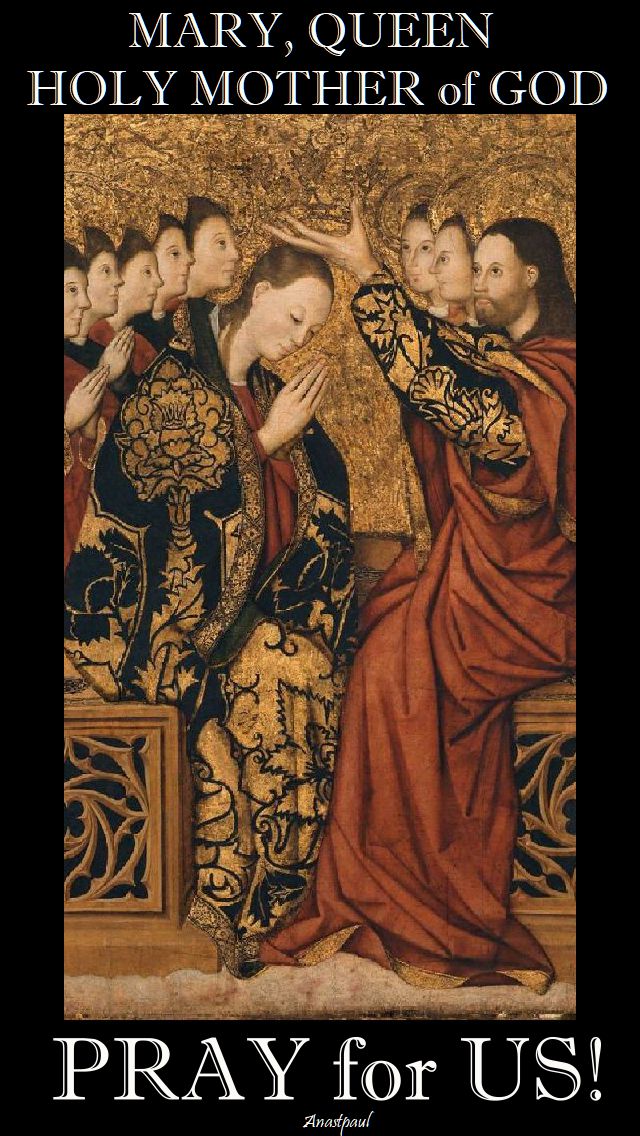
Mary our Queen, Holy Mother of God
By St Anthony of Padua (1195-1231) Evangelical Doctor

Mary, our Queen,
Holy Mother of God,
we beg you to hear our prayer.
Make our hearts overflow with divine grace
and resplendent with heavenly wisdom.
Render them strong with your might
and rich in virtue.
Pour down upon us the gift of mercy
so that we may obtain the pardon of our sins.
Help us to live in such a way
as to merit the glory and bliss of heaven.
May this be granted us by your Son Jesus
who has exalted you above the angels,
has crowned you as Queen,
and has seated you with Him
forever on His refulgent throne.
Amen.

mary our queen, holy mother of god by st anthony of padua.2

Posted in CONFESSION/PENANCE, EUCHARISTIC Adoration, franciscan OFM, MORNING Prayers, QUOTES of the SAINTS, SAINT of the DAY, The BLESSED VIRGIN MARY, The HOLY EUCHARIST / The HOLY MASS

Thought for the Day – 14 August – The Memorial of St Maximillian Kolbe

Thought for the Day – 14 August – The Memorial of St Maximillian Kolbe

St Maximilian’s “Secret” to Holiness and Happiness

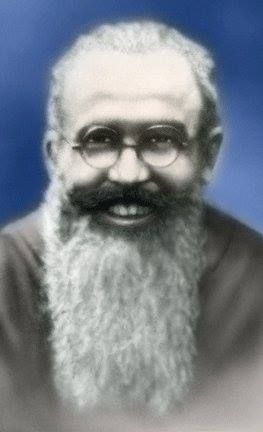
smiling kolbe

St. Maximilian says:  “It is a false and widely diffused idea that the saints were not like us.   They were also subject to temptation, they fell and got up, they also felt overwhelmed with sadness, weakened and paralyzed by discouragement.   But remember the words of the Saviour:  ‘Without me, you can do nothing’ (Jn 15:51) and those of St. Paul:  ‘I can do all things in him who strengthens me’ (Phil 4:13).   Not confiding in themselves, but, putting all their confidence in God after every humiliating fall, they repented sincerely, they purified their soul in the Sacrament of Penance and then they went back to work with still greater fervour.”
We are very much deceived if we think we cannot become a saint, or that we will be “lucky” if we even make it to Purgatory.   The great men of the world overcome all kinds of obstacles in order to become rich or famous.   Why do we not try harder to persevere, when that is precisely what Our Blessed Lord deserves?   After all, He poured Himself out for us so that we might be holy.   The saints were not supermen; they were sinners who persevered through hardship and adversity because they were humble and repentant and confident in God’s grace.”…(Fr Angelo M. Geiger F.I.)
In the end, holiness is not merely a warm feeling of God’s presence or even the ecstatic experiences of the saints.   St Maximilian tells us that true holiness is found in obedience and obedience is acquired through prayer, penance and perseverance.
And this obedience consists in living – truly living the life of a Catholic, St Maximillian said his own words):

“Go to confession with sincerity, diligence, a deep sorrow for his sins and a firm resolve to amend his life. He will suddenly feel a peace and happiness compared with which all the fleeting, unworthy pleasures of this world are really an odious torment.

Let everyone seek to come and receive Jesus in the Holy Eucharist with proper preparation.

Go to Eucharistic Adoration – for this is the the most important activity.

Let him never permit his soul to remain in sin but let him purify it immediately.

Let him do his duty manfully.

Let him address humble and frequent prayers to God’s throne, especially through the hands of the Immaculate Virgin.

Let him welcome his brethren with a charitable heart, bearing for God’s sake the sufferings and difficulties of life.

Let him do good to all, even his enemies, solely for the love of God and not in order to be praised or even thanked by men.”

Then we will come to understand what it means to have a foretaste of paradise;  and perhaps more than once we will find peace and joy even in poverty, suffering, disgrace, or illness.

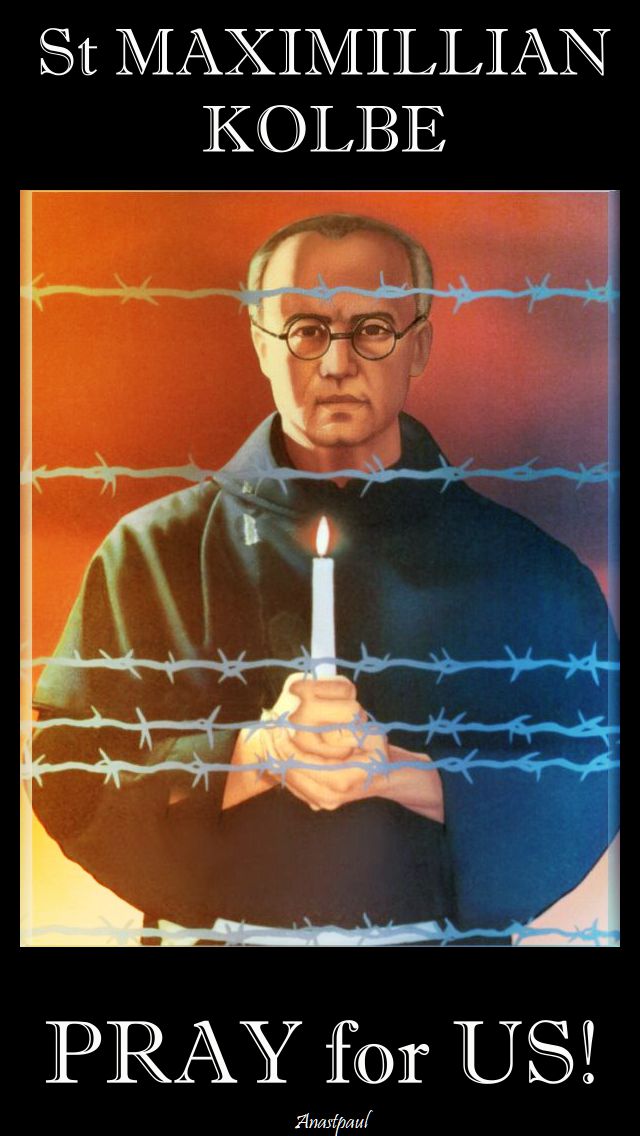
St Maximillian, pray for us!

st max pray for us

Posted in EUCHARISTIC Adoration, franciscan OFM, MORNING Prayers, QUOTES of the SAINTS, QUOTES on SUFFERING, SAINT of the DAY, The BLESSED VIRGIN MARY, The HOLY EUCHARIST / The HOLY MASS

Quote/s of the Day – 14 August – The Memorial of St Maximillian Kolbe

Quote/s of the Day – 14 August – The Memorial of St Maximillian Kolbe

“If angels could be jealous of men,
they would be so, for one reason:
HOLY COMMUNION.”

if angels could be jealous of men - st maximillian kolbe

“Jesus honoured her before all ages
and will honour her for all ages.
No one comes to Him, nor even near Him,
no one is saved or sanctified,
if he too will not honour her.
This is the lot of Angels and of men.”

jesus honoured her before all ages - st maximillian kolbe

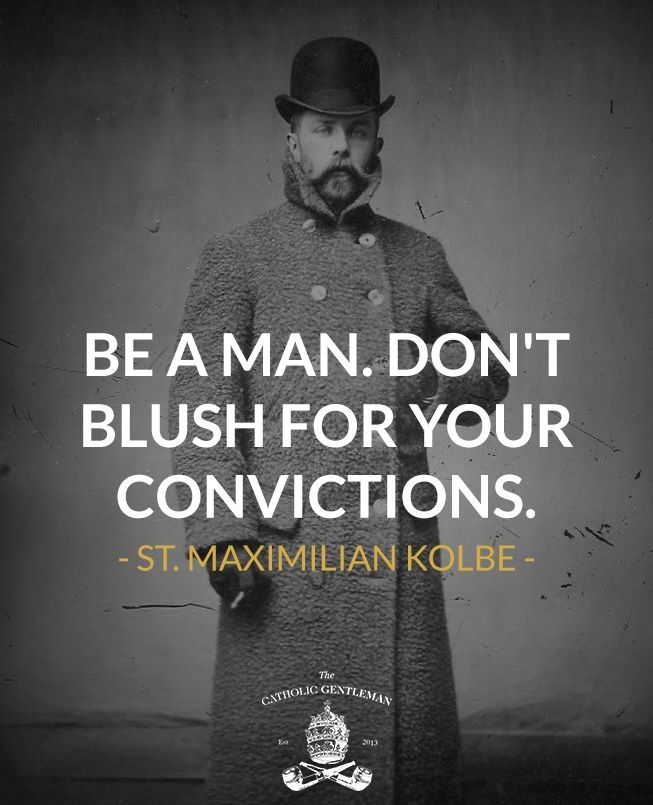
“Be a man! Don’t blush for your convictions.”

be a man! don't blush for your convictions - st maximillian kolbe

“Let us remember, that love lives through sacrifice
and is nourished by giving.
Without sacrifice, there is no love.”

remember that love lives through sacrifice - st maximillian kolbe

“My aim is to institute perpetual adoration,
for this is the the most important activity.”

my aim is to institute - st maximillian kolbe

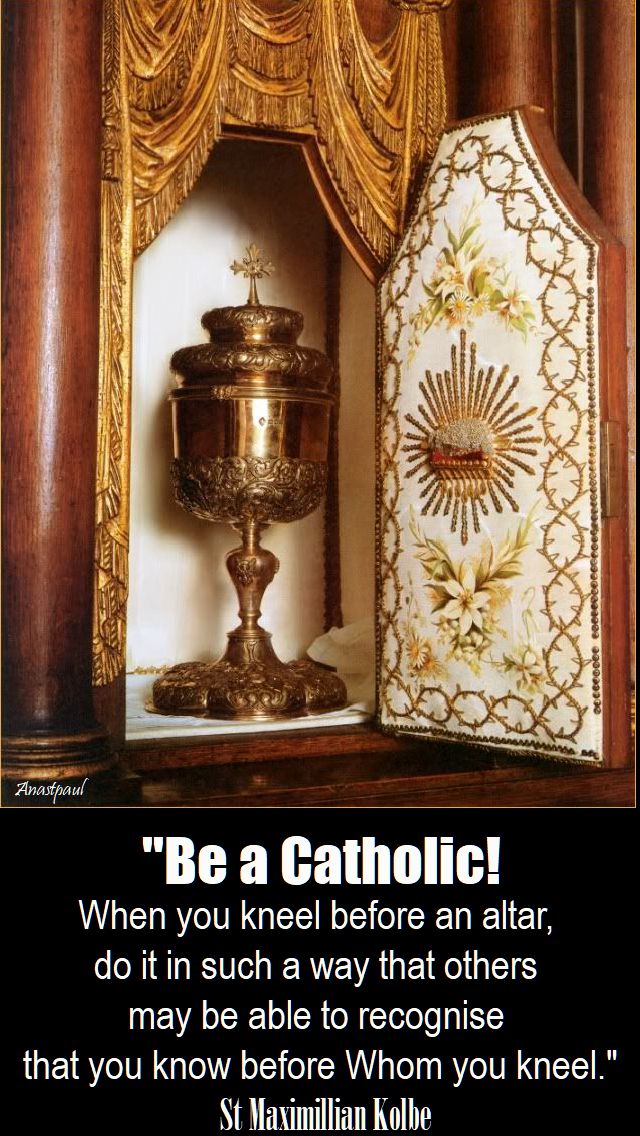
“Be a Catholic!
When you kneel before an altar,
do it in such a way that others
may be able to recognise
that you know before Whom you kneel.”

be a catholic - st maximillian kolbe

St Maximilian Kolbe

Posted in franciscan OFM, MORNING Prayers, QUOTES of the SAINTS, The BLESSED VIRGIN MARY, The WORD

One Minute Reflection – 14 August – The Memorial of St Maximillian Kolbe

One Minute Reflection – 14 August – The Memorial of St Maximillian Kolbe

Mine are counsel and advice; mine is strength; I am understanding….Proverbs 8:14

Proverbs 8-14

REFLECTION – “When we dedicate ourselves to Mary, we become instruments in her hands, just as she is an instrument in God’s hands.   Let us then be guided by her, for she will provide for the needs of body and soul and overcome all difficulties and anxieties.”…St Maximillian Kolbe

when we dedicate ourselves to Mary - st maximillian kolbe

PRAYER – My Lord and my God, You who are the fruit of Mary’s blessed womb and the most Divine Son of our Father, grant that I may always have recourse to You, through her who bore You. Grant that she may help and comfort me and lead me to You. Mary, Holy and loving Mother of God, pray for us all, amen

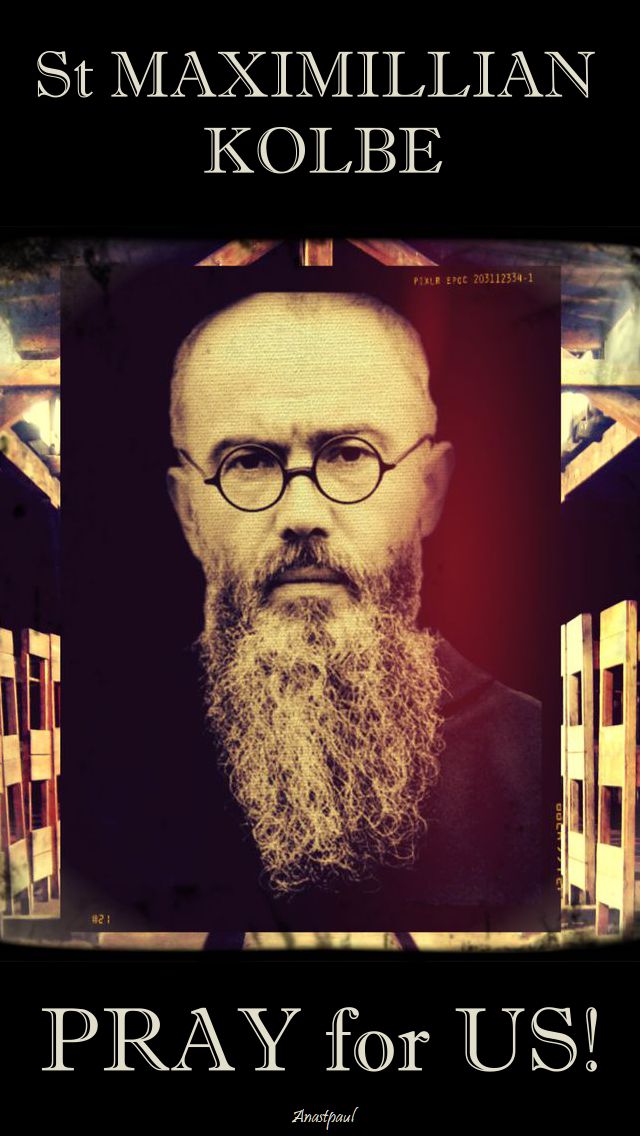
st maximillian - pray for us

Posted in CONSECRATION Prayers, franciscan OFM, MORNING Prayers, SAINT of the DAY, The BLESSED VIRGIN MARY

Our Morning Offering – 14 August

Our Morning Offering – 14 August

Consecration to the Immaculata – By St Maximillian Kolbe

O Immaculata, Queen of Heaven and earth,
Refuge of sinners and our most loving Mother,
God has willed to entrust the entire order of mercy to you.
I, ……………(name), a repentant sinner,
cast myself at your feet, humbly imploring you
to take me with all that I am and have,
wholly to yourself as your possession and property.
Please make of me, of all my powers of soul and body,
of my whole life, death and eternity, whatever most pleases you.
If it pleases you, use all that I am and have without reserve,
wholly to accomplish what was said of you:
“She will crush your head,” and
“You alone have destroyed all heresies in the whole world.”
Let me be a fit instrument in your immaculate and merciful hands
for introducing and increasing your glory to the maximum
in all the many strayed and indifferent souls
and thus help extend as far as possible,
the blessed kingdom of the most Sacred Heart of Jesus.
For wherever you enter you obtain the grace of conversion
and growth in holiness, since it is through your hands
that all graces come to us from the most Sacred Heart of Jesus.
Allow me to praise you, O Sacred Virgin
Give me strength against your enemies
Amen

A shorter version of the prayer can be used for the daily renewal of the consecration:

Daily Consecration Renewal to the Immaculata
By St Maximillian Kolbe

Immaculata, Queen and Mother of the Church,
I renew my consecration to you for this day
and for always, so that you might use me
for the coming of the Kingdom of Jesus in the whole world.
To this end, I offer you all my prayers,
actions and sacrifices of this day.
Amen

daily consecration renewal to the immaculata by st maximillian kolbe

Posted in franciscan OFM, SAINT of the DAY

Saint of the Day – 14 August – St Maximillian Kolbe OFM Conv – “MARTYR of CHARITY” and “Apostle of Consecration to Mary”

Saint of the Day – 14 August – St Maximillian Kolbe OFM Conv – “MARTYR of Charity” and “Apostle of Consecration to Mary”- Born Maksymilian Maria Kolbe(7 January 1894 at Zdunska Wola, Poland as Raymond Kolbe – 14 August 1941 by lethal carbonic acid injection after three weeks of starvation and dehydration at the Auschwitz, Poland death camp).   His body was burned in the ovens and the ashes scattered.   Some relics have been preserved and distributed by the friars at Niepokalanów, Poland.   He was Beatified on 17 October 1971 by Pope Paul VI – his beatification miracles include the July 1948 cure of intestinal tuberculosis of Angela Testoni and August 1950 cure of calcification of the arteries/sclerosis of Francis Ranier.   He was Canonised on 10 October 1982 by St Pope John Paul II, who declared him a ‘Martyr of Charity.’   Patronages – drug addicts, political prisoners, families, journalists, prisoners, amateur radio, the pro-life movement, Esperanto.  St John Paul II declared him “The Patron Saint of Our Difficult Century”. Due to Kolbe’s efforts to promote consecration and entrustment to Mary, he is known as the “Apostle of Consecration to Mary”.

Childhood
Maximilian Kolbe was born on 8 January 1894 in Zduńska Wola, in the Kingdom of Poland, which was a part of the Russian Empire, the second son of weaver Julius Kolbe and midwife Maria Dąbrowska.   His father was an ethnic German and his mother was Polish. He had four brothers.

Kolbe’s life was strongly influenced in 1906 by a childhood vision of the Virgin Mary. He later described this incident:  “That night I asked the Mother of God what was to become of me.   Then she came to me holding two crowns, one white, the other red.   She asked me if I was willing to accept either of these crowns.   The white one meant that I should persevere in purity and the red that I should become a martyr.  I said that I would accept them both.”

Franciscan Friar
In 1907, Kolbe and his elder brother Francis joined the Conventual Franciscans.   They enrolled at the Conventual Franciscan minor seminary in Lwow later that year.   In 1910, Kolbe was allowed to enter the novitiate, where he was given the religious name Maximilian.   He professed his first vows in 1911 and final vows in 1914, adopting the additional name of Maria.   He was sent to Rome in 1912, where he attended the Pontifical Gregorian University.   He earned a doctorate in philosophy in 1915 there. From 1915 he continued his studies at the Pontifical University of St Bonaventure where he earned a doctorate in theology in 1919 or 1922 (sources vary).   He was active in the consecration and entrustment to Mary.   During his time as a student, he witnessed vehement demonstrations against Popes St. Pius X and Benedict XV in Rome during an anniversary celebration by the Freemasons.   According to Kolbe:

“They placed the black standard of the “Giordano Brunisti” under the windows of the Vatican.   On this standard the archangel, St Michael, was depicted lying under the feet of the triumphant Lucifer.   At the same time, countless pamphlets were distributed to the people in which the Holy Father was attacked shamefully.”

Soon afterward, Kolbe organised the Militia Immaculatae (Army of the Immaculate One), to work for conversion of sinners and enemies of the Catholic Church, specifically the Freemasons, through the intercession of the Virgin Mary.   So serious was Kolbe about this goal that he added to the Miraculous Medal prayer:

“O Mary, conceived without sin, pray for us who have recourse to thee.   And for all those who do not have recourse to thee;  especially the Masons and all those recommended to thee.”


In 1918, Kolbe was ordained a priest.   In July 1919 he returned to the newly independent Poland, where he was active in promoting the veneration of the Immaculate Virgin Mary. He was strongly opposed to leftist – in particular, communist – movements.   From 1919 to 1922 he taught at the Kraków seminary.   Around that time, as well as earlier in Rome, he suffered from tuberculosis, which forced him to take a lengthy leave of absence from his teaching duties.   In January 1922 he founded the monthly periodical Rycerz Niepokalanej (Knight of the Immaculate), a devotional publication based on French Le Messager du Coeur de Jesus (Messenger of the Heart of Jesus).    From 1922 to 1926 he operated a religious publishing press in Grodno.   As his activities grew in scope, in 1927 he founded a new Conventual Franciscan monastery at Niepokalanów near Warsaw, which became a major religious publishing center.   A junior seminary was opened there two years later.

Between 1930 and 1936, Kolbe undertook a series of missions to East Asia.   At first, he arrived in Shanghai, China but failed to gather a following there.   Next, he moved to Japan, where by 1931 he founded a monastery at the outskirts of Nagasaki (it later gained a novitiate and a seminary) and started publishing a Japanese edition of the Knight of the Immaculate.   The monastery he founded remains prominent in the Roman Catholic Church in Japan.   Kolbe built the monastery on a mountainside that, according to Shinto beliefs, was not the side best suited to be in harmony with nature.   When the atomic bomb was dropped on Nagasaki, Kolbe’s monastery was saved because the other side of the mountain took the main force of the blast.   In mid-1932 he left Japan for Malabar, India, where he founded another monastery;  this one however closed after a while.   Meanwhile, the monastery at Niepokalanów began in his absence to publish the daily newspaper, Mały Dziennik (The Little Daily), in alliance with the political group, the National Radical Camp (Obóz Narodowo Radykalny).   This publication reached a circulation of 137,000, and nearly double that, 225,000, on weekends.

Death at Auschwitz
After the outbreak of World War II, which started with the invasion of Poland by Germany, Kolbe was one of the few brothers who remained in the monastery, where he organised a temporary hospital.   After the town was captured by the Germans, he was briefly arrested by them on 19 September 1939 but released on 8 December.   He refused to sign the Deutsche Volksliste, which would have given him rights similar to those of German citizens in exchange for recognising his German ancestry.   Upon his release he continued work at his monastery, where he and other monks provided shelter to refugees from Greater Poland, including 2,000 Jews whom he hid from German persecution in their friary in Niepokalanów.   Kolbe also received permission to continue publishing religious works, though significantly reduced in scope.   The monastery thus continued to act as a publishing house, issuing a number of anti-Nazi German publications.   On 17 February 1941, the monastery was shut down by the German authorities.   That day Kolbe and four others were arrested by the German Gestapo and imprisoned in the Pawiak prison.   On 28 May, he was transferred to Auschwitz as prisoner #16670.

Continuing to act as a priest, Kolbe was subjected to violent harassment, including beating and lashings and once had to be smuggled to a prison hospital by friendly inmates.   At the end of July 1941, three prisoners disappeared from the camp, prompting SS-Hauptsturmführer Karl Fritzsch, the deputy camp commander, to pick 10 men to be starved to death in an underground bunker to deter further escape attempts.   When one of the selected men, Franciszek Gajowniczek, cried out, “My wife! My children!”, Kolbe volunteered to take his place.  (The last pic below with St John Paul is at the Canonisation of St Maximillian).

According to an eye witness, an assistant janitor at that time, in his prison cell, Kolbe led the prisoners in prayer to Our Lady.   Each time the guards checked on him, he was standing or kneeling in the middle of the cell and looking calmly at those who entered. After two weeks of dehydration and starvation, only Kolbe remained alive.   “The guards wanted the bunker emptied, so they gave Kolbe a lethal injection of carbolic acid.   Kolbe is said to have raised his left arm and calmly waited for the deadly injection.” His remains were cremated on 15 August, the feast day of the Assumption of Mary.

Kolbe’s influence has found fertile ground in his own Order of Conventual Franciscan friars, in the form of continued existence of the Militia Immaculatae movement.   In recent years new religious and secular institutes have been founded, inspired from this spiritual way.   Among these the Missionaries of the Immaculate Mary – Father Kolbe, the Franciscan Friars of Mary Immaculate, and a parallel congregation of Religious Sisters, and others.   The Franciscan Friars of Mary Immaculate are even taught basic Polish so they can sing the traditional hymns sung by Kolbe, in the saint’s native tongue.   According to the friars,

“Our patron, St. Maximilian Kolbe, inspires us with his unique Mariology and apostolic mission, which is to bring all souls to the Sacred Heart of Christ through the Immaculate Heart of Mary, Christ’s most pure, efficient and holy instrument of evangelisation – especially those most estranged from the Church.”

Kolbe’s views into Marian theology echo today through their influence on Vatican II.   His image may be found in churches across Europe.   Several churches in Poland are under his patronage, such as the Sanctuary of Saint Maxymilian in Zduńska Wola or the Church of Saint Maxymilian Kolbe in Szczecin.   A museum, Museum of St. Maximilian Kolbe “There was a Man”, was opened in Niepokalanów in 1998.

In 1963 Rolf Hochhuth published a play significantly influenced by Kolbe’s life and dedicated to him, The Deputy.   In 2000, the National Conference of Catholic Bishops (U.S.) designated Marytown, home to a community of Conventual Franciscan friars, as the National Shrine of St. Maximilian Kolbe.   Marytown is located in Libertyville, Illinois, and also features the Kolbe Holocaust Exhibit.   In 1991, Krzysztof Zanussi released a Polish film about the life of Kolbe.   The Polish Senate declared the year 2011 to be the year of St Maximilian Kolbe.

First-class relics of Kolbe exist, in the form of hairs from his head and beard, preserved without his knowledge by two friars at Niepokalanów who served as barbers in his friary between 1930 and 1941.   Since his beatification in 1971, more than 1,000 such relics have been distributed around the world for public veneration.   Second-class relics such as his personal effects, clothing and liturgical vestments, are preserved in his monastery cell and in a chapel at Niepokalanów and may be viewed by visitors.

St Maximillian Pray for us!

 

Posted in franciscan OFM, MORNING Prayers, PRAYERS of the CHURCH, PRAYERS of the SAINTS, SAINT of the DAY, The HOLY EUCHARIST / The HOLY MASS

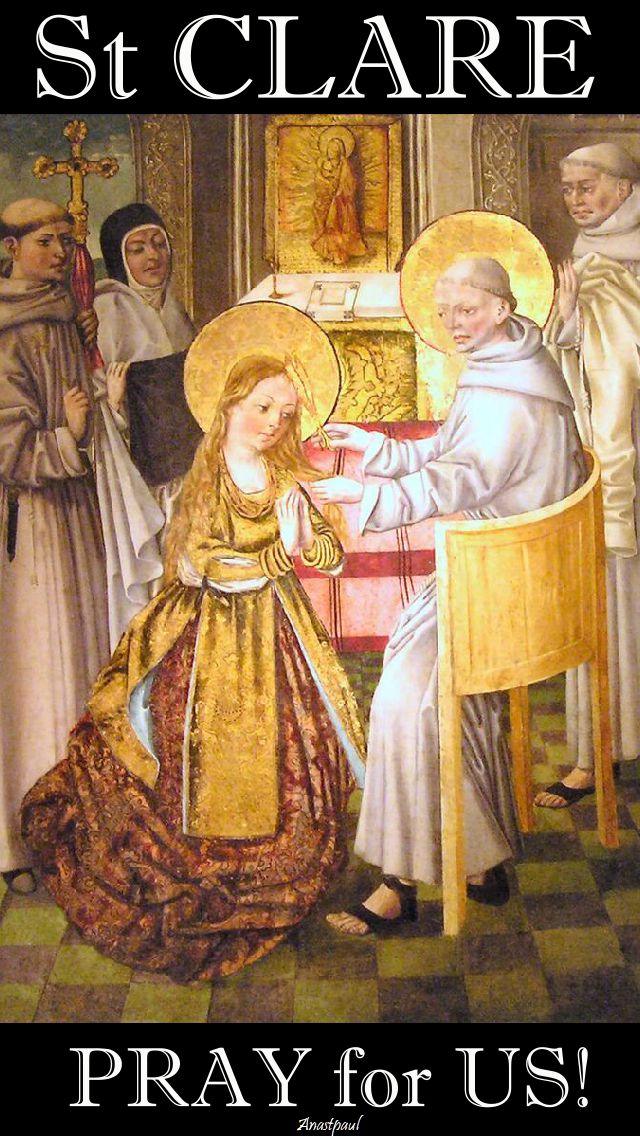
Thought for the Day – 11 August – The Memorial of St Clare of Assisi Clare (a name meaning “shining with light”)

Thought for the Day – 11 August – The Memorial of St Clare of Assisi

Clare (a name meaning “shining with light”)

The 41 years of Clare’s religious life are a model of piety and sanctity.   She demonstrated an indomitable resolve to lead the simple, literal gospel life as Francis taught her, resisting worldly pressures to dilute the rules of her order.   Through her commitment to the Gospel and her unwavering life of prayer, Clare established a new manner for women to live in community and serve the Lord—one of poverty and humility, service and contemplation, and generous concern for others.   Saint Clare continues to inspire us today through the example set forth in her life, as well as her writings which survive her.

Her life is one of simple focus.   From an early age she dedicated herself to the Lord and through a lifetime of humility, service, obedience, patient suffering, prayer and contemplation, Clare refined her being into a “model of perfection.”   Miracles aside, the daily life of poverty and labour resonates today, reminding us of the Lord’s call to us:  “He who is last shall be first.”   Saint Clare depended completely on the Lord, looking to the Eucharist as a source of joy and sustenance and never taking the gifts of God for granted.   Today, on her feast day, we might slow down and contemplate our relationship with the Lord, our dependence, the value we place upon our Eucharistic gift and privilege.   How well do we live the advice of Saint Clare:  “Totally love Him, Who gave Himself totally for your love.”

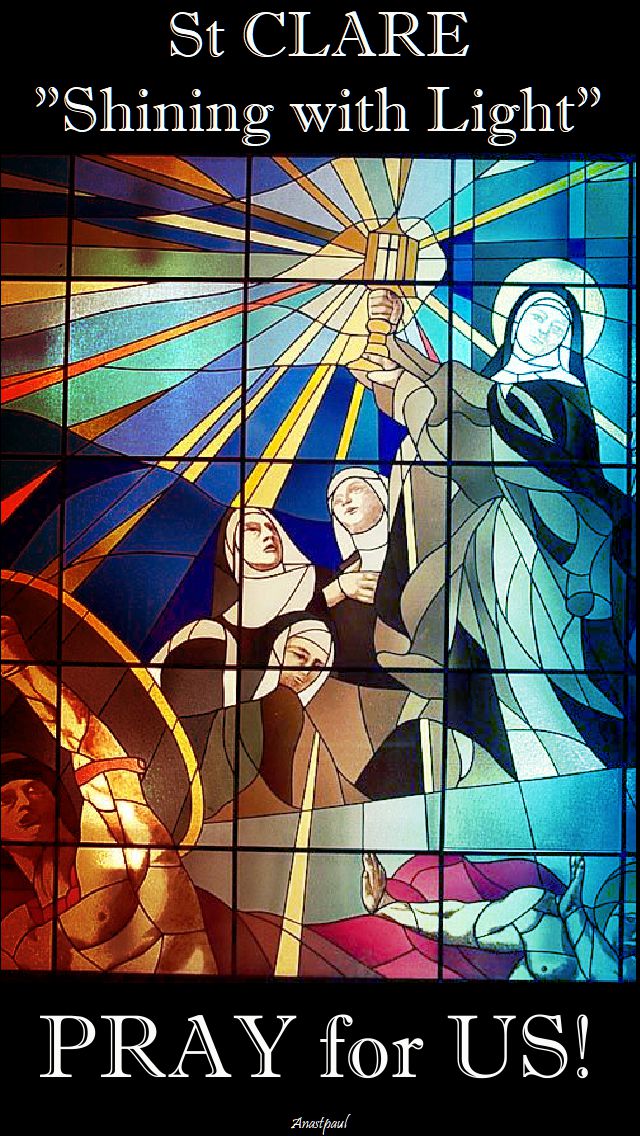
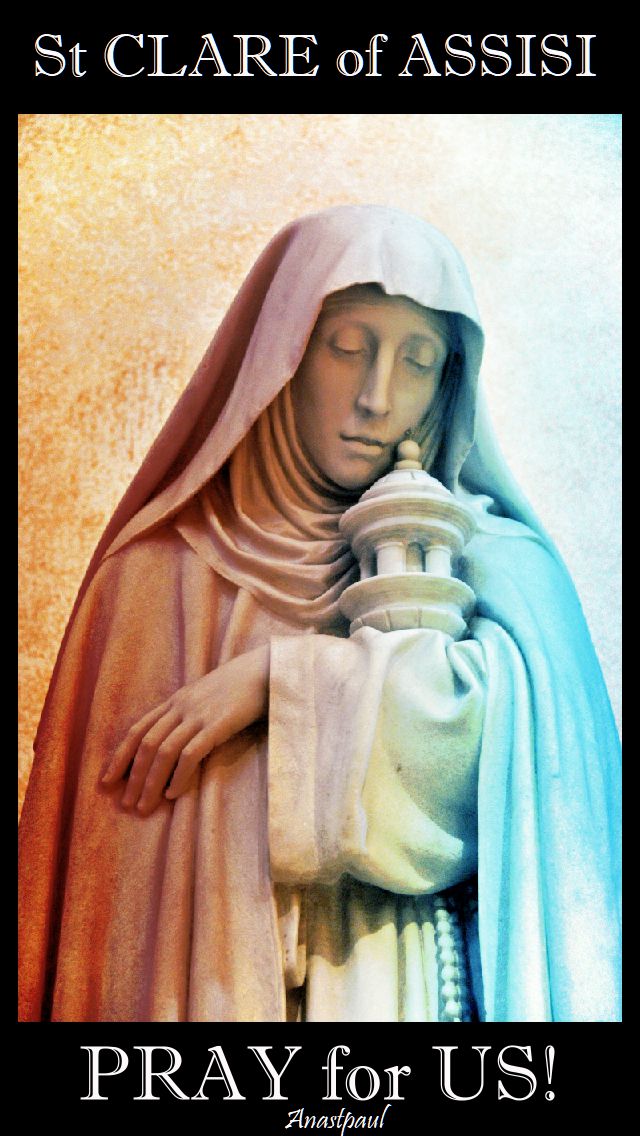
St Clare, shining with light – Pray for us!

ST CLARE PRAY FOR US 2

O wondrous blessed clarity of Clare!
In life she shone to a few;
after death she shines on the whole world!
On earth she was a clear light;
Now in heaven she is a brilliant sun.

O how great the vehemence of the
brilliance of this clarity!
On earth this light was indeed kept
within cloistered walls,
yet shed abroad its shining rays;
It was confined within a convent cell,
yet spread itself through the wide world.

– Pope Innocent IV

st clare pray for us 3


Posted in EUCHARISTIC Adoration, franciscan OFM, MORNING Prayers, QUOTES of the SAINTS, SAINT of the DAY, The BLESSED VIRGIN MARY, The HOLY EUCHARIST / The HOLY MASS

Quote/s of the Day – 11 August – The Memorial of St Clare of Assisi

Quote/s of the Day – 11 August – The Memorial of St Clare of Assisi

“He, Christ, is the splendour of eternal glory, “the brightness of eternal light and the mirror without cloud.”
Behold, I say, the birth of this mirror. Behold Christ’s poverty even as he was laid in the manger and wrapped in swaddling clothes. What wondrous humility, what marvellous poverty!
The King of angels, the Lord of heaven and earth resting in a manger!
Look more deeply into the mirror and meditate on His humility, or simply on His poverty.
Behold the many labours and sufferings He endured to redeem the human race.
Then, in the depths of this very mirror, ponder His unspeakable love which caused Him to suffer on the wood of the cross and to endure the most shameful kind of death.
The mirror Himself, from His position on the cross, warned passers-by to weigh carefully this act, as He said:
“All of you who pass by this way, behold and see if there is any sorrow like mine.”
Let us answer His cries and lamentations with one voice and one spirit:
“I will be mindful and remember and my soul will be consumed within me.”

Gerard_Seghers_-_St._Clare_and_St._Francis_of_Assisi_in_adoration_before_the_Child_Jesus
Gerard Seghers – St. Clare and St. Francis of Assisi in adoration before the Child Jesus.

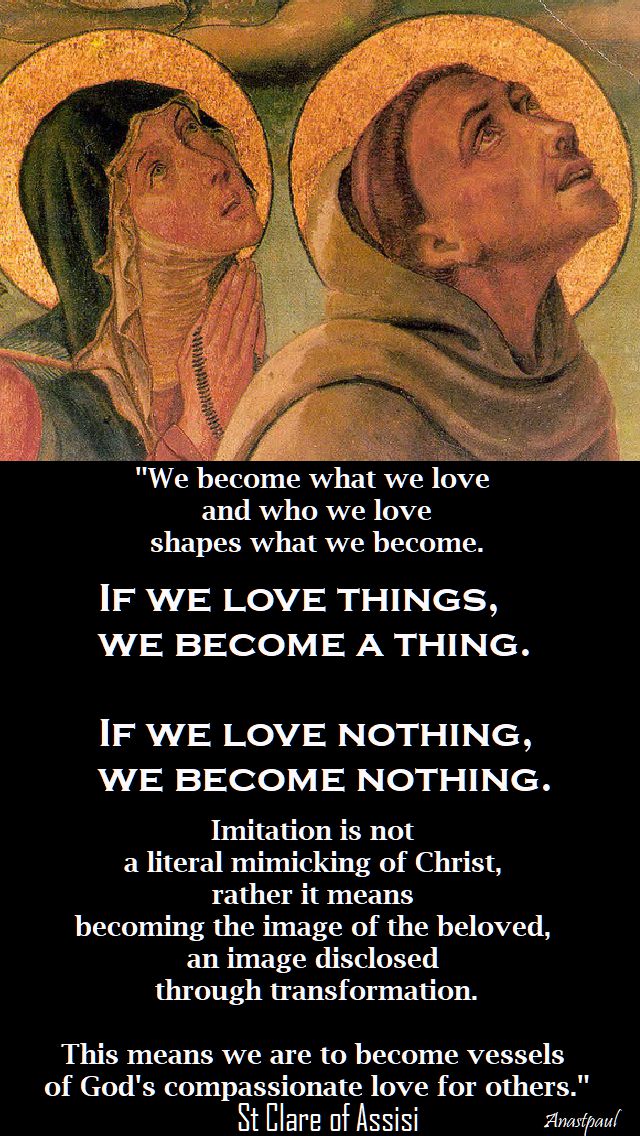
“We become what we love and who we love shapes what we become.
If we love things, we become a thing.
If we love nothing, we become nothing.
Imitation is not a literal mimicking of Christ,
rather it means becoming the image of the beloved,
an image disclosed through transformation.
This means we are to become vessels of God’s
compassionate love for others.”

St Clare’s second letter to Blessed Agnes of Prague

we become what we love - st clare

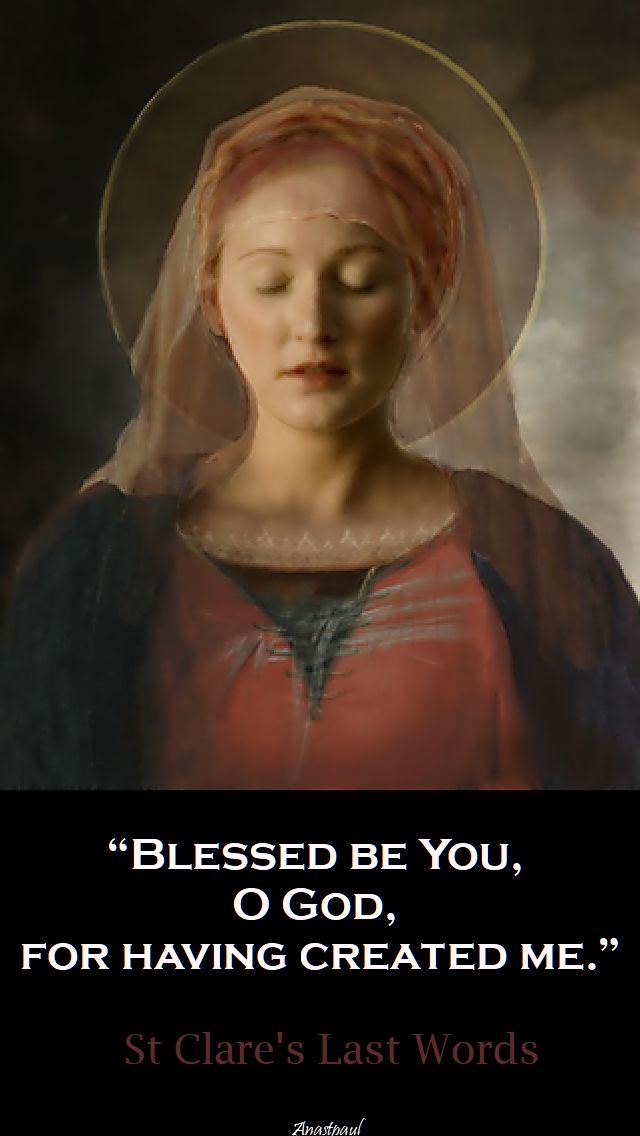
“ Blessed be You, O God, for having created me. ”

St Clare’s Last Words

blessed be you o god - st clare

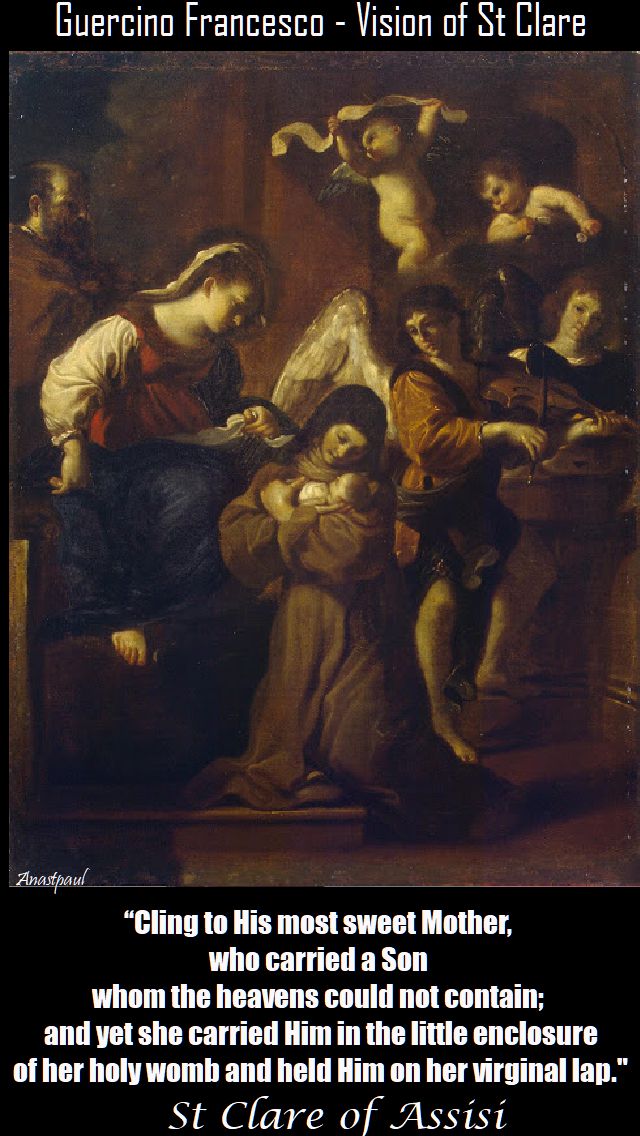
“Cling to His most sweet Mother,
who carried a Son whom the heavens could not contain;
and yet she carried Him in the little enclosure of her holy womb
and held Him on her virginal lap.”

cling to his most sweet Mother - st clare

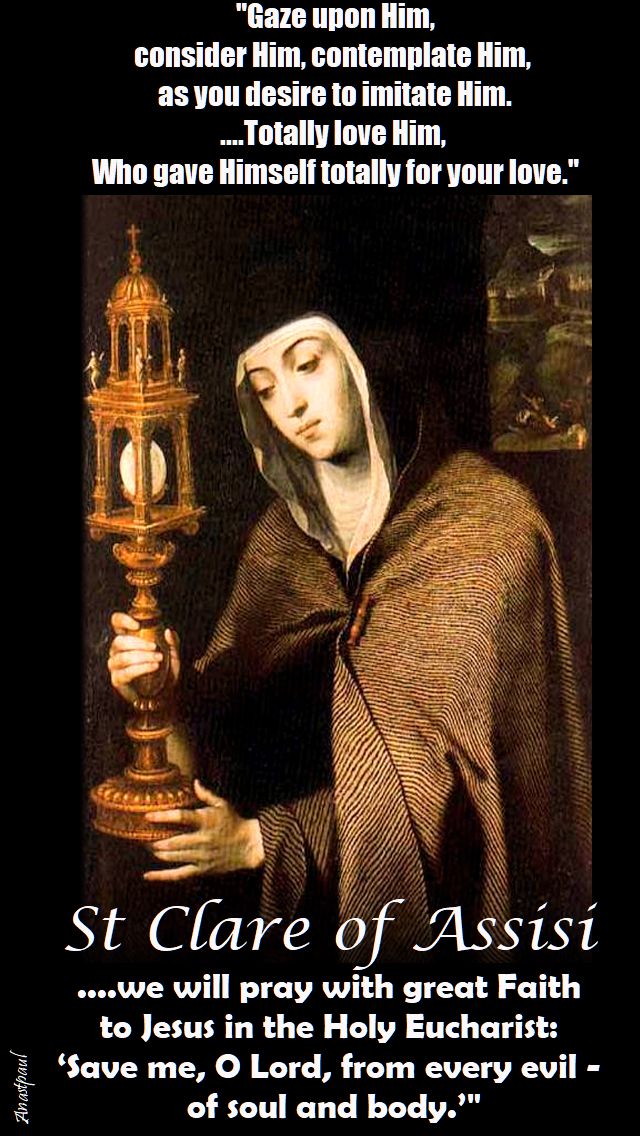
“Gaze upon Him, consider Him, contemplate Him, 
as you desire to imitate Him.
….Totally love Him, Who gave Himself totally for your love.”

“They say that we are too poor
but can a heart which possesses the infinite God be truly called poor?
We should remember this miracle of the Blessed Sacrament when in Church.
Then we will pray with great Faith to Jesus in the Holy Eucharist:
‘Save me, O Lord, from every evil – of soul and body.’”

St Clare of Assisi

gaze upon Him, consider Him - st clare

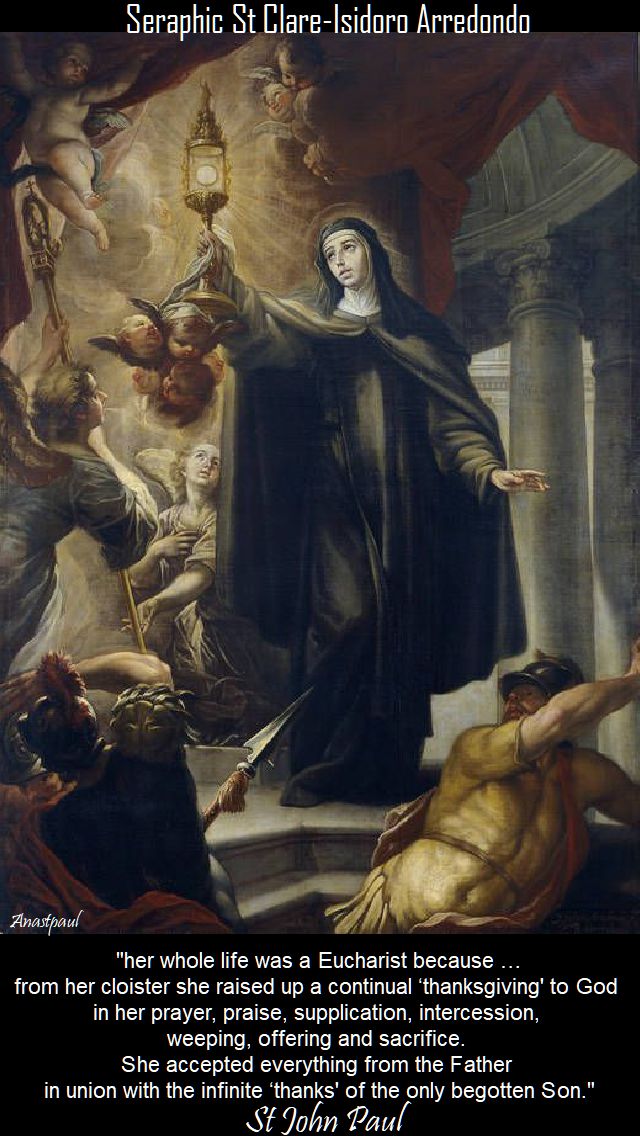
St Pope John Paul II said of Saint Clare: 

“her whole life was a Eucharist because …
from her cloister she raised up a continual ‘thanksgiving’ to God 
in her prayer, praise, supplication, intercession, weeping, offering and sacrifice. 

She accepted everything from the Father in union with the infinite ‘thanks’ of the only begotten Son.

her whole life was a Eucharist - st john paul


Posted in franciscan OFM, MORNING Prayers, QUOTES of the SAINTS, SAINT of the DAY, The WORD

One Minute Reflection – 11 August – The Memorial of St Clare of Assisi

One Minute Reflection – 11 August – The Memorial of St Clare of Assisi

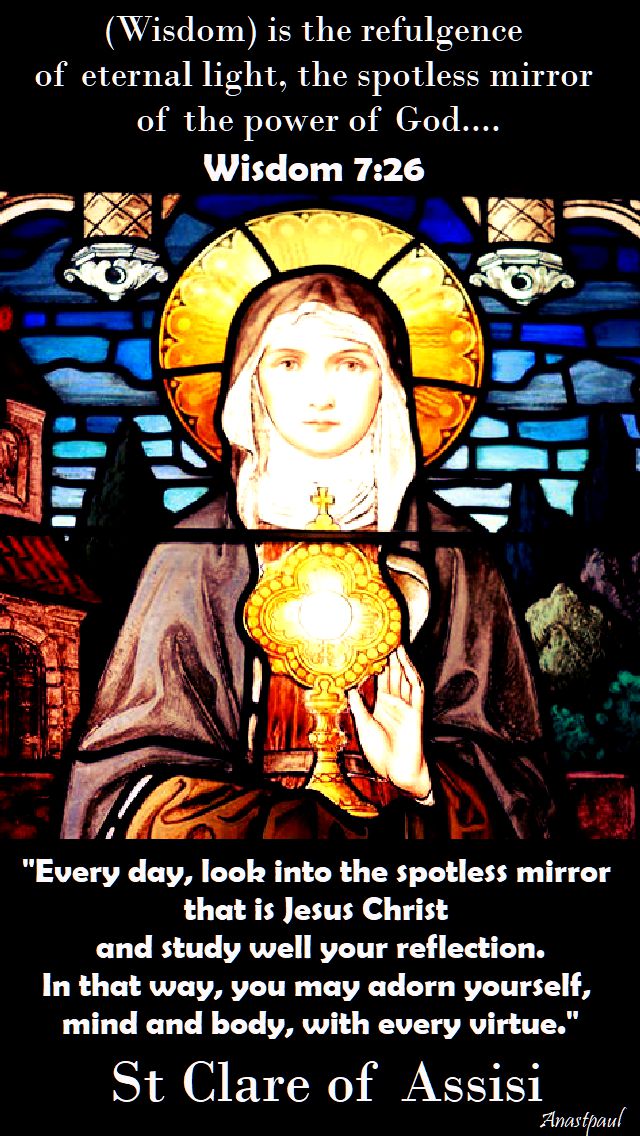
(Wisdom) is the refulgence of eternal light,
the spotless mirror of the power of God….Wisdom 7:26

REFLECTION – “Every day, look into the spotless mirror that is Jesus Christ and study well your reflection.
In that way, you may adorn yourself, mind and body, with every virtue.”…St Clare of Assisi

every day look into the spotless mirror - st clare of assisi

PRAYER – Lord Jesus, help me to dwell often on the manner in which I am following You. Let me strive each day to become more and more like You in all things and eventually, to become the light of You to all the world around me. St Clare of Assisi, you who were a light to all those around you, pray for us, amen.

st clare of assisi - pray for us

Posted in franciscan OFM, MORNING Prayers, PRAYERS of the CHURCH, SAINT of the DAY

Our Morning Offering – 11 August

Our Morning Offering – 11 August

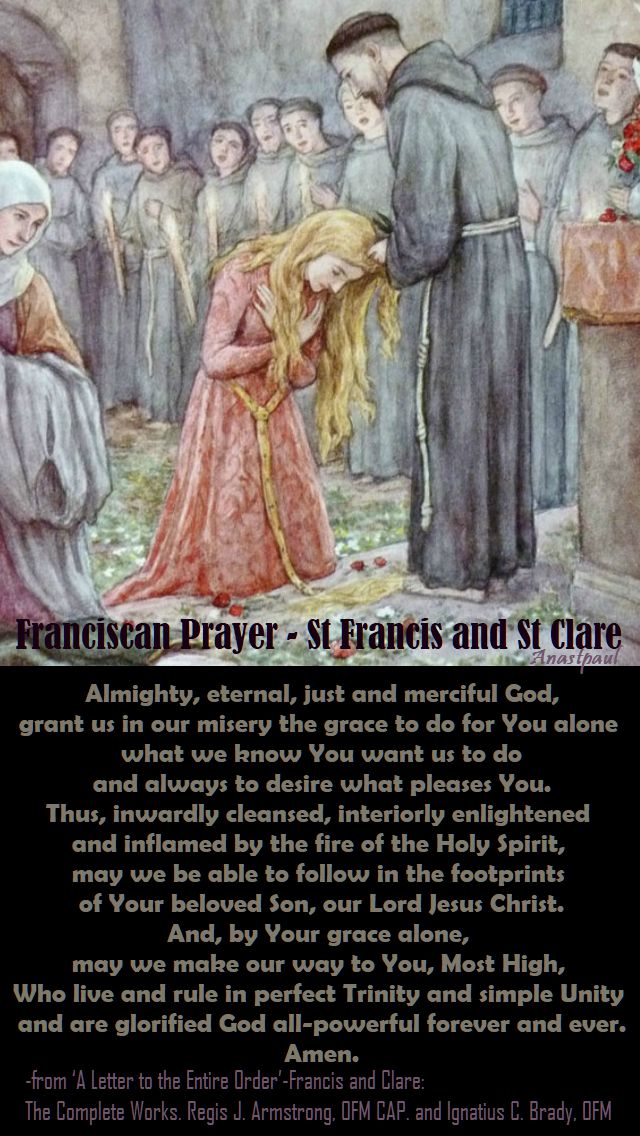
Franciscan Prayer
St Francis and St Clare

Almighty, eternal, just and merciful God,
grant us in our misery the grace to do for You alone
what we know You want us to do
and always to desire what pleases You.
Thus, inwardly cleansed, interiorly enlightened
and inflamed by the fire of the Holy Spirit,
may we be able to follow in the footprints
of Your beloved Son, our Lord Jesus Christ.
And, by Your grace alone,
may we make our way to You, Most High,
Who live and rule in perfect Trinity and simple Unity
and are glorified God all-powerful forever and ever.
Amen.

-from ‘A Letter to the Entire Order’
Francis and Clare: The Complete Works. Regis J. Armstrong, OFM
CAP. and Ignatius C. Brady, OFM

almighty eternal just and merciful god - st francis and st clare

Posted in EYES - Diseases, of the BLIND, franciscan OFM, INCORRUPTIBLES, MORNING Prayers, PATRONAGE - TELEVISION

Saint of the Day – 11 August – St Clare of Assisi (1194-1253)

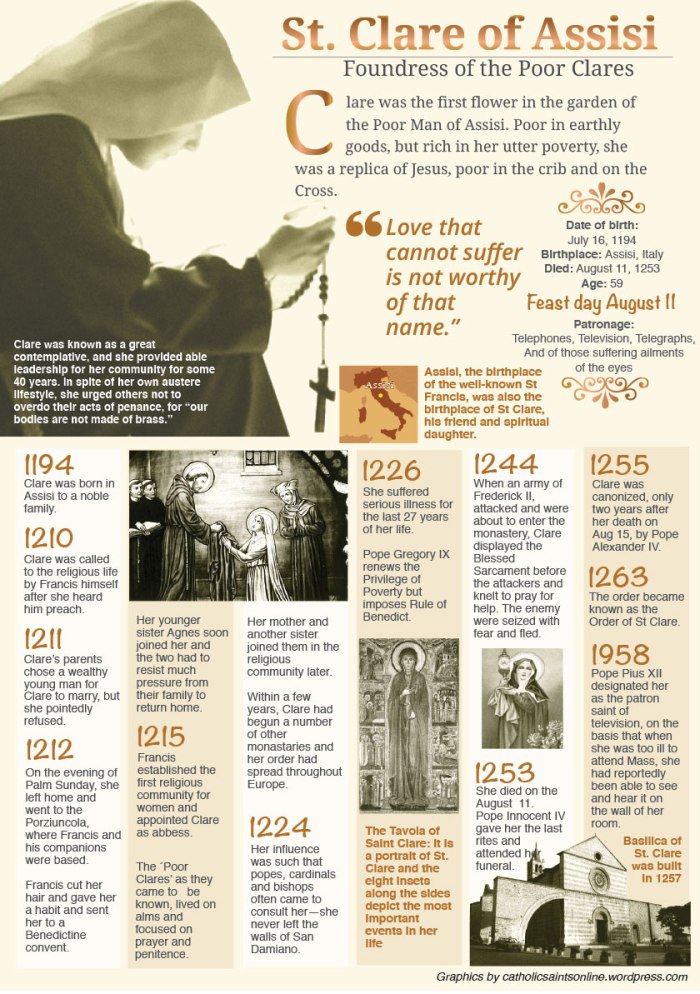
Saint of the Day – 11 August – St Clare of Assisi (1194-1253) – Virgin, Religious, Founder, Mystic, Friend and Follower of St Francis, Miracle-Worker – (16 July 1194 at Assisi, Italy – 11 August 1253 of natural causes).   St Clare was Canonised on 26 September 1255 by Pope Alexander IV.   St Clare was born Chiara Offreduccio (sometimes spelled Clair, Claire, etc.) is an Italian saint and one of the first followers of Saint Francis of Assisi.   She founded the Order of Poor Ladies, a monastic religious order for women in the Franciscan tradition and wrote their Rule of Life, the first set of monastic guidelines known to have been written by a woman.    Following her death, the Order she founded was renamed in her honour as the Order of Saint Clare, commonly referred to today as the Poor Clares.   Patronages – embroiderers, needle workers, eyes, against eye disease, for good weather, gilders, gold workers, goldsmiths, laundry workers, television (proclaimed on 14 February 1958 by Pope Pius XII because when St Clare was too ill to attend the Holy Mass, she had been able to see and hear it, on the wall of her room.), television writers, Poor Clares, Assisi, Italy, Santa Clara Indian Pueblo.  st-clare-of-assisi-header-info 2jpg

st-clare-of-assisi-header

St Clare was born in Assisi, the eldest daughter of Favorino Sciffi, Count of Sasso-Rosso and his wife Ortolana.   Traditional accounts say that Clare’s father was a wealthy representative of an ancient Roman family, who owned a large palace in Assisi and a castle on the slope of Mount Subasio. Ortolana belonged to the noble family of Fiumi and was a very devout woman who had undertaken pilgrimages to Rome, Santiago de Compostela and the Holy Land.   Later in life, Ortolana entered Clare’s monastery, as did Clare’s sisters, Beatrix and Catarina (who took the name Agnes).

As a child, Clare was devoted to prayer.   Although there is no mention of this in any historical record, it is assumed that Clare was to be married in line with the family tradition.   However, at the age of 18 she heard Francis preach during a Lenten service in the church of San Giorgio at Assisi and asked him to help her to live after the manner of the Gospel.   On the evening of Palm Sunday, 20 March 1212, she left her father’s house and accompanied by her aunt Bianca and another companion proceeded to the chapel of the Porziuncula to meet Francis.  There, her hair was cut and she exchanged her rich gown for a plain robe and veil.

Francis placed Clare in the convent of the Benedictine nuns of San Paulo, near Bastia. Her father attempted to force her to return home.   She clung to the altar of the church and threw aside her veil to show her cropped hair.   She resisted any attempt, professing that she would have no other husband but Jesus Christ.   In order to provide the greater solitude Clare desired, a few days later Francis sent her to Sant’ Angelo in Panzo, another monastery of the Benedictine nuns on one of the flanks of Subasio.   Clare was soon joined by her sister Catarina, who took the name Agnes.   They remained with the Benedictines until a small dwelling was built for them next to the church of San Damiano, which Francis had repaired some years earlier.

Other women joined them and they were known as the “Poor Ladies of San Damiano”. They lived a simple life of poverty, austerity and seclusion from the world, according to a Rule which Francis gave them as a Second Order (Poor Clares).

San Damiano became the centre of Clare’s new religious order, which was known in her lifetime as the “Order of Poor Ladies of San Damiano.”   San Damiano was long thought to be the first house of this order, however, recent scholarship strongly suggests that San Damiano actually joined an existing network of women’s religious houses organised by Hugolino (who later became Pope Gregory IX).   Hugolino wanted San Damiano as part of the order he founded because of the prestige of Clare’s monastery.   San Damiano emerged as the most important house in the order and Clare became its undisputed leader.   By 1263, just ten years after Clare’s death, the order had become known as the Order of Saint Clare.   In 1228, when Gregory IX offered Clare a dispensation from the vow of strict poverty, she replied:  “ I need to be absolved from my sins but not from the obligation of following Christ.”   Accordingly, the Pope granted them the Privilegium Pauperitatis — that nobody could oblige them to accept any possession.

Unlike the Franciscan friars, whose members moved around the country to preach, Saint Clare’s sisters lived in enclosure, since an itinerant life was hardly conceivable at the time for women.   Their life consisted of manual labour and prayer. The nuns went barefoot, slept on the ground, ate no meat and observed almost complete silence.

For a short period, the order was directed by Francis himself.    Then in 1216, Clare accepted the role of abbess of San Damiano.   As abbess, Clare had more authority to lead the order than when she was the prioress and required to follow the orders of a priest heading the community.   Clare defended her order from the attempts of prelates to impose a rule on them that more closely resembled the Rule of Saint Benedict than Francis’ stricter vows.   Clare sought to imitate Francis’ virtues and way of life so much so that she was sometimes titled alter Franciscus, another Francis.   She also played a significant role in encouraging and aiding Francis, whom she saw as a spiritual father figure and she took care of him during his final illness.

After Francis’s death, Clare continued to promote the growth of her order, writing letters to abbesses in other parts of Europe and thwarting every attempt by each successive pope to impose a rule on her order which weakened the radical commitment to corporate poverty she had originally embraced.   She did this despite enduring a long period of poor health until her death.   Clare’s Franciscan theology of joyous poverty in imitation of Christ is evident in the rule she wrote for her community and in her four letters to Agnes of Prague.

In 1224, the army of Frederick II came to plunder Assisi.   Clare went out to meet them with the Blessed Sacrament in her hands.   Suddenly a mysterious terror seized the enemies, who fled without harming anybody in the city.

Before breathing her last in 1253, Clare said:  “ Blessed be You, O God, for having created me.”

On 9 August 1253, the papal bull Solet annuere of Pope Innocent IV confirmed that Clare’s rule would serve as the governing rule for Clare’s Order of Poor Ladies.   Two days later, on 11 August Clare died at the age of 59.   Her remains were interred at the chapel of San Giorgio while a church to hold her remains was being constructed.   At her funeral, Pope Innocent IV insisted the friars perform the Office for the Virgin Saints as opposed to the Office for the Dead (Bartoli, 1993).   This move by Pope Innocent ensured that the Canonisation process for Clare would begin shortly after her funeral.   Pope Innocent was cautioned by multiple advisers against having the Office for the Virgin Saints performed at Clare’s funeral (Bartoli, 1993).   The most vocal of these advisers was Cardinal Raynaldus who would later become Pope Alexander IV, who in two years time would canonise Clare (Pattenden, 2008).   At Pope Innocent’s request the canonisation process for Clare began immediately.   While the whole process took two years, the examination of Clare’s miracles took just six days.   On 26 September 1255, Pope Alexander IV Canonised Clare as Saint Clare of Assisi.   Construction of the Basilica of Saint Clare was completed in 1260, and on October 3 of that year Clare’s remains were transferred to the newly completed basilica where they were buried beneath the high altar.   In further recognition of the saint, Pope Urban IV officially changed the name of the Order of Poor Ladies to the Order of Saint Clare in 1263.

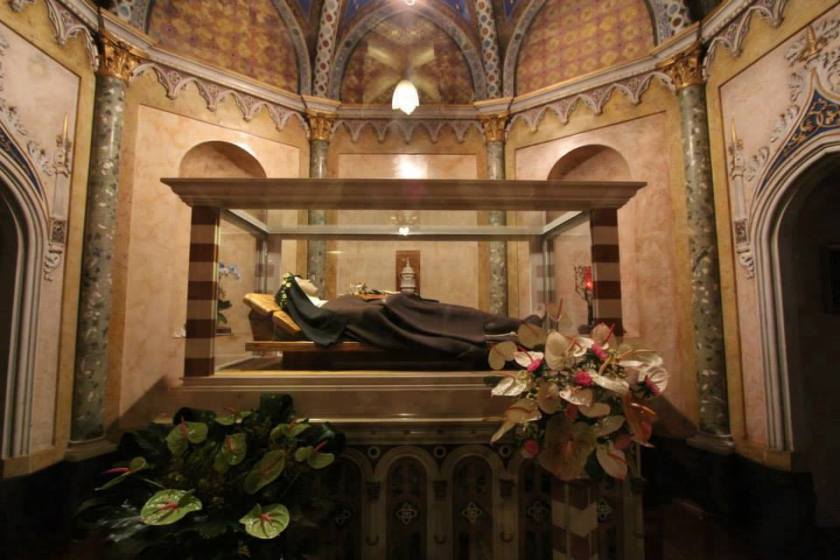
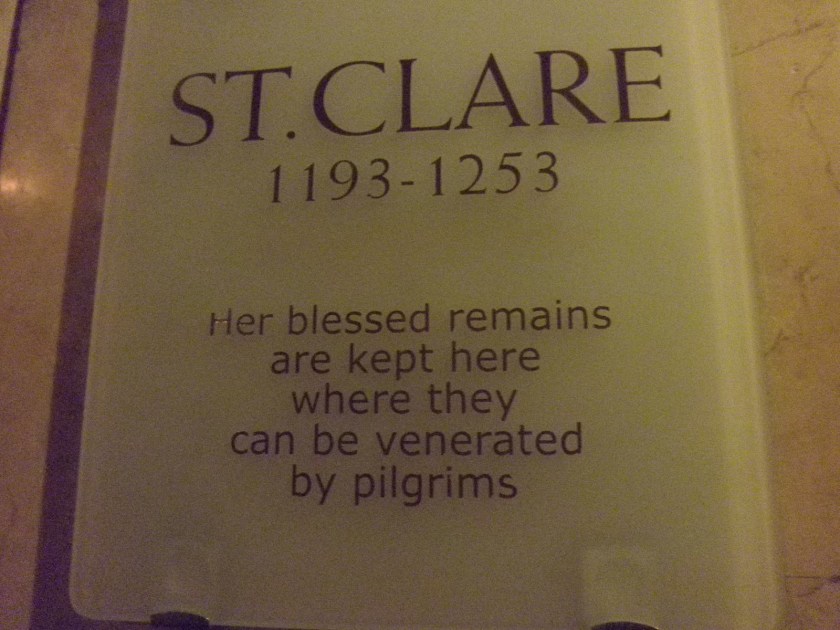
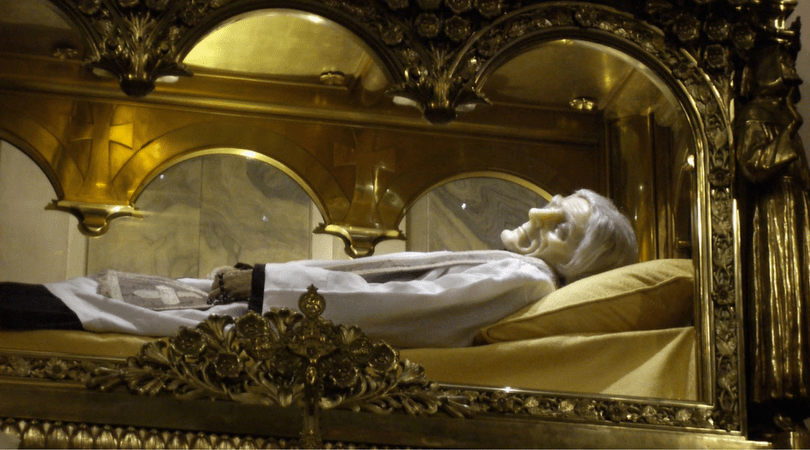
Some 600 years later in 1872, Saint Clare’s relics were transferred to a newly constructed shrine in the crypt of the Basilica of Saint Clare, where her relics can still be venerated today.    Her body is incorrupt.

OLYMPUS DIGITAL CAMERA

20100813-assisi-santa-chiara-10
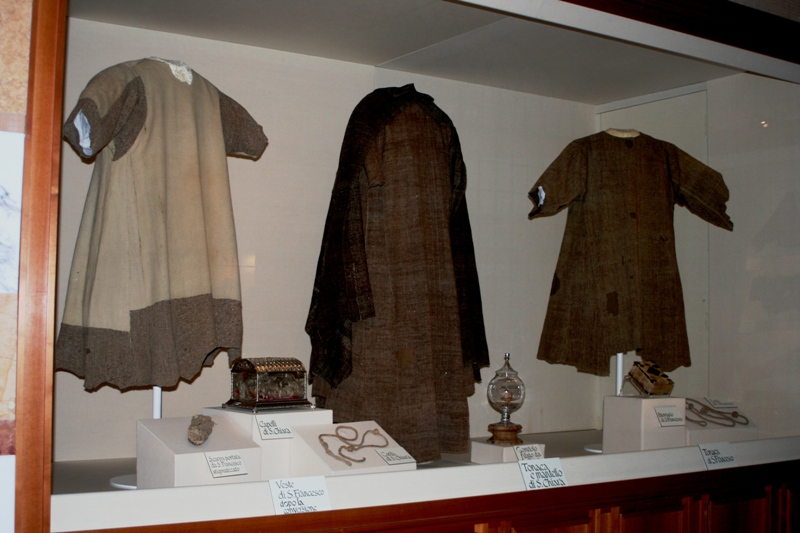
St Clare’s Garment in the Centre with St Francis’ on each side

St-Clare-of-Assisi-relic

st clare relics

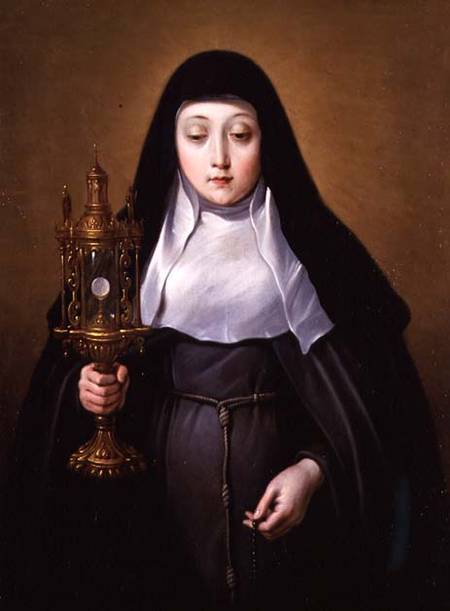
In art, Clare is often shown carrying a monstrance or pyx, in commemoration of the occasion when she warded away the soldiers of Frederick II at the gates of her convent by displaying the Blessed Sacrament and kneeling in prayer.

Pope Pius XII designated Clare as the Patron Saint of television in 1958 because when St Clare was too ill to attend the Holy Mass, she had been able to see and hear it, on the wall of her room.

There are traditions of bringing offerings of eggs to the Poor Clares for their intercessions for good weather, particularly for weddings.  This tradition remains popular in the Philippines, particularly at the Real Monasterio de Santa Clara in Quezon City.   According to the Filipino essayist Alejandro Roces, the practice arose because of Clare’s name. In Castilian clara refers to an interval of fair weather and in Spanish, it also refers to the white or albumen of the egg.

Posted in DOMINICAN OP, franciscan OFM, MORNING Prayers, SAINT of the DAY, The BLESSED VIRGIN MARY

Thought for the Day – 8 August – The Memorial of St Dominic de Guzman

Thought for the Day – 8 August – The Memorial of St Dominic de Guzman

Words of Pope Benedict XVI on St Dominic

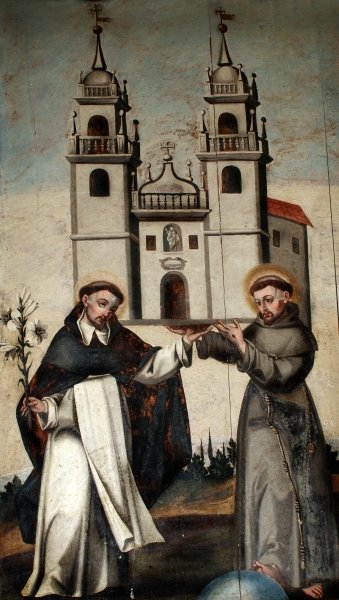
In the second volume of his work “Jesus of Nazareth”, in speaking of the first and last coming of Christ, he introduces a “middle coming”, through his word, the sacraments, events.   And he continues: ” But there are also modalities of this coming season.   The impact of two great figures -Francisco and Domingo- between the twelfth and thirteenth centuries, has been a way in which Christ has re-entered history, re-enforcing His word and his love;  a way with which He has renewed the Church and has driven history to itself. ”   In St Dominic’s words:  “You are my companion and must walk with me. If we hold together, no earthly power can withstand us.” 

francis and dominic holding church

Likewise, Benedict XVI, recognising the Marian devotion of Saint Dominic, manifested in his catechesis on February 3, 2010:  ” First and foremost, Marian devotion, which he cultivated with tenderness and left his spiritual children as an inheritance, Which in the history of the Church have had the great merit of spreading the prayer of the holy rosary, so rooted in the Christian people and so rich in evangelical values, a true school of faith and piety.

Once, at a difficult point in the preaching ministry, St Dominic had a dream in which he saw heaven.   Christ was there, arrayed like a king, with His Mother beside Him cloaked in a magnificent mantle.   Around the Blessed Mother were countless souls from all walks of life: clergy, laypersons, and members of every religious order ever founded. Among the religious there were Benedictines, Augustinians, Carmelites, Franciscans, everyone, except the Order of Preachers.   Struck to the heart, Dominic said,  “Is there not a single one of mine?” The Lord gestured to his Mother, who opened her mantle. There, under it, were hundreds and hundreds of Dominican souls in their black and white habits.   The Lord said, “Behold, I have left your Order in the care of My Mother.”

MARY AND THE DOMINICANS - MY SNIP

And, in the catechesis of August 8, 2012, he referred to another characteristic of St Dominic, the prayer :  “St Dominic was a man of prayer.   In love with God, he had no other aspiration than the salvation of souls, especially those who had fallen into the webs of the heresies of his time;   Imitator of Christ, incarnated radically the three evangelical counsels joining to the proclamation of the Word the testimony of a poor life; under the guidance of the Holy Spirit, progressed in the path of Christian perfection.   At all times prayer was the force that renewed and made more and more fruitful his apostolic works.

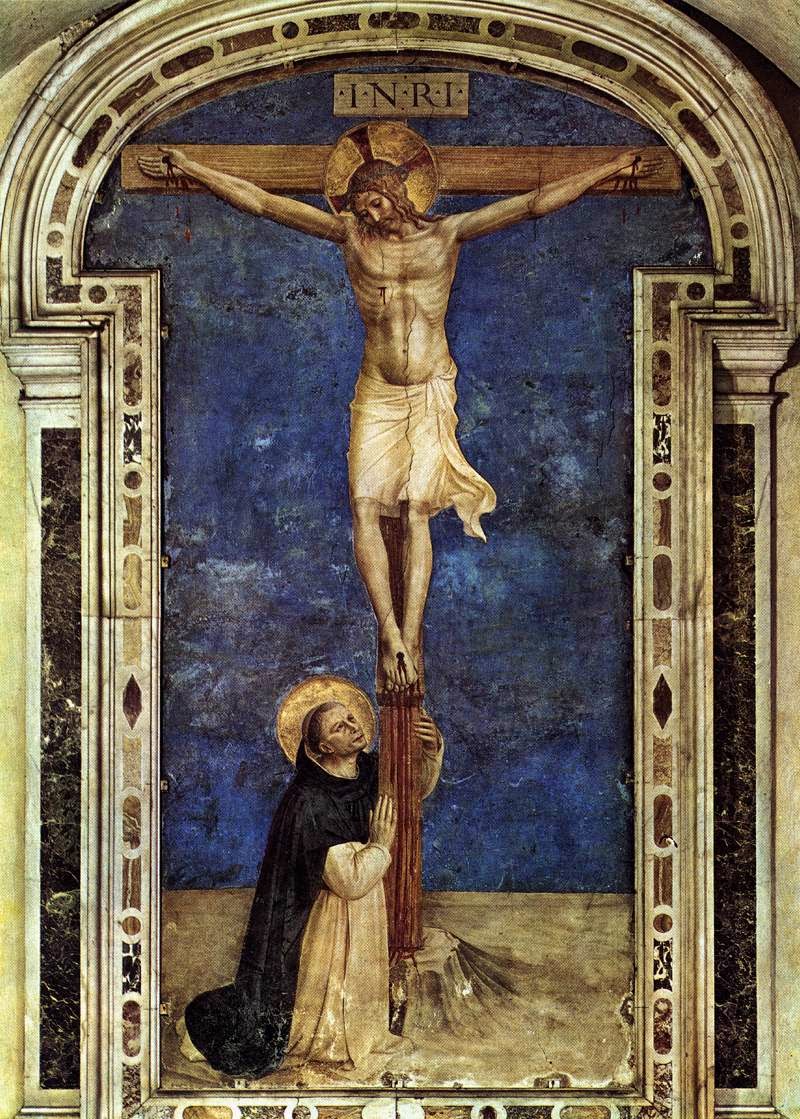
fra angelico st dominic adoring the crucifix

St Dominic reminds us that at the origin of the witness of faith, which every Christian should give in family, work, social commitment and also in times of relaxation, is prayer, personal contact with God.   Only this real relationship with God gives us the strength to live intensely every event, especially moments of greater suffering. “

St Dominic pray for us!

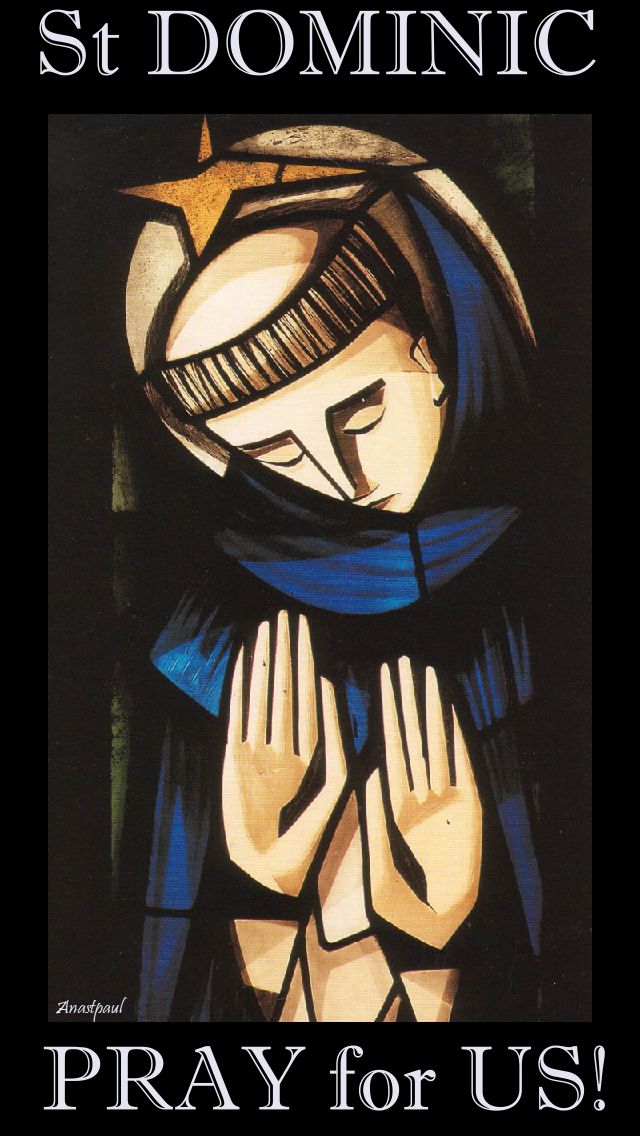
st dominic pray for us 2

Posted in CONFESSORS, franciscan OFM, INCORRUPTIBLES, PRIESTS, all CLERGY, QUOTES - J R R Tolkien and MORE, SAINT of the DAY

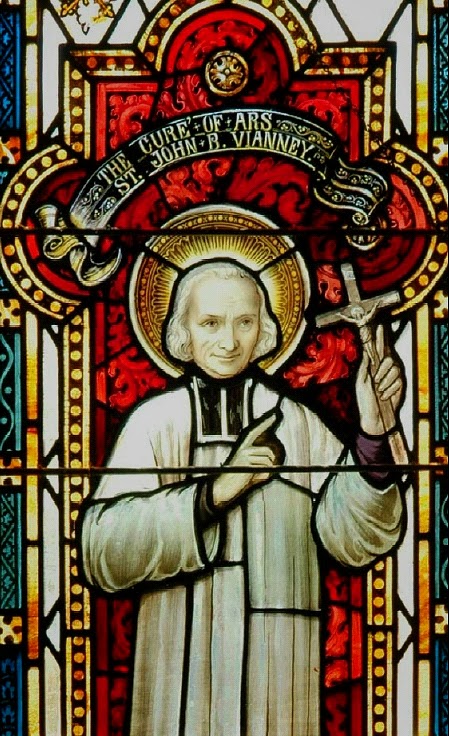
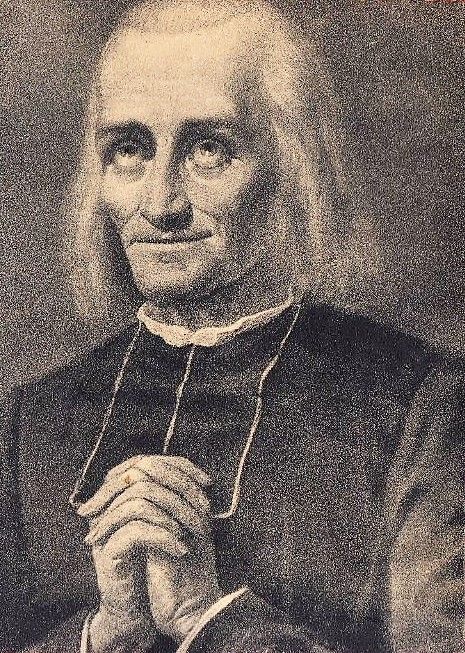
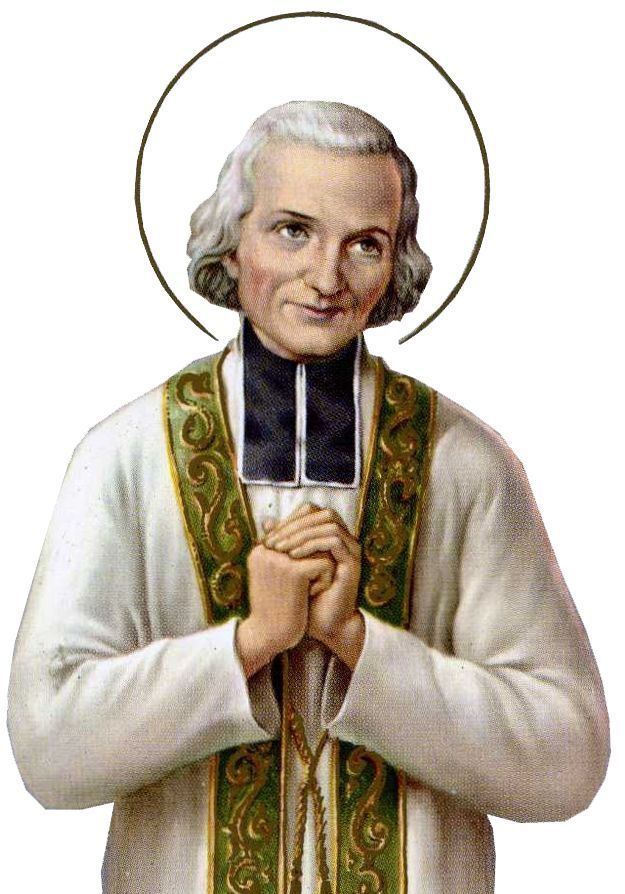
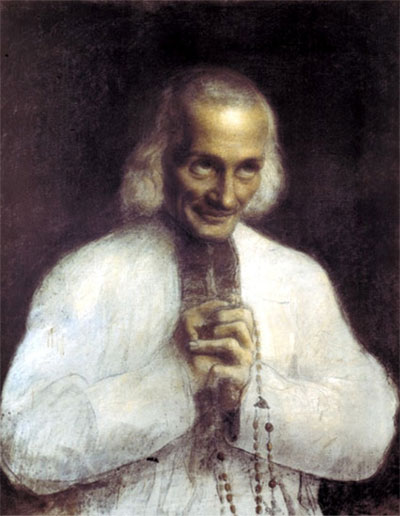
Saint of the Day – 9 August – St Jean-Baptiste Marie Vianney TOSF (1786-1859)- The Curé of Ars, Confessor

Saint of the Day – 9 August – St Jean-Baptiste Marie Vianney TOSF (1786-1859) – The Curé of Ars (Parish Priest of Ars) – Confessor Priest and Tertiary – (8 May 1786 at Dardilly, Lyons, France – 4 August 1859 at Ars, France of natural causes)   His body is interred in the Basilica of Ars.   He was Canonised on 31 May 1925 by Pope Pius XI.   Patronages – Confessors, Priests (proclaimed on 23 April 1929 by Pope Pius XI), Personal Apostolic Administration of Saint John Mary Vianney, Dubuque, Iowa, Archdiocese of, Kamloops, British Columbia, Diocese of, Kansas City, Kansas, Archdiocese of, Lafayette, Louisiana, Diocese of, Saint Paul and Minneapolis, Minnesota, Archdiocese of.  St John Vianney’s body is incorrupt.

St-John-Vianney

St John Vianney was born on 8 May 1786, in the French town of Dardilly, France (near Lyon) and was baptised the same day.   His parents, Matthieu Vianney and his wife Marie (Belize), had six children, of whom John was the fourth.   The Vianneys were devout Catholics, who helped the poor and gave hospitality to St Benedict Joseph Labre, the patron saint of tramps, who passed through Dardilly on his pilgrimage to Rome.

St Benedict Joseph Labre detail Icon and Jesus Crowns
St Benedict Joseph Labre

By 1790, the anticlerical Terror phase of the French Revolution forced many loyal priests to hide from the regime in order to carry out the sacraments in their parish.   Even though to do so had been declared illegal, the Vianneys traveled to distant farms to attend Masses celebrated by priests on the run.   Realising that such priests risked their lives day by day, Vianney began to look upon them as heroes.   He received his First Communion catechism instructions in a private home by two nuns whose communities had been dissolved during the Revolution.   He made his first communion at the age of 13 (normal in those times).   During the Mass, the windows were covered so that the light of the candles could not be seen from the outside.   His practice of the Faith continued in secret, especially during his preparation for confirmation.

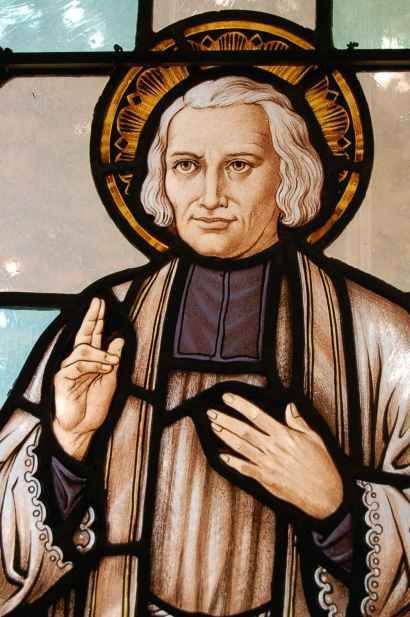
The Catholic Church was re-established in France in 1802 by Napoleon Bonaparte, resulting in religious peace throughout the country, culminating in a Concordat.   By this time, Vianney was concerned about his future vocation and longed for an education.   He was 20 when his father allowed him to leave the farm to be taught at a “presbytery-school” in the neighbouring village of Écully, conducted by the Abbé Balley.   The school taught arithmetic, history, geography and Latin.   Vianney struggled with school, especially with Latin, since his past education had been interrupted by the French Revolution.   Only because of Vianney’s deepest desire to be a priest—and Balley’s patience—did he persevere.lovely - st john vianney glass

St Vianney’s studies were interrupted in 1809 when he was drafted into Napoleon’s armies. He would have been exempt, as an ecclesiastical student but Napoleon had withdrawn the exemption in certain dioceses because of his need for soldiers in his fight against Spain.   Two days after he had to report at Lyons, he became ill and was hospitalised, during which time his draft left without him.   Once released from the hospital, on 5 January, he was sent to Roanne for another draft.   He went into a church to pray and fell behind the group.   He met a young man who volunteered to guide him back to his group but instead led him deep into the mountains of Le Forez, to the village of Les Noes, where deserters had gathered.   St Vianney lived there for fourteen months, hidden in the byre attached to a farmhouse and under the care of Claudine Fayot, a widow with four children.   He assumed the name Jerome Vincent and under that name, he opened a school for village children.   Since the harsh weather isolated the town during the winter, the deserters were safe from gendarmes.   However, after the snow melted, gendarmes came to the town constantly, searching for deserters.   During these searches, Vianney hid inside stacks of fermenting hay in Fayot’s barn.

An imperial decree proclaimed in March 1810 granted amnesty to all deserters, which enabled Vianney to go back legally to Ecully, where he resumed his studies.   He was tonsured in 1811 and in 1812 he went to the minor seminary at Verrières-en-Forez.   In autumn of 1813, he was sent to the major seminary at Lyons.   Considered too slow, he was returned to Abbe Balley.   However, Balley persuaded the Vicar general that Vianney’s piety was great enough to compensate for his ignorance and the seminarian received minor orders and the subdiaconate on 2 July 1814, was ordained a deacon in June 1815 and was ordained priest on 12 August 1815 in the Couvent des Minimes de Grenoble.   He said his first Mass the next day and was appointed the assistant to Balley in Écully.

St-John-Vianney.5

Curé of Ars
In 1818, shortly after the death of Balley, Jean-Marie Vianney was appointed parish priest of the parish of Ars, a town of 230 inhabitants.    As parish priest, he realised that the Revolution’s aftermath had resulted in religious ignorance and indifference, due to the devastation wrought on the Catholic Church in France.   At the time, Sundays in rural areas were spent working in the fields, or dancing and drinking in taverns.  He spent time in the confessional and gave homilies against blasphemy and paganic dancing.   If his parishioners did not give up this dancing, he refused them absolution.   Abbe Balley had been St Vianney’s greatest inspiration, since he was a priest who remained loyal to his faith, despite the Revolution.   He felt compelled to fulfill the duties of a curé, just as did Balley, even when it was illegal.   With Catherine Lassagne and Benedicta Lardet, he established La Providence, a home for girls.   Only a man of vision could have such trust that God would provide for the spiritual and material needs of all those who came to make La Providence their home.french - st john vianney

Later years
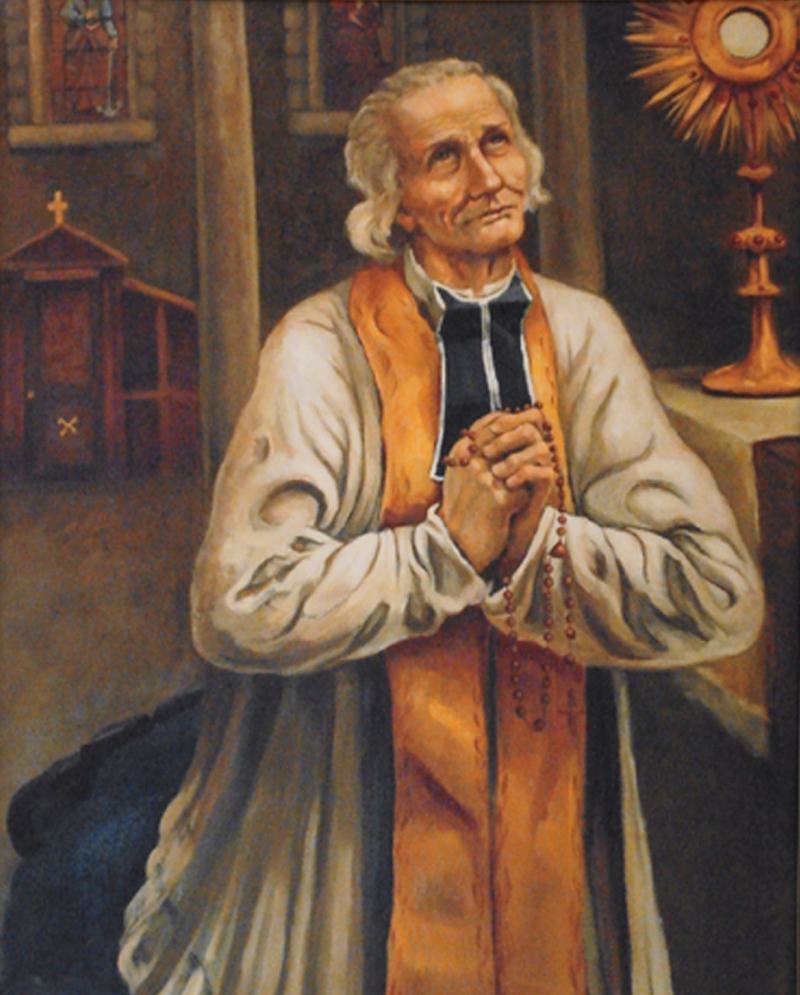
Fr Vianney came to be known internationally and people from distant places began travelling to consult him as early as 1827.   “By 1855, the number of pilgrims had reached 20,000 a year.   During the last ten years of his life, he spent 16 to 18 hours a day in the confessional.   Even the bishop forbade him to attend the annual retreats of the diocesan clergy because of the souls awaiting him yonder”.  His work as a confessor is John Vianney’s most remarkable accomplishment.   In the winter months he was to spend 11 to 12 hours daily reconciling people with God.   In the summer months this time was increased to 16 hours.   Unless a man was dedicated to his vision of a priestly vocation, he could not have endured this giving of self day after day.st john vianney lg

Many people look forward to retirement and taking it easy, doing the things they always wanted to do but never had the time. But John Vianney had no thoughts of retirement.   As his fame spread, more hours were consumed in serving God’s people.   Even the few hours he would allow himself for sleep were disturbed frequently by the devil, who physically attacked and tormented St John and kept him from sleeping.

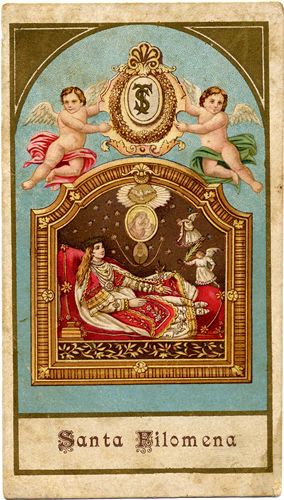
St Vianney had a great devotion to St. Philomena.   He regarded her as his guardian and erected a chapel and shrine in honor of the saint.   During May 1843, he fell so ill he thought that his life was coming to its end.   St John Vianney attributed his cure to her intercession.

st philomena

He yearned for the contemplative life of a monk and four times ran away from Ars, the last time in 1853.  St John Vianney read much and often the lives of the saints, and became so impressed by their holy lives that he wanted for himself and others to follow their wonderful examples.   The ideal of holiness enchanted him.   This was the theme which underlay his sermons.  “We must practice mortification. For this is the path which all the Saints have followed,” he said from the pulpit.   He placed himself in that great tradition which leads the way to holiness through personal sacrifice. “If we are not now saints, it is a great misfortune for us:  therefore we must be so.   As long as we have no love in our hearts, we shall never be Saints.”   The Saint, to him, was not an exceptional man before whom we should marvel but a possibility which was open to all Catholics.   Unmistakably did he declare in his sermons that “to be a Christian and to live in sin is a monstrous contradiction. A Christian must be holy.”   With his Christian simplicity he had clearly thought much on these things and understood them by divine inspiration, while they are usually denied to the understanding of educated men.   He was a champion of the poor as a Franciscan tertiary and was a recipient of the coveted French Legion of Honour.St.-John-Vianney.8

On 4 August 1859, Vianney died at the age of 73.   The bishop presided over his funeral with 300 priests and more than 6,000 people in attendance.   Before he was buried, Vianney’s body was fitted with a wax mask.

On 3 October 1874 Pope Pius IX proclaimed him “venerable”;  on 8 January 1905, Pope Pius X declared him Blessed and proposed him as a model to the parochial clergy.   In 1925 John Mary Vianney was canonized by Pope Pius XI, who in 1929 made him patron saint of parish priests.

In 1959, to commemorate the centenary of John Vianney’s death, Pope John XXIII issued the encyclical letter Sacerdotii nostri primordia.   St Pope John Paul II visited Ars in person in 1986 in connection with the anniversary of Vianney’s birth and referred to the great saint as a “rare example of a pastor acutely aware of his responsibilities … and a sign of courage for those who today experience the grace of being called to the priesthood.”snip - st john vianney

In honour of the 150th anniversary of Vianney’s death, Pope Benedict XVI declared a Year of the Priest, running from the Feast of the Sacred Heart 2009–2010.   The Vatican Postal Service issued a set of stamps to commemorate the 150th Anniversary.   With the following words on 16 June 2009, Benedict XVI officially marked the beginning of the year dedicated to priests, “…On the forthcoming Solemnity of the Most Sacred Heart of Jesus, Friday 19 June 2009 – a day traditionally devoted to prayer for the sanctification of the clergy –, I have decided to inaugurate a ‘Year of the Priest’ in celebration of the 150th anniversary of the dies natalis of John Mary Vianney, the Patron Saint of parish priests worldwide…” In the Holy Father’s words the Curé d’Ars is “a true example of a pastor at the service of Christ’s flock.”

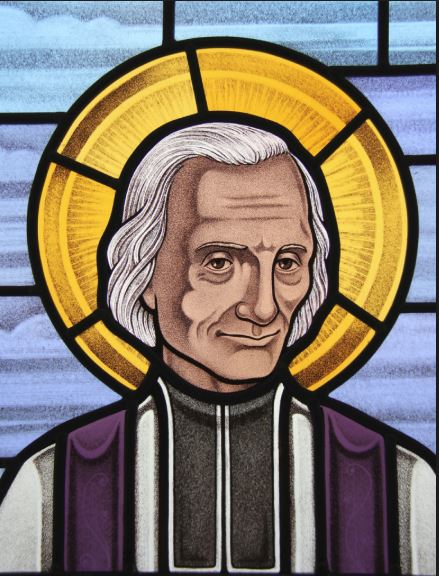
There are statues and stained glass windows of St John Vianney in many French churches and in Catholic churches throughout the world.   Also, many parishes founded in the twentieth and twenty-first centuries are named after him.   Some relics are kept in the Church of Notre-Dame de la Salette in Paris.st john vianney relics

Posted in DOCTORS of the Church, franciscan OFM, MORNING Prayers, QUOTES of the SAINTS, SAINT of the DAY

Thought for the Day – 21 July – The Memorial of St Lawrence of Brindisi (1559-1619) Apostolic Doctor

Thought for the Day – 21 July – The Memorial of St Lawrence of Brindisi (1559-1619) Apostolic Doctor

“It is surprising that St Lawrence of Brindisi was able to continue without interruption his work as an appreciated and unflagging preacher in many cities of Italy and in different countries, in spite of holding other burdensome offices of great responsibility. Indeed, within the Order of Capuchins he was professor of theology, novice master, for several mandates minister provincial and definitor general, and finally, from 1602 to 1605, minister general. In the midst of this mountain of work,   Lawrence cultivated an exceptionally fervent spiritual life.   He devoted much time to prayer and, especially, to the celebration of Holy Mass — often protracted for hours — caught up in and moved by the memorial of the Passion, death and Resurrection of the Lord.
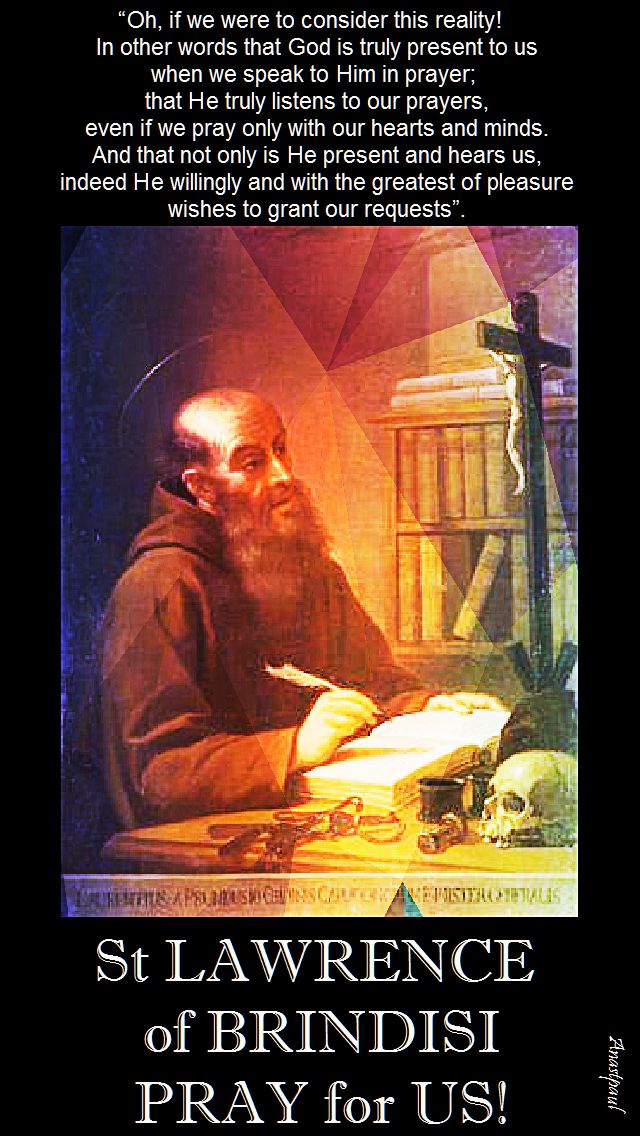
Moreover, with the unmistakable ardour of his style, Lawrence urged everyone and not only priests, to cultivate a life of prayer, for it is through prayer that we speak to God and that God speaks to us: “Oh, if we were to consider this reality!”, he exclaimed. “In other words that God is truly present to us when we speak to Him in prayer;  that He truly listens to our prayers, even if we pray only with our hearts and minds. And that not only is He present and hears us, indeed He willingly and with the greatest of pleasure wishes to grant our requests”.
St Lawrence of Brindisi teaches us to love Sacred Scripture, to increase in familiarity with it, to cultivate daily relations of friendship with the Lord in prayer, so that our every action, our every activity, may have its beginning and its fulfilment in Him.   This is the source from which to draw so that our Christian witness may be luminous and able to lead the people of our time to God.”…….Pope BENEDICT XVI (General Audience) – St. Peter’s Square, Wednesday, 23 March 2011

St Lawtence of Brindisi, pray for us!

of if we were to consider this reality!-st lawrence of brindisi

Posted in DOCTORS of the Church, franciscan OFM, MORNING Prayers, QUOTES of the SAINTS, The WORD

Quote/s of the Day – 21 July

Quote/s of the Day – 21 July

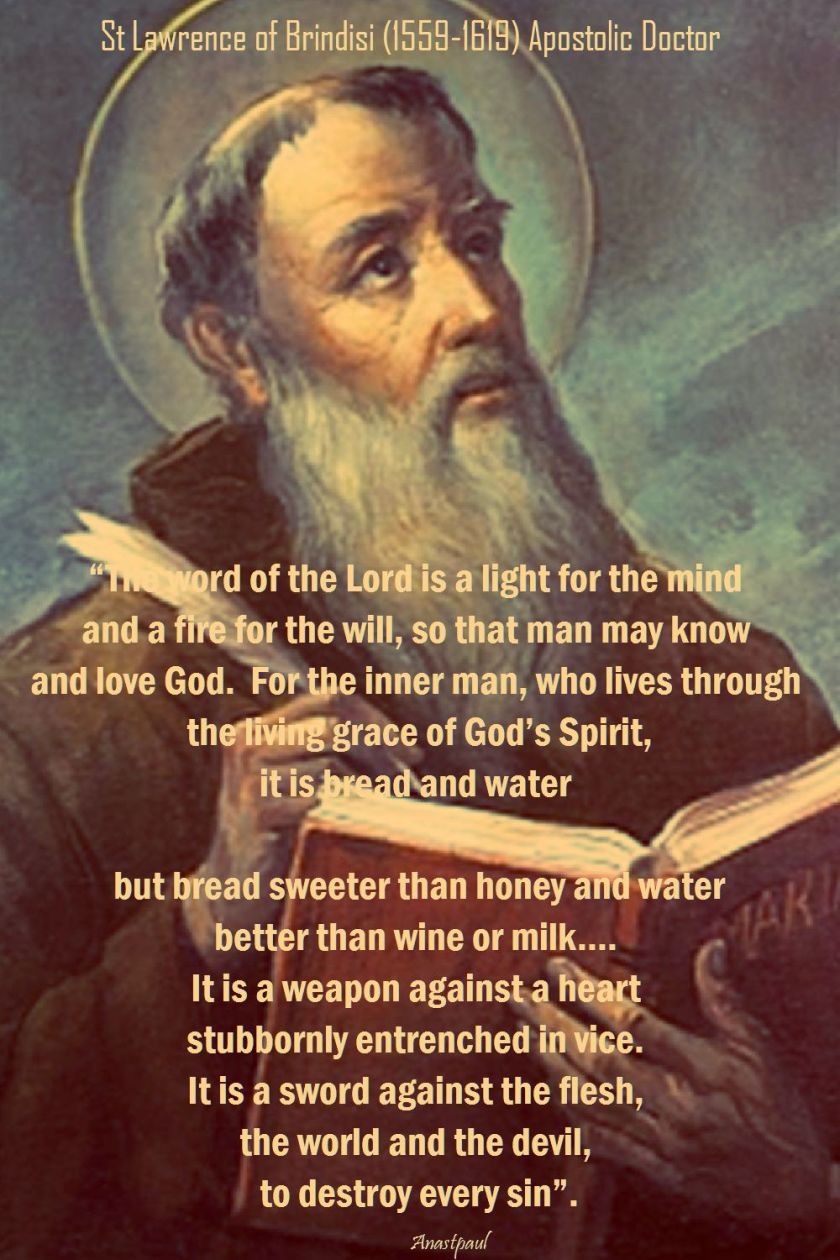
“The word of God is replete with manifold blessings, since it is, so to speak, a treasure of all goods.   It is the source of faith, hope, charity, all virtue, all the gifts of the Holy Spirit, all the beatitudes of the Gospel, all good works, all the rewards of life, all the glory of paradise…For the word of God is a light to the mind and a fire to the will.   It enables man to know God and to love Him.   And for the interior man who lives by the Spirit of God through grace, it is bread and water, but a bread sweeter than honey and the honeycomb, a water better than wine and milk.   For the soul it is a spiritual treasure of merits yielding an abundance of gold and precious stones.   Against the hardness of a heart that persists in wrongdoing, it acts like a hammer.   Against the world, the flesh and the devil it serves as a sword that destroys all sin.”

the word of the lord - st lawrence of brindisi

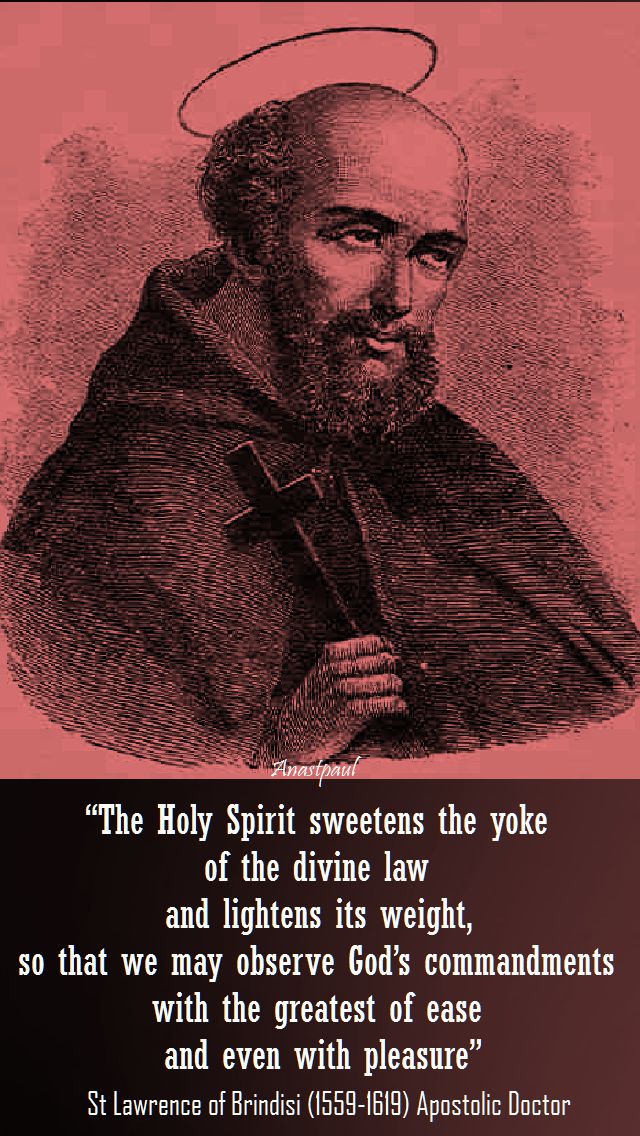
“The Holy Spirit sweetens the yoke
of the divine law and lightens its weight,
so that we may observe God’s commandments
with the greatest of ease and even with pleasure”

the holy spirit - st lawrence of brindisi

St Lawrence of Brindisi (1559-1619) Apostolic Doctor

Posted in DOCTORS of the Church, EUCHARISTIC Adoration, franciscan OFM, MORNING Prayers, QUOTES of the SAINTS, SAINT of the DAY, The HOLY EUCHARIST / The HOLY MASS, The WORD

One Minute Reflection – 21 July

One Minute Reflection – 21 July

“I tell you, something greater than the temple is here.”………..Matthew 12:6

REFLECTION – “My dear souls, let us recognize, I pray you, Christ’s infinite charity towards us in the institution of this Sacrament of the Eucharist.  In order that our love be a spiritual love, He wills a new heart, a new love, a new spirit for us.  It is not with a carnal heart but with a spiritual one, that Christ has loved us with a gratuitous love, a supreme and most ardent love, by way of pure grace and charity.  Ah!  One needs to love Him back with one’s whole, whole, whole, living, living, living and true, true, true heart!!” …… St Lawrence of Brindisi (1559-1619) Apostolic Doctor

my dear souls - st lawrence of brindisi

PRAYER – Lord God, You bestowed on St Lawrence of Brindisi the spirit of counsel and fortitude, so that Your name might be glorified and souls be saved.  At the intercession of St Lawrence, grant that we may see what we have to do and, in Your mercy give us the strength to do it and the courage, love and charity to persevere.  Grant above all, that by his prayers we may love You above all and with all we are. St Lawrence pray for us, amen.

ST LAWRENCE OF BRINDISI PRAY FOR US

Posted in franciscan OFM, MORNING Prayers, PRAYERS of the SAINTS

Our Morning Offering – 21 July

Our Morning Offering – 21 July

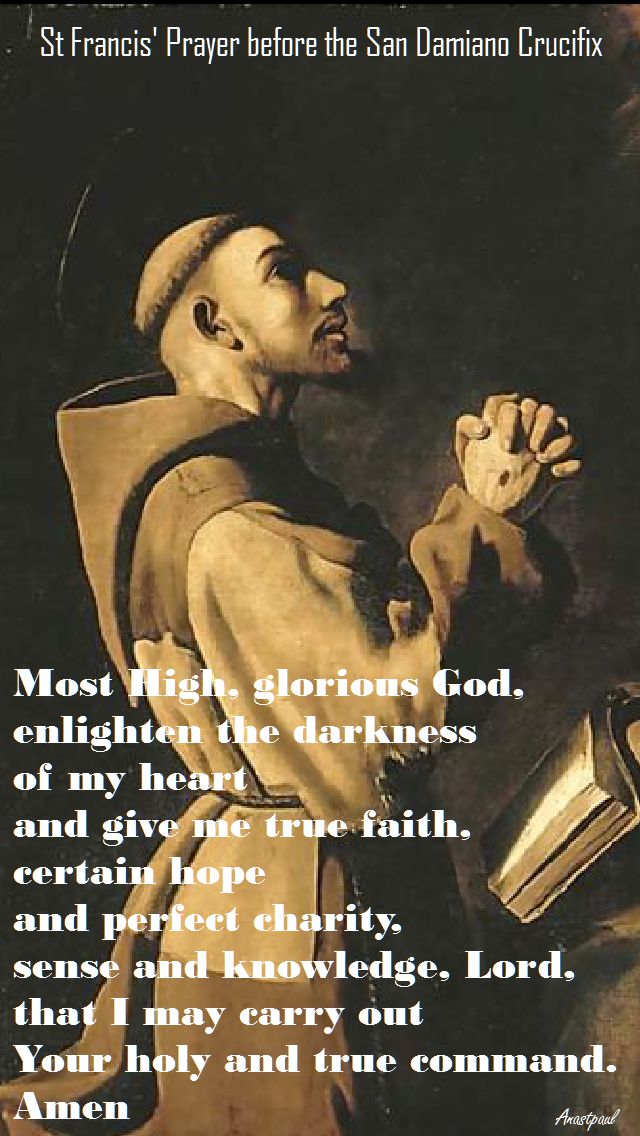
St Francis’s Prayer Before the San Damiano Crucifix

Most High, glorious God,
enlighten the darkness of my heart
and give me
true faith,
certain hope
and perfect charity,
sense and knowledge,
Lord, that I may carry out
Your holy and true command.
Amen

SAN DAMIANO PRAYER - ST FRANCIS

Posted in DOCTORS of the Church, franciscan OFM, SAINT of the DAY

Saint of the Day – 21 July – St Lawrence of Brindisi O.F.M. Cap – Doctor of the Church

Saint of the Day – 21 July – St Lawrence of Brindisi O.F.M. Cap – Doctor of the Church – (22  July 1559 at Brindisi, Italy as Julius Caesar Rossi –  22 July 1619 at Lisbon, Portugal of natural causes).   His remains are buried in the cemetery of the Poor Clares in Villafranca, Spain.   He was Beatified on 1 June 1783 by Pope Pius VI and Canonised on 8 December 1881 by Pope Leo XIII.   He was created a Doctor of the Church by Blessed Pope John XXIII in 1959 with the title Doctor apostolicus (Apostolic Doctor).   Patronages – of Brindisi, Italy.   Attributes – leading the Christian army against the Turks, receiving the embrace of the Child Jesus.   He is known as the “Franciscan Renaissance Man”  – he was a Religious member of the Franciscan Friars Minor Capuchin, a Priest, Theologian, Vicar General of the Franciscans, Language scholar, Humanist, Philosopher, Biblicist, Preacher, Missionary, Professor, International Administrator, Confidant of Popes, Emperors, Kings and Princes, Diplomatic envoy, Army Chaplain, Military Strategist and Morale builder, Polemicist, Prolific writer.

st lawrence FIRST IMAGE

Despite Saint Lawrence of Brindisi’s later fame, little is known of his early years.   His father was William Russo, a well-to-do Venetian merchant and his mother was Elizabeth Masella.   He was born in the Southern Italian port city of Brindisi on the 22nd of July 1559.   He received his early education at a day school run by the Conventual Franciscans and made rapid progress in his studies.   At the tender age of six, following the Italian custom of the time, he publicly preached a short Christmastide sermon on the Child Jesus.  However, by the time he was 14 he had lost both his parents and his education was entrusted to his uncle, a high-ranking cleric at Venice’s Saint Mark’s Cathedral.   It was at Saint Mark’s College, a private school run by his uncle, that Julius Caesar received an excellent secondary education.

In Venice he came to know the Capuchin Friars Minor who had a small church dedicated to saint Mary of the Angels on the island of Giudeca.   Impressed by their austere life of Poverty, he asked for admission to the Order and was invested with the habit as a novice at the Verona Capuchin novitiate friary of on the 18th of February 1575.  At this time, Julius Caesar was given the religious name Brother Lawrence.     He made his perpetual profession on the 24th of March the following year.

His writings fill fifteen volumes and his knowledge of Hebrew allowed him to preach so effectively to the Jewish people in Italy that the rabbis were certain that Lawrence must have been a Jew who had become a Christian.   His skills in dealing with people meant that he served as a papal emissary to many countries but he never forgot that he was first and foremost a priest.

There is a very special title accorded by the Church to certain saints, who are named “Doctor of the Church” and this title indicates that the writings and preaching of such a person are useful to Christians “in any age of the Church.”   Such men and women are also particularly known for the depth of understanding and the orthodoxy of their theological teachings.   St. Lawrence of Brindisi was given this title and he is one of the thirty-six saints to be named “Doctor.”

doctors

While still a deacon, St. Lawrence of Brindisi became known as an excellent preacher and after his ordination captured the whole of northern Italy with his amazing sermons. He was sent into Germany by the pope to establish Capuchin houses.   While there, he became chaplain to Emperor Rudolf II and had a remarkable influence on the Christian soldiers fighting the Muslims who were threatening Hungary in 1601.   Through his efforts, the Catholic League was formed to unify Catholics for the purpose of strengthening the Catholic cause in Europe.   Sent by the emperor to persuade Philip III of Spain to join the League, he established a Capuchin friary in Madrid.   He also brought peace between Spain and the kingdom of Savoy.

His compassion for the poor, the needy and the sick was legendary.   Elected minister-general of his order in 1602, he made the Capuchins a major force in the Catholic Restoration, visiting every friary in the thirty-four provinces of the order and directing the work of nine thousand friars.   He himself was a dominant figure in carrying out the work of the Council of Trent and was described by Pope Benedict XV as having earned “a truly distinguished place among the most outstanding men ever raised up by Divine Providence to assist the Church in time of distress.”

Yet in the midst of all this feverish activity, Brother Lawrence found peace and strength to keep going by taking refuge in prayer.   Sometimes his Masses which were usually celebrated in private could last for up to twelve hours.   He wept copious tears as he celebrated the Holy Sacrifice and was even witnessed being lifted into the air as he prayed at the Altar.   When he entered the Order in 1575, he told the Provincial Minister who tried to dissuade him by describing in detail the rigours of the Capuchin lifestyle: “Nothing will be difficult for me as long as there is a Crucifix in my room.”   Pictures of Saint Lawrence often show him contemplating the Crucifix.

ST LAWRENCE OF BRINDISI - 2.JULY 21

To Mary he attributed his vocation, his restoration to health as a student, his knowledge of Hebrew and all his successes.   He went to her in all his needs.   When elected Vicar General of the Order, he first went to the Shrine of Our Lady’s Holy House at Loreto and returned there at the end of his term of office.   From his formation days onward, he prayed the Rosary and the Little Office of the Blessed Virgin daily.   His favourite greeting for the Brothers was: “Nos, cum prole pia, benedicat Virgo Maria! May the Virgin Mary bless us with her loving Child!”


In 1619, at the request of the Pope, Brother Lawrence had to travel once more to Spain to make known to the Spanish King the plight of Naples’s citizens under the tyrannical rule of the Spanish Viceroy of the region, the Duke of Ossuna.   He managed to escape the Duke’s attempts to block his mission and set sail secretly from Genoa.   He had to go to Lisbon in Portugal to meet the King of Spain.   His diplomatic mission was successfully concluded but worn out by the journey he fell critically ill.   Having received the Last Sacraments, Brother Lawrence of Brindisi died in Lisbon, Portugal before he could board a ship to return home on the 22nd of July 1619.   Saint Lawrence entered heaven the same date as he entered this world sixty years previously.

law_17_s

O God, who didst bestow on blessed Lawrence of Brindisi, Your Confessor and Doctor, the spirit of wisdom and fortitude to endure every labour for the glory of Your Name and the salvation of souls:  grant us, in the same spirit, both to perceive what we ought to do, and by his intercession to perform the same;  through Jesus Christ thy Son our Lord, who lives and reigns with You, in the unity of the Holy Spirit, ever one God, world without end, amen.

St Lawrence pray for us!

Lawrence_of_Brindisi

Posted in DOCTORS of the Church, franciscan OFM, MORNING Prayers, QUOTES of the SAINTS, SAINT of the DAY

Thought for the Day – 15 July by Pope Benedict XVI – 10 March 2010 on St Bonaventure

Thought for the Day – 15 July by Pope Benedict XVI – 10 March 2010 on St Bonaventure

“Of these his writings, which are the soul of his government and show the way to follow either as an individual or a community, I would like to mention only one, his masterwork, the “Itinerarium mentis in Deum,” which is a “manual” of mystical contemplation.

This book was conceived in a place of profound spirituality: the hill of La Verna, where St. Francis had received the stigmata.   In the introduction, the author illustrates the circumstances that gave origin to his writing:

“While I meditated on the possibility of the soul ascending to God, presented to me, among others, was that wondrous event that occurred in that place to Blessed Francis, namely, the vision of the winged seraphim in the form of a crucifix. And meditating on this, immediately I realised that such a vision offered me the contemplative ecstasy of Father Francis himself and at the same time the way that leads to it” (Journey of the Mind in God, Prologue, 2, in Opere di San Bonaventura. Opuscoli Teologici / 1, Rome, 1993, p. 499).

The six wings of the seraphim thus became the symbol of six stages that lead man progressively to the knowledge of God through observation of the world and of creatures and through the exploration of the soul itself with its faculties, up to the satisfying union with the Trinity through Christ, in imitation of St. Francis of Assisi.

The last words of St. Bonaventure’s “Itinerarium,” which respond to the question of how one can reach this mystical communion with God, would make one descend to the depth of the heart:

“If you now yearn to know how that happens (mystical communion with God), ask grace, not doctrine;  desire, not the intellect; the groaning of prayer, not the study of the letter;  the spouse, not the teacher;  God, not man; darkness not clarity;  not light but the fire that inflames everything and transport to God with strong unctions and ardent affections. … We enter therefore into darkness, we silence worries, the passions and illusions;  we pass with Christ Crucified from this world to the Father, so that, after having seen him, we say with Philip: that is enough for me” (Ibid., VII, 6).

Dear friends, let us take up the invitation addressed to us by St. Bonaventure, the Seraphic Doctor, and let us enter the school of the divine Teacher.   We listen to his Word of life and truth, which resounds in the depth of our soul.    Let us purify our thoughts and actions, so that He can dwell in us, and we can hear His divine voice, which draws us toward true happiness”.        Pope Benedict XVI – 10 March 2010 on St Bonaventure

St Bonaventure, pray for us!

st bonaventure pray for us 2

Posted in DOCTORS of the Church, franciscan OFM, QUOTES of the SAINTS, SAINT of the DAY, The BLESSED VIRGIN MARY

Quote/s of the Day – 15 July

Quote/s of the Day – 15 July

“Christ is both the way and the door.
Christ is the staircase and the vehicle,
like the “throne of mercy over the Ark of the Covenant,”
and “the mystery hidden from the ages.”
A man should turn his full attention to this throne of mercy
and should gaze at Him hanging on the cross,
full of faith, hope and charity, devoted,
full of wonder and joy, marked by gratitude
and open to praise and jubilation.
Then such a man will make with Christ a “pasch,”
that is, a passing-over.
Through the branches of the cross.
he will pass over the Red Sea,
leaving Egypt and entering the desert.
There he will taste the hidden manna
and rest with Christ in the sepulcher,
as if he were dead to things outside.
He will experience, as much as is possible for one who is still living,
what was promised to the thief who hung beside Christ:
‘Today you will be with me in paradise.'”
– from Journey of the Mind to God by Saint Bonaventure

“The life of God — precisely because God is triune —
does not belong to God alone.
God who dwells in inaccessible light and eternal glory
comes to us in the face of Christ and the activity of the Holy Spirit.
Because of God’s outreach to the creature,
God is said to be essentially relational, ecstatic, fecund,
alive as passionate love. Divine life is therefore also our life.
The heart of the Christian life is to be united
with the God of Jesus Christ by means of communion with one another.
The doctrine of the Trinity is, ultimately, therefore,
a teaching not about the abstract nature of God,
nor about God in isolation from everything other than God
but a teaching about God’s life with us and our life with each other.”

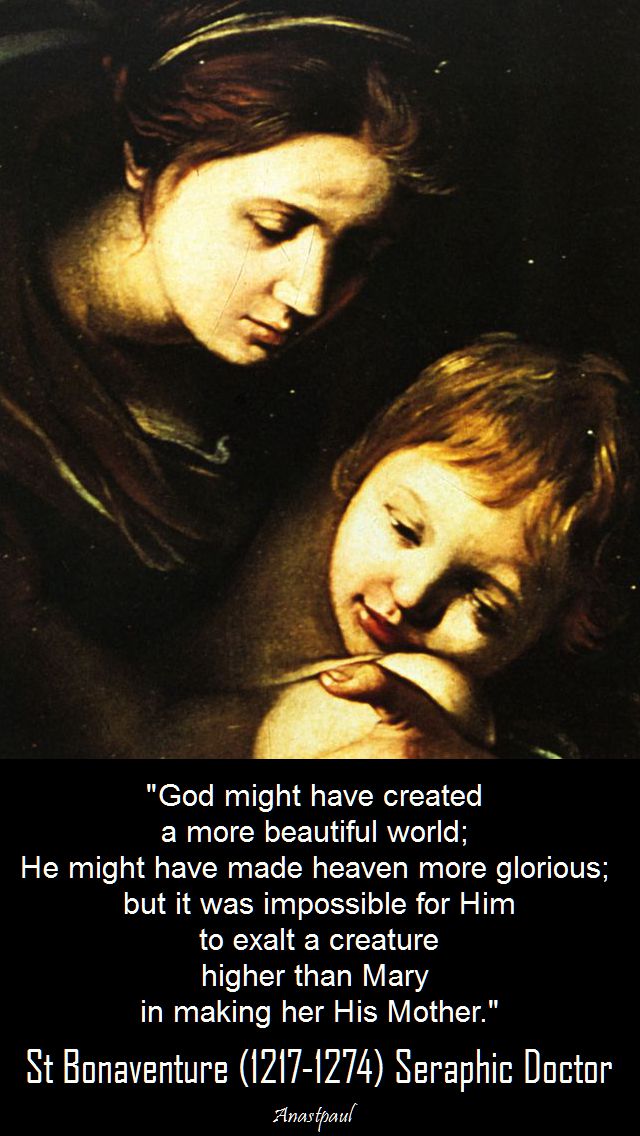
“God might have created a more beautiful world;
He might have made heaven more glorious;
but it was impossible for Him to exalt a creature
higher than Mary in making her His Mother.”

god might have created-st bonaventure


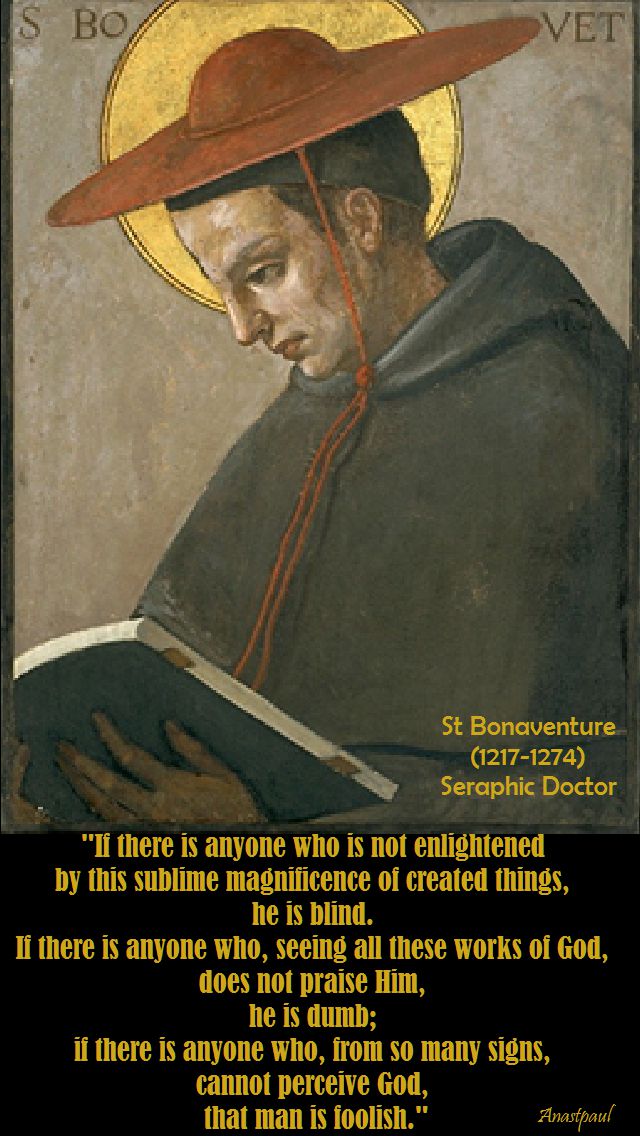
“If there is anyone who is not enlightened
by this sublime magnificence of created things,
he is blind.
If there is anyone who, seeing all these works of God,
does not praise Him,
he is dumb;
if there is anyone who, from so many signs,
cannot perceive God,
that man is foolish.”

if there is anyone who is not enlightened-st bonaventure


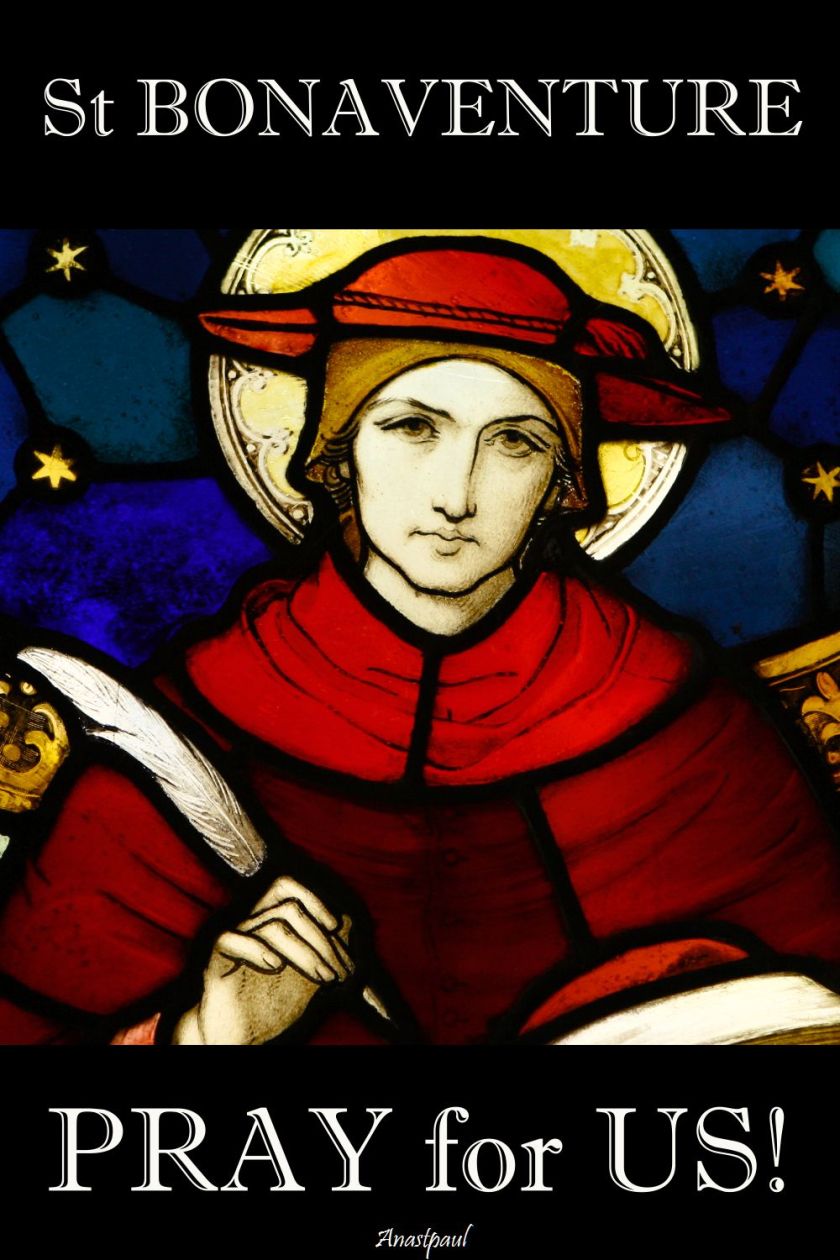
St Bonaventure (1217-1274) Seraphic Doctor

Posted in DOCTORS of the Church, franciscan OFM, SAINT of the DAY, STOMACH DISEASES and PAIN, INTESTINAL DISORDERS

Saint of the Day – 15 July – St Bonaventure – Seraphic Doctor

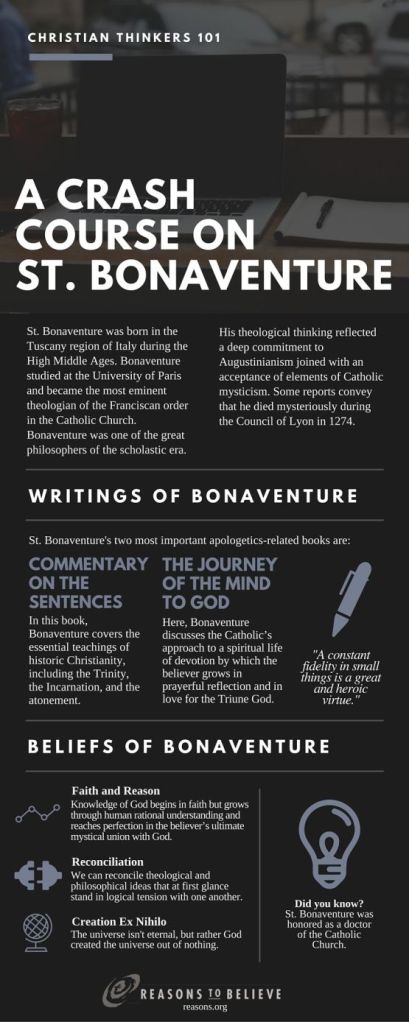
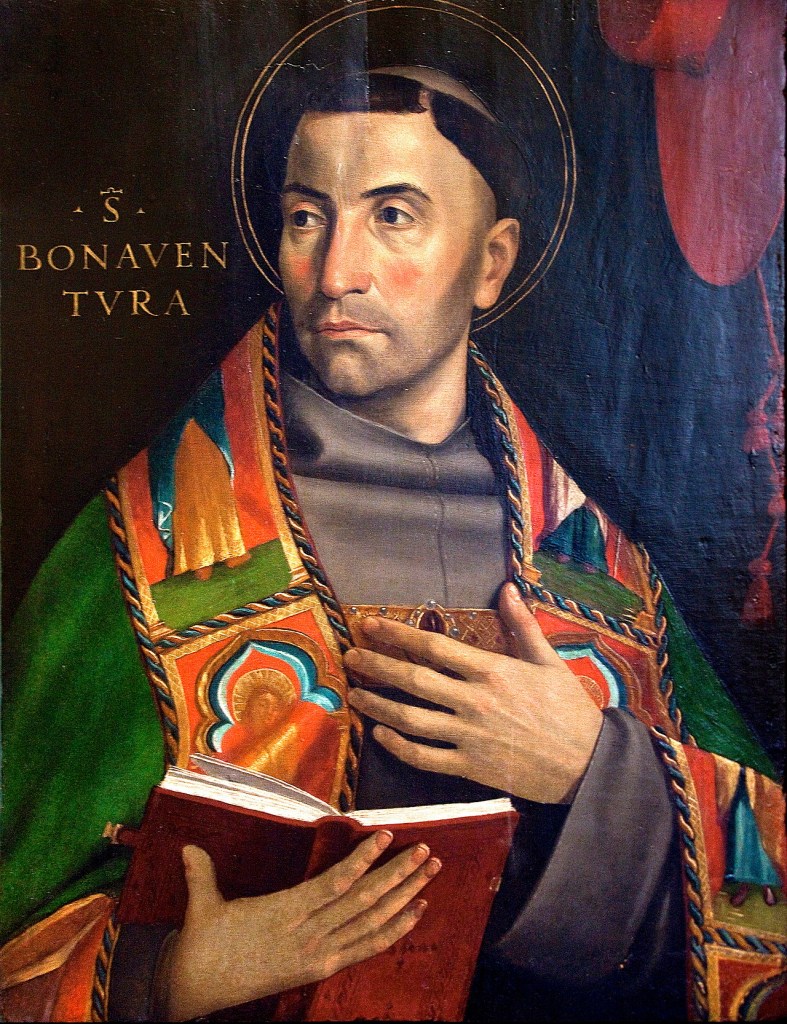
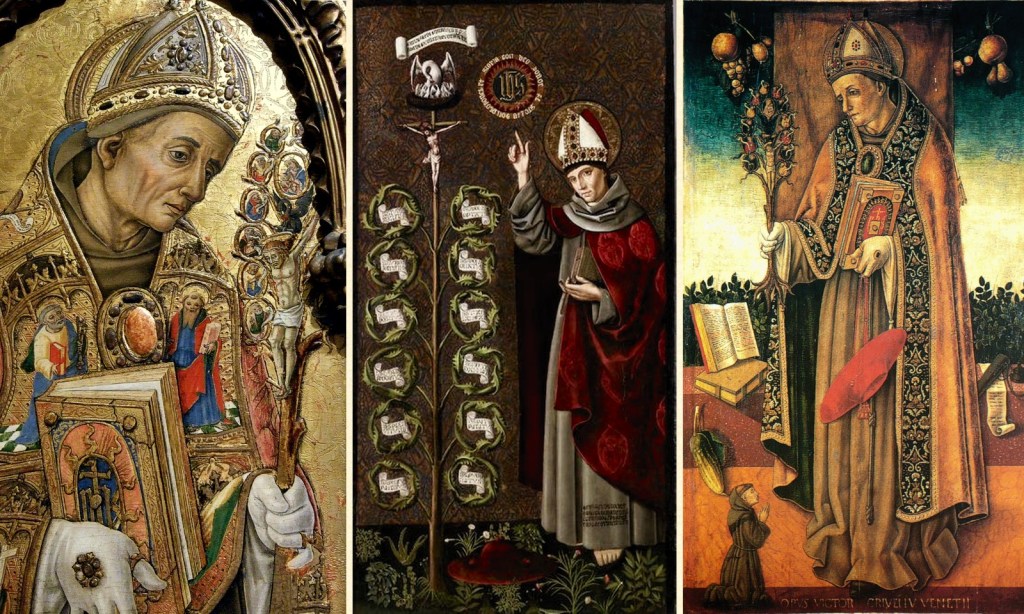
Saint of the Day – 15 July – St Bonaventure – Confessor, Bishop, Doctor of the Church – Friar, Theologian, Philosopher, Writer, Mystic, Preacher, Teacher – born in (1221 at Bagnoregio, Tuscany, Italy and died on 15 July 1274 at Lyon, France of natural causes).  He was born Giovanni di Fidanza and was the seventh Minister General of the Order of Friars Minor, he was also Cardinal Bishop of Albano.  Bonaventure was Canonised on 14 April 1482 by Pope Sixtus IV and declared a Doctor of the Church in the year 1588 by Pope Sixtus V.   He is known as the “Seraphic Doctor” (Latin: Doctor Seraphicus). PATRONAGESagainst intestinal problems, stomach diseases, of – Bagnoregio, Italy, Banja Luka, Bosnia and Herzegovina, Cochiti Indian Pueblo, Saint Bonaventure University, New York.

St Bonaventure was born at Bagnorea in Umbria, not far from Viterbo, then part of the Papal States.   Almost nothing is known of his childhood, other than the names of his parents, Giovanni di Fidanza and Maria Ritella.

He entered the Franciscan Order in 1243 and studied at the University of Paris, possibly under Alexander of Hales and certainly under Alexander’s successor, John of Rochelle. In 1253 he held the Franciscan chair at Paris.    A dispute between seculars and mendicants delayed his reception as Master until 1257, where his degree was taken in company with Thomas Aquinas.   Three years earlier his fame had earned him the position of lecturer on The Four Books of Sentences—a book of theology written by Peter Lombard in the twelfth century—and in 1255 he received the degree of master, the medieval equivalent of doctor.

After having successfully defended his order against the reproaches of the anti-mendicant party, he was elected Minister General of the Franciscan Order.   On 24 November 1265, he was selected for the post of Archbishop of York;   however, he was never consecrated and resigned the appointment in October 1266.[6]

Bonaventure was instrumental in procuring the election of Pope Gregory X, who rewarded him with the title of Cardinal Bishop of Albano and insisted on his presence at the great Second Council of Lyon in 1274.   There, after his significant contributions led to a union of the Greek and Latin churches, Bonaventure died suddenly and in suspicious circumstances.   The 1913 edition of the Catholic Encyclopedia has citations that suggest he was poisoned but no mention is made of this in the 2003 second edition of the New Catholic Encyclopedia.   The only extant relic of the saint is the arm and hand with which he wrote his Commentary on the Sentences, which is now conserved at Bagnoregio, in the parish church of St. Nicholas.

He steered the Franciscans on a moderate and intellectual course that made them the most prominent order in the Catholic Church until the coming of the Jesuits.   His theology was marked by an attempt completely to integrate faith and reason.   He thought of Christ as the “one true master” who offers humans knowledge that begins in faith, is developed through rational understanding and is perfected by mystical union with God.

Bonaventure’s feast day was included in the General Roman Calendar immediately upon his canonisation in 1482.  In 1969 it was classified as an obligatory memorial and assigned to the date of his death, 15 July.

Posted in DOCTORS of the Church, EUCHARISTIC Adoration, franciscan OFM, MORNING Prayers, SAINT of the DAY

Celebrating the Life and Miracles of St Anthony of Padua on his Memorial today 13 June

Celebrating the Life and Miracles of St Anthony of Padua on his Memorial today 13 June

St Anthony and the Holy Eucharist

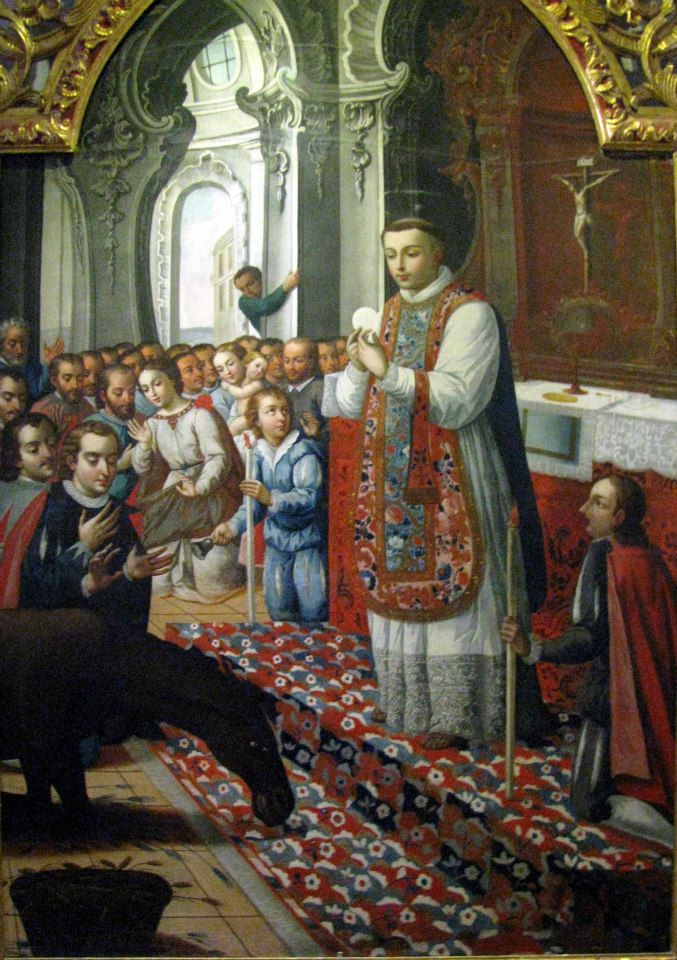
Anthony has been pictured by artists and sculptors in all kinds of ways.   He is depicted with a book in his hands, with a lily or torch.   He has been painted preaching to fish, holding a monstrance with the Blessed Sacrament in front of a mule or preaching in the public square or from a nut tree.

To prove to the heretics that Jesus is truly in the Blessed Sacrament, a horse was not given any food for three days.    Oats were placed in front of him.   The horse refused to eat the oats till he had knelt down and adored Jesus in the Holy Eucharist that St Anthony held in his hand.  This took place in Rimini Italy.

Miracles-of-St.-Anthony-of-Padua (1)

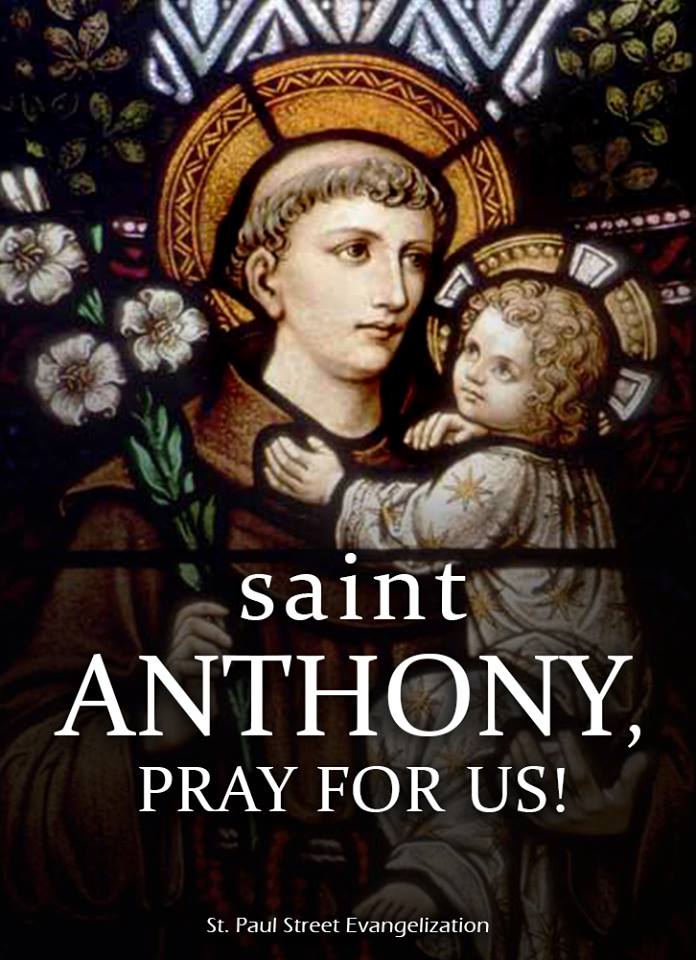
St Anthony and the Child Jesus

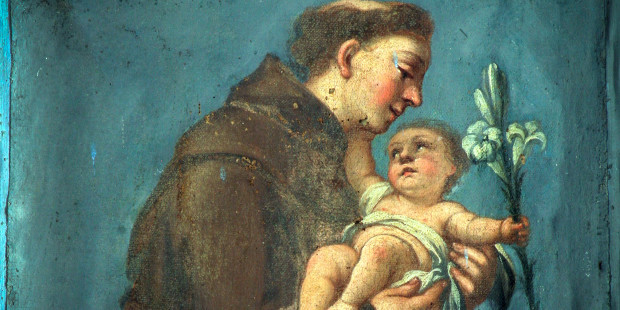
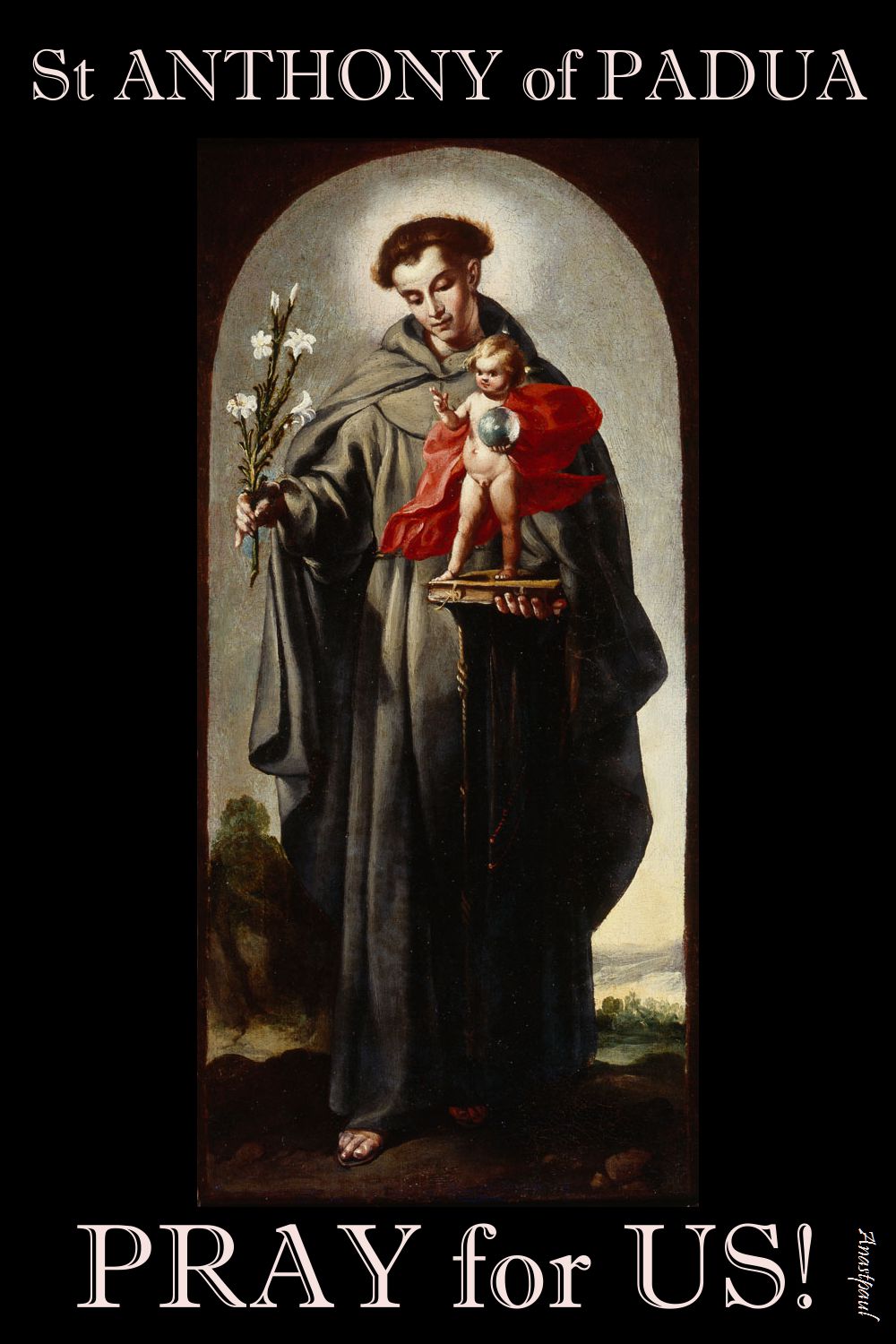
But since the 17th century we most often find the saint shown with the child Jesus in his arm or even with the child standing on a book the saint holds.   A story about Saint Anthony related in the complete edition of Butler’s Lives of the Saints (edited, revised and supplemented by Herbert Anthony Thurston, S.J., and Donald Attwater) projects back into the past a visit of Anthony to the Lord of Chatenauneuf.   Anthony was praying far into the night when suddenly the room was filled with light more brilliant than the sun.   Jesus then appeared to Saint Anthony under the form of a little child. Chatenauneuf, attracted by the brilliant light that filled his house, was drawn to witness the vision but promised to tell no one of it until after Anthony’s death.

Some may see a similarity and connection between this story and the story in the life of Saint Francis when he re-enacted at Greccio the story of Jesus and the Christ Child became alive in his arms.   There are other accounts of appearances of the child Jesus to Francis and some companions.

These stories link Anthony with Francis in a sense of wonder and awe concerning the mystery of Christ’s incarnation.   They speak of a fascination with the humility and vulnerability of Christ who emptied himself to become one like us in all things except sin. For Anthony, like Francis, poverty was a way of imitating Jesus who was born in a stable and would have no place to lay his head.

web-st-anthony-of-padua-zvonimir-atletic-shutterstock_51259915

Patron of Sailors, Travelers, Fishermen

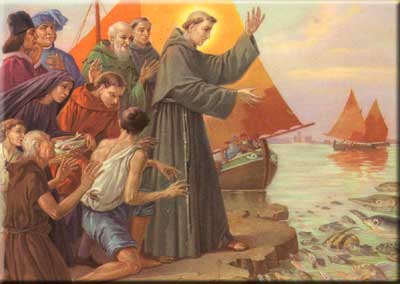
In Portugal, Italy, France and Spain, Saint Anthony is the patron saint of sailors and fishermen.   According to some biographers his statue is sometimes placed in a shrine on the ship’s mast.   And the sailors sometimes scold him if he doesn’t respond quickly enough to their prayers.

Not only those who travel the seas but also other travelers and vacationers pray that they may be kept safe because of Anthony’s intercession.   Several stories and legends may account for associating the saint with travelers and sailors.

First, there is the very real fact of Anthony’s own travels in preaching the gospel, particularly his journey and mission to preach the gospel in Morocco, a mission cut short by severe illness.   But after his recovery and return to Europe he was a man always on the go, heralding the Good News.

There is also a story of two Franciscan sisters who wished to make a pilgrimage to a shrine of our Lady but did not know the way.   A young man is supposed to have volunteered to guide them.   Upon their return from the pilgrimage one of the sisters announced that it was her patron saint, Anthony, who had guided them.

Still another story says that in 1647 Father Erastius Villani of Padua was returning by ship to Italy from Amsterdam.   The ship with its crew and passengers was caught in a violent storm.   All seemed doomed. Father Erastius encouraged everyone to pray to Saint Anthony.   Then he threw some pieces of cloth that had touched a relic of Saint Anthony into the heaving seas.   At once, the storm ended, the winds stopped and the sea became calm.

miracle8miracle3

Teacher, Preacher

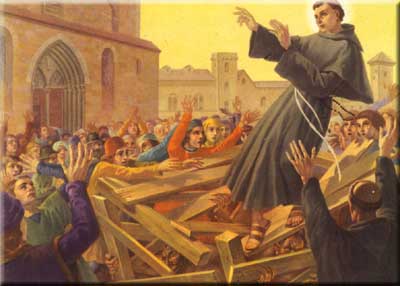
Among the Franciscans themselves and in the liturgy of his feast, Saint Anthony is celebrated as a teacher and preacher extraordinaire.   He was the first teacher in the Franciscan Order, given the special approval and blessing of Saint Francis to instruct his brother Franciscans.   His effectiveness as a preacher calling people back to the faith resulted in the title “Hammer of Heretics.”   Just as important were his peacemaking and calls for justice.

In canonising Anthony in 1232, Pope Gregory IX spoke of him as the “Ark of the Testament” and the “Repository of Holy Scripture.”   That explains why Saint Anthony is frequently pictured with a burning light or a book of the Scriptures in his hands.   In 1946 Pope Pius XII officially declared Anthony a Doctor of the Universal Church.   It is in Anthony’s love of the word of God and his prayerful efforts to understand and apply it to the situations of everyday life that the Church especially wants us to imitate Saint Anthony.

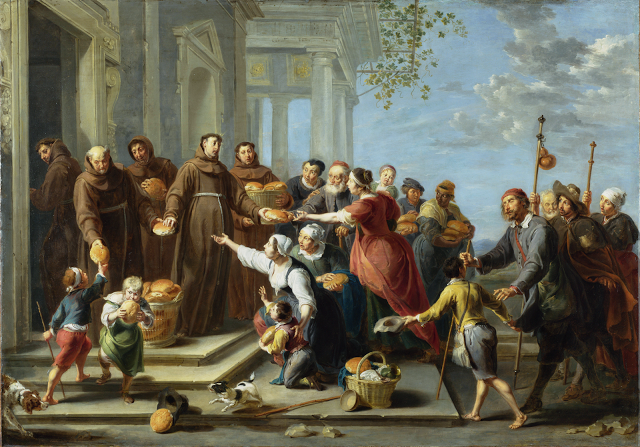
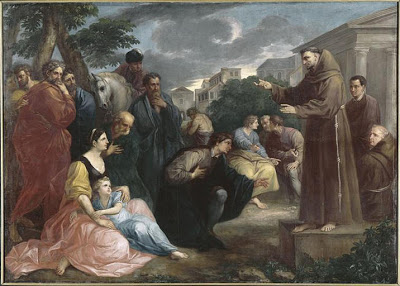
Saint Anthony of Padua distributing Bread by Willem van Herp the Elder circa 1662Anthony-of-Padua-preaching

While noting in the prayer of his feast Anthony’s effectiveness as an intercessor, the Church wants us to learn from Anthony, the teacher, the meaning of true wisdom and what it means to become like Jesus, who humbled and emptied himself for our sakes and went about doing good.


Franciscan Father Norman Perry (1929-1999) served as editor-in-chief of St. Anthony Messenger magazine for 18 years.

St Anthony of Padua, Pray for us!

ST ANTHONY OF PADUA - JUNE 13

Posted in DOCTORS of the Church, franciscan OFM, MORNING Prayers, SAINT of the DAY

Thought for the Day – 13 June

Thought for the Day – 13 June

St Anthony of Padua was a tireless preacher, teacher, defender of the faith.   He brought many back to God by his example and words.   But first he gave himself to God completely.   Like all saints, he is a perfect example of turning one’s life over to Christ. God did with Anthony as God pleased — and what God pleased was a life of spiritual power and brilliance that still attracts admiration today.   He whom popular devotion has nominated as finder of lost objects found himself by losing himself totally to the providence of God.   Preaching was simply the overflow of his own inner life.   For all of us, if God comes first and the cultivation of intimacy with Him, then everything else flows from this, as water flows from its source.

St Anthony of Padua, brilliant star, Pray for us!

ST ANTHONY OF PADUA PRAY FOR US 3

Posted in franciscan OFM, MORNING Prayers, QUOTES of the SAINTS, SAINT of the DAY

Quote/s of the Day – 13 June

Quote/s of the Day – 13 June

“He who is the beginning and the end,
the ruler of the angels,
made Himself obedient to human creatures.
The creator of the heavens obeys a carpenter;
the God of eternal glory listens to a poor virgin.
Has anyone ever witnessed anything comparable to this?
Let the philosopher no longer disdain from listening
to the common labourer;
the wise, to the simple;
the educated, to the illiterate;
a child of a prince, to a peasant.”

he who is the beginning and the end - st anthony of padua

“Christians must lean on the Cross of Christ
just as travelers lean on a staff
when they begin a long journey.”

christians must lean - st anthony of padua

“Earthly riches are like the reed.
Its roots are sunk in the swamp
and its exterior is fair to behold –
but inside it is hollow.
If a man leans on such a reed,
it will snap off and pierce his soul.”

earthly riches are like the reed-st anthony of padua

“Not without a long procession does the devil wish the sinner to be carried to his grave
and therefore he arranges the file after the usual manner:
Ambition carries the cross,
Detraction the incense,
Oppression the holy – or rather the cursed – water,
Hypocrisy bears the lights.
There are two chanters:
one is the Fallacious Confidence of living a long time
and he sings, Requiem aeternam – you still have abundant time;
the other is Presumption as to the Divine Mercy
and he sings, In Paradisnm le ducant angeli.
Pride celebrates the office.
Then follow Vain-Glory on the right,
Envy on the left, and, walking after,
Anger, Impatience, Insolence, Blasphemy,
Contumely, Arrogance, Lasciviousness,
Gluttony, Idle Talk, Boasting, Injury, Curiosity
and Uneasiness.
Lo! what a crowd in the conscience following him
who is dead in trespasses and sin.”

St Anthony of Padua Pray for us!

st anthony pray for us 2

Posted in franciscan OFM, MORNING Prayers, QUOTES of the SAINTS, SAINT of the DAY, The WORD

One Minute Reflection – 13 June

One Minute Reflection – 13 June

“You are the light of the world. A city built on a hill cannot be hid. No one after lighting a lamp puts it under the bushel basket, but on the lampstand, and it gives light to all in the house. In the same way, let your light shine before others, so that they may see your good works and give glory to your Father in heaven.”………….Matthew 5:15-16

matthew 5 15-16

REFLECTION – “Actions speak louder than words;
let your words teach and your actions speak.
We are full of words but empty of actions
and therefore are cursed by the Lord,
since He Himself cursed the fig tree
when He found no fruit but only leaves.
It is useless for a man to flaunt his knowledge
of the law if he undermines its teaching by his actions.”…….St Anthony of Padua

ACTIONS SPEAK LOUDER THAN WORDS - st anthony

PRAYER – My Lord and my God, teach me the gift of silence and the gift of charity. Help me to live as I speak and to do as You say. Let my fruit be the proof of my love for You and for my neighbour. St Anthony your preaching and teaching was always accompanied by love and charity, pray for us all that we may be a light for the world, amen.

st anthony pray for us

Posted in DOCTORS of the Church, franciscan OFM, MORNING Prayers, PRAYERS of the SAINTS, SAINT of the DAY, The HOLY GHOST

Our Morning Offering – 13 June

Our Morning Offering – 13 June

O God, send forth Your Holy Spirit
By St Anthony of Padua

O God,
send forth Your Holy Spirit into my heart
that I may perceive,
into my mind that I may remember,
and into my soul that I may meditate.
Inspire me to speak with piety,
holiness, tenderness and mercy.
Teach, guide and direct my thoughts
and senses from beginning to end.
May Your grace ever help and correct me,
and may I be strengthened now
with wisdom from on high,
for the sake of Your infinite mercy. Amen

o god send forth your holy spirit

Posted in DOMESTIC ANIMALS, For FAITH in the BLESSED SACRAMENT, franciscan OFM, Of ANIMALS / ANIMAL WELFARE, Of BEGGARS, the POOR, against POVERTY, PATRONAGE - LOST KEYS/LOST ARTICLES, PATRONAGE - of MOTHERS, MOTHERHOOD, PATRONAGE - THE ELDERLY, OLD AGE, PATRONAGE-INFERTILITY & SAFE CHILDBIRTH, PREGNANCY, SAILORS, MARINERS, NAVIGATORS, SAINT of the DAY

Saint of the Day – 13 June – St Anthony of Padua O.F.M! Evangelical Doctor – Hammer of Heretics – Professor of Miracles – Wonder-Worker – Ark of the Testament – Repository of Holy Scripture

Saint of the Day – 13 June – St Anthony of Padua OFM (1195-1231) Evangelical Doctor – KNOWN AS THE Hammer of Heretics – Professor of Miracles – Wonder-Worker  – Ark of the Testament – Repository of Holy Scripture  (1195 at Lisbon, Portugal – 13 June 1231 of natural causes).    Religious Priest and Friar of the Franciscan Order, Evangelist, Preacher, Teacher, Apostle of Charity, Apostle of the Holy Eucharist, Scriptural expert, Miracle Worker, Teacher, Confessor, Defender of the Faith.  He was buried on the Tuesday following his death in the Church of Santa Maria Maggiore, Padua, Italy and legend says that all the sick who visited his new grave were healed.   Also known as St Anthony of Lisbon.   Patronages – against sterility, against shipwreck, against starvation, American Indians, amputees, animals – both wild and domestic, asses, mariners, elderly people, expectant mothers, for faith in the Blessed Sacrament, fishermen, for good harvests, horses, lost articles, seekers of lost articles, posted articles, oppressed people,  poor people, swineherds, travel guides, travellers, Brazil, Portugal, Tigua Indians, 4 Diocese, 17 Cities.

St Anthony of Padua/Lisbon, was a Portuguese Priest and Friar of the Franciscan Order.   He was born and raised by a wealthy family in Lisbon, Portugal and died in Padua, Italy.   Noted by his contemporaries for his forceful preaching, expert knowledge of scripture and undying love and devotion to the poor and the sick, he was one of the most-quickly Canonised Saints in Church history.   He was proclaimed a Doctor of the Church by Pope Pius XII on 16 January 1946.

St. Anthony’s Youth & Conversion

St Anthony was born in the year 1195at Lisbon (Portugal) where his father was a captain in the royal army.   Already at the age of fifteen years, he had entered the Congregation of Canons Regular of St Augustine and devoted himself with great earnestness both to study and to the practice of piety in the Monastery at Coimbra (Portugal).

Toledo gerard st anthony padua

About that time some of the first members of the Order of Friars Minor, which St. Francis has founded in 1206 came to Coimbra.   They begged from the Canons Regular a small and very poor place, from which by their evangelical poverty and simplicity they edified everyone in the region.   Then in 1219 some of these friars, moved by divine inspiration, went as missionaries to preach the Gospel of Christ to the inhabitants of Morocco.   There they were brutally martyred for the Faith.   Some Christian merchants succeeded in recovering their remains and so brought their relics in triumph back to Coimbra.   The relics of St Bernard and companions, the first martyrs of the Franciscan Order, seized St. Anthony with an intense desire to suffer martyrdom in a like manner.   So moved by their heroic example he repeatedly begged and petitioned his superiors to be given leave to join the Franciscan Order.   In the quiet little Franciscan convent at Coimbra he received a friendly reception and in the same year his earnest wish to be sent to the missions in Africa was fulfilled.

St Anthony’s Arrival in Italy

But God had decreed otherwise.   And so, St Anthony scarcely set foot on African soil when he was seized with a grievous illness.   Even after recovering from it, he was so weak that, resigning himself to the will of God, he boarded a boat back to Portugal. Unexpectedly a storm came upon them and drove the ship to the east where it found refuge on coast of Sicily.   St Anthony was greeted and given shelter by the Franciscans of that island and thus came to be sent to Assisi, where the general chapter of the Order was held in May, 1221.   Since he still looked weak and sickly,and gave no evidence of his scholarship, no one paid any attention to the stranger until Father Gratian, the Provincial of friars living in the region of Romagna (Italy), had compassion on him and sent him to the quiet little convent near Forli (also in Italy).   There St Anthony remained nine months as chaplain to the hermits, occupied in the lowliest duties of the kitchen and convent and to his heart’s content he practiced interior as well as exterior mortification.

VENETIAN SCHOOL- ST ANTHONY

St Anthony, Preacher and Teacher

But the hidden jewel was soon to appear in all its brilliance.   For the occasion of a ceremony of ordination some of the hermits along with St Anthony were sent to the town of Forli.   Before the ceremony was to begin, however, it was announced that the priest who was to give the sermon had fallen sick.   The local superior, to avert the embarrassment of the moment, quickly asked the friars in attendance to volunteer.   Each excused himself, saying that he was not prepared, until finally, St Anthony was asked to give it.   When he too, excused himself in a most humble manner, his superior ordered him by virtue of the vow of obedience to give the sermon.   St Anthony began to speak in a very reserved manner;  but soon holy animation seized him and he spoke with such eloquence, learning and unction that everybody was fairly amazed.

When St Francis was informed of the event, he gave St Anthony the mission to preach throughout Italy.   At the request of the brethren, St. Anthony was later commissioned also to teach theology, “but in such a manner,” St Francis distinctly wrote, ” that the spirit of prayer be not extinguished either in yourself or in the other brethren.” St Anthony himself placed greater value in the salvation of souls than on learning.   For that reason he never ceased to exercise his office as preacher despite his work of teaching.

The number of those who came to hear him was sometimes so great that no church was large enough to accommodate and so he had to preach in the open air.   Frequently St. Anthony wrought veritable miracles of conversion.  Deadly enemies were reconciled. Thieves and usurers made restitution.   Calumniators and detractors recanted and apologised.   He was so energetic in defending the truths of the Catholic Faith that many heretics returned to the Church.   This occasioned the epitaph given him by Pope Gregory IX “the ark of the covenant.”

In all his labours he never forgot the admonition of his spiritual father, St Francis, that the spirit of prayer must not be extinguished.   If he spent the day in teaching and heard the confession of sinners till late in the evening, then many hours of the night were spent in intimate union with God.

Once a man, at whose home St Anthony was spending the night, came upon the saint and found him holding in his arms the Child Jesus, unspeakably beautiful and surrounded with heavenly light.   For this reason St. Anthony is often depicted holding the Child Jesus.

St Anthony’s Death

In 1227 St Anthony was elected Minister Provincial of the friars living in northern Italy.   Thus he resumed the work of preaching.   Due to his taxing labours and his austere penance, he soon felt his strength so spent that he prepared himself for death. After receiving the last sacraments he kept looking upward with a smile on his countenance.  When he was asked what he saw there, he answered: “I see my Lord.”   He breathed forth his soul on June 13, 1231 A. D., being only thirty six year old.   Soon the children in the streets of the city of Padua were crying:  “The saint is dead, Anthony is dead.”   Anthony is buried in a chapel within the large basilica built to honour him, where his tongue is displayed for veneration in a large reliquary.   For, when his body was exhumed thirty years after his death, it was claimed that the tongue glistened and looked as if it was still alive and moist; apparently a further claim was made that this was a sign of his gift of preaching.

padua16-1b

Pope Gregory IX enrolled him among the saints in the very next year.   At Padua, a magnificent basilica was built in his honour, his holy relics were entombed there in 1263.    From the time of his death up to the present day, countless miracles have occurred through St. Anthony’s intercession, so that he is known as the Wonder-Worker.   In 1946 St Anthony was declared a Doctor of the Church.

church-s-antonio-476776_1280
Basilica of St Anthony in Padua

Why do we ask St Anthony to help us find lost things?

St. Anthony had a book of psalms that was quite special to him.   It was special because in those days before the printing press, books were rare and expensive.   But it was also special because it contained many notes Anthony had made to help him in his preaching and teaching.

Late one night, a young Franciscan decided to leave the community.   He’d had enough of that life, so he made plans to just sneak out in the middle of the night.   He saw Anthony’s book of psalms on his way out and he snatched it up and ran.   He knew that he could sell this precious book for a good deal of money.

Of course, Anthony was quite upset.   He prayed that God would change the young man’s heart and bring him back to the Franciscan life.   He also hoped that while God was at it, he would return Anthony’s book too.   The next day, the young man returned, tired and ashamed, with Anthony’s book.   He also brought back his own gifts and talents, which he decided once more to offer to the Franciscan community.

So that’s why we like to ask St Anthony to help us find lost things. He was an extraordinary man who can still help us from heaven, even in the most ordinary ways.

456px-Marcantonio_Bassetti_-_St_Antony_Reading_-_WGA01483
451px-Guercino_Antonio_Bambino
zurbaran_finalw450
Vicente_Carducho_-_The_Vision_of_St_Anthony_of_Padua_-_WGA4211
Posted in CATHOLIC DEVOTIONS of the Month, DOCTORS of the Church, franciscan OFM, MORNING Prayers, The BLESSED VIRGIN MARY

Our Morning Offering – 22 May

Our Morning Offering – 22 May

Mother of Mercy
By St Bonaventure (1217-74)
Seraphic Doctor

Virgin full of goodness,
Mother of Mercy,
I entrust to you my body and soul,
my thoughts, my actions,
my life and my death.
O my Queen, help me,
and deliver me from all
the snares of the devil.
Obtain for me the grace
of loving my Lord Jesus Christ,
your Son, with a true and perfect love,
and after Him, O Mary,
to love you with all my heart
and above all things.
Amen

virgin full of goodness-st bonaventure

Posted in CONSECRATION Prayers, DEVOTIO, franciscan OFM, MORNING Prayers, SAINT of the DAY, Uncategorized

Thought for the Day – 20 May

Thought for the Day – 20 May

In St Bernardine’s day, cursing was almost part of the common speech and he combated it by promoting devotion to the Holy Name of Jesus.
He even had cards printed inscribed with the Holy Name and they were more popular than playing cards..
He knew that you do not root out an evil merely preaching against it, instead you must put something good in its place.
That is a piece of wisdom it would do us well to follow.   Perhaps our attempts should be garnered universally to root out the sacrilegious habit of great portions of the world, which use the name of God and of Jesus in vain, so often with every sentence, so much so, that in public it is now an accepted practice!

St Bernardine of Siena, please pray for us!

st bernardine of siena-pray for us.jpg 2

CONSECRATION HOLY NAMEf1bc989243ef8f0d43b071bc162c831f

Posted in DEVOTIO, franciscan OFM, MORNING Prayers, QUOTES of the SAINTS, SAINT of the DAY

Quote of the Day – 20 May

Quote of the Day – 20 May

Especially known for his devotion to the Holy Name of Jesus, Bernardine devised a symbol—IHS, the first three letters of the name of Jesus in Greek–in Gothic letters on a blazing sun.   This was to displace the superstitious symbols of the day, as well as the insignia of factions:  for example, Guelphs and Ghibellines.   The devotion spread and the symbol began to appear in churches, homes and public buildings.

breviary_tuscany
The provenance of this item indicates that the prayer book belonged to Franciscan communities in Tuscany during the lifetime of Saint Bernardine of Siena.

“The name of Jesus is the glory of preachers
because the shining splendour of that Name
causes His word to be proclaimed and heard.
And how do you think such an immense, sudden
and dazzling light of faith came into the world,
if not because Jesus was preached?
Was it not through the brilliance and sweet savour
of this Name that God called us into His marvelous light?
When we have been enlightened and in that same light
behold the light of heaven, rightly may the apostle Paul say to us:
‘Once you were darkness but now you are light in the Lord;
walk as children of light.’ “

the name of jesus - st bernardine of siena