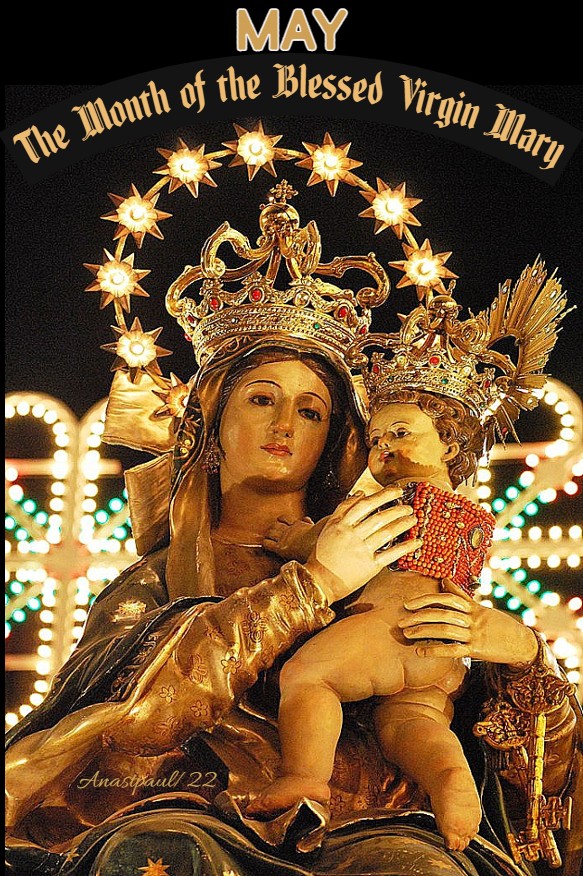
Our Morning Offering – 15 August – “The Month of the Immaculate Heart of Mary” – The Assumption of the Blessed Virgin into Heaven
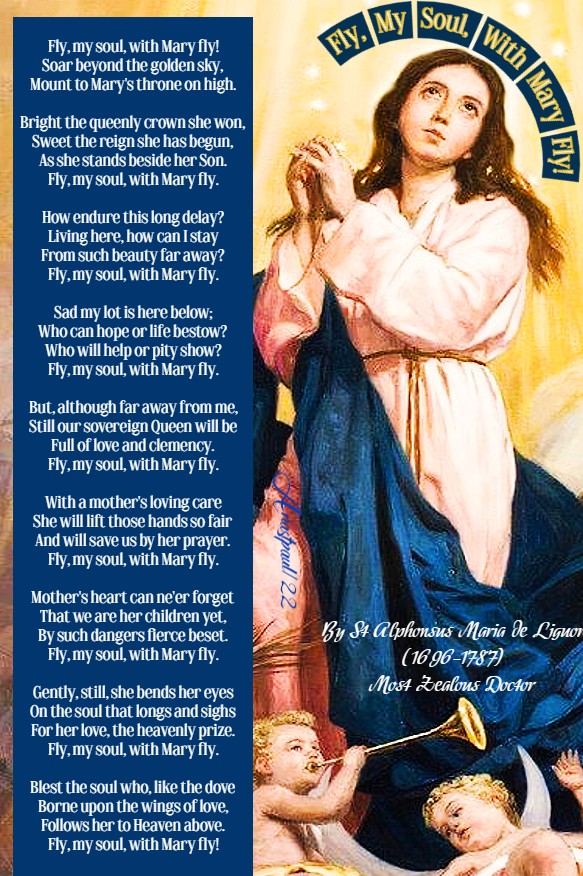
Fly, My Soul, with Mary Fly! By St Alphonsus Maria de Liguori (1696-1787) Most Zealous Doctor (From “The Glories of Mary”) Trans. Redemptoris Fathers, 1931)
Fly, my soul, with Mary fly! Soar beyond the golden sky, Mount to Mary’s throne on high.
Bright the queenly crown she won, Sweet the reign she has begun, As she stands beside her Son. Fly, my soul, with Mary fly.
How endure this long delay? Living here, how can I stay From such beauty far away? Fly, my soul, with Mary fly.
Sad my lot is here below; Who can hope or life bestow? Who will help or pity show? Fly, my soul, with Mary fly.
Quote of the Day – 13 August – “The Month of the Immaculate Heart of Mary” and the Feast of Our Lady Refuge of Sinners
O Mother Blest By St Alphonsus Maira Liguori (1696-1787) Most Zealous Doctor of the Church Trans. Fr Edmund Vaughn C.SS.R. (1827 – 1908 )
O Mother blest, whom God bestows On sinners and on just, What joy, what hope thou givest those Who in thy mercy trust. Thou are clement, thou are chaste, Mary thou art fair, Of all mothers, sweetest best, none with thee compare.
O heavenly Mother, mistress sweet! it never yet was told that suppliant sinner left thy feet, unpitied, unconsoloed. Thou are clement, thou are chaste, …
O Mother, pitiful and mild, Cease not to pray for me; For I do love thee as a child, And sigh for love of thee. Thou art clement, thou art chaste, …
Most powerful Mother, all men know Thy Son denies thee nought; Thou askest, wishest it, and lo! His power thy will hath wrought. Thou art clement, thou art chaste, …
O Mother blest, for me obtain, Ungrateful though I be, To love that God who first could deign To show such love for me. Thou art clement, thou art chaste, Mary, thou art fair. Of all mothers, sweetest, best, None with thee compare.
Our Morning Offering – 11 August – “The Month of the Immaculate Heart of Mary” – Pentecost XII
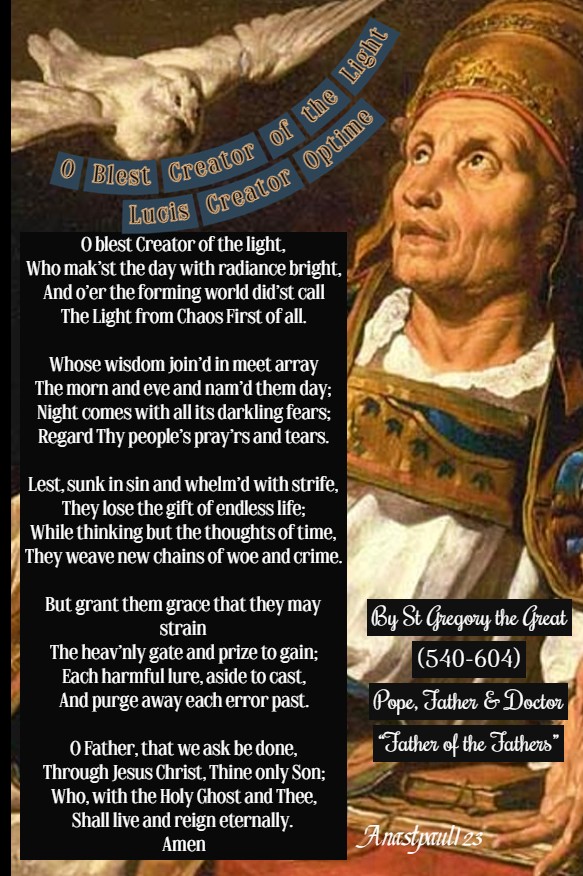
Lucis Creator Optime O Blest Creator of the Light By St Gregory the Great (540-604) Pope, Father & Doctor “Father of the Fathers”
O blest Creator of the light, Who mak’st the day with radiance bright, And o’er the forming world did’st call The Light from Chaos First of all.
Whose wisdom join’d in meet array The morn and eve and nam’d them day; Night comes with all its darkling fears; Regard Thy people’s pray’rs and tears.
Lest, sunk in sin and whelm’d with strife, They lose the gift of endless life; While thinking but the thoughts of time, They weave new chains of woe and crime.
But grant them grace that they may strain The heav’nly gate and prize to gain; Each harmful lure, aside to cast, And purge away each error past.
O Father, that we ask be done, Through Jesus Christ, Thine only Son; Who, with the Holy Ghost and Thee, Shall live and reign eternally. Amen
This hymn is used for Vespers (II) on Sundays throughout the year in the Extraordinary Form of the Roman Breviary. Trans John M Neale (1818-1866), 1851. Tune: “Lucis Creator Optime” Gregorian Chant, Mode VIII, traditional.
Our Morning Offering – 10 August – St Lawrence (Died 258) “Keeper of the Treasures of he Church,” Martyr, Archdeacon.
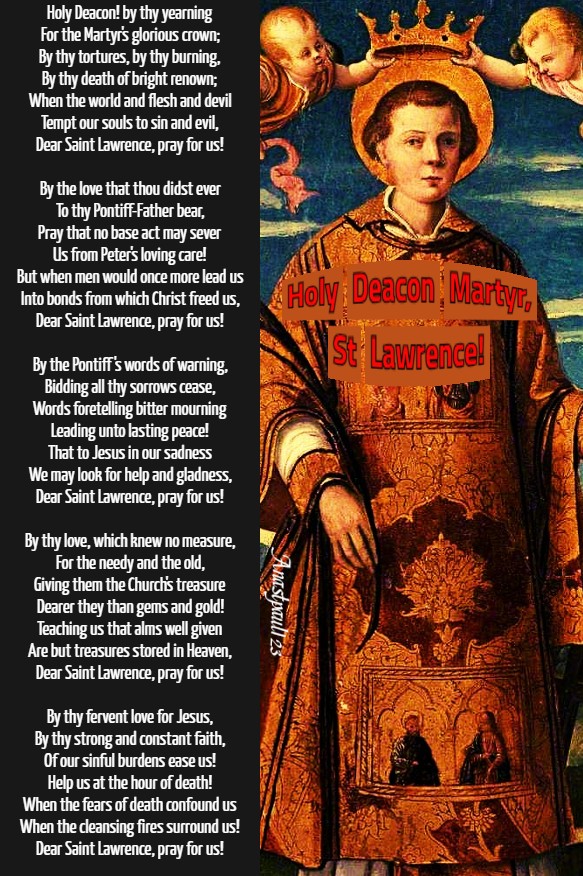
Holy Deacon Martyr, St Lawrence! Unknown Author
Holy Deacon! by thy yearning For the Martyr’s glorious crown; By thy tortures, by thy burning, By thy death of bright renown; When the world and flesh and devil Tempt our souls to sin and evil, Dear Saint Lawrence, pray for us!
By the love that thou didst ever To thy Pontiff-Father bear, Pray that no base act may sever Us from Peter’s loving care! But when men would once more lead us Into bonds from which Christ freed us, Dear Saint Lawrence, pray for us!
By the Pontiff’s words of warning, Bidding all thy sorrows cease, Words foretelling bitter mourning Leading unto lasting peace! That to Jesus in our sadness We may look for help and gladness, Dear Saint Lawrence, pray for us!
By thy love, which knew no measure, For the needy and the old, Giving them the Church’s treasure Dearer they than gems and gold! Teaching us that alms well given Are but treasures stored in Heaven, Dear Saint Lawrence, pray for us!
By thy fervent love for Jesus, By thy strong and constant faith, Of our sinful burdens ease us! Help us at the hour of death! When the fears of death confound us When the cleansing fires surround us! Dear Saint Lawrence, pray for us!
Our Morning Offering – 7 August – “The Month of the Immaculate Heart of Mary”
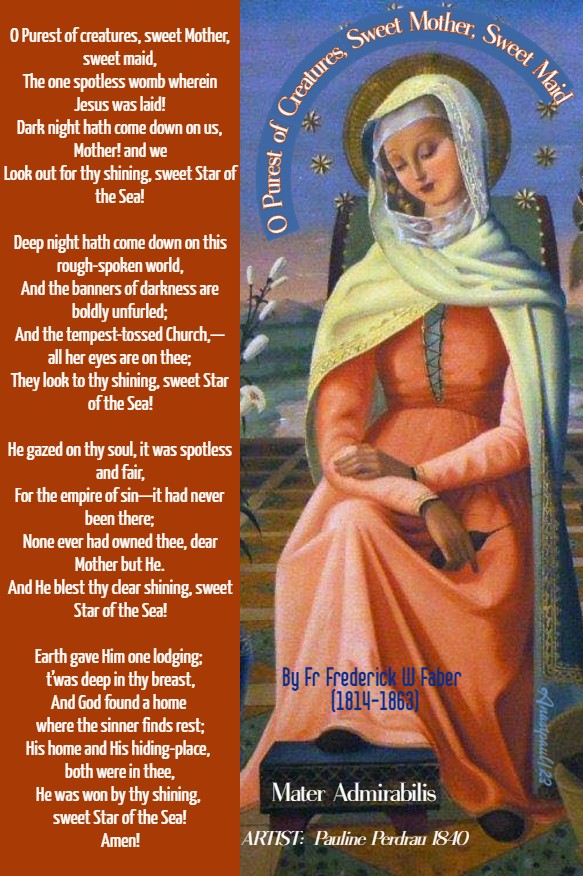
O Purest of Creatures, Sweet Mother, Sweet Maid By Fr Frederick W Faber C.Orat. (1814-1863)
O Purest of creatures, sweet Mother, sweet maid, The one spotless womb wherein Jesus was laid! Dark night hath come down on us, Mother! and we Look out for thy shining, sweet Star of the Sea!
Deep night hath come down on this rough-spoken world, And the banners of darkness are boldly unfurled; And the tempest-tossed Church,— all her eyes are on thee; They look to thy shining, sweet Star of the Sea!
He gazed on thy soul, it was spotless and fair, For the empire of sin—it had never been there; None ever had owned thee, dear Mother but He. And He blest thy clear shining, sweet Star of the Sea!
Earth gave Him one lodging; t’was deep in thy breast, And God found a home where the sinner finds rest; His home and His hiding-place, both were in thee, He was won by thy shining, sweet Star of the Sea!
Our Morning Offering – 6 August – The Transfiguration of Our Lord
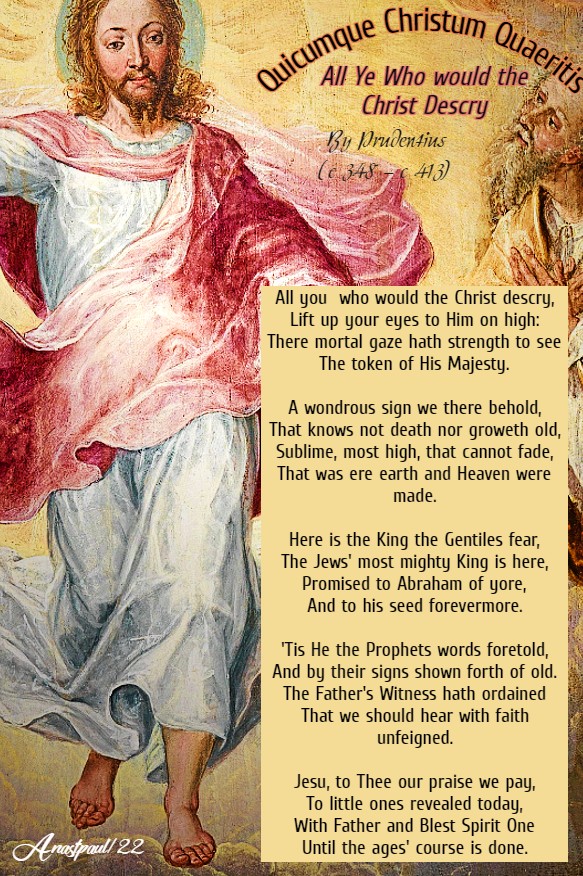
Quicumque Christum Quaeritis All Ye Who would the Christ Descry By Prudentius (c 348 – c 413) (Aurelius Prudentius Clemens) The Renowned Poet
All you who would the Christ descry, Lift up your eyes to Him on high: There mortal gaze hath strength to see The token of His Majesty.
A wondrous sign we there behold, That knows not death nor groweth old, Sublime, most high, that cannot fade, That was ere earth and Heaven were made.
Here is the King the Gentiles fear, The Jews’ most mighty King is here, Promised to Abraham of yore, And to his seed forevermore.
‘Tis He the Prophets words foretold, And by their signs shown forth of old. The Father’s Witness hath ordained That we should hear with faith unfeigned.
Jesu, to Thee our praise we pay, To little ones revealed today, With Father and Blest Spirit One Until the ages’ course is done.
The Hymn Quicumque Christum quaeritis is the twelfth and last poem in the Cathemerino of Prudentius, originally written in honour of the Epiphany. Its 208 lines has furnished four hymns to the Roman Breviary, Latin below the image. On the Feast of the Transfiguration the verses above are used. There is a short biography of Prudentius here: https://anastpaul.com/2020/01/08/quote-s-of-the-day-8-january-take-courage-it-is-i-and-bl-titus-zeman/
Quicumque Christum quaeritis, Uculos in altum tollite: Illic licebit visere Signum perennis glorias.
Illustre quiddam cernimus, Quod nesciat finem pati, Sublime, celsum, interminum, Antiquius ccelo et chao.
Hic ille Rex est Gentium, Populique Rex Judaici, Promissus Abraha patri, Ejusque in aevum semini.
Hunc et Prophetis testibus, Iisdemque signatoribus Testator et Pater jubet Audire nos, et credere.
Jesu, tibi sit gloria, Qui te revelas parvulis, Cum Patre et almo Spiritu In sempiterna saecula.
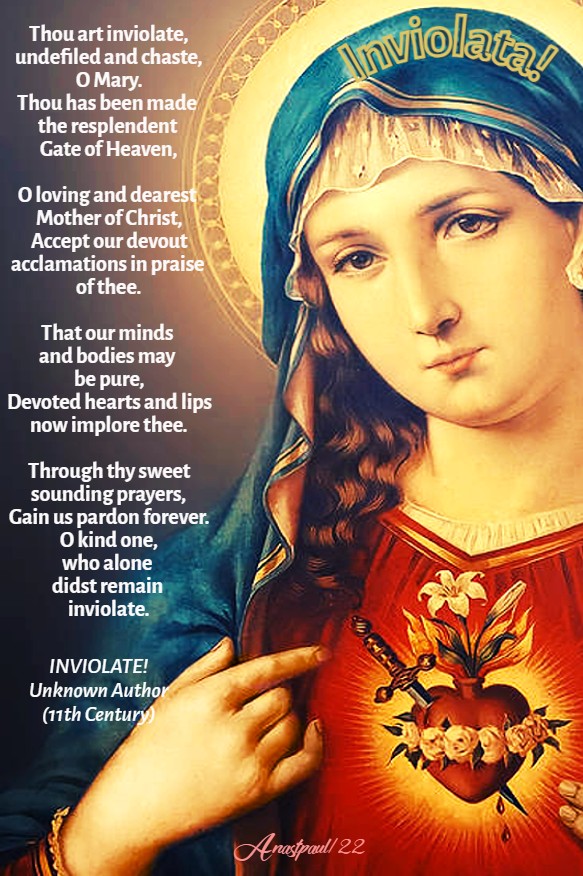
Thou art inviolate, undefiled and chaste, O Mary. Thou has been made the resplendent Gate of Heaven,
O loving and dearest Mother of Christ, Accept our devout acclamations in praise of thee.
That our minds and bodies may be pure, Devoted hearts and lips now implore thee.
Through thy sweet sounding prayers, Gain us pardon forever. O kind one, who alone didst remain inviolate.
The Hymn Inviolata has been claimed by the Carmelite Order, as a Traditional Hymn originating within their ranks. The Hymn is also used by Dominican Friars in the chanting of Compline. Its origins trace to the 11th century. It appears in Hymnals from 1860 to 1920.
Inviolata, integra, et casta es Maria, quae es effecta fulgida caeli porta.
O Mater alma Christi carissima, suscipe pia laudum praeconia.
Te nunc flagitant devota corda et ora, nostra ut pura pectora sint et corpora.
Tua per precata dulcisona, nobis concedas veniam per saecula.
O benigna! O Regina! O Maria, quae sola inviolata permansisti.
Our Morning Offering – 25 July – The Feast of St James the Greater, Apostle and Martyr
Aeterna Christi Munera The Eternal Gifts of Christ the King By St Ambrose (340-397) Father and Doctor of the Church
The eternal gifts of Christ the King, The Apostles’ glory let us sing. And al,l with hearts of gladness raise, Due hymns of thankful love and praise! For they the Church’s Princes are, Triumphant leaders in the warrior band, True lights to lighten every land.
Theirs was the steadfast faith of Saints, The hope which never yields nor faints, The love of Christ in perfect glow, That lay the prince of this world low, In them, the Father’s glory shone, In them, the Spirit’s will was done.
The Son Himself, exults in them, Joy fills the new Jerusalem. Praise to the Father, with the Son, And Holy Ghost, three in One; As ever was in ages past, And so shall be while ages last. Amen.
The Authorship of this Hymn is generally attributed to St Ambrose. He intended this composition of eight strophes to be used on the Feast Days of Martyrs. In the course of time, however,, the Hymn was selected for use on the Feast Days of the Apostles too. In each case, the Hymn praises the victory of the Apostles or Martyrs and expresses admiration for their constancy in specifically described trials and sufferings.
Our Morning Offering – 13 July – Feast of the Most Holy Name of Mary
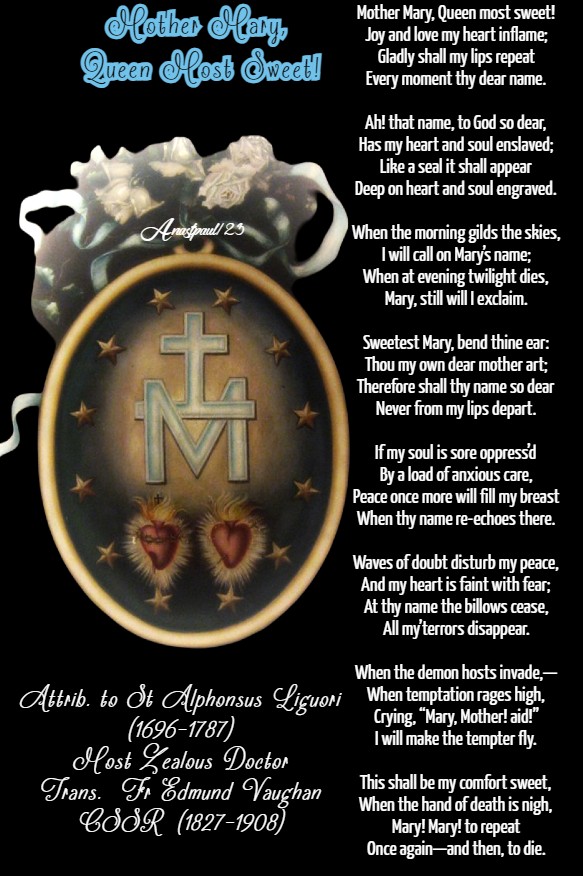
Mother Mary, Queen Most Sweet! Attrib. to St Alphonsus de Liguori (1696-1787) Most Zealous Doctor Italian Hymn Trans. Fr Edmund Vaughan CSSR (1827-1908)
Mother Mary, Queen most sweet! Joy and love my heart inflame; Gladly shall my lips repeat Every moment thy dear name.
Ah! that name, to God so dear, Has my heart and soul enslaved; Like a seal it shall appear Deep on heart and soul engraved.
When the morning gilds the skies, I will call on Mary’s name; When at evening twilight dies, Mary, still will I exclaim.
Sweetest Mary, bend thine ear: Thou my own dear mother art; Therefore, shall thy name so dear Never from my lips depart.
If my soul is sore oppress’d By a load of anxious care, Peace once more will fill my breast When thy name re-echoes there.
Waves of doubt disturb my peace, And my heart is faint with fear; At thy name the billows cease, All my’terrors disappear.
When the demon hosts invade,— When temptation rages high, Crying, “Mary, Mother! aid!” I will make the tempter fly.
This shall be my comfort sweet, When the hand of death is nigh, Mary! Mary! to repeat Once again—and then, to die.
This Hymn is an Anonymous Hymn belonging to the Redemptorist tradition but Hymnary.org attributes it to St Alphonsus Liguori. “Hymns and Verses on Spiritual Subjects” (1863) notes that this is one of two Hymns, translated in that book, mentioned above, which come from a Neapolitan published collection of Mission Hymns which are attributed to St Alphonsus.
Our Morning Offering – 8 July – Pentecost Thursday
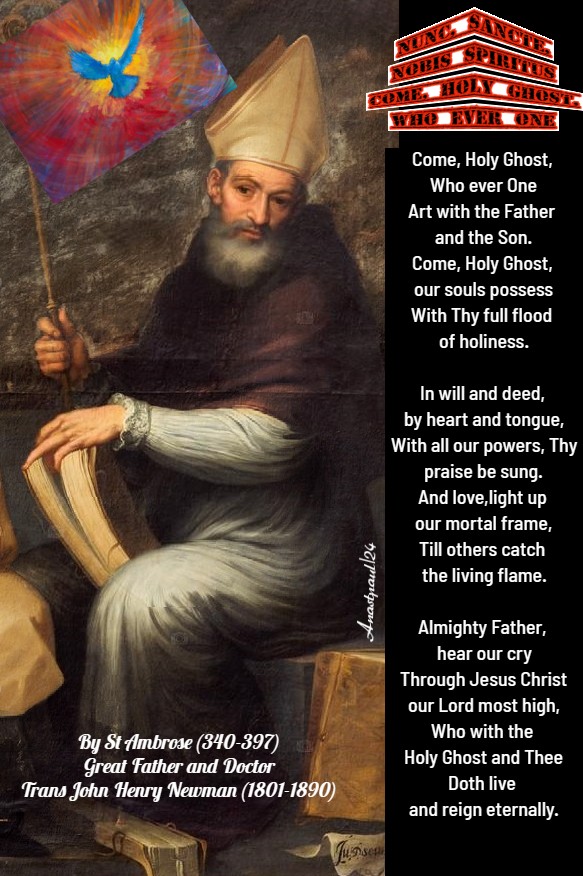
Nunc, Sancte, nobis Spiritus Come, Holy Ghost, Who ever One By St Ambrose (340-397) Trans John Henry Newman (1801-1890) Trans 1836
Come, Holy Ghost, Who ever One Art with the Father and the Son. Come, Holy Ghost, our souls possess With Thy full flood of holiness.
In will and deed, by heart and tongue, With all our powers, Thy praise be sung. And love, light up our mortal frame, Till others catch the living flame.
Almighty Father, hear our cry Through Jesus Christ our Lord most high, Who with the Holy Ghost and Thee Doth live and reign eternally.
Our Morning Offering – 7 July – “The Month of the Most Precious Blood” – Pentecost VII
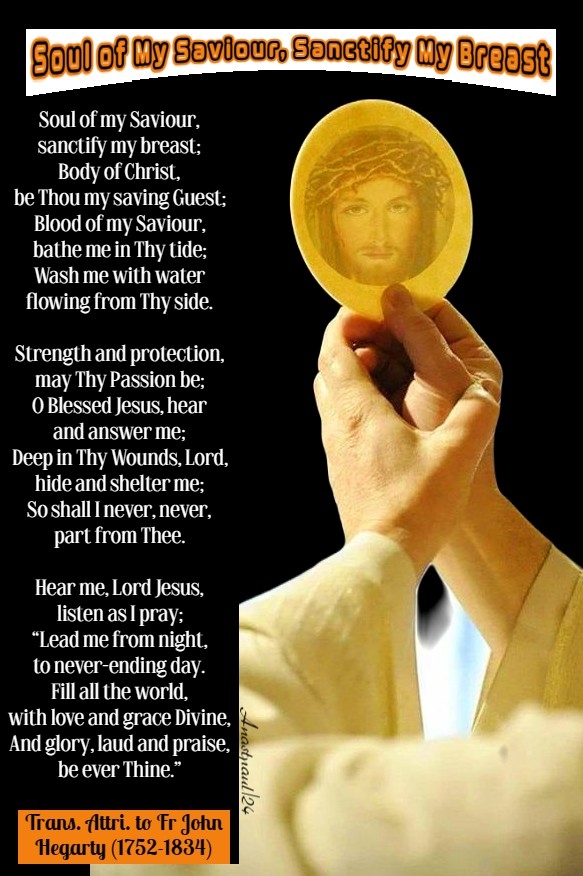
Soul of My Saviour, Sanctify My Breast Trans. Attri. to Fr John Hegarty (1752-1834)
Soul of my Saviour, sanctify my breast; Body of Christ, be Thou my saving Guest; Blood of my Saviour, bathe me in Thy tide; Wash me with water flowing from Thy side.
Strength and protection, may Thy Passion be; O Blessed Jesus, hear and answer me; Deep in Thy Wounds, Lord, hide and shelter me; So shall I never, never, part from Thee.
Hear me, Lord Jesus, listen as I pray; “Lead me from night, to never-ending day. Fill all the world, with love and grace Divine, And glory, laud and praise, be ever Thine.”
This Hymn is based on the original Latin text of the Anima Christi. Fr Hegarty is attributed with its translation and/or arrangement. He was born in County Derry, Ireland, educated at Dublin University and was Ordained in June 1890 and spent most of active apostolic years in Brisbane, Australia. He died aged 82 years.
Our Morning Offering – 6 July – The Octave Day of Saints Peter and Paul, Apostles
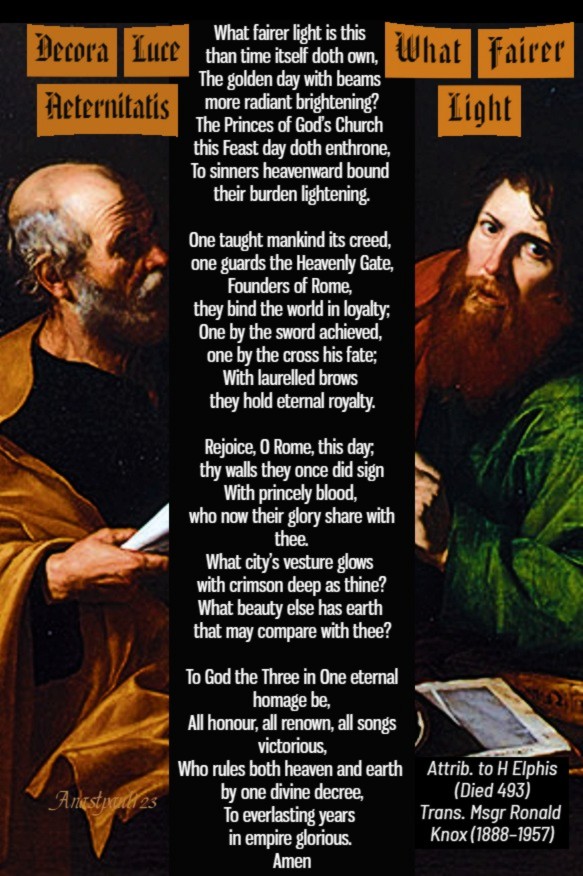
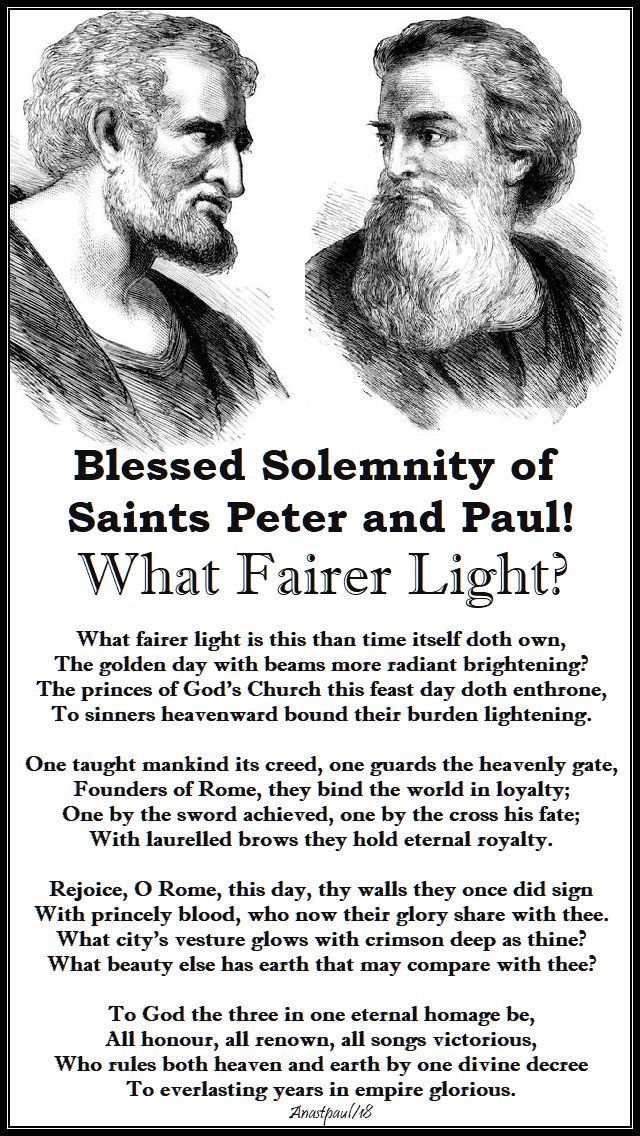
Decora Luce Aeternitatis What Fairer Light? Attrib. to H Elphis (Died 493) Wife of BL Severinus Boethius c 477– 524) Trans. Msgr Ronald Knox (1888–1957)
What fairer light is this than time itself doth own, The golden day with beams more radiant brightening? The Princes of God’s Church this Feast day doth enthrone, To sinners heavenward bound their burden lightening.
One taught mankind its creed, one guards the Heavenly Gate, Founders of Rome, they bind the world in loyalty; One by the sword achieved, one by the cross his fate; With laurelled brows they hold eternal royalty.
Rejoice, O Rome, this day; thy walls they once did sign With princely blood, who now their glory share with thee. What city’s vesture glows with crimson deep as thine? What beauty else has earth that may compare with thee?
To God the Three in One eternal homage be, All honour, all renown, all songs victorious, Who rules both heaven and earth by one divine decree, To everlasting years in empire glorious. Amen
5th century Latin Hymn “Aurea Luce” attributed to H Elphis (Died 493), first wife of the Roman philosopher-poet Boethius (c475–c525). He would eventually be Martyred for his defence of the Faith against the Arian ruler: Theodoric. Msgr Knox, a convert from Anglicanism, was a noted Scholar, Author, Hymnist and Translator, becoming the Secretary to St Pius X. Under direction of his religious superiors, he re-translated the Latin Vulgate Bible into English from Hebrew and Greek sources. What Fairer Light is set to the tune, Decora Lux by the English Catholic Composer, Samuel Webbe (1740–1816).
In 1632, in accord with changes called for by the Council of Trent, Pope Urban VIII (1568-1644) revised the original text of Aurea Luce and divided it into two new Hymns for Lauds and Vespers: Decora Lux and Beate Pastor Petre. In the Liturgy of the Hours, What Fairer Light is used on 29 June, the Solemnity of Sts Peter and Paul, Apostles. The above is the Older version.
Our Morning Offering – 29 June – Sts Peter and Paul, Apostles
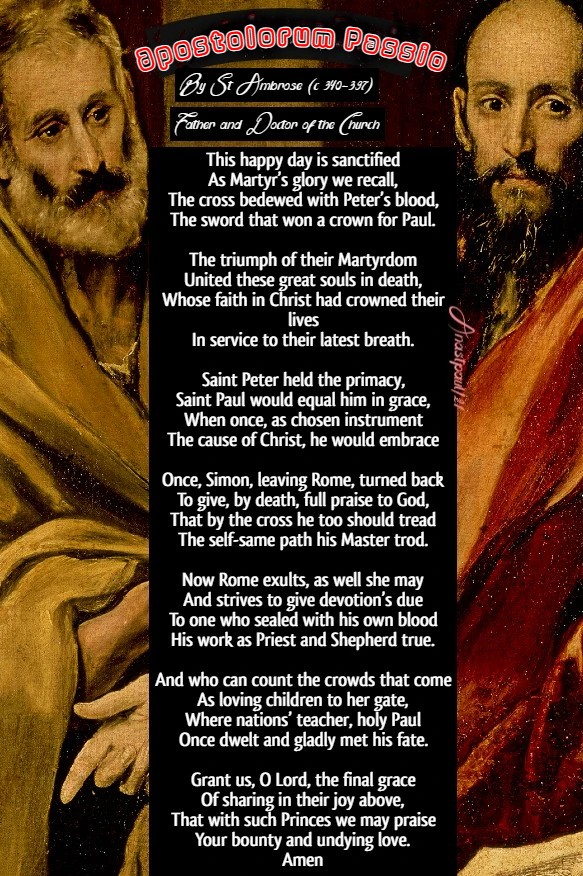
Apostolorum Passio By St Ambrose (c 340-397) Father and Doctor of the Church
This happy day is sanctified As Martyr’s glory we recall, The cross bedewed with Peter’s blood, The sword that won a crown for Paul.
The triumph of their Martyrdom United these great souls in death, Whose faith in Christ had crowned their lives In service to their latest breath.
Saint Peter held the primacy, Saint Paul would equal him in grace, When once, as chosen instrument The cause of Christ, he would embrace
Once, Simon, leaving Rome, turned back To give, by death, full praise to God, That by the cross he too should tread The self-same path his Master trod.
Now Rome exults, as well she may And strives to give devotion’s due To one who sealed with his own blood His work as Priest and Shepherd true.
And who can count the crowds that come As loving children to her gate, Where nations’ teacher, holy Paul Once dwelt and gladly met his fate.
Grant us, O Lord, the final grace Of sharing in their joy above, That with such Princes we may praise Your bounty and undying love. Amen
Translation: The Benedictines of Saint Cecilia’s Abbey, Ryde, UK
Our Morning Offering – 24 June – “The Month of the Sacred Heart of Jesus” – Pentecost V
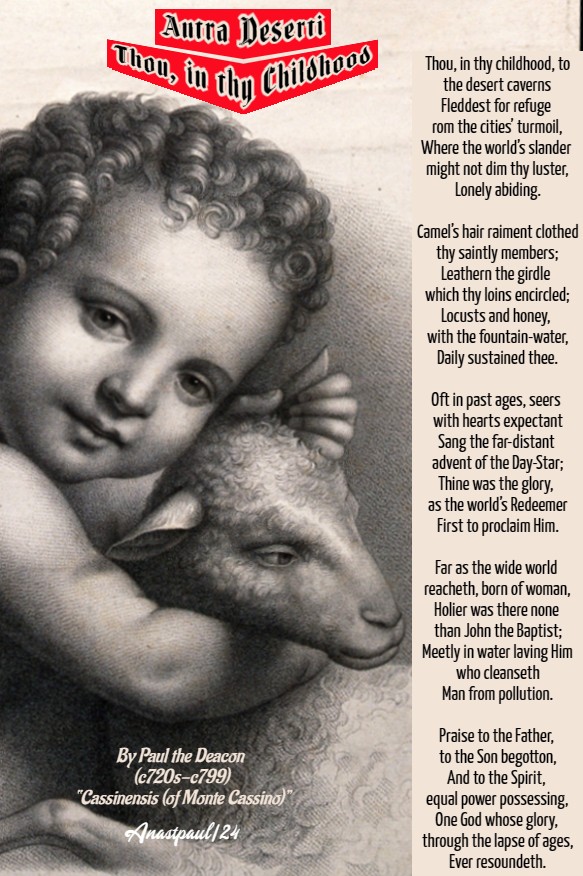
Antra Deserti Thou, in thy Childhood By Paul the Deacon (c720s-c799) “Cassinensis (of Monte Cassino)” Monk, Spiritual Author, Historian, Poet
Thou, in thy childhood, to the desert caverns Fleddest for refuge from the cities’ turmoil, Where the world’s slander might not dim thy luster, Lonely abiding.
Camel’s hair raiment clothed thy saintly members; Leathern the girdle which thy loins encircled; Locusts and honey, with the fountain-water, Daily sustained thee.
Oft in past ages, seers with hearts expectant Sang the far-distant advent of the Day-Star; Thine was the glory, as the world’s Redeemer First to proclaim Him.
Far as the wide world reacheth, born of woman, Holier was there none than John the Baptist; Meetly in water laving Him who cleanseth Man from pollution.
Praise to the Father, to the Son begotton, And to the Spirit, equal power possessing, One God whose glory, through the lapse of ages, Ever resoundeth.
This Hymn, “Ut queant laxis resonare fibris”, is in three parts. The Breviary and Roman Missal list the above for Matins today, on the Feast of the Nativity of St John the Baptist.
Our Morning Offering – 23 June – “The Month of the Sacred Heart of Jesus” – Pentecost V
Auctor Beate Sæculi Jesu, Creator of the World! Unknown Author
Jesu, Creator of the world! Of all mankind Redeemer blest! True God of God in whom we see The Father’s Image clear expressed!
Thee Saviour, love alone constrained To make our mortal flesh Thine own; And as a second Adam come, For the first Adam to atone.
That selfsame Love that made the sky, Which made the sea and stars and earth, Took pity on our misery, And broke the bondage of our birth.
O Jesu! in Thy Heart Divine May that same Love forever flow, Forever mercy to mankind From that exhaustless Fountain flow.
For this Thy Sacred Heart was pierced, And both with blood and water ran; To cleanse us from the stains of guilt, And be the hope and strength of man.
Jesu! to Thee be glory giv’n, Who from the Heart dost grace outpour, With Father and with Holy Ghost, Through endless ages evermore.
Trans. The Benedictines of Saint Cecilia’s Abbey, Ryde, UK slightly adapted from Fr Edward Caswell CO (1814-1878) original translation Music: PUER NOBIS, LM; adapted by Michael Praetorius, (1571-1621). This particular Vespers Hymn is taken from the Feast of the Sacred Heart. In a Seminary or Monastery, this hymn would be sung. It has a very compelling melody, which adds to the beauty of a Hymn which extolls the mercy of Our Lord Jesus Christ. The theme of the entire piece is Our Lord’s Sacred Heart and how It is the Fount of Mercy for all who come to Him. It tells how we should value the Infinite Redemption He wrought for us.
Our Morning Offering – 14 June – “The Month of the Sacred Heart of Jesus” and the Octave Day of the Sacred Heart
O Sacred Heart of Jesus, I Place my Trust in Thee Attr to Sr Mary Gisela of Notre Dame Convent (USA 1957)
O Sacred Heart of Jesus, I place my trust in Thee, Whatever may befall me, Lord, though dark the hour may be; In all my woes, in all my joys, though nought but grief I see, O Sacred Heart of Jesus, I place my trust in Thee.
When those I love have passed away and I am sore distressed, O Sacred Heart of Jesus, I fly to Thee for rest. And when the cross is heavy, my confidence shall be Unshaken as I cry, dear Lord, “I place my trust in Thee.”
This is my one sweet prayer, dear Lord, my faith, my trust, my love But most of all in that last hour, when death points up above, O Sweet Saviour, may Thy Face smile on my soul all free. Oh may I cry with rapturous love, “I’ve placed my trust in Thee!”
The above been set as a Hymn to the tune PASSION CHORALE by Hans Leo Hassler (1601) – the tune which is commonly used for a “O Sacred Head now Wounded”
Our Morning Offering – 11 June – Feast of St Barnabas the Apostle, Martyr, The “Son of Encouragement.”
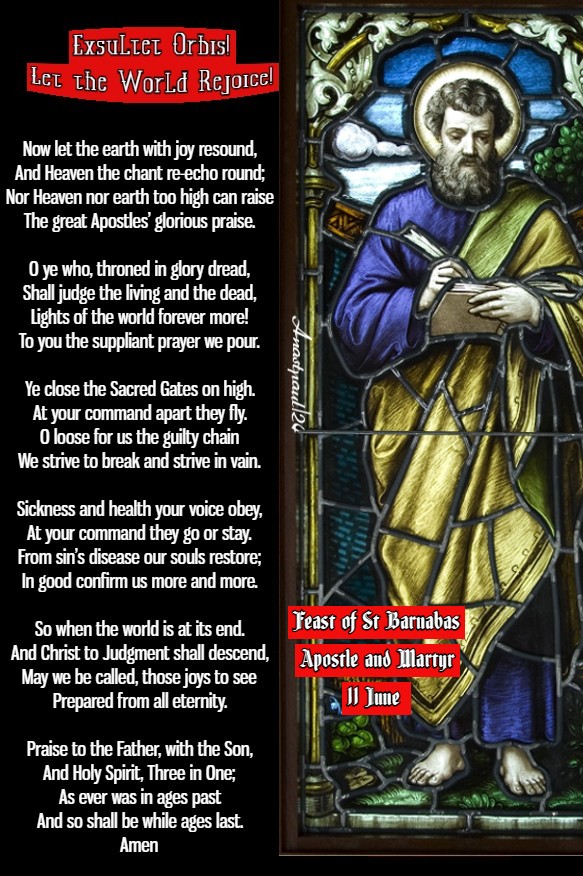
Exsultet Orbis! Let the World Rejoice! Unknown Author
Now let the earth with joy resound, And Heaven the chant re-echo round; Nor Heaven nor earth too high can raise The great Apostles’ glorious praise.
O ye who, throned in glory dread, Shall judge the living and the dead, Lights of the world forever more! To you the suppliant prayer we pour.
Ye close the Sacred Gates on high. At your command apart they fly. O loose for us the guilty chain We strive to break and strive in vain.
Sickness and health your voice obey, At your command they go or stay. From sin’s disease our souls restore; In good confirm us more and more.
So when the world is at its end. And Christ to Judgment shall descend, May we be called, those joys to see Prepared from all eternity.
Praise to the Father, with the Son, And Holy Spirit, Three in One; As ever was in ages past And so shall be while ages last. Amen
(Roman Breviary for the Common of Apostles) An Office Hymn that was traditionally prescribed for Vespers and Lauds on the Feasts of Apostles and Evangelists outside Easter time. The Hymn is found as early as the 10th Century in a Hymnal of Moissac Abbey.
Our Morning Offering – 2 June – The Solemnity of Corpus Christ, The Most Holy Body and Blood of our Lord Jesus Christ
Lauda Sion Salvatorem Sion, Lift Up thy Voice and Sing (Excerpt) By St Thomas Aquinas (1225-1274) Doctor Angelicus / Doctor Communis
Sion, lift thy voice and sing, Praise thy Saviour and thy King, Praise with hymns thy Shepherd true, Dare thy most to praise Him well, For He doth all praise excel, None can ever reach His due.
Special theme of praise is Thine, That true living Bread divine, That life-giving flesh adored, Which the brethren twelve received, As most faithfully believed, At the Supper of the Lord.
Let the chant be loud and high, Sweet and tranquil be the joy Felt to-day in every breast; On this festival divine Which recounts the origin Of the glorious Eucharist.
St Thomas Aquinas wrote the Liturgy for Corpus Christi when Pope Urban IV added the Solemnity to the universal Church’s Liturgical calendar in 1264. He provided a great sequence, one of the great poems chanted or recited before the proclamation of the Gospel. Lauda Sion is one of only four medieval sequences which were preserved in the Roman Missal published in 1570 following the Council of Trent (1545–1563)—the others being Victimae Paschali Laudes (Easter), Veni Sancte Spiritus (Pentecost) and Dies irae (requiem masses). (A fifth, Stabat Mater, would later be added in 1727.) Before Trent, many feasts had their own sequences. The existing versions were unified in the Roman Missal promulgated in 1570. The Lauda Sion is still sung today as solemn Eucharistic hymn, though its use is optional in the post-Vatican II Ordinary form. As with St Thomas’s other three Eucharistic Hymns, the last few stanzas of the Lauda Sion are often used alone, in this case, to form the “Ecce Panis Angelorum”.
Our Morning Offering – 28 May – “The Month of the Blessed Virgin Mary” – As we face the last few days of the special month of our Queen and Mother, we kneel at her feet in love, veneration and supplication and implore her unfailing protection and refuge. I cannot imagine how anyone may reach our goal of eternal life and weave their way through this vale of tears, without our Most Blessed Mother!
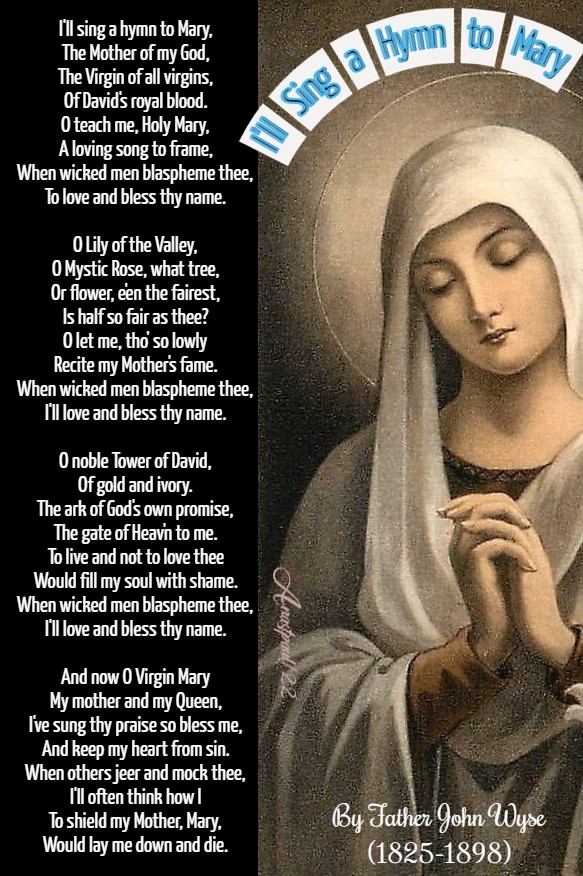
I’ll Sing a Hymn to Mary By Father John Wyse (1825-1898) Irish Priest and Hymn writer
I’ll sing a hymn to Mary, The Mother of my God, The Virgin of all virgins, Of David’s royal blood. O teach me, Holy Mary, A loving song to frame, When wicked men blaspheme thee, To love and bless thy name.
O Lily of the Valley, O Mystic Rose, what tree, Or flower, e’en the fairest, Is half so fair as thee? O let me, tho’ so lowly Recite my Mother’s fame. When wicked men blaspheme thee, I’ll love and bless thy name.
O noble Tower of David, Of gold and ivory. The ark of God’s own promise, The gate of Heav’n to me. To live and not to love thee Would fill my soul with shame. When wicked men blaspheme thee, I’ll love and bless thy name.
When troubles dark afflict me In sorrow and in care, Thy light doth ever guide me O beauteous Morning Star. Lo, I’ll be ever ready Thy goodly help to claim, When wicked men blaspheme thee, To love and bless thy name.
The saints are high in glory, With golden crowns so bright; But brighter far is Mary, Upon her throne of light. Oh that which God did give thee, Let mortal ne’er disclaim; When wicked men blaspheme thee, I’ll love and bless thy name.
But in the crown of Mary, There lies a wonderous gem, As Queen of all the Angels, Which Mary shares with them; No sin hath e’er defiled thee, So doth our faith proclaim; When wicked men blaspheme thee, I’ll love and bless thy name.
And now O Virgin Mary My mother and my Queen, I’ve sung thy praise so bless me, And keep my heart from sin. When others jeer and mock thee, I’ll often think how I To shield my Mother, Mary, Would lay me down and die.
Blue skies, Blue waters, blue as Mary’s eyes God scatters with a lavish hand, On every land. Still night, Made lovely with soft, silver light, God wraps about the world when day Has slipped away. Each field Holds up a golden-flowered shield Against the shining shafts of sun, Yet each is won. Bright rain God spills to bring to earth again New freshness. Then like sudden tears It disappears. Green trees, The vagabonding summer breeze, The golden days and silver nights His will unites In one. And when His work of love is done, His will decrees a holiday, The month of May. And why? That she, as pure as summer sky, Who found within an earth-born Boy What earth contained of joy and pain Might find her full content of joy On earth again.
Our Morning Offering – 25 April – Feast of St Mark Evangelist
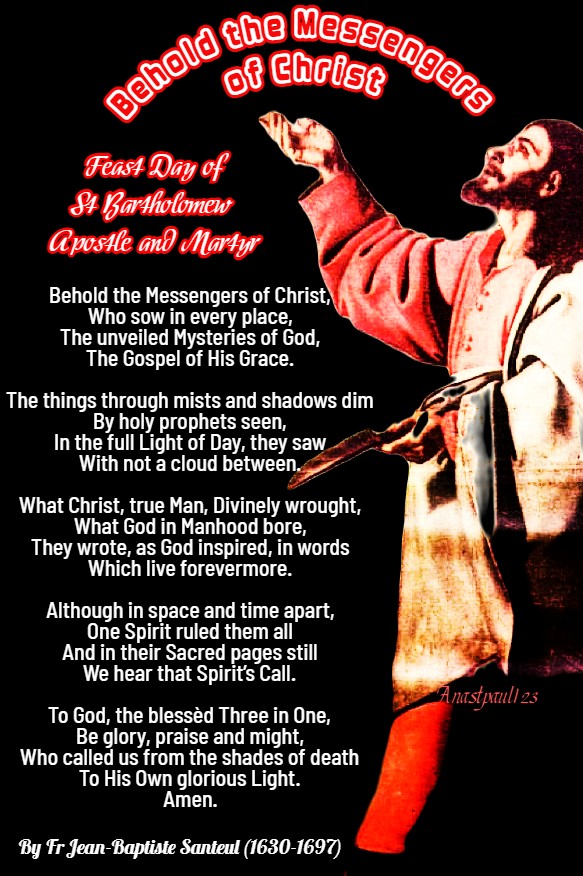
Behold the Messengers of Christ By Fr Jean-Baptiste Santeul (1630-1697) Priest, Monk, Hymnist, Poet, Writer
Behold the Messengers of Christ, Who sow in every place, The unveiled Mysteries of God, The Gospel of His Grace.
The things through mists and shadows dim By holy prophets seen, In the full Light of Day, they saw With not a cloud between.
What Christ, true Man, Divinely wrought, What God in Manhood bore, They wrote, as God inspired, in words Which live forevermore.
Although in space and time apart, One Spirit ruled them all And in their Sacred pages still We hear that Spirit’s Call.
To God, the blessèd Three in One, Be glory, praise and might, Who called us from the shades of death To His Own glorious Light. Amen.
Trans. Compilers of Hymns Ancient and Modern, 1861. This Hymn was used for Vespers I & II and Nocturns on the Feasts of St Mark and St Luke in the Paris Breviary (1736). Cardinal Newman’s Hymni Ecclesiae has it listed for the same hours, as the Common of Evangelists in the Paris Breviary (presumably a later edition). Tune: “Tiverton“ Rev J Grigg, c1791.
Our Morning Offering – 24 April – The Octave Day of the Patronage of St Joseph
Caelitum, Ioseph, decus Joseph, the Praise and Glory of the Heavens By Fr Juan Escollar (Died 1700)
Joseph, the praise and glory of the heavens, Sure pledge of life and safety of the wide world, as in our joy we sing to thee, in kindness listen to our praises.
Thou by the world’s Creator wert appointed Spouse of the Virgin, thee He willed to honour. Naming thee father of the Word and guardian of our salvation.
Thou, thy Redeemer, lying in a stable, whom long ago foretold the choir of Prophets, sawest rejoicing and thy God adorest Humble in childhood.
God, King of Kings and Governor of the ages, He at Whose word the powers of hell do tremble, He Whom the adoring heavens ever worship, called thee protector.
Praise to the Triune Godhead everlasting, Who with such honour mightily hath blest thee. O may He grant us at thy blest petition Joys everlasting. Amen
This Hymn was formerly used at Matins for the Feast of St Joseph, Spouse of the Blessed Virgin Mary (19 March). It is still used for this Feast but for Lauds. It is also the Hymn for Lauds for the Feast of St Joseph the Worker on 1 May. Translation by Alan G McDougall (1895-1964).
Our Morning Offering – 22 April – “The Month of the Resurrection and the Blessed Sacrament”
Glory Be to Jesus, Who in Bitter Pains By St Alphonsus Maria de Liguori 1696–1787) [Attrib] Transl. Fr Edward Caswell CO (1814-1878) (An Indulgence of 100 days)
Glory be to Jesus, Who in bitter pain Poured for me the life-Blood From His sacred veins.
Grace and life eternal In that Blood I find; Blest be His compassion, Infinitely kind.
Blest through endless ages Be the precious stream, Which from endless torments Dost the world redeem.
Abel’s blood for vengeance Pleaded to the skies; But the Blood of Jesus For our pardon cries.
Oft as it is sprinkled On our guilty hearts, Satan in confusion Terror-struck departs.
Oft as earth exulting Wafts its praise on high, Angel-hosts rejoicing Make their glad reply.
Lift ye then your voices; Swell the mighty flood; Louder still and louder Praise the Precious Blood.
Our Morning Offering – 17 April – “The Month of the Resurrection and the Blessed Sacrament” – Wednesday, St Joseph’s Day and The Solemnity of the Patronage of St Joseph
Hail, Holy Joseph, Hail! By Father Frederick William Faber CO (1814-1863)
Hail, holy Joseph, hail! Chaste spouse of Mary hail! Pure as the lily flow’r In Eden’s peaceful vale. Hail, holy Joseph, hail! Prince of the house of God! May His best graces be By thy sweet hands bestowed.
Hail, holy Joseph, hail! Comrade of Angels, hail! Cheer thou the hearts that faint, And guide the steps that fail. Hail, holy Joseph, hail! God’s choice wert thou alone! To thee the Word made flesh, Was subject as a Son.
Hail, holy Joseph, hail! Teach us our flesh to tame And, Mary, keep the hearts That love thy husband’s name. Mother of Jesus! bless, And bless, ye Saints on high, All meek and simple souls That to Saint Joseph cry. Amen
Our Morning Offering – 3 April – “The Month of the Resurrection and the Blessed Sacrament” – Easter Wednesday
“Alleluia!” Now We Cry! (Come, You Faithful, Raise the Strain) By St John Damascene (675-749) Father & Doctor of the Church Trans. John Mason Neale
Come, you faithful, raise the strain of triumphant gladness! God has brought His Israel into joy from sadness, loosed from Pharaoh’s bitter yoke Jacob’s sons and daughters, led them with unmoistened foot through the Red Sea waters.
See the spring of souls today; Christ has burst His prison, and from three days’ sleep in death as a Sun hath risen; all the winter of our sins, long and dark, is flying from His Light, to Whom we give laud and praise undying.
Now the queen of seasons, bright with the day of splendour, with the Royal Feast of Feasts, comes its joy to render; comes to gladden faithful hearts which with true affection welcome in unwearied strains Jesus’ Resurrection!
For today among His own Christ appeared, bestowing blessed peace which evermore passes human knowing. Neither could the gates of death, nor the tomb’s dark portal, nor the watchers, nor the seal, hold Him as a mortal.
“Alleluia!” Now we cry to our King immortal, Who, triumphant, burst the bars of the tomb’s dark portal. Come, you faithful, raise the strain of triumphant gladness! God has brought His Israel into joy from sadness!
He is Risen, Tell the Story By Father Willard F Janusch (1930-2018)
He is risen, tell the story to the nations of the night; from their sin and from their blindness, let them walk in Easter light. Now begins a new creation, now has come our true salvation. Jesus Christ, the Son of God!
Mary goes to tell the others of the wonders she has seen; John and Peter come a’running what can all this truly mean? O Rabboni, Master holy, to appear to one so lowly! Jesus Christ, the Son of God!
He has cut down death and evil, He has conquered all despair; He has lifted from our shoulders, all the weight of anxious care. Risen Brother, now before you, we will worship and adore You. Jesus Christ, the Son of God!
Now get busy, bring the message, so that all may come to know there is hope for saint and sinner, for our God has loved us so. Ev’ry Church bell is a’ringing, ev’ry Christian now is singing. Jesus Christ, the Son of God!
A Parish Priest, Seminary Professor and prolific Musician and Hymnist, Fr Willard wa Ordained in 1956 and died at the age of 88 in 2018.
Our Morning Offering – 31 March – Easter Sunday, Alleluia, He is Truly Risen, Alleluia!
O Filii et Filiae Ye Sons and Daughters of the Lord By Jean Tisserand OFM (Died 1497) (The original Hymn comprises the nine stanzas below). Trans. Fr Edward Caswell C.Orat. (1814-1878)
Ye sons and daughters of the Lord, The King of Heaven, the King adored, From death this day Himself restored. Alleluia, Alleluia, Alleluia!
On Sunday morn at break of day The holy women went their way, To see the tomb where Jesus lay. Alleluia, Alleluia, Alleluia!
An Angel clad in white they see, Who sat,and spake unto the three: “Your Lord hath gone to Galilee.” Alleluia, Alleluia, Alleluia!
That night the’ Apostle met in fear, But Christ didst in the midst appear: “My peace,” He saith, “be on thee!” Alleluia, Alleluia, Alleluia!
But Thomas, when of this he heard, Was doubtful of his brethren’s word; Wherefore, again there came the Lord. Alleluia, Alleluia, Alleluia!
“Behold My side, O Thomas, see; My hands, My feet, I show to thee; Not faithless but believing be.” Alleluia, Alleluia, Alleluia!
When Thomas say that wounded side, The truth no longer he denied, “Thou art my Lord and God,” he cried. Alleluia, Alleluia, Alleluia!
Oh, blest are they who have not seen Their Lord and yet believe in Him; Eternal life awaiteth them. Alleluia, Alleluia, Alleluia!
On this Most Holy Day of days, To God your hearts and voices raise In laud and jubilee and praise. Alleluia, Alleluia, Alleluia Amen!
Our Morning Offering – 6 April – Maundy Thursday in Holy Week
Man of Sorrows—Wrapt in Grief From an old French Hymn Author Unknown
Man of Sorrows—wrapt in grief, Bow Thine ear to our relief; Thou for us the path hast trod Of the dreadful wrath of God. Thou the cup of fire hast drain’d Till its light alone remain’d: Lamb of Love!—we look to Thee, Hear our mournful litany!
By the garden—fraught with woe, Whither Thou full oft wouldst go: By Thine Agony of prayer In the desolation there! By the chains of sleep, which bound Watchers in their trance profound; Lord!—behold our bended knee,— Listen to our litany!
By the conflict foul and fell With the loosen’d fiends of hell, By the darkness of the hour Shadow’d with the tempter’s power, By the dire and deep distress Of that mystery fathomless;— Lord! our tears in mercy see Mingling with our litany!
By the vision then, which stole Looming o’er Thy spotless soul, Of the pride and guilt of man, Since his fall from grace began,— Seas of sin, with billowy waves, Yawning into countless graves;— Lord! ourselves from shipwreck free, Hear our solemn litany!
By the Chalice, when it came Pregnant with a hell of flame: By those Lips—which fain would pray That it might but pass away: By the Heart, which drank it dry, Lest a rebel race should die;— Let Thy Pity be our plea, Hear our solemn litany!
Man of Sorrows! —let Thy grief Purchase for us our relief— Lord of Mercy—bow Thine ear, Slow to anger—swift to hear: Let the garden Thou hast trod Draw us to the throne of God; So Gethsemane shall be Sweet in every litany!
This translation by Matthew Bridges (1800-1894) (The Passion of Jesus 1852) Hymnist, Poet, Writer Converted to Catholicism in 1848, by the influence of John Henry Newman (1801-1890) Tune: “Anima Christi (English)” traditional English melody.
Quote of the Day – 22 March – Friday in Passion Week, the Fifth Friday in Lent, Our Lady of the Seven Sorrows
STABAT MATER
At the Cross her station keeping, Stood the mournful Mother weeping, Close to Jesus to the last. Through her heart, His sorrow sharing, All His bitter anguish bearing, Now at length the sword had passed.
Oh, how sad and sore distressed Was that Mother highly blest, Of the sole begotten One! Christ above in torment hangs. She beneath beholds the pangs Of her dying glorious Son.
Is there one who would not weep, Whelmed in miseries so deep, Christ’s dear Mother to behold? Can the human heart refrain From partaking in her pain, In that Mother’s pain untold?
Bruised, derided, cursed, defiled, She beheld her tender Child, All with bloody scourges rent. For the sins of His own nation, Saw Him hang in desolation Till His spirit forth He sent.
O thou Mother: fount of love! Touch my spirit from above, Make my heart with thine accord. Make me feel as thou hast felt; Make my soul to glow and melt With the love of Christ my Lord.
Holy Mother, pierce me through; In my heart each wound renew Of my Saviour Crucified. Let me share with thee His pain, Who for all my sins was slain, Who for me in torment died.
Let me mingle tears with thee, Mourning Him who mourned for me, All the days that I may live. By the Cross with thee to stay; There with thee to weep and pray, Is all I ask of thee to give.
Virgin of all virgins best, Listen to my fond request: Let me share thy grief divine. Let me to my latest breath, In my body bear the death Of that dying Son of thine.
Wounded with His every wound, Steep my soul till it hath swooned In His very blood away. Be to me, O Virgin, nigh, Lest in flames I burn and die, In His awful Judgment day.
Christ, when Thou shalt call me hence, Be Thy Mother my defence, Be Thy Cross my victory. While my body here decays, May my soul Thy goodness praise, Safe in Paradise with Thee. Amen
Note: This text of the Stabat Mater is one of over 60 translations of this famous 13th Century Latin Hymn/Prayer. The Author is uncertain but is believed to be either St Jacopone da Todi OFM (1230-1306) or Pope Innocent III (1161-1216)[reigned from from 8 January 1198 until his death on 16 July 1216]. The title comes from its first line, “Stabat Mater dolorosa” – which means “the sorrowful mother was standing.” It is often used when praying the Stations of the Cross. The original Latin text of the Stabat Mater has also been set to music by such composers as Haydn, Rossini, and Poulenc.

You must be logged in to post a comment.