Posted in ADVENT, DOCTORS of the Church, JESUIT SJ, MORNING Prayers, QUOTES of the SAINTS, QUOTES on SANCTITY, SAINT of the DAY, Uncategorized

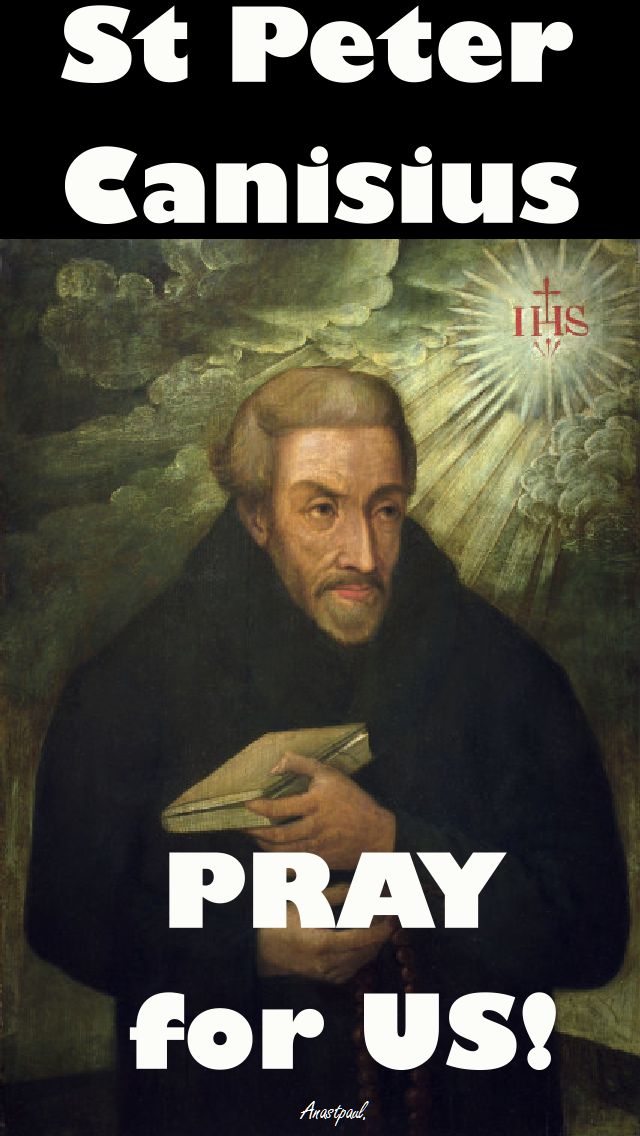
Quote/s of the Day – 21 December – The Memorial of St Peter Canisius (1521-1597) Doctor of the Church

Quote/s of the Day – 21 December – The Memorial of St Peter Canisius (1521-1597) Doctor of the Church

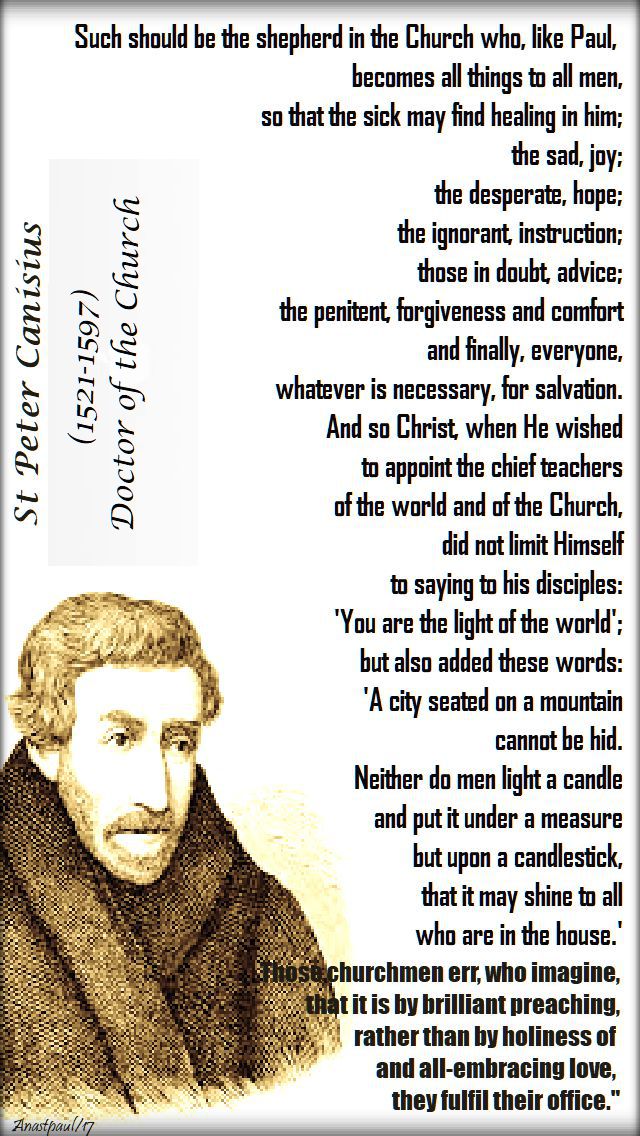
“Such should be the shepherd
in the Church who, like Paul,
becomes all things to all men,
so that the sick may find healing in him;
the sad, joy;
the desperate, hope;
the ignorant, instruction;
those in doubt, advice;
the penitent, forgiveness and comfort
and finally, everyone,
whatever is necessary, for salvation.
And so Christ, when He wished
to appoint the chief teachers
of the world and of the Church,
did not limit Himself to saying to his disciples:
‘You are the light of the world’;
but also added these words:
‘A city seated on a mountain cannot be hid.
Neither do men light a candle
and put it under a measure but upon a candlestick,
that it may shine to all who are in the house.’
Those churchmen err, who imagine,
that it is by brilliant preaching,
rather than by holiness of and all-embracing love,
they fulfil their office.
such should be - st peter canisius - 21 dec 2017

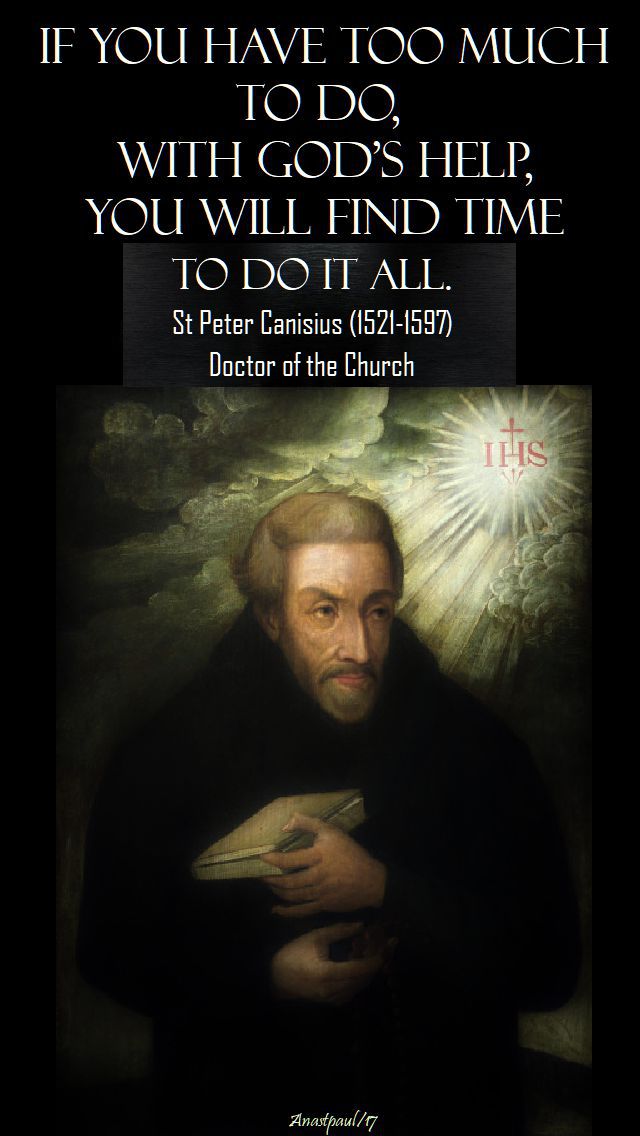
“If you have too much to do, with God’s help, you will find time to do it all.”

St Peter Canisius (1521-1597) Doctor of the Churchif you have too much to do - st peter canisius - 21 dec

“Among the Jesuit saints, it is Peter Canisius
that brought me into the Society of Jesus…
as we go on, you will see, what influence
St Peter has had on this sinner. “

“(St Peter Canisius had) an extraordinary devotion
to the Holy Eucharist – his devotion to the Holy Sacrifice
were such that people would come from great distances
to watch him offer Mass, so devoutly did he celebrate.
He was one of the people that urged frequent Communion
at the Council of Trent and was one of those who got
the Council of Trent to pass a little known decree,
little known because it took almost three hundred years
for that decree to really come to life.
The Council of Trent, mind you, sixteenth century,
encouraged daily Communion – you would never guess it, would you?
Peter Canisius was one of those who, under instructions from Ignatius,
made sure that the Council passed that decree
and he spent hours before the Blessed Sacrament.”

Ven Servant of God Fr John A Hardon S.J. (1914-2000)st peter canisus had an - fr john a hardon - 21 dec 2017

Posted in ADVENT, DOCTORS of the Church, JESUIT SJ, MARIAN QUOTES, MORNING Prayers, QUOTES of the SAINTS, SAINT of the DAY

One Minute Reflection – 21 December – The Memorial of St Peter Canisius (1521-1597) Doctor of the Church

One Minute Reflection – 21 December – The Memorial of St Peter Canisius (1521-1597) Doctor of the Church

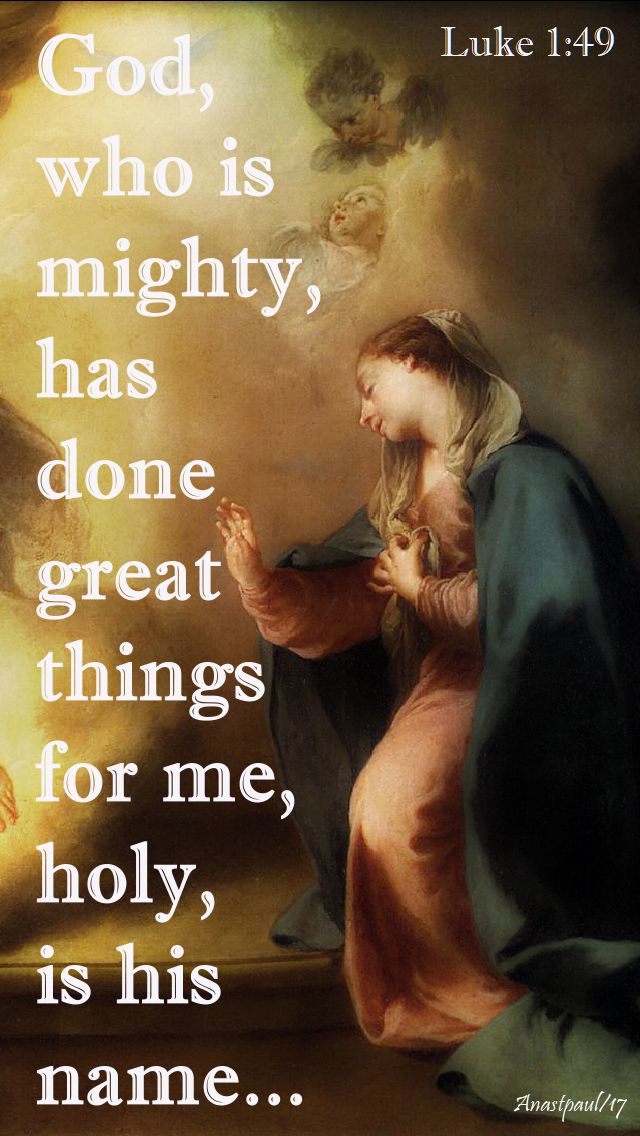
God who is mighty,
has done great things for me,
holy is his name…….Luke 1:49Luke 1 - 49

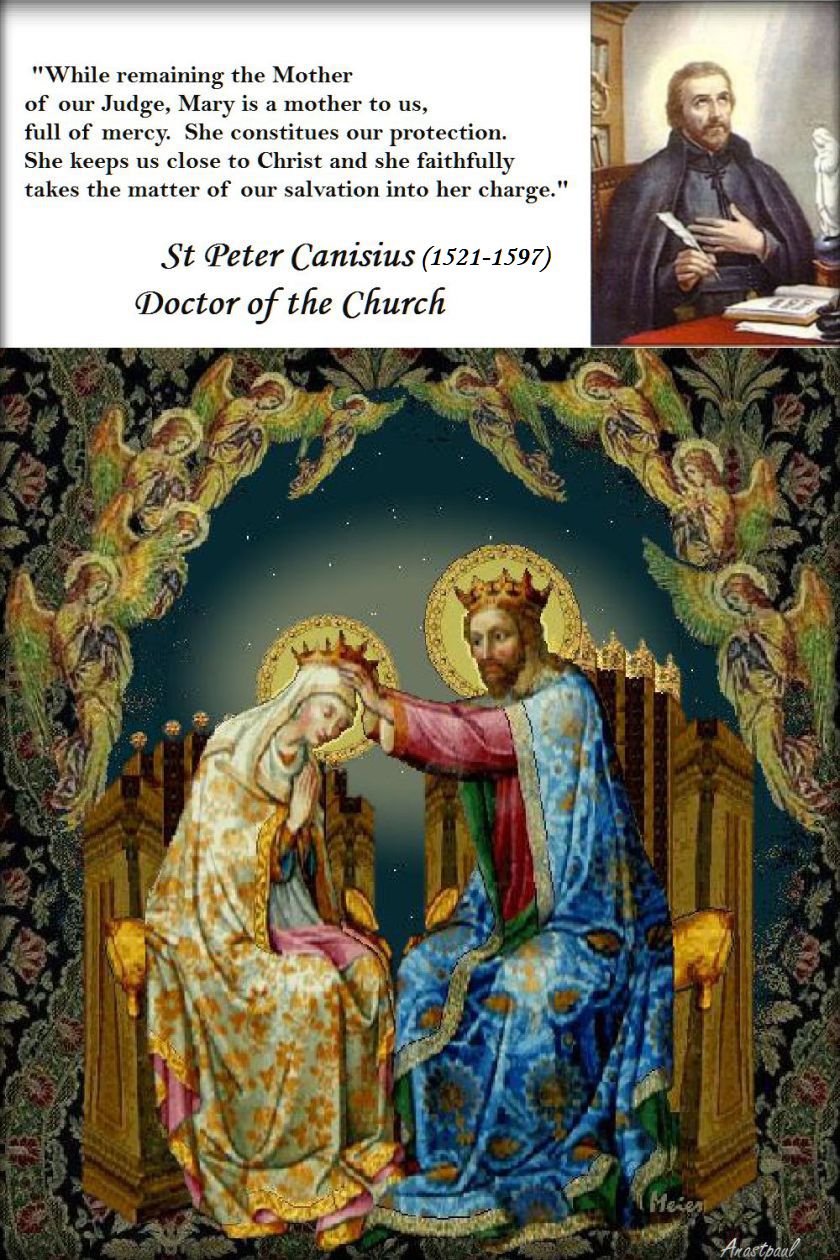
REFLECTION – “While remaining the Mother of our Judge, Mary is a mother to us, full of mercy.   She constitutes our protection.   She keeps us close to Christ and she faithfully takes the matter of our salvation into her charge.”……………….St Peter Canisiuswhile remaining the mother of our judge - st peter canisius - 2016 image

PRAYER – Heavenly Father, You have filled Mary with grace and made her a Co-Meaditrix with Christ Your Son.   Grant that I may have constant recourse to her and attain the salvation she helped win for the world.   St Peter Canisius, you lived a life of total and full dedication to our Father, to His divine Son and his holy and most blessed mother and in complete openness to the inspiration of the Holy Spirit.   Please pray for us that as you were strengthened in sanctity and doctrine for the defence and growth of the Catholic faith, every seeker of truth may have the joy of finding our God and that all Catholics may persevere and grow in love and zeal for the one true faith. amen.canisius-pray-for-us - 2016

Posted in ADVENT, JESUIT SJ, PRAYERS of the SAINTS, SAINT of the DAY

Our Morning Offering – 21 December – The Memorial of St Peter Canisius (1521-1397) Doctor of the Church

Our Morning Offering – 21 December – The Memorial of St Peter Canisius (1521-1597) Doctor of the Church

May I Be United With You, Good Jesus
St Peter Canisius (1521-1597) Doctor of the Church

Let my eyes take their sleep
but may my heart always
keep watch for You.
May Your right hand bless Your servants
who love You.
May I be united with the praise
that flows from You, Lord Jesus,
to all your saints;
united with the gratitude
drawn from Your heart, good Jesus,
that causes Your saints to thank You;
united with Your passion, good Jesus,
by which You took away our guilt;
united with the divine longing
that You had on earth, for our salvation;
united with every prayer
that welled from Your divine heart, good Jesus
and flowed into the hearts of Your saints.
Amenmay I be united with you good jesus - st peter canisius sj


Posted in CATHOLIC PRESS, DOCTORS of the Church, JESUIT SJ, Of Catechists, SAINT of the DAY

Saint of the Day – 21 December – St Peter Canisius SJ (1521-1597) – Confessor, Doctor of the Church

Saint of the Day – 21 December – St Peter Canisius SJ (1521-1597) – Confessor, Priest, Religious, Doctor of the Church, Reformer, Teacher,  Writer, Apostle of Charity –  (Born as Pieter Kanis on 8 May 1521 at Niemguen, Netherlands – 21 December 1597 at Fribourg, Switzerland of natural causes).   Patronages – Catholic Press, Germany, Catechists.   Known as the Hammer of Protestantism and the Second Apostle of Germany.   St Peter  became known for his strong support for the Catholic faith during the Protestant Reformation in Germany, Austria, Bohemia, Moravia and Switzerland.   The restoration of the Catholic Church in Germany after the Protestant Reformation is largely attributed to the work there of the Society of Jesus, which he led.   “Peter Canisius was the first publisher, the first author, the first editor of the Society of Jesus.   By now, Jesuits have followed in his footsteps to the tune of having published in 400 years, thousands of books.   From the time of Canisius, and his name is first in the bibliography of Jesuit writers, from Peter Canisius to the end of the l9th century, that is to 1900, there are about twenty volumes of bibliography, each volume about two inches thick, stands about eighteen inches high, filled just with authors and titles, thousands and thousands and thousands, no other religious institute in the Church publishes as much as members of the Society.   It was all started by Peter Canisius.” (Ven Servan of God Fr John A Hardon S.J.)

canisius - large

St Peter Canisius was born in 1521 in what is now the Netherlands.   His father was the local mayor and his mother died shortly of his birth.  Peter studied at the University of Cologne and earned a Master’s degree in 1540 at the age of 19.   While there, he met St Peter Faber, one of the first Jesuits.   Through him, Canisius became the first Dutchman to join the Society of Jesus in 1543.   St Peter Canisius’ preaching and writings, led him to become one of the most influential Catholics of his time.   He supervised the founding and maintenance of the first German-speaking Jesuit colleges and was known as the Second Apostle of Germany.

If you have too much to do, with God’s help you will find time to do it all – St Peter Canisius

For a half-century he led the Catholic Reformation in Austria, Bavaria and Bohemia.   For that reason he is reckoned an apostle to Germany, second only to St. Boniface.   With stupendous energy he preached and taught in parishes, reformed and founded universities, wrote many books including popular catechisms, restored lapsed Catholics, converted Protestants, preached retreats and found time to care for the sick.   In his last 30 years travelling more than 20,000 miles on foot or horseback, St Peter Canisius spearheaded the renewal of the Catholic faith in southern Germany.Saint_Petrus_Canisius

Peter Canisius revitalised Catholic life and teaching at universities in Ingolstadt and Augsburg.   He founded new ones at Prague and Fribourg.   In all four cities his preaching and catechising won the hearts of Catholics and attracted nominal Protestants to the church.   In Vienna his personal care for plague victims made him a most popular figure.  Thus, when appointed diocesan administrator, he was in a position to revive the city’s long decadent Catholic community.

After 1555, Peter Canisius published his famous Summary of Christian Doctrine and two smaller catechisms.   These books generated the Catholic Reformation as Luther’s catechism had spread Protestantism.   Canisius’s catechisms also helped launch the Catholic press.    The Three Catechisms he compiled between 1555 and 1558.   The first Catechism was addressed to students who could grasp the elementary notions of theology;  the second, to young people of the populace for an initial religious instruction;  the third, to youth with a scholastic formation of middle and high school levels.   He explained Catholic doctrine with questions and answers, concisely, in biblical terms, with great clarity and with no polemical overtones.   “There were at least 200 editions of this Catechism in his lifetime alone, translated into 15 languages!   And hundreds of editions succeeded one another until the 20th century.   So it was that still in my father’s generation people in Germany were calling the Catechism simply “the Canisius”.   He really was the Catechist of Germany for centuries, he formed people’s faith for centuries.” (Pope Benedict XVI).

He was offered the post of Bishop of Vienna in 1554 but declined in to continue his travelling and teachings.

canisius2

In the late 16th century, when open hostility typified relations between Catholics and Protestants, Peter Canisius advised charity and moderation. He opposed theological debates with Protestant leaders and in general, discouraged discussion of Catholic distinctives such as indulgences, purgatory and monastic vows with Protestants.   He believed such efforts only heightened division and embittered relations.   He articulated his views in this letter to his Jesuit superior:

“It is plainly wrong to meet non-Catholics with bitterness or to treat them with discourtesy.   For this is nothing else than the reverse of Christ’s example because it breaks the bruised reed and quenches the smoking flax.   We ought to instruct with meekness those whom heresy has made bitter and suspicious and has estranged from orthodox Catholics, especially from our fellow Jesuits.   Thus, by whole-hearted charity and good will we may win them over to us in the Lord.

Again, it is a mistaken policy to behave in a contentious fashion and to start disputes about matters of belief with argumentative people who are disposed by their very natures to wrangling.   Indeed, the fact of their being so constituted is a reason the more why such people should be attracted and won to the simplicity of the faith as much by example as by argument.”

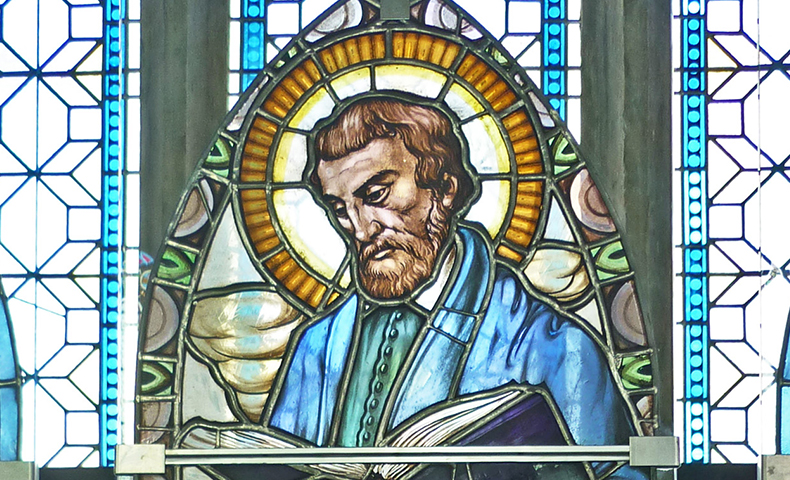
In 1591, Peter Canisius suffered a stroke that nearly killed him.   But he recovered and devoted himself to writing for six more years until his death in 1597.   His body was interred before the high altar of the Church of Saint Nicholas in Fribourg and his relics were translated to the Church of Saint Michael at the Jesuit College in Fribourg in 1625. He was Canonised 21 May 1925 by Pope Pius XI and was added to the now 36 Doctors of the Church, by Pope Pius XI in 1925.SOD-1221-SaintPeterCanisius-790x480Petrus Canisius / Gemaelde - Petrus Canisius / Painting -

Posted in ADVENT, JESUIT SJ, MORNING Prayers, The CHRIST CHILD

Thought for the Day – 15 December – Friday in the Second Week of Advent – “The Golden Thread”

Thought for the Day – 15 December – Friday in the Second Week of Advent – “The Golden Thread”

The Golden Thread

All through the long ages that elapsed from the promise to the coming of the Redeemer, a golden thread of light from Heaven ran athwart their darkness.   In the chosen people of Israel, there ever prevailed a strong conviction of the coming of a Saviour, who was to deliver His people from all sin and evil. It was handed down from generation to generation and was again and again renewed by the inspired declarations of the Prophets of Israel.   Thus, God in His mercy never leaves Himself without a witness to reveal to men of goodwill the message of hope.

So through all the centuries that have passed since the coming of our Lord, the Catholic Church has been the golden thread of light amid the darkness of heresy and heathendom.   What a bright and glorious thread!   What a contrast to all around!   How it has, through God’s mercy, enlightened my life  ! How can I ever thank God sufficiently that, led by its Divine light, I am travelling on in peace and safety to the Heavenly Jerusalem!

So, too, there runs through the life of all those who are to attain at last to the eternal happiness of Heaven, a golden thread, which never wholly disappears, even though their steps may wander far from the right path.   Sometimes it is kindness to the poor; sometimes devotion to the holy souls; very often, it is a reverence to the Holy Mother of God that thus runs through the whole of life.   In my life, God has interwoven some such thread.   Do I follow it up with grateful perseverance?   (Fr Richard Clarke SJ)

Come Lord Jesus, my light, my life, I thank You!come lord jesus - 15 december 2017 - the golden thread

Posted in ADVENT, JESUIT SJ, MORNING Prayers, QUOTES of the SAINTS, SAINT of the DAY, The HOLY GHOST, The WORD

One Minute Reflection – 13 December – The Memorial of St Lucy (c 283-304)

One Minute Reflection – 13 December – The Memorial of St Lucy (c 283-304)

Cast me not our of your presence and your Holy Spirit, take not from me….Psalm 51:13psalm 51 13

REFLECTION – “When the Holy Spirit is in a soul, He communicates Himself in one way or another.
We can say that He makes virtue contagious and turns a simple faithful into an apostle.”…St Claude de la Colombiere S.J. (1641-1682)when the holy spirit - st claude de la colombiere 1641-1682 - 13 dec 2017

PRAYER – Heavenly Father, grant that Your Holy Spirit may inspire me to be a true follower of Your Son.   May He dwell in me always and keep me ever on the path of holiness.   May the prayer of the virgin Martyr Lucy, support us, O Lord, so that with each passing year, we may celebrate her entry into life and finally see You face to face and greet her with joy.   Through our Lord, Jesus Christ, in unity with the Holy Spirit, one God forever and ever amen.st lucy - pray for us - 13 Dec 2017

Posted in ADVENT, CHRISTMASTIDE!, JESUIT SJ, MARIAN TITLES, MIRACLES, MORNING Prayers, SAINT of the DAY, The CHRIST CHILD

Thought for the Day – 9 December 2017 – Saturday of the First Week of Advent & the Memorial of St Juan Diego (1474-1548), the Marian Visionary of the Miracle of Mary of Guadalupe – Five Lessons from the Manger

Thought for the Day – 9 December 2017 – Saturday of the First Week of Advent & the Memorial of St Juan Diego(1474-1548) , the Marian Visionary of the Miracle of Mary of Guadalupe – Five Lessons from the Mangerfive lessons from the manger - 9 dec 2017

The Surprise:  God does not manifest in great events but in small surprises.   The boy in a manger, who would have imagined that God among us shows Himself like this?   The Christian lives the surprise in the small gifts of the day to day.

The Silence:   Mary meditates all this in her heart, with a look that goes deeper and finds the meaning of things.   The Christian feeds on silence, prays and asks the Father for an understanding of what happens to him, in order to discern the best options.

The Light:   On the darkest night of the year the Light of Jesus manifests itself.   God visits our darkness, the places where we think He could never be.   We are not abandoned children but infinitely loved.   The Christian lives this hope.

The Poor:   The shepherds, despised by all, are the first recipients of the announcement of the birth of Jesus.   Always the little ones are the favourites of God.   The message is given to the poorest, to whom no one gives importance.   This is particularly obvious today, on the Memorial of St Juan Diego, the Marian Visionary of the Miracle of Mary of Guadalupe, for whom we ask, please pray for us St Juan!

These are the five lessons we learn from the manger.   Throughout this month, we pray that we might get closer Christ’s coming to us on this Christmas Day, in your prayer proposals and in your union with the Holy Father and his intentions.

A Holy and Blessed Advent!

(Taken partially from Father António Valério, SJ – Director of the Pope’s Global Network of Prayer in Portugal)st juan diego pray for us 2


Posted in ADVENT, JESUIT SJ, MORNING Prayers, The WORD

Tuesday of the First Week of Advent – 5 December 2017

Tuesday of the First Week of Advent – 5 December 2017

“Lord, open my lips, and my mouth shall declare your praise.”

Daily Meditation:
A shoot shall sprout from the stump.
Our God can transform our weakness, our sin, all conflict and all division.
From every life-less stump – where any future hope has been cut off
– a shoot of new life can sprout.
He shall judge the poor with justice,
and decide aright for the land’s afflicted.

We need to really hear this “good news” so that our hearts can begin to be softened
to hear how profoundly our God desires to help us
and to make things right with all of creation.
Throughout the day today, we can lighten our spirits
as we turn to God and pray:
Let me rejoice at the coming of your Son, for me!

Justice shall flourish in his time and fullness of peace forever. Psalm 72

Today’s Daily Reflection – Intercessions:
To the eternal Word who became man
to reveal to us the new and living way.
Let us make our humble prayer:
Come, Lord, and save us!

God in whom we live and move and have our being,
– come teach us that You have made us Your own.

You are not far from each of us,
– show Yourself to all who search for You.

Father of the poor and consoler of the afflicted,
– set captives free, give joy to those who mourn.

You hate death and love life,
– free all mankind from eternal death.

Closing Prayer:
God of forgiveness,
I turn to You in my great weakness
and beg for Your help.
Let me feel the joy growing in my heart
as I anticipate Your coming.
I hear the message of the prophets of old
and know that the Messiah will bring
new life and new ways of living.
From the humbleness of my life,
help me to grow and bloom
and hear the words
that will change the world.
May the Lord bless us,
protect us from all evil
and bring us to everlasting life.
Amen.

“Maranatha, Come Lord Jesus.”Tuesday of the first week of advent - 5 dec 2017

Posted in JESUIT SJ, MORNING Prayers, SAINT of the DAY, The WORD

One Minute Reflection – 3 December

One Minute Reflection – 3 December 2017

For the sake of the joy which lay before him he endured the cross………….Heb 12:2Hebrews 12 - 2 - 3 dec 2016

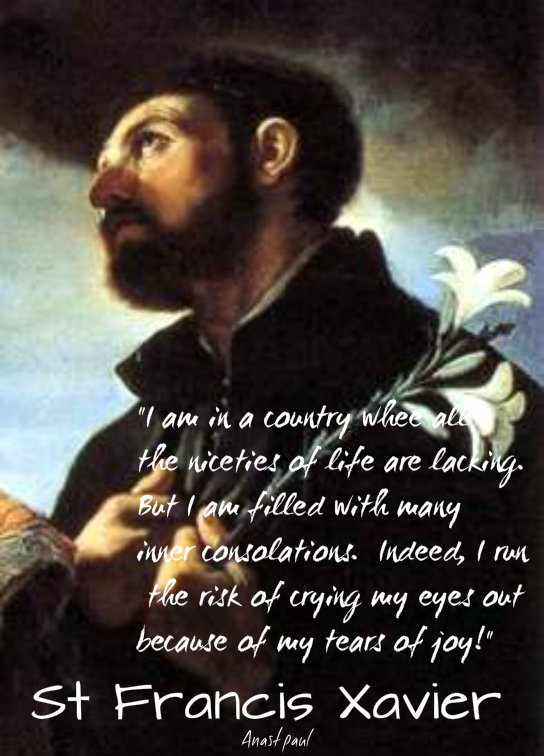
REFLECTION – I am in a country whee all the niceties of life are lacking.
But I am filled with many inner consolations. Indeed, I run the risk of crying my eyes out because of my tears of joy!…..St Francis Xavier (Saint of the Day)I am in a country - st francis xavier - 3 dec 2016

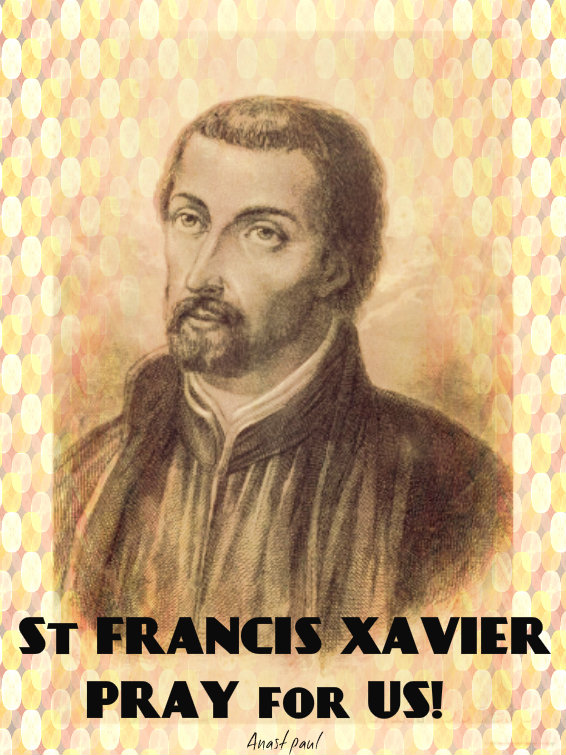
PRAYER – Heavenly Father, grant me the inner consolation to possess spiritual joy in all circumstances, Let me be so united with You that I will joyfully bear with all tribulations. St Francis Xavier be my example and pray for me! Amenst francis xavier - pray for us - 3 dec 2016

Posted in ADVENT, JESUIT SJ, MORNING Prayers, The WORD

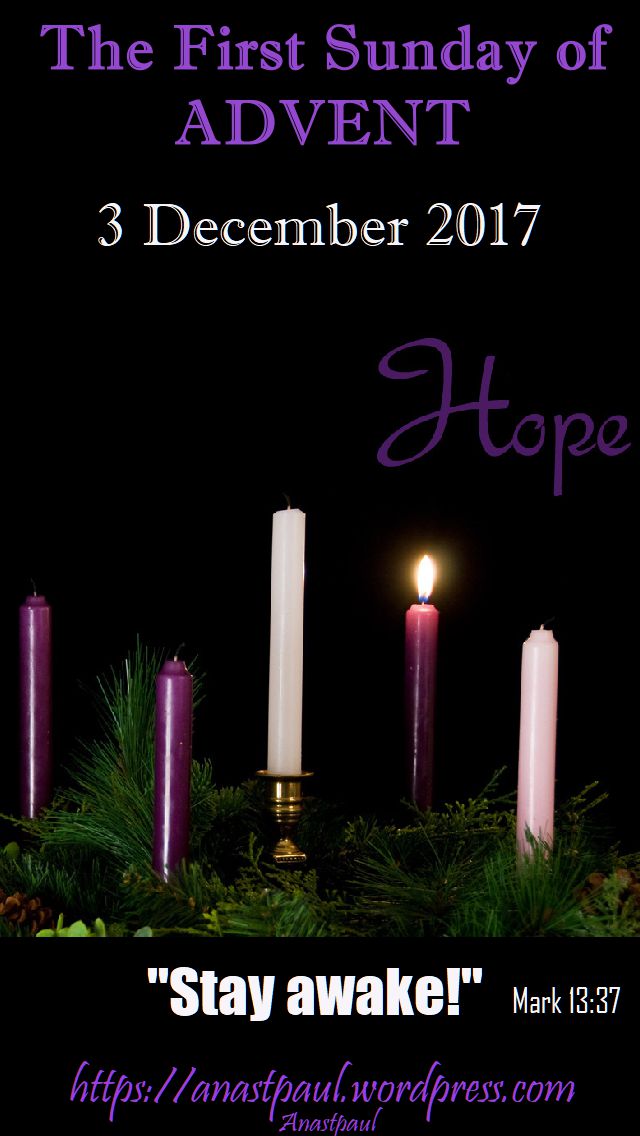
The First Sunday of Advent – Year B – 3 December

Today the Church begins the season of Advent, which is divided into two parts, from the first Sunday to 16 December, we prepare for the future coming of Jesus and from 17 to 24 December, we recall his historical coming.   The Church is a pilgrim Church.   It journeys between this twofold coming of Jesus.   During this journey, the Church, like any other pilgrim, goes through a threefold experience of loneliness, hope and watchful waiting.   In moments of crises and struggles, we feel that we have been abandoned by God.   It is not that God has deserted us but that we have forgotten or ignored His presence with us.   Even in such situations, we have to believe that another world is possible.   It is only those who see the invisible who can do the impossible.   We ought to hop for the intervention of the Lord and wait for it patiently, just as the Church waits vigilantly for the second coming of the Lord.   As we begin this season of Advent and a new Liturgical Year today, let us ask the Lord to grant us a deep sense of security and assurance during our journey of faith, a journey towards a new world of love, joy and peace.

Come, Lord Jesus! Come and visit your people.
We await your coming. Come, O Lord!

Father, all powerful and ever-living God,
we do well always and everywhere
to give you thanks
through Jesus Christ our Lord.
When he humbled himself to come among us,
he fulfilled the plan you formed long ago
and opened for us the way to salvation.

Now we watch for the day,
hoping that the salvation promised us will be ours
when Christ will come again in his glory.

And so, with all the choirs of angels in heaven
we proclaim your glory
and join in their unending hymn of praise:

Holy, holy, holy Lord,
God of power and might,
heaven and earth are full of your glory.
Hosanna in the highest.
Blessed is he who comes in the name of the Lord
Hosanna in the highest.

Today’s Readings – Daily Meditation:
Judah shall be safe and Jerusalem dwell secure.
We begin Advent coming to the Lord who promises to keep us safe. In awe we say:

“To you, O Lord, I lift up my soul!”
Psalm 25

Let’s begin this week with a deeply felt prayer.
Even if we don’t know exactly what we need or long for,
today, let’s try to express our desire for God’s help and assistance.

The days are coming, says the Lord, when I will fulfill the promise I made to the house of Israel and Judah. Jeremiah 33

He guides the humble to justice,
he teaches the humble his way.
Psalm 25

Today’s Daily Reflection – Intercessions:
To God our Father, who has given us the grace
to wait in graceful hope for the revelation of
our Lord Jesus Christ, let us make our prayer:
Show us Your mercy, Lord.

Sanctify us in mind and body,
– keep us without sin until the coming of Your Son.

Make us walk this day in holiness,
– and live upright and devout lives in this world.

May we be clothed in our Lord Jesus Christ,
– and filled with the Holy Spirit.

Lord, help us to stand watchful and ready,
– until Your Son is revealed in all His glory.

Closing Prayer:
Lord God,
I sense Your power, Your might
and I stand in awe, painfully aware
of how poor and weak I am before You.

As I begin this Advent journey,
teach me to turn to You in my fear and sorrow.
I don’t want to keep making my heart hard against You
turning a deaf ear to Your invitation.

Only You can help me to soften,
to be like the clay in Your gentle potter’s hands.

May the Lord bless us,
protect us from all evil
and bring us to everlasting life.
Amen. (Creighton University)the first sunday of advent - 3 dec 2017 - stay awake

Posted in JESUIT SJ, SAINT of the DAY

3 December – Be Blessed today on the Memorial of the great St Francis Xavier (1506-1552)

via St Francis Xavier – 3 December

Posted in JESUIT SJ, SAINT of the DAY

Saint of the Day – 3 December – St Francis Xavier S.J. (1506-1552) Known as the Second St Paul

via Saint of the Day – 3 December

Posted in JESUIT SJ, MORNING Prayers, PRAYERS of the SAINTS, SAINT of the DAY

Our Morning Offering – 23 November – The Memorial of Blessed Miguel Pro S.J. (1891-1927)

Our Morning Offering – 23 November – The Memorial of Blessed Miguel Pro S.J. (1891-1927)

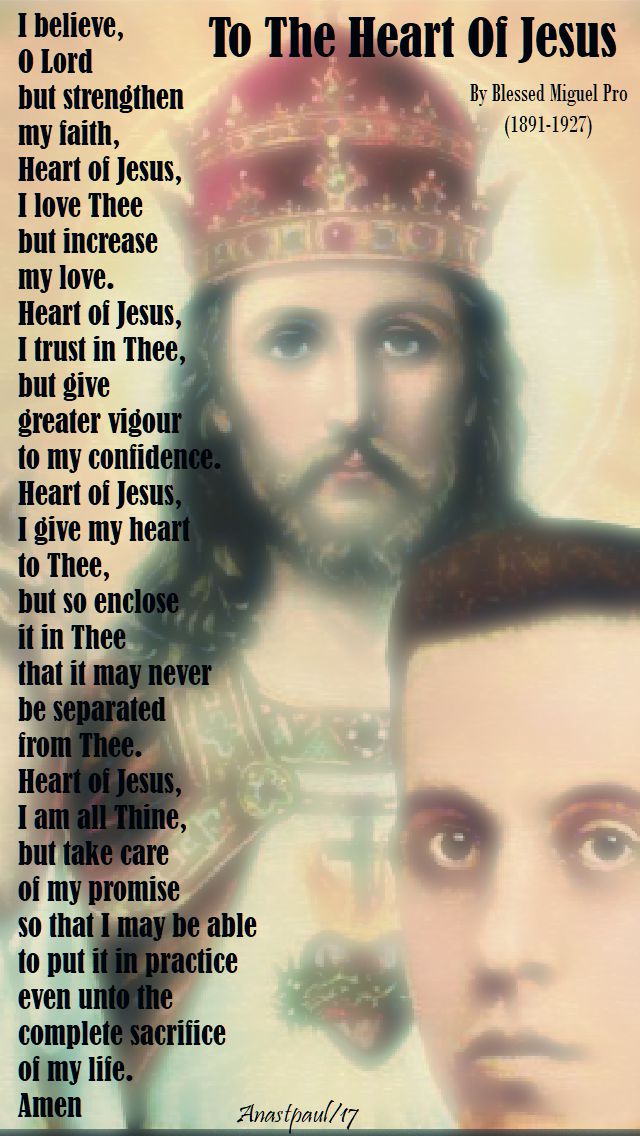
To The Heart Of Jesus
By Blessed Miguel Pro S.J. (1891-1927)

I believe, O Lord
but strengthen my faith,
Heart of Jesus, I love Thee
but increase my love.
Heart of Jesus, I trust in Thee,
but give greater vigour
to my confidence.
Heart of Jesus,
I give my heart to Thee,
but so enclose it in Thee
that it may never
be separated from Thee.
Heart of Jesus, I am all Thine,
but take care of my promise
so that I may be able
to put it in practice even unto
the complete sacrifice of my life.
Amento the heart of jesus - bl migule pro - 23 nov 2017

Posted in JESUIT SJ, SAINT of the DAY

Memorials of the Saints – 23 November

St Pope Clement I (Optional Memorial)
St Columbanus (Optional Memorial)
Bl Miguel Agustin Pro (Optional Memorial)

St Adalbert of Casauria
St Alexander Nevski
St Amphilochius of Iconium
St Augusta of Alexandria
St Cecilia Yu Sosa
St Clement of Metz
Bl Detlev of Ratzeburg
Bl Enrichetta Alfieri
St Falitrus of Chabris
St Faustina of Alexandria
Bl Felícitas Cendoya Araquistain
St Felicity of Rome
St Gregory of Girgenti
Bl Guy of Casauria
St Jaume Nàjera Gherna
St Loëvan of Brittany
St Lucretia of Mérida
Bl Margaret of Savoy
St Mustiola of Chiusi
St Paternian of Fano
St Paulinus of Whitland
St Rachildis of Saint-Gall
St Severin of Paris
St Sisinius of Cyzicus
St Trudo of Hesbaye
St Wilfetrudis of Nivelless

Posted in FEASTS and SOLEMNITIES, JESUIT SJ, MORNING Prayers, PRAYERS of the SAINTS, SAINT of the DAY

Our Morning Offering – 18 November – The Feast of the Dedication of The Basilicas of Sts Peter and Paul

Our Morning Offering – 18 November – The Feast of the Dedication of The Basilicas of Sts Peter and Paul

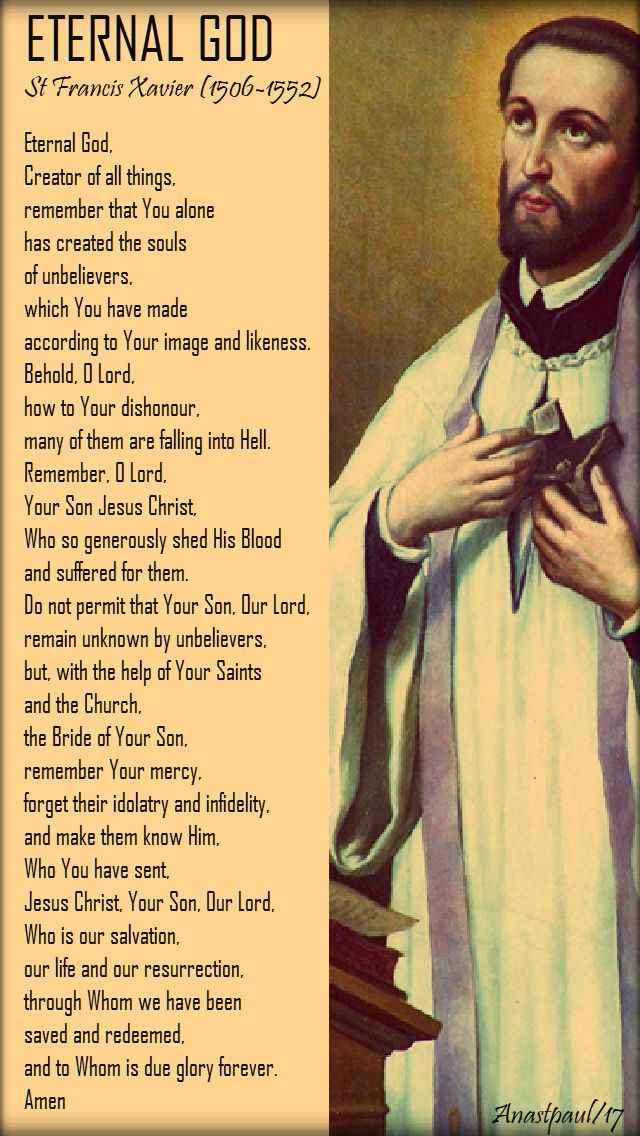
Eternal God
By St Francis Xavier S.J. (1506-1552)

Eternal God,
Creator of all things,
remember that You alone
has created the souls of unbelievers,
which You have made
according to Your image and likeness.
Behold, O Lord,
how to Your dishonour,
many of them are falling into Hell.
Remember, O Lord,
Your Son Jesus Christ,
Who so generously shed His Blood
and suffered for them.
Do not permit that Your Son, Our Lord,
remain unknown by unbelievers,
but, with the help of Your Saints
and the Church,
the Bride of Your Son,
remember Your mercy,
forget their idolatry and infidelity,
and make them know Him,
Who You have sent,
Jesus Christ, Your Son, Our Lord,
Who is our salvation,
our life and our resurrection,
through Whom we have been
saved and redeemed,
and to Whom is due glory forever. Ameneternal god - st francis xavier - 18 nov 2017

Posted in DOCTORS of the Church, FATHERS of the Church, JESUIT SJ, MORNING Prayers, QUOTES of the SAINTS, QUOTES on CHARITY, QUOTES on MERCY, SAINT of the DAY

Quote/s of the Day – 17 November – Mercy/Charity/Love on the Memorial of St Elizabeth of Hungary – Apostle of Charity (1207-1231)

Quote/s of the Day – 17 November – Mercy/Charity/Love on the Memorial of St Elizabeth of Hungary – Apostle of Charity (1207-1231)

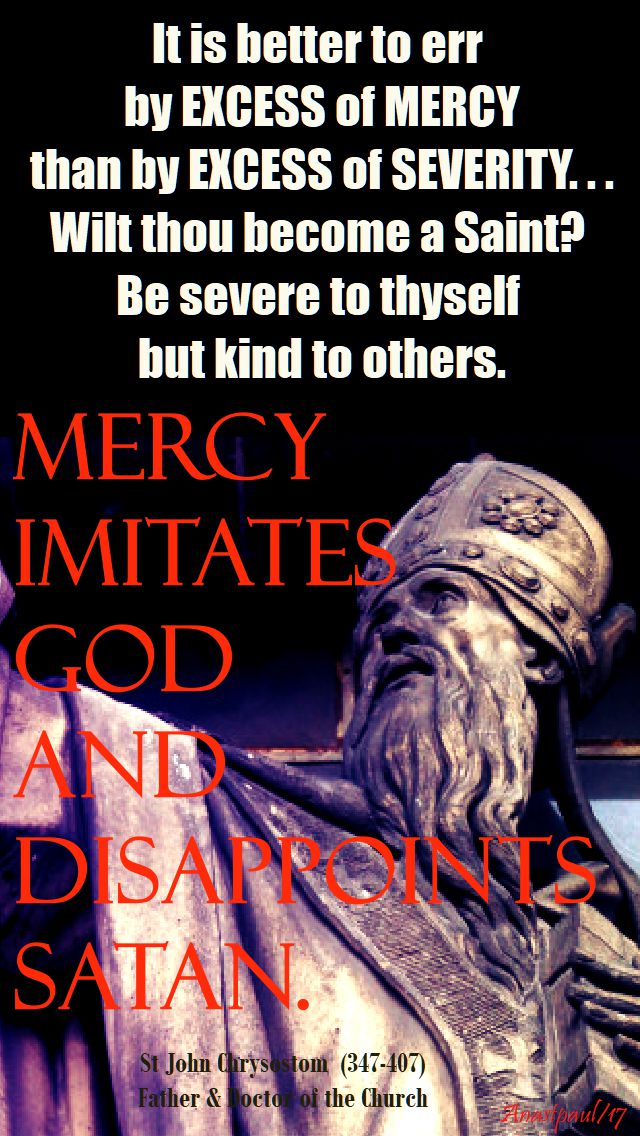
“It is better to err by excess of mercy
than by excess of severity. . .
Wilt thou become a Saint?
Be severe to thyself but kind to others.”

“Mercy imitates God and disappoints Satan.”

St John Chrysostom (347-407) Father & Doctor of the Churchmercy imitates god - st john chrysostom - 17 nov 2017

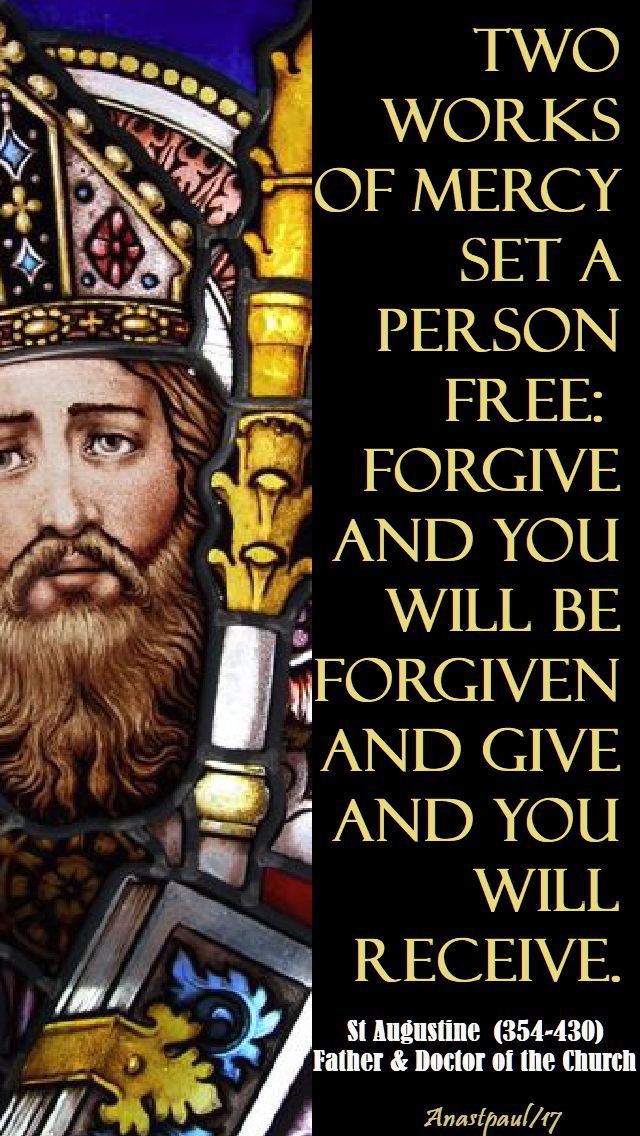
“Two works of mercy set a person free:
Forgive and you will be forgiven
and give and you will receive.”two works of mercy - st augustine - 17 nov 2017

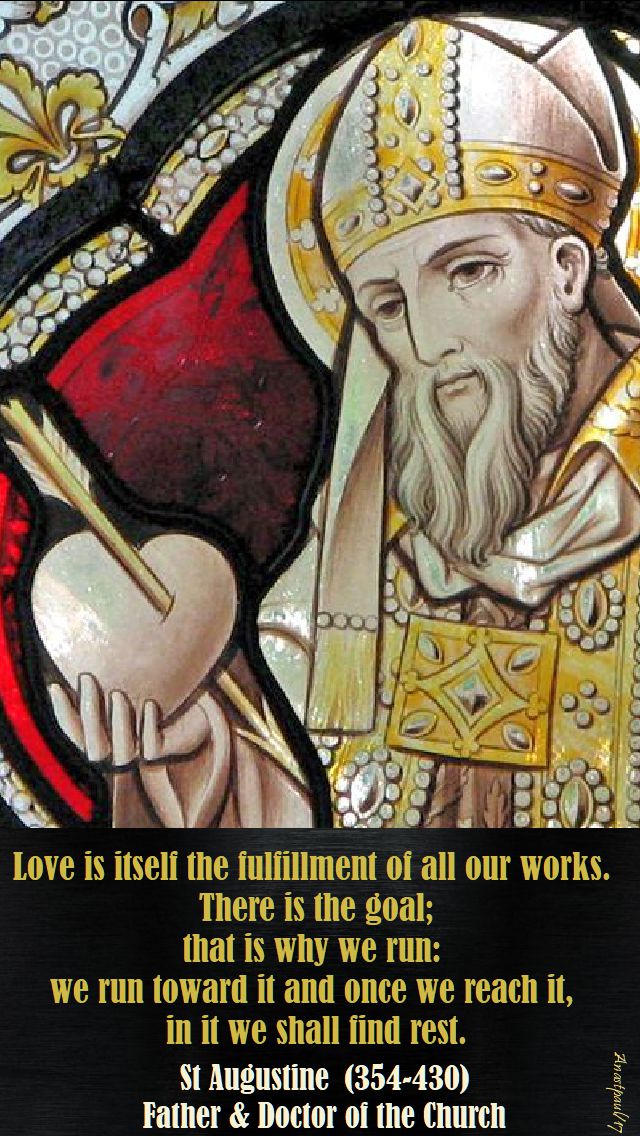
” Love is itself the fulfillment of all our works.
There is the goal;
that is why we run:
we run toward it and once we reach it,
in it we shall find rest.

St Augustine (354-430) Father & Doctor of the Churchlove is itself - st augustine - 17 nov 2017

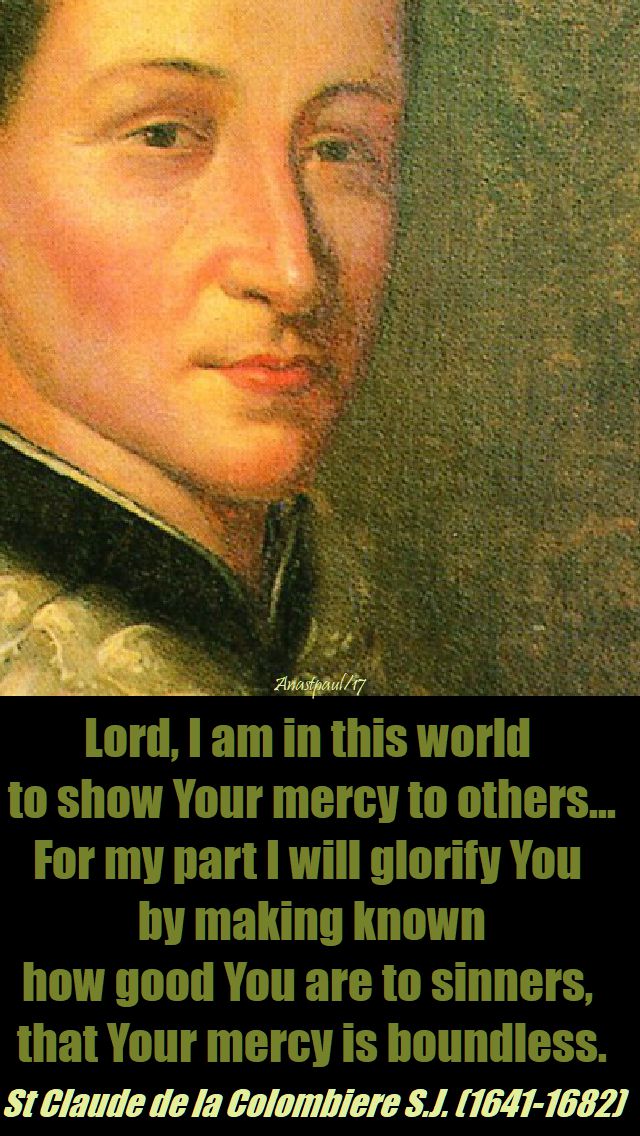
“Lord, I am in this world to show Your mercy to others…
For my part I will glorify You by making known
how good You are to sinners, that Your mercy is boundless.”

St Claude de la Colombiere S.J. (1641-1682)lord, i am in this world - st claude de la colombiere- 17 nov 2017

Posted in EUCHARISTIC Adoration, JESUIT SJ, MORNING Prayers, SAINT of the DAY, The HOLY EUCHARIST / The HOLY MASS

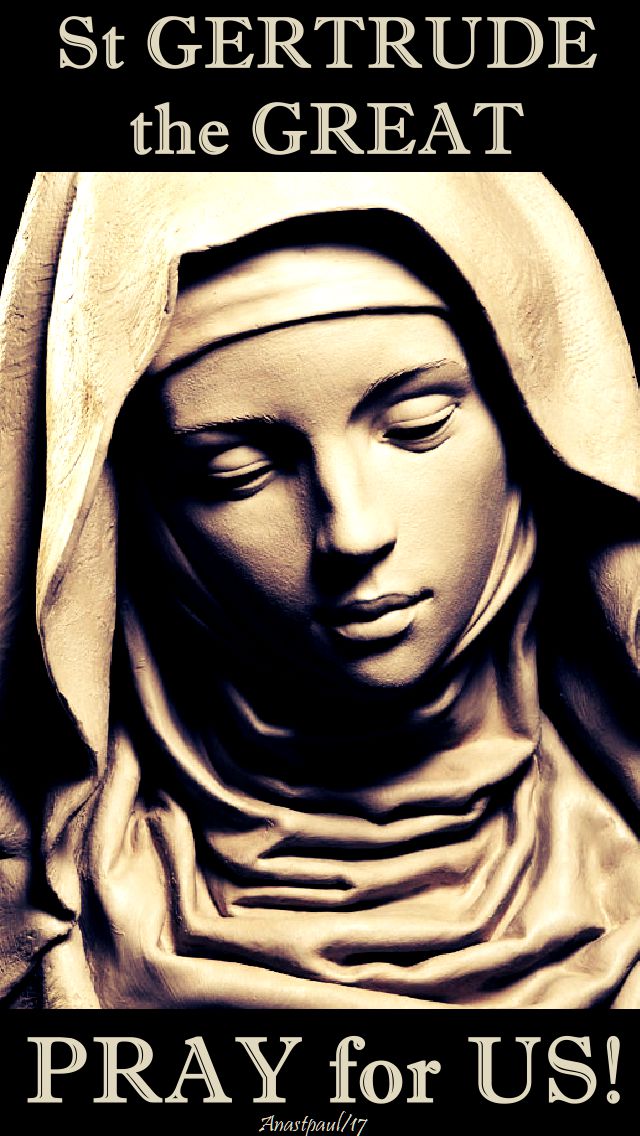
Thought for the Day – 16 November – The Memorial of St Gertrude the Great (1256-1302)

Thought for the Day – 16 November – The Memorial of St Gertrude the Great (1256-1302)

The characteristic of St Gertrude’s piety is her devotion to the Sacred Heart, the symbol of that immense charity which urged the Word to take flesh, to institute the Holy Eucharist, to take on Himself our sins and, dying on the Cross, to offer Himself as a victim and a sacrifice to the Eternal Father.

Faithful to the mission entrusted to them, the superiors of Helfta appointed renowned theologians, chosen from the Dominican and Franciscan friars, to examine the works of the saint.   These approved and commented them throughout.   In the sixteenth century Lanspergius and Blosius propagated her writings.   The former, who with his confrere Loher spared no pains in editing her works, also wrote a preface to them.   The writings were warmly received especially in Spain and among the long list of holy and learned authorities who used and recommended her works may be mentioned :
—St. Teresa, who chose her as her model and guide,—Yepez—the illustrious Suare,—the Discalced Carmelite Friars of France—St Francis de Sales—M. Oliver—Fr Faber—Dom Gueranger.

The Church has inserted the name of Gertrude in the Roman Martyrology with this eulogy:  “On the 17th of November, in Germany (the Feast) of St Gertrude Virgin, of the Order of St. Benedict, who was illustrious for the gift of revelations.”

Let us run to the Sacred Heart of Jesus, O Come let us Adore Him!

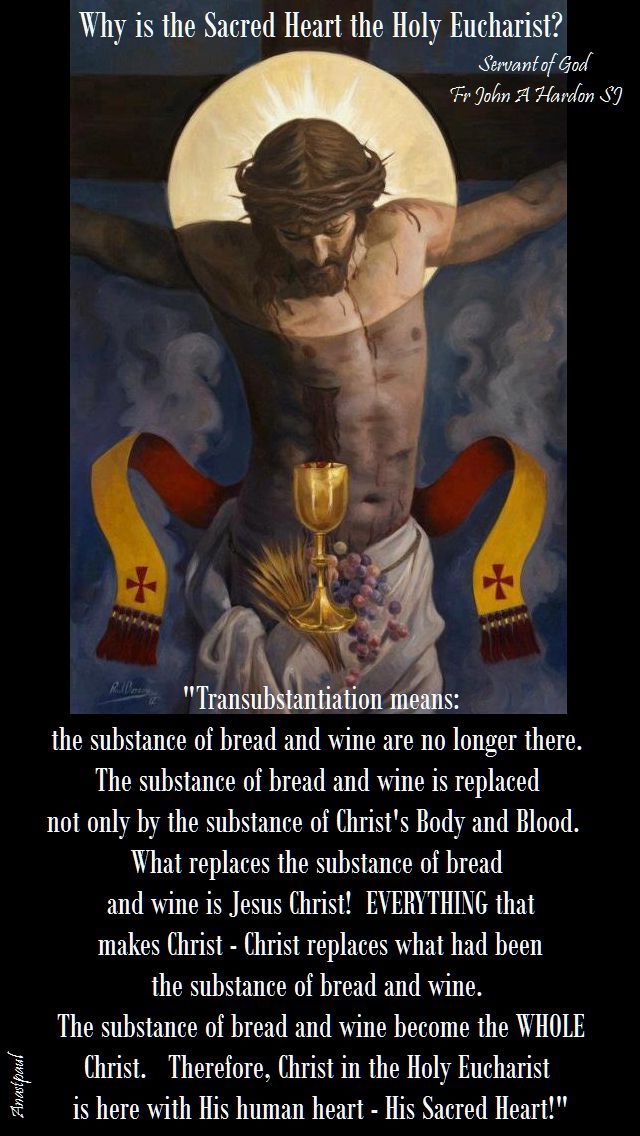
St Gertrude the Great, Pray for us!st gertrude the great - pray for us no 2 - 16 nov 2017my pic - why is the eucharist the sacred heart - 15 june 2017

Posted in JESUIT SJ, MORNING Prayers, SAINT of the DAY, Uncategorized

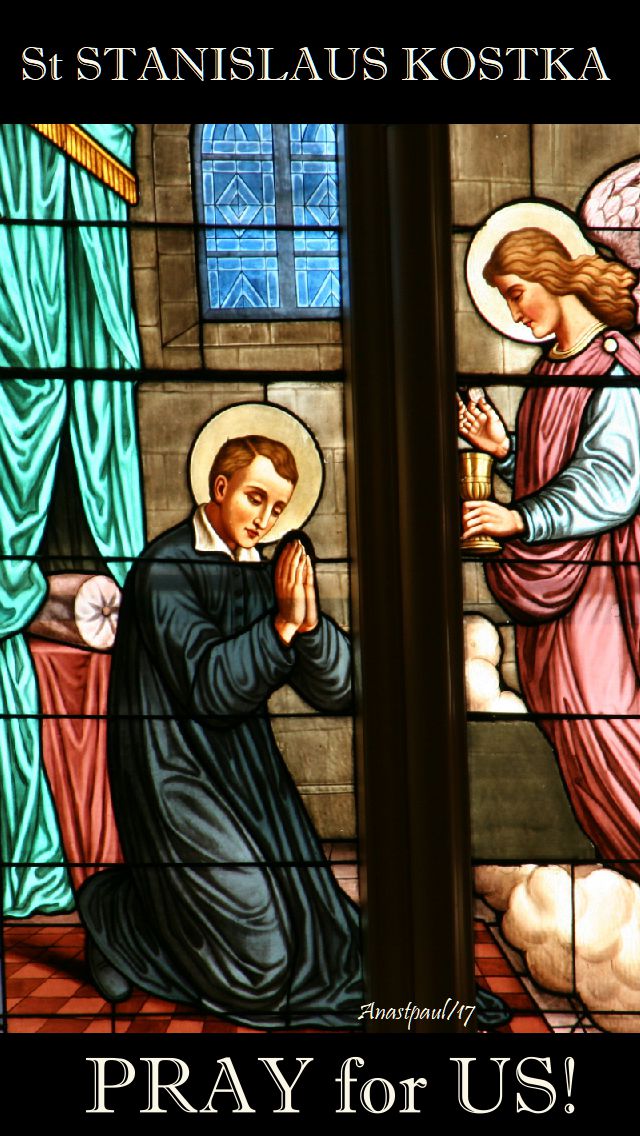
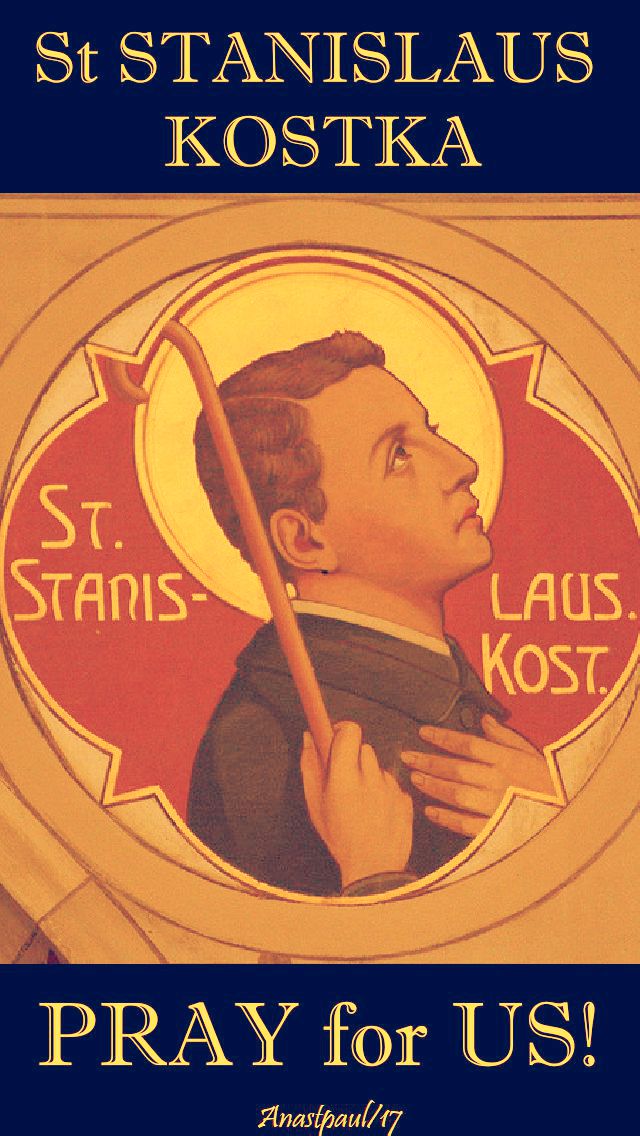
Thought for the Day – 13 November – The Memorial of St Stanislaus Kostka SJ (1550-1568)

Thought for the Day – 13 November – The Memorial of St Stanislaus Kostka SJ (1550-1568)

Although the life of St. Stanislaus was short in years, it contains a simple roadmap for us all.

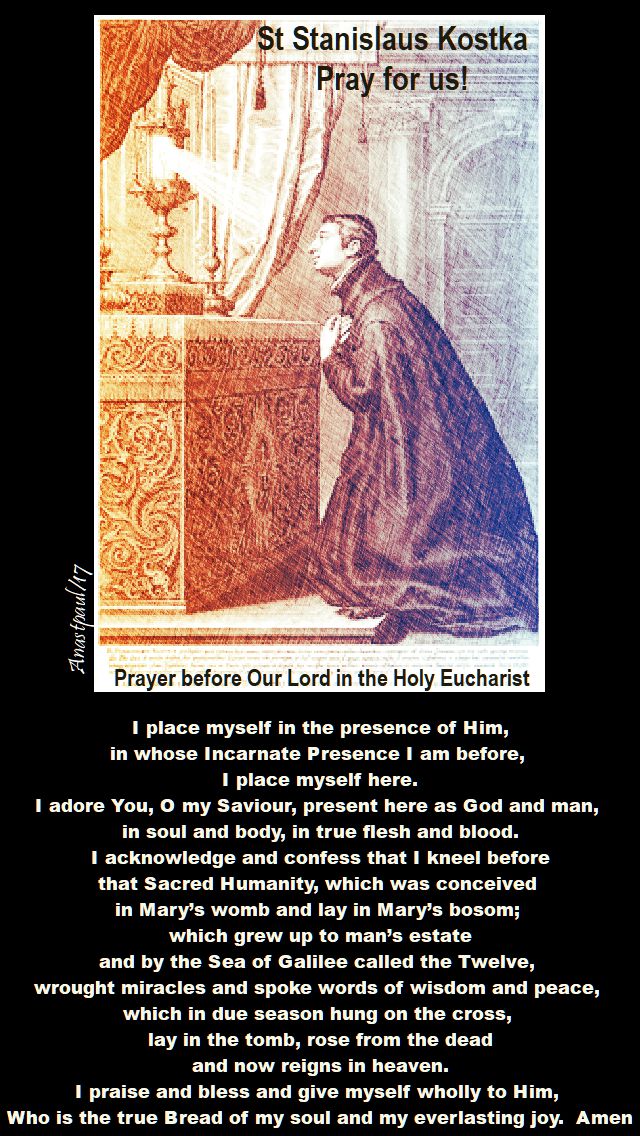
The Three things all saints possess and these things will make us saints too – great devotion to the Blessed Sacrament, our Holy Mother and Prayer.   Follow him in these points.   Assist daily, if you can, at Holy Mass, attend Our Lord in the Tabernacle or at Eucharistic Adoration, as often as possible, even for just a few minutes and always prepare yourself carefully for holy Communion;  honour the divine Mother and invoke her with filial trust.   To ask her blessing, morning and night, after the example of St Stanislaus, is easily done and is, moreover, a sign of love and confidence.PRAYER BEFORE OUR LORD IN THE HOLY EUCHARIST - ST STANISLAUS MEMORIAL - 13 NOV 2017

And finally, especially during this month of the holy souls, remember to contemplate your own death each day and do not delay your penance until you are lying on your sick-bed.  While you are in the possession of health, examine your conscience, in order to ascertain if there is nothing which might trouble you on your death-bed.   Should you find anything, remove it without delay.   “For it is difficult, it is very difficult,” says Hugo of St. Victor, “to do true penance at that time and to awaken, in a troubled conscience, earnest repentance.”   Perhaps, at that moment, one does not even think of it, or knows, not what to do in the anxiety of his mind.   “At the time of sickness, you can hardly think of anything but what you feel,” says St Jerome; and St Augustine writes:  “It is in accordance with Divine Justice that he who forgets God during his life, forgets himself in the hour of death.”   “Therefore, whoever wishes to die quietly and peacefully, let him do penance while he enjoys health,” says S. Bernard.   While you are in the possession of health, you would daily employ a few minutes to examine your conscience, in order to ascertain if there is nothing which might trouble you on your death-bed.    Should you find anything, remove it without delay!

A practice of worth for us all, is to beg St Stanislaus to be our patrons of a holy and peaceful death.   Therefore, we pray:

Saint Stanislaus, patron most tender and most powerful, angel of purity and of love, I rejoice with you in your happy death, a death rejoiced in, by your longing to see Jesus and Mary. who was taken up bodily into heaven and consummated by a mighty impulse of love toward her.   I give thanks unto Mary, who was pleased to hear and answer your prayers and I implore you, by the glory of your happy death, to be the advocate and patron of my death.   Intercede with Mary our Mother for me that my death, if not so happy as yours, may at least be peaceful under the protection of Mary, my Advocate and of you my special patron of my inevitable.

Our Father, Hail Mary, Glory be.

Pray for us, O holy Stanislaus,
That we may be made worthy of the promises of Christ.

Let us pray:

O God, who amongst the other wonderful works of Your wisdom, has bestowed the grace of holiness on them of tender years:   grant, we beseech You, that we, following in the footsteps of blessed St Stanislaus and redeeming the time by unremitting labour, may hasten without fear, to enter into our eternal rest.   Through Christ our Lord, St Stanislaus, pray for us now and at the hour of our death, amen.st stanislaus - pray for us - 13 nov 2017 no 3

Posted in JESUIT SJ, MORNING Prayers, QUOTES of the SAINTS, SAINT of the DAY

Quote/s of the Day – 13 November – The Memorial of St Stanislaus Kostka SJ (1550-1568)

Quote/s of the Day – 13 November – The Memorial of St Stanislaus Kostka SJ (1550-1568)

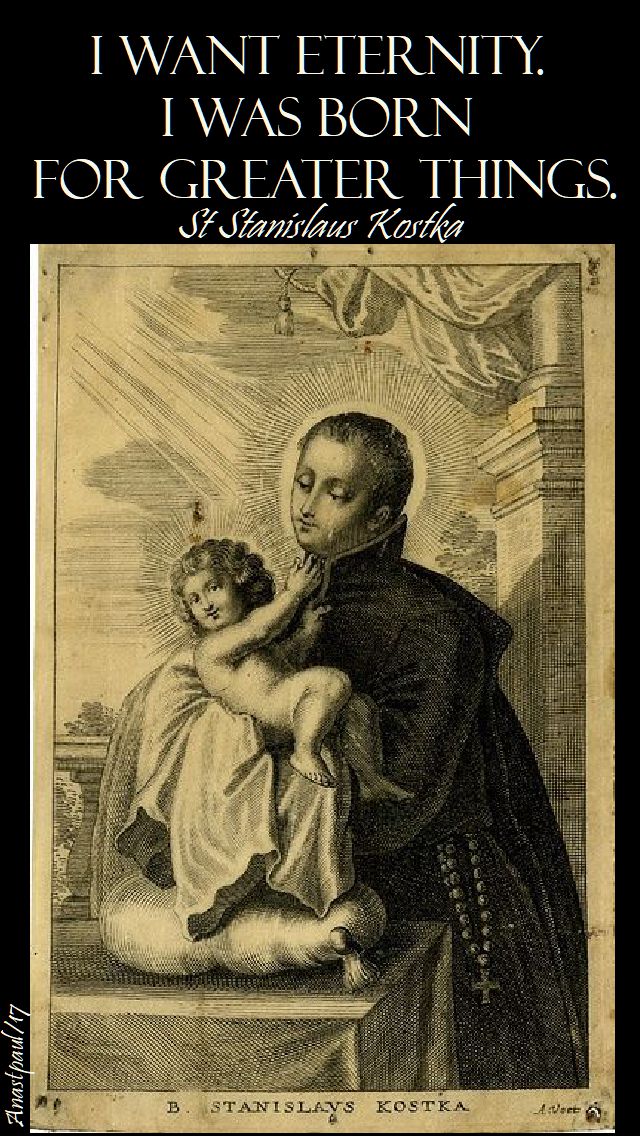
“I want eternity. I was born for greater things…”i want eternity - stanislaus - 13 nov 2017

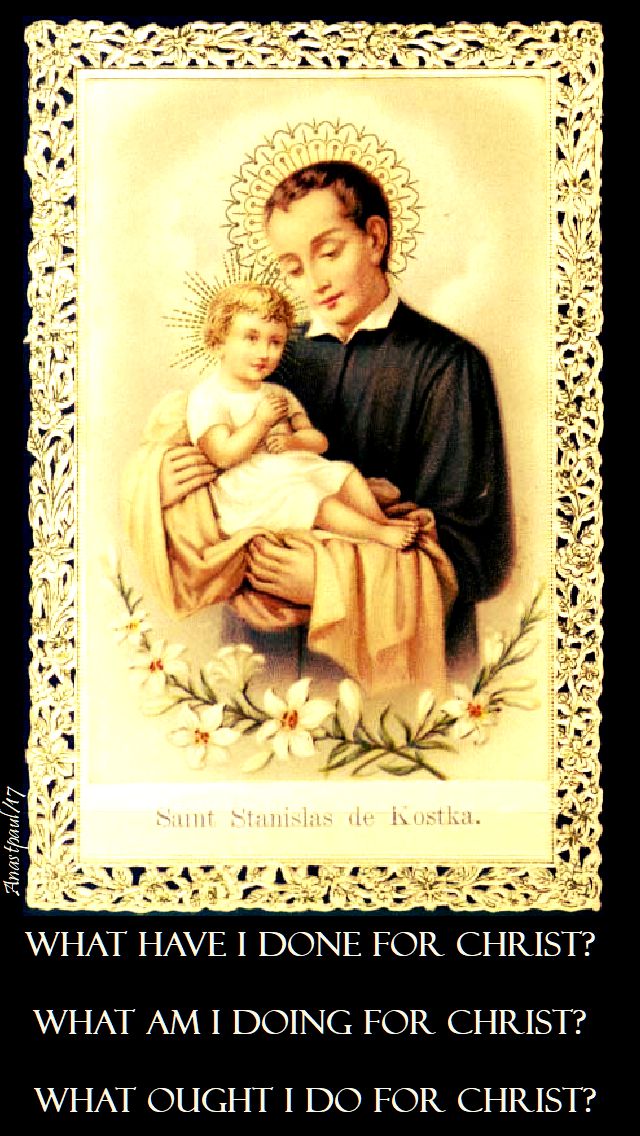
“What have I done for Christ?
What am I doing for Christ?
What ought I do for Christ?”

St Stanislaus Kostka SJ (1550-1568)what have i done for christ - st stanislaus - 13 nov 2017

Posted in JESUIT SJ, MORNING Prayers, QUOTES of the SAINTS, SAINT of the DAY

One Minute Reflection – 13 November – The Memorial of St Stanislaus Kostka SJ (1550-1568)

One Minute Reflection – 13 November – The Memorial of St Stanislaus Kostka SJ (1550-1568)

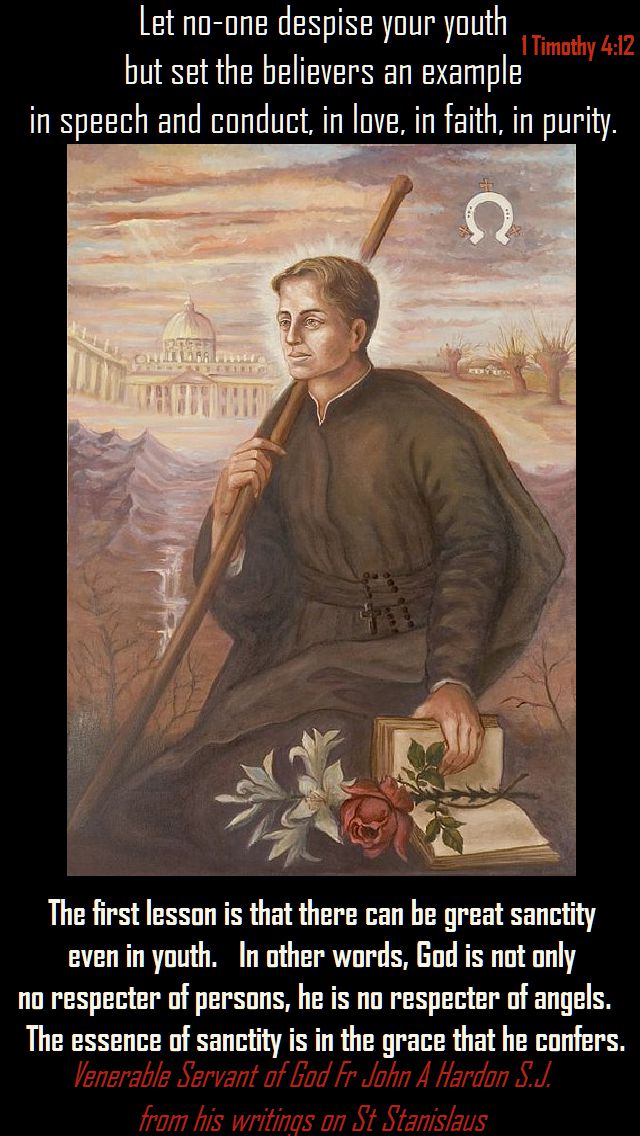
Let no-one despise your youth but set the believers an example in speech and conduct, in love, in faith, in purity….1 Timothy 4:12

REFLECTION – “The first lesson is that there can be great sanctity even in youth.   In other words, God is not only no respecter of persons, He is no respecter of angels.   The essence of sanctity is in the grace that He confers. … God gives His grace to whom ever He wishes, in what quantity He wishes and ours is to recognise His gift and not miscalculate. …There can be great sanctity in youth.”…Venerable Servant of God Fr John A Hardon S.J. from his writings on St Stanislausthe first lesson is that - fr john a hardon on st stanislaus - 13 nov 2017

PRAYER – Holy Father, I beg Your grace to achieve sanctity.   Grant me the wisdom to follow Your Son, the fortitude to persevere in all trails but most of all Holy Father, grant me Your grace to obtain eternal life.   Precious youth, St Stanislaus, please pray for us all , amen.st stanislaus - pray for us - 13 nov 2017 - no 4

Posted in JESUIT SJ, MORNING Prayers, PRAYERS of the CHURCH, SAINT of the DAY

Our Morning Offering – 13 November – The Memorial of St Stanislaus Kostka SJ (1550-1568)

Our Morning Offering – 13 November – The Memorial of St Stanislaus Kostka SJ (1550-1568)

Wash Me With Your Precious Blood
By St Peter Canisius, S.J.

See, O merciful God, what return
I, Your thankless servant, have made
for the innumerable favours
and the wonderful love You have shown me!
What wrongs I have done, what good left undone!
Wash away, I beg You, these faults and stains
with Your precious blood, most kind Redeemer,
and make up for my poverty by applying Your merits.
Give me the protection I need to amend my life.
I give and surrender myself wholly to You,
and offer You all I possess,
with the prayer that You bestow Your grace on me,
so that I may be able to devote and employ
all the thinking power of my mind
and the strength of my body in Your holy service,
who are God blessed for ever and ever. Amenwash me with your precious blood - st peter canisius - 13 nov 2017

Posted in JESUIT SJ, SAINT of the DAY

Saint of the Day – 13 November – St Stanislaus Kostka SJ (1550-1568)

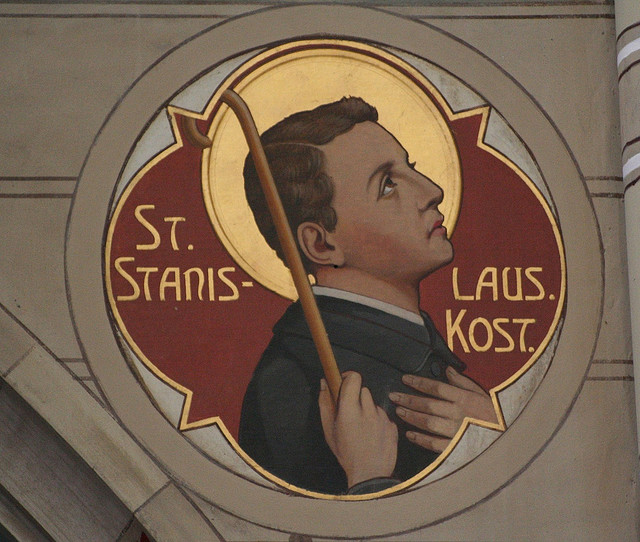
Saint of the Day – 13 November – St Stanislaus Kostka SJ (1550-1568) Jesuit Novice (28 October 1550 at Rostkovo, Poland – between 3 and 4 am of 15 August, feast of the Assumption of the Blessed Virgin Mary, 1568 at Rome, Italy from a high fever).  Patronages – • against broken bones• aspirants to the Oblates of Saint Joseph • last sacraments• Poland.   Attributes – Lily, Jesuit habit, Jesus, Most Blessed Sacrament.   St Stanislaus was Beatified on 19 October 1605 by Pope Paul V and Canonised on 31 December 1726 by Pope Benedict XIII.

HEADER ST SANISLAUS

His father, Jan Kostka, was a senator of the Kingdom of Poland and Lord of Zakroczym; his mother was Małgorzata Kryska from Drobni).   He was the second of seven children. His older brother Paweł (Paul) survived to be present at beatification ceremony of Stanislaus in 1605.   At home, the two brothers were taught with firmness, even severity; its results were their piety, modesty, temperance, and submission.

“I expect great things of him,” wrote St Peter Canisius of St Stanislaus Kostka. He certainly had in mind accomplishments like those of St Francis Xavier and other early Jesuits.   But young Stanislaus died before he could do anything.   Except live for God and become a saint.

Polish nobleman John Kostka was not pleased with the spiritual inclinations of his second son.   He did all he could to discourage Stanislaus’s desire for Christian service. Paul, a brother two years older than he, bullied him and tried to lure him into more worldly pursuits.

On 25 July 1564, they arrived at Vienna with their tutor to attend the Jesuit college that had been opened four years before.   Stanislaus was soon conspicuous, among his classmates during his 3 years of schooling, not only for his amiability and cheerfulness of expression but also for his growing religious fervour and piety.

His brother Paul said during the process of beatification:  “He devoted himself so completely to spiritual things that he frequently became unconscious, especially in the church of the Jesuit Fathers at Vienna.   It is true,” added the witness, “that this had happened at home to my brother at Easter when he was seated at table with our parents and other persons.”  SAINT STANISLAUS KOSTKA WITH THE VIRGIN

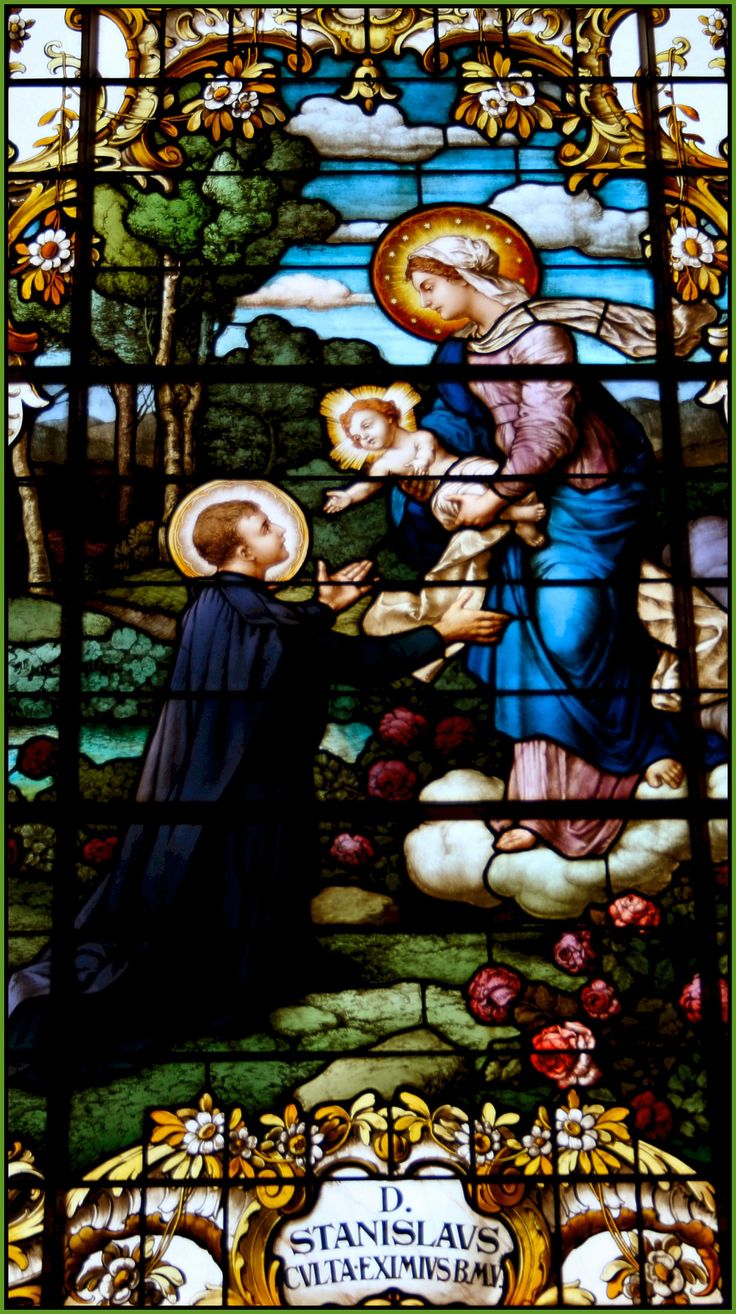
Among other practices of devotion he joined while at Vienna the Congregation of St Barbara, to which many students of the Jesuit college belonged.  The confidences he then made to his tutor and later to a fellow-member of the Society at Rome, he declared that it was Saint Barbara who brought two angels to him during the course of a serious illness, in order to give him the Eucharist.   He also said that the Blessed Mother came to him in a vision, encouraging him to become a Jesuit.   So much piety, however, did not please the older brother Paul;  his exasperation led him to treat the innocent Stanislaus with violence.   Stanislaus suffered the unjust treatment with remarkable stoicism and patience but there came one night when, after having again suffered the harsh comments and blows from his brother, he turned on Paul with the words:  “Your rough treatment will end in my going away never to return and you will have to explain my leaving to our father and mother.”   Paul’s sole reply was to swear violently at him.   St. Stanislaus Kostka

Thus, upon recovering, Stanislaus determined to join the Society of Jesus.   With Paul in hot pursuit, he fled to Dillingen where Peter Canisius welcomed him.   Then to demonstrate his determination, Stanislaus walked the 350 miles to Rome and there Jesuit general St Francis Borgia accepted him.

Stanislaus kept a journal during his novitiate.   His notes reflect both a youthful idealism and an adult commitment.   Here are a few excerpts:

“Consider how hard it is for a person to be separated from any place he has loved deeply.   How much harder the soul will find it when the time comes to leave the mortal body, its companion so dear.   And the great fear it will experience in that moment because its salvation is at stake and it must stand in the presence of the one it has so offended.  If the just man will scarcely be saved, what about me a sinner?

But think of the great joy the good will feel at the thought of the service they’ve paid to God.   They will be glad because they’ve suffered something for love of him back there and didn’t fix their hope and attention on the things of this world that we leave so soon.   Think of the joy that the soul will feel in its escape from the prison of this body.   So long has it lived in perpetual exile, expelled from its own heavenly home.  How much greater its uncontainable joy and complete satisfaction when it arrives in its own country to enjoy the vision of God with the angels and the blessed.

I am so ashamed and confused because I see how many have been lost on account of a single mortal sin and how many times I have deserved eternal damnation.

I shall reflect on myself and ask:  “What have I done for Christ?   What am I doing for Christ?   What ought I do for Christ?”

However, Stanislaus did not complete his training.   Nine months into his novitiate he again became very sick.   Saint Stanislaus had drawn as his monthly patron for August the glorious martyr Saint Lawrence and in his honour he performed daily some penance or devotion.   On the eve of his feast, he obtained leave to take the discipline;  in the morning he went to Communion and then laid before the image of the saint a letter addressed to Our Lady, in which he begged that he might die on her Feast of the Assumption and he prayed Saint Lawrence to present to her his petition.   That night he was seized with a slight fever, which, however, rapidly increased and on Assumption Eve, he received the last sacraments.   Then, as he lay dying, he had brought to him a little book containing a litany in his own writing of his monthly patron saints, whom he constantly invoked.   At 3 a.m. on the Feast of the Assumption, he face suddenly lit up with joy and he breathed forth his soul to the Mother of God, who had come to conduct him to heaven.    His confidence in the Blessed Virgin, which had already brought him many signal favours, was this time again rewarded.   And shortly afterward he died.   Stanislaus was only seventeen years old when he “arrived in his own country to enjoy the vision of God.”

The entire city proclaimed him a saint and people hastened from all parts to venerate his remains and to obtain, if possible, some relics.

Posted in JESUIT SJ, MORNING Prayers, SAINT of the DAY

Thought for the Day – 7 November – The Memorial of Blessed Anthony Baldinucci SJ (1665-1717)

Thought for the Day – 7 November – The Memorial of Blessed Anthony Baldinucci SJ (1665-1717)

Today, 7 November we celebrate the feast day of Blessed Antonio Baldinucci (1665-1717), a Jesuit missionary who, despite failing health, served the Lord with every ounce of strength and love he possessed.  While his heart lay in overseas missions, Anthony obediently remained in Italy, giving great missions, reaching many through his preaching and example and working tirelessly for the conversion of souls.   His simple faith and acceptance of the will of the Lord, inspire us today to examine our lives and hopes… and then measure how those relate to what the Lord would have us do.
His words “That God may be moved by my sufferings to touch the hearts of my hearers” are an inspiration to us when we wonder how to offer our sufferings to God. Perhaps ours would be “that God may be moved by my sufferings and use my life as an example to the hearts of sinners.”

Blessed Anthony Baldinucci, Pray for us!bl anthony baldinucci pray for us - 7 nov 2017.no2

Posted in JESUIT SJ, SAINT of the DAY

Saint of the Day – 7 November – Blessed Anthony Baldinucci S.J. (1665-1717)

Saint of the Day – 7 November – Blessed Anthony Baldinucci S.J. (1665-1717) Jesuit Priest, Preacher, Writer and Missionary.   Born on 19 June 1665 in Florence, Italy and died on 7 November 1717 of natural causes.   Beatified on 23 April 1893 by Pope Leo XIII.


Antonio Baldinucci was born in Florence (Tuscany, Italy), the son of a writer and artist and his wife. he fifth of five sons, Antonio’s parents had promised the Lord prior to his birth that if they produced a son, they would devote his life to Saint Anthony of Padua (whose intercession had cured a family member of serious illness). hen Antonio was born, he was raised in the faith, with the intention of his becoming a priest and serving God as promised by his parents.   Antonio embraced his parents’ wishes with the zeal of one on fire for the Lord. ather than rebel, as we might expect from a teenage boy, Antonio instead gravitated to the holy, threw himself into his studies and lived a pious life. At age eleven, he began his studies with the Jesuits at San Giovannino but following his eldest brother’s entrance into the Dominican Order, expressed his wish to follow. he Dominicans, however, refused Antonio’s admission, due to his poor health. nstead, his father recommended that he embark on the Spiritual Exercises of Saint Ignatius of Loyola, to attempt to discern God’s plan for his life.   Under the spiritual direction of a Jesuit, Antonio was led to seek admission to the Society of Jesusand at the age of 16, began his novitiate in Rome.

Antonio, often ill, was assigned to serve the local Rome community.   He first taught the young men at the college, despite his young age.   Antonio was not content to remain in Rome, however, expressing his greatest wish to be sent out as a missionary among the Gentiles and to suffer martyrdom for the Lord.   He applied, during his tenure with the Jesuits for three overseas missions trips—to India, China, and Japan—and was each time refused, on account of his fragile health.   As his health worsened, he experienced debilitating headaches and body fatigue and was sent around the country to various Jesuit houses, seeking advice and cure.   Apparently, getting out of Rome was helpful for him and he regained his strength.   Allowed to preach, his brothers were amazed by his vigour and success in converting those who heard him!

Returning to Rome, Antonio would spend his afternoons in public places, preaching, and drawing many to the Church.   He was ordained at age 30 and immediately applied to be sent overseas as a missionary but again was refused.   Instead, Antonio was sent to Frascati, south of Rome, where part of his duties was to provide missions to the poor surrounding towns and villages in the area.   Antonio embraced this task with zeal, working among the poor and uneducated for the remainder of his life.  Looking to St Ignatius and St Peter Claver as models Antonio traveled barefoot to the towns and villages, regardless of weather.   He carried all he needed in a bag on his back and walked with a pilgrim staff.   When asked why he walked barefoot, he replied: “That God may be moved by my sufferings to touch the hearts of my hearers.” 

Each of Antonio’s missions lasted between eight and fourteen days, depending on the needs of the parish and for his preaching he generally drew from the Spiritual Exercises. At the start of each mission, Blessed Antonio would lead a procession of penitents, during which he wore a crown of thorns, carried a heavy cross and whipped or flagellated himself.   This he did as penance for the sins of those he served.   Once he had instilled a bit of fear into his mission attendees, Blessed Antonio softened his approach.   He spent little time in the pulpit, instead interacting on a personal level with his congregation, writing letters, teaching catechism, visiting and assisting children and the ill.   All were welcome, including the ruffians or thugs of the villages.   Antonio often began his missions by seeking out the roughest characters of the region and asking them to accompany him, offering him “protection.”   By the conclusion of each mission, many of these dissolute characters had come to the faith.   Each of Blessed Antonio’s missions ended in the same manner, with a large exhibition where everyone could receive Holy Eucharist.   Following Communion, a public burning of cards, dice, obscene pictures, books and secular songs would commence.   After one mission, 240 daggers and small guns and 21 pistols were laid at his feet.

Blessed Antonio participated in missions for over 20 years, during that time giving 448 missions in 30 dioceses (an average of 22 each year).  Despite this schedule, he found the time to write down many of his sermons, as well as maintain correspondence with those who needed spiritual direction and support.   To do so, he maintained a rigorous schedule of work, prayer and penance, sleeping little (about three hours each night on a bed of planks) and fasting constantly.   While he had received a special dispensation from Pope Clement XI to not offer daily Mass due to his schedule, he refused to accept it, reading the Liturgy daily.

Gradually, Antonio’s reputation grew and he was summoned to larger and larger cities, drawing great crowds at each mission.   Father Baldinucci was deeply devoted to the Eucharist, the Passion of Christ and the Blessed Virgin Mary.   He highly revered an image of the Blessed Virgin with the title, “Refuge of Sinners,” attributing numerous conversions and miraculous cures to its veneration.   Beginning a new mission in Frosinone, his health failed him and he was confined to his bed.   Although he appeared to others to be recovering, Antonio knew his death was approaching and requested that the image of Mary be placed before him.   Repeatedly, he prayed to Our Blessed Mother, “Show yourself to be a Mother.”   After asking for the Last Sacraments and despite the fact that he was barely able to speak, Antonio continued to recite the prayer, “Jesus and Mary, my hope,” until his death.

He began to convulse through the night until the following morning and finally at 11.00 am on the morning of 7 November 1717, Fr Baldinucci who was only fifty-two surrendered his soul to his Saviour.   The indefatigable priest at his death had served the Society for thirty-five years and spent twenty years as an active preacher in the Italian countryside.

Fr Baldinucci was beatified by Pope Leo XIII on 25 March 1893 and his memorial is liturgically celebrated on 7 July.

Blessed Antonio was buried in the chapel of San Giovanni in Florence.

Posted in JESUIT SJ, POETRY

THE HOUND OF HEAVEN – By Francis Thompson, (1859-1907)

“The Hound of Heaven” is a 182-line poem written by English Catholic poet Francis Thompson (1859–1907).   The poem became famous and was the source of much of Thompson’s posthumous reputation.   The poem was first published in Thompson’s first volume of poems in 1893.   It was included in the Oxford Book of English Mystical Verse (1917).   Thompson’s work was praised by G K Chesterton and it was also an influence on J R R Tolkien, who presented a paper on Thompson in 1914.

This Christian poem has been described as follows:

“The name is strange.   It startles one at first.   It is so bold, so new, so fearless.   It does not attract, rather the reverse.   But when one reads the poem this strangeness disappears.   The meaning is understood.   As the hound follows the hare, never ceasing in its running, ever drawing nearer in the chase, with unhurrying and imperturbed pace, so does God follow the fleeing soul by His Divine grace.   And though in sin or in human love, away from God it seeks to hide itself, Divine grace follows after, unwearyingly follows ever after, till the soul feels its pressure forcing it to turn to Him alone in that never ending pursuit.”    Fr JFX. O’Conor, S.Jthe hound of heaven - francis thompson - 23 oct 2017
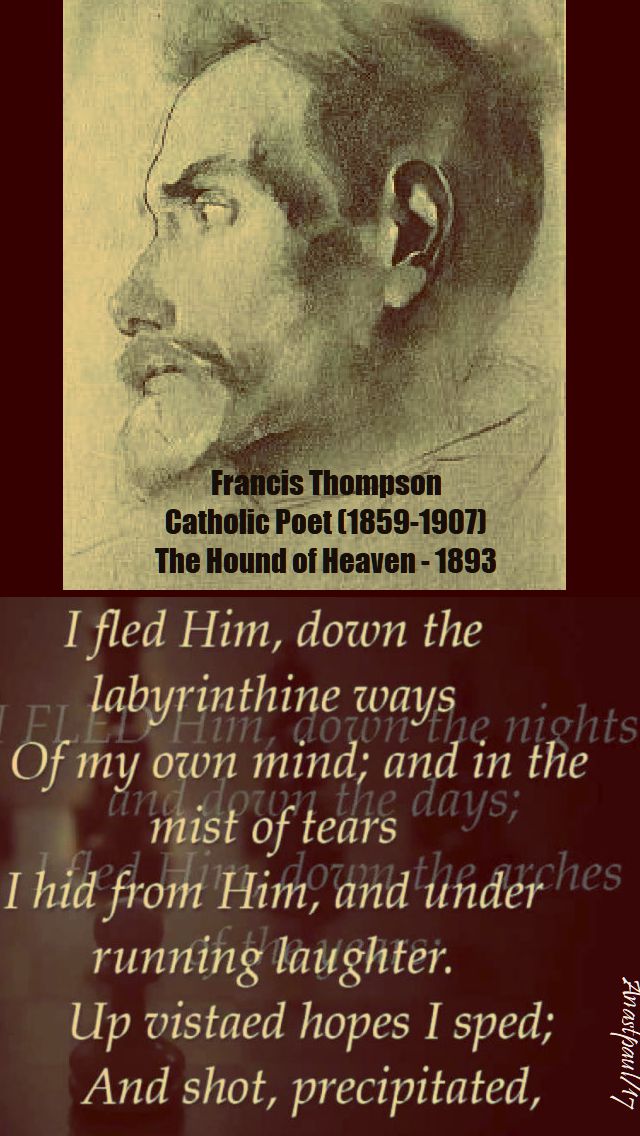
THE HOUND OF HEAVEN (1893)  – By Francis Thompson (16 December 1859 – 13 November 1907)

https://youtu.be/gToj6SLWz8Q (Richard Burton – a beautiful version)

I fled Him, down the nights and down the days;
I fled Him, down the arches of the years;
I fled Him, down the labyrinthine ways
Of my own mind; and in the midst of tears
I hid from Him, and under running laughter.
Up vistaed hopes I sped;
And shot, precipitated,
Adown Titanic glooms of chasmed fears,
From those strong Feet that followed, followed after.
But with unhurrying chase,
And unperturbèd pace,
Deliberate speed, majestic instancy,
They beat—and a Voice beat
More instant than the Feet—
‘All things betray thee, who betrayest Me’.

I pleaded, outlaw-wise,
By many a hearted casement, curtained red,
Trellised with intertwining charities;
(For, though I knew His love Who followed,
Yet was I sore a dread
Lest, having Him, I must have naught beside.)
But, if one little casement parted wide,
The gust of His approach would clash it to:
Fear wist not to evade, as Love wist to pursue.
Across the margent of the world I fled,
And troubled the gold gateway of the stars,
Smiting for shelter on their clanged bars;
Fretted to dulcet jars
And silvern chatter the pale ports o’ the moon.
I said to Dawn: Be sudden—to Eve: Be soon;
With thy young skiey blossom heap me over
From this tremendous Lover—
Float thy vague veil about me, lest He see!
I tempted all His servitors, but to find
My own betrayal in their constancy,
In faith to Him their fickleness to me,
Their traitorous trueness, and their loyal deceit.
To all swift things for swiftness did I sue;
Clung to the whistling mane of every wind.
But whether they swept, smoothly fleet,
The long savannahs of the blue;
Or, whether, Thunder-driven,
They clanged his chariot ‘thwart a heaven,
Plashy with flying lightnings round the spurn o’ their feet:—
Fear wist not to evade as Love wist to pursue.
Still with unhurrying chase,
And unperturbed pace,
Deliberate speed, majestic instancy,
Came on the following Feet,
And a Voice above their beat—
‘Naught shelters thee, who wilt not shelter Me.’

I sought no more after that which I strayed
In face of man or maid;
But still within the little children’s eyes
Seems something, something that replies,
They at least are for me, surely for me!
I turned me to them very wistfully;
But just as their young eyes grew sudden fair
With dawning answers there,
Their angel plucked them from me by the hair.
Come then, ye other children, Nature’s—share
With me’ (said I) ‘your delicate fellowship;
Let me greet you lip to lip,
Let me twine with you caresses,
Wantoning
With our Lady-Mother’s vagrant tresses,
Banqueting
With her in her wind-walled palace,
Underneath her azured dais,
Quaffing, as your taintless way is,
From a chalice
Lucent-weeping out of the dayspring.’
So it was done:
I in their delicate fellowship was one—
Drew the bolt of Nature’s secrecies.
          I knew all the swift importings
On the wilful face of skies;
I knew how the clouds arise
Spumèd of the wild sea-snortings;
All that’s born or dies
Rose and drooped with; made them shapers
Of mine own moods, or wailful divine;
With them joyed and was bereaven.
I was heavy with the even,
When she lit her glimmering tapers
Round the day’s dead sanctities.
I laughed in the morning’s eyes.
I triumphed and I saddened with all weather,
Heaven and I wept together,
And its sweet tears were salt with mortal mine:
Against the red throb of its sunset-heart
I laid my own to beat, And share commingling heat;
But not by that, by that, was eased my human smart.
In vain my tears were wet on Heaven’s grey cheek.
For ah! we know not what each other says,
These things and I; in sound I speak—
Their sound is but their stir, they speak by silences.
Nature, poor stepdame, cannot slake my drouth;
Let her, if she would owe me,
Drop yon blue bosom-veil of sky, and show me
The breasts o’ her tenderness:
Never did any milk of hers once bless
My thirsting mouth.
Nigh and nigh draws the chase,
With unperturbed pace,
Deliberate speed, majestic instancy;
And past those noisèd Feet
A voice comes yet more fleet—
‘Lo! naught contents thee, who content’st not Me.’

Naked I wait Thy love’s uplifted stroke!
My harness piece by piece Thou has hewn from me,
And smitten me to my knee;
I am defenceless utterly.
I slept, methinks, and woke,
And, slowly gazing, find me stripped in sleep.
In the rash lustihead of my young powers,
I shook the pillaring hours
And pulled my life upon me; grimed with smears,
I stand amidst the dust o’ the mounded years—
My mangled youth lies dead beneath the heap.
My days have crackled and gone up in smoke,
Have puffed and burst as sun-starts on a stream.
Yea, faileth now even dream
The dreamer, and the lute the lutanist;
Even the linked fantasies, in whose blossomy twist
I swung the earth a trinket at my wrist,
Are yielding; cords of all too weak account
For earth with heavy griefs so overplussed.
Ah! is Thy love indeed
A weed, albeit an amarinthine weed,
Suffering no flowers except its own to mount?
Ah! must—
Designer infinite!—
Ah! must Thou char the wood ere Thou canst limn with it?
My freshness spent its wavering shower i’ the dust;
And now my heart is as a broken fount,
Wherein tear-drippings stagnate, spilt down ever
From the dank thoughts that shiver
Upon the sighful branches of my mind.
Such is; what is to be?
The pulp so bitter, how shall taste the rind?
I dimly guess what Time in mists confounds;
Yet ever and anon a trumpet sounds
From the hid battlements of Eternity;
Those shaken mists a space unsettle, then
Round the half-glimpsed turrets slowly wash again.
But not ere him who summoneth
I first have seen, unwound
With glooming robes purpureal, cypress-crowned;
His name I know and what his trumpet saith.
Whether man’s heart or life it be which yields
Thee harvest, must Thy harvest-fields
Be dunged with rotten death?

Now of that long pursuit
Comes on at hand the bruit;
That Voice is round me like a bursting sea:
‘And is thy earth so marred,
Shattered in shard on shard?
Lo, all things fly thee, for thou fliest Me!

‘Strange, piteous, futile thing!
Wherefore should any set thee love apart?
Seeing none but I makes much of naught’ (He said),
‘And human love needs human meriting:
How hast thou merited—
Of all man’s clotted clay the dingiest clot?
Alack, thou knowest not
How little worthy of any love thou art!
Whom wilt thou find to love ignoble thee,
Save Me, save only Me?
All which I took from thee I did but take,
Not for thy harms,
But just that thou might’st seek it in My arms.
All which thy child’s mistake
Fancies as lost, I have stored for thee at home:
Rise, clasp My hand, and come!’

Halts by me that footfall:
Is my gloom, after all,
Shade of His hand, outstretched caressingly?
‘Ah, fondest, blindest, weakest,
I am He Whom thou seekest!
Thou dravest love from thee, who dravest Me.’
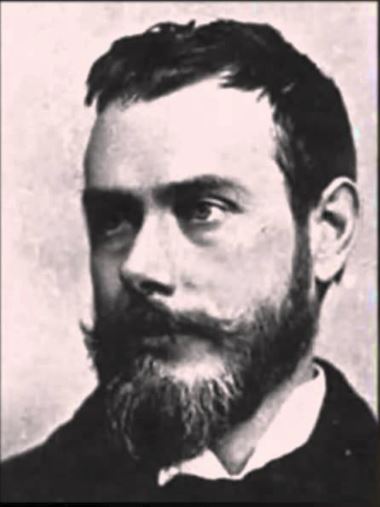

FRANCIS THOMPSON - MY SNIP

Posted in JESUIT SJ, MORNING Prayers, QUOTES of the SAINTS, The HOLY GHOST

Quote/s of the Day – 21 October

Quote/s of the Day – 21 October

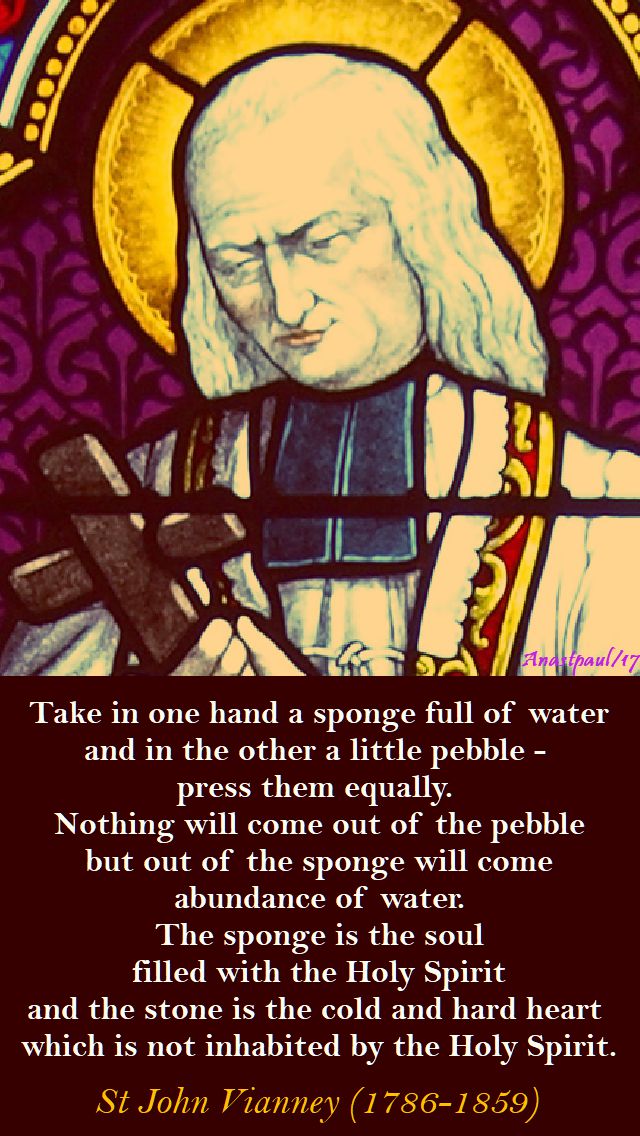
“Take in one hand a sponge full of water
and in the other a little pebble – press them equally.
Nothing will come out of the pebble
but out of the sponge will come abundance of water.
The sponge is the soul filled with the Holy Spirit
and the stone is the cold and hard heart
which is not inhabited by the Holy Spirit.”

St John Vianney (1786-1859)take in one hand - st john vianney - 21 oct 2017

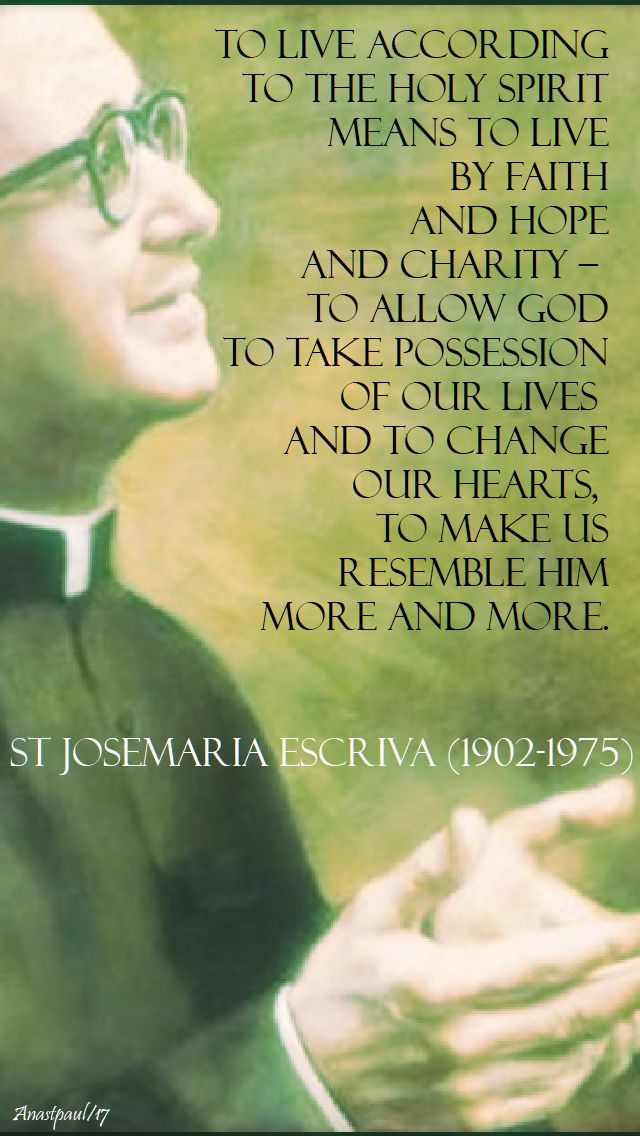
“To live according to the Holy Spirit
means to live by faith and hope and charity –
to allow God to take possession of our lives
and to change our hearts,
to make us resemble him more and more.”

St Josemaria Escriva (1902-1975)to live according - st josemaria - 21 oct 2017

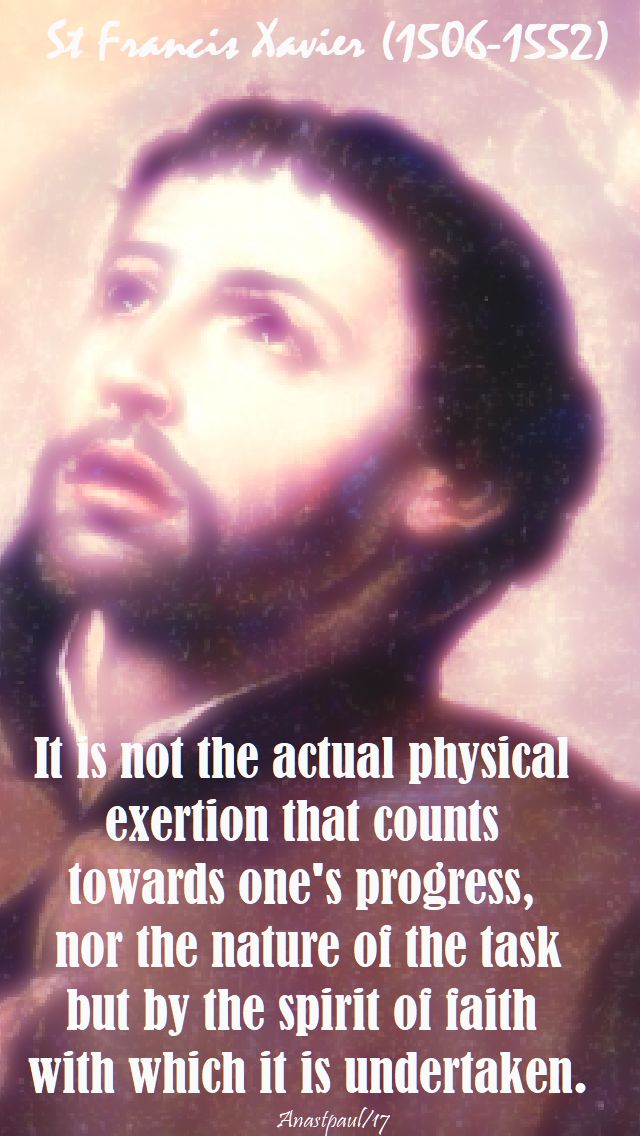
“It is not the actual physical exertion that counts
towards one’s progress, nor the nature of the task
but by the spirit of faith with which it is undertaken.”

St Francis Xavier (1506-1552)it is not - st francis xavier - 21 oct 2017

Posted in franciscan OFM, JESUIT SJ, MARIAN QUOTES, MORNING Prayers, The BLESSED VIRGIN MARY, The HOLY ROSARY/ROSARY CRUSADE, Uncategorized

Quote/s of the Day – 20 October – The Month of the Holy Rosary

Quote/s of the Day – 20 October – The Month of the Holy Rosary

“The Rosary is the prayer
that always accompanies my life:
it is also the prayer
of simple people and saints…
it is the prayer of my heart”.

“The Rosary lays before our eyes the beauty
of a simple contemplative prayer
that is accessible to everyone, great and small.”

Pope Francispope francis on the rosary - quotes - 20 oct 2017

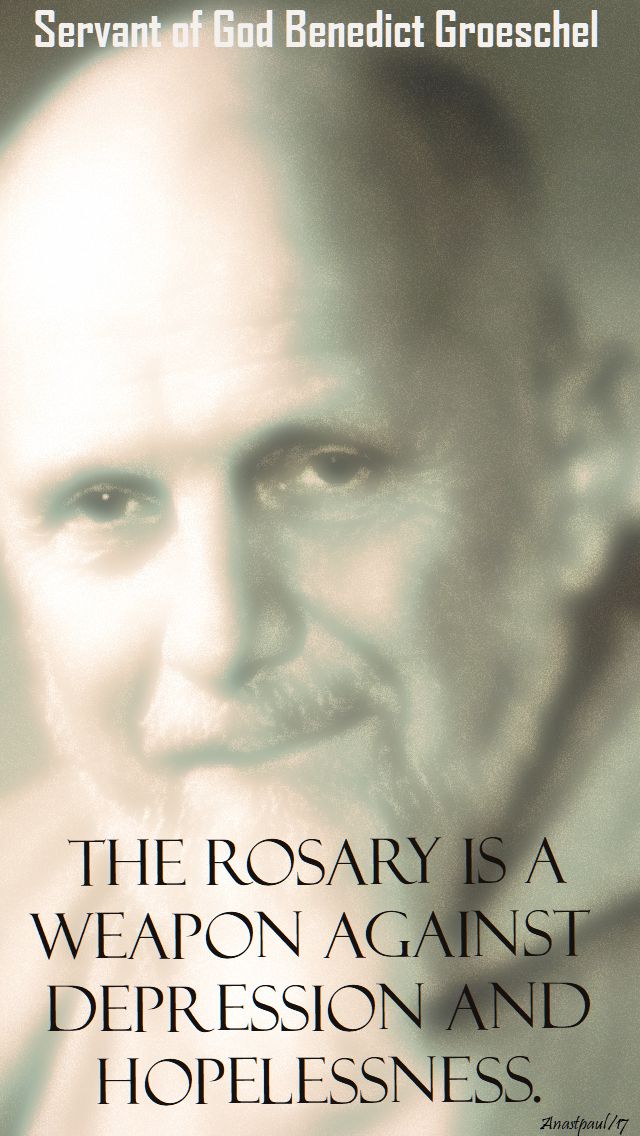
“The rosary is a weapon against
depression and hopelessness.”

Servant of God Benedict Groeschelthe rosary is - benedict groeschel

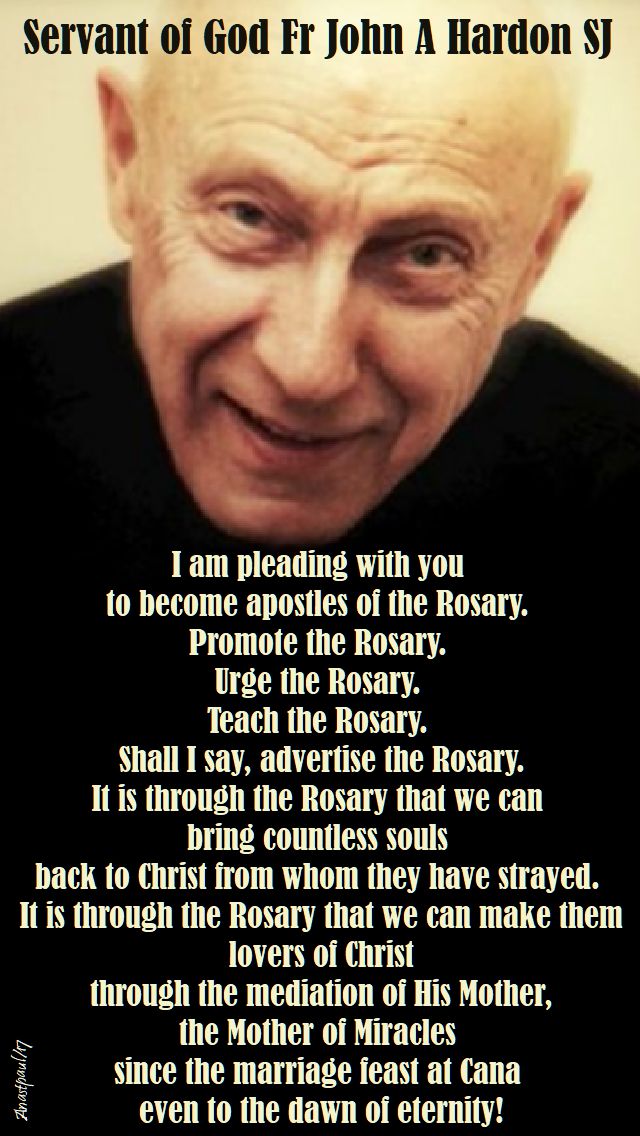
“I am pleading with you to become apostles of the Rosary.
Promote the Rosary.
Urge the Rosary.
Teach the Rosary.
Shall I say, advertise the Rosary.
It is through the Rosary that we can bring countless souls
back to Christ from whom they have strayed.
It is through the Rosary that we can make them
lovers of Christ through the mediation of His Mother,
the Mother of Miracles since the marriage feast at Cana
even to the dawn of eternity!”

Servant of God Fr John A Hardon SJ

(Father Hardon wrote and gave this conference before His Holiness, John Paul II, issued the Apostolic Letter Rosarium Virginis Mariae that added five more mysteries (the Luminous Mysteries) to the Rosary.)i am pleading with you - john a hardon - on the rosary - 20 oct 2017

Posted in JESUIT SJ, MORNING Prayers, QUOTES of the SAINTS, SAINT of the DAY, The WORD

One Minute Reflection – 19 October – The Memorial of Saints John de Brébeuf and Isaac Jogues, Priests and Companions, Martyrs

One Minute Reflection – 19 October – The Memorial of Saints John de Brébeuf and Isaac Jogues, Priests and Companions, Martyrs

Do not grow lazy but imitate those who through faith and patience, are inheriting the promise .…Hebrews 6:12hebrews 6-12 - 19 oct 2017 - north american martyrs

REFLECTION – “My confidence is placed in God, who does not need our help for accomplishing His designs.
Our single endeavour should be to give ourselvs to the work and to be faithful to Him.”…..St Isaac Jogues SJ (1607-1646)my confidence is placed in god - st isaac jogues sj - 19 october 2017

PRAYER – My Lord and patient God, help me to practice patience in doing good. No matter what may occur, allow me to face each day with quiet courage and without complaint, knowing You are always at my side and that all is part of Your divine plan.   I pray for total abandonment to Your Will.  Sts John de Brébeuf, Isaac Jogues and your fellow Martyrs, please pray for us all, amen.19 OCT 2017 - One Minute Reflection JESUIT MARTYRS OF NORTH AMERICA - pray for us -

Posted in INCORRUPTIBLES, JESUIT SJ, SACRED and IMMACULATE HEARTS, SAINT of the DAY

Saint of the Day – 16 October – St Margaret Mary Alacoque (1647-1690) V.H.M.

Saint of the Day – 16 October – St Margaret Mary Alacoque (1647-1690) V.H.M. Virgin, Nun, Mystic, Saint and Apostle of the Sacred Heart.  Born Marguerite-Marie Alacoque on 22 July 1647 at L’Hautecourt, Burgundy, France – 17 October 1690 of natural causes.   Patronages – against polio, against the death of parents, devotees of the Sacred Heart, polio patients.   She was Beatified on 18 September 1864 by Pope Blessed Pius IX and Canonised on 13 May 1920 by Pope Benedict XV.   When her tomb was canonically opened in July 1830, two instantaneous cures were recorded to have taken place.   Her incorrupt body rests above the side altar in the Chapel of the Apparitions, located at the Visitation Monastery in Paray-le-Monial and many striking blessings have been claimed by pilgrims attracted there from all parts of the world.SacretHeart-fcp-atp BESTchapel-of-the-apparitionsst mm shrine

She was born in 1647 AD at Janots, a small town of Burgundy, the fifth of seven children, of Claude and Philiberte Alacoque.    Her father was a prosperous notary;  the family owned a country house and farmland and had some aristocratic connections.   Margaret’s godmother was a neighbour, the Countess of Corcheval.    As a small child Margaret spent a great deal of time with her but these visits were brought to a sudden end by the death of the countess.   The father died of pneumonia when Margaret was about eight and this was another severe shock to her.   Claude had loved his family dearly but had been short-sighted and extravagant and his death put them in hard straits.   However, Margaret was sent to school with the Urbanist Sisters at Charolles.   She loved the peace and order of the convent life and the nuns were so impressed by her devotion that she was allowed to make her First Communion at the age of nine (normally around the age of 12 at that time).   A rheumatic affliction kept her bedridden for four years.   During that time she was brought home, where some of her father’s relatives had moved in and taken over the direction of the farm and household.   She and her mother were treated almost as servants.  This painful situation grew more acute after Margaret’s recovery, for the relatives tried to regulate all her comings and goings.   Not allowed to attend church as often as she pleased, the young girl was sometimes seen weeping and praying in a corner of the garden.   It grieved her deeply that she could not ease things for her mother.   Her eldest brother’s coming of age saved the day, for the property now reverted to him and the family again had undisputed possession of their home.

Philiberte had expressed a hope that Margaret would marry;  the girl considered this but at the age of twenty, inspired by a vision, she put aside all such thoughts and resolved to enter a convent.   While awaiting admission, she tried to help and teach certain neglected children of the village.   At twenty-two she made her profession at the convent of the Visitation at Paray-le-Monial.   The nuns of the Order of the Visitation, founded in the early years of the seventeenth century by St. Francis de Sales, were famed for their humility and selflessness.   As a novice Margaret excelled in these virtues.   When she made her profession, the name of Mary was added and she was called Margaret Mary. She began a course of mortifications and penances which were to continue, with more or less intensity, as long as she lived.   We are told that she was assigned to the infirmary and was not very skillful at her tasks.

Some years passed quietly in the convent and then Margaret Mary began to have experiences which seemed to be of supernatural origin.   The first of these occurred on 27 December 1673, when she was kneeling at the grille in the chapel.   She felt suffused by the Divine Presence and heard the Lord inviting her to take the place which St John had occupied at the Last Supper.   The Lord told her that the love of His heart must spread and manifest itself to men and He would reveal its graces through her.   This was the beginning of a series of revelations covering a period of eighteen months.  When Margaret Mary went to the Superior, Mother de Saumaise, with an account of these mystical experiences, claiming that she, an humble nun, had been chosen as the transmitter of a new devotion to the Sacred Heart, she was reprimanded for her presumption.   Seriously overwrought, Margaret Mary suffered a collapse and became very ill.   The Mother Superior reflected that she might have erred in scorning the nun’s story and vowed that if her life were spared, she would take it as a sign that the visions and messages were truly from God.   When Margaret Mary recovered, the Superior invited some theologians who happened to be in the town—they included a Jesuit and a Benedictine—to hear the story.   These priests listened and judged the young nun to be a victim of delusions.   Their examination had been a sheer torture to Margaret Mary. Later a Jesuit, Father Claude de la Columbiere, talked to her and was completely convinced of the genuineness of the revelations.   He was to write of the nun and to inaugurate this devotion in England.

For many years, Margaret Mary suffered from despair, from self-inflicted punishments and also from the slights and contempt of those around her.    In 1681, Father Claude returned to the convent and died there the following year.   Margaret Mary was appointed assistant and novice-mistress by a new Mother Superior who was more sympathetic towards her.   In 1683, opposition in the community ended after an account of Margaret Mary’s visions was read aloud in the refectory from the writings left by Father Claude, who had taken it upon himself to make known to the world the nun’s remarkable experiences.    Mother Melin was elected Superior and named Margaret Mary her assistant.   That she was finally vindicated was to her a matter of indifference. She later became Novice Mistress, saw the convent observe the feast of the Sacred Heart privately beginning in 1686 and two years later, a chapel was built at the Paray-le-Monial to honour the Sacred Heart;  soon observation of the feast of the Sacred Heart spread to other Visitation convents.   When she was forty-three, while serving a second term as assistant superior, Margaret Mary fell ill.   Sinking rapidly, she received the Last Sacraments, saying, “I need nothing but God, and to lose myself in the heart of Jesus.” Margaret Mary died at the Paray-le-Monial on October 17, 1690.   Margaret Mary was canonised a saint in 1920.    She, St John Eudes, and St Claude La Colombiere are called the “Saints of the Sacred Heart”;  the devotion was officially recognised and approved by Pope Clement XIII in 1765, seventy-five years after her death.

In seventeenth-century France, the faith of the people had been badly shaken;  there had been rebellion against the Church and neglect of its teachings; the rise of Protestantism and the spread of the heresy of Jansenism both had a part in the weakening of the structure built up through the ages.   But as every threat brings its response, so now there rose up fresh, strong forces to counter these trends.   Three famous religious, who are today venerated as saints, were particularly effective:  Saint John Eudes and StClaude de la Columbiere were French Jesuit priests and writers;   Saint Margaret Mary Alacoque was a simple nun of the order of the Visitation.   Their special work was to popularise the devotion to the Sacred Heart of Jesus.  Although the devotion to the Sacred Heart of Jesus was practiced before this time, it now gained a strong new impetus through the work of Father John Eudes and the writings of Father Claude.   “The Sacred Heart is the symbol of that boundless love which moved the Word to take flesh, to institute the Holy Eucharist, to take our sins upon Himself and, dying on the Cross, to offer Himself as a victim and sacrifice to the eternal Father.”

The devotion to the Sacred Heart first became popular in France, then spread to Poland and other countries.   The first petition to the Holy See for the institution of the feast was from Queen Mary, consort of James II of England.   The month of June is appointed for this devotion and since 1929 the feast has been one of the highest rank and is celebrated on the Friday after the Solemnity of the Body and Blood of Christ.

Posted in JESUIT SJ, MORNING Prayers, QUOTES on SUFFERING, SAINT of the DAY, The BLESSED VIRGIN MARY, The HOLY CROSS

Quote/s of the Day – 10 October – The Memorial of St Francis Borgia SJ (1510-1572) and St Daniel Comboni (1831-1881)

Quote/s of the Day – 10 October – The Memorial of St Francis Borgia SJ (1510-1572) and
St Daniel Comboni (1831-1881)

“I am very sorry to lose the company of a man of your merit,
a shining light of counsel, a model in the exercise of the highest offices of State and,
because of your virtue and piety, a factor of edification for all my court.
But I recognise that it would be unreasonable to dispute over you with the Master you have chosen to serve.
It is, therefore, with sorrow that I grant you the permission you are requesting.
I authorise you to renounce your fiefs and titles in favour of your firstborn son.
The number of those who will envy you, will be greater than those who will imitate you, since it is easy to admire beautiful examples but difficult to follow them.
I recommend myself to your prayers and I count upon you,
to attract divine blessings over me, my States, and all Christendom.”

(King Charles V of Spain when he granted permission to St Francis to enter the novitiate of the Jesuits.)

“When you pray, hear Mass, sit at table, engage in business
and when at bedtime you remove your clothes—
at all times crave that by the pain which He felt when He was stripped
just before His crucifixion, He may strip us of our evil habits of mind.
Thus, naked of earthly things, we may also embrace the cross.”when you pray - st francis borgia - 10 oct 2017

“I have great doubts about the salvation of those
who do not have special devotion to Mary.”

St Francis Borgia (1510-1572)i have great doubts - st francis borgia - 19 oct 2917

“The same terrible crosses that oppress me
are also the greatest consolation
because Jesus suffered,
Jesus is a Victim
Jesus chose the Cross….
(therefore) I am happy with the Cross,
tbat borne willingly for the love of God,
generates triumph and eternal life.”

St Daniel Comboni (1831-1881)the same terrible crosses - st daniel comboni - 10 oct 2017