Posted in JESUIT SJ, MORNING Prayers, PRAYERS of the SAINTS

Our Morning Offering – 27 July

Our Morning Offering – 27 July

“O God, I love You and not because
I hope for heaven thereby.”
St Francis Xavier translated by Gerald Manley Hopkins

I love You, God, I love You—
Not out of hope for heaven for me
Nor fearing not to love and be
In the everlasting burning.
You, my Jesus, after me
Did reach Your arms out dying,
For my sake suffered nails and lance,
Mocked and marred countenance,
Sorrows passing number,
Sweat and care and cumber,
Yes and death, and this for me,
And You could see me sinning:
Then I, why should not I love You,
Jesu so much in love with me?
Not for heaven’s sake, not to be
Out of hell by loving You;
Not for any gains I see;
But just the way that You loved me
I do love and will love You.
What must I love You Lord, for then?
For being my king and God. Amen

I love you lord - st francis xavier

Posted in CONTEMPLATIVE Prayer, JESUIT SJ, MORNING Prayers

The Gift of Contemplative Prayer

The Gift of Contemplative Prayer

by Margaret Silf

Probably most of us, if we think of contemplative prayer at all, regard it as something that is beyond us and practiced only by a few contemplative monks and nuns whose whole lives are devoted to prayer.   Yet I have heard respected and experienced spiritual guides say that contemplation is often given to those you would least expect—to harassed mothers and people who think they can’t pray, to children, to the sick and dying, to people with no academic learning about prayer or Scripture or theology.   God sometimes seems to speak, heart to heart, in this mysterious way, to the untaught and unpracticed. None of us should imagine that the ways of contemplative prayer are closed to us because God is always infinitely larger than our expectations.

I suggest that creation itself gives us a gateway.   In every moment of our lives, a silent, invisible miracle of exchange is taking place.   We breathe out the air that our bodies no longer need, which is mainly carbon dioxide, a waste product for us but the very thing that the green leaves on the trees and plants need to produce their own energy.   So they receive our carbon dioxide and, through the process of photosynthesis, produce not only their own life energy, but also oxygen—a waste product for them but the very thing we need to live.   Whenever I stop my busyness for a few moments to look around me, I am amazed at this arrangement and it makes me think of prayer.

So perhaps a good way to open our hearts up to the gift of contemplation is simply to become still, and, quite literally, to breathe out our waste—all that clogs us and deadens us—and to breathe in God’s renewing life, as we breathe in the fresh oxygen that the plants have made for us.   This simple, deliberate breathing exercise can become something like what the French peasant was doing as he looked at God and God looked at him.   We are becoming aware of the mysterious exchange of life between ourselves and God.   And there is no reason that any period of quiet might not become prayer of this kind.

There may be other creatures who can help you cross the threshold of contemplation. If there is a baby in the family, try simply holding her in your arms as she sleeps and letting God hold both of you in his.   Nothing more.   No deep thoughts.   No search for meaning.   Just be there.

A cat (if you are not allergic to them!) can also be a great aid to prayer.   My own cat loves to sleep round my neck.   At first I found this disturbing but when he has settled into a particular hollow (perhaps where he can feel my pulse), he will lie there, quite still, just purring deeply, until he falls asleep and the purring ceases.   When he does this, I let myself find a hollow close to God’s pulse and let my own prayer become just a sleepy purr and then the silence of content.   Or you might discover prayer on a park bench.   The other day I was in Hyde Park and I spent a few minutes listening to the deep-throated cooing of the pigeons. I wanted to join them because, in their way, they were engaged in contemplative prayer, simply expressing, in this peaceful murmur, the song of their beings.

In your own home, prayer awaits you in the opening of a flower, the rising of your bread dough, or the steady, imperceptible development of a child.   Spend time in silence, aware of the wonder that is being unfolded in your cakes and your children, your houseplants or your garden.   For this is the essence of contemplative prayer—simple awareness, allowing God to be God, without trying to put the limitations of shape or meaning around him.

Contemplation, like all prayer, is pure gift and not anything we can achieve.   It happens when prayer becomes, wholly and utterly, the flow of God’s grace, transforming the land it flows through, like Ezekiel’s stream.   Or it happens when we lose consciousness of our own part in it and become simply receptors and carriers of grace.   It happens when we realise that our transformation depends on nothing but God’s grace and love, and, like the chrysalis, let go of all activity to try to achieve our own redemption.

When we try to describe it, we fail, for it lies beyond the world of words.   We can open our hearts to it by the practice of awareness but we cannot bring it about, any more than we can force a flower to open or an egg to hatch.   And in our silent, trustful waiting, we are acknowledging that God is God, the source and the destination, the means and the end of all our prayer, whatever form it may take.

from Close to the Heart: A Practical Approach to Personal Prayer

Make my Heart Still

“Lord take my poor heart. It is often so far from You, lost in a thousand things and in the trifles that fill up my everyday life. Lord, only You can collect the thoughts of my heart and have it concentrate on You, You who are the centre of all hearts, the Lord of all souls. Only You can bestow the spirit of prayer, only Your grace is able to allow me to find You amidst this multitude of things, amdist the distractions of everyday life, YOU, the one necessity, the one person with whom my heart can become still.”

“When man comes to God in awe and love, then he is praying.”

Karl Rayner SJ – The Mystical Way in Everyday Life

when man comes to god in awe and love-karl rayner sj

Posted in JESUIT SJ, MORNING Prayers, SAINT of the DAY

Thought for the Day – 2 July

Thought for the Day – 2 July

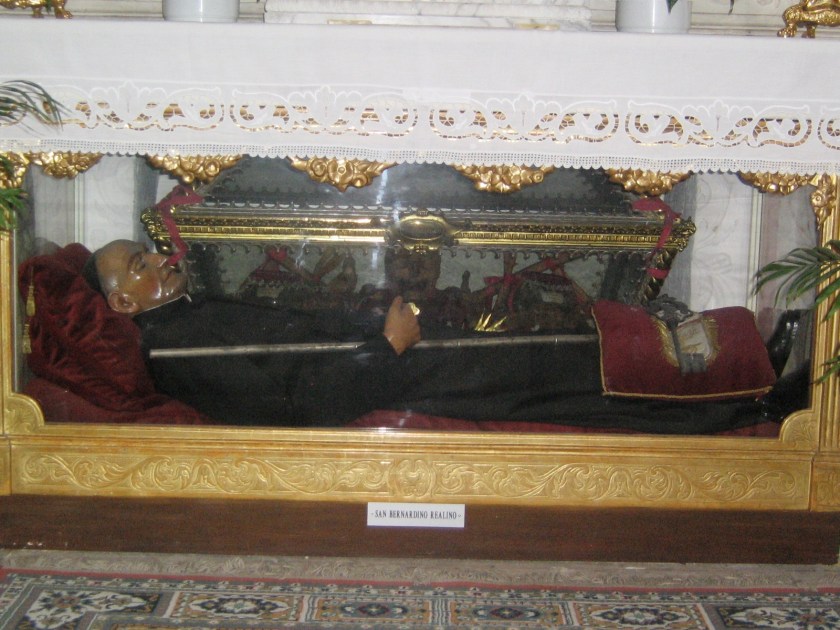
By the time of his death, Saint Bernardino Realino (saint of the day 2 July) was recognizsed as a man of great zeal and holiness.   Those who had known him at once hailed him as a saint.   Following his death, blood that had been collected from him while alive was observed to defy biological properties.   For over a century, the blood remained liquefied, foaming and frothing on the anniversary of his death.   Similarly, when his tomb was opened, the flesh of his body was found to be incorrupt, his blood frothing and emitting a sweet perfumed scent.

Reliquie_di_San_Bernardino_Realino_Lecce_1205

His life reminds us that it is never too late for a change in perspective!   As a young man, Bernardino achieved great worldly success but realised that worldly recognition and riches left him unfulfilled.   He turned to the Lord, listened for His Will and embraced a rich lifetime of service and obedience, providing necessary spiritual direction to others. On this, his feast day, we might pause to take stock of our own perspective and priorities. How do we judge success in our lives? How might that differ from the manner in which the Lord, Our God, judges success?   Are we able to live today’s Gospel – Matthew 10:37-42?

St Bernardino Realino, pray for us!

st bernardino realino - pray for us.2

Posted in INCORRUPTIBLES, JESUIT SJ, SAINT of the DAY, The BLESSED VIRGIN MARY

Saint of the Day – 2 July – St St Bernadino Realino SJ

Saint of the Day – 2 July – St St Bernadino Realino SJ – Priest, Lawyer, Teacher, Apostle of Charity -(1 December 1530 in Carpi, Modena, Italy -2 July 1616 in Lecce, Italy of natural causes).   Canonised on 22 June 1947 by Pope Pius XII.  Patronage -Lecce, Italy (proclaimed on 15 December 1947 by Pope Pius XII).  His body is incorrupt and emits a perfumed fragrance.

bernardinrealino

Bernardino Realino was born near Modena, Italy, on 1 December 1530.   At university he began studying philosophy and medicine but switched to law which he thought would open greater chances for advancement and wealth.   Family connections helped him become mayor of Felizzano at age 26, which also involved being a judge.   He was regarded as honest by the people and was reappointed to the post.   Other posts followed until he was made mayor of Castelleone.
Despite his successful career, Realino began losing interest in worldly advancement and began giving away his money to the poor.   In August 1564 he met two Jesuit novices and learned that the Jesuits had only recently come to Naples.   Further encounters strengthened his vocation and then he had a vision of Our Lady, who told him to enter the Jesuits.   He was accepted as a novice on 13 October 1564 at the age of 34.
Realino wanted to be a brother but was told he should be ordained a priest.   Only seven months after taking first vows he was ordained on 24 May 1567.   It was a tribute to his maturity that the Jesuit General (St) Francis Borgia made him master of novices in Naples, although still studying theology.   He also began the pastoral work which would occupy the rest of his active life.   He preached and taught catechism, visited slaves on the galleys in Naples harbour and heard confessions.
In 1574 he was sent to Lecce in Apulia, where there was a plan to set up a Jesuit house and college.   The local response was enthusiastic and Realino began the pastoral work which would last for 42 years:  preaching, hearing confessions, counselling clergy, visiting the sick and those in prison and giving conferences to men and women religious. Several times he was instructed to move to Naples or Rome but each every time he was about to leave the city, he was prevented by some unexpected occurrence – a sudden fever or bad weather.   Eventually his superiors allowed him to stay on in Lecce doing his pastoral work.   In 1583 he set up a sodality for diocesan priests to nurture their spiritual life and improve their competence to hear confessions.   The people showed their love for their pastor, especially during his final illness in June 1616.   Crowds gathered outside the Jesuit residence and only men were allowed in to kiss his hand and devoutly touch religious objects to his body.   On his death-bed, the city mayor and magistrates formally requested Fr Realino to be Lecce’s defender and protector in heaven.   Unable to speak, he nodded.   The distinguished lawyer who spent most of his life as a parish priest in relative seclusion died at the age of 86 with his eyes fixed on a crucifix.   His last words were: “O Madonna, mia santissima” (O my Lady, my most holy one).

72bernardino2bernardino.realino01stbernardinerealino (1)Reliquie_di_San_Bernardino_Realino_Lecce_1205

Posted in CATHOLIC DEVOTIONS of the Month, CATHOLIC-PRAYERS OF THE CHURCH, DOCTORS of the Church, EUCHARISTIC Adoration, FEASTS and SOLEMNITIES, HYMNS, JESUIT SJ, MORNING Prayers, POETRY, PRAYERS of the CHURCH, PRAYERS of the SAINTS

Our Morning Offering – 18 June 2017 – The Feast of Copus Christi

Our Morning Offering – 18 June 2017 – The Feast of Copus Christi

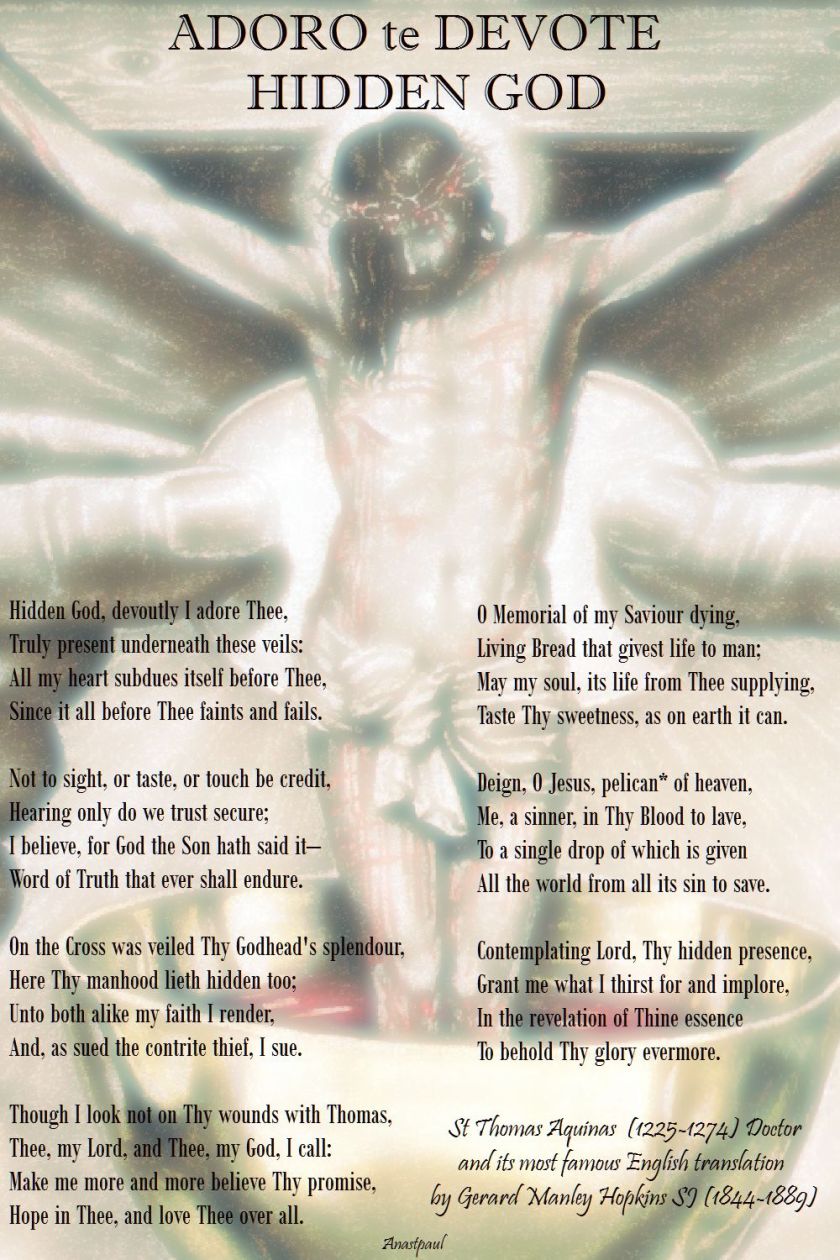
ADORO te DEVOTE – HIDDEN GOD
St Thomas Aquinas (1225-1274) Doctor
and its most famous English translation
by Gerard Manley Hopkins SJ (1844-1889)

Hidden God, devoutly I adore Thee,
Truly present underneath these veils:
All my heart subdues itself before Thee,
Since it all before Thee faints and fails.

Not to sight, or taste, or touch be credit,
Hearing only do we trust secure;
I believe, for God the Son hath said it–
Word of Truth that ever shall endure.

On the Cross was veiled Thy Godhead’s splendour,
Here Thy manhood lieth hidden too;
Unto both alike my faith I render,
And, as sued the contrite thief, I sue.

Though I look not on Thy wounds with Thomas,
Thee, my Lord, and Thee, my God, I call:
Make me more and more believe Thy promise,
Hope in Thee, and love Thee over all.

O Memorial of my Saviour dying,
Living Bread that givest life to man;
May my soul, its life from Thee supplying,
Taste Thy sweetness, as on earth it can.

Deign, O Jesus, pelican* of heaven,
Me, a sinner, in Thy Blood to lave,
To a single drop of which is given
All the world from all its sin to save.

Contemplating Lord, Thy hidden presence,
Grant me what I thirst for and implore,
In the revelation of Thine essence
To behold Thy glory evermore.

ADORO te DEVOTE - ST THOMAS AQUINAS TRANSLATE G M HOPKINS SJ

Posted in CATECHESIS, CATHOLIC DEVOTIONS of the Month, CATHOLIC Quotes, EUCHARISTIC Adoration, JESUIT SJ, MORNING Prayers, QUOTES of the SAINTS

Thought for the Day – 15 June

Thought for the Day – 15 June

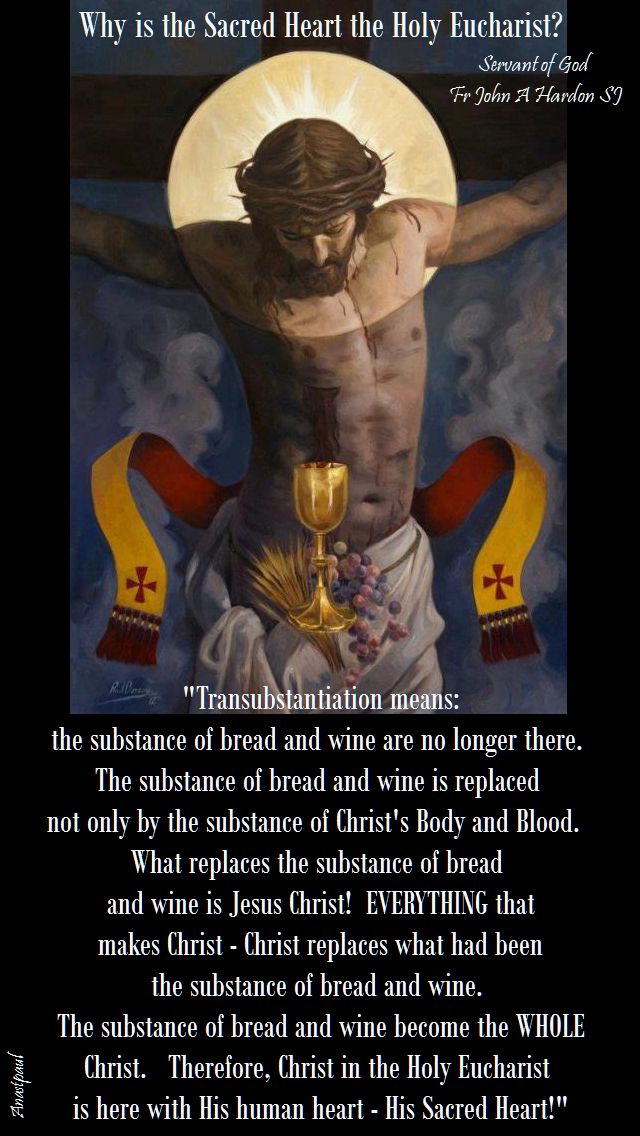
Why is the Sacred Heart the Holy Eucharist?

It is impossible to identify the Holy Eucharist too closely with Jesus Christ.   We should remember He is in the Holy Eucharist not merely with His substance.   I have corrected many of my students over the years who tell me “Transubstantiation means that the substance of bread and wine become the substance of Jesus Christ.” I reply, “No, transubstantiation means the substance of bread and wine are no longer there. The substance of bread and wine is replaced not only by the substance of Christ’s Body and Blood. What replaces the substance of bread and wine is Jesus Christ!” Everything that makes Christ, Christ replaces what had been the substance of bread and wine.   The substance of bread and wine become the whole Christ.

Therefore, Christ in the Holy Eucharist is here with His human heart.   Is it a living heart?   Yes! That is why the revelations our Lord made to St. Margaret Mary about promoting devotion to the Sacred Heart were all made from the Holy Eucharist.

Why do we equate the Sacred Heart with the Holy Eucharist?   Because the Holy Eucharist is the whole Christ with His human heart.   According to St. Margaret Mary, the Sacred Heart is the Holy Eucharist.   So it follows that devotion to the Sacred Heart is devotion to the Holy Eucharist.   It is infinite Love Incarnate living in our midst in the Blessed Sacrament.

Servant of God Fr John A Hardon SJ

why is the sacred heart the Holy Eucharist - fr john a hardon

Posted in CATHOLIC DEVOTIONS of the Month, JESUIT SJ, MORNING Prayers, PRAYERS of the SAINTS, SACRED and IMMACULATE HEARTS

Our Morning Offering – 14 June

Our Morning Offering – 14 June

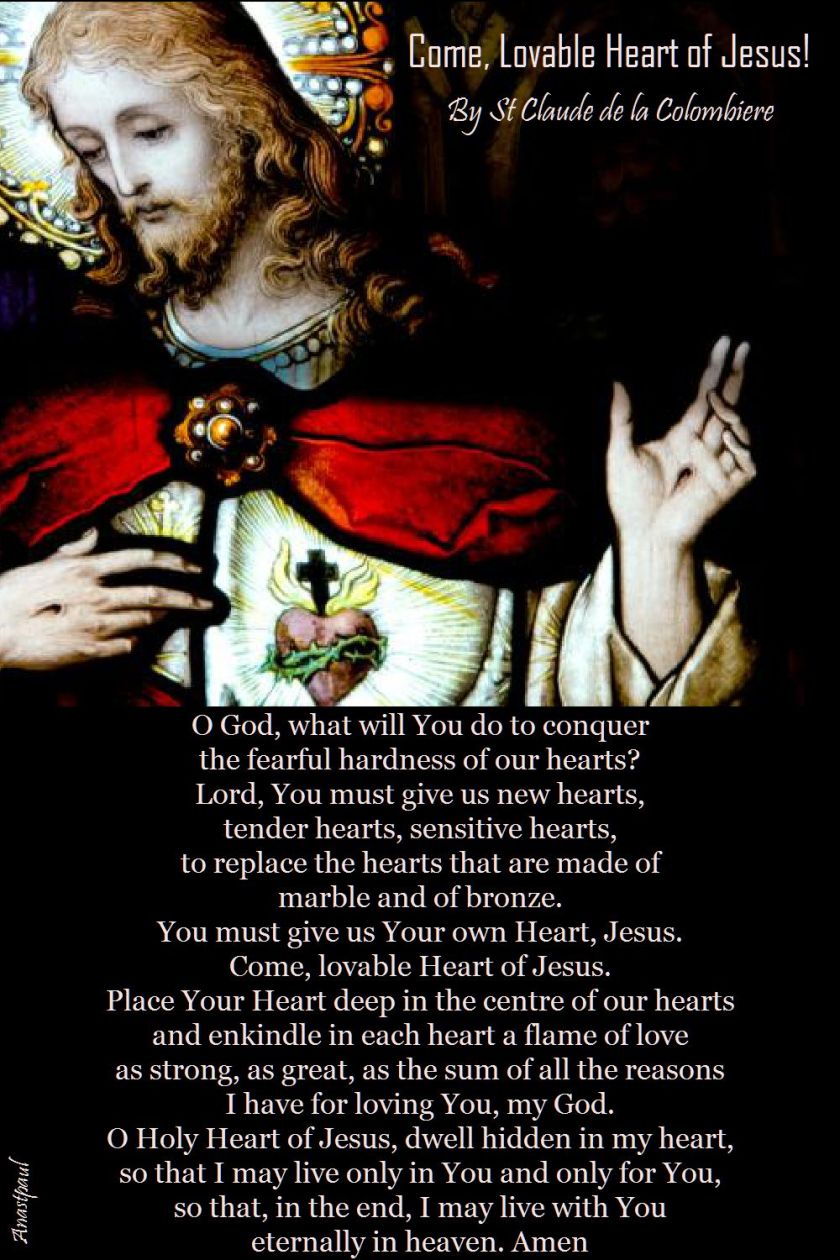
Come, Lovable Heart of Jesus!
By St Claude de la Colombiere

O God, what will You do to conquer
the fearful hardness of our hearts?
Lord, You must give us new hearts,
tender hearts, sensitive hearts,
to replace the hearts that are made of
marble and of bronze.
You must give us Your own Heart, Jesus.
Come, lovable Heart of Jesus.
Place Your Heart deep in the centre of our hearts
and enkindle in each heart a flame of love
as strong, as great, as the sum of all the reasons
I have for loving You, my God.
O Holy Heart of Jesus, dwell hidden in my heart,
so that I may live only in You and only for You,
so that, in the end, I may live with You
eternally in heaven. Amen

come, lovable heart of jesus - st claude de la colombiere

Posted in CATHOLIC DEVOTIONS of the Month, EUCHARISTIC Adoration, JESUIT SJ, NOVENAS, SACRED and IMMACULATE HEARTS

ANNOUNCING the NOVENA to the SACRED HEART BEGINS 14 JUNE

ANNOUNCING the NOVENA to the SACRED HEART
BEGINS 14 JUNE

ANNOUNCING the novena to the sacred heart - 14 June to begin.jpg

We may say that devotion to the Sacred Heart began on Calvary.   When the Heart of Christ was pierced on the Cross, it opened the door to realising how deeply Jesus loves us.   In return, He wants nothing more than for us to love Him with all our hearts.   There is nothing that God wants more than for us to love Him without reserve.
What God wants more than anything else is for us to love Him more than anyone else in the world.

This is the sum total of our Catholic faith.   We believe that God made us out of sheer love.   None of us, none of us had to exist.   We also believe He became man to die on the Cross out of love for us.   We further believe that He is present in the Blessed Sacrament with His living Heart of flesh so that we may come to Him and tell Him how deeply we love Him.

In today’s love-starving world, how we need to follow the example of Jesus Christ in His unspeakable love for us.   If there is one adjective that describes the modern world, this world is a loveless world.   This world is a selfish world.   This world is so preoccupied with space and time that it gives almost no thought to eternity and the everlasting joys that await those who have served God faithfully here on earth.

How do we serve God faithfully?   We serve Him only as faithfully as we serve Him lovingly, by giving ourselves to the needs of everyone whom God puts into our lives.   No one reaches heaven automatically.   Heaven must be dearly paid for.   The price of reaching heaven is the practice of selfless love here on earth.

That is why God puts into our lives so many occasions for loving people who obviously do not love us, or giving ourselves to people who have never given themselves to us.   How desperately we need, especially in today’s world, to learn that God became man in order to suffer and die out of love for us on the Cross.

That is what devotion to the Sacred Heart is all about.   It is the practice of selfless love toward selfish people.   It is giving ourselves to persons that do not give themselves to us. In all of our lives, God has placed selfish persons who may be physically close to us but spiritually are strangers and even enemies.   That is why God places unkind, unjust, even cruel people into our lives.   By loving them, we show something of the kind of love that God expects of His followers.

Devotion of the Sacred Heart is the solution to the gravest problem in the modern world today.   How can we give ourselves to those who do not love us, who even positively hate us?   We can love them, with the help of divine grace, by following the example of Jesus Christ, who died on the Cross out of love for a sin-laden human race……..Servant of God Fr John A. Hardon SJ

Let us Pray – starting on Wednesday 14 June.

Posted in JESUIT SJ, MORNING Prayers, POETRY

Celebrating GERARD MANLEY HOPKINS SJ – 8 June

Celebrating GERARD MANLEY HOPKINS SJ – 8 June

Gerard Manley Hopkins SJ, one of the leading poets of the nineteenth century, died on this day in Dublin in 1889,   His poetry is strikingly innovative, notable for its vivid imagery and new verse forms at a time when verse mainly followed traditional lines.   He struggled with depression and ill health throughout his short life but his last words at age 44 were “I am so happy, I am so happy.   I loved my life.”

Much of Gerard’s poetry was concerned with the divine presence in the material world, like this, probably one of the most renowned – “God’s Grandeur”

The world is charged with the grandeur of God.
It will flame out, like shining from shook foil;
It gathers to a greatness, like the ooze of oil
Crushed. Why do men then now not reck his rod?
Generations have trod, have trod, have trod;
And all is seared with trade; bleared, smeared with toil;
And wears man’s smudge and shares man’s smell: the soil
Is bare now, nor can foot feel, being shod.

And for all this nature, is never spent;
There lives the dearest freshness deep down things;
And though the last lights off the black West went
Oh, morning, at the brown brink eastward, springs—
Because the Holy Ghost over the bent
World broods with warm breast and with ah! bright wings.

god's grandeur-gerard manley hopkins sj

Posted in JESUIT SJ, MORNING Prayers, SAINT of the DAY

Thought for the Day – 8 June

Thought for the Day – 8 June

May the Holy Spirit help us put into practice the choices of Jacques Berthieu:  his passion for a challenging mission that led him to another country, another language and another culture, his personal attachment to the Lord expressed in  prayer, his pastoral zeal, which was simultaneously a fraternal love of the faithful entrusted to his care and a commitment to lead them higher on the Christian way and finally, a life lived as gift, a choice lived out every day until the death which definitively configured him to Christ.

It is the choice we must all make – let us see our lives too as a missionary, in amongst the daily norms and battles, for viewed through our Christian eyes, our encounters are not that much different to that strange island where St Jacques Berthieu carried out his vocation.

St Jacques Berthieu, pray for us!

ST JACQUES BERTHIEU PRAY FOR US.jpg 2

Posted in EUCHARISTIC Adoration, JESUIT SJ, MORNING Prayers, SAINT of the DAY

Quote/s of the Day – 8 June

Quote/s of the Day – 8 June

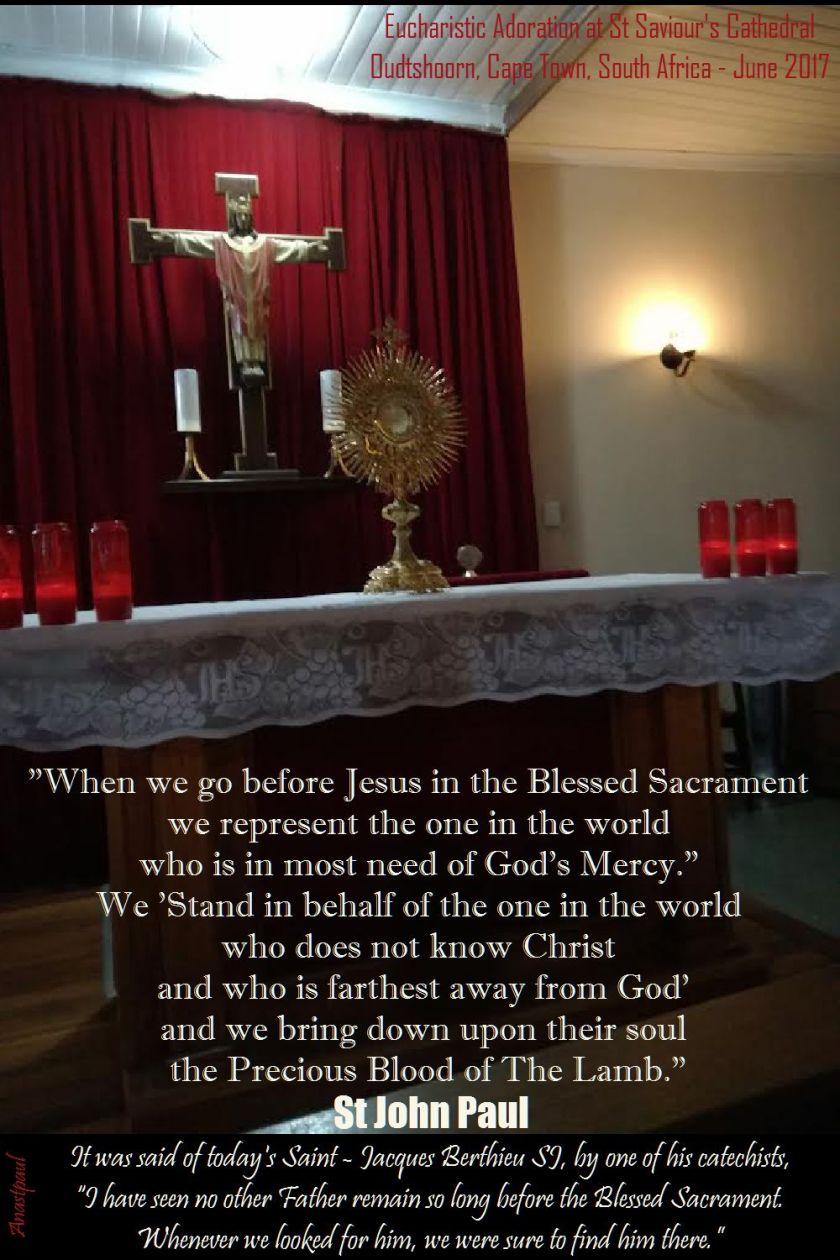
“When we go before Jesus in the Blessed Sacrament
we represent the one in the world
who is in most need of God’s Mercy.”
We “Stand in behalf of the one in the world
who does not know Christ and who is farthest away from God
and we bring down upon their soul the Precious Blood of The Lamb.”
– St Pope John Paul

It was said of today’s Saint – Jacques Berthieu, by one of his catechists,
“I have seen no other Father remain so long before the Blessed Sacrament.
Whenever we looked for him, we were sure to find him there.”

when we go before Jesus-st john paul

Posted in JESUIT SJ, MORNING Prayers, QUOTES of the SAINTS, SAINT of the DAY, The WORD

One Minute Reflection – 8 June

One Minute Reflection – 8 June

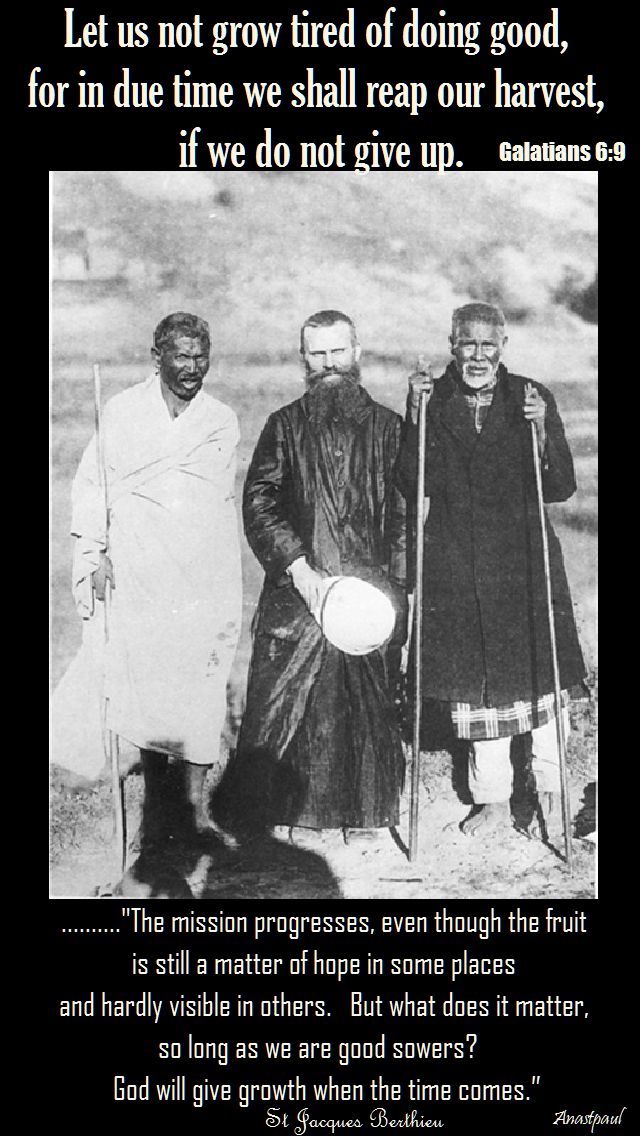
Let us not grow tired of doing good,
for in due time we shall reap our harvest,
if we do not give up……….Galatians 6:9

REFLECTION – ………“how much I still love the soil of my country and the beloved land of the Auvergne.   And yet God has given me the grace to love even more these uncultivated fields of Madagascar, where I can only catch a few souls for our Lord… The mission progresses, even though the fruit is still a matter of hope in some places and hardly visible in others.   But what does it matter, so long as we are good sowers?   God will give growth when the time comes.” …………………St Jacques Berthieu SJ

the mission progresses even though-st jacques berthieu

PRAYER – Heavenly Father, may the intercession of St Jacques Berthieu help us to recognise the strength that is given to us in our weakness, so that we might live our vocation with fidelity and joy and give ourselves totally to the mission received from Your Divine Son, the Lord!   St Jacques Berthieu, pray for us, amen.

ST JACQUES BERTHIEU PRAY FOR US

Posted in JESUIT SJ, SAINT of the DAY

Saint of the Day – 8 June – St Jacques Berthieu SJ (1838-1896) “Martyr of Madasgacar”

Saint of the Day – 8 June – St Jacques Berthieu SJ (1838-1896) – Martyr, Priest, Missionary known as the “Martyr of Madasgacar” (28 November 1838 in Monlogis, Polminhac, Cantal, France – shot on 8 June 1896 in Madagascar by Menalamba rebels for his work in replacing ancestor worship with Christianity, his body was dumped in the Mananara River).   He was declared venerable in 1964, Beatified on 17 October 1965, at Saint Peter’s Basilica, Vatican City by Pope Paul VI and Canonised on 21 October 2012 by Pope Benedict XVI.
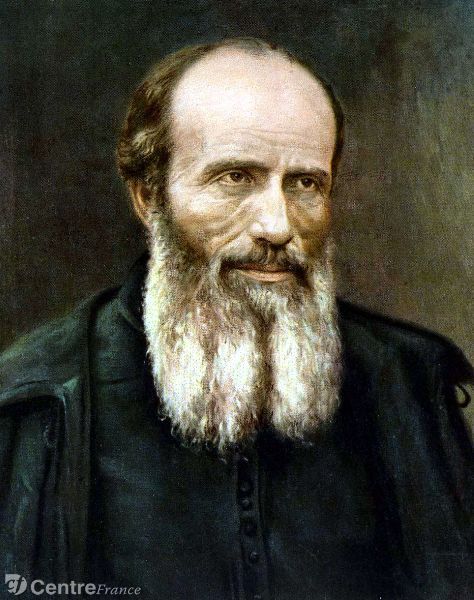
St Jacques Berthieu

Jacques Berthieu was born on November 27, 1838, in the area of Montlogis, in Polminhac, in the Auvergne in central France, the son of deeply Christian farmers of modest means.   His childhood was spent working and studying, surrounded by his family.   The early death of an older sister made him the oldest of six children.   He studied at the seminary of Saint-Flour and was ordained to the priesthood for this diocese on May 21, 1864.   His bishop, Monseigneur de Pompignac, named him vicar in Roannes-Saint Mary, where he replaced an ill and aged priest.   He served as a diocesan priest for nine years.   Because of his desire to evangelize distant lands and to ground his spiritual life in the Spiritual Exercises of Saint Ignatius, he sought admission to the Society of Jesus and entered the novitiate in Pau on October 31, 1873 at the age of thirty-five.
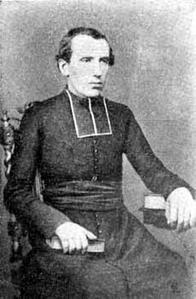
st jacques berthieu 6

Mission
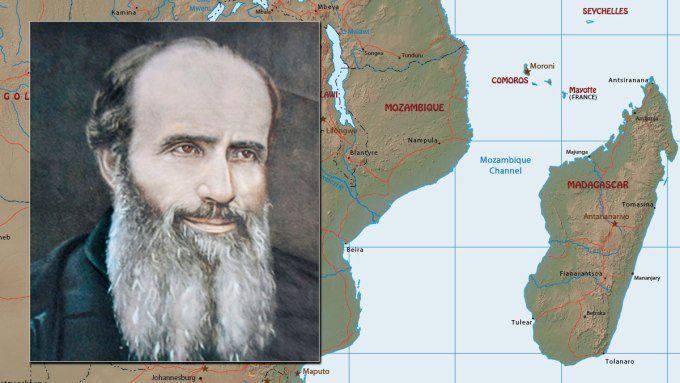
He sailed from the port of Marseilles in 1875 to two islands in the vicinity of Madagascar that were then under French jurisdiction, Réunion and Sainte-Marie, where he studied Malagasy and prepared himself for the mission.  The beginnings of his missionary life were not easy for this 37-year-old Jesuit.   Climate, language, culture were all totally new things which made him exclaim, “My uselessness and my spiritual misery serve to humiliate me but not to discourage me.   I await the hour when I can do something, with the grace of God”.    Mindful of his farming background, he was happy to cultivate the kitchen garden that supplied the station.   He and two other Jesuits and the Sisters of St. Joseph of Cluny formed a missionary team.   There he was engaged in pastoral work for five years, until March 1880.

Madagascar
In 1881, French legislation closed French territories to Jesuits, a measure which compelled Jacques Berthieu to relocate to the large island of Madagascar, an independent kingdom at that time.   Jacques Berthieu went first to Tamatova and then to Tananarive until his superiors sent him to the far-off mission of Ambohimandroso, near Betsileo.   The outbreak of the first French-Malagasy war in 1883 forced him to depart. From 1886 on, he supervised the mission of Ambositra, 250 km south of Antananarivo. After a stay in Ambositra of five years, he went to Andrainarivo in 1891.   This post was northeast of the capital and had 18 mission-stations to look after, situated in the most remote and inaccessible places.st jacques berthieu-01
Insurrection of 1896
France captured the royal palaces in September 1894 and declared Madagascar its possession, sparking the Menalamba (“red shawl”) revolt against European influence. Europeans and Malagasy Christians were targeted by organized and armed Hova units. Jacques Berthieu sought to place the Christians under the protection of French troops. Deprived of this protection by a French colonel whom Berthieu had chastised for his behaviour with the women of the country, Berthieu led a convoy of Christians towards Antananarivo and stopped in the village of Ambohibemasoandro.   On 8 June 1896, Menalamba fighters entered the village and found Jacques Berthieu hiding in the house of a Protestant friend.   They seized him and stripped him of his cassock.   One of them snatched his crucifix from him, saying: “Is this your amulet? Is it thus that you mislead the people? Will you continue to pray for a long time?”   He responded: “I have to pray until I die.” One of them then struck Berthieu’s forehead with a machete; Berthieu fell to his knees, bleeding profusely. The Menalamba then led him away for what would be a long trek.   After about a ten kilometer march, they reached the village of Ambohitra where the church Berthieu had built was located.   They insisted that it would not be possible for Berthieu to enter the camp because he would desecrate the nearby sampy, the idols held sacred by traditional communities at that time.   They threw a stone at him three times and the third time Berthieu fell prostrate.   Not far from the village, since Berthieu was sweating, a Menalamba took Berthieu’s handkerchief, soaked it in mud and dirty water and tied it around Berthieu’s head, as they jeered at him, shouting: “Behold the king of the Vazaha (Europeans).”   Some then went on to emasculate him, which resulted in a fresh loss of blood that exhausted him._st-berthieu-martyr-de-la-foi
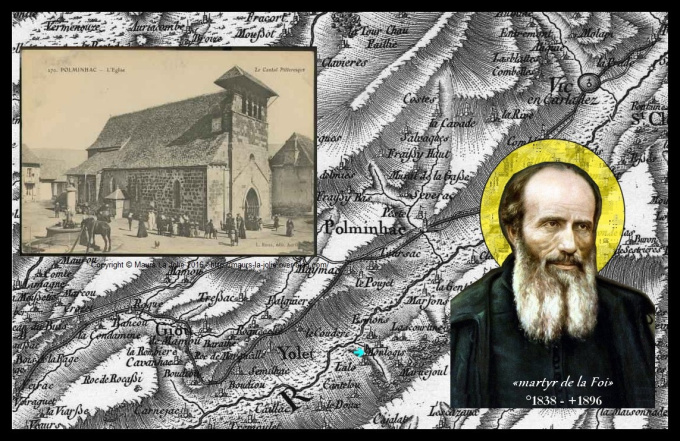
 

Death
As night drew near, in Ambiatibe, a village 50 kilometers north of Antananarivo, after some deliberation, a decision was made to kill Berthieu.   The chief gathered a platoon of six men armed with guns.   At the sight, Jacques Berthieu knelt down.   Two men fired simultaneously at him but missed.   Berthieu made the sign of the cross and bowed his head.   One of the chiefs approached him and said:  “Give up your hateful religion, do not mislead the people anymore and we will make you our counsellor and our chief and we will spare you.”   He replied:  “I cannot consent to this; I prefer to die.”   Two men fired again. Berthieu bowed his head in prayer once more, and they missed him.   Another fired a fifth shot, which hit Berthieu without killing him.   He remained on his knees.   A last shot, fired at close range, finally killed Jacques Berthieu.   His body was dumped into the Mananara River and was never recovered.
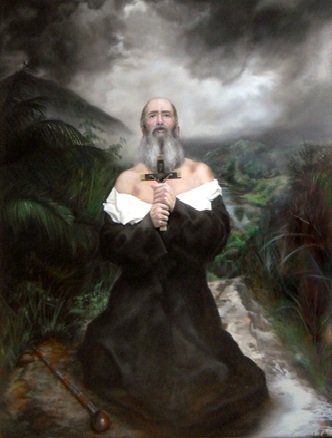
 

ST-Jacques-Berthieu-SJ02

As a missionary, Jacques Berthieu described his task thus:  “This is what it means to be a missionary:  to make oneself all things to all people, both interiorly and externally;  to be responsible for  everything, people, animals and things and all this in order to gain souls, with a large and generous heart.”   His many efforts to promote education, to construct buildings, irrigation and gardens and to develop agricultural training all give witness to these words.   He was a tireless catechist.   A young school teacher, who was accompanying him on a journey, noticed that even while on horseback, Berthieu still had his catechism open before him.   The teacher asked him: “Father, why are you still studying the Catechism?” He answered: “My son, the Catechism is a book one can never understand deeply enough, since it contains all of Catholic Doctrine.”   In those days, once on foreign mission, there was no question of returning to one’s country of origin.   “God knows,” Berthieu said, “how much I still love the soil of my country and the beloved land of the Auvergne.   And yet God has given me the grace to love even more these uncultivated fields of Madagascar, where I can only catch a few souls for our Lord…   The mission progresses, even though the fruit is still a matter of hope in some places and hardly visible in others.   But what does it matter, so long as we are good sowers?   God will give growth when the time comes.”

A man of prayer, Jacques Berthieu drew his strength from it.   “Whenever I looked for him,” declared one of the catechists, “I found him almost always on his knees in his room.” Another said:  “I have seen no other Father remain so long before the Blessed Sacrament. Whenever we looked for him, we were sure to find him there.”   A brother of his community also gave this testimony:  “While he was convalescing, each time I entered his room, I found him on his knees, praying.”   His love for God was such that they called him “tia vavaka” (the pious one).   He was always seen with the rosary or the breviary in his hands.   His faith expressed itself in his devotion to the Blessed Sacrament, the Eucharist being the source of his spiritual life.   He also professed a special devotion to the Sacred Heart to which he consecrated himself in Paray-le-Monial before departing for mission and he became the apostle of this devotion among the Malagasy Christians.   A fervent devotee of the Virgin Mary, he went on pilgrimage to Lourdes and the rosary was his favorite prayer;   it was this prayer that he recited while he was being led to his death.   He also venerated Saint Joseph.

As a shepherd, he addressed Christians with the very words of Christ:  “my little children” (Jn 13, 33); as for his executioners, he questioned them with gentleness:  “ry zanako, my children.”   His charity was full of respect for others, even when he had to correct an erring believer.   And yet, he knew how to speak strongly and firmly whenever he judged that the interests of God and of the church were at stake.   He did not hide the demands of Christian life, beginning with the unity and the indissolubility of monogamous marriage.   Polygamy being the usual practice at the time, he denounced the injustice and the abuses it generated, thus creating enemies, especially among the powerful.

On the eve of his death, while he was heading towards the capital with the Christians hunted down by the Menalamba, he was moved with compassion at the sight of a young man with a wounded foot.   Berthieu began looking for carriers, offering a large amount of money for this service but all refused.   Descending from his horse, Berthieu lifted the disabled man onto his mount and despite Berthieu’s own weakness, he himself continued the journey on foot, while pulling the animal by the bridle.  “He was gentle,” declared a witness, “patient, zealous in carrying out his ministry whenever he was called, even when someone called him at midnight or when it was raining heavily.”   In the south of Anjozorofady lived two female lepers.   Whenever he returned from his travels, he would visit them, bring them food and clothes and teach them catechism, until he baptised them.   He considered the accompaniment of the dying in their agony a most important ministry:  “Whether I am eating or sleeping,” he would say, “do not be ashamed to call me, for me there is no stricter obligation than to visit the dying.” … Vatican.va

St Jacques Berthieu, pray for us!

 

Posted in CATHOLIC DEVOTIONS of the Month, JESUIT SJ, MORNING Prayers, PRAYERS of the SAINTS, The BLESSED VIRGIN MARY

Our Morning Offering – 28 May

Our Morning Offering – 28 May

O Holy Mary, My Mother
St Aloysius Gonzaga
(1568-1591)

O Holy Mary, my mother,
into your blessed trust and custody,
and into the care of your mercy
I this day, every day,
and in the hour of my death,
commend my soul and my body.
To you I commit
all my anxieties and miseries,
my life and the end of my life,
that by your most holy intercession
and by your merits
all my actions may be directed
and disposed
according to your will
and that of your Son.
Amen

o holy mary my mother -st aloysius gonzaga

Posted in JESUIT SJ, MORNING Prayers

The Present Moment is the Only Real Moment

The Present Moment is the Only Real Moment

“The spiritual life always concerns itself with the present.
Retreatants are very inclined to worry about the future and be guilty about the past.
It is important to set goals for the future and to implement ways to achieve those goals.
It is also important to review the past, claim the history of grace and sin and more grace.
But the PRESENT MOMENT is the only real moment…………….live in the NOW moment because the present is the ONLY moment of grace.”…….Fr Bill Creed SJ

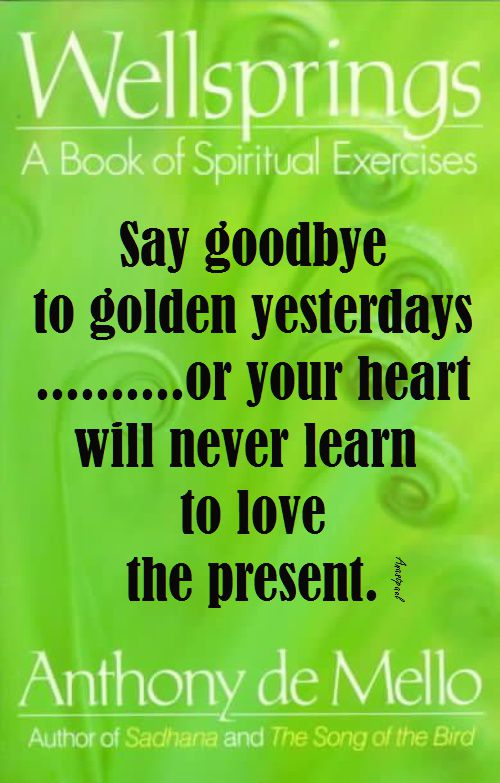
Say goodbye
to golden yesterdays
……….or your heart
will never learn
to love
the present.

Fr Anthony de Mello SJ “Wellsprings”

Pause in your activities today – perhaps when you are in the car, or between meetings, or busy doing ‘mother’ things that leave you mindless – and be STILL in the present moment of grace.   This is the beginnings of contemplative prayer.

say goodbye - fr anthony de mello

Posted in JESUIT SJ, MORNING Prayers, PAPAL ENCYLICALS, SAINT of the DAY

Thought for the Day – 16 May

Thought for the Day – 16 May

“What seems to shine forth especially in the life of Andrew Bobola is his Catholic faith, whose vigour, nourished by divine grace, grew so much stronger with the passing of the years that it conferred on him a special mark of distinction, and spurred him on to undergo his martyrdom with courage.
But the Catholic Church, particularly in the countries to the East, was facing an extremely grave crisis owing to the efforts of the schismatics, who were striving by every device to draw the faithful away from the unity of the Church into their own errors. Andrew went, therefore, into those regions on the instruction and command of his Superiors and by public sermons and private instruction through their cities, towns and villages and most of all by the fervour of his exceptional holiness and the burning zeal of his apostolate, he freed the wavering faith of a multitude of Christians from beguiling falsehood, brought them back to sound principles, and joyfully invited all he could to return to the one fold of Jesus Christ.
He did not merely restore and strengthen the faith of the Christians, languishing and on the verge of collapse but roused them also to weep for their own sins, to settle their disputes, to heal their divisions, to restore true morality. It seemed that, like his Divine Master, wherever he passed by doing good, a new spring blossomed forth, bright with heavenly flowers and fruits of salvation.    Consequently, as tradition has it, he received from all, even from the schismatics, the significant title of “Hunter of Souls.”
This tireless apostle of Jesus Christ had lived by faith, had spread the faith and had defended the faith; so too, he did not hesitate to die for the faith of his fathers.”
INVICTI ATHLETAE (On St. Andrew Bobola)
(Venerable) Pope Pius XII
Encyclical Promulgated on 16 May 1957

Do you find yourself persecuted, in trouble, disliked and maligned because you live by and defend the Faith?    But this is our mission – we do not live according to the instructions of our Divine Master, unless we ‘go forth and spread the good news’.   If we miss a single opportunity to live and speak the truth, we may well be responsible for the eternal damnation of a soul – what a frightening thought!

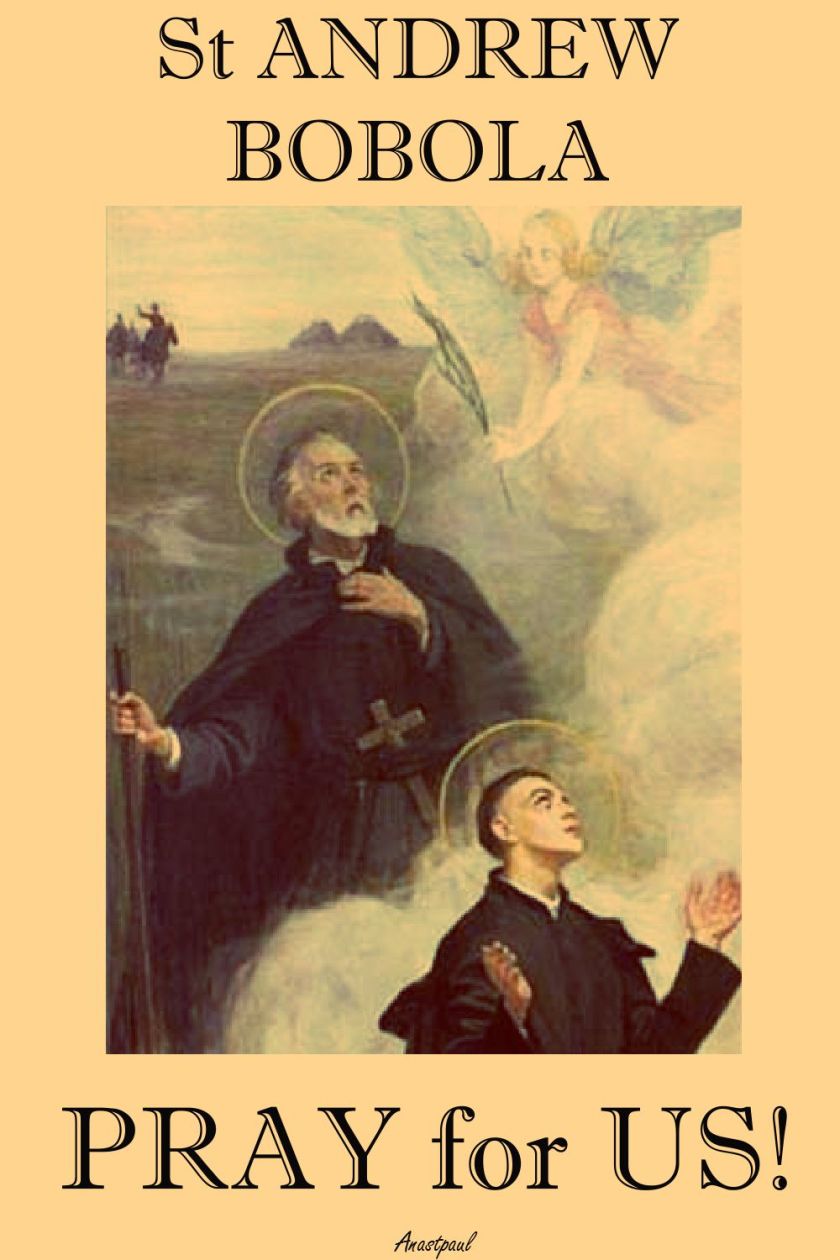
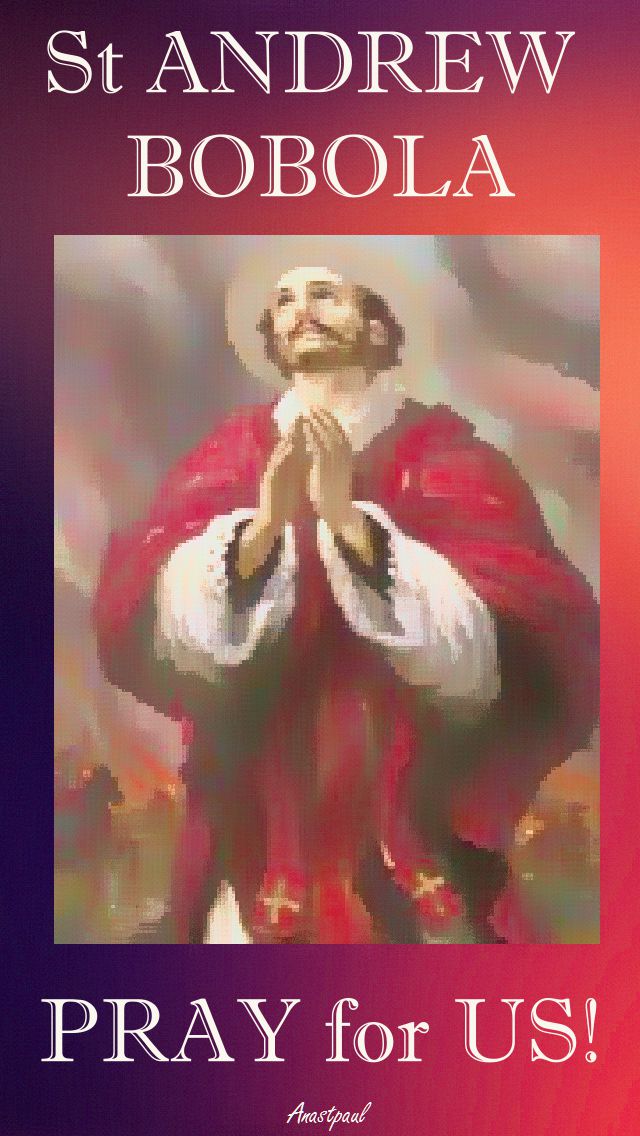
St Andrew Bobola, inspire us with your zeal for souls and please Pray for us!

st andrew bobola pray for us.jpg 2

Posted in JESUIT SJ, MORNING Prayers, PAPAL ENCYLICALS, QUOTES of the SAINTS, SAINT of the DAY

Quote of the Day – 16 May

Quote of the Day – 16 May

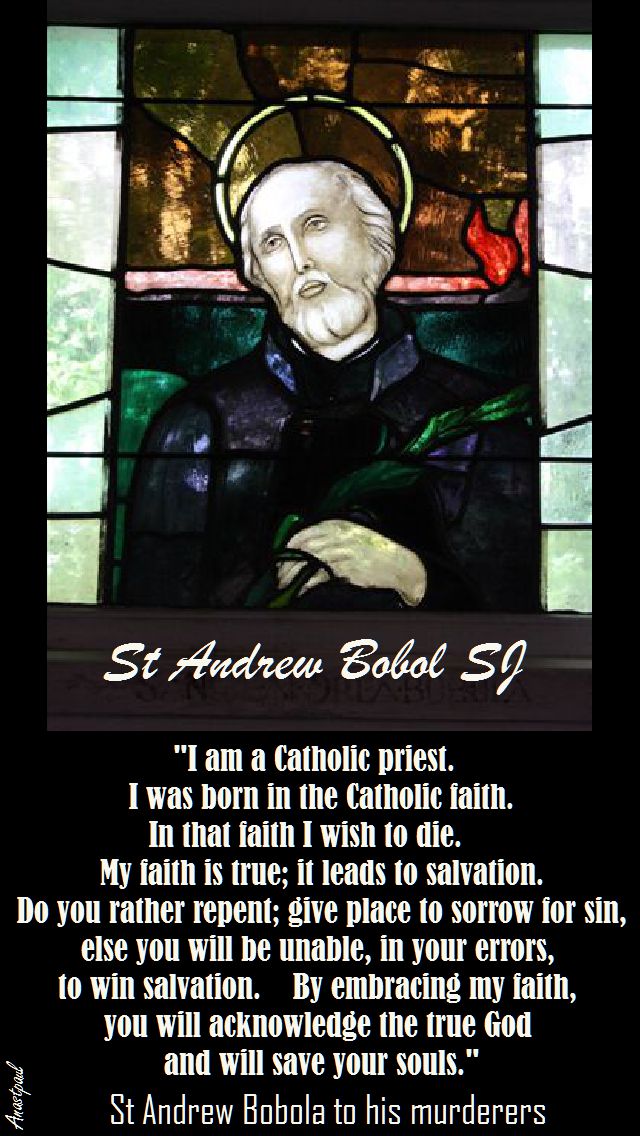
…..”the Polish Martyr rose to the heights of the noblest triumphs which the Church commemorates. Andrew was asked if he were a priest of the Latin rite, and he replied:

‘I am a Catholic priest.  I was born in the Catholic faith.  In that faith I wish to die.    My faith is true; it leads to salvation.    Do you rather repent; give place to sorrow for sin, else you will be unable, in your errors, to win salvation.    By embracing my faith, you will acknowledge the true God and will save your souls’.

St Andrew Bobola SJ

At these words, those wicked men, utterly devoid of humanity, were roused to a fiendish barbarity and reached such a degree of cruelty that they inflicted still more horrible sufferings on the soldier of Christ.   Once again, “he was scourged, a crown like that of Jesus Christ was bound about his head, he was struck heavy blows and lay wounded by a scimitar.   Next, his right eye was gouged out, strips of skin were torn off, his wounds were savagely scorched and rubbed with prickly bundles of straw.   Nor was that enough: his ears, nose and lips were cut off, his tongue torn out by the root and finally, a weapon plunged into his heart.   And, at long last, the valiant athlete, three hours after midday, displaying a truly marvelous example of fortitude, was pierced by a sword and achieved the glory of martyrdom.” ……………….Venerable Pope Pius XII – INVICTI ATHLETAE (On St. Andrew Bobola) Encyclical Promulgated on 16 May 1957

i am a Catholic priest - st andrew bobola

Posted in JESUIT SJ, MORNING Prayers, QUOTES of the SAINTS, SAINT of the DAY, The WORD

One Minute Reflection – 16 May

One Minute Reflection – 16 May

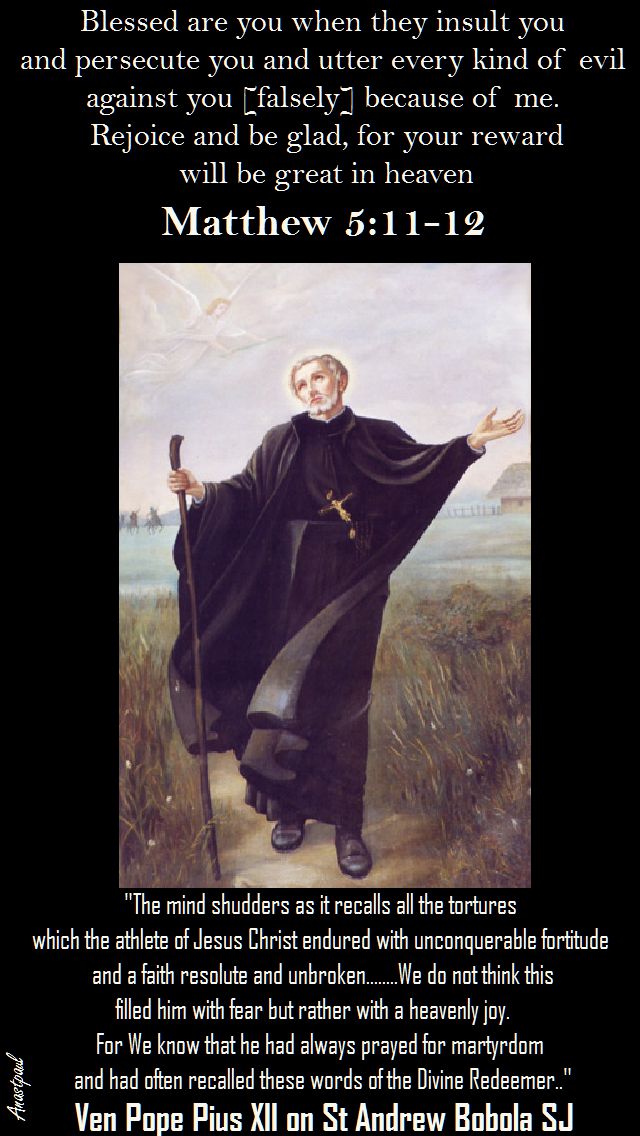
Blessed are you when they insult you and persecute you and utter every kind of evil against you [falsely] because of me.    Rejoice and be glad, for your reward will be great in heaven…………..Matthew 5:11-12

REFLECTION – “The mind shudders as it recalls all the tortures which the athlete of Jesus Christ endured with unconquerable fortitude and a faith resolute and unbroken……..We do not think this filled him with fear but rather with a heavenly joy.    For We know that he had always prayed for martyrdom and had often recalled these words of the Divine Redeemer..”………Venerable Pope Pius XII

ven pope pius xII on st andrew bobola sj

PRAYER – Gracious Lord, help me too to be an apostle of zeal and a ‘hunter of souls’. For I know that is through Your grace and by that grace manifest in my life that I may reach out and help all those around me. Grant me Lord, the courage and zeal of St Andrew Bobola, who I now request for his intercessionary prayers, on behalf of all Your Holy Church. Amen

st andrew bobola pray for us

Posted in JESUIT SJ, MORNING Prayers, SAINT of the DAY

Saint of the Day – 16 May – St Andrew Bobola SJ

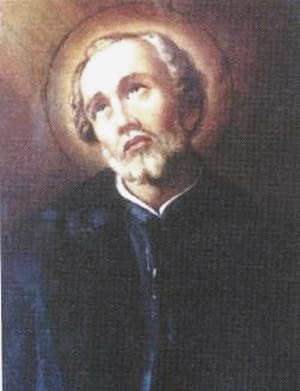
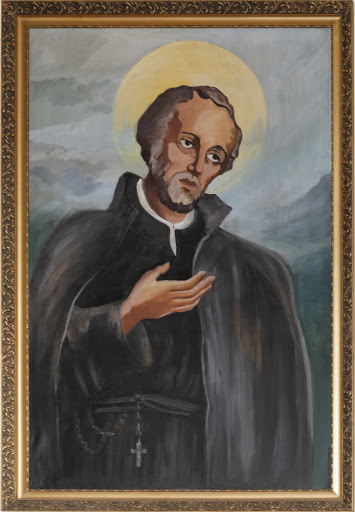
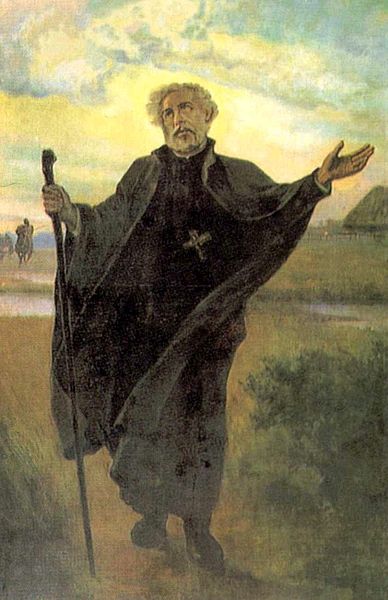
Saint of the Day – 16 May – St Andrew Bobola SJ (1591-1657) Martyr, Priest, Missionary, known as the Apostle of Lithuania and the “Hunter of Souls.”.   Born Andrzej Bobola – Patron of Poland and the Archdiocese of Warsaw. His body is incorrupt.

StAndreaBobola16-5 (1)

Bobola was born in 1591 into a noble family in the Sandomir Palatinate in the Province of Lesser Poland of the Crown of the Kingdom of Poland, then a constituent part of the Polish–Lithuanian Commonwealth.   In 1611 he entered the Society of Jesus in Vilnius, then in the Grand Duchy of Lithuania, the other part of the Commonwealth.   He subsequently professed solemn vows and was ordained in 1622, after which he served for several years as an advisor, preacher, Superior of a Jesuit residence, etc., in various places.

From 1652 Bobola also worked as a country “missionary”, in various locations of Lithuania:  these included Polotsk, where he was probably stationed in 1655 and also Pinsk, (both now in Belarus).   On 16 May 1657, during the Khmelnytsky Uprising, he was captured in the village of Janów (now Ivanava, Belarus) by the Cossacks of Bohdan Chmielnicki and, after being subjected to a variety of tortures, killed.st andrew bobola sj

One description of Bobola’s death written in 1865 states:

“In the same year, the Cossacks surprised a holy Polish Jesuit, in the town of Pinsk and conferred on him the palm of martyrdom, on the 16th of May, 1657.   Father Andrew Bobola, …had just offered up the holy sacrifice, when a horde of Cossacks attacked the town.   On beholding the barbarians, Father Bobola fell upon his knees, raised his eyes and his hands toward heaven, and, having a presentiment that his hour had arrived, exclaimed, “Lord, thy will be done!”   At that moment, the Cossacks rushed upon him, stripped him of his holy habit, tied him to a tree, placed a crown upon his head, …after which they scourged him, tore out one of his eyes, burned his body with torches, and one of the ruffians traced, with his poignard, the form of a tonsure on the head of the venerable Father and on his back the figure of a chasuble!   To do this, the executioner had to strip off the skin of the holy martyr!   But this was not yet all.   The fingers of the apostle had received the priestly unction.   The executioner tore from them the skin and forced needles under his nails!   And during this indescribable torture, the hero prayed for his tormentors;  he preached, both by word and example, until the schismatics tore out his tongue and crushed his head.   Father Andrew Bobola, whom the Church declared Blessed, the 30th of October, 1853, was sixty-five years of age.”388px-st andrew Bobola

Bobola’s body was originally buried in the Jesuit church in Pinsk.   It was later moved to their church in Polotsk.   By the beginning of the 18th century, however, nobody knew where Bobola’s body was buried.   In 1701 Father Martin Godebski, S.J., the Rector of the Pinsk College, reputedly had a vision of Bobola.   This caused him to order a search for the body.   It was found completely incorrupt, which was recognized by the Church and its supporters as proof of holiness.   In 1719 the casket was officially reopened and the body inspected by qualified medical personnel (five physicians and pharmacists).   It was reportedly still completely incorrupt: pliable and with soft flesh.

In 1922, the Bolsheviks moved the corpse, later described by an American journalist as “remarkably well-preserved” to the Museum of Hygiene of People’s Commissioners of Health in Moscow.   The whereabouts of the remains was not known to the Catholic authorities and Pope Pius XI charged the Papal Famine Relief Mission in Russia, headed by American Jesuit Father Edmund A. Walsh, with the task of locating and “rescuing” them.    In October 1923—as a kind of “pay” for help during famine—the remains were released to Walsh and his Assistant Director, Father Louis J. Gallagher, S.J.   Well packed by the two Jesuits, they were delivered to the Holy See by Gallagher on All Saints’ Day (1 November) 1923.   In May 1924, the relics were installed in Rome’s Church of the Gesù, the main church of the Society of Jesus.

Since 17 June 1938 the body has been venerated at a shrine in Warsaw, with an arm remaining at the original shrine in Rome.

Declared Blessed by Pope Pius IX on 30 October 1853, Bobola was canonised by Pope Pius XI on 17 April 1938.   His feast day was originally celebrated by the Jesuits on 23 May but it is now generally celebrated on 16 May.   On his feast day in 2002, Pope John Paul II declared Bobola a patron saint of Poland and of the Roman Catholic Archdiocese of Warsaw.

Posted in DOCTORS of the Church, JESUIT SJ, MORNING Prayers, PRAYERS of the SAINTS

Our Morning Offering – 18 April

Our Morning Offering – 18 April

Wash Me With Your Precious Blood
By St. Peter Canisius S.J. (1521-1597)

WASH ME WITH YOUR PRECIOUS BLOOD-ST PETER CANISIUS

See, O merciful God, what return
I, Your thankless servant, have made
for the innumerable favours
and the wonderful love You have shown me!
What wrongs I have done, what good left undone!
Wash away, I beg You, these faults and stains
with Your precious blood, most kind Redeemer,
and make up for my poverty by applying Your merits.
Give me the protection I need to amend my life.
I give and surrender myself wholly to You,
and offer You all I possess,
with the prayer that You bestow Your grace on me,
so that I may be able to devote and employ
all the thinking power of my mind
and the strength of my body in Your holy service,
who are God blessed for ever and ever. Amen

Posted in JESUIT SJ, MORNING Prayers, PRAYERS of the SAINTS

Our Morning Offering – 6 April

To The Heart Of Jesus
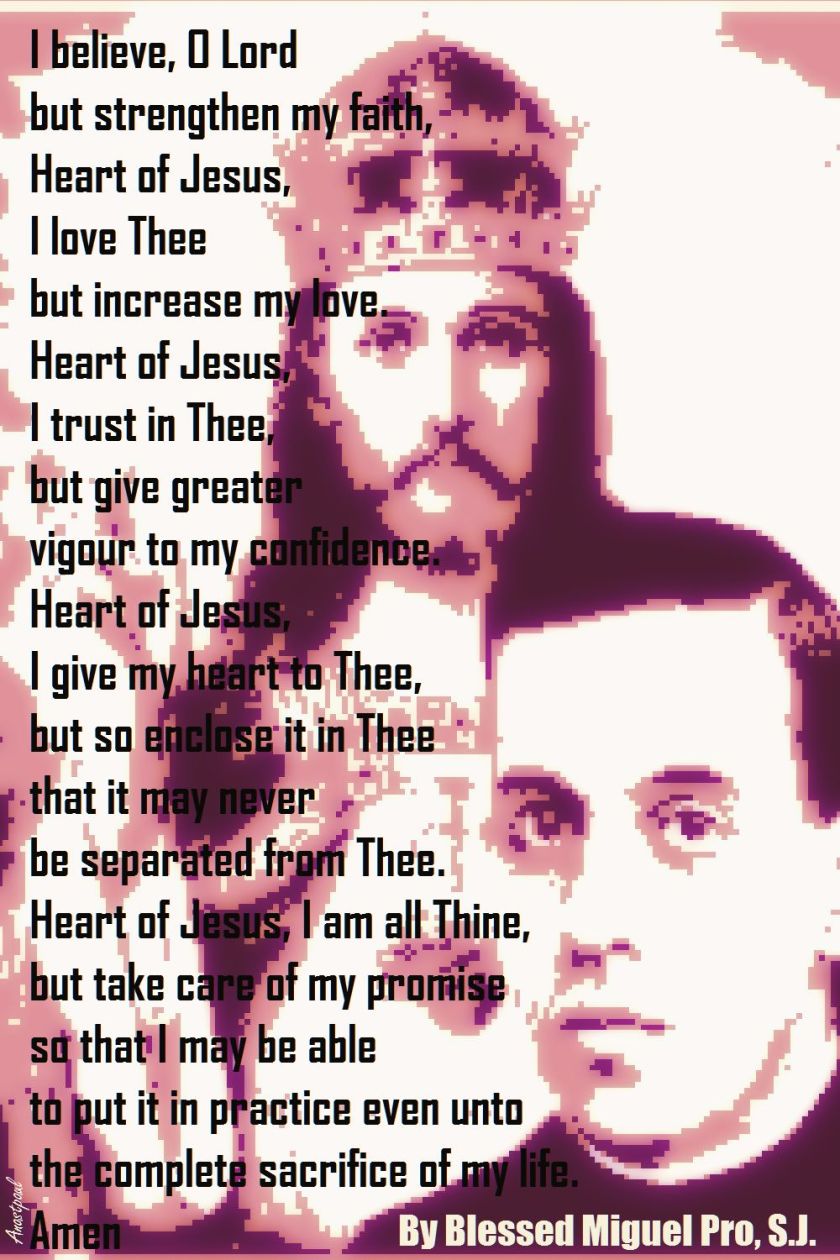
By Blessed Miguel Pro, S.J.

I believe, O Lord, but strengthen my faith,
Heart of Jesus, I love Thee
but increase my love.
Heart of Jesus, I trust in Thee,
but give greater vigour to my confidence.
Heart of Jesus, I give my heart to Thee,
but so enclose it in Thee
that it may never be separated from Thee.
Heart of Jesus, I am all Thine,
but take care of my promise
so that I may be able
to put it in practice even unto
the complete sacrifice of my life.

Amen

I BELIEVE O LORD BUT STRENGTHEN MY FAITH BY BL MIGUEL PRO

Posted in JESUIT SJ, MORNING Prayers, SAINT of the DAY

Thought for the Day – 16 March

Thought for the Day – 16 March

Potential martyrdom was a central component of the Jesuit missionary identity. Missionaries going to Canada knew they were at risk from harsh conditions, as well as from confronting alien cultures. They expected to die in the name of God; they believed the missionary life and its risks was a chance to save converts and thus be saved themselves.   The Jesuits Christophe Regnault and Paul Ragueneau provided the two accounts of the deaths of Jean de Brébeuf and Gabriel Lalement.   According to Regnault, the Jesuits learned of the tortures and deaths from Huron refugee witnesses, who had escaped from Saint-Ignace.   Regnault went to see the bodies to verify the accounts and his superior Rageuneau’s account was based on his report.   The main accounts of Brébeuf’s death come from the Jesuit Relations.   Jesuit accounts of his torture emphasize his stoic nature and acceptance, claiming that he suffered silently without complaining. Throughout the torture, Brébeuf was reported to have been more concerned for the fate of the other Jesuits and of the captive Native converts than for himself.   As part of the ritual, the Iroquois drank his blood, as they wanted to absorb Brébeuf’s courage in enduring the pain.   The Iroquois mocked baptism by pouring boiling water over his head.

Is it even a tiny iota of our faith to know and be prepared to die such a death for Christ?   When we suffer and are persecuted, in the smallest way compared to this, compared to the Cross of Christ, do we grow in faith and courage and pray for more?

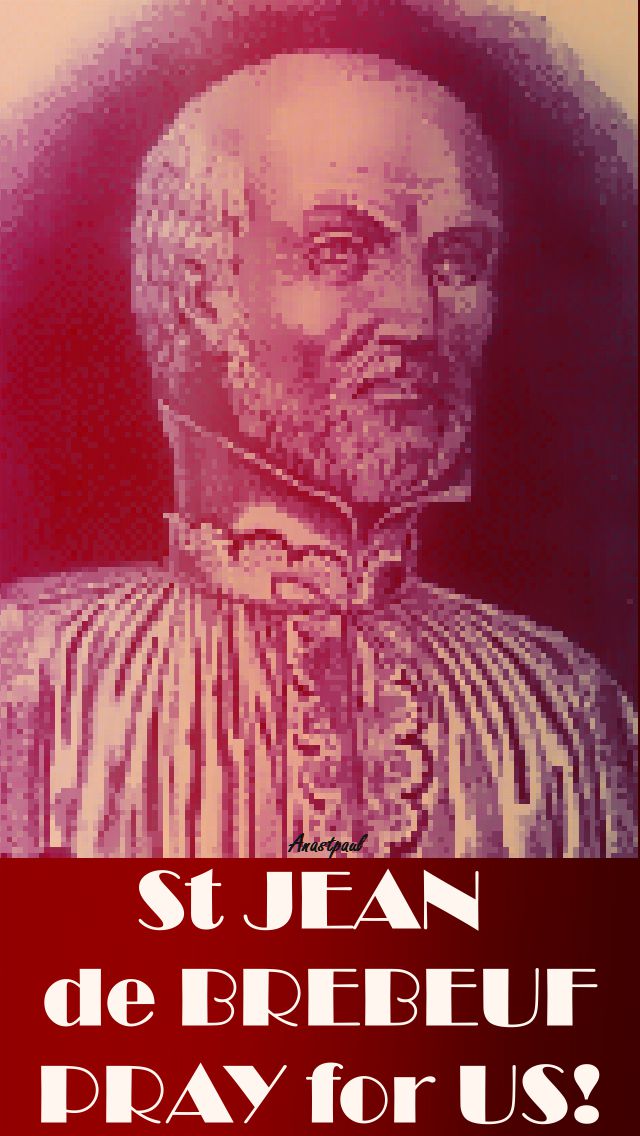
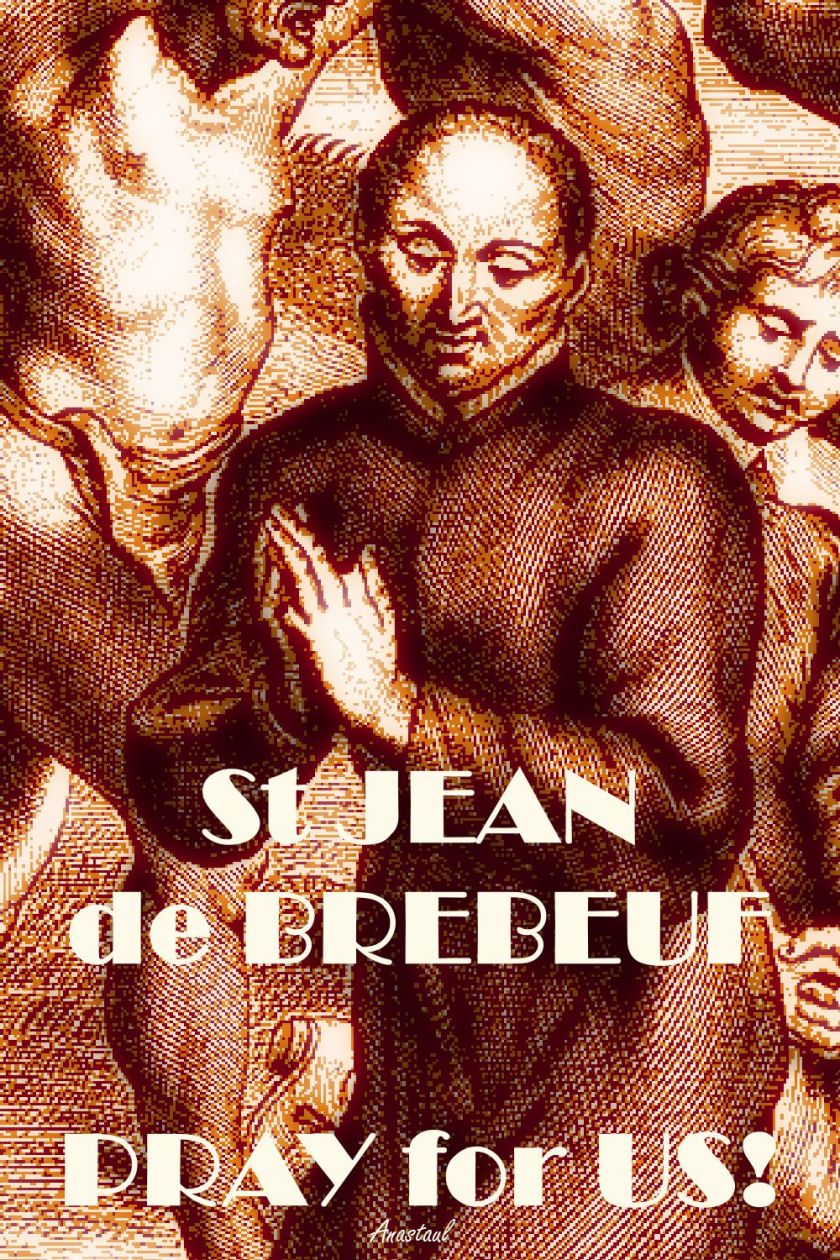
St Jean de Brebeuf please pray that we may all grow in faith and courage!

STJEANDEBREBEUF-PRAY FOR US 2

Posted in JESUIT SJ, MORNING Prayers, QUOTES of the SAINTS, SAINT of the DAY, The WORD

One Minute Reflection – 16 March

One Minute Reflection – 16 March

All who believe………………have eternal life in him……….John 3:15

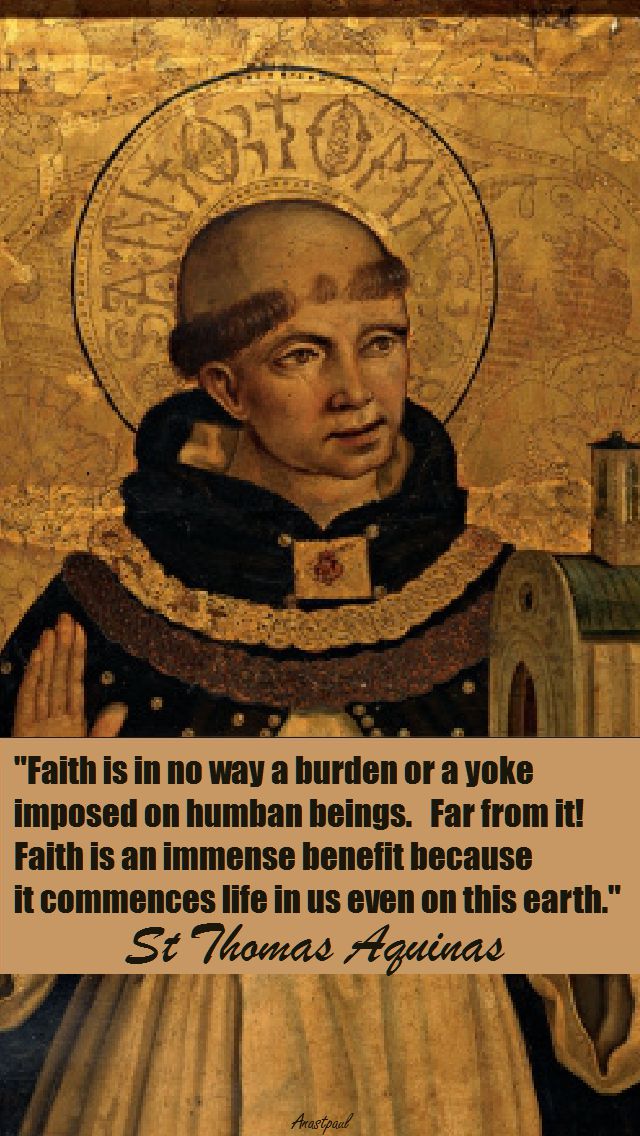
REFLECTION – “Faith is in no way a burden or a yoke imposed on humban beings.  Far from it! Faith is an immense benefit because it commences life in us even on this earth.”………….St Thomas Aquinas

PRAYER – Heavenly Father, thank You for giving me the gift of faith.  Help me to remain firm in my faith throughout my life and to strive, no matter to what suffering You call me, to increase in faith and love for You, day by day.  St Jean de Brebeuf, you have reached the glory of heaven and by your life and suffering for your faith, you taught us the true beauty of love for Christ the Lord, please pray for us all, amen.

FAITHIS IN NO WAY-ST THOMAS AQUINASST JEAN DE BREFEUF PRAY FOR US

Posted in JESUIT SJ, QUOTES of the SAINTS, SAINT of the DAY

Thought for the day – 10 March

Thought for the day – 10 March

“Ogilvie typifies what can be overlooked when we reflect the Creed, in the Creed when we say, ‘suffered under Pontius Pilate.’   In other words, Ogilvie typifies the perennial struggle of the Church with the state.   It was a civil official who condemned Christ and it is the state over the centuries, which in Augustine’s language, has become the arm of the enemies of God that gave the Church her first martyrs for 300 years and has been placing such a heavy burden on those who wish to remain faithful to Christ.   The conflict of Church and state is the final feature of John Ogilvie’s spirituality as a martyr.

Let us ask St. John Ogilvie to obtain, especially for the leaders in the Church today, something of the courage he had to be willing to proclaim the true faith even at the price of their blood.   St. John Ogilvie, pray for us.

In the name of the Father and of the Son and of the Holy Spirit. Amen.”

BY VENERABLE SERVANT OF GOD JOHN A HARDON SJ

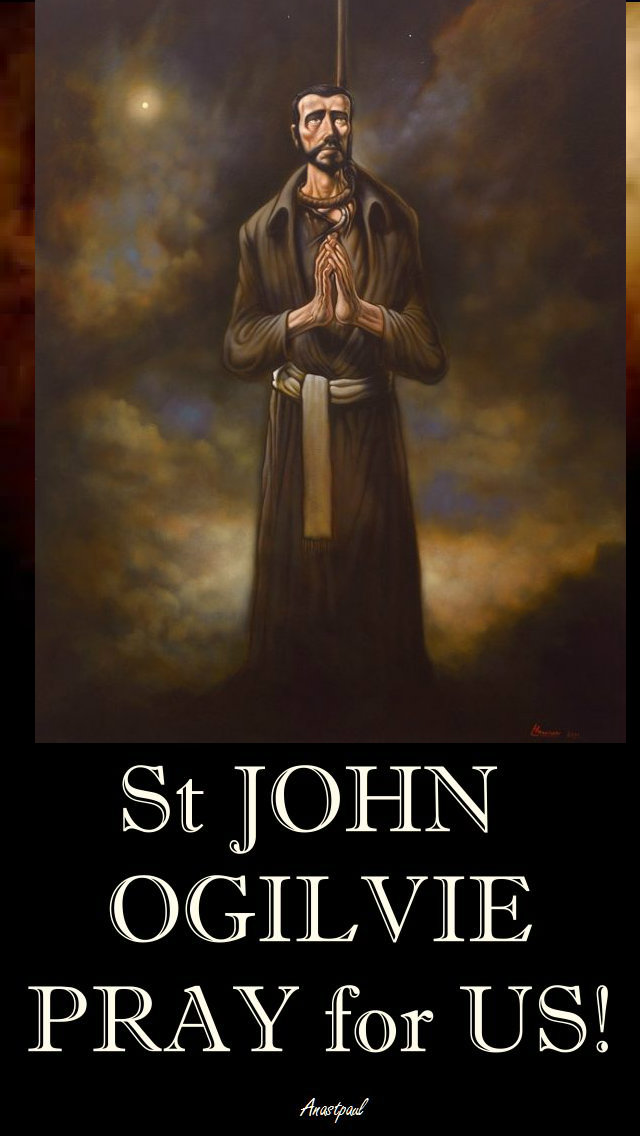
ST JOHN OGILVIE SJ-PRAY FOR US 3

Posted in JESUIT SJ, MORNING Prayers, QUOTES of the SAINTS, SAINT of the DAY, The HOLY ROSARY/ROSARY CRUSADE

Quote/s of the Day – 10 March

Quote/s of the Day – 10 March

“In all that concerns the king, I will be slavishly obedient; if any attack his temporal power, I will shed my last drop of blood for him.
But in the things of spiritual jurisdiction which a king unjustly seizes I cannot and must not obey.”
~~ St John Ogilvie at his trial

“willingly and joyfully pour forth even a hundred lives. Snatch away that one
which I have from me and make no delay about it, but my religion you will never snatch
away from me!”

“If there be here any hidden Catholics, let them pray for me but the prayers of heretics I will not have.”— Saint John Ogilvie at his execution

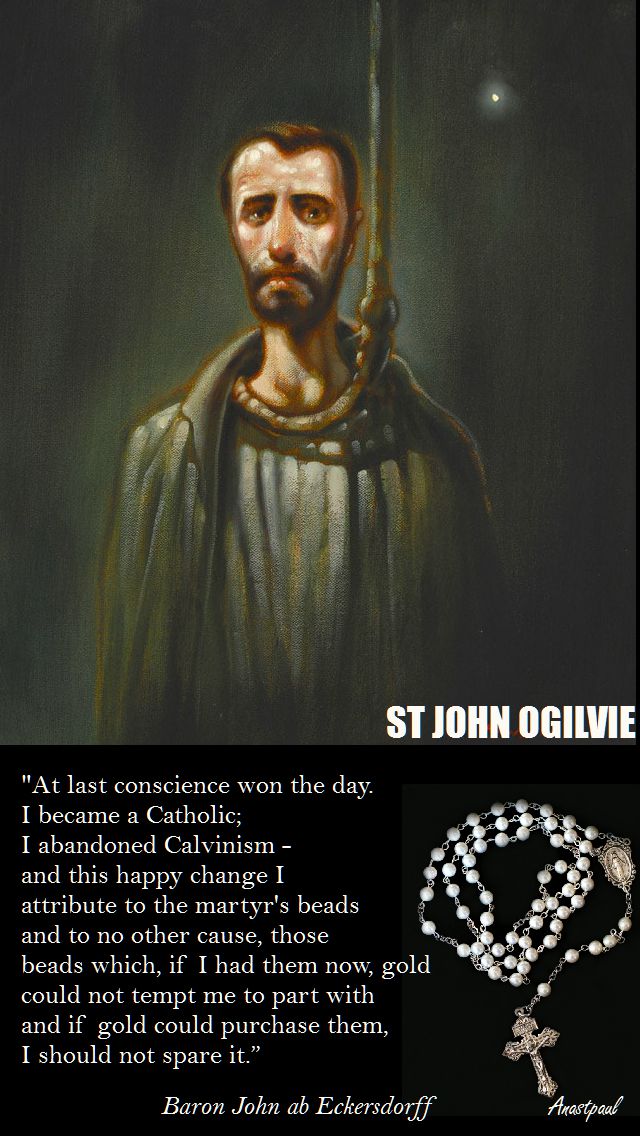
“At last conscience won the day.  I became a Catholic;
I abandoned Calvinism – and this happy change I attribute to the martyr’s beads and to no other cause those beads which, if I had them now, gold could not tempt me to part with and if gold could purchase them, I should not spare it.” ~~~ Baron John ab Eckersdorff 

(St. John Ogilvie was executed by hanging on March 10, 1615.
A few moments before his hanging, St. John threw his Rosary into the crowd where it
hit Baron John ab Eckersdorff a Calvinist nobleman on the chest – he later converted to
Catholicism, attributing his conversion to witnessing the martyrdom and St. John’s
rosary.)

IF THERE BE ANY HIDDEN-STJOHNOGILVIEAT LAST CONSCIENCE-STJOHN OGILVIE

Posted in DOCTORS of the Church, JESUIT SJ, LENT, MORNING Prayers, QUOTES of the SAINTS, SAINT of the DAY, The WORD

One Minute Reflection – 10 March

One Minute Reflection – 10 March

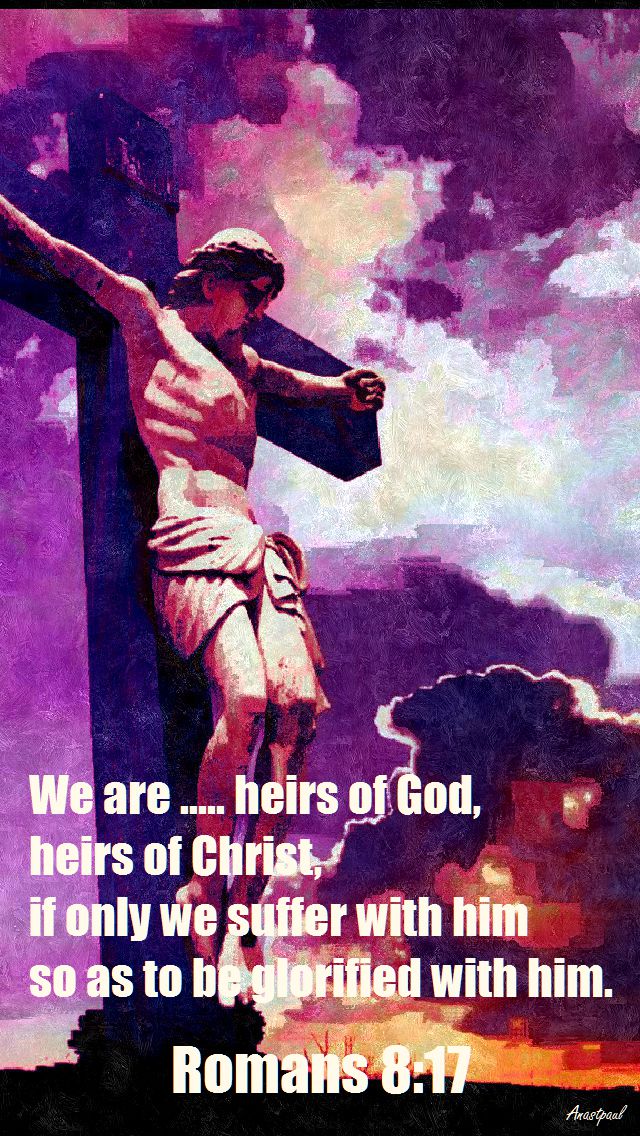
We are ….. heirs of God, heirs of Christ, if only we suffer with him so as to be glorified with him……..Romans 8:17

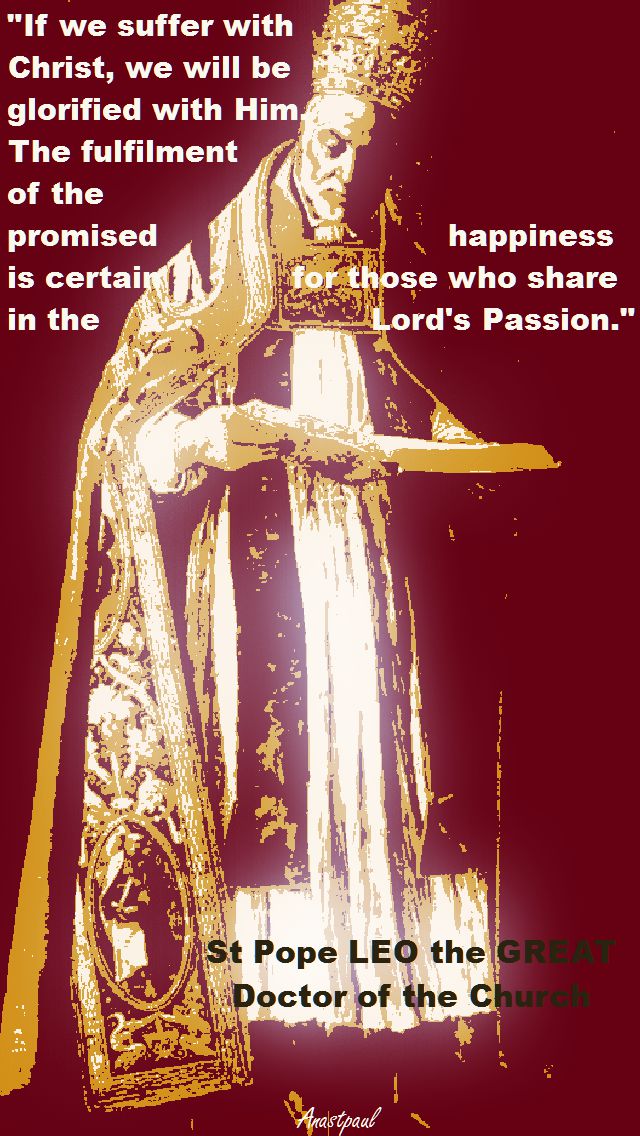
REFLECTION – If we suffer with Christ, we will be glorified with Him.   The fulfilment of the promised happiness is certain for those who share in the Lord’s Passion……St Pope Leo the Great

PRAYER – Grant me Your grace to overcome my natural fear of suffering Lord.   Strengthen me to bear my sufferings in union with Your sacred Passion, for the salvation of the world.  St John Ogilvie you are an example to me, please pray that this Lenten time will assist us all in overcoming our fear of sharing in the Passion of our God. Amen

ROMANS 8-17IF WE SUFFER WITH CHRIST-STLEOTHEGREATST JOHN OGILVIE PRAY FOR US

Posted in JESUIT SJ, SAINT of the DAY, The HOLY ROSARY/ROSARY CRUSADE

St John Ogilvie SJ – 10 March – St John Ogilvie, his Rosary and the Baron

Blessed Memorial of St John Ogilvie SJ – 10 March – St John Ogilvie, his Rosary and the Baron

Although the judge had tried to pin the crime of treason on him, Ogilvie forced him to assert that it was for his Catholic Faith that he was being killed, rather than for treason, which Protestant history alleges.    Just as with Saint Thomas More, the heroic Jesuit protested his allegiance to the King saying that he was the King’s loyal subject but God’s servant first.    Again, as it was with Thomas More, the executioner begged the martyr’s forgiveness, which he paternally gave.

There were many brave Catholics who came to the execution site to support the saint with prayers and with shouts.   They were fearless.  John said onthe scaffold “If there be here any hidden Catholics, let them pray for me but the prayers of heretics I will not have.”   Then something spontaneous happened, by divine intervention and inspiration.   Just before they tied his hands on the scaffold the saint quickly pulled out his rosary and tossed it to the crowd as a token of farewell.   There was a Protestant Baron, a traveller, who happened to be in the crowd and the rosary bounced off his chest.   The man tried to reach down for the beads but was beaten to them by the surrounding faithful anxious to get such a relic.

This episode of the Protestant gentleman in the crowd was recounted in the records of the trial of the saint because he, the Baron John ab Eckersdorff, was converted by means of the rosary of our Jesuit martyr.   Here is how the event is related, in the words of the Baron, as we have them in Father Daniel Conway’s three part history of Venerable John Ogilvie, published in 1878, in a Glasgow diocesan journal “The Month”:

“His Rosary struck the breast of a young noble
man who was on his travels in these kingdoms.
He was a foreigner and a heretic his name, Baron
John ab Eckersdorff.  ” I was on my travels
through England and Scotland as it is the custom
of our nobility being a mere stripling, and not
having the faith. I happened to be in Glasgow the
day Father Ogilvie was led forth to the gallows,
and it is impossible for me to describe his lofty
bearing in meeting death.   His farewell to the
Catholics was his casting into their midst, from the
scaffold, his rosary beads just before he met his
fate.   That rosary, thrown haphazard, struck me
on the breast in such wise that I could have caught
it in the palm of my hand;  but there was such a
rush and crush of the Catholics to get hold of it,
that unless I wished to run the risk of being trodden
down, I had to cast it from me.   Religion was the
last thing I was then thinking about : it was not in
my mind at all; yet from that moment I had no
rest.   Those rosary beads had left a wound in my
soul; go where I would I had no peace of mind.
Conscience was disturbed, and the thought would
haunt me : why did the martyr’s rosary strike me,
and not another?   For years I asked myself this
question it followed me about everywhere.    At
last conscience won the day.   I became a Catholic;
I abandoned Calvinism – and this happy change I
attribute to the martyr’s beads and to no other
cause those beads which, if I had them now, gold
could not tempt me to part with and if gold could
purchase them, I should not spare it.”

Saint John Ogilvie, pray for us!

st-john-ogilvie-pray-for-us-10 MARCH 2017.jpg

Posted in JESUIT SJ, SAINT of the DAY

Saint of the Day – 10 March – St John Ogilvie

Saint of the Day – 10 March – St John Ogilvie SJ (1579-1615 died aged 36) MARTYR and Jesuit Priest – hanged 10 March 1615 at Glasgow, Scotland but no relic of his body has survived.  He was canonised 0n 17 October 1976 by Pope Paul VI.

saints3-9ogilivie

John Ogilvie’s noble Scottish family was partly Catholic and partly Presbyterian. His father raised him as a Calvinist, sending him to the continent to be educated.   There John became interested in the popular debates going on between Catholic and Calvinist scholars.   Confused by the arguments of Catholic scholars whom he sought out, he turned to Scripture.   Two texts particularly struck him: “God wills all men to be saved and come to the knowledge of the truth,” and “Come to me all you who are weary and find life burdensome, and I will refresh you.”

Slowly, John came to see that the Catholic Church could embrace all kinds of people. Among these, he noted, were many martyrs.   He decided to become Catholic and was received into the Church at Louvain, Belgium, in 1596 at the age of 17.

John continued his studies, first with the Benedictines, then as a student at the Jesuit College at Olmutz.   He joined the Jesuits and for the next 10 years underwent their rigorous intellectual and spiritual training. Ordained a priest in France in 1610, he met two Jesuits who had just returned from Scotland after suffering arrest and imprisonment.   They saw little hope for any successful work there in view of the tightening of the penal laws.   But a fire had been lit within John. For the next two and a half years he pleaded to be missioned there.

Sent by his superiors, he secretly entered Scotland posing as a horse trader or a soldier returning from the wars in Europe.   Unable to do significant work among the relatively few Catholics in Scotland, John made his way back to Paris to consult his superiors. Rebuked for having left his assignment in Scotland, he was sent back.   He warmed to the task before him and had some success in making converts and in secretly serving Scottish Catholics.   But he was soon betrayed, arrested and brought before the court. His trial dragged on until he had been without food for 26 hours.   He was imprisoned and deprived of sleep. For eight days and nights he was dragged around, prodded with sharp sticks, his hair pulled out.   Still, he refused to reveal the names of Catholics or to acknowledge the jurisdiction of the king in spiritual affairs. He underwent a second and third trial but held firm.   At his final trial he assured his judges: “In all that concerns the king, I will be slavishly obedient; if any attack his temporal power, I will shed my last drop of blood for him. But in the things of spiritual jurisdiction which a king unjustly seizes I cannot and must not obey.”

Condemned to death as a traitor, he was faithful to the end, even when on the scaffold he was offered his freedom and a fine living if he would deny his faith.   His courage in prison and in his martyrdom was reported throughout Scotland.   This Jesuit loved to laugh. His jokes brightened the dark days of his captivity during which his captors tried to “brainwash” him. “For eight days and nine nights, they kept me awake by using pins, needles and whips.” St. John Ogilvie was executed by hanging on March 10, 1615 and was disembowled.   A few moments before his hanging, St. John threw his Rosary into the crowd where it was caught by Baron John ab Eckersdorff a Calvinist nobleman – who later converted to Catholicism, attributing his conversion to witnessing the martyrdom and St. John’s rosary.

John Ogilvie was canonised in 1976, becoming the first Scottish saint since 1250.

Posted in JESUIT SJ, MORNING Prayers, PRAYERS of the SAINTS

Our Morning Offering – 26 February

Our Morning Offering – 26 February

Anima Christi by St. Ignatius of Loyola

Soul of Christ, sanctify me
Body of Christ, save me
Blood of Christ, inebriate me
Water from the side of Christ, wash me
Passion of Christ, strengthen me
Good Jesus, hear me
Within Your wounds, shelter me
from turning away, keep me
From the evil one, protect me
At the hour of my death, call me
Into Your presence lead me
to praise You with all Your saints
Forever and ever, amen

anime-christi-by-st-iggy

Posted in JESUIT SJ, MORNING Prayers, PRAYERS of the SAINTS

Our Morning Offering – 16 February

Our Morning Offering – 16 February

A Prayer to Seek the Consolation of the Cross
by Saint Alphonsus Rodriguez S.J.

Jesus, love of my soul, centre of my heart!
Why am I not more eager to endure pains
and tribulations for love of You,
when You, my God, have suffered so many for me?
Come, then, every sort of trial in the world,
for this is my delight, to suffer for Jesus.
This is my joy, to follow my Saviour
and to find my consolation
with my Consoler on the Cross.
This is my happiness,
this my pleasure:
to live with Jesus,
to walk with Jesus,
to converse with Jesus,
to suffer with and for Him,
this is my treasure, amen.

prayer-st-alphonsus-rodriguez-sj-jesuslofeofmysoulcentreofmyheart