Posted in CATHOLIC DEVOTIONS of the Month, MARIAN DEVOTIONS, MARIAN QUOTES, MARIAN TITLES, QUOTES of the SAINTS, The BLESSED VIRGIN MARY, The WORD

Marian Thought for the Day – 9 May “Mary’s Month!” – Wednesday of the Sixth Week of Eastertide

Marian Thought for the Day – 9 May “Mary’s Month!” – Wednesday of the Sixth Week of Eastertide

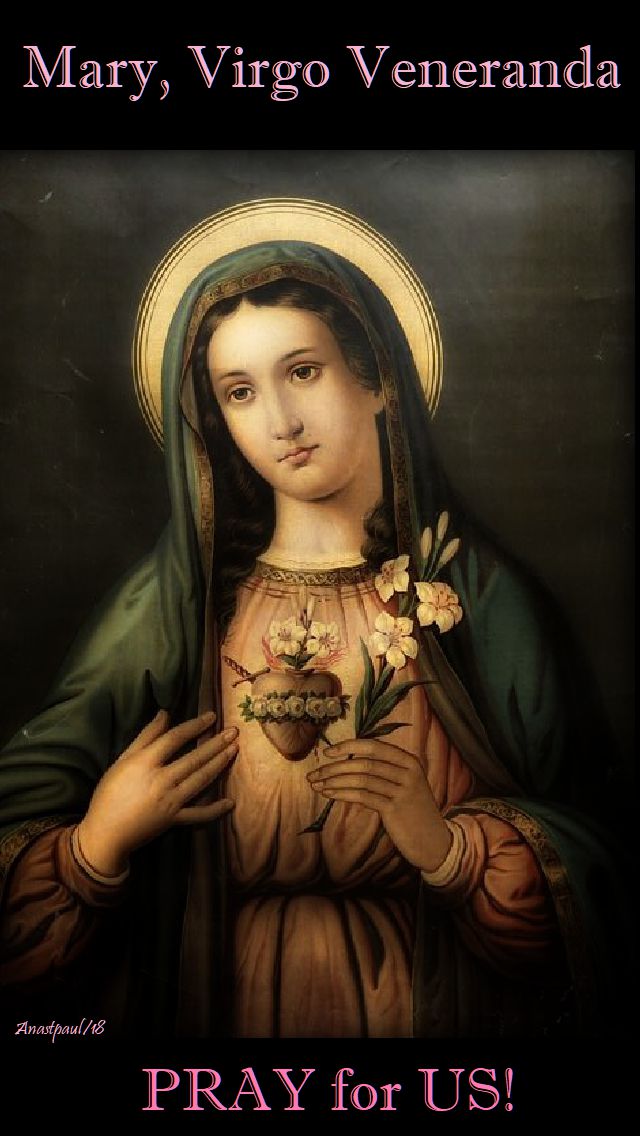
Mary is the “Virgo Veneranda,”

The All-Worshipful Virgin
Blessed John Henry Newman Cong. Orat. (1801-1890)

WE use the word “Venerable” generally of what is old.   That is because only what is old has commonly those qualities which excite reverence or veneration.

It is a great history, a great character, a maturity of virtue, goodness, experience, that excite our reverence and these commonly, cannot belong to the young.

But this is not true when we are considering Saints.   A short life with them is a long one. Thus Holy Scripture says, “Venerable age is not that of long time, nor counted by the number of years but it is the understanding of a man that has gray hairs and a spotless life is old age.   The just man, if he be cut short by death, shall be at rest;  being made perfect in a short time, he fulfilled a long time.” [Wisdom v.]

Nay, there is a heathen writer, who knew nothing of Saints, who lays it down that even to children, to all children, a great reverence should be paid and that on the ground of their being as yet innocent.   And this is a feeling very widely felt and expressed in all countries;  so much so that the sight of those who have not sinned (that is, who are not yet old enough to have fallen into mortal sin) has, on the very score of that innocent, smiling youthfulness, often disturbed and turned the plunderer or the assassin in the midst of his guilty doings, filled him with a sudden fear and brought him, if not to repentance, at least to change of purpose.

And, to pass from the thought of the lowest to the Highest, what shall we say of the Eternal God (if we may safely speak of Him at all) but that He, because He is eternal, is ever young, without a beginning and therefore without change and, in the fullness and perfection of His incomprehensible attributes, now just what He was a million years ago?   He is truly called in Scripture the “Ancient of Days,” and is therefore infinitely venerable;   yet He needs not old age to make him venerable;  He has really nothing of those human attendants on venerableness which the sacred writers are obliged figuratively to ascribe to Him, in order to make us feel that profound abasement and reverential awe which we ought to entertain at the thought of Him.

And so of the great Mother of God, as far as a creature can be like the Creator;  her ineffable purity and utter freedom from any shadow of sin, her Immaculate Conception, her ever-virginity—these her prerogatives (in spite of her extreme youth at the time when Gabriel came to her) are such as to lead us to exclaim in the prophetic words of Scripture both with awe and with exultation, “Thou art the glory of Jerusalem and the joy of Israel;  thou art the honour of our people;  therefore hath the hand of the Lord strengthened thee and therefore art thou blessed forever.”

Mary, Virgo Veneranda, Pray for us!mary virgo veneranda - pray for us - 9 may 2018

Posted in CATHOLIC DEVOTIONS of the Month, MARIAN DEVOTIONS, MARIAN QUOTES, MARIAN TITLES, MORNING Prayers, QUOTES of the SAINTS, The BLESSED VIRGIN MARY

Marian Thought for the Day – 8 May – “Mary’s Month!” – Tuesday of the Sixth Week of Eastertide

Marian Thought for the Day – 8 May – “Mary’s Month!” – Tuesday of the Sixth Week of Eastertide

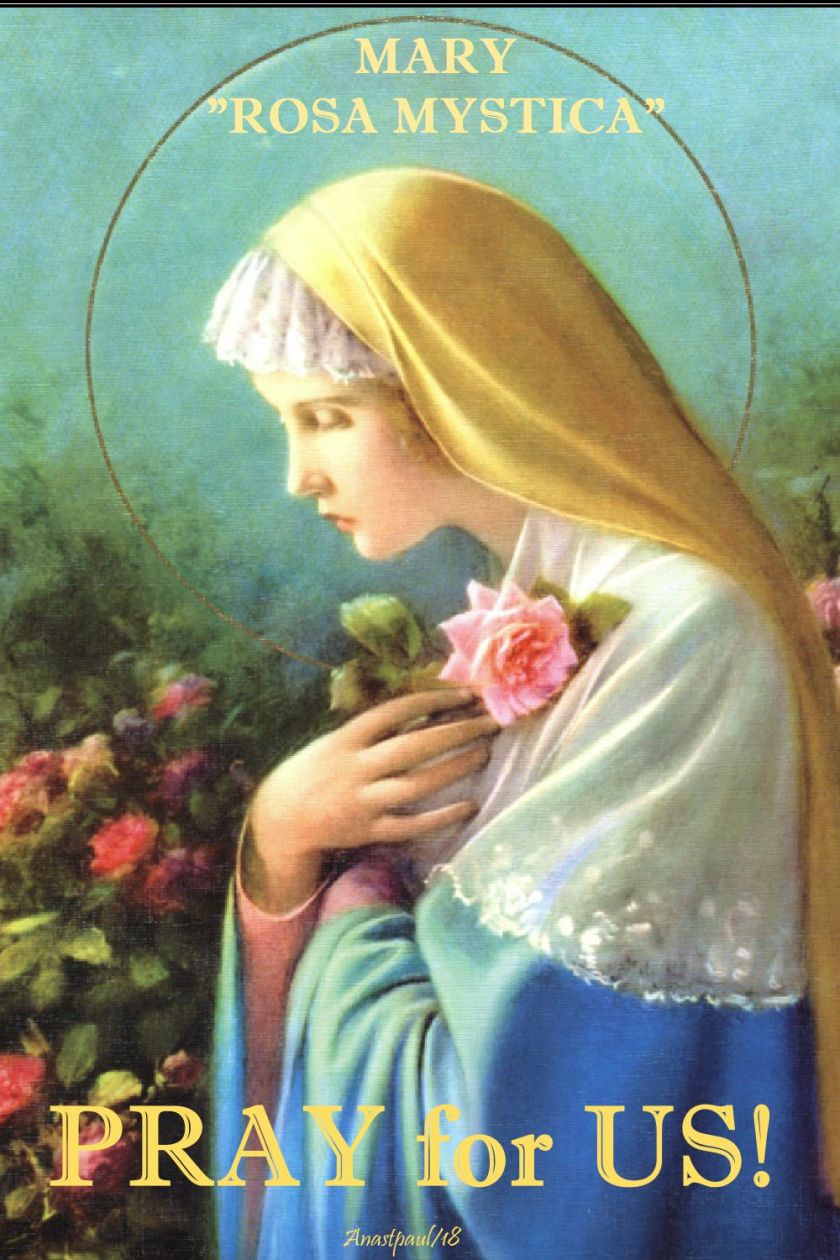
Mary is the “Rosa Mystica,” the Mystical Rose
Blessed John Henry Newman (1801-1890)

HOW did Mary become the Rosa Mystica, the choice, delicate, perfect flower of God’s spiritual creation?   It was by being born, nurtured and sheltered in the mystical garden or Paradise of God.   Scripture makes use of the figure of a garden, when it would speak of heaven and its blessed inhabitants.   A garden is a spot of ground set apart for trees and plants, all good, all various, for things that are sweet to the taste or fragrant in scent, or beautiful to look upon, or useful for nourishment;  and accordingly in its spiritual sense, it means the home of blessed spirits and holy souls dwelling there together, souls with both the flowers and the fruits upon them, which by the careful husbandry of God, they have come to bear, flowers and fruits of grace, flowers more beautiful and more fragrant than those of any garden, fruits more delicious and exquisite than can be matured by earthly husbandman.

All that God has made speaks of its Maker;, the mountains speak of His eternity;, the sun of His immensity and the winds of His Almightiness.   In like manner flowers and fruits speak of His sanctity, His love and His providence;  and such as are flowers and fruits, such must be the place where they are found.   That is to say, since they are found in a garden, therefore a garden has also excellences which speak of God because it is their home.   For instance, it would be out of place if we found beautiful flowers on the mountain-crag, or rich fruit in the sandy desert.   As then by flowers and fruits are meant, in a mystical sense, the gifts and graces of the Holy Ghost, so by a garden is meant mystically, a place of spiritual repose, stillness, peace, refreshment and delight.

Thus our first parents were placed in “a garden of pleasure” shaded by trees, “fair to behold and pleasant to eat of,” with the Tree of Life in the midst and a river to water the ground.   Thus our Lord, speaking from the cross to the penitent robber, calls the blessed place, the heaven to which He was taking him, “paradise,” or a garden of pleasure. Therefore St John, in the Apocalypse, speaks of heaven, the palace of God, as a garden or paradise, in which was the Tree of Life giving forth its fruits every month.

Such was the garden in which the Mystical Rose, the Immaculate Mary, was sheltered and nursed to be the Mother of the All Holy God, from her birth to her espousals to St Joseph, a term of thirteen years.   For three years of it, she was in the arms of her holy mother, St Anne and then for ten years she lived in the temple of God.   In those blessed gardens, as they may be called, she lived by herself, continually visited by the dew of God’s grace and growing up a more and more heavenly flower, till at the end of that period she was meet for the inhabitation in her of the Most Holy.   This was the outcome of the Immaculate Conception.   Excepting her, the fairest rose in the paradise of God has had upon it blight and has had the risk of canker-worm and locust.   All but Mary;  she from the first was perfect in her sweetness and her beautifulness and at length, when the angel Gabriel had to come to her, he found her “full of grace,” which had, from her good use of it, accumulated in her, from the first moment of her being.

Mary, Rosa Mystica, Pray for us!mary - rosa mystica - pray for us - 8 may 2018

Posted in CATHOLIC DEVOTIONS of the Month, EASTER, MARIAN PRAYERS, MARIAN QUOTES, MARIAN TITLES, MORNING Prayers, QUOTES of the SAINTS, The BLESSED VIRGIN MARY, The HOLY EUCHARIST / The HOLY MASS, The INCARNATION, The WORD

One Minute Marian Reflection – 8 May – “Mary’s Month!” – Tuesday of the Sixth Week of Eastertide

One Minute Marian Reflection – 8 May – “Mary’s Month!” – Tuesday of the Sixth Week of Eastertide

And the angel said to her in reply, “The holy Spirit will come upon you, and the power of the Most High will overshadow you.   Therefore the child to be born will be called holy, the Son of God…Luke 1:35and the angel said to her in reply - luke 1 35 - 8 may 2018

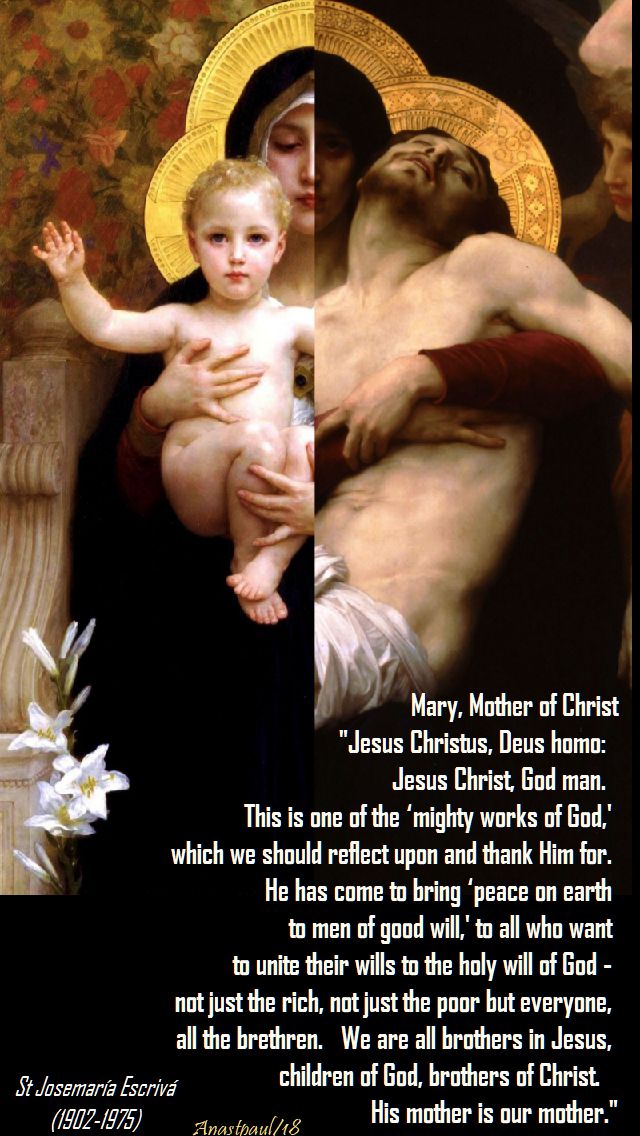
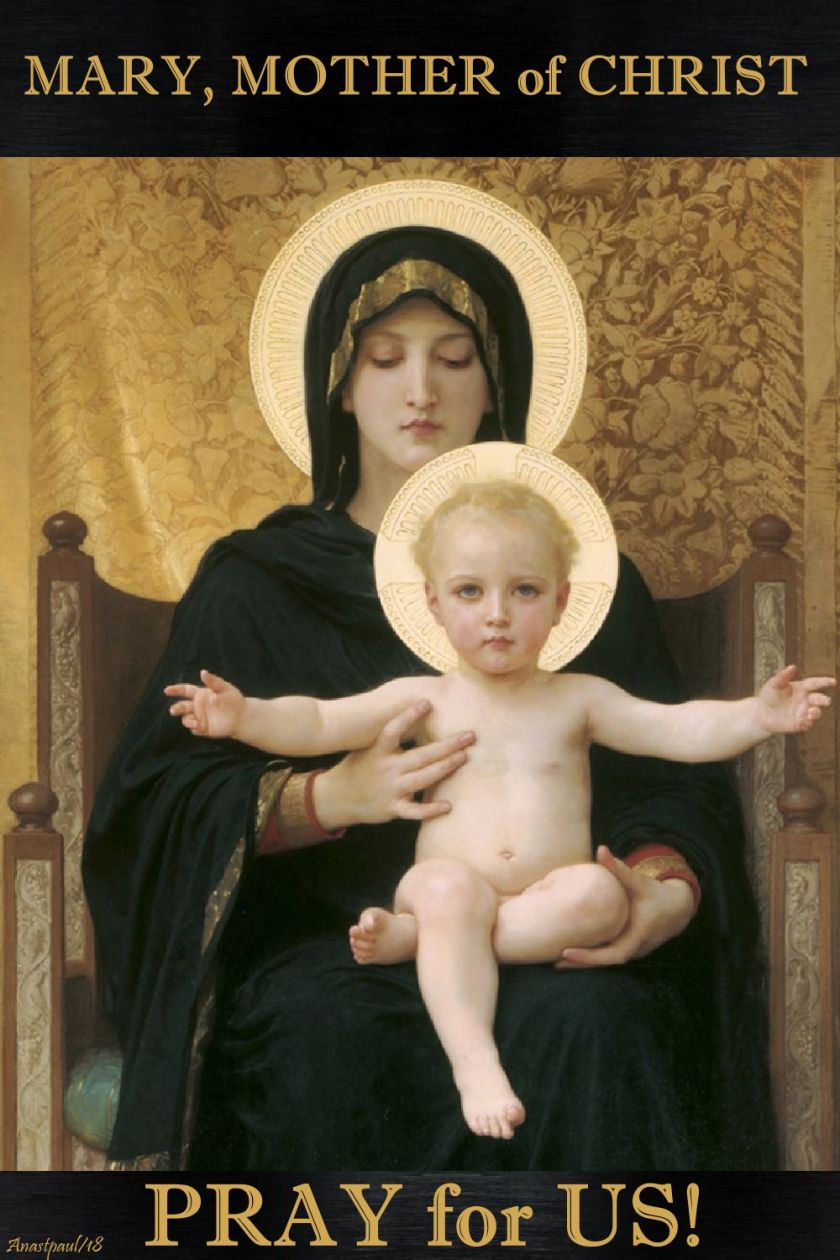
REFLECTIONMARY:  MOTHER OF CHRIST – “Jesus Christus, Deus homo:  Jesus Christ, God man.   This is one of the ‘mighty works of God,’ which we should reflect upon and thank Him for.   He has come to bring ‘peace on earth to men of good will,’ to all who want to unite their wills to the holy will of God – not just the rich, not just the poor but everyone, all the brethren.   We are all brothers in Jesus, children of God, brothers of Christ.   His mother is our mother .”…St Josemaría Escrivá (1902-1975) – “Christ Triumphs through Humility” – “Christ is Passing By – 13”
Let us offer to our Mother today:
Jesus Himself, when we receive Him in Holy Communion.mary mother of christ - st josemaria - 8 may 2018

PRAYER – Shape us in the likeness of the divine nature of our Redeemer, whom we believe to be true God and true man, since it was Your will, Lord God, that He, Your Word, should take to Himself our human nature in the womb of the Blessed Virgin Mary. Grant, we pray, that by intercession of the Mother of our Lord Jesus Christ, we may reach eternal life.   We make our prayer, through Christ, our Lord, in union with You and the Holy Spirit, one God, forever, amen.mary mother of christ - pray for us - 8 may 2018


Posted in ArchAngels and Angels, MARIAN TITLES, MIRACLES, SAINT of the DAY

8 May – Apparition of Michael the Archangel at Monte Gargano, Italy (492), Feast of Our Lady of Luján and Memorials of the Saints

Apparition of Michael the Archangel at Monte Gargano, Italy (492)

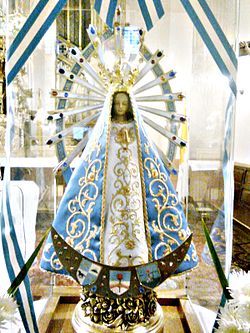
Our Lady of Luján:  The Virgin is a two feet tall terracotta statue of Our Lady.   It was made in Brazil and sent to Argentina in May 1630.   Its original appearance seemed inspired by Murillo’s Immaculates.   In 1887, to preserve and protect it, the image was given a solid silver covering.   It is usually clothed with a white robe and sky blue cloak, the colors of the Argentinian flag.   Only the dark oval face with big blue eyes and the hands folded in prayer are now visible.
Tradition says that an ox-drawn wagon was taking the statue from Buenos Aires to Santiago del Estero.   The animals stopped at the Luján River and refused to cross. Through trial and error the teamsters discovered that it the box with the Virgin was in the wagon, the oxen would not move;  if it was removed, then away they went.   After testing this several times, the people realised that Our Lady wanted to stay in Luján and so she is there today.
The image was first taken to the nearby home of Don Rosendo.   He built a primitive chapel for it which lasted 40 years.   A bigger shrine was completed in 1685.   A new sanctuary was built in the 19th century.   The image was crowned canonically in 1887.   In 1930 Pope Pius XII gave the sanctuary the title of Basilica.
Patronages:
• Agentina (proclaimed on 8 September 1930 Pope Pius XI)
• Argentinian military chaplains
• Paraguay
• Uruguay

Virgen_de_Luján-Réplica

St Acacius of Byzantium
Bl Aloysius Luis Rabata
St Amatus Ronconi
Bl Angelo of Massaccio
St Arsenio of Mount Scete
St Benedict II, Pope
St Boniface IV, Pope
St Desideratus of Bourges
Bl Domenico di San Pietro
St Gibrian
St Helladius of Auxerre
St Ida of Nivelles
St Martin of Saujon
St Metrone of Verona
St Odrian of Waterford
St Otger of Utrecht
St Peter of Besançon
Bl Pietro de Alos
Bl Raymond of Toulouse
Bl Teresa Demjanovich
Bl Ulrika Fransiska Nisch
St Victor Maurus
St Wiro of Utrecht

Posted in CATHOLIC DEVOTIONS of the Month, MARIAN DEVOTIONS, MARIAN QUOTES, MARIAN TITLES, QUOTES of the SAINTS, The BLESSED VIRGIN MARY

Marian Thought for the Day – 7 May “Mary’s Month” – Monday of the Sixth week of Eastertide

Marian Thought for the Day – 7 May “Mary’s Month” – Monday of the Sixth week of Eastertide

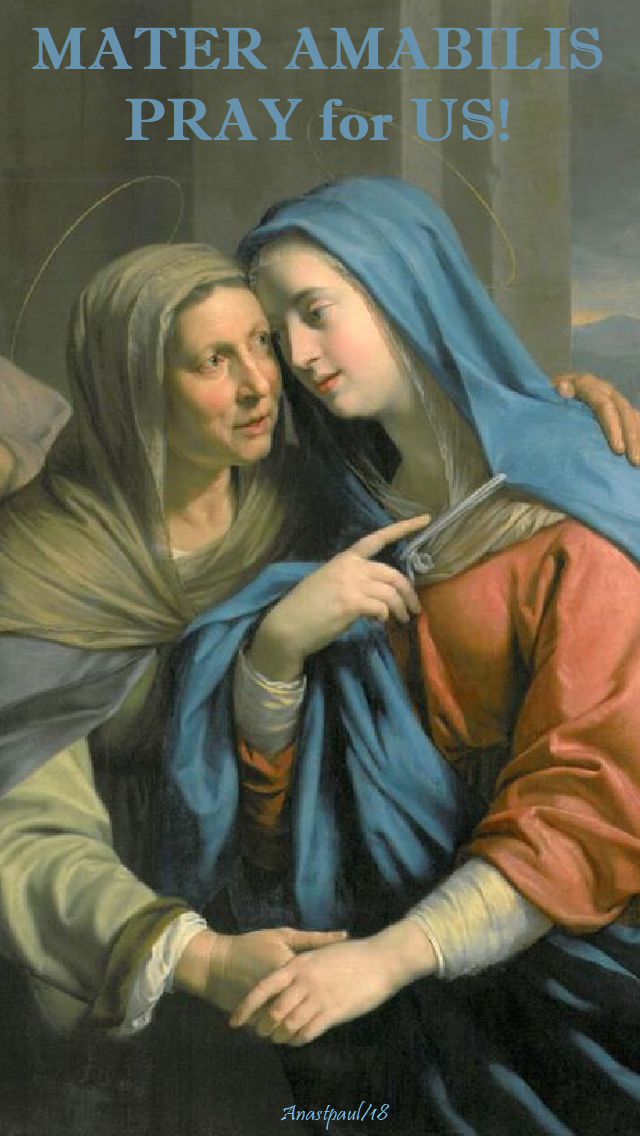
Mary is the “Mater Amabilis”
the Lovable or Dear Mother
Blessed John Henry Newman (1801-1890)

WHY is she “Amabilis” thus specially?   It is because she was without sin.   Sin is something odious in its very nature and grace is something bright, beautiful, attractive.

However, it may be said that sinlessness was not enough to make others love her, or to make her dear to others and that for two reasons:   first, because we cannot like anyone that is not like ourselves and we are sinners;   and next, because her being holy would not make her pleasant and winning because holy persons whom we fall in with, are not always agreeable and we cannot like them, however we may revere them and look up to them.

Now as to the first of these two questions, we may grant that bad men do not, cannot like good men but our Blessed Virgin Mary is called Amabilis, or lovable, as being such to the children of the Church, not to those outside of it, who know nothing about her and no child of Holy Church but has some remains of God’s grace in his soul which makes him sufficiently like her, however greatly wanting he may be, to allow of his being able to love her.   So we may let this question pass.

But as to the second question, viz., How are we sure that our Lady, when she was on earth, attracted people round her and made them love her merely because she was holy?—considering that holy people sometimes have not that gift of drawing others to them.

To explain this point we must recollect that there is a vast difference between the state of a soul such as that of the Blessed Virgin, which has never sinned and a soul, however holy, which has once had upon it Adam’s sin;   for, even after baptism and repentance, it suffers necessarily from the spiritual wounds which are the consequence of that sin. Holy men, indeed, never commit mortal sin, nay, sometimes have never committed even one mortal sin in the whole course of their lives.   But Mary’s holiness went beyond this. She never committed even a venial sin and this special privilege is not known to belong to anyone but Mary.

Now, whatever want of amiableness, sweetness, attractiveness, really exists in holy men arises from the remains of sin in them, or again from the want of a holiness powerful enough to overcome the defects of nature, whether of soul or body but, as to Mary, her holiness was such, that if we saw her and heard her, we should not be able to tell to those who asked us anything about her except simply that she was angelic and heavenly.

Of course, her face was most beautiful but we  should not be able to recollect whether it was beautiful or not, we should not recollect any of her features because it was her beautiful sinless soul, which looked through her eyes and spoke through her mouth and was heard in her voice and compassed her all about.   When she was still, or when she walked, whether she smiled, or was sad, her sinless soul, this it was, which would draw all those to her who had any grace in them, any remains of grace, any love of holy things.

There was a divine music in all she said and did—in her mien, her air, her deportment, that charmed every true heart that came near her.   Her innocence, her humility and modesty, her simplicity, sincerity, and truthfulness, her unselfishness, her unaffected interest in everyone who came to her, her purity—it was these qualities which made her so lovable and were we to see her now, neither our first thought nor our second thought would be, what she could do for us with her Son, (though she can do so much) but our first thought would be, “Oh, how beautiful!” and our second thought would be, “Oh, what ugly hateful creatures are we!”

Mater Amabilis, Pray for us!mater amabilis - lovable mother - dear mother - the visitation - pray for us - 7 may 2018

Posted in CATHOLIC DEVOTIONS of the Month, MARIAN QUOTES, MARIAN TITLES, MORNING Prayers, QUOTES of the SAINTS, The BLESSED VIRGIN MARY, The HOLY EUCHARIST / The HOLY MASS

Marian Thought for the Day – 6 May “Mary’s Month!” – Sixth Sunday of Eastertide B

Marian Thought for the Day – 6 May “Mary’s Month!” – Sixth Sunday of Eastertide B

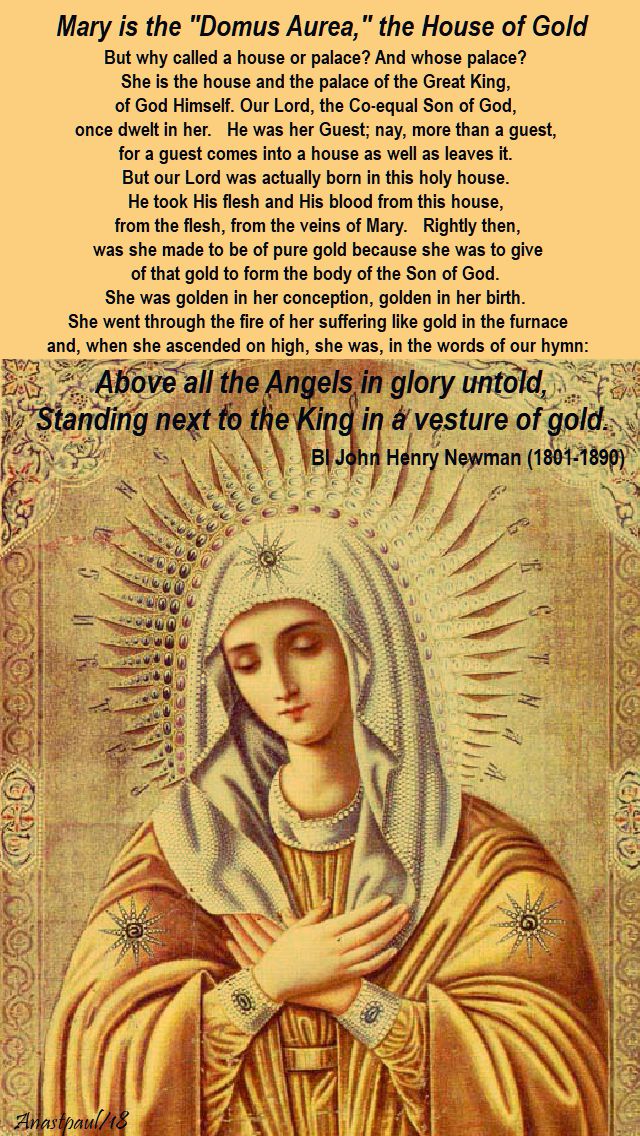
Mary is the “Domus Aurea,” the House of Gold
Blessed John Henry Newman (1801-1890)

WHY is she called a House?   And why is she called Golden?   Gold is the most beautiful, the most valuable, of all metals. Silver, copper and steel may in their way be made good to the eye but nothing is so rich, so splendid, as gold.   We have few opportunities of seeing it in any quantity but anyone who has seen a large number of bright gold coins knows how magnificent is the look of gold.   Hence it is that in Scripture the Holy City is, by a figure of speech, called Golden.   “The City,” says St. John, “was pure gold, as it were transparent glass.”   He means of course to give us a notion of the wondrous beauty of heaven, by comparing it with what is the most beautiful of all the substances which we see on earth.

Therefore, it is that Mary too, is called golden because her graces, her virtues, her innocence, her purity, are of that transcendent brilliancy and dazzling perfection, so costly, so exquisite, that the angels cannot, so to say, keep their eyes off her any more than we could help gazing upon any great work of gold.

But observe further, she is a golden house, or, I will rather say, a golden palace.   Let us imagine we saw a whole palace or large church all made of gold, from the foundations to the roof;  such, in regard to the number, the variety, the extent of her spiritual excellences, is Mary.

But why called a house or palace?   And whose palace?   She is the house and the palace of the Great King, of God Himself.   Our Lord, the Co-equal Son of God, once dwelt in her. He was her Guest, nay, more than a guest, for a guest comes into a house as well as leaves it.   But our Lord was actually born in this holy house.   He took His flesh and His blood from this house, from the flesh, from the veins of Mary.   Rightly then was she made to be of pure gold because she was to give of that gold to form the body of the Son of God.   She was golden in her conception, golden in her birth.   She went through the fire of her suffering like gold in the furnace and when she ascended on high, she was, in the words of our hymn,

Above all the Angels in glory untold,
Standing next to the King in a vesture of gold.mary is the house of gold

Holy Mary, Mother of God, pray for us!HOLY MARY MOTHER OF GOD - PRAY FOR US

Posted in CATHOLIC DEVOTIONS of the Month, MARIAN DEVOTIONS, MARIAN QUOTES, MARIAN TITLES, MORNING Prayers, QUOTES of the SAINTS, The BLESSED VIRGIN MARY

Marian Thought for the Day – 5 May “Mary’s Month!” – Saturday of the Fifth Week of Eastertide

Marian Thought for the Day – 5 May “Mary’s Month!” – Saturday of the Fifth Week of Eastertide

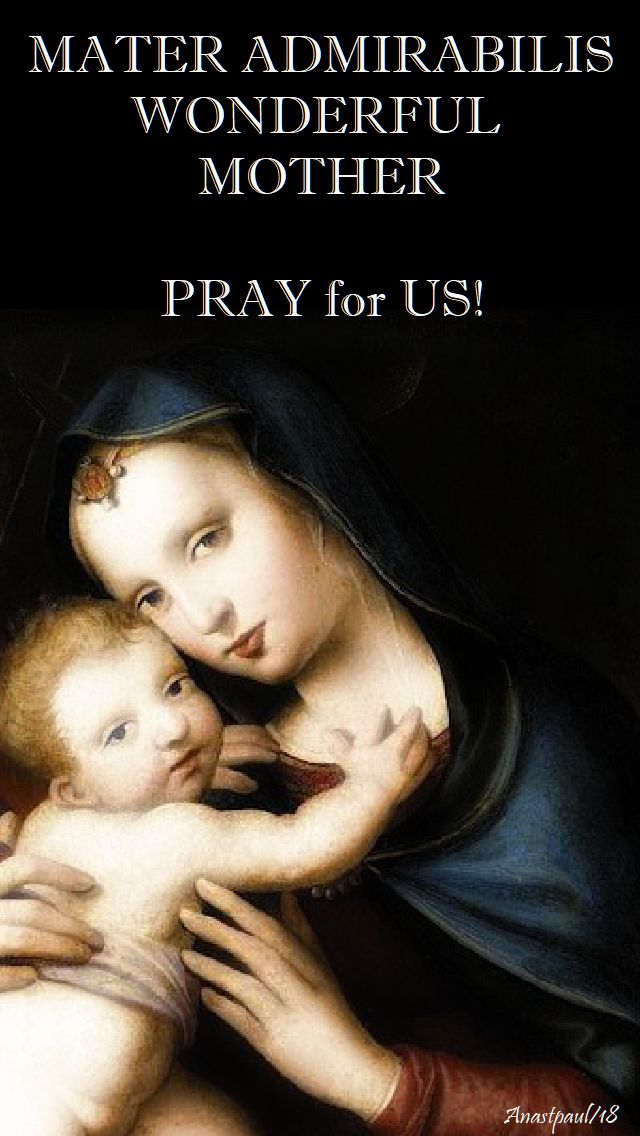
Mary is the “Mater Admirabilis,” the Wonderful Mother
Blessed John Henry Newman (1801-1890)

WHEN Mary, the Virgo Prædicanda, the Virgin who is to be proclaimed aloud, is called by the title of Admirabilis, it is thereby suggested to us what the effect is of the preaching of her as Immaculate in her Conception.  The Holy Church proclaims, preaches her, as conceived without original sin and those who hear, the children of Holy Church, wonder, marvel, are astonished and overcome by the preaching.   It is so great a prerogative.

Even created excellence is fearful to think of when it is so high as Mary’s.  As to the great Creator, when Moses desired to see His glory, He Himself says about Himself, “Thou canst not see My face, for man shall not see Me and live;” and St. Paul says, “Our God is a consuming fire.”   And when St John, holy as he was, saw only the Human Nature of our Lord, as He is in Heaven, “he fell at His feet as dead.”   And so as regards the appearance of angels.   The holy Daniel, when St Gabriel appeared to him, “fainted away and lay in a consternation, with his face close to the ground.”   When this great archangel came to Zacharias, the father of S. John the Baptist, he too was troubled and fear fell upon him. But it was otherwise with Mary when the same St Gabriel came to her  . She was overcome indeed and troubled at his words, because, humble as she was in her own opinion of herself, he addressed her as “Full of grace,” and “Blessed among women” but she was able to bear the sight of him.

Hence we learn two things:  first, how great a holiness was Mary’s, seeing she could endure the presence of an angel, whose brightness smote the holy prophet Daniel even to fainting and almost to death;  and secondly, since she is so much holier than that angel, and we so much less holy than Daniel, what great reason we have to call her the Virgo Admirabilis, the Wonderful, the Awful Virgin, when we think of her ineffable purity!

There are those who are so thoughtless, so blind, so grovelling as to think that Mary is not as much shocked at wilful sin as her Divine Son is and that we can make her our friend and advocate, though we go to her without contrition at heart, without even the wish for true repentance and resolution to amend.   As if Mary could hate sin less and love sinners more, than our Lord does!   No: she feels a sympathy for those only who wish to leave their sins else, how should she be without sin herself?   No, if even to the best of us she is, in the words of Scripture, “fair as the moon, bright as the sun and terrible as an army set in array,” what is she to the impenitent sinner?

Mater Admirabilis, Wonderful Mother, Pray for us!mater admirabilis - pray for us - 5 may 2018

Posted in CATHOLIC DEVOTIONS of the Month, MARIAN DEVOTIONS, MARIAN PRAYERS, MARIAN QUOTES, MARIAN TITLES, MORNING Prayers, PRAYERS of the SAINTS, QUOTES of the SAINTS, The BLESSED VIRGIN MARY

One Minute Marian Reflection – 5 May “Mary’s Month!” – Saturday of the Fifth Week of Eastertide

One Minute Marian Reflection – 5 May “Mary’s Month!” – Saturday of the Fifth Week of Eastertide

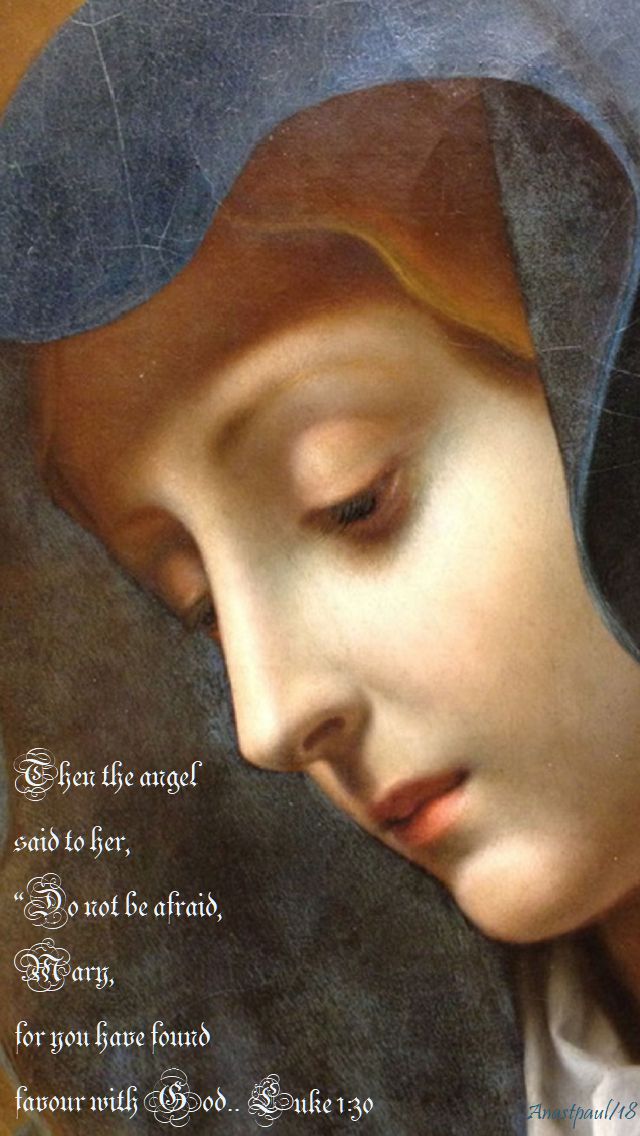
Then the angel said to her, “Do not be afraid, Mary, for you have found favour with God…Luke 1:30then the angel said to her - luke 1 30 - 5 may 2018

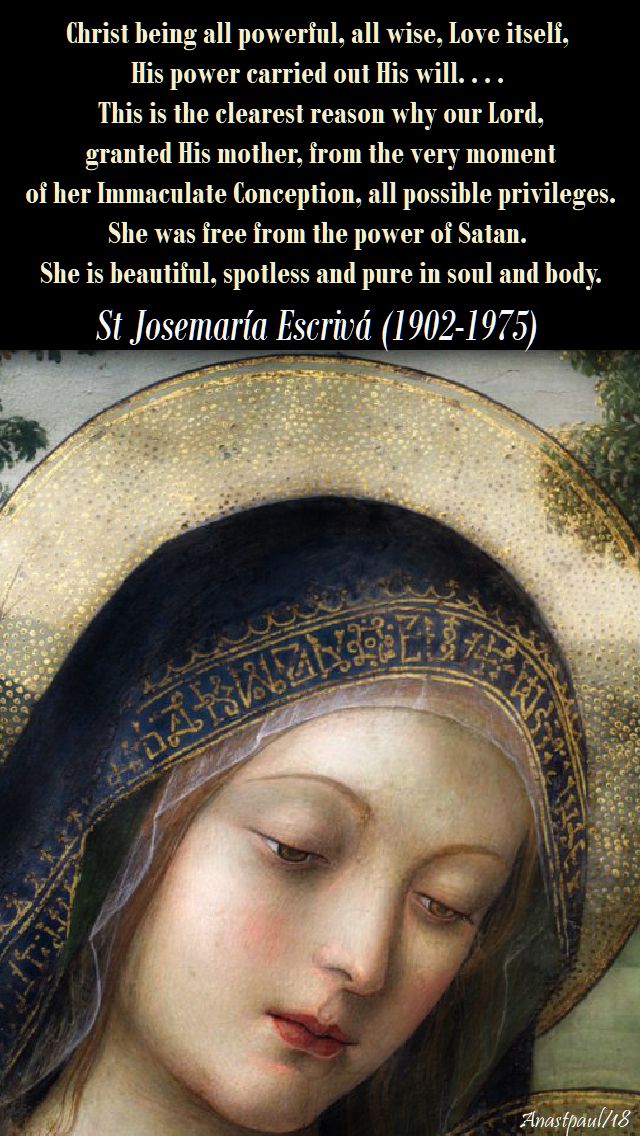
REFLECTION – “MARY: HER IMMACULATE CONCEPTION: “How would we have acted, if we could have chosen our own mother? I’m sure we would have chosen the one we have, adorning her with every possible grace. That is what Christ did. Christ being all powerful, all wise, Love itself, His power carried out His will. . . . This is the clearest reason why our Lord granted His mother , from the very moment of her Immaculate Conception, all possible privileges. She was free from the power of Satan. She is beautiful, spotless and pure in soul and body.” …St Josemaría Escrivá (1902-1975) – “Cause of our Joy” – Christ is Passing By – 171
Let us offer to our Mother today:
The renewal of our baptismal vows.christ being all-powerful, all wise, love itself - st josemaria - marian reflection - 5 may 2018

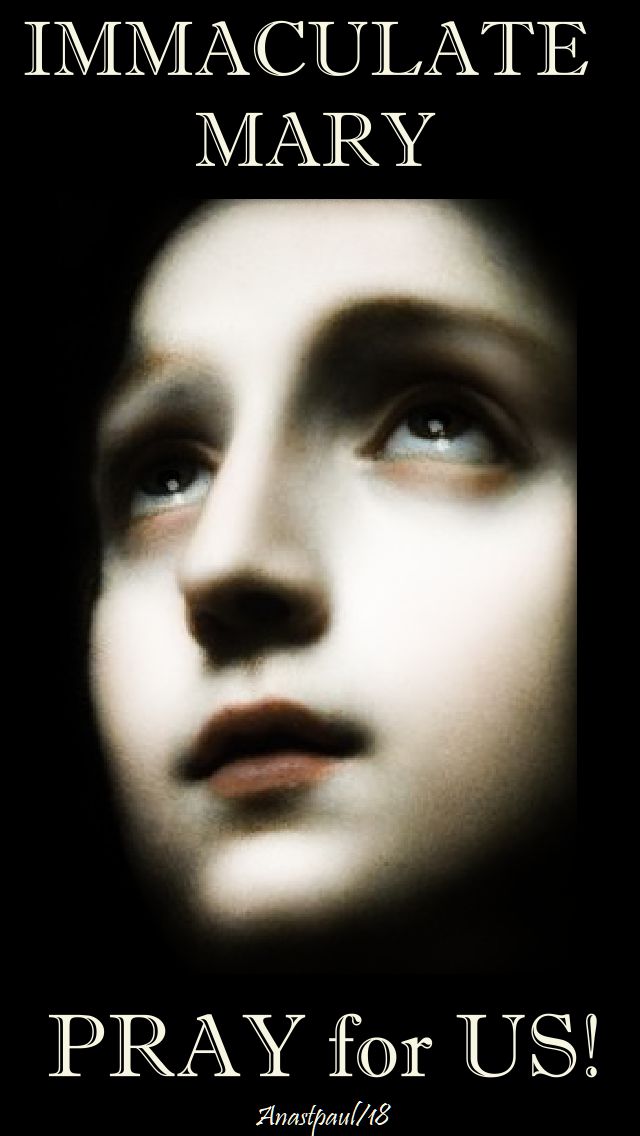
PRAYER – Almighty God, grant that Your faithful, who rejoice in the protection of the Blessed Virgin Mary, may be delivered from every evil here on earth, through her prayer and come to the enduring joys of heaven. We make our prayer through her Son, our Lord Jesus Christ, one God with You, in the union of the Holy Spirit, forever amen.immaculate mary - pray for us - 5 may 2018

Posted in CATHOLIC DEVOTIONS of the Month, MARIAN DEVOTIONS, MARIAN QUOTES, MARIAN TITLES, MORNING Prayers, The BLESSED VIRGIN MARY, Thomas a Kempis, Uncategorized

Marian Thought for the Day – 4 May – Mary’s Month! – Friday of the Fifth Week of Eastertide

Marian Thought for the Day – 4 May – Mary’s Month! – Friday of the Fifth Week of Eastertide

Mary is the “Virgo Prædicanda,” the Virgin who is to be Proclaimed
Blessed John Henry Newman (1801-1890)

MARY is the Virgo Prædicanda, that is, the Virgin who to be proclaimed, to be heralded, literally, to be preached.

We are accustomed to preach abroad that which is wonderful, strange, rare, novel, important.   Thus, when our Lord was coming, St John the Baptist preached Him;  then, the Apostles went into the wide world and preached Christ.   What is the highest, the rarest, the choicest prerogative of Mary?   It is that she was without sin.   When a woman in the crowd cried out to our Lord, “Blessed is the womb that bare Thee!” He answered, “More blessed are they who hear the word of God and keep it.”   Those words were fulfilled in Mary.   She was filled with grace in order to be the Mother of God.   But it was a higher gift than her maternity to be thus sanctified and thus pure.   Our Lord indeed would not have become her son unless He had first sanctified her but still, the greater blessedness was to have that perfect sanctification.   This then is why she is the Virgo Prædicanda; she is deserving to be preached abroad because she never committed any sin, even the least;  because sin had no part in her;  because, through the fullness of God’s grace, she never thought a thought, or spoke a word, or did an action, which was displeasing, which was not most pleasing, to Almighty God;  because in her was displayed the greatest triumph over the enemy of souls.

Wherefore, when all seemed lost, in order to show what He could do for us all by dying for us;  in order to show what human nature, His work, was capable of becoming;  to show how utterly He could bring to naught the utmost efforts, the most concentrated malice of the foe and reverse all the consequences of the Fall, our Lord began, even before His coming, to do His most wonderful act of redemption, in the person of her who was to be His Mother.   By the merit of that Blood which was to be shed, He interposed to hinder her incurring the sin of Adam, before He had made on the Cross atonement for it. And therefore it is that we preach her who is the subject of this wonderful grace.

But she was the Virgo Prædicanda for another reason.   When, why, what things do we preach?   We preach what is not known, that it may become known.   And hence the Apostles are said in Scripture to “preach Christ.”   To whom?   To those who knew Him not—to the heathen world.   Not to those who knew Him but to those who did not know Him.

Preaching is a gradual work, first one lesson, then another.   Thus were the heathen brought into the Church gradually.   And in like manner, the preaching of Mary to the children of the Church and the devotion paid to her by them, has grown, grown gradually, with successive ages.   Not so much preached about her in early times as in later.   First she was preached as the Virgin of Virgins—then as the Mother of God—then as glorious in her Assumption—then as the Advocate of sinners—then as Immaculate in her Conception.   And this last has been the special preaching of the present century and thus that which was earliest in her own history is the latest in the Church’s recognition of her.

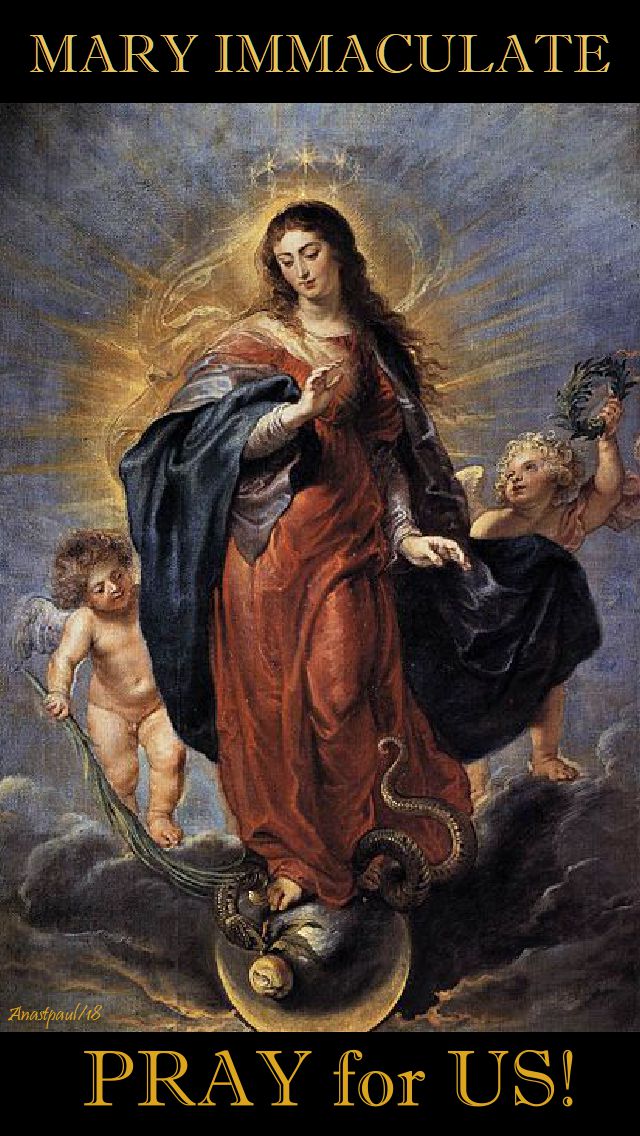
Mary Immaculate, Pray for us!mary immaculate - pray for us - 4 mary 2018.jpg

Posted in CATECHESIS, CATHOLIC DEVOTIONS of the Month, DOGMA, MARIAN QUOTES, MARIAN TITLES, MORNING Prayers, QUOTES of the SAINTS, The BLESSED VIRGIN MARY

Marian Thought for the Day – 3 May – Mary’s Month! – Thursday of the Fifth Week of Eastertide and the Feast of Sts Philip and James Apostles and Martyrs

Marian Thought for the Day – 3 May – Mary’s Month! – Thursday of the Fifth Week of Eastertide and the Feast of Sts Philip and James Apostles and Martyrs

On the Immaculate Conception
Mary is the “Virgo Purissima,” the Most Pure Virgin
By Blessed John Henry Newman (1801-1890)

BY the Immaculate Conception of the Blessed Virgin is meant the great revealed truth that she was conceived in the womb of her mother, St Anne, without original sin.

Since the fall of Adam all mankind, his descendants, are conceived and born in sin. “Behold,” says the inspired writer in the Psalm Miserere—“Behold, I was conceived in iniquity and in sin did my mother conceive me”.   That sin which belongs to every one of us and is ours, from the first moment of our existence, is the sin of unbelief and disobedience, by which Adam lost Paradise.   We, as the children of Adam, are heirs to the consequences of his sin and have forfeited in him, that spiritual robe of grace and holiness, which he had given him by his Creator at the time that he was made.   In this state of forfeiture and disinheritance we are all of us conceived and born and the ordinary way, by which we are taken out of it, is the Sacrament of Baptism.

But Mary never was in this state, she was by the eternal decree of God exempted from it. From eternity, God, the Father, Son and Holy Ghost, decreed to create the race of man and, foreseeing the fall of Adam, decreed to redeem the whole race by the Son’s taking flesh and suffering on the Cross.   In that same incomprehensible, eternal instant, in which the Son of God was born of the Father, was also the decree passed of man’s redemption through Him.   He who was born from Eternity was born by an eternal decree to save us in Time and to redeem the whole race and Mary’s redemption, was determined in that special manner which we call the Immaculate Conception.   It was decreed, not that she should be cleansed from sin but that she should, from the first moment of her being, be preserved from sin, so that the Evil One never had any part in her.   Therefore, she was a child of Adam and Eve as if they had never fallen, she did not share with them their sin, she inherited the gifts and graces (and more than those) which Adam and Eve possessed in Paradise.   This is her prerogative and the foundation of all those salutary truths, which are revealed to us concerning her.

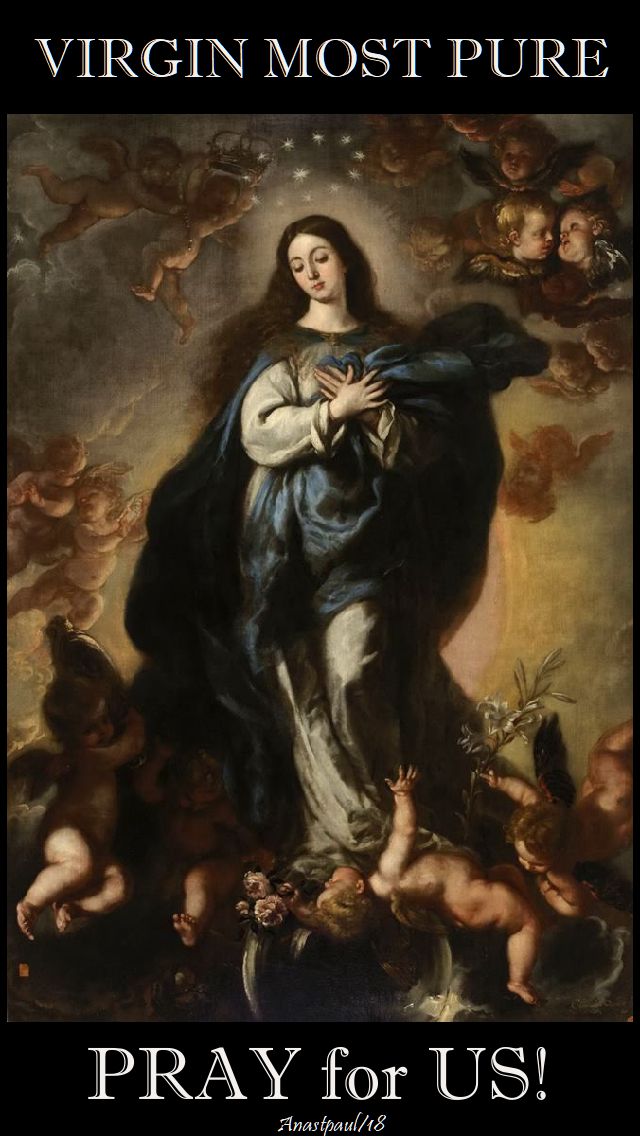
Let us say then with all holy souls, Virgin most pure, conceived without original sin, Mary, pray for us.virgin most pure - pray for us - 3 may 2018

Posted in MARIAN DEVOTIONS, MARIAN QUOTES, MARIAN TITLES, MORNING Prayers, QUOTES of the SAINTS, The BLESSED VIRGIN MARY

Marian Thought for the Day – 2 May – “Mary’s Month” – May the Month of Joy By Blessed John Henry Newman (1801-1890)

Marian Thought for the Day – 2 May – “Mary’s Month”

May 2 – May the Month of Joy
By Blessed John Henry Newman  (1801-1890)

WHY is May called the month of Mary and especially dedicated to her?   Among other reasons there is this, that of the Church’s year, the ecclesiastical year, it is at once the most sacred and the most festive and joyous portion.   Who would wish February, March, or April, to be the month of Mary, considering that it is the time of Lent and penance? Who again would choose December, the Advent season—a time of hope, indeed, because Christmas is coming but a time of fasting too?   Christmas itself does not last for a month; and January has indeed the joyful Epiphany, with its Sundays in succession but these in most years, are cut short ,by the urgent coming of Septuagesima.

May on the contrary belongs to the Easter season, which lasts fifty days and in that season the whole of May commonly falls and the first half always.,, The great Feast of the Ascension of our Lord into heaven is always in May, except once or twice in forty years. Pentecost, called also Whit-Sunday, the Feast of the Holy Ghost, is commonly in May and the Feasts of the Holy Trinity and Corpus Christi are in May not unfrequently.  May, therefore, is the time in which there are such frequent Alleluias, because Christ has risen from the grave, Christ has ascended on high and God the Holy Ghost has come down to take His place.

Here then we have a reason why May is dedicated to the Blessed Mary.   She is the first of creatures, the most acceptable child of God, the dearest and nearest to Him.   It is fitting then that this month should be hers, in which we especially glory and rejoice in His great Providence to us, in our redemption and sanctification in God the Father, God the Son and God the Holy Ghost.

But Mary is not only the acceptable handmaid of the Lord.   She is also Mother of His Son, and the Queen of all Saints and in this month the Church has placed the feasts of some of the greatest of them, as if to bear her company.   St John, the beloved disciple, St Philip, and St James. Seven Popes, two of them especially famous, St Gregory VII. and St Pius V, also two of the greatest Doctors, St Athanasius and St Gregory Nazianzen; two holy Virgins especially favoured by God, St Catherine of Sienna (as her feast is kept in England) and St Mary Magdalen of Pazzi and one holy woman most memorable in the annals of the Church, St Monica, the Mother of St Augustine.   And above all and nearest to us in this Church, our own holy Patron and Father, St Philip Neri, occupies, with his Novena and Octave, fifteen out of the whole thirty-one days of the month.   These are some of the choicest fruits of God’s manifold grace and they form the court of their glorious Queen.

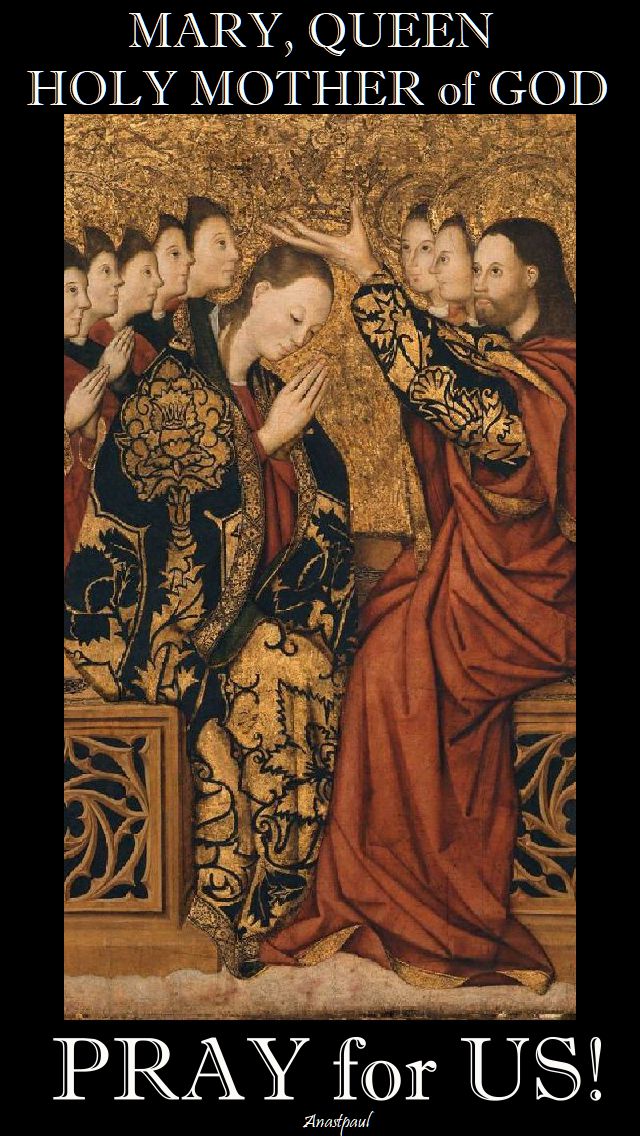
Mary, Queen of Heaven and Earth, Pray for us!mary queen - pray for us

Posted in CATHOLIC DEVOTIONS of the Month, MARIAN QUOTES, MARIAN TITLES, MORNING Prayers, The BLESSED VIRGIN MARY

Thought for the Day – 1 May – Tuesday of the Fifth Week of Eastertide, the Memorial of St Joseph the Worker and the 1st day of the Month of Mary

Thought for the Day – 1 May – Tuesday of the Fifth Week of Eastertide, the Memorial of St Joseph the Worker and the 1st day of the Month of Mary

May, The Month of Promise
Why is May chosen as the month in which we exercise a special devotion to the Blessed Virgin?

The first reason, is because, it is the time when the earth bursts forth into its fresh foliage and its green grass, after the stern frost and snow of winter and the raw atmosphere and the wild wind and rain, of the early spring.   It is because the blossoms are upon the trees and the flowers are in the gardens.   It is because the days have got long and the sun rises early and sets late.   For such gladness and joyousness of external Nature is a fit attendant on our devotion to her, who is the Mystical Rose and the House of Gold.

A man may say, “True but in this climate, we have sometimes a bleak, inclement May.” This cannot be denied;  but still, so much is true that at least it is the month of promise and of hope.   Even though the weather happen to be bad, it is the month that begins and heralds in the summer.   We know, for all that may be unpleasant in it, that fine weather is coming, sooner or later.   “Brightness and beauty shall,” in the Prophet’s words, “appear at the end and shall not lie:  if it make delay, wait for it, for it shall surely come and shall not be slack.”

May then is the month, if not of fulfillment, at least of promise and is not this the very aspect, in which we most suitably regard the Blessed Virgin, Holy Mary, to whom this month is dedicated?

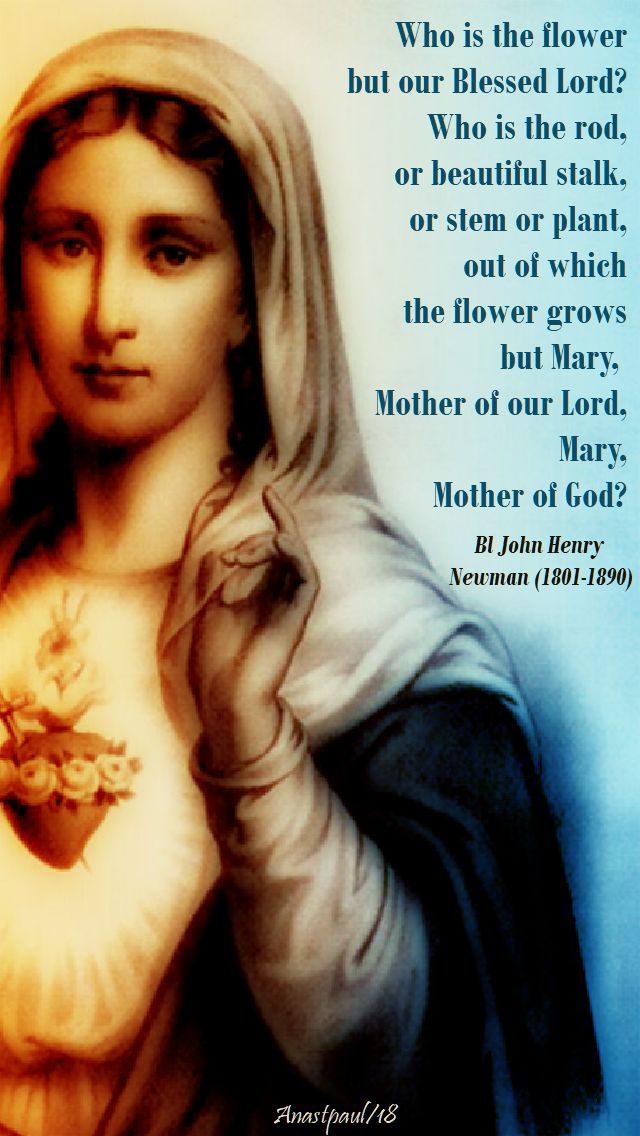
The Prophet says, “There shall come forth a rod out of the root of Jesse and a flower shall rise out of his root.”   Who is the flower but our Blessed Lord?   Who is the rod, or beautiful stalk or stem or plant out of which the flower grows but Mary, Mother of our Lord, Mary, Mother of God?

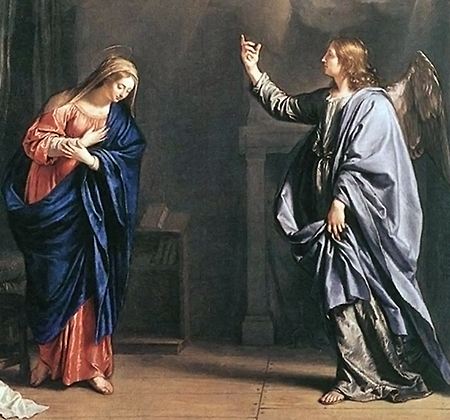
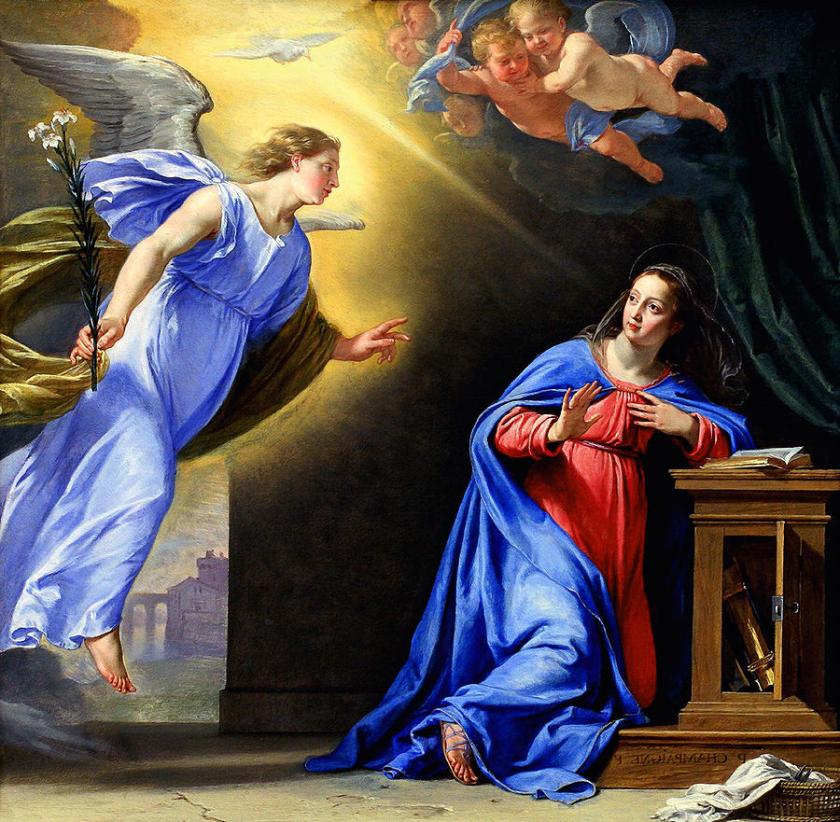
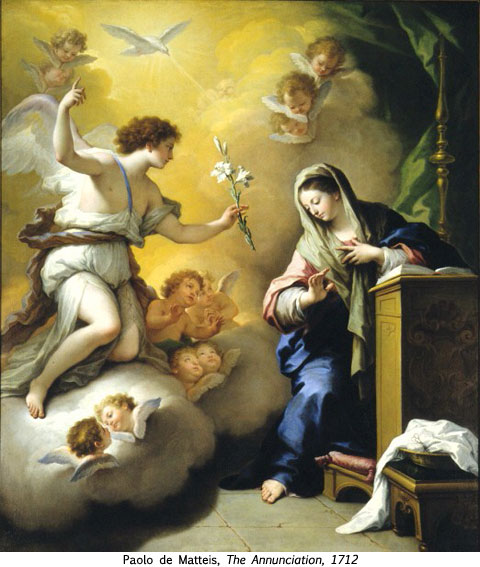
It was prophesied that God should come upon earth.   When the time was now full, how was it announced?   It was announced by the Angel coming to Mary.   “Hail, full of grace,” said Gabriel, “the Lord is with thee; blessed art thou among women.”   She then was the sure promise of the coming Saviour and, therefore, May is, by a special title her month…. taken from Meditations for the Month of May, by Blessed John Henry Newman  (1801-1890)who is the flower but our blessed lord - bl john henry newman - 1 may 2018

Holy Mary, Mother of God and our Mother, Pray for us!mary mother of god pray for us - 1 jan 2018

Posted in CATHOLIC DEVOTIONS of the Month, MARIAN DEVOTIONS, MARIAN PRAYERS, MARIAN QUOTES, MARIAN TITLES, MORNING Prayers, QUOTES of the SAINTS, The BLESSED VIRGIN MARY, The WORD

One Minute Marian Reflection – 1 May – Tuesday of the Fifth Week of Eastertide, the Memorial of St Joseph the Worker and the 1st day of the Month of Mary

One Minute Reflection – 1 May – Tuesday of the Fifth Week of Eastertide, the Memorial of St Joseph the Worker and the 1st day of the Month of Mary

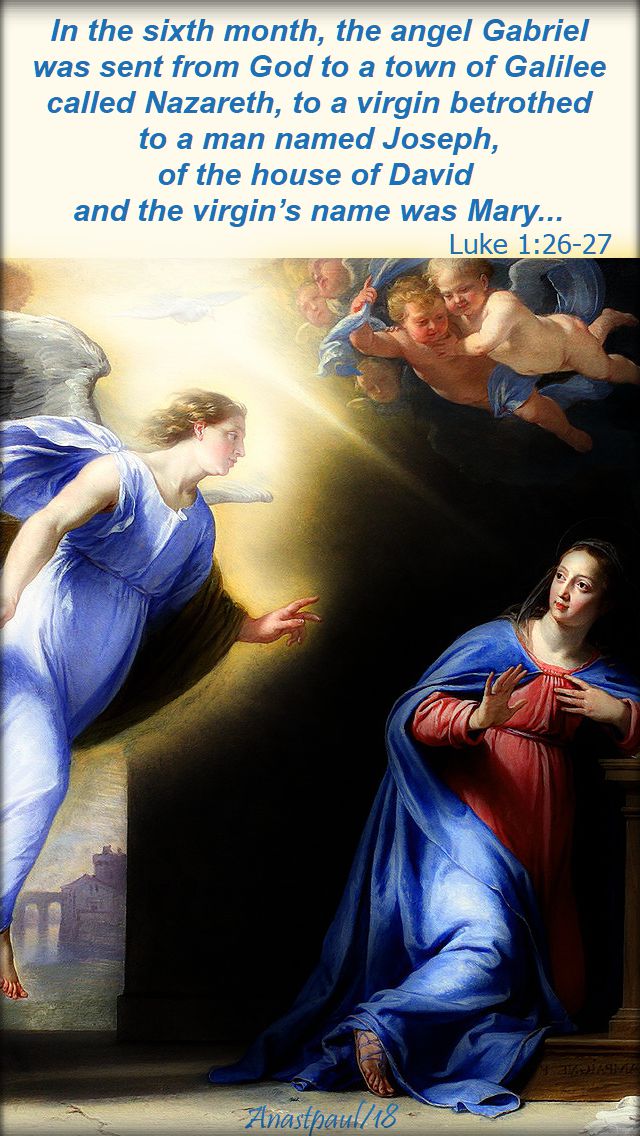
In the sixth month, the angel Gabriel was sent from God to a town of Galilee called Nazareth, to a virgin betrothed to a man named Joseph, of the house of David and the virgin’s name was Mary...Luke 1:26-27in the sixth month the angel Gabriel - luke 1 26-27 - 1 may 2018

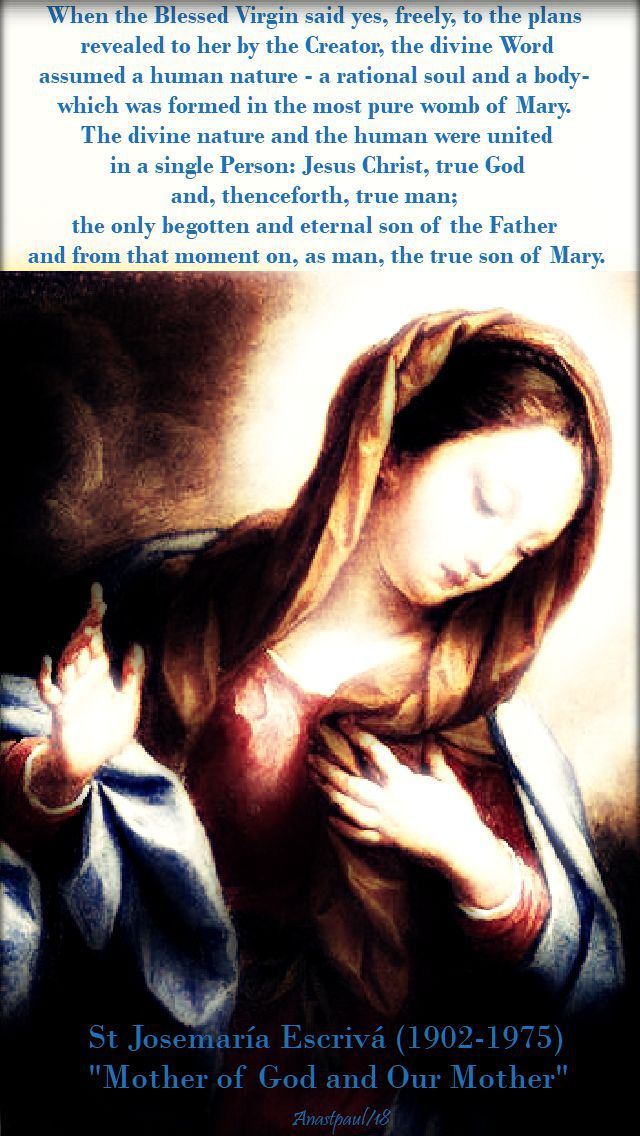
REFLECTION – “MARY, THE MOTHER OF GOD:  “When the Blessed Virgin said yes, freely, to the plans revealed to her by the Creator, the divine Word assumed a human nature — a rational soul and a body – which was formed in the most pure womb of Mary. The divine nature and the human were united in a single Person:  Jesus Christ, true God and, thenceforth, true man;  the only begotten and eternal son of the Father and from that mo­ment on, as man, the true son of Mary.   This is why our Lady is the mother of the Incarnate Word, of the second person of the Blessed Trinity, who has united our human nature to Himself for ever, without any confusion of the two natures.   The greatest praise we can give to the Blessed Virgin is to address her loudly and clearly by the name that expresses her very highest dignity: ‘Mother of God’.
Let us offer to our Mother today:
Brief but frequent prayers of love, such as – “Mother of God, your petitions are most powerful.”St Josemaría Escrivá (1902-1975) – “Mother of God and Our Mother,” – Friends of God 274when the blessed virgin said yes, freely, - st josemaria - 1 may 2018

PRAYER – Almighty God and Father, Your ways are not our ways, teach us to willingly agree to them, for You know which way we should go.   Help us to say “yes” always to Your plan and to render ourselves as a sacrament of Your divine love to all we meet.   Fill us with the grace to be your tools to bring glory to Your kingdom.   Our Father, who art in heaven, may Your Will be done on earth as it is in heaven.   Mary Mother of God, pray for us!   Through our Our Lord Jesus Christ with You, in the union of the Holy Spirit, one God forever, amen.holy mary-mother of god - pray-for-us.- 1 may 2017 and 2018

Posted in MARIAN TITLES, SAINT of the DAY, St JOSEPH

Memorial of St Joseph the Worker, Feast of the Madonna of Giubino and Memorials of the Saints – 1 May

St Joseph the Worker (Optional Memorial)

Madonna of Giubino:

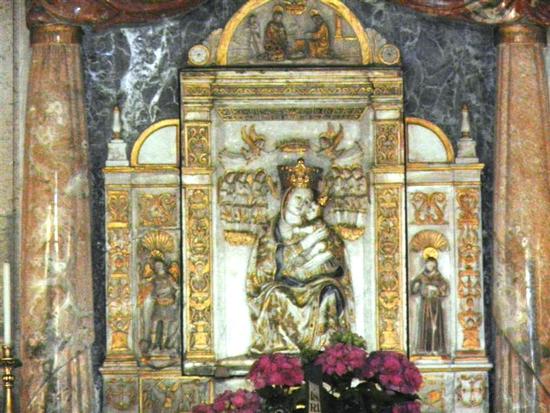
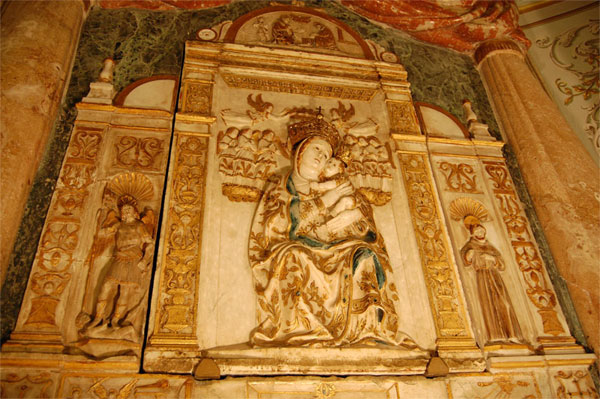
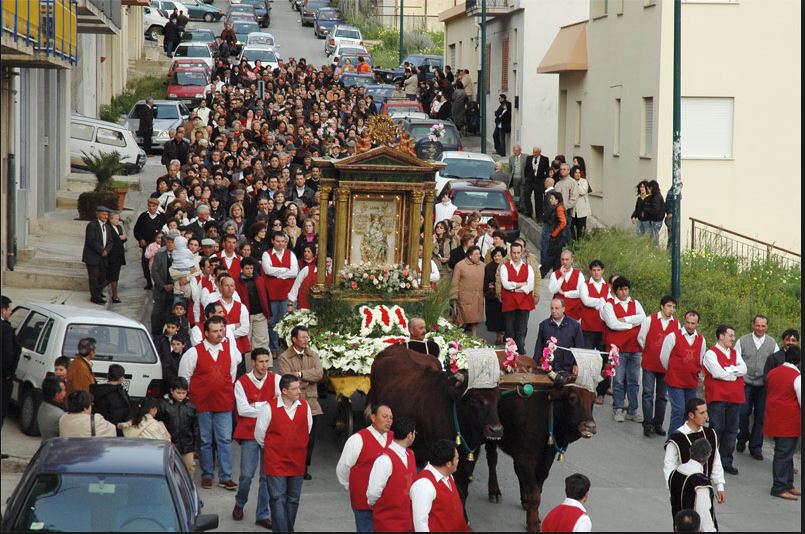
The Church of the Madonna of Giubino was built in 1721 to house a miraculous marble-relief icon of the Madonna, which is brought to a country chapel during the summer.   (A copy of the relief is housed in the Church of St Joseph in Brooklyn, New York, giving testimony to the large emigrant community of Calatafimesi who lived in Brooklyn in the early 20th century).   The Church of Maria Santissima di Giubino is dedicated to the patroness of the town.   It has a single nave, with an elegant barrel vault decorated with frescoes and ornamental motifs.   Inside it there are some important works: the painting with the Assumption, Our Lady with Angels and Saints dated 1617, the altar-piece of All Saints, an 18th-century wooden organ and a 15th-century marble alto-rilievo representing Madonna of Giubino with the Infant Jesus.   In 1655 an invasion of grasshoppers was destroying all the crops in the countryside of Calatafimi: the people, assembled in a Church, decided that, after putting all the names of the saints who had an altar in town inside a ballot box, they would choose as a patron that one whose name had been drawn.   After they invoked the Holy Ghost, it was chosen the name of Maria Santissima di Giubino by lots.   The central part of the triptych with the image of the Virgin was soon taken out from the wall in the country church of Giubino and taken in procession:  Calatafimi was free from grasshoppers.   Maria Santissima di Giubino was elected patroness of the town (25 April 1655) and the bas-relief of the Virgin of Giubino was then placed on the high altar of the new Church, designed by Giovanni Biagio Amico (the same planner of the Church of Santissimo Crocifisso) in 1721.   In 1931 the triptych was recomposed in the town sanctuary and restored. There was a new restoration of the Church in 1978.

giubinogiubino.2fiesta madonna giubino

St Aceolus of Amiens
St Acius of Amiens
St Aldebrandus of Fossombrone
St Amator of Auxerre
St Ambrose of Ferentino
St Andeolus of Smyrna
Bl Arigius of Gap
St Arnold of Hiltensweiler
St Asaph of Llanelwy
St Augustine Schöffler
St Benedict of Szkalka
St Bertha of Avenay
St Bertha of Kent
St Brieuc of Brittany
St Ceallach of Killala
St Cominus of Catania
Evermarus of Rousson
Bl Felim O’Hara
St Grata of Bergamo
St Isidora of Egypt
St Jeremiah the Prophet
St John-Louis Bonnard
Bl Klymentii Sheptytskyi
St Marculf
St Orentius of Auch
St Orentius of Loret
St Patientia of Loret
St Peregrine Laziosi (1260-1345) Incorrupt
Bl Petronilla of Moncel
St Richard Pampuri
St Romanus of Baghdad
St Sigismund of Burgundy
St Theodard of Narbonne
St Thorette
St Torquatus of Guadix
Bl Vivald of Gimignano

Posted in MARIAN QUOTES, MARIAN TITLES, MIRACLES, MORNING Prayers, QUOTES of the SAINTS, SAINT of the DAY

Thought for the Day – 27 April – Friday of the Fourth Week of Eastertide and the Feast of Our Lady of Montserrat

Thought for the Day – 27 April – Friday of the Fourth Week of Eastertide and the Feast of Our Lady of Montserrat

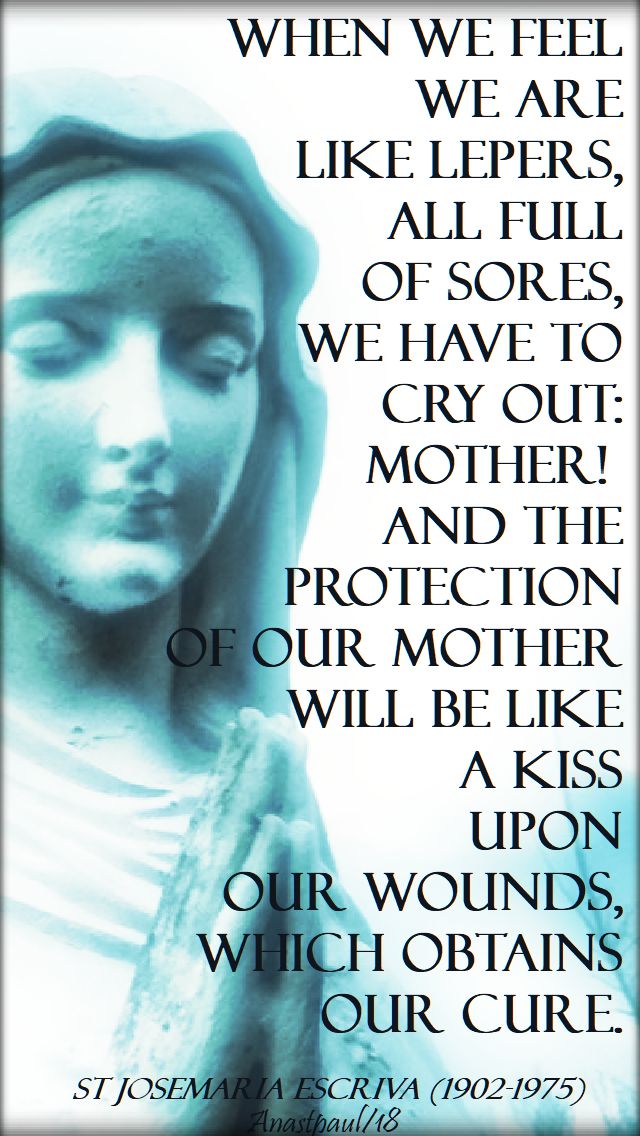
“If I were a leper my mother would hug me.   She would kiss my wounds without fear or hesitation. —Well then, what would the Blessed Virgin Mary do?

When we feel we are like lepers, all full of sores, we have to cry out:  Mother!       And the protection of our Mother will be like a kiss upon our wounds, which obtains our cure. “…St. Josemaria Escriva  (1902-1975) – The Forge, no. 190

when we feel we are like lepers - st josemaria no 2- 27 april 2018

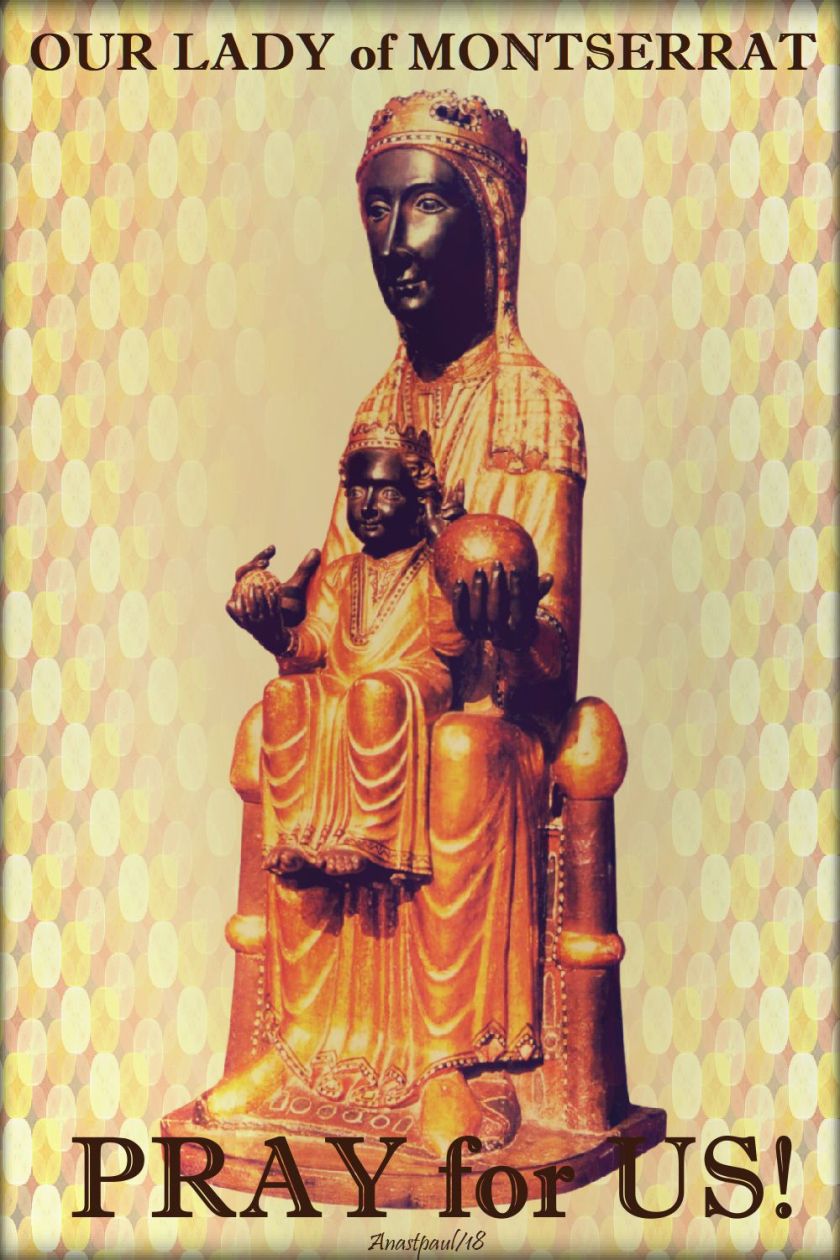
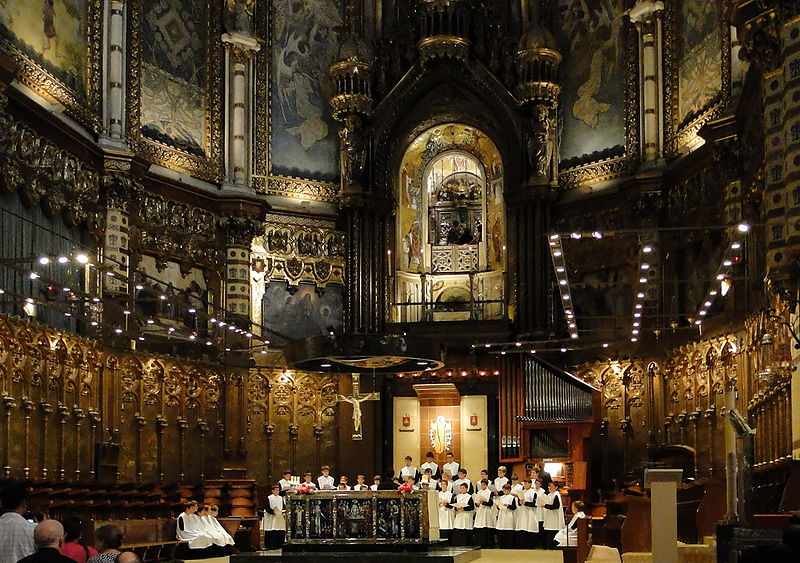
Approximately 28 miles northwest of Barcelona, Spain, is the mountain of Montserrat. Located on the mountain is the Benedictine Monastery and Marian Shrine of Montserrat where since the 8th century pilgrims have journeyed to see the miraculous image of Our Lady of Montserrat.

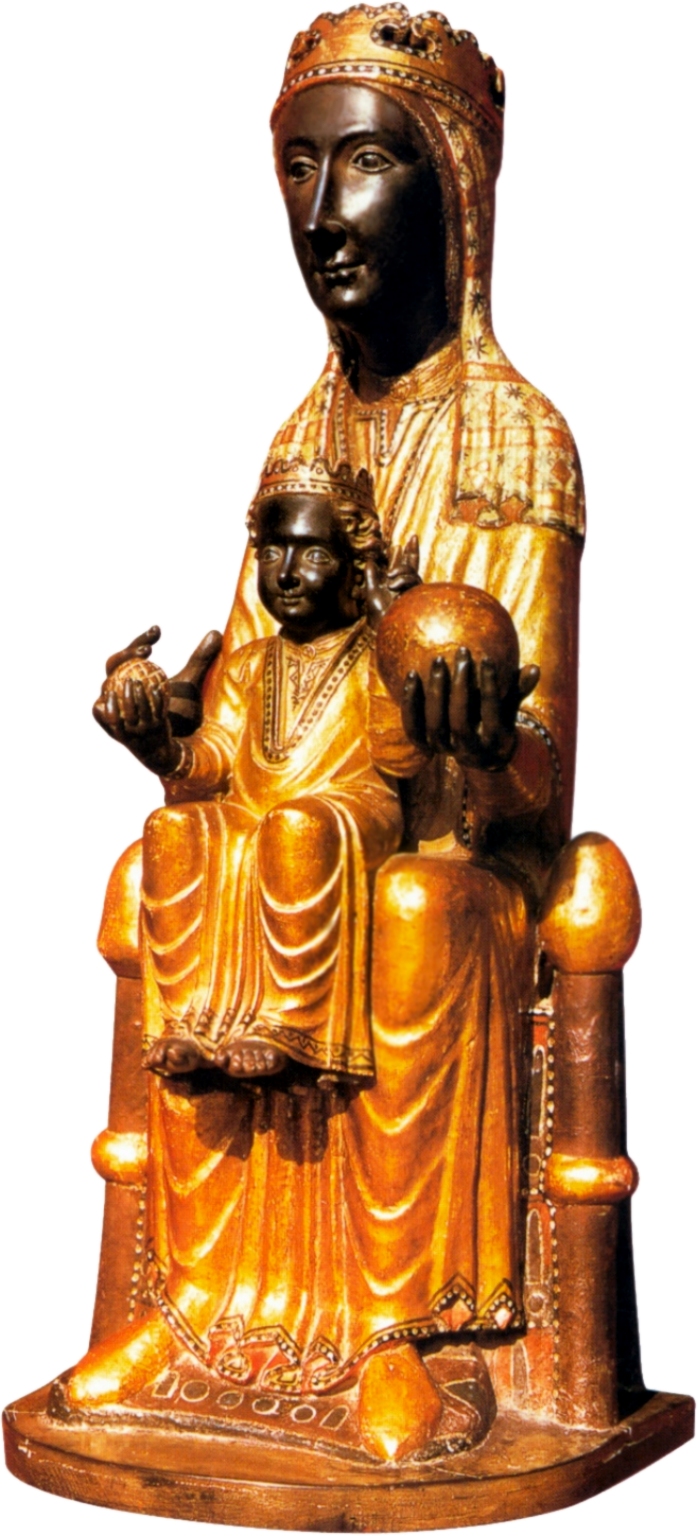
According to tradition, the image of Our Lady was found on the mountain in 718 AD.   The Benedictine Monks chose to build their monastery around the statue of Our Lady because they were unable to lift or move it.   The statue of Our Lady of Montserrat remains on the mountain today, enshrined within the sanctuary in a beautifully decorated chapel.   Our Lady is depicted seated on a throne holding the Child Jesus. Her face and hands have darkened over time due to external elements for which she is affectionately called “La Morenita.”

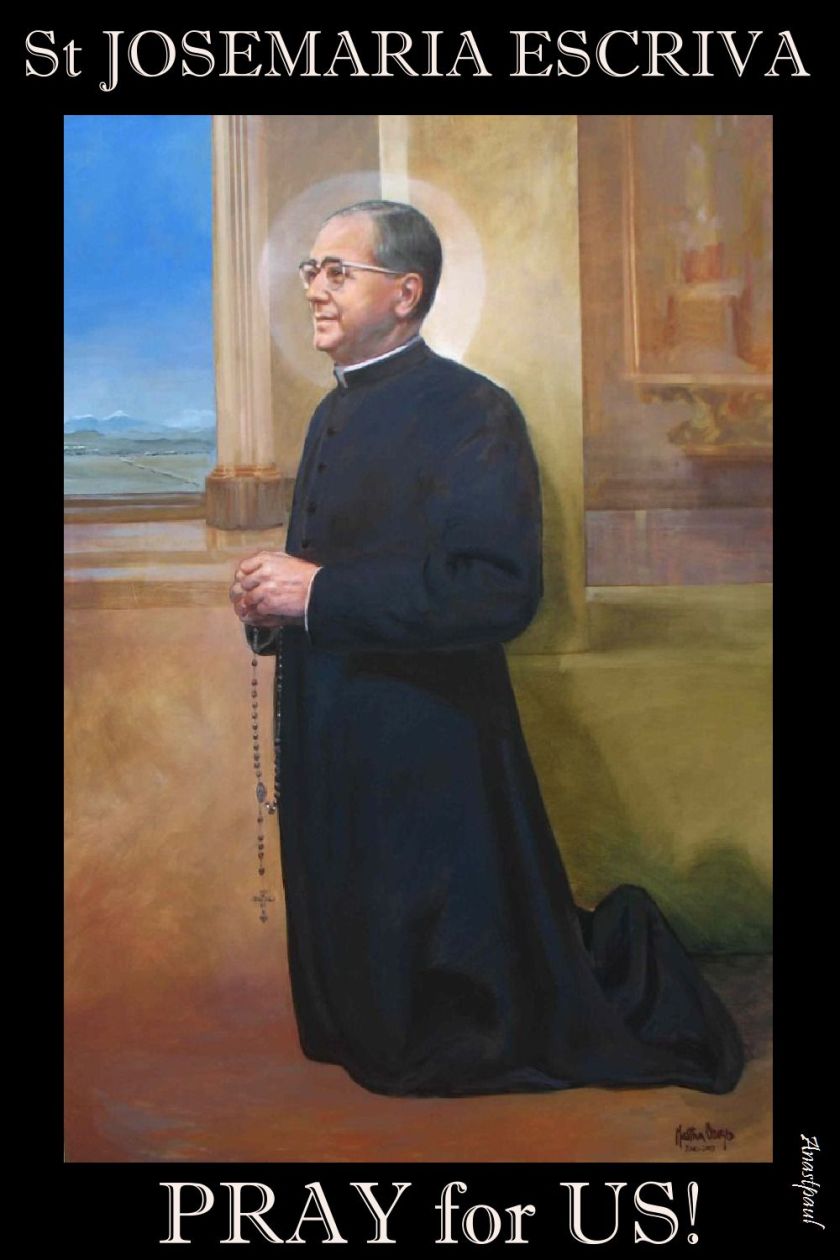
Saints Peter Nolasco, Ignatius Loyola, and Josemaria Escriva are counted among the many pilgrims that throughout the centuries have gone to Our Lady of Montserrat to seek her intercession.   St Josemaria was deeply devoted to Our Lady of Montserrat.   During the 1940’s, he frequently visited the shrine and made an especially important visit in 1946 before departing for Rome, which would become his new permanent home and where would begin an important period in the history of Opus Dei.

A CARESS FROM HIS HEAVENLY MOTHER: CURED OF DIABETES

Despite his move to Rome, St Josemaria’s love for the Blessed Virgin Mary under this advocation continued throughout his life.   And it was on the feast of Our Lady of Montserrat, 27 April 1954, that he was cured of diabetes, after a very severe attack which brought him to the point of death.   The story is told by Jose Miguel Cejas in his book Josemaría Escrivá, un hombre, un camino y un mensaje (“Josemaria Escriva, a man, a way and a message”):

“27 April 1954 and life was going on as usual in Villa Tevere, the headquarters of the Opus Dei prelature in Rome. It was the feast of Our Lady of Montserrat, an ordinary day, filled with prayer and work in the warm Italian springtime.   Recently Escriva’s diabetes had intensified.   Every week he went for a blood test and the results were progressively worse, in spite of a strict diet and the high doses of insulin he was given daily.   Escriva did not lose his peace of mind over this:  God led him along paths of abandonment, humility, simplicity and trust.   That day, following the doctor’s instructions, at ten to one in the afternoon, Alvaro del Portillo had given him an injection with a new prescription of delayed-action insulin.   Afterwards they went down to the dining-room.

Escriva sat down at table and suffered a physical collapse.   He realised that he could be about to die and his instant reaction was to ask for absolution.
“Alvaro, give me absolution.”
“But, Father, what are you saying?”
“Absolution!”
As Fr Del Portillo was too surprised to do anything, Escriva began the words for him, “Ego te absolvo – ” and fell unconscious on the floor.

It was an anaphylactic shock.   Del Portillo gave him absolution, put some sugar in his mouth and made him swallow it, dashed water in his face and moved his head and limbs and quickly summoned a doctor.   Some minutes later, Escriva slowly began to come round, though he found that he could not see anything.

The doctor was astonished, since these types of insulin reaction are normally fatal. However, after some hours Escriva felt better and recovered his sight again.   From that day on, his diabetes was cured.   It had been a caress from his Heavenly Mother, on the feast of Our Lady of Montserrat.”

Our Lady of Montserrat, pray for us!our lady of montserrat pray for us - 27 april 2018

St Josemaria Escriva, pray for us!st josemaria - pray for us

Posted in MARIAN TITLES, SAINT of the DAY

Feast of Our Lady of Montserrat – 27 April

Feast of Our Lady of Montserrat (718) – 27 April, is a Marian title associated with a venerated statue of the Madonna and Child venerated at the Santa Maria de Montserrat monastery on the Montserrat Mountain in Catalonia, Spain. She is the Patron Saint of Catalonia, an honour she shares with Saint George (Sant Jordi in Catalan). Pope Leo XIII granted the image a Canonical coronation on 11 September 1881. The image is one of the Black Madonnas of Europe, hence its familiar Catalan name, La Moreneta (“the little dark-skinned one” or “the little dark one”). Believed by some to have been carved in Jerusalem in the early days of the Church, it is more likely a Romanesque sculpture in wood from the late 12th century. An 18th century polychromed statue of the same image is also displayed in Saint Peter’s basilica, previously stored in the Vatican Museums which was gifted by the President of Brazil, Joao Goulart on the Papal election of Pope Paul VI in 1963. The image has been on display for Papal masses since the Pontificate of Pope Benedict XVI.

hope-montserrat

Blackened by candles that burned before the statue day and night, this particular image dates back to at least the twelfth century.    St Ignatius of Loyola made an annual pilgrimage to Montserrat as have a million or more pilgrims every year in modern times.
The mountain named Montserrat rises 20 miles northwest of Barcelona, in the region of Catalonia, which takes it names from the Spanish, Catalan, for “sawn mountain” probably because its rock outgrowths seem to be the teeth of a saw
 from a distance. These most unusual lofty cone-shaped jags are almost perpendicular.   The highest cone rises to a height of nearly 4,000 feet, while the circumference around the entire base of the mountain is measured at about 12 miles.   The church which contains the miracle-working statue of the Madonna and Child sits about halfway up the mountain.
According to tradition, the miraculous image was first known as La Jerosolimitana (the native of Jerusalem), since it is thought to have been carved there in the early days of the Church.   The statue was eventually given to St Etereo, Bishop of Barcelona, who brought it to Spain.
In the seventh century, when Saracen infidels invaded Spain, the Christians of Barcelona heroically defended it for three years until defeat appeared imminent.   Knowing that they could hold out no longer, they decided to take their treasured image of Our Lady to a secret, safe place.   Quietly, with the knowledge of the Bishop and the Governor of the city, a group brought the statue to Montserrat, placing it in a small cave, on 22 April 718. A complete account  of the origin of the miraculous image, the cause of its removal and the place of its hidden security were recorded and  in the archives of Barcelona.
Even though the location of the statue was eventually forgotten, the people of Barcelona never forgot the holy image for almost 200 years.   Then, in 890, shepherd boys from Monistrol, a village at the foot of Montserrat, were sent unbeknown to them to be the source of the discovery of the treasure.
While tending their flocks that night the shepherds were surprised by lights and the sound of singing coming from the mountain.   When this happened once again, they reported the situation to their priest, who looked into the matter.   He, too, heard the singing and saw the mysterious lights, so he 
reported this to the Bishop, who also witnessed the same occurrences.   At last the statue of Our Lady was discovered in the cave and brought out and placed in a small church that was soon built;  this little church developed into the present church that was completed in 1592.
In 888 there had already been a chapel dedicated to Our Lady and it was at that spot that the present shrine is located.   Eventually a monastery was added, which grew rapidly, because of the miracles wrought there by the Blessed Virgin.   According to the caretakers of the shrine, the statue that still presides over the monastery was introduced in the twelfth or thirteenth century.   This statue might have replaced an earlier one, which could have been destroyed during one of the many wars.
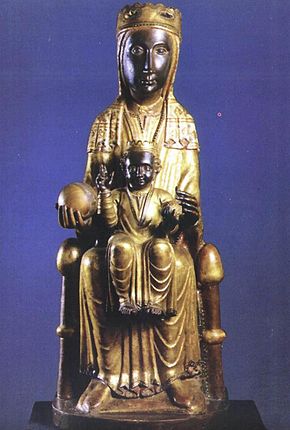
Carved in wood, the statue is in a sitting position and measures slightly over three feet in height.   In Romanesque style, the figure is slender, with an elongated face and a delicate expression.   The dress of the Virgin consists of a tunic and cloak both gilded and plain in design which is draped.   Beneath the crown is a veil adorned with stars, squares, and stripes in subtle shades of colour.   The right hand of the Virgin holds a sphere, while the other is extended in a graceful gesture.   The Child Jesus sits on His Mother’s lap and also wears a crown and lovely garments.   His right hand is raised in blessing; His left hand holds an object that resembles a large pine cone.   A cushion serves as the Madonna’s footrest;  she is seated upon a chair that has large legs and whose back is topped by cone-shaped finials.   The statue is highly revered not only as a religious treasure but also because of its artistic value.   It is almost completely gilded, save the face and hands of both Our Lady and the Child Jesus 
[and His feet also].   Unlike many old statues which are black because of the kind of wood or the effects of the original paint, the dark colour of Our Lady of Montserrat is attributed to the innumerable candles and lamps used in its veneration.   Because of this dark colour it is affectionately called La Moreneta, The Dark Little One.   Thus, the Virgin of Montserrat is classified among the Black Madonnas.
The image is in an alcove behind the main altar.   It can be reached by climbing decorated stairs to the side of the church. The stairs lead to a large room which is directly behind the alcove where the statue is enthroned. This large room is called the Camarin de La Virgen, the Chamber of the Virgin.   A large number of people can fit in the space to pray beside the throne of the Blessed Mother.   The pilgrim cannot touch the image, however, since it is protected by a glass. 

A_Virgem_de_Mont_Serrat
Although not located on the peak of the mountain as are the sanctuaries of Monte Cassino and Le Puy, the monastery is situated high enough from the surrounding area to make one think it safe from attack.   Yet the monastery sustained considerable damage during the Napoleonic invasion.   Additional harm was inflicted during civil wars and revolutionary disturbances.   The treasured image of the Madonna and Child was hidden during these times but was soon restored to its place of honour when the church and buildings were quickly repaired.   These buildings were spared during the Spanish Civil War of 1936-1939 by the Autonomous Government of Catalonia. 

800px-Abbey_of_Montserrat_02
Benedictines settled in the monastery hundreds of years ago and still maintain the sanctuary and provide hospitality to the steady stream of pilgrims who go there.   The number of historical figures connected to the sanctuary or who have visited it, including one of its hermits, Bernat Boil, who accompanied Christopher Columbus to the New World, thus becoming the first missionary to America.   One of Montserrat’s first abbots became Julius II, the Renaissance Pope for whom Michelangelo worked.   Emperor Charles V and Philip II of Spain both died with blessed candles from the sanctuary in their hands.   King Louis XIV of France had intercessory prayers said at Montserrat for the Queen Mother and Emperor Ferdinand III of Austria made generous financial gifts to the monastery.   All the kings of Spain prayed at the shrine, as did Cardinal Roncalli, who later became St Pope John XXIII. 

basilica of the Abbey of Montserrat, Catalonia, Spainour lady of montserrat
Some of the Saints who visited there were St Peter Nolasco, St Raymond of Penafort, St Vincent Ferrer, St Francis Borgia, St Aloysius Gonzaga, St Joseph Calasanctius, St Anthony Mary Claret and St Ignatius, who as a knight was confessed by one of the monks.   After spending a night praying before the image of Our Lady of Montserrat, he began his new life and the founding of Jesuit order.   A few miles away is Manresa, a pilgrim shrine of the Society of Jesus.   The shrine holds the cave wherein St Ignatius Loyola retired from the world and wrote his Spiritual Exercises.
The Virgin of Montserrat was declared the Patron Saint of the Diocese of Catalonia by Leo XIII.   The statue has always been one of the most celebrated images in Spain.
A historian wrote:  “In all ages the sinful, the suffering, the sorrowful, have laid their woes at the feet of Our Lady of Montserrat and none have ever gone away unheard or unaided.” 

montserrat

Posted in MARIAN TITLES, SAINT of the DAY

Feast of Our Lady of Montserrat and Memorials of the Saints 27 April

Our Lady of Montserrat:  (718) Our Lady is venerated under the invocation of the Virgin of Montserrat or “Rosa d’abril” – because of the Virolai hymn sung to her – at the Santa Maria de Montserrat monastery in the Montserrat mountain in Catalonia, Spain.
It is one of the black Madonnas of Europe, hence its familiar Catalan name, la Moreneta (“The little dark-skinned one”).
Believed by some to have been carved in Jerusalem in the early days of the Church. Legend has it that the Benedictine monks could not move the statue to construct their monastery, choosing to instead build around it.
On 11 September 1844, Pope Leo XIII declared the virgin of Montserrat patroness of Catalonia, Spain.

St Adelelmus of Le Mans
St Asicus of Elphin
St Castor of Tarsus
St Enoder
St Floribert of Liege
Bl Hosanna of Cattaro
Bl Jakov Varingez
St John of Kathara
St Joseph Outhay Phongphumi
St Laurensô Nguyen Van Huong
St Liberalis of Treviso
St Maughold
Bl Nicolas Roland
St Noël Tenaud
Bl Peter Armengol
St Pollio of Cybalae
St Simeon of Jerusalem
St Stephen of Tarsus
St Tertullian of Bologna
St Theophilus of Brescia
St Winewald of Beverley
St Zita of Lucca

Martyrs of Nicomedia: A group of Christians murdered together for their faith. In most cases all we have are their names – Dioscurus, Evanthia, Felicia, Felix, Germana, Germelina, Johannes, Julius, Laetissima, Nikeforus, Papias, Serapion and Victorinus. They died at Nicomedia, Bithynia, Asia Minor (modern Izmit, Turkey).

Posted in MARIAN TITLES, SAINT of the DAY

Feast of Our Lady of Good Counsel and Memorials of the Saints – 26 April

Our Lady of Good Counsel (Memorial) – https://anastpaul.wordpress.com/2017/04/26/thought-for-the-day-26-april/

our-lady-of-good-counsel-pray-for-us

Bl Alda of Siena
St Antoninus of Rome
St Basileus of Amasea
St Clarence of Venice
St Claudius of Rome
St Pope Cletus
St Cyrinus of Rome
St Exuerantia of Troyes
Bl Gregory of Besians
Bl Juli Junyer Padern
St Lucidius of Verona
St Pope MarcellinusSt
Paschasius Radbertus
St Pelligrino of Foggia
St Peter of Braga
St Primitive of Gabi
St Rafael Arnáiz Barón (1911-1938)

St Richarius of Celles
Bl Stanislaw Kubista
St Trudpert of Munstertal
St William of Foggia
Bl Wladyslaw Goral

Posted in MARIAN TITLES, SAINT of the DAY, The BLESSED VIRGIN MARY

Feast of Our Lady of Bonnaria, Our Lady of Luján and Memorials of the Saints – 24 April

St Fidelis of Sigmaringen (1577-1622) Known as “The Poor Man’s Lawyer” (Optional Memorial)

Our Lady of Bonaria:   Devotion to the Blessed Virgin Mary in the form of a statue of Mary and the Christ Child that was washed up at a Mercedarian monastery near Cagliari, Italy on 25 April 1370, apparently from a shipwreck the night before.   Legend says that the locals tried to open the crate it was in, but only one of the Mercedarian monks could get the it open.   Patron of Sardinia, Italy.

Our Lady of Bonaria

Our Lady of Luján in Buenos Aires:   Virgin of Luján, Patroness of Argentina, Uruguay and Paraguay. 16th-century icon of the Virgin Mary.   Tradition holds that a settler ordered the terracotta image of the Immaculate Conception in 1630 because he intended to create a shrine in her honour to help reinvigorate the Catholic faith in Santiago del Estero, his region.   After embarking from the port of Buenos Aires, the caravan carrying the image stopped at the residence of Don Rosendo Oramas, located in the present town of Zelaya.   When the caravan wanted to resume the journey, the oxen refused to move. Once the crate containing the image was removed, the animals started to move again. Given the evidence of a miracle, people believed the Virgin wished to remain there.   The image was venerated in a primitive chapel for 40 years.   Then the image was acquired by Ana de Matos and carried to Luján, where it currently resides.
Among the Popes who have honoured Our Lady of Luján are Clement XI, Clement XIV, Pius VI, Pius IX, Leo XIII, Pius XI, Venerable Pius XII, and St John Paul II.   In 1824, Fr John Mastai Ferretti visited the shrine on his way to Chile.   He later became Pope Pius IX and defined the dogma of the Immaculate Conception on 8 December 1854.
Because of the reputation of the shrine, Pope Leo XIII decided in 1886 to honour the miraculous statue with a Canonical Coronation.   On 30 September of that year, he blessed the crown, which was made of pure gold and set with 365 diamonds, rubies, emeralds and sapphires, 132 pearls and a number of enamels depicting the emblems of the Archbishop and the Argentine Republic.   The papal coronation of Our Lady of Luján took place on 8 May 1887.   The celebrant chosen by the Pope for this event was Archbishop Federico León Aneiros who at that time made a pilgrimage in thanksgiving to Our Lady for sparing his archdiocese from the scourge of cholera.   On 8 September 1930, Pope Pius XI formally declared Our Lady of  Luján. as the Patroness of Argentina, Paraguay and Uruguay.   The Papal document was signed by Cardinal Eugenio Pacelli, the future Venerable Pope Pius XII.
In 1982, during the Falklands War, St Pope John Paul II became the first pope to visit Our Lady of Luján.   During this visit the Pope celebrated an outdoor Mass in the square of the Basilica of Our Lady of Luján and bestowed upon her the Golden Rose.   Both in his homily of June 11 and his Angelus back in Rome reflecting on the trip, he commented on Our Lady’s never failing maternal solicitude for the faithful in times of distress.   Sixteen years later in Rome, St John Paul II gave a replica of the image to the Argentine National Parish during his pastoral visit there.
The Golden Rose is a gift from the Pope to nations, cities, basilicas, sanctuaries or images. It is blessed by him on the fourth Sunday of Lent, anointed with the Holy Chrism and dusted with incense.   This Rose consists of a golden rose stem with flowers, buds and leaves, placed in a silver vase lined on the inside with a bronze case bearing the Papal shield.   Pope Leo IX is considered as the originator of this tradition in the year 1049.
In the Americas, the Rose has been given to Our Lady of Guadalupe in Mexico, to Our Lady of Aparecida in Brazil, to St Joseph’s Oratory in Canada, to the Basilica of the National Shrine of the Immaculate Conception in the United States, to the Cathedral Basilica of Nuestra Señora del Valle in Argentina and to the Basílica Santuario Nacional de Nuestra Señora de la Caridad del Cobre in Cuba.   On 11 June 1982, St John Paul II personally bestowed a Golden Rose on Our Lady of Luján.


St Alexander of Lyon
St Anthimos of Nicomedia
St Authairius of La Ferté
St Benedetto Menni
St Bova of Rheims
St Deodatus of Blois
St Diarmaid of Armagh
St Doda of Rheims
St Dyfnan of Anglesey
St Egbert of Rathemigisi
St Eusebius of Lydda
St Gregory of Elvira
St Honorius of Brescia
St Ivo of Huntingdonshire
St Leontius of Lydda
St Longinus of Lydda
St Mary Euphrasia Pelletier (1796-1868)

St Mary of Cleophas
St Mary Salome
St Mellitus of Canterbury
St Neon of Lydda
St Sabas the Goth of Rome
St Tiberio of Pinerolo
St William Firmatus

Mercedarian Martyrs of Paris: No info yet.

Posted in MARIAN TITLES, MIRACLES, MORNING Prayers, QUOTES of the SAINTS, QUOTES on LOVE, QUOTES on SANCTITY, SAINT of the DAY, The HOLY EUCHARIST / The HOLY MASS

Quote/s of the Day – 16 April – Monday of the Third Week of Eastertide and the Memorial of St Bernadette Soubirous (1844-1879)

Quote/s of the Day – 16 April – Monday of the Third Week of Eastertide and the Memorial of St Bernadette Soubirous (1844-1879)

“Nothing is anything anymore to me,
everything is nothing to me,
only Jesus!
Neither things,
nor persons,
neither ideas,
nor emotions,
neither honour,
nor sufferings.
Jesus is for me honour,
delight,
heart and soul.”nothing is anything anymore to me - st bernadette - 16 april 2018

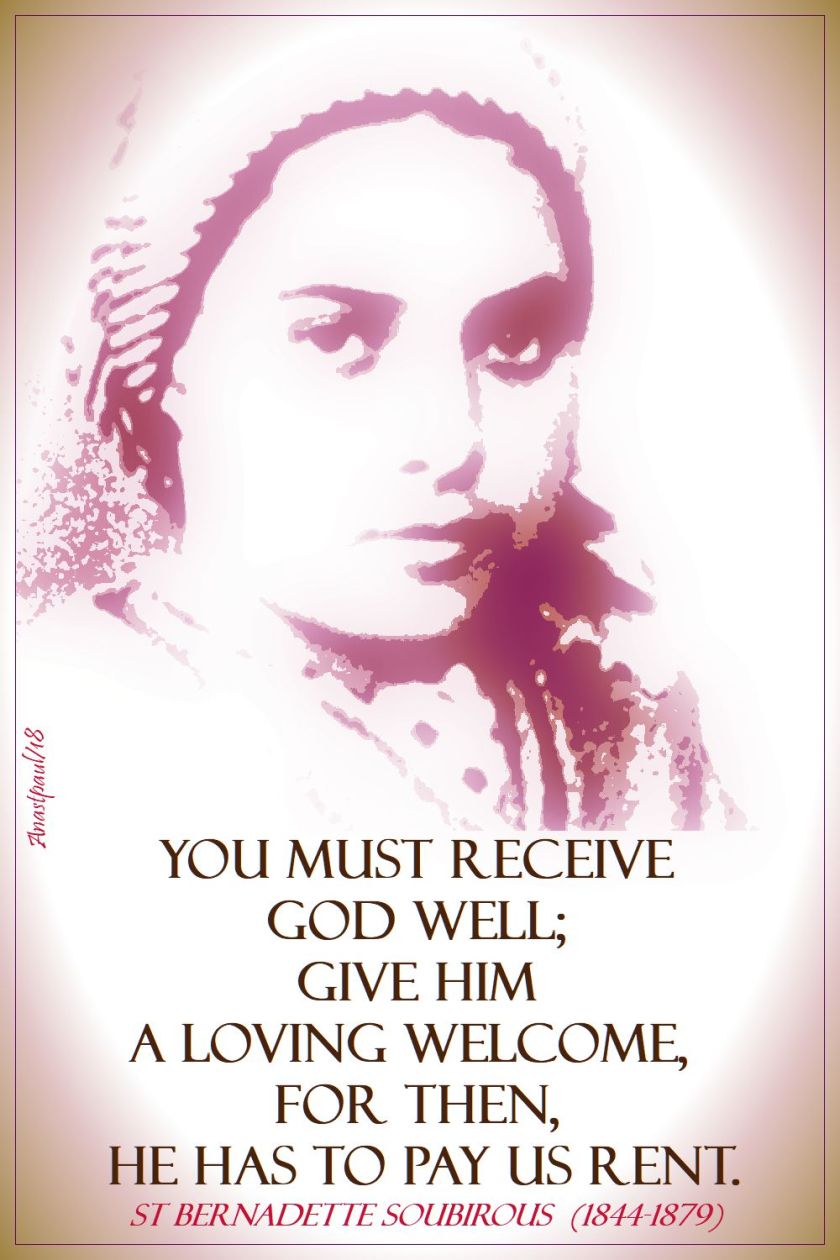
“You must receive God well – 
give Him a loving welcome,
for then, He has to pay us rent.”

St Bernadette Soubirous (1844-1879)you must receive god well - st bernadette - 16 april 2018

Posted in INCORRUPTIBLES, MARIAN TITLES, MIRACLES, Of BEGGARS, the POOR, against POVERTY, Of the SICK, the INFIRM, All ILLNESS, SAINT of the DAY, The BLESSED VIRGIN MARY

Saint of the Day – 16 April – Saint Bernadette Soubirous (1844-1879)

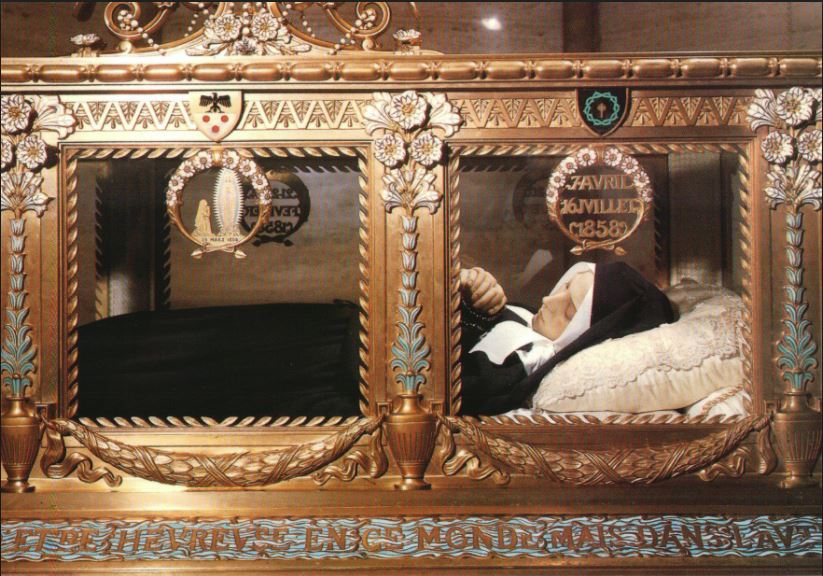
Saint of the Day – 16 April – Saint Bernadette Soubirous (1844-1879) Marian Visionary of Lourdes, Virgin, Consecrated Religious.  Born on 7 January 1844 at Lourdes, Hautes-Pyrénées, France and died on 16 April 1879, Nevers, Nièvre, France of natural causes, aged 35.   Patronages – Bodily illness,  Lourdes, France, shepherds, against poverty, people ridiculed for their faith.   She was Canonised on 8 December 1933 by Pope Pius XI.   Her Body is incorrupt and is on display in Nevers, France.st-bernadette-soubirous1St. Bernadette -at Death & Todayst bernadette's incorrupt body
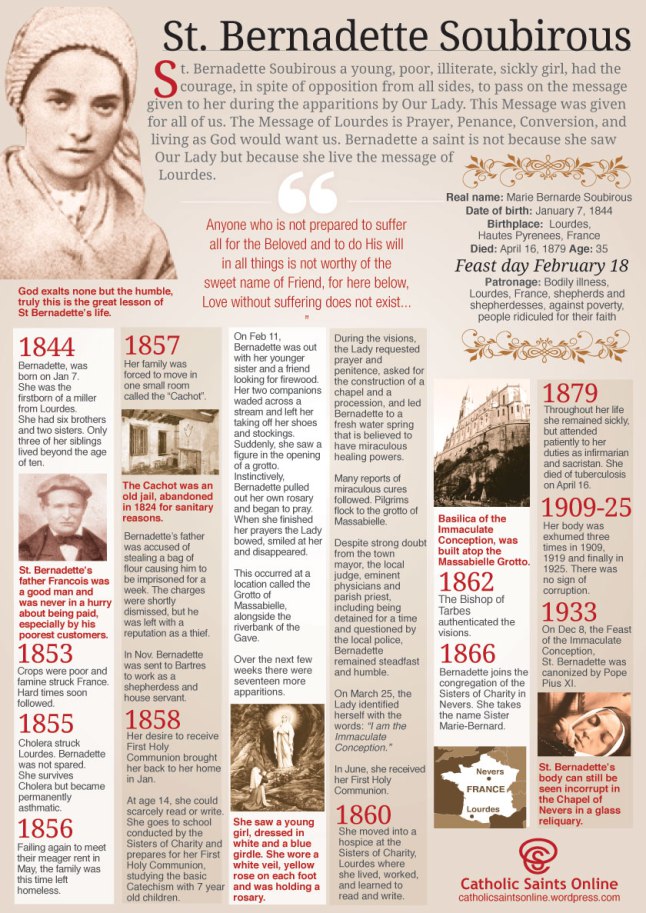
The eldest of nine children, only four of whom survived childhood, Marie-Bernarde Soubirous was born at Lourdes, in the foothills of the Pyrenees.   After her father, a miller, lost his job in 1854, the family was exposed to the direst extremes of poverty.

By the time she was 14, Bernadette had been sick so often that she hadn’t grown properly.   She was the size of a much younger girl.   She, her parents and her younger brothers and sisters all lived in a tiny room at the back of someone else’s house, a building that had actually been a prison many years before.   They slept on three beds: one for the parents, one for the boys and one for the girls.   Every night they battled mice and rats.   Every morning, they woke up, put their feet on cold stone floors and dressed in clothes that had been mended more times than anyone could count.   Each day they hoped the work they could find would bring them enough bread to live on that day.

“Bernadette” grew up uneducated, undernourished and asthmatic, obliged to work as a waitress and a farmhand.   The little girl spoke in a Basque dialect and could scarcely read or write.   She did, however, imbibe from her parents a deep Catholic devotion.

By 1856 the Soubirous were living in an abandoned prison cell which stank of sewage. On 11 February 1858 Bernadette, with her sister Toinette and a friend, went to gather firewood.   In a grotto beside the River Gave, at a place used as a watering hole for pigs, she saw a vision of a “Lady” wearing a white dress, a blue girdle and a yellow rose on each foot.   Bernadette’s companions saw nothing and she herself wondered whether her experience had been an illusion.   Three days later, though, she returned to the grotto, and again saw the apparition.   On 18 February her third visit, the vision spoke for the first time, asking for her presence over the next fortnight.   Next day, the Lady instructed Bernadette to tell the priests to build a chapel at the grotto.
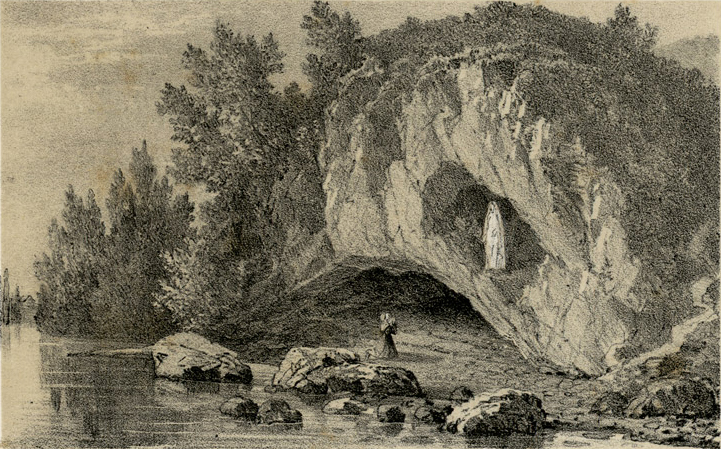
Grotte_miraculeuse_à_Lourdes_Charles_Mercereau

Crowds began to gather to witness the regular phenomenon of the small girl in ecstasy. The police, concerned, interrogated Bernadette, who related her experiences with clarity and conviction.   Local interest quickened after the Lady told Bernadette to drink from a muddy trickle in the grotto.   By the morrow the trickle had turned into an active spring.

On 4 March at the end of the prescribed fortnight, a crowd of 10,000 gathered to watch Bernadette.   In fact, she would experience three more apparitions, bringing the total to 18.   Chivied by the parish priest, she insisted that the Lady should give her name.   “I am the Immaculate Conception,” came the reply, in perfect Basque dialect.   Bernadette had no idea what this meant.   She repeated it to herself over and over on her way back to the village so she wouldn’t forget the strange, long words.   When she told her parish priest what the lady had said, he was quite surprised.   The priest knew that what the mysterious lady had said meant that she was Mary, Jesus’ mother.   The mysterious lady of the grotto had told Bernadette who she was.   But it was not very common for people—especially poor little girls who couldn’t read—to think of Mary as the “immaculate conception,” a phrase that reminds us of how God saved Mary from sin even before she was born.   The Blessed Virgin also told her:   “I do not promise to make you happy in this world but in the next,” the apparition had told her.

Disliking the attention she was attracting, Bernadette went to the hospice school run by the Sisters of Charity of Nevers where she had learned to read and write.   Although she considered joining the Carmelites, her health precluded her entering any of the strict contemplative orders.   On 29 July 1866, with 42 other candidates, she took the religious habit of a postulant and joined the Sisters of Charity at their motherhouse at Nevers.   Her Mistress of Novices was Sister Marie Therese Vauzou.   The Mother Superior at the time gave her the name Marie-Bernarde in honour of her godmother who was named “Bernarde”.

st bernadette - nun

Bernadette spent the rest of her brief life there, working as an assistant in the infirmary and later as a sacristan, creating beautiful embroidery for altar cloths and vestments. Her contemporaries admired her humility and spirit of sacrifice.   One day, asked about the apparitions, she replied:

“The Virgin used me as a broom to remove the dust.   When the work is done, the broom is put behind the door again.” and  “They think I’m a saint,” she observed. “When I’m dead they’ll come and touch holy pictures and rosaries to me, and all the while I’ll be getting boiled on a grill in purgatory.”

She later contracted tuberculosis of the bone in her right knee.   She had followed the development of Lourdes as a pilgrimage shrine while she still lived at Lourdes but was not present for the consecration of the Basilica of the Immaculate Conception there in 1876.
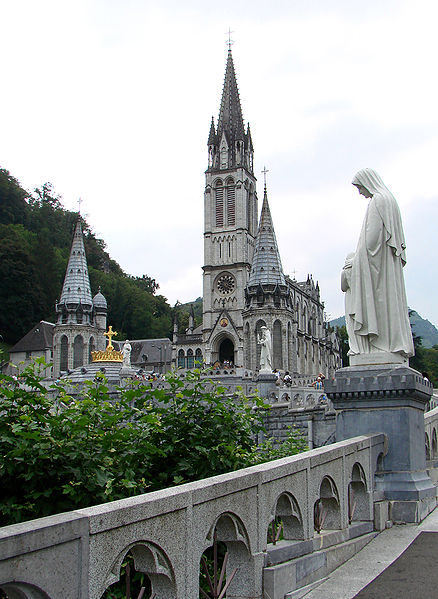
438px-Lourdes_ND_Rosaire_03

For several months prior to her death, she was unable to take an active part in convent life.   She eventually died of her long-term illness at the age of 35 on 16 April 1879 (Easter Wednesday) while praying the holy rosary.   On her deathbed, as she suffered from severe pain and in keeping with the Virgin Mary’s admonition of “Penance, Penance, Penance,” Bernadette proclaimed that “all this is good for Heaven!”   Her final words were, “Blessed Mary, Mother of God, pray for me! A poor sinner, a poor sinner”. 

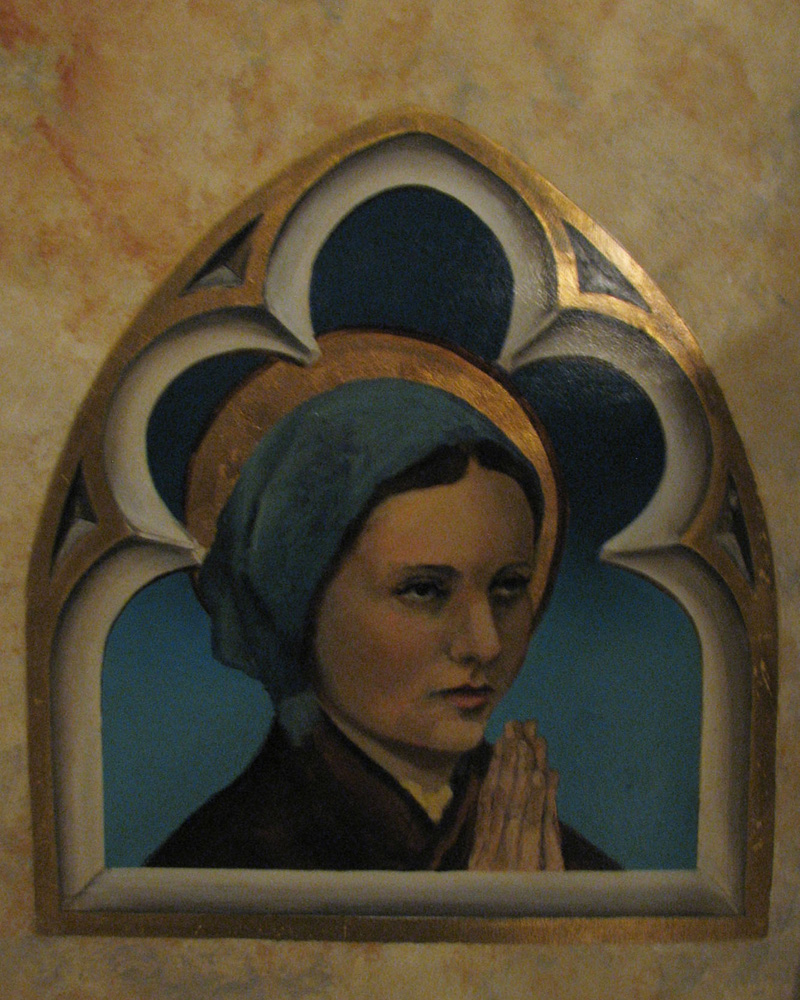
In the 1858 Lourdes apparitions, the Blessed Virgin Mary declared herself as the Immaculate Conception to the innocent little shepherd girl named Bernadette: … The Immaculate Conception (CCC, 490-3)st bernadette in art
Posted in EUCHARISTIC Adoration, MARIAN TITLES, MIRACLES, SAINT of the DAY

Memorials of the Saints – 16 April

Bl Arcangelo Canetoli
St Benedict Joseph Labre – Known as the Beggar of Perpetual Adoration (1748-1783)

St Bernadette of Lourdes – The Visionary of Lourdes (1844-1879)

St Drogo
St Elias
St Fructuosus of Braga
St Herveus of Tours
Bl Joachim Piccolomini
St Lambert of Saragossa
St Magnus of Orkney
St Turibius of Astorga
St Vaise
St William Gnoffi

Martyrs of Avrillé – 26 beati: – A group of lay people who were executed together for their faith during the anti-Christian persecutions of the French Revolution. They were martyred on 16 April 1794 at Avrillé, Maine-et-Loire, France.
• Blessed Anne Maugrain
• Blessed François Micheneau veuve Gillot
• Blessed François Suhard veuve Ménard
• Blessed Jean Ménard
• Blessed Jeanne Gourdon veuve Moreau
• Blessed Jeanne Leduc épouse Paquier
• Blessed Jeanne Onillon veuve Onillon
• Blessed Jeanne Thomas veuve Delaunay
• Blessed Madeleine Cady épouse Desvignes
• Blessed Madeleine Sallé épouse Havard
• Blessed Marguerite Robin
• Blessed Marie Forestier
• Blessed Marie Gingueneau veuve Coiffard
• Blessed Marie Lardeux
• Blessed Marie Piou épouse Supiot
• Blessed Marie Rechard
• Blessed Marie Roger veuve Chartier
• Blessed Marie-Genevieve Poulain de la Forestrie
• Blessed Marthe Poulain de la Forestrie
• Blessed Perrine Bourigault
• Blessed Perrine Laurent
• Blessed Perrine Pottier épouse Turpault
• Blessed Pierre Delépine
• Blessed Renée Bourgeais veuve Juret
• Blessed Renée Rigault épouse Papin
• Blessed Renée Sechet veuve Davy
16 April 1794 at Avrillé, Maine-et-Loire, France – Beatified: 19 February 1984 by Pope John Paul II at Rome, Italy

Martyrs of Corinth – 9 saints: A group of nine Christians who were tortured and martyred together in the persecutions of Decius. We know little more than three of their names – Callistus, Charisius and Leonide. They were thrown into the sea at Corinth, Greece c250

Martyrs of Saragossa: Group of eighteen martyrs murdered in 304 in Saragossa, Spain in the persecutions of Diocletian and the prefect Dacean. We know little more than the names – Apodemus, Caecilian, Caius, Crementius, Engratia, Eventius, Felix, Fronto, Gaius, Julia, Lambert, Lupercus, Martial, Optatus, Primitivus, Publius, Quintilian, Saturnius (4 men of this name), Succesus and Urban. Their graves re-discovered in 1389 in the crypt under the church of San Encrazia in Saragossa.

Posted in DEVOTIO, HOLY WEEK, MARIAN TITLES, MORNING Prayers, PAPAL SERMONS, PRACTISING CATHOLIC, The BLESSED VIRGIN MARY

Sabbatum Sanctum – Holy Saturday: “Watching” and The Easter Vigil of the Holy Night

Sabbatum Sanctum – Holy Saturday:  “Watching” and The Easter Vigil of the Holy Night

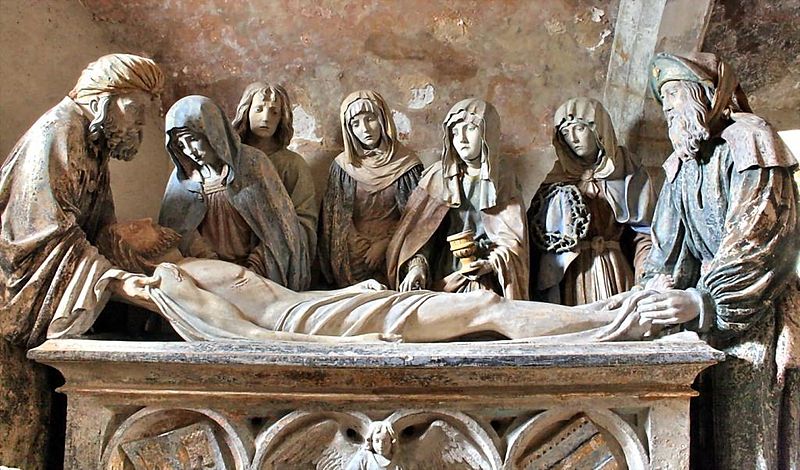
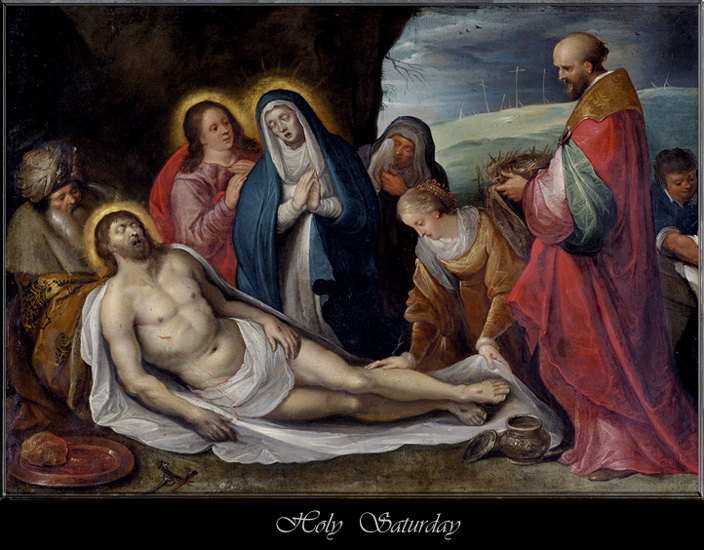
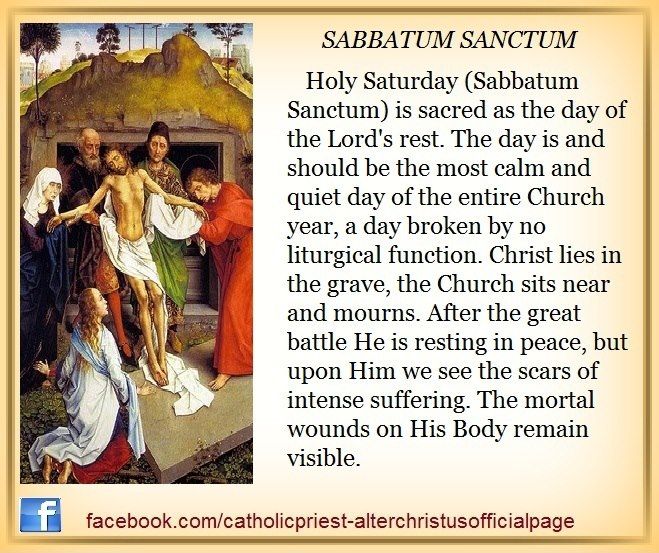
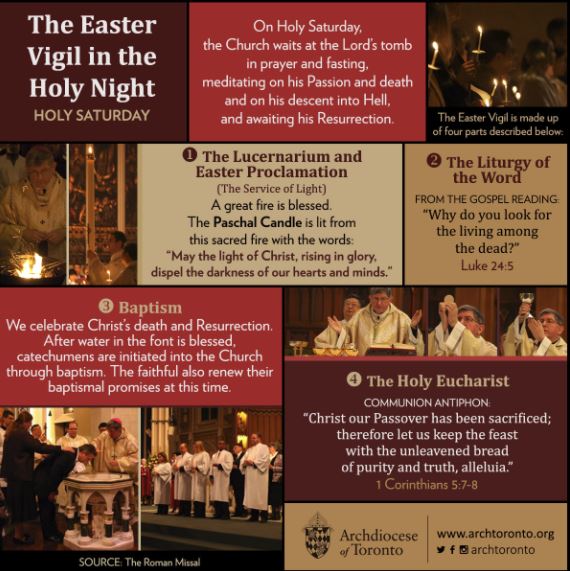
On Holy Saturday the Church waits at the Lord’s tomb, meditating on His suffering and death.   The altar is left bare and the sacrifice of the Mass is not celebrated.   Only after the solemn vigil during the night, held in anticipation of the resurrection, does the Easter celebration begin, with a spirit of joy that overflows into the following period of fifty days.The Entombment by the Maitre du Chaorce. “HOLY SAT 2

Holy Saturday (from Sabbatum Sanctum, its official liturgical name) is sacred as the day of the Lord’s rest; it has been called the “Second Sabbath” after creation.   The day is and should be the most calm and quiet day of the entire Church year, a day broken by no liturgical function.   Christ lies in the grave, the Church sits near and mourns.   After the great battle He is resting in peace but upon Him we see the scars of intense suffering…The mortal wounds on His Body remain visible…Jesus’ enemies are still furious, attempting to obliterate the very memory of the Lord by lies and slander.
HOLY SAT INFOHOLY SAT INFO 2HOLY SAT INFO 3

Mary and the disciples are grief-stricken, while the Church must mournfully admit that too many of her children return home from Calvary cold and hard of heart.   When Mother Church reflects upon all of this, it seems as if the wounds of her dearly Beloved were again beginning to bleed.

According to tradition, the entire body of the Church is represented in Mary:  she is the “credentium collectio universa” (Congregation for Divine Worship, Lettera circolare sulla preparazione e celebrazione delle feste pasquali, 73).   Thus, the Blessed Virgin Mary, as she waits near the Lord’s tomb, as she is represented in Christian tradition, is an icon of the Virgin Church keeping vigil at the tomb of her Spouse while awaiting the celebration of His resurrection.


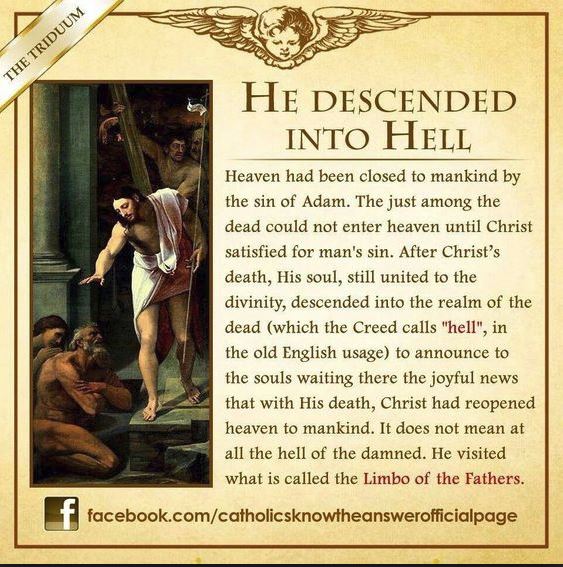
The pious exercise of the Ora di Maria is inspired by this intuition of the relationship between the Virgin Mary and the Church:  while the body of her Son lays in the tomb and His soul has descended to the dead to announce liberation from the shadow of darkness to His ancestors, the Blessed Virgin Mary, foreshadowing and representing the Church, awaits, in faith, the victorious triumph of her Son over death. — Directory on Popular Piety and the Liturgy

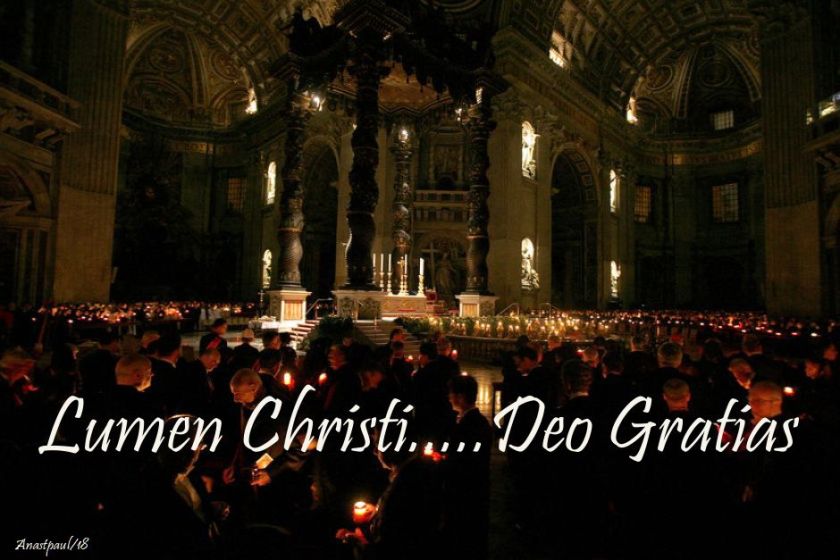
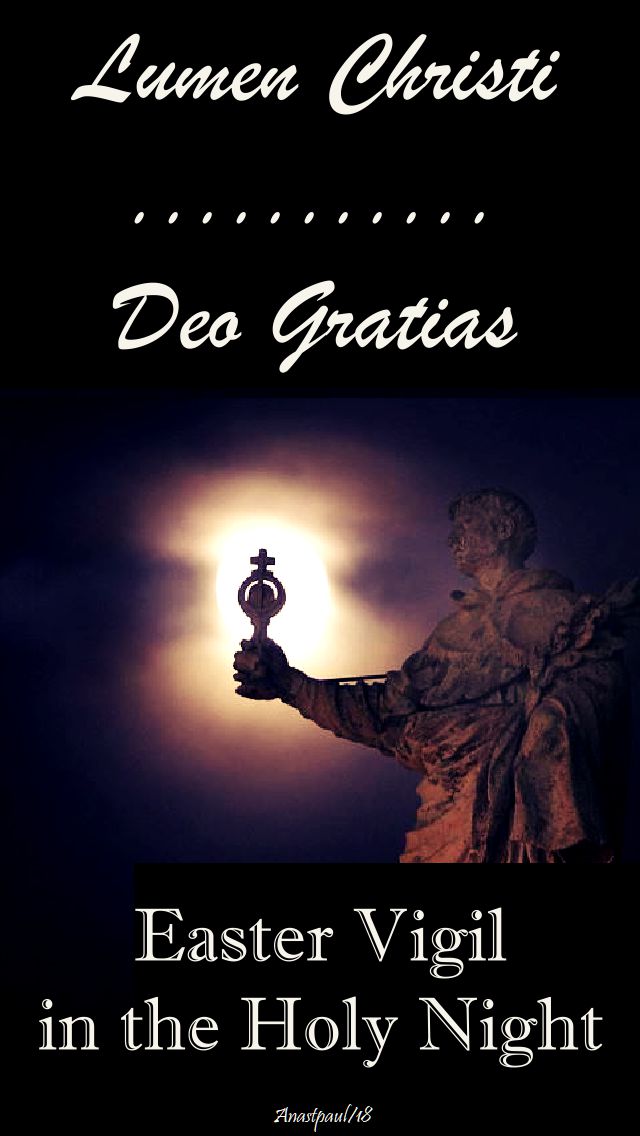
“This same night is a night of watching kept to the Lord . . . throughout every generation” (cf. Ex 12:42)lumen christi - 31 march 2018

On this holy night we celebrate the Easter Vigil, the first — indeed the “mother” — of all vigils of the liturgical year.   On this night, as is sung over and over again in the Preconio, we walk once more the path of humanity from creation to the culminating event of salvation, the death and resurrection of Christ.

The light of Him who “has been raised from the dead, the first fruits of those who have fallen asleep” (1 Cor 15:20) makes this memorable night, which is rightly considered the “heart” of the liturgical year, “bright as the day” (Ps 139:12).   On this night the entire Church keeps watch and recalls, in meditation, the significant stages of God’s saving intervention in the universe.

“A night of watching kept to the Lord”.   There is a twofold significance to this solemn Easter Vigil, so rich with symbols accompanied by an extraordinary abundance of biblical texts.   On the one hand, it is the prayerful memory of the mirabilia Dei, in the re-presentation of key texts from the Sacred Scriptures, from creation to the sacrifice of Isaac, to the passage through the Red Sea, to the promise of the New Covenant.

On the other hand, this evocative vigil is the trusting expectation of the complete fulfilment of the ancient promises.   The memory of God’s work reaches its climax in the resurrection of Christ and is projected onto the eschatological event of the parusia.   We thus catch a glimpse, on this night of Passover, of the dawning of that day that never ends, the day of the Risen Christ, which inaugurates the new life, the “new heavens and a new earth” (2 Pet 3:13; cf. Is 65:17; 66:22; Rev 21:1).

From its very beginnings, the Christian community placed the celebration of Baptism within the context of the Easter Vigil.   Here too, on this night, some catechumens will be immersed with Jesus into his death to rise with Him to immortal life.   Thus the wonder of the mysterious spiritual rebirth, wrought by the Holy Spirit, is renewed; the rebirth that incorporates the newly baptised into the people of the new and final Covenant, sealed by the death and resurrection of Christ.

Together with those who will shortly receive Baptism, the liturgy invites all of us here present to renew the promises of our own Baptism.   The Lord asks us to renew the expression of our full obedience to Him and of our total dedication to the service of his Gospel.

Beloved Brothers and Sisters! If this mission may sometimes seem difficult, call to mind the words of the Risen Lord:  “I am with you always, to the close of the age” (Mt 28:20). Certain of His presence, you shall fear no difficulty and no obstacle.   His word will enlighten you;   His Body and His Blood will nourish you and sustain you on your daily journey to eternity.

At the side of each of you there will always be Mary, as she was present among the Apostles, frightened and confused at the time of trial.   And with her faith she will show you, beyond the night of the world, the glorious dawn of the resurrection. Amen

Lumen Christi!

St Pope John Paul II easter vigil in the holy night - 31 march 2018

Posted in DOGMA, FEASTS and SOLEMNITIES, HOLY WEEK, MARIAN TITLES, SAINT of the DAY

25 March 2018, Palm Sunday, the Solemnity of the Annunciation and Memorials of the Saints

Palm Sunday (2018)

Annunciation of the Blessed Virgin Mary (Solemnity): The Annunciation to the Blessed Virgin Mary by Gabriel the Archangel that she was to be the Mother of God (Luke 1), the Word being made flesh through the power of the Holy Spirit.   The feast probably originated about the time of the Council of Ephesus, c 431 and is first mentioned in the Sacramentary of Pope Gelasius (died 496).   The Annunciation is represented in art by many masters, among them Fra Angelico, Hubert Van Eyck, Jan Van Eyck, Philippe de Champaigne (1 and 2 below), Ghirlandajo, Holbein the Elder, Lippi, Pinturicchio, Titian (2nd last below), Tintoretto (last below) and Del Sarto.Annunciation_Philippe de Champaigneannunciation-philippe-de-champaignethe annunciation - paolo de matteis 1712the-annunciation1200px-Zwiastowanie_Tintoretta

Our Lady of Betania:   Actually the name Betania means Bethany in Spanish. It was originally given this name by Maria Esperanza and was the site of their farm, in Venezuela.   Apparitions of the Blessed Virgin Mary were reported and eventually a small chapel was built here and the faithful began to gather, especially on Feast Days but throughout the year.

St Alfwold of Sherborne
St Barontius of Pistoia
St Desiderius of Pistoia
St Dismas
St Dula the Slave
Bl Emilian Kovch
Bl Everard of Nellenburg
Bl Herman of Zahringen
St Hermenland
St Humbert of Pelagius
Bl James Bird
Bl Josaphata Mykhailyna Hordashevska
St Kennocha of Fife
St Lucia Filippini
St Margaret Clitherow
Bl Margaretha Flesch
St Mariam Sultaneh Danil Ghattas
St Matrona of Barcelona
St Matrona of Thessaloniki
St Mona of Milan
St Ndre Zadeja
Bl Pawel Januszewski
St Pelagius of Laodicea
Bl Placido Riccardi
St Procopius
St Quirinus of Rome
Bl Tommaso of Costacciaro

262 Martyrs of Rome: A group 262 Christians martyred together in Rome. We know nothing else about them, not even their names.

Posted in JESUIT SJ, MARIAN TITLES, SAINT of the DAY

Nostra Signora dei Sette Veli / Our Lady of the Seven Veils, Foggia, Italy and Memorials of the Saints – 22 March

Nostra Signora dei Sette Veli / Our Lady of the Seven Veils, Foggia, Italy (11th Century) – 22 March:

In the Cathedral of Foggia one can find an ancient and mysterious image of the Blessed Virgin Mary. This icon, called “Our Lady of the Seven Veils,” once caused Saint Alphonsus to go into ecstasy, which I will describe below. As a young priest, St Pio of Pietreclina would make a visit to this image everyday.
In the eleventh century Foggia, Italy was a tiny town perched around the Tavern of the Owl.   One day some local farmers saw three flames over a small pond or bog.   Intrigued, they dug where the miraculous fire had been and discovered a large “table” buried in the mud.   They realised that this “table” was actually a Byzantine icon that had remained somewhat preserved despite being soaked in water and mud.   The image was cleaned and then cloaked with new veils.   I assume there were seven veils and hence the name but I cannot verify this.   The icon was then placed in the local Tavern of the Owl for veneration.   Soon the tavern became a place of pilgrimage.   In 1080 Robert Guiscard built a church to honour the sacred image.   In 1172 the church was expanded by William II “the Good” of Sicily.   The “face hole” is all that one can now see of the original wooden icon.   It is black and the face is now indiscernible.   However, on Maundy Thursday of 1731, the Virgin Mary’s white face appeared in this portal, which was usually black and dark.
Saint Alphonsus Liguori heard about apparition and went to Foggia to venerate the Immaculate Mother of the Saviour.   He also received an apparition of the Virgin’s face in the small black portal.   He described the Blessed Virgin’s face on that occasion as a girl of 13-14 with a white veil.   The apparitions of the Virgin’s face on the icon continued until about 1745.
As the city grew larger, the church was decorated and enriched.   The Normans, Swabians, Angevins, Aragonese, Spaniards and Bourbons considered the church to be one of the most important in Italy.  It has served as the site for several royal weddings. Today, the image is said to be covered in seven layers of precious metal and embroidered material – hence the name Madonna of the Seven Veils.

St Avitus of Périgord
St Basil of Ancyra
St Basilissa of Galatia
St Benevenuto Scotivoli of Osimo
Bl Bronislaw Komorowski
St Callinica of Galatia
Bl Clemens August von Galen
St Darerca of Ireland
St Deghitche
St Epaphroditus of Terracina
St Failbhe of Iona
Bl François-Louis Chartier
St Harlindis of Arland
Bl Hugolinus Zefferini
St Lea of Rome
Bl Marian Górecki
St Nicholas Owen S.J. (1562-1606)

St Octavian of Carthage
St Paul of Narbonne
St Saturninus the Martyr
St Trien of Killelga

Posted in CATHOLIC Quotes, FEASTS and SOLEMNITIES, MARIAN QUOTES, MARIAN TITLES, MARY, MATER ECCLESIAE, PAPAL DECREE, The BLESSED VIRGIN MARY

Pope Francis institutes new celebration of Mary, Mother of the Church

Pope Francis institutes new celebration of Mary, Mother of the Church

Congregation of Divine Worship and the Discipline of the Sacraments

DECREE
on the celebration
of the Blessed Virgin Mary
Mother of the Church
in the General Roman Calendar

The joyous veneration given to the Mother of God by the contemporary Church, in light of reflection on the mystery of Christ and on his nature, cannot ignore the figure of a woman (cf. Gal 4:4), the Virgin Mary, who is both the Mother of Christ and Mother of the Church.

In some ways this was already present in the mind of the Church from the premonitory words of Saint Augustine and Saint Leo the Great.   In fact the former says that Mary is the mother of the members of Christ, because with charity she co-operated in the rebirth of the faithful into the Church, while the latter says that the birth of the Head is also the birth of the body, thus indicating that Mary is at once Mother of Christ, the Son of God, and mother of the members of his Mystical Body, which is the Church.   These considerations derive from the divine motherhood of Mary and from her intimate union in the work of the Redeemer, which culminated at the hour of the cross.

Indeed, the Mother standing beneath the cross (cf. Jn 19:25), accepted her Son’s testament of love and welcomed all people in the person of the beloved disciple as sons and daughters to be reborn unto life eternal.   She thus became the tender Mother of the Church which Christ begot on the cross handing on the Spirit.   Christ, in turn, in the beloved disciple, chose all disciples as ministers of his love towards his Mother, entrusting her to them so that they might welcome her with filial affection.

As a caring guide to the emerging Church, Mary had already begun her mission in the Upper Room, praying with the Apostles while awaiting the coming of the Holy Spirit (cf. Acts 1:14).   In this sense, in the course of the centuries, Christian piety has honoured Mary with various titles, in many ways equivalent, such as Mother of Disciples, of the Faithful, of Believers, of all those who are reborn in Christ and also as “Mother of the Church” as is used in the texts of spiritual authors as well as in the Magisterium of Popes Benedict XIV and Leo XIII.

Thus the foundation is clearly established by which Blessed Paul VI, on 21 November 1964, at the conclusion of the Third Session of the Second Vatican Council, declared the Blessed Virgin Mary as “Mother of the Church, that is to say of all Christian people, the faithful as well as the pastors, who call her the most loving Mother” and established that “the Mother of God should be further honoured and invoked by the entire Christian people by this tenderest of titles”.

Therefore the Apostolic See on the occasion of the Holy Year of Reconciliation (1975), proposed a votive Mass in honour of Beata Maria Ecclesiæ Matre, which was subsequently inserted into the Roman Missal.   The Holy See also granted the faculty to add the invocation of this title in the Litany of Loreto (1980) and published other formularies in the Collection of Masses of the Blessed Virgin Mary (1986).   Some countries, dioceses and religious families who petitioned the Holy See were allowed to add this celebration to their particular calendars.

Having attentively considered how greatly the promotion of this devotion might encourage the growth of the maternal sense of the Church in the pastors, religious and faithful, as well as a growth of genuine Marian piety, Pope Francis has decreed that the Memorial of the Blessed Virgin Mary, Mother of the Church, should be inscribed in the Roman Calendar on the Monday after Pentecost and be now celebrated every year.

This celebration will help us to remember that growth in the Christian life must be anchored to the Mystery of the Cross, to the oblation of Christ in the Eucharistic Banquet and to the Mother of the Redeemer and Mother of the Redeemed, the Virgin who makes her offering to God.

The Memorial therefore is to appear in all Calendars and liturgical books for the celebration of Mass and of the Liturgy of the Hours.   The relative liturgical texts are attached to this decree and their translations, prepared and approved by the Episcopal Conferences, will be published after confirmation by this Dicastery.

Where the celebration of the Blessed Virgin Mary, Mother of the Church, is already celebrated on a day with a higher liturgical rank, approved according to the norm of particular law, in the future it may continue to be celebrated in the same way.

Anything to the contrary notwithstanding.

From the Congregation of Divine Worship and the Discipline of the Sacraments, 11 February 2018, the memorial of the Blessed Virgin Mary of Lourdes.

Robert Card. Sarah
Prefect

+ Arthur Roche
Archbishop Secretarydecree - mater ecclesiae - new memorial monday after pentecost - 4 march 2018

Posted in MARIAN QUOTES, MARIAN TITLES, MORNING Prayers, ON the SAINTS, PAPAL SERMONS, QUOTES of the SAINTS, QUOTES on CHARITY, QUOTES on CONVERSION, QUOTES on LOVE, SAINT of the DAY, The BLESSED VIRGIN MARY

Quote/s of the Day – 20 February 2018 -The First Memorial of Saints Francisco (1908-1919) and Jacinta (1910-1920) – “The Shepherds of Fatima”

Quote/s of the Day – 20 February 2018 -The First Memorial of Saints Francisco (1908-1919) and Jacinta (1910-1920) – “The Shepherds of Fatima”

“We were burning in that light
which is God and we were not consumed.
What is God like?
It is impossible to say.
In fact, we will never be able to tell people”

St Francisco Marto of Fatima (1908-1919)we-were-burning-in-that-light-st-francisco-marto-20-feb-2018

“Speak ill of no-one and avoid the company
of those who talk (ill) about their neighbours.

St Jacinta Marto of Fatima (1910-1920)speak-ill-of-no-one-st-jacinta-20-feb-2018.jpg

“Father, to You I offer praise, for you have revealed these things to the merest children”. Today Jesus’ praise takes the solemn form of the beatification of the little shepherds, Francisco and Jacinta.   With this rite the Church wishes to put on the candlelabrum these two candles which God lit to illumine humanity in its dark and anxious hours. …Father, to You I offer praise for all Your children, from the Virgin Mary, Your humble Servant, to the little shepherds, Francisco and Jacinta. May the message of their lives live on forever to light humanity’s way!”

St Pope John Paul (1920-2005) on the Beatification of Francisco and Jacinta, 13 May 2000the church wishes to put on the candlelabrum - st john paul - 20 feb 2018

Posted in LENT, MARIAN PRAYERS, MARIAN QUOTES, MARIAN TITLES, MORNING Prayers, PAPAL SERMONS, QUOTES - J R R Tolkien and MORE, QUOTES on REPENTANCE, QUOTES on SANCTITY, QUOTES on SUFFERING, SAINT of the DAY, The BLESSED VIRGIN MARY, The HOLY CROSS, The PASSION, The WORD

One Minute Reflection – 20 February 2018 – Tuesday of the First Week of Lent and The First Memorial of Saints Francisco (1908-1919) and Jacinta (1910-1920)

One Minute Reflection – 20 February 2018 – Tuesday of the First Week of Lent and The First Memorial of Saints Francisco (1908-1919) and Jacinta (1910-1920)

“Unless a grain of wheat falls into the earth and dies, it remains just a single grain; but if it dies, it bears much fruit..” …John 12:24

REFLECTION – “In Lucia’s account, the three chosen children found themselves surrounded by God’s light as it radiated from Our Lady.   She enveloped them in the mantle of Light that God had given her.   According to the belief and experience of many pilgrims, if not of all, Fatima is more than anything this mantle of Light that protects us, here, as in almost no other place on earth.   We need but take refuge under the protection of the Virgin Mary and to ask her, as the Salve Regina teaches: “show unto us… Jesus”.the three chosen children - pope francis canonisation homily - 20 feb 2018
“The Lord, who always goes before us, said this and did this (Jn 12:24).   Whenever we experience the cross, He has already experienced it before us.   We do not mount the cross to find Jesus.   Instead it was He who, in His self-abasement, descended even to the cross, in order to find us, to dispel the darkness of evil within us and to bring us back to the light.”…Pope Francis at the Canonisation of Saints Francisco and Jacinta on 14 May 2017

the lord, who always goes before us - pope francis - 20 feb 2017 - sts francisco and jacinta

PRAYER – Heavenly Father, just as the little children, Francisco and Jacinta, were chosen to be bearers of Your message, grant we pray, that by their prayers on our behalf, we too may Your bearers of light.   Be with us, holy Mother, during our Lenten journey to the Resurrection of your Son, help us to become like little children and in that new purity, shine with His Light.   Through Jesus our Lord, with the Holy Spirit, one God forever, amen.sts francisco & jacinta - 20 feb 2018

Posted in MARIAN PRAYERS, MARIAN QUOTES, MARIAN TITLES, MIRACLES, SAINT of the DAY

Saints of the Day – 20 February – Saints Francisco (1908-1919) and Jacinta Marta (1910-1920)

Saints of the Day – 20 February 2018 – Today, is the First Memorial of Saints Francisco (1908-1919) and Jacinta Marta (1910-1920) who were Canonised last year, 13 May 2017 – “The Shepherds of Fatima”

Between 13 May and 13 October 1917, three Portuguese shepherd children from Aljustrel, received apparitions of Our Lady at Cova da Iria, near Fátima, a city 110 miles north of Lisbon.   At that time, Europe was involved in an extremely bloody war. Portugal itself was in political turmoil, having overthrown its monarchy in 1910;  the government disbanded religious organisations soon after.STS FRANCISCO AND JACINTA-HEADER

At the first appearance, Mary asked the children to return to that spot on the thirteenth of each month for the next six months.   She also asked them to learn to read and write and to pray the rosary “to obtain peace for the world and the end of the war.”   They were to pray for sinners and for the conversion of Russia, which had recently overthrown Czar Nicholas II and was soon to fall under communism.   Up to 90,000 people gathered for Mary’s final apparition on 13 October 1917, when Our Lady of the Rosary asked them to build a chapel on the rocky hillside.   This apparition is now known as the Miracle of the Sun.   The entire crowd saw a remarkable sight.   The sun seemed to dance in the sky.   It was spinning like a top and shooting off brilliant colours of the rainbow. Suddenly the sun dropped treacherously close to earth.   People dropped to their knees and the sun just as quickly returned to its play in the sky.

Less than two years later, Francisco died of influenza in his family home.   He was buried in the parish cemetery and then re-buried in the Fátima basilica in 1952.   Jacinta died of influenza in Lisbon in 1920, offering her suffering for the conversion of sinners, peace in the world and the Holy Father.   She was re-buried in the Fátima basilica in 1951, when it was discovered that her body is incorrupt.   Their cousin Lúcia dos Santos, became a Carmelite nun and was still living when Jacinta and Francisco were beatified in 2000;   she died five years later.

Pope Francis canonised the younger children on his visit to Fátima to commemorate the 100th anniversary of the first apparition, last year, 13 May 2017. fatima canonisation.3fatima canonisation.2fatima canonisationCANONISATION MASS

The shrine of Our Lady of Fátima is visited by up to 20 million people a year.children of fatimaSTS FRANCISCO AND JACINTA.1.PGsts francisco and jacinta and our lady of fatimaSTS FRANCISCO AND JACINTA

For fuller details and more images here is my post from last year:  – https://anastpaul.wordpress.com/2017/02/20/saints-of-the-day-20-february-blessed-francisco-and-jacinta-marto/

Posted in FEASTS and SOLEMNITIES, MARIAN TITLES, MIRACLES, SAINT of the DAY, The BLESSED VIRGIN MARY, Uncategorized

Feast of Madonna del Pilerio and Memorials of the Saints – 12 February

Madonna del Pilerio:   The term Pilerio probably derives from piliero (pillar), or it could be older and derive from the greek puleròs (guardian, guardian of the city gate).   The cult of the Madonna del Pilerio as the patron saint of Cosenza, dates back to the end of the 16th century.   It is said that in the year 1576, while the plague desolated different regions of Italy, a devotee, praying before the icon of the Madonna del Pilerio, noticed a stain similar to the pestiferous bubo (the marks of the plague), present on the face of the Image.   The phenomenon was noted by the people and by the ecclesiastical authorities. The stain was considered a prodigy and a revealing sign of the protection of the Madonna for the City of Cosenza, saved by her from the plague.   Since then the Virgin of Pilerio became the Protectress of the City.
The news of the prodigious sign did not take long to spread and from the neighbouring countries a growing rush of devotees began.   The pilgrimages continued over time and grew in number, so much so that in 1603, the Archbishop Monsignor Giovan Battista Costanzo (1591-1617), to better serve the influx of pilgrims, removed the painting from the place where it was and placed it before on one of the pillars of the central nave of the Duomo, then on the main altar and finally in 1607 in the specially built chapel dedicated to the Virgin and where even today is venerated.   On April 17, 1607, at the unanimous request of the inhabitants of Cosenza, the Archbishop Mgr. Costanzo crowned the Virgin of Pilerio Regina and Patrona della Città.  In 1783 a violent earthquake struck down on Cosenza. On that occasion another sign was found on the face of the image of the Pilerio.


St Alexius of Kiev
St Ammonius of Alexandria
Bl Anthony of Saxony
St Anthony Kauleas
St Benedict of Aniane (747-821)

Bl Benedict Revelli
St Damian of Africa
St Damian of Rome
St Ethelwald of Lindisfarne
St Eulalia of Barcelona
St Gaudentius of Verona
St Goscelinus of Turin
Bl Gregory of Tragurio
Bl Humbeline of Jully
St Jak Bushati
St Julian of Alexandria
St Julian the Hospitaller
Bl Ladislaus of Hungary
Bl Ludan
St Meletius of Antioch
St Modestus of Alexandria
St Modestus of Carthage
St Modestus the Deacon
Bl Nicholas of Hungary
St Sedulius
Bl Thomas of Foligno

Martyrs of Albitina – 46 saints:
During the persecutions of Diocletian, troops were sent to the churches of Abitina, North Africa on a Sunday morning; they rounded up everyone who had arrived for Mass and took them all to Carthage for interrogation by pro-consul Anulinus. The 46 who proclaimed their Christianity were executed. We know some of their names and stories.
• Ampelius
• Cassiano
• Ceciliano
• Cecilia
• Danzio
• Deciano
• Emeritus
• Ercolina
• Eva
• Fausto
• Felice (2 by this name)
• Felix
• Gennara (2 by this name)
• Gennaro
• Giriale
• Hilarion
• Maggiore
• Margherita
• Martino
• Mary
• Massimiano
• Matrona (2 by this name)
• Onorata
• Pelusio
• Pomponia
• Prima
• Quinto
• Regiola
• Restituta
• Rogatian (3 by this name)
• Rogato (2 by this name)
• Saturninus the Elder
• Saturninus the Younger
• Seconda (2 by this name)
• Thelica
• Victoria
• Vincenzo
• Vittoriano
• Vittorino
They were tortured to death in 304 in prison at Albitina, North Africa.

Martyred in England:
Bl George Haydock
Bl James Fenn
Bl John Nutter
Bl John Munden
Bl Thomas Hemeford

Martyred in the Spanish Civil War:
Josep Gassol Montseny