Posted in DOGMA, FEASTS and SOLEMNITIES, MARIAN DEVOTIONS, MARIAN QUOTES, MARIAN TITLES, MORNING Prayers, QUOTES of the SAINTS, SAINT of the DAY, The BLESSED VIRGIN MARY

Thought for the Day – 19 August – On the Assumption of the Blessed Virgin Mary

Thought for the Day – 19 August – On the Assumption of the Blessed Virgin Mary

By Blessed John Henry Cardinal Newman  (1801-1890)

Blessed Newman says it begins with who Mary:  “As soon as we apprehend by faith, the great fundamental truth, that Mary is the Mother of God, other wonderful truths follow in its train and one of these, is that, she was exempt from the ordinary lot of mortals, which is not only to die but to become earth to earth, ashes to ashes, dust to dust.”   Mary receives honour because of who her Son is – our only Lord and Saviour and from His victory over sin and death, Mary is blessed with this gift.as soon as we apprehend by faith - bl john henry - 19 aug 2018

Yet, Mary was not the first or the only one to have her body preserved from corruption. Blessed Newman quotes St Matthew, who reports that bodies of the saints came out of the tombs following our Lord’s resurrection.   “Can we suppose that Abraham, or David, or Isaias, or Ezechias, should have been thus favoured and not God’s own Mother?…Was she not nearer to Him than the greatest of the Saints before her?   Therefore we confidently say that our Lord, having preserved her from sin and the consequences of sin…lost no time, in pouring out the full merits, of that Passion upon her body as well as her soul.”can we suppose that abraham or david - bl john henry - 19 aug 2018

We, too, want to be more fully conformed to our Lord, just as our Lady is and to be in Heaven as she is united with the Object of our love.   She will help us bring to Him the little that we have and to rely on Him, as she did.   She is the Mother of our Lord and she is our Mother too.
Let us go to her today and, with confidence, to our Heavenly Father, who never fails to honour and bless those who surrender to Him.

Mary, Holy Mother, Assumed into Heaven, Pray for us!mary assumed into heaven - pray for us - 19 aug 2018

Posted in DOGMA, MARIAN DEVOTIONS, MARIAN PRAYERS, MARIAN TITLES, Our MORNING Offering, PAPAL PRAYERS, SAINT of the DAY, The BLESSED VIRGIN MARY

Our Morning Offering – 19 August – The Solemnity of the Assumption of the Blessed Virgin Mary

Our Morning Offering – 19 August – The Solemnity of the Assumption of the Blessed Virgin Mary

Prayer in Honour of the Assumption of the Blessed Virgin Mary
By Venerable Pope Pius XII (1876-1958)

O Immaculate Virgin, Mother of God
and Mother of men,
we believe with all the fervour of our faith,
in your triumphal Assumption,
both body and soul, into heaven,
where you are acclaimed as Queen
by all the choirs of angels
and all the legions of the saints.
And we unite with them to praise and bless the Lord,
who has exalted you above all other pure creatures
and to offer you the tribute of our devotion
and our love.
Amenprayer in honour of the assumption of the blessed virgin mary by ven pius XII - 19 aug 2018

Posted in FEASTS and SOLEMNITIES, MARIAN DEVOTIONS, MARIAN TITLES, PAPAL ENCYLICALS, QUOTES of the SAINTS, SAINT of the DAY, The BLESSED VIRGIN MARY

The Solemnity of the Assumption of the Blessed Virgin Mary – 19 August

The Solemnity of the Assumption of the Blessed Virgin Mary – 19 AugustSOD-0815-SolemnityoftheAssumptionofMary-790x480.jpg

The Solemnity of the Assumption is a day of joy.   God has won  . Love has won.   It has won life.   Love has shown that it is stronger than death, that God possesses the true strength and that His strength is goodness and love.

The Catechism of the Catholic Church (974) states that the “Most Blessed Virgin Mary, when the course of her earthly life was completed, was taken up body and soul into the glory of heaven, where she already shares in the glory of her Son’s Resurrection, anticipating the resurrection of all members of His Body.”

St John Damascene (675-749) Father & Doctor of the Church, an outstanding herald of this traditional truth, spoke with powerful eloquence when he compared the bodily Assumption of the loving Mother of God with her other prerogatives and privileges:
“It was fitting that she, who had kept her virginity intact in childbirth, should keep her own body free from all corruption even after death.
It was fitting that she, who had carried the Creator as a child at her breast, should dwell in the divine tabernacles.
It was fitting that the spouse, whom the Father had taken to himself, should live in the divine mansions.
It was fitting that she, who had seen her Son upon the cross and who had thereby received into her heart the sword of sorrow which she had escaped in the act of giving birth to him, should look upon him as he sits with the Father.
It was fitting that God’s Mother should possess what belongs to her Son and that she should be honoured by every creature as the Mother and as the handmaid of God.”assumption - guido reni

Gathering together the testimonies of the Christians of earlier days, St Robert Bellarmine S.J. (1542-1621) Doctor of the Church exclaimed:
“And who, I ask, could believe that the ark of holiness, the dwelling place of the Word of God, the temple of the Holy Spirit, could be reduced to ruin?   My soul is filled with horror at the thought that this virginal flesh which had begotten God, had brought Him into the world, had nourished and carried Him, could have been turned into ashes …”assumption-of-the-virgin-mary-1600-1601-annibale-carracci

Blessed John Henry Cardinal Newman (1801-1890) expressed similar thoughts on the Assumption of Mary when he said “It was becoming, that she [Mary] should be taken up into heaven and not lie in the grave till Christ’s second coming, who had passed a life of sanctity and of miracle such as hers.”
He added, “If her body was not taken into heaven, where is it? Why are not pilgrimages made to it?   Why are not relics producible of her, as of the saints in general?   Plainly because that sacred body is in heaven, not on earth.”Assumption_841568

It is important to note also that the Venerable Pope Pius XII in the official church document did not say specifically whether or not Mary actually died before being taken up to heaven, only that she “completed the course of her earthly life.”   The important thing is that she did not experience the corruption of her body from death that we do as a result of our being born with Original Sin.dormition_lgAssumption-of-Mary-by-Strobeldormition of the virgin - lawrence op

Dormition of the Virgin Mary
“In the liturgical books which deal with the feast either of the dormition or of the Assumption of the Blessed Virgin there are expressions that agree in testifying that, when the Virgin Mother of God passed from this earthly exile to heaven, what happened to her sacred body was, by the decree of divine Providence, in keeping with the dignity of the Mother of the Word Incarnate and with the other privileges she had been accorded.
Thus, to cite an illustrious example, this is set forth in that sacramentary which Adrian I, our predecessor of immortal memory, sent to the Emperor Charlemagne.   These words are found in this volume:  “Venerable to us, O Lord, is the festivity of this day on which the holy Mother of God suffered temporal death but still could not be kept down by the bonds of death, who has begotten your Son our Lord incarnate from herself.””

“Christ overcame sin and death by his own death and one who through Baptism has been born again in a supernatural way has conquered sin and death through the same Christ. Yet, according to the general rule, God does not will to grant to the just the full effect of the victory over death until the end of time has come.   And so it is that the bodies of even the just are corrupted after death, and only on the last day will they be joined, each to its own glorious soul.
Now God has willed that the Blessed Virgin Mary should be exempted from this general rule.   She, by an entirely unique privilege, completely overcame sin by her Immaculate Conception and as a result she was not subject to the law of remaining in the corruption of the grave and she did not have to wait until the end of time for the redemption of her body.”

Venerable Pope Pius XII (1876-1958) from the Apostolic Constitution ‘Munificentissimus Deus’ (The most bountiful God) which defined ex cathedra The Assumption as Dogma by the Catholic Church in 1950.

So what does the Dogma of the Assumption of Mary into Heaven mean for us on a more down-to-earth level?   It gives us great hope that, as we strive to live in our Lord’s grace and to do His will, with Mary’s assistance, we might share in His resurrection someday!417px-Tizian_041Baroque_Rubens_Assumption-of-Virgin-3

Assumption Day on 15 August is a nationwide public holiday in Andorra, Austria, Belgium, Burundi, Cameroon, Central African Republic, Chile, Republic of Congo, Côte d’Ivoire, Croatia, Colombia, Costa Rica, Cyprus, East Timor, France, Gabon, Greece, Georgia, Republic of Guinea, Haiti, Italy, Lebanon, Lithuania, Luxembourg, Republic of Macedonia, Madagascar, Malta, Mauritius, Republic of Moldova, Monaco, Montenegro (Albanian Catholics), Paraguay, Poland (Polish Army Day), Portugal, Romania, Rwanda, Senegal, Seychelles, Slovenia, Spain, Syria, Tahiti, Togo and Vanuatu and was also in Hungary until 1948.   In India, 15 August also celebrates Independence Day.

It is also a public holiday in parts of Germany (Bavaria and Saarland) and Switzerland (in 14 of the 26 cantons).   In Guatemala, it is observed in Guatemala City and in the town of Santa Maria Nebaj, both of which claim her as their patron saint.   Also, this day is combined with Mother’s Day in Costa Rica and parts of Belgium.

Prominent Catholic and Orthodox countries in which Assumption Day is an important festival but is not recognized by the state as a public holiday include Brazil, Bulgaria, Czech Republic, Ireland, Mexico, the Philippines and Russia.

In many places, religious parades and popular festivals are held to celebrate this day. In Canada, Assumption Day is the Fête Nationale of the Acadians, of whom she is the patron saint.   Some businesses close on that day in heavily francophone parts of New Brunswick, Canada.   The Virgin Assumed in Heaven is also patroness of the Maltese Islands and her feast, celebrated on 15 August, apart from being a public holiday in Malta is also celebrated with great solemnity in the local churches especially in the seven localities known as the Seba’ Santa Marijiet.
Below is an image of the feast of the Assumption of the Virgin Mary at Novara di Sicilia.Assunzione_agosto_NovaradiSicilia_tre

Posted in DOGMA, FEASTS and SOLEMNITIES, MARIAN DEVOTIONS, MARIAN TITLES, SAINT of the DAY

The Solemnity of the Assumption of the Blessed Virgin Mary and Memorials of the Saints – 19 August

The Solemnity of the Assumption of the Blessed Virgin Mary – celebrated today in South Africa and most countries of Africa, many others and in many Diocese where the local Bishops have decided to move the Solemnity to a Sunday.

St John Eudes (Optional Memorial)
Biography here:   https://anastpaul.wordpress.com/2017/08/19/saint-of-the-day-19-august-st-john-eudes-apostle-of-two-hearts/

St Andrew the Tribune
St Badulf of Ainay
St Bertulf of Luxeuil
St Calminius
St Credan of Evesham
St Donatus of Mount Jura
St Elaphius of Châlons
St Ezekiel Moreno Y Diaz
St Guenninus
Bl Guerricus
Bl Hugh Green
St Julius of Rome
St Louis of Toulouse
St Magnus of Anagni
St Magnus of Avignon
St Magnus of Cuneo
St Marianus of Entreaigues
St Marinus of Besalu
St Magino of Tarragona
St Mochta
St Namadia of Marsat
St Rufinus of Mantua
St Sarah the Matriarch
St Sebaldus
St Thecla of Caesarea
St Timothy of Gaza

Martyrs of Nagasaki – 15 beati: A group of missionaries and their laymen supporters who were executed for spreading Christianity in Japan.
• Antonius Yamada
• Bartholomaeus Mohyoe
• Iacobus Matsuo Denji
• Ioachim Díaz Hirayama
• Ioannes Miyazaki Soemon
• Ioannes Nagata Matashichi
• Ioannes Yago
• Laurentius Ikegami Rokusuke
• Leo Sukeemon
• Ludovic Frarijn
• Marcus Takenoshita Shin’emon
• Michaël Díaz Hori
• Paulus Sankichi
• Pedro de Zúñiga
• Thomas Koyanagi
Theywere beheaded on 19 August 1622 at Nagasaki, Japan and Beatified on 7 May 1867 by Pope Pius IX.

Martyred in the Spanish Civil War
Martyred Carmelite Sisters of Charity – 9 beati
Martyred Salesians of Ciudad Real – 8 beati
Martyred Subiaco Benedictines of Barcelona – 7 beati
• Blessed Agueda Hernández Amorós
• Blessed Agustí Busquets Creixell
• Blessed Andrés Pradas Lahoz
• Blessed Antolín Martínez y Martínez
• Blessed Antoni Pedró Minguella
• Blessed Càndid Feliu Soler
• Blessed Cipriano González Millán
• Blessed Damián Gómez Jiménez
• Blessed Elvira Torrentallé Paraire
• Blessed Félix González Bustos
• Blessed Francisca de Amézua Ibaibarriaga
• Blessed Francisco de Paula Ibáñez y Ibáñez
• Blessed Ignasi Guilà Ximenes
• Blessed Isidro Muñoz Antolín
• Blessed Joan Roca Bosch

Posted in DOGMA, FEASTS and SOLEMNITIES, MARIAN TITLES, SAINT of the DAY, The BLESSED VIRGIN MARY

Solemnity of the Assumption of the Blessed Virgin Mary – 15 August

Solemnity of the Assumption of the Blessed Virgin Mary – 15 August (in the US, however, in most countries of Africa, the Solemnity will celebrated on Sunday 19 AUGUST):   The feast celebrates the assumption of the body of the Blessed Virgin Mary into heaven upon her death.   According to Pope Benedict XIV, it is a probable opinion, which it is impious to deny, though not an article of faith but has since in 1950 has been raised to a DOGMA of the Faith.   The origin of the feast day is not known but it was celebrated in Palestine before the year 500.   It is a holy day of obligation, its vigil being a fast day, in many English-speaking countries.   Among the many masters who have painted the subject of the Assumption are Fra Angelico, Ghirlandajo, Rubens, Del Sarto and Titian.
Patronages:
• Acadians, Cajuns
• Cistercian Order, Cistercians
• fish dealers, fishmongers
• French air crews
• harness makers
• France
• Guatemala
• India
• Jamaica
• Malta
• Paraguay
• Slovakia
• East Africa (region of east Africa which includes diverse countries, proclaimed on 15 March 1952 by Pope Pius XII)
• South Africa (THIS IS NOT A REGION BUT A COUNTRY and the Assumption is, therefore, the Patronal Feast of the Country of South Africa – proclaimed on 15 March 1952 by Pope Pius XII)
• 24 dioceses
• 38 cities

assumption-of-the-virgin-mary-1600-1601-annibale-carracci
Annabale Carraci 1600-1601

St Alipius of Tagaste
Bl Alfred of Hildesheim
Bl Agustín Hurtado Soler
St Arduinus of Rimini
St Arnulphus of Soissons
Bl Claudio Granzotto
Bl George Halley
St Napoleon of Alexandria
Bl Pio Alberto del Corona
St Simplician (c 320-c 401) Bishop and Successor of St Ambrose (340-397) Doctor of the Church in the ArchDiocese of Milan.
Details of the life of St Simplician here: https://anastpaul.wordpress.com/2017/08/15/saint-of-the-day-15-august-st-simplician-of-milan/
St Tarcisius (3rd century) Martyr

Martyrs of Nicomedia – 3 saints: Three Christians martyred together. No details survive but the names – Eutychian, Philip and Straton. They were martyred in Nicomedia, Bithynia (in modern Turkey).

Martyred in the Mexican Revolution: 4 Saints –
St David Roldán Lara
St Luis Batiz Sainz
St Manuel Moralez
St Salvador Lara Puente

Martyred in the Spanish Civil War: Thousands of people were murdered in the anti-Catholic persecutions of the Spanish Civil War from 1934 to 1939.
• Blessed Agustì Ibarra Angüela
• Blessed Carmelo Sastre y Sastre
• Blessed Clemente Vea Balaguer
• Blessed Francisco Míguez Fernández
• Blessed Ildefonso Alberto Flos
• Blessed Jaume Bonet Nadal
• Blessed Joan Ceró Cedó
• Blessed Josep Santonja Pinsach
• Blessed Juan Francisco Barahona Martín
• Blessed Juan Mesonero Huerta
• Blessed Luis Ros Ezcurra
• Blessed Manuel Formigo Giráldez
• Blessed Miguel Alberto Flos
• Blessed Sebastià Balcells Tonijuan
• Blessed Severiano Montes Fernández

Posted in CONSECRATION Prayers, franciscan OFM, MARIAN PRAYERS, MARIAN QUOTES, MARIAN TITLES, ON the SAINTS, PRAYERS of the SAINTS, SAINT of the DAY, The BLESSED VIRGIN MARY, The WORD

Thought for the Day – 14 August – The Memorial of St Maximillian Kolbe OFM Conv (1894 -1941)

Thought for the Day – 14 August – The Memorial of St Maximillian Kolbe OFM Conv (1894 -1941) “Martyr of Charity”and “Apostle of Consecration to Mary”

“Greater love than this no man hath, that a man lay down his life for his friends.”

John 15:13

That verse certainly comes to mind whenever I think of St Maximilian Kolbe, whose feast we celebrate today.   So it’s not surprising to read that these were the opening words of the papal decree introducing his Beatification.   St Maximilian Kolbe was arrested in Poland in February of 1941 and in May sent to the Auschwitz death camp.   As prisoner #16670, he eventually laid down his life for another prisoner on 14 August 1941, at the young age of 47.

Father Kolbe’s death was not a sudden, last-minute act of heroism.   His whole life had been a preparation.   His holiness was a limitless, passionate desire to convert the whole world to God.   And his beloved Immaculata, was his inspiration.

St Maximillian is the patron saint of families, prisoners, journalists, political prisoners, drug addicts and the pro-life movement.   St John Paul II declared him to be “the patron saint of our difficult century.”   The evils which made the twentieth century so difficult were not left behind as we moved into the twenty-first century.

Let us continue to call upon the intercession of this saint and continue to come to Jesus through His mother, Mary, the Immaculata.

Daily Consecration Renewal to the Immaculata
By St Maximillian Kolbe

Immaculata, Queen and Mother of the Church,
I renew my consecration to you for this day
and for always, so that you might use me
for the coming of the Kingdom of Jesus in the whole world.
To this end, I offer you all my prayers,
actions and sacrifices of this day.
Amendaily-consecration-renewal-to-the-immaculata-by-st-maximillian-kolbe-14 aug 2017

Mary, Immaculata, Pray for us!mary, immaculata - pray for us - 12 may 2018
St Maximillian Kolbe, pray for us!st-max-pray-for-us.14 aug 2017

Posted in EUCHARISTIC Adoration, franciscan OFM, MARIAN QUOTES, MARIAN TITLES, MORNING Prayers, QUOTES of the SAINTS, QUOTES on FAITH, QUOTES on LOVE, QUOTES on SUFFERING, QUOTES on the CROSS of CHRIST, SAINT of the DAY, The BLESSED VIRGIN MARY

Quote/s of the Day – 14 August – The Memorial of St Maximillian Kolbe OFM Conv (1894 -1941)

Quote/s of the Day – 14 August – The Memorial of St Maximillian Kolbe OFM Conv (1894 -1941) “Martyr of Charity”and “Apostle of Consecration to Mary”

“Be a Catholic!
When you kneel before an altar,
do it in such a way that others
may be able to recognise
that you know before Whom you kneel.”be-a-catholic-st-maximillian-kolbe- 14 aug 2017

“My aim is to institute
Perpetual Adoration,
for this is the the most
important activity.”my aim is to - st max kolbe - adoration - 14 aug 2018

“Let us remember,
that love lives through sacrifice
and is nourished by giving.
Without sacrifice,
there is no love.”love lives through sacrifice - st max kolbe 14 aug 2018

“Let us not forget,
that Jesus not only suffered
but also rose in glory;
so, too, we go to the glory
of the Resurrection,
by way of suffering
and the Cross.”let us not forget = st max kolbe 14 aug 2018

“Let us give ourselves
to the Immaculata.
Let her prepare us,
let her receive Him
in Holy Communion.
This is the manner most perfect
and pleasing to the Lord Jesus
and brings great fruit to us.”
Because “the Immaculata
knows the secret,
how to unite ourselves totally
with the heart of the Lord Jesus…”let us give ourselves to the immaculata - st max kolbe - 14 aug 2018

“We do not limit ourselves in love.
We want to love the Lord Jesus,
with her heart,
or rather, that she would love the Lord,
with our heart.”

St Maximillian Kolbe (1894 -1941)we do not limit ouselves in love - st max kolbe - 14 aug 2018

Posted in franciscan OFM, MARIAN QUOTES, MARIAN TITLES, MORNING Prayers, QUOTES of the SAINTS, SAINT of the DAY, The BLESSED VIRGIN MARY, The WORD

One Minute Reflection – 14 August – The Memorial of St Maximillian Kolbe (1894 -1941)

One Minute Reflection – 14 August – The Memorial of St Maximillian Kolbe OFM Conv (1894 -1941) “Martyr of Charity”and “Apostle of Consecration to Mary”

For behold, henceforth all generations will call me blessed…Luke 1:48

REFLECTION – “A man cannot rise any higher than this.   The Immaculate is the highest degree of perfection and sanctity of a creature.   No man will ever attain this celestial summit of grace, for the Mother of God is unique.   However, he who gives himself without limits, to the Immaculate, will in a short time attain a very high degree of perfection and procure for God, a very great glory.”…St Maximillian Kolbefor behold - luke 1 48 - a man cannot rise any higher than this - st max kolbe - 14 august 2018

PRAYER – My Lord and my God, You who are the fruit of Mary’s blessed womb and the most Divine Son of our Father, grant that we may always have recourse to You, through her who bore You.    Grant that she may help and comforus me and lead us to You.   Mary, Holy and loving Mother of God, pray for us all.   Grant O Lord, that through the intercession of St Maximillian, we may entrust ourselves to You through Your and our blessed Mother, amen.mary immaculate holy mother of god - pray for us - 28 may 2018st-maximillian-pray-for-us-14 aug 2017

Posted in MARIAN DEVOTIONS, MARIAN TITLES, SAINT of the DAY, The BLESSED VIRGIN MARY

Feast of Our Lady, Refuge of Sinners/Refugium Peccatorum and Memorials of the Saints – 13 August

St Pope Pontian Martyr (Died 235) (Optional Memorial)
St Hippolytus (170 – 235) Martyr (Optional Memorial)

Details of St Pope Pontian & St Hippolytus here: https://anastpaul.wordpress.com/2017/08/13/saints-of-the-day-13-august-st-pope-pontian-and-st-hippolytus-martyrs/

Our Lady, Refuge of Sinners/Refugium Peccatorum:   St John Damascene calls Mary a city of refuge to all who flee to Her.   This idea of a city of refuge is an old Scriptural fact calling attention to the humanity, the pity, of the old Jewish Law, which established certain cities of refuge where criminals might find escape from the arm of the authorities.   For instance there were no less than six Levitical Cities, three on either side of the Jordan, where men who had been guilty of the act of involuntary homicide might find protection and immunity, until they were released from banishment by the death of the High Priest.   These six cities were obliged to receive the homicides and to lodge them without any charge.   But there were at least 48 cities which had this privilege of asylum. Nor was it a peculiarly Jewish custom.   Even the Greeks and Romans had their cities of asylum.   The Jewish idea was brought into Christianity. One of the beautiful customs in the Middle Ages was “the right of sanctuary,” by which those who ran foul of the law could not be taken so long as they remained in the Church, or sanctuary.   And this is Our Lady, Refuge of Sinners!
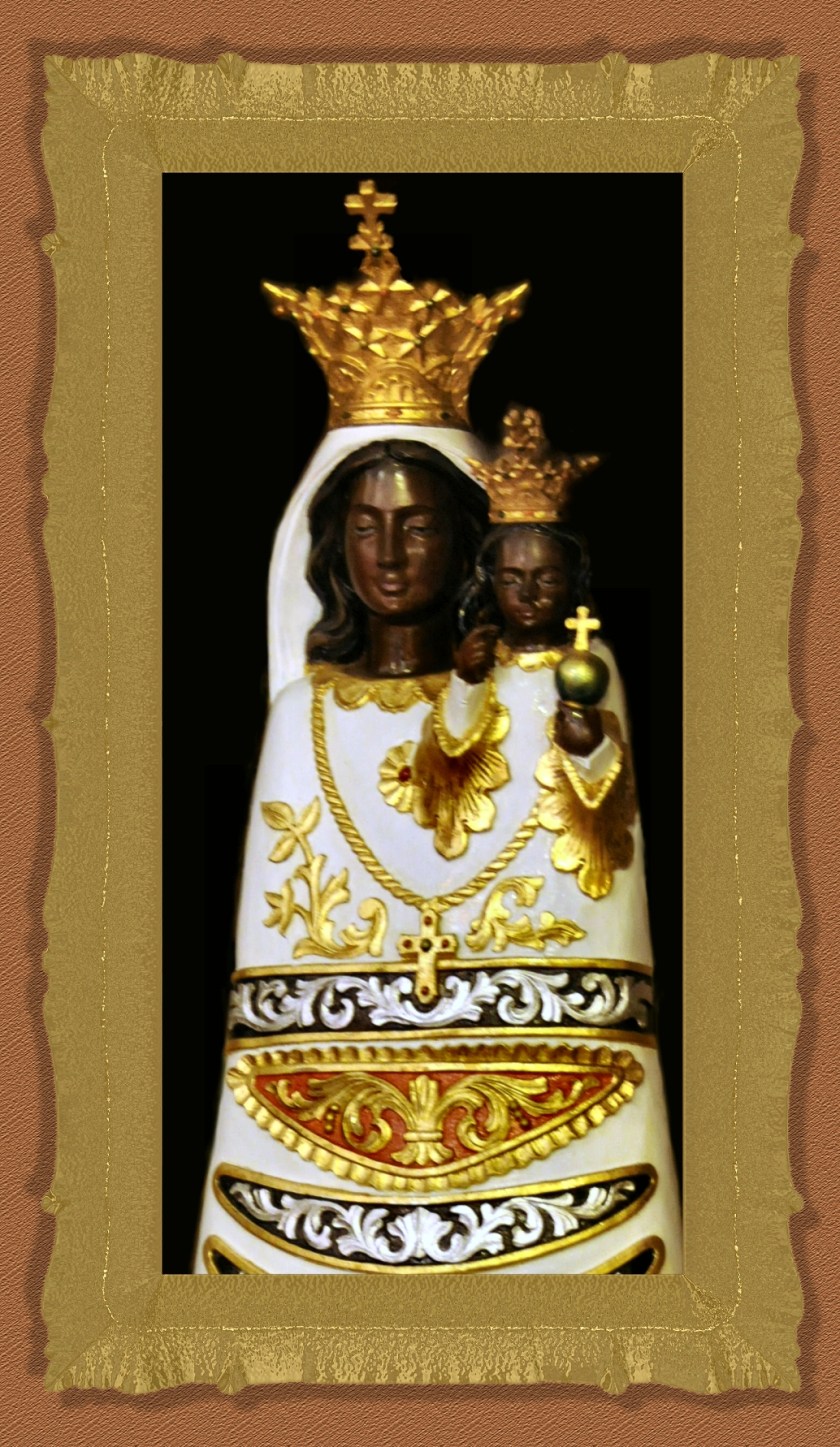
Refugium Peccatorum is one part of four Marian advocations in the Litany of Loreto, the others being Salus Infirmorum (healer of the sick) Consolatrix Afflictorum (consoler of the afflicted) and Auxilium Christianorum (help of Christians).   Each advocation extolling Mary’s role as advocate for spiritual and corporeal mercy has a rich history but in general, the notion of asking the Blessed Virgin Mary for help in temporal needs dates back to Saints Justin Martyr, Irenaeus and Ambrose of Milan.
The 18th century Jesuit preacher, Blessed Antonio Baldinucci (1665-1717) had a particular devotion to the Refugium Peccatorum image of Virgin Mary in the Church of the Gesu (Frascati) in Italy and commissioned a copy which he considered miraculous and carried it with him in his travels.   The Jesuits spread copies of the image of the Madonna of Refuge in Mexico by the 19th century and it began to be depicted in missions there, often with clouds surrounding the lower portion of the image of the Virgin Mary holding the Child Jesus.

Antonio_Baldinucci
The term “Refugium peccatorum” is also used other works of Roman Catholic Marian art. For instance, there is a marble statue representing the Virgin Mary, on the grand staircase of the old municipal palace in Venice, Italy.   The name came from the fact that the convicts were allowed to stop in front of the Virgin Mary’s statue to pray for their soul on the way to the scaffold.
The traditional feast day of Our Lady, Refuge of Sinners is today, 13 August.refuge-of-sinners

St Anastasius the Monk
St Anastasius the Priest
St Benildus
St Cassian of Imola
St Cassian of Todi
St Concordia
St Conn O’Rourke
Bl Gertrude of Altenberg
St Helen of Burgos
St Herulph of Langres
Bl Jakob Gapp
Bl John of Alvernia
St John Berchmans S.J. (1599-1621)

St Junian of Mairé
St Ludolph
Bl Marco d’Aviano/Mark of Aviano OFM Cap (1631-1699)
St Maximus the Confessor
St Nerses Glaietsi
St Patrick O’Healy
Bl Pierre Gabilhaud
St Radegund
St Radegunde
St Wigbert of Fritzlar
Bl William Freeman

Martyred in the Spanish Civil War:
• Blessed Francesc Castells Areny
• Blessed Inocencio García Díez
• Blessed José Bonet Nadal
• Blessed José Boher y Foix
• Blessed José Juan Perot y Juanmarti
• Blessed Jose Tàpies y Sirvant
• Blessed Josep Alsina Casas
• Blessed Luciano Hernández Ramírez
• Blessed Maria de Puiggraciós Badia Flaquer
• Blessed Mateo Despóns Tena
• Blessed Modesto García Martí
• Blessed Pascual Araguàs y Guàrdia
• Blessed Pedro Martret y Molet
• Blessed Silvestre Arnau y Pascuet

Martyred Claretians of Barbastro – 51 beati:
• Blessed Agustín Viela Ezcurdia
• Blessed Alfons Miquel Garriga
• Blessed Alfons Sorribes Teixidó
• Blessed Antolín Calvo y Calvo
• Blessed Antoni Dalmau Rosich
• Blessed Atanasio Vidaurreta Labra
• Blessed Eduardo Ripoll Diego
• Blessed Esteve Casadevall Puig
• Blessed Eusebi Maria Codina Millà
• Blessed Felipe de Jesús Munárriz Azcona
• Blessed Francesc Roura Farró
• Blessed Francisco Castán Meseguer
• Blessed Gregorio Chirivas Lacamba
• Blessed Hilario Llorente Martín
• Blessed Jaume Falgarona Vilanova
• Blessed Joan Baixeras Berenguer
• Blessed Joan Codinachs Tuneu
• Blessed José Amorós Hernández
• Blessed José Blasco Juan
• Blessed José Figuero Beltrán
• Blessed José Pavón Bueno
• Blessed Josep Maria Badía Mateu
• Blessed Josep Ormo Seró
• Blessed Josep Ros Florensa
• Blessed Juan Díaz Nosti
• Blessed Juan Echarri Vique
• Blessed Juan Sánchez Munárriz
• Blessed Leoncio Pérez Ramos
• Blessed Lluís Escalé Binefa
• Blessed Lluís Lladó Teixidor
• Blessed Lluís Masferrer Vila
• Blessed Manuel Buil Lalueza
• Blessed Manuel Martínez Jarauta
• Blessed Manuel Torras Sais
• Blessed Miquel Masip González
• Blessed Nicasio Sierra Ucar
• Blessed Pedro García Bernal
• Blessed Pere Cunill Padrós
• Blessed Rafael Briega Morales
• Blessed Ramon Illa Salvia
• Blessed Ramon Novich Rabionet
• Blessed Salvador Pigem Serra
• Blessed Sebastià Riera Coromina
• Blessed Sebastián Calvo Martínez
• Blessed Secundino Ortega García
• Blessed Teodoro Ruiz de Larrinaga García
• Blessed Tomàs Capdevila Miró
• Blessed Wenceslau Clarís Vilaregut
They were martyred on 2 August through 18 August 1936 in Barbastro, Huesca, Spain and Beatified on 25 October 1992 by Pope John Paul II.

Posted in franciscan OFM, MARIAN DEVOTIONS, MARIAN QUOTES, MARIAN TITLES, MORNING Prayers, QUOTES of the SAINTS, SAINT of the DAY, The BLESSED VIRGIN MARY

Thought for the Day – 5 August – Dedication of the Basilica of Saint Mary Major/Our Lady of the Snow

Thought for the Day – 5 August – Dedication of the Basilica of Saint Mary Major/Our Lady of the Snow

St Mary Major is one of the four Roman basilicas known as patriarchal cathedrals in memory of the first centres of the Church.   St John Lateran represents Rome, the See of Peter;   St Paul Outside the Walls, the See of Alexandria, the see presided over by Mark;   St Peter’s, the See of Constantinople and St Mary’s, the See of Antioch, where Mary is believed to have spent most of her later life.

Theological debate over Christ’s nature as God and man reached fever pitch in Constantinople in the early fifth century.   The chaplain of Bishop Nestorius began preaching against the title Theotokos, “Mother of God,” insisting that the Virgin was mother only of the human Jesus.   Nestorius agreed, decreeing that Mary would henceforth be named “Mother of Christ” in his see.   The people of Constantinople virtually revolted against their bishop’s refutation of a cherished belief.   When the Council of Ephesus refuted Nestorius, believers took to the streets, enthusiastically chanting, “Theotokos!   Theotokos!”

So often I wish we would take to the streets shouting the same, “Mother of God! Mother of God!”

“Jesus honoured her before all ages
and will honour her for all ages.
No one comes to Him,
nor even near Him,
no one is saved or sanctified,
if he too will not honour her.
This is the lot of angels and of men.”

St Maximillian Kolbe (1894-1941)jesus-honoured-her-before-all-ages-st-maximillian-kolbe - 5 aug 2017

Our Lady of the Snows, Pray for us!

our lady of the snows - pray for us - 5 aug 2018

Posted in MARIAN TITLES, SAINT of the DAY, The BLESSED VIRGIN MARY

SALUS POPULI ROMANI SANTA MARIA MAGGIORE, ROME – 5 August

SALUS POPULI ROMANI
SANTA MARIA MAGGIORE, ROMEsnows2

“Let us ask the Blessed Virgin to nominate an heir.”

THE PATRICIAN JOHN IN ROME BEFORE THE MIRACLE OF THE SNOW IN 352:
A WEALTHY aristocrat and devout Christian known by tradition as John, lived in Rome in the fourth century.   He and his wife had no children and were fearful that their lack of an heir would put an end to the family’s long prominence in the government of the city.   They had often prayed for a child but without success.   One day John’s wife said, “Let us ask the Blessed Virgin to nominate an heir.”   They did so and their prayer was answered dramatically.

SNOW IN AUGUST – the height of summer!
In August 352 a rectangle of snow was discovered on Mount Esquiline, one of the famous Seven Hills.   Snowfall of any sort was unheard of in Rome at that time of year but that it had fallen only in one place and in such a specific pattern was regarded as a phenomenon.   People crowded to see the patch of snow, which persisted despite the heat.   John was convinced that its shape and size indicated that a church should be built on the spot.   In fact both John and the Pontiff had dreamt that Our Lady desired a church to be built on Mount Esquiline.   The Holy Father was so moved by his dream that he visited the mysterious snowfall.   When he arrived with his retinue, John and his wife were already there kneeling in prayer to the Virgin.
As soon as the plot for the building had been staked out the snow melted.   John met the cost of the building, which was completed in 354 and was dedicated the Basilica Liberiana.   Seventy years later the church was rebuilt on a grander scale by Pope Sixtus III, who added decorations and ornaments of silver.   From then the church was known as Basilica Sixti and the Church of Santa Maria Maggiore [St Mary Major].

THE PRODIGY OF THE SNOW IS TRUE
The new basilica housed a celebrated painting provided by the Pope.   It had belonged to St Helen, the mother of the Emperor Constantine—–the same Helen who, according to tradition, had made a pilgrimage to Palestine and discovered the original Cross of Christ. The picture, painted on a slab of cedar wood, is of a Madonna and Child.   The infant Jesus is holding a book and both figures are haloed and crowned—–the crowns presented by Pope Gregory XVI in 1832 as a thank-offering for deliverance from cholera.363px-Virgin_salus_populi_romani
The so-called ‘new’ Lady Chapel was built by Pope Paul V in 1613 to house the miraculous painting.   He declared, “This image should have a magnificent place of its own, befitting its eminence.   For it has always been regarded by all faithful people and through it many miracles and wonders have been wrought.”
Salus Populi Romana [Salvation of the Roman People] is the title of this famous painting and it is rightly named because for centuries the people of Rome have prayed before it in times of famine, war and national crisis.
Many popes have held the basilica on Mount Esquiline in particular regard.   When Gregory I was Pope [590-604] Rome was ravaged by a plague.   Gregory carried the image of the Holy Mother in procession from the chapel as far as Hadrian’s Mausoleum  . When the procession arrived they heard an invisible heavenly choir singing Regina Caeli. When the Pope asked the Virgin to pray for the city he saw an apparition of S. Michael replacing the sword of vengeance in its scabbard.   The plague abated.
Pope Benedict XIV had a special affection for the legend.   In 1427 he declared, “It must be acknowledged that nothing is wanting to enable us to affirm with moral certainty that the prodigy of the Snow is true” and Pope Benedict XVI attended the holy picture every Saturday and prayed the Litany.   The night before he died, Paul V asked to be taken to the Chapel of the Blessed Virgin in order to pray before her image.   St Ignatius Loyola, founder of the Society of Jesus, said his first Mass here at Christmas 1538.

snows3
The Madonna of the Snows 
GAETANO LAPIS 
1720

ANGELS SING THE RESPONSES
The Chapel of the Virgin Salus Populi Romani [Protectress of the Roman People] is very close to the historic heart of the Catholic Church, so it is not surprising that many stories have enriched its tradition over the centuries.   It is said that once when Pope Gregory the Great was celebrating Mass in the chapel and intoning the words “Pax Domini sit semper vobiscum,” he heard a choir of Angels sing the response “Et cum spiritu tuo.” From that day the custom in the chapel was to omit that section of the Mass in the belief that it was being offered and sung by the Angels.

snows1b
The figure on your left is Saint Lucy and the one on your right is Saint Mary of Magdala.   The Angel is distributing the snow by letting it fall from his hands as it collects on the ground below. The hand of the Christ Child is raised in the salute position of Christ the King.

THE BASILICA TODAY
The present-day church is one of the largest basilicas in the world and its Patronal Festival is held today in remembrance of the miracle of the snow.   During this celebration hundreds of white blossoms are showered from the dome of the chapel.   Not to be missed are the thirteenth-century mosaics on biblical themes and the frescoes by Reni and Della Porta.   There is an imposing Romanesque bell tower erected in 1377.
Santa Maria Maggiore has a further claim to fame.   In the seventh century a relic was brought from Bethlehem and traditionally venerated as the manger in which the Christ Child was laid at the first Christmas.   And so another name for the great basilica is St Mary of the Crib.

682px-Santa_Maria_Maggiore_(Rome)_06
Oratory of the Nativity

One of the most spectacular sights which meets today’s pilgrim is the triumphal arch which extends to almost 66 feet.   It is decorated in four horizontal sections. In the middle at the top God’s throne is set in a circle, with St Peter and St Paul on either side. Above this mosaic are the symbols of the four Gospel writers.

Interior_of_Santa_Maria_Maggiore_(Rome).jpg
Triumphal Arch with the Mosaic above

On 12 November 1964, Blessed Pope Paul VI made a pilgrimage to the basilica and solemnly proclaimed Our Lady “Mother of the Church.”
On 5 August the anniversary of the miraculous snow fall, the Feast of Our Lady of Snows is celebrated at the basilica of her name.   White petals are scattered throughout the Basilica.

More here:  https://anastpaul.wordpress.com/2017/08/05/august-5-dedication-of-the-basilica-of-saint-mary-major-our-lady-of-the-snows/

Posted in FEASTS and SOLEMNITIES, MARIAN TITLES, SAINT of the DAY

Feast of the Dedication of the Basilica of Saint Mary Major/Our Lady of the Snow and Memorials of the Saints – 5 August

Dedication of the Basilica of Saint Mary Major/Our Lady of the Snow (Optional Memorial)
https://anastpaul.wordpress.com/2017/08/05/august-5-dedication-of-the-basilica-of-saint-mary-major-our-lady-of-the-snows/

dedication-header

Our Lady of Copacabana:   A statue of the Blessed Virgin Mary standing four feet tall, made of plaster and maguey fiber, and created by Francisco Tito Yupanqui.   Except for the face and hands, it is covered in gold leaf, dressed like an Inca princess, and has jewels on neck, hands and ears.   There is no record of what the image looks like under the robes, the carved hair has been covered by a wig, and the image never leaves the basilica.   On 21 February 1583 it was enthroned in an adobe church on the peninsula of Copacabana, which juts into Lake Titicaca nearly 3 miles above sea level.   In 1669 the viceroy of Peru added a straw basket and baton to the statue, which she still holds today. The present shrine dates from 1805.   The image was crowned during the reign of Pope Pius XI, and its sanctuary was promoted to a basilica in 1949.   It has been the recipient of many expensive gifts over the years, most of which were looted by civil authorities in need of quick cash.
Patronage – Bolivia, Bolivian navy.

St Abel of Rheims
St Addai
St Aggai of Edessa
Bl Arnaldo Pons
St Cantidianus
St Cantidius
St Cassian of Autun
St Casto of Teano
Bl Corrado of Laodicea
St Emidius of Ascoli Piceno
St Eusignius
St Gormeal of Ardoilen
Bl James Gerius
St Margaret the Barefooted
St Mari
St Memmius of Châlons-sur-Marne
St Nonna
St Oswald of Northumbria
St Paris of Teano
Bl Pierre-Michel Noël
St Sobel
St Theodoric of Cambrai-Arras
St Venantius of Viviers
St Viator

Martyrs of Fuente la Higuera: A group of Augustinian priests and clerics who were martyred together in the Spanish Civil War. 5 August 1936 in Fuente la Higuera, Valencia, Spain. They were Beatified on 28 October 2007 by Pope Benedict XVI.
10 Beati:
• Anastasio Díez García
• Ángel Pérez Santos
• Cipriano Polo García
• Emilio Camino Noval
• Felipe Barba Chamorro
• Gabino Olaso Zabala
• Luciano Ramos Villafruela
• Luis Blanco Álvarez
• Ubaldo Revilla Rodríguez
• Victor Gaitero González

Martyrs of the Salarian Way: Twenty-three Christians who were martyred together in the persecutions of Diocletian.
303 on the Salarian Way in Rome, Italy.

Martyred in the Spanish Civil War:
Bl Eduardo González Santo Domingo
Bl Jaume Codina Casellas
Bl Joan Gibert Galofré
Bl José Trallero Lou
Bl Lluís Domingo Mariné
Bl Manuel Moreno Martínez
Maximino Fernández Marinas
Bl Pau Virgili Monfá
Bl Pere Massó Llagostera
Bl Salvi Huix Miralpeix
Bl Victor García Ceballos

Posted in CATHOLIC DEVOTIONS of the Month, CATHOLIC-PRAYERS OF THE CHURCH, DEVOTIO, MARIAN DEVOTIONS, MARIAN PRAYERS, MARIAN QUOTES, MARIAN TITLES, MORNING Prayers, PRACTISING CATHOLIC, PRAYERS of the CHURCH, The BLESSED VIRGIN MARY

Devotion for August – The Immaculate Heart of Mary

Devotion for August

The Immaculate Heart of Mary

The history of the devotion to the Heart of Mary is connected on many points with that to the Heart of Jesus;  nevertheless, it has its own history which, although very simple, is not devoid of interest.   The attention of Christians was early attracted by the love and virtues of the Heart of Mary.   The Gospel itself invited this attention with exquisite discretion and delicacy.   What was first excited was compassion for the Virgin Mother. It was, so to speak, at the foot of the Cross that the Christian heart first made the acquaintance of the Heart of Mary.   Simeon’s prophecy paved the way and furnished the devotion with one of its favourite formulae and most popular representations: the heart pierced with a sword.   But Mary was not merely passive at the foot of the Cross;  “she cooperated through charity”, as St Augustine says, “in the work of our redemption”.

Another Scriptural passage to help in bringing out the devotion was the twice-repeated saying of St Luke, that Mary kept all the sayings and doings of Jesus in her heart, that there she might ponder over them and live by them.   Some of the Fathers also throw light upon the psychology of the Virgin, for instance, S. Ambrose, when in his commentary on St Luke, he holds Mary up as the ideal of virginity and St Ephrem, when he so poetically sings of the coming of the Magi and the welcome accorded them by the humble Mother.

In the New Testament Elizabeth proclaims Mary blessed because she has believed the words of the angel ,the Magnificat is an expression of her humility and in answering the woman of the people, who in order to exalt the Son proclaimed the Mother blessed, did not Jesus himself say:  “Blessed rather are they that hear the word of God and keep it”, thus in a manner inviting us to seek in Mary that which had so endeared her to God and caused her to be selected as the Mother of Jesus?   The Fathers understood His meaning and found in these words a new reason for praising Mary.   St Leo says that through faith and love, she conceived her Son spiritually, even before receiving Him into her womb and St Augustine tells us, that she was more blessed in having borne Christ in her heart, than in having conceived Him in the flesh.

August has 2 Marian Feast Days, 15 August, The Assumption and 22 August, The Queenship of Mary.   The Feast of the Immaculate or Most Pure Heart of Mary is celebrated throughout the Church, in different countries and religious communities on different days. (http://www.traditionalcatholicpriest.com/2015/08/21/feast-of-the-immaculate-heart-of-mary-august-22nd/)devotion-for-august-the-immaculate-heart-of-mary-1 august 2017.jpg

Daily Prayer for August
for the Intercession of
the Immaculate Heart of Mary

O Most Blessed Mother,
heart of love, heart of mercy,
ever listening, caring, consoling, hear our prayer.
As your children, we implore your intercession,
with Jesus your Son.
Receive with understanding and compassion,
the petitions we place before you today,
especially those so deep in our heart.
We are comforted in knowing your heart is ever open
to those who ask for your prayer.
We trust to your gentle care and intercession,
those whom we love
and who are sick or lonely or hurting.
Help all of us, Holy Mother,
to bear our burdens in this life,
until we may share eternal life and peace
with God, our Father forever.
Amendaily prayer for august for the intercession of the imm heart of mary - o most blessed mother, heart of love, heart of mercy - 1 august 2018

Posted in JESUIT SJ, MARIAN TITLES, SAINT of the DAY

Memorials of the Saints and Feast of Our Lady of Consolation – 31 July

St Ignatius of Loyola (1491-1556) (Memorial)
Lots of Info here: https://anastpaul.wordpress.com/2017/07/31/saint-of-the-day-31-july-st-ignatius-loyola-founder-of-the-society-of-jesusthe-jesuits/

Our Lady of Consolation:   Starting in the 2nd century, Catholics venerated Mary as Our Lady of Consolation, one of her earliest titles of honour.   The title of Our Lady of Consolation, or Mary, Consoler of the Afflicted, comes from the Latin Consolatrix Afflictorum.   The origin of this invocation is derived from the Augustinian monks who propagated this particular devotion.   In 1436 the Confraternity of the Holy Cincture of Our Lady of Consolation was founded in Bologna, Italy.   It was based on an Augustinian tradition which hold that Saint Monica in the fourth century, was distraught with anxiety for her wayward son, Augustine and that Mary gave her a sash which the Virgin wore, with the assurance that whoever wore this belt would receive her special consolation and protection.   Along with Augustine and Monica, Our Lady of Consolation is one of the three patrons of the Augustinians.   The “Augustinian Rosary” is sometimes called the “Corona (or Crown) of Our Mother of Consolation”.

678px-Pietro_Perugino_cat50
Madonna della Consolazione, Perugino c.1497


St Calimerius of Milan
Bl Cecilia Schelingov
Bl Everard Hanse
St Fabius of Caesarea
St Firmus of Tagaste
St Germanus of Auxerre (c 378 – c 448)
St Giustino de Jacobis
St Helen of Skofde
Bl Jean-François Jarrige de La Morelie de Breuil
Bl John Colombini
St Marcel Denis
St Neot

Matyrs of Syria – 350 saints: 350 monks massacred by heretics for their adherence to orthodox Christianity and the decrees of the Council of Chalcedon. 517 in Syria.

Martyrs of Synnada: 3 Saints
Democritus
Dionysius the Martyr
Secundus

Martyred in the Spanish Civil War: Thousands of people were murdered in the anti-Catholic persecutions of the Spanish Civil War from 1934 to 1939.
• Blessed Ciriaco Olarte Pérez de Mendiguren
• Blessed Dionisio Vicente Ramos
• Blessed Francisco Remón Játiva
• Blessed Miguel Goñi Ariz
• Blessed Miguel Francisco González-Díez González-Núñez
• Blessed Agapito Alcalde Garrido
• Blessed Ciriaco Olarte Pérez de Mendiguren
• Blessed Dionisio Vicente Ramos
• Blessed Francisco Remón Játiva
• Blessed Jaume Buch Canals
• Blessed Maria Roqueta Serra
• Blessed Miguel Goñi Ariz
• Blessed Miguel Francisco González-Díez González-Núñez
• Blessed Prudencio Gueréquiz y Guezuraga
• Blessed Segundo de Santa Teresa
• Blessed Teresa Subirà Sanjaume
• Blessed Vicenta Achurra Gogenola
• Blessed Francisca Pons Sardá

Posted in MARIAN TITLES, SAINT of the DAY, The BLESSED VIRGIN MARY

Memorials of the Saints – 29 July

St Martha (Memorial) – Sister of Saint Lazarus and Saint Mary of Bethany. Friend of Jesus, and hostess to him in her house. May have been part of an early mission to France.

More on St Marth here:  https://anastpaul.wordpress.com/2017/07/29/saint-of-the-day-29-july-st-martha/

Chirsk-Pskov Icon of the Mother of God:
The Chirsk (Pskov) Icon of the Mother of God was initially in the Chirsk village church of the Pskov diocese.   In a time of a deadly pestilence, tears flowed from the eyes of the Chirsk Icon of the Mother of God.   This was reported to authorities in the city of Pskov. Priests and devout men carried the wonder-working icon to Pskov.   A procession was held to honour the icon, which was placed in the cathedral church of the Holy Trinity.
On the reverse of the icon are depicted the Holy Apostle and Evangelist Luke and St Theodosius of the Kiev Caves.chirskaya2


St Antony
St Beatrix of Rome
Bl Beatrix of Valfleury
St Callinicus of Paphlagonia
Bl Charles-Antoine-Nicolas Ancel
St Faustinus of Rome
St Faustinus of Spello
St Felix of Rome
St John Baptist Luo Tingyin
St John the Soldier
Bl José Calasanz Marqués
St Joseph Zhang
St Kilian of Inishcaltra
St Lek Sirdani
Bl Luis Bertran
St Lupus of Troyes
Bl Mancius of the Cross
St Martha Wang
St Olaf II
St Olaus of Sweden
St Paulus Chen Changpin
Bl Petrus of Saint Mary
St Pjetër Çuni
St Prosper of Orleans
St Rufo of Rome
St Seraphina
St Serapia of Syria
St Simplicius of Rome
St Sulian
Bl Pope Urban II
St William of Saint Brieuc

Four Anonymous Martyrs

Martyrs of Calanda – 8 beati: A group of Dominican priests and friars who were martyred over the course of a day in the same town by the same group of anti-Christian forces in the Spanish Civil War.
• Antonio Manuel López Couceiro
• Felicísimo Díez González
• Gumersindo Soto Barros
• Lamberto María de Navascués de Juan
• Lucio Martínez Mancebo
• Matías Manuel Albert Ginés
• Saturio Rey Robles
• Tirso Manrique Melero
They were martyred on 29 July 1936 in Calanda, Teruel, Spain and Beatified on 11 March 2001 by St Pope John Paul II.

Martyrs of Lleida – 12 beati: Carmelites of the Ancient Observance novices, friars and priests who were all martyred together in the Spanish Civil War.
• Àngel Prat Hostench
• Eliseo Maneus Besalduch
• Gabriel Escoto Ruiz
• Ginés Garre Egea
• Joan Maria Puigmitjà Rubió
• Joan Prat Colldecarrera
• Josep Solé Rovira
• Lluis Fontdecava Quiroga
• Manuel Serrano Buj
• Miquel Soler Sala
• Pere Dorca Coromina
• Pere Ferrer Marín
They were martyred on 29 July 1936 in Clot dels Aubens, Cervera, Lleida, Spain and Beatified on 28 October 2007 by Pope Benedict XVI.

Martyred in the Spanish Civil War:   Thousands of people were murdered in the anti-Catholic persecutions of the Spanish Civil War from 1934 to 1939.
Bl Bartolomé Rodríguez Soria
Joseph-Louis Marcou Pecalvel
Bl Juan Bautista Egozcuezábal Aldaz
Martyrs of Rome – 23 saints
Eugene
Flora the Martyr
Lucilla
Theodore

Posted in CONFESSION/PENANCE, MARIAN TITLES, MORNING Prayers, PAPAL SERMONS, QUOTES on CONVERSION, QUOTES on PRAYER, The BLESSED VIRGIN MARY, The WORD

Thought for the Day – 27 July – Today’s Gospel: Matthew 13:18–23

Thought for the Day – 27 July – Friday of the Sixteenth week in Ordinary Time, Year B – Today’s Gospel: Matthew 13:18–23

“As for what was sown on good soil, this is he who hears the word and understands it;
he indeed bears fruit and yields, in one case a hundredfold, in another sixty and in another thirty.”…Matthew 13:23

“Dear brothers and sisters, Jesus invites us today to look inside ourselves:  to give thanks for our good soil and to tend the soil that is not yet good.

Let us ask ourselves if our heart is open to welcome the seed of the Word of God with faith.

Let us ask ourselves if our rocks of laziness are still numerous and large;  let us identify our thorns of vice and call them by name.

Let us find the courage to reclaim the soil, to effect a conversion of our heart, bringing to the Lord in Confession and in prayer, our rocks and our thorns.” …Pope Francis (Angelus, 16 July 2017)let us ask ourselves if our rocks of laziness - pope francis - 27 july 2018

Holy Mary, Mother of God, Pray for us!mary mother of god pray for us - 27 july 2018

Posted in MARIAN TITLES, SAINT of the DAY

Memorials of Our Lady of Kazan and the Saints – 21 July

St Lawrence of Brindisi OFM Cap (1559-1619) Doctor of the Church (Optional Memorial)

https://anastpaul.wordpress.com/2017/07/21/saint-of-the-day-21-july-st-lawrence-of-brindisi-o-f-m-cap-doctor-of-the-church/

Our Lady of Kazan:  This miraculous icon, also known as the Theotokos of Kazan, is thought to have originated in Constantinople in the 13th century before it was taken to Russia.   When the Turks took Kazan in 1438, the icon may have been hidden.   Ivan the Terrible liberated Kazan in 1552 and the town was destroyed by fire in 1579.
The icon was eventually found in the ruins of a burnt-out house at Kazan on the River Volga on 8 July in 1579.   According to tradition, the location of the icon was revealed during a dream by the Blessed Virgin Mary to a ten year old girl named Matrona. Matrona told the local bishop of her dream, but he did not believe her.   There were two more similar dreams, after which Matrona and her mother went to the place indicated by the Blessed Virgin and dug in the ruins what had been a house until the uncovered the icon.   It appeared untouched by the flames, with the colours as vivid and brilliant as if it were new.   The bishop took the icon to the Church of Saint Nicholas and immediately there was a miracle of a blind man’s sight being restored to him.   A monastery was built over the place where the icon had been found.
Known as the Holy Protectress of Russia, the icon was stolen on 29 June 1904.   The thieves were later caught and claimed that they had destroyed the icon after taking the gold frame and jewels attached to the image.   In any event, the original has never been found, though there are many copies in existence, thanks to the popularity of the icon. Many of the copies are known to be miracle working.
In 1993 a copy of the icon was given to Pope John Paul II, who kept it in his personal study before it was given to representatives of the Russian Orthodox Church in 2004.Kazan_moscow

Bl Agrícola Rodríguez García de Los Huertos
St Alberic Crescitelli
St Arbogast of Strasbourg
St Barhadbescialas
St Benignus of Moyenmoutier
Bl Claudius of Avignon
St Claudius of Troyes
St Corona of Marceille
Bl Cristóbal López de Valladolid Orea
Bl Daniel Molini
St Daniel the Prophet
St Eleutherius of Marseille
St Eternus of Evreaux
Bl Gabriel Pergaud
St Iosephus Wang Yumei
St John of Edessa
St John of Moyenmoutier
Bl Juan de Las Varillas
Bl Juan de Zambrana
St Jucundinus of Troyes
St Julia of Troyes
St Justus of Troyes
Bl Parthenius of Thessaly
St Praxides of Rome
St Simeon Salus
St Victor of Marseilles
St Wastrada
St Zoticus of Comana

Martyrs of Africa – 6 saints: Six Christians who were martyred together. We know no other details about them but the names – Emilian, Hugal, Motanus, Saphus, Stercorius and Victor. They were martyred in an unknown location in Africa, date unknown.

Posted in MARIAN TITLES, SAINT of the DAY, The BLESSED VIRGIN MARY

Feast of Our Lady of Good Deliverance and Memorials of the Saints – 18 July

Our Lady of Good Deliverance:  Since the 1000s, the Church of Saint-Etienne-des-Grès in the old Latin Quarter of Paris had a chapel to Our Lady of Good Deliverance, where, across the centuries, pilgrims sought the Virgin’s help with all kinds of sufferings.   During the Wars of Religion and counter-Reformation, her confraternity had 12,000 members, including the King and Queen   of France. In 1587, young St Francis de Sales, feeling himself damned, recovered confidence and joy after saying the prayer that had been pasted to a tablet before her statue, the Memorare.
In 1790, the revolutionary government closed the Church of Saint-Etienne-des-Grès.   In 1791, when the church’s furnishings were advertised for sale, a devoted countess, Madame de Carignan Saint Maurice, bought the statue of the Black Virgin and moved it to her lodgings in Paris.   The following year, St-Etienne’s was destroyed. In 1793, the countess was sent to prison, where she met the Sisters of St Thomas of Villanova.   They all got out the next year but when the government threatened to disband the Sisters, Mme de Carignan vowed to give them the statue if they were spared.   In 1806, she fulfilled the vow.   The image was installed in the Sisters’ chapel in Paris, moving with them in 1908 to their present motherhouse in the suburb of Neuilly-sur-Seine.
On a pedestal above the altar, the life-size polychrome limestone statue dates from the 1300s: a classic Gothic standing mother and child, but both coal-black.   The Black Virgin wears a white veil and dark blue mantle ornamented with fleurs-de-lys over a red robe. Every day, the Sisters gather in the chapel to pray on behalf of families, the sick, religious vocations, those who have entrusted themselves to the Virgin and peace in the world.
The feast of Our Lady of Good Deliverance, is set for 18 July, the date when the Vatican officially approved the congregation of Soeurs de Saint Thomas de Villenueve in 1873. The 1 May procession formerly held by her confraternity has been revived in recent years by the Chapter of Our Lady of Good Deliverance, Neuilly’s branch of Notre-Dame de Chrétienté.our-lady-of-good-dliverance-18-july 2017

St Aemilian of Dorostorium
St Alanus of Sassovivo
St Alfons Tracki
Bl Arnold of Amiens
St Arnoul the Martyr
St Arnulf of Metz
St Athanasius of Clysma
Bl Bernard de Arenis
Bl Bertha de Marbais
St Bruno of Segni O.S.B. (1049-1123)
St Ðaminh Ðinh Ðat
St Edburgh of Bicester
St Elio of Koper
St Frederick of Utrecht (c 815 – c 838)
St Goneri of Treguier
St Gundenis of Carthage
Bl Herveus
Bl Jean-Baptiste de Bruxelles
St Marina of Ourense
St Maternus of Milan
St Minnborinus
St Pambo of the Nitrian Desert
St Philastrius of Brescia
St Rufillus of Forlimpopoli
St Scariberga of Yvelines
St Szymon of Lipnicza
St Theneva
St Theodosia of Constantinople

Martyrs of Silistria – 7 saints: Seven Christians who were martyred together. No details about them have survived but the names – Bassus, Donata, Justus, Marinus, Maximus, Paulus and Secunda. They were martyred in Silistria (Durostorum), Moesia (in modern Bulgaria), date unknown.

Martyrs of Tivoli – 8 saints: A widow, Symphorosa and her seven sons ( Crescens, Eugene, Julian, Justin, Nemesius, Primitivus and Stracteus) martyred in Tivoli, Italy in the 2nd-century persecutions of Hadrian.

Posted in DEVOTIO, MARIAN DEVOTIONS, MARIAN TITLES, MORNING Prayers, PAPAL MESSAGES, SAINT of the DAY, The BLESSED VIRGIN MARY

Thought for the Day – 16 July – The Memorial of Our Lady of Mount Carmel

Thought for the Day – 16 July – The Memorial of Our Lady of Mount Carmel

A 1996 doctrinal statement approved by the Congregation for Divine Worship and the Discipline of the Sacraments states that:

“Devotion to Our Lady of Mount Carmel is bound to the history and spiritual values of the Order of the Brothers of the Blessed Virgin Mary of Mount Carmel and is expressed through the scapular.   Thus, whoever receives the scapular becomes a member of the order and pledges him/herself to live according to its spirituality in accordance with the characteristics of his/her state in life.”

According to the Church on the Brown Scapular:

“The scapular is a Marian habit or garment.
It is both a sign and pledge.
A sign of belonging to Mary, a pledge of her motherly protection, not only in this life but after death.

As a sign, it is a conventional sign signifying three elements strictly joined:

first, belonging to a religious family particularly devoted to Mary, especially dear to Mary, the Carmelite Order;

second, consecration to Mary, devotion to and trust in her Immaculate Heart;

third, an urge to become like Mary by imitating her virtues, above all her humility, chastity and spirit of prayer.”

† † † † † † † † † † † † † † † † † † † †† † † † † † † † † † † † † † † † † † † †† †


The Shorter Form of Blessing and Bestowing the Scapular of Our Lady of Mt Carmel.

The Postulant kneels before the Priest, who is vested in surplice and white stole and the Priest says:

V. Show us Your mercy, O Lord.
R. And grant us Your salvation.
V. O Lord, hear my prayer.
R. And let my cry come unto You.
V. The Lord be with you.
R. And with Your spirit.
Let us pray:
O Lord Jesus Christ, the Saviour of men, bless † with Your right hand this habit which, for Your love and for the love of Your holy Mother, the Blessed Virgin Mary of Mount Carmel, this Your Servant (Handmaid) shall wear devoutly, so that, through the intercession of the same Blessed Virgin, Your Mother, he (she) may be guarded against the wicked one and remain until death in Your grace. Who lives and reigns, world without end.
R. Amen.

The Priest sprinkles the Scapular with holy water and, placing it upon the shoulders of the postulant, says:

Receive this blessed habit and pray the most Holy Virgin
that by her merits you may bear it without stain
and that she may guard you from all adversity
and bring thee unto life everlasting.
R. Amen.

By the power that has been granted to me, I admit you to share in all the spiritual blessings which, through the cooperation of our merciful Saviour, Jesus Christ, are obtained by the Religious of Mount Carmel.
In the name of the Father and of the Son, † and of the Holy Ghost.
R. Amen

Almighty God, the Creator of heaven and earth, bless † you, He Who has vouchsafed to join you unto the Society and Confraternity of the Blessed Virgin Mary of Mount Carmel; let us beseech her, therefore, that in the our of your death she may bruise the head of the old serpent and that you may obtain the palm of victory and the crown of inheritance everlasting. Through Christ our Lord.
R. Amen.

Then the Priest sprinkles the Recipient with holy water.

Notice--Scapulars of Our Lady of Mount Carmel can now be replaced by a MEDAL, having on one side the image of Our Lord showing His Sacred Heart and on the other, the image of the Blessed Virgin;  even, ONE such medal can replace SEVERAL scapulars:  but, then, it must receive just as many blessings as there are scapulars to be replaced, one sign of the Cross, however, suffices for each blessing.

Our Lady of Mount Carmel, Pray for us!our-lady-of-mount-carmel-pray-for-us-16 July 2018.2

Posted in MARIAN PRAYERS, MARIAN TITLES, MORNING Prayers, SAINT of the DAY, The BLESSED VIRGIN MARY

Our Morning Offering – 16 July – The Memorial of Our Lady of Mount Carmel

Our Morning Offering – 16 July – The Memorial of Our Lady of Mount Carmel

Prayer to Our Lady of Mount Carmel

O all-blessed, immaculate Virgin,
ornament and glory of Mount Carmel,
you, who looks with most gracious countenance,
on those who have been clothed
with your venerable livery,
look kindly also on me
and take me under the mantle
of your maternal protection.
Strengthen my weakness with your might;
enlighten the darkness of my heart
with your wisdom;
increase in me faith, hope and charity.
So adorn my souls with graces and virtues
that it may always be dear to your divine Son and to you.
Assist me during life,
comfort me in death with your most sweet presence
and present me as your child and faithful servant
to the most Holy Trinity,
that I may be enabled
to praise and extol you in heaven forever.
Amen (Say 3xHail Mary’s and 3xGlory Be’s)prayer to our lady of mount carmel - 16 july 2018

Posted in MARIAN TITLES, SAINT of the DAY, The BLESSED VIRGIN MARY

Feast of Our Lady of Mount Carmel and Memorials of the Saints – 16 July

Our Lady of Mount Carmel (Optional Memorial)

https://anastpaul.wordpress.com/2017/07/15/feast-of-our-lady-of-mount-carmel-16-july/

carmel-title-pic

Bl André de Soveral
St Andrew the Hermit
St Antiochus of Sebaste
Bl Arnold of Clairvaux
Bl Arnold of Hildesheim
St Athenogenes of Sebaste
Bl Bartholomew of Braga O.P. ArchBishop of Braga also known as Bl Bartholomew of the Martyrs (Bartolomeu Fernandez dei Martiri Fernandes) (1514-1590)
St Benedict the Hermit
Bl Claude Beguignot
Bl Domingos Carvalho
St Domnin
St Domnio of Bergamo
Bl Dorothée-Madeleine-Julie de Justamond
St Elvira of Ohren
St Eugenius of Noli
St Faustus
St Faustus of Rome and Milan
St Fulrad of Saint Denis
St Generosus of Poitou
St Gobbán Beg
St Gondolf of Saintes
St Grimoald of Saintes
St Helier of Jersey
Bl Irmengard
Bl John Sugar
St Landericus of Séez
Bl Madeleine-Françoise de Justamond
Bl Marguerite-Rose de Gordon
Bl Marguerite-Thérèse Charensol
Bl Marie-Anne Béguin-Royal
Bl Marie-Anne Doux
St Marie Madeline Postel
Bl Marie-Rose Laye
Bl Milon of Thérouanne
Bl Nicolas Savouret
Bl Ornandus of Vicogne
St Paulus Lang Fu
St Reinildis of Saintes
Bl Robert Grissold
Bl Simão da Costa
St Sisenando of Cordoba
St Tenenan of Léon
St Teresia Zhang Heshi
St Valentine of Trier
St Vitalian of Capua
St Vitaliano of Osimo
St Yangzhi Lang

Martyrs of Antioch – 5 saints: Five Christians who were martyred together. No details about them have survived by the names – Dionysius, Eustasius, Maximus, Theodosius and Theodulus. They were martyred in Antioch, Syria, date unknown.

Posted in MARIAN TITLES, SAINT of the DAY, The BLESSED VIRGIN MARY

Feast of Our Lady of Valsorda and Our Lady of Soccorso and Memorials of the Saints – 13 July

St Henry II (972-1024) Holy Roman Emperor (Optional Memorial)

https://anastpaul.wordpress.com/2017/07/13/saint-of-the-day-13-july-st-henry-ii-holy-roman-emperor/

Our Lady of Grace of Valsorda: – Read about Our Lady of Valsorda here: http://mariancalendar.org/madonna-delle-grazie-di-valsorda-/-our-lady-of-grace-of-valsorda-garessio-valsorda-italy/

Our Lady of Soccorso/Our Lady of Help: Read here: http://wdtprs.com/blog/2012/03/beating-the-devil-the-madonna-del-soccorso/

Bl Anne-Andrée Minutte
St Arno of Würzburg
Bl Barthélemy Jarrige de la Morelie de Biars
Bl Berthold of Scheide
St Clelia Barbieri (1847-1870)

St Dogfan
Bl Élisabeth Verchière
St Emanuele Lê Van Phung
St Esdras the Prophet
St Eugene of Carthage
Bl Ferdinand Mary Baccilleri
St Iosephus Wang Kuiju
Bl James of Voragine
Bl Jean of France
St Joel the Prophet
Bl Louis-Armand-Joseph Adam
Bl Mariano de Jesus Euse Hoyos (1845-1926)
Bl Marie-Anastasie de Roquard
Bl Marie-Anne Depeyre
Bl Marie-Anne Lambert
St Mildred of Thanet
St Muritta of Carthage
St Myrope
St Paulus Liu Jinde
St Salutaris of Carthage
St Sarra of Egypt
St Serapion of Alexandria
Serapion of Macedonia
Bl Thérèse-Henriette Faurie
Bl Thomas Tunstal
St Turiaf

Martyrs of Cyprus – 300 saints: 300 Christians who retired to Cyprus to live as cave hermits, devoting themselves to prayer and an ascetic life devoted to God. Tortured and martyred for their faith and their bodies dumped in the various caves in which they had lived. We know the names of five of them but no other details even about them – Ammon, Choulélaios, Epaphroditus, Eusthénios and Héliophotos. They were beheaded in the 12th century on Cyprus and their bodies dumped in the cave where they had lived and only rediscovered long afterwards.

Martyrs of Philomelio – 31 saints: 31 soldiers martyred for their faith in the persecutions of prefect Magno, date unknown. The only name that has come down to us is Alexander. In Philomelio, Phrygia (in modern Turkey).

Posted in MARIAN DEVOTIONS, MARIAN PRAYERS, MARIAN QUOTES, MARIAN TITLES, MIRACLES, MORNING Prayers, PAPAL DECREE, SAINT of the DAY, The BLESSED VIRGIN MARY

Thought for the Day – 27 June – The Feast of Our Lady of Perpetual Succour

Thought for the Day – 27 June – The Feast of Our Lady of Perpetual Succour ( Under the Protection of the Redemptiorists – CSsr)mother of perpetual help

An artist about to paint an icon prepares himself spiritually by prayer, confession, Holy Communion and sometimes fasting.   He prays even while painting, for he sees himself as an instrument of the Holy Spirit, the principal artist, Who will use the icon as an instrument to channel graces to those who reverence it and pray before it.   In most cases, the artist does not even sign his name to his work.

In Western art, there is little difference in the styles used in sacred art as compared to secular art;  only the subject matter is different.   Icons, however, are not meant to be realistic as far as physical representation, but rather to portray eternal truths in a way that immediately transports the viewer to a spiritual plane.   Perhaps the simplest way to describe it is as theology in line and colour.   The images are rendered in an extremely stylised, non-naturalistic way.   The folds of garments appear as simple geometric forms, while faces and bodies show portray human nature transformed by grace into the divine.

In the icon of Our Mother of Perpetual Help, the Child Jesus is not portrayed with the physical proportions of an infant but appears almost as an adult in miniature form.   This has been interpreted to indicate that He is God, having infinite knowledge.   Yet He is human as well, for He clings to His Mother’s hand in fear, while gazing up toward the angel over His shoulder.   One of His sandals has come loose, indicating the haste with which He had run to her.

Why is the Child Jesus so frightened?   The angels in the picture are holding instruments of His Passion and death, with the angel on the left bearing the gall, the lance and the reed, while the angel on the right holds the cross and nails.   Their hands are covered with a cloth or veil, much like the humeral veil that the priest holds when blessing with the Blessed Sacrament in the monstrance at Benediction.

The face of Our Lady is grave and sorrowful, with her large eyes directed not at Jesus, but at us.   One feels that she is pleading with us to avoid sin, which has caused her Son to suffer so much for us.   Her gaze makes us a part of the picture and the pain it portrays.   “Will you not love my Son, Who has loved you so much?” she seems to say.

Our Lady is clothed in the colours of royalty; her tunic is of dark red and her mantle is dark blue with a green lining.   (According to another interpretation, the dark red is said to be the colour worn by virgins at the time of Christ, while blue was the colour worn by mothers in Palestine.)   The Child Jesus also wears the colours of royalty.   Both Jesus and Mary have golden halos, but Christ’s halo is decorated with a cross as a sign of His Divinity and Passion.   Jewelled crowns were placed on the heads of both Mother and Child of the original icon by order of the Vatican in 1867.   (The crowns were removed when the icon underwent restoration in the 1990’s.)

The Greek initials next to the head of Our Lady identify her as “Mother of God,” while those next to the Child are the abbreviation for “Jesus Christ.”   The letters over the angels’ heads indicate the one on the left as St Michael and the one on the right as S. Gabriel.

The 8-pointed star on Our Lady’s veil tells us that she is the Star of the Sea, the Star that leads us to Jesus.   The small ornate cross to the left of the star reinforces this concept.

Mary’s mouth is small to indicate her spirit of silence and prayer.   Her eyes are large, for they see all of our troubles and needs and are always turned toward us.

Christ’s hands, turned palms down into His Mother’s, indicate that He has placed the graces of the Redemption in her keeping.   Our Lady’s hand does not clasp those of her Son but remains open, inviting us to put our hands in hers along with those of Jesus.

As in other icons, the background of the painting is gold to symbolize Heaven, where Jesus and Mary now reign in glory.   This light of Heaven shines through their clothing, illuminating not only the picture itself but those who behold it.   This radiance speaks to us of God’s light and grace, strengthening and consoling us as we journey through life to our heavenly goal.

Finally, it is of no small significance that Our Blessed Mother herself referred to the icon by the title of “Holy Mary of Perpetual Succour.”   Surely this, along with the symbolism we see in the picture, should assure us of the loving concern and tenderness our Blessed Mother has for us and her ardent desire to be a source of perpetual help to all who call upon her.

In answer to Pope Pius IX’s injunction to “make her known,” the Redemptorists commissioned several artists to paint copies of the original icon.   More than 2,300 such copies, similarly touched to the original, have been sent to other houses of the order around the world.   Pope Pius IX also received a copy, which he enshrined in his private chapel and was often seen kneeling before it in prayer.   (Excerpt from Sister Mary Agatha, CMRI)
Part of the tradition is that Mary had made it clear that she wished her image to be situated between the great basilicas of St John Lateran (the Pope’s Cathedral) and St Mary Major, her own basilica.   For the best part of 300 years from the year 1500, it was famous for the many miracles and graces granted to those who made the pilgrimage to the church of St Matthew on the Via Merulana, which was destroyed during the Napoleonic war.

In January 1855, the Redemptorist priests purchased Villa Caserta in Rome along the Via Merulana and converted it into their headquarters.   Without realising it, the property they had purchased was once the church and monastery of Saint Matthew, the site which the Virgin reportedly chose as the icon’s shrine.

Decades later, Pope Pius IX invited the Redemptorist Fathers to set up a Marian house of veneration in Rome, in response to which the Redemptorists built the Church of St  Alphonsus Liguori at that location.   The Redemptorists were thus established on the Via Merulana, not knowing that it had once been the site of the Church of San Matteo and shrine of the once-famous icon.

Mother of Perpetual Succour, Pray for us!

THANKSGIVING PRAYER

O Mother of Perpetual Succour,
with grateful hearts we join you
in thanking God
for all the wonderful things
He has done for us,
especially for giving us,
Jesus, your Son, as our Redeemer.
O God, our Creator,
we thank You for the gift of life
and all the gifts of nature:
our senses and faculties,
our talents and abilities.
We thank You for creating us
in Your image and likeness
and for giving us this earth
to use and develop,
to respect and cherish.
Despite our failures,
you continue to show Your love for us today
by increasing the life of Your Spirit in us
at the Eucharistic table.
Finally, we thank You, loving Father,
for giving us Mary,
the Mother of Your Son,
to be our Mother of Perpetual Succour.
We are grateful for all the favours
we have received through her intercession.
We pray that those past favours
may inspire us to greater confidence,
in your loving mercy and to seek the aid
of our Mother of Perpetual Succour.
Amenthanksgiving prayer to god our father for our mother of perpetual succour - redemptorists - 27 june 2018mother of perpetual succour - pray for us - 27 june 2018.jpg

Posted in DOCTORS of the Church, FATHERS of the Church, MARIAN QUOTES, MARIAN TITLES, MORNING Prayers, QUOTES of the SAINTS, QUOTES on ANGER, QUOTES on CHARITY, QUOTES on CHASTITY, QUOTES on CONVERSION, QUOTES on FAITH, QUOTES on FORGIVENESS, QUOTES on HUMILITY, QUOTES on SANCTITY, QUOTES on TEMPTATION, SAINT of the DAY, The BLESSED VIRGIN MARY, The HOLY EUCHARIST / The HOLY MASS, The HOLY GHOST

Quote/s of the Day – 27 June – The Memorial of St Cyril of Alexandria (376-444) Father and Doctor

Quote/s of the Day – 27 June – The Memorial of St Cyril of Alexandria (376-444) Father and Doctor

“He who receives Communion
is made holy and divinised in soul and body
in the same way that water, set over a fire, becomes boiling…
Communion works like yeast that has been mixed into dough
so that it leavens the whole mass;
…Just as by melting two candles together,
you get one piece of wax,
so, I think, one who receives the Flesh and Blood of Jesus
is fused together with Him by this Communion
and the soul finds that he is in Christ and Christ is in him.”just as by melting - st cyril of alex - 27 june 2018

“If the poison of pride is swelling up in you,
turn to the Eucharist and that Bread,
Which is your God humbling and disguising Himself,
will teach you humility.

If the fever of selfish greed rages in you,
feed on this Bread and you will learn generosity.

If the cold wind of coveting withers you,
hasten to the Bread of Angels and charity
will come to blossom in your heart.

If you feel the itch of intemperance,
nourish yourself with the Flesh and Blood of Christ,
Who practiced heroic self-control during His earthly life
and you will become temperate.

If you are lazy and sluggish about spiritual things,
strengthen yourself with this heavenly Food
and you will grow fervent.

Lastly, if you feel scorched by the fever of impurity,
go to the banquet of the Angels
and the spotless Flesh of Christ,
will make you pure and chaste.”the power of the holy eucharist - if the poison of pride - st cyril of alexandria - 27 june 2018

“Our Saviour went to the wedding feast
to make holy the origins of human life.”our-saviour-went-to-the-edding-feast-st-cyril-of-alexandria-27 june 2017

“From Christ and in Christ,
we have been reborn through the Spirit,
in order to bear the fruit of life,
not the fruit of our old, sinful life
but the fruit of a new life founded upon
our faith in Him and our love for Him.
Like branches growing from a vine,
we now draw our life from Christ
and we cling to His holy commandment,
in order to preserve this life.”from christ and in christ - st cyril of alex - 27 june 2018

“That anyone could doubt, the right
of the holy Virgin to be called the Mother of God,
fills me with astonishment.
Surely, she must be the Mother of God,
if our Lord Jesus Christ is God
and she gave birth to Him!”

St Cyril of Alexandria (376-444) Father and Doctorthat anyone could doubt - st cyril of alex - 27 june 2018

Posted in DOCTORS of the Church, FATHERS of the Church, MARIAN PRAYERS, MARIAN TITLES, MORNING Prayers, PRAYERS of the SAINTS, SAINT of the DAY, The BLESSED VIRGIN MARY

Our Morning Offering – 27 June

Our Morning Offering – 27 June – The Memorial of St Cyril of Alexandria (376-444) and the Feast of Our Lady of Perpetual Succour and the Mother of God of Gietrzwald, Poland

Hail, Mother of God
By St Cyril of Alexandria (376-444) Father & Doctor of the Church

Hail, Mother and Virgin,
eternal Temple of the Godhead,
Venerable Treasure of Creation,
crown of virginity,
support of the true faith,
on which the Church is founded, throughout the world.
Mother of God,
who contained the infinite God
under your heart,
whom no space can contain.
Through you, the most Holy Trinity, is revealed,
adored and glorified,
demons are vanquished,
Satan cast down from heaven into hell
and our fallen nature again assumed into heaven.
Through you, the human race,
held captive in the bonds of idolatry,
arrives at the knowledge of Truth.
What more shall I say of you?
Hail, through whom kings rule,
through whom the Only-Begotten Son of God
has become the Star of Light
to those sitting in darkness
and in the shadow of death.
Amenhail mother of god - st cyril of alexandria - 27 june 2018

Posted in MARIAN TITLES, SAINT of the DAY, The BLESSED VIRGIN MARY

Feast of Our Lady of Perpetual Succour, Mother of God of Gietrzwald, Poland and Memorials of the Saints – 27 June

Our Lady of Perpetual Succour

Mother of God of Gietrzwald, Poland

Details of the above two Marian Feasts here: https://anastpaul.wordpress.com/2017/06/27/saints-memorials-and-feast-days-of-the-blessed-virgin-mary-27-june/

St Cyril of Alexandria (376-444) Father and Doctor of the Church (Optional Memorial)
St Adeodato of Naples
St Aedh McLugack
St Anectus of Caesarea
St Arialdus of Milan
St Arianell of Wales
Bl Benvenutus of Gubbio
St Brogan
St Crescens of Galatia
St Crescentius of Mainz
Bl Daniel of Schönau
Bl Davanzato of Poggibonsi
St Desideratus of Gourdon
St Dimman
St Felix of Rome
St Ferdinand of Aragon
St Gudene of Carthage
St Joanna the Myrrhbearer
St John of Chinon
St Ladislas I of Hungary
St Sampson of Constantinople
St Spinella of Rome
St Tôma Toán
St Zoilus of Cordoba

Martyrs Killed Under Communist Regimes in Eastern Europe: Among the thousands of Christians murdered by various Communist regimes in their hatred of the faith, there were 25 members of the Ukrainian Greek Catholic Church and Russian Byzantine Catholic Church, priests, bishops, sisters and lay people, whose stories are sufficiently well documented that we know they were murdered specifically for their faith in eastern Europe and whose Causes for Canonization were opened. Their Causes were combined and they were beatified together. They have separate memorials but are remembered together today. They are –
• Andrii Ischak • Hryhorii Khomyshyn • Hryhorii Lakota • Ivan Sleziuk • Ivan Ziatyk • Klymentii Sheptytskyi • Leonid Feodorov • Levkadia Harasymiv • Mykola Konrad • Mykola Tsehelskyi • Mykolai Charnetskyi • Mykyta Budka • Oleksa Zarytskyi • Ol’Ha Bida • Ol’Ha Matskiv • Petro Verhun • Roman Lysko • Stepan Baranyk • Symeon Lukach • Vasyl Vsevolod Velychkovskyi • Volodomyr Bairak • Volodymyr Ivanovych Pryima • Yakym Senkivsky • Yosafat Kotsylovskyi • Zenon Kovalyk

Beatified – 27 June 2001 by Pope John Paul II in Ukraine

Posted in MARIAN PRAYERS, MARIAN TITLES, MORNING Prayers, ON the SAINTS, PAPAL SERMONS, QUOTES of the SAINTS, SAINT of the DAY, The BLESSED VIRGIN MARY, Uncategorized

Thought for the Day – 26 June – The Memorial of St Josemaria Escrivá (1902-1975)

Thought for the Day – 26 June – The Memorial of St Josemaria Escrivá (1902-1975)

Excerpt from St John Paul’s Homily

on the Canonisation of St Josemaria – 6 October 2002

“All who are led by the Spirit of God are sons of God” (Rom 8,14).   These words of the Apostle Paul, … help us understand better the significant message of today’s canonisation of Josemaría Escrivá de Balaguer.   With docility he allowed himself to be led by the Spirit, convinced that only in this way can one fully accomplish God’s will.

This fundamental Christian truth was a constant theme in his preaching.   Indeed, he never stopped inviting his spiritual children to invoke the Holy Spirit to ensure that their interior life, namely, their life of relationship with God and their family, professional and social life, totally made up of small earthly realities, would not be separated but would form only one life that was “holy and full of God”.   He wrote, “We find the invisible God in the most visible and material things” (Conversations with Josemaría Escrivá, n. 114).

This teaching of his is still timely and urgent today.   In virtue of the Baptism that incorporates him into Christ, the believer is called to establish with the Lord an uninterrupted and vital relationship.   He is called to be holy and to collaborate in the salvation of humanity.

To fulfil such a rigorous mission, one needs constant interior growth nourished by prayer.   St Josemaría was a master in the practice of prayer, which he considered to be an extraordinary “weapon” to redeem the world.   He always recommended: “in the first place prayer;  then expiation;  in the third place but very much in third place, action” (The Way, n. 82).   It is not a paradox but a perennial truth:  the fruitfulness of the apostolate lies above all in prayer and in intense and constant sacramental life.   This, in essence, is the secret of the holiness and the true success of the saints.

May the Lord help you, dear brothers and sisters, to accept this challenging ascetical and missionary instruction.   May Mary sustain you, whom the holy founder invoked as “Spes nostra, Sedes Sapientiae, Ancilla Domini!” (Our Hope, Seat of Wisdom, Handmaid of the Lord).

May Our Lady make everyone an authentic witness of the Gospel, ready everywhere to make a generous contribution to building the Kingdom of Christ!   May the example and teaching of St Josemaría be an incentive to us, so that at the end of the earthly pilgrimage, we too may be able to share in the blessed inheritance of heaven!   There, together with the angels and all the saints, we will contemplate the face of God and sing His glory for all eternity.”

Mary, Our Hope, Seat of Wisdom, Handmaid of the Lord, Pray for us!mary our hope handmaid of the lord - pray for us - 26 june 2018

St Josemaria, Pray for us!st-josemaria-pray-for-us-21- 26 june 2017

Posted in FEASTS and SOLEMNITIES, MARIAN TITLES, SAINT of the DAY

Feast of the Blessed Virgin of Potente del Trompone, Our Lady of Longing and Memorials of the Saints – 26 June

Blessed Virgin of Potente del Trompone:
Visionary:  Domenica di Miglianotto on 26 June 1562
Title:  Blessed Virgin of Potente del Trompone
2nd Visionary:  Visionary: St Peter of Alcantara (1499-1562)

St Peter of Alcantara (1499-1562 – Memorial 19 October) was a Franciscan who lived in several monasteries in Spain. Since 1540, he undertook a major reform plan, designing to bring the Franciscan Order back to its roots.   Although he was met with much resistance on this path, a Brief of Pope Paul IV approved the reform.   From 1556, he became provincial of the Spanish reformed convents, under the patronage of the Province of St Joseph, and received permission to build new convents in Spain and worldwide.   Through the charisma of his high mystical graces, the persuasive power of his preaching, and example of his severe life, he led a life of prayer and atonement. Peter had a great influence on his brethren and the faithful, but also the nobility and the government of his country.   St Teresa of Avila praised the mystical qualities of Peter of Alcantara.   His book on contemplative prayer is well known and his aspiration to perfect prayer and meditation.   Shortly before his death the Mother of God appeared to him and forewarned of his death. He was beatified in 1622 and canonised in 1669.

st-t-of-a-and-st-peter-of-alcantara

Our Lady of Longing:   Matka Boża Tęskniąca / Longing Mother of God, Warsaw, Poland – One of the oldest churches in the Archdiocese of Warsaw is St Elizabeth Powsin   Located on the main altar is a painting of Our Lady of Longing – artist unknown – from the first half of the seventeenth century.   At either side, the image is surrounded by statues of Saints Adalbert and Stanislaus – Polish bishops and martyrs  . The testimony of miracles and graces relating to the Our Lady of Longing icon have been collected at least since the mid-seventeenth century.   On 28 June 1998, the image became the fourth image of Mary in the Archdiocese of Warsaw to be canonically crowned.

our-lady-of-longing-26-june 2017

St Acteie of Rome
St Albinus of Rome
Bl Andrea Giacinto Longhin
Bl Andrii Ischak
St Anthelm of Belley
St Babolenus of Stavelot-Malmédy
St Barbolenus of Fossés
Bl Bartholomew of Vir
St Corbican
St David of Thessalonica
St Deodatus of Nola
St Dionysius of Bulgaria
St Edburga of Gloucester
St Hermogius of Tuy
St Iosephus Ma Taishun
St John of Rome
St John of the Goths
St José Maria Robles Hurtado
St Josemaria Escriva (1902-1975)

Bl Khalil Al-Haddad
St Maxentius of Poitou
St Medico of Otricoli
Bl Mykola Konrad
St Paul of Rome
St Pelagius of Oviedo
St Perseveranda of Poitiers
Bl Raymond Petiniaud de Jourgnac
St Salvius
Bl Sebastian de Burgherre
St Soadbair
St Superius
St Terence of Rome
St Vigilius of Trent
Bl Volodymyr Ivanovych Pryima

Martyrs of Africa – 4 saints: Four Christians who were martyred together – Agapitus, Emerita, Felix and Gaudentius at an unknown location in Africa, date unknown.

Martyrs of Alexandria – 3 saints: Three Christians who were martyred together, but we really know little more that the names – Agatho, Diogenes and Luceja. They were martyred in Alexandria, Egypt, date unknown.

Martyrs of Cambrai – 4 beati: Four Daughters of Charity of Saint Vincent de Paul nuns at Arras, France. Imprisoned together in 1792 and executed together two years later in the anti-Catholic excesses of the French Revolution. They were:
• Jeanne Gerard
• Marie-Françoise Lanel
• Marie-Madeleine Fontaine
• Thérèse-Madeleine Fantou
They were guillotined on 26 June 1794 at Cambrai, Nord, France and Beatified in June 1920 by Pope Benedict XV.

Posted in FEASTS and SOLEMNITIES, MARIAN TITLES, MIRACLES, SAINT of the DAY, The BLESSED VIRGIN MARY

Feast of Our Lady of Miracles – 21 June

Feast of Our Lady of Miracles – 21 June – the patron of the town of Alcamo, Sicily.header - Maria_SS_dei_Miracoli_-_ALCAMO_processione_2010_198

The cult of Madonna of Miracles in Alcamo dates back to 21 June 1547, the day people remember the Madonna’s apparition to some women near a stream running north of Alcamo.   According to tradition while washing their clothes in the stream, the women, with a blind and a deaf one among them, saw the apparition of a woman with a child and were hit by a gust of pebbles, during the apparition but without receiving any injury or pain;   on the contrary, after being hit by the pebbles, they strangely felt a certain sense of wellbeing and recovered their health.   After learning the news, the women’s husbands, thinking that it was a joke, went to investigate, thinking that someone was hidden among the bushes around there but they didn’t find anybody.

Then the local authorities inquired on the spot, cut down the near grove and found the ruins of a “cuba”, an old arc of a mill that nobody remembered any longer and inside there was a fresco on a stone made by an anonymous painter of the 13th century representing Our Lady with the Child Jesus, which at first the believers called “Madonna Fons Misericordiae” (that is Our Lady Source of Mercy).

Chiesa_Basilica_S_Maria_Assunta_Alcamo_128
A representation of the discovery of Our Lady of Miracles’ image (inside its chapel in the Basilica of Our Lady of the Assumption in Alcamo).

After this discovery all the people started praying before the rediscovered image and in the following days there were several miracles.7, Our Lady of Miracles became the patron saint of Alcamo, in substitution of the Holy Crucified, who was the patron saint of Alcamo and other near small towns (among which Calatafimi and Salemi).   The old patron saint’s memory however remains in Alcamo people’s mind:  in fact they call San Francesco di Paola “santu patri” (whose translation means “patron saint”) as the Church named after him was called the Holy Crucified Church.

The Madonna’s discovered image was first called “Our Lady Source of Mercy” but thanks to the high number of subsequent miracles, in 1583 the name was changed into “Our Lady of Miracles”.

Further to these events, Don Fernando Vega, Alcamo’s governor, ordered the construction of the Sanctuary of Our Lady of Miracles, which hosts the Madonna’s image. Inside the Church there is a white marble sarcophagus containing the mortal remains of the governor Don Fernando Vega, according to his will.

Calata_al_Santuario_della_Madonna_dei_Miracoli_di_Alcamo_-_14
The Crowned Painting of the Madonna of Miracles in the Sanctuary at Alcamo
Calata_al_Santuario_della_Madonna_dei_Miracoli_di_Alcamo_-_11
Dome fresco “The Madonna of Miracles’ Glorification”

Celebrations:
Every year in Alcamo there are the celebrations in honour of Our Lady of Miracles from 19 June until 21 of June.   This is the most important religious festivity in Alcamo.   The real celebrations are often anticipated by other events, so extending the feast to about two weeks, in this way the beginning of the celebrations changes every year, while the last day is always the 21 June.

The celebrations include:
“The pealing of church bells” which opens the celebrations together with the burst of fireworks and the passing of the band through the town streets;  in the past Alcamo’s band also joined the musical band of Partinico (a neighbouring small town).
The holy Mass in honour of Our Lady of Miracles in the Basilica di Santa Maria Assunta (also called “mother church”), in which all confraternities and laity groups in Alcamo take part.
The procession to the Sanctuary of Madonna of Miracles (called “calata”), in which all civil and religious authorities of the town (together with the Mayor) take part;  they are preceded by the band of the town.   In old times people took also the animals that had recovered from an illness.   Inside the sanctuary they sing Vespers and then there is the Eucharistic Blessing/Benediction.

Calata_al_Santuario_della_Madonna_dei_Miracoli_di_Alcamo_-_04
Façade of the sanctuary of Madonna of Miracles
Santuario_della_Madonna_dei_Miracoli_(Alcamo)_-_Discesa_al_Santuario
Route to the Sanctuary

Dance, music and theatrical performances.
Sport events.
Exhibitions of various kinds, including one about local Craftmanship.
“The Market Fair” at Piazza della Repubblica.
The Streets entertainers (called “Madonnari”).
The Procession of Our Lady of Miracles’ statue along the town streets and return to the mother church. Before this solemn procession, the statue of Our Lady of Miracles, createdin 1720 by Lorenzo Curti from Castelvetrano (see the image of the statue above and the back below), is adorned with a silver 12 star crown (“stellario” in Italian), a crown and a hairpin embellished by precious stones (called “tuppu di la Maronna”) which is placed behind the Madonna’s nape.   After that, the statue goes out from the Church, taken along the streets by a group of believers on their shoulders and accompanied by the band and it comes back to the mother church at the end of the procession.

Maria_SS_dei_Miracoli_-_ALCAMO_preparazione_2010_032Maria_SS_dei_Miracoli_-_ALCAMO_processione_2010_042
Fireworks near the “bastione” in Piazza Bagolino.   They take place at the end of the feast, soon after the statue’s return into the church, at about midnight.
The traditional descent to the sanctuary takes place during the so-called “Historical Cortege” with period costumes.   This cortege, which anticipates the real “calata”, passes through Corso 6 Aprile and Piazza Ciullo and finally ends at the Castle of the Counts of Modica (also called “Castle of Alcamo”).   The workmen of the association “I Cavalieri di San Giorgio” (San Giorgio’s knights) and the Civil Authorities take part in the cortege too.  Translated from the Italian).I_Cavalieri_di_San_Giorgio_-_AlcamoCalata_al_Santuario_della_Madonna_dei_Miracoli_di_Alcamo_-_06

Posted in FEASTS and SOLEMNITIES, MARIAN TITLES, MORNING Prayers, SAINT of the DAY, The BLESSED VIRGIN MARY, Uncategorized

Feast of Our Lady of Miracles and Memorials of the Saints – 21 June

St Aloysius Gonzaga S.J. (1568-1591) (Memorial)

Madonna of Miracles – Our Lady of Miracles (or Madonna of Miracles) is the patron saint of the town of Alcamo, Italy.

Calata_al_Santuario_della_Madonna_dei_Miracoli_di_Alcamo_-_14

St Agofredus of La-Croix
St Alban of Mainz
St Apollinaris of Africa
Bl Colagia
St Corbmac
St Cyriacus of Africa
St Demetria of Rome
St Dominic of Comacchio
St Engelmund
Bl Jacques-Morelle Dupas
St John Rigby
St José Isabel Flores Varela
Bl Juan of Jesus
St Lazarus
St Leutfridus
St Martia of Syracuse
St Martin of Tongres
Bl Melchiorre della Pace
St Mewan of Bretagne
Bl Nicholas Plutzer
St Ralph of Bourges
St Raymond of Barbastro
St Rufinus of Syracuse
St Suibhne the Sage
St Terence
St Ursicenus of Pavia

Martyrs of Taw – 3+ saints: Three Christians of different backgrounds who were martyred together – Moses, Paphnutius, Thomas. They were beheaded in Taw, Egypt, date unknown.