Saint Gaudentius of Rimini, also known as Gaudenzo, Gaudenzio, martyr and bishop. Gaudentius was born in Ephesus in around 280 and fled to Rome in 308 because his parents were killed by Manichaeans. Consecrated a bishop, he evangelised Rimini, Italy in 346. He ordained Saint Marinus as deacon and attended the Council of Rimini in 359 which condemned Arianism.
To to flee Arian violence in the city, with seventeen other bishops, Gaudentius retreated to a nearby town, which tradition says was renamed Cattolica (‘Catholic’) after their retreat. On his return to Rimini, Gaudentius was arrested for condemning Arianism. A mob snatched him from the hands of the city’s magistrates: he was lynched or stoned to death by Arians on 14 October 360.
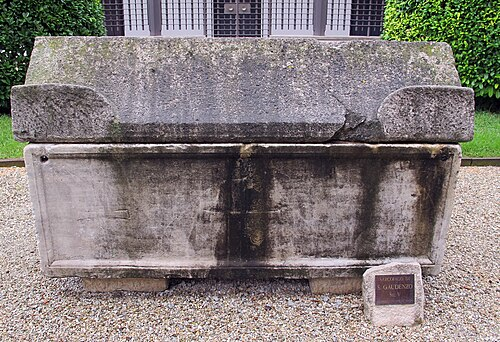
Gaudentius’ sarcophagus by the Tempio Malatestiano in Rimini
Saint Gaudentius performed several miracles during his life: he exorcised a man possessed by the devil and he transformed the waters of the Misa river into wine for his travelling companions.
As well as being the patron saint of Rimini, Gaudentius is celebrated in Ostra, in the Marche region, Garaguso, in Basilicata, both of which host some of his relics. In 1857, Pope Pius IX donated a silver reliquary to Rimini’s Tempio Malatestiano to house Gaudentius’ skull.
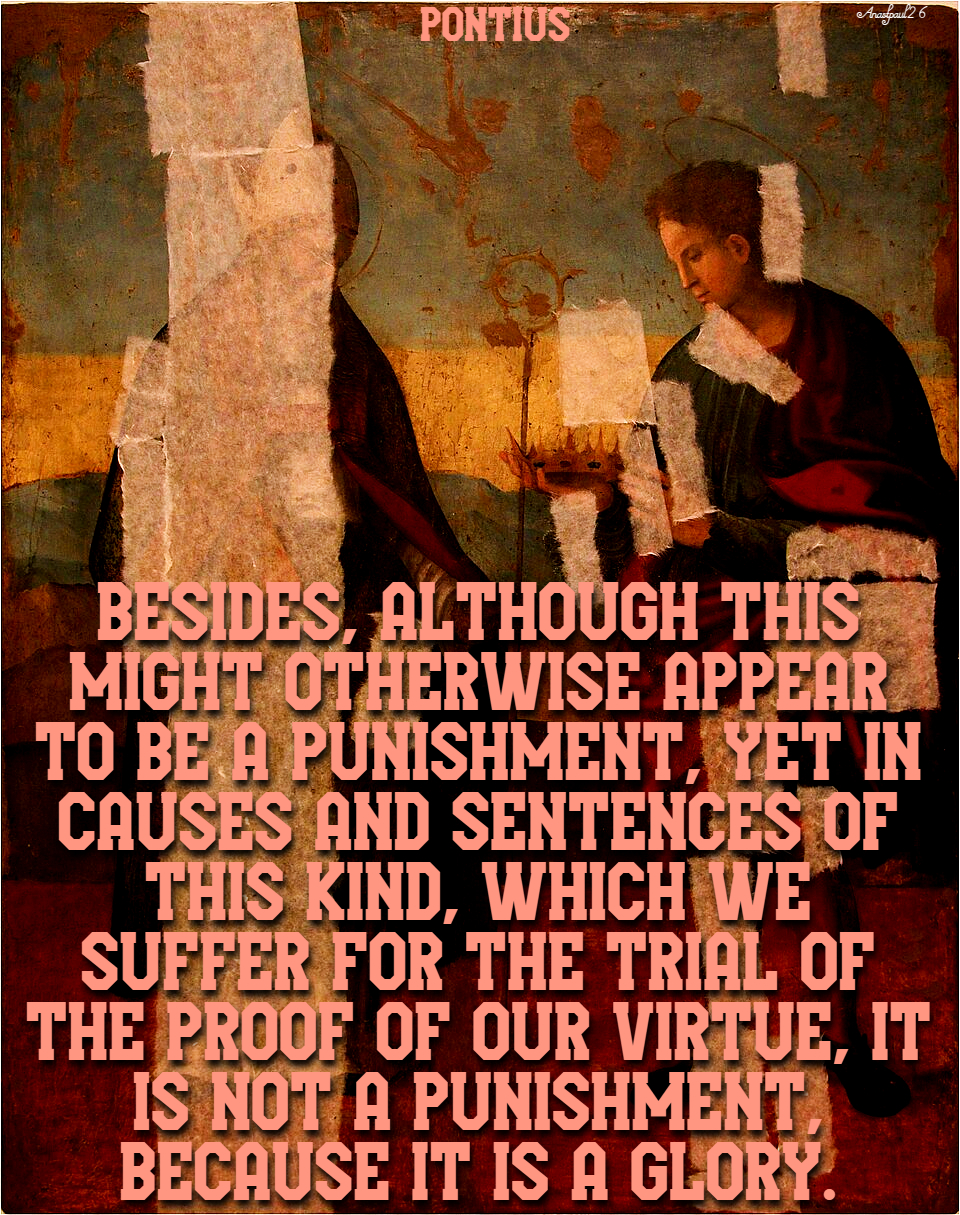
Besides, although this might otherwise appear to be a punishment, yet in causes and sentences of this kind, which we suffer for the trial of the proof of our virtue, it is not a punishment, because it is a glory.
October 14: Our Lady of La Rochette, France (7th Century)
The Abbot Orsini wrote: “Our Lady of La Rochette near Geneva. A shepherd coming up to a bush, where he heard a plaintive voice, found there an image of the Blessed Virgin, which led to a church being built there.”
St Donatian of Rheims (Died 390) St Donatian was the Seventh Bishop of Rheims, France from 360 to 390. His Memorial is beautifully celebrated in Bruges with a procession of his relics.
Saint Fortunatus of Todi (Died 537) Bishop, Confessor, miracle-worker. An entry in the Roman Martyrology under 14 October records: “At Todi in Umbria, St Fortunatus, Bishop, who, as is mentioned by blessed Gregory, was endowed with an extraordinary gift for casting out unclean spirits.”
St Franciszek Roslaniec St Gaudentius of Rimini St Gundisalvus of Lagos Bl Jacques Laigneau de Langellerie St Lupulo of Capua St Lupus of Caesarea St Manacca St Manehildis St Modesto of Capua Bl Richard Creagh
St Rusticus of Trier St Saturninus of Caesarea St Stanislaw Mysakowski St Venanzio of Luni — Martyrs of Caesarea – (4 saints): Three brothers and a sister martyred together in the persecutions of Diocletian – Carponius, Evaristus, Fortunata and Priscian. In 303 in Caesarea, Cappadocia (in modern Turkey) – their relics enshrined in Naples, Italy.
Martyred in the Spanish Civil War: • Blessed Ana María Aranda Riera • Blessed Jacques Laigneau de Langellerie
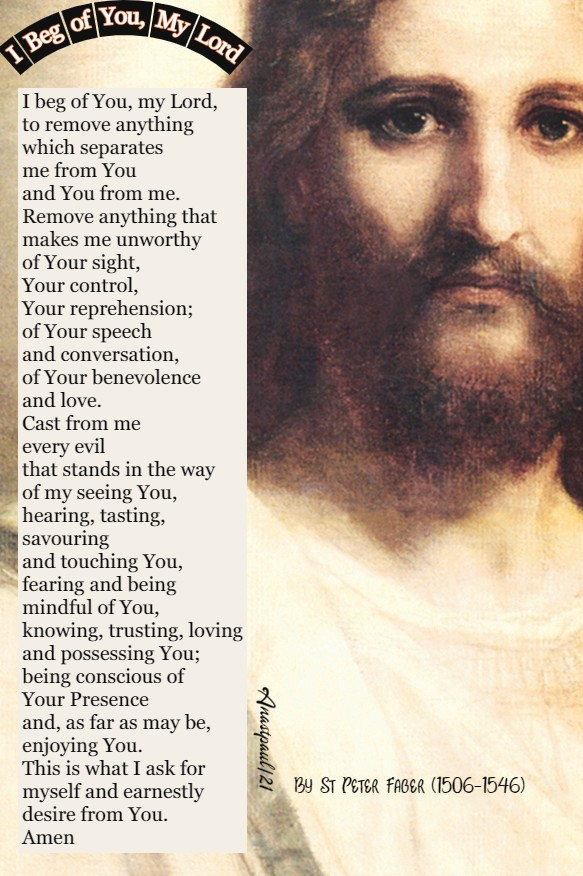
I Beg of You, My Lord By St Peter Faber (1506-1546)
I beg of You, my Lord, to remove anything which separates me from You and You from me. Remove anything that makes me unworthy of Your sight, Your control, Your reprehension; of Your speech and conversation, of Your benevolence and love. Cast from me every evil that stands in the way of my seeing You, hearing, tasting, savouring and touching You, fearing and being mindful of You, knowing, trusting, loving and possessing You; being conscious of Your Presence and, as far as may be, enjoying You. This is what I ask for myself and earnestly desire from You. Amen
One Minute Reflection – 14 October – “Month of the Holy Rosary” – Readings: John 21:15-17, Ps 29:2, 1 Pet 5:1-4; 5:10-11, Matt 16:13-19
And Jesus answering, said to him: Blessed art thou, Simon Bar-Jona: because flesh and blood hath not revealed it to thee, but my Father who is in heaven. And I say to thee: That thou art Peter; and upon this rock I will build My Church, and the gates of hell shall not prevail against it. And I will give to thee the keys of the kingdom of heaven. And whatsoever thou shalt bind upon earth, it shall be bound also in heaven: and whatsoever thou shalt loose upon earth, it shall be loosed also in heaven.
Matt 16:13-19
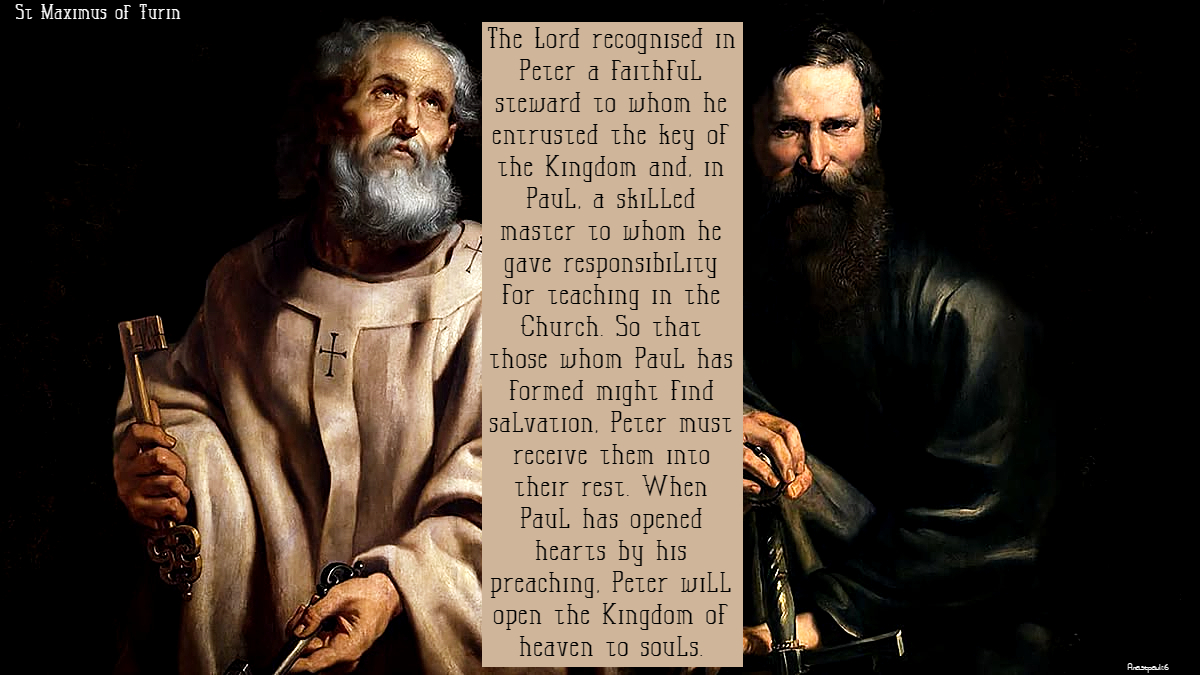
REFLECTION – The Lord recognised in Peter a faithful steward to whom he entrusted the key of the Kingdom and, in Paul, a skilled master to whom he gave responsibility for teaching in the Church. So that those whom Paul has formed might find salvation, Peter must receive them into their rest. When Paul has opened hearts by his preaching, Peter will open the Kingdom of heaven to souls. So it is a kind of key that Paul, too, has received from Christ: the key of knowledge, enabling him to open up to their very depths hearts hardened towards the faith. Then, in spiritual unveiling, it causes what was hidden within to appear in the light of day. This is a key that allows the confession of sin to escape from consciences and locks within them for ever the grace of the Savior’s mystery.
So both have received keys from the Lord's hands: the key of knowledge for the one and the key of authority for the other; the former metes out the riches of immortality, the latter dispenses treasures of wisdom. For there are treasures of knowledge, as it is written: this mystery is Christ “in whom are hidden all the treasures of wisdom and knowledge,”
St Maximus of Turin
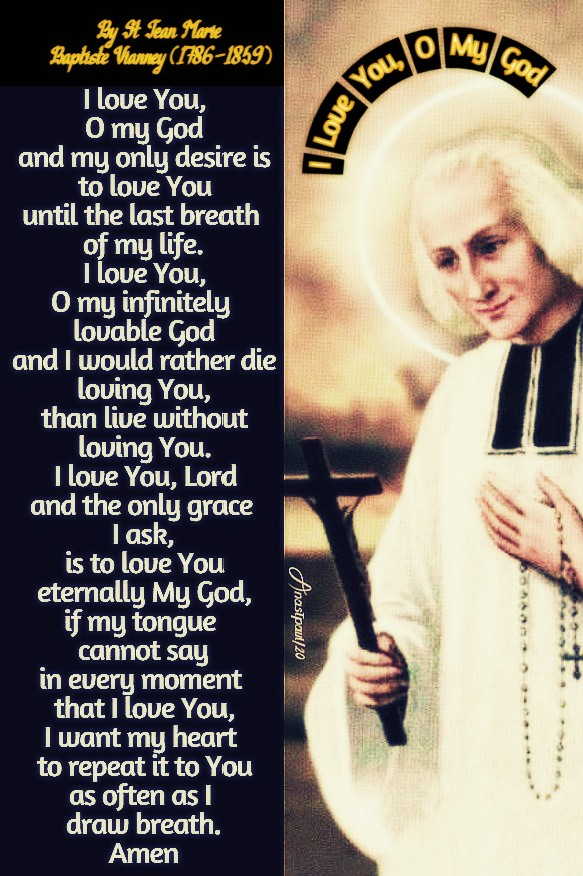
PRAYER – I Love You, O My God – By St Jean Marie Baptiste Vianney (1786-1859) I love You, O my God and my only desire is to love You until the last breath of my life. I love You, O my infinitely lovable God and I would rather die loving You, than live without loving You. I love You, Lord and the only grace I ask, is to love You eternally My God, if my tongue cannot say in every moment that I love You, I want my heart to repeat it to You as often as I draw breath. Amen
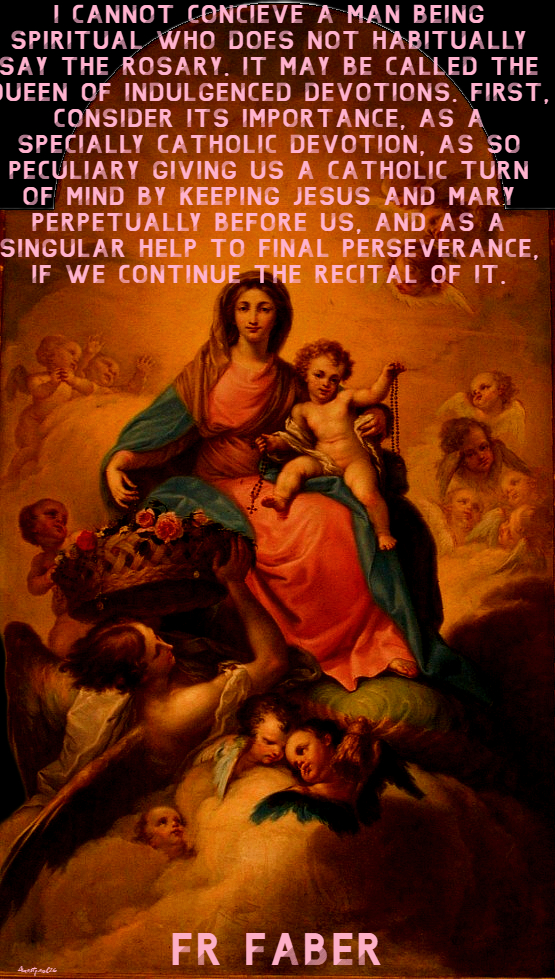
I cannot concieve a man being spiritual who does not habitually say the rosary. It may be called the queen of indulgenced devotions. First, consider its importance, as a specially Catholic devotion, as so peculiary giving us a Catholic turn of mind by keeping Jesus and Mary perpetually before us, and as a singular help to final perseverance, if we continue the recital of it.
Fr Faber
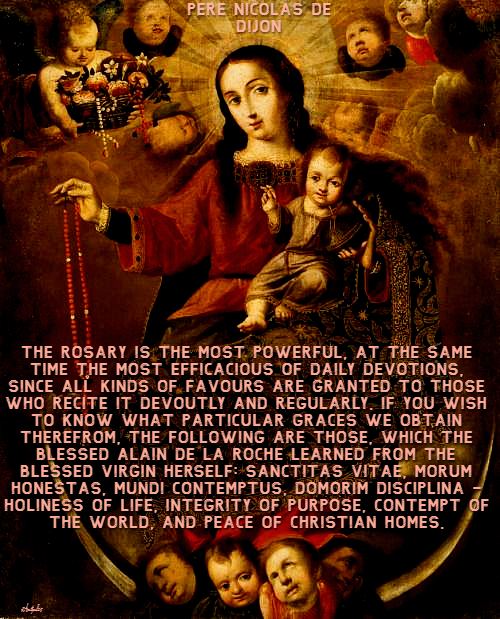
The Rosary is the most powerful, at the same time the most efficacious of daily devotions, since all kinds of favours are granted to those who recite it devoutly and regularly. If you wish to know what particular graces we obtain therefrom, the following are those, which the Blessed Alain de la Roche learned from the Blessed Virgin herself: Sanctitas vitae, morum honestas, mundi contemptus, domorim disciplina – Holiness of life, integrity of purpose, contempt of the world, and peace of Christian homes.
Pere Nicolas de Dijon
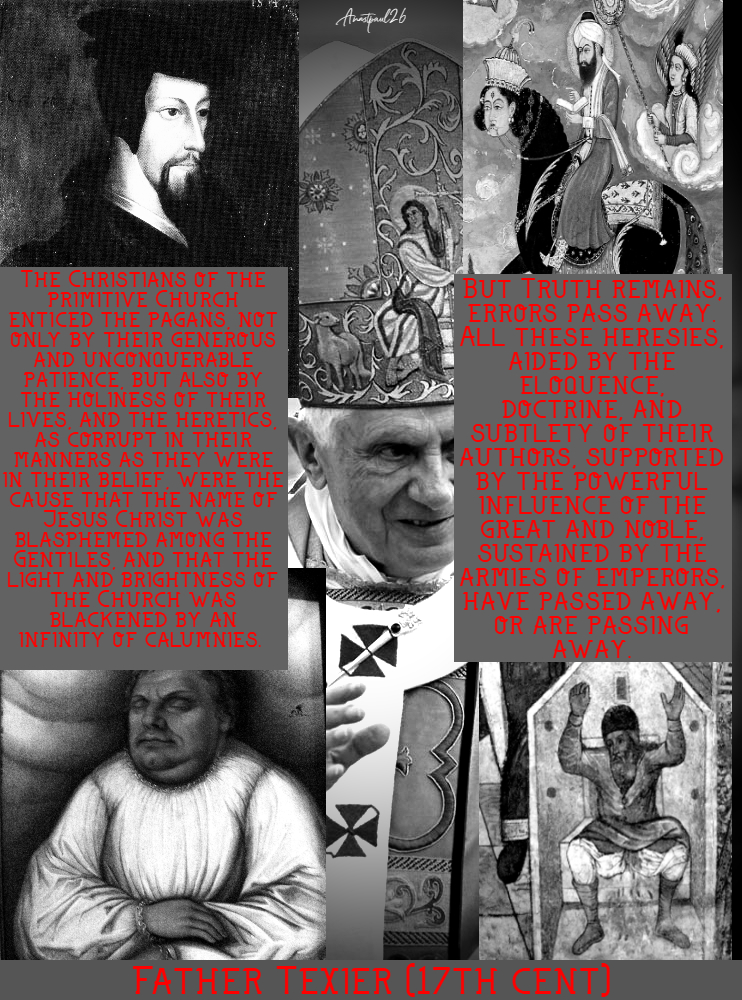
The Christians of the primitive Church enticed the pagans, not only by their generous and unconquerable patience, but also by the holiness of their lives, and the heretics, as corrupt in their manners as they were in their belief, were the cause that the name of Jesus Christ was blasphemed among the Gentiles, and that the light and brightness of the Church was blackened by an infinity of calumnies. But Truth remains, errors pass away. All these heresies, aided by the eloquence, doctrine, and subtlety of their authors, supported by the powerful influence of the great and noble, sustained by the armies of emperors, have passed away, or are passing away.
Father Texier (17th cent)
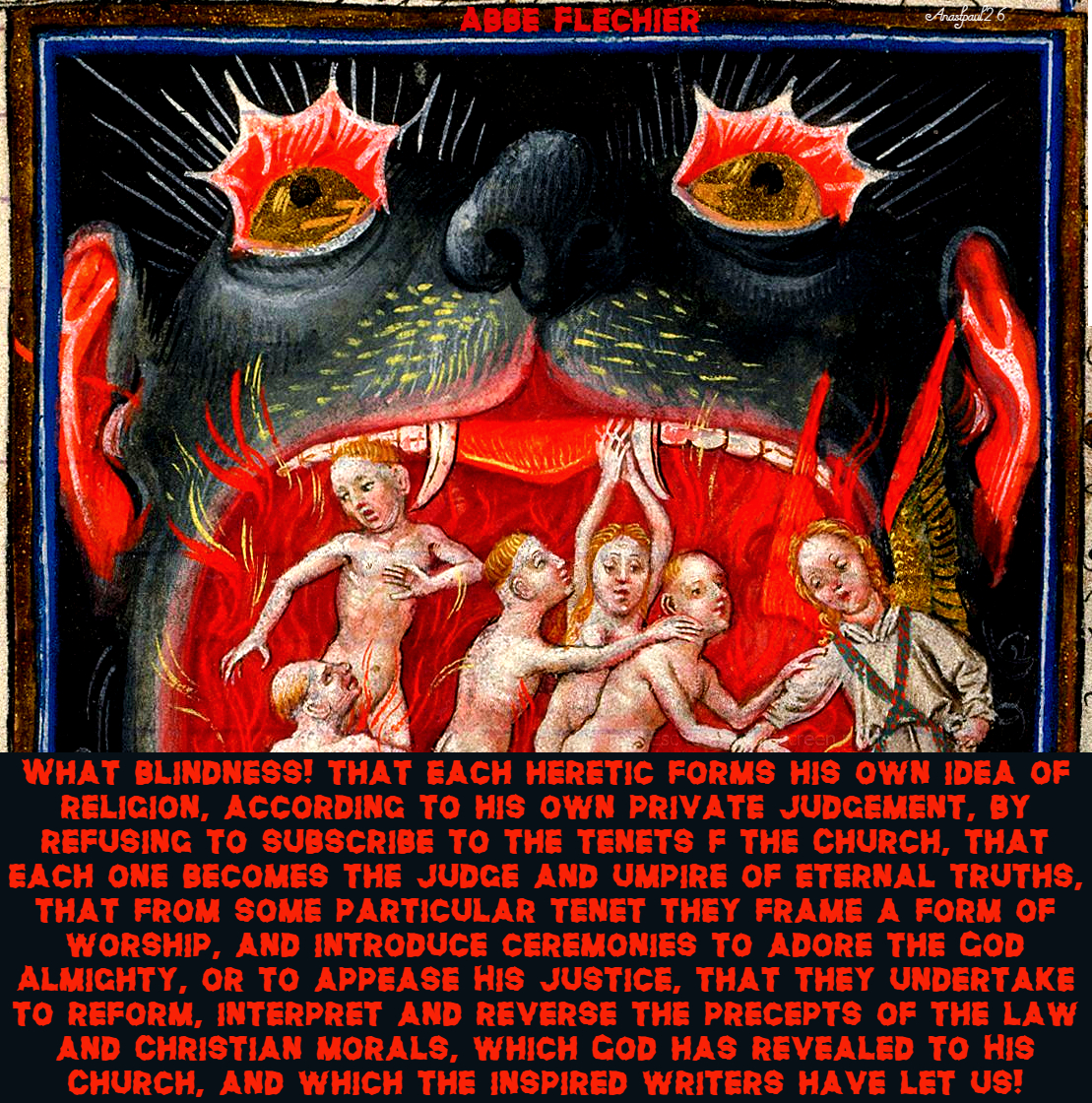
What blindness! that each heretic forms his own idea of religion, according to his own private judgement, by refusing to subscribe to the tenets f the Church, that each one becomes the judge and umpire of eternal truths, that from some particular tenet they frame a form of worship, and introduce ceremonies to adore the God Almighty, or to appease His justice, that they undertake to reform, interpret and reverse the precepts of the law and Christian morals, which God has revealed to His Church, and which the inspired writers have let us!
Abbe Flechier
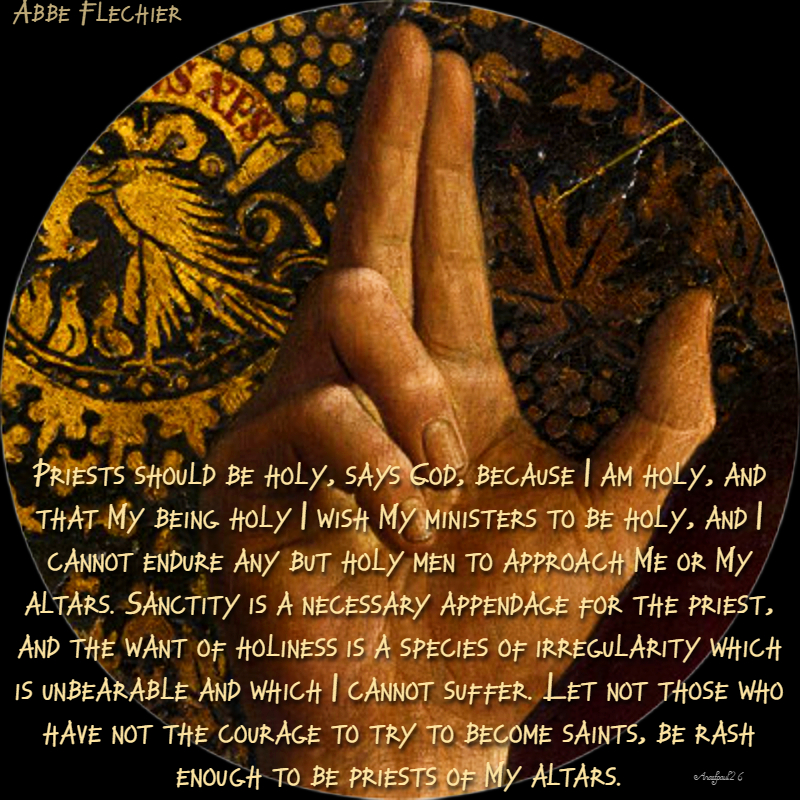
Priests should be holy, says God, because I am holy, and that My being holy I wish My ministers to be holy, and I cannot endure any but holy men to approach Me or My altars. Sanctity is a necessary appendage for the priest, and the want of holiness is a species of irregularity which is unbearable and which I cannot suffer. Let not those who have not the courage to try to become saints, be rash enough to be priests of My altars.
Abbe Flechier
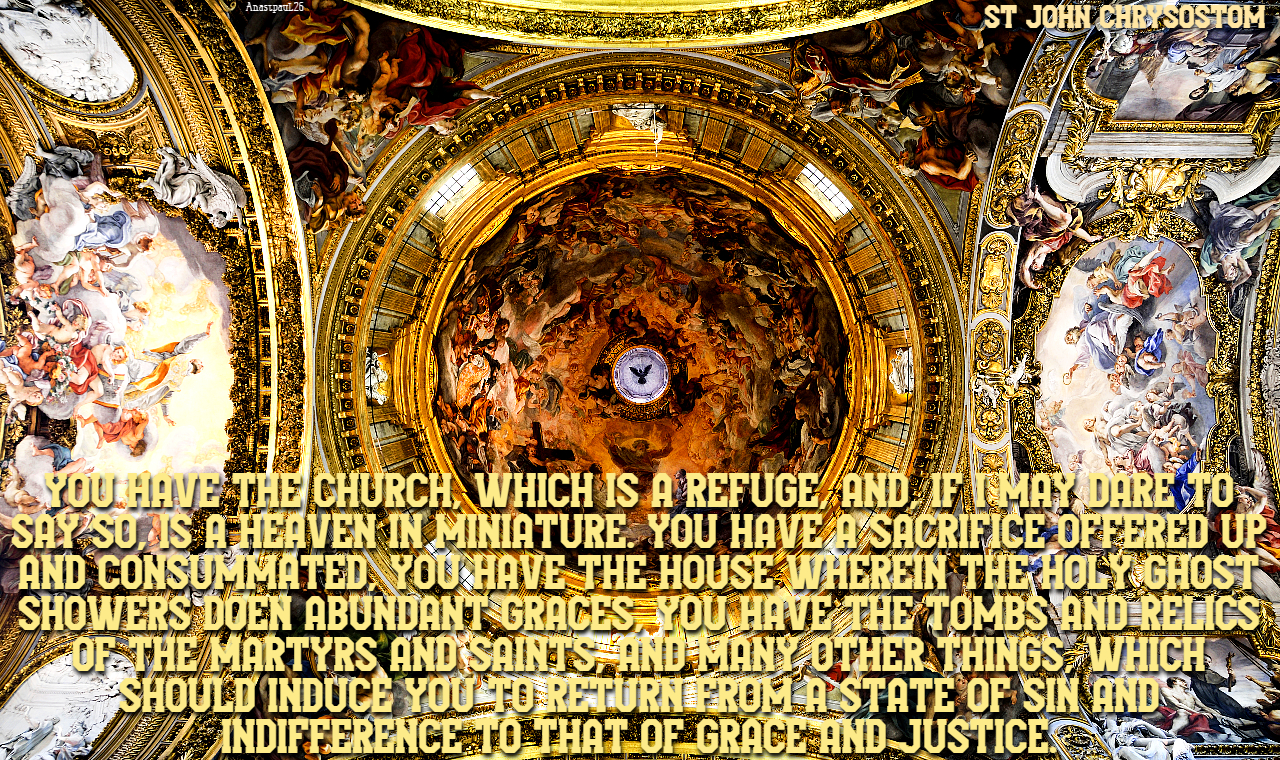
You have the church, which is a refuge, and, if I may dare to say so, is a heaven in miniature. You have a sacrifice offered up and consummated, you have the house wherein the Holy Ghost showers doen abundant graces, you have the tombs and relics of the martyrs and saints, and many other things, which should induce you to return from a state of sin and indifference to that of grace and justice.
To have a singular Devotion to the holy Spirits of the First Choir—the Angels, Archangels, and Principalities.
The third or last Hierarchy of the Holy Angels is formed of three Choirs Angels, Archangels, and Principalities. They are particularly applied to the affairs of kingdoms and provinces, and in general to all that regards the happiness of man. Their goodness and kindness is so great, that we can never make them a suitable return. The principalities are so called, says St. Gregory, because they are the princes of the other two choirs, and communicate to them those lights and intelligences which they receive from the higher Hierarchies. The Archangels watch over kingdoms and provinces and the Angels are appointed the guardians of men.
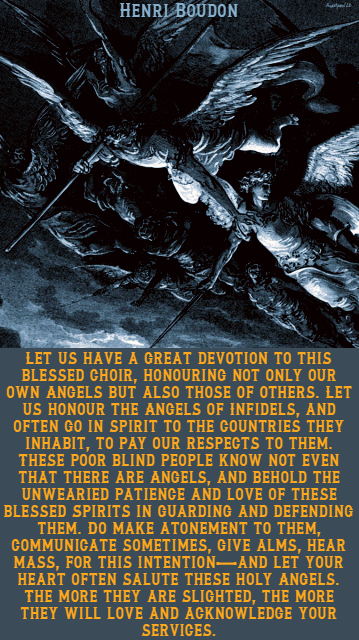
Let us have a great devotion to this blessed choir, honouring not only our own Angels but also those of others. Let us honour the Angels of Infidels, and often go in spirit to the countries they inhabit, to pay our respects to them. These poor blind people know not even that there are Angels, and behold the unwearied patience and love of these blessed Spirits in guarding and defending them. Do make atonement to them, communicate sometimes, give alms, hear mass, for this intention—and let your heart often salute these holy Angels. The more they are slighted, the more they will love and acknowledge your services. If a great king, in the revolt of his subjects, received considerable services from foreigners, he would not fail to acknowledge them gratefully, when reinstated in his dominions : hence judge what you may expect from the princes of the celestial realm. Do the same for the Angels of Heretics—for those of uninstructed Catholics, the greater number of whom know as little about these holy Spirits, as Pagans and Infidels. Pray for their conversion, that knowing the adorable Jesus, whom God has sent, and Mary his amiable mother, they may also know and honour the Angels.
Be devout to the Angels of your friends; these often render you services, which you would not receive from your own guardian. As, in the number of your friends, your confessor holds the first place, honour particularly his Angel, and pray him to bear on his mind a perfect knowledge of the designs of God on those whom he directs. Honour the Angels of your parents, relations, benefactors, and- of all with whom you have to do; they have more part than you think in the favours you receive by means of those persons. Be devout to the Angels of your enemies—it is the true way to gain them—or, if God wills that you should suffer the effects of their hatred, it is the best means of obtaining grace to love them cordially and make a good use of your sufferings. In fine, revere the Angels of the Sovereign Pontiff, the Bishops, the Clergy, and all persons in authority—that they may fitly discharge their obligations.
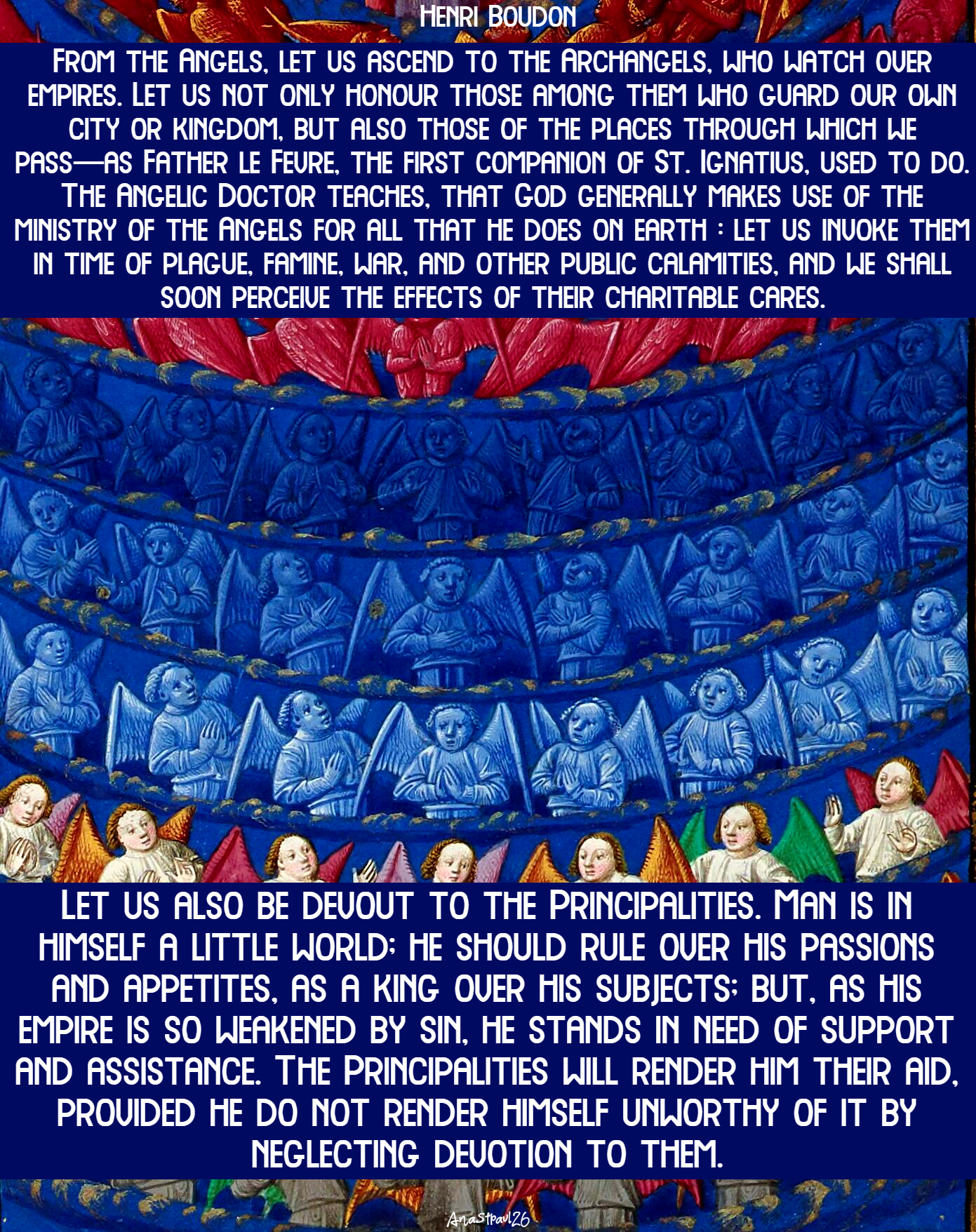
From the Angels, let us ascend to the Archangels, who watch over empires. Let us not only honour those among them who guard our own city or kingdom, but also those of the places through which we pass—as Father le Fevre, the first companion of St. Ignatius, used to do. The Angelic Doctor teaches, that God generally makes use of the ministry of the Angels for all that he does on earth : let us invoke them in time of plague, famine, war, and other public calamities, and we shall soon perceive the effects of their charitable cares.
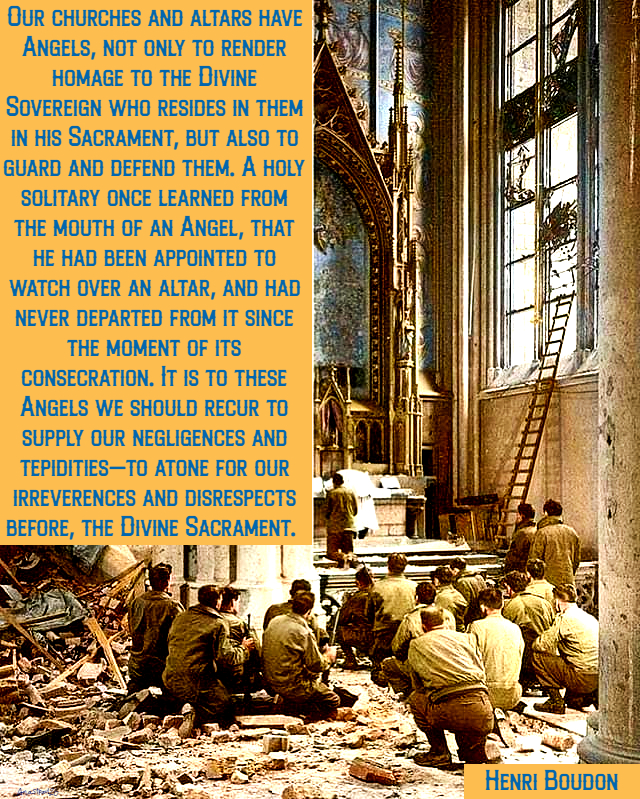
Our churches and altars have Angels, not only to render homage to the Divine Sovereign who resides in them in his Sacrament, but also to guard and defend them. A holy solitary once learned from the mouth of an Angel, that he had been appointed to watch over an altar, and had never departed from it since the moment of its consecration. It is to these Angels we should recur to supply our negligences and tepidities—to atone for our irreverences and disrespects before, the Divine Sacrament. It is well to unite in the love and homage which they continually render to it, and like the Psalmist, to “sing canticles of praise to our God in the presence of his Angels.”
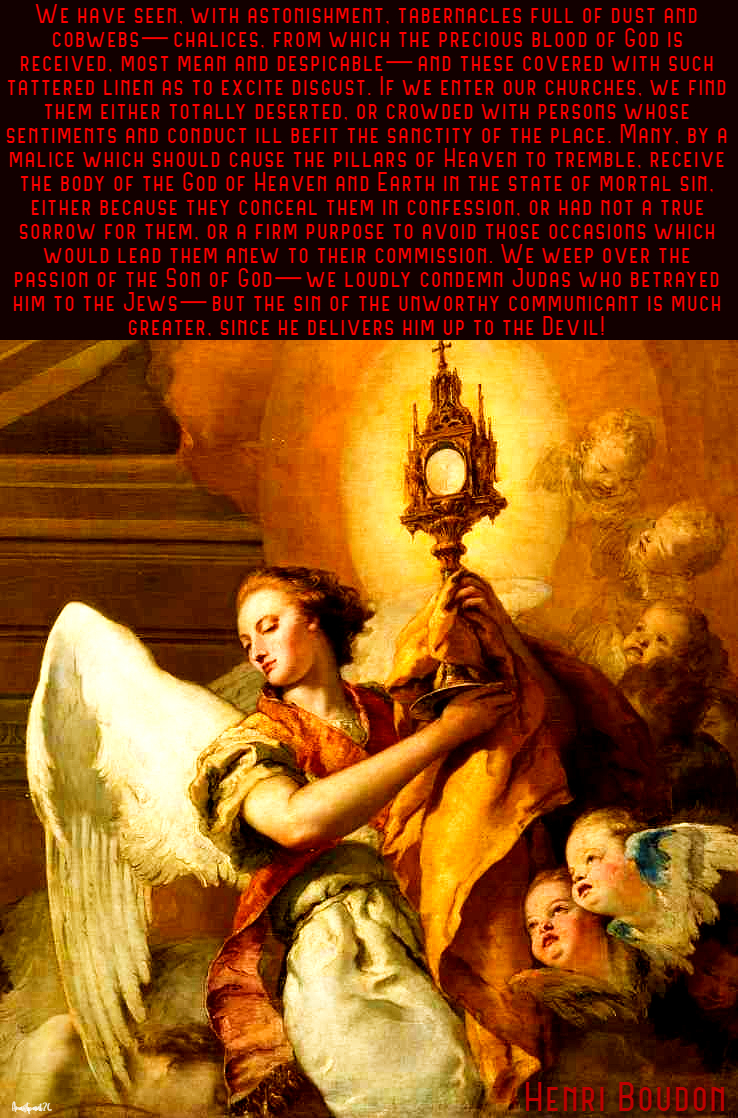
O my Lord and my God! here permit me to bewail, in the presence of your Divine Majesty, the deplorable blindness of Christians, who are the children of light, regarding your holy Sacrament. Is it then true, that they still believe you to be really present in this adorable mystery and behave as they do ? We are seized with horror when we reflect on the irreverences committed against you by Heretics and Infidels but those offered to you by Christians, who profess themselves ready to sacrifice their lives in defence of this adorable truth, are inconceivable. We have seen, with astonishment, tabernacles full of dust and cobwebs—chalices, from which the precious blood of God is received, most mean and despicable—and these covered with such tattered linen as to excite disgust. If we enter our churches, we find them either totally deserted, or crowded with persons whose sentiments and conduct ill befit the sanctity of the place. This is not all—the sufferings which love has imposed on our Sovereign stop not here. Many, by a malice which should cause the pillars of Heaven to tremble, receive the body of the God of Heaven and Earth in the state of mortal sin, either because they conceal them in confession, or had not a true sorrow for them, or a firm purpose to avoid those occasions which would lead them anew to their commission. We weep over the passion of the Son of God—we loudly condemn Judas who betrayed him to the Jews—but the sin of the unworthy communicant is much greater, since he delivers him up to the Devil!
O ! Angels of Paradise ! I address myself to you—knowing the obduracy of men, inspire them with all that respect for the adorable body of your Sovereign, which they are capable of conceiving—give them a knowledge of the dispositions with which it should be received:—that this abominable crime, this sin more hellish than human, may be no more committed. Inspire the rich to provide churches and altars, with suitable decorations—and repair, by your unceasing homage, the insults which have been offered to this mystery of inconceivable love.
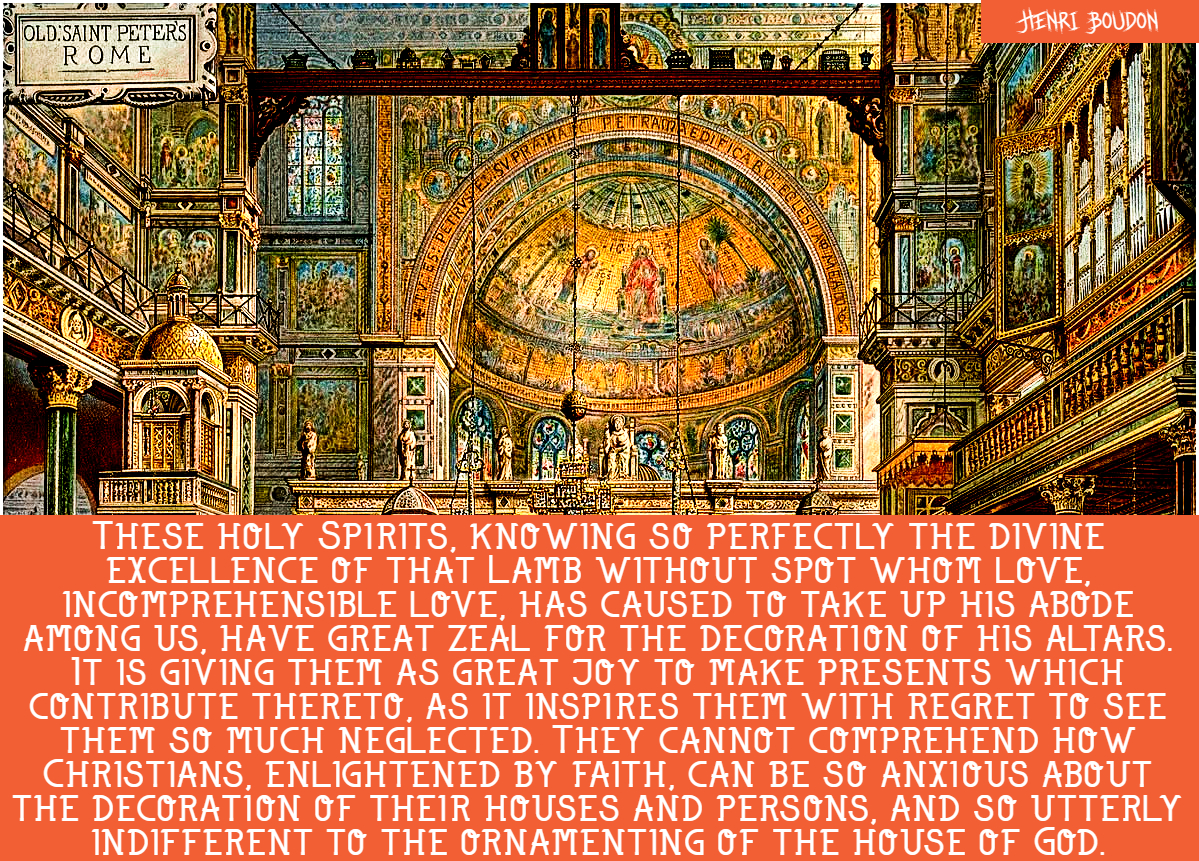
These holy Spirits, knowing so perfectly the divine excellence of that Lamb without spot whom love, incomprehensible love, has caused to take up his abode among us, have great zeal for the decoration of his altars. It is giving them as great joy to make presents which contribute thereto, as it inspires them with regret to see them so much neglected. They cannot comprehend how Christians, enlightened by faith, can be so anxious about the decoration of their houses and persons, and so utterly indifferent to the ornamenting of the house of God.
Let us also be devout to the Principalities. Man is in himself a little world; he should rule over his passions and appetites, as a king over his subjects; but, as his empire is so weakened by sin, he stands in need of support and assistance. The Principalities will render him their aid, provided he do not render himself unworthy of it by neglecting devotion to them.



You must be logged in to post a comment.