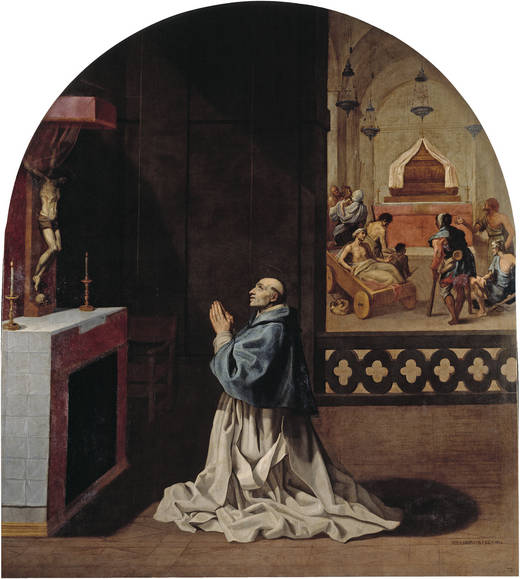
Blessed Artaldo of Belley, also known as Artaldus, Artaud, Arthaud, Arthold, Artholdus, Artoldo, was a 13th-century Carthusian Bishop of Belley, France. Artaldus was born in the castle of Sothonod in Savoy. At the age of eighteen, he went to the court of Duke Amadeus III, but a year or two after, he became a Carthusian at Portes. After many years, being a priest and an experienced and holy religious, he was sent by the prior of the Grande Chartreuse to found a charterhouse near his home, in a valley in the Valromey significantly called “the cemetery”. Here Artaldus established himself with six of his brethren from Portes. The community was no sooner well settled down, than there buildings were destroyed by fire, and St. Artaldus had to begin all over again. He chose a fresh site on the Arvieres River, and his second foundation was soon built and occupied, dedicated to the Virgin Mary, in 1132.
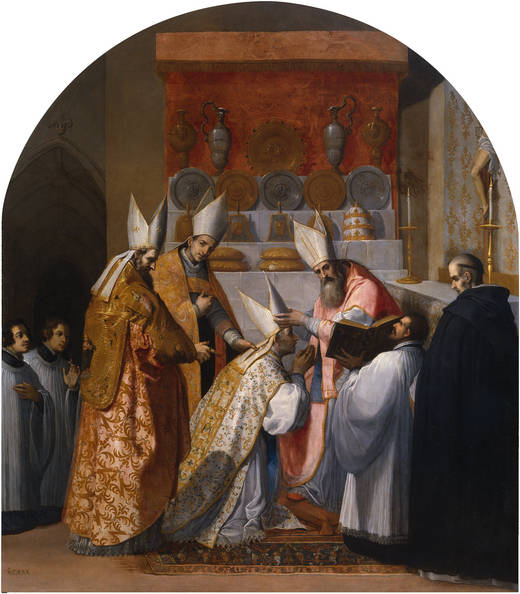
But a Carthusian cell could not contain the ever-increasing reputation of Artaldus: like his master St. Bruno, he was consulted by the Pope, and when he was well over eighty, he was called from his monastery to be bishop of Belley. However, after less than two years of episcopate, his resignation was accepted, and he returned to Arvieres, where he lived in peace for the rest of his days. During his last years, he was visited by St. Hugh of Lincoln, who had come into France, and who, while he was prior of the charterhouse of Witham, had induced Henry II to become a benefactor of Arvieres.
The cultus of St. Artaldus, called simply Blessed by the Carthusians, was confirmed for the diocese of Belley in 1834. He was 105 years old when he died on 6 October 1206, the same day as the founder of his order, St Bruno.
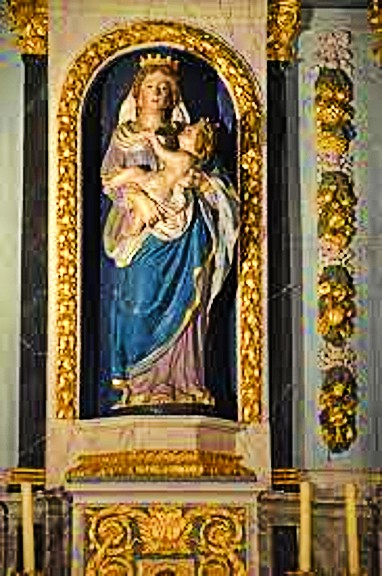
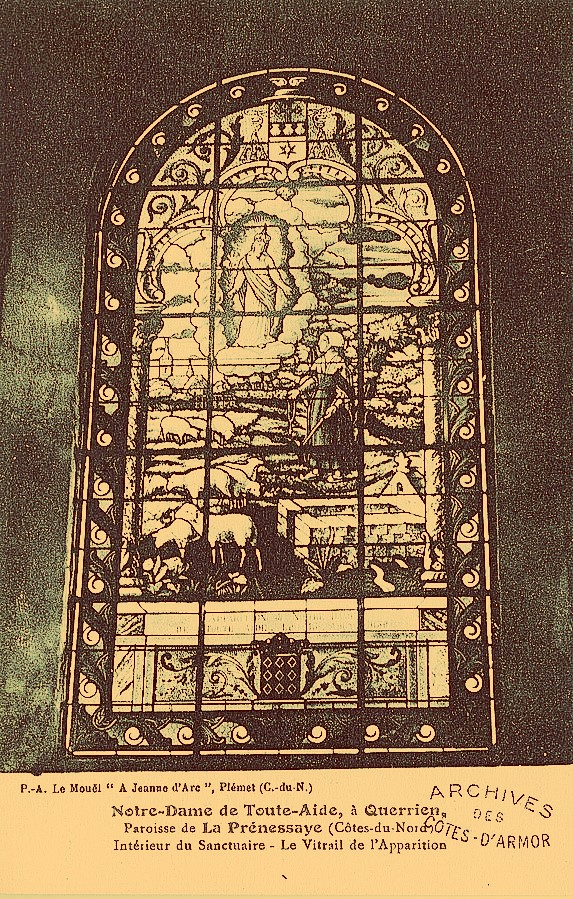
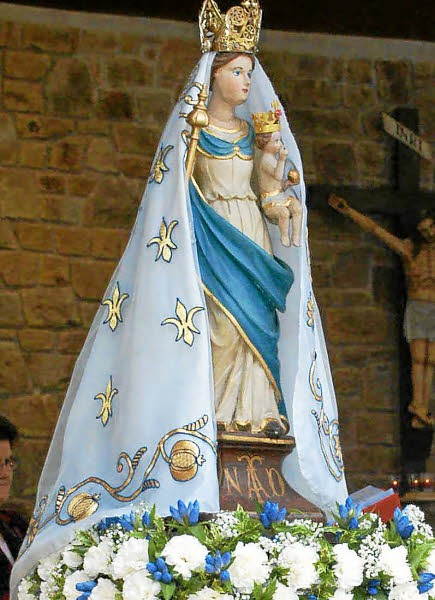
Notre-dame-de-toute-aide de Querrien, France / Our Lady of All Help (1652) – 6 October, for the Feast of the Holy Rosary on 7 October) 15 August (the Assumption) and the Sunday following 8 September (Feast of the Nativity of Our Lady):
In 574, the Monk Saint Columban came from Ireland and landed on the coast of Brittany with 12 companions. The Monk Saint Gall, friend and companion of St Colomban, was part of the group. The latter stopped at Querrien and there, he found a clear and limpid spring gushing out of the ground “so that the inhabitants can knead bread there” . St Gall also built a wooden Oratory which he dedicated to Our Lady. He placed there, a wooden Statue, representing the Virgin and Child , a Statue he had sculpted himself. Over time, the Oratory was abandoned, it disintegrates and the Statue fell to the ground and was buried in the mud near the source of the spring.
On 15 August 1652, Jeanne Courtel a 12-year-old girl, deaf and dumb from birth. while guarding the family’s sheep saw a “beautiful lady” who spoke to her. Thereupon, Jeanne was immediately able to hear and to speak to the great astonishment of all the inhabitants of the village. A few days later, Jeanne saw the beautiful lady again who asked to have the ground dug up near the source of the spring, where the Statue of the Virgin was buried. The wooden Statuette was found at the place indicated, confirming for the people, the authenticity of the Apparition. There were a total of fifteen appearances of Our Lady with which Jeanne was favoured, until September of the same year. From that time on, pilgrims arrived and numerous miracles were recorded.
Shortly after this miracle became known, there was a second one just as remarkable. There was a community benefactor whose son was at death’s door with a high fever. Invoking Our Lady before this same Statue the man saw his son instantly cured. After this second wondrous miracle, the Statue was moved into the Chapel and there were many miracles that followed. One miracle was worked in favour of a religious Sister who had been terribly burned and was she was instantly cured. A Priest, falsely accused of a crime, was acquitted after special prayers to the “miracle lady.” The statue had had no name before this but the Parishioners decided now to call her Our Lady of All Help, Quick Help, or Our Lady of Good Remedy.
The local Bishop, Denis de La Barde, launched an investigation and went there to verify the child’s declarations. Satisfied with his hearings, he had a chapel erected in 1652 to organise the devotion of the faithful. After having carried out a canonical investigation, the Bishop of Saint-Brieuc issued a positive opinion on the Apparition and decided to have a Chapel built and to organise worship there. The following 29 September, the Bishop returned to bless the first stone of the Chapel during a celebration which brought together 1,500 pilgrims.
On 14 August 1950, a great celebration was held in the Sanctuary. This celebration was attended by 20,000 pilgrims, several Bishops, the Abbots of Brittany and 200 Priests from Saint-Brieuc, Rennes and Vannes , for the crowning of the Statue of Notre-Dame de Tout-Aide . It was Archbishop Clément Roque of Rennes who placed the crown designed by Émile Daubé and made by goldsmith René Desury on the head of the Statue. This coronation was carried out with the authorisation and blessing of Pope Pius XII.
The Statue itself is only about 60 centimetres tall. The Blessed Virgin Mary is crowned, and holds her Infant Son in one arm, and a sceptre in the other. At the time of the French Revolution and during the accompanying Reign of Terror, the Abbey was destroyed. A pious lady took the Statue of Our Lady of All Help and safeguarded it until the trouble was over. After her death the Statue was restored to the community. The Statue of Our Lady of All Help has survived several wars since.
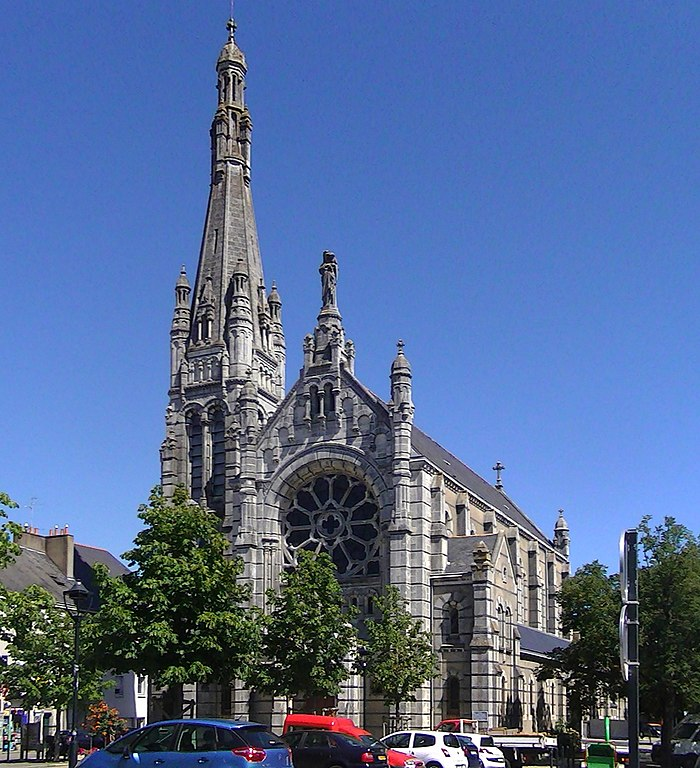
In 1998, a series of renovations began which would continue for several years. Today pilgrimages continue all year with often as many as 10 000 attending the major celebrations. The current Church incorporates the small Chapel (the remains of which, can still be seen on the north side of the building).
There is a short and very lovely prayer which, for centuries, has been associated with this Statue. It is, “Oh, Mother of All Help, say but one word in our behalf to Thy Divine Son, for He cannot refuse thee any favour. Amen.”
St Bruno O.Cart (c 1030-1101) Priest, Confessor, Hermit, Monk, Mystic, Founder of the Carthusian Order, Philosopher, Theologian, Teacher, Advisor, Writer (Optional Memorial)
Blessed Adalbero of Lambach (c 1010–1090) Bishop of Würzburg and Count of Lambach-Wels, Reformer, Mediator and Advisor, founder of Churches and Monasteries.
St Pardulf St Renato of Sorrento St Romanus of Auxerre St Sagar of Laodicea — Martyrs of Capua – 4 saints: A group of martyrs who were either killed in Capua, Italy, or that’s where their relics were first enshrined. We now know nothing but their names – Aemilius, Castus, Marcellus and Saturninus.
Martyrs of Kyoto – 52 beati: Fifty-two Japanese lay people, some single, some married, some parents, some children, who were martyred together during one of the government sponsored persecutions of Christians.
Martyrs of Trier: Commemorates the large number of martyrs who died in Trier, Germany in the persecutions of Diocletian. 287 in Trier, Germany.
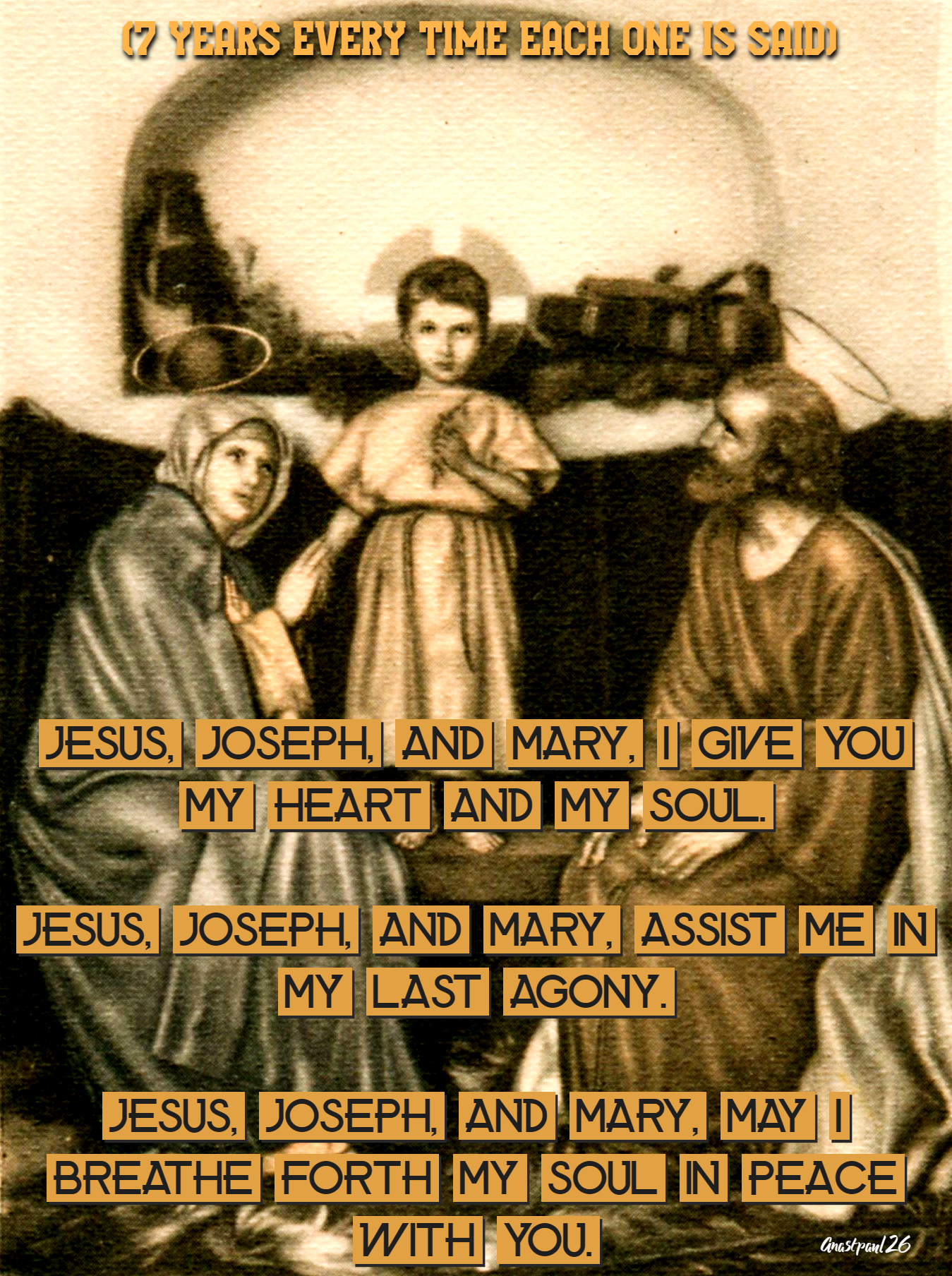
Jesus, Joseph, and Mary, I give you my heart and my soul.
Jesus, Joseph, and Mary, assist me in my last agony.
Jesus, Joseph, and Mary, may I breathe forth my soul in peace with you.
(7 years every time each one is said)
From sudden and unprovided death, O Lord, deliver us.
(300 days every time said)
O Lord, my God, I now, at this moment, readily and willingly accept at Thy hand whatever kind of death it may please Thee to send me, with all its pains, penalties, and sorrows.
(7 years every time said. Plenary indulgence at the point of death to all those who at any time of their lives, with sincere love toward God and with the usual conditions, make this kind of act)
Grant, we beseech Thee, O Lord, that we in the hour of death, being strengthened by the sacraments and cleansed of all sins, may with joy deserve to be received into the bosom of Thy mercy. Through Christ Our Lord. Amen.
One Minute Reflection – 6 October – “Month of the Holy Rosary” – Readings: Ps 36:30-31, Ps 36:1, Sir 31:8-11, Luke 12:35-40
Blessed are those servants whom the master, on his return, shall find watching.
Luke 12:35-40
REFLECTION – And your public assemblies I have come to hate. For there are excessive banquetings, and subtle flutes which provoke to lustful movements, and useless and luxurious anointings, and crowning with garlands. With such a mass of evils do you banish shame; and you fill your minds with them, and are carried away by intemperance, and indulge as a common practice in wicked and insane fornication. And this further I would say to you, why are you, being a Greek, indignant at your son when he imitates Jupiter, and rises against you and defrauds you of your own wife? Why do you count him your enemy, and yet worship one that is like him? And why do you blame your wife for living in unchastity, and yet honour Venus with shrines? If indeed these things had been related by others, they would have seemed to be mere slanderous accusations, and not truth. But now your own poets sing these things, and your histories noisily publish them.
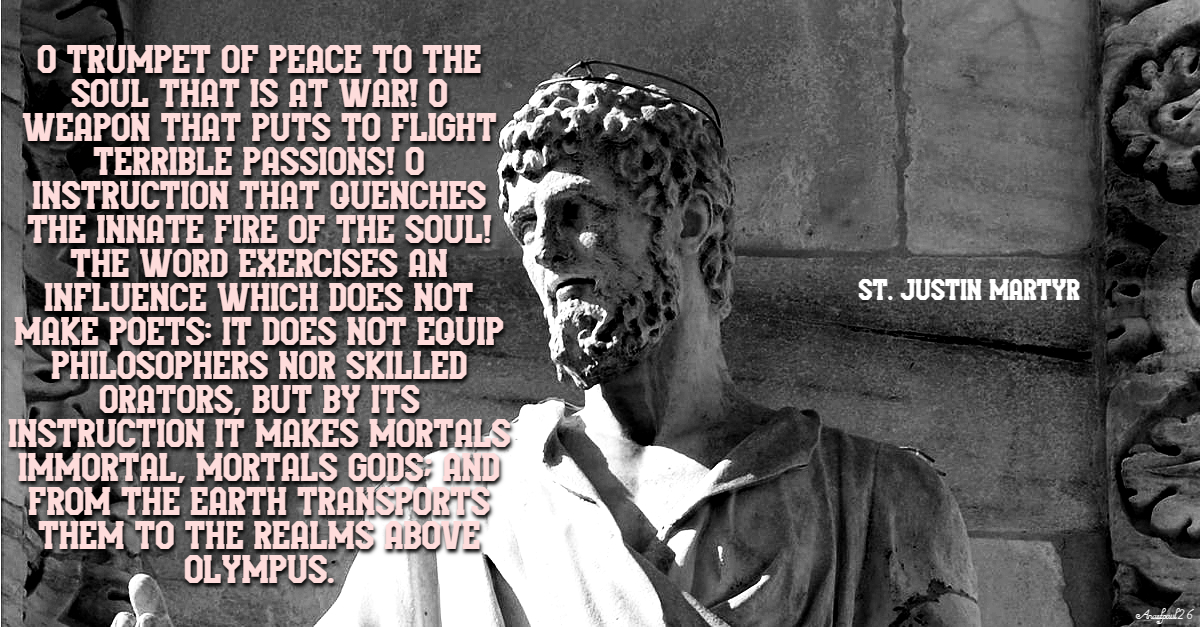
Henceforth, you Greeks, come and partake of incomparable wisdom, and be instructed by the Divine Word, and acquaint yourselves with the King immortal; and do not recognise those men as heroes who slaughter whole nations. For our own Ruler, the Divine Word, who even now constantly aids us, does not desire strength of body and beauty of feature, nor yet the high spirit of earth’s nobility, but a pure soul, fortified by holiness, and the watchwords of our King, holy actions, for through the Word power passes into the soul. O trumpet of peace to the soul that is at war! O weapon that puts to flight terrible passions! O instruction that quenches the innate fire of the soul! The Word exercises an influence which does not make poets: it does not equip philosophers nor skilled orators, but by its instruction it makes mortals immortal, mortals gods; and from the earth transports them to the realms above Olympus.
St. Justin Martyr
PRAYER – Our Father who art in heaven, Hallowed be Thy name. Teach us Almighty Father to pray, fill us with the love of Your Spirit and guide us always by the Word and Trust of our lives. With the Blessed Mother of God and of the Holy Rosary, we kneel in love and adoration. May her prayers lead us to heaven. Amen
Be not vexed over evildoers, nor jealous of those who do wrong.
Ps 36:1
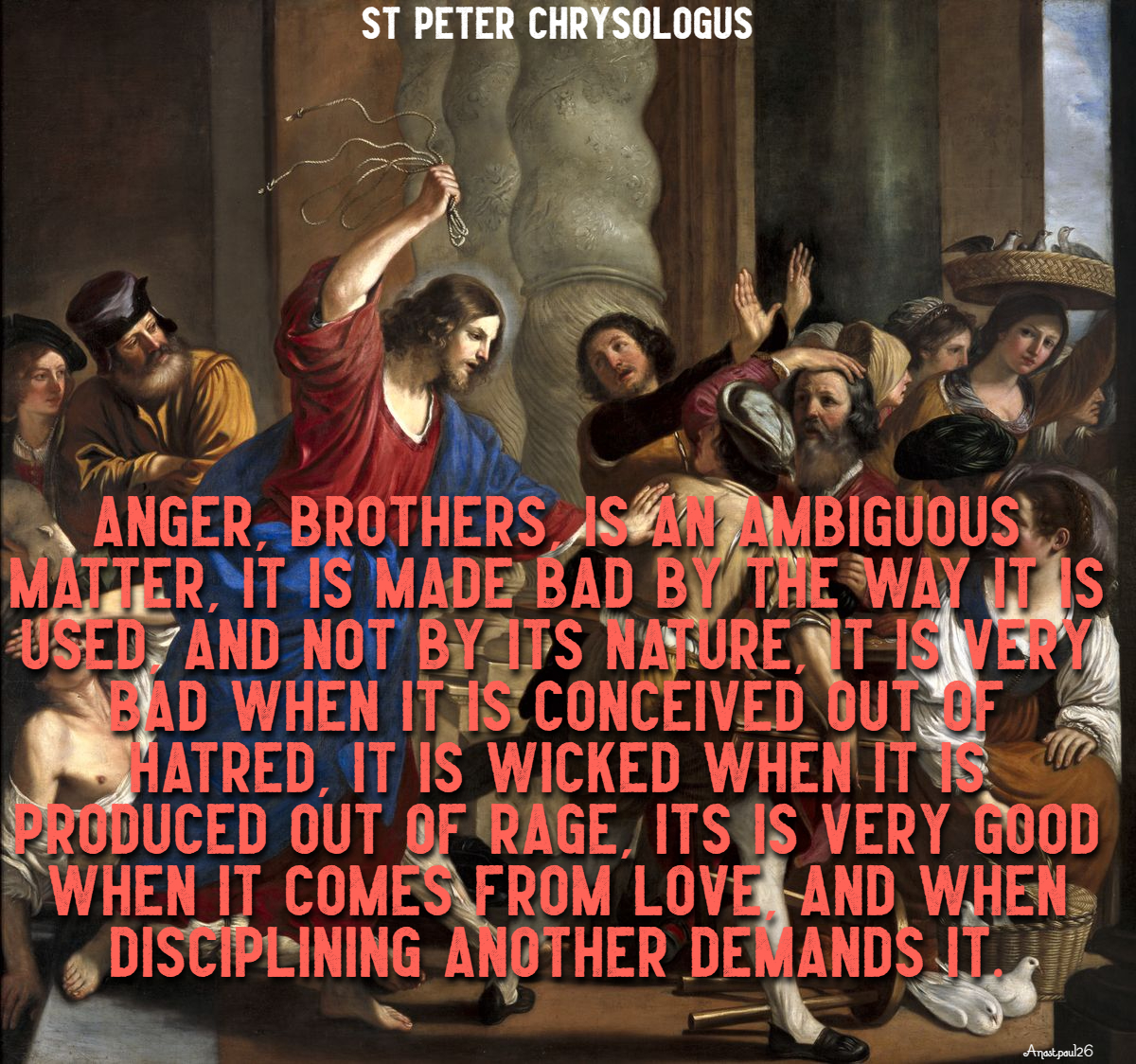
Anger, brothers, is an ambiguous matter, it is made bad by the way it is used, and not by its nature, it is very bad when it is conceived out of hatred, it is wicked when it is produced out of rage, its is very good when it comes from love, and when disciplining another demands it.
St Peter Chrysologus
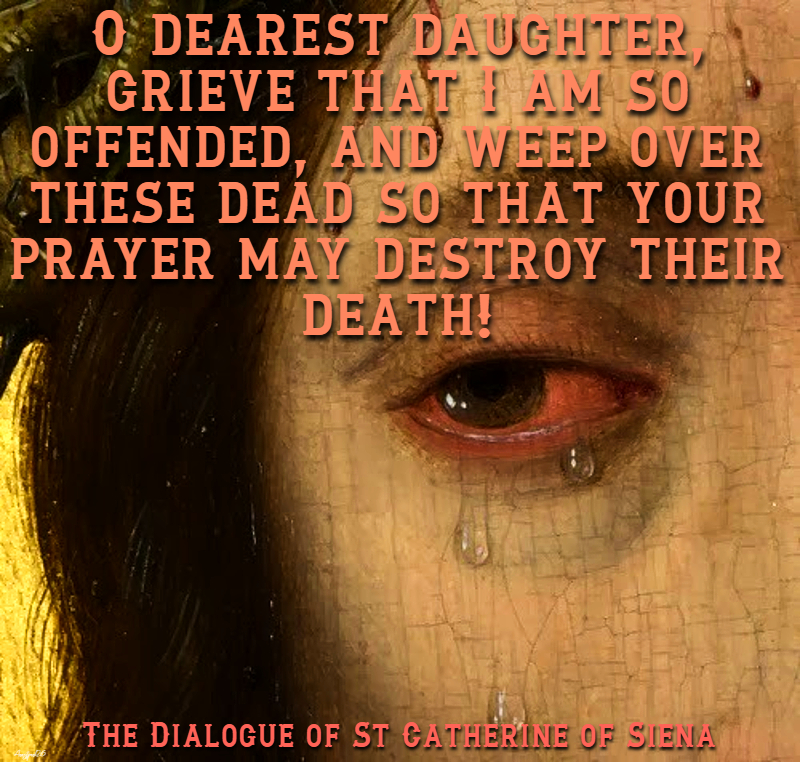
O dearest daughter, grieve that I am so offended, and weep over these dead so that your prayer may destroy their death!
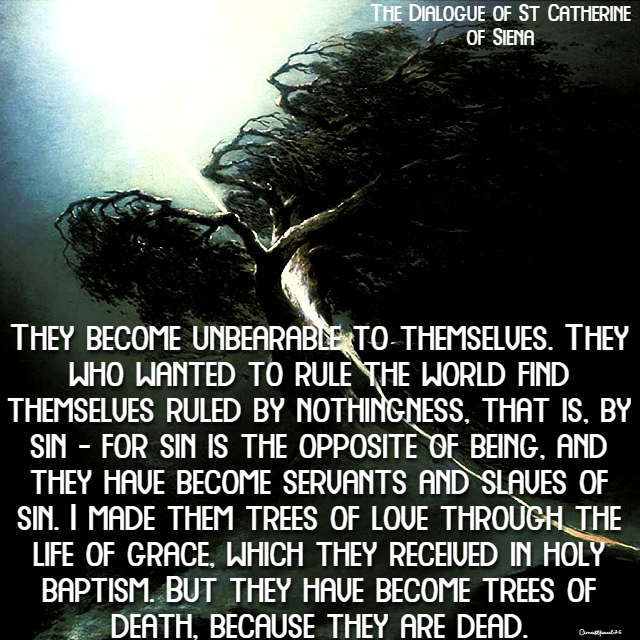
They become unbearable to themselves. They who wanted to rule the world find themselves ruled by nothingness, that is, by sin – for sin is the opposite of being, and they have become servants and slaves of sin. I made them trees of love through the life of grace, which they received in holy baptism. But they have become trees of death, because they are dead.
The Dialogue of St Catherine of Siena
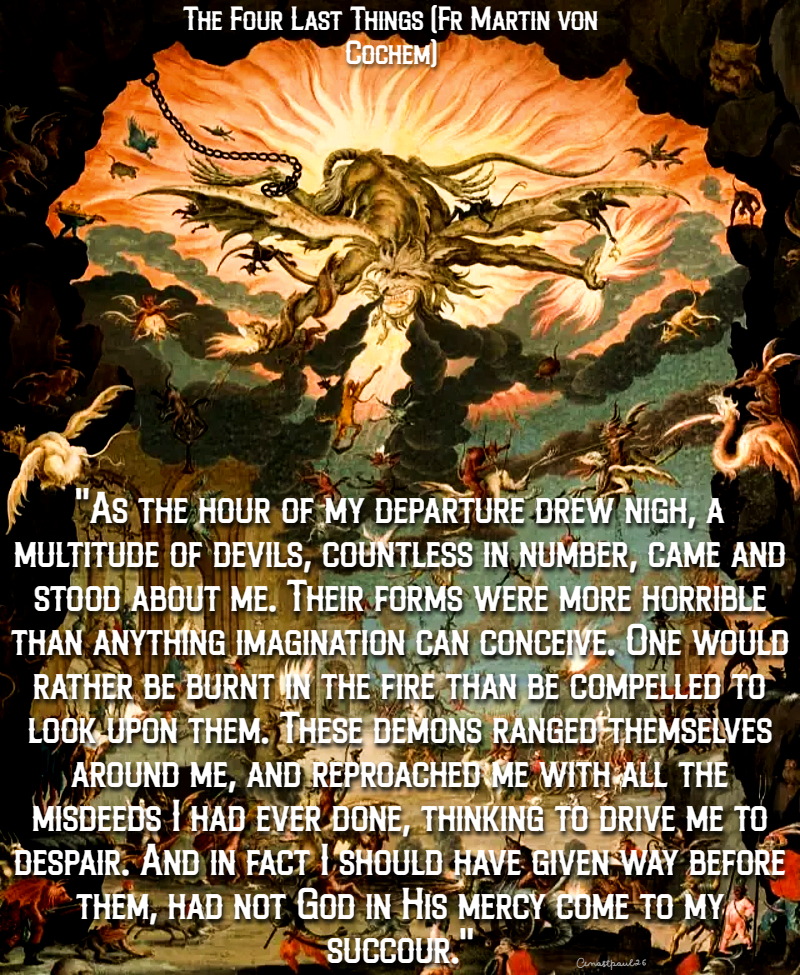
St. Cyril also, writing to St. Augustine, says that one of the three men who were raised from the dead told him: “As the hour of my departure drew nigh, a multitude of devils, countless in number, came and stood about me. Their forms were more horrible than anything imagination can conceive. One would rather be burnt in the fire than be compelled to look upon them. These demons ranged themselves around me, and reproached me with all the misdeeds I had ever done, thinking to drive me to despair. And in fact I should have given way before them, had not God in His mercy come to my succour.”
The Four Last Things (Fr Martin von Cochem)
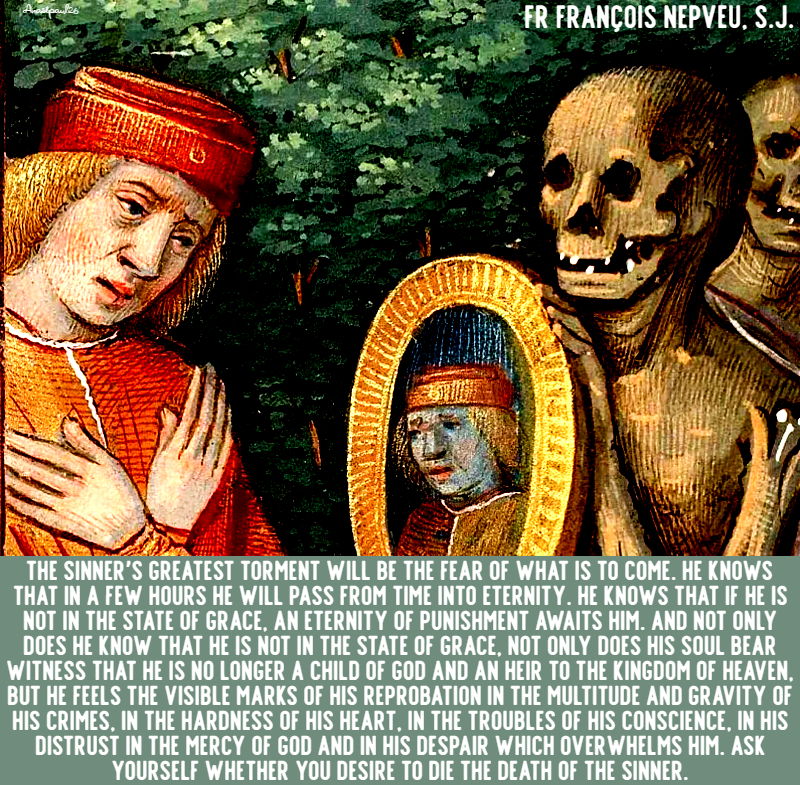
The sinner’s greatest torment will be the fear of what is to come. He knows that in a few hours he will pass from time into eternity. He knows that if he is not in the state of grace, an eternity of punishment awaits him. And not only does he know that he is not in the state of grace, not only does his soul bear witness that he is no longer a child of God and an heir to the kingdom of heaven, but he feels the visible marks of his reprobation in the multitude and gravity of his crimes, in the hardness of his heart, in the troubles of his conscience, in his distrust in the mercy of God and in his despair which overwhelms him. Ask yourself whether you desire to die the death of the sinner.
Fr François Nepveu, S.J.
Who are you, then, that you should be afraid of mortal man? Today he is here, tomorrow he is not seen. Fear God and you will not be afraid of the terrors of men. What can anyone do to you by word or injury? He hurts himself rather than you, and no matter who he may be he cannot escape the judgment of God.
The Imitation of Christ
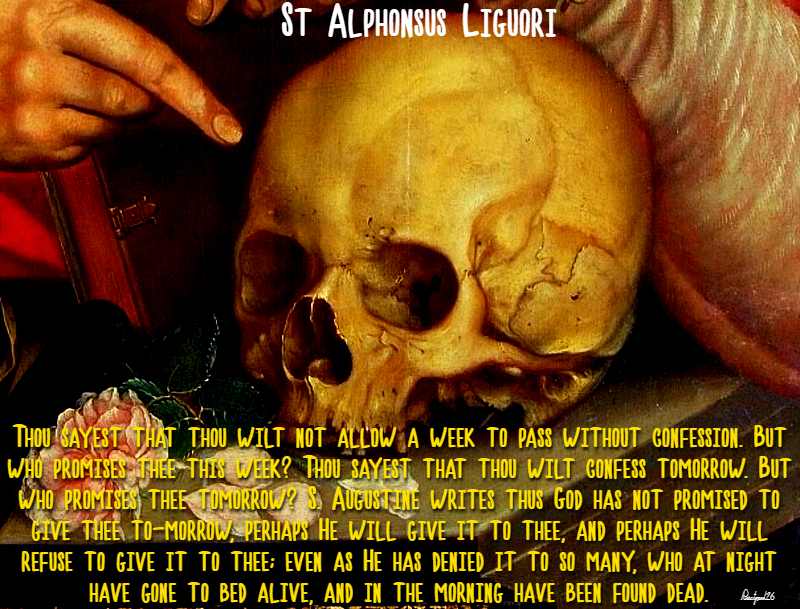
Thou sayest that thou wilt not allow a week to pass without confession. But who promises thee this week? Thou sayest that thou wilt confess tomorrow. But who promises thee tomorrow? S. Augustine writes thus God has not promised to give thee tomorrow, perhaps He will give it to thee, and perhaps He will refuse to give it to thee; even as He has denied it to so many, who at night have gone to bed alive, and in the morning have been found dead.
The Glories of the Holy Angels Venerable Henri Boudon, Archdeacon of Evreux
MOTIVE FOURTH All Men are assisted by the Angels
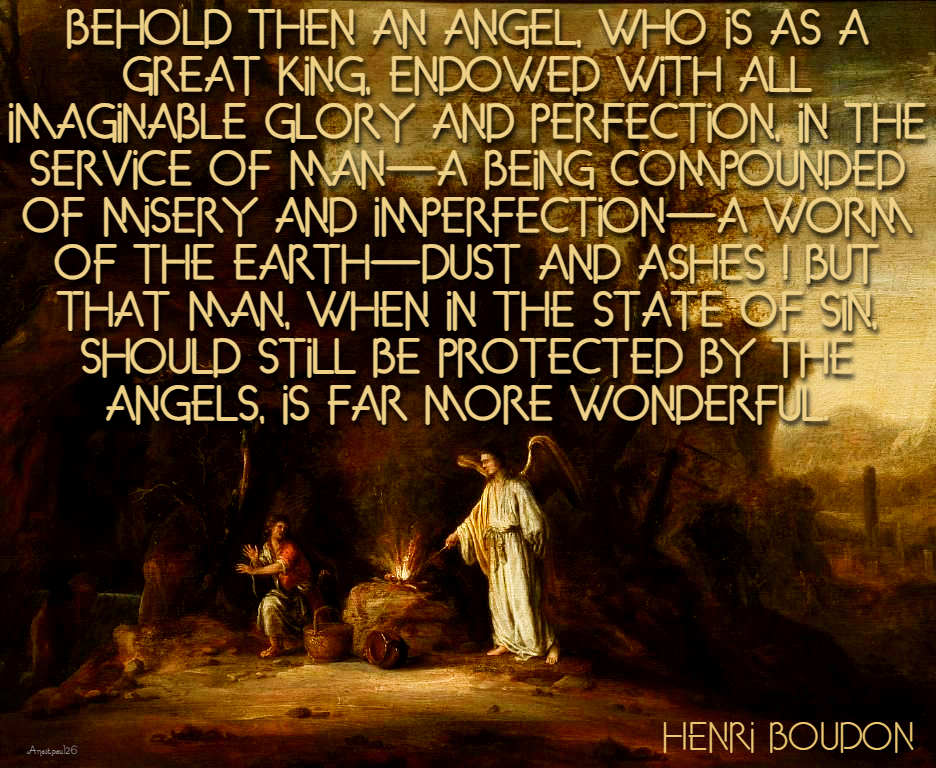
It is unnecessary to seek any other motive to love God than love itself—as our Lord revealed to Mother Magdalen of St. Joseph, a Carmelite religious. But why does God love men so much? Let it be published among the nations, says St. Bernard, and let them confess that the Lord has determined to treat them magnificently. O my God ! what is man, that you condescend to give him your only Son, to send him your Holy Spirit, and depute your Angels to guard and defend him ! ‘ Behold then an Angel, who is as a great king, endowed with all imaginable glory and perfection, in the service of man—a being compounded of misery and imperfection—a worm of the earth—dust and ashes ! But that man, when in the state of sin, should still be protected by the Angels, is far more wonderful. If we say we have no sin, we deceive ourselves: the greatest saints have fallen, through weakness or inadvertence, into venial faults— and would to God that there were no greater committed Hell itself being less terrible than a single offence against the Divine Majesty; but, alas ! men in general have little horror of mortal sin, and easily fall into it.
The Angels, though struck with amazement at these diabolical excesses, are nevertheless not deterred from assisting these unhappy beings. O soul! who readest these truths, is it not wonderful that the blessed Spirits should lend their aid to those who offend God, considering the knowledge they possess of his unspeakable greatness ? Is it not amazing that they are content to remain with those who every day trample on the blood of their God, “and make void the sufferings by which they have been redeemed.’
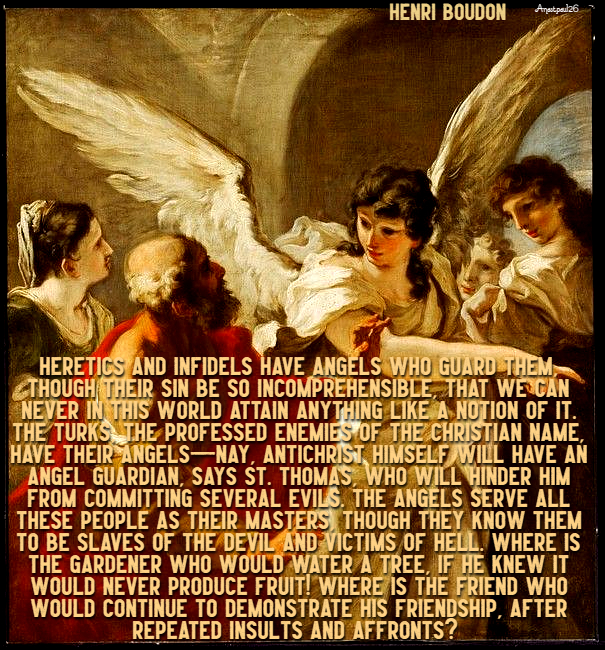
Let us go further : Heretics and Infidels have Angels who guard them, though their sin be so incomprehensible, that we can never in this world attain anything like a notion of it. The Turks, the professed enemies of the Christian name, have their Angels—nay, Antichrist himself will have an Angel Guardian, says St. Thomas, who will hinder him from committing several evils. The Angels serve all these people as their masters, though they know them to be slaves of the devil and victims of hell. Where is the gardener who would water a tree, if he knew it would never produce fruit! Where is the friend who would continue to demonstrate his friendship, after repeated insults and affronts ? Yet all the injuries, revolts, contempt and ingratitude of men diminish not in the least degree the charity of these blessed Spirits. They go to seek them in the forests of Canada, in the remotest deserts, in the most gloomy caverns, at the extremities of the earth.
You would say that they are beside themselves with love for men, who have nothing of man but the shape and appearance, their lives being wholly earthly and sensual. These celestial beauties give their affections to deformity itself, and yet meet with no other return than ingratitude and contempt. How shocking—how deplorable!
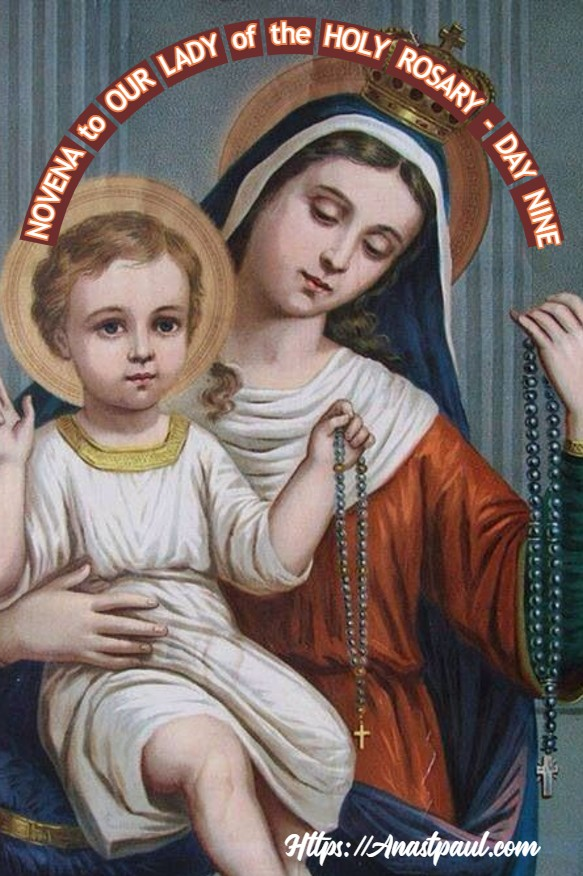
Day Nine: We Pray for the Grace of Wisdom and for our private intentions
At the end of this journey of prayer together, Let us today, turn to Our Divine Father and pray, so that we may be granted the gift of wisdom and discernment, to enable us to Understand, Distinguish, Separate and Decide between the good and evil. We pray for the ability to make the right judgement for and about others, as well as for ourselves, according to God’s Will. Amen
Daily Prayer along with our Daily Rosary:
My dearest Mother Mary, behold me, your child, in prayer at your feet. Accept this Holy Rosary, which I offer you in accordance with your requests at Fatima, as a proof of my tender love for you, for the intentions of the Sacred Heart of Jesus, in atonement for the offenses committed against your Immaculate Heart and for this special favour which I earnestly request in my Rosary Novena: ………………………….. (Mention your request).
I beg you to present my petition to your Divine Son. If you will pray for me, I cannot be refused. I know, dearest Mother, that you want me to seek God’s holy Will concerning my request. If what I ask for should not be granted, pray that I may receive that which will be of greater benefit to my soul.
I offer you this spiritual Bouquet of Roses because I love you. I put all my confidence in you, since your prayers before God are most powerful. For the greater glory of God and for the sake of Jesus, your loving Son, hear and grant my prayer. Sweet Heart of Mary, be my salvation.
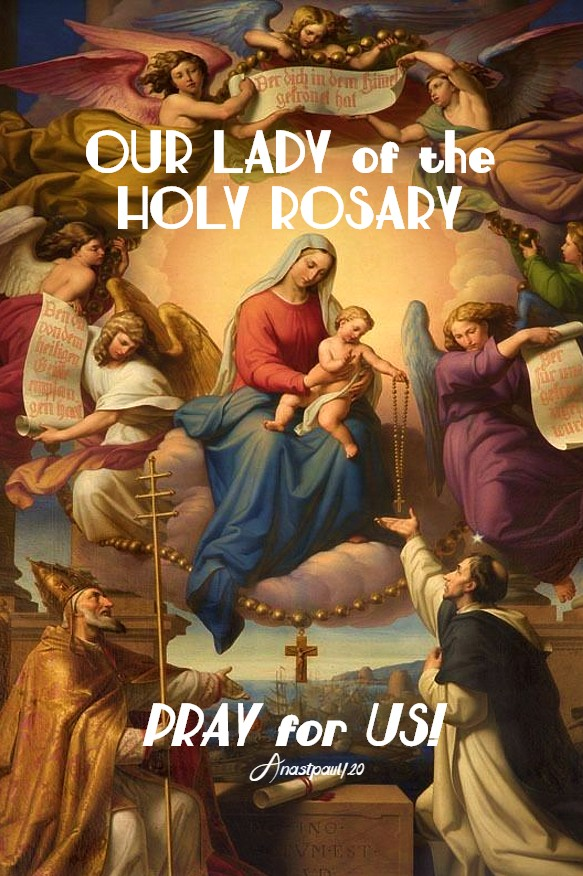
Our Lady of the Rosary, pray for our Holy Mother Church and for our country.
Sweet Heart of Jesus, be my love.
Sweet Heart of Mary, at the hour of my death, lead me home.




You must be logged in to post a comment.