Posted in Uncategorized

Saint of the Day – 10 October – Saints Eulampius and Eulampia

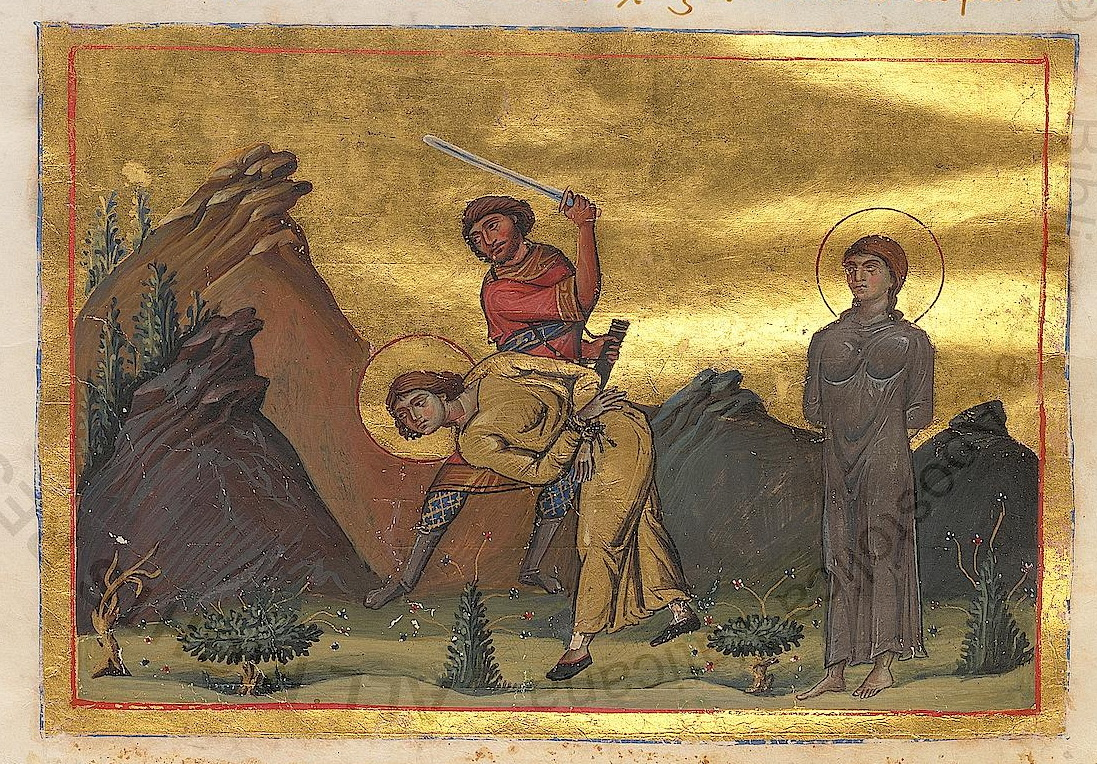
Saints Eulampius and Eulampia, brother and sister martyrs from Nicomedia, Asia Minor (in modern Turkey) were children executed in 310, during the reign of Emperor Maximinus.

Eulampius was arrested by the Roman authorities during an attempt to buy supplies for Christians who were hiding in caves on the outskirts of Nicomedia. After he was whipped, his sister Eulampia was arrested after she emerged from a crowd to embrace and comfort him.

The siblings were executed the next day. First they were thrown into a cauldron of boiling oil, but since they miraculously stepped out unhurt, they were beheaded.

Two hundred soldiers, moved by the courage and faith of the two siblings, converted to Christianity on the spot and were themselves martyred.

And in the midst of that place we saw as it were an old man sitting, having snow-white hair, and with a youthful countenance; and his feet we saw not. And on his right hand and on his left were four-and-twenty elders, and behind them a great many others were standing. We entered with great wonder, and stood before the throne; and the four angels raised us up, and we kissed Him, and He passed His hand over our face.

Passion of Perpetua and Felicity

Posted in MARIAN TITLES

Twentieth Sunday after Pentecost, La Naval de Manila / The Grand Lady of the Philippines (1593) and Memorials of the Saints – 10 October

La Naval de Manila / Our Lady of the Most Holy Rosary , Quezon City, Philippines (1593) – Second Sunday of October:
Also known as Nuestra Señora del Santísimo Rosario / The Grand Lady of the Philippines.

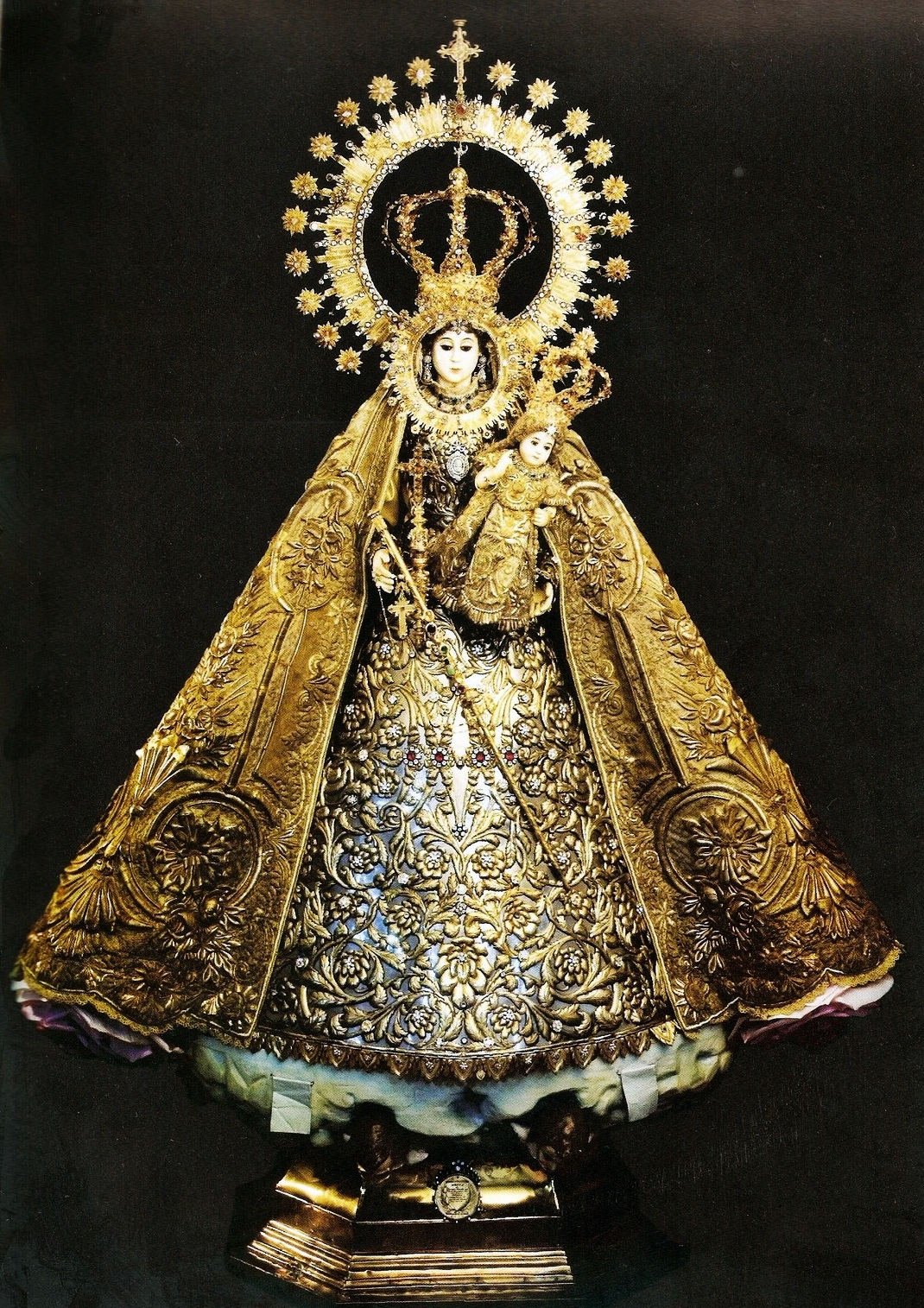
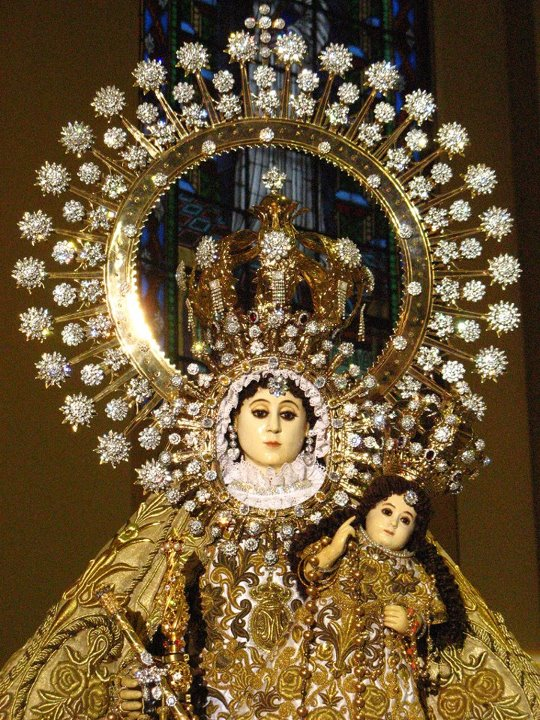
In 1593, the Governor General of the Philippines commissioned a Statue of Our Lady of the Rosary for the Dominican Church in Manila. A un-named Chinese sculptor carved the hardwood body and ivory hands and face, which has Asian features. About 4’8″ tall, the image is dressed in cloth of gold, with a crown and a halo of 24 stars and adorned with precious donated jewels. Our Lady holds the Child Jesus with her left hand and a Rosary with her right.
The title “La Naval” refers to Our Lady’s help in the naval battles of Lepanto in 1571 and Manila in 1646, when a small Catholic fleet repeatedly repelled Dutch invaders. The Catholic Church in Manila first celebrated the feast of “La Naval” on 8 October 1646. Pope Pius X’s Apostolic Delegate crowned the Statue on 5 October 1907.

Pope Pius XII also sent an Apostolic Letter on the occasion of the tricentenary of the Battle of La Naval de Manila on 31 July 1946. The Japanese bombing of 27 December 1941 destroyed the Church of Santo Domingo in Manila’s old walled city. Hidden for safekeeping, the holy Statue moved in 1954 to its present location in the Santo Domingo Shrine in Quezon City.

In 1646, naval forces of the Dutch Republic made several repeated attempts to conquer the Philippines in a bid to control trade in Asia. The combined Spanish and Filipino forces who fought, requested the intercession of the Virgin through the Statue prior to battle. They were urged to place themselves under the protection of Our Lady of the Rosary and to pray the Rosary repeatedly. They went on to rebuff the continued attacks by the superior Dutch fleet, engaging in five major battles at sea and losing only fifteen members of the Spanish Navy. After the Dutch retreat, in fulfillment of their vow, the survivors walked barefoot to the Shrine in gratitude to the Virgin.

Later, on 9 April 1662, the Cathedral chapter of the Archdiocese of Manila declared the naval victory a miraculous event owed to the intercession of the Virgin Mary, declaring:

“Granted by the Sovereign Lord through the intercession of the Most Holy Virgin and devotion to her Rosary, that the miracles be celebrated, preached and held in festivities and to be recounted amongst the miracles wrought by the Lady of the Rosary, for the greater devotion of the faithful to Our Most Blessed Virgin Mary and Her Holy Rosary.“

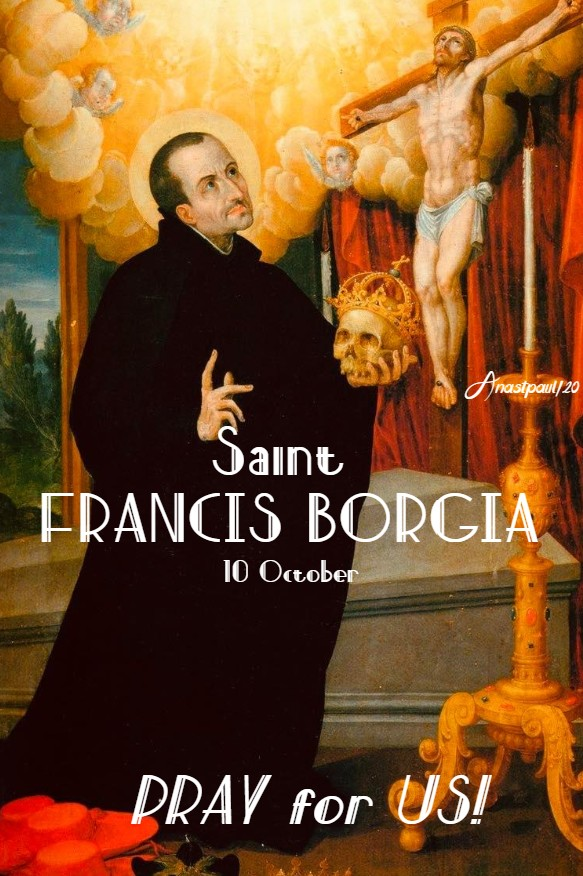
St Francis Borgia SJ (1510-1572) Priest of the Society of Jesus, Advisor, Missionary, Evangelist, Administrator par excelleance. Francisco de Borja y Aragon was the 4th Duke of Gandía, was a Grandee of Spain, a Spanish Jesuit and third Superior General of the Society of Jesus

St Aldericus

St Cassius
St Cerbonius of Populonia
St Cerbonius of Verona
St Clarus of Nantes
Bl Demestrius of Albania
Bl Edward Detkens
St Eulampia
St Eulampius
St Florentius the Martyr
St Fulk of Fontenelle
St Gereon
St Gundisalvus
Bl Hugh of Macon
St John of Bridlington OSA (1319-1379) Priest, Prior of the Monastery of the Canons Regular of St Augustine.
Bl Leon Wetmanski
St Maharsapor the Persian
St Malo the Martyr
St Patrician
St Paulinus of Capua

St Paulinus of York (c 584-644) First Bishop of York, Missionary – Paulinus was a member of the Gregorian mission sent in 601 by Pope Gregory I.

Bl Pedro de Alcantara de Forton de Cascajares
St Pinytus of Crete
Bl Pontius de Barellis
St Tanca
St Teodechilde
St Victor of Xanten

Martyrs of Ceuta – 7 beati: A group of seven Franciscan Friars Minor missionaries to Muslims in the Ceuta area of modern Morocco. Initially treated as madmen, within three weeks they were ordered to convert to Islam and when they would not they were first abused in the streets, then arrested, tortured and executed.
• Angelo
• Daniele di Calabria
• Donnolo
• Hugolinus
• Leone
• Nicola
• Samuele
They were beheaded in 1227 in Mauritania Tingitana (Ceuta, Morocco). Local Christians secreted the bodies away and gave them proper burial in Ceuta. They were Beatified in 1516 by Pope Leo X.

Posted in Our MORNING Offering

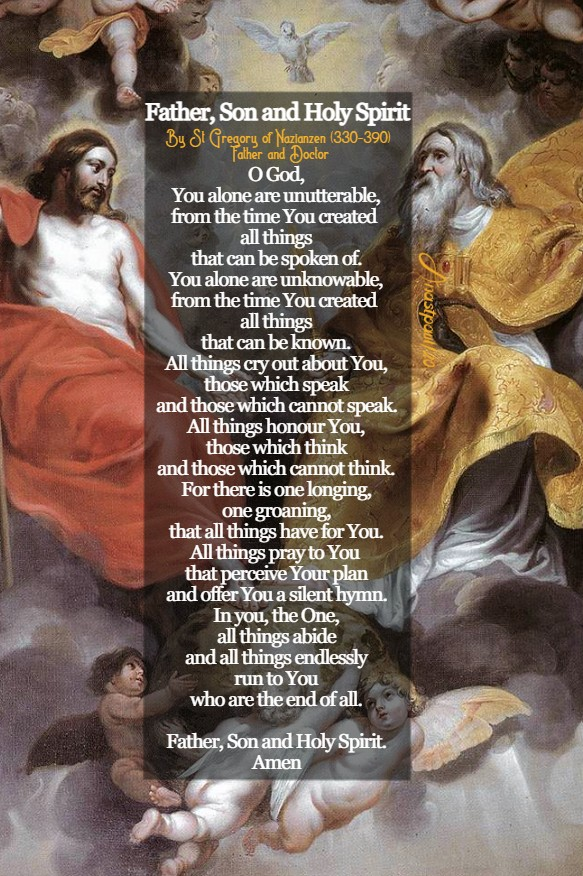
Our Morning Offering – 10 October – Father, Son and Holy Spirit

Father, Son and Holy Spirit
By St Gregory of Nazianzen (330-390)
Father and Doctor

O God,
You alone are unutterable,
from the time You created all things
that can be spoken of.

You alone are unknowable,
from the time You created all things
that can be known.

All things cry out about You,
those which speak
and those which cannot speak.

All things honour You,
those which think
and those which cannot think.

For there is one longing, one groaning,
that all things have for You.

All things pray to You
that perceive Your plan
and offer You a silent hymn.

In you, the One,
all things abide
and all things endlessly run to You
who are the end of all.

Father, Son and Holy Spirit.
Amen.

Posted in ONE Minute REFLECTION

One Minute Reflection – 10 October – “In this present age a hundred times as much… and in the age to come, everlasting life”

One Minute Reflection – 10 October – “Month of the Most Holy Rosary” – Readings: Ps 36:30-31, Ps 36:1, Ecclus 45:1-6, Matt 19:27-29

And everyone who has left house, or brothers, or sisters, or father, or mother, or wife, or children, or lands, for My name’s sake, shall receive a hundredfold, and shall possess life everlasting.

Matt 19:27-29

REFLECTION – These [social] teachings [of the Church] could diminish the distance that pride is pleased to maintain between the rich and the poor, but simple friendship is still too little. If we obey Christianity’s precepts, union will be brought about through fraternal love. On both sides, people will know and understand that absolutely all human beings have come forth from God, their common father; that God is their common and only goal, and that God alone is able to communicate perfect and absolute happiness to angels and to human beings. In addition, all have been redeemed by Jesus Christ and restored by him to their dignity as children of God, and thus a true bond of fraternity unites them, whether this be among themselves or to Christ their Lord, who is “the first-born of many brothers.”

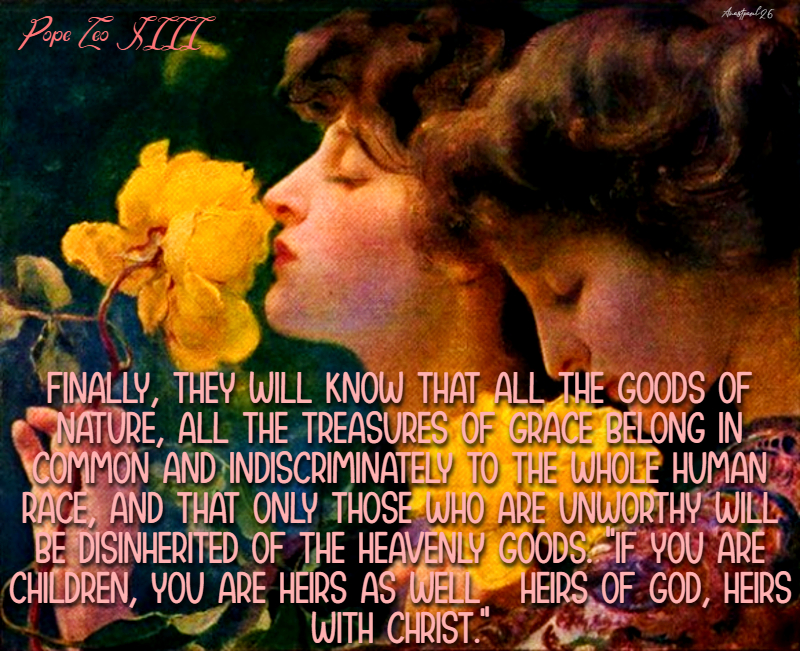
Finally, they will know that all the goods of nature, all the treasures of grace belong in common and indiscriminately to the whole human race, and that only those who are unworthy will be disinherited of the heavenly goods. “If you are children, you are heirs as well: heirs of God, heirs with Christ.”

Leo XIII

PRAYER – Almighty God and Father, you sent St Francis Borgia to be Your witnesses and to bring Your Church to all for the salvation of souls. Sustain us by their prayers that by our lives we may lead all to You through Holy Mother Church. Through Jesus Christ our Lord, Who lives and reigns with You and the Holy Spirit, God forever and ever, amen

Posted in CATHOLIC Quotes

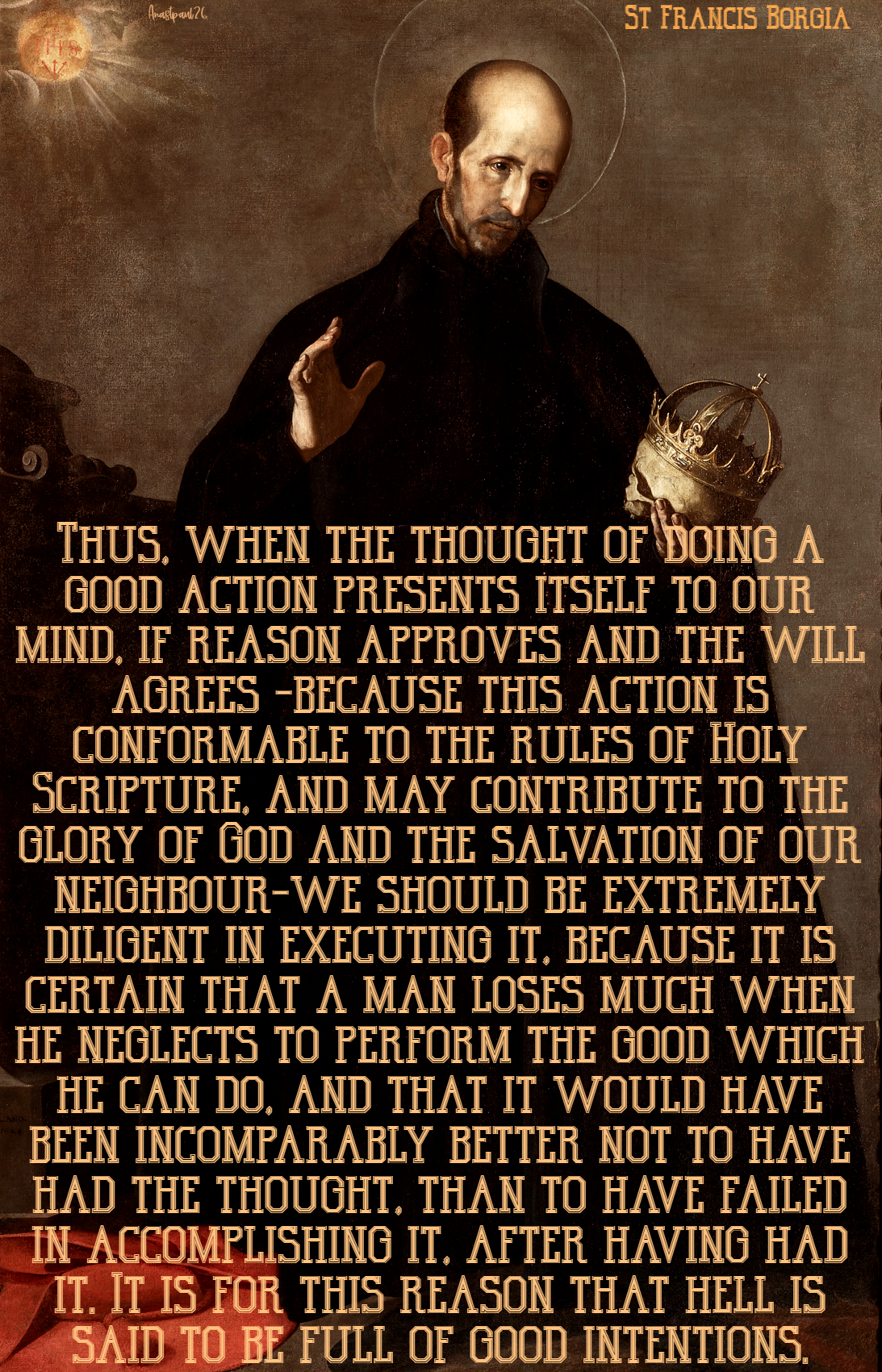
Quote/s of the Day – 10 October – St Francis Borgia

Thus, when the thought of doing a good action presents itself to our mind, if reason approves and the will agrees -because this action is conformable to the rules of Holy Scripture, and may contribute to the glory of God and the salvation of our neighbour-we should be extremely diligent in executing it, because it is certain that a man loses much when he neglects to perform the good which he can do, and that it would have been incomparably better not to have had the thought, than to have failed in accomplishing it, after having had it. It is for this reason that hell is said to be full of good intentions.

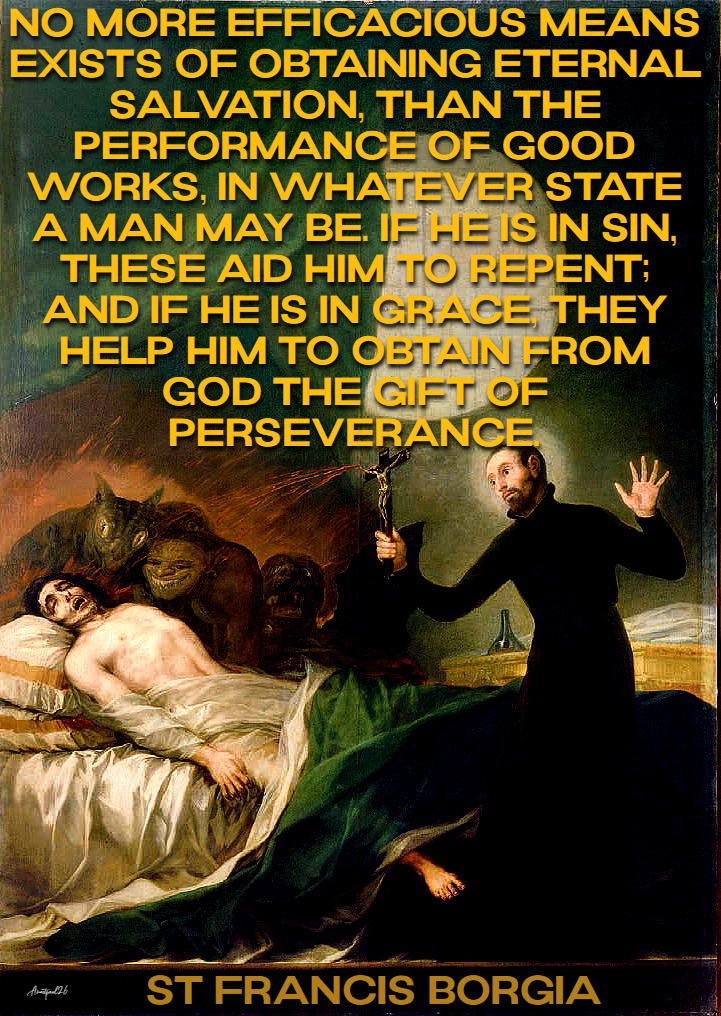
No more efficacious means exists of obtaining eternal salvation, than the performance of good works, in whatever state a man may be. If he is in sin, these aid him to repent; and if he is in grace, they help him to obtain from God the gift of perseverance.

While dressing in the morning.

  1. Enter into a profound sentiment of confusion, in considering that you are well clothed, and that Jesus Christ was fastened naked to a cross for love of you.
  2. Thank Him for having assumed our nature, although He knew at the time how ungrateful we should be for this favour; and also for having given us clothes to cover us, although we have so often despised the nuptial robe of grace, with which He clothed us. While dressing yourself, yon are performing one of the works of mercy, which is to clothe the naked: implore Him to accept this action, in consideration of the garment of ignominy with which He was covered in the palace of Herod.

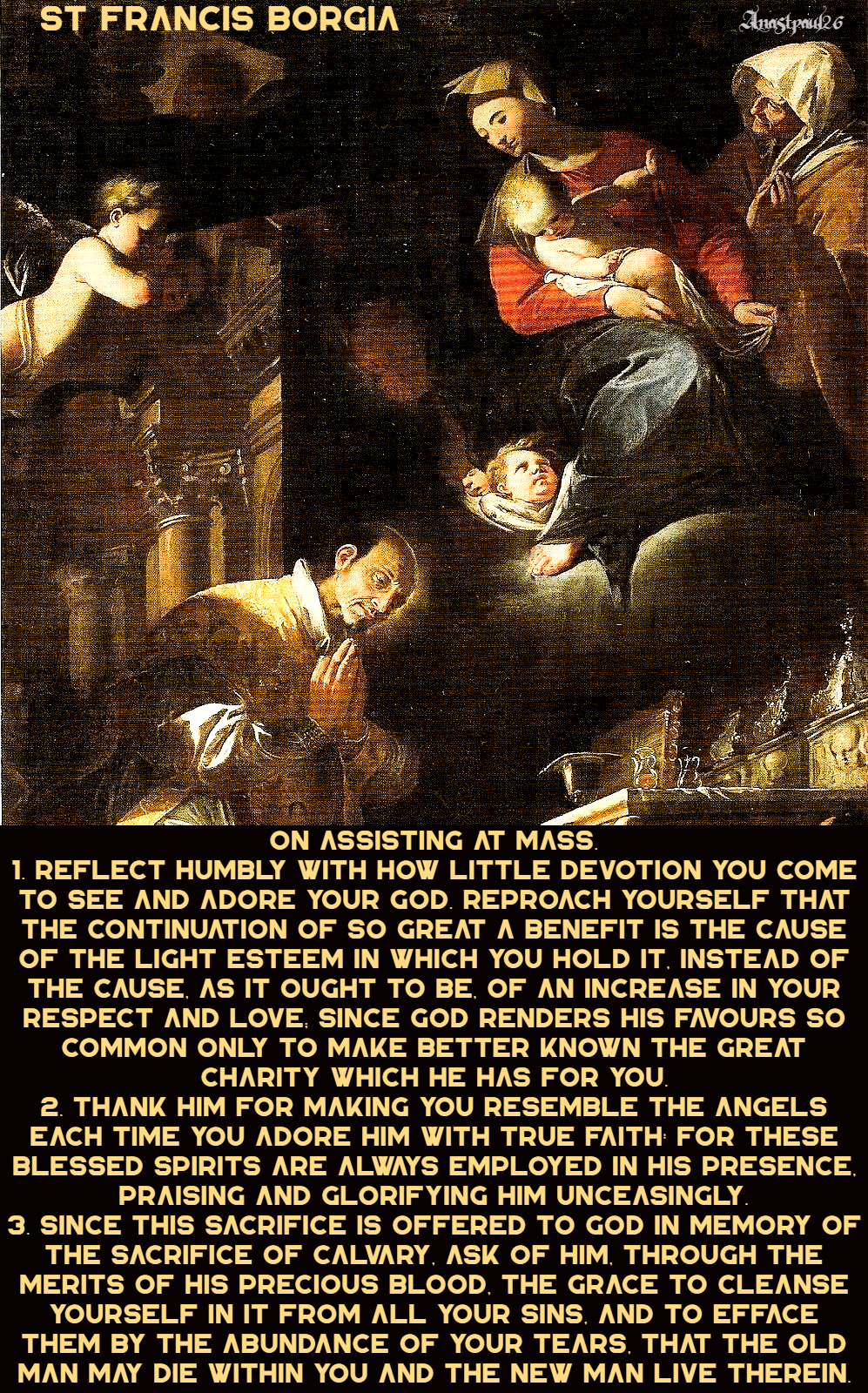
On assisting at Mass.

  1. Reflect humbly with how little devotion you come to see and adore your God. Reproach yourself that the continuation of so great a benefit is the cause of the light esteem in which you hold it, instead of the cause, as it ought to be, of an increase in your respect and love; since God renders His favours so common only to make better known the great charity which He has for you.
  2. Thank Him for making you resemble the Angels each time you adore Him with true faith: for these blessed spirits are always employed in His presence, praising and glorifying Him unceasingly.
  3. Since this sacrifice is offered to God in memory of the sacrifice of Calvary, ask of Him, through the merits of His precious blood, the grace to cleanse yourself in it from all your sins, and to efface them by the abundance of your tears, that the old man may die within you and the new man live therein.

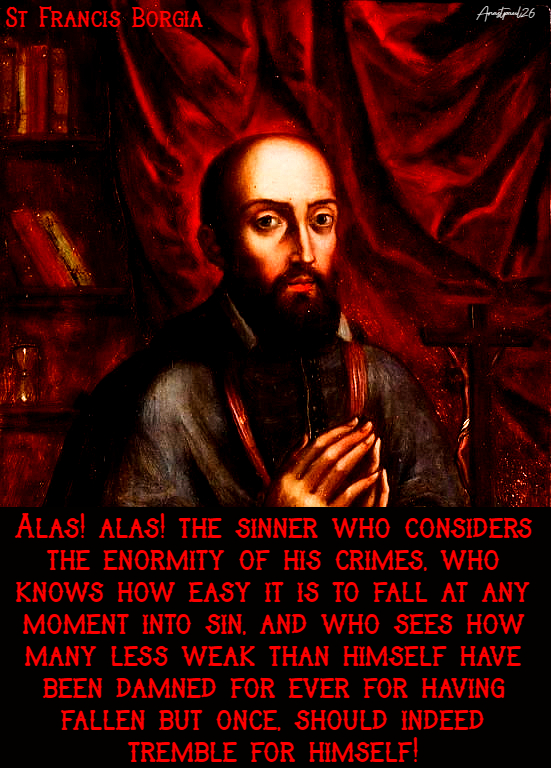
Alas! alas! the sinner who considers the enormity of his crimes, who knows how easy it is to fall at any moment into sin, and who sees how many less weak than himself have been damned for ever for having fallen but once, should indeed tremble for himself!

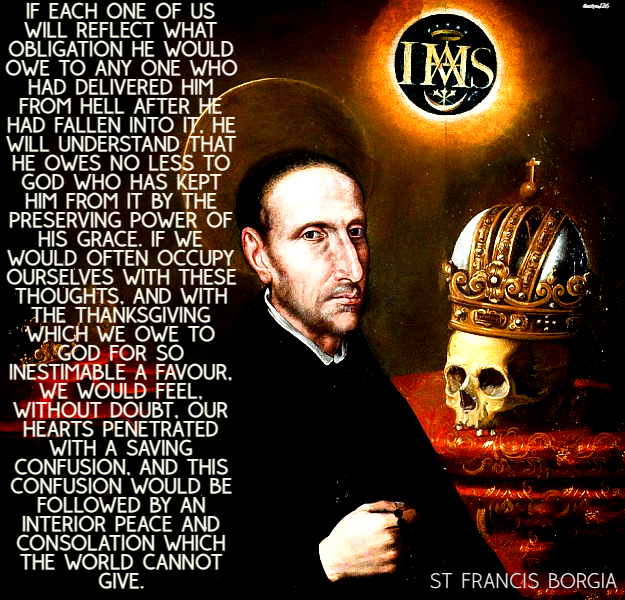
If each one of us will reflect what obligation he would owe to any one who had delivered him from hell after he had fallen into it, he will understand that he owes no less to God who has kept him from it by the preserving power of His grace. If we would often occupy ourselves with these thoughts, and with the thanksgiving which we owe to God for so inestimable a favour, we would feel, without doubt, our hearts penetrated with a saving confusion, and this confusion would be followed by an interior peace and consolation which the world cannot give.

Posted in OCTOBER - The HOLY ROSARY and The HOLY ANGELS

Thought for the Day – 10 October – The protection afforded to us

The Glories of the Holy Angels


Venerable Henri Boudon, Archdeacon of Evreux

MOTIVE EIGHTH

The Protection afforded to us by the Angels against the enemies of our Salvation.

The life of man is a warfare; he has to fight against temptations within and temptations without—temptations from the world, and temptations from himself. It is a strange thing, that we ourselves are our most dangerous enemies, and that it would give us quite enough to do to wage war against ourselves. Yet this is not all; we have other combats to sustain. We must combat against the devils, powerful in might, cruel in rage, countless in number, indefatigable in pursuit.—Being spiritual beings, they strike invisibl —enter all places—see all things—leave no art, no wile, untried, to effect our ruin, and triumph in our defeat. O ! you who read these lines ! do you not tremble at the idea of such combats? On your victory depends your eternal fate. Consider what it is to be damned for ever, and the danger in which you are of being so, by the malice of the devils—and then you will be convinced of the necessity of being devout to their powerful adversaries, the holy Angels.

The devils are cruel in their rage; the destruction of our corporeal existence would not suffice to glut their malice: they unceasingly seek to take away the life of our souls, and “ go about” continually “ seeking whom they may devour.” This infuriate malice is accompanied by such power, that, as we learn from the Book of Job, no force on earth can be compared to it: millions of armed men could do nothing against the efforts of a single evil spirit. The Scripture calls them the powers and princes of this world and of darkness the greater part of mankind being subject to their detestable tyranny.

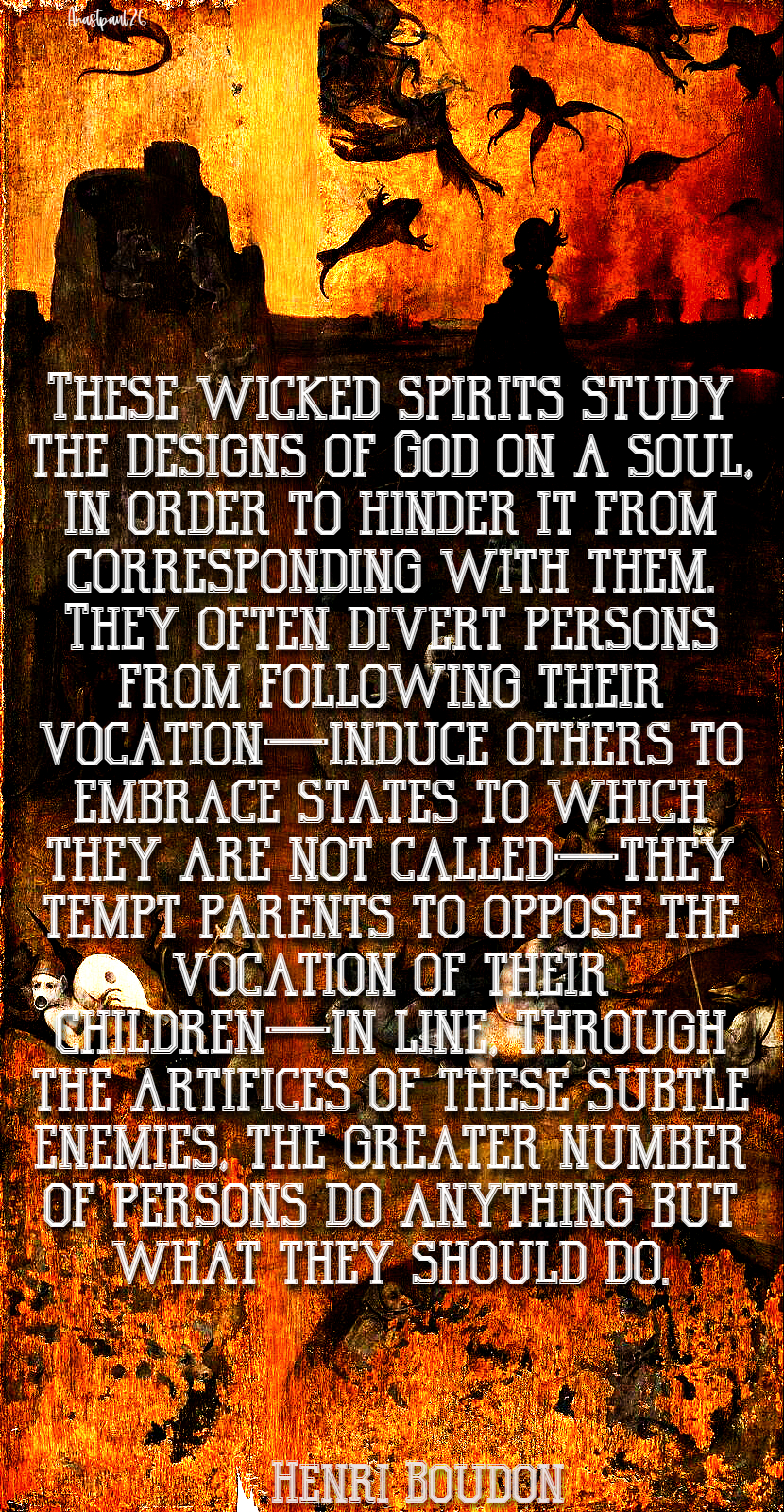
These wicked spirits study the designs of God on a soul, in order to hinder it from corresponding with them. They often divert persons from following their vocation—induce others to embrace states to which they are not called—they tempt parents to oppose the vocation of their children—in line, through the artifices of these subtle enemies, the greater number of persons do anything but what they should do.

If they cannot turn us from the ways of grace, they try to mingle in them ; prompting us to pray, when God will have us labour for him; to be angry and impatient when hindered from a good work; to be disquieted at our faults; to confess and communicate through imperfect motives; to irritate ourselves with an unquiet zeal at the faults of others, and to forget our own. As they are without peace or order among themselves, they labour all they can to render us so too—often exciting scruples, doubts, anxieties—inspiring us with fears as to the validity of our past confessions—prompting us to make them all anew, and still to be dissatisfied. They give false ideas of piety—and if they see true devotion gain ground in any place, by means of prayer and frequent communion, they will cause some of those who use these means to fall into great faults, to furnish others with a pretext for declaiming against them.

These wicked spirits, as we have already said, often represent things to us quite differently from what they are. They persuade persons in the world, that devotion is only for those who live in monasteries, and quite incompatible with their state. They not only persecute those who are employed actively in gaining souls to God, but those also who live in solitude, when possessed of extraordinary virtue, knowing that, by their prayers, and constant union with God, they will help to save and sanctify many other persons.

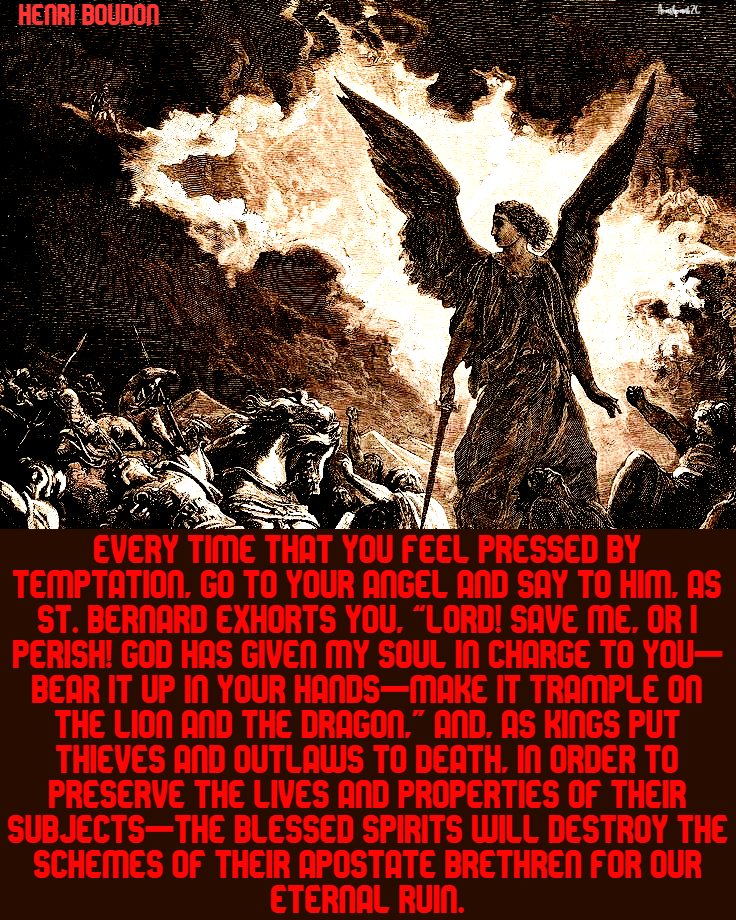
Are you not now convinced of your want of superior force against such enemies, in order to be victorious ? Having seen so many wiles laid for your destruction, are you not resolved to make use of that succour which our good God has provided for you in his holy Angels? Every time that you feel pressed by temptation, go to your Angel and say to him, as St. Bernard exhorts you, “Lord! save me, or I perish! God has given my soul in charge to you— bear it up in your hands—make it trample on the lion and the dragon,” and, as kings put thieves and outlaws to death, in order to preserve the lives and properties of their subjects—the blessed spirits will destroy the schemes of their apostate brethren for our eternal ruin; and with them we shall sing a canticle of joy and a psalm of jubilation, because we shall have obtained the victory.