Posted in MARIAN QUOTES, ON the SAINTS, PAPAL SERMONS, PRAYERS to the SAINTS, QUOTES of the SAINTS, SAINT of the DAY

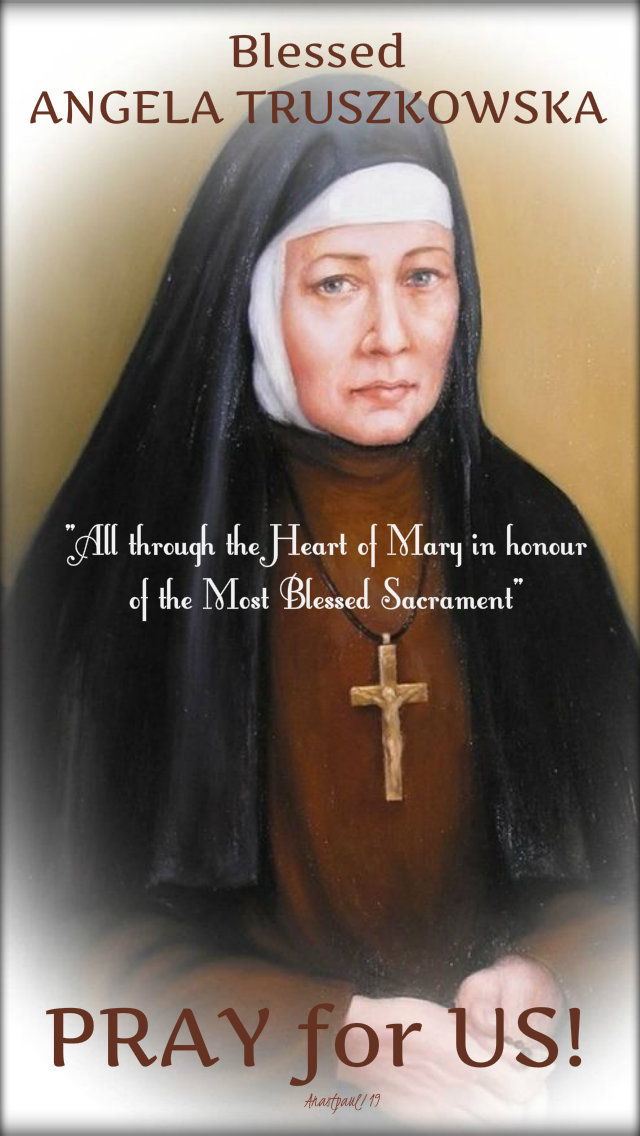
Thought for the Day – 10 October – “All through the Heart of Mary in honour of the Most Blessed Sacrament”

Thought for the Day – 10 October – The Memorial of Blessed Angela Truszkowska (1825-1899)

Excerpt from the
Address of the Holy Father JOHN PAUL II
to the Sisters of Saint Felix of Cantalice

Friday 16 June 2000

“Your Foundress would often take the children in her care to the Capuchin Church in Warsaw where Saint Felix is shown bearing the Infant Jesus in his arms.   In the figure of the Holy Child, Blessed Maria Angela recognised the little ones she was called to serve. She knew that Saint Felix was shown bearing the Infant Jesus in his arms, because, in bearing the burdens of the needy, he had carried in his arms the poor Christ Himself and she recognised this as her own calling.   By bearing the burdens of the weakest she and her Sisters would bear in their arms the “little” Lord Jesus.   Blessed Maria Angela knew too, that it was Mary who had placed the Holy Child in the arms of Saint Felix and that, it was Mary, who was now placing her Infant Son in the arms of the Sisters of Saint Felix. How right then that she should dedicate the Congregation to the Immaculate Heart of Mary.

3. Yet the sword which pierced Mary’s heart (cf. Lk 2:35) pierced the heart of the Foundress too.   “Love means giving”, she wrote, “giving everything that love asks for, giving immediately, without regrets, with joy and wanting even more to be asked of us.”   In obeying the logic of the Incarnation and bearing in her arms, the Lord himself, Blessed Maria Angela became a victim of love.   Step by step she ascended the hill of Calvary, in a journey of suffering, both physical and spiritual, until her life was ablaze with the mystery of the Cross.

As she journeyed more deeply into Calvary’s darkness she became more insistent, that at the heart of the Congregation’s life, there should be devotion above all to the Holy Eucharist and to the Immaculate Heart of Mary.   She bequeathed to her Sisters the motto: “All through the Heart of Mary in honour of the Most Blessed Sacrament”.   In long hours of prayer before the Blessed Sacrament, she learnt that she and her Sisters were called to “reproduce the pattern of the Lord’s death” (Phil 3:10) so that they might become the Eucharist.   And in the Mother of Christ, Blessed Mary Angela recognised, the one who shared in her Son’s Passion most intimately and she knew, that this was the Sisters’ calling as well.   In Mary Immaculate she recognised the woman of the Magnificat, the woman whose self-emptying, allowed God to fill her with the joy of the Holy Spirit.   This was to be the life of the Sisters of Saint Felix.

4. Ours is a very different world but we are no less challenged by the spiritual lethargy of our time and by the question of where true freedom lies.   It is the Church’s sacred duty to proclaim to the world the true answer to that question and Religious men and women, are crucial in that task.   For the Felician Sisters, this must mean, an ever more radical fidelity to the program of life bequeathed to you by your Foundress, since, if there is not this fidelity among you, then you too can fall victim to the spiritual confusion of the age and there may emerge among you, the anxiety and disunity which are its fruits.

I urge you, therefore, dear Sisters, at this critical time in the life of your Congregation, to commit yourself in this General Chapter to more ardent worship of the Most Blessed Sacrament, to deeper devotion to Mary Immaculate and to a more radical love of the charism of your Foundress.   Embrace the Lord’s Cross as Blessed Angela did!   Then you will become the Eucharist your whole life will sing Magnificat, your poverty will be filled with “the unsearchable riches of Christ” (Eph 3:8).   Entrusting the General Chapter and the entire Congregation to Mary, Mother of Sorrows and Mother of all our joys and to the intercession of Saint Francis, Saint Felix and your Blessed Foundress, I gladly impart my Apostolic Blessing, as a pledge of endless grace and peace in Jesus Christ, “the faithful witness and firstborn from the dead” (Rev 1:5).

Prayer for the Intercession of Blessed Angela

God our Father,
we praise and thank You
for the gift of Blessed Angela,
who lived Your will,
in faith and trust
and lived Your love,
in service to others.
I pray, in confidence,
that through her intercession
You will grant me
the favour which I request.
I ask this,
through Christ our Lord.
Amen

Blessed Angela Truszkowska, Pray for Us!
Amenall through the heart of mary in honour of the bl sacra -blangla truszkowska 10 oct 2019 pray for us.jpg

Posted in ON the SAINTS, QUOTES of the SAINTS, QUOTES on TRUST and complete CONFIDENCE in GOD, SAINT of the DAY

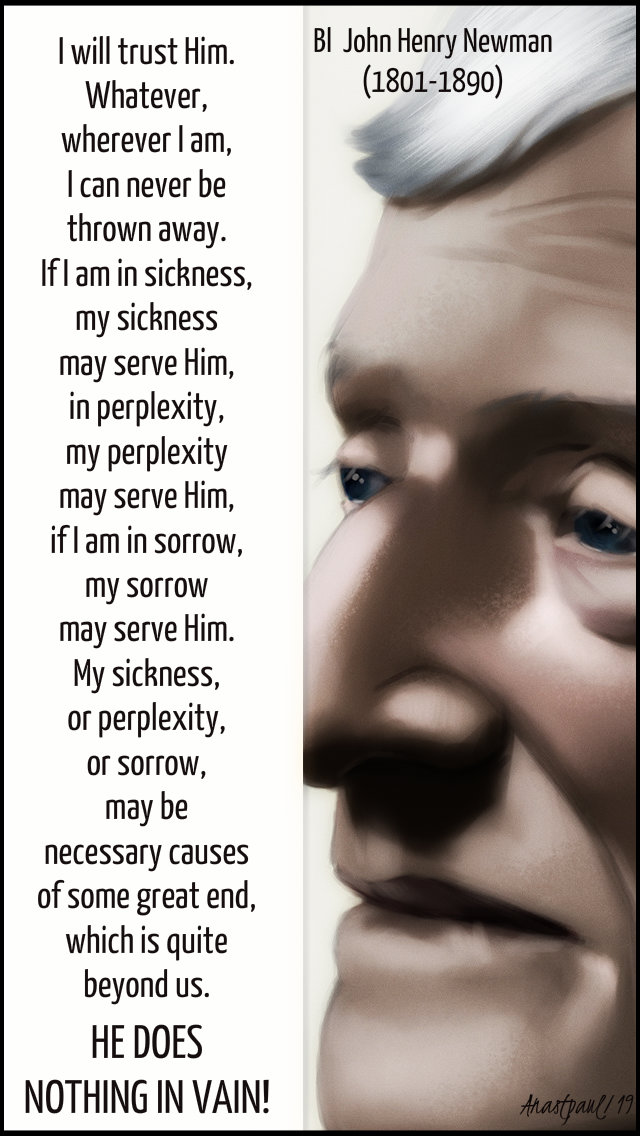
Thought for the Day – 9 October – “Still, He knows what He is about”

Thought for the Day – 9 October – The Memorial of Blessed John Henry Newman (1801-1890)

LETTER OF THE HOLY FATHER JOHN PAUL II
ON THE OCCASION OF THE 2nd CENTENARY
OF THE BIRTH OF CARDINAL JOHN HENRY NEWMAN

To The Most Reverend Vincent Nichols
Archbishop of Birmingham

On the occasion of the second centenary of the birth of the Venerable Servant of God John Henry Newman, I gladly join you, your Brother Bishops of England and Wales, the priests of the Birmingham Oratory and a host of voices throughout the world in praising God for the gift of the great English Cardinal and for his enduring witness.

As Newman pondered the mysterious divine plan unfolding in his own life, he came to a deep and abiding sense that “God has created me to do Him some definite service. He has committed some work to me which he has not committed to another. I have my mission” (Meditations and Devotions).   How true that thought now appears as we consider his long life and the influence which he has had beyond death.   He was born at a particular time – 21 February 1801, in a particular place – London and to a particular family – the firstborn of John Newman and Jemima Fourdrinier.   But the particular mission entrusted to him by God ensures that John Henry Newman belongs to every time and place and people.

Newman was born in troubled times which knew not only political and military upheaval but also turbulence of soul.   Old certitudes were shaken and believers were faced with the threat of rationalism on the one hand and fideism on the other. Rationalism brought with it a rejection of both authority and transcendence, while fideism turned from the challenges of history and the tasks of this world to a distorted dependence upon authority and the supernatural.   In such a world, Newman came eventually to a remarkable synthesis of faith and reason which were for him “like two wings on which the human spirit rises to the contemplation of the truth” (Fides et Ratio, Introduction; cf. ibid., 74).   It was the passionate contemplation of truth which also led him to a liberating acceptance of the authority which has its roots in Christ and to the sense of the supernatural which opens the human mind and heart to the full range of possibilities revealed in Christ.   “Lead kindly light amid the encircling gloom, lead Thou me on”, Newman wrote in The Pillar of the Cloud and for him Christ was the light at the heart of every kind of darkness.   For his tomb he chose the inscription: Ex umbris et imaginibus in veritatem and it was clear at the end of his life’s journey that Christ was the truth he had found.

But Newman’s search was shot through with pain.   Once he had come to that unshakeable sense of the mission entrusted to him by God, he declared:  “Therefore, I will trust Him… If I am in sickness, my sickness may serve Him, in perplexity, my perplexity may serve Him… He does nothing in vain…  He may take away my friends. He may throw me among strangers.   He may make me feel desolate, make my spirits sink, hide the future from me.    (Meditations and Devotions).   All these trials he knew in his life but rather than diminish or destroy him they paradoxically strengthened his faith in the God who had called him, and confirmed him in the conviction that God “does nothing in vain”.   In the end, therefore, what shines forth in Newman is the mystery of the Lord’s Cross – this was the heart of his mission, the absolute truth which he contemplated, the “kindly light” which led him on.i will trust him - bl john henry newman 28 march 2019.jpg

As we thank God for the gift of the Venerable John Henry Newman on the two hundredth anniversary of his birth, we pray that this sure and eloquent guide in our perplexity will also become for us in all our needs a powerful intercessor before the throne of grace.   Let us pray that the time will soon come when the Church can officially and publicly proclaim the exemplary holiness of Cardinal John Henry Newman, one of the most distinguished and versatile champions of English spirituality.   With my Apostolic Blessing.

From the Vatican, 22 January 2001.

IOANNES PAULUS II

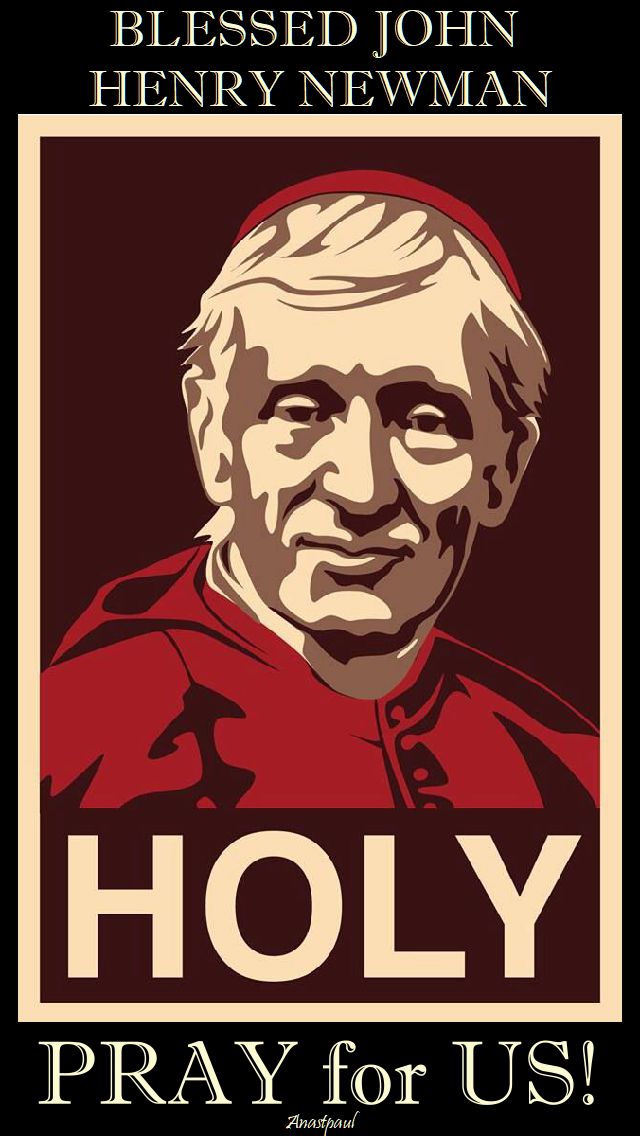
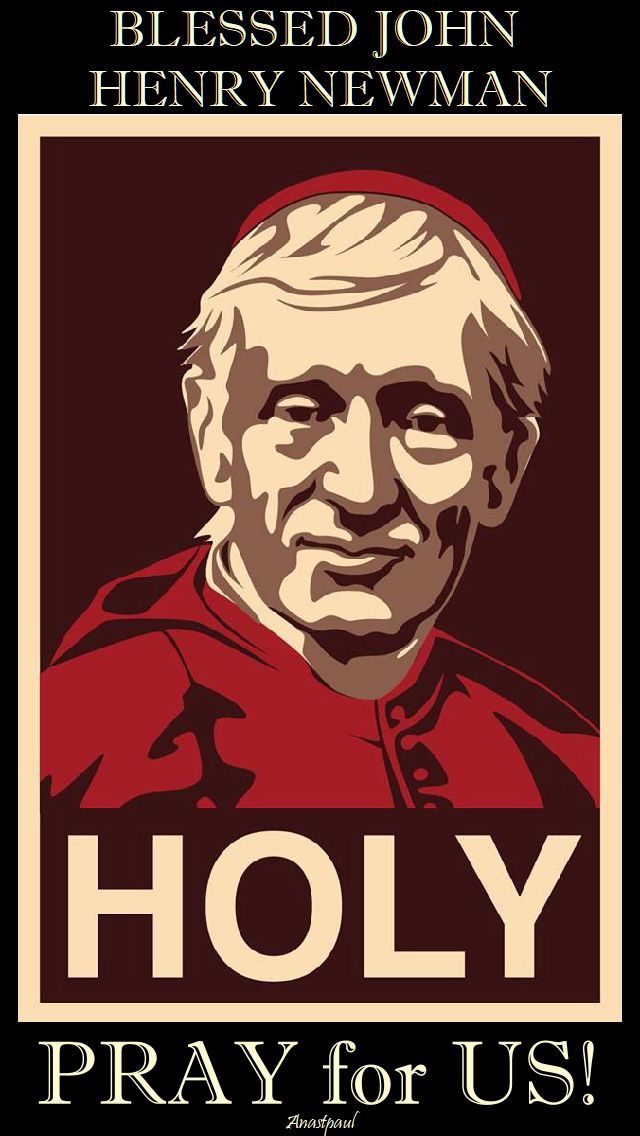
Blessed John Henry Newman, Pray for Us!bl john henry pray for us.jpg

Posted in franciscan OFM, ON the SAINTS, POETRY, QUOTES of the SAINTS, SAINT of the DAY

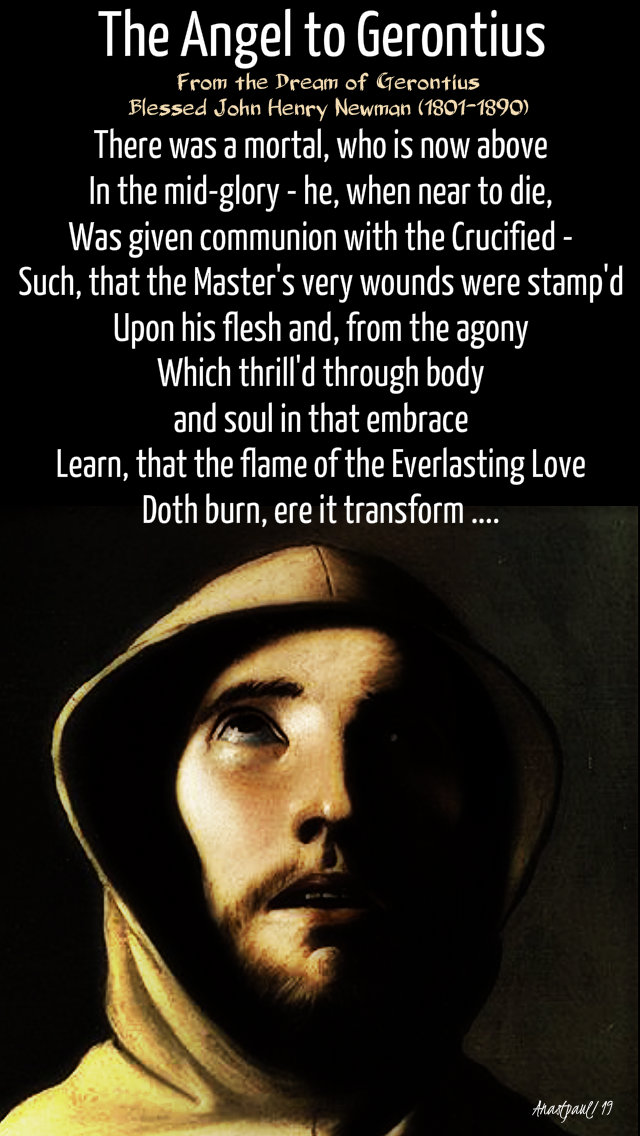
Quote of the Day – 4 October – The Angel to Gerontius

Quote of the Day – 4 October – The Memorial of St Francis of Assisi OFM (1181/2–1226)

The Angel to Gerontius

“There was a mortal, who is now above
In the mid-glory – he, when near to die,
Was given communion with the Crucified –
Such, that the Master’s very wounds were stamp’d
Upon his flesh and, from the agony
Which thrill’d through body and soul in that embrace
Learn, that the flame of the Everlasting Love
Doth burn, ere it transform ….”

From the Dream of Gerontius
Blessed John Henry Newman (1801-1890)

Some Quotes of St Francis here:
https://anastpaul.com/2018/10/04/quote-s-of-the-day-4-october-the-memorial-of-st-francis-of-assisi-1181-2-1226/the angel to gerontius from the dram of gerontius bl john henry newman on st francis 4 oct 2019.jpg

Posted in franciscan OFM, ON the SAINTS, ONE Minute REFLECTION, QUOTES of the SAINTS, QUOTES on CONVERSION, SAINT of the DAY, The WORD

One Minute Reflection – 4 October – ‘Listening to the Word’

One Minute Reflection – 4 October – Friday of the Twenty-sixth week in Ordinary Time, Year C Gospel: Luke 10:13-16 – The Memorial of St Francis of Assisi OFM (1181/2–1226)

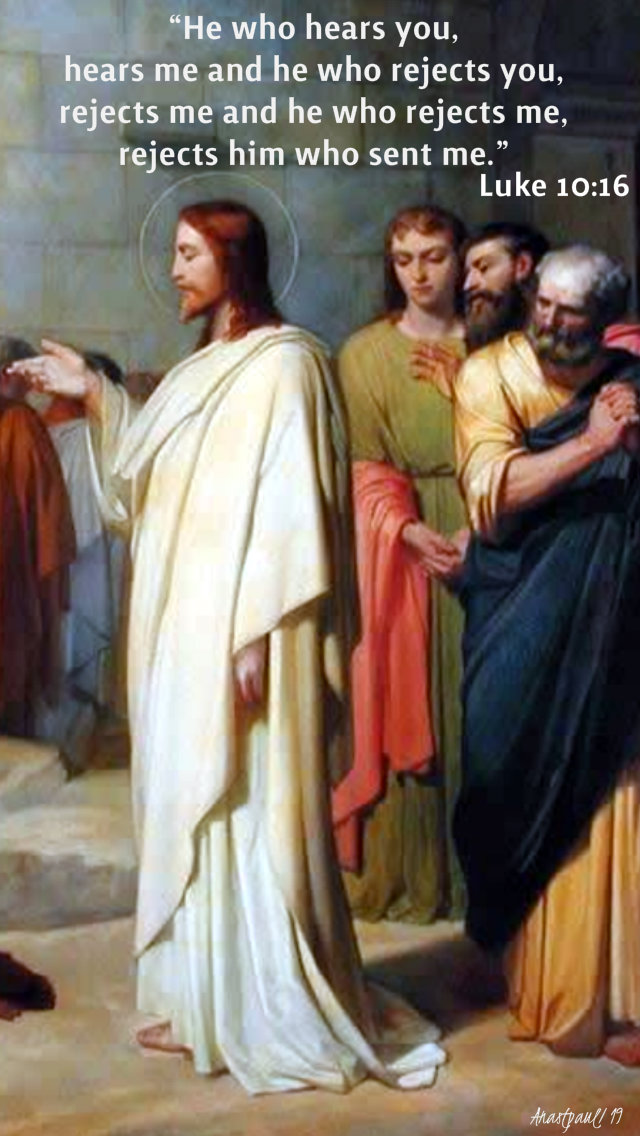
“He who hears you, hears me and he who rejects you,
rejects me and he who rejects me, rejects him who sent me.”…Luke 10:16luke 10 16 he who hears you hears me - 4 oct 2019.jpg

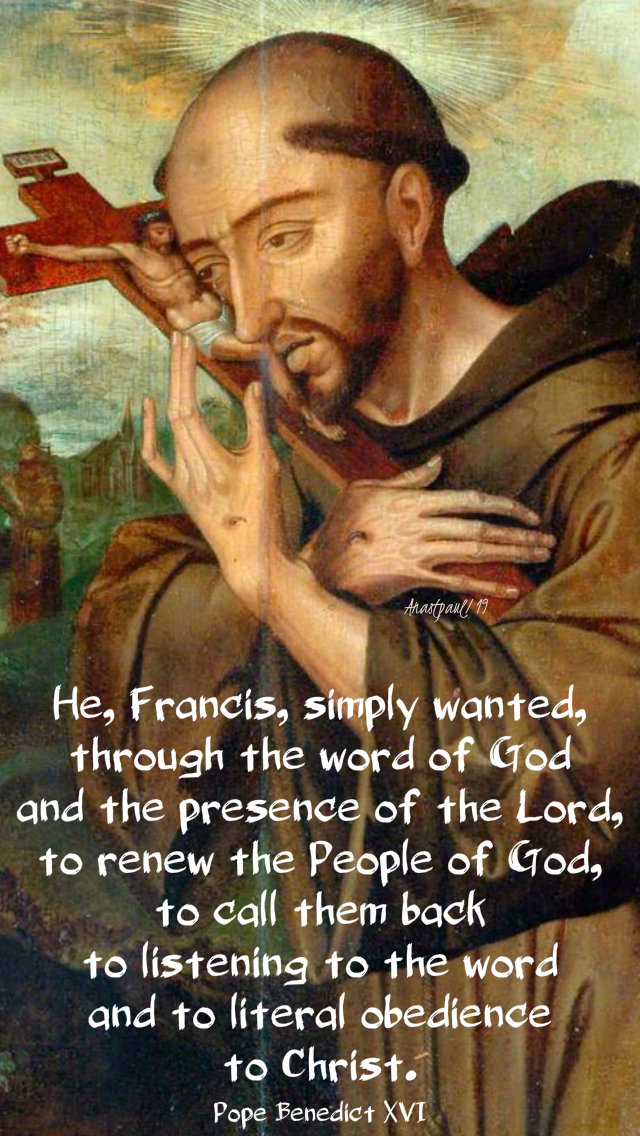
REFLECTION – “The truth is that St Francis really did have an extremely intimate relationship with Jesus and with the word of God, that he wanted to pursue sine glossa – just as it is, in all its radicality and truth.   It is also true, that initially he did not intend to create an Order with the necessary canonical forms.   Rather he simply wanted, through the word of God and the presence of the Lord, to renew the People of God, to call them back to listening to the word and to literal obedience to Christ.”…Pope Benedict XVI – Catechesis on St Francis – General Audience, 27 January 2010he, francis, simply wanted - pope benedict 4 oct 2019.jpg

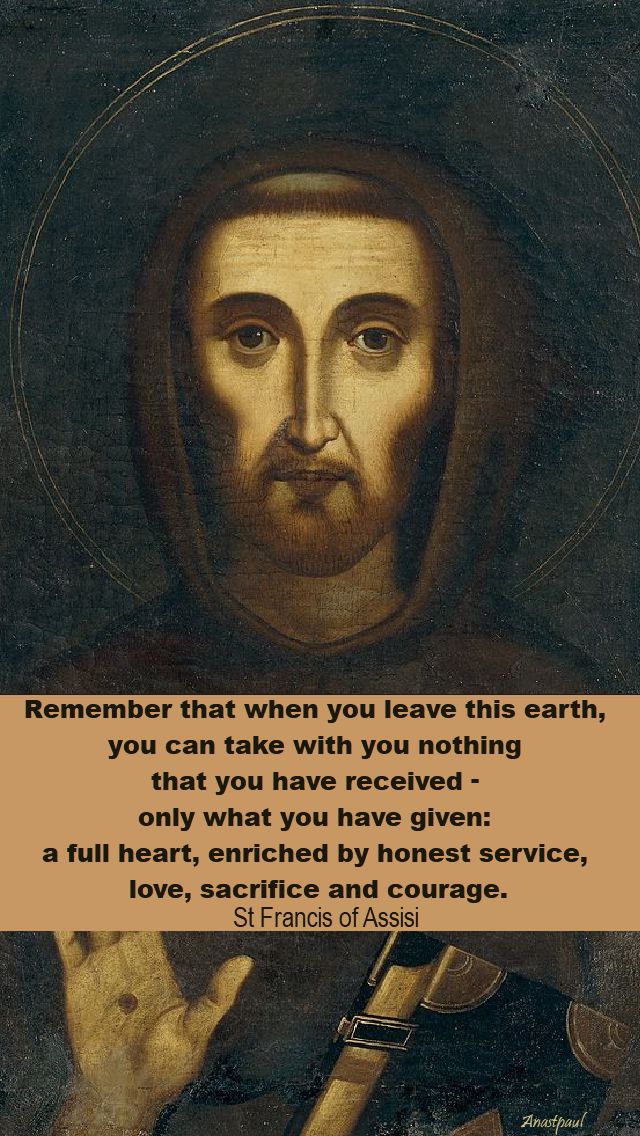
“Remember that when you leave this earth, you can take with you nothing that you have received—only what you have given – a full heart, enriched by honest service, love, sacrifice and courage.”….St Francis of Assisiremember-that-when-you-leave-st-francis-4-oct-2017 and 2018 and 2019.jpg

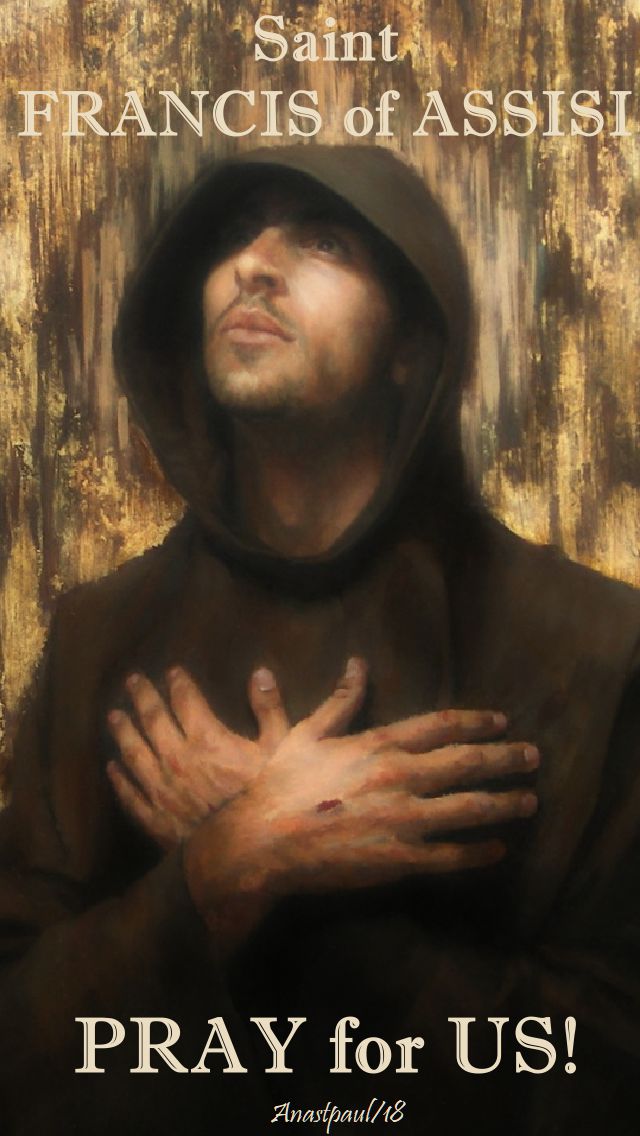
PRAYER – Lord God, You made St Francis of Assisi, Christ-like in his poverty and humility, his gentleness and charity, his love and courage. Help us to walk in his ways that, with joy and love, we may follow Christ Your Son and be united with You. May the intercession of St Francis, be an assistance on our journey. Through Christ our Lord, with the Holy Spirit, one God forever, amen.st francis of assisi - pray for us - 17 sept 2018.jpg

Posted in franciscan OFM, ON the SAINTS, QUOTES of the SAINTS, QUOTES on EVANGELISATION, QUOTES on FAITH, SACRAMENTS, SAINT of the DAY, The HOLY GHOST

Thought for the Day – 22 September – Come Holy Spirit!

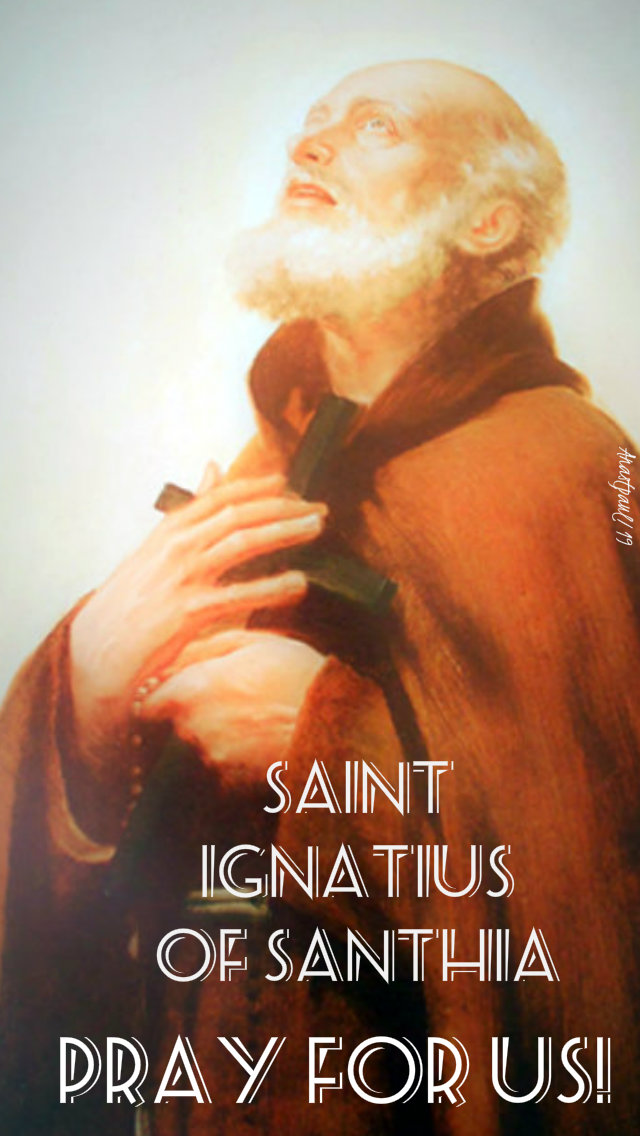
Thought for the Day – 22 September – The Twenty Fifth Sunday in Ordinary Time, Year C and The Memorial of St Ignatius of Santhia OFM Cap (1686-1770)

“Receive the Holy Spirit, whose sins you shall forgive, they are forgiven” (Jn 20, 22-23).

With these words, the Risen One bestows on the Apostles the gift of the Spirit and with it the divine power to forgive sins.   The Capuchin priest Ignatius of Santhiá lived uniquely the mission of forgiving sins and of guiding men and women on the paths of evangelical perfection.

For the love of Christ and to advance more quickly in evangelical perfection he walked in the footsteps of the Poverello of Assisi.

In the Piedmont of his time, Ignatius of Santhiá was father, confessor, counsellor and teacher of many – priests, religious and lay people – who sought his wise and enlightened guidance.

Even today he continues to remind everyone of the values of poverty, simplicity and authentic Christian life.

“Come, Holy Spirit fill the hearts of your faithful
and enkindle in them the fire of your love.”

The Holy Spirit radically transformed the Apostles who out of fear had locked themselves into the Upper Room, making them fervent heralds of the Gospel.   Down through the ages, the Spirit continues to support the Church in her evangelising mission, raising up in every age courageous witnesses to the faith.

With the Apostles, the Blessed Virgin Mary received the gift of the Spirit (cf. Acts 1,14). With her and in communion with the new saints, let us also implore the miracle of a new Pentecost for the Church.   For the humanity of our time let us ask an abundance of the gifts of the Holy Spirit.

Come Holy Spirit, enkindle the hearts of your faithful!
Help us to spread the fire of your love in the world.   Amen!

St Pope John Paul II – Canonisation Homily – Sunday, 19 May 2002

St Ignatius of Santhia, Pray for Us!st ignatius of santhia pray for us 22 sept 2019.jpg

Posted in ON the SAINTS, QUOTES of the SAINTS, SAINT of the DAY

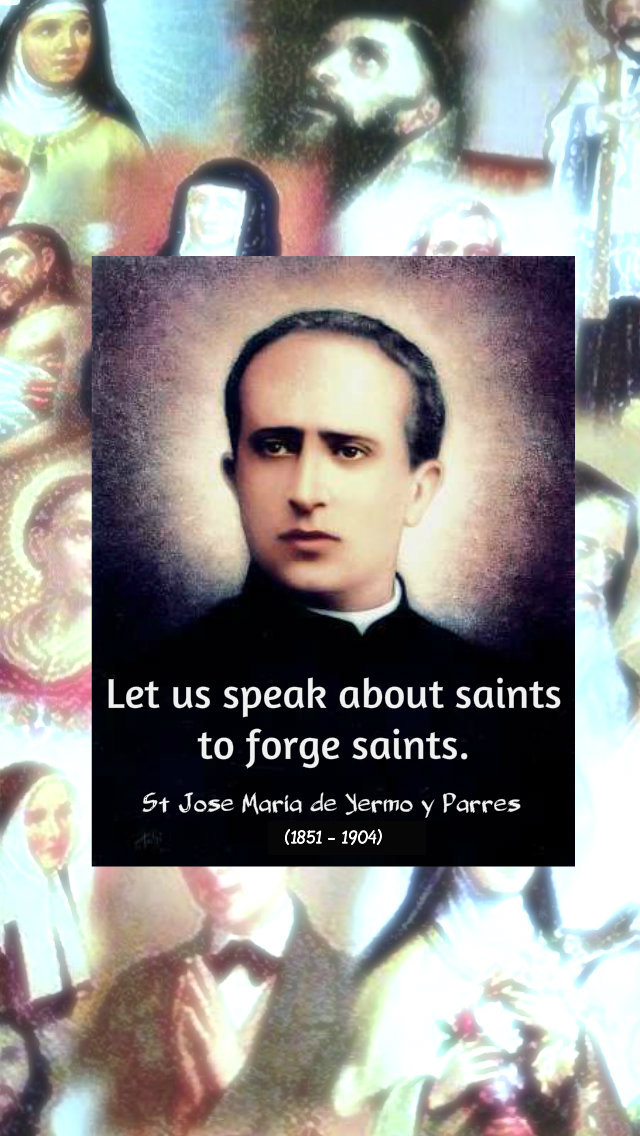
Quote of the Day – 20 September – “Let us speak about saints to forge saints.”

Quote of the Day – 20 September – The Memorial of Saint Jose Maria de Yermo y Parres (1851–1904)

“Let us speak about saints to forge saints.”

Saint Jose Maria de Yermo y Parres (1851–1904)let us spak about saints to forge saints - st jose maria parres 20 sept 2019

Posted in ON the SAINTS, QUOTES of the SAINTS, QUOTES on FAITH, SACRAMENTS, SAINT of the DAY

Thought for the Day – 16 September – A Faith that is Ready and Unshaken – St Cyprian to St Pope Cornelius

Thought for the Day – 16 September – Monday of the Twenty-fourth week in Ordinary Time, Year Cand the Memorial of St Pope Corneliu  s and St Cyprian of Carthage, Martyrs

A Faith that is Ready and Unshaken

Saint Cyprian of Carthage (c 200-258)
Bishop, Father of the Church and Martyr

An excerpt from his Letter 60

Cyprian sends greetings to his brother Cornelius. My very dear brother, we have heard of the glorious witness given by your courageous faith.   On learning of the honour you had won by your witness, we were filled with such joy that we felt ourselves sharers and companions in your praiseworthy achievements.   After all, we have the same Church, the same mind, the same unbroken harmony.   Why then should a priest not take pride in the praise given to a fellow priest as though it were given to him?   What brotherhood fails to rejoice in the happiness of its brothers wherever they are?

Words cannot express how great was the exultation and delight here when we heard of your good fortune and brave deeds, how you stood out as a leader of your brothers in their declaration of their faith.   You led the way to glory but you gained many companions in that glory, being foremost in your readiness to bear witness, on behalf of all, you prevailed on your people to become a single witness.   We cannot decide which we ought to praise, your own ready and unshaken faith, or the love of your brothers who would not leave you.   While the courage of the bishop who thus led the way has been demonstrated, at the same time the unity of the brotherhood who followed, has been manifested.   Since you have one heart and one voice, it is the Roman Church as a whole that has thus borne witness.

Dearest brother, bright and shining is the faith which the blessed Apostle praised in your community.   He foresaw in the spirit the praise your courage deserves and the strength that could not be broken, he was heralding the future when he testified to your achievement, his praise of the fathers was a challenge to the sons.   Your unity, your strength have become shining examples of these virtues to the rest of the brethren.

Divine providence has now prepared us.   God’s merciful design has warned us that the day of our own struggle, our own contest, is at hand.   By that shared love which binds us closely together, we are doing all we can to exhort our congregation, to give ourselves unceasingly to fasting, vigils and prayers in common.   These are the heavenly weapons which give us the strength to stand firm and endure, they are the spiritual defences, the God-given armaments that protect us.

Let us then remember one another, united in mind and heart.   Let us pray without ceasing, you for us, we for you, by the love we share, we shall thus relieve the strain of these great trials.

Sts Cornelius and Cyprian, Pray for Us!STS CORNELIUS AND CYPRIAN PRAY FOR US 16 SEPT 2019 no 2.jpg

Posted in ON the SAINTS, SAINT of the DAY

Thought for the Day – 10 September – He found so much pleasure in this inward conversation with God

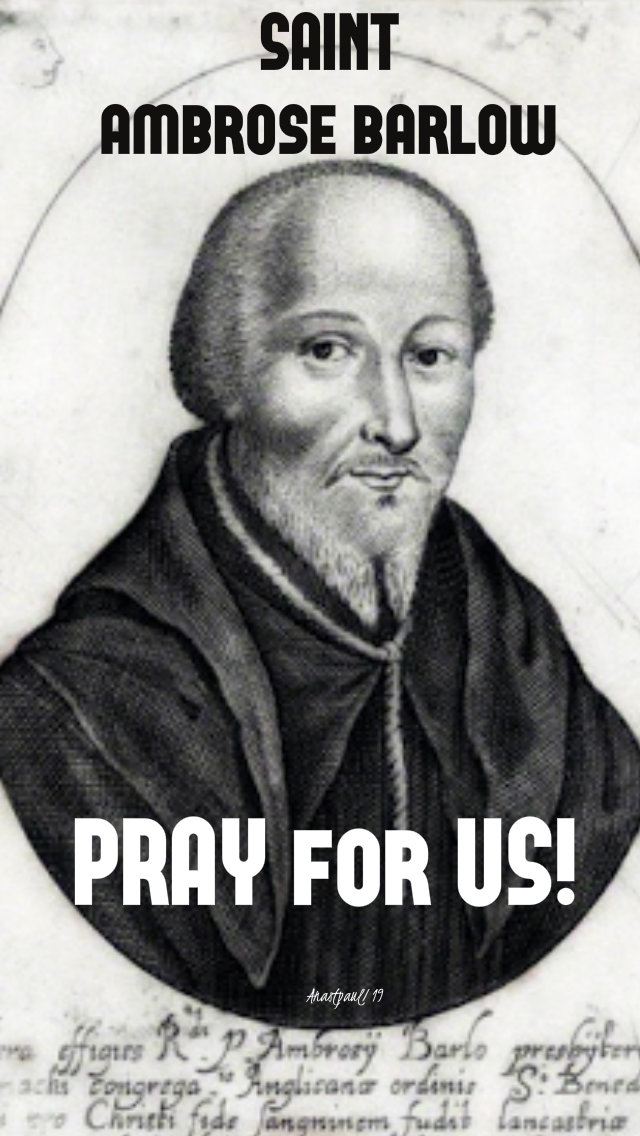
Thought for the Day – 10 September – The Memorial of St Ambrose Edward Barlow OSB (1585-1641) Martyr

Ambrose ministered to the Catholic population in an area between Manchester and Liverpool.

We are fortunate in that the primary sources give us substantial detail about the manner in which Ambrose carried out his work.   Richard Challoner (who wrote Memoirs of Missionary Priests) wrote:-
“such was the fervour of his zeal, that he thought the day lost in which he had not done some notable thing for the salvation of souls…. Night and day he employed in seeking after the lost sheep and correcting sinners…. He found so much pleasure in this inward conversation with God… as much as worldlings would be when going to a feast.
He was always afraid of honours and preferments and had a horror of vainglory, which he used to call the worm or moth of virtues and which he never failed to correct in, others.   He industriously avoided feasts and assemblies and all meetings for merrymaking, as liable to dangers of excess, idle talk and detraction…..He chose to live in a private country house, where the poor, to whom he had chiefly devoted his labours, might have, at all times, free access to him.   He would never have a servant, till forced to it by sickness, never used a horse but made his pastoral visits on foot….He allowed himself no manner of play or pastime and avoided all superfluous talk and conversation, more especially, with those of the fair sex.   His diet was chiefly whitmeats and garden stuff….  He drank only small beer and that very sparingly and always abstained from wine.   He was never idle but was always either praying, studying, preaching, administering the sacraments or painting pictures of Christ or His blessed mother….He feared no dangers, when God’s honour and the salvation of souls called him forth…passed, even at noonday through the midst of his enemies, without apprehension….Yet he was very severe in rebuking sin, so that obstinate and impertinent sinners were afraid of coming near him.”

On the eve of principal festivals, Christmas, Easter and Whitsuntide, Catholics would gather from a wide area.   The night was spent in prayer and hearing confessions.   On the following day, all were fed, the richer members and Ambrose serving the rest and then they had their meal from the leavings.   “Their cheare was boil’d beefe and pottage, minched pies, goose and groates and to every man a gray coate at parting.”

About six months before his arrest in 1641, Ambrose suffered a stroke which affected the use of one side of his body.   A Jesuit priest was sent to help him and may have provided some assistance to him while he was in prison.
Ambrose laboured in south Lancashire between 1617 and 1641.   It appears that he was arrested and imprisoned on at least four occasions.   He ministered to St Edmund Arrowsmith SJ (1585 – 1628) Martyr, in 1628 while the latter was awaiting trial and subsequent execution in Lancaster Prison.   He was said to be as well known in the area in which he served.   Probably local support enabled him to continue in his role for so long.   He had a premonition of what his fate would be since it is reported that St Edmund Arrowsmith appeared to him in a dream and said that he too would become a martyr.

St Ambrose Barlow, Pray for Us!st ambrose barlow pray for us 10 sept 2019 no 2.jpg

Posted in DOMINICAN OP, ON the SAINTS, PRACTISING CATHOLIC, PRAYERS for CANONISATION, QUOTES on CHARITY, QUOTES on HUMAN DIGNITY, QUOTES on JUSTICE, QUOTES on LOVE, QUOTES on MERCY, SAINT of the DAY

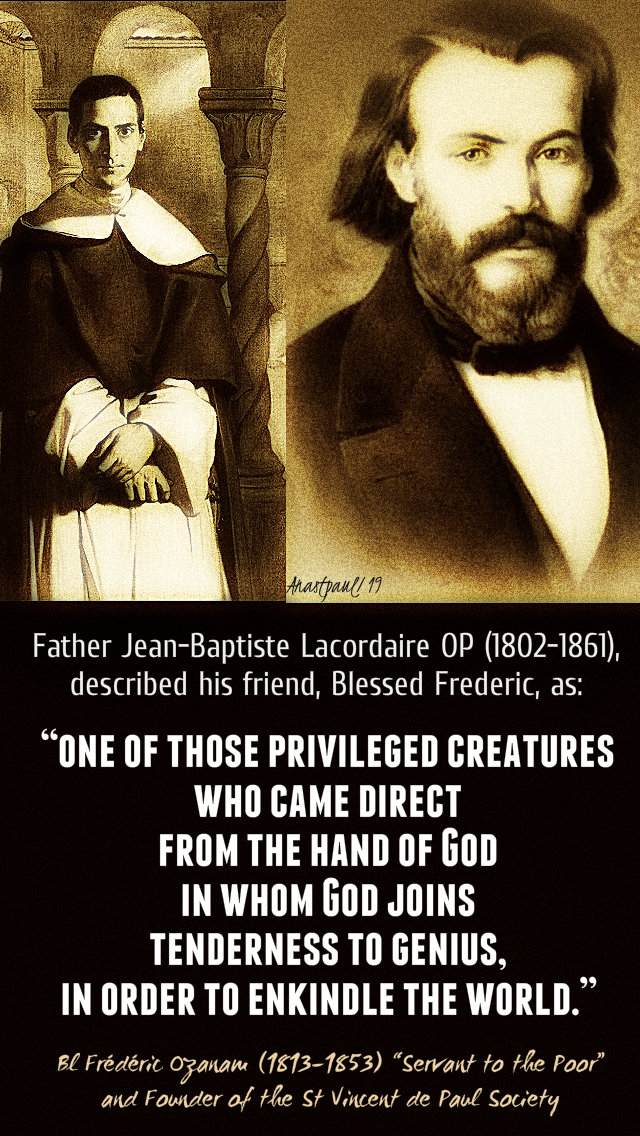
Thought for the Day – 9 September – “One of those privileged creatures who came direct from the hand of God …”

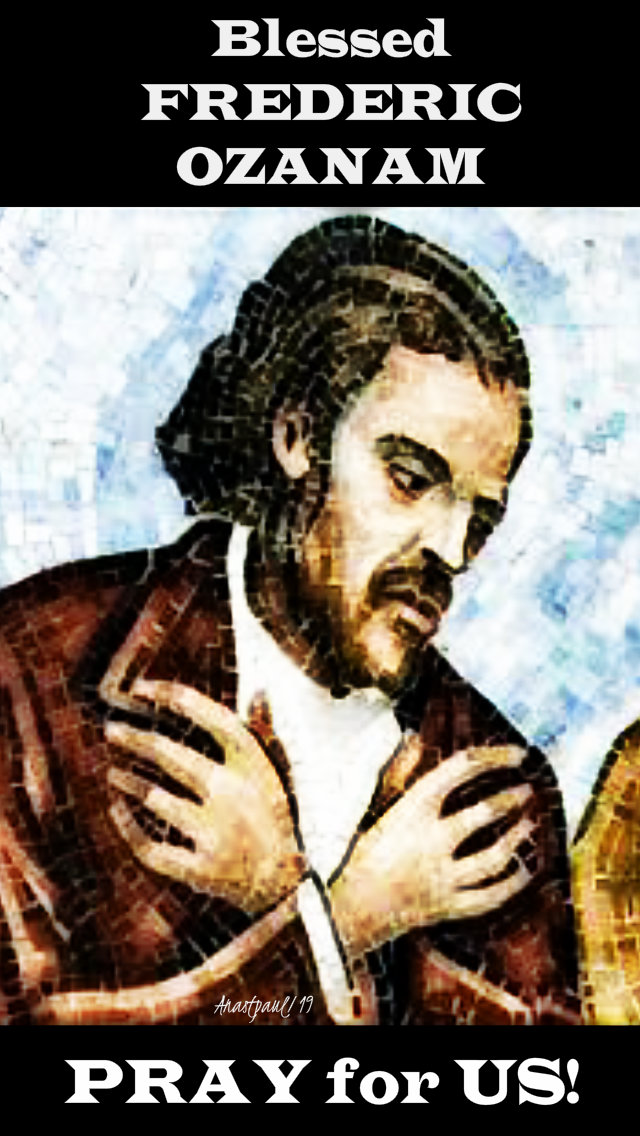
Thought for the Day – 9 September – The Memorial of Blessed Frédéric Ozanam (1813–1853) “Servant to the Poor” and Founder of the St Vincent de Paul Society

A man convinced of the inestimable worth of each human being, Frédéric served the poor of Paris well and drew others into serving the poor of the world.   Through the Saint Vincent de Paul Society, which he founded, his work continues to the present day.

Once, after Frédéric spoke about Christianity’s role in civilisation, a club member said: “Let us be frank, Mr Ozanam, let us also be very particular.   What do you do besides talk to prove the faith you claim is in you?”

Frédéric was stung by the question.   He soon decided that his words needed a grounding in action.   He and a friend began visiting Paris tenements and offering assistance as best they could.   Soon a group dedicated to helping individuals in need under the patronage of Saint Vincent de Paul formed around Frédéric.

Feeling that the Catholic faith needed an excellent speaker to explain its teachings, Frédéric convinced the Archbishop of Paris to appoint Dominican Father Jean-Baptiste Lacordaire OP (1802-1861), the greatest preacher then in France, to preach a Lenten series in Notre Dame Cathedral.   It was well-attended and became an annual tradition in Paris.   Meanwhile, the Saint Vincent de Paul Society was growing throughout Europe.   Paris alone counted 25 conferences.

In 1846, Frédéric, Amelie, and their daughter Marie went to Italy, there he hoped to restore his poor health.   They returned the next year.   The revolution of 1848 left many Parisians in need of the services of the Saint Vincent de Paul conferences.   The unemployed numbered 275,000.   The government asked Frédéric and his coworkers to supervise the government aid to the poor.   Vincentians throughout Europe came to the aid of Paris.

In 1852, poor health again forced Frédéric to return to Italy with his wife and daughter. He died on 8 September 1853.   In his sermon at Frédéric’s funeral, Fr Lacordaire described his friend as “one of those privileged creatures who came direct from the hand of God in whom God joins tenderness to genius, in order to enkindle the world.”one of those priviliged creatures - bl frederic by jean baptiste lacordaire 9 sept 2019.jpg

Frédéric was beatified in 1997.   Since Frédéric wrote an excellent book entitled Franciscan Poets of the Thirteenth Century, and since his sense of the dignity of each poor person was so close to the thinking of Saint Francis, it seemed appropriate to include him among Franciscan “greats.”

His commitment to the plight of those in need and social justice for all, inspires us to look around our communities today—outside our safety zones—and activate the Christian virtues of charity that we are all called to by the life of Jesus.   He said:

“Yours must be a work of love, of kindness, you must give your time, your talents, yourselves.   The poor person is a unique person of God’s fashioning with an inalienable right to respect.   You must not be content with tiding the poor over the poverty crisis, You must study their condition and the injustices which brought about such poverty, with the aim of a long term improvement.”

Prayer for the Canonisation of Blessed Frédéric Ozanam

Lord, you made Blessed Frédéric Ozanam
a witness of the Gospel, full of wonder
at the mystery of the Church.
You inspired him to alleviate poverty and injustice
and endowed him with untiring generosity
in the service of all those suffering.
In family life, he revealed a most genuine love
as a son, brother, husband and father.
In secular life, his ardent passion for the truth
enlightened his thought, writing and teaching.
His vision for our society was a network of charity
encircling the world inspired
by St Vincent de Paul’s love, boldness and humility.
His prophetic social vision appears in every aspect of his life,
together with the radiance of his virtues.
We thank you Lord, for these many gifts.
May the Church proclaim his holiness,
as a saint, a providential light for today’s world!
We ask this prayer through Jesus Christ, our Lord.
Amen

Blessed Frederic, Pray for us too, Amen!bl frederic ozanam pray for us 9 sept 2019 no 2.jpg

Posted in CHRIST, the WAY,TRUTH,LIFE, DOCTORS of the Church, FATHERS of the Church, ON the SAINTS, QUOTES of the SAINTS, QUOTES on MUSIC/SINGING, QUOTES on PEACE, QUOTES on PERSECUTION, QUOTES on SACRIFICE, St JOHN the BAPTIST

Thought for the Day – 29 August – St Bede -Precursor of Christ in Birth and Death

Thought for the Day – 29 August – The Beheading of St John the Baptist

Precursor of Christ in Birth and Death

Saint Bede (673-735)
Priest, Father and Doctor of the Church

An excerpt from Homily 23

As forerunner of our Lord’s birth, preaching and death, the blessed John showed in his struggle, a goodness worthy of the sight of heaven.   In the words of Scripture:  Though in the sight of men he suffered torments, his hope is full of immortality.   We justly commemorate the day of his birth with a joyful celebration, a day which he himself made festive for us through his suffering and which he adorned with the crimson splendour of his own blood.   We do rightly revere his memory with joyful hearts, for he stamped with the seal of martyrdom, the testimony, which he delivered, on behalf of our Lord.

There is no doubt that blessed John suffered imprisonment and chains as a witness to our Redeemer, whose forerunner he was and gave his life for Him.   His persecutor had demanded, not that he should deny Christ but only, that he should keep silent about the truth.   Nevertheless, he died for Christ.   Does Christ not say – I am the truth? Therefore, because John shed his blood for the truth, he surely died for Christ.

Through his birth, preaching and baptising, he bore witness to the coming birth, preaching and baptism of Christ and by his own suffering, he showed, that Christ also would suffer.

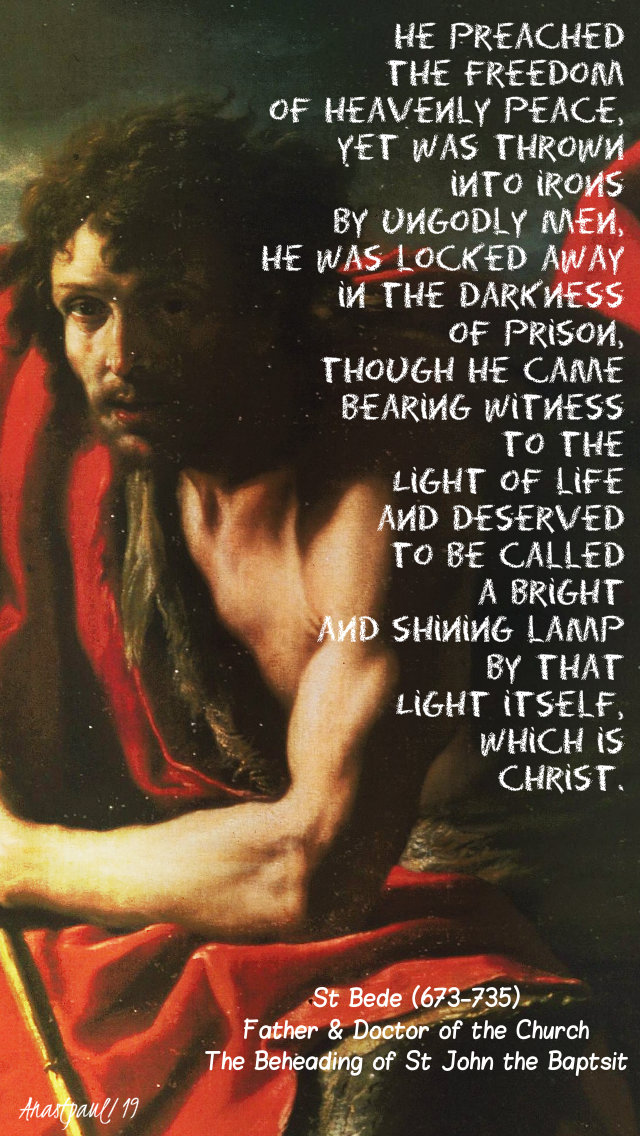
Such was the quality and strength of the man who accepted the end of this present life by shedding his blood after the long imprisonment.   He preached the freedom of heavenly peace, yet was thrown into irons by ungodly men, he was locked away in the darkness of prison, though he came bearing witness to the Light of life and deserved to be called a bright and shining lamp by that Light itself, which is Christ.  John was baptised in his own blood, though he had been privileged to baptise the Redeemer of the world, to hear the voice of the Father above him and to see the grace of the Holy Spirit descending upon him.   But to endure temporal agonies for the sake of the truth was not a heavy burden for such men as John, rather it was easily borne and even desirable, for he knew eternal joy would be his reward.he preached the freedom of heavenly peace - st john the baptist - by st bede 29 aug 2019.jpg

Since death was ever near at hand through the inescapable necessity of nature, such men considered it a blessing to embrace it and thus gain the reward of eternal life by acknowledging Christ’s name.   Hence the apostle Paul rightly says:  You have been granted the privilege, not only to believe in Christ but also to suffer for his sake.   He tells us why it is Christ’s gift that his chosen ones should suffer for Him:  The sufferings of this present time, are not worthy, to be compared with the glory that is to be revealed in us.

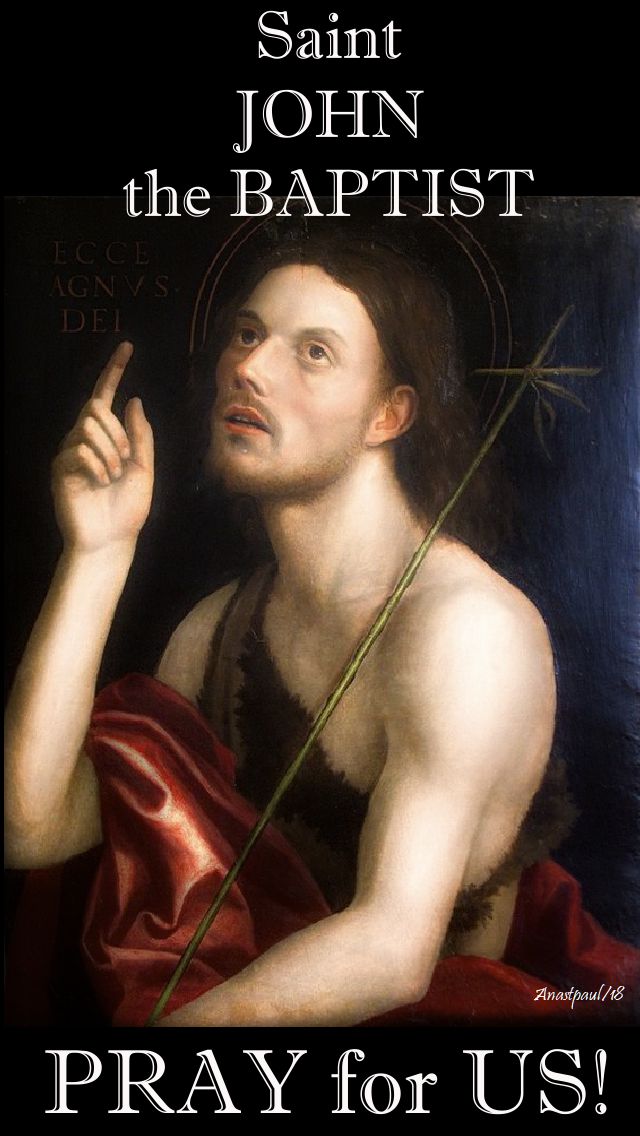
St John the Baptist, Pray for us!st john the baptist - pray for us - 24 june 2018.jpg

Posted in ON the SAINTS, QUOTES of the SAINTS, QUOTES on MOTHERHOOD, QUOTES on PERSEVERANCE, QUOTES on PRAYER, QUOTES on the FAMILY, SAINT of the DAY

Thought for the Day – 27 August -St Monica’s ‘Nunc Dimittis”

Thought for the Day – 27 August – Tuesday of the Twenty-first week in Ordinary Time, Year C and The Memorial of St Monica (322-387)

Blessed John Henry Newman (1801-1890)

Sermons preached on various occations

“Many a mother, who is anxious for her son’s bodily welfare, neglects his soul.
So, did NOT the Saint of today – her son might be accomplished, eloquent, able and distinguished – all this was nothing to her, while he was dead in God’s sight, while he was the slave of sin, while he was the prey of heresy.
She desired his true life.
She wearied heaven with prayer
and wore out herself,
with praying –
she did not at once prevail.
He left his home,
he was carried forward by his four bearers –
ignorance,
pride,
appetite
and ambition –
he was carried out into a foreign land,
he crossed over from Africa to Italy.
She followed him,
she followed the corpse,
the chief,
the only mourner-
she went where he went, from city to city.
It was nothing to her to leave her dear home and her native soil, she had no country below;  her sole rest, her sole repose, her Nunc dimittis, was his new birth.
So while she still walked forth in her deep anguish and isolation
and her silent prayer,
she was at length rewarded by the long-coveted miracle.
Grace melted the proud heart
and purified the corrupt breast of Augustine
and restored
and comforted
his mother!”

“How many difficulties there are also today in family relationships
and how many mothers are anguished because their children choose mistaken ways!
Monica, a wise and solid woman in the faith, invites us not to be discouraged
but to persevere in our mission of wives and mothers,
maintaining firm our confidence in God and clinging with perseverance to prayer.”

Pope Benedict XVI (27 August 2006)monica-a-wise-and-solid-woman-pope-benedict 27 aug 2017

St Monica, Pray with us for our sons, Pray for Us!st-monica-pray-for-us-27 aug 2017

Posted in DOCTORS of the Church, FEASTS and SOLEMNITIES, ON the SAINTS, QUOTES of the SAINTS, QUOTES on EVANGELISATION, QUOTES on FAITH, SAINT of the DAY, The APOSTLES & EVANGELISTS

Thought for the Day – 24 August – “God has given”

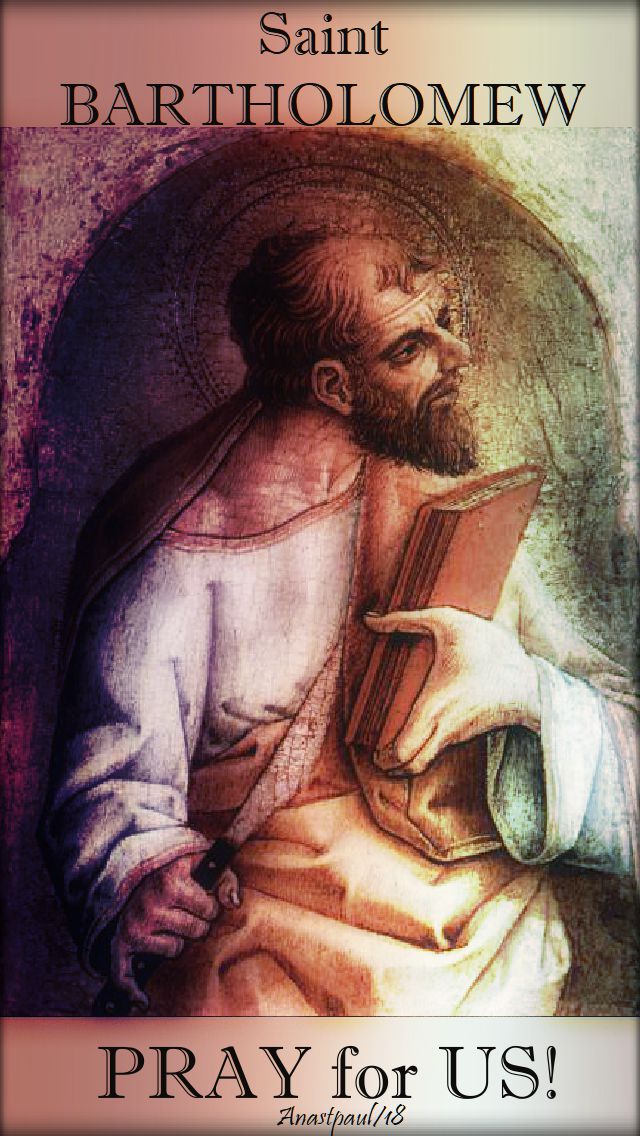
Thought for the Day – 24 August – The Feast of St Bartholomew, Apostle of Christ – Today’s Gospel: John 1:45–51

The name “Nathanael” means “God has given”

“The apostles’ glory is so indistinguishable and so bonded together by the cement of so many graces that in celebrating the feast of one of them the common greatness of all is called to our interior attention. For they share together the same authority of supreme judge, the same honourable rank and they hold the same power to bind and loose (Mt 19:28; 18:18).   They are those precious pearls that Saint John tells us he beheld in the Book of Revelation out of which are constructed the gates of the heavenly Jerusalem (Rv 21:21.14)…   And indeed, whenever the apostles beam divine light through their signs or miracles, they open up the heavenly glory of Jerusalem, to all those peoples who have been converted to the christian faith…

Of them, too, the prophet says: “Who are these who fly along like clouds?” (Is 60:8)…  God raises the minds of His preachers to contemplation of truths on high… so that they can abundantly pour down the rain of God’s word into our hearts.   Thus they drink water from the spring, so as to give drink to us too.

Saint Bartholomew drew from the fullness of this spring, when the Holy Spirit came upon him, as on the other apostles, in the form of tongues of fire (Acts 2:3).”

St Peter Damian (1007-1072) – Bishop, Doctor of the Church (Sermon 42, 2nd for Saint Bartholomew, PL 144, 726)

St Bartholomew, Pray for Us!st-bartholomew-pray-for-us-24-aug-2018.jpg

Posted in ON the SAINTS, QUOTES of the SAINTS, QUOTES on SANCTITY

Quote of the Day – 17 August – Become a Saint!

Quote of the Day – 17 August – Saturday of the Nineteenth week in Ordinary Time, Year C

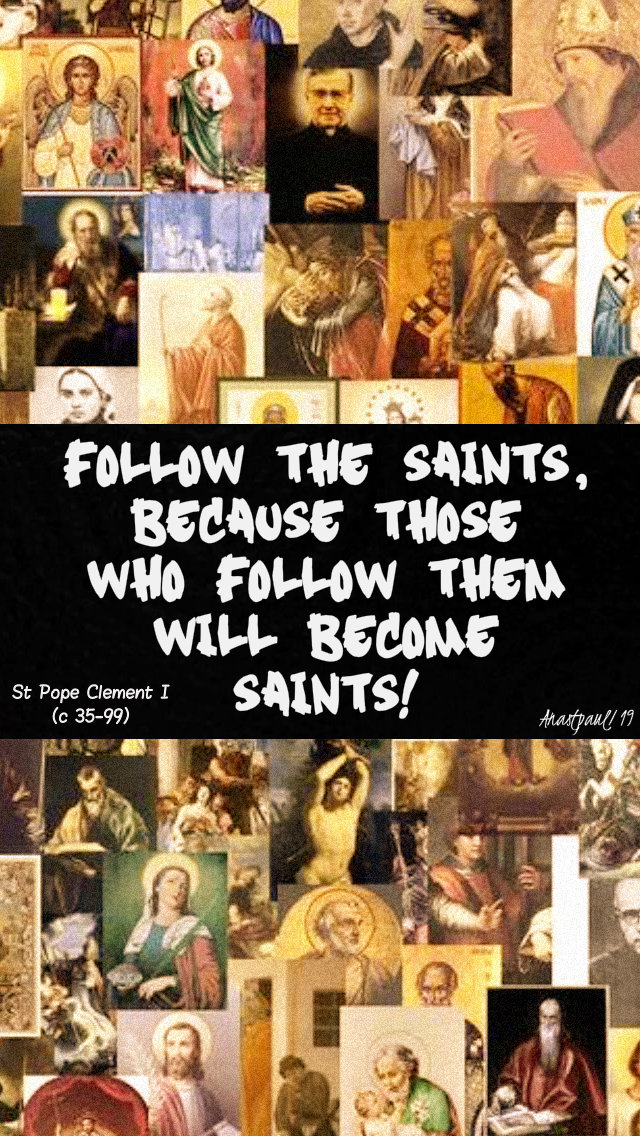
“Follow the saints,
because those who follow them
will become saints!”

Saint Pope Clement I (c 35-99)follow the saints - 17 august 2019 st pope clement I.jpg

Posted in DOCTORS of the Church, FEASTS and SOLEMNITIES, HYMNS, ON the SAINTS, QUOTES of the SAINTS, SAINT of the DAY, St PETER!

Thought for the Day – 1 August – ‘Upon this rock I will build my Church!’

Thought for the Day – 1 August – Thursday of the Seventeenth week in Ordinary Time, Year C and the Feast of St Peter in Chains

Homily of St Augustine

Peter alone among the Apostles was accounted worthy to hear – A – men I say to thee, that thou art Peter and upon this rock I will build my Church.   Worthy indeed was he, to be the foundation-stone, the supporting pillar, the key to the kingdom, in building up the peoples into the house of God.   Concerning this, the divine word says – And they laid, it says, their sick, that when Peter passed by, his shadow at the least might fall on them.   If at that time the shadow of his body could give aid, how much more now can the fullness of his power?   If a mere breath of air from him, as he passed by, was of such benefit to suppliants, how much more his favour now that he remains steadfast?   With good reason is the iron of those Penal chains held throughout all the churches of Christ to be more precious than gold.

If the shadow of him who visited was so potent to cure, how much more the chains of him who binds?   If even the mere appearance of an empty image could have the force of healing in it, how much more healthfulness should the chains, with which he suffered, whose iron weight had pressed upon his sacred members, deserve to draw forth from his body?   If he was so mighty to help his suppliants before his martyrdom, how much more must he avail after his triumph?

Happy those bonds, which by touching the Apostle rendered him a Martyr and so from manacles and fetters themselves were changed into a crown!   Happy chains, which brought their prisoner even unto the cross of Christ, not so much for condemnation as for consecration!

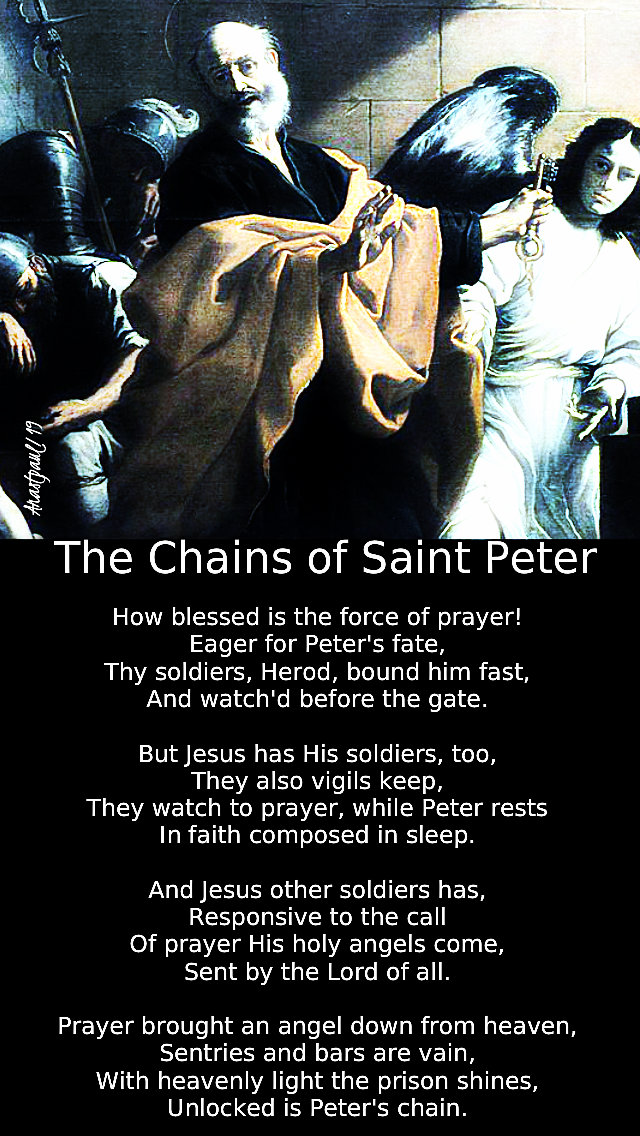
Jesus said to His disciples – Who do men say that the Son of Man is?   Peter answered and said – Thou art Christ, the son of the living God.   And I say to thee – that thou art Peter and upon this rock I will build my Church!the chains of st peter hymn 1 aug 2019.jpg

Hymn
The Chains of Saint Peter

How blessed is the force of prayer!
Eager for Peter’s fate,
Thy soldiers, Herod, bound him fast,
And watch’d before the gate.

But Jesus has His soldiers, too,
They also vigils keep,
They watch to prayer, while Peter rests
In faith composed in sleep.

And Jesus other soldiers has,
Responsive to the call
Of prayer His holy angels come,
Sent by the Lord of all.

Prayer brought an angel down from heaven,
Sentries and bars are vain,
With heavenly light the prison shines,
Unlocked is Peter’s chain.

St Peter, Pray for Us!

st pope peter apostle and martyr pray for us 22feb2019.jpg

Posted in FEASTS and SOLEMNITIES, ON the SAINTS, SAINT of the DAY, St PETER!

1 August – The Feast of Saint Peter in Chains

1 August – The Feast of Saint Peter in Chains
The feast was originally kept in Rome, Italy to commemorate the dedication of the Church of Saint Peter on the Esquiline Hill built by Eudoxia Licinia in 442 and rebuilt by Adrian I in the 8th century.   When the chains which Saint Peter had worn in prison and from which he was freed by angelic intervention were later venerated there, the feast received its present name.
The date when these chains were brought from Jerusalem is disputed – some claim they were brought in 116 by travellers sent in search of them by Saint Balbina and her father Saint Quirinus, while others think Saint Eudoxia brought them in 439.   St Pope Leo the Great united them to the chains with which Saint Peter had been fettered in the Mamertine Prison, forming a chain about two yards long which is preserved in a bronze safe and guarded by a special confraternity.   Patronages – diocese of Annecy, France, Donnas, Italy.

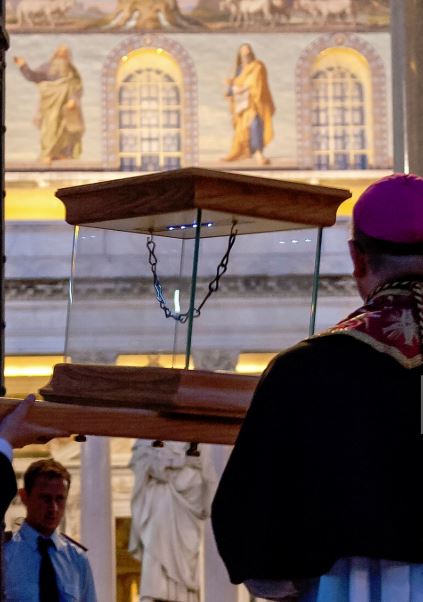
The Feast was removed from the Liturgical Calendar as a separate feast in 1962 but is celebrated together with the Feast of Sts Peter and Paul on 29 June.   See the Getty image below.

29 JUNE FEAST OF STS PETER AND PAUL
ROME, ITALY – 29 JUNE 2018: The faithful carry in procession the relic of the chains of St Paul on the occasion of the Feast of Saints Peter and Paul, around the Basilica of Paul Outside the Walls on 29 June 2018 in Rome, Italy.   The surviving links of the chain that held St Paul prisoner in Rome, between 61 and 63 are displayed in an illuminated theca, near the tomb of the saint inside the Basilica of St Paul Outside the Walls.   St Peter’s Chains are not carried in a similar way, being permanently protected.

St Peter in Chains
by Father Francis Xavier Weninger, 1876

The Holy Church, today, celebrates a special feast in commemoration of the great benefit which God bestowed upon His people by miraculously delivering St Peter, the visible head of the church, from prison.   The entire event is described in the Acts of the Apostles, by St Luke.   Herod Agrippa, a son of Aristobulus, favored by the Roman Emperor Claudius, ruled over Judaea, with the title of king.   To give more stability to his reign, he endeavoured to make himself beloved by the Jews, for which there was no easier way than to persecute the Christians, especially those who fearlessly proclaimed the Gospel of Christ, as did the holy Apostles.  He had, therefore, apprehended and soon after beheaded, James the Great, brother of St John, which bloody deed gave the Jews great satisfaction.   To increase this, Herod commanded them to seize St Peter, intending to make away with him in the same manner.   His command was executed, Peter was taken prisoner, chained and locked in a narrow dungeon, which was guarded so vigilantly, that he could not escape.   It was then near the Easter Festival, after which St Peter was to be beheaded.   The Christians, in deep distress, were praying day and night, that the Almighty would not permit His flock to be so soon deprived of its shepherd.PEter in Chains.jpg

There was no human power to save him but God, hearing the prayer of His people, delivered him by a miracle.   On the eve of the day on which he was to be executed, God sent an Angel to set him free.   Although heavily laden with chains, the holy Apostle slept peacefully, guarded by the soldiers.   The Angel, who by his brightness, illumined the dungeon, struck him on the side and awakened him, saying:  “Arise quickly.   Gird thyself; put on thy sandals and cloak and follow me.”   The Apostle, whose chains had fallen from his hands and who thought it all a dream, obeyed and followed the Angel.   They passed the first and second watches without attracting their attention and reached the iron gate which led into the street.   The gate opened without the aid of human hands.  956px-Hendrick_Terbrugghen_(follower_of)_-_The_Liberation_of_St._Peter_-_Google_Art_Project

After having conducted St Peter through one street, the Angel vanished and was seen no more. Not until then did the holy Apostle realise that his deliverance was not a dream but a reality.   Hence he began to praise the Almighty, exclaiming:  “Now I know truly that the Lord has sent his Angel and delivered me out of the hands of Herod and from all the expectation of the people of Judaea.”   He proceeded immediately to the house of Mary, the mother of John Mark, where the faithful were assembled in prayer.

When he knocked at the door, a servant, named Rhode, came and asked who was there. Judging by the voice that it was Peter, she was so greatly startled with joy and astonishment, that, without opening the door, she ran back to announce the news.   They all believed that she was insane but as she reiterated her words, some said that it must be his guardian Angel.   Meanwhile, the Saint repeated his knocking at the door.   They opened it and perceived, with amazement, their beloved shepherd safe and free from chains.   Their joy on beholding him was as great as had been their grief when he was taken prisoner.   Having given the sign for silence, St Peter related all that had happened to him.   They all gave thanks to Divine Providence when he had ended and learned to trust in future to the heavenly power and mercy.st peter being led away by the angel prison chains.jpg

Among the sermons of St Chrysostom, there is one in which he asserts, that the chains by which St Peter had been bound to the ground, came into the possession of the Christians soon after his deliverance and were held by them in great honour.   Eudoxia, wife of the emperor Theodosius the Younger, received them as a present from the patriarch Juvenal, when on a visit to the holy places and sent one of them to the Church at Constantinople. The other she gave to her daughter Eudoxia, who married the Emperor Valentinian III. Eudoxia showed the chain to Pope Sixtus III., who, on his part, showed her the one with which St Peter had been bound, before the Emperor Nero sentenced him to die.   No sooner had the two chains been held together, than they suddenly united as if they had been but one chain and forged by the same hand.   This miracle increased the veneration in which these chains were held and actuated Eudoxia to build a special church at Rome for their keeping, where they can still be seen.   Many sick were healed by their touch and many possessed were delivered, among the latter was a Count of the court of the Emperor Otho, who, in the year 969, was sent to Rome to be freed from the Evil Spirit. Pope John XIII had hardly touched the count’s neck with the holy chains, when he was relieved and his torments were ended.st peter in chains prison

St Gregory the Great, writes that it was considered a great happiness to possess a few particles filed off from these chains and that many persons devoutly wore them enclosed in golden crosses and lockets around their necks.   Experience has shown that the touch of these crosses or lockets has restored health to many a sick person.   A nobleman, who scoffed at this and, in derision, dared to break one of these crosses, was severely chastised.   He was instantly possessed by the Evil One and became so enraged that he took his own life, as St Gregory relates.   St Augustine states that the iron of these precious chains is justly esteemed far above gold.   Blessed are those fetters which touched the apostle and made him a martyr.   “The touch of the blessed limbs of St Peter has sanctified the instruments of torture.”   In another place the same Saint says:   “If the shadow of St Peter possessed a healing virtue, how much greater power must the chains of his sufferings have derived from him.”casket-with-st-peter chains.jpg

Posted in FEASTS and SOLEMNITIES, ON the SAINTS, The APOSTLES & EVANGELISTS

Quote of the Day – 25 July -Learning from St James

Quote of the Day – 25 July – Feast of St James, Apostle

“…we can learn much from St James – promptness in accepting the Lord’s call even when He asks us to leave the “boat” of our human securities, enthusiasm in following Him on the paths that He indicates to us over and above any deceptive presumption of our own, readiness to witness to Him with courage, if necessary to the point of making the supreme sacrifice of life.

Thus James the Greater stands before us as an eloquent example of generous adherence to Christ.   He, who initially had requested, through his mother, to be seated with his brother next to the Master in His Kingdom, was precisely the first to drink the chalice of the passion and to share martyrdom with the Apostles.

And, in the end, summarising everything, we can say that the journey, not only exterior but above all interior, from the mount of the Transfiguration to the mount of the Agony, symbolises the entire pilgrimage of Christian life, among the persecutions of the world and the consolations of God, as the Second Vatican Council says.   In following Jesus, like St James, we know that even in difficulties we are on the right path.”

Pope Benedict XVI

General Audience, June 21, 2006we-can-learn-much-from-st-james-pope-benedict-25 july 2017 and 2019.jpg

Posted in ON the SAINTS, PAPAL SERMONS, SAINT of the DAY, The HOLY CROSS

Thought for the Day – 23 July – Hail, O Cross, our only hope!

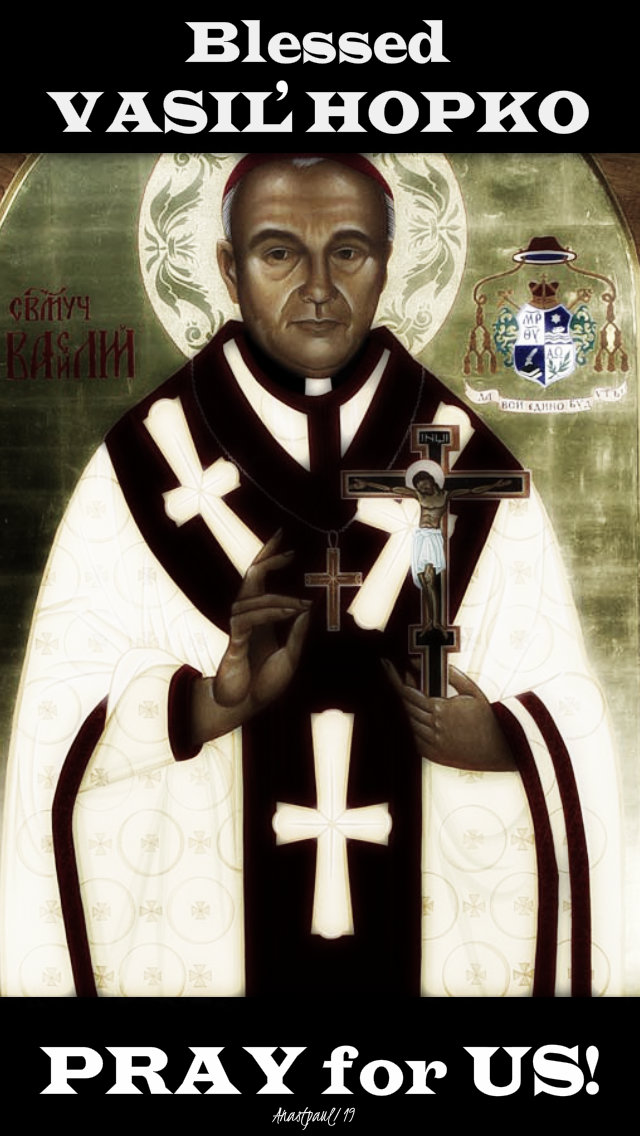
Thought for the Day – 23 July – The Memorial of Blessed Vasil’ Hopko (1904-1976) Bishop and Martyr

Excerpt from St Pope John Paul’s Beatification Homily
Bratislava, Esplanade of Petržalka
Sunday, 14 September 2003

“O Crux, ave spes unica!   Hail, O Cross, our only hope!”

On the Cross, human misery and divine mercy meet.   The adoration of this unlimited mercy, is for man, the only way to open himself to the mystery which the Cross reveals.

The Cross is planted in the earth and would seem to extend its roots in human malice but it reaches up, pointing as it were to the heavens, pointing to the goodness of God.   By means of the Cross of Christ, the Evil One has been defeated, death is overcome, life is given to us, hope is restored, light is imparted.   O Crux, ave spes unica!

O Crux, ave spes unica!   Saint Paul speaks of the same theme in the letter to the Ephesians which we have just heard.   Not only did Christ Jesus become man, in everything similar to human beings but He took on the condition of a servant and humbled Himself even more, by becoming obedient to the point of death, even death on a cross (cf. Phil 2:6-8).

Yes, “God so loved the world that he gave his only Son” (Jn 3:16).   We admire – overwhelmed and gratified – the breadth and length and height and depth of the love of Christ which surpasses all knowledge (cf. Eph 3:18-19)!   O Crux, ave spes unica!

4. Certainly, it was meditation on this great and wonderful mystery that sustained Blessed Bishop Vasil’ Hopko and Blessed Sister Zdenka Schelingová in their choice of the consecrated life and, especially, in the sufferings endured, during their terrible imprisonment.

Both shine before us as radiant examples of faithfulness, in times of harsh and ruthless religious persecution.   Bishop Vasil’ never repudiated his attachment to the Catholic Church and to the Pope.   Sister Zdenka did not hesitate to risk her life so as to assist God’s ministers.

Both faced up to an unjust trial and an ignoble condemnation, to torture, humiliation, solitude, death.   And so the Cross became for them, the way that led them to life, a source of fortitude and hope, a proof of love for God and man.   O Crux, ave spes unica!

Blessed Vasil’ Hopko, Pray for Us!BL VASIL HOPKO PRAY FOR US 23 JULY 2019.jpg

Posted in CHRIST, the WAY,TRUTH,LIFE, ON the SAINTS, QUOTES - J R R Tolkien and MORE, QUOTES of the SAINTS, QUOTES on DIVINE PROVIDENCE, QUOTES on HOPE, QUOTES on HUMILITY, QUOTES on PERSEVERANCE, The WORD

Quote/s of the Day – 17 July – Childlike

Quote/s of the Day – 17 July – Wednesday of the Fifteenth week in Ordinary Time, C – Today’s Gospel Matthew 11:25-27.

“You have hidden these things
from the wise and the learned,
you have revealed them,
to the childlike”

Matthew 11:25matthew 11 25 you have revealed them to the childlike 17 july 2019.jpg

“He will provide
the way and the means,
such as you
could never have imagined.”

St Catherine of Siena (1347-1380)
Doctor of the Churchhe will provide the way and the means such as you - st catherine of siena 17 july 2019.jpg

“Love to be unknown.”

St Philip Neri (1515-1595)love to be unknown st philip neri - 17 july 2019.jpg

“The two kinds of people
that go around,
seeing the world
as absolutely fascinating,
are children and saints.”the two kinds of people - fr mike schmitz 17 july 2019.jpg

“God has a plan
to get to you
but how many people
have a plan,
to get to God?”

Father Mike Schmitzgod has a plan to get to you - fr mike schmitz 17 july 2019.jpg

Posted in DOCTORS of the Church, FATHERS of the Church, MORNING Prayers, ON the SAINTS, QUOTES of the SAINTS, The APOSTLES & EVANGELISTS

One Minute Reflection – 10 July – The Twelve

One Minute Reflection – 10 July – Wednesday of the Fourteenth week in Ordinary Time, Year C, Gospel: Matthew 10:1–7

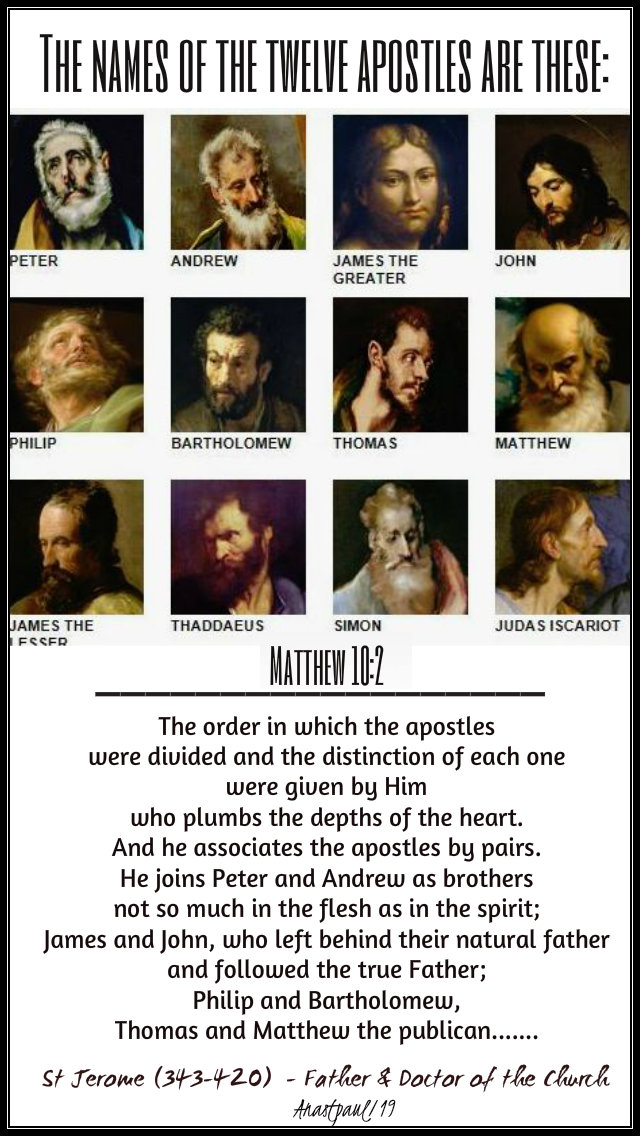
The names of the twelve apostles are these:   first, Simon, who is called Peter and Andrew his brother;  James the son of Zebedee and John his brother; …Matthew 10:2

REFLECTION – “The order in which the apostles were divided and the distinction of each one were given by him who plumbs the depths of the heart.   The first to be recorded is Simon called Peter (to distinguish him from the other Simon, who is called the Cananaean from the village of Cana in Galilee, where the Lord turned the water into wine).   He also calls James the son of Zebedee because he is followed by another James, the son of Alphaeus.   And he associates the apostles by pairs.  He joins Peter and Andrew as brothers not so much in the flesh as in the spirit;  James and John, who left behind their natural father and followed the true Father;  Philip and Bartholomew, Thomas and Matthew the publican.   The other Evangelists, in listing the names, put Matthew first and then Thomas, nor do they mention the name publican, lest in recalling his former way of life they seem to insult the Evangelist.   But Matthew, as we said before, places himself after Thomas and calls himself a publican so that “where sin abounded, grace has abounded even more.”

Simon the Cananaean is the one whom another Evangelist calls the Zealot.   In fact, Cana interpreted means “zeal.”   Church history relates that the apostle Thaddaeus was sent to Edessa, Abgarum in the region of Osroene.   The person whom Luke the Evangelist calls Jude the brother of James, elsewhere called Lebbaeus, which interpreted means “little heart,” is believed to have been referred to by three names.   Simon Peter and the sons of Zebedee (called sons of thunder) were named for their strength of mind and great faith.   Judas Iscariot took his name either from his hometown or from the tribe of Issachar.   By a certain prophecy he was born in condemnation of himself, for Issachar interpreted means “reward,” as to signify the price of the traitor.” … St Jerome (343-420)  – Father & Doctor of the Church (Commentary on Matthew, 1.)matthew 10 2 - the names of the 12 apostles are these - st jerome - 10 july 2019

PRAYER – Holy God and Almighty Father, we are the disciples of Your Son as we follow Him home to You, grant us we pray, the strength and love to imitate Him in all things and to daily, pick up our cross with joy and commitment.   May the Blessed Virgin, be a constant protection and assistance in our times of struggle and may all your angels and saints and martyrs, pray for us, through our Lord Jesus Christ, with the Holy Spirit, God for always and forever, amen.blessed virgin mary pray for us 17 jan 2019

Posted in EUCHARISTIC Adoration, ON the SAINTS, QUOTES of the SAINTS, SAINT of the DAY, The HOLY EUCHARIST / The HOLY MASS

Quote/s of the Day – 8 July – May we never forget Your Presence.

Quote/s of the Day – 8 July –  The Memorial of Blessed Peter Vigne (1670-1740)

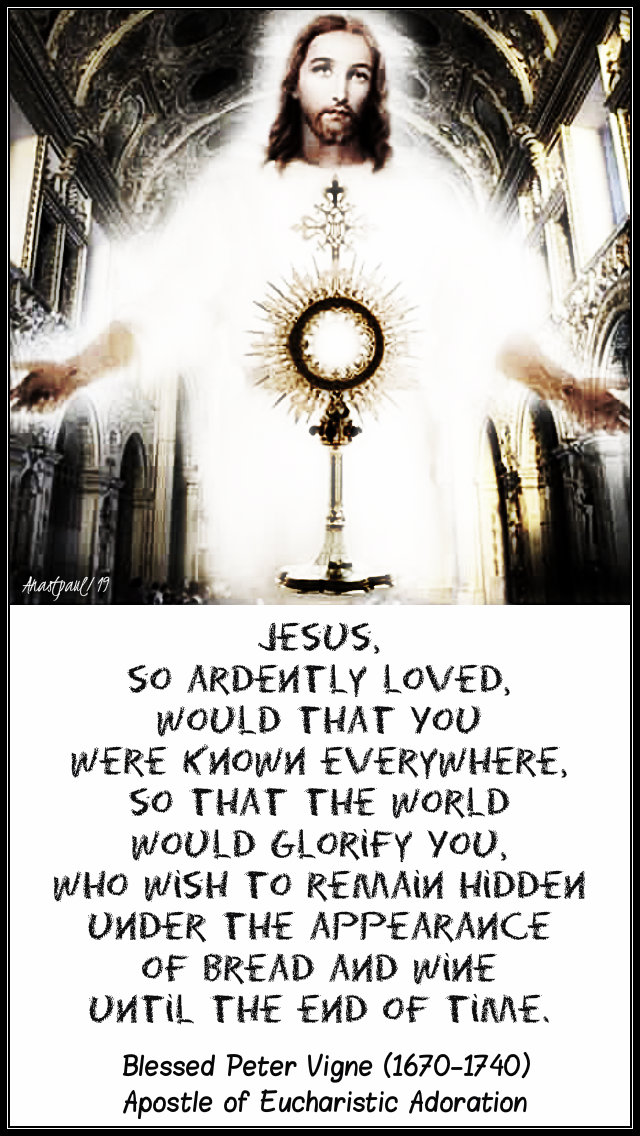
“Jesus, so ardently loved,
would that You were known everywhere,
so that the world would glorify You,
who wish to remain hidden
under the appearance of bread and wine
until the end of time.”jesus so ardently loved - bl peter vigne - 8 july 2019.jpg

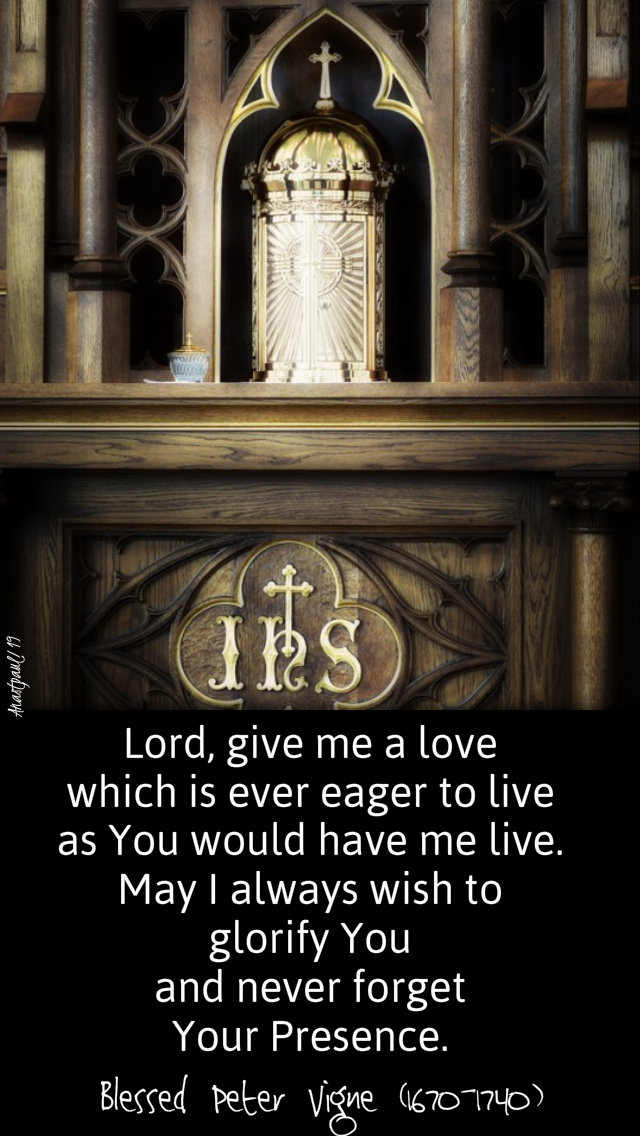
“Lord, give me a love
which is ever eager to live
as You would have me live.
May I always wish to glorify You
and never forget Your Presence.”

Blessed Peter Vigne (1670-1740)

Apostle of Eucharistic Adorationlord give me a love - never forget your presence - bl peter vigne 8 july 2019.jpg

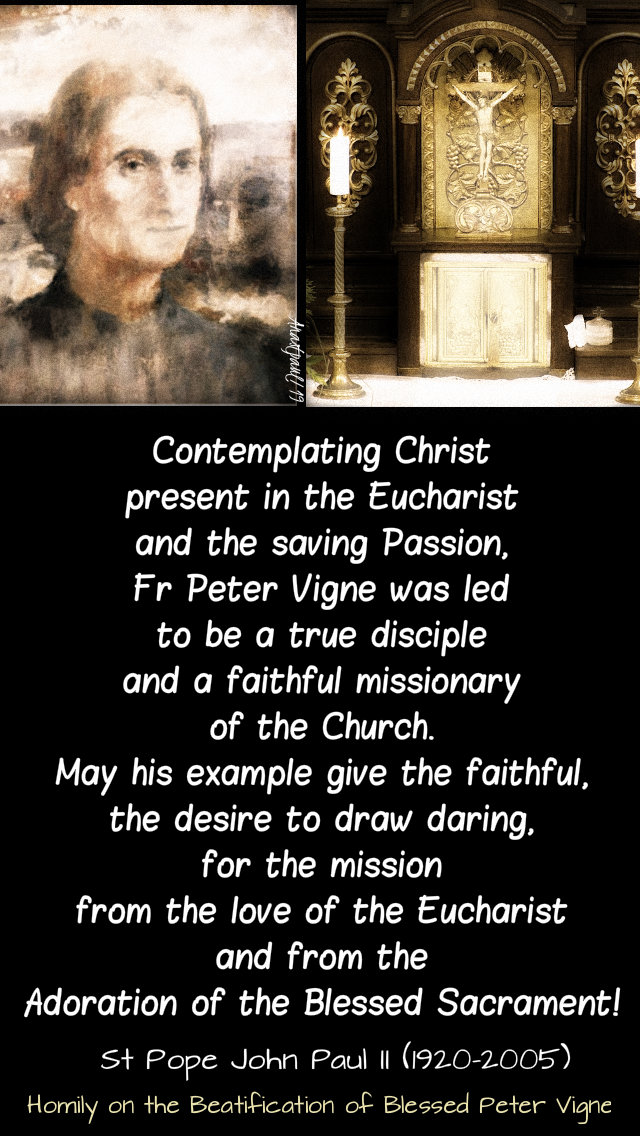
“Contemplating Christ present in the Eucharist and the saving Passion,
Fr Peter Vigne was led to be a true disciple and a faithful missionary
of the Church.
May his example give the faithful,
the desire to draw daring for the mission
from the love of the Eucharist
and from the adoration of the Blessed Sacrament!”

St Pope John Paul II (1920-2005)

Homily on the Beatification of Blessed Peter Vigne,
Sunday, 3 October 2004contemplating christ present in the eucharist - st john paul on bl peter vigne 8 july 2019.jpg

Posted in DOCTORS of the Church, FATHERS of the Church, FEASTS and SOLEMNITIES, ON the SAINTS, QUOTES of the SAINTS, QUOTES on FAITH, SAINT of the DAY, The APOSTLES & EVANGELISTS

Thought for the Day – 3 July – ‘..The God he could not see’

Thought for the Day – 3 July – Feast of St Thomas Apostle

“My Lord and My God”

Saint Pope Gregory the Great (540-604)
Bishop of Rome and Great Western Father and Doctor of the Church

An excerpt from his Homily 26

Thomas, one of the twelve, called the Twin, was not with them when Jesus came.   He was the only disciple absent, on his return he heard what had happened but refused to believe it.   The Lord came a second time, He offered His side for the disbelieving disciple to touch, held out His hands and, showing the scars of His wounds, healed the wound of his disbelief.

Dearly beloved, what do you see in these events?   Do you really believe that it was by chance that this chosen disciple was absent, then came and heard, heard and doubted, doubted and touched, touched and believed?   It was not by chance but in God’s providence.   In a marvellous way, God’s mercy arranged, that the disbelieving disciple, in touching the wounds of his master’s body, should heal our wounds of disbelief.   The disbelief of Thomas has done more for our faith than the faith of the other disciples.   As he touches Christ and is won over to belief, every doubt is cast aside and our faith is strengthened.   So the disciple who doubted, then felt Christ’s wounds, becomes a witness to the reality of the Resurrection.

Touching Christ, he cried out – My Lord and my God.   Jesus said to him – Because you have seen me, Thomas, you have believed.   Paul said: Faith is the guarantee of things hoped for, the evidence of things unseen.  It is clear, then, that faith is the proof of what cannot be seen.   What is seen gives knowledge, not faith.   When Thomas saw and touched, why was he told – You have believed because you have seen me?   Because what he saw and what he believed were different things.   God cannot be seen by mortal man. Thomas saw a human being, whom he acknowledged to be God and said: -My Lord and my God.   Seeing, he believed, looking at one who was true man, he cried out that this was God, the God he could not see.seeing he believed - st pope gregory - 3 july 2019 st thomas.jpg

What follows is reason for great joy – Blessed are those who have not seen and have believed.   There is here a particular reference to ourselves, we hold in our hearts one we have not seen in the flesh.   We are included in these words but only if we follow up our faith with good works.   The true believer practices what he believes.   But of those who pay only lip service to faith, Paul has this to say – They profess to know God but they deny him in their works.   Therefore James says – Faith without works is dead.

St Thomas, Pray for Us!st thomas apostle of christ pray for us 3 july 2019.jpg

Posted in FATHERS of the Church, FEASTS and SOLEMNITIES, MORNING Prayers, ON the SAINTS, QUOTES - J R R Tolkien and MORE, QUOTES on FAITH, SAINT of the DAY, The APOSTLES & EVANGELISTS, The RESURRECTION, The WORD

One Minute Reflection – 3 July – “Happy are those who have not seen and yet believe!”.

One Minute Reflection – 3 July – Feast of St Thomas Apostle, Gospel John 20:24–29

Thomas answered him, “My Lord and my God!”…John 20:28john 20 28 my lord and my god feat of st thomas 3 july 2019.jpg

REFLECTION – “Put your finger into the marks of the nails”.   You looked for Me when I wasn’t there, now take advantage of it.   I understand your desire despite your silence. Before you tell Me them I already know your thoughts.   I heard you speak and, even though unseen, I was beside you, beside your doubts.   Without revealing Myself I made you wait, so as better to consider your eagerness.   “Put your finger into the marks of the nails.   Put your hand into my side, do not be unbelieving any longer, but believe.”
Then Thomas touched Him and all his mistrust fell away.   Full of genuine faith and all the love owing to God, he cried out:  “My Lord and my God!”   And the Lord said to him – “You believe because you have seen me;  happy are those who have not seen and yet believe!”   Thomas took the news of the Resurrection to those who had not seen.   Draw the whole earth to believe, not by its own sight but at your word.   Go through peoples and cities far away.   Teach them to carry the cross rather than weapons on their shoulders.   Only proclaim me – they will believe and worship.   They will demand no other proof.   Tell them they are called by grace and, with your own eyes, behold their faith.   Truly, blessed are those who did not see and yet believed!
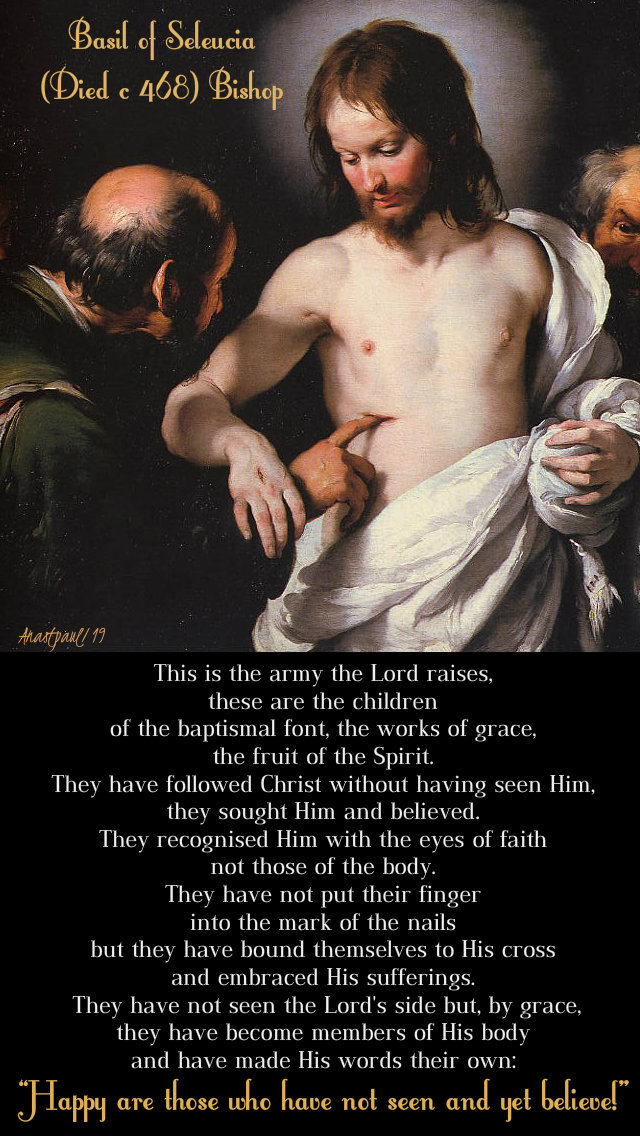
This is the army the Lord raises, these are the children of the baptismal font, the works of grace, the fruit of the Spirit.   They have followed Christ without having seen Him, they sought Him and believed.   They recognised Him with the eyes of faith not those of the body.   They have not put their finger into the mark of the nails but they have bound themselves to His cross and embraced His sufferings.   They have not seen the Lord’s side but, by grace, they have become members of His body and have made His words their own:  “Happy are those who have not seen and yet believe!”Basil of Seleucia (Died c 468) Bishop Sermon for the Resurrection, 1-4this is the army the lord raises - basil of seleucia feast of st thomas 3 july 2019.jpg

PRAYER – Almighty Father,as we honour Thomas the Apostle, let us always experience the help of his prayers. May we have eternal life by believing in Jesus,
whom Thomas acknowledged as Lord, for He lives and reigns with You and the Holy Spirit, one God, forever and ever. Amenst thomas pray for us 2.jpg

Posted in HYMNS, ON the SAINTS, PRAYERS of the SAINTS, QUOTES of the SAINTS, QUOTES on OBEDIENCE, QUOTES on TRUST and complete CONFIDENCE in GOD

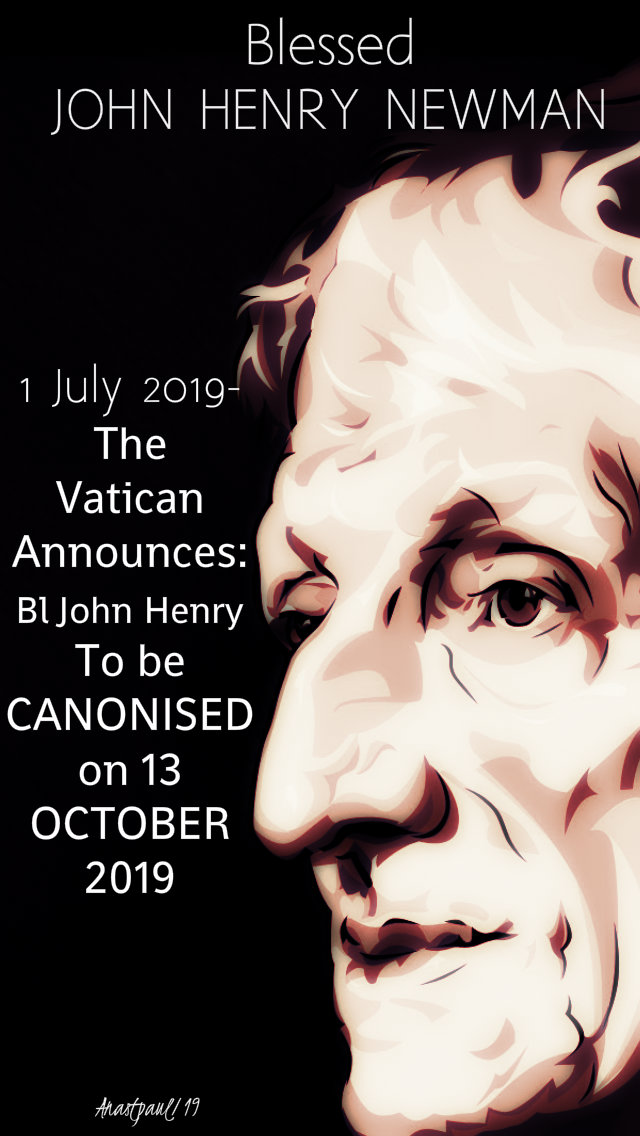
Pope Francis to Canonise Blessed John Henry Newman (1801-1890) on 13 October 2019

The Vatican announces the date of the Canonisation of Blessed John Henry Newman (1801-1890), along with four others on Sunday 13 October 2019, the 28th Sunday in Ordinary Time, Year C.vatican announces canonisation of Bl John Henry Newman today 1 july 2019.jpg

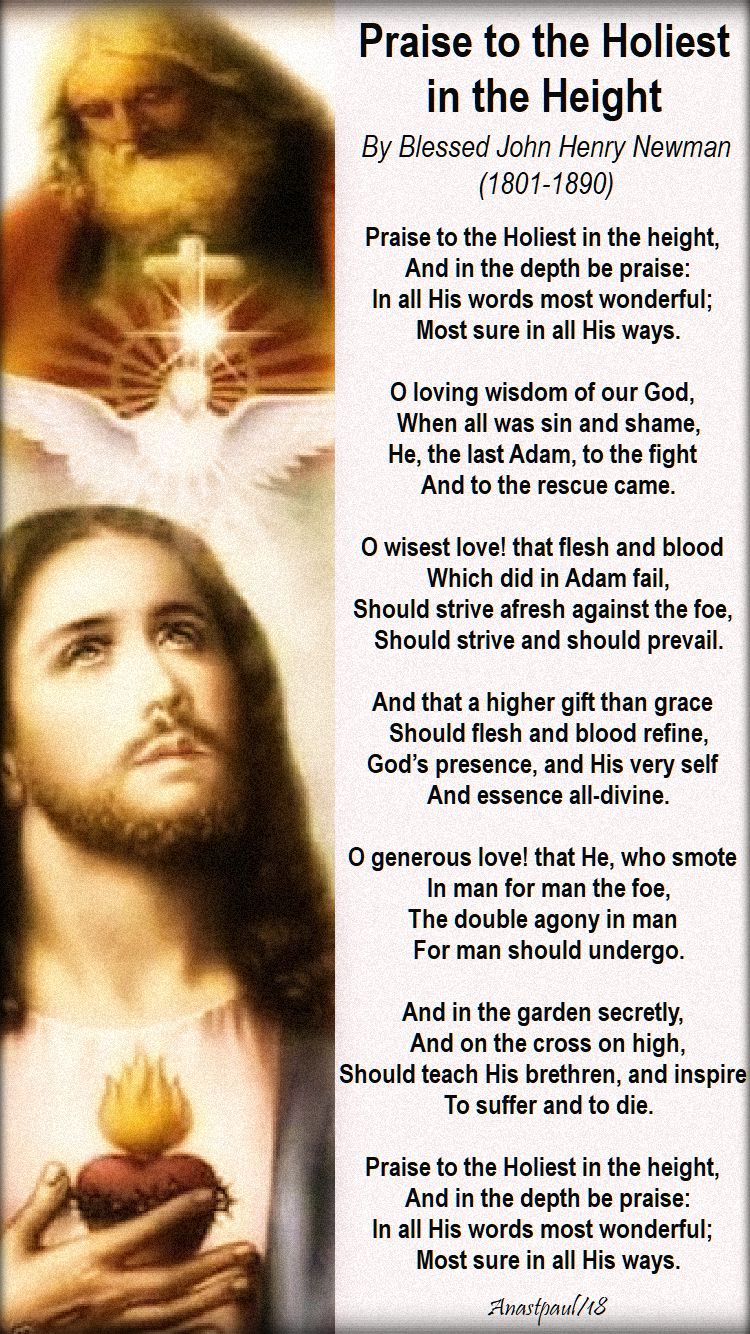
“Praise to the Holiest in the height
And in the the depth be praise.
In all His words most wonderful,
Most sure in all His ways!”
Blessed John Henry NewmanPraise to the Holiest in the Height - bl john henry newman - 9 oct 2018.jpg

In February, the Pope signed a decree recognising a second miracle attributed to Blessed John Henry Newman, the inexplicable healing of a woman with a “life-threatening pregnancy”.

Ordained a Catholic priest in 1847, he was made a cardinal by Pope Leo XIII in 1879, although he was not a bishop.   Newman’s conversion to the Catholic faith was controversial in England and resulted in him losing many friends, including his own sister who never spoke to him again.

The British cardinal founded the Oratory of St Philip Neri in England and was particularly dedicated to education, founding two schools for boys.   He died in Birmingham in 1890 at the age of 89.

In October, Cardinal Newman will become Britain’s first new saint since the Canonisation of St John Ogilvie (1579-1615) Martyr, Memorial 10 March, in 1976.

At Newman’s beatification Mass in Birmingham, England in September 2010, Pope Benedict XVI said that Newman’s “insights into the relationship between faith and reason, into the vital place of revealed religion in civilised society and into the need for a broadly-based and wide-ranging approach to education, were not only of profound importance for Victorian England but continue today, to inspire and enlighten many all over the world.   “What better goal could teachers of religion set themselves than Blessed John Henry’s famous appeal for an intelligent, well-instructed laity:   ‘I want a laity, not arrogant, not rash in speech, not disputatious but men who know their religion, who enter into it, who know just where they stand, who know what they hold and what they do not, who know their creed so well that they can give an account of it, who know so much of history that they can defend it…..” 

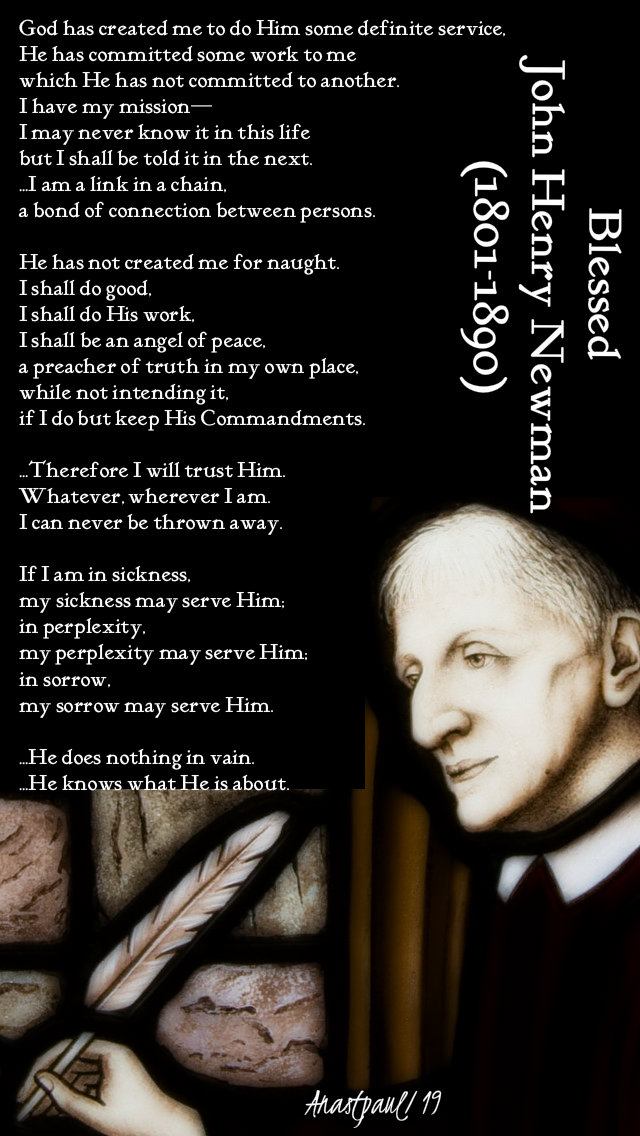
As Blessed, John Henry’s Memorial is 9 October, the date he was received into the Catholic Church.god has created me - bl john henry newman 3 feb 2019

“God has created me to do Him some definite service.
He has committed some work to me
which He has not committed to another.
I have my mission.
I may never know it in this life
but I shall be told it in the next.
I am a link in a chain, a bond of connection between persons.
He has not created me for naught.
I shall do good, I shall do His work.
I shall be an angel of peace,
a preacher of truth in my own place,
while not intending it,
if I do but keep His commandments.
Therefore, I will trust Him…
If I am in sickness, my sickness may serve Him,
in perplexity, my perplexity may serve Him…
He does nothing in vain…
He may take away my friends.
He may throw me among strangers.
He may make me feel desolate,
make my spirits sink,
hide the future from me.
Still, He knows what He is about.”

+++++++++++++++++++++

The Others to be Canonised on the same day are:

Sister Mariam Thresia of India is the founder of the Congregation of the Sisters of the Holy Family.

Italian Sister Giuseppina Vannini is the founder of the Daughters of Saint Camillus.

Brazilian Sister Dulce Lopes Pontes of the Congregation of the Missionary Sisters of the Immaculate Conception of the Mother of God.

Marguerite Bays of Switzerland, of the Third Order of Saint Francis of Assisi.

+++++++++++++++++++++

Posted in FEASTS and SOLEMNITIES, MORNING Prayers, ON the SAINTS, QUOTES of the SAINTS, SAINT of the DAY, St PAUL!, St PETER!, The APOSTLES & EVANGELISTS

Thought for the Day – 29 June – Glorious Princes of the earth and Servants of Heaven!

Thought for the Day – 29 June – The Solemnity of Saints Peter and Paul

Blessed Isaac of Stella O.Cist. (c 1100 – c 1170)
Cistercian Monk

Sermon 49, 1st for the Feast of Saints Peter and Paul

“These were men of mercy whose good deeds shall not be forgotten; the wealth they have left their inheritance will last for ever” (Latin liturgy; cf. Sir 44:10-11).”

Today, beloved, we are celebrating the birthday of the apostles Peter and Paul and it is altogether fitting that… such a death should be called ‘birth’ since it gave birth to life… See to what the saints have come – through the death that bestows life, they leave this life that leads to death, so as to come to that life-giving life, which is in the hands of Him who, as Christ said: “has life in Himself” – the Father (Jn 5:26)…

There are three kinds of people who are merciful.   The first give of their goods… so as to contribute out of their superfluity to the penury of their neighbour… The second give all their goods away and, for them… everything is held in common with others from then on… But as for the third, they not only expend all they have but are “themselves utterly spent” (2 Cor 12:15) and give themselves up in person to the dangers of prison, exile and death so that they may rescue others from the dangers in which their souls are lying. They pour themselves out because they are so full of ardent desire for others.   They will receive the reward of that love of which “there is no greater – to lay down one’s life for one’s friends” (Jn 15:13)… Such are those glorious princes of the earth and servants of heaven of whom today – after long privations “from hunger and thirst, cold and nakedness”, exhaustion and danger, “from their own race, from Gentiles, from false brethren” (2 Cor 11:26-27) – we celebrate the death that was so magnificently victorious. To such as these, the saying well applie – “Their good deeds shall never be forgotten” because they have not forgotten mercy… Yes, to the merciful, “their lot has fallen in a pleasant land, their inheritance is without compare” (Ps 16[15]:6).

Glorious Saints Peter and Paul, Pray for Us!

sts-peter-and-paul-pray-for-us-29-june-2019-sts-peter-and-paul 29 june 2020

Posted in DOCTORS of the Church, FATHERS of the Church, FEASTS and SOLEMNITIES, ON the SAINTS, QUOTES of the SAINTS, SAINT of the DAY, St PAUL!, St PETER!, The APOSTLES & EVANGELISTS

Solemnity of Saints Peter and Paul – 29 June

Solemnity of Saints Peter and Paul, Apostles and Martyrs  – 29 JuneHEADER - sts-peter-paul-facebook-2018.jpg

Today the Church celebrates the feast day of Sts Peter & Paul.   As early as the year 258, there is evidence of an already lengthy tradition of celebrating the solemnities of both Saint Peter and Saint Paul on the same day.   Together, the two saints are the founders of the See of Rome, through their preaching, ministry and martyrdom there.   St Peter is also celebrated on 22 February (feast of the Chair of Peter, emblematic of the world unity of the Church) on 1 August (Saint Peter in Chains), St Paul’s Conversion is celebrated on 25 January and both are once again celebrated on 18 November (feast of the dedication of the Basilicas of Peter and Paul – the two major Basilicas in Rome).

In a sermon in the year 395, St Augustine (354-430) Father & Doctor of the Church, said of Sts Peter and Paul:

“Both apostles share the same feast day, for these two were one and even though they suffered on different days, they were as one.

Peter went first and Paul followed.

And so we celebrate this day made holy for us, by the apostles’ blood.   Let us embrace what they believed, their life, their labours, their sufferings, their preaching and their confession of faith.”

both apostles share the same feast day - st augustine sts peter and paul 29 june 2019.jpg

Peter (d. 64?) Saint Mark ends the first half of his Gospel with a triumphant climax.   He has recorded doubt, misunderstanding and the opposition of many to Jesus.   Now Peter makes his great confession of faith – “You are the Messiah” (Mark 8:29b).   It was one of the many glorious moments in Peter’s life, beginning with the day he was called from his nets along the Sea of Galilee to become a fisher of men for Jesus.

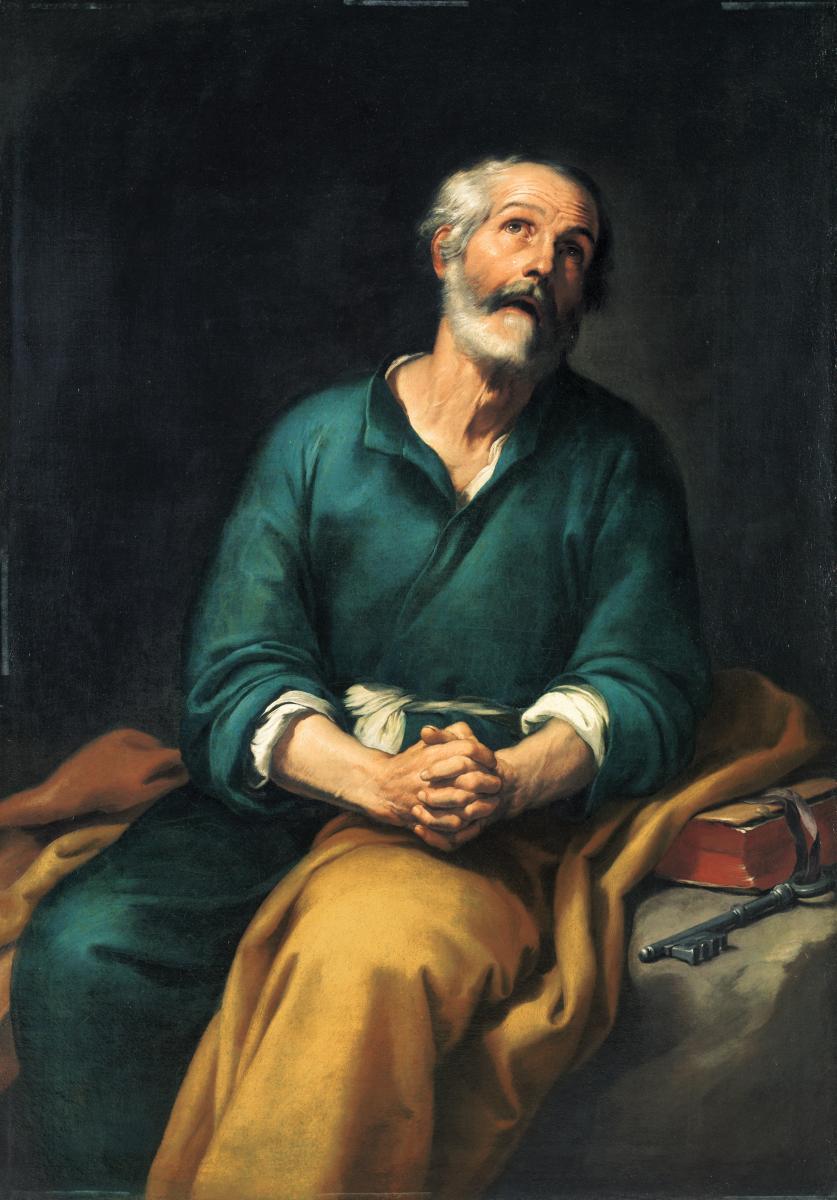
The New Testament clearly shows Peter as the leader of the apostles, chosen by Jesus to have a special relationship with Him.   With James and John he was privileged to witness the Transfiguration, the raising of a dead child to life and the agony in Gethsemane.   His mother-in-law was cured by Jesus.   He was sent with John to prepare for the last Passover before Jesus’ death.   His name is first on every list of apostles.saint-peter-1634.jpg

And to Peter only did Jesus say, “Blessed are you, Simon son of Jonah.   For flesh and blood has not revealed this to you, but my heavenly Father.   And so I say to you, you are Peter, and upon this rock I will build my church and the gates of the netherworld shall not prevail against it.   I will give you the keys to the kingdom of heaven. Whatever you bind on earth shall be bound in heaven; and whatever you loose on earth shall be loosed in heaven” (Matthew 16:17b-19).

But the Gospels prove their own trustworthiness by the unflattering details they include about Peter.   He clearly had no public relations person.   It is a great comfort for ordinary mortals to know that Peter also has his human weakness, even in the presence of Jesus.

He generously gave up all things, yet he can ask in childish self-regard, “What are we going to get for all this?” (see Matthew 19:27).   He receives the full force of Christ’s anger when he objects to the idea of a suffering Messiah –“Get behind me, Satan!   You are an obstacle to me.   You are thinking not as God does, but as human beings do” (Matthew 16:23b).

Peter is willing to accept Jesus’ doctrine of forgiveness but suggests a limit of seven times. He walks on the water in faith but sinks in doubt.   He refuses to let Jesus wash his feet, then wants his whole body cleansed.   He swears at the Last Supper that he will never deny Jesus and then swears to a servant maid that he has never known the man  . He loyally resists the first attempt to arrest Jesus by cutting off Malchus’ ear but in the end, he runs away with the others.   In the depth of his sorrow, Jesus looks on him and forgives him and he goes out and sheds bitter tears.   The Risen Jesus told Peter to feed his lambs and his sheep (John 21:15-17).

Paul (d. 64?) If the most well-known preacher today suddenly began preaching that your country should adopt Marxism and not rely on the democracy, the angry reaction would help us understand Paul’s life when he started preaching that Christ alone can save us.  He had been the most pharisaic of Pharisees, the most legalistic of Mosaic lawyers.   Now he suddenly appears to other Jews as a heretical welcomer of Gentiles, a traitor and apostate.

st paul - wow Hl. Paulus - ANTONY VAN DYCK 2.jpg
St Paul – Antony van Dyck

Paul’s central conviction was simple and absolute – Only God can save humanity.   No human effort—even the most scrupulous observance of law—can create a human good which we can bring to God, as reparation for sin and payment for grace.   To be saved from itself, from sin, from the devil and from death, humanity must open itself completely to the saving power of Jesus.

Paul never lost his love for his Jewish family, though he carried on a lifelong debate with them about the uselessness of the Law without Christ.   He reminded the Gentiles that they were grafted on the parent stock of the Jews, who were still God’s chosen people, the children of the promise.saints-peter-and-paul-2.jpg

Posted in CATHOLIC DEVOTIONS of the Month, DOCTORS of the Church, FATHERS of the Church, ON the SAINTS, QUOTES of the SAINTS, SAINT of the DAY, The APOSTLES & EVANGELISTS, The WORD

Saint of the Day – 11 June – St Barnabas, Apostle “Son of Encouragement”

st-barnabas-pray-for-us-11-june-2018.jpghttps://anastpaul.com/2018/06/11/saint-of-the-day-11-june-st-barnabas-apostle-son-of-encouragement/

https://anastpaul.com/2017/06/11/saint-of-the-day-st-barnabas-the-apostle-11-june/

News of this came to the ears of the church in Jerusalem and they sent Barnabas to Antioch.   When he came and saw the grace of God, he was glad and he exhorted them all, to remain faithful to the Lord, with steadfast purpose;  for he was a good man, full of the Holy Spirit and of faith.   And a large company was added to the Lord...Acts 11:22-24

“While we cannot see God, there is something we can do, to open a way, for the eye of our understanding to come to Him.   It is certain that we can see now in His servants, one whom we can in no way see in Himself.   When we see them doing astonishing things, we can be sure that God dwells in their hearts…   None of us can look directly at the rising sun by gazing at its orb.   Our eyes are repelled as they strain to see its rays.   But we look at mountains bathed in sunlight and see that it has risen.   Because we cannot see the Sun of righteousness (Mal 3,20) Himself, let us see the mountains bathed in His brightness, I mean the holy apostles.   They shine with virtues and gleam with miracles…  The power of His divinity, is in itself, like the sun in the sky;  in human beings it is like the sun shining on earth…”

St Pope Gregory the Great (c 540-604), Father & Doctor of the Church

(Homilies on the Gospel, no 30)

when-he-came-and-saw-acts-11-22-24-when-we-see-them-doing-st-pope-gregory-the-great-11-june-2018-st-barnabas.jpg

Posted in ON the SAINTS

Thought for the Day – 15 May – The 140th Anniversary of Cardinal John Henry

Thought for the Day – 15 May – the 140th Anniversary of Blessed John Henry Newman (1801-1890) being raised to the College of Cardinals

Blessed John Henry Newman was a great thinker – a seminal theologian and philosopher (he is one of Bishop Barron’s Pivotal Players in the History of the Church) – but, he possessed something much more than intellectual brilliance.   He possessed wisdom and a profound devotional life.   He brought to any practical topic an awareness of the unity and consistency of the whole of the Christian life.   His words are illuminated with immense insights and light – they get to the very core of soul – the core of what it means to be a Christian – the Light of Christ!

He has been called the “absent Father of Vatican II” because his writings on conscience, religious liberty, Scripture, the vocation of lay people, the relation of Church and State and other topics were extremely influential in the shaping of the Council’s documents.

Although Newman was not always understood or appreciated, he steadfastly preached the Good News by word and example.  A complex thinker, his words are always relevant in every age – he is truly a ‘doctor” of the church – which means a “teacher for all ages”.

Blessed John Henry Newman, Pray for Us!bl-john-henry-pray-for-us - 9 oct 2018.jpg

Posted in CATECHESIS, ON the SAINTS, QUOTES of the SAINTS, QUOTES on TRUST and complete CONFIDENCE in GOD, SAINT of the DAY

Second Thoughts for the Day – 13 May – And all will be well, all manner of things shall be well!

Second Thoughts for the Day – 13 May – Monday of the Fourth Week of Easter, C and the Memorial of Blessed Julian of Norwich (c 1342-c 1430)all will be well - bl julian of norwich ccc 13 may 2019.jpg

Excerpt from Pope Benedict’s Catechesis on Julian of Norwich

Wednesday, 1st December 2010

Dear Brothers and Sisters,

I still remember with great joy the Apostolic Journey I made in the United Kingdom last September.   England is a land that has given birth to a great many distinguished figures who enhanced Church history with their testimony and their teaching.   One of them, venerated both in the Catholic Church and in the Anglican Communion, is the mystic Julian of Norwich, of whom I wish to speak this morning.

The — very scant — information on her life in our possession comes mainly from her Revelations of Divine Love in Sixteen Showings, the book in which this kindly and devout woman set down the content of her visions.

It is known that she lived from 1342 until about 1430, turbulent years both for the Church, torn by the schism that followed the Pope’s return to Rome from Avignon and for the life of the people who were suffering the consequences of a long drawn-out war between the Kingdoms of England and of France.   God, however, even in periods of tribulation, does not cease to inspire figures such as Julian of Norwich, to recall people to peace, love and joy.

As Julian herself recounts, in May 1373, most likely on the 13th of that month, she was suddenly stricken with a very serious illness that in three days seemed to be carrying her to the grave.   After the priest, who hastened to her bedside, had shown her the Crucified One not only did Julian rapidly recover her health but she received the 16 revelations that she subsequently wrote down and commented on in her book, Revelations of Divine Love.

And it was the Lord himself, 15 years after these extraordinary events, who revealed to her the meaning of those visions.

“‘Would you learn to see clearly your Lord’s meaning in this thing?   Learn it well – Love was His meaning.   Who showed it to you?   Love…. Why did He show it to you?   For Love’…. Thus I was taught that Love was our Lord’s meaning” (Julian of Norwich, Revelations of Divine Love, Chapter 86).

Inspired by divine love, Julian made a radical decision.   Like an ancient anchoress, she decided to live in a cell located near the church called after St Julian, in the city of Norwich — in her time an important urban centre not far from London.   She may have taken the name of Julian, precisely from that Saint, to whom was dedicated the church, in whose vicinity she lived for so many years, until her death.

This decision to live as a “recluse”, the term in her day, might surprise or even perplex us.   But she was not the only one to make such a choice.   In those centuries a considerable number of women opted for this form of life, adopting rules specially drawn up, for them, such as the rule compiled by St Aelred of Rievaulx (1110-1167).

The anchoresses or “recluses”, in their cells, devoted themselves to prayer, meditation and study.   In this way they developed a highly refined human and religious sensitivity which earned them the veneration of the people.   Men and women of every age and condition, in need of advice and comfort, would devoutly seek them.   It was not, therefore, an individualistic choice, precisely with this closeness to the Lord, Julian developed the ability to be a counsellor to a great many people and to help those who were going through difficulties in this life.

We also know that Julian too received frequent visitors, as is attested by the autobiography of another fervent Christian of her time, Margery Kempe, who went to Norwich in 1413 to receive advice on her spiritual life.   This is why, in her lifetime, Julian was called “Dame Julian”, as is engraved on the funeral monument that contains her remains.   She had become a mother to many.

Men and women who withdraw to live in God’s company acquire by making this decision a great sense of compassion for the suffering and weakness of others.   As friends of God, they have at their disposal a wisdom that the world — from which they have distanced themselves — does not possess and they amiably share it with those who knock at their door.

It was precisely in the solitude infused with God that Julian of Norwich wrote her Revelations of Divine Love.   Two versions have come down to us, one that is shorter, probably the older and one that is longer.   This book contains a message of optimism based on the certainty of being loved by God and of being protected by his Providence.

In this book we read the following wonderful words:  “And I saw full surely that ere God made us He loved us, which love was never lacking nor ever shall be.   And in this love He has made all His works and in this love He has made all things profitable to us and in this love our life is everlasting… in which love we have our beginning.   And all this shall we see in God, without end” (Revelations of Divine Love, Chapter 86).

The theme of divine love recurs frequently in the visions of Julian of Norwich who, with a certain daring, did not hesitate to compare them also to motherly love.   This is one of the most characteristic messages of her mystical theology.   The tenderness, concern and gentleness of God’s kindness to us are so great that they remind us, pilgrims on earth, of a mother’s love for her children.   In fact, the biblical prophets also sometimes used this language that calls to mind the tenderness, intensity and totality of God’s love, which is manifested in creation and in the whole history of salvation that is crowned by the Incarnation of the Son.

God, however, always excels all human love, as the Prophet Isaiah says:  “Can a woman forget her sucking child, that she should have no compassion on the son of her womb? Even these may forget, yet I will never forget you” (Is 49:15).

Julian of Norwich understood the central message for spiritual life – God is love and it is only if one opens oneself to this love, totally and with total trust and lets it become one’s sole guide in life, that all things are transfigured, true peace and true joy found and one is able to radiate it.

I would like to emphasise another point.   The Catechism of the Catholic Church cites the words of Julian of Norwich when it explains the viewpoint of the Catholic faith on an argument that never ceases to be a provocation to all believers (cf. nn. 304-313, 314).

If God is supremely good and wise, why do evil and the suffering of innocents exist?   And the Saints themselves asked this very question.   Illumined by faith, they give an answer that opens our hearts to trust and hope: in the mysterious designs of Providence, God can draw a greater good even from evil, as Julian of Norwich wrote:   “Here I was taught by the grace of God that I should steadfastly hold me in the Faith … and that … I should take my stand on and earnestly believe in … that ‘all manner of thing shall be well”’ (The Revelations of Divine Love, Chapter 32).

Yes, dear brothers and sisters, God’s promises are ever greater than our expectations.   If we are present to God, to His immense love, the purest and deepest desires of our heart, we shall never be disappointed.   “And all will be well”, “all manner of things shall be well” – this is the final message that Julian of Norwich transmits to us and that I am also proposing to you today.   Many thanks…Vatican.va

Blessed Julian, Pray for us!bl julian of norwich pray for us 13 may 2019.jpg

Posted in ON the SAINTS, SAINT of the DAY

Saint of the Day – 7 May – St Agostino Roscelli ( 1818–1902)

Saint of the Day – 7 May – St Agostino Roscelli ( 1818–1902) aged 83, Priest, Founder of the Institute of Sisters of the Immaculata, Spiritual director, Apostle of prayer and charity, Social reformer, founder of training schools and programmes for young adults, both girls and boys, Chaplain to Prisoners and Orphanages – also known as Augustine Roscelli, Augustin Roscelli – born on 27 July 1818 at Bargone di Casarza Ligure, Italy and died on 7 May 1902 at Genoa, Italy of natural causes.   St Agostino inspired social change in Genoa, Italy for children and disadvantaged women.ST AGOSTINO ROSCELLI.jpg

On 27 July 1818, Agostino was born in northern Italy.   His parents, Domenico Roscelli and Maria Gianelli, had him baptised the same day out of fear that he may not survive. Despite his early health problems, Agostino would grow into a quiet intellectual, receiving his basic education from the parish priest, Fr Andrea Garibaldi.   These times were brief however, as he would spend a large part of his childhood caring for his poor farming family’s sheep in the mountains.   During these solitary times, he would fill his hours with prayer.

In May 1835, at the age of 17, Agostino attended a parish mission given by a visiting priest, Fr Antonio Maria Gianelli (1789– 1846) (parish priest of Chiavari and later bishop of Bobbio) and now a Saint and the founder of the Missionaries of St Alphonsus.    (About St Anthony here: https://anastpaul.wordpress.com/2018/06/07/saint-of-the-day-7-june-st-anthony-mary-gianelli-1789-1846/)

This mission thoroughly convinced him he had a call to the priesthood, a calling that would not be easily achieved, considering the poor financial state his family was in. Despite this, he attacked the situation with prayer, which led to financial aid that allowed him to study in Genoa, Italy.   One of his benefactors was Fr Gianelli who found him a post as a sacristan and guardian of a church attached to a girls school.   He was ordained on 19 September 1846.agostino roscelli1-young main .jpg

Agostino was shortly thereafter, appointed to a working class parish, San Martino d’Albaro, in 1846.   He would later move to the Church of Consolation in Genoa in 1854. As a parish priest he soon made a positive impression with his obvious zeal and austerity of life.   He spent long hours in the confessional, which developed his deep concern for the youth of the area.   The boys of the parish were often tempted into a life of crime, having little to no education or hope of finding work.   The girls were even worse off, having less education than the boys and were liable to seek menial work in the city, often being seduced or enticed into a life of prostitution.

Seeing a great need for change, Agostino set about forming a new type of job training for girls.   He gathered together a group of young women and with them founded a “sewing workshop”, in which girls could receive practical and professional training as well as Christian instruction.  STATUE ST AGOSTINO ROSCELLINot wanting to neglect the boys, he would also found a “young craftsman” institute for them in 1858.   He would later go on to establish a residential school to train young women who were in danger of starvation or falling into prostitution because they had no support.
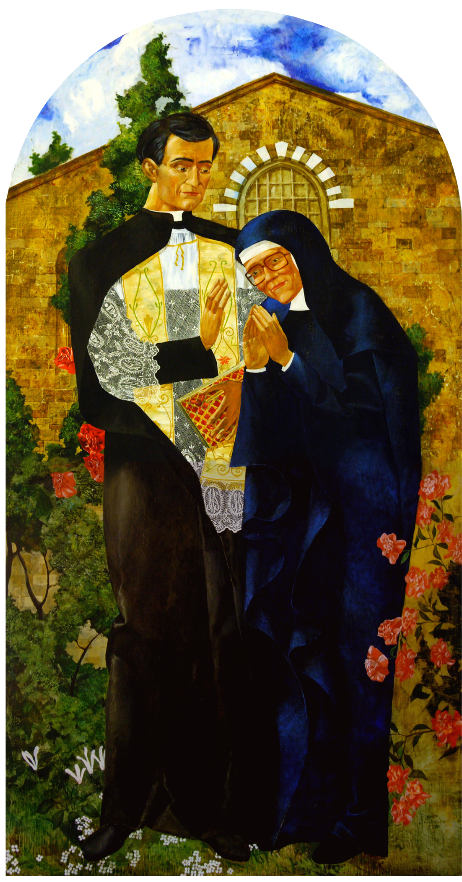
In 1872, Agostino began a ministry to prisoners, working especially with those condemned to death.   Two years later, in 1874, he was appointed Warden and Chaplain of the new provincial orphanage, Monte dei Fieschine, a post he held for 22 years. During that time he would baptise over 8,000 children, as well as providing care for young single mothers, not condemning them but seeing them as simple souls led astray on account of lack of rewarding work.

He lived in an atmosphere of intense prayer, something that would inspire those around him, especially his helpers.   The women who ran the sewing workshop, known as “Roscelli’s Collaborators”, decided their mission would be greatly helped if they were to consecrate themselves to Christ in a more formal way.   Agostino was reluctant to start a religious congregation but was encouraged to seek the advice and approval of Pope Pius IX.

Pope Pius IX’s reply was simple, “May God bless you and your good works”.  ST AGOSTINO Roscelli 3This was what Agostino needed however and he would go on to found the Institute of Sisters of the Immaculata on 15 October 1876.   Agostino would induct the first of the nuns a week later, going on to act as their spiritual director.   He would oversee the early growth of the order beyond Genoa and eventually beyond Italy.
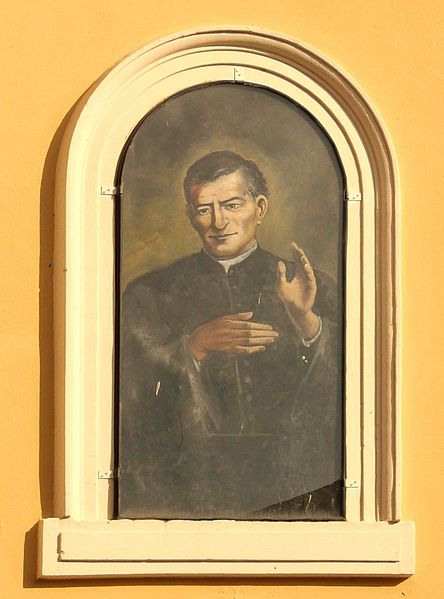
Until the very end of his life, St Agostino would describe himself simply as a “poor priest”, ever humble as to his accomplishments.   On 7 May 1902, he died of natural causes in Genoa, Italy.   He was 83 years old.

On 17 May 1995, Agostino was officially declared Blessed by St Pope John Paul II.   He said:

“A spiritual feature characteristic of Blessed Agostino Roscelli…was to work at the service of his brothers and sisters without ever neglecting his interior union with the Lord.   The true contemplative is the one who is able to work with greater force and incisiveness for the salvation of souls and the good of the Church.   The new blessed’s apostolic activity was truly fruitful because it flowed from a genuine mystical and contemplative life.   His ardent love for God, enriched by the gift of wisdom, enabled him to give himself as far as possible to serving his neighbour without ever being separated from the Lord.”… St John Paul at the Beatification ceremony.”

99 years after his death, Agostino was officially declared a Saint by St Pope John Paul II on 10 June 2001.444px-Bargone-dipinto_Agostino_Roscelli

“‘Great is his love for us.’   The love of God for men is manifested with particular clarity in the life of St Augustine Roscelli, whom we contemplate today in the splendour of holiness.  Its existence, imbued with deep faith, can be considered a gift offered to the glory of God and for the good of souls.   It was faith which made him always obedient to the Church and its teachings, in docile adherence to the Pope and to their own bishop.   By faith he knew how to draw comfort in sad and harsh difficulty and in painful events.   Faith was the solid rock to which he held on tightly to not give in to discouragement.  This same faith led him to feel it his duty to communicate it to others, especially to those who approached the ministry of confession.   He became a master of the spiritual life, especially for the sisters that he founded, which saw him serene even in the most trying situations.   St Augustine Roscelli exhorts us always to trust in God, immersing us in the mystery of His love.”… St John Paul’s homily at the Canonization of Agostino Roscelli, 10 June 2001.

Below is his birthplace and the plaque outside.

Posted in FATHERS of the Church, FEASTS and SOLEMNITIES, ON the SAINTS, PRACTISING CATHOLIC, QUOTES - J R R Tolkien and MORE, QUOTES on the CHURCH, SAINT of the DAY, The APOSTLES & EVANGELISTS

Thought for the Day – 3 May – The Preaching of the Apostles

Thought for the Day – 3 May – The Feast of Saints Philip and James, Apostles

The Preaching of the Apostles

Tertullian (c 155- c 240)
Priest, Father and Ancient Christian Writer

An excerpt from his On the Prescription of Heretics

Our Lord Jesus Christ Himself declared what He was, what He had been, how He was carrying out His Father’s will, what obligations He demanded of men.    This He did during His earthly life, either publicly to the crowds, or privately to His disciples.  Twelve of these He picked out, to be His special companions, appointed to teach the nations.

One of them fell from His place.   The remaining eleven were commanded by Christ, as He was leaving the earth to return to the Father after His resurrection, to go and teach the nations and to baptise them into the Father, the Son and the Holy Spirit.
The apostles cast lots and added Matthias to their number, in place of Judas, as the twelfth apostle.   The authority for this action is to be found in a prophetic psalm of David.   After receiving the power of the Holy Spirit which had been promised to them, so that they could work miracles and proclaim the truth, they first bore witness to their faith in Jesus Christ and established churches throughout Judea.   They then went out into the whole world and proclaimed to the nations the same doctrinal faith.

They set up churches in every city.   Other churches received from them a living transplant of faith and the seed of doctrine and through this daily process of transplanting they became churches.   They therefore qualify as apostolic churches by being the offspring of churches that are apostolic.

Every family has to be traced back to its origins.   That is why we can say that all these great churches constitute that one original Church of the apostles, for it is from them that they all come.   They are all primitive, all apostolic, because they are all one.   They bear witness to this unity by the peace in which they all live, the brotherhood which is their name, the fellowship to which they are pledged.   The principle on which these associations are based is common tradition by which they share the same sacramental bond.

The only way in which we can prove what the apostles taught—that is to say, what Christ revealed to them — is through those same churches.   They were founded by the apostles themselves, who first preached to them by what is called the living voice and later by means of letters.

The Lord had said clearly in former times – I have many more things to tell you but you cannot endure them now.   But He went on to say – When the Spirit of truth comes, He will lead you into the whole truth.   Thus Christ shows us that the apostles had full knowledge of the truth, for He had promised that they would receive the whole truth through the Spirit of truth.   His promise was certainly fulfilled, since the Acts of the Apostles prove, that the Holy Spirit came down on them.

Saints James and Philip, Pray for us!sts-philip-and-james-pray-for-us-3-may-2017.jpg