Posted in GOD ALONE!, GOD is LOVE, GOD the FATHER, JULY - The MOST PRECIOUS BLOOD, QUOTES on ETERNAL LIFE, QUOTES on SELF-DENIAL, QUOTES on SUFFERING, St Francis de Sales, The MOST PRECIOUS BLOOD, The WILL of GOD

Quote of the Day – 1 March – ‘A foretaste of eternal life …’

Quote of the Day – 1 March – The Second Sunday in Lent – Thessalonians 5:14-23, Matthew 17:1-9 – Scripture search here: https://www.drbo.org/

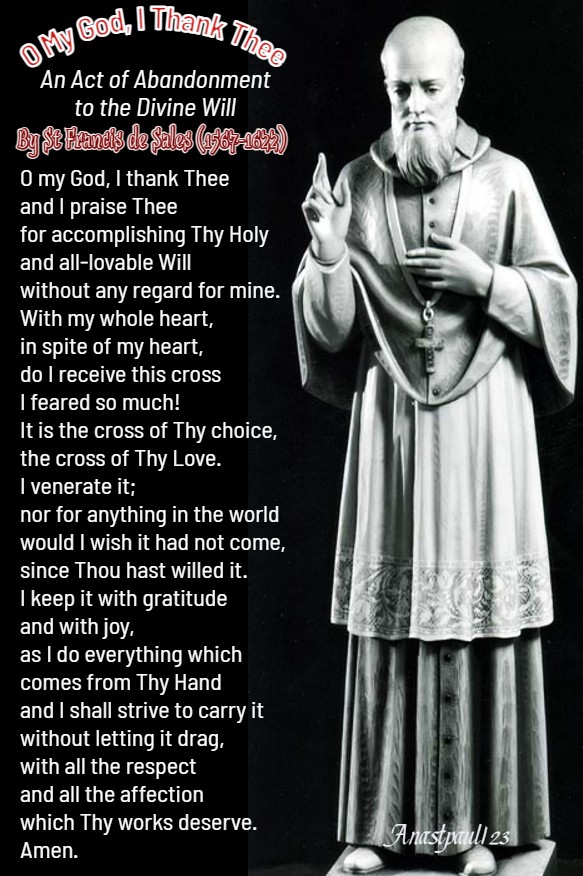
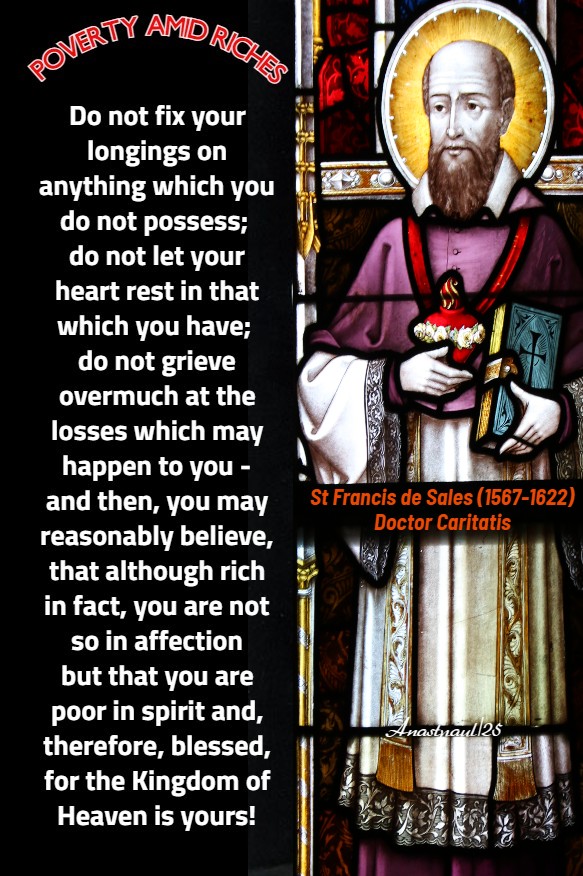
You will begin to taste, even in this life,
a foretaste of eternal life,
for the principal beatitude of the soul in Heaven,
is to be confirmed forever in the Will of the Father.
Thus, it tastes the Divine sweetness.
But it will never taste it in Heaven,
if it is not clothed with it on earth,
where we are pilgrims and travellers.
When it is clothed with it, it tastes God
by grace in its troubles; its memory will be full
of the Blood of the Lamb without blemish;
its mind will be opened and contemplate
the ineffable Love that God has made known
in the Wisdom of His Son and the love it finds,
in the Holy Spirit’s goodness, casts out self-love
and love for created things, to love only God.
So do not be afraid … but suffer with joy,
so as to conform yourself to the Will of God.
””

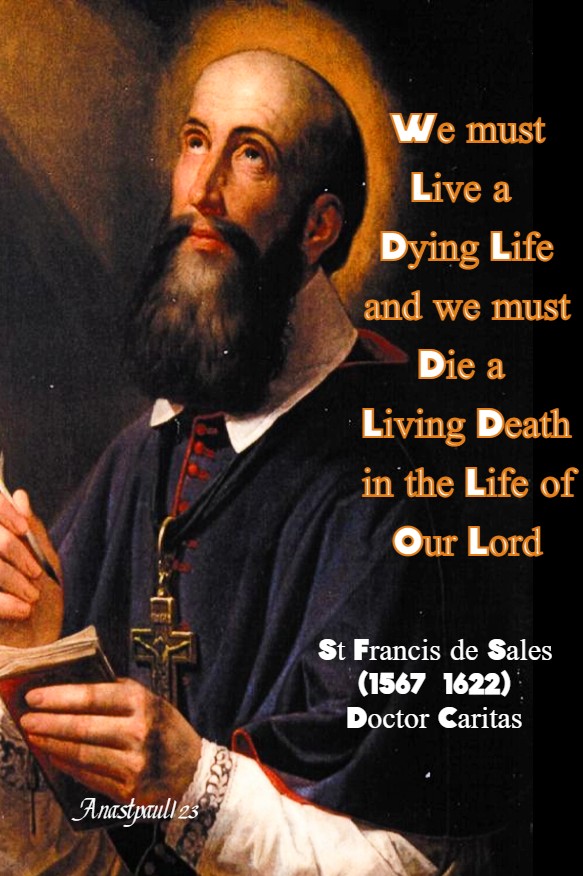
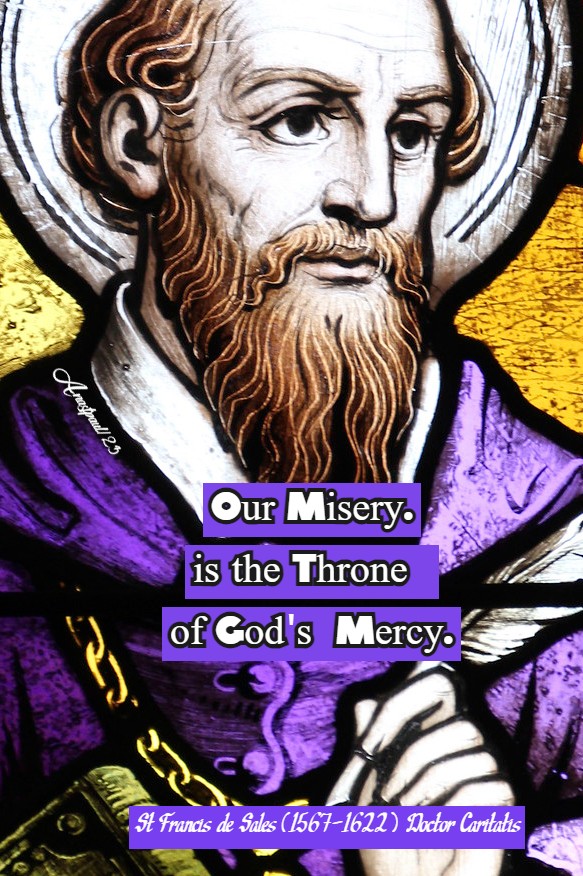
St Francis de Sales (1567-1622)
Doctor Caritatis

Posted in GOD is LOVE, GOD the FATHER, LENT 2026, The PASSION, The WILL of GOD, Thomas Aquinas

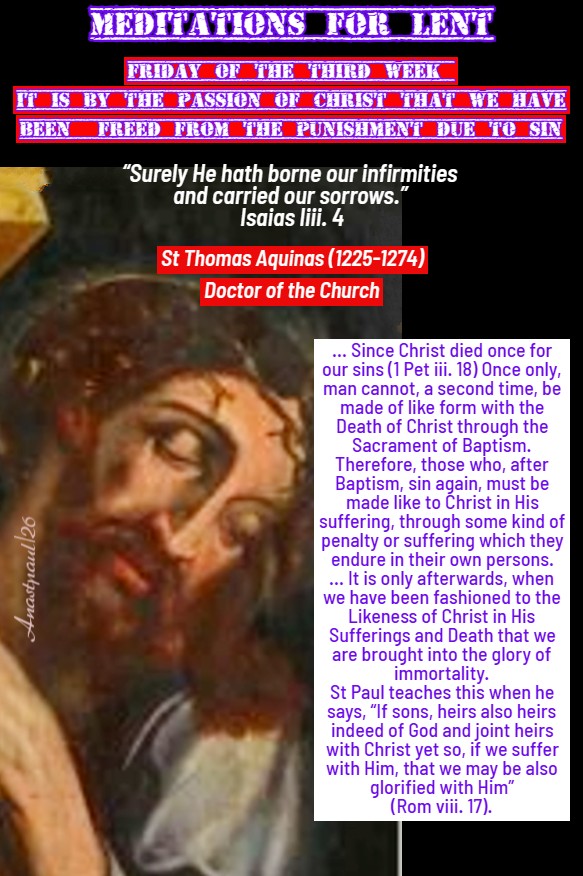
The Second Sunday of Lent – 1 March – Our Lenten Journey With St Thomas Aquinas – God the Father Delivered Christ to His Passion

The Second Sunday of Lent – 1 March – Our Lenten Journey With St Thomas Aquinas (1225-1274) Doctor of the Church

The Second Sunday
God the Father Delivered Christ to His Passion

God spared not even His own Son but delivered Him up for us all.
Rom viii. 32.

Christ suffered willingly, moved by obedience to His Father. Wherefore, God the Father delivered Christ to His Passion and this, in three ways:

  1. Because the Father, of His Eternal Will, preordained the Passion of Christ as the means whereby to free the human race. So it is said in Isaias, “The Lord hath laid on Him the iniquity of us all” (Isa liii. 6) and again, “The Lord was pleased to bruise Him in infirmity” (ibid liii. 10).
  2. Because He inspired Our Lord with the willingness to suffer for us, pouring into His Soul the Love which produced the will to suffer. Whence the Prophet goes on to say, “He was offered because it was His Own Will” (Isa liii. 7).
  3. Because He did not protect Our Lord from the Passion but exposed Him to His persecutors. Whence we read in St Matthew’s Gospel: as He hung on the cross Christ said, “My God, My God, why hast thou forsaken Me” (Matt xxvii. 46). For God the Father, that is to say, had left Him at the mercy of His torturers.

To hand over an innocent man to suffering and to death, against his will, compelling him to die as it were, would indeed be cruel and wicked.
But it was not in this way God the Father delivered Christ. He delivered Christ by inspiring Him with the Will to suffer for us. By so doing, the severity of God is made clear – no sin is forgiven without punishment! which St Paul again teaches when he says, God spared not His Own Son.

At the same time God’s kindness and goodness is exhibited in the fact that whereas man could not, no matter what his punishment, sufficiently make satisfaction, God has given man someone Who is able to make that satisfaction for him. Which is what St Paul means by, He delivered Him up for us all and again when he says, God hath proposed Christ to be an appeasement through faith in His Blood (Rom iii. 25).
The same activity in a good man and in a bad man is differently judged, inasmuch as the root from which it proceeds is different.
The Father, for example, delivered Christ and Christ delivered Himself and this from love and, therefore, They are praised.

Judas delivered Him from love of gain, the Jews from hatred, Pilate from the worldly fear with which he feared Caesar and these are rightly regarded with horror.
Christ, therefore, did not owe to death the debt of necessity but of Charity –
the Charity to men by which He willed their Salvation and the Charity to God, by which He willed to fulfil God’s Will, as it says in the Gospel, “Not as I Will but as Thou Wilt (Matt xx vi. 39).

ST THOMAS AQUINAS (1225-1274)
Priest, Theologian, Dominican
Doctor Angelicus (Angelic Doctor)
Doctor Communis (Common Doctor)

Added by Pope Saint Pius V in 1568

Posted in GOD is LOVE, LENT 2026, The PASSION, Thomas Aquinas

Saturday of the First Week of Lent – 28 February – Our Lenten Journey With St Thomas Aquinas – The Love of God Exhibited in the Passion of Christ

Saturday of the First Week of Lent – 28 February – Our Lenten Journey With St Thomas Aquinas (1225-1274) Doctor of the Church

Saturday of the First Week
The Love of God
Exhibited in the Passion of Christ

God commendeth His charity towards us because when, as yet we were sinners, according to the time, Christ died for us.
Rom v 8, 9

  1. “Christ died for the ungodly” (ibid 6
    This is a great thing if we consider Who it is Who died, a great thing too if we consider on whose behalf He died.
    For scarcely for a just man, will one die (ibid 6), that is to say that you will not find anyone who will die even to set free a man who is innocent, nay even, it is said, “The just perisheth and no man layeth it to heart” (Isaias l vii).

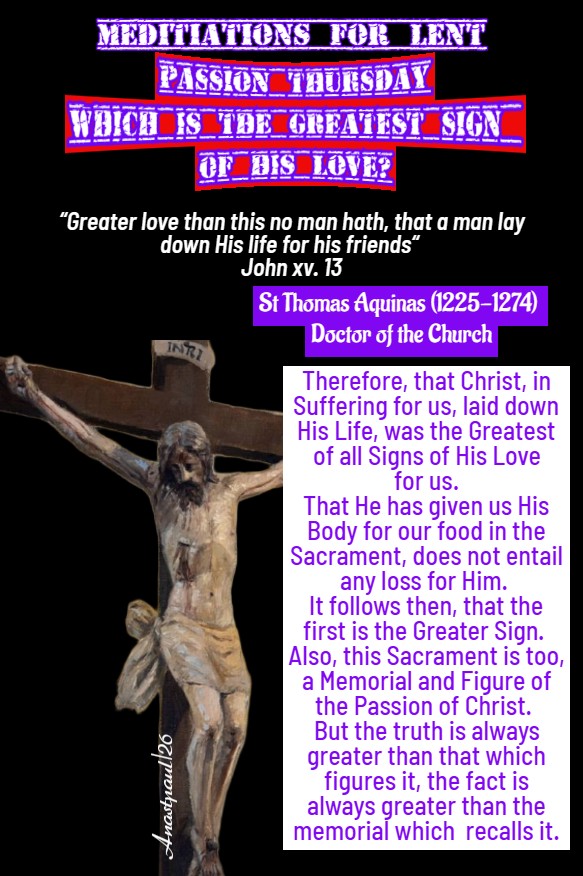
Rightly, therefore, does St.Paul say scarcely will one die. There might perhaps be found one, someone rare person, who out of sa uperabundance of courage, would be so bold as to die for a good man. But this is rare, for the simple reason that so to act is the greatest of all things. “Greater love than this, no man hath, says Our Lord Himself, that a man lay down his life for his friends (John xv. 13).

But the like of that which Christ Himself did, to die for evildoers and the wicked, has never been seen.
Wherefore rightly do we ask in wonderment, why Christ did this.

  1. If in fact it be asked, why Christ died for the wicked, the answer is that God, in this way, commendeth His Charity towards us. He exhibits to us in this way that He Loves us with a Love which knows no limits, for while we were as yet sinners, Christ died for us.

The very death of Christ for us, depicts the Love of God, for it was His Son Whom He gave to die that satisfaction might be made for us. God so Loved the world, as to give His Only Begotten Son (John iii. 16).
And thus, as the Love of God the Father for us is proved in His giving us His Holy Spirit, so also is it proved in this way, by His Gift of His Only Son.

The Apostle says, God commendeth, signifying thereby that the Love of God cannot be measured. This is exhibited by the very fact of the matter, namely the fact that He gave His Son to die for us and it is proved too by reason of the kind of people we are, for whom He died.
“Christ was not stirred up to die for us by any merits of ours, when as yet we were sinners. God (who is rich in mercy) for His exceeding Charity wherewith He Loved us, even when we were dead in sins, hath quickened us together in Christ ” (Eph ii. 4).

  1. All this is almost too much to be believed.
    “A work is done in your days which no man will believe when it shall be told” (Habac i. 5).
    This Truth that Christ died for us is so difficult a Truth that scarcely can our intellect grasp it. Nay it is a Truth which our intellect can, in no way understand.
    And St Paul preaching, makes echo to Habacuc, I work a work in your days, a work which you will not believe, if any man shall tell it to you (Acts xiii 14).

So great is God’s Love for us and His Grace towards us that He does more for us than we can believe or understand.

ST THOMAS AQUINAS (1225-1274)
Priest, Theologian, Dominican
Doctor Angelicus (Angelic Doctor)
Doctor Communis (Common Doctor)
Added by Pope Saint Pius V in 1568
Posted in JULY - The MOST PRECIOUS BLOOD, LENT 2026, The MOST PRECIOUS BLOOD, The PASSION, The SEVEN PASSION Feasts, Thomas Aquinas

Friday of the First Week of Lent – 27 February – Our Lenten Journey With St Thomas Aquinas – The Feast of the Holy Lance and Nails of Our Lord

Friday of the First Week of Lent – 27 February – Our Lenten Journey With St Thomas Aquinas (1225-1274) Doctor of the Church

Friday After First Sunday
The Feast of the Holy Lance Lance
and the Nails of Our Lord

“One of the soldiers opened His side with a spear and immediately there came forth Blood and Water.”
John xix. 34.

  1. The Gospel deliberately says opened and not wounded because, through Our Lord’s Side, there was opened to us the Gate of Eternal Life.
    “ After these things I looked and behold, a gate was opened in heaven,” (Apoc iv. i). This is the door opened in the ark, through which enter the animals who will not perish in the flood.
  2. But this door is the cause of our salvation.
    Immediately there came forth Blood and Water a thing truly miraculous that, from a dead body, in which the blood congeals, Blood should come forth!

This was done to show that by the Passion of Christ we receive a full absolution, an absolution from every sin and every stain. We receive this absolution from sin through that Blood which is the price of our redemption. You were not redeemed with corruptible things as gold or silver, from your vain conversation with the tradition of your fathers but with the Precious Blood of Christ, as of a lamb unspotted and undefiled (i Pet i. 18).

We were absolved from every stain by the Water which is the laver of our redemption.
In the Prophet Ezechiel, it is said, “I will pour upon you clean water and you shall be cleaned from all your
filthiness” (Ezech xxxvi. 28) and in Zacharias,
“There shall be a fountain open to the house of David and to the inhabitants of Jerusalem for the washing of the sinner and the unclean woman” (Zach xiii. i).

And so, these two things may be thought of in relation to two of the Sacraments, the Water to Baptism and the Blood to the Holy Eucharist.
Or both may be referred to the Holy Eucharist since, in the Mass, water is mixed with the wine. Although the water is not of the substance of the Sacrament.

Again, as from the side of Christ asleep in death on the Cross there flowed that Blood and Water in which the Church is consecrated, so from the side of the sleeping Adam was formed the first woman, who herself foreshadowed the Church.

ST THOMAS AQUINAS (1225-1274)
Priest, Theologian, Dominican
Doctor Angelicus (Angelic Doctor)
Doctor Communis (Common Doctor)
Added by Pope Saint Pius V in 1568
Posted in DOCTORS of the Church, FATHERS of the Church, LENT 2026, The PASSION, Thomas Aquinas

Thursday of the First Week of Lent – 26 February – Our Lenten Journey With St Thomas Aquinas – It was fitting that Christ should be Crucified with the Thieves

Thursday of the First Week of Lent – 26 February – Our Lenten Journey With St Thomas Aquinas (1225-1274) Doctor of the Church

Thursday of the First Week of Lent
It was fitting that Christ
should be Crucified with the Thieves

Christ was Crucified between the thieves because such was the will of the Jews and also because, this was part of God’s Design.
But the reasons why this was appointed, were not the same in each of these cases.

  1. As far as the Jews were concerned, Our Lord was Crucified with the thieves on either side to encourage the suspicion that He too was a criminal.
    But it transpired otherwise!
    The thieves themselves have left not a trace in the remembrance of man, while His Cross is everywhere held in honour. Kings lying their crowns aside, have embroidered the Cross on their Royal robes. They have placed it on their crowns; on their armiur. It has its place on the very Altars. Everywhere, throughout the world, we behold the splendour of the Cross.

In God’s Plan, Christ was Crucified with the thieves in order, for our sakes, He became accursed of the Cross, so, for our salvation, He is Cucified like an evil Man amongst evil men.

  1. The Pope, St Leo the Great, says that the thieves were crucified, one on either side of Our Lord, so that, in the very appearance of the scene of His Suffering, there might be set forth that distinction which should be made in the judgement of each one of us.
    St Augustine has the same thought. “The Cross itself,” he says, “was a tribunal. In the centre was the Judge. To the one side a man who believed and was set free, to the other side, a scoffer and he was condemned.”
    Already there was made clear the final fate of the living and the dead, the one class placed at His Right, the other on His Left.
  2. According to St Hilary, the two thieves, placed to right and to left, typify that the whole of mankind is called to the mystery of Our Lord’s Passion. And, since division of things, according to right and left is made with reference to believers and those who will not believe, one of the two, placed on the right, is saved by justifying faith.
  3. As St Bede says, the thieves who were crucified with Our Lord, represent those who, for the faith and to confess Christ, undergo the agony of martyrdom or the severe discipline of a more perfect life.
    Those who do this for the sake of eternal glory are typified by the thief on the Right Hand.
    Those whose motive is the admiration of whoever beholds them, imitate the spirit and the act of the thief on the Left Hand.

As Christ owed no debt in payment for which a man must die but submitted to death of His Own Will, in order to overcome death, so also, He had not done anything on account of which He deserved to be put with the thieves.
But of His Own Will, He chose to be reckoned among the wicked that by His Power, He might destroy wickedness itself.
Which is why St John Chrysostom says, to convert the thief on the cross and to turn him to Paradise, was as great a miracle as the earthquake!

ST THOMAS AQUINAS (1225-1274)
Priest, Theologian, Dominican
Doctor Angelicus (Angelic Doctor)
Doctor Communis (Common Doctor)
Added by Pope Saint Pius V in 1568

Posted in LENT 2026, QUOTES on SUFFERING, The PASSION, Thomas a Kempis

Wednesday of the First Week of Lent – 25 February – Our Lenten Journey With St Thomas Aquinas – How Great was the Sorrowo of Our Lord in His Passion?

Wednesday of the First Week of Lent – 25 February – Our Lenten Journey With St Thomas Aquinas (1225-1274) Doctor of the Church

Wednesday of the First Week of Lent
How Great was the Sorrow
of Our Lord in His Passion?

“Attend and see if there be any sorrow like unto My sorrow.
Lam i. 12.

Our Lord as He suffered felt in reality and in His Senses, that pain which is caused by some harmful bodily injuries.
He also felt that interior pain which is caused by the fear of something harmful and, which we call sadness.
In both these respects, the pain suffered by Our Lord was the greatest pain possible in this present life.
There are four reasons why this was so.

  1. The causes of the pain.
    The cause of the pain in the senses was the catastrophic injuries to the body, a pain whose bitterness derived partly from the fact that the sufferings attacked every part of His Body and partly, from the fact that, of all species of torture , death by Crucifixion is undoubtedly the most bitter.
    The nails are driven through the most sensitive of all places, the hands and the feet, the weight of the body itself increases the pain every moment.
    Add to this the long extentuated agony, for the Crucified do not die immediately as do those who are beheaded. The cause of the internal pain was:
    (i) All the sins of all mankind for which, by suffering, He was making satisfaction, so that, in a sense, He took them to Himself as though they were His own. The words of my sins, it says in the Psalms (Ps xxi. 2).

(ii) The special case of the Jews and the others who had had a share in the sin of His death and especially, the case of His disciples for whom His death had been a thing to be ashamed of.

(iii) The loss of His Bodily Life which, by the nature of things, is something from which human nature turns away in horror.

  1. We may consider the greatness of the pain according to the capacity, bodily and spiritual, for suffering of Him Who suffered. In
    His Body He was most admirably formed, for it was formed by the miraculous operation of the Holy Ghost and, therefore, Iits Sense of Touch, the sense through which we experience pain, was of the keenest.
    His Soul likewise, from Its interior powers, had a knowledge as from experience of all the causes of sorrow.
  2. The greatness of Our Lord’s Suffering can be considered in regard to this that the pain and sadness were without any alleviation. For, in the case of no matter what other sufferer, the sadness of mind and even the bodily pain, is lessened through a certain kind of reasoning, by means of which there is brought about a distraction of the sorrow from the higher powers to the lower.
    But when Our Lord suffered this did not happen, for He allowed each of His Powers to act and suffer to the fullness of its special capacity.
  3. We may consider the greatness of the suffering of Christ in the Passion, in relationship to this fact, that the Passion and the pain it brought with it, were deliberately undertaken by Christ with the object of freeing man from sin.
    And, therefore, He undertook to suffer an amount of pain proportionately equal to the extent of the fruit which was to follow from the Passion.

From all these causes, if we consider them together, it will be evident that the pain suffered by Christ was the greatest pain ever suffered.

ST THOMAS AQUINAS (1225-1274)
Priest, Theologian, Dominican
Doctor Angelicus (Angelic Doctor)
Doctor Communis (Common Doctor)
Added by Pope Saint Pius V in 1568
Posted in CHRIST the WORD and WISDOM, CONFESSION/PENANCE, DOCTORS of the Church, FATHERS of the Church, GOD is LOVE, JUNE-THE SACRED HEART, MEDITATIONS - ANTONIO CARD BACCI, QUOTES for CHRIST, QUOTES on OBEDIENCE, QUOTES on PATIENCE, QUOTES on REPARATION/EXPIATION, QUOTES on REPENTANCE, QUOTES on SACRIFICE, SACRED and IMMACULATE HEARTS, SACRED HEART QUOTES, The WORD

Quote/s of the Day – 25 February – Repent

Quote/s of the Day – 25 February –– Ember Wednesday – 3 Kings 19:3-8; Matthew 12:38-50 – Scripture search here: https://www.drbo.org/

The sign of Jonah

Matthew 12:39

It was, too, to lead the Ninevites
to firm repentance and to convert them
to Him, Who would deliver them from death,
amazed as they were by the sign accomplished in Jonah …
In the same way, God permitted man
to be swallowed by that great monster,
the author of disobedience,
not so that he should altogether vanish away
and die but because God, had prepared beforehand,
the salvation fulfilled by His Word
by means of the “sign of Jonah.

St Irenaeus (130-208)
Bishop of Lyons, Martyr and Father

To do penance is to bewail
the evil we have done
and to do no evil to bewail.

But He still follows behind us and counsels us,
although we have despised Him,
He still does not cease to call us.
We turn our backs on His face, so to speak,
when we reject His Words,
when we trample His Commandments underfoot
but He, Who sees that we reject Him,
still calls out to us by His Commandments
and waits for us by His patience,
stands behind us and calls us back
when we have turned away.

St Pope Gregory the Great (540-604)
Father & Doctor of the Church

What are we doing?
If we really love the Sacred Heart of Jesus,
we should offer penance and sacrifices
in order to make reparation for our sins
and the sins of others
and, to propitiate this adorable Heart,
Which ardently desires to bestow
new favours upon us.

Antonio Cardinal Bacci (1881-1971)

Posted in LENT 2026, QUOTES on SUFFERING, The PASSION, Thomas Aquinas

Tuesday of the First Week of Lent – 24 February – Our Lenten Journey With St Thomas Aquinas – Christ underwent every kind of suffering

Tuesday of the First Week of Lent – 24 February – Our Lenten Journey With St Thomas Aquinas (1225-1274) Doctor of the Church

Tuesday of the First Week :
Christ underwent every kind of suffering

Every kind of suffering.
The things men suffer may be understood in two ways.
By “kind” we may mean a particular, individual suffering and in this sense, there was no reason why Christ should suffer every kind of suffering, for many kinds of sufferings are contrary, one to the other, as for example, to be burnt and to be drowned.
We are of course, speaking of Our Lord as suffering from causes outside Himself, for to suffer the suffering effected by internal causes, such as bodily illness, would not have become Him.
But, if by “kind” we mean, the class, then Our Lord did suffer by every kind of suffering, as we can show
in three ways:

  1. By considering the men through whom He suffered.
    For He suffered something at the hands of Gentiles and of Jews, of men and even of women as the story of the servant girl who accused St.Peter goes to show.
    He suffered, again, at the hands of Rulers, of their Ministers, and of the people, as was prophesied, Why have the Gentiles raged and the people devised vain things? The Kings of the earth stood up and the Princes met together against the Lord and against His Christ (Ps ii. i, 2).
    He suffered, too, from His friends, the men He knew best, for Peter denied Him and Judas betrayed Him.
  2. If we consider the things through which suffering is possible. Christ suffered in the friends who deserted Him and in His good name through the blasphemies uttered against Him.
    He suffered in the respect, in the glory, due to Him through the derision and contempt bestowed upon Him.
    He suffered in all things, for He was stripped even of His clothing; in His soul, through sadness, through weariness and through fear; in His body through wounds and the scourging.
  3. If we consider what He underwent in His various members. His head suffered through the Crown of piercing Thorns, His hands and feet, through the nails driven through them, His face from the blows and the defiling spittle and His whole body through the scourging.

He suffered in every sense of His body.
Touch was afflicted by the scourging and the nailing, taste by the vinegar and gall, smell by the stench of corpses as He hung on the Cross in that place of the dead which is called Calvary.
His hearing was torn with the voices of mockers and blasphemers and He saw the tears of His Mother and of the disciple whom He loved.
If we only consider the amount of suffering required, it is true that one suffering alone, the least indeed of all, would have sufficed to redeem the human race from all its sins. But if we look at the fitness of the matter, it had to be that Christ should suffer in all the kinds of sufferings.

ST THOMAS AQUINAS (1225-1274)
Priest, Theologian, Dominican
Doctor Angelicus (Angelic Doctor)
Doctor Communis (Common Doctor)
Added by Pope Saint Pius V in 1568

Posted in LENT 2026, QUOTES on TEMPTATION, QUOTES on the DEVIL/EVIL, Thomas Aquinas

Monday of the First Week of Lent – 23 February – Our Lenten Journey With St Thomas Aquinas

Monday of the First Week of Lent – 23 February – Our Lenten Journey With St Thomas Aquinas (1225-1274) Doctor of the Church

Monday of the First Week :
Christ had to be tempted in the desert

He was in the desert 40 days and 40 nights and was tempted by satan.
Mark i. 13.

  1. It was by Christ’s Own Will that He was exposed to the temptation by the devil, as it was also, by His Own Will that He was exposed to be slain by the limbs of the devil. Had He not so willed, the devil would never have dared to approach Him.

The devil is always more disposed to attack those who are alone because, as is said in Sacred Scripture: “If a man shall prevail against one, two shall withstand him easily (Eccles iv. 12).
This is why Christ went out into the desert, as one going out to a battleground, that there, He might be tempted by the devil. Whereupon St Ambrose says, Christ went into the desert for the express purpose of provoking the devil. For unless the devil had fought, Christ would never have overcome him for me!

St Ambrose gives other reasons too. He says Christ chose the desert as the place to be tempted for a hidden reason, namely, that He might free Adam from his exile who, from Paradise, was driven into the desert and again, that He did it for a reason in which there is no mystery, namely, to show us that the devil envies those who are tending towards a better life.

  1. We say with St Chrysostom that Christ exposed Himself to the temptation because the devil, most of all, tempts those whom he sees alone.
    So in the very beginning of things, he tempted the woman, when he found her away from her husband. It does not however follow from this that a man ought to throw himself into any occasion of temptation which presents itself.

Occasions of temptation are of two kinds.
One kind arises from man’s own action, when, for example, man himself goes near to sin, not avoiding the occasion of sin.
That such occasions are to be avoided we know and Holy Scripture reminds us of it. “Stay not in any part of the country round about Sodom” (Gen xix. 17).
The second kind of occasion arises from the devil’s constant envy of those who are tending to better things, as St Ambrose says and this occasion of temptation is not one we must avoid.
So, according to St John Chrysostom, not only Christ was led into the desert by the Holy Ghost but all the children of God who possess the Holy Ghost are led in like manner. For God’s children are never content to sit down with idle hands but the Holy Ghost ever urges them to undertake for God some great work. And this, as far as the devil is concerned, is to go into the desert, for in the desert, there is none of that wickedness in which the devil’s delight.
Every good work is, as it were, a desert to the eye of the world and of our flesh, for good works are contrary to the desire of the world.

To give the devil such an opportunity of temptation as this is not dangerous, for it is much more the inspiration of the Holy Ghost, Who is the promoter of every perfect work which prompts us, than the working of the devil, who hates them all.

ST THOMAS AQUINAS (1225-1274)
Priest, Theologian, Dominican
Doctor Angelicus (Angelic Doctor)
Doctor Communis (Common Doctor)
Added by Pope Saint Pius V in 1568
Posted in AUGUSTINIANS OSA, CHRIST the HIGH PRIEST, CHRIST the WORD and WISDOM, DOCTORS of the Church, LENT 2026, QUOTES on TEMPTATION, The WORD, Thomas Aquinas

The First Sunday of Lent – 22 February – Our Lenten Journey With St Thomas Aquinas – Christ willed to be tempted

The First Sunday of Lent – 22 February – Our Lenten Journey With St Thomas Aquinas (1225-1274), Doctor of the Church

The First Week of Lent – Sunday

It was fitting that Christ should be tempted

Jesus was led by the spirit into the desert,
to be tempted by the devil.

Matt iv. i

Christ willed to be tempted:

  1. That He might assist us against our own temptations.
    St Gregory says: “That our Redeemer, Who had come to earth to be killed, should will to be tempted, was not unworthy of Him. It was. indeed but just that He should overcome our temptations by His own, in the same way that He had come to overcome our death by His death.”
  2. To warn us that no man, however holy he be, should think himself safe and free from temptation.
    Whence again, His choosing to be tempted after His Baptism, about which St Hilary says: “The devil’s wiles are especially directed to trap us at times when we have recently been made holy because the devil desires no victory as much as a victory over the world of Grace.”
    Whence too, the Scripture warns us, “Son, when thou comest to the service of God, stand in justice and in fear and prepare thy soul for temptation” (Ecclus ii. i).
  3. To give us an example of how we should overcome the temptations of the devil, St Augustine says: “Christ gave Himself to the devil to be tempted that, in the matter of our overcoming those same temptations, He might be of service, not only by His assistance but too, by His example.”
  4. To fill and saturate our minds with confidence in His Mercy.
    “For we have not a High Priest Who cannot have compassion on our infirmities but One , without sin but ttempted in all things, like as we are, (Heb iv. 15).

ST THOMAS AQUINAS (1225-1274)
Priest, Theologian, Dominican
Doctor Angelicus (Angelic Doctor)
Doctor Communis (Common Doctor)
Added by Pope Saint Pius V in 1568

Posted in CHRIST the WORD and WISDOM, LENT 2026, The SACRED PASSION - Meditations for LENT, The WORD, Thomas Aquinas

Saturday after Ash Wednesday – 21 February – Our Lenten Journey With St Thomas Aquinas – Saturday : The Grain of Wheat

Saturday after Ash Wednesday – 21 February – Our Lenten Journey With St Thomas Aquinas (1225-1274), Doctor of the Church

Saturday : The Grain of Wheat

Unless the grain of wheat falling into the ground die, itself remaineth alone.”
John xii. 24

We use the grain of wheat in two ways, for bread and for seed. Here the Word is to be taken in the second sense, grain of wheat meaning seed and not the matter out of which we make bread. For in this sense it never increases, so as to bear fruit.
When it is said that the grain must die, this does not mean that it loses its value as seed but that it is changed into another kind of thing. So St Paul (i Cor xv. 36) says, “That which then thou sowest is not quickened, except it die first.”

The Word of God is a seed in the soul of man, insofar as it is a thing introduced into man’s soul, by words spoken and heard, in order to produce the fruit of good works.
The seed is the Word of God (Luke viii. II). So also the Word of God garbed in Flesh is a Seed placed in the world, a Seed from which great crops should grow, whence it is compared in St Matthew’s Gospel (xiii. 31, 32) to a grain of mustard seed.

Our Lord, therefore, says to us, “I came as Seed, something meant to bear fruit and, therefore, I say to you, unless the grain of wheat falling into the ground die, itself remaineth alone” which is, as much as to say, “Unless I die, the fruit of the conversion of the Gentiles, will not follow.”
He compares Himself to a grain of wheat because He came to nourish and to sustain the minds of men and to nourish and sustain are precisely what wheaten bread does for men. In the Psalms it is written, That bread may strengthen man’s heart (Ps ciii. 15) and in St John, The bread that I will give is My Flesh for the life of the world(John vi. 52).

  1. “But if it die it bringeth forth much fruit” (John xii. 25). What is here explained is the usefulness of the Passion. It is as though the Gospel said, Unless the grain fall into the earth through the humiliations of the Passion, no useful result will follow, for the grain itself remaineth alone. But if it shall die, done to death and slain by the Jews, it bringeth forth much fruit, for example:

(i) The remission of sin.
This is the whole fruit, that the sin thereby should be taken away (Isaias xxvii. 9). And this is the fruit of the Passion of Christ as is declared by St Peter – Christ died once for our sins, the just for the unjust that He might offer us to God (i Pet iii. 18).

(ii) The conversion of the Gentiles to God.
“ I have appointed you that you shall go forth and bring forth fruit and that your fruit should remain” (John xv. 16). This fruit the Passion of Christ bore, if I be lifted up from the earth, I will draw all things to myself (John xii. 32).

(iii) The fruit of Glory.
The fruit of good labours is glorious (Wis. iii. 15).
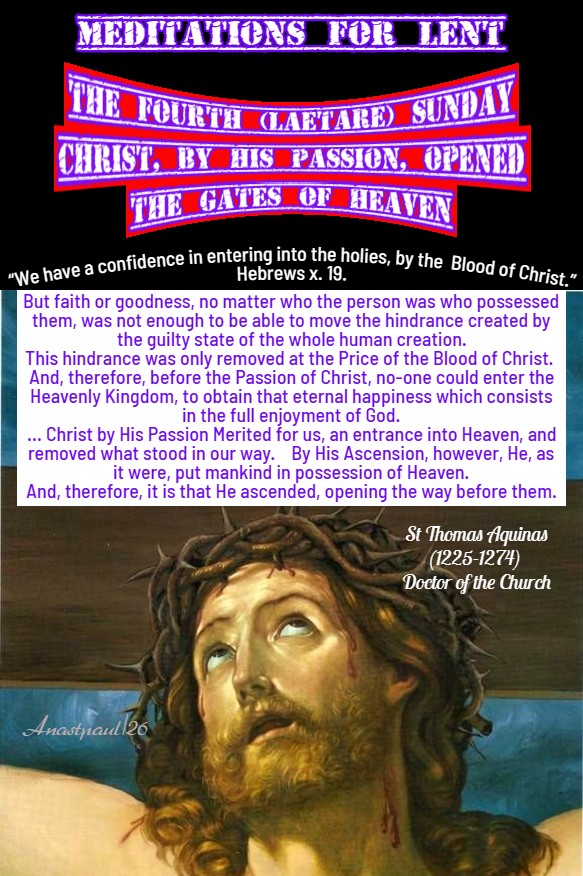
And this fruit too, the Passion of Christ brough forth; We have, therefore, a confidence in the entering into the Holies by the Blood of Christ – a new and living way which He hath dedicated for us through the veil, that is to say, His Flesh (Hebr x. 19).

ST THOMAS AQUINAS (1225-1274)
Priest, Theologian, Dominican
Doctor Angelicus (Angelic Doctor)
Doctor Communis (Common Doctor)
Added by Pope Saint Pius V in 1568

Posted in LENT 2026, The SEVEN PASSION Feasts, Thomas Aquinas

Friday – 20 February – Our Lenten Journey With St Thomas Aquinas – 

Ash Friday – 20 February – Our Lenten Journey With St Thomas Aquinas (1225-1274), Doctor of the Church

Friday : The Crown of Thorns

“Go forth, ye daughters of Sion and see King Solomon in the diadem, wherewith his mother crowned him in the day of his espousals and in the day of the joy of his heart.
Cant iii. n.

This is the voice of the Church inviting the souls of the faithful to behold the marvellous beauty of her Spouse. For the daughters of Sion, who are they but the daughters of Jerusalem, holy souls, the citizens of that City which is above, who with the Angels enjoy the peace which knows no end and, in consequence, look upon the glory of the Lord?

  1. Go forth, shake off the disturbing commerce of this world so that, with minds set free, you may be able to contemplate Him Whom you love. And see King Solomon, the true Peacemaker, that is to say, Christ Our Lord.

In the diadem wherewith his mother crowned him, as though the Church said, “Look on Christ garbed with Flesh for us, the Flesh He took from the flesh of His Mother.” For it is His Flesh which is here called a Diadem, the Flesh which Christ assumed for us, the Flesh in which He died and destroyed the reign of death, the Flesh in which, rising once again, He brought to us the hope of resurrection.

This is the Diadem of which St.Paul speaks, We see Jesus for the suffering of death crowned with glory and honour (Heb ii. 9). His Mother is spoken of as crowning Him because Mary the Virgin it was, who from her own flesh gave Him Flesh.

In the day of His espousals, that is, in the hour of His Incarnation, when He took to Himself the Church not having spot or wrinkle (Eph v. 27), the hour again when God was joined with man.
And in the day of the joy of His heart. For the joy and the gaiety of Christ, is for the human race, salvation and redemption. And coming home, He calls together His friends and neighbours saying to them, Rejoice with Me because I have found My sheep which was lost (Luke xv. 6).

  1. We can, however, refer the whole of this text simply and literally, to the Passion of Christ. For Solomon, foreseeing through the centuries the Passion of Christ, was uttering a warning for the daughters of Sion, that is, for the Jewish people.

Go forth and see King Solomon, that is, Christ, in His Diadem, that is to say, the Crown of Thorns, with which His Mother, the Synagogue has crowned Him; in the day of His espousals, the day when He joined to Himself the Church and in the day of the joy of His heart, the day in which He rejoiced that by His Passion, He was delivering the world from the power of the devil.
Go forth, therefore, and leave behind the darkness of unbelief and see, understand with your minds, He Who suffers as Man is really God
!

Go forth, beyond the gates of your City, that you may see Him, on Mount Calvary, Crucified.

ST THOMAS AQUINAS (1225-1274)
Priest, Theologian, Dominican
Doctor Angelicus (Angelic Doctor)
Doctor Communis (Common Doctor)
Added by Pope Saint Pius V in 1568

Posted in CONFESSION/PENANCE, LENT 2026, QUOTES on REPARATION/EXPIATION, Thomas Aquinas

Thursday – 19 February – Our Lenten Journey With St Thomas Aquinas – Fasting

Ash Thursday – 19 February – Our Lenten Journey With St Thomas Aquinas (1225-1274), Doctor of the Church

Thursday : Fasting

  1. We fast for three reasons.

(i) To check the desires of the flesh. So St Paul says in fastings, in chastity (2 Cor vi. 5), meaning that fasting is a safeguard for chastity. As St Jerome says, “Without Ceres and Bacchus, Venus would freeze,” as much as to say, lust loses its heat through spareness of food and drink.

(ii) That the mind may more freely raise itself to contemplation of the heights. We read in the book of Daniel that it was after a fast of three weeks that he received the revelation from God (Dan x. 2-4).

(iii) To make satisfaction for sin. This is the reason given by the Prophet Joel, Be converted to me with all your heart, in fasting and in weeping and in mourning (Joel ii. 12). And here is what St Augustine writes on the matter. “Fasting purifies the soul. It lifts up the mind and it brings the body into subjection to the spirit. It makes the heart contrite and humble, scatters the clouds of desire, puts out the flames of lust and shines the true light of chastity.”

  1. There is a commandment laid on us to fast. For fasting helps to destroy sin and to raise the mind to thoughts of the spiritual world. Each man is then bound, by the natural law of the matter, to fast just as much as is necessary to help him in these matters. Which is to say, fasting in general is a matter of natural law. To determine, however, when we shall fast and how, according to what suits and is of use to the Catholic body, is a matter of positive law. To state the positive law is the business of the Bishops and what is thus stated by them is called Ecclesiastical fasting, in contradistinction with the natural fasting previously mentioned.

ST THOMAS AQUINAS (1225-1274)
Priest, Theologian, Dominican
Doctor Angelicus (Angelic Doctor)
Doctor Communis (Common Doctor)
Added by Pope Saint Pius V in 1568
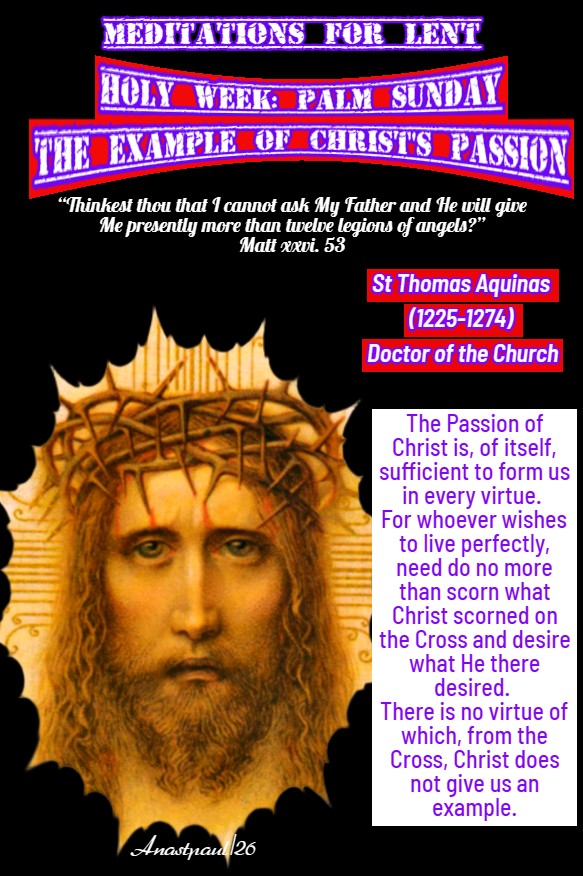
Posted in DOCTORS of the Church, GOD ALONE!, LENT 2026, Our MORNING Offering, QUOTES on LOVE of GOD, QUOTES on WATCHING, QUOTES on WISDOM, The FAITHFUL on PILGRIMAGE, Thomas Aquinas

Our Morning Offering – 19 February – Grant Me, My God By St Thomas Aquinas

Our Morning Offering – 19 February – Ash Thursday

Grant Me, My God
By St Thomas Aquinas (1225-1274)
Angelic Doctor, Common Doctor

Make my heart watchful, O God,
so that no vain thoughts may distract it from Thee.
Make it noble,
so that it may never be seduced by any base affection.
Make it steadfast,
so that troubles may not dismay it.
Make it free,
so that it may not yield to the onslaughts of passion.
Grant me, my God,
the intelligence, to understand Thee,
the love, to seek Thee,
the wisdom, to find Thee,
words, to please Thee,
the perseverance, to wait faithfully for Thee
and, the hope of embracing Thee, at last.
Grant that I, a repentant sinner,
may bear Thy chastisements with resignation.
Poor pilgrim which I am,
may I draw on the treasury of Thine grace
and may I one day,
be eternally happy with Thee in Heavenly glory!
Amen.

Posted in DOCTORS of the Church, DOMINICAN OP, LENT, LENT 2026, QUOTES on DEATH, QUOTES on SIN, QUOTES on SUFFERING, Thomas Aquinas

Ash Wednesday – 18 February – Our Lenten Journey With St Thomas Aquinas Begins

Ash Wednesday – 18 February – Our Lenten Journey With St Thomas Aquinas (1225-1274), Doctor of the Church

Ash Wednesday : Death

By one man sin entered into this world and by sin death.” – Romans v. 12.

  1. If for some wrongdoing a man is deprived of some benefit once given to him, that he should lack that benefit is the punishment of his sin.

Now, in man’s first creation he was divinely endowed with this advantage that, as long as his mind remained subject to God, the lower powers of his soul were subjected to the reason and the body was subjected to the soul.

But because by sin man’s mind moved away from its subjection to God, it followed that the lower parts of his mind ceased to be wholly subjected to the reason. From this there followed such a rebellion of the bodily inclination against the reason, that the body was no longer wholly subject to the soul.

Whence followed death and all the bodily defects. For life and wholeness of body are bound up with this, that the body is wholly subject to the soul, as a thing which can be made perfect is subject to that which makes it perfect. So it comes about that, conversely, there are such things as death, sickness and every other bodily defect, for such misfortunes are bound up with an incomplete subjection of body to soul.

  1. The rational soul is of its nature immortal and, therefore, death is not natural to man insofar as man has a soul. It is natural to his body, for the body, since it is formed of things contrary to each other in nature, is necessarily liable to corruption and, it is in this respect, that death is natural to man.

But God who fashioned man is all powerful. And hence, by an advantage conferred on the first man, He took away that necessity of dying which was bound up with the matter of which man was made. This advantage was, however, withdrawn through the sin of our first parents.

Death is then natural, if we consider the matter of which man is made and it is a penalty, inasmuch as it happens through the loss of the privilege whereby man was preserved from dying.

  1. Sin – Original Sin and actual sin – is taken away by Christ, that is to say, by Him Who is also the remover of all bodily defects. He shall quicken also your mortal bodies because of His Spirit Who dwelleth in you (Romams viii. II).

But, according to the order appointed by a wisdom which is Divine, it is at the time which best suits, when Christ takes away both the one and the other, i.e., both sin and bodily defects.

Now it is only right that, before we arrive at that glory of impassibility and immortality which began in Christ and which was acquired for us through Christ, we should be shaped after the pattern of Christ’s sufferings.
It is then only right that Christ’s liability to suffer should remain in us too, for a time, as a means of our coming to the impassibility of glory in the way He himself came to it.

ST THOMAS AQUINAS (1225-1274)
Priest, Theologian, Dominican
Doctor Angelicus (Angelic Doctor)
Doctor Communis (Common Doctor)
Added by Pope Saint Pius V in 1568
Posted in LENT 2026, MARIAN DEVOTIONS, MARIAN PRAYERS, MARIAN QUOTES, MARIAN REFLECTIONS, MARIAN TITLES, Our MORNING Offering, St Alphonsus de Liguori,, St JOSEPH

Our Morning Offering – 17 February – My Beloved Redeemer, Prayer for the Flight into Egypt By St Alphonsus

Our Morning Offering – 17 February – Feast of the Flight into Egypt

My Beloved Redeemer
Prayer for the Flight into Egypt (Excerpt)
By St Alphonsus Maria de Liguori (1696-1787)
Doctor of the Church

My beloved Redeemer,
I have many times driven Thee out of my soul
but now I hope, that Thou
have again taken possession of it.
I beseech Thee,
do Thou bind it to Thyself
with the sweet chains of Thy love.
Oh, do Thou make Thyself loved,
make Thyself loved by all the sinners
who persecute Thee,
give them light,
make them know the love
Thou hast borne them
and the love Thou deserves,
since Thou goes wandering over the earth
as a poor Infant,
weeping and trembling with cold
and seeking souls to love Thee!
O Mary, most holy Virgin,
O dearest Mother
and companion of the sufferings of Jesus,
do thou help me always
to carry and preserve thy Son
in my heart,
in life and in death!
Amen.

Posted in DIVINE Mercy, Goodness, Patience, DOCTORS of the Church, GOD is LOVE, LENT 2026, Our MORNING Offering, QUOTES on PERSECUTION, REDEMPTORISTS CSSR, SACRED and IMMACULATE HEARTS, SACRED HEART PRAYERS, St Alphonsus de Liguori,, The NINE FIRST FRIDAYS

Our Morning Offering – 16 February – O Adorable Heart of my Jesus!

Our Morning Offering – 16 February – “The Month of the Nost Blessed Trinity” – Ferial Day – Quinquagesima Week

O Adorable Heart of my Jesus!
By St Alphonsus Maria de Liguori (1696-1787)
Most Zealous Doctor

O Adorable Heart of my Jesus,
Heart yearning expressly. for the love of men!
Until now, I have shown towards Thee
only ingratitude.
Pardon me, O my Jesus.
Heart of my Jesus,
Abyss of Love and of Mercy,
how is it possible,
that I do not die of sorrow,
when I reflect on Thy Goodness to me
and my ingratitude to Thee?
Thou, my Creator, after having created me,
hast given Thy Blood and Thy Life for me
and, not content with this,
Thou hast invented a means of offering
Thyself everyday for me,
in the Holy Eucharist,
exposing Thyself to a thousand insults and outrages!
Ah, Jesus, do Thou wound my heart
with a great contrition for my sins
and a lively love for Thee.
Through Thy Tears and Thy Blood,
give me the grace of perseverance
in Thy fervent love, until I breathe my last sigh.
Amen.

Posted in DOCTORS of the Church, LENT 2026, NOVENAS, PRAYERS to THE HOLY GHOST, St Alphonsus de Liguori,, The HOLY FACE, The HOLY GHOST

Lenten Preparation Novena to the Holy Face – The Second Day – 10 February

Lenten Preparation
Novena to the Holy Face
To end on Shrove Tuesday,
The Feast of the Holy Face

All those who, attracted by My Love and venerating My Countenance, shall receive, by virtue of My Humanity, a brilliant and vivid impression of My Divinity. This splendour shall enlighten the depths of their souls, so that in eternal glory the celestial court shall marvel at the marked likeness of their features, with My Divine Countenance.” … (Our Lord Jesus Christ to St Gertrude the Great)

DAILY PREPARATORY PRAYER

O Most Holy and Blessed Trinity,
through the intercession of Holy Mary,
whose soul was pierced through
by a sword of sorrow
at the sight of the Passion of her Divine Son,
we ask Thy help,
in making a perfect Novena of Reparation with Jesus,
united with all His sorrows, love and total abandonment.
We now implore all the Angels and Saints
to intercede for us as we pray this Holy Novena
to the Most Holy Face of Jesus
and for the glory of the most Holy Trinity,
Father, Son and Holy Ghost.
Amen

THE SECOND DAY:

PRAYER:
Most Holy Face of Jesus,
we are truly sorrowful,
for we have hurt Thee so much.
By our sins, we have disobeyed Thee,
turned away from Thee
and omitted to please Thee by our lives.
But now, we wish to do penance
and amend our lives.
Immaculate Heart of Mary,
intercede for us,
help us to console
the Most Holy Face of Jesus.
Pray for us, that we may share
in the tremendous love
you have for the most Holy
and Blessed Trinity.
Through the merits of Thy Most Precious Blood
and Thy Most Holy Face,
O Jesus, grant us our petition ………………
Pardon and mercy.
Amen

Come O Holy Ghost!
By St Alphonsus Liguori (1696-1787)
Most Zealous Doctor

Thou made Mary full of grace
and inflamed the hearts of the Apostles
with a holy zeal,
enflame our hearts with Thy Love.
Thou art the Spirit of goodness,
give us the courage to confront evil.
Thou art Fire,
set us ablaze with Thy Love.
Thou art Light,
enlighten our minds,
that we may see what is truly good and true.
Thou art the Dove,
give us gentleness.
Thou art a Soothing Breeze,
bring calm to the storms which rage within us.
Thou art the Tongue,
may our lips ever sing God’s praises
Thou art the Cloud,
shelter us under the shadow of Thy protection.
O Holy Ghost, melt the frozen,
warm the chilled
and enkindle in us,
an earnest desire to please Thee.
We ask this through Christ our Lord.
Amen

Posted in DIVINE Mercy, Goodness, Patience, MEDITATIONS - ANTONIO CARD BACCI, QUOTES on DESPAIR, QUOTES on SIN, QUOTES on the DEVIL/EVIL

Thought for the Day – 29 December – Our Frequent Lapses

Thought for the Day – 29 December – Meditations with Antonio Cardinal Bacci (1881-1971)

Our Frequent Lapses

“It is sad to have to admit, that in spite of our good resolutions and in spite of the graces which we receive from God, we continue to fall into sin.
Our continual lapses can cause us to become discouraged.
This, however, is a device of the devil, who has already lured us into sin and now, proceeds to suggest thoughts of despair.
He wishes to convince us that resistance is useless, that our nature is completely corrupt and, that there is no escape for us.

My dear children,” wrote St John to the early Christians, “these things I write to you, in order that you may not sin. But, if anyone sins, we have an advocate with the Father, Jesus Christ, the just and he is a propitiation for our sins, not for ours only but also, for those of the whole world” (1 Jn 2:1-2).
If we say that that we have no sin, we deceive ourselves and the truth is not in us. If we acknowledge our sins, he is faithful and just to forgive us our sins and to cleanse us from all iniquity.” (1 Jn 1:9).
He who says that he knows him and does not keep his commandments, is a liar and the truth is not in him But he who keeps his word, in him the love of God is truly perfected” (1 Jn 2:5).

It is clear, therefore, that we ought to avoid sin by every means in our power because, it extinguishes our charity and brings death to the soul.
Nevertheless, even if we continue to fall into sin, we should never lose heart.
Discouragement and despair are stratagems of the devil.
No matter how great and how numerous our sins maybe, God is always prepared to pardon them.

Let us recall the example of Mary Magdalen, of the repentant thief and of the prodigal son.
As long as we repent sincerely, we may be sure that God will forgive us and clasp us to His breast, for God is Infinitely merciful.

Antonio Cardinal Bacci

Posted in CATHOLIC TIME, CONFESSION/PENANCE, GOD ALONE!, MEDITATIONS - ANTONIO CARD BACCI, QUOTES for the NEW YEAR, QUOTES on BAD CONVERSATION, QUOTES on GOOD WORKS, QUOTES on PRAYER, Quotes on SALVATION, QUOTES on SIN, QUOTES on SLOTH, QUOTES on THANKSGIVING, QUOTES on TIME

Thought for the Day – 28 December – The Value of An Hour

Thought for the Day – 28 December – Meditations with Antonio Cardinal Bacci (1881-1971)

The Value of An Hour

There are twenty four hours in a day, eight thousand seven hundred and sixty, in a year.
How have you spent all the hours which God has given you in the past?

How do you intend to use the hours which He will give you in the future?

When you examine the past, you will find much to regret.
Perhaps you have spent many hours in sin, in idle gossp, in useless or dangerous pastimes, or in innumerable business transactions, all of which will contribute NOTHING towards your eternal salvation, which should be our main concern in this life.

How much time have you spent thinking of God, your Creator and Redeemer?
How many hours have you devoted to prayer, thanksgiving and penance.
How many have you spent in apostolic work on behalf of your neighbour?
It may be that the service of God and your spiritual welfare have, so far, been the least of your worries, on which you have expended no more than the few odd moments left over from your other preoccupations.
You are well aware, nevertheless, that the purpose of life is to know, love and serve God.
You know that you ought to offer Him all your thoughts, affections and actions, for He alone can make your happy – or do you NOT know and believe this?

Antonio Cardinal Bacci

Posted in DOCTORS of the Church, FATHERS of the Church, GOD is LOVE, LOVE of NEIGHBOUR, MEDITATIONS - ANTONIO CARD BACCI, QUOTES on CHARITY, QUOTES on LOVE of GOD, The APOSTLES & EVANGELISTS

Thought for the Day – 27 December – St John, the Apostle and Evangelist

Thought for the Day – 27 December – Meditations with Antonio Cardinal Bacci (1881-1971)

St John, the Apostle and Evangelist

“Both in his Gospel and in his letters, St John continually emphasises the virtue of charity.
He stresses the need for love of God and love of our neighbour, “God is love,” he says, “and he who abides in love abides in God and God in him” (1 Jn 4:16).
According to St Jerome, when the Apostle John was almost a hundred years old and lacked the strength to speak for very long, he was accustomed to go, supported by his disciples, to gatherings of the faithful.
There he prepared, on every occasion, the same exhortation: “My children, love one another.
His followers grew tired of this and finally asked him why he kept repeating the same phrase.
Because that is God’s command,” he replied, “and if we do no more than obey it, that is sufficient!

Let us meditate upon his words and let us remember, that our love for God is futile, unless it is accompanied by a practical love for our neighbour.
The love of God cannot be separated, from the love of our fellow-men.

Antonio Cardinal Bacci

Posted in MEDITATIONS - ANTONIO CARD BACCI, QUOTES on COURAGE, QUOTES on MARTYRDOM, QUOTES on SUFFERING, St PAUL!

Thought for the Day – 26 December – St Stephen, the First Martyr

Thought for the Day – 26 December – Meditations with Antonio Cardinal Bacci (1881-1971)

St Stephen, the First Martyr

“Among the original seven Deacons nominated by the Apostles, there was one name Stephen, who was outstanding for his sanctity and extraordinary spiritual gifts.
Being enlightened by God, this young man dared to rebuke the Jews in public for their hardness of heart and openly defended the doctrine of Christ, Whom he proclaimed to be the Saviour and Redeemer of the world.
One day, when he was threatened by his foes, Stephen raised his eyes trustfully towards Heaven and said: “Behold, I see the heavens opened and the Son of Man standing at the right hand of God.”
The Jews could no longer restrain their fury and proceeded to drag the young man outside the City.
There, they left their garments in the care of a youth named Saul, while they savagely stoned Stephen to death.
Stricken to his knees by the force of the missiles, the saintly young disciple continued to look towards Heaven.
“Lord Jesus,” he cried, “receive my spirit.”
Before he breathed his last, he forgave his enemies in the manner of his Divine Master.
“Lord,” he prayed, “do not lay this sin against them.”
And with these words he fell asleep (Cf Acts 7:51-60; 8:1-2).

Let us admire and imitate the courage of this Martyr.
We may never be called on, to endure a martyrdom of blood on behalf of our Faith but, we shall almost certainly be obliged to undergo the martyrdom of the assault of the passions on our purity of soul, or of severe physical or mental suffering…
If we accept these trials from God with perfect resignation and love, they will certainly prove as valuable to us, as real martyrdom.
If we endure them with the courage and fortitude of St Stephen, we shall be rewarded as he was, by seeing Jesus standing at the right hand of God and offering us the palm of victory!”

Antonio Cardinal Bacci

Posted in CHRISTMAS Quotes, CHRISTMASTIDE!, DECEMBER - The DIVINE INFANCY and The IMMACULATE CONCEPTION, GOD ALONE!, MEDITATIONS - ANTONIO CARD BACCI, QUOTES on HUMILITY, QUOTES on LOVE of GOD, QUOTES on SIMPLICITY, The DIVINE INFANT, The NATIVITY of JESUS

Thought for the Day – 25 December – The Feast of the Nativity

Thought for the Day – 25 December – Meditations with Antonio Cardinal Bacci (1881-1971)

The Feast of the Nativity

“The first people to pay homage to Jesus Christ, are not men of exalted rank but humble shepherds.
They come to offer their poor gifts but, above all else, they offer Him their simple and innocent hearts.

We also should approach the manger with humility and simplicity.
Foremost among the gifts which we offer, should be the renunciation of sin, a firm resolution to resist our lower inclinations and a great love for Him, Who has loved us so much.
There are no more pleasing gifts which we could offer Jesus Christ on His Birthday.
Let us go now to Him!

Antonio Cardinal Bacci

Posted in CHRIST the LIGHT, CHRIST the WORD and WISDOM, DOCTORS of the Church, MARCH the month of ST JOSEPH, ONE Minute REFLECTION, QUOTES on HUMILITY, QUOTES on WISDOM, St Francis de Sales, St JOSEPH, The NATIVITY of JESUS, The WORD

One Minute Reflection – 24 December – ‘… God gave him His most glorious Son to care for …’

One Minute Reflection – 24 December – “The Month of the Divine Infancy and the Immaculate Conception of the Blessed Virgin Mary” – The Vigil of the Nativity of Our Lord Jesus Christ – Romans 1:1-6 Matthew 1:18-21 – Scripture search here: https://www.drbo.org/

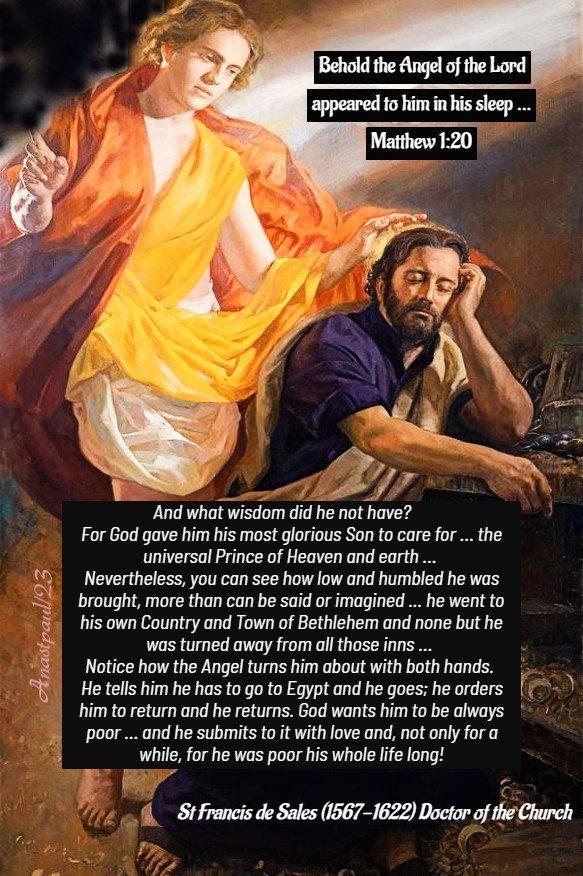
Behold, the Angel of the Lord appeared to him in his sleep …” – Matthew 1:20

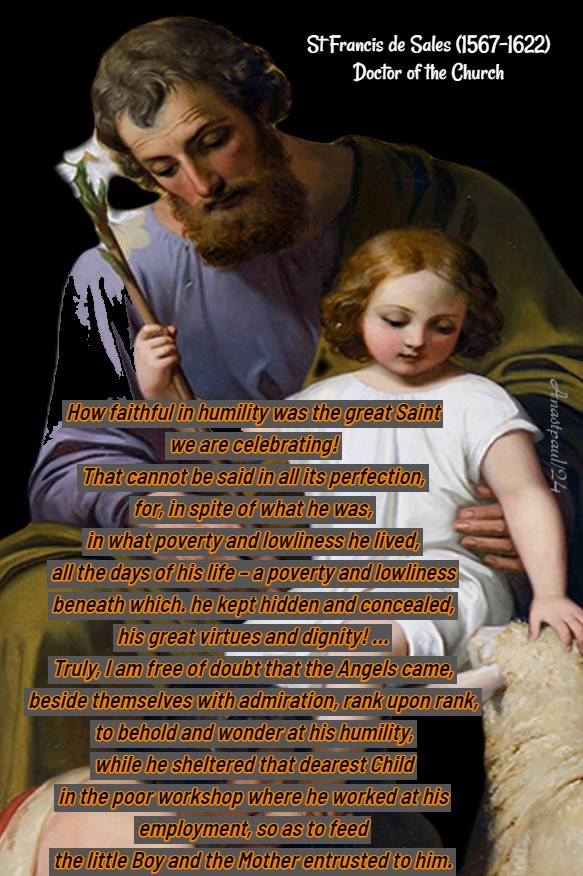
REFLECTION – “How faithful in humility was the great Saint we are celebrating! That cannot be said in all its perfection for, in spite of what he was, in what poverty and lowliness he lived, all the days of his life – a poverty and lowliness beneath which. he kept hidden and concealed, his great virtues and dignity! … Truly, I am free of doubt that the Angels came, beside themselves with admiration, rank upon rank, to behold and wonder at his humility, while he sheltered that dearest Child in the poor workshop where he worked at his employment, so as to feed the little Boy and the mother entrusted to him.

There is no doubt at all that St Joseph was braver than David and wiser that Solomon [who were his ancestors]. Nevertheless, seeing him reduced to the exercise of carpentry, who could have discerned this, unless they were enlightened by a heavenly Light, so hidden did he keep the remarkable gifts with which God had favoured him? And what wisdom did he not have? For God gave him His most glorious Son to care for … the universal Prince of Heaven and earth … Nevertheless, you can see how low and humbled he was brought, more than can be said or imagined … he went to his own Country and Town of Bethlehem and none but he was turned away from all those inns … Notice how the Angel turns him about with both hands. He tells him he has to go to Egypt and he goes; he orders him to return and he returns. God wants him to be always poor … and he submits to it with love and, not only for a while, for he was poor his whole life long!” – St Francis de Sales (1567-1622) Bishop of Geneva and Doctor of the Church (Conferences No 20)

PRAYER – O God, Thou Who gladden us, year after year, with the expectation of our redemption, grant that we, who now welcome with joy Thy Only-begotten Son as our Redeemer, may also gaze upon Him without fear when He comes as our Judge, our Lord Jesus Christ. Through the same Jesus Christ, Thy Son our Lord, Who lives and reigns with Thee, in the unity of the Holy Ghost, God, world without end. Amen (Collect).

Posted in "Follow Me", ADVENT QUOTES, DECEMBER - The DIVINE INFANCY and The IMMACULATE CONCEPTION, GOD ALONE!, MEDITATIONS - ANTONIO CARD BACCI, QUOTES for CHRIST, QUOTES on HEAVEN, QUOTES on HUMILITY, QUOTES on LOVE of GOD, QUOTES on SIMPLICITY, QUOTES on THE WORLD, The DIVINE INFANT, The WILL of GOD

Thought for the Day – 23 December – What Jesus Wants From Us

Thought for the Day – 23 December – Meditations with Antonio Cardinal Bacci (1881-1971)

A Christmas Novena VIII
What Jesus Wants From Us

Unless you turn and become like little children,” the Infant Jess says to us, “you shall not enter into the Kingdom of Heaven” (Mt 18:2).
He wishes us to be humble, simple and innocent, like children.
As we grow older, unfortunately, many of us become proud, complicated and vain.
We lose the honest candour of childhood

Worldly pretentiousness cannot possibly appeal to Jesus, since He, Who is truly great, chose to become a tiny Infant.
He wishes us to renounce the self-important airs and the intricate methods which we employ, in order to conceal the truth, to disguise our lack of virtue and to assume the appearances of learning and of authority, regardless of the fact that the highest achievement of which we are capable, is to be humble, the most necessary knowledge of all, is to know Jesus Crucified and the best kind of authority, is the ability to control our passions and to subject ourselves to the will of God.

It is, in this sense, that we must become little children before God and before man.
Then Jesus Christ will love us and will grant us His favours.”

Antonio Cardinal Bacci

Posted in DECEMBER - The DIVINE INFANCY and The IMMACULATE CONCEPTION, PRAYERS to the DIVINE INFANT JESUS, The DIVINE INFANT, The HOLY INFANCY, The O ANTIPHONS

Quote/s of the Day – 23 December – “O Radix Jesse”

Quote/s of the Day – 23 December – “The Month of the Divine Infancy and the Immaculate Conception of the Blessed Virgin Mary”

“O Radix Jesse”

O Root of Jesse , Who standest for a Sign to the nations, before Whom kings shall close their mouth,
of Whom the Gentiles shall entreat mercy;
Come to set us free and no longer delay
!”

 “O Root of Jesse O King and Saviour, Come and set us free; free from all which displeases Thee, free from the snares which entangle our feet, free from our perverse attachment to our own will , free from the power of the devil, free from our apathy in obeying Thy commands and holy inspirations, free from all which hinders us in Thy service; Come and say the Word and we shall be delivered!

 Fr Richard Frederick Clarke SJ (1839-1900)

Posted in DECEMBER - The DIVINE INFANCY and The IMMACULATE CONCEPTION, GOD ALONE!, MEDITATIONS - ANTONIO CARD BACCI, Quote on SELF-ABANDONMENT, QUOTES on LOVE of GOD, QUOTES on PRAYER, The DIVINE INFANT, The WILL of GOD

Thought for the Day – 22 December – Prayer and Dedication

Thought for the Day – 22 December – Meditations with Antonio Cardinal Bacci (1881-1971)

A Christmas Novena VII
Prayer and Dedication

“As we kneel before the Infant Jesus, let us beseech Him to enable us to grasp the truth of these reflections.
Let us take more care of our soul than we do, as of our external talents and possessions.
May God occupy the foremost place in our minds and may He be the principal object of our thoughts, desires and affections.

Let us imitate the humble recollection and ardent love for God, of the Holy Infant.
Like Him, let us offer ourselves entirely to God.
Let us ask Him to make us like Himself, in complete acceptance of the Divine Will, especially when we are in trouble or in pain, for in this way, we shall be able to show God how sincerely we love Him
.”

Antonio Cardinal Bacci

Posted in DECEMBER - The DIVINE INFANCY and The IMMACULATE CONCEPTION, MEDITATIONS - ANTONIO CARD BACCI, QUOTES on GOOD WORKS, QUOTES on PRIDE, QUOTES on SILENCE, QUOTES on THE WORLD, The DIVINE INFANT

Thought for the Day – 21 December – The Silence of the Divine Infant

Thought for the Day – 21 December – Meditations with Antonio Cardinal Bacci (1881-1971)

A Christmas Novena VI
The Silence of the Divine Infant

Evil always attracts a great deal of attention, whereas goodness operates in silence.
The reason why evil creates such a stir, is that it is the work of pride and of ambition.
It wants to be seen and to be applauded.
Goodness, good works, is done for God.
It does not seek the world’s applause but, only the approval of God.
When an enterprise sets out to look for publicity, there is reason to fear that it does not come from God but is prompted by human motives.
As a result, it will prove sterile!

If we sincerely desire to please God, we shall work in silence.

We shall not aim at our own worldly interests but, shall seek our own spiritual good and that of our fellowmen.
If it is God’s will. our good work may shine also before men but let us remember that this is for the glory of God and in order to give good example to our neighbour.”

Antonio Cardinal Bacci

Posted in ADVENT REFLECTIONS, CATECHESIS, CHRIST the WORD and WISDOM, DIVINE Mercy, Goodness, Patience, ONE Minute REFLECTION, QUOTES on FORGIVENESS, QUOTES on SIN, QUOTES on SUFFERING, St Francis de Sales, The SECOND COMING, The WORD

One Minute Reflection – 21 December – Why does God say that He will forgive the people of Israel their iniquity because they have reached the peak of their sinfulness?!

One Minute Reflection – 21 December – “The Month of the Divine Infancy and the Immaculate Conception of the Blessed Virgin Mary” – Advent IV – 1 Corinthians 4:1-5 – Luke 3:1-6 – Scripture search here: https://www.drbo.org/

Prepare the way of the Lord, make straight His paths.” – Luke 3:4

REFLECTION – “When the pagans led the people of Israel into slavery and sent them as captives among the Persians and the Medes, after a long period of captivity, the good King Cyrus resolved to take them out of their enslavement and to bring them back to the Promised Land. With divine poetry, the Prophet Isaias broke into song with these beautiful words: “Comfort, give comfort to my people, says the Lord your God. Your consolation will neither be in vain nor useless. Speak tenderly to Jerusalem … for her sinfulness is complete. And because her iniquity has reached its peak, she will be forgiven.” And that is why that great Prophet told the people of Israel: “Prepare the way of the Lord… Make straight … a highway for our God!” (cf Isa 40:1).

Why does God say He will forgive the people of Israel their iniquity because they have reached the peak of their sinfulness?! The ancient Fathers … teach that these words can be understood … as if God were saying: “When they have reached their greatest affliction and when they intensely feel the burden of their iniquity in enslavement and servitude, after punishing them for their evil ways … I looked at them and I felt compassion for them. When they had reached the worst of their days, I was satisfied with what they had suffered. And that is why now, their iniquity will be forgiven … When they had reached the height of their … ingratitude, when they seemed no longer to remember anything at all of God and His Kindness, then their iniquity will be forgiven.”…

When God in His Providence desired to show humankind His Goodness, it was admirable, for in doing so, He did not want to be motivated by anything. Without being prompted by anything other than His Goodness, He communicated Himself to them in a truly marvelous way.

When He came into this world, it was the time when humankind had reached the peak of its sinfulness; when the laws were in the hands of Annas and Caiaphas … when Herod ruled and Pontius Pilate presided over Judea that was when God came to the world to redeem us and to deliver us from the tyranny of sin and the servitude of our enemy.” – St Francis de Sales (1567-1622) Bishop of Geneva and Doctor of the Church (Sermon for the 4th Sunday of Advent).

PRAYER – Grant, we beseech Thee, almighty God, that we, who are heavy-laden under the yoke of sin, maybe delivered from the bondage of old, by the long-awaited new birth of Thy Only-begotten Son. Who livest and reignest with God the Father, in the unity of the Holy Ghost, God, world without end. Rejoice! ejoice! Emmanuel, Shall come to thee, O Israel. Amen (Collect)

Posted in ADVENT QUOTES, DECEMBER - The DIVINE INFANCY and The IMMACULATE CONCEPTION, GOD ALONE!, MEDITATIONS - ANTONIO CARD BACCI, QUOTES on GREED, WEALTH, QUOTES on THE WORLD, QUOTES on WEALTH/RICHES, The DIVINE INFANT, The HEART, The HOLY INFANCY

Thought for the Day – 19 December – The Swaddling Clothes of the Divine Infant

Thought for the Day – 19 December – Meditations with Antonio Cardinal Bacci (1881-1971)

Christmas Novena V
The Swaddling Clothes of the Divine Infant

The swaddling clothes of the Infant Jesus are, moreover, a symbol of the love which should bind us to Him.
If we are not capable of loving Jesus, are we capable of love at all?
Perhaps we love wealth, honour and pleasure?
Some day, however, we shall have to leave all our wealth behind.
Worldly honour and glory are also fleeting and can never satisfy us, while earthly pleasures leave behind a sense of emptiness and disgust.

Jesus Christ alone, can satisfy our hearts, for He alone, has words of everlasting life!
Lord,” let us say with St Peter, “to whom shall we go? Thou hast words of everlasting life” (Jn 6:69).

Antonio Cardinal Bacci