Posted in CHRISTMASTIDE!, JESUIT SJ, POETRY, QUOTES of the SAINTS, SAINT of the DAY, The NATIVITY of JESUS, Ven Servant of God John A Hardon

Quote/s of the Day – 21 February – The Burning Babe

Quote/s of the Day – 21 February – the Memorial of St Peter Damian OSB (1007-1072) Doctor of the Church and St Robert Southwell SJ (1561-1595) Priest and Martyr

The Burning Babe, by Saint Robert Southwell

burning-babe-excerpt-st-robert-southwell-mem-21-feb-21-jan-2019 and 21 feb 2020 as quote of the day

As I in hoary winter’s night stood shivering in the snow,
Surprised I was with sudden heat which made my heart to glow;
And lifting up a fearful eye to view what fire was near,
A pretty babe all burning bright did in the air appear;
Who, scorchëd with excessive heat, such floods of tears did shed
As though his floods should quench his flames which with his tears were fed.
Alas, quoth he, but newly born in fiery heats I fry,
Yet none approach to warm their hearts or feel my fire but I!
My faultless breast the furnace is, the fuel wounding thorns,
Love is the fire, and sighs the smoke, the ashes shame and scorns;
The fuel justice layeth on, and mercy blows the coals,
The metal in this furnace wrought are men’s defiled souls,
For which, as now on fire I am to work them to their good,
So will I melt into a bath to wash them in my blood.
With this he vanished out of sight and swiftly shrunk away,
And straight I called unto mind that it was Christmas day.

It’s not surprising, it’s one of the great poems of the English language.

St Robert Southwell S.J. (1561-1595) Martyr, Religious Priest, Poet, Hymnodist, Writer, clandestine missionary was born in 1561 in Horsham Saint Faith, Norfolk, England and he was martyred by being hanged, drawn and quartered on 21 February 1595 (aged 33) in Tyburn, London, England. St Robert was Canonised on 25 October 1970 by Blessed Pope Paul VI.
“His poetry – we don’t know exactly when he began to write but it must have been very young because he wrote a great deal of which we have the record and by now the English speaking world knows Robert Southwell. His two outstanding poems are ‘The Burning Babe’ and ‘The Virgin Mary to Christ On The Cross.’” (Ven Fr John A Hardon SJ)

St Peter Damian quotes here:
https://anastpaul.com/2019/02/21/quote-s-of-the-day-21-february-st-peter-damian/
And some from St Robert Southwell here:
https://anastpaul.com/2018/02/21/quote-s-of-the-day-21-february-the-memorial-of-st-peter-damian-o-s-b-1007-1072-and-st-robert-southwell-s-j-1561-1595/

Posted in CHRIST, the WAY,TRUTH,LIFE, JESUIT SJ, Our MORNING Offering, POETRY

Our Morning Offering – 17 February – Psalm 121 By Fr Daniel Berrigan

Our Morning Offering – 17 February – Monday of the Sixth week in Ordinary Time, Year A

The Pharisees came forward and began to argue with Jesus, seeking from him a sign from heaven to test him.
He sighed from the depth of his spirit and said, “Why does this generation seek a sign? Amen, I say to you, no sign will be given to this generation.”
Then he left them, got into the boat again and went off to the other shore. – Today’s Gospel: Mark 8:11-13

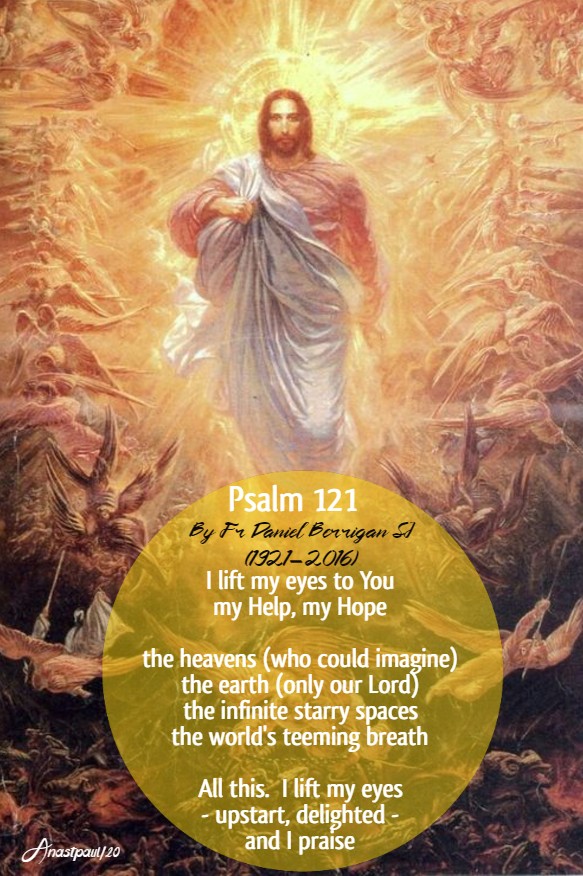
Psalm 121
By Fr Daniel Berrigan SJ (1921–2016)

I lift my eyes to You
my Help, my Hope

the heavens (who could imagine)
the earth (only our Lord)
the infinite starry spaces
the world’s teeming breath

All this. I lift my eyes
– upstart, delighted –
and I praise.

Fr Daniel Joseph Berrigan SJ was an American Jesuit priest, anti-war activist, Christian pacifist, playwright, poet and author.psalm 121 fr daniel berigan i lift up my eyes to you my help my hope 17 feb 2020

Posted in CHRISTMASTIDE!, Our MORNING Offering, POETRY, PRAYERS for SEASONS

Our Morning Offring – 14 January – Be Born in Us

Our Morning Offring – 14 January – Tuesday of the First week in Ordinary Time, Year A

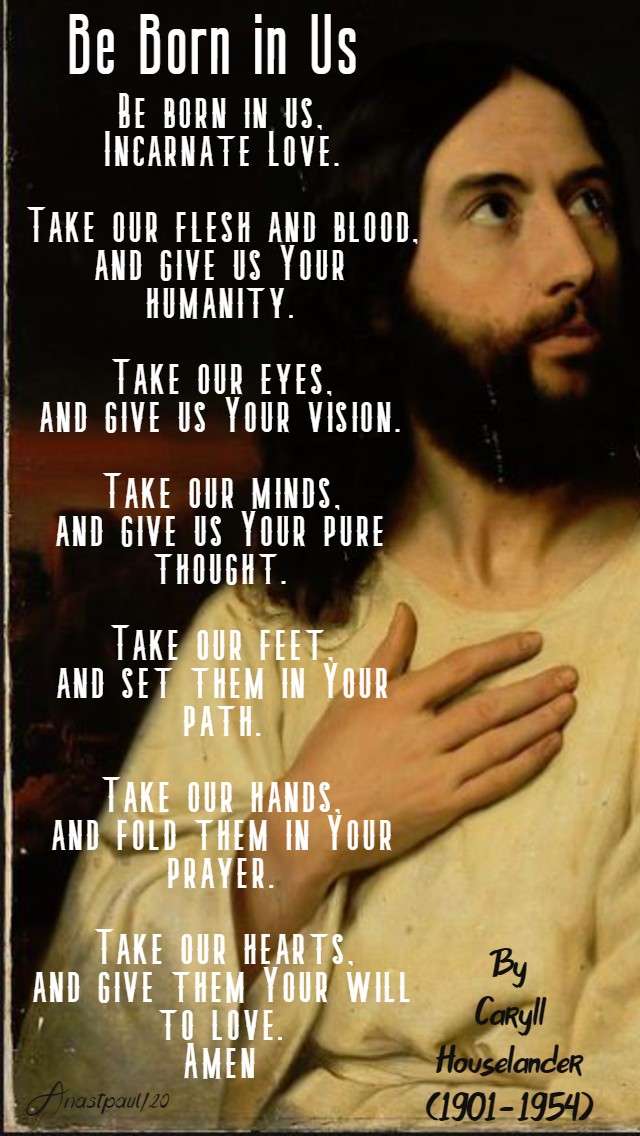
Be Born in Us
By Caryll Houselander (1901-1954)

Be born in us,
Incarnate Love.

Take our flesh and blood,
and give us Your humanity.

Take our eyes,
and give us Your vision.

Take our minds,
and give us Your pure thought.

Take our feet,
and set them in Your path.

Take our hands,
and fold them in Your prayer.

Take our hearts,
and give them Your will to love.

Amen

Caryll Houselander (29 September 1901 – 12 October 1954) was an English lay Roman Catholic ecclesiastical artist, mystic, popular religious writer and poet.be born in us caryll houselander no 2 14 jan 2020.jpg

Posted in Our MORNING Offering, POETRY

Our Morning Offering – 13 January – I know, Lord, You are with me.  Stand by me.

Our Morning Offering – 13 January – Monday of the First week in Ordinary Time

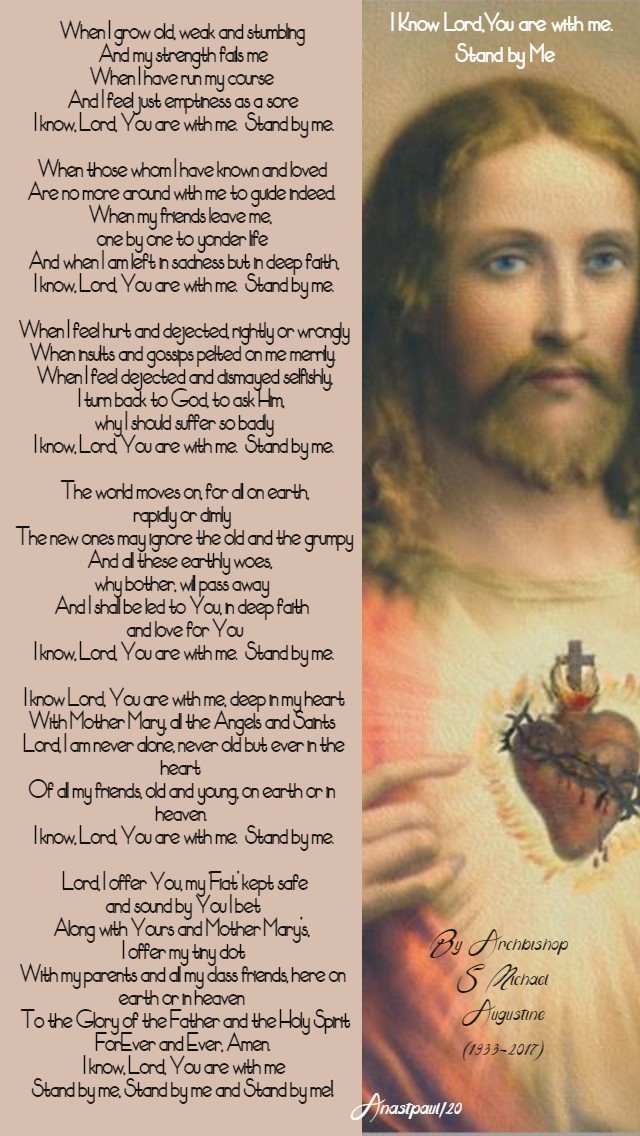
I know, Lord, You are with me.  Stand by me.
By Archbishop + S Michael Augustine (1933-2017)

When I grow old, weak and stumbling
And my strength fails me
When I have run my course
And I feel just emptiness as a sore
I know, Lord, You are with me.  Stand by me.

When those whom I have known and loved
Are no more around with me to guide indeed.
When my friends leave me, one by one to yonder life
And when I am left in sadness but in deep faith,
I know, Lord, You are with me.  Stand by me.

When I feel hurt and dejected, rightly or wrongly
When insults and gossips pelted on me merrily.
When I feel dejected and dismayed selfishly,
I turn back to God, to ask Him, why I should suffer so badly
I know, Lord, You are with me.  Stand by me.

The world moves on, for all on earth rapidly or dimly
The new ones may ignore the old and the grumpy
And all these earthly woes, why bother, will pass away
And I shall be led to You, in deep faith and love for You
I know, Lord, You are with me.  Stand by me.

I know Lord, You are with me, deep in my heart
With Mother Mary, all the Angels and Saints
Lord, I am never alone, never old but ever in the heart
Of all my friends, old and young, on earth or in heaven.
I know, Lord, You are with me.  Stand by me.

Lord, I offer You, my ‘Fiat’ kept safe and sound by You I bet
Along with Yours and Mother Mary’s, I offer my tiny dot
With my parents and all my class friends, here on earth or in heaven
To the Glory of the Father and the Holy Spirit
ForEver and Ever, Amen.
I know, Lord, You are with me
Stand by me, Stand by me and Stand by me!

Archbishop Emeritus of Pondicherry and Cuddalore, India
Augustine was sometimes referred to as the “People’s Bishop” and “Bishop of the Poor.” He was fluent in English, French, Tamil and Latin.   He was a Tamil scholar, as well as a lyricist, poet, writer, singer, magician and artist.I know Lord you are with me stand by me archb michael augustine NO 2 13 jan 2020.jpg

Posted in FATHERS of the Church, POETRY, QUOTES - J R R Tolkien and MORE, QUOTES on COURAGE, QUOTES on DEATH, QUOTES on FAITH, QUOTES on FEAR, QUOTES on TRUST and complete CONFIDENCE in GOD, SAINT of the DAY, The WORD

Quote/s of the Day – 8 January – “Take courage, it is I” and Bl Titus Zeman

Quote/s of the Day – 8 January – Third day after Epiphany, Readings: 1 John 4:11-18, Psalm 72:1-2, 10-13, Mark 6:45-52 and the Memorial of Blessed Titus Zeman SDB (1915-1969) Priest and Martyr

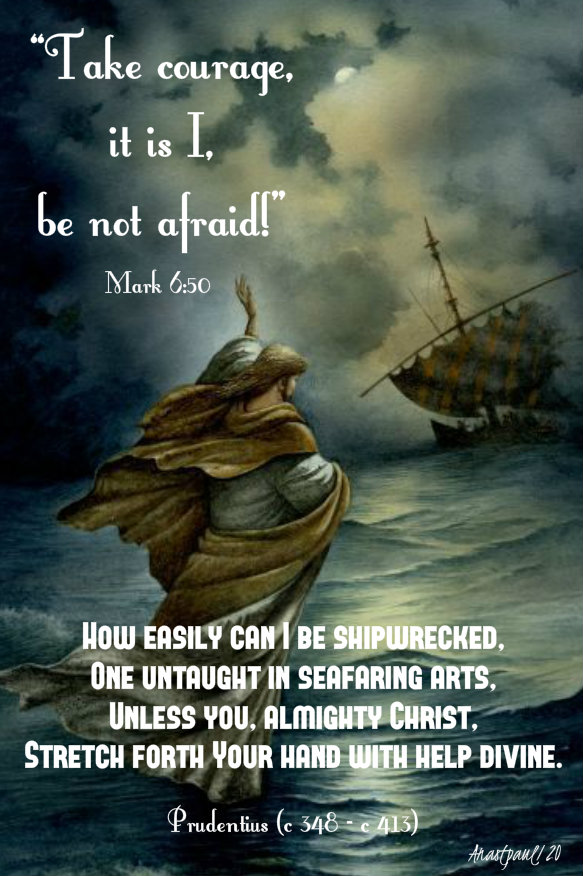
“They had all seen him and were terrified.   But at once he spoke with them, “Take courage, it is I, be not afraid!” (Mark 6:50)

Prudentius (c 348 – c 413) (formally known as Aurelius Clemens Prudentius) comments on this verse from the Gospel proclaimed during today’s Mass:

Thus I by my loquacious tongue
From the heaven of silence am led
Into perils unknown and dark.

Not as Peter, disciple true,
Confident in his virtue and faith,
I am as one whose unnumbered sins
Have shipwrecked on the rolling seas.

How easily can I be shipwrecked,
One untaught in seafaring arts,
Unless you, almighty Christ,
Stretch forth Your hand with help divine.

(Against Symmachus, 2)

Aurelius Prudentius Clemens was a Roman Christian poet, born in the Roman province of Tarraconensis (now Northern Spain) in 348.   He probably died in the Iberian Peninsula some time after 405, possibly around 413.
Prudentius practised law with some success and was twice provincial governor, perhaps in his native country.   Towards the end of his life (possibly around 392) Prudentius retired from public life to become an ascetic, fasting until evening and abstaining entirely from animal food and writing poems, hymns and controversial works in defence of Christianity. Prudentius later collected the Christian poems written during this period and added a preface, which he himself dated 405.
The poetry of Prudentius is influenced by early Christian authors, such as Tertullian and St. Ambrose, as well as the Bible and the acts of the martyrs.   His hymn Da, puer, plectrum (including “Corde natus ex parentis” – “Of the Father’s Love Begotten”) and the hymn for Epiphany O sola magnarum urbium (“Earth Has Many A Noble City”), both from the Cathemerinon, are still in use today.mark 6 5- it is I be not afraid - how easily can I be shipwrecked - prudentius 8 jan 2020.jpg

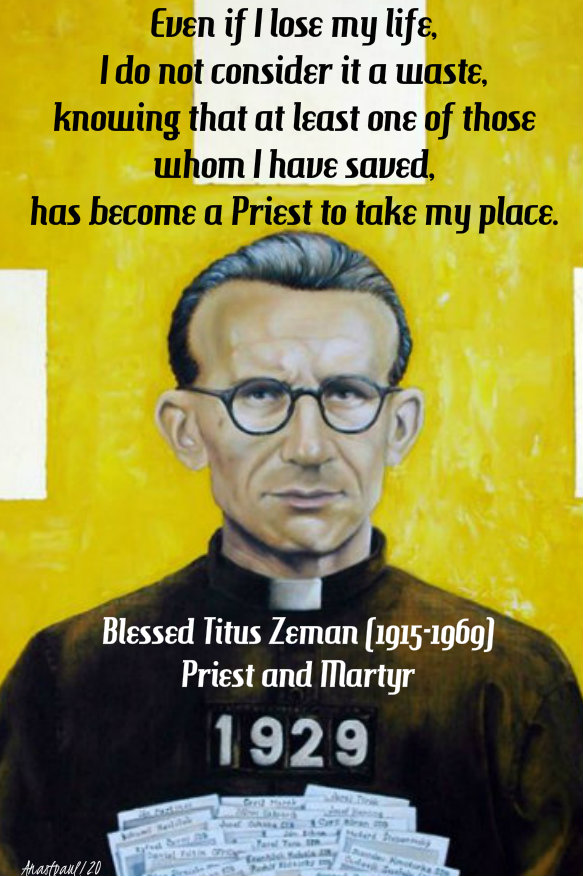
“Even if I lose my life,
I do not consider it a waste,
knowing that at least one of those
whom I have saved,
has become a Priest
to take my place.”

Blessed Titus Zeman

even if i lose my life - bl titus seman 8 jan 2020.jpg

Posted in CHRIST, the WAY,TRUTH,LIFE, CHRISTMASTIDE!, DEVOTIO, FEASTS and SOLEMNITIES, JESUIT SJ, Our MORNING Offering, POETRY

Our Morning Offering – 5 January – Who lives in Love

Our Morning Offering – 5 January – The Solemnity of the Epiphany of the Lord

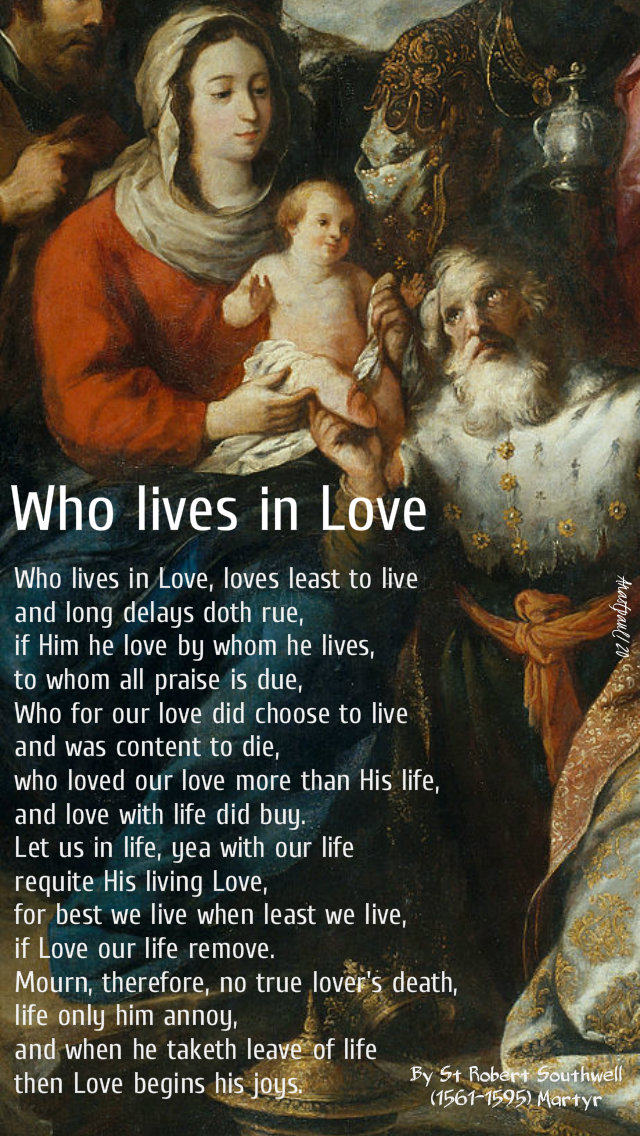
Who lives in Love
By St Robert Southwell SJ (1561-1595) Martyr

Who lives in Love, loves least to live
and long delays doth rue,
if Him he love by whom he lives,
to whom all praise is due,
Who for our love did choose to live
and was content to die,
who loved our love more than His life,
and love with life did buy.
Let us in life, yea with our life
requite His living love,
for best we live when least we live,
if Love our life remove.
Mourn, therefore, no true lover’s death,
life only him annoy,
and when he taketh leave of life
then Love begins his joys.who lives in love - st robert southwell 5 jan 2020.jpg

Posted in CHRISTMASTIDE!, FEASTS and SOLEMNITIES, MARIAN POETRY, MARIAN PRAYERS, Our MORNING Offering, POETRY, PRAYERS for SEASONS, The BLESSED VIRGIN MARY, The INCARNATION, The NATIVITY of JESUS

Our Morning Offering – 1 January – ‘Now will I sing to Thy mother!’

Our Morning Offering – 1 January – The Solemnity of Mary, Mother of God and the Octave Day of the Nativity of the Lord

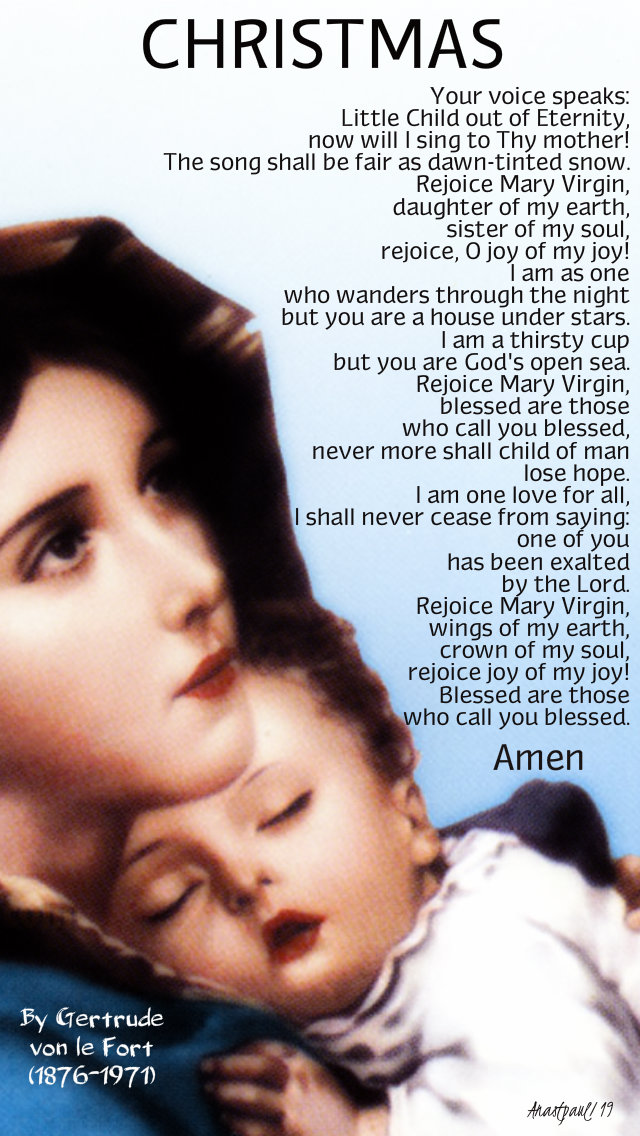
CHRISTMAS
By Gertrude von le Fort (1876-1971)

Your voice speaks:
Little child out of Eternity, now will I sing to Thy mother!
The song shall be fair as dawn-tinted snow.
Rejoice Mary Virgin, daughter of my earth, sister of my soul,
rejoice, O joy of my joy!
I am as one who wanders through the night
but you are a house under stars.
I am a thirsty cup but you are God’s open sea.
Rejoice Mary Virgin, blessed are those who call you blessed,
never more shall child of man lose hope.
I am one love for all, I shall never cease from saying:
one of you has been exalted by the Lord.
Rejoice Mary Virgin, wings of my earth, crown of my soul,
rejoice joy of my joy!
Blessed are those who call you blessed.

The Baroness Gertrud von Le Fort (full name Gertrud Auguste Lina Elsbeth Mathilde Petrea Freiin von Le Fort – 11 October 1876 – 1 November 1971 – aged 95) was a German writer of novels, poems and essays.
She converted to Catholicism in 1925 and most of her writings came after this conversion. She published over 20 books, comprising poems, novels and short stories.   Her work gained her the accolade of being “the greatest contemporary transcendent poet.”   Her works are appreciated for their depth and beauty of their ideas and for her sophisticated refinement of style.   She was nominated by Hermann Hesse for the Nobel Prize in Literature and was granted an honorary Doctorate of Theology for her contributions to the issue of faith in her works.CHRISTMAS BY GERTRUDE VON LE FORT 1 january 2019.jpg

Posted in CHRISTMASTIDE!, EUCHARISTIC Adoration, FEASTS and SOLEMNITIES, Our MORNING Offering, POETRY, PRACTISING CATHOLIC, The HOLY EUCHARIST / The HOLY MASS, THE HOLY FAMILY - FAMILIAE SANCTAE

Our Morning Offering – 29 December – The Song Of The Eucharist By Liam Ó Comáin

Our Morning Offering – 29 December – Feast of the Holy Family of Jesus, Mary and Joseph and the Fifth Day of the Christmas Octave

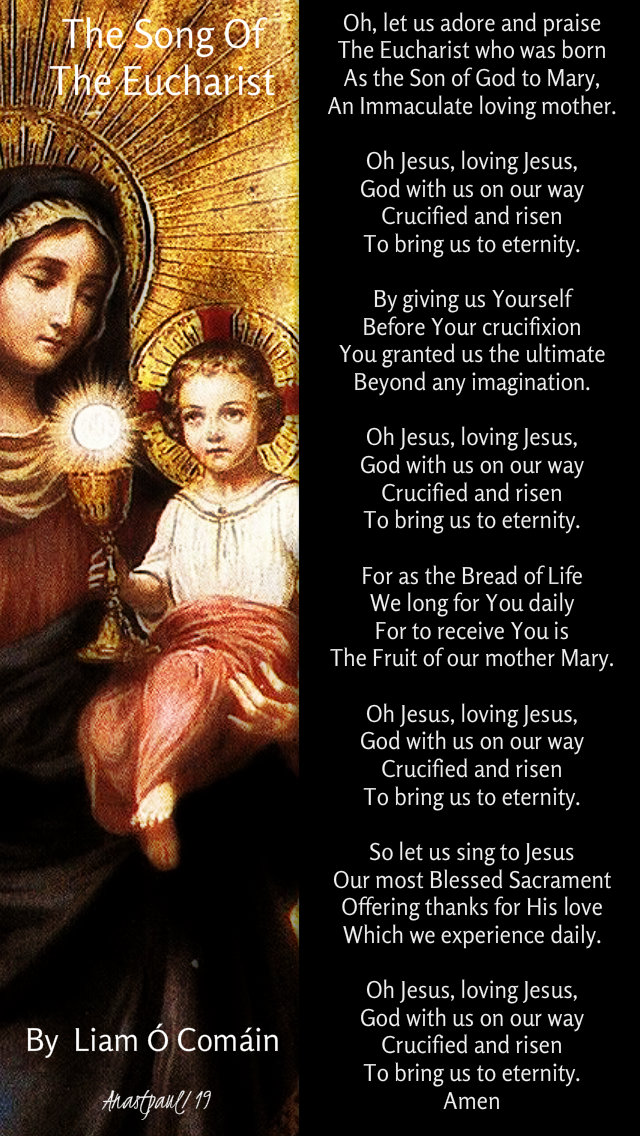
The Song Of The Eucharist
By Liam Ó Comáin

Oh, let us adore and praise
The Eucharist who was born
As the Son of God to Mary,
An immaculate loving mother.

Oh Jesus, loving Jesus,
God with us on our way
Crucified and risen
To bring us to eternity.

By giving us Yourself
Before Your crucifixion
You granted us the ultimate
Beyond any imagination.

Oh Jesus, loving Jesus,
God with us on our way
Crucified and risen
To bring us to eternity.

For as the Bread of Life
We long for You daily
For to receive You is
The Fruit of our mother Mary.

Oh Jesus, loving Jesus,
God with us on our way
Crucified and risen
To bring us to eternity.

So let us sing to Jesus
Our most Blessed Sacrament
Offering thanks for His love
Which we experience daily.

Oh Jesus, loving Jesus,
God with us on our way
Crucified and risen
To bring us to eternity.

Amen

“The Truth is that Jesus,
is the greatest of all poems!
In truth, He is the Poet of all poets!
The mystical Source of the Art of all arts!”

Liam Ó Comáin

The author was born in the Town of Limavady in the Valley of the Roe in the County of Derry, in the north of Ireland. His birth name in English was William Cummings ( Young Bar The Door) but later on in life he changed his name to its Irish Gaelic form.
A great lover of poetry and, in due course, Liam has had books published about poetry, mysticism, politics and the sport of Pigeon Racing.   He has also written for the media.
A graduate from the Open University and the University Of Ulster at Coleraine in Psychologyand Philosophy (plus).the song of the eucharist by liam o comain o let us adore and praise - 29 dec 2019 feast of the holy family.jpg

Posted in CHRISTMASTIDE!, FEASTS and SOLEMNITIES, HYMNS, POETRY, SAINT of the DAY

Thought for the Day – 28 December – Lully, Lullay, thou little tiny child

Thought for the Day – 28 December – The Feast of the Holy Innocents – The Fourth Day of the Christmas Octave

Herod “the Great,” king of Judea, was unpopular with his people because of his connections with the Romans and his religious indifference.   Hence he was insecure and fearful of any threat to his throne.   He was a master politician and a tyrant capable of extreme brutality.   He killed his wife, his brother and his sister’s two husbands, to name only a few.

Matthew 2:1-18 tells this story:  Herod was “greatly troubled” when astrologers from the east came asking the whereabouts of “the newborn king of the Jews,” whose star they had seen.   They were told that the Jewish Scriptures named Bethlehem as the place where the Messiah would be born.   Herod cunningly told them to report back to him so that he could also “do him homage.”   They found Jesus, offered him their gifts, and warned by an angel, avoided Herod on their way home. Jesus escaped to Egypt.

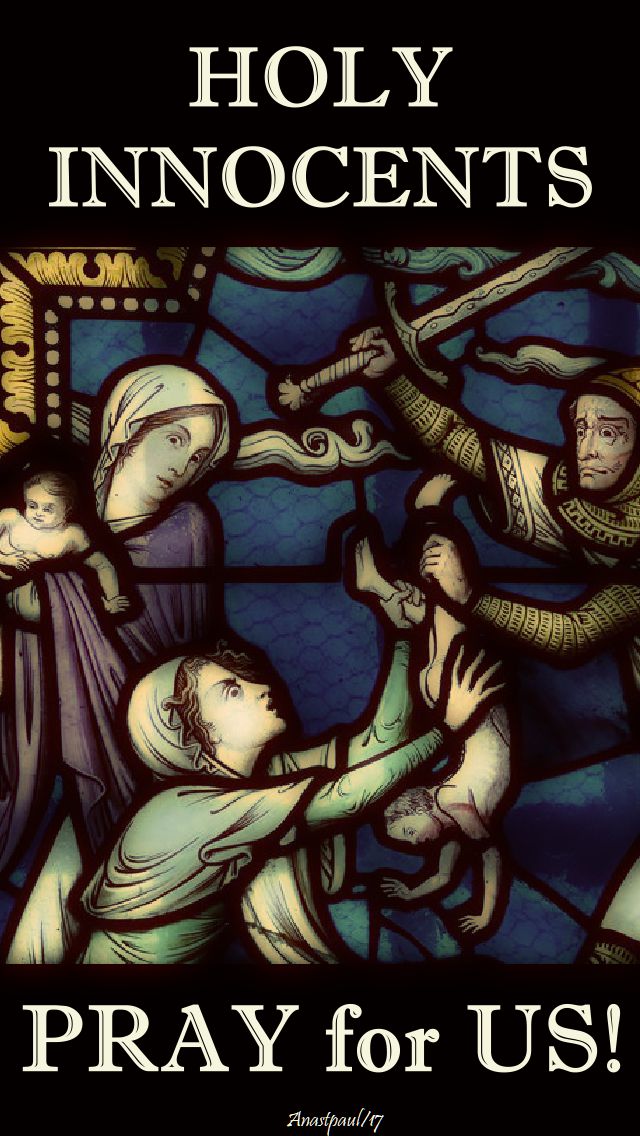
Herod became furious and “ordered the massacre of all the boys in Bethlehem and its vicinity two years old and under.”   The horror of the massacre and the devastation of the mothers and fathers led Matthew to quote Jeremiah:   “A voice was heard in Ramah, sobbing and loud lamentation, Rachel weeping for her children…” (Matthew 2:18). Rachel was the wife of Jacob (Israel).   She is pictured as weeping at the place where the Israelites were herded together by the conquering Assyrians for their march into captivity.

The Holy Innocents are few in comparison to the genocide and abortion of our day.   But even if there had been only one, we recognise the greatest treasure God put on the earth—a human person, destined for eternity and graced by Jesus’ death and resurrection.

The 15th Century English Carol commemorates the slaughter of the Holy Innocents.

Lully, Lullay, thou little tiny child.
Bye, bye, lully, lullay.
Lullay thou little tiny child
Bye, bye, lully, lullay

O sisters, too, how may we do,
For to preserve this day,
This poor Youngling for whom we sing
Bye, bye lully, lullay

Herod the King, in his raging,
Charged he hath this day,
His men of might, in his own sight,
All young children to slay.

Then woe is me, poor child, for thee,
And ever mourn and say;
For thy parting neither say nor sing,
Bye, bye lully, lullay.

Holy Innocents, Pray for Us!holy-innocents-pray-for-us-no-2-28-dec-2017,2018,2019.jpg


Posted in DOCTORS of the Church, MARIAN PRAYERS, MARIAN QUOTES, POETRY, PRAYERS of the SAINTS, QUOTES of the SAINTS, QUOTES on DISCIPLESHIP, QUOTES on FAITH, QUOTES on PEACE, QUOTES on SANCTITY, QUOTES on SILENCE, QUOTES on the CROSS of CHRIST, SAINT of the DAY, The HOLY CROSS

Quote/s of the Day – 14 December – St John of the Cross

Quote/s of the Day – 14 December – The Memorial of St John of the Cross (1542-1591) Doctor of the Church

“Silence is God’s first language.”silence is god's first language st john of the cross 10 sept 2019.jpg

“Most holy Mary,
Virgin of virgins,
shrine of the most Holy Trinity,
joy of the angels,
sure refuge of sinners,
take pity on our sorrows,
mercifully accept our sighs
and appease the wrath
of your most holy Son.
Amen”

most holy virgin sure refuge of sinners - st john of the cross - 11 may 2019.jpg

“O blessed Jesus,
give me stillness of soul in You.
Let Your mighty calmness reign in me.
Rule me, O King of Gentleness,
King of Peace.”

o king of gentleness st john of the cross 14dec 2018 no 3.jpg

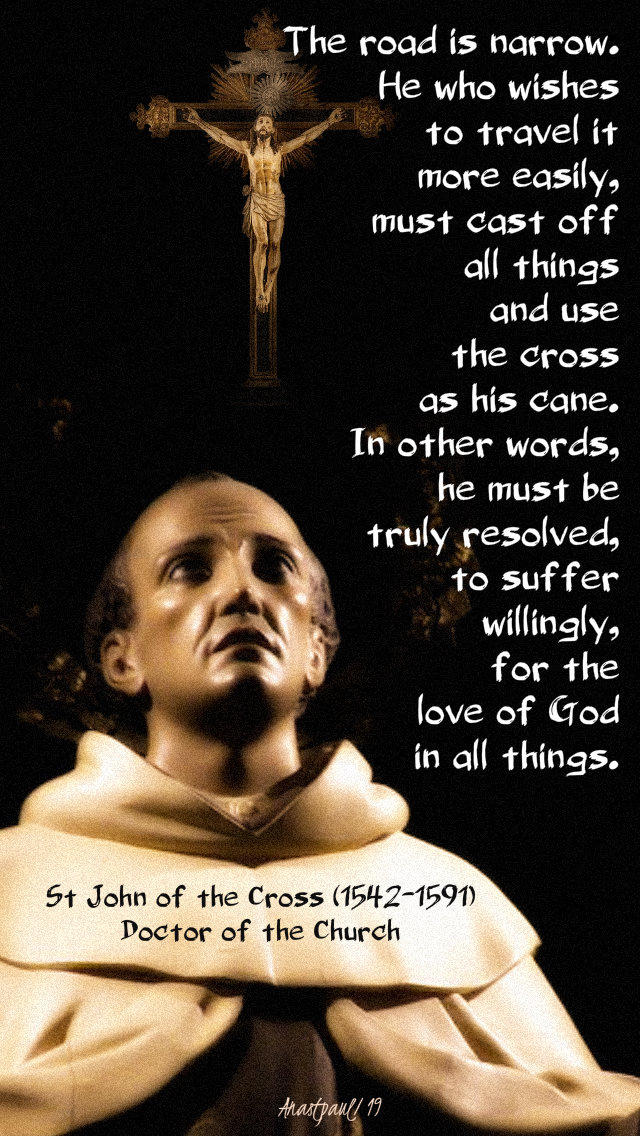
“The road is narrow.
He who wishes to travel it more easily
must cast off all things and use the cross as his cane.
In other words, he must be truly resolved
to suffer willingly for the love of God in all things.”the road is narrow - st john of the cross 9 july 2019 chinese martyrs.jpg

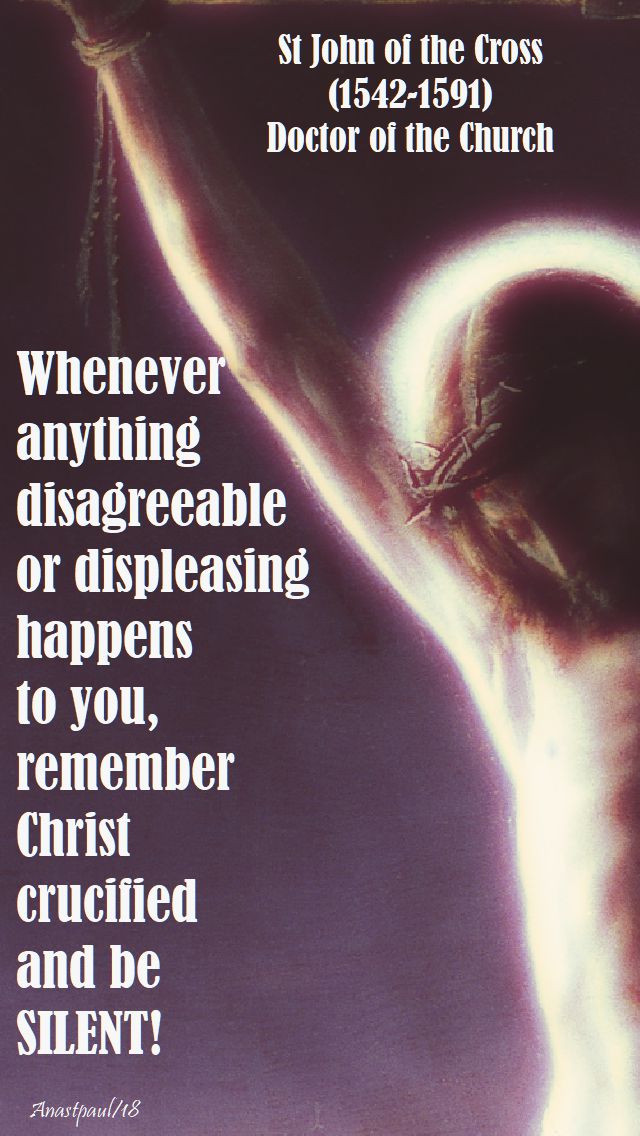
“Whenever anything disagreeable
or displeasing happens to you,
remember Christ crucified
and be silent!”whenever anything displeasing - st john of the cross - 1 july 2018

‘Song of the soul that is glad to know God by faith’

How well I know that fountain’s rushing flow
Although by night

Its deathless spring is hidden. Even so
Full well I guess from whence its source flow
Though it be night.

Its origin (since it has none) none knows:
But that all origin from it arose
Although by night.

I know there is no other thing so fair
And earth and heaven drink refreshment there
Although by night.

Full well I know the depth no man can sound
And that no ford to cross it can be found
Though it be night

Its clarity unclouded still shall be:
Out of it comes the light by which we see
Though it be night.

Flush with its banks the stream so proudly swells;
I know it waters nations, heavens, and hells
Though it be night.

The current that is nourished by this source
I know to be omnipotent in force
Although by night.

(Translated by Roy Campbell)

St John of the Cross (1542-1591) Doctor of the Churchsong-of-the-soul-that-is-glad-to-know-god-by-faith-st-j-of-the-cross-14-dec-2017 and 14dec 2019.jpg

More here: 

https://anastpaul.com/2018/12/14/quotes-of-the-day-14-december-st-john-of-the-cross-1542-1591-doctor-of-the-church/

Posted in ADVENT PRAYERS, CATHOLIC-PRAYERS OF THE CHURCH, CHRISTMASTIDE!, HYMNS, MARIAN POETRY, MARIAN PRAYERS, MARIAN Saturdays, Our MORNING Offering, POETRY, PRAYERS of the CHURCH, PRAYERS of the SAINTS, SAINT of the DAY, The ANNUNCIATION, The INCARNATION, The LITTLE OFFICE of MARY, The NATIVITY of JESUS

Our Morning Offering – 14 December – The God whom earth and sea and sky

Our Morning Offering – 14 December – Saturday of the Second week of Advent, Year A, the Memorial of St Venantius Fortunatus (c 530 – c 609) and a Marian Saturday

The God whom earth and sea and sky
For Mary, The Mother of God
For the Annunciation and Christmas
By St Venantius Fortunatus (c 530 – c 609)

The God whom earth and sea and sky
Adore and praise and magnify,
Whose might they claim, whose love they tell,
In Mary’s body comes to dwell.

O Mother blest! the chosen shrine
Wherein the architect divine,
Whose hand contains the earth and sky,
Has come in human form to lie.

Blest in the message Gabriel brought,
Blest in the work the Spirit wrought,
Most blest, to bring to human birth
The long desired of all the earth.

O Lord, the Virgin-born, to you
Eternal praise and laud are due,
Whom with the Father we adore
And Spirit blest for evermore.

the god whom earth and sea and sky st venantius fortunatus 14 dec 2019 hymn poem for mary

Posted in CATHOLIC-PRAYERS OF THE CHURCH, HYMNS, POETRY, PRAYERS of the CHURCH, SAINT of the DAY, The HOLY CROSS

Saint of the Day – 14 December – Saint Venantius Fortunatus (c 530 – c 609)

Saint of the Day – 14 December – Saint Venantius Fortunatus (c 530 – c 609) Bishop, Poet, Hymnist, Writer – born c 530 at Rreviso, Italy and died c 609 at Poitiers, modern France of natural causes.

Today’s saint was unique, first a travelling lay poet, he later became a Priest and then a Bishop.   But he always remained a professional author of poetry, a “troubadour” of Christ.st venantius fortunatus 1.jpg

His impressive full name was Venantius Honorius Clementianus Fortunatus.   Born near Treviso in northern Italy, he received a good education in literature and law.

While studying at Ravenna, he was cured of an eye ailment by the intercession of St Martin of Tours.   To express his gratitude to the Gallic saint, he set out for France, intent on a thanksgiving visit to St Martin’s tomb.   He did not take the shortest route, however. He went to Mainz, Cologne, Trier and Metz in Germany, then crossed into Gaul (France) and visited Verdun, Rheims, Soissons and Paris before he reached his destination.   We know all this, because, we have the poetry he wrote for benefactors in each of these places.   Thus he earned his fare.

After Venantius had thanked the Saint of Tours, he went over to Poitiers, also in France and became attached to the Monastery of the Holy Cross at that place.   He had been attracted by the work that St Radegund was doing at Poitiers.

Radegund was the daughter of the King of Thuringia.   King Clotaire of the Franks had captured her and forced her to marry him.   Escaping from her husband, the unwilling queen had taken the veil at Poitiers and founded Holy Cross Abbey.   She chose her adopted daughter Agnes as abbess.   Venantius, who had a great sensitivity to women in need, volunteered to serve this monastery as its unofficial steward.   Later, he entered the priesthood and became the monastery’s chaplain.   His “mother” (as he called St Radegund) and his “sister” (as he called Abbess Agnes) were a good and gracious influence on him.ST venantius fortunatus AlmaTadema-VenantiusFortunatus.jpg

It was in 569, while Venantius was serving Holy Cross Abbey, that the Emperor Justin II sent to Queen Radegund a generous relic of the true Cross of Jesus.   King Sigebert of Gaul arranged for a splendid ceremony to welcome this relic.   Venantius composed the hymn Vexilla Regis, (“The royal banners forward go.”)   One of the greatest of the medieval hymns, it continued to be chanted at the rites of Good Friday until the 1960s.

When St Radegund died in 587, Fortunatus was freer to travel about.   Wherever he went, he was still prevailed on to write new poems.   From 599 to 609 he was also bishop of Poitiers.   As such, he was a close associate of three other notable bishops – Saints Felix of Nantes, Leontius of Bordeaux and Gregory of Tours.  St Gregory urged him to collect and publish his poetical works.   He did so and it amounted to ten fat volumes.   More volumes were added after his death.

He had written cheerfully for every sort of celebration.   Some of his poems were complimentary, some were lives of the saints but the most durable were his devotional works.   Another of these was sung, like the Vexilla Regis, in the Good Friday liturgy: “Pange lingua gloriosi lauream certaminis” (“Sing, my tongue, the Saviour’s glory”).   A third is still used (in translation) for Easter – Salve festa dies (“Hail thee, festival day”).   St Venantius also wrote hymns to Mary – “Quem terra, fontes, aethera” (“To God whom earth and sea and sky”) and perhaps even the popular “Ave Maris Stella” (“Hail, bright star of ocean”).

Fortunatus wrote panegyrics and other types of poems, including praise, eulogies, personal poems to bishops and friends alike, consolations and poems in support of political issues, particularly those presented by his friends Gregory of Tours and Radegunde.   His eleven books of poetry contain his surviving poems, all ordered chronologically and by importance of subject.   For instance, a poem about God will come before the panegyric to a king, which will come before a eulogy to aBishop.  This collection of poems is the main primary source for writing about his life.

Venantius died with a reputation for genial holiness.   Although he has never been listed as a saint in the official Roman Martyrology, he was honoured as such even during his lifetime and now, in several French and Italian dioceses, great feasts are still held in his honour.   As a poet, his devotional verge can show a depth of poetic piety.   Thus, in addressing the Cross in his Vexilla Regis, he sings touchingly – (I took the liberty of making an image of this beautiful verse on the Salvidor Dali rendition of “Christ of St John of the Cross” based on St John’s drawing and on his Feast day today).

“On whose dear arms, so widely flung,
The weight of this world’s ransom hung,
The price of humankind to pay
And spoil the spoiler of his prey
All hail, O Cross, our only hope!”on whose dear arms so widely flung - st venantius fortunatus - 14 dec 2019 - exaltation of the holy cross.jpg

In his time, Fortunatus filled a great social desire for Latin poetry  . He was one of the most prominent poets at this point and had many contracts, commissions and correspondences with kings, bishops and noblemen and women from the time he arrived in Gaul until his death.   He used his poetry to advance in society, to promote political ideas he supported, usually conceived of by Radegunde or by Gregory and, to pass on personal thoughts and communications.   He was a master wordsmith and because of his promotion of the church, as well as the Roman tendencies of the Frankish royalty, he remained in favour with most of his acquaintances throughout his lifetime.

Posted in MARIAN QUOTES, MARIAN TITLES, MATER DOLOROSA - Mother of SORROWS, POETRY, QUOTES of the SAINTS, QUOTES on the CROSS of CHRIST, SAINT of the DAY, The HOLY CROSS, The PASSION

Thought for the Day – 16 November – I grieve, Mary, for thy son and thee.

Thought for the Day – 16 November – The Memorial of St Edmund Rich of Abingdon (1175-1240) Archbishop of Canterbury

St Edmund’s best-known work in the Middle Ages was his Speculum Ecclesie.   It’s a work on the contemplative life, offering (among other things) meditations on different moments in the life of Christ, aiming to help the reader to enter imaginatively into the scenes of His Passion and feel intense compassion for His sufferings.   I don’t know whether people read the Speculum Ecclesie today, but most students of Middle English will have read a poem which survives as part of it.   This is one of the earliest, shortest and most popular devotional poems in Middle English:

Nou goth sonne under wod,
Me reweth, Marie, thi faire rode.
Nou goth sonne under tre,
Me reweth, Marie, thi sone and thee.

Now goes the sun under the wood,
I grieve, Mary, for your fair face.
Now goes the sun under the tree,
I grieve, Mary, for thy son and thee.

This short poem is designed to be a spur to meditation on the Crucifixion, perhaps at the appropriate hour of the day when the sun begins to set.   Apparently very simple, the poem is dense with meaningful wordplay – as the sun sets behind the wood, so Christ the Son is shrouded in darkness on the wood of the cross, the tree; that is, the ‘rode’, which means both ‘face’ and ‘rood’ (cross).   And here we have another pair of a mother and her son, and their strong emotional bond (like St Edmund himself and his mother).   The poem encourages the reader to meditate and dwell on Christ’s Crucifixion by approaching the Son through the Mother, to feel compassion for His suffering as it is reflected in her grief (underlined by that wordplay on ‘rode’ – (His cross and her face). How wonderful it is that this poem should be associated with a saint whose mother was such an important presence in his life.

Back in Abingdon, the Catholic church is dedicated to him and to the Virgin Mary, the mother and bride who was so constant a presence in his spiritual life.

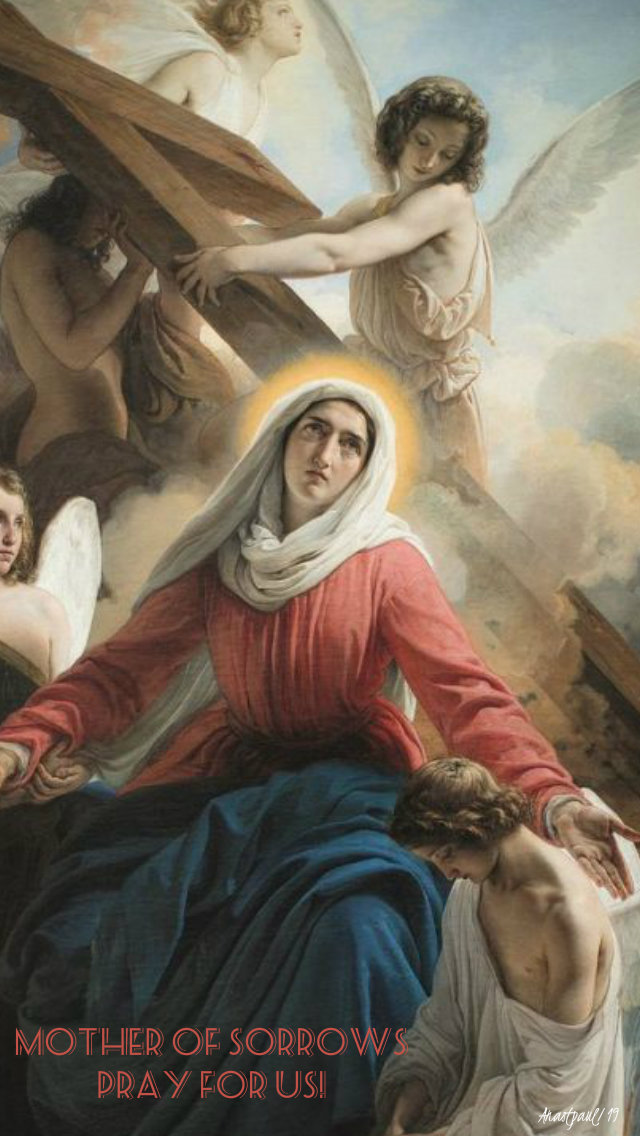
Mother of Sorrows, Pray for Us!

St Edmund, Pray for Us!mother of sorrows pray for us 16 nov 2019

Posted in CARMELITES, EUCHARISTIC Adoration, POETRY, PRACTISING CATHOLIC, QUOTES of the SAINTS, QUOTES on PEACE, QUOTES on SILENCE, QUOTES on the CROSS of CHRIST, SAINT of the DAY, The HOLY CROSS, The HOLY EUCHARIST / The HOLY MASS, The LAMB of GOD

Thought for the Day – 8 November – To Surrender To Love

Thought for the Day – 8 November – The Memorial of St Elizabeth of the Trinity O.Carm (1880-1906)

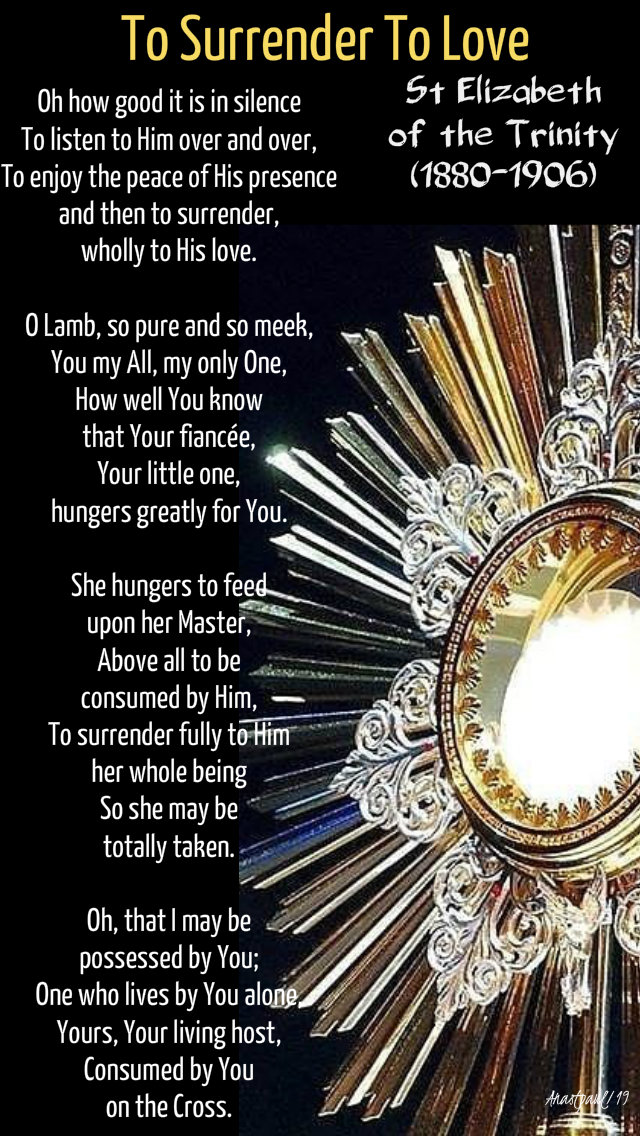
To Surrender To Love
By St Elizabeth of the Trinity (1880-1906)

Oh how good it is in silence
To listen to Him over and over,
To enjoy the peace of His presence
and then to surrender, wholly to His love.

O Lamb, so pure and so meek,
You my All, my only One,
How well You know that Your fiancée,
Your little one, hungers greatly for You.

She hungers to feed upon her Master,
Above all to be consumed by Him,
To surrender fully to Him her whole being
So she may be totally taken.

Oh, that I may be possessed by You;
One who lives by You alone,
Yours, Your living host,
Consumed by You on the Cross.to surrender to love st elizabeth of the trinity 8 nov 2019

Posted in DIVINE Mercy, Goodness, Patience, POETRY, QUOTES of the SAINTS, QUOTES on REPENTANCE, SAINT of the DAY, The WORD

One Minute Reflection – 7 November – ‘Rejoice with me, for I have found my sheep which was lost.’

One Minute Reflection – 7 November – Thursday of the Thirty First week in Ordinary Time, Year C, Gospel: Luke 15:1–10 and the Memorial of Saint Vincenzo Grossi (1845-1917)

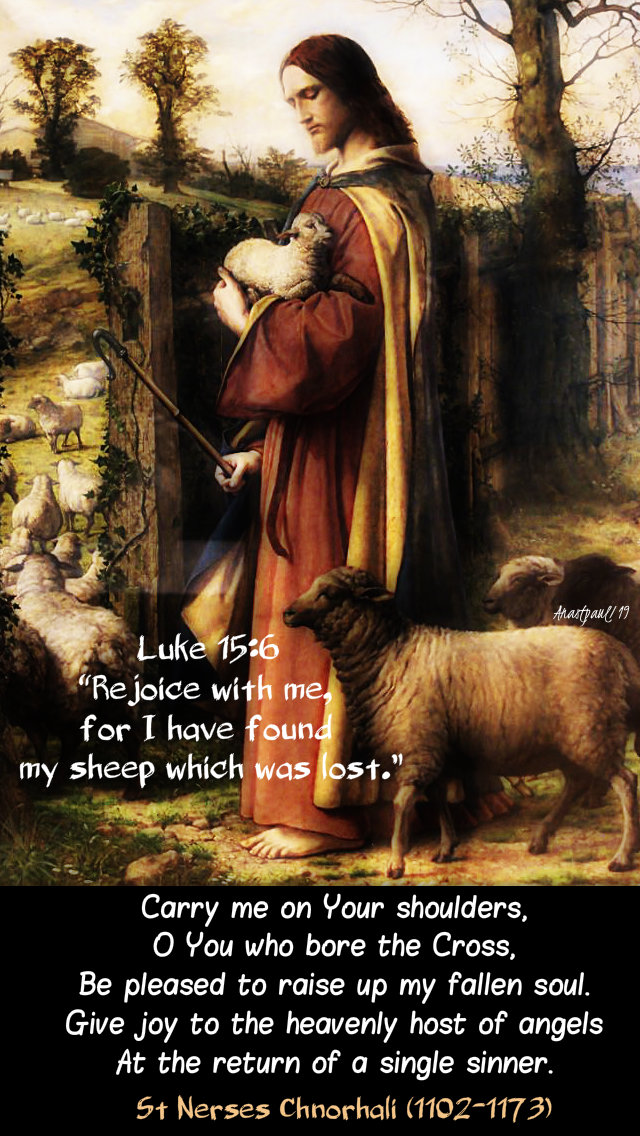
“‘Rejoice with me, for I have found my sheep which was lost.’”… Luke 15:6

REFLECTION –
“I have wandered in the desert,
Gone astray in the wilderness,
One among a hundred
As in the parable of the sheep.

The wicked enemy tore it to pieces,
He covered it with incurable wounds,
Hence there is no other cure for the wound
But You, to heal it.

In floods of tears I implore You,
I lift up my cries to my Lord:
O Good Shepherd, come down from heaven,
Go in search of the little flock.

Lord, seek out the fallen coin,
Your image that was lost (Gn 1:26),
That I trampled in the vice of sin
And the stinking mud.

Wash me, Lord, from my filth,
Make my soul pure, as the whiteness of snow (Is 1:18).
Make up the number of the ten coins
As You did for the forty saints [of Sebaste].

Carry me on Your shoulders,
O You who bore the Cross,
Be pleased to raise up my fallen soul.
Give joy to the heavenly host of angels
At the return of a single sinner.” … Saint Nerses Chnorhali (1102-1173), Armenian Bishopluke 15 6 rejoice with me for i have found - carry me on your shoulders - st nerses chnorhali 7 nov 2019

PRAYER – Lord God, in Your wisdom, You created us, by Your providence You rule us, penetrate our inmost being with Your holy light, so that our way of life, may always be one of faithful service to You. With great love we thank You for the great gifts You shower upon us and for being our Father, who seeks and finds us when we are lost.   Grant that by the intercession of St Vincenzo Grossi, we may ever seek to stay true to our baptism. Through Jesus, our Lord, with the Holy Spirit, God forever, amen.st vincenzo grossi pray for us 7 nov 2019

Posted in ART DEI, HYMNS, Our MORNING Offering, POETRY, PRAYERS of the SAINTS

Our Morning Offering – 6 November – Tis I – Be not Afraid!

Our Morning Offering – 6 November – Wednesday of the Thirty  First week in Ordinary Time, Year C

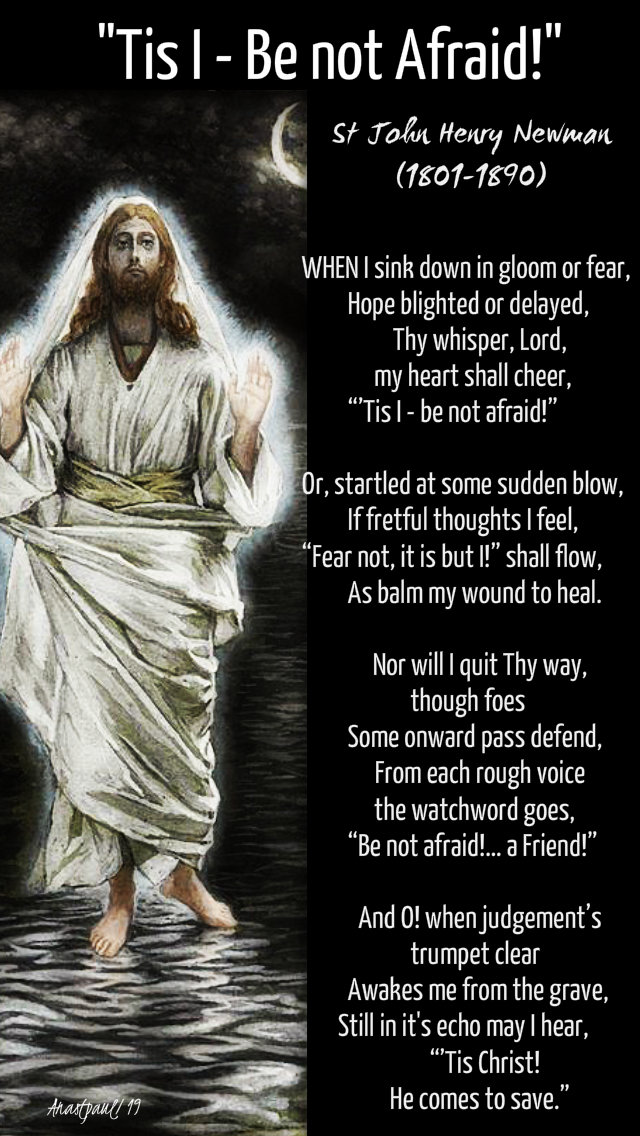
Tis I – Be not Afraid!
St John Henry Newman (1801-1890)

WHEN I sink down in gloom or fear,
Hope blighted or delayed,
Thy whisper, Lord, my heart shall cheer,
“’Tis I – be not afraid!”

Or, startled at some sudden blow,
If fretful thoughts I feel,
“Fear not, it is but I!” shall flow,
As balm my wound to heal.

Nor will I quit Thy way, though foes
Some onward pass defend,
From each rough voice the watchword goes,
“Be not afraid!… a Friend!”

And O! when judgement’s trumpet clear
Awakes me from the grave,
Still in it’s echo may I hear,
“’Tis Christ! He comes to save.”tis I be not afraid - st john henry newman 6 nov 2019.jpg

Posted in FEASTS and SOLEMNITIES, ON the SAINTS, POETRY, QUOTES - J R R Tolkien and MORE, QUOTES of the SAINTS, The WORD

Quote/s of the Day – 1 November – On the Saints

Quote/s of the Day – 1 November – The Solemnity of All Saints

“Follow Me”

Matthew 9:9matthew 9 9 the calling of matthew follow me 21 sept 2019

“Follow the saints,
because those who follow them
will become saints.”

Saint Pope Clement I (c 35-99)follow the saints - 17 august 2019 st pope clement I

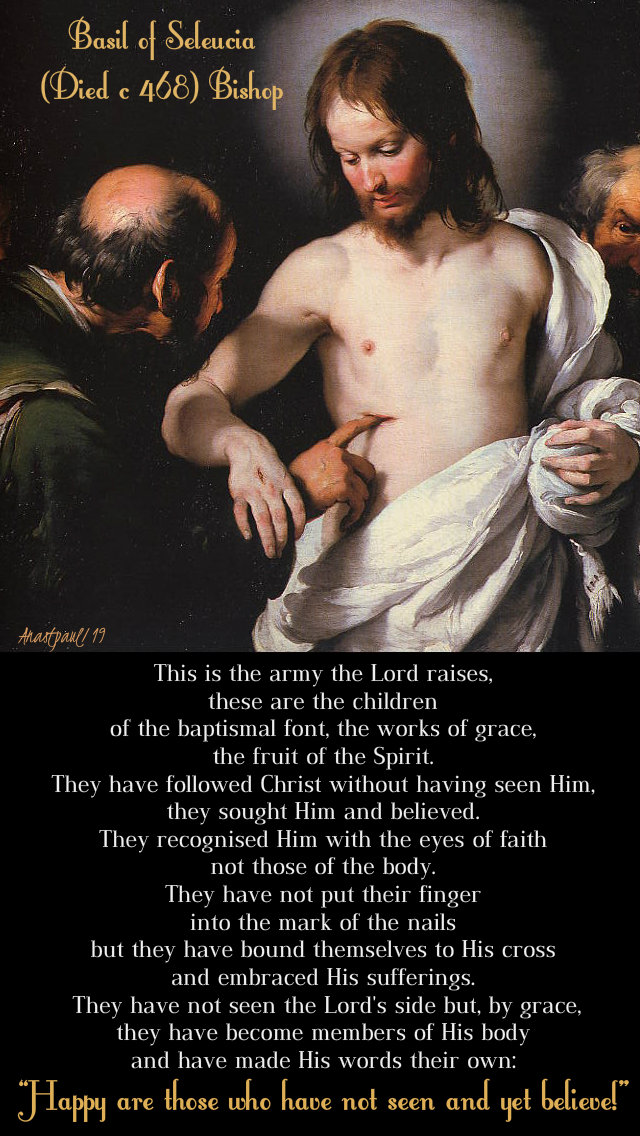
“This is the army the Lord raises,
these are the children of the baptismal font,
the works of grace, the fruit of the Spirit.
They have followed Christ without having seen Him,
they sought Him and believed.
They recognised Him with the eyes of faith not those of the body.
They have not put their finger into the mark of the nails
but they have bound themselves to His cross and embraced His sufferings.
They have not seen the Lord’s side but, by grace,
they have become members of His body
and have made His words their own:
“Happy are those who have not seen and yet believe!”

Basil of Seleucia (Died c 468) Bishopthis-is-the-army-the-lord-raises-basil-of-seleucia-feast-of-st-thomas-3-july-2019 AND 1 NOV 2019.jpg

The Angel to Gerontius
“There was a mortal, who is now above
In the mid-glory – he, when near to die,
Was given communion with the Crucified –
Such, that the Master’s very wounds were stamp’d
Upon his flesh and, from the agony
Which thrill’d through body and soul in that embrace
Learn, that the flame of the Everlasting Love
Doth burn, ere it transform ….”

From the Dream of Gerontius
Blessed John Henry Newman (1801-1890)the-angel-to-gerontius-from-the-dram-of-gerontius-bl-john-henry-newman-on-st-francis-4-oct-2019 AND 1 NOV 2019.jpg

“God creates out of nothing.
Wonderful you say.
Yes, to be sure but He does.
what is still more wonderful,
He makes saints out of sinners.”god creates out of nothing - soren kierkegaard - 1 nov 2017

“The tyrant dies and his rule is over,
the Martyr dies and his rule begins.”

Soren Kierkegaard (1813-1855)the tyrant dies and his rule is over the martyr dies and his rule begins - soren kierkegaard 21 jan 2019

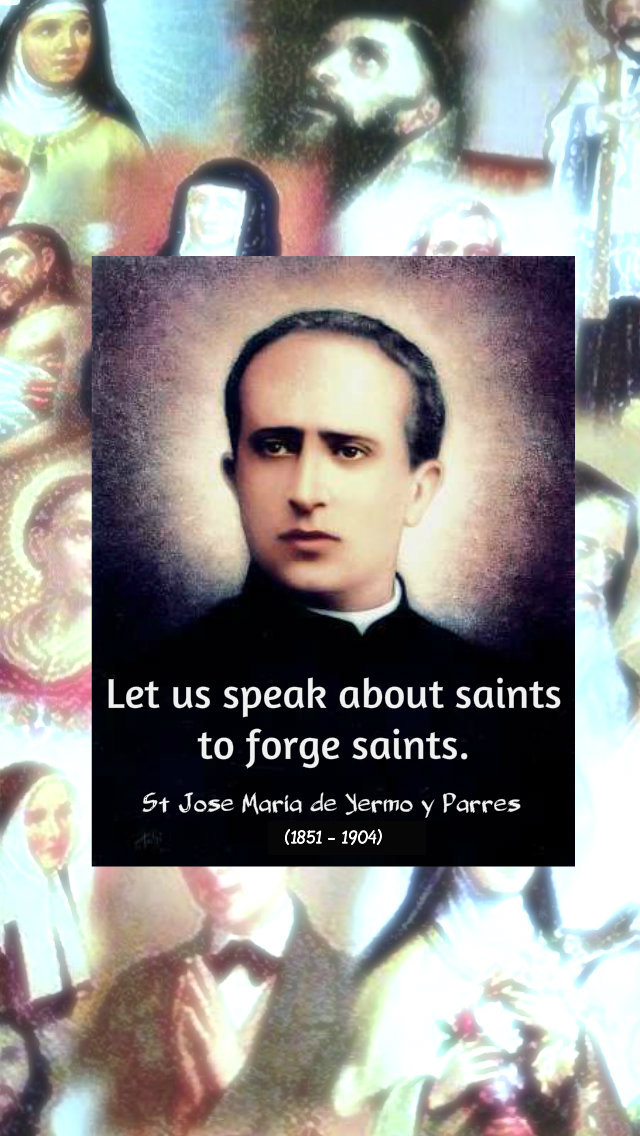
“Let us speak about saints to forge saints.”

Saint Jose Maria de Yermo y Parres (1851–1904)let us spak about saints to forge saints - st jose maria parres 20 sept 2019.jpg

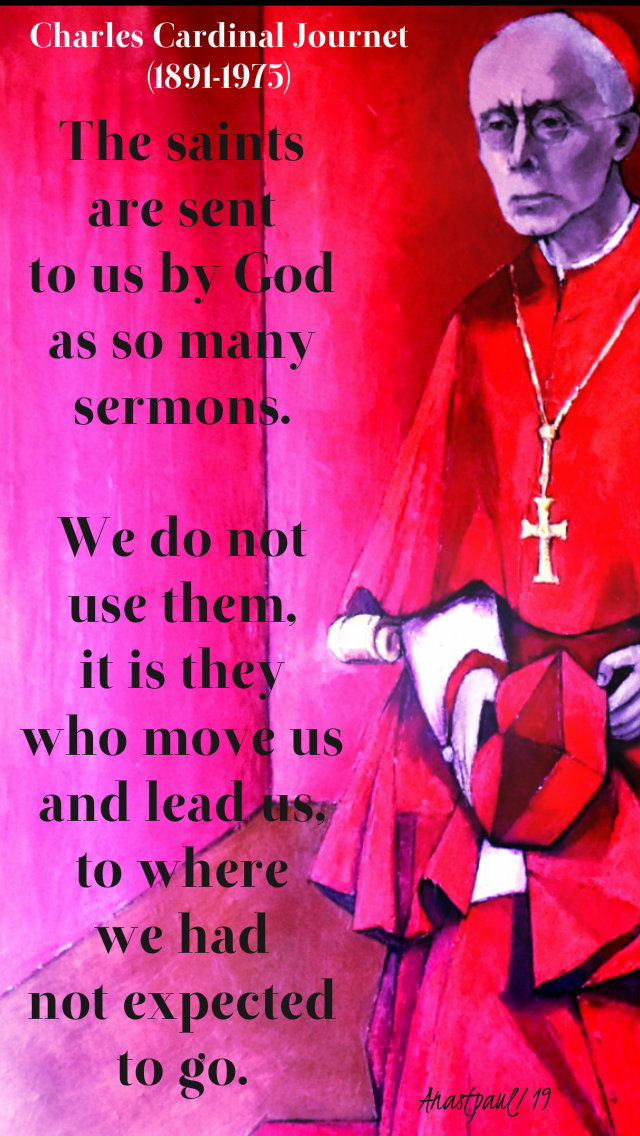
“For the saints are sent to us by God
as so many sermons.
We do not use them, it is they who move us
and lead us, to where we had not expected to go.”

Charles Cardinal Journet (1891-1975)

More here:
https://anastpaul.com/2018/11/01/quote-s-of-the-day-1-november-the-solemnity-of-all-the-saints/

the saints are sent to us by god - card charles journet 21 march 2019.jpg

Posted in Gerard MANLEY HOPKINS SJ, JESUIT SJ, POETRY, SAINT of the DAY

Thought for the Day – 31 October – ‘That in Majorca, Alfonso watched the door.’

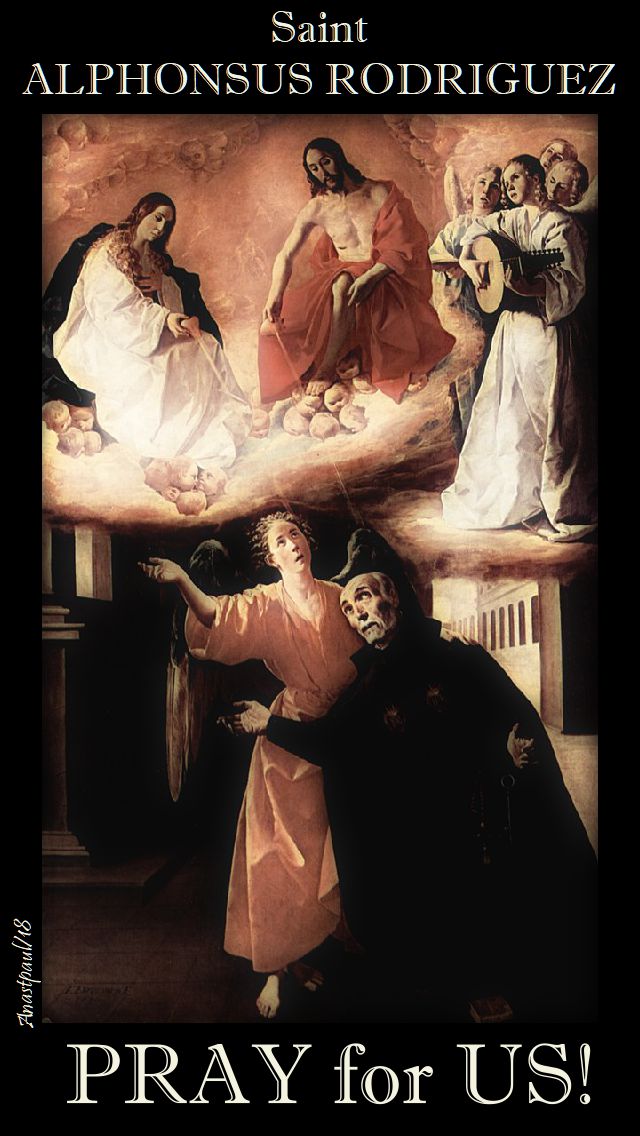
Thought for the Day – 31 October – The Memorial of St Alphonsus Rodriguez SJ (1532-1617)

Tragedy and challenge beset today’s saint early in life but Alphonsus Rodriguez found happiness and contentment, through simple service and prayer.

Born in Spain in 1533, Alphonsus inherited the family textile business at 23.   Within the space of three years, his wife, daughter and mother died.   Meanwhile, business was poor.   Alphonsus stepped back and reassessed his life  . He sold the business and, with his young son, moved into his sister’s home.   There he learned the discipline of prayer and meditation.
At the death of his son years later, Alphonsus, almost 40 by then, sought to join the Jesuits.   He was not helped by his poor education.   He applied twice before being admitted.   For 45 years he served as doorkeeper at the Jesuits’ college in Majorca.   When not at his post, he was almost always at prayer, though he often encountered difficulties and temptations.

His holiness and prayerfulness attracted many to him, including Saint Peter Claver, then a Jesuit seminarian.  Alphonsus died in 1617. He is the patron saint of Majorca.

We like to think that God rewards the good, even in this life.   But Alphonsus knew business losses, painful bereavement and periods when God seemed very distant.   None of his suffering made him withdraw into a shell of self-pity or bitterness.   Rather, he reached out to others who lived with pain, including enslaved Africans.   Among the many notables at his funeral were the sick and poor people whose lives he had touched. May they find such a friend in us!
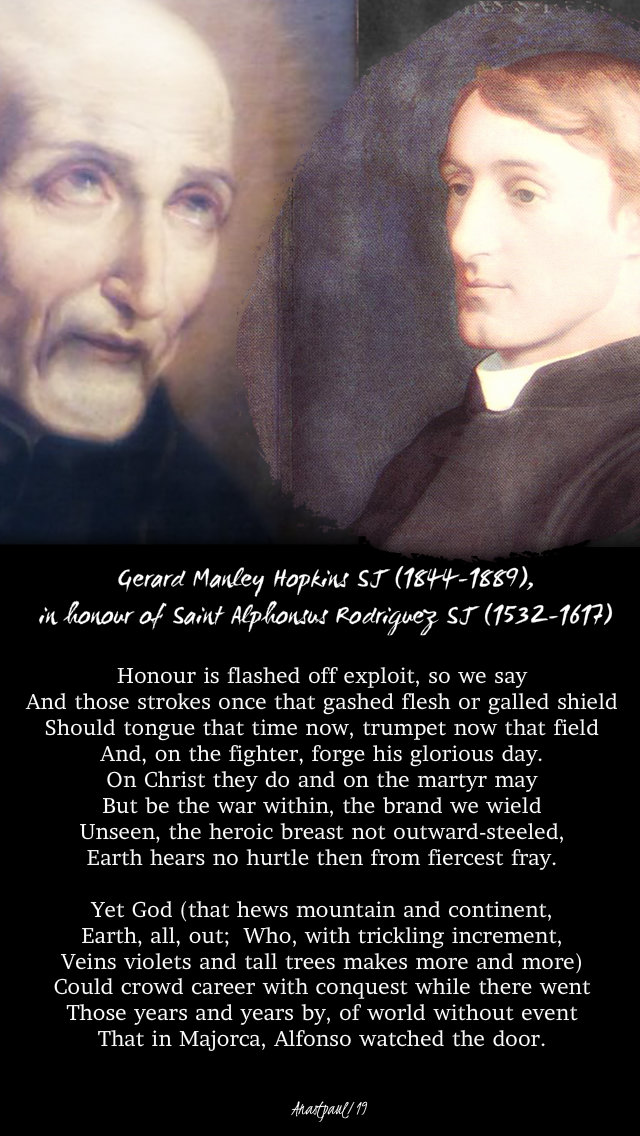
Alphonsus’ life as doorkeeper may have been humdrum but centuries later he caught the attention of poet and fellow-Jesuit Gerard Manley Hopkins, who made him the subject of one of his most famous poems.

Honour is flashed off exploit, so we say
And those strokes once that gashed flesh or galled shield
Should tongue that time now, trumpet now that field
And, on the fighter, forge his glorious day.
On Christ they do and on the martyr may
But be the war within, the brand we wield
Unseen, the heroic breast not outward-steeled,
Earth hears no hurtle then from fiercest fray.

Yet God (that hews mountain and continent,
Earth, all, out;  Who, with trickling increment,
Veins violets and tall trees makes more and more)
Could crowd career with conquest while there went
Those years and years by, of world without event
That in Majorca, Alfonso watched the door.

Gerard Manley Hopkins SJ (1844-1889),
in honour of Saint Alphonsus Rodriguez SJ (1532-1617)gerard manley hopkins poem for st alphonsus rodrigues 31 oct 2019 no 2.jpg

St Alphonsus Rodriguez, Pray for Us!st alphonsus rodriguez pray for us - 31 oct 2018.jpg

Posted in CATHOLIC-PRAYERS OF THE CHURCH, DIVINE Mercy, Goodness, Patience, GOD is LOVE, HYMNS, MINI SERIES, PAPAL SERMONS, POETRY, PRACTISING CATHOLIC, PRAYERS of the CHURCH, PRAYERS of the SAINTS, The MOST HOLY & BLESSED TRINITY, The WORD, VATICAN Resources

Thought for the Day – 29 October – How to speak about God?

Thought for the Day – 29 October – Tuesday of the Thirtieth week in Ordinary Time, Year C, Gospel: Luke 13:18-21

Again he said, …”To what shall I compare the kingdom of God?
It is like yeast that a woman took and mixed in
with three measures of wheat flour
until the whole batch of dough was leavened.” Luke 13:20

Excerpt – Part One
Year of Faith – How to speak about God?

Pope Benedict XVI
Paul VI Audience Hall
Wednesday, 28 November 2012

The important question we ask ourselves today is – how can we talk about God in our time?   How can we communicate the Gospel so as to open roads to His saving truth in our contemporaries’ hearts — that are all too often closed — and minds — that are at times distracted by the many dazzling lights of society? Jesus, the Evangelists tell us, asked Himself about this as He proclaimed the kingdom of God – “With what can we compare the Kingdom of God, or what parable shall we use for it?” (Mk 4:30).

How can we talk about God today?   The first answer is that we can talk about God because He has talked to us, so the first condition for speaking of God is listening to all that God Himself has said.   God has spoken to us!   God is therefore not a distant hypothesis concerning the world’s origin, He is not a mathematical intelligence far from us.   God takes an interest in us, He loves us, He has entered personally into the reality of our history, He has communicated Himself, even to the point of taking flesh.   Thus God is a reality of our life, He is so great that He has time for us too, He takes an interest in us. In Jesus of Nazareth we encounter the face of God, who came down from His heaven to immerse Himself in the human world, in our world, and to teach “the art of living”, the road to happiness, to set us free from sin and make us children of God (cf. Eph 1:5; Rom 8:14).   Jesus came to save us and to show us the good life of the Gospel.

Talking about God means first of all expressing clearly what God we must bring to the men and women of our time, not an abstract God, a hypothesis but a real God, a God who exists, who has entered history and is present in history, the God of Jesus Christ as an answer to the fundamental question of the meaning of life and of how we should live. Consequently speaking of God demands familiarity with Jesus and His Gospel, it implies that we have a real, personal knowledge of God and a strong passion for His plan of salvation without succumbing to the temptation of success but following God’s own method.   God’s method is that of humility — God makes Himself one of us — His method is brought about through the Incarnation in the simple house of Nazareth; through the Grotto of Bethlehem, through the Parable of the Mustard Seed.

We must not fear the humility of taking little steps but trust in the leaven that penetrates the dough and slowly causes it to rise (cf. Mt 13:33).   In talking about God, in the work of evangelisation, under the guidance of the Holy Spirit, we must recover simplicity, we must return to the essence of the proclamation – the Good News of a God who is real and effective, a God who is concerned about us, a God-Love who makes Himself close to us in Jesus Christ, until the Cross and who, in the Resurrection, gives us hope and opens us to a life that has no end, eternal life, true life. – To be continued/…

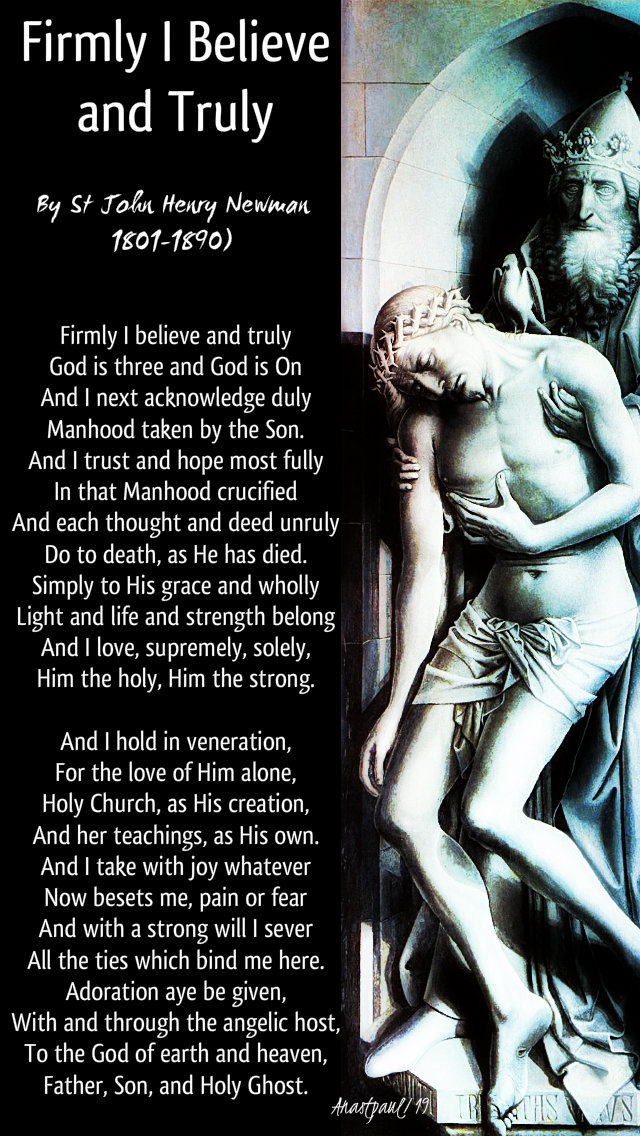
Firmly I believe and truly
St John Henry Newman (1801-1890)

Firmly I believe and truly
God is three and God is On
And I next acknowledge duly
Manhood taken by the Son.
And I trust and hope most fully
In that Manhood crucified
And each thought and deed unruly
Do to death, as He has died.
Simply to His grace and wholly
Light and life and strength belong
And I love, supremely, solely,
Him the holy, Him the strong.

And I hold in veneration,
For the love of Him alone,
Holy Church, as His creation,
And her teachings, as His own.
And I take with joy whatever
Now besets me, pain or fear
And with a strong will I sever
All the ties which bind me here. 
Adoration aye be given,
With and through the angelic host,
To the God of earth and heaven,
Father, Son, and Holy Ghost.firmly i believe and truly st john henry newman 29 oct 2019.jpg

Posted in CATHOLIC-PRAYERS OF THE CHURCH, Hail MARY!, HYMNS, MARIAN POETRY, MARIAN PRAYERS, MARIAN Saturdays, Our MORNING Offering, POETRY, PRAYERS of the CHURCH, The BLESSED VIRGIN MARY

Our Morning Offering – 26 October – Ave Maria, Amen

Our Morning Offering – 26 October – Saturday of the Twenty-ninth week in Ordinary Time, Year C and a Marian Saturday

Ave Maria, Amen
Traditional Catholic Hymn/Poem
Unknown Author

A song ascends from vale to heights,
from town to town a hundred times,
Ave Maria, Amen.

In every place the earth around,
at every bells resound,
Ave Maria, Amen.

All creatures, be they low or high,
send joyous songs up to the sky,
Ave Maria, Amen.

Stars near each other in their rays
and greet each other on their ways,
Ave Maria, Amen.

The angels at the throne of God
with harps and flutes the Highest land,
Ave Maria, Amen.

And all the blest in paradise
to joyous, happy praise give rise,
Ave Maria, Amen.

Thus praises sound through space and time
in everlasting, glorious rhyme,
Ave Maria, Amenave maria amen - trad catholic hymn poem - 26 oct 2019.jpg

Posted in ON the SAINTS, POETRY, SAINT of the DAY

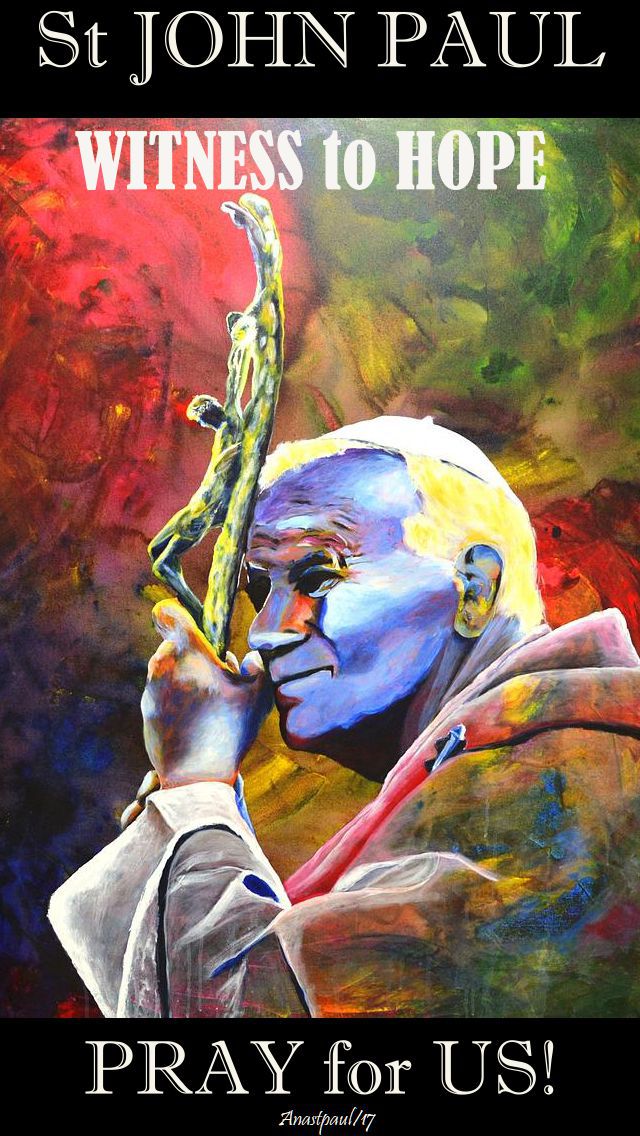
Thought for the Day – 22 October – Happy feast day of St John Paul the Poet!

Thought for the Day – 22 October – The Memorial of St Pope John Paul II (1920-2005)

Happy feast day of St John Paul the Poet!

Many know that St John Paul II’s talents included acting and athletics but did you know the Saint is also an accomplished poet?   He loved to write about nature, humanity and God and wrote poetry throughout his life – as a student, a quarry worker, a priest, bishop and Pope, beginning in 1939 and publishing under pseudonyms in Poland.   It wasn’t until he became Pope that his poetry was published throughout the world.

Known to family and friends as Lolek (a nickname that translates as “Chuck”), the future John Paul II learned about suffering at an early age when his mother died of heart and kidney problems in 1929, shortly before his ninth birthday.  This poem below, “Over This, Your White Grave”” was written before he was twenty.

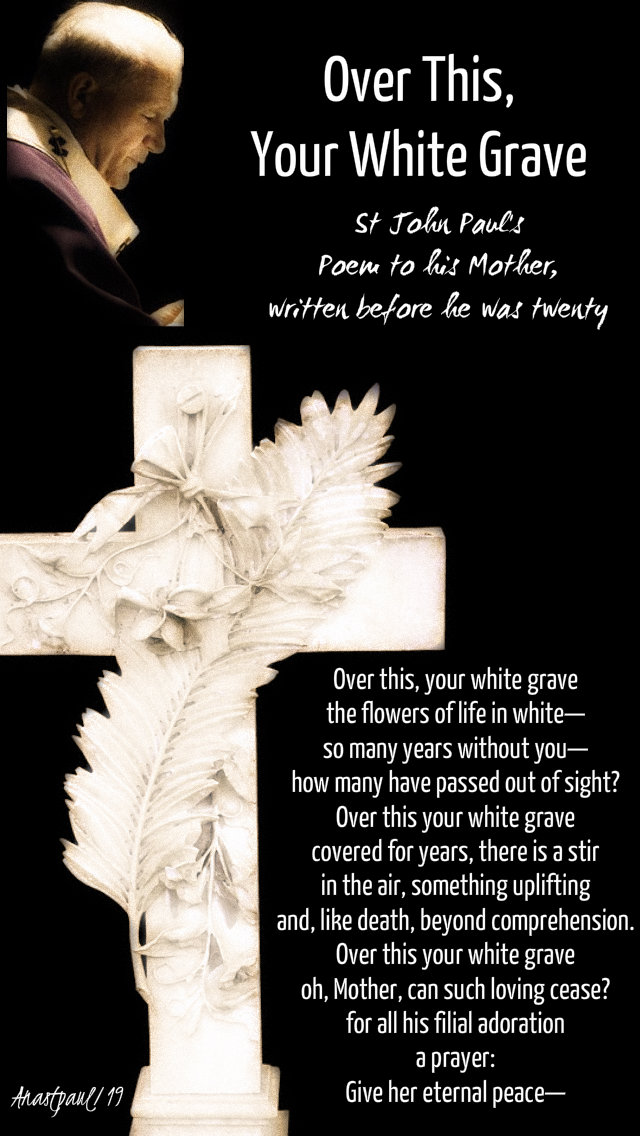
Over This, Your White Grave

Over this, your white grave
the flowers of life in white—
so many years without you—
how many have passed out of sight?
Over this your white grave
covered for years, there is a stir
in the air, something uplifting
and, like death, beyond comprehension.
Over this your white grave
oh, Mother, can such loving cease?
for all his filial adoration
a prayer:
Give her eternal peace—

over this your white grave poem to his mother st john paul 22 oct 2019.jpg

“Veronica?”
“Bernice Veronica” – both names referring to the Woman who wiped the Face of Jesus, commonly depicted in every Catholic church, at the Sixth Station of the Cross.

Did she exist? And what does it mean to be “a Veronica?”

St Pope John Paul II expressed the answer to the question of Veronica most beautifully in his poem, “Name”

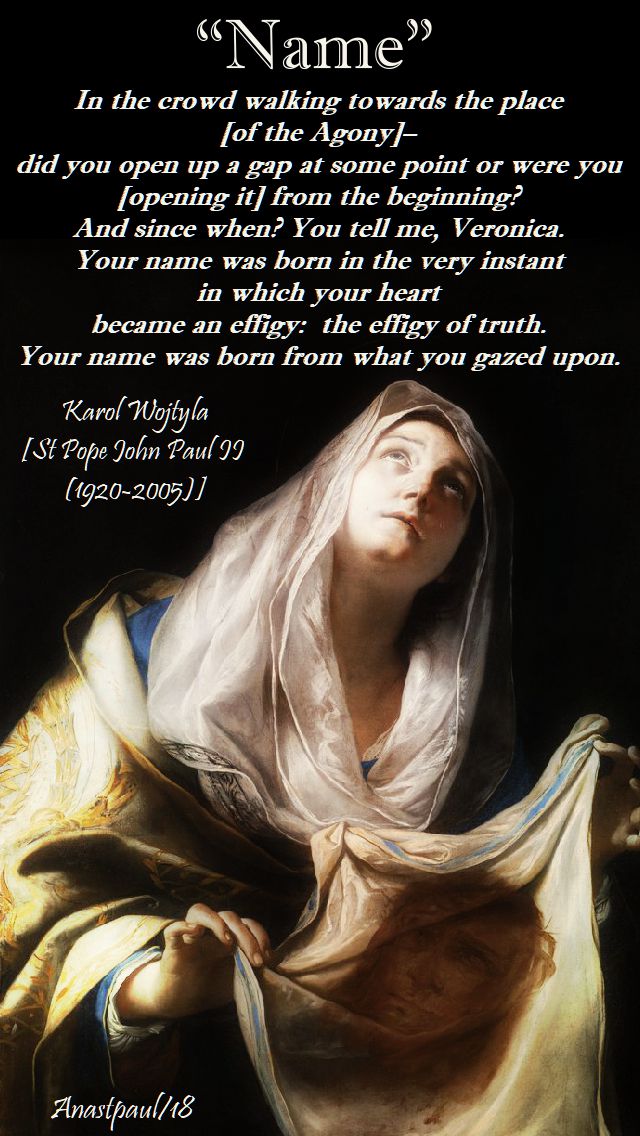
“Name”

In the crowd walking towards the place

[of the Agony]–

did you open up a gap at some point or were you

[opening it] from the beginning?

And since when? You tell me, Veronica.

Your name was born in the very instant

in which your heart

became an effigy: the effigy of truth.

Your name was born from what you gazed upon.

Karol Wojtyla

name-st-veronica-karol-wotyla-st-john-paul-12-july-2018 and 22 oct 2019

St Peter’s Square had a special meaning for St John Paul.   In earlier days he wrote a poem about it.   Below is an excerpt from it:

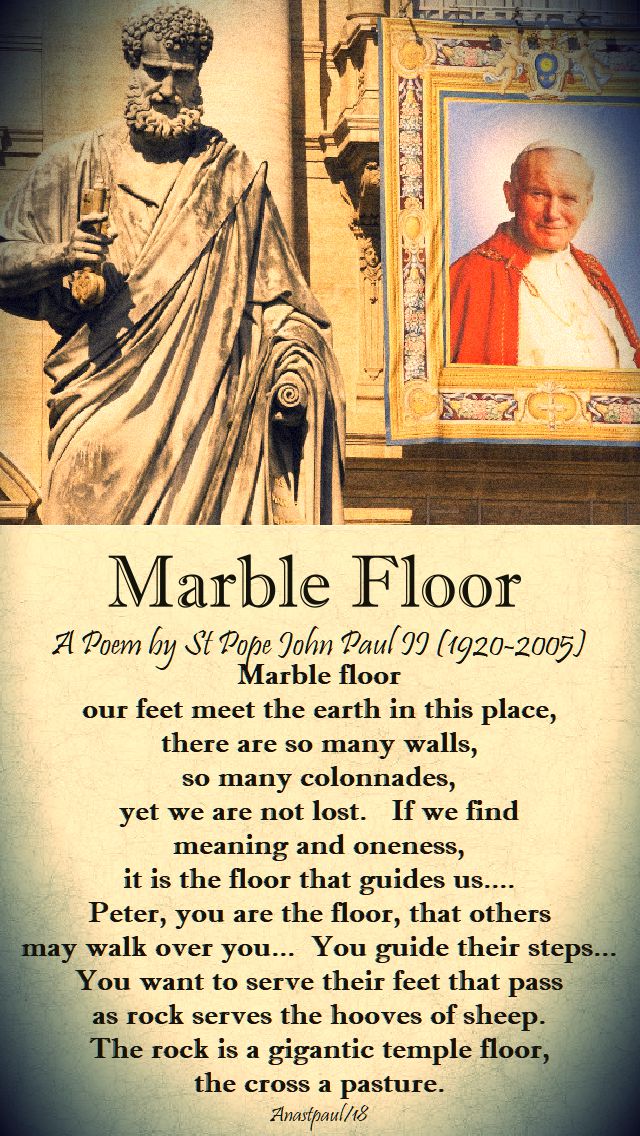
Marble Floor

Marble floor
our feet meet the earth in this place,
there are so many walls,
so many colonnades,
yet we are not lost. If we find
meaning and oneness,
it is the floor that guides us….
Peter, you are the floor, that others
may walk over you… You guide their steps…
You want to serve their feet that pass
as rock serves the hooves of sheep.
The rock is a gigantic temple floor,
the cross a pasture.

St Peter’s name means “a rock” and Christ said of him “on this Rock I will build my Church.”   The poem is about the role of the Holy Father, who is a shepherd to his flock, a guide to the Church.marble-floor-by-st-john-paul-22-oct-2018 and 22 oct 2019

St John Paul, keep being our Shepherd by your Prayers!st-jp-pray-for-us-22-oct-2017-2.and 22 oct 2019.jpg

Posted in CATHOLIC-PRAYERS OF THE CHURCH, HYMNS, POETRY

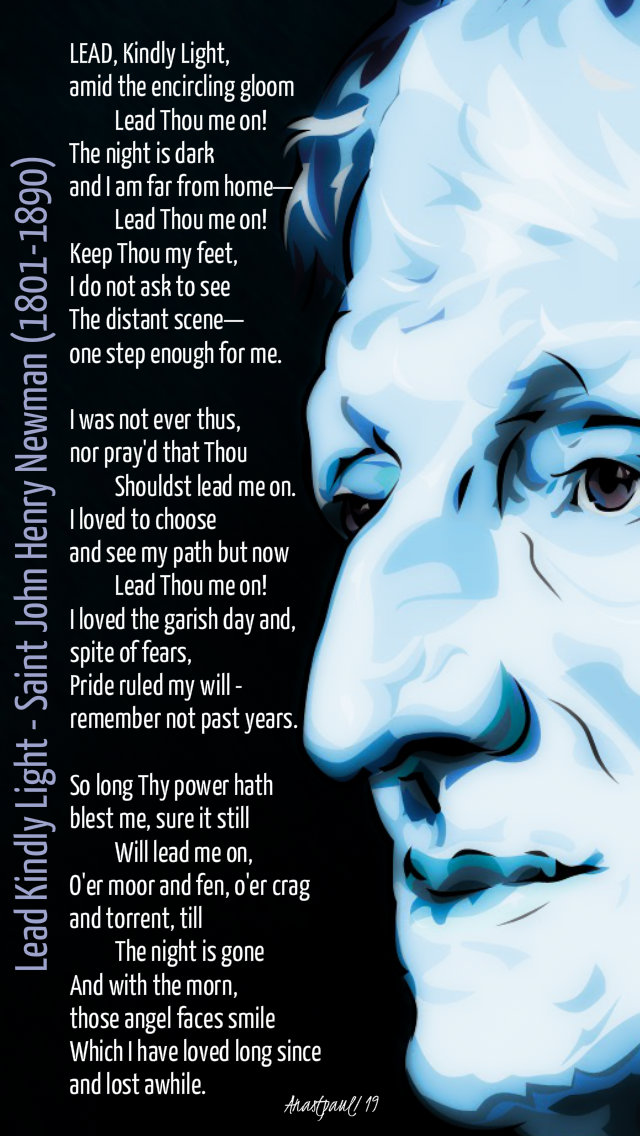
Quote of the Day – 13 October – LEAD, Kindly Light

Quote of the Day – 13 October – Twenty-eighth Sunday in Ordinary Time, Year C and today, John Henry Newman will be Canonised

The Pillar of the Cloud
By St John Henry Newman (1801-1890)

LEAD, Kindly Light, amid the encircling gloom
Lead Thou me on!
The night is dark and I am far from home—
Lead Thou me on!
Keep Thou my feet, I do not ask to see
The distant scene—one step enough for me.

I was not ever thus, nor pray’d that Thou
Shouldst lead me on.
I loved to choose and see my path but now
Lead Thou me on!
I loved the garish day and, spite of fears,
Pride ruled my will – remember not past years.

So long Thy power hath blest me, sure it still
Will lead me on,
O’er moor and fen, o’er crag and torrent, till
The night is gone
And with the morn, those angel faces smile
Which I have loved long since and lost awhile.

At Sea
16 June 1833

St John Henry Newmanlead kindly light 13 oct 2019 st john henry newman

Posted in JESUIT SJ, MARIAN QUOTES, MARIAN REFLECTIONS, POETRY, PRAYERS for CANONISATION, QUOTES of the SAINTS, QUOTES on MISSION, QUOTES on PATIENCE, QUOTES on PEACE, SAINT of the DAY

Thought for the Day – 12 October – Mary, who gives Comfort and Strength

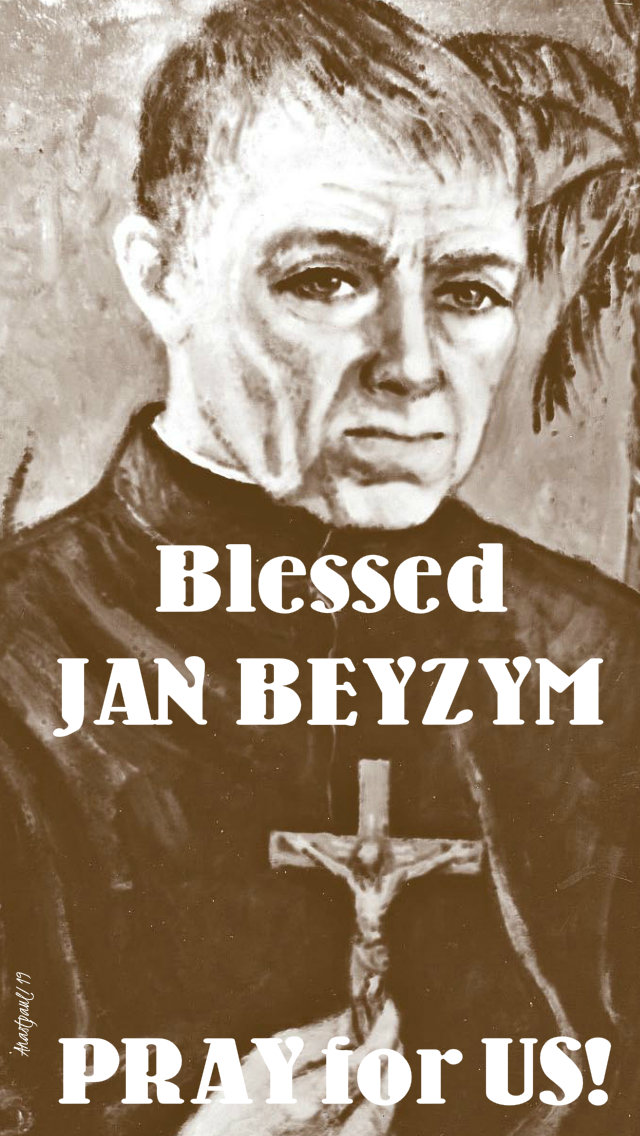
Thought for the Day – 12 October – The Memorial of Blessed Jan Beyzym SJ (1850–1912), “Apostle of the Lepers of Madasgascar”

Mary, who gives Comfort and Strength
By Fr Mieczysław Bednarz SJ

Our Holy Mother was his strength and comfort.   All his sufferings were dedicated to Her and to the Polish Province of Father’s order.   Our Lady was his lifelong and reliable help in all his deeds and sufferings.   St Joseph, alongside with Mary, was a model of patience for Father Beyzym.   When he had been waiting for long years for the decision with regard to his Sakhalin mission, Father saw the necessity to accept God’s will and follow St Joseph, who had been waiting in Egypt for the Angel’s word telling him to return to the land of Israel.

Father Beyzym’s life, especially the years he devoted to the work for the lepers (Father never complained about that and about them) were full of disappointments, troubles, obstacles and obstruction.   If there were not for his gift of patience, Father would not carry such a burden.

Only the spirit of faith, the vision of faith in the continual praying for the help of God and His Holy Mother, only the power of the Eucharist and the strength of the compassion for the miserable, gave Father the power to endure to the end.   During his last illness he was admired for his patience and courageousness.   “By your patience possess your souls” (Luke 21,19), – was one of the mottoes of Father Beyzym’s life.   And he lived up to it.

Humbly and gratefully Father attributed everything to the Blessed Mother, because, as he used to say, he was a complete failure.   She ruled and directed and he was only a tool in Her hands.   There was no heroism in his work for the lepers.   “Our Holy Mother sent me to take care of them.   So, here I am and there is that”.
Humble, small, poor, understanding his badness, always trustful, free of pride and despair, immersed in the mercy of God and Our Holy Mother’s care, he prayed, worked and coped with thousands of difficulties and problems.   This was Father Beyzym – small in his unconscious greatness.   Great was his love – humble and serving to the very end.

Why do you Hurry?
By Father Stanislaw Ziemianski SJ

Why do you hurry Father Beyzym
To the hostile and far away land
Why do you guide your steps of a pilgrim,
Where need and leprosy are hand in hand?

Refrain:
I hurry to save my brothers in Christ,
Unblessed and miserable outcasts.
I go to save my brothers in Christ,
Lepers, desolate hearts!

Why do you sail to Madagascar?
The island is unexplored and wild.
There lepers cramped in their huts
Live in the straits of body and mind.

Refrain:
I hurry to save my brothers in Christ…

Aren’t you afraid you contract the illness,
And you would suffer your chicklings fate?
Deny yourself for the lepers what made you,
Whose voice you heard outcrying for help?

Refrain:
I hurry to save my brothers in Christ…

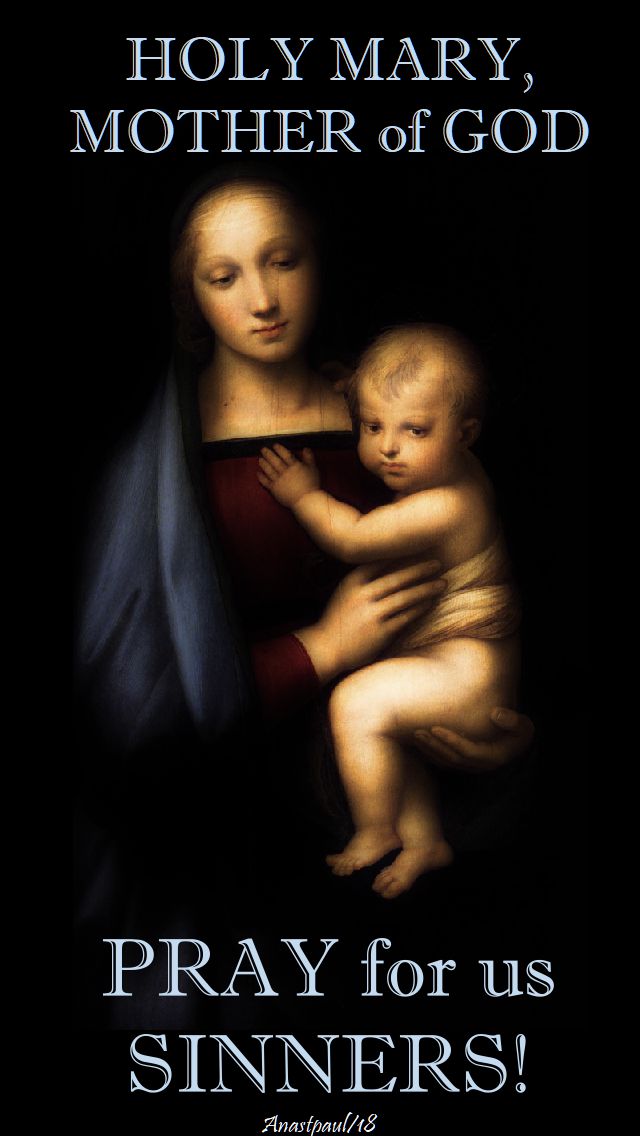
Holy Mother, Pray for Us!holy-mary-mother-of-god-pray-for-us-sinners-4-may-2018.jpg

Prayer for the Canonisation of Blessed Jan Beyzym
The Apostle of the Lepers of Madasgar

Father of mercy and God of all comfort!
Through the agency of Your Servant Jan Beyzym
You bestowed mercy and consolation
On the most miserable of the miserable,
On the forlorn and outcast,
On the separated off the human society
With the wall of fear and scorn.

By Your mercy in him
And his intercession
Make us the instrument of Your Providence,
Kindness and consolation for all,
Who need it.

And if it is not against Your will,
Deign to include him among Your Saints,
And graciously grant us,
What we sincerely ask You for
With the desire for Your glory
And our benefit.

Through Christ, Our Lord.
Amen

Blessed Jan Beyzym, Pray for us!bl jan beyzym pray for us no 2 12 oct 2019.jpg

Posted in POETRY, PRAYERS of the SAINTS, QUOTES of the SAINTS, SAINT of the DAY

Quote of the Day – 9 October – Be Merciful, Be Gracious

Quote of the Day – 9 October – Wednesday of the Twenty Seventh Week in Ordinary Time, Year C, Gospel: Luke 11:1–4 and the Memorial of Blessed John Henry Newman (1801-1890)

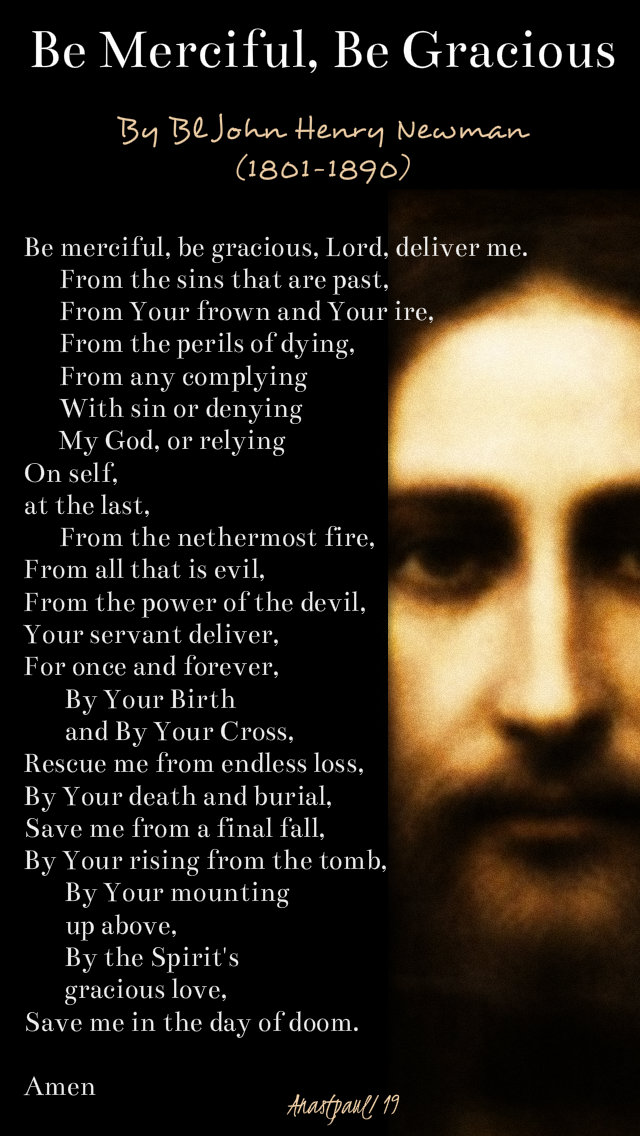
Be Merciful, Be Gracious
By Blessed John Henry Newman (1801-1890)

Be merciful, be gracious, Lord, deliver me.
From the sins that are past,
From Your frown and Your ire,
From the perils of dying,
From any complying
With sin or denying
My God, or relying
On self,
at the last,
From the nethermost fire,
From all that is evil,
From the power of the devil,
Your servant deliver,
For once and forever,
By Your Birth and By Your Cross,
Rescue me from endless loss,
By Your death and burial,
Save me from a final fall,
By Your rising from the tomb,
By Your mounting up above,
By the Spirit’s gracious love,
Save me in the day of doom.

Amen

Bl John Henry Newman

More here:
https://anastpaul.com/2018/10/09/quote-s-of-the-day-9-october-the-memorial-of-blessed-john-henry-newman-1801-1890/be-merciful-be-gracious-bl-john-henry-newman-30-april-2019AND 9 OCT 2019

Posted in franciscan OFM, ON the SAINTS, POETRY, QUOTES of the SAINTS, SAINT of the DAY

Quote of the Day – 4 October – The Angel to Gerontius

Quote of the Day – 4 October – The Memorial of St Francis of Assisi OFM (1181/2–1226)

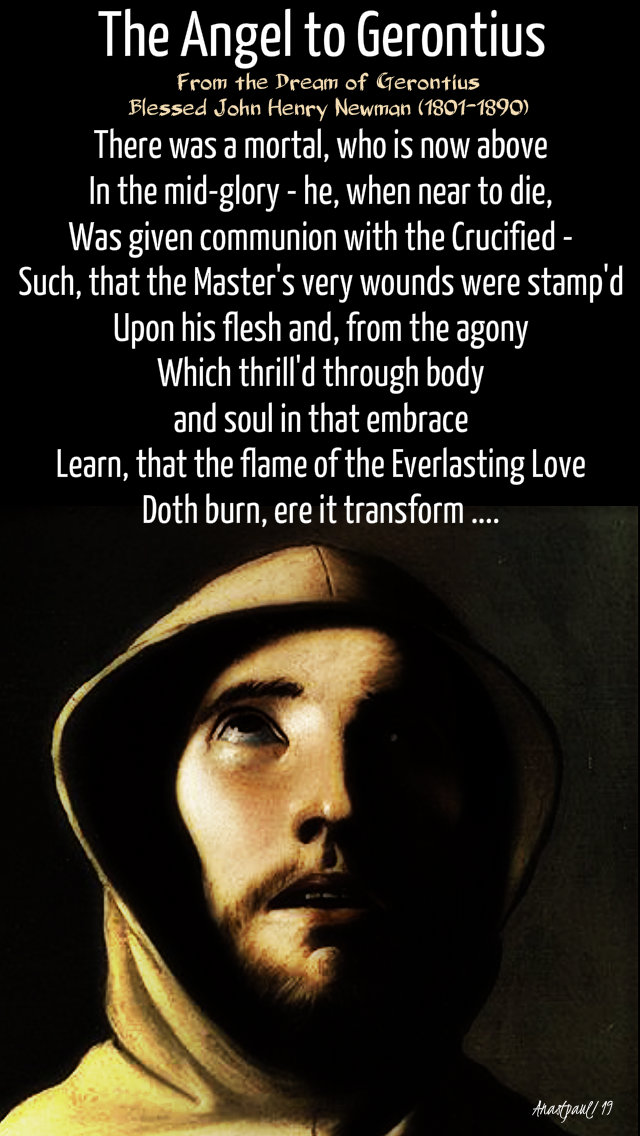
The Angel to Gerontius

“There was a mortal, who is now above
In the mid-glory – he, when near to die,
Was given communion with the Crucified –
Such, that the Master’s very wounds were stamp’d
Upon his flesh and, from the agony
Which thrill’d through body and soul in that embrace
Learn, that the flame of the Everlasting Love
Doth burn, ere it transform ….”

From the Dream of Gerontius
Blessed John Henry Newman (1801-1890)

Some Quotes of St Francis here:
https://anastpaul.com/2018/10/04/quote-s-of-the-day-4-october-the-memorial-of-st-francis-of-assisi-1181-2-1226/the angel to gerontius from the dram of gerontius bl john henry newman on st francis 4 oct 2019.jpg

Posted in CATHOLIC-PRAYERS OF THE CHURCH, Our MORNING Offering, POETRY, PRAYERS of the CHURCH, QUOTES on the CROSS of CHRIST, The HOLY CROSS, The HOLY EUCHARIST / The HOLY MASS

Our Morning Offering – 15 September – Sonnet to our Lord Crucified

Our Morning Offering – 15 September – Twenty Fourth Sunday in Ordinary Time, Year C

As we celebrate today the holy mystery of the Sacrifice of the Mass,

let us contemplate our Lord Crucified.

Sonnet to our Lord Crucified
Anonymous

I am not moved to love You, O my God,
That I might hope in promised heaven to dwell,
Nor am I moved by fear of pain in hell,
To turn from sin and follow where You trod.
You move me, Lord, broken beneath the rod,
Or stretched out on the cross, as nails compel
Your hand to twitch. It moves me that we sell,
To mockery and death, Your precious blood.
It is, O Christ, Your love which moves me so,
That my love rests not on a promised prize,
Nor holy fear on threat of endless woe,
It is not milk and honey but the flow
Of blood from blessed wounds before my eyes,
That waters my buried soul and makes it grow.
Amensonnet to our lord crucified i am not moved to love you - 15 sept 2019.jpg

Posted in DOCTORS of the Church, DOMINICAN OP, franciscan OFM, Hail MARY!, MARIAN DEVOTIONS, MARIAN POETRY, MARIAN QUOTES, MARIAN REFLECTIONS, MARIAN TITLES, POETRY, QUOTES of the SAINTS

Quote/s of the Day – 12 September – Mary’s Name

Quote/s of the Day – 12 September – Feast of the Most Holy Name of Mary

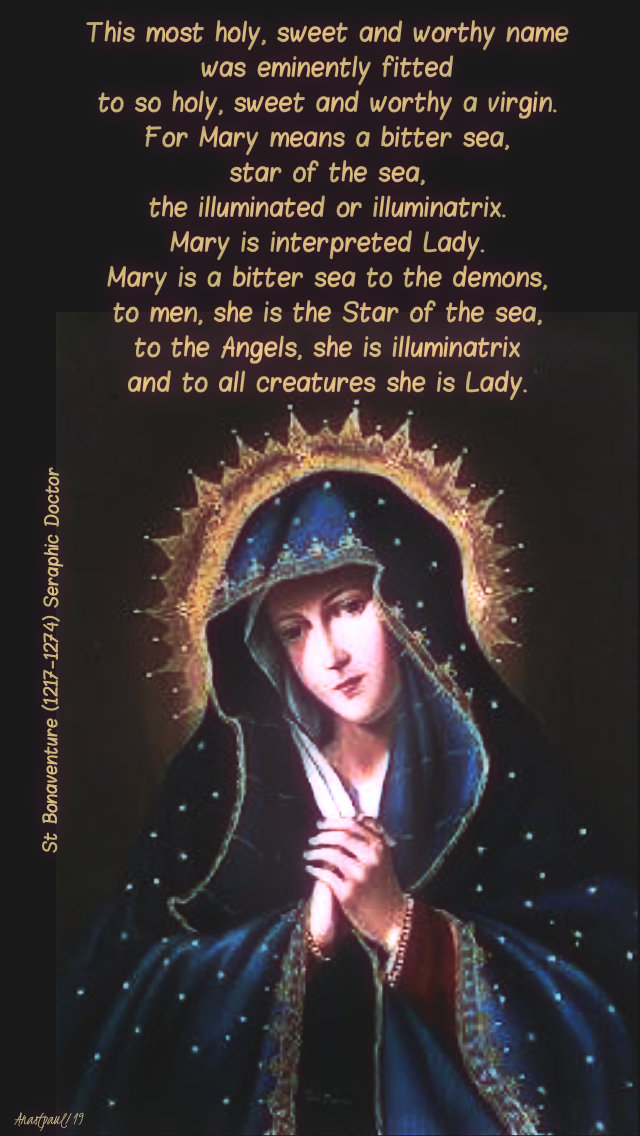
“This most holy, sweet and worthy name
was eminently fitted
to so holy, sweet and worthy a virgin.
For Mary means a bitter sea, star of the sea,
the illuminated or illuminatrix.
Mary is interpreted Lady.
Mary is a bitter sea to the demons,
to men, she is the Star of the sea,
to the Angels, she is illuminatrix
and to all creatures she is Lady.”

St Bonaventure (1217-1274) Seraphic Doctorthis most holy sweet name = st bonaventure 12 sept 2019 no 2.jpg

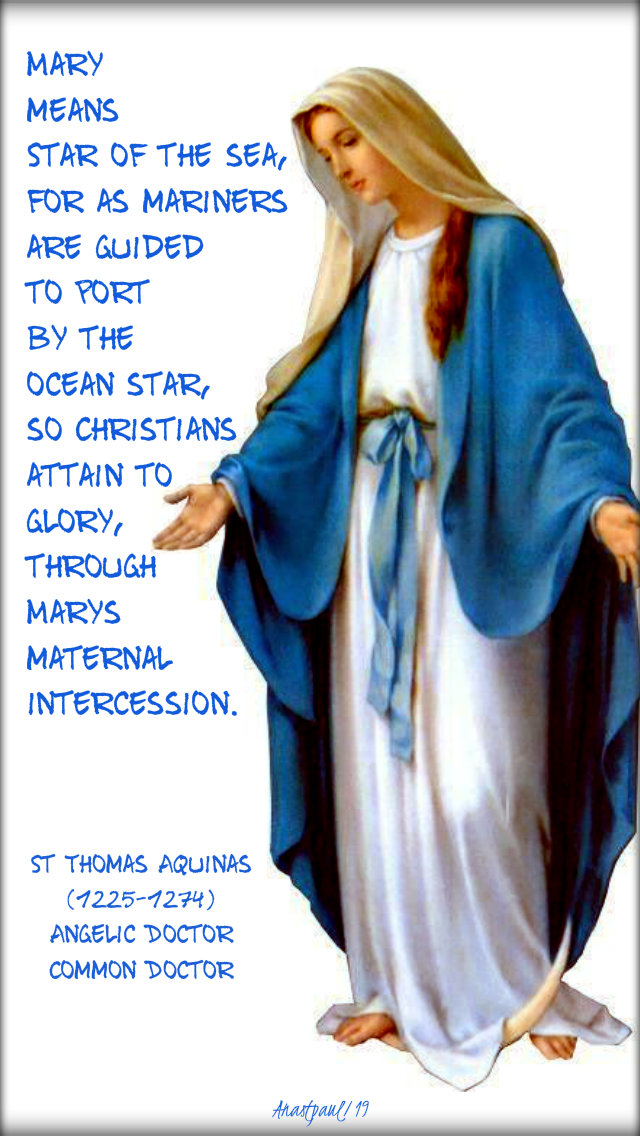
“Mary means Star of the sea,
for as mariners are guided to port
by the ocean star,
so Christians attain to glory,
through Mary’s maternal intercession.”

St Thomas Aquinas (1225-1274)

Angelic Doctor
Common Doctor

mary means star of the sea - st thomas aquinas 12 sept 2019

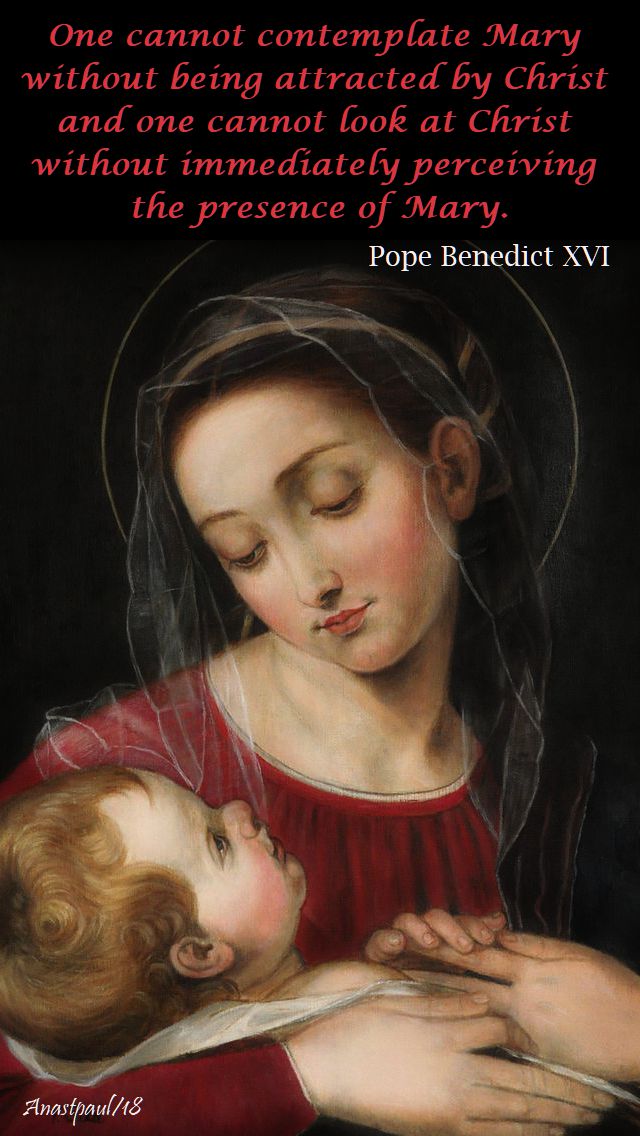
“One cannot contemplate Mary
without being attracted by Christ
and one cannot look at Christ
without immediately perceiving
the presence of Mary.”

Pope Benedict XVIone-cannot-contemplate-mary-pope-benedict-open-house-conversations-with-st-louis-de-montfort-the-secret-of-mary-28-sept-2018.jpg

Mary’s Name

Rare perfume is a rough and reeking place,
A bell-like music breaking through the blare
Of strident streets, a dear remembered face
Appearing through the mind’s pondrous despair.

A foam of summer flowers fringing the drear
Immobile desert sea, a cherished voice
Calling in some long night of pain and fear
To make the heavy, heaving heart rejoice.
Such is the mystic wonder of her name
That is a shudder down Hell’s shaken halls,
And joy where angel-wings flit like white flames,
Where height to echoing height its glory calls.

Liam Bhophy

The Apostle – October 1962the most holy name of mary 12 sept 2019

Posted in DOCTORS of the Church, franciscan OFM, MARIAN PRAYERS, MARIAN Saturdays, Our MORNING Offering, POETRY, PRAYERS of the SAINTS, THE ASSUMPTION

Our Morning Offering – 17 August – The Praises of Mary “Assumption” Poem by Saint Anthony

Our Morning Offering – 17 August – Saturday of the Nineteenth week in Ordinary Time, Year C and a Marian Saturday

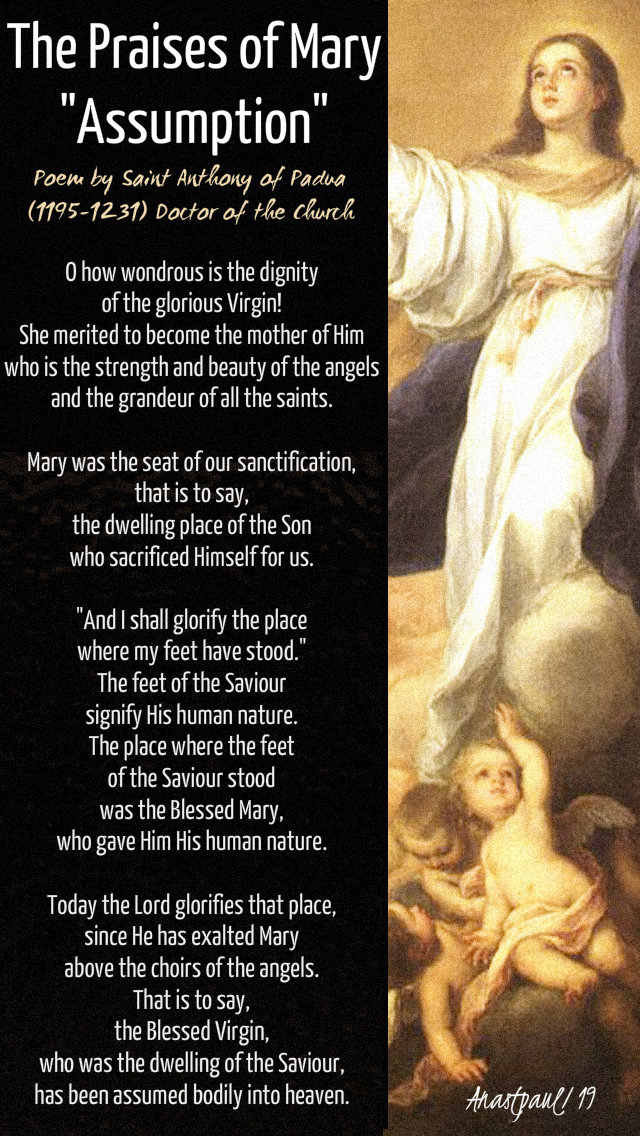
The Praises of Mary
“Assumption”
Poem by Saint Anthony of Padua (1195-1231)
Doctor of the Church

O how wondrous is the dignity of the glorious Virgin!
She merited to become the mother of Him
who is the strength and beauty of the angels
and the grandeur of all the saints.

Mary was the seat of our sanctification,
that is to say,
the dwelling place of the Son
who sacrificed Himself for us.

“And I shall glorify the place where my feet have stood.”
The feet of the Saviour signify His human nature.
The place where the feet of the Saviour stood
was the Blessed Mary,
who gave Him His human nature.

Today the Lord glorifies that place,
since He has exalted Mary
above the choirs of the angels.
That is to say,
the Blessed Virgin,
who was the dwelling of the Saviour,
has been assumed bodily into heaven.the praises of mary assumption by st anthony of padua 17 aug 2019.jpg

Posted in BREVIARY Prayers, DANTE ALIGHIERI!, HYMNS, MARIAN PRAYERS, Our MORNING Offering, POETRY, PRAYERS of the CHURCH, SAINT of the DAY, The LITTLE OFFICE of MARY

Our Morning Offering – 5 August – Maiden yet a Mother

Our Morning Offering – 5 August – Monday of the Eighteenth week in Ordinary Time, Year C and the Memorial of the Dedication of Mary Major

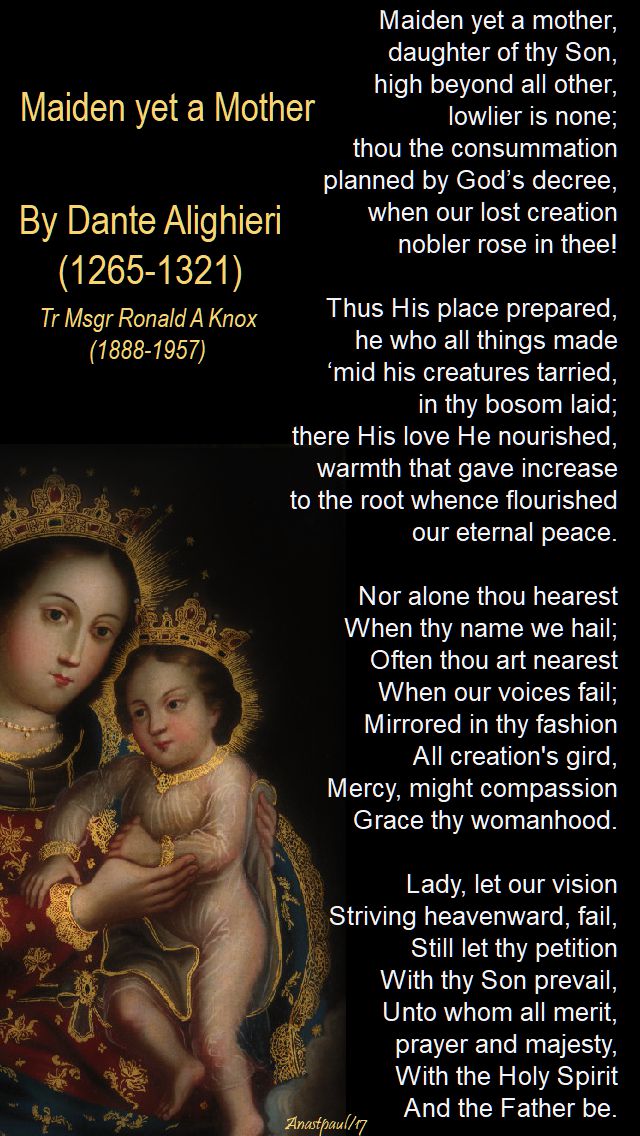
Maiden yet a Mother
By Dante Alighieri (1265-1321)
Tr Msgr Ronald A Knox (1888-1957)

Maiden yet a mother,
daughter of thy Son,
high beyond all other,
lowlier is none;
thou the consummation
planned by God’s decree,
when our lost creation
nobler rose in thee!

Thus His place prepared,
he who all things made
‘mid his creatures tarried,
in thy bosom laid;
there His love He nourished,
warmth that gave increase
to the root whence flourished
our eternal peace.

Nor alone thou hearest
When thy name we hail;
Often thou art nearest
When our voices fail;
Mirrored in thy fashion
All creation’s gird,
Mercy, might compassion
Grace thy womanhood.

Lady, let our vision
Striving heavenward, fail,
Still let thy petition
With thy Son prevail,
Unto whom all merit,
prayer and majesty,
With the Holy Spirit
And the Father be.

Maiden Yet A Mother is a translation of a poem by Durante (Dante) degli Alighieri (c 1265–1321).   It is based upon the opening verses of Canto 33 of the Paradiso from his Divine Comedy in which St Bernard of Clairvaux (1090–1153) praises and prays to the Virgin Mother on behalf of Dante.   It was translated from the original Italian into English by the Catholic convert, Monsignior Ronald A Knox (1888-1957).   It is one of the Marian Hymns in the Breviary.maiden-yet-a-mother-dante-10-dec-2017 and 5 aug 2019 - dedication of st mary major.jpg

Posted in CATHOLIC-PRAYERS OF THE CHURCH, DOCTORS of the Church, EUCHARISTIC Adoration, FEASTS and SOLEMNITIES, JESUIT SJ, MORNING Prayers, POETRY, PRAYERS of the CHURCH, PRAYERS of the SAINTS, QUOTES of the SAINTS, The HOLY EUCHARIST / The HOLY MASS

Thought for the Day – 23 June – Through Our Gazing in Adoration

Thought for the Day – 23 June – The Solemnity of the Most Holy Body and Blood of Christ

Through Our Gazing in Adoration

Pope Benedict XVI General Audience, 17 November 2010

Dear friends, fidelity to the encounter with the Eucharistic Christ in Sunday’s Holy Mass is essential for the journey of faith but let us try as well to frequently go to visit the Lord present in the Tabernacle!   Gazing in adoration at the consecrated Host, we discover the gift of the love of God, we discover the passion and the cross of Jesus and also His Resurrection.   Precisely through our gazing in adoration, the Lord draws us to Himself, into His mystery, to transform us as He transforms the bread and wine.

The saints always found strength, consolation and joy in the Eucharistic encounter.   With the words of the Eucharistic hymn “Adoro te devote,” let us repeat before the Lord, present in the Most Blessed Sacrament:  “Make me believe ever more in You, that in You I may have hope, that I may love You!”

Thank you.

Adoro te Devote
By St Thomas Aquinas (1225-1274) Doctor of the Church
Trans. Fr Gerard Manley Hopkins SJ (1844-1889)

Godhead here in hiding, whom I do adore,
Masked by these bare shadows,
shape and nothing more,
See, Lord, at Thy service low lies here a heart
Lost, all lost in wonder at the God Thou art.

Seeing, touching, tasting are in Thee deceived –
How says trusty hearing? that shall be believed,
What God’s Son has told me, take for truth I do,
Truth Himself speaks truly or there’s nothing true.

On the cross Thy godhead made no sign to men,
Here Thy very manhood steals from human ken –
Both are my confession, both are my belief,
And I pray the prayer of the dying thief.

I am not like Thomas, wounds I cannot see,
But can plainly call Thee Lord and God as he,
Let me to a deeper faith daily nearer move,
Daily make me harder hope and dearer love.

O Thou our reminder of Christ crucified,
Living Bread, the life of us for whom He died,
Lend this life to me then – feed and feast my mind,
There be Thou the sweetness man was meant to find.

Bring the tender tale true of the Pelican,
Bathe me, Jesu Lord, in what Thy bosom ran—
Blood whereof a single drop has power to win
All the world forgiveness of its world of sin.

Jesu, whom I look at shrouded here below,
I beseech Thee send me what I thirst for so,
Some day to gaze on Thee face to face in light
And be blest forever with Thy glory’s sight.
Amenadoro te devote - copus christi 23 june 2019.jpg