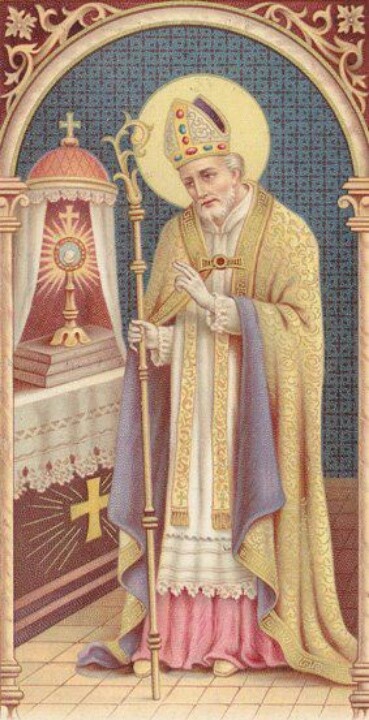
Posted in CHILDREN / YOUTH, PATRONAGE-INFERTILITY & SAFE CHILDBIRTH, REDEMPTORISTS CSSR, SAINT of the DAY

Saint of the Day – 16 October – St Gerard Majella C.Ss.R. (1726-1755)

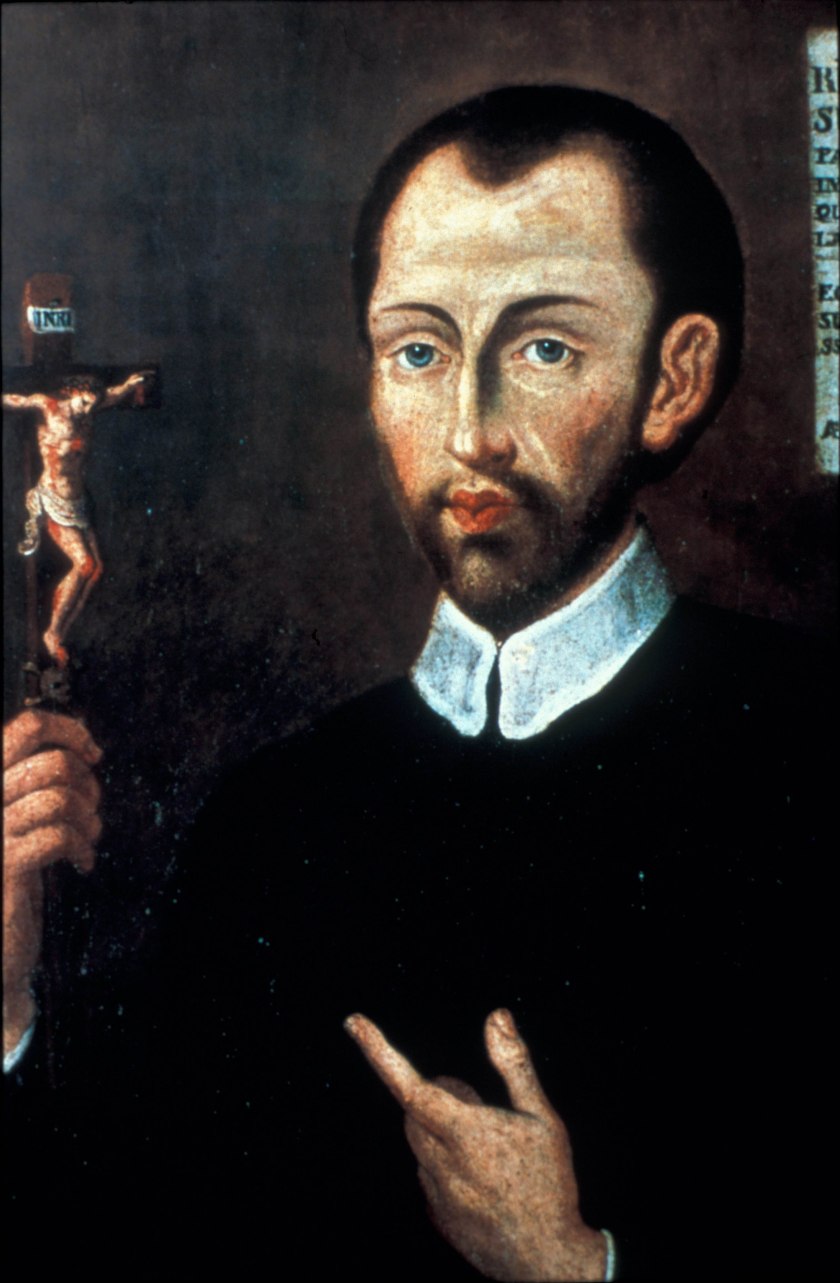
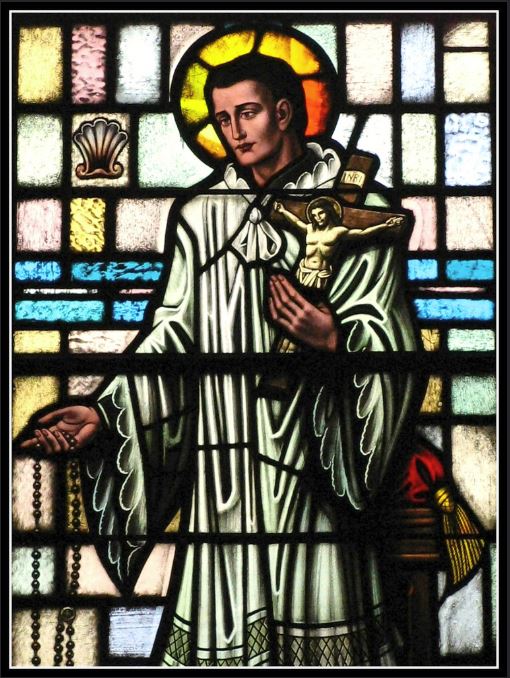
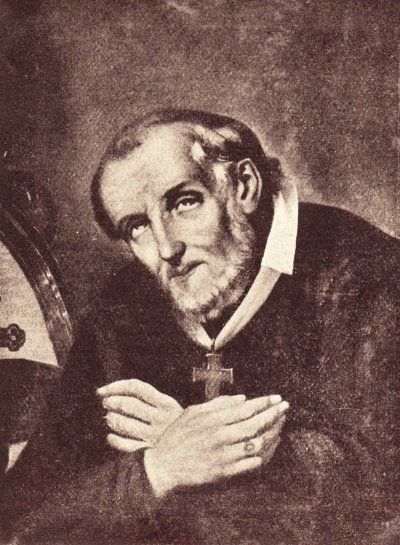
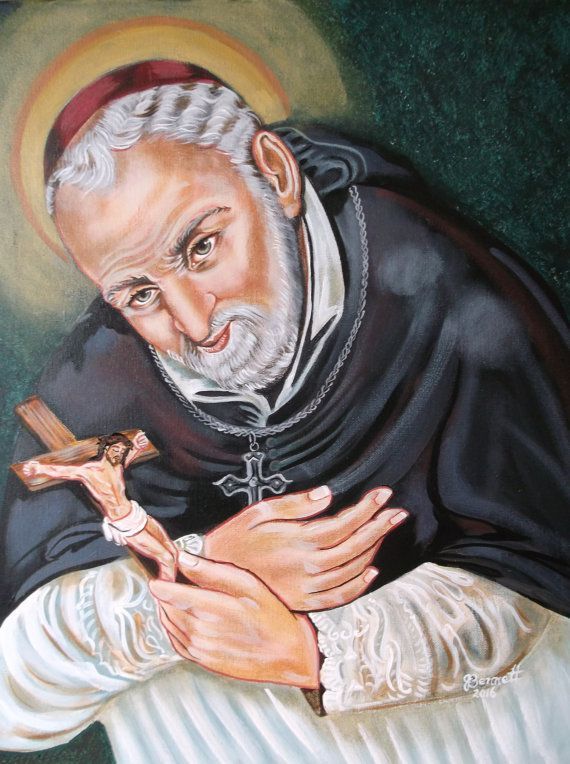
Saint of the Day – 16 October – St Gerard Majella C.Ss.R. (1726-1755) Religious Lay Brother of the Congregation of the Redeemer, better known as the Redemptorists, Apostle of the Holy Eucharist, Apostle of Charity, known as a Thaumaturge, a Saint who works miracles not just occasionally but as a matter of course.    Born on 23 April 1725 at Muro, Italy as Gerardo Maiella and died on 16 October 1755 at Caposele, Provincia di Avellino, Campania, Italy of tuberculosis, aged just 29.   Patronages – children (and unborn children in particular); childbirth; mothers (and expectant mothers in particular); motherhood; falsely accused people; good confessions; lay brothers; tennis ball football, head boys and Muro Lucano, Italy.St._Gerard_Majella__lg info
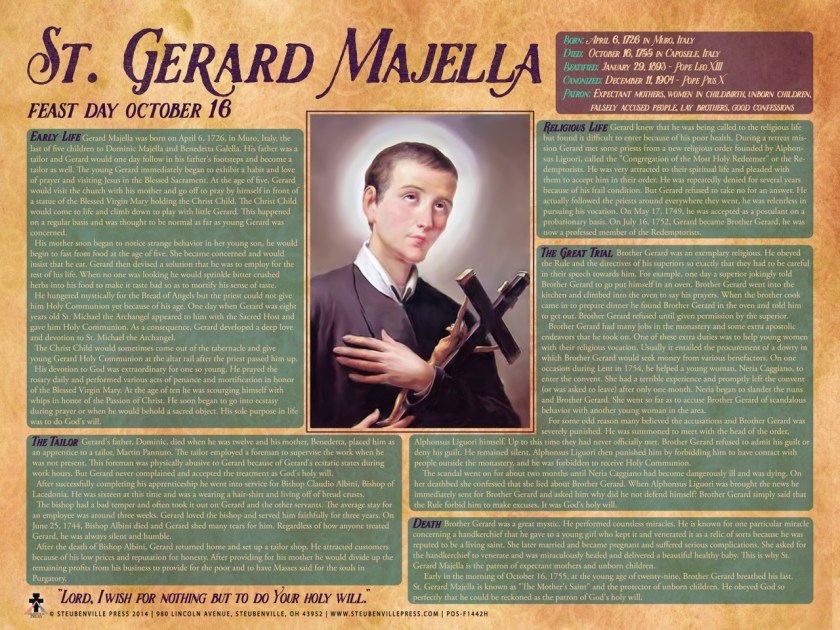
St Gerard was born in Muro Lucano, Basilicata, the youngest of five children.   He wanted very much to receive Holy Communion at the age of seven and went to the Communion railing one day with the others but the priest, seeing his age, passed him up; and he went back to his place in tears.   The following night, Saint Michael the Archangel brought him the Communion he so much desired.   His tailor father died when Gerard was twelve, leaving the family in poverty.   His mother then sent him to her brother so that he could teach Gerard to sew and follow in his father’s footsteps.   However, the foreman was abusive.   The boy kept silent but his uncle soon found out and the man who taught him resigned from the job.   After four years of apprenticeship, he took a job as a servant to work for the local Bishop of Lacedonia.   Upon the bishop’s death, Gerard returned to his trade, working first as a journeyman and then on his own account.   He divided his earnings between his mother and the poor and in offerings for the souls in Purgatory.

He tried to join the Capuchin Order but his health prevented it.   He had acquired a reputation of sanctity and finally, when he was 23 years old, he obtained the aid of some missionaries to second his request and was admitted as a Coadjutor of the newly founded Congregation of the Most Holy Redeemer, known as Redemptorists, in 1749.  The order was founded in 1732 by Saint Alphonsus Liguori (1696-1787 Doctor of the Church) at Scala, near Naples.   The essentially missionary order is dedicated to “preaching the word of God to the poor.”   Its apostolate is principally in giving of missions and retreats.st gerard
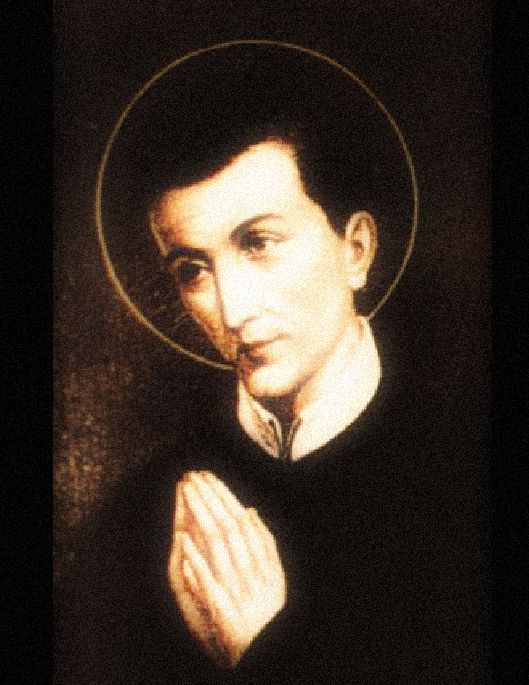
During his life, he was very close to the peasants and other outsiders who lived in the Neapolitan countryside.   In his work with the Redemptorist community, he was variously gardener, sacristan, tailor, porter, cook, carpenter and clerk of works on the new buildings at Caposele.

At 27, the good-looking Majella became the subject of a malicious rumour.   An acquaintance, Neria, accused him of having had relations with a young woman.   When confronted by St Alphonsus Liguori, the founder, on the accusations, the young lay brother remained silent.   The girl later recanted and cleared his name.

Some of Majella’s reported miracles include restoring life to a boy who had fallen from a high cliff, blessing the scanty supply of wheat belonging to a poor family and making it last until the next harvest and several times multiplying the bread that he was distributing to the poor.   One day, he walked across the water to lead a boatload of fishermen through stormy waves to the safety of the shore.   He was reputed to have had the gift of bilocation and the ability to read souls.st gerard majella

Once he conducted a group of students on a nine-day pilgrimage to Mount Gargano, where the Archangel Michael had appeared.   They had very little money for the tri, and when they arrived at the site, there was none left.   Gerard went before the Tabernacle and told Our Lord that it was His responsibility to take care of the little group.   He had been observed in the church by a religious, who invited the Saint and his companions to lodge in his residence.   When the party was ready to start home again, Gerard prayed once more, and immediately someone appeared and gave him a roll of bills.

His last will was a small note on the door of his cell:   “Here the will of God is done, as God wills and as long as God wills.”   He died at 29 of tuberculosis.st gerard unusual edit
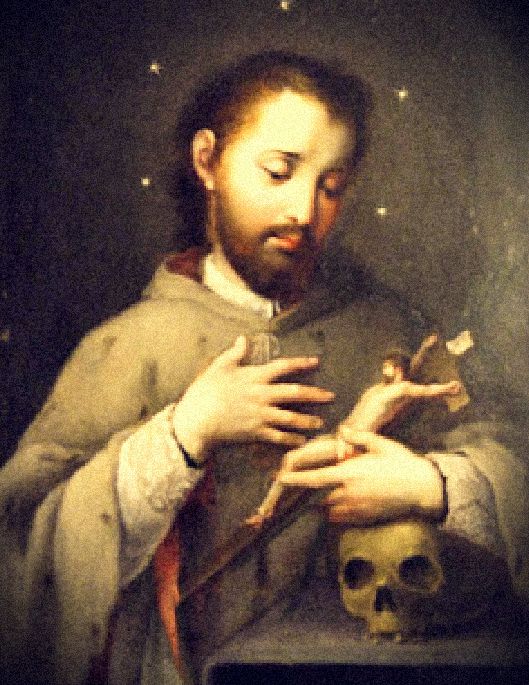
One miracle in particular explains how Majella became known as the special patron of mothers.   A few months before his death, he visited the Pirofalo family and accidentally dropped his handkerchief.    One of the Pirofalo girls spotted the handkerchief moments after he had left the house and she ran after Gerard to return it.  “Keep it,” he said to her. “You may need it some day.”   Years later when the girl, now a married woman, was on the verge of losing her life in childbirth, she remembered the words of the saintly lay brother.   She asked for the handkerchief to be brought to her.   Almost immediately, the pain disappeared and she gave birth to a healthy child.   That was no small feat in an era when only one out of three pregnancies resulted in a live birth and word of the miracle spread quickly.

Because of the miracles that God worked through Gerard’s prayers with mothers, the mothers of Italy took Gerard to their hearts and made him their patron.   At the process of his beatification, one witness testified that he was known as “il santo dei felice parti,” “the saint of happy childbirths.”   It is a well-known patronage and many miracles still occur.    The St Gerard Majella Annual Novena takes place every year in St Josephs Church, Dundalk, Ireland.   This annual nine-day novena is the biggest festival of faith in Ireland.   St Joseph’s sponsors the St Gerard’s Family League, an International Association of Christians united in prayer for their own and other families, to preserve Christian values in their home and family life.   Since his death in 1775, countless favours and miracles have been granted and worked through his intercession. As well as the patron of a good confession, he has been invoked as a constant source of help and inspiration to parents. st gerard - family, mothers
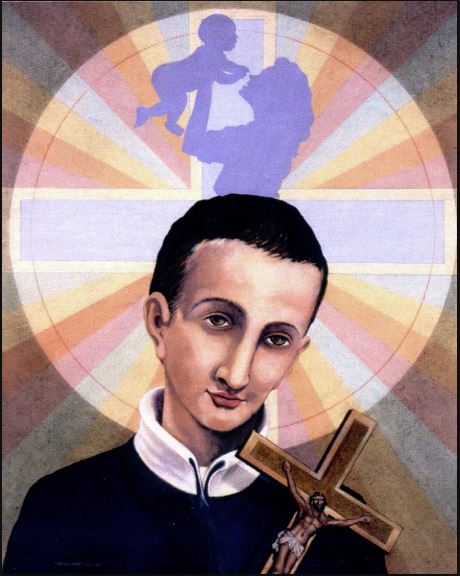
St Gerard was Beatified in Rome on 29 January 1893, by Pope Leo XIII. He was Canonised less than twelve years later on 11 December 1904, by St Pope Pius X.beautiful - st gerard majella - maxresdefault
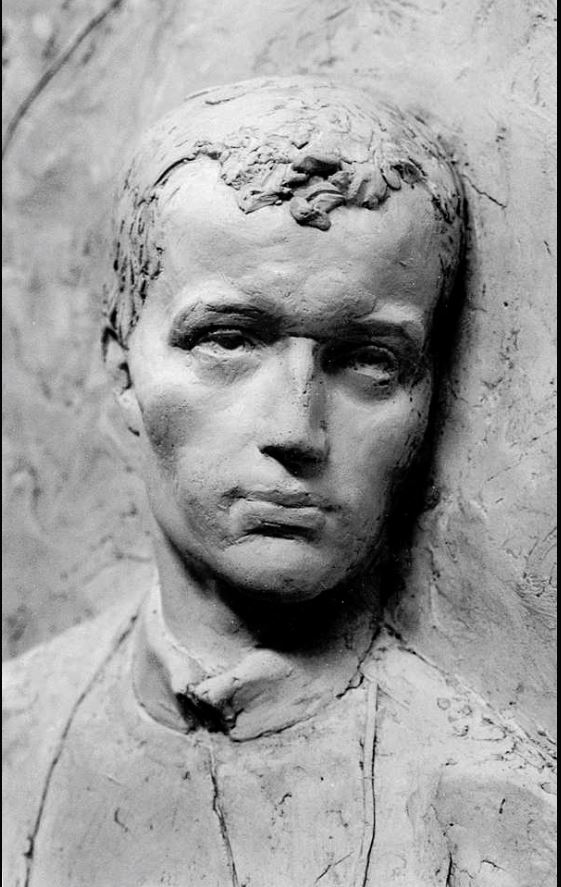
Posted in Against SCRUPELOSITY, for Scrupulous people, All THEOLOGIANS, Moral Theologians, CONFESSORS, DOCTORS of the Church, GOUT, KNEE PROBLEMS, ARTHRITIS, etc, Of a Holy DEATH & AGAINST A SUDDEN DEATH, of the DYING, FINAL PERSEVERANCE, DEATH of CHILDREN, DEATH of PARENTS, REDEMPTORISTS CSSR, SAINT of the DAY, Uncategorized

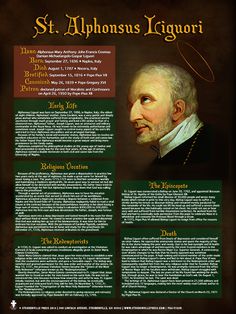
Saint of the Day – 1 August – St Alphonsus Maria de Liguori C.Ss.R. (1696-1787) – Doctor of the Church

Saint of the Day – 1 August – St Alphonsus Maria de Liguori C.Ss.R. (1696-1787) – Confessor, Bishop, Doctor of the Church, Founder of the Redemptorists, Spiritual Writer, Composer, Musician, Artist, Poet, Lawyer, Scholastic Philosopher and Theologian.    Patronages – against arthritis, against scrupulosity, of Confessors (given on 26 February 1950 by Pope Pius XII), final perseverance, moral theologians, moralists (1950 by Pope Pius XII), scrupulous people, vocations, Diocese of Acerra, Italy, Diocese of Agrigento, Italy,l Pagani, Italy, Sant’Agata de’ Goti, Italy.

The Roman Martyrology states of St Alphonsus today: “At Nocera-de-Pagani, Saint Alphonsus Maria de Liguori, Bishop of St Agatha of the Goths and Founder of the Congregation of the Most Holy Redeemer (the Redemptorists), distinguished by his zeal for the salvation of souls, by his writings, his preaching and his example.
He was inscribed on the Calendar of the Saints by Pope Gregory XVI in the year 1839, the 52nd after his happy death and , in 1871, was declared Doctor of the Universal Church by Pius IX, according to a decree of the Sacred Congregation of Rites.
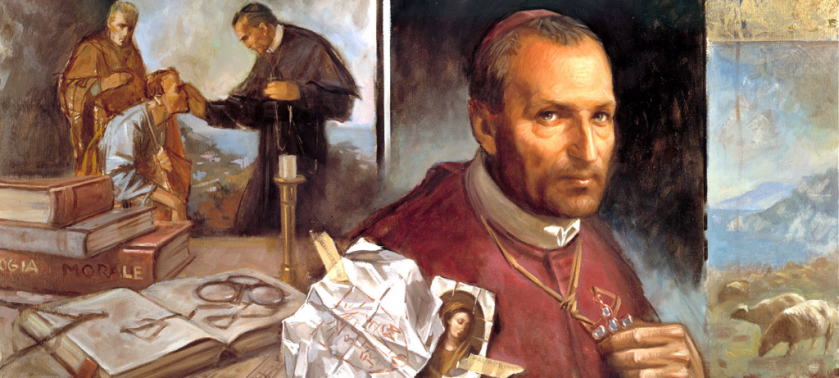
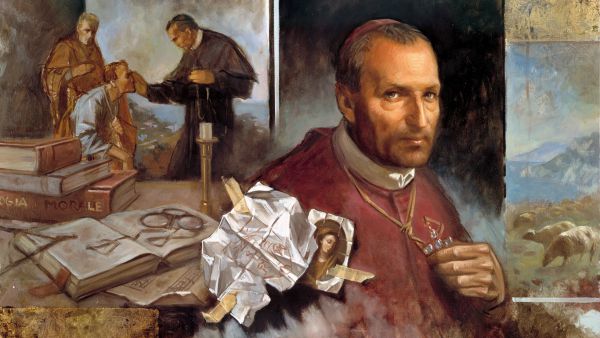
“header image - alphonsus

St Alphonsus was born of noble parents, near Naples, in 1696.   His spiritual training was entrusted to the Fathers of the Oratory in that city and from his boyhood Alphonsus was known as a most devout Brother of the Little Oratory.   At the early age of sixteen he was made doctor in law and he threw himself into this career with ardour and success.

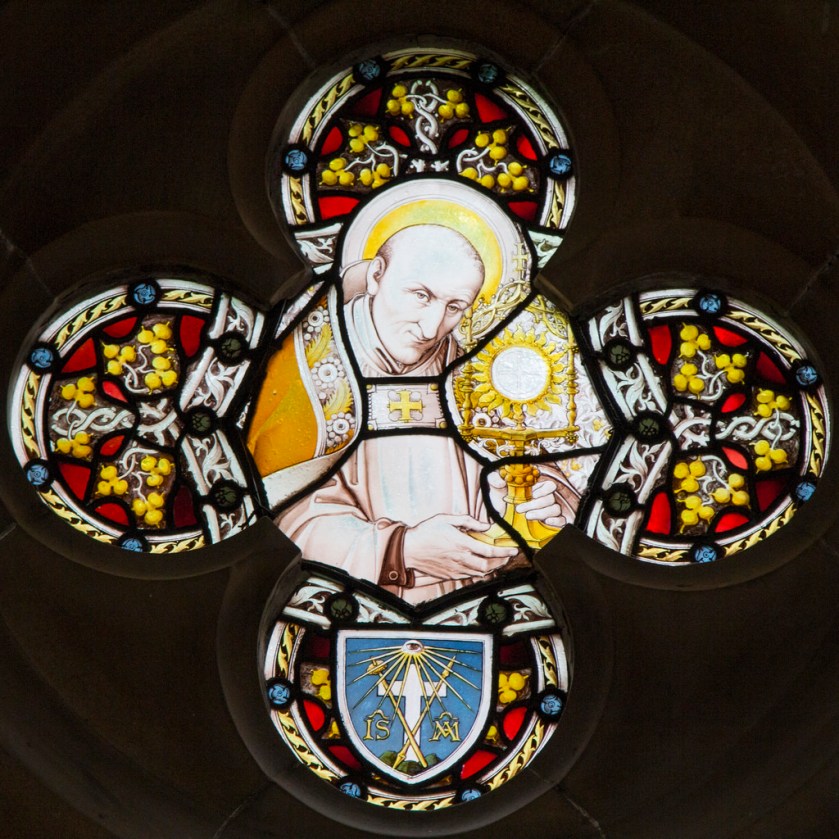
A mistake, by which he lost an important cause, showed him the vanity of human fame and determined him to labour only for the glory of God.   He entered the priesthood, devoting himself to the most neglected souls and to carry on this work he founded later the missionary Congregation of the Most Holy Redeemer,   The Redemptorists.alphonsus - youngalphonsus - very young - magnificent

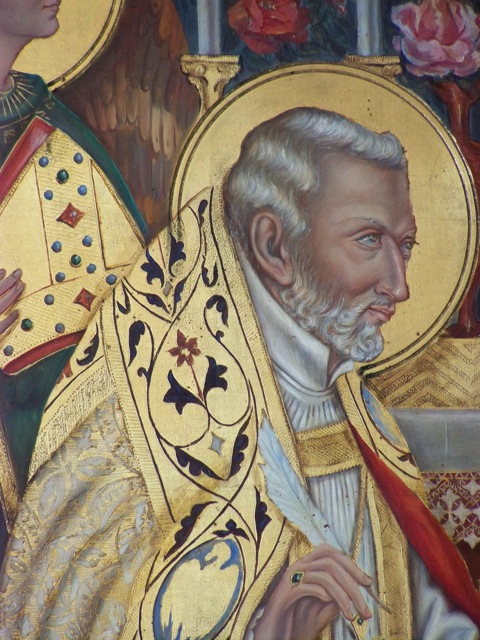
At the age of sixty-six he became Bishop of St Agatha and undertook the reform of his diocese with the zeal of a Saint.   He made a vow never to lose time and, though his life was spent in prayer and work, he composed a vast number of books, filled with such science, unction and wisdom that he has been declared one of the Doctors of the Church.st alphonsus - BEAUTIFUL image!

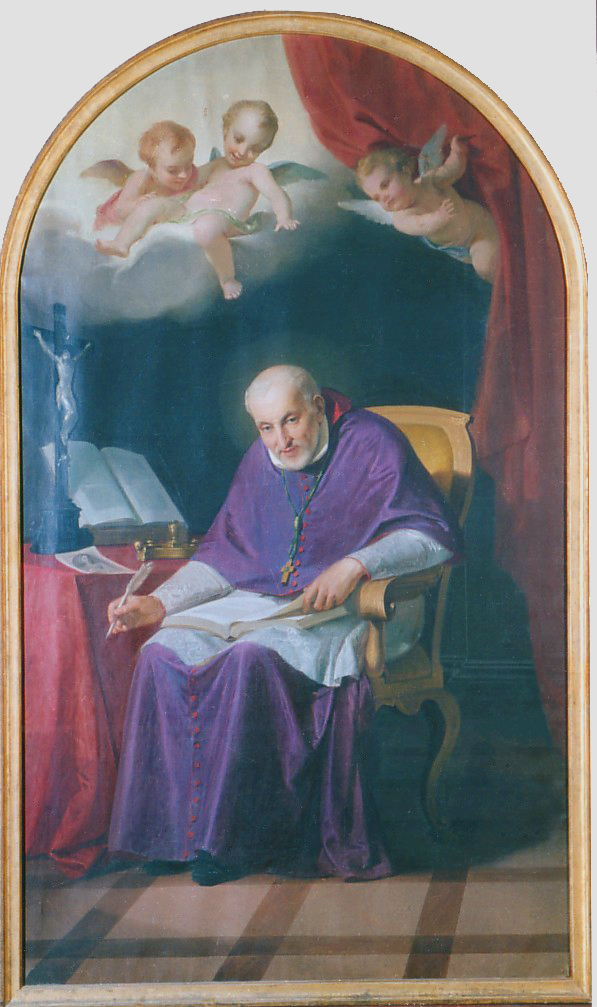
St Alphonsus wrote his first book at the age of forty-nine and in his eighty-third year had published about 100 volumes, when his director forbade him to write more.   Very many of these books were written in the half-hours snatched from his labours as missionary, religious superior and Bishop, or in the midst of continual bodily and mental sufferings.   With his left hand he would hold a piece of marble against his aching head while his right hand wrote.

alphonsus

Yet he counted no time wasted which was spent in charity.   He did not refuse to hold a long correspondence with a simple soldier who asked his advice, or to play the harpsichord while he taught his novices to sing spiritual canticles.   He lived in evil times, and met with many persecutions and disappointments.

For his last seven years he was prevented by constant sickness from offering the Adorable Sacrifice but he received Holy Communion daily and his love for Jesus Christ and his trust in Mary’s prayers sustained him to the end.

He died in 1787, in his ninety-first year.alphonsus 2

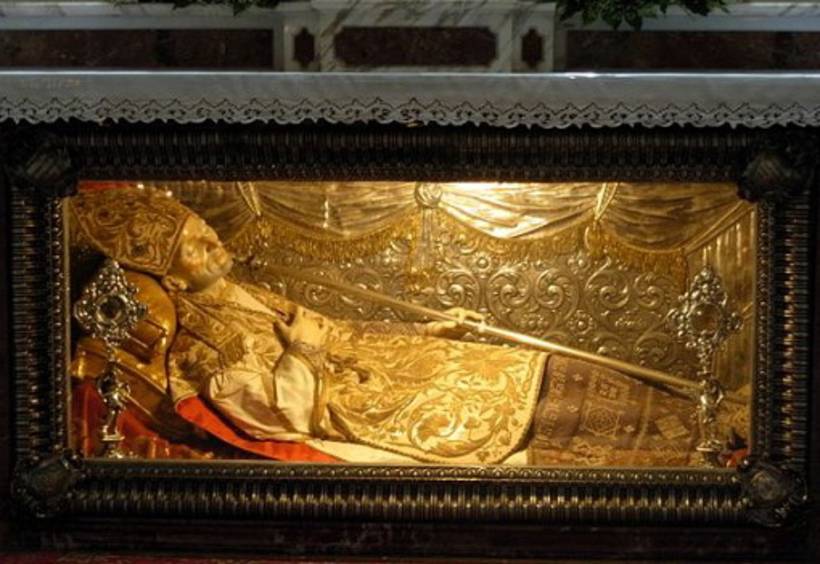
For lots more details on St Alphonsus here:   https://anastpaul.wordpress.com/2017/08/01/saint-of-the-day-1-august-st-alphonsus-maria-de-liguori-c-ss-r-doctor-of-the-church/ alphonsus relics

alphonsus by lawrence op

Posted in Against SCRUPELOSITY, for Scrupulous people, All THEOLOGIANS, Moral Theologians, CONFESSORS, DOCTORS of the Church, GOUT, KNEE PROBLEMS, ARTHRITIS, etc, Of a Holy DEATH & AGAINST A SUDDEN DEATH, of the DYING, FINAL PERSEVERANCE, DEATH of CHILDREN, DEATH of PARENTS, Of and for VOCATIONS, REDEMPTORISTS CSSR, SAINT of the DAY

Saint of the Day – 2 August – St Alphonsus Maria de Liguori C.Ss.R. – Doctor of the Church

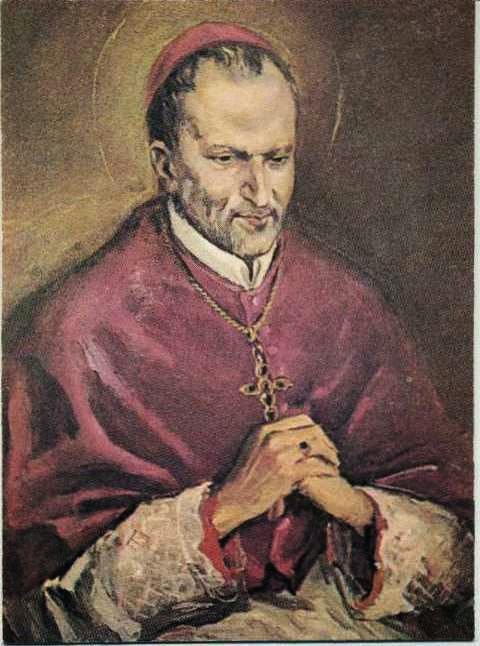
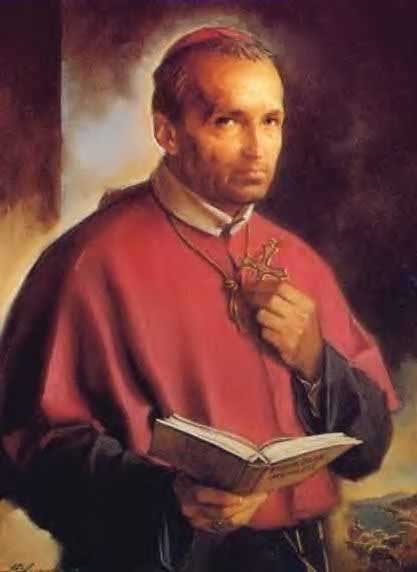
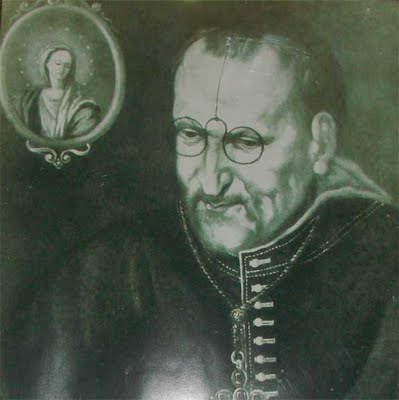
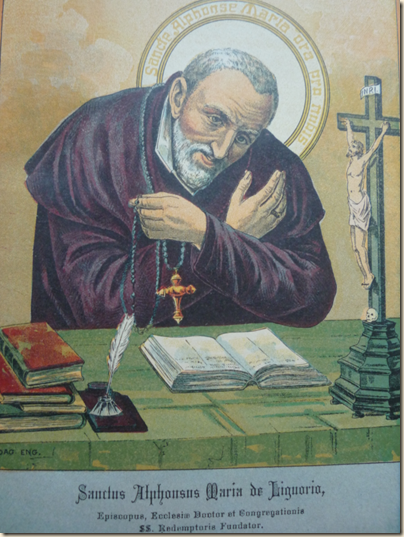
Saint of the Day – 2 August – St Alphonsus Maria de Liguori C.Ss.R. – Doctor of the Church-Bishop, Confessor, Founder, Spiritual Writer, Composer, Musician, Artist, Poet, Lawyer, Scholastic Philosopher and Theologian.   Born on 27 September 1696 at Marianelli near Naples, Italy and died on  1 August 1787 at Nocera, Italy of natural causes.   He was Canonised on 26 May 1839 by Pope Gregory XVI and declared Doctor of the Church by Pope Pius IX in 1871.    He founded the Congregation of the Most Holy Redeemer (the Redemptorists). In 1762 he was appointed Bishop of Sant’Agata dei Goti.  Patronages – against arthritis, against scrupulosity, of Confessors (given on 26 February 1950 by Pope Pius XII), final perseverance, moral theologians, moralists (1950 by Pope Pius XII), scrupulous people, vocations, Diocese of Acerra, Italy, Diocese of Agrigento, Italy,l Pagani, Italy, Sant’Agata de’ Goti, Italy.   Attributes – chaplet, praying with a monstrance in his hands, pen, quill, crucifix, writing, bishop with his chin on his chest (due to his arthritis).

St Alphonsus learned to ride and fence but was never a good shot because of poor eyesight.   Myopia and chronic asthma precluded a military career so his father had him educated for the legal profession.   He was taught by tutors before entering the University of Naples, where he graduated with doctorates in civil and canon law at 16. He remarked later that he was so small at the time that he was almost buried in his doctor’s gown and that all the spectators laughed.   When he was 18, like many other nobles, he joined the Confraternity of Our Lady of Mercy with whom he assisted in the care of the sick at the hospital for “incurables”.

He became a successful lawyer.  He was thinking of leaving the profession and wrote to someone, “My friend, our profession is too full of difficulties and dangers;  we lead an unhappy life and run risk of dying an unhappy death”.   At 27, after having lost an important case, the first he had lost in eight years of practicing law, he made a firm resolution to leave the profession of law.   Moreover, he heard an interior voice saying: “Leave the world, and give yourself to me.”

In 1723, he decided to offer himself as a novice to the Oratory of St. Philip Neri with the intention of becoming a priest.   His father opposed the plan but after two months (and with his Oratorian confessor’s permission), he and his father compromised:  he would study for the priesthood but not as an Oratorian and live at home.   He was ordained on 21 December 1726, at 30.   He lived his first years as a priest with the homeless and the marginalised youth of Naples.   He became very popular because of his plain and simple preaching.   He said: “I have never preached a sermon which the poorest old woman in the congregation could not understand”.    He founded the Evening Chapels, which were managed by the young people themselves.   The chapels were centres of prayer and piety, preaching, community, social activities and education.   At the time of his death, there were 72, with over 10,000 active participants.   His sermons were very effective at converting those who had been alienated from their faith.

Liguori suffered from scruples much of his adult life and felt guilty about the most minor issues relating to sin.    Moreover, the saint viewed scruples as a blessing at times and wrote:  “Scruples are useful in the beginning of conversion…. they cleanse the soul and at the same time make it careful”.

In 1729, Alphonsus left his family home and took up residence in the Chinese Institute in Naples.   It was there that he began his missionary experience in the interior regions of the Kingdom of Naples, where he found people who were much poorer and more abandoned than any of the street children in Naples.   In 1731, while he was ministering to earthquake victims in the town of Foggia, Alphonsus claimed to have had a vision of the Virgin Mother in the appearance of a young girl of 13 or 14, wearing a white veil.

Congregation of the Most Holy Redeemer (The Rdemptorists) – On 9 November 1732, he founded the Congregation of the Most Holy Redeemer, when Sister Maria Celeste Crostarosa told him that it had been revealed to her that he was the one that God had chosen to found the congregation.   He founded the congregation with the charism of preaching popular missions in the city and the countryside.   Its goal was to teach and preach in the slums of cities and other poor places.   They also fought Jansenism, a heresy that supported a very strict morality:  “the penitents should be treated as souls to be saved rather than as criminals to be punished”.  He is said never to have refused absolution to a penitent.

A gifted musician and composer, he wrote many popular hymns and taught them to the people in parish missions.   In 1732, while he was staying at the Convent of the Consolation, one of his order’s houses in the small city of Deliceto in the province of Foggia in Southeastern Italy, Liguori wrote the Italian carol “Tu scendi dalle stelle” (“From Starry Skies Descending”) in the musical style of a pastorale.   The version with Italian lyrics was based on his original song written in Neapolitan, which began Quanno nascette Ninno (When the child was born).   As it was traditionally associated with the zampogna, or large-format Italian bagpipe, it became known as Canzone d’i zampognari the (“Carol of the Bagpipers”).

Bishop
Alphonsus was consecrated Bishop of Sant’Agata dei Goti in 1762.   He tried to refuse the appointment by using his age and infirmities as arguments against his consecration.   He wrote sermons, books and articles to encourage devotion to the Blessed Sacrament and the Blessed Virgin Mary.   He first addressed ecclesiastical abuses in the diocese, reformed the seminary and spiritually rehabilitated the clergy and faithful.   He suspended those priests who celebrated Mass in less than 15 minutes and sold his carriage and episcopal ring to give the money to the poor.   In the last years of his life, he suffered a painful sickness and a bitter persecution from his fellow priests, who dismissed him from the Congregation that he had founded.

St-Alphonsus-at Mt St A, sm
ST ALPHONSUS - 2.AUG 1
st alphonsus 3
ST ALPHONSUS - HOLYCARD

Death
In 1775, he was allowed to retire from his office and went to live in the Redemptorist community in Pagani, Italy, where he died.

Veneration and legacy
He was beatified on 15 September 1816 by Pope Pius VII and canonized on 26 May 1839 by Pope Gregory XVI.

In 1949, the Redemptorists founded the Alphonsian Academy for the advanced study of Catholic moral theology.   He was named the patron of confessors and moral theologians by Pope Pius XII on 26 April 1950, who subsequently wrote of him in the encyclical Haurietis aquas.

Moral theology
Alphonsus’ greatest contribution to the Church was in the area of moral theology.    His masterpiece was The Moral Theology (1748), which was approved by the Pope himself and was born of Alphonsus’ pastoral experience, his ability to respond to the practical questions posed by the faithful and his contact with their everyday problems.   He opposed sterile legalism and strict rigoururism.   According to him, those were paths closed to the Gospel because “such rigour has never been taught nor practiced by the Church”.   His system of moral theology is noted for its prudence, avoiding both laxism and excessive rigour.   Since its publication it has remained in Latin, often in 10 volumes or in the combined 4-volume version of Gaudé.   It saw only recently its first publication in translation, in an English translation made by Ryan Grant and published in 2017 by Mediatrix Press.   The English translation of the work is projected to be around 5 volumes.

Mariology
His Mariology, though mainly pastoral in nature, rediscovered, integrated and defended that of St Augustine of Hippo, St Ambrose of Milan and other fathers;  it represented an intellectual defence of Mariology in the 18th century, the Age of Enlightenment, against the rationalism to which his often flaming Marian enthusiasm contrasted:

The Glories of Mary
Marian Devotion
Prayers to the Divine Mother
Spiritual Songs
The True Spouse of Jesus Christ

Other works
Great Means of Salvation and of Perfection
The Way of Salvation and of Perfection
The Way of the Cross,
Preparation for Death,
The Incarnation, Birth and Infancy of Jesus Christ
The Holy Eucharist
Victories of the Martyrs

Many of these are available online.