Posted in SAINT of the DAY, The HOLY EUCHARIST / The HOLY MASS

Saint of the Day – 26 April – Saint Paschasius Radbertus (785–865)

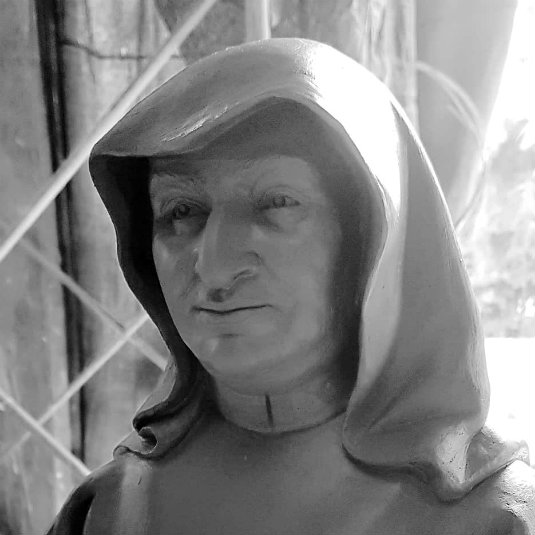
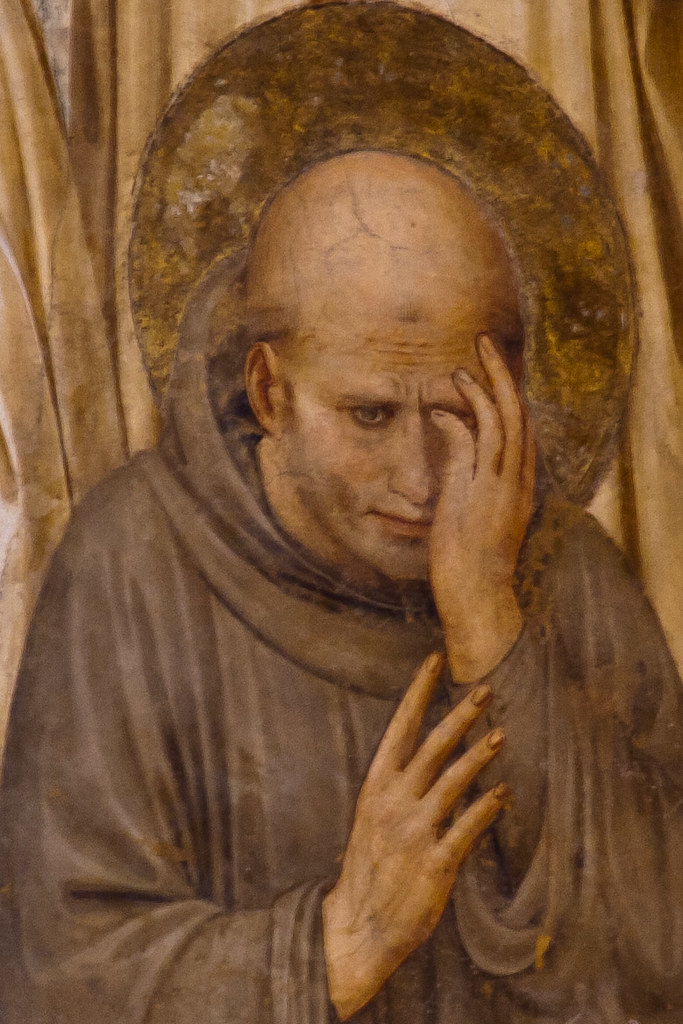
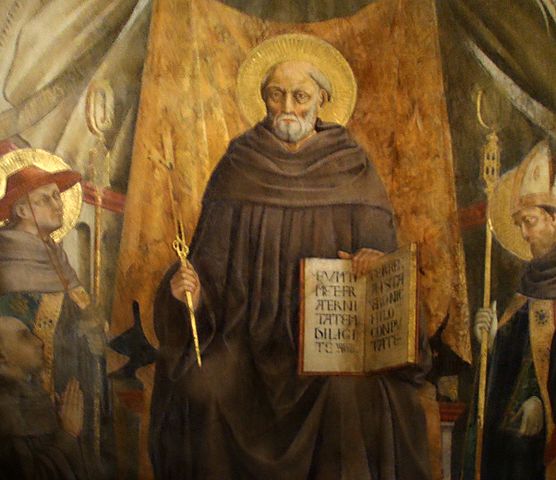
Saint of the Day – 26 April – Saint Paschasius Radbertus (785–865) Monk, Abbot, Theologian – born 785 at Soissons, France and died in 865 of natural causes.   St Paschasius was a Carolingian theologian and the abbot of Corbie, a monastery in Picardy founded in 657 or 660 by the queen regent Bathilde with a founding community of monks from Luxeuil Abbey.   His most well-known and influential work is an exposition on the nature of the Eucharist written around 831, entitled De Corpore et Sanguine Domini.snip st paschasius radbertus.JPG

Paschasius was an orphan left on the steps of the convent of Notre-Dame de Soissons.   He was raised by the nuns there and became very fond of the abbess, Theodrara. Theodrara was sister of St Adalard of Corbie (C 751-827) and St Wala of Corbie (c 755–836), two monks (and both abbots prior to Paschasius) whom he admired greatly.   At a fairly young age, Paschasius left the convent to serve as a monk under Abbot Adalard, at Corbie.

Through the abbotship of both Adalard and Wala, Paschasius focused on the monastic life, spending his time studying and teaching.   When Adalard died in 826, Paschasius helped ensure Wala would become Abbot in his place.   Wala’s death in 836 brought yet another abbot to Corbie, Ratramnus, who held opposing views to Paschasius on a number of ecclesiastical issues.   Ratramnus wrote a refutation of Paschasius’ treatise on the Eucharist, De Corpore et Sanguine Domini, using the same title.st paschasius radvertus of corbie

By 844, Paschasius himself became abbot, however he resigned his title ten years later to return to his studies  . He left Corbie for the nearby monastery of St Riquier, where he lived in voluntary exile for some years.   Why he resigned is unknown, however, it is likely that his actions were motivated by factional disputes within his monastic community, misunderstandings between himself and the younger monks were likely factors in his decision.   He returned to Corbie late in life and resided in his old monastery until his death in 865.

St Paschasius’ body was first buried at the Church of St John in Corbie.   After numerous reported miracles, the Pope ordered his remains to be removed and interred in the Church of St Peter, Corbie.   He was Canonised in 1073 by Pope Gregory VII.

Corbiechurch.jpg
St Peter’s Corbie

St Paschasius has an extensive collection of works, including the “Vitae” or Lives of St Adalbert and St Wala and many exegeses on various books of the Bible.  He wrote commentaries on the Gospel of Matthew, Lamentations, a commentary on Revelations and an exposition of Psalm 45, which he dedicated to the nuns at St Mary at Soissons. De Partu Virginis, written for his friend Emma, Abbess of St Mary at Soissons and daughter of Theodrara, describes the lifestyle of nuns.  26_ St_ Paschasius Radbertus, AbbotHe also wrote a treatise, titled De Nativitae Sanctae Mariae, regarding the nature of the Virgin Mary and the birth of Jesus Christ.  Paschasius probably wrote much more but none of it has survived through the centuries.

The most well-known and influential work of St Paschasius, ‘De Corpore et Sanguine Domini’ The Body and Blood of Christ (written between 831 and 833), is an exposition on the nature of the Eucharist.   It was originally written as an instructional manual for the monks under his care at Corbie and is the first lengthy treatise on the Sacrament of the Eucharist in the Western world.   In it, Paschasius agrees with St Ambrose (340-397) in affirming that the Eucharist contains the true, historical body of Jesus Christ.

According to Paschasius, God is truth itself and, therefore, His words and actions must be true.   Christ’s proclamation at the Last Supper that the bread and wine were His body and blood must be taken literally, since God is truth.   He believes that the transubstantiation of the bread and wine to be used at the Eucharist occurs literally.  Only if the Eucharist is the actual body and blood of Christ can a Christian know it is salvific.

Paschasius believed that the presence of the historical blood and body of Christ allows the partaker a real union with Jesus in a direct, personal and physical union by joining a person’s flesh with Christ’s and Christ’s flesh with his.   To Paschasius, the Eucharist’s transformation into the flesh and blood of Christ is possible because of the principle that God is truth, God is able to manipulate nature, as He created it.

The book was given to Charles the Bald, the Frankish king, as a present in 844, with the inclusion of a special introduction.   The view Paschasius expressed in this work was met with some hostility.   Ratramnus, who preceded Paschasius as Abbot of Corbie, wrote a rebuttal by the same name, by order of Charles the Bald, who did not agree with some of the views Paschasius held.   Ratramnus believed that the Eucharist was strictly metaphorical, he focused more on the relationship between faith and the newly emerging science, while Paschasius believed in the miraculous.

Shortly thereafter, a third monk joined the debate, St Rabanus Maurus (c 780–856), which initiated the Carolingian Eucharist Controversy.   Ultimately, however, the king accepted Paschasius’ assertion and the physical presence of Christ in the Eucharist, which had already been believed for centuries, was cemented by St Paschasius book and cleared the way for a precise understanding of Transubstantiation.st paschasius radbertus

Posted in MARIAN TITLES, SAINT of the DAY, The BLESSED VIRGIN MARY

Memorial of Our Lady of Good Counsel and the Saints – 26 April

Our Lady of Good Counsel (Memorial) – https://anastpaul.wordpress.com/2017/04/26/thought-for-the-day-26-april/

Bl Alda of Siena
St Antoninus of Rome
St Basileus of Amasea
St Clarence of Venice
St Claudius of Rome
St Pope Cletus (c 25-c 89) 3rd Bishop of Rome and Martyr
Biography: https://anastpaul.wordpress.com/2017/04/26/saint-of-the-day-26-april-st-pope-cletus/
St Cyrinus of Rome
St Exuerantia of Troyes
Bl Gregory of Besians
Bl Juli Junyer Padern
St Lucidius of Verona
St Pope Marcellinus
St Paschasius Radbertus (785–865)
St Pelligrino of Foggia
St Peter of Braga
St Primitive of Gabi
St Rafael Arnáiz Barón (1911-1938)
About this memorable Saint:   https://anastpaul.wordpress.com/2018/04/26/saint-of-the-day-26-april-st-rafael-arnaiz-baron-o-c-s-o-1911-1938/

St Richarius of Celles
Bl Stanislaw Kubista
St Trudpert of Munstertal
St William of Foggia
Bl Wladyslaw Goral

Posted in SAINT of the DAY, The APOSTLES & EVANGELISTS, The WORD

Quote of the Day – 25 April – “Go into the whole world”

Quote of the Day – 25 April – Thursday of Easter week and the Memorial of St Mark the Evangelist

Jesus appeared to the Eleven and said to them:
“Go into the whole world
and proclaim the Gospel to every creature.
Whoever believes and is baptised will be saved;
whoever does not believe will be condemned.
These signs will accompany those who believe:
in my name they will drive out demons,
they will speak new languages.
They will pick up serpents with their hands
and if they drink any deadly thing, it will not harm them.
They will lay hands on the sick and they will recover.”

Mark 16:15-18go into the whole world - mark 16 15 - 25 april 2019 st mark.jpg

Posted in DOCTORS of the Church, EASTER, FATHERS of the Church, MORNING Prayers, QUOTES of the SAINTS, SAINT of the DAY, The APOSTLES & EVANGELISTS, The RESURRECTION, The WORD

One Minute Reflection – 25 April – “It is I, fear not.”

One Minute Reflection – 25 April – Thursday of Easter week, Gospel: Luke 24:35–48 and the Memorial of St Mark the Evangelist and St Giovanni Battista Piamarta (1841 – 1913)

As they were saying this, Jesus himself stood among them
and said to them, “Peace be with you.”…Luke 24:36

REFLECTION – “Rebellious people had chased peace from the earth… and thrown the world into its primordial chaos… Among the disciples as well, war was waging, faith and doubt fought furious assaults on one another… Where a storm was raging, their hearts could find no peaceful harbour, no calm port.

At the sight of that Christ who plumbs the hearts, who commands the winds, who is master over tempests and who with a simple sign changes the storm into a serene sky, strengthened them with his peace, saying: “Peace be with you!
It is I, fear not.
It is I, who was crucified, who was dead, who was buried.
It is I, your God become man for you.
It is I. Not a spirit clothed with a body but truth itself become man.
It is I, the living one among the dead, who have come from heaven to the heart of hell.
It is I, before whom death fled, whom hell feared. In its terror, hell proclaimed me to be God. Do not be afraid, Peter, you who denied me, nor you, John, who fled, nor all of you who abandoned me, who thought of nothing but betraying me, who do not yet believe in me, even though you see me.
Do not be afraid, it really is I.
I have called you with grace,
I have chosen you with forgiveness,
I have upheld you with my compassion,
I have carried you in my love and I am taking you today solely because of my kindness.”...St Peter Chrysologus (400-450) Father & Doctor of the Churchluke 24 36 peace be with you - do not be afraid it is i - st peter chrysologus 25 april 2019 easter thurs.jpg

PRAYER – Lord God, let there be one faith in our hearts, one love for You, one Way in You, for You are the One Truth and the only Way.   We linger in Your light and beg Your unending kindness.   Grant that by the prayers of Your saints we may obtain Your strength.   St Mark, pray for us.  St Giovanni Piamarta, pray for us.   Through Christ our Lord, with the Holy Spirit, God for always and forever, amen.

Posted in ON the SAINTS, SAINT of the DAY

Saint of the Day – 25 April – Saint Giovanni Battista Piamarta FN (1841 – 1913)

Saint of the Day – 25 April – Saint Giovanni Battista Piamarta FN (1841 – 1913) – Priest, Teacher, Apostle of the Poor, Founder of the Congregation of the Holy Family of Nazareth.    St Giovanni established his congregation in 1900 in order to promote Christian education across the Italian peninsula.   He also founded the Humble Servants of the Lord.   Both of which he is the Patron and of jobseekers.st giovanni battista piamarta-new-saints_j8chwu.jpg

Giovanni Battista Piamarta was born in Brescia on 26 November 1841 into a poor household, his father was a barber.

He lost his parents at the age of nine in 1840 and the orphanage was situate in the slums of the town, where he experienced the desperation of the street children.   His maternal grandfather helped him to keep afloat and alive and sent him to the Oratory of Saint Thomas.   His adolescence was difficult but thanks to the parish of Vallio Terme he entered the diocesan seminary.

He was ordained to the priesthood on 23 December 1865 and he began his pastoral mission in Carzago Riviera (Bedizzole), spending his first two decades in intense pastoral work and is remembered as a priest “zealous, excellent, flawless in everything”.st giovanni_Piamarta.jpg

During that time he was appointed as the priest (and later director) of the parish of Saint Alexander and then as the parish priest of Pavone del Mella.   Brescia was in the process of industrialisation and Piamarta identified with the difficulties and hopes of disadvantaged adolescents, due to his own experiences as a child.

With the support of Monsignor Pietro Capetti and the Catholic Movement he started the Art and Crafts Institute for the vocational and Christian education of the poorest children and adolescents on 3 December 1886.   The “Workman’s Institute” grew and they were able to help and teach many adolescents to receive an adequate technical education.st giovanni piamarta with children

In 1889, he and Father Giovanni Bonsignori began the Agricultural Colony of Remedello.   As a result, a range of the religious gathered around Piamarta who shared the ideals and labours of the mission.   In March 1900 he established the Congregation of the Holy Family of Nazareth (“Piamartinis”) to continue the work of technical Christian education around the world.

This would, in time, include Italy, Angola, Mozambique, Brazil (from where the Canonisation miracle came) and Chile.   Piamarta’s work with the Brescian printing and publishing house, “Queriniana”, helped make Brescia a European centre of Catholic publications.

St Giovanni died on 25 April 1913 in Remedello after a life spent in the service of God and his fellow man.   In 1926 his remains were moved to the church of the workmen that he himself had built.

He was Beatified on 12 October 1997 by St Pope John Paul II and Canonised on 21 October 2012 by Pope Benedict XVI.canonisation snip st giovanni

St Giovanni piamarta new-saints-tease_ips3jy

The Son of Man came to serve and to give his life as a ransom for many (cf. Mk 10:45

“Giovanni Battista Piamarta, priest of the Diocese of Brescia, was a great apostle of charity and of young people.   He raised awareness of the need for a cultural and social presence of Catholicism in the modern world and so he dedicated himself to the Christian, moral and professional growth of the younger generations with an enlightened input of humanity and goodness.   Animated by unshakable faith in divine providence and by a profound spirit of sacrifice, he faced difficulties and fatigue to breathe life into various apostolic works, including the Artigianelli Institute, Queriniana Publishers, the Congregation of the Holy Family of Nazareth for men and for women, the Congregation of the Humble Sister Servants of the Lord.

The secret of his intense and busy life is found in the long hours he gave to prayer.   When he was overburdened with work, he increased the length of his encounter, heart to heart, with the Lord.   He preferred to pause before the Blessed Sacrament, meditating upon the passion, death and resurrection of Christ, to gain spiritual fortitude and return to gaining people’s hearts, especially the young, to bring them back to the sources of life with fresh pastoral initiatives.”

Pope Benedict XVI on the Canonisation of St Giovanni, Sunday, 21 October 2012

Posted in EASTER, FEASTS and SOLEMNITIES, SAINT of the DAY, The APOSTLES & EVANGELISTS

Feast of St Mark the Evangelist and Memorials of the Saints – 25 April 2019

St Mark the Evangelist (Feast) Also known as John Mark (Born 1st century – martyred 25 April 68 at Alexandria, Egypt) – The Winged Lion (This year, 2019, as St Mark’s Feast falls within the Easter Octave, it is not celebrated in the usual way, as the Easter Solemnity, obviously takes precedence).
St Markhttps://anastpaul.wordpress.com/2018/04/25/saint-of-the-day-25-april-st-mark-the-evangelist/

And:  https://anastpaul.wordpress.com/2017/04/25/saint-of-the-day-25-april-st-mark-the-evangelist-solemnity/

St Agathopodes of Antioch
Bl Andrés Solá Molist
St Anianus of Alexandria
Bl Antonio Pérez Lários
St Callista of Syracuse
St Clarentius of Vienne
St Ermin of Lobbes
St Evodius of Syracuse
St Franca Visalta
St Giovanni Battista Piamarta FN (1841 – 1913)

St Heribaldus of Auxerre
St Hermogenes of Syracuse
Bl José Trinidad Rangel y Montaño
St Kebius
St Macaille
St Macedonius
St Mario Borzaga
St Pasicrate of Mesia
St Paul Thoj Xyooj
Pedro de San Jose Betancur
Phaebadius of Agen
Philo of Antioch
Robert of Syracuse
Bl Robert Anderton
Stefano of Antioch
St Valenzio of Mesia
Bl William Marsden

Martyrs of Yeoju – 3 saints: Three Christian laymen martyred together in the apostolic vicariate of Korea. 25 April 1801 in Yeoju, Gyeonggi-do, South Korea
They were Beatified15 August 2014 by Pope Francis
• Ioannes Won Gyeong-do
• Marcellinus Choe Chang-ju
• Martinus Yi Jung-bae

Posted in EUCHARISTIC Adoration, PRAYERS of the SAINTS, QUOTES of the SAINTS, QUOTES on COURAGE, QUOTES on FAITH, QUOTES on GRACE, QUOTES on LOVE, QUOTES on MARTYRDOM, QUOTES on the CROSS of CHRIST, SAINT of the DAY, The HOLY EUCHARIST / The HOLY MASS, The PASSION, The RESURRECTION

Quote/s of the Day – 24 April – St Fidelis & St Mary Euphrasia Pelletier

Quote/s of the Day – 24 April – Wednesday of Easter week and the Memorial of St Fidelis of Sigmaringen OFM.Cap. (1577-1622) and St Mary Euphrasia Pelletier (1796-1868)

“Woe to me if I should prove myself
but a half-hearted soldier in the service
of my thorn-crowned Captain.”woe-to-me-st-fidelis - 24 apil 2019 no 2

“What made the holy apostles and martyrs
endure fierce agony and bitter torments,
except faith and especially faith in the resurrection?
What is it that today makes true followers of Christ
cast luxuries aside, leave pleasures behind
and endure difficulties and pain?
It is a living faith that expresses itself through love.
It is this that makes us put aside the goods of the present
in the hope of future goods. It is because of faith
that we exchange the present for the future.”

St Fidelis of Sigmaringen (1577-1622)what made the holy apostles and martyrs - st fidelis - 24 april 2019

“May your heart be an altar,
from which the bright flame,
of unending thanksgiving
ascends to heaven.”may-your-heart-be-an-altar-st-mary-euphrasia-24-april-2019 no 2

“Draw near to our Lord, thoroughly aware
of you own nothingness and you may hope
all things from His Goodness and Mercy.
Never forget that Jesus Christ is no less generous
in the Blessed Sacrament than He was
during His mortal life on earth.”draw-near-to-our-lord-st-mary-euphrasia-24-april-2018

O my God,
may every beat of my heart,
be a prayer, to obtain grace
and pardon for sinners.
May all my sighs, be so many
appeals to Your infinite mercy.
May each look, have the virtue,
to gain to Your love,
those souls, whom I shall look on.
May the food of my life,
be to work without ceasing
for Your glory
and the salvation of souls.
Amen

St Mary Euphrasia Pelletier (1796-1868)morning-prayer-of-st-mary-euphrasia-pelletier-24-april 2019-o-my-god-may-every-beat-of-my-heart-no-2-jpg2.jpg

Posted in EASTER, franciscan OFM, PAPAL MESSAGES, PRAYERS of the SAINTS, QUOTES of the SAINTS, SAINT of the DAY, The HOLY EUCHARIST / The HOLY MASS, The WORD

One Minute Reflection – 24 April – “Stay with us”

One Minute Reflection – 24 April – Wednesday of Easter week, Gospel: Luke 24:13–35 and the Memorial of St Benedict Menni (1841-1914)

“Stay with us, for it is toward evening and the day is now far spent.”   So he went in to stay with them....Luke 24:29

REFLECTION – “When the disciples on the way to Emmaus asked Jesus to stay “with” them, He responded by giving them a much greater gift, through the Sacrament of the Eucharist He found a way to stay “in” them.
Receiving the Eucharist means entering into a profound communion with Jesus.   “Abide in me, and I in you” (Jn 15:4).   This relationship of profound and mutual “abiding” enables us to have a certain foretaste of heaven on earth.   Is this not the greatest of human yearnings?   Is this not what God had in mind when He brought about in history His plan of salvation?   God has placed in human hearts a “hunger” for His word (cf. Am 8:11), a hunger which will be satisfied only by full union with Him.   Eucharistic communion was given, so that we might be “sated” with God here on earth, in expectation of our complete fulfilment in heaven.
This special closeness which comes about in Eucharistic “communion” cannot be adequately understood or fully experienced apart from ecclesial communion…   The Church is the Body of Christ – we walk “with Christ” to the extent that we are in relationship “with his body”. Christ provided for the creation and growth of this unity, by the outpouring of His Holy Spirit.   And He Himself, constantly builds it up by His Eucharistic presence.   It is the one Eucharistic bread which makes us one body.   As the Apostle Paul states:  “Because there is one bread, we who are many are one body, for we all partake of the one bread” (1Cor 10:17)…Saint John Paul II (1920-2005) – Apostolic Letter “ Mane nobiscum Domine ” §19-20luke 24 29 - stay with us - when the disciples on the way to emmaus - st john paul 24 april 2019 - wed easter octave.jpg

PRAYER – Stay with me, Lord, for it is necessary to have You present so that I do not forget You.   You know how easily I abandon You.
Stay with me Lord, because I am weak and I need Your strength, so that I may not fall so often.
Stay with me Lord, for You are my life and without You, I am without fervour.
Stay with me Lord, for You are my light and without you, I am in darkness.
Stay with me Lord, to show me Your will.
Stay with me Lord, so that I hear Your voice and follow You…. St Padre Pio of Pietrelcina (1887-1968) (Excerpt)  
And grant holy Father, that the prayers of St Benedict Menni, may assist us on our way. Through Christ, our Lord, with the Holy Spirit, one God with You, forever, amen.st benedict menni pray for us 24 april 2019.jpg

Posted in SAINT of the DAY, VATICAN Resources

Saint of the Day – 24 April Saint Benedict Menni OH (1841-1914) “A Heart Without Borders”

Saint of the Day – 24 April Saint Benedict Menni OH (1841-1914) “A Heart Without Borders” Priest, founder of the Hospitaller Sisters of the Sacred Heart of Jesus.  Patronages – Hospitaller Sisters of the Sacred Heart of Jesus, People with mental health issues, the sick, Volunteers.

BENEDICT MENNI, who is being raised to the altars today, was a faithful follower of Saint John of God OH (1495 – 1550 – Founder of the Order of Hospitallers) and, through his words and deeds, was a Herald of the Gospel of Mercy and a new Prophet of Hospitality.Header San_Benito_Menni.jpg

His origins and his Hospitaller vocation:
The city of Milan was his cradle – he was born there on 11 March 1841 and baptised the same day.   He was named Angelo Ercole (Eercole means Hercules), almost as a portent of the Herculean spirit and strength that was to characterise his whole personality.

He was the fifth of 15 children born to Luigi Menni and Luisa Figini.   His warm and hospitable home gave him the support and stimulus he needed to develop his intellectual powers and his personality.
God’s call came early on, faithful to his conscience, he gave up a good position in a bank, and with his selfless attitude to suffering, he volunteered to work as a stretcher-bearer to assist the soldiers wounded on the battlefield at Magenta, near Milan.

Attracted by the spirit of dedication and self-denial which he discovered in the Brothers of St John of God, at the age of 19 he applied to enter the Hospitaller Order.

He began his Religious life taking the name Benedict and consecrated himself to God and to the care of the sick.   And today we venerate him with the same name – Saint Benedict Menni.19991121_benedetto_menni.jpg

His Hospitaller formation and mission:
It was during his nursing and priestly studies that his Religious Hospitaller personality was gradually fashioned, which he placed at the disposal of his Superiors, embracing the cause of helping the most needy members of society, so many of whom were sick.

At that time Spain, the cradle of the Hospitaller Order, was embroiled in political strife, with open hostility to all the Religious Orders and the work of St John of God was practically dead.   It needed a new lease of life and Benedict Menni was to be the man of providence to bring it about.

He was sent to Spain in 1867 and it was there that he performed his two great works – he restored the Order of St John of God and founded the Congregation of the Hospitaller Sisters of the Sacred Heart of Jesus.

Thanks to his magnanimous spirit, his great capabilities and state of mind, he overcame many difficulties and did so much good to help the sick, providing them with comprehensive care.st benedict menni oh.jpg

The Restorer of the Hospitaller Order:
Sent to Spain by the Prior General of the Order, Fr Giovanni M Alfieri, who always supported him and with the blessing of the Pope, Visitor and Prior General of the Order Pius IX, even before he left Rome, Benedict Menni demonstrated a will of iron and a determined spirit.   Only a few months after his arrival in Spain he set up his first children’s hospital in Barcelona (1867), marking the beginning of his extraordinary work of restoration, which he was to carry throughout the next 36 years.

From the first moment, thanks to his commitment to his vocation, numerous generous followers rallied around him and it was through them, that he was able to guarantee continuity to his new Hospitaller institutions, that were springing up in Spain, Portugal and Mexico, to spread subsequently throughout the New World.

The Founder of the Hospitaller Sisters:
When he arrived in Granada (1878), Benedict Menni came in contact with two young women, Maria Josefa Recio and Maria Angtistias Gimenez, who set up a new women’s hospital specifically to provide psychiatric care in 1881.

It was at Ciempozuelos, Madrid, that the Mother House of the “Congregation of the Hospitaller Sisters of the Sacred Heart of Jesus” was founded, receiving the approval of the Holy See in 1901.

Six words summarise their identity in the Hospitaller service – “pray, work, endure, suffer, in love for God and in silence”.st benedict with sisters.jpg

The new Institution soon spread its wings of merciful charity by becoming established in several countries in Europe and Latin America and later on in Africa and Asia.   At the present time, as the Congregation celebrates the Canonisation of its founder, Benedict Menni, the Sisters are present in 24 countries, with over 100 Hospitaller Centres.st benedict menni close up

Benedict Menni, their Founder and spiritual Father, imbued them with his own charismatic spirit of St John of God and for over 30 years continued to provide them with his guidance and formation in Hospitaller ascetics.

Visitor and Prior General of the Order:
The opera magna wrought by Benedict Menni as a Restorer and Founder spread, at the request of the Holy See, to the whole Order when he was appointed Apostolic Visitor (1909-1911) and subsequently Prior General (1911), which he had to resign one year later as a result of misunderstandings and for health reasons.

He spent the last two years of his life in humility and purification and died a holy death at Dinan, France, on 24 April 1914.

His mortal remains were taken by the Spanish Brothers to Ciempozuelos and today are venerated under the high altar in the Founders’ Chapel in the Hospitaller Sisters’ Mother House there.

In the glory of the saints:
The process to acknowledge his holiness opened in the diocese of Madrid where he is buried, in 1945-1947 and his virtues were recognised as heroic, by the Congregation for the Causes of the Saints on 11 May 1982, so that he was able to be called ” Venerable”.

After official acceptance of the miraculous healing of Asuncion Cacho thanks to his intercession, he was proclaimed “Blessed” in St Peter’s Basilica by St Pope John Paul II on 23 June 1985.Benedeto-menni

His message of Hospitality:
In addition to his total dedication which bore such fruit, his holy and sanctifying conduct, his life offered entirely to God and to the sick with total generosity, the witness borne by Benedict Menni has regained all its topical relevance today with his Canonisation, which is offering him to the universal Church as a model and an example to be followed, particularly by those working in health care.

Humanisation and evangelisation are challenges to the new millennium.   St Benedict Menni recalls to us and enlightens the words of our Lord, “I was sick and you visited me… Come, O blessed of my Father”.

Health care uses the benefits brought by scientific and technological progress but frequently, it is the “heart” which is missing in patient care.   Health care is often concerned more with the sickness than the sick, who are often viewed as numbers or clinical cases, rather than as brothers and sisters, to be cared for and ministered to, as persons made in the image of a suffering God....Vatican.va

St Benedict was Canonised on 21 November 1999 by St Pope John Paul II.st benedict menni-varias-unidas

Posted in MARIAN TITLES, SAINT of the DAY

24 April – Feast of Our Lady of Bonaria & Our Lady of Luján in Buenos Aires and Memorials of the Saints

St Fidelis of Sigmaringen (1577-1622) Known as “The Poor Man’s Lawyer” (Optional Memorial)
Biography:   https://anastpaul.wordpress.com/2017/04/24/saint-of-the-day-24-april-st-fidelis-of-sigmaringen/

Our Lady of Bonaria:   Devotion to the Blessed Virgin Mary in the form of a statue of Mary and the Christ Child that was washed up at a Mercedarian monastery near Cagliari, Italy on 25 April 1370, apparently from a shipwreck the night before.   Legend says that the locals tried to open the crate it was in, but only one of the Mercedarian monks could get the it open. Patron of Sardinia, Italy.our-lady-of-bonaria
Our Lady of Luján in Buenos Aires:  Virgin of Luján, Patroness of Argentina, Uruguay and Paraguay.   16th-century icon of the Virgin Mary. Tradition holds that a settler ordered the terracotta image of the Immaculate Conception in 1630 because he intended to create a shrine in her honour to help reinvigorate the Catholic faith in Santiago del Estero, his region.  virgen_de_lujc3a1n-rc3a9plicaAfter embarking from the port of Buenos Aires, the caravan carrying the image stopped at the residence of Don Rosendo Oramas, located in the present town of Zelaya.   When the caravan wanted to resume the journey, the oxen refused to move. Once the crate containing the image was removed, the animals started to move again. Given the evidence of a miracle, people believed the Virgin wished to remain there.   The image was venerated in a primitive chapel for 40 years.   Then the image was acquired by Ana de Matos and carried to Luján, where it currently resides.

St Alexander of Lyon
St Anthimos of Nicomedia
St Authairius of La Ferté
St Benedetto/Benedict Menni OH (1841-1914)
St Bova of Rheims
St Deodatus of Blois
St Diarmaid of Armagh
St Doda of Rheims
St Dyfnan of Anglesey
St Egbert of Rathemigisi
St Eusebius of Lydda
St Gregory of Elvira
St Honorius of Brescia
St Ivo of Huntingdonshire
St Leontius of Lydda
St Longinus of Lydda
St Mary Euphrasia Pelletier (1796-1868)
About St Mary Euphrasia: https://anastpaul.wordpress.com/2018/04/24/saint-of-the-day-24-april-st-mary-euphrasia-pelletier-1796-1868/

St Mary of Cleophas
St Mary Salome
St Mellitus of Canterbury
St Neon of Lydda
St Sabas the Goth of Rome
St Tiberio of Pinerolo
St William Firmatus

Mercedarian Martyrs of Paris: No info yet.

Posted in CARMELITES, QUOTES of the SAINTS, QUOTES on the CROSS of CHRIST, SAINT of the DAY, The HOLY CROSS, The PASSION

Quote/s of the Day – 23 April – Marked with His brand

Quote/s of the Day – 23 April – the Memorial of Bl Teresa Maria of the Cross OCD (1846–1910)

Do you know what it means
to be truly spiritual?
It means becoming the slaves of God.
Marked with His brand,
which is that of the Cross,
spiritual persons,
because now, they have given Him,
their liberty,
can be sold by Him,
as slaves of everyone,
as He was.
In acting this way,
He doesn’t do us any harm
but rather He grants us,
a not insignificant grace.do youknow what it means - bl teresa maria of the cross - 23 april 2019.jpg

We have always seen,
that those who were
closest to Christ our Lord,
were those with the greatest trials.
Let us look at what
His glorious Mother suffered
and the glorious apostles.
Take up the Cross of Jesus.
Help your Spouse to carry the burden
that weighs Him down
and pay no attention
to what they may say about you.
If you should happen to stumble
and fall like your Spouse,
do not withdraw from the Cross or abandon it.
No matter how great your trials may be,
you will see, that they are quite small,
in comparison to His.take up the cross - bl teresa maria of the cross 23 april 2019.jpg

If we never look at Him
or reflect on what we owe Him
and the death He suffered for us,
I don’t know how we’ll be able
to know Him or serve Him.
And without these works in His service,
what value will our faith have?
And what value will our works have,
if they are separated,
from the inestimable merits
of Jesus Christ, our Good.
And then, who will bring us
to love this Lord?”

Blessed Teresa Maria of the Cross OCD (1846–1910)if we never look at him or reflect - bl teresa maria of the cross 23 april 2019.jpg

Posted in MORNING Prayers, QUOTES of the SAINTS, QUOTES on the CROSS of CHRIST, SAINT of the DAY, The HOLY CROSS, The WORD

One Minute Reflection – 23 April – “..How is it you want to please Him only with words?

One Minute Reflection – 23 April – Tuesday of Easter week, First Reading: Acts 2:36-41and the Memorial of Bl Teresa Maria of the Cross OCD (1846–1910)

Now when they heard this, they were cut to the heart and said to Peter and the rest of the apostles, “Brethren, what shall we do?”   And Peter said to them, “Repent and be baptised every one of you, in the name of Jesus Christ, for the forgiveness of your sins and you shall receive the gift of the Holy Spirit...Acts 2:36-38acts-2-36-38 (1) now when they heard this they were cut to the heart 3 april 2018.jpg

REFLECTION – “Fix your eyes on the Crucified and everything will become easy for you. If His Majesty showed us His love by means of such works and frightful torments, how is it you want to please Him only with words?”…Bl Teresa Maria of the Cross (1846–1910)fix your eyes on the crucified - bl teresa maria of the cross 23 april 2019.jpg

PRAYER – Almighty, ever-living God, we confidently call You Father, as well as Lord. Renew Your Spirit in our hearts, make us ever more perfectly Your children.   Grant that all who have received the grace of Baptism may strive to be worthy of their Christian calling and reject everything opposed to it.   May the prayers of Bl Teresa Maria of the Cross (1846–1910), help us to grow in perseverance and strength as we follow in the way of the Cross..   Through our Lord Jesus Christ, in union with the Holy Spirit, one God forever, amen.blessed teresa maria of the cross pray for us 23 april 2019.jpg

Posted in CARMELITES, MYSTICS, SAINT of the DAY

Saint of the Day – 23 April – Blessed Teresa Maria of the Cross OCD (1846–1910)

Saint of the Day – 23 April – Blessed Teresa Maria of the Cross OCD (1846–1910) Religious Nun of the Carmelite Order, Foundress of the Carmelite Sisters of Saint Teresa, Mystic, Adorer of the Holy Eucharist, Marian devotee, spiritaul advisor, teacher.   Born on 2 March 1846 at Campi Bisenzio, Florence, Italy as Teresa Adelaide Cesina Manetti and died on 3 April 1910 at Campi Bisenzio, Florence, Italy of natural causes.   Patronages – Carmelite Sisters of Saint Teresa, People ridiculed for their piety, Campi Bisenzio, Italy her birthplace.st teresa maria of the cross Manetti

Teresa Manetti, familiarly called Bettina, was born in the Tuscan countryside and raised among a simple family.    She was the daughter of Salvatore Manetti and Rosa Bigagli, and had one brother, Adamo Raffaello.   She lived her entire life in her small village.

01-Casa-Natale-di-Bettina-223x3001
Birthplace of Blessed Teresa Maria

Bettina had a cheerful, energetic disposition and a talent for organisation and all the qualities which make for a good leader.   At the age of 21, she rented a home with two other women who dedicated themselves to a life of prayer, penance and charity.   They cared for the sick and the poor and taught catechism to children.   They were inspired by the writings of Saint Teresa of Avila and had a special devotion to her.   Many other women joined the small group.   The women were admitted to the Teresian Third Order and Bettina took the new name of Teresa Maria of the Cross.

Two years later, she joined the Discalced Carmelites as a nun.   Over the next few years she started schools in several Italian cities, each with it’s little group of Carmelite teachers.   Her Institute of teaching nuns received approval from Pope Saint Pius X on 27 February 1904 as the Carmelite Sisters of Saint Teresa of Florence with a mission to teach and care for children, especially orphans.   Like her inspiration, Saint Teresa of Avila, Teresa of the Cross met with much resistance to her work with the poor, much slander about her personal life and a long period of spiritual dryness but all who met her, commented on the air of joy and peace she brought to her work.

Under the wise guidance of Mother Teresa, the new congregation, animated by a true Carmelite spirit, went on expanding.   In realisation of an old prophetic dream, with twelve houses opened in Tuscany, Teresa was able to add two on the Carmelite missions in Syria and one on the slopes Of Carmel, at Haifa.   She gave individual attention to the foundations and to the religious, with the strength of a mother who wished her daughters to be poor and detached from everything, truly tending towards God alone as they served His orphans and little ones.   She herself was the servant of all. Despite her own precarious health, she was forgetful of self as she sought to pour out joy and her smile upon all who approached her.   The witnesses at the process of beatification are unanimous in declaring that everyone who met her was impressed by her trust in God and by her serene abandonment to Providence and felt himself the better person for it.st teresa maria of the cross

And as the years passed, Teresa was more and more besieged by crowds of people, especially on Sundays.   Lines of persons of every class and condition awaited their turn to be heard and consoled by her.  She was able to unite them to the Lord, give counsels of heavenly wisdom, heal ills which resisted the efforts of science, read hearts, see into the future, cut down distances, multiply goods and money.   These are the «little flowers» that are in evidence on every page of the canonical processes, little flowers that, while they reveal charismatic facts, also show her exceptional availability for her neighbours, even at times of greatest pain.   Bishop Andrew Cassullo, who had known her intimately, affirmed in her regard: “She undid herself doing good.”

She lived joyfully, body and soul the mystery of the Cross in full conformity to the will of God.   Teresa Maria was outstanding for her love for the Eucharist and her maternal care for children and for the poor.   Her life was motivated by a consuming love for Christ and a desire to save souls.   She endeavoured to live according to God’s holy will and took delight in all the crosses which came through this purpose.   In a prayer she wrote:

“To suffer, to suffer, always suffer.   Do what you want with me, it’s enough that I save souls for you.”bl teresa maria of the cross new.jpg

The source of such a dedication was her life of faith and of theological charity, the great virtues of her life which nourished her Eucharistic fervour and gave her the strength to live out her religious name, of the Cross, in its deepest significance.   She lived on prayer and she had the gift of a continual communion with the Lord, so that, as one witness recalls in regard to a personal affirmation of the servant of God, “for her it was the same to be enclosed in a convent or to deal with people, because everywhere she felt herself united to God.”   This habitual union found its nourishment in Eucharistic piety.   She had great devotion for the Eucharist even as a child.   During the institute’s first years she went into ecstasy almost every day after Communion, later, too, in the Eucharistic presence she felt something that drew her out of herself.

One of her great hopes was a house entirely dedicated to the perpetual adoration of the Eucharist.   She was able to realise this in Florence, where on 11 January 1902, in the church of Corpus Domini, which she had built, the Blessed Sacrament was solemnly exposed.   It was in contact with Christ that her apostolic desires increased, hence she exclaimed:  “I should like to make all hearts into one and plunge it into the heart of Jesus.”   Moreover, the love of Jesus bound her more intimately to Our Lady, whose tenderness and care for Jesus she herself wished to have.   Happy to be a Carmelite, she saw in her Carmelite vocation a commitment to belong to Our Lady more deeply and to spread devotion to her.

She died at Campi Bisenzio on 23 April 1910 and was beatified on October 1986 by St Pope John Paul II after the approval of the required miracle.4_23_Blessed-Teresa-Mary-Manetti

Posted in SAINT of the DAY

Memorials of the Saints – 23 April

St Adalbert of Prague (c 957-997) Martyr (Optional Memorial)
About St Adalbert:   https://anastpaul.wordpress.com/2017/04/23/saint-of-the-day-23-april-st-adalbert-of-prague/

St George (died c 303) Martyr (Optional Memorial)
St George!https://anastpaul.wordpress.com/2018/04/23/saint-of-the-day-23-april-st-george-died-c-303-martyr/

St Achilleus of Vienne
Bl Adalbert III of Salzburg
St Felix of Vienne
St Fortunatus of Vienna
St George of San Giorio
St Gerard of Orchimont
Bl Gerard of Toul
Bl Giles of Assisi
Bl Giles of Saumur
Bl Giorgio di Suelli
Bl Helen del Cavalanti
St Ibar of Meath
Bl Maria Gabriela Sagheddu
St Marolus of Milan
St Pusinna of Champagne
Bl Teresa Maria of the Cross (1846–1910)

Martyrs of Africa: A group of Christians murdered for their faith in northern Africa. Little information has survived but their names. The ones we know are – Catulinus, Chorus, Faustinus, Felicis, Felix, Nabors, Plenus, Salunus, Saturninus, Silvius, Solutus, Theodora, Theodorus, Theon, Ursus, Valerius, Venustus, Victorinus, Victurus, Vitalis

Posted in SAINT of the DAY

Saint of the Day – 22 April – Saint Pope Caius I (Died 296)

Saint of the Day – 22 April – Saint Pope Caius I (Died 613) – (presumed to be a Martyr) – also called Gaius, was the Bishop of Rome from 17 December 283 to his death in 296. Christian tradition makes him a native of the Dalmatian city of Salona, today Solin near Split, the son of a man also named Caius and a member of a noble family related to the Emperor Diocletian.pope caius

About 280, an early Christian house of worship was established on the site of Santa Susanna, which, like many of the earliest Christian meeting places, was in a house (domus ecclesiae).   The domus belonged, according to the sixth-century acta, to brothers named Caius and Gabinus, prominent Christians.   Caius may be this Pope, or Caius the Presbyter. Gabinus is the name given to the father of Saint Susanna (3rd century Martyr). Thus, sources state that Caius was the uncle of Saint Susanna.

Pope Caius reigned for 13 years until his death in 296 just before the Diocletian persecution.   He was a relative of the Emperor Diocletian – instigator of one of the last great persecution of Christians in the early years of the Church.   Early in his papacy Caius decreed that a man must be a priest before he could be ordained a bishop.PCaius

He is said to have been driven into hiding in the catacombs for eight years whence he died a confessor, however the source from which this information is gleaned is considered unreliable by most historians.   His successor was Pope Marcellinus (died 304).

Caius’ tomb, with the original epitaph, was discovered in the catacomb of Callixtus and in it the ring with which he used to seal his letters.   In 1631, his alleged residence in Rome was turned into a church.   However, it was demolished in 1880 to make room for the Ministry of War, on the Via XX Settembre and his relics were transferred to the chapel of the Barberini family in the Lateran.Pope-Caius-I

Saint Caius’s feast day is celebrated on 22 April, as is that of Saint Pope Soter (see his Biography- https://anastpaul.wordpress.com/2018/04/22/saint-of-the-day-st-pope-soter-died-c-174/).   Both are mentioned under 22 April in the Roman Martyrology, the official list of recognised saints.   The entry for Saint Caius is as follows: “At Rome, in the cemetery of Callistus on the Via Appia, the burial of Saint Caius, Pope, who, fleeing from the persecution of Diocletian, died as a confessor of the faith.”

saint_soter_and_saint_caius
Saints Pope Soter & Pope Caius

St Caius is venerated in Dalmatia and Venice.   In Florence, the church of San Gaggio on the via Senese was dedicated to him, the term Gaggio is a corruption of the name Cajo.

Posted in SAINT of the DAY

Memorials of the Saints – 22 April

St Abel McAedh
St Aceptismas of Hnaita
St Pope Agapitus I,
St Apelles of Smyrna
St Arwald
St Pope Caius I (Died 296)

St Epipodius of Lyon
St Euflamia
Bl Francis of Fabriano
St Helimenas
St Joseph of Persia
St Leo of Sens
St Leonidas of Alexandria
St Lucius of Laodicea
St Opportuna of Montreuil
St Senorina
St Pope Soter (Died c 174)
Biography:  https://anastpaul.wordpress.com/2018/04/22/saint-of-the-day-st-pope-soter-died-c-174/

St Theodore of Sykeon (Died 613)
About St Theordore:  https://anastpaul.wordpress.com/2017/04/22/saint-of-the-day-22-april-st-theodore-of-sykeon/
St Virginio

Martyrs of Alexandria:  No info yet

Martyrs of Persia: Bishops, priests, deacons and laity who were martyred in Persia and celebrated together. Several of them have their stories related in the Acta of Saints Abdon and Sennen.
• Abdiesus the Deacon
• Abrosimus
• Aceptismas of Hnaita
• Aithilahas of Persia
• Azadanes the Deacon
• Azades the Eunuch
• Bicor
• Chrysotelus of Persia
• Helimenas of Persia
• James of Persia
• Joseph of Persia
• Lucas of Persia
• Mareas
• Milles of Persia
• Mucius of Persia
• Parmenius of Persia
• Tarbula of Persia

Posted in SAINT of the DAY

Saint of the Day – 20 April – St Pope Anicetus (died c 20 April 168)

Saint of the Day – 20 April – St Pope Anicetus (died c 20 April 168) was the Bishop of Rome from c 157 to his death in 168.  st anicetus-3.jpgAccording to the Annuario Pontificio, the start of his papacy may have been 153.   Anicetus actively opposed Gnosticism and Marcionism.   He welcomed Polycarp of Smyrna (69-155) to Rome, to discuss the controversy over the date for the celebration of Easter.

Born in Emesa, Syria at the end of the first century, he came along at a time when most of the Apostles had already died.   Anicetus was of the generation of leaders who had never met any of the original leaders of the fledgling Church.

It is said that Anicetus came to Rome with St Justin Martyr (100-165), one of the first Christian apologists.   On the martyrdom of Pius I, Anicetus was elected to the bishopric of Rome.   He had quite a bit to face.Papa_Aniceto_cropped.jpg

First, the Gnostic heretics, Valentinian and Marcion, were still in Rome, still trying to sell their concepts of the two Gods, the tyrant of the Old Testament and the kind, loving God of the New.   Valentinian, who, Tertullian says, planned to become the Bishop of Rome but never got the chance, was eventually excommunicated.   There is no documentation as to who finally did the excommunication but it seems that St Polycarp of Smyrna may have done that.   At any rate, he moved back to Asia Minor soon after Anicetus became bishop.   His followers continued to raise havoc in Rome.   Marcion was excommunicated by his own father, the bishop of Sinope.   Because the Roman civilians listened so long to the teachings of these heretics, they tended to fall away from the intense teachings of Peter and Paul.   Anicetus worked very hard at re-educating his see.   He did make a rule to help distinguish the orthodox presbyters from the long-haired Gnostics, they had to keep their hair short.   As the early historian, Hegesippus, wrote, the whole city developed a zeal of sanctity.

Polycarp, the elderly bishop of Smyrna, had sat at the knee of St John the Evangelist and had conversed with others.   Many in the East revered him and clung to his every word. In the middle of the second century, the Eastern Church celebrated Easter Biblically, that is, the 14th day of Nisan, as defined as Passover, no matter what day of the week it fell on.   The Western Church had already been directed to celebrate Easter on the Sunday.  At this time, it was already becoming a straining point between the two segments of the Church.   In 160, the old, revered Polycarp came to Rome to discuss this with Anicetus. Eventually, neither would budge and they had to agreed to disagree.   Anicetus was not going to put the Church at risk by antagonising Polycarp and thus let it alone.   But many years later, this became one of the dividing arguments that split the Church.St anicetus-2.jpg

Soon after Marcus Aurelius became emperor, he must have noted the lack of worship of the standard Roman gods.   A brilliant man in his own right, Aurelius must have known the cause of this behaviour.   He quickly went to the source, Pope Anicetus and took him into custody.  As inflexible as ever in supporting the orthodoxy of the Church and making known the Good News of Jesus Christ, Anicetus did not alter his beliefs.   Most believed he was thereafter martyred for his faith but there are no historical grounds for this account.   17 or 20 April are two dates which have been cited as the date of his death and his memorial was originally on 17 April.   The Liber Pontificalis states he was buried in the cemetery of Callistus.

St Anicetus, pray for us.pope-saint-anicetus.jpg

Posted in HOLY WEEK, SAINT of the DAY

Easter Vigil in the Holy Night and Memorials of the Saints – 20 April

St Agnes of Montepulciano OP (1268-1317)
About St Agnes:  https://anastpaul.wordpress.com/2017/04/20/saint-of-the-day-20-april-st-agnes-of-montepulciano/
St Pope Anicetus (Died c 168)

Bl Antony Page
St Caedwalla of Wessex
Bl Catwallon
Bl Chiara Bosatta
St Domninus of Digne
Bl Francis Page
Bl Gerald of Salles
Bl Harduin
Bl Hildegun of Schönau
St Hugh of Anzy-le-Duc
Bl James Bell
Bl John Finch
Bl John of Grace-Dieu
St Marcellinus – Bishop of Embrun (born in North Africa- died 374)
Biography:   https://anastpaul.wordpress.com/2018/04/20/saint-of-the-day-20-april-st-marcellinus-of-embrun-born-in-north-africa-died-374/
St Marcian of Auxerre
St Margaret of Amelia
Bl Maurice MacKenraghty
St Michel Coquelet
Bl Oda of Rivreulle
Bl Richard Sergeant
St Sara of Antioch
St Secundinus of Córdoba
St Servilian
Bl Simon Rinalducci
St Sulpicius
St Theodore Trichinas
St Theotimus of Tomi
St Vincent of Digne
St Wiho of Osnabrück
Bl William Thomson

Posted in SAINT of the DAY

Saint of the Day – 19 April – St Expeditus (Died 303) Martyr

Saint of the Day – 19 April – St Expeditus (Died 303)  Roman Centurion, Martyr – Patronages – emergencies, expeditious solution, against procrastination, merchants, navigators.Saint_Expeditus._Oil_painting_by_a_painter_of_Palermo_Wellcome_L0076176

His position in the army was not compatible with conversion to Christianity, as this seemed to be an open challenge to the authority of the Emperor.   In the Roman Empire of the 3rd and early 4th century AD, any military commander who converted to Christianity and refused to worship and make sacrifices to their pagan gods, immediately was subjected to derision.   The emperor did not tolerate a commander who challenged his laws.  st expeditus

Expeditus was quickly betrayed by a jealous rival.   Upon learning these facts, the Caesar Galerius sent orders for an immediate end to what he considered a military revolt.   The execution order came quickly.   On 19 April in the year 303, during the reign of Diocletian, by order of Emperor Caesar Galerius, son of a Pagan priestess, Expeditus was tortured and executed in Melitene, now a part of Turkey.   Expeditus, who had fought and defeated many enemies in a hundred battles fought with honour and loyalty to a Caesar and culture that gave no mercy.

Expeditus perished in a most cruel manner, first scourged in view of his legion and then when given the opportunity to repent, he refused without hesitation and was beheaded.

St Expeditus is little known and given the fact, that very little is known about his life, it is absolutely astounding that an ever-growing number of people thank him for his help everyday.   They thank him because he has helped them.  st expeditus 2.jpg

St Expeditus, is the saint of “just and urgent causes.”   He is our advocate and our mediator before God. Veneration of St Expeditus, is not recent.   In Turin Italy St Expeditus was the Patron Saint of traders in the early Middle Ages.   In Germany in the 1700’s St Expeditus was pictured as an old man with a white beard (symbolising wisdom) near a clock with the inscription “hodie” (“today” in Latin).   In the rest of the world, he is depicted as a young Roman soldier with a palm frond in his left hand and tramples a black crow that shouts “cras” (tomorrow in Latin) and holding a Crucifix in his right hand which has the word “hodie” on it.

One day, while thinking about embracing the Lord, the devil appeared to him in the form of a black crow, with the intention of delaying his conversion, as long as possible.   The bird squawked saying “cras, cras” (tomorrow, tomorrow)  but the devil failed, because Expeditus realising it, roared angrily and trampled on the bird while yelling “Hodie, hodie” – Today, today!   I will not leave anything for tomorrow, starting now I will be Christian.   I will become a Christian today because tomorrow I could be dead and may forfeit my chance of salvation”.   He immediately found a group of Christians who welcomed him into their community and baptised him into the faith.The_statue_of_St._Expeditus

Prayer to St Expeditus in Urgent Need

Our dear Martyr and protector, Saint Expeditus,
You who know what is necessary and what is urgently needed.
I beg you to intercede before the Holy Trinity
that by your intercession,
my request will be granted.
……………………
(Clearly express your needs
and ask him to find a way to help you.)
May I receive your blessings and favours.
Through our Lord Jesus Christ, Amen.

If Saint Expeditus grants your request, place an advertisement in the local Catholic  newspaper  and/or your Parish Bulletin or Notice Board, thanking Saint Expeditus, so that his name and fame will grow.

Posted in HOLY WEEK, HOLY WEEK 2019, SAINT of the DAY

Friday of the Passion of the Lord and Memorials of the Saints – 19 April

Friday of the Passion of the Lord *2019

St Alphege of Winchester (c 953–1012) ArchBishop and Martyr

About St Alphege:  https://anastpaul.wordpress.com/2017/04/19/saint-of-the-day-19-april-st-alphege/

St Apollonius the Priest
St Aristonicus of Melitene
St Crescentius of Florence
St Expeditus (Died 303) 
St Gaius of Melitene
St Galata of Melitene
St George of Antioch
St Gerold of Saxony
St James Duckett
Bl Jaume Llach-Candell
St Pope Leo IX (1002-1054)
Biography: https://anastpaul.wordpress.com/2018/04/19/saint-of-the-day-19-april-st-pope-leo-ix-1002-1954/

St Martha of Persia
Bl Ramon Llach-Candell
St Rufus of Melitene
St Vincent of Collioure

Martyrs of Carthage – 17 saints: A group of Christians martyred in the persecutions of Decius. We know little more than the names – Aristo, Basso, Credula, Donato, Ereda, Eremio, Fermo, Fortunata, Fortunio, Frutto, Julia, Mappalicus, Martial, Paul, Venusto, Victorinus and Victor. Died in the year 250 in prison in Carthage, North Africa (modern Tunis, Tunisia).

Posted in INCORRUPTIBLES, SAINT of the DAY

Saint of the Day – 18 April – Blessed James Oldo OFS (1364-1404)

Saint of the Day – 18 April – Blessed James Oldo OFS (1364-1404) – Priest, widower, Apostle of Charity, Preacher, painter, musician – born in 1364 in Lodi, near Milan, Italy and died on 18 April 1404 of an unknown natural cause, though it is believed it was the plague.  He is also known as James of Oldo, James D’Oldo, James of Lodi, Jakob, Jacopo, Giacomo. His body is incorrupt.blessed-james-oldo.jpg

Blessed James came from a wealthy family.   He was a painter, a singer, a musician and – it was said at the time – the best dancer in town.   James fell in love with Catherine in their home town and they found each other equally in love with the amusements that made up so much of their lives.   All was directed towards the finer goods of this world.

The plague broke out in Lodi, however and the, by now, parents of three young daughters, found themselves in danger.   So they left their city dwelling for Catherine’s father’s place in the country.   Despite those precautions, two of his daughters died from the plague.   James determined to use whatever time he had left to build up treasures in heaven and to build God’s realm on earth.   From then on he avoided the luscious pleasures of this life.   At that point he realised what a fool he had been in chasing down all these passing things.   He still painted but now it was only religious art designed to point the soul to Christ Jesus  . He spent the rest of this time in prayer, study, penance and in serving the poor and the sick, in doing all he could to make up for lost time.

His wife too turned to God in her sorrow.   She and her husband James, took vows of continence and became Secular Franciscans.   They converted their home into a chapel where small groups of people, many of them fellow Secular Franciscans, came for prayer and support.   They tore up all their fine clothing making vestments. They dismantled their jewellery in order to decorate the sacred vessels.

There home became a place of succour for all who needed care, one was a sick priest, who taught him Latin.   Upon the death of his wife, James himself became a priest.   He worked diligently until his dying day for the ill, the lonely, the imprisoned.   Indeed, he contracted the illness that killed him because he was so careless in embracing those who were suffering from unknown deseases.

Blessed James was beatified on 26 March 1934 by Pope Pius XI (cultus confirmed).   When his relics were moved seven years after his death, his body was found incorrupt and was then re-interred in the nearby Church of Sant’Egidio in 1580 and again it was re-interred in the Cathedral of Lodi in 1789, where his shrine now resides.

1024px-Duomo_di_Lodi_interno.jpg
Cathedral of Lodi
Posted in HOLY WEEK, HOLY WEEK 2019, SAINT of the DAY

Holy Thursday & Memorials of the Saints – 18 April

Holy Thursday – The Mass of the Lord’s Supper *2019

St Agia of Hainault
St Anthia of Illyria
St Athanasia of Aegina
St Bitheus
St Calocerus of Brescia
St Cogitosus
St Corebus
St Eleuterius of Illyria
St Elpidius of Melitene
St Eusebius of Fano
St Galdinus of Milan
St Gebuinus of Lyons
St Genocus
St Hermogenes of Melitene
Bl Idesbald of Dunes
Bl James Oldo OFS (1364-1404)

Bl Joseph Moreau
St Laserian of Leighlin
Bl Louis Leroy
Bl Luca Passi
St Perfecto of Córdoba
St Pusicio
Bl Roman Archutowski
Bl Savina Petrilli
St Ursmar of Lobbes
St Wigbert of Augsburg

Posted in Of MONKS, OF RELIGIOUS ORDERS, SAINT of the DAY

Saint of the Day – 17 April – St Robert de Chaise-Dieu OSB (c1000-1067)

Saint of the Day – 17 April – St Robert de Chaise-Dieu OSB (c1000-1067) Priest, professed religious of the Order of St Benedict, Monk, Abbot, Apostle of Charity, Marian devotee.   He was of noble stock, was related to Saint Gerald of Aurillac (c 855–c 909) and was a descendant of St Caesarius of Arles (470-543).   He is best known for the establishment of the Benedictine Convent of La Chaise-Dieu (‘Home of God’) and for his total commitment to the poor.   He became a spiritual inspiration for Pope Clement VI (1291–1352) – whose own origin,s in the religious life ,were based at that Convent – and it was Pope Clement who confirmed the Canonisation of the Benedictine Abbot on 19 September 1351 in Avignon.   He is also known as Robert de Turlande, Robert of Casa Dei. Patronages – Abbots, Monks, Hermits, the Monastery of Chaise-Dieu.st robert of chaise-dieu art

St Robert was born in 1000 to a family of Margeride nobility and became the Canon Count of Brioude.   His mother went into labour while in the forests near the castle she lived in and so gave birth to him there, locals perceived this as a sign that the child would become a hermit.

Robert’s education was overseen at the Church of Saint-Julien in Brioude where he later became its canon after he was ordained to the priesthood in 1026 – it was there that he founded a hospice for the poor of the region.   He later became a monk at Cluny and placed himself under the direction of Saint Odilo, (c 962–1049), the fifth Abbot of Cluny, also a a relative of St Robert.

Dissatisfied with canonical life and his relative, St Odilo, Robert wished to found a monastery.   After a pilgrimage to Rome, Robert went with two of his companions to Monte Cassino for further training in the Rule of St Benedict.

When he returned to France, upon reaching the bleak Livradois plateau he settled next to a chapel dedicated to Saint Vital and Saint Agricole to live in solitude with God.   He named this place ‘Casa Dei’ ‘House of God’, which later became known as La Chaise-Dieu.

In 1046 he and two of his companions received the permission of Pope Gregory VI to establish a hermitage and embark on a life of commitment to the poor.   It was Gregory VI who suggested that the trio consider the contemplative life as a greater method of achieving their aim of providing for the poor, this prompted him to move to Auvergne. He has been credited for the construction and the restoration of around a total of 50 churches in his region.st robert engraving of chaise-dieu

Robert’s influence was such that at the time of his death in 1067, the Abbey and its dependent priories numbered some 300 monks.  He inspired others through his faith, he placed great emphasis on the cult of Mary and his charity through which he made the Abbey a welcoming and giving place – which became its enduring symbol and undoubtedly, his dynamism (as early as 1052 he had gained the protection of the King of France, Henry I and also that of Pope Leon IX).

st robert statue in chaise-dieu Church
Statue and shrine of St Robert at the Church of St Robert in the village names for him.

Robert died on 17 April 1067 and his funeral was set on 24 April due to the large numbers of people who desired visiting his remains.   Hundreds of miracles were reported to have been performed due to his intercession which started a local ‘cultus’ to him.   He was interred in his own convent, though most of his relics were burnt due to the Huguenots.   He was Canonised in 1070 and his tomb became a place of pilgrimage. So much so, that in 1095 before beginning his first Crusade from Clermont, Urban Pope II insisted on praying at Robert’s Tomb.header st robert of chaise-dieu.jpeg

There is a beautiful village called Saint Robert after our Saint.   It is rich in history and heritage and ranks among the most beautiful villages in France.   It is organised around its Romanesque church of the twelfth century (also named after St Robert and probably built by his Monks) and its narrow streets are lined with old shops and manor houses in stone.     To see wonderful images of this village, visit here:  https://decouvrir-la-france-en-photos.blogspot.com/2017/09/70-saint-robert-correze-19.html

Posted in SAINT of the DAY

Memorials of the Saints -17 April

Bl Andrés Hibernón Real OFM (1534-1602)
Biography:  https://anastpaul.wordpress.com/2018/04/17/saint-of-the-day-17-april-blessed-andres-hibernon-real-o-f-m-1534-1602/

St Agia of Hainault
St Anthia of Illyria
St Athanasia of Aegina
St Bitheus
St Calocerus of Brescia
St Cogitosus
St Corebus
St Eleuterius of Illyria
St Elpidius of Melitene
St Eusebius of Fano
St Galdinus of Milan
St Gebuinus of Lyons
St Genocus
St Hermogenes of Melitene
Bl Idesbald of Dunes
Bl James Oldo
Bl Joseph Moreau
St Laserian of Leighlin
Bl Louis Leroy
Bl Luca Passi
Bl Marie of the Incarnation
St Perfecto of Córdoba
St Pusicio
St Robert de Turlande/Chaise-Dieu OSB (c 1000-1067)
Bl Roman Archutowski
Bl Savina Petrilli
St Stephen Harding O.Cist. (1050-1104) Co-Founder of the Cistercian Order
About St Stephen:  https://anastpaul.wordpress.com/2017/04/17/saint-of-the-day-17-april-st-stephen-harding/
St Ursmar of Lobbes
St Wigbert of Augsburg

Posted in QUOTES of the SAINTS, QUOTES on SUFFERING, SAINT of the DAY, The WORD

Quote/s of the Day – 16 April – For to you has been granted…not only to believe in him but also to suffer for him…

Quote/s of the Day – 16 April – Tuesday of Holy Week and the Memorial of St Benedict Joseph Labre – Known as the Beggar of Perpetual Adoration (1748-1783) and St Bernadette Soubirous (1844-1879)

For to you has been granted, for the sake of Christ,
not only to believe in him but also to suffer for him…

Philippians 1:29for-to-you-has-been-granted-philippians-1-29 16 april 2018 (1).jpg

“God afflicts us
because He loves us
and it is very pleasing to Him,
when, in our afflictions,
He sees us abandon ourselves
to His paternal care.”

St Benedict Joseph Labre (1748-1783)god afflicts us because he loves us - st benedict joseph labre - 16 april 2019

“The more I am crucified,
the more I rejoice.”

St Bernadette Soubirous (1844-1879)the-more-i-am-crucified-st-bernadette-16-april-2018

Posted in SAINT of the DAY

Saint of the Day – 16 April – Saint Drogo (1105–1186)

Saint of the Day – 16 April – Saint Drogo (1105–1186) – penitent pilgram, apostle of prayer and the Holy Eucharist, anchorite – also known as Dreux, Drugo and Druron, is a Flemish saint.   He was born in Epinoy, Flanders in 1105 and died in Sebourg, France in 1186. Patronages – those whom others find repulsive, unattractive people, Baume-les-Messieurs, bodily ills, broken bones, cattle, coffee house keepers, coffee house owners, deaf people, deafness, dumbness, Fleury-sur-Loire, gall stones, hernias, illness, insanity, mental illness, mentally ill people, midwives, mute people, muteness, mutes, orphans, ruptures, sheep, shepherds, sick people, sickness.st drogo

St Drogo was a child of Flemish nobility.   His mother died when he was born.   He learned the reason for her death and it made an emotional impact on him.   He held himself responsible.   Later in his life, he went to extreme penances, perhaps to relieve his guilt.   Drogo was orphaned when he was a teenager.

As Drogo approached manhood, he resolved to abandon his home and distribute his considerable inheritance to the poor.   Whatever circumstances precipitated this sudden change, we may well imagine that Drogo was inspired by Christ’s exhortation to another troubled young man:  “If thou wilt be perfect, go sell what thou hast, and give to the poor, and thou shalt have treasure in heaven: and come follow me” (Mt 19:21).   Drogo kept for himself no more than the clothes on his back and entrusting himself to Providence.

He became a shepherd for about six years, working in Sebourg, near Valenciennes. Cherishing his simple life, Drogo passed much of his time in prayerful contemplation and gave to the poor most of what he received in wages or gifts.   His humility, gentleness and generosity quickly earned the villagers’ admiration.   A constant tradition has it that, while Drogo was out in the fields, tending his flock or deep in prayer, he could sometimes simultaneously be seen attending Mass in the village.   This gave rise to a common saying, that reportedly persisted to the twentieth century, among the rural folk of that region, who, if charged with several onerous tasks, might protest, “I’m not Saint Drogo, I can’t ring the church bell for Mass and be in the procession!”

After six years in Sebourg, Drogo felt called by God to take up the pilgrim’s staff.   Setting off on foot like the Apostles before him, he travelled to Rome where he visited the tombs of Saints Peter and Paul, stopping along the way at many other renowned holy sites in France and Italy.   During his journey, Drogo occasionally used his skills as a shepherd to support himself and instructed other shepherds he encountered.drogo

Some accounts speculate that Drogo believed that only the pope himself could absolve him of his part in the death of his mother.   Although he never did meet the pope, Drogo pursued these peregrinations for nine years and nine voyages to Rome, each time returning briefly to Sebourg.   Drogo gladly suffered the hunger, thirst, harsh weather and other incommodities and dangers of pilgrimage in pursuit of holiness.   However, these restless years took their tol, and the weary pilgrim eventually made his way back to Sebourg for the last time, having developed a debilitating and disfiguring hernia.

His wandering days behind him, Drogo resolved to live as a solitary, still detached from worldly things.   The parishioners of Sebourg helped him to build a small anchorite’s cell adjoining the parish church.   From there, Drogo could adore the Holy Eucharist and hear the divine offices through a small opening in the church wall.   Still in his early thirties, Drogo shut himself within and vowed to remain there for the rest of his days.

Despite this solitary existence, Drogo never refused the people who sought his spiritual advice or the benefit of his prayers; those who visited his humble cell always left consoled and edified.   Drogo now sustained himself on little more than barley bread and water, if it happened that a kind visitor brought him some other food or gift, Drogo would give it away to the poor, keeping only what was strictly necessary for subsistence. Over time, Drogo’s painful malady worsened and he developed putrescent sores on his lower body.   Even in the face of these trials, he never lost the gay and serene disposition for which he was known.drogo (1)

Drogo died on16 April 1186 (it is thought or it might have been 1189), having attained a ripe old age for one whose earthly existence was marked by illness, hardship and self-abnegation.   Upon learning of his death, Drogo’s kin from Epinoy claimed the body, wishing to return it to his birthplace.   The parishioners of Sebourg acceded to the request in accordance with the custom of those days.   The body was thus placed in a fine casket and set on an ox-drawn cart.   Yet it appears that God intended Drogo to remain in his adoptive home.   Reportedly, as the procession made its way out of Sebourg, the saint’s casket seemed to grow heavier and heavier.   At last the cart reached a point at the boundary of the village where it could no longer advance at all, as though obstructed by a supernatural force.

In any event, the attempt to repatriate Drogo’s remains had to be abandoned.   The body was brought back to Sebourg to general acclaim and interred in the village church with rustic pomp.   The villagers erected a cross on the spot where the ox-cart had been obliged to stop and although the cross itself has been replaced several times over the centuries, this simple monument still stands today in a field on the outskirts of Sebourg. Each year on Trinity Sunday, the modern-day villagers commemorate the event with a procession in which the saint’s reliquary is borne from the church to St Drogo’s Cross, preceded by the village children dressed as shepherds and shepherdesses.

Not long after Drogo’s death, accounts of miraculous intercessions attributed to his relics spread through the surrounding country and beyond and a stream of sick pilgrims made their way to Sebourg.   The miracles multiplied and over time the crowds became so substantial, de Gruyse tells us, that it was difficult to approach the saint’s tomb.

By the time of his enrollment in the Martyrologium Romanum, Drogo had long been acclaimed a saint in his homeland by vox populi.   In 1612, the archbishop of Cambrai ordered the formal elevation of Drogo’s relics at Sebourg.   Confraternities dedicated to St Drogo are active today in Sebourg and Carvin, and in Cambrai he is invoked at an annual “Shepherd’s Mass” at which sheep farmers and their lambs are blessed.

St Drogo’s patronage has come to be associated with a variety of occupations and conditions.   First, he is predictably a patron saint of shepherds and a protector of their flocks.   Drogo is also a patron saint of expectant mothers, presumably due to his special sympathy and gratitude toward the mother he never knew.   His physical malady has likewise made him a patron of those who suffer from hernias, kidney stones and other ailments of the abdomen, as well as of persons deemed physically unlovely.drogo icon

Most notable in the contemporary popular culture of the English-speaking world, however, are the surprising identification of Drogo as the patron saint of coffeehouse-keepers and his association more generally with coffee.   This might be dismissed as an apocryphal invention boosted by the coffeehouse boom of the past few decades, were it not historically attested.   A Belgian almanac from 1860 shows that in Mons—just across the present-day Franco-Belgian border from Sebourg—Drogo had already been claimed by the city’s cafetiers (coffeehouse-keepers) as their patron.

Nevertheless, the origin of St Drogo’s association with coffeehouses remains mysterious; coffee was not introduced into France and Belgium until the seventeenth century.   Some have ventured, tongue in cheek, that harried baristas might fittingly invoke a saint reputed to possess the mystical gift of bilocation.   A more plausible connection may reside in a minor detail from some biographical sources – during his years of reclusion, Drogo took no drink but warm water.   Perhaps also, the early coffeehouse-keepers of Hainaut marvelled at how the properties of the coffee bean are transformed by fire without being destroyed by it and were reminded of Drogo’s miraculous survival of the destruction of the church at Sebourg, when kneeling in prayer in his cell, he refused to leave during the fire – the Church was destroyed but NOT St Drogo’s abode.drogo 576px-Église_Saint-Druon_de_Sebourg_29

Thanks to Crises Magazine for most of St Drogo’s beautiful story.

Posted in SAINT of the DAY

Memorials of the Saints – 16 April

Bl Arcangelo Canetoli
St Benedict Joseph LabreKnown as the Beggar of Perpetual Adoration (1748-1783)
Dearest St Benedict Joseph:   https://anastpaul.wordpress.com/2017/04/16/saint-of-the-day-16-april-st-benedict-joseph-labre/

St Bernadette of Lourdes – The Visionary of Lourdes (1844-1879)
St Bernadette!https://anastpaul.wordpress.com/2018/04/16/saint-of-the-day-16-april-saint-bernadette-soubirous-1844-1879/

St Drogo (1105–1186)

St Elias
St Fructuosus of Braga
St Herveus of Tours
Bl Joachim Piccolomini
St Lambert of Saragossa
St Magnus of Orkney
St Turibius of Astorga
St Vaise
St William Gnoffi

Martyrs of Avrillé – 26 beati: – A group of lay people who were executed together for their faith during the anti-Christian persecutions of the French Revolution. They were martyred on 16 April 1794 at Avrillé, Maine-et-Loire, France.
• Blessed Anne Maugrain
• Blessed François Micheneau veuve Gillot
• Blessed François Suhard veuve Ménard
• Blessed Jean Ménard
• Blessed Jeanne Gourdon veuve Moreau
• Blessed Jeanne Leduc épouse Paquier
• Blessed Jeanne Onillon veuve Onillon
• Blessed Jeanne Thomas veuve Delaunay
• Blessed Madeleine Cady épouse Desvignes
• Blessed Madeleine Sallé épouse Havard
• Blessed Marguerite Robin
• Blessed Marie Forestier
• Blessed Marie Gingueneau veuve Coiffard
• Blessed Marie Lardeux
• Blessed Marie Piou épouse Supiot
• Blessed Marie Rechard
• Blessed Marie Roger veuve Chartier
• Blessed Marie-Genevieve Poulain de la Forestrie
• Blessed Marthe Poulain de la Forestrie
• Blessed Perrine Bourigault
• Blessed Perrine Laurent
• Blessed Perrine Pottier épouse Turpault
• Blessed Pierre Delépine
• Blessed Renée Bourgeais veuve Juret
• Blessed Renée Rigault épouse Papin
• Blessed Renée Sechet veuve Davy
16 April 1794 at Avrillé, Maine-et-Loire, France – Beatified: 19 February 1984 by Pope John Paul II at Rome, Italy

Martyrs of Corinth – 9 saints: A group of nine Christians who were tortured and martyred together in the persecutions of Decius. We know little more than three of their names – Callistus, Charisius and Leonide. They were thrown into the sea at Corinth, Greece c250

Martyrs of Saragossa: Group of eighteen martyrs murdered in 304 in Saragossa, Spain in the persecutions of Diocletian and the prefect Dacean. We know little more than the names – Apodemus, Caecilian, Caius, Crementius, Engratia, Eventius, Felix, Fronto, Gaius, Julia, Lambert, Lupercus, Martial, Optatus, Primitivus, Publius, Quintilian, Saturnius (4 men of this name), Succesus and Urban. Their graves re-discovered in 1389 in the crypt under the church of San Encrazia in Saragossa.

Posted in SAINT of the DAY

Saint of the Day – 15 April – St Ruadán (died 584)

Saint of the Day – 15 April – St Ruadán (died 584) – Priest and Monk –  also known Rowan, Ruadon, Roadan, Rodon and Rodan, was an Irish Christian abbot who founded the monastery of Lorrha (Lothra, County Tipperary, Ireland – see the ruins below), near Terryglass.   He was known for his prophesies. After his death, he was venerated as a saint and as one of the “Twelve Apostles of Ireland”.

img-Twelve-Apostles-of-Ireland.jpg
The Twelve Apostles of Ireland

Ruadhán is said to have been the son of Fergus Bern, son of Dera Dubh, of the race of the kings of Munster.  He studied and was ordained at Clonard.  He was educated in Clonard County Westmeath by St Finian (470-549).   He replaced St Brendan (the navigator) at Lorrha who preceded to cross the Shannon and set up his monastery at Clonfert Co. Galway.

Ruadhan founded a monastic settlement at Lorrha that would have consisted of a monastery and various other buildings including cells for the many monks that would have lived here.   Also a ditch or large mound would have been built around the settlement to keep animals in and intruders out, the outlines of these are still visible today.   Life for the monks would have been tough but simple, rising early from their beds which would have consisted of rushes or straw placed on the bare ground.   They then would pray and fast between their domestic chores.   The settlement would have been self-sufficient providing everything from food, clothing, to shelter.  Despite the evidence of conflicts with the surrounding hierarchy and with St Brendan, Ruadhán was highly regarded.   His monastery was said to have had 150 monks with a very holy reputation.

Ruadhan
St Ruadhan from a set of paintings of the Twelve Apostles of Ireland

On the site of this settlement are the remains of an 11th century church probably on the spot of Ruadhan’s original monastery.   It has at the west end of the south wall an ornate doorway that shows many carved motifs including a pelican drawing blood from its breast.   Also there are the remains of two high crosses with only the decorated shafts remaining, one of these is said to mark the grave of a Munster king who died at Lorrha, the other is said to mark St Ruadhan’s grave although it seems to have been crafted many years after his death.   Villages and towns often popped up around monastic settlements as trade and refuge attracted the local people, the origin of Lorrha village can be attributed to this.1024px-Lorrha_Priory_of_St._Ruadhan_SW_2010_09_04

There are many legends attributed to Ruadhan but he is probably most famous for his curse on the High King’s residence at Tara after the king, Diarmuid Mac Cerbhaill, had violated the sanctity of the church by taken a hostage from its protection.   The downfall of Tara from a once thriving royal residence is credited to Ruadhan.

Ruadhan’s hand, enshrined in silver, was preserved at Lorrha until the Reformation time, when it was lost.  The bell of St Ruadhan which was found in a well named after the Saint is kept in the British Museum after being discovered many years ago.   This well is situated across the road from the present day Church of Ireland.

“My splendid cloak adorned with gold which was on the altar of Rome, bring it to Ruadhan of Lortha, since we shall die this day” extract from the last will and testament of the high king of Cashel.

Today both the Catholic and Church of Ireland churches in Lorrha in the diocese of Killaloe, are dedicated to St Ruadhán.

Base of High Cross at St Ruadhan's Abbey.JPG
Base of the High Cross at St Ruadhan’s Abbey

Praise in the Féilire of Aengus
Aengus praises Ruadhán in his Féilire on his feast of 15th April:

Prímdae bréo nád athbi
ar-fich tola tothlai,
ba caín lie lógmar
Ródán lócharn Lothrai.

An excellent flame that does not wane,
that vanquishes urgent desires.
Fair was the gem,
Ruadhán, lamp of Lorrha.


Posted in SAINT of the DAY

Memorials of the Saints – 15 April

St Abbo II of Metz
St Abbondio
St Acuta
St Anastasia of Rome
St Basilissa of Rome
Bl Cesar de Bus (1544-1607)
Biography:  https://anastpaul.wordpress.com/2017/04/15/saint-of-the-day-15-april-bl-cesar-de-bus/

St Crescens of Myra
St Eutyches of Rome
St Eutychius of Ferentino
St Huna of Slättåkra
St Hunna (of Strasbourg) (died 679)
The life of St Hunna:   https://anastpaul.wordpress.com/2018/04/15/saint-of-the-day-15-april-st-hunna-died-679/

Bl Laurentinus Sossius
St Maro of Rome
St Maximus of Persia
St Mundus
St Nidger of Augsburg
St Olympiades of Persia
St Ortario of Landelles
St Paternus of Vannes
St Pausilopo of Thrace
St Ruadhan of Lorrha (died 584)
St Sylvester of Réome
St Theodore of Thrace
St Victorinus of Rome
St Waltmann of Cambrai

Mercedarian Martyrs of Africa: A group of Mercedarian monks sailing to Africa as on a mission to redeem capture Christians. Captured by Moors, they were tortured and executed for their faith. Martyrs. 1393

Posted in LENT 2019, MYSTICS, Of the SICK, the INFIRM, All ILLNESS, SAINT of the DAY

Saint of the Day – 14 April – Saint Lydwina of Schiedam (1380-1433)

Saint of the Day – 14 April – Saint Lydwina of Schiedam (1380-1433) aged 53 – Mystic, Ascetic, apostle of the Holy Eucharist and of penance and prayer, also known as Liduina, Lidwid, Lidwina, Lijdwine, Ludivine, Lydwid, Lydwine – born on 18 April 1380 (Palm Sunday) at Schiedam, Netherlands and died on 14 April (Easter Sunday) 1433 at Schiedam, Netherlands of natural causes.   Patronages – against all illness,  ice skating, prolonged suffering. skaters, Schiedam, Netherlands.

The story of Lydwina, the patron saint of ice skating, is a sad and fascinating one indeed. She was a Dutch girl born on a Palm Sunday and raised alongside eight brothers to a father and mother, Peter and Petronella who were a “poor noble” and ‘poor commoner”.

By all accounts, she was “a lovely and charming girl”. At age fifteen, in a severe winter Lydwina was skating with girlfriends when she fell and broke a rib and was put in bed in her family home. After her injury, gangrene set in and Lydwina became partially paralysed.

She never fully recovered and became progressively more disabled and ill throughout her life.   It is believed that she became paralysed with the exception of her left hand and that parts of her body… “fell off”.   Blood is reported to have spontaneously poured from her mouth, ears and nose.   Some historians have hypothesised that accounts of her affliction may have actually been describing one of the first known cases of Multiple Sclerosis, which of course would not have been known at that time.

Much of Lydwina’s time was spent in prayer, meditation and in offering her pain to God. Devoutly spiritual, she developed a devotion to The Eucharist, was visited by saints and had visions in which she was shown a “Heaven and Purgatory”.   Miracles reportedly occurred at her beside.st Lidwina_painting

After Lydwina’s fall while skating, she fasted constantly and became reputed as a healer and holy woman, although many viewed her as being ‘under the influence of an evil spirit’ due to her deteriorating health.

Her hometown of Schiedam created a document that attests to her fasting.   She ate only a little piece of apple, then part of a date, watered down wine and then river water that was contaminated with salt from the tides.   This document created by Schiedam town officials (which still exists) also claims that she shed skin, bones and part of her intestines, which her parents kept in a vase until Lydwina had her mother bury them after they drew much attention.

She lost her sight seven years before her death but continued to fast and report visions, in one of which her Guardian Angel assisted her, until her death at age fifty three.st lydwina snip

Posthumously, Lydwina’s grave became a place of pilgrimage.   Thomas à Kempis’s (1380-1471) publication, Vita Lidewigis, A Life of St Lydwina, caused an increase in veneration.  In 1615 her relics were taken to Brussels but in 1871 they were returned to Schiedam. In 1434, a chapel was built over it.   Her relics were taken to Brussels, Belgium in 1615 but returned to Schiedam in 1871.

In 1890, Pope Leo XIII Canonised her.   She is known as the patron saint of ice skaters and the chronically ill and her “feast day” is observed on 18 March, 14 April (universal memorial) or 14 June depending on the region and area’s tradition.st lydwina snip 2 statue

The Church of Our Lady of the Visatation, which was opened in 1859 in Schiedam closed in 1969 and her statue and relics were removed and moved to the chapel dedicated to her Basilica of Lydwina in West-Frankeland.   In Schiedam, her name is attached to numerous institutions and the Intorno Ensemble foundation presents a bi-annual musical theatrical production about Lydwina, the town saint, in one of Schiedam’s churches.

Of her suffering at the end of her life, Lidwina allegedly said, “If I live to be healthy by Ave Maria again I would not want to.”  Her final vision was of Christ administering last rites to her. 

This powerful and heartwarming history makes it so fitting that Lydwina was named the patron saint of ice skating.

Surely, one of the parables of the story of St Lydwina, is that if you fall down, you never give up and you too may become a Saint.   Your search for holiness, may, after all, only begin after the fall!st-lidwina-1