Feast of St Thomas, Apostle of Christ, Martyr – 3 July
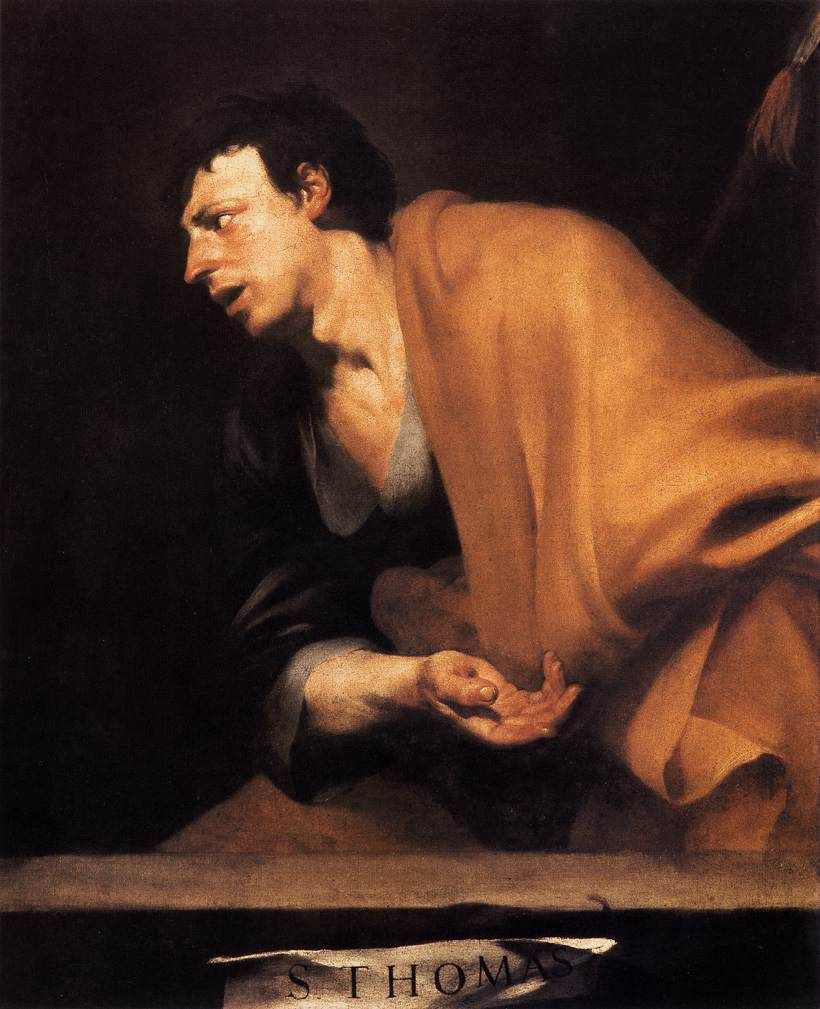
There is very little about the Apostle Thomas in the Gospels, one text calls him the “twin.” Rarely during Jesus’ lifetime does he stand out among his colleagues. There is the instance before the raising of Lazarus, when Jesus was still in Perea and Thomas exclaimed: “Let us also go and die with Him.”
Best-known is his expression of unbelief after the Saviour’s death, giving rise to the phrase “doubting Thomas.” Nevertheless, the passage describing the incident, had as today’s Gospel, must be numbered among the most touching in Sacred Scripture, “My Lord and my God!”
In the Breviary lessons St Pope Gregory the Great makes the following reflections: “Thomas’ unbelief has benefited our faith more than the belief of the other disciples, it is because he attained faith, through physical touch, that we are confirmed in the faith beyond all doubt. Indeed, the Lord permitted the Apostle to doubt after the resurrection but He did not abandon him in doubt. By his doubt and by his touching the sacred wounds, the Apostle became a witness to the truth of the Resurrection. Thomas touched and cried out – My Lord and my God! And Jesus said to him – Because you have seen Me, Thomas, you have believed. Now if Thomas saw and touched the Saviour, why did Jesus say: Because you have seen Me, Thomas, you have believed? Because he saw something other than what he believed. For no mortal man can see divinity. Thomas saw the Man Christ and acknowledged His divinity with the words – My Lord and my God. Faith, therefore, followed upon seeing.”
This slideshow requires JavaScript.
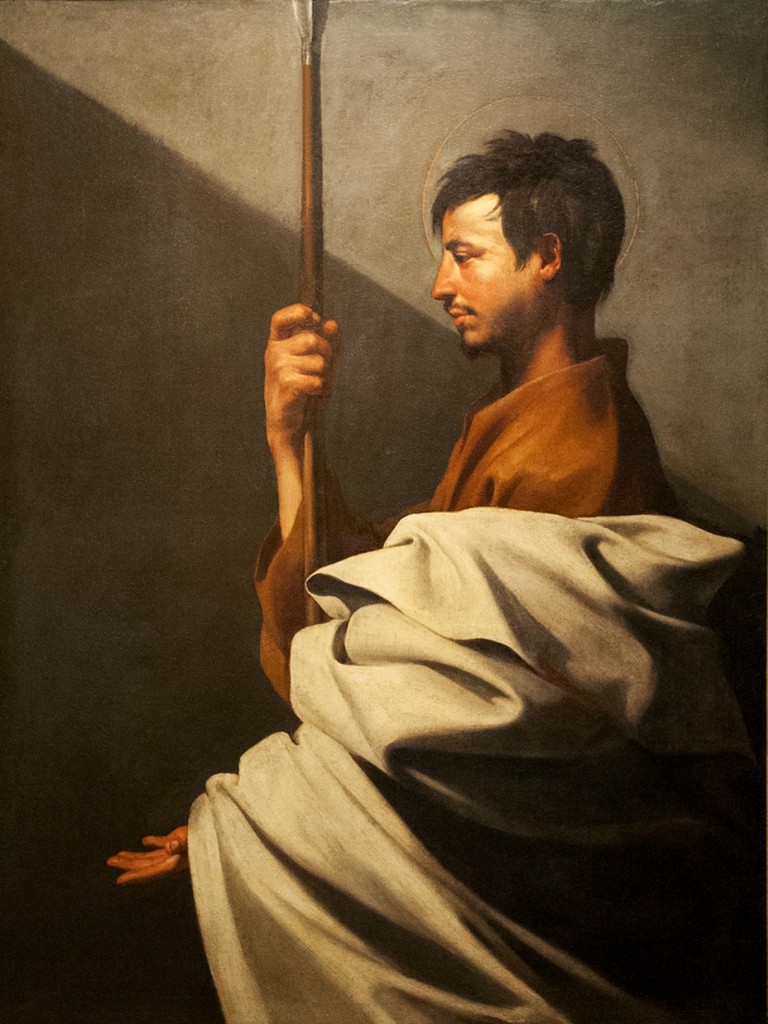
Concerning later events in the Apostle’s life, very meagre information exists. The Martyrology has this: “At Calamina (near Madras in India) the Martyrdom of the Apostle Thomas – he announced the Gospel to the Parthians and, finally, came to India. After he had converted numerous tribes to Christianity, he was pierced with lances at the king’s command.”
Excerpted from The Church’s Year of Grace, Pius Parsch
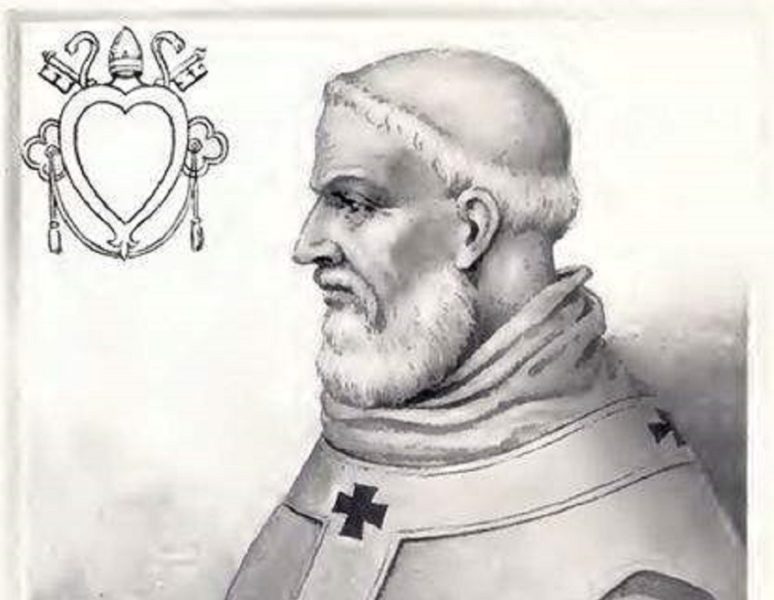
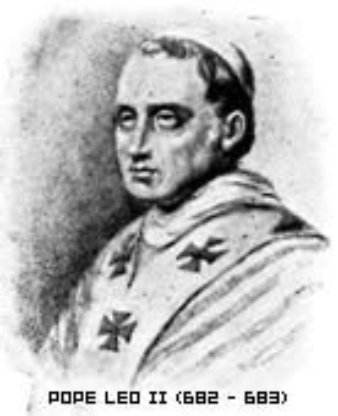
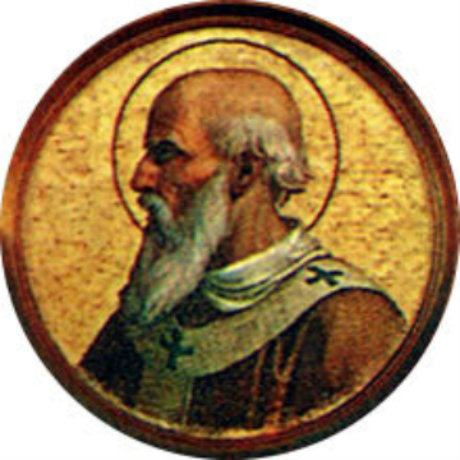
Saint of the Day – 3 July – St Pope Leo II (611–683) was Bishop of Rome from 17 August 682 to 28 June 683, the day of his death. He is one of the popes of the Byzantine Papacy.
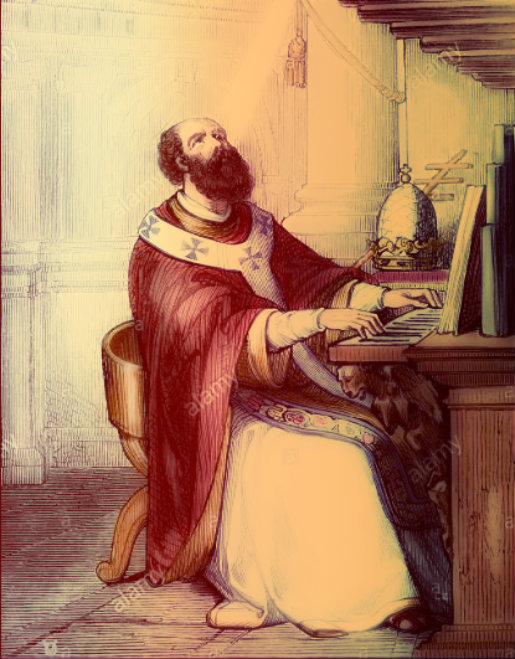
Pope Leo II was a Sicilian. He was learned in sacred and profane letters, as also in the Greek and Latin tongues and was, moreover, an excellent musician. He rearranged and improved the music of the sacred hymns and psalms used in the Church.
He approved the acts of the sixth General Council, which was held at Constantinople, under the presidency of the legates of the apostolic see, in the presence of the emperor Constantine, the Patriarchs of Constantinople and Antioch and one hundred and seventy bishops – Leo also translated these said acts into Latin.
It was in this Council that Cyrus, Sergius, and Pyrrhus were condemned for teaching that there is in Christ, only one will and one operation. Leo broke the pride of the Archbishops of Ravenna, who had puffed themselves up, under the power of the exarchs, to set at naught the power of the apostolic see. Wherefore, he decreed that the elections of the clergy of Ravenna should be worth nothing, until they had been confirmed by the authority of the Bishop of Rome.
He was a true father to the poor. Not by money only but by his deeds, his labours and his advice, he relieved the poverty and loneliness of widows and orphans. He was leading all to live holy and godly lives, not by mere preaching but by his own life, when he died in the year 683, he had been Pope eleven months. He was buried in the church of Saint Peter.
St Leo was originally buried in his own monument, however, some years after his death, his remains were put into a tomb that contained the first four of his papal namesakes.
Excerpted from The Liturgical Year, Abbot Gueranger OSB
St Thomas: https://anastpaul.com/2018/07/03/saint-of-the-day-feast-of-st-thomas-apostle-of-christ/
St Anatolius of Alexandria
St Anatolius of Constantinople
Bl Andreas Ebersbach
Bl Barbara Jeong Sun-mae
St Bladus
St Byblig
St Cillene
St Dathus of Ravenna
St Eusebius of Laodicea
St Firminus
St Firmus
Bl Gelduin
St Germanus of Man
St Giuse Nguyen Ðình Uyen
St Gunthiern
St Guthagon
St Heliodorus of Altinum
St Hyacinth of Caesarea
St Ioannes Baptista Zhao Mingxi
St Irenaeus of Chiusi St Pope Leo II (611–683)
St Maelmuire O’Gorman
St Mark of Mesia
St Mennone the Centurian
St Mucian of Mesia
St Paul of Mesia
St Petrus Zhao Mingzhen
St Philiphê Phan Van Minh
St Raymond of Toulouse
—
Martyrs of Alexandria – 13 saints: Thirteen Christian companions marytred together. No details about them have survived but the names – Apricus, Cyrion (2 of), Eulogius, Hemerion, Julian, Julius, Justus, Menelaus, Orestes, Porfyrios and Tryphon (2 of). They martyred in Alexandria, Egypt, date unknown.
Martyrs of Constantinople – 24 saints: A group of 24 Christians martyred in the persecutions of Arian emperor Valens. We know little more than their names – Acacios, Amedinos, Ammonius, Ammus, Cerealis, Cionia, Cionius, Cyrianus, Demetrius, Eulogius (2), Euphemia, Heliodoros, Heraclios, Horestes, Jocundus, Julian, Martyrios, Menelaeus, Sestratus, Strategos, Thomas, Timotheos and Tryphon. They were martyred in c367 in Constantintinople.
Theodotus and Companions – 6 saints: Six Christians who were imprisoned, tortured and martyred together in the persecutions of Trajan. Saint Hyacinth ministered to them in prison. We know nothing else about them but their names – Asclepiodotus, Diomedes, Eulampius, Golinduchus, Theodota and Theodotus. They were beheaded in c110, location unknown.
One Minute Reflection – 2 July – Tuesday of the Thirteenth Week, Year C – Today’s Gospel: Matthew 8:23-37 and the Memorial of Blessed Eugénie Joubert (1876–1904)
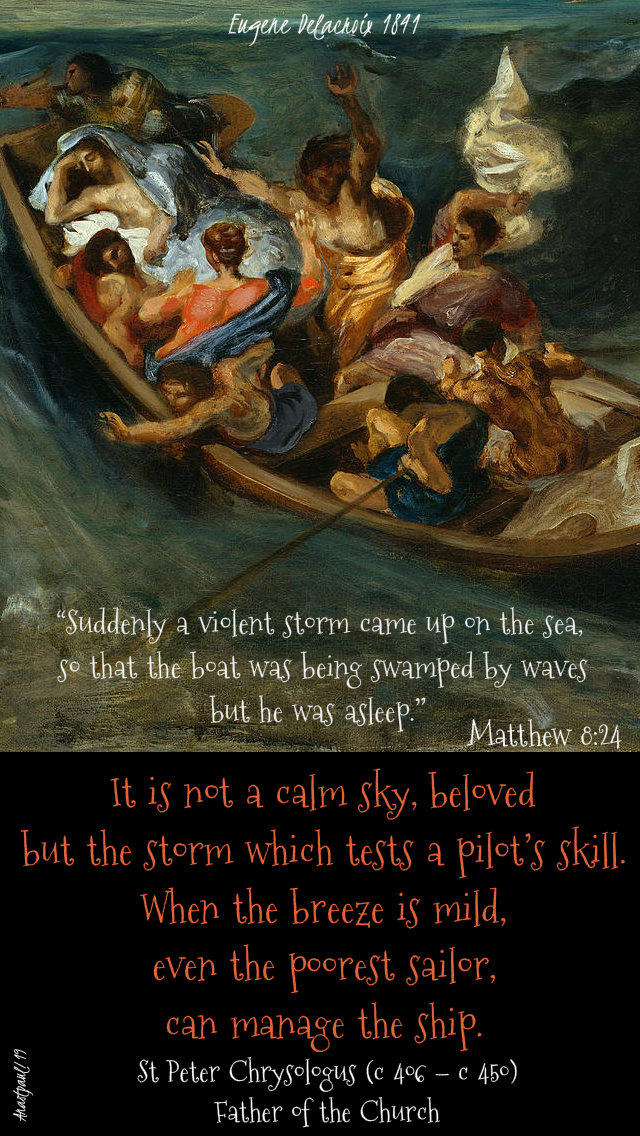
“Suddenly a violent storm came up on the sea, so that the boat was being swamped by waves but he was asleep.”… Matthew 8:24
REFLECTION – “The sea offered its heaving back for Christ to walk upon. Now it levelled its crests to a plain, checked its swelling and bound up its billows. It provided rocklike firmness, so He could walk across the waterway. Why did the seas heave so, and toss and pitch, even as if threatening its Creator? And why did Christ Himself, who knows all the future, seem so unaware of the present thatHhe gave no thought to the onrushing storm, the moment of its height and the time of its peril? While all the rest were awake, He alone was fast asleep even with utter doom threatening both Himself and His dear ones. Why? It is not a calm sky, beloved but the storm which tests a pilot’s skill. When the breeze is mild, even the poorest sailor, can manage the ship. But in the crosswinds of a tempest, we want the best pilot with all His skill.”… Saint Peter Chrysologus (c 406 – c 450) (Sermons, 20)
PRAYER – Heavenly Father, grant me an operative faith – a faith that will move mountains and is strong enough to know that absolutely nothing and no-one here on earth can compare to You. Let me show that faith by lively love and by loving deeds and by conforming myself to Your will in all things – teach me that only YOU are first in line. This is how you lived your life Bl Eugénie Joubert putting only the God who created us first and now you are a Saint. Please pray for us. We make our prayer through Christ, our Lord, in the unity of the Holy Spirit, God forever and for always, amen.
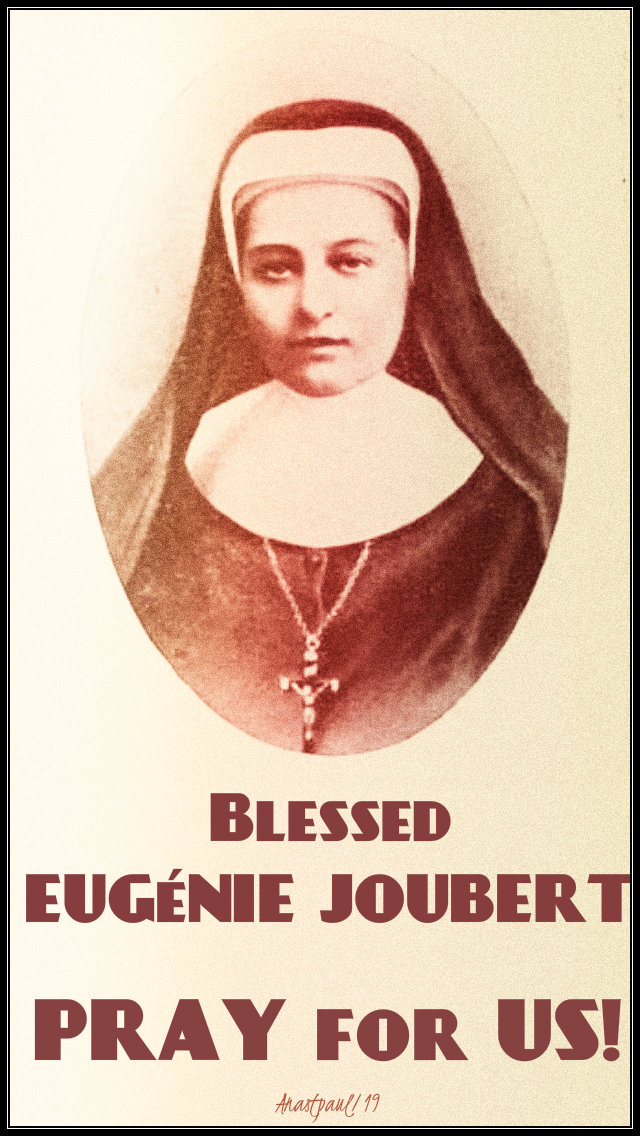
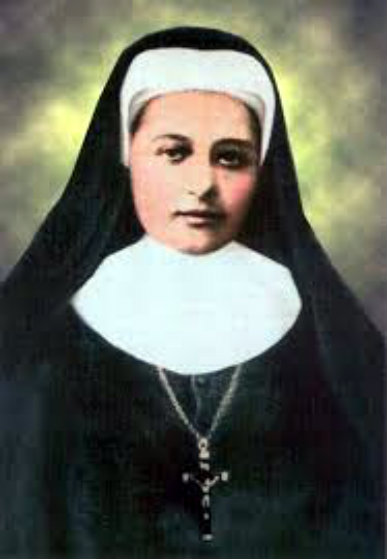
Saint of the Day – Blessed Eugénie Joubert (1876–1904) aged 28 – Religious of the Sisters of the Holy Family of the Sacred Heart – born on 11 February 1876 in Yssingeaux, Haute-Loire, France and died on 2 July 1904 in Liège, Belgium of tuberculosis. Her life was noted for her staunch devotion to the Mother of God, her boundless care for the children in her charge and her commitment to her spiritual cultivation was well known and admired.
Eugénie Joubert was born in 1876 to Pierre Joubert and Antonia Celle as the fourth of eight children in France.
Joubert and her elder sister were placed in a boarding school that the Ursulines managed at Ministrel – both grew fond of their time there and came to like their experiences. She made her First Communion on 29 May 1887. On 6 October 1895 she joined a religious order at Aubervilliers (near Paris) and began as a postulant and then commenced her period of the novitiate, her mother bid her farewell and said: “Don’t look back but become a saint!”.
On 13 August 1896 she received the habit from the order’s founder, Jesuit Louis-Etienne Rabussier and made her profession to him on 8 December 1897. She followed the Spiritual Exercises twice in her novitiate. She taught catechism to local children.
Bl Eugénie was assigned to be a catechist in Aubervilliers where she worked with poor children to prepare them for their First Communion. She was then sent to Rome and later moved to Belgium in May 1904 but died soon after.
Bl Eugénie began to suffer from tuberculosis in 1902 and died in Belgium in 1904. She had once collapsed from exhaustion after suffering a haemorrhage. Her breathing grew much more laboured in her final hours and she was presented with an image of the Child Jesus to which she uttered her final words: “Jesus … Jesus … Jesus”.
Her remains are interred in the chapel of the Sisters of the Holy Family of the Sacred Heart in Dinant, Belgium.
The cause for sainthood started under Pope Pius XI on 1 June 1938 – she was titled as a Servant of God – and the confirmation of her life of heroic virtue allowed for St Pope John Paul II to name her as Venerable on 9 June 1983, that same pope Beatified her on 20 November 1994.
Bl Benedict Metzler St Bernadino Realino SJ (1530-1616) Biography: https://anastpaul.com/2017/07/02/saint-of-the-day-2-july-st-st-bernadino-realino-sj/ Bl Eugénie Joubert (1876–1904)
Bl Giovanni da Fabriano Becchetti
St Jacques Fermin
Bl Jarich of Mariengaarde
St Jéroche
St Lidanus of Sezze
St Martinian of Rome
St Monegundis
St Oudoceus Bl Peter of Luxembourg (1369-1387) Bishop and Cardinal About Blessed Peter: https://anastpaul.com/2018/07/02/saint-of-the-day-2-july-blessed-peter-of-luxembourg-1369-1387/
Bl Pietro Becchetti da Fabriano
St Processus of Rome
St Swithun
—
Martyred Soldiers of Rome – 3 saints: Three soldiers who were converted at the martyrdom of Saint Paul the Apostle. Then they were martyred, as well. We known nothing else about them but their names – Acestes, Longinus and Megistus. Martyred c68 in Rome, Italy
Martyrs in Carthage by Hunneric – 7 saints: A group of seven Christians tortured and murdered in the persecutions of the Arian Vandal king Hunneric for remaining loyal to the teachings of orthodox Christianity. They were some of the many who died for the faith during a period of active Arian heresy. – Boniface, Liberatus, Maximus, Rogatus, Rusticus, Septimus and Servus.
Martyrs of Campania – 10 saints: A group of ten Christians marytred together in the persecutions of Diocletian. The only details about them to have survived are their names – Ariston, Crescention, Eutychian, Felicissimus, Felix, Justus, Marcia, Symphorosa, Urban and Vitalis. Martyred in 284 in Campania, Italy.
Martyrs of Seoul – 8 saints: Additional Memorial – 20 September as part of the Martyrs of Korea.
A group of eight Christians who were martyred together as part of the lengthy persecutions in Korea.
• Agatha Han Sin-ae
• Antonius Yi Hyeon
• Bibiana Mun Yeong-in
• Columba Gang Wan-suk
• Ignatius Choe In-cheol
• Iuliana Gim Yeon-i
• Matthaeus Gim Hyeon-u
• Susanna Gang Gyeong-bok
They were martyred on 2 July 1801 at the Small West Gate, Seoul, South Korea. Beatified on 15 August 2014 by Pope Francis.
Thought for the Day – 1 July – The Memorial of Bl Antonio Rosmini (1797-1855) and the first day of the Month of the Most Precious Blood
The Pope’s invitation to write books to present, in a modern language, the doctrine of the Church was accomplished by publishing works that were destined to produce fruits well into the future. His prodigious act ivity in many fields was supported by a mystical life of prayer, which included the daily offering of his blood in union with the precious Blood of JESUS. On 18 November 2007, he was proclaimed a Blessed and was presented as a luminous model of intellectual charity.
In his exhortation, Veritatis Gaudium of 29 January 2018, Pope Francis, quoting words from the book The Five Wounds of Holy Church, published by Rosmini in 1848, issued an invitation to follow Rosmini’s recommendations for the formation of clergy and of the faithful.
The fundamental dimensions of the charism
The Institute, as a religious family born of Charity, offers God’s help for sanctification in the perfection of charity. It is a gift for all categories of people, because God does not exclude anyone from His love. In practice, the following groups belong to the Institute: brothers and priests with vows (Rosminians), the Sisters of Providence (Rosminian Sisters), Adopted Sons and Ascribed members. These latter do not live in communities but participate in the charism while following their chosen way of life. They can be men and women, married couples, diocesan priests, even bishops!
Rosmini did not receive from God a call to any specific work of charity, like many other founders and thus the Institute is meant to mirror the Church in its identity and in its mission of universal charity. The development of our charism has been conditioned and slowed down by historical and ecclesial events but in recent years it has begun to increase.
The fundamental dimensions of the spirituality of our charism
Union with God begins with justice, that is, with the commitment to personal purification and detachment from sin. It grows into adherence to grace in such a way that we desire only and in an orderly fashion, to do the will of God, manifested through the duties of our state of life, the voice of the Church, the indications of superiors and the demands of our neighbours. All this is masterly expressed in the pages of Maxims of Christian Perfection. Since Rosmini affirms the supreme value of the person, the Rosminian way enhances and directs a conscious and mature Christian witness.
The fundamental dimensions of our specific charismatic mission
Indifference to one’s own choices becomes total openness to calls from God and from the Church. Both Rosminian brethren and Sisters put their total being at the disposal of charity. Thanks to the marvellous conjunction of consecrated and lay life, the Rosminian charismatic Family is the mirror of the Church. It tends to promote and develop works of charity that reach the most important places of the Church and society.
One Minute Reflection – 1 July – Monday of the Thirteenth week in Ordinary Time, Year C – Today’s Gospel Matthew 8:18–22 and the Memorial of Bl Antonio Rosmini (1797-1855)
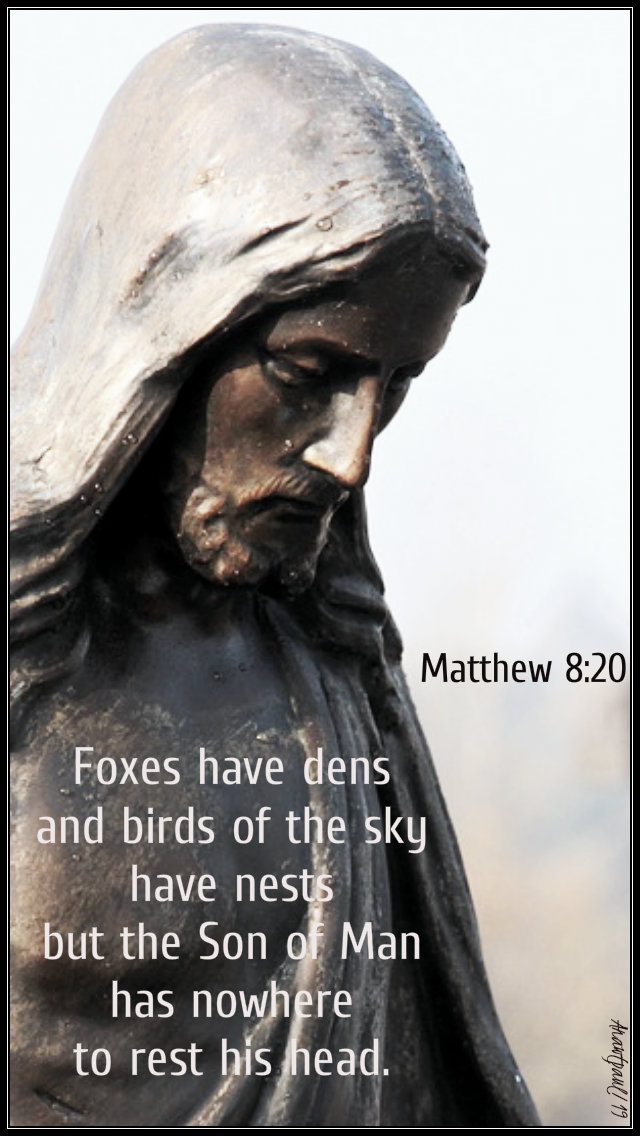
“Jesus answered him, “Foxes have dens and birds of the sky have nests, but the Son of Man has nowhere to rest his head.”…Matthew 8:20
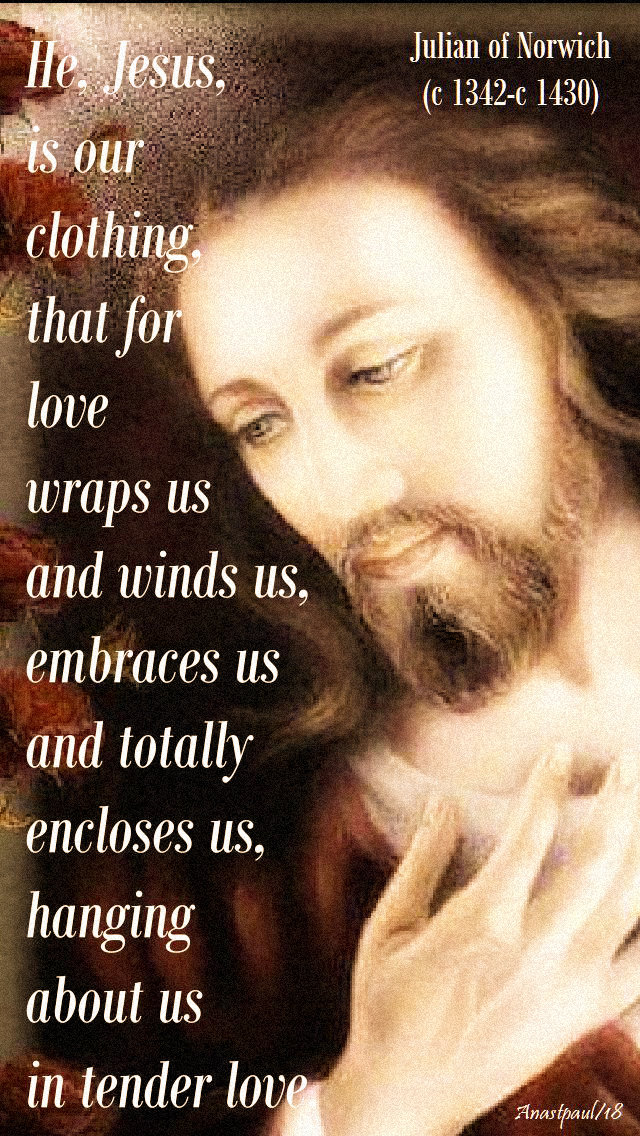
REFLECTION – “He [ Jesus] is our clothing, that for love wraps us and winds us,
embraces us and totally encloses us, hanging about us in tender love.”… Blessed Julian of Norwich (c 1342-c 1430)
PRAYER – Lord God, be the beginning and the end of all that we are and do and say. Prompt our actions with Your grace, may Your light be our only way, may Your commands be our only need and complete all, with Your all-powerful help. Blessed Antonio Rosmini who gave all for the sake of glory of God, pray for us! We make our prayer through Christ our Lord in the unity of the Holy Spirit, one God with You, forever and ever, amen.
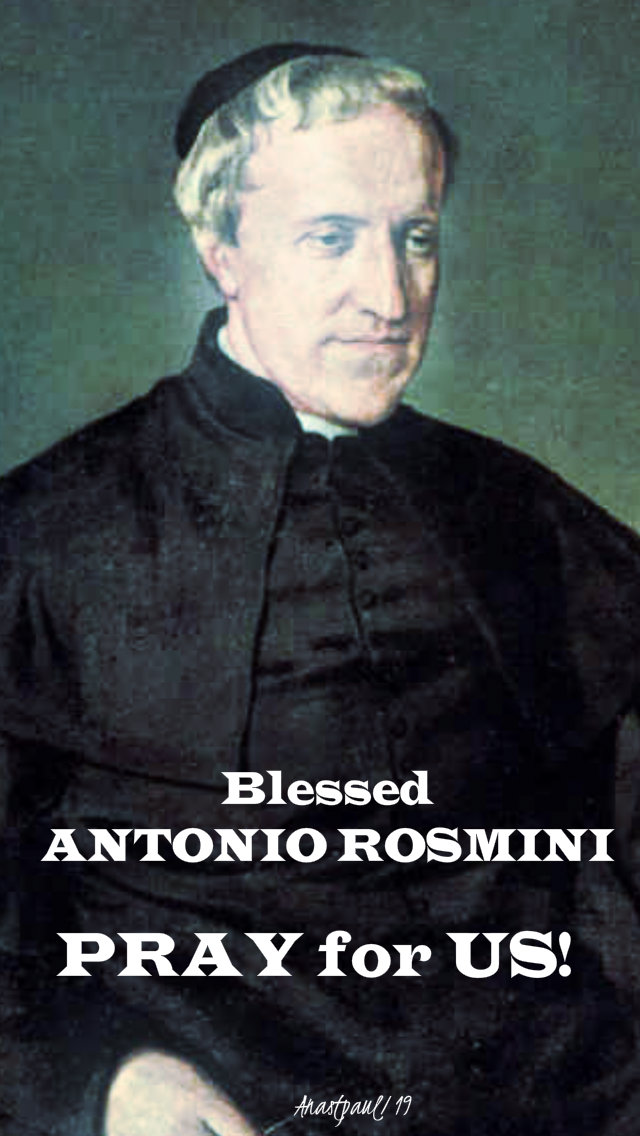
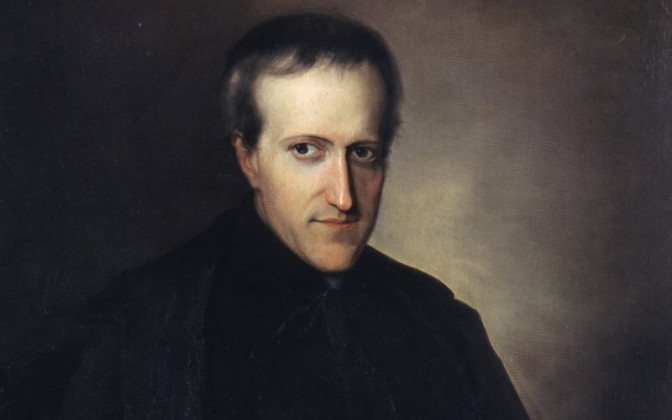
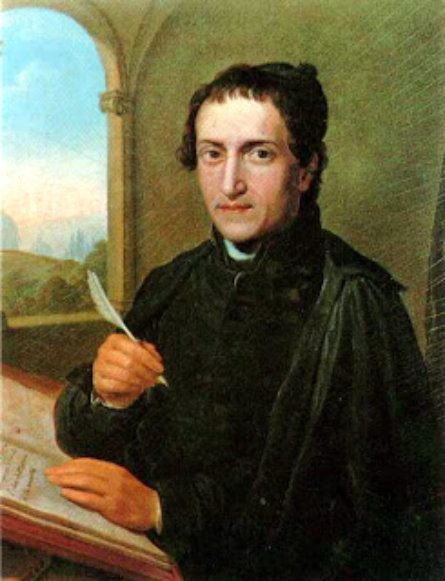
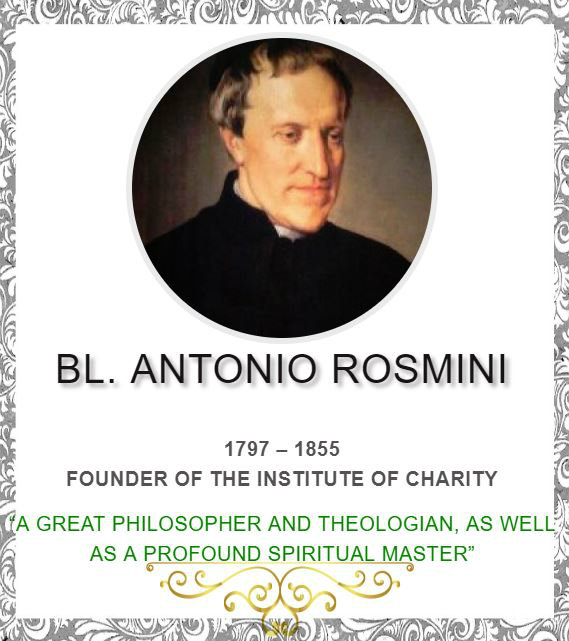
Saint of the Day – 1 July – Blessed Antonio Rosmini (1797-1855) aged 58 – Priest, Founder of the Institute of Charity (also known as the Rosminians), Philosopher, Writer, pioneer of the concept of social justice and was a key figure in Italian Liberal Catholicism. Born on 24 March 1797 in Rovereto, Austrian Tyrol (modern Trent, Italy) and died on 1 July 1855 in Stresa, Viterbo, Italy of natural causes.
Antonio Rosmini was born on 24 March 1797 to Pier Modesto and Giovanna dei Conti Formenti di Riva at Rovereto, a very “Italian” town although part of the Austrian Empire since 1509. He was baptised the following day and received his early education locally.
In 1816 he enrolled at the University of Padua, Italy, where he received doctorates in theology and canon law. After his studies he returned to Rovereto to prepare for Holy Orders.
In February 1820 he accompanied his sister, Margherita, to Verona where the Marquess Maddalena of Canossa (now Blessed) had founded a religious institute. During the visit Maddalena invited him to found a male religious institute as a twin to her own institute. While the young man politely declined, her invitation in time proved prophetic.
Antonio was ordained a priest on 21 April 1821 at Chioggia, Italy. In 1823 he travelled to Rome with the Patriarch of Venice, who arranged an audience for him with Pope Pius VII. In that audience the Pontiff encouraged him to undertake the reform of philosophy.
In 1826 he went to Milan to continue his research and publish the results of his philosophical studies. He wrote on many subjects, including the origin of ideas and certitude, the nature of the human soul, ethics, the relationship between Church and State, the philosophy of law, metaphysics, grace, original sin, the sacraments and education.
On Ash Wednesday, 20 February 1828, Fr Rosmini withdrew to write the Constitutions of the budding Institute of Charity, in which he incorporated the principle of passivity (to be concerned with one’s personal sanctification until God’s will manifests itself to undertake some external work of charity) and the principle of impartiality (to free one of any personal preference in assuming a work of charity).
To assure himself of God’s will in his philosophical and foundational work, Rosmini went to Rome a second time, in November 1828 and there received Pope Leo XII’s support. On 15 May 1829 he met with the new Pope, Pius VIII, who confirmed his double mission as philosopher and founder. During this visit to Rome, Fr Rosmini published “Maxims of Christian Perfection” and “Origin of Ideas”, winning the admiration of many scholars.
By 1832 the Institute of Charity had spread to Northern Italy and by 1835 it reached England, where the community enjoyed substantial growth. In England the Rosminians are credited with introducing the use of the Roman collar and cassock and the practice of wearing the religious habit in public. They were known for preaching missions, the practice of the Forty Hours, May devotions, the use of the scapular, novena celebrations, public processions and the blessing of throats on the feast of St Blaise.
Pope Gregory XVI approved the Constitutions of the Institute of Charity on 20 December 1838. On 25 March 1839 vows were taken by 20 Italian and 6 British priests . On 20 September 1839 Fr Rosmini was appointed provost general for life.
This happy period of growth and apostolic success, however, was tempered by opposition to his intellectual and philosophical writings from 1826 until his death.
Primarily his “Treatise on Moral Conscience” (1839) led to a sharp, 15-year controversy which required more than one Papal injunction to silence the “Rosminian Question”. Another important, controversial work was “The Five Wounds of the Church” (1832).
Fr Rosmini found himself wedged between the obligation to renew Catholic philosophy and finding his works on the Index. But his obedience to the Church was admirable: ” In everything, I want to base myself on the authority of the Church and I want the whole world to know that I adhere to this authority alone” (Congregation for the Doctrine of the Faith, “Note on the Force of the Doctrinal Decrees”, L’Osservatore Romano English edition [ORE], 25 July 2001, p. 9).
To close the issue definitively, the Pontiff submitted all Rosmini’s works to examination by the Congregation of the Index. On 3 July 1854, it was decreed: “All the works of Antonio Rosmini-Serbati that have recently been examined are to be dismissed [from the Index or any error] and this examination in no way detracts from the good name of the author, nor of the religious Society founded by him, nor from his life and singular merits towards the Church” (R. Malone, “Historical Overview of the Rosmini Case”, ORE, 25 July 2001, p. 10).
Less than a year after this Decree Fr Antonio Rosmini died on 1 July 1855 at Stresa, Italy, at age 58…Vatican.va
He was Beatified on 18 November 2007 by Pope Benedict XVI.
Monument to St Antonio Rosmini in Milan (1896).
His body is interred in the Church of the Santissimo Crocifisso built by him in Stresa.
This slideshow requires JavaScript.
Today the Rosminians operate on 5 continents and continue to flourish.
O God, light of the faithful and shepherd of souls,
who set blessed Antonio in the Church
to feed your sheep by his words and form them by his example,
grant that through his intercession
we may keep the faith he taught by his words
and follow the way he showed by his example.
Through our Lord Jesus Christ, Your Son,
who lives and reigns with You in the unity of the Holy Spirit,
one God, forever and ever. Amen
The Most Precious Blood of Our Lord, Jesus Christ: The feast was removed from the General Roman Calendar in 1969, “because the Most Precious Blood of Christ the Redeemer is already venerated in the solemnities of the Passion, of Corpus Christi, of the Sacred Heart of Jesus and in the feast of the Exaltation of the Holy Cross.” However, as this is the Month of the Most Precious Blood, this day, is most worthy of celebrating this Feast Day everyday.
St Aaron of Caerleon
St Aaron the Patriarch Bl Antonio Rosmini-Serbati (1797-1855)
St Arnulf of Mainz
Bl Assunta Marchetti
St Atilano Cruz Alvarado
St Calais of Anisole
St Carilephus
St Castus of Sinuessa
St Cewydd
St Concordius of Toledo
St Cuimmein of Nendrum
St Domitian of Lerins
Bl Elisabeth de Vans
St Eparchius of Perigord
St Eutychius of Umbria
St Esther the Queen
St Gall of Clermont
Bl George Beesley
St Golvinus of Leon
St Gwenyth of Cornwall
St Huailu Zhang
Bl Jan Nepomucen Chrzan
Bl Jean-Baptiste Duverneuil
St Julius of Caerleon
St Justino Orona Madrigal
St Juthware
St Leonorious of Brittany
St Leontius of Autun
Bl Luis Obdulio Navarro
St Martin of Vienne
Bl Montford Scott
Bl Nazju Falzon
St Nicasius of Jerusalem
St Oliver Plunkett (1629-1681) Martyr
Bl Pierre-Yrieix Labrouhe de Laborderie
St Secundinus of Sinuessa
St Servan of Culross
St Theobald of Vicenza
St Theodoric of Mont d’Or
Bl Thomas Maxfield
Bl Tullio Maruzzo
St Veep
—
Martyrs of Rome – 6 saints: Six Christians who were martyred together. No details have survived except their names – Esicius, Antonius, Processus, Marina, Serenus and Victor. They were martyred in Rome, Italy, date unknown.
One Minute Reflection – 30 June – Thirteenth Sunday of the Year in Ordinary Time, Year C, Gospel: Luke 9:51–62 and the Memorial of Gennaro Maria Sarnelli C.Ss.R. (1702–1743)
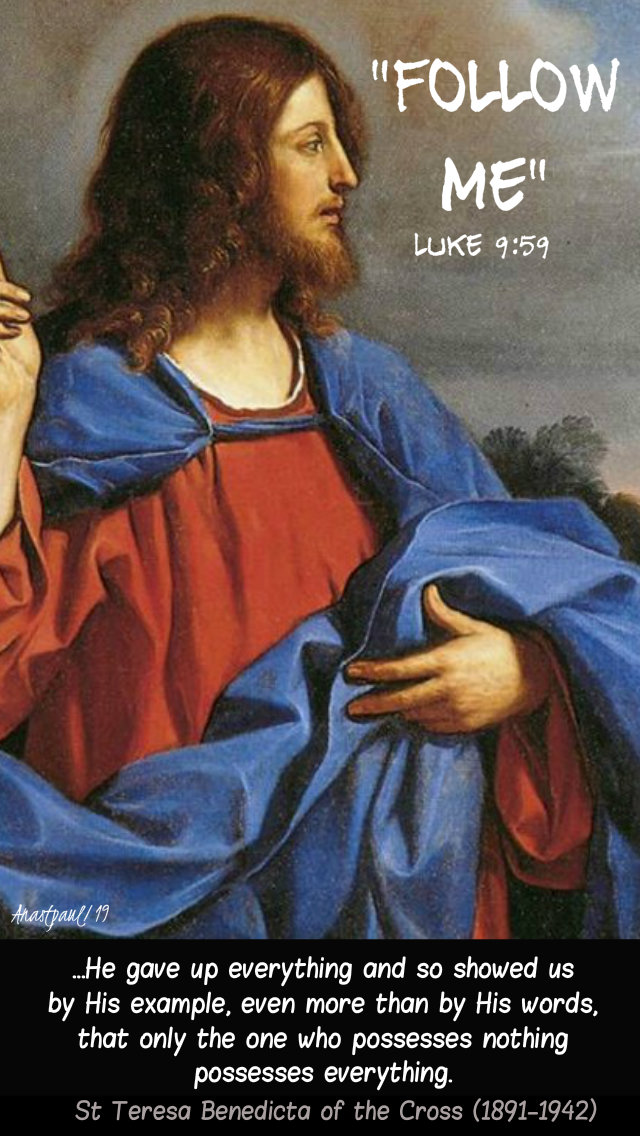
“Follow me.”…Luke 9:59
REFLECTION – “The Saviour preceded us on the path of poverty. All the possessions of heaven and earth belonged to Him. They presented for Him no danger, He could make use of them while keeping His heart completely free. But He knew that it is almost impossible for a human being to have possessions without subjecting ourselves to them and becoming a slave. That is why He gave up everything and so showed us by His example, even more than by His words, that only the one who possesses nothing possesses everything. His birth in a stable and His flight to Egypt already showed, that the Son of the Man had nowhere to rest His head. Whoever wants to follow Him must know that we have here below no permanent dwelling. The more deeply we become aware of it, the more ardently we shall aim towards our future dwelling and we shall exult in the thought, that we will find our home in heaven.”…St Teresa Benedicta of the Cross [Edith Stein] (1891-1942) Martyr – Meditation for the feast of the Exaltation of the Cross
PRAYER – Lord God, strength of those who hope in You. Support us in our prayer because we are weak and can do nothing without You. Help us as we follow Your Son, whose Light leads us home to You. Grant us always the help of Your grace and listen, we pray to the prayers of Blessed Gennaro Maria Sarnelli, who cries to You on our behalf. We make our prayer through Christ our Lord, in unity with You and the Holy Spirit, one G always and for all eternity, amen.
Saint of the Day – 30 June – Blessed Gennaro Maria Sarnelli C.Ss.R. (1702–1743) aged 42 – Redemptorist Priest, Lawyer, Writer, Preacher, Apostle of the Charity, Social Reformer, he also initiated a fervent movement against the spread of prostitution – born on 12 September 1702 in the castle of Duke Zapata, Naples, Italy of a noble family and died on 30 June 1744 in Naples, Italy of natural causes. Patronages – Writers, Italian missionaries.
Sarnelli was one of Saint Alphonsus Maria de’ Liguori’s (1696-1787 Most Zealous Doctor of the Church) earliest companions and was also a prolific writer. He published more than 30 books on a wide range of subjects, including socio-juridical studies, moral issues, mysticism, pedagogy, pastoral practice, Mariology and ascetical theology. His apostolic zeal knew no limits – he preached missions and aided his friend St Alphonsus in his work, he tended to the sick and helped to get girls out of prostitution despite the threats levelled against him.
From his childhood he was noted for being modest as well as for his self-denial and his great diligence in his studies. He was obedient to his parents though when he perceived he was disobedient he begged their pardon and would either kiss their hand or throw himself at their feet. He often visited the church of Saint Francis Xavier as a child. In 1716 he desired to become a Jesuit but his father objected due to his age and directed him to learn law instea, the beatification of Saint John Francis Regis was also an influence in his decision. He did this (learning jurisprudence and earning his doctorate in civil and canon law in 1722) and became quite successful in this field as a professional Lawyer and was enrolled in the Congregation of the Knights of the Legal and Medical Professions that the Pious Workers of Saint Nicholas of Toledo directed. One of the rules of this association – which he observed – was visiting the sick in the Hospital of the Incurables. It was while tending to the ill in the hospital that his call to become a priest blossomed to the point he could not ignore such a call.
In September 1728 he abandoned the bar and decided to become a priest after commencing his ecclesial studies. Cardinal Francesco Pignatelli incardinated him as a cleric to the parish of Santa Anna di Palazzo. His zeal showed itself at once in his labours for children whom he catechised with wonderful success. On 4 June 1729 he became a boarder at the Collegio della Santa Famiglia to continue his studies under more peaceful conditions though left on 8 April 1730 to enter the novitiate of the Congregation of the Apostolic Missions. He concluded this probation on 28 May 1731] He was ordained to the priesthood on 8 June 1732 and became a member of the Propaganda of Naples which was a congregation of secular priests devoted to apostolic work. He also gave all his wealth to the poor for he had no use for it himself. Cardinal Pignatelli assigned him to serve as the Director of Religious Instruction in the parish of Saints Francis and Matthew in the Spanish quarter. He also visited the old people in the Hospice of Saint Gennaro and those condemned to death who were ill in the hospital at the docks. It was at this time that he developed a friendship with Saint Alphonsus Maria de’ Liguori after the two first met in Chiaiano.
In June 1733 he travelled to Scala to aid a friend at a mission at Ravello and he met up with and became one of the earliest companions to Liguori in founding the Redemptorists which he joined in 1733. The pair worked together and gave missions along the coast of Amalfi from 1735 to April 1736 when Sarnelli’s health started to decline. He had to return to Naples where he spent the next decade in a poor apartment with one religious as a companion. In 1841 he prepared for the canonical visitation of Cardinal Giuseppe Spinelli so planned and participated in missions at Casali. Having become aware of the rampant corruption of girls he decided to direct all his work against prostitution. But doing this work earned him threats from the criminal element that made profit from this. In April 1744 he stopped preaching altogether because his health became so dire.
On the day of his death, the doctor came at around 8:00 am to see him while he later said to the religious next to him: “I feel the chill of death”. The religious rushed to summon the priest who gave him absolution. Sarnelli kissed his clasped Crucifix from time to time. He died at 10:00am on 30 June 1744. His old friend Liguori was present at his bedside as Sarnelli died and noted a sweet odour that remained in the room even long after Sarnelli was buried, the religious Francesco Tartaglione and the novice Francisco Romito were also present. His brother Domenico was so overcome with emotion he did not want to leave the room where his brother’s remains were. His remains were buried on 2 July 1744 in the parish church of Santa Maria dell’Aiuto in Naples (in the San Nicola chapel) though were later reinterred in the Redemptorist church of Santi Alfonso e Antonio at Tarsia in Naples. His remains were moved again on 25 October 1994 to the Redemptorist church of La Santissima Trinità in Ciorani.
His old friend Liguori was his first biographer and noted the circumstances of Sarnelli’s death in which he was present; Liguori noted that his remains “… exhaled a sweet odour – which remained in the room long after the interment.
Sarnelli’s fame for holiness was a well-known fact during his life but his Beatification cause did not open until 1861 in Naples, formal introduction came in 1874 and he was named as Venerable on 2 December 1906. St Pope John Paul II Beatified him on 12 May 1996.
This slideshow requires JavaScript.
Prayer in Honour of Blessed Gennaro Maria Sarnelli
Holy Redeemer,
we place ourselves in Your presence
confident that You are a loving and merciful God.
You walk with us by day and night,
as we strive to proclaim Your gospel with compassion,
to people who are poor and abandoned.
As we reach out to those most in need,
we look to Blessed Gennaro Sarnelli
as a model and help.
His ardent desire was to bring people
on the fringes of society and Church
to a deeper knowledge and love of You.
We pray that his zeal will inspire
and motivate us to share Your redemption
with those who are marginalised.
We especially remember people
who make decisions that lead to destructive
and addictive behaviours.
May our choices be those of Blessed Sarnelli,
who continually lived the gospel
in spite of adversity and opposition.
We ask his help,
that our commitment may not shrink
for lack of support or favour,
for as we become one with those who are outcast,
we become one with You.
Amen
St Adolphus of Osnabrück
St Alpinian of Limoges
St Alrick the Hermit
Bl Ambrose de Feis
Bl Anthony de Tremoulières
Bl Arnulf of Villers
St Austriclinian of Limoges
St Basilides of Alexandria
St Bertrand of Le Mans
St Clotsindis of Marchiennes
Bl Elisabeth Heimburg
St Emiliana of Rome
St Erentrude
St Eurgain
St Gaius Bl Gennaro Maria Sarnelli C.Ss.R. (1702–1743)
Bl Jacob Clou
St Leo the Deacon
St Lucina of Rome
St Lucina of the Callistus Catacombs
St Marcian of Pampeluna
St Martial of Limoges
St Ostianus
St Otto of Bamberg
St Peter of Asti
St Petrus Li Quanhui
Bl Philip Powel
St Raimundus Li Quanzhen Bl Raymond Lull TOSF (c 1232 – c1315) Biography:
St Theobald of Provins
Bl Vasyl Vsevolod Velychkovskyi
St Vihn Son Ðo Yen
Bl Zenon Kovalyk
—
Martyrs of Africa – 7 saints: Seven Christians martyred together. No detail about them have surived but the names – Cursicus, Gelatus, Italica, Leo, Timotheus, Zoilus, and Zoticus. Date and precise location in Africa unknown.
Thought for the Day – 29 June – The Solemnity of Saints Peter and Paul
Blessed Isaac of Stella O.Cist. (c 1100 – c 1170) Cistercian Monk
Sermon 49, 1st for the Feast of Saints Peter and Paul
“These were men of mercy whose good deeds shall not be forgotten; the wealth they have left their inheritance will last for ever” (Latin liturgy; cf. Sir 44:10-11).”
Today, beloved, we are celebrating the birthday of the apostles Peter and Paul and it is altogether fitting that… such a death should be called ‘birth’ since it gave birth to life… See to what the saints have come – through the death that bestows life, they leave this life that leads to death, so as to come to that life-giving life, which is in the hands of Him who, as Christ said: “has life in Himself” – the Father (Jn 5:26)…
There are three kinds of people who are merciful. The first give of their goods… so as to contribute out of their superfluity to the penury of their neighbour… The second give all their goods away and, for them… everything is held in common with others from then on… But as for the third, they not only expend all they have but are “themselves utterly spent” (2 Cor 12:15) and give themselves up in person to the dangers of prison, exile and death so that they may rescue others from the dangers in which their souls are lying. They pour themselves out because they are so full of ardent desire for others. They will receive the reward of that love of which “there is no greater – to lay down one’s life for one’s friends” (Jn 15:13)… Such are those glorious princes of the earth and servants of heaven of whom today – after long privations “from hunger and thirst, cold and nakedness”, exhaustion and danger, “from their own race, from Gentiles, from false brethren” (2 Cor 11:26-27) – we celebrate the death that was so magnificently victorious. To such as these, the saying well applie – “Their good deeds shall never be forgotten” because they have not forgotten mercy… Yes, to the merciful, “their lot has fallen in a pleasant land, their inheritance is without compare” (Ps 16[15]:6).
Quote/s of the Day – 29 June – The Solemnity of Saints Peter and Paul
“Their sound has gone out into all the earth and their words to the ends of the world”
Psalm 19:5
“There must be general rejoicing, dearly beloved, over this holy company whom God has appointed for our example in patience and for our confirmation in faith. But we must glory even more in the excellence of their fathers, Peter and Paul, whom the grace of God has raised to such a height among all the members of the Church that He has set them like twin lights of eyes in that Body whose head is Christ.”
“Saint Peter does not cease to preside over his See and preserves an endless sharing, with the Sovereign Priest. The firmness that he received from the Rock which is Christ, he himself, having become the Rock, transmits it equally to his successors.”
St Pope Leo the Great (400-461)
Doctor of the Church’s Unity
“And so it is with Rome, where the holy Apostles Peter and Paul, gave with their blood their final witness. The vocation of Rome is of apostolic origin and the ministry which it is our lot to exercise here, is a service for the benefit of the entire Church and of mankind. But it is an irreplaceable service, because it has pleased the Wisdom of God to place the Rome of Peter and Paul, so to speak, on the road that leads to the eternal City, by the fact that Wisdom chose to confide to Peter—who unifies in himself the College of Bishops—the keys of the kingdom of heaven.”
One Minute Reflection – 29 June – The Solemnity of Saints Peter and Paul – Today’s Gospel: Matthew 16:13–19
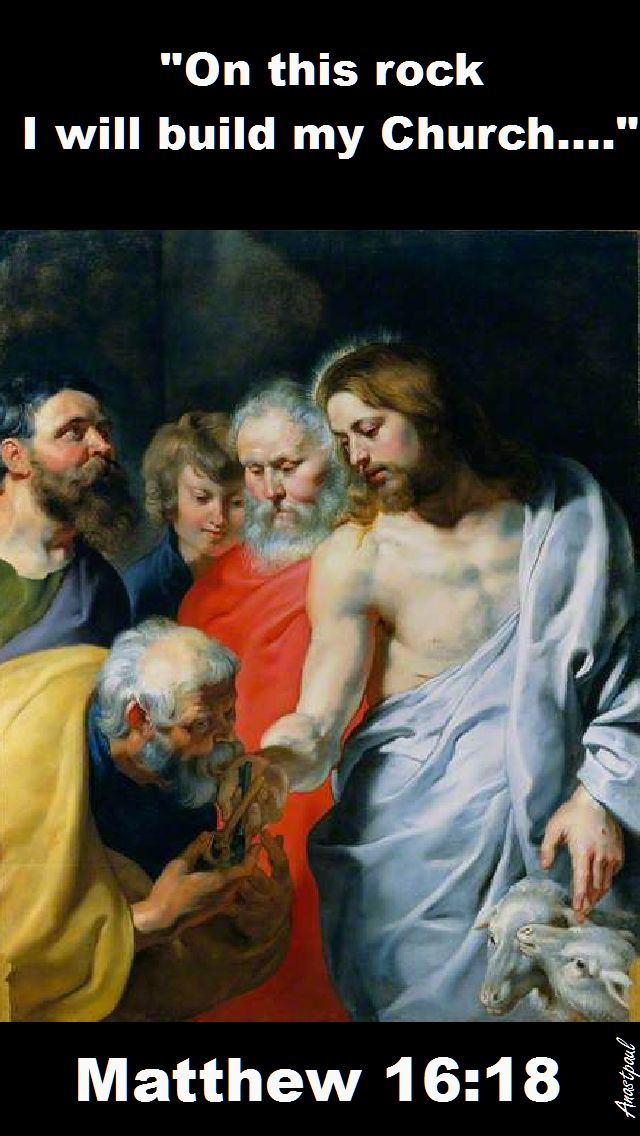
“And I tell you, you are Peter and on this rock I will build my church and the powers of death shall not prevail against it. I will give you the keys of the kingdom of heaven and whatever you bind on earth shall be bound in heaven, and whatever you loose on earth shall be loosed in heaven.” …Matthew 16:18-19
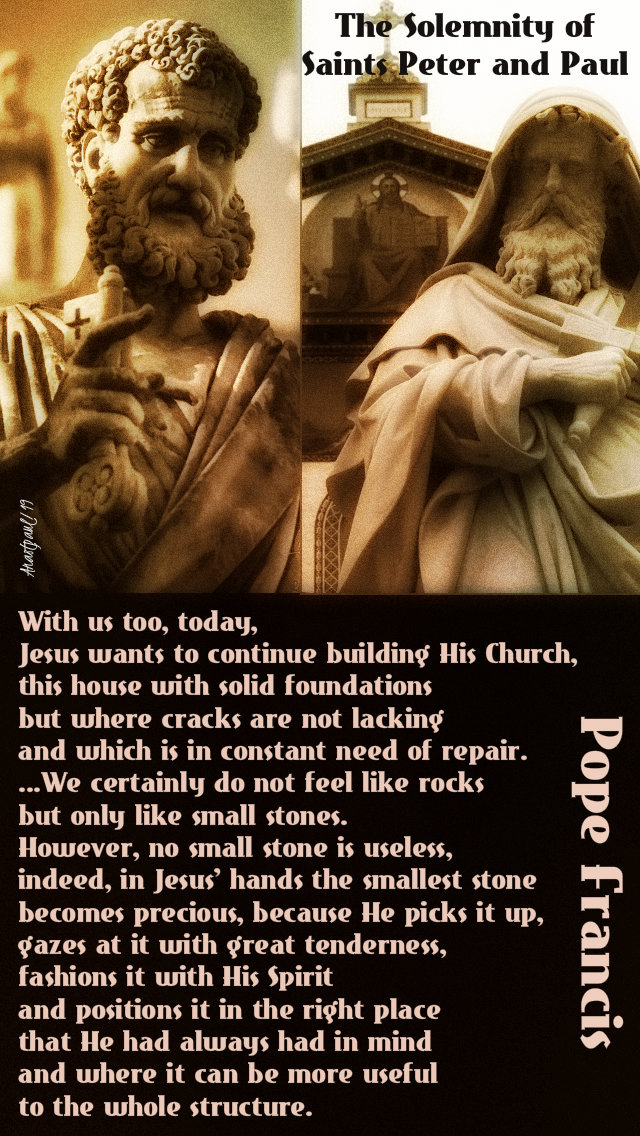
REFLECTION – “With us too, today, Jesus wants to continue building His Church, this house with solid foundations but where cracks are not lacking and which is in constant need of repair. Always. The Church always needs to be reformed, repaired. We certainly do not feel like rocks but only like small stones. However, no small stone is useless, indeed, in Jesus’ hands the smallest stone becomes precious, because He picks it up, gazes at it with great tenderness, fashions it with His Spirit and positions it in the right place that He had always had in mind and where it can be more useful to the whole structure.”…Pope Francis (Angelus, 27 August 2017)
PRAYER – O God, who on the Solemnity of the Apostles Peter and Paul give us the noble and holy joy of this day, grant, we pray, that your Church may in all things follow the teaching of those through whom she received the beginnings of right religion.
Through our Lord Jesus Christ, your Son,who lives and reigns with you in the unity of the Holy Spirit, one God, forever and ever. Amen
Our Morning Offering – 29 June – The Solemnity of Saints Peter and Paul
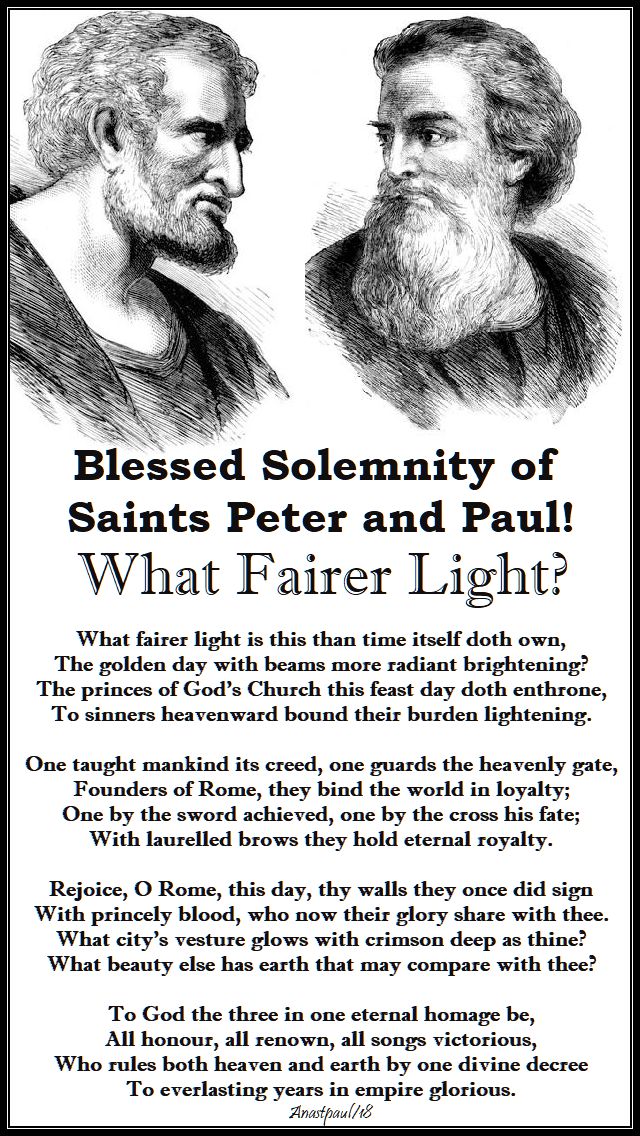
What Fairer Light?
Hymn for the Solemnity of Sts Peter and Paul Elphis, c 493, wife of Boethius c 477– 524 Translation: R A Knox, 1888-1957
What fairer light is this than time itself doth own,
The golden day with beams more radiant brightening?
The princes of God’s Church this feast day doth enthrone,
To sinners heavenward bound their burden lightening.
One taught mankind its creed, one guards the heavenly gate,
Founders of Rome, they bind the world in loyalty;
One by the sword achieved, one by the cross his fate;
With laurelled brows they hold eternal royalty.
Rejoice, O Rome, this day, thy walls they once did sign
With princely blood, who now their glory share with thee.
What city’s vesture glows with crimson deep as thine?
What beauty else has earth that may compare with thee?
To God the three in one eternal homage be,
All honour, all renown, all songs victorious,
Who rules both heaven and earth by one divine decree
To everlasting years in empire glorious.
Solemnity of Saints Peter and Paul, Apostles and Martyrs – 29 June
Today the Church celebrates the feast day of Sts Peter & Paul. As early as the year 258, there is evidence of an already lengthy tradition of celebrating the solemnities of both Saint Peter and Saint Paul on the same day. Together, the two saints are the founders of the See of Rome, through their preaching, ministry and martyrdom there. St Peter is also celebrated on 22 February (feast of the Chair of Peter, emblematic of the world unity of the Church) on 1 August (Saint Peter in Chains), St Paul’s Conversion is celebrated on 25 January and both are once again celebrated on 18 November (feast of the dedication of the Basilicas of Peter and Paul – the two major Basilicas in Rome).
In a sermon in the year 395, St Augustine (354-430) Father & Doctor of the Church, said of Sts Peter and Paul:
“Both apostles share the same feast day, for these two were one and even though they suffered on different days, they were as one.
Peter went first and Paul followed.
And so we celebrate this day made holy for us, by the apostles’ blood. Let us embrace what they believed, their life, their labours, their sufferings, their preaching and their confession of faith.”
Peter (d. 64?) Saint Mark ends the first half of his Gospel with a triumphant climax. He has recorded doubt, misunderstanding and the opposition of many to Jesus. Now Peter makes his great confession of faith – “You are the Messiah” (Mark 8:29b). It was one of the many glorious moments in Peter’s life, beginning with the day he was called from his nets along the Sea of Galilee to become a fisher of men for Jesus.
The New Testament clearly shows Peter as the leader of the apostles, chosen by Jesus to have a special relationship with Him. With James and John he was privileged to witness the Transfiguration, the raising of a dead child to life and the agony in Gethsemane. His mother-in-law was cured by Jesus. He was sent with John to prepare for the last Passover before Jesus’ death. His name is first on every list of apostles.
And to Peter only did Jesus say, “Blessed are you, Simon son of Jonah. For flesh and blood has not revealed this to you, but my heavenly Father. And so I say to you, you are Peter, and upon this rock I will build my church and the gates of the netherworld shall not prevail against it. I will give you the keys to the kingdom of heaven. Whatever you bind on earth shall be bound in heaven; and whatever you loose on earth shall be loosed in heaven” (Matthew 16:17b-19).
But the Gospels prove their own trustworthiness by the unflattering details they include about Peter. He clearly had no public relations person. It is a great comfort for ordinary mortals to know that Peter also has his human weakness, even in the presence of Jesus.
He generously gave up all things, yet he can ask in childish self-regard, “What are we going to get for all this?” (see Matthew 19:27). He receives the full force of Christ’s anger when he objects to the idea of a suffering Messiah –“Get behind me, Satan! You are an obstacle to me. You are thinking not as God does, but as human beings do” (Matthew 16:23b).
Peter is willing to accept Jesus’ doctrine of forgiveness but suggests a limit of seven times. He walks on the water in faith but sinks in doubt. He refuses to let Jesus wash his feet, then wants his whole body cleansed. He swears at the Last Supper that he will never deny Jesus and then swears to a servant maid that he has never known the man . He loyally resists the first attempt to arrest Jesus by cutting off Malchus’ ear but in the end, he runs away with the others. In the depth of his sorrow, Jesus looks on him and forgives him and he goes out and sheds bitter tears. The Risen Jesus told Peter to feed his lambs and his sheep (John 21:15-17).
Paul (d. 64?) If the most well-known preacher today suddenly began preaching that your country should adopt Marxism and not rely on the democracy, the angry reaction would help us understand Paul’s life when he started preaching that Christ alone can save us. He had been the most pharisaic of Pharisees, the most legalistic of Mosaic lawyers. Now he suddenly appears to other Jews as a heretical welcomer of Gentiles, a traitor and apostate.
St Paul – Antony van Dyck
Paul’s central conviction was simple and absolute – Only God can save humanity. No human effort—even the most scrupulous observance of law—can create a human good which we can bring to God, as reparation for sin and payment for grace. To be saved from itself, from sin, from the devil and from death, humanity must open itself completely to the saving power of Jesus.
Paul never lost his love for his Jewish family, though he carried on a lifelong debate with them about the uselessness of the Law without Christ. He reminded the Gentiles that they were grafted on the parent stock of the Jews, who were still God’s chosen people, the children of the promise.
St Anastasius of Bourges
St Benedicta of Sens
St Cassius of Narni
St Ciwg ap Arawn
St Cocha
St Ilud Ferch Brychan
St Judith of Niederaltaich
St Marcellus of Bourges
St Mary, the Mother of John Mark
Bl Pierre of Tarentaise the Elder
St Salome of Niederaltaich
St Syrus of Genoa
Bl William of Sann
—
Martyrs of China
Ioannes Baptista Wu Mantang
Magdalena Du Fengju
Maria Du Tianshi
Paulus Wu Anju
Paulus Wu Wanshu
One Minute Reflection – 28 June – Solemnity of the Most Sacred Heart of Jesus and the World Day of Prayer for the Sanctification of Priests, Gospel: Luke 15:3–7
“Rejoice with me, for I have found my sheep, which was lost.”…Luke 15:6
REFLECTION – “I feel that my Jesus is drawing ever closer to me. These last days He has let me fall into the sea and drown in the consideration of my wretchedness and pride, so as to make me understand just how much I need Him. Just as I am on the verge of being overcome, Jesus, walking on the water, comes smiling to meet me, so that I may be saved. With Peter I should like to say to Him: “Depart from me, Lord, for I am a sinful man” (Lk 5:8) but, I am forestalled, by the gentleness of His heart and sweetness of His words: “Fear not” (Lk 5:10).
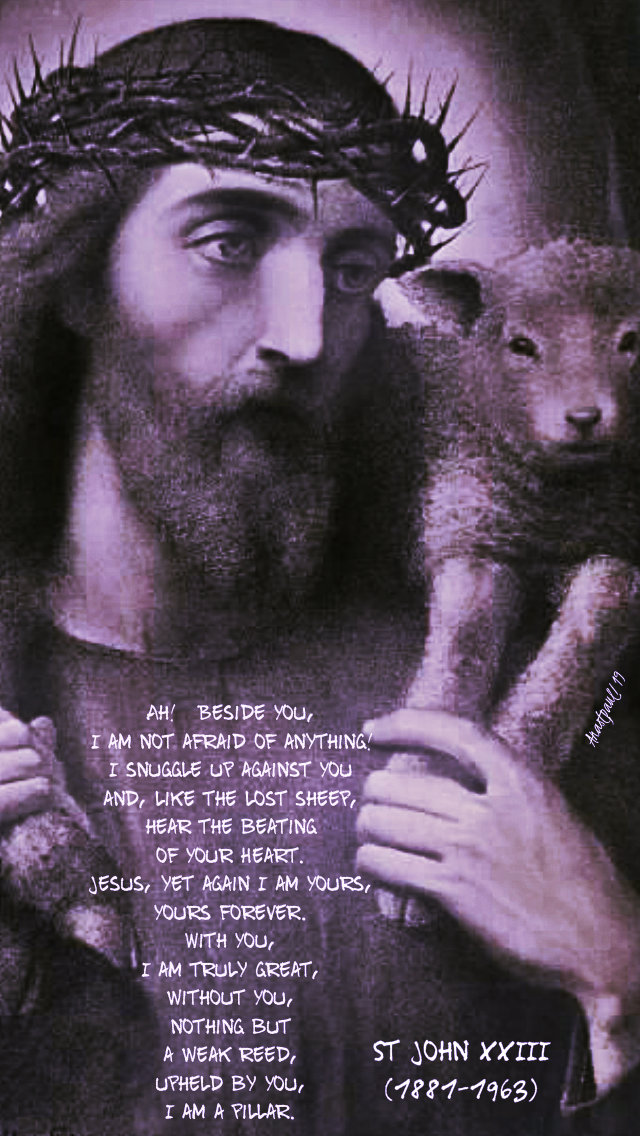
Ah! Beside You I am not afraid of anything! I snuggle up against You and, like the lost sheep, hear the beating of Your Heart. Jesus, yet again I am Yours, Yours forever. With You, I am truly great, without You, nothing but a weak reed, upheld by You, I am a pillar. I must never forget my wretchedness, not so as to be constantly trembling but so that, regardless of my lowliness and confusion, I may, with ever greater confidence, draw close to Your Heart. For my wretchedness, is the throne of Your mercy and love.”…St John XXIII (1881-1963)Journal of a soul, 1901-1903
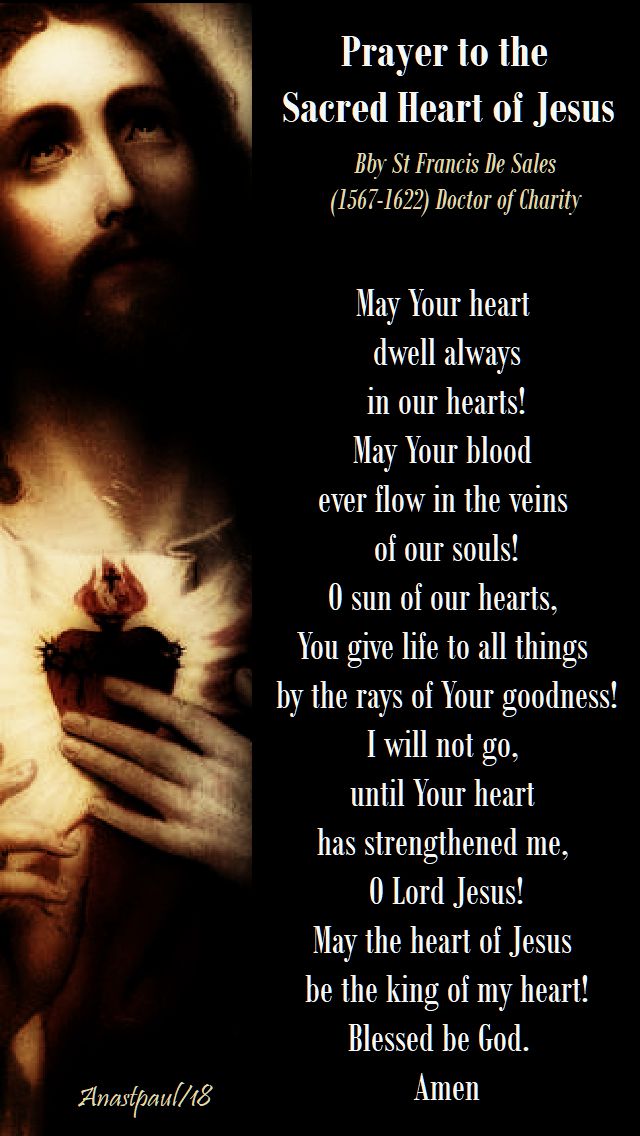
PRAYER – “May Your heart dwell always in our hearts! May Your blood ever flow in the veins of our souls! O sun of our hearts, You give life to all things by the rays of Your goodness! I will not go, until Your heart has strengthened me, O Lord Jesus! May the heart of Jesus be the king of my heart! Blessed be God. Amen.”…St Francis De Sales (1567-1622) Doctor of Charity
Saint of the Day – 28 June – St Vincenza Gerosa SCCG (1784–1847) – was an Italian professed religious and the co-foundress of the Sisters of Charity of Lovere that she founded alongside Saint Bartolomea Capitanio (1807–1833). Gerosa met Capitanio in 1824 and the two consecrated themselves to God in the name of educating children and tending to the poor of the Bergamo area. Patronage – Sisters of Charity of Lovere.
Saint Vincenza was born Caterina Gerosa in Lovere, Bergamo, Italy in 1784. She was orphaned as a youth. She was eventually adopted by a wealthy family of shopkeepers. Despite her family’s wealth, Caterina grew up shy and reserved. She was ever focused on aiding those in need, specifically the poor and abandoned. She dressed modestly and spent her time when not helping at the family shop, in prayer and at daily Mass.
Vincenza was sent by her parents to be educated by the Benedictine Sisters of Gandino. However, she soon fell ill and her poor health prevented her from continuing her studies. She returned to Lovere, where her adopted mother, father and dear sister died in rapid succession. She was left alone again and had to manage the family business, suffering the losses of her family by offering them to Christ. She prayed constantly to accept the will of the Lord in her life and used her family’s money to provide charitable works in the community. She became involved in her Church parish, organising a women’s oratory with meetings and retreats. She founded a practical school to teach the poor girls of the community domestic work so as to improve their station in life.
Vincenza met the schoolteacher, Bartolomea Capitanio and together they embarked on a new mission – to found a hospital to care for those who could not afford medical care. This they did and extended their mission to establishing a special religious institute with the objectives of providing assistance to the sick, free education for girls, Christian orphanages and programs designed to promote youth welfare. To accomplish this mission, together they founded the Sisters of Charity in 1824. At that time, Catherine took the name Vincenza and made her profession in the parish of San Giorgio before Father Rusticiano Barboglio and the Servant of God Angelo Bosio. Together they wrote ‘the Foundation Document” which forms the basis of the Rule of Life for the Order – “The Institute which will be founded in Lovere is be totally founded on charity and this must be its principle aim…should have as its aim the education of poor young girls…devote itself to the relief of the sick..”
Only nine short years later, Bartolomea died. Vincenza was tempted to return to her previous life at Lovere but agreed to continue the work the two started after her spiritual director encouraged her to do so. She continued on her own to manage and expand the order. The Order of the Sisters of Charity was approved by Pope Gregory XVI in 1840 and quickly spread throughout Italy and later to India and other countries. Vincenza continued overseeing the order until her death in 1847. Her body is venerated at the Chapel of the Sisters of Charity in Lovere.
Christ crowned, Vincentia (right) and Bartholomäa Capitano, apse mosaic, around 1937, in the Sanctuary of the Sisters of Charity in Lovere.
Saint Vincenza Gerosa was Beatified on 7 May 1933 by Pope Pius XI. She was Canonised on 18 May 1950 by Pope Pius XII.
Solemnity of The Most Sacred Heart of Jesus *2019 World Day of Prayer for the Sanctification of Priests *2019 Excerpt from ENCYCLICAL of Pope Pius XII
HAURIETIS AQUAS – on DEVOTION TO The SACRED HEART
15 May 1956
Bl Almus of Balmerino
St Argymirus of Córdoba
St Attilio of Trino
St Austell of Cornwall
St Benignus of Utrecht
St Crummine
Bl Damian of Campania
St Egilo
St Heimrad
St Lupercio
St Papias the Martyr
St Pope Paul I
St Theodichildis St Vincenza Gerosa (1784–1847)
—
Martyrs of Africa – 27 saints: 27 Christians martyred together. The only details about them to survive are the names – Afesius, Alexander, Amfamon, Apollonius, Arion, Capitolinus, Capitulinus, Crescens, Dionusius, Dioscorus, Elafa, Eunuchus, Fabian, Felix, Fisocius, Gurdinus, Hinus, Meleus, Nica, Nisia, Pannus, Panubrius, Plebrius, Pleosus, Theoma, Tubonus and Venustus. Unknown location in Africa, date unknown.
Martyrs of Alexandria – 8 saints: A group of spiritual students of Origen who were martyred together in the persecutions of emperor Septimius Severus – Heraclides, Heron, Marcella, Plutarch, Potamiaena the Elder, Rhais, Serenus and Serenus. They were burned to death c.206 in Alexandria, Egypt.
Thought for the Day – 27 June – Thursday of the Twelfth week in Ordinary Time, Year C and The Memorial of St Cyril of Alexandria (376-444) Father and Doctor
Defender of the divine Motherhood of the Virgin Mary
Saint Cyril of Alexandria (376-444)
Bishop, Father and Doctor
An excerpt from his Letter 1
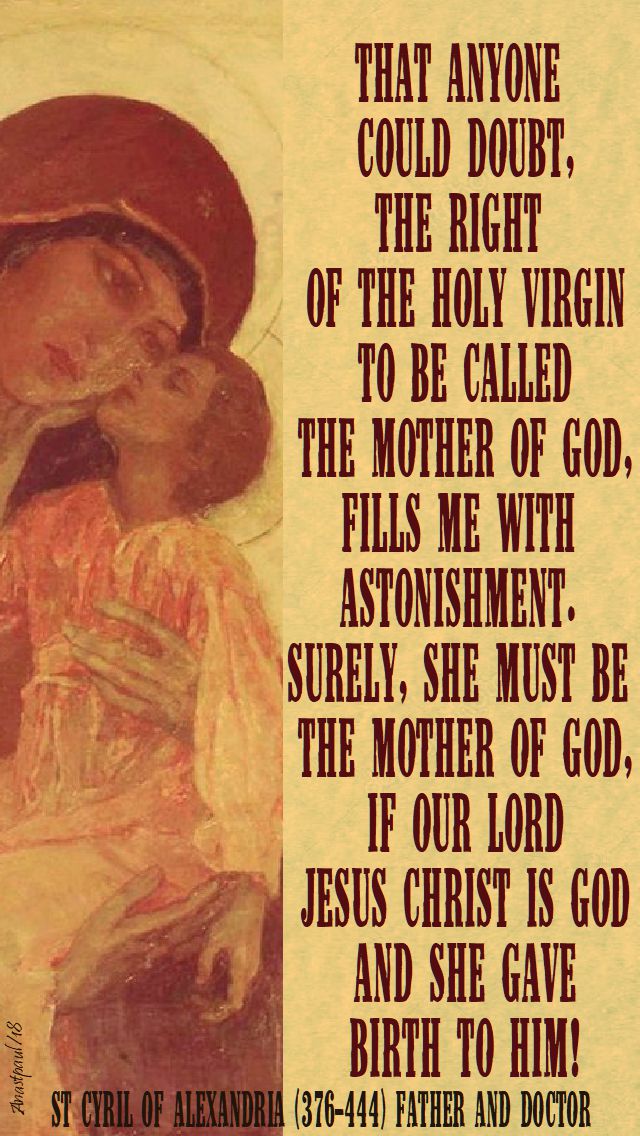
That anyone could doubt the right of the holy Virgin to be called the mother of God fills me with astonishment. Surely she must be the Mother of God if our Lord Jesus Christ is God and she gave birth to him! Our Lord’s disciples may not have used those exact words but they delivered to us the belief those words enshrine and this has also been taught us, by the holy fathers.
In the third book of his work on the holy and consubstantial Trinity, our father Athanasius, of glorious memory, several times refers to the holy Virgin as “Mother of God.” I cannot resist quoting his own words: “As I have often told you, the distinctive mark of holy Scripture is that it was written to make a twofold declaration concerning our Saviour – namely, that He is and has always been God, since He is the Word, Radiance and Wisdom of the Fatherand that for our sake,, in these latter days, He took flesh from the Virgin Mary, Mother of God and became man.”
Again further on he says: “There have been many holy men, free from all sin. Jeremiah was sanctified in his mother’s womb and John while still in the womb leaped for joy at the voice of Mary, the Mother of God.” Athanasius is a man we can trust, one who deserves our complete confidence, for he taught nothing contrary to the sacred books.
The divinely inspired Scriptures affirm that the Word of God was made flesh, that is to say, He was united to a human body endowed with a rational soul. He undertook to help the descendants of Abraham, fashioning a body for Himself from a woman and sharing our flesh and blood, to enable us to see in Him not only God but also, by reason of this union, a man like ourselves.
It is held, therefore, that there are in Emmanuel two entities, divinity and humanity. Yet our Lord Jesus Christ is nonetheless one, the one true Son, both God and man, not a deified man on the same footing as those who share the divine nature by grace but true God, who for our sake, appeared in human form. We are assured of this by Saint Paul’s declaration: When the fullness of time came, God sent his Son, born of a woman, born under the law, to redeem those who were under the law and to enable us to be adopted as sons.
Hail, O Mary, Mother of God By St Cyril of Alexandria (376-444) Father & Doctor of the Church
Hail, Mother and Virgin,
eternal Temple of the Godhead,
Venerable Treasure of Creation,
crown of virginity,
support of the true faith,
on which the Church is founded, throughout the world.
Mother of God,
who contained the infinite God
under your heart,
whom no space can contain.
Through you, the most Holy Trinity, is revealed,
adored and glorified,
demons are vanquished,
Satan cast down from heaven into hell
and our fallen nature again assumed into heaven.
Through you, the human race,
held captive in the bonds of idolatry,
arrives at the knowledge of Truth.
What more shall I say of you?
Hail, through whom kings rule,
through whom the Only-Begotten Son of God
has become the Star of Light
to those sitting in darkness
and in the shadow of death.
Amen
Quote/s of the Day – 27 June – Thursday of the Twelfth week in Ordinary Time, Year C and The Memorial of St Cyril of Alexandria (376-444) Father and Doctor
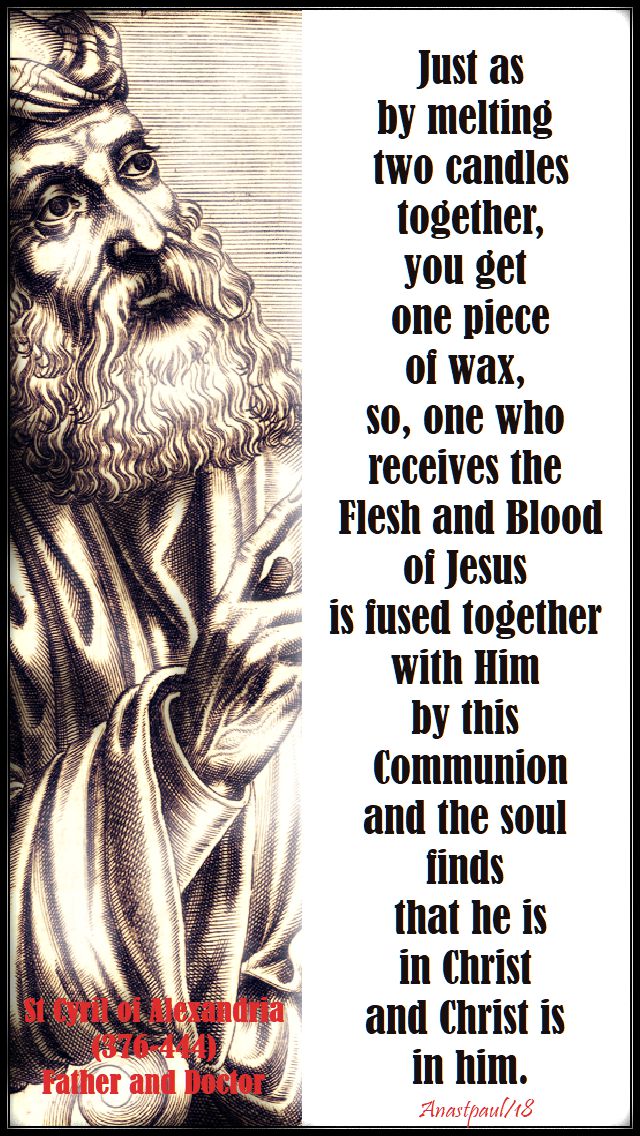
“He who receives Communion is made holy and divinised in soul and body in the same way that water, set over a fire, becomes boiling… Communion works like yeast that has been mixed into dough so that it leavens the whole mass; …Just as by melting two candles together, you get one piece of wax, so, I think, one who receives the Flesh and Blood of Jesus is fused together with Him by this Communion and the soul finds that he is in Christ and Christ is in him.”
“We have passed over the waves of this present life like a sea, with its commotion and insane bustle. We have eaten spiritual manna, the bread that came down from heaven giving life to the world.”
“If the touch alone of His sacred flesh, restores life to a corrupting body, what profit shall we not discover, in His life-giving Eucharist, when we make of it our food? It will wholly transform into its own property, which is immortality, those who participate in it.”
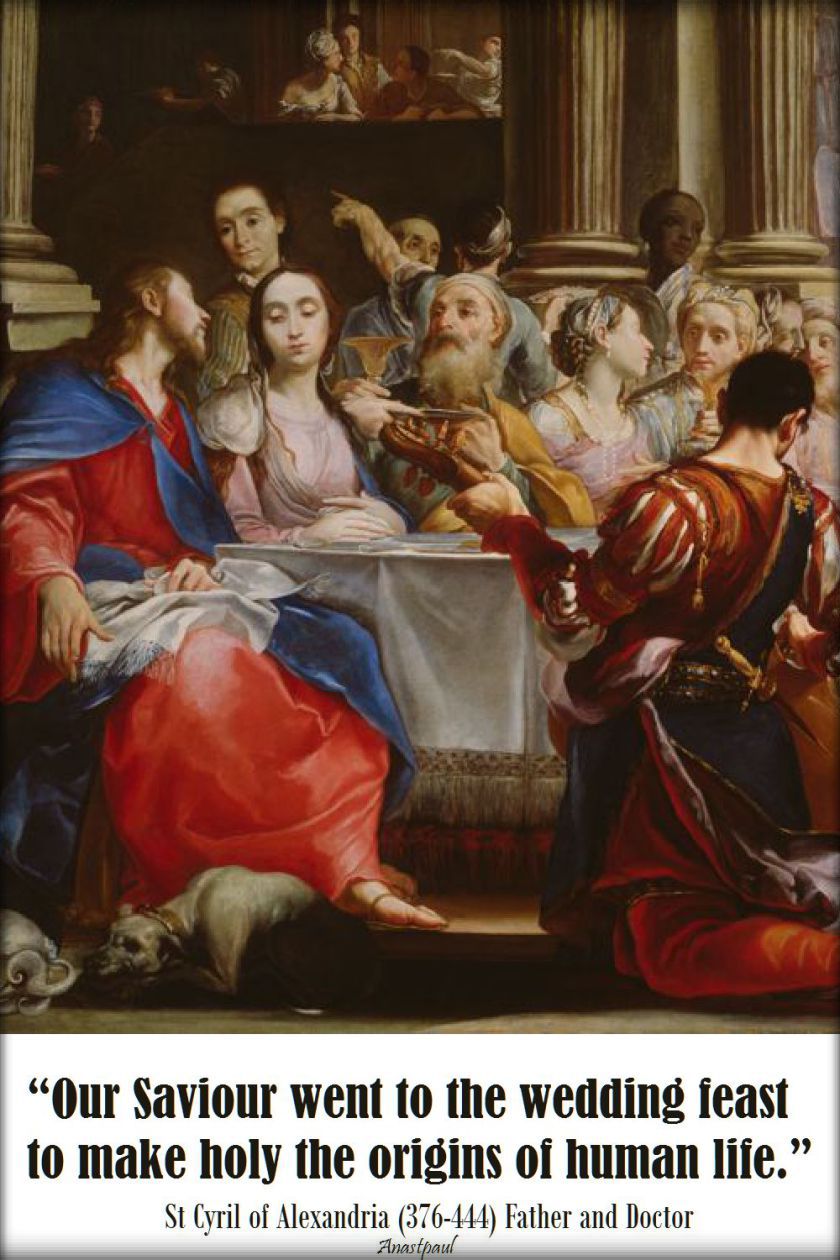
“Our Saviour went to the wedding feast to make holy the origins of human life.”
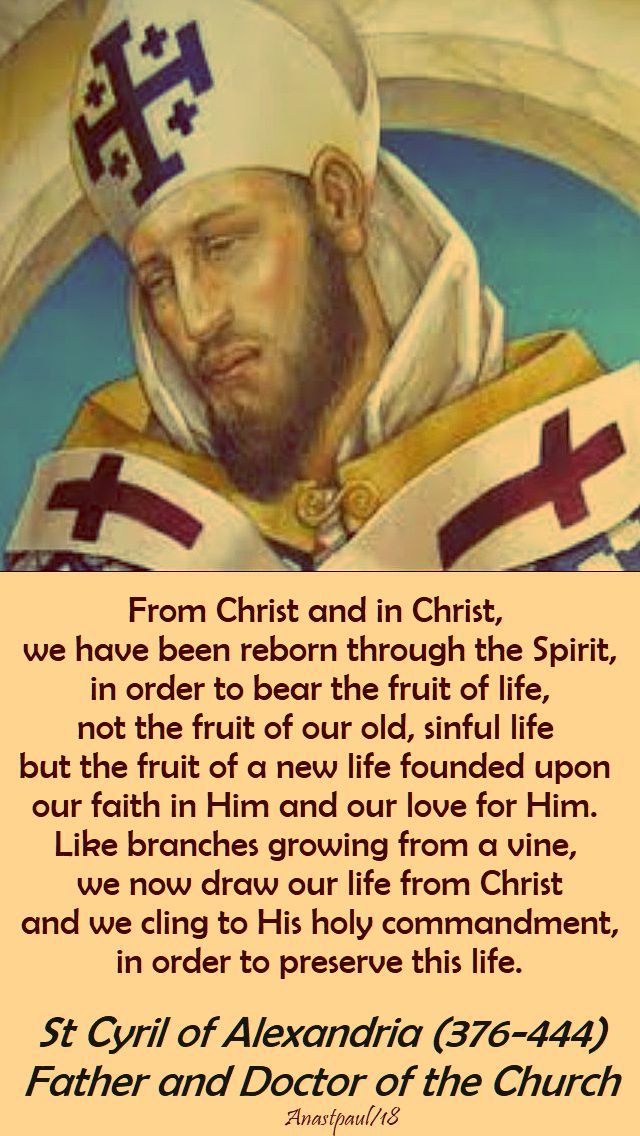
“From Christ and in Christ, we have been reborn through the Spirit, in order to bear the fruit of life, not the fruit of our old, sinful life but the fruit of a new life founded upon our faith in Him and our love for Him. Like branches growing from a vine, we now draw our life from Christ and we cling to His holy commandment, in order to preserve this life.”
“That anyone could doubt, the right of the holy Virgin to be called the Mother of God, fills me with astonishment. Surely, she must be the Mother of God, if our Lord Jesus Christ is God and she gave birth to Him!”
St Cyril of Alexandria (376-444) Father and Doctor
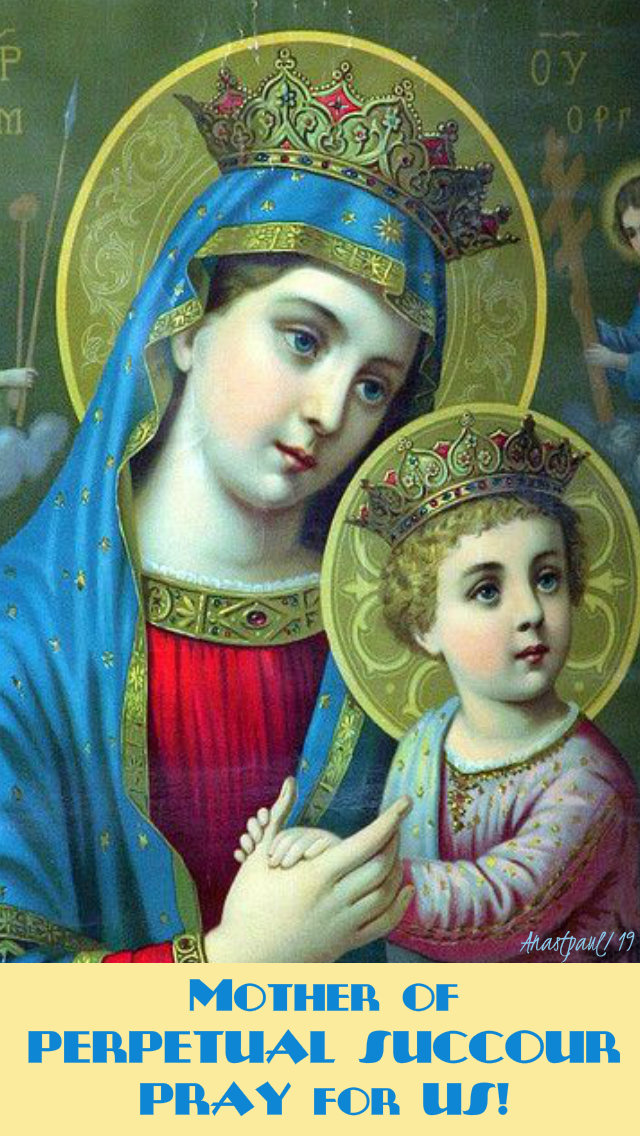
One Minute Reflection – 27 June – Thursday of the Twelfth week in Ordinary Time, Year C, Gospel: Matthew 7:21–29 and the Feast of Our Lady of Perpetual Succour
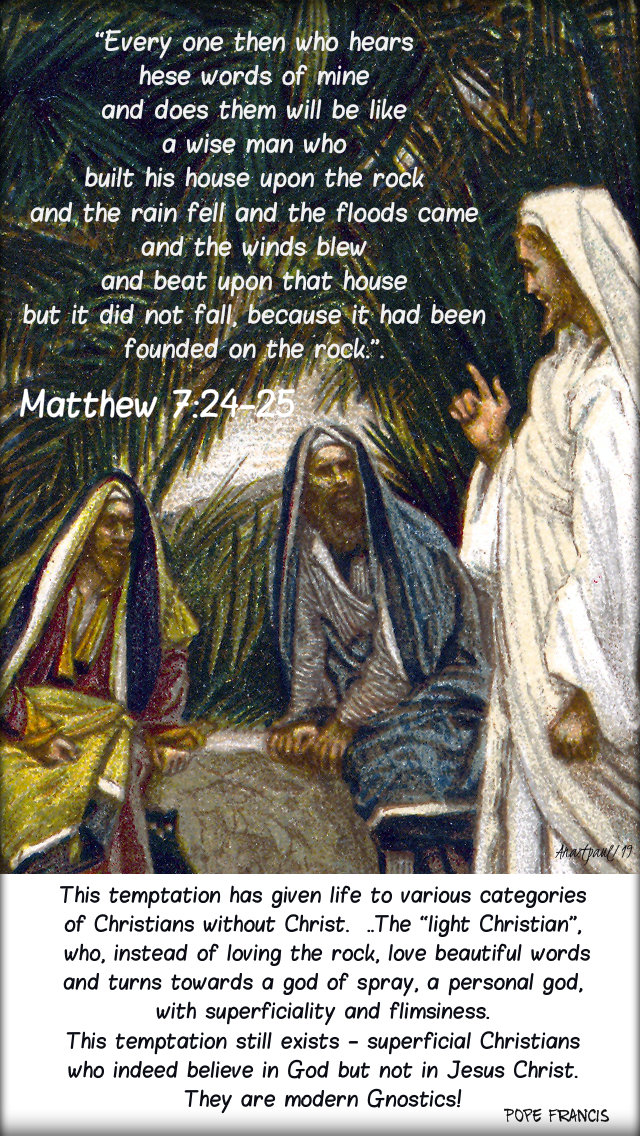
“Every one then who hears these words of mine and does them will be like a wise man who built his house upon the rock and the rain fell and the floods came and the winds blew and beat upon that house but it did not fall, because it had been founded on the rock.”…Matthew 7:24-25
REFLECTION – “The Lord speaks to us of our foundation… our Christian life and He tells us that this foundation is the rock”. We must, therefore, “build the house”, namely, our life, on the rock that is Christ. When St Paul speaks of the rock in the desert, He is referring to Christ, the only rock “that can give us security”. …there is always a temptation to live our Christianity away from the rock that is Christ, the only One who gives us the freedom to say “Father” to God. This temptation has given life to various categories of Christians without Christ. ..The “light Christian”, who, instead of loving the rock, love beautiful words and turns towards a god of spray, a personal god, with superficiality and flimsiness. This temptation still exists: superficial Christians who indeed believe in God but not in Jesus Christ. They are modern Gnostics!
The second category includes those who believe that Christian life must be taken so seriously that they end by confusing solidity and firmness with rigidity. These rigid Christians, think that to be Christian it is necessary to wear mourning and always to take everything seriously, paying attention to formalities, just as the scribes and Pharisees did. Tthese are Christians for whom everything is serious. They are today’s Pelagians who believe in the firmness of faith and are convinced that salvation is the way I do things. I must do them seriously, without any joy. They are very numerous. They are not Christians. They disguise themselves as Christians.
In short, these two categories of believers do not know Jesus, do not know who the Lord is, do not know what the rock is, they have none of the freedom of Christians. Consequently, they have neither joy nor freedom. In their life there is no room for the Holy Spirit. Therefore, the Lord’s teaching for today, is an invitation to build our Christian life on the rock that gives us freedom”….Pope Francis – ‘Santa Marta’ – Thursday, 27 June 2013
PRAYER – God our Father, You open the gates of the kingdom of heaven to those who are born again of water and the Holy Spirit. Increase the grace You have given, so that the people who have been purified from all sin, may not forfeit the promised blessing of Your love. Grant that we may ever keep Your Son, the Lord Jesus Christ, before our eyes and do all in Him and through Him and for Him and may the prayers of our Mother of Perpetual Succour may ever guide and bear us in her care. We make our pray through Christ, our Lord, in union with You and the Holy Spirit, one God forever, amen
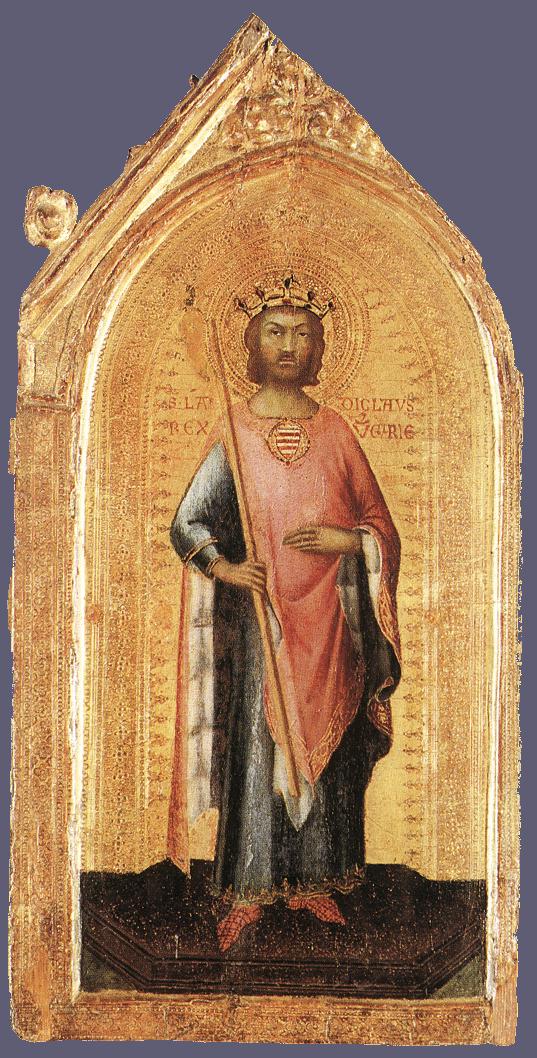
Saint of the Day – St Ladislaus I – (c 1040-1095) King of Hungary, Apostle of Charity, defender of the Faith. Born in c 1040 in Hungary and died on 1095 in Neutra, Hungary (in modern Slovakia) of natural causes. His relics are at Varadin (in modern Serbia). Patronage – Szekszard, Hungary.
Ladislaus the First, son of Bela, King of Hungary, was born in 1041. By the pertinacious importunity of the people he was compelled, much against his own inclination, to ascend the throne, in 1080.
He restored the good laws and discipline which St Stephen had established and which seem to have been obliterated by the confusion of the times. Chastity, meekness, gravity, charity and piety were from his infancy the distinguishing parts of his character, avarice and ambition were his sovereign aversion, so perfectly had the maxims of the Gospel extinguished in him all propensity to those base passions.
His life in the palace was most austere; he was frugal and abstemious but most liberal to the Church and the poor. Vanity, pleasure, or idle amusements had no share in his actions or time, because all his moments were consecrated to the exercises of religion and the duties of his station, in which he had only the divine will in view and sought only God’s greater honour.
He watched over a strict and impartial administration of justice, was generous and merciful to his enemies and vigorous in the defence of his country and the Church. He drove the Huns out of his territories and vanquished the Poles, Russians and Tartars.
He was preparing to command, as general-in-chief, the great expedition of the Christians against the Saracens for the recovery of the Holy Land, for Ladislaus believed that he was called to die for Christ, when God called him to Himself, on 30 July, 1095.
Legend says that Géza, Ladisluas’s brother, decided to build a church dedicated to the Holy Virgin in Vác after Ladislaus explained the significance of the wondrous appearance of a red deer at the place where the church would be erected:
As [King Géza and Duke Ladislaus] were standing at a spot near [Vác], where is now the church of the blessed apostle Peter, a stag appeared to them with many candles burning upon his horns and it began to run swifly before them towards the wood and at the spot where is now the monastery, it halted and stood still. When the soldiers shot their arrows at it, it leapt into the Danube and they saw it no more. At this sight the blessed Ladislaus said: “Truly that was no stag but an angel from God.” And King [Géza] said: “Tell me, beloved brother, what may all the candles signify which we saw burning on the stag’s horns.” The blessed Ladislaus answered: “They are not horns but wings, they are not burning candles but shining feathers. It has shown to us that we are to build the church of the Blessed Virgin on the place where it planted its feet and not elsewhere.” — The Hungarian Illuminated Chronicle
Ladislaus was Canonised on 27 June 1192 by Pope Celestine III. Legends depict him as a pious knight-king, “the incarnation of the late-medieval Hungarian ideal of chivalry.” He is a popular saint in Hungary and neighbouring nations, where many churches are dedicated to him.
St Cyril of Alexandria (376-444) Father and Doctor of the Church (Optional Memorial) Biography: https://anastpaul.com/2018/06/27/saint-of-the-day-27-june-st-cyril-of-alexandria-376-444-father-and-doctor-of-the-church/ and
St Adeodato of Naples
St Aedh McLugack
St Anectus of Caesarea
St Arialdus of Milan
St Arianell of Wales
Bl Benvenutus of Gubbio
St Brogan
St Crescens of Galatia
St Crescentius of Mainz
Bl Daniel of Schönau
Bl Davanzato of Poggibonsi
St Desideratus of Gourdon
St Dimman
St Felix of Rome
St Ferdinand of Aragon
St Gudene of Carthage
St Joanna the Myrrhbearer
St John of Chinon St Ladislaus I – (c 1040-1095)
St Sampson of Constantinople
St Spinella of Rome
St Tôma Toán
St Zoilus of Cordoba
—
Martyrs Killed Under Communist Regimes in Eastern Europe: Among the thousands of Christians murdered by various Communist regimes in their hatred of the faith, there were 25 members of the Ukrainian Greek Catholic Church and Russian Byzantine Catholic Church, priests, bishops, sisters and lay people, whose stories are sufficiently well documented that we know they were murdered specifically for their faith in eastern Europe and whose Causes for Canonization were opened. Their Causes were combined and they were beatified together. They have separate memorials but are remembered together today. They are –
• Andrii Ischak • Hryhorii Khomyshyn • Hryhorii Lakota • Ivan Sleziuk • Ivan Ziatyk • Klymentii Sheptytskyi • Leonid Feodorov • Levkadia Harasymiv • Mykola Konrad • Mykola Tsehelskyi • Mykolai Charnetskyi • Mykyta Budka • Oleksa Zarytskyi • Ol’Ha Bida • Ol’Ha Matskiv • Petro Verhun • Roman Lysko • Stepan Baranyk • Symeon Lukach • Vasyl Vsevolod Velychkovskyi • Volodomyr Bairak • Volodymyr Ivanovych Pryima • Yakym Senkivsky • Yosafat Kotsylovskyi • Zenon Kovalyk
Beatified – 27 June 2001 by Pope John Paul II in Ukraine
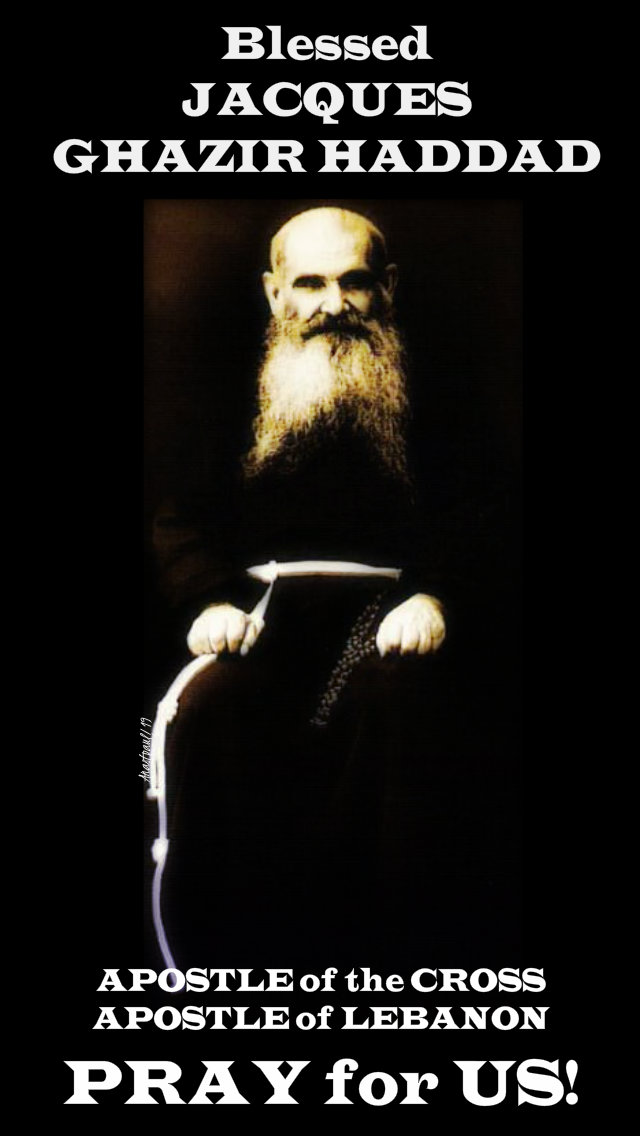
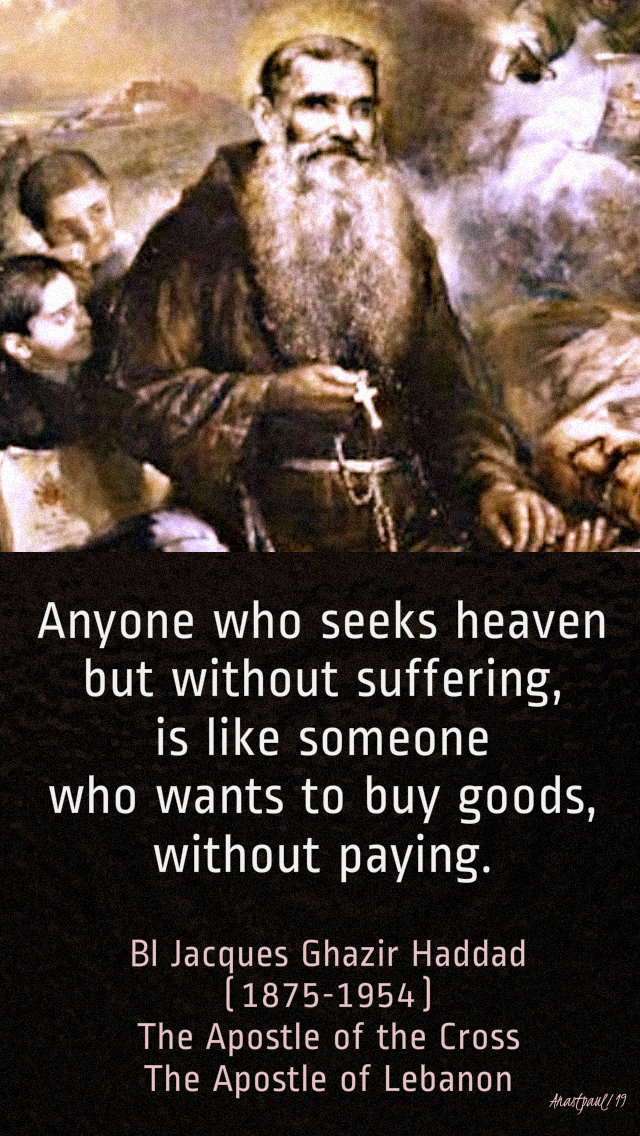
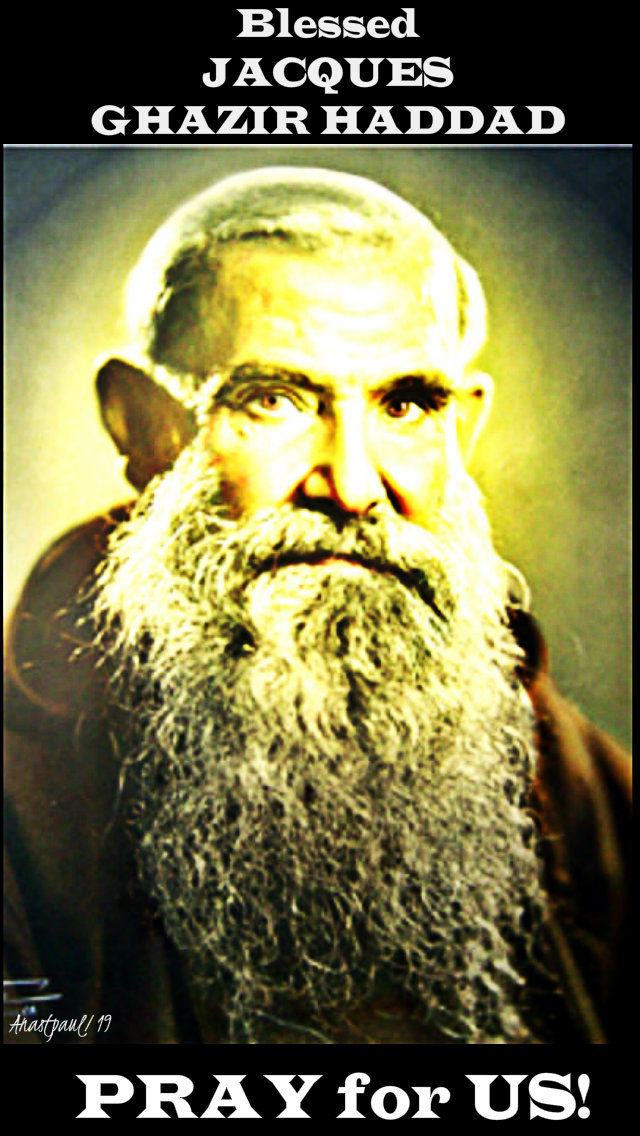
Thought for the Day – 26 June – Wednesday of the Twelfth week in Ordinary Time and the Memorial of Blessed Jacques Ghazir Haddad OFM Cap (1875-1954) “The Apostle of Lebanon” “The Apostle of the Cross”
Lebanon’s Apostle of the Cross
Brother Jacque’s long-cherished dream of erecting a large Cross in Lebanon was a concrete expression of his commitment to his Christian faith and to his native country. He wanted to make it not only a meeting place for Franciscan Tertiaries but above all, a place of prayer for all those fallen in war and for the Lebanese who had emigrated in search of work. With the help of collected money he completed this project which also included a church dedicated to Our Lady of the Sea and, later, hospital, orphanage and rest home for retired priests in 1923.
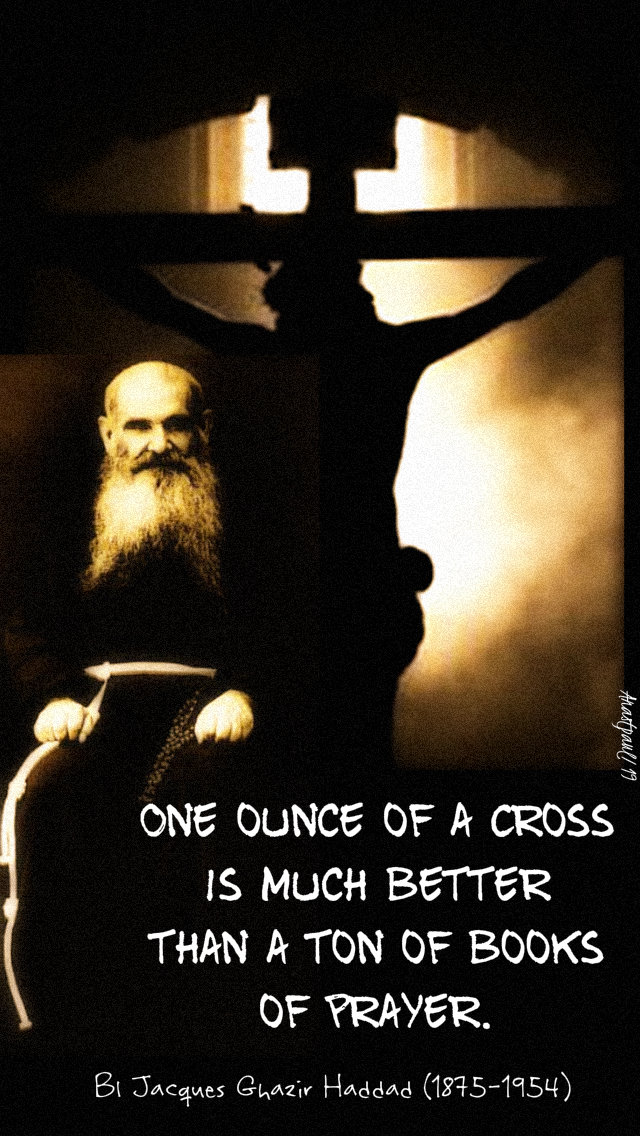
Brother James’s love for the Cross of Christ was so legendary that people christened him ‘the Apostle of the Cross’. He himself prayed the Stations of the Cross everyday and he encouraged others to frequently pray this prayer. Among his publications is a booklet of mediations for the Way of the Cross and the congregation of Tertiary Sisters he founded to run his corporal works of mercy projects is called the ‘Congregation of Franciscan Sisters of the Cross of Lebanon’. Among his frequently quoted maxims are the following: “I myself have the Cross as a destiny”.,“One ounce of a Cross is much better than a ton of books of prayer.”, and “O Cross of the Lord, so dear to the heart”.And as he left this world he held his well-worn Crucifix in his hands.
Besides his love of the Cross, Brother James also had a deep devotion to the Eucharist and to Our Blessed Lady. He prayed the fifteen decades of the rosary every day. He viewed our Lady as the perfect guide who leads people to Christ. “Honouring Mary, no matter how sacred, is only the door leading to Jesus. Mary is the means, Jesus is the end. Mary is the road, Jesus is the destination”. It was in adoration before the Blessed Sacrament that Brother James reached this destination while here on earth. Sometimes, as he adored the the Lord in the tabernacle, he would pray, “How I would prefer to take you in procession throughout the streets rather than closing up on you in the tabernacle”.
Apostle of Lebanon
But inevitable old-age and illness impacted this energetic Capuchin Brother’s own strength of also. He was already known throughout Lebanon as Abouna Yaaqoub(أبونا يعقوب) meaning Father Jacques, Father James or Abba Jacob.
At dawn on Saturday 26 June 1954 he said, “Today is my last day!” and he died at 3 o’ clock in the afternoon . The radio, the press, his friends and church bells in the villages announced his death. Thousands flocked to the Friary of the Cross to weep, pray and receive a final blessing. His body was laid to rest in a tomb of the new Calvary Chapel. This chapel soon became a site that is visited by an ever-growing throngs of pilgrims. Tens of thousands of Lebanese turned out to celebrate his beatification in Beirut’s Martyrs Square. That bloodstained square which witnessed so many tragedies of wartorn Lebanon’s recent history resound with cheers of joy as the painting of the Brother Jacques of Ghazir was unveiled above it after the Pope’s representative, Cardinal Martens, proclaimed the faithful son of Lebanon, Khalil Haddad, the Capuchin Order’s ‘Abuna Yaaqub’ a Blessed. His beatification a moment of hope for unity in a country ripped apart by factional warfare and international conflict.
Blessed Jacques Ghazir Haddad (1875-1954)
“The Apostle of Lebanon”
“The Apostle of the Cross”
Pray for Us!
Quote/s of the Day – 26 June – Wednesday of the Twelfth week in Ordinary Time and the Memorial of Blessed Jacques Ghazir Haddad OFM Cap (1875-1954) “The Apostle of Lebanon” “The Apostle of the Cross”
“How I would prefer to take You in procession throughout the streets, rather than closing You up n the tabernacle!”
“One ounce of a Cross is much better than a ton of books of prayer.”
“Anyone who seeks heaven but without suffering, is like someone who wants to buy goods, without paying.”
“Prayer without trust, is like a letter in one’s pocket. It never reaches its destination!”
“Honouring Mary, no matter how sacred, is only the door leading to Jesus. Mary is the means, Jesus is the end. Mary is the road, Jesus is the destination.”
One Minute Reflection – 26 June – Wednesday of the Twelfth week in Ordinary Time, Gospel: Matthew 7:15–20
“Every good tree bears good fruit”...Matthew 7:17
REFLECTION – “In a culture paradoxically suffering from anonymity and at the same time obsessed with the details of other people’s lives, shamelessly given over to morbid curiosity, the Church must look more closely and sympathetically at others whenever necessary. In our world, ordained ministers and other pastoral workers can make present the fragrance of Christ’s closeness and His personal gaze. The Church will have to initiate everyone – priests, religious and laity – into this “art of accompaniment” which teaches us to remove our sandals before the sacred ground of the other (cf. Ex 3:5). The pace of this accompaniment must be steady and reassuring, reflecting our closeness and our compassionate gaze which also heals, liberates and encourages growth in the Christian life…
Today more than ever we need men and women who, on the basis of their experieevangeliigaudium169-171,nce of accompanying others, are familiar with processes which call for prudence, understanding, patience and docility to the Spirit, so that they can protect the sheep from wolves who would scatter the flock. We need to practice the art of listening, which is more than simply hearing. Listening, in communication, is an openness of heart which makes possible that closeness without which genuine spiritual encounter cannot occur. Listening helps us to find the right gesture and word which shows that we are more than simply bystanders. Only through such respectful and compassionate listening, can we enter on the paths of true growth and awaken a yearning for the Christian ideal – the desire to respond fully to God’s love and to bring to fruition what He has sown in our lives.”…Pope Francis – Apostolic Exhortation « Evangelii Gaudium / The Joy of the gospel #169-171
PRAYER – Enable me loving Father, to live a life of purity that will make me live in You. Let me be so united with You that whatever I might ask will be in total accord with Your will for me. Bl Jacques Ghazir Haddad, your tireless work and preaching for the glory of the Kingdom show us the way to sanctification, please intercede for us all. May Mary our Mother of Compassion, be our constant companion. We make our prayer through Christ our Lord, with the Holy Spirit, one God for all eternity, amen.





 In 1823 he travelled to Rome with the Patriarch of Venice, who arranged an audience for him with Pope Pius VII. In that audience the Pontiff encouraged him to undertake the reform of philosophy.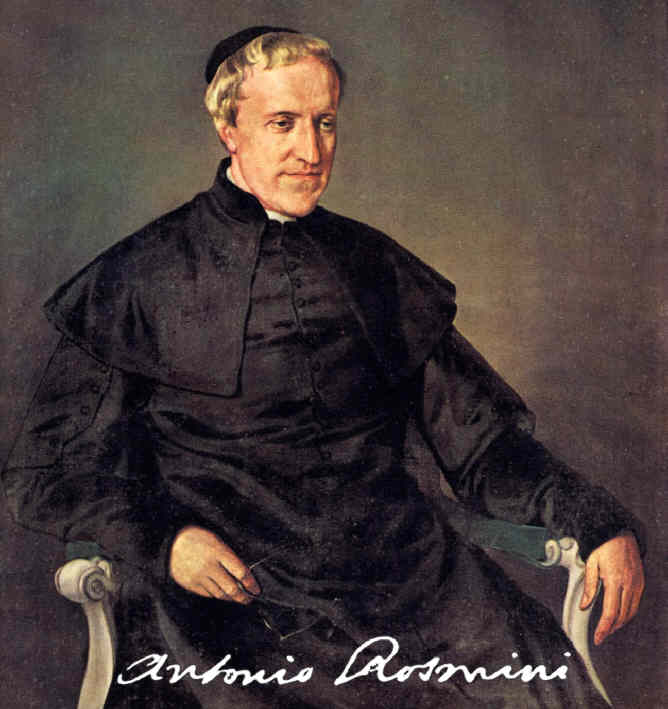



 He concluded this probation on 28 May 1731] He was ordained to the priesthood on 8 June 1732 and became a member of the Propaganda of Naples which was a congregation of secular priests devoted to apostolic work. He also gave all his wealth to the poor for he had no use for it himself. Cardinal Pignatelli assigned him to serve as the Director of Religious Instruction in the parish of Saints Francis and Matthew in the Spanish quarter. He also visited the old people in the Hospice of Saint Gennaro and those condemned to death who were ill in the hospital at the docks. It was at this time that he developed a friendship with Saint Alphonsus Maria de’ Liguori after the two first met in Chiaiano.
 He died at 10:00am on 30 June 1744. His old friend Liguori was present at his bedside as Sarnelli died and noted a sweet odour that remained in the room even long after Sarnelli was buried, the religious Francesco Tartaglione and the novice Francisco Romito were also present. His brother Domenico was so overcome with emotion he did not want to leave the room where his brother’s remains were. His remains were buried on 2 July 1744 in the parish church of Santa Maria dell’Aiuto in Naples (in the San Nicola chapel) though were later reinterred in the Redemptorist church of Santi Alfonso e Antonio at Tarsia in Naples. His remains were moved again on 25 October 1994 to the Redemptorist church of La Santissima Trinità in Ciorani.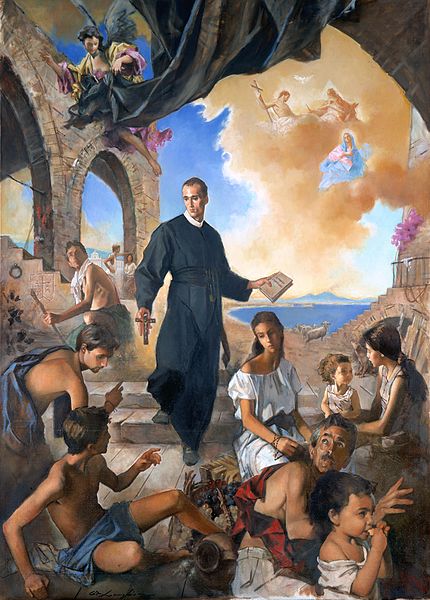






 To accomplish this mission, together they founded the Sisters of Charity in 1824. At that time, Catherine took the name Vincenza and made her profession in the parish of San Giorgio before Father Rusticiano Barboglio and the Servant of God Angelo Bosio. Together they wrote ‘the Foundation Document” which forms the basis of the Rule of Life for the Order – “The Institute which will be founded in Lovere is be totally founded on charity and this must be its principle aim…should have as its aim the education of poor young girls…devote itself to the relief of the sick..”












You must be logged in to post a comment.