Posted in FATHERS of the Church, FEASTS and SOLEMNITIES, ON the SAINTS, PRACTISING CATHOLIC, QUOTES - J R R Tolkien and MORE, QUOTES on the CHURCH, SAINT of the DAY, The APOSTLES & EVANGELISTS

Thought for the Day – 3 May – The Preaching of the Apostles

Thought for the Day – 3 May – The Feast of Saints Philip and James, Apostles

The Preaching of the Apostles

Tertullian (c 155- c 240)
Priest, Father and Ancient Christian Writer

An excerpt from his On the Prescription of Heretics

Our Lord Jesus Christ Himself declared what He was, what He had been, how He was carrying out His Father’s will, what obligations He demanded of men.    This He did during His earthly life, either publicly to the crowds, or privately to His disciples.  Twelve of these He picked out, to be His special companions, appointed to teach the nations.

One of them fell from His place.   The remaining eleven were commanded by Christ, as He was leaving the earth to return to the Father after His resurrection, to go and teach the nations and to baptise them into the Father, the Son and the Holy Spirit.
The apostles cast lots and added Matthias to their number, in place of Judas, as the twelfth apostle.   The authority for this action is to be found in a prophetic psalm of David.   After receiving the power of the Holy Spirit which had been promised to them, so that they could work miracles and proclaim the truth, they first bore witness to their faith in Jesus Christ and established churches throughout Judea.   They then went out into the whole world and proclaimed to the nations the same doctrinal faith.

They set up churches in every city.   Other churches received from them a living transplant of faith and the seed of doctrine and through this daily process of transplanting they became churches.   They therefore qualify as apostolic churches by being the offspring of churches that are apostolic.

Every family has to be traced back to its origins.   That is why we can say that all these great churches constitute that one original Church of the apostles, for it is from them that they all come.   They are all primitive, all apostolic, because they are all one.   They bear witness to this unity by the peace in which they all live, the brotherhood which is their name, the fellowship to which they are pledged.   The principle on which these associations are based is common tradition by which they share the same sacramental bond.

The only way in which we can prove what the apostles taught—that is to say, what Christ revealed to them — is through those same churches.   They were founded by the apostles themselves, who first preached to them by what is called the living voice and later by means of letters.

The Lord had said clearly in former times – I have many more things to tell you but you cannot endure them now.   But He went on to say – When the Spirit of truth comes, He will lead you into the whole truth.   Thus Christ shows us that the apostles had full knowledge of the truth, for He had promised that they would receive the whole truth through the Spirit of truth.   His promise was certainly fulfilled, since the Acts of the Apostles prove, that the Holy Spirit came down on them.

Saints James and Philip, Pray for us!sts-philip-and-james-pray-for-us-3-may-2017.jpg

Posted in CATHOLIC Quotes, FEASTS and SOLEMNITIES, MORNING Prayers, QUOTES on the CHURCH, SAINT of the DAY, The APOSTLES & EVANGELISTS, The WORD

One Minute Reflection – 3 May – I believe

One Minute Reflection – 3 May – Friday of the Second Week of Easter, Gospel: John 14:6–14 and the Feast of Sts James and Philip and the Memorial of Saint Stanislaw Kazimierczyk CRL (1433–1489)

“Truly, truly, I say to you, he who believes in me will also do the works that I do and greater works than these will he do, because I go to the Father…”...John 14:12

REFLECTION – “Jesus is the Father’s Emissary.   From the beginning of His ministry, He “called to him those whom he desired … And he appointed twelve, whom also He named apostles, to be with Him and to be sent out to preach.” (Mk 3:13-14)   From then on, they would also be His “emissaries” (Greek apostoloi).   In them, Christ continues His own mission = “As the Father has sent me, even so I send you.” (Jn 20:21)   The apostles’ ministry is the continuation of His mission, Jesus said to the Twelve: “he who receives you receives me.” (Mt 10:40)

Jesus unites them to the mission He received from the Father.   As “the Son can do nothing of his own accord” but receives everything from the Father who sent Him, so those whom Jesus sends can do nothing apart from Him (Jn 5:19.30), from whom they received both the mandate for their mission and the power to carry it out.   Christ’s apostles knew that they were called by God as “ministers of a new covenant,” “servants of God,” “ambassadors for Christ,” “servants of Christ and stewards of the mysteries of God” (1 Cor 4:1).

In the office of the apostles, there is one aspect that cannot be transmitted – to be the chosen witnesses of the Lord’s Resurrection and so the foundation stones of the Church. But their office also has a permanent aspect.   Christ promised to remain with them always.   The divine mission entrusted by Jesus to them “will continue to the end of time, since the Gospel they handed on is the lasting source of all life for the Church.  Therefore, … the apostles took care to appoint successors.” (Vatican II, LG 20) Catechism of the Catholic Church- #858-860the divene mission - vatican LG 20 - he who believes in me - john 14 12 - 3 may 2019.jpg

PRAYER – Almighty Father, we believe, strengthen our faith.   Divine Son, we follow You, remain with us.   Holy Spirit, come, guide our steps.   Glory be to the Father and to the So and to the Holy Spirit, as it was in the beginning is now and ever shall be, amen. Saints James and Philip, Saint Stanislaw, pray for us!st james and philip pray for us 3 may 2019- no 4jpg.jpg

st stanislaw kazimierczyk pray for us 3 may 2019.jpg

Posted in SAINT of the DAY

Saint of the Day – 3 May – Saint Stanislaw Kazimierczyk CRL (1433–1489)

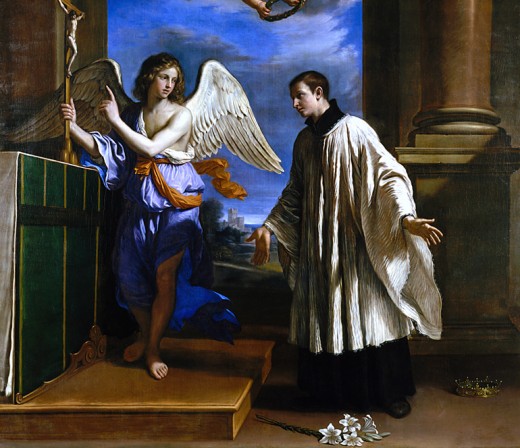
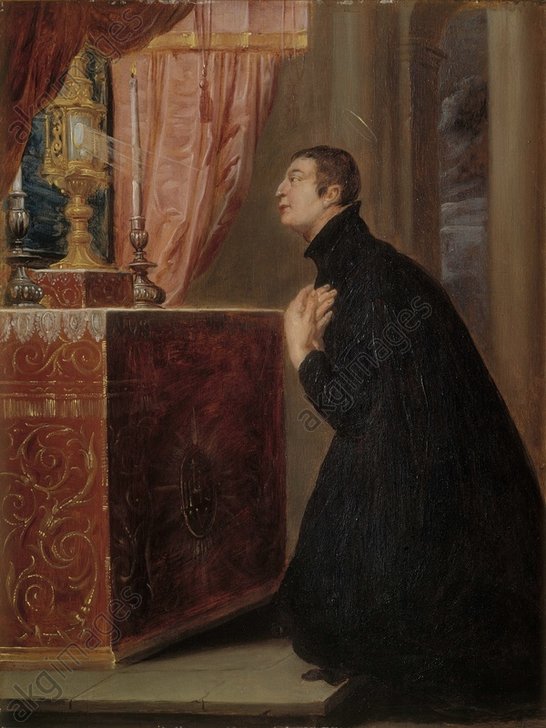
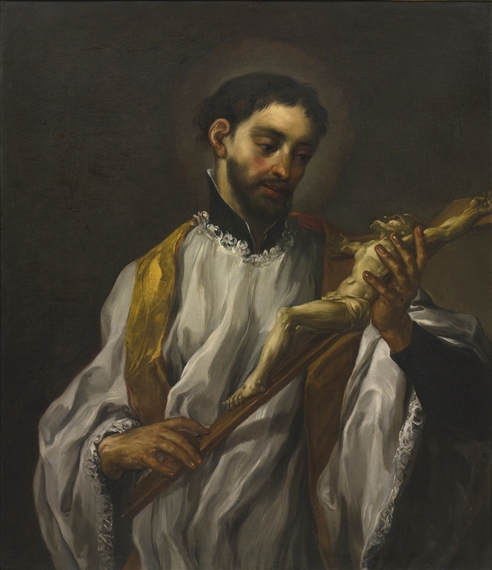
Saint of the Day – 3 May – Saint Stanislaw Kazimierczyk CRL (1433–1489) aged 55, Priest of the Canons Regular of the Lateran – Apostle of the Holy Eucharist and of the poor, of Confession, famed Preacher, ascetic, mystic.   Born on 27 September as Stanisław (Louis) Sołtys and died on 3 May 1489 in Kazimierz, Lubelskie, Poland of natural causes.   Patronage – of Preachers.Stanislaw_Kazimierczyk_painting

Stanisław Sołtys was born 27 September 1433 in Kraków to Maciej Sołtys and Jadwiga. His parents had long wanted a child and he was born on exactly the same date that the remains of Saint Stanisłaus  (1030– 1079), Patron of Poland, were being moved.   His parents were members of the Brotherhood of the Blessed Sacrament.

He received his education from the Canons Regular of the Lateran at their school, not far from his home, which was attached to their convent and to the local parish church of the Corpus Christi, that the order administered.   He went onto receive doctorates in theological studies and in his philosophical studies from the Jagiellonian University in Kraków.   He received a bachelor’s degree in 1451.
The successful completion of his studies in 1456 saw him enter the Canons Regular of the Lateran and thus became a novice.   He took the religious name of Stanisław Kazimierczyk after the patron of Poland. bl stanislaus.JPG

He was ordained as a priest in 1456 and was then named as the vice-prior of the order despite being a new priest and not having experience.   He was also made the novice master in charge of new candidates to the order.   He dedicated himself to the care of the ill and the poor and was noted for the deep devotion of the Holy Mass.   He developed a reputation for great spiritual insight as a confessor.   It was his allure as a preacher and confessor that saw people seek him out to preach and hear their confessions.   He preached in strong defence of the doctrine of the Real Presence in the Eucharist against the preachings of the Polish followers of John Wycliffe and Jan Hus.   It was due to this, that he gained the title “Apostle of the Blessed Sacrament”.   Saint John Cantius (1390-1473) – a colleague of his at the Jagiellonian and a major scientist of the period, was a close friend of his.

He slept little and often slept on the ground more as a penitential act.   On one occasion he went to visit the tomb of his patron when he saw the Mother of God with the Infant Jesus in her arms, Saint Stanisław and other saints were around her.   He often delivered his sermons in German as well as his native Polish.   King John I Albert once attributed an 8 September 1487 battle win against the Ottoman Empire to him.Saint Stanislaus of Kazimierz

He died  on 3 May 1489 and immediately was acclaimed a saint by all who knew him and those to whom he ministered.   He had fallen quite ill during Lent and requested anointing.   He put his hands on his conferees’ heads to bless them and to bid them farewell and died with his hands upraised to entrust his soul to God.

The faithful referred to him often as “Blessed” despite the fact that he had not been beatified but was called this due to his great reputation for personal holiness – in the 1500s this title was recorded as being given.   His remains were moved in 1632 after the priest Martin Kłoczyński commissioned a splendid altar in his honour to house the remains – a total of 176 purported miracles were reported to have taken place in the first year since his death.

The Canons Regular of the Lateran made several requests to the pope to seek beatification in 1773 but no cause was ever initiated  . The Cardinal Archbishop of Kraków Karol Józef Wojtyła (the future St Pope John Paul II) asked the order, in 1971, to collect existing documents and evidence on the life of the late priest and set up a historical commission to aid them in this on 15 December 1972.   The beatification process launched under Pope John Paul II on 14 October 1986 and the priest was titled as a Servant of God once the Congregation for the Causes of Saints (CCS) issued the official nihil obstat to the cause.   St John Paul II both named him as Venerable upon the confirmation of his heroic virtue and approved his longstanding “cultus” which allowed for the pope to preside over the Beatification on 18 June 1993 as a solemnisation of that “cultus”.

Pope Benedict XVI approved a miracle on 19 December 2009 and on 19 February 2010 confirmed the date for Canonisation.   He Canonised him on 17 October 2010 in Saint Peter’s Square.76. Saint Stanislas Soltys Kazimierczyk - phili

Posted in franciscan OFM, SAINT of the DAY, The APOSTLES & EVANGELISTS

Feast of St James and St Philip – Memorials of the Saints – 3 May


St James the Lesser Apostle (Feast)
St Philip the Apostle (Feast)
Sts James and Philip:   https://anastpaul.wordpress.com/2018/05/03/3-may-feast-of-sts-philip-and-james-apostles-and-martyrs/

St Adalsindis of Bèze
Bl Adam of Cantalupo in Sabina
St Ahmed the Calligrapher
St Aldwine of Peartney
St Pope Alexander I
St Alexander of Constantinople
Bl Alexander of Foigny
St Alexander of Rome
Bl Alexander Vincioli
St Ansfrid of Utrecht
St Antonina of Constantinople
St Diodorus the Deacon
Bl Edoardo Giuseppe Rosaz
St Ethelwin of Lindsey
St Eventius of Rome
St Fumac
St Gabriel Gowdel
St Juvenal of Narni
Bl Maria Leonia Paradis
St Maura of Antinoe
St Peter of Argos
St Philip of Zell
Bl Ramon Oromí Sullà
St Rhodopianus the Deacon
St Scannal of Cell-Coleraine
Bl Sostenaeus
St Stanislas Kazimierczyk CRL (1433–1489)
St Theodolus of Rome
St Timothy of Antinoe
Bl Uguccio
Bl Zechariah

Posted in CATECHESIS, DOCTORS of the Church, EASTER, FATHERS of the Church, HOLY WEEK 2019, QUOTES of the SAINTS, QUOTES on DEATH, SAINT of the DAY, The INCARNATION, The PASSION, The RESURRECTION

Thought for the Day – 2 May – On the Incarnation of the Word

Thought for the Day – 2 May – Thursday of the Second week of Easter, Gospel: John 3:31–36 and the Memorial of St Athanasius (297-373)

On the Incarnation of the Word

Saint Athanasius (297-373)
Bishop, Great Eastern Father & Doctor of the Church
Known as “The Father of Orthodoxy”

An excerpt from On the Incarnation of the Word

The Word of God, incorporeal, incorruptible and immaterial, entered our world.   Yet it was not as if He had been remote from it up to that time.   For there is no part of the world that was ever without His Presence; together with His Father, He continually filled all things and places.

Out of His loving-kindness for us, He came to us and we see this in the way He revealed Himself openly to us.   Taking pity on mankind’s weakness and moved by our corruption, He could not stand aside and see death have the mastery over us, He did not want creation to perish and His Father’s work in fashioning man, to be in vain.   He, therefore, took to Himself a body, no different from our own, for He did not wish simply to be in a body or only to be seen.

If He had wanted simply to be seen, He could indeed have taken another and nobler, body.   Instead, He took our body in its reality.

Within the Virgin, He built himself a temple, that is, a body, He made it His own instrument in which to dwell and to reveal Himself.   In this way, He received from mankind, a body like our own and, since all were subject to the corruption of death, He delivered this body over to death for all and with supreme love, offered it to the Father. He did so, to destroy the law of corruption, passed against all men, since all died in Him. The law, which had spent its force on the body of the Lord, could no longer have any power over His fellowmen.   Moreover, this was the way in which the Word was to restore mankind to immortality, after it had fallen into corruption and summon it back, from death to life.   He utterly destroyed the power death had against mankind—as fire consumes chaff—by means of the body He had taken and the grace of the Resurrection.

This is the reason why the Word assumed a body that could die, so that this body, sharing in the Word who is above all, might satisfy death’s requirement in place of all.  Because of the Word dwelling in that body, it would remain incorruptible and all would be freed forever from corruption, by the grace of the Resurrection.

In death, the Word made a spotless sacrifice and oblation of the body He had taken.   By dying for others, He immediately banished death for all mankind.in death the word made a spotless - st athanasius - 2 may 2019

In this way the Word of God, who is above all, dedicated and offered His temple, the instrument that was His body, for us all, as He said and so paid, by His own death the debt that was owed.   The immortal Son of God, united with all men by likeness of nature, thus fulfilled all justice, in restoring mankind to immortality, by the promise of the resurrection.

The corruption of death, no longer holds any power over mankind, thanks to the Word, who has come to dwell among them through His one body.

St Athanasius, Pray for Us!st athanasius pray for us no 2 - 2 may 2019 adapted.jpg


Posted in DOCTORS of the Church, FATHERS of the Church, MARIAN QUOTES, QUOTES of the SAINTS, QUOTES on FAITH, QUOTES on FORGIVENESS, QUOTES on MARTYRDOM, QUOTES on PRAYER, QUOTES on the CHURCH, SAINT of the DAY, The BLESSED VIRGIN MARY

Quote/s of the Day – 2 May – Athanasius and Antoninus

Quote/s of the Day – 2 May – Thursday of the Second week of Easter, Gospel: John 3:31–36 and the Memorial of St Athanasius (297-373) – Father and Doctor of the Church and St Antoninus of Florence OP (1389-1459)

“For the Son of God became man
so that we might become God.”for the son of god became man - st athanasius - 2 may 2019

“Christians, instead of arming themselves with swords,
extend their hands in prayer.”christians instead of arming themselves with swords - st athanasius 2 may 2019

“But what is also to the point, let us note that the very tradition, teaching and faith of the Catholic Church from the beginning was preached by the Apostles and preserved by the Fathers. On this the Church was founded – and if anyone departs from this, he neither is, nor any longer ought to be called, a Christian.”

St Athanasius (297-373) Father & Doctor of the Churchbut what is also to the point let us note - st athanasius 2 may 2019

“While other martyrs suffered
by sacrificing their own lives,
the Blessed Virgin suffered,
by sacrificing her Son’s life.”

St Antoninus OP (1389-1459)while other martyrs suffered - st antoninus 2 may 2019

Posted in DOCTORS of the Church, DOMINICAN OP, FATHERS of the Church, MORNING Prayers, QUOTES of the SAINTS, SAINT of the DAY, The HOLY GHOST, The WORD

One Minute Reflection – 2 May – He is in them by the Presence of His Spirit and in them He is seen.

One Minute Reflection – 2 May – Thursday of the Second week of Easter, Gospel: John 3:31–36 and the Memorial of St Athanasius (297-373) – Father and Doctor of the Church and St Antoninus OP (1389-1459), Gospel:  John 3:31–36

For the one whom God sent speaks the words of God.   He does not ration his gift of the Spirit…he who does not obey the Son shall not see life…John 3:34,36

REFLECTION – “The sanctification or, rather, the deification of the nature of man, is one main subject of St Athanasius’s theology.   Christ, in rising, raises His Saints with Him to the right hand of power.   They become instinct with His life, of one body with His flesh, divine sons, immortal kings, gods.   He is in them, because He is in human nature and He communicates in them that nature, deified by becoming His, that them It may deify.   He is in them by the Presence of His Spirit and in them He is seen.”…Bl John Henry Newman (1801-1890)he does not ration his gift john 3 34 - he is in them by the presence - bl john henry newman 2 may 2019.jpg

PRAYER – Lord God, whose name is holy and whose mercy is proclaimed in every generation, send forth Your Spirit into our hearts and grant that, faithfully pondering on all that is holy, we may ever live in the splendour of Your presence.   Listen we beseech You, to the prayers we request from St Athanasius and St Antoninus, to help us on this earthly journey.   We make our prayer through Christ, Your Son our Lord and Saviour, with the Holy Spirit, one God forever amen.st-athanasius-pray-for-us-2-may-2019

st antoninus - pray for us 2 may 2019


Posted in DOMINICAN OP, SAINT of the DAY

Saint of the Day – 2 May – Saint Antoninus of Florence OP (1389-1459) “Antoninus the Counsellor”

Saint of the Day – 2 May – Saint Antoninus of Florence OP (1389-1459) Archbishop of Florence, Dominican Priest and Friar, Confessor, spiritual director, apostle of mercy, theologian, writer, reformer, Prior of the Order. Born as Antonio Pierozzi (also called de Forciglioni) on 1 March 1389 in the city of Florence and died on 2 May 1459 at Florence, Italy.   Known as “Antoninus the Counsellor”.   Patronages – Moncalvo, Turin, Italy, University of Santo Tomas Graduate School, Manila, Philippines, Saint Antoninus Parish, Municipality of Pura, Tarlac Philippines.header snip st antoninus.JPG

Anthony Pierozzi, born on 1 March 1389, was soon nicknamed “Antoninus” (“Little Anthony”), either because of his small stature or his weak health.   Thus began the life of the future Saint Antoninus born to noble parents in Florence, Italy.

The influence of the Dominicans on Antoninus’ early life led him to seek admittance to the Dominican Order at the age of 15.   Antoninus approached the prior of the convent in Fiesole, Blessed Brother John Dominic (c 1355–1419, with his request to be admitted to the Order.   Perhaps noticing the weak health of the aspirant and not wishing to give an outright refusal to Antoninus’ request, Brother John Dominic told him to come back once he had memorised the Decretum of Gratian, or the Code of Canon Law at the time.   To the prior’s surprise, the youth returned within the year having accomplished the task required of him.   He was thus admitted to the Order.

The love and zeal he had as a novice never left Antoninus.   He became a great reformer more by example than by word.   Elected prior at a young age, Antoninus served as superior for many years.   He, like his brothers in St Dominic and St Thomas Aquinas, was concerned with the formation of the friars of the Order of Preachers.   Hence he prepared the Summa Moralis, a systematic and comprehensive presentation of Christian Moral Theology, which he wrote, as he said, during the summer and the winter of his life. Antoninus’ writings treated the practical aspects of living the faith.   His writings were a major development in the field of moral theology.   St Antoninus also wrote a biography of Blessed John Dominic and a history of the world.st antoninus bishop of florence op.jpg

Antoninus’ devotion to the Sacrament of Penance and spiritual counsel earned him the title of Antoninus the Counsellor.   Such was his ability to instruct and to guide others.

Antoninus accepted into the Order Brother John of Fiesole, the future artist, Fra Angelico (c 1395–1455).   Having an eye for recognising the gifts of others, Antoninus instructed Fra Angelico to prepare his own Summa Moralis, not in words but through his painting. Hence when the new convent of San Marco was built, Prior Antoninus had Fra Angelico grace each of the friar’s cells with a painting based on a scene from the life of Christ.

After he was appointed Archbishop of Florence, Antoninus’ residence became known as the hostel for the poor, such was his generosity and service for victims of poverty.   His sensitivity to the needs of others led him to found the “Men of St Martin,” in order to offer quiet support to the wealthy who had become indigent.   Hence, the Archbishop lived out the works of mercy.

THE ALMS OF ST ANTONINUS OF FLORENCE.jpg
The Alms of St Antoninus by Lorenzo Lotto

He came to win the esteem and love of his people, especially by his energy and resource in combating the effects of the plague and earthquake in 1448 and 1453.    Antoninus lived a life of austerity as archbishop, continuing to follow the Dominican Rule.   His relations with the Medici regime were close but not always harmonious, with his serving several times as an ambassador for the Republic to the Holy See during the 1450s.ST ANTONINUS ARCHBISHOP OF FLORENCE.jpg

St Antoninus died on 2 May 1459 and Pope Pius II conducted his funeral.   The Pope happened to be on his way to the Council of Mantua when he heard of the Archbishop’s death.   The Archbishop’s wish was that he be buried at the priory which he had founded in the City.  st sntoninus incorrupt body.JPG

He was Canonised on Trinity Sunday, 31 May 1523 by Pope Adrian VI, who himself held ideas of radical and drastic church reform similar to those of Antoninus.

Eternal God, you blessed Saint Antoninus with a marvellous gift of counsel.   By the help of his prayers, while we walk in the darkness of this life, may we learn from the light of Christ all that we ought to do.   We ask this through our Lord Jesus Christ, your Son, who lives and reigns with you and the Holy Spirit, one God, forever and ever. Amen800px-Collezione_loeser,_busto_di_sant'antonino,_stucco_dipinto,_xv_sec.

Posted in DOCTORS of the Church, DOMINICAN OP, FATHERS of the Church, SAINT of the DAY

Memorials of the Saints – 2 May

St Athanasius (c295-373) – Father and Doctor of the Church (Memorial)
Biography:   https://anastpaul.wordpress.com/2018/05/02/saint-of-the-day-2-may-st-athanasius-c295-373-father-and-doctor-of-the-church-father-of-orthodoxy/

St Alpin de Châlons
St Antoninus of Florence OP (1389-1459)

Bl Bernard of Seville
St Bertinus the Younger
Bl Boleslas Strzelecki
Bl Conrad of Seldenbüren
St Cyriacus of Pamphylia
St Eugenius of Africa
St Exsuperius of Pamphylia
St Felix of Seville
St Fiorenzo of Algeria
St Gennys of Cornwall
St Germanus of Normandy
St Gluvias
St Guistano of Sardinia
St Joseph Luu
Bl Juan de Verdegallo
St Longinus of Africa
St Neachtain of Cill-Uinche
St Theodulus of Pamphylia
St Ultan of Péronne
St Vindemialis of Africa
St Waldebert of Luxeuil
St Wiborada of Saint Gall
Bl William Tirry
St Zoe of Pamphylia

Martyrs of Alexandria – 4 saints: A group of Christians marytred together in the persecutions of Diocletian. We know little more than their names – Celestine, Germanus, Neopolus and Saturninus. 304 in Alexandria, Egypt

Posted in QUOTES - J R R Tolkien and MORE, QUOTES of the SAINTS, QUOTES on WORK/LABOUR, SAINT of the DAY, St JOSEPH

Quote/s of the Day – 1 May – Sanctification through work

Quote/s of the Day – 1 May – Wednesday of the Second week of Easter, the first day of Mary’s Month and the Memorial of St Joseph the Worker, Gospel: John 3:16–21

“Sanctity, for the vast majority of people,
implies sanctifying their work,
sanctifying themselves in it
and sanctifying others through it.”sanctity for the vast majority - st joseph worker - st josemaria escriva 1 may 2019.jpg

“It is no good offering to God,
something that is less perfect
than our poor human limitations permit.
The work that we offer, must be without blemish
and it must be done as carefully as possible,
even in its smallest details,
for God will not accept shoddy workmanship.
‘Thou shalt not offer anything that is faulty,’
Holy Scripture warns us,
‘because it would not be worthy of him.’
For that reason, the work of each one of us,
the activities that take up our time and energy,
must be an offering worthy of our Creator.
It must be operatio Dei, a work of God,
that is done for God –
in short, a task that is complete and faultless.”

St Josemaria Escrivá (1902-1975)it is no good offering to god - on work - st josemaria escriva 1 may 2019.jpg

“A spirituality must be lived that will help believers
to sanctify themselves through their work,
imitating St Joseph, who everyday,
had to provide for the needs of the Holy Family
with his hands and who because of this,
the Church indicates as patron of workers.”

Pope Benedict XVIa spirituality must be lived - pope benedict 1 may 2019.jpg

“Work done grudgingly, is servitude.

Work done willingly, is service.

Work done lovingly, is a Sacrament!”

Unknownwork-done-grudgingly-1-may-2018-st-joseph-the-worker-unknown-author.jpg

Posted in CATHOLIC-PRAYERS OF THE CHURCH, CHRIST, the WAY,TRUTH,LIFE, FATHERS of the Church, MORNING Prayers, PRAYERS of the CHURCH, QUOTES of the SAINTS, SAINT of the DAY, St JOSEPH, The WORD

One Minute Reflection – 1 May – “The light that never dims”

One Minute Reflection – 1 May – Wednesday of the Second week of Easter, the first day of Mary’s Month and the Memorial of St Joseph the Worker, Gospel: John 3:16–21

“But he who does what is true comes to the light, that it may be clearly seen that his deeds have been wrought in God.”…John 3:21

REFLECTION – “In the evening, when the Bishop is present, the deacon carries in the lamp.   And standing in the midst of all the faithful who are there, he will offer thanksgiving.   First of all he says the greeting:  “The Lord be with you,” and the people respond:  “And with your spirit.” – Then he says: “Let us give thanks to the Lord” and they reply: “It is right and just.   To Him be the greatness and supremacy together with the glory”… Then he will pray thus, saying:
“We give you thanks, Lord, through your Son Jesus Christ our Lord, through whom you enlighten us by revealing the light that never dims.   Since day is spent and we have now reached evening, filled with the light of the day you created for our joy and since, through your grace, we do not now lack the light of evening, we praise and glorify you through your Son, Jesus Christ our Lord, through whom to you be glory and power and honour, with the Holy Spirit, now and for ever and through all ages. Amen.”   And everyone will say: “Amen.”
In this way, after the meal, all will stand in prayer.   The children say psalms as also the virgins.”…St Hippolytus of Rome (c 170– c 235) Priest and Martyr – Apostolic Tradition, 25john 3 21 but he who does what is true - we give you thanks Lord - st hippolytus 1 may 2019.jpg

PRAYER – Shed your clear light on our hearts, Lord, so that walking continually in the way of Your commandments, we may never be deceived or misled.   Your ways are not our ways, teach us to willingly agree to them, for You know which way we should go. Help us to say “yes” always to Your plan and to render ourselves as a sacrament of Your divine love to all we meet.   Fill us with the grace to be your tools to bring glory to Your kingdom.   St Joseph, silent and loving husband and father, as you worked for and protected your family on earth, protect us all now in the Church of Your adopted son. Through Him, our Our Lord Jesus Christ with You, in the union of the Holy Spirit, one God forever, amen.st joseph the worker pray for us 1 may 2019.jpg


Posted in SAINT of the DAY

Saint of the Day – 1 May – Saint Richard Pampuri OH (1897-1930)

Saint of the Day – 1 May – Saint Richard Pampuri OH (1897-1930) aged 33- professed Religious of the Hospitallers of St John of God, medical doctor, founder of the Band of Pius X (a Youth movement) which he dedicated to the medical care of poor people, Third Order Franciscan.     Patronages – Trivolzio, Military chaplains, Nurses, Doctors.  He was an outstanding lover of the Holy Eucharist in Adoration and an avid Marian devotee, as well as living out his short but faith-filled life in total charity to all the needy and poor.header-3-saint-richard-pampuri.jpg

ERMINIO FILIPPO PAMPURI, Brother Richard in religion, was the tenth of the eleven children of Innocenzo and Angela (nee Campari) Pampuri.   He was born at Trivolzio (Pavia, Italy), on 12 August 1897 and was baptised the following day.

When he was three years of age his mother died and he was then taken into the home of his mother’s sister, at Torrino, a village near Trivolzio.   In 1907 also his father is expired at Milan.   He went to two primary schools at nearby villages and then went to Milan where he attended a junior high school.   He completed his high school studies as a boarder at Augustine’s College, Pavia, where after graduation, he enrolled in the Medical Faculty of Pavia University.

Between the years 1915 and 1920, he was in the fighting zone of World War I.   He served firstly as a sergeant and later went into training as an officer in the Medical Corps.ST RICHARD PAMPURI 3.jpg

On 6 July 1921, he graduated top of his class in Medicine and Surgery at the above mentioned university.   After a three years practical experience with this doctor uncle and for a short time as temporary assistant in the medical practice at Vernate, he was appointed to the practice of Morimondo (Milan).   In 1922 he passed his internship with high honours at the Milan Institute of Obstetrics and Gynaecology.   In 1923 he was registered at Pavia University as a General Practitioner of Medicine and Surgery.

Very soon his heart and mind began opening up to the Christian ideals of medicine and the apostolate.   Even as a young boy he wanted to become a missionary priest but was dissuaded from this on account of his delicate health.   From his youth he was always a shining example of Christian virtue everywhere he went.   Whilst living in the midst of the world, he openly and consistently professed the Gospel message and practised works of charity with generosity and devotion.   He loved prayer and kept himself constantly in close union with God, even when he was kept very busy.   He assiduously attended the Eucharistic table and spent long periods in profound adoration before the Tabernacle.  He had a tremendous devotion to the Blessed Virgin Mary and prayed the Rosary often more than once a day.

He was an active and diligent member of Pavia University’s Severino Boezio Club for Catholic Action.   He also belonged to the St Vincent de Paul Society and the Third Orden of St Francis.   Since his boyhood he was involved in Catholic Action so when he arrived at Morimondo to practice medicine, he gave valuable assistance to the parish priest and helped him to set up a musical band and a Catholic Action Youth Club of which he was the first president.   Both of these under the patronage of St Pius X.   He was also secretary of the Parish Missionary Aid Society.   He organised regular retreats for the Youth Club, farm labourers and local workers, at the Jesuit Fathers’ “Villa del Sacro Cuore” at Triuggio, generally paying their expenses.   He used to invite his colleagues and friends to come along as well.19891101_riccardo_pampuri.jpg

As well as being studious and competent in practising his profession, he was generous, charitable and very concerned for his patients.  Throughout his practice he visited them both by day and night, never sparing himself no matter wherever they lived, even in places difficult to find.   Since most of his patients were poor, he gave them medicines, money, food, clothing and blankets.   His charity extended to the poor rural workers and needy folk in and around Morimondo and even going further afield to other towns and districts.

When eventually he was to leave his practice in six years time, to become a religious, the grief at having lost the “holy doctor” was so greatly felt everywhere, that even the daily press took up the story.

Dr Pampuri joined the Hospitaller Order of St John of God so as to follow the way of evangelical holiness more closely and at the same time to be able to carry on his medical profession so as to alleviate the suffering of his neighbour.   He joined the St John of God Brothers at Milan on 22 June 1927.   He did his novitiate year at Brescia and when it was over, made his profession of religious vows on 24 October 1928.   He was then appointed Director of the dental clinic attached to the St John of God Brothers’ Hospital at Brescia. This was mostly frequented by working people and the poor.   Brother Richard untiringly gave himself fully to serving them with such wonderful charity that he was admired by all.ST RICHARD PAMPURI 2.jpg

Throughout his life as a religious, Brother Richard was, as he had always been before he became a St John of God Brother, a model of virtue and charity – to his Brothers in the Order, the patients, the doctors, the paramedics, the nurses and all who came into contact with him.   Everybody agreed upon his sanctity.

He suffered a fresh outbreak of pleurisy, which he first contracted during his military service and this degenerated into specific bronco-pneumonia.   On 18 April 1930 he was taken from Brescia to Milan, where he died in sanctity on 1 May at the age of 33 years: “leaving behind, the memory of a doctor who knew how to transform his own profession into a mission of charity and a religious brother, who reproduced within himself, the charism of a true son of St John of God” (Decree of heroic virtue, 12 June 1978).

After his death, his reputation of sanctity which he demonstrated throughout his life, greatly expanded throughout Italy, Europe and the entire world.   Many of the faithful received significant graces from God, even miraculous ones, through his intercession.

The two required miracles were accepted and he was Beatified by His Holiness St John Paul II on 4 October 1981.   Later on, a miraculous healing through the intercession of Blessed Richard Pampuri, took place on 5 January 1982 at Alcadozo (Albacete, Spain). This was approved as a miracle and so, on the feast of All Saints, 1 November 1989, he was solemnly Canonised.Saint Richard Pampuri 2.jpg
“The brief, but intense life, of Brother Richard Pampuri is a stimulus for the entire People of God but especially so for youth, doctors and religious brothers and sisters.   He invites the youth of today, to live joyfully and courageously in the Christian faith, to always listen to the Word of God, generously follow the teachings of Christ’s message and give themselves to the service of others.   He appeals to his colleagues, the doctors, to responsibly carry out their delicate art of healing, vivifying it with Christian, human and professional ideals, because theirs is a real mission of service to others, of fraternal charity and a real promotion of human life.

Brother Richard recommends to religious brothers and sisters, especially those who quietly and humbly go about their consecrated work in hospital wards and other centres, to hold fast to the original charism of their Institute in their lives, loving both God and their neighbour who is in need” (Homily, 4 October 1981).

St Richard Pampuri’s body is conserved and venerated in the Parish Church of Trivolzio (Pavia, Italy).   His feastday is celebrated on 1 May.

Posted in MARIAN TITLES, SAINT of the DAY, St JOSEPH

St Joseph the Worker, Madonna of Giubino and Memorials of the Saints – 1 May

St Joseph the Worker (Optional Memorial)
About this Memorial:   https://anastpaul.wordpress.com/2018/05/01/memorial-of-st-joseph-the-worker-1-may/

Madonna of Giubino:
Read about this Marian Feast here: https://anastpaul.wordpress.com/2018/05/01/memorial-of-st-joseph-the-worker-feast-of-the-madonna-of-giubino-and-memorials-of-the-saints-1-may/

St Aceolus of Amiens
St Acius of Amiens
St Aldebrandus of Fossombrone
St Amator of Auxerre
St Ambrose of Ferentino
St Andeolus of Smyrna
Bl Arigius of Gap
St Arnold of Hiltensweiler
St Asaph of Llanelwy
St Augustine Schöffler
St Benedict of Szkalka
St Bertha of Avenay
St Bertha of Kent
St Brieuc of Brittany
St Ceallach of Killala
St Cominus of Catania
Evermarus of Rousson
Bl Felim O’Hara
St Grata of Bergamo
St Isidora of Egypt
St Jeremiah the Prophet
St John-Louis Bonnard
Bl Klymentii Sheptytskyi
St Marculf
St Orentius of Auch
St Orentius of Loret
St Patientia of Loret
St Peregrine Laziosi (1260-1345) Incorrupt
Bl Petronilla of Moncel
St Richard Pampuri OH (1897-1930) aged 33
St Romanus of Baghdad
St Sigismund of Burgundy
St Theodard of Narbonne
St Thorette
St Torquatus of Guadix
Bl Vivald of Gimignano

Posted in SAINT of the DAY

Thought for the Day – 30 April – Saint Pius V and Saint Paul VI

Thought for the Day – 30 April – Tuesday of the Second week of Easter and the Memorial of St Pope Pius V OP (1504-1572), The Pope of Lepanto

This is the pope whose job it was to implement the historic Council of Trent.   If we think popes had difficulties in implementing Vatican Council II, Pius V had even greater problems after Trent four centuries earlier.

During his papacy (1566-1572), Pius V was faced with the almost overwhelming responsibility of getting a shattered and scattered Church back on its feet.   The family of God had been shaken by corruption, by the Reformation, by the constant threat of Turkish invasion and by the bloody bickering of the young nation-states.   In 1545, a previous pope convened the Council of Trent in an attempt to deal with all these pressing problems.   Off and on over 18 years, the Fathers of the Church discussed, condemned, affirmed and decided upon a course of action.   The Council closed in 1563.

Pius V was elected in 1566 and charged with the task of implementing the sweeping reforms called for by the Council.   He ordered the founding of seminaries for the proper training of priests.   He published a new missal, a new breviary, a new catechism and established the Confraternity of Christian Doctrine classes for the young.   Pius zealously enforced legislation against abuses in the Church.   He patiently served the sick and the poor by building hospitals, providing food for the hungry and giving money customarily used for the papal banquets to poor Roman converts.   His decision to keep wearing his Dominican habit led to the custom–to this day–of the pope wearing a white cassock.   And ALL THIS in 6 years of his papacy!

In striving to reform both Church and state, Pius encountered vehement opposition from England’s Queen Elizabeth and the Roman Emperor Maximilian II.   Problems in France and in the Netherlands also hindered Pius’s hopes for a Europe united against the Turks. Only at the last minute was he able to organise a fleet which won a decisive victory in the Gulf of Lepanto, off Greece, on 7 October 1571.

Pius’s ceaseless papal quest for a renewal of the Church was grounded in his personal life as a Dominican friar.   He spent long hours with his God in prayer, fasted rigorously, deprived himself of many customary papal luxuries and faithfully observed the spirit of the Dominican Rule that he had professed.

In their personal lives and in their actions as popes, Saint Pius V and Saint Paul VI both led the family of God in the process of interiorising and implementing the new birth called for, by the Spirit in major Councils.   With zeal and patience, Pius and Paul pursued the changes urged by the Council Fathers.   Like Pius and Paul, we too are called to constant change of heart and life.   Amen, Alleluia!

St Pope Pius V, Pray for us!st pope pius v pray for us 30 april 2019 no 3.jpg

St Pope Paul VI, Pray for us!st pope paul vi pray for us 30 april 2019

Posted in POETRY, QUOTES - J R R Tolkien and MORE, SAINT of the DAY

Quote of the Day – Lepanto – 30 April – St Pope Pius V

Quote of the Day – Lepanto – 30 April – Tuesday of the Second week of Easter and the Memorial of St Pope Pius V OP (1504-1572), The Pope of Lepanto

Lepanto
BY G K CHESTERTON (1874-1936)lepanto - by g k chesterton - maxresdefault.jpg

White founts falling in the courts of the sun,
And the Soldan of Byzantium is smiling as they run.
There is laughter like the fountains in that face of all men feared,
It stirs the forest darkness, the darkness of his beard,
It curls the blood-red crescent, the crescent of his lips,
For the inmost sea of all the earth is shaken with his ships.
They have dared the white republics up the capes of Italy,
They have dashed the Adriatic round the Lion of the Sea,
And the Pope has cast his arms abroad for agony and loss,
And called the kings of Christendom for swords about the Cross,
The cold queen of England is looking in the glass.
The shadow of the Valois is yawning at the Mass.
From evening isles fantastical rings faint the Spanish gun,
And the Lord upon the Golden Horn is laughing in the sun.

Dim drums throbbing, in the hills half heard,
Where only on a nameless throne a crownless prince has stirred,
Where, risen from a doubtful seat and half attainted stall,
The last knight of Europe takes weapons from the wall,
The last and lingering troubadour to whom the bird has sung,
That once went singing southward when all the world was young,
In that enormous silence, tiny and unafraid,
Comes up along a winding road the noise of the Crusade.
Strong gongs groaning as the guns boom far,
Don John of Austria is going to the war,
Stiff flags straining in the night-blasts cold
In the gloom black-purple, in the glint old-gold,
Torchlight crimson on the copper kettle-drums,
Then the tuckets, then the trumpets, then the cannon, and he comes.
Don John laughing in the brave beard curled,
Spurning of his stirrups like the thrones of all the world,
Holding his head up for a flag of all the free.
Love-light of Spain—hurrah!
Death-light of Africa!
Don John of Austria
Is riding to the sea.

Mahound is in his paradise above the evening star,
(Don John of Austria is going to the war.)
He moves a mighty turban on the timeless houri’s knees,
His turban that is woven of the sunset and the seas.
He shakes the peacock gardens as he rises from his ease,
And he strides among the tree-tops and is taller than the trees,
And his voice through all the garden is a thunder sent to bring
Black Azrael and Ariel and Ammon on the wing.
Giants and the Genii,
Multiplex of wing and eye,
Whose strong obedience broke the sky
When Solomon was king.

They rush in red and purple from the red clouds of the morn,
From temples where the yellow gods shut up their eyes in scor,
They rise in green robes roaring from the green hells of the sea
Where fallen skies and evil hues and eyeless creatures be,
On them the sea-valves cluster and the grey sea-forests curl,
Splashed with a splendid sickness, the sickness of the pearl,
They swell in sapphire smoke out of the blue cracks of the ground,—
They gather and they wonder and give worship to Mahound.
And he saith, “Break up the mountains where the hermit-folk can hide,
And sift the red and silver sands lest bone of saint abide,
And chase the Giaours flying night and day, not giving rest,
For that which was our trouble comes again out of the west.
We have set the seal of Solomon on all things under sun,
Of knowledge and of sorrow and endurance of things done,
But a noise is in the mountains, in the mountains, and I know
The voice that shook our palaces—four hundred years ago:
It is he that saith not ‘Kismet’; it is he that knows not Fate,
It is Richard, it is Raymond, it is Godfrey in the gate!
It is he whose loss is laughter when he counts the wager worth,
Put down your feet upon him, that our peace be on the earth.”
For he heard drums groaning and he heard guns jar,
(Don John of Austria is going to the war.)
Sudden and still—hurrah!
Bolt from Iberia!
Don John of Austria
Is gone by Alcalar.

St Michael’s on his mountain in the sea-roads of the north
(Don John of Austria is girt and going forth.)
Where the grey seas glitter and the sharp tides shift
And the sea folk labour and the red sails lift.
He shakes his lance of iron and he claps his wings of stone,
The noise is gone through Normandy; the noise is gone alone;
The North is full of tangled things and texts and aching eyes
And dead is all the innocence of anger and surprise,
And Christian killeth Christian in a narrow dusty room,
And Christian dreadeth Christ that hath a newer face of doom,
And Christian hateth Mary that God kissed in Galilee,
But Don John of Austria is riding to the sea.
Don John calling through the blast and the eclipse
Crying with the trumpet, with the trumpet of his lips,
Trumpet that sayeth ha!
Domino gloria!
Don John of Austria
Is shouting to the ships.

King Philip’s in his closet with the Fleece about his neck
(Don John of Austria is armed upon the deck.)
The walls are hung with velvet that is black and soft as sin,
And little dwarfs creep out of it and little dwarfs creep in.
He holds a crystal phial that has colours like the moon,
He touches, and it tingles, and he trembles very soon,
And his face is as a fungus of a leprous white and grey
Like plants in the high houses that are shuttered from the day,
And death is in the phial, and the end of noble work,
But Don John of Austria has fired upon the Turk.
Don John’s hunting, and his hounds have bayed—
Booms away past Italy the rumour of his raid
Gun upon gun, ha! ha!
Gun upon gun, hurrah!
Don John of Austria
Has loosed the cannonade.

The Pope was in his chapel before day or battle broke,
(Don John of Austria is hidden in the smoke.)
The hidden room in man’s house where God sits all the year,
The secret window whence the world looks small and very dear.
He sees as in a mirror on the monstrous twilight sea
The crescent of his cruel ships whose name is mystery.
They fling great shadows foe-wards, making Cross and Castle dark,
They veil the plumèd lions on the galleys of St Mark
And above the ships are palaces of brown, black-bearded chiefs,
And below the ships are prisons, where with multitudinous griefs,
Christian captives sick and sunless, all a labouring race repines
Like a race in sunken cities, like a nation in the mines.
They are lost like slaves that sweat, and in the skies of morning hung
The stair-ways of the tallest gods when tyranny was young.
They are countless, voiceless, hopeless as those fallen or fleeing on
Before the high Kings’ horses in the granite of Babylon.
And many a one grows witless in his quiet room in hell
Where a yellow face looks inward through the lattice of his cell,
And he finds his God forgotten, and he seeks no more a sign—
(But Don John of Austria has burst the battle-line!)
Don John pounding from the slaughter-painted poop,
Purpling all the ocean like a bloody pirate’s sloop,
Scarlet running over on the silvers and the golds,
Breaking of the hatches up and bursting of the holds,
Thronging of the thousands up that labour under sea
White for bliss and blind for sun and stunned for liberty.
Vivat Hispania!
Domino Gloria!
Don John of Austria
Has set his people free!

Cervantes on his galley sets the sword back in the sheath
(Don John of Austria rides homeward with a wreath.)
And he sees across a weary land a straggling road in Spain,
Up which a lean and foolish knight forever rides in vain,
And he smiles, but not as Sultans smile and settles back the blade….
(But Don John of Austria rides home from the Crusade.)

St Pope Pius V, Pray for Us!st pope pius v pray for us 30 april 2019.jpg

Posted in CHRIST, the WAY,TRUTH,LIFE, MARIAN TITLES, POETRY, QUOTES of the SAINTS, QUOTES on CONVERSION, QUOTES on FAITH, QUOTES on the CHURCH, SAINT of the DAY, The BLESSED VIRGIN MARY, The WORD

One Minute Reflection – 30 April – My heart has become Your manger

One Minute Reflection – 30 April – Tuesday of the Second week of Easter and the Feast of Our Lady, Mother of Africa (1840) and the Memorial of St Pope Pius V OP (1504-1572), The Pope of Lepanto

“…So that everyone who believes, may have eternal life in him”…John 3:15jesus and nicodemus john 3 15 everyone who believes may have eternal life in him 30april2019.jpg

REFLECTION –
“My Lord, God,
You have led me by a long, dark path,
Rocky and hard.
Often my strength threatened to fail me.
I almost lost all hope of seeing the light.
But when my heart grew numb with deepest grief,
A clear star rose for me.
Steadfast it guided me- I followed,
At first reluctant, but more confidently later.

At last I stood at Church’s gate.
It opened. I sought admission.
From Your priest’s mouth Your blessing greets me.
Within me stars are strung like pearls.
Red blossom stars show me the path to You.
They wait for You at Holy Night.
But Your goodness
Allows them to illuminate my path to You.
They lead me on.
The secret which I had to keep in hiding
Deep in my heart,
Now I can shout it out:
I believe-I profess!
The priest accompanies me to the altar:
I bend my face-
Holy water flows over my head.

Lord, is it possible that someone who is past
Midlife can be reborn (Jn 3:4)?
You said so and for me it was fulfilled,
A long life’s burden of guilt and suffering
Fell away from me.
Erect I receive the white cloak,
Which they place round my shoulders,
Radiant image of purity!
In my hand I hold a candle.
Its flame makes known
That deep within me glows Your holy life.

My heart has become Your manger,
Awaiting You,
But not for long!
Maria, Your mother and also mine
Has given me her name.
At midnight she will place her newborn child
Into my heart.

Ah, no-one’s heart can fathom,
What You’ve in store for those who love You (1Cor 2:9).
Now You are mine and I won’t let You go.
Wherever my life’s road may lead,
You are with me.
Nothing can ever part me from Your love (Rm 8:39).”

St Teresa Benedicta of the Cross [Edith Stein] OCD (1891-1942) Martyrah no-ones heart can fathom - st teresa benedicta 30 april 2019.jpg

PRAYER – True Light of the world, Lord Jesus Christ, as You enlighten all men for their salvation, give us grace, we pray, to herald Your coming, by preparing the ways of justice and of peace.   May the intercession of Your Mother and our Mother of Africa and St Pope Pius V, assist us on our journey to You.   Who live and reign with the Father and the Holy Spirit, God, forever and ever, amen.our lady mother of africa pray for us 30 april 2019

st pope pius V pray for us - 30 april 2019

Posted in DOMINICAN OP, SAINT of the DAY, The HOLY ROSARY/ROSARY CRUSADE

Saint of the Day – 30 April – Saint Pope Pius V (1504-1572)

Saint of the Day – 30 April – Saint Pope Pius V OP (1504-1572) – born Antonio Ghislieri (from 1518 called Michele Ghislieri, OP) 17 January 1504 at Bosco, diocese of Alessandria, Lombardy, Italy, was head of the Catholic Church and ruler of the Papal States from 8 January 1566 to his death in 1572.   He died on 1 May 1572 in Rome, Italy, apparently of a renal disorder caused by kidney stones.   He was a reformer, an apostle of prayer and charity, a great organiser, Marian devotee and apostle of the Holy Rosary, lover of the Holy Cross.  Pius V was highly ascetic.  pius v rosary.jpgHe wore a hair shirt beneath the simple habit of a Dominican friar (for which reason he is often attributed with the institution of the White cassock worn by the Holy Father) and was often seen in bare feet.  In the time of a great famine in Rome he imported corn at his own expense from Sicily and France, a considerable part of which he distributed among the poor and sold the rest to the public at a very low price.  After the papal election, instead of hosting an elaborate banquet, he ordered that the food be given to people in real need.   Tradition holds that he once restored a beggar’s severed foot.header Pius_V_Santi_Giovanni_e_Paolo_Venice_-_Pope_Pius_V_by_Bartolomeo_Letterini.jpg

He is chiefly notable for his role in the Council of Trent, the Counter-Reformation, the Battle of Lepanto and the standardisation of the Roman rite within the Latin Church. Pius V declared Thomas Aquinas a Doctor of the Church.

As a cardinal, Ghislieri gained a reputation for putting orthodoxy before personalities, prosecuting eight French bishops for heresy.   He also stood firm against nepotism, rebuking his predecessor Pope Pius IV to his face when he wanted to make a 13-year-old member of his family a cardinal and subsidise a nephew from the papal treasury.

By means of the papal bull of 1570, Regnans in Excelsis, Pius V excommunicated Elizabeth I of England for heresy and persecution of English Catholics during her reign. He also arranged the formation of the Holy League, an alliance of Catholic states to combat the advancement of the Ottoman Empire in Eastern Europe.  4_30_Pope St Pius V lepanto 3 bestAlthough outnumbered, the Holy League famously defeated the Ottomans at the Battle of Lepanto in 1571.   St Pius V attributed the victory to the intercession of the Blessed Virgin Mary and instituted the feast of Our Lady of Victory.   Biographers report that as the Battle of Lepanto ended, Pius rose and went over to a window, where he stood gazing toward the East. “…Looking at the sky, he cried out, ‘A truce to business, our great task at present is to thank God for the victory which He has just given the Christian army’.”st pius v  vision.jpg

Pope Pius V was from a poor Italian family and had entered the Dominican order at age 14.   A teacher, a master of novices, a bishop and finally a cardinal, he was a strict and honest man, as well as a zealous reformer.   He wept when he was told in 1566 that he had been elected pope.   The 18-year-long Council of Trent had ended 3 years before and he, as Holy Father, had the task of implementing it.

The previous pope had been easygoing but Pius V made immediate changes.   At first, the people complained that the atmosphere of Rome became like that of a monastery.   But soon the pope’s personal character changed their minds.   He ordered that the gifts given at his coronation be sent to hospitals and to those in need.   The Church finances were examined, the army was reduced and the lifestyles of the cardinals and bishops were simplified.   Seminaries were established, synods were held, dioceses were organised, and parish priests were called to regular meetings.   A new catechism was completed.   Parish priests were made responsible for Catholic education.   The Roman Missal became the sole Mass book for the Western Church (with a few minor exceptions) for four centuries.

His first care as Pope was to reform the Roman court and capital by the strict example of his household and the severe punishment of all offenders.   He next endeavoured to obtain from the Catholic powers the recognition of the Tridentine decrees, two of which he urgently enforced-the residence of bishops and the establishment of diocesan seminaries.

He revised the Missal and Breviary and reformed the ecclesiastical music.   Nor was he less active in protecting the Church.

We see him at the same time supporting the Catholic King of France against the Huguenot rebels, encouraging Mary Queen of Scots, in the bitterness of her captivity and excommunicating her rival the usurper Elizabeth, when the best blood of England had flowed upon the scaffold and the measure of her crimes was full.

But it was at Lepanto that the Saint’s power was most manifest, there, in October, 1571, by the holy league which he had formed but still more by his prayers to the great Mother of God, the aged Pontiff crushed the Ottoman forces and saved Christendom from the Turk.Chapel_of_Pius_V_Santi_Giovanni_e_Paolo_(Venice)_-_Pope_Pius_V_by_Bartolomeo_Letterini

St Pius was accustomed to kiss the feet of his crucifix on leaving or entering his room. One day the feet moved away from his lips.   Sorrow filled his heart and he made acts of contrition, fearing that he must have committed some secret offence but still he could not kiss the feet.   It was afterwards found that they had been poisoned by an enemy.St pius v cross.jpg

After only six years as pope, Pius V died of a painful disease, of which he had never complained.   He was buried in the chapel of St Andrea which was close to the tomb of Pope Pius III, in the Vatican. Although his will requested he be buried in Bosco, Pope Sixtus V built a monument in the chapel of SS. Sacramento in the Liberian basilica. His remains were transferred there on 9 January 1588.  The front of his tomb has a lid of gilded bronze which shows a likeness of the dead pope. Most of the time this is left open to allow the veneration of the saint’s remains.640 tomb-Roma-Santa_Maria_Maggiore01

tomb - Pius_V_head_Wiki
Portrait of Pius V by Pierre Le Gros on the tomb

In 1696, the process of Pius V’s canonisation was started through the efforts of the Master of the Order of Preachers, Antonin Cloche.   He also immediately commissioned a representative tomb from the sculptor Pierre Le Gros the Younger, to be erected in the Sistine Chapel of the Basilica di Santa Maria Maggiore.   The pope’s body was placed in it in 1698.   Pope Pius V was beatified by Pope Clement X in the year 1672 and was Canonised by Pope Clement XI (1700–21) on 22 May 1712.

Blessed Cardinal John Henry Newman declared that:

 “St Pius V was stern and severe, as far as a heart burning and melted with divine love could be so … Yet such energy and vigour as his were necessary for the times.   He was a soldier of Christ in a time of insurrection and rebellion, when in a spiritual sense, martial law was proclaimed.”St_Pius_V-.jpg

st pius V lepanto 2

Posted in MARIAN TITLES, SAINT of the DAY

Feast of Our Lady, Mother of Africa and Memorials of the Saints – 30 April

Our Lady, Mother of Africa:  (Feast) North Africa, the land of Saints Monica, Augustine, among others, as part of Roman Empire began to become Christian in the 3rd century under Emperor Constantine.   It remained Christian until the Arab invasions in later centuries.   The French re-established themselves early in the 19th century.
The first bishop, Bishop Dupuch found it impossible to build a church because the local population was hostile to the French.   He went back to France for assistance. The Sodality of Our Lady in Lyon offered to the bishop a bronze statue of the Immaculate Conception with the understanding that she would be the Protectress of both the Mohammedans and the natives.   It was brought from France in 1840 and was entrusted to the Cistercian monks of Staueli. Later, Cardinal Lavigiers, founder of the White Sisters, enshrined it in the new basilica at Algiers, where in 1876 the image was crowned. This bronze statue, very dark in colour, is known as Our Lady of Africa.
Pilgrims began to come to venerate the image where the lame, the blind and the crippled were miraculously healed and sailors came also, to beg for protection of their long and perilous voyages.   At this and other North African shrines the veneration given to Mary by Mohammedans is very marked.   This feast commemorates the crowning of the Algiers statue.our lady of africa crowned.jpg

St Marie Guyart of the Incarnation OSU (1599-1672)( Optional Memorial)
Biography:   https://anastpaul.wordpress.com/2017/04/30/saint-of-the-day-30-april-st-marie-guyart-of-the-incarnation-o-s-u/

St Pope Pius V (1504-1572) (Optional Memorial)
Apologies – St Pius’s video and Memorial was erroneously posted yesterday.


St Adjutor of Vernon
St Aimo of Savigny
St Amator of Córdoba
St Aphrodisius of Alexandria
St Cynwl
St Dedë Plani
St Diodoro of Aphrodisias
St Donatus of Euraea
St Erconwald of London
St Eutropius of Saintes
St Forannan
St Genistus of Limoges
St Giuse Tuân
Bl Gualfardus of Augsburg
Bl Hildegard the Empress
St Joseph Benedict Cottolengo (1786-1842)
About St Joseph Cottolengo:   https://anastpaul.wordpress.com/2018/04/30/saint-of-the-day-30-april-st-joseph-benedict-cottolengo-1786-1842-an-intense-day-of-love/

St Lawrence of Novara
St Louis of Córdoba
St Mariano of Acerenza
St Maximus of Ephesus
St Mercurialis of Forlì
St Peter of Córdoba
St Pomponius of Naples
St Quirinus of Rome
St Rodopiano of Aphrodisias
St Sophia of Fermo
St Swithbert the Younger
Bl Ventura of Spello
Bl William Southerne

Posted in DOCTORS of the Church, QUOTES of the SAINTS, QUOTES on DIVINE PROVIDENCE, SAINT of the DAY, The MOST HOLY & BLESSED TRINITY

Thought for the Day – 29 April – I tasted and I saw

Thought for the Day – 29 April – Monday of the Second week of Easter, Year C and the Memorial of St Catherine of Siena (1347-1380) Doctor of the Church

I tasted and I saw

Saint Catherine of Siena OP (1347-1380)
Doctor of the Church

An excerpt from Dialogue on Divine Providence

With a look of mercy that revealed His indescribable kindness, God the Father spoke to Catherine:

“Eternal God, eternal Trinity, You have made the blood of Christ so precious through His sharing in Your divine nature.   You are a mystery as deep as the sea, the more I search, the more I find and the more I find, the more I search for You.   But I can never be satisfied, what I receive, will ever leave me desiring more.   When You fill my soul I have an even greater hunger and I grow more famished for Your Light.   I desire above all to see You, the true Light, as You really are.

I have tasted and seen the depth of Your mystery and the beauty of Your creation with the light of my understanding.   I have clothed myself with Your likeness and have seen what I shall be.   Eternal Father, You have given me a share in Your power and the wisdom, that Christ claims as His own and Your Holy Spirit has given me, the desire to love You.   You are my Creator, eternal Trinity and I am Your creature.   You have made of me a new creation in the blood of Your Son and I know, that You are moved with love, at the beauty of Your creation, for You have enlightened me.

Eternal Trinity, Godhead, mystery deep as the sea, You could give me no greater gift than the gift of Yourself.   For You are a fire ever burning and never consumed, which itself consumes all the selfish love that fills my being.   Yes, You are a fire that takes away the coldness, illuminates the mind with its Light and causes me to know Your truth.   By this Light, reflected as it were in a mirror, I recognise that You are the highest good, one we can neither comprehend nor fathom.   And I know, that You are beauty and wisdom itself.   The food of angels, You gave Yourself to man, in the fire of Your love.

You are the garment which covers our nakedness and in our hunger, You are a satisfying food, for You are sweetness and in You there is no taste of bitterness, O triune God!  Amen”

St Catherine of Siena, Pray for Us!st-catherine-of-siena-pray-for-us-29-april-20182.jpg

Posted in CHRIST, the WAY,TRUTH,LIFE, DOCTORS of the Church, DOMINICAN OP, QUOTES of the SAINTS, QUOTES on FAITH, QUOTES on FEAR, QUOTES on HAPPINESS, QUOTES on HEAVEN, QUOTES on LOVE, QUOTES on SILENCE, QUOTES on TRUTH, SAINT of the DAY

Quote/s of the Day – 29 April – Catherine

Quote/s of the Day – 29 April – Monday of the Second week of Easter, Year C and the Memorial of St Catherine of Siena (1347-1380) Doctor of the Church

“What is it you want to change?
Your hair, your face, your body?
Why? For God is in love with all those things
and He might weep when they are gone!”what-is-it-you-want-to-change-st-catherine-of-siena-29-april-2018.jpg

“All the way to heaven IS heaven
because Jesus said,
“I am the way.”all the way to heaven IS heaven - st catherine of siena - 29 april 2019

“Speak the truth in a million voices.
It is silence that kills!”speak the truth in a million voices - st catherine of siena - 29 april 2019.jpg

“Turn over the rudder in God’s name
and sail with the wind,
heaven sends us.”

St Catherine of Siena OP (1347-1380) Doctor of the Church

More St Catherine quotes here:   https://anastpaul.wordpress.com/2018/04/29/quote-s-of-the-day-29-april-fifth-sunday-of-eastertide-and-the-memorial-of-st-catherine-of-siena-1347-1380-doctor-of-the-church/turn over the rudder - st catherine of siena 29 april 2019.jpg

Posted in BAPTISM, CARMELITES, DOCTORS of the Church, DOMINICAN OP, MORNING Prayers, QUOTES of the SAINTS, QUOTES on CONVERSION, QUOTES on SANCTITY, SAINT of the DAY, The HOLY GHOST, The WORD

One Minute Reflection – 29 April – “A ray of sunlight shining on a smudgy window”

One Minute Reflection – 29 April – Monday of the Second week of Easter, Year C, Gospel: John 3:1–8 and the Memorial of St Peter of Verona OP (1205–1252)

“…that which is born of the Spirit is spirit.”...John 3:6

REFLECTION – “We read in Saint John – No one can enter the Kingdom of God without being born of water and Spirit.   To be reborn in the Holy Spirit during this life is to become most like God in purity, without any mixture of imperfection.   Accordingly, pure transformation can be effected – although not essentially – through the participation of union.

Here is an example that will provide a better understanding of this explanation.   A ray of sunlight shining on a smudgy window, is unable to illumine that window completely and transform it into its own light.   It could do this, if the window were cleaned and polished… The extent of illumination is not dependent on the ray of sunlight but on the window.   If the window is totally clean and pure, the sunlight will so transform and illumine it, that to all appearances the window will be identical with the ray of sunlight and shine just as the sun’s ray.   Although, obviously, the nature of the window is distinct from that of the sun’s ray, even if the two seem identical, we can assert, that the window is the ray or light of the sun by participation.

The soul on which the divine light of God’s being is ever shining, or better, in which it is ever dwelling by nature, is like this window.   A soul makes room for God by wiping away all the smudges and smears of creatures, by uniting its will perfectly to God’s, for to love is to labour, to divest and deprive oneself for God, of all that is not God.   When this is done, the soul will be illumined by and transformed in God.”…St John of the Cross (1542-1591) Doctor of the Churchjohn 3 6 that which is born of the spirit - a ray of sunlight - st john of the cross - 29 april 2019

PRAYER – Almighty God and Father, grant that Your faithful people who were buried with Your Son in baptism, may by His Resurrection and intercession at Your right hand, obtain for us eternal life.   Send Your Spirit upon Your adopted children and lead us in Your way.   Grant that by the intercession of St Peter of Verona, our path may be straightened and glow with Your light.   Through Christ our Lord, with the Holy Spirit, God forever, amen.st peter of verona pray for us 29 april 2019

Posted in DOCTORS, / SURGEONS / MIDWIVES., DOMINICAN OP, SAINT of the DAY

Saint of the Day – 29 April – St Peter of Verona OP (1205–1252)

Saint of the Day – 29 April – St Peter of Verona OP (1205–1252) also known as St Peter Martyr – Priest and Friar of the Order of Preachers, a celebrated Preacher, Miracle-worker, Marian devotee.   He served as Inquisitor in Lombardy, was murdered by an assassin and was Canonised 11 months after his death, making his, the fastest Canonisation in history. Patronages – inquisitors, midwives, Castelleone di Suasa, Italy, Verona, Italy, Diocese of, Guaynabo, Puerto Rico. St Peter is the the first Canonised Martyr of the Dominican Order.st PeterMartyr-400x526

In the English-speaking part of the world especially, all too little is known about this illustrious Friar Preacher.   Possibly this is in part due to the well-known bias in England against the old-time inquisition, which spread thence into the colonies founded by that country, for Saint Peter was closely connected with that institution.   Indeed, by not a few he is considered as a man without a heart.   Yet he was most compassionate.   His character was rounded out by an admirable strength of will and a mind so judiciously balanced that he neither shrank from duty, whatever the sacrifice, or even danger, it involved, nor allowed his heart to control his judgement.

Father Thomas Agni of Leontino, another noted Dominican, archbishop of Cosenza and later patriarch of Jerusalem, was the first to write a life of the blessed martyr.   His testimony should he all the more reliable because he lived for many years with Saint Peter of Verona, had been his superior and was an eye-witness of the principal events in his life.   The work shows no signs of undue predilection.   Agni’s original manuscript was for long years at Saint Mark’s Convent, Florence. Another, with some additions by Father Ambrose Taegio, was preserved in the Convent of Nostra Donna delle Grazie, Milan.

Peter was born in Verona, Italy in 1205, of parents who had embraced the heresy of Cartharism but he did attend a Catholic school.   He was educated at the University of Bologna and was accepted into the Dominican Order by Dominic himself.  st peter martyr beautiful lg

Because the Dominicans were theologically trained preachers, the popes entrusted the Inquisition to them.   In 1234, Pope Innocent IV recognised Peter’s virtues (severity of life and doctrine, talent for preaching, and zeal for the orthodox Catholic faith) and appointed him Inquisitor in Lombardy.   He spent about six months in that office and it is unclear whether he was ever involved in any trials.   His one recorded act was a declaration of clemency for those confessing heresy or sympathy to heresy.   In 1251 his jurisdiction was extended to most of northern Italy. Although he attracted huge crowds with his preaching, as an inquisitor he also made enemies.

Marvellously filled with the gifts of the Holy Spirit, he laboured continually for the propagation and defence of the true faith, being zealous for its promotion among the people.   To this end he established the Association of the Faith and the Confraternity of the Blessed Virgin Mary.   He was a fervent of promoter of community and fraternal life and served the brethren wisely as a prior.   He was also greatly solicitous for the spiritual good of the sisters, lovingly assisting them with his advice and exhortations to their spiritual benefit.

In his sermons he denounced heresy and also those Catholics who professed the Faith by words but acted contrary to it in deeds.   Crowds came to meet him and followed him, conversions were numerous, including many Cathars who returned to orthodoxy.

Because of this, a group of Milanese Cathars conspired to kill him.   They hired an assassin, one Carino of Balsamo.   Carino’s accomplice was Manfredo Clitoro of Giussano. On 6 April 1252, when Peter was returning from Como to Milan, the two assassins followed Peter to a lonely spot near Barlassina and there killed him and mortally wounded his companion, a fellow friar named Domenico.SaintPeterTheMartyr'sAssasination.JPG

Carino struck Peter’s head with an axe and then attacked Domenico.   Peter rose to his knees and recited the first article of the Symbol of the Apostles (the Apostle’s Creed). Offering his blood as a sacrifice to God, according to legend, he dipped his fingers in it and wrote on the ground: “Credo in Deum” “I believe in God”, the first words of the Apostles’ Creed.   The blow that killed him cut off the top of his head but the testimony given at the inquest into his death confirms that he began reciting the Creed when he was attacked.   Domenico was carried to Meda, where he died five days afterwards.st peter of verona icon

The murderer Carino, renounced heresy, became a Dominican co-operator brother and died with a reputation for sanctity.  He is the subject of a local cult as Blessed Carino of Balsamo.

Wherever he went, the deaf, the dumb, the blind, the lame and people sick with every kind of ailment were brought to him.   Ordinarily all were benefited by his prayers.  They praised God for the power of healing which He had given His servant.st Peter-of-Verona-Full-e1425844752637-400x454.jpg

Peter of Verona and with reason, was considered a learned doctor.   Yet he ever continued to store his mind with new knowledge, whether through prayer, meditation, or reading the Sacred Writings.   The example which he set his religious brethren showed them by what means they could perfect themselves in their state of life and make themselves useful to the Church.   Never did his degree of Master in Sacred Theology cause him to neglect study.   Study never prevented him from being the first at all the regular exercises.   Well did he know how to combine the practices of the cloister with the labours of the apostolic life.st petermartyr1

In private conversation, just as in his sermons, he stimulated the faithful with his personal sentiments of love for the Blessed Virgin.   Because of his influence in their favour the Servites (they were investigated to ensure their orthodoxy) have ever regarded Peter of Verona in the light of a second founder of their order.   After his Canonisation, they placed him on the list of their holy patrons and protectors.

The Bull of Canonisation was sent at once to all bishops and ecclesiastical superiors, with an order that the feast of Peter of Verona should he celebrated every year on 29 April. This day was chosen for the celebration because that of his martyrdom, 6 April often falls in Holy Week, or within the octave of Easter.   Alexander IV and several of his successors, prescribed that the feast should he of the same obligation as that of Saint Dominic. Finally, Clement X, by a papal decree, ordered that the feast of Saint Peter Martyr should have the rank of a duplex for the whole Church.   This was in 1670 and the practice is in use today, wherever the Roman breviary is recited.

However, veneration of Peter of Verona is especially noteworthy in the Order of Friars Preacher and in that of the Servites.   It is particularly the case in Italy, the land of his birth, the field of his labours and the place of his holy death.   There many are the churches, chapels and confraternities erected in his honour.st peter martyr of verona

The body of the martyr is still preserved and venerated in a magnificent chapel of Saint Eustorgio, Milan.   Princes and noblemen of France, Germany, England and Italy (particularly the archbishops of Milan) imitated the king and queen of Cyprus with their rich gifts for the enshrinement of the saint’s relics.   At each time of their various translations (1253, 1340, 1651 and 1736) many miracles were wrought.   Suffice it to say that the Acta Sanctorum, in the third volume for April, where they treat of our martyr, give a long list of attested wonders worked by him.tomb of st peter martyr 439px-Lombardia_Milano4_tango7174.jpg

Saint Thomas of Aquinas, the Angelic Doctor, was an ardent admirer of Peter of Verona.  In 1263 he visited the martyr’s sepulchre.   While at Saint Eustorgio’s Convent, the great theologian and poet wrote the following verses in eulogy of the valiant athlete of the faith, which were afterwards engraved on a marble slab and placed near his tomb, where they may still he read:

Here silent is Christ’s Herald.
Here quenched, the People’s Light.
Here lies the martyred Champion
Who fought Faith’s holy fight.
The Voice the sheep heard gladly,
The light they loved to see
He fell beneath the weapons
Of graceless Cathari.

The Saviour crowns His Soldier.
His praise the people psalm.
The Faith he kept adorns him
With martyr’s fadeless palm.

His praise new marvels utter,
New light he spreads abroad
And now the whole wide city
Knows well the path to God.

Posted in DOMINICAN OP, SAINT of the DAY

Memorials of the Saints – 29 April

St Catherine of Siena (1347-1380) Doctor of the Church (Memorial)
St Catherine here:   https://anastpaul.wordpress.com/2018/04/29/saint-of-the-day-29-april-st-catherine-of-siena-1347-1380-doctor-of-the-church/

Abbots of Cluny: A feast that recognises the great and saintly early abbots of Cluny Abbey:
• Saint Aymardus of Cluny
• Saint Berno of Cluny
• Saint Hugh of Cluny
• Saint Mayeul
• Saint Odilo of Cluny
• Saint Odo of Cluny
• Saint Peter the Venerable


St Antonius Kim Song-u
St Ava of Denain
St Daniel of Gerona
St Dichu
St Endellion of Tregony
St Fiachan of Lismore
St Hugh of Cluny
St Gundebert of Gumber
St Joseph Benedict Cottolengo
St Paulinus of Brescia
St Peter of Verona OP (1205–1252) – St Peter Martyr
Bl Robert Gruthuysen
St Senan of Wales
St Severus of Naples
St Theoger
St Torpes of Pisa
St Tychicus
St Wilfrid the Younger

Martyrs of Cirta: A group of clergy and laity martyred together in Cirta, Numidia (in modern Tunisia) in the persecutions of Valerian. They were – Agapius, Antonia, Emilian, Secundinus and Tertula, along with a woman and her twin children whose names have not come down to us.

Martyrs of Corfu: A gang of thieves who converted while in prison, brought to the faith by Saint Jason and Saint Sosipater who were had been imprisoned for evangelizing. When the gang announced their new faith, they were martyred together. They were – Euphrasius, Faustianus, Insischolus, Januarius, Mammius, Marsalius and Saturninus. They were boiled in oil and pitch in the 2nd century on the Island of Corcyra (modern Corfu, Greece.
Also known as:
• Martyrs of Corcyra
• Seven Holy Thieves
• Seven Holy Robbers
• Seven Robber Saints

Posted in MYSTICS, SAINT of the DAY

Saint of the Day – 28 April – Blessed Itala Mela ObSB (1904–1957)

Saint of the Day – 28 April – Blessed Itala Mela ObSB (1904–1957) – Laywoman, Mystic, Benedictine Oblate, Theological Writer.

Blessed Itala was an Italian Roman Catholic who was a lapsed Christian until a conversion of faith in the 1920s and as a Benedictine oblate assumed the name of “Maria della Trinità”.   She became one of the well-known mystics of the Church during her life and indeed following her death.   She also penned a range of theological writings that focused on the Trinity, such an integral element of the Christian faith.header - bl itala mela.JPG

Itala Mela was born on 28 August 1904 in La Spezia to Pasquino Mela and Luigia Bianchini, both were atheist teachers.   She spent her childhood in the care of her maternal grandparents from 1905 to 1915, as her parents worked and her grandparents prepared Mela for her First Communion and Confirmation – she made on 9 May 1915 and 27 May 1915 respectively.

The death of her brother Enrico at the age of nine (27 February 1920) challenged Mela’s perception of her Christian faith and she wrote of her feelings to the loss:  “After his death, nothing”.   As a result, she eschewed her Christian faith and slipped into atheism. However, at the age of 18 she had a profound spiritual experience whichresulted in the reawakening of her faith, on the Feast of the Immaculate Conception (8 Dec. 1922).   After rediscovering God, her faith deepened with the motto she took being:  “Lord, I shall follow You unto the darkness, unto death”.bl Itala_Mela

Bl Itala became a member of FUCI (Federation of Catholic Students) in 1923, where she met future pope Giovanni Battista Montini (St Paul VI) and Bl Cardinal Alfredo Ildefonso Schuster OSB (1880-1954) at the meetings there.   She also met the priests Divo Barsotti and Agostino Gemelli OFM.    At such meetings, Monsignor Montini and both the politicians Aldo Moro and Giulio Andreotti, both of the Christian Democracy Party served as major influences upon her.

She passed her studies in 1922 with recognition of being a brilliant student and was enrolled at the University of Genoa on the following 11 November, where she later received a degree in letters in 1928 as well as in classical studies.

Bl Itala experienced her first vision of God on 3 August 1928 as a beam of light at the tabernacle, in a church of a seminary at Pontremoli.   She wrote afterwards, “The will of Christ, which I feel in the depths of my soul, is to drag me, to immerse myself with Himself in the abysses of the Holy Trinity … It is useless to look for other ways, this is what He has chosen for my sanctification.”   Feeling called to the religious life, she tried to enter a Benedictine convent but health did not allow her to remain.   Instead she became a Benedictine Oblate and consecrated herself to the Holy Trinity.

She departed for Milan at this time and chose as her confessor Adriano Bernareggi., who later became the Archbishop of Bergamo.

Her true calling as a Benedictine oblate came in 1929 and solidified to the point, where she commenced her novitiate.   It concluded on 4 January 1933 when she made her profession in Rome in the church of San Paolo fuori le Mura making her four vows.   As a sign of her new life, Mela assumed the name of “Maria della Trinità – Maria of the Trinity”.    She composed many profound spiritual writings and continued to have spiritual visions and ecstasies.    She even proposed a special memorial to Mary of the Trinity to Pope Pius XII, which he approved in 1941. bl itala mela sml

In Genoa from 5–15 October 1946, Mela composed a series of spiritual exercises for the benefit of the faithful, the exercises were well received.

Bl Itala died on 29 April 1957 aged 52.   Her remains were later transferred to the La Spezia Cathedral in 1983.

She was proclaimed Venerable on 12 June 2014 after Pope Francis approved her life of heroic virtue.   On 14 December 2015 the pope also approved a miracle attributed to her intercession which allowed for her Beatification to take place.   Bl Itala was beatified in La Spezia on 10 June 2017 and Cardinal Angelo Amato presided over the celebration on the pope’s behalf.    The miracle in question concerned the revival of an Italian newborn, whose body was in state of clinical brain death.

Pope Francis said on Sunday, 11 June 2017, the day after her Beatification:

Dear brothers and sisters, yesterday in La Spezia, Itala Mela was Beatified.

She was raised in a family far removed from the faith, in her youth she professed to be an atheist but converted after an intense spiritual experience.    She worked among Catholic university students, she then became a Benedictine Oblate and followed a mystic path centred on the mystery of the Most Holy Trinity, which we celebrate today in a special way.   May the witness of the new Blessed encourage us, during our days, to turn our thought often to God the Father, Son and Holy Spirit who abides in the chamber of our heart.

bl itala mela

The Spiritual Experience of Itala Mela, a Life Incandescently Immersed in the Trinity

This present translation in English is the most recent development of an ongoing study regarding Itala Mela and the profound mysteries that our Lord revealed to her regarding the Inhabitation of the Most Blessed Trinity.  This is a most telling narrative describing the work of God in each individual soul for the fulfilment of the destiny of mankind.   A work achieved by co-operation to grace and acceptance of the circumstances of life with an eye to advancing the Kingdom within oneself and the world around us.

Itala is an example of an ordinary life of an ordinary person and how God takes this ordinariness and makes it extraordinary.   Yes, sanctity is for everyone, if only we see to understand and act in love.   The journey begins today with a light for each step of our path.spiritual exp of bl itala mela.jpg

Posted in DIVINE Mercy, Goodness, Patience, EASTER, SAINT of the DAY

Low Sunday the Octave Day of Easter and Divine Mercy Sunday *2019 & Memorials of the Saints – 28 April

Low Sunday the Octave Day of Easter and Divine Mercy Sunday *2019

St Louis Marie Grignion de Montfort (1673-1716) (Optional Memorial)
St Louis’s story:   https://anastpaul.wordpress.com/2018/04/28/saint-of-the-day-28-april-st-louis-marie-grignion-de-montfort-1673-1716/

St Peter Chanel SM (1803-1841) Martyred aged 37 (Optional Memorial)
Biography:   https://anastpaul.wordpress.com/2017/04/28/saint-of-the-day-28-april-st-peter-chanel/

St Adalbero of Augsburg
St Agapio of Cirtha
St Artemius of Sens
Bl Itala Mela ObSB (1904–1957)
St Benedict of the Bridge
St Cronan of Roscrea
St Cyril of Turov
Bl Gerard of Bourgogne
St Gianna Beretta Molla (1922-1962)

Bl Józef Cebula
Bl Luchesius
St Pamphilus of Sulmona
St Prudentius of Tarazona

St Alexander
St Aphrodisius of Beziers
St Berthold
St Buonadonna
Carino Peter of Balsamo
St Firmiano
St Germaine
St Guido Spada
St Luchtighern of Ennistymon
St Marie Louise Trichet Jesus
St Mark of Galilee
St Peter of Bearn
St Primianus
St Probe
St Tellurium

Posted in franciscan OFM, INCORRUPTIBLES, SAINT of the DAY

Saint of the Day – 27 April – Blessed Jakov Varingez OFM (c 1400–1496)

Saint of the Day – 27 April – Blessed Jakov Varingez OFM (c 1400–1496) aged 96, was a Croatian professed religious of the Order of Friars Minor, Apostle of charity, Mystic with a great devotion to the Cross of Christ, Marian devotee, he was noted as a miracle worker and levitated.   He assumed the name of “Giacomo of Bitetto” after his profession into that order.   Patronage – Bitetto.   He is honoured in the Franciscan Order on 20 April.   His body is incorrupt.

bl jakov varingez body.jpg
Blessed Jakov in the Church in Bitetto

Jakov Varingez was born in Zadar around 1400 to Leonardo and Beatrice.

In 1420 he entered the Order of Friars Minor as a brother assistant after having relocated to Bari, in the Kingdom of Naples, to flee Turkish invaders and joined the order in neighbouring Bitetto at Saint Peter’s convent.bl jakob Varingez.jpg

In 1438 his superior requested him to participate in the General Chapter for the order, in Bari as his aide.   The friar decided to remain in Bari and lived in various monasteries until 1450 where he served as a cook, sacristan, gardener, porter and alms-beggar, before settling in Bitetto.

The friar remained in Bitetto until 1463 before moving to Bari where he remained until moving to Cassano delle Murge in 1469 at the Santa Maria degli Angeli convent.   He returned to Bitetto from 1480-1483 before moving to the Santa Maria dell’Isola convent in Conversano until 1485 when he moved for the final time back to Bitetto.

He had a deep devotion to the Passion and to the Blessed Mother and was known to have fallen into ecstasies.   He cared for patients infected with the plague during an epidemic in 1482 when he was already in his eighties.blessed-jakov-varingez.jpg

He died in Bitetto in 1496 and his remains were interred in a chapel built for him.  Public honour in his name is reported since 1505.   Pilgrims have continued to visit his Shrine and pray for his intercession and a miracle attributed to him is currently under investigation.

He was Beatified on 29 December 1700 after Pope Clement XI confirmed his cultus and was a decree of heroic virtues was proclaimed on 19 December 2009 by Pope Benedict XVI.   The cause for his Canonisation continues.

Posted in MARIAN TITLES, SAINT of the DAY, The BLESSED VIRGIN MARY

Memorial of Our Lady of Montserrat and of the Saints – 27 April

Our Lady of Montserrat:   (718) Our Lady is venerated under the invocation of the Virgin of Montserrat or “Rosa d’abril” – because of the Virolai hymn sung to her – at the Santa Maria de Montserrat monastery in the Montserrat mountain in Catalonia, Spain.
It is one of the black Madonnas of Europe, hence its familiar Catalan name, la Moreneta (“The little dark-skinned one”).
Believed by some to have been carved in Jerusalem in the early days of the Church. Legend has it that the Benedictine monks could not move the statue to construct their monastery, choosing to instead build around it.
On 11 September 1844, Pope Leo XIII declared the virgin of Montserrat patroness of Catalonia, Spain.

The full story of Our Lady of Montserrat: https://anastpaul.wordpress.com/2018/04/27/feast-of-our-lady-of-montserrat-27-april/

St Adelelmus of Le Mans
St Asicus of Elphin
St Castor of Tarsus
St Enoder
St Floribert of Liege
Bl Hosanna of Cattaro
Bl Jakov Varingez OFM (c 1400–1496)
St John of Kathara
St Joseph Outhay Phongphumi
St Laurensô Nguyen Van Huong
St Liberalis of Treviso
St Maughold
Bl Nicolas Roland
St Noël Tenaud
Bl Peter Armengol
St Pollio of Cybalae
St Simeon of Jerusalem
St Stephen of Tarsus
St Tertullian of Bologna
St Theophilus of Brescia
St Winewald of Beverley
St Zita of Lucca (1212-1272)
Biography:   https://anastpaul.wordpress.com/2017/04/27/saint-of-the-day-27-april-st-zita-of-lucca/

Martyrs of Nicomedia: A group of Christians murdered together for their faith. In most cases all we have are their names – Dioscurus, Evanthia, Felicia, Felix, Germana, Germelina, Johannes, Julius, Laetissima, Nikeforus, Papias, Serapion and Victorinus. They died at Nicomedia, Bithynia, Asia Minor (modern Izmit, Turkey).

Posted in QUOTES of the SAINTS, QUOTES on SACRIFICE, QUOTES on SANCTITY, QUOTES on SUFFERING, QUOTES on the CROSS of CHRIST, SAINT of the DAY, The HOLY CROSS, The WORD

Quote/s of the Day – 26 April – “… only the Cross of Christ”

Quote/s of the Day – 26 April – Friday of Easter week and the Memorial of St Rafael Arnáiz Barón OCSO (1911-1938)

“…only the Cross of Christ
sheds light on the path of this life….
God is in the detached heart,
in the silence of prayer,
in the voluntary sacrifice to pain,
in the emptiness of the world and its creatures.
God is in the Cross and,
as long as we do not love the Cross,
we will not see Him, or feel Him….
If the world and men knew….
But they will not know,
they are very busy in their interests,
their hearts are very full of things
that are not God.”only in the cross of christ - st rafael arnaiz baron 26 april 2019 easter friday.jpg

“How good God is, I thought!
There is peace everywhere
except in the human heart.
…God is so good to me that,
in the silence,
He speaks to my heart
and teaches me,
little by little,
sometimes in tears,
always with the cross,
to detach myself from creatures,
not to look for perfection
except in Him …”

St Rafael Arnáiz Barón (1911-1938)how good god is - st rafael arnaiz baron redone 26 april 2019.jpg

The message of the cross
is foolishness to those
who are perishing
but to us,
who are being saved,
it is the power
of God…

1 Corinthians 1:18

More Quotes of St Rafael – https://anastpaul.wordpress.com/2018/04/26/quote-s-of-the-day-26-april-thursday-of-the-fourth-week-of-eastertide-and-the-memorial-of-st-rafael-arnaiz-baron-1911-1938/1-corinthians-1-18-the message of the cross is foolishness - 26 april 2018.jpg

Posted in SAINT of the DAY, The HOLY EUCHARIST / The HOLY MASS

Saint of the Day – 26 April – Saint Paschasius Radbertus (785–865)

Saint of the Day – 26 April – Saint Paschasius Radbertus (785–865) Monk, Abbot, Theologian – born 785 at Soissons, France and died in 865 of natural causes.   St Paschasius was a Carolingian theologian and the abbot of Corbie, a monastery in Picardy founded in 657 or 660 by the queen regent Bathilde with a founding community of monks from Luxeuil Abbey.   His most well-known and influential work is an exposition on the nature of the Eucharist written around 831, entitled De Corpore et Sanguine Domini.snip st paschasius radbertus.JPG

Paschasius was an orphan left on the steps of the convent of Notre-Dame de Soissons.   He was raised by the nuns there and became very fond of the abbess, Theodrara. Theodrara was sister of St Adalard of Corbie (C 751-827) and St Wala of Corbie (c 755–836), two monks (and both abbots prior to Paschasius) whom he admired greatly.   At a fairly young age, Paschasius left the convent to serve as a monk under Abbot Adalard, at Corbie.

Through the abbotship of both Adalard and Wala, Paschasius focused on the monastic life, spending his time studying and teaching.   When Adalard died in 826, Paschasius helped ensure Wala would become Abbot in his place.   Wala’s death in 836 brought yet another abbot to Corbie, Ratramnus, who held opposing views to Paschasius on a number of ecclesiastical issues.   Ratramnus wrote a refutation of Paschasius’ treatise on the Eucharist, De Corpore et Sanguine Domini, using the same title.st paschasius radvertus of corbie

By 844, Paschasius himself became abbot, however he resigned his title ten years later to return to his studies  . He left Corbie for the nearby monastery of St Riquier, where he lived in voluntary exile for some years.   Why he resigned is unknown, however, it is likely that his actions were motivated by factional disputes within his monastic community, misunderstandings between himself and the younger monks were likely factors in his decision.   He returned to Corbie late in life and resided in his old monastery until his death in 865.

St Paschasius’ body was first buried at the Church of St John in Corbie.   After numerous reported miracles, the Pope ordered his remains to be removed and interred in the Church of St Peter, Corbie.   He was Canonised in 1073 by Pope Gregory VII.

Corbiechurch.jpg
St Peter’s Corbie

St Paschasius has an extensive collection of works, including the “Vitae” or Lives of St Adalbert and St Wala and many exegeses on various books of the Bible.  He wrote commentaries on the Gospel of Matthew, Lamentations, a commentary on Revelations and an exposition of Psalm 45, which he dedicated to the nuns at St Mary at Soissons. De Partu Virginis, written for his friend Emma, Abbess of St Mary at Soissons and daughter of Theodrara, describes the lifestyle of nuns.  26_ St_ Paschasius Radbertus, AbbotHe also wrote a treatise, titled De Nativitae Sanctae Mariae, regarding the nature of the Virgin Mary and the birth of Jesus Christ.  Paschasius probably wrote much more but none of it has survived through the centuries.

The most well-known and influential work of St Paschasius, ‘De Corpore et Sanguine Domini’ The Body and Blood of Christ (written between 831 and 833), is an exposition on the nature of the Eucharist.   It was originally written as an instructional manual for the monks under his care at Corbie and is the first lengthy treatise on the Sacrament of the Eucharist in the Western world.   In it, Paschasius agrees with St Ambrose (340-397) in affirming that the Eucharist contains the true, historical body of Jesus Christ.

According to Paschasius, God is truth itself and, therefore, His words and actions must be true.   Christ’s proclamation at the Last Supper that the bread and wine were His body and blood must be taken literally, since God is truth.   He believes that the transubstantiation of the bread and wine to be used at the Eucharist occurs literally.  Only if the Eucharist is the actual body and blood of Christ can a Christian know it is salvific.

Paschasius believed that the presence of the historical blood and body of Christ allows the partaker a real union with Jesus in a direct, personal and physical union by joining a person’s flesh with Christ’s and Christ’s flesh with his.   To Paschasius, the Eucharist’s transformation into the flesh and blood of Christ is possible because of the principle that God is truth, God is able to manipulate nature, as He created it.

The book was given to Charles the Bald, the Frankish king, as a present in 844, with the inclusion of a special introduction.   The view Paschasius expressed in this work was met with some hostility.   Ratramnus, who preceded Paschasius as Abbot of Corbie, wrote a rebuttal by the same name, by order of Charles the Bald, who did not agree with some of the views Paschasius held.   Ratramnus believed that the Eucharist was strictly metaphorical, he focused more on the relationship between faith and the newly emerging science, while Paschasius believed in the miraculous.

Shortly thereafter, a third monk joined the debate, St Rabanus Maurus (c 780–856), which initiated the Carolingian Eucharist Controversy.   Ultimately, however, the king accepted Paschasius’ assertion and the physical presence of Christ in the Eucharist, which had already been believed for centuries, was cemented by St Paschasius book and cleared the way for a precise understanding of Transubstantiation.st paschasius radbertus

Posted in MARIAN TITLES, SAINT of the DAY, The BLESSED VIRGIN MARY

Memorial of Our Lady of Good Counsel and the Saints – 26 April

Our Lady of Good Counsel (Memorial) – https://anastpaul.wordpress.com/2017/04/26/thought-for-the-day-26-april/

Bl Alda of Siena
St Antoninus of Rome
St Basileus of Amasea
St Clarence of Venice
St Claudius of Rome
St Pope Cletus (c 25-c 89) 3rd Bishop of Rome and Martyr
Biography: https://anastpaul.wordpress.com/2017/04/26/saint-of-the-day-26-april-st-pope-cletus/
St Cyrinus of Rome
St Exuerantia of Troyes
Bl Gregory of Besians
Bl Juli Junyer Padern
St Lucidius of Verona
St Pope Marcellinus
St Paschasius Radbertus (785–865)
St Pelligrino of Foggia
St Peter of Braga
St Primitive of Gabi
St Rafael Arnáiz Barón (1911-1938)
About this memorable Saint:   https://anastpaul.wordpress.com/2018/04/26/saint-of-the-day-26-april-st-rafael-arnaiz-baron-o-c-s-o-1911-1938/

St Richarius of Celles
Bl Stanislaw Kubista
St Trudpert of Munstertal
St William of Foggia
Bl Wladyslaw Goral