Posted in SAINT of the DAY

Saint of the Day – 15 December – Saint Valerian of Abbenza (c377-c457) Confessor, Bishop

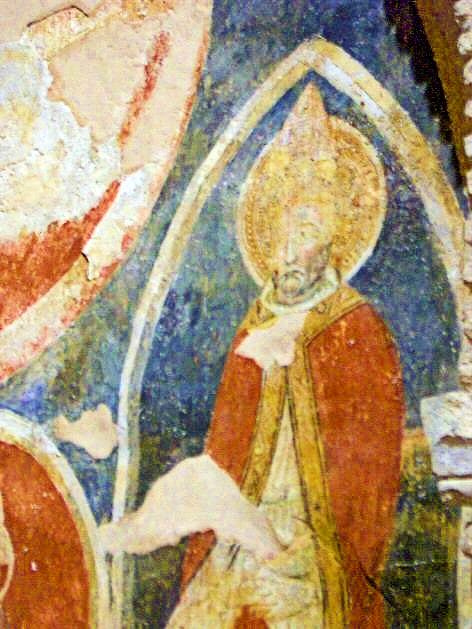
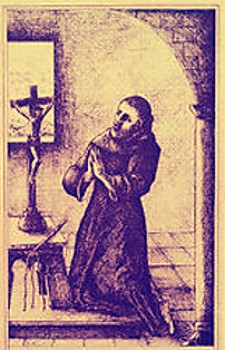
Saint of the Day – 15 December – Saint Valerian of Abbenza (c377-c457) Confessor, the 2nd Bishop of Abbenza in North Africa.  Born in c377 and died in c457 of exposure in the region of his Diocese. Additional Memorial – 28 November as one of the Martyrs of North Africa.

The Roman Martyrology this day states: “In Africa, the holy Bishop Valerian, who, being upwards of eighty years old, in the persecution of the Vandals, under the Arian King Genseric, was asked to deliver the Sacred vessels of the Church and, as he constantly refused, an order was issued to drive him, all alone, out of the City and all were forbidden to allow him to stay, either in their houses or on their land. For a long time, he remained lying on the public roads in the open air and thus, in the confession and defence of the Catholic verity, closed his blessed life.

Valerian was a Roman Bishop of Abbenza, an ancient Episcopal Seat of the Roman Province of Proconsular Africa, identifiable today with the ruins of Bordj-Hamdouna, in the Archdiocese of Carthage, in northern Africa, who lived in the 5th Century.

In the list of Bishops of this Diocese, he is second on the list after Fortunatus.

He is remembered for having refused to obey Genseric, the King of the Vandals, who arrived with his troops in the City, to hand over all the Sacred vessels and furnishings of the Church to him.

Valerian protested against the violence of the soldiers and was driven out and exiled from his City together with eight other Bishops of North Africa – although they were not sent into exile together.

The order was given forbidding anyone to offer him hospitality of any kind. He had to live and sleep outdoors, on the public roads, until his death.

Valerian, remembered as a Confessor, remained faithful to his faith until his death. The name of Saint Valerian was included in the Roman Martyrology on his Feast Day, 15 December.

Posted in DECEMBER - The DIVINE INFANCY and The IMMACULATE CONCEPTION, MARIAN TITLES, NOTES to Followers, NOVENAS, SAINT of the DAY, The DIVINE INFANT

Octave Day of the Immaculate Conception of the Blessed Virgin Mary, Nuestra Señora de Monguí / Our Lady of Mongui, Colombia (16th Century), Memorials of the Saints for 15 December and Novena Reminders

The Christmas Novena to the Divine Infant Jesus by St Alphonsus Maria de Liguori – BEGINS on 16 December:
This Novena is translated from the Italian of Saint Alphonsus Maria de Liguori and was first published in 1758.
Although this Novena is intended, primarily as a preparation for the Feast of our Lord’s Nativity, it can be used with spiritual profit at any time of the year, as a devotion in honour of the Infant Jesus.
This translation by the Redemptorists of the UK.

AND/OR:
December, naturally being the Month of the Divine Infant, is a wonderful time to begin this Monthly practice:
The Monthly Novena to the Infant Jesus of Prague

From 16 to 24 December (and of every Month on the same dates).

St Adalbero of Metz
St Bacchus the Younger
St Christiana the Slave
St Florentius of Bangor

St Margaret of Fontana
Bl Maria della Pace

St Maximinus of Micy
St Offa of Essex
St Paul of Latros
St Silvia of Constantinople
St Urbicus
St Valerian of Abbenza (c377-c457) Confessor, Bishop
Blessed Victoria Strata (1562-1617) Widow,

Posted in AUGUSTINIANS OSA, NAPLES, SAINT of the DAY

Saint of the Day – 14 December – Saint Agnellus of Naples OSA (535-596)

Saint of the Day – 14 December – Saint Agnellus of Naples OSA (535-596) Hermit, Priest, Abbot, Defender and Protector of the City of Naples, Miracle-worker. Agnellus was initially a Basilian Monk and later became a Friar of the Hermits of St Augustine. Born in 535 in Naples, Italy and died of natural causes on 14 December 596 in his birth-town at the age of 61. Patronages – against invaders or invasion, of the City of Guarcino, one of the 50+ Co-Patrons of Naples (See Note below). Also known as – Agnello, Aniello the Abbot. Additional Memorial – 18 May in his Patronage Town of Guarcino.

The Roman Martyrology reads today: “In Naples, in Campaniaa, St Agnellus, Abbot. Illustrious by the gift of miracles, he was often seen with the standard of the Cross, delivering the City besieged by enemies.

At the beginning of the 10th Century, Peter, a Sub-Deacon of the Neapolitan Church who had been freed from a serious illness through the intercession of Agnellus, composed a “Libellus Miraculorum,” in which, in addition to his own miraculous cure, he recounts twenty-two further miracles performed through the intercession of our Saint.

Agnellus was born in 535 in Naples into a rich family of Syracusan origin, possibly related to Saint Lucy. His father was Federico and his mother Giovanna. He spent his youth as a Hermit in a cave near a Chapel dedicated to the Virgin Mary and then, in the Church of Santa Maria Intercede which later became Sant’Agnello Maggiore.

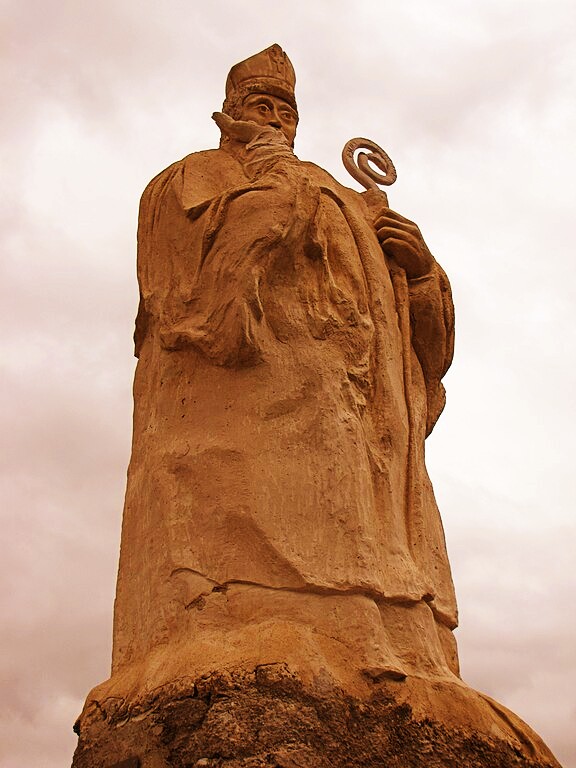
Statue of the saint in the Town named after him.

He received a rich and extensive inheritance on his parents’ death and used it on works of mercy, such as founding a hospital for the poor.

Agnellus became increasingly popular among the inhabitants of Naples, so much so that they called upon him to save the City during the Lombard invasion of 581. Accepting the challenge, he appeared carrying a Banner of the Cross to defend the City.

He finally left the City to escape his popularity, moving to Monte Sant’Angelo, then the village of Guarcino, where he remained for seven years and where there is a Shrine dedicated to him.

Agnellus later returned to Naples to become an Augustinian Monk and then a Priest at the Monastery of Gaudiosus of Naples, where he finally became Abbot and where he died aged 61.

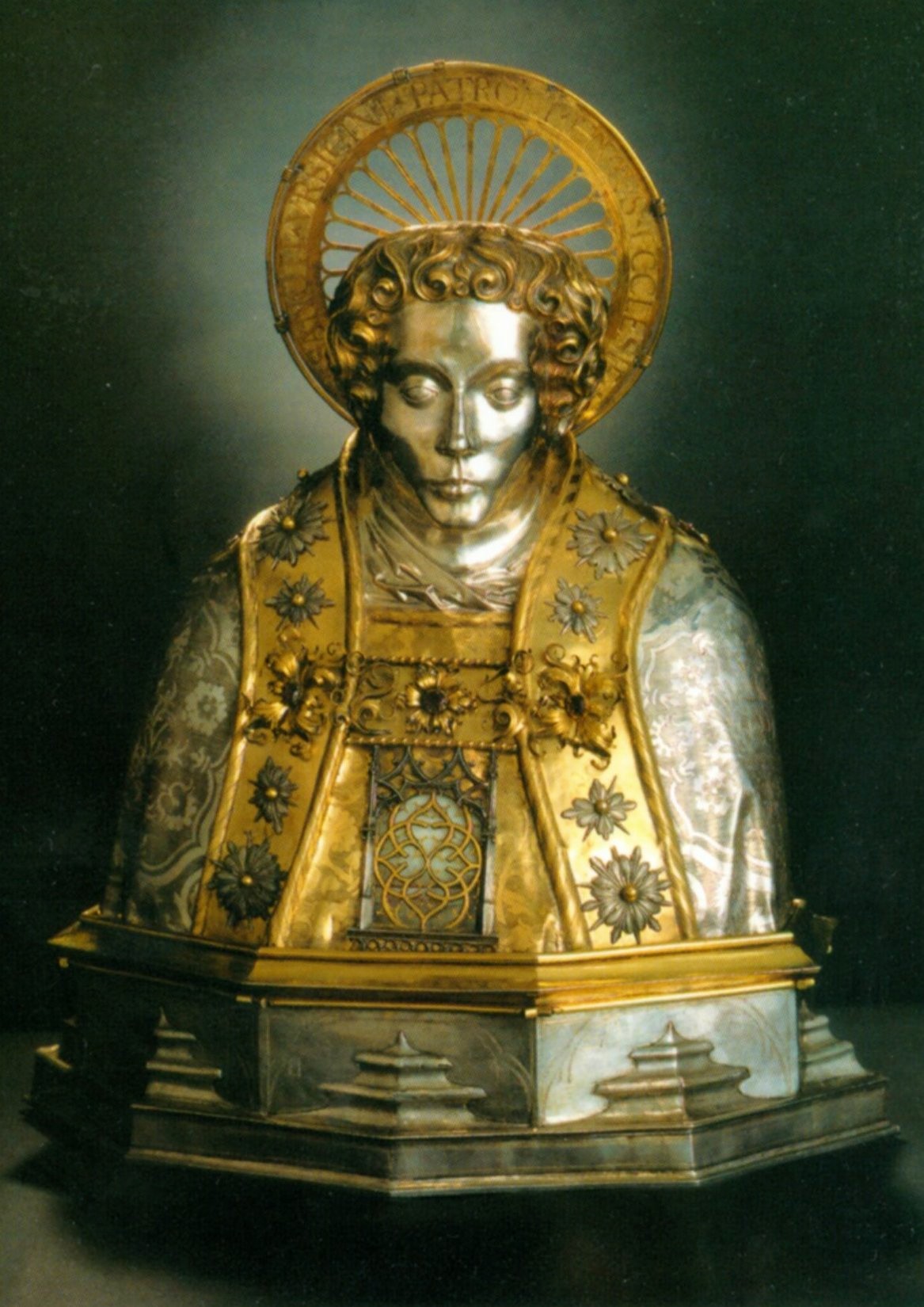
The 17th Century Reliquary bust containing the jaw and throat attributed to Agnellus, is kept in the Cathedral of Naples, inside the Chapel of San Gennaro. He is Co-Patron of the City of Naples where, according to tradition, he was buried in the Church of Sant’Agnello Maggiore in Caponapoli.

Since the 15th Century, Agnellus was counted among the Patrons of Naples and is also the Patron of Guarcino, a City in Lazio in the Province of Frosinone. He also enjoys particular veneration in Lucca, where, since the 12th Century, an Altar was dedicated to him. This City disputed with Naples regarding the authenticity of its Relics and celebrates the Feast on 18 May.

There are many Churches dedicated to St Agnellus in the region.

*NOTE: The City of Naples has more than 50 official Patron Saints, although its principal Patron is Saint Januarius (Died c305). St Januarius is a Martyr of the Great Persecution which ended with Diocletian’s retirement in 305.
The second in terms of importance, is St Aspren (Died in the 2nd Century) – the first Bishop of Naples. St Aspren’s Episcopate is stated as lasting twenty-three years.

St Agnellus in Glory – Gloria di Sant’Agnello, Santuario di Sant’Agnello Abate – Roccarainola
Posted in MARIAN TITLES, SAINT of the DAY

Within the Octave of the Immaculate Conception, Madonna del Patrocinio / Our Lady of Defence -Romagna, Italy) (1685) and Memorials of the Saints – 14 December

St Abundius of Spain
St Agnellus of Naples (535-596) Abbot

Bl Buenaventura Bonaccorsi
St Folcuino of Therouanne
Bl Joan Lambertini
St John Pan y Agua (Bread-and-Water)
Bl John Discalceat
St Justus of Spain
St Matronianus of Milan
St Pompeius of Pavia

St Viator of Bergamo
Bl William de Rovira

Posted in SAINT of the DAY

Saint of the Day – 13 December – Saint Ursicinus of Cahors (Died c595) Bishop

Saint of the Day – 13 December – Saint Ursicinus of Cahors (Died c595) Bishop, Monk, Royal Court Official and Adviser. Died in c595, og natural causes, after around 15 years as the Bishop of Cahors. Also known as – Urci, Urcisse, Urcsicinus, Ursicin, Ursicino.

Ursicinus was the Chancellor of Queen Ultragotha, the wife of Childebert I, King of Paris. He was chosen by Maurilius, then-Bishop of Cahors, to be his successor, making him the ninth Bishop of Cahors.

Cahors surrounding its Cathedral

The little information which has come to us about this Saint is reported by Saint Gregory of Tours in his “Historia Eccl. Francorum”, where he states that around the year 580, Maurilius, among the many Ecclesiastics who aspired to succeed him, chose Ursicinus, who was already a Secular and Spiritual Adviser to Queen Ultrogota, widow of King Childebert I.

Around 584, Innocent, Bishop of Rodez, accused Ursicinus of having usurped many Churches in his Diocese, so much so that the Bishop of Cahors had to defend himself in a Council meeting in Clermont, presided over by Bishop Sulpicius I, of Bouges. In that assembly, the accusations were judged false and Ursicinus was able to recover those Parishes usurped by the Bishop of Rodez and which had never belonged to his Diocese but had always been part of the Cahors See..

But then, Ursicinus was sentenced to a three-year penance at another Council. In fact, in the Autumn of 585, on the indication of King Gontranno, a Council was convened in Macon, where those Bishops who had welcomed the rebel Gondowald, a conspirator against the Merovingian dynasty, were discussed. Ursicinus publicly confessed to having committed this “crime” and the Bishop’s sentence of condemnation was explicit – he had to do penance for three years, abstaining from shaving his hair or beard, abstaining from wine and meat, not celebrating Mass, not ordaining Priests, nor consecrating Churches and not proceeding with any blessings.

Following this condemnation, the traces of Bishop Ursicinus are lost, but we do find him present at the Fourth Council of Auvergne in 590. After this citation we only know that his successor, Eusebius, was present at the Council of Paris in 614.

With regards to the cult of the sanctity of our Ursicinus – in a 14th Century Psalter, we find the first evidence of his cult and his feast which was celebrated on 13 December appears.

Many Churches in the Diocese were dedicated to him. Among these, one in Cahors, one in Tréjouls and one in Cantal. There are also two villages named after him, one in the canton of Puymirol and the other in that of Salvagnac. In the Diocese of Cahors the feast and remembrance of Saint Ursicinus, Bishop, is still celebrated today.

St Ursicinus Church in Cahors which was built in around the 7th Century
Posted in EYES - Diseases, of the BLIND, MARIAN TITLES, PRAYERS to the SAINTS, SAINT of the DAY

Within the Octave of the Immaculate Conception, La Reina del Rosario de Banos de Agua Santa / Queen of the Holy Rosary, Ecuador (1570), St Lucy and a Prayer for her intercession and Memorials of the Saints – 13 December

Wednesday of the Second Week of Advent

Within the Octave of the Immaculate Conception of the Blessed Virgin Mary, Mother of God

Prayer to St Lucy

O St Lucy, you preferred to let your eyes be torn out
instead of denying the faith
and defiling your soul
and God, through an extraordinary miracle,
replaced them with another pair of sound and perfect eyes
to reward your virtue and faith,
appointing you as the protector against eye diseases.
I come to you for you to protect my eyesight
and to heal the illness in my eyes.

O St Lucy, preserve the light of my eyes
so that I may see the beauties of creation,
the glow of the sun,
the colour of the flowers
and the smile of children.

Preserve also the eyes of my soul,
the faith, through which I can know my God,
understand His teachings,
recognise His love for me
and never miss the road that leads me
to where you, St Lucy,
can be found in the company of the angels and saints.
St Lucy, protect my eyes and preserve my faith.

St Lucy, “Bringer of Light” Pray for those with eye ailments,
Pray for us all!

St Antiochus of Sulci

St Aristone
St Arsenius of Latro
St Aubert of Arras
Bl Bartholomew of Tuscany
St Edburgh of Lyminge
St Einhildis of Hohenburg
Bl Elizabeth Rose
St Jodocus

St Martino de Pomar
St Roswinda
St Tassio of Bavaria
St Ursicinus of Cahors (Died c595) Bishop
St Wifred

Posted in SAINT of the DAY

Saint of the Day – 12 December – Saint Columba of Terryglass (Died 552) Abbot, One of the Twelve Apostles of Ireland

Saint of the Day – 12 December – Saint Columba of Terryglass (Died 552) Abbot, Founder of Monasteries, Miracle-worker. One of the Twelve Apostles of Ireland, pupil and disciple of St Finnian of Clonard (470–549) known as the “Tutor of the Saints of Ireland.” Born in Leinster, Ireland and died on 13 December 552 of the Plague at his Monastery in Terryglass, where he was also buried. Also known as – Colum mac Crimthainn, Colum moccu Loigse, Columba of Tirdaglas, Columba of Tyrdagla. Additional Memorial – 6 January as one of the Twelve Apostles of Ireland.

Columba was the son of Ninnidh, a descendant of Crinthainn, King of Leinster. In his childhood, he learned his Psalms and Hymns from an old holy man named Colman Cule, who lived near Clonenagh and founded the Church of Cluain Cain.
As he grew into adulthood, he studied with St Finnian of Clonard and then, Columba resolved to go to Rome and bring back Relics of Saints Peter and Paul. On his return, he visited Tours and brought from there, the staff of St Martin of Tours. He also visited England and preached with some success to the Anglo-Saxons.

Returning home, he remained at Clonenagh for around a year, before crossing Slieve Bloom and founding a Church near Lough Derg.

Around 520, Columba was prompted by an Angel, to relocate to the Island of Inis Cealtra and establish a Monastery there. , He remained a long time at this Monastery. According to one report, when one of his Monks died suddenly on the shore opposite the northern part of the Island, Columba ordered the Monks to go and say to the dead man, “Columba bids thee arise.” The man then arose and returned with them to the Island.

Columba founded the celebrated Monastery of Tirdaglas (Tir-da-glasí), or Terryglass in 548. St Fintan of Clonenagh (c526-603) received his religious formation at Terryglass and was deeply influenced by the penitential practices and the severity of the Rule at the Terryglass Monastery finally becoming the Abbot

When Saint Finnian was in extremis, suffering from the Plague, he sent for Columba to administer Holy Viaticum. Columba himself died of the Plague on 13 December 552 and was buried within the precincts of his Monastery at Terryglass.

There are some fifteen more Saints of Ireland, bearing the name of our St Columba all being mentioned in the Martyrology of Gorman.

Terryglass Parish Church with a Cross, being part of a Shrine to St Columba in the foreground
Posted in MARIAN TITLES, SAINT of the DAY

Within the Octave of the Immaculate Conception, Nuestra Senora De Guadalupe / Our Lady of Guadalupe (1531) and Memorials of the Saints for 12 December

Tuesday of the Second Week of Advent

St Abra
St Agatha of Wimborne
Bl Bartholomew Buonpedoni

St Colman of Clonard
St Columba of Terryglass (Died 552) Abbot One of the Twelve Apostles of Ireland.
Bl Conrad of Offida
St Corentius of Quimper
St Cormac
St Cury
St Donatus the Martyr
St Edburga of Thanet

St Gregory of Terracina
St Hermogenes
Bl Ida of Nivelles

Bl Martin Sanz
St Simon Phan Ðac Hòa
St Spyridon of Cyprus
St Synesius

Posted in SAINT of the DAY

Saint of the Day – 11 December – Saint Damasus I (c305-384) Pope, Confessor

Saint of the Day – 11 December – Saint Damasus I (c305-384) Bishop of Rome from 366-his death on 11 December 384. Pope Damasus was a Poet, a Confessor and Defender of Orthodoxy and a Reformer of morals amongst many other qualities. Born in c306 in Rome, Italy of Spanish descendancy and died in 384 in the same City of natural causes. He was initially buried in the Mark and Marcellianus Catacombs in Rome and in …. his bones were re-interred in the Church of San Lorenzo in Damaso, Rome. Patronage – of Archeologists.

The Roman Martyrology reads: “St Rome, St Damasus, Pope and Confessor, who condemned the heresiarch Apollinaris and restored to his See, Peter, Bishop of Alexandria who had been driven from it. He also discovered the bodies of many holy Martyrs and wrote verses in their honour.

Today is the Feast of Pope St Damasus I, who was elected in October of 366, at roughly the age of 60 and died on this day in 384. He served as Deacon at the Church of St Lawrence Outside-the-Walls. He was elected to the Papacy in the midst of controversy, since a small group of the Clergy supported another candidate, Ursicinus; the followers of this schismatic seized control of the Liberian Basilica (now St Mary Major) and could only be repressed with violence and the exile of the anti-Pope.

St Damasus was a strenuous Defender of the Orthodox Christian faith, holding Synods in Rome to condemn the heresies of Macedonius and Apollinaris, sending legates to the First Council of Constantinople and excommunicating the Arian bishop of Milan, Auxentius, who was later succeeded by St Ambrose. It was at his (St Ambrose’) behest that St Jerome revised the Latin text of the Gospels and it is in a letter to him that St Jerome famously describes the need for such a revision by saying, “There are as many versions (of the Sacred Scriptures) as there are copies.” Pope Damasus then befriended St Jerome and employed him as his Secretary, a position he held for many years. They worked together on exegetical matters but, perhaps Damasus’ most important contribution to the Church, was that he commissioned Jerome to revise the existing Latin translation of the Gospels based on the original Greek. This was to become the Sacred Scripture translation which was later called “The Vulgate.” St Jerome is traditionally represented as a Cardinal because of the time he spent in Rome as Damasus’ Secretary.

Our Saint is today, venerated too, as the Patron Saint of Archeologists and, particularly those who work in the field of early Christian archeology, because of his great encouragement of devotion to the Roman Martyrs and his efforts to preserve their memories. He built a Church in honour of St Lawrence within his own house in the centre of Rome, now known as “San Lorenzo in Damaso” and also a Shrine at the Catacomb of St Sebastian, where the bodies of Ss Peter and Paul were once kept and the Baptistery of the ancient Basilica of St Peter. Within many of the Roman Catacombs, he had the areas around the Martyrs’ graves restored to make them more accessible to pilgrims ..

As a young man, Damasus had worked in the Papal Archives (the first reference to a Papal Archive), where he read about the lives and deaths of the Martyrs. Now that the persecutions were over, he worked tirelessly to promote the Martyr cult. He encouraged pilgrimages to the Catacombs and re-opened them, after they had been closed by Emperor Diocletian. He restored them, built staircases and skylights, all with the aim of demonstrating that the real splendour of Rome was not pagan but Christian.

Damasus also decorated the graves of many Martyrs with Epitaphs, composed by himself and carved into marble, with a special kind of lettering invented for the purpose. This Font, in which the bars of the letters are alternately thick and thin, with curved serifs at the corners, is known as either “Philocalian” lettering from its inventor, a friend of his named Furius Dionysius Filocalus, or “Damasian” after himself. We have a total of about 70 of these Inscriptions; about 40 of the originals are preserved, while the rest are recorded in various sources, although the stones themselves have been lost.

One of the best preserved of these is at the Church of St Agnes Outside-the-Walls on the Via Nomentana, the High Altar of which rests over her Gravesite. As seen in the photograph below, only the upper left corner is missing.

After recounting the Martyrdom and burial of St Agnes (including the story that when her clothes were torn off, her hair miraculously grew to cover her exposed body), the final line asks the “renowned Martyr to favour the prayers of Damasus.” These Inscriptions are particularly valuable witnesses to the authenticity of various Martyrs and the Liturgical devotion paid to them, since we know that Pope Damasus took care to inform himself about the Martyrdoms as best he could. At the grave of Ss Peter and Marcellinus, who were killed in the persecution of Diocletian in 304, he placed an Epitaph in which he gives the story of their deaths and then notes that he learned the details when he was a boy, by interviewing the Martyrs’ own executioner!Being himself born in the very heart of the persecution and. therefore. a young Cleric in Rome in the early years of the peace of the Church, he must also have known many who had actually, themselves, witnessed the Martyrdoms of Sts Agnes, John and Paul and Sebastian, just to name a few.

Pope Damasus’ relationship with the Eastern Church was unhappy. There, St Basil the Great (329-379) fought to restore orthodoxy on the basis of a refined new explanation of the Nicene Doctrine. Like the West, in general,, Damasus did not understand the new development and when Antioch was divided between rival Bishops, the Pope stubbornly clung to the support of Paulinus, the unrepresentative leader of a reactionary group, instead of Meletius, on whom the Eastern hope of unity rested . When Meletius died in 381, Damasus refused to enter into Church communion with his successor, Flavian. In desperation, Basilios described the Pope as improbably arrogant, who did nothing to contribute to the constructive détente between East and West that was now underway.

The second Ecumenical Council took place in Constantinople from May to July 381. Originally, it was an Eastern Council, where only about 150 Eastern Bishops participated. Pope Damasus was not present but when the Council decisions were later presented to him, he approved them and the Council was thus considered Ecumenical. Here the Doctrine of the Trinity was established for good and the Council adopted a powerful declaration of the deity of the Holy Ghost, directed against the Macedonians and the Pneumatomas (who rejected the deity of the Holy Ghost). The Council also condemned the Arians and Semi-Arians.

It was Pope Damasus I who introduced the Doxology Gloria Patri (Glory be to the Father) at the end of the Hymns. He was also the first to take over the title of Pontifex Maximus (High Priest) from the Roman Emperors. He also authorised the Ambrosian Rite and introduced the use of the Hebrew term “Hallelujah” (Latin: Alleluia ).

Damasus died on 11 December 384 in Rome and was first interred in the Catacomb of Mark and Marcellianus, near the Catacomb of Domitilla, on the Via Ardeatina, in a burial place he had prepared for his mother and sister, Irene. Later, his Relics were transferred to the Church of St Lorenzo in Damaso, which he had built himself. There, after being forgotten for a long time, they were found again in 1645. His Feast has been celebrated on 11 December since the 7th Century.

The Basilica of San Lorenzo in Damaso
Posted in CARMELITES, MARIAN TITLES, SAINT of the DAY

Monday of the Second Week of Advent, Within the Octave of the Immaculate Conception, St Pope Damasus I and the Saints for 11 December

Monday of the Second Week of Advent

Within the Octave of the Immaculate Conception of the Blessed Virgin Mary, Mother of God

St Aithalas of Arbela
St Apseus of Arbela
Barsabas of Persia
St Cian

Bl David of Himmerod
Bl Dominic Yanez
St Eutychius the Martyr
St Fidweten

Bl Franco of Siena

Bl Hugolinus Magalotti
Blessed Jean Laurens O. Praem.(1548-1613)

St Pens
St Sabinus of Piacenza
Blessed Severin Ott O.Praem. (1627-1708) Priest and Friar of the Norbertines or Premonstratensians.

Posted in SAINT of the DAY

Saint of the Day – 10 December – Saint Thomas of Farfa (Died c720) Abbot,

Saint of the Day – 10 December – Saint Thomas of Farfa (Died c720) Abbot, Hermit, Pilgrim, expert Restorer and Abbot extraordinaire! Born at Maurienne, Savoy, France and died in c720 of natural causes at his famous Monastery of Farfa. Also known as – Thomas of Maurienne.

This is the place which I promised you

  • Words addressed by the Madonna to Thomas, the Restorer of Farfa Monastery, to indicate to him the ruins of the destroyed Abbey which were, later rebuilt by the Saint – it is the place of the current Monastery.

Thomas is believed to have hailed from Maurienne, where he was a Monk before he travelled to the Holy Land. According to the 12th Century Chronicon Farfense, by the renowned Monk Historian Gregory of Catino, Thomas was on a pilgrimage when, in the Church of the Holy Sepulchre in Jerusalem, he had a vision of the Virgin Mary, who told him to go to Italy and re-establish an abandoned Abbey which had been founded in her name.

Together with a small group of disciples and by the gracious assistance of Divine guidance, Thomas found the ruins of an Abbey in a deserted region in the Sabina Hills in central Italy.

The foundation of Farfa p dates to around 560-570 by St Laurence of Syria (Lorenzo Siro), who arrived from Syria together with his sister Susannah, to carry out an apostolate in Sabina, where he was elected as the Bishop but he himself soon left this position to become a Monk and dedicate himself to the foundation of this Monastery which had attracted him by the position of 3 beautiful tall Cypresses, representing the glorious Blessed Trinity..

At the time of the death of San Lorenzo, which occurred towards the end of the 6th Century, the Monastery suffered complete devastation and abandonment, due to the arrival of the Lombards but, our Saint Thomas managed to find the remains of the place dedicated to the Blessed Mother – being still marked by the same three cypresses.

Finally the ancient Church, now in ruins, was given new life in 680, under the protection of the Duke of Spoleto, Faroaldo II, who offered land and buildings.

It is precisely thanks to Saint Thomas that a period of profound recovery began in Farfa. In addition to the reclamation of the land, the Abbey patrimony expanded so considerably, to the point that Popes, Dukes, Kings and Governors granted great exemptions and privileges, so that Farfa quickly became an economically and politically powerful entity.

During Thomas’s 40+ year Abbacy, three Monks from Farfa established the Monastery of San Vincenzo al Volturno. According to San Vincenzo’s Vita, it was Thomas who directed the Monks to “the oratory of Christ’s Martyr Vincent [where] on each side of the river is a thick forest (which serves as a habitation for wild beasts and a hiding-place for robbers.”

Also during Thomas’ tenure, the Abbey received a privilege in 705, from Pope John VII which recognised that the Abbey was founded by “Bishop Laurence.” This Papal privilege included a confirmation of the Abbey’s first grant of land, from Duke Faroald II of Spoleto. Through his donations Faroald claimed to have “restored that place through Abbot Thomas and your [Papal] recommendation.” Thomas was ordered to put the Papal privilege on display.

The working Farfa today

Saint Thomas died in c720, after forty years of regency of the Farfa Monastery and was buried right there. According to the 11th Century Martyrology of the Abbey, Thomas was buried at the 30th Milestone, as later was Abbot Hilderic (Died 857). Thomas had been succeeded by Aunepert around 720.

The 3 Cypresses in winter
Posted in MARIAN TITLES, SAINT of the DAY

The Second Sunday of Advent, Within the Octave of the Immaculate Conception, Santissima Casa de Loreto / The Holy House of Loreto / Our Lady of Loreto (1291) and Memorials of the Saints – 10 December

The Second Sunday of Advent

St Pope Melchiades (Died 314) Bishop of Rome from 2 July 311- 19 or 11 January 314)

St Abundius
St Albert of Sassovivo
St Angelina of Serbia
Blessed Brian Lacey (Died 1591) Lay Martyr
BL Bruno of Rommersdorf
St Caesarius of Epidamnus
St Carpophorus
St Deusdedit of Brescia (Died c700) Bishop

St Edmund Gennings
St Emérico Martín Rubio
St Florentius of Carracedo
St Fulgentius of Afflighem
St Gemellus of Ancyra
St Gonzalo Viñes Masip
Bl Guglielmo de Carraria
St Guitmarus
St Hildemar of Beauvais
Bl Jerome Ranuzzi
Bl John Mason

St Julia of Merida
St Lucerius
St Maurus of Rome
St Mercury of Lentini
St Polydore Plasden
Bl Sebastian Montanol
Bl Sidney Hodgson
St Sindulf of Vienne
St Swithun Wells
St Thomas of Farfa (Died c720) Abbot, Hermit
Bl Thomas Somers
St Valeria

Posted in SAINT of the DAY

Saint of the Day – 9 December – Saint Proculus of Verona (Died c320) Bishop

Saint of the Day – 9 December – Saint Proculus of Verona (Died c320) Bishop of Verona, Italy. Died in c320 in Verona of natural causes thus our Saint Proculus was a survivor of the violent persecutions of Diocletian. Also known as – Procolo.

The Roman Martyrology says today: “In Verona, during the persecution of Diocletian, St Proculus, Bishop, who was buffeted, scourged with rods and driven out of the City. Being at length, restored to his Church, he rested in peace.

The Martyrs, Saints Firmus and Rusticus of Verona with an Angel and the seated Saint Proculu by Sebastiano Ricci.

During the Diocletian persecution, Proculus, the Bishop of Verona went to the prison to encourage Sts Firmus and Rusticus. He was bound and brought with them before Anulinus, the Consul. However, as Proculus was elderly, Anulinus did not consider him worth his interest and had him beaten, released and driven from the City. He lived to survive the persecutions and eventually returned to resume leadership of his flock but died not too long after.

St Proculus from a 9th Century Fresco

Attached to the Basilica of St Zeno in Verona, is the Chapel of St Proculus housing his Relics. It dates from the 6th or 7th Century. It is first mentioned, however, only in 845.

In San Zaccaria’s Church in Venice their stands a life-size wooden statue “St Proculus of Verona” (1451) – see above. In 1704, Sebastiano Ricci executed a large Canvas of St Proculus for Bergamo Cathedral.

St Zeno’s Basilica Verona
Posted in MARIAN TITLES, SAINT of the DAY

Within the Octave of the Immaculate Conception, Nostra Signora dell’Immacolata Concezione / Our Lady of the Conception, Naples, Italy (1618) and Memorials of the Saints – 9 December

Within the Octave of the Immaculate Conception

St Adam Scotus
St Auditor of Saint-Nectaire
St Balda of Jouarre
St Budoc of Brittany
Bl Carmen Rodríguez Banazal *
St Caesar of Korone
St Cephas

St Cyprian of Perigueux
St Ethelgiva of Shaftesbury
St Gorgonia*
St Julian of Apamea

St Michaela Andrusikiewicz
St Nectarius of Auvergne

St Proculus of Verona (Died c320) Bishop

St Valeria of Limoges
St Wulfric of Holme

Posted in SAINT of the DAY

Saint of the Day – 8 December – Saint Eucharius of Trier (Died 3rd Century) Bishop

Saint of the Day – 8 December – Saint Eucharius of Trier (Died 3rd Century) the First Bishop of Trier, Germany, Date and place of birth are unknown but Eucharius is believed to have been of Italian origin. Patronages – against plague and epidemics, of Trier, Germany. Also known as Eucherius, Euchario. Additional Memorial in Limburg, Germany of the 3 Bishops sent by St Peter, occurs on 11 September. –
The Roman Martyrology reads: “At Treves, St Eucharius, disciple of the blessed Apostle Peter and the first Bishop of that City.

Saint Eucharius is the First Bishop of Trier. This name opens the list of Bishops of the oldest See in Germany. The shepherds of that Diocese have been documented since the first half of the 3rd Century.

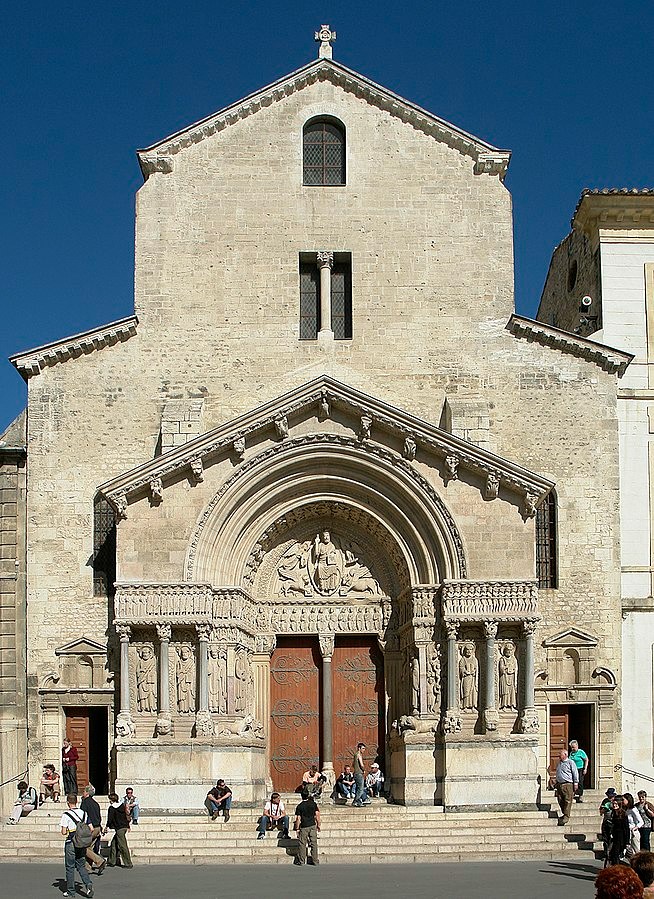
The first Bishops, St Eucherius and St Valerius are attested by an ancient inscription from the end of the 5th Century, while the first historically documented Bishops are St Maternius who became the Archbishop of Cologne and St Agrizius mentioned in 314, who participated in the Council of Arles.

The Trier Seal

The Holy Tunic is preserved in the Trier Cathedral which was worn by Jesus before His Crucifixion. The Tunic was discovered by Saint Helena and was donated by Bishop Agrizius. The first mention of the Sacred Relic dates to 1196, when Archbishop John Consecrated the Altar where it was kept.

We know very little about our Saint today but it is assumed that he governed the Diocese at the end of the 3rd Century especially because, Saint Eucharius was a disciple of Saint Peter, who sent him with Valerius and Maternus to evangelise Gaul.

It is said that the Bishop resurrected his companion Maternus from his sarcophagus, using the “pastoral staff of Saint Peter.” To confirm the existence of this legend, there is an ancient seal from Trier which shows the Saint receiving the keys to the City from Saint Peter. Another tradition about St Eucharius of Trier tells us that he destroyed a statue of Venus and placed the current Cross in its place which remains to this day.

The cult of this holy Bishop has been proven since 455 and is widespread in western Germany, Switzerland and many other surrounding regions. An image of him is found carved in relief in the Porta Nuova in Trier, where we see him holding the model of the City placed under his protection.

Sculptures of the first three Bishops: Saint Eucharius, Saint Valerius and Saint Maternus

Furthermore, there is a 16th Century Statue of him in Balg and a painting preserved in the Unterlinden Museum in Coilmar. In 457, Saint Cyril, the Thirteenth Bishop of Trier, had two Sarcophagi built, one for Saint Valerius and the other for Saint Eucharius. The Sarcophagi are located in the Benedictine Abbey of St Matthias in Trier which had originally been named for him until some Relics of St Matthias were obtained there.

The first Martyrologies which bear his name, are those of Rabano Mauro (856) and Notkero (912).

There are various celebrations in memory of the Bishop. In Limburg the feast of the Bishops Eucharius, Valerius and Maternus occurs on 11 September. In the Roman Martyrology his Feast day was set on 8 December.

The Tombs of St Eucharius and St Valerius at the Abbey of St Matthias
Posted in DECEMBER - The DIVINE INFANCY and The IMMACULATE CONCEPTION, FEASTS and SOLEMNITIES, SAINT of the DAY, The IMMACULATE CONCEPTION

The Immaculate Conception of the Glorious and Ever-Virgin Mary, Mother of God and Memorials of the Saints 8 December

St Anastasia of Pomerania
St Anthusa of Africa
St Antonio García Fernández
St Casari of Villeneuve-lès-Avignon
St Eucharius of Trier (Died 3rd Century) Bishop

St Gunthildis of Ohrdruf
Bl Johanna of Cáceres
St Macarius of Alexandria
St Patapius
St Rafael Román Donaire

St Sofronius of Cyprus

Posted in "Follow Me", ADVENT QUOTES, CHRIST the LIGHT, CHRIST the SUN of JUSTICE, CHRIST, the WAY,TRUTH,LIFE, DOCTORS of the Church, FATHERS of the Church, GOD ALONE!, MARIAN QUOTES, OUR Cross, QUOTES on CHASTITY, QUOTES on DEATH, QUOTES on ENEMIES, QUOTES on ETERNAL LIFE, QUOTES on FORGIVENESS, QUOTES on GRACE, QUOTES on HUMILITY, QUOTES on Lukewarmness, QUOTES on PEACE, QUOTES on PURITY, Quotes on SALVATION, QUOTES on SLOTH, QUOTES on the CROSS of CHRIST, QUOTES on the POOR, QUOTES on WATCHING, SAINT of the DAY, The HEART, The HOLY CROSS, The SECOND COMING

Quote/s of the Day – 7 December – St Ambrose

Quote/s of the Day – 7 December – St Ambrose (340-397) – Confessor, Bishop, Father and Doctor of the Church

O, that the soul of Mary were in us,
to glorify the Lord!
That the spirit of Mary were in us,
to rejoice in God.
May the life of Blessed Mary
be ever present to our awareness.
In her, as in a mirror,
the form of virtue
and beauty of chastity, shine forth.
She was Virgin, not only in body
but in mind and spirit.
She never sullied the pure affection of her heart
by unworthy feelings.
She was humble of heart.
She was serious in her conversations.
She was prudent in her counsels.
She preferred to pray rather than to speak.
She united in her heart the prayers of the poor,
and avoided the uncertainty of worldly riches.
She was ever faithful to her daily duties,
reserved in her conversations
and always accustomed to recognise God
as the witness of her thoughts.
Blessed be the Name of Jesus
!”

(On Virginity II 2.7)

Watch, therefore because you know not
the day, nor the hour.

Matthew 25:13

In the hours of the night, think always on Christ
and hope for His coming at every moment. …
Christ enters at the open door.
He will not fail to do so, for He has promised to enter.
Embrace Him, Whom you have sought.
Approach Him and be illumined.
Hold Him and ask Him not to go away quickly.
Beg Him not to depart.
For “His Word runs swiftly” (Ps 147:15)
and will not be held by the slothful
or negligent soul.
Let your soul run to His call and follow closely, t
he sound of His heavenly Voice,
for His passing is swift. …

Open wide your door to the One who comes.
Open your soul,
throw open the depths of your heart
to see the riches of simplicity,
the treasures of peace,
the sweetness of grace.
Open your heart
and run to meet
the Sun of Eternal Light
Who illuminates all men.

No-one heals himself
by wounding another.

Our own evil inclinations
are far more dangerous,
than any external enemies.

Carry me, O Christ,
on Thy Cross
which is salvation to the wanderer,
rest for the wearied
and, in which alone,
is Life for those who die.

MORE:
https://anastpaul.com/2022/12/07/quote-s-of-the-day-7-december-st-ambrose-3/

St Ambrose (340-397)
Father and Doctor of the Church

Posted in SAINT of the DAY

Saint of the Day – 7 December – Saint Urbanus of Teano (Died circa late 4th Century) Confessor, Bishop

Saint of the Day – 7 December – Saint Urbanus of Teano (Died circa late 4th Century) Confessor, the Third Bishop of Teano, Peacemaker, Apostle of the poor and needy, Miracle-worker. Born and died in Teano, Italy. Patronage – Teano, Italy. Also known as – Urban, Urbano, Urbanius.

The Roman Martyrology reads today: “At Teano in Campania, Saint Urbanus, Bishop.

Interior of the Teano Cathedral

In the Diocese of Teano, the first Three Bishops are Saints: Paris, Amasius and Urbanus. The records after these, became incomplete until the second half of the 9th Century.

He is called a great Confessor, Native of the place, he was a disciple and Deacon of the First Bishop of Teano, San Paris (Died c346). Upon his death, the people wanted Urbanus as their Bishop by popular acclaim. But he managed to avoid the election in favour of Amasius (Died c356). When the latter also died, he had to accept the nomination as Bishop.

He exercised his pastoral function with great sanctity.
It is said that he performed many miracles which attracted numerous crowds to him. He spent all his energy to visit the faithful of his Diocese, to create Churches and revive Christian worship. He acted as peacemaker during discords, he was assiduous in assisting the poor and needy.

The chronology of his predecessors who died respectively in 346 and 356, allows us to place his Episcopate in the second half of the 4th Century.

The lessons of the Office of the Diocese, published in 1533, deal with him, where he is described as a holy Bishop with great piety and devotion and all the essential elements of a holy Bishop.

There is a little information handed down to us in the 6th Century “Vitae” of his predecessors. Only the Author, Lanzoni thinks that the cult of the first three Bishops of that Church in Teano, derives from an authentic Episcopal catalogue.

Urbanus died very old on 7 December, as he had previously predicted.
He was buried in a tomb which he, himself, had built between the southern gate of the City and the Savone river, probably in the ancient Cemetery, where today the Diocesan Church dedicated to San Paris is located.

The name of St Urbanus was added to the Roman Martyrology with a Feast Day of 7 December.

The City of Teano
Posted in DOCTORS of the Church, FATHERS of the Church, FEASTS and SOLEMNITIES, JESUIT SJ, MARIAN QUOTES, MARIAN TITLES, SAINT of the DAY, St Louis-Marie Grignion de MONTFORT

Vigil of the Immaculate Conception, Virgen del Castillo / Virgin of the Castle, Spain (1642) St Ambrose and the Saints for 7 December

A Day of Fasting and Abstinence, for the Holy Day tomorrow

It is through the most Blessed Virgin Mary, that Jesus Christ came into the world and, it is also through her, that He will reign in the world.” – St Louis Marie Grignion de Montfort (1673-1716)

St Agatho of Alexandria
St Anianas of Chartres
St Athenodoros of Mesopotamia
St Buithe of Monasterboice

St Diuma
St Geretrannus of Bayeux
Bl Humbert of Clairvaux
St Martin of Saujon

St Nilus of Stolbensk

St Servus the Martyr
St Theodore of Antioch
St Urbanus of Teano (Died circa late 4th Century) Confessor, Bishop of Teano
St Victor of Piacenza

Posted in SAINT of the DAY

Saint of the Day – 6 December – Blessed Angelica Leonti of Milazzo TOM (1519-1559) Virgin

Saint of the Day – 6 December – Blessed Angelica Leonti of Milazzo TOM (1519-1559) Virgin, Lay Tertiary of the Order of the Minim. Also known as – Angela.

Blessed Angelica was born in 1519 in Milazzo in the Province of Messina on the western tip of Sicily in southern Italy. Her parents were Domenico Leonti and Bernarda Maiolino. She had two sisters, Blasia and the Blessed Pelagia (Died 1591).

Milazzo was an ancient City that was important in the Middle Ages and the Renaissance, as a port for trade and a manufacturing centre but also, as a well-equipped military base. There the cult of Saint Francis of Paola (1416-1507) was particularly lively.

Angelica lived in constant struggle against the attractions of the world. Not its temptations per se but, the legitimate and human concerns of those, who wished her to live a normal and happy life, where she was respected and satisfied. She was beautiful, sensitive and virtuous and against her family’s wishes, she followed the fate of so many other girls of her age, by forgoing a spouse. It was not easy because she was exposed to constant pressure but she stubbornly resisted both flattery and threats.

In moments of most serious tension, she resorted to the Crucifix, imploring His help. She was granted, by the Cross a cross, that is, a very serious illness which put her very life in danger. It was then that she, by vow, wore the Habit of the Third Order of San Francesco di Paola. In that dress, as if inside a mystical armour, she felt sure that she could remain in the desired state forever.

When she recovered, she, like her two sisters, became a Tertiary in the Third Order of the Mimins, (Tertius Ordo Minimorum – TOM), a branch of the Saint Francis of Paola Order of the Friars Minor (OM or Ordo Minim), open to laypeople of both sexes. It was said of the three sisters that “fasting was their sustenance, prayer their recreation and assistance to the poor and sick their favourite activity”. “The City hailed Angela as holy and it was often said that when she was seen in the street with her sister, they were accompanied by two angels in human form, their faces shining with heavenly splendour.”

But Angelica was eaten up from within by a malignant tumour and her beauty was transformed into hideousness and, as the suffering became more and more unbearable, she honed the spirit that filled her body like a consuming fire. Angelica died in Milazzo, according to Piazza in Memorie della Città di Milazzo, on 1 November 1559, aged only forty. From this day Angelica Leonti was called Beata Angelica by the people of Milazzo. Her memorial day is 6 December. Her sister, Pelagia died in 1591.

Posted in MARIAN TITLES, SAINT of the DAY

Notre-Dame de Séez/ Our Lady of Séez, France (5th Century), St Nicholas and Memorials of the Saints – 6 December

St Aemilianus the Martyr
Blessed Angelica Leonti of Milazzo TOM (1519-1559) Virgin

St Boniface the Martyr
St Dativa the Martyr
St Dionysia the Martyr

St Gertrude the Elder
St Isserninus of Ireland
St Leontia the Martyr
St Majoricus the Martyr
St Polychronius
St Tertus

Posted in PATRONAGE - HEADACHES, SAINT of the DAY

Saint of the Day – 5 December – St Gerbold (Died c691) Bishop

Saint of the Day – 5 December – St Gerbold (Died c691) Bishop of Bayeux in Normany, France, Hermit, Founder of the Monastery of Livry in Normandy. Also known as – Gerbaud, Gerebaud, Gereboldus, Gerhold of of Bayeux. Died in c691 of natural causes. Patronages against dysentery (popularly – St Gerbold’s Disease), hemorrhoids, headaches.

Gerbold became the Bishop of Bayeux in 689. According to some records and traditions, he took part in the Synod in Rouen in 692 or 693 and founded a Monastery in Livry – on the site of the current Chapel dedicated to St Sulpicius of Bayeux. The Bishops’ list puts Gerbold’s death at 691.

According to tradition, Gerbold became a Steward for a wealthy lord in England. There, the lord’s wife made advances to Gerbold which he rejected, whereupon the disappointed woman complained about him to her husband, probably reversing the story.

Gerbold fell into disgrace, his master imprisoned him and then threw him into the sea, weighed down with a millstone! But miraculously it turned into cork, allowing Gerbold to cross the English Channel and land in Ver-sur-Mer near Bayeux. There – or in nearby Crépon – he lived as a Hermit. His miraculous deeds persuaded the people of Bayeux to appoint him as their Bishop.

As Bishop, Gerbold’s moral strictness turned the people against him and they drove him out of the City. He travelled on pilgrimage to Rome until the people of Bayeux were scourged with the diseases of dysentery and hemorrhoids. They recalled their Bishop, in haste, begged forgiveness for their sins, whereupon the illnesses immediately ceased.

Posted in MARIAN TITLES, SAINT of the DAY

The Sodality of Our Lady / Our Lady of the Jesuit College, Rome (1584), St Sabbas of Mar Saba and Memorials of the Saints – 5 December

St Abercius
St Anastasius
St Aper of Sens

St Basilissa of Øhren
St Bassus of Lucera
St Bassus of Nice
St Cawrdaf of Fferreg
St Christina of Markyate
St Consolata of Genoa
St Crispina
St Cyrinus of Salerno
St Dalmatius of Pavia
St Firminus of Verdun

St Gerbold (Died c691) Bishop
St Gratus
Bl Giovanni Gradenigo
St Justinian
St Martiniano of Pecco
St Nicetius of Trier
St Pelinus of Confinium

Posted in SAINT of the DAY

Saint of the Day – 4 December – St Bernardo degli Uberti OSB Vall. (c1060-1133) Cardinal Bishop – a fascinating Saint who even Pablo Picasso could not resist painting

Saint of the Day – 4 December – St Bernardo degli Uberti OSB Vall. (c1060-1133) Cardinal Bishop, Benedictine Vallombrosan Monk, Abbot of San Salvi Monastery, Abbot-General of the Vallombrosans. Created a Cardinal by Pope Urban II in 1097. Papal legate, Bishop of Parma, Italy in 1106. Exiled twice during disputes with Anti–Papal forces opposing Pope Saint Gregory VII. Born in c1060 in Florence, Italy and died on 4 December 1133 in Parma, Italy of natural causes. Patronage – of Pavia. – A fascinating Saint who even Pablo Picasso could not resist painting (2nd image below – maybe Senor Picasso’s ‘Blue Period?’

Bernardo was born around 1060 in Florence in the region of Tuscany in central Italy. His father’s name was Bruno and he came from a noble family which, in the following Century, took the name Uberti. But Bernardo gave up a life of power and luxury and, in July 1085, gave his inheritance to relatives, friends and the Town’s Monastery of San Salvi. He himself became a Monk in the Vallombrosan Order in the Mother house Monastery in Vallombrosa. It was an ascetic community, founded not long before, by Saint John Gualbertus .

In time, Bernardo was elected Abbot of San Salvio and then the 4th or 5th Abbot-General of the Vallombrosan Order. Under his leadership, the Order spread from Tuscany into Emilia Romagna and Lombardy. In 1097, while holding Office as Abbot-General, he was appointed Cardinal by the Blessed Pope Urban II (1088-1099) and he was entrusted with various assignments as Papal Vicar in northern Italy and Legate of Canossa. On behalf of Pope Paschalis II (1099-1118), he promoted the Ecclesiastical reform in many Cities in northern Italy. In 1106, on the occasion of the Consecration of the new Cathedral, Pope Paschalis II appointed Bernardo as the Bishop of Parma. Pope Paschalis himself, Consecrated Bernardo and under his guidance and governance, Parma became a centre of the reform movement.

At a time when many Bishops, not only accepted but sought secular power, Bernardo renounced all the secular power which his predecessors in the Episcopate had received. He never forgot and did not let others forget that he had been trained as a Monk in a very ascetic school and, so far as was compatible with his duties, he maintained his monastic observances.

Parma was, at this time, seriously affected by several schisms. First, on 28 October 1061, Bishop Peter Cadalus of Parma had established himself as antipope Honorius II (1061-1072) and then there were other Bishops who supported Archbishop Guibert (Wibert) of Ravenna, who, on 25 June 1080, also established himself as antipope Clement III (1080-1100). Bernardo was a zealous supporter of the true Pope, Saint Gregory VII (1073-1085) and his reforms. He was a particular opponent of simony which was widespread in his Diocese. He proved a very successful Bishop but was twice banished from Parma. The first time was in 1104 by the followers of the antipope Maginulf or Sylvester IV (1105-1111), who arrested him at the Altar, on 15 August 1104. He was in exile for two years.

In 1124, for the Vallombrosan Order, Bernardo obtained protection from Emperor Henry V (1106-1125) Emperor from 1111. In the investiture dispute, Bernardo took an intermediate position but nevertheless, he was arrested, together with the Pope, by Emperor Henry V.

In 1127 there was a civil war in Germany and the Hohenstaufen elevated Duke Frederick II of Swabia’s brother, Konrad of Staufen (Henry V’s nephew), to counter-king (1127-35) against Lothar III (1125-1137). Pope Honorius II (1124-1130) Excommunicated Konrad in 1128, along with Archbishop Anselm of Milan, who had crowned him King of Lombardy. Bernardo also protested against the elevation of Konrad and he was, therefore, then again driven into exile. In 1133, Lothar came to Rome to be crowned Emperor . Bernardo continued to attempt a mediatation and while he was already suffering in his last illness, he received Lothar in Verona, on his way to Rome.

Bernardo had returned to his See, when, on 4 December 1133, he died in Parma. The Vallombrosans immediately began to venerate him as a Saint and his Relics were already elevated, on 3 December 1139 by his successor as Bishop, Lanfranc. At the time, this was equivalent to a Canonisation. His Memorial day is the day of his death on 4 December and his name appears in the Martyrologium Romanum. His tomb is in the Chancel of the Cathedral in Parma and Relics are found in Vallombrosa, Florence and Parma.

The Vallombrosans consider St Bernardo as their “third father” after Saints Benedict of Nursia and John Gualbertus. In art, he is most often portrayed as a Cardinal, sometimes being carried to Heaven by Angels. He is sometimes depicted preaching, giving alms, blessing, casting out demons, or appearing to devoted followers after his death.

St Bernardo being carried to Heaven by Angels – the ceiling of Pavia Cathedral
Posted in franciscan OFM, MARIAN TITLES, SAINT of the DAY

Notre-Dame-de-la-Chapelle d’Abbeville / Our Lady of La Chapelle, France (1400), St Peter Chrysologus (c 400-450), St Barbara (Died 3rd Century) Virgin Martyr and all the Saints for 4 December

St Ada of Le Mans
St Adelmann of Beauvais

St Apro
St Bernardo degli Uberti OSB Vall. (c1060-1133) Cardinal Bishop
St Bertoara of Bourges
St Christianus
St Clement of Alexandria
St Cyran of Brenne
St Eraclius
St Ezequiel Álvaro de La Fuente
St Felix of Bologna
Bl Francis Galvez
St Heraclas of Alexandria
Bl Jerome de Angelis
St John the Wonder Worker
St Maruthas
St Melitus of Pontus

St Prudens
St Sigiranus
Bl Simon Yempo
St Sola

Posted in CHRIST the WORD and WISDOM, DOCTORS of the Church, FATHERS of the Church, GOD ALONE!, JESUIT SJ, QUOTES on LOVE of GOD, QUOTES on THE WORLD, SAINT of the DAY, The KINGDOM of GOD / HEAVEN, The SECOND COMING, The WORD

One Minute Reflection – 3 December – … Know that the Kingdom of God is near. – Luke 21:29-31

One Minute Reflection – 3 December –The First Sunday of Advent – St Francis Xavier SJ (1506-1552) Confessor – Romans 13:11-14; Luke 21:25-33 – Scripture search here: https://www.drbo.org/

Look at the fig tree and all the trees, when they produce their fruit you know that summer is near. So too, when you see these things happening, know that the Kingdom of God is near.” – Luke 21:29-31

REFLECTION – “Look at the fig tree and all the trees, when they produce their fruit you know that summer is near. So too, when you see these things happening, know that the Kingdom of God is near.He means that just as the coming of summer is recognised by the fruit on the trees, so is the nearness of the Kingdom of God recognised by the destruction of the world. These words show that the fruit of the world is destruction – it increases only to fall, it produces, only to destroy by its disasters whatever it produces. The Kingdom of God is aptly compared to summer, because it is then that the clouds of our sorrow pass away and the days of life shine with the brightness of the Eternal Sun. …

Heaven and earth will pass away but My words will not pass away.” Nothing among material realities is more lasting than the heavens and the earth and nothing among realities, passes away, as quickly as an utterance. … Therefore, the Lord declares: “Heaven and earth will pass away but My words will not pass away.” He means: “Nothing that is lasting in your world lasts for eternity without change and everything that in Me, is perceived as passing away, is kept firm, without passing away. My utterance, which passes away, expresses thoughts that endure without change.” …

Therefore, my friends, do not love what you see cannot long exist. Keep in mind the Apostle John’s precept, in which he counsels us not “to love the world or the things in the world because, if anyone loves the world, the love of the Father is not in him” (1 Jn 2:15). – St Gregory the Great (540-604) Pope, Father and Doctor of the Church (Sermons on the Gospels No 1 )

PRAYER – O God, Thou Who were pleased to gather into Thy Church the peoples of the Indies by the preaching and miracles of blessed Francis, mercifully grant that we, who honour his glorious merits, may also imitate the example of his virtues. Through Jesus Christ, Thy Son our Lord, Who lives and reigns with Thee, in the unity of the Holy Ghost, God, world without end. Amen (Collect).

Posted in SAINT of the DAY

Saint of the Day – 3 December – Saint Mirocles (Died c316) Confessor, Bishop

Saint of the Day – 3 December – Saint Mirocles (Died c316) Confessor, the 6th Bishop of Milan from before 313 to c316.. Mirocles was one of the originators of the Ambrosian Liturgy and Chant. His life and works were praised by Saint Ambrose. Unknown birth date butit is thought he was born in Pavia, Italy – he died in Milan on 30 November c316 of natural causes. Also known as – Merocles, Mirocle, Mirocleto.

The Roman Martyrology reads: “At Milan, St Mirocles, Confessor and Bishop, sometimes mentioned by St Ambrose.

Almost nothing is known about the life of Mirocles. He was elected as the Bishop of Milan before 313 and he reigned until his death in c316. He perhaps was born to a family of Pavia, of which family St Epiphanius would be born over 100 years later as his relative on his mother’s side.

Mirocles was the Bishop of Milan when, in 313, the Emperors Constantine I and Licinius, issued the Edict of Milan which proclaimed the religious toleration in the Roman Empire. After the Edict of Milan, Mirocles started the erection of the Basilica, which was the first Cathedral of the City and, was built on the same site as that occupied today, by the present Cathedral of Milan.

Sources record, the presence of Mirocles at the Lateran Council held in October 313 in Rome, under Pope Miltiades, which took a stand in the Donatism heresy, condemning Donatus Magnus charged to re-baptising those who had lapsed and which sided with Caecilianus, the Bishop of Carthage. Mirocles participated also in the following Council of all the Western Bishops held in Arles on 1 August 314, which confirmed the condemnation of Donatus and ruled in matters regarding Canon Law.

Mirocles possibly also founded the Church of San Vittore al Corpo in Milan (rebuilt many times during the next Centuries) in honour of Saint Victor Maurus, who was Martyred during the terrors of the reign of Emperor Diocletian in c303.

Mirocles died on the 30 November of about 316 but his Feast day was set on 3 December. His body was buried in Milan in the Church of San Vittore al Corpo.

Altar and Sepulchre of St Mirocles
Posted in JESUIT SJ, MARIAN TITLES, SAINT of the DAY

THE FIRST SUNDAY OF ADVENT, Vergine di Montesanto / Our Lady of the Holy Mountain, Rome (1659)

THE FIRST SUNDAY OF ADVENT

St Abbo of Auxerre
St Abran
St Agapius
St Agricola of Pannonia
St Anthemius of Poitiers
St Attalia of Strasbourg
Bl Bernard of Toulouse OP Martyr

St Cassian of Tangiers
St Claudius of Africa
St Claudius the Martyr
St Crispin of Africa
St Edward Coleman
St Eloque of Lagny

St Ethernan
St Hilaria the Martyr
St Jason the Martyr
St John of Africa
St Lucius, King
St Lucy the Chaste
St Magina of Africa
St Mamas
St Marcos García Rodríguez
St Maurus the Martyr
St Mirocles (Died c316) Confessor, Bishop of Milan from before 313 to c316.
St Seleucus
St Stephen of Africa
St Theodore of Alexandria
St Theodulus of Edessa
St Veranus
Zephaniah the Prophet

Posted in SAINT of the DAY

Saint of the Day – 2 December – Saint Oderisius de Marsi OSB (Died 1105)

Saint of the Day – 2 December – Saint Oderisius de Marsi OSB (Died 1105) Italian Deacon and Cardinal, Abbot of Montecassino, Count of the great noble family of the Marsi. Born at Marsi, Italy and died in 1105 of natural causes at Montecassino. Also known as – Oderisius I, Oderisius of Montecassino, Oderisius of Monte Cassino, Odorisio, Odorisius.

In the ancient and historic centre of Naples, is an area of ​​great artistic and archaeological interest and, therefore, declared a world heritage site, in a narrow alley, behind the large Basilica complex, there is the Sansevero Chapel. Initially, in 1500, it was a Votive Chapel, (a Chapel built in thanksgiving) then, in 1750, it became the burial Chapel of the Princes of Sansevero dei Marsi and Sangro. , by the munificent, wise, scientist and mysterious Raimondo de Sangro, prince of Sansevero.

In this Chapel, resides a concentration of sculptural and architectural works which are famous throughout Europe. The six Saints descended from this ancient Princely House are depicted in the vault: St Randisio – Cardinal, St Berardo (Died 1123) Bishop, Rosalia (Died 1166), Bl Philippa (c1190-1236), St Pietro and our Saint Odorisius.

For Odorisius there is also a magnificent Altar dedicated to him, with a Statue created by the sculptor Francesco Queirolo which depicts him in a mystical attitude, kneeling on a ushion, with the Cardinal’s hat next to him.

Odorisius, was the Count of the Marsi and was created Cardinal Deacon by Pope Alexander II. In 1087 he became the 39th Abbot of the Benedictine Monastery of Montecassino. Emulating the great Abbot Desiderius, his predecessor, he continued his artistic works for the Abbey, demonstrated zeal and favour for the Crusaders whom he welcomed in Montecassino, supporting them with letters sent to the Emperor Alexius of Constantinople.

He had great pity for the deceased, he established a devout and charitable tradition in the Monastery whereby, after the death of each Monk, a poor person would be fed in his place, for thirty days, a custom still in force, as recounted in a 1977 text. There is also, a whole series of prayers and singing of psalms, in suffrage of the deceased which he established for the Cassino community, to be recited everyday. Every Friday he established the custom of the celebration of a Holy Mass for the specific intention of the Faithful Departed.

During his government, the 11th Century ended which had seen the maximum splendour of Montecassino, while continuing the terrible fight against the Muslim invasion.

He died on 2 December 1105 and was buried in Montecassino.

Posted in MARIAN TITLES, SAINT of the DAY, THE FIVE FIRST SATURDAYS DEVOTION

First Saturday, Our Lady of Didinia, Cappadocia, Turkey (363), St Bibiana (Died c 361) Virgin Martyr and the Saints for 2 December

First Saturday

St Evasius of Brescia
St Habakkuk the Prophet
Bl John Amero

St Lupus of Verona
St Nonnus of Edessa (Died late 4th Century) Bishop
St Oderisius de Marsi OSB (Died 1105) Italian Deacon Cardinal, Abbot of Montecassino.
St Pimenio in Rome
St Pontian

Blessed Robert of Matallana O.Cist. (Died 1185) Abbot
St Silvanus