Saint of the Day – 24 April – St Egbert (c639-c729) Confessor, Priest, Monk, Reformer, Missionary, Teacher. Born in c639 in Northumbria, England and died on 24 April 729 on the Island of Iona, Scotland of natural causes. After studying at Lindisfarne and Rath Melsigi, (in Ireland) he spent his life travelling around the Monasteries in northern Britain and around the Irish Sea on his mission of Reform. He was instrumental in the establishment of St Wigbert’s mission, in the footsteps of St Boniface, to the Teutonic lands of Holland and Germany. Also known as – Egbert of Iona, Egbert of Northumbria, Egbert of Ripon, Egbert of Rath Migisi, Ecgberht.
The Roman Martyrology reads: “On the Island of Iona in Scotland, Saint Egbert, Priest and Monk, who worked with dedication for the evangelisation of many regions of Europe and, now, advanced in years, reconciled the Monks of Iona, with the use Roman of the Paschal Rectum, celebrating his eternal Easter, immediately after having officiated its Solemnity.”
Egbert was born in Northumbria, England in around 639 of a noble family. After some years of study at the Monastery of Lindisfarne, he travelled to Ireland to study. One of his fellow Friars at this time was St Chad of Mercia. He settled at the Monastery of Rath Melsigi, in modern-day County Carlow.
By 664, most of his Northumbrian brethren, died of the plague and he contracted it too. Egbert vowed that if he recovered, he would live in exile, on perpetual pilgrimage from his homeland of England and would lead a life of penitential prayer and fasting. At this time he was twenty five years old and upon his recovery, he kept his vow until his death at age 90.
According to tradition, Egbert was one of the most renowned ‘pilgrims’ of the early Middle Ages and occupied a prominent position in a political and religious culture which spanned northern Britain and the Irish Sea.
Egbert was Ordained a Priest and began to organise Monks in Ireland to evangelise in Frisia. Many other high-born notables were associated with his work, including Saint Adalbert, Saint Swithbert and Saint Chad. He, however, was dissuaded from accompanying them himself by a vision in which a Monk, who had been the Prior of Melrose Monastery. Egbnert instead dispatched St Wigbert, another Englishman living at Rath Melsigi, to Frisia.
While in Ireland, Egbert was one of those present at the Synod of Birr in 697, when the Lex Innocentium (Law of Innocents) was guaranteed. This is regarded as Europe’s first human rights treaty, for its protection of women and non-combatants, extending the Law of Patrick, which protected Monks, to civilians.
Egbert had influential contacts with the Kings of Northumbria and of the Picts, as well as with Iona, to which he moved in around 716. He persuaded the Monks there to adopt the Roman Easter dating. He died on Iona at the age of ninety, on the first day in which the Easter Feast was observed in the Roman dating in the Monastery, on 24 April 729.
His feast day 24 April, is found in both the Roman and Irish Martyrologies, and in the Metrical Calendar of York. Although he is now honoured as a Confessor, it is probable that St Ecgberht was a Bishop.
Our Saint Egbert ought not to be confused with the later Egbert. the Archbishop of York, or Egbert of Lindisfarne.
St Fidelis of Sigmaringen OFM Cap (1577-1622) Priest of the Capuchins of the Friar’s Minor and Martyr, Lawyer, Philosopher, Teacher, Apostle of Eucharistic Adoration and charity Known as “The Poor Man’s Lawyer” St Fidelis was Beatified on 24 March 1729 by Pope Benedict XIII and Canonised on 29 June 1746, Rome by Pope Benedict XIV His Life and Death: https://anastpaul.wordpress.com/2017/04/24/saint-of-the-day-24-april-st-fidelis-of-sigmaringen/
St Alexander of Lyon St Anthimos of Nicomedia St Authairius of La Ferté St Bova of Rheims St Deodatus of Blois St Diarmaid of Armagh St Doda of Rheims St Dyfnan of Anglesey St Egbert (c639-c729) Confessor, Priest, Monk, Reformer. St Eusebius of Lydda St Gregory of Elvira St Honorius of Brescia St Ivo of Huntingdonshire St Leontius of Lydda St Longinus of Lydda
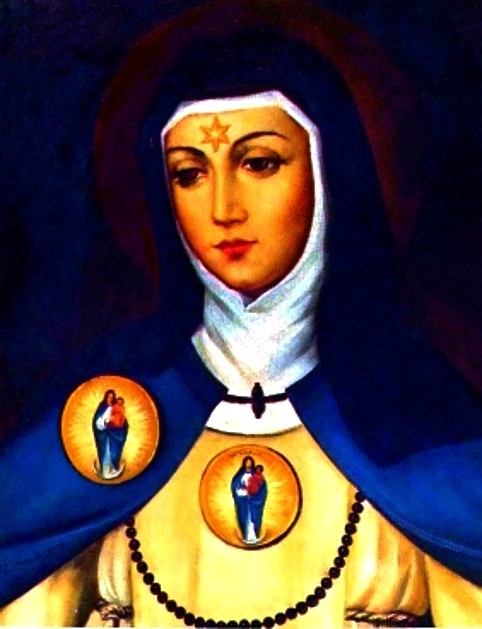
St Mary Euphrasia Pelletier (1796-1868) Nun, Foundress of the Congregation of Our Lady of Charity of the Good Shepherd. Patronages – Good Shepherd Sisters, travellers. On 11 December 1897, Pope Leo XIII declared her “Venerable.” She was Beatified on 30 April 1933 and Canonised on 2 May 1940 by Venerable Pope Pius XII. About St Mary Euphrasia: https://anastpaul.wordpress.com/2018/04/24/saint-of-the-day-24-april-st-mary-euphrasia-pelletier-1796-1868/
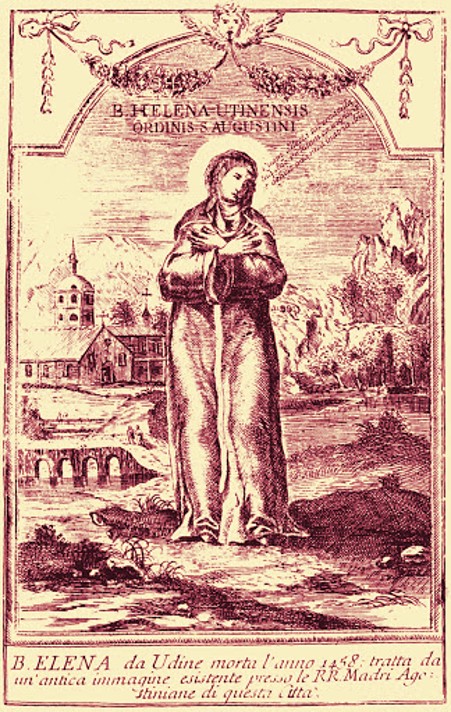
Saint of the Day – 23 April – Blessed Helen del Cavalanti OSA (1396-1458) Widow, Mother, Third Order Augustinian, Mystic, Miracle-worker. Helen was known for her spirit of penance, obedience, humility, devotion to the Passion of Christ and to the Eucharist and for her love of neighbour. Born in 1396 at Udine, Italy and died om 23 April 1458, at Udine of natural causes. Patronages – against temptations, of widows. Also known as – Helen Valentini. Helen of Udine, Helena Valentini of Udine, Elena…
Helen was born in Udine in 1396 to the nobleman Count Valentinis – a Lord of Maniago. We know of only one sibling, a sister: named Perfetta.
In 1411 at the age of 15, she married the Florentine Knight, Antonio del Cavalcanti, an Official of the City of Udine and the pair had six children – three males and three females, living happily as a loving family.
After 30 years together, raising their 6 children, Antonio died. Helen cut off her hair and placed it with her jewels in his coffin, saying: “These I wore for love of you – take them to the grave with you.”
A short while later, still within 1441, Helen heard a sermon in the Augustinian Church of Santa Lucia and decided then and there to join the Order. She became a professed Third Order member of the Order of Saint Augustine (the first for the Third Order in Udine).
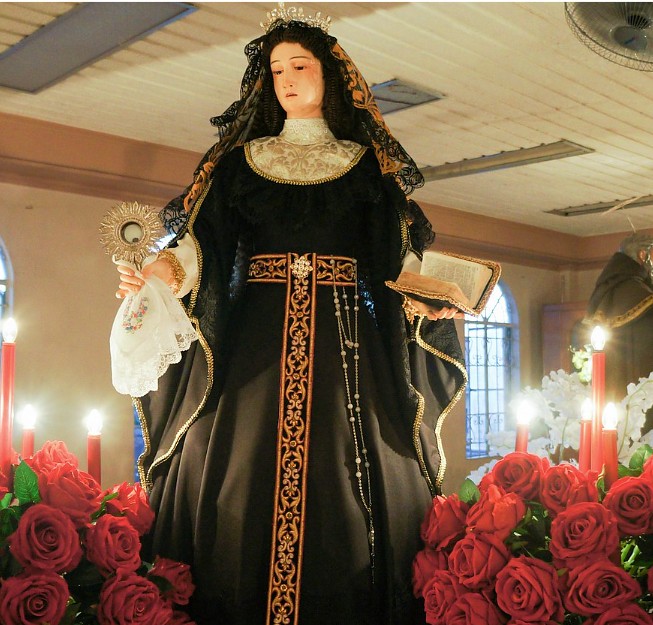
A Statue of Blessed Helen in Udine
She soon became known for her several austerities and her life of dedication to her fellowman. One of her mortifications was to take a vow of silence, speaking on Christmas alone. Helen placed 33 pebbles in jer shoes walking with pain for the rest of her days and slept on a stone pallet in place of a bed. She continued to live at home, in 1446 she moved in with her sister who was also a Third Order Augustinian, residing there until her death. She dedicated herself completely to God. She devoted long hours to prayer and meditation on the Gospels. She provided personal service and material contributions, to works of mercy. Helen developed a reputation as a Miracle worker with the power of curing the sick.
Helen became bedridden in 1455 after fracturing both her femurs in a fall. Even now, in this painful time, Helen preferred a pallet of stones and straw to a bed. Her declining health led to her death on the Saturday evening of 23 April 1458. Mass was celebrated in her room and Friars from a nearby Convent came to chant the Psalms.
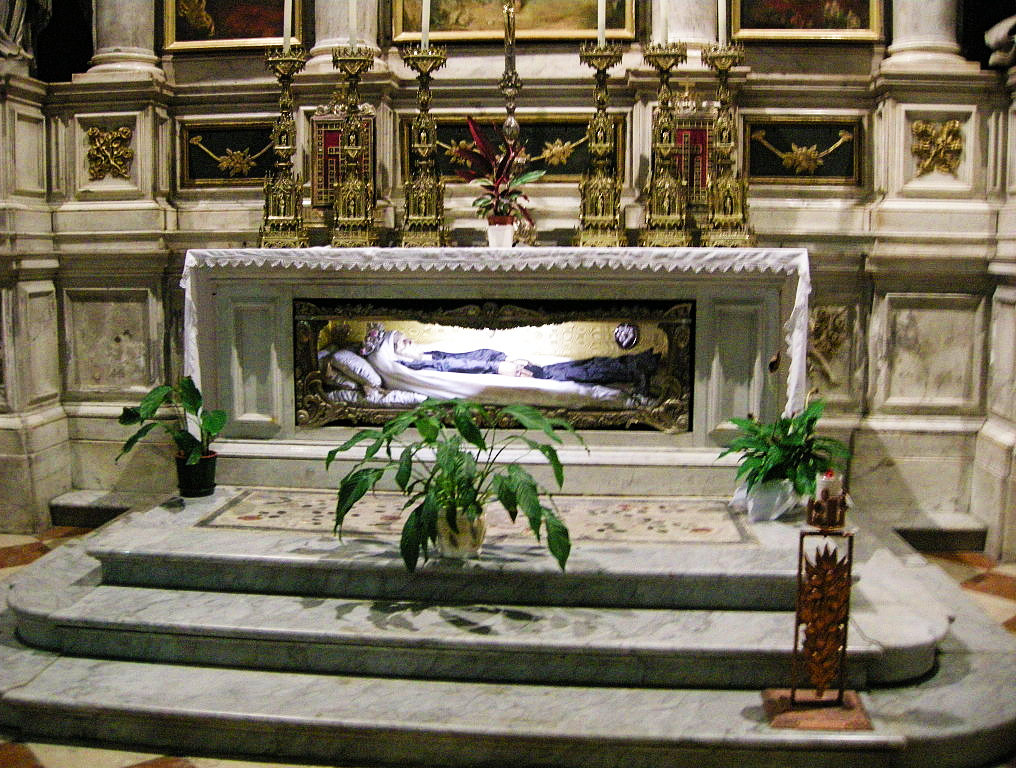
Her remains were interred in Santa Lucia but in 1845. they were moved to the Udine Cathedral. On 27 September 1848, Pope Pius IX confirmed her cultus and Beatified her.
There is a wonderful procession in her honour each year.
St Giorgio di Suelli (Died 1117) Italian Bishop of Suelli, Apostle of the poor, Miracle-worker. For the Diocese he was a true shepherd, a lover of the poor whom he helped and of whom he had a list. He was devoted to prayer and fasting and lived a life of penitence and poverty. Biography: https://anastpaul.com/2021/04/23/saint-of-the-day-23-april-saint-giorgio-di-suelli-died-1117/
Blessed Helen del Cavalanti (Died 1458) Widow, Mother, Third Order Augustinian. St Ibar of Meath St Marolus of Milan St Pusinna of Champagne
Martyrs of Africa: A group of Christians murdered for their faith in northern Africa. Little information has survived but their names. The ones we know are – Catulinus, Chorus, Faustinus, Felicis, Felix, Nabors, Plenus, Salunus, Saturninus, Silvius, Solutus, Theodora, Theodorus, Theon, Ursus, Valerius, Venustus, Victorinus, Victurus, Vitalis.
Saint of the Day – 22April – Saint Altfried of Münster (Died 849) the Third Bishop of Münster from (839–849) and Abbot of Essen-Werden and Helmstedt. Born in the 9th Century, n Friesland (in modern Netherlands) and died on 22 April 849 of natural causes. Altfried was a nephew of St Ludger (c 742-809) and his second successor in the See of Münster, as well as a successor as Abbot of the Abbey of Essen-Werden (founded by St Ludger). The second successor was also a close relative, St Gerfried of Münster. Altfried also wrote a comprehensive Vita of St Ludger. Also known as – Altfrid, Altfrith. The name Münster means Monastery.
We have such scant information on Altfried’s life, although I believe there is a complete Vita available somewhere online in Latin. He was born of a noble family and followed his uncle, St Ludger becoming a Monk and Priest in St Ludger’s Monastery of Essen-Werden, later becoming it’s Abbot. It seems that a second Monastery at Helmstedt, also founded by St Ludger fell under Altfried’s administration.
On the death of Bishop Gerfried in 839, Altfried succeeded him as the Bishop of Münster where he remained until his death.
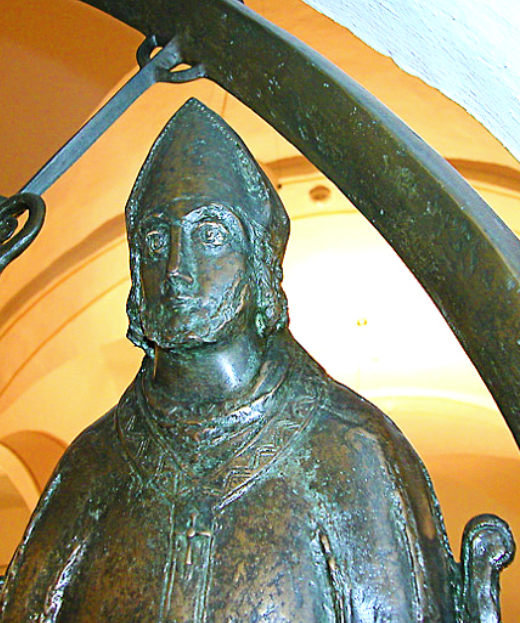
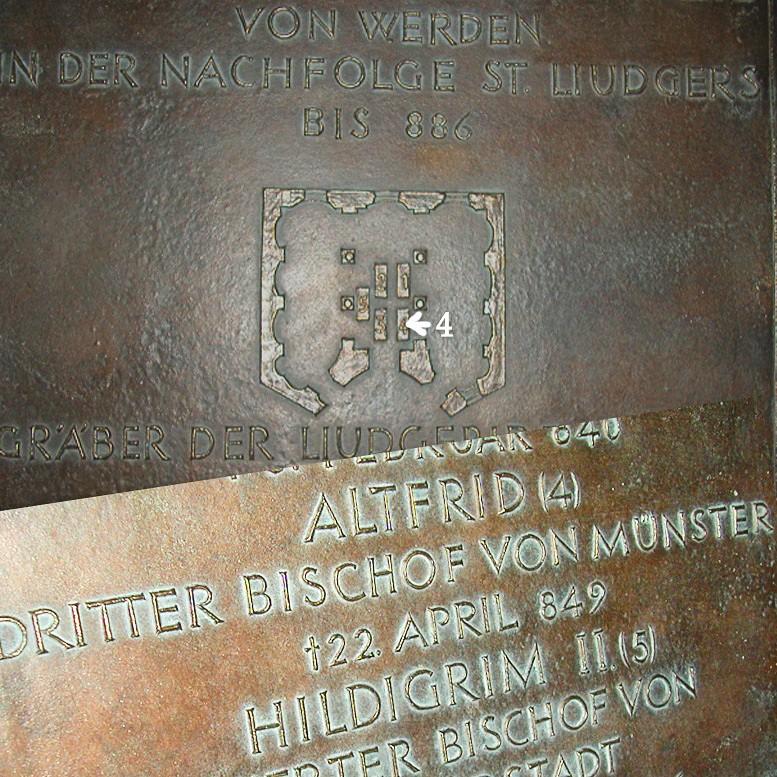
His remains were solemnly buried in the Crypt at the Monastery of Essen-Werden. The Statues and Tomb inscription below, are enshrined there.
Notre-Dames de Betharam / Our Lady of Betharam, France (1503) – 22 April: Saint Bernadette Soubirous frequently visited the Shrine of Betharram. In fact, the rosary beads that Bernadette used when praying with the Blessed Virgin during the first apparition at Lourdes had come from the Betharram Shrine and the priest to whom she was sent after the apparitions, was Saint Michel Garicoïts (1797-1863) the Priest of Betharram. He it was who alone believed Bernadette’s accounts of the apparitions at Lourdes. He was Canonised in 1947. About St Michel Garicoits here: https://anastpaul.com/2019/05/14/saint-of-the-day-14-may-saint-michel-garicoits-1797-1863/ HERE: https://anastpaul.com/2021/04/22/notre-dames-de-betharam-our-lady-of-betharam-france-1503/
St Pope Caius I (Died 296) Martyr, Bishop of Rome from 17 December 283 to his death in 296. Christian tradition makes him a native of the Dalmatian city of Salona, today Solin near Split, the son of a man also named Caius and a member of a noble family related to the Emperor Diocletian. Biography: https://anastpaul.com/2019/04/22/saint-of-the-day-22-april-saint-pope-caius-i-died-613/
Martyrs of Persia: Bishops, Priests, Deacons and Laity who were Martyred in Persia and celebrated together. Several of them have their stories related in the Acta of Saints Abdon and Sennen.
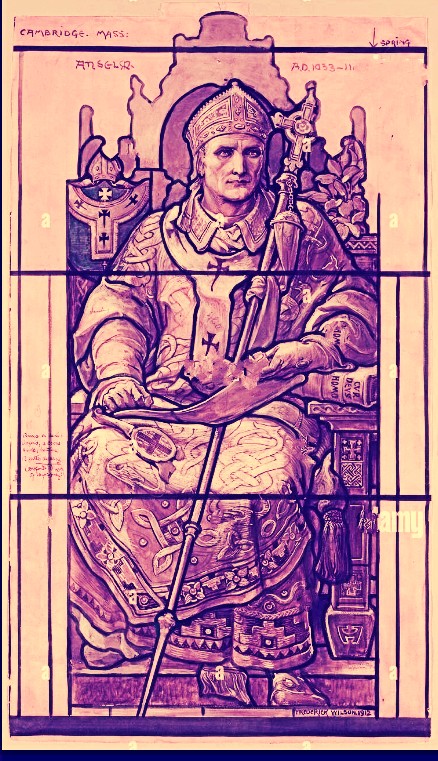
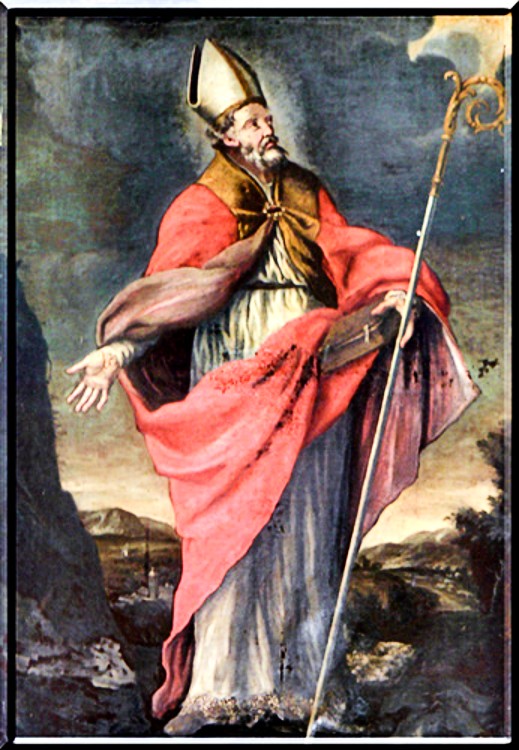
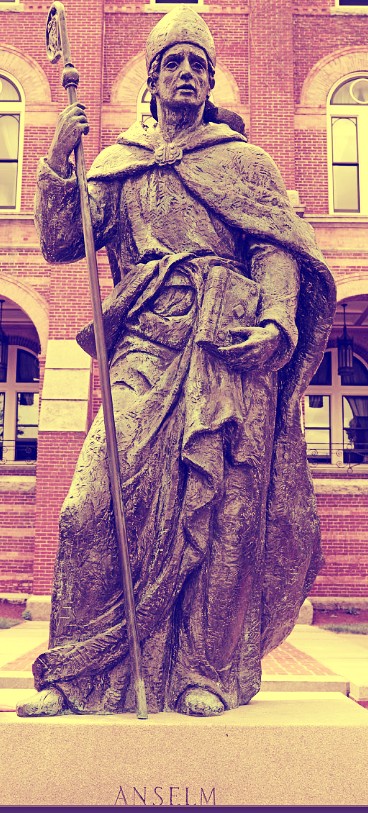
Saint of the Day – 21 April – St Anselm (1033-1109) Bishop, Confessor, Magnificent and Marian Doctor of the Church
St Anselm, Archbishop of Canterbury By Fr Francis Xavier Weninger SJ (1805-1888)
“Anselm, the celebrated Archbishop of Canterbury, in England, was born in Piedmont in the year 1033. He was gifted by nature with brilliant talents and a large, comprehensive mind. When he was hardly fifteen years of age, he was desirous of entering upon a religious life but he was not, admitted, as it was feared that it would provoke the wrath of his father and his noble relatives. This refusal was so deeply regretted by Anselm that he fell into a grievous illness which renewed his determination to enter a Monastery. On his recovery, however, he forgot his resolution and not only did he lose all inclination to enter the religious state, but he began to lead a much more worldly life than he had done previously. It was fortunate for him that, to a certain extent, he had lost his father’s love and was treated by him rather harshly. Not being able to endure this, Anselm left home, hoping that his absence might restore to him his father’s affection.
He, therefore, proceeded to France, where he remained for three years. Suddenly his desire to study, which had lain dormant in his mind so long, was reawakened and hearing that the celebrated Doctor Lanfranc, his compatriot, instructed young men in sacred science, in an Abbey not far distant, he went to him and begged to be admitted among the number of his disciples. Lanfranc consented and Anselm made such rapid progress in his studies that he soon left all others behind him.
During this time, he renewed his zeal in the practice of piety and virtue and also his determination to give his life entirely to the Almighty. In pursuance of this, he received the Habit, at the age of twenty-seven, in the Abbey of St Benedict, where he had studied and, after having passed through his novitiate, he took his vows. How eanestly he strove after spiritual perfection is evident from the fact that three years after, he had taken the vows, he succeeded Lanfranc, his teacher, as Prior of the same Abbey, the latter being called as Abbot to another Monastery. Several, who had been longer in the Order than he, envied and persecuted him on account of his promotion but the exquisite gentleness, patience and humility of Anselm soon won him all hearts and changed envy and jealousy into love and respect. His holy life added much to their veneration. He fasted almost daily,and his body became fearfully emaciated. By his constant mortification, he lost all relish for food. During the day, he instructed others in sacred science and in the Mysteries of the Faith. The greater part of the night he passed in prayer and meditation.
He attended, before all his other affairs, to the sick, day and night and wherever he was needed. He fed them and lifted them in and out of their beds, with his own hands. The most tender devotion he bore to our Crucified Saviour and often wept bitterly when he thought how our Redeemer, notwithstanding all His sufferings for us, is so frequently and so deeply offended. His aversion to sin was so intense that he, several times said that he would rather cast himself into hell, than commit a mortal sin. He shunned carefully the least thing that he thought was displeasing to God – because nothing is little which offends the Most High and often from something which appears, in itself, of small importance, eternal happiness or damnation depends! He too, was much devoted to the Blessed Virgin and was one of the first who defended, by the pen, her Immaculate Conception. Besides this, he wrote many other works in praise of the Divine Mother,and endeavoured to incite others to pay her due honours.
After the death of the Abbot, Anselm was unanimously elected as his successor, although he did what he could to prevent it. Invested with this new dignity, he changed, not in the least his mode of life, unless he was more fervent than ever in all his devotional exercises.
The fame of his sanctity and erudition spread abroad daily, more and more, so that he was not only esteemed by the Prelates of the Church, as well as by Kings but also by Pope Gregory VII, who, harassed on account of the sad condition of the Church at that period, recommended himself several times to the prayers of the Saint.
Some business appertaining to his Convent called Anselm to England and as his name was already well known there, he was everywhere received with the greatest honour. While he was, in England, Lanfranc, who after being instructor to Anselm, had become Abbot and then Archbishop of Canterbury, died and the King, without hesitation, chose St Anselm to be his successor and although the Saint most earnestly declined, he was at last obliged to yield to the influences of the clergy. He shed many bitter tears during his Consecration but once installed in his new functions, he went zealously to work to change the depraved manners of the people by preaching, writing instructive works and holding Councils.
Everything was going well, when the King himself caused great disturbances. He took forcible possession of a great deal of property belonging to the Church and would not consent that, during the division which at that time existed in the Church, anyone else but himself, should be regarded as the head thereof. Anselm courageously protected the rights and liberties of the Church and opposed, with manly independence, the wicked oppression and evil designs of the King. Hence, the unscrupulous counsellors of the King, persecuted him, banished his friends, deprived him of his revenues and tormented him in manifold ways, thinking thus to intimidate him and make him pliable to the King’s wishes. But they were mistaken. The Saint remained inflexible and was willing, rather to die, than in the least to swerve from his duty. Believing that the wrath of the King would be sooner appeased, if another occupied his See, he went to Rome and humbly requested the Pope to release him from his Archbishopric. The Pope, however, refusing his request, endeavoured to reconcile him with the King and meanwhile, made use of the knowledge and talents of the holy man in his warfare against the heretics and schismatics.
After sometime, Anselm went to Lyons, in France, to escape the honours which were tendered to him at Rome. While there, King William of England, who had so violently resented the Saint’s protection of the rights of the Church, died an unhappy death. He was hunting and the excitement was just at its height, when the fatal arrow of a French officer piercing his heart, sent him, without a moment for repentance, into eternity. Indescribably grieved was Anselm on hearing this news and he said more than once, that he would willingly give his life, if with his blood, he could save the soul of the unhappy Monarch. Before the intelligence of the King’s death had reached Lyons, Hugh, the holy Abbot of Cluny, said to Anselm : “King William stands accused before the Judgement Seat of the Most High and is already judged and sentenced to the eternal fire.”
On the death of King William, the crown fell to his son Henry, who, warned by the example of his father, endeavoured to ameliorate matters. He abolished the intolerable investitures, was gracious and kind to all, would neither have anything to do with the property of the Church, nor lay hands on the income of the clergy. As he knew how great the consideration was that Anselm enjoyed among all right-minded people, he recalled him to England and received him very graciously. But this behaviour was of short duration and before long the Archbishop had again to make a journey to Rome to seek protection for the rights of the Church, which Henry, like his father, commenced to violate. The Pope granted the Saint all he requested, all that justice demanded but when the King heard of it, he forbade the Archbishop to return to his See.
Anselm, therefore, repairing once more to Lyons, remained there for sixteen months. While there he daily celebrated the Holy Mass and offered many prayers and penances for the conversion of the King and the salvation of the whole land. Meanwhile, all England wished for the return of her shepherd and the King’s sister rested not in her endeavours, until her brother was appeased and allowed him to come back. After the holy man had returned to his See, he strove with all his energy to employ his few remaining years for the benefit of his flock. Thus he passed three peaceful years.
When he was no longer able to say Mass, he caused himself to be carried into the Church that he might at least be present at the Holy Sacrifice, for which he had always evinced the deepest veneration. After having received the Holy Sacraments on Wednesday in Holy Week, he requested to be laid, clad in a penitential robe, on the ground upon ashes and while they read to him the Passion of our Lord, he peacefully expired, in the seventy-sixth year of his age.
The many miracles which were wrought at his tomb caused the fame of his sanctity to be spread abroad through the whole of the Christian world.”
St Conrad of Parzham OFM Cap (1818-1894) Franciscan Religious Lay Friar, Devotee of Blessed Sacrament and Marian, Apostle of Charity, Miracle worker with the charism of prophecy. His heroic virtues and the miracles he performed won for him the distinction to be ranked among the Blessed by Pope Pius XI in 1930. Four years later, the same pope, approving additional miracles which had been performed, solemnly inscribed his name in the list of Saints. Biography: https://anastpaul.com/2018/04/21/saint-of-the-day-21-april-st-conrad-of-parzham-ofm-cap-1818-1894/
St Crotates of Nicomedia St Cyprian of Brescia St Felix of Alexandria St Fortunatus of Alexandria St Frodulphus St Isacius of Nicomedia St Maelrubba of Applecross
St Silvius of Alexandria St Simeon of Ctesiphon St Vitalis of Alexandria Bl Vitaliy Bayrak Bl Wolbodó of Liège
Saint of the Day – 20 April – Blessed Hildegun of Schönau O.Cist. (Died 1188) Virgin, Cistercian Monk – yes! she was disguised as a boy as a child, for her own safety and after many frightening trials, decided to retain the identity in order to enter the Cistercian Monastery as Brother Joseph. Her true identity remained a secret until her death. Born in the Rhineland, Germany and died in 1188 in Schönau, Germany of natural causes. Also known as – Joseph, Brother Joseph, Hildegun of Neuss, Hildegunda of…. Hildegunde of…. Hildegund of…. (Hildegund should not be confused with Saint Hildegund (c1130–1178), whose Feast day is 6 February.)
Born to a noble family, her father Harper, took her on a pilgrimage to the Holy Land in 1182, when she was 12 years old. However, after landing at Tyre, Lebanon, Harper took ill and knew he would die. He entrusted her to the care of his manservant and, realising the dangers that could meet the girl on her return journey, her father dressed her as a boy.
No sooner was Harper buried, however, than the servant absconded with the money given him for expenses and abandoned Hildegun. Still dressed as a boy, she took the name Joseph for the patron of families and children. Left to beg on the streets, a well-connected German pilgrim saw her and offered to return her to her home but failed to fulfil his plans.
By 1187, Hildegun was moved by a call to the religious life. Thus she entered the Cistercian Monastery at Schönau — without mentioning that she was a young woman.
After a year’s novitiate and three days before she was to take her monastic vows, she took ill, dying on 20 April 1188. Only while preparing her for burial did the Monks discover her actual sex.
St Caedwalla of Wessex Bl Catwallon St Domninus of Digne Bl Gerald of Salles Bl Harduin Blessed Hildegun of Schönau (Died 1188) Virgin St Hugh of Anzy-le-Duc Bl John of Grace-Dieu
St Marcian of Auxerre St Margaret of Amelia Bl Maurice MacKenraghty St Michel Coquelet Bl Oda of Rivreulle St Sara of Antioch St Secundinus of Córdoba St Servilian
Blessed Simon Rinalducci OSA (Died 1322) Priest, Friar of the Order of the Hermits of St Augustine, noted for his theological studies, Prior of several houses, renowned Preader, Miracle-worker. Blessed Simon was a model of humility and obedience, even in the face of great trials and obvious injustices. Simon was Beatified on 19 March 1833 by Pope Gregory XVI (cultus confirmed). His Life: https://anastpaul.com/2021/04/20/saint-of-the-day-blessed-simon-rinalducci-osa-died-1322/
St Sulpicius St Theodore Trichinas St Theotimus of Tomi St Vincent of Digne St Wiho of Osnabrück
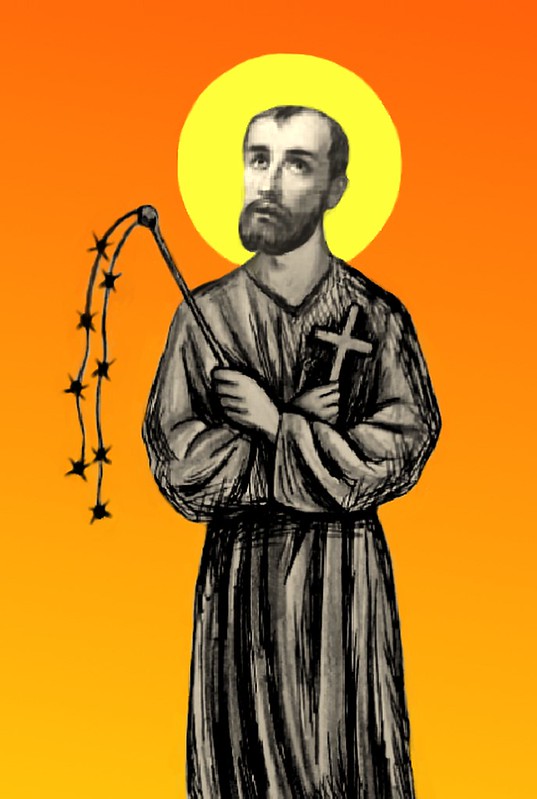
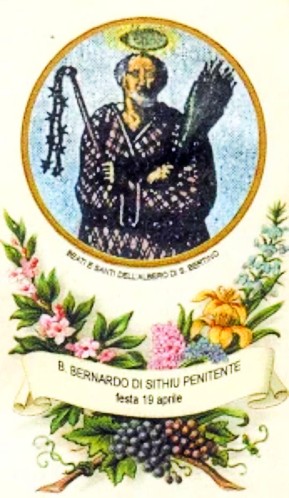
Saint of the Day – 19 April – Blessed Bernard of Sithiu (Died 1182) Layman Penitent, Pilgrim, Hermit Died on 19 April 1182 in the Monastery of Saint-Bertin, Thérouanne region, France of natural causes. Patronages – of sinners, convicts, prisoners, penitents, pilgrims. Also known as – Bernard of Maguellone, Bernard the Penitent, Bernard the Pilgrim.
The Roman Martyrology: “At the Monastery of Saint-Bertin in the territory of France in Thérouanne, lies the tomb of Blessed Bernard, penitent, who, eager to atone for the sins of his youth with an austere penitence, voluntarily chose exile and, barefooted, wearing rough garments, was a tireless pilgrim to the holy places.”
Like St Nicholas of Trani, St Benedict Joseph Labre, St Rocco and several others this Saint lived as an itinerant pilgrim to the Shrines of Europe.
The few reports received about the life of Blessed Bernard of Sithiu are those handed down in the writings of John of Sithiu, Abbot in 1187, a source of extraordinary interest. There is also the Office composed in his honour and in 1465, an inventory of his remains are cited, “relics of St Bernard, Penitent. “
From such documents and testimonies, we discover that Bernard, following a murder, was ordered to make a pilgrimage of atonement.
After wandering far and wide for a long time, he finally settled near the former town of Sithiu, where, for four years he lived in poverty and deprivation. He prayed and fasted incessantly and endured the elements, as well as many other trials and sufferings. He became a very saintly man in love with God and self-renunciation. Finally dying on 19 April 1182.
The fame for holiness which was gained in life, was later confirmed after death, by many miracles occurring at his tomb.
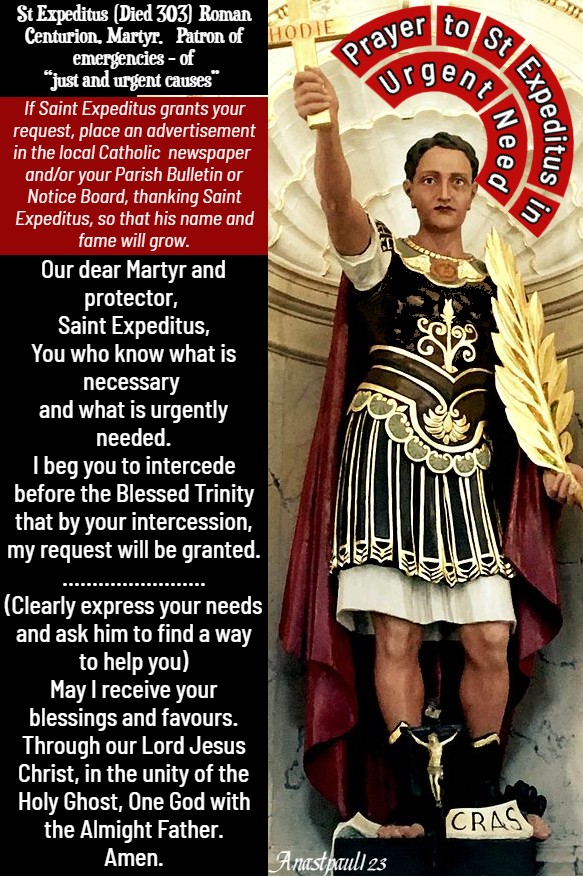
Our dear Martyr and protector, Saint Expeditus, You who know what is necessary and what is urgently needed. I beg you to intercede before the Blessed Trinity that by your intercession, my request will be granted. …………………… (Clearly express your needs and ask him to find a way to help you.) May I receive your blessings and favours. Through our Lord Jesus Christ, in the unity of the Holy Ghost, One God with the Almighty Father. Amen.
If Saint Expeditus grants your request, place an advertisement in the local Catholic newspaper and/or your Parish Bulletin or Notice Board, thanking Saint Expeditus, so that his name and fame will grow.
St Gaius of Melitene St Galata of Melitene St George of Antioch St Gerold of Saxony
St Pope Leo IX (1002-1054) known as “Apostolic Pilgrim” When the German Pope Damasus II died in 1048, Bishop Bruno was selected by the Emperor, Henry III, to succeed him. Bruno agreed to go to Rome and to accept the Papacy if freely elected thereto by the Roman people. He wished, at least, to rescue the See of Peter from its servitude to the German Emperors. When, in company with Hildebrand he reached Rome and presented himself to its people clad in pilgrim’s guise and barefooted but still tall and fair to look upon, they cried out with one voice that him and no other would they have as Pope. Assuming the name of Leo, he was solemnly enthronedon 12 February, 1049. Biography: https://anastpaul.wordpress.com/2018/04/19/saint-of-the-day-19-april-st-pope-leo-ix-1002-1954/
St Martha of Persia St Rufus of Melitene St Vincent of Collioure
Martyrs of Carthage – 17 Saints: A group of Christians Martyred in the persecutions of Decius. We know little more than the names – Aristo, Basso, Credula, Donato, Ereda, Eremio, Fermo, Fortunata, Fortunio, Frutto, Julia, Mappalicus, Martial, Paul, Venusto, Victorinus and Victor. Died in the year 250 in prison in Carthage, North Africa (modern Tunis, Tunisia).
Saint of the Day – 18 April – Blessed Barbara Aurillot / Marie of the Incarnation OCD (1566-1618) Widow, Third Order Lay Discalced Carmelite Sister, Apostle of Charity, Mystic. Barbara is considered the Foundress of the French branch of Carmel. She was known for receiving visions and ecstasies and for supernatural gifts. Born on 1 February 1566 at Paris, France as Barbe Aurillot and died on 18 April 1618 at Pontoise, France of natural causes. Patronages – against impoverishment, against loss of parents, against poverty, parents separated from children, the poor, widows. Also known as – Le belle Acarie (the beautiful Acarie), as she was known in Paris, Barbara Aurillot, Barbara Avrillot, Barbe Acarie, Barbe Aurillot, Barbe Avrillot, Madame Acarie, Marie Acarie Marie or Mary of the Incarnation.
Barbara was the daughter of a French Government Official named Nicholas Aurillot,the Accountant General in the Paris Chamber and Chancellor of Marguerite of Navarre, first wife of Henri IV. Her mother, Marie Lhuillier. was a descendant of Etienne Marcel, the famous prévôt des marchands (Chief municipal Magistrate). She was educated at her Aunt’s Convent at Longchamps, the Minor Sisters of Humility of Our Lady.
Although Barbara was attracted to the religious life, at the age of 16 in 1684, through obedience, she was married to Pierre Acarie, the Viscount of Villemoran, a wealthy young man of high standing, who was a fervent Catholic and Government Treasury Official. She became the Mother of six children, three of whom became Carmelites Nuns and one a Priest.
Her husband, Pierre, supported the Catholic League, of which he was a staunch member, against Henry IV. Pierre was one of the sixteen who organised the resistance in Paris. When Henry became King, he seized the Acarie estates, impoverished the family and exiled Pierre from Paris, separated husband and father from his family. Barbara had to contend with creditors and irate businessmen. Although she had been severely injured due to a fall from her horse and medical treatment which had only made matters worse and left her an invalid for the rest of her life. Barbara still, legally challenged the matter and went to Court to fight and she won. The family was able to reclaim part of the their property and fortune.
Barbara was devoted to the writings of Saint Teresa of Avila. Her good works eventually won her the admiration and support of the same King Henry! who assisted her later when she was the greatest protagonist in bringing the reformed Carmelites of St Teresa to France. At this time, she received a vision of St Teresa who informed her that God wished Barbara to do this work.
At the beginning of the Seventeenth Century Madame Acarie was widely known for her virtue, her supernatural gifts and especially, for her charity towards the poor and the sick in the hospitals. To her residence came all the distinguished and devout people of the day. Among them was St Vincent de Paul and St Francis de Sales, the latter of whom became her Spiritual Counsellor.
Barbara was instrumental in bringing the Discalced Carmelites of Saint Teresa to France, founding five houses between 1604 and 1609. The Carmel spread rapidly and profoundly influenced the French religious and secular society of the day. In 1618, the year of Barbara’s death, Carmel numbered fourteen houses.
She also shared in two foundations of the day, that of the Oratory and of the Ursulines. She urged De Bérulle to refuse the tutorship of Louis XIII and on 11 November 1611, she, with St Vincent de Paul, assisted at the Mass of the installation of the Oratory of France.
Among the many postulants whom Mme Acarie received for the Carmel, there were some who had no vocation and she conceived the idea of getting them to undertake the education of young girls and broached her plan to her holy cousin, Mme. de Sainte-Beuve. To establish the new order they brought Ursulines to Paris and adopted their rule and name.
When Pierre died in 1613, his widow settled her affairs and begged leave to enter the Carmel, asking as a favour to be received as a lay sister in the poorest community. In 1614 she withdrew to the Monastery of Amiens, taking the name of Marie of the Incarnation. Her three daughters had preceded her into the cloister and one of them was Sub-prioress at Amiens. In 1616, by order of her Superiors for health reasons, she went to the Carmelite Convent at Pontoise, where she died at the aged of 52/53. St Francis de Sales considered her death in spiritual poverty as laudable as that of St Francis Xavier’s, who died in utter physical poverty.
Her cause was introduced at Rome in 1627 and she was Beatified on 24 April 1791 by Pope Pius VI – her Feast is widely celebrated in Paris on 18 April. Her mortal remains are in the Chapel of the Carmelites of Pontoise.
It has been said that the vigorous and saintly Madame Acarie, provided the first definite impulse towards that interior growth which made the exquisite and urbane St Francis de Sales, a fit guide for the soul of St Jane Frances de Chantal.
St Agia of Hainault St Anthia of Illyria St Antusa of Constantinople Saint Apollonius the Apologist
St Athanasia of Aegina
Blessed Barbara Aurillot / Marie of the Incarnation O.Carm (1566-1618) Widow, Lay Carmelite Sister St Bitheus St Calocerus of Brescia St Cogitosus St Corebus St Eleuterius of Illyria St Elpidius of Melitene St Eusebius of Fano St Galdinus of Milan St Gebuinus of Lyons St Genocus St Hermogenes of Melitene
Blessed Idesbald of Dunes O.Cist (c1095-1167) Cistercian Priest and Abbot of Ten Duinen Abbey, Our Lady of the Dunes. The Roman Martyrology states: “In Bruges in Flanders, in today’s Belgium, Blessed Idesbaldo, Abbot, who, soon became a widower and exercised for another thirty years, duties in the palace of the Counts, entered the Monastery of Dune at a mature age, which he held holy, as the third Abbot for twelve years.” Biography: https://anastpaul.com/2021/04/18/saint-of-the-day-18-april-blessed-idesbald-of-dunes-o-cist-c-1095-1167/
Saint of the Day – 17 April – St Landericus (c637-c720) Bishop, Abbot Born in c637 at Hainaut, Belgium and died on 17 Apr c720 (aged 82–83) at in Soignies, France of natural causes. Patron Saint of the House of Habsburg. Also known as – Landericus of Meaux (Metz), Landericus of Soignies, Landry, Landricus, Landrich, Landerico.
That he was a Bishop in the Seventh Century is generally agreed upon but exactly where and when is unclear. Some accounts show him as Bishop of Metz, while others say he was Bishop of Meaux, both in France.
Either way, it is said he resigned his Episcopal responsibilities so as to become a Benedictine DMonk at the Monastery of Hautmont, in France and later at Soignies, in Belgium, both of which were founded by his father.
He succeeded his father as Abbot of Soignies when the elder died around the year 677. Abbot Landericus also died at Soignies somewhere between the years 700 and 730, depending on which account of his life is used and his relics are held at the Collegiale S. Vincent, the Church named for his father.
His feast day is 17 April. Locally, that is in France and Belgium, he is known as St Landry, while most compilations of Saints use the Latin name St Landericus.
In the truly unique and renowned Church known as the Hofkirche in Innsbruck resides a large Statue of our Saint. This is most interesting and leads us to believe that he must have been a much more illustrious figure than we can find information regarding his life. and there is also the fact that he is the Patron Saint of the Royal House of Habsburg. This beautiful Church was built to house the tomb of Emperor Maximilian I who died in 1519. The Church is also known as “Schwarzmanderkirche“ (literally “Black Men Church”) famous for its namesake “Black Men” – 28 over-life-sized Renaissance bronze Statues of important historical figures and Saints which flank the marble Tomb of Emperor Maximilian I. See below.
Bl essed Andrés Hibernón Real OFM (1534-1602) Religious Friar, Apostle of the Holy Eucharist, the Blessed Virgin and the Holy Rosary, Apostle of the poor. He predicted the date of his death four years before the fact, which was 18 April 1602 in Gandia, Valencia, Spain of natural causes immediately after having prayed a rosary. He was Beatified on 22 May 1791 by Pope Pius VI. His body is incorrupt. Biography: https://anastpaul.wordpress.com/2018/04/17/saint-of-the-day-17-april-blessed-andres-hibernon-real-o-f-m-1534-1602/
St Agia of Hainault St Anthia of Illyria St Athanasia of Aegina St Bitheus St Calocerus of Brescia St Cogitosus St Corebus
St Eleuterius of Illyria St Elpidius of Melitene St Eusebius of Fano St Galdinus of Milan St Gebuinus of Lyons St Genocus St Hermogenes of Melitene Bl Idesbald of Dunes Blessed James of Cerqueto Bl James Oldo Bl Joseph Moreau St Landericus (c637-c730) Bishop, Abbot St Laserian of Leighlin Bl Louis Leroy Bl Luca Passi St Pantagathus of Vienne St Perfecto of Córdoba St Pusicio
St Robert de Turlande/Chaise-Dieu OSB (c 1000-1067) Priest, professed religious of the Order of St Benedict, Monk, Abbot, Apostle of Charity, Marian devotee. He was of noble stock, was related to Saint Gerald of Aurillac (c855–c909) and was a descendant of St Caesarius of Arles (470-543). He is best known for the establishment of the Benedictine Convent of La Chaise-Dieu (‘Home of God’) and for his total commitment to the poor. He became a spiritual inspiration for Pope Clement VI (1291–1352) – whose own origin,s in the religious life were based at that Convent – and it was Pope Clement who confirmed the Canonisation of the Benedictine Abbot on 19 September 1351 in Avignon. His Life: https://anastpaul.com/2019/04/17/saint-of-the-day-17-april-st-robert-de-chaise-dieu-osb-c-1000-1067/
Saint of the Day – 16 April – Blessed Arcangelo Canetoli CRSSB (1460-1513) Priest.and Canon of the Canons Regular of the Congregation of the Most Holy Saviour at Bologna, Mystic gifted with the charism of prophecy and of many visions of the Blessed Virgin, Born in 1460 in Bologna, Italy and died on 16 April 1513 (aged 53) in Gubbio, Italy of natural causes. His body is incorrupt. Arcangelo was Beatified on 2 October 1748 by Pope Benedict XIV.
Blessed Arcangelo Canetoli between St Nicholas and St Leonard painted by GB Piazzetta and Domenico Maggiotto for the Church of San Salvatore, Venice.
Arcangelo Canetoli, born in Bologna in 1460, suffered the bitter vicissitudes of the rivalry between the Canetoli and the Bentivoglio families. When still a young child, he providentially survived the extermination of the entire family. As a young man he entered the Canons Regular of Santa Maria di Reno, known as “Renani.” Due to his extreme humility and love of solitude he refused, for a long time, any Ecclesiastical dignity and only out of obedience, did he accept Priestly Ordination. From 1498 he lived in the convent of Sant’Ambrogio di Gubbio, loved and venerated by the humble and the powerful, including the Acquisti of Arezzo and the Medici of Florence. He consistently refused the appointment as Archbishop of the Medici City proposed to him by Pope Leo X. He died on 16 April 1513 and his incorrupt body is still venerated in his Monastery in Gubbio.
Arcangelo was born to one of the noblest families of Bologna – the Canetoli. The entire family was massacred being held esponsible for the death of member of an opposing family member. Only Arcangelo, still a child, managed to save himself thanks to fortuitous circumstances.
On 29 September 1484 he took the Habit of the Congregation of the Canons Regular of Santa Maria di Reno, called “Renani”, in the Convent of the Santissimo Salvatore in Venice. Here he was entrustd with the task of welcoming pilgrims and in some of them he sometimes happened to recognise the murderers of his family members! However, he always knew how to heroically dominate his desire for revenge.
Extremely humble and a lover of solitude, for a long time he refused, any Ecclesiastical dignity and finally, in 1498, accepted Priestly Ordination only out of a sense of obedience to his Superioirs. Shortly after his Ordination he was sent, by his own request, to the Hermitage of St Ambrose, a mountainside Monastery in Gubbio. Here he would remain for the remainder of his life, although he operated as the Provincial Vicar of his Order for 4 years, still retaining his base at Gubbio.
The St Ambrose Monastery in Gubbio
Arcamgelo predicted that Cardinal Giovanni de’ Medici would be elected as pope sometime soon and when this Cardinal became Pope Leo X in 1513, the Leo’s brother Giuliano de’ Medici summoned Canetoli to Florence in an attempt to persuade him to become the new Archbishop of Florence. But again Arangelo refused and returned to his Convent.
Blessed Arcangelo refusing the Honour of becoming the Archbishop of Florence painted by Giuseppe Reposati.
Arcangelo died in 1513 after a period of illness and high temperatures. He was interred in his Monastery of St Anbrose at Gubbio, where his incorrupt body remains enshrined for the veneration of pilgrims.
Blessed Arcangelo Canetoli (1460-1513) Priest. Beatified on 2 October 1748 by Pope Benedict XIV.
St Benedict Joseph Labre – Known as the Beggar of Perpetual Adoration (1748-1783) Laqy Penitent and Pilgrim – he “abandoned his country, his parents and whatever is flattering in the world, to lead a new sort of life, a life most painful, most penitential, not in a wilderness, nor in a cloister but in the midst of the world, devoutly visiting as a pilgrim the famous places of Christian devotion.” Canonised by Pope Leo XIII on 8 December 1881. Dearest St Benedict Joseph: https://anastpaul.wordpress.com/2017/04/16/saint-of-the-day-16-april-st-benedict-joseph-labre/
St Magnus of Orkney (c 1075-1115) Layman Martyr, Magnus was the Earl .of Orkney in Scotland and related to the Royal House of Norway, which exercised sovereignty over the Orkney Islands at that time. The story of St Magnus’ life and Martyrdom are well attested. His Life and Death: https://anastpaul.com/2022/04/16/saint-of-the-day-16-april-saint-magnus-of-orkney-c-1075-1115/
St Turibius of Astorga St Vaise St William Gnoffi
Martyrs of Corinth – 9 Saints: A group of nine Christians who were tortured and Martyred together in the persecutions of Decius. We know little more than three of their names – Callistus, Charisius and Leonide. They were thrown into the sea at Corinth, Greece c250.
Martyrs of Saragossa: Group of eighteen Martyrs murdered in 304 in Saragossa, Spain in the persecutions of Diocletian and the prefect Dacean. We know little more than the names – Apodemus, Caecilian, Caius, Crementius, Engratia, Eventius, Felix, Fronto, Gaius, Julia, Lambert, Lupercus, Martial, Optatus, Primitivus, Publius, Quintilian, Saturnius (4 men of this name), Succesus and Urban. Their graves re-discovered in 1389 in the crypt under the Church of San Encrazia in Saragossa.
Saint of the Day – 15 April – St Paternus of Avranches (c482-565) Bishop, Abbot, Monk, Hermit, Miracle-worker, Founder of Monasteries, local Missionary to the pagans. Born c482 at Poitiers and died c565 of natural causes. Also known as – Foix, Padarn, Pair, Patier.
Paternus was born at Poitiers, of illustrious Christian parents, about the year 482. His father, Patranus, with the consent of his wife, went to Ireland to end his days as a hermit in holy solitude.
Paternus, fired by his father’s example, embraced monastic life in the Abbey of Marnes, France. After some time, desiring to attain the perfection of Christian virtue by a life of penance in solitude, he retired with a companion Monk of the Abbey, Saint Scubilion. In the forests of the Diocese of Coutances near the sea, they embraced an austere anchorite’s life resembling that of Angels more than of men.
In 512, an Abbot of that region who knew of him recommended Paternus to the Bishop of Coutances, who Ordained him a Deacon and then a Priest. He and Saint Scubilion then evangelised the western coasts and established several Monasteries, of which he was the Abbot general. Many miracles honoured his apostolate among the pagan populations.
In his mature years, he was consecrated bishop of Avranches while his former companion, Saint Scubilion, had become Abbot of a Monastery founded by the two missionaries.
When Saint Paternus fell ill he felt his end was near and he sent to his dear friend to come and assist him in his last illness. But the same fate had befallen Scubilion, who, for his part had sent a messenger to Paternus! The two hermit-missionaries, each of whom had become the spiritual father of many, departed this life on the same day, 15 or 16 April 565, the thirteenth year of the Episcopate of Saint Paternus. They were afterwards buried on the same day in the Church of the Monastery of Scicy, a region they had evangelised together.
Statue of St Paternus at the Church dedicated to him in Avranches
Saint Anastasia of Rome (Died c 68) Martyr, Spiritual Student of St Peter the Apostle AND: St Basilissa of Rome (Died c 68) Martyr, Spiritual Student of St Peter the Apostle. put to death during the reign of Nero. They were among the first converts to Christianity in the 1st century after Christ. The Roman Martyrology states today: “At Rome, the Saints Basilissa and Anastasia. Of noble families, they were disciples of the Apostles and, as they persevered courageously in the profession of their faith, in the time of the Emperor Nero, they had their tongues and feet cut off, were put to the sword and thus obtained the Crown of Martyrdom.” Their Life and Death: https://anastpaul.com/2022/04/15/saint-s-of-the-day-15-april-saints-anastasia-and-st-basilissa-died-c-68-martyrs/
St Crescens of Myra St Eutyches of Rome St Eutychius of Ferentino
Bl Laurentinus Sossius St Maro of Rome St Maximus of Persia St Mundus St Nidger of Augsburg St Olympiades of Persia St Ortario of Landelles St Paternus of Avranches (c482-c565) Bishop
St Sylvester of Réome St Theodore of Thrace St Victorinus of Rome St Waltmann of Cambrai
Mercedarian Martyrs of Africa: A group of Mercedarian Monks sailing to Africa as on a mission to redeem capture Christians. Captured by Moors, they were tortured and executed for their faith. Martyrs. 1393.
Saint of the Day – 14 April – St Abundius the Sacristan (Died c564) Confessor, Sacristan of St Peter’s Basilica in Rome, Layman. Pope St Gregory I the Great wrote of his life, which was filled with many graces. Died in .564 of natural causes. Also known as – Abonde. Patronage – of Sacristans.
The Roman Martyrology reads today: “At Rome, St Abundius, resdident Sacristan of the Church of St Peter.”
Abundius’ holy life was reportedly an inspiration to all who knew him and several miracles were attributed to him, during his life. For one, he is reported as having miraculously cured a gout sufferer by his prayers.
Another wonderful miracle wrought by the intercession of Abundius is told by Saint Gregory the Great in his Dialogues (Book III, Chapter 25). St Gregory reports that there was a young woman who was suffering from palsy and had been praying to Saint Peter to be cured. The Saint appeared to her in a vision and told her to go to Abundius to be cured. The woman did not know Abundius but sought him out at the Basilica and engaged in the following conversation with him:
“The maid … suddenly met with him whom she sought for and asking for him of himself, he told her that he was Abundius. Then quoth she: ‘Our shepherd and Patron, blessed St Peter the Apostle, hath sent me that you should help me of this my disease.’ ‘If you be sent by him,’ quoth Abundius, ‘then rise up’ and taking her by the hand, he forthwith lifted her up upon her feet and from that very hour, all the sinews and parts of her body became so strong that no sign of her former malady remained.”
In the same work, St Gregory also makes note of another saintly Sacristan of Saint Peter’s, Theodore, who lived before Abundius.
St Abundius is remembered at St Peter’s today where his holy Relics are enshrined.
St Bernard of Tiron (1046-1117) Monk, Abbot, Founder of the the Tiron Abbey and the Tironensian Order. St Bernard had a deep devotion to the Passion of Christ, teaching and instruction his disciples in the love of the Holy Cross. The Roman Martyrology reads: “In the Monastery of Tiron near Chartres in France, Saint Bernard, Abbot, who on several occasions gave himself up to a hermit life in the woods and on the Island of Chausey but also dedicated himself to instructing and guiding the disciples, who in great numbers, flocked to him.” St Bernard’s Life: https://anastpaul.com/2022/04/14/saint-of-the-day-14-april-st-bernard-of-tiron-c-1046-1117/
St Domnina of Terni St Fronto of Nitria Bl Hadewych
One Minute Reflection – 13 April – Easter Thursday – The Memorial of St Hermenegild (Died 585) Martyr, Confessor – Acts 8:26-40, John 20: 11-18 – Scripture search here: https://www.drbo.org/
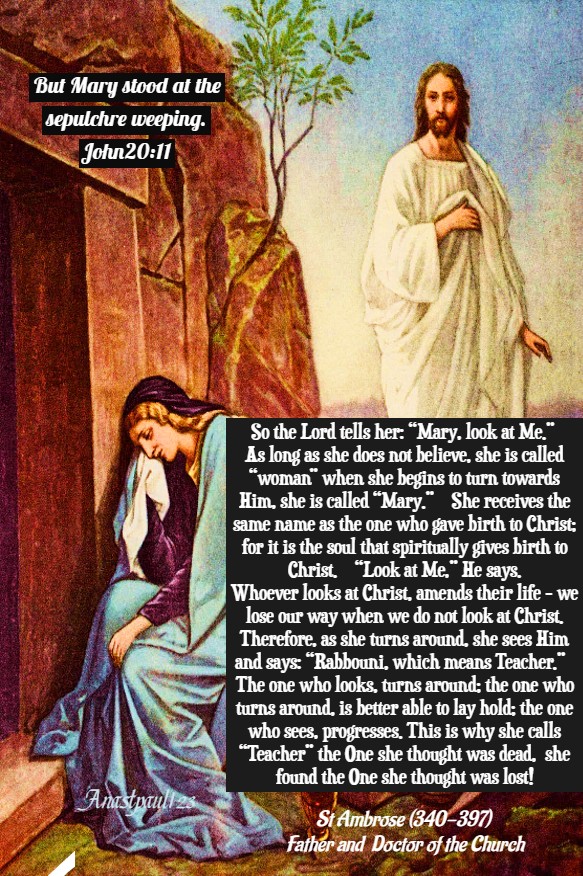
“But Mary stood at the sepulchre without, weeping.” – John 20:11
REFLECTION – “Why are you weeping?” You yourself are the cause of your tears, you are the one who makes yourself cry … You cry because you do not believe in Christ: believe and you will see Him. Christ is there; He never misses those who look for Him. “Why are you weeping?” Tears do not serve you any good; you need to have faith, a living faith and worthy of God. Do not think about mortal things and you will stop crying … Why should you be weeping for what makes others rejoice?
“Whom are you looking for?” Can you not see that Christ is the Strength of God that Christ is the Wisdom of God that Christ is Holiness, Christ is Chastity, Christ is Purity, Christ was born of a Virgin, Christ comes from the Father and is with the Father and is always in the Father – born and, therefore, not created, not rejected but always loved, True God from True God? “They have taken away my Lord and I do not know where they laid Him” You are mistaken woman, you think that Christ has been taken away from the tomb by others and you do not believe that He has risen by His Own Power. But no-one can take away the Power of God, no-one takes away the Wisdom of God, no-one can take away His venerable Chastity. Christ is not taken away from the tomb of the just man, nor from the intimacy of the Virgin, nor from the secrecy of her faithful soul and even if there were someone who wanted to take Him away, they could not take Him away.
So the Lord tells her: “Mary, look at Me.” As long as she does not believe, she is called “woman” when she begins to turn towards Him, she is called “Mary.” She receives the same name as the one who gave birth to Christ; for it is the soul that spiritually gives birth to Christ. “Look at Me,” He says. Whoever looks at Christ, amends their life – we lose our way when we do not look at Christ. Therefore, as she turns around, she sees Him and says: “Rabbouni, which means Teacher.” The one who looks, turns around; the one who turns around, is better able to lay hold; the one who sees, progresses. This is why she calls “Teacher” the One she thought was dead, she found the One she thought was lost!” —St Ambrose (340-397) Bishop of Milan, Father and Doctor of the Church (Treatise on Virginity 17-21).
PRAYER – OGod, Who didst teach Thy blessed Martyr Hermenegild to choose a heavenly, rather than an earthly crown, grant, we beseech Thee, that we, like him, may so pass through temporal things that we finally miss not those which are eternal. Through esus Christ, Thy Son our Lord, Who lives and reigns with Thee, in the unity of the Holy Ghost, God, world without end. Amen (Collect).
Saint of the Day – 13 April – St Hermenegild (Died 585) Martyr, Confessor, King. Born in Toletum, Vmodern Spain and died on 13 April 585 by beheading. Also known as Hermengild, Ermengild, Ermengildo.
The Roman Martyrology reads: “At Seville in Spain, St Hermenegild, son of Leovigild, Arian King of the Visigoths, who was incarcerated for the confession of the Catholic Faith. By order of his wicked father, he was beheaded because he had refused to receive communion from an Arian Bishop, on the Paschal Solemnity and thus exchanging an earthly for a heavenly Kingdom, he entered the abode of the blessed, both as a King and as a Martyr.”
Leogild, King of the Visigoths, had two sons, Hermenegild and Recared, who reigned jointly with him. All three were Arians but Hermenegild married a. zealous Catholic, the daughter of Sigebert, King of France and by her holy example he was converted to theTrue Faith.
The Baptism of St Hermenegild attr to Guercino 17th Century
His father, on hearing the news, denounced him as a traitor and marched to seize his person. Hermenegild tried to rally the Catholics of Spain in his defence but they were too weak to make any stand and, after a two year fruitless struggle, he surrendered on the assurance of a free pardon.
When safely in the royal camp, his father the King had him loaded with fetters and cast into a foul dungeon at Seville. Tortures and bribes were in turn employed to shake his faith but Hermenegild wrote to his father that he held the Crown as nothing and preferred to lose sceptre and life. rather than betray the Truth of God.
At length, on Easter night, an Arian Bishop entered his cell and promised him his father’s pardon if he would but receive Communion at his hands. Hermenegild indignantly rejected the offer and knelt with joy for his death-stroke.
The same night a light streaming from his cell told the Christians who were watching near by that the Martyr had won his crown and was keeping his Easter with the Saviour and His Saints in glory.
El Triunfo de San Hermenegildo by Francisco Herrera the Younger (1654)
Leovigild on his death-bed, although still an Arian, bade Recared seek out St Leander, whom he had himself cruelly persecuted and, following Hermenegild’s example, be was received by St Leander into the Church. Recared did so too and on his father’s death, laboured so earnestly for the extirpation of Arianism that he brought over the whole nation of the Visigoths to the One True Church.
“Nor is it to be wondered,” says St Gregory, “that he came thus to be a preacher of the True Faith, seeing that he was brother of a Martyr, whose merits did help him to bring so many into the lap of God’s Church.”
St Carpus of Pergamus Bl Edward Catherick Bl Francis Dickenson St Guinoc
St Hermengild (Died 585) Martyr, Confessor, King
St Ida of Boulogne Bl Ida of Louvain Bl James of Certaldo Bl John Lockwood
Blessed Margaret of Castello OP (1287-1320) Italian professed member from the Third Order of the Order of Preachers of St Dominic. Margaret was disabled and became known for her deep faith and holiness. Her body is incorrupt. Beatified on 19 October 1609 by Pope Paul V (concession of indult for Mass and Office). About Blessed Margaret: https://anastpaul.wordpress.com/2018/04/13/saint-of-the-day-13-april-blessed-margaret-of-castello-o-p-1287-1320/
St Martius of Auvergne Bl Miles Gerard St Papylus of Pergamus St Proculus of Terni St Ursus of Ravenna
Martyrs of Dorostorum – 3 Saints: A lector and two students Martyred together in the persecutions of Diocletian – Dadas, Maximus and Quinctillianus. Beheaded c303 in Dorostorum, Lower Mysia (modern Sillistria, Bulgaria.
Saint of the Day – 12 April – Saint Pope Julius I (Died 337) Bishop of Rome from 6 February 337 until his death on 12 April 352. He fought against the Arian Heresy and it is traditionally believed that he is the Pope who set 25 December as the date of the Birth of Jesus. Born at Rome, Italy and died on 12 April 352 of natural causes. Also known as – Jules I.
The Roman Martyrology reads: “At Rome, the birthday of Pope St Julius, who combated vigorously for the Catholic Faith against the Arians. After a life of brilliant deeds and great sanctity, he rested in peace.”
Julius was the son of a Roman named Rusticus. He was elected Pope to succeed Pope St Mark on 6 February 337.
Julius was soon involved in the Arian controversy when Eusebius of Nicomedia opposed the return of Athanasius to the See of Alexandria in 338. Eusebius and his followers elected George, whereupon the Arians elected Pistus.
On his second banishment from Alexandria, St Athanasius came to Rome, and was recognised as the rightful Bishop by the Synod presided over by Julius in c340. In a letter to the Eusebian Bishops, Julius declared that Athanasius was the rightful Bishop of Alexandria and reinstated him. The matter was not finally settled until the Council of Sardica (Sofia), summoned by Emperors Constans and Constantius in 342 or 343, declared Julius’ action correct and that any deposed Bishop had the right of appeal to the Pope in Rome.
The Fathers of the Council of Sardica sent Pope Julius I the letter Quod semper credidimus, whose beginning we transcribe:
“The Bishops gathered in the City of Sardica, to our most beloved Brother Julius, Bishop of Rome.
We have always believed and professed that which we have now experienced and heard. What the Blessed Paul, Doctor of Nations, said about himself is true; to wit that since Christ the Lord dwelt in him, there can be no doubt that the Spirit spoke through his breath and resounded in his mouth. …
You also, beloved Brother, although separated from us in body, have been present with us, united in spirit and will. The reason for your absence was both honourable and compelling so that the schismatic wolves might not steal, nor treacherously waylay, any of the flock with their snares, or the heretical dogs, rabid with fury, disturb it with their mad barking, or, indeed that serpent spew forth the venom of his diabolical blasphemies. This certainly seems to be the best and most fitting course – that the Priests of the Lord, from each and every Province report everything to their Head that is, to the See of the Apostle Peter.”
Julius also built several Basilicas and Churches in Rome before his death on 12 April 337.
St Alferius Pappacarbone of La Cava (930–1050) Priest, Founder and Abbot of Arsicia (La Trinità della Cava) which follows the Benedictine Rule, nobleman, Diplomat to Prince Waimar III of Salerno, Cluniac reformer, cave Hermit, Mystic and Ecstatic, Miracle-worker. The Roman Martyrology states: “In the Monastery of Cava de ‘Tirreni in Campania, Saint Alferius, Founder and first Abbot, who, after having been adviser to Guaimario, Duke of Salerno, who became a disciple of Saint Odilone in Cluny, learned in an excellent way, the discipline of monastic life.” Biography: https://anastpaul.com/2021/04/12/saint-of-the-day-12-april-saint-alferius-of-la-cava-930-1050/
Blessed Andrew of Montereale OSA (c1479-1764) Priest and Friar of the Order oif the Hermits of St Augustine, renowned Scholar, Preacher, Teacher, Reformer. Confessor and Spiritual Director to the Royal Court of France, Miracle-worker. His life was devoted to teaching, preaching and leading the Augustinians from several positions of leadership. He was hailed, even during his lifetime, as a pious Miracle worker.
St Artemón of Caesarea St Basil of Parion St Constantine of Gap St Damian of Pavia St Erkemboden of Thérouanne St Florentin of Arles St Pope Julius I (Died 337) Bishop of Rome from 6 February 337 until his death on 12 April 352. St Lorenzo of Belem St Peter of Montepiano
St Sabas the Lector
St Tetricus of Auxerre St Victor of Braga St Vissia of Fermo St Wigbert
Saint of the Day – 11 April – Saint Godeberta (c640-c700) Abbess, Miracle-worker. Born in c640 near Amiens, France and died in c700 at Noyon, France of natural causes. Patronages – against plague/epidemics, for drought relief )fpr rain) , of Noyon, France. Also known as – Godeberta of Noyon, Godebertha, Godberta.Godeberta means “fervour.” Additional Memorials – 11 June, the Fifth Sunday after Easter.
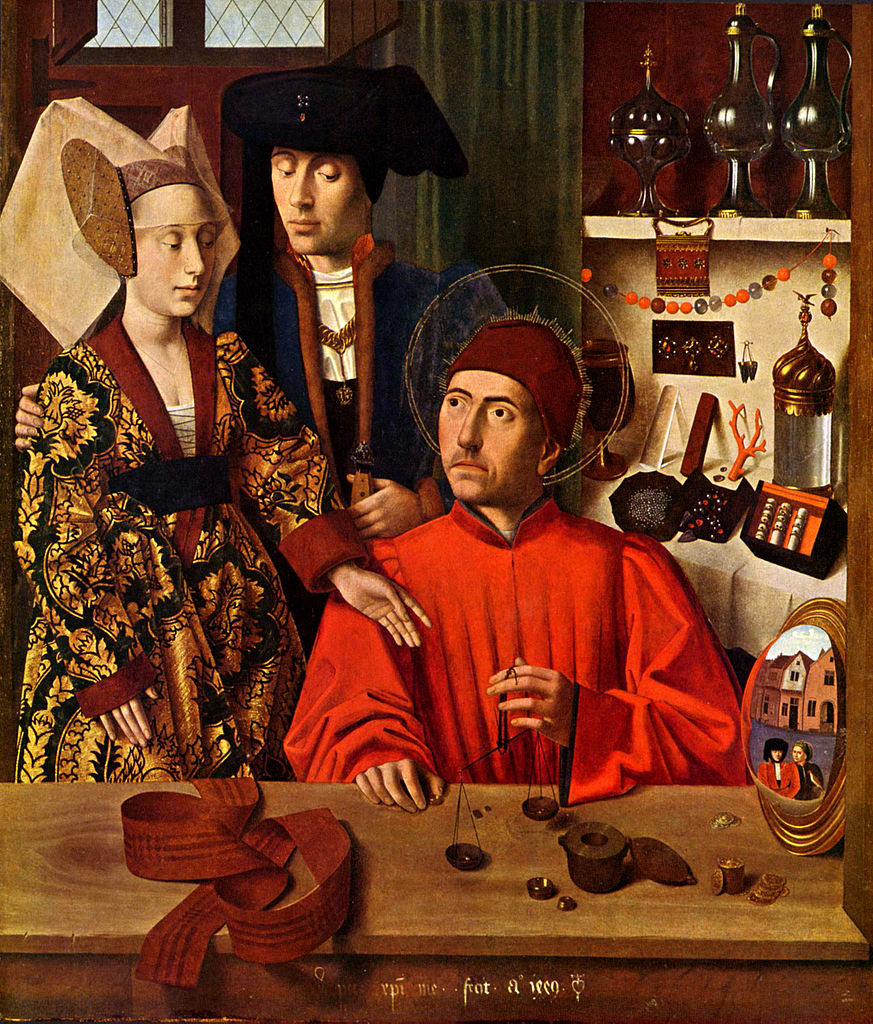
Godeberta was born about the year 640, at Boves, a few leagues from Amiens, in France;. She was very carefully educated, her parents being of noble rank and attched to the Court of King Clovis II. When the question of her marriage was being discussed in the presence of the King, the saintly Bishop of Noyon, St Eligius, as if by inspiration, presented Godeberta with a golden ring and expressed the hope that she might devote her life to the service of God. Godeberta, moved by the Holy Spirit and feeling her heart suddenly filled with Divine love, turned away from the bright prospects before her and refused the advantageous offers which had been made by her noble suitors. She declared her willingness to be the spouse of Christ and asked the holy prelate to allow her to assume the veil.
The Legend of Saint Eligius and Saint Godeberta, by Petrus Christus.
In a short time all opposition to her wishes disappeared and she entered on her new life under the guidance of St Eligius. The King of the Franks was so impressed by her conduct and her zeal that he made her a present of the small palace which he had at Noyon, together with a little Chapel dedicated to St George. Godeberta’s example inspired a number of young women to follow in the same path and she founded in her new home, a Convent, of which she became the Abbess
Here she passed the remainder of her life in prayer and solitude, save when the call of charity or religion, brought her forth among the people, many of whom were still sunk in the vices of paganism. She was remarkable ,in particular, for the constant penances and fasts, to which she subjected herself. She had a wonderful faith in the efficacy of that ancient practice of the early Christians–the Sign of the Cross and, it is recorded, that on one occasion, in 676, during the Episcopacy of St Mommelinus, when the town was threatened with total destruction by fire, she made the Sign of the Cross over the flames,and the conflagration was forthwith extinguished.
The exact year of her death is unknown but it is said to have occurred on 11 June, on which day her feast is marked in the Proprium of Beauvais. In Noyon, however, by virtue of an indult, dated 2 April, 1857, it is kept on the fifth Sunday after Easter, the feast of 11 April appears to stem from the belief that this was the date of the translation of her Relics. The body of the Saint was interred in the Church of St George, which was afterwards called by her name.
In 1168 Godeberta’s body was solemnly translated from the ruined Church where it had rested for over 450 years, by Bishop Baudoin to the Cathedral of Noyon. Providentially her relics have escaped the ravages of time and fire and the malice of the irreligious. At the period of the Revolution a pious townsman secretly buried them near the Cathedral. When the storm had passed they were recovered from their hiding place and their authenticity, being canonically established, they were replaced in the Church.
A bell is still preserved which tradition avers, to have been the one actually used by Godeberta in her Convent. It is certainly very ancient and there seems no good reason, in particular from an archaeological point of view, for doubting the trustworthiness of the legend. In the treasury of the Cathedral, likewise may be seen a gold ring, said to have been that presented by St Eligius to the Saint. Mention is made in a record of the year 1167 of this Relic having been then in the possession of the Church of Noyon.
Unfortunately the most ancient documents we have giving details of Godeberta’s life do not, in all probability, date beyond the Eleventh Century, as the oldest “Vita” which, in truth, is rather a panegyric for her feast than a biography, is believed to have been composed by Radbodus, who became Bishop of Noyon in 1067. In those days, too, the aim of such writers was the edification rather than the instruction of the faithful, so we find in this life, the usual wonders related in such pious works of that period with but few historic facts. It is certain, however, that St. Godeberta was looked upon as a protector in the time of plagues and catastrophes and we have every reason to hold that this practice was justified by the results that followed her solemn invocation.
In 1866 a violent outbreak of typhoid fever occurred in Noyon, decimating the Town. On 23 May in that year, one of the leading citizens, whose child had just been stricken down, approached the cure of the Church and recalling the favours that had been granted in ages past to the clients of the Saint, earnestly asked that the Shrine containing her Relics should be exposed and a Novena of intercession begun. This was done the following day,and forthwith, the scourge ceased; it was officially certified that not another case of typhoid occurred. In thanksgiving a solemn procession took place under the guidance of the Bishop, Mgr Gignoux, a few weeks later, the Relics of St Godeberta being carried triumphantly through the town. A beautiful statue of the saint, the cathedral of Noyon, which was blessed by the Bishop on 25 February, 1867, perpetuated the memory of this wonderful event.
St Domnio of Salona Bl Elena Guerra St Eustorgius of Nicomedia Bl George Gervase St Godeberta (c640-c700) Abbess
St Guthlac of Crowland (674–715) Monk, Hermit, Ascetic. St Guthlac was from Lincolnshire in England. He is particularly venerated in the Fens of eastern England where many Churches are dedicated to him. His sister is venerated as Saint Pega, an anchoress. His body was incorrupt until its destruction in the 16th century by the dissolution of the Monasteries by Henry VIII. Biography: https://anastpaul.com/2019/04/11/saint-of-the-day-11-april-st-guthlac-674-715/
St Hildebrand of Saint-Gilles St Isaac of Monteluco Bl James of Africa Bl John of Cupramontana Bl Lanunio St Machai St Maedhog of Clonmore Bl Mechthild of Lappion Bl Paul of Africa St Philip of Gortyna St Raynerius Inclusus St Sancha of Portugal St Stephen of Saint-Gilles
Saint of the Day – 10 April – St Bademus (Died 376) Confessor, Abbot and Martyr, Founder of a Monastery. Bademus died on 10 April 376 by being stabbed countless times and finally beheaded by a wavering and frightened executioner. Also known as – Bademo, Vadim.
Bademus was a rich and noble citizen of Bethlapeta in Persia, who sold his possessions to follow Christ, then gave the greater part of the proceeds to the poor. He reserved just enough to found a Monastery near that City, to which he retired with several others and then governed it with great sanctity. He conducted his religious in the paths of perfection with sweetness, prudence and charity.
To crown his virtue, God permitted him, with seven of his Monks, to be apprehended by the followers of King Sapor in the thirty-sixth year of that King’s persecution. He lay for four months in a dungeon, loaded with chains and during this lingering martyrdom, received everyday, a cruel flagellation. But he triumphed over his torments by the patience and joy with which he suffered them for Christ.
At the same time, a Prince named Nersan, who was a Christian, was cast into prison and his goods confiscated because he refused to adore the sun. At first he seemed resolute but, at the sight of tortures,his constancy failed him and he promised to conform if he could be delivered. The King, to test whether his change was sincere, ordered Bademus to be brought where Nersan was kept in the royal palace and sent word to Nersan that if he would slay the Abbot, he would be restored to his liberty and former dignities. The apostate accepted the condition; a sword was put into his hand and he advanced to plunge it into the breast of the Abbot. But being seized with a sudden terror, he stopped short and remained for some time unable to lift up his arm to strike – he had neither courage to repent, nor heart to accomplish his crime.
Finally, he hardened himself and continued with a trembling hand to aim at the Martyr’s sides. Fear, shame, remorse and respect made his strokes forceless and unsteady and so great was the number of his victim’s wounds that the bystanders were in admiration at his invincible patience. Saint Bademus reproached his executioner, saying, “What will you do on the day when you will have to render an account of your actions and hear the sentence of your condemnation? I offer myself willingly to die for the glory of my Lord Jesus Christ but I would prefer to die by another hand, than yours!” The pagans themselves were horrified at the cruelty of the King, the long Martyrdom and the perfidious acts of the apostate.
Saint Bademus suffered on the 10th of April in the year 376. His body was cast out of the City but secretly carried away and interred by the Christians. A short time afterwards Nersan fell into public disgrace and perished by the sword – other accounts say that he committed suicide. . The disciples of the Saint were released from their chains four years later, at the death of King Sapor.


























 AnaStpaul
You must be logged in to post a comment.