Our Morning Offering – 27 January – The Memorial of St John Chrysostom (347-407) Father and Doctor of the Church, Bishop, Confessor.
Hail, O Mother! By St John Chrysostom (347-407) Father and Doctor of the Church
Hail, O Mother! Virgin, heaven, throne, glory of our Church, it’s foundation and ornament. Earnestly pray for us to Jesus, your Son and Our Lord, that through your intercession, we may have mercy on the day of judgement. Pray that we may receive, all those good things which are reserved for those who love God. Through the grace and favour of Our Lord, Jesus Christ, to Whom, with the Father and the Holy Spirit, be power, honour and glory, now and forever. Amen
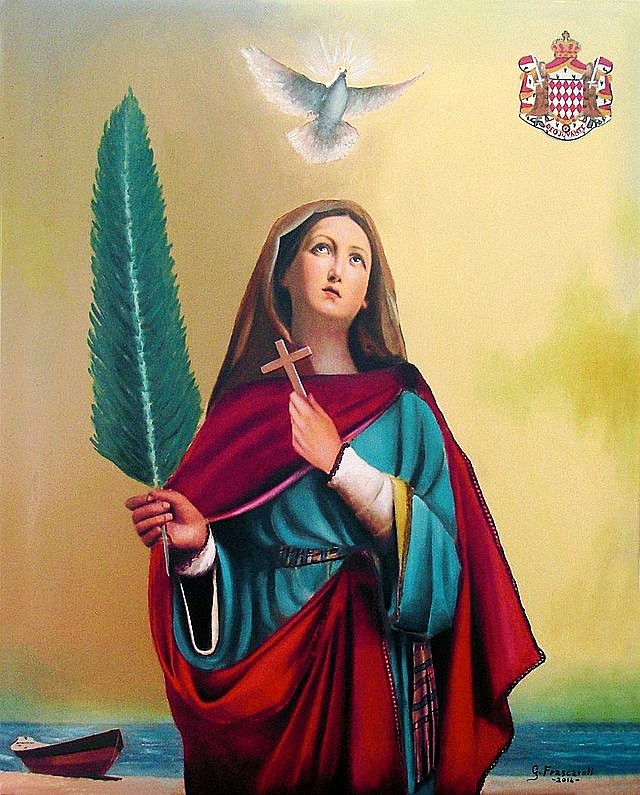
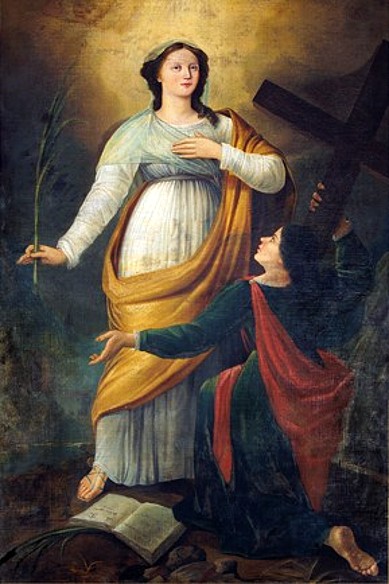
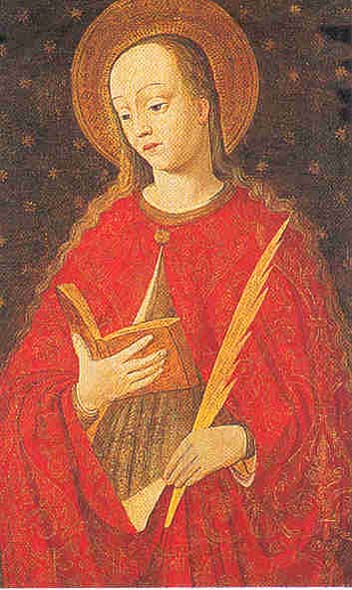
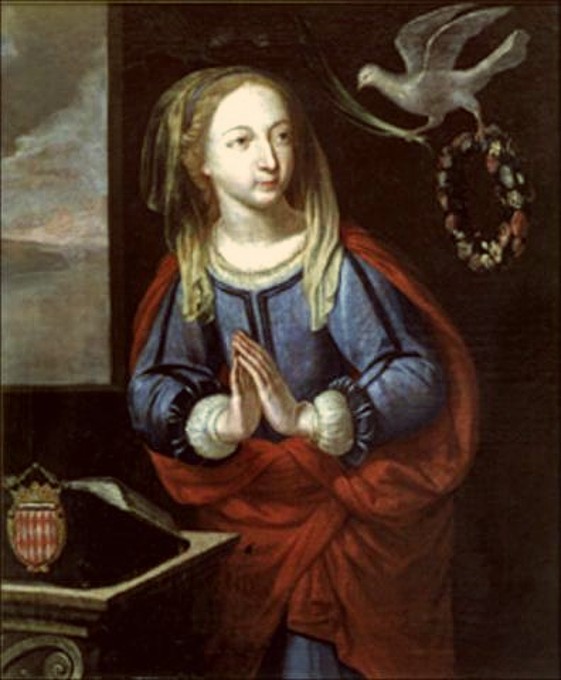
Saint of the Day – 27 January – St Devota (Died c 303) Virgin Martyr,. Born at Mariana, Corsica, France and died by being tortured to death on the rack in c 303. Patronages – Monica, Corsica, House of Grimaldi, Mariana, Corsica; mariners. Also known as – Dévote, … of Corsica, … of Monaco.
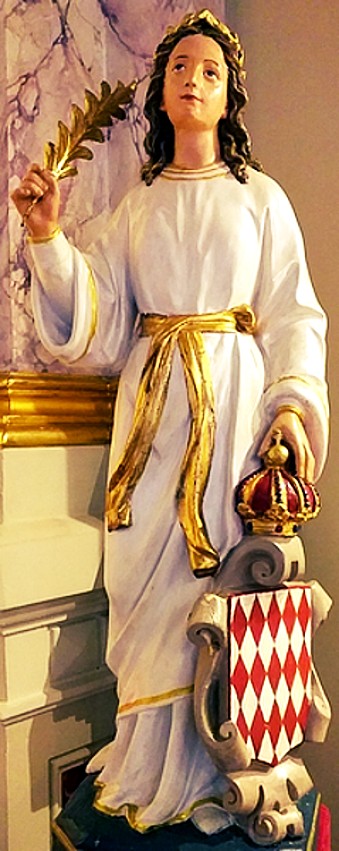
Part of the St DevotaAltarpiece at the St Nicholas Cathedral, Monaco
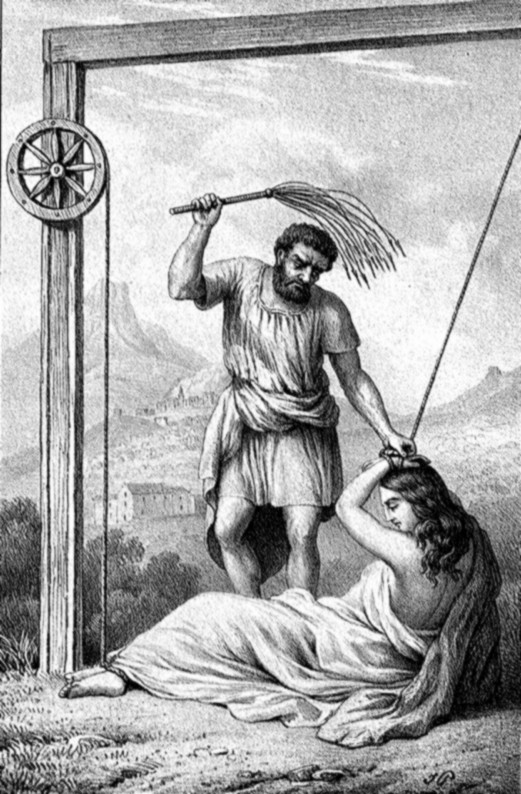
Devota was a Corsican woman born at Mariana, Corsica. A young virgin, she had decided to devote herself fully to the service of God. Devota was part the household of Senator Eutychius of the imperial Roman administration.. During the Diocletian persecution, the Prefect Barbarus, arrived in Corsica with a fleet and when he learned that the Senator was harbouring a Christian in his house, demanded that she be given up and compelled to perform the requisite sacrifice to the imperial cult. Senator Eutychius refused, and not wishing to confront him directly, Barbarus arranged to have him poisoned. Devota was imprisoned and tortured for her faith. Her mouth was crushed, and her body was dragged through rocks and brambles. She was Martyred at Mariana by being racked to death.
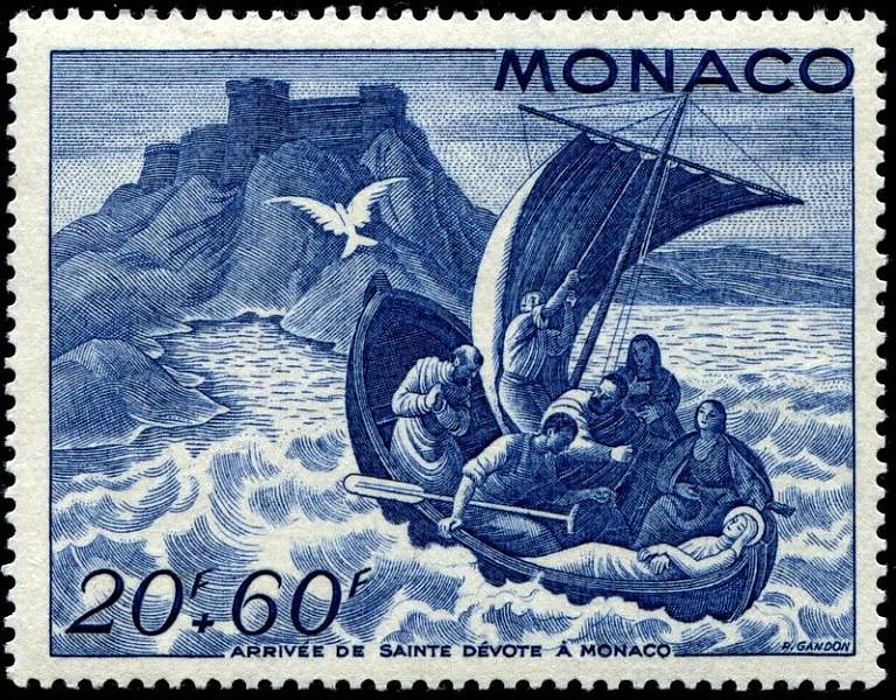
After her death, the Governor of the Province ordered her body to be burnt to prevent its veneration. However, it was saved from the flames by Christians. Her body was placed on a boat bound for Africa. Gratianus the boat’s pilot; Benenato, a Priest and Apollinaris, his Deacon believed it would receive proper Christian burial there. However, a storm overtook the boat. A dove appeared and guided the boat to present-day Les Gaumates, part of the Principality of Monaco, where a Chapel dedicated to Saint George stood.
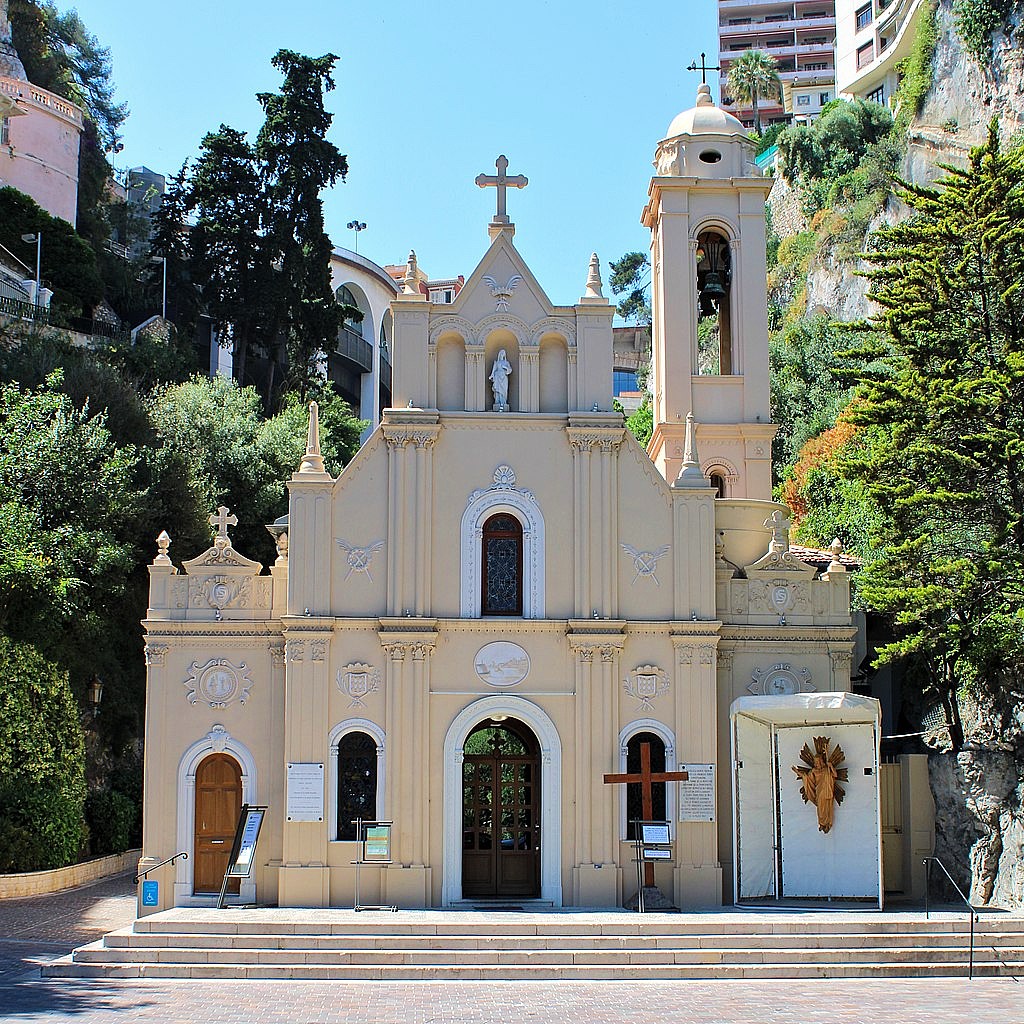
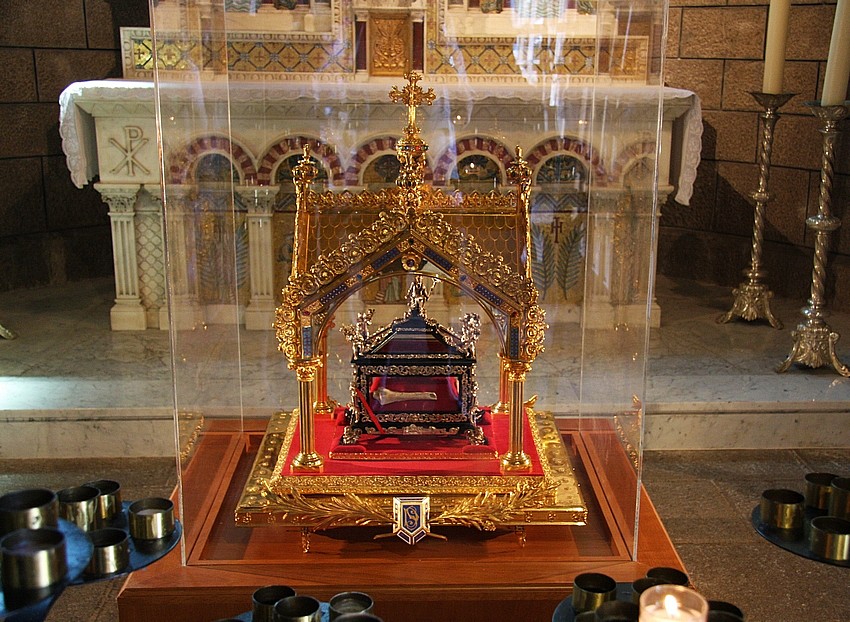
In her honour, a new Chapel was built, which stands in Monaco still where flowers bloom, on her Feast Day today, which is still in the throes of winter in Monaco and therefore, before their season. Reports of numerous miracles soon occurred at St Devota’s tomb. During incursions by Moors, Devota’s relics were translated to safety at the Monastery of Cimiez and were returned to Monaco, to her Church restored much later, by Antonio I, Prince of Monaco.
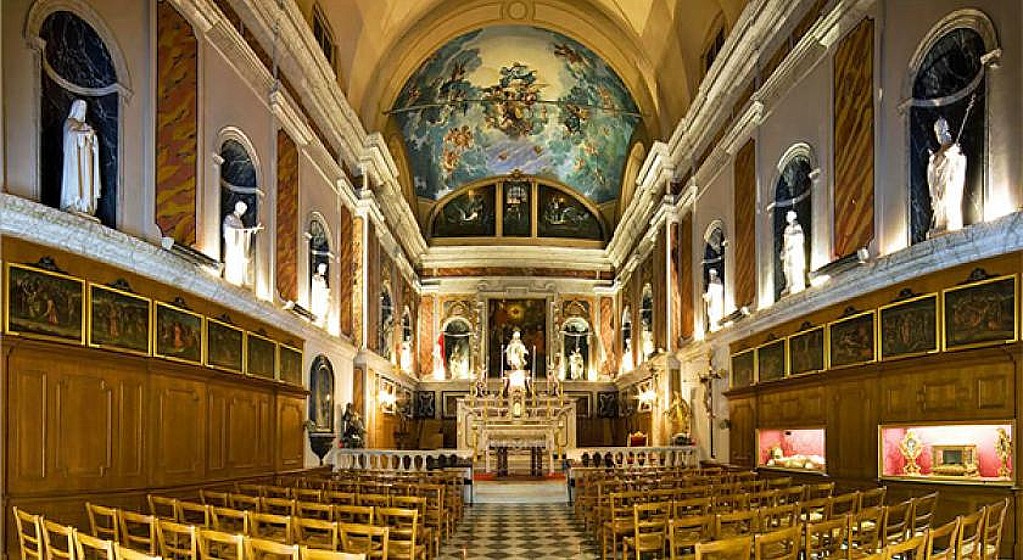
The Sainte-Dévote Chapel is first mentioned about 1070, belonging to the Abbey of Saint Pons. The Chapel was rebuilt and expanded several times. It became a Priory in the 13th century and in 1536 was acquired by Honoré I, Lord of Monaco. The Chapel became the Parish Church in 1887.
The “Legend of Saint Devota” is one of the Principality of Monaco’s oldest traditions – it has influenced national culture engendering a deep devotion to the Faith and to St Devota as well as influencing many areas of national life. in fields as diverse as history, literature, the arts, painting, music, coins and stamps. This legend, passed on through a medieval document, holds a special place in the heart of the Monégasque and over the centuries, has been awarded a permanent place in the Country’s history.
In 1070, Antinope, the Captain of a Florentine ship, attempted to steal the reliquary containing Devota’s relics. The legend states that a violent wind impeded him from escaping with the relics. Arrested, Ugo Grimaldi ordered his ears and nose to be cut off. Antinope’s boat was then burnt on the beach of Monaco.
In the 16th century, Devota was invoked for protection against the Genoese and the Pisans. Their ultimate failure to take away the independence of Monaco was attributed to the divine protection of Devota. In 1631, the cessation of an outbreak of the Plague was also due to St Devota’s intercession, as well as, the expulsion of the Spanish on the night of 17 November 1641 – a galley taken from the Spanish was renamed “Devota.” Monégasque coins bearing the effigy of Devota were issued in the 16th century, beginning in the reign of Honoré II, Prince of Monaco. During his reign, Devota became the Patroness of Monaco.
A series of postage stamps bearing Devota’s likeness were issued in 1944 and again in 1992.
St Devota has her very own corner on the famous Circuit de Monaco, where the most famous motor race in the world is held. Situated at the very first turn of the Grand Prix track is none other than the location of the Patron Saint’s Chapel. The celebrated Sanctuary is sadly often missed during the races, as the beautiful creme structure is usually covered by crash barriers and signage.
Joseph Méry put the legend of Saint Devota into verse. The first book written in Monegasque language by the Monegasque Poet, Louis Notari, is entitled A legenda de Santa Devota. It was composed in 1927 and is important because, until then, the Monégasque language, had been utilized only in speech.
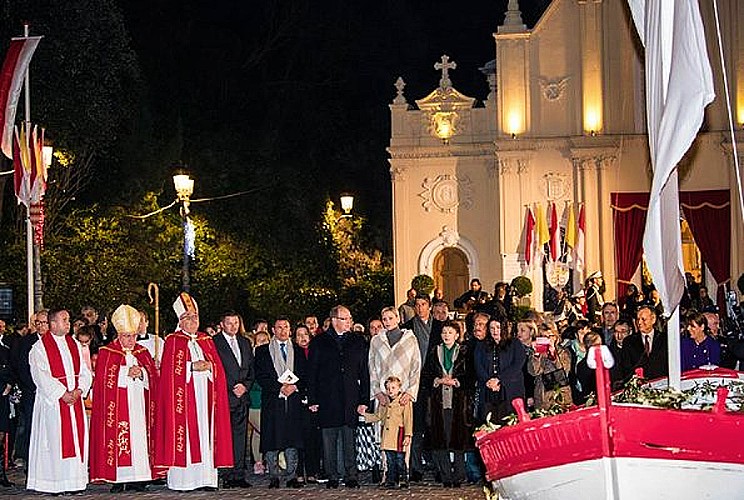
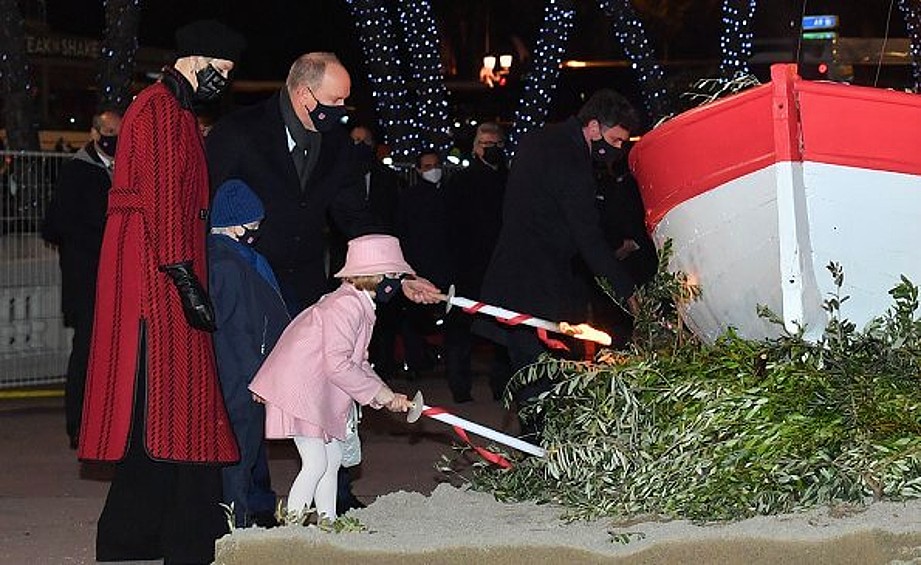
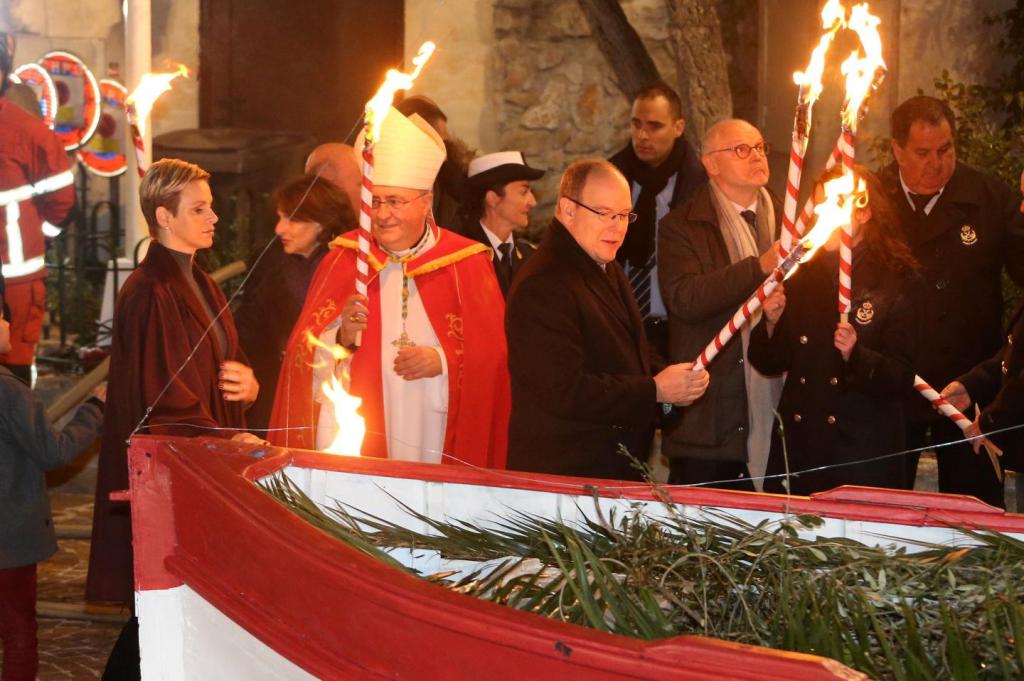
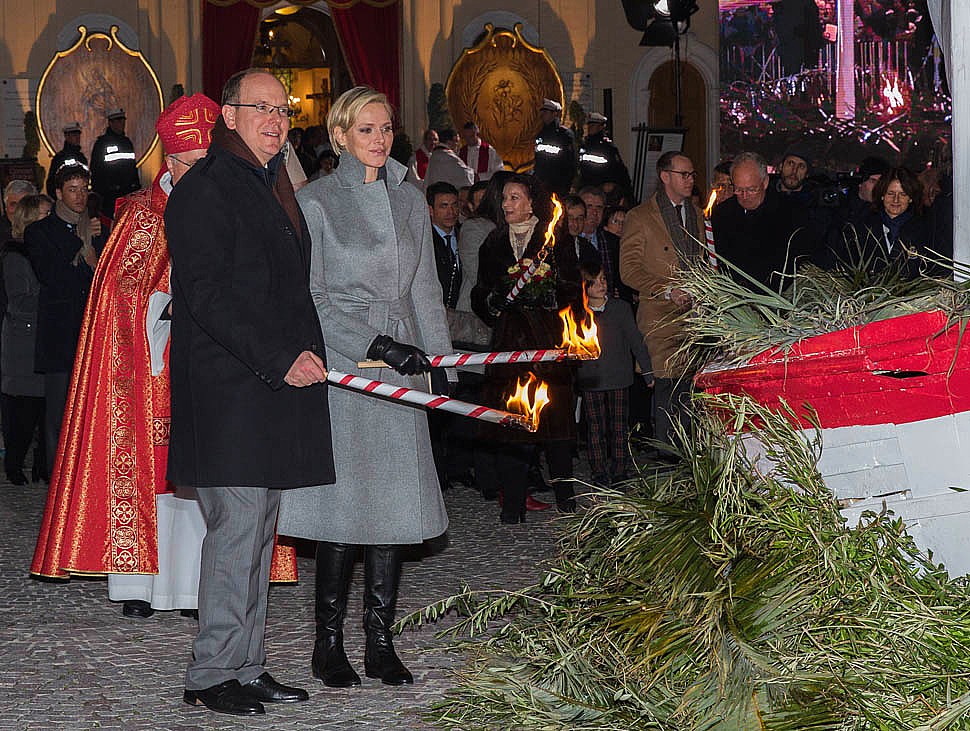
Her cult became important to Monaco and the Grimaldis. Since 1874 it has been the custom that on the evening before her feast day a symbolic fishing boat is brought in procession into Port-Hercule and set alight outside the Église Sainte Dévote. This is followed by a fireworks display that lights up Port-Hercule.
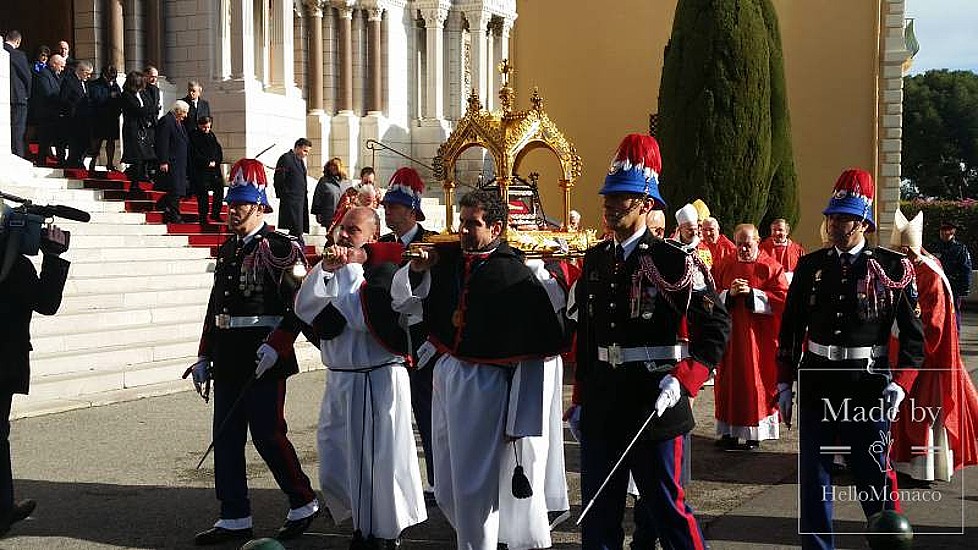
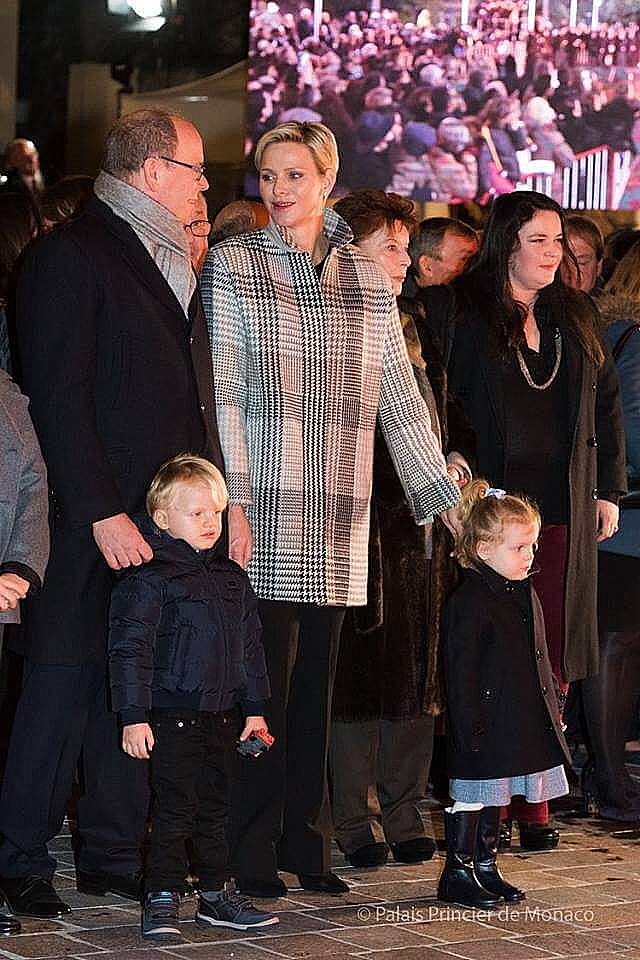
On 27 January Mass is celebrated in the Cathedral of Our Lady of the Immaculate Conception attended by Prince Albert II and Princess Charlene and their children. It is followed by a Solemn Procession of the Relics, to request protection for the Royal Family and the Principality. A Reception in the Monte Carlo Opera House also take place. Albert II, Prince of Monaco, together with Princess Charlene, participate in this ceremony.
In 2014 the Monegasque Rugby Federation, in association with the Princess Charlene of Monaco Foundation, organised the Saint Devota Rugby Challenge. Including teams from Spain and Italy, the free program includes educational workshops and circuits for disabled children, to introduce them to the game.
Most of you know that I am a South African and we, here at home, are all very proud of the South African Princess of Monaco, Charlene!
St John Chrysostom (347-407) Father and Doctor of the Church – “Golden Mouthed,” Preacher, Orator, Writer, Theologian, Confessor. Name Meaning – God is gracious; gift of God (John), golden-mouthed (Chrysostom). Biography: https://anastpaul.com/2017/09/13/saint-of-the-day-13-september-st-john-chrysostom-347-407-father-and-doctor-of-the-church-golden-mouthed/ AND: https://anastpaul.com/2018/09/13/saint-of-the-day-13-september-st-john-chrysostom-347-407-father-and-doctor-of-the-church-golden-mouthed-2/ His Feast Day is today (changed in 1969 to 13 September). The Roman Martyrology states of him today: “At Constantinople, St John, Bishop, who was surnamed Chrysostom on account of his golden flow of eloquence. He greatly promoted the interests of the Christian religion by his preaching and exemplary life and, after many toils, closed his life in banishment. His sacred body was brought to Constantinople on this day in the reign of Theodosius the younger and afterwards taken to Rome and placed in the Basilica of the Prince of the Apostles. This illustrious Preacher of the Word of God, Pope Pius X declared and appointed as the Heavenly Patron of Sacred Orators.”
Bl Antonio Mascaró Colomina St Avitus St Candida of Bañoles St Carolina Santocanale St Devota of Corsica (Died c 303) Virgin Martyr St Domitian of Melitene St Emerius of Bañoles
Blessed Jurgis Matulaitis-Matulewicz/George Matulaitis MIC (1871-1927) Archbishop of Vilnius from late 1918 until his resignation in 1925, Apostolic Nuncio in Lithuania, Founder of the Congregation of the Poor Sisters of the Immaculate Conception of the Blessed Virgin Mary and the Handmaids of Jesus in the Eucharist, Professor, Spiritual Director, Superior-General of the Marian Fathers from 1911 until his death and is known as the “Renovator of The Marians.” His Story: https://anastpaul.com/2020/01/27/saint-of-the-day-27-january-blessed-george-matulaitis-mic-1871-1927/
St Gilduin Bl Gonzalo Diaz di Amarante St Henry de Osso y Cervello St John Maria Muzeyi Bl John of Warneton St Julian of Le Mans St Julian of Sora St Lupus of Châlons
St Marius of Bodon Bl Michael Pini St Natalis of Ulster St Paul Josef Nardini Bl Rosalie du Verdier de la Sorinière St Theodoric of Orléans St Pope Vitalian
Martyrs of North Africa – 30 Saints: A group of 30 Christians martyred together by Arian Vandals. The only details to have survived are four of their names – Datius, Julian, Reatrus and Vincent. c 500 in North Africa.
Quote/s of the Day – 26 January – The Memorial of St Polycarp (c 69 – c 155) Martyr and Apostolic Father of the Church,
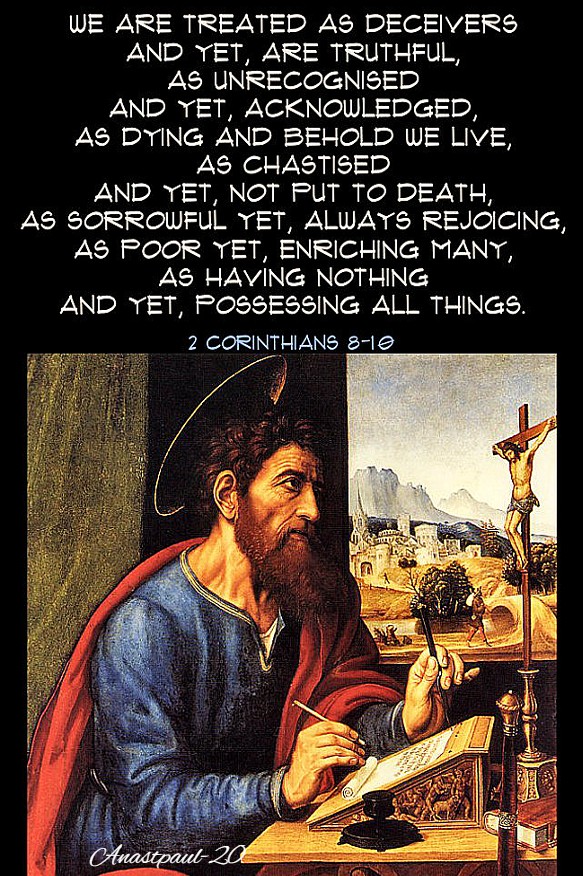
“We are treated as deceivers and yet, are truthful, as unrecognised and yet, acknowledged, as dying and behold we live, as chastised and yet, not put to death, as sorrowful yet, always rejoicing, as poor yet, enriching many, as having nothing and yet, possessing all things.”
2 Corinthians 8-10
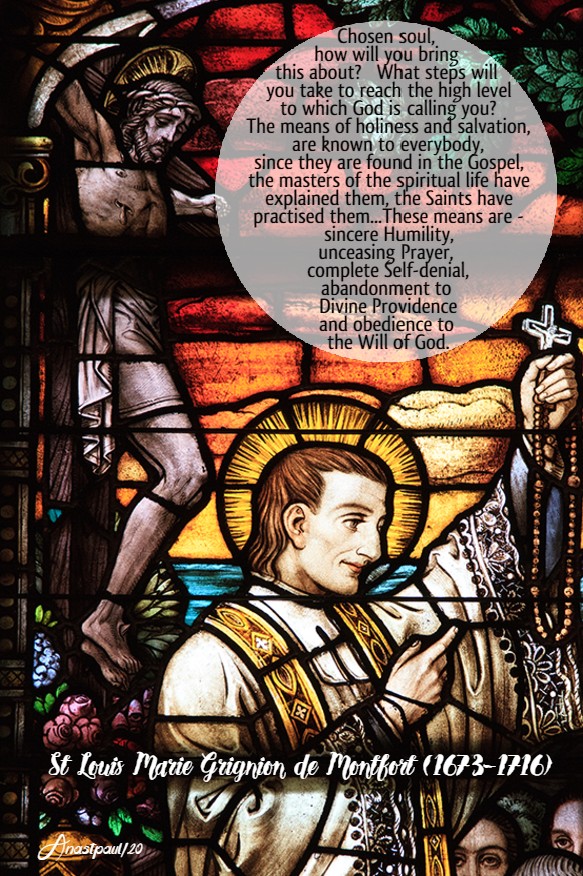
“Chosen soul, how will you bring this about? What steps will you take to reach the high level to which God is calling you? The means of holiness and salvation, are known to everybody, since they are found in the Gospel, the masters of the spiritual life have explained them, the Saints have practised them… These means are – sincere Humility, unceasing Prayer, complete Self-denial, abandonment to Divine Providence and obedience to the Will of God.”
St Louis Marie Grignion de Montfort (1673-1716)
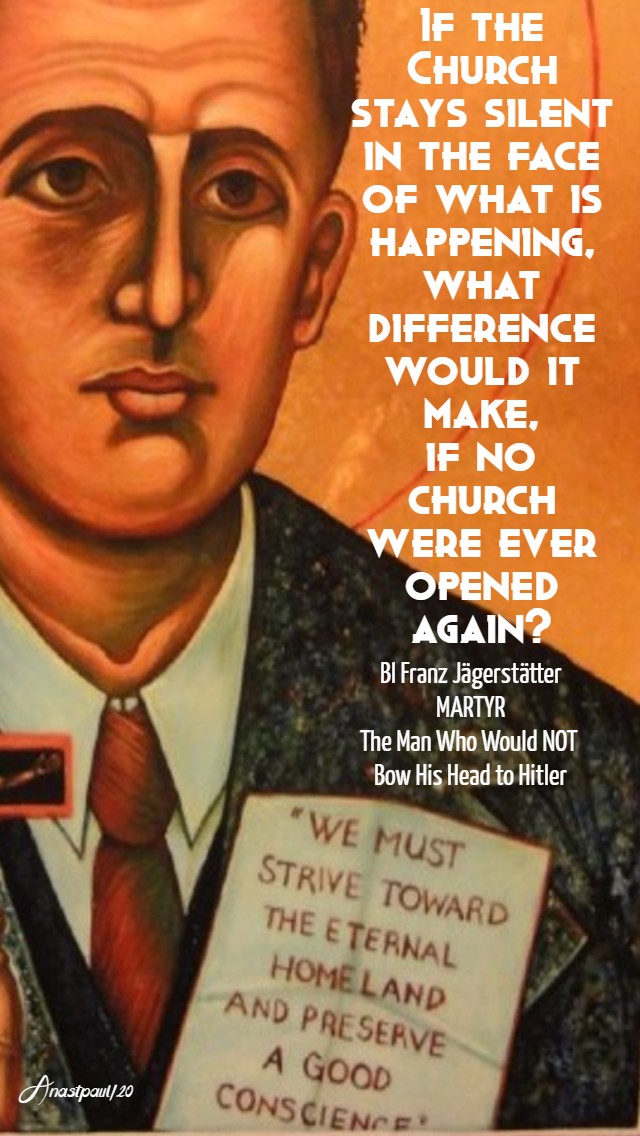
“If the Church stays silent in the face of what is happening, what difference would it make, if no church were ever opened again?”
“We are not dealing with a small matter but the great (apocalyptic) life and death struggle has already begun. Yet in the midst of it, there are many, who still go on living their lives as though nothing had changed … “
One Minute Reflection – 26 January – The Memorial of St Polycarp (c 69 – c 155) Martyr and Apostolic Father of the Church, 1 John 3:10-16; Matthew 10:26-32
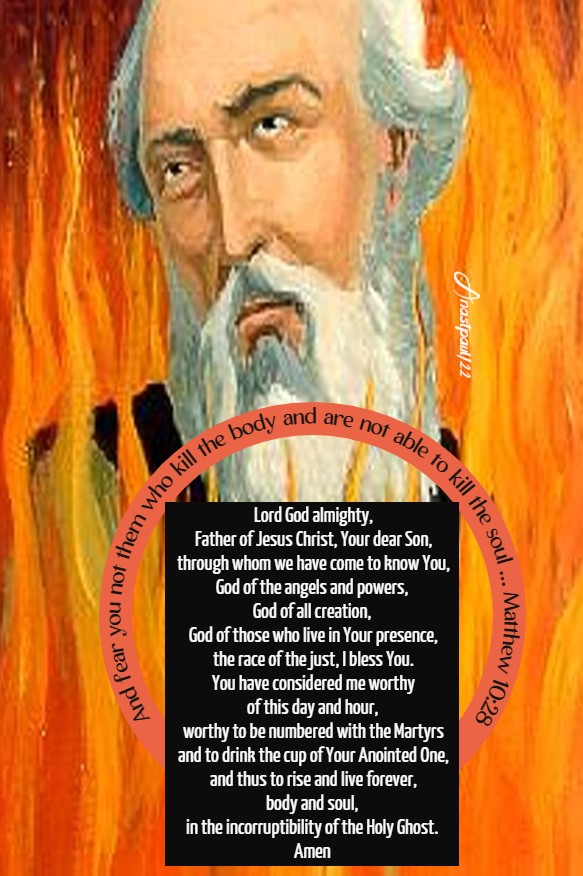
“And fear you not them who kill the body and are not able to kill the soul …” – Matthew 10:28
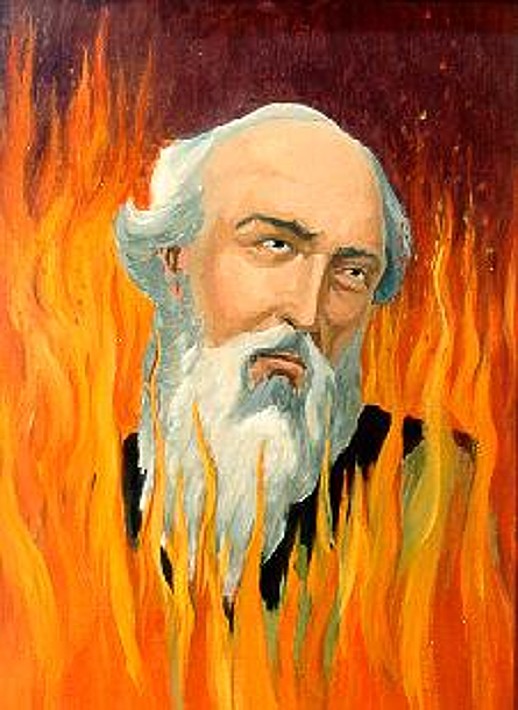
REFLECTION – “They did not nail Polycarp but only tied him up. And so, he was bound, putting his arms behind his back, like a noble ram taken from a large flock for sacrifice, a burnt offering acceptable to and made ready for God. Then he gazed up to Heaven and said: “O Lord God Almighty, Father of Your beloved and blessed Son Jesus Christ, through Whom we have received knowledge of You, God of the angels and the powers and of all creation, God of the whole race of the righteous who live in Your sight: I bless You, for You have thought me worthy of this day and hour, to share the cup of Your Christ, as one of Your Martyrs, to rise again to eternal life in body and soul in the immortality of the Holy Ghost. May I be taken up today into Your Presence among Your Martyrs, as a rich and acceptable sacrifice, in the manner You have prepared and have revealed and have now brought to fulfillment, for You are the God of truth… And so also I praise You for all things; I bless and glorify you through our Eternal High Priest in Heaven (Heb 4,14), in Your beloved Child, Jesus Christ, through Whom be glory to You and to Him and to the Holy Ghost, now and for the ages to come. Amen.” – Letter of the Church of Smyrna concerning the Martyrdom of Saint Polycarp (69-155)
PRAYER – Lord of all creation, You gave St Polycarp, a place in the company of the Martyrs. Grant that, through his intercession, we may, like him, drink from that cup which Christ drank and so rise to eternal life. Through Christ our Lord, in unity with the Holy Spirit, one God forever, amen.
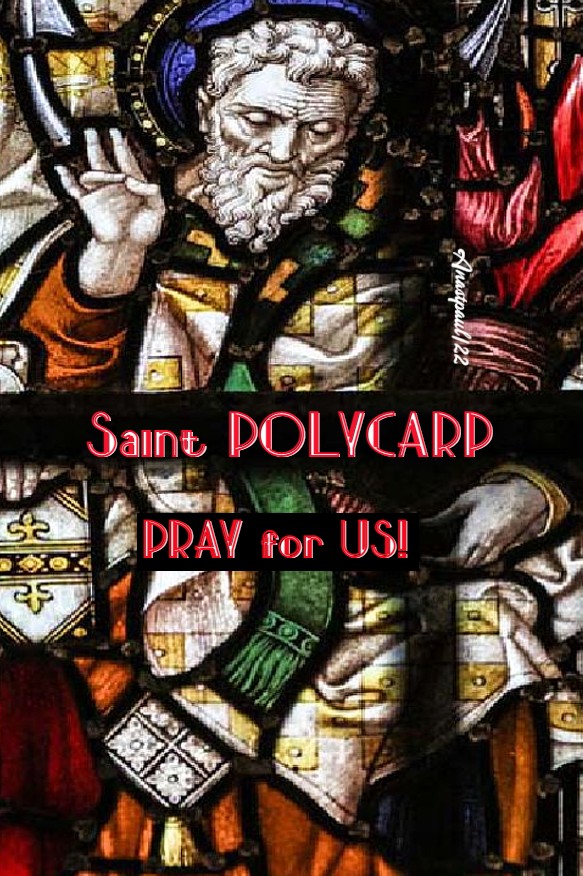
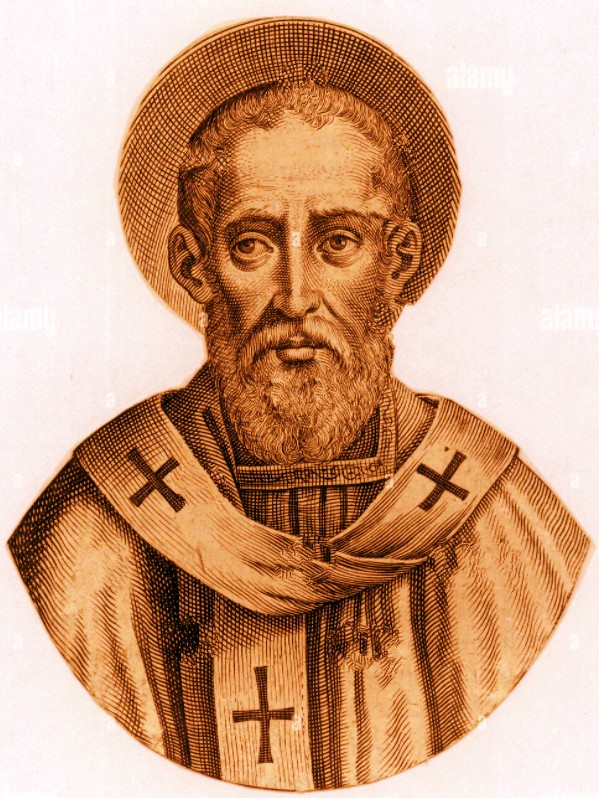
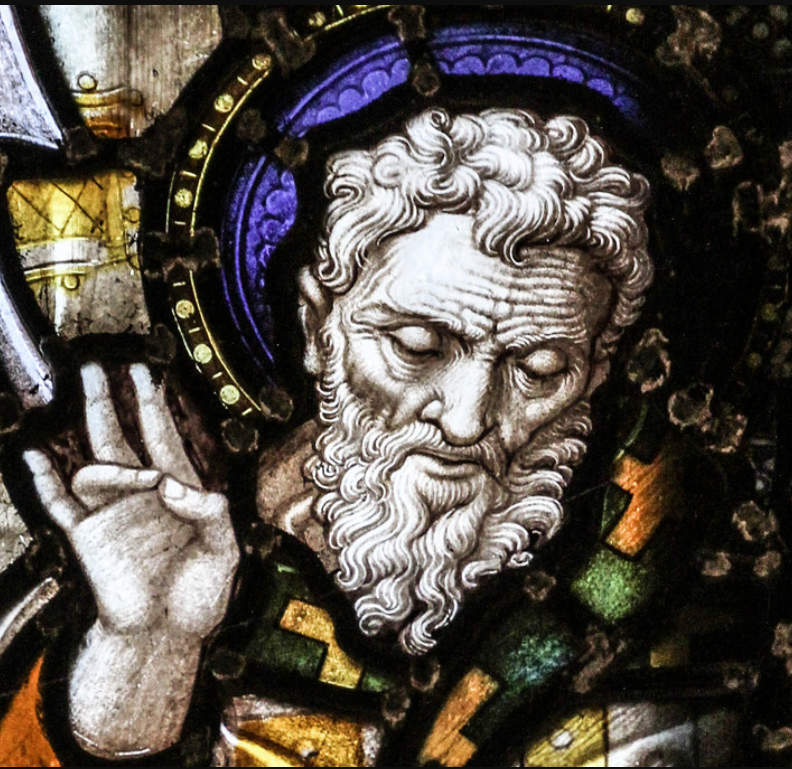
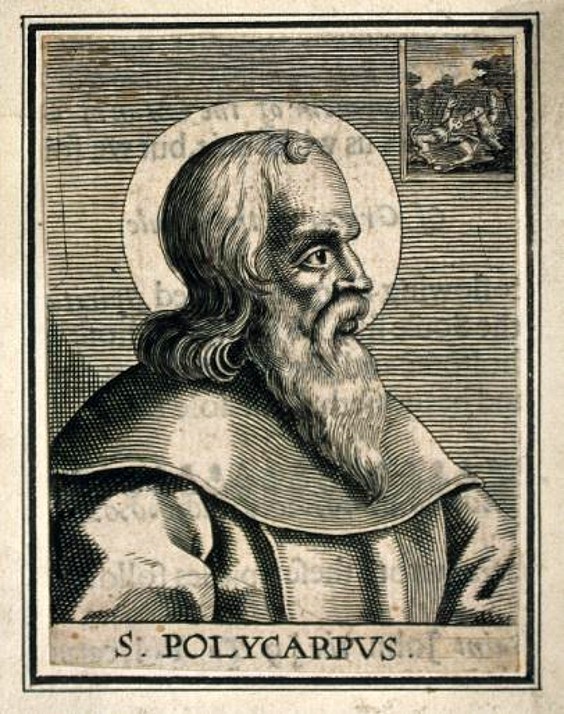
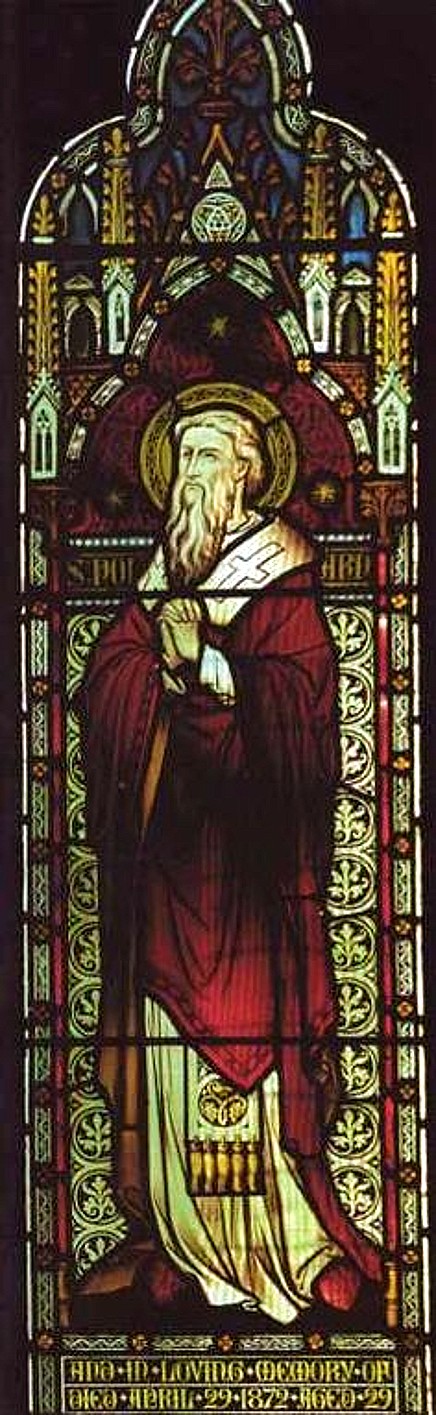
Saint of the Day – 26 January – Saint Polycarp (69-155) Bishop of Smyrna (Asia Minor), Martyr, Apostolic Church Father. Polycarp was a disciple of Saint John the Apostle Consecrated by St John, as the Bishop of Smyrna. Polycarp is regarded as one of three chief Apostolic Fathers, along with Saint Clement of Rome and Saint Ignatius of Antioch.
The Roman Martyrology reads today: “At Smyrna, the birthday of St Polycarp, a disciple of the Apostle, the beloved St John, who Consecrated him Bishop of that City and Primate of all Asia. Afterwards under Marcus Antoninus and Lucius Aurelius Commodus, whilst the Proconsul was sitting in judgement and all the people in the amphitheatre were clamouring against him, he was condemned to the flames. But, as he received no injury from them, he was transpierced with a sword and thus received the Crown of Martyrdom.”
Amidst the sweetness he is enjoying from the contemplation of the Word made Flesh, St John, the Beloved Disciple beholds, coming towards him his dear Polycarp, the Angel of the Church of Smyrna (Apoc. 2: 8), all resplendent with the glory of Martyrdom (he is the only bishop mentioned in the Apocalypse without any reproach). This venerable Saint was a disciple of St John the Evangelist, whom he imitated by zealously opposing the heretics, who were then striving to corrupt the Faith. In obedience to the command of his holy Master (2 John, 1: 10), he refused to have anything to do with Marcion, the heresiarch, whom he called the first-born of Satan. This energetic adversary of the proud sect that denied the mystery of the Incarnation, wrote an admirable Epistle to the Philippians, in which we find these words: “Whosoever confesses not, that Jesus Christ came in the flesh, is an Antichrist.” St Polycarp, then, had a right to the honour of standing near the Crib, in which the Son of God shows Himself to us in all His loveliness and clothed in flesh like unto our own. Let us honour this disciple of St John, this friend of St Ignatius of Antioch, this Bishop of the Apostolic Age, whose praise was pronounced by Jesus Christ Himself in the Revelations of Patmos. Our Saviour said to him by the mouth of St John: “Be thou faithful unto death and I will give thee the crown of life” (Apoc. 2: 10). St Polycarp was faithful unto death, and has received his crown.
In the sixth year of Marcus Aurelius and Lucius Verus, Statius Quadratus being proconsul of Asia, a violent persecution broke out in that country, in which the faithful gave heroic proofs of their courage and love of God, to the astonishment of the infidels. When they were torn to pieces with scourges till their very bowels were laid bare, amidst the moans and tears of the spectators, who were moved with pity at the sight of their torments, not one of them gave so much as a single groan: so little regard had they for their own flesh in the cause of God. No kind of torture, no inventions of cruelty, were forborne to force them to a conformity to the pagan worship of the times. The authors of these Acts observe, that the Martyrs, by their patience and constancy, demonstrated to all men, that, while their bodies were tormented, they were in spirit estranged from the flesh and already in Heaven; or rather, that Our Lord was present with them and assisted them; for the fire of the barbarous executioners seems, as if it had been a cooling refreshment to them.
On one occasion, seeing the courage of one Germanicus and his companions and being fond of their impious bloody diversions, the spectators cried out: “Away with the impious; let Polycarp be sought for.” The holy man, though fearless, had been prevailed upon by his friends to withdraw and conceal himself in a neighbouring village during the persecution, spending most of his time in prayer. Three days before his Martyrdom, he, in a vision, saw his pillow on fire – from which he understood by revelation and foretold to his companions, that he should be burned alive. When the persecutors were in quest of him, he changed his hiding-place but was betrayed by a boy, who was threatened with the rack unless he disclosed him. Herod the Irenarch, or keeper of the peace, whose office it was to prevent misdemeanours and apprehend malefactors, sent horsemen by night to beset his lodgings. The Saint was upstairs in bed but refused to make his escape, saying, “God’s will be done.” He went down, met them at the door, ordered them a good supper and desired only some time for prayer before he went with them. This granted, he began his prayer standing, which he continued in that posture for two hours, recommending to God his own flock and the whole Church with so much earnestness and devotion, that several of those who were come to seize him, repented they had undertaken the commission.
They set him on an ass,and were conducting him towards the City, when he was met on the road by Herod and his father Nicetes, who took him into their chariot and endeavoured to persuade him to a little compliance, saying: “What harm is there in saying ‘Lord Caesar,’ or even in sacrificing, to escape death?” By the word ‘Lord’ was meant nothing less than a kind of deity or godhead. The Bishop at first was silent, in imitation of our Saviour but being pressed, he gave them this resolute answer: “ I shall never do what you desire of me.” At these words, taking off the mask of friendship and compassion, they treated him with scorn and reproaches and thrust him out of the chariot with such violence, that his leg was bruised by the fall.
The holy man went cheerfully to the place where the people were assembled. Upon his entering it, a voice from Heaven was heard by many, saying: “Polycarp, be courageous and act manfully.” He was led directly to the tribunal of the proconsul, who exhorted him to respect his own age (probably more than 100 years), to swear by the genius of Caesar and to say: “Take away the impious” meaning the Christians. The Saint, turning towards the people, said with a stern countenance: “Exterminate the wicked,” meaning by this expression either a wish that they might cease to be wicked by their conversion to the Faith of Christ; or this was a prediction of the calamity which befell their City in 177, when Smyrna was overturned by an earthquake. The proconsul repeated: “Swear by the genius of Caesar and I will discharge you“ blaspheme Christ! Polycarp replied: “I have served Him these 86 years (probably the time since his Baptism) and He never did me any harm but much good and how can I blaspheme my King and my Saviour? If you require of me to swear by the genius of Caesar, as you call it, hear my free confession – I am a Christian but if you desire to learn the Christian religion, appoint a time and hear me.” The proconsul said: “Persuade the people.” The Martyr replied: “I address my discourse to you; for we are taught to give due honour to princes, as far as is consistent with religion. But the populace is an incompetent judge to justify myself before.” Indeed rage rendered them incapable of hearing him.
The proconsul then assuming a tone of severity, said: “I have wild beasts!” “Call for them, replied the Saint, for we are unalterably resolved not to change from good to evil. It is only good to pass from evil to good.” The proconsul said: “If you contempt the beasts, I will cause you to be burnt to ashes.” Polycarp answered: “You threaten me with a fire, which burns for a short time and then goes out but are yourself ignorant of the judgement to come and of the fire of everlasting torments, which is prepared for the wicked. Why do you delay? Bring against me what you please.” While he said this and many other things, he appeared in a transport of joy and confidence and his countenance shone with a certain heavenly grace and pleasant cheerfulness, insomuch, that the Proconsul himself, was struck with admiration.
However, he ordered a crier to make public proclamation, three times in the middle of the Stadium (as was the Roman custom in capital cases) – Polycarp has confessed himself a Christian! At this proclamation, the whole multitude of Jews and Gentiles gave a great shout, the latter crying out: “This is the great teacher of Asia; the father of the Christians; the destroyer of our gods, who preaches to men not to sacrifice to or adore them.” They applied to Philip the Asiarch (president of the public games) to let loose a lion upon Polycarp. He told them that it was not in his power because those games had been closed. Then they unanimously demanded that he should be burned alive. Their request was no sooner granted but everyone ran with all speed to fetch wood from the baths and shops.
The pile being prepared, Polycarp put off his garments, untied his girdle and began to take off his shoes; an office he had not been accustomed to, the Christians having always striven who should do these things for him, regarding it as a happiness to be permitted even to touch him. The wood and other combustibles were heaped all round him. The executioners would have nailed him to the stake but he said to them: “Suffer me to be as I am. He who gives me grace to undergo this fire, will enable me to stand still without that precaution.” They, therefore, contented themselves with tying his hands behind his back and in this posture, looking up towards Heaven, he prayed: “O Almighty Lord God, Father of Thy beloved and blessed Son Jesus Christ, by Whom we have received the knowledge of Thee, God of Angels, powers and every creature and of all the race of the just that live in Thy presence! I bless Thee for having been pleased in Thy goodness to bring me to this hour, that I may receive my portion in the number of Thy Martyrs and partake of the chalice of Thy Christ, for the resurrection to eternal life, in the incorruptibleness of the Holy Ghost. Amongst whom grant me to be received this day as a pleasing sacrifice, such as one as Thou Thyself hast prepared, that so Thou mayest accomplish what Thou, O true and faithful God, hast foreshown. Wherefore, for all things I praise, bless and glorify Thee, through the eternal High Priest, Jesus Christ Thy beloved Son, with Whom, to Thee and the Holy Ghost be glory now and forever. Amen.”
He had scarcely finished when fire was set to the pile, which increased to a mighty flame. But behold a wonder, say the authors of these Acts, seen by us reserved to attest it to others, the flames forming themselves into an arch, like the sails of a ship swelled with the wind, gently encircled the body of the Martyr, which stood in the middle, resembling not roasted flesh but purified gold or silver, appearing bright through the flames and his body sending forth such a fragrance, that we seemed to smell precious spices. The blind infidels were only exasperated to see, that his body could not be consumed and ordered a spearman to pierce him through, which he did, and such a quantity of blood issued out of his left side as to quench the fire!
The malice of the devil ended not here: he endeavoured to obstruct the relics of the Martyr being carried off by the Christians, for many desired to do it, to show their respect to his body. Therefore, by the suggestion of Satan, Nicetes advised the proconsul not to bestow it on the Christians, lest, said he, abandoning the Crucified Man, they should adore Polycarp. The Jews suggested this, Not knowing, say the authors of the Acts, that we can never forsake Christ, nor adore any other, though we love the Martyrs, as His disciples and imitators, for the great love they bore their King and Master. The centurion, seeing a contest raised by the Jews, placed the body in the middle and burned it to ashes. We afterwards took up the bones, say they, more precious than the richest jewels or gold, and deposited them decently in a place at which may God grant us to assemble with joy, to celebrate the natal day of the Martyr. Thus said these disciples and eye-witnesses. It was at two in the afternoon, which the authors of the Acts call the eighth hour, in the year 155, that St Polycarp received his crown. His tomb is still shown with great veneration at Smyrna in a small Chapel.
The Church gives us a passage from St Jerome’s book, On Ecclesiastical Writers, in which there is contained a short notice of our Holy Martyr:
“Polycarp, a disciple of the Apostle John, who ordained him Bishop of Smyrna, was looked up to by all the Churches of Asia, inasmuch as he had not only known some of the Apostles, and those who had seen Our Lord, but had been trained by them. He went to Rome, during the reign of the Emperor Antoninus Pius, and under the Pontificate of Anicetus, in order to have an answer to certain questions regarding Easter day. Whilst there, he brought back to the Faith several Christians who had been misled by the teaching of Marcion and Valentine. Having on a certain occasion casually met Marcion, who said to him: Dost thou know us? Polycarp replied: Yes, I know thee as the first-born of Satan. Some time after, under the reign of Marcus Antoninus and Lucius Aurelius Commodus, in the fourth persecution after that under Nero, he was cited before the Proconsul of Smyrna, who condemned him to be burnt alive; which sentence was carried into effect in the amphitheater, amidst the clamors of the whole people. He wrote an important Letter to the Philippians, which is still read in the Churches of Asia.
How well didst thou bear out the full meaning of the name, O Polycarp! For thou didst produce many fruits for thy Saviour, during the eighty-six years spent in His service. The numerous souls won over to Christ, the virtues which adorned thy life, and thy life itself, which thou didst present to thy Lord in its full maturity—these were thy fruits. And what happiness was thine to have received instruction from the Disciple that leaned upon Jesus’ Breast! After being separated from him for more than sixty years, thou art united with him on this day of thy Martyrdom and thy venerable master receives thee in a transport of joy. Thou dost adore with him that Divine Babe, Whose simplicity thou hadst imitated during life and Who was the single object of thy love. Ask of Him for us, that we too may be faithful unto death.
By thy prayers, now that thou art enthroned in Heaven, make fruitful the vineyard of the Church, which when on earth thou didst cultivate by thy labours and water with the blood of thy glorious Martyrdom. Re-establish faith and unity in the Churches of Asia, which were founded by thy venerable hand. Hasten, by thy prayers, the destruction of that degrading slavery of Islam, which has kept the East in bondage so long because her once faithful children severed themselves from Rome, by the great schism of Byzantium. Pray for the Church of Lyons, which regards thee as its founder, through the ministry of thy disciple Pothinus and took itself so glorious a share in the apostolate of the Gentiles, by the Work of the Propagation of the Faith.
Watch over the purity of our holy Faith and preserve us from being deceived by false teachers. The error which thou didst combat and which teaches, that all the mysteries of the Incarnation are but empty symbols, has risen up again in these our days. There are Marcions, even now, who would reduce all religion to myths and they find followers. May thy powerful prayers rid the world of this remnant of so impious a doctrine. Thou didst pay homage to the Apostolic Chair, for thou, too, wanted to see Peter and didst journey to Rome, in order to consult its Pontiff on questions regarding the interests of thy Church in Smyrna. Pray for the restoration of this august See, whence are derived the jurisdiction of our Pastors and the authoritative teachings of the Faith. Pray for us, that we may spend the remaining days of this holy Christmas Season in the contemplation and the love of our new-born King. May this love, accompanied with purity of heart, draw down upon us, the merciful blessings of God and at length,, after our course is run, obtain for us the Crown of Life. Amen!” (The Passio of St Polycarp).
St Alphonsus of Astorga St Ansurius of Orense St Athanasius of Sorrento St Conan of Iona Bl Eystein Erlandsön Bl José Gabriel del Rosario Brochero Bl Marie de la Dive veuve du Verdier de la Sorinière Bl Michaël Kozal
St Theofrid of Corbie St Theogenes of Hippo St Tortgith of Barking
Martyred Family of Constantinople: Saint Mary and Saint Xenophon were married and the parents of Saint John and Saint Arcadius. Theirs was a wealthy family of Senatorial rank in 5th century imperial Constantinople, but were known as a Christians who lived simple lives. To give their sons a good education, Xenophon and Mary sent them to university in Beirut, Phoenicia. However, their ship wrecked, there was no communication from them, and the couple assumed, naturally, that the young men had died at sea. In reality, John and Arcadius had survived and decided that instead of continuing to Beirut, they were going to follow a calling to religious life and became monks, eventually living in a monastery in Jerusalem. Years later, Mary and Xenophon made a pilgrimage to Jerusalem – where they encountered their sons. Grateful to have their family re-united and taking it as a sign, Xenophon and Mary gave up their positions in society in Constantinople, and lived the rest of their lives as a monk and anchoress in Jerusalem. A few years later, the entire family was martyred together. They were martyred in 5th century Jerusalem.
Saint of the Day – 25 January – Saint Praejectus (625–676) Bishop of Clermont, Martyr. Although he was considered a Martyr immediately after his death his murder does not seem to have been related to the hatred of the Faith. Born in 625 in Auvergne, France and died by being stabbed to death on 25 January 676 at Volvic, France. Patronage – Randazzo, Sicily. Also known as – Preietto, Preils, Prejectus, Prest, Prie, Priest, Prix, Proietto, Projectus, Pry.
The Roman Martyrology reads: “In Clermont-Ferrand in the Aquitaine region, in France, Saints Preietto, Bishop and Amarino, man of God, both killed by the notables of the City.”
Praejectus was born in the Auvergne to the nobility. He studied under St Genesius of Clermont and was Ordained a Priest and, with the approval of King Childeric II, became the Bishop of Clermont in 666.
As Bishop, Prajejectus in his 10 years as the shepherd, worked zealously founding Monasteries, hospitals and Churches. He worked with Saint Reol of Rheims, Saint Agilbert of Paris, Saint Amarinus of Clermon and Saint Ouen of Rouen to reform and calm the sometimes violent political situation in their Sees.
During the political struggles of the time, Hector, Lord of Marseilles, had been accused of various crimes and at the order of Childeric, had been arrested and executed. Agritius, the man who killed Praejectus, believed that the Bishop had been responsible for Hector’s death. At Volvic, the assassin thus stabbed Praejectus and Amarinus, the Abbot of a Monastery in the area.
An account of Praejectus’ life was written shortly after his death and he was immediately venerated as a Martyr. The author may have been a nun from the Monastery of Chamalières, which had been founded through Praejectus’ efforts and it was presided over by an Abbess who was probably a member of Praejectus’ family.
Most of St Praejectus’ relics are enshrined in Flavigny Abbey, Flavigny-sur-Ozerain, France., where there is also a miraculous fountain at which cures are granted through the intercession of St Praejectus. In 760 his cultus spread to English monastic calendars. The Church at Volvic, where Praejectus was killed, is dedicated to “St Priest” (Projectus) and where some relics reside.
Bl Antoni Swiadek St Apollo of Heliopolis St Artemas of Pozzuoli St Auxentius of Epirus St Bretannion of Tomi St Donatus the Martyr St Dwynwen (Died c 460) Virgin Princess, Nun. St Emilia Fernández Rodríguez de Cortés St Eochod of Galloway St Joel of Pulsano St Juventinus of Antioch Bl Manuel Domingo y Sol St Maximinus of Antioch St Palaemon
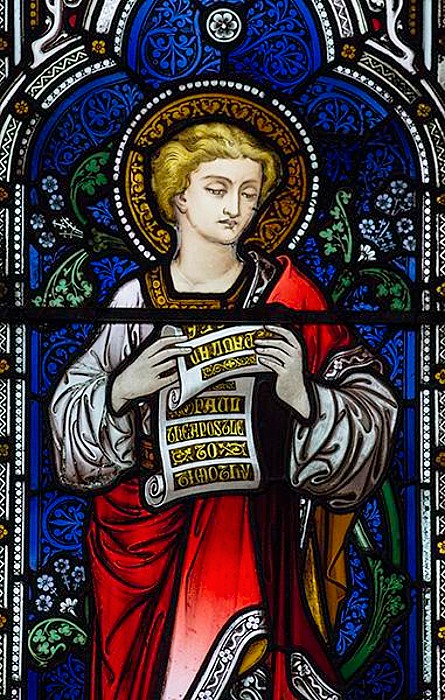
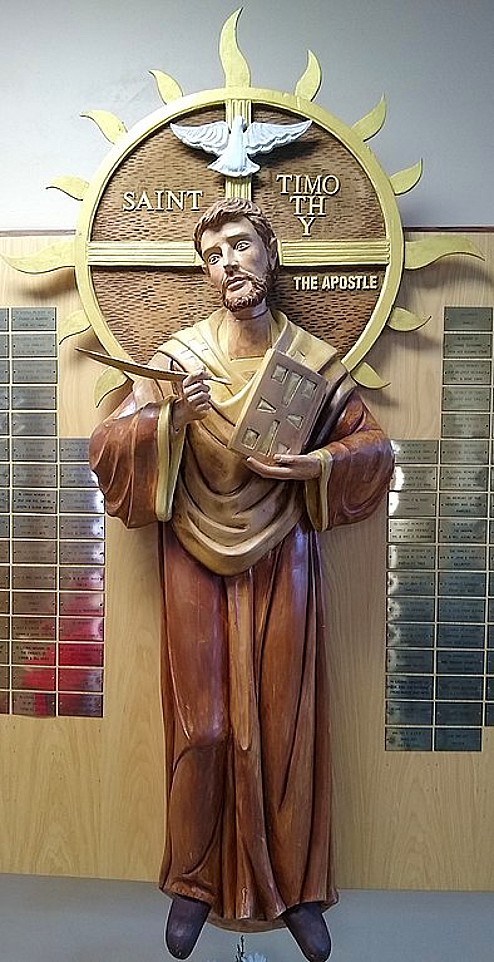
Saint of the Day – 24 January – Saint Timothy (Died c 97) Disciple of St Paul, Bishop of Ephesus and Martyr, Confessor, Missionary. Died by being stoned to death in c 97. Patronages – against intestinal disorders; of Termoli, Italy. Also known as – Timotheus. Additional Memorials – 26 January (Novus Ordo), 23 January (Australia), 27 January (Norway).
The Roman Martyrology states of St Timothy today: “The birthday of St Timothy, disciple of the Apostle, St Paul, who consecrated him Bishop of Ephesus. After many combats for Christ, he was stoned for reprehending those who offered sacrifices to Diana and shortly after, went peacefully to rest in the Lord.”
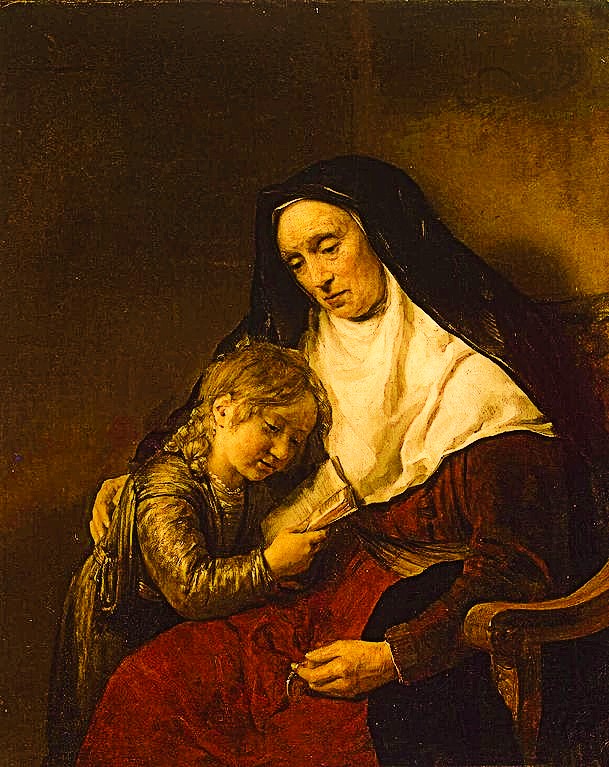
St Timothy, the beloved disciple of St Paul, was of Lycaonia and probably of the City of Lystra. His father was a Gentile but his mother, Eunice, was a Jewess. When Paul and Barnabas first visited Lystra, Paul healed a person crippled from birth, leading many of the inhabitants to accept his teaching. When he returned a few years later with Silas, Timothy was already a respected member of the Christian community as were his mother and grandmother Lois and St Paul commends their faith. Timothy had made the holy scriptures his study from his childhood. In 1 Corinthians 16:10, there is a suggestion that he was by nature reserved and quiet: “When Timothy comes, see that you put him at ease among you, for he is doing the work of the Lord.”
Rembrandt’s Timothy and his grandmother, 1648.
Timothy’s father was a Greek Gentile. Thus Timothy had not been circumcised and Paul now ensured that this was done, according to Acts 16:1-3, to enable Timothy’s acceptability to the Jews, who they would be evangelising. St Chrysostom here admires the prudence, steadiness and charity of St Paul and we may add, the voluntary obedience of our disciple, Timothy.
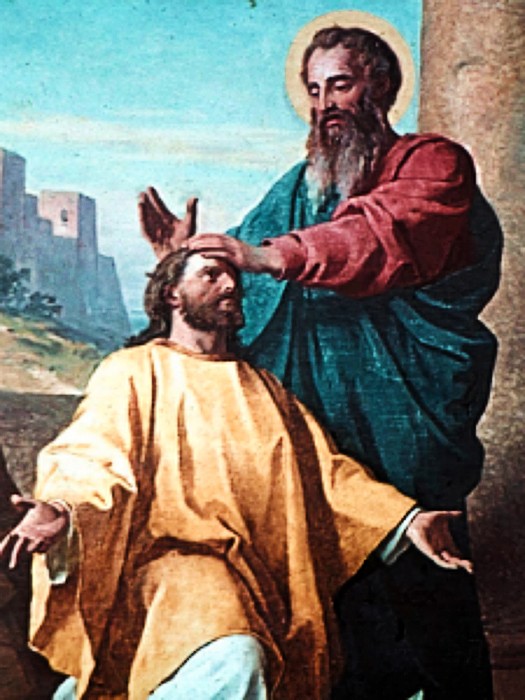
After he was circumcised, St Paul, by the imposition of hands, committed to him the ministry of preaching, his rare virtue making ample amends for his want of age. From that time the Apostle regarded him not only as his disciple and most dear son but as his brother and the companion of his labours. He calls him a man of God and tells the Philippians, that he found no-one so truly united to him in heart and sentiments, as Timothy.
Timothy became St Paul’s disciple and later his constant companion and co-worker in preaching.[18] In the year 52, Paul and Silas took Timothy along with them on their journey to Macedonia. Augustine extols his zeal and disinterestedness in immediately forsaking his country, his house, and his parents, to follow the apostle, to share in his poverty and sufferings.
Timothy may have been subject to ill health or “frequent ailments” and Paul encouraged him to “use a little wine for your stomach’s sake,” hence his patronage of stomach ailments,”
When Paul went on to Athens, Silas and Timothy stayed for some time at Beroea and Thessalonica before joining Paul at Corinth.
Timothy’s bond with Paul was close. Timothy’s name appears as the co-author on 2 Corinthians, Philippians, Colossians, 1 Thessalonians, 2 Thessalonians and Philemon. Paul wrote to the Philippians about Timothy, “I have no-one like him.”
When Paul was in prison and awaiting martyrdom, he summoned his faithful friend Timothy for a last farewell.
That Timothy was jailed at least once during the period of the writing of the New Testament is implied by St Paul in Hebrews when he mentions Timothy’s release at the end of the epistle.
Although not stated in the Scriptures other sources have records of the Apostle’s death. The apocryphal Acts of Timothy (5th Century) states that in the year 97, the 80-year-old Bishop tried to halt a procession in honour of the goddess Diana by preaching the Gospel. The angry pagans beat him, dragged him through the streets and stoned him to death.
From the 13th century until 1969 the feast of Timothy (alone, that is without St Titus whose feast day is 6 February) is today, 24 January, the day before that of the Conversion of Saint Paul.
In the 4th century, the relics of Timothy were transferred from Ephesus to Constantinople and placed in the Church of the Holy Apostles near the tombs of Saints Andrew and Luke. In the 13th century, the relics seem to have been taken to Italy by a count returning from the crusades and buried, around 1239, in the Termoli Cathedral. The remains were re-discovered in 1945, during restoration works.
St Filip Geryluk Bl Francesc de Paula Colomer Prísas St Guasacht St Ignacy Franczuk Bl John Grove St Julian Sabas the Elder St Luigj Prendushi St Macedonius Kritophagos Blessed Marcolino Amanni of Forli OP (1317-1397) Bl Marie Poussepin
St Projectus St Sabinian of Troyes St Suranus of Sora St Thyrsus Bl William Ireland
Martyrs of Asia Minor – 4 Saints: A group of Christians martyred together for their faith. The only details to survive are four of their names – Eugene, Mardonius, Metellus and Musonius. They were burned at the stake in Asia Minor.
Martyrs of Podlasie – 13 Beati: Podlasie is an area in modern eastern Poland that, in the 18th-century, was governed by the Russian Empire. Russian sovereigns sought to bring all Eastern-rite Catholics into the Orthodox Church. Catherine II suppressed the Greek Catholic Church in Ukraine in 1784. Nicholas I did the same in Belarus and Lithuania in 1839. Alexander II did the same in the Byzantine-rite Eparchy of Chelm in 1874 and officially suppressed the Eparchy in 1875. The Bishop and the Priests who refused to join the Orthodox Church were deported to Siberia or imprisoned. The laity, left on their own, had to defend their Church, their liturgy and their union with Rome. On 24 January 1874 soldiers entered the village of Pratulin to transfer the parish to Orthodox control. Many of the faithful gathered to defend their parish and Church. The soldiers tried to disperse the people but failed. Their commander tried to bribe the parishioners to abandon Rome but failed. He threatened them with assorted punishments but this failed to move them. Deciding that a show of force was needed, the commander ordered his troops to fire on the unarmed, hymn-singing laymen. Thirteen of the faithful died, most married men with families, ordinary men with great faith. We know almost nothing about their lives outside of this incident. Their families were not allowed to honour them or participate in the funerals and the authorities hoped they would be forgotten. Their names are: • Anicet Hryciuk • Bartlomiej Osypiuk • Daniel Karmasz • Filip Geryluk • Ignacy Franczuk • Jan Andrzejuk • Konstanty Bojko • Konstanty Lukaszuk • Lukasz Bojko • Maksym Hawryluk • Michal Wawryszuk • Onufry Wasyluk • Wincenty Lewoniuk Martyrdom: • shot on 14 January 1874 by Russian soldiers in Podlasie, Poland • buried nearby without rites by those soldiers Beatified – 6 October 1996.
Martyrs of Antioch: Babylas Epolonius Prilidian Urban
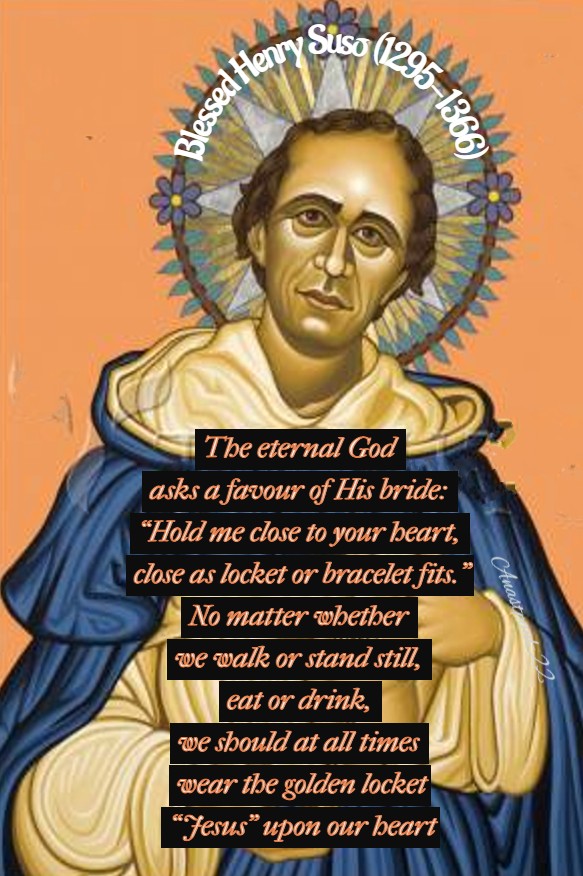
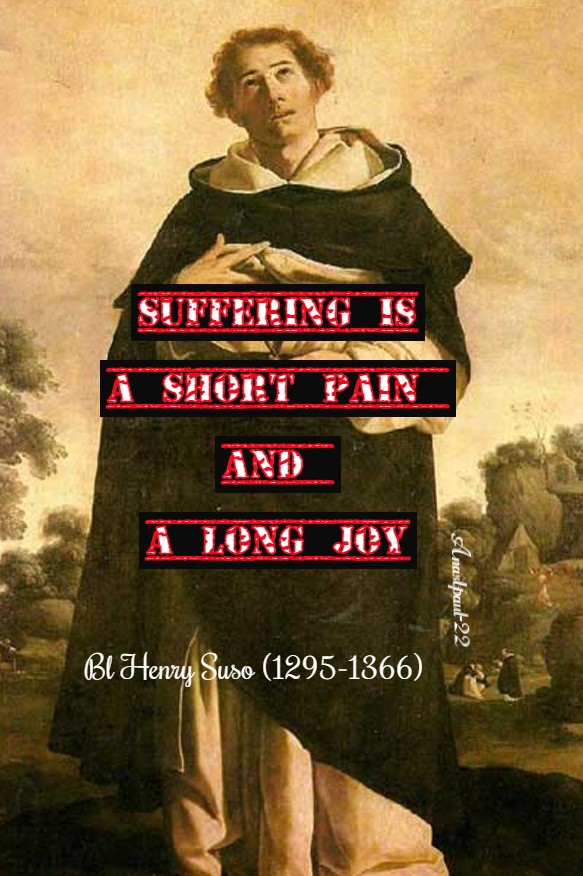
Quote/s of the Day – 23 January – “Month of the Most Holy Name of Jesus” – The Memorial of Blessed Henry Suso OP (1295-1366)
“The eternal God asks a favour of His bride: “Hold me close to your heart, close as locket or bracelet fits.” No matter whether we walk or stand still, eat or drink, we should at all times wear the golden locket “Jesus” upon our heart.”
“Suffering is a short pain and a long joy.”
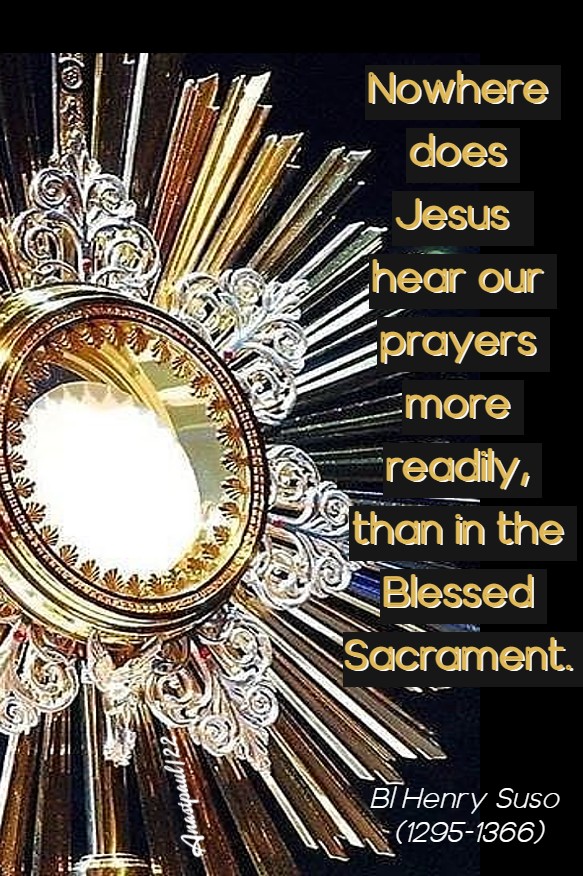
“Nowhere does Jesus hear our prayers more readily, than in the Blessed Sacrament.”
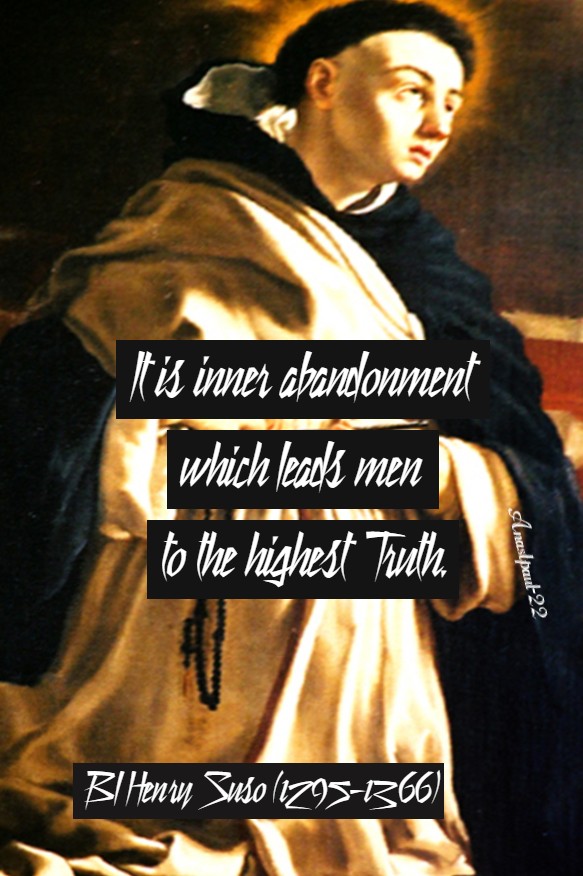
“It is inner abandonment which leads men to the highest Truth.”
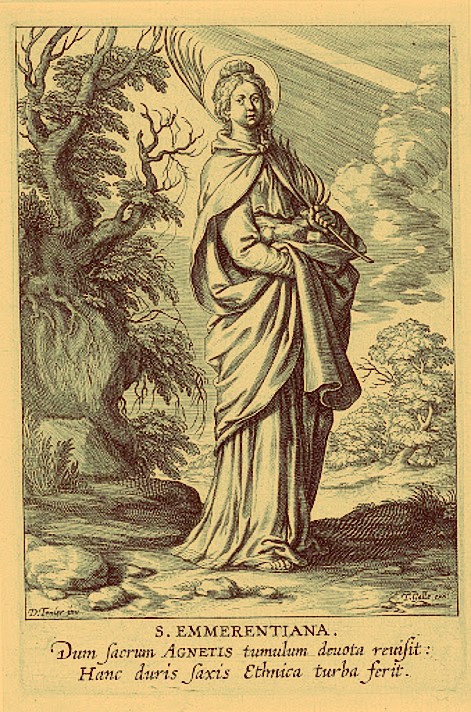
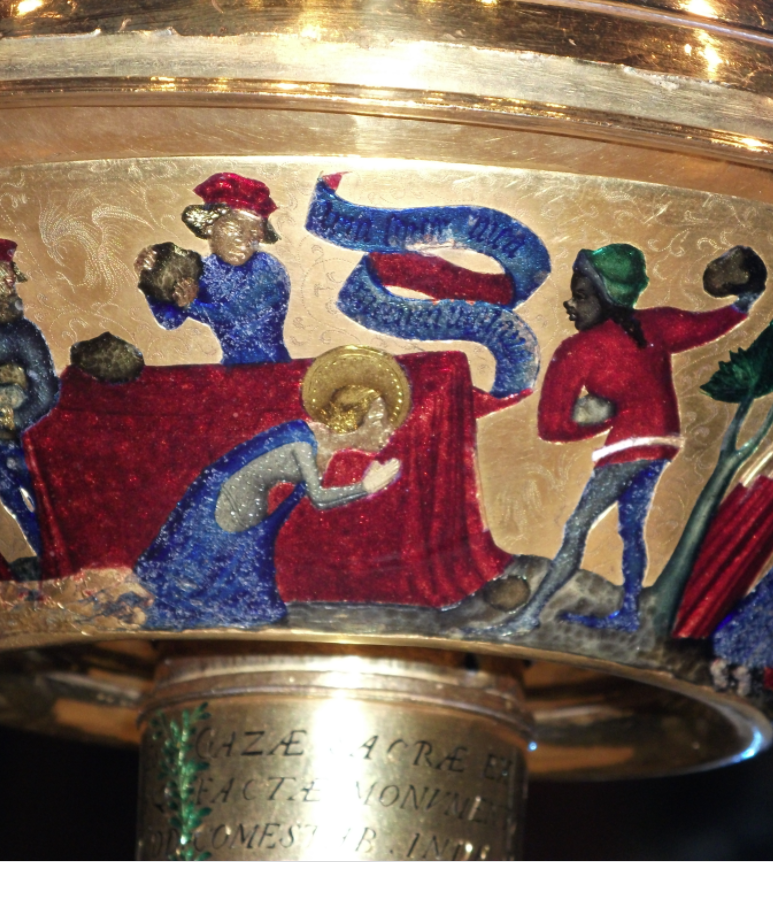
Saint of the Day – 23 January – St Emerentiana (Died c 301) Virgin, Martyr, Foster Sister pf St Agnes, Catechumen. Also known as – Emerentia. Died by being stoned to death in c 304 at Rome, Italy. Patronages – against abdominal pains, stomach ailments, against colic.
The Roman Martyrology states: “At Rome, the holy Virgin and Martyr, Emerentiana. Being only a Catechumen, she was stoned to death by the pagans, whilst praying t the tomb of St Agnes, her Foster Sister.”
An unknown author of the 5th century. added to the Latin Passio of St Agnes, a third chapter that dwells on the funeral of the Saint, on her appearance to her parents, eight days after her death and on the foundation of the Basilica built in her honour by St Costanza, daughter of Constantine.
Among the faithful who flocked to St Agnes’ funeral is also remembered “Emerentiana.”
A sudden attack by fanatical pagans scattered the Christians. Emerenziana, instead of fleeing, courageously addressed the assailants but ended up being stoned to death. The parents of St Agnes buried her body nearby on the limits of their property. There is no doubt, the author concludes, enunciating the doctrine on the Baptism of blood, that Emerenziana was Baptised in her blood, having died for the defence of justice, confessing the Lord.
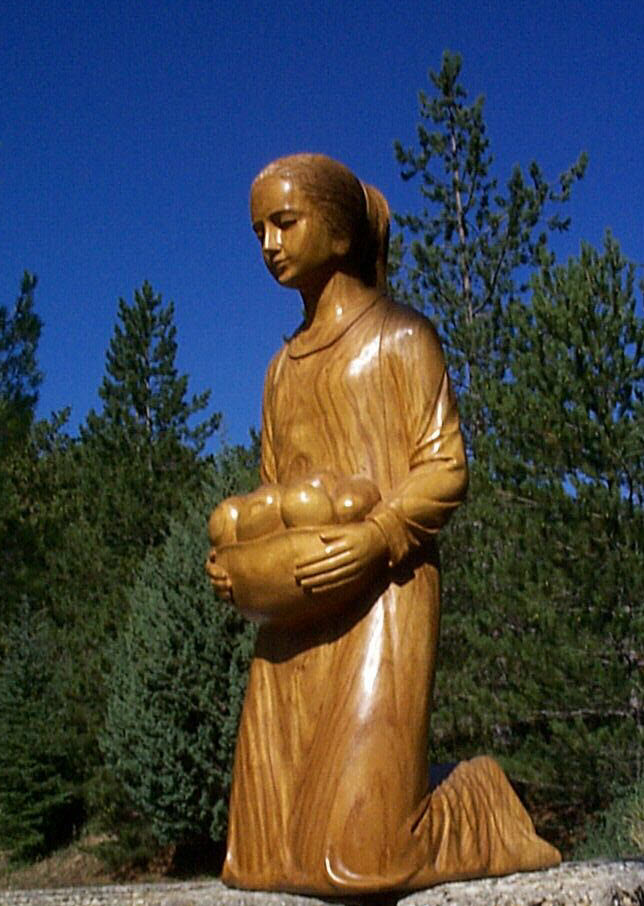
Emerentiana is represented as a young girl who either has stones in her lap and lilies in her hand, or as being stoned to death by a mob. Her tomb is inow n the Church of St Agnes outside the walls, in Rome. An Altar dedicated to her with a marble relief by Ercole Ferrata depicting her Martyrdom is in St Agnes in Agone.
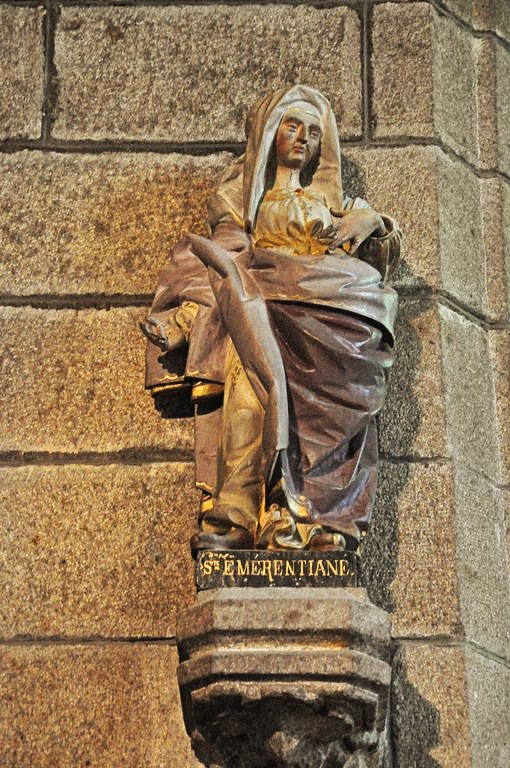
There is another Chapel dedicated to St Emerentiana at the Marian Shrine of Notre Dame de Vie. Venasque, France, as a special Patron of the Secular Institute of Our Lady of Life. The Statue below resides in this Chapel.
St Raymond of Peñafort OP (1175-1275) “Father of Canon Law” Dominican Priest, Doctor of Canon Law, the Third Master of the Order of Preachers, Founder of the Mercedarian friars, Writer, Teacher, Miracle-Worker. St Raymond of Peñafort’s Feast day was inserted in the General Roman Calendar in 1671 for celebration on 23 January. In 1969 it was moved to 7 January, the day after that of his death. He is the Patron Saint of canon lawyers, specifically and lawyers, in general. Biography: https://anastpaul.com/?s=st+raymond+penafort
St Ildephonsus (506-667) Archbishop of Toledo. Theologian, Scholar, Marian devotee, Writer, Evangeliser. Abbot Dom Guéranger calls him the Doctor of the Virginity of Mary. Saint Ildephonsus established the feast of the Expectation of the Blessed Virgin Mary, which is still kept in some places on 18 December. Biography: https://anastpaul.wordpress.com/2018/01/23/saint-of-the-day-23-january-st-ildephonsus-607-667/
Bl Juan Infante St Jurmin St Lufthild St Maimbod Bl Margaret of Ravenna Martyrius of Valeria St Messalina of Foligno St Ormond of Mairé St Parmenas the Deacon St Severian the Martyr
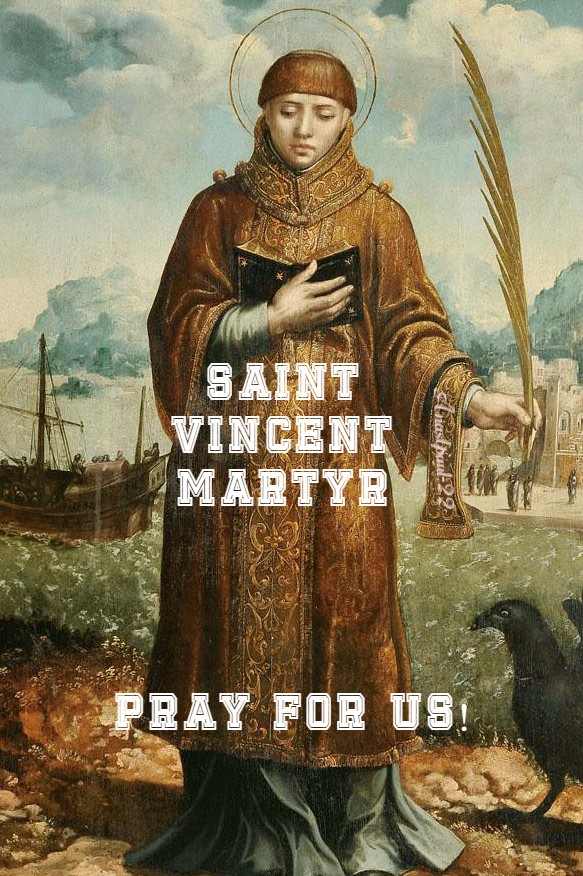
One Minute Reflection – 22 January – The Memorial of Saints Vincent of Saragossa (Died 304) Martyr – Wisdom 3:1-8, Luke 21:9-19
“Before all this happens, however, they will seize and persecute you, they will hand you over to the synagogues and to prisons and they will have you led, before kings and governors because of my name …” – Luke 21:12
REFLECTION – “Jesus gives them clear and evident signs of the time when the consummation of the world draws near. He says that there will be wars, turmoil, famines and epidemics everywhere. There will be terrors from heaven and great signs. As another Evangelist says, “All the stars shall fall and the heaven be rolled up like a scroll and its powers will be shaken.”
In the middle of this, the Saviour places what refers to the capture of Jerusalem. He mixes the accounts together in both parts of the narrative. Before all these things, He says, “They will lay their hands on you and persecute you, delivering you up to synagogues and to prisons and bringing you before kings and rulers for my name’s sake. This will be a witness to you.” Before the times of consummation, the land of the Jews was taken captive and the Roman armies overran it. They burned the temple, overthrew their national government and stopped the means for legal worship. They no longer had sacrifices, now that the temple was destroyed. The country of the Jews together with Jerusalem itself was totally laid waste. Before these things happened, they persecuted the blessed disciples. They imprisoned them and had a part in unendurable trials. They brought the disciples before judges and sent them to kings. Paul was sent to Rome to Caesar.
Christ promises, however, that He will deliver them certainly and completely. He says that a hair of your head will not perish!” – St Cyril of Alexandria (376-444) Bishop of Alexandria, Father and Doctor of the Incarnation the Church (Commentary on Luke, Homily 139)
PRAYER – True Light of the world, Lord Jesus Christ, as You enlighten all men for their salvation, give us the grace, we pray, to herald Your coming by preparing the ways of justice and of peace. We walk in faith and by Your Light as St Vincent, fearless of men to the end and trusting only in Your grace, inspires us to follow. Grant that his prayers may assist us on our path. Who live and reign with the Father and the Holy Spirit, God forever, amen.
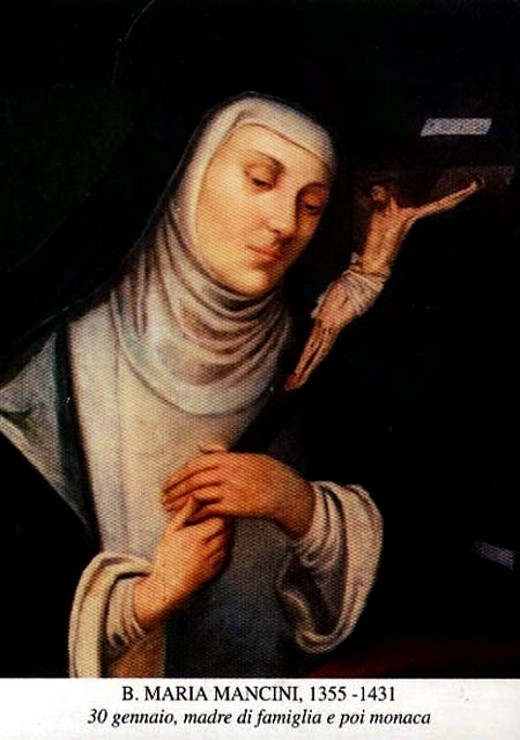
Saint of the Day – 22 January – Blessed Maria Mancini of Pisa OP (1356-1431) Widow, Second Order Nun of the Order of Preachers, spiritual disciple of St Catherine of Siena, Prioress, Mystic, Reformer, Apostle of the poor and the sick. Born as Caterina Mancini in 1356 in Pisa, Italy and died on 22 January 1431 in Pisa, Italy of natural causes. Additional Memorial – 30 January (Dominicans). Twice widowed, she saw all her seven children die. On the advice of St Catherine of Siena, Caterina first took the habit of the Third Order before entering the Monastery founded by the Blessed Chiara Gambacorti (1362-1420) in Pisa. Here she lived as a Nun, completely devoted to contemplation and penance.
The Roman Martyrology states: “In Pisa, Blessed Maria Mancini, who, twice widowed and all her children lost, under the exhortation of St Catherine of Siena, began community life in the Monastery of St Domenic, which she led for ten years.”
Caterina was born in Pisa, of noble parentage and almost in babyhood began enjoying the miraculous favours with which her life was filled. At the age of three, she was warned by some heavenly agency ,that the porch on which she had been placed by a nurse,was unsafe. Her cries attracted the nurse’s attention and they had barely left the porch, when it collapsed. When she was five, she beheld, in an ecstasy, the dungeon of a place in Pisa, in which Peter Gambacorti, one of the leading citizens, was being tortured. At Caterina’s prayer, the rope broke and the man was released. Our Lady told the little girl to say prayers everyday for this man because he would one day be her benefactor.
Caterina would have much preferred the religious life to marriage but she obeyed her parents and was married at the age of twelve. Widowed at sixteen, she was compelled to marry again. Of her seven children, only one survived the death of her second husband and Caterina learned, through a vision, that this child, too, was soon to be taken from her. Thus she found herself, at the age of twenty five, twice widowed and bereft of all her children. Refusing a third marriage, she devoted herself to prayers and works of charity.
She soon worked out for herself a severe schedule of prayers and good works, fasting and mortifications. She tended the sick and the poor, bringing them into her own home and regarding them as Our Lord Himself. She gave her goods to the poor and laboured for them, with her own hands. Our Lord was pleased to show her that He approved of her works by appearing to her in the guise of a poor young man, sick and in need of both food and medicine. She carefully dressed His wounds and she was rewarded by the revelation that He was, in reality her Redeemer ,Whom she had served.
St Catherine of Siena visited Pisa at about this time and the two saintly women were drawn together into a holy friendship. As they prayed together in the Dominican Church one day, they were surrounded by a bright cloud, out of which flew a white dove. They conversed joyfully on spiritual matters and were mutually strengthened by the meeting.
On the advice of St Catherine of Siena, Caterina retired to an enclosed Convent of the Second Order. In religion, she was given the name Maria by which she is usually known. She embraced the religious life in all its austerity and, with Blessed Clare GambarcotI and a few other members of the Convent, she founded a new and much more austere house, which had been built by Peter GambacortI. Our Lady’s prophecy of his benefactions was thus fulfilled.
Blessed Maria was favoured with many visions and was in almost constant prayer. She became Prioress of the house on the death of her friend Blessed Clare Gambacorti and ruled it with justice and holiness, until her death.
O God, who didst enrich Blessed Maria, with the abundance of the gift of contemplation and of singular charity towards her neighbour, grant us that, in imitation of her, by meditation on heavenly things and showing mercy to others, we may merit to attain, with her, everlasting glory. Through Christ our Lord. Amen.
St Anastasius the Persian St Antonio della Chiesa St Blaesilla of Rome St Brithwald of Ramsbury St Caterina Volpicelli St Dominic of Sora Bl Esteve Santacana Armengol St Francis Gil de Frederich de Sans
Blessed Giuseppe Giaccardo SSP (1896-1948) Bl Giuseppe Nascimbeni St Guadentius of Novara Bl Ladislao Batthyany-Strattmann Bl Laura Vicuna Blessed Maria Mancini of Pisa OP (1356-1431) Widow, Thjrd Order Sister of the Order of Preachers St Mateo Alonso de Leciñana
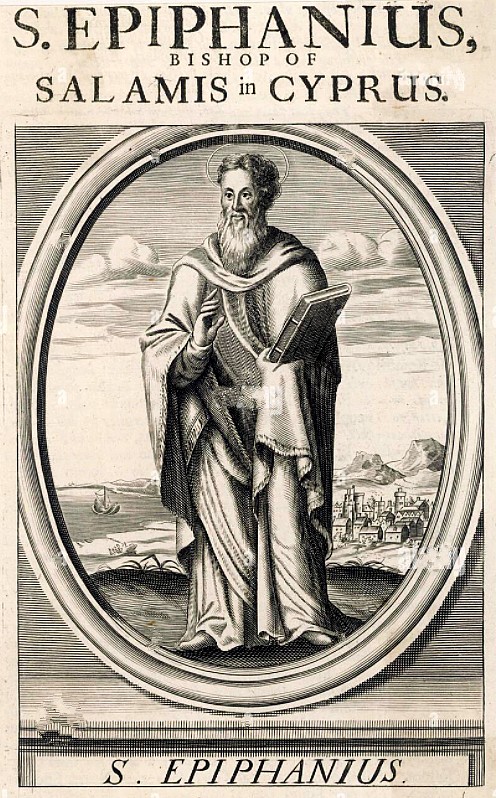
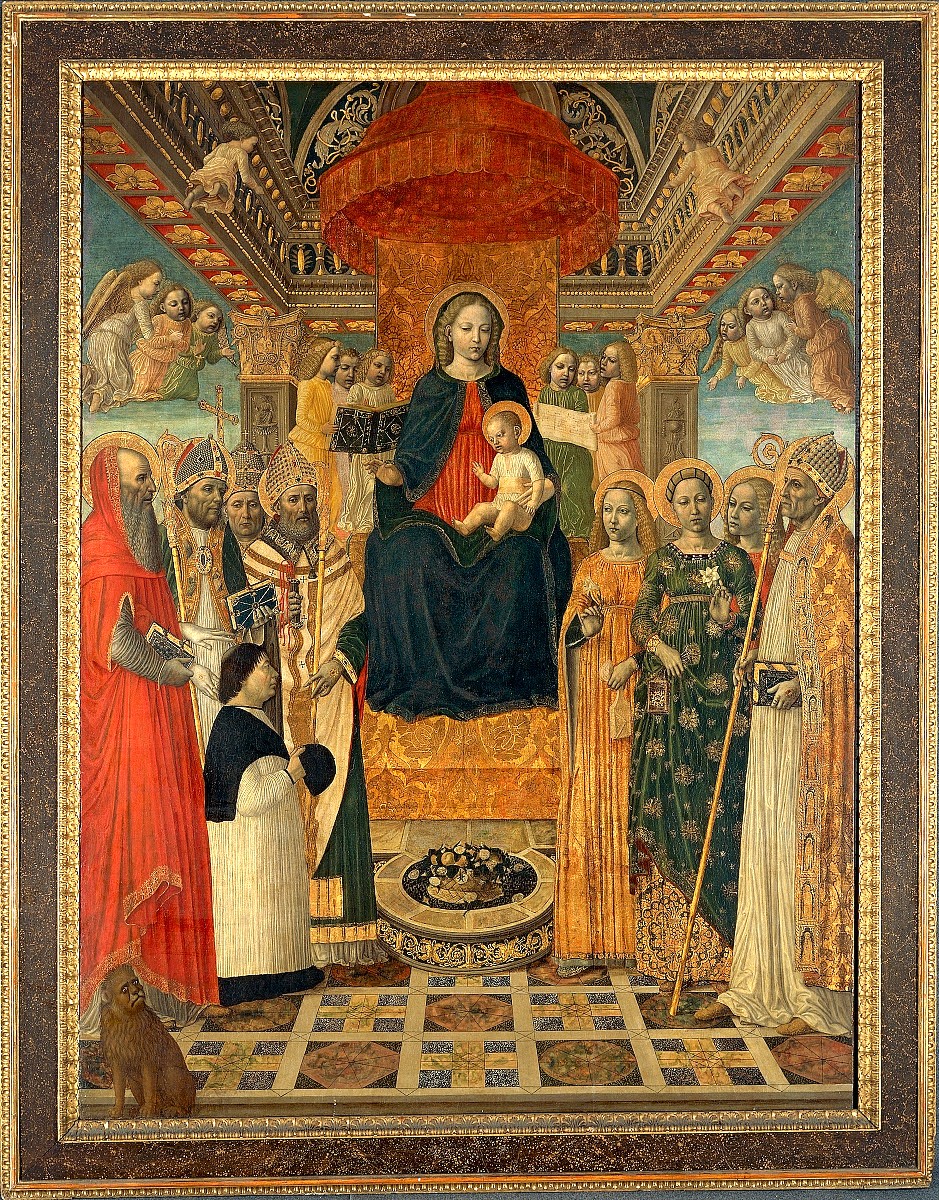
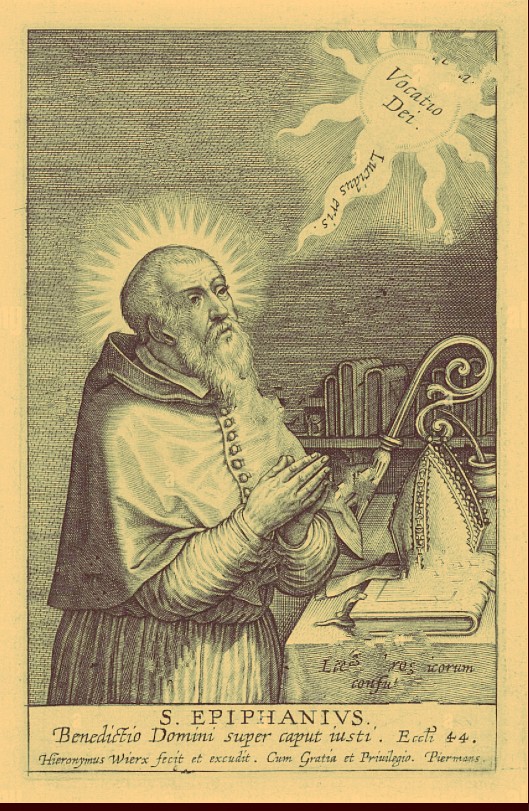
Saint of the Day – 21 January – Saint Epiphanius of Pavia (439–496) Bishop of Pavia, Italy from from 466 until his death. Papal and Secular Mediator and Peacemaker, Known as – “Epiphanius the Peacemaker,” “The Glory of Italy,” “The Light of Bishops.” Born in c 439 at Pavia, Italy and died in 496 at Burgundy, France of a fever.
The Roman Martyrology for 21 January reads : “In Pavia, Saint Epifanio, Bishop , who, at the time of the barbarian invasions, worked zealously for the reconciliation of the peoples, for the liberation of prisoners and for the reconstruction of the destroyed City.”
Our primary source for Epiphanius’ life is the Vita Epifanius written by St Magnus Felix Ennodius (c 473-521) , who knew him personally, travelling with the Bishop on his mission to King Gundobad of the Burgundians in 494–6. According to St Ennodius, Epiphanius’ father was Maurus and his mother Focaria, who was related to Mirocle, Bishop of Milan (304-326). Epiphanius was the brother of Saint Honorata and Saint Liberata.
He joined the household of Bishop Crispinus at the age of eight for his education and became a lector, learning to read and write, as well as stenography. At the age of 18 he was Ordained Subdeacon and Deacon at 20. Bishop Crispinus, as he lay dying, appointed Epiphanius as his successor in the presence of the ex-consul Flavius Rusticus. Although he resisted the appointment, Epiphanius was made Bishop in Milan in his 28th year.
Shortly after becoming Bishop, Epiphanius was asked to intervene between Anthemius and the barbarian leader Ricimer, appealing to both parties for peace. More peacemaking and diplomatic missions followed and most of these to high-ranking figures proved to be successful endeavours. Religious dignitaries such as Epiphanius had wide-ranging influence on the rulers and aristocrats during this period. In the eighth year of his episcopate (spring 475), the Emperor Julius Nepos, sent him on a diplomatic mission to Euric about Visigothic incursions.
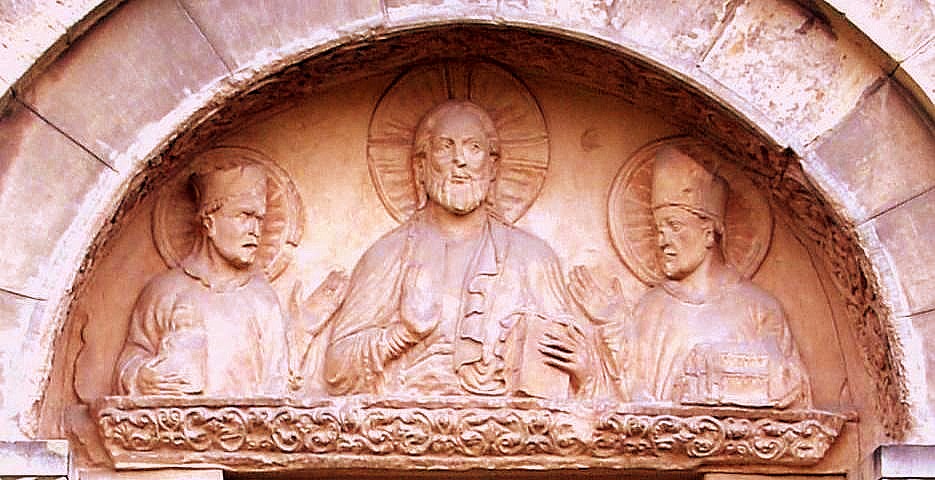
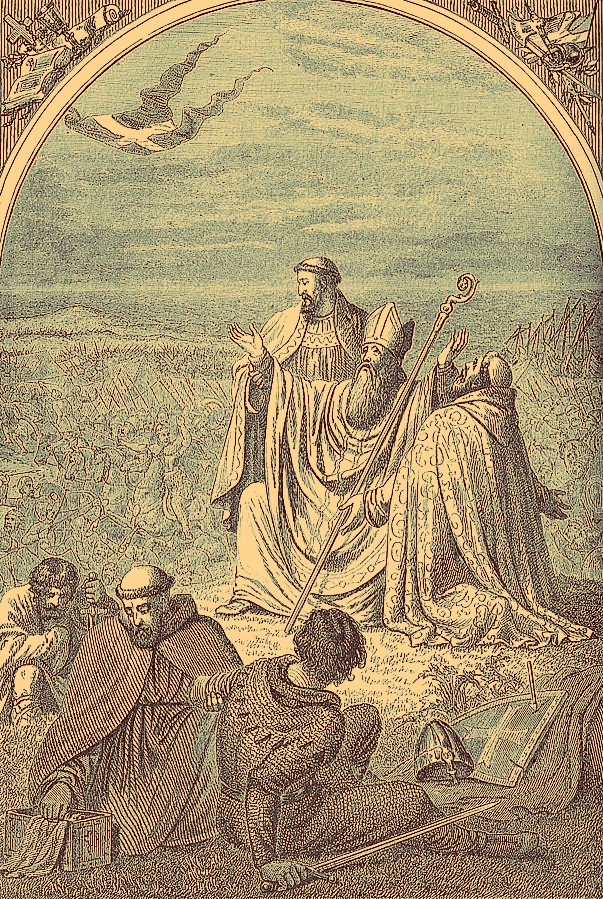
I presume St Epiphanius is the Bishop on the right
Another success was Epiphanius’ negotiations over the ransom of his sister, St Honorata, who had been abducted from the Monastery of St Vincent in Pavia, during the war between Theodoric the Great and Odoacer.
Epiphanius actively worked on the reconstruction of Pavia which, in 476, had been sacked and destroyed by rival armies. Epiphanius visited the victors several times, to implore clemency for the vanquished. In particular, he successfully implored the clemency of Odoacer, of Theodoric and of the King of Burgundians, Gundobaldo, from whom he obtained the release of six thousand prisoners.
In 496 , returning from Ravenna , where he had gone for yet another legation to King Theodoric in favour of Pavia and the entire Province, he fell ill in Parma with pneumonia, was transported to his home in Pavia, where he died at the age of fifty-eight years, after thirty years as Bishop.
Shortly after his death , Epiphanius was revered as a saint and numerous miracles were attributed to him . In 962 most of his relics were moved to Hildesheim to give this region more prestige and heavenly help. The relics of Epiphanius are still contained in a golden casket placed under the central Altar of the Cathedral of Hildesheim.
Tympanon depicting Christ, Saint Godehard and Saint Epiphanius, on the StGodehard Basilica in Hildesheim, Germany.
St Agnes of Aislinger St Alban Bartholomew Roe St Anastasius of Constantinople St Aquila of Trebizond St Brigid of Kilbride St Candidus of Trebizond Bl Edward Stransham St Epiphanius of Pavia (c 439–496) Bishop St Eugenius of Trebizond Bl Franciscus Bang St Gunthildis of Biblisheim
Blessed Josefa María Inés de Benigánim OAD (1625–1696) Nun of the Discalced Augustinian Nuns with the religious name of “Josefa María of Saint Agnes,” Virgin, Mystic, gifted with the charism of prophecy and counsel. She became known for her profound spiritual and theological insight as well as for her severe austerities she practised during her life. Her body is incorrupt. Biography: https://anastpaul.com/2020/01/21/saint-of-the-day-21-january-blessed-josefa-maria-ines-de-beniganim-oad-1625-1696/
St John Yi Yun-on St Lawdog St Maccallin of Waulsort
St Nicholas Woodfen St Patroclus of Troyes St Publius of Malta Bl Thomas Reynolds St Valerian of Trebizond St Vimin of Holywood St Zacharias the Angelic
Blessed Martyrs of Laval – 19 Beati: Fifteen men and four women who were martyred in Laval, France by anti-Catholic French Revolutionaries. • Blessed André Duliou • Blessed Augustin-Emmanuel Philippot • Blessed François Duchesne • Blessed François Migoret-Lamberdière • Blessed Françoise Mézière • Blessed Françoise Tréhet • Blessed Jacques André • Blessed Jacques Burin • Blessed Jean-Baptiste Triquerie • Blessed Jean-Marie Gallot • Blessed Jeanne Veron • Blessed John Baptist Turpin du Cormier • Blessed Joseph Pellé • Blessed Julien Moulé • Blessed Julien-François Morin • Blessed Louis Gastineau • Blessed Marie Lhuilier • Blessed Pierre Thomas • Blessed René-Louis Ambroise The were born in France and they were martyred on several dates in 1794 in Laval, Mayenne, France. They were Beatified on 19 June 1955 by Pope Pius XII at Rome, Italy.
Martyrs of Rome – 30 Saints: Thirty Christian soldiers executed together in the persecutions of Diocletian. They were martyred in 304 in Rome, Italy.
Martyrs of Tarragona: Augurius, Eulogius, Fructuosus.
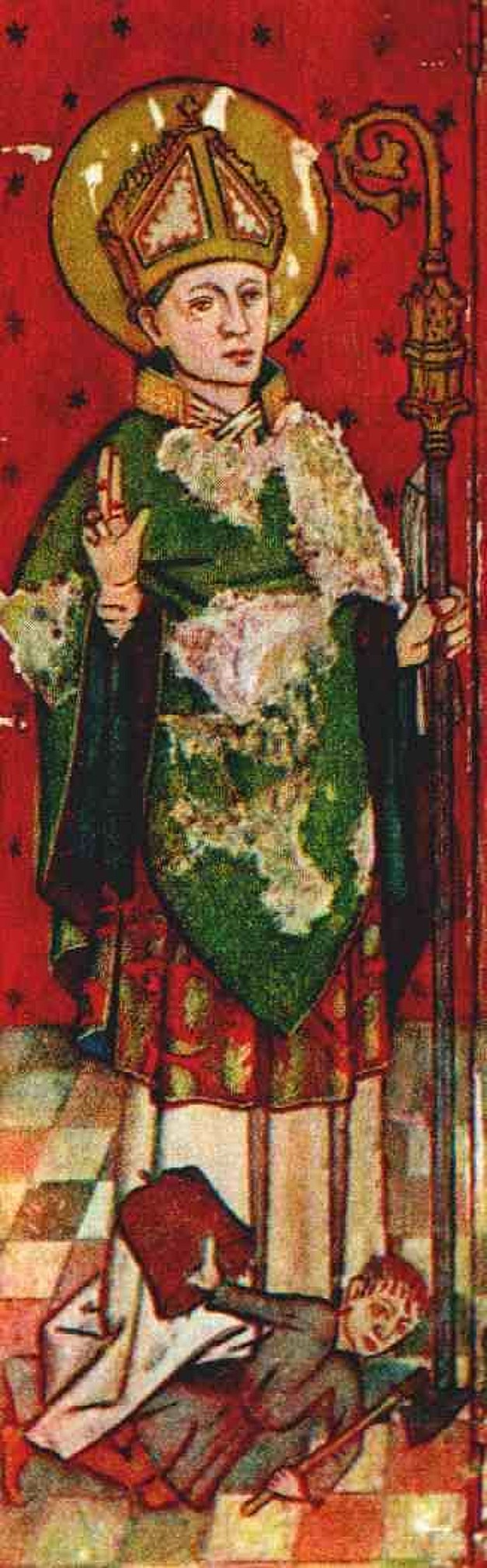
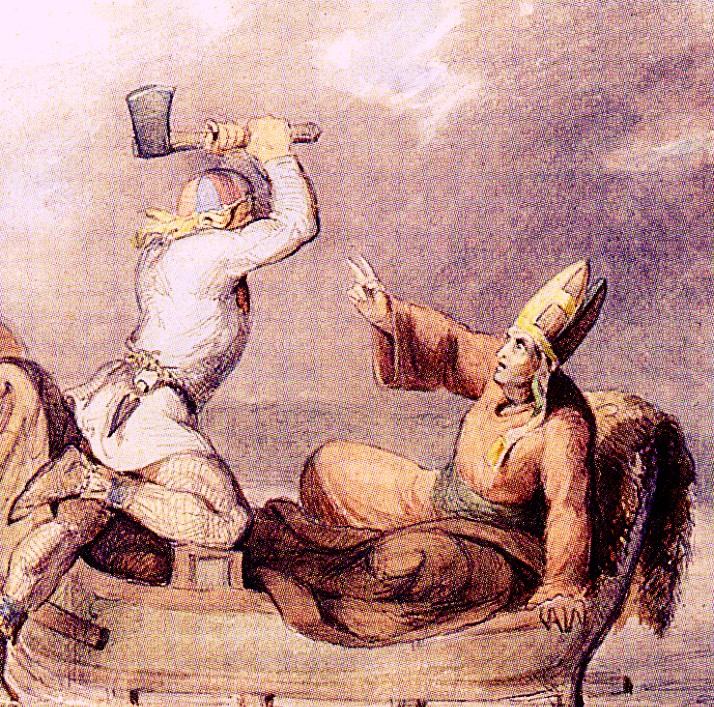
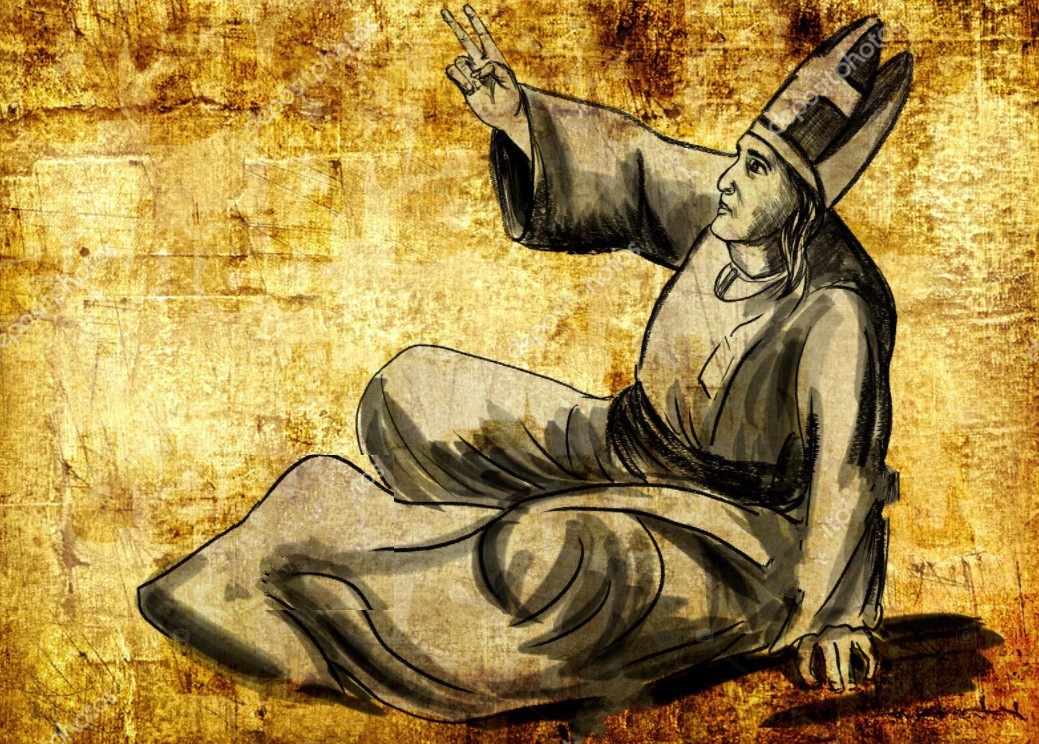
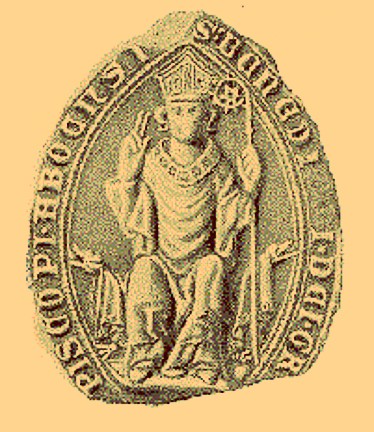
Saint of the Day – 20 January – Saint Henry of Uppsala (Died c 1156) Martyr, Bishop of Uppsala, (then in eastern Sweden), Missionary. Born in England and died struck with an axe in c 1156 at Nousis, Finland. Patronages – against storms, of Finland. Also known as – Henry of Finland. Henry of Sweden, Heikki, Henrik. Additional Memorial – 18 June (translation of his relics).
According to his Vita (the legend of his life), which was written nearly one hundred years after his death, Henry was born in the early twelfth century and reigned in the See of Uppsala during the time when King Saint Eric of Sweden (also a Martyr) ruled the country. Apparently, Bishop, Henry and the Monarch were good friends and brothers in the Faith and Henry’s biographer blissfully describes this period in Sweden, as Christendom at its finest.
Turning his attention eastward, King Eric, decided to do battle with the pagan Finns, who were separated from Uppsala by the Gulf of Bothnia. Some legends attribute Eric’s campaign against the Finns as retaliatory measures for their plundering activities in Sweden. Other sources say that Eric and Henry worked in tandem and their motivations were largely evangelical. By conquering the Finns, the Bishop and the King hoped to win them over the Christianity.
Whatever their true motivations, King Eric and Bishop Henry conquered Finland and subsequently baptiSed the locals and built Churches. The Catholic Cathedral in Helsinki, Finland’s Capital City, is named in Henry’s honour, to recognise the credit that Finnish Christians give to this saintly Bishop for giving them their faith.
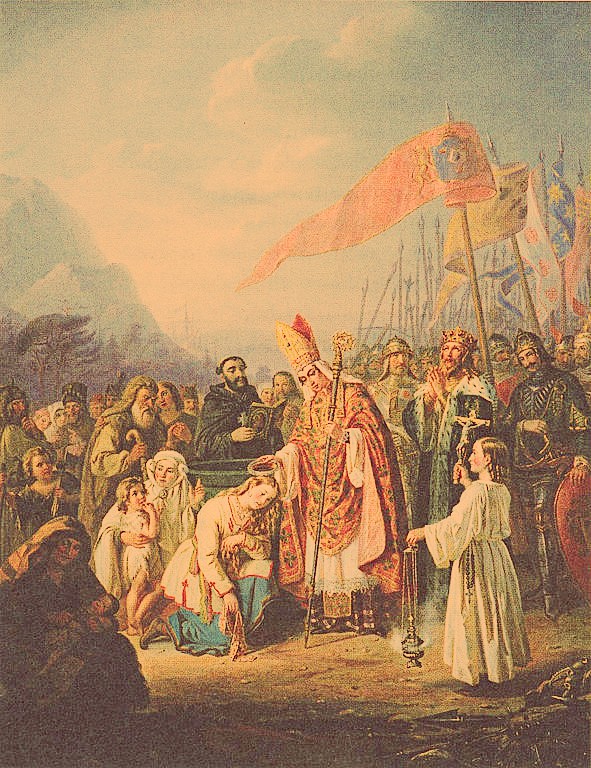
Bishop Henry Baptises the Finns at the spring of Kuppis.
King Eric returned to his home in Swede, but Henry stayed in Finland, as he loved serving as a Missionary in Finland, evangelising and converting numerous numbers.
Henry was murdered by a soldier named Lalli. Lalli was a Baptised Christian who had murdered another soldier. After examining the case, Henry excommunicated Lalli, who flew into a rage and struck Henry with an axe. The murder of Henry is believed to have occurred in the year 1156. Immediately after Henry’s death, his legend records, many miracles began to occur around his tomb and in the surrounding towns – children were raised from the dead, a blind woman’s eyesight was restored, fishermen survived terrible storms at sea.
St Henry is an important figure in the medieval history of Finland and there are a plethora of colourful poems and legends written about his life.
Devotion to St Henry, which spread throughout Finland over subsequent centuries, is a beautiful testament to the pride that countries throughout the globe have taken in their origin stories of the brave men and women who have brought the Good News of Christ to their homeland.
Henry was buried at buried at Nousis in Finland and on 18 June 1300 his relics were translated to Totku but they were stolen by the Russian troops in 1720.
He was Canonised and declared Patron of Finland in 1158 by Pope Adrian IV, who had also been a Missionary in the area.
St Ascla of Antinoe Bl Basil Anthony Marie Moreau St Basilides the Senator St Bassus the Senator Bl Benedict Ricasoli Bl Bernardo of Poncelli Bl Cyprian Michael Iwene Tansi St Daniel of Cambron Bl Didier of Thérouanne St Eusebius the Senator St Eustochia Calafato
St Eutyches the Senator St Fechin of Fobhar Bl Francesco Paoli Saint Henry of Uppsala (Died c 1156) Bishop, Martyr Bl Jeroni Fábregas Camí St Maria Cristina dell’Immacolata Concezione St Molagga of Fermoy St Neophytus of Nicaea St Stephen Min Kuk-ka St Wulfsin
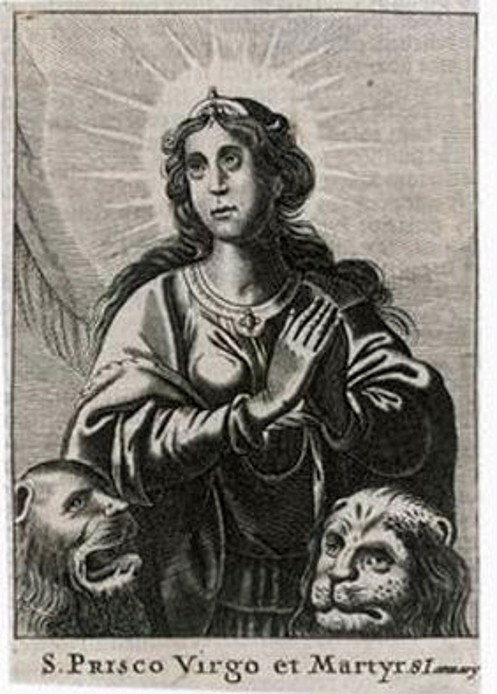
Saint of the Day – 18 January – Saint Prisca (1st Century) Child Virgin Martyr. Born to the imperial Roman hristian nobility and died by being stabbed with a sword in 275 in Rome, Italy. Also known as – Priscilla, Prisque.
The Roman Martyrology reads: “In the City of Rome, the holy Virgin and Martyr Prisca; after many tortures she gained the Crown of Martyrdom under Emperor Claudius II (about 270).”
Born to Christian parents of a noble family, Prisca was raised during the reign of the Roman Emperor Claudius II. While Claudius did not persecute Christians with the same fervour as other Roman Emperors, Christians still did not practice their faith openly. In fact, Prisca’s parents went to great lengths to conceal their faith and thus they were not suspected of being Christians.
Prisca, however, did not feel the need to take precaution. The young girl openly professed her dedication to Christ and eventually, she was reported to the Emperor. Claudius had her arrested and commanded her to make a sacrifice to Apollo, the pagan god of the sun.
According to the legend, Prisca refused and was tortured for disobeying. Then, suddenly, a bright, yellow light shone about her and she appeared to be a little star.
Claudius ordered that Prisca be taken away to prison, in the hopes that she would abandon Christ. When all efforts to change her mind were unsuccessful, she was taken to an amphitheatre and thrown in with a lion.
As the crowd watched, Prisca stood fearless. According to legend, the lion walked toward the barefoot girl and then gently licked her feet. Disgusted by his thwarted efforts to dissuade Prisca, Claudius had her stabbed to death with a sword.
Seventh-century accounts of the grave sites of Roman Martyrs refer to the discovery of an epitaph of a Roman Christian named Priscilla in a large catacomb and identifies her place of interment on the Via Salaria as the Catacomb of Priscilla.
Feast of the Chair of St Peter: In 1960, Pope John XXIII removed from the General Roman Calendar, the 18 January Feast of the Chair of Peter, Two Liturgical Feasts were celebrated in Rome, in Honour of Chairs of Saint Peter, one of which was kept in the Baptismal Chapel of St Peter’s Basilica, the other at the Catacomb of Priscilla. The dates of these celebrations are 18 January and 22 February. The two Feasts were included in the Tridentine Calendar with the rank of Double, which, in 1604, Pope Clement VIII raised to the rank of Greater Double. Those traditional Catholics. who do not accept the changes made by Pope John XXIII, continue to celebrate both Feast days: “Saint Peter’s Chair at Rome” on 18 January and the “Chair of Saint Peter at Antioch” on 22 February. https://anastpaul.com/2017/02/22/feast-of-the-chair-of-st-peter-22-february/
St Archelais the Martyr Bl Beatrix of Este the Younger Bl Charlotte Lucas St Catus
Blessed Cristina Ciccarelli OSA (1481–1543) Religious of the Order of Saint Augustine, Mystic, Stigmatist, Apostle of the poor, Reformer, she had a had a particular devotion to the Eucharist and to the Passion and Death of Christ, she was granted the gift of Prophecy, visions and levitation. About Bl Cristina: https://anastpaul.com/2020/01/18/saint-of-the-day-18-january-blessed-cristina-ciccarelli-osa-1481-1543/
St Day/Dye St Deicola of Lure Bl Fazzio of Verona Bl Félicité Pricet St Leobard of Tours
Bl Monique Pichery St Moseus of Astas St Prisca of Rome (1st Century) Child Virgin Martyr St Susanna the Martyr St Thecla the Martyr St Ulfrid of Sverige Bl Victoire Gusteau St Volusian of Tours
Martyrs of Carthage – 3 saints Martyrs of Egypt -37 saints Martyrs of Nicaea – 3 saints
Quote/s of the Day – 17 January – The Memorial of St Anthony Abbot (251-356)
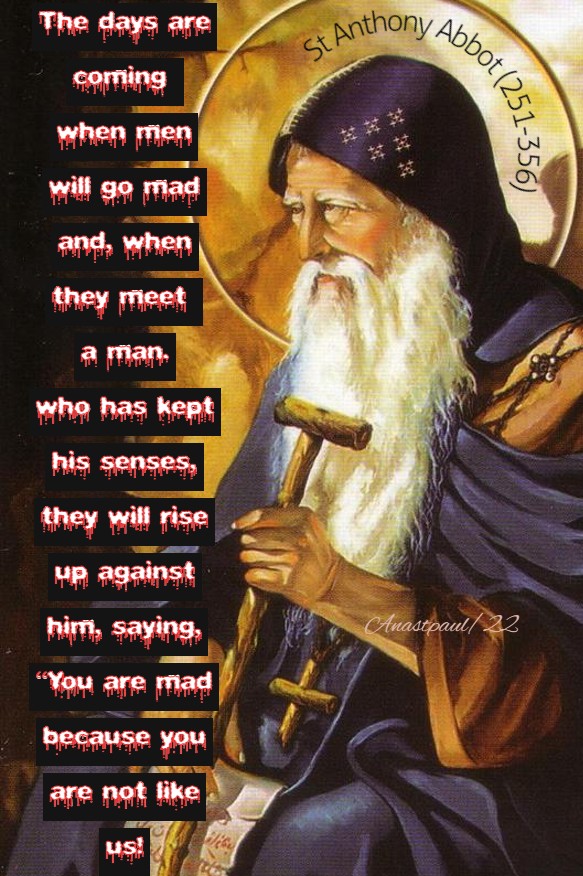
“The days are coming when men will go mad and, when they meet a man. who has kept his senses, they will rise up against him, saying, “You are mad because you are not like us!”
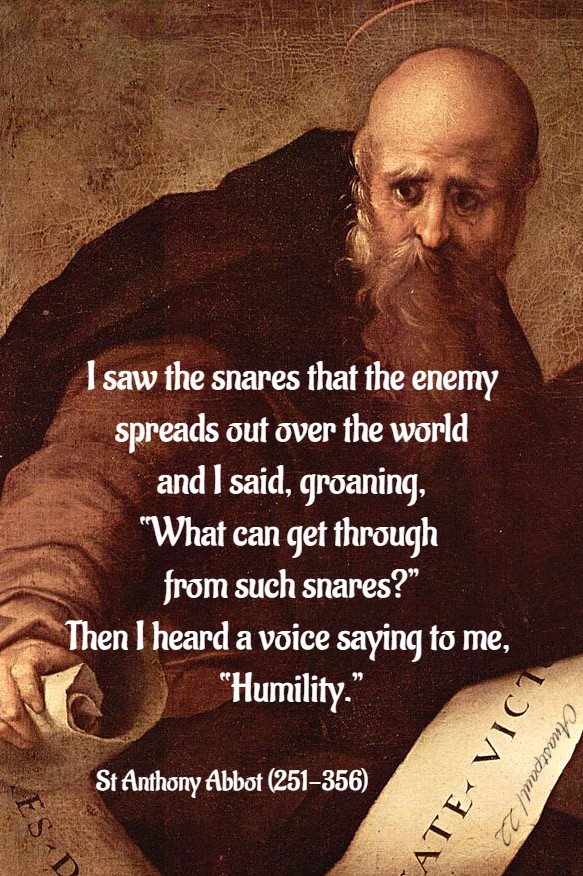
“I saw the snares that the enemy spreads out over the world and I said, groaning, “What can get through from such snares?” Then I heard a voice saying to me, “Humility.”
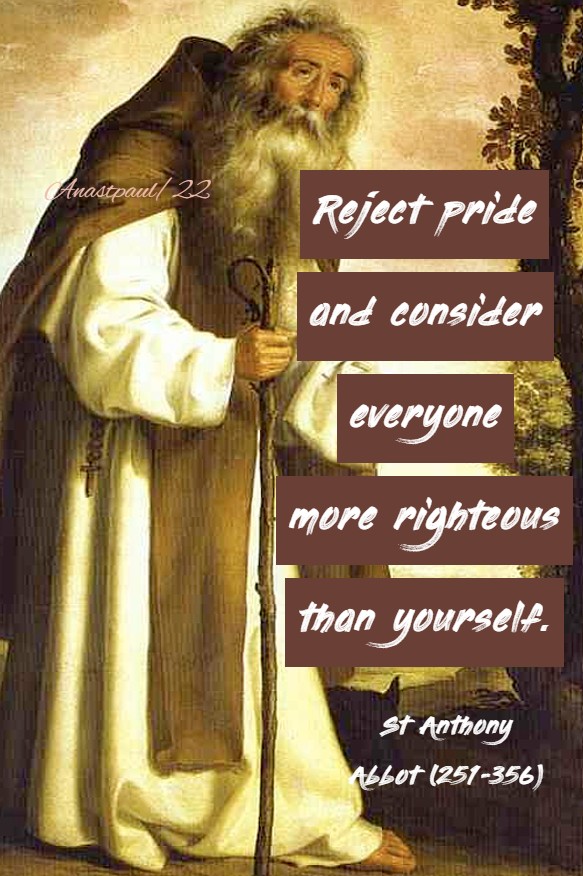
“Reject pride and consider everyone more righteous than yourself.”
Saint of the Day – 17 January – Blessed Gamelbert of Michaelsbuch (c 720-c 802) Priest, Monk, Hermit. Born in c 720 in Bavaria (in modern Germany) and died in c 802 of natural causes.
“Such was his kindness of heart, that he used to buy the little birds caught by the peasants, in order to set them free. He never allowed his servants to work in the fields or woods, if bad weather threatened. He valued, above everything, peace and concord and kept the peace among his parishioners, as far as he possibly could.” – from “The Little Bollandists” by Monsignor Paul Guérin, 1882
Gamelbert was of noble descent and a Lord of Michaelsbuch. After a pilgrimage to Rome, Gamelbert became a Priest and then the Parish Priest in Michaelsbuch, Germany for over 50 years.
In the mid-8th Century he acquired from Duke Tassilo III a piece of woodland on the opposite bank of the Danube between Mariaposching and Deggendorf, for which he had to pay a tax known as the Medema. From this was derived the name of Metten both for the place itself and for the Monastery which he established there, Metten Abbey..
The first Abbot was Gamelbert’s Godson Blessed Utto (Feast day 3 October), who directed the construction of the Monastery from his hermitage (the present Uttobrunn). In 766 twelve monks arrived from Reichenau Abbey as the first official occupants, although the place was well settled by then
In art, Gamelbert is represented as a Priest or as a pilgrim surrounded by birds.
Blessed Gamelbert was Beatified on 25 August 1909 by Pope Saint Pius X (cultus confirmed).
St Achillas of Sketis St Amoes of Sketis St Antony of Rome Bl Euphemia Domitilla Blessed Gamelbert of Michaelsbuch (c 720-c 802) Priest St Genitus St Genulfus St Jenaro Sánchez Delgadillo St John of Rome Bl Joseph of Freising St Julian Sabas the Elder St Marcellus of Die St Merulus of Rome St Mildgytha St Nennius St Neosnadia St Pior St Richimir
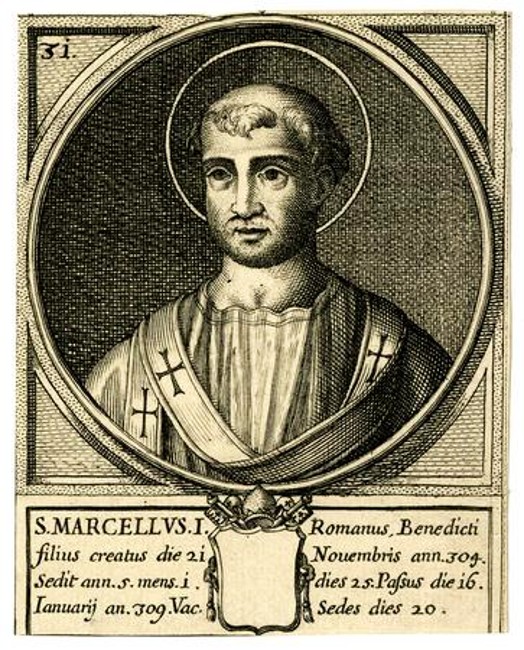
Saint of the Day – 16 January – Saint Pope Marcellus I (Died 309) Papal Ascension May-June 308. Also known as – Marcel, Marcelo. Patronage – Stablemen.
Nothing of Marcellus’ life before his papacy has survived the centuries. He became Pope at the end of the persecutions of Diocletian in aound 3089. The persecutions had disrupted the Church so much, that there had been a gap of over a year without a Pope.
Once he was elected, he faced several challenges, including reconsituting the clergy, which had been decimated and whose remnant had practiced their vocation only covertly and with the expectation of martyrdom. He worked hard to recover and welcome back all who had denied the faith in order to keep from being murdered.
When a group of the apostatised, known as the Lapsi, refused to do penance, Marcellus refused to allow their return to the Church. Some of these caused such civil disruption that Emperor Maxentius exiled the Pope in order to settle the matter.
Legend says that Marcellus was forced to work as a stable slave as punishment, however we do know that he died of the terrible conditions he suffered in exile and is considered a Martyr because of that.
The account in the Liber Pontificalis continues: “But although he served many days in the stable, he did not cease his service to the Lord with prayers and fastings. Moreover, in the ninth month, all his clergy came by night and removed him by night from the stable. A certain matron and widow whose name was Lucina, who had lived with her husband Marcus for 15 years and had been 19 years a widow, received the blessed man. And she dedicated her house as a Church in the name of the blessed Marcellus and there day and night the Lord Jesus Christ was confessed with hymns and prayers.”
This is the Church known in modern times as San Lorenzo in Lucina where a Basilica was subsequently built in the mid-4th century, restored and embellished numerous times throughout the centuries. Traces of the original Roman structure may be seen amidst the foundations even to this day.
The Liber Pontificalis continues: “But Maxentius heard of it and sent and seized the blessed Marcellus a second time and gave orders that in that very Church, boards should be laid down and the animals of the stable should be collected and kept there and the blessed Marcellus should tend them. And he died in the service of the animals, clad only in a hair shirt.
And the blessed Lucina took is body and he was buried in the cemetery of Priscilla on the Via Salaria, 16 January.
And the Bishopric was empty 20 days.
Lucina herself was condemned by proscription.”
The remains of the Martyred Pope were later transferred to the Basilica of San Marcello al Corso in Rome. An epitaph of Pope Saint Marcellus, written by Pope Damasus about 80 years after Marcellus’s Martyrdom, was found in the cemetery of Priscilla.
St Juana Maria Condesa Lluch Bl Konrad II of Mondsee St Leobazio St Liberata of Pavia St Pope Marcellus I (Died 309) Martyr, Papal Ascension May-June 308 St Melas of Rhinocolura St Priscilla of Rome St Sigeberht of East Anglia St Titian of Oderzo St Triverius St Valerius of Sorrento
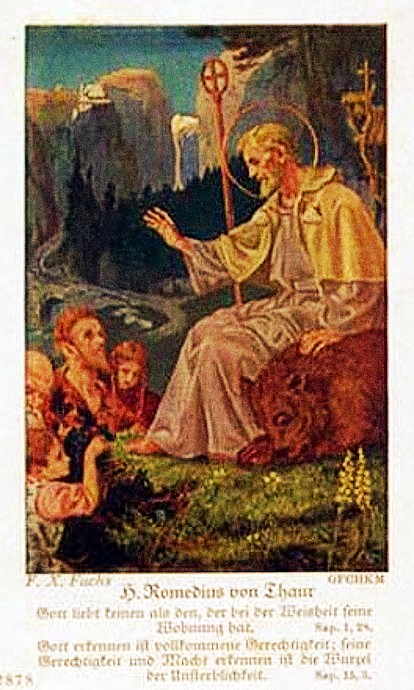
Saint of the Day – 15 January – Saint Romedius of Nonsberg/theologians Hermit, Penitent., Pilgrim. Born in Thaur, Tyrol, Austria and died in the 4th Century in Salzburg, Austria of natural causes. Also known as – Romedio of Hohenwart, Romedio of Salzburg, Romedio of Sanzeno, Romedio of Thaur. Romedio. Additional Memorial – 1st Sunday in October (translation of relics). Patronages – against accidents, against bone diseases, against danger at sea, against fever, against fire, against floods, against hail, against headaches, against toothaches, of prisoners, theology students/theologians, travellers/pilgrims. Canonised on 24 July 1907 by Pope Pius X (cultus confirmation).
The Roman Martyrology states: “In the Val di Non in Trentino, St Romedius, an anchorite, who, having given his possessions to the Church, led a life of penance in the hermitage that still bears his name today.”
Romedius was the son and heir of the wealthy Count of Thaur, the lord of a castle near Innsbruck and owner of salt pans in the valley of the River Inn. After a pilgrimage to Rome, Romedius gave all his possessions to the Church, withdrawing into a hermitage in grottoes in the Val di Non. he was accompanied by two companions, Abraham and David.
A later date emerges from the history of his works and extensive research. It is most likely that Romedius came from the family of the Counts of Andechs , lived in the 11th century, gave up his fortune in Thaur and joined the then spreading mendicant movement. After a visit to the Bishop of Trento , he visited the Martyrs’ graves of Alexander , Martyrius and Sisinniusin Sanzeno. It is believed that he died at the age of 74.
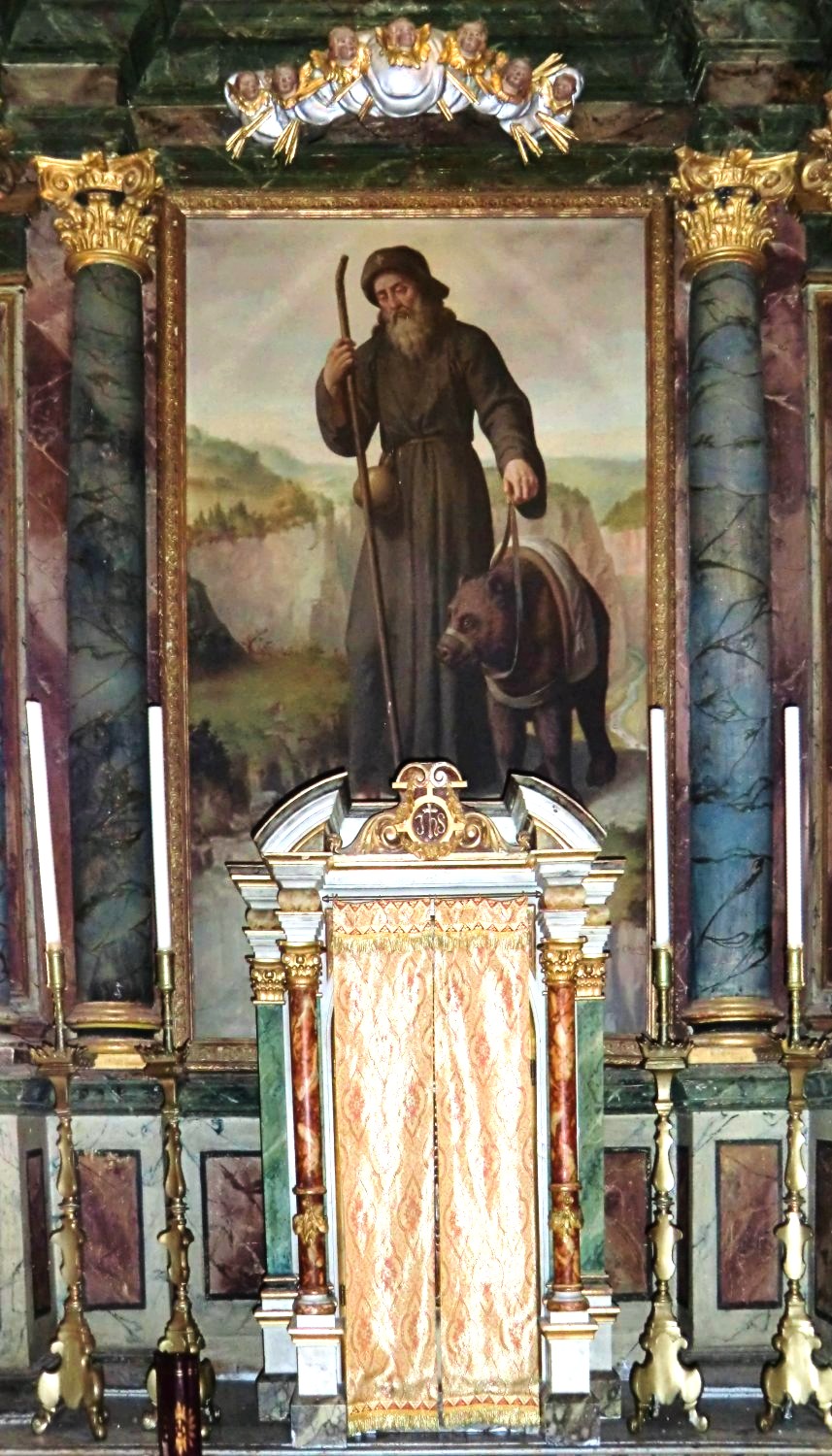
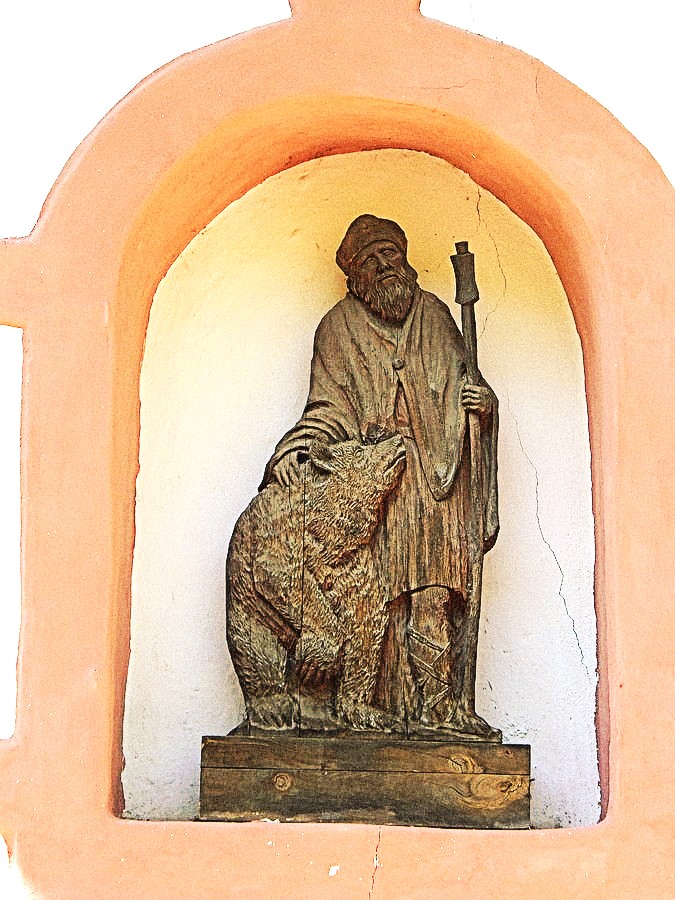
Romedius is often depicted alongside or astride a bear. According to his hagiography he wanted to visit the friend of his youth, St Vigilius, Bishop of Trento (who died in 405) but his horse was torn to pieces by a wild bear. Romedius, however, had the bear bridled by his disciple David. The bear became docile and carried Romedius on its back to Trento.
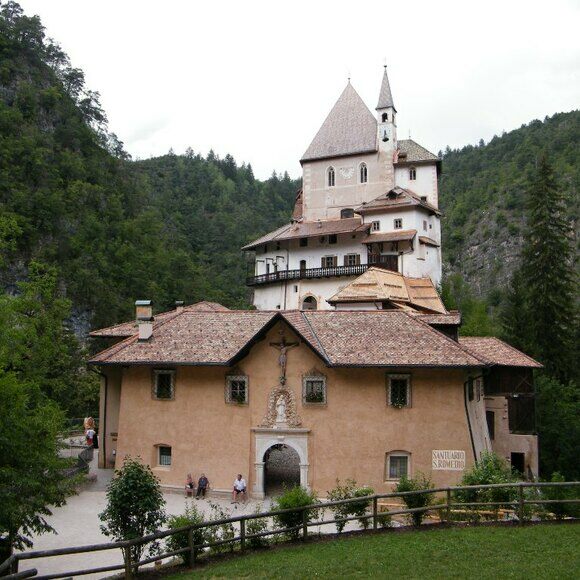
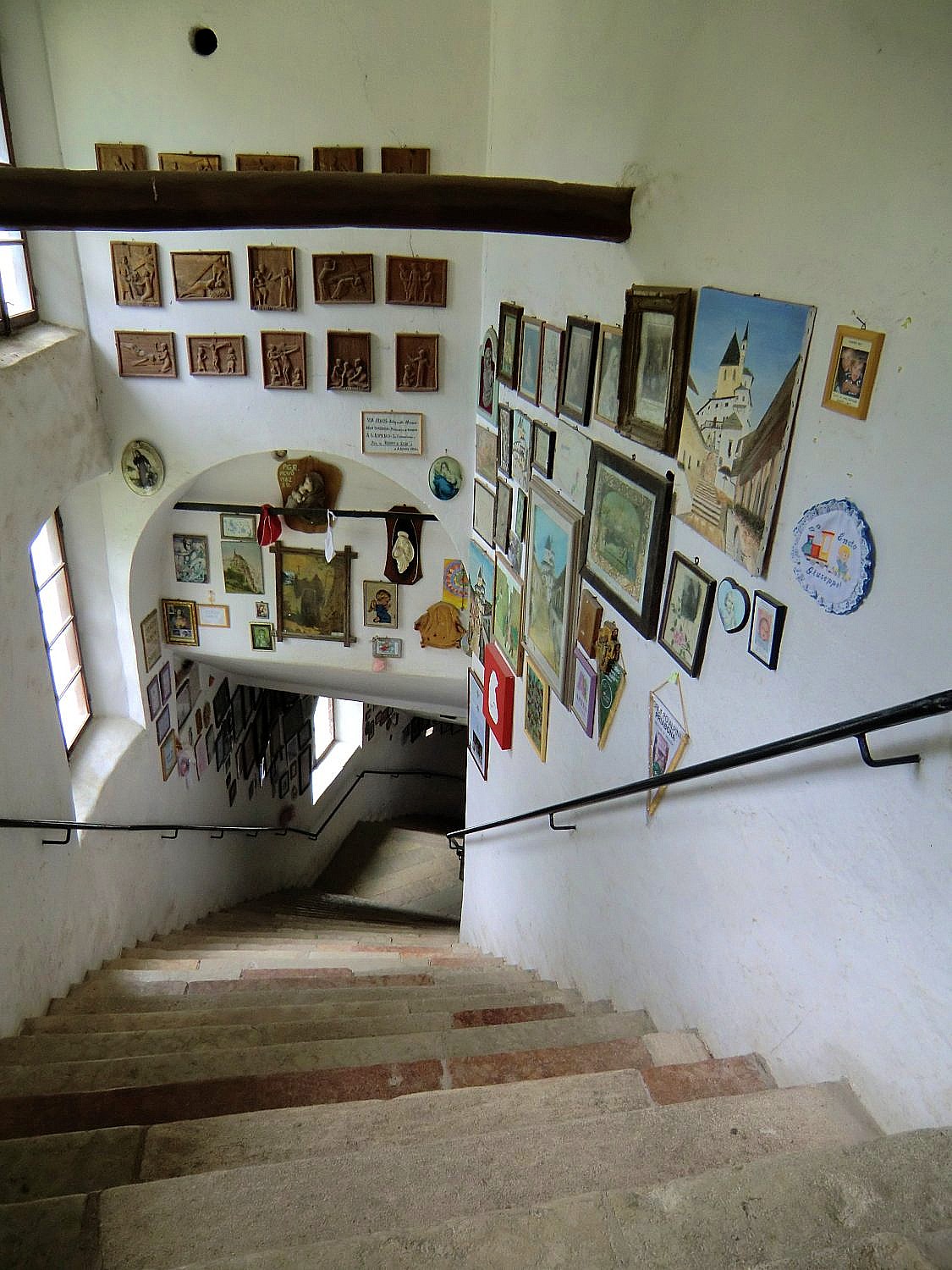
Upon Romedius’ death, his body was laid to rest in a small tomb above his cave in the mountains, a site that was soon visited by pilgrims. The Sanctuary of San Romedio grew from the little Church that was built to venerate him, to a popular pilgrimage site. The Santuario di San Romedio is across the lake from Cles at the head of the Val di Non, above the village of Sanzeno. The Sanctuary where Romedius lived with his bear companion, is now a complex of several Churches, from the Romanesque period to the 20th century beyond a gateway on the forested slopes. Votive offerings of crutches line the walls of the narrow stone stairwell up to the highest chapel, said to mark the site of the Saint’s retreat.
Staircase with votive offerings in the Hermitage at Tavon, 1706
His local cult, which consolidated itself in the course of the 11th century, was officially recognised in the twelfth by the Bishop of Trento. In 1795, permission was given for special offices in his name in the Diocese of Brixen, which at that time, included the Northern Tyrol. His cult remains popular in Trentino, Bavaria, and the Tyrol.
Romedius’ Bear In remembrance of this legend, in 1958 Italian Senator G. G. Gallarati Scotti, honorary member of the committee for the foundation of the World Wildlife Fund in Italy, purchased Charlie, a bear intended to be killed and donated it to the Sanctuary of San Romedius, in the Valle di Non.
Today, the Province of Trentino protects the last brown bears of the Alps in the Adamello-Brenta National Park and, near the Sanctuary, takes care of young bears born in captivity in Trentino.
Relief at the pilgrimage church near Thaur
In the work known as Illustrissimi, a collection of letters written by Pope John Paul I when he was Patriarch of Venice, Romedius’ bear is one of the “recipients” of the letters.
St Arnold Janssen SVD (1837-1909) Priest, Founder, Missionary, Teacher, advocate of the Sacred Heart, Director of the Apostleship of Prayer, He founded the Society of the Divine Word, a Catholic missionary religious congregation, also known as the Divine Word Missionaries, as well as two congregations for women. Biography: https://anastpaul.com/2020/01/15/saint-of-the-day-15-january-st-arnold-janssen-svd-1837-1909/
St Blaithmaic of Iona St Bonitus of Clermont St Britta St Ceolwulf of Northumbria St Emebert of Cambrai St Ephysius of Sardinia St Eugyppius St Francis Ferdinand de Capillas Bl Geoffrey of Peronne Bl Giacomo Villa St Gwrnerth St Habakkuk the Prophet St Isidore of Scété St Isidore the Egyptian St Ita of Killeedy St John Calabytes St Liewellyn St Lleudadd of Bardsey St Macarius of Egypt St Malard of Chartres
St Maurus OSB (c 512-584) Benedictine Monk, Abbot and Deacon, miracle-worker. Maurus was the first disciple of Saint Benedict of Nursia (512–584). He is mentioned in Saint Gregory the Great’s biography of the latter as the first oblate, offered to the Monastery by his noble Roman parents as a young boy, to be brought up in the monastic life. The formula and blessing of St Maurus were universally adopted and approved for use in the Blessing of the Sick. His Life and Miracles: https://anastpaul.com/2021/01/15/saint-of-the-day-15-january-saint-maurus-osb-c-512-584/
Bl Peter of Castelnau St Placid St Probus of Rieti St Romedio of Nonsberg St Sawl St Secondina of Anagni St Secundina of Rome St Tarsicia of Rodez St Teath
Martyrs of Suances – 5 Beati: A Priest and four laymen in the Archdiocese of Burgos, Spain who were Martyred together in the Spanish Civil War. • Blessed Donato Rodríguez García • Blessed Emilio Huidobro Corrales • Blessed Germán García y García • Blessed Valentín Palencia Marquina • Blessed Zacarías Cuesta Campo They were martyred on 15 January 1937 near Suances, Cantabria, Spain The Beatification was celebrated in Burgos, Spain, presided by Cardinal Angelo Amato.

































You must be logged in to post a comment.