Quote/s of the Day – 28 October – Feast of Saints Simon and Jude, Apostles and Martyrs, Gospel: Luke 6:12-19
“Simon was worlds apart from Matthew, who, on the contrary, had an activity behind him as a tax collector that was frowned upon as entirely impure. This shows that Jesus called His disciples and collaborators, without exception, from the most varied social and religious backgrounds.
It was people who interested Him, not social classes or labels! And the best thing is that in the group of His followers, despite their differences, they all lived side by side, overcoming imaginable difficulties, indeed, what bound them together, was Jesus Himself, in whom they all found themselves united with one another.
This is clearly a lesson for us who are often inclined to accentuate differences and even contrasts, forgetting, that in Jesus Christ, we are given the strength to get the better of our continual conflicts.
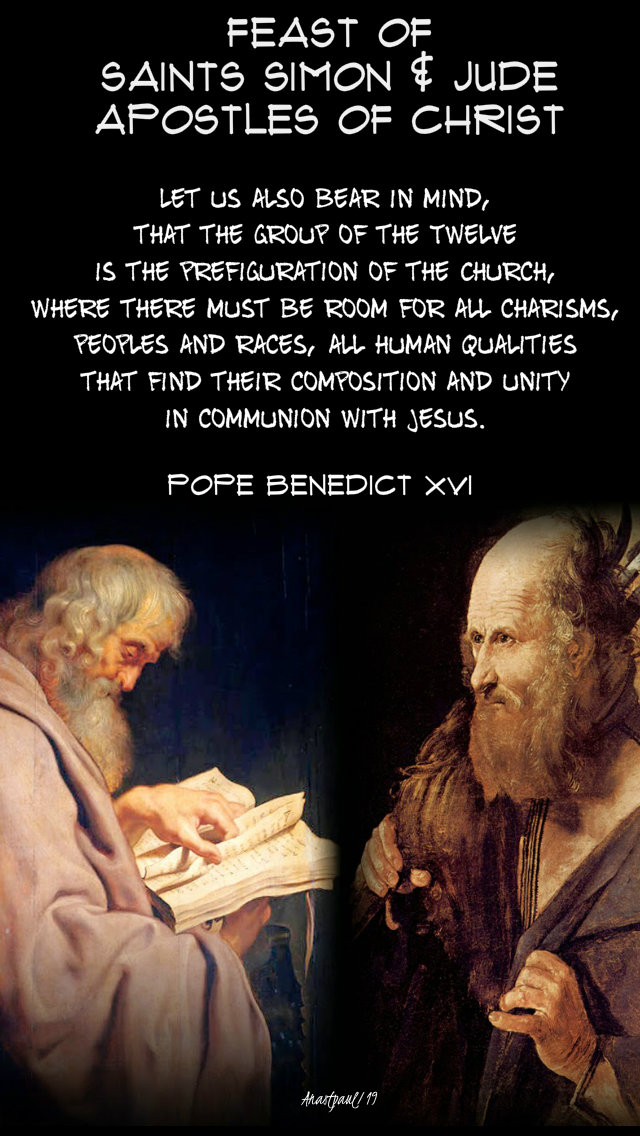
Let us also bear in mind, that the group of the Twelve, is the prefiguration of the Church, where there must be room for all charisms, peoples and races, all human qualities that find their composition and unity in communion with Jesus.”
Pope Benedict XVI
Catechesis on Saints Simon and Jude General Audience Saint Peter’s Square Wednesday, 11 October 2006
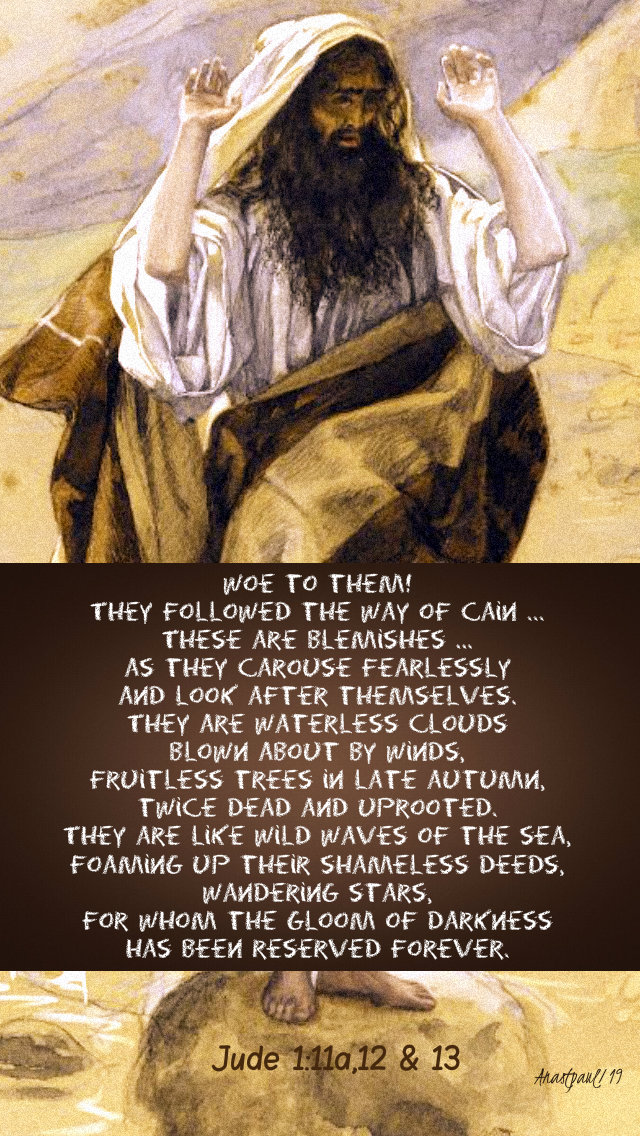
“Woe to them! They followed the way of Cain … These are blemishes … as they carouse fearlessly and look after themselves. They are waterless clouds blown about by winds, fruitless trees in late autumn, twice dead and uprooted. They are like wild waves of the sea, foaming up their shameless deeds, wandering stars, for whom the gloom of darkness has been reserved forever.”
One Minute Reflection – 28 October – Feast of Saints Simon and Jude, Apostles and Martyrs, Gospel: Luke 6:12-19
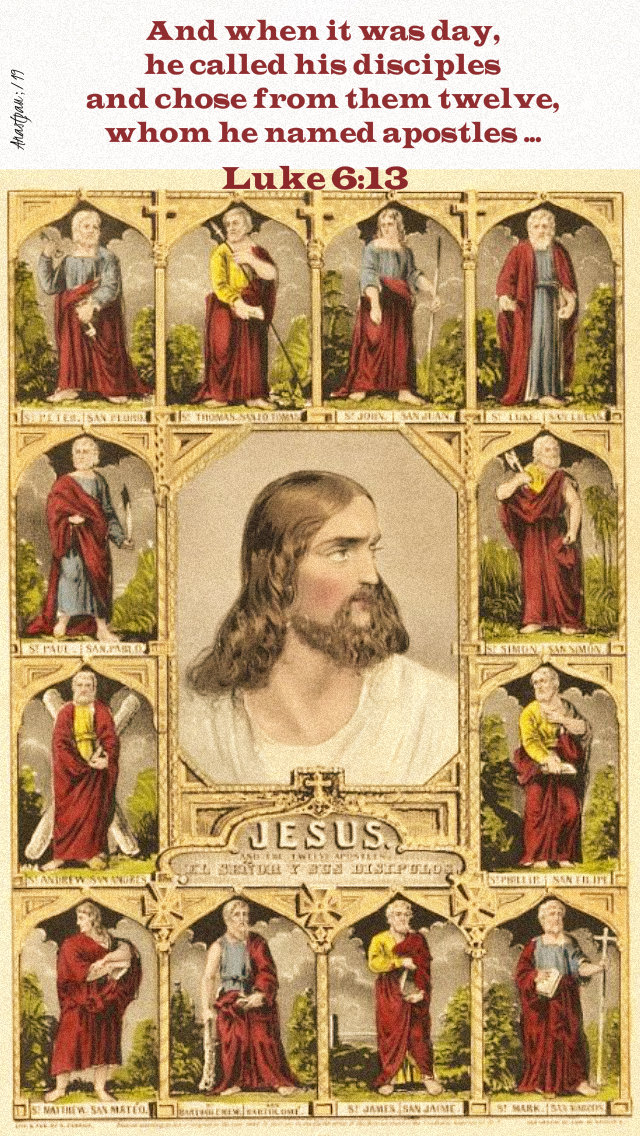
And when it was day, he called his disciples and chose from them twelve, whom he named apostle … Luke 6:13
REFLECTION – “Saint Paul said: “The weakness of God is stronger than all men” (1Cor 1:25). It is clear from this too that the gospel is divine. For whence did it strike twelve unlettered men to attempt such great enterprises, men who were living in marshes, or rivers, in desert places, who had never perhaps gone into a city or the public square? Whence did it strike them to array themselves against the whole world? That they were cowardly and unmanly, he who has written about them shows, inasmuch as he does not even deprecate nor try to gloss over their failings. This, in itself, is a powerful proof of the truth. What then does this man say about them? That after the innumerable miracles they had seen Christ work, when He was taken prisoner some fled, while the one who remained, although he was head over the rest, denied Him.
Here were men who failed to stand up to the Jews when Christ was alive. Yet when He died and was buried, they arrayed themselves against the whole world… Would they not have said to themselves: “What is this? He had not strength to save Himself, will He protect us? He did not defend Himself when He was alive, will He reach out His hand to us, now He is dead? When He was alive He did not conquer a single nation—shall we convince the whole world by speaking His name?”… Hence it is clear that, if they had not seen Him risen and received this mighty proof of His power, they would never have risked such a gamble.” … St John Chrysostom (c.345-407) Priest at Antioch then Bishop of Constantinople, Father & Doctor of the Church – Homily on the 1st letter to the Corinthians 4, 3
PRAYER – Lord God, You taught us to call upon Your name, through the preaching of the Apostles. Open our eyes each day, grant that we may see Jesus Your Son at our side, open our ears that we may hear His voice, open our mouths, that we may beg forgiveness and proclaim the good news, as we follow the way Your Son carved out for us. At the intercession of Sts Simon and Jude, may Your Church continue to grow and to hope in Your love. We make our prayer through Jesus our Lord, with the Holy Spirit, God forever, amen.
Our Morning Offering – 28 October – Feast of Saints Simon and Jude, Apostles and Martyrs
Come, let us worship the Lord, the King of Apostles.
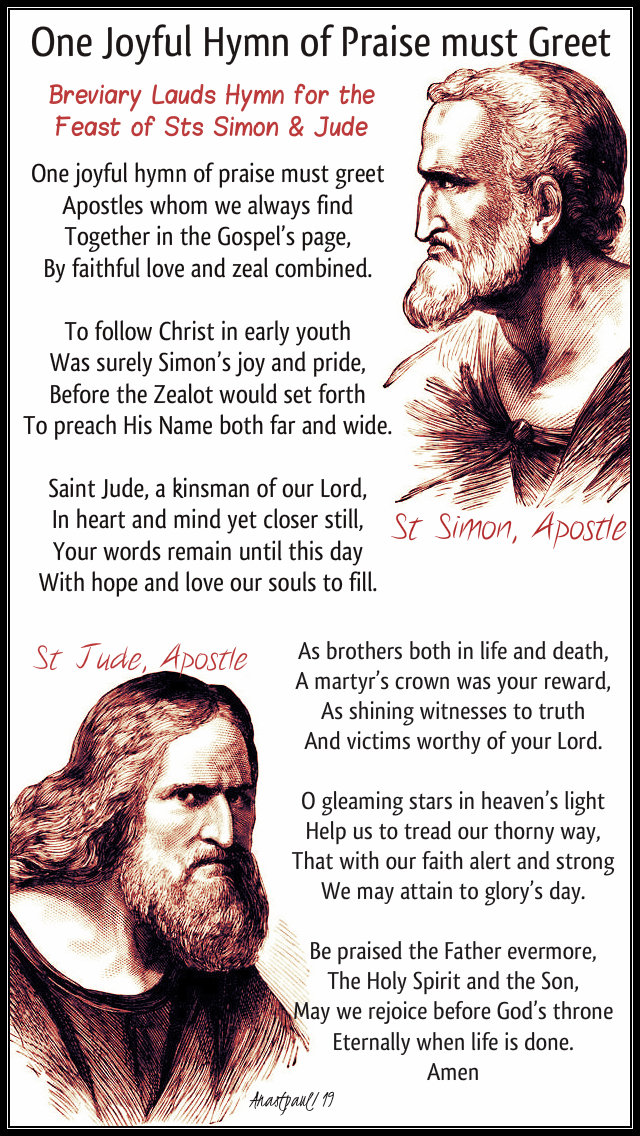
One Joyful Hymn of Praise must Greet Morning Hymn On the Feast of Sts Simon and Jude From the Breviary The Benedictines of Saint Cecilia’s Abbey, Ryde, UK
One joyful hymn of praise must greet
Apostles whom we always find
Together in the Gospel’s page,
By faithful love and zeal combined.
To follow Christ in early youth
Was surely Simon’s joy and pride,
Before the Zealot would set forth
To preach His Name both far and wide.
Saint Jude, a kinsman of our Lord,
In heart and mind yet closer still,
Your words remain until this day
With hope and love our souls to fill.
As brothers both in life and death,
A martyr’s crown was your reward,
As shining witnesses to truth
And victims worthy of your Lord.
O gleaming stars in heaven’s light
Help us to tread our thorny way,
That with our faith alert and strong
We may attain to glory’s day.
Be praised the Father evermore,
The Holy Spirit and the Son,
May we rejoice before God’s throne
Eternally when life is done.
Amen
Feast of Saints Simon and Jude, Apostles of Christ – 28 October
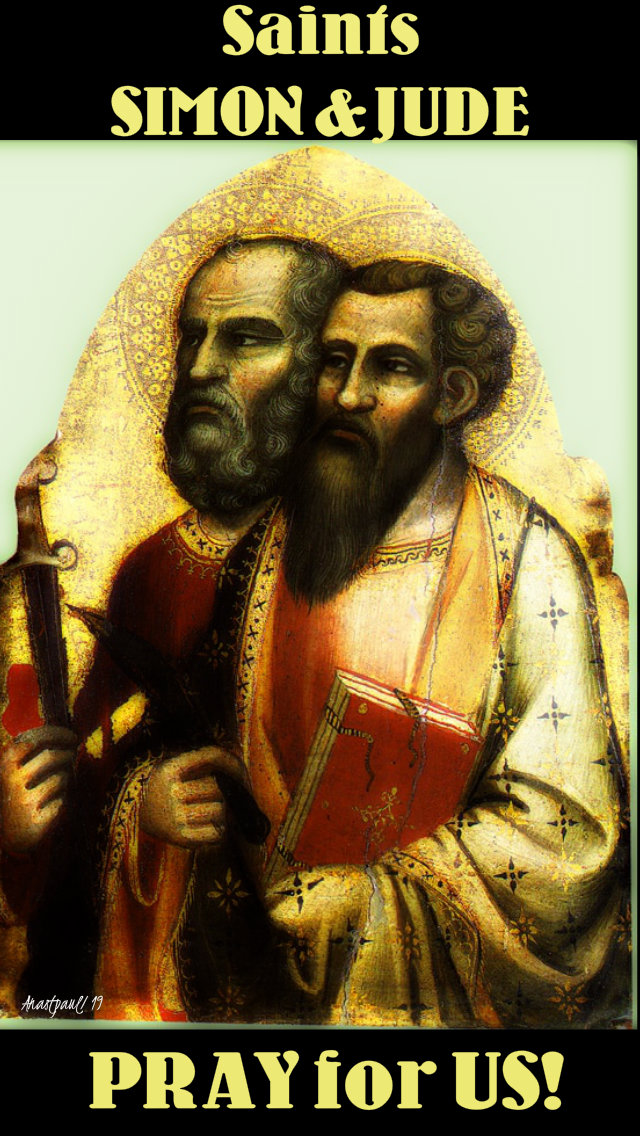
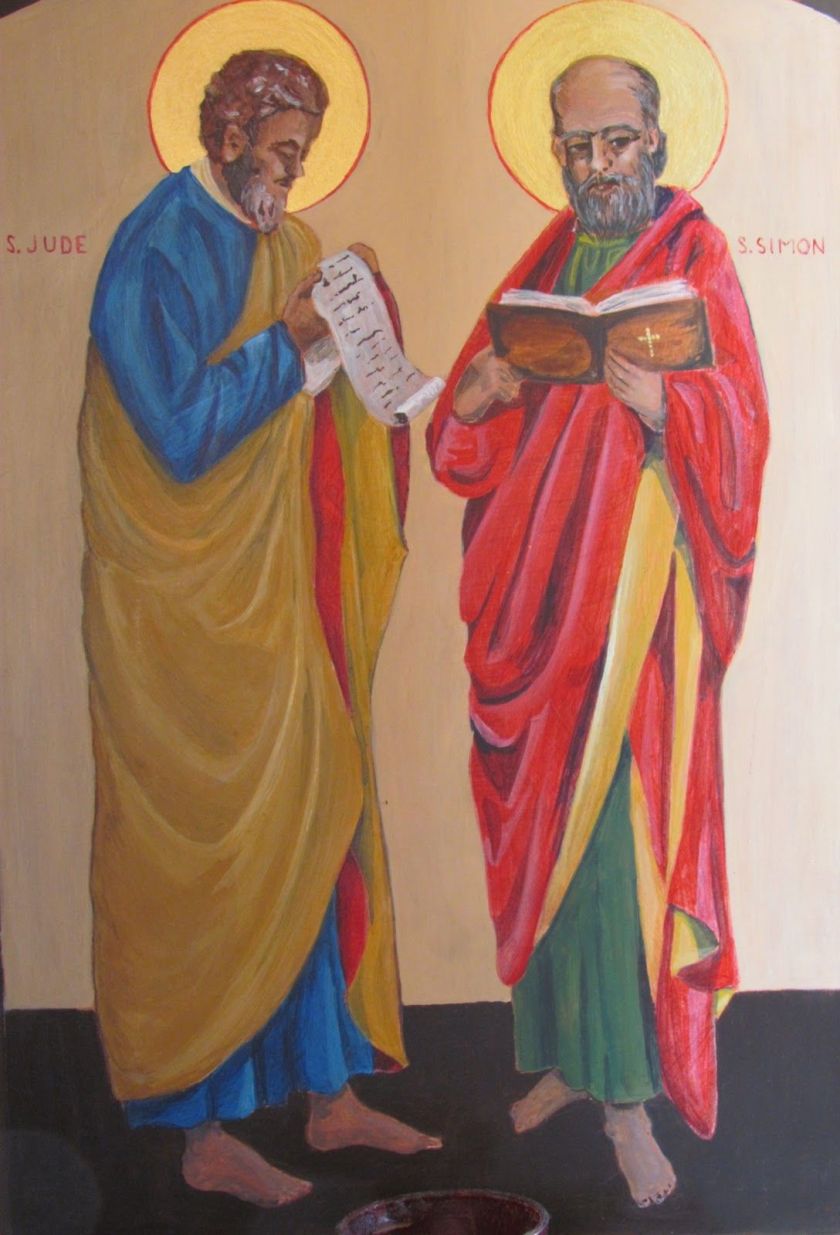
Today the Church celebrates the feast of Sts Simon and Jude whose names occur together in the Canon of the Mass and are also celebrated on the same day. These two Apostles have been linked in name since the early days of Christianity and some believe that this is because they were relatives of Jesus.
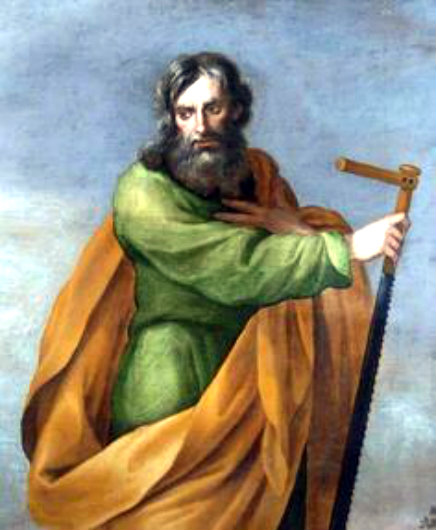
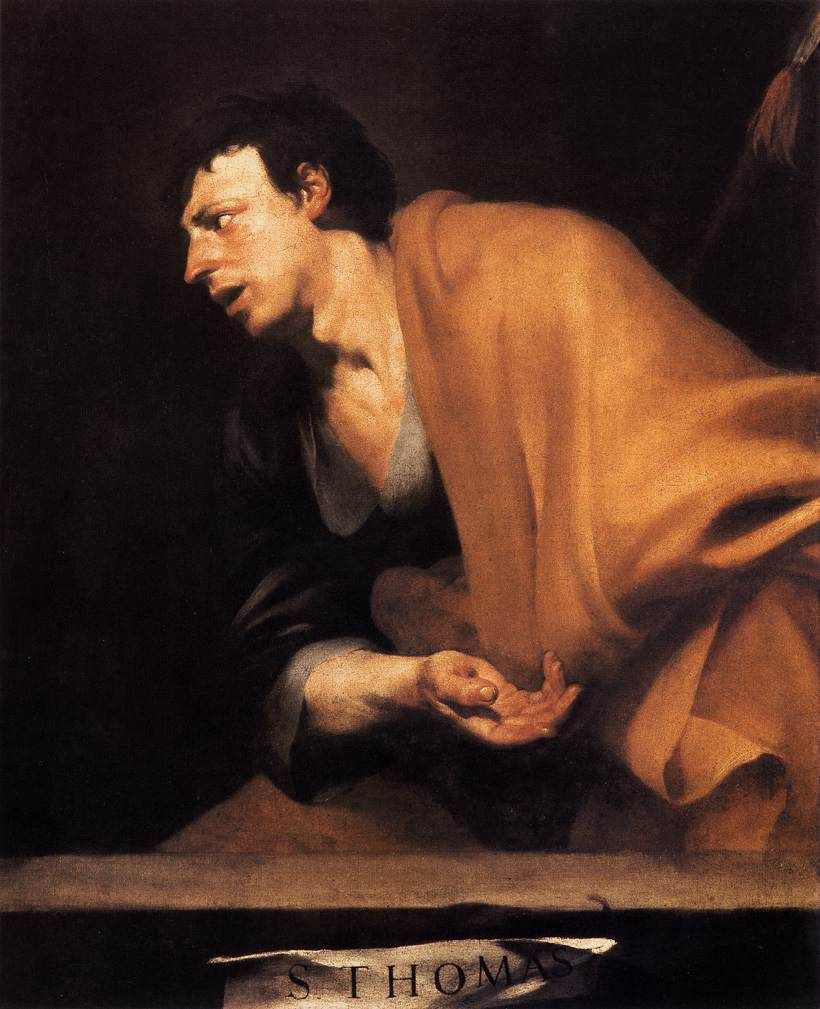
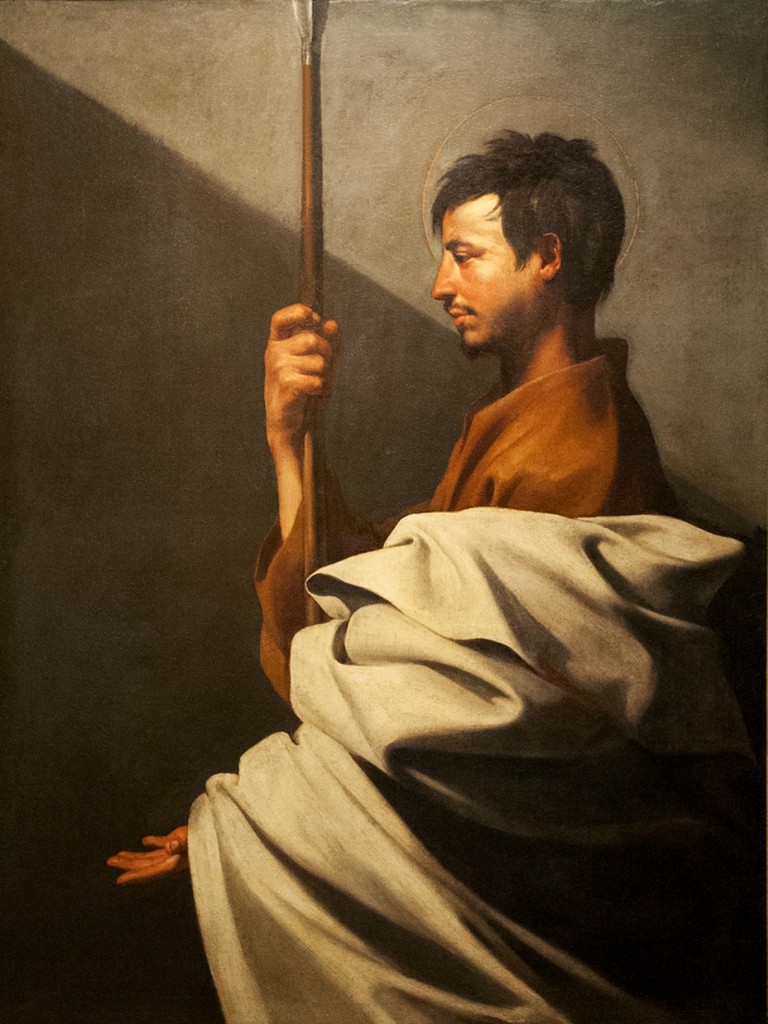
San Simón | Jusepe de Ribera / Image: Saint Jude Thaddeus | Georges de La Tour
St Simon in the Gospels is called “the Zealot” and this may indicate that he belonged to that military group of Jews called the Zealots, the last of whom committed suicide on Masada rather than surrender to the Roman legions. Legend has Simon evangelising the area around Edessa in Syria, where later a great school of theology arose. It is also said, that after preaching in Egypt, he joined St Jude in Mesopotamia and that they both went as missionaries to Persia and were martyred there. Undoubtedly, their names are linked also because of this association.
St Simon
Jude was most certainly a cousin of Jesus and is mentioned in the lists of the “brothers of the Lord.” In Luke he is called Jude and in Matthew and Mark, ‘Thaddeus’ and is considered to be the brother of James, the first Bishop of Jerusalem and the leader of the early Christian community there – this is James the Lesser, not the brother of St John. He is the author of the Epistle of Jude in the New Testament, one of those called the ‘Catholic Epistles.’ It is believed that the early translators of the New Testament from Greek into English, sought to distinguish him from Judas Iscariot and subsequently abbreviated his forename. In iconography, , St Jude is often shown with an image of his cousin, our Lord Jesus and a tongue of fire over his head.
At the Last Supper, it was Jude who asked the Lord Jesus, why He did not manifest Himself to the rest of the world and Jesus answered that he and the Father would visit all those who loved Him, saying – “We will come to him and make our abode with him.”
Jude is the patron of ‘hopeless cases’ and devotion to him, as the advocate of impossible causes, is widespread throughout the Church. So why is St Jude Thaddaeus the patron saint of desperate causes? The traditional reason is rather simple – When one hears the name Judas (Latin and Greek) or even Jude (English), one immediately thinks of Judas Iscariot who betrayed our Lord. Therefore, a person had to be desperate to invoke his name. Being so seldom invoked and reverenced, St Jude is ready and waiting to hear the prayers of those who call upon him. Ironically, he is probably the Apostle who is invoked the most in prayer and the most memorialised in churches, with statues and stained glass windows or other artworks.
It is a beautiful tradition, associated with prayer to St Jude, for his intercession, to leave a copy of the prayer in a Church, or before his Statue, Picture or Shrine, for someone else in great need, to find. The prayer is usually prayed as a Novena.
Prayer to St Jude
Patron of Impossible Causes
Most holy Apostle, St Jude,
faithful servant and friend of Jesus,
the Church honours and invokes you universally,
as the patron of hopeless causes,
of things almost despaired of.
Pray for me, I am so helpless and alone.
Help me, I implore you,
by that particular privilege given to you,
to bring visible and speedy help
where help is almost despaired of.
Come to my assistance in this great need,
that I may receive the consolation
and help of Heaven in all my necessities,
tribulation and sufferings,
particularly ………………… (state request)
and that I may praise God with you
and all the elect forever.
I promise, O blessed St Jude,
to be ever mindful of this great favour,
to always honour you as my special and powerful patron
and to gratefully encourage devotion to you.
Amen
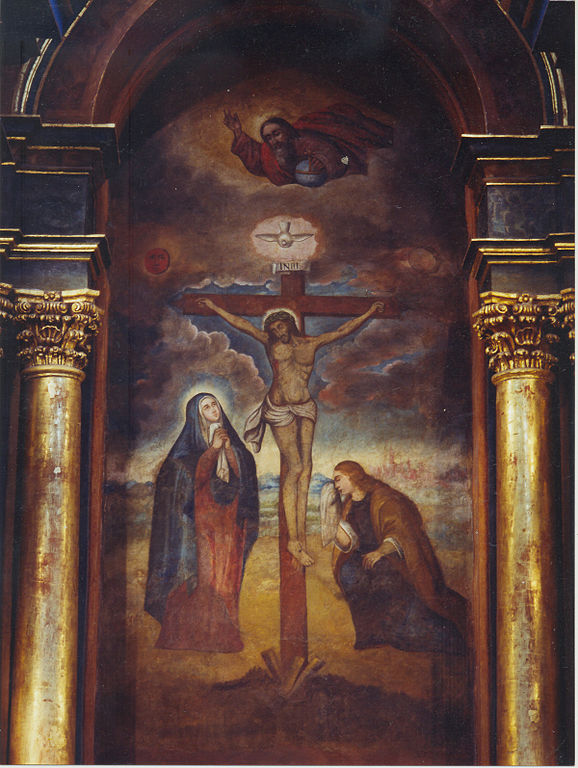
Lord of Miracles/Señor de los Milagros de Nazarenas: A mid-17th-century painting of the Crucifixion that is venerated in Lima, Peru and its celebration involves one of the largest processions in the world.
It was painted by an unnamed African taken to Peru as a slave from what is now Angola. Above the Cross is the Holy Spirit and God the Father. Below and to the right of Jesus, is His mother, the Virgin Mary with her heart pierced by a sword of sorrow. Kneeling and weeping at the foot of the cross is St Mary Magdalene.
The name originated on 13 November 1655 when everything around it was destroyed in an earthquake that left the painting standing and undamaged. Christ is shown enduring the pain of crucifixion.
Every year in October, hundreds of thousands of devotees from all races and economic backgrounds participate in a procession honouring the image through the streets of Lima. Boulevards are decorated in purple on 18,19 and the final Feast 28 October to celebrate the Lord of Miracles.
St Abdias of Babylon
St Abraham of Ephesus
St Alberic of Stavelot
St Anastasia the Elder
St Anglinus of Stavelot
St Cyril of Rome
St Cyrilla of Rome
St Diomedes the Younger
St Dorbhene of Iona
St Eadsin of Canterbury
St Elius of Lyon
St Faro of Meaux
St Ferrutius
St Fidelis of Como
St Genesius of Thiers
Bl Germain of Talloires
St Gioan Dat
St Godwin of Stavelot
St Maria Ascuncion
St Remigius of Lyons
St Rodrigo Aguilar Aleman
St Salvius of Amiens
—
Martyrs of Avila – 3 saints: Two sisters and a brother who, during a period of persecution, fled Talavera de la Reina, Spain, were caught and executed. Martyrs: Christeta, Sabina and Vincent. 303 in Avila, Spain.
Martyred in the Spanish Civil War:
• Blessed Claudio Julían García San Román
• Blessed Maria Asuncion
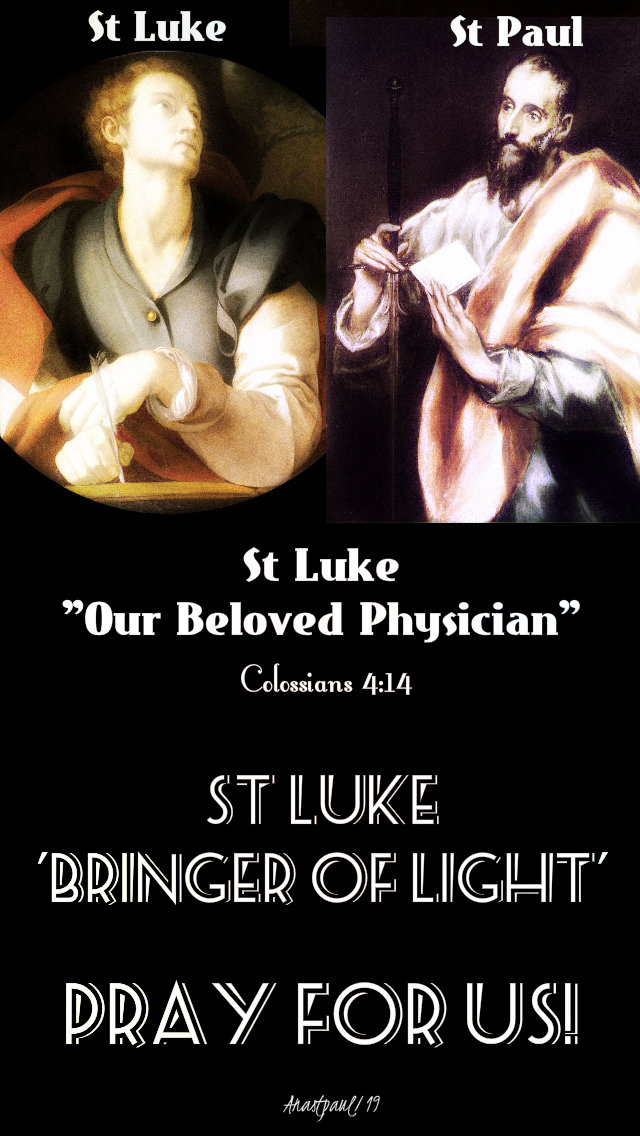
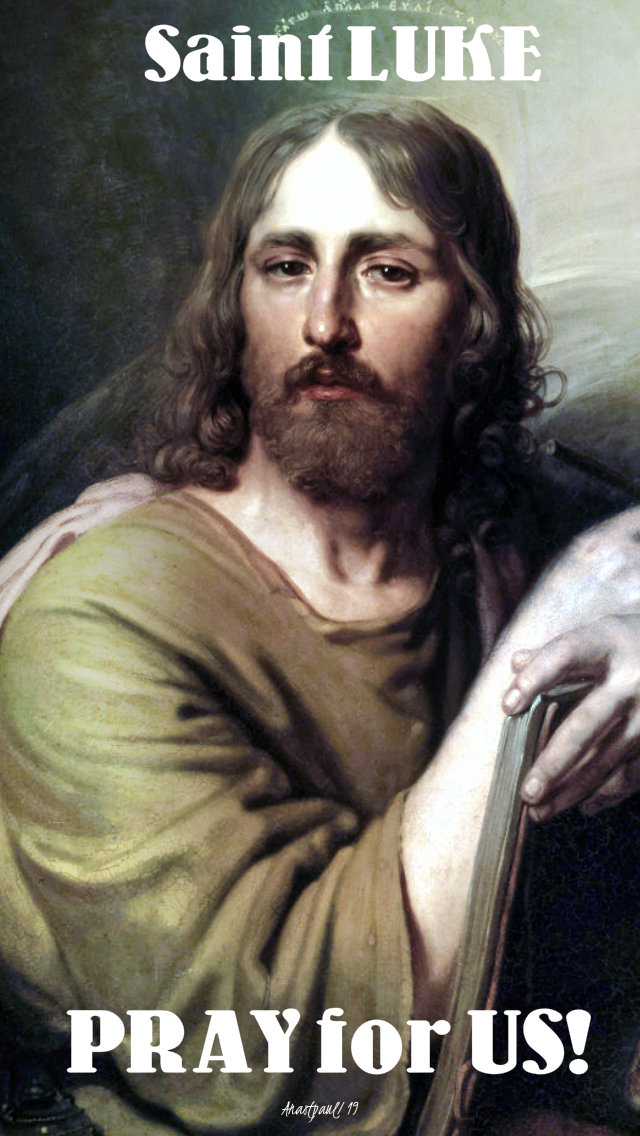
Thought for the Day – 18 October – Feast of St Luke the Evangelist
“Our Beloved Physician” – Bringer of Light
Luke wrote as a Gentile for Gentile Christians. His Gospel and Acts of the Apostles reveal his expertise in classic Greek style, as well as his knowledge of Jewish sources. There is a warmth to Luke’s writing that sets it apart from that of the other synoptic Gospels and yet, it beautifully complements those works. The treasure of the Scriptures is a true gift of the Holy Spirit to the Church.
Luke wrote one of the major portions of the New Testament, a two-volume work comprising the third Gospel and Acts of the Apostles. In the two books, he shows the parallel between the life of Christ and that of the Church. He is the only Gentile Christian among the Gospel writers. Tradition holds him to be a native of Antioch and Paul calls him “our beloved physician (Col 4:14).” His Gospel was probably written between 70 and 85.
Luke appears in Acts, during Paul’s second journey, remains at Philippi for several years, until Paul returns from his third journey, accompanies Paul to Jerusalem and remains near him when he is imprisoned in Caesarea. During these two years, Luke had time to seek information and interview persons, who had known Jesus. He accompanied Paul on the dangerous journey to Rome where he was a faithful companion.
Luke’s unique character may best be seen by the emphases of his Gospel, which has been given a number of subtitles:
1) The Gospel of Mercy
2) The Gospel of Universal Salvation
3) The Gospel of the Poor
4) The Gospel of Absolute Renunciation
5) The Gospel of Prayer and the Holy Spirit
6) The Gospel of Joy
One Minute Reflection – 18 October – The Feast of St Luke the Evangelist, Gospel: Luke 10:1-9
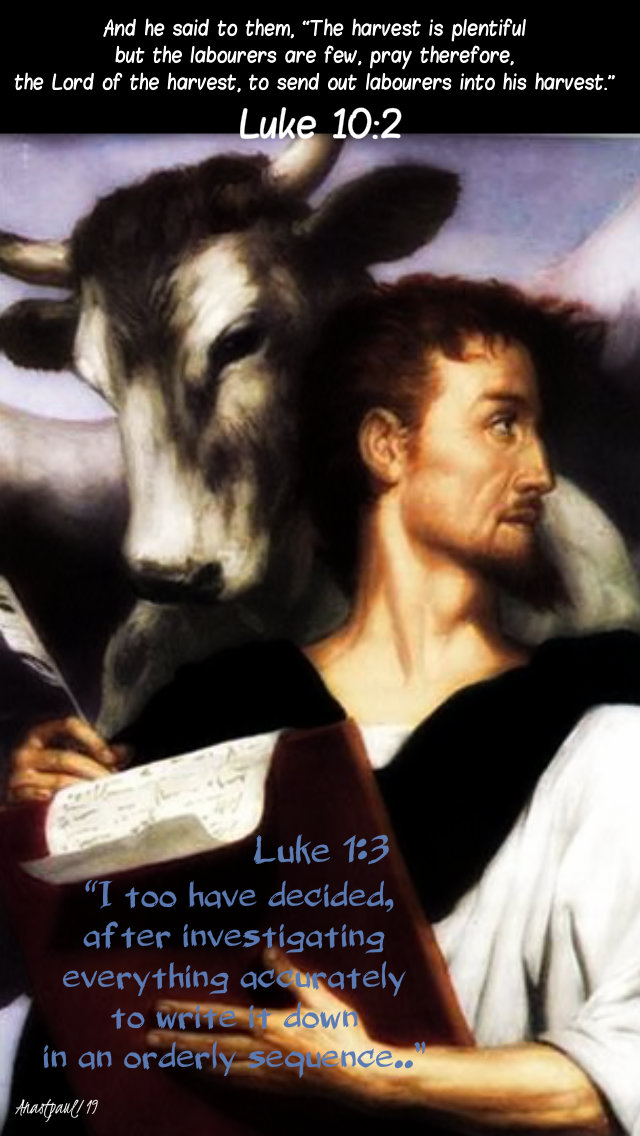
And he said to them, “The harvest is plentiful but the labourers are few, pray therefore, the Lord of the harvest, to send out labourers into his harvest.” … Luke 10:2
Saint Luke’s testimony – “I too have decided, after investigating everything accurately to write it down in an orderly sequence” (Luke 1:3)
REFLECTION – “Among all the Scriptures, even those of the New Testament, the Gospels have a special pre-eminence and rightly so, for they are the principal witness for the life and teaching of the incarnate Word, our Saviour. The Church has always and everywhere, held and continues to hold, that the four Gospels are of apostolic origin. For what the Apostles preached in fulfilment of the commission of Christ, afterwards, they themselves and apostolic men, under the inspiration of the divine Spirit, handed on to us in writing – the foundation of faith, namely, the fourfold Gospel, according to Matthew, Mark, Luke and John.
Holy Mother Church has firmly and with absolute constancy, held and continues to hold, that the four Gospels just named, whose historical character the Church unhesitatingly asserts, faithfully hand on what Jesus Christ, while living among men, really did and taught for their eternal salvation until the day He was taken up into heaven (Acts 1:1-2). Indeed, after the Ascension of the Lord the Apostles handed on to their hearers what He had said and done. This they did with that clearer understanding which they enjoyed after they had been instructed by the glorious events of Christ’s life and taught by the light of the Spirit of truth (Jn 14:26).
The sacred authors wrote the four Gospels, selecting some things from the many which had been handed on by word of mouth or in writing, reducing some of them to a synthesis, explaining some things in view of the situation of their churches and preserving the form of proclamation but always, in such fashion, that they told us the honest truth about Jesus. For their intention in writing, was that either from their own memory and recollections, or from the witness of those who “themselves from the beginning were eyewitnesses and ministers of the Word” we might know “the truth concerning those matters about which we have been instructed” (Lk 1, 1-4). … Vatican Council II – Dogmatic Constitution on Revelation “ Dei Verbum ” # 18-19
PRAYER – Lord God, You chose St Luke to reveal the mystery of Your love in his preaching and his writings. Grant, we pray, that we may grow in love for the Holy Face of Christ, His words and His directions, revealed to us in the Gospels, in the example of your saints. Today, on his feast, we especially look to St Luke, to guide, teach and pray for us. We make our prayer through our Lord Jesus Christ, with the Holy Spirit, one God with You, forever and ever, amen.
Our Morning Offering – 18 October – The Feast of St Luke,
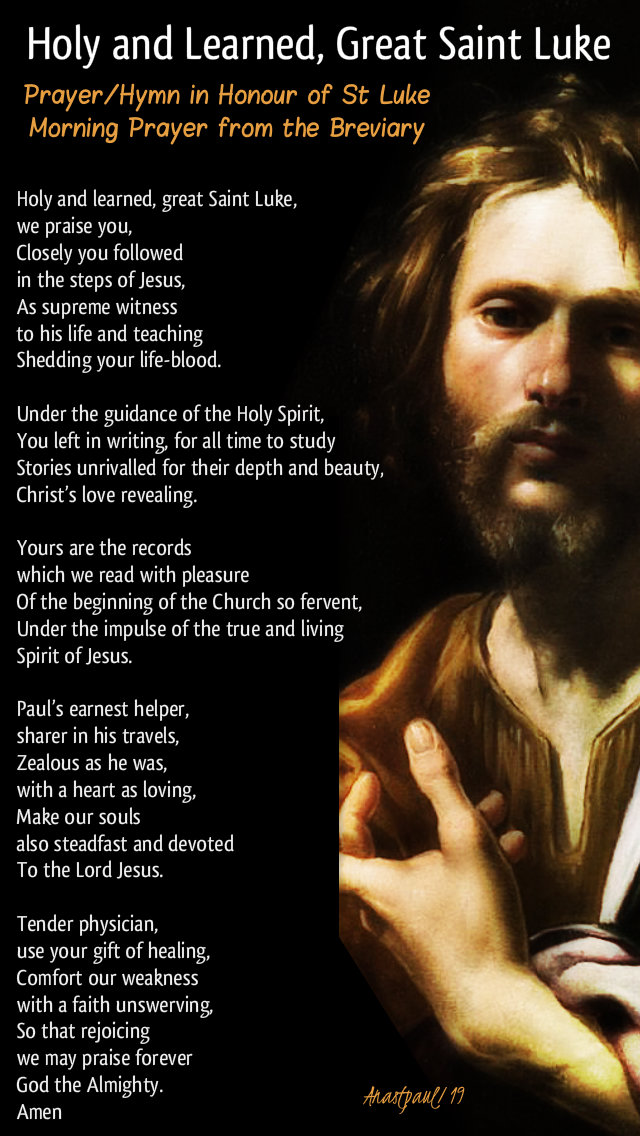
Holy and Learned, Great Saint Luke Prayer/Hymn in Honour of St Luke Morning Prayer from the Breviary
Holy and learned, great Saint Luke, we praise you,
Closely you followed in the steps of Jesus,
As supreme witness to his life and teaching
Shedding your life-blood.
Under the guidance of the Holy Spirit,
You left in writing, for all time to study
Stories unrivalled for their depth and beauty,
Christ’s love revealing.
Yours are the records which we read with pleasure
Of the beginning of the Church so fervent,
Under the impulse of the true and living
Spirit of Jesus.
Paul’s earnest helper, sharer in his travels,
Zealous as he was, with a heart as loving,
Make our souls also steadfast and devoted
To the Lord Jesus.
Tender physician, use your gift of healing,
Comfort our weakness with a faith unswerving,
So that rejoicing we may praise forever
God the Almighty.
Amen
St Acutius of Pozzuoli
St Asclepiades of Antioch
St Brothen
Bl Burchard I
St Cadwaladr of Brittany
Bl Domenico of Perpignano
St Eutychius of Pozzuoli
St Gwen
St Gwen of Tagarth
St Gwendoline
St Isaac Jogues
St Julian the Hermit St Justus of Beauvais (c 278—c 287) Child of nine
Bl Margherita Tornielli
St Monon of Nassogne
St Proculus of Pozzuoli
Bl Theobald of Narbonna
St Tryphonia of Rome
—
Martyrs of Africa – 9 saints: A group of Christians martryed together in Africa. The only details that have survived are the names – Beresus, Dasius, Faustinus, Leucius, Lucius, Martialis, Victoricus, Victrix and Viktor. They were martyred in c.300 in Africa.
Martyred in the Spanish Civil War:
• Blessed Alfredo Almunia López-Teruel
• Blessed Francisco Roselló Hernández
• Blessed Isidro Juan Martínez
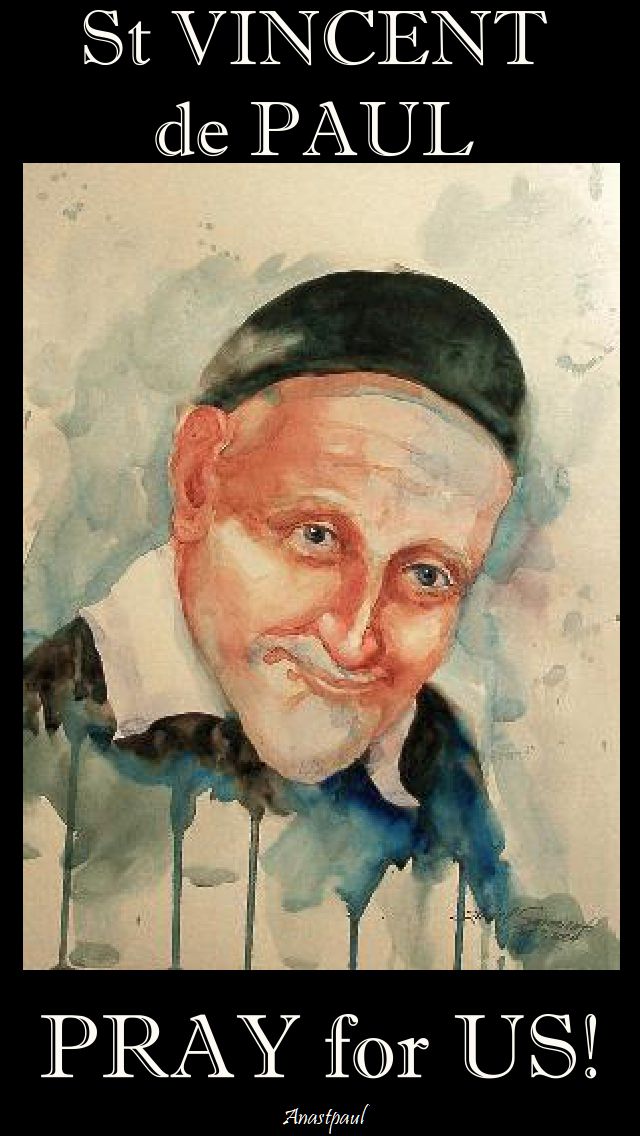
One Minute Reflection – 27 September – Friday of the Twenty Fifth week in Ordinary Tim, Year C, Gospel: Luke 9:18–22 and the Memorial of St Vincent de Paul (1581-1660)
“The Son of man must suffer many things and be rejected by the elders and chief priests and scribes and be killed and on the third day be raised.”... Luke 9:22
REFLECTION – “The scene found n the Gospel reading forms a climax of the Synoptic Gospels. It constitutes the watershed in Jesus’ life. To this point, in accord with the mission given Him by the Father, He has acted messianically and has aroused a sense of who He is, especially in His disciples. Because the shift that takes place in this scene is so important, Luke places it in the context of a prayer of Jesus in solitude. By asking His disciples about His identity, He takes the opportunity to reveal the core of His mission.
Yet, the people’s perception of who He is, is so imperfect, that He cannot use it as a point of departure. Peter’s statement, “you are the Messiah of God” hits the target, yet Peter’s image of the Messiah remains an Old Testament and contemporary one – the Messiah as Israel’s liberator. That is why Jesus forbids them to use the title and, more profoundly, that is why He lays out clearly, what is the true task of the Messiah – to be rejected, to die, to rise again. So that this will not be received as some sort of incomprehensible, mythological event, He immediately explains it’s implications for anyone who wishes to be His disciple – “Take up your cross daily” and “follow” the Messiah in this way.
The required faith embraces the act it includes – discipleship – but not by scheming to gain something – rather, by unconditional loss: “Whoever loses his life for my sake … ” … Cardinal Han Urs von Bathasar (1905-1988)
PRAYER – Lord God, You hold out the Light of Your Word to those who do not know You. Strengthen in our hearts, the faith You have given us and the Credo we profess, so that no trials may quench the fire Your Spirit has kindled in us. May the intercession of St Vincent de Paul, grant us the grace of following the way of the Cross, to stand beneath it with our Mother, the Mother of God, Ave Maria! We make our prayer through Jesus Christ with the Holy Spirit, one God forever, amen.
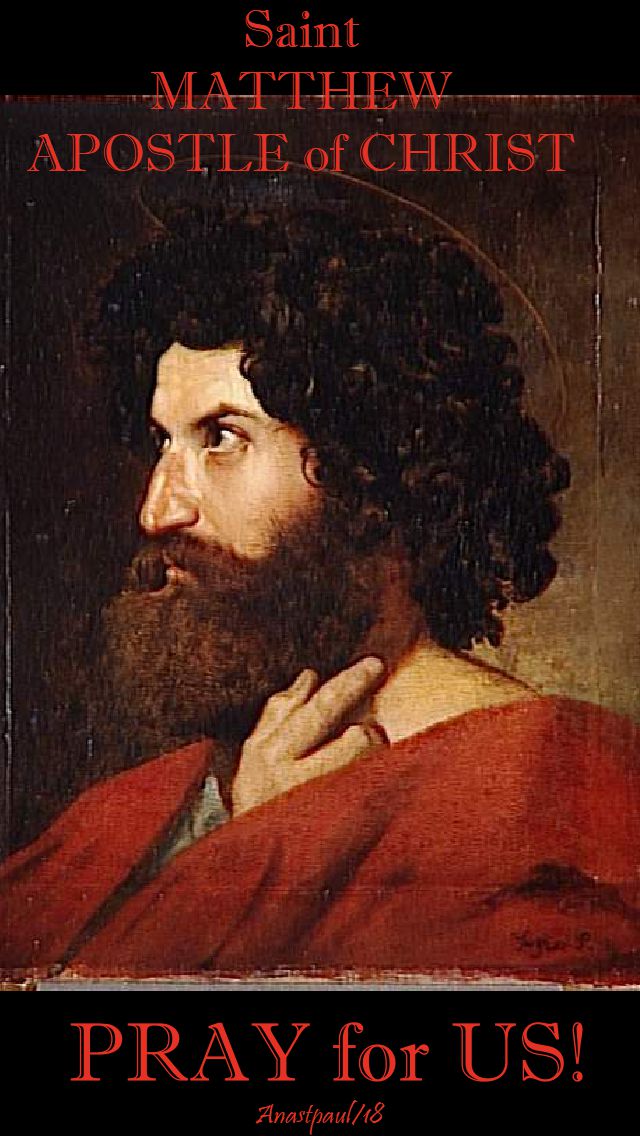
Thought for the Day – 21 September – The Feast of St Matthew, Apostle and Evangelist- Today’s Gospel: Matthew 9:9–13
We can learn much from Matthew.
He was a man who knew quite well the power of money. He knew the comfort it could ensure, the recreation it could buy, the luxury it could provide. But he was wise enough to know what it could not do. Money could never give him that sense of peace deep inside. It could never befriend him when he was lonely or give him the strength and courage to go on, when all else seemed lost. Money could never buy him forgiveness or love.
But the love of Christ could do all this and more.
He was open enough to recognise truth when he saw Him. “And he got up and followed him” (Matthew 9:9b).
Quote/s of the Day – 21 September – The Feast of St Matthew, Apostle and Evangelist- Today’s Gospel: Matthew 9:9–13
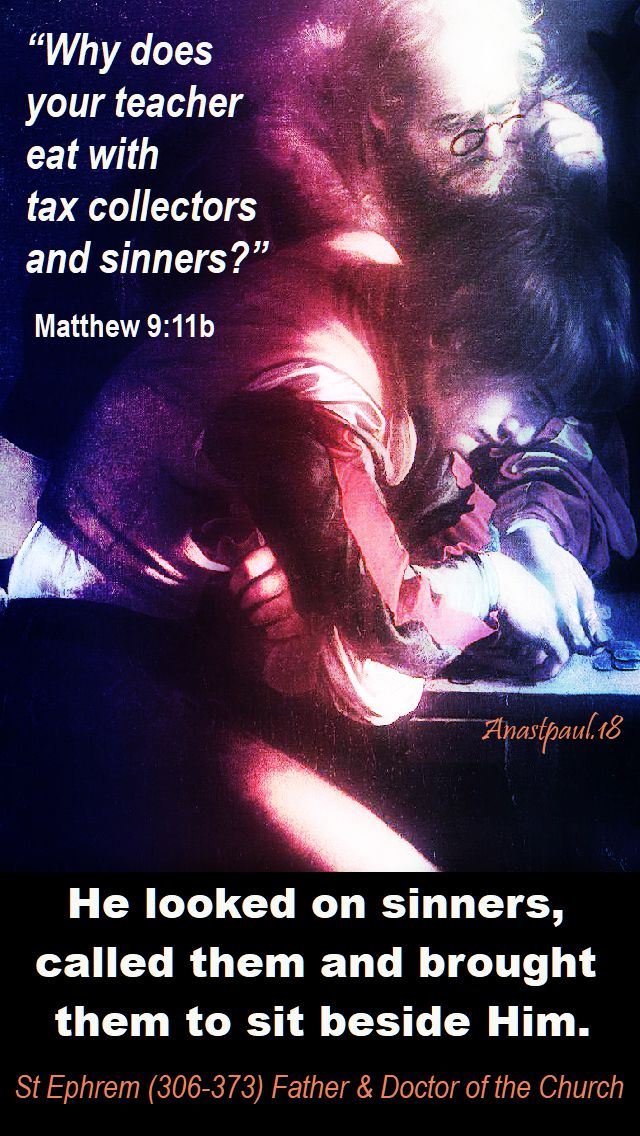
“Why does your teacher eat with tax collectors and sinners?”
Matthew 9:11b
“Our Lord chose Matthew, the tax collector, to encourage his fellows to join Him. He looked on sinners, called them and brought them to sit beside Him. What a wonderful sight! Angels stand trembling while publicans, seated, rejoice. The angels are struck with awe before the Lord’s greatness while sinners eat and drink with Him. The scribes choke with hatred and indignation, the publicans rejoice because of His mercy. The heavens saw the sight and were filled with wonder, hell saw it and was maddened. Satan saw it and was enraged, death saw it and withered, the scribes saw it and were much troubled.”
St Ephrem (306-373) Father & Doctor of the Church
Commentary on the Gospel, or Diatessaron, 5, 17 (SC 121, p.115 rev.)
“The good news of the Gospel consists precisely in this – offering God’s grace to the sinner!”
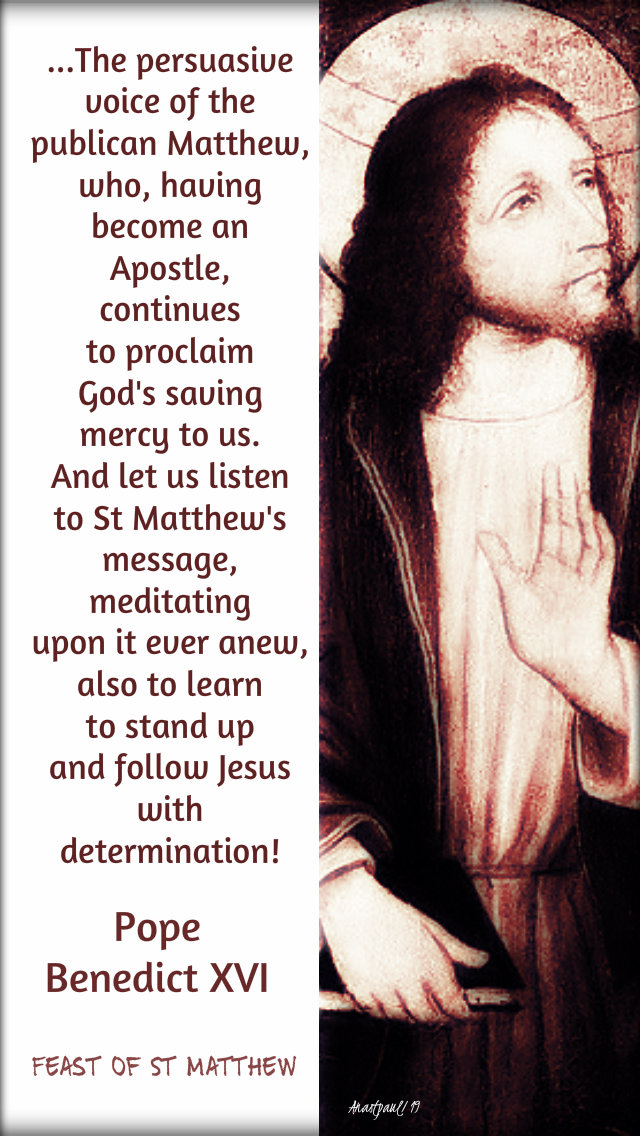
“The Gospel of Matthew written in Hebrew or Aramaic is no longer extant but in the Greek Gospel that we possess, we still continue to hear, in a certain way, the persuasive voice of the publican Matthew, who, having become an Apostle, continues to proclaim God’s saving mercy to us. And let us listen to St Matthew’s message, meditating upon it ever anew, also to learn to stand up and follow Jesus with determination.”
One Minute Reflection – 21 September – The Feast of St Matthew, Apostle and Evangelist- Today’s Gospel: Matthew 9:9–13
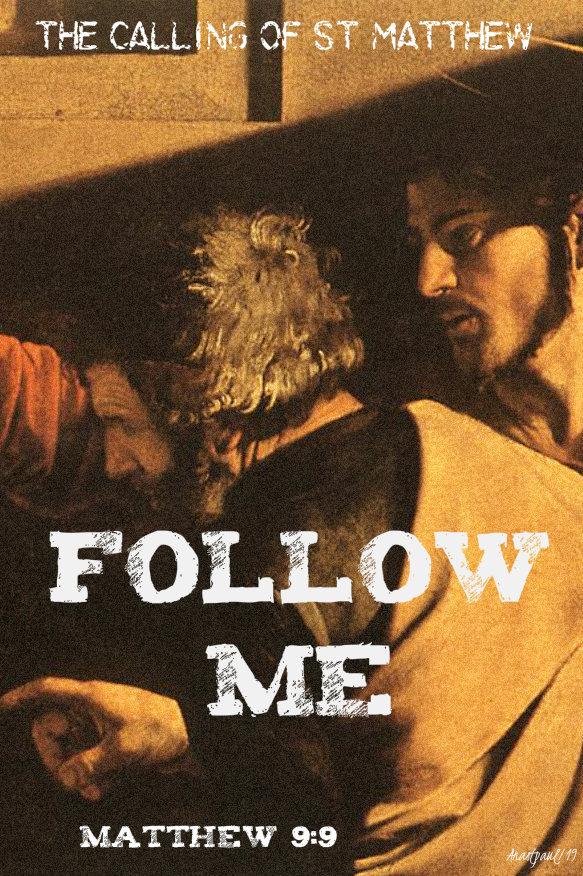
“Follow me”.. Matthew 9:9
REFLECTIONS – “Jesus saw a man called Matthew sitting at the tax office and he said to him: “Follow me.” He looked at him not with the eyes of the body but rather with the eye of interior pity. He saw a tax collector, and since He looked at him in pity and choosing him as a disciple, He said: “Follow me.” ‘Follow’ meant ‘imitate’ – not by the movement of his feet but rather by a change of life. For whoever says he is following Christ “ought himself to walk as Christ walked” (cf 1Jn ).
“Matthew rose and followed him.” It is not to be wondered at that the tax collector should leave the earthly gains he was looking after at the first command of the Lord and that, abandoning riches, he should join the company of Him who, he saw, had no wealth. For the Lord, who outwardly called him with words, through a hidden instinct secretly taught him to follow Him. By the gift of divine grace the Lord enlightened his mind to understand that He who on earth called him away from temporal interests, could in heaven give incorruptible treasures (cf Mt 6,20).
“And as Jesus sat at table in the house, behold, many tax collectors and sinners came and sat down with Jesus and his disciples.” The conversion of one tax collector provided an example of penance and forgiveness to many tax collectors and sinners. In a wonderful and true sign of the future, he who was to become the apostle and teacher of the gentiles, brought with him to salvation, a multitude of sinners in the first moments of his conversion!” ... Saint Bede the Venerable (673-735) Father & Doctor of the Church – Homilies on the gospels I, 21 ; CCL 122, 149
PRAYER – Lord, You showed Your great mercy to Matthew the tax-gatherer by calling him to become Your Apostle. Supported by his prayer and example, may we always answer Your call and live in close union with You. We make our prayer, in union with God our Father and the Holy Spirit, one God forever and ever. St Matthew, Apostle of Christ, pray for us, amen.
Saint of the Day – 21 September – Feast of St Matthew, Apostle and Evangelist
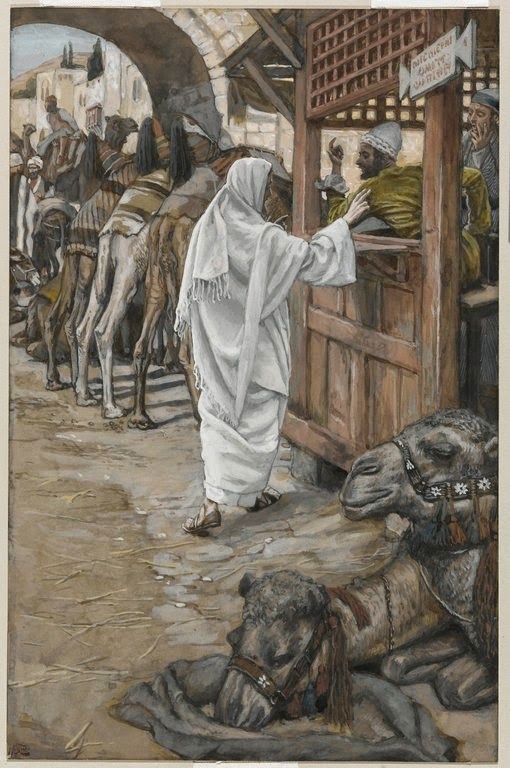
One day, as our Lord was walking by the Sea of Galilee, He saw, sitting at the receipt of custom, Matthew the publican, whose business it was to collect the taxes from the people for their Roman masters. Jesus said to him, “Follow Me” and leaving all, Matthew arose and followed Him.
Now the publicans were abhorred by the Jews as enemies of their country, outcasts and notorious sinners, who enriched themselves by extortion and fraud. No Pharisee would sit with one at table. Our Saviour alone had compassion for them. So St Matthew made a great feast, to which he invited Jesus and His disciples, with a number of these publicans, who henceforth began eagerly to listen to Him. It was then, in answer to the murmurs of the Pharisees, that He said, “They that are in health need not the physician. I have not come to call the just, but sinners to penance.”
The Calling of Matthew – James Tissot
After the Ascension, St Matthew remained some years in Judæa and there wrote his Gospel, to teach his countrymen that Jesus was their true Lord and King, foretold by the prophets. St Matthew afterward preached the Faith far and wide and is said to have finished his course in Parthia.
Obey all inspirations of Our Lord as promptly as St Matthew, who, at a single word, “laid down,” says St Bridget, “the heavy burden of the world to put on the light and sweet yoke of Christ.”
St Alexander of the Via Claudia
Bl Diego Hompanera París
St Eusebius of Phoenicia
St Francisco Pastor Garrido
St François Jaccard
St Gerulph
St Herminio García Pampliega
St Iphigenia
St Isaac of Cyprus
Bl Jacinto Martínez Ayuela
St Jacques Honoré Chastán
St Johannes Ri
St Jonah the Prophet
Bl José María Azurmendi Mugarza
Bl Josep Vila Barri
Bl Manuel Torró García
Bl Mark Scalabrini
St Maura of Troyes
St Meletius of Cyprus
Bl Nicolás de Mier Francisco
St Pamphilus of Rome
St Pierre Philibert Maubant
St Tôma Tran Van Thien
Bl Vicente Galbis Gironés
Bl Vicente Pelufo Orts
—
Martyrs of Gaza – 3 saints: Three brothers, Eusebius, Nestulus and Zeno, who were seized, dragged through the street, beaten and murdered by a pagan mob celebrating the renunciation of Christianity by Julian the Apostate. They were burned to death in 362 on a village garbage heap in Gaza, Palestine.
Martyred in the Spanish Civil War:
• Blessed Diego Hompanera París
• Blessed Jacinto Martínez Ayuela
• Blessed José María Azurmendi Mugarza
• Blessed Josep Vila Barri
• Blessed Manuel Torró García
• Blessed Nicolás de Mier Francisco
• Blessed Vicente Galbis Gironés
• Blessed Vicente Pelufo Orts
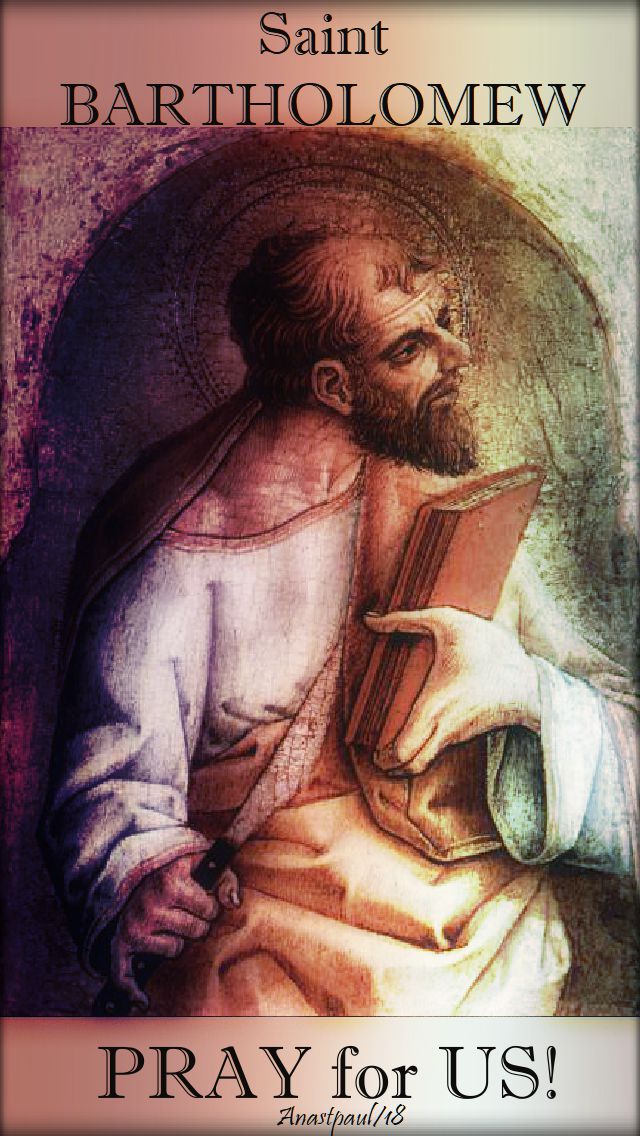
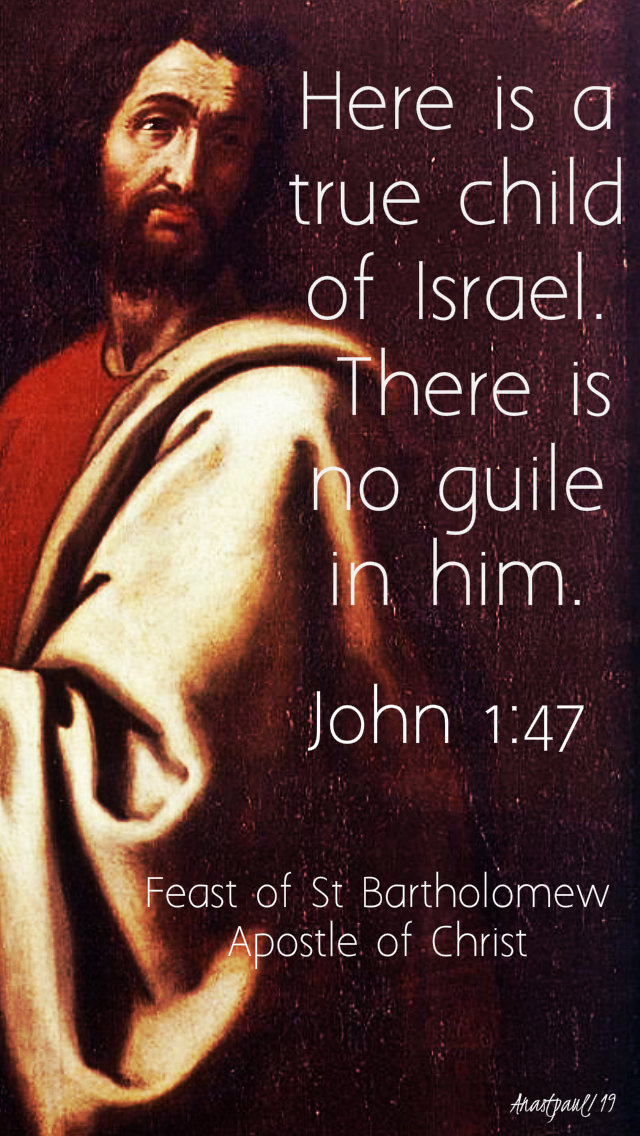
Thought for the Day – 24 August – The Feast of St Bartholomew, Apostle of Christ – Today’s Gospel: John 1:45–51
The name “Nathanael” means “God has given”
“The apostles’ glory is so indistinguishable and so bonded together by the cement of so many graces that in celebrating the feast of one of them the common greatness of all is called to our interior attention. For they share together the same authority of supreme judge, the same honourable rank and they hold the same power to bind and loose (Mt 19:28; 18:18). They are those precious pearls that Saint John tells us he beheld in the Book of Revelation out of which are constructed the gates of the heavenly Jerusalem (Rv 21:21.14)… And indeed, whenever the apostles beam divine light through their signs or miracles, they open up the heavenly glory of Jerusalem, to all those peoples who have been converted to the christian faith…
Of them, too, the prophet says: “Who are these who fly along like clouds?” (Is 60:8)… God raises the minds of His preachers to contemplation of truths on high… so that they can abundantly pour down the rain of God’s word into our hearts. Thus they drink water from the spring, so as to give drink to us too.
Saint Bartholomew drew from the fullness of this spring, when the Holy Spirit came upon him, as on the other apostles, in the form of tongues of fire (Acts 2:3).”
St Peter Damian (1007-1072) – Bishop, Doctor of the Church (Sermon 42, 2nd for Saint Bartholomew, PL 144, 726)
One Minute Reflection – 24 August – The Feast of St Bartholomew, Apostle of Christ – Today’s Gospel: John 1:45–51
Philip said to him, “Come and see.” … John 1:46
REFLECTION – “Nathanael’s reaction suggests another thought to us – in our relationship with Jesus we must not be satisfied with words alone. In his answer, Philip offers Nathanael a meaningful invitation: “Come and see!” (Jn 1: 46). Our knowledge of Jesus needs above all a first-hand experience – someone else’s testimony is, of course important, for normally the whole of our Christian life begins with the proclamation handed down to us by one or more witnesse, but afterwards, we, ourselves, have to become personally committed, in a deep and intimate relationship with Jesus.” … Pope Benedict XVI – General Audience, 4 November 2006
PRAYER – Almighty Lord and Father, strengthen in us that faith with which St Bartholomew gave himself wholeheartedly to Christ Your Son. Grant, at his intercession, that Your Church may become the Sacrament of salvation, for all the nations of the earth. We make our prayer through Jesus, our Lord and Christ, in the unity of the Holy Spirit, one God, forever, amen.
=========================
St Eutychius of Troas
St George Limniotes
St Irchard
St Jeanne-Antide Thouret (1765-1826)
Bl Miroslav Bulesic
St Ouen of Rouen
St Patrick the Elder
St Ptolemy of Nepi
St Romanus of Nepi
St Sandratus
St Taziano of Claudiopolis
—
Martyred in the Spanish Civil War:
• Blessed Fortunato Velasco Tobar
• Blessed Isidre Torres Balsells
• Blessed Rigoberto Aquilino de Anta Barrio
Martyred in World War II: 6 Beati
Czeslaw Jozwiak
Edward Kazmierski
Edward Klinik
Franciszek Kesy
Jarogniew Wojciechowski
Luis Almécija Lázaro
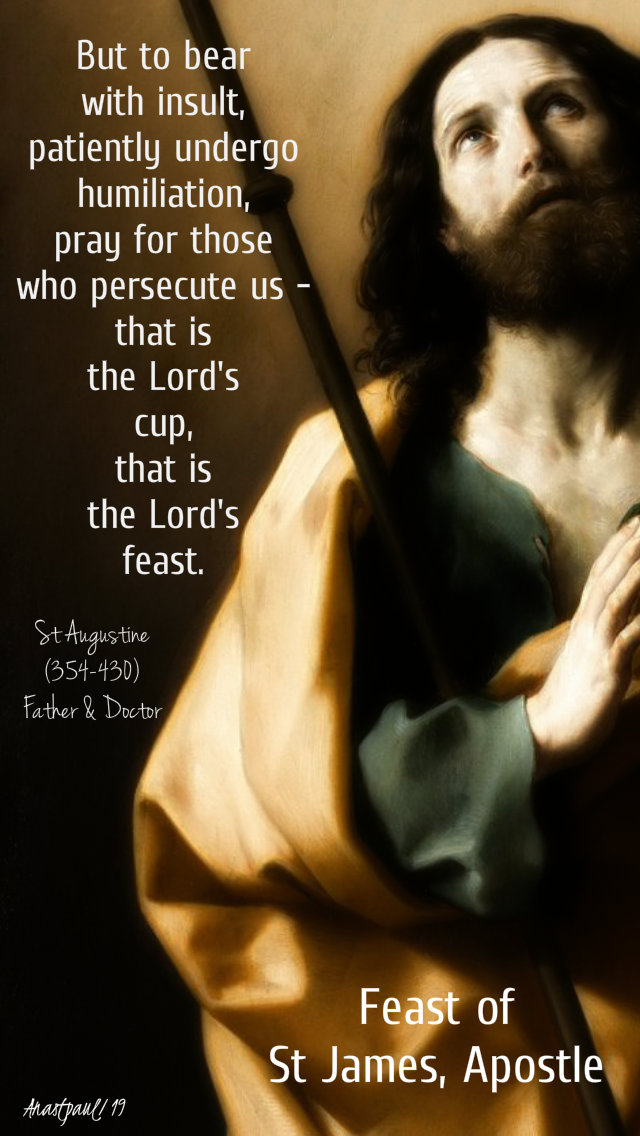
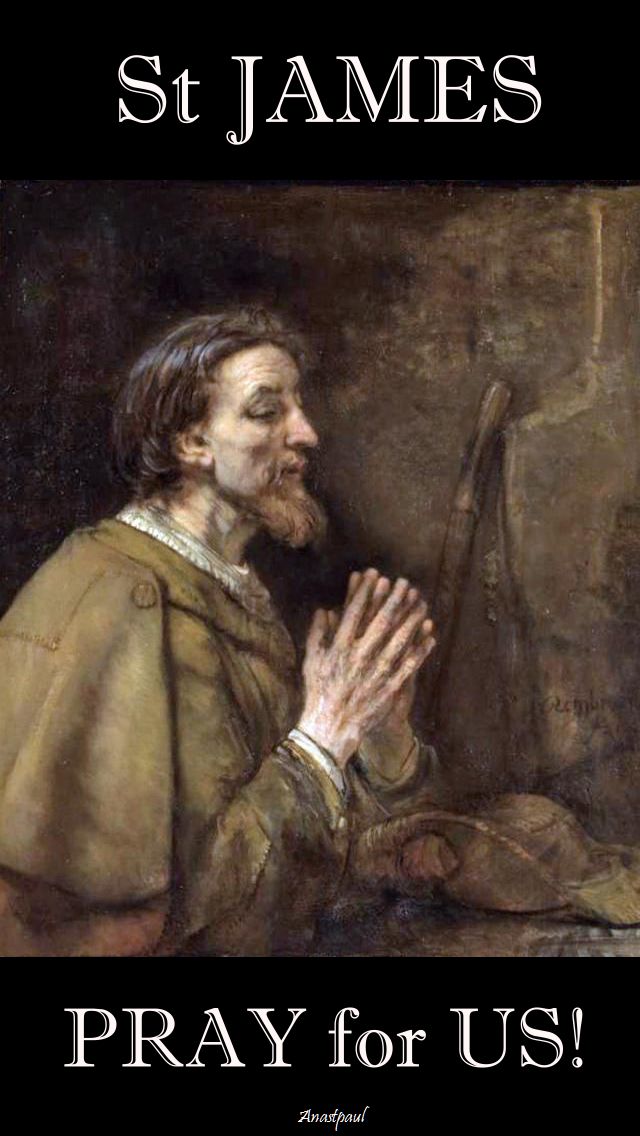
Quote of the Day – 25 July – Feast of St James, Apostle
“…we can learn much from St James – promptness in accepting the Lord’s call even when He asks us to leave the “boat” of our human securities, enthusiasm in following Him on the paths that He indicates to us over and above any deceptive presumption of our own, readiness to witness to Him with courage, if necessary to the point of making the supreme sacrifice of life.
Thus James the Greater stands before us as an eloquent example of generous adherence to Christ. He, who initially had requested, through his mother, to be seated with his brother next to the Master in His Kingdom, was precisely the first to drink the chalice of the passion and to share martyrdom with the Apostles.
And, in the end, summarising everything, we can say that the journey, not only exterior but above all interior, from the mount of the Transfiguration to the mount of the Agony, symbolises the entire pilgrimage of Christian life, among the persecutions of the world and the consolations of God, as the Second Vatican Council says. In following Jesus, like St James, we know that even in difficulties we are on the right path.”
One Minute Reflection – 25 July – Feast of St James, Apostle, Gospel: Matthew 20:20–28
Jesus said in reply, “You do not know what you are asking. Can you drink the cup that I am going to drink?” They said to him, “We can.”……Matthew 20:28
REFLECTION – “Christ laid down His life for us, so we ought to lay down our lives for our brothers” (1Jn 3,16)… Jesus said to Peter: “When you were younger, you used to dress yourself and go where you wanted but when you grow old … someone else will dress you and lead you where you do not want to go…” (Jn 21,18). It was the Cross, the Passion, He promised him. “Go even so far as to pasture my sheep, suffer for my sheep.” This is what a good bishop is to be like. If he is not, he is no bishop…
Now listen to this other testimony. Two of His disciples, the brothers John and James who were sons of Zebedee, were ambitious for the first place without consideration for the others… Our Lord answered them: “You do not know what you are asking”, for he added: “Can you drink the cup that I am going to drink?” What cup is this if not that… of the Passion?… And they, forgetting their weakness, immediately said: “We can”. Then He said to them: “My cup you will indeed drink. But to sit at my right or at my left is not mine to give but is for those for whom it has been prepared by my Father”… In this way He gave proof of His humility for, in fact, everything the Father prepares is prepared, too, for the Son… He came in humility – He, the Creator, was created amongst us, He made us but He was made for us. God before time began, man in time, He delivered man from time. This great physician has come to heal our cancer… by His example, He has come to heal pride itself.
This is what we must give our attention to, in the Lord – let us consider His humility, drink the cup of His humility, clasp Him, contemplate Him. How easy it is to have elevated thoughts, easy to take pleasure in honours, easy to give one’s ear to flatterers and people who praise us. But to bear with insult, patiently undergo humiliation, pray for those who persecute us (Mt 5,39.44) – that is the Lord’s cup, that is the Lord’s feast.“… Saint Augustine (354-430) FathEr & Doctor of the Church – Sermon for the ordination of a bishop, Guelferbytanus no.32
PRAYER – Almighty ever-living God, who consecrated the first fruits of Your Apostles by the blood of Saint James, grant, we pray, that Your Church may be strengthened by his confession of faith and constantly sustained by his protection. Through our Lord Jesus Christ, your Son, who lives and reigns with you in the unity of the Holy Spirit, one God, forever and ever. St James the Greater, Apostle of Christ, Pray for us! Amen
St James the Greater (Feast) – Son of Zebedee and Salome, brother of Saint John the Apostle. He is called “the Greater” simply because he became an Apostle before Saint James the Lesser.
St Cugat del Valles
Bl Darío Acosta Zurita
St Ebrulfus
St Euphrasia
St Fagildo of Santiago
St Felix of Furcona
St Florentius of Furcona
St Glodesind of Metz
St Magnericus of Trier
Bl Michel-Louis Brulard
Bl Mieczyslawa Kowalska
St Mordeyren
St Nissen of Wexford
St Olympiad of Constantinople
St Paul of Palestine
Bl Pietro Corradini of Mogliano
St Theodemir of Cordoba
—
Martyrs of Caesarea – 3 saints: Three Christians martyred together in the pesecutions of emperor Maximilian and governor Firmilian – Paul, Tea and Valentina. 309 in Caesarea, Palestine.
Martyrs of Cuncolim – 20 saints: On 15 July 1583 the group met at the church of Orlim, and hiked to Cuncolim to erect a cross and choose land for a new church. Local anti-Christian pagans, seeing the unarmed Christians, gathered their weapons and marched on them. One of the parishioners, a Portuguese emigre named Gonçalo Rodrigues, carried a firearm, but Father Alphonsus Pacheco stopped him from using it. The pagans then fell upon them, and killed them all without mercy. They were –
• Alphonsus Pacheco
• Alphonsus the altar boy
• Anthony Francis
• Dominic of Cuncolim
• Francis Aranha
• Francis Rodrigues
• Gonçalo Rodrigues
• Paul da Costa
• Peter Berno
• Rudolph Acquaviva
• ten other native Christian converts whose names have not come down to us
They were martyred on Monday 25 July 1583 at the village of Cuncolim, district of Salcete, territory of Goa, India. Beatified on 30 April 1893 by Pope Leo XIII.
Martyrs of Motril – 5 beati: Four priests and a brother, all members of the Augustinian Recollects, who were martyred together in the Spanish Civil War:
• Deogracias Palacios del Río
• José Rada Royo
• José Ricardo Díez Rodríguez
• Julián Benigno Moreno y Moreno
• León Inchausti Minteguía
They were shot on 25 July 1936 in Motril, Granada, Spain and Beatified on 7 March 1999 by Pope John Paul II.
Martyrs of Toledo – 4 beati: Four brothers and a priest, all members of the Hospitallers of Saint John of God, and all martyred together in the Spanish Civil War.
• Carlos Rubio álvarez
• Eloy Francisco Felipe Delgado Pastor
• Jerónimo Ochoa Urdangarín
• Primo Martínez De San Vicente Castillo
25 July 1936 in Talavera de la Reina, Toledo, Spain. They were Beatified on 25 October 1992 by Pope John Paul II.
Martyrs of Urda – 3 beati: Three members of the Passionists who were martyred together in the Spanish Civil War.
• Benito Solana Ruiz
• Felix Ugalde Irurzun
• Pedro Largo Redondo
They were shot on 25 July 1936 in Urdá, Toledo, Spain and Beatified on 1 October 1989 by Pope John Paul II.
One Minute Reflection – 10 July – Wednesday of the Fourteenth week in Ordinary Time, Year C, Gospel: Matthew 10:1–7
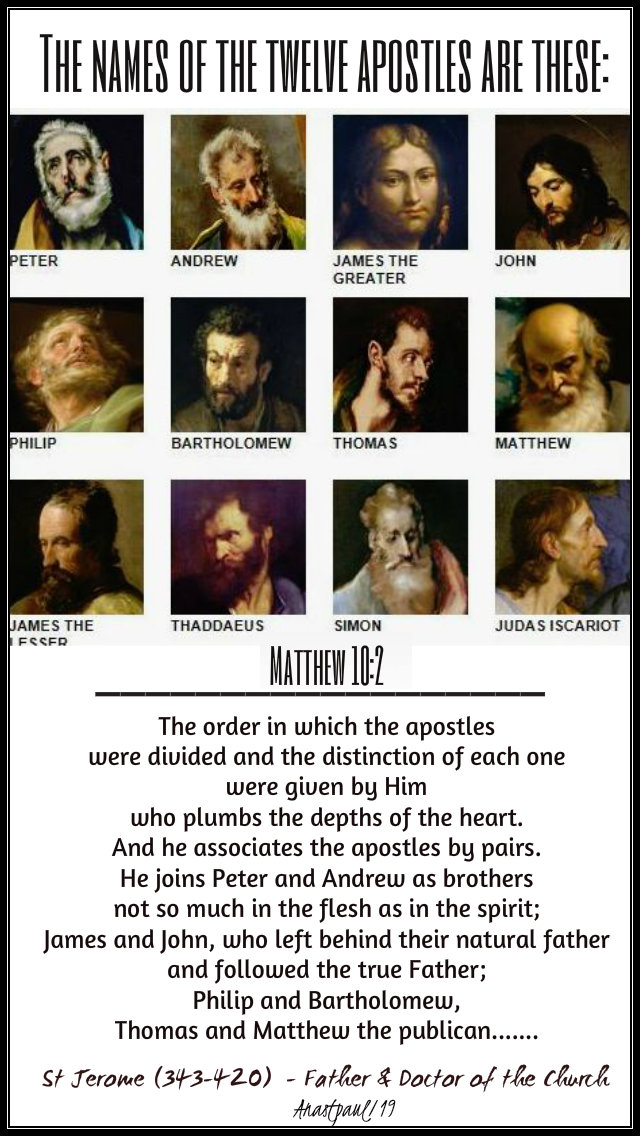
The names of the twelve apostles are these: first, Simon, who is called Peter and Andrew his brother; James the son of Zebedee and John his brother; …Matthew 10:2
REFLECTION – “The order in which the apostles were divided and the distinction of each one were given by him who plumbs the depths of the heart. The first to be recorded is Simon called Peter (to distinguish him from the other Simon, who is called the Cananaean from the village of Cana in Galilee, where the Lord turned the water into wine). He also calls James the son of Zebedee because he is followed by another James, the son of Alphaeus. And he associates the apostles by pairs. He joins Peter and Andrew as brothers not so much in the flesh as in the spirit; James and John, who left behind their natural father and followed the true Father; Philip and Bartholomew, Thomas and Matthew the publican. The other Evangelists, in listing the names, put Matthew first and then Thomas, nor do they mention the name publican, lest in recalling his former way of life they seem to insult the Evangelist. But Matthew, as we said before, places himself after Thomas and calls himself a publican so that “where sin abounded, grace has abounded even more.”
Simon the Cananaean is the one whom another Evangelist calls the Zealot. In fact, Cana interpreted means “zeal.” Church history relates that the apostle Thaddaeus was sent to Edessa, Abgarum in the region of Osroene. The person whom Luke the Evangelist calls Jude the brother of James, elsewhere called Lebbaeus, which interpreted means “little heart,” is believed to have been referred to by three names. Simon Peter and the sons of Zebedee (called sons of thunder) were named for their strength of mind and great faith. Judas Iscariot took his name either from his hometown or from the tribe of Issachar. By a certain prophecy he was born in condemnation of himself, for Issachar interpreted means “reward,” as to signify the price of the traitor.” … St Jerome (343-420) – Father & Doctor of the Church (Commentary on Matthew, 1.)
PRAYER – Holy God and Almighty Father, we are the disciples of Your Son as we follow Him home to You, grant us we pray, the strength and love to imitate Him in all things and to daily, pick up our cross with joy and commitment. May the Blessed Virgin, be a constant protection and assistance in our times of struggle and may all your angels and saints and martyrs, pray for us, through our Lord Jesus Christ, with the Holy Spirit, God for always and forever, amen.
Thought for the Day – 3 July – Feast of St Thomas Apostle
“My Lord and My God”
Saint Pope Gregory the Great (540-604)
Bishop of Rome and Great Western Father and Doctor of the Church
An excerpt from his Homily 26
Thomas, one of the twelve, called the Twin, was not with them when Jesus came. He was the only disciple absent, on his return he heard what had happened but refused to believe it. The Lord came a second time, He offered His side for the disbelieving disciple to touch, held out His hands and, showing the scars of His wounds, healed the wound of his disbelief.
Dearly beloved, what do you see in these events? Do you really believe that it was by chance that this chosen disciple was absent, then came and heard, heard and doubted, doubted and touched, touched and believed? It was not by chance but in God’s providence. In a marvellous way, God’s mercy arranged, that the disbelieving disciple, in touching the wounds of his master’s body, should heal our wounds of disbelief. The disbelief of Thomas has done more for our faith than the faith of the other disciples. As he touches Christ and is won over to belief, every doubt is cast aside and our faith is strengthened. So the disciple who doubted, then felt Christ’s wounds, becomes a witness to the reality of the Resurrection.
Touching Christ, he cried out – My Lord and my God. Jesus said to him – Because you have seen me, Thomas, you have believed. Paul said: Faith is the guarantee of things hoped for, the evidence of things unseen. It is clear, then, that faith is the proof of what cannot be seen. What is seen gives knowledge, not faith. When Thomas saw and touched, why was he told – You have believed because you have seen me? Because what he saw and what he believed were different things. God cannot be seen by mortal man. Thomas saw a human being, whom he acknowledged to be God and said: -My Lord and my God. Seeing, he believed, looking at one who was true man, he cried out that this was God, the God he could not see.
What follows is reason for great joy – Blessed are those who have not seen and have believed. There is here a particular reference to ourselves, we hold in our hearts one we have not seen in the flesh. We are included in these words but only if we follow up our faith with good works.The true believer practices what he believes. But of those who pay only lip service to faith, Paul has this to say – They profess to know God but they deny him in their works. Therefore James says – Faith without works is dead.
Quote/s of the Day – 3 July – Feast of St Thomas Apostle, Gospel John 20:24–29
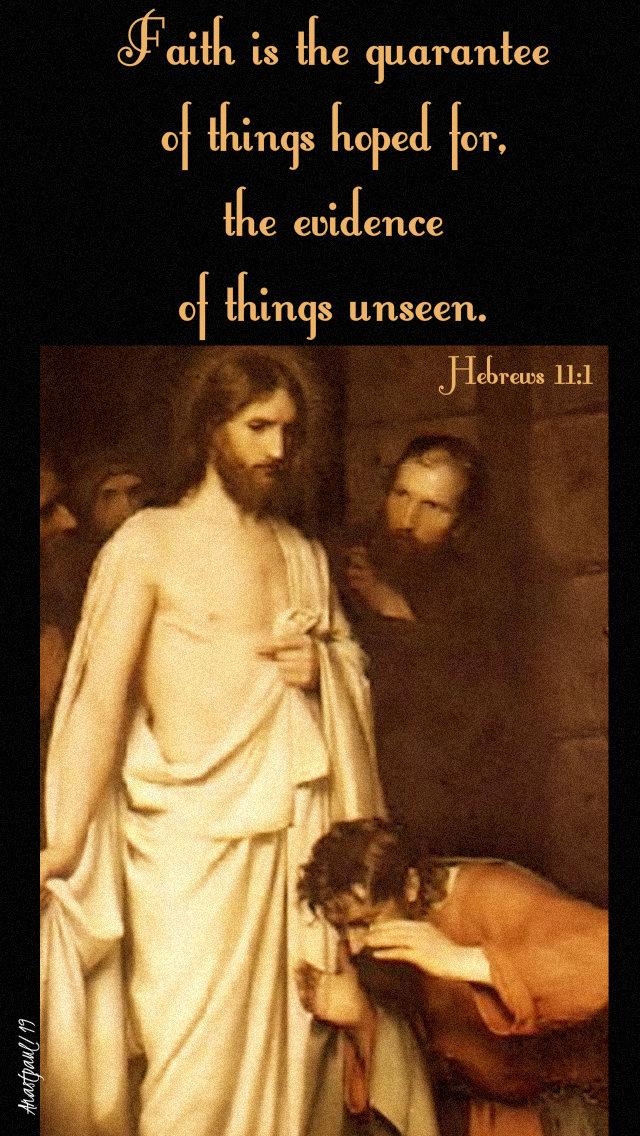
“Faith is the guarantee of things hoped for, the evidence of things unseen.”
Hebrews 11:1
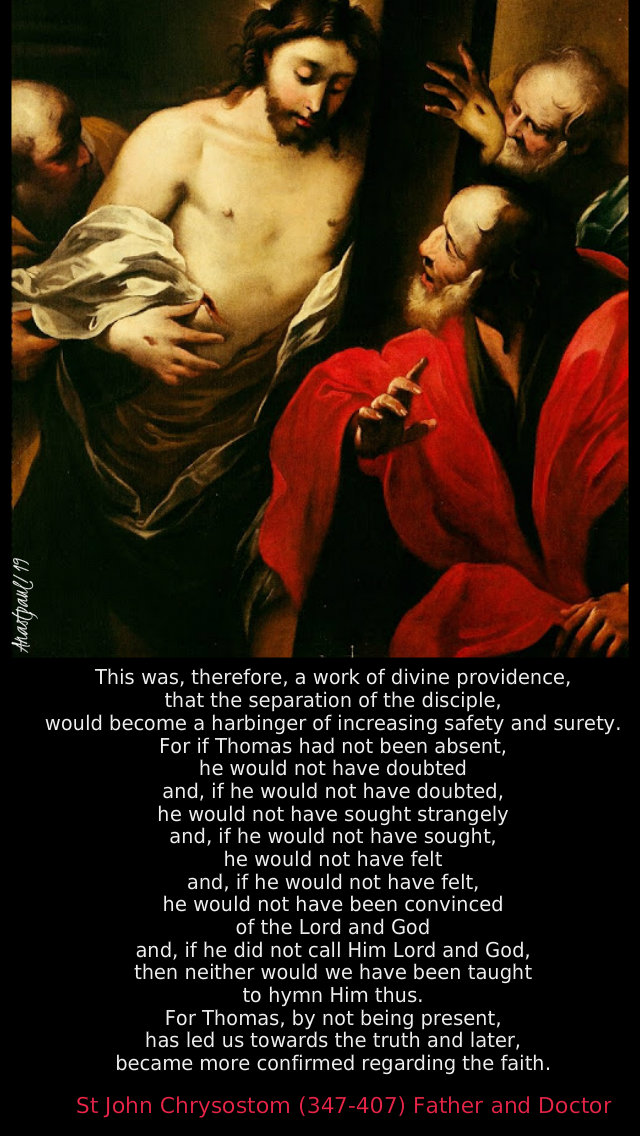
“This was, therefore, a work of divine providence, that the separation of the disciple, would become a harbinger of increasing safety and surety. For if Thomas had not been absent, he would not have doubted and, if he would not have doubted, he would not have sought strangely and, if he would not have sought, he would not have felt and, if he would not have felt, he would not have been convinced of the Lord and God and, if he did not call Him Lord and God, then neither would we have been taught to hymn Him thus. For Thomas, by not being present, has led us towards the truth and later, became more confirmed regarding the faith.”
One Minute Reflection – 3 July – Feast of St Thomas Apostle, Gospel John 20:24–29
Thomas answered him, “My Lord and my God!”…John 20:28
REFLECTION – “Put your finger into the marks of the nails”. You looked for Me when I wasn’t there, now take advantage of it. I understand your desire despite your silence. Before you tell Me them I already know your thoughts. I heard you speak and, even though unseen, I was beside you, beside your doubts. Without revealing Myself I made you wait, so as better to consider your eagerness. “Put your finger into the marks of the nails. Put your hand into my side, do not be unbelieving any longer, but believe.”
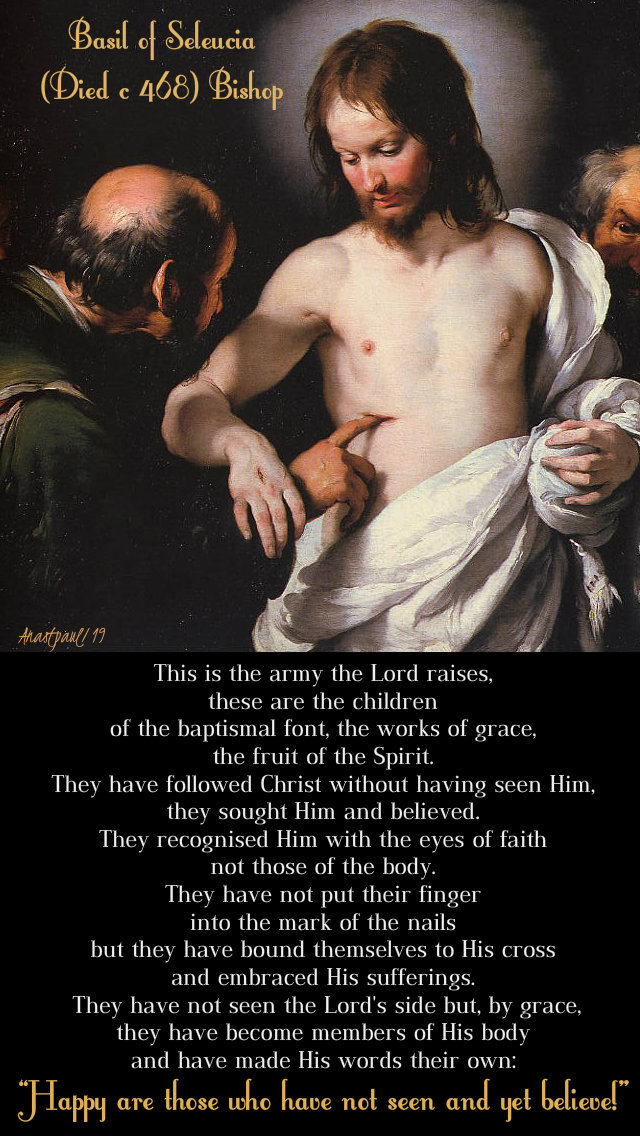
Then Thomas touched Him and all his mistrust fell away. Full of genuine faith and all the love owing to God, he cried out: “My Lord and my God!”And the Lord said to him – “You believe because you have seen me; happy are those who have not seen and yet believe!” Thomas took the news of the Resurrection to those who had not seen. Draw the whole earth to believe, not by its own sight but at your word. Go through peoples and cities far away. Teach them to carry the cross rather than weapons on their shoulders. Only proclaim me – they will believe and worship. They will demand no other proof. Tell them they are called by grace and, with your own eyes, behold their faith. Truly, blessed are those who did not see and yet believed! This is the army the Lord raises, these are the children of the baptismal font, the works of grace, the fruit of the Spirit. They have followed Christ without having seen Him, they sought Him and believed. They recognised Him with the eyes of faith not those of the body. They have not put their finger into the mark of the nails but they have bound themselves to His cross and embraced His sufferings. They have not seen the Lord’s side but, by grace, they have become members of His body and have made His words their own: “Happy are those who have not seen and yet believe!”… Basil of Seleucia (Died c 468) Bishop – Sermon for the Resurrection, 1-4
PRAYER – Almighty Father,as we honour Thomas the Apostle, let us always experience the help of his prayers. May we have eternal life by believing in Jesus,
whom Thomas acknowledged as Lord, for He lives and reigns with You and the Holy Spirit, one God, forever and ever. Amen
Our Morning Offering – 3 July – Feast of St Thomas Apostle
O Fathers of Our Ancient Faith
O Fathers of our ancient faith,
With all the heav’n, we sing your fame
Whose sound went forth in all the earth
To tell of Christ and bless His name.
You took the gospel to the poor,
The Word of God alight in you,
Which in our day is told again,
That timeless Word, forever new.
You told of God, who died for us
And out of death triumphant rose,
Who gave the truth that made us free
and changeless through the ages goes.
Praise Father, Son and Holy Spirit,
Whos gift is faith that never dies,
A light in darkness now, until
The day-star in our hearts arise.
O Fathers of Our Ancient Faith is written by the Benedictine Nuns of Stanbrook Abbey. In the Divine Office (1974) it is sung at Morning Prayer in the Common of Apostles. It is set to the anonymous tune associated with the 7th century Latin hymn, Creator Alme Siderum.
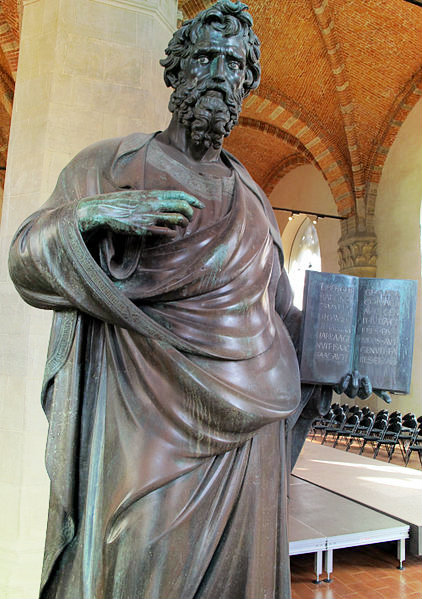
Feast of St Thomas, Apostle of Christ, Martyr – 3 July
There is very little about the Apostle Thomas in the Gospels, one text calls him the “twin.” Rarely during Jesus’ lifetime does he stand out among his colleagues. There is the instance before the raising of Lazarus, when Jesus was still in Perea and Thomas exclaimed: “Let us also go and die with Him.”
Best-known is his expression of unbelief after the Saviour’s death, giving rise to the phrase “doubting Thomas.” Nevertheless, the passage describing the incident, had as today’s Gospel, must be numbered among the most touching in Sacred Scripture, “My Lord and my God!”
In the Breviary lessons St Pope Gregory the Great makes the following reflections: “Thomas’ unbelief has benefited our faith more than the belief of the other disciples, it is because he attained faith, through physical touch, that we are confirmed in the faith beyond all doubt. Indeed, the Lord permitted the Apostle to doubt after the resurrection but He did not abandon him in doubt. By his doubt and by his touching the sacred wounds, the Apostle became a witness to the truth of the Resurrection. Thomas touched and cried out – My Lord and my God! And Jesus said to him – Because you have seen Me, Thomas, you have believed. Now if Thomas saw and touched the Saviour, why did Jesus say: Because you have seen Me, Thomas, you have believed? Because he saw something other than what he believed. For no mortal man can see divinity. Thomas saw the Man Christ and acknowledged His divinity with the words – My Lord and my God. Faith, therefore, followed upon seeing.”
This slideshow requires JavaScript.
Concerning later events in the Apostle’s life, very meagre information exists. The Martyrology has this: “At Calamina (near Madras in India) the Martyrdom of the Apostle Thomas – he announced the Gospel to the Parthians and, finally, came to India. After he had converted numerous tribes to Christianity, he was pierced with lances at the king’s command.”
Excerpted from The Church’s Year of Grace, Pius Parsch
St Thomas: https://anastpaul.com/2018/07/03/saint-of-the-day-feast-of-st-thomas-apostle-of-christ/
St Anatolius of Alexandria
St Anatolius of Constantinople
Bl Andreas Ebersbach
Bl Barbara Jeong Sun-mae
St Bladus
St Byblig
St Cillene
St Dathus of Ravenna
St Eusebius of Laodicea
St Firminus
St Firmus
Bl Gelduin
St Germanus of Man
St Giuse Nguyen Ðình Uyen
St Gunthiern
St Guthagon
St Heliodorus of Altinum
St Hyacinth of Caesarea
St Ioannes Baptista Zhao Mingxi
St Irenaeus of Chiusi St Pope Leo II (611–683)
St Maelmuire O’Gorman
St Mark of Mesia
St Mennone the Centurian
St Mucian of Mesia
St Paul of Mesia
St Petrus Zhao Mingzhen
St Philiphê Phan Van Minh
St Raymond of Toulouse
—
Martyrs of Alexandria – 13 saints: Thirteen Christian companions marytred together. No details about them have survived but the names – Apricus, Cyrion (2 of), Eulogius, Hemerion, Julian, Julius, Justus, Menelaus, Orestes, Porfyrios and Tryphon (2 of). They martyred in Alexandria, Egypt, date unknown.
Martyrs of Constantinople – 24 saints: A group of 24 Christians martyred in the persecutions of Arian emperor Valens. We know little more than their names – Acacios, Amedinos, Ammonius, Ammus, Cerealis, Cionia, Cionius, Cyrianus, Demetrius, Eulogius (2), Euphemia, Heliodoros, Heraclios, Horestes, Jocundus, Julian, Martyrios, Menelaeus, Sestratus, Strategos, Thomas, Timotheos and Tryphon. They were martyred in c367 in Constantintinople.
Theodotus and Companions – 6 saints: Six Christians who were imprisoned, tortured and martyred together in the persecutions of Trajan. Saint Hyacinth ministered to them in prison. We know nothing else about them but their names – Asclepiodotus, Diomedes, Eulampius, Golinduchus, Theodota and Theodotus. They were beheaded in c110, location unknown.




















 AnaStpaul
You must be logged in to post a comment.