Posted in FEASTS and SOLEMNITIES, PAPAL SERMONS, SAINT of the DAY, The APOSTLES & EVANGELISTS, VATICAN Resources

Saint of the Day – 3 JULY – Feast of St Thomas, Apostle of Christ

Saint of the Day – 3 JULY _ Feast of St Thomas, Apostle of Christ

Thomas the twin
By Pope Benedict XVI – General Audience, 27 September 2006

Dear Brothers and Sisters,

Continuing our encounters with the Twelve Apostles chosen directly by Jesus, today we will focus our attention on Thomas.  Ever present in the four lists compiled by the New Testament, in the first three Gospels he is placed next to Matthew (cf. Mt 10: 3; Mk 3: 18; Lk 6: 15), whereas in Acts, he is found after Philip (cf. Acts 1: 13).

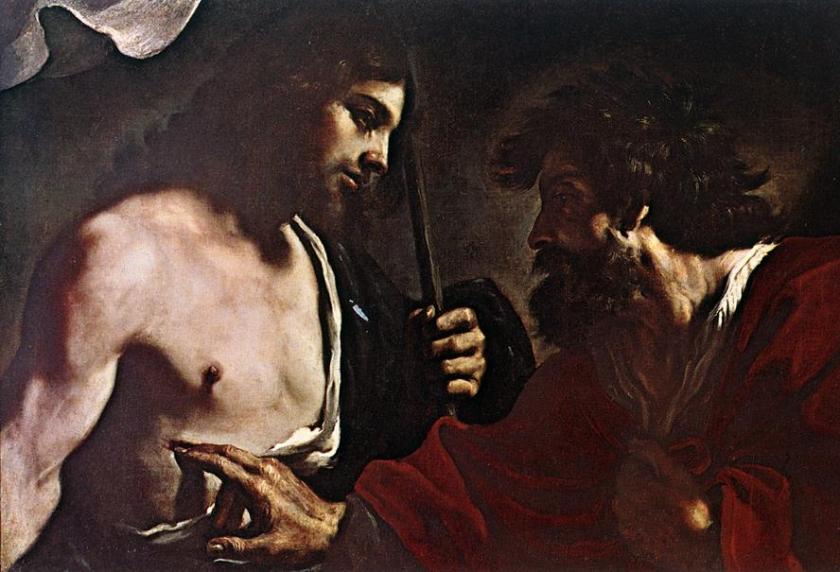
His name derives from a Hebrew root, ta’am, which means “paired, twin”. In fact, John’s Gospel several times calls him “Dydimus” (cf. Jn 11: 16; 20: 24; 21: 2), a Greek nickname for, precisely, “twin”.   The reason for this nickname is unclear.header - St. Thomas the Apostle (2)Header 2 Guercino - Doubting Thomas

It is above all the Fourth Gospel that gives us information that outlines some important traits of his personality.
The first concerns his exhortation to the other Apostles when Jesus, at a critical moment in His life, decided to go to Bethany to raise Lazarus, thus coming dangerously close to Jerusalem (Mk 10: 32).
On that occasion Thomas said to his fellow disciples:  “Let us also go, that we may die with him” (Jn 11: 16).   His determination to follow his Master is truly exemplary and offers us a valuable lesson:  it reveals his total readiness to stand by Jesus, to the point of identifying his own destiny with that of Jesus and of desiring to share with Him the supreme trial of death.

In fact, the most important thing is never to distance oneself from Jesus.
Moreover, when the Gospels use the verb “to follow”, it means that where He goes, his disciple must also go.
Thus, Christian life is defined as a life with Jesus Christ, a life to spend together with Him. St Paul writes something similar when he assures the Christians of Corinth:  “You are in our hearts, to die together and to live together” (II Cor 7: 3).   What takes place between the Apostle and his Christians must obviously apply first of all to the relationship between Christians and Jesus himself: dying together, living together, being in his Heart as He is in ours.

A second intervention by Thomas is recorded at the Last Supper.   On that occasion, predicting his own imminent departure, Jesus announced that He was going to prepare a place for His disciples so that they could be where He is found and He explains to them: “Where [I] am going you know the way” (Jn 14: 4).   It is then that Thomas intervenes, saying: “Lord, we do not know where you are going; how can we know the way?” (Jn 14: 5).
In fact, with this remark he places himself at a rather low level of understanding but his words provide Jesus with the opportunity to pronounce His famous definition:  “I am the Way and the Truth and the Life” (Jn 14: 6).
Thus, it is primarily to Thomas that He makes this revelation but it is valid for all of us and for every age.   Every time we hear or read these words, we can stand beside Thomas in spirit and imagine that the Lord is also speaking to us, just as He spoke to him.
At the same time, his question also confers upon us the right, so to speak, to ask Jesus for explanations.   We often do not understand Him.   Let us be brave enough to say:  “I do not understand you, Lord, listen to me, help me to understand”.   In such a way, with this frankness which is the true way of praying, of speaking to Jesus, we express our meagre capacity to understand and at the same time place ourselves in the trusting attitude of someone who expects light and strength from the One able to provide them.

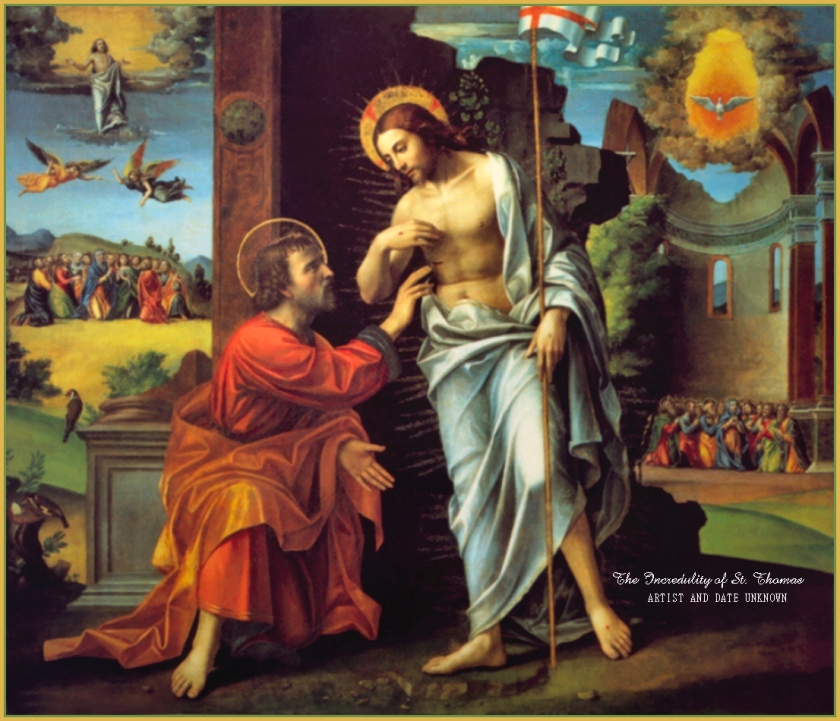
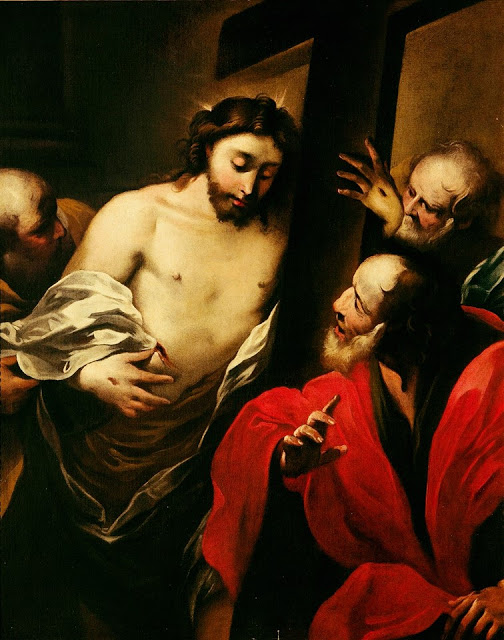
Then, the proverbial scene of the doubting Thomas that occurred eight days after Easter is very well known.   At first he did not believe that Jesus had appeared in his absence and said:  “Unless I see in his hands the print of the nails, and place my finger in the mark of the nails, and place my hand in his side, I will not believe” (Jn 20: 25).
Basically, from these words emerges the conviction that Jesus can now be recognised by His wounds rather than by His face.   Thomas holds that the signs that confirm Jesus’ identity are now above all His wounds, in which He reveals to us how much He loved us. In this the Apostle is not mistaken.

The_Disbelief_of_Saint_Thomas-569ffff65f9b58eba4ae6452
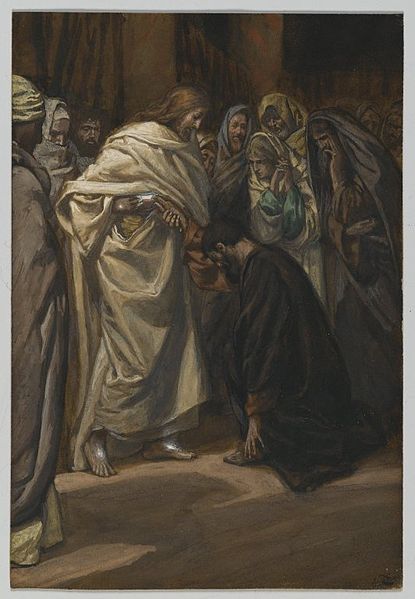
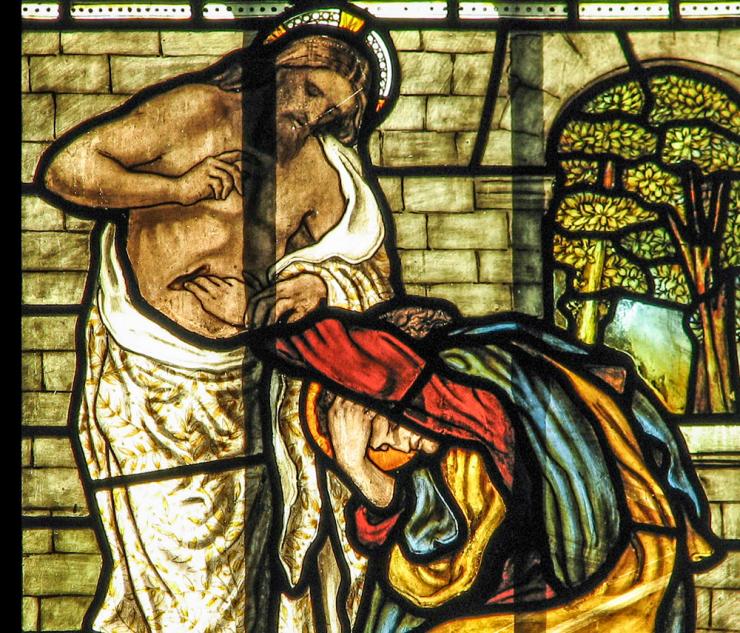
As we know, Jesus reappeared among his disciples eight days later and this time Thomas was present.   Jesus summons him:  “Put your finger here, and see my hands; and put out your hand, and place it in my side; do not be faithless, but believing” (Jn 20: 27).
Thomas reacts with the most splendid profession of faith in the whole of the New Testament:  “My Lord and my God!” (Jn 20: 28).   St Augustine comments on this: Thomas “saw and touched the man and acknowledged the God whom he neither saw nor touched but by the means of what he saw and touched, he now put far away from him every doubt and believed the other” (In ev. Jo. 121, 5).
The Evangelist continues with Jesus’ last words to Thomas:  “Have you believed because you have seen me? Blessed are those who have not seen and yet believe” (Jn 20: 29).   This sentence can also be put into the present:  “Blessed are those who do not see and yet believe”.
In any case, here Jesus spells out a fundamental principle for Christians who will come after Thomas, hence, for all of us.DO---0307--St-Thomas-Apostle-by-Lawrence-Lew-OP_0St. Thomas, Apostle

It is interesting to note that another Thomas, the great Medieval theologian of Aquinas, juxtaposed this formula of blessedness with the apparently opposite one recorded by Luke:  “Blessed are the eyes which see what you see!” (Lk 10: 23).   However, Aquinas comments:  “Those who believe without seeing are more meritorious than those who, seeing, believe” (In Johann. XX lectio VI 2566).

In fact, the Letter to the Hebrews, recalling the whole series of the ancient biblical Patriarchs who believed in God without seeing the fulfilment of His promises, defines faith as “the assurance of things hoped for, the conviction of things not seen” (Heb 11: 1).

The Apostle Thomas’ case is important to us for at least three reasons:  first, because it comforts us in our insecurity;  second, because it shows us that every doubt can lead to an outcome brighter than any uncertainty and, lastly, because, the words that Jesus addressed to him remind us of the true meaning of mature faith and encourage us to persevere, despite the difficulty, along our journey of adhesion to Him.

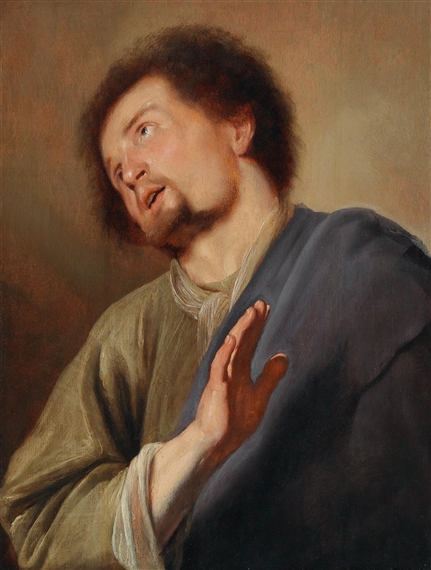
Jan Lievens, The Apostle Saint Thomas

A final point concerning Thomas is preserved for us in the Fourth Gospel, which presents him as a witness of the Risen One in the subsequent event of the miraculous catch in the Sea of Tiberias (cf. Jn 21: 2ff.).
On that occasion, Thomas is even mentioned immediately after Simon Peter:  an evident sign of the considerable importance that he enjoyed in the context of the early Christian communities.
Indeed, the Acts and the Gospel of Thomas, both apocryphal works but in any case important for the study of Christian origins, were written in his name.

Lastly, let us remember that an ancient tradition claims that Thomas first evangelised Syria and Persia (mentioned by Origen, according to Eusebius of Caesarea, Ecclesiastical History 3, 1) then went on to Western India (cf. Acts of Thomas 1-2 and 17ff.), from where also he finally reached Southern India.

Let us end our reflection in this missionary perspective, expressing the hope that Thomas’ example will never fail to strengthen our faith in Jesus Christ, Our Lord and Our God. Amen…Pope Benedict, vatican.vaTHOMAS - verrocch_ph96_pl124_050404

THOMAS - verrocchio_gp69_28_012503
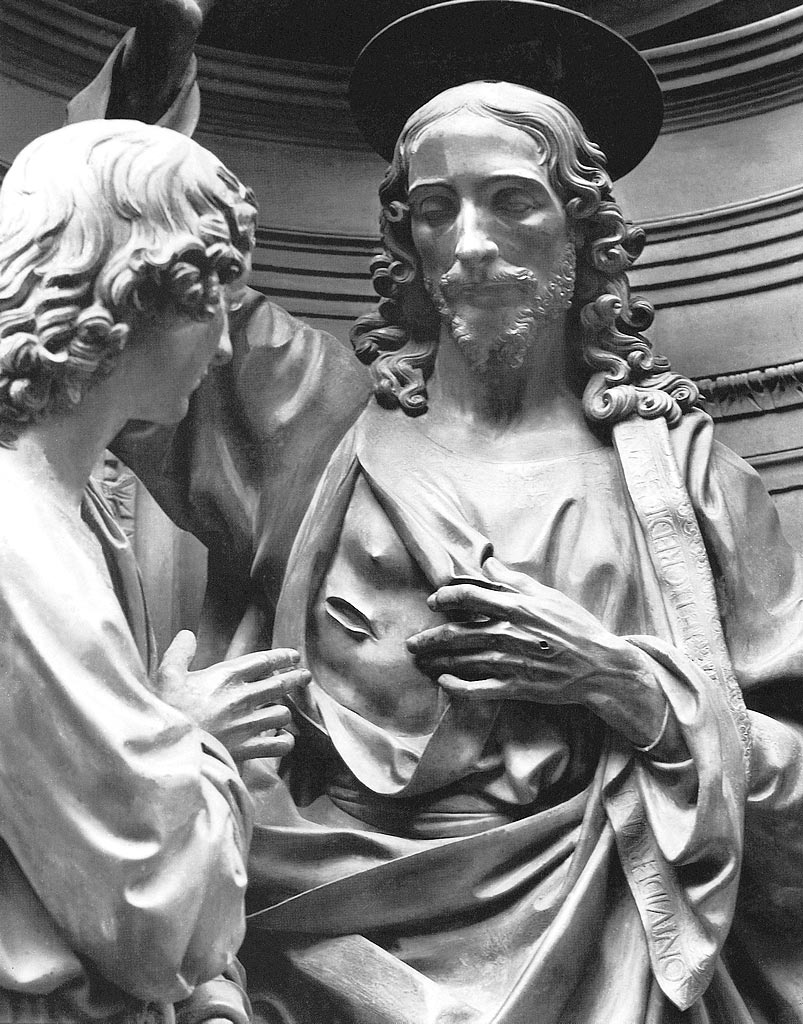
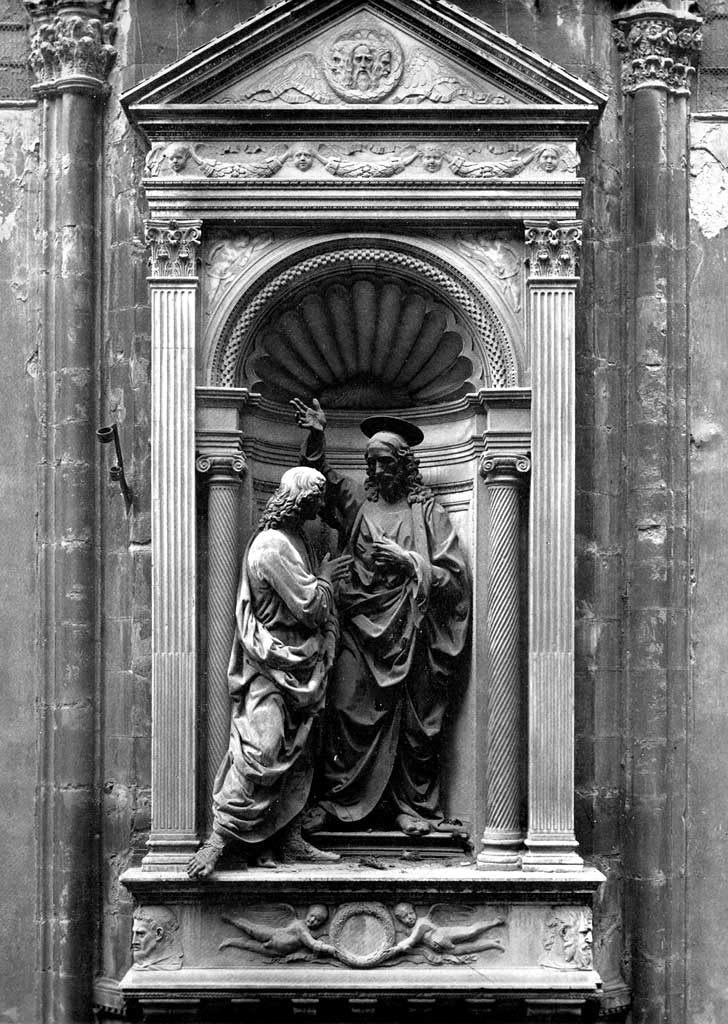
Christ and St Thomas – San Michele, Florence by Andrea del Verrocchio 1465-1483

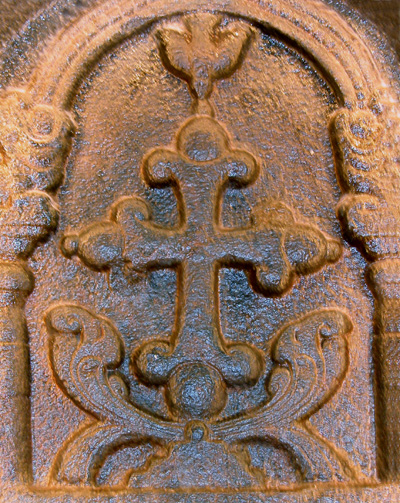
There is a large population of native Christians who call themselves ‘the Christians of St Thomas’.   They have an ancient oral tradition that he landed at Cranganoreon, the west coast and established seven churches in Malabar though his landing on the west coast is disputed today, the rest is not. He then passed eastward to the Coromandel Coast, where he was Martyred, by spearing, on the ‘Big Hill’, eight miles from Madras and was buried at Mylapore, now a suburb of that city.   There are several medieval references to the tomb of St Thomas in India, some of which name Mylapore and in 1522 the Portuguese discovered the tomb there, with certain small relics now preserved in the cathedral of St Thomas at Mylapore.   But the bulk of his relics were certainly at Edessa in the fourth century, as the Acta Thomae relate.   They were later translated from Edessa to the island of Khios in the Aegean and from thence to Ortona in the Abruzzi, where they are still venerated.

When St Francis Xavier came to India, the signs of blood were still to be seen on the cross where the murderous deed of the martyrdom of St Thomas was committed and more than once drops of blood appeared on this cross during the celebration of Mass, when crowds of people were present.   St Xavier, shortly after his arrival in India, went to the tomb of St Thomas, and passed many days and nights there in prayer. He begged God fervently to bestow upon him the Spirit and zeal of this holy Apostle, that he might be able to restore the Christian faith which St Thomas had preached there but which had gradually been entirely exterminated.   Before undertaking any important work, he went, if possible, to the tomb of St Thomas and when this was impossible, he invoked the holy Apostle’s intercessio, and endeavoured to follow his example in all things.

the bleeding cross
The Bleeding Cross

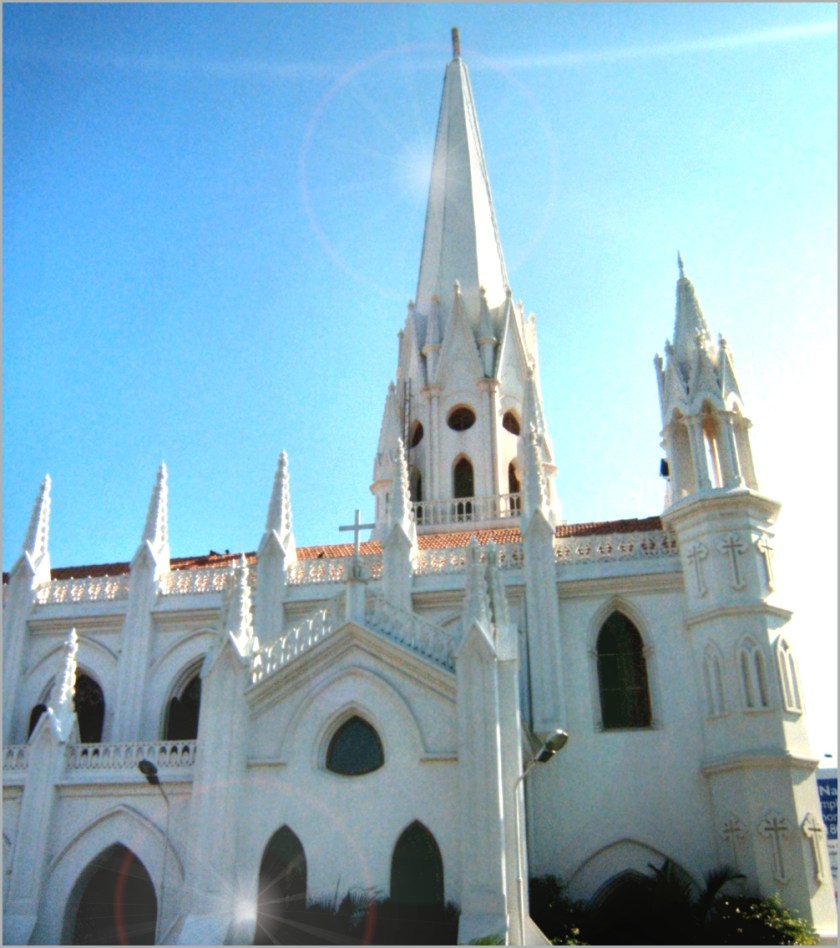
Saint Thomas was declared the “Apostle of India” by Pope Paul VI in 1972.   Below is the St Thomas Cathedral in Madras, India.

More info with patronages etc and many pics here:  https://anastpaul.wordpress.com/2017/07/03/saint-of-the-day-3-july-st-thomas-the-apostle-of-christ/apostle-thomas5b-madras cathedralrubens-san-giacomo-minoresnip st thomas

Posted in FATHERS of the Church, PAPAL SERMONS, SAINT of the DAY, VATICAN Resources

Saint of the Day – 28 June – St Irenaeus of Lyons (c 135 – c 202) Father of the Church

Saint of the Day – 28 June – St Irenaeus of Lyons (c 135 – c 202) Father of the Church, Bishop, Theologian, Writer, Confessor, Defender of the Faith, Apologist.  St Irenaeus was born in c130 in Smyrna, Asia Minor (modern Izmir, Turkey) and is presumed to have been martyred in c 202 in Lyons, France.

Catechesis of Pope Benedict XVI on St Irenaeus of Lyon

General Audience, Wednesday, 28 March 2007

In the Catechesis on the prominent figures of the early Church, today we come to the eminent personality of St Irenaeus of Lyons.   The biographical information on him comes from his own testimony, handed down to us by Eusebius in his fifth book on Church History.a crash course on st irenaeus mem 28 june

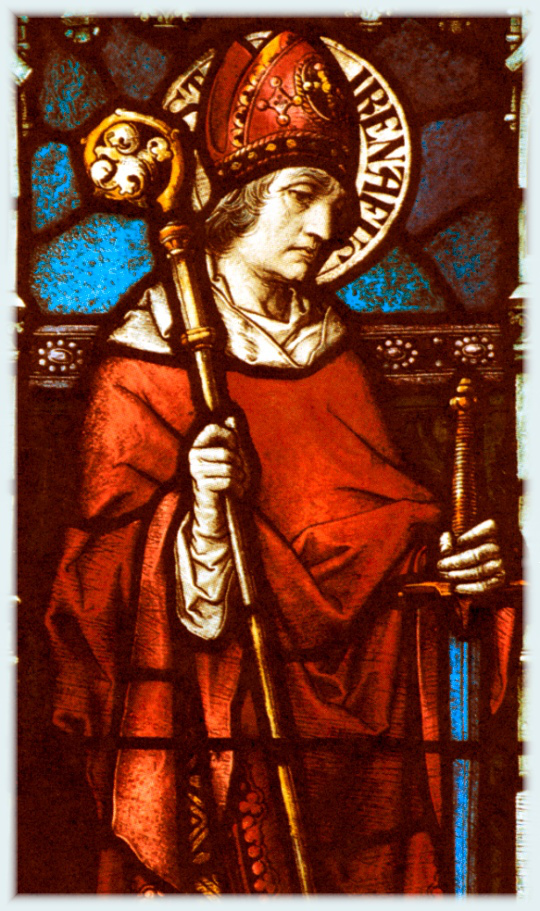
Irenaeus was, in all probability, born in Smyrna (today, Izmir in Turkey) in about 135-140, where in his youth, he attended the school of Bishop Polycarp, a disciple in his turn of the Apostle John.   We do not know when he moved from Asia Minor to Gaul but his move must have coincided with the first development of the Christian community in Lyons, here, in 177, we find Irenaeus listed in the college of presbyters.   In that very year, he was sent to Rome, bearing a letter from the community in Lyons, to Pope Eleutherius.   His mission to Rome saved Irenaeus from the persecution of Marcus Aurelius which took a toll of at least 48 martyrs, including the 90-year old Bishop Pontinus of Lyons, who died from ill-treatment in prison.   Thus, on his return, Irenaeus was appointed Bishop of the city.   The new Pastor devoted himself without reserve to his episcopal ministry which ended in about 202-203, perhaps with martyrdom.snip - st irenaeus

Irenaeus was first and foremost a man of faith and a Pastor.   Like a good Pastor, he had a good sense of proportion, a wealth of doctrine and missionary enthusiasm.   As a writer, he pursued a twofold aim, to defend true doctrine from the attacks of heretics and to explain the truth of the faith clearly.   His two extant works – the five books of The Detection and Overthrow of the False Gnosis and Demonstration of the Apostolic Teaching (which can also be called the oldest “catechism of Christian doctrine”) – exactly corresponded with these aims.   In short, Irenaeus can be defined as the champion in the fight against heresies.

The second-century Church was threatened by the so-called Gnosis, a doctrine which affirmed that the faith taught in the Church was merely a symbolism for the simple who were unable to grasp difficult concepts, instead, the initiates, the intellectuals – Gnostics, they were called – claimed to understand what was behind these symbols and thus formed an elitist and intellectualist Christianity. Obviously, this intellectual Christianity became increasingly fragmented, splitting into different currents with ideas that were often bizarre and extravagant, yet attractive to many.   One element these different currents had in common was “dualism” – they denied faith in the one God and Father of all, Creator and Saviour of man and of the world.   To explain evil in the world, they affirmed the existence, besides the Good God, of a negative principle.   This negative principle was supposed to have produced material things, matter.

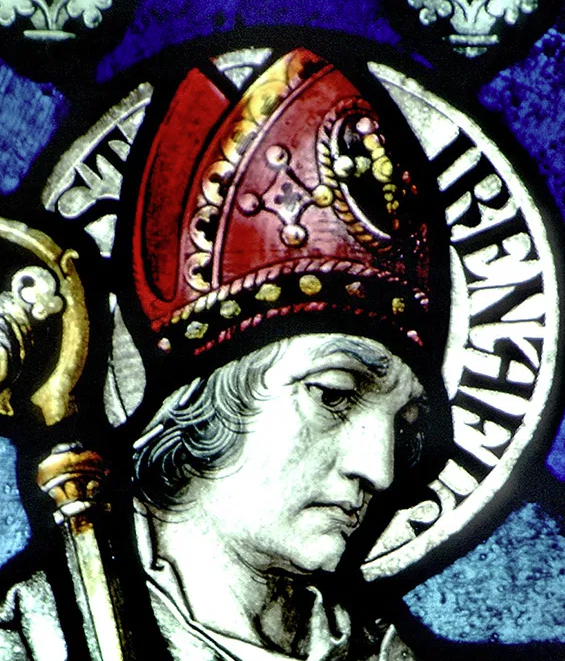
Firmly rooted in the biblical doctrine of creation, Irenaeus refuted the Gnostic dualism and pessimism which debased corporeal realities.   He decisively claimed the original holiness of matter, of the body, of the flesh no less than of the spirit.   But his work went far beyond the confutation of heresy, in fact, one can say, that he emerges as the first great Church theologian who created systematic theology, he himself speaks of the system of theology, that is, of the internal coherence of all faith.   At the heart of his doctrine is the question of the “rule of faith” and its transmission.   For Irenaeus, the “rule of faith” coincided in practice with the Apostles’ Creed, which gives us the key for interpreting the Gospel, for interpreting the Creed in light of the Gospel.   The Creed, which is a sort of Gospel synthesis, helps us understand what it means and how we should read the Gospel itself.st irenaeus glass detail snip face

In fact, the Gospel preached by Irenaeus is the one he was taught by Polycarp, Bishop of Smyrna, and Polycarp’s Gospel dates back to the Apostle John, whose disciple Polycarp was.
The true teaching, therefore, is not that invented by intellectuals which goes beyond the Church’s simple faith.   The true Gospel is the one imparted by the Bishops who received it in an uninterrupted line from the Apostles.   They taught nothing except this simple faith, which is also the true depth of God’s revelation.   Thus, Irenaeus tells us, there is no secret doctrine concealed in the Church’s common Creed.   There is no superior Christianity for intellectuals.   The faith publicly confessed by the Church is the common faith of all.   This faith alone is apostolic, it is handed down from the Apostles, that is, from Jesus and from God.   In adhering to this faith, publicly transmitted by the Apostles to their successors, Christians must observe what their Bishops say and must give special consideration to the teaching of the Church of Rome, pre-eminent and very ancient.   It is because of her antiquity that this Church has the greatest apostolicity; in fact, she originated in Peter and Paul, pillars of the Apostolic College.   All Churches must agree with the Church of Rome, recognising in her the measure of the true Apostolic Tradition, the Church’s one common faith.st-irenaeus-3

With these arguments, summed up very briefly here, Irenaeus refuted the claims of these Gnostics, these intellectuals, from the start.   First of all, they possessed no truth superior to that of the ordinary faith, because what they said was not of apostolic origin, it was invented by them.   Secondly, truth and salvation are not the privilege or monopoly of the few but are available to all through the preaching of the Successors of the Apostles, especially of the Bishop of Rome.   In particular – once again disputing the “secret” character of the Gnostic tradition and noting its multiple and contradictory results – Irenaeus was concerned to describe the genuine concept of the Apostolic Tradition which we can sum up here in three points.

a) Apostolic Tradition is “public”, not private or secret.   Irenaeus did not doubt that the content of the faith transmitted by the Church is that received from the Apostles and from Jesus, the Son of God.   There is no other teaching than this.   Therefore, for anyone who wishes to know true doctrine, it suffices to know “the Tradition passed down by the Apostles and the faith proclaimed to men” –  a tradition and faith that “have come down to us through the succession of Bishops” (Adversus Haereses, 3, 3, 3-4).   Hence, the succession of Bishops, the personal principle and Apostolic Tradition, the doctrinal principle, coincide.

b) Apostolic Tradition is “one”.   Indeed, whereas Gnosticism was divided into multiple sects, Church Tradition is one in its fundamental content, which – as we have seen – Irenaeus calls precisely regula fidei or veritatis –  and thus, because it is one, it creates unity through the peoples, through the different cultures, through the different peoples; it is a common content like the truth, despite the diversity of languages and cultures.   A very precious saying of St Irenaeus is found in his book Adversus Haereses:  “The Church, though dispersed throughout the world… having received [this faith from the Apostles]… as if occupying but one house, carefully preserves it.   She also believes these points [of doctrine] just as if she had but one soul and one and the same heart and she proclaims them and teaches them and hands them down with perfect harmony, as if she possessed only one mouth.   For, although the languages of the world are dissimilar, yet the import of the tradition is one and the same.   For the Churches which have been planted in Germany do not believe or hand down anything different, nor do those in Spain, nor those in Gaul, nor those in the East, nor those in Egypt, nor those in Libya, nor those which have been established in the central regions of the world” (1, 10, 1-2).   Already at that time – we are in the year 200 – it was possible to perceive the Church’s universality, her catholicity and the unifying power of the truth that unites these very different realities, from Germany, to Spain, to Italy, to Egypt, to Libya, in the common truth revealed to us by Christ.

c) Lastly, the Apostolic Tradition, as he says in the Greek language in which he wrote his book, is “pneumatic”, in other words, spiritual, guided by the Holy Spirit, in Greek, the word for “spirit” is “pneuma”.   Indeed, it is not a question of a transmission entrusted to the ability of more or less learned people but to God’s Spirit, who guarantees fidelity to the transmission of the faith.
This is the “life” of the Church, what makes the Church ever young and fresh, fruitful with multiple charisms.

For Irenaeus, Church and Spirit were inseparable:  “This faith”, we read again in the third book of Adversus Haereses, “which, having been received from the Church, we do preserve and which always, by the Spirit of God, renewing its youth as if it were some precious deposit in an excellent vessel, causes the vessel itself containing it, to renew its youth also…. For where the Church is, there is the Spirit of God and where the Spirit of God is, there is the Church and every kind of grace” (3, 24, 1).st irenaeus beautiful glass detail snip

As can be seen, Irenaeus did not stop at defining the concept of Tradition.   His tradition, uninterrupted Tradition, is not traditionalism, because this Tradition is always enlivened from within by the Holy Spirit, who makes it live anew, causes it to be interpreted and understood in the vitality of the Church.   Adhering to her teaching, the Church should transmit the faith in such a way that it must be what it appears, that is, “public”, “one”, “pneumatic”, “spiritual”.   Starting with each one of these characteristics, a fruitful discernment can be made of the authentic transmission of the faith in the today of the Church.

More generally, in Irenaeus’ teaching, the dignity of man, body and soul, is firmly anchored in divine creation, in the image of Christ and in the Spirit’s permanent work of sanctification.   This doctrine is like a “high road” in order to discern together with all people of good will, the object and boundaries of the dialogue of values and to give an ever new impetus to the Church’s missionary action, to the force of the truth, which is the source of all true values in the world.Irenæus_af_Lyon_Frederikskirken

Posted in DOCTORS of the Church, FATHERS of the Church, ON the SAINTS, PAPAL SERMONS, SAINT of the DAY, VATICAN Resources

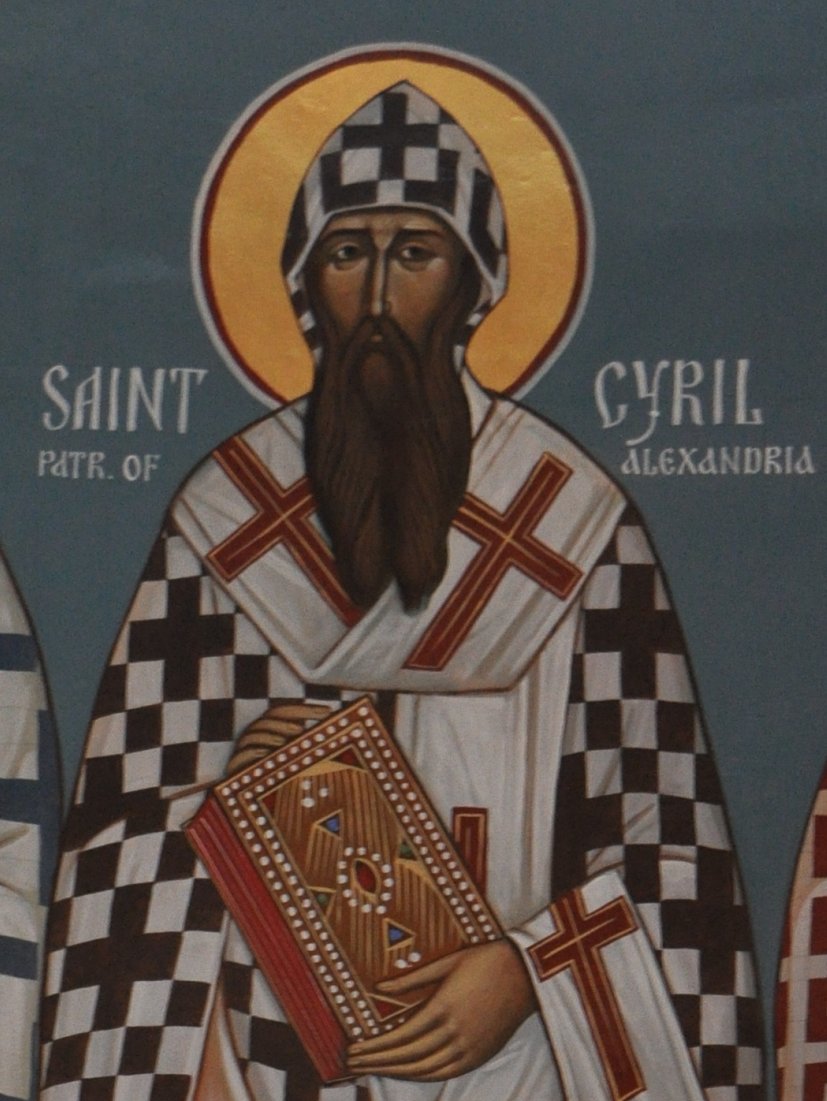
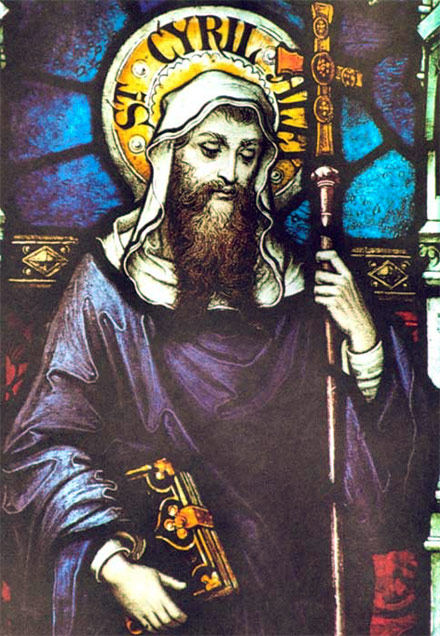
Saint of the Day – 27 June – St Cyril of Alexandria (376-444) Father and Doctor of the Church

Saint of the Day – 27 June – St Cyril of Alexandria (376-444) Father and Doctor of the Church – “The Pillar of Faith” & “Seal of all the Fathers”Doctor Incarnationis (Doctor of the Incarnation) – Patronage – Alexandria, Egypt.

Pope Benedict’s Catechesis on The Fathers of the Church
St Cyril of Alexandria
Wednesday, 3 October 2007

Today too, continuing our journey following the traces left by the Fathers of the Church, we meet an important figure:  St Cyril of Alexandria.   Linked to the Christological controversy which led to the Council of Ephesus in 431 and the last important representative of the Alexandrian tradition in the Greek Orient, Cyril was later defined as “the guardian of exactitude” – to be understood as guardian of the true faith – and even the “seal of the Fathers”.   These ancient descriptions express clearly a characteristic feature of Cyril:  the Bishop of Alexandria’s constant reference to earlier ecclesiastical authors (including, in particular, Athanasius), for the purpose of showing the continuity with tradition of theology itself.   He deliberately, explicitly inserted himself into the Church’s tradition, which he recognised as guaranteeing continuity with the Apostles and with Christ himself.   Venerated as a Saint in both East and West, in 1882 St Cyril was proclaimed a Doctor of the Church by Pope Leo XIII, who at the same time also attributed this title to another important exponent of Greek Patristics, St Cyril of Jerusalem (315-387).   Thus are revealed the attention and love for the Eastern Christian traditions of this Pope, who later also chose to proclaim St John Damascene (675-749) a Doctor of the Church, thereby showing that both the Eastern and Western traditions express the doctrine of Christ’s one Church.header - st cyril of alexandria

We have almost no information on Cyril’s life prior to his election to the important See of Alexandria.   He was a nephew of Theophilus, who had governed the Diocese of Alexandria as Bishop since 385 AD with a prestigious and iron hand. It is likely that Cyril was born in this Egyptian metropolis between 370 and 380 A.D., was initiated into ecclesiastical life while he was still very young and received a good education, both culturally and theologically. In 403, he went to Constantinople in the retinue of his powerful uncle.   It was here that he took part in the so-called “Synod of the Oak” which deposed the Bishop of the city, John (later known as “Chrysostom”) and thereby marked the triumph of the Alexandrian See over its traditional rival, the See of Constantinople, where the Emperor resided.   Upon his uncle Theophilus’ death, the still young Cyril was elected in 412 as Bishop of the influential Church of Alexandria, which he governed energetically for 32 years, always seeking to affirm her primacy throughout the East, strong also because of her traditional bonds with Rome.

Two or three years later, in 417 or 418, the Bishop of Alexandria showed himself to be realistic in mending the broken communion with Constantinople, which had lasted by then since 406 as a consequence of Chrysostom’s deposition.   But the old conflict with the Constantinople See flared up again about 10 years later, when in 428 Nestorius was elected, a severe and authoritarian monk trained in Antioch.   The new Bishop of Constantinople, in fact, soon provoked opposition because he preferred to use as Mary’s title in his preaching “Mother of Christ” (Christotòkos) instead of “Mother of God” (Theotòkos), already very dear to popular devotion.   One reason for Bishop Nestorius’ decision was his adherence to the Antiochean type of Christology, which, to safeguard the importance of Christ’s humanity, ended by affirming the division of the Divinity. Hence, the union between God and man in Christ could no longer be true, so naturally it was no longer possible to speak of the “Mother of God”.st cyril of alexandria - detail

The reaction of Cyril – at that time the greatest exponent of Alexandrian Christology, who intended on the other hand to stress the unity of Christ’s person – was almost immediate, and from 429 he left no stone unturned, even addressing several letters to Nestorius himself.   In the second of Cyril’s letters to Nestorius (PG 77, 44-49), written in February 430, we read a clear affirmation of the duty of Pastors to preserve the faith of the People of God.   This was his criterion, moreover, still valid today:  the faith of the People of God is an expression of tradition, it is a guarantee of sound doctrine.   This is what he wrote to Nestorius:  “It is essential to explain the teaching and interpretation of the faith to the people in the most irreproachable way and to remember that those who cause scandal, even to only one of the little ones, who believe in Christ, will be subjected to an unbearable punishment”.

In the same letter to Nestorius – a letter which later, in 451, was to be approved by the Council of Chalcedon, the Fourth Ecumenical Council – Cyril described his Christological faith clearly:  “Thus, we affirm that the natures are different that are united in one true unity but from both, has come only one Christ and Son, not because, due to their unity, the difference in their natures has been eliminated but rather, because divinity and humanity, reunited in an ineffable and indescribable union, have produced for us one Lord and Christ and Son”.   And this is important –  true humanity and true divinity are really united in only one Person, Our Lord Jesus Christ. Therefore, the Bishop of Alexandria continued:  “We will profess only one Christ and Lord, not in the sense that we worship the man together with the Logos, in order not to suggest the idea of separation by saying “together’ but in the sense that we worship only one and the same, because He is not extraneous to the Logos, His body, with which He also sits at His Father’s side, not as if “two sons” are sitting beside Him but only one, united with His own flesh”.Icon_St._Cyril_of_Alexandria

And soon the Bishop of Alexandria, thanks to shrewd alliances, obtained the repeated condemnation of Nestorius, by the See of Rome, consequently with a series of 12 anathemas which he himself composed and finally, by the Council held in Ephesus in 431, the Third Ecumenical Council.   The assembly which went on with alternating and turbulent events, ended with the first great triumph of devotion to Mary and with the exile of the Bishop of Constantinople, who had been reluctant to recognise the Blessed Virgin’s right to the title of “Mother of God” because of an erroneous Christology that brought division to Christ Himself.    After thus prevailing against his rival and his doctrine, by 433 Cyril was nevertheless already able to achieve a theological formula of compromise and reconciliation with the Antiocheans.   This is also significant, on the one hand, is the clarity of the doctrine of faith but in addition, on the other, the intense search for unity and reconciliation.   In the following years he devoted himself in every possible way to defending and explaining his theological stance, until his death on 27 June 444.

Cyril’s writings – truly numerous and already widely disseminated in various Latin and Eastern translations in his own lifetime, attested to by their instant success – are of the utmost importance for the history of Christianity.   His commentaries on many of the New and Old Testament Books are important, including those on the entire Pentateuch, Isaiah, the Psalms and the Gospels of John and Luke.   Also important are his many doctrinal works, in which the defence of the Trinitarian faith against the Arian and Nestorian theses recurs.   The basis of Cyril’s teaching is the ecclesiastical tradition and in particular, as I mentioned, the writings of Athanasius, his great Predecessor in the See of Alexandria.   Among Cyril’s other writings, the books Against Julian deserve mention. They were the last great response to the anti-Christian controversies, probably dictated by the Bishop of Alexandria in the last years of his life to respond to the work Against the Galileans, composed many years earlier in 363 by the Emperor known as the “Apostate” for having abandoned the Christianity in which he was raised.st-cyril-of-alexandria-4

The Christian faith is first and foremost the encounter with Jesus, “a Person, which gives life a new horizon” (Deus Caritas Est, n. 1).   St Cyril of Alexandria was an unflagging, staunch witness of Jesus Christ, the Incarnate Word of God, emphasising above all his unity, as he repeats in 433 in his first letter (PG 77, 228-237) to Bishop Succensus:  “Only one is the Son, only one the Lord Jesus Christ, both before the Incarnation and after the Incarnation.   Indeed, the Logos born of God the Father was not one Son and the one born of the Blessed Virgin another but we believe, that the very One who was born before the ages, was also born according to the flesh and of a woman”.   Over and above its doctrinal meaning, this assertion shows that faith in Jesus the Logos born of the Father is firmly rooted in history because, as St Cyril affirms, this same Jesus came in time with His birth from Mary, the Theotò-kos and in accordance with His promise will always be with us.

And this is important –  God is eternal, He is born of a woman and He stays with us every day.   In this trust we live, in this trust we find the way for our life…. Pope Benedict XVI

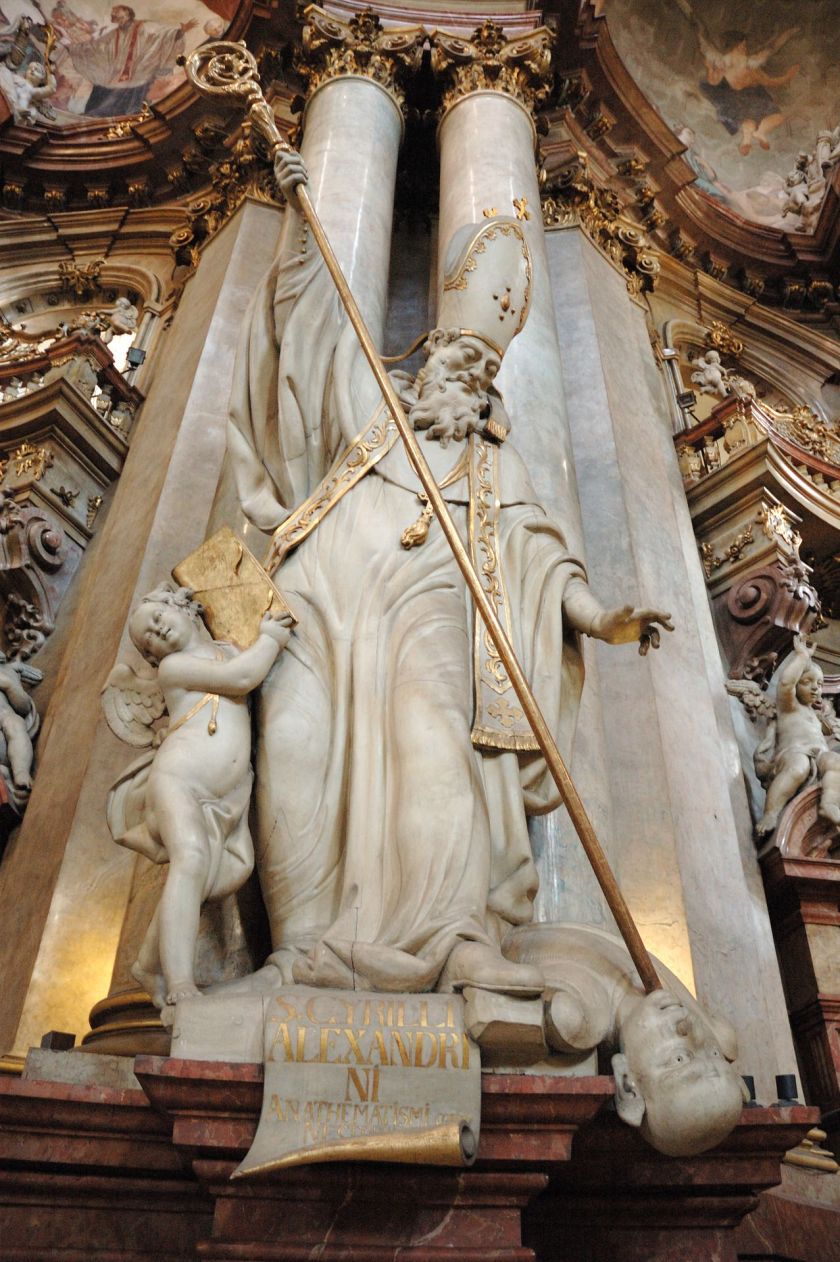
For more on St Cyril here : https://anastpaul.wordpress.com/2017/06/27/saint-of-the-day-27-june-st-cyril-of-alexandria-doctor-father-of-the-church-the-pillar-of-faith-seal-of-all-the-fathers-doctor-incarnationis-doctor-of-the-incarnation/cyril in prague.jpg


Posted in SAINT of the DAY, VATICAN Resources

Saint of the Day – 26 June – St Josemaría Escrivá de Balaguer y Albás (1902-1975) – “The Saint of Ordinary Life”

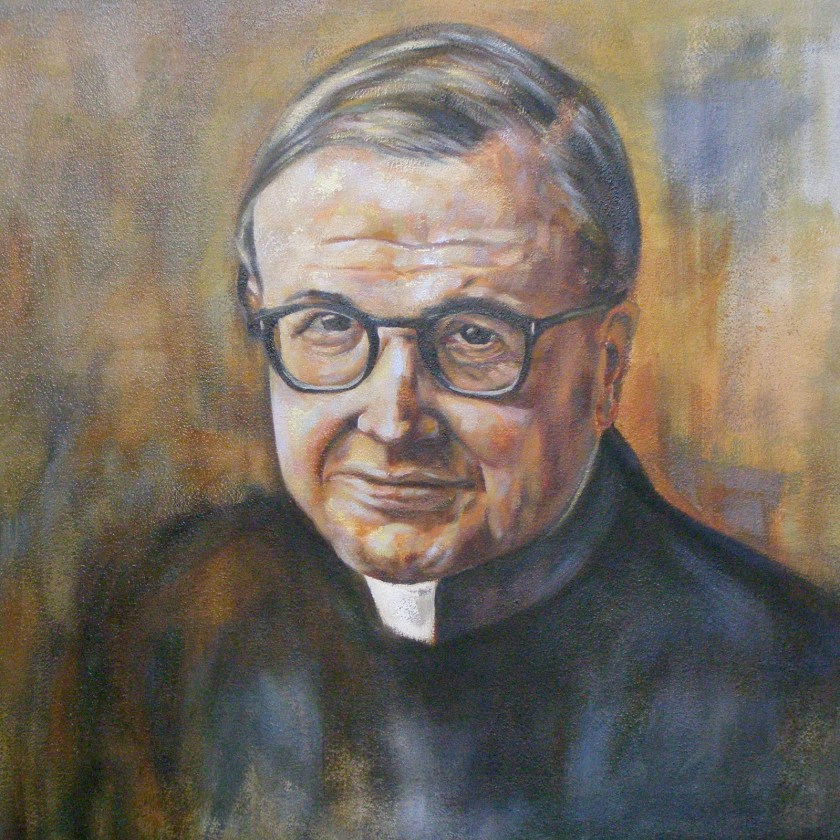
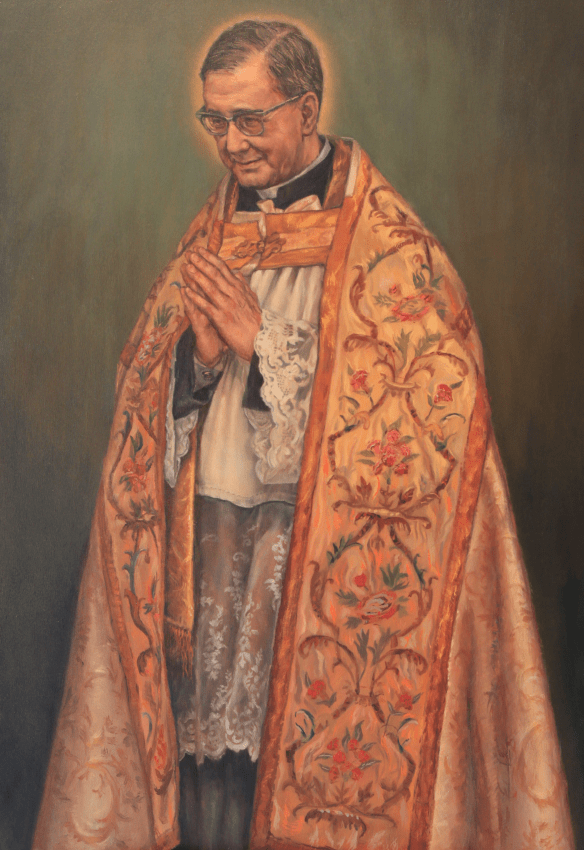
Saint of the Day – 26 June – St Josemaría Escrivá de Balaguer y Albás (1902-1975) commonly known as Josemaria Escrivá- “The Saint of Ordinary Life” – Priest, Founder of Opus Dei, an organisation of laypeople and priests dedicated to the teaching that everyone is called to holiness by God and that ordinary life can result in sanctity.   St Josemaria was born on 9 January 1902 in Barbastro, Spain and died on 26 June 1975 of natural causes in his office in Rome, Italy.   His remains are interred at the Prelatic Church of Our Lady of Peace at Viale Bruno Buozzi 75, Rome, Italy.   Patronage – Opus Dei.HUGE - ST JOSEMARIA

From the Apostolic Brief regarding the Beatification of the Venerable Servant of God Josemaría Escrivá, Priest, Founder of Opus Dei:

“The Founder of Opus Dei has recalled that the universality of the call to full union with Christ implies also that any human activity can become a place for meeting God. (…)   He was a real master of Christian living and reached the heights of contemplation with continuous prayer, constant mortification, a daily effort to work carried out with exemplary docility to the motions of the Holy Spirit, with the aim of serving the Church as the Church wishes to be served.

A bright and cheerful home:   Josemaría Escrivá was born in Barbastro, Spain, on 9 January 1902, the second of six children born to José Escrivá and María Dolores Albás. His parents were devout Catholics and he was baptised on 13 January that year and received from them – first through the example of their life – a firm grounding in the faith and the Christian virtues:  love for frequent Confession and Holy Communion, a trusting recourse to prayer, devotion to Our Lady, helping those in greatest need.

Blessed Josemaría grew up as a cheerful, lively and straightforward child, fun-loving, good at study, intelligent and with an observing eye.   He had a great affection for his mother and a trusting friendship with his father, who encouraged him to feel free to open his heart and tell him his worries and was always ready to answer his questions with affection and prudence.   It was not long before Our Lord began to temper his soul in the forge of sorrow.   Between 1910 and 1913 his three younger sisters died and in 1914 his family suffered financial ruin.   In 1915 the Escrivás moved to Logroño, a nearby town, where their father found a job with which to keep his family.

In the winter of 1917-18 something happened which was to have a decisive influence on Josemaría Escrivá’s future.   The snow fell very heavily that Christmas in Logroño, and one day he saw some frozen footprints in the snow.   They had been left by a discalced Carmelite.   Josemaría found himself wondering If others sacrifice so much for God and their neighbour, couldn’t I do something too?   This was how God started to speak to his heart:  “I began to have an inkling of what Love is, to realise that my heart was yearning for something great, for love.”  He did not yet know what precisely God wanted of him, but he decided to become a priest, thinking that it would make him more available to fulfil God’s will.

Priestly ordination:  Having completed his secondary education, he started his priestly studies at the Seminary of Logroño, passing on, in 1920, to the Seminary of Saragossa, at whose Pontifical University he completed his formation prior to ordination.   At his father’s suggestion and with the permission of his ecclesiastical superiors, he also studied Law at the University of Saragossa.   His generous and cheerful character and his straightforwardness and calm approach to things won him many friends.   His life of piety, respect for discipline and endeavour in study were an example to his fellow seminarians and in 1922, when he was but twenty years of age, he was appointed an inspector or prefect in the Seminary by the Archbishop of Saragossa.

During that time he spent many hours praying before the Blessed Sacrament.   His spiritual life became deeply rooted in the Eucharist.   Each day he would also visit the Basilica of Our Lady of Pilar, asking Mary to request God to show him what He wanted him to do.   As he recalled on 2 October 1968:  “Since I felt those inklings of God’s love, I sought to carry out, within the limits of my smallness, what He expected from this poor instrument. (…) And, with those yearnings, I prayed and prayed and prayed, in constant prayer.   I kept on repeating:  Domine, ut sit!, Domine, ut videam! like the poor fellow in the Gospel, who shouted out because God can do everything. Lord, that I may see!   Lord, that it may come to be!   And I also repeated (…) filled with confidence in my heavenly Mother:  Domina, ut sit!,  Domina, ut videam!   The Blessed Virgin has always helped me to discover her Son’s desires.”

On 27 November 1924 his father, José Escrivá, died suddenly and unexpectedly.   On 28 March 1925, Josemaría was ordained a priest by Bishop Díaz Gómara in the church of the Seminary of St Charles in Saragossa.   Two days later he celebrated his first Solemn Mass in the Holy Chapel of the Basilica of Our Lady of Pilar and on 31 March he moved to Perdiguera, a small country village, where he had been appointed assistant regent to the parish.

In April 1927, with the consent of his Archbishop, he took up residence in Madrid to study for his doctorate in Civil Law, a degree which at that time was only granted by the Central University in the Spanish capital. In Madrid, his apostolic zeal soon brought him into contact with a wide variety of people:  students, artists, workers, academics, priests. He spent many hours caring for children and for sick and poverty-stricken people in the outer suburbs of the city.   At the same time he taught law to earn a living for himself and his mother and sister and young brother.   For a good many years the family were in serious financial difficulties, which they bore with dignity and courage.   Our Lord blessed Fr Josemaría with abundant graces, both ordinary and extraordinary.   They found a fertile reception in his generous soul and produced much fruit in the service of the Church and souls.

The foundation of Opus Dei (Work of God):  Opus Dei was born on 2 October 1928.   Blessed Josemaría was spending some days on retreat and, while doing his meditation on some notes regarding the inner motions he had received from God in the previous years, he suddenly saw – to see was the term he always used to describe the foundational experience – the mission the Lord wanted to entrust to him:  to open up in the Church a new vocational path, aimed at spreading the quest for holiness and the practice of apostolate through the sanctification of ordinary work in the middle of the world, without changing one’s place.   A few months later, on 14 February 1930, God made him understand that Opus Dei was to spread among women also.

From that moment onward, Blessed Josemaría devoted all his energies to the fulfilment of his foundational mission, fostering among men and women from all areas of society a personal commitment to follow Christ, to love their neighbour and seek holiness in daily life.   He did not see himself as an innovator or reformer, for he was convinced that Jesus Christ is eternally new and that the Holy Spirit is constantly rejuvenating the Church, for whose service God has brought Opus Dei into existence.   Fully aware that the task entrusted to him was supernatural by nature, he proceeded to dig deep foundations for his work, based on prayer and penance, on a joyous awareness of his being a son of God and on tireless work.   People of all sorts began to follow him and, in particular, university students and teachers, among whom he awakened a genuine determination to serve everyone, firing in them a desire to place Christ at the heart of all human activities by means of work that is sanctified and sanctifies both the doer and those for whom it is done.   This was the goal he set for the initiatives of the faithful of Opus Dei:  to lift up to God, with the help of grace, each and every created reality, so that Christ may reign in everyone and in everything; to get to know Christ Jesus;  to get Him known by others; to take Him everywhere.   One can understood why he was able to declare that The divine paths of the earth have been opened up.

Apostolic expansion:  In 1933, he started a university Centre, the DYA Academy, because he grasped that the world of human knowledge and culture is a key to the evangelisation of society as a whole.   In 1934 he published Spiritual Considerations, the first version of The Way.   Since then there have been 372 printings of the book in 44 languages and its circulation has passed the four and a half million mark (in 1992 – the figures are much higher now).

While Opus Dei was thus taking its first steps, the Spanish Civil War broke out.   It was 1936.   There were serious outbreaks of religious violence in Madrid.   To these Fr Josemaría responded heroically with prayer, penance and apostolic endeavour.   It was a time of suffering for the whole Church but also a time of spiritual and apostolic growth and for strengthening hope.   By 1939, with the war over, the Founder of Opus Dei was able to give new vigour to his apostolic work all over the Spanish peninsula.   In particular he mobilised many young university students to take Christ to every area of society and discover the greatness of the Christian calling.   At the same time, with his reputation for holiness growing, many Bishops invited him to preach to their clergy and to lay people involved in Catholic organisations.   Similar petitions came to him from the superiors of religious orders – he always said yes.

In 1941, while he was preaching a retreat to priests in Lerida, in the North of Spain, his mother who had been a great help to him in the apostolates of Opus Dei, died.   God also let him become the butt of harsh misunderstandings.   The Bishop of Madrid, Bishop Eijo y Garay gave him his fullest backing and granted the first canonical approval to Opus Dei.   Blessed Josemaría accepted these difficulties with a prayerful and cheerful attitude, aware that “all those desiring to live piously in Christ Jesus will meet persecution” (2 Tim 3:12) and he recommended his spiritual children, in the face of these attacks, to forgive ungrudgingly:  “don’t answer back, but pray, work and smile.”

In 1943, through a new foundational grace he received while celebrating Holy Mass, there came to birth – within Opus Dei – the Priestly Society of the Holy Cross, in which priests proceeding from the faithful of Opus Dei could be incardinated.   The fact of all the faithful of Opus Dei, both laity and priests, belonging fully to Opus Dei, with both laity and priests cooperating organically in its apostolates, is a feature of the foundational charism, which the Church confirmed in 1982, when giving Opus Dei its definitive status in Church Law as a Personal Prelature.   On 25 June 1944 three engineers were ordained to the priesthood. One of them was Alvaro del Portillo, who would eventually succeed the Founder as the head of Opus Dei.   In the years that followed, close on a thousand laymen of Opus Dei reached the priesthood at the encouragement of Blessed Josemaría.

The Priestly Society of the Holy Cross, which is intrinsically united to the Prelature of Opus Dei, also carries out, in close harmony with the Pastors of the local Churches, activities of spiritual formation for diocesan priests and candidates to the priesthood.   Diocesan priests too may belong to the Priestly Society of the Holy Cross, while maintaining unchanged their status as clergy of their respective dioceses.

diaconos_opusdei_20161030152600901511_20161031134606411927_20170427161749449272
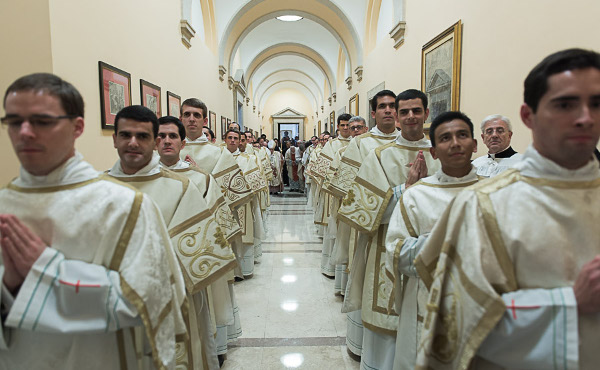
29 April 2017, 31 Opus Dei Priests about to be Ordained

st-josemaria-13

A Roman and universal spirit:   As soon as the end of the world war was in sight, Blessed Josemaría began to prepare apostolic work in other countries, because, as he pointed out, Jesus wants his Work from the outset to have a universal, Catholic heart.   In 1946 he moved to Rome, in order to obtain papal recognition for Opus Dei.   On 24 February 1947, Pius XII granted Opus Dei the decretum laudis, or decree of praise; and three years later, on 16 June 1950, the Church’s definitive approval.   Since then it has been possible to admit as Cooperators of Opus Dei men and women who are not Catholic and not even Christian but who wish to help its apostolic works, with their work, alms and prayer.

The headquarters of Opus Dei were fixed in Rome, to emphasise even more clearly the aspiration which is the guiding force of all its work, to serve the Church as the Church wishes to be served, in close union with the see of Peter and the hierarchy of the Church.   On several occasions, Pope Pius XII and St Pope John XXIII sent Blessed Josemaría expressions of their affection and esteem;  Paul VI wrote to him in 1964 describing Opus Dei as “a living expression of the perennial youthfulness of the Church”.

This stage too of the life of the Founder of Opus Dei, was characterised by all kinds of trials.   Not only was his health affected by many sufferings (for more than ten years he had a serious form of diabetes, from which he was miraculously cured in 1954) but also there were financial hardships and the difficulties arising from the expansion of the apostolic works worldwide.   Nevertheless, he kept smiling throughout, because “True virtue is not sad or disagreeable but pleasantly cheerful.”   His permanent good humour was a constant witness to his unconditional love for God’s will.


“The world is little, when Love is great”:  his desire to flood the earth with the light of Christ led him to follow up the calls that many Bishops made to him from all over the world, asking Opus Dei to help them in the work of evangelisation with its apostolates. Many varied projects were undertaken:  colleges to impart professional training, schools for agricultural workers, universities, primary and secondary schools, hospitals and medical centres, etc.   These activities, which he often compared to a shoreless sea, originate at the initiative of ordinary Christians who seek to meet specific local needs with a lay mentality and a professional approach.   They are open to people of all races, religions and social backgrounds, because their unmistakably Christian outlook is always matched by a deep respect for the freedom of consciences.

When John XXIII announced his decision to call an Ecumenical Council, Blessed Josemaría began to pray and get others to pray for the happy outcome of this great initiative of the Second Vatican Ecumenical Council, as he wrote in a letter in 1962.   As a result of the deliberations of the Council, the Church’s solemn Magisterium was to confirm fundamental aspects of the spirit of Opus Dei, such as the universal call to holiness;  professional work as a means to holiness and apostolate;  the value and lawful limits of Christian freedom in temporal affairs;  and the Holy Mass as the centre and root of the interior life.   Blessed Josemaría met numerous Council Fathers and experts, who saw him as a forerunner of many of the master lines of the Second Vatican Council. Profoundly identified with the Council’s teaching, he diligently fostered its implementation through the formative activities of Opus Dei all over the world.

Holiness in the midst of the world:  “Heaven and earth seem to merge, far away, on the horizon.   But don’t forget that where they really meet is in your heart as a son of God.”  Blessed Josemaría preached constantly that interior life is more important than organising activities.   In The Way he wrote that “These world crises are crises of saints.”   He insisted that holiness always requires prayer, work and apostolate to be intertwined in what he called a unity of life and practised this himself, with cheerful perseverance.

He was utterly convinced that in order to attain sanctity through daily work, one needs to struggle to be a soul of prayer, of deep inner life.   When a person lives this way, “everything becomes prayer, everything can and ought to lead us to God, feeding our constant contact with Him, from morning till night.   Every kind of work can become prayer and every kind of work, become prayer, turns into apostolate.”

The root of the astonishing fruitfulness of his ministry lies precisely in his ardent interior life which made Blessed Josemaría a contemplative in the midst of the world.   His interior life fed on prayer and the sacraments and expressed itself in a passionate love for the Eucharist, in the depth with which he lived the Mass as the centre and root of his own life, in his tender devotion to the Virgin Mary, to St Joseph and the Guardian Angels, and in his faithfulness to the Church and the Pope.

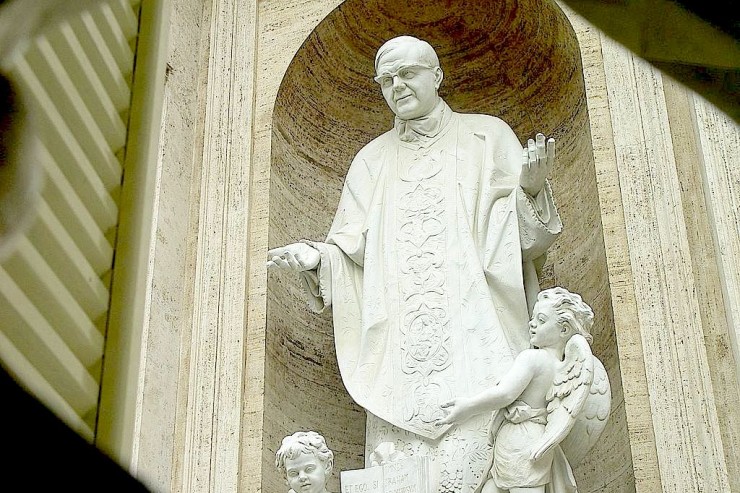
sanjosemaria- Vatican statue
Founder Statue at the Vatican

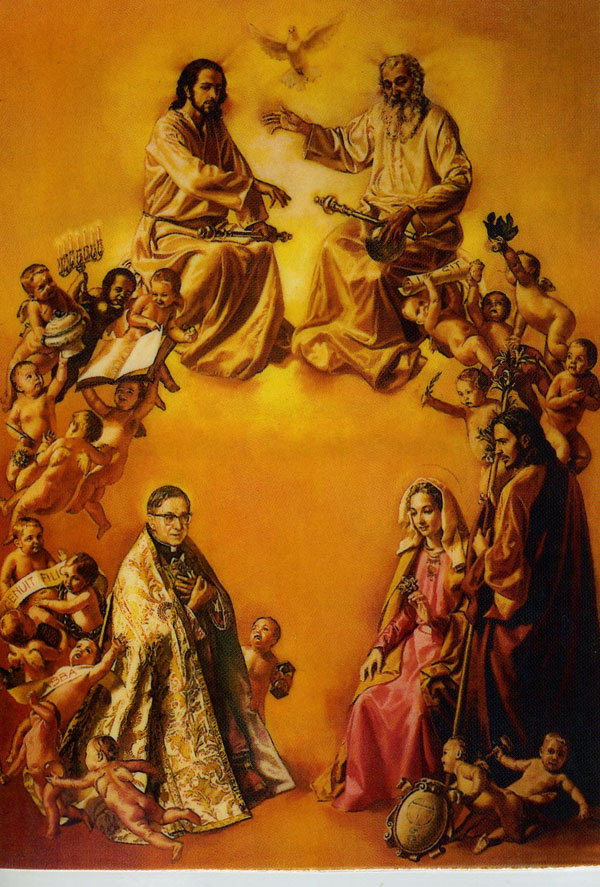
The definitive encounter with the Most Holy Trinity:  During the last years of his life, the Founder of Opus Dei undertook a number of catechetical journeys to countries in Europe and Latin America.   Wherever he went, there were meetings, which were always simple and familiar in tone, even though often those listening to him were to be counted in thousands.   He would speak about God, the sacraments, Christian devotions, the sanctification of work and his love for the Church and the Pope.   On 28 March 1975 he celebrated his priestly Golden Jubilee.   His prayer that day was like a summing up of his whole life:   “Fifty years have gone by and I am still like a faltering child.   I am just beginning, beginning again, as I do each day in my interior life.   And it will be so to the end of my days: always beginning anew.”Retablo_de_Escrivá_en_Roma

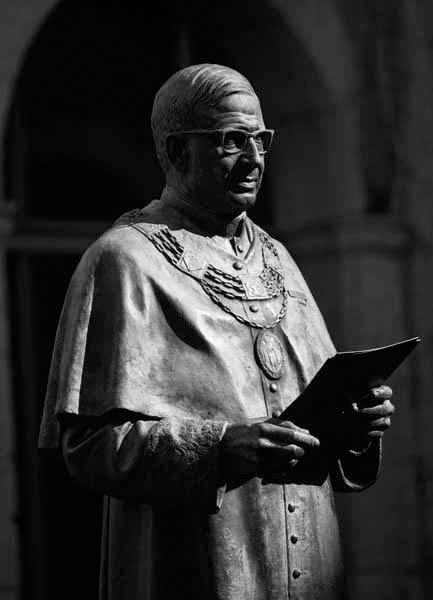
On 26 June 1975, at midday, Blessed Josemaría died in his workroom, of a cardiac arrest, before a picture of Our Lady which received his last glance.   At the time, Opus Dei was present in all five continents, with over 60,000 members from 80 nationalities.   His books of spirituality (The Way, Holy Rosary, Conversations with Mgr Escrivá, Christ is Passing By, Friends of God, Love for the Church, The Way of the Cross, Furrow, The Forge) have reached multi-millions of copies.st josemaria statue

After his death, many people asked the Holy Father for his canonisation.   On 17 May 1992, in Rome, His Holiness St Pope John Paul II raised Josemaría Escrivá to the altars, in a beatification ceremony before hundreds of thousands of pilgrims.   On 21 September 2001, the Ordinary Congregation of Cardinal and Bishop members of the Congregation for the Causes of Saints, unanimously confirmed the miraculous character of a cure attributed to Blessed Josemaría.  The decree regarding this miracle was read before the Holy Father on 20 December.   On 26 February 2002, John Paul II presided over an Ordinary Public Consistory of Cardinals and, having heard the Cardinals, Archbishops and Bishops present, he established that the ceremony for the Canonisation of Blessed Josemaría Escrivá should take place on 6 October 2002.   And so it did!….Vatican.va


St Josemaria, Pray for us!

more images and information here :  https://anastpaul.wordpress.com/2017/06/26/saint-of-the-day-26-june-josemaria-escriva-de-balaguer-y-albas/

1014px-Detail_autel_Jose_Maria_Escriva_de_Balaguer_Peterskirche_Vienna
Detail from a Shrine to St Josemaria at the Basilica of St Peter in Vienna, Austria


Posted in FATHERS of the Church, PAPAL SERMONS, SAINT of the DAY, VATICAN Resources

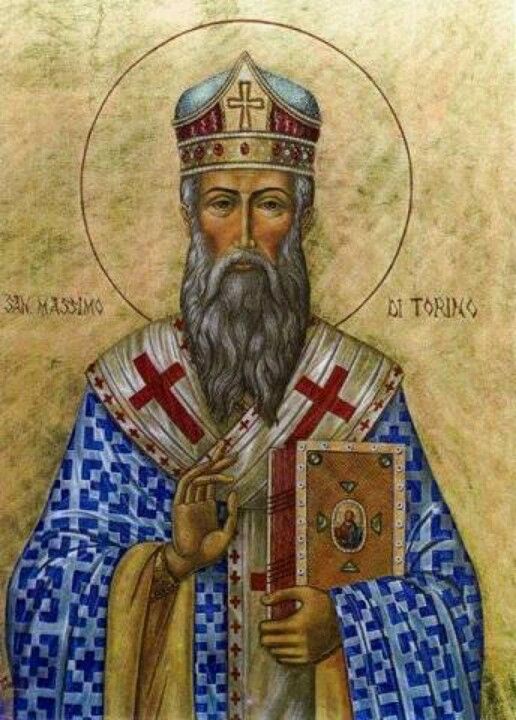
Saint of the Day – 25 June – St Maximus of Turin (? – c 420) Father of the Church

Saint of the Day – 25 June – St Maximus of Turin (? – c 420) Father of the Church, Bishop, Writer, Theologian  –  known as Massimo – date of birth unknown – his date of death is also not certain.   St Maximus is believed to have been a native of Rhaetia (modern day Northern Italy).  Patron of Turin, Italy.   St Maximus attended the synod of Milan where northern Italian bishops accepted the letter of Pope Leo I which set forth the orthodox doctrine of the Incarnation.   He also attended the the Synod of Rome in 465.   He was a prolific and inspirational Theological writer with 118 homilies, 116 sermons and 6 treatises surviving.

ST maximus of turin

“Between the end of the fourth century and the beginning of the fifth, another Father of the Church after St Ambrose made a great contribution to the spread and consolidation of Christianity in Northern Italy – St Maximus, whom we come across in 398 as Bishop of Turin, a year after St Ambrose’s death.   Very little is known about him, in compensation, we have inherited a collection of about 116 of his Sermons.   It is possible to perceive in them the Bishop’s profound and vital bond with his city, which attests to an evident point of contact between the episcopal ministry of Ambrose and that of Maximus.

At that time serious tensions were disturbing orderly civil coexistence.   In this context, as pastor and teacher, Maximus succeeded in obtaining the Christian people’s support. The city was threatened by various groups of barbarians.   They entered by the Eastern passes, which went as far as the Western Alps.   Turin was therefore permanently garrisoned by troops and at critical moments became a refuge for the populations fleeing from the countryside and urban centres where there was no protection.   Maximus’ interventions in the face of this situation testify to his commitment to respond to the civil degradation and disintegration.   Although it is still difficult to determine the social composition of those for whom the Sermons were intended, it would seem that Maximus’ preaching – to avoid the risk of vagueness – was specifically addressed to a chosen nucleus of the Christian community of Turin, consisting of rich landowners who had property in the Turinese countryside and a house in the city.   This was a clear-sighted pastoral decision by the Bishop, who saw this type of preaching as the most effective way to preserve and strengthen his own ties with the people.St. Maximus presents to the people of Turin the Icon of the Madonna Consolata.

To illustrate this view of Maximus’ ministry in his city, I would like to point out for example Sermons 17 and 18, dedicated to an ever timely topic:  wealth and poverty in Christian communities.   In this context too, the city was fraught with serious tensions. Riches were accumulated and hidden.   “No one thinks about the needs of others”, the Bishop remarked bitterly in his 17th Sermon.   “In fact, not only do many Christians not share their own possessions but they also rob others of theirs.   Not only, I say, do they not bring the money they collect to the feet of the apostles but in addition, they drag from priests’ feet, their own brethren who are seeking help”.   And he concluded:  “In our cities there are many guests or pilgrims.   Do what you have promised”, adhering to faith, “so that what was said to Ananias will not be said to you as well:  “You have not lied to men but to God'” (Sermon 17, 2-3).

In the next Sermon, the 18th, Maximus condemns the recurring forms of exploitation of others’ misfortunes.   “Tell me, Christian”, the Bishop reprimands his faithful, “tell me why you snatched the booty abandoned by the plunderers?   Why did you take home “ill-gotten gains’ as you yourself think, torn apart and contaminated?”.   “But perhaps”, he continues, “you say you have purchased them and thereby believe you are avoiding the accusation of avarice.   However, this is not the way to equate purchasing with selling.   “It is a good thing to make purchases but that means what is sold freely in times of peace, not goods looted during the sack of a city… So act as a Christian and a citizen who purchases in order to repay”  (Sermon 18: 3).   Without being too obvious, Maximus thus managed to preach a profound relationship between a Christian’s and a citizen’s duties.   In his eyes, living a Christian life also meant assuming civil commitments.   Vice-versa, every Christian who, “despite being able to live by his own work, seizes the booty of others with the ferocity of wild beasts”;  who “tricks his neighbour, who tries every day to nibble away at the boundaries of others, to gain possession of their produce, does not compare to a fox biting off the heads of chickens but rather to a wolf savaging pigs.” (Sermon 41, 4).

img-Saint-Maximus-of-Turin

In comparison with the cautious, defensive attitude that Ambrose adopted to justify his famous project of redeeming prisoners of war, the historical changes that occurred in the relationship between the Bishop and the municipal institutions are clearly evident. By now sustained through legislation that invited Christians to redeem prisoners, Maximus, with the collapse of the civil authority of the Roman Empire, felt fully authorised in this regard to exercise true control over the city.   This control was to become increasingly extensive and effective until it replaced the irresponsible evasion of the magistrates and civil institutions.   In this context, Maximus not only strove to rekindle in the faithful the traditional love for their hometown but he also proclaimed the precise duty to pay taxes, however burdensome and unpleasant they might appear (cf. Sermon 26, 2).   In short, the tone and substance of the Sermons imply an increased awareness of the Bishop’s political responsibility in the specific historical circumstances. He was “the lookout tower” posted in the city.   Whoever could these watchmen be, Maximus wonders in Sermon 92, “other than the most blessed Bishops set on a lofty rock of wisdom, so to speak, to defend the peoples and to warn them about the evils approaching in the distance?”.   And in Sermon 89 the Bishop of Turin describes his tasks to his faithful, making a unique comparison between the Bishop’s function and the function of bees:  “Like the bee”, he said, Bishops “observe bodily chastity, they offer the food of heavenly life using the sting of the law.   They are pure in sanctifying, gentle in restoring and severe in punishing”.   With these words, St Maximus described the task of the Bishop in his time.st maximus of turin - snip

In short, historical and literary analysis show an increasing awareness of the political responsibility of the ecclesiastical authority in a context in which it continued de facto to replace the civil authority.
Indeed, the ministry of the Bishop of Northwest Italy, starting with Eusebius who dwelled in his Vercelli “like a monk” to Maximus of Turin, positioned “like a sentinel” on the highest rock in the city, developed along these lines.   It is obvious that the contemporary historical, cultural and social context is profoundly different.   Today’s context is rather the context outlined by my venerable Predecessor, Pope John Paul II, in the Post-Synodal Apostolic Exhortation Ecclesia in Europa, in which he offers an articulate analysis of the challenges and signs of hope for the Church in Europe today (nn. 6-22).   In any case, on the basis of the changed conditions, the believer’s duties to his city and his homeland still remain effective.   The combination of the commitments of the “honest citizen” with those of the “good Christian” has not in fact disappeared.

In conclusion, to highlight one of the most important aspects of the unity of Christian life, I would like to recall the words of the Pastoral Constitution Gaudium et Spes:  consistency between faith and conduct, between Gospel and culture.   The Council exhorts the faithful “to perform their duties faithfully in the spirit of the Gospel.   It is a mistake to think that because we have here no lasting city, but seek the city which is to come, we are entitled to shirk our earthly responsibilities;  this is to forget that by our faith we are bound all the more to fulfil these responsibilities according to the vocation of each one” (n. 43).   

In following the Magisterium of St Maximus and of many other Fathers, let us make our own, the Council’s desire, that the faithful may be increasingly anxious to “carry out their earthly activity in such a way as to integrate human, domestic, professional, scientific and technical enterprises with religious values, under whose supreme direction all things are ordered to the glory of God” (ibid.) and thus for humanity’s good.”…Pope Benedict XVI, General Audience, Wednesday, 31 October 2007header - st maximus of turin

Posted in MORNING Prayers, ON the SAINTS, PAPAL SERMONS, PRAYERS for PRIESTS, QUOTES on the PRIESTHOOD, The WORD, VATICAN Resources

One Minute Reflection – – 23 June – The Memorial of St Joseph Cafasso (1811-1860)

One Minute Reflection – – 23 June – The Memorial of St Joseph Cafasso (1811-1860)

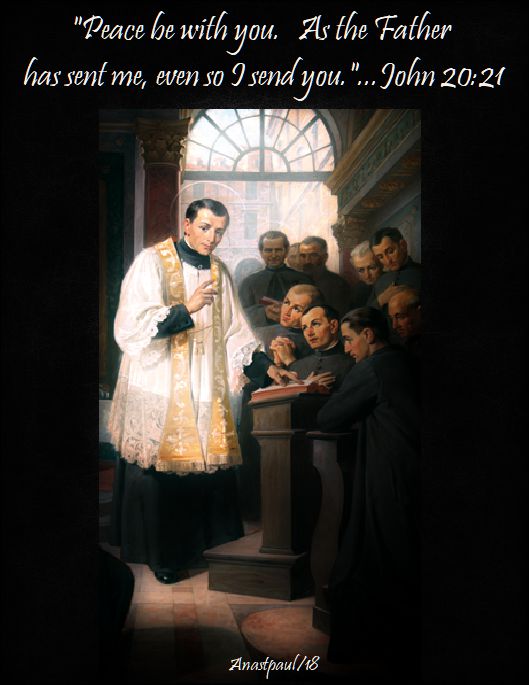
“Peace be with you.   As the Father has sent me, even so I send you.”…John 20:21as the father has sent me - john 20-21 - st joseph cafasso - 23 june 2018

REFLECTION – “Not without a special and beneficial disposition of Divine Goodness have we witnessed new stars rising on the horizon of the Catholic Church: the parish priest of Ars and the Venerable Servant of God, Joseph Cafasso.   These two beautiful, beloved, providently timely figures must be presented today; one, the parish priest of Ars, as small and humble, poor and simple as he was glorious and the other, a beautiful, great, complex and rich figure of a priest, the educator and formation teacher of priests, Venerable Joseph Cafasso”….Pope Pius XI

PRAYER – Holy God, may St Joseph Cafasso’s example serve as a reminder to all to hasten towards the perfection of Christian life, towards holiness.   In particular, may St Joseph Cafasso, remind priests of the importance of devoting time to the sacrament of Reconciliation and to spiritual direction and to all, the concern we should have for the most deprived.   May we find help in his intercession and that of the Blessed Virgin Mary, to whom St Joseph Cafasso was very devoted and whom he called “Our beloved Mother, our consolation, our hope”.   St Joseph Cafasso, St John Vianney, please pray for all our priests!   We make our prayer through our Lord Jesus Christ, with You, in the union of the Holy Spirit, one God forever, amen.sts joseph cafasso and john vianney - pray for us and all priests - 23 june 2018

Posted in PAPAL SERMONS, SAINT of the DAY, VATICAN Resources

Saint of the Day – 23 June – St Joseph Cafasso (1811-1860) “Priest of the Gallows”

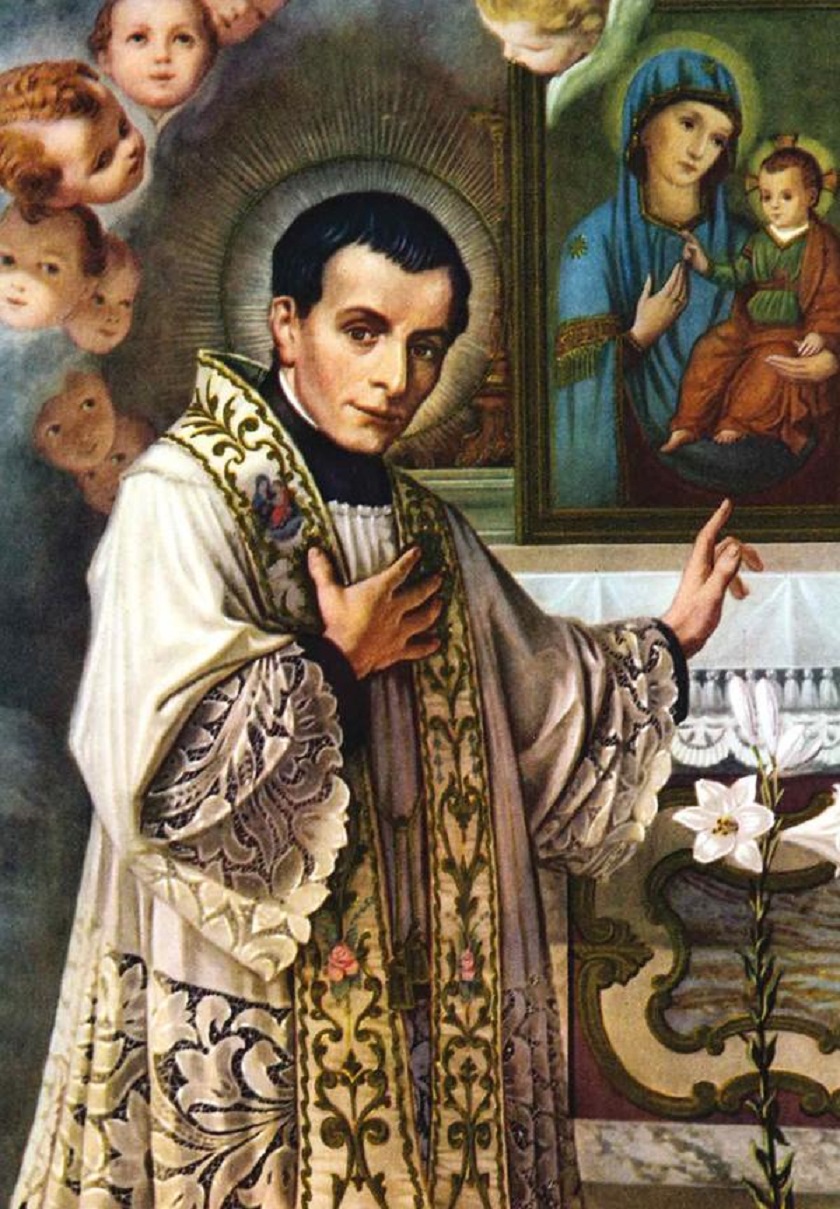
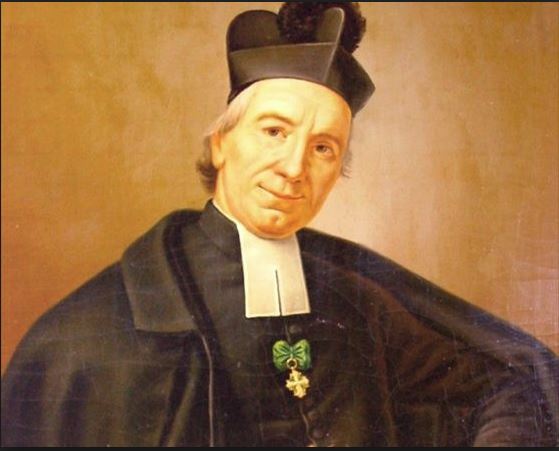
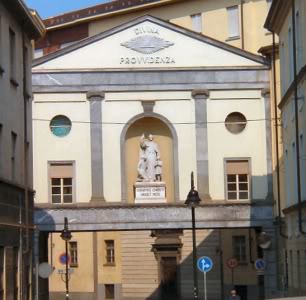
Saint of the Day – 23 June – St Joseph Cafasso (1811-1860) “Priest of the Gallows”, Priest, Theology Lecturer, Social Reformer, Confessor, Spiritual Director (of St John Bosco and quite a few other saints), Rector of a post-Ordination Theological College, member of the Third Order of St Francis – born Giuseppe Cafasso on 15 January 1811 at Castelnuovo d’Asti, Italy and died on 23 June 1860 at Turin, Italy of pneumonia, a stomach hemorrhage and complications of his congenital medical problems (he had been born with a deformed spine which contributed to his short stature and frail constitution).   His will bequeathed everything to aid the Little House of Divine Providence which was the religious order founded by St Joseph Benedict Cottolengo (1786-1842).    St John Bosco (1815-1888) preached the funeral Mass homily.  Patronages – Italian prisons, Prison chaplains, Prisoners, those condemned to death.0627giuseppe-cafasso-header no 2

Joseph Cafasso was born in Castelnuovo d’Asti, the same village in which St John Bosco was born, on 15 January 1811.   He was the third of four children.   The last, his sister Marianna, was to be the mother of Bl Joseph Allamano, Founder of the Consolata Missionary Fathers and the Consolata Missionary Sisters.   He was born in 19th-century Piedmont, marked by serious social problems but also by many Saints who strove to find remedies for them.   These Saints were bound to each other by total love of Christ and by their profound charity for the poorest people.   The grace of the Lord can spread and multiply the seeds of holiness!   

Cafasso completed his secondary school studies and the two years of philosophy at the College of Chieri and, in 1839, went on to the theological seminary where he was ordained a priest in 1833.   Four months later he entered what for him was to be the fundamental and only “stage” in his priestly life:  the “Convitto Ecclesiastico di S. Francesco d’Assisi” in Turin.   Having entered it to perfect himself in pastoral ministry, it was here that he brought to fruition his gifts as a spiritual director and his great spirit of charity.   The “Convitto” was in fact not only a school of moral theology where young priests, who came mainly from the countryside, learned how to become confessors and how to preach but was also a true and proper school of priestly life, where priests were formed in the spirituality of St Ignatius of Loyola and in the moral and pastoral theology of the great holy Bishop St Alphonsus Mary de’ Liguori.   The type of priest that Cafasso met at the “Convitto” and that he himself helped to strengthen especially as Recto, was that of the true pastor with a rich inner life and profound zeal in pastoral care, faithful to prayer, committed to preaching and to catechesis, dedicated to the celebration of the Eucharist and to the ministry of Confession, after the model embodied by St Charles Borromeo and St Francis de Sales and promoted by the Council of Trent.   A felicitous saying of St John Bosco sums up the meaning of educational work in that community:  “at the “Convitto’ men learn to be priests”.lg - st joseph cafasso

St Joseph Cafasso sought to bring this model into being in the formation of the young priests so that, in turn, they might become the formation teachers of other priests, religious and lay people, forming a special and effective chain.   From his chair of moral theology he taught them to be good confessors and spiritual directors, concerned for the true spiritual good of people, motivated equally by a desire to make God’s mercy felt and, by an acute and lively sense of sin.   Cafasso the teacher had three main virtues, as St John Bosco recalled:  calmness, wisdom and prudence.   For him the test of the lessons taught was the ministry of Confession, to which he himself devoted many hours of the day.   Bishops, priests, religious, eminent laymen and women and simple people sought him.   He was able to give them all the time they needed.   He was also a wise spiritual counsellor to many who became Saints and founders of religious institutes.   His teaching was never abstract, nor based exclusively on the books that were used in that period. Rather, it was born from the living experience of God’s mercy and the profound knowledge of the human soul that he acquired in the long hours he spent in the confessional and in spiritual direction:  his was a real school of priestly life.

His secret was simple:  to be a man of God; to do in small daily actions “what can result in the greater glory of God and the advantage of souls”.   He loved the Lord without reserve, he was enlivened by a firmly-rooted faith, supported by profound and prolonged prayer and exercised in sincere charity to all.   He was versed in moral theology but was likewise familiar with the situation and hearts of people, of whose good he took charge as the good pastor that he was.   Those who had the grace to be close to him were transformed into as many good pastors and sound confessors.   He would point out clearly to all priests the holiness to achieve in their own pastoral ministry.   Bl. Fr Clement Marchisio, Founder of the Daughters of St Joseph, declared:  “You entered the “Convitto’ as a very mischievous, thoughtless youth, with no idea of what it meant to be a priest;  and you came out entirely different, fully aware of the dignity of the priest”.   How many priests were trained by him at the “Convitto” and then accompanied by him spiritually!   Among them as I have said emerges St John Bosco who had him as his spiritual director for a good 25 years, from 1835 to 1860:  first as a seminarian, then as a priest and lastly as a Founder.   In all the fundamental decisions of his life St John Bosco had St Joseph Cafasso to advise him but in a very specific way – Cafasso never sought to form Don Bosco as a disciple “in his own image and likeness”and Don Bosco did not copy Cafasso –  he imitated Cafasso’s human and priestly virtues, certainly and described him as “a model of priestly life” but according to his own personal disposition and his own specific vocation;   a sign of the wisdom of the spiritual teacher and of the intelligence of the disciple,the former did not impose himself on the latter but respected his personality and helped him to interpret God’s will for him.

Dear friends, this is a valuable lesson for all who are involved in the formation and education of the young generations and also a strong reminder of how important it is to have a spiritual guide in one’s life, who helps one to understand what God expects of each of us.   Our Saint declared with simplicity and depth:   “All a person’s holiness, perfection and profit lies in doing God’s will perfectly…. Happy are we if we succeed in pouring out our heart into God’s, in uniting our desires and our will to His to the point, that one heart and one will are formed, wanting what God wants, wanting in the way, in the time and in the circumstances that He desires and willing it all for no other reason, than that God wills it”.st joseph cafasso - lovely

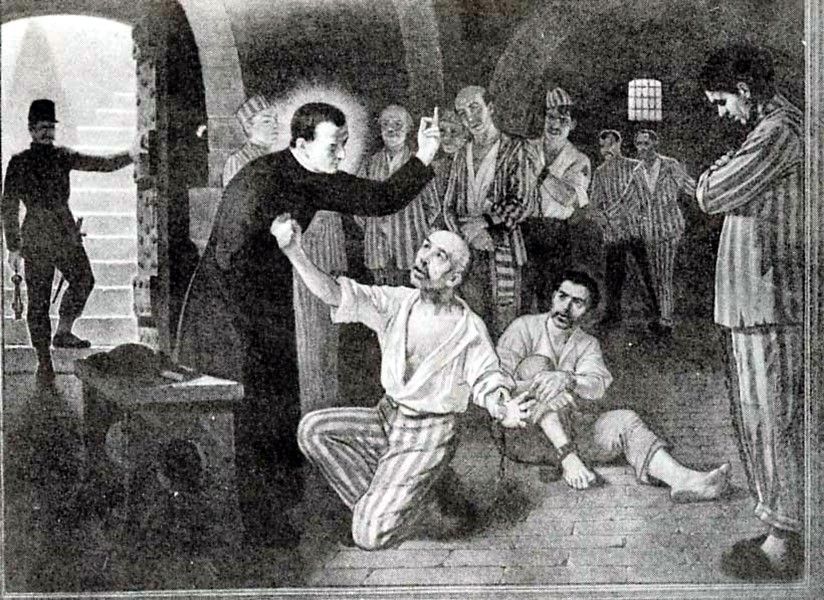
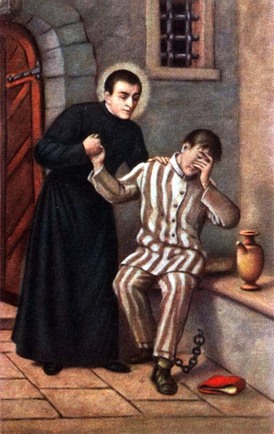
However, another element characterises the ministry of our Saint:  attention to the least and in particular to prisoners who in 19th-century Turin lived in inhumane and dehumanising conditions.   In this sensitive service too, which he carried out for more than 20 years, he was always a good, understanding and compassionate pastor, qualities perceived by the prisoners who ended up by being won over by his sincere love, whose origin lay in God himself.

Cafasso’s simple presence did good: it reassured, it moved hearts hardened by the events of life and above all it enlightened and jolted indifferent consciences.   In his early prison ministry he often had recourse to great sermons that managed to involve almost the entire population of the prison.   As time passed, he gave priority to plain catechesis in conversation and in personal meetings.   Respectful of each individual’s affairs, he addressed the important topics of Christian life, speaking of trust in God, of adherence to His will, of the usefulness of prayer and of the sacraments whose goal is Confession, the encounter with God who makes Himself infinite mercy for us.

Those condemned to death were the object of very special human and spiritual care.   He accompanied to the scaffold 57 of the men sentenced to death, having heard their confession and having administered the Eucharist to them.   He accompanied them with deep love until the last breath of their earthly existence.joseph with prisonersSt Joseph Cafasso-thumb-275x434-6841

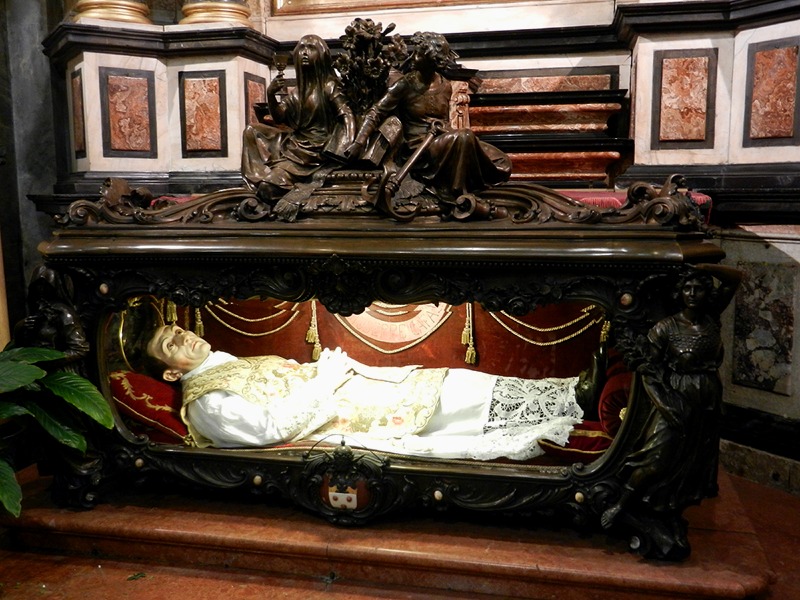
Joseph Cafasso died on 23 June 1860, after a life offered entirely to the Lord and spent for his neighbour.   My Predecessor, the Venerable Servant of God Pope Pius XII, proclaimed him Patron of Italian prisons on 9 April 1948 and, with his Apostolic Exhortation Menti Nostrae, on 23 September 1950 held him up as a model to priests engaged in Confession and in spiritual direction.”…Pope Benedict XVI, General Audience,  30 June 2010

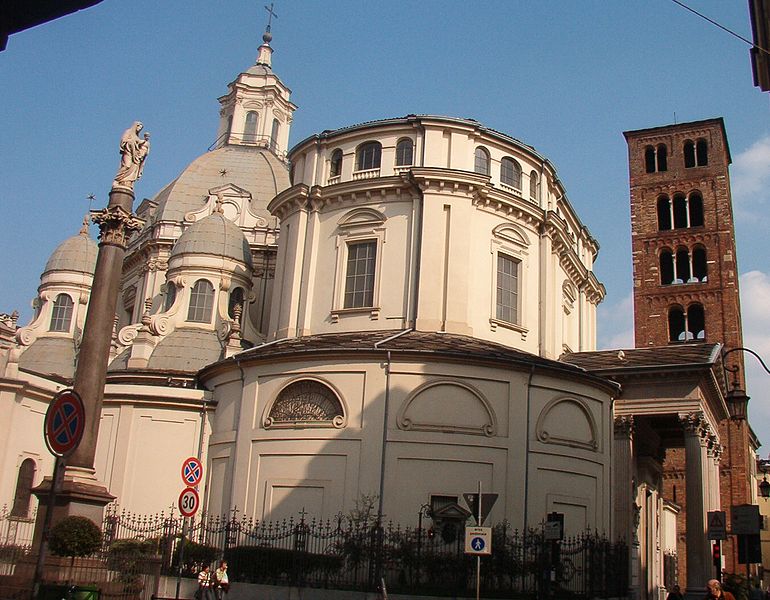
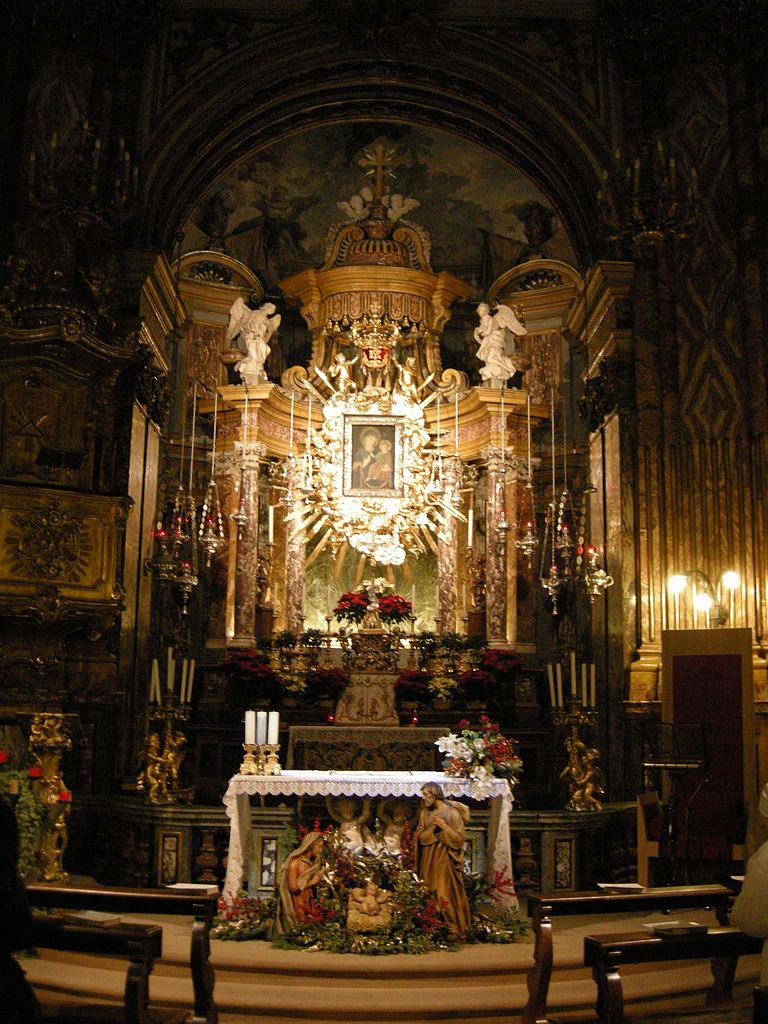
St Joseph was Beatified on 3 May 1925 by Pope Pius XI and Canonised 22 June 1947, by Pope Pius XII.   His Major shrine is Santuario della Consolata, Turin, Italy.3186TorinoConsolatainside770px-Santuario_della_Consolata_Torino768px-Consolata_di_torino,_interno,_25


Posted in MORNING Prayers, papal ENCYCLICALS, PAPAL ENCYLICALS, QUOTES on LOVE, QUOTES on MARRIAGE, MARRIED LOVE, The WORD, VATICAN Documents, VATICAN Resources

One Minute Reflection – 15 June – Friday of the Tenth Week of Ordinary Time, Year B – Today’s Gospel Matthew 5:27-32

One Minute Reflection – 15 June – Friday of the Tenth Week of Ordinary Time, Year B – Today’s Gospel Matthew 5:27-32

“It was also said, ‘Whoever divorces his wife, let him give her a certificate of divorce.’   But I say to you that every one who divorces his wife, except on the ground of unchastity, makes her an adulteress and whoever marries a divorced woman, commits adultery.”…Matthew 5:31-32matthew 5 31-32-but i say to you that everyone who divorces

REFLECTION – “Married love particularly reveals its true nature and nobility when we realise that it takes its origin from God, who is love… Marriage, then, is far from being the effect of chance or the result of the blind evolution of natural forces.   It is in reality the wise and provident institution of God the Creator, whose purpose was to effect in man His loving design.   As a consequence, husband and wife, through that mutual gift of themselves alone… develop that union of two persons in which they perfect one another, cooperating with God in the generation and rearing of new lives.   The marriage of those who have been baptised is, in addition, invested with the dignity of a sacramental sign of grace, for it represents the union of Christ and His Church (Eph 5:32).

In the light of these facts the characteristic features and exigencies of married love are clearly indicated.   This love is above all fully human, a compound of sense and spirit.   It is not, then, merely a question of natural instinct or emotional drive.   It is also, and above all, an act of the free will, whose trust is such that it is meant not only to survive the joys and sorrows of daily life but also to grow, so that husband and wife become, in a way, one heart and one soul and together attain their human fulfilment.

It is a love which is total—that very special form of personal friendship in which husband and wife generously share everything, allowing no unreasonable exceptions and not thinking solely of their own convenience.   Whoever really loves his partner, loves not only for what he receives but loves that partner, for the partner’s own sake, content to be able to enrich the other with the gift of himself.

Married love is also faithful and exclusive of all other and this until death.   This is how husband and wife understood it on the day on which, fully aware of what they were doing, they freely vowed themselves to one another in marriage… Finally, this love is fecund.   It is not confined wholly to the loving interchange of husband and wife;  it also contrives to go beyond this to bring new life into being.”…Blessed Paul VI – Humanae vitae, 8-9whoever really loves - bl pope paul VI - humanae vitae 9 - 15 june 2018

PRAYER – Yours is the day and Yours, the night, Lord God and we are Your children. Grant we pray, that the weakness of our humanity, the drive of our emotions and flesh may not overpower us.   Lead us Lord, through the dangers of our day, give us strength and true love, wishing only our final home for those who share our lives, especially our spouse.   Mary, pray for us, that we may imitate your faithfulness in all things, St Joseph be a guide and a support to us all.   We make our prayer through Christ our Lord, in the unity of the Holy Spirit, one God forever, amen.holy mary holy joseph - pray for us - 15 june 2018

Posted in SAINT of the DAY, VATICAN Resources

Saint of the Day – 12 June – St Gaspar Bertoni C.S.S. (1777-1853)

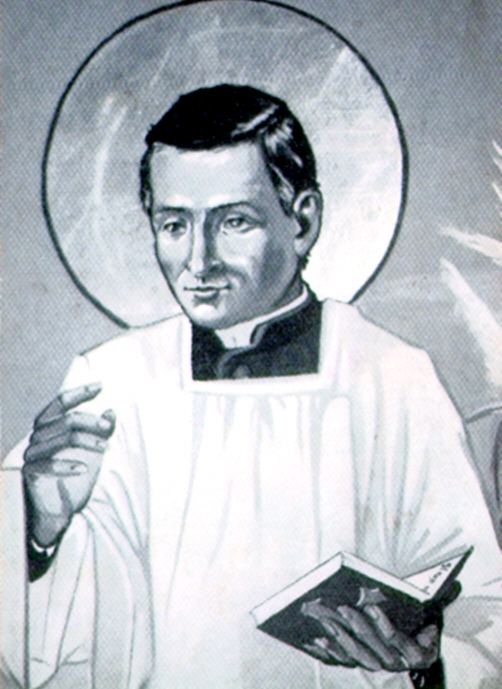
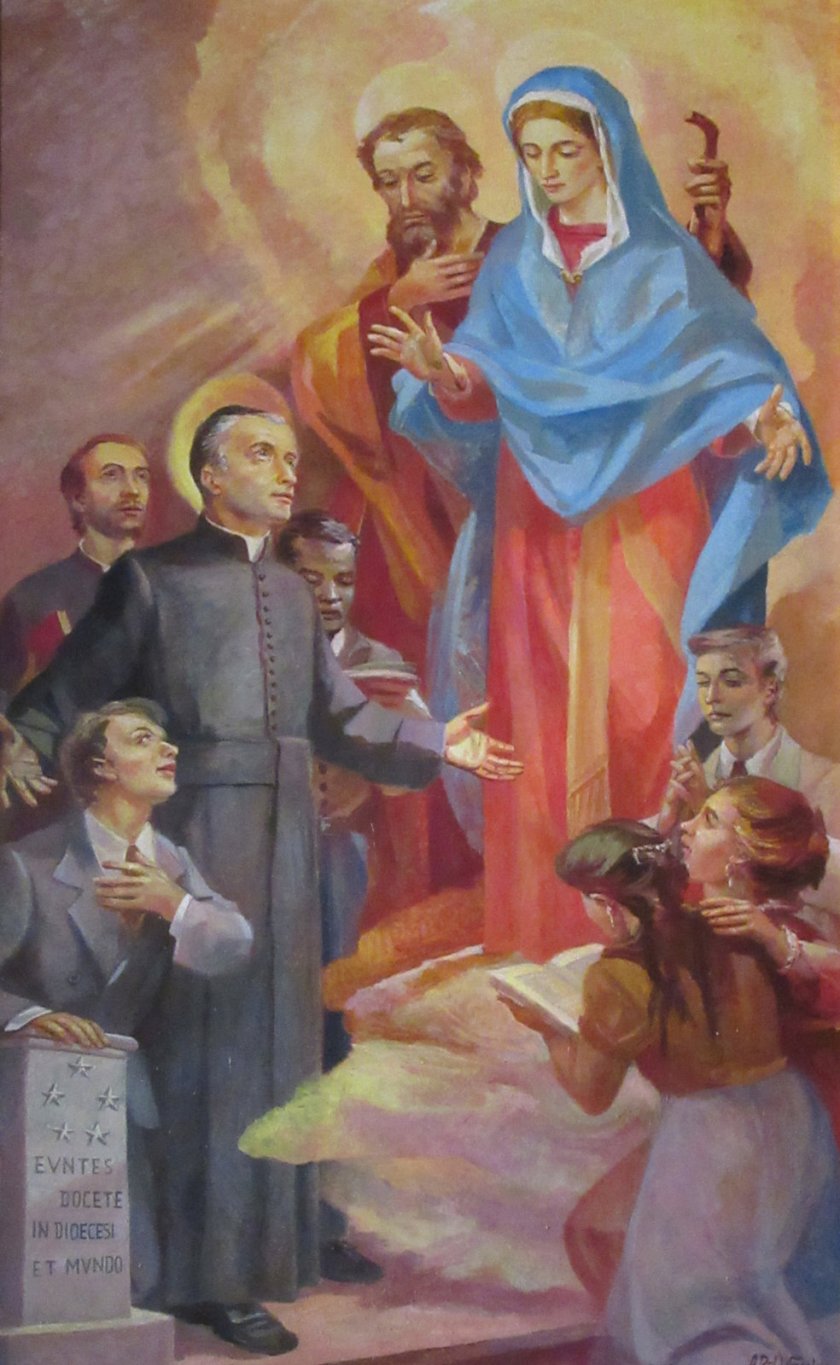
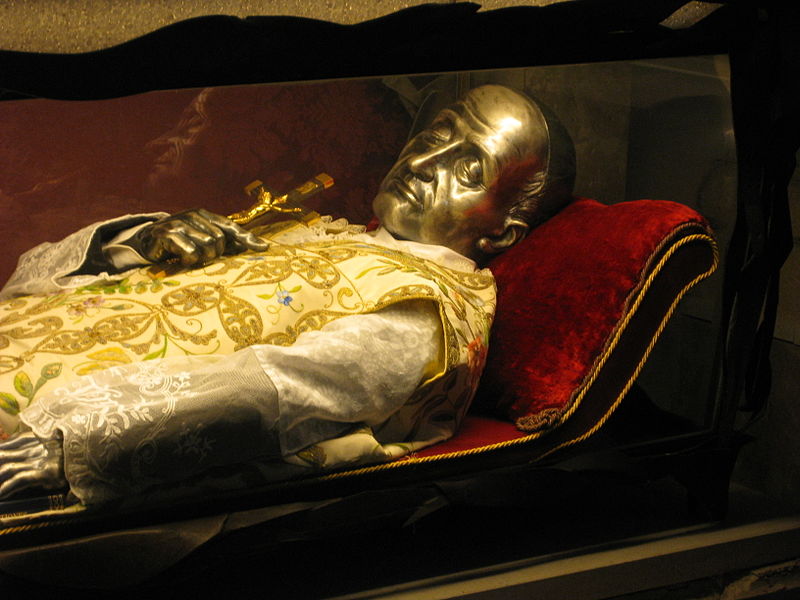
Saint of the Day – 12 June – St Gaspar Bertoni C.S.S. (1777-1853) – Priest and Founder of the Congregation of the Sacred Stigmata of Our Lord Jesus Christ C.S.S., commonly known as the Stigmatines, Teacher,  Apostolic missionary, Spiritual advisor.   Born Gaspare Luigi Bertoni on 9 October 1777 in Verona, Italy and he died on Sunday 12 June 1853 in Verona, Italy of natural causes.   Patronage – The Stigmatines. st Gaspare Bertoni (1777-1853)

GASPAR BERTONI was born in Verona, in the Republic of Venice, on 9 October 1777, of Francis Bertoni and Brunora Ravelli of Sirmione.   He was baptised the following day by his uncle, Fr James Bertoni, in the parish church of St Paul, in the Campo Marzo section of Verona.   On both sides of the family, the profession of “Notary” was exercised and from an old legal document, it can be seen that the family was fairly well off.   Even more outstanding, however, was the practice of the faith.

Following the death of his baby sister, young Gaspar remained the only child.   He had the benefit of an excellent education both at home and at St Sebastian’s school, that was conducted by the municipality after the suppression of the Jesuits.   They, however, continued teaching and also in the direction of the Marian Congregation.   Young Bertoni here came under the influence of Fr Louis Fortis, who would in the future be the first Jesuit General after the reinstatement of the Company of Jesus.

From the grace of his first Holy Communion at age 11, Gaspar Bertoni was called to a life of mystical union.   His vocation to the priesthood matured and at 18, he entered the seminary.   In frequenting the theological course as an external student, he found in his professor of moral theology, Fr Nicholas Galvani, an excellent spiritual director.

During his first year of theology, he witnessed the invasion of the French armies (1 June 1796).   This was the beginning of a 20 year period of great upheaval for his native city. Inspired by deep charity, he dedicated himself to the assistance of the sick and wounded, as a member of a Gospel Fraternity for the Hospitals, that had just then been instituted by the Servant of God, Fr Peter Leonardi.

At his priestly ordination (20 September 1800), at the dawn of a new century, he found himself in a world in need of much assistance for the resolution of the serious problems that disturbed it.

His pastor assigned the youth of parish to his pastoral care.   He dedicated himself with all his energies and great organisational ability to the new mission.   He established an Oratory in the form of a “Marian Cohort”, that had as its goal the Christian and social formation of the youth.   All such organisations were suppressed by a decree from Napoleon (1807) and Fr Bertoni reserved the carrying out of his plans for better times.Gaspar-48

Meanwhile, he took over the spiritual direction of a community founded then by St. Magdalena of Canossa at St. Joseph’s Convent (May 1808). It was here that he met the Servant of God, Leopoldina Naudet, whom he would then spiritually guide to the heights of the mysticism of holy abandonment and to the foundation of the Sisters of the Holy Family. He extended this aspect of his ministry to another Servant of God, Teodora Campostrini, of a noble family, both in the discernment of her vocation, as in the foundation of her Community, of the “Sorelle Minime” of the Charity of the Sorrowful Mother.

By September of 1810, he had already moved from his family home after the death of his mother and was transferred from St Paul’s Parish, to St Firmus Major.   Here, the bishop also entrusted him with the spiritual direction of the seminarians in the diocesan seminary.   A solid spiritual and theological formation of the young was always the clear objective of the frequent gatherings that he held in his own home.   At this time, he began to organise this endeavour in a more orderly fashion.   His overall idea was the renewal of the clergy based on an unconditional adherence to the Supreme Pontiff, Pius VII, at that time, Napoleon’s prisoner.   For Fr Bertoni, the Pontiff, was always “the first and irremovable stone” of the Church.   The reform of the Church had to begin from the sanctuary itself, with the return of its ministers to the integral following of the Gospel. The diocesan seminary was going through a very bad crisis.   However, in a short time it regained its proper form with his assistance and even assumed a monastic aspect as a contemporary witness stated.gaspare-bertoni-5d93dd14-c710-41b8-8d5a-a499289558c-resize-750

With the fall of Napoleon, the need for restoration was widely felt.   Fr Bertoni clearly understood that to gather the flock once again, it would be necessary to awaken them by the presentation of the fundamental truths of the faith through the preaching of missions to the people.   On 20 December 1817, Pope Pius VII conferred on him a precise mandate, by conferring on him the faculty of “apostolic missionary“.   While the suspicious government of Austria forbade this specific ministry, Fr Bertoni dedicated himself to other preaching and catechetical instruction.header - Gaspare_Bertoni2

While becoming all things to gain all for Christ, Fr Bertoni cultivated a very intense interior life.   From the reading of his Spiritual Diary, it appears that he was also grace by mystical gifts.   Among these, was the call, made evident to him by grace, to the foundation of a religious family.

On 4 November 1816, with two companions, he moved into a small house, adjacent to a suppressed Church, that bore the title of “the Sacred Stigmata of St Francis (from this, the name of his community was eventually adapted;   in this small church, he also worked to spread the devotion to the Passion and the wounds of Christ).   In a very unostentatious manner, the new community opened a tuition-free school, offering this and other gratuitous services to the Church and society.   The men lived together a common life of strict observance and penance.   An intense life of contemplation was joined to a broad apostolate, including the Christian education of the youth, the formation of the clergy and missionary preaching, in perfect availability to the requests of the bishop.gasparebertoni3

Right after an ecstasy that he experienced praying before a Crucifix (on 30 May 1812), he suffered a first attack of “miliary fever” that brought him to the very threshold of death. Almost miraculously, he did recover but for the rest of his 41 years of life he remained in poor health, all this while giving a wonderful example of patience and heroic confident abandonment to God.   Even from his sick-bed, suffering indescribable discomfort, he became the “angel of counsel” for countless persons who sought him out.   A number among these were gifted human beings, who were founding charitable works, such as Blessed Charles Steeb, the Servants of God, Fr Nicholas Mazza and Fr Anthony Provolo – and others from outside the city, who came to Verona to meet with him.st gaspar bertoni

St Gaspar was an authentic image of Christ Crucified, with nearly 300 surgical procedures on his right leg that he endured, he could not suffer enough for the good of the Church and the salvation of souls.   Once doctor asked him if he needed anything – and among his last words were: “I need to suffer”.
In a vision of vivid hope in the Risen Christ, bearing the signs of His Triumph, and supported by the Holy Spouses and Patrons, Mary and Joseph, he died a holy death, at 3:30 on a Sunday afternoon, 12 June 1853.

His Congregation of the Sacred Stigmata of Our Lord Jesus Christ, enriched by so many sufferings, gradually spread beyond Verona, to other cities in Italy and then to the United States, to Brazil (where it presently has 6 Bishops), to Chile, to the Philippines and to mission territories:  South Africa, the Ivory Coast, Tanzania, Thailand.   In 2012 they had 94 houses spread around the world….(vatican.va) 

St Gaspar was Beatified on 1 November 1975, Saint Peter’s Square, Vatican City by Blessed Pope Paul VI and Canonised 1 November 1989, Saint Peter’s Square, Vatican City by St Pope John Paul II.Saint Gaspar Bertoni, in the Church of Stigmates in Verona


Posted in MARIAN DEVOTIONS, MARIAN QUOTES, MARIAN TITLES, MORNING Prayers, QUOTES - J R R Tolkien and MORE, SACRED and IMMACULATE HEARTS, The BLESSED VIRGIN MARY, VATICAN Resources

Thought for the Day – 9 June – The Feast of the Immaculate Heart of Mary

Thought for the Day – 9 June – The Feast of the Immaculate Heart of Mary

“It was through the body of a young, Jewish girl, living in a tiny village called Nazareth, that Jesus, the divine Word, was made flesh.   Mary belonged to that part of the people of Israel, who awaited the Lord’s coming with expectation and longing.   She had no doubt read about His coming in the Old Testament Scriptures and prayed for it.   But she had no idea how it would come about.   Most Israelites thought the Messiah would manifest Himself gloriously.

When the Archangel Gabriel announced to Mary that she was to be the “door’ through which the long awaited desire of the nations would be fulfilled, she must have been astonished:  “Hail, O favoured one, the Lord is with you! … You will conceive in your womb and bear a son, and you shall call His name Jesus” (Lk 1.28-31).   A new life – filled with risks – opened before her.   According to the Church’s tradition, Mary, in an exceptional gesture for a Jewish woman, had decided “not to know man” (Lk 1.34).   She had discerned virginity to be God’s will.   Her Immaculate Heart – the Feast we keep this day – prompted a total giving of herself to God and included the gift of both her body and her heart.   Reassuring her that God had not disdained her vow, Gabriel told Mary that, like the glory of God coming upon the ark, so would the Spirit overshadow her.   The young “handmaid of the Lord” contemplated the Angel’s words.   She treasured them in her heart.   Her response, known as her fiat – “let it be done to me as you say” (Lk 1.38) – shows that she entrusted herself fully to God’s designs.   She chose to forgo her own plans for God’s.   Through her fiat, the Word of God took flesh in the tabernacle of her womb…..

Today in this Eucharist, on the Feast of the Immaculate Heart of Mary, Jesus knocks at the door of our heart.   In us, He wishes to take up His abode and, through our body, enter human history.   When we welcome Him, He gives birth to divinity within the crib of our hearts.   What answer will our heart give to His divine proposal?”…..Cardinal Robert Sarah (16 June 2012)tday-in-this-eucharist-card-robert-sarah-24 june 2017

Immaculate Heart of Mary, pray for us!immaculate-mary-poray-for-us-24 june 2017

Posted in CATHOLIC DEVOTIONS of the Month, FEASTS and SOLEMNITIES, MORNING Prayers, PAPAL ENCYLICALS, PRACTISING CATHOLIC, PRAYERS for PRIESTS, PRAYERS of the CHURCH, SACRED and IMMACULATE HEARTS, SAINT of the DAY, VATICAN Resources

Blessed and Holy Solemnity of the Most Sacred Heart of Jesus and The World Day of Prayer for the Sanctification of Priests – 8 June

8 June – Blessed and Holy Solemnity of the Most Sacred Heart of Jesus – (Friday after the Second Sunday after Pentecost) and The World Day of Prayer for the Sanctification of Priests.sacred heart - header 1header - Sacred Heart of Jesus in you I trust

Excerpt from ENCYCLICAL of Pope Pius XII
HAURIETIS AQUAS – on DEVOTION TO The SACRED HEART
15 May 1956

Venerable Brethren:  Health and Apostolic Benediction.

1. “You shall draw waters with joy out of the Saviour’s fountain.”  These words by which the prophet Isaias, using highly significant imagery, foretold the manifold and abundant gifts of God which the Christian era was to bring forth, come naturally to Our mind when We reflect on the centenary of that year when Our predecessor of immortal memory, Pius IX, gladly yielding to the prayers from the whole Catholic world, ordered the celebration of the feast of the Most Sacred Heart of Jesus in the Universal Church.

2. It is altogether impossible to enumerate the heavenly gifts which devotion to the Sacred Heart of Jesus has poured out on the souls of the faithful, purifying them, offering them heavenly strength, rousing them to the attainment of all virtues.   Therefore, recalling those wise words of the Apostle S. James, “Every best gift and every perfect gift is from above, coming down from the Father of Lights,” We are perfectly justified in seeing in this same devotion, which flourishes with increasing fervour throughout the world, a gift without price, which our divine Saviour the Incarnate Word, as the one Mediator of grace and truth between the heavenly Father and the human race imparted to the Church, His mystical Spouse, in recent centuries when she had to endure such trials and surmount so many difficulties.

3. The Church, rejoicing in this inestimable gift, can show forth a more ardent love of her divine Founder and can, in a more generous and effective manner, respond to that invitation which St John the Evangelist relates as having come from Christ Himself: “And on the last and great day of the festivity, Jesus stood and cried out, saying, ‘If any man thirst, let him come to Me and let him drink that believeth in Me.   As the Scripture saith: Out of his heart there shall flow rivers of living waters.’   Now this He said of the Spirit which they should receive who believed in Him.”header - sacred heart

8. The Church has always valued and still does, the devotion to the Most Sacred Heart of Jesus so highly, that she provides for the spread of it among Christian peoples everywhere and by every means.   At the same time she uses every effort to protect it against the charges of so-called “naturalism” and “sentimentalism.”   In spite of this it is much to be regretted that, both in the past and in our own times, this most noble devotion does not find a place of honour and esteem among certain Christians and, even occasionally, not among those who profess themselves moved by zeal for the Catholic religion and the attainment of holiness.

17. Through the years of Our pontificate–years filled not only with bitter hardships but also with ineffable consolations, these effects have not diminished in number or power or beauty but, on the contrary, have increased.   Indeed, happily there has begun a variety of projects which are conducive to a rekindling of this devotion.   We refer to the formation of cultural associations for the advancement of religion and of charitable works, publications setting forth the true historical, ascetical and mystical doctrine concerning this entire subject, pious works of atonement and, in particular, those manifestations of most ardent piety which the Apostleship of Prayer has brought about, under whose auspices and direction local gatherings – families, colleges, institutions – and sometimes nations have been consecrated to the Sacred Heart of Jesus.   To all these We have offered paternal congratulations on many occasions, whether in letters written on the subject, in personal addresses, or even in messages delivered over the radio.

18. Therefore when We perceive so fruitful an abundance of healing waters, that is, heavenly gifts of divine love, issuing from the Sacred Heart of our Redeemer, spreading among countless children of the Catholic Church by the inspiration and action of the divine Spirit, We can only exhort you, venerable brethren, with fatherly affection to join Us in giving tribute of praise and heartfelt thanks to God, the Giver of all good gifts.   We make Our own these words of the Apostle of the Gentiles: “Now to Him Who is able to do all things more abundantly than we desire or understand, according to the power that worketh in us, to Him be glory in the Church and in Christ Jesus unto all generations world without end. Amen.”sacred heart 3sacred heart 2

All information on this Devotion here:  https://anastpaul.wordpress.com/2017/06/23/celebrating-the-solemnity-of-the-most-sacred-heart-of-jesus-23-june-2017/

And the Twelve Promises here: https://anastpaul.wordpress.com/2017/06/23/friday-23-june-2017-blessed-and-holy-solemnity-of-the-most-sacred-heart-of-jesus-friday-after-the-second-sunday-after-pentecost/

The World Day of Prayer for the Sanctification of Priests

This celebration offers an opportunity to lift up our priests in prayer and thanksgiving, asking God, that they might continually rediscover the gift of their ordination and experience the joy of the mission entrusted to them, while always growing in sanctity.

Let us Pray:

“Our Father for Priests”

Our Father who art in heaven,
Give us priests according to Your Heart.
That Thy name be hallowed,
Give us priests according to Your Heart.
That Thy kingdom come,
Give us priests according to Your Heart.
That Thy will be done on earth as it is in heaven,
Give us priests according to Your Heart.
To give us each day the Bread of life,
Give us priests according to Your Heart.
To forgive us our trespasses,
Give us priests according to Your Heart.
That we be not led into temptation,
Give us priests according to Your Heart.
And deliver us
And all of Your priests from evil. Amen.
(Anonymous)

Issued by the Congregation for the Clergy (vatican.va)our father for priests - sacred heart solemnity - 8 june 2018


Posted in MORNING Prayers, QUOTES of the SAINTS, SAINT of the DAY, VATICAN Resources

Saint of the Day – 6 June – Saint Marcellin Champagnat (1789-1840)

Saint of the Day – 6 June – Saint Marcellin Champagnat (1789-1840) – Priest of the Society of Mary and Founder of the  the Institute of the Little Brothers of Mary (Marist Brothers) ‘FMS’, a religious congregation of brothers devoted to Mary and dedicated to education.   St Marcellin was born as Marcellin-Joseph-Benoît Champagnat on 20 May 1789 at Hameau du Rosey, Lyon, France and died on 6 June 1840 in in Saint-Chamond, Loire, France of natural causes.

19990418_marcellin_benoit_champagnatchampagnat_iconografia

MARCELLIN CHAMPAGNAT was born on 20th May 1789, in Marlhes, a village in the mountains of east-central France.   The Revolution was about to burst upon the scene.   He was the ninth child of a very Christian family, from whom he received his basic education.   His mother and his aunt, a religious driven from her convent, awoke in him a solid faith and deep devotion to Mary.   His father, who was a farmer and merchant, possessed an above-average education and played a significant role in the politics of the village and the region.   He imparted to Marcellin his aptitude for manual work, a penchant for direct action, a sense of responsibility and openness to new ideas.
When Marcellin was 14, a priest passing through the village helped him to see that God was calling him to the priesthood.   Marcellin, whose formal schooling was practically non-existent, began to study because “God wills it!”, even while those around him, aware of his limitations, tried to dissuade him.   The difficult years he spent in the minor seminary in Verrieres (1805-1813) were for him a time of real human and spiritual growth.

Among his companions in the major seminary in Lyons were Jean-Marie Vianney, the future Cure of Ars and Jean-Claude Colin who was to become the founder of the Marist Fathers.   He joined a group of seminarians whose goal was to found a congregation bearing Mary’s name and including priests, sisters and a lay third order the “Society of Mary” for the re-Christianisation of society.   Deeply aware of the cultural and spiritual poverty of the children of the countryside, Marcellin felt a strong urge to include a branch of brothers for the Christian education of young people.   “I cannot see a child without wanting to tell him how much Jesus loves him.”   The day after their ordination on 22nd July 1816, these young priests went to consecrate themselves to Mary and to place their project under her protection at the shrine of Our Lady of Fourviere.vierge-dorée

Basilica of Our Lady de Fourviere,
Basilica of Our Lady of Fourviere

Marcellin was sent as curate to the parish of La Valla.   His ministry there included visiting the sick, catechising the children, helping the poor and helping families to live the Christian life.   His simple, direct style of preaching, his deep devotion to Mary and his apostolic zeal, made a profound impression on his parishioners.   His encounter with a dying 17-year-old boy, who had absolutely no religious instruction, shook him to his depths and moved him not to delay any longer in putting his plans into action.img-Saint-Marcellin-Joseph-Benoit-Champagnat

On 2nd January 1817, only six months after his arrival in La Valla, Marcellin, a 27-year-old curate, brought together his first two disciples; the congregation of the Little Brothers of Mary, or Marist Brothers, was born in poverty, humility and total trust in God under Mary’s protection.   While still carrying on his parish ministry, he went to live with his brothers, whom he trained and prepared for their mission as Christian teachers, catechists and educators of young people.   Passionately devoted to the Kingdom of God, conscious of the tremendous needs of young people and an instinctive educator, Marcellin turned these uncultured young country lads into generous apostles.   He lost no time in opening schools.   Vocations arrived and the first little house, even though enlarged by Marcellin himself, was soon too small.   There were many difficulties.   The clergy in general did not understand what this inexperienced young priest with no material resources was trying to accomplish.   However, the nearby villages continually requested brothers to see to the Christian education of their children.

Marcellin and his brothers shared in the construction of their new house, which could hold more than 100 persons and which would bear the name of “Our Lady of the Hermitage”.   Freed from his parish duties in 1825, he thenceforth devoted himself totally to his congregation:  the spiritual, pedagogical and apostolic formation and accompaniment of his brothers, visits to the schools and the opening of new ones.

ST MARCELLIN

Marcellin, a man of deep faith, never ceased to seek the will of God through prayer and dialogue with the religious authorities and with his brothers  . Very conscious of his own limitations, he counted only on God and on the protection of Mary, his “Good Mother”, “Ordinary Resource” and “First Superior”.   His deep humility and his acute awareness of the presence of God, helped him to live through many severe trials with great inner peace.   He often prayed psalm 126:  “If the Lord does not build the house”, convinced that this congregation of brothers was the work of God and Mary.   His motto was, “All to Jesus through Mary and all to Mary for Jesus”.ST MARCELLIN SNIP

“To make Jesus Christ known and loved” is the brothers’ mission.   The school is the privileged setting for this mission of evangelisation.   Marcellin taught his disciples to love and respect children and to give special attention to the poor, the most ungrateful and the most neglected, especially orphans.   Spending a great deal of time with young people, with simplicity, family spirit and love of work and all of this carried out as Mary would have, were the essential points of his vision of education.

In 1836, the Church recognised the Society of Mary and entrusted to it the missions of Oceania.   Marcellin took his vows as a member of the Society of Mary and sent three brothers with the first missionary Marist Fathers to the islands of the Pacific.   “Every diocese of the world figures in our plans”, he had written.

Steps for obtaining legal recognition of his congregation made great demands on his time, energy and spirit of faith.   He never stopped repeating, “When God is on your side and you rely only on Him, nothing is impossible!”ST MERCELLIN BIT OLDER

A lengthy illness gradually wore down his robust constitution.   Worn out by his labours, he died at the age of 51 on 6th June 1840, leaving this message with his brothers:  “May you be of one heart and one mind.   May it be said of the Little Brothers of Mary as of the first Christians: see how they love one another!”…Vatican.va489px-Ravery,_Portrait_of_Marcellin_Champagnat,_1840

St Marcellin Champagnat was declared Venerable in 1920 by Pope Benedict XV, Beatified by Pope Pius XII on 29 May 1955 and Canonised by St Pope John Paul II on 18 April 1999.

canoncisation celebrations
Canonisation Mass at the  General House
canonisation poster
Caonisation celebration poster

Today there are about 5,000 Marist Brothers in 72 countries;  their slogan A Heart Without Borders.

ST MARCELLIN ICONST MARCELLIN ICON LIFEST MARCELLIN STATUEST MARCELLIN STATUE 2

Posted in SAINT of the DAY, VATICAN Resources

Saint of the Day – 4 June – St Filippo Smaldone (1848-1923)

Saint of the Day – 4 June – St Filippo Smaldone (1848-1923) Priest and Founder of the Salesian Sisters of the Sacred Hearts, Preacher, Catechist, Apostle of Eucharistic Adoration and Our Lady, Apostle of Charity and especially of orphans, the blind and the deaf, Spiritual Advisor and Director – Born on 27 July 1848 in Naples, Italy and died on 4 June 1923 in Lecce, Italy from a combination of diabetes and a heart condition.  St Filippo is best known for his extensive work with the deaf, the blind and orphans, during his lifetime.    Father Smaldone was a gifted preacher known for his commitment to proper Catechesis and to the care of orphans and the mute, which earned him civic recognition.   Patronages: Salesian Sisters of the Sacred Hearts, Deaf people, Mute people.   He was Beatified in 1996 by St John Paul and Canonised by Pope Benedict XVI on 15 October 2006 in St Peter’s Square.

st filippo smaldone

Filippo Smaldone was born in Naples on 27 July 1848, at a time of political and social turmoil in Italy as well as for the Church.   Notwithstanding the social, political and religious unrest that surrounded him, he decided to dedicate himself to the service of the Church and become a priest.

While he was still a philosophy and theology student, he became involved in helping the many marginalised people and deaf-mutes in Naples, who at the time were without appropriate forms of assistance.   His dedication to the apostolate did not leave him much time to study and it was with difficulty that he passed the examination for Minor Orders.

After a period of time in what is today known as the Archdiocese of Rossano-Cariati, where he could concentrate on his studies, he returned to the Archdiocese of Naples in 1876.   There he continued to study and to work with deaf-mutes and was ordained a priest on 23 September 1871.

Fr Smaldone dedicated himself to the priestly ministry through evening catechism classes and visiting the hospitalised and homebound sick.   During a plague epidemic he too caught the contagion but he was miraculously cured through intercession to Our Lady of Pompeii, for whom he cherished a special, lifelong devotion.

In addition to his parish ministry he continued his pioneer work in the education of deaf-mutes;  however, he met many obstacles during his work and became discouraged, at one point wanting to change ministries and head for the foreign missions.

But it was his wise confessor who convinced him that his true mission was in Naples among the people who needed him most.   Thus, he gave himself without reserve to this apostolate and made it the principle object of his mission.

Armed with the great experience he had acquired through the years, Fr Smaldone went to Lecce, Italy, on 25 March 1885, where he founded an institute for deaf-mutes with Fr Lorenzo Apicella and a group of Sisters, he had specially trained.   This was the basis for the Congregation of the Salesian Sisters of the Sacred Hearts, which rapidly took root and flourished.

After founding the Lecce institute, which became the Motherhouse of the Congregation he founded, in 1897 Fr Smaldone opened other institutes in Rome and Bari, Italy.   Due to the great need, Fr Smaldone soon expanded his work to include blind children, orphans and the abandoned in his institutes.

st filippo smaldone-artwork

Signs of the great work he accomplished for love of God and neighbour were both external and internal trials.   In fact, one of his favourite sayings was:  “The Lord sends us trials and tribulations to settle our debt to Him”.

From without he had to defend himself against the anti-Church municipal council;  from within, he had to deal with the departure of the first superior of the new Congregation he founded, which provoked a long apostolic visit on the part of the Holy See.

The crucible of trials thus tried this holy man of God and found him and his works worthy.   He continued to strive, with fatherly affection, to educate his deaf-mute students and to give the Salesian Sisters a complete religious formation.

Fr Smaldone also served as confessor and spiritual director to priests, seminarians and various religious communities.   He founded the Eucharistic League of Priest Adorers and Women Adorers, and was superior of the Congregation of the Missionaries of St Francis de Sales.

20061015smaldone

He was appointed a canon of Lecce Cathedral and at one point was awarded a commendation by the civil Authorities.

Fr Filippo Smaldone died of a serious diabetic condition with heart complications on 4 June 1923 at the age of 75;   he was in Lecce and surrounded by the affection of the Sisters and many of the needy whom he had served throughout his life.

St Filippo’s Ccanonisation cause commenced in an informative process that opened in 1964 under Pope Paul VI and concluded its business sometime after this.   The introduction to this process titled him as a Servant of God.   The Congregation for the Causes of Saints validated this process in Rome on 23 May 1989 and received the Positio in 1989 which allowed for theologians to approve it on 3 February 1995 and the C.C.S. to likewise approve the cause on 16 May 1995.   St Pope John Paul II declared Smaldone to be Venerable on 11 July 1995 after the pope confirmed that the priest had indeed lived a model Christian life of heroic virtue.

The miracle needed for beatification was investigated and then validated on 7 May 1993 while a medical board later approved it on 1 June 1995.   Theologians also assented to this miracle on 27 October 1995 as did the C.C.S. on 12 December 1995.   St John Paul II issued formal assent needed and deemed that the healing was a miracle attributed to Smaldone’s intercession on 12 January 1996 while later presiding over Smaldone’s Beatification on 12 May 1996.

The process for a second miracle spanned from 2000 to 2002 at which point it received validation on 4 April 2003 before receiving the assent of the medical board on 3 February 2005;  theologians assented to it on 17 May 2005 as did the C.C.S. on 17 January 2006.   Pope Benedict XVI approved this on 28 April 2006 and Canonised Smaldone in Saint Peter’s Square on 15 October 2006.

sanpietroSan_Filippo_Smaldone

Posted in BREVIARY Prayers, CATHOLIC DEVOTIONS of the Month, CATHOLIC-PRAYERS OF THE CHURCH, DEVOTIO, FEASTS and SOLEMNITIES, MARIAN DEVOTIONS, MARIAN PRAYERS, MARIAN QUOTES, MORNING Prayers, PAPAL MESSAGES, PRAYERS of the CHURCH, QUOTES of the SAINTS, SAINT of the DAY, The BLESSED VIRGIN MARY, The WORD, VATICAN Resources

Our Morning Offering – 31 May – The Last Day of Mary’s Month and the Feast of the Visitation of the Blessed Virgin Mary

Our Morning Offering – 31 May – The Last Day of Mary’s Month and the Feast of the Visitation of the Blessed Virgin Mary

The Magnificat, is Mary’s great gift to scripture, one of its most beautiful prayers.   It is prayed every evening in the Liturgy of the Hours by millions around the world.   With that, Mary’s great acclamation becomes the Church’s.

The Magnificat
The Canticle of Mary
Luke 1:46-55

My soul glorifies the Lord,
my spirit rejoices in God, my Saviour
He looks on His servant in her lowliness
Henceforth all ages will call me blessed:
The Almighty works marvels for me,
holy is his Name!
His mercy is from age to age,
on those who fear Him.
He puts forth His arm in strength
and scatters the proud-hearted.
He casts the mighty from their thrones
and raises the lowly.
He fills the starving with good things,
sends the rich away empty.
He protects Israel, His servant,
remembering His mercy,
the mercy promised to our fathers,
to Abraham and his sons forever.

Excerpt (18) from the Apostolic Exhortation “Marialis Cultus”

 Blessed Pope Paul VI – 2 February 1974

“18.   Mary is also the Virgin in prayer.   She appears as such in the visit to the mother of the precursor, when she pours out her soul in expressions glorifying God and expressions of humility, faith and hope.   This prayer is the Magnificat (cf. Lk. 1:46-55), Mary’s prayer par excellence, the song of the messianic times in which there mingles the joy of the ancient and the new Israel.   As St Irenaeus seems to suggest, it is in Mary’s canticle, that there was heard once more, the rejoicing of Abraham who foresaw the Messiah (cf. Jn. 8:56)(48) and there rang out in prophetic anticipation the voice of the Church:  “In her exultation Mary prophetically declared in the name of the Church:  ‘My soul proclaims the glory of the Lord….'”

 And in fact Mary’s hymn has spread far and wide and has become the prayer of the whole Church in all ages.”

the magnificat - luke 1 46-55 - 31 may 2018 - feast of the visitation.jpg


Posted in CATHOLIC DEVOTIONS of the Month, MARIAN PRAYERS, MARIAN QUOTES, MARIAN TITLES, MORNING Prayers, PAPAL SERMONS, PRAYERS of the SAINTS, QUOTES of the SAINTS, SAINT of the DAY, The BLESSED VIRGIN MARY, VATICAN Resources

Thought for the Day and it’s Marian too – 29 May “Mary’s Month!” – The Memorial of Blessed Joseph Gerard O.M.I. (1831-1914)

Thought for the Day and it’s Marian too – 29 May “Mary’s Month!” – The Memorial of Blessed Joseph Gerard O.M.I. (1831-1914)

BEATIFICATION OF FATHER JOSEPH GÉRARD

HOMILY OF JOHN PAUL II

Maseru Race Course (Lesotho)
Thursday, 15 September 1988

“My soul proclaims the greatness of the Lord” (Luc. 1, 46).

Dear Brothers and Sisters in Christ,

1. On the day after the feast of the Triumph of the Cross of Christ, the liturgy of the Church, directs our attention towards her, who is found at the foot of the Cross, to the Mother of Christ, Mary.

She stood at the foot of the Cross, together with three other women and with John, the disciple whom Christ loved.   The Second Vatican Council, teaches us that Mary is found there, at the foot of the Cross, “in keeping with the divine plan” (Lumen Gentium, 58).

Indeed in a certain sense this was the climax in her life’s pilgrimage, the moment for which the Holy Spirit had been preparing her throughout her entire existence and especially from the time of the Annunciation.   It was the culmination of her pilgrimage of faith, of hope and of that special union with Jesus, her Son, the Redeemer of the world.

At the beginning of this pilgrimage, we hear Mary say in the house of her kinswoman Elizabeth, when she speaks of the great things the Almighty has done for her:  “My soul proclaims the greatness of the Lord”.   At the foot of the Cross, “a sword pierces Mary’s soul”, fulfilling the words of Simeon (Cfr. Luc. 2, 35).

And yet, Mary does not cease to believe.   The great works of God are accomplished precisely through this Cross, through the Sacrifice of the life of her Son.   And united to the redemptive Sacrifice of her Son is the maternal sacrifice of her heart.

2. The Church leads us today into the very centre of the Heart of Mary, into the intimate mystery of her union with her Son, a union which here, at the foot of the Cross, reaches its particular fullness.

In the Letter to the Hebrews we read that Christ, while being Son of God, one in being with the Father, “learned to obey through suffering” (Hebr 5, 8).   And precisely through this obedience, even to death on the Cross “he became for all who obey him the source of eternal salvation” (Ibid 5, 9).

At the moment of the Annunciation Mary first spoke her “fiat”.

She said:  “Let what you have said be done to me”.   And, with new strength of faith and trust in God, she repeated this “fiat” at the foot of the Cross!   This was her maternal sharing in the redemptive obedience of her Son as he offered his life on the Cross for the sins of the world.

At the foot of the Cross, Mary never ceased to praise the wondrous mercy of God, the mercy which endures “from generation to generation”.     And she did not cease to proclaim the saving “power of his arm”, which puts down the proud and raises the lowly. Like no other person on earth, Mary was able to penetrate the Paschal Mystery of Christ; she understood it with her heart.

3. And therefore the Church sees the Mother of God, as the one who “preceded in the pilgrimage of faith” all the People of God on earth.  In this faith, she became a true daughter of Abraham; indeed she even surpassed him whom Saint Paul calls “the Father of all believers” (Rom. 4, 11).   Her pilgrimage of faith, has done something even greater:  it has enabled us to enter, ever more profoundly, into the inscrutable mysteries of God.

The Church in your country, in Lesotho, here in Maseru, as does the Church throughout the earth, goes forward on this same pilgrimage of faith, the pilgrimage on which the Mother of God has gone before us.   Today the Bishop of Rome meets you on this pilgrimage.   He stands in your midst and celebrates with you the Eucharistic Sacrifice on the Feast of Our Lady of Sorrows.

4. It is with great joy, that I join you in prayer today, my brothers and sisters of the Church in Lesotho.   I know that many of you have had to make many sacrifices in order to be here and I assure you of my happiness and gratitude that you have come.   Your presence at this Liturgy is a sign of your love for the Church and an expression of your willingness to bear witness to the Kingdom of Christ.

I am also aware that many people would have liked to be with us but have been unable to do so:  the sick and suffering, those who live too far away, those who are too young or too old.   To all of them, I say with deep affection, the Pope embraces you and loves you in the Sacred Heart of Jesus Christ our Redeemer.

My fraternal greetings go to Archbishop Morapeli of Maseru and to the bishops of the other dioceses of Lesotho.   With them, I greet all your dedicated priests and religious, your catechists and all the members of your Christian families.

I greet our non-Catholic brothers and sisters in Christ and all people of good will and I thank you for joining us on this historic occasion.   I offer very cordial greetings, to those who have come from beyond the borders of this country.

In a very special way, I greet the people of South Africa where Blessed Joseph Gérard laboured in Natal and the eastern Free State.

As members of one family, united in the love of Jesus, we rejoice today in the everlasting mercy of God who has granted us the gift of faith and made us a people of hope, a people on pilgrimage to the eternal Kingdom of God.

5. This day has a particular significance for the journey of faith which the Church in Lesotho is making.   For today we celebrate the Beatification of the Servant of God, Joseph Gérard.

In the First Reading of the Liturgy, taken from the book of Genesis, we hear God calling Abraham to set out on a journey of faith, to set out on a road that will take him away from all that he has ever known and loved, to put all his trust in the promise of the Lord.

Father Gérard heard God addressing to him a similar call of faith.   As in the case of Abraham, the Lord said to the young Frenchman named Joseph, “Leave your country, your family and your father’s house, for the land I will show you” (Gen. 12, 1).   And he went promptly, as the Lord told him.   He followed God’s call.   He placed all his trust in the promise he had heard from on high.

The land that God showed Blessed Joseph was Africa, more precisely the land of South Africa and then some years laser the land of the Basotho people.   To this land, this Kingdom of Lesotho, he came as a man of faith.   He came because he had been called and sent to proclaim the Kingdom of God.

6. From an early age, Joseph Gérard had been convinced that God was calling him to be a missionary.   His heart overflowed with gratitude for the gift of the Christian life and he longed to share with others this treasure, this priceless pearl, the infinite riches of knowing Jesus Christ.   And it was this constant zeal for evangelisation that shaped every stage of his long life.

Upon his arrival in Lesotho, together with Bishop Allard and Brother Bernard, he at once set about learning the language and customs of the Basotho people.   He tried to understand their way of thinking, their sensitivities, their hopes and desires.   He was eager to understand their very souls, so that he could decide on the best methods to use in preaching to them the Good News of salvation.

Father Gérard and his companions began their apostolic work at the mission called Roma.   They gave themselves wholeheartedly and sacrificially to the task, relying completely on the grace of the Holy Spirit.   And the Spirit of God soon brought forth fruit.   Only a few years later, in 1866, a second mission at Korokoro was established.   And in 1868 yet a third mission dedicated to Saint Michael was begun.

In obedience to his superior, Father Gérard went to the northern part of the country in 1876, where he founded the mission of Saint Monica.   For the next twenty years and more, he laboured there untiringly, establishing a convent and school and building other missions in the surrounding area.   In all his pastoral endeavours and plans, he placed all his hope in God, remembering the words spoken at his priestly ordination, namely that God who began the good work in him would bring it to completion.

Wherever Blessed Joseph Gérard went, he lived his missionary vocation with extraordinary apostolic fervour.   His love for God, which burned ever more ardently in his heart, showed itself in practical love of neighbour.   Above all he is remembered for his special care for the sick and suffering.   Through frequent visits and his gentle manner, he always seemed to bring them fresh courage and hope.   For those near the hour of death he found the right words to prepare them to meet God peacefully, face to face.

The secret of his holiness, the key to his joy and zeal, was the simple fact that he lived continually in the presence of God.   Blessed Joseph’s whole life was caught up in the love of the Holy Trinity.   People wanted to be near to Father Gérard because he always seemed near to God.   He was filled with a spirit of prayer, nourished daily by the Liturgy of the Hours and by frequent visits to the Blessed Sacrament.   He had a fervent devotion to the Mother of God and the Saints.   During his long and difficult journeys to outlying missions and the homes of the sick, he conversed continually with his beloved Lord.   It is undoubtedly, this vivid sense of being always in the presence of God, that explains his lifelong fidelity to his religious vows of chastity, poverty and obedience and to his obligations as a priest.

God blessed Father Gérard with a long life of apostolic service.   He granted him the grace to see over half a century of the unfolding evangelisation of Lesotho.   Father Gérard is certainly rejoicing today at the vitality of the Church in this country which was so dear to his heart:  its bishops are native sons, there is an increasing number of vocations to the priesthood and religious life, the active laity numbers more than six hundred thousand people, including a hundred and forty thousand studying in Catholic schools.   But with his missionary spirit, would he not still encourage us today to carry on with fresh enthusiasm the many-sided task of proclaiming the Gospel of Christ?

7. Here in Lesotho you have a traditional greeting:  Khotso, Pula, Nala, – peace, rain and abundance.   Blessed Joseph Gérard must have often prayed for these same blessings, he must have often uttered this same greeting in this land.   Above all, he always tried to be a servant of reconciliation and peace, for this is an essential part of evangelisation.

To evangelise means to proclaim the Good News of our Lord Jesus Christ, the Saviour of the whole world, to tell the story of how “God wanted all perfection to be found in him and all things to be reconciled through him and for him, everything in heaven and everything on earth, by his death on the Cross” (Col. 1, 19-20).   The first step of evangelisation is to accept the grace of conversion into our own minds and hearts, to let ourselves be reconciled to God.   We must first experience God’s gracious mercy, the love of Christ which has “reconciled us to himself” and given us “the work of handing on this reconciliation” (2Cor. 5-18).

As the twentieth century draws to a close and as your country looks to the future, this is the special gift and the greatest responsibility which the members of the Church offer to their fellow citizens, to be servants of reconciliation and peace, after the example of Blessed Joseph Gérard.

Always believe in the power of love and truth, the love of neighbour which is rooted in the love of God and the truth which sets people free.    Reject violence as a solution to any situation, no matter how unjust it may be.   Put your trust in the methods that respect the rights of all and that are fully in accordance with the Gospel.   Above all, trust in the God of justice, who created all things, who sees all human events, who holds in his hands the destiny of every person and of every nation.

8. Dear brothers and sisters:  I rejoice with you on this solemn day of celebration.   It is a day of great importance in your pilgrimage of faith and hope, a day of jubilation on the journey to union with Christ which the People of God in this land are making.   Let us give thanks to the most holy God for this day.   Let us sing, together with Mary:  “My soul proclaims the greatness of the Lord and my spirit exults in God my Saviour” (Luc. 1, 46-47).

Together with Mary and with Blessed Joseph Gérard, let all the people of Lesotho exult in God our Saviour.   Yes, all of you: young and old, children and parents, workers and teachers, priests and religious, the handicapped and the sick.   Let us all praise the Lord with grateful voices, for the Almighty has done great things for us.   Holy is his name!

9. Yet, at the same time, let the eyes of our faith never wander from the Cross of Calvary.

We read in the Gospel: “Seeing his mother and the disciple he loved standing near her, Jesus said to his mother, ‘Woman, this is your son’. Then to the disciple he said, ‘This is your mother’. And from that moment the disciple made a place for her in his home” (Io. 19, 26-27).

My fervent wish for all of you, dear brothers and sisters, is that the word of John’s Gospel may be fulfilled in you.

May each of you discover Mary as your Mother.

May each of you seek to be a son, a daughter, of Mary, who at the foot of the Cross becomes in a particular way for us the “Mother of Divine Grace”.

May each of you “make a place for her in your home”, and even more so in your heart, every day and throughout your life, especially at those times of trial and suffering.

May the memory of this blessed day be inscribed for ever in the history of this city and this country, in the history of the whole continent of Africa.

Blessed Joseph Gérard, pray for us, lead us to Jesus through the Immaculate Heart of Mary, our Mother in faith. Amenbl joseph gerard - pray for us - 29 may 2018

Act of entrustment to Mary

O Mary, Mother of our Redeemer, Mother of the Church, at the end of this celebration of the Eucharist, we turn to you with confidence and love.   On this feast of Our Lady of Sorrows, we remember your own sharing in the suffering and death of Christ your Son.

O Mother of Sorrows, it was precisely at the hour of your Son’s death that you became by a new title our Mother, Mother of all the faithful.   For your loving Son said to you, as you stood at the foot of the Cross, “Woman, this is your son!”.

From that moment onwards and throughout the course of human history, you are the Mother not only of the beloved disciple but of every member of the Church.   You are our gentle Mother.   You care for us all as your dear children.   In fact, you see in each of us the face of your beloved Jesus and you intercede with Him on our behalf, for our good and the Redemption of the world.

Today, dearest Mother, I entrust to you all those present at this Holy Sacrifice of the Mass, and all the people living in this mountain Kingdom.   I entrust them to you with complete confidence and love.

O Mother of Sorrows, I bring before you the sick and the elderly and all who are burdened by sin.   I know they will find in you a safe harbour and a consoling help.   You will bring them tenderly but surely, to the foot of the Triumphant Cross.

O Immaculate Heart of Mary, so filled with love for your Son, I entrust to you the youth of Lesotho in whose eyes the future shines.   Protect them from the evil one.   Enable them to see that only your Son is “the Way and the Truth and the Life”, only in Him is there a future full of hope and a life truly founded on love.

O Blessed Virgin of Nazareth, I place before you the families of the Basotho people, all married couples who with their children are called to form a lifelong communion of love.   Keep them pure and chaste, ever faithful to one another, always faithful, as you were, to the life-giving word of God.

O Mary, Model of holiness and first disciple of your Son, I entrust to your gentle care the Church in Lesotho.   As it rejoices in a century and a quarter of evangelisation and in the beatification of Father Joseph Gérard, lead your sons and daughters in the way of constant conversion, along the path of spiritual renewal.   Pray for this local Church, so dear to the Successor of Peter, so dear to your own Immaculate Heart.   Help our brothers and sisters to come to believe with conviction what you believed at the foot of the Cross. that human death is not the final word, for the final word belongs to God, the God of love and mercy, the God who has saved the world through the victorious Cross of your Son.   Amen.

Immaculate Heart of Mary, Pray for us!

O Mother of Sorrows, Pray for us!


Posted in CATHOLIC DEVOTIONS of the Month, CONSECRATION Prayers, MARIAN DEVOTIONS, MARIAN PRAYERS, MARIAN QUOTES, MORNING Prayers, PAPAL PRAYERS, PAPAL SERMONS, PRAYERS of the SAINTS, QUOTES of the SAINTS, QUOTES on CHARITY, QUOTES on DIVINE PROVIDENCE, QUOTES on EVANGELISATION, QUOTES on FAITH, QUOTES on JOY, QUOTES on LOVE, QUOTES on PEACE, QUOTES on PERSECUTION, QUOTES on SANCTITY, QUOTES on SUFFERING, QUOTES on TRUST and complete CONFIDENCE in GOD, QUOTES on TRUTH, QUOTES on VIOLENCE, The BLESSED VIRGIN MARY, The HOLY CROSS, VATICAN Resources

Quote/s of the Day – and Marian too – 29 May “Mary’s Month!” – The Memorial of Blessed Joseph Gerard O.M.I. (1831-1914)

Quote/s of the Day – and Marian too – 29 May “Mary’s Month!” – The Memorial of Blessed Joseph Gerard O.M.I. (1831-1914)

“Always believe, in the power of love and truth,
the love of neighbour, which is rooted in the love of God
and the truth, which sets people free.”

“Reject violence as a solution to any situation,
no matter how unjust it may be.”

“Above all, trust in the God of justice,
who created all things,
who sees all human events,
who holds in His hands,
the destiny of every person and of every nation.”always believe in the power of love - above all trust in the god of justice - reject violence - st pope john paul - 29 may 2018

“Let the eyes of our faith
never wander
from the Cross of Calvary.”let the eyes of our faith - st pope john paul - 29 may 2018- no 2

“May each of you, discover Mary, as your Mother.”

“May each of you, seek to be a son, a daughter, of Mary,
who at the foot of the Cross,
becomes in a particular way for us,
the “Mother of Divine Grace”.”

May each of you, “make a place for her in your home”
and even more so in your heart,
every day and throughout your life,
especially at those times, of trial and suffering.”may each of you (on mary) - st pope john paul - 29 may 2018

Maseru Race Course (Lesotho)
Thursday, 15 September 1988

St Pope John Paul II (1920-2005)

Taken from the Beatification Homily of St Pope John Paul II
(See today’s thought for the Day)

Posted in CATHOLIC DEVOTIONS of the Month, MARIAN DEVOTIONS, MARIAN TITLES, MARY, MATER ECCLESIAE, SAINT of the DAY, The BLESSED VIRGIN MARY, VATICAN Resources

The First of the Universal Celebration of the Official Memorial of Mary, Mother of the Church/Maria, Mater Ecclesiae and Memorials of the Saints – 21 May 2018

Maria, Mater Ecclesiae/Mary Mother of the Church – the First Official Memorial of this new feast day to be held this year, 2018.   Vatican Decree here: https://anastpaul.wordpress.com/2018/03/04/pope-francis-institutes-new-celebration-of-mary-mother-of-the-church/decree - mater ecclesiae - new memorial monday after pentecost - 4 march 2018

Martyrs of the Mexican Revolution (Optional Memorial):   The 1917 Mexican constitution was pointedly anti-clerical and anti-Church, and its adoption instituted years of violent religious persecution including expulsion of foreign priests, closing of parochial schools, and the murders of several priests and lay leaders who work to minister to the faithful and support religious freedom.   25 of them who died at different times and places but all as a result of this persecution were celebrated together.   They each have separate memorials but are also remembered as a group.

• Saint Agustin Caloca Cortes
• Saint Atilano Cruz Alvarado
• Saint Cristobal Magallanes Jara
• Saint David Galván-Bermúdez
• Saint David Roldán-Lara
• Saint David Uribe-Velasco
• Saint Jenaro Sánchez DelGadillo
• Saint Jesús Méndez-Montoya
• Saint Jose Isabel Flores Varela
• Saint José María Robles Hurtado
• Saint Julio álvarez Mendoza
• Saint Justino Orona Madrigal
• Saint Luis Batiz Sainz
• Saint Manuel Moralez
• Saint Margarito Flores-García
• Saint Mateo Correa-Magallanes
• Saint Miguel de la Mora
• Saint Pedro de Jesús Maldonado-Lucero
• Saint Pedro Esqueda Ramírez
• Saint Rodrigo Aguilar Alemán
• Saint Roman Adame Rosales
• Saint Sabas Reyes Salazar
• Saint Salvador Lara Puente
• Saint Toribio Romo González
• Saint Tranquilino Ubiarco Robles

Canonised: 21 May 2000 by Pope John Paul II

St Adalric of Bèze
Bl Adilio Daronch
St Ageranus of Bèze
St Ansuinus of Bèze
St Antiochus of Caesarea Philippi
St Bairfhion of Killbarron
St Berard of Bèze
St Collen of Denbighshire

St Constantine the Great
St Donatus of Caesarea
St Eugene de Mazenod O.M.I. (1782-1861)

St Eutychius of Mauretania
Bl Franz Jägerstätter
St Genesius of Bèze
St Godric of Finchale
Bl Hemming of Åbo
St Hospitius of Cap-Saint-Hospice
Bl Hyacinth-Marie Cormier
St Isberga of Aire
Bl Jean Mopinot
Bl Lucio del Rio
St Mancio of Évora
Bl Manuel Gómez González
St Nicostratus of Caesarea Philippi
Bl Pietro Parenzo
St Polieuctus of Caesarea
St Polius of Mauretania
St Restituta of Corsica
St Rodron of Bèze
St Secundinus of Cordova
St Secundus of Alexandria
St Serapion the Sindonite
St Sifrard of Bèze
Bl Silao
St Synesius
St Theobald of Vienne
St Theopompus
St Timothy of Mauretania
St Valens of Auxerre
St Vales
St Victorius of Caesarea

Martyrs of Egypt:  Large number of bishops, priests, deacons and lay people banished when the Arian heretics seized the diocese of Alexandria, Egypt in 357 and drove out Saint Athanasius and other orthodox Christians.   Many were old, many infirm and many, many died of abuse and privations while on the road and in the wilderness.   Very few survived to return to their homes in 361 when Julian the Apostate recalled all Christians and then many of those later died in the persecutions of Julian.

Martyrs of Pentecost in Alexandria:  An unspecified number of Christian clerics and lay people who, on Pentecost in 338, were rounded up by order of the Arian bishop and emperor Constantius and were either killed, or exiled, for refusing to accept Arian teachings.   339 in Alexandria, Egypt.

Posted in MORNING Prayers, PRAYERS for VARIOUS NEEDS, PRAYERS of the CHURCH, VATICAN Resources

18 May – St Pope John Paul’s Birthday

On the Anniversary of the Birth of St John Paul, Karol Wojtyla, we send him our love and ask for his intercession.

Vatican Official Prayer to St John Paul II

Oh, St John Paul, from the window of heaven, grant us your blessing!
Bless the church that you loved and served and guided,
courageously leading it along the paths of the world,
in order to bring Jesus to everyone and everyone to Jesus.
Bless the young, who were your great passion.
Help them dream again, help them look up high again,
to find the light that illuminates the paths of life here on earth.
May you bless families, bless each family!
You warned of Satan’s assault against this precious
and indispensable divine spark that God lit on earth.
St John Paul, with your prayer, may you protect the family
and every life that blossoms from the family.
Pray for the whole world, which is still marked by tensions,
wars and injustice.
You tackled war by invoking dialogue and planting the seeds of love:
pray for us so that we may be tireless sowers of peace.
Oh St John Paul, from heaven’s window,
where we see you next to Mary,
send God’s blessing down upon us all.
Amenprayer to st john paul - birthday today 18 may 2018

St John Paul, Pray for us!st john paul pray for us

Posted in DOCTORS of the Church, PAPAL DECREE, PAPAL MESSAGES, SAINT of the DAY, VATICAN Resources

Saint of the Day – 10 May – St John of Avila (1499-1569) “Apostle of Andalusia” known as “Father Master Avila” – Doctor of the Church

Saint of the Day – 10 May – St John of Avila (1499-1569) “Apostle of Andalusia” known as “Father Master Avila” – Doctor of the Church – Priest, Doctor of the Church, known as the Apostle of Andalusia, Mystic, Author, Preacher, Scholastic teacher, Founder of Schools and Universities, Reformer, Spiritual Advisor, Evangelist, Preacher (one of the greatest preachers of his time) was born on 6 January 1499 at Almodovar del Campo (Ciudad Real), Toledo, New Castile, Spain and died on 10 May 1569 at Montilla, Spain of natural causes.   Patronages – of  Andalusia, Spain, Spain, Spanish secular clergy, World Youth Day 2011.   His Relics are  interred in the Jesuit church at Montilla, Spain.  (More info and images see my post last year:  https://anastpaul.wordpress.com/2017/05/10/saint-of-the-day-10-may-st-john-of-avila/).
JohnofAvila

APOSTOLIC LETTER

Proclaiming Saint John of Avila, diocesan priest,
a Doctor of the Universal Church

BENEDICTUS PP. XVI
FOR PERPETUAL REMEMBRANCE

1. Caritas Christi urget nos (2 Cor 5:14).   The love of God, made known in Jesus Christ, is the key to the personal experience and teaching of the Holy Master John of Avila, an “evangelical preacher” constantly grounded in the sacred Scriptures, passionately concerned for the truth and an outstanding precursor of the new evangelization.

The primacy of grace, which inspires good works, the promotion of a spirituality of trust and the universal call to holiness lived as a response to God’s love are central themes in the teaching of this diocesan priest who devoted his life to the exercise of his priestly ministry.

On 4 March 1538 Pope Paul III issued the Bull Altitudo Divinae Providentiae, addressed to John of Avila and authorizing him to found the University of Baeza in the province of Jaén. John is there described as “praedicatorem insignem Verbi Dei”.   On 14 March 1565 Pius IV sent a Bull confirming the faculties granted to the University in 1538, wherein John is called “Magistrum in theologia et verbi Dei praedicatorem insignem” (cf. Biatiensis Universitas, 1968).   His contemporaries readily called him “Master”, a title which he held from 1538. In the homily for his canonization on 31 May 1970, Pope Paul VI praised his person and his outstanding teaching on the priesthood;  he held him up as an example of preaching and spiritual direction, called him a advocate of ecclesiastical reform and stressed his continuing influence down to our own time.

John of Avila lived in the first half of the sixteenth century.   He was born on 6 January 1499 or 1500 in Almodóvar del Campo (Ciudad Real, in the Archdiocese of Toledo).   He was the only son of devout Christian parents, Alonso Ávila and Catalina Gijón, who were wealthy and of high social standing.   When John was fourteen years old, he was sent to study law at the prestigious University of Salamanca.   He left his studies at the end of the fourth term, after a profound experience of conversion.   This prompted him to return home to devote himself to meditation and prayer.

Set on becoming a priest, in 1520 he went to study theology and humanities at the University of Alcalá de Henares, which was open to the great currents of the theology of that time and to the stirring of Renaissance humanism.   In 1526, he received priestly ordination and celebrated his first solemn Mass in his parish church.   Intending to go as a missionary to the West Indies, he determined to distribute his large inheritance among the needy.   Then, with the consent of the future first Bishop of Tlaxcala in New Spain (Mexico), he went to Seville to await a ship for the new world.

While preparing for his journey, John devoted himself to preaching in the city and its environs.   There he met the venerable Servant of God Fernando de Contreras, a doctor of Alcalá and a celebrated catechist.   Fernando, impressed by the young priest’s witness of life and his rhetorical ability, got the Archbishop of Seville to dissuade him from going to America in order to remain in Andalusia.   He stayed with de Contreras in Seville, sharing with him a life of poverty and prayer.   Devoting himself to preaching and spiritual direction, he continued to study theology at the College of Saint Thomas, where he may have been granted the title of “Master”.

In 1531, because of a misunderstanding about a homily he had given, John was imprisoned.   It was in prison that he began writing the first version of his work, Audi, Filia.  In those years he received the grace of an unusually profound insight into the mystery of God’s love and the great benefits bestowed on humanity by Jesus Christ our Redeemer.   Thereafter these were to be pillars of his spiritual life and central themes of his preaching.

Following his acquittal in 1533, he continued to preach with considerable success among the people and before the authorities but he chose to move to the Diocese of Córdoba, where he received incardination.   Some time later, in 1536, the Archbishop of Granada summoned him, desirous of his counsel.   There, in addition to continuing his work of evangelisation, he completed his studies at the university.

Thanks to his insight into the times and his excellent academic training, John of Avila was an outstanding theologian and a true humanist.   He proposed the establishment of an international court of arbitration to avoid wars and he invented and patented a number of engineering devices.   Leading a life of great poverty, he devoted himself above all to encouraging the Christian life of those who readily listened to his preaching and followed him everywhere.   He was especially concerned for the education and instruction of boys and young men, especially those studying for the priesthood.   He founded several minor and major colleges, which after the Council of Trent would become seminaries along the lines laid down by that Council.   He also founded the University of Baeza, which was known for centuries for its work of training clerics and laity.

After travelling throughout Andalusia and other regions of Central and Eastern Spain in preaching and prayer, in 1554, already ill, he finally withdrew to a simple house in Montilla (Córdoba), where he exercised his apostolate through an abundant correspondence and the preparation of several of his writings.   The Archbishop of Granada wanted to take John as his theological expert to the last two sessions of the Council of Trent.   Prevented from travelling because of ill health, he drafted the Memoriales, which were to have considerable influence on that great ecclesial assembly.

On the morning of 10 May 1569, in his humble home in Montilla, surrounded by disciples and friends, clinging to a crucifix, after much suffering he surrendered his soul to the Lord.

3. John of Avila was a contemporary, friend and counsellor of great saints and one of the most celebrated and widely esteemed spiritual masters of his time.

Saint Ignatius Loyola, who held him in high regard, was eager for him to enter the nascent “Company” which was to become the Society of Jesus.   Although he himself did not enter, the Master directed some thirty of his best students to the Society.   Juan Ciudad, later Saint John of God, the founder of the Order of Hospitallers, was converted by listening to the saintly Master and thereafter relied on him as his spiritual director. The grandee Saint Francis Borgia, later the General of the Society of Jesus, was another important convert thanks to the help of Father Avila.   Saint Thomas of Villanova, Archbishop of Valencia, disseminated Father Avila’s catechetical method in his diocese and throughout the south of Spain.   Among Father Avila’s friends were Saint Peter of Alcántara, Provincial of the Franciscans and reformer of the Order, and Saint John de Ribera, Bishop of Badajoz, who asked him to provide preachers to renew his diocese and later, as Archbishop of Valencia, kept a manuscript in his library containing 82 of John’s sermons.   Teresa of Jesus, now a Doctor of the Church, underwent great trials before she was able to send him the manuscript of her Autobiography.   Saint John of the Cross, also a Doctor of the Church, was in touch with his disciples in Baeza who assisted in the Carmelite reform.   Blessed Bartholomew of the Martyrs was acquainted with his life and holiness through common friends, and many others acknowledged the moral and spiritual authority of the Master.826px-Attributed_to_el_Greco_-_Portrait_of_Juan_de_Ávila_-_Google_Art_Project
4. Although “Father Master Avila” was primarily a preacher, he did not fail to make masterful use of his pen to set forth his teaching.   His memory and his posthumous influence, down to our own times, are closely linked not only to his life and witness but also to his various writings.

His major work, Audi, Filia, a classic of spirituality, is his most systematic treatise, wide-ranging and complete; its definitive edition was completed by the author in the last years of his life.  The Catechism or Christian Doctrine, the only work printed during his lifetime (1554), is a pedagogical synthesis of the content of the faith, addressed to children and adults.   The Treatise on the Love of God, a literary gem, reflects the depths of his insight into the mystery of Christ, the Incarnate Word and Redeemer.   The Treatise on the Priesthood is a brief compendium including his conversations, sermons and letters.   Saint John’s writings also include minor works consisting of guidelines or recommendations (avisos) for the spiritual life.   The Treatises on Reform are linked to the Council of Trent and the provincial synods which implemented it, and fittingly deal with personal and ecclesial renewal.   The Sermons and Conversations, like his Letters, are writings which span the entire liturgical year and the years of his priestly ministry. His commentaries on the Bible — including those on the Letter to the Galatians, the First Letter of John and others — are systematic expositions of remarkable insight and of great pastoral value.

All these works are marked by profound content, a clearly pedagogical format and the use of images and examples which give a glimpse into the sociological and ecclesial realities of the time.   The tone is one of supreme trust in God’s love, which calls each person to the perfection of charity.   His language is the classical and sober Castilian of his birthplace, La Mancha, coloured at times by the imagination and warmth of the south, an environment in which he spent the greater part of his apostolic life.

In his effort to discern the working of the Spirit in the Church during a complex historical period fraught with confusion, cultural change, various currents of humanism and the search for new forms of spirituality, he was clear in his presentation of criteria and concepts.

5. In his teaching, Master John of Avila constantly spoke of baptism and redemption as spurs to growth in holiness.   He explained that Christian spiritual life, as a participation in the life of the Blessed Trinity, begins with faith in the God who is Love, is grounded in God’s goodness and mercy as expressed in the merits of Christ and is wholly guided by the Spirit;  that is to say, by love of God and our brothers and sisters.   He writes: “Open your little heart to that breadth of love by which the Father gave us His Son, and with Him gave us Himself and the Holy Spirit and all things besides” (Letter 160). And again:  “Your neighbour is a concern of Jesus Christ” (ibid., 62), and therefore: “The proof of perfect love of our Lord is seen in the perfect love of our neighbour” (ibid., 103).   He also showed a deep appreciation of created realities, ordering them in the perspective of love.

Since we are temples of the Trinity, it is the Triune God who grants us His own life and thus our hearts become gradually one with God and our brothers and sisters.   The way of the heart is one of simplicity, goodness, love and filial affection.   This life according to the Spirit is markedly ecclesial, for it expresses the spousal love between Christ and the Church — the central theme of Audi, Filia.   It is also Marian:   configuration to Christ, through the working of the Holy Spirit, is a process of growth in virtues and gifts which takes Mary as our model and Mother.   The missionary dimension of spirituality, derived from its ecclesial and Marian dimension, is clearly seen in the writings of Master Avila, who calls for apostolic zeal grounded in contemplation and the constant pursuit of holiness.   Devotion to the saints is something he recommends, since they point us toward “a great Friend, God himself, who embraces our hearts in His love (…) and commands us to have many other friends, who are His saints” (Letter 222).

6. If Master Avila was a pioneer in pointing to the universal call to holiness, he also had an essential role in the historical development of a systematic doctrine on the priesthood.   Down the centuries his writings have been a source of inspiration for priestly spirituality and even a current of mysticism among secular priests.   His influence can clearly be seen in a number of later spiritual writers.

Central to Master Avila’s teaching is the insight that, as priests, “during the Mass we place ourselves on the altar in the person of Christ to carry out the office of the Redeemer Himself” (Letter 157) and that acting in persona Christi demands that we humbly embody God’s paternal and maternal love.   This calls for a particular lifestyle, marked by regular recourse to the word of God and the Eucharist, by the adoption of a spirit of poverty, by preaching “temperately”, in other words, based on prior study and prayer and by love for the Church as the Bride of Christ.

The creation of means for providing candidates to the priesthood with a suitable formation, the need for greater holiness among the clergy and the necessary reform of ecclesial life were deep and constant concerns of the Holy Master.   A holy clergy is essential to the renewal of the Church and this in turn calls for the careful selection and suitable training of aspirants to the priesthood.   To meet this need, Saint John urged the establishment of seminaries and the creation of a special College for the study of sacred Scripture.   These proposals would affect the entire Church.

The foundation of the University of Baeza, to which he gave all his attention and enthusiasm, turned out to be one of his most successful ventures, since it succeeded in offering seminarians an excellent initial and permanent formation, with special emphasis on the study of a pastorally oriented “positive theology”;   it also gave rise to a priestly school which flourished for centuries.

7. Given the evident and growing reputation for sanctity of Master John of Avila, the cause for his beatification and canonisation was opened in the Archdiocese of Toledo in 1623.   It was not long before witnesses were questioned in Almodóvar del Campo and Montilla, where the Servant of God was born and died and in Córdoba, Granada, Jaen, Baeza and Andujar.   Nevertheless, for various reasons the cause was left unfinished until 1731, when the Archbishop of Toledo sent to Rome the informative processes that had already been completed.   In a decree dated 3 April 1742, Pope Benedict XIV approved Master Avila’s writings and praised his doctrine and on 8 February 1759, Clement XIII declared his heroic virtues.   John of Avila was beatified by Pope Leo XIII on 6 April 1894 and canonised by Pope Paul VI on 31 May 1970.   Acknowledging his outstanding role as a model of priesthood, in 1946 Pius XII named him Patron of the diocesan clergy of Spain.

The title of “Master”, by which Saint John of Avila was known in his lifetime and down the centuries, made it possible, following his canonisation, to consider naming him a Doctor of the Church.   Thus, at the request of Cardinal Benjamín de Arriba y Castro, Archbishop of Tarragona, the twelfth Plenary Assembly of the Spanish Episcopal Conference in July 1970, decided to petition the Holy See to declare him a Doctor of the Universal Church.   Many other petitions followed, particularly on the twenty-fifth anniversary of his canonisation (1995) and the fifth centenary of his birth (1999).

The declaration that a saint is a Doctor of the Universal Church implies the recognition of a charism of wisdom bestowed by the Holy Spirit for the good of the Church and evidenced by the beneficial influence of his or her teaching among the People of God.   All this was clearly evident in the person and work of Saint John of Avila.   He was often sought out by his contemporaries as a master of theology, gifted with the discernment of spirits, and a director of souls.   His help and guidance were sought by great saints and acknowledged sinners, the wise and the unlearned, the poor and the rich;  he was also responsible for important conversions and sought constantly to improve the life of faith and the understanding of the Christian message of those who flocked to him, eager to hear his teaching.   Learned bishops and religious also sought him out as a counsellor, preacher and theologian.   He exerted considerable influence on those who came into contact with him and on the environments in which he moved.

8. Master Avila was not a university professor, although he had organised and served as the first rector of the University of Baeza.   He held no chair in theology but gave lessons in sacred Scripture to lay people, religious and clerics.

He never set forth a systematic synthesis of his theological teaching, yet his theology was prayerful and sapiential.   In his Memorial II to the Council of Trent, he gives two reasons for linking theology and prayer:  the holiness of theological knowledge, and the welfare and up-building of the Church.   As befitted a true humanist endowed with a healthy sense of realism, his was a theology close to life, one which answered the questions of the moment and did so in a practical and understandable way.

The teaching of John of Avila is outstanding for its quality and precision and its breadth and depth, which were the fruit of methodical study and contemplation together with a profound experience of supernatural realities.   His abundant correspondence was soon translated into Italian, French and English.

Particularly evident was his profound knowledge of the Bible, which he wished to be known by all.   For this reason he did not hesitate to expound the Scriptures, both in his daily preaching and his lessons on specific books.   He was in the habit of comparing translations and analysing their literary and spiritual meaning, and was familiar with the most important patristic commentaries.   He was also convinced that study and prayer were necessary for a proper understanding of revelation and that insight into the meaning of the sacred texts could be gained with the aid of tradition and of the magisterium.   From the Old Testament he cited most frequently the Psalms, Isaiah and the Song of Songs.   From the New, he cited the Apostle John and, most of all, Saint Paul. Pope Paul VI, in the Bull for his canonisation, described him as “a faithful imitator of Saint Paul”.

9. The teaching of Master John of Avila clearly contains a sound and enduring message, capable of strengthening and deepening the deposit of faith while lighting up new pathways of doctrine and life.   The relevance of his teaching can be seen by comparing it to the papal magisterium; in this way we see that his eminens doctrina constitutes a genuine charism, a gift of the Holy Spirit to the Church past and present.

The primacy of Christ and of grace which, in relation to the love of God, was a constant theme of Master Avila’s teaching, has been taken up by contemporary theology and spirituality, and has clear implications for pastoral activity, as I stressed in my Encyclical Deus Caritas Est.   Trust, based on the acknowledgement and experience of God’s love, goodness and mercy, has also been proposed in the recent papal magisterium, as for example in the Encyclical Dives in Misericordia and the Post-Synodal Apostolic Exhortation Ecclesia in Europa, which is a real proclamation of the Gospel of hope, as I also wished my Encyclical Spe Salvi to be.   In the Apostolic Letter Ubicumque et Semper, establishing the Pontifical Council for Promoting the New Evangelisation, I noted that “to proclaim fruitfully the word of the Gospel it is first necessary to have a profound experience of God”;   these words evoke the serene and humble figure of this “evangelical preacher” whose outstanding doctrine continues to be most timely.

10. In 2002, the Spanish Episcopal Conference was informed of the positive outcome of the review of the teaching found in the works of Saint John of Avila conducted by the Congregation for the Doctrine of the Faith. In 2003 a number of Cardinals, Archbishops and Bishops, Presidents of Bishops’ Conferences, Superiors General of Institutes of Consecrated Life, leaders of ecclesial associations and movements, universities and other institutions, along with certain distinguished individuals, joined the Spanish Episcopal Conference in expressing to Pope John Paul II, through a Postulatory Letter, the appropriateness of bestowing on Saint John of Avila the title of Doctor of the Church.

Once the dossier was forwarded to the Congregation for the Causes of Saints and a relator for the cause was named, it was necessary to draft the relative Positio.   The President and Secretary of the Spanish Episcopal Conference, together with the President of the committee for the doctorate and the postulator of the cause, then signed the definitive Petition (Supplex Libellus) on 10 December 2009.   The particular meeting of the theological consultors of the Congregation met on 18 December 2010 to discuss naming the Holy Master a Doctor of the Church.   The vote was positive.   On 3 May 2011, the plenary session of Cardinal and Bishop members of the Congregation presided over by the Prefect, Cardinal Angelo Amato, and with Archbishop Salvatore Fisichella as relator, decided, with another unanimous vote, to ask me, if I so desired, to declare Saint John of Avila as a Doctor of the Universal Church.   On 20 August 2011, during the World Youth Day celebrations in Madrid, I announced to the People of God: “I will shortly declare Saint John of Avila a Doctor of the Universal Church”.   On 27 May 2012, Pentecost Sunday, I had the joy of telling the throngs of pilgrims from throughout the world gathered in Saint Peter’s Square that “the Spirit, who has spoken through the prophets, continues to inspire with His gifts of wisdom and knowledge men and women committed to the pursuit of truth, who offer new insights into the mystery of God, of man and of the world.   Hence I am pleased to announce that on 7 October next, at the start of the Ordinary Assembly of the Synod of Bishops, I will proclaim Saint John of Avila and Saint Hildegard of Bingen Doctors of the Universal Church… The sanctity of their lives and the profundity of their doctrine make them perennially relevant:  the grace of the Holy Spirit guided them to that experience of insight into divine revelation and intelligent dialogue with the world which constitutes the constant horizon of the Church’s life and activity. Especially in the light of the new evangelisation to which the Assembly of the Synod of Bishops will be dedicated and the beginning of the Year of Faith, these two Saints and Doctors will be most important and relevant”.

Today, with the help of God and the approval of the whole Church, this act has taken place.   In Saint Peter’s Square, in the presence of many Cardinals and Prelates of the Roman Curia and of the Catholic Church, in confirming the acts of the process and willingly granting the desires of the petitioners, I spoke the following words in the course of the Eucharistic sacrifice: “Fulfilling the wishes of numerous brethren in the episcopate, and of many of the faithful throughout the world, after due consultation with the Congregation for the Causes of Saints, with certain knowledge and after mature deliberation, with the fullness of my apostolic authority I declare Saint John of Avila, diocesan priest, and Saint Hildegard of Bingen, professed nun of the Order of Saint Benedict, to be Doctors of the Universal Church.   In the name of the Father, and of the Son, and of the Holy Spirit”.

I hereby decree the present Letter to be perpetually valid and fully effective and I establish that from this moment anything to the contrary proposed by any person, of whatever authority, knowingly or unknowingly, is invalid and without force.

Given in Rome, at Saint Peter’s, under the ring of the Fisherman, on 7 October 2012, in the eighth year of my Pontificate.

BENEDICTUS PP. XVI

Posted in SAINT of the DAY, VATICAN Resources

Saint of the Day – 7 May – St Rose Venerini (1656-1728)

Saint of the Day – 7 May – St Rose Venerini M.P.V. (1656-1728) Religious, Foundress, Teacher, Innovator and Pioneer, Apostle of Charity – born (Rosa Venerini) on 9 February 1656 at Viterbo, Italy and died on 7 May 1728 at Rome, Italy of natural causes.   St Rose was a pioneer in the education of women and girls in 17th-century Italy and the foundress of the Religious Teachers Venerini (Italian: Maestre Pie Venerini), an religious order of women, often simply called the Venerini Sisters.   She was canonised by Pope Benedict XVI on 15 October 2006.Santa_Rosa_Venerini
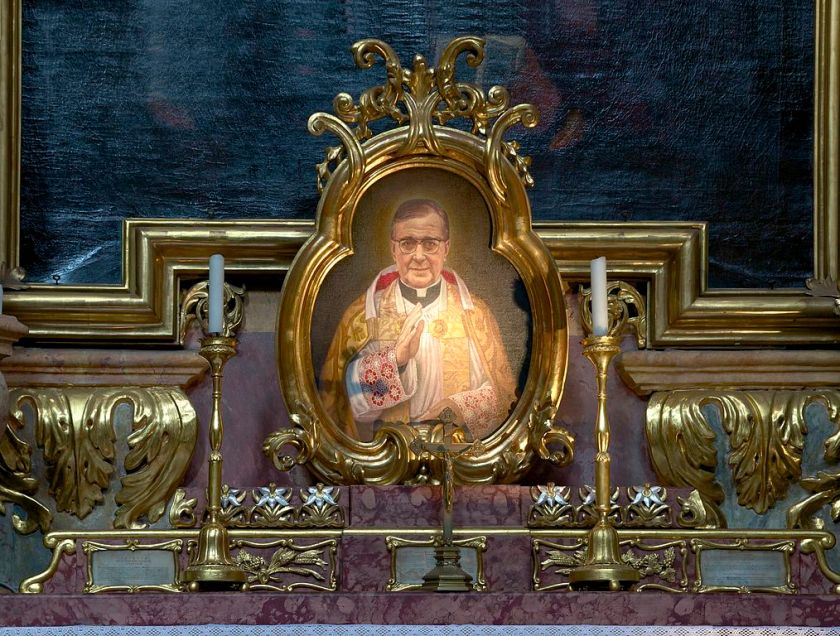
Rosa Venerini, was born in Viterbo, on 9 February 1656.   Her father, Goffredo, originally from Castelleone di Suasa (Ancona), after having completed his doctorate in medicine at Rome, moved to Viterbo where he practised the medical profession brilliantly in the Grand Hospital.   From his marriage to Marzia Zampichetti, of an ancient family of Viterbo, four children were born:   Domenico, Maria Maddalena, Rosa and Orazio.

Rosa was naturally gifted with intelligence and an uncommon human sensibility.   The education that she received in her family allowed her to develop her many talents of mind and heart, forming her in steadfast Christian principles.   According to her first biographer, Father Girolamo Andreucci, S.I., she made a vow to consecrate her life to God at the age of seven.   During the early years of her youth, she lived through a conflict between the attractions of the world and the promise made to God.   Rosa overcame this crisis with trusting prayer and mortification.

At age twenty, Rosa raised questions about her own future.   The women of her time could choose only two orientations for their live:  marriage or the cloister.   Rosa esteemed both but she felt called to realise another project for the good of the Church and the society of her time.   Urged on by prophetic interior occurrences, she committed much time in suffering and searching before reaching a resolution that was completely innovative.

In the autumn of 1676, on the advice of her father, Rosa entered the Dominican Monastery of St Catherine, with the prospect of fulfilling her vow.   With her Aunt Anna Cecilia beside her, she learned to listen to God in silence and in meditation.   She remained in the monastery for only a few months because the sudden death of her father forced her to return to her suffering mother.   In the years immediately following, Rosa had to bear the burden of serious events for her family:  her brother Domenico died at only twenty-seven years of age;  a few months later her mother died, unable to bear the sorrow.

In the meantime, Maria Maddalena married.   There remained at home only Orazio and Rosa, by now twenty-four years old.   Challenged by the desire to do something great for God, in May of 1684, the Saint began to gather the girls and women of the area in her own home to recite the rosary.  The way in which the girls and women prayed and above all, their conversation before and after the prayer, opened the mind and heart of Rosa to a sad reality:  the woman of the common people was a slave of cultural, moral and spiritual poverty.   She then understood that the Lord was calling her to a higher mission which she gradually identified in the urgent need to dedicate herself to the instruction and Christian formation of young women, not with sporadic encounters but with a school understood in the real and true sense of the word.ST ROSE VENERINI 4

On 30 August 1685, with the approval of the Bishop of Viterbo, Cardinal Urbano Sacchetti and the collaboration of two friends, Gerolama Coluzzelli and Porzia Bacci, Rosa left her father’s home to begin her first school, according to an innovative plan that had matured in prayer and her search for the will of God.   The first objective of the Foundress was to give the girls of the common people a complete Christian formation and prepare them for life in society.   Without great pretence, Rosa opened the first “Public School for Girls in Italy”.   The origins were humble but the significance was prophetic, the human promotion and spiritual uplifting of woman was a reality that did not take long to receive the recognition of the religious and civil authorities.

The initial stages were not easy.   The three Maestre (teachers) had to face the resistance of clergy who considered the teaching of the catechism as their private office.   But the harshest suspicion came from conformists who were scandalised by the boldness of this woman of the upper middle class of Viterbo who had taken to heart the education of ignorant girls.   Rosa faced everything for the love of God and with her characteristic strength, continuing on the path that she had undertaken, by now sure that she was truly following the plan of God.   The fruits proved her to be right.   The same clergy soon recognised the moral improvement that the work of education generated among the girls and mothers.

The validity of this initiative was acknowledged and its fame went beyond the confines of the Diocese.   Cardinal Mark Antonio Barbarigo, Bishop of Montefiascone, understood the genius of the Viterbo project and he called the Saint to his diocese.   The Foundress, always ready to sacrifice herself for the glory of God, responded to the invitation.   From 1692 to 1694, she opened ten schools in Montefiascone and the villages surrounding Lake Bolsena.   The cardinal provided the material means and Rosa made the families aware, trained the teachers and organised the schools.   When she had to return to Viterbo to attend to the strengthening of her first school, Rosa entrusted the schools and the teachers to the direction of a young woman, St Lucia Filippini (1672-1732), in whom she has seen particular gifts of mind, heart and spirit.

After the openings in Viterbo and Montefiascone, other schools were started in Lazio. Rosa reached Rome in 1706 but the first experience in Rome was a real failure which marked her deeply and caused her to wait six long years before regaining the trust of the authorities.   On 8 December 1713, with the help of Abate Degli Atti, a great friend of the Venerini family, Rosa was able to open one of her schools in the centre of Rome at the foot of the Campidoglio.

On 24 October 1716, they received a visit from Pope Clement XI, accompanied by eight Cardinals, who wanted to attend the lessons.   Amazed and pleased, at the end of the morning he addressed these words to the Foundress: Signora Rosa, you are doing that which we cannot do.   We thank you very much because with these schools you will sanctify Rome ”.

ST ROSE VENERINI 3

From that moment on, Governors and Cardinals asked for schools for their areas.   The duties of the Foundress became intense, consisting of travels and hard work interwoven with joys and sacrifices for the formation of new communities.   Wherever a new school sprang up, in a short time a moral improvement could be noted in the youth.

Rosa Venerini died a saintly death in the community of St Mark’s in Rome on the evening of 7 May 1728.   She had opened more than forty schools.   Her remains were entombed in the nearby Church of the Gesù, so loved by her.   In 1952, on the occasion of her Beatification, they were transferred to the chapel of the Generalate in Rome.

We can summarise the charism of Rosa Venerini in a few words.   She lived consumed by two great passions:  passion for God and passion for the salvation of souls.   When she understood that the girls and women of her time needed to be educated and instructed in the truths of the faith and of morality, she spared nothing of time, hard work, struggle and difficulties of every kind, as long as it responded to the call of God.   She knew that the proclamation of the Good News could be received if people were first liberated from the darkness of ignorance and error.   Moreover, she intuited that professional training could give woman a human promotion and affirmation in society.   This project required an educating Community and Rosa, without pretense and well before its time in history, offered to the Church the model of the Apostolic Religious Community.st rosa end note

Rosa did not practice her educational mission only in the school but took every occasion to announce the love of God.   She comforted and cured the sick, raised the spirits of the discouraged, consoled the afflicted, called sinners back to a new life, exhorted to fidelity consecrated souls not observing their call, helped the poor and freed people from every form of moral slavery.

Educate to save became the motto that urged the Maestre Pie Venerini to continue the Work of the Lord intended by their Foundress and radiate the charism of Rosa to the world:  to free from ignorance and evil so that the project of God which every person carries within can be visible.

ST ROSE VENERINI 5

This is the magnificent inheritance that Rosa Venerini left her Daughters.   Wherever the Maestre Pie Venerini strive to live and transmit the apostolic concern of their Mother, in Italy as in other lands, they give preference to the poor.

After having made its contribution to the Italian immigrants to the USA from 1909 and in Switzerland from 1971 to 1985, the Congregation extended its apostolic activity to other lands:  India, Brazil, Cameroon, Romania, Albania, Chile, Venezuela and Nigeria.RoseVenerini

Posted in QUOTES of the SAINTS, SAINT of the DAY, VATICAN Resources

Saint of the Day – 6 May – Blessed Anna Rosa Gattorno (1831-1900)

Saint of the Day – 6 May – Blessed Anna Rosa Gattorno (1831-1900) Wife, Mother, Widow, Religious, Foundress of the Daughters of St Anne, Stigmatist, Mystic.  Born on 14 October 1831 at Genoa, Italy as Rose Maria Benedetta – Died at 9am on 6 May 1900 at Rome, Italy of influenza.  Bl Anna Rosa was Beatified on 9 April 2000 by St Pope John Paul II.   Patronages – Daughters of Saint Anne, Widowers, Mothers.rosa-maria-benedetta-gattorno-custo-18a4852c-af01-4fa8-914d-4d8517aef9d-resize-750

“My love, what can I do to make the whole world love you? … Make use once again of this wretched instrument to renew the faith and the conversion of sinners”.

This generous outburst, uttered at the feet of her ‘Supreme Good’ – who drew her ever closer to Him – constituted the deepest yearning of Anna Rosa Gattorno’s heart, leading her to offer her life totally in a continuous sacrifice for the glory and pleasure of the Father.
She was born in Genoa on 14 October 1841 into a deeply Christian, well-to-do family of good name.   She was baptised the same day in the parish of St Donato and received the names Rosa, Maria, Benedetta.
In her father Francesco and her mother Adelaide Campanella, like their other five children, she found the first models for her moral and Christian life.   When she was 12 years old, she was confirmed at St Maria delle Vigne by Cardinal Archbishop Tadini.
As a young girl she was educated at home, as was the custom in rich families at that time. With her serene and loveable character, open to piety and charity, she was nonetheless firm and knew how to react to the confrontations of the political and anticlerical climate of the time, which did not spare even some members of the Gattorno family.
At the age of 21 Rosa married her cousin Gerolamo Custo (5 November 1852), and moved to Marseilles.   Unforeseen financial difficulties very soon upset the happiness of the new family which was forced to return to Genoa in a state of poverty.   More serious misfortunes were looming:  their first child, Carlotta, after a sudden illness was left deaf and dumb for life;  Gerolamo’s attempt to find fortune abroad ended with his return, aggravated by a fatal illness;  the happiness of the other two children was deeply disturbed by her husband’s disappearance which left her a widow less than six years after their marriage (9 March 1858) and, a few months later, by the loss of her youngest little son.
The succession of so many sad events in her life marked a radical change which she called her “conversion” to the total gift of herself to the Lord, to his love and to love of neighbour.   Purified by her trials and strengthened in spirit, she understood the true meaning of pain and was confirmed in the certainty of her new vocation.
Under the guidance of her confessor, Fr Giuseppe Firpo, she made private perpetual vows of chastity and obedience on the Feast of the Immaculate Conception 1858, followed by vows of poverty (1861) in the spirit of St Francis of Assisi, as a Franciscan tertiary.   Since 1855, she had also obtained the benefit of daily communion, which was uncommon in those days.   She remained constantly anchored to this source of grace and, encouraged by ever growing intimacy with the Lord, she found support, missionary fervour, strength and zeal in service to her brothers and sisters.
In 1862, she received the gift of hidden stigmata, perceived most intensely on Fridays.
As a faithful wife and exemplary mother, never depriving her children of anything – always following and loving them tenderly – with greater availability she learned to share in the sufferings of others, giving herself in apostolic charity:  “I dedicated myself with greater zeal to pious works and to visiting hospitals and the poor sick at home, helping them by meeting their needs as much as I could and serving them in all things”.


The Catholic associations in Genoa competed for her, so that although she loved silence and concealment, her genuinely evangelising way of life was remarked by all.
Progressing on this path, she was made president of the “Pious Union of the New Ursulines Daughters of Holy Mary Immaculate”, founded by St Paula Frassinetti (1809-1882) and was entrusted with the revision of the Rule destined for the Union at the express wish of Archbishop Charvaz.
On that precise occasion (February 1864), redoubling her prayers to Christ Crucified, she received the inspiration for a new Rule, her own specific Foundation.
Fearful of being forced to abandon her children she prayed, made acts of penance and asked advice.   Fra Francis of Camporosso (1804-1866), a lay Capuchin, who is himself, a saint, to whom she also expressed her apprehension before the serious troubles that were imminent, supported and encouraged her, as did her confessor and the Archbishop of Genoa.
However, feeling her maternal duties more and more acutely, she sought authoritative confirmation in the words of Pius IX, with the secret hope of being relieved.   The Pontiff, at an audience on 3 January 1866, instead enjoined her to start her foundation immediately, adding:  “This Institute will spread in all the parts of the world as swiftly as the flight of the dove. God will take care of your children: you must think of God and his work”   She therefore accepted to do the Lord’s will and as she then wrote in her Memoirs:  “I generously offered them to God and repeated to him Abraham’s words: ‘Here I am, ready to do your divine will’.… Having offered myself for His Work, I received immense consolations…”.
Overcoming the resistance of her relatives and, to the disappointment of her Bishop, leaving the associations in Genoa, she founded her new religious family in Piacenza and named it definitively “Daughters of St. Anne, mother of Mary Immaculate” (8 December 1866).   She was clothed on 26 July 1867 and on 8 April 1870 made her religious profession, together with 12 sisters.
Fr Tornatore, a priest of the Congregation of the Mission, collaborated with her in the Institute’s development.   Expressly requested, he wrote the Rule and was then considered Co-Founder of the Institute.
Entrusting herself totally to divine Providence and motivated from the start by a courageous charitable impulse, Rosa Gattorno began with a spirit of motherly dedication to consolidate God’s Work as the Pope had called it and as she too, chosen to co-operate in it, would always call it, attentively caring for any form of suffering and moral or material poverty, with the one intention of serving Jesus in His painful and injured members and of “evangelising first and foremost with life”.
Various works came into being for the poor and the sick with any form of illness, for lonely, elderly or abandoned persons, the little and the defenceless, adolescents and young girls “at risk” for whom she arranged appropriate instruction and subsequent integration in the working world.   In addition, she soon opened schools for the people and for the education of the children of the poor and other works of human and evangelical advancement in accordance with the greatest needs of the time and with an effective presence in ecclesial and civil life.   “Servants of the poor and ministers of mercy” she called her daughters and she urged them to accept, as a sign of the Lord’s favour to serve their brethren with love and humility:   “Be humble … only think that you are the lowliest and the most wretched of all creatures who render service to the Church… and have the grace to belong to her”.bl anna rosa gattorno
Less than 10 years after its foundation, the Institute obtained the Decree of Praise (1876), and its definitive approval in 1879.   For the Rule, it had to wait until 1892.
Highly esteemed and appreciated by all, she also worked in Piacenza with Bishop Scalabrini (1839-1905), who has now been beatified and in particular in the institute for deaf-mutes which he founded.
However Mother Rosa Gattorno was not spared humiliations, difficulties and tribulations of all kinds.   Despite this, the Institute spread rapidly, in Italy and abroad, thus achieving the Foundress’ ardent missionary desire:  “Oh my Love! How I feel myself burning with the desire to make you known and loved by all! I would like to attract all the world, to give to all, to appease all … I would like to go everywhere and shout out for everybody to come and love you”.   To be “Jesus’ voice” and to bring all people the message of the love that saves was and always remained her heart’s deepest desire.   In 1878, she was already sending the first Daughters of St Anne to Bolivia, then to Brazil, Chile, Peru, Eritrea, France and Spain.   In Rome, where her work began in 1873, she organised boys’ and girls’ schools for the poor, nursery schools, assistance for the new-born babies of workers in the tobacco factory, houses for former prostitutes, serving women, nurses for home care, etc.   There she also had the Generalate built, with its adjacent church.
In all, at her death there were 368 houses in which 3,500 sisters were carrying out their mission.
The secret of her journey of holiness, of the dynamism of her charity and of the strength of mind with which she could face all obstacles with firm faith and guide the Institute with full dedication, courage and far-sightedness for 34 years, was her continuous union with God and total, trusting abandonment in him:  “Although I am in the midst of such a torrent of things to do, I am never without the union with my Good”; her attention and docility to the impulses of the Spirit;  her deep and loving participation in Christ’s Passion;  her ceaseless prayers for the conversion of sinners and the sanctification of all mankind.
She had a deep sense of belonging to Church and was ever humble, devout and obedient to the directives of the Pope and the hierarchy.
With her fondness of St Anne, she had a special love for Mary, to whom she entirely entrusted herself, in order to belong totally to God and totally to her brethren.
A pure and simple instrument in the hands of the “superfine Craftsman”, conformed to the Poor Christ and with Him, a victim of love, she fulfilled in her life the desire she inculcated in her daughters:  “To live for God, to die for him and to spend life for love”.
She lived like this until February 1900, when she caught a dangerous form of influenza and rapidly deteriorated.  Her health, sorely tried by her acts of penance, frequent exhausting journeys and an enormous mass of correspondence, worries and serious disappointments, no longer resisted.   On 4 May she received the sacrament of the Anointing of the Sick and two days later, on 6 May, at 9.00 a.m., having ended her earthly pilgrimage, she died a holy death in the Generalate.
The fame of holiness which had surrounded her during her life, spread after her death and grew unimpeded all over the world.
As an expression of a rare plan of God, in her three-fold experience of wife and mother, widow and then religious and Foundress, in her mission of service to humanity and to extending the kingdom Rosa Gattorno brought great honour to the “feminine genius”. Although she was ever faithful to God’s call and a genuine teacher of Christian and ecclesial life, she remained essentially a mother:  of her own children, whom she constantly followed, of the Sisters, whom she deeply loved and of all the needy, the suffering and the unhappy, in whose faces she contemplated the face of Christ, poor, wounded and crucified.
Her charism has spread in the Church with the birth of other forms of evangelical life: Sisters of Contemplative Life; a Religious Association of Priests;  the Secular Institute and the Ecclesial Movement for the Laity, which are active in the Church in almost all the parts of the world….Vatican.va

Beata_Anna_Rosa_Gattorno


Posted in SAINT of the DAY, VATICAN Resources

Saint of the Day – 5 May – Blessed Caterina Cittadini (1801-1857)

Saint of the Day – 5 May – Blessed Caterina Cittadini (1801-1857) Religious, Teacher, Founder  – (28 September 1801 – 5 May 1857) was an Italian Roman Catholic religious from Bergamo who established the Ursuline Sisters of Saint Jerome Emiliani.   The order was dedicated to the education of girls in Bergamo and in the surrounding areas and has since expanded outside of the Italian nation. Cittadini was orphaned as a child and cultivated her faith among fellow children in an orphanage where the spiritual direction was strong.   Her order came in part of her devotion to Saint Jerome Emiliani (1486-1537) as well as the Blessed Mother.   Patronages – Ursuline Sisters of St Jerome Emiliani, Orphans, Teachers.

bl Caterina Cittadini

Cittadini’s reputation increased as the decades went on due to her fame as a passionate and inspiring educator who instilled in girls both a civic and a religious education that was the basis of her educational career and her beliefs.

Her beatification was celebrated on 29 April 2001 once Pope John Paul II recognised a miracle that was attributed to Cittadini’s direct intercession.

Caterina Cittadini was born in Bergamo on 28 September 1801 to Giovanni Battista Cittadini and Margherita Lanzani.   Her sister was Giuditta (1803-1840).    She was baptised on 30 September in the parish of San Alessandro in Colonna.   Her mother died in 1808 and her father abandoned the sisters after being widowed.   The sisters were taken in and grew up in the orphanage of Bergamo where both sisters developed a strong and ardent faith;  in her case it meant a strong devotion to both the Blessed Mother and to Saint Jerome Emiliani.   The sisters left the orphanage in 1823 in order to live with their paternal cousins Giovanni and Antonio Cittadini in Calolzio.

Cittadini became a teacher at a public girls school in Somasca in 1824 at the time she and Giuditta felt called to the religious life.   Their spiritual director Giuseppe Brena – from their time at the orphanage – advised them to remain in Somasca to instead become the basis of a new religious congregation devoted to the education of girls both children and adolescents.   To that end the pair bought a house in Somasca in 1826 and also bought and furnished a building that became a female boarding school in October 1826. Cittadini taught the students religious education and managed the school on a simultaneous level;  at this stage word of her success spread and she attracted dozens of students from the surrounding areas.   The Cittadini sisters opened two private schools in 1832 and in 1836.


Giuditta directed these schools until her sudden death in 1840 which had put an emotional strain upon her older sister.   This was exacerbated with the death of her cousin Antonio in 1841 and her spiritual director not long after that.   The rapid losses that she incurred ruined her health to the point where she neared death in 1842 but was cured through the intercession of Saint Jerome Emiliani (1486-1537)

She quit public teaching in 1845 in order to just manage the schools themselves and she also took three companions under her wing to assist her in both that task and also in the care of orphans.   In 1850 she received the papal approval of Pope Pius IX to build a chapel to house the Eucharist at her boarding school and in 1851 applied for the approval of a new religious congregation to the Bishop of Bergamo, Carlo Gritti Morlacchi.   In 1854 the new Bishop Pietro Luigi Speranza encouraged her work and instructed her to write the Rule of her new order – her first attempt was based on those of the Milanese Ursulines and was rejected.   She persisted in writing the Rule once more which was accepted on 17 September 1854 bearing the name of her new congregation, The Ursuline Sisters of Saint Jerome Emiliani. 

Cittadini died in 1857 after a period of ill health;  her reputation for holiness and for her ardent faith spread across the northern Italian cities and led to calls for her cause of beatification to be introduced.   Six months after her death – on 14 December 1857 – the Bishop of Bergamo gave his approval for the order to be recognised of diocesan right while on 8 July 1927 the congregation received the official papal approval of Pope Pius XI;  this meant the congregation was now universal and was recognised of pontifical right to exercise its functions.

The order now operates in Asia in nations such as India and the Philippines and in Europe in both Belgium and Switzerland amongst others.


Posted in PAPAL SERMONS, SAINT of the DAY, VATICAN Resources

Saint of the Day – 30 April – St Joseph Benedict Cottolengo (1786-1842) – An Intense Day of Love

Saint of the Day – 30 April – St Joseph Benedict Cottolengo (1786-1842) Priest, Founder, Confessor, Apostle of Charity.   Born as Giuseppe Benedetto Cottolengo on 3 May 1786 at Bra, Cuneo, Piedmont region, Italy and died on 30 April 1842 of typhus at Chieri, Turin, Italy.  He was buried in the Mary altar in the main chapel in Valdocco, Italy.   St Joseph was Canonised on 19 March 1934 by Pope Pius XI.   Known as “the labourer of Divine Providence”.

Header - st joseph benedetto cottolengo

“Joseph Benedict Cottolengo was born in Bra, a small town in the Province of Cuneo, on 3 May 1786.   The eldest of 12, six of whom died in infancy, he showed great sensitivity to the poor from childhood.   He embraced the way of the priesthood, setting an example to two of his brothers.   The years of his youth coincided with the Napoleonic period and the consequent hardships in both the religious and social contexts.   Cottolengo became a good priest much sought after by penitents and, in the Turin of that time, a preacher of spiritual exercises and conferences for university students who always met with noteworthy success.   At the age of 32, he was appointed canon of the Santissima Trinità, a congregation of priests whose task was to officiate in the Corpus Domini Church and to ensure the decorum of the city’s religious ceremonies but he felt uneasy in this situation.   God was preparing him for a special mission and, precisely with an unexpected and decisive encounter, made him realise what was to be his future destiny in the exercise of the ministry.

The Lord always sets signs on our path to guide us according to his will to our own true good.   This also happened to Cottolengo, dramatically, on Sunday morning, 2 September 1827.   The diligence from Milan arrived in Turin, more crowded than ever.   Crammed into it was a whole French family.   The mother, with five children, was at an advanced stage of pregnancy and had a high temperature.   After traipsing to various hospitals, this family found lodgings in a public dormitory but the woman’s situation was serious and some people went in search of a priest.   By a mysterious design they came across Cottolengo and it was precisely he who, heavy hearted, accompanied this young mother to her death, amid the distress of the entire family.   Having carried out this painful task, with deep anguish he went to the Blessed Sacrament and knelt in prayer:  “My God, why?   Why did you want me to be a witness?   What do you want of me?  Something must be done!”.   He got to his feet and had all the bells rung and the candles lit and, gathering in the church those who were curious, told them:  “The grace has been granted!   The grace has been granted!”.   From that time Cottolengo was transformed: all his skills, especially his financial and organisational ability, were used to give life to projects in support of the neediest.

In his undertaking he was able to involve dozens and dozens of collaborators and volunteers.   Moving towards the outskirts of Turin to expand his work, he created a sort of village, in which he assigned a meaningful name to every building he managed to build:  “House of Faith”, “House of Hope”, “House of Charity”.   He adopted a “familystyle”, establishing true and proper communities of people with volunteers, men and women religious and lay people, who joined forces in order to face and overcome the difficulties that arose.   Everyone in that Little House of Divine Providence had a precise task:  work, prayer, service, teaching or administration.   The healthy and the sick shared the same daily burden.   With time religious life could be specifically planned in accordance with particular needs and requirements.

 430piccolacasa

Cottolengo even thought of setting up his own seminary to provide specific formation for the priests of his Work.   He was always ready to follow and serve Divine Providence and never questioned it.   He would say:  “I am a good for nothing and I don’t even know what to make of myself.   But Divine Providence certainly knows what it wants.   It is only up to me to support it. Let us go ahead in Domino”.   To his poor and the neediest, he would always call himself “the labourer of Divine Providence”.

St Joseph Benedict Cottolengo 7st joseph benedetto cottolengo.4st joseph benedetto cottolengo.3

He also chose to found beside the small citadels five monasteries of contemplative sisters and one of hermits and considered them among his most important achievements.   They were a sort of “heart” which was to beat for the entire Work.   He died on 30 April 1842, with these words on his lips:  “Misericordia, Domine, Misericordia, Domine.   Good and Holy Providence… Blessed Virgin, it is now up to you”.   The whole of his life, as a newspaper of the time said, was “an intense day of love”.”….Pope Benedict XVI General Audience, Saint Peter’s Square, Wednesday, 28 April 2010.
Today Cottolengo Fathers, Sisters and Brothers still work together in activities focused on communicating God’s love for the poorest. They are spread out all over the world: Ecuador, India, Italy, Kenya, Switzerland, Tanzania and the United States.   Don Cottolengo contracted typhoid while assisting his patients and died in Chieri, Piedmont on 30 April 1842.   Cottolengo was beatified by Pope Benedict XV in 1917 and was Canonised by Pope Pius XI in 1934.
Joseph Benedict Cottolengo was enlisted among the saints of charity by Pope Benedict XVI in his encyclical Deus caritas est.   The parish of Saint Joseph Benedict Cottolengo is located in Grosseto, Italy.   There is a Via San Giuseppe Benedetto Cottolengo in Pisa.
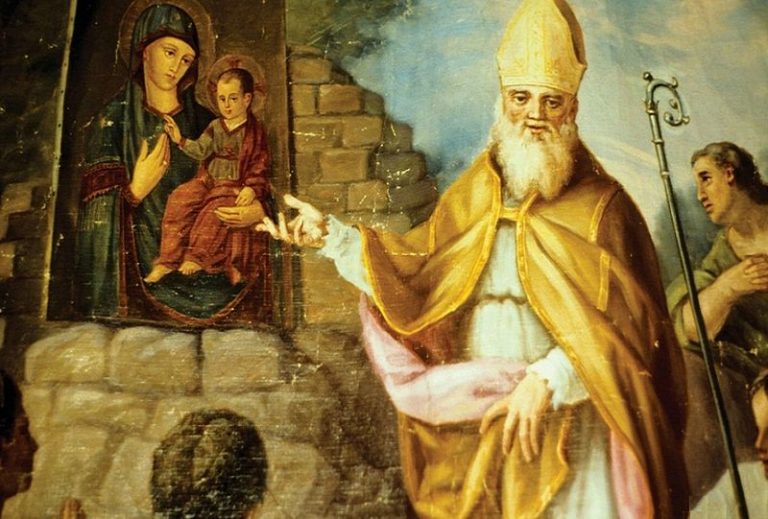
StJosephCottolengo30-4a

The Sisters of St. Joseph Cottolengo pray before the blessed sacrament inside the Chiesa Piccola.jpg
The Sisters of St Joseph Cottolengo pray before the blessed sacrament inside the Chiesa Piccola
cottolengo sisters
Cottolengo Sisters at Prayer
Posted in SAINT of the DAY, VATICAN Resources

Saint of the Day – 26 April – St Rafael Arnáiz Barón O.C.S.O. (1911-1938)

Saint of the Day – 26 April – St Rafael Arnáiz Barón O.C.S.O. (1911-1938) 9 April 1911 in Burgos, Spain – 26 April 1938 in Dueñas, Palencia, Spain – Religious Brother of the Cistercian Monastery of the Strict Observance (Trappists), Apostle of Eucharistic Adoration and of the Blessed Virgin Mary, Artist and Writer.   Known as Brother María Rafael.   Patronages – against diabetes, diabetes mellitus, World Youth Day 2011.

Beato_Raffaele_Arnaiz_Baron

St Rafael Arnáiz Barón was born in Burgos, Spain, on 9 April 1911 into a well-to-do Christian family.   He was the eldest of four.   As a boy he attended several schools run by Jesuits and his sensitivity to spiritual topics and to art was apparent from boyhood. These qualities were remarkably well balanced giving him an open, joyful attitude to the world, combined with exuberant good humour, respect and humility.

Bouts of fever and pleurisy interrupted his education.   When he had recovered his father took him to Zaragoza to consecrate him to Our Lady of the Pillar and his family moved to Oviedo where he completed his secondary schooling.

In 1930 Rafael embarked on architectural studies in Madrid.   It was in this year that his deeper commitment to Christ began.   After completing his secondary schooling, that summer he had spent a holiday near Avila at the home of his uncle and aunt, the Duke and Duchess of Maqueda.   It was they who introduced him to the Trappist Monastery of San Isidoro de Dueñas whose beauty and prayerful atmosphere attracted him.

Rafael was a talented artist, His pictorial powers both in concept and in actual completion were considerable and he was far from fussy.   His teacher says of him:

“He was magnificent in the art of decoration and had done
some truly outstanding pieces . . . both in oils and in watercolour,
he worked to large design and without fussiness; he
needed only a few highly descriptive brush strokes to bring
it off;   he knew how to give strength and setting to all he did.
He had a very exact sense of colour and in some of his pictures
he was able to achieve the most difficult tints.   One peculiarity
was that when Rafael did landscapes, he preferred
to completely exclude from them any sign of people;  none of
his works contain a single human figure that could take or
distract from the luminosity of the whole.”

He was called up but declared unfit for active duty.   He decided to abandon his architectural studies in Madrid and seek the mystery of the “Absolute” in this Cistercian Monastery of the Strict Observance, which he entered on 16 January 1934 and joyfully received the white habit.   He was 23.   He said upon entering that this decision had not been prompted by suffering or disappointments but rather by God who, “in his infinite goodness” had given him far more in life than he deserved.   Rafael felt deeply suited to the monastic rhythm of Gregorian chant and the Liturgy of the Hours.   He wrote many letters to his mother, who after his death collected them in a book and to his uncle and aunt with whom he had a close friendship.

REPORTAJE. RAFAEL ARNAIZ BARON. HERMANO RAFAEL. BEATO OVETENSE EN PROCESO DE CANONIZACION

Four months after entering the monastery, after an austere Lent, he was smitten by a serious form of diabetes mellitus which forced him to go home for treatment.   Indeed, he was obliged to go back and forth between his home and the monastery again and again between 1935 and 1937.   It was at the height of the Spanish Civil War.

Thus, on his final return to the monastery, he was made an oblate, taking the last place and living on the fringes of the community.   Canon law at the time did not permit a person in his condition of poor health to take monastic vows.

The Virgin Mary was the love and consolation of Rafael’s life.   “It is a pity,” he wrote, “that David [the psalmist] didn’t know the Most Holy Virgin! What marvelous things he would have said about her! A heart as big as his would certainly have been full of love for Mary! Mary! If only I knew how to write!”
He died in the monastery’s infirmary on 26 April 1938 after a final attack of the disease at only 27 years old.   He was buried in the monastery cemetery and his remains were later translated to the Abbey Church.

Despite his brief life, he embodies the Cistercian grace in a remarkably pure way.   From beginning to end he let himself be led through a series of bewildering contradictions and perplexities illness, war, the inability to pronounce his vows, abnormal community relations until he totally renounced himself.   Humiliation was his constant companion.

His one desire was to live in order to love:  to love Jesus, Mary, the Cross, his Trappist monastery.   His reputation for holiness spread rapidly throughout Spain and his grave at San Isidro became a place of pilgrimage where many favours were received.

On 19 August 1989, at the World Youth Day in Santiago de Compostela, John Paul II proposed Bro. Rafael as a model for young people today and beatified him on 27 September 1992, in Rome.   In his Homily at the beatification Mass, the late Pope said of this Spanish Trappist that he set an example, especially for young people, “of a loving and unconditional response to the divine call”. (Vatican.va)

ST RAPHAEL BARON 2

The sainthood process started in Palencia in an informative process that spanned from 28 June 1961 until 30 April 1967 while theologians agreed on 25 January 1974 that all of his spiritual writings were in full accordance with the norms of the faith.   The formal introduction to the cause came later on 15 January 1983 and the late Trappist became titled as a Servant of God.   The Congregation for the Causes of Saints validated the informative process in Rome on 26 June 1987 and received the Positio dossier in 1987. Theologians approved this dossier on 12 May 1989 as did the C.C.S. on 11 July 1989.   The confirmation of his heroic virtue on 7 September 1989 allowed for St Pope John Paul II to sign a decree that titled him as Venerable.

The process for a miracle took place in the location that it originated in and it received C.C.S. validation on 6 October 1989;  a medical board approved it on 31 October 1991 as did the theologians on 4 March 1992 and the C.C.S. on 7 April 1992. St John Paul II approved this miracle on 13 June 1992 and beatified the Trappist on 27 September 1992 in Saint Peter’s Square.   The process for another miracle opened in Madrid and spanned from 9 April 2005 to 7 May 2006 before its validation on 30 November 2006.   Medical experts assented to this on 13 March 2008 as well as theologians on 7 June 2008 and the C.C.S. members on 4 November 2008.   Pope Benedict XVI approved this miracle on 6 December 2008 and formalised the date for the sainthood celebration in a consistory on 21 February 2009.  Pope Benedict XVI Canonised him on 11 October 2009.


Canonisation miracle
The miracle that led to the Canonisation was the January 2001 healing of Begoña Alonso Leon in Madrid.   She was 30 and in the fifth month of being pregnant with her daughter Laura and began to feel severe contractions and headaches as well as signs of eclampsia. On 25 December 2000 – Christmas – she was admitted at seven months into a Madrid hospital due to the symptoms worsening and after an ultrasound was directed to the surgical theatre for a cesarean section.   Her daughter was born in good health but Leon’s condition worsened and she was in the intensive care unit for over two weeks.   Her rapid healing after this was attributed to the late Trappist whom she appealed to during her illness.

canonisation snip


canonisation banner

Posted in DEVOTIO, DIVINE Mercy, Goodness, Patience, EASTER, FEASTS and SOLEMNITIES, MORNING Prayers, QUOTES of the SAINTS, QUOTES on PRAYER, SAINT of the DAY, The HOLY GHOST, VATICAN Resources

One Minute Reflection – 8 April – Low Sunday the Octave Day of Easter and Divine Mercy Sunday and the Memorial of Bl Augustus Czartoryski S.D.B. (1858-1893)

One Minute Reflection – 8 April – Low Sunday the Octave Day of Easter and Divine Mercy Sunday and the Memorial of Bl Augustus Czartoryski S.D.B. (1858-1893)

“How lovely is your dwelling place, Lord, God of hosts.   My soul is longing and yearning, is yearning for the courts of the Lord…. One day within your courts is better than a thousand elsewhere” …Psalm 84[83]: 2, 11

REFLECTION – “Blessed Augusto Czartoryski wrote these words of the Psalm, his motto of life, on the holy card of his first Mass.   In them is contained the rapture of a man who, following the voice of the call, discovers the beauty of the ministerial priesthood.   In them resounds the echo of the different choices that the person who is discerning God’s will and wishes to fulfil it must make.   Augustus Czartoryski, a young prince, carefully prepared an effective method to discern the divine plan.   In prayer, he presented to God all questions and deep perplexities and then in the spirit of obedience he followed the counsel given by his spiritual guides.   In this way he came to understand his vocation and to take up the life of poverty to serve the “least”.   The same method enabled him throughout the course of his life to make decisions, so that today we can say that he accomplished the designs of Divine Providence in a heroic way.   I would like to leave this example of holiness especially to young people, who today search out the way to decipher God’s will relating to their own lives and desire to faithfully forge ahead each day according to the divine word.   My dear young friends, learn from Blessed Augustus to ask ardently in prayer for the light of the Holy Spirit and wise guides, so that you may understand the divine plan in your lives and are able to walk constantly on the path of holiness.”…St Pope John Paul on the Beatification of Blessed Augustus on Sunday, 25 April 2004
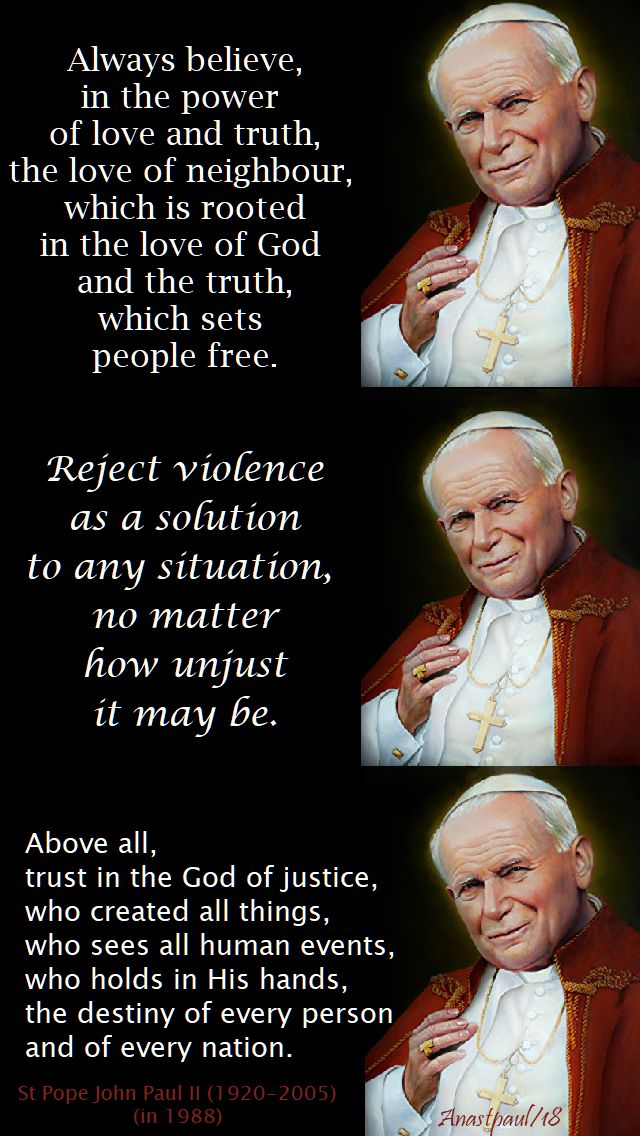
bl augustus czartoryski wrote these words - st john paul - 8 april 2018

PRAYER – Heavenly God and Father and Your divine Son, dear Jesus in whom we trust, send Your Holy Spirit to guide and teach us, to lead us into the ways of holiness.   Grant, we pray, that by the intercession of Blessed Augustus, we may fulfil Your Holy Will by the light of the Holy Spirit.   Through Jesus Christ, our Lord, in union with the Holy Spirit, one God forever, amen.bl augustus czartoryski - pray for us - 8 april 2018

Posted in SAINT of the DAY, VATICAN Resources

Saint of the Day – 8 April – Blessed Augustus Czartoryski S.D.B. (1858-1893)

Saint of the Day – 8 April – Blessed Augustus Czartoryski S.D.B. (1858-1893) Religious Priest of the Salesians of Don Bosco, Royal Prince and Duke – born Prince August Franciszek Maria Anna Józef Kajetan Czartoryski/the Duke of Vista Alegre on 2 August 1858 in Paris, France – evening of 8 April, 1893 in Alassio, Savona, Italy of tuberculosis.  His remains were interred in the family mausoleum in the parish crypt in Sieniawa, Poland and later re-interred in the Salesian church in Przemysl, Poland.

Augusto Czartoryski was born on 2 August 1858 in Paris, France, the firstborn son to Prince Ladislaus of Poland and Princess Maria Amparo, daughter of the Duke and Queen of Spain.   The noble Czartoryski Family had been living in exile in France for almost 30 years, in the Lambert Palace.   Here, with the hope of restoring unity in Poland, they continued to direct activities between their fellow Polish countrymen and the European chancellery.

BlAugustoCzartoryski08-4

Plans for a future Prince

It was already planned that Augusto would be a future “reference point” for this restoration and would carry on the “Czartoryski” name.   God’s designs, however, were to unfold differently.
When Augusto was 6, his mother died of tuberculosis;  the disease was also transmitted to him and for the rest of his life he would be plagued by ill health.   Although he had to make “forced pilgrimages” with his father to Italy, Switzerland, Egypt and Spain in search of a cure, he never regained his health.

384px-María_Amparo_Muñoz_y_Borbón,_condesa_de_Vista_Alegre_–_conde_Ladislao_Czartoryski
His parents, c 1860

As he grew up, Augusto felt that he was not meant for the life of nobility and one day, when he was 20 years old, he wrote to his father:  “I confess to you that I am tired [of all the parties;  they are superficial entertainments that cause me anguish and I feel myself “forced’ to make acquaintances with others at these banquets”.

Augusto already received spiritual direction from his tutor, Joseph Kalinsowski (later Saint Raphael of Saint Joseph Kalinowski O.C.D. (1835-1907) , who would later become a Carmelite and who, before leaving for Carmel in 1877, wrote to Prince Ladislaus to suggest that it would be wise, considering the boy’s love for God, to entrust him to the direction of a priest.

Encounter with Don Bosco

Prince Ladislaus accepted the counsel given by Augusto’s tutor and Fr Stanislaus Kubowicz began to guide him.   Augusto was already feeling more and more called to religious life and was hoping for a clearer indication of what God wanted from him:  this “decisive event” took place when he was 25 and met Don Bosco, founder of the Salesians.

When Don Bosco came to Paris and celebrated Mass in the family chapel of the Lambert Palace, Augusto saw in this holy founder and teacher the “father of his soul” and guide for his future.   While Augusto remained quiet and withdrawn in the face of matrimony plans made for him by his father, he had no intention of continuing the “noble line”. Indeed, after his first encounter with the Salesian saint, he was more resolute than ever to answer God’s call by becoming a Salesian.

When his father gave him permission, Augusto would travel to Turin to meet with Don Bosco and participate in spiritual retreats.   He became comfortable with the “poverty” of the Salesian Oratory and was not disturbed by his frequent ill health or his father’s opposition;  he instead saw God’s hand in all these circumstances.

He would say: “If God wants this, all will go well since he can take away every obstacle.   If he does not want this, then neither do I”.BL AUGUSTUS

A “Prince’ for God’s Kingdom

Don Bosco was somewhat reluctant to accept Augusto into the Salesian community:  it took Pope Leo XIII to remove his doubts when he gave Augusto this message:  “Tell Don Bosco that it is the Pope’s will that he receives you among the Salesians”.

Don Bosco replied: “Well then, my dear son, I accept you. From this moment, you are a part of the Salesian Family and I desire that you belong here until you die”.

In 1887 he began his novitiate under the guidance of Don Giulio Barberis.   The young man had to overcome many “habits” and adjust to community life, schedule, frugal meals and other sacrifices.   All this he did with great serenity and abandonment to God.

When his father came to try to convince him to return home and accept his nobility as “Prince”, he refused.   On 24 November 1887, the day of his vesting in the hands of Don Bosco, the holy founder whispered into Augusto’s ear:  “Courage, my prince! Today we have conquered, and I can also say with great joy that one day when you become a priest you will do much for your Country”.

0802_august-czartoryski

One year as Christ’s Priest

Don Bosco died two months later.   Augusto’s health was also worsening and his father continued to try to dissuade him from becoming a priest, using his ill health as an “excuse”.

When Prince Ladislaus asked the “help” of Cardinal Parocchi to dismiss him from the Salesians, Augusto wrote:   “In full liberty I made my vows and I did this with great joy of heart.   From that day I continue to live in the Congregation with an immense peace of spirit and I thank the Lord for allowing me to know the Salesian Family and for having called me to become a Salesian”.

On 2 April 1892 he was Ordained a Priest by the Bishop of Ventimiglia.   Although Prince Ladislaus was not present at the Ordination, a month later, joined by the entire family in Mentone, he reconciled himself with his son’s decision and renounced his own dreams of prestige and nobility for Augusto.

Fr Augusto died on 8 April 1893 in Alassio, where he lived his year as a Priest, occupying a room which looked out onto the courtyard where the children of the Oratory played. He was 35 years old.

BL AUGUTUS TOMB-Salezjanie_-_Czartoryski1
Relics of August Czartoryski in Salesians Church in Przemyśl, Poland
Posted in SAINT of the DAY, VATICAN Resources

Saint of the Day – 28 February – Blessed Stanislaw Antoni Trojanowski (1908-1942) Martyr

Saint of the Day – 28 February – Blessed Stanislaw Antoni Trojanowski (1908-1942) Martyr  and Religious Brother – also known as:  Tymoteusz, Timoteo Trojanowski, Stanislaw Tymoteusz Trojanowski,   prisoner 25431.   Born on 29 July 1908 in Sadlowo, Mazowieckie, diocese of Plock, Poland – 28 February 1942 in the death camp hospital at Oswiecim (Auschwitz), Malopolskie, Nazi-occupied Poland of pneumonia.   He was Beatified on 13 June 1999 by St Pope John Paul II.

452px-Stanisław_Tymoteusz_Trojanowski

In the Auschwitz death camp near Krakow in Poland, Blessed Timoteusz Trojanowski, a Brother of the Order of Friars Minor Conventual and martyr, who, during the domination of his homeland under a regime hostile to humanity and religion, exhausted by tortures suffered for confessing his Christian faith, brought to fruition his martyrdom.

Stanislaw Antoni was born 29 July 1908 in the village of Sadlowo, in the diocese of Plock, parents and Ignacy Franciszka Zebkiewicz.   The precarious economic situation of the family led him to work from an early age.   This involved poor attendance at primary school.   On 5 March 1930 he entered the convent of Friars Minor Conventual and Niepokalanow (founded by St Maximillian Kolbe) and on 6 January 1931 he was able to begin his novitiate with the name of Tymoteusz.   He made a simple profession of vows on 2 February 1932 and professed his solemn vows on 11 February 1935.   His whole religious life was held in Niepokalanow, working in the shipping department of the magazine “Knights of the Immaculate Conception” in the warehouse and infirmary, where he devoted himself to the sick brethren.

On 3 May 1937, he reported to his superior his wish to go on a mission “anywhere, anytime, provided the will of God.”

He was disciplined and faithful to his vocation, had great confidence on the part of his famous superior, Father Kolbe.

With the outbreak of World War II in 1939, he chose to remain at Niepokalanow.   On 14 October 1941 he was arrested by the Gestapo with six brothers, including a Friar Bonifacy and locked up in prison in Warsaw because they were Catholics.   In prison he was able to devote much time to prayer, bolstering the courage to others.

On 8 January 1942 he was again deported with Bonifacy to the concentration camp of Oswiecim with the number 25431.   He was originally intended for the transport of construction materials, then the excavation and transport of gravel and finally to the collection of rapeseed.   He endured, with great courage, the hunger, cold and hard work.   He never lost heart, always encouraging others to trust in the protection of God.   The cold caused the pneumonia that led to his death in the hospital at the death camp on 28 February 1942.   (From the translated Roman Martyrology)

img-Blessed-Stanislaw-Antoni-Trojanowski

Posted in SAINT of the DAY, VATICAN Resources

Saint of the Day – 26 February – St Paula Montal Fornés De San José De Calasanz (1799-1889)

Saint of the Day – 26 February – St Paula Montal Fornés De San José De Calasanz (1799-1889) Religious nun and Founder – born on 11 October 1799 at Arenys de Mar, near Barcelona, Spain – 26 February 1889 at Olesa de Montserrat, Barcelona, Spain of natural causes. St Paula’s religious name was Paula of Saint Joseph Calasanz.  She was a Spanish Roman Catholic professed religious and the foundress of the Sisters of the Pious Schools. cause for sainthood opened several decades after her death in the 1950s after being titled as a Servant of God; confirmation of her heroic virtue in 1988 saw her named as Venerable.   St Pope John Paul II Beatified her on 18 April 1993 and Canonised her on 25 November 2001.

st paula montal fornes - 26 feb 2018

The life of Paula Montal Fornés de San José de Calasanz, fruitful and prophetic, almost centennial, unfolded within a broad historical context (1799-1889), a crisis period during the troubled 19th Century in Spain, torn between the postulates of the Old Regime and the new liberal trends, with significant socio-political, cultural and religious repercussions.   Four cities were especially representative of her life, well-rooted in the land and historical surroundings:

In Arenys de Mar (Barcelona), she spent her childhood and youth (1799-1829).   A coastal village, facing the sea, cosmopolitan and industrial, is where she was born into this life, on 11 October 1799 and born into grace that same afternoon.   She was brought up in a modest Christian family atmosphere.   She participated in the spiritual life of her parish.   She stood out because of her love for the Virgin Mary.   From the age of 10, she learned the harshness of working to help her mother, a widow with five children.   She was the eldest.   During that time, through her own experience, she realised that girls, young ladies, women, had scarce possibilities for access to education, to culture… and she felt called by God to assist in rectifying the situation and carrying out that task.

Figueras (Gerona), a border city between Spain and France and a military stronghold famous for its weaponry castle, was where she had set her sights.   Accompanied by her  friend Inés Busquets, in 1829, she moved to the capital of that area to open her first school for girls, with broad educational programs which far surpassed those required for boys.   It was a new school.   Figueras was where her special educational apostolate for girls began.   A new charisma was born in the Church, an Apostolic Work aimed toward the complete human Christian education of girls and young women and toward the advancement of women, to save families and transform society.   Her followers would distinguish themselves by professing a fourth vow of teaching.

Sabadell (Barcelona) signifies the origin of her educational work in the Pious Schools. We know that, at least since 1837, she felt totally identified with the spirit of Saint Joseph of Calasanz, and wanted to live by the Calasanz spirituality and rules.   With that purpose, after founding a second school in her hometown of Arenys de Mar in 1842, where she came into direct contact with the Piarist Fathers of Mataró, she opened a third school in Sabadell in 1846.   The presence of the Piarist Fathers, Fr Jacinto Felíu and Fr Agustín Casanovas in the Sabadell school, was providential.   There, with their help and guidance, she achieved in a short time, the canonical structure of her newly formed Congregation.   On 2 February 1847, she made her profession as a Daughter of Mary Religious of the Pious Schools, along with her first three companions, Inés Busquets, Felicia Clavell and Francisca de Domingo.   At the General Chapter meeting, held in Sabadell on 14 March 1847, she was not elected General Superior, or even Assistant General.

During the period from 1829 to 1859, she was intensely active, personally founding 7 schools:  Figueras (1829), Arenys de Mar (1842), Sabadell (1846), Igualada (1849), Vendrell (1850), Masnou (1852) and Olesa de Montserrat (1959).   She inspired and helped to found 4 others:  Gerona (1853), Blanes (1854), Barcelona (1857) and Sóller (1857).   She was also the formulator of the first 130 Sisters of the Pious Schools of the Congregation.   A very active and prophetic period in her life.

Olesa de Montserrat (Barcelona), 1859.  The last school personally founded by her.   A poor small town, at the foot of the Monastery of Our Lady of Montserrat, to whom she professed great devotion.   It was her favourite School, where she stayed until her death (15 December 1859 to 26 February 1889).   Those were 30 years of grace for the girls and young women of Olesa, who benefited from her rich testimony with the example of her generous and holy life.   “Everyone loved and adored her…”.   And for the Congregation:  a total yes to God;  the living of the virtues that should characterise the Pious Schools’ educator.   And the twilight of a life in God.

The design of Mother Paula Montal’s spirituality is comprised of two facets:  her participation in the Calasanz spirituality and her unique educational charisma, directed toward the complete human Christian education of women.

Upon her death, the Congregation of the Daughters of Mary, Sisters of the Pious Schools, founded by her, was made up of 346 Escolapias (Sisters of the Pious Schools), who carried out the spirit of the Pious Schools teaching, the legacy of their Foundress, in 19 schools extending throughout the Spanish region.

The canonical process for her Beatification began in Barcelona on May 3, 1957.   St Pope John Paul II beatified her in Rome on 18 April 1993.   The miracle of her Canonisation, performed in September of 1993, in Blanquizal, a very marginal and violent area of Medellín (Colombia), for a little 8-year old girl, Natalia García Mora, was approved by St Pope John Paul II on 1 July 2000.

To our society, wounded by so many pressures, where the subjects of education for all, the advancement of women, the family and youth are currently unresolved issues, the new Saint delivers the message of her life and her educational work, a message of love and of service.  Her charisma in the 19th Century was a statement of love and hope, especially for women, who found in her a mother and teacher for the young women and girls.   And today it continues to be as urgent and current an issue as it was back then.

The educational work of Saint Paula Montal Fornés de San José de Calasanz continues today in the Church, particularly through the more than 800 Sisters of the Pious Schools, spread out over 112 communities, who educate some 30,000 students, in 19 nations on four continents, for the development of women, so that the “civilization of love” may become a reality. (vatican.va)

Posted in SAINT of the DAY, VATICAN Resources

Saint of the Day – 25 February – Blessed Maria Adeodata Pisani OSB (1806-1855)

Saint of the Day – 25 February – Blessed Maria Adeodata Pisani OSB (1806-1855) (29 December 1806 at Naples, Italy– 25 February 1855 from heart problems at the Benedictine monastery at Mdina, Malta ) (also known as Blessed Maria Teresa and Blessed Adeodata) was a Maltese nun, Writer, Apostle of Charity, whom St Pope John Paul II venerated on 24 April 2001 (decree of heroic virtues) and beatified on 9 May 2001.   Blessed Maria Adeodata’s beatification miracle occurred on 24 November 1897 when abbess Giuseppina Damiani from the Monastery of Saint John the Baptist Subiaco, Italy was suddenly healed of a stomach tumour following her request for Maria Pisani’s intervention.   Blessed Maria Adeodata’s Cause was delayed for years due to lack of funds, and political problems between Malta and Italy.

header - bl adeodata

Maria Adeodata Pisani, OSB was born in Naples on the 29 December 1806, the only daughter of Baron Benedetto Pisani Mompalao Cuzkeri and Vincenza Carrano.   She was baptised on the same day in the Parish of St Mark at Pizzofalcone and named Maria Teresa.   Her father had the title of Baron of Frigenuini, one of the oldest and richest barony in Malta, whilst her mother was an Italian.
Unfortunately, her father took to drink and this soon led to marital problems, so much so that whilst Maria Teresa was still a small child her mother left the conjugal house and entrusted the child to her husband’s mother, Elisabeth Mamo Mompalao, who lived in Naples.   The grandmother took good care of Maria Teresa but when she died her grandchild was only 10 years of age.   After her grandmother’s death, she was sent to a famous boarding school in Naples, known as the ‘Istituto di Madama Prota’, where the aristocratic ladies of the area used to get their education. 

Maria Teresa stayed in this college till she was 17 years of age and here she received her religious and social education.   In the meantime, her father continued to create problems and in 1821, due to his involvement in the uprising in Naples, he was sentenced to death.   Since he was a British citizen, his sentence was suspended and he was expelled from Naples and deported to Malta.

In 1825, Maria Teresa and her mother came to live in Malta.   They settled in Rabat where her father was also living his dissolute life but they never lived together with him. Although her mother had been trying to find a suitable man to get her married, Maria Teresa always declined such proposals.   She preferred to lead a quiet life, going out to Church daily and when the occasion presented itself to help the poor she met on the streets.   The people who knew her started to comment about her pious behaviour.   She was never put off by her father’s behaviour and whenever she met him she would ask for his blessing.

On one occasion, she was impressed by a sermon she heard at the ‘Ta’ Giezu’ church in Rabat.   She went to pray in front of the picture of Our Lady of Good Counsel, in the Augustinian’s Church in Rabat, the church where she usually went for her daily mass and evening prayers.   There for the first time she felt the calling to become a nun and dedicate her life to God in prayer.   Her parents immediately opposed her wish to become a nun and her mother forced her to wait for a year before making any final decision.   Maria Teresa waited obediently for a whole year but her resolve did not change.

On the 16 July 1828, she joined the Benedictine Community in St Peter’s Monastery in Mdina.   In choosing this kind of life, she had chosen a life of prayer, work, silence and obedience.   After six months as a postulant, at the beginning of 1829  in a special ceremony of investiture as a novice took place, surrounded by her parents and relatives and she changed her name to Maria Adeodata.   During the one year she was a novice, she impressed not only her companions in the novitiate but also the nun who was in charge of the novices.   This nun confessed that she never found any fault in Adeodata, and that instead of teaching her, she used to learn from her.

On the 4th March 1830, the required Notarial Act of Renouncement was performed, which was the last formal step required to be admitted as a nun.   In this Act, she renounced to her titles and distributed the vast inheritance she had inherited from her paternal grandmother, keeping just enough for herself to be able to help others during her lifetime.

The solemn monastic profession took place on the 8 March 1830, and for the next 25 years she lived as a cloistered nun in St Peter’s monastery.   During this period, not only the nuns in the monastery but many persons outside benefitted from her acts of charity and her saintly life.   She held various official responsibilities within the monastery but the ones she treasured most were that of looking after the chapel, which gave her more time to be near the Blessed Sacrament and that of porter, which kept her close to the poor people who used to come daily to the monastery seeking help.   For four years she was in charge of novices and from 1851 to 1853 she was elected as Abbess.   During the two years’ mandate she had to face difficulties from a few members of the community, since she tried to bring about some changes in community life in order to help the community live more in accordance with the Benedictine rule and monastic way of life. Some nuns were also jealous of her since so many people revered her for her saintly way of life.

She was renowned for her spirit of self-sacrifice and self-denial.   The best she had, whether food or clothes, were always given to those in need, whilst she was happy to live on leftovers and worn out clothes.   During her life in the monastery she also wrote various works, the most famous of which is “The mystical garden of the soul that loves Jesus and Mary”, which collects together personal spiritual reflections written in the form of a diary between 15 August 1835 and 3 May 1843.   She also wrote her reflections about spiritual direction and a good number of prayers some of which were meant to be used in the community.   Although her native language was Italian, she did her best to learn how to speak and write in Maltese and she wrote some prayers in Maltese for common use in the Monastery.   Throughout her life as a nun, she was a shining example to all in her observance of the Rule of St Benedict, obedience to her superiors, her acts of charity, her devotion to the Blessed Sacrament and to the Blessed Virgin and her total commitment to love God.

During the last two years of her life, heart trouble slowly eroded her health which was never all that good.   Yet she continued to force herself to live a normal life within her community, always striving for perfection and leading others through her example.

On the 25 February 1855, at the age of 48, she realised that the end was near.   Against her nurse’s advice, she dragged herself to the Chapel for the early morning conventual mass, and after receiving communion she had to be carried back to her bed, where she died soon afterwards surrounded by her community reciting prayers.

As soon as news of her death reached the people outside the monastery, the same phrase was repeated throughout Malta:  “the Saint has died”.   She had a simple funeral and she was buried in the Monastery’s crypt the following day.

Many people claimed miraculous cures and other graces from God through Adeodata’s intercession.   In 1892, the Canonical Process for her Beatification and Canonisation was initiated.   In 1897, the miracle which was later to be presented to the Congregation for Causes of Beatification and Canonisations for official examination and eventual acceptance took place.   This miracle happened in Subiaco in Italy and it involved a Benedictine Abbess who was so sick that the last rites were administered to her but after prayers through the intercession of Adeodata she got better and the doctors looking after her could not explain such a recovery.

Due to economic reasons, the Canonical Process for Adeodata’s Beatification was stopped in 1913 but in 1989, the Benedictine Community at St Peter’s Monastery presented a petition for the resumption of the Canonical Process for Adeodata’s Beatification and Canonisation.   She was Beatified by St Pope John Paul on 9 May 2001.bl adeodata venerationparish church in maltarelikwa tal-Beata Marija Adeodata Pisani

Posted in SAINT of the DAY, VATICAN Resources

Saint of the Day – 24 February – Blessed Thomas Mary Fusco and Tommaso Maria Fusco (1831-1891)

Saint of the Day – 24 February – Blessed Thomas Mary Fusco and Tommaso Maria Fusco (1831-1891).   Priest, Founder, Apostle of Charity, Apostolic Missionary, Spiritual Director, Confessor, Preacher, Writer, Blessed Thomas was born on 1 December 1831 at Pagani, Salerno, parish of San Felice e Corpo di Cristo, diocese of Nocera-Sarno, Italy and he died on 24 February 1891 of a chronic liver disease at the age of 59.   He was Beatified on 7 October 2001 by St Pope John Paul II.   The beatification miracles involved the healing of Mrs Maria Battaglia on 20 August 1964 in Sciacca, Agrigento, Sicily.   Patronages – of Daughters of Charity of the Most Precious Blood.HEADER - BL THOMAS MARY FUSCO

Thomas Mary Fusco, the seventh of eight children, was born on1 December 1831 in Pagani, Salerno, in the Diocese of Nocera-Sarno, Italy, to Dr Antonio, a pharmacist and Stella Giordano, of noble descent.   They were known for their upright moral and religious conduct and taught their son Christian piety and charity to the poor.   He was baptised on the day he was born in the parish of St Felice e Corpo di Cristo.   In 1837, when he was only six years old, his mother died of cholera and a few years later, in 1841, he also lost his father.   Fr Giuseppe, an uncle on his father’s side and a primary school teacher, then took charge of his education.

Since 1839, the year of the canonisation of St Alphonsus Mary de’ Liguori, little Tommaso had dreamed of church and the altar;  in 1847 he was at last able to enter the same diocesan seminary of Nocera which his brother Raffaele would leave after being ordained a priest in 1849.   On 1 April 1851, Tommaso Maria received the sacrament of Confirmation and on 22 December 1855, after completing his seminary formation, he was ordained a priest by Bishop Agnello Giuseppe D’Auria.

In those years, sorrowful because of the loss of his loved ones, including his uncle (1847) as well as his young brother, Raffaele (1852), the devotion to the Patient Christ and to his Blessed Sorrowful Mother, already dear to the entire Fusco family, took root in Tommaso Maria, as in fact his biographers recall:  “He had a deep devotion to the crucified Christ which he cherished throughout his life”.

Right from the start he saw to the formation of boys for whom he opened a morning school in his own home, while for young people and adults, bent on increasing their human and Christian formation, he organised evening prayers at the parish church of St Felice e Corpo di Cristo.  This was a true place of conversion and prayer, just as it had been for St Alphonsus, revered and honoured in Pagani for his apostolate.

In 1857, he was admitted to the Congregation of the Missionaries of Nocera under the title of St Vincent de Paul and became an itinerant missionary, especially in the regions of Southern Italy.   In 1860 he was appointed chaplain at the Shrine of our Lady of Carmel (known as “Our Lady of the Hens”) in Pagani, where he built up the men’s and women’s Catholic associations and set up the altar of the Crucified Christ and the Pious Union for the Adoration of the Most Precious Blood of Jesus.

In 1862 he opened a school of moral theology in his own home to train priests for the ministry of confession, kindling enthusiasm for the love of Christ’s Blood;  that same year, he founded the “(Priestly) Society of the Catholic Apostolate” for missions among the common people;  in 1874 he received the approval of Pope Pius IX, now blessed.

Deeply moved by the sorry plight of an orphan girl, a victim of the street, after careful preparation in prayer for discernment, Fr Tommaso Maria founded the Congregation of the “Daughters of Charity of the Most Precious Blood” on 6 January, the Solemnity of Epiphany in 1873.   This institute was inaugurated at the Church of Our Lady of Mount Carmel, in the presence of Bishop Raffaele Ammirante, who, with the clothing of the first three sisters with the religious habit, blessed the first orphanage for seven poor little orphan girls of the area.   It was not long before the newborn religious family and the orphanage also received the Pope’s blessing, in response to their request.

Fr Tommaso Maria continued to dedicate himself to the priestly ministry, preaching spiritual retreats and popular missions;   and from his apostolic travels sprang the many foundations of houses and orphanages that were a monument to his heroic charity, which was even more ardent in the last 20 years of his life (1870-1891).

In addition to his commitments as founder and apostolic missionary, he was parish priest (1874-1887) at the principal church of St Felice e Corpo di Cristo in Pagani, extraordinary confessor to the cloistered nuns in Pagani and Nocera and, in the last years of his life, spiritual father of the lay congregation at the Shrine of Our Lady of Mount Carmel.bl fusco - larger

It was not long before Fr Tommaso Maria, envied for the good he achieved in his ministry and for his life as an exemplary priest, was faced with humiliation and persecution and, in 1880, even a brother priest’s slanderous calumny.    However, sustained by the Lord, he lovingly carried that cross which his own Pastor, Bishop Ammirante had foretold at the time of his institute’s foundation:  “Have you chosen the title of the Most Precious Blood? Well, may you be prepared to drink the bitter cup”.

During the harshest of trials, which he bore in silence, he would repeat:  “May work and suffering for God always be your glory and in your work and suffering, may God be your consolation on this earth and your recompense in heaven.   Patience is the safeguard and pillar of all the virtues”.

Wasting away with a liver-disease, Fr Tommaso Maria died a devout death on 24 February 1891, praying with the elderly Simeon:  “Lord, now let your servant depart in peace, according to your word” (Lk 2, 29).

He was only 59 years old!   In the notice issued by the town council of Pagani on 25 February 1891 the Gospel witness of his life, known to one and all, was summarised in these words:  “Tommaso Maria Fusco, Apostolic Missionary, Founder of the Daughters of Charity of the Most Precious Blood, an exemplary priest of indomitable faith and ardent charity, worked tirelessly in the name of the Redeeming Blood for the salvation of souls: in life he loved the poor and in death forgave his enemies”.

His life was directed to the highest devotion of Christian virtues by the priestly life, lived intensely in constant meditation on the mystery of the Father’s love, contemplated in the crucified Son whose Blood is “the expression, measure and pledge” of divine Charity and heroic charity to the poor and needy, in whom Fr Tommaso Maria saw the bleeding Face of Jesus.   His writings, preaching and popular missions marked his vast experience of faith and the light of Christian hope that shone from his vocation and actions. He had a vital, burning love for God; it enflamed his words and his apostolate, made fruitful by love for God and neighbour, by union with the crucified Jesus, by trust in Mary, Immaculate and Sorrowful, and above all by the Eucharist.

Fr Tommaso Maria Fusco was an Apostle of Charity of the Most Precious Blood, a friend of boys and girls and young people and attentive to every kind of poverty and human and spiritual misery.   For all these reasons he enjoyed the fame of holiness among the diocesan priests, among the people and among his spiritual daughters who received his charism and witness to it today in the various parts of the world where they carry out their apostolate in communion with the Church.

The cause for the beatification of Fr Tommaso Maria Fusco was initiated in 1955 and the decree of his heroic Christian virtues was published on 24 April 2001.   The miraculous healing of Mrs Maria Battaglia on 20 August 1964 in Sciacca, Agrigento, Sicily, through the intercession of Fr Tommaso Maria Fusco was recognised on7 July 2001.

With his beatification, St Pope John Paul II presents Fr Tommaso Maria Fusco as an example and a guide to holiness for priests, for the people of God and for his spiritual daughters, the Daughters of Charity of the Most Precious Blood…vatican.vabl thomas mary fusco 2 - snipfusco