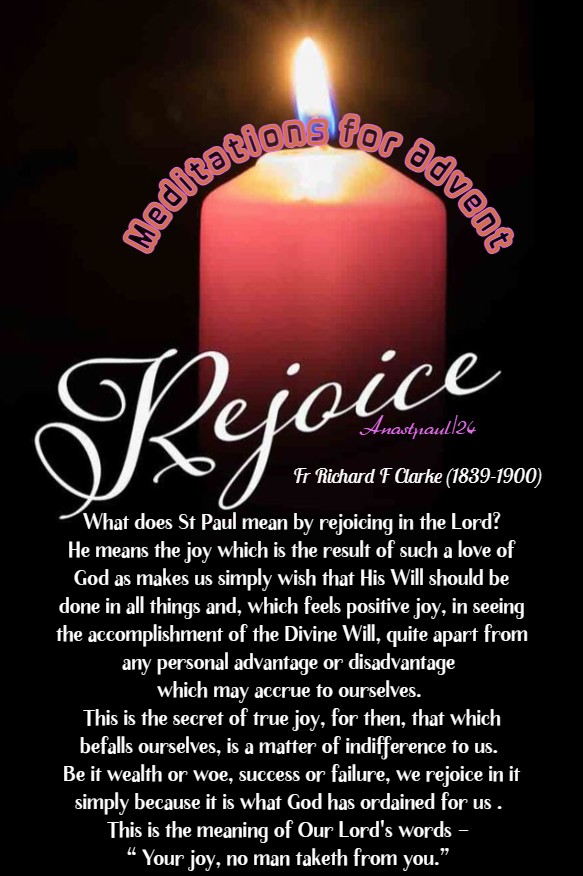
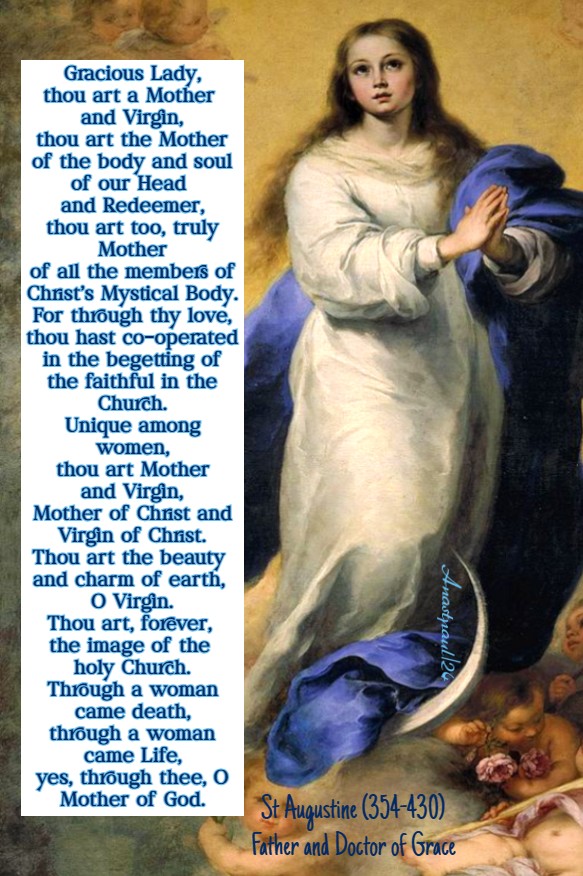
Thought for the Day – 13 July – Meditations with Fr Richard Frederick Clarke SJ (1839-1900) Today we begin a new seriest with Fr Clarke having completed “Patience.” I believe we still have a week or so of “Humility” to complete.
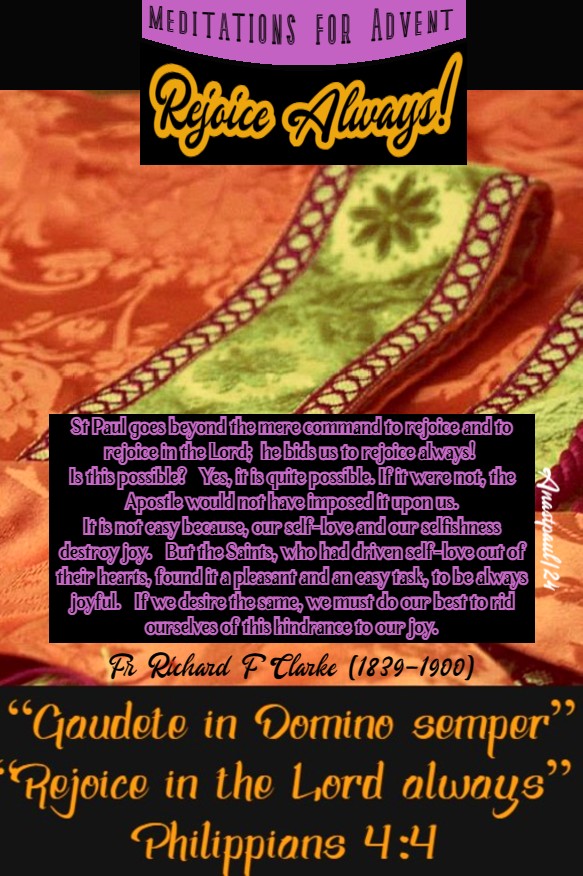
CHARITY Meditations for a Month
The Definition of Charity What is Charity?
Charity is an infused virtue, by which we love God for His own sake and above all things and our neighbour as ourselves, for the love of God. It is the best gift which God Himself can give, the gift compared to which, all other gifts are insignificant and worthless. It is the end and aim, the perfection and the crown of the Christian life. If we possess it, we have all things; if we possess it not, we have nothing; we are miserable and wretched and poor and blind and naked before God. Pray that God may teach you to know and to love His Divine gift.
Charity is called an infused virtue, because we can only obtain it, if God shall please to pour it into our soul. No amount of practice can make it ours. No natural benevolence will develop into charity, unless God adds that supernatural character which alone can render it pleasing in His sight and meritorious of eternal life. We must carefully distinguish natural from supernatural charity and we must beware of being satisfied with the former.
Charity is one of the virtues called “Christian virtues,” inasmuch, as their model and type, is the Life of Christ upon earth because, they unite us to Christ and make us like unto Him. It is true that charity is, in itself, pre-eminently the Christian virtue and when Saint Paul says, “Put ye on the Lord Jesus Christ” (Romans 13:14), he refers alone to the virtue of charity, with which we must be clothed, if we are to be the servants and followers of our Lord. Can I say I am clothed with charity, so all around me see it? Do they not too often detect in me, a lamentable want of this virtue?
Quote/s of the Day – 13 July – “The Month of the Most Precious Blood” – St Anacletus (c25-c89) 3rd Bishop of Rome and Martyr – 1 Petet 5:1-4; 5:10-11: Matthew 16:13-19 – Scripture search here: https://www.drbo.org/
“And I say to thee: That thou art Peter and upon this rock, I will build My Church and the gates of hell shall not prevail against it.”
Matthew 16:18
“… About the fourth watch of the night, He came towards them, walking upon the sea …”
Mark 6:48
“In the expression “fourth watch of the night” we find the number corresponding to the signs of His care. Thus, the first watch was that of the Law; the second, that of the Prophets; the third, that of His coming in the flesh; the fourth is situated in His return in glory. But He will find the Church declining and hemmed in by the spirit of the Antichrist and all the distresses of this world. He will come when anxieties and afflictions are at their height … The disciples will be terrified even by the coming of the Lord, fearing the images of a reality distorted by Antichrist and by the deceitful imaginations infiltrating their sight. But our good Lord will speak to them directly, casting out their fear and saying: “It is I”, dispersing their fear of imminent shipwreck by faith in His coming! ”
St Hilary (315-368) Bishop of Poitiers, Father & Doctor of the Church
“We, as Catholics, are not permitted to believe anything of our own will, nor to choose, what someone has believed, of his [own will]. We have God’s Apostles as authorities, who did not themselves, of their own wills, choose anything of what they wanted to believe but faithfully transmitted, to the nations, the teachings of Christ.”
St Isidore of Seville (c560-636) Father & Doctor of the Church
“Let us trust in Him. Who has placed this burden upon us. What we ourselves cannot bear, let us bear, with the help of Christ. For He is All-powerful and He tells us: ‘My yoke is easy and my burden light.’”
St Boniface (c672-754) Martyr
“Thus we do not say that the Pope cannot err in his private opinions, as did John XXII; or be altogether a heretic, as perhaps Honorius was. Now, when he, [the Pope], is explicitly a heretic, he falls ipso facto, from his dignity and OUT of the Church! …
St Francis de Sales (1567-1622) Doctor of the Church
One Minute Reflection –13 July – “The Month of the Most Precious Blood” – St Anacletus (c25-c89) 3rd Bishop of Rome and Martyr – 1 Petet 5:1-4; 5:10-11: Matthew 16:13-19 – Scripture search here: https://www.drbo.org/
“And I say to thee that thou art Peter and upon this rock I sgall build My Church …” – Matthew 16:18
REFLECTION – “Thou art Peter and upon this rock I shall build My Church.” He was given this name of ‘Peter’ because he was the first to set the foundations of the faith among the nations and because, he is the indestructible rock on which rests the judgement seat and the whole edifice, belonging to Christ Jesus. It was on account of his faithfulness that he was called Peter, whereas our Lord receives the same Name on account of His power according to Saint Paul’s words: “They drank from a spiritual Rock which followed them and that Rock ,was the Christ” (1 Cor 10:4). Yes, the Apostle chosen to be His co-worker merited to share the same Name as Christ. They built the same building together – Peter does the planting, the Lord gives the increase and it is the Lord, too, Who sends those who will do the watering (cf 1 Cor 3:6).
As you know, my beloved, it was following on from his own failure, when our Saviour suffered that blessed Peter was raised up. It was after he had denied the Lord that he became the first next to Him. Rendered more faithful when he wept over the faith he had betrayed, he received a still greater grace than the one he had lost. To him, Christ confided his flock, so that he might guide it like a good shepherd and he, who had been so weak, would now become the support of all. He, who had fallen, when questioned about his faith, must now establish the others on the unshakeable foundations of faith. Hence, he is called the foundation-stone of the piety of the Church.” – St Augustine (354-430) Father and Doctor of Grace (Sermon attributed to Saint Augustine).
PRAYER – Look forgivingly on thy flock, Eternal Shepherd, and keep it in thy constant protection, by the intercession of blessed Anacletus thy Martyr and Sovereign Pontiff, whom thou didst constitute Shepherd of the whole Church.Through the same Jesus Christ, Thy Son our Lord, Who lives and reigns with Thee, in the unity of the Holy Ghost, God, world without end. Amen (Collect).
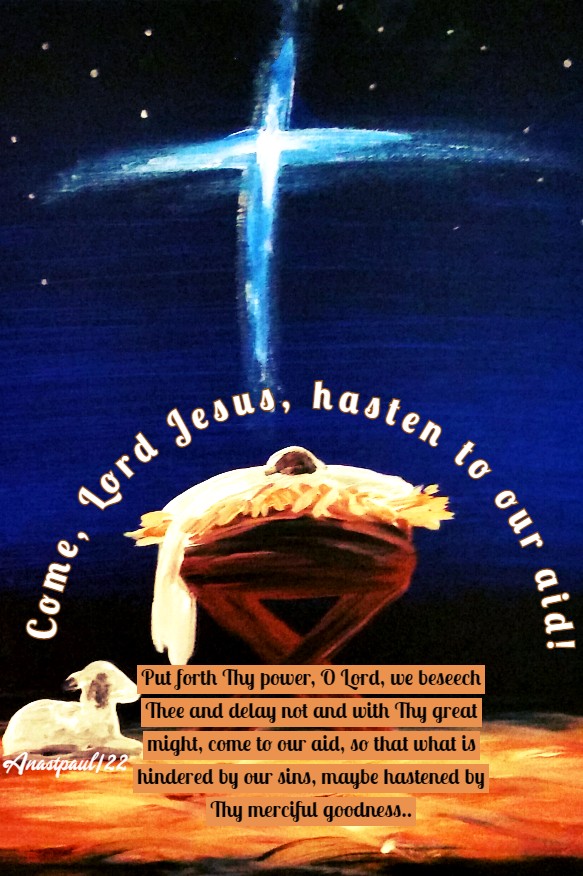
Saint of the Day – 13 July – Saint Arno of Würzburg (Died 892) Bishop Martyr. Born at an unknown location in the 9th Century and died on 13 July 892 at Chemnitz, Saxony (in modern Germany). Also known as – Artno, Arn. His name means ‘the eagle‘ in old high German.
Arno was a student of the Bishop of Würzburg, Gozbald. In 855 he was made Bishop of Würzburg by the King of the East Frankish Empire, Louis the German.
Arno had the Cathedral built there which was then dedicated to St Kilian and was constructed on the site of the the Cathedral of the Saviour which had burned down in 855.
Under Arno’s Episcopal leadership, 9 new Churches were built in 10 years, mostly situate in the east of his Diocese, . He repeatedly took part in Imperial conferences and Imperial Synods and also participated in four of the King’s military campaigns: against the Bohemians , the Moravians , the Normans and against the Sorbs. During the latter campaign he was killed by pagan Sorbs – during the celebration of Holy Mass.
Würzburg Cathedral
Arno died near Chemnitz in Saxony, in the district of Klaffenbach an old Stone Cross marks the possible place of death. Another possible place is Herrenhaide – a district of Burgstädt near Chemnitz – where a Memorial was erected in 2006. According to tradition, his Grave was in the – now demolished – Jacobi Church near the Castle in Colditz. Today his Gravestone is kept in the nearby Church of St Aegidien. Formal recognition of his cult was finally approved in the 18th Century although it had been highly active especially in the Franconia region for centuries.
Our Morning Offering – 13 July – Feast of the Most Holy Name of Mary
Mother Mary, Queen Most Sweet! Attrib. to St Alphonsus de Liguori (1696-1787) Most Zealous Doctor Italian Hymn Trans. Fr Edmund Vaughan CSSR (1827-1908)
Mother Mary, Queen most sweet! Joy and love my heart inflame; Gladly shall my lips repeat Every moment thy dear name.
Ah! that name, to God so dear, Has my heart and soul enslaved; Like a seal it shall appear Deep on heart and soul engraved.
When the morning gilds the skies, I will call on Mary’s name; When at evening twilight dies, Mary, still will I exclaim.
Sweetest Mary, bend thine ear: Thou my own dear mother art; Therefore, shall thy name so dear Never from my lips depart.
If my soul is sore oppress’d By a load of anxious care, Peace once more will fill my breast When thy name re-echoes there.
Waves of doubt disturb my peace, And my heart is faint with fear; At thy name the billows cease, All my’terrors disappear.
When the demon hosts invade,— When temptation rages high, Crying, “Mary, Mother! aid!” I will make the tempter fly.
This shall be my comfort sweet, When the hand of death is nigh, Mary! Mary! to repeat Once again—and then, to die.
This Hymn is an Anonymous Hymn belonging to the Redemptorist tradition but Hymnary.org attributes it to St Alphonsus Liguori. “Hymns and Verses on Spiritual Subjects” (1863) notes that this is one of two Hymns, translated in that book, mentioned above, which come from a Neapolitan published collection of Mission Hymns which are attributed to St Alphonsus.
Bl Anne-Andrée Minutte St Arno of Würzburg (Died 892) Bishop Martyr Bl Berthold of Scheide St Dogfan Bl Élisabeth Verchière St Esdras the Prophet St Eugene of Carthage St Giustina of Arzano
St Iosephus Wang Kuiju
Blessed James of Voragine OP (c1226 – 3 or 16 July 1298) Italian Archbishop of Genoa, Author of the ‘Golden Legend’ (a collection of lives of Saints and treatises on Christian festivals, one of the most popular religious works of the Middle Ages and is still published and referred to today – completed 1265), Priest and Friar of the Order of Preachers of St Dominic, Writer, Scholar of great genius, Prior and Provincial General of the Order. Blessed James was Beatified on 11 May 1816 by Pope Pius VII. Biography: https://anastpaul.com/2021/07/13/saint-of-the-day-13-july-blessed-james-of-voragine-op-c-1226-1298-author-of-the-golden-legend/
Bl Jean of France St Joel the Prophet Bl Marie-Anastasie de Roquard Bl Marie-Anne Depeyre Bl Marie-Anne Lambert
St Muritta of Carthage St Myrope St Salutaris of Carthage St Sarra of Egypt St Serapion of Alexandria Serapion of Macedonia St Silas (1st Century) Disciple of Sts Paul and Barnabas Bl Thérèse-Henriette Faurie Bl Thomas Tunstal
Martyrs of Cyprus – 300 Saints: 300 Christians who retired to Cyprus to live as cave Hermits, devoting themselves to prayer and an ascetic life devoted to God. Tortured and Martyred for their faith and their bodies thrown into the various caves in which they had lived. We know the names of five of them but no other details even about them – Ammon, Choulélaios, Epaphroditus, Eusthénios and Héliophotos. They were beheaded in the 12th century on Cyprus and their bodies dumped in the cave where they had lived and only rediscovered long afterwards.
Martyrs of Philomelio – 31 Saints: 31 soldiers Martyred for their faith in the persecutions of prefect Magno, date unknown. The only name that has come down to us is Alexander. In Philomelio, Phrygia (in modern Turkey).
Thought for the Day – 12 July – Meditations with Fr Richard Frederick Clarke SJ (1839-1900)
PATIENCE Meditations for a Month Today is the Last Meditation
The Third Fruit of Patience: – Joy
‘As it were, sorrowing yet always rejoicing.‘ (2 Cor 6 : 10) This is St Paul’s description of the ministers of Christ, labouring for the salvation of souls. What is true of them, is true of all faithful servants of God. On the surface ,apparent misery but down in the depths of the soul, intense joy. Of this joy, St Paul says: ‘I am filled with comfort and exceedingly abound with joy. in all our tribulation. (2 Cor 7 : 4) What is it that works this charm? Patience!. Patient endurance, humble submission to the Will of God, resignation to His Providence.
How is it that out of sorrow, joy can come? The reason is that if we are living for God and in dependence upon Him and seeking to promote His glory, then, although in the natural order we may be crushed down with pain and suffering, we shall be full of joy by reason of the supernatural gladness which God bestows upon us. ‘Your joy,‘ says our Lord to His Apostles, ‘no man shall take from you.’ (St John 16 : 22) Have I any experience of this joy? If so, I shall thank God for it; if not, I must wait patiently and see whether there may not be some hindrance to it, on my part.
Whence comes this joy? From Heaven. This is why it surpasses all earthly joy and makes earthly sufferings sweet. It is the first faint reflection of the Light of Heaven, amid the clouds and darkness of earth – the first foretaste of the joy into which the just will be welcomed by their Lord at the Gate of Heaven. If one drop of it sweetens all bitterness on earth and makes all sufferings light, what must be the intensity of joy which will inebriate all those who have here endured tribulation and suffering for Christ’s sake?
Quote/s of the Day – 12 July – “The Month of the Most Precious Blood” – St John Gualbert (c985-1073) Abbot, “The Merciful Knight”– Ecclesiasticus 45:1-6, Matthew 5:43-48 – Scripture search here: https://www.drbo.org/
“But I say to you, love your enemies …” Matthew 5:44
St John Gualbert said to his enemy, “I cannot refuse what you ask in Christ’s Name. I grant you your life and I give you my friendship. Pray that God may forgive me my sin.”
St John Gualbert (c985-1073) “The Merciful Knight”
“What is the surest kind of witness? “Anyone who acknowledges that Jesus Christ came among us in the flesh” (cf 1 Jn 4:2) and who keeps the commands of the Gospel… How many there are, each day, of these hidden martyrs of Christ who confess the Lord Jesus! … So be faithful and courageous in interior persecutions, so that you may also win the victory in exterior persecutions.”
St Ambrose (340-397) Father & Doctor of the Church
“… Every man is both debtor and creditor… A beggar asks you for alms but you, too, are God’s beggar, for when we pray we are all beggars of God. We stand – or rather, prostrate ourselves – at our Father’s door (cf Lk 11:5); we beseech Him with groans, anxious to receive a grace from Him and this grace is God Himself! What does the beggar ask of you? Bread. And what is it that you are asking of God but Christ, Who said: “I am the Living Bread come down from Heaven” (Jn 6:51).”
St Augustine (354-430) Father and Doctor of Grace
“You must be reconciled to your enemies, speak to them, as if they had never done you anything but good, all your life, keeping nothing in your heart but the charity, which the good Christian should have, for everyone, so that we may all appear with confidence, before the tribunal of God.”
One Minute Reflection – 12 July – “The Month of the Most Precious Blood of Jesus” – St John Gualbert (c985-1073) Abbot – Ecclesiasticus 45:1-6, Matthew 5:43-48 – Scripture search here: https://www.drbo.org/
“But I say to you, Love your enemies …” Matthew 5:44
REFLECTION – “Let us pay attention, all my brothers, to what the Lord says: “Love your enemies and do good to those who hate you,” for our Lord Jesus Christ, Whose footprints we must follow (cf 1 Pt 2:21), called His betrayer “friend” (Mt 26:50) and gave Himself willingly to those who Crucified Him. Our friends, then, are all those who, unjustly afflict upon us, trials and ordeals, shame and injuries, sorrows and torments, martyrdom and death! We must love them greatly, for we will possess eternal life because of what they bring upon us.” – St Francis of Assisi (c1181-1226) Founder of the Friars Minor (Earlier Rule, #22).
PRAYER – May the intercession of the blessed Abbot John commend us to Thee, O Lord, so that through his merits we may obtain that which we cannot accomplish by our own. Through Jesus Christ, Thy Son our Lord, Who lives and reigns with Thee, in the unity of the Holy Ghost, God, world without end. Amen (Collect).Through the same Jesus Christ, Thy Son our Lord, Who lives and reigns with Thee, in the unity of the Holy Ghost, God, world without end. Amen (Collect).

Our Morning Offering – 12 July – “The Month of the Most Precious Blood”and a Friday of the Passion
Constant Prayer to the Precious Blood of Jesus By St Catherine of Siena (1347-1380) Doctor of the Church
Precious Blood, Ocean of Divine Mercy, Flow upon us! Precious Blood, Most Pure Offering, Procure us every grace! Precious Blood, Hope and Refuge of sinners, Atone for us! Precious Blood, Delight of holy souls, Draw us! Amen
Saint of the Day – 12 July – Saint Viventiolus of Lyons (c460–524) Bishop, Scholar, Spiritual Writer, Monk of Condat, an Abbey which boasted an important school. He was a teacher there and his knowledge was great. Born in Lyons in c460 and died there in 524 of natural causes. Also known as – Juventiole, Vivientol, Viventiole, Vivenziolo.
Lyons Cathedral Basilica
Viventiolus and his brother Rusticus were the sons of Aquilinus (c430-c470), a nobleman of Lyons and friend of St Sidonius Apollinaris. Aquilinus was a Priest of a Province in Gaul between 423 and 448 under Apollinaris, the father of Sidonius.
Through his paternal grandmother, Tullia, Viventiolus was the great-grandson of Saint Eucherius.
Viventiolus was a Monk in Jura, where he was elected Prior. Due to our Saint’s great learning and leadership abilities, St Avitus the Archbishopof Vienne, recommended him for the See of Lyons and his own Episcopal school there.
The Interior of the Apse of Lyons Cathedral Basilica
In 516-517, he and St Avitus presided over the Council of Agaune. From this Council we have received a large part of the speech he made there. Viventiolus speaks, with great finesse and great mystical depth, of the cloisters from which he desired reform, in order to eradicate the ignorance prevalent amongst the Monks.
He is also the Author of a book “The Lives of the Jura Fathers” which described the beginnings of monasticism in that region.
Bl Conrad of Maleville Bl David Gonson St Epiphana St Faustus the Soldier St Felix of Milan * Commemorated with St Nabor St Fortunatus of Aquileia (1st Century – Died c66) Deacon St Hermagorus of Aquileia (1st Century – Died c 66) Bishop, Disciple of St Mark the Evangelist Bl Guy Vignotelli St Hilarion of Ancyra St Jason of Tarsus Bl Jeanne-Marie de Romillon
Bl Madeleine-Thérèse Talieu Bl Marguerite-Eléonore de Justamond Bl Marie Cluse St Menas the Soldier St Menulphus of Quimper St Nabor of Milan * Commemorated with St Felix St Paternian of Bologna St Paulinus of Antioch St Phêrô Khan St Proclus of Ancyra St Proculus of Bologna St Uguzo of Carvagna St Ultán
St Viventiolus of Lyons (c460–524) Bishop
Three Holy Exiles: Three Christian men who became Benedictine Monks at the Saint James Abbey in Regensburg, Germany, then Hermits at Griestatten and whose lives and piety are celebrated together. – Marinus, Vimius and Zimius.
Martyrs of Rome – Four members of the Imperial Roman nobility. They were all soldiers, one or more may have been officers, and all were Martyred in the persecutions of Diocletian – Basilides, Cyrinus, Nabor and Nazarius. Died in c 304 outside Rome, Italy and were buried there along the Aurelian Way.
Martyrs of Nagasaki – 8 Beati: Additional Memorial – 10 September as one of the 205 Martyrs of Japan Eight lay people, many them related to each other, who were martyred together: Catharina Tanaka, Ioannes Onizuka Naizen, Ioannes Tanaka, Ludovicus Onizuka, Matthias Araki Hyozaemon, Monica Onizuka, Petrus Araki Chobyoe, Susanna Chobyoe, 12 July 1626 in Nagasaki, Japan. Beatified on 7 May 1867 by Pope Blessed Pius IX.
Thought for the Day – 11 July – Meditations with Fr Richard Frederick Clarke SJ (1839-1900)
PATIENCE Meditations for a Month
The Second Fruit of Patience: – Hope
‘Patience,’ says St Paul, ‘works out our trial and trial, hope.‘ (Romans 5 : 4) If we humbly accept the sufferings God sends us without rebellion or complaint, then, we reap the reward in rapid growth of hope within our heart. Through the darkness, we descry a bright light in the distance and, although our path be a dreary and a painful one, this prospect cheers us and makes us go on our way, rejoicing. In the earlier part of the time of trial, hope was dim and faint but, when we have been proved faithful servants, hope begins to anticipate the future and to fill us with a happiness which makes the present sufferings comparatively light. Have I attained that happy state?
Joined to this prospect of the future, is a great confidence in God, in the present! Confidence is part of hope. When we have learned, by patience, to trust Him amid sorrow, tribulation, disappointment, then, we have a solid foundation for trusting Him, all the rest of our lives, not only with a sort of blind assurance that all He does is best but, with a consciousness of the happy results to come, from all that patience bids us bear, results, too which we begin to experience even here. I must then aim at this confidence and pray that I may gain it, by patience.
St Paul tells us that if we hope for that which we see not, we have to wait for it, for the perfect ,work of patience, is to wait contentedly for the time, when God will give us the good things He has promised us. This was the Apostle’s frame of mind when he said: ‘I have fought a good fight, have kept the faith, at the last there is laid up for me, a crown of justice.’ (2 Timothy 4 : 7) So, too, for me, if I persevere to the end, there is laid up a like crown. The thought of it shall animate me to fresh patience.
Quote/s of the Day – 11 July – St Pius I, Pope (Died c 154) Martyr – 1 Peter 5:1-4; 5:10-11, Matthew 16:13-19 – Scripture search here: https://www.drbo.org/
“Thou art the Christ, the Son of the living God.”
Matthew 16:16
“But the God of all grace, Who hath called us into His eternal glory in Christ Jesus, after you have suffered a little, will Himself perfect you and confirm you and establish you. To Him be glory and empire forever and ever. Amen.”
1 Peter 5:10-11
“Wake up then, believer and note whatis stated here: “In My Name.” That [Name] is Christ Jesus. Christ signifies King, Jesus signifies Saviour. Therefore, whatever we ask for that would hinder our salvation, we do not ask in our Saviour’s Name and yet, He is our Saviour, not only when He does what we ask but also, when He does not. When He sees us ask anything to the disadvantage of our salvation, He shows Himself our Saviour by not doing it. The physician knows whether what the sick person asks for, is to the advantage or disadvantage of his health. And [the physician] does not allow what would be harmful to him, although the sick person himself, desires it. But the physician looks to his final cure.”
St Augustine (354-430) Father and Doctor of Grace of the Church
“The Kingdom of Heaven, says the Gospel, is like a mustard seed … Christ is the Kingdom of Heaven! Sown like a mustard seed in the garden of the Virgin’s womb, He grew up into the Tree of the Cross, whose branches, stretch across the world … Christ is the Kingdom because all the glory of His Kingdom, is within Him. Christ is a Man because all humanity is restored in Him. Christ is a Mustard Seed because the infinitude of Divine greatness, is accommodated to the littleness of flesh and blood!”
St Peter Chrysologus (c 400-450) “Golden Words” Father & Doctor of the Church
“May Christ be heard in our language, may Christ be seen in our life, may He be perceived in our hearts”
St Peter Damian (1007-1072) Doctor of the Church
“He is the origin of all wisdom. The Word of God in the heights, is the source of wisdom. Christ is the source of all true knowledge, for He is “the way, the truth and the life.” (Jn 14:6). … As way, Christ is the teacher and origin of knowledge … Without this Light, which is Christ, no-one can penetrate the secrets of faith.”
One Minute Reflection – 11 July – “The Month of the Most Precious Blood” – St Pius I, Pope (Died c 154) Martyr – 1 Peter 5:1-4; 5:10-11; Matthew 16:13-19 – Scripture search here: https://www.drbo.org/
“Upon this rock I will build My Church” – Matthew 16:18
REFLECTION – “Brothers, when it comes to fulfilling my duties as Bishop, I discover that I am weak and slack, weighed down by the weakness of my own condition, while at the same time, I want to act generously and courageously. However, I draw my strength from the untiring intercession of the almighty and eternal Priest, Who, like us but equal to the Father, lowered His Divinity to the level of man and raised humankind to the level of God. The decisions He made, give me a just and holy joy. For, when He delegated many shepherds to care for His flock, He did not abandon watching over His beloved sheep. Thanks to that fundamental and eternal assistance, I in turn, have received the protection and support of the Apostle Peter, who also does not abandon his function. This solid foundation, on which the whole of the Church is built, never grows tired of carrying the whole weight, of the building which rests upon it.
The firmness of faith, for which the first of the Apostles was praised, never fails. Just as everything which Peter professed in Christ remains, so that which Christ established in Peter, remains … The order willed by God’s Truth remains. Saint Peter perseveres in the solidity which he received; he has not abandoned the governance of the Church which was placed in his hands. That, my brothers, is what that profession of faith, inspired by God the Father, obtained in the heart of the Apostle. He received the solidity of a rock which no assault can shake. In the entire Church, Peter says everyday: “Thou art the Messiah, the Son of the living God.” – St Leo the Great (400-461) Pope, Father and Doctor of the Church (Sermon on the anniversary of his Consecration as Bishop).
PRAYER – Look forgivingly on thy flock, Eternal Shepherd and keep it in Thy constant protection, by the intercession of blessed Pius thy Martyr and Sovereign Pontiff, whom Thou didst constitute Shepherd of the whole Church.. Through the same Jesus Christ, Thy Son our Lord, Who lives and reigns with Thee, in the unity of the Holy Ghost, God, world without end. Amen (Collect).
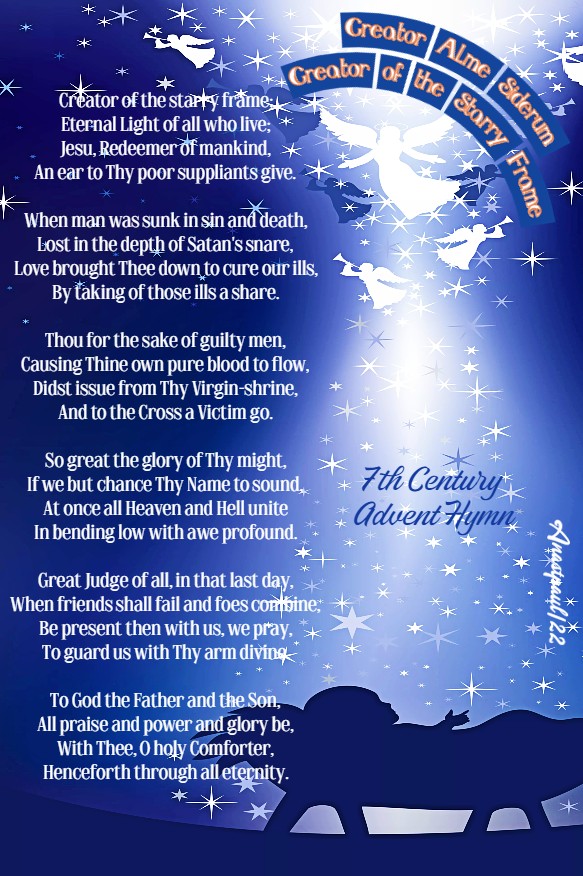
Almighty God, Open Thou My Heart A Prayer for Guidance By St Bede the Venerable (673-735) Father and Doctor of the Church
ALMIGHTY God, open Thou my heart and enlighten me with the grace of the Holy Spirit, to see those things which are well-pleasing to Thy will. Direct my thoughts and understanding to those things which it is proper to meditate upon and to take in hand; in such fashion, as by fitting character and deeds, I might be found worthy of the eternal joy of heavenly life. Direct my acts to Thy commandments, that I might, by labour so unbrokenly study to bring them to fulfilment, as to attain to an everlasting reward. Amen
Saint of the Day – 11 July – Saint Berthevin of Laval (10th Century) Deacon Martyr, Hermit, Teacher. We believe he was born in Parigny, in the region of Lisieux, France and died in Laval by being murdered. Also known as – Berthevin of Laval, Berthevin of Parigny, Berthevin of Vicoin, Berthevin of Val-Guidon, Bertevin, Bertewin, Bertewinusn Berthvinn Berthwinus, Bertininus, Bertivinus, Bertunius, Bertunus, Bertuwinus, Bertuwius, Bertwin, Brévin. Additional Memorials – 11 June (translation of Relics) and 8 September on some calendars.
Berthevin was a member of the noble family of Argence. He is said to be the son of Pierre d’Argence. A village of the same name St Berthevin, still exists in Parigny today.
What we know about Saint-Berthevin was transcribed by a Monk of Mont Saint-Michel in the 12th or 14th Century.
Saint-Berthevin, a Cleric from Parigny in Normandy, became a Hermit to escape the Norman invaders. The Lord of Laval , noticed his virtues and he charged him with ensuring the education of his children. Berthevin carried out his new function with zeal. As soon as he had the leisure, he would retire to his old Hermit’s cave to pray and instruct thimself and he children of the surrounding area.
His Vita tells us that, while carrying out his duties with prudence and justice, he studied Sacred Scripture and spiritual literature and went to pray every day in a Church dedicated to Saint Nicholas .
Having gained the full trust of his Master, other servants killed him out of jealousy and threw his body into a river near which he was accustomed to pray. But then, fearing that his body would be discovered, they hid it, in turn, in a fountain in the Vicoin, before hoisting it into the crevice of a cliff overlooking the Vicoin. It was there that his godmother, warned by a heavenly voice, came to collect his body and brought it to Parigny.
St Pius I, Pope (Died c 154) Martyr – The Ninth Successor of St Peter. Papal Ascension c 142. Born at Aquileia, Italy and died in Rome. The Roman Martyrology states of him today: “At Rome, the blessed Pius, Pope and Martyr, who was crowned with Martyrdom in the persecution of Marcus Aurelius.” His Life and Death: https://anastpaul.com/2021/07/11/saint-of-the-day-11-july-saint-pope-pius-i-died-c-154/
St Abundius of Ananelos St Amabilis of Rouen St Anna An Jiaoshi St Anna An Xingshi Bl Antonio Muller St Berthevin of Laval (Died 10th Century) Deacon Martyr St Cindeus St Cowair St Cyprian of Brescia St Cyriacus the Executioner St Hidulf of Moyenmoutier St Januarius St John of Bergamo
St Leontius the Younger St Marcian of Lycaonia St Marciana of Caesarea Bl Maria An Guoshi Bl Maria An Linghua Bl Marie-Clotilde Blanc Bl Marie-Marguerite de Barbégie d’Albrède
St Olga Queen of Kiev (c 890-969) She was known as a ruthless and effective ruler but “when Olga was enlightened, she rejoiced in soul and body. The Bishop, who instructed her in the faith, said to her, ‘Blessed art thou among the women of Rus,’,for thou hast loved the light and quit the darkness. The sons of Rus’ shall bless thee to the last generation of thy descendants.” About St Olga: https://anastpaul.com/2020/07/11/saint-of-the-day-11-july-saint-olga-queen-of-kiev-c-890-969/
St Placidus of Disentis * (7th Century) Monk (see below)
Bl Rosalie-Clotilde Bes St Sabinus of Brescia St Sabinus of Poitiers St Sidronius
Thought for the Day – 10 July – Meditations with Fr Richard Frederick Clarke SJ (1839-1900)
PATIENCE Meditations for a Month
The First Fruit of Patience: – Peace
We all long after peace; we are anxious, not for inactivity, nor indeed that we should have nothing against which to fight but, for the absence of that conflict within us which is the source of all our misery. It is the struggle, in our own hearts, between two opposing forces of duty and inclination, which troubles and disturbs us. I f this struggle is to cease, one of these two forces must be crushed. It is the process of crushing our corrupt inclinations which we dread. We have not the necessary courage, although we know that the only way to peace is to mortify our members which are upon the earth. This is the story of my troubles, I have not conquered my lower nature and my self-will!
How is the victory to be gained and peace restored to our hearts? It is impossible without suffering. Nothing else has the power to break our proud wills and make us put our stubborn necks beneath the yoke. We speak of those who have suffered, as having a chastened look and it always attracts us. There is in suffering a sort of supernatural force which ought to commend it to us, or at least, to reconcile us to it. If I have to suffer, I will think of this and console myself with knowing that God will bring peace and happiness out of it.
But, it is not all suffering which has this wholesome effect but only suffering borne with patience. If we are impatient, rebellious, unresigned – our suffering maybe an occasion of fresh trouble, rather than of peace. I must accept it from the Hand of God, if it is to bring with it that quiet tranquillity which I have never yet attained as I fight. I must bow my head and place myself in God’s Hands to suffer, as He pleases, whatever He pleases, as long as He pleases. This is the only road to solid peace!
Quote/s of the Day –10 July – Proverbs 31:10-31, Matthew 12:46-50 – Scripture search here: https://www.drbo.org/
“For whoever does the Will of My Father in Heaven, is My brother and My sister and My mother.”
Matthew 12:50
“Unfurl the sails and let God steer us where He will.”
St Bede the Venerable (673-735) Confessor, Father and Doctor of the Church
“No-one will have any other desire in Heaven than what God wills and the desire of one, will be the desire of all and the desire of all and of each one, will also be the desire of God.”
St Anselm (1033-1109) Archbishop of Canterbury
“Strive to be faithful to that which God has called you.”
St Angelica de Merici (1474-1540) Virgin
“It is impossible, that he could be denied the favours for which he asks and which we should request him to obtain for us. Let us go to him trustingly but, let us remember, that the surest way of being heard by him, is to imitate his wonderful virtues, especially his humility, his spirit of prayer, his purity and his calm desire always, to do God’s will.”
One Minute Reflection – 10 July – “The Month of the Most Precious Blood of Jesus” – St Rufina and St Secunda of Rome (3rd Century) Virgin Martyrs – Proverbs 31:10-31, Matthew 12:46-50 – Scripture search here: https://www.drbo.org/
“For whoever does the will of My Father in heaven, is My brother and My sister and My mother.” – Matthew 12:50
REFLECTION – “I beg you to listen to what the Lord had to say when He stretched out His hand towards His disciples: “Here are My mother and My brethren” and, “whoever does the will of My Father in heaven, is My brother and My sister and My mother.”Are we to take it from this that the Virgin Mary did not do the will of the Father, she who by faith believed, by faith conceived; she who was chosen to bring forth salvation on our behalf and who, was by Christ created that Christ in her, might be created? Indeed and indeed, she did the Father’s will and it is a greater thing for Mary that she was Christ’s disciple, than that she was His Mother. It is a happier thing to be His disciple, than to be His Mother. Blessed then is Mary, who bore her Lord in her body, before she gave Him birth…
Mary is holy. Mary is blessed. Yet the Church is greater than she is. What reason do I bring? Mary is part of the Church. She is a holy member of the Church; she is THE holy member; she is the member above all member hut, she is still one member of the whole body… Brothers, listen very closely – you are members of Christ’s body and you are the body of Christ (1 Cor 12:27). And this is how you are what He said: “Here are My mother and My brothers.” But how does this prove you are Christ’s mother? He goes on: “Whoever hears and whoever does the will of my heavenly Father, is My brother and My sister and My mother.” – St Augustine (354-430) Father and Doctor of the Church (Sermon 25 on Saint Matthew).
PRAYER – Grant, we beseech Thee, Almighty God, that we, who know how courageously Thy holy Martyrs have confessed the faith, may experience their goodness as they intercede for us with Thee.Through the same Jesus Christ, Thy Son our Lord, Who lives and reigns with Thee, in the unity of the Holy Ghost, God, world without end. Amen (Collect).
Our Morning Offering – 10 July – “The Month of the Most Precious Blood”
I Love Thee, O My God By St John Marie Baptiste Vianney (1786-1859)
I love Thee, O my God and my only desire is to love Thee until the last breath of my life. I love Thee, O my infinitely lovable God and I would rather die loving Thee than live without loving Thee. I love Thee, Lord and the only grace I ask, is to love Thee eternally. My God, if my tongue cannot say in every moment that I love Thee, I wish my heart to repeat it to Thee as often as I draw breath! Amen
Saint of the Day – 10 July – Blessed Bernard of Quintavalle OFM (c1175-c1241) Friar of the Friars Minor, the first disciple of St Francis and is often called “First Fruits of the Minor Order.” Missionary, Master Provincial and trustworthy companion and legate of St Francis. He received. from St Francis on his deathbed, custody of the Friars Minor. He died nearly 20 years after St Francis. Born in c1175 in Assisi, Italy and died between 1241 and 1246 in Assisi of natural causes. Also known as – Bernard of Assisi, Bernardo… “First fruits of the Minor Order” (“Minorum Ordinis Prima Plantula”). Additional Memorial – 2 July on some calendars.
Bernard, son of Quintavalle di Berardello, was a wealthy young noble from Assisi. His family’s house still stands in Assisi to this day.
He studied at Bologna University receiving his Degree in both Civil and Canon Law. He also fought in the First Crusade.
He was a rich young merchant who became acquainted with St Francis when the Saint visited his palace. On the Feast of Saint Matthias, 24 February 1208, Francis had heard the Gospel, “And going, preach, saying: The Kingdom of Heaven is at hand. … Do not possess gold, nor silver, nor money in your purses … And when you come into the house, salute it, saying: Peace be to this house. … Behold I send you as sheep in the midst of wolves. Be ye therefore wise as serpents and simple as doves!” (Matthew 10:7-19).
Then Francis knew that his path was pointed out, took off his shoes and gave them away together with the staff and the belt. He put on an undyed woollen coat, tied it with a rope and went out as a beggar. This was the suit he gave to his brothers the following year.
Many began to admire Francis and some wanted to become his companions and disciples. The first of these was Bernard of Quintavalle. He sold everything he owned and shared the money among the poor and thus became the first fruit in the Order.
View of the Upper Basilica in Assisi
Peter of Cattaneo (Pietro Cattani), the Canon of the Cathedral of Assisi, also wanted to become Francis’s disciple and Francis gave them both the garb on 16 April 1208. The third to join them was the famous Blessed brother Giles , a man of great simplicity and spiritual wisdom. He arrived on 23 April.
Together with Francis, Bernard went to Rome to see Pope Innocent III (1198-1216) to obtain the approval of The Seraphic Rule (16 April 1209), then in 1211 he was in Florence and Bologna, places which can thank him for the beginning of his Franciscan presence in those Cities. Together with brother Giles, he travelled to Spain, where he was later,appointed as the Master Povincial (1217-1219). Between 1241 and 1243 he spent some time in Siena.
His date of death is not known, although some records declare it to have been 10 July 1241. What is quite clear, is that he was no longer alive on 11 August 1246, as his companions, the brothers Leo, Rufinus and Angelus, sent his memoirs of Francis to the General Minister and Crescentius and Bernard were then dead. He had died in Assisi as he had predicted and he is buried close to the Tomb of St Francis (below), in the Basilica of St Francis in Assisi. The Franciscan Martyrology commemorates him today, 10 July.
St Sylvanus of Pisidia Bl Sylvie-Agnès de Romillon St Waltram
Martyrs of Africa – 4 Saints: A group of Christians Martyred together in Africa. The only information that has survived are four of their names – Felix, Januarius, Marinus and Nabor.
Martyrs of Antioch – 10 Saints: A group of ten Christians Martyred together. We have no details about them but the names – Diogenes, Domnina, Esicius, Macarius, Maxima, Maximus, Rodigus, Timoteus, Veronia and Zacheus. They were martyred in Antioch, date unknown.
Martyrs of Damascus – 11 Beati: A group of Franciscans and laymen ordered by Druz Muslims to convert to Islam. They refused and were hacked to pieces. ‘Abd Al-Mu’ti Masabki Carmelo Bolta Bañuls Engelbert Kolland Francisco Pinazo Peñalver Fransis Masabki Juan Jacobo Fernández y Fernández Manuel Ruiz López Nicanor Ascanio de Soria Nicolás María Alberca Torres Pedro Soler Méndez Rufayil Masabki They were cut to pieces on 9-10 July 1860 in Damascus, Syria. Beatified on 10 October 1926 by Pope Pius XI.
Martyrs of Nicopolis – 45 Saints: A group of 45 Christians tortured and Martyred together in the persecutions of emperor Licinius. We know nothing else but six of their names – Anicetus, Anthony, Daniel, Leontius, Mauritius and Sisinno. c 329 in Nicopolis, Armenia (modern Koyulhisar, Turkey).
Martyrs of Nitria – 5 Saints: Fathers of Nitria – Four Monks and the Bishop of Alexandria, Egypt who were Martyred by heretics. Saint John Chrysostom wrote about them but their names have not come down to us. They were Martyred in the 4th century in Nitria, Egypt.
Thought for the Day – 9 July – Meditations with Fr Richard Frederick Clarke SJ (1839-1900)
PATIENCE Meditations for a Month
The Patience of the Holy Souls
In Purgatory the suffering is more intense than any suffering of this present life and there is greater need of patience to endure it. But the Holy Souls have their wills in perfect conformity to the Will of God and they cannot be anything but patient amid their torments. They do not and they cannot rebel but their submission does not remove the bitterness of their unceasing sorrow, as they think, how comparatively easy it would have been, for them to avoid, while still on earth, their present anguish, by greater faithfulness to grace and by uniting their actions and sufferings, to the actions and sufferings of the Divine Son of God.
If we could look forward to those sufferings, with an appreciation of what they are, how patient we should be now! We should consider it a privilege to suffer now, as the very best way of avoiding the agony of that fire which will be kindled, by the wrath of God and will, in some way, correspond to our ingratitude and unfaithfulness to our King and Benefactor. If no other motive makes me patient, under my earthly sufferings, yet at least, the prospect of long years of far worse sufferings, ought to make me choose the lighter suffering now. What am I doing to shorten my Purgatory?
3 The Holy Souls must sometimes think, reproachfully, how little their friends on earth do to aid them in their present sufferings. Among many other methods of aiding them, I can offer up for them all the pains of mind and body which God sends me, asking God to accept them in alleviation of the sufferings of the holy souls. This will help me to be patient and to suffer willingly and, when my time comes, I shall find that patient suffering for others, will shorten my time of banishment from God, in the fires of Purgatory.
Quote/s of the Day – 9 July – St John Fisher (1469-1535) Bishop, Martyr, Cardinal and St Thomas More (1478-1535) Martyr, Confessor.
“Contrition is to have sorrow at heart and great repentance of all sins and to have steadfast purpose to keep and abstain himself from all deadly sins. For he who has intention, to return to deadly sin, his confession avails him nothing!”
“Whether we eat or drink, wake or sleep, laugh or weep, our life here is always drawing to an end.”
“Is it not a wonderful thing that He, that is, the Lord and Author of all liberty, would thus be bound with ropes and nailed hand and foot unto the Cross? Thus, whoever, with a meek heart and a true faith, muses and marvels over this most wonderful book (I speak of the Crucifix), he shall come to more fruitful knowledge than many others who, each day, study their common books.”
St John Fisher (1469-1535) Bishop, Martyr, Cardinal
“The soul cannot thrive in the absence of a garden. If you do not want Paradise, you are not human and if you are not human, you do not have a soul!”
“We cannot go to Heaven in featherbeds.”
“[How can anyone] be silly enough to think himself better than others because his clothes are made of finer woolen thread than theirs.? After all, those fine clothes were once worn by a sheep and they never turned it into anything better than a sheep!”
“Pride thinks it’s own happiness shines the brighter, by comparing it with the misfortunes of others.”
One Minute Reflection – 9 July – “The Month of the Most Precious Blood” – Romans 6:19-23; Matthew 7:15-21– Scripture search here: https://www.drbo.org/
“By their fruits you shall know them. Do men gather grapes from thorns, or figs from thistles? ” – Matthew 7:16
REFLECTION – “Let us love God, my brothers, let us love God but let it be at the expense of our arms and the sweat of our brow. For only too often, so many of our acts of love for God, kindness, favour and other similar feelings and interior practices of the gentle heart, however good and desirable they are, are nevertheless, to be held in suspicion, when they do not at all bring us to practice actual love. Our Lord said: “My Father is glorified by this – that you bear much fruit” (Jn 15:8).
Now this is something about which we need to be very careful because, there are many who, so as to be exteriorly well-ordered and interiorly full of great feelings for God, stop at that. And when it comes to the point and they find themselves in a situation for action, they stop short. They pride themselves on their inflated imaginations; they are satisfied with the sweet exchanges they have with God in prayer; they even talk about it like Angels. But when they come away, is there any question of working for God, of suffering, practicing mortification, teaching the poor, searching for the lost sheep (Lk 15:4), being pleased when they lack something, accepting sickness or some other misfortune? Alas, then, there is no-one to be seen, courage fails them! No, let us not deceive ourselves – our whole task consists in progressing towards acts!” – St Vincent de Paul (1581-1660) Priest, Founder (Spiritual conferences to the Missionaries, Fragment 171).
PRAYER – From all perils of soul and body defend us, O Lord, we beseech Thee,and by the intercession of blessed and glorious ever Virgin Mary, Mother of God, of blessed Joseph, of thy blessed Apostles Peter and Paul and of blessed Martyrs St John Fisher, St Thomas More, St Maria Goretti and all the Saints, graciously grant us safety and peace that all adversities and errors being overcome, Thy Church may serve Thee in security and freedom.Through the same Jesus Christ, Thy Son our Lord, Who lives and reigns with Thee, in the unity of the Holy Ghost, God, world without end. Amen (Collect).
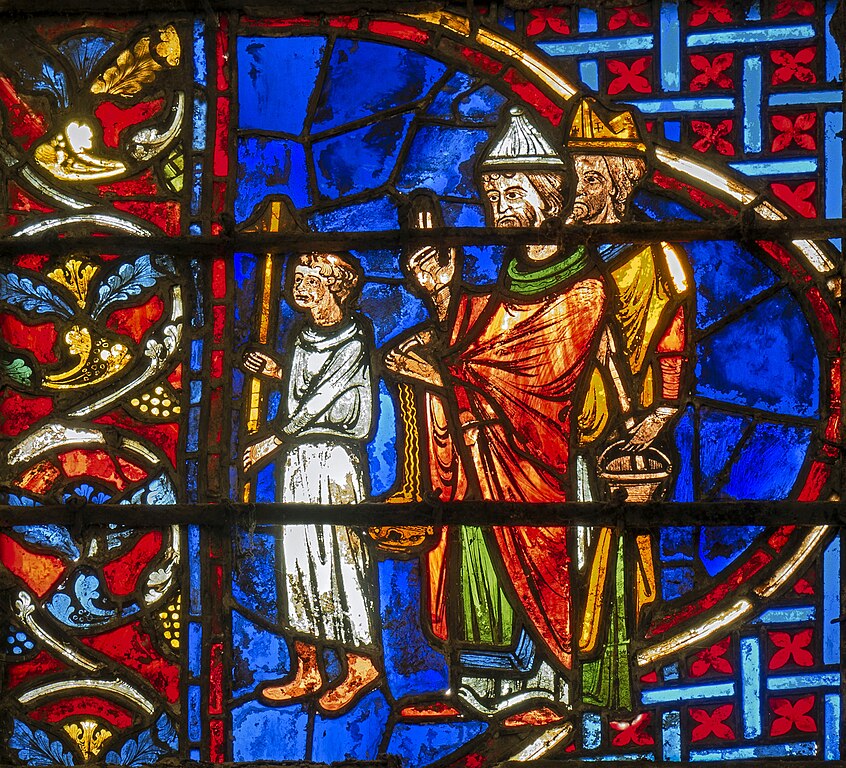
Our Morning Offering – 9 July– “The Month of the Most Precious Blood” – Feast of St Thomas More (1478-1535) Martyr, Confessor
O Lord, Grant Us … A Prayer of Petitio By St Thomas More (1478-1535)
O Lord, grant us a mind which is humble, quiet, peaceaable, patient and charitable and a taste of Thy Holy Ghost, in all our thoughts, words and deeds.
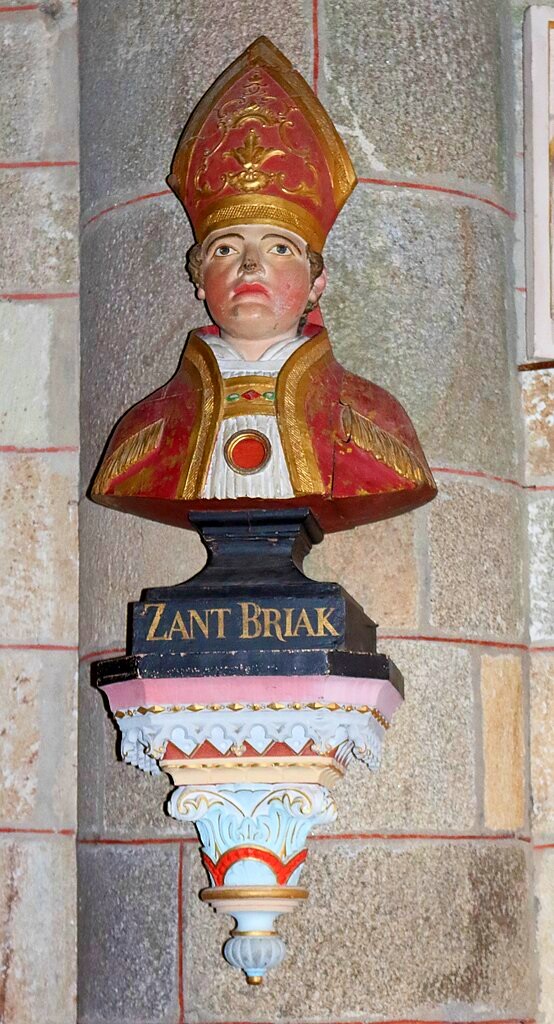
O Lord, grant us a lively faith, a firm hope, a fervent charity, a love of Thee.
Take from us all lukewarmness in meditation and all dullness in prayer. Give us fervour and delight in thinking of Thee, Thy grace and Thy tender compassion toward us.
Grant us, good Lord, the grace to work for the things we pray for. Amen.
Saint of the Day – 9 July – Saint Brictius of Martola (Died c312) Bishop and Confessor. Brictius was the Bishop of Martola, near Spoleto in Umbria in Italy. Also known as Brixtius.
The Roman Martyrology reads: “At Martola, St Brixius, Bishop. Under the Judge Marcian, after having suffered much for the confession of Our Lord and converted a great multitude to Christ. he rested in peace.”
We have very little information about the life of our Saint. Tradition believes that he was imprisoned during the persecutions of Diocletian but escaped Martyredom and died peacefully as Constantine was begining to take power.
St Maria Goretti (1890-1902) Virgin and Martyr, known as “Saint Agnes of the 20th Century.” She was Canonised on 24 June 1950 by Pope Pius XII The ceremony was attended by 250,000 including her mother, the only time a parent has witnessed her child’s Canonisation. Her Life and Death: https://anastpaul.com/2017/07/06/saint-of-the-day-6-july-st-maria-goretti/
Blessed Adrian Fortescue TOSD (1476-1539) Martyr,. A husband and father, a Justice of the Peace, a Knight of the Realm, a Knight of Malta and a Dominican Tertiary (Lay Dominican), he was at once a loyal servant of the Crown so far as he could be but still more, he was a man of unshakeable faith and love of the One True Faith. He was Beatified on 13 May 1895 by Pope Leo XIII. His Life and Death: https://anastpaul.com/2018/07/09/saint-of-the-day-blessed-adrian-fortescue-1476-1539-martyr/
St Agrippinus of Autun St Alexander of Egypt St Audax of Thora St Brictius of Martola(Died c312) Bishop and Confessor St Copra of Egypt St Cyril of Gortyna Bl Dionysius the Rhetorician St Everild of Everingham St Faustina of Rome St Felician of Sicily
Blessed Giovanna Scopelli O.Carm (1428 – 1491) Virgin, Mystic, Italian Religious of the Carmelites and established her own Convent as its first Prioress. She was known, during her lifetime as a Miracle-worker with many coming to her to ask for her assistance and prayers. Her body is incorrupt. About Blessed Giovanna: https://anastpaul.com/2021/07/09/saint-of-the-day-9-july-blessed-giovanna-scopelli-o-carm-1428-1491/
St Floriana of Rome St Hérombert of Minden Bl Joachim Ho
St John of Cologne OP (Died 1572) Priest Martyr and the MARTYRS of GORKUM
Bl Luigi Caburlotto Bl Marguerite-Marie-Anne de Rocher Bl Marie-Anne-Madeleine de Guilhermier St Patermutius of Egypt St Paulina do Coração Agonizante de Jesus
Four Holy Polish Brothers – 4 Saints: Four brothers who became hermits, Benedictine Monks and Saints – Andrew, Barnabas, Benedict and Justus. They were born in Poland and died in 1008 of natural causes.
Martyrs of Gorkum – 19 Saints: The Roman Martyrology (1914 Ed) notes today as the Feast of a group of Saints known as the Martyrs of Gorkum: “At Briel in Holland, the Martyrdom of the 19 Martyrs of Gorkum. For vindicating the authority of the Roman Church and the Real Presence of Christ in the Eucharist, they endured various ignominies and torments from the Calvinist heretics and ended their suffering by being put to death. In the year 1867, Pope Pius IX placed them among the holy Martyrs.” They are – Adrianus van Hilvarenbeek • Andreas Wouters • Antonius van Hoornaar • Antonius van Weert • Cornelius van Wijk • Francisus de Roye • Godfried van Duynen • Godfried van Melveren • Hieronymus van Weert • Jacobus Lacops • Joannes Lenaerts • John of Cologne • Leonardus van Veghel • Nicasius Janssen van Heeze • Nicolaas Pieck • Nicolaas Poppel • Petrus van Assche • Theodorus van der Eem • Willehad van Deem • They were hanged on 9 July 1572 in Brielle, Zuid-Holland, Netherlands. Beatified on 24 November 1675 by Pope Clement X and Canonised on 29 June 1867 by Pope Pius IX.
Martyrs of Orange – 32 Beati: 32 Nuns from several Orders who spent up to 18 months in prison and were finally executed for refusing to renounce Christianity during the persecutions of the French Revolution. Anne Cartier • Anne-Andrée Minutte • Dorothée-Madeleine-Julie de Justamond • élisabeth Verchière • élisabeth-Thérèse de Consolin • Jeanne-Marie de Romillon • Madeleine-Françoise de Justamond • Madeleine-Thérèse Talieu • Marguerite-Eléonore de Justamond • Marguerite-Marie-Anne de Rocher • Marguerite-Rose de Gordon • Marguerite-Thérèse Charensol • Marie Cluse • Marie-Anastasie de Roquard • Marie-Anne Béguin-Royal • Marie-Anne Depeyre • Marie-Anne Doux • Marie-Anne Lambert • Marie-Anne-Madeleine de Guilhermier • Marie-Claire du Bac • Marie-Clotilde Blanc • Marie-Elisabeth Pélissier • Marie-Gabrielle-Françoise-Suzanne de Gaillard de Lavaldène • Marie-Gertrude de Ripert d’Alauzier • Marie-Marguerite Bonnet • Marie-Marguerite de Barbégie d’Albrède • Marie-Rose Laye • Rosalie-Clotilde Bes • Suzanne-Agathe Deloye • Sylvie-Agnès de Romillon • Thérèse-Henriette Faurie They were guillotined between 6 July and 26 July 1794 at Orange, Vaucluse, France. Beatified on 10 May 1925 by Pope Pius XI.
Martyrs of the Baths – 10,204 Saints: A group of Christians enslaved by Diocletian to build the gigantic baths in imperial Rome, Italy. The end of their labours coincided with the beginning of the great persecutions of Diocletian and they were all executed. Ancient records indicated there were 10,204 of them; Zeno of Rome is the only one whose name has come down to us and we know nothing else about any of their individual lives.
You must be logged in to post a comment.