Our Morning Offering – 22 November – “The Month of the Holy Souls in Purgatory” and a Friday of the Passion
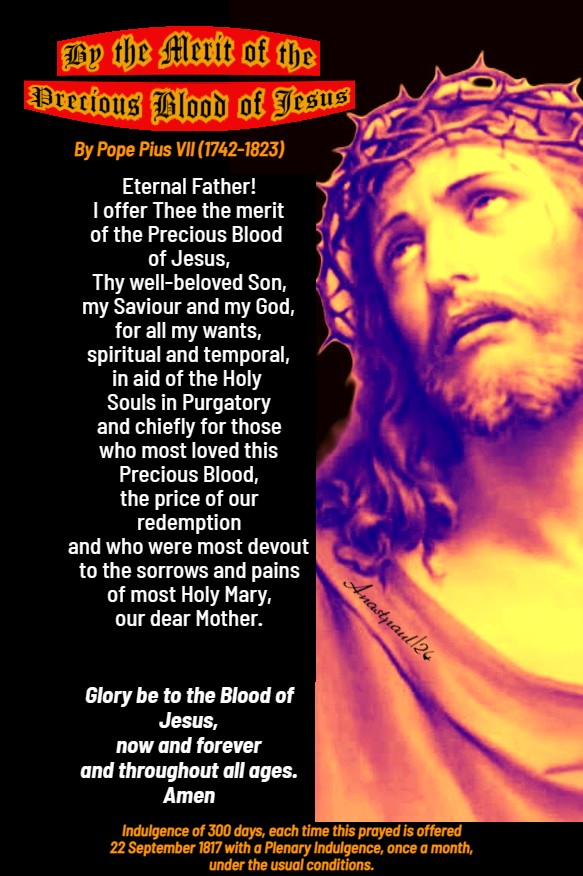
By the Merit of the Precious Blood of Jesus By Servant of God Pope Pius VII (1742-1823) Papacy from 1800 to 1823 Indulgenced Act of Oblation to Our Father
Eternal Father! I offer Thee the merit of the Precious Blood of Jesus, Thy well-beloved Son, my Saviour and my God, for all my wants, spiritual and temporal, in aid of the Holy Souls in Purgatory and chiefly for those who most loved this Precious Blood, the price of our redemption and who were most devout to the sorrows and pains of most Holy Mary, our dear Mother.
Glory be to the Blood of Jesus, now and forever and throughout all ages. Amen
Indulgence of 300 days, each time this prayed is offered 22 September 1817 with a Plenary Indulgence, once a month, under the usual conditions.
Note of Interest:On 15 August 1811 – the Feast of the Assumption – it is recorded that the Pope celebrated Mass and was said to have entered a trance and began to levitate in a manner that drew him to the Altar. This particular episode aroused great wonder and awe among attendants, which included the French soldiers guarding him, who were awestruck at what had occurred and left records of it.
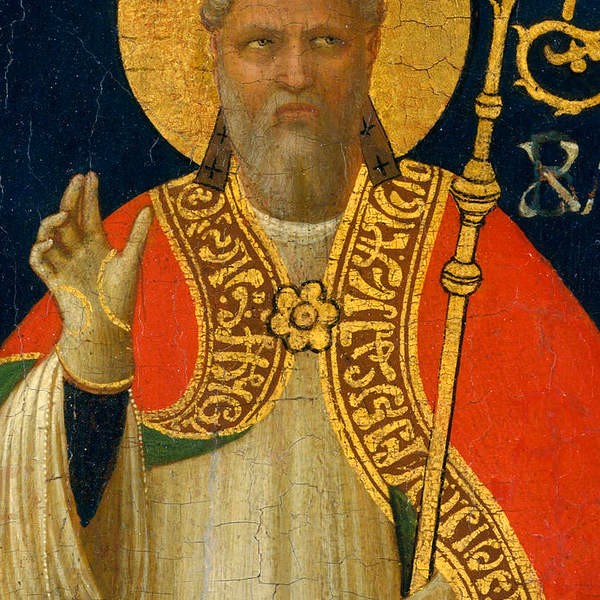
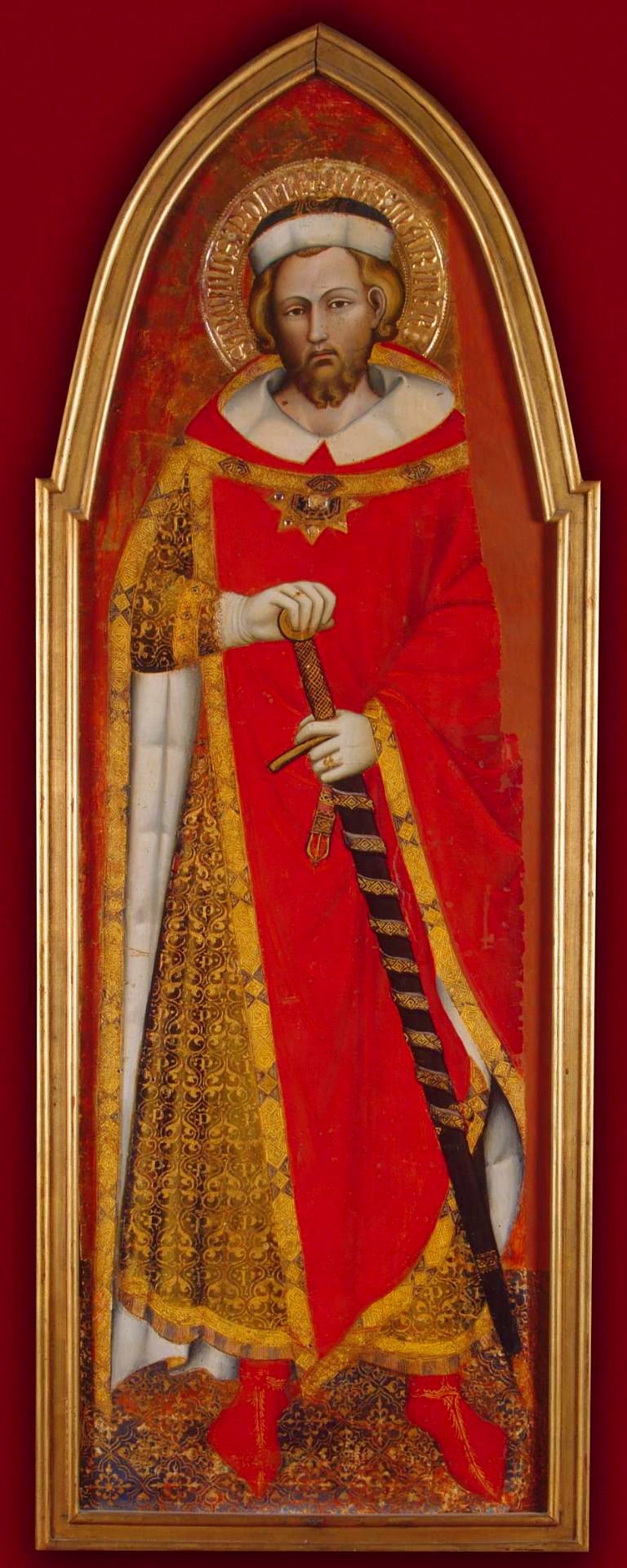
Saint of the Day – 22 November – Saint Christian of Auxerre (Died 871) Bishop of Auxerre, France for 12 years from 859 until his death on 22 November 871 of natural causes. The image below is of an unknown ancient Bishop by Fra Angelico.
Saint Christian was a Bishop of Auxerre who lived in the 9th Century. In some Ecclesiastical records, he appears in 36th place, in others, in the 37th. In the list of the “Liber Episcopalis” in which brief biographical notes and chronological data were noted, he appears after Saint Abbone and before Wala (or Guala).
He also appears in the 1st catalogue of Bishops compiled in the year 875, by the Canons Rainogala and Agaldo, considered quite trustworthy by later historians, even if doubts had been raised about the chronology before the 7th Century.
Historically, Saint Christian is mentioned for the first time among the signatories of the Treaty of Clobenza, on 7 June 860.
Furthermore, his name appears in many documents, including the last at the Council of Douzy in September 871, where he was represented by his Archdeacon.
He died on 22 November 871, after having led the Diocese for twelve years. In Auxerre, the celebration and remembrance of Saint Christian has been set today, the birthday of St Christian into Heaven.
St Agabbas of Syria St Amphilochius of Iconium St Ananias of Arbela
St Appia + (1st Century) Lay Martyr, Disciple of St Paul (see below) St Archippus + (1st Century) Lay Martyr, Disciple of St Paul (see below)
St Eugenia of Matera St Christian of Auxerre (Died 871) Bishop St Dayniolen the Younger St Mark of Antioch St Maurus of North Africa
St Philemon + (1st Century) Lay Martyr, Disciple of St Paul, St Appia + (1st Century) Lay Martyr, Disciple of St Paul, his wife, Saint Appia and their son, Archippus. Many scholars believe that Pilemon was a Bishop or the Archbishop of Colossae. The Roman Martyrology reads: “At Colossae, in Phrygia, during the reign of Nero, Saints Philemon and Apphias, disciples of St Paul. When the Christians ran to the Church for protection on a pagan feast, they were arrested and, by the command of the Governor, Artocles, were scourged, let down into a pit up to their waists and overwhelmed with stones.” St Archippus + (1st Century) Lay Martyr, Disciple of St Paul Their Lives and Deaths: https://anastpaul.com/2023/11/22/saint-of-the-day-22-november-saints-philemon-appia-and-archippus-martyrs/
Thought for the Day – 21 November – Meditations with Saint Alphonsus Maria de Liguori (1696-1787) Bishop, Confessor, Most Zealous Doctor of the Church
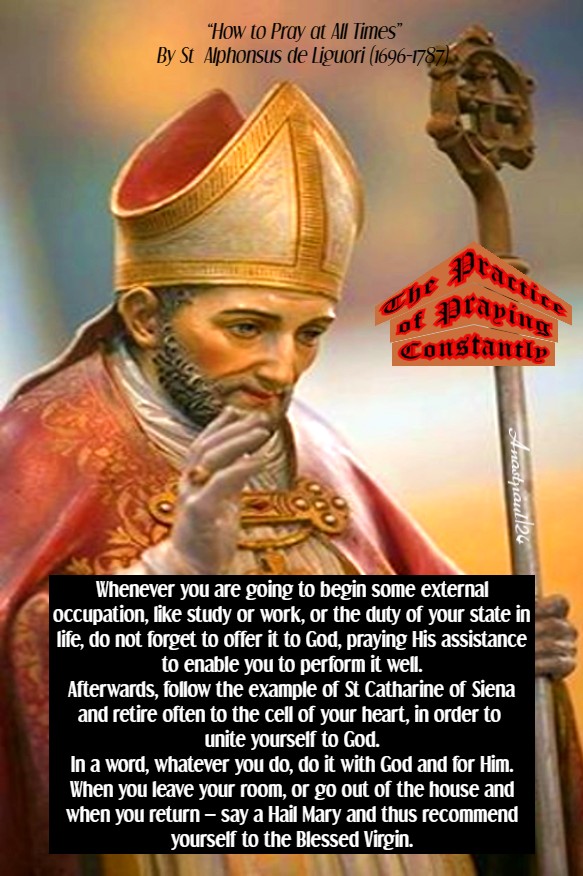
“How to Pray at All Times” By St Alphonsus Maria de Liguori (1696-1787)
The Practice of Praying Constantly Recollection Excerpt from Chapter Five:4
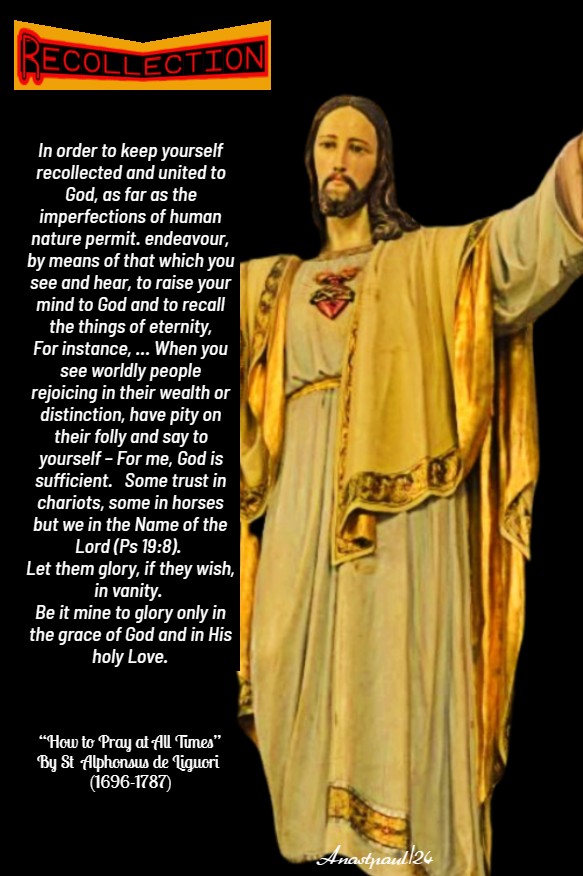
“In order to keep yourself recollected and united to God, as far as the imperfections of human nature permit. endeavour, by means of that which you see and hear, to raise your mind to God and to recall the things of eternity,
For instance, when you see running water, reflect that your life is rushing on in like manner and taking you nearer to death. … When you see graves or the bodies of the dead, think of what will happen to yourself one day. When you see worldly people rejoicing in their wealth or distinction, have pity on their folly and say to yourself – For me, God is sufficient. Some trust in chariots, some in horses but we in the Name of the Lord (Ps 19:8). Let them glory, if they wish, in vanity. Be it mine to glory only in the grace of God and in His holy Love.
… When you look out over the ocean and see it now calm and tranquil and now lashed to fury by the winds, consider the difference there is between a soul in sin and a soul in the state of grace. When you see a tree which is withered, reflect on the fact that a soul without God is fit for nothing but to be cast into the fire. If you ever happen to see one who has been guilty of some great crime, trembling with shame and fear in the presence of his judge, or his father, or of his Bishop, consider what the terror of the sinner will be in the presence of Jesus Christ, his Judge. When thunder crashes through the . heavens and you grow alarmed, reflect how those miserable souls who are damned, tremble as they hear continually in hell, the thunders of the Divine wrath.”
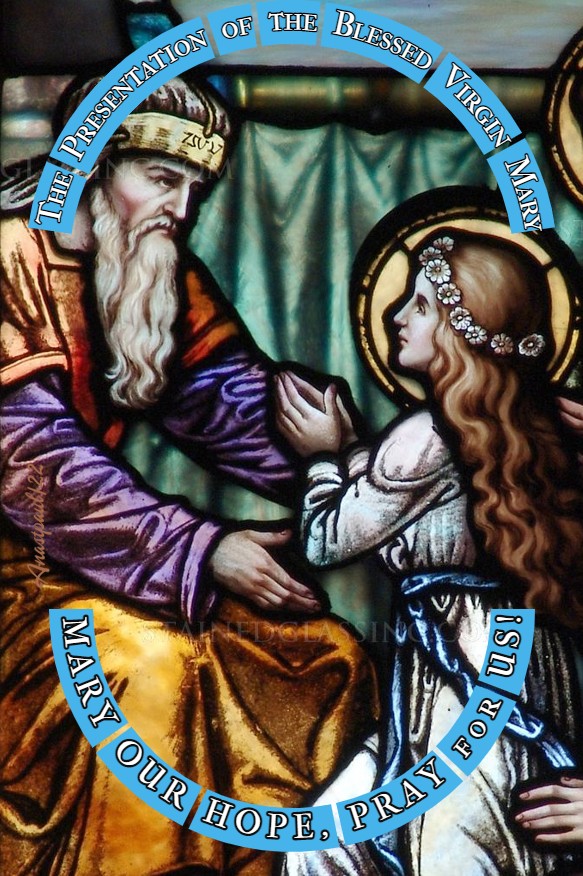
Quote/s of the Day – 21 November – The Presentation of the Blessed Virgin Mary
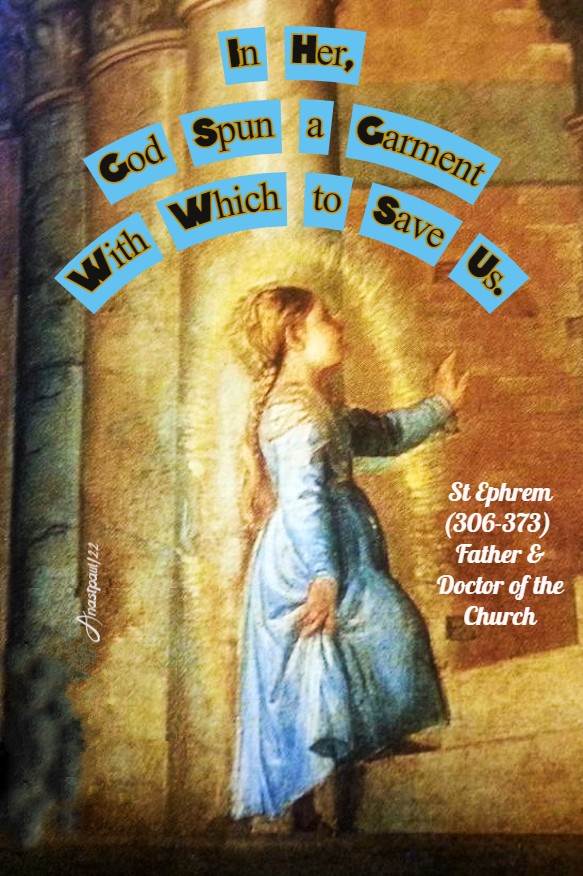
“In her, God spun a garment with which to save us.”
St Ephrem (306-373) Father & Doctor of the Church
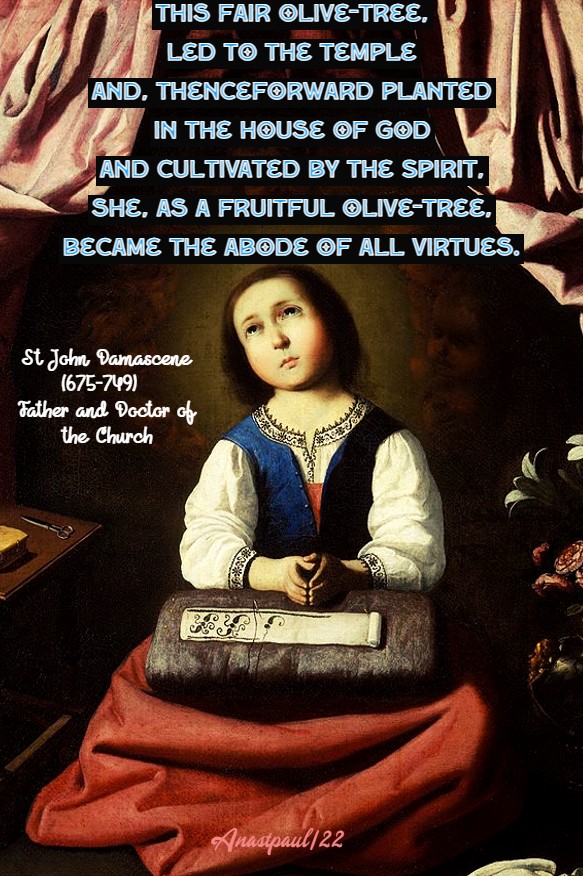
“This fair olive-tree, led to the temple and, thenceforward planted in the House of God and cultivated by the Spirit, she, as a fruitful olive-tree, became the abode of all virtues.”
St John Damascene (675-749) Father and Doctor of the Church
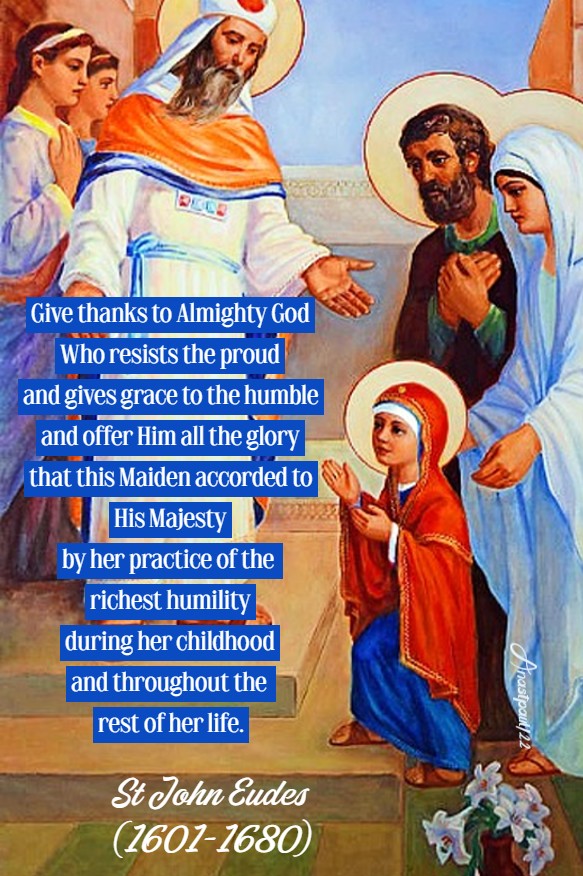
“Give thanks to Almighty God Who resists the proud and gives grace to the humble and offer Him all the glory that this Maiden accorded to His Majesty by her practice of the richest humility during her childhood and throughout the rest of her life.”
One Minute Reflection – 21 November – The Presentation of the Blessed Virgin Mary – Sir ach24:14-1, Luke 11:27-28 – Scripture search here: https://www.drbo.org/
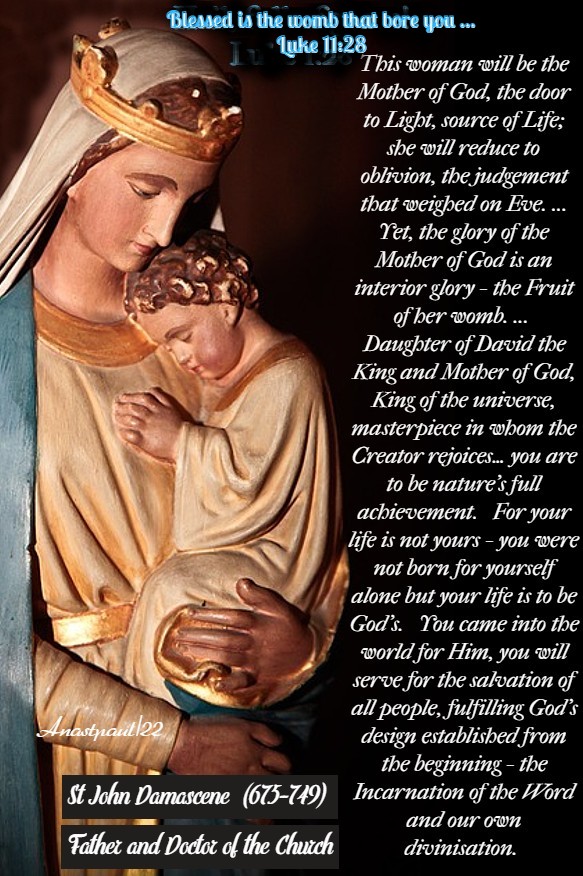
“Blessed is the womb that bore you” – Luke 11:27
REFLECTION – “This woman will be the Mother of God, the door to Light, source of Life; she will reduce to oblivion the judgement that weighed on Eve. “The rich among the people seek the face” of this woman, “the kings of the nations shall pay her homage” they shall “ offer gifts”…, yet the glory of the Mother of God is an interior glory: the fruit of her womb.
O woman, so worthy of love, thrice happy, “blessed are you among women and blessed is the fruit of your womb.” Daughter of David the king and Mother of God, King of the universe, masterpiece in whom the Creator rejoices… you are to be nature’s full achievement. For you, life is not yours; you were not born for yourself alone but your life is to be God’s. You came into the world for Him, you will serve for the salvation of all people, fulfilling God’s design established from the beginning: the Incarnation of the Word and our own divinisation. Your whole desire is to feed on the words of God, to be strengthened by their sap, like “a green olive tree in the house of God,” “like a tree planted by running water,” you are the “tree of life” who “yielded its fruit in due season”…
He Who is Infinite, Limitless, came to dwell in your womb; God, the Child Jesus, was nourished by your milk. You are the ever virginal Doorway of God; your hands hold your God; your lap is a throne raised up above the Cherubim… You are the wedding chamber of the Spirit, the “city of the living God, gladdened by the runlets of the stream”, that is to say, the waves of the Spirit’s gifts. You are “all fair, the Beloved” of God.” – St John Damascene (675-749) Monk, Theologian, Father and Doctor of the Church (Homily on the Nativity of the Virgin # 9).
PRAYER – O God, by Whose will the blessed Mary, ever Virgin, the dwelling place of the Holy Spirit, was on this day presented in the temple, grant, we beseech Thee, that by her intercession, we may be found worthy to be brought into the temple of Thy glory. Through Jesus Christ, Thy Son our Lord, Who lives and reigns with Thee, in the unity of the Holy Ghost, God, world without end. Amen (Collect).
Saint of the Day – 21 November – Saint Rufus (1st Century) Disciple of the Apostles, most particularly a disciple of St Paul, possibly later a Bishop. It is believed that Rufus was born in Rome and to have died there late in the 1st Century probably after St Peter and Paul.
St Paul preaching
Rufus was the disciple to whom Saint Paul sent a greeting and also to the Rufus’ mother (Romans 16:13). St Mark says in his Gospel (15:21) that Simon of Cyrene was the father of Rufus and as Mark wrote his Gospel most especially for the Roman Christians, this Rufus is probably the same as the one to whom Paul sent a salutation.
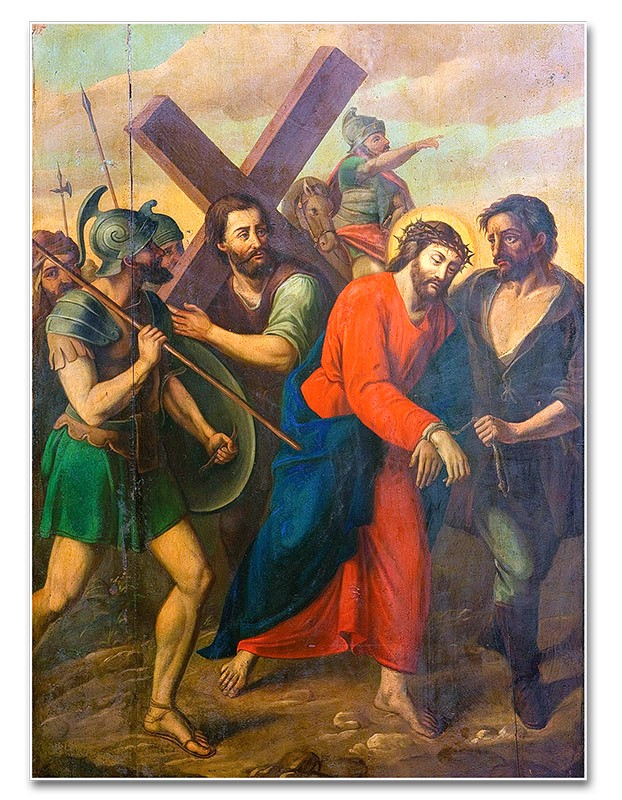
Simon of Cyrene carries the Cross
Tradition believes too that our St Rufus later served the Church as a Bishop.
St Paul says: “Salute Rufus, elect in the Lord and his mother and mine.” (Romans 16:13).
St Mark says: “And they forced one Simon a Cyrene, who passed by, coming out of the country, the father of Alexander and of Rufus, to take up His Cross.” (Mark 15:21).
St Celsus the Martyr St Clement the Martyr St Demetrius of Ostia – Martyr. No other information has survived. St Digain
St Pope Gelasius I (Died 496) Papal Ascension 1 March 492 until his death on 21 November 496 in Rome, Italy.Gelasius was learned Scholar and a prolific Author, Defender of orthodoxy and of the See of Peter. Zealous Apostle of the poor and needy and of the Majesty of the Liturgical Worship, including the discipline of Hymn and Prayer within his scholastic orbit of Author. The Feast of St Gelasius is kept on 21 November which is the anniversary of his Interment, although many writers give this as the day of his death which actually occurred on 19 November as stated above. The Roman Martyrology reads today: “At Rorme, the birthday of St Gelasius, Pope, distinguished for learning and sanctity.” His Zealous Life: https://anastpaul.com/2023/11/21/saint-of-the-day-21-november-st-gelasius-i-died-496-bishop-of-rome/
St Heliodorus of Pamphylia St Hilary of Vulturno St Honorius of Ostia – Martyr. No other information has survived.
St Maurus of Porec St Maurus of Verona St Rufus (1st Century) Disciple of the Apostles especially of St Paul
Martyrs of Asta – 3 Saints: Three Christians Martyred together for their faith during the persecutions of Diocletian. The only details about them to survive are their names – Eutychius, Honorius and Stephen. They were Martyred in c300 at Asta, Andalusia, Spain.
Quote/s of the Day – 20 November – “The Month of the Holy Souls in Purgatory”
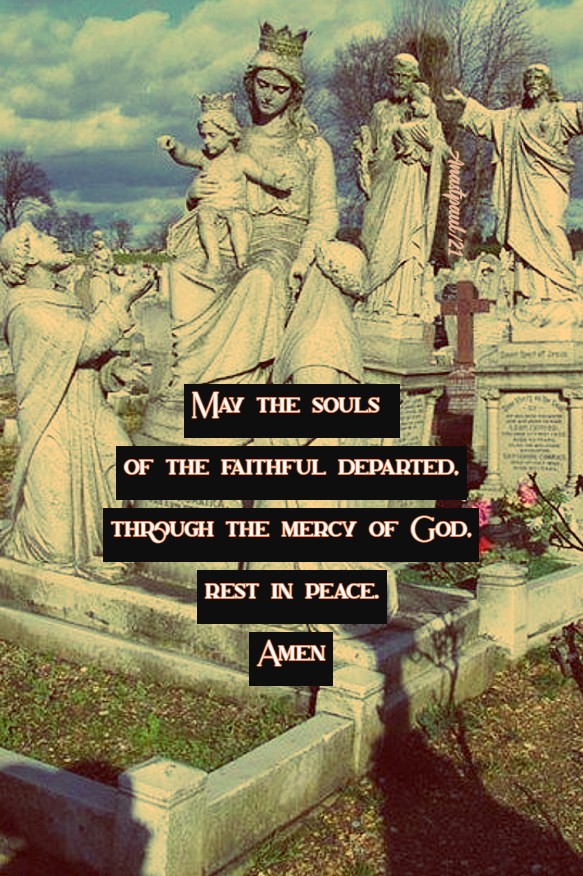
“May the souls of the faithful departed through the mercy of God, rest in peace, amen.”
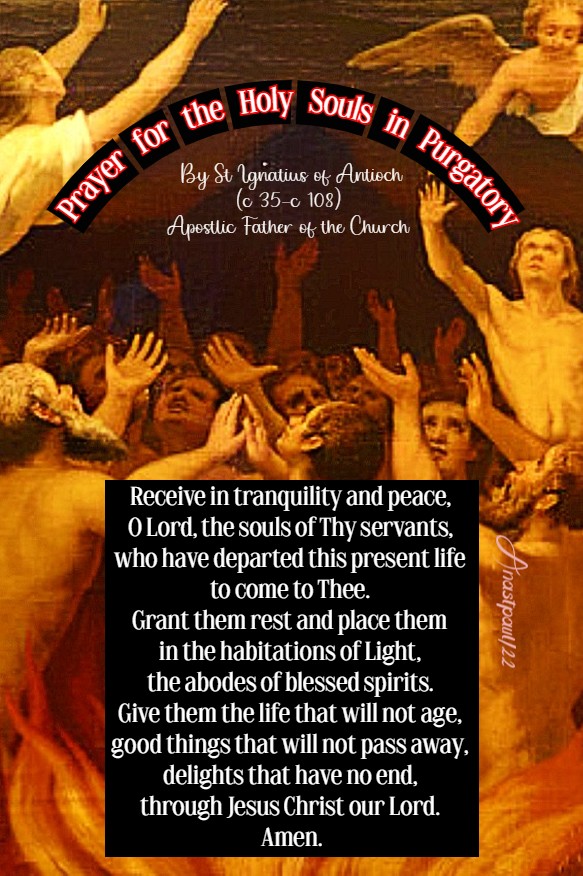
Prayer for the Holy Souls in Purgatory By St Ignatius of Antioch (c35-c108) Apostolic Father of the Church
Receive in tranquility and peace, O Lord, the souls of Thy servants, who have departed this present life to come to Thee. Grant them rest and place them in the habitations of Light, the abodes of blessed spirits. Give them the life that will not age, good things that will not pass away, delights that have no end, through Jesus Christ our Lord. Amen.
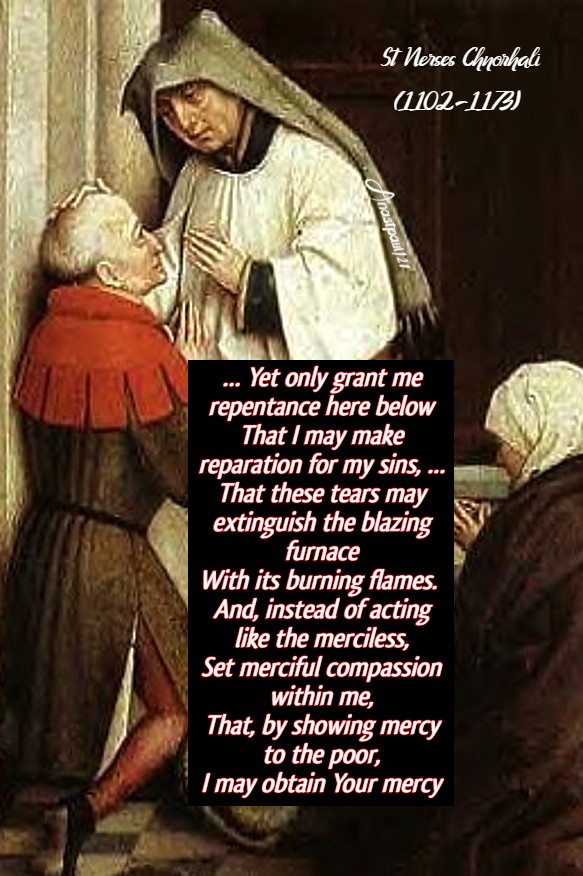
“ … Yet only grant me repentance here below That I may make reparation for my sins, … That these tears may extinguish the blazing furnace With its burning flames. …
And, instead of acting like the merciless, Set merciful compassion within me, That, by showing mercy to the poor, I may obtain Your mercy.”
St Nerses Chnorhali (1102-1173) Armenian Bishop
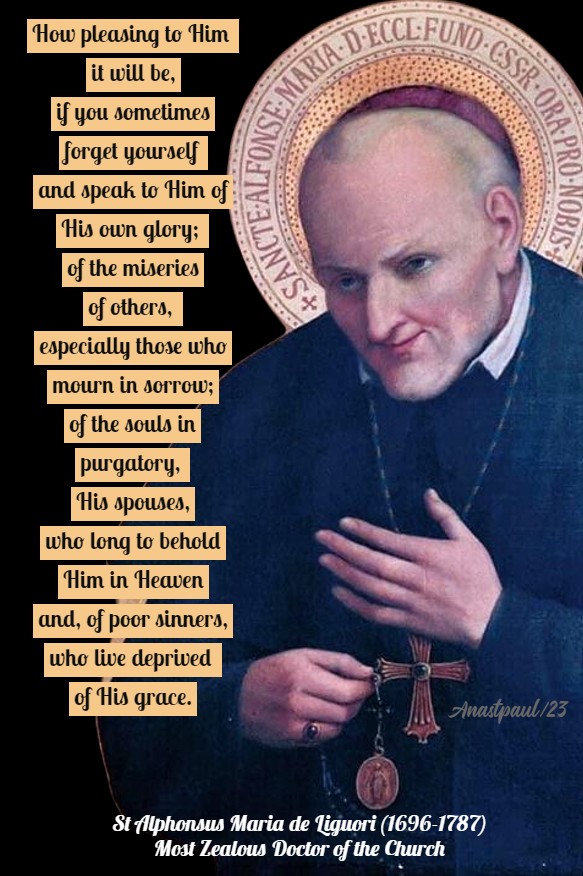
“How pleasing to Him it will be, if you sometimes forget yourself and speak to Him of His own glory; of the miseries of others, especially those who mourn in sorrow; of the souls in purgatory, His spouses, who long to behold Him in Heaven and, of poor sinners, who live deprived of His grace.”
St Alphonsus de Liguori (1696-1787) Most Zealous Doctor
Thought for the Day – 20 November – Meditations with Saint Alphonsus Maria de Liguori (1696-1787) Bishop, Confessor, Most Zealous Doctor of the Church
“How to Pray at All Times” By St Alphonsus Maria de Liguori (1696-1787)
The Practice of Praying Constantly Remembering Indulgences Excerpt from Chapter Five:3
“Here, in passing, I would remind the reader of Indulgences which are attached to various Acts of Devotion and also, I would remind him, of the desirability of renewing, each morning, the intention of gaining, during the day, all the Indulgences possible. …
In like manner, form the intention of gaining too, all the Indulgences granted for saying the Rosary on beads properly blessed, the Angelus three times a day, the Litany of our Blessed Lady, the Salve Regina, the Ave Maria and the Gloria Patri; … for reciting the prayer Anima Christi; for bowing the head at the Gloria Patri and at the Most Holy Names of Jesus and Mary; for hearing Mass; for making half an hour’s mental prayer – for this, there is a Partial Indulgence, and also, if the meditation is made daily, a Plenary on the usual conditions of confession, Communion and praying for the intentions of the Church; for genuflecting before the Blessed Sacrament; for kissing the Crucifix …”
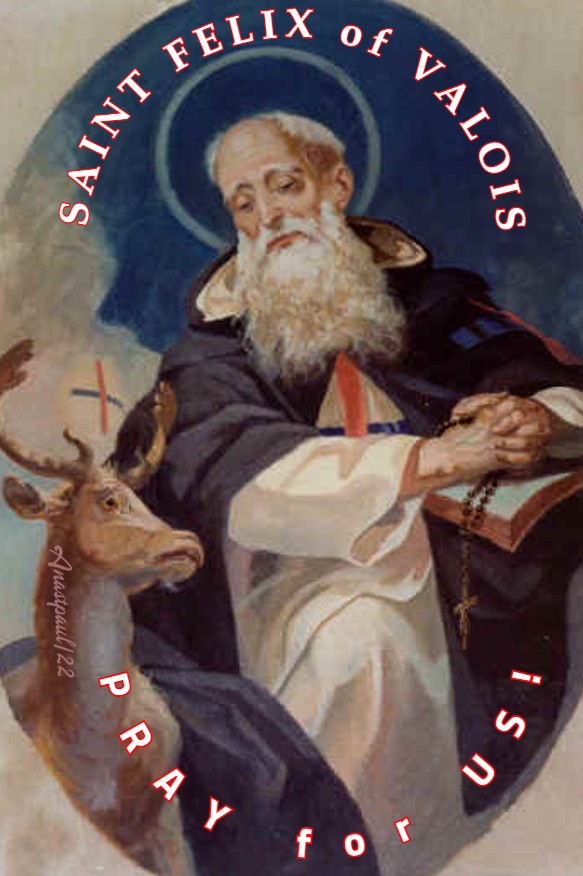
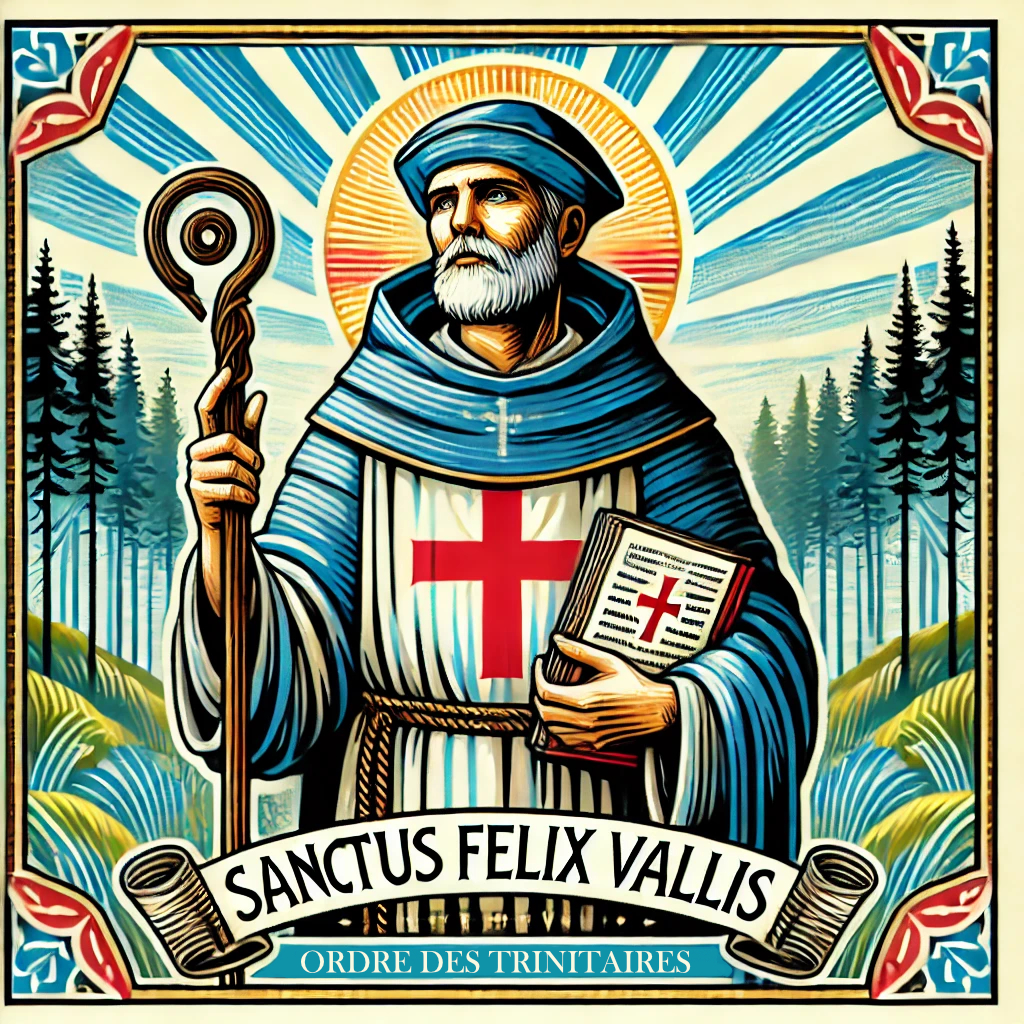
One Minute Reflection – 20 November – “The Month of the Holy Souls in Purgatory” – St Felix of Valois (1127-1212) Confessor – 1 Corinthians 4:9-14; Luke 12:32-34 – Scripture search here: https://www.drbo.org/
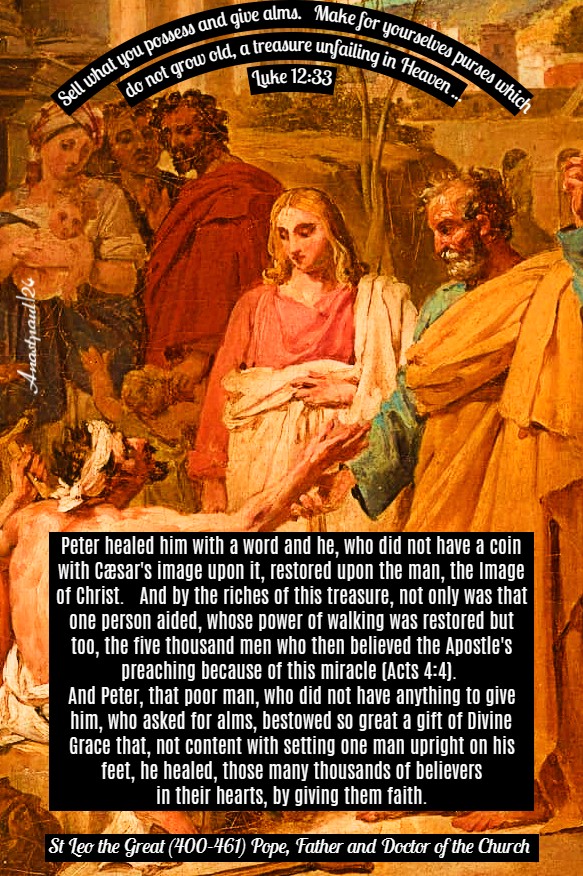
“Sell what you possess and give alms. Make for yourselves purses which do not grow old, a treasure unfailing in Heaven, where neither thief draws near, nor moth destroys.” – Luke 12:33
REFLECTION – “Blessed are the poor in spirit, for theirs is the Kingdom of Heaven” (Mt 5:3) … Of this generous poverty, the Apostles first, after the Lord, have given us example. Unhesitatingly leaving all they had, at the Voice of the heavenly Master, they were joyfully converted and abandoned the catching of fish, to become fishers of men (Mt 4:18f.). Among the latter, many became like themselves, by imitating their faith; for with those first children of the Church, “the community of believers was of one heart and mind” (Acts 4:32). Stripped of all their possessions, they were enriched with eternal goods, thanks to holy poverty. Welcoming the Apostles’ preaching, they rejoiced to have nothing in this world and yet, possess all things in Christ. (2 Cor 6:10).
Hence, the blessed Apostle Peter, when he was going up to the temple and was asked for alms by a lame man, said, “I have neither silver nor gold but what I do have I give you; in the Name of Jesus Christ the Nazorean, rise and walk” (Acts 3:6)… Peter healed him with a word and he, who did not have a coin with Cæsar’s image upon it, restored upon the man, the Image of Christ. And by the riches of this treasure, not only was that one person aided, whose power of walking was restored but too, the five thousand men who then believed the Apostle’s preaching because of this miracle (Acts 4:4). And Peter, that poor man, who did not have anything to give him, who asked for alms, bestowed so great a gift of Divine Grace that, not content with setting one man upright on his feet, he healed, those many thousands of believers in their hearts, by giving them faith.” – St Leo the Great (400-461) Pope, Father and Doctor of the Church (Sermon 95 2-3).
PRAYER – OGod, Who by heavenly inspiration graciously called forth blessed Felix, Thy Confessor, from the desert to the work of ransoming captives; grant, we beseech Thee, that by his intercession and liberated by Thy grace from the captivity of our sins, we may be led into our heavenly fatherland. Through Jesus Christ, Thy Son our Lord, Who lives and reigns with Thee, in the unity of the Holy Ghost, God, world without end. Amen (Collect).
Our Morning Offering – 20 November – “The Month of the Holy Souls in Purgatory”
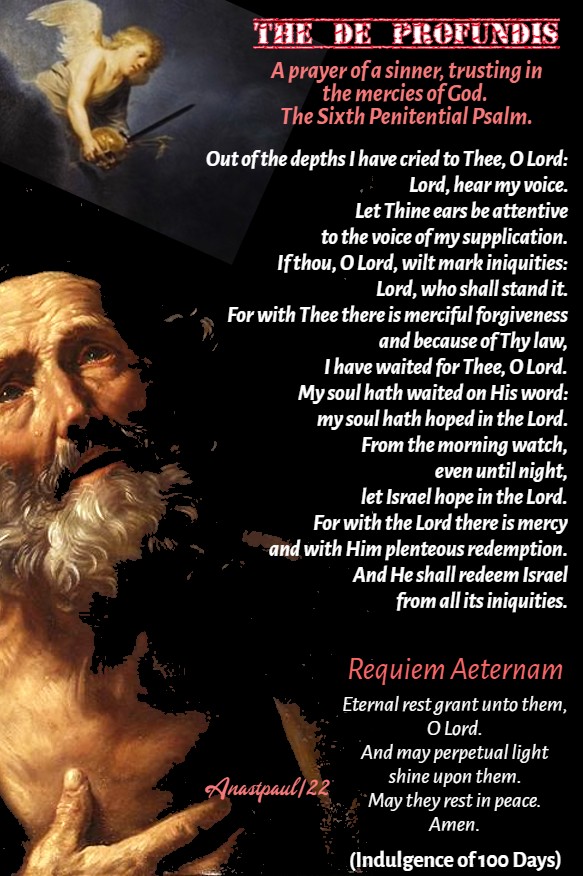
The De Profundis Psalm 129
A prayer of a sinner, trusting in the mercies of God. The Sixth Penitential Psalm.
Out of the depths I have cried to Thee, O Lord: Lord, hear my voice. Let Thine ears be attentive to the voice of my supplication. If thou, O Lord, wilt mark iniquities: Lord, who shall stand it. For with Thee there is merciful forgiveness and because of Thy law, I have waited for Thee, O Lord. My soul hath waited on His word: my soul hath hoped in the Lord. From the morning watch, even until night, let Israel hope in the Lord. For with the Lord there is mercy and with Him plenteous redemption. And He shall redeem Israel from all its iniquities.
(Eternal rest or “Requiem aeternam”) Eternal rest grant unto them, O Lord. And may perpetual light shine upon them. May they rest in peace. Amen.
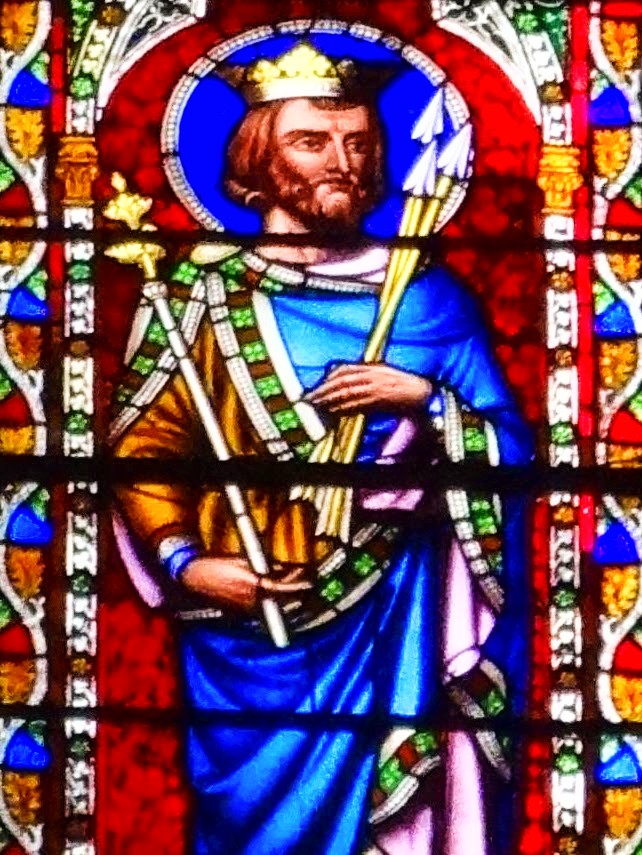
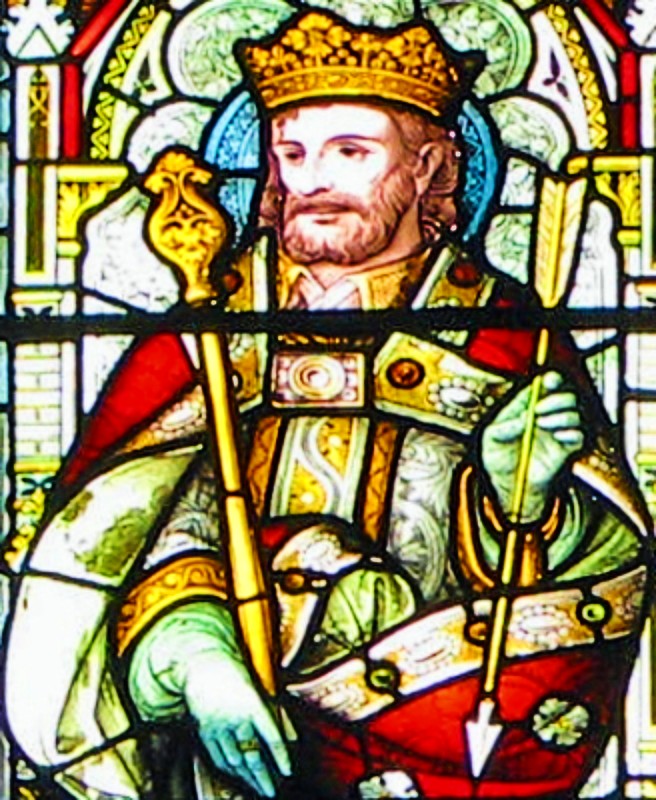
Saint of the Day – 20 November – St Edmund (c841-870) King and Martyr. Born in c841 probably in Nuremburg, Germany and died by being beaten, whipped, pierced with arrows “until he bristled with them like a hedgehog” and then beheaded at Hoxne, Suffolk, England on 20 November 870. Patronages – Co-Patron of England, against the Plague/Epidemics, of Kings, of torture victims, wolves, of the County and Diocese of East Anglia. Also known as – Edmund the Martyr, … of East Anglia. Additional Memorials – 29 April (translation of Relics), 2 November and 25 December on some local calendars.
The Roman Martyrology reads today: “In England, St Edmund, King and Martyr.”
On Christmas Day in the year 855, a remarkable event unfolded as a 14-year-old boy named Edmund was hailed as the rightful King of Norfolk by the influential figures of the County, including ruling men and Clergy. This acclaim was soon followed by a similar declaration from the leaders of Suffolk the following year.
For the next 15 years, Edmund would rule over the East Angles, a region in England, with a reputation for Christian dignity and justice which was universally acknowledged. He appeared to draw inspiration from the piety of King David of the Old Testament, notably excelling in the public recitation of the Psalms during worship.
However, Edmund’s reign was not without its challenges. Starting in 866, his Kingdom faced escalating threats from Danish invasions. For four years, the East Angles managed to maintain an unstable and often broken peace, with the invaders. Nevertheless, the situation took a dire turn, when the Danes set fire to Thetford, prompting King Edmund’s army to confront them. Unfortunately, they were unable to defeat the marauding Danish forces.
As the invaders reached East Anglia, they presented Edmund with an offer of peace but, it came with a condition which Edmund found impossible to accept. The condition required him to rule as a vassal under Danish authority and, most notably, to forbid the practice of the Christian Faith. Edmund unwaveringly refused this ultimatum, choosing to stand firm in defence of Christ.
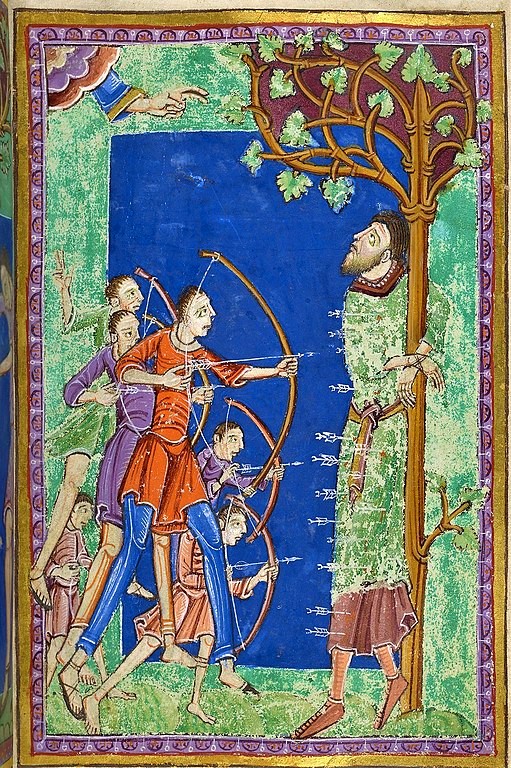
In response to his refusal, Edmund was subjected to a gruesome and torturous fate. He was bound to a tree and made the target of Danish archers, who rained down a hail of arrows upon him. Throughout this agonising ordeal, Edmund displayed remarkable bravery, repeatedly invoking the Name of Jesus. Eventually, he was decapitated, sealing his fate as a Martyr for Christ and His Church.
The Martyrdom of St Edmund, from the 12th Century Passio Sancto Eadmundi
Edmund’s final resting place is the City of Bury St Edmunds, where his memory is cherished to this day. The tree at Hoxne which tradition claimed was the site of his Martyrdom, stood as a symbol of his sacrifice until 1849 when it fell. During the tree’s dismantling, an arrowhead was discovered embedded in its trunk, serving as a poignant reminder and Relic of his Martyrdom.
St Edmund holds a unique place in history as the only English sovereign to die for both his religious beliefs and the defence of his throne, until the time of King Charles I. His Martyrdom quickly earned him reverence and his cultus spread widely throughout the Middle Ages. Together with Saint George, Saint Edmund is celebrated as one of the Patron Saints of England.
‘There was a great wonder, that he was as whole as if he were alive, with an intact body and his neck was healed which had previously been cut; it was as if there were a red silken thread about his neck, to show men how he had been killed. And the wounds which the cruel heathen had made in his body, with many shots, were healed by Heaven’s God and he lies thus incorrupt until this present day, awaiting the resurrection and eternal glory.’
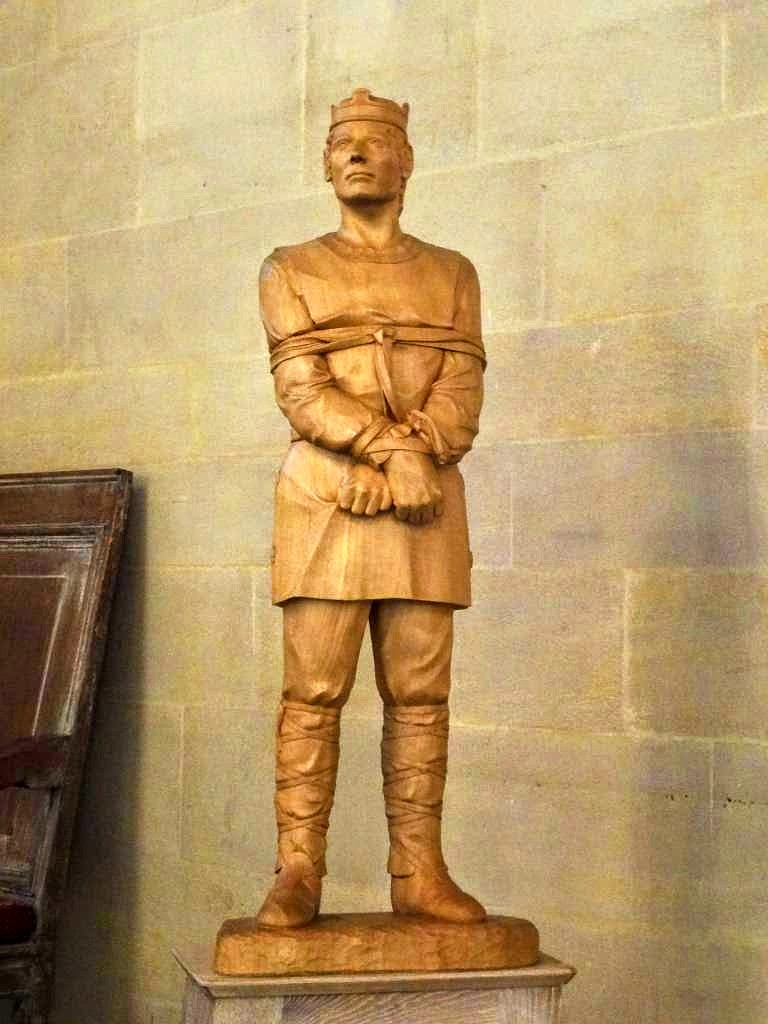
This modern Statue of St Edmund in the Cathedral of Bury St Edmund
St Agapius of Caesarea Bl Ambrose of Camaldoli St Ampelus of Messina St Anatolius of Nicea St Apothemius of Angers St Autbodus of Valcourt St Basil of Antioch St Bernerio of Eboli St Crispin of Ecija
St Dasius of Dorostorum St Dorus of Benevento St Edmund (c841-870) King and Martyr
St Eudo of Carméry St Eustachius of Nicea St Eval of Cornwall St Gaius of Messina St Gregory Decapolites St Hippolytus of Belley St Humbert of Elmham St Leo of Nonantula St Maxentia of Beauvais St Milagros Ortells Gimeno St Nerses of Sahgerd and Companions St Simplicius of Verona St Sylvester of Châlons-sur-Saône St Thespesius of Nicea St Teonesto of Vercelli
Martyrs of Antioch – 3 Saints: Group of three Christians executed together for their faith. No details have survived except their names – Basil, Dionysius and Rusticus. They were martyred in Antioch (Antakya, Turkey).
Martyrs of Heraclea – 3 Saints: A group of 43 Christians Martyred together. The only details about them to survive are three of their names – Agapitus, Bassus and Dionysius. They were martyred in Heraclea, Thrace.
Martyrs of Turin – 3 Saints: Three Christian Martyrs whose original stories were lost and somehow came to be associated with the Theban Legion. They are – Adventor, Octavius and Solutor. They were beheaded in 297 in Turin, Italy. Patronage – Turin, Italy.
Thought for the Day – 19 November – Meditations with Saint Alphonsus Maria de Liguori (1696-1787) Bishop, Confessor, Most Zealous Doctor of the Church
“How to Pray at All Times” By St Alphonsus Maria de Liguori (1696-1787)
The Practice of Praying Constantly Excerpt from Chapter Five:2
“Perform your more important Acts of Devotion with great care, such as going to Confession, receiving Holy Communion, reciting the Divine Office and other similar duties.
Whenever you are going to begin some external occupation, like study or work, or the duty of your state in life, do not forget to offer it to God, praying His assistance to enable you to perform it well. Afterwards, follow the example of St Catharine of Siena and retire often to the cell of your heart, in order to unite yourself to God. In a word, whatever you do, do it with God and for Him. When you leave your room, or go out of the house and when you return – say a Hail Mary and thus recommend yourself to the Blessed Virgin.
At your meals, whether you find them pleasant to your taste, or not to your liking, offer all to God. On rising from table, say, as grace, some little prayer like this: ‘Lord, how good Thou art to one who has offended Thee!’
During the day give some time to spiritual reading and make a visit to the Blessed Sacrament and to Our Lady. In the evening, say the Rosary, examine your conscience, make Acts of Faith, Hope, Charity and Contrition; promise to serve God more fervently and to receive the holy Sacraments during life and at death and form the intention of gaining all the Indulgences within your power. When you go to bed, reflect that you have deserved to lie in the fire of hell – then, with a Crucifix in your arms, compose yourself to sleep, saying: ‘In peace, in the self-same I will sleep and I will rest‘ (Ps 4:9).”
Quote/s of the Day – 19 November – St Elizabeth of Hungary (1207-1231) Widow – Proverbs 31:10-31;, Matthew 13:44-52 – Scripture search here: https://www.drbo.org/
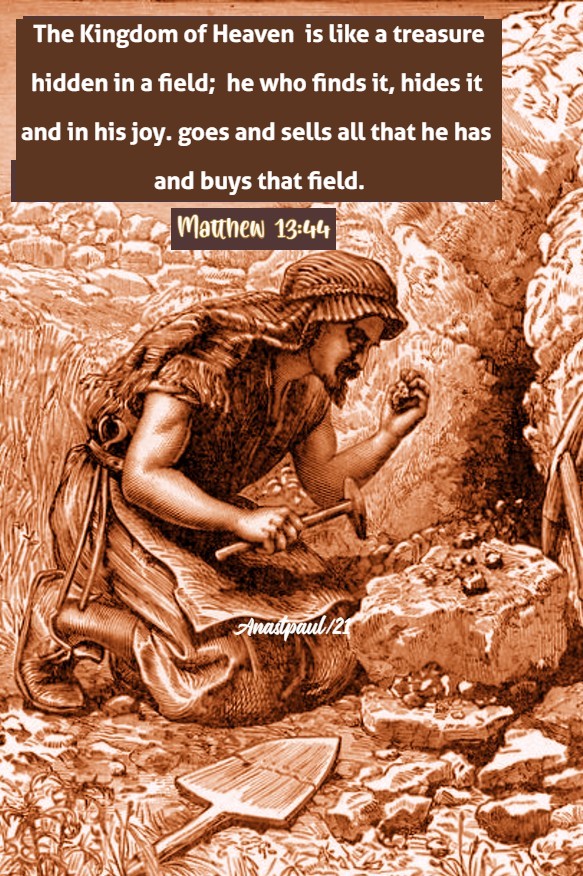
“The Kingdom of Heaven is like a treasure hidden in a field.”
Matthew 13:44
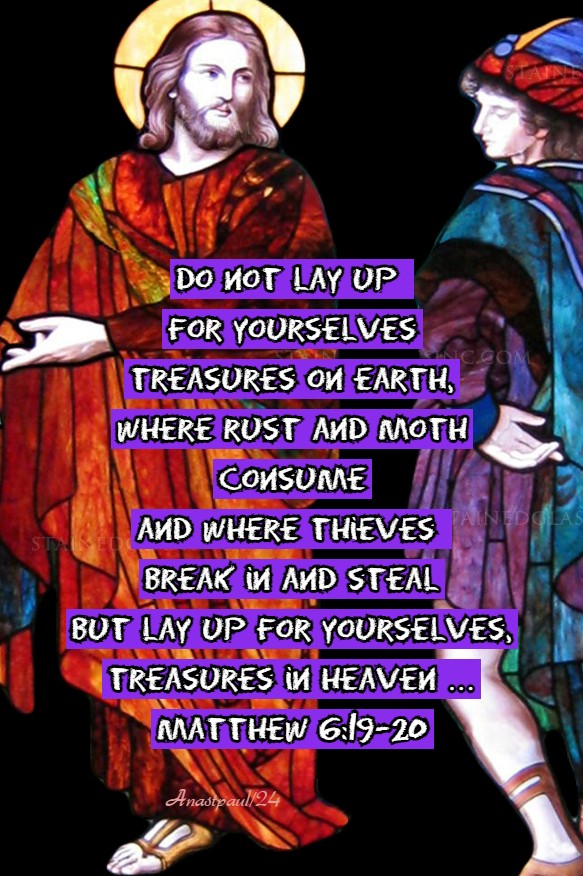
“Do not lay up for yourselves treasures on earth, where rust and moth consume and where thieves break in and steal but lay up for yourselves, treasures in Heaven …”
Matthew 6:19-20
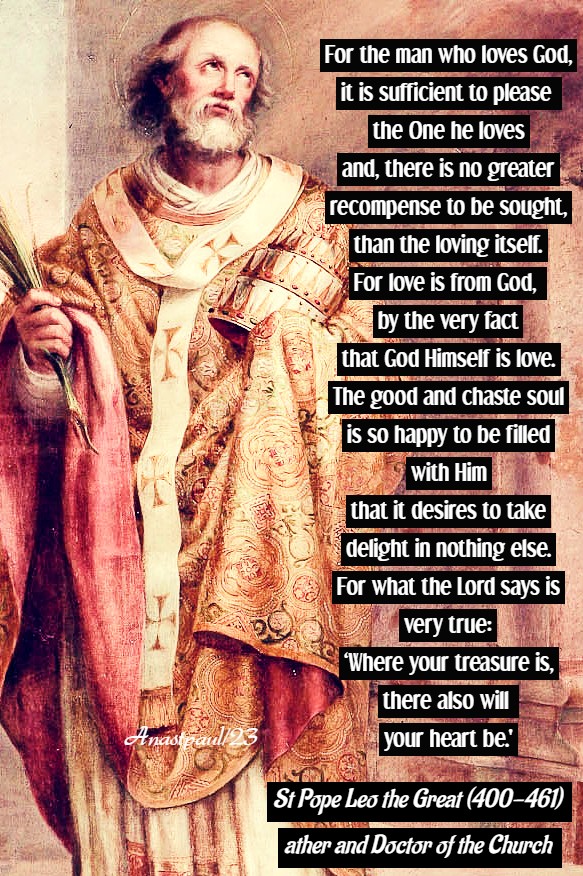
“For the man who loves God, it is sufficient to please the One he loves and, there is no greater recompense to be sought, than the loving itself. For love is from God, by the very fact that God Himself is love. The good and chaste soul is so happy to be filled with Him that it desires to take delight in nothing else. For what the Lord says is very true: ‘Where your treasure is, there also will your heart be.’”
“What is a man’s treasure but the heaping up of profits and the fruit of his toil? For, whatever a man sows, this too will he reap and each man’s gain, matches his toil and where delight and enjoyment are found, there the heart’s desire is attached. Now, there are many kinds of wealth and a variety of grounds for rejoicing – every man’s treasure is that, which he desires. If it is based on earthly ambitions, its acquisition makes men not blessed but wretched. … By distributing what might be superfluous to support the poor, they are amassing imperishable riches, so that what they have discreetly given, cannot be subject to loss. They have properly placed those riches, where their heart is – it is a most blessed thing, to work to increase such riches, rather than to fear that they may pass away.”
St Pope Leo the Great (400-461) ather and Doctor of the Church
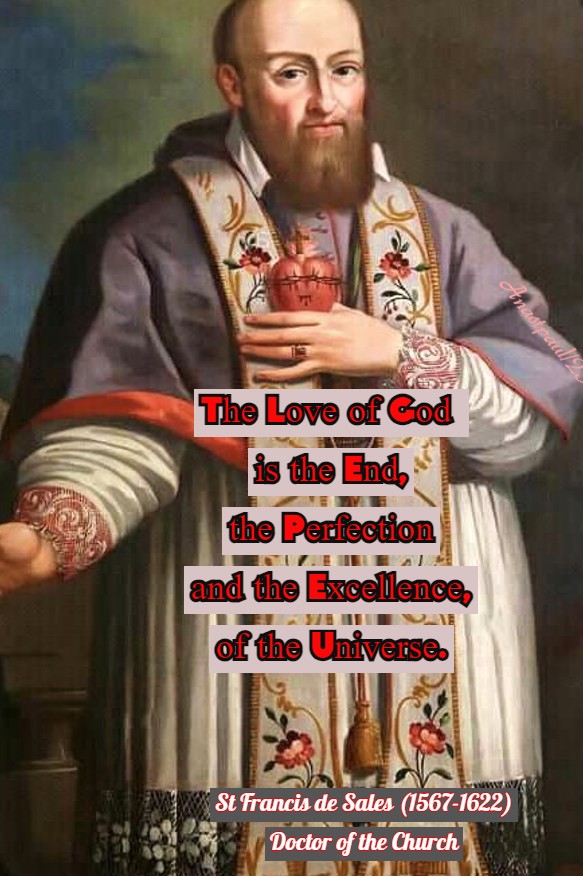
“The love of God is the end, the perfection and the excellence, of the universe. ”
(Treatise on the Love of God, Book 10, Chapter 1)
St Francis de Sales (1567-1622) Doctor of the Church
One Minute Reflection – 19 November – “The Month of the Holy Souls in Purgatory” – St Elizabeth of Hungary (1207-1231) Widow – Proverbs 31:10-31;, Matthew 13:44-52 – – – Scripture search here: https://www.drbo.org/
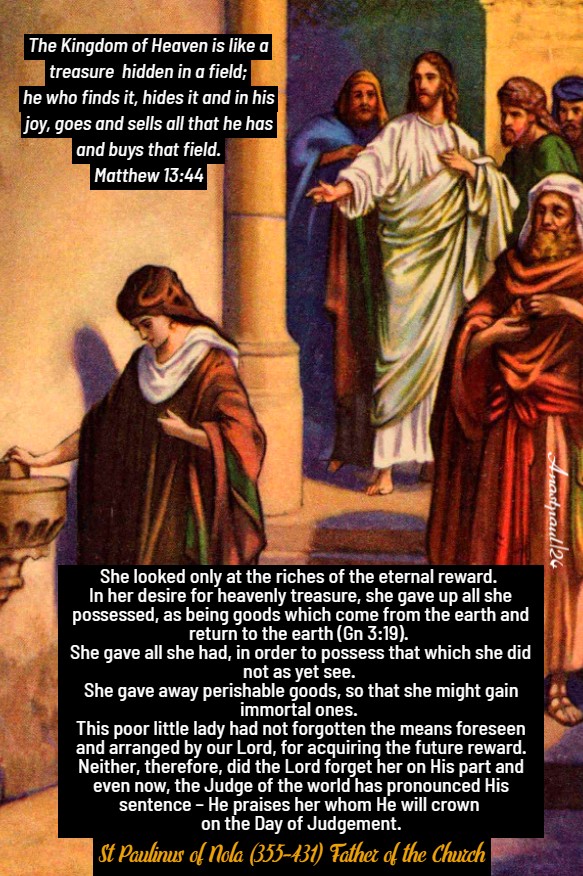
“The Kingdom of Heaven is like a treasure hidden in a field; he who finds it, hides it and in his joy, goes and sells all that he has and buys that field.” – Matthew 13:44
REFLECTION – “Let us call to mind that widow who, in her care for the poor, forgot herself, to the point of giving away everything she had to live on, thinking only of the life to come, as our Lord Himself attests. The others gave of their abundance but she – even poorer, perhaps, than many of the poor, for her whole fortune resided in two small coins – she it was, who carried in her heart more wealth than many of the wealthy.
She looked only at the riches of the eternal reward. In her desire for heavenly treasure, she gave up all she possessed, as being goods which come from the earth and return to the earth (Gn 3:19). She gave all she had, in order to possess that which she did not as yet see. She gave away perishable goods, so that she might gain immortal ones. This poor little lady had not forgotten the means foreseen and arranged by our Lord, for acquiring the future reward. Neither, therefore, did the Lord forget her on His part and even now, the Judge of the world has pronounced His sentence – He praises her whom He will crown on the Day of Judgement.” – St Paulinus of Nola (355-431) Bishop, Father of the Church (Letter 34 2-4).
PRAYER – O merciful God, enlighten the hearts of Thy faithful people and through the glorious prayers of blessed Elizabeth, make us look upon worldly prosperity as nought and ever rejoice in heavenly consolation. Through Jesus Christ, Thy Son our Lord, Who lives and reigns with Thee, in the unity of the Holy Ghost, God, world without end. Amen (Collect).
Our Morning Offering – 19 November – Acts of Faith, Hope and Charity
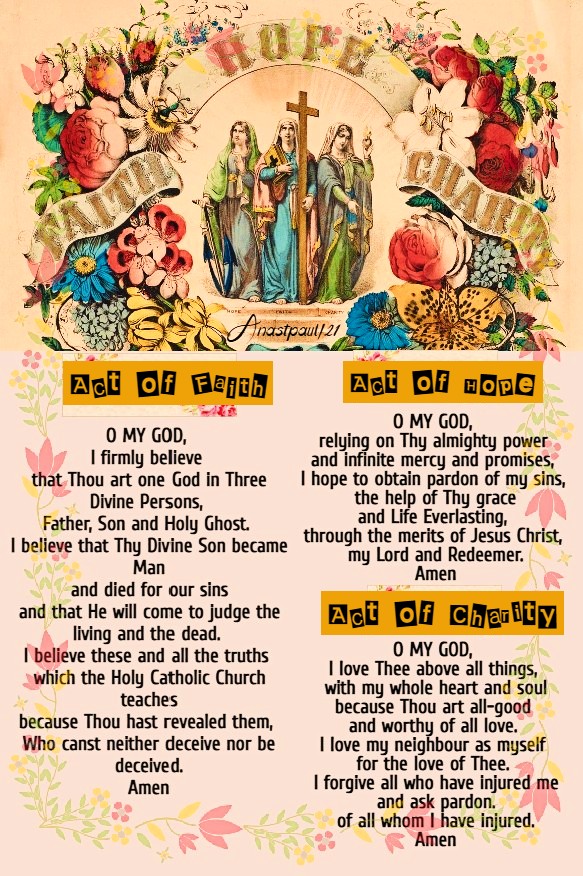
ACT of FAITH
O MY GOD, I firmly believe that Thou art one God in Three Divine Persons, Father, Son and Holy Ghost. I believe that Thy Divine Son became Man and died for our sins and that He will come to judge the living and the dead. I believe these and all the truths which the Holy Catholic Church teaches because Thou hast revealed them, Who canst neither deceive nor be deceived. Amen
ACT of HOPE
O MY GOD, relying on Thy almighty power and infinite mercy and promises, I hope to obtain pardon of my sins, the help of Thy grace and Life Everlasting, through the merits of Jesus Christ, my Lord and Redeemer. Amen
ACT of CHARITY
O MY GOD, I love Thee above all things, with my whole heart and soul because Thou art all-good and worthy of all love. I love my neighbour as myself for the love of Thee. I forgive all who have injured me and ask pardon. of all whom I have injured. Amen
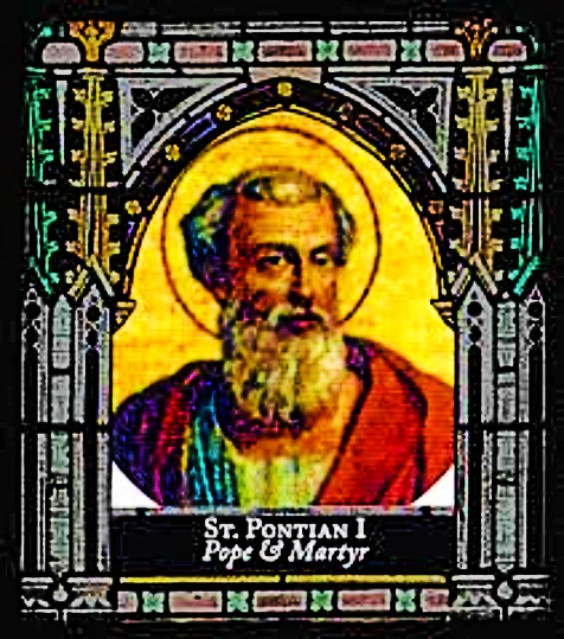
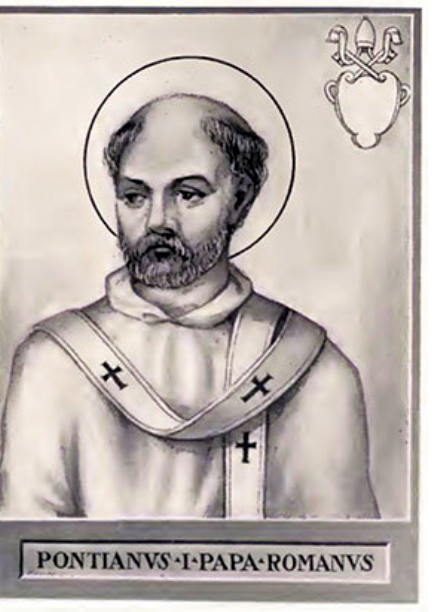
Saint of the Day – 19 November – Saint Pontianus (Died 235) Pope Martyr. Papal Ascension 21 July 230. Born at Rome, Italy and died on 19 November 235 from the horrible violence of the scourgins received in the mines of Sardinia. Patronages – Carbonia and Montaldo Scarampi, both Cities in Italy. Also known as – Pontian, Pontianius, Ponziano. Additional Memorial – 13 August (Depositiones Martyrum, 354).
The Roman Martyrology reads today: “The birthday of St Pontian, Pope and Martyr, who with the Priest, Hippolytus, was transported to Sardinia by the Governor Alexander and there, being scourged to death with rods, consumated his Martyrdom. His body was conveyed to Rome by the blessed Pope Fabian and buried in the Cemetery of Callixtus.”
In the first years of Pontian’s Pontificate, the early Christian Church enjoyed relative peace. But then, according to the well-known Church historian St Eusebius, the next Emperor, Maximinus, began a campaign of active and brutal persecution of the nascent Church. Both Pope Pontian and the Antipope Hippolytus of Rome, were arrested and exiled to laboUr in the mines of Sardinia, generally regarded as a death sentence.
In order to make certain that the Church was not deprived of its leadership, Saint Pontian stepped down, the first Pope ever to do so. Consequently, Pope Anteros was elected in his stead but reigned for less than two months.
Pope Fabian (236-50), successor to Pope Anteros, had the remains of StPontian brought to Rome at a later date and Pontian was buried in the Papal crypt of the Catacomb of Callixtus on the Appian Way. The slab covering his Tomb was discovered in 1909. Thereon the Greek inscribed reads: “Pontianus Bish”). The inscription “MARTUR” had been added in a different hand.
In 235 during the reign of Maximinus, a persecution directed chiefly against the Ecclesiastical hierarchy began. One of its first victims was Pontian, who with Hippolytus, was banished to the mines on the Island of Sardinia. How long Pontian endured the sufferings of exile and harsh treatment in the Sardinian mines is unknown.
Pope Fabian (236-250), successor to Pope Anteros, had the remains of St Pontian and Hippolytus brought to Rome.
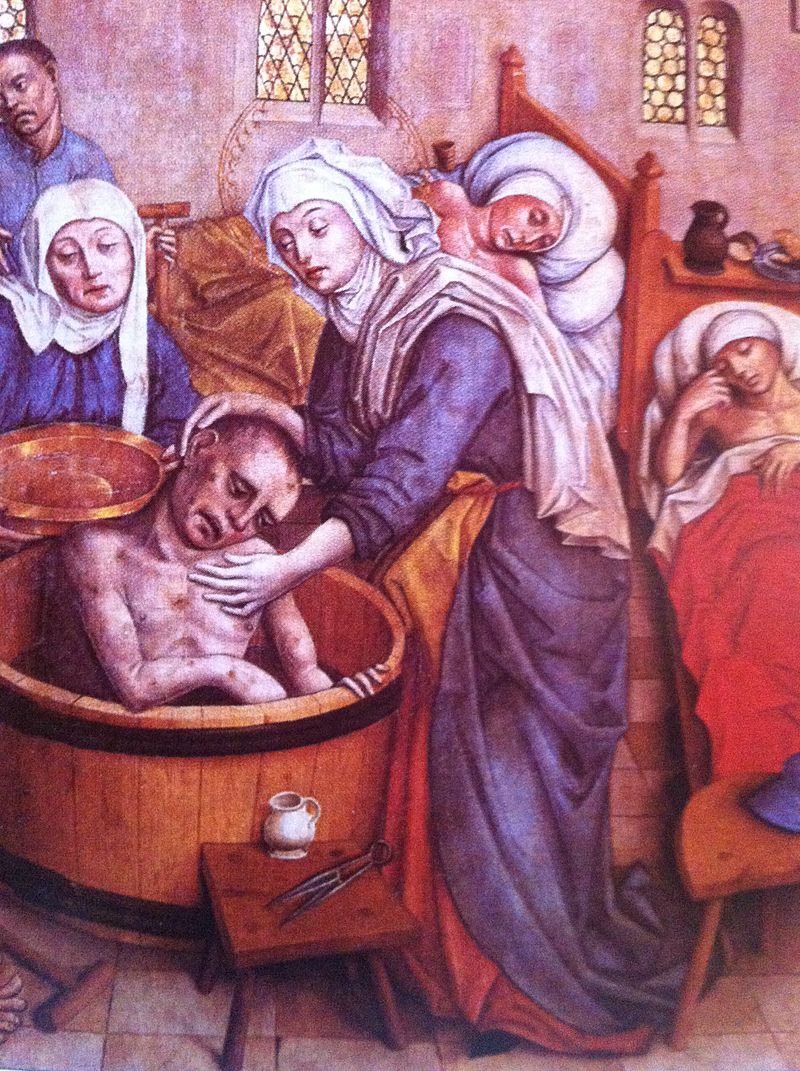
St Elizabeth of Hungary TOSF (1207-1231) Widow, Princess, Third Order Franciscans, Mother, Apostle of the poor, the sick, the needy.. She was Canonised on 27 May 1235 by Pope Gregory IX at Perugia, Italy. Patronages – hospitals, nurses, bakers, brides, countesses, dying children, exiles, homeless people, lace-makers, widows. all Catholic charities and the Third Order of Saint Francis. About St Elizabeth: https://anastpaul.wordpress.com/2017/11/17/saint-of-the-day-st-elizabeth-of-hungary-1207-1231-t-o-s-f/ Her Feast Day is 19 November – movedto the 17 November in 1969
St Atto of Tordino St Azas of Isauria St Barlaam of Caves St Barlaam of Antioch St Corbre of Anglesey St David of Augsburg St Ebbe of Minster-of-Thanet St Egbert of York
St Medana St Nerses the Great St Obadiah the Prophet St Tuto
Martyrs of Heraclea – 40 Saints: Forty women, a mix of Nuns, widows and other lay women, who were Martyred together. No other details have come down to us. They died at Heraclea, Thrace.
Martyrs of Vienne: – 3 Saints St Exuperius St Felicianus St Severinus
Thought for the Day – 18 November – Meditations with Saint Alphonsus Maria de Liguori (1696-1787) Bishop, Confessor, Most Zealous Doctor of the Church
“How to Pray at All Times” By St Alphonsus Maria de Liguori (1696-1787)
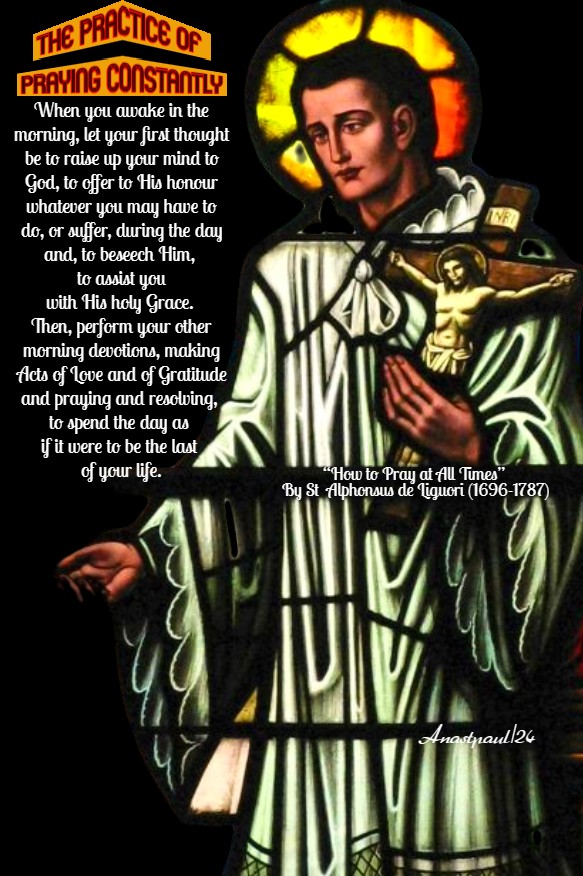
The Practice of Praying Constantly Excerpt from Chapter Five:1
“When you awake in the morning, let your first thought be to raise up your mind to God, to offer to His honour whatever you may have to do, or suffer, during the day and, to beseech Him, to assist you with His holy Grace. Then, perform your other morning devotions, making Acts of Love and of Gratitude and praying and resolving, to spend the day as if it were to be the last of your life.
Father Saint-Jure recommends you, every morning, to complete an agreement with God that, every time you make a certain sign, such as placing your hand upon your heart, or raising your eyes to Heaven or to the Crucifix, or the like, you intend thereby, to make an Act of love, of desire to see God loved by all, of oblation of yourself and other acts of the same kind. When you have made these Acts, place your soul in the Wound of the Side of Jesus and under the Mantle of Our Lady and beg of the Eternal Father, for the love of Jesus and Mary, to protect you during the day.
Then, before all things else, be sure to make your meditation, or mental prayer, at least for half an hour. Meditate especially on the sufferings and contempt endured by Jesus in His Passion. This is the subject dearest to fervent souls and the one best calculated to set hearts aflame with Divine love.”
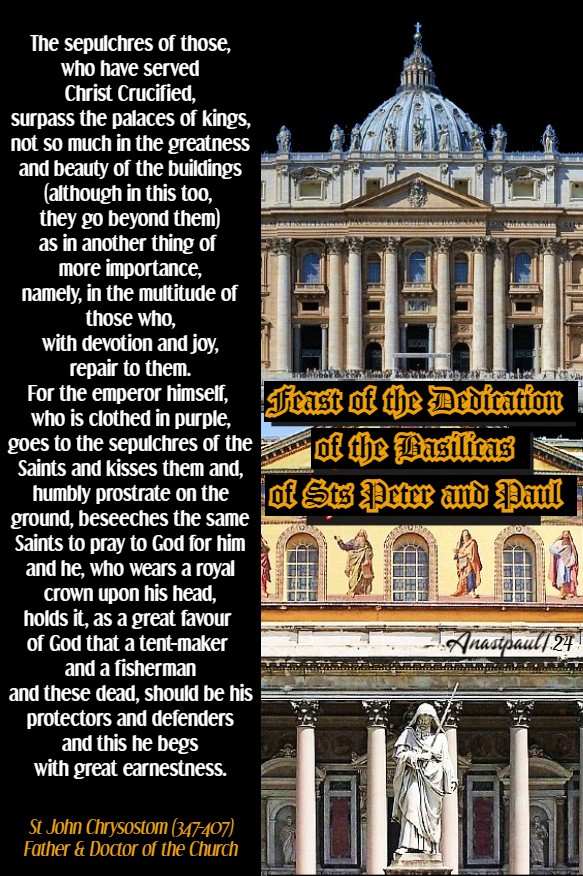
Quote/s of the Day – 18 November – Feast of the Dedication of the Basilicas ofSts Peter and Paul
“The sepulchres of those, who have served Christ Crucified, surpass the palaces of kings, not so much in the greatness and beauty of the buildings (although in this too, they go beyond them) as in another thing of more importance, namely, in the multitude of those who, with devotion and joy, repair to them. For the emperor himself, who is clothed in purple, goes to the sepulchres of the Saints and kisses them and, humbly prostrate on the ground, beseeches the same Saints to pray to God for him and he, who wears a royal crown upon his head, holds it, as a great favour of God that a tent-maker and a fisherman and these dead, should be his protectors and defenders and this he begs with great earnestness.”
St John Chrysostom (347-407) Father & Doctor of the Church
“We do not build Churches to Martyrs as to gods but memories as to men, departed this life, whose souls live with God. Nor do we erect Altars to sacrifice on them to the Martyr but to the God of the Martyr and our God.”
St Augustine (354-430) Father & Doctor of the Church
One Minute Reflection – 18 November – “The Month of the Holy Souls in Purgatory” – Feast of the Dedication of the Basilicas of Peter and Paul – Apocalypse 21:2-5; Luke 19:1-10 – Scripture search here: https://www.drbo.org/
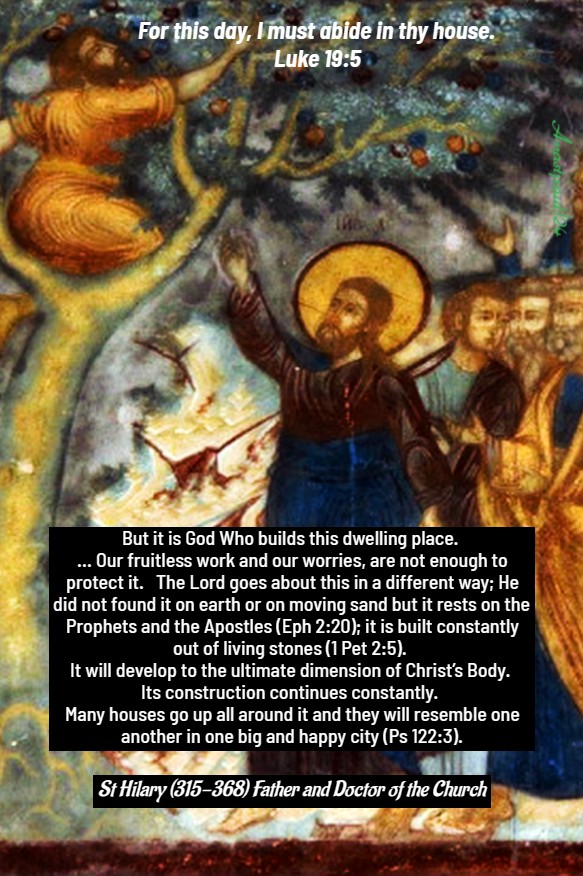
“… For this day, I must abide in thy house.” – Luke 19:5
REFLECTION – “The Lord said: “This is My resting place forever” and He “chose Zion as the place where He will dwell.” (Ps 132:14) But the temple is destroyed. Where will God’s eternal throne be? Where will His resting place be forever? Where will His temple be for His dwelling place? The apostle Paul gives us an answer: “You are the temple of God, … the Spirit of God dwells in you” (1 Cor 3:16). That is the house and temple of God. They are filled with His teaching and His power. They are the dwelling place for the holiness of God’s Heart.
But it is God Who builds this dwelling place. If it were built by human hands, it would not last, not even if it were founded on human teaching. Our fruitless work and our worries, are not enough to protect it. The Lord goes about this in a different way; He did not found it on earth or on moving sand but it rests on the Prophets and the Apostles (Eph 2:20); it is built constantly out of living stones (1 Pet 2:5). It will develop to the ultimate dimension of Christ’s Body. Its construction continues constantly. Many houses go up all around it and they will resemble one another in one big and happy city (Ps 122:3).” – St Hilary (315-368) Bishop of Poitiers, Father and Doctor of the Divinity of Christ (Treatise on Psalm 64).
PRAYER – O God, Who for us brings each year, the recurrence of the Consecration day of this Thy holy temple and always brings us back safely to the sacred rites, hear the prayers of Thy people and grant that whoever enters this temple, to pray for blessings, may rejoice in having obtained whatever he sought. Through Jesus Christ, Thy Son our Lord, Who lives and reigns with Thee, in the unity of the Holy Ghost, God, world without end. Amen (Collect).
The One Thing Necessary By St Alphonsus Maria de Liguori (1696-1787) Most Zealous Doctor
O my God, help me to remember, that time is short, eternity long. What good is all the greatness of this world at the hour of death? To love Thee, my God and save my soul is the one thing necessary. Without Thee, there is no peace of mind or soul. My God, I need fear only sin and nothing else in this life, for to lose Thee, my God, is to lose all. O my God, help me to remember, that I came into this world with nothing and shall take nothing from it, when I die. To gain Thee, I must leave all. But in loving Thee, I already have all good things – the infinite riches of Christ and His Church in life, Mary’s motherly protection and perpetual help and the eternal dwelling place Jesus has prepared for me. Eternal Father, Jesus has promised that whatever we ask in His Name will be granted us. In His Name, I pray, give me a burning faith, a joyful hope, a holy love for Thee. Grant me perseverance in doing Thine will and never let me be separated from Thee. My God and my All, make me a Saint! Amen
Saint of the Day – 18 November – St Thomas of Antioch (Died 782) Hermit, Miracle-worker. He died of natural causes in 782. Patronage – against pestilence.
The Roman Martyrology reads today: “At Antioch, St Thomas, a Monk, honoured with an annual solemnity by the people of Antioch, for having obtained the cessation of a pestilence by his prayers.”
An unknown Hermit
We have no information of this Saint. We know that Thomas spent most of his life as a Hermit in the area near Antioch (modern Syria).
According to tradition, he is a special Saint for relief against pestilence.
Dedication of the Basilicas of Peter and Paul: From the twelfth century the Dedications of the Vatican Basilica of St Peter and the Basilica of St Paul on the Via Ostiense, have been celebrated on this day, as the anniversary of their dedication by St Pope Silvester and St Pope Siricius in the fourth century. In more recent times, this feast has been extended to the whole Roman Rite. As the anniversary of the Dedication of the Basilica of St Mary Major (5 August) honours the motherhood of Our Lady, so this Feast honours the memory of the two Princes of the Apostles. About this Feast: https://anastpaul.wordpress.com/2017/11/18/feast-of-the-dedication-of-the-basilicas-of-sts-peter-and-paul-at-rome-18-november/
St Amandus of Lérins Bl Andreas Murayama Tokuan St Anselm of Lérins St Augusto Cordero Fernández St Barulas St Constant Bl Cosmas Takeya Sozaburo Bl Domingos Jorge St Emiliano Martínez de La Pera Alava St Esteban Anuncibay Letona St Francisco Marco Alemán St Germán García y García Bl Guilminus Bl Ioannes Yoshida Shoun St José María Cánovas Martínez St Keverne Bl Leonard Kimura St Mawes St Maximus of Mainz St Modesto Sáez Manzanares St Mummolus of Lagny St Nazarius of Lérins St Noah the Patriarch
St Oriculus St Patroclus of Colombier St Romfarius of Coutances
St Romanus of Antioch (Died c 303) Deacon Martyr. The Roman Martyrology reads: “At Antioch, the birthday of St Romanus, Martyr in the time of the Emperor Galerius. When the Prefect Asclepiades broke into the Churches and strove to destroy them completely, Romanus exhorted the Christians to resist him and, after being subjected to dire torments and the cutting out of his tongue (without which, however, he spoke the praises of God), he was strangled in prison and crowned with a glorious Martyrdom. Before him suffered a young boy, named Barula, who, being asked by him. whether it was better to worship one God, Whom the Christians adore, was scourged and beheaded.” His Life and Death: https://anastpaul.com/2022/11/18/saint-of-the-day-18-november-saint-romano-of-antioch-died-c-303-deacon-
St Teofredo of Vellaicum St Thomas of Antioch (Died 782) Hermit
Thought for the Day – 17 November – Meditations with Saint Alphonsus Maria de Liguori (1696-1787) Bishop, Confessor, Most Zealous Doctor of the Church
“How to Pray at All Times” By St Alphonsus Maria de Liguori (1696-1787)
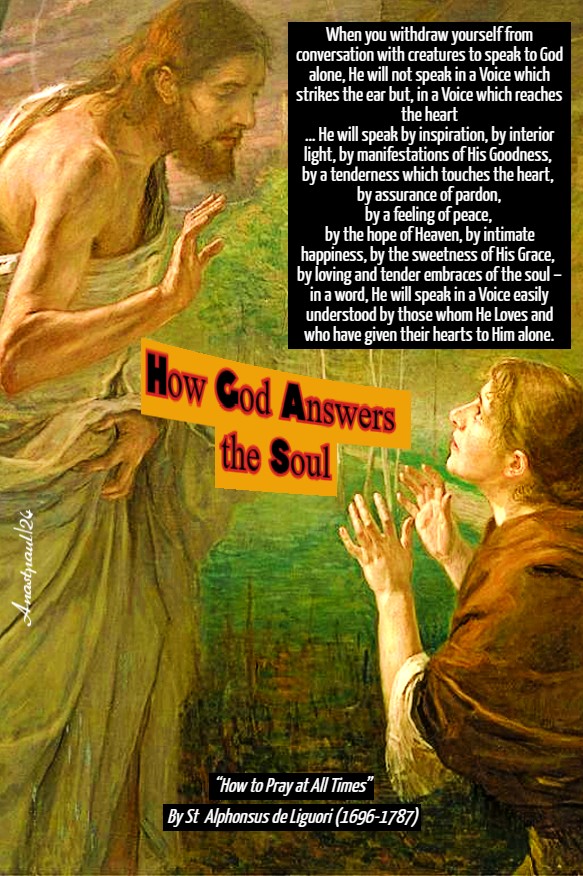
How God Answers the Soul Excerpt from Chapter Four
In a word, if you wish to please the loving Heart of God, endeavour to speak to Him as often as you can and, with the fullest confidence which He will answer and speak to you in return. When you withdraw yourself from conversation with creatures to speak to God alone, He will not speak in a Voice which strikes the ear but, in a Voice which reaches the heart
… He will speak by inspiration, by interior light, by manifestations of His Goodness, by a tenderness which touches the heart, by assurance of pardon, by a feeling of peace, by the hope of Heaven, by intimate happiness, by the sweetness of His Grace, by loving and tender embraces of the soul – in a word, He will speak in a Voice easily understood by those whom He Loves and who have given their hearts to Himalone.”
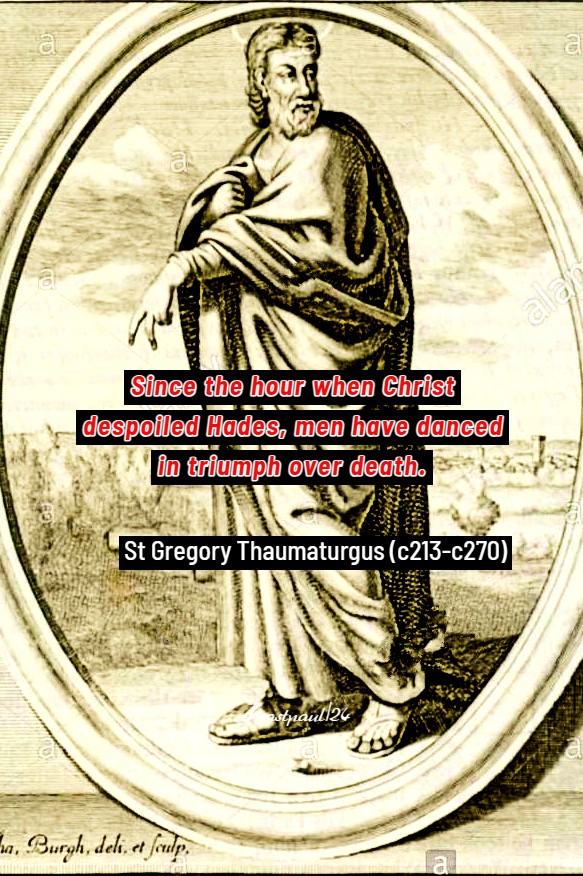
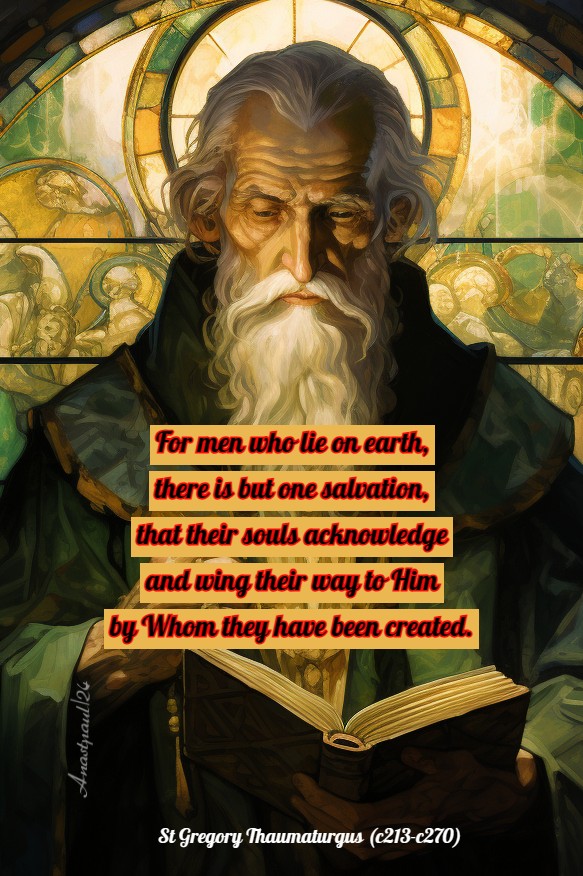
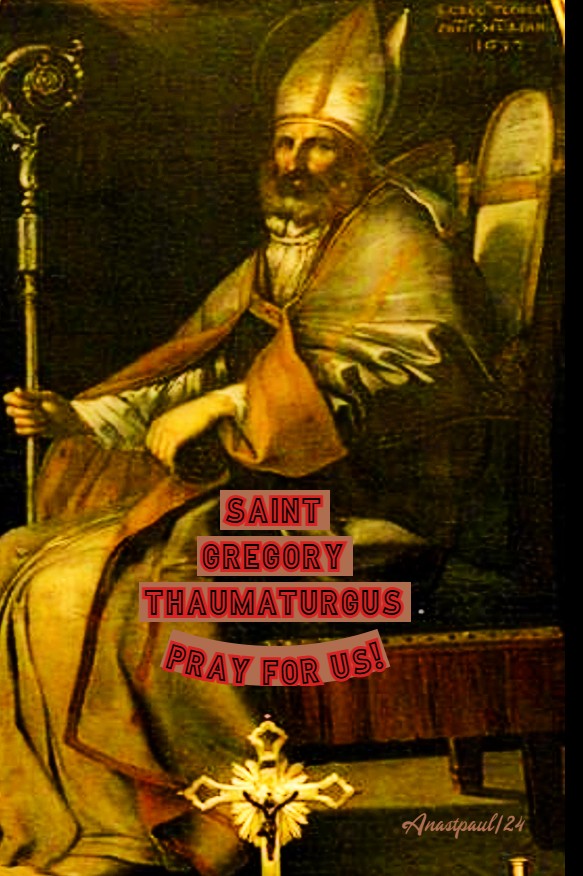
One Minute Reflection – 17 November – “The Month of the Holy Souls in Purgatory” – St Gregory Thaumaturgus (c 213-c 270) “the Wonder-Worker,” Bishop, Confessor – 1 Thessalonians 1:2-10; Matthew 13:31-35 – Scripture search here: https://www.drbo.org/
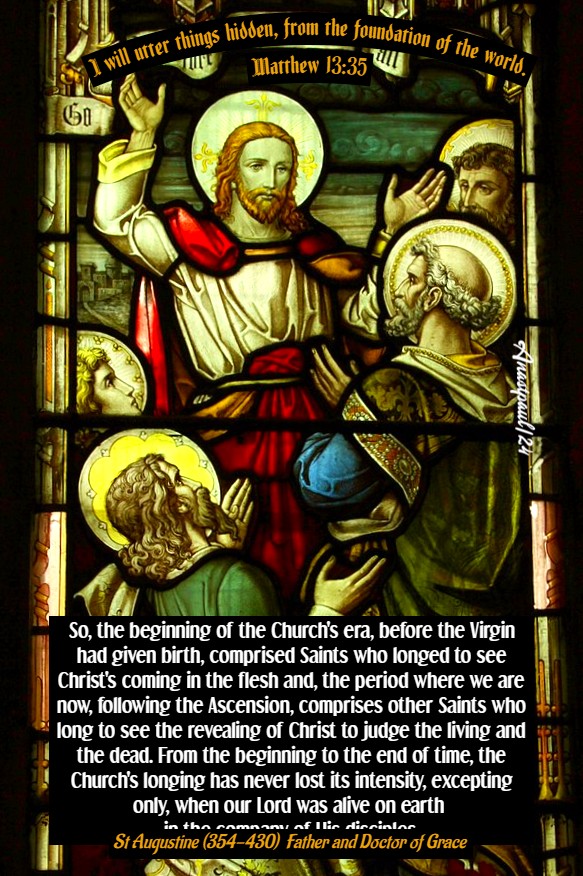
“I will utter things hidden, from the foundation of the world.” – Matthew 13:35
REFLECTION – “In one of the Psalms the Prophet says: “My soul pines for Thy salvation; I hope in Thy Word” (118:1) … Who is expressing this ardent desire if not “the chosen race, the royal priesthood, the people set apart for God” (1 Pt 2:9) each in their own day, in each one of those, who have lived, are living or will live, from humanity’s first beginning until the end of the world? … This is why our Lord Himself, says to His disciples: “Many Prophets and righteous men have wished to see that which you see.” It is their voice, then, we must recognise in this Psalm … Their longing has never come to an end in the Saints, nor does it end even now in “the Body of Christ, the Church” (Col 1:18) until “the Desired of all nations” comes (Hag 2:8) …
So, the beginning of the Church’s era, before the Virgin had given birth, comprised Saints who longed to see Christ’s coming in the flesh and, the period where we are now, following the Ascension, comprises other Saints who long to see the revealing of Christ to judge the living and the dead. From the beginning to the end of time, the Church’s longing has never lost its intensity, excepting only, when our Lord was alive on earth in the company of His disciples.” – St Augustine (354-430) Bishop of Hippo, Father and Doctor of Grace (Discourses on the Psalms Ps 118 No 20).
PRAYER – Grant, we beseech Thee, Almighty God that the venerable feast of Thy blessed Gregory Confessor and Bishop may increase our devotion and promote our salvation. Through Jesus Christ, Thy Son our Lord, Who lives and reigns with Thee, in the unity of the Holy Ghost, God, world without end. Amen (Collect).




















You must be logged in to post a comment.