Our Morning Offering – 7 April – “The Month of the Resurrection and the Blessed Sacrament” – The Octave Day of Easter or Low Sunday
“Victimae Paschali Laudes” The Easter Sequence By Father Wipo of Burgundy (c995– c1050) (Attrib)
Christians, to the Paschal Victim Offer your thankful praises!
A Lamb the sheep redeems, Christ, Who only is sinless, Reconciles sinners to the Father.
Death and life have contended in that combat stupendous. The Prince of Life, Who died, reigns immortal.
Speak, Mary, declaring What you saw, wayfaring. “The tomb of Christ, Who is living, the glory of Jesus’ Resurrection”
“Bright Angels attesting, The shroud and napkin resting. ” “Yes, Christ my Hope is arisen; To Galilee He goes before you. ”
Christ indeed from death is risen, our new life obtaining. Have mercy, Victor King, ever reigning! Amen. Alleluia!
Before the Gospel is proclaimed, the ancient Sequence “Victimae Paschali Laudes” of Easter Sunday is read or sung. The Sequence (Sequentia) is the Liturgical Hymn of the Mass which occurs on four Feasts:– Easter, Pentecost, Corpus Christi and Our Lady of Sorrows. This sequence, “Victimae Paschali Laudes” is attributed to Wipo of Burgundy (c995– c1050) who was a Priest, Poet and Historian, the Chaplain of the Holy Roman Emperor Conrad II during the 11th Century and possibly the Tutor of his son Emperor Henry III.
Saint of the Day – 7 April – Saint Hegesippus (c110-c180) Lay Ancient Christian Writer. Born and died probably in Jerusalem. Also known as -Egesippo, Hegesippus of Jerusalem, Hegesippus the Nazarene.
The Roman Martyrology reads: “St Hegesippus, who lived near the time of the Apostles, He came to Rome whilst Anicetus was the Sovereign Pontiff and remained until the accession of Eleutherius. He wrote the history of the Church in a simple style, from the Passion of our Lord, to his own time and, delineated, in his narrative, the character of those whose lives he imitated.”
Hegesippus was, by nation and religion, a Jew, who joined the Church of Christ in Jerusalem, when the disasters prophesied of his unhappy land occurred and opened his eyes to see their cause.
His writings were known to Saint Jerome and St Eusebius and were praised by them and by all of antiquity. In fact all we know of our Saint came to us from the writings of St Eusebius.
Hegesippus journeyed to Rome, stopping to visit all important Churches along his way. He remained in Rome for nearly twenty years, from the Pontificate of Pope Saint Anicetus (Bishop of Rome c157–168) to that of Saint Eleutherius (Pontificate 174-189). During the time of the latter. he returned to Jerusalem, where he died at an advanced age, probably in Jerusalem, in the year 180.
In 133, Saint Hegisippus began a history of the Church entitled ‘Memoirs,’ which was composed of five books and covered the time from the Passion of Christ until that year, that is, one hundred years. The loss of this work, of which only a few fragments remain, is extremely regretted and lamented, for it is known that they still all existed in the 7th Century. In it he gave illustrious proofs of his faith and placed, in evidence, the Apostolic tradition, proving that although certain men had disturbed the Church by preaching heresies, yet, even to his day, no Episcopal See or individual Church had fallen into error. This testimony he gave after having personally visited all the principal Churches, both of the East and the West, with the intention of gathering all authentic traditions concerning the life of Our Lord and of the Apostles.
He says: “And the Church of the Corinthians remained in the true word until Primus was bishop in Corinth; I made their acquaintance in my journey to Rome, and remained with the Corinthians many days, in which we were refreshed with the true word. And when I was in Rome, I made a succession up to Anicetus, whose Deacon was Eleutherus. And in each succession and in each City, all is according to the ordinances of the law and the Prophets and the Lord Jesus.” (Eusebius, IV, 22).
The Octave Day of Easter or Low Sunday Quasimodo Sunday or Dominica In Albis “At the end of the Octave, in the ancient Roman Church, the Newly-Baptised would remove their white Baptismal gowns which would be deposited at the Cathedral. Thus, the Saturday of the Octave is called “in albis” and the Sunday, which is technically outside the Octave and the beginning of the Easter season, is “in albis depositis.” Hitherto they were known as the “infantes… infants” in the Faith. In fact, the first Chant of Sunday’s Mass, in Introit, is from 1 Peter 2:2-3 in the Vetus Latina version which pre-dates the Vulgate of St Jerome. In the translation I’ll include the verse immediately before, because it is relevant to our work today:
Quasimodo Geniti I nfantes, rationabile, sine dolo lac concupiscite ut in eo crescatis in salutem si gustastis quoniam dulcis Dominus. … [So put away all malice and all guile and insincerity and envy and all slander.] Like newborn babes, long for the pure spiritual milk so that by it, you may grow up to salvation; for you have tasted the kindness of the Lord.”
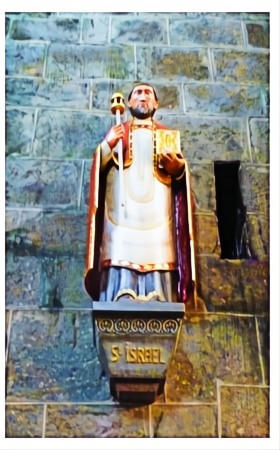
St Albert of Tournai Bl Alexander Rawlins St Brenach of Carn-Engyle St Calliopus of Pompeiopolis Bl Cristoforo Amerio St Cyriaca of Nicomedia St Donatus of North Africa
St Epiphanius the Martyr St Finian of Kinnitty St George the Younger St Gibardus of Luxeuil St Goran St Guainerth St Hegesippus (c110-c180) Ancient Christian Writer
Saint Hermann Joseph O.Praem (c1150-1241) Priest, Friar of the Order of of Canons Regular of Prémontré (the Norbertines or White Canons), Mystic, a prolific writer on spiritual subjects and the Sacred Scriptures, known as “The Boy who Played with Angels.” Patronages – watch and clockmakers, children and young students, Altar boys, Acolytes, Sextons and Sacristans, expectant mothers and safe childbirth. This beautiful painting below by Sir Antony van Dyck, shows Mother Mary receiving an apple from Hermann, to give to Baby Jesus. His Holy Life: https://anastpaul.com/2023/04/07/saint-of-the-day-7-april-saint-hermann-joseph-o-praem-c1150-1241-priest/
Sir Antony van Dyck – The Vision of St Hermann Joseph
Blessed Maria Assunta Pallotta (1878-1905) Italian professed Religious who served as a member of the Franciscan Missionaries of Mary, Missionary to China. Patronages – Missionaries, against typhus. Blessed Maria Assunta was Beatified on 7 November 1954 by Pope Pius XII. Her body is incorrupt. About Bl Maria Assunta: https://anastpaul.com/2019/04/07/saint-of-the-day-7-april-blessed-maria-assunta-pallotta-1878-1905/
St Peleusius of Alexandria Bl Ralph Ashley St Rufinus the Martyr St Saturninus of Verona Bishop and Confessor Bl Ursuline of Parma
Martyrs of Pentapolis – 4 Saints: A Bishop, Deacon and two Lectors at Pentapolis, Lydia who for their faith were tortured, had their tongues cut out, and were left for dead. They survived and each died years later of natural causes; however, because they were willing to die and because there were attempts to kill them, they are considered martyrs. We know little else except their names – Ammonius, Irenaeus, Serapion and Theodore c 310 at Pentapolis, Lybia.
Martyrs of Sinope – 200 Saints: 200 Christian soldiers Martyred together for their faith. We don’t even have their names. They were martyred in Sinope, Pontus, Asia Minor (in modern Turkey).
Thought for the Day – 6 April– The Spiritual Combat (1589) – Dom Lorenzo Scupoli OSM (c1530-1610)
“None shall be crowned who has not fought well.” 2 Tim 2: 5
XLI: … We Must Never Wish to be Delivered from the Trials we are Patiently Enduring
“When you shall find yourself in any painful position and bearing it patiently, take heed lest the devil or your own self-love persuade you to desire deliverance from it; for you may thereby, incur two great evils.
+++ Firstly – If this desire should not rob you at once of the virtue of patience, it would at least gradually dispose you to impatience. +++ Secondly – Your patience would become defective and would be rewarded by God only according to the duration of the suffering; whereas, if you had not desired to be freed from it but had committed yourself wholly to His Divine goodness, your sufferings, although but of an hour’s duration, or even less, would have been accepted by your Lord as an enduring service.
In this, then and in all things, make it your unvarying rule, to keep your wishes so far removed from every other object that they may tend simply to their true and only end, the Will of God. For thus, will they be ever right and true and, in any cross, or accident which may occur, you will be not only tranquil but content because, as nothing can happen without the Supreme Will, by willing the same, you will come, at all times, both to will all that happens and to possess all that you desire!
This must not be understood either of our own sins or those of others, for God Wills not these but, it applies to every chastisement arising from them, or from any other cause, although it be so keen and searching, as to reach the very bottom of the heart and, to wither the very roots of the natural life; a cross wherewith God is sometimes pleased to favour His nearest and dearest friends.
And, what I say of the patience which you are bound to practice on all occasions, is to be understood of that portion of any trouble, which still remains, after we have used all lawful means of relief and which, it is the Will of God that we should endure.
And, in the use of these means, we should be guided by the Will and disposal of God, Who has appointed them to be used, not to please ourselves but because He so Wills; nor as loving or desiring deliverance from suffering beyond what is required for His service and by His Will!”
Quote/s of the Day – 6 April – “The Month of the Resurrection and the Blessed Sacrament” – Easter Saturday – 1 Peter 2:1-10, John 20:1-9 – Scripture search here: https://www.drbo.org/
“[He] hath called you out of darkness into His marvellous Light … ”
1 Peter 2:9
“Let not your hearts be troubled, neither let them be afraid.”
John 14:27
“In the world you will have tribulation. But take heart, I have conquered the world.” John 16:33
“Who will be crowned without having fought? Who will go to rest if he is not tired (cf. 2 Tim 2:5-6)? Who will gather the fruits of life without having planted virtues in his soul? Cultivate them, prepare the earth with the greatest care, take trouble over it, sweat over it, children, God’s workers, imitators of the Angels, competitors with incorporeal beings, lights for those who are in the world (cf. Phil 2:15)!”
St Theodore the Studite (759-826)
“Lord, help me to live this day, quietly, easily. To lean upon Thy great strength, trustfully, restfully. To wait for the unfolding of Thy will, patiently, serenely. To meet others, peacefully, joyously. To face tomorrow, confidently, courageously.”
St Frances of Assisi (c1181-1226)
“Let nothing perturb you, nothing frighten you. All things pass. God does not change. Patience achieves everything.”
St Teresa of Jesus of Avila (1515-1582) Doctor of Prayer
“Let us think only of spending the present day well. Then, when tomorrow shall have come, it will be called TODAY and then, we will think about it.”
St Francis de Sales (1567-1622) Doctor of the Church
One Minute Reflection – 6 April – “The Month of the Resurrection” – Easter Saturday – 1 Peter 2:1-10, John 20:1-9 – Scripture search here: https://www.drbo.org/
“This is the day which the Lord has made: let us be glad and rejoice therein.” – Psalm 117:24.
REFLECTION – “The Sun of Justice (Mal 3:20) which had disappeared for three days, today rises and shines on the whole creation. Christ was in the tomb for three days but He existed before the ages! He comes up like a vine and fills the earth with joy. Let us behold the Rising Sun which will never set, let us anticipate the day and be filled with the joy of this Light!
The gates of Hell have been broken by Christ, the dead awake from sleep. Christ rises, He, the Resurrection of the dead and comes to awaken Adam. Christ, the Resurrection of all who have died, rises and comes to free Eve from malediction. Christ rises, He Who is the Resurrection and He transforms, in all its beauty, what had “no stately bearing to make us look at Him” (Is 53:2). As a sleeper, the Lord awoke and confounded all the deceitfulness of the enemy. He was raised and gave joy to the whole creation; He was raised and the prison-house of Hell was emptied; He was raised and transformed, what is corruptible into incorruptibility (1 Cor 15:53). The Risen Christ clothed Adam with incorruptibility, his original dignity.
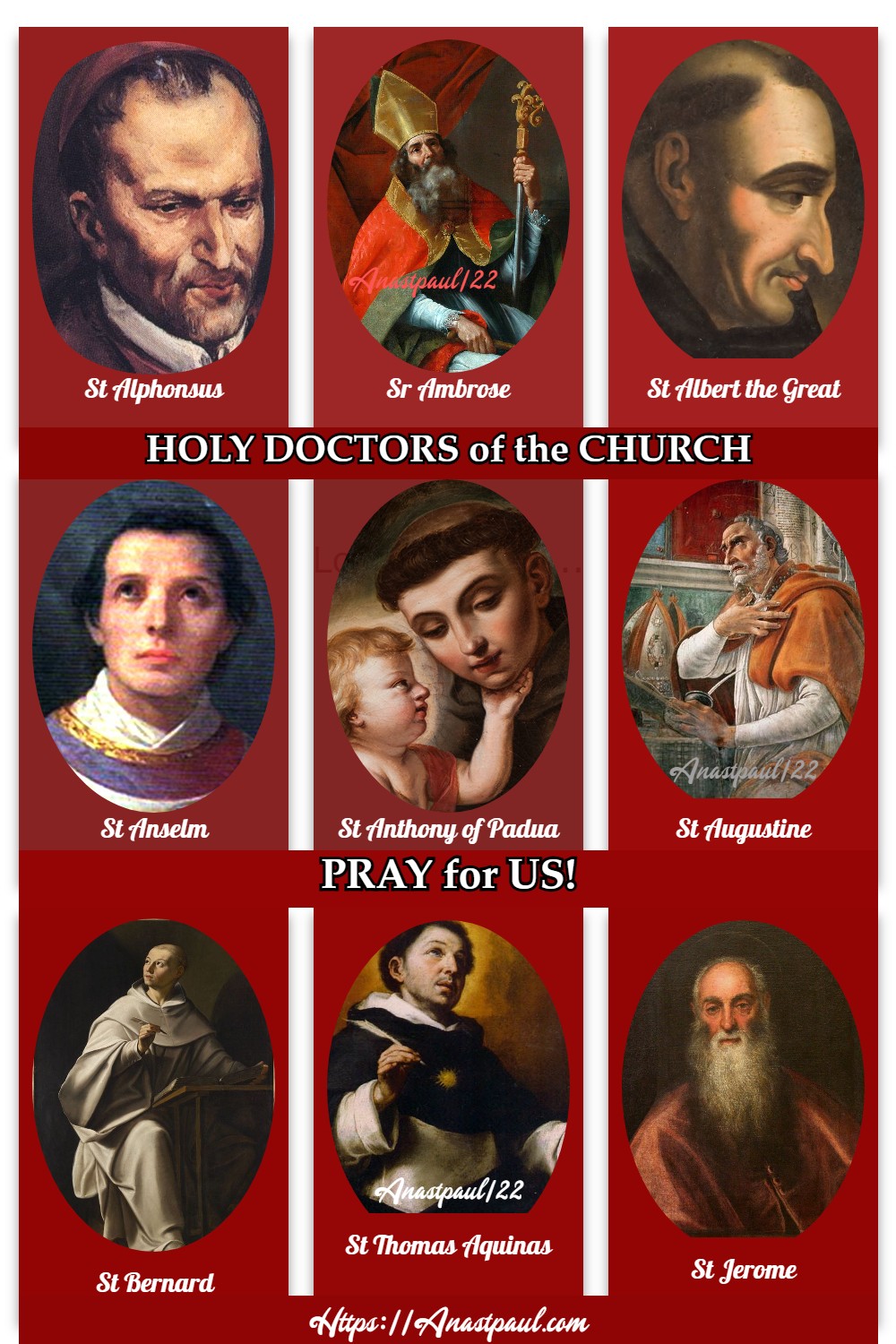
Today, through Christ, the Church becomes a new heaven (Apoc 21:1), a more beautiful vault to contemplate, than the visible sun. The sun which we see everyday, cannot compare with this Sun – as a servant filled with respect, it eclipsed before Him, when it saw Him hanging on the Cross (Mt 27:45). It is of this Sun that the Prophet said: “For you, who fear My Name, there will arise the Sun of Justice with its healing rays” (Mal 3:20)… Through Him, Christ, the Sun of Justice, the Church becomes a beautiful heaven filled with a multitude of stars which emerge from the Baptismal waters in their new Light. “This is the day which the Lord has made; let us rejoice in it and be glad” (Ps 117:24), filled with the joy that comes from God.” – St Epiphanius of Salamis (Died 403) Bishop
PRAYER – Grant, we beseech Thee, O Almighty God that we, who have devoutly kept the Easter solemnities, may at last worthily pass from keeping Feasts, unto Thee here below, to the everlasting jubilation above. Through Jesus Christ, Thy Son our Lord, Who lives and reigns with Thee, in the unity of the Holy Ghost, God, world without end. Amen (Collect).
Mother of Christ, Mother of Christ, What shall I ask of thee? I do not sigh for the wealth of earth For the joys that fade and flee, But, Mother of Christ, Mother of Christ, This do I long to see — The bliss untold which thy arms enfold, The Treasure upon thy knee.
Mother of Christ, Mother of Christ, He was All-in-All to thee, In the winter’s cave, in Nazareth’s home, In the hamlets of Galilee, So, Mother of Christ, Mother of Christ, He will not say nay to thee, When He lifts His Face to thy sweet embrace, Speak to Him, Mother, of me.
Mother of Christ, Mother of Christ, The world will bid Him flee, Too busy to heed His gentle Voice, Too blind His charms to see, Then, Mother of Christ, Mother of Christ, Come with thy Babe to me, Tho’ the world be cold, my heart shall hold A shelter for Him and thee.
Mother of Christ, Mother of Christ, What shall I do for thee? I will love thy Son with the whole of my strength, My only King shall He be. Yes! Mother of Christ, Mother of Christ, This will I do for thee, Of all that are dear or cherished here, None shall be dear as He.
Mother of Christ, Mother of Christ, I toss on a stormy sea, O lift thy Child as a Beacon Light, To the Port where I fain would be! And, Mother of Christ, Mother of Christ, This do I ask of thee — When the voyage is o’er, oh! stand on the shore And show Him at last to me.
The Author is unclear – The 1920 St Gregory Hymn book (editor Nicola A. Montani) credits it to Nicola A Montani. The 1914 American Catholic Hymn book credits it to “S. N. D. ” – most likely meaning a Sister of Notre Dame
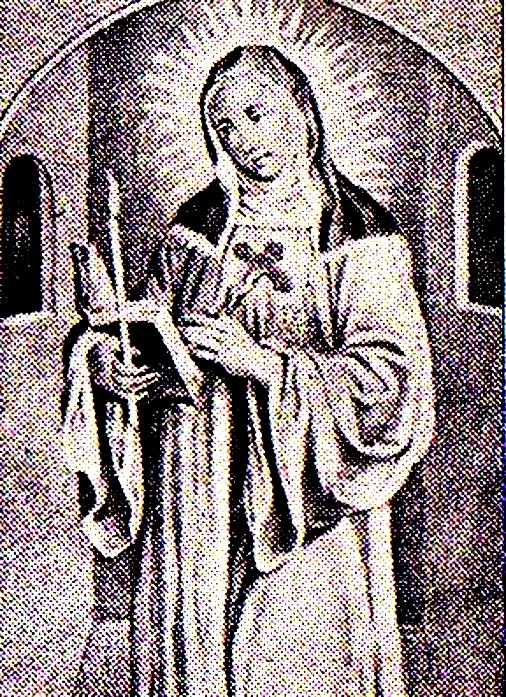
Saint of the Day – 6 April – Blessed Catherine of Pallanza (c1437-1478) Virgin, Hermit, Ascetic, Mystic, Prioress, Spiritual Advisor graced with the charism of prophecy. Born in c1437 in Pallanza, Italy as Catarina Morigi and died on 6 April 1478 at Sacra Monte sopra Varese Monastery, Varese, Italy of natural causes aged 51 years. Also known as – Caterina Morigi di Pallanza, Catherine Morigi, Catarina Morigi Catarina of Pallanza, Katarina … Additional Memorial – 27 April (Ambrosian Rite). Her cult was confirmed on 16 September 1769 by Pope Clement XIV. Her body is incorrupt.
Catarina was born around 1437 in Pallanza, a small village in the Diocese of Novara in the Piedmont region of northern Italy. Her entire family died in a plague epidemic when she was very young and she was adopted by a woman who lived in nearby Milan.
At the age of 20 she was deeply moved after hearing a sermon on the Passion of Christ, prostrating herself before the Crucifix in the Church and consecrating her virginity to God. It was not long after this that she received a vision of the Crucified Jesus Who said to her: “Beloved daughter Catarina … I have selected for you the place called Santa Maria on the Mountain.” Catarina immediately retired to a wild and lonely mountain region above Varese near Milan which had often been used by hermits and, where Saint Ambrose had built an Altar in honour of the Virgin Mary .
She joined a group of female Hermits under the leadership of a Priest in charge of St Ambrose’ Sanctuary. Older sources write that she was the first woman known to have lived there as a Hermit but this is obviously not correct. Catarina lived this life for fifteen years and even in an area famous for the severe penances of its Hermit residents, Catarina’s asceticism was so extreme that it attracted attention. She fasted ten months of the year and was always dependent on gifts of food brought to her at irregular intervals by those who sought her prayers and advice.
Despite her desire to be left alone, a group of five female disciples joined her. The first (in 1454) was Blessed Juliana Puricelli of Busto Arsizio and the others came in 1460. In 1474, Catarina organised them as a duly constituted community with herself as the Prioress, under the Rule of Saint Augustine. Pope Sixtus IV (1471-1484) approved the community. The Monastery was dedicated to Our Lady of the Mountain and the place was called Sacra Monte sopra Varese. The Nuns received permission to wear the Habit of the Poor Clares. Catherine served as Prioress for two years before she died.
Catherine died on 6 April 1478 at Sacra Monte sopra Varese. On her deathbed she was given a Crucifix and she kissed it and said: “I see my beloved Crucified One.” Her Confessor then said to her: “Behold your Crucified One” and she replied: “I have Him engraved upon my heart.”
Even while she was alive, she was graced with prophetic abilities and a local cult developed very quickly. In the 1730s, her mortal remains were translated to a special Chapel built in her honour, where her body is still venerated today. She was Beatified on 16 September 1769 when her cult was confirmed by Pope Clement XIV (1769-1774). At the same time, Blessed Juliana Puricelli’s cult was also confirmed. Catherine’s memorial day is the day of her death 6 April while 27 April is her Feast Day in the Ambrosian Liturgy (together with Juliana).
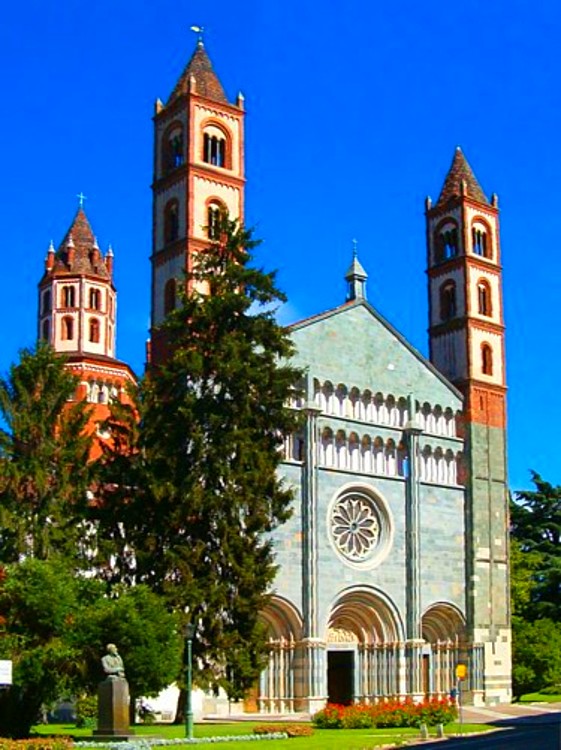
St Agrarius the Martyr St Amand of Grisalba St Berthanc of Kirkwall St Brychan of Brycheiniog Blessed Catharine of Pallanza (c1437-1478) Virgin St Celsus Bishop St Diogenes of Philippi St Elstan of Abingdon St Galla of Rome St Gennard St Irenaeus of Sirmium St Marcellinus the Martyr
Martyrs of Sirmium : 7 Saints: A group of fourth century Martyrs at Sirmium, Pannonia (modern Sremska Mitrovica, Serbia). We know little more than seven of their names – Florentius, Geminianus, Moderata, Romana, Rufina, Saturus and Secundus.
Thought for the Day – 5 April– The Spiritual Combat (1589) – Dom Lorenzo Scupoli OSM (c1530-1610)
“None shall be crowned who has not fought well.” 2 Tim 2: 5
XL: … Of the Time to be Given to the Exercise of Each Virtue and Of the Signs of Progress (Part Two)
“And the greater the alacrity and joyfulness of spirit which accompanies these acts, the greater may be our hope that we have derived protit from this exercise.
We must beware, however, of assuming, as a certainty, that we have acquired any virtue, or entirely subdued any one passion, even though, after a long time and after many struggles, we may have ceased to feel its motions within us. For here too, the arts and devices of Satan and our own deceitful nature, may find place, since that which is really vice seems to our lurking pride, to be virtue. Besides, if we look to the perfection to which God calls us, we shall hardly persuade ourselves, however great the progress we have made in the way of holiness, that we have even crossed its threshold!
Return, therefore, to your first exercises, as a young soldier and a newborn babe but just beginning to struggle, as if you had hitherto done nothing.
And remember to attend rather to advancement in holiness, than to an examination of your progress; for the Lord God, the true and only Searcher of our hearts, gives this knowledge to some and withholds it from others, according as He sees that it will lead to pride or to humility and, as a loving Father, He removes a danger from one, while to another, He offers an opportunity of increase in holiness.
Therefore, although the soul does not perceive its progress, let it continue these exercises; for they shall be seen when it will please the Lord, for the soul’s greater good, to make it known to it.”
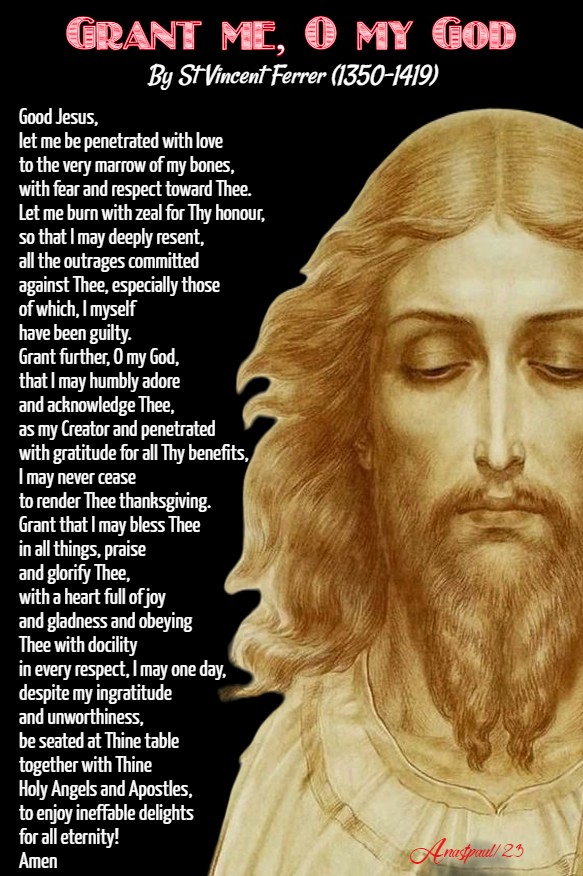
Quote/s of the Day – 5 April – St Vincent Ferrer OP (1350-1419) Confessor, called “The Angel of the Apocalypse” and of “The Last Judgement” and the “Mouthpiece of God.”
“If you truly wish to help the soul of your neighbour, you should firstly approach God with all your heart. Ask Him simply, to fill you with charity, the greatest of all virtues.”
“When troubled by temptations, raise up your heart and soul to God, humbly beseeching Him to turn them to His greater glory and to your salvation, supporting the temptations as long as it shall please Him and imploring Him, to grant you grace, never to offend Him.”
“Regard yourself as more vile and miserable in the sight of God because of your faults, than any sinner whatever, no matter what his sins. . . and consider closely that any grace, or inclination to good or desire of virtue, you may have, is not of yourself but of the sole mercy of Christ.”
One Minute Reflection – 5 April – “The Month of the Resurrection and the Blessed Sacrament” – Easter Friday – St Vincent Ferrer OP (1350-1419) Confessor, called the “Angel of the Apocalypse/The Last Judgement” and the “Mouthpiece of God” – 1 Peter 3:18-22, Matthew 28:16-20 – Scripture search here: https://www.drbo.org/
“Go, therefore, teach all nations, baptising them in the Name of the Father and of the Son and of the Holy Ghost.” – Matthew 28:19
REFLECTION – “The Father, the Son and the Holy Ghost, are of One substance and inseparably equal. Their Unity is in their Essence, their plurality in the Persons. The Lord openly showed the Unity of the Divine Essence and the Trinity of Persons, when He said: “Baptise them in the Name of the Father and of the Son and of the Holy Ghost.” He did not say “in the NAMES” but “in the Name” by which He showed the Unity of Essence. But, He then used Three Names in order to show that there are Three Persons.
In this Trinity can be found, the supreme origin of all things, perfect beauty, very blessed joy. As Saint Augustine said in his book on true religion, the supreme origin is God the Father, from Whom all things come, from Whom proceed the Son and the HolyGhost. The very perfect Beauty is the Son, the Truth of the Father, Who is not dissimilar to Him in anything, Whom we venerate with the Father and in the Father, Who is the model for all things because, everything was made through Him and everything relates to Him. The very blessed Joy, the sovereign goodness is the Holy Ghost Who is the Gift of the Father and of the Son and we must believe and hold that this Gift is exactly like the Father and the Son.
When we look at creation, we finish with the Trinity which is of One single substance. We understand One single God – the Father from Whom we are, the Son by Whom we are, the Holy Ghost in Whom we are – the Origin to Whom we run; the Model Whom we follow; the Grace which reconciles us!” – St Anthony of Padua OFM (c1195-1231) Franciscan, Evangelical Doctor of the Church (Sermons for Sundays and the Feasts of the Saints).
PRAYER – O God, Who graciously enlightened Thy Church by the virtues and preaching of blessed Vincent, Thy Confessor, grant that we, Thy servants, may, be taught by his example and delivered from all harm by his intercession.Through the same Jesus Christ, Thy Son our Lord, Who lives and reigns with Thee, in the unity of the Holy Ghost, God, world without end. Amen (Collect).
Our Morning Offering – 5 April – “The Month of the Resurrection and the Blessed Sacrament” – Easter Friday
A Song of Praise St John Baptiste de la Salle (1651-1719) (Instructions and Prayers Ch 17. 81-82)
My tongue is untied in praise of my God. because His mercy for mankind has no limits and He is loving with all His creatures across the Centuries. I unite my voice with that of the Angels and Saints to sing the glory of God in Heaven and His peace on earth. Through Christ in Whom Thou, Father, are pleased, with Christ and in Christ may every praise, power, honour and glory be given to Thee throughout the ages. Alleluia! SO BE IT!
Saint of the Day – 5 April – St Albert of Pietramontecorvino (c1031-1127) the 2nd Bishop of Montecorvino, known as a visionary and Mystic, Miracle-worker. Born in around 1031 or 1032 in Normandy, France and died in 1127 of natural causes, at Montecorvino, Aqulia, Italy. Patronage – of Pietramontecorvino, Italy. Additional Memorial – 16 May in Pietramontecorvino.
Although most sources believe Albert was born in Normandy in northern France some believe he was born in Planisio near Pietramontecorvino in today’s Province of Foggia in the region of Puglia in southern Italy. Be that as it may, he certainly was settled in Montecorvino with his parents by the age of five years. The original village has now disappeared and been replaced by Pietramontecorvino.
Albert showed holiness at an early age and attracted many to follow in his footsteps. i Between 1059 and 1075 he was elected the city’s second Bishop. When he grew old, he lost his sight and he was given an assistant Bishop. Our Saint endured his trials with heroic patience. He died in 1127 in Pietramontecorvino and is buried in the Cathedral there.
He is honoured with a festival every year, on 16 May, the people go on pilgrimage to the ruins of the ancient city, bringing in a procession with Statue of the Saint, preserved in the mother Church of Stone. The cult of Saint Alberto dates to the 12th Century. After the Mass, a ceremony of blessing of the crops is also celebrated. The Statue of the Saint is carried to the four sides of the ruins of the original Cathedral and arranged with the face turned to the fields; in this way the blessing is prayed over to crops.
St Irene of Thessalonica St Maria Crescentia Hoss St Pausilippus Bl Peter Cerdan St Theodore the Martyr
Martyrs of Lesbos: 5 Saints: Five young Christian women Martyred together for their faith. We don’t even know their names. island of Lesbos, Greece.
Martyrs of North-West Africa: Large group of Christians murdered while celebrating Easter Mass during the persecutions of Genseric, the Arian king of the Vandals. They were Martyred in 459 at Arbal (in modern Algeria).
Martyrs of Seleucia: 120 Saints :One-hundred and eleven (111) men and nine (9) women who, because they were Christians, were dragged to Seleucia and Martyred for refusing to worship the sun or fire or other pagan idols during the persecutions of King Shapur II. They were burned alive in 344 in Seleucia, Persia.
Thought for the Day – 4 April– The Spiritual Combat (1589) – Dom Lorenzo Scupoli OSM (c1530-1610)
“None shall be crowned who has not fought well.” 2 Tim 2: 5
XL: … Of the Time to be Given to the Exercise of Each Virtue and Of the Signs of Progress (Part One)
“It is not for me to determine the time to be given to the exercise of each several virtue. This must be regulated by the state and necessities of individuals, by the progress they are making in their spiritual course and, by the judgement of their director.
But, if we set ourselves faithfully and diligently to work after the manner I have described, there is no doubt but that, in a few weeks’ time, we shall have made no little progress.
It is a sign of advancement in holiness if we persevere in our exercises of virtue amid dryness, darkness and anguish of spirit and the withdrawal of spiritual consolation.
Another clear indication will be the degree of resistance made by the senses to the performance of acts of virtue; for the weaker this resistance, the greater will be our progress. When, therefore, we cease to experience any opposition or rebellion in the inferior and sensual will and, more especially, in sudden and unexpected assaults, we may look upon it as a sign that we have acquired the virtue.”
Quote/s of the Day – 4 April – “The Month of the Resurrection and the Blessed Sacrament” – Easter Thursday
“Our Lord Jesus Christ Has appeared to us from the bosom of the Father. He has come and drawn us out of the shadows And enlightened us with His joyful Light.
Day has dawned for humankind, Cast out the power of darkness. For us, a Light from His Light has arisen That has enlightened our darkened eyes.
Over the world He has made His glory arise And has lit up the deepest depths. Death is no more, darkness has ended, The gates of hell are shattered.
He has illumined every creature, All the shades from times long past. He has brought about salvation and given us Life; Next He will come in glory.
Our King is coming in His great glory: Let us light our lamps and go out to meet Him (Mt 25,6); Let us be glad in Him, as He has been glad in us And gives us gladness, with His glorious Light.
My friends, arise! make yourselves ready To give thanks to our Saviour King, Who will come in His glory and make us joyful With His joyous Light in the Kingdom.”
One Minute Reflection – 4 April – “The Month of the Resurrection and the Blessed Sacrament” – Easter Thursday – The Memorial of St Isidore of Seville (c560-636) Bishop, Confessor, Father & Doctor of the Church – Acts 8:26-40, John 20: 11-18 – Scripture search here: https://www.drbo.org/
“Jesus said to her: ‘Mary!” – John 20:16
REFLECTION – “Sir, if you have taken Him away…” Mary had not yet said Who it was Who made her weep from desire, nor mentioned by Name, Him of Whom she spoke. But the force of love customarily brings it about that a heart believes, everyone else is aware of the One of Whom it is always thinking! … Mary, did not believe that the One for Whom she herself so constantly wept in her desire, was unknown to the other.
Jesus said to her: “Mary!” After he had called her by the common name of “woman” he called her by her own name, as if to say: “Recognise Him Who recognises you.” To Moses too, God said: “I know you by name” (Ex 33:12) because “man” is the common appellation of us all,but “Moses” was his own name. He was rightly told that he was known by name, as if the Lord was saying to him openly: “I do not know you in a general way as I know others but, particularly.”
And so because Mary was called by name, she acknowledged her Creator and called Him at once “Rabboni” that is, “teacher.” He was both the One she was outwardly seeking and, the One Who was teaching her, iTwardly, to seek Him … “Mary Magdalene came and made known to the disciples: ‘I have seen the Lord and He said these things to me.’” See, how the sin of the human race was removed, where it began!? In Paradise a woman was the cause of death for a man; coming from the sepulchre, a woman proclaimed Life to men!” – St Gregory the Great (540-640) Pope, Father and Doctor of the Church (Homily 25 on the Gospel).
PRAYER – O God, Who granted to Thy people blessed Isidore as ashepherd of salvation, grant, we beseech Thee that we who cherished him on earth as a teacher of life may be found worthy to have him as an intercessor in Heaven. T hrough Jesus Christ, Thy Son our Lord, Who lives and reigns with Thee, in the unity of the Holy Ghost, God, world without end. Amen (Collect).
Our Morning Offering – 4 April – “The Month of the Resurrection and the Blessed Sacrament” – Easter Thursday
O Lamb of God By St Irenaeus (c130 – c202) Bishop & Martyr, Father of the Church
O Lamb of God, who takes away the sin of the world, look upon us and have mercy upon us, Thou who art Thyself, both Victim and Priest, Thyself, both Reward and Redeemer, keep safe from all evil those whom Thou hast redeemed, O Saviour of the world! Amen
Saint of the Day – 4 April – Saint Aleth De Montbard De Fontaines of Dijon (1064-1106) Laywoman, Mother of 7 including St Bernard of Clairvaux, St Humbeline of Jully (c1091-c1136) a Benedictine Nun, St Gerard of Clairvaux (Died 1138) Bernard older brother, Blessed Nivard of Clairvaux (c1100-c1150) Bernard’s youngest brother. Born in 1064 in Montbard, Departement de la Côte-d’Or, Bourgogne, France and died on 31 August 1106 (aged 41–42). Patronage – of Dijon, France. Also known as – Aleth of Montbard, Aleth of Zélie, Adelaide…Adèle…Alaysia…Aleidis…Aletta…Alette…Aleydis…Alice…Alix…Aliz…Alyette…Alèthe…Elisabeth…Ethle… In English her name would be Alice. Her Feast today is celebrated on the date of the transfer of her Relics to Clairvaux Monastery in 1250.
Aleth was a daughter of Bernhard I, the local lord of Montbard who came from the French nobility. She received a comprehensive education. At around the age of 16, she married Tezelin de Fontaine, the Castellan at the Castle of Fontaine-lès-Dijon. With him she became the mother of seven children, including Gerhard of Clairvaux , Bernhard of Clairvaux, Nivard of Clairvaux and Humbelina of Jully-sur-Sarce.
Aleth died with a reputation for sainthood at the Castle in Fontaine-lès-Dijon on 31 August 1106. She was buried in the Crypt of the Church of the Monastery of St Benignus in Dijon, next to hhis Tomb.
In 1250 her remains were transferred to the Clairvaux Monastery – in today’s Ville-sous-la-Ferté – near Troyes in France. She was solemnly laid to restby her son. Sadly all these holy Relics were dispersed and lost when the Monastery was attacked and closed during the French Revolution.
St Aleth of Dijon (1064-1106)Laywoman, Mother of St Bernard (of Clairvaux) St Gwerir of Liskeard St Henry of Gheest St Hildebert of Ghent St Peter of Poitiers (c1130-1215) Bishop
St Theodulus of Thessalonica St Theonas of Egypt St Tigernach of Clogher
St Zosimus of Palestine (Died c560) Priest, Monk, Hermit. Priest, Monk, Hermit. As already reported in the legendary life of St Mary of Egypt, St Zosimus, a Monk and Hermit, is the one who discovers St Mary in the desert and gave her Holy Communion shortly before her death. The Roman Martyrology reports: “In Palestine, the Anchorite, St Zosimus, who buried the remains of St Mary of Egypt.” His Life: https://anastpaul.com/2023/04/04/saint-of-the-day-4-april-st-zosimus-of-palestine-c-460-c-560-priest-hermit/
Martyred in Cairo François de la Terre de Labour Nicolas of Montecorpino
Martyrs of Thessalonica – 14 Saints: Fourteen Christians who were Martyred together, date unknown. No other information, except the names of 12 of them, has survived – Ingenuus, Julianus, Julius, Matutinus, Orbanus, Palatinus, Paulus, Publius, Quinilianus, Saturninus, Successus, Victor and two whose names have not come down to us. Agathopus the Deacon, Theodulus the Lector.
Thought for the Day – 3 April– The Spiritual Combat (1589) – Dom Lorenzo Scupoli OSM (c1530-1610)
“None shall be crowned who has not fought well.” 2 Tim 2: 5
XXXIX: … How to Avail Ourselves of Occasions for the Exercise of a Single Virtue
“We have already seen that it is more profitable to exercise ourselves, for a time, in a single virtue than in many at once and that, we should use, with this view, the occasions we meet with, however diverse they may be. Now learn how to accomplish this, with tolerable success.
It may happen that in the same day, or even in the same hour, we are approved for something in which we have done well, or blamed on some other account; we may be harshly refused some favour we have asked, it maybe a mere trifle; we may be unjustly suspected; or, we may be called upon to endure some bodily pain, or some petty annoyance, such as a dish badly cooked; or some more heavy affliction and more difficult to be borne, may befall us, such as this wretched life is full of!
Although, in the variety of these or similar occurrences, we may perform various acts of virtue, yet, if we would keep to the rule laid down, we shall continue to exercise ourselves in acts wholly conformable to the virtue we have at the time in hand; as for example:
+++If, when these occasions present themselves, we are exercising ourselves in patience, we shall endure them all willingly and with a joyful heart.
+++If our exercise be of humility, we shall, in all these little crosses, acknowledge ourselves to be deserving of every possible ill.
+++If of obedience, we shall submit ourselves at once to the Almighty Hand of God, as well as, to all created things, whether rational or even inanimate which may have caused us these annoyances and this, to please Him because He has so willed it.
+++If of poverty, we shall be well content to be stripped and robbed of all earthly consolations, whether great or small.
+++If of charity, we shall produce acts of love towards our neighbour as the instrument of good to us and towards our Lord God, as the first and loving cause whence these annoyances proceed, or by Whom they are permitted for our spiritual exercise and improvement.
From what has been said of the various accidents which may befall us daily, we may also learn how, during a single trial of long duration, such as sickness or other like affliction, we may yet continue to produce acts of that virtue in which we are at the time exercising ourselves.
Quote/s of the Day – 3 April – “The Month of the Resurrection and the Blessed Sacrament” – Easter Wednesday
The Greatest Story Ever Told The Greatest Easter Painting Ever Made!
“Look into Peter’s wide open eyes and John’s intense gaze. Their eyes contain a mix of anxiousness and hope, the way a parent or grandparent’s eyes look at the news of an impending birth. A new life is about to emerge but there is still uncertainty because it is a mystery beyond full human comprehension or control. Peter and John’s faces capture the same sense of anticipation. Burnand created a sparse, simple painting capturing two of the most important players in the greatest story ever told. Meditate upon their faces, as Burnand intended you to do and through them, discover the empty tomb.” (Elisabeth Ehrhard-Crises Magazine).
One Minute Reflection – 3 April – “The Month of the Resurrection and the Blessed Sacrament” – Easter Wednesday – Acts 3:13-15; 3:17-19, John 21:1-14 – Scripture search here: https://www.drbo.org/
“Simon Peter … drew the net to land …” – John 21:11
REFLECTION – “After catching such a large catch of fish, “Simon Peter went overboard and dragged the net ashore.” I believe that you, dear listeners, now perceive why it was Peter who brought the net to land. Our holy Church had been entrusted to him; it was to him individually that it was said: “Simon, son of Jonah, do you love me? Feed my sheep.” What was afterwards disclosed to him in words, was now indicated to him by an action.
Because the Church’s preacher was to part us from the waves of this world, it was surely necessary that Peter bring the net full of fish to land. He dragged the fish to the firm ground of the shore because, by his preaching, he revealed to the faithful the stability of our eternal home. He accomplished this by his words and by his letters and, he accomplishes it daily, by his miraculous signs. As often as he serves us from the uproar of earthly affairs, what occurs, is that we are caught like fish in the net of the faith and brought to shore.” – St Pope Gregory the Great (540-604) Father and Doctor of the Church (Homilies on the Gospel No 24).
PRAYER – O God, Who dost every year fill us with holy gladness through the rising of the Lord, mercifully grant that these Feast-days which we are now keeping here in time, may be to us, a means whereby, in the end, we may worthily attain unto those pleasures which are at Thy Right Hand, for evermore.Through the same Jesus Christ, Thy Son our Lord, Who lives and reigns with Thee, in the unity of the Holy Ghost, God, world without end. Amen (Collect).
Our Morning Offering – 3 April – “The Month of the Resurrection and the Blessed Sacrament” – Easter Wednesday
“Alleluia!” Now We Cry! (Come, You Faithful, Raise the Strain) By St John Damascene (675-749) Father & Doctor of the Church Trans. John Mason Neale
Come, you faithful, raise the strain of triumphant gladness! God has brought His Israel into joy from sadness, loosed from Pharaoh’s bitter yoke Jacob’s sons and daughters, led them with unmoistened foot through the Red Sea waters.
See the spring of souls today; Christ has burst His prison, and from three days’ sleep in death as a Sun hath risen; all the winter of our sins, long and dark, is flying from His Light, to Whom we give laud and praise undying.
Now the queen of seasons, bright with the day of splendour, with the Royal Feast of Feasts, comes its joy to render; comes to gladden faithful hearts which with true affection welcome in unwearied strains Jesus’ Resurrection!
For today among His own Christ appeared, bestowing blessed peace which evermore passes human knowing. Neither could the gates of death, nor the tomb’s dark portal, nor the watchers, nor the seal, hold Him as a mortal.
“Alleluia!” Now we cry to our King immortal, Who, triumphant, burst the bars of the tomb’s dark portal. Come, you faithful, raise the strain of triumphant gladness! God has brought His Israel into joy from sadness!
Saint of the Day – 3 April – Saint Nicetas of Medicion (c760-824) Abbot of Medicion Abbey in Bithynia (in modern Turkey). Born in c760 in Bithynian, Caesarea and died in 824 of natural causes in Constantinople. Also known as – Nicetas of Constantinople, Nicetas the Confessor, Niketas… Nikita… His name is of Greek origin and means “victorious.”
The Roman Martyrology reads: “In the Monastery of Medicion, in the East, the Abbot, St Nicetas, who suffered much for the worship of holy images, in the time of Leo the Armenian.”
Nicetaswas only eight days old when he lost his mother. His father dedicated him to God and, at the age of twelve, he was already the Lector of the Bishop of Caesarea of Bithynia. As a teenager, he entered the Medicion Monastery, on Mount Olympus in Bithynia.
His life of rigour and humility, led his fellow Monks to choose him as their Abbot.. During the persecutions of the Sacred Images, at the time of Emperor Leo V the Armenian, he allowed himself to commune with heretics, after having been exhausted by harsh imprisonment. Repentant, he fled to a secluded place. But to publicly demonstrate his repentance of heart, at the request of Theodore the Studite, he returned to Constantinople. For this action he was arrested and interned at the prison at Cape Akritas, he was locked up there for six years in a dungeon, without light and fed on a little mouldy bread and stale water.
He was finally released on the death of the Emperor but he did not want to reclaim the management of his Monastery and retired to a small estate on the Golden Horn, facing Constantinople. After a few months, he died, exhausted by the suffering and his own austerities. His remains were brought back to his Monastery of Medicion
Several medieval lives of Nicetas exist. The most important of these is the life by Theosterictus, who states that he was a disciple of St Nicetas.
St Benedict of Palermo OFM (1526-1589) Lay Friar of the Order of Friars Minor of the Observance, Confessor, spiritual counsellor, Apostle of the poor and needy, graced with the gift of healing the sick. St Benedict’s gifts for prayer, his love for the Blessed Virgin and the Infant Jesus and the wisdom displayed in his guidance of souls, earned him, a reputation for holiness, throughout Sicily. Following the example of St Francis, Benedict kept seven 40-day fasts throughout the year. He also slept only a few hours each night. His body is incorrupt. Kind and Holy Benedict: https://anastpaul.com/2023/04/03/saint-of-the-day-3-april-st-benedict-of-palermo-ofm-1526-1589-lay-friar/
Blessed Gandulphus of Binasco OFM (c1200-1260)Priest, Friar of the First Order of St Francis. He was a renowned Preacher mainly in Sicily, Hermit, Miracle-worker . He was one of those who entered the Order while the Seraphic Father was still alive and the life he led was one of great self-abnegation. He was Beatified on 10 March 1881 by Pope Leo XIII. Biography: https://anastpaul.com/2022/04/03/saint-of-the-day-3-april-blessed-gandulphus-of-binasco-ofm-c-1200-1260/
Martyrs of Greece – 4 Saints: A group of young Christian men who protested to City authorities that gifts to temples of pagan gods should be used to feed the poor during a regional famine. When the officials refused, the group went to local temples, broke up the idols and fixtures and gave the gold and silver bits to the poor to use to buy food. The group was imprisoned and executed. The only other thing we know about these Martyrs are the names – Bythonius, Elpideforus, Dius and Galycus. They Died in the 3rd Century at an unknown location in Greece.
Martyrs of Tomi (Romania) – 9 Saints who were Martyred together. We know nothing else about them but the names – Arestus, Benignus, Chrestus, Evagrius, Papo, Patricius, Rufus, Sinnidia and Zosimus. They Died at Tomi, Scythia (modern Constanta, Romania).
Thought for the Day – 2 April– The Spiritual Combat (1589) – Dom Lorenzo Scupoli OSM (c1530-1610)
“None shall be crowned who has not fought well.” 2 Tim 2: 5
XXXVIII: … Esteem All Opportunities of Fighting for the Acquisition of Virtue (Part Two)
“The other consideration (of which we have already spoken) is, that all events which befall us come from God, for our good, in order that we may derive fruit therefrom.
And although, as we have said before, some of these occasions, such as our own defects, or those of others, cannot be said to be of God, Who wills not sin, yet they are from Him, inasmuch as He permits them and though able to hinder them, hinders them not. But all the sorrows and afflictions which come upon us, either by our own fault or the malice of others, are both from God and of God because He concurs in them and that, which He would not have us do, as being full of a deformity beyond measure hateful to His most pure eyes, He would yet have us suffer, for our greater advancement in holiness, or for some other wise reason unknown to us.
Seeing, then, that it is most assuredly our Lord’s will that we should suffer willingly, any Cross which may come upon us, either from others or from our own evil deeds, to say, as many do in excuse for their impatience that God wills not evil but abhors it, is a vain pretext, whereby to cover our own faults and avoid the Cross which He wills us to bear.
Nay, I will say further, that supposing all other circumstances the same, our Lord is more pleased with our patient endurance of trials which come upon us from the wickedness of men, especially of those, whom we have served and benefited, than with our endurance of other grievous annoyances. And this because, our proud nature is, for the most part, more humbled by the former than by the latter and also because, by willingly enduring them, we do above measure, please and magnify our God, co-operating with Him in that, wherein His ineffable goodness and omnipotence shine forth most brightly, namely, in extracting from the deadly poison of malice and wickedness, the sweet and precious fruit of holiness and virtue!
No sooner, therefore, does our Lord perceive in us an earnest desire to attempt and persevere in so glorious an undertaking, than He prepares a chalice of strongest temptation and strongest trial, for us, that we may drink it at the appointed hour and we, recognising therein His love and our own good, should receive it willingly and blindly, confidently and promptly drinking it to the very dregs, as a medicine compounded by a Hand which cannot err; of ingredients the more profitable to the soul, in proportion to their intrinsic bitterness!”
Quote/s of the Day – 2 April – “The Month of the Resurrection and the Blessed Sacrament” – Easter Tuesday
“Alleluia, alleluia, alleluia!!! For with thee is the fountain of life and in Thy Light, we shall see light.”
Psalm 36:9
“Do we, then, regard it as a great and marvellous thing, for the Creator of all things, to bring about the resurrection of those, who have served Him with holiness, in the assurance of a good faith?… With this hope, then, let our souls be bound to Him Who is faithful, to His promises and upright in His judgements. He, Who has commanded us not to lie will much more not lie Himself. For nothing is impossible to God except lying (Jn 32:17; Lk 1:37; 6:18).” (Letter to the Corinthians, #24-28)
St Pope Clement I (c35-c99) Pope from about 90 to 99 Apostolic Father
“Let us listen to the holy Voice of God which summons us from on high, from the holy mountain top. There, we must hasten – I make bold to say – like Jesus, Who is our leader and has gone before us into Heaven. There, with Him, may the eyes of our mind shine with His light and the features of our soul be made new; may we be transfigured with Him and moulded to His image, ever becoming divine, being transformed in an ever greater degree of glory.”
St Anastasius Sinaita (Died 6th Century) Priest and Abbot
“We must make our way towards eternity, never regarding what men think of us, or of our actions, studying only to please God.”
One Minute Reflection – 2 April – “The Month of the Resurrection and the Blessed Sacrament” – Easter Tuesday – Acts 13:16; 13:26-33; Luke 24:36-47 – Scripture search here: https://www.drbo.org/
“And He said to them: Why are you troubled and why do thoughts arise in your hearts?” – Luke 24:38
REFLECTION – “This Gospel passage… shows us in truth, Who the Messiah is and who the Church … that we might understand well which Bride it is that this Divine Bridegroom has chosen and Who the Bridegroom of this holy Bride is … On this page we can read their deed of espousal …
You have learned that Christ is the Word, God’s Utterance, united to a human soul and human body … Here, the disciples thought they were seeing a ghost; they did not believe that the Lord had a real body. But since the Lord understood the danger of such thoughts, He made haste to snatch them out of their hearts … “Why do questions arise in your hearts? Look at My Hands and My Feet; touch Me and see because, a ghost does not have flesh and bone, as you can see I have.” Yet you, with these same questioning thoughts, strongly oppose the rule of faith you have received …
Christ is truly the Word, the Only-begotten Son equal to the Father, united to a truly human soul and a real body, clean of all sin. This is the Body which died, the Body which rose again, this Body was fastened to the Cross, this Body laid in the tomb, this Body is seated in the Heavens. Our Lord wished to persuade His disciples that what they were seeing was truly bone and flesh… Why did He want to convince me of this truth? Because He knew, just how much it was to my own good, to have faith in it and how much I had to lose, if I did not. You too, then, have faith – it is He, the Bridegroom!
Now listen to what was said about the Bride… “The Messiah had to suffer and rise from the dead on the third day and repentance, for the forgiveness of sins, is to be preached in His Name to all the nations, beginning from Jerusalem.” This is the Bride… the Church is spread all over the earth and has taken all peoples to her heart … The Apostles saw Christ and believed in what they did not see, the Church. We, on our part, see the Church; so let us believe in Jesus Christ, Whom we do not see and so, by holding onto what we see, we shall come to Him Whom, as yet, we do not see.” – St Augustine (354-430) Bishop, Father and Doctor of Grace (Sermon 238).
PRAYER – O God, Who art ever multiplying the children of Thy Church, grant unto the same, Thy servants that they may lead the rest of their lives, according to this beginning, wherein Thou hast given them faith to receive the Sacrament of the New Birth. Through Jesus Christ, Thy Son our Lord, Who lives and reigns with Thee, in the unity of the Holy Ghost, God, world without end. Amen (Collect).
You must be logged in to post a comment.