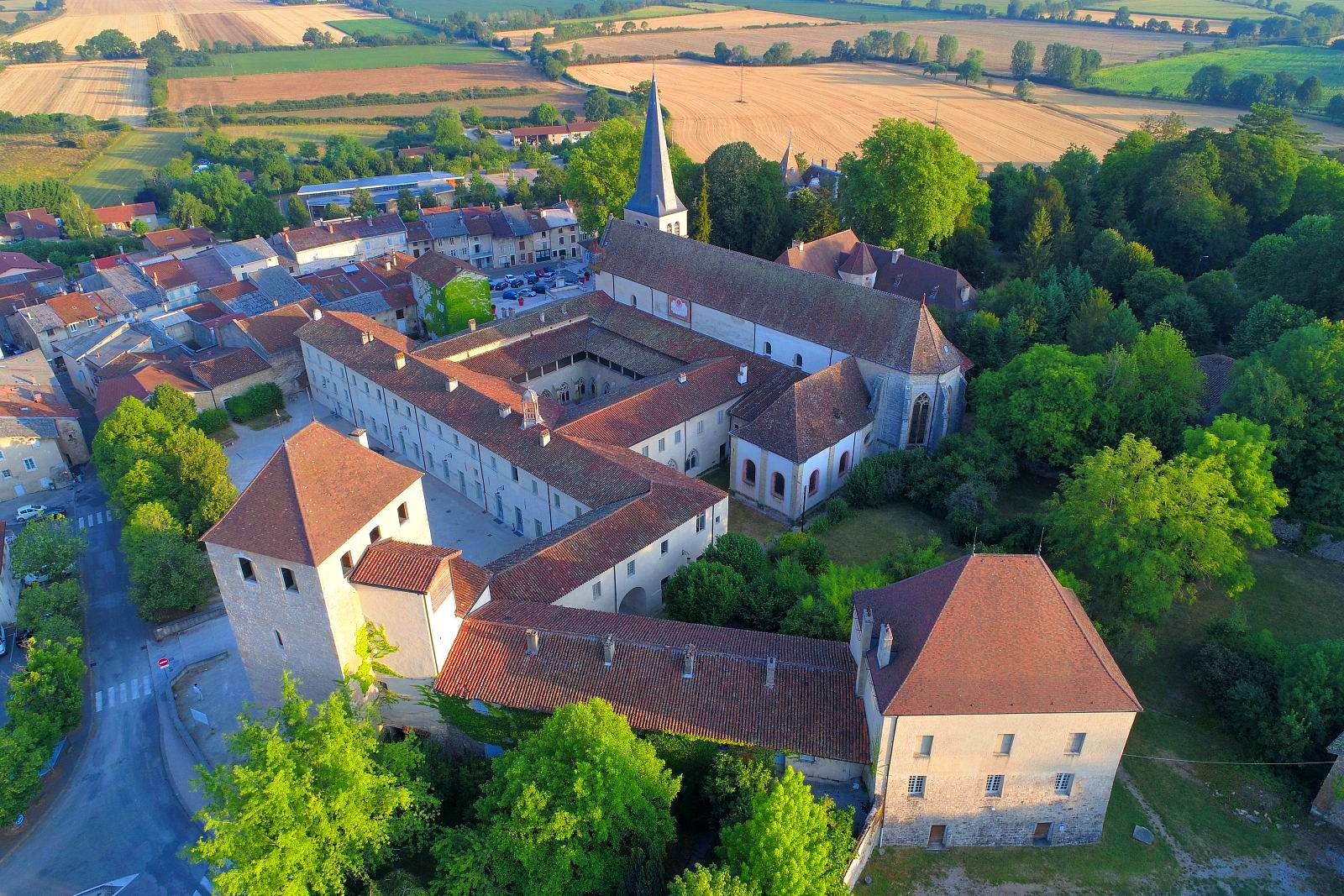
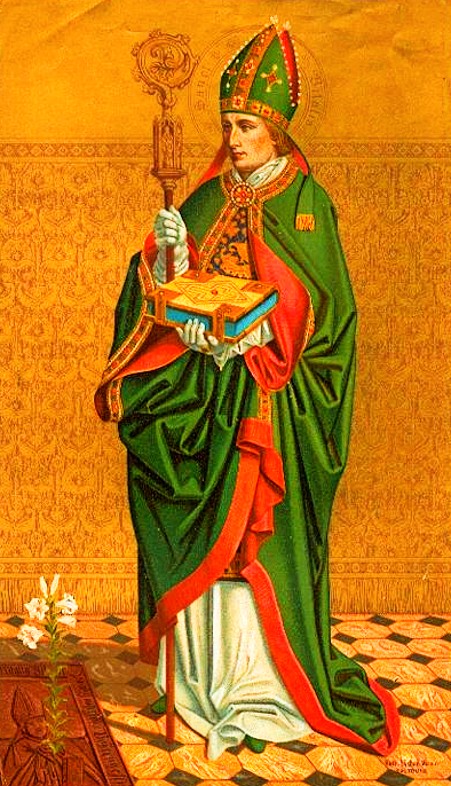
Saint of the Day – 21 October – Saint Hugh of Ambronay (9th-10th Century) Abbot of Ambronay Abbey,in the Ddiocese of Belley, France. Also known as – Ugo, Hugo, Hugon, Hugues.
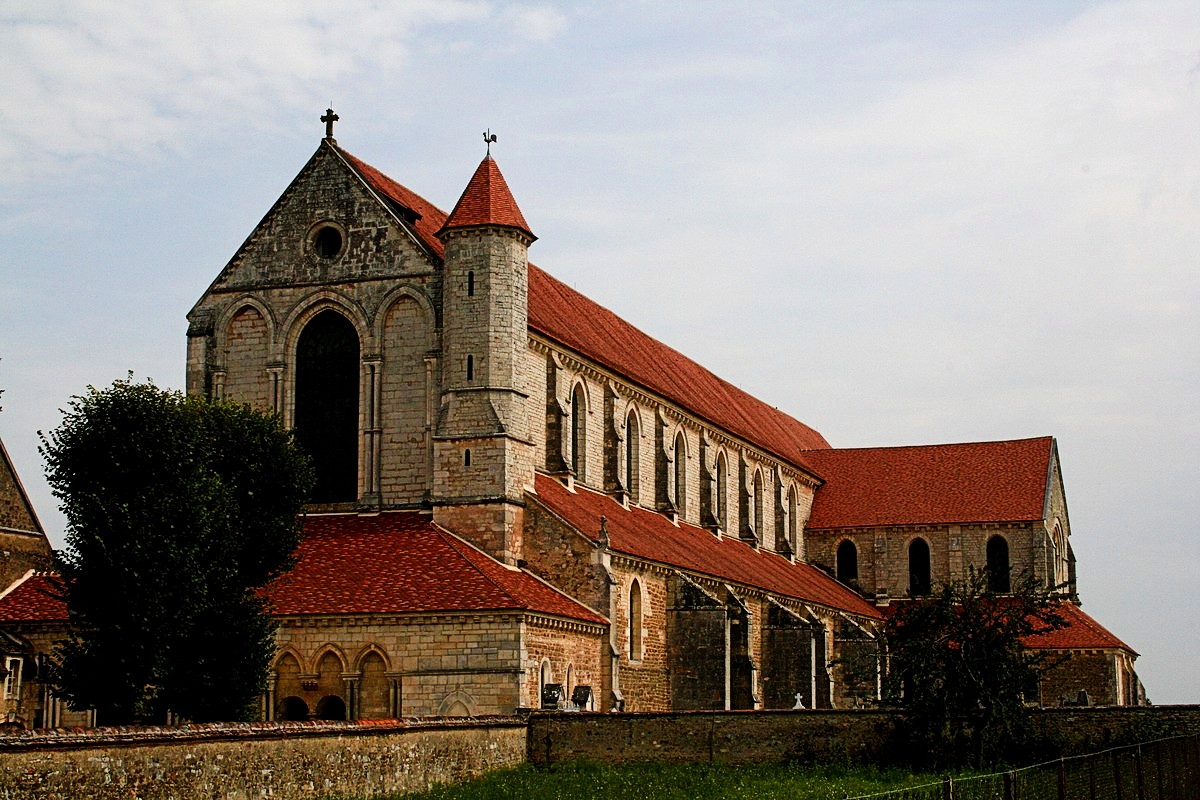
Ambronay Abbey,
Hugh of Ambronay was an Abbot who lived between the 9th and 10th Centuries. Information regarding his life is scant and fragmentary.
However, tradition and local veneration make him a figure worthy of attention, offering food for thought on monastic life and the cult of Saints.
The main sources which tell us about Saint Hugh are the list of Abbots of Ambronay, present in the text ‘Gallia Christiana’, and the local calendar of Ambray. The first places him in third place, after Saint Berardand before Dulon, around 910. The second places his Feast Day on 21 October, while until the French Revolution, it was celebrated on 10 May.
The scarcity of biographical details has led some historians to doubt the existence of Saint Hugh I, hypothesizing that it could be a mistaken identification with a homonymous abbot of the 13th century. However, local tradition venerates him as a Saint and preserves the memory of his cult.
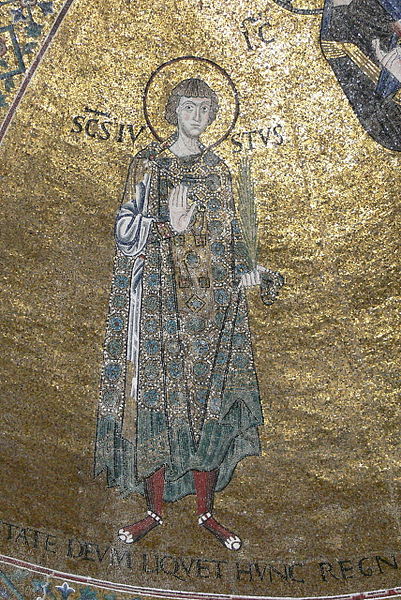
His Relics were preserved until violence of the Huguenot period and the only representation of the Saint is found in a 15th-Century stained glass window in the Parish Church of Ambray.
Saint Hugh I lived in a period of great religious and monastic fervour. The Abbey of Notre-Dame de Ambronay, which he led, was an important centre of culture and religion. His figure, reminds us of the fundamental role of Monasteries in the spread of Christianity and culture in Europe during the Middle Ages.
Saint Ursula and Companions: (Died c238) Virgin Martyrs This Amazing Story: https://anastpaul.com/2022/10/21/saint-of-the-day-21-october-saint-ursula-and-companions-died-c-238-virgin-martyr/ There are other Saints closely associated with Ursula and her story – travelling companions who were Martyred with her. They are: Antonia of Cologne Cesarius of Cologne Cyriacus of Cologne Daria Fiolanus of Lucca Ignatius of Cologne James of Antioch Mauritius of Cologne Pontius of Cologne Sulpitius of Ravenna Vincent of Cologne Travelling companion, but escaped the massacre: Cunera Led by a dove to the lost tomb of St Ursula: Cunibert of Cologne.
St Agatho the Hermit St Asterius of Périgord St Asterius of Rome
St Celina of Meaux St Cilinia St Condedus St Domnolus of Pouilly St Finian Munnu St Gebizo St Hilarion of Moglena St Hugh of Ambronay (9th-10th Century) Abbot St Letizia St Maurontus of Marseilles St Malchus of Syria
Thought for the Day – 20 October – Meditations with Saint Alphonsus Maria de Liguori (1696-1787) Bishop, Confessor, Most Zealous Doctor of the Church
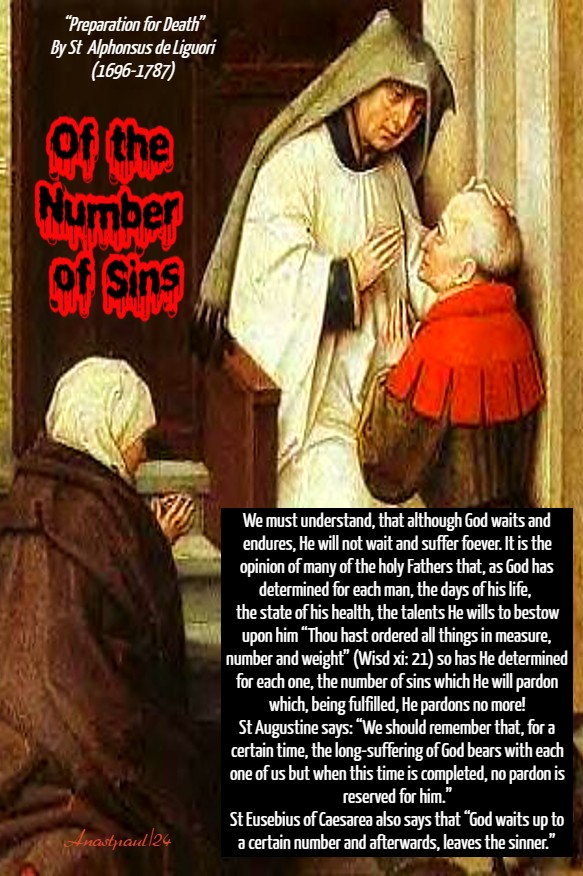
“Preparation for Death” By St Alphonsus Maria de Liguori (1696-1787)
CONSIDERATION XVIII
Of the Number of Sins “Because sentence against an evil work is not executed speedily, therefore, the heart of the sons of men is fully set in them to do evil.” (Eccles viii: 11)
FIRST POINT: IF God were to chastise offences, immediately, He would not be nsulted as He is now but because the Lord delays His punishment and waits, sinners take courage to further offend Him.
We must understand, that although God waits and endures, He will not wait and suffer forever. It is the opinion of many of the holy Fathers that, as God has determined for each man, the days of his life, the state of his health, the talents He wills to bestow upon him “Thou hast ordered all things in measure, number and weight” (Wisd xi: 21) so has He determined for each one, the number of sins which He will pardon which, being fulfilled, He pardons no more! St Augustine says: “We should remember that, for a certain time, the long-suffering of God bears with each one of us but when this time is completed, no pardon is reserved for him.” St Eusebius of Caesarea also says that “God waits up to a certain number and afterwards, leaves the sinner.”
This opinion of the Fathers is supported by Holy Scripture. In one place it says that the Lord delayed the ruin of the Amorites. “For the iniquity of the Amorites is not yet full.” (Gen xv: 16). In another, “I will no more have mercy upon the house of Israel.” (Hos i: 6). Again, “Because all those men …. have tempted Me now these ten times. … Surely they shall not see the land which I swore unto their fathers.” (Num xiv: 22, 23). In another place Job says: “My transgression is sealed up in a bag.” (Job xiv: 17).
Sinners keep no account of their sins but God does, strictly, that He may punish when the harvest is ripe that is, when the number is completed. … Sinner, you should fear, for the sins which have been forgiven you, for if you add another sin, it may be that the new sin with those already pardoned, will complete the number and then, there will remain no more mercy for you and this Holy Scripture plainly declares: “The Lord patiently expecteth that when the day of judgement shall arrive, He may punish them in the fulness of their sins.” (2 Mace vi: 14) . So that God waits until the day in which the measure of sins is full and then, He punishes. Of this delayed punishment, there are many examples in Holy Scripture and especially in the case of Saul, who was forsaken by God for his last disobedience and who prayed that Samuel would intercede for him, saying: “I prav thee, pardon my sin and turn again with me that I may worship the Lord.” (i Sam xv: 25). But Samuel answered: “I will not return with thee, for thou hast rejected the word of the Lord and the Lord hath rejected thee.” (Ib xv: 26). …
Oh, to how many miserable sinners does it not happen that they live for many years in their sins but when their number is fiull, they are seized by death and are sent to hell! “They spend their days in wealth and in a moment, go down to the grave.” (Job xxi: 13).
Affections andr.Prayers
Oh, my God, I thank Thee; how many, for fewer sins than mine are now in hell and for them there is no more pardon or hope! Whilst I am still living, … I have, if I desire it, the hope of pardon and of Heaven. Yes, my God, I desire pardon. I repent, above every other sin, that of having offended Thee because I have offended Thy Infinite Goodness.
Eternal Father, “Look upon the Face of Thine Anointed.” (Ps Ixxxiv: 9). Look upon that Son, Who died upon that Cross for me. By His merits, have pity upon me. I promise to choose death rather than to offend Thee more. I may justly fear, thinking upon the sins that I have committed and the graces which Thou hast bestowed upon me, that should I add another sin, my measure would be full and I should be condemned. Oh, help me by Thy grace – from Thee I look for light and strength to be faithful to Thee and if ever Thou seest that I should again offend Thee, let me die in this moment, in which I trust that I an in Thy grace. I love Thee, my God, above all things and I fear more than death itself, to find myself agaiagain out of Thy grace ; in mercy gran, this may never be.
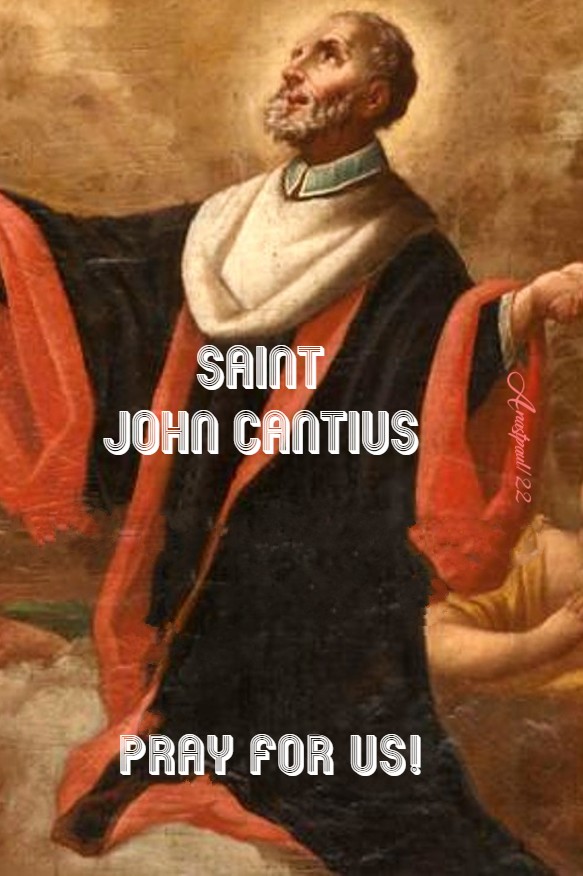
Quote/s of the Day – 20 Octoberber – St John Cantius (1390-1473) Confessor
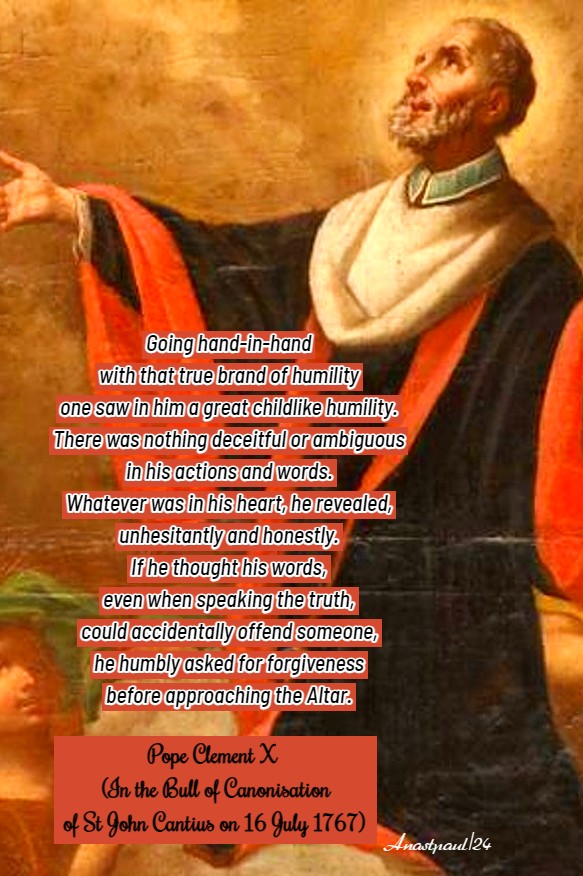
“Going hand-in-hand with that true brand of humility one saw in him a great childlike humility. There was nothing deceitful or ambiguous in his actions and words. Whatever was in his heart, he revealed, unhesitantly and honestly. If he thought his words, even when speaking the truth, could accidentally offend someone, he humbly asked for forgiveness before approaching the Altar.”
Pope Clement X (In the Bull of Canonisation of St John Cantius on 16 July 1767)
One Minute Reflection – 20 October – “The Month of the Most Holy Rosary and of the Angels” – St John Cantius (1390-1473) Confessor – Philippians 1:6-11; Matthew 22:15-21 – – – Scripture search here: https://www.drbo.org/
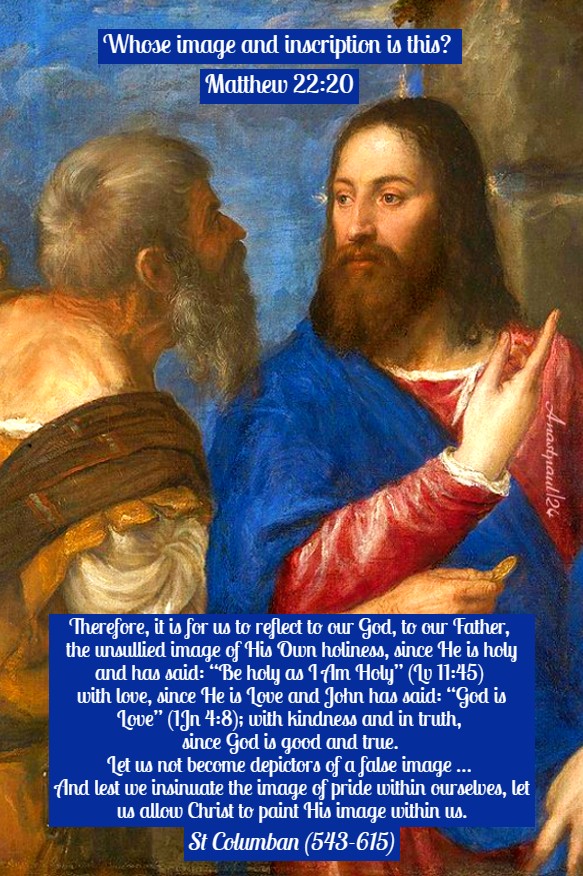
“Whose image and inscription is this? ” – Matthew 22:20
REFLECTION – “Moses wrote in the Law: “God created man in His image and likeness” (Gn 1:26). I would ask you to reflect on the importance of this saying. God, Who is almighty, invisible, incomprehensible and without compare, when he fashioned man of clay, ennobled him by the image of His Own greatness. What is there in common between man and God, between clay and spirit? For “God is spirit” (Jn 4:24). Therefore, it represents a great sign of His esteem for man that God should have rewarded him with the image of His eternity and the likeness of His Own life. The greatness of man lies in his likeness to God, as long as he preserves it …
As long as a soul makes good use of the virtues sown into it, it remains like God. All the virtues God placed in us at our creation He has taught us to repay to Himself. In the first place, He requires us to love Him with all our heart (Dt 6:5) since, from the beginning, even before we existed, “He loved us first” (1Jn 4:10). To love God, then, is to restore His image within us. Now, he loves God who keeps His commandments…
Therefore, it is for us to reflect to our God, to our Father, the unsullied image of His Own holiness, since He is holy and has said: “Be holy as I Am Holy” (Lv 11:45) with love, since He is Love and John has said: “God is Love” (1Jn 4:8); with kindness and in truth, since God is good and true. Let us not become depictors of a false image … And lest we insinuate the image of pride within ourselves, let us allow Christ to paint His image within us.” – St Columban (543-615) Monk, Founder of monasteries, Father of the Church (Instruction 11, 1-4).
PRAYER – Grant, we beseech Thee, Almighty God, that by following the example of blessed John, Thy Confessor, we may advance in a knowledge of holiness and, by showing pity for others, obtain Thou forgiveness through his merits. Through Jesus Christ, Thy Son our Lord, Who lives and reigns with Thee, in the unity of the Holy Ghost, God, world without end. Amen (Collect).
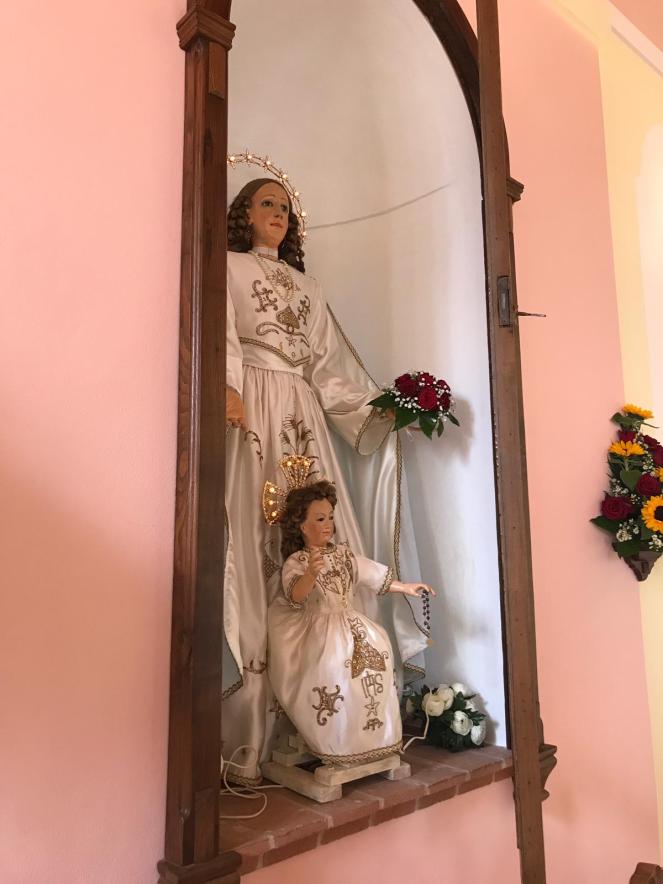
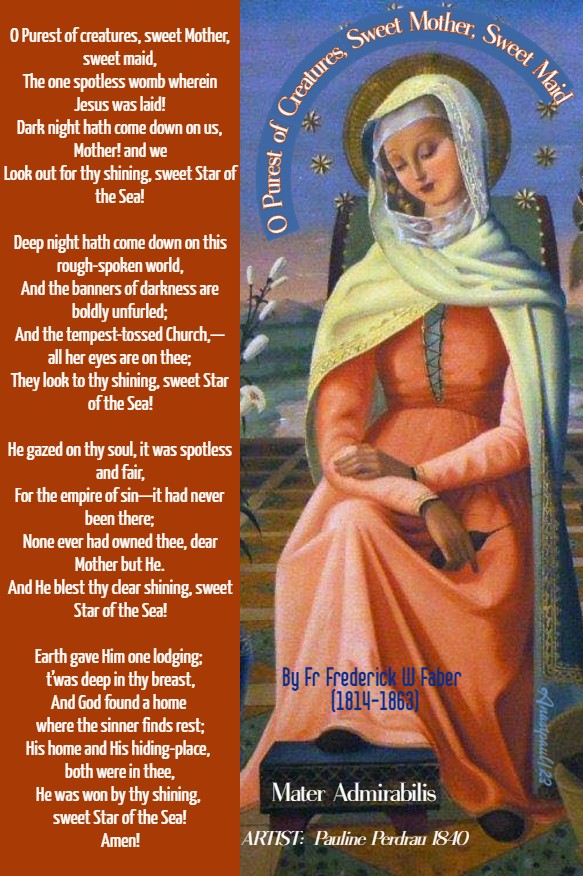
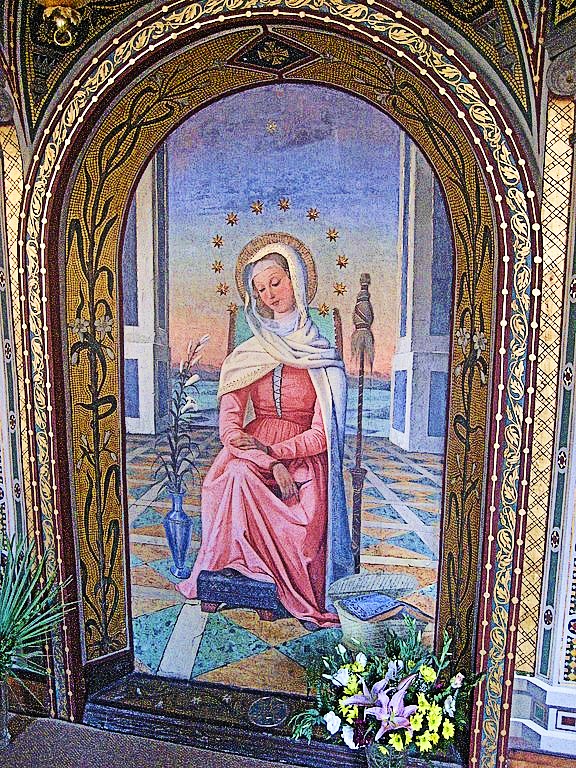
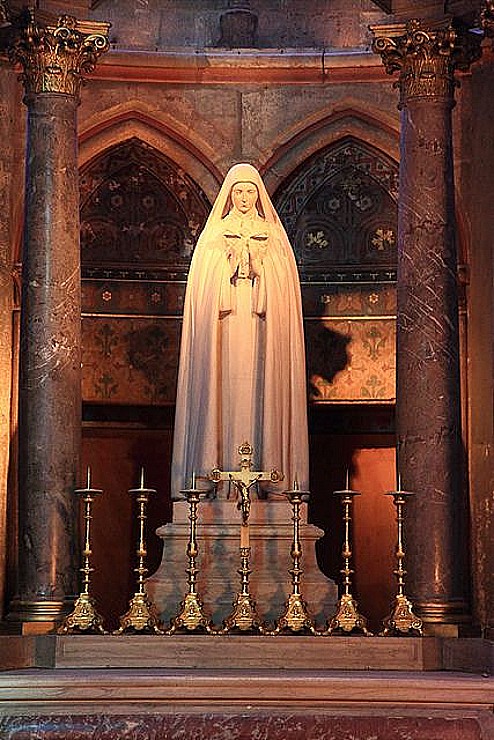
Our Morning Offering – 20 October – “The Month of the Most Holy Rosary and of the Angels” – Feast of Mater Admirabilis / Mother Most Admirable
O Purest of Creatures, Sweet Mother, Sweet Maid By Fr Frederick W Faber C.Orat. (1814-1863)
O Purest of creatures, sweet Mother, sweet maid, The one spotless womb wherein Jesus was laid! Dark night hath come down on us, Mother! and we Look out for thy shining, sweet Star of the Sea!
Deep night hath come down on this rough-spoken world, And the banners of darkness are boldly unfurled; And the tempest-tossed Church,— all her eyes are on thee; They look to thy shining, sweet Star of the Sea!
He gazed on thy soul, it was spotless and fair, For the empire of sin—it had never been there; None ever had owned thee, dear Mother but He. And He blest thy clear shining, sweet Star of the Sea!
Earth gave Him one lodging; t’was deep in thy breast, And God found a home where the sinner finds rest; His home and His hiding-place, both were in thee, He was won by thy shining, sweet Star of the Sea!
Saint of the Day – 20 October – Saint Vitalis of Salzburg (Died c730) Bishop of Salburg for around 15 years, Monk, Abbot, Missionary. Born in either France or Italy and died in c730 at his Diocese of Salzburg in Austria of natural causes. Patronage – of Pinzgau; of children and pregnant women, Salzburg, Austria together with St Rupert (in the image below of St Vitalis’ Altar at the Monastery of St Peter, St Ruper’s Statue is on the left and St Vitalis on the right). The Name ‘Vitalis’ means: ‘the invigorating one’ (Latin). Also known as – Vergilius.
Vitalis was a student of the first Bishop of Salzburg, St Rupert (c660–710) and his successor as the Second Bishop and Abbot of the important Benedictine Monastery of St Peter from 715/716.
According to tradition, he was particularly involved in missionary work in Pinzgau, south of Salzburg, of which City he is the patron.
Vitalis’ grave was initially located in the Cathedral in Salzburg. It was an important pilgrimage site in the Middle Ages after miracles occurred there during the construction of the Cathedral. In the middle of the 15th Century, Pope Pius II approved the reburial of the Relics in the Church of St Peter’s Monastery. Vitalis’ grave relief from 1497 is an important medieval sculpture. Below is the beautiful Altar of St Vitalis at the Abbey Church of St Peter.
In 1678, Pope Urban VIII approved St Vitalisa festival with a Mass and Officein the Diocese of Salzburg. He is listed as a Saint in the Roman Martyrology . Attributes: Lily growing from his heart.
Blessed James Strepar OFM (c 1340-1409) Archbishop of Halicz, Poland from 1392 until his death Religious Priest of the Order of Friars Minor, Missionary. St Pius X proclaimed Blessed James, along with St Anthony of Padua, the Patrons of the Conventual Franciscan Order of Krakow Province. He was given the title of “Protector of the Kingdom, Defender and Guardian of the Homeland,” for his exceptional merits, including civil ones. Such was he considered by all. He was Canonised by by Pope Pius VI on 11 September 1791. His body is incorrupt. His Life: https://anastpaul.com/2020/10/20/saint-of-the-day-20-october-blessed-james-strepar-ofm-c-1340-1409/
St Leopardo of Osimo St Lucas Alonso Gorda St Martha of Cologne + Virgin Martyr
St Maximus of Aquila (c228-c250) Deacon Martyr. The Roman Martyrology reads: “At Aveia, near Aquila in Abruzzo, Italy, the birthday of blessed Maximus, Deacon and Martyr, who, through the desire of suffering, presented himself to the persecutors who sought him. After answering with great constancy, he was racked and tortured, then beaten with rods and finally, he died by being precipitated from an elevated place.” His Life and Death: https://anastpaul.com/2023/10/20/saint-of-the-day-20-october-saint-maximus-of-aquila-c228-c250-deacon-martyr/
St Orora St Saula of Cologne + Virgin Martyr St Sindulphus of Rheims St Usthazanes St Vitalis of Salzburg (Died c730) Bishop
Thought for the Day – 19 October – Meditations with Saint Alphonsus Maria de Liguori (1696-1787) Bishop, Confessor, Most Zealous Doctor of the Church
“Preparation for Death” By St Alphonsus Maria de Liguori (1696-1787)
CONSIDERATION XVII
Of the House of Divine Mercy “Not knowing that the goodness of God leadeth thee to repentance?” (Rom ii: 4)
FIRST POINT: WE read in the parable in St Matthew xiii that the tares, having grown in a field together with the corn, the servants wished to pluck them up. “Wilt Thou then that we go and gather them up ?” But the Master answered: “Nay; …. Let them both grow together until the harvest and at the time of harvest, I will say to the reapers, Gather ye together first the tares and bind them in bundles to burn them.” From this parable we learn the patience which the Lord shows to sinners and also, the severity which He shows to those who are obstinate.
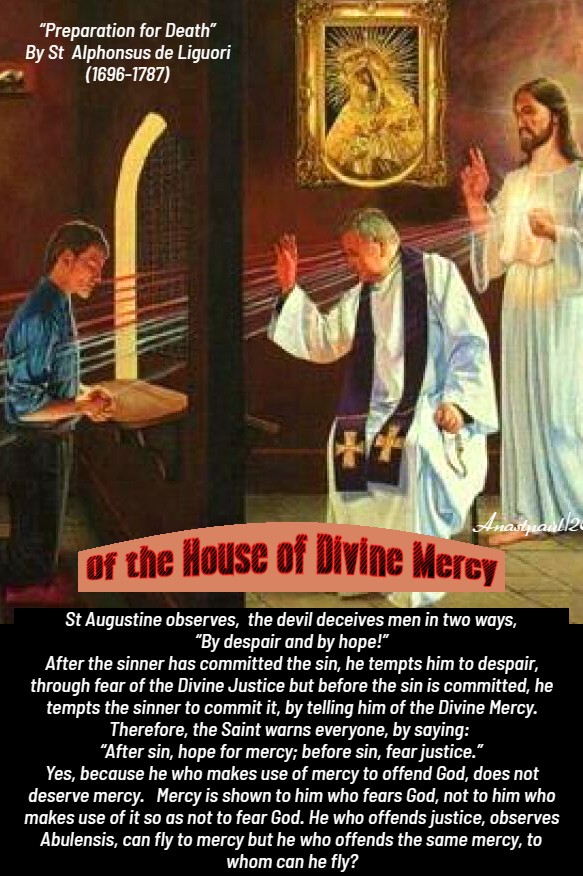
St Augustine observes, the devil deceives men in two ways, “By despair and by hope!” After the sinner has committed the sin, he tempts him to despair, through fear of the Divine Justice but before the sin is committed, he tempts the sinner to commit it, by telling him of the Divine Mercy. Therefore, the Saint warns everyone, by saying: “After sin, hope for mercy; before sin, fear justice.” Yes, because he who makes use of mercy to offend God, does not deserve mercy. Mercy is shown to him who fears God, not to him who makes use of it so as not to fear God. He who offends justice, observes Abulensis, can fly to mercy but he who offends the same mercy, to whom can he fly?
It is but seldom a sinner is found so hopeless, as to wish to be condemned. Sinners are willing to sin but they are not willing to give up the hope of being saved. They commit sin and say to themselves, God is merciful; I will commit this sin and afterwards confess it. Behold, says St Augustine, this is how sinnersspeak: “God is good, I will do what pleaseth me” but O God, how many, who are now in hell, have said the same!
… The mercy of God is Infinite but the acts of this mercy are finite. God is merciful but He is also just. … As St Augustine observes, God never fails in His promises, neither does He fail in His threats! Take care, says St Chrysostom, when the devil but not God, promises thee Divine Mercy, that thou mayest commit sin. Woe, add St Augustine, to him who hopes, so that he may sin: “ Woe to that perverse hope.” Oh ! exclaims the Saint, how many there are, whom this vain hope has deceived and caused to be lost!
… In short, although God endures, for some time, yet He will not endure forever. If God were to suffer sin forever, no-one would be lost but it is the general opinion, that the greater part, even of Christians are lost. “For wide is the gate and broad is the way, which leadeth to destructio, and many there be, who go in thereat.” (Matt vii:13). …
Affections and Prayers
Ah, my God, I have been one of those who offended The, notwithstanding Thou wast good to me. Lord, wait for me, do not abandon me because I hope, Thy grace helping me, never more to provoke Thee to abandon me. I repent, O Thou Infinite Goodness, for having offended Thee and for, having thus abused Thy patience. I thank Thee that Thou hast waited for me until now. From this day forward, I will never more abuse Thee as I have done, in the time that .is past. Thou hast borne with me so long that Thou mightest one day see me made a lover of Thy Goodness. That that day be already come, is my hope.
I love Thee more than anything and I prize Thy grace more than all the kingdoms of the world; rather than lose it, I would lose my life, if it were possible to do so, many times over, My God, for the love of Jesus Christ, give me holy perseverance until death, with Thy most holy love. Never allow me to betray Thee any more, neither to cease to love Thee.
Quote/s of the Day – 19 October – St Peter of Alcantara OFM (1499-1562) Confessor
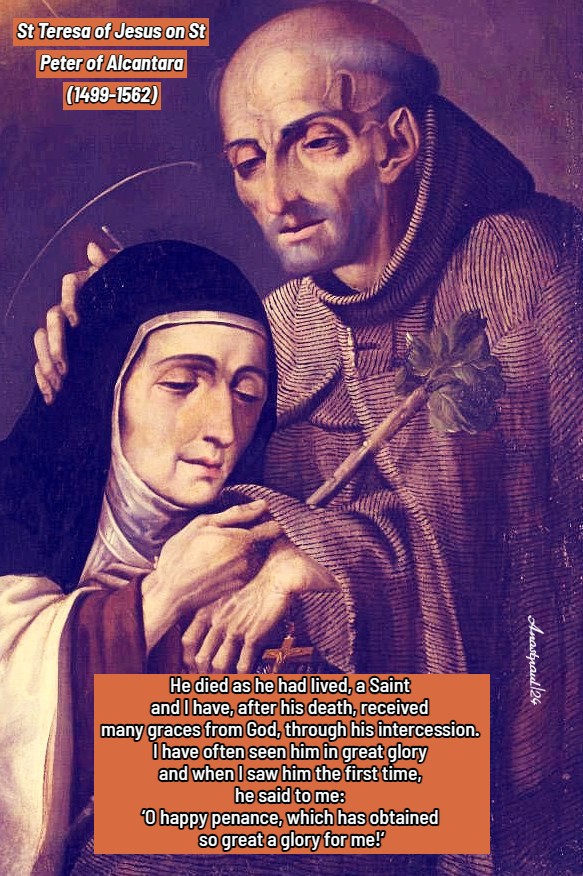
St Teresa, who has written much in his praise, says among other things: “He died as he had lived, a Saint and I have, after his death, received many graces from God, through his intercession. I have often seen him in great glory and when I saw him the first time, he said to me: ‘O happy penance, which has obtained so great a glory for me!‘”
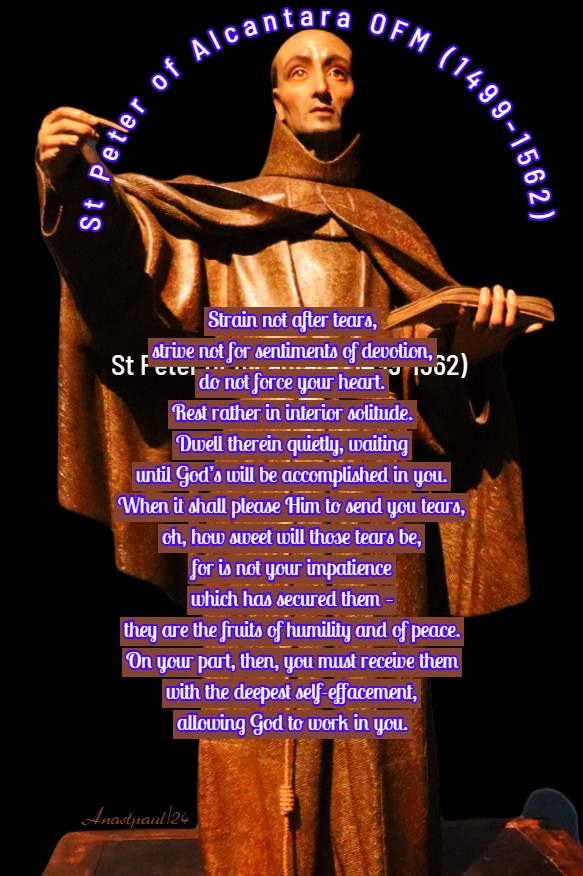
“Strain not after tears, strive not for sentiments of devotion, do not force your heart. Rest rather in interior solitude. Dwell therein quietly, waiting until God’s will be accomplished in you. When it shall please Him to send you tears, oh, how sweet will those tears be, for is not your impatience which has secured them – they are the fruits of humility and of peace. On your part, then, you must receive them with the deepest self-effacement, allowing God to work in you.”
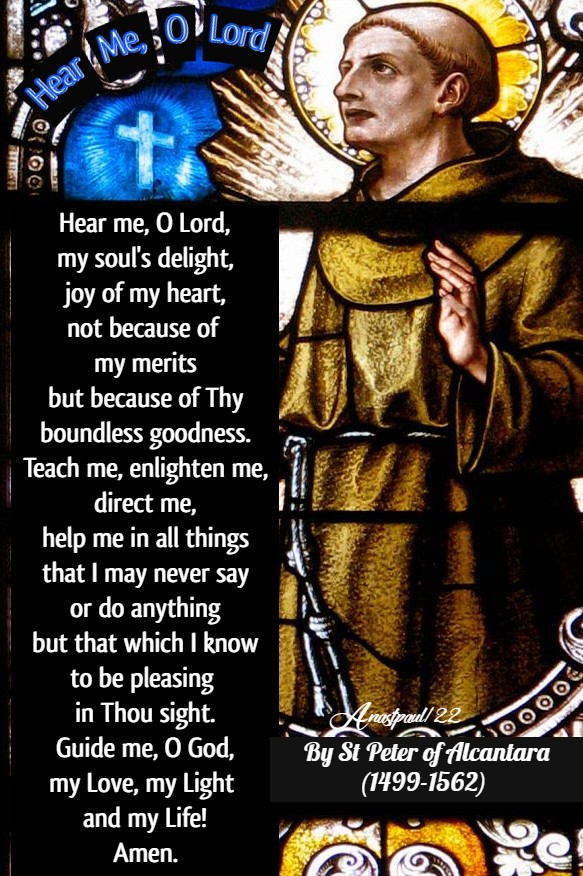
Hear Me, O Lord By St Peter of Alcantara (1499-1562)
Hear me, O Lord, my soul’s delight, joy of my heart, not because of my merits but because of Thy boundless goodness. Teach me, enlighten me, direct me, help me in all things that I may never say or do anything but that which I know to be pleasing in Thou sight. Guide me, O God, my Love, my Light and my Life! Amen
One Minute Reflection – 19 October – “The Month of the Most Holy Rosary and of the Angels” – St Peter of Alcantara OFM (1499-1562) Confessor – Philippians 3:7-12, Luke 12:32-34 – Scripture search here: https://www.drbo.org/
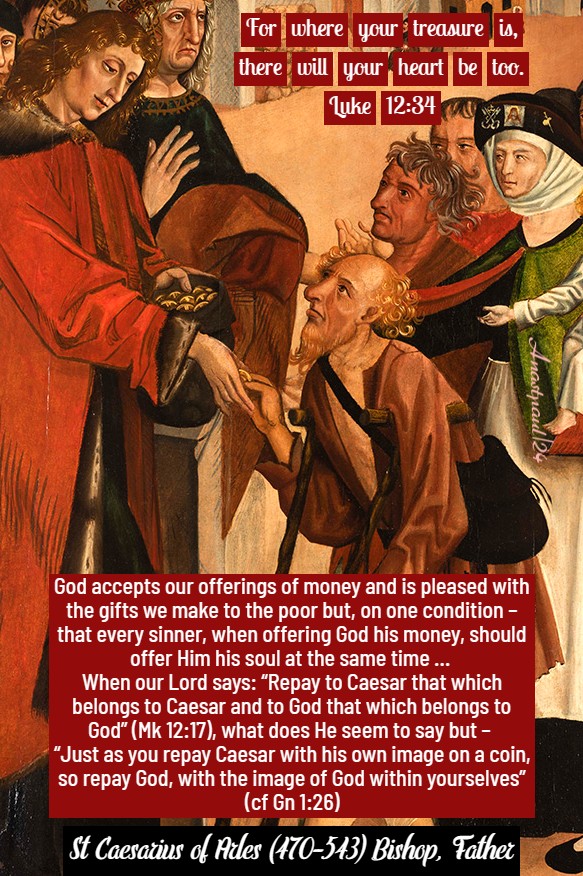
“For where your treasure is, there will your heart be too.” – Luke 12:34
REFLECTION – “God accepts our offerings of money and is pleased with the gifts we make to the poor but, on one condition – that every sinner, when offering God his money, should offer Him his soul at the same time … When our Lord says: “Repay to Caesar that which belongs to Caesar and to God that which belongs to God” (Mk 12:17), what does He seem to say but – “Just as you repay Caesar with his own image on a coin, so repay God, with the image of God within ourselves” (cf Gn 1:26) …
This is why, as we have already said on numerous occasions, when we hand out money to the poor, let us offer our souls to God, so that, where our treasure is, there our heart may also be. Indeed, why does God ask us to give money? Unquestionably because, He knows the special love we have for it, we are always thinking about it and, where our money is, there too is our heart. This is why God urges us to make up our treasure in Heaven by making gifts of it to the poor; it is so that our hearts may follow where we have already sent our treasure and, when the Priest says: “Lift up your hearts” we may answer with peaceful conscience: “We lift them up to the Lord.” – St Caesarius of Arles (470-543) Bishop, Father (Sermon 32, 1-3).
PRAYER – O God, Who graciously made blessed Peter, Thy Confessor, glorious by the gift of remarkable penance and sublime contemplation, grant, we beseech Thee, that, by the merit of his prayers, we may the more easily understand the things of Heaven by curbing our passions. Through Jesus Christ, Thy Son our Lord, Who lives and reigns with Thee, in the unity of the Holy Ghost, God, world without end. Amen (Collect).
Our Morning Offering – 19 October – “The Month of the Most Holy Rosary and of the Angels”
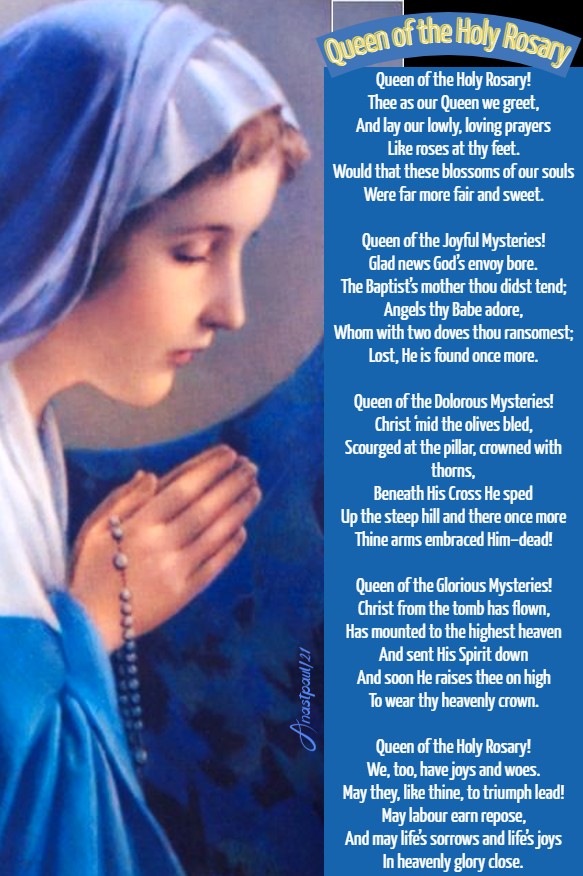
Queen of the Holy Rosary
Queen of the Holy Rosary! Thee as our Queen we greet, And lay our lowly, loving prayers Like roses at thy feet. Would that these blossoms of our souls Were far more fair and sweet.
Queen of the Joyful Mysteries! Glad news God’s envoy bore. The Baptist’s mother thou didst tend; Angels thy Babe adore, Whom with two doves thou ransomest; Lost, He is found once more.
Queen of the Dolorous Mysteries! Christ ‘mid the olives bled, Scourged at the pillar, crowned with thorns, Beneath His Cross He sped Up the steep hill and there once more Thine arms embraced Him–dead!
Queen of the Glorious Mysteries! Christ from the tomb has flown, Has mounted to the highest heaven And sent His Spirit down And soon He raises thee on high To wear thy heavenly crown.
Queen of the Holy Rosary! We, too, have joys and woes. May they, like thine, to triumph lead! May labour earn repose, And may life’s sorrows and life’s joys In heavenly glory close.
Taken from: Cyril Robert – Mary Immaculate: God’s Mother and Mine. 1946
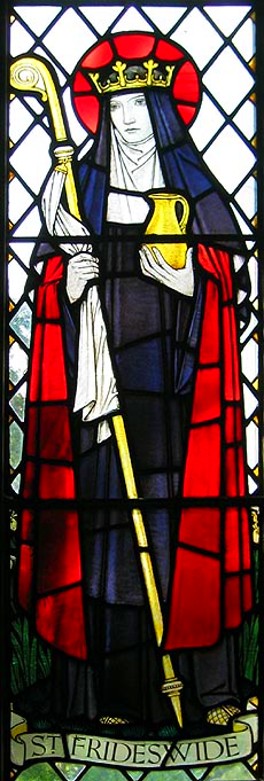
Saint of the Day – 19 October – Saint Frideswide (c665-c735) Virgin, Abbess, Founder of the St Mary’s Convent, Miracle-worker The Convent is now Christ Church College, University of Oxford and the Convent Church became Oxford Cathedral. Born in c665 in the upper Thames region of England and died on 19 October 735 of natural causes at her little hermitage at Binsey. Patronage – of the City of Oxford, England and of the University of Oxford. Also known as – Fredeswida, Fredeswinda, Frévisse, Friday, Frideswida, Frideswith, Friðuswiþ, Fris, Fritheswithe, Frithuswith, Fridesvida.
The Roman Martyrology reads today: “At Oxford, in England, St Frideswide, Virgin.”
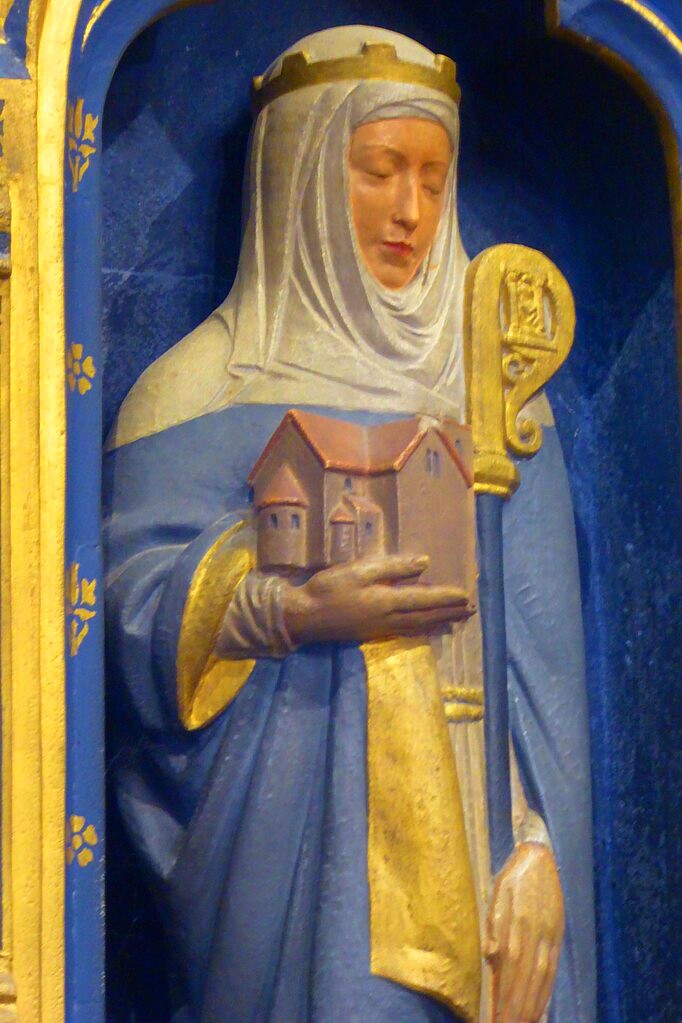
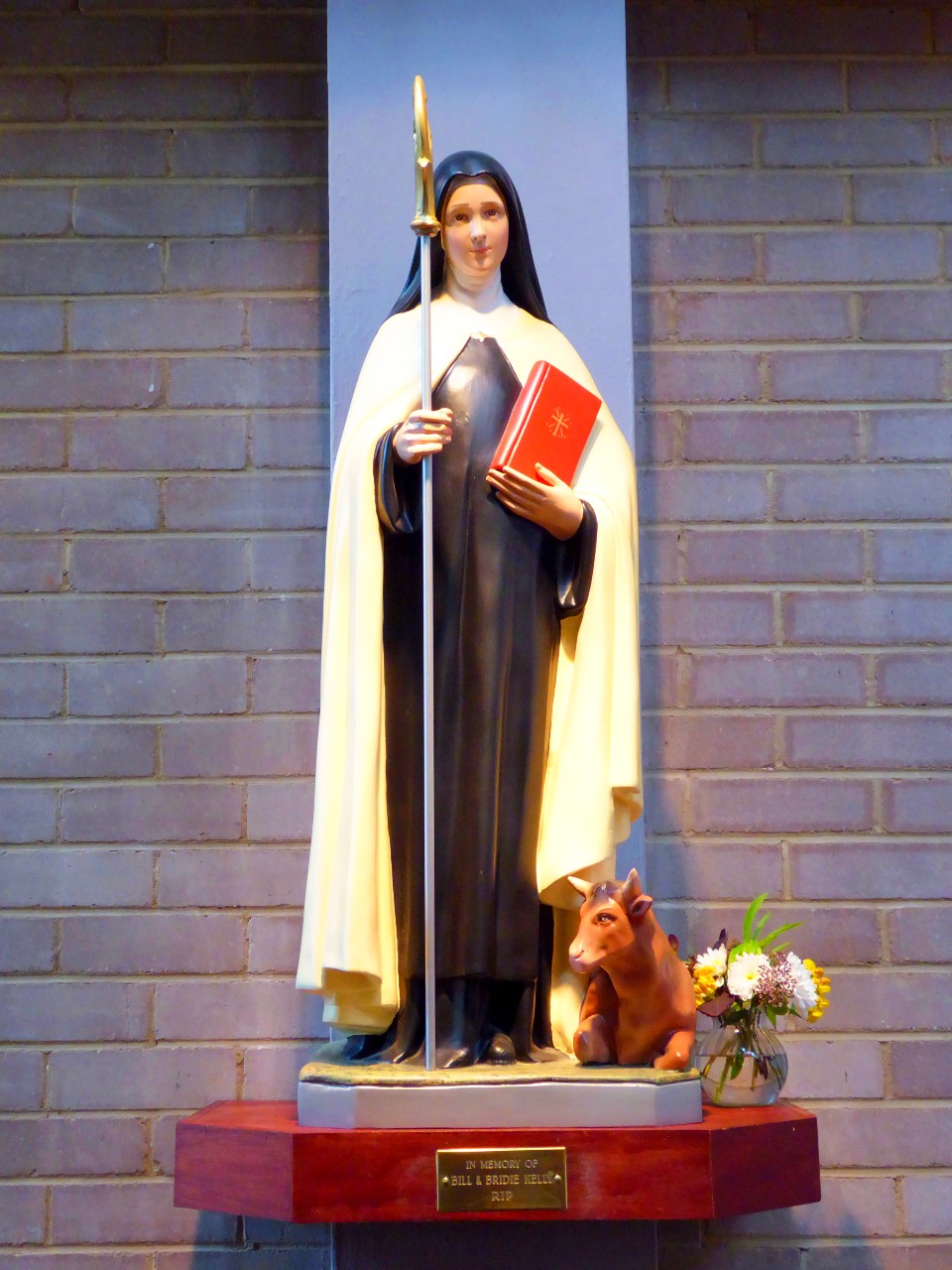
This Statue of St Frideswild at the St Michael’s Church Oxford
Today is the Feast of Oxford’s Patron St Frideswide, a true Anglo-Saxon Saint. She was born in the Southern border regions of the Kingdom of Mercia, traditionally at Oxford. She was the daughter of pious parents, Didan, the 7th Century sub-King of North and West Berkshire and his wife, Sefrida. These two committed her to the care of a holy woman named, Aelfgith, but, after her mother’s death, Frideswide returned to live with her father. She persuaded him to build her a Church at the gates of Oxford and, there, she took the veil with twelve young women of her acquaintance. Didan enhanced the establishment, by erecting Convent buildings nearby and, there, they lived, not bound by the rules of the cloister but by holy charity and love of seclusion.
Not long afterward, Aelfgar, a minor Prince of Mercia, heard of Frideswide’s great beauty, as well as her wealth as Didan’s heiress and sent a messenger to ask for her hand in marriage. She excused herself, upon the plea of her vow of celibacy but the Prince persisted and, eventually, made a plan to carry her off. Fortunately, Frideswide discovered the scheme and fled, just in time, to the River Thames. Finding an unattended boat there, she floated to a place, probably Bampton (Oxfordshire) or Frilsham (Berkshire). She took up her abode in a deserted hut used to shelter the pigs which fed upon the acorns in the surrounding forest. A fountain sprang up at her prayer and she was thus able to survive, concealed there for about three years.
Prince Aelfgar had been determined not to be beaten so easily, however and continued to try and find the lady’s hiding place. By the time she felt it safe to return to Oxford, he was absolutely fuming. Hearing of her return, Aelfgar besieged the City and threatened to burn it to the ground unless Frideswide was given up to him. He vowed to sacrifice the lady, not only to his own brutality but to that of his men. Both Frideswide and her father’s defending army were worn out with fatigue. Just as she was about to fall into Aelfgar’s hands, she was reminded of the early saintly ladies of the Church who had saved their honour at the price of life. She thus invoked Sts Catherine and Cecilia, who immediately struck her persecutor blind at the moment he broke through the City gates and entered Oxford. With their leader so wounded, Aelfgar’s fear-stricken men dispersed.
The Princess returned to her nunnery and collected around her a number of Saxon maidens and Monks, over whose double Monastery she presided in great holiness for many years. The origins of the University of Oxford are said, to lie in the school she established there.
Abbess Frideswide was well known for the miracles she performed during her own lifetime. One well-known tale reveals how she was once accosted by a local leper who appealed to her, in the name of Christ, to kiss him. Overcoming her fear of infection and natural disgust at his loathsome condition, the holy lady made the Sign of the Cross and kissed him. Immediately, the scales fell away and his flesh became like that of a child.
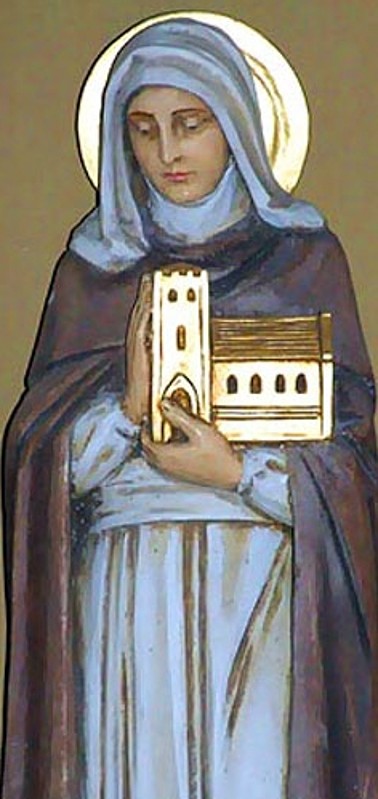
In later life, Frideswide retired to the transquility of a little hermitage at Binsey, not far outside Oxford. There she died on 19 October 735, being subsequently buried in her Monastery in Oxford, where Christ Church Cathedral now stands. Multitudes of pilgrims resorted to her tomb and to the Binsey Chapel, although the well and Chapel at Frilsham were eclipsed by other claimants. All became famous for miraculous cures. She is represented, in art, with the pastoral staff of an Abbess, a model of her foundation and Church, a fountain springing up near her and an ox at her feet.
St Altinus St Aquilinus of Evreux St Asterius of Ostia St Beronicus of Antioch St Columban of Tours — Priest. Listed in the Martyrology of St Jerome. No other details have survived.
St Desiderius of Longoret St Ednoth St Ethbin St Eusterius of Salerno St Frideswide (c665-735) Virgin St Laura of Cordoba St Lucius of Rome St Lupus of Soissons St Pelagia of Antioch
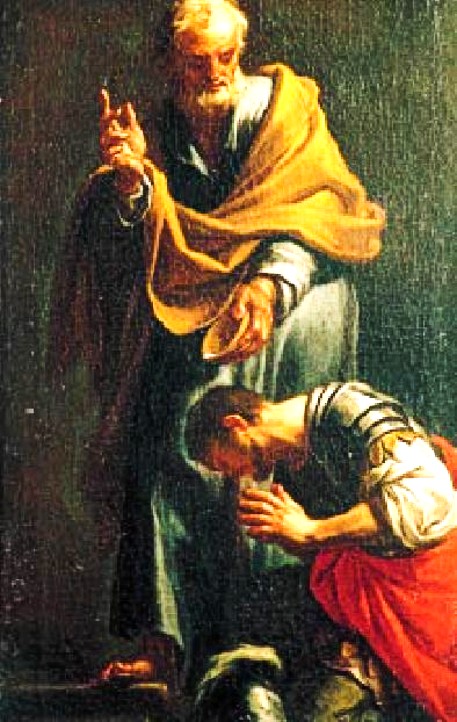
St Varus and 6 Companions (Died c307) Martyrs, Soldier. Died in c307 by being tortured and then hanged from a tree on 19 October 307 in Kemet, Upper Egypt. The Roman Martyrology reads: “In Egypt, St Varus, Solder under the Emperor Maximinus. He used to visit and comfort seven saintly Monks, detained in prison, when one of them happening to die, he wished to take his place and having suffered cruel afflictions, with them, he obtained the Palm of Martyrdom.” Their Lives and Deaths: https://anastpaul.com/2023/10/19/saint-of-the-day-19-october-saint-varus-and-six-companions-died-c307-martyrs/
Thought for the Day – 18 October – Meditations with Saint Alphonsus Maria de Liguori (1696-1787) Bishop, Confessor, Most Zealous Doctor of the Church
“Preparation for Death” By St Alphonsus Maria de Liguori (1696-1787)
CONSIDERATION XVI
Of the Mercy of God “Mercy rejoiceth against judgement.” ( James ii: 13).
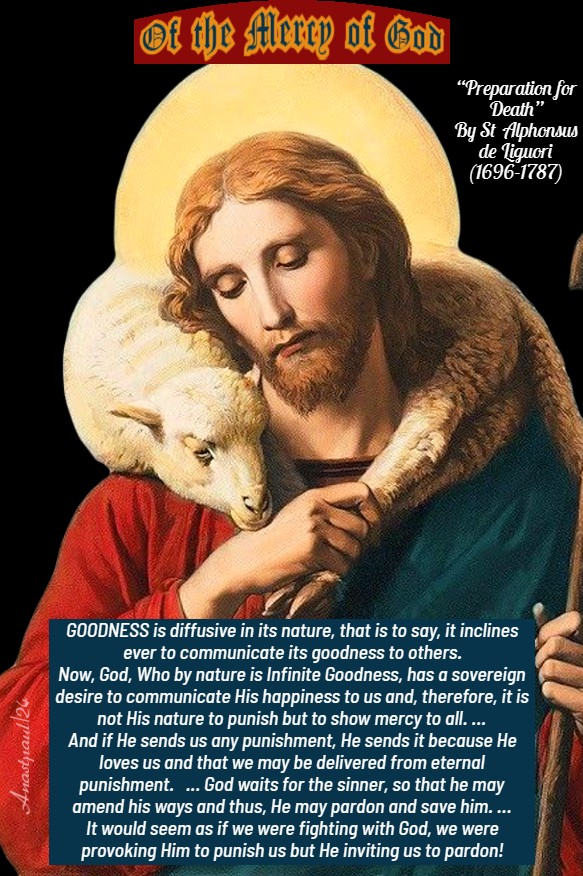
FIRST POINT: GOODNESS is diffusive in its nature, that is to say, it inclines ever to communicate its goodness to others. Now, God, Who by nature is Infinite Goodness, has a sovereign desire to communicate His happiness to us and, therefore, it is not His nature to punish but to show mercy to all. As Isaiah says, punishment is opposite to the inclination of Almighty God. “ He shall be wroth …. that He may do His work, His strange work.” (Isa xxviii: 21). And when the Lord chastises in this life, He chastises so that He may show mercy in the next. “Thou hast also been displeased; O turn Thee unto us again.” (Ps Ix: I). He appears to be angry, so that we may repent and detest our sins. “Thou hast shown Thy people heavy things; Thou hast given us a drink of deadly wine.” (Ps lx: 3). And if He sends us any punishment, He sends it because He loves us and that we may be delivered from eternal punishment. “Thou hast given a token for such as fear Thee that they may triumph because of the truth. Therefore, were Thy beloved delivered.” (Ps Ix: 4, 5).
And how can the mercy be ever admired and praised enough which God shows towards sinners in waiting for them, in calling them and in receiving them when they return? And, in the first place, oh, how great is the patience which God exercises owards us in waiting for our repentance! My brother, when thou wast offending God, He could have caused thee to die but He waited for thee and, instead of chastising thee, He conferred His benefits upon thee. He preserved thy life and provided for thee. He feigned not to see thy sins, so that thou might repent. “Thou overlookest the sins of men, for the sake of repentance.” (Wisd xi: 24).
But how is it, Lord, that Thou Who canst not endure the sight of a single sin, yet remainest quiet when Thou beholdest so many? “Thou beholdest that dishonest one that revengeful one that blasphemer, whose offences increase daily but yet ,Thou punish them not and why so much patience?” Therefore, will the Lord wait, that He may be gracious unto you.” (Isa xxx: 18). God waits for the sinner, so that he may amend his ways and thus, He may pardon and save him.
St Thomas observes, all creation – fire, earth, air, water – would punish the sinner by instinct, to avenge the wrongs done to the Creator, for “all creation, in its service to Thee, the Creator, turns against the impious.”
Yet God, in His mercy withholds them. But, Lord, Thou dost wait for these wicked ones that they may repent, yet dost Thou not see they are making use of Thy mercy to offend Thee more? … And wherefore then so much patience? Because God willeth not the death of the sinner but that he should be converted and live. “As I live, saith the Lord God, I have no pleasure in the death of the wicked but that the wicked turn from his way and live.” (Ezek xxxii: 11). St Augustine goes so far as to say, that if God were not God, “He would be unjust on account of the long-suffering which He shows towards shiners.” To wait for that one who makes use of God’s patience only to become more sinful, would appear unjust to the Divine honour. “We sin,” the Saint goes onto say, “We sin and are attached to it, and some make their peace with sin ; they sleep in sin for months and for years . We rejoice in sin, some even boast of their wickedness and art Thou appeased ?”
It would seem as if we were fighting with God, we were provoking Him to punish us but He inviting us to pardon!
Affections,and Prayers
Ah, my Lord, full well do I know, at this very hour, my place ought to be in hell. But because of Thy mercy, I am not there but in this place, even at Thy feet and I can hear Thee telling me, that Thou dost wish to be loved by me. “Thou shalt love the Lord thy God.”
And Thou dost assure me of Thy pardon if only I repent of the offences which I have committed against Thee. Yes, my God, since Thou desirest to be loved even by me, who am a miserable rebel against Thy Majesty, I will love Thee with all my heart and I will repent for having offended Thee, more than any other sin into which I may have fallen.
Ah, enlighten me, O Infinite Goodness and make me to know the wrong I have done Thee. No, I will no longer resist Thy calls. I will no more displease the God Who has loved me so much and Who has pardoned me so many times and with so much love. Ah, would that I had never offended Thee, O my Jesus ! Pardon me and grant that from this day forward, I may love none other than Thee that I may live for Thee alone, Thou who didst die for me.
Grant that I may suffer for Thy love, since Thou hast suffered so much for mine. Thou hast loved me from eternity; grant that I may burn with Thy love in eternity. I hope for all things because of Thy merits.
Quote/s of the Day – 18 October – The Feast of St Luke, the Evangelist
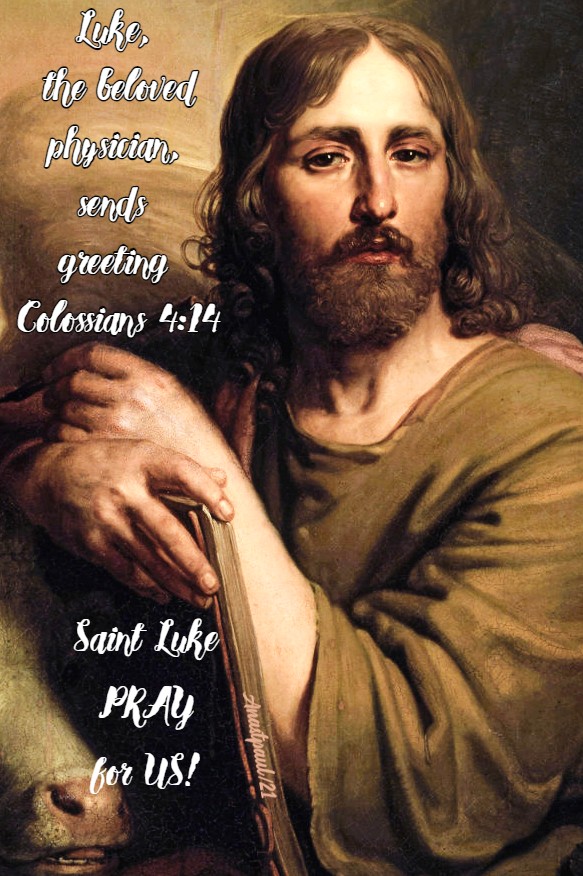
“Luke, the beloved Physician, sends greetings … ”
Colossians 4:14
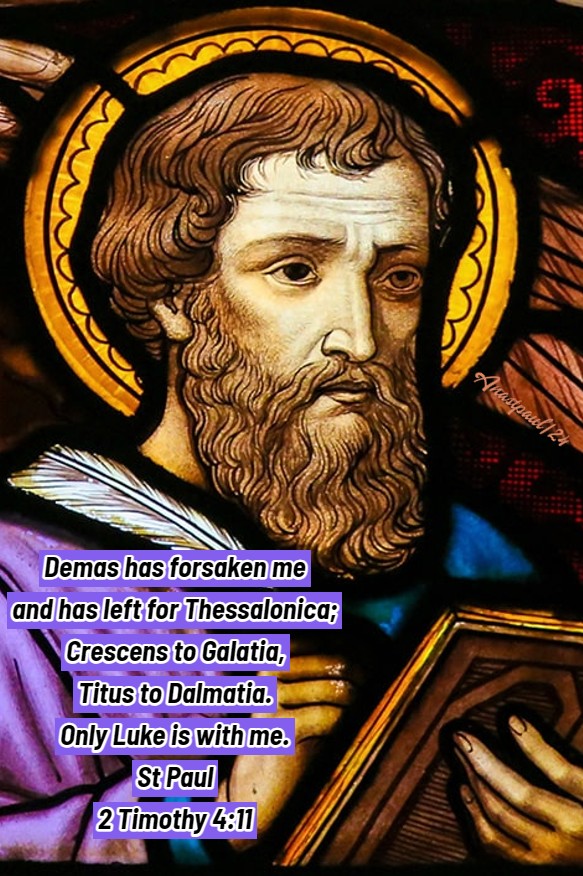
“Demas has forsaken me and has left for Thessalonica; Crescens to Galatia, Titus to Dalmatia. Only Luke is with me.”
2 Timothy 4:11
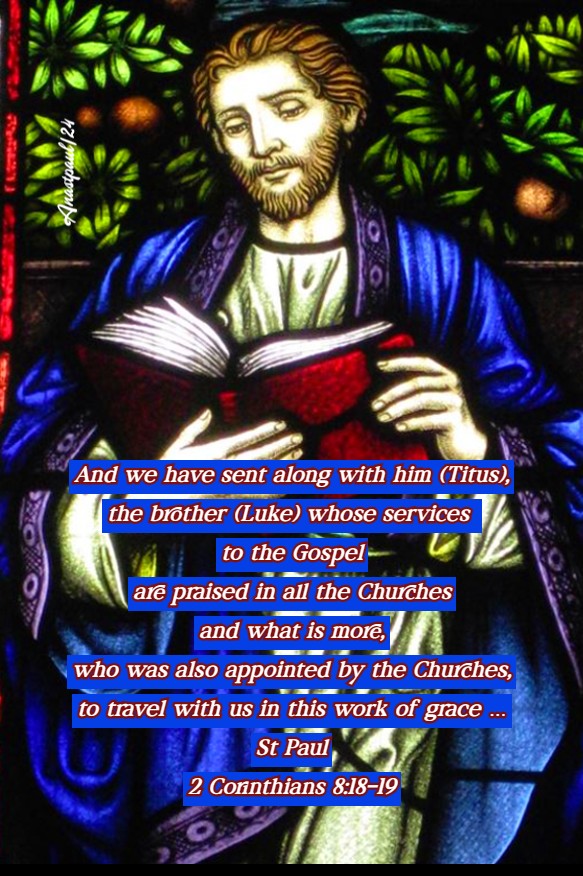
“And we have sent along with him (Titus), the brother (Luke) whose services to the Gospel are praised in all the Churches and what is more, who was also appointed by the Churches, to travel with us in this work of grace …”
2 Corinthians 8:18-19
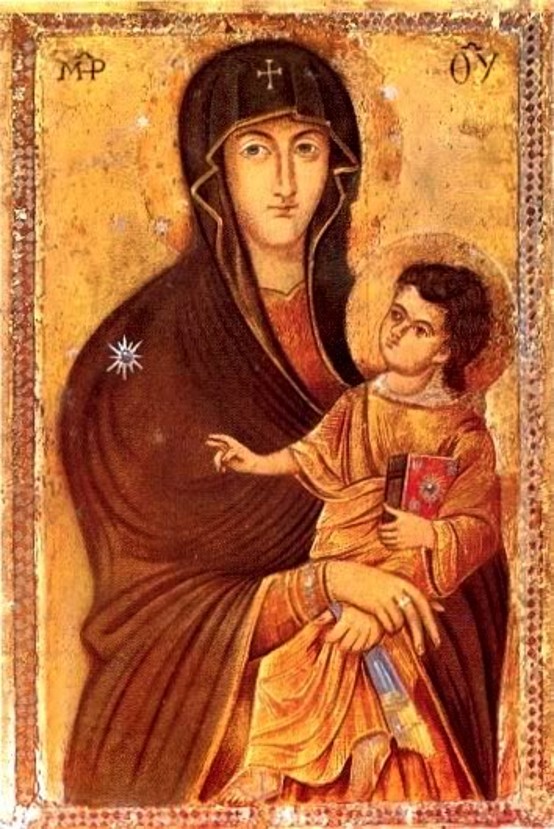
The Salus Populi Romani Protectress and Health of the Roman People Painted By St Luke resides in St Mary Major Basilica, Rome
One Minute Reflection – 18 October – “The Month of the Most Holy Rosary and of the Angels” – The Feast of St Luke, the Evangelist – 2 Corinthians 8:16-24, Luke 10:1-9 – Scripture search here: https://www.drbo.org/
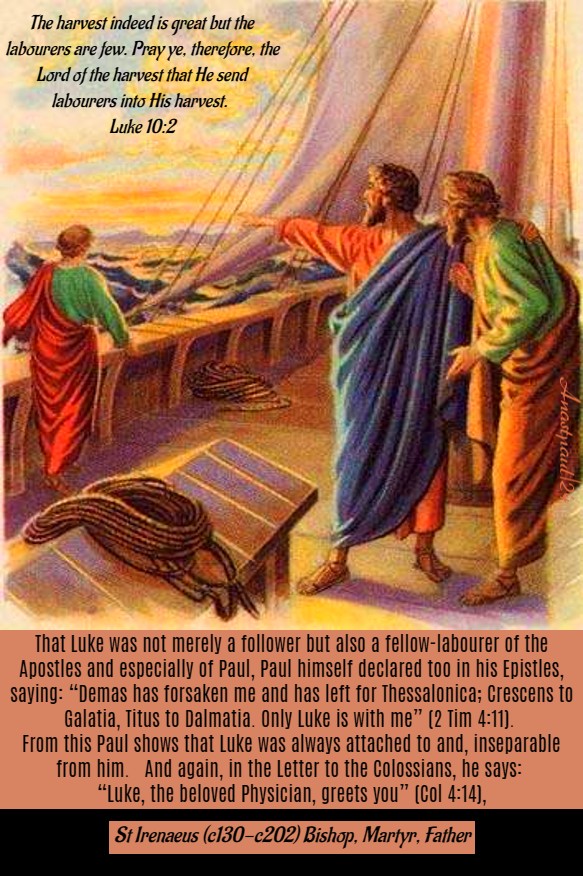
“The harvest indeed is great but the labourers are few. Pray ye, therefore, the Lord of the harvest that He send labourers into His harvest. ” – Luke 10:2
REFLECTION – “That Luke was inseparable from Paul and his fellow-labourer in the Gospel, he himself clearly evinces, not as a matter of boasting but as bound to do so by the truth itself. For when Barnabas and John Mark, had parted company from Paul and sailed to Cyprus, Luke writes: “We came to Troas” (Acts 16:8.11)… Then he carefully indicates all the rest of their journey as far as Philippi,and how they delivered their first address … And all the remaining details of his journey with Paul, he recounts with all possible diligence … As Luke was present at all these occurrences, he carefully noted them down in writing, so that he cannot be convicted of falsehood or boastfulness for all these details were well known …
That Luke was not merely a follower but also a fellow-labourer of the Apostles and especially of Paul, Paul himself declared too in his Epistles, saying: “Demas has forsaken me and has left for Thessalonica; Crescens to Galatia, Titus to Dalmatia. Only Luke is with me” (2 Tim 4:11). From this Paul shows that Luke was always attached to and, inseparable from him. And again, in the Letter to the Colossians, he says: “Luke, the beloved Physician, greets you” (Col 4:14)…” – St Irenaeus (c130-c202) Bishop, Martyr, Theologian, Father of the Church (Against the Heresies III).
PRAYER – O Lord, we beseech Thee, that Luke, Thy holy Evangelist, who for the honour of Thy Name bore continuously in his body the suffering of the Cross, may intercede on our behalf. Through the same Jesus Christ, Thy Son our Lord, Who lives and reigns with Thee, in the unity of the Holy Ghost, God, world without end. Amen (Collect).
Our Morning Offering – 18 October – The Feast of St Luke, the Evangelist
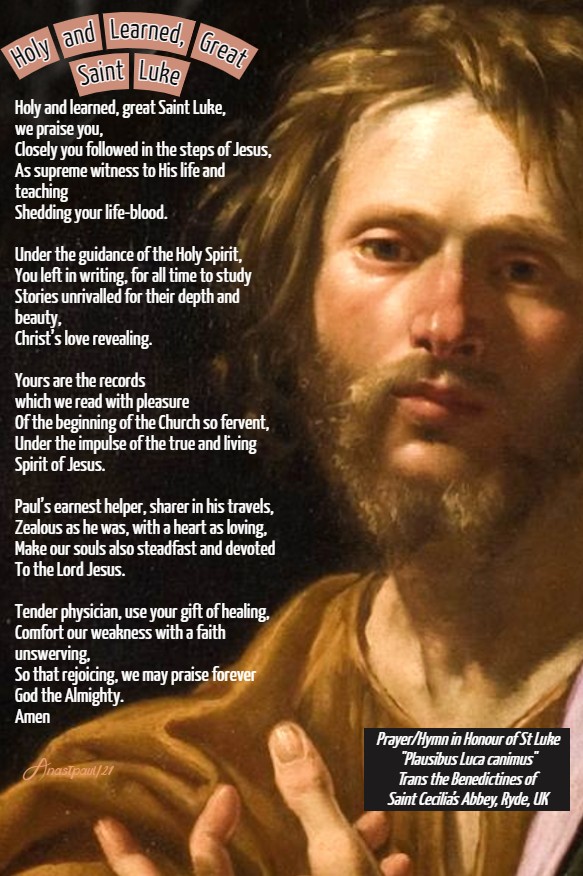
Holy and Learned, Great Saint Luke Prayer/Hymn in Honour of St Luke “Plausibus Luca canimus” Trans the Benedictines of Saint Cecilia’s Abbey, Ryde, UK
Holy and learned, great Saint Luke, we praise you, Closely you followed in the steps of Jesus, As supreme witness to His life and teaching Shedding your life-blood.
Under the guidance of the Holy Spirit, You left in writing, for all time to study Stories unrivalled for their depth and beauty, Christ’s love revealing.
Yours are the records which we read with pleasure Of the beginning of the Church so fervent, Under the impulse of the true and living Spirit of Jesus.
Paul’s earnest helper, sharer in his travels, Zealous as he was, with a heart as loving, Make our souls also steadfast and devoted To the Lord Jesus.
Tender physician, use your gift of healing, Comfort our weakness with a faith unswerving, So that rejoicing, we may praise forever God the Almighty. Amen
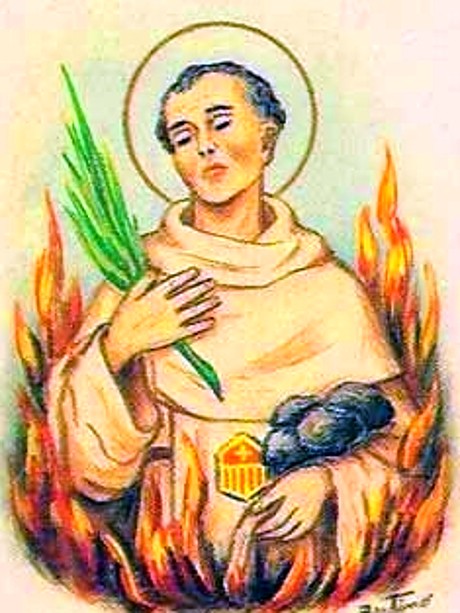
Saint of the Day – 18 October – Blessed Theobald of Narbonne OdeM (Died 1253) Martyr, Friar of the Order of Order of Our Lady of Mercy and the Redemption of the Captives (Mercedarians). Born in France and died by Martyrdom in 1253 in modern Tunisia.
In 1253, Theobald was appointed redeemer of the Mercedarian Order, together with Saint Ferdinand of Portalegre. They embarked from Barcelona to Tunis (Africa).
On 16 October of the same year, having concluded the redemption in which they had redeemed 129 slaves, they promised two Moors to buy some of their slaves but finding others, especially many women and children, in greater need of being freed, they did not keep their promise. Then the two Moors fwent to the King of Tunis, in revenge and told lies, T the King finally had Theobald imprisoned. Ferdinand who insisted on testifying to the innocence of his companion, was beaten and forced to return to Spain with the redeemed slaves.
At the end of October 1253, after various torments, Theobald was thrown into a fire and since he was slow to die, he was killed by stones. Praising God he reached the crown of Martyrs. The Order celebrates him on 18 October.
Bl Margherita Tornielli St Monon of Nassogne St Proculus of Pozzuoli Blessed Theobald of Narbonne OdeM (Died 1253) Martyr St Tryphonia of Rome
Martyrs of Africa – 9 Saints: A group of Christians Martryed together in Africa. The only details that have survived are the names – Beresus, Dasius, Faustinus, Leucius, Lucius, Martialis, Victoricus, Victrix and Viktor. They were Martyred in c300 in Africa.
Thought for the Day – 17 October – Meditations with Saint Alphonsus Maria de Liguori (1696-1787) Bishop, Confessor, Most Zealous Doctor of the Church
“Preparation for Death” By St Alphonsus Maria de Liguori (1696-1787)
CONSIDERATION XV
On the Evil of Deadly Sin “I have nourished and brought up children and they have rebelled against me.” (Isa 1:2)
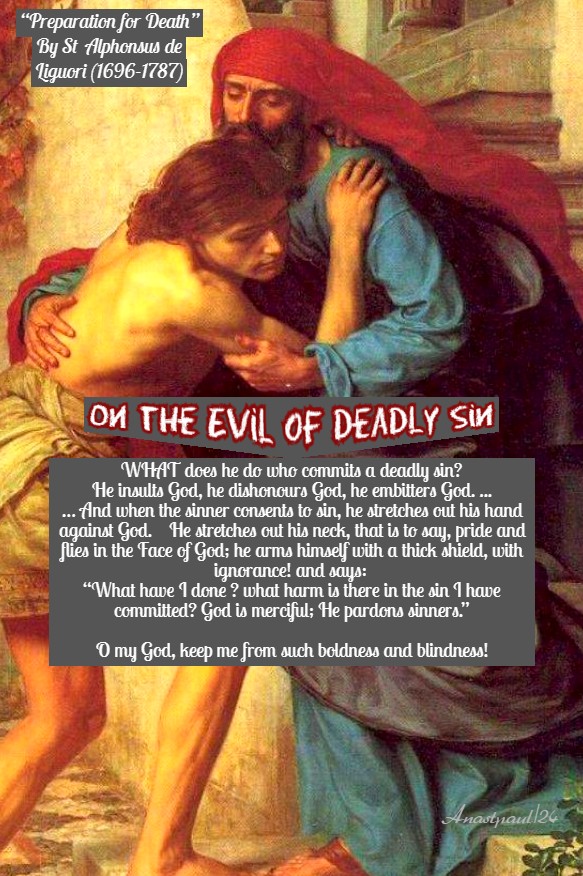
FIRST POINT: “” WHAT does he do who commits a deadly sin? He insults God, he dishonours God, he embitters God.
In the first place, by the deadly sin he commits, he insults God. As St Thomas observes, the malice of an injury is measured according to the person who does it and the person who receives it. It is very wicked to insult a peasant but it is worse to insult a nobleman and still much worse, to insult a king. Who is God ? He is the King of kings: “Lord of lords and King of kings.” (Apoc xvii: 14). God is of Infinite Majesty, with respect to Whom, all the princes of the earth, the Saints and the Angels in Heaven, are less than a grain of dust. Nay, says Isaiah, compared with the greatness of God all creatures are as the smallest things, even as though they had never been: “All nations before Him are as nothing.” (Isa xl:17).
Even such is God and who is man? St. Bernard answers, even a sack of worms and food for worms, who, in a short time, will be devoured by worms: “Miserable and poor and blind and naked.” (Apoc iii: 17). Man is a miserable worm who can do nothing; he is blind and can see nothing and poor and naked and has nothing. And this miserable worm dares to insult God!
… The Angelic Doctor is right when he says: “the sin of man contains a malice almost infinite. Sin has a certain infinity of malice from the infinity of the Divine Majesty.” Nay, St Augustine calls sin absolutely an “infinite evil!” Therefore it is, that if all men, and all Angels, were to offer themselves to die and to annihilation, they would not be able to make satisfaction for one single sin!
God punishes deadly sin with the great punishment of hell but, however much God punishes the sinner, all theologians agree that God punishes it “Citra condignnm” that is, with less punishment than deadly sin deserves. And what punishment can be great enough for a worm who tries to set himself against his Lord? God is Lord of all, because He has created all things. And in fact, all creatures obey God: “The winds and the sea obey Him” (Matt viii: 27). “Fire and hail, snow and vapours, wind and storm, fulfilling His word.” (Ps cxlviii: 8).
But what does man do when he sins? He says to God, Lord, I do not wish to serve Thee … “Who is the Lord that I should obey His Voice ….. I know not the Lord.” (Exod v: 2). Even thus does the sinner say: “Lord, I know Thee not ; I wish to do what pleases me.” In short, he despises God and turns away from Him and, it is indeed committing a deadly sin, to turn away from God. “A turning away from the unchangeable good,” as St Thomas observes.
Of this does the Lord complain. … Thou hast been ungrateful, says God, thou hast left Me, since I would never have left thee, thou hast turned away from Me. God has declared that He hates sin, therefore, He cannot do otherwise than hate him who sins: “For the ungodly and his ungodliness, are both alike, hateful unto God.” (Wisd xiv: 9). When man sins, he is bold enough to declare himself the enemy of God. “He stretcheth out his hand against God and strengtheneth himself against the Almighty.” (Job xv: 25). … And when the sinner consents to sin, he stretches out his hand against God. He stretches out his neck, that is to say, pride and flies in the Face of God; he arms himself with a thick shield, with ignorance! and says: “What have I done ? what harm is there in the sin I have committed? God is merciful; He pardons sinners.” O my God, keep me from such boldness and blindness!
Affections andPrayers
Behold, O my God, at Thy Feet the rebellious one; the bold one, who has had the boldness to insult Thee so many times and to turn away from Thee but now I seek for mercy from Thee. For Thou hast said: “Call unto Me and I will answer thee.” (Jer xxxiii: 3). I know that hell is a fitting punishment for me but Thou knowest that I feel very sorry for having offended Thee, O Thou Infinite Goodness, more sorry than if I had lost everything I possess and my life even. Ah, my Lord, pardon me and never let me offend Thee more. Thou hast waited for me, so that I may forever bless Thy mercy and love Thee. Yes, I do bless and love Thee and hope because of. the merits of Jesus Christ, never more to be separated from Thy Love. … Ah, take me entirely into Thy possession, my soul, my body, my powers, my senses, my will and my liberty. … Thou Who art my only good, my only adorable One, be also my only love. Give me zeal in loving Thee. 1 hope for it from Thee, O Thou, Who art Omnipotent.
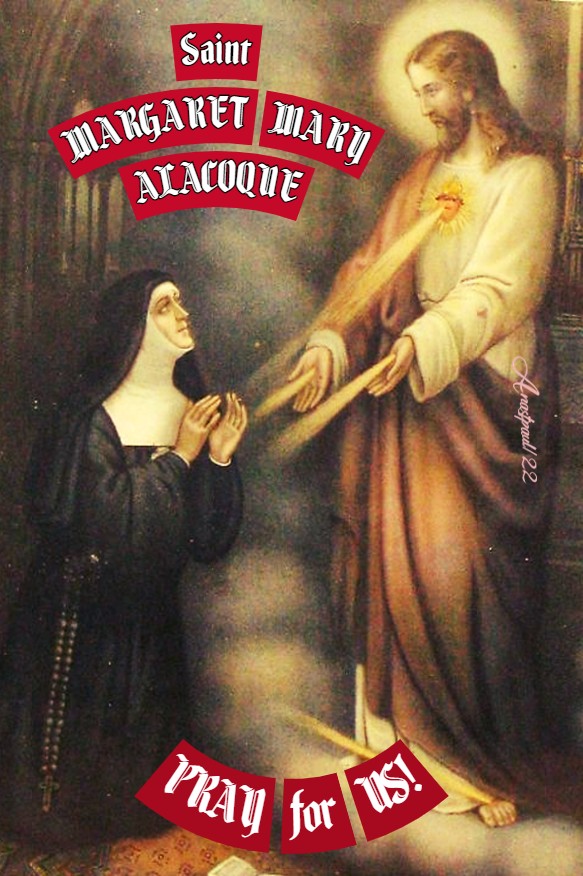
Quote/s of the Day – 17 October – St Margaret Mary Alacoque (1647-1690) Virgin
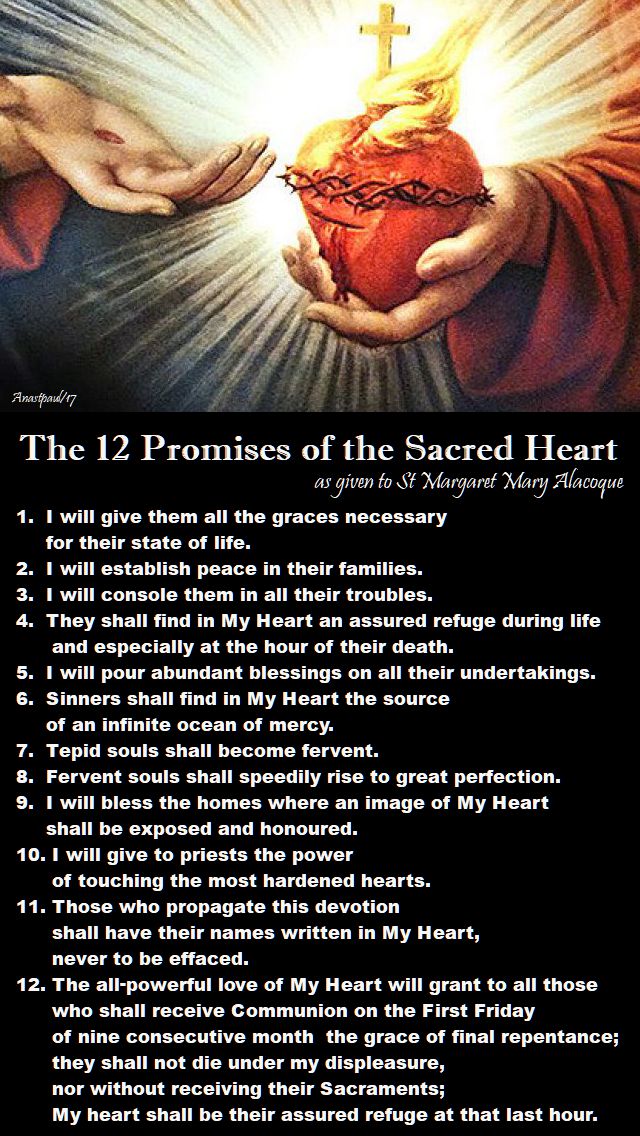
The Twelve Promises of Jesus to Saint Margaret Mary or those Devoted to His Sacred Heart:
I will give them all the graces necessary for their state of life.
I will establish peace in their families.
I will console them in all their troubles.
They shall find in My Heart an assured refuge during life and especially at the hour of their death.
I will pour abundant blessings on all their undertakings.
Sinners shall find in My Heart the source of an infinite ocean of mercy.
Tepid souls shall become fervent.
Fervent souls shall speedily rise to great perfection.
I will bless the homes where an image of My Heart shall be exposed and honoured.
I will give to priests the power of touching the most hardened hearts.
Those who propagate this devotion shall have their names written in My Heart, never to be effaced.
The all-powerful love of My Heart will grant to all those who shall receive Communion on the First Friday of nine consecutive months the grace of final repentance; they shall not die under my displeasure, nor without receiving their Sacraments; My heart shall be their assured refuge at that last hour.
From Saint Margaret Mary Alacoque’s Vision of Jesus
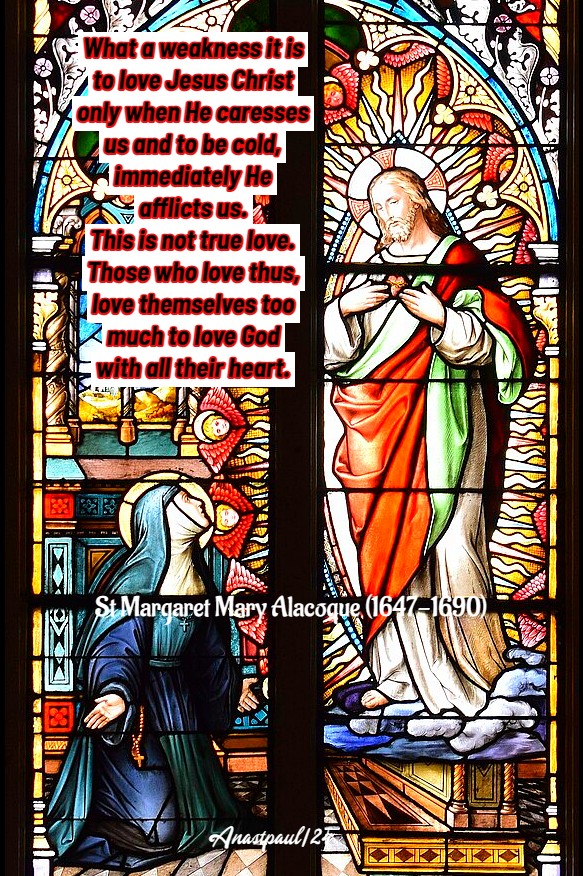
“What a weakness it is to love Jesus Christ only when He caresses us and to be cold, immediately He afflicts us. This is not true love. Those who love thus, love themselves too much to love God with all their heart.”
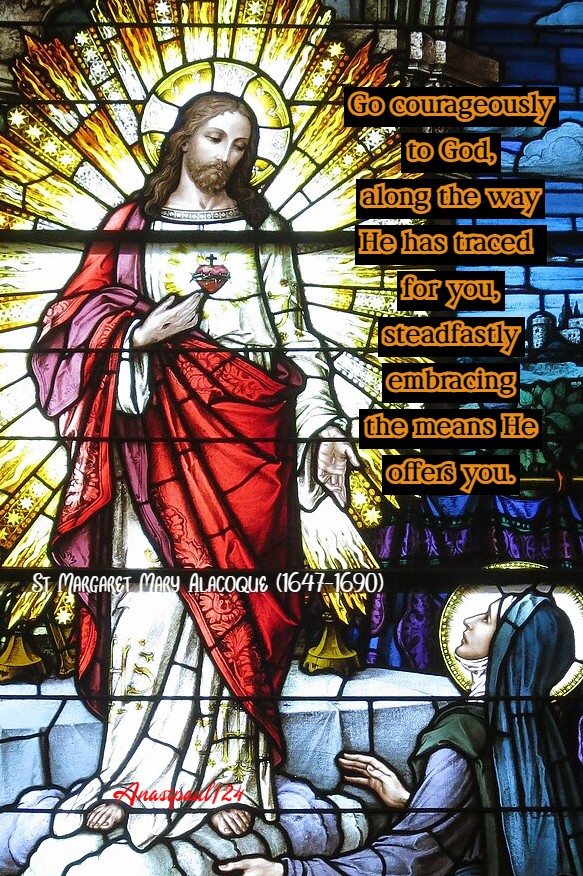
“Go courageously to God, along the way He has traced for you, steadfastly embracing the means He offers you.”
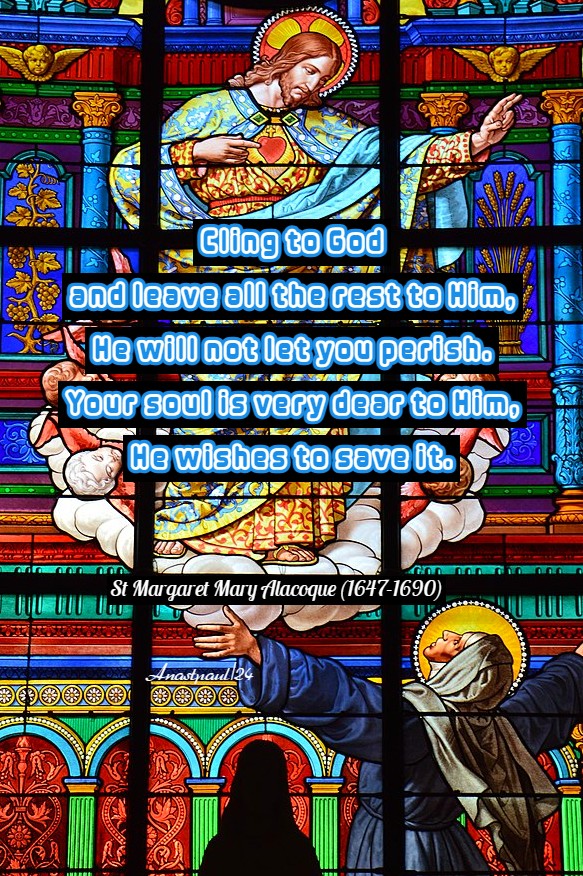
“Cling to God and leave all the rest to Him, He will not let you perish. Your soul is very dear to Him, He wishes to save it.”
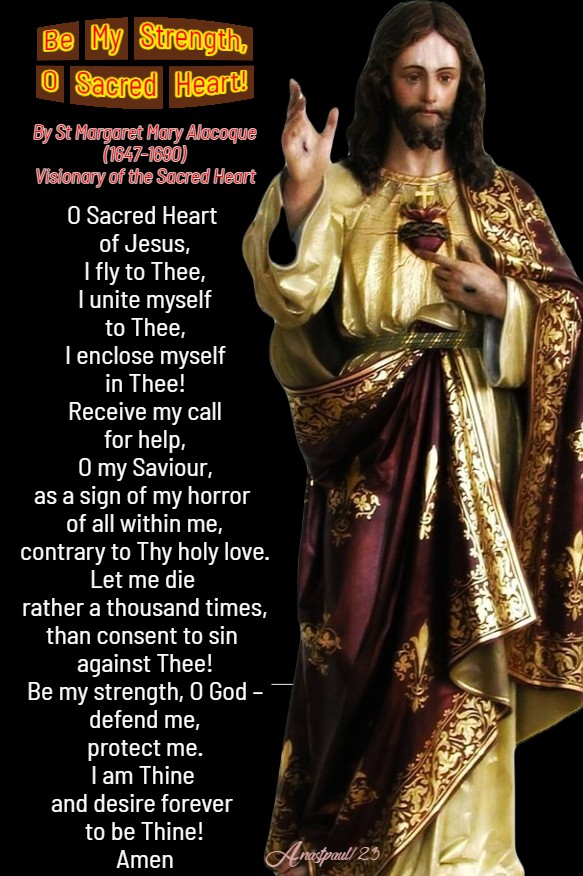
Be My Strength, O Sacred Heart! By St Margaret Mary Alacoque (1647-1690) Visionary of the Sacred Heart
O Sacred Heart of Jesus, I fly to Thee, I unite myself to Thee, I enclose myself in Thee! Receive my call for help, O my Saviour, as a sign of my horror, of all within me contrary to Thy holy love. Let me die rather a thousand times, than consent to sin against Thee! Be my strength, O God – defend me, protect me. I am Thine and desire forever to be Thine! Amen
One Minute Reflection – 17 Octoberber – “The Month of the Most Holy Rosary and of the Angels” – St Margaret Mary Alacoque (1647-1690) Virgin – Ephesians 3:8-9, 14-19, Matthew 11:25-30 – Scripture search here: https://www.drbo.org/
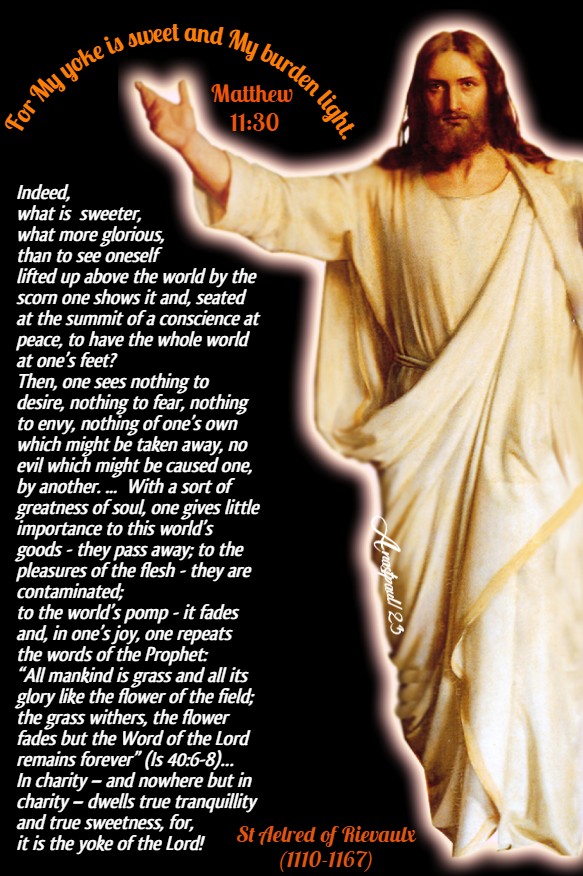
“For My yoke is sweet and My burden light.” – Matthew 11:30
REFLECTION – “People who complain about the roughness of the Lord’s yoke have possibly not completely rejected, the heavy load of the lusts of the world, or, if they did reject them, they have enslaved themselves to them again, to their greater shame! Outwardly, they carry the yoke of the Lord but inwardly, they submit their shoulders to the burden of the world’s cares. They set on the balance of the Lord’s yoke, the hardships and difficulties which they inflict on themselves… As for the yoke of the Lord – it is “sweet and its burden light”.
Indeed, what is sweeter, what more glorious, than to see oneself lifted up above the world by the scorn one shows it and, seated at the summit of a conscience at peace, to have the whole world at one’s feet? Then, one sees nothing to desire, nothing to fear, nothing to envy, nothing of one’s own which might be taken away, no evil which might be caused one, by another. The eyes of the heart turn towards “an inheritance which is incorruptible, undefiled and unfading which is kept for us in Heaven” (1 Pt 1:4). With a sort of greatness of soul, one gives little importance to this world’s goods – they pass away; to the pleasures of the flesh – they are contaminated; to the world’s pomp – it fades and, in one’s joy, one repeats the words of the Prophet: “All mankind is grass and all its glory like the flower of the field; the grass withers, the flower fades but the Word of the Lord remains forever” (Is 40:6-8)… In charity – and nowhere but in charity – dwells true tranquillity and true sweetness, for, it is the yoke of the Lord!” – St Aelred of Rievaulx (1110-1167) Cistercian Monk (The Mirror of charity I:30-31).
PRAYER – O Lord Jesus Christ, Who wondrously revealed the unsearchable riches of Thy Heart to blessed Margaret Mary, the Virgin, grant us, by her merits and through imitating her, to love Thee, in all things and above all things, so that we may be found worthy to possess a lasting dwelling place in Thou Heart itself. Through the same Jesus Christ, Thy Son our Lord, Who lives and reigns with Thee, in the unity of the Holy Ghost, God, world without end. Amen (Collect).
Our Morning Offering – 17 October – St Margaret Mary Alacoque VHM (1647-1690) Virgin
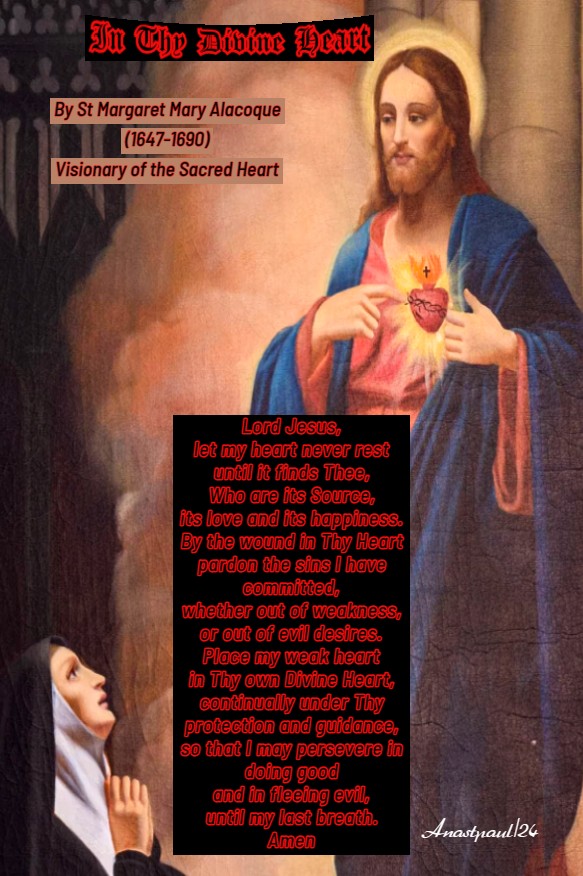
In Thy Divine Heart By St Margaret Mary Alacoque (1647-1690) Visionary of the Sacred Heart
Lord Jesus, let my heart never rest until it finds Thee, Who are its Source, its love and its happiness. By the wound in Thy Heart pardon the sins I have committed, whether out of weakness, or out of evil desires. Place my weak heart in Thy own Divine Heart, continually under Thy protection and guidance, so that I may persevere in doing good and in fleeing evil, until my last breath. Amen
Saint of the Day – 17 October – Saint Victor of Capua (Died 554) Bishop of Capua, Italy, Spiritual Writer. He died there in 554 of natural causes.
The Roman Martyrology reads today: “At Capua, St Victor, the Bishop, distinguished for erudition and sanctity.”
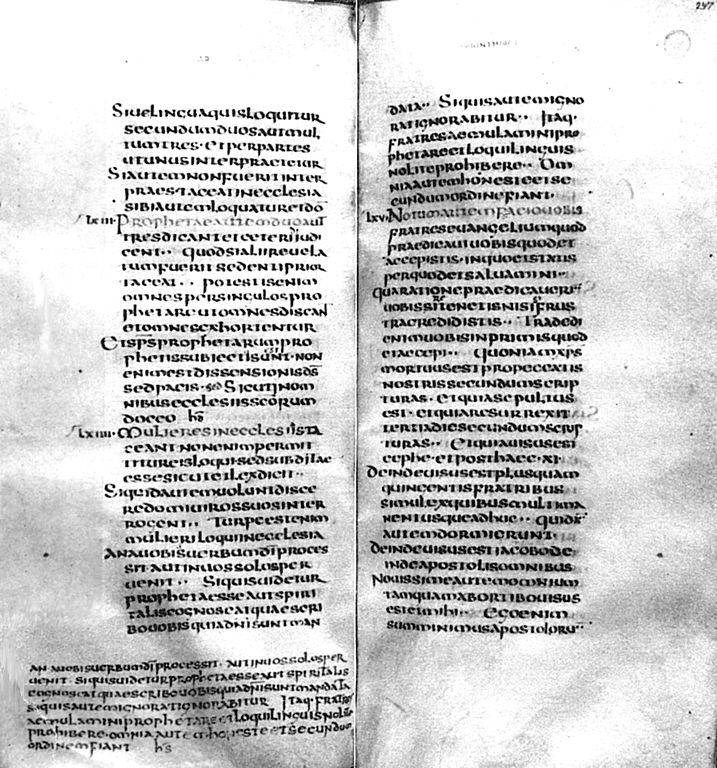
Pages 296–297 of the Codex Fuldensis
Very little is known about Victor’s life. Apart from his writings, Victor is known only by his Epitaph, which states that he died in AApril 554, after an Episcopate of about 13 years from February 541.
Victor’s best known work is the Codex Fuldensis which was written between 541 and 546 while he was the Bishop of Capua. The Codex is an early manuscript of the Vulgate and it contains the entirety of the New Testament, as well as the apocryphal Epistle to the Laodiceans.
Other works include several commentaries on the Old and New Testaments, and a work on the Paschal Cycle which was praised and quoted in fragments, by the great St Bede. Victor also authored analyses of the genealogy of Jesus and Noah’s Ark, all of which are lost.
He dedicated a codification of the order of pericopes in a Lectionary to St Constantius of Aquino.
His feast in the Roman Martyrology is on 17 October.
Bl Gilbert the Theologian St Heron of Antioch Bl Jacques Burin St John the Short/Dwarf St Louthiern St Mamelta of Persia St Nothelm of Canterbury St Richard Gwyn St Rudolph of Gubbio St Rufus of Rome St Serafino of Montegranaro St Solina of Chartres St Victor of Capua (Died 554) Bishop St Zosimus of Rome
Martyrs of Nicomedia – 3 Saints: A group of Christians Martyred in the persecutions of Diocletian. The only details about them that have survived are their names – Alexander, Marianus and Victor. 303 in Nicomedia (in modern Turkey).
Martyrs of Valenciennes -5 Beati: A group of Ursuline nuns Martyred in the persecutions of the French Revolution. Hyacinthe-Augustine-Gabrielle Bourla Jeanne-Reine Prin Louise-Joseph Vanot Marie-Geneviève-Joseph Ducrez Marie-Madeleine-Joseph Déjardins
Martyrs of Volitani: A group of Martyrs who were praised by Saint Augustine of Hippo. In Volitani, proconsular Africa (in modern Tunisia).
Thought for the Day – 16 October – Meditations with Saint Alphonsus Maria de Liguori (1696-1787) Bishop, Confessor, Most Zealous Doctor of the Church
CONSIDERATION XIV
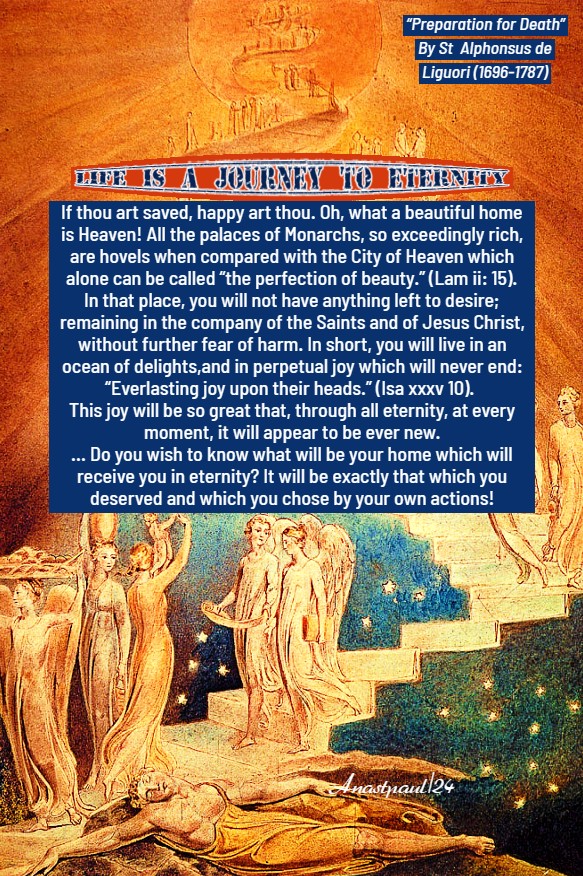
Life is a Journey to Eternity “Man goeth to his long home.” (Eccles xii: 5)
FIRST POINT: FROM beholding that, in this world, so many evil-livers live in prosperity and, so many righteous men, on the contrary, live in adversity, even the Gentiles recognised, by the light of nature alone, this truth – as there is a God and, as this God is just, so there must be another life, in which the wicked will be punished and the good rewarded! What these Gentiles saw by the light of reason alone, we, Christians, confess, by faith: “Here we have no abiding city but we seek one to come.” (Heb xiii; 14). This world is not truly our country but, for us, it is a place of passage, through which we must pass quickly to our “long home.” “Man goeth to his long home.”
Therefore, my reader, the house in which you dwell is not your house; it is an hostel from which, quickly and when you least expect it, you will have to depart. Know, when the time of your death has arrived, those most dear, will be the first to thrust you out. And what will be your real home? A grave will be the home of your body, until the day of judgement and your soul will have to go to its long home, either to Paradise or to Hell. Wherefore, St Augustine addresses you: “Thou art a guest; thou beholdest and thou passest onwards.” That traveller would be insan, who, passing through a country, would wish to lay out there all his inheritance in the purchase of a villa or a house in that place which, in a few days he must leave. Reflect, yet, says the Saint, that in this world thou art a passenger, do not place thy affections on what thou seest, behold and pass on and procure a good home where you will have to dwell forever.
If thou art saved, happy art thou. Oh, what a beautiful home is Heaven! All the palaces of Monarchs, so exceedingly rich, are hovels when compared with the City of Heaven which alone can be called “the perfection of beauty.” (Lam ii: 15). In that place, you will not have anything left to desire; remaining in the company of the Saints and of Jesus Christ, without further fear of harm. In short, you will live in an ocean of delights,and in perpetual joy which will never end: “Everlasting joy upon their heads.” (Isa xxxv 10). This joy will be so great that, through all eternity, at every moment, it will appear to be ever new.
But, if thou art lost; unhappy thou! Thou wilt be confined in a lake of fire, abandoned by all and without God. And for what time? Perchance, when a hundred thousand years shall have passed by, your punishment will be ended? What end! A hundred thousand million years and ages will pass by, and your hell will be ever at its beginning. For what are a thousand years in comparison with eternity? Less than a day that has passed, “A thousand years in Thy sight are but as yesterday, seeing that it is past as a watch in the night.” (Ps xc: 4).
Do you wish to know what will be your home which will receive you in eternity? It will be exactly that which you deserved and which you chose by your own actions!
Affections and Prayers
Behold, then, O Lord, the home which I have deserved by my life; alas, Hell! where, from the first sin which I committed, I ought to remain, abandoned by Thee, deprived of the hope of being able to love Thee more. Let Thy mercy forever be blessed which, having waited for me, also gives me time to atone for my sin! Let the Blood of Jesus Christ be blessed which has obtained this mercy for me. No, my God, I do not desire further to abuse Thy patience. I repent, above every other sin, having grieved Thee, not so much on account of having deserved hell, as that I have abused Thy infinite goodiiess. Never more, my God, never more; let me die rather than offend Thee more. If I were now in Hell, O my Sovereign Good, I could not love Thee any more, neither couldst Thou further love me. I love Thee and I desire to be loved by Thee. I do not deserve this but Jesus Christ merits it, Who so sacrificed Himself upon the Cross that Thou mightst be able to pardon and love me.
Eternal Father, for the love, then, of Thy Son, give me grace to love Thee ever and to love Thee much, more and more. I love Thee, O my Father, for having given Thy Son!
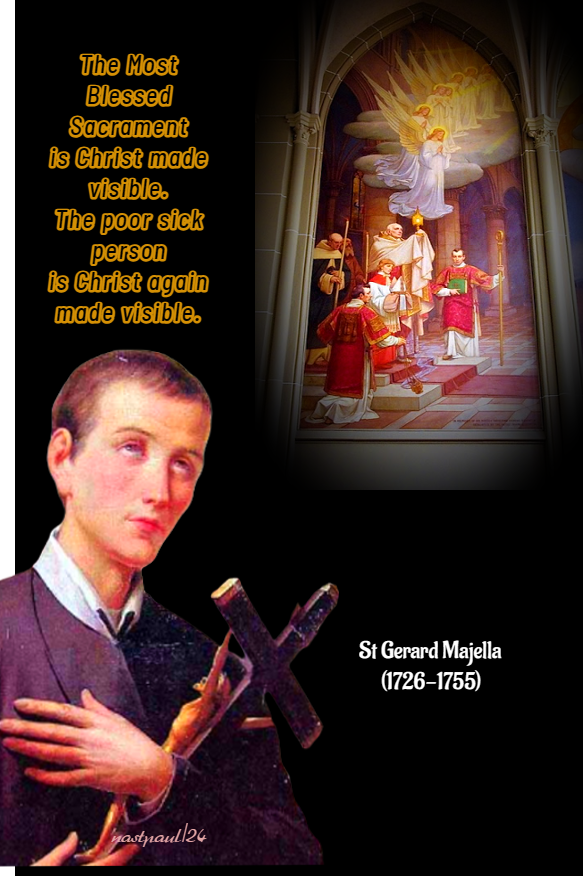
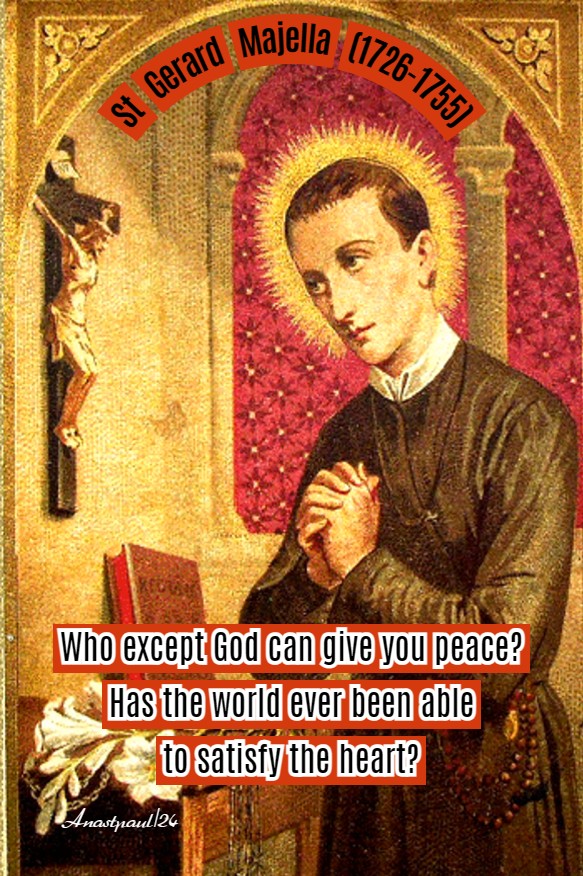
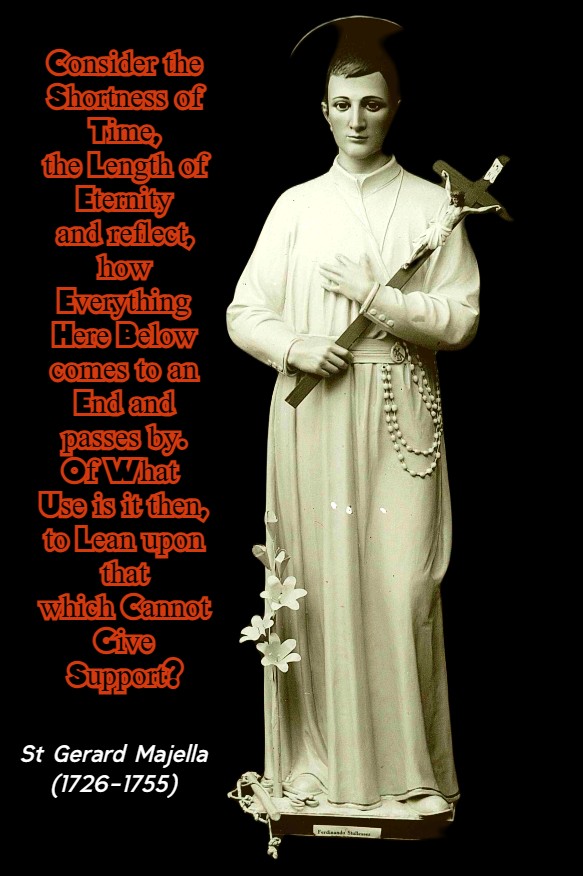
Quote/s of the Day – 16 October – St Gerard Majella CSsR (1726-1755) Religious Lay Brother of the Redemptorists
“The Most Blessed Sacrament is Christ made visible. The poor sick person is Christ again made visible.”
“Who except God can give you peace? Has the world ever been able to satisfy the heart?”
“Consider the shortness of time, the length of eternity and reflect, how everything here below comes to an end and passes by. Of what use is it then, to lean upon that which cannot give support?”
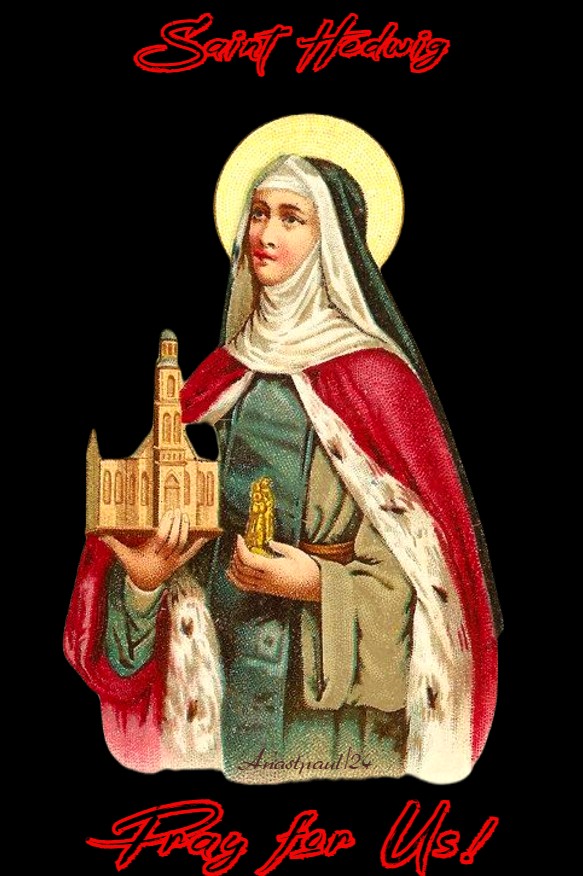
One Minute Reflection – 16 October – “The Month of the Most Holy Rosary and of the Angels” – Feast of the Purity of the Blessed Virgin Mary and of St Hedwig of Andechs (1174-1243) Widow – Proverbs 31:10-31, Matthew 13:44-52 – Scripture search here: https://www.drbo.org/
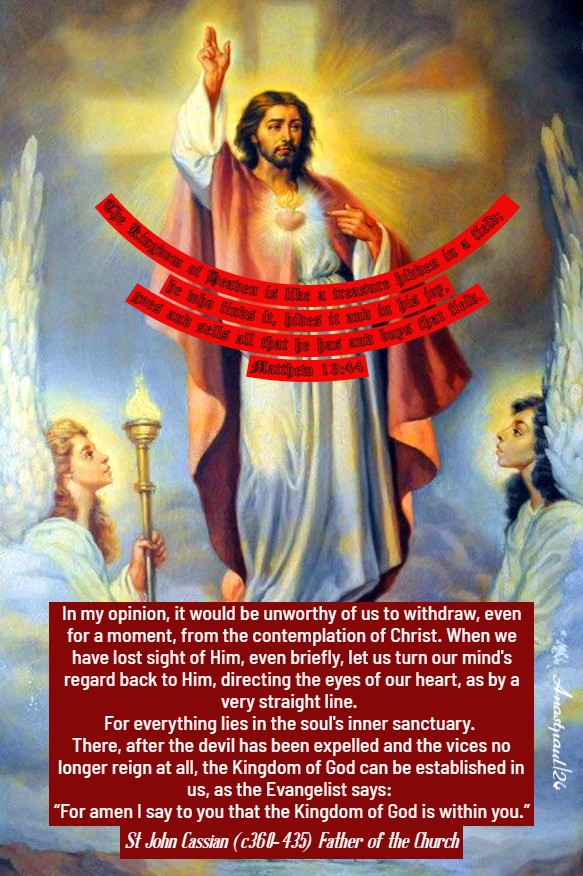
“The Kingdom of Heaven is like a treasure hidden in a field; he who finds it, hides it and in his joy, goes and sells all that he has and buys that field.” – Matthew 13:44
REFLECTION – “In my opinion, it would be unworthy of us to withdraw, even for a moment, from the contemplation of Christ. When we have lost sight of Him, even briefly, let us turn our mind’s regard back to Him, directing the eyes of our heart, as by a very straight line. For everything lies in the soul’s inner sanctuary. There, after the devil has been expelled and the vices no longer reign at all, the Kingdom of God can be established in us, as the Evangelist says: “For amen I say to you that the Kingdom of God is within you.”
But within us there can be nothing else than knowledge or ignorance of the truth and the love, of either the vices, or the virtues, by which we make ready a Kingdom in our hearts, either for the devil or for Christ.
The Apostle Paul also describes the characteristics of this Kingdom when he says: “For the Kingdom of God is not food and drink but righteousness and peace and joy in the Holy Ghost.” Thus, if the Kingdom of God is within us and the Kingdom of God is itself, righteousness and peace and joy, then, whoever abides in these things, is undoubtedly in the Kingdom of God … Let us lift up the eyes of our soul to that Kingdom which is endless joy!” – St John Cassian (c360-435) Monk, Theologian, Founder of Monasteries, Father of the Church, Disciple of St John Chrysostom (Conferences No 1).
PRAYER – O God, Who taught blessed Hedwig to forsake worldly vanities that she might, humbly follow Thy Cross, with her whole heart, grant through her merits and example, we may learn to renounce the perishable delights of the world and, by embracing Thy Cross, overcome all things opposed to our salvation. Through Jesus Christ, Thy Son our Lord, Who lives and reigns with Thee, in the unity of the Holy Ghost, God, world without end. Amen (Collect).
Our Morning Offering – 16 October – “The Month of the Most Holy Rosary and of the Angels” – Feast of the Purity of the Blessed Virgin Mary
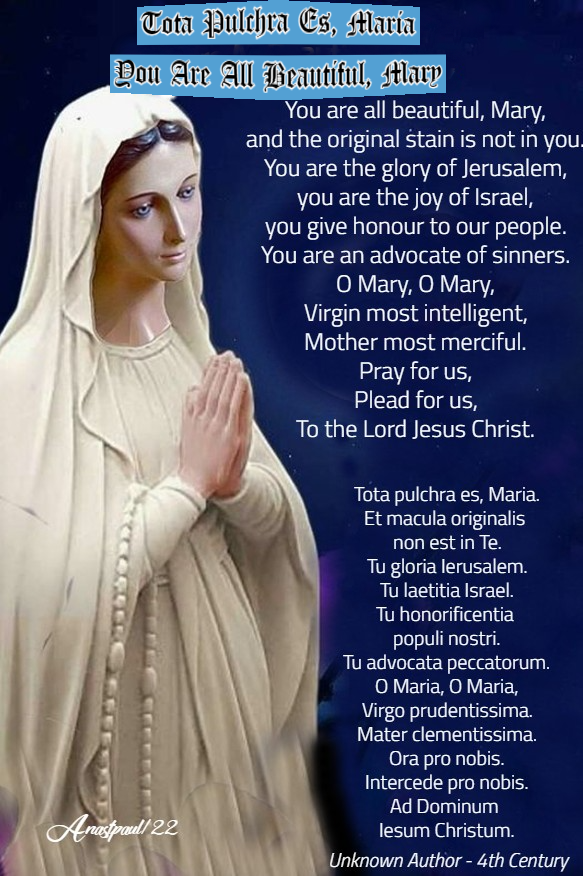
Tota Pulchra Es, Maria You Are All Beautiful, Mary Unknown Author – 4th Century
You are all beautiful, Mary, and the original stain is not in you. You are the glory of Jerusalem, you are the joy of Israel, you give honour to our people. You are an advocate of sinners. O Mary, O Mary, Virgin most intelligent, Mother most merciful. Pray for us, Plead for us, To the Lord Jesus Christ.
Tota pulchra es, Maria. Et macula originalis non est in Te. Tu gloria Ierusalem. Tu laetitia Israel. Tu honorificentia populi nostri. Tu advocata peccatorum. O Maria, O Maria, Virgo prudentissima. Mater clementissima. Ora pro nobis. Intercede pro nobis. Ad Dominum Iesum Christum.
This prayer used by the Church since the 4th Century for the Feast of the Immaculate Conception and the Purity of the Blessed Virgin. It takes some text from the book of Judith and other text from Song of Songs, specifically 4:7. Many composers have set this prayer to music over the centuries.
























You must be logged in to post a comment.