Thought for the Day – 20 June – Meditations with Fr Richard Frederick Clarke SJ (1839-1900)
HUMILITY Meditations for a Month
Humility in Our Estimation of Ourselves
There is no better test of humility than the opinion we form about others as compared to ourselves. If we had to make a list of the virtuous, in what position should we place ourselves? A man who is truly humble will place himself,not only last but least, with a great interval between himself and the rest of mankind! Saint Dominic used to place himself, in spirit, beneath the feet of the very demons, as being far worse than them. Saint Paul declared himself the very worst of sinners. Can I honestly speak of myself thus? Do I regard myself as the worst of all men in the sight of God?
What should be the ground of this humility? We must not attempt impossibilities. I ought not to think myself worst of all, unless I really am so. It may be that I cannot truthfully say that I am in the habit of committing mortal sins. How, then, can I be worse than the notorious sinner? Yet, when I think of all the graces God has given me, I must confess that, if He had given them to those who sin most deeply, they would be far better than I am. My only superiority is in greater graces! Humble yourself at the thought of all the graces you have received and of your frequent failures to co-operate with them.
Even if we had never sinned, this would not free us from the obligation of putting ourselves below all and beneath all. Our exemption would be no credit to ourselves. It would simply be a fresh gift of God which ought to make us more vividly conscious, of our vileness and nothingness, in His sight. We must always be as nothing in His sight but sin makes us worse than nothing. It makes us a blot upon creation, inferior to the dumb creatures which have never sinned!
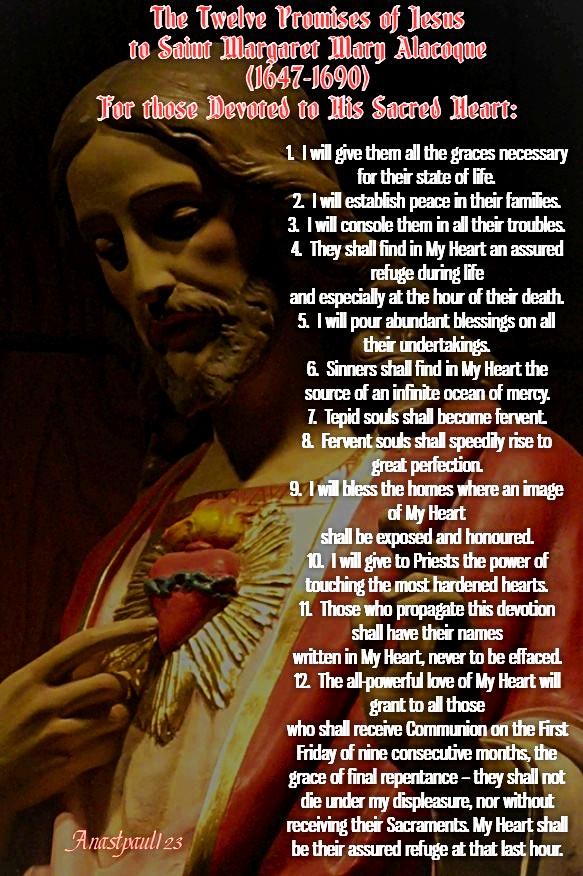
The Twelve Promises of Jesus to Saint Margaret Mary and to those Devoted to His Sacred Heart:
I will give them all the graces necessary for their state of life.
I will establish peace in their families.
I will console them in all their troubles.
They shall find in My Heart an assured refuge during life and especially at the hour of their death.
I will pour abundant blessings on all their undertakings.
Sinners shall find in My Heart the source of an infinite ocean of mercy.
Tepid souls shall become fervent.
Fervent souls shall speedily rise to great perfection.
I will bless the homes where an image of My Heart shall be exposed and honoured.
I will give to priests the power of touching the most hardened hearts.
Those who propagate this devotion shall have their names written in My Heart, never to be effaced.
The all-powerful love of My Heart will grant to all those who shall receive Communion on the First Friday of Nine consecutive months the grace of final repentance; they shall not die under my displeasure, nor without receiving their Sacraments; My heart shall be their assured refuge at that last hour.
“His Heart is the natural Sign and Symbol of His boundless love for the human race.”
One Minute Reflection – 20 June – “The Month of the Sacred Heart of Jesus” – St Pope Silverius (Died 538) Martyr – Jude 1:17-21; Matthew 16:13-19 – Scripture search here: https://www.drbo.org/
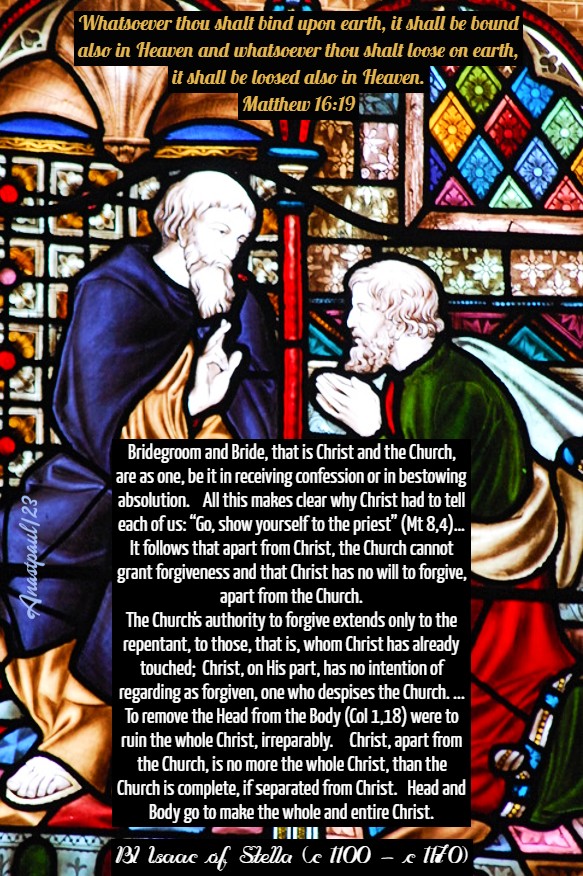
“Whatsoever thou shalt bind upon earth, it shall be bound also in Heaven and whatsoever thou shalt loose on earth, it shall be loosed also in Heaven.” – Matthew 16:19
REFLECTION – “Bridegroom and Bride, that is Christ and the Church, are as one, be it in receiving confession or in bestowing absolution. All this makes clear why Christ had to tell each of us: “Go, show yourself to the priest” (Mt 8:4)… It follows that apart from Christ, the Church cannot grant forgiveness and that Christ has no will to forgive, apart from the Church. The Church’s authority to forgive extends only to the repentant, to those, that is, whom Christ has already touched; Christ, on His part, has no intention of regarding as forgiven, one who despises the Church.
Doubtless, Christ need accept no restraints to His power of Baptising, Consecrating the Eucharist, Ordaining Priests, forgiving sins and the like but, the humble and faithful Bridegroom, prefers to confer such blessings, with the co-operation of His Bride. “What God,” then, “has joined, let no man put asunder” (Mt 19:6). “I say this is a great mystery and refers to Christ and the Church” (Eph 5:32)… To remove the Head from the Body (Col 1:18) were to ruin the whole Christ, irreparably. Christ, apart from the Church, is no more the whole Christ, than the Church is complete, if separated from Christ. Head and Body go to make the whole and entire Christ.” – Bl Isaac of Stella (c 1100 – c 1170) Cistercian Monk, Abbot, Theologian, Philosopher (Sermon 11, §11-814).
PRAYER – Look forgivingly on Thy flock, Eternal Shepherd and keep it in Thy constant protection, by the intercession of blessed Sylverius Thy Martyr and Sovereign Pontiff, whom Thou didst constitute Shepherd of the whole Church. Through Jesus Christ, Thy Son our Lord, Who lives and reigns with Thee, in the unity of the Holy Ghost, God, world without end. Amen (Collect).
ALL PRAISE, honour and glory to the Divine Heart of JESUS.Indulgenced– 50 Days, once a day. 168 Pope Leo XIII, 14 June 1901.
Our Morning Offering – 20 June – “The Month of the Sacred Heart of Jesus”
Act of Love to the Sacred Heart of Jesus By Servant of God Cardinal Rafael Merry del Val (1865-1930)
Reveal Thy Sacred Heart to me, O Jesus and show me Its attractions. Unite me to It forever. Grant that all my aspirations and all the beats of my heart, which cease, not even while I sleep, may be a testimonial to Thee, of my love for Thee and may it say to Thee – “Yes, Lord, I am all Thine” the pledge of my allegiance to Thee, rests forever in my heart and will never cease to be there. May Thou accept, the slight amount of good that I do and be graciously pleased, to repair all my wrong-doing – so that I may be able, to bless Thee, in time and in eternity. Amen
Saint of the Day – 20 June – Saint Bagne of Thérouanne (Died c706) the 5th Bishop of Thérouanne in northwest France (now St Omer) and then Abbot of Fontanelle, the Monastery of Saint Wandrille in Normandy, a disciple of *St Wandrille (c 605–668) Priest, Monk, Abbot. Died in c711 of natural causes Patronage – of Calais, France. Also known as – Theodericus Buinu (his birth name), Bagne of Calais, Bagnus, Bain, Baino, Bainus, Baiano. Additional Memorial – 10 June in Calais and possible universally at one time.
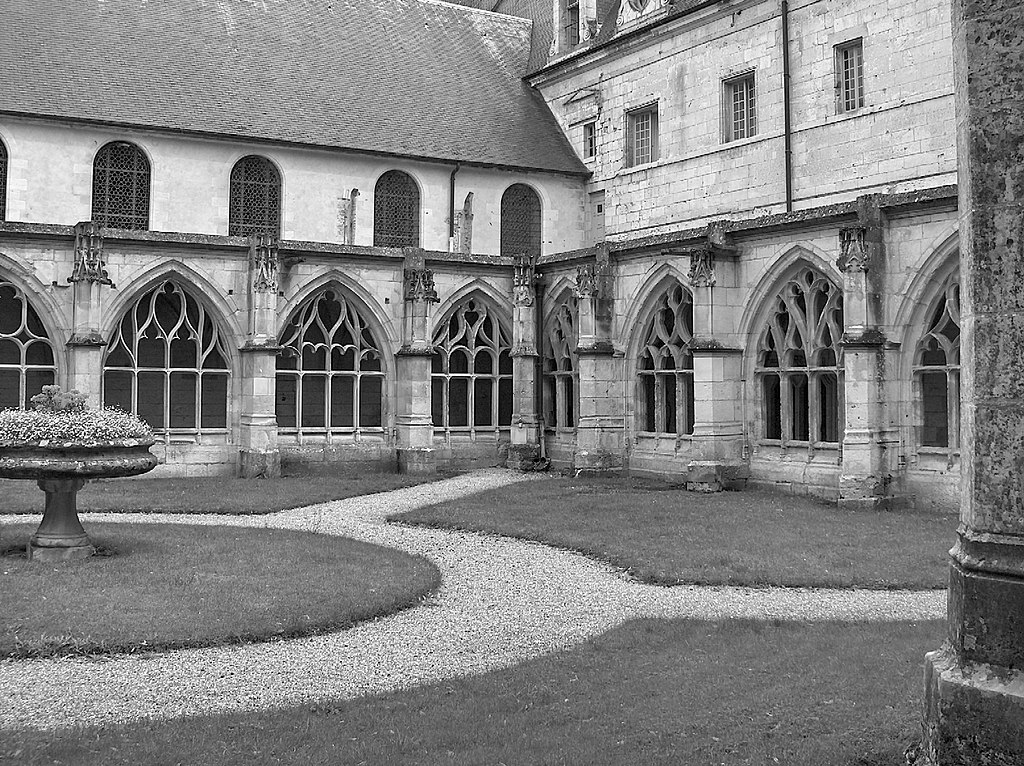
Fontanelle Abbey St Wandrille’s Monastery
Bagne was born to an illustrious family and was named Theodericus Buinus. He embraced the monastic life and was one of the most fervent disciples of St Wandrille. He built up the Monastery of Fontenelle so much by his prudence, his learning and his holiness that, after the death of Saint Drancius, Successor of Saint Omer to the see of Thérouanne and Boulogne, he was elected and called to govern the Diocese.
Baigne was at the head of this See for twelve years, fulfilling all the duties of his pastoral charge with extraordinary zeal and with the greatest perfection, from the year 685 to the year 697. He made several translations and went to Rome, where Pope Sergius I showered him with precious gifts and gave him marks of his high esteem and friendship.
Finally, overwhelmed by the fatigue of the pastoral care and jealous of imitating so many holy Bishops whose veneration he had made honourable, in 697, our Saint Bagne resigned from his Office and chose ,for the place of his retreat, his dear Abbey of Fontenelle, in which he had once spent days so full of meditation, prayer and peace.
Three years after his retirement. he had to yield to the entreaties of the Monks and accept the new Office of Abbot of Fontenelle. In 705 he transferred, from the Church of Saint Paul to that of Saint Peter, the bodies of Saint Wandrille and Saint Ansbert, which were found intact and emmiting the sweetest smell.
Saint Bagne only lived, it seems, for a very short time after this transfer. We are unsure of the precise date of his death, which is usually placed in c706.
There remains, says Father Van-Drival, who provided us with the above details (1635), a living memory of this holy Bishop in the name of the village of “Binghem” the home of Bagne. We have, in fact, the tradition that Saint Bagne sometimes lived in this place, where he had acquired land for the Church of Thérouanne. In 846, the Relics of Saint Bagne were translated to Saint Omer, in order to protect them from the desecration of the Danes. The City of Calais having been the Saint’s favourite place for preaching and this holy Bishop having reaped great fruits of conversion there, the Calaisians have always considered him as their very own Apostle and honoured him as their Patron. His feast is celebrated on 10 June in that City.
St Bagne of Thérouanne (Died c706) Bishop Blessed Benignus of Breslau O,Cist. (13th-14th Century) Cistercian Monk and Martyr St Edburga of Caistor St Florentia of Seville
Blessed Francisco Pacheco SJ (1566-1626) Martyr, Priest of the Society of Jesus, Missionary to India, China and Japan, Provincial Superior. Fr Pacheco and his eight Jesuit companions, together with the nine lay Christians, were included among the 205 Martyrs Beatified by Blessed Pope Pius IX on 7 May1867. His Life and Death: https://anastpaul.com/2021/06/20/saint-of-th-day-20-june-blessed-francisco-pacheco-sj-1566-1626/
St Gemma of Saintonge St Goban of Picardie St Helen of Öehren
St Macarius of Petra (Died c350) Bishop and Confessor St Methodius of Olympus
Blessed Michelina of Pesaro TOSF (1300-1356) Widow, Religious of the Third Order of the Friars Minor, Stigmatic, Penitent, Apostle of all in need, Founder of the Confraternity of the Annunciation, to care for the poor, nurse the sick and bury the dead. Patronages – Pesaro, widows, against mental illness, against death of children. Beatified on 13 April 1737 by Pope Clement XII. Her Holy Life: https://anastpaul.com/2022/06/20/saint-of-the-day-20-june-blessed-michelina-of-pesaro-tosf-1300-1356/
St Novatus of Rome (Died c151) Confessor, Layman. The Roman Martyrology reads today: “At Rome, the demise of St Novatus, son of the blessed Senator, Puden and brother of the saintly Priest, Timothy and of the Holy Virgins of Christ, Pudentiana and Praxedes, who were instructed in the Faith by the Apostles. Their house was converted into a Church and bore the title of Pastor.” A Zealous Life: https://anastpaul.com/2023/06/20/saint-of-the-day-20-june-saint-novatus-of-rome-died-c151-confessor/
Martyred in London: Bl Anthony Turner Bl John Fenwick Bl John Gavan BL Thomas Whitbread Blessed William Harcourt
Irish Martyrs – 260 Beati – This is the collective title given to the 260 or more persons who are credited with dying for the Faith in Ireland between 1537 and 1714.
Martyrs of Lower Moesia: Martyred on the Black Sea at Lower Moesia (in modern Bulgaria), date unknown. St Cyriacus St Paul
Martyred in Nagasaki: 9 Beati : burned alive on 20 June 1626 in Nagasaki, Japan. Their ashes were thrown into the sea and no relics remain. They were Beatified on 7 May 1867 by Pope Pius IX. Blessed Baltasar de Torres Arias Blessed Francisco Pacheco Blessed Gaspar Sadamatsu Blessed Giovanni Battista Zola Blessed Ioannes Kisaku Blessed Michaël Tozo Blessed Paulus Shinsuke Blessed Petrus Rinsei Blessed Vincentius Kaun
Thought for the Day – 19 June – Meditations with Fr Richard Frederick Clarke SJ (1839-1900)
HUMILITY Meditations for a Month
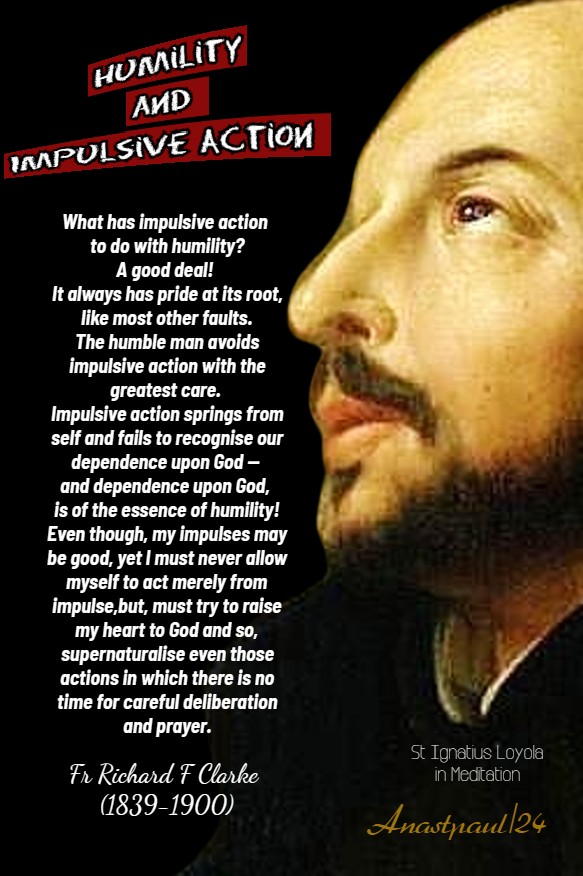
Humility and Impulsive Action
Actions done on impulse and without reflection, proceed from nature, not from grace. A generous nature acts from generous impulses. A selfish nature acts from the ever-present impulses to provide for the interests of self. Such actions do not obtain grace from God or deserve a reward in Heaven. They mark the direction of the stream but do not assist it on its way. Ask yourself, “Do I in general act from impulse? In what direction does impulse carry me?”
What has impulsive action to do with humility? A good deal! It always has pride at its root, like most other faults. The humble man avoids impulsive action with the greatest care. Impulsive action springs from self and fails to recognise our dependence upon God — and dependence upon God, is of the essence of humility! Even though, my impulses may be good, yet I must never allow myself to act merely from impulse,but, must try to raise my heart to God and so, supernaturalise even those actions in which there is no time for careful deliberation and prayer.
How dangerous is impulse! How often I have bitterly regretted actions done on the impulse of the moment! I knew I had better wait before speaking or acting but I was not willing to resist the desire to gratify my impulsive nature. I was not held back by the secret consciousness that what I was doing was sinful, imperfect and ill judged! How many imprudent words, how many foolish actions and how many actual sins, have proceeded from my forgetting or refusing to acknowledge, my continual dependence upon God!
Quote/s of the Day – 19 June – 2 Corinthians 10:17-18, 11:1-2; Matthew 25:1-13 – Scripture search here: https://www.drbo.org/
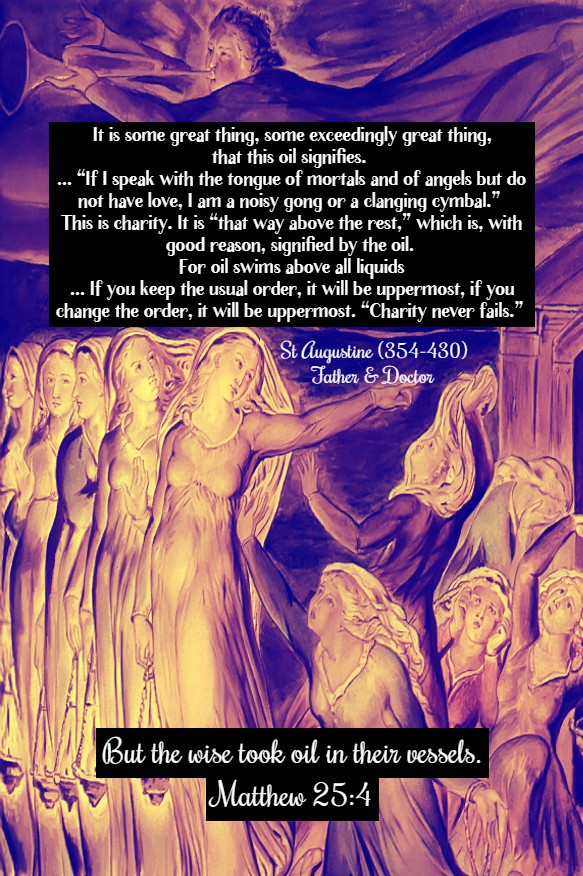
“But the wise took oil in their vessels” Matthew 25:4
“It is some great thing, some exceedingly great thing that this oil signifies. … “If I speak with the tongue of mortals and of angels but do not have love, I am a noisy gong or a clanging cymbal.” This is charity. It is “that way above the rest,” which is, with good reason, signified by the oil. For oil swims above all liquids. If you keep the usual order, it will be uppermost, if you change the order, it will be uppermost. “Charity never fails!”
St Augustine (354-430) Father and Doctor of Grace
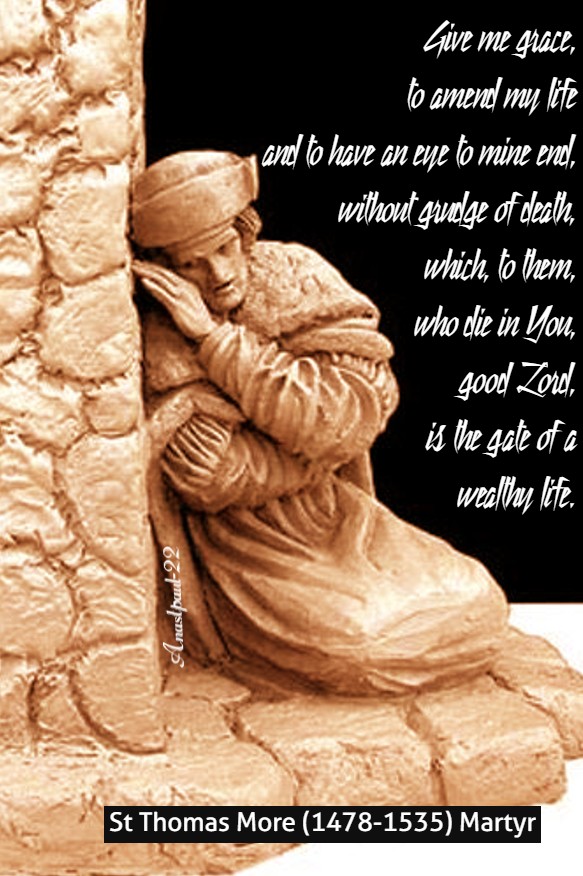
“Give me grace, to amend my life and to have an eye to mine end, without grudge of death, which, to them, who die in You, good Lord, is the gate of a wealthy life.”
St Thomas More (1478-1535) Martyr
“Love consists, not in feeling great things but, in having great detachment and in suffering for the Beloved.”
St John of the Cross (1542-1591) Doctor Mysticus
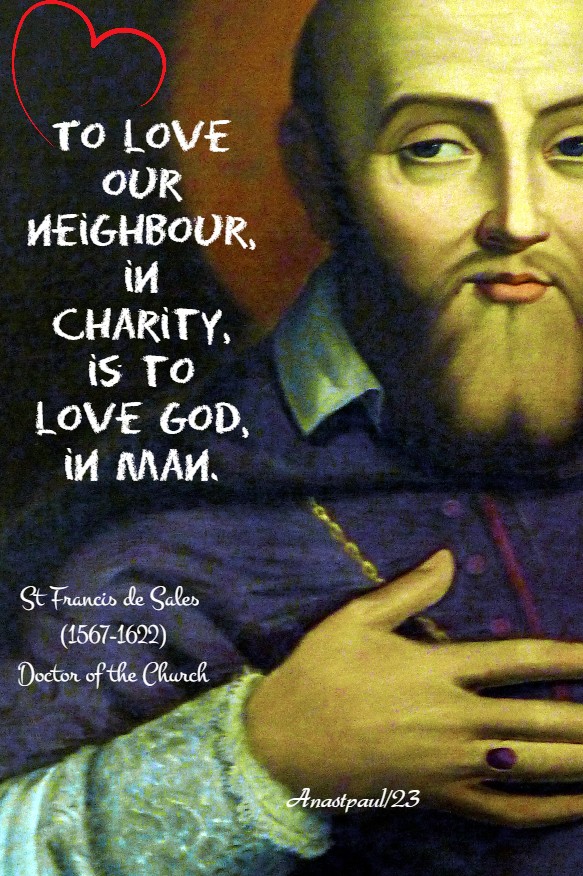
“To love our neighbour, in charity, is to love God, in man.”
(Treatise on the Love of God Book 10 Chapter 11)
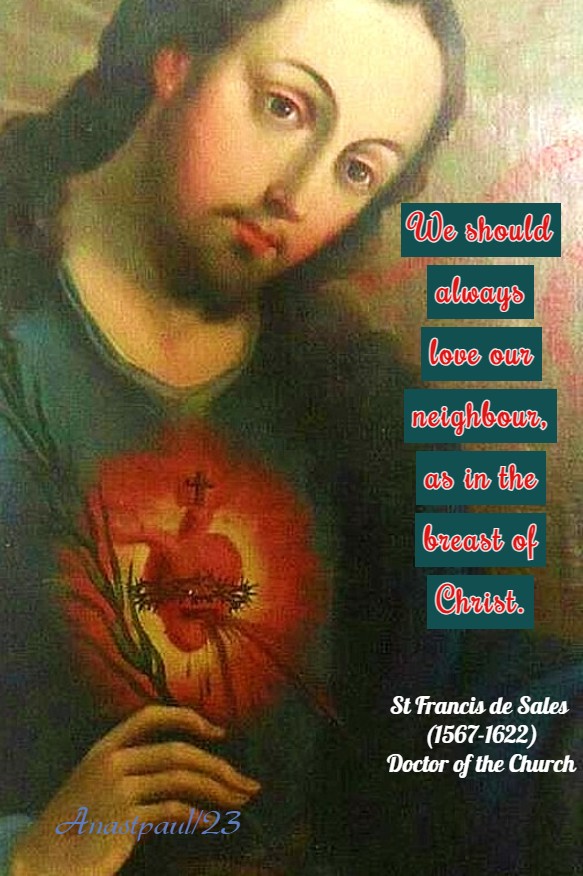
“We should always love our neighbour, as in the breast of Christ”
(The Spirit of St François de Sales II, 1)
St Francis de Sales (1567-1622) Doctor of the Church
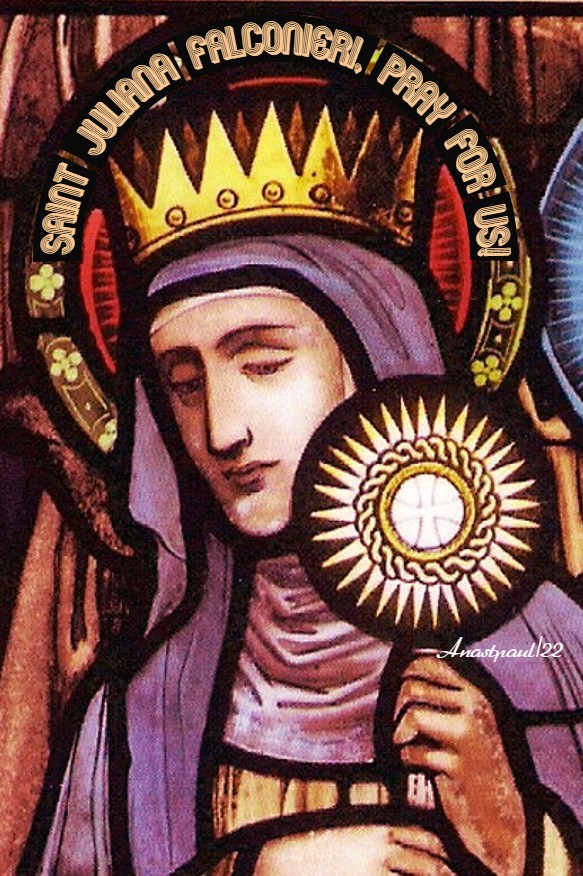
One Minute Reflection – 19 June – “The Month of the Sacred Heart of Jesus” – St Juliana Falconieri OSM (1270 – 1341) Virgin – 2 Corinthians 10:17-18, 11:1-2; Matthew 25:1-13 – Scripture search here: https://www.drbo.org/
“ … The Bridegroom came and they, who were ready, went in with Him … ” – Matthew 25:10
REFLECTION – “In this world, which is to say, in the Church, wholly following Christ, He says to all of us: “Whoever wishes to come after Me must deny himself.” This command is not being directed to virgins but not married women, to widows but not wives, to Monks but not husbands, to Priests but not laity. It is the whole Church, the whole Body of Christ with all its members, differentiated and divided according to their proper functions that is, to follow Christ. May she wholly follow Him, she who is one alone, the dove, the bride (Sg 6:9); may she follow Him, she who has been redeemed and endowed with the Blood of her Bridegroom. Virginal purity has its place here; the continence of widows has its place here; wedded chastity has its place here…
These members who have their place here should follow Christ, each according to their category, each according to their status, each after its fashion. Let them deny themselves, that is to say, let them not rely on themselves. Let them carry their cross that is to say, bear, for Christ’s sake in the world, all that the world inflicts on them. May they love Him, He, the Only One, Who never deceives or is deceived, the Only One ,Who is not mistaken. May they love Him because, what He promises is true. Yet because, He does not give it to us now, our faith falters. Keep going, persevere, bear and accept this delay and you have carried His Cross!” – St Augustine (354-430) Father and Doctor of Grace (Sermon 96:9)
PRAYER – O God, Who miraculously fortified blessed Juliana, Thy Virgin, in her last illness with the precious Body of Thy Son, grant, we beseech Thee, that with her merits pleading for us, we also, refreshed and strengthened by the same Sacrament in our dying agony, may be brought to our heavenly home. Through Jesus Christ, Thy Son our Lord, Who lives and reigns with Thee, in the unity of the Holy Ghost, God, world without end. Amen (Collect).
EUCHARISTIC Heart of JESUS, model of the priestly heart, have mercy on us. COR JESU Eucharisticum, cordis sacerdotalis exemplar, miserere nobis.– Indulgence 300 Days, Everytime – Raccolta 177St Pius X, 11 Sept
Our Morning Offering – 19 June – “The Month of the Sacred Heart of Jesus” –
O DIVINE Heart of JESUS Pope Leo XIII Indulgence 100 Days, Once a day Raccolta 167 13 March 1901.
O DIVINE Heart of JESUS, grant, we beseech Thee, eternal rest to the souls in purgatory, the final grace to those who shall die today, true repentance to sinners, the light of the faith to pagans and Thy Blessing to me and mine. To Thee, O most compassionate Heart of JESUS! I commend all these souls and I offer to Thee, on their behalf, all Thy merits, together with the merits of Thy most Holy Mother and of all the Saints, Angels and all the Sacrifices of the Holy Mass, Communions, prayers and good works, which shall be accomplished today, throughout the Christian world. Amen
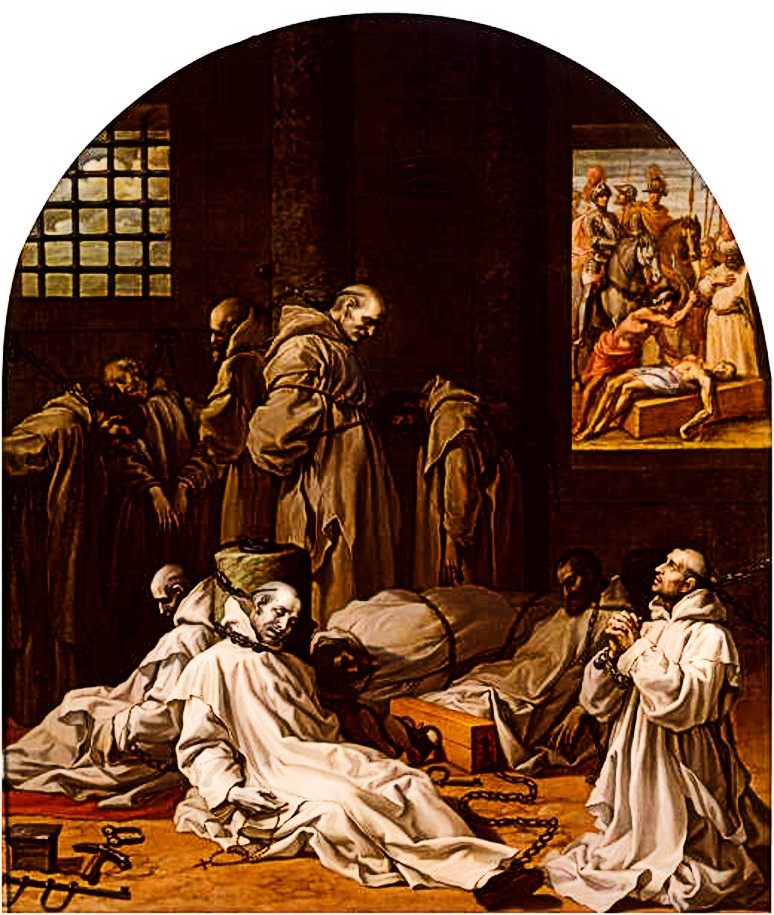
Saint of the Day – 19 June – Blessed Humphrey Middlemore O.Cart. (Died 1535) Priest, Martyr, Carthusian Monk and Prior. Died on 19 June 1535at Tyburn Tree , London for refusal to take the new Oath of Supremacy by being hanged, drawn and quartered. Additional Memorial – on 4 May as one of the Carthusian Martyrs of London during the violent horrors perpetrated by Henry VIII when Catholics refused to recognise his so-called marriage to Anne Boleyn.
Although the date of his birth is uncertain, his father was Thomas Middlemore of Edgbaston, Warwickshire, who had acquired his estate at Edgbaston by marriage with the heiress of Sir Henry Edgbaston. Humphrey’s mother was Ann Lyttleton, of Pillaton Hall, Staffordshire. Humphrey became attracted to the Carthusian Order at an early age and entered the London Charterhouse, where he was Professed and Ordained. He was subsequently appointed to the Office of Procurator. He was esteemed by the Prior, Dom John Houghton (also Martyred).
In 1534 the question of King Henry VIII’s marriage with Anne Boleyn arose. The King was determined that the more prominent of his subjects should expressly acknowledge the validity of the marriage and the right of succession of any issue therefrom. The Crown was at first anxious to secure the public acquiescence of the Monks of the London Charterhouse in this matter, since they enjoyed great prestige for the austerity and sincerity of their mode of life. Accordingly, the Royal Commissions paid a visit to the Charterhouse and required the Monks to take the Oath to that effect. Doms John Houghton and Humphrey Middlemore refused and were, in consequence, imprisoned in the Tower of London but, after a month’s imprisonment, they were persuaded to take the Oath conditionally and were released.
In the following year, on 4 May 1535, the authorities sent to their death at Tyburn Tree, three leading English Carthusians, first among them John Houghton, Prior of the London Charterhouse but also Robert Lawrence and Augustine Webster, respectively Priors of Beauvale and Axholme. This led to Middlemore becoming Vicar of the community.
Meanwhile, Thomas Bedyll, one of the Royal Commissioners, had again visited the Charterhouse and endeavoured, both by conversation and writing, to shake the faith of Middlemore and his community, in the Papal supremacy. His efforts left them unmoved and, after debating with them, he obtained authority from Thomas Cromwell to arrest three leading Monks of the London House: Middlemore, as the Vicar and with him ,Doms William Exmew and Sebastian Newdigate. All three were thrown into prison, where they were treated with cruelty, being bound to posts with chains round their necks and legs and compelled to remain thus day and night for two weeks. They were then brought before the Council and required to take the Oath. They refused and gave arguments from Scripture and the Church Fathers in favour of the Pope and his supremacy over the Church of Christ.
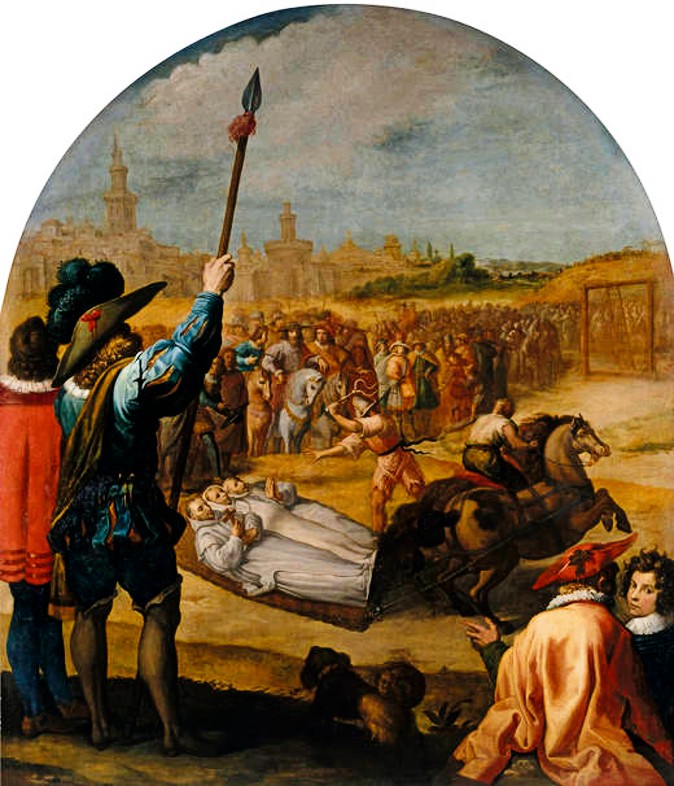
They were accordingly condemned to death and executed at Tyburn Tree on 19 June, being hanged, drawn and quartered. This was a little more than a month after their fellow Monks. This process of attrition was to claim fifteen of the London Carthusians.
Pope Leo XIII Beatified Blessed Humphrey on 29 December 1886.
Part of a stained glass window in St. Mary’s Roman Catholic Church in Bridge Gate, Derby
Sts Adleida and Lupo of Bergamo Married Martyrs Bl Arnaldo of Liniberio St Culmatius of Arezzo St Deodatus of Jointures St Deodatus of Nevers St Gaudentius of Arezzo
St Hildegrin of Châlons-sur-Marne Bishop St Hildemarca of Fecamp (Died c682) Abbess Blessed Humphrey Middlemore O.Cart. (Died 1535) Priest, Martyr St Innocent of Le Mans St Lambert of Saragossa Layman Martyr St Lupo of Bergamo St Modeste Andlauer St Nazario of Koper Bl Odo of Cambrai St Rémi Isoré Bl Sebastian Newdigate Bl Thomas Woodhouse Bl William Exmew St Zosimus of Umbria
Thought for the Day – 18 June – Meditations with Fr Richard Frederick Clarke SJ (1839-1900)
HUMILITY Meditations for a Month
Humility and Curiosity
Curiosity at first sight does not seem to have any direct bearing on humility but, in point of fact, it is very injurious to humility. Those who pry into matters which do not concern them, will find this eagerness after unnecessary information, very injurious to their humility. It is opposed to the quiet, peaceful temper of one, who does his own work ,without concerning himself with that of others. It leads to criticism, the habit of rash judgement and a dissatisfaction with what goes on around us. It makes the mind dissipated and unsettled and fosters an unhealthy activity outside our own sphere of duty.
Curiosity does not mean we should not be eager for knowledge but, not for knowledge which does not, directly or indirectly, help forward the work which God has given us to do. What are the affairs of our neighbours to us? We say, perhaps that to know them, will increase our influence. It certainly will not increase our influence for good. It may puff us up with an idea of our own importance and make us believe that others admire us for it but, to know too much, is not only most dangerous to our humility but, it alienates others from us and makes them fear and dislike us.
Curiosity is one of the effects of pride. In Eve, it was the immediate effect of her sin of pride. Before she had indulged a rebellious thought against God, she had no wish for knowledge which God had forbidden. It is often the stepping-stone from pride to other sins — to evil speaking, to luxury, to greediness, to lying and, above all, to the weakening of faith and hope. Examine yourself as to whether you indulge in this dangerous habit of curiosity?
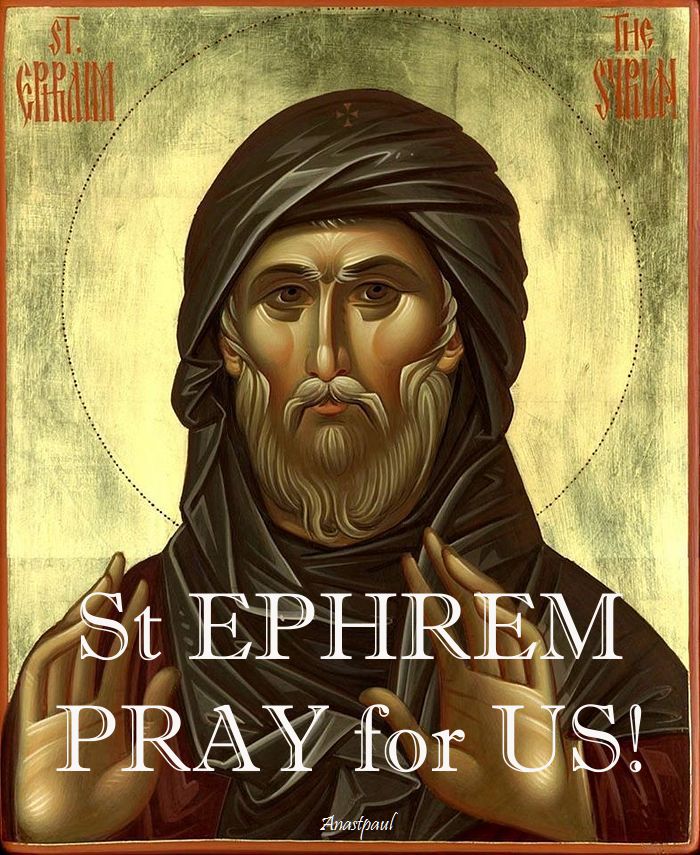
Quote/s of the Day – 18 June – “The Harp of the Holy Ghost!” Father & Doctor of the Church, Confessor
“The Cross gives Light to the whole universe; it casts out darkness and gathers nations together in charity, into One Church, One Faith, One Baptism…”
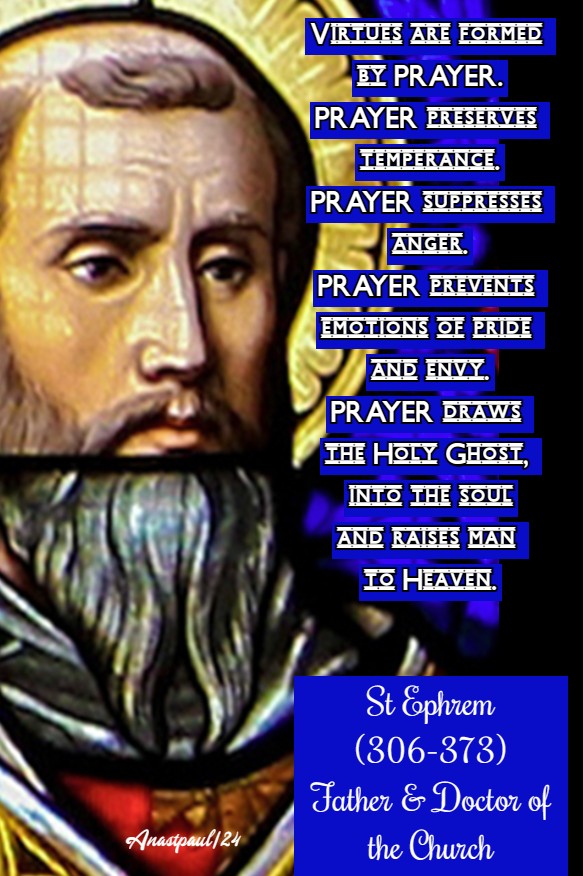
“Virtues are formed by PRAYER. PRAYER preserves temperance. PRAYER suppresses anger. PRAYER prevents emotions of pride and envy. PRAYER draws the Holy Ghost, into the soul and raises man to Heaven.”
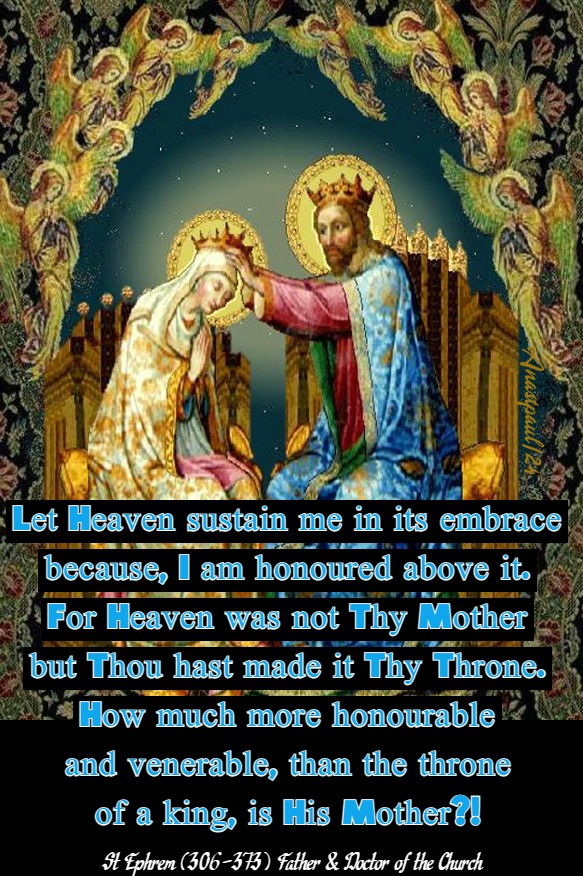
“Let Heaven sustain me in its embrace because, I am honoured above it. For Heaven was not Thy Mother but Thou hast made it Thy Throne. How much more honourable and venerable, than the throne of a king, is His Mother?!”
“Thou alone and Thy Mother, are in all things fair, there is no flaw in Thee and no stain in Thy Mother.”
“Some people, who were opposed to the Holy Ghost, said: “These people have had too much new wine; they are drunk.” Indeed, you speak truly! However, it is not as you think it is. It is not wine from the vineyard they have drunk. It is a new wine that flows from Heaven – a wine newly pressed on Golgotha. The Apostles caused it to be drunk and thus , they inebriated all creation. This is wine that was pressed on the Cross!”
One Minute Reflection – 18 June – “The Month of the Sacred Heart of Jesus” –“The Harp of the Holy Ghost!” Father & Doctor of the Church, Confessor – 2 Timothy 4:1-8; Matthew 5:13-19 – Scripture search here: https://www.drbo.org/
“Neither do men light a candle and put it under a bushel but upon a candlestick that it may shine to all in the house.” – Matthew 5:15
REFLECTION – “Men do not light a candle and put it under a bushel …” Through these words, Jesus again encourages His disciples to lead an irreproachable life, by advising them to watch over themselves constantly because, they are placed in the sight of all humankind, like athletes in a stadium, who are seen by the whole world (1 Cor 4:9).
He told them: “Do not say to yourselves: ‘Now we can stay here quietly sitting, we are hidden in a little corner of the world,’ for you will be visible to all humankind, like a City on top of a mountain (Mt 5:14), like a light in the house which has been placed on the lamp stand … I have lit the light of your torch but it is up to you to see it is kept burning, not just to your personal advantage but also, in the interest of all who will see it and who, through it, will be led to the Truth. The worst wickedness would not put a shadow over your light, if you live with the vigilance of those who are called to bring the whole world to good. So, let your life correspond to the holiness of your mission, so that God’s grace may be proclaimed everywhere.” – St John Chrysostom (347-407) Father and Doctor of the Church (Homilies on St Matthew’s Gospel No 15).
PRAYERS – O God, Who willed to enlighten Thy Church by the wondrous learning and glorious merits of the life of blessed Ephrem, Thy Confessor and Doctor, we humbly pray Thee that, by his pleading, Thou will shield her with Thy lasting power, against the snares of error and evil. Through Jesus Christ, Thy Son our Lord, Who lives and reigns with Thee, in the unity of the Holy Ghost, God, world without end. Amen (Collect).
MAY the Heart of JESUS in the most Blessed Sacrament be praised, adored and loved with grateful affection, at every moment, in all the Tabernacles of the world, even to the end of time. Amen.Indulgence 100 Days, Once a day. Raccolta 161 Blessed Pius IX, 29 February 1868.
Our Morning Offering – 18 June – “The Month of the Sacred Heart of Jesus” –
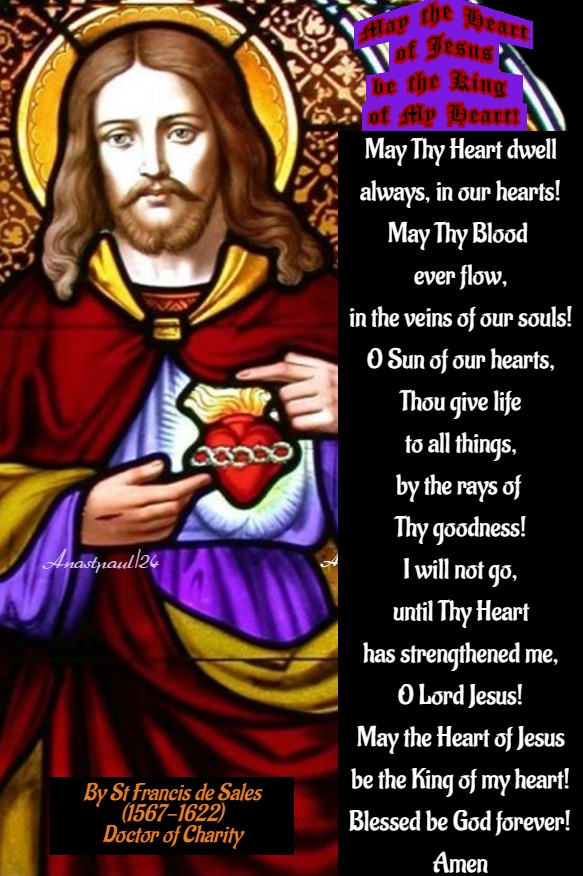
May the Heart of Jesus be the King of My Heart! By St Francis de Sales (1567-1622) Doctor of Charity
May Thy Heart dwell always, in our hearts! May Thy Blood ever flow, in the veins of our souls! O Sun of our hearts, Thou give life to all things, by the rays of Thy goodness! I will not go, until Thy Heart has strengthened me, O Lord Jesus! May the Heart of Jesus be the King of my heart! Blessed be God forever! Amen
Saint of the Day – 18 June – Saint Abraham of Clermont (Died c479) Abbot and Founder of the Monastery of St Cyriacus in Clermont-Ferrand, Hermit, Miracle-worker. Born in 5th Century Syria and died in c479 of natural causes in his Monastery in France. Patronage – against fever. Also known as – Abraham the Abbot.
Ancient Monks with an old Abbot
Abraham was born in Syria, along the Euphrates River and was of Persian origins. He later left for Egypt, to visit some of the hermits and Monks there, seeking knowledge of monastic life and rules. However, on the way to Egypt, he was kidnapped and held prisoner for five years.
Finally. he managed to escape and ardously travelled to Gaul (France). He settled in Clermont in the Auvergne region as a Hermit. His reputation for holiness spread rapidly and he attracted so many disciples that he needed to build a Monastery to house them, near the Basilica of Saint Cyricus not far from St Illidius Church in Clermont.
He died around 479. St Apollinaris Sedonius, the Bishop of Clermont wrote an Epitaph on the grave of St Abraham from which we have been granted confirmation of some facts concerning our Saint’s life.
St Alena of Dilbeek St Amandus of Bordeaux St Arcontius of Brioude St Athenogenes of Pontus St Calogero of Sicily St Calogerus of Fragalata St Calogerus the Anchorite St Colman mac Mici St Cyriacus of Malaga St Demetrius of Fragalata St Edith of Aylesbury
St Elpidius of Brioude St Equizio of Telese St Erasmo St Etherius of Nicomedia Bl Euphemia of Altenmünster St Fortunatus the Philosopher St Gerland of Caltagirone St Gregory of Fragalata
St Osanna of Northumberland St Osmanna of Jouarre St Paula of Malaga Bl Peter Sanchez
Hermits of Karden: A father (Felicio) and his two sons (Simplicio and Potentino) who became pilgrim to various European holy places and then hermits at Karden (modern Treis-Karden, Germany). (Born in Aquitaine (in modern France. ) Their relics transferred to places in the Eifel region of western Germany at some point prior to 930. They were canonised on 12 August 1908 by Pope Pius X (cultus confirmation).
Martyrs of Ravenna – 4 Saints: A group of four Christians Martyred together. We have no details but their names – Crispin, Cruciatus, Emilius and Felix. They were martyred in Ravenna, Italy, date unknown.
Martyrs of Rome – 3 Saints: Three Christians Martyred together . We have no details but their names – Cyriacus, Paul and Thomas. In Rome, Italy, date unknown.
Martyrs of Tripoli – 3 Saints: Three imperial Roman soldiers, at last two of them recent converts, who were imprisoned, tortured and executed for their faith. Martyrs – Hypatius, Leontius and Theodulus. They were Greek born and they died c135 at Tripoli, Phoenicia (in modern Lebanon).
Thought for the Day – 17 June – Meditations with Fr Richard Frederick Clarke SJ (1839-1900)
PATIENCE Meditations for a Month
Patience during Bereavement
Pure human love, especially the love of father and mother for their children, is one of the most beautiful things in the natural order. It interweaves itself with our very nature. Husband and wife, brother and sister and above all, the children who are in a special sense our own, are a part of ourselves; they are our own by birth, our own-by constant association, our own by a thousand ties of love. Oh, how sorrowful it is to lose one of our little circle, to see the empty place, to miss their looks of love, the sweet sound of their voice. Then indeed we have need of patience and must beg that we may not grieve like those who have no hope but, may humbly bow our necks under God’s chastising Hand.
Patience! how are we to obtain it under the crushing blow? How are we to recognise the love of God in thus taking away the light of our eyes from us? It is indeed difficult and, for a time, the absorbing grief may overpower us. But we can always pray, we can always make an act of resignation, we can always say: ‘Not as I will but as Thou wilt!’ It is the Lord, let Him do what is good in His sight. Has this been my conduct when one whom I dearly loved was taken from me?
There are many motives of consolation when friends and dear ones fade away or die. If they died in their innocence, how we, ought to rejoice when we think of them with Christ in Heaven! If they had sinned and done penance, we ought to rejoice that God gave them the grace of dying a good death. We can always console ourselves by praying for them. We can make their departure a reason for living a better and a holier life that we may not fail to meet them again before the Throne of God. All this I will do more henceforward.
Quote/s of the Day – 17 June – Ferial Day – Visiting St Augustine
“Our hearts were made for Thee, O God And restless must they be Until, O God, this grace accord, Until they rest in Thee!”
“So Saul was led to Ananias – the ravaging wolf is led to the sheep. But the Shepherd, Who guides everything from Heaven above, reassures him… “Do not fear, I will show him what he will have to suffer, for My Name’s sake” (Acts 9:16). What wonder is this! The wolf is led, a captive, to the sheep… The Lamb who died for the sheep, teaches it not to be afraid anymore!”
“He asks for our faith and offers us salvation. What He offers us, is so precious that what He asks of us, is as nothing!”
Breathe in Me, O Holy Ghost By St Augustine (354-420) Father and Doctor of the Church
Breathe in me, O Holy Ghost, that my thoughts may all be holy. Act in me, O Holy Ghost, that my work, too, may be holy. Draw my heart, O Holy Ghost, that I love but what is holy. Strengthen me, O Holy Ghost, to defend all that is holy. Guard me, then, O Holy Ghost, that I always may be holy. Amen
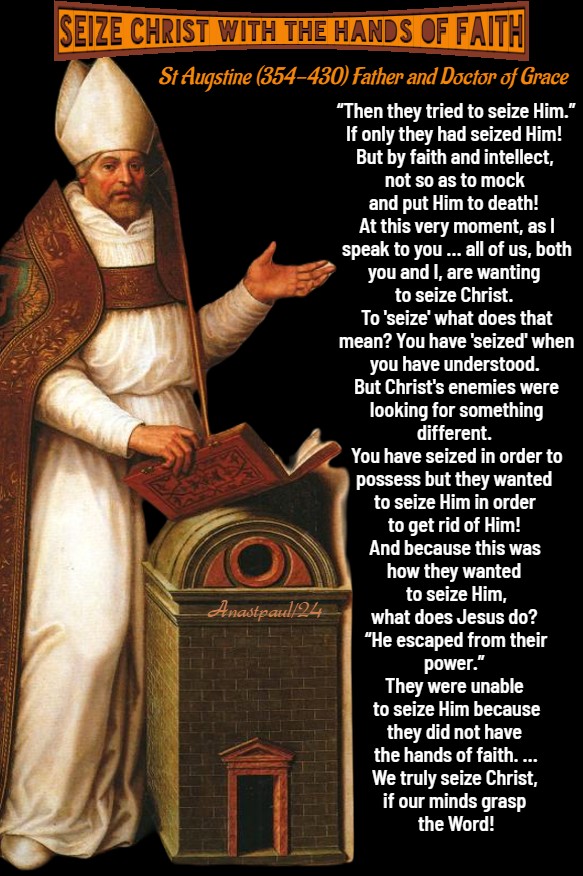
“Then they tried to seize Him.” If only they had seized Him! But by faith and intellect, not so as to mock and put Him to death! At this very moment, as I speak to you … all of us, both you and I, are wanting to seize Christ. To ‘seize’ what does that mean? You have ‘seized’ when you have understood. But Christ’s enemies were looking for something different. You have seized in order to possess but they wanted to seize Him in order to get rid of Him! And because, this was how they wanted to seize Him, what does Jesus do? “He escaped from their power.” They were unable to seize Him because they did not have the hands of faith. … We truly seize Christ, if our minds grasp the Word!”
“Let Us Hate Our Sins and Love Him Who Will Exact Punishment for Them. What then should the Christian do? He ought to use the world, not become its slave. And what does this mean? It means having, as though not having. … Are we really certain that we love Him? Or do we love our sins more? Therefore, let us hate our sins and love Him Who, will exact punishment for them. He will come whether we wish it or not. Do not think that because He is not coming just now, He will not come at all. He will come, you know not when and provided He finds you prepared, your ignorance of the time of His coming, will not be held against you.”
Watch, O Lord! With Those Who Wake, or Watch, or Weep Tonight By St Augustine (354-430) Father and Doctor of Grace
Watch, O Lord, with those who wake, or watch, or weep tonight and give Thy Angels and Saints, charge over those who sleep. Tend Thy sick ones, O Lord Christ. Rest Thy weary ones. Bless Thy dying ones. Soothe Thy suffering ones. Pity Thy afflicted ones. Shield Thy joyous ones. And all, for Thine Love’s sake. Amen
St Augustine (354-430) Father and Doctor of the Church
One Minute Reflection – 17 June – “The Month of the Sacred Heart of Jesus” – Ferial Day –The Fourth Sunday after Pentecost – Romans 8:18-23; Luke 5:1-11 – Scripture search here: https://www.drbo.org/
“And getting into one of the boats, the one that was Simon’s, He asked him to put out a little from the land. And sitting down, He began to teach the crowds from the boat.” – Luke 5:3
REFLECTION – “Ordinarily, people are not given life on a boat but transported. Nor are they comforted on a vessel but anxious about its journey. Notice also, that this boat, is not a boat, which is given to Peter to be piloted — rather, it is the Church which is committed to the Apostle to be governed. For this is the vessel that does not kill but gives life to those borne along by the storms of this world, as if by waves. Just as a little boat holds the dying fish that have been brought up from the deep, so also the vessel of the Church gives life to human beings who have been freed from turmoil. Within itself, I say, the Church gives life to those who are half-dead, as it were.” – St Maximus of Turin (? – c 420) Bishop, Father (Sermon 110).
PRAYER – Grant, we beseech Thee, O Lord God, unto all Thy servant, that they may remain continually in the enjoyment of soundness, both of mind and body and by the glorious intercession of the Blessed Mary, ever a Virgin, may be delivered from present sadness, and enter into the joy of thine eternal. Through the same Jesus Christ, Thy Son our Lord, Who lives and reigns with Thee, in the unity of the Holy Ghost, God, world without end. Amen (Collect).
Sweet Heart of my JESUS, make me love Thee ever more and more! 300 Days Once a Day. ii. Plenary, Once a month. Raccolta – 162. Blessed Pope Pius IX, 26 November 1876.
Our Morning Offering – 17 June – “The Month of the Sacred Heart of Jesus”
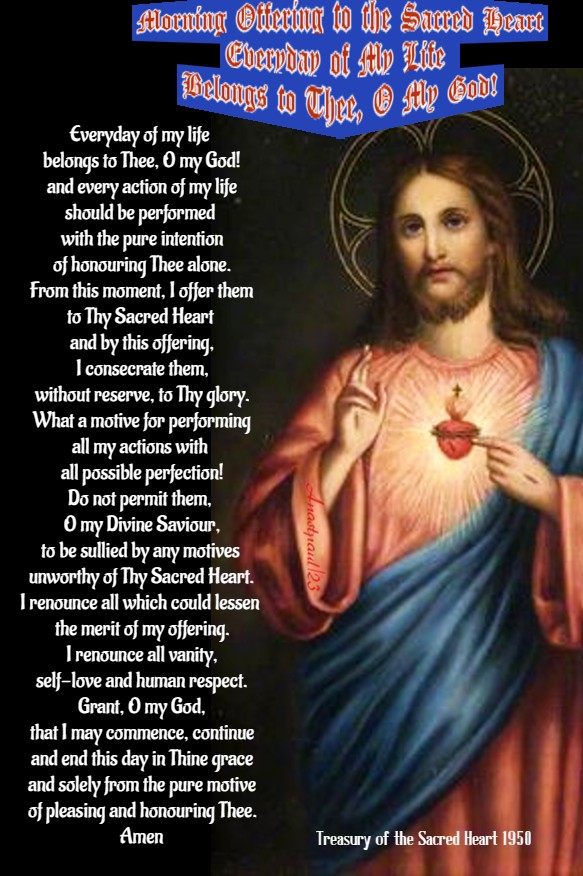
Morning Offering to the Sacred Heart Everyday of My Life Belongs to Thee, O My God! (Treasury of the Sacred Heart 1950)
Everyday of my life belongs to Thee, O my God! and every action of my life should be performed with the pure intention of honouring Thee alone. From this moment, I offer them to Thy Sacred Heart and by this offering, I consecrate them, without reserve, to Thy glory. What a motive for performing all my actions with all possible perfection! Do not permit them, O my Divine Saviour, to be sullied by any motives unworthy of Thy Sacred Heart. I renounce all which could lessen the merit of my offering. I renounce all vanity, self-love and human respect. Grant, O my God, that I may commence, continue and end this day in Thine grace and solely from the pure motive of pleasing and honouring Thee. Amen
Saint of the Day – 17 June – Saint Fulk (Died 900) Archbishop of Rheims in 883, Chancellor of Frankish Kingdom, protector and defender of the Church’s rights and assets for which position he was murdered on 17 June 900. Some sources name him a Martyr for the Church of Christ. Also known as – Foulques the Venerable, Coots the Venerable … Folco…Foulque…Fulco…Foulques of Reims… Fulko…Fulque…Fulquerio…Venerável…
Fulk was born into a noble Frankish family with close ties to the Carolingian dynasty. His brother, Anscarius I, became the first Marquis of Ivrea, giving rise to the Anscarici dynasty.
Fulk undertook an Ecclesiastical career from a young age, becoming a Palace Cleric at the Court of Charles II the Bald. In 877 his dedication and ability led to his appointment as the Abbot of the Benedictine Abbey of St Bertinus.
On 7 March 883, Fulk reached the pinnacle of his Ecclesiastical career with his appointment as the Archbishop of Rheims, one of the most prestigious Episcopal Sees of the West Frankish Kingdom. During his tenure, he fervently devoted himself to the restoration of the Diocesan Cathedral, the symbol of his spiritual authority.
In 898, Fulk assumed the role of the Chancellor of the Kingdom, taking a leading role in the political sphere. He became noticeable for his tenacious defence of Ecclesiastical assets from the expansionist aims of the nobles, countering secular interference in the properties of the Church.
Fulk’s strenuous defence of the rights of the Church led him to clash with Baldwin II, the powerful Count of Flanders. According to the chronicler Floardus, the King granted Fulk the Abbey of St Vaast in Arras, previously controlled by Baldwin. This act fuelled tensions between the two, leaders culminating in the assassination of Fulk on 17 June 900 at the hands of men in the service of the Flemish Count.
St Briavel of Gloucestershire St David of Bourges St Dignamerita of Brescia St Diogenes of Rome St Emily de Vialar St Fulk of Rheims (Died 900) Bishop St Gundulphus of Bourges
St Himerius of Amelia St Hypatius of Chalcedon St Molling of Wexford St Montanus of Gaeta St Nectan of Hartland Bl Paul Burali d’Arezzo Bl Peter Gambacorta Bl Philippe Papon St Prior St Rambold of Ratisbon
Martyrs of Apollonia – 7 Saints: A group of Christians who fled to a cave near Apollonia, Macedonia to escape persecution for his faith, but were caught and executed. The names we know are – Basil, Ermia, Felix, Innocent, Isaurus, Jeremias and Peregrinus. They were beheaded at Apollonia, Macedonia.
Martyrs of Aquileia – 4 Saints: Four Christian Martyrs memorialised together. No details about them have survived, not even if they died together – Ciria, Maria, Musca and Valerian. c.100 in Aquileia, Italy.
Martyrs of Chalcedon – 3 Saints: Three well-educated Christian men who were sent as ambassadors from King Baltan of Persia to the court of emperor Julian the Apostate to negotiate peace between the two states, and an end of Julian’s persecutions of Christians. Instead of negotiating, Julian imprisoned them, ordered them to make a sacrifice to pagan idols and when they refused, had them executed. Their names were Manuel, Sabel and Ismael. They were beheaded in 362 in Chalcedon (part of modern Istanbul, Turkey) and their bodies burned and no relics survive.
Martyrs of Fez – 4 Beati: A group of Mercedarians sent to Fez, Morocco to ransom Christians imprisoned and enslaved by Muslims. For being openly Christian they were imprisoned, tortured, mutilated and executed. Martyrs – Egidio, John, Louis and Paul. They were martyred in Fez, Morocco.
Martyrs of Rome – 262 Saints: A group of 262 Christians Martyred in the persecutions of Diocletian. In c303 in Rome, Italy. They were buried on the old Via Salaria in Rome.
Martyrs of Venafro – 3 Saints: Three Christian lay people, two of them imperial Roman soldiers, who were converts to Christianity and were Martyred together in the persecutions of Maximian and Diocletian – Daria, Marcian and Nicander. They were beheaded c.303 in Venafro, Italy. By 313 a basilica had been built over their graves which were re-discovered in 1930. They are patrons of Venafro, Italy.
Thought for the Day – 16 June – Meditations with Fr Richard Frederick Clarke SJ (1839-1900)
PATIENCE Meditations for a Month
On Patience in Sickness
It is not easy for those who have always enjoyed robust health to understand how heavy a cross is a long-continued illness. It is not merely the physical pain, although this is often very difficult to bear. It is the discomfort, the weariness, the languor, the depression which accompany sickness; it is the restlessness, the inability to find repose, the loneliness of the long hours. What need the sick have of patience! Patience should be the watchword of their life. Grant me patience, 0 Lord, patience to suffer for Thee and with Thee and never to murmur even when the pain and suffering is greatest!
There is a form of ill-health which is the most difficult of all to bear with patience; when we go about our usual occupations in a state of suffering which makes everything a burden. We get little sympathy be cause we are still able to do our work, or perhaps ,we are blamed because we are not able to do it as wel as we should. Oh, what compassion we should have for those who suffer thus and, if it is our own lot, we should do our best to unite our sufferings with the sufferings of Jesus and ask Him to grant us patience to carry our heavy cross.
We sometimes fancy that when we are ill and unable to do active work for God, we are useless and cannot gain graces for ourselves or for others. This is a great mistake – we can gain more graces in illness than in health. Suffering is more pleasing to God than doing; it earns greater merit, it prepares us more speedily for Heaven, it blots out sin more rapidly. Many of the Saints were sanctified by sickness. Hence bear it willingly, try to rejoice in it!
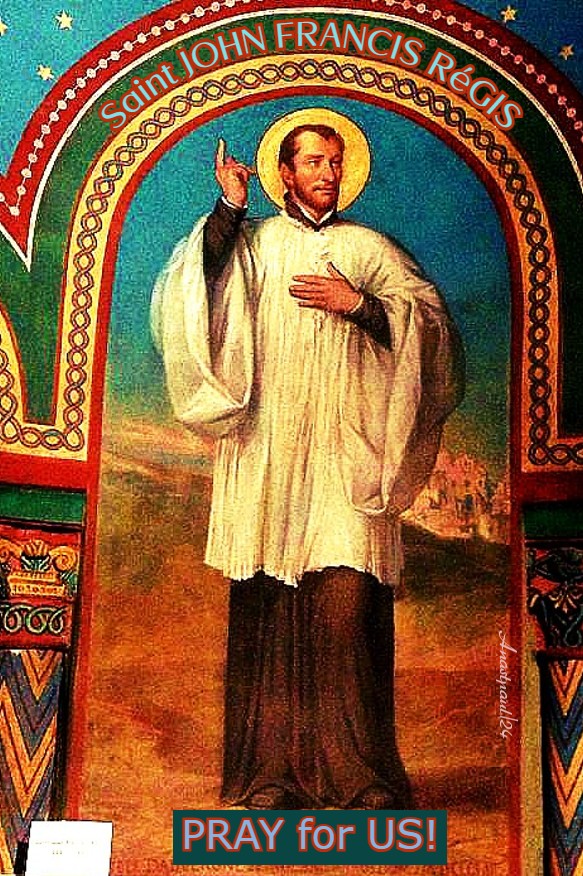
Quote/s of the Day – 16 June – St John Francis Régis SJ (1597-1640) Priest, Confessor, Missionary –The Fourth Sunday after Pentecost – Romans 8:18-23; Luke 5:1-11 – Scripture search here: https://www.drbo.org/
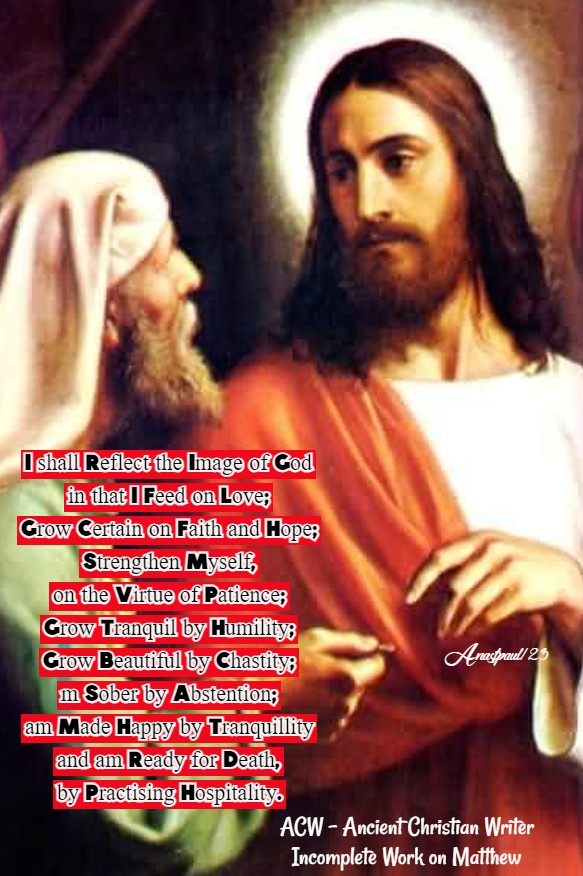
“I shall reflect the image of God in that I feed on love; grow certain on faith and hope; strengthen myself, on the virtue of patience; grow tranquil by humility; grow beautiful by chastity; am sober by abstention; am made happy by tranquillity and am ready for death, by practising hospitality.”
ACW – Ancient Christian Writer Incomplete Work on Matthew (Homily 40)
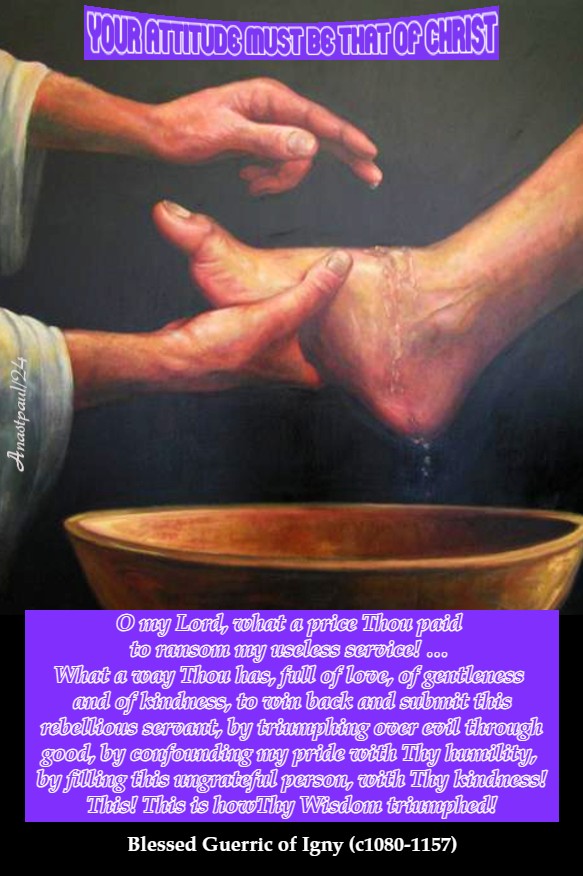
“O my Lord, what a price Thou paid to ransom my useless service! … What a way Thou has, full of love, of gentleness and of kindness, to win back and submit this rebellious servant, by triumphing over evil through good, by confounding my pride with Thy humility, by filling this ungrateful person, with Thy kindness! This! This is howThy Wisdom triumphed!”
Blessed Guerric of Igny (c1080-1157) Cistercian Abbot
“Fear not, henceforth you shall catch men.” Luke 5:10
“At Thy Word I will lower the nets.” It is at the command of divine grace and supernatural inspiration that the nets of preaching are to be spread out. Otherwise, the preacher wastes his time in lowering the lines of his words. People’s faith is won, not by carefully composed speeches but the grace of a divine vocation… O fruitful humility! When those who so far have not caught a thing, put their trust in Christ’s Word, they catch a great number of fish…”
St Anthony of Padua (1195-1231) Doctor of the Church
“Humility and charity are the two master chords – one, the lowest; the other, the highest; all the others are dependent on them. Therefore, it is necessary, above all. to maintain ourselves in these two virtues, for observe well, that the preservation of the whole edifice depends on the foundation and the roof!”
One Minute Reflection – 16 June – “The Month of the Sacred Heart of Jesus” – St John Francis Régis SJ (1597-1640) Priest, Confessor, Missionary –The Fourth Sunday after Pentecost – Romans 8:18-23; Luke 5:1-11 – Scripture search here: https://www.drbo.org/
“ And Jesus saith to Simon: Fear not, from henceforth thou shalt catch men. – Luke 5:10
REFLECTION – “On that night of light [ Christmas, at fourteen years of age] began the third period of my life, the most beautiful and the most filled with graces from Heaven … I could say to Him like His Apostles: “Master, I fished all night and caught nothing.” More merciful to me than He was to His disciples, Jesus took the net Himself, cast it, and drew it in filled with fish. He made me a fisher of souls. I experienced a great desire to work for the conversion of sinners. The cry of Jesus on the Cross sounded continually in my heart: “I thirst!” These words ignited within me an unknown and very living fire. I wanted to give my Beloved to drink and I felt myself consumed with a thirst for souls …
To awaken my zeal, God showed me my desires were pleasing to Him. I heard talk of a great criminal just condemned to death for some horrible crimes; everything pointed to the fact that he would die impenitent. I wanted, at all cost,s to prevent him from falling into hell… I felt, in the depths of my heart, certain that our desires would be granted but to obtain courage to pray for sinners I told God I was sure He would pardon the poor, unfortunate Pranzini; that I’d believe this, even if he went to his death without any signs of repentance or without having gone to Confession. I was absolutely confident in the mercy of Jesus. But, I was begging Him for a “sign” of repentance, only for my own simple consolation. My prayer was answered to the letter! …
After this unique grace, my desire to save souls grows each day and I seemed to hear Jesus say that which He said to the Samaritan woman: “Give me to drink!” It was a true interchange of love – to souls, I was giving the Blood of Jesus – to Jesus, I was giving these same souls, refreshed by the Divine Dew. I slaked His Thirst and the more I gave Him to drink, the more the thirst of my poor, little soul increased and it was this ardent thirst, He was giving me as the most delightful drink of His Love.” – St Thérèse of the Child Jesus (1873-1897) Carmelite (Autobiographical Manuscript).
PRAYER – Grant, we beseech Thee, O Lord God, unto all Thy servant, that they may remain continually in the enjoyment of soundness, both of mind and body and by the glorious intercession of the Blessed Mary, always a Virgin, Thy Saints, remembering Thy Confessor John Francis Regis, may be delivered from present sadness, and enter into the joy of thine eternal. Through the same Jesus Christ, Thy Son our Lord, Who lives and reigns with Thee, in the unity of the Holy Ghost, God, world without end. Amen (Collect).
MAY the Heart of JESUS in the most Blessed Sacrament be praised, adored and loved with grateful affection, at every moment, in all the Tabernacles of the world, even to the end of time. – Indulgence 100 Days, Once a Day. Raccolta 161 Blessed Pius IX, 29 February 1868.
Our Morning Offering – 16 June – “The Month of the Sacred Heart” – The Sixth Sunday after Pentecost
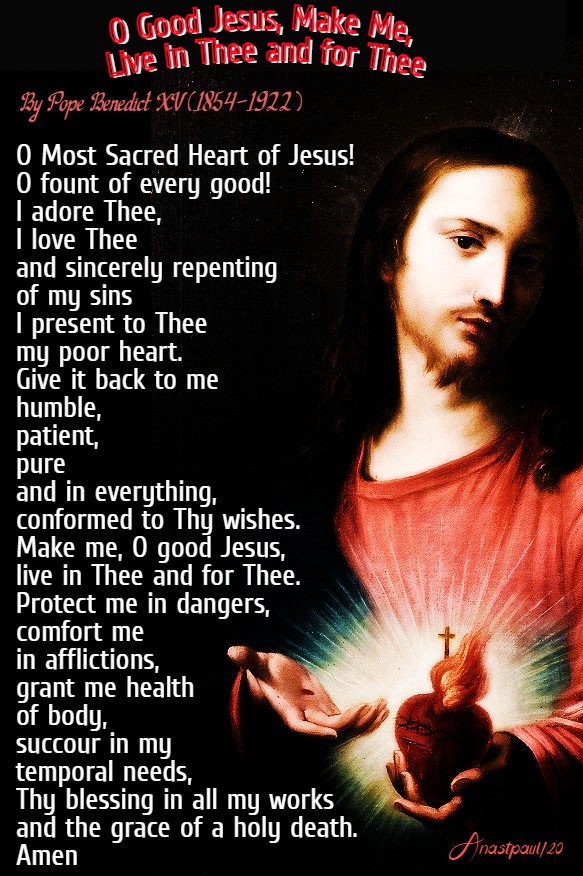
O Good Jesus, Make Me Live in Thee and for Thee By Pope Benedict XV (1854-1922)
O Most Sacred Heart of Jesus! O fount of every good! I adore Thee, I love Thee and sincerely repenting of my sins I present to Thee my poor heart. Give it back to me humble, patient, pure and in everything, conformed to Thy wishes. Make me, O good Jesus, live in Thee and for Thee. Protect me in dangers, comfort me in afflictions, grant me health of body, succour in my temporal needs, Thy blessing in all my works and the grace of a holy death. Amen
Saint of the Day – 16 June – Saint Aurelian of Arles (c523-c551) Bishop of Arles from 546, Founder of Monasteries. His predecessors were St Auxanius (the Bishop from 542/3–546) and St Caesarius of Arles (Died 533). His father, Sacerdos, (Died552) was an Archbishop of Lyon. His cousin, Nicetius (Died 573) succeeded his father as the Archbishop of Lyons. He died on 16 June c551 in Lyons, aged just 28 years old and is buried in the Church of Saint-Nizier. The text of his Epitaph is preserved. Also known as – Aurelianus, Aurelian the Sinner (his own name for himself), Aureliano.
The Roman Martyrology reads: “At Lyons, the blessed Aurelian, Bishop of Arles.”
Aurelian was elected as the Bishop of Arles in 546, when he was only 23 years old. At the request of King Childebert, he was appointed as the Vicar of the Apostolic See in Gaul, by Pope Vigilius and invested with the Pallium.
He founded the Monastery of St Peter, in Arles to which he gave a Rule inspired by that of St Caesarius. He also founded a Convent dedicated to the Blessed Virgin Mother in collaboration with King Childebert I and his wife Ultrogotha. Saint Peter’s Monastery may count among the first Monasteries (co-)founded by a Merovingian King.
He wrote a Rule for Monks for his first foundation which is primarily based on St Caesarius of Arles’ Rule for Monks but also uses parts of St Caesarius’ Rule for Virgins. It is the only early medieval Monastic Rule for Monks which requires total enclosure. Later Aurelian produced a female version of his Rule for his second foundation. His Rule for Nuns is somewhat shorter but shows few signs of an adjustment. Both Rules are preserved.
In 549, Aurelian participated in the 5th Council of Orléans which was presided by his father. as the Archbishop of Lyons, in which the condemnation of Nestorius and Eutyches was renewed.
He received a letter, dated 29 April 550, from PopeVigilius in response to one of his own, in which he complained about the Papal attitude regarding the ‘three chapters.’ The Pontiff justified himself by saying that he did not intend to admit any proposition against what was established by the Councils of Nicaea, Chalcedon and Ephesus and asked him to intervene with Childebert so that he could obtain, from the Arian Totila and the Goths the respect of the Church of Rome.
Aurelian died in Lyons, probably on 16 June. 551 and was buried in the Basilica of Nizier.. Mentioned by sTS Florus and Adonis, the name of Aurelian also appears in the Roman Martyrology, which commemorates his Feast on 16 June.
St Nizier Basilica In Lyons where St Aurelian is buried
Father’s Day + 2024 Wishing all Dads a Blessed and Happy Father’s Day!
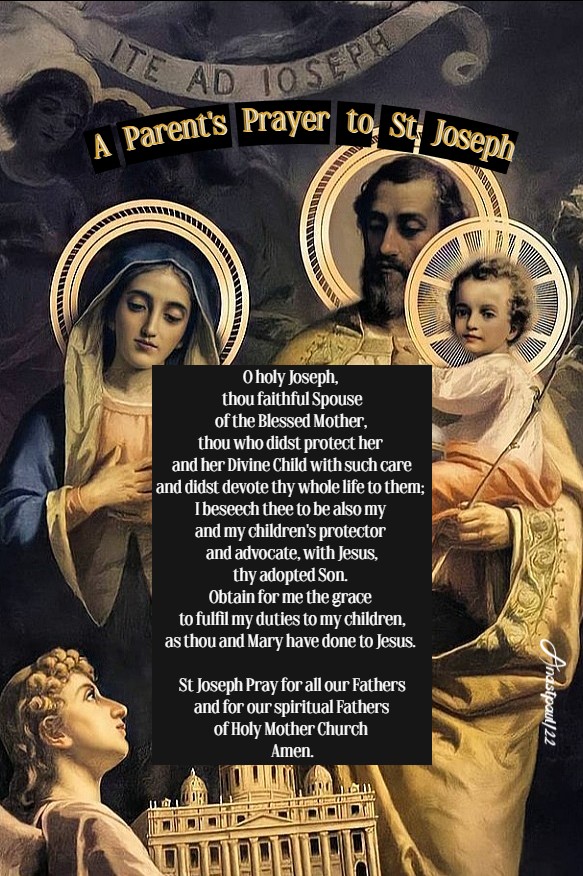
A Parent’s Prayer to St Joseph
O holy Joseph, thou faithful Spouse of the Blessed Mother, thou who didst protect her and her Divine Child with such care and didst devote thy whole life to them; I beseech thee to be also my and my children’s protector and advocate, with Jesus, thy adopted Son. Obtain for me the grace to fulfil my duties to my children, as thou and Mary have done to Jesus.
St Joseph Pray for all our Fathers and for our spiritual Fathers of Holy Mother Church Amen.
St Berthaldus St Ceccardus of Luni St Cettin of Oran St Colman McRhoi St Crescentius of Antioch St Cunigunde of Rapperswil St Curig of Wales St Cyriacus of Iconium (c 301-c 304) Child Martyr
Blessed Donizetti Tavares de Lima (1882-1961) Priest, Apostle of the poor, the elderly and the sick, miracle-worker, known to bilocate. A prophecy related to Vatican II: “No, no, Archbishop! We won’t see this disgrace (prophesying that they both would die soon) but it will come! This was not just a dream, nor a nightmare! The darkness will fall over this world! I beg you: don’t let them destroy the Altars!” An amazing life: https://anastpaul.com/2020/06/16/saint-of-the-day-16-june-blessed-donizetti-tavares-de-lima-1882-1961/
St Elidan St Felix of San Felice St Ferreolus of Besançon St Ferrutio of Besançon Bl Gaspare Burgherre St Graecina of Volterra St Ismael of Wales St Julitta of Iconium St Justina of Mainz
St Maurus of San Felice St Palerio of Telese St Similian of Nantes Bishop and Confessor Bl Thomas Redyng St Tycho of Amathus
Martyrs of Africa: A group of 5 Christians Martyred together. We know nothing else but the names – Cyriacus, Diogenes, Marcia, Mica, Valeria. They were martyred in an unknown location in Africa, date unknown.












































You must be logged in to post a comment.