Thought for the Day – 2 November – Meditations with Antonio Cardinal Bacci (1881-1971)
“Purgatory”
“Purgatory is the masterpiece of God’s justice and mercy. St John tells us in the Apocalypse, that nothing defiled can enter into the Heavenly Jerusalem (Apoc 21:27).
There are very few, however, who are privileged to arrive at the supreme moment of death, still wearing their Baptismal robe of innocence. Even the just man falls very often as the Holy Spirit warns us (Prov 24:16). We all possess many failings and have been guilty of many sins, either mortal or venial. It is true, that we can obtain forgiveness by penance and by receiving the Sacraments but, there still remains the temporal punishment due to our sins. Neither the small penances imposed by the Confessor, nor our own tiny acts of voluntary mortification, are sufficient to satisfy our debt. We cannot be certain, moreover, that we shall be able, at the hour of our death, to cleanse ourselves of all our sins, by means of one good Confession. Even if we appear before the judgement seat of God without any grave faults, there will still, unfortunately, be many debts to be paid and many imperfections to be purified.
What then will happen to us? The justice of God cannot admit us, imperfect and defiled as we are, into the everlasting happiness of the Beatific Vision. Will He reject us, therefore, even as He rejects those who die in mortal sin and are condemned to eternal punishment? This is unthinkable, for the mercy of God is as Infinite as His justice. And so, there is Purgatory, where the souls of those who have died in the state of grace but, still scarred with imperfections and burdened with debts to be paid, can find a way of purifying themselves and, of making themselves worthy of an everlasting reward.
Let us thank God for this gift, the last link in the chain of His mercies, which enables us to prepare ourselves for our entry into the Beatific Vision.”
Quote/s of the Day – 2 November – “The Month of The Holy Souls in Purgatory” and the Feast of the Holy Souls in Purgatory
“A person may say, I am not much concerned how long I stay in purgatory, provided I may come to eternal life. Let no-one reason thus! Purgatory fire will be more dreadful than whatever torments can be seen, imagined or endured in this world. He who is now afraid to put his finger into the fire, does he not fear, lest he be then all buried in torments, for a very long time?”
St Caesarius of Arles (470-543) Bishop, Father of the Church
“To assist the Souls in Purgatory, is to perform the most excellent of the Works of Mercy, or rather, it is to practice, in a most sublime manner, all the Works of Mercy together – it is to visit the sick; it is to give drink to thos who thirst, for the vision of God; it is to feed the hungry, to ransom prisoners, to clothe the naked, to procure, the hospitality of the heavenly Jerusalem for poor exiles; it is to comfort the afflicted, to instruct the ignorant — in fine, to practice all the Works of Mercy in one!”
St Francis de Sales (1567-1622) Doctor Caritatis
“It is said that souls who, in this life, have but little longing for Heaven are punished in Purgatory with a peculiar pain, called the pain of languor. This surely is only just because, to have but little longing for Heaven is to set little value on the happiness of that eternal Kingdom which our Lord opened to us, by His Death. Remember then, frequently to think of, and long for Heaven. Say to God that your life seems an endless span, so great is your desire to go to Him, to see Him face-to-face and, to love Him. Say to Him, over and over again, Lord, as long as I live on this earth, I am in danger of forsaking Thee and of losing Thy Love.”
“How pleasing to Him it will be, if you sometimes forget yourself and speak to Him of His own glory; of the miseries of others, especially those who mourn in sorrow; of the souls in purgatory, His spouses, who long to behold Him in Heaven and, of poor sinners, who live deprived of His grace.”
St Alphonsus Maria de Liguori (1696-1787) Most Zealous Doctor
One Minute Reflection – 2 November – “The Month of The Holy Souls in Purgatory” – All Souls Day – Ephesian 6:10-17 –,– Scripture search here: https://www.drbo.org/
“‘Thou wicked servant! I forgave thee all thy debt because thou entreated Me. Should not thou then, have had compassion also on thy fellow-servant, even as I had compassion on thee?’ ” – Matthew 18:32-33
REFLECTION – “Every man is God’s debtor and each has his brother in debt to him. Indeed, who could be without debt towards God, if not Him, in Whom is found no sin? And who could not have a debtor in his brother, if not he, whom no-one has ever offended? Thus every man is both debtor and creditor… A beggar asks you for alms but you, too, are God’s beggar, for when we pray we are all beggars of God. We stand – or rather, prostrate ourselves – at our Father’s door (cf Lk 11:5); we beseech Him with groans, anxious to receive a grace from Him and this grace is God Himself. What does the beggar ask of you? Bread. And what is it that you are asking of God but Christ, Who said: “I am the Living Bread come down from Heaven” (Jn 6:51). Do you want to receive pardon? Then, show pardon. “Forgive and you will be forgiven.” Do you want to receive? “Give and gifts will be given to you” (Lk 6:37-38) …
Thus, we ought to be ready to forgive all the wrongs done to us, if we wish God to forgive us too. Truly, if we consider our sins and think over the offences we have committed, I do not know how we can sleep, without feeling the burden of our debt weighing down upon us! And this is why we make our requests to God each day. Each day our prayers strike His ears; each day we prostrate ourselves, saying: “Forgive us our debts, as we ourselves forgive those who are in debt to us.” Which of your debts would you like to have remitted? All of them or only some? You are going to reply – All! So do the same for your debtor then!” – St Augustine (354-430) Father and Doctor of Grace (Sermon 83).
PRAYER – O God, Creator and Redeemer of all the faithful, grant to the souls of Thy servants and handmaids, the remission of all their sins, that they may obtain, by our loving prayer,s the forgiveness which they have always desired. Who lives and reigns with God the Father, in the unity of the Holy Spirit, God, world without end. Amen (Collect).
Our Morning Offering – 2 November – “The Month of the Holy Souls in Purgatory” – All Souls Day and Our Lady of Suffragette
O Turn To Jesus, Mother! Turn To Our Blessed Lady for the Souls in Purgatory (1940) By Fr Frederick W Faber C.Orat (1814-1863)
O turn to Jesus, Mother! turn, And call Him by His tenderest Names; Pray for the Holy Souls that burn This hour amid the cleansing flames.
Ah! they have fought a gallant fight; In death’s cold arms they persevered And after life’s uncheery night, The harbour of their rest is neared.
In pains beyond all earthly pains, Favourites of Jesus! there they lie, Letting the fire wear out their stains And worshipping God’s purity.
Spouses of Christ they are, for He Was wedded to them by His blood And Angels o’er their destiny In wondering adoration brood.
They are the children of thy tears; Then hasten, Mother! to their aid; In pity think, each hour appears, An age while glory is delayed.
See, how they bound amid their fires, While pain and love their spirits fill; Then with self-crucified desires, Utter sweet murmurs and lie still.
Ah me! the love of Jesus yearns O’er that abyss of sacred pain, And as He looks, His Bosom burns With Calvary’s dear thirst again.
O Mary! let thy Son no more His lingering Spouses thus expect, God’s children to their God restore And to the Spirit His elect.
Pray then, as thou hast ever prayed; Angels and Souls, all look to thee; God waits thy prayers, for He hath made Those prayers, His law of charity! Amen
Saint of the Day – 2 November – Saint Marcian (4th Century) Confessor, Hermit, Penitent, Mystic, Ascetic, Born on an unknown date in Cyrrhus, Syria and died in c387 at his desert hermitage there. Also known as – Marcian of Chalcis or Cyrus or Syria, Marcianus, Martianus, Markianos.
The Roman Martyrology reads today: “At Cyrus, in Syria, St Marcian, Confessor.”
Marcian lived in a desert in Asia Minor. He was fortunate to be remembered by an exceptional writer, St Theodoret, the Bishop of Cyrus, who, in 423, wrote a “History of the Monks” giving considerable prominence to our Marcian, who had been born in Cyrus and, therefore, a source of glory for that City.
Naturally, Theodoret also speaks of the desert cell, where there was room for only one person; he praises Marcian’s spirit of penance; he extols his supernatural gifts and mystical charism; he describes the Hermit’s ascetic life and recalls the admiration he was surrounded by in the desert. He also has the merit, rare among biographers of such figures, of recording the sayings of the wise solitary.
Once, for example, five Bishops came to visit Marcian to question him, or as we would say today, to interview him. They gathered around him, sitting, waiting for his first response which, however, did not come. Silent and motionless among those Bishops, old Marcian looked like a tree trunk, dark and wrinkled.
His interviewers, however, had not come to him because they were driven by curiosity or excited by the novelty. They made him understand that his silence could be a sign of humility but too, a lack of charity. Marcian then spoke: “The Lord of the universe, continually speaks to us through creation; He instructs us through the Sacred Scriptures; He teaches us what we must do, frightening us with the threat of punishment and spurring us on with the promise of Divine rewards. What could Marcian add to all this? Marcian who, like the others, neither listens to his God nor follows His holy counsels?”
Another day, he was visited by a Hermit who lived in the same desert. Marcian offered him something to eat. The Hermit was scandalised. And the Saint then spoke, to re-establish what we would call the hierarchy of values. “Fasting, must not be esteemed more than food. Instead, we must esteem charity above all else. Charity is commanded to us by the Lord and is pleasing to Him. Fasting, however, depends on our own choice. There is no doubt, we must honour God’s Commandment more than our own austerity.”
Despite this, he was austere. He fasted voluntarily and willingly; he disciplined and mortified himself but he did not make these things the purpose of his life. Man’s sole purpose is, in fact, charity, even if he dwells in the desert, far from men and the world. Without charity, says St. Paul, we are nothing but clanging cymbals; all of us, even if we are Hermits in the desert!
All Souls Day – (Will be celebrated tomorrow) The Commemoration of All the Faithful Departed: Commemoration of the faithful departed in Purgatory. Abbot Odilo of Cluny instituted it in the Monasteries of his congregation in 998, other religious orders took up the observance and it was adopted by various Diocese and gradually by the whole Church. The Office of the Dead must be recited by the clergy on this day and Pope Benedict XV granted to all Priests, the privilege of saying three Masses of requiem – one for the souls in Purgatory one for the intention of the Holy Father one for the Priest’s intentions If the feast should fall on Sunday it is kept on 3 November. Patronage: Monselice, Italy HERE: https://anastpaul.com/2018/11/02/commemoration-of-all-souls-day-2-november/ AND: https://anastpaul.wordpress.com/2017/11/02/the-commemoration-of-all-the-holy-souls-in-purgatory-2-november/
St Ambrose of Agaune St Ambrose of Agaune St Amicus of Fonte Avellana St Amicus of Rambone St Baya of Scotland St Domninus of Grenoble St Erc of Slane St Eustochium of Tarsus St George of Vienne
Blessed John Bodey (1549-1583) Layman, Martyr, Husband and Schoolmaster. Born in 1549 at Wells, Somerset, England and died on 2 November 1583 at Andover, England by being hanged, drawn and quartered for the crime of being a Catholic and refusing to accept Elizabeth I, Queen of England, as the Head of the Church. Blessed John was Beatified on 15 December 1929 together with Blessed John Slade (feast day 30 October), by Pope Pius XI. His Life and Death: https://anastpaul.com/2023/11/02/saint-of-the-day-2-november-blessed-john-bodey-1549-1583-layman-martyr/
Bl John Bodey left and St Swithun Wells, right at Winchester Catholic Cathedral
St Jorandus of Kergrist St Justus of Trieste St Marcian (4th Century) Confessor
St Theodotus (c260–c335) Bishop of Laodicea(in modern Turkey), Philosopher, possibly a Physician, Theologian. He initially defended the Arians but after being provisionally excommunicated, he repented his stance and became a defender of orthodoxy. The Roman Martyrology reads today: “At Laodicea in Syria, St Theodotus, a Bishop, powerful in words and adorned with good works and virtues.” His Life of Service: https://anastpaul.com/2024/11/02/saint-of-the-day-2-november-saint-theodotus-c260-c335-bishop/
Martyrs of Isfahan – 5+ Saints: Acindynus, Pegasius and Anempodistus were Persian priests who were imprisoned, tortured, interrogated and Martyred in the persecutions of king Sapor II of Persia; he considered any Christian to be a Roman spy and anti-Persian.
Martyrs of Sebaste – 10 Saints: A group of ten soldiers in the imperial Roman army of Emperor Licinius Licinianus who were executed together for refusing to burn incense as a sacrifice to the emperor. The only details that have survived are five of their names – Agapius, Cartherius, Eudoxius, Styriacus and Tobias. They were burned at the stake in 315 in Sebaste
November The Month of “The Holy Souls in Purgatory” or of “The Church Suffering” or “The Faithful Departed”
Pope Clement XII. was the first who, in order to move the piety of Christians to pray for the souls in Purgatory, granted, by a Brief of 4 August 1736, Coelestes Ecclesiae thesauros – i. The Indulgence of 100 days to all the faithful, everytime that, at the sound of the bell, at the first hour after the evening Ave Maria, they say devoutly, on their knees, the psalm De profundis, with a Requiem Aeternamat at the end of, it. (The evening Ave Maria in Rome varies with the season; it is commonly taken as 6 o’clock.) ii. A Plenary Indulgence to those who perform this pious exercise, for a year, at the hour appointed, once in the year, on any one day, after Confession and Holy Communion. Those who do not know by heart the De Profundis, may gain these Indulgences by saying, in the way already mentioned for the De profundis, one Pater Noster and one Ave Maria, with the Requiem Aeternam. Observe also, that the aforesaid Clement XII. declared, on 12 December 1736, that these Indulgences might be gained by saying the De Profundis etc, as above, although, according to the custom of a particular Church or place, the “signal for the dead,” as it is called, be given by the sound of the bell either before, or after one hour after the evening Ave Maria. Pope Pius VI, by a Rescript of 18 March 1781, granted the above-named Indulgences to all the faithful, who should chance to dwell in any place where no bell for the dead is sounded and who, shall say the De Profundis or Pater Noster, as aforesaid, about the time specified above.
Applying Indulgences to the Faithful Departed
“By the practice of Indulgences, the Church places at the charitable disposal of the faithful, the inexhaustible treasure accumulated, from age to age, by the superabundant satisfactions of the Saints, added to those of the Martyrs and united to those of our Blessed Lady and the infinite residue of our Lord’s sufferings. These remissions of punishment, she grants to the living, by her own direct power but, she nearly always approves of and permits, their application to the dead, by way of suffrage, that is to say, in the manner in which, as we have seen, each of the faithful may offer to God, Who accepts it, for another, the suffrage or succour of his own satisfactions.” (The Liturgical Year,Abbot Prosper Guéranger OSB (1805-1875).
A Partial Indulgence may be obtained, by devoutly visiting a Cemetery and praying there for the departed, mentally or vocally. One may gain a Plenary Indulgence visiting a Cemetery each day, between 1 November and 8 November. These Indulgences are applicable only to the Souls in Purgatory.
A Plenary Indulgence, again applicable only to the Souls in Purgatory, is also granted when the faithful piously visit a Church or a public Oratory on 2 November. In visiting the Church or Oratory, it is required, that one Our Father and the Creed be recited and then the usual conditions are fulfilled, within 20 days.
A Partial Indulgence, applicable only to the Souls in Purgatory, can be obtained when the Eternal Rest (Requiem Aeternam) is prayed:
ETERNAL REST
Eternal rest grant unto them, O Lord and may perpetual light shine upon them and may the souls of all the faithful departed, through the mercy of God, rest in peace. Amen
Thought for the Day – 1 November – Meditations with Antonio Cardinal Bacci (1881-1971)
The Feast of All Saints
“Today’s feast should inspire in us, a burning desire to become holy. Men long for many things in this world, things which are often useless and, even sinful. They desire riches, pleasure, honours, success and material comfort. These things may be lawful but, they cannot satisfy the human heart, which is made for God. Whenever we achieve any of our ambitions in this world, are we in fact, happy or even perfectly satisfied? The truth is that we are not! because, the soul is greater than the objects which surround us. God alone can fill and satisfy it.
Sanctity should be our principal ambition. We should yearn to be more closely united to God, so that His Divinity may be reflected in our thoughts and in our actions. If we enjoy God’s friendship, we shall become more like God and shall be lifted up above petty mundane considerations. Perhaps, we doubt our ability to reach such a high spiritual level? Even so, we should, nevertheless, desire to reach it and, not just in a passing and indifferent manner but, constantly and actively. We should keep our desire alive by repeating it to ourselves and by continually praying for God’s grace to fulfil it. “I intend to become holy,” said little Dominic Savio and he kept the promise which he had made to God. Many people have formed the same resolution, both desert hermits and University professors, both humble workmen and rulers of nations. Since we ought to have the same intention, what is there to prevent us? Let us make this resolution now and put it into effect, with the help of God!”
“Blessed are the clean of heart, for they will see God.”
Matthew 5:8
“You say in your book that while we live, we are able to pray for each other but afterwards, when we have died, the prayer of no person for another, can be heard. But if the Apostles and Martyrs, while still in the body, can pray for others, at a time, when they ought still to be solicitous, about themselves, how much more will they do so, after their crowns, victories and triumphs!?”
St Jerome (343-420) Father and Doctor of the Church
“I feel a longing and a need to become a Saint. I did not know it was so easy to become one but now I see one can be holy and happy too. I feel I simply MUST become a Saint!”
St Dominic (1170-1221)
“Dismiss all anger and look into yourself a little. Remember, he of whom you are speaking, is your brother and, as he is in the way of salvation, God can make him a Saint, in spite of his present weakness!”
St Thomas of Villanova OSA (1488-1555)
“Let us read the lives of the Saints; let us consider the penances which they performed and blush to be so effeminate and so fearful of mortifying our flesh.”
St Alphonsus Maria de Liguori (1696-1787) Most Zealous Doctor
“The chance to become a Saint is offered me only once. If I do not profit by it, it is gone forever. Since I can have only once , the good fortune to become a Saint, what shall hinder me from labouring for that end? I have every opportunity to sanctify myself. Yes, I will be a Saint!”
One Minute Reflection – 1 November – – “The Month of the Holy Souls in Purgatory” – All Saints Day – Apocalypse 7:2-12 – Matthew 5:1-12 – Scripture search here: https://www.drbo.org/
“Theirs is the Kingdom of Heaven.” – Matthew 5:3
REFLECTION – “Blessed are the poor in spirit, for theirs is the Kingdom of Heaven” (Mt 5: 3). Clearly, those who are truly blessed, are they who throw off the worthless but heavy burdens of this world and renounce all desires for any wealth save the richness of the Creator of the world alone. For His sake they are like those who, having nothing, yet possess all things in Him (2 Cor 6:10). Do they not truly possess all things if they have God for their portion and inheritance (Ps 141:6) and possess Him Who contains all things and disposes of them all? This is the God Who, lest there be anything lacking to those who fear Him (Ps 34:10), gives to them, for their use, all things outside Himself in the measure He knows is good for them and, keeps His Own Self for their ultimate enjoyment… Let us, therefore, rejoice, brethren that we are poor, for Christ but let us take care too that we are humble for Christ. No-one is more worthy of our scorn, than a poor man who is proud…
“The Kingdom of God is not a matter of food and drink but of righteousness, peace and joy in the Holy Ghost” (Rm 14:17) . If we feel we have all this within ourselves, why do we not confidently proclaim that the Kingdom of God is within us? (Lk 17:21). Now, what is within us, truly belongs to us, for nobody can take it away from us against our will. This is why, when He proclaims the happiness of the poor, the Lord is correct in saying: “The Kingdom of God is theirs” and not that it “will be theirs.” It is theirs by an unimpeachable right. But it is also theirs because of a most certain pledge and their happy enjoyment of it. It is theirs, not only because the Kingdom was prepared for them from the foundation of the world (Mt 25:34) but too because, they have already begun to enter into some sort of possession of it. They already have heavenly treasure in earthen vessels (2 Co 4:7); they already bear God in body and heart!” – Blessed Guerric of Igny (c1080-1157) Cistercian Abbot (Sermon for All Saints 3:5-6)
PRAYER – Almighty, eternal God, Who granted us to honour the merits of all Thy Saints in a single solemn festival, bestow on us, we beseech Thee, through their manifold intercession, that abundance of Thymercy for which we yearn. Through Jesus Christ, Thy Son our Lord, Who lives and reigns with Thee, in the unity of the Holy Ghost, God, world without end. Amen (Collect).
Our Morning Offering – 1 November – “The Month of the Holy Souls in Purgatory”
I Salute Thee, All ye Holy Angels and Saints of God By St Gertrude the Great(1256-1302)
I salute thee through the Heart of Jesus, O all ye holy Angels and Saints of God. I rejoice in thy glory and I give thanks to our Lord for all the benefits which He has showered upon thee. I praise Him and glorify Him and offer thee, for an increase of thou joy and honour, the most gentle heart of Jesus. Deign, therefore, to pray for me that I may become, like thee, according to the Heart of God. Amen.
Saint of the Day – 1 November – Saint Vigor (Died c537) Bishop of Bayeux for 27 years from from 511 until his death in around 537/538. Originally from Artois, in north western France, he knew and became a disciple of Saint Vaast, the Bishop of Arras, was educated by him and developed his vocation under the care of St Vaast. St Vaast’s influence was instrumental in the conversion of Clovis . Vigor passed on this dynamism and evangelical strength to his Diocese. Also known as – Vigeur, Vigile, Vigorus.
The Roman Martyrology reads today: “At Bayeux, St Vigor, Bishop in the time of Childebert I, King of the Franks.”
Statue at the Saint-Vigor Church in Saint-Vigor-des-Monts .
According to a brief Vita written in Latin in the 8th Century, Vigor was educated in Arras by Saint Vaast, thus maturing his vocation of the Priesthood.
Fearing his father’s disapproval, he then drew inspiration from the concept of monastic missionary journeys which was very popular at the time and fled with a companion, hiding in the Village of Ravière, near Bayeux. Despite their clandestine status, the two evangelised, preached and educated the local population.
After receiving the Priestly Ordination, Vigor greatly expanded the scope of his activity and finally becamethe Bishop of Bayeux in around 511. Discovering that many of the people were still pagans, he destroyed the stone idol they worshipped on a hill near the City and replaced it with a Church. The site was renamed ‘Hill of Unction.’ Count Bertulf, greatly enraged by the incident, attempted to reclaim the site but fell from his horse, breaking his neck. This incident was interpreted as Divine intervention in defence of the recently Consecrated site.
The holy Bishop finally died around 537 and was buried in the Monastery of Saint-Vigor-le-Grand which he had built in the area. The Relics were subsequently illegally sold to the Abbot of Saint-Riquier and his successor oversaw the publication of the Vita. In England, too, the Normans dedicated two or three Churches to our Saint Vigor’s memory.
November “The Month of the Holy Souls in Purgatory”
All Saints Day – (a Holy Day of Obligation) Instituted to honour all the saints, known and unknown. It owes its origin in the Western Church to the dedication of the Roman Pantheon in honour of the Blessed Virgin Mary and all the Martyrs by Pope Saint Boniface IV in 609, the anniversary of which was celebrated at Rome on 13 May. Pope Saint Gregory III Consecrated a Chapel in the Vatican Basilica in honour of All Saints, designating 1 November as their feast. Pope Gregory IV extended its observance to the whole Church. It has a Vigil and Octave and is a Holy Day of Obligation – the eve is popularly celebrated as Hallowe’en. Patronage – Arzignano, Italy. ABOUT: https://anastpaul.com/2019/11/01/solemnity-of-all-saints-1-november/ AND: https://anastpaul.com/2018/11/01/1-november-solemnity-of-all-saints/ AND: https://anastpaul.wordpress.com/2017/11/01/1-november-the-feast-of-all-the-saints/
St Caesarius of Africa St Caesarius of Damascus St Ceitho St Cledwyn of Wales Bl Clemens Kyuemon St Cyrenia of Tarsus St Dacius of Damascus St Deborah the Prophetess St Dingad Bl Dionysius Fugixima St Floribert of Ghent St Gal of Clermont St Genesius of Lyon St Germanus of Montfort St Harold the King St James of Persia St John of Persia St Julian of Africa St Juliana of Tarsus St Lluís Estruch Vives St Marcel of Paris St Mary the Slave St Mathurin St Meigan St Nichole St Pabiali of Wales Bl Pere Josep Almató Ribera Auras St Peter Absalon Bl Peter Paul Navarra Bl Petrus Onizuka Sadayu St Rachel the Matriarch
The Holy Souls in Purgatory (due to having fallen on a Sunday) All Souls Day – The Commemoration of All the Faithful Departed: Commemoration of the faithful departed in Purgatory. Abbot Odilo of Cluny instituted it in the Monasteries of his congregation in 998, other religious orders took up the observance and it was adopted by various Diocese and gradually by the whole Church. The Office of the Dead must be recited by the clergy on this day and Pope Benedict XV granted to all Priests, the privilege of saying three Masses of requiem – one for the souls in Purgatory one for the intention of the Holy Father one for the Priest’s intentions If the feast should fall on Sunday it is kept on 3 November. Patronage: Monselice, Italy HERE: https://anastpaul.com/2018/11/02/commemoration-of-all-souls-day-2-november/ AND: https://anastpaul.wordpress.com/2017/11/02/the-commemoration-of-all-the-holy-souls-in-purgatory-2-november/
St Acepsimas St Acheric of Vosges Bl Alphais of Cudot Bl Berardo dei Marsi Bl Berchtold of Engelberg St Caesarius St Cecilio Manrique Arnáiz St Clydog St Cristiolus St Domnus (6th Century) Bishop and Confessor of Vienne St Elerius St Englatius St Florus of Lodeve St Gaudiosus of Tarazona St Germanus St Guenhael St Hermengaudius of Urgell St Hilary of Viterbo
Innumerable Martyrs of Saragossa: A large group of Christians martyred in Zaragoza, Spain by Dacian during the persecutions of Diocletian. Dacian ordered all Christians of the city into exile under pain of death; when they were assembled to leave, Dacian ordered imperial soldiers to massacre the lot of them. They were Martyred in 304.
DISCLAIMER: Please note: I cannot control the content of the Advertisements on this Site, or of pop-ups which may appear, The revenue from the Advertisements, however, does provide a little assistance in the support of the Site. I do apologise for any inappropriate content.
Thought for the Day – 31 October – Meditations with Antonio Cardinal Bacci (1881-1971)
“Month of the Holy Rosary” “Pray for Us … at the Hour of our Death”
“We have come to the end of this month, which we have dedicated to Mary and her blessed Rosary. Let us remember, however, that apart from this Month of October, we should dedicate our whole lives to her, up to our final moment of death. We are always in need of Mary’s patronage and intercession with God. Let us always have recourse to her, therefore, especially in danger and in suffering but, most especially, at the decisive moment of death, for this is the moment on which eternity depends. This day will arrive sooner or later but, it will certainly come, “at an hour you do not expect” (Lk 12:40).
In the second part of the Hail Mary, the Church places on our lips, these words of supplication: “Holy Mary, Mother of God, pray for us sinners, now and at the hour of our death, Amen.” How many times we have recited this prayer?! But do we ever think of death? Let us remember that a mediation on death is the most valuable lesson in life. One day, we shall find ourselves face-to-face with God, drawing our last breath on earth. It may be on a sick bed, it may be in the middle of a street – we do not know. It may be after a long illness at the end of which we are comforted by the Holy Sacraments and blessed by a Priest, or it may be quite unexpected. But, it is certain that death will come. Let us aim, therefore, at being always prepared, so that it may not come when we have no good works to offer and when our hearts are full of ourselves and of worldly interests. Like Mary, let us lead lives of holiness and we shall be sure to die holy deaths. Let us beseech our heavenly Mother to be by our side at that final moment to sustain us in the conflict and to consign our souls to her divine Son, Jesus. Amen.”
Quote/s of the Day – 31 October – The Vigil of All Saints – Apocalypse 5:6-12 – Luke 6:17-23 – Scripture search here: https://www.drbo.org/
“Blessed are you poor, for the Kingdom of God is yours …”
Luke 6:20
“Govern my heart O Lord, lest it drift into useless and disordered thoughts. Do not permit me to become excessively preoccupied with anything at all, even matters and concerns which are useful and good in themselves. Temper the affections of my soul, so that I may neither love, nor hate anything, in a way which exceeds due proportions. Let me neither rejoice, nor be saddened, beyond the measure which is fitting and rational.”
St Albert the Great (1200-1280) Universal Doctor of the Church
“Do not fix your longings on anything which you do not possess; do not let your heart rest in that which you have; do not grieve overmuch, at the losses which may happen to you – and then, you may reasonably believe that although rich in fact, you are not so in affection but that you are poor in spirit and, therefore, blessed, for the Kingdom of Heaven is yours.”
St Francis de Sales (1567-1622) Doctor Caritatis
“Be brave and try to detach your heart from worldly things. Do your utmost to banish darkness from your mind and come to understand what true, selfless piety is. Through confession, endeavour to purify your heart of anything which may still taint it. Enliven your faith which is essential to understand and achieve piety.”
One Minute Reflection – 31 October – “The Month of The Most Holy Rosary and The Holy Angels” – The Vigil of All Saints – Apocalypse 5:6-12 – Luke 6:17-23 – Scripture search here: https://www.drbo.org/
“And He, lifting up His Eyes on His disciples, He said: “Blessed are you poor, for the Kingdom of God is yours …” – Luke 6:20
REFLECTION – “Let us examine how St Luke encompassed the eight blessings into the four. We know, there are four Cardinal Virtues – temperance, justice, prudence and fortitude. One who is poor in spirit, is not greedy. One who weeps is not proud but is submissive and tranquil. One who mourns, is humble. One who is just does not deny that which he knows is given jointly to all. One who is merciful, gives away his own goods. One who bestows his own goods, does not seek another’s, nor does he contrive a trap for his neighbour. These virtues are interwoven and interlinked, so that one who has one, may be seen to have several and a single virtue befits the Saints. Where virtue abounds, the reward too abounds …. Thus temperance ,has purity of heart and spirit, justice has compassion, patience has peace and endurance has gentleness.
“Blessed,” it says, “are the poor.” Not all the poor are blessed, for poverty is neutral. The poor can be either good or evil, unless, perhaps, the blessed pauper is to be understood as he whom the Prophet described, saying, “A righteous poor man is better than a rich liar.” Blessed is the poor man who cried and whom the Lord heard. Blessed is the man poor in offence. Blessed is the man poor in vices. Blessed is the poor man in whom the prince of this world finds nothing. Blessed is the poor man who is like that poor Man Who, although He was rich, became poor for our sake. Matthew fully revealed this when he said, “Blessed are the poor in spirit.” One poor in spirit is not puffed up, is not exalted in the mind of his own flesh. This beatitude is first, when I have laid aside every sin and I have taken off all malice and I am content with simplicity, destitute of evils. All which remains is that I regulate my conduct. For what good does it do me to lack worldly goods, unless I am meek and gentle?
Although there are many charms of delights in riches, yet there are more incentives to practice virtues. Although virtue does not require assistance and the contribution of the poor person is more commended than the generosity of the rich, yet with the authority of the heavenly saying, He condemns not those who have riches but those who do not, know how to use them. The pauper is more praiseworthy who gives with eager compassion and is not restrained by the bolts of looming scarcity. He thinks that he ,who has enough for nature, does not lack. So the rich person is the more guilty, who does not give thanks to God for what he has received but vainly hides wealth, given for the common use and conceals it in buried treasures. Then the offence consists, not in the wealth but, in the attitude.
Purify yourself with your tears. Wash yourselves with mourning. If you weep for yourself, another will not weep for you… One who is a sinner weeps for himself and rebukes himself that he may become righteous, for just people accuse themselves of sin. Let us pursue order for it is written, “Set in order love in me.” I have laid down sin. I have tempered my conduct. I have wept for my transgressions. I begin to hunger. I hunger for righteousness. The sick, when he is seriously ill, does not hunger, for the pain of the illness excludes hunger. What is the hunger for righteousness? What is the bread of which it is said, “I have been young and am old and I have not seen the righteous man forsaken, nor his seed begging bread?” Surely one who is hungry seeks increase of strength. What greater increase of virtue is there, than the rule of righteousness? – St Ambrose (340-397) Father and Doctor of the Church (Exposition on the Gospel of Luke, #5).
PRAYER – Multiply Thy grace upon us, O Lord our God and grant that by following in holiness of life, those whose glorious festival we anticipate, we may attain to their bliss. Through Jesus Christ, Thy Son our Lord, Who lives and reigns with Thee, in the unity of the Holy Ghost, God, world without end. Amen (Collect).
Our Morning Offering – 31 October – “The Month of The Most Holy Rosary and The Holy Angels”
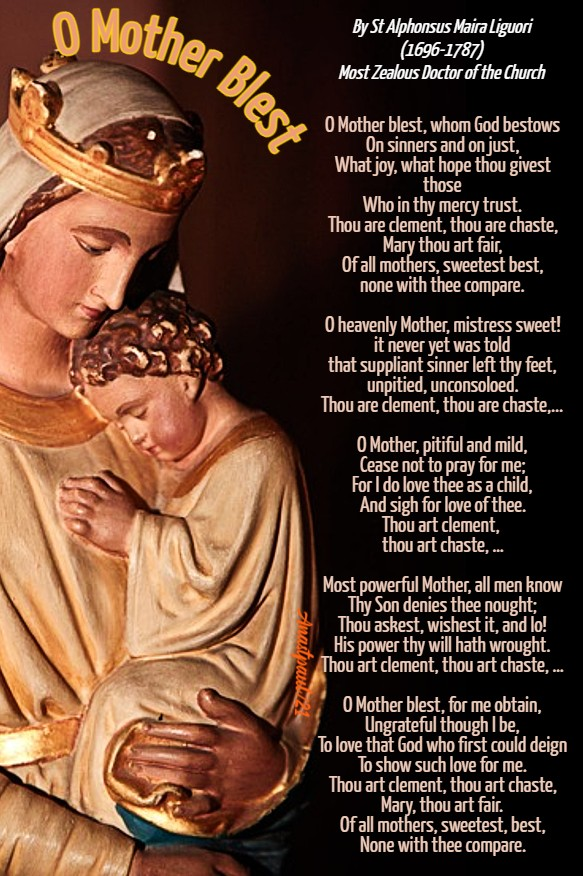
O Mother Blest By St Alphonsus Maira Liguori (1696-1787) Most Zealous Doctor of the Church Trans. Fr Edmund Vaughn C.SS,R, (1827 – 1908 )
O Mother blest, whom God bestows On sinners and on just, What joy, what hope thou givest those Who in thy mercy trust. Thou are clement, thou are chaste, Mary thou art fair, Of all mothers, sweetest best, none with thee compare.
O heavenly Mother, mistress sweet! it never yet was told that suppliant sinner left thy feet, unpitied, unconsoloed. Thou are clement, thou are chaste, …
O Mother, pitiful and mild, Cease not to pray for me; For I do love thee as a child, And sigh for love of thee. Thou art clement, thou art chaste, …
Most powerful Mother, all men know Thy Son denies thee nought; Thou askest, wishest it, and lo! His power thy will hath wrought. Thou art clement, thou art chaste, …
O Mother blest, for me obtain, Ungrateful though I be, To love that God who first could deign To show such love for me. Thou art clement, thou art chaste, Mary, thou art fair. Of all mothers, sweetest, best, None with thee compare.
Saint of the Day – 31 October – St Stachys (1st Century) the 1st Bishop of Constantinople.
The Roman Martyrology reads today: “At Constantinople, St Stachys, Bishop, who was Consecrated as the first Bishop of that City by the blessed Apostle, Andrew.”
Stachys is a Greek name, meaning “ear of corn, or fruit.” He is mentioned in Romans 16:9: “Greet Urban and my dear Stachys.”
We know nothing else about him except the accounts handed down to us by the Greeks – the Apostle St Andrew Consecrated him as the first Bishop of Byzantium or Argyropolis. Stachys founded a Church at Argyropouli, and many people gathered there to hear him preach.
It is not clear if Stachys was the same person whom Paul calls “dear” in the Epistle to the Romans but he is always associated in traditions with five other disciples, (Ampliatus, Urban of Macedonia, Apelles of Heraklion, Aristobulus of Britannia and Narcissus of Athens) that are the very same names mentioned together with him by Paul in Romans 16:8–11.
Vigil of All Saints Day or All Hallow’s Eve: Eve of the Feast of All Hallows, that is, All Saints Day. Halloween is a day on which many quaint customs are revived. It is popular in the United States and Scotland and in the US has become the second largest secular holiday of the year.
St Lucilla of Rome Bl Maria de Requesens St Narcissus
St Quentin (Died c287 Martyr, Roman Senator, Missionary. Died in c287 after horrible torments he was finally beheaded. Patronages – against coughs, whooping courgh, colds, against dropsy, against sneezing, of bombardiers, of Chaplains, locksmiths, porters, surgeons, tailors, various Italian Towns. The Roman Martyrology reads today: “At Saint Quentin, in France, St Quentinus, a Roman citizen and Senator, who endured Martyrdom under the Emperor Maximian. By the revelation of an Angel, his body was found incorrupt after the lapse of 55 years.” Wonderful St Quentin: https://anastpaul.com/2024/10/31/saint-of-the-day-31-october-saint-quentin-died-c287-martyr/
St Wolfgang (c934 –994) “The Great Almoner,” Bishop of Regensburg , Monk, Missionary, Ascetic, Apostle of Charity. He is regarded as one of the three great German Saints of the 10th Century, the other two being Saint Ulrich and Saint Conrad of Constance. He was Canonised in 1052 by Pope Leo IX. St Wolfgang’s life: https://anastpaul.com/2019/10/31/saint-of-the-day-31-october-saint-wolfgang-of-regensburg-c-934-994/
Thought for the Day – 30 October– Meditations with Antonio Cardinal Bacci (1881-1971)
“The Month of the Most Holy Rosary” Prayer and Our Lady
“Mary’s was a life of constant prayer. It is a thousand tmes more necessary, that ours, should be the same. We are so weak and so prone to temptation that we are always in danger of falling into sin. “Without me, you can do nothing,” (Jn 15:5) Jesus tells us. “I am the vine, you are the branches. If anyone does not abide in me, he shall be cast outside as the branch and wither.” (Ibid). “Ask and it shall be given to you; seek and you shall find; knock and it shall be opened to you ” (Mt 7:7). In short, Jesus asks us to pray. He wants us to pray because He wants to give us His graces.
about:blank
We cannot object that it is impossible for us to pray all the time because we have to work and fulfil other obligations. The work, which has first claim on us, is the service of God, which is prayer. Secondly, we can pray in tbe course of our daily work and of our different occupations, by offering to God, everything which we do. No matter what we are doing, we can raise our minds to God in an act of love and so remain always, close to Him.
It is not our work which prevents us from praying constantly but our attachment to worldly things, our excessive love for ourselves and of other creatures. We must avoid these distractions, if we wish to live like Mary in a continual state of prayer. ”
Quote/s of the Day – 30 October – Ferial Day – Ephesians 5:15-21 –John 4:46-53 – Scripture search here: https://www.drbo.org/
“And himself believed and his whole house.”
John 4:53
“So that our minds might be free of these illusions, the Word invites us to shake this deep sleep from the eyes of our soul, so that we might not slip away from the true realities, by becoming attached to that which has no consistency. That is why He suggests that we be watchful when He says: “Let your loins be girt about and your lamps burning …” (Lk 12:35) For when the light shines before our eyes, it chases sleep away and, when our loins are held tight by a belt, they prevent the body from succumbing to it… The person who has fastened on the belt of temperance lives in the light of a pure conscience; the trust of a child illuminates his life like a lamp… If we live in this way, we will enter a life, like that of the Angels!”
St Gregory of Nyssa (c335–c395) Father of the Church (Brother of St Basil the Great)
“He pours light into our minds, arouses our desire and gives us strength… As the soul is the life of the body, so the Holy Ghost is the life of our souls.”
St Peter Damian (1007-1072) Bishop, Father and Doctor of the Church
“Believing is: an act of the intellect assenting to the divine truth, by command of the will, moved by God through grace.”
St Thomas Aquinas (1225-1274) Doctor Angelicus. Doctor Communis
“Do you also wish to go away?” He asked. It was then that Simon Peter made his memorable reply, “Lord, to whom shall be go? Thou hast the words of everlasting life.” (Jn 6:68-69). We also may experience, at times, a sense of uncertainty concerning the words of Jesus Christ. There are such tremendous mysteries in the Christian religion. But, a religion which contained no mysteries could scarcely be true. There are mysteries of nature surrounding us and within us. How can we imagine that there are no mysteries in God, the supreme and most perfect Being? Could it be possible for our petty intellects fully to comprehend God in Himself and in His revelation? Let us bow our heads, therefore, before the mysteries of the Divinity. Let us adore God and repeat with St Peter: We cannot go away from You, O God because You have the words of everlasting life.”
One Minute Reflection – 30 October – “The Month of The Most Holy Rosary and The Holy Angels” – Ferial Day – – – Ephesians 5:15-21 –John 4:46-53 – Scripture search here: https://www.drbo.org/
“Unless you see signs and wonders, you believe not.” – John 4:48
REFLECTION – “Whoever examines the majesty of God will be crushed by His glory” (Prv 25:27). God can do works which surpass man’s understanding… Faith is required of you and sincerity of life – not high intelligence, nor penetrating knowledge of the Mysteries of God. If you do not understand, nor grasp what is below you, how will you comprehend what is above you? Be subject to God, submit yourself to the faith and the light of knowledge will be given to you, as much as you need and can use.
Some have grave temptations concerning faith and Sacraments which are not to be imputed to them but rather, to the enemy. Take no notice, do not argue with your thoughts, nor answer the doubts with which the devil attacks you; believe God’s Word, believe His Saints and Prophets and the wicked enemy will be routed. It is often most profitable to God’s servant, to endure such things. For the devil does not tempt the infidel or sinner, of whom he has already secure possession but, he uses various means, to tempt and harass the devout faithful.
Go on then with simple unquestioning faith and approach the Sacrament with reverent beseeching. Anything you cannot understand, commit it surely to God, Who is omnipotent. God does not deceive you – the over-confident person deceives himself. God walks in step with the simple ones, He shows Himself to the humble ones, He grants understanding to the little ones; “He reveals hidden meanings to little ones” and hides away His grace from the inquisitive and the proud. Human reason is feeble and fallible but true faith cannot be deceived. All use of reason, all human inquiry should walk in the footsteps of faith; it should not go on in front of it, nor call it in question.” – Thomas à Kempis CRSA (1380-1471) (The Imitation of Christ IV, 18).
PRAYER – O God, our refuge and our strength, the very source of holiness, heed the devout prayers of Thy Church and grant that what we seek in faith, we may obtain in fact. Through Jesus Christ, Thy Son our Lord, Who lives and reigns with Thee, in the unity of the Holy Ghost, God, world without end. Amen (Collect).
Our Morning Offering – 30 October – “The Month of The Most Holy Rosary and The Holy Angels” – The Feast of – St Alphonsus Rodriquez SJ (1532-1617)
This is My Joy, To Follow My Saviour A Prayer to Seek the Consolation of the Cross By St Alphonsus Rodriguez SJ (1532-1617)
Jesus, love of my soul, centre of my heart! Why am I not more eager to endure pains and tribulations for love of Thee, when Thou, my God, have suffered so many for me? Come, then, every sort of trial in the world, for this is my delight, to suffer for Jesus. This is my joy, to follow my Saviour and to find my consolation with my Consoler on the Cross. This is my happiness, this my pleasure – to live with Jesus, to walk with Jesus, to converse with Jesus, to suffer with and for Him, this is my treasure! Amen
Saint of the Day – 30 October – Saint Serapion (Died 211) Bishop of Antioch, Scholar and a learned Theologian. He served as the Bishop of Antioch from 191 until his death in 211. He is known through his theological writings, although sadly all but a few fragments of his works have perished.
The Roman Martyrology reads today: “At Antioch, St Serapion, a Bishop, very celebrated for his learning.”
St Serapion of Antioch in the Església de Sant Antoni Abat (València)
Serapion was considered one of the major Theologians of his day. St Eusebius of Caesarea (c260-339) refers to three of his works in his history but agrees that others probably existed – firstly, is a private letter addressed to Caricus and Pontius against Montanism, from which Eusebius quotes an extract (Historia ecclesiastica V 19), as well as proofs, showing that it was circulated amongst Bishops in Asia and Thrace; next is a work addressed to a certain Domninus, who in time of persecution abandoned Christianity for the error of ‘Jewish will-worship’ (Hist. Eccles, VI 12).
Lastly, St Eusebius quotes (vi 12:2) from a pamphlet Serapion wrote concerning the heretical Docetic teaching of Peter, in which Serapion presents an argument to the Christian community of Rhossus, in Syria, against this heresy and condemns it. He recalls the permission to read this apocryphal work given in ignorance of its true character and expresses his intention to visit the Church to strengthen them in the True Faith.
Eusebius also alludes to a number of personal letters Serapion wrote to Pontius, Caricus and others, about this heretical Docetic teaching.
Serapion also acted with the support of St Pantaenus against the influence of Gnosticism in Osroene, by consecrating Mari of Edessa as the Bishop of Edessa, where Mari addressed the increasingly Gnostic tendencies, the Syrian Bardesanes, was introducing to its Christian community. He Ordained St Pantaenus as a Priest or Bishop in Edessa.
Serapion was succeeded as the Bishop of Antioch by St Asclepiades (Eusebius Historia Ecclesiastica VI 11:4).
St Germanus (Died c541) Bishop of Capua, Italy, Confessor, Papal Legate. St Germanus was a close friend of St Benedict of Nursia. The Roman Martyrology states: St Germanus, Bishop and Confessor, a man of great sanctity, whose soul, at the hour of death, was seen by St Benedict taken to heaven by angels. His Life: https://anastpaul.com/2020/10/30/saint-of-the-day-30-october-saint-germanus-of-capua-died-c-541/
St Herbert of Tours
Blessed John Slade (Died 1583) Layman Martyr. Beatified on 15 December 1929 by Pope Pius XI. The Roman Martyrology: “At Winchester in England, blessed John Slade, Martyr, who was hanged on the gallows and cruelly disemboweled for having refused the power of Queen Elizabeth I in spiritual matters.” His Life and Death: https://anastpaul.com/2023/10/30/saint-of-the-day-30-october-blessed-john-slade-died-1583-layman-martyr/
St Maximus of Cumae St Nanterius of Saint-Mihiel Bl Raymond of Cardona St Saturninus of Cagliari St Serapion (Died 211) Bishop of Antioch St Talarica of Scotland Bl Terrence Albert O’Brien St Theonestus of Philippi (Died 425) Bishop, Martyr St Zenobia of Aegea St Zenobius of Aegea
Martyrs in Africa: A group of 100 to 200 Christians murdered in the early persecutions and about whom we know nothing except that they died for their faith.
Thought for the Day – 29 October – Meditations with Antonio Cardinal Bacci (1881-1971)
“Month of the Holy Rosary” “Mary, Our Hope”
“In the beautiful prayer, known as the Salve Regina or Hail, Holy Queen, the Church salutes Mary as “our life, our sweetness and our hope.” Mary is our hope, because, she gave us our Saviour, Jesus and, because, she prays to Him continually for the graces which we need. Following the example of Luther, modern protestants raise the objection that Mary cannot be regarded as a source of hope, because, all our trust should be placed in God. Anyone who places his trust in creatures, draws down God’s curse upon himself, they say and, they go on to quote from Jeremias: “Cursed be the man who trusteth in man” (Jer 17:5). But this is true only, when we trust in creatures independently of God, as if we can derive any good from them, without recourse to God. We invoke Mary, however, as the Mother of God and our mediatrix with Him. She is our hope, insofar as she obtains for us from God, the graces and favours which we require. St Bernard assures us, that God has placed in Mary’s hands, all the riches which He wishes to bestow on us (Serm de aquaed). “He will never experience eternal ruin,” says St Anselm, “for whom Mary has once prayed.” St Bernard calls upon Mary as the foundation of all his hope (Ibid). Let us remember, that Mary is our loving Mother who wishes us to pray to her because, she knows that if she intercedes on our behalf, she will certainly be heard. It should be most consoling to us to have such a good and powerful Mother in whom, we can safely trust in every peril and in every necessity. Let us pray to her with love and faith, in the certainty that, we shall be answered in the way that is best for us. Let us say along with St John Damascene: “O Mother of God, if I place my trust in you, I shall be saved. If I am under your protection, I have nothing to fear because to be devoted to you, is to possess a weapon of salvation which God grants only to those, whom He desires to redeem” (Serm de Nat, cap 4).”
Quote of the Day – 29 October – Resumed Mass of Sunday – The Feast of Christ the King – Colossians 1:12-20 – John 18:33-37 – Scripture search here: https://www.drbo.org/
Consecration of the Human Race to the Sacred Heart of Jesus
From the Encyclical Letter of Pope Pius XI Quas Primas 11 December 1925
Most sweet Jesus, Redeemer of the human race, look down upon us humbly prostrate in Thy Presence. We are Thine and Thine we wish to be but, to be more surely united to Thee, behold, each one of us this day, freely dedicates himself to Thy Most Sacred Heart. Many, indeed, have never known Thee; many, too, despising Thy precepts, have rejected Thee. Have mercy on them all, most merciful Jesus and draw them to Thy Sacred Heart. Be Thou King, O Lord, not only of the faithful who have never forsaken Thee but too, of the prodigal sons who have abandoned Thee; grant that they may quickly return to their Father’s house, lest they perish of wretchedness and hunger. Be Thou King of those whom heresy holds in error or discord keeps aloof; call them back to the harbour of truth and the unity of faith, so that soon there may be but one fold and one Shepherd.
Be Thou King of all those, who even now, abide in the shadow of idolatry or Islam and refuse not Thou to bring them into the Light of Thy Kingdom. Look finally, with eyes of pity, upon the children of that race which was for so long a time, Thy chosen people and let Thy Blood which was once invoked upon them in vengeance, now descend upon them in a cleansing flood of redemption and eternal life. Grant, O Lord, to Thy Church assurance of freedom and immunity from harm; unto all nations give an ordered tranquillity; bring it to pass, from pole to pole, that the earth may resound with one cry: Praise to the Divine Heart which wrought our salvation! to It be honour and glory forever and ever. Amen.
Indulgence: 5 years, each time) 11 December 1925 Pope Pius XI
One Minute Reflection – 29 October – “The Month of The Most Holy Rosary and The Holy Angels” – Resumed Mass of Sunday – Ferial Day – Colossians 1:12-20 – John 18:33-37 – Scripture search here: https://www.drbo.org/
“Pilate, therefore, said to Him, Thou are then a King?” – John 18:37
REFLECTION – “What a stupendous thing it was for the King of the ages to become King of men! For Christ did not become King of Israel to exact tribute, to equip armies with swords, to subdue visible foes. He became King of Israel that He might rule over men’s souls, counsel them about eternity that, He might lead those, who would believe in Him, hope in Him and love Him, to the Kingdom of Heaven. Accordingly, it was not to increase His power–it was condescension on His part which made Him,, the Son of God, co-equal with the Father, the Word by Whom all things were made – wish to become King of Israel. It was an indication of His mercy; it did not augment His power. He, Who on earth was called King of the Jews, in Heaven is called, Lord of the Angels. But is Christ King of the Jews only and not King of the Gentiles too? When, in prophecy He said, “But I have established My Kingdom upon Sion, My holy mountain. I will make known the decree of the Lord,” He added immediately, so that the mention of Mount Sion, might not lead men to believe He had been anointed King of the Jews solely: “The Lord has said to Me – Thou art My Son; this day have I begotten Thee. Ask of Me and I will give Thee the Gentiles for Thy inheritance and the ends of the earth, for Thy possessions.”
Jesus answered – “My Kingdom is not of this world. If My Kingdom were of this world, My followers would have fought that I might not be delivered to the Jews. But as it is, My Kingdom is not from here.” This is what the good Master wished us to know. First, we had to learn, how vain was the notion of His Kingdom that it should be hostile, either to the Romans or to the Jews. When the Roman governor asked Jesus “Art thou King of the Jews?” the Lord could have answered: “My Kingdom is not of this world.” But Christ asked in His turn, ”Dost thou say this of thyself, or have others told thee of Me?” because, He wished to show, from Pilate’s answer, that He, Jesus, had been charged with this, as a crime by the Jews, before Pilate. Thus He laid bare to us the thoughts of men which He knew and which were vain. After the reply of Pilate, Jesus replied to them, to both Jews and Gentiles, more fittingly and more opportunely, “My Kingdom is not of this world.”– St Augustine (354-430) Father and Doctor of Grace (Sermon on Christ the King) Roman Breviary
PRAYER – Almighty and eternal God, Who willed to restore all things in Thy beloved Son, the King of the Universe, graciously grant that the peoples of the earth torn asunder by the wound of sin, may submit to His most gentle rule.Through the same Jesus Christ, Thy Son our Lord, Who lives and reigns with Thee, in the unity of the Holy Ghost, God, world without end. Amen (Collect).
Our Morning Offering – 29 October – “The Month of The Most Holy Rosary and The Holy Angels”
Salve Regina Hail Holy Queen [An Indulgence of 300 days–1925]
By Blessed Herman of Reichenau (1013–1054)
Hail, holy Queen, Mother of Mercy, Hail our life, our sweetness and our hope. To thee do we cry, Poor banished children of Eve; To thee do we send up our sighs, Mourning and weeping in this valley of tears. Turn then, most gracious advocate, Thine eyes of mercy toward us; And after this our exile, Show unto us the blessed fruit of thy womb, Jesus.
This line, below, by St Bernard of Clairvaux (1090-1153) Doctor of the Church
O clement, O loving, O sweet Virgin Mary.
℣ Pray for us, O holy Mother of God, ℟ that we may be made worthy of the promises of Christ.
You must be logged in to post a comment.