Quote/s of the Day – 11 January – “The Month of the Most Holy Name of Jesus and of the Holy Family” – Within the Octave of Epiphany – Isaias 60:1-6, Matthew 2:1-12
“And seeing the Star they rejoiced with exceeding great joy.”
Matthew 2:10
“Faith in Jesus and in the power of His Holy Name is the greatest spiritual force in the world today. It is a source of joy and inspiration in our youth; of strength in our manhood, when only His Holy Name and His grace, can enable us to overcome temptation; of hope, consolation and confidence at the hour of our death, when more than ever before, we realise, that the meaning of Jesus is ‘Lord, the Saviour.’ We should bow in reverence to His Name and submission to His Holy Will.”
Bl Henry Suso OP (1290-1365)
“Should everything turn upside down, I do not say around us but within us, that is to say, should our soul be sad, happy, in sweetness, in bitterness, peaceful, troubled, in light, in darkness, in temptation, in rest, in enjoyment, in disgust, in dryness, in gentleness, should the sun burn it or the dew refresh it, ah! this point of our heart, our spirit, our higher will, which is our compass, should, nevertheless, always and at all times, turn unceasingly, tend perpetually towards the love of God!”
One Minute Reflection – 11 January – “The Month of the Most Holy Name of Jesus and of the Holy Family” – Within the Octave of Epiphany – Isaias 60:1-6; Matthew 2:1-12 – Scripture search here: https://www.drbo.org/
“And seeing the Star, they rejoiced with exceeding great joy.” – Matthew 2:10
REFLECTION – “Jesus is born poor in a stable; the Angels of Heaven indeed acknowledge Him but men abandon and forsake Him on earth. Only a few shepherds come and pay Him homage. But our Redeemer was desirous of communicating to us the grace of His redemption and begins, therefore, to manifest Himself to the Gentiles, who knew Him least. Therefore, He sends a Star to enlighten the holy Magi, in order that they may come and acknowledge and adore their Saviour. This was the first and sovereign grace bestowed upon us–our vocation to the Faith which was succeeded by our vocation to grace, of which men were deprived.
Behold the Wise Men, who immediately, without delay, set off upon their journey. The Star accompanies them as far as the cavern where the Holy Infant lies. On their arrival, they enter and what do they find? They found the Child with Mary. They find a poor maiden and a poor Infant wrapped in poor swaddling-clothes, without anyone to attend on Him or assist Him. But, lo! on entering into the little shed, these holy pilgrims feel a joy which they had never felt before; they feel their hearts chained to the dear little Infant Whom they behold. The straw, the poverty, the cries of their little Saviour–oh, what darts of love! Oh, what blessed flames are they to their enlightened hearts! The Infant looks upon them with a joyful countenance and this is the mark of affection, with which He accepts them amongst the first-fruits of His Redemption.
The holy Kings then look at Mary, who does not speak –she remains silent but with her blessed countenance which breathes the sweetness of paradise, she welcomes them and thanks them for having been the first to come and acknowledge Her Son (as indeed He is) for their Sovereign Lord. See also how, out of reverence, they adore Him in silence and acknowledge Him for their God, kissing His Feet and offering Him their gifts of Gold, Frankincense and Myrrh. Let us too, with the holy Magi, adore our little King Jesus and let us offer Him all our hearts.” – St Alphonsus de Liguori (1696-1787) Bishop, Founder of the Redemptorists, Most Zealous Doctor (The Adoration of the Magi),
PRAYER – O God, Thou Who by the guidance of a star this day revealed Thy Only-begotten Son to the Gentiles, mercifully grant that we, who know Thee now by faith, may come to behold Thee in glory. Through the same Jesus Christ, Thy Son our Lord, Who lives and reigns with Thee, in the unity of the Holy Ghost, God, world without end. Amen (Collect).
Our Morning Offering – 11 January – “The Month of the Most Holy Name of Jesus and of the Holy Family” – Sixth Day within the Octave of Epiphany
Sweet Jesus, Thy Name is Joy By St Anthony of Padua OFM (1195-1231) Doctor of the Church
Sweet Jesus, is there anything sweeter than Thee? To remember Thee is more delightful than everything else. Thy Name is joy – it is the true Gate of our Salvation. What else are Thou, Jesus, if not our Saviour? Be our Redeemer. Give us the virtues of hope and love, just as Thou hast given us faith, our primary joy. Give us the words which we need to praise Thee always. With the help and through the prayers of Thy Mother. Thou who art blessed throughout the ages. Amen
Saint of the Day – 11 January – St Leucius of Brindisi (Died c180) Bishop, Confessor, Missionary. Born in Eastern Europe and died in c180 in Brindisi, Italy of natural causes. Patronages – of Atessa, the City of Brindisi and the Archdiocese of Brindisi-Ostuni, all in Italy. Also known as – Leucio.
The Roman Martyrology reads: “At Brindisi, the holy saint Leucius, Bishop and Confessor.”
St Leucius was the first Bishop of Brindisi,who founded the Diocese of Brindisi in 165. A second Bishop of the same name is also honoured as a Saint but he lived in the 5th Century and was Martyred – this latter was mentioned by St Gregory the Great.
Not much is known of Leucius’ early life, although it is believed that he was born in Eastern Europe, to Eudecius and Euphrodisia and was given the name of Eupressius at birth. The young Eupressius was educated and spent the formative years of his life in Alexandria, Egypt.
Following the death of his mother, he entered monastic life. A heavenly vision, during a memoria of the Virgin, would change his name from Eupressius to Leucius (this name means bright, pure as the light). Having already been Ordained a Bishop, Leucius wished to undertake a Missionary Apostolate in Brindisi, to liberate the pagans. Leucius left Alexandria for Brindisi, which at the time was one of the largest ports of the Mediterranean, in the southern part of Italy.
Leucius first became renowned when many pagans in Apulia heard him preaching the Gospel during a drought. He claimed that if they had faith in his message, the rains would come. After the rains fell, the pagans were immediately converted to Chris. Soon after, he became the first Bishop of Brindisi and proceeded to build the Churches of St Mary’s and St John the Baptist.
However, the honour of the Mother of God, however, it is more likely that the Bishop of Brindisi of the 5th Century, was the one who built a Church in honour of the Blessed Virgin. After all, that custom became the norm only after the Blessed Virgin Mary was proclaimed as the Mother of God at the Council of Ephesus in 431. Immediately afterwards, Santa Maria Maggiore was built in Rome. From that moment, every City built a St Mary’s Church as if for battle. It is, therefore, logical that the roots of the St Mary’s Church in Brindisi, dates from the 4th Century rather than the 2nd.
The later part of his life is unknown but according to tradition, he suffered martyrdom in the year 180 but this is not acknowledged in the Martyrology. Soon after his death his remains were returned to Brindisi, there they remained until the Lombard invasion of 768, when they were moved to Trani, then to the capital of the Duchy of Benevento and finally to the Basilica Cathedral of Brindisi, see below.
St Pope Hyginus (Died 142) Papal Ascension c 138. It is believed he was a Martyr for Christ and suffered during the persecution of Antoninus, although our ancient sources do not confirm this. Tradition holds that during his Papacy he determined the various prerogatives of the clergy and defined the grades of the ecclesiastical hierarchy. Hyginus also instituted Godparents at Baptism to assist the baptised during their Christian life. In addition, he decreed, that all Churches be Consecrated. His Life and Death: https://anastpaul.com/2022/01/11/saint-of-the-day-11-january-saint-pope-hyginus-died-142/
St Boadin of Ireland St Breandan of Ireland (the name is not an error) St Eithne St Fedelemia St Honorata of Pavia St Leucius of Alexandria (Died 5th Century) Bishop Martyr
St Leucius of Brindisi )Died c180) Bishop Confessor
St Liberata of Pavia St Lucius the Soldier St Luminosa of Pavia St Mark the Soldier St Michael of Klopsk St Palaemon St Paldo St Peter Balsam St Peter of Alexandria St Peter of Anea St Peter the Soldier
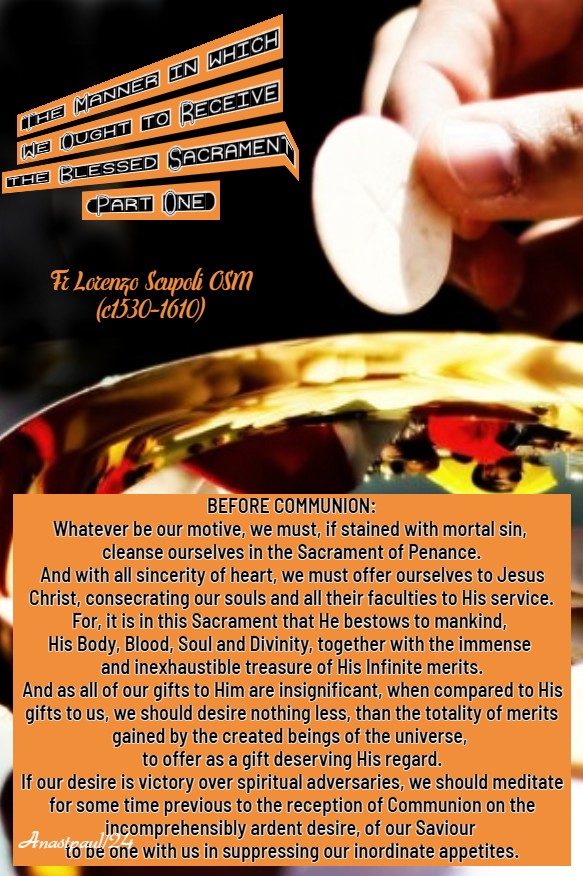
Thought for the Day – 10 January – The Spiritual Combat (1589) – Dom Lorenzo Scupoli OSM (c1530-1610)
“None shall be crowned who has not fought well.” 2 Tim 2: 5
The First Two Weapons of the Spiritual Combat
II: Of Trust in God (Confidence)
“Self-distrust, necessary as we have shown it to be in this conflict, is not alone sufficient. Unless we would be put to flight, or remain helpless and vanquished in the hands of our enemies, we must add to it perfect trust in God and expect from Him alone, succour and victory! For, as we, who are nothing, can look for nothing from ourselves but falls and, therefore, should utterly distrust ourselves; so, from our Lord, may we assuredly expect complete victory in every conflict. To obtain His help, let us, therefore, arm ourselves with a lively Confidence in Him. And this also may be accomplished in four ways: … [Be here tomorrow, God willing] ”
Quote/s of the Day – 10 January – Within the Octave of The Epiphany – Isaias 60:1-6; Matthew 2:1-12 – Scripture search here: https://www.drbo.org/
“We have seen His Star in the East and have come, with gifts, to worship the Lord. Alleluia!”
Matthew 2:2
“Behold, the star which they had seen in the east, went before them until it came and stood over where the Child was…”
Matthew 2:9
“I implore you to live with me and, by believing, to run with me; let us long for our Heavenly Country, let us sigh for our Heavenly Home, let us truly feel that here, we are strangers. What shall we then see? Let the gospel tell us: In the beginning was the Word and the Word was with God and the Word was God. You will come to the fountain, with whose dew you have already been sprinkled. Instead of the ray of Light which was sent through slanting and winding ways, into the heart of your darkness, you will see the Light Itself, in all its purity and brightness. It is to see and experience this Light that you are now being cleansed. … It has been good for us to share the common Light, good to have enjoyed ourselves, good to have been glad together. When we part from one another, let us not depart from Him!”
St Augustine (354-430) Father and Doctor of Grace
“The obedience of the Star calls us to imitate its humble service: to be servants, as best we can, of the grace which invites all men to find Christ.”
St Pope Leo the Great (400-461) Father and Doctor of the Church
“… For this day, I must abide in thy house.” Luke 19:5
“But He says to all: “Come down quickly, for the exalted freedom of the spirit cannot be maintained, except through lowly obedience of mind. You must know and love Me, as both God and a human being, higher than all and lower than all! You will savour Me when I raise you up above all things and above yourself to Myself and, when you lower yourself beneath all things and beneath yourself, to Me and for My sake. Then, I will have to come to your house and remain living with you and in you and you with Me and in Me!”
One Minute Reflection – 10 January – “The Month of the Most Holy Name of Jesus and of the Holy Family” – Within the Octave of The Epiphany – Isaias 60:1-6; Matthew 2:1-12 – Scripture search here: https://www.drbo.org/
“Arise, be enlightened, O Jerusalem, for thy Light is come and the glory of the Lord is risen upon thee.” – Isaias 60:1
REFLECTION – “This is the day which Abraham saw and rejoiced to see, when he knew that the sons born of his faith would be blessed in his seed, that is, in Christ. Believing that he would be the father of the nations, he looked into the future, giving glory to God, in full awareness that God is able to do what He has promised.
This is the day which David prophesied in the Psalms, when he said: All the nations which you have brought into being, will come and fall down in adoration in Thy presence, Lord and glorify Thy Name. Again, the Lord has made known His salvation; in the sight of the nations, He has revealed His Justice.
This came to be fulfilled, as we know, from the time when the Star beckoned the Three Wise Men out of their distant country and led them, to recognise and adore, the King of Heaven and earth. The obedience of the Star calls us to imitate its humble service: to be servants, as best we can, of the grace which invites all men to find Christ.
Dear friends, you must have the same zeal to be of help to one another, then, in the Kingdom of God, to which faith and good works are the way, you will shine as children of the Light: through our Lord Jesus Christ, Who lives and reigns with God the Father and the Holy Ghost, forever and ever. Amen.” – St Pope Leo the Great (400-461) Father and Doctor of the Church (An excerpt from his On the Lord’s Epiphany, Sermon 3).
PRAYER – O God, Thou Who by the guidance of a star this day revealed Thy Only-begotten Son to the Gentiles, mercifully grant that we, who know Thee now by faith, may come to behold Thee in glory. Through the same Jesus Christ, Thy Son our Lord, Who lives and reigns with Thee, in the unity of the Holy Ghost, God, world without end. Amen (Collect).
Our Morning Offering – 10 January – “The Month of the Most Holy Name of Jesus and of the Holy Family” – Within the Octave of The Epiphany
O Child, So Worthy of Our Love, I Offer Thee My Heart (O Grant Me that Gold, Incense and Myrrh Which I Lack) By St Alphonsus Liguori (1696-1787) Most Zealous Doctor
O Child so worthy of our love, I see You lying on the straw in this cave, so poor and despised. Yet faith teaches me, that You are my God come down from heaven for my salvation. I acknowledge You as my Sovereign Lord and Saviour, as such I proclaim You, yet, I have nothing at all to offer You. I am without Love’s Gold, since I have given my love to the things of this world – I have only loved my own whim, rather than loving You, so infinitely worthy of love. I am without Prayer’s Incense, since I have lived wretchedly without thinking of You. I have no Myrrh of Mortification since, so as not to forsake some paltry pleasures, I have so often saddened Your infinite goodness. So what am I to offer You? O my Jesus, I offer You my heart, soiled and naked as it is. Take it and change it, for You have come down to us to wash our guilty hearts with Your Blood and so transform us from sinners into saints. O grant me that Gold, Incense and Myrrh which I lack. Grant me the Gold of Your Holy Love; grant me the Incense which is the spirit of prayer; grant me Myrrh, the willingness and strength to deny myself in all that displeases You… O holy Virgin, you welcomed those devout Magi Kings with keen affection and satisfied them. Deign to welcome and comfort me also, I, who come, following their example, to visit and offer myself to your Son Amen.
Saint of the Day – 10 January – St Pope Agatho (Died 681) Bishop of Rome from 27 June 678 (at this time over 100 years old) until his death on 10 January 681. Born in Sicily of Greek parentage, probably in Palermo of which City he is the Patron. Known for his affability and charity, on account of the many miracles attributed to his intercession, he has been styled as “Thaumaturgus or Wonderworker.” Also known as – Agathon, Agatone, Agathonius.
The Roman Martyrology reads today: “At Rome, the Pope, St Agatho, who terminated a liferemarkable for sanctity and learning by a holy death.”
Agatho was originally a Benedictine Monk at St Hermes in Palermo and there is good authority that he was more than 100 years old when, in 678, he ascended the Papal Chair asthe successor to Pope Donus.
Shortly after Agatho became the Supreme Pontiff, Saint Wilfred, Archbishop of York, who had been unjustly and uncanonically deposed from his See by Theodore of Canterbury, arrived in Rome to invoke the authority of the Holy See on his behalf. At a Synod which Pope Agatho convoked in the Lateran to investigate the affair, Wilfred was restored to his See.
The main event of Agatho’s Pontificate remains however, the Sixth Ecumenical Council, held in Constantinople in 680, at which the Papal Legates presided and which practically ended the Monothelite heresy. Before the Decrees of the Council arrived in Rome for the approval of the Pope, Agatho had died on 10 January 681 and was laid to rest in St Peter’s Old Basilica.
His memory is still wonderfully celebrated in Greece.
Artwork and Shrine of St Agatho at Lipari Cathedral in Sicily
Thought for the Day – 9 January – The Spiritual Combat (1589) – Dom Lorenzo Scupoli OSM (c1530-1610)
“None shall be crowned who has not fought well.” 2 Tim 2: 5
The First Two Weapons of the Spiritual Combat
I: Distrust of Self (Diffidence) FOUR METHODS,
“I, therefore, set before you FOUR METHODS, by the use of which, in dependence always on Divine grace, you may acquire this gift. …”
The FIRST is, to KNOW and consider your own vileness and nothingness and your inability, of yourself, to do any good, by which to merit an entrance into the Kingdom of Heaven.
The SECOND is, CONTINUALLY to ASK such knowledge of the Lord in fervent and humble prayer; for it is His gift. And in order to reach its attainment, we must look upon ourselves, not only as destitute thereof, but as of ourselves incapable of acquiring it. Present yourself, therefore, continually before the Divine Majesty, with an assured faith that He is willing, of His great goodness, to grant your petition; wait patiently, all the time which His Providence appoints and without doubt, you shalt obtain it.
The THIRD is, to stand in FEAR of your own judgement about yourself, of your strong inclination to sin, of the countless hosts of enemies against whom you are incapable of making the slightest resistance, of their long practice in open warfare and secret stratagem, of their transformations into Angels of Light and of the innumerable arts and obstacles which they secretly spread for us, even in the very way of holiness.
The FOURTH is, whenever you are OVERTAKEN by any FAULT, to look more deeply into yourself and, more keenly, feel your absolute and utter weakness – for to this end did God permit your fall that, warned by His inspiration and illumined by a clearer Light than before, you may come to know yourself and learn to despise yourself as a thing unutterably vile and be, therefore, also willing to be so accounted and despised by others. For without this willingness, there can be no holy self-distrust which is founded on TRUE HUMILITY and experimental SELF-KNOWLEDGE.
This self-knowledge is clearly needful to all who desire to be united to the Supreme Light and Uncreated Truth and the Divine Clemency, often makes use of the fall of proud and presumptuous men to lead to Itself; justly suffering them to fall into some faults which they trusted to avoid, by their own strength that they may learn to know and absolutely distrust themselves. Our Lord is not, however, wont to use so severe a method, until those more gracious means of which we have before spoken have failed to work the cure designed by His Divine Mercy. He permits a man to fall, more or less deeply, in proportion to his pride and self-esteem; so that if there were no presumption (as in the case of the Blessed Virgin Mary), there would be no fall. Therefore, whenever you shall fall, take refuge at once in humble self-knowledge and beseech the Lord, with urgent entreaties to give you Light — truly to know yourself and entire self-distrust lest you should fall again, perhaps into deeper perdition!”
Quote/s of the Day – 9 January – “The Month of the Most Holy Name of Jesus and of the Holy Family” – Within the Octave of Epiphany – Isaias 60:1-6; Matthew 2:1-12 – Scripture search here: https://www.drbo.org/
“Arise, be enlightened, … for thy Light is come!”
Isaias 60:1
“Make ready then the vessel of your soul that you may become a son of God and an heir of God and joint-heir with Christ (Romans 8:17); if, indeed, you are preparing yourself that you may receive; if you are drawing near in faith that you may be made faithful; if of set purpose, you are putting off the old man!”
St Cyril of Jerusalem (315-387) Father and Doctor of the Church
“Have patience with all things but chiefly, have patience with yourself. Do not lose courage in considering your own imperfections but instantly set about remedying them, everyday begin the task anew.”
“A person who is conscious of his misery, can certainly have great confidence in God. In fact, he cannot have true confidence in Him, without this consciousness of his misery. This knowledge and acknowledgement of our misery, leads us to the presence of God.”
St Francis de Sales (1567-1622) Doctor of the Church
“Anyone who takes life seriously in the Christian sense, will regard it as a difficult journey towards perfection and towards God. This journey will be, at the same time, painful and joyful. … It is our own loss if we sit down lazily on the side of the road, which should lead us to Heaven. It is even more disastrous, if we acknowledge defeat and lay down the spiritual weapons of prayer and renunciation, in order to surrender ourselves to sin or to indifference. Everyday we should say to ourselves, in the presence of God – A new life is beginning … in You, by Your grace and for You! Amen”
One Minute Reflection – 9 January – “The Month of the Most Holy Name of Jesus and of the Holy Family” – Within the Octave of Epiphany – Isaias 60:1-6; Matthew 2:1-12 – Scripture search here: https://www.drbo.org/
“Arise, be enlightened, O Jerusalem, for thy Light is come and the glory of the Lord is risen upon thee.” – Isaias 60:1
REFLECTION – “The loving Providence of God determined that in the last days He would aid the world, set on its course to destruction. He decreed that all nations should be saved in Christ.
A promise had been made to the holy Patriarch Abraham, in regard to these nations. He was to have a countless progeny, born not from his body but from the seed of faith. His descendants are, therefore, compared with the array of the stars. The father of all nations, was to hope, not in an earthly progeny but, in a progeny from above.
Let the full number of the nations now take their place in the family of the Patriarchs. Let the children of the promise, now receive the blessing in the seed of Abraham, the blessing renounced by the children of his flesh. In the persons of the Magi, let all people adore the Creator of the universe – let God be known, not in Judea only but in the whole world, so that His Name may be great in all Israel.
Dear friends, now that we have received instruction in this revelation of God’s grace, let us celebrate, with spiritual joy, the day of our first harvesting, of the first calling of the Gentiles. Let us give thanks to the merciful God, Who has made us worthy, in the words of the Apostle, to share the position of the Saints in Light, who has rescued us from the power of darkness and brought us into the Kingdom of His beloved Son. As Isaias prophesied – the people of the Gentiles, who sat in darkness, have seen a great light and for those who dwelt in the region of the shadow of death a Light has dawned. He spoke of them to the Lord – The Gentiles, who do not know Thee, will invoke Thee and the peoples, who knew Thee not, will take refuge in Thee.” – St Pope Leo the Great (400-461) Father and Doctor of the Church (An excerpt from his On the Lord’s Epiphany, Sermon 3)
PRAYER – O God, Thou Who by the guidance of a star this day revealed Thy Only-begotten Son to the Gentiles, mercifully grant that we, who know Thee now by faith, may come to behold Thee in glory. Through the same Jesus Christ, Thy Son our Lord, Who lives and reigns with Thee, in the unity of the Holy Ghost, God, world without end. Amen (Collect).
Our Morning Offering – 9 January – “The Month of the Most Holy Name of Jesus and of the Holy Family” – Within the Octave of The Epiphany
The Love of Your Name By Thomas à Kempis CRSA (1380-1471) The Imitation of Christ (Book 3 Ch 26:1-4)
My God, Sweetness beyond words, make bitter all the carnal comfort which draws me from love of the eternal and lures me to its evil self, by the sight of some delightful good in the present. Let it not overcome me, my God. Let not flesh and blood conquer me. Let not the world and its brief glory deceive me, nor the devil trip me by his craftiness. Give me courage to resist, patience to endure and constancy to persevere. Give me the soothing unction of Your spirit, rather than all the consolations of the world and in place of carnal love, infuse into me, the love of Your Name. Amen
Saint of the Day – 9 January – Saint Marcellinus of Ancona (Died c577) the Fifth Bishop of Ancona, Italy.Born in Ancona and died there on 9 January in c577 of natural causes. Patronages – against fire (a raging fire ceased by St Marcellinus waving his prayer book at it; the book survived the fire with only slight damage; afterwards, people who touched it, while praying, were cured of ailments), of Ancona, Italy. Also known as – Marcellin, Marcellino.
The Roman Martyrology reads: “At Ancona, St Marcellinus, Bishop, who, according to St Gregory the Great, miraculously delivered that City from destruction by fire.”
Marcellinus, of the noble family of Boccamaiori, became the Fifth Bishop of Ancona in 539. At that time, the Church of Santo Stefano acted as the Cathedral. According to a Vita of the Saint, instead of being proud of the high office which had been entrusted to him, Marcellinus mortified himself with fasting and continual penance which he offered to God, together with vigils, prayers and works of charity.
In his Dialogues, St Gregory the Great (540-604) called him “a man of venerable virtue” and recalled the miracle when he extinguished a fire which was devastating Ancona.
In the Istoria d’Ancona, written in the first half of the 19th Century by Abbot Antonio Leoni, who drew upon a number of ancient sources, we read what happened when the fire “untreated at first” was fuelled by the wind. The City’s inhabitants implored the help of their Bishop who, after raising his eyes to Hea in prayer, was carried on a chair (he had difficulty walking due to a severe attack of gout) to the point where the fire was most threatening. There, he held out and read from the Evangeliary containing the passages of the synoptic Gospels, with notes relating to the Liturgical use of Ancona. The Evangeliary was partly scorched by a sudden upsurge of the flames which, however, went out the instant the Saint suddenly shut the book, to everyone’s gratitude.
A portion of the Evangeliary which was damaged
The Evangeliary of Saint Marcellinus, on the eve of the Saint’s Feast, is carried in procession through the City’s streets and is still kept in the Diocesan Museum of Ancona, after being restored in the 20th Century. Sick people who touched it regained health; the son of a noble family remained unharmed in the midst of a fire into which the devil had thrown him, out of envy at the veneration shown to Marcellinus by the youth; a fire in a village near Ancona immediately ceased when the prayer book was brought there.
Early 1300s Statue of St Marcellinus
The first Cathedral in Ancona is commemorated by an inscription on the Primary School which is now built on this site.
St Marcellinus’ Relics , circa 1756, in the Crypt of Ancona Cathedral
St Peter of Sebaste (c340-c391) Bishop of Sebaste in Lesser Armenia. Member of the glorious family of Saints – He was the younger brother of Basil the Great, Gregory of Nyssa, the famous Christian Hermit Naucratius and Macrina the Younger and a close friend of Gregory of Nazianzen, all Saints. Of course, Basil and Gregory of Nazianzen are both Doctors too. St Pete‘r’s Biography: https://anastpaul.com/2021/01/09/saint-of-the-day-9-january-st-peter-of-sebaste-c-340-c-391-bishop/
St Marcellinus of Ancona (Died c577) Bishop St Marciana Bl Martinus In Eon-min St Maurontius St Nearchus St Paschasia of Dijon St Philip Berruyer St Polyeucte
Martyrs of Africa – 21 Saints: A group of 21 Christians murdered together for their faith in the persecutions of Decius. The only details to survive are 14 of their names – Artaxes, Epictetus, Felicitas, Felix, Fortunatus, Jucundus, Pictus, Quietus, Quinctus, Rusticus, Secundus, Sillus, Vincent and Vitalis. They were Martyred in c 250.
Martyrs of Antioch – 6 Saints: A group of Christians Martyred together during the persecutions of Diocletian – Anastasius, Anthony, Basilissa, Celsus, Julian and Marcionilla.
Thought for the Day – 8 January – The Spiritual Combat (1589) – Dom Lorenzo Scupoli OSM (c1530-1610)
“None shall be crowned who has not fought well.” 2 Tim 2: 5
The First Two Weapons of the Spiritual Combat
I: Distrust of Self (Diffidence)
“So necessary is self-distrust in this conflict that, without it, you will be unable, I say, not to achieve the victory desired but even to overcome the very least of your passions! And let this be well impressed upon your mind; for our corrupt nature too easily inclines us to a false estimate of ourselves; so that, being really nothing, we account ourselves to be something and presume, without the slightest foundation, upon our own strength. This is a fault, not easily discerned by us but very displeasing in the sight of God. For He desires and loves, to see in us, a frank and true recognition of this most certain truth — that all the virtue and grace which is within us, is derived from Himself alone, Who is the Fountain of all good and that nothing good can proceed from us, no, not even a thought which can find acceptance in His sight.
And, although this very important self-distrust is, itself, the work of His Divine Hand and is bestowed upon His beloved, now by means of holy inspirations, now by sharp chastisements and violent and almost irresistible temptations and by other means which we, ourselves, do not understand; still, it is His will that we, on our part, should do all in our power to attain it. I, therefore, set before you four methods, by the use of which, in dependence always on Divine grace, you may acquire this gift. …
Quote/s of the Day – 8 January – Advice for 2024 from St John of the Cross
“What we need most, in order to make progress, is to be silent before this great God with our appetite and with our tongue, for the language He best hears is silent love.”
“Contemplation is nothing else but a secret, peaceful and loving infusion of God which, if admitted, will set the soul on fire with the Spirit of love.”
“Take God for your spouse and friend and walk with Him continually and you will not sin and will learn to love and, the things you must do, will work out prosperously for you.”
“The endurance of darkness is the preparation for great light!”
“Strive to preserve your heart in peace; let no event of this world, disturb it.”
Lord God, Lift Me Up By St John of the Cross (1542-1591)
Lord God, my Beloved, if Thou art still mindful of my sins and wilt not grant my petitions, let Thy will be done, for this is my main desire. Show Thy goodness and mercy and Thou shalt be known for them. If Thou art waiting for me to do good works and upon their performance, Thou wilt grant my petitions, cause them to be accomplished in me, O Lord! Send also, the punishment for my sins, which is acceptable to Thee. For how will I raise myself up to Thee, born and bred as I am, in misery, unless Thou, O Lord, wilt lift me up with the Hand which made me?! Amen
St John of the Cross (1542-1591) Mystical Doctor of the Church
One Minute Reflection – 8 January – “The Month of the Most Holy Name of Jesus and of the Holy Family”– Within the Octave of The Epiphany –Isaias 60:1-6; Matthew 2:1-12 – Scripture search here: https://www.drbo.org/
“Falling down they adored Him” – Matthew 2:11
REFLECTION – “God’s intention was not only to come down to earth but to become known there; not only to be born but to be recognised. In fact, it is with this recognition in mind that we hold this celebration of the Epiphany, the great day of His manifestation. For it was today that the Magi came from the East in search of the Sun of Justice at its rising (Mal 3:20), He of Whom we read: “Behold a Man Whose name is the Orient,” (Zec 6:12 Vul.). Today they have adored the Virgin’s newborn Child, following the guidance of a New Star. What great cause for joy do we not find here, my brethren, as also in those words of the Apostle Paul: “The kindness and generous love of God our Saviour have appeared,” (Tit 3:4)…
What is this you are doing, you Magi? What is this you are doing? Are you adoring an Infant at the breast in a wretched hovel, wrapped in miserable rags? Can a Child such as this really be God? Yet, “The Lord is in His holy temple, the Lord’s throne is in Heaven.” (Ps 11:4) while you are looking for Him in a common stable, held in His Mother’s arms! Whatever are you doing? Why are you offering Him gold? Could such a One as this be King? Where, then, is His Royal Court, His Throne, His crowd of courtiers? Can a stable be a palace, a crib a throne, Mary and Joseph members of His Court? How on earth could wise men be so foolish as to adore a Baby, as contemptible by reason of His age, as for the poverty of His Family?
Mad? Yes, they have become so in order to be wise. The Holy Spirit has taught them already what the Apostle Paul would later proclaim: “Whoever would be wise, let him become a fool. For since the world, in all its wisdom, did not come to know God in His Wisdom, it has pleased God to save those who believe, through the foolishness of the Gospel we proclaim, (Cf 1 Cor 1:21)… And so, they prostrate themselves before this poor Child; they do Him homage as to a King; they adore Him as a God. He Who outwardly guided them by a Star, has cast His Light into the interior of their hearts!” – St Bernard (1091-1153) Cistercian Monk, Father and Doctor of the Church (1st Sermon for the Epiphany).
PRAYER – O God, Thou Who by the guidance of a star this day revealed Thy Only-begotten Son to the Gentiles; mercifully grant that we, who know Thee now by faith, may come to behold Thee in glory. Through the same Jesus Christ, Thy Son our Lord, Who lives and reigns with Thee, in the unity of the Holy Ghost, God, world without end. Amen (Collect).
Our Morning Offering – 8 January – “The Month of the Most Holy Name of Jesus and of the Holy Family” – With the Octave of The Epiphany
O Dearest Infant By St Alphonsus Liguori (1696-1787) Most Zealous Doctor
O dearest Infant, tell me what You came on earth to do. Tell me whom You are seeking. Ah, yes, I now understand… You have come to die for me, a lost sheep, in order that I may no more hide from You but love You. O Jesus, my treasure, my life, my love, my all, if I do not love You, then whom shall I love? Where can I find a mother or father, a friend, or a spouse more loving than You? And who has ever loved me more than You have? I am sorry that I have lived so many years in this world and yet still love You so little, even having offended You and sometimes forgotten You. Amen
Saint of the Day – 8 January – Saint Albert of Cashel (Died c600) Bishop(?), Missionary. Born in England and died in 800 at Regensburg, Germany of natural causes. Patronages – against arthritis, of Cashel, Ireland, the Archdiocese of Cashel and Emly, Ireland. Also known as – Albert of Regensburg, Alberto. The name ‘Albert’ means “shining through nobility” (From the Old High German). Canonised on 19 June 1902 by Pope Leo XIII.
Traditionally held to be an Englishman who worked in Ireland and then Bavaria in modern Germany, together with St Erhard of Regensburg who died in the 7th Century and is believed to have been Albert’s brother.
Albert worked mainly around the City of Cashel, in Ireland and itraditionally held to have been the Bishop of that City and today he is reverred as the City’s and the Diocesan Patron Saint. There is a chronilogical error regarding Albert’s life in that the Diocese of Cashel was only founded in 1111.
In a legendary 12th Century Vita, he is called “natione Anglus, conversatione Angelicus – by race an Angle, in manners an Angel!”
Our Saint and St Erhard of Regensburg, evangelised and went on pilgrimage to the Holy Land together. They separated when Albert went to Ireland and Erhard remain in Regensburg. According to tradition, Albert became Archbishop of Cashel in County Tipperary in Ireland. Out of longing for his brother Erhard, Albert finally returned to Regensburg, where Erhard had since died. Albert prostrated himself crying at his grave in what was then the Niedermünster Monastery. Albert died soon after and his grave is next to Erhard ‘s.
Albert was Canonised by the confirmation of his cult on 19 June 1902 (the group “Albert , Asicus and Carthagus – Bishops, and their 22 Irish companions”) by Pope Leo XIII. His memorial day is 8 January in the Archdiocese of Cashel and Emly but 19 January is also mentioned. He is celebrated all over Ireland. It is recorded that Albert suffered from arthritis, hence his patronage of this illness.
St Albert’s Reliquary in the Church of the Niedermünster Monastery in Regensburg.
St Abo of Tblisi St Albert of Cashel (Died c600) Bishop
St Apollinaris the Apologist (Died 2nd Century) Confessor, Defender of the True Faith against heretics, Writer, renowned Scholar. Bishop, Apologist. The Roman Martyrology states: “In Hierapolis in Phrygia, in today’s Turkey, Saint Apollinaris, Bishop, who shone under the Emperor Marcus Aurelius for doctrine and holiness.” A Courageous and Zealous Life: https://anastpaul.com/2022/01/08/saint-of-the-day-8-january-saint-apollinaris-the-apologist-died-2nd-century/
St Athelm of Canterbury St Atticus of Constantinople St Carterius of Caesarea Bl Edward Waterson St Ergnad of Ulster St Erhard of Regensburg St Eugenian of Autun St Garibaldus of Regensburg St Gudule of Brussels St Helladius St Julian of Beauvais St Lucian of Beauvais St Maximian of Beauvais St Maximus of Pavia Bl Nathalan of Aberdeen St Patiens of Metz St Pega of Peakirk
St Severinus of Noricum (c 410-482) Abbot, Hermit, Missionary, the “Apostle to Noricum” (Noricum is the Latin name for the Celtic Kingdom or Federation of Tribes which included most of modern Austria and part of Slovenia). He established Monasteries and refuge centres for those stricken by war. Severinus was graced with the gifts of prophecy and miracles. Biography: https://anastpaul.com/2023/01/08/saint-of-the-day-8-january-saint-severinus-of-noricum-c-410-482-the-apostle-to-noricum/
St Theophilus the Martyr St Thorfinn St Wulsin of Sherborne
Martyrs of Greece – 9 Saints: A group of Christians honoured in Greece as Martyrs, but we have no details about their lives or deaths – Euctus, Flix, Januarius, Lucius, Palladius, Piscus, Rusticus, Secundus and Timotheus
Martyrs of Terni – 4 Saints: A group of Christian soldiers in the imperial Roman army. Executed during the persecutions of Emperor Claudius. Martyrs. – Carbonanus, Claudius, Planus and Tibudianus. They were martyred in 270 in Terni, Italy.
Thought for the Day – 7 January – The Spiritual Combat (1589) – Dom Lorenzo Scupoli OSM (c1530-1610)
“None shall be crowned who has not fought well.” 2 Tim 2: 5
Introduction I: Of the Essence of Christian Perfection – Of the Struggle Requisite for its Attainment – And of the Four Things Needful in this Conflict
And of the Four Things Needful in this Conflict
“Now that you see wherein Christian perfection consists and that it requires a continual intense warfare against self, you must provide yourself with four most sure and necessary weapons, in order to secure the palm and gain the victory, in this spiritual combat. These are:
Distrust of Self (Diffidence of ourselves)
Trust in God (Confidence in God)
Proper use of the faculties of Body and Mind (Exercise) and
Prayer.
Of all these, we will, with the Divine assistance, treat clearly and concisely in the following Chapters.”
Quote/s of the Day – 7 January – “The Month of the Most Holy Name of Jesus and of the Holy Family” and tbe Feast of the Holy Family
“He went down with them and came to Nazareth and was obedient to them”
Luke 2:51
“So, taking Christ’s genealogy from Joseph – a husband in chastity, he was father in the same way. … Are you saying that he did not conceive Jesus through the operation of nature? Well then, what the Holy Spirit operated, He did for them both. For Joseph was “a just man,” Matthew tells us (1:19). Both husband and wife were just. The Holy Spirit dwelt within their mutual justice and gave each of them, a Son!”
St Augustine (354-430) Father and Doctor of Grace
“God, to Whom Angels submit themselves and Who Principalities and Powers obey, was subject to Mary; and not only to Mary but Joseph too, for Mary’s sake [….]. God obeyed a human creature; this is humility without precedent. A human creature commands God! it is sublime beyond measure.”
St Bernard (1090-1153) Father & Mellifluous Doctor of the Church
A pious practice among Catholics, is to write “✝ J M J ✝” often flanked by two Crosses at the top of letters, cards, documents and personal notes as a reference to Jesus, Mary and Joseph as the Holy Family. Where it is written, “✝ J M J ✝” the writer appeals for the blessing and protection of the Holy Family.
One Minute Reflection – 7 January – “The Month of the Most Holy Name of Jesus and of the Holy Family”– Sunday Within the Octave of the Epiphany – Isaias 60:1-6; Matthew 2:1-12 – Scripture search here: https://www.drbo.org/
“… And falling down they worshipped Him. Then, opening their treasures, they offered Him gifts, Gold and Frankincense and Myrrh.” … Matthew 2:11
REFLECTION – “But if, with careful thought, we wish to see how their threefold kind of gift, is also offered by all who come to Christ, with the foot of faith — is not the same offering repeated in the hearts of true believers? For he who acknowledges ,Christ the King of the universe brings Gold from the treasure of his heart, he who believes the Only-begotten of God to have united man’s true nature to Himself, offers Myrrh and he who confesses Him, in no wise, inferior to the Father’s Majesty, worships Him in a manner, with Incense.” - St Pope Leo the Great (400-461) Father and Doctor of the Church
PRAYER – O God, Thou Who by the guidance of a star this day revealed Thy Only-begotten Son to the Gentiles, mercifully grant that we, who know Thee now by faith, may come to behold Thee in glory. Through the same Jesus Christ, Thy Son our Lord, Who lives and reigns with Thee, in the unity of the Holy Ghost, God, world without end. Amen (Collect).
Saint of the Day – 7 January – Saint Lucian of Antioch (Died 312) Confessor, Priest, Martyr, Teacher, Theologian, Writer, Founder of the renowned School of Antioch. Born in Samosata. Syria in the 2nd Century and died after many tortures by the sword in 312 at Nicomedia, Bithynia (modern Izmid, Turkey). Also known as – Lucian of Drepana, Lucian of Nicomedië, Lucian of Nicomedia, Lucian the Martyr, Lucian of Samosata, Luciano… Lucianus… Lucian means ‘the shining one‘ (Latin).
The Roman Martyrology reads: “The birthday of the blessed Lucian. a Priest of the Church of Antioch and Martyr, who was distinguished for his learning and eloquence. He suffered at Nicomedia for the confession of Christ, in the persecution of Galerius Maximian and was buried at Helenopolis, in Bithynia. His praises have been proclaimed by St John Chrysostom.”
Fresco in the Cathedral in Segni. Italy
Lucian came from a respected family, was educated in Edessa – today’s Sanlıurfa – and then worked as a Priest and teacher in Antioch – today’s Antakya/Hatay. He founded the famous Antiochene school – it used literal, grammatical-historical explanations to interpret Scripture which was in contrast to the allegorical interpretation of the Scriptures taught in Alexandria and, therefore, had a reputation for rationalism.
After the condemnation of Bishop Paul of Samosata in 268 and his teaching that Jesus Christ was a normal human being, Lucian, although not subscribing to this view, also found himself increasingly in opposition to the official teaching and soon no longer belonged to the community in Antioch. Arius, the founder of Arianism , was then one of Lucian’s students, whose followers initially called themselves Syllukianists after Lucian – (meaning: “like-minded with Lucian”).
It seems Lucian corrected his errors and in 285 made peace with the Church and was re-admitted into full communion with the community of Antioch
Lucian was in Nicomedia (today Izmid in Turkey), when Emperor Diocletian’s persecutions broke out and he was imprisoned there for nine years. Twice he was interrogated, when he defended himself ably and refused to deny Christ. In the winter of 311/312 Lucian was brought before Emperor Maximinus Daza, where he presumably suffered Martyrdom after making a profession of his faith. His speech before the Emperor has been preserved but its authenticity is disputed. He was either starved to death, or more likely, killed by sword in 312. His body was taken to Drepanum, which was nearby. Emperor Constantine renamed it Helenopolis in memory of his mother – today’s Hersek -.
According to St Jerome’s testimony, a summary of the Sacred Scriptures published by Lucian was used for a long time, from Constantinople – today’s Istanbul – to Antioch. A surviving creed written by Lucian, according to which Jesus Christ was not Consubstantial but only Consubstantial with God, was also widespread. Lucian’s life story, written in the middle of the 4th Century, comes from Arian representatives.
A Greek Icon of St Lucian
Lucian’s grave in Drepanon – today’s Hersek – was first venerated by the followers of Arianism but by the end of the 4th Century, Lucian was included in the Church’s list of Saints.
St John Chrysostom gave him an Eulogy, St Eusebius of Caesarea praised him as a Priest of the community in Antioch who was excellent in all his conduct and as a very excellent man in every respect, of a strict way of life and well versed in the Sacred sciences . St Helena had a Church built in his honour in Antioch which was probably Consecrated on 15 October. In the Russian Orthodox Church, Lucian is incorrectly referred to as a Bishop because of his importance.
Canonisation: – As early as the end of the 4th Century, Lucian was included in the list of Saints despite his earlier critical relationship with the official Church.
Bl Albert of Siena St Aldric of Le Mans Bl Ambrose Fernandez St Anastasius of Sens St Brannock of Braunton St Candida of Greece St Cedd St Clerus of Antioch St Crispin I of Pavia St Cronan Beg St Emilian of Saujon St Felix of Heraclea St Giuliano of Gozzano (c350-c391) Deacon, Missionary St Januarius of Heraclea St Julian of Cagliari St Kentigerna St Lucian of Antioch (Died 312) Confessor, Priest, Martyr
St Pallada of Greece St Polyeuctus of Melitene St Reinhold of Cologne St Spolicostus of Greece St Theodore of Egypt St Tillo of Solignac
St Valentine of Passau (Died 475) Bishop in Passau in the Rhaetia region, Switzerland, an area in the border region of modern Italy, Austria and Switzerland, Monk, Abbot, Missionary, Hermit, Miracle-worker. Died on 7 January 475 at Mais, Tyrol, Austria of natural causes. Patronages – against convulsions, against cramps/stomach pain, against epilepsy, against gout, against plague/epidemics, against demonic possession, of cattle diseases, of pilgrims, poor people, City and Diocese of Passau. Biography: https://anastpaul.com/2023/01/07/saint-of-the-day-7january-st-valentine-of-passau-died-475-bishop/
St Virginia of Ste-Verge Bl Wittikund of Westphalia
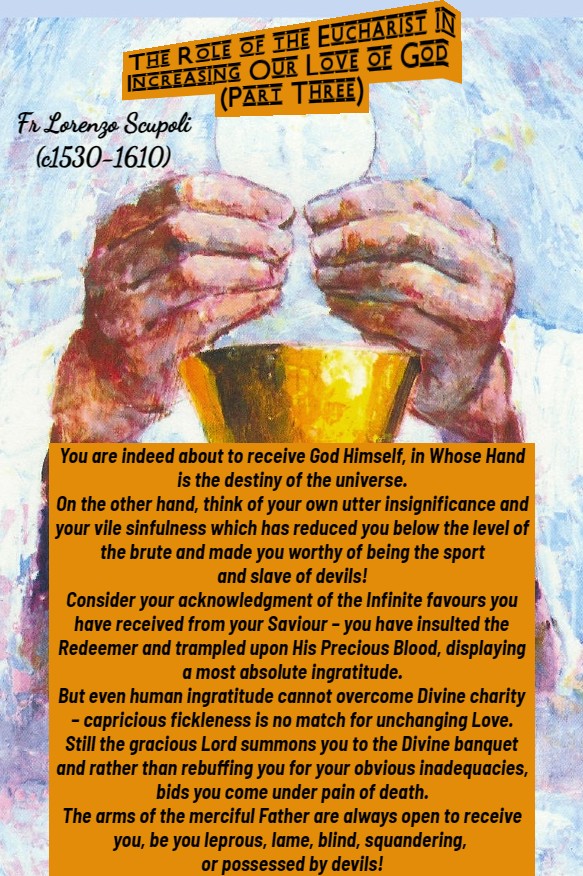
Thought for the Day – 6 January – The Spiritual Combat (1589) – Dom Lorenzo Scupoli OSM (c1530-1610)
“None shall be crowned who has not fought well.” 2 Tim 2: 5
Introduction I: Of the Essence of Christian Perfection – Of the Struggle Requisite for its Attainment – And of the Four Things Needful in this Conflict
Of the Struggle Requisite for its Attainment
“You see, then, very clearly that, as I have said, the spiritual life consists not in these things. It consists in nothing else but: the knowledge of the goodness and the greatness of God and of our nothingness and inclination to all evil; in the love of Him and the hatred of ourselves; in subjection, not to Him alone but for love of Him, to all His creatures; in entire renunciation of all will of our own and absolute resignation to all His divine pleasure; and furthermore, willing anddoing all this purely for the glory of God and solely to please Him and because He so wills and merits thus to be loved and served.
This is the law of love, impressed by the Hand of the Lord Himself upon the hearts of His faithful servants; this is the abnegation of self which He requires of us; this is His sweet yoke and light burden; this is the obedience to which, by His Voice and His Example, our Master and Redeemer calls us.
In aspiring to such sublime perfection, you will have to do continual violence to yourself by a generous conflict with your own will in all things, great or small, until it be wholly annihilated; you must prepare yourself, therefore, for the battle with all readiness of mind, for none but brave warriors shall receive the crown!
This is indeed the most difficult of all struggles — for while we strive against self, self is striving against us and, therefore, is the victory here most glorious and precious in the sight of God! For if you will set yourself to trample down and exterminate all your unruly appetites, desires and wishes, even in the smallest and most inconsiderable matters, you will render a greater and more acceptable service to God, than if you should discipline yourself to blood, fast more rigorously than hermits or anchorites of old, or convert millions of souls and yet, voluntarily leave even one of these evils alive within you. For although the conversion of souls is no doubt more precious to the Lord than the mortification of a fancy, nevertheless, nothing should, in your sight, be of greater account than to will and to do that very thing which the Lord specially demands and requires of you. And He will infallibly be better pleased that you should watch and labour to mortify your passions, than if, consciously and willfully, leaving but one alive within you, you should serve Him in some other matter of greater importance in itself.”
You must be logged in to post a comment.