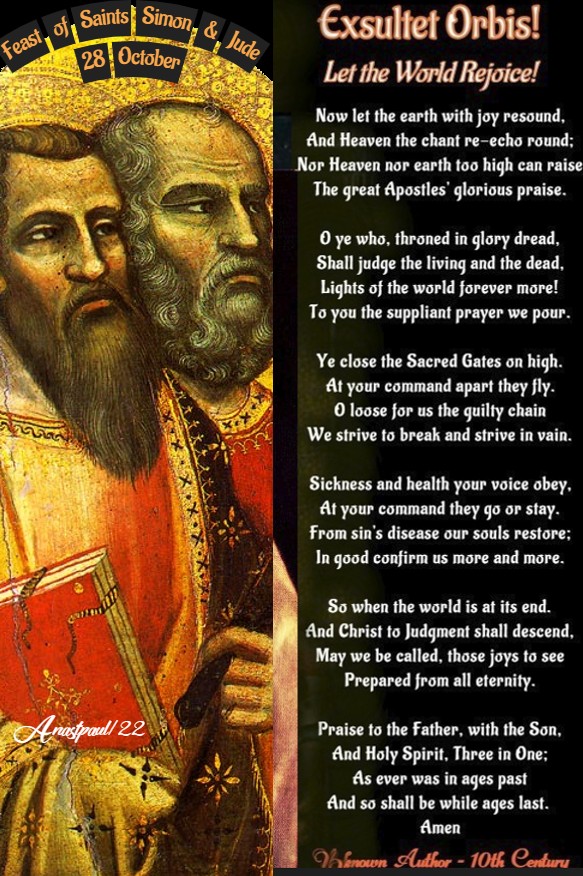
Our Morning Offering – 28 October – Feast of Saints Simon and Jude, Apostles
Exsultet Orbis! Let the World Rejoice! Unknown Author
Now let the earth with joy resound, And Heaven the chant re-echo round; Nor Heaven nor earth too high can raise The great Apostles’ glorious praise.
O ye who, throned in glory dread, Shall judge the living and the dead, Lights of the world forever more! To you the suppliant prayer we pour.
Ye close the Sacred Gates on high. At your command apart they fly. O loose for us the guilty chain We strive to break and strive in vain.
Sickness and health your voice obey, At your command they go or stay. From sin’s disease our souls restore; In good confirm us more and more.
So when the world is at its end. And Christ to Judgment shall descend, May we be called, those joys to see Prepared from all eternity.
Praise to the Father, with the Son, And Holy Spirit, Three in One; As ever was in ages past And so shall be while ages last. Amen
(Roman Breviary for the Common of Apostles) An Office Hymn that was traditionally prescribed for Vespers and Lauds on the Feasts of Apostles and Evangelists outside Easter time. The Hymn is found as early as the tenth century in a hymnal of Moissac Abbey.
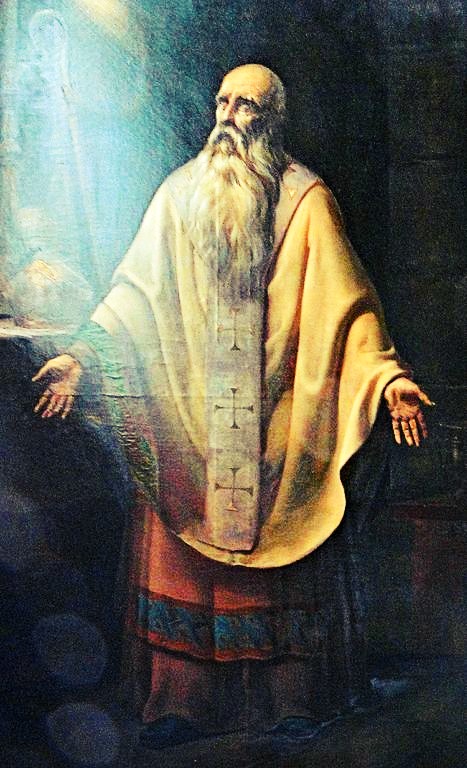
Saint of the Day – 28 October – Saint Gaudiosus of Naples (Died c453) Bishop of Abitinae in North Africa, Monk and founder of a Monastery where he introduced the Rule of St Augustine. Born Septimius Celius Gaudiosus in Tunisia, North Africa and died in exile in c455 at Naples in Italy of natural causes. Also known as – Gaudiosus of Abitinae, Gaudiosus the African.The image often used for our Saint is actually St Guadiosus of Brescia. I have found no image of today’s Saint.
The Roman Martyrology reads: “At Naples, St Gaudiosus, an African Bishop, who came to Campania because of the persecution of the Vandals and closed his holy career peacefully in a Monastery near that City.”
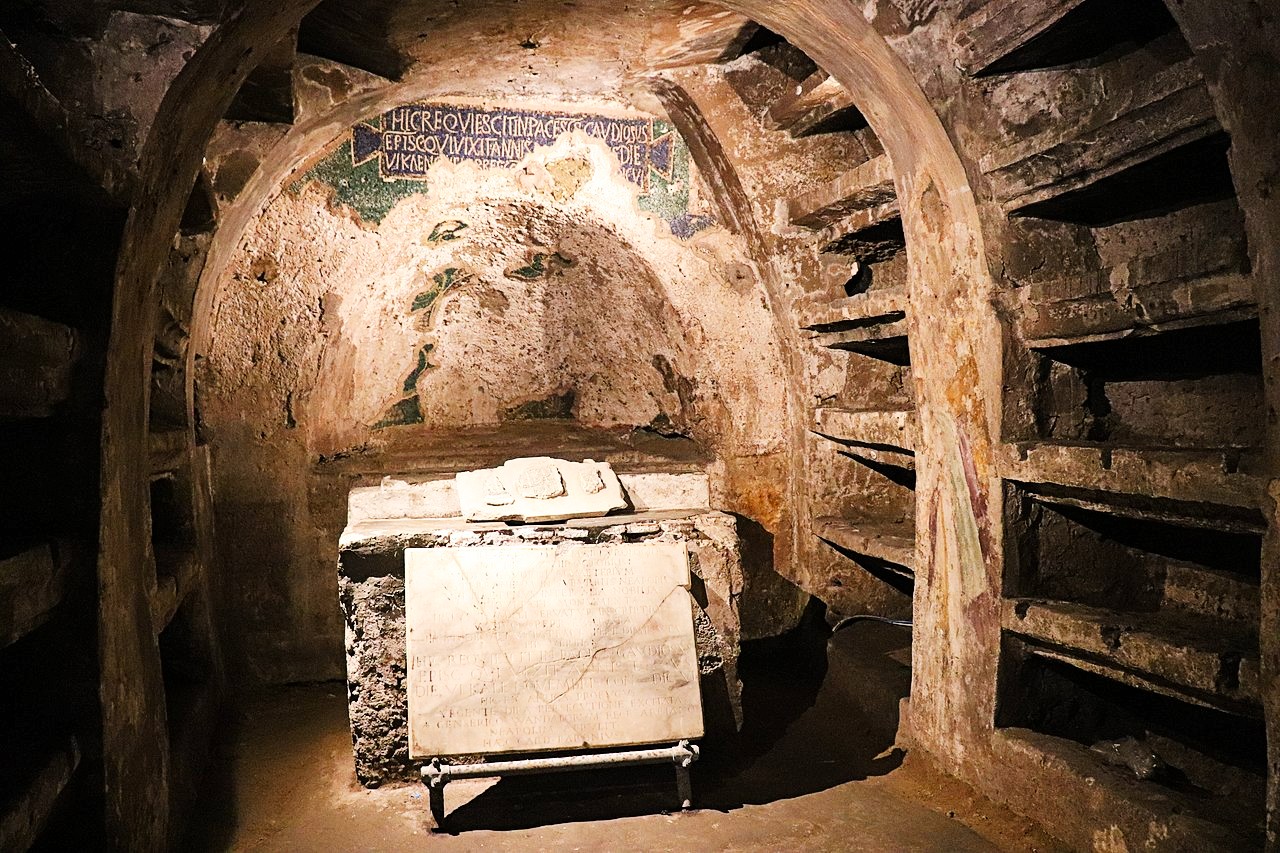
Tomb of St Gaudiosus
Gaudiosus, fled North Africa during the persecutions of Genseric, King of the Vandals, in a ship without sails or oars but which miraculously arrived safely in Naples carrying the precious cargo of other exiled Clergy, including the Bishop of Carthage, St Quodvultdeus and arriving in Naples in around 439,
Gaudiosus settled on the hill of Capodimonte, where he built a Monastery named the Caponapoli Monastery where he introduced the Rule of St Augustine. He is accredited with bringing to his new home, part of the Relics of St Restituta, the Virgin Martyr of Tunisia which are now kept in the early Basilica dedicated to her and which has been incorporated into the Naples Cathedral.
When Gaudiosus died between 451 and 45, he was buried in the Cemetery outside the City walls of Naples. His tomb soon began to arouse devotion. From that time onwards, the early Christian underground Cemetery expanded and gradually became the Catacombs of St Gaudiosus.
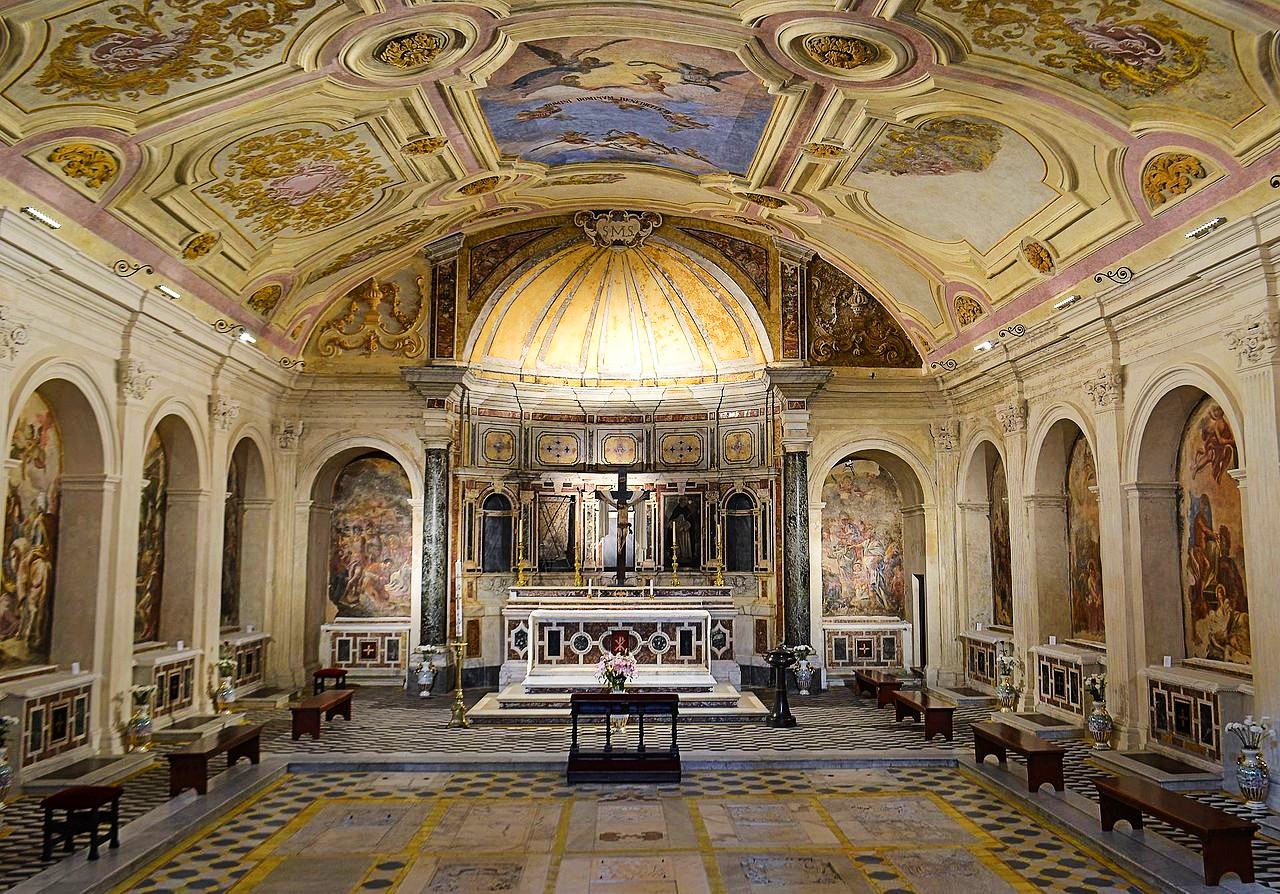
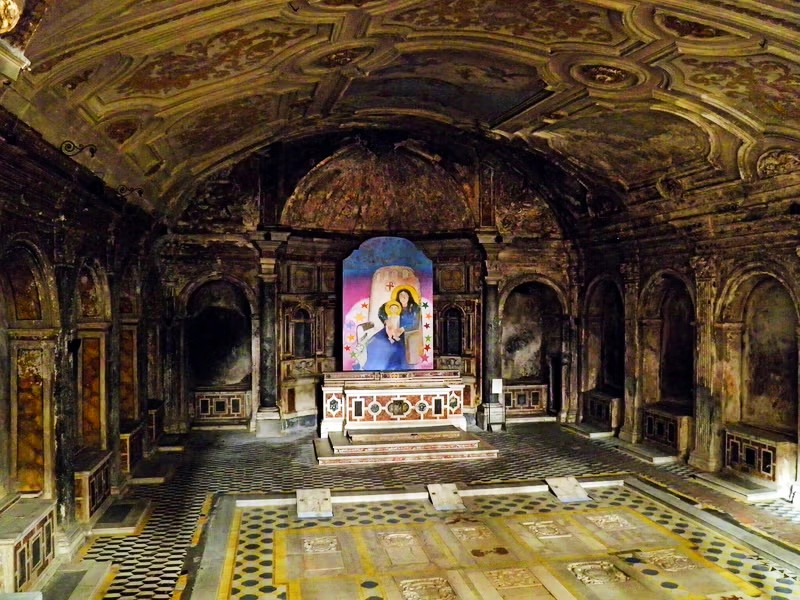
The Catacombs of San Gaudiosus are the second largest in Naples and includes both early Christian and 17th Century elements. The entrance to the underground burial site is inside the Basilica St Maria della Sanità, beneath the High Altar.
Main crypt below the High Altar of Santa Maria della Sanità.
On one side of the Catacombs there is the intensity of the early Christian elements, such as the Tombs of St Gaudiosus and Quodvultdeus. The walls are decorated with valuable frescoes and mosaics of the 5th and 6th Centuries which feature widely used Symbols in the early Christian era, such as the fish, the lamb and grapes with branches. On the other side are the special graves reserved for nobles, dating to the 17th Century, when the Catacombs resumed the function of a burial site.
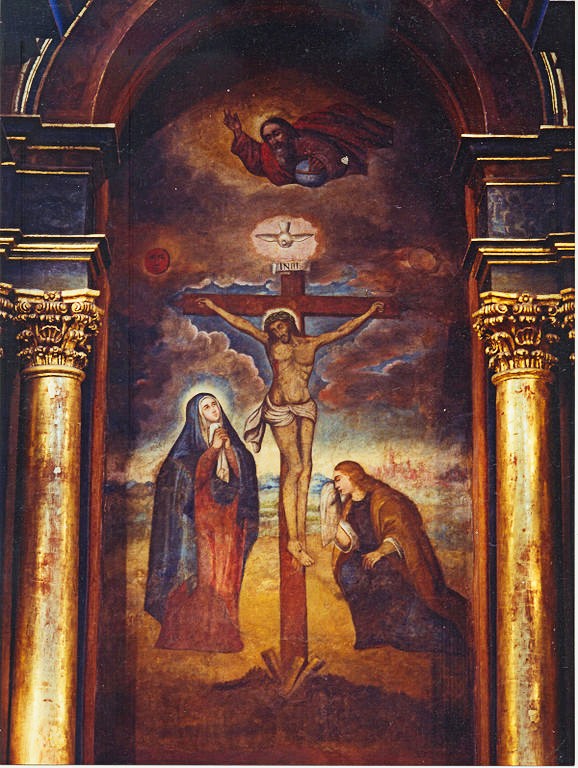
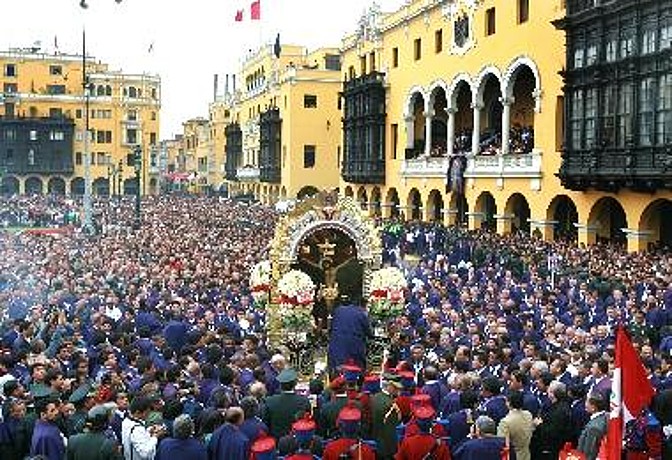
Lord of Miracles/Señor de los Milagros de Nazarenas – A mid-17th-century painting of the Crucifixion that is venerated in Lima, Peru and its celebration involves one of the largest processions in the world. It was painted by an unnamed African taken to Peru as a slave from what is now Angola. Above the Cross is the Holy Spirit and God the Father. Below and to the right of Jesus, is His mother, the Virgin Mary with her heart pierced by a sword of sorrow. Kneeling and weeping at the foot of the cross is St Mary Magdalene. The name originated on 13 November 1655 when everything around it was destroyed in an earthquake that left the painting standing and undamaged. Christ is shown enduring the pain of Crucifixion. Every year in October, hundreds of thousands of devotees from all races and economic backgrounds participate in a procession honouring the image through the streets of Lima. Boulevards are decorated in purple on 18,19 and the final Feast 28 October to celebrate the Lord of Miracles.
St Abdias of Babylon St Abraham of Ephesus St Alberic of Stavelot St Anastasia the Elder St Anglinus of Stavelot St Cyril of Rome St Cyrilla of Rome St Diomedes the Younger St Dorbhene of Iona
St Ferrutius St Gaudiosus of Naples (Died c453) Bishop St Genesius of Thiers Bl Germain of Talloires St Godwin of Stavelot St Maria Ascuncion St Remigius of Lyons St Rodrigo Aguilar Aleman St Salvius of Amiens
Martyrs of Avila – 3 Saints: Two sisters and a brother who, during a period of persecution, fled Talavera de la Reina, Spain, were caught and executed. Martyrs: Christeta, Sabina and Vincent. 303 in Avila, Spain.
Thought for the Day – 27 October – Meditations with Antonio Cardinal Bacci (1881-1971)
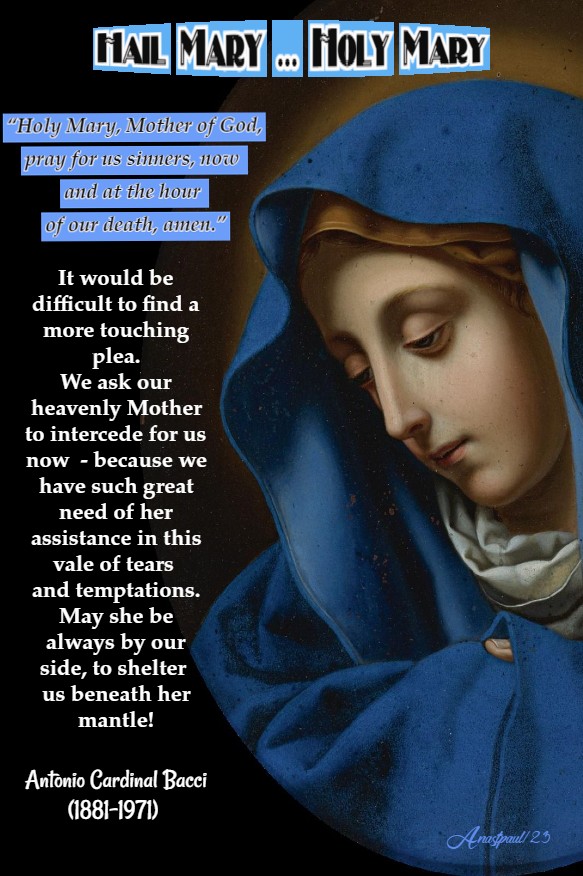
“Month of the Holy Rosary” “Hail Mary … Holy Mary”
“The Angel’s greeting was later completed by the salavation of St Elizabeth. As soon as Elizabeth saw the Blessed Virgin coming to visit her, she cried out in humble veneratin: “Blessed art thou among women and blessed is the fruit of thy womb!” (Lk 1:42).
In the first part of the Hail Mary, then, we pay her the words of the Gospel, the highest tributes ever accorded to any human creature, proclaiming her to be full of grace, blessed among women and Mother of the Redeemer. The second part, which was later added by the Church, (composed and proposed by St Peter Canisius 1521-1597) Doctor of the Church), is a heartfelt supplication addressed to Mary as the Mother of God and our Mother. “Holy Mary, Mother of God, pray for us sinners, now and at the hour of our death, amen.” It would be hard to find a more touching plea. We ask our heavenly Mother to intercede for us now – because we have such great need of her assistance in this vale of tears and temptations. May she be always by our side, to shelter us beneath her mantle!”
Quote/s of the Day – 27 October – Vigil of Saints Simon and Jude – 1 Corinthians 4:9-14, John 15:1-7 – Scripture search here: https://www.drbo.org/
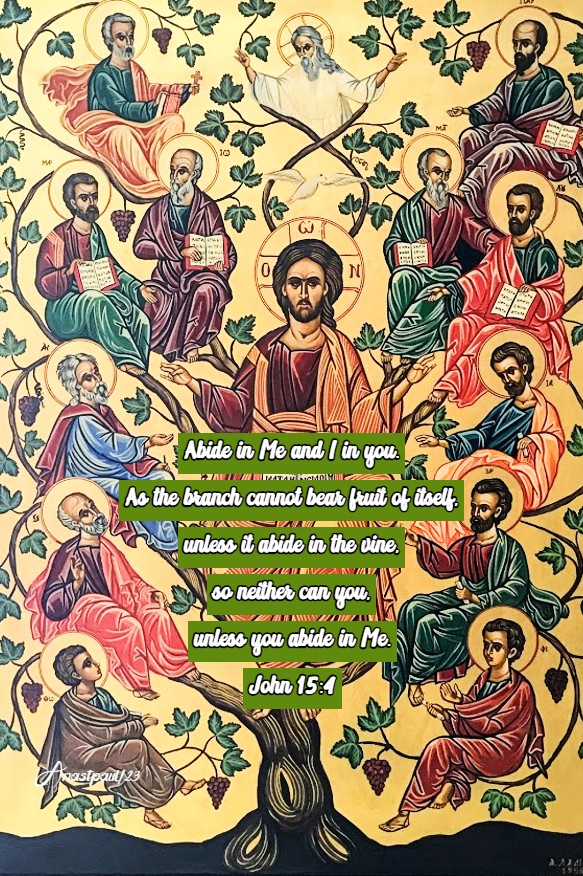
“Abide in Me and I in you. As the branch cannot bear fruit of itself, unless it abide in the vine, so neither can you, unless you abide in Me.”
John 15:4
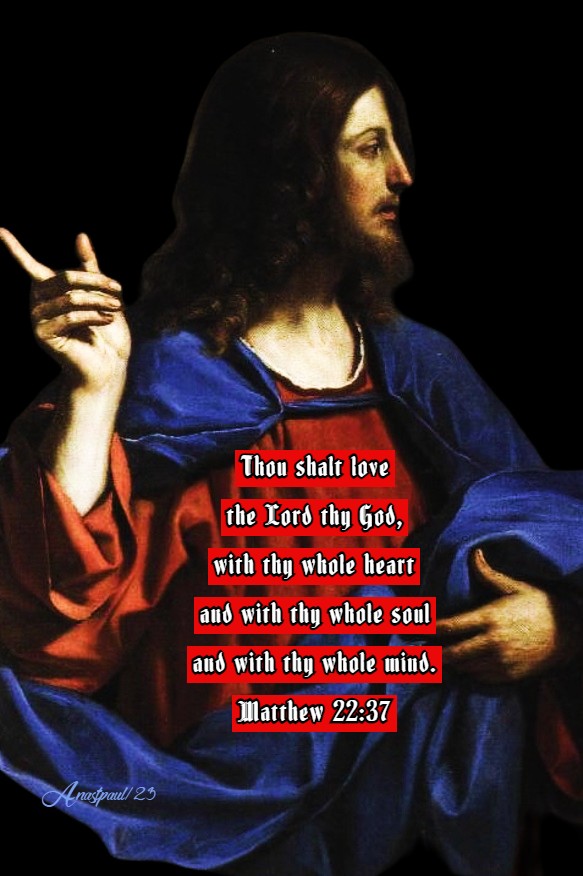
“Thou shalt love the Lord thy God, with thy whole heart and with thy whole soul and with thy whole mind.”
Matthew 22:37
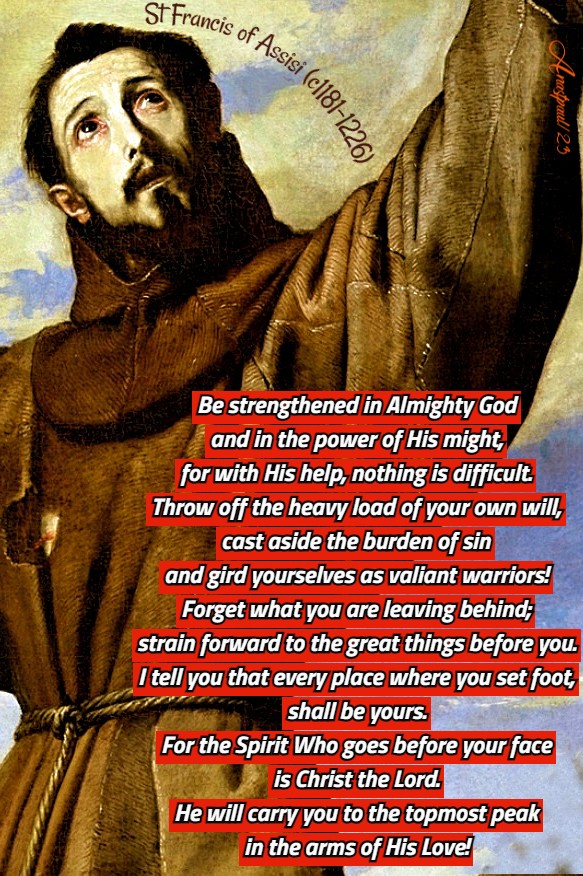
“Be strengthened in Almighty God and in the power of His might, for with His help, nothing is difficult. Throw off the heavy load of your own will, cast aside the burden of sin and gird yourselves as valiant warriors! Forget what you are leaving behind; strain forward to the great things before you. I tell you that every place where you set foot, shall be yours. For the Spirit, Who goes before your face is Christ the Lord. He will carry you to the topmost peak in the arms of His Love.”
St Francis of Assisi (c1181-1226)
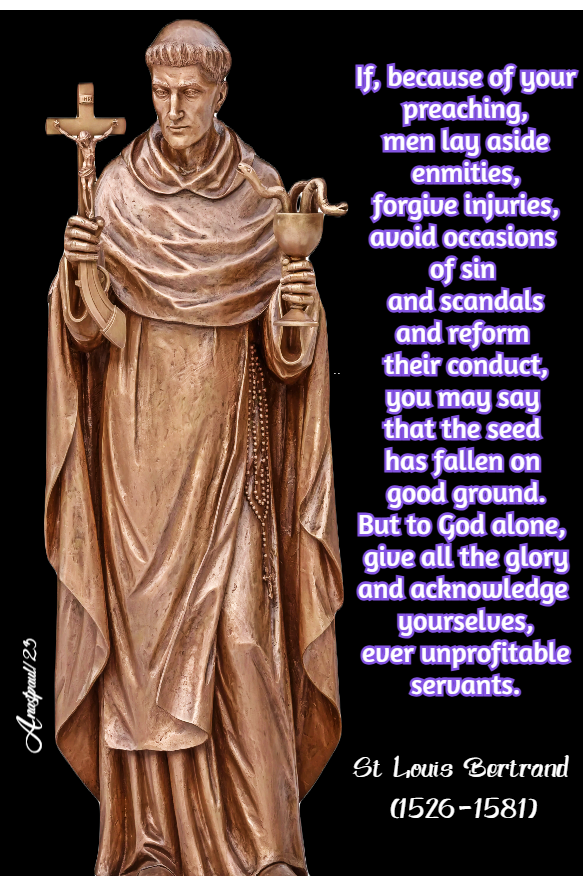
“If, because of your preaching, men lay aside enmities, forgive injuries, avoid occasions of sin and scandals and reform their conduct, you may say that the seed has fallen on good ground. But to God alone, give all the glory and acknowledge yourselves, ever unprofitable servants.”
St Louis Bertrand (1526-1581)
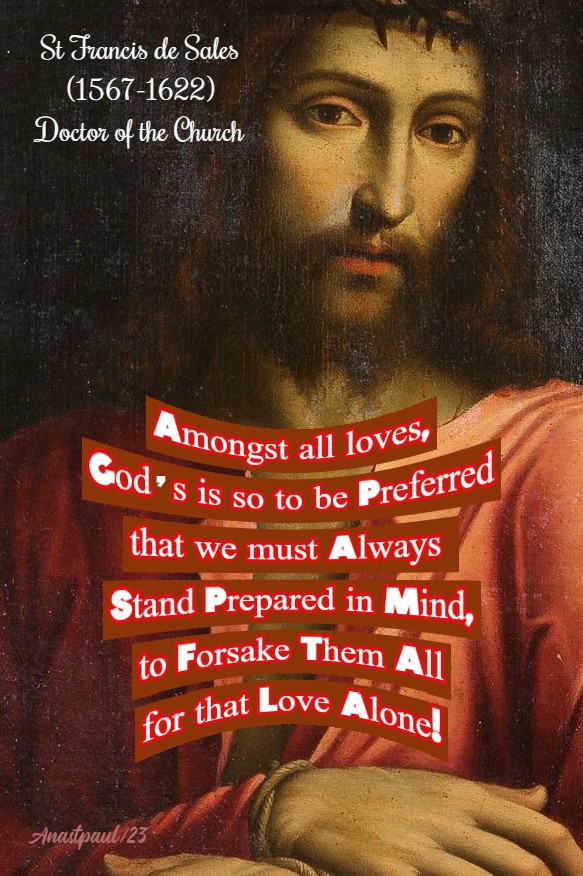
“Amongst all loves, God’s is so to be preferred that we must always stand prepared in mind, to forsake them all for that alone!”
St Francis de Sales (1567-1622) Doctor of the Church
(Treatise on the Love of God, Book 10, Chapter 7)
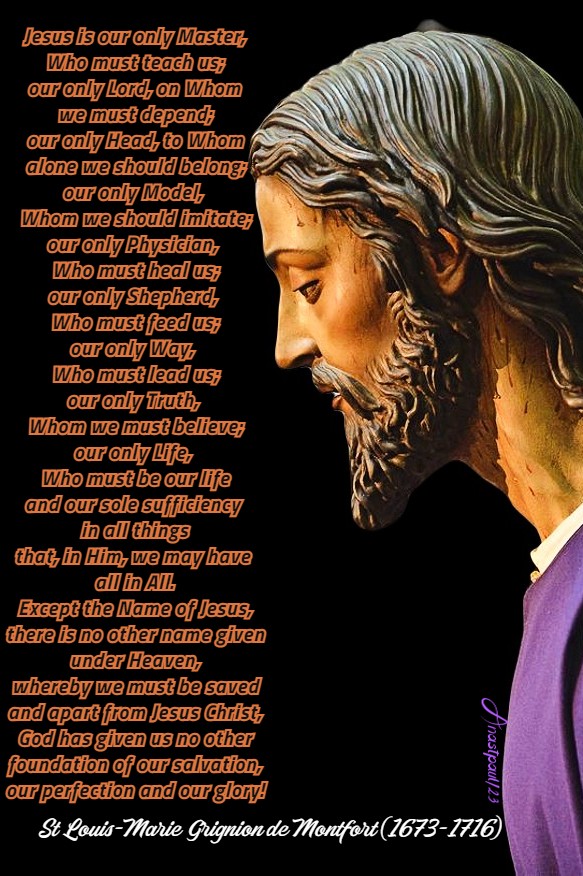
“[Jesus] is our only Master, Who must teach us; our only Lord, on Whom we must depend; our only Head, to Whom alone we should belong; our only Model, Whom we should imitate; our only Physician, Who must heal us; our only Shepherd, Who must feed us; our only Way, Who must lead us; our only Truth, Whom we must believe; our only Life, Who must be our life and our sole sufficiency in all things that, in Him, we may have all in All. Except the Name of Jesus, there is no other name given under Heaven, whereby we must be saved and apart from Jesus Christ, God has given us no other foundation of our salvation, our perfection and our glory! ”
One Minute Reflection – 27 October – “The Month of the Most Holy Rosary and of the Angels” – Vigil of Saints Simon and Jude – 1 Corinthians 4:9-14, John 15:1-7 – Scripture search here: https://www.drbo.org/
“Abide in Me and I in you.” – John 15:4
REFLECTION – “[Jesus] is our only Master, Who must teach us; our only Lord, on Whom we must depend; our only Head, to Whom alone we should belong; our only Model, Whom we should imitate; our only Physician, Who must heal us; our only Shepherd, Who must feed us; our only Way, Who must lead us; our only Truth, Whom we must believe; our only Life, Who must be our life and our sole sufficiency in all things that, in Him, we may have all in All. Except the Name of Jesus, there is no other name given under Heaven, whereby we must be saved and apart from Jesus Christ, God has given us no other foundation of our salvation, our perfection and our glory: “for other foundations, no man can lay but that which is laid which is Christ Jesus” (1 Cor 3:11). Every house which is not built upon this firm Rock, is founded on the shifting sands and will inevitably fall, sooner or later. Every soul who is not united with Christ, as a branch to the stem of the vine, will fall off, wither and become fit only for the fire. If we are in Jesus Christ and Jesus Christ in us, we need not fear damnation; neither Angels in Heaven, nor men on earth, neither demons in hell, nor any other creature, can harm us because they cannot separate us from the love of God in Christ Jesus (cf. Rm 8:38-39).” – St Louis-Marie Grignion de Montfort (1673-1716) Priest, Renowned Preacher, Founder of Religious Communities [Treatise on the true devotion to the Blessed Virgin (Article one; First Truth)]
PRAYER – Grant, we beseech Thee, O Lord God, unto all Thy servants, that they may remain continually in the enjoyment of soundness, both of mind and body and by the glorious intercession of the Blessed Mary, always a Virgin, maybe delivered from present sadness and enter into the joy of Thine eternal gladness. Through Jesus Christ, Thy Son our Lord, Who lives and reigns with Thee, in the unity of the Holy Ghost, God, world without end. Amen (Collect).
Our Morning Offering – 27 October – Friday: Day of the Passion of Christ
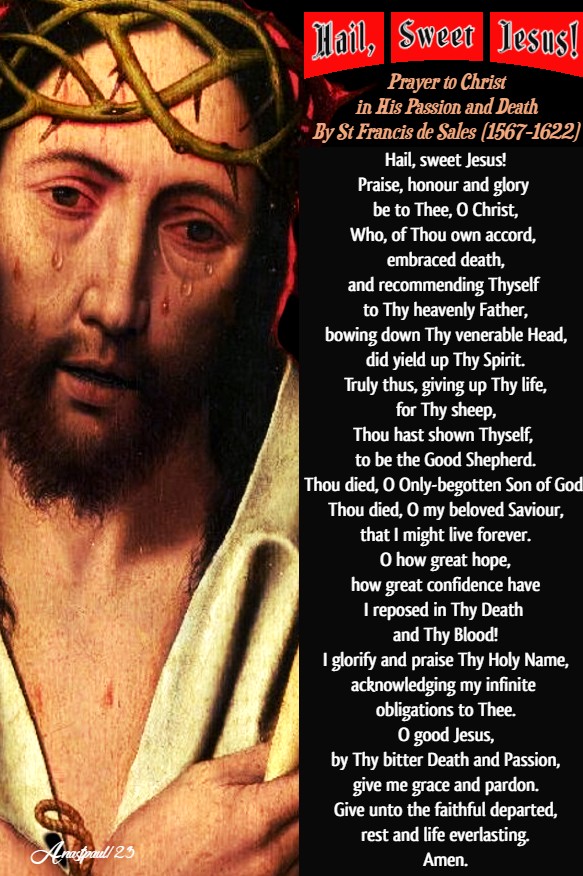
Hail, Sweet Jesus! Prayer to Christ in His Passion and Death By St Francis de Sales (1567-1622) Doctor of the Church
Hail, sweet Jesus! Praise, honour and glory be to Thee, O Christ, Who, of Thou own accord, embraced death, and recommending Thyself to Thy heavenly Father, bowing down Thy venerable Head, did yield up Thy Spirit. Truly thus, giving up Thy life, for Thy sheep, Thou hast shown Thyself, to be the Good Shepherd. Thou died, O Only-begotten Son of God. Thou died, O my beloved Saviour, that I might live forever. O how great hope, how great confidence have I reposed in Thy Death and Thy Blood! I glorify and praise Thy Holy Name, acknowledging my infinite obligations to Thee. O good Jesus, by Thy bitter Death and Passion, give me grace and pardon. Give unto the faithful departed, rest and life everlasting. Amen.
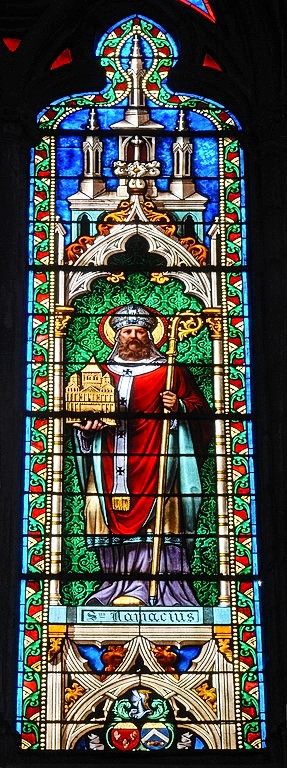
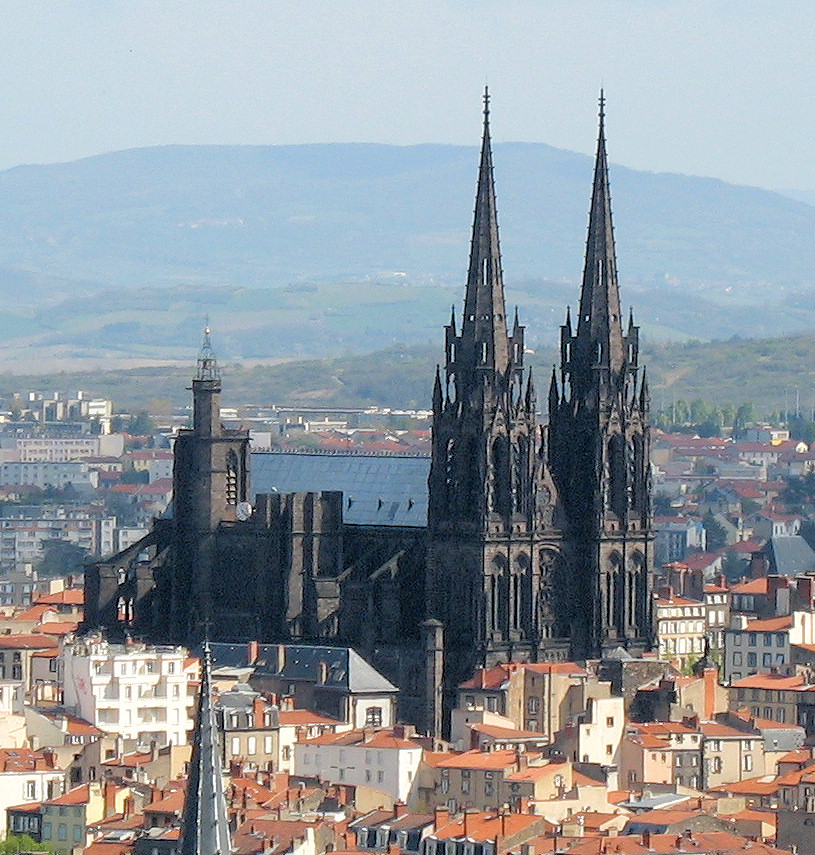
Saint of the Day – 27 October – Saint Namatius of Clermont (Died c462) Bishop, the Eighth or Ninth Bishop of Clermont (then called Arvernis) from 446 until his death in 462 and founded Clermont’s first Cathedral, bringing the Relics of Saints Vitalis and Agricola from Bologna, Italy, to enshrined therein.dedicating the Cathedral to them. Also known as – Namace, Namazio.
Namatius was a wise and good man, happily married. He lived in France (New Aquitaine), in the 5th Century. Despite having married, Namatius was elected Bishop of Clermont. In fact, in those days, the Bishop was chosen from among the City’s men who demonstrated that they had many virtues and qualities to put to good use for the entire community and, that they were capable of the sacrifices necessary in order to become the shepherd of the flock of Christ.
Even the Bishop’s wife had to demonstrate that she possessed great virtues, like Namatius’ wife, a woman with a truly golden heart, as well as being very cultured. Namatius and his wife joyfully accepted the new role. From that moment on, they no longer lived together as before – each one lived separately at the service of the Lord.
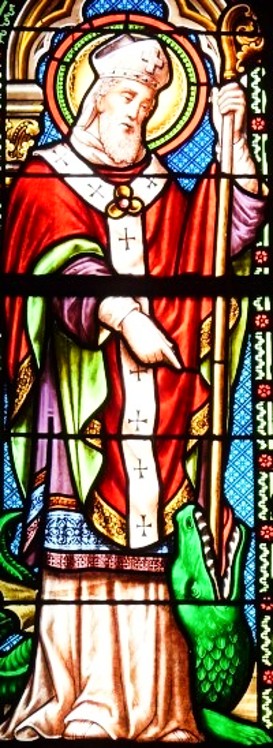
A stained glass window (see right) in the Saint-Eutrope Church in Clermont shows the Saint carrying the first Cathedral of Clermont.
Of this construction project, St Gregory of Tours in his Historia Francorum writes:
“He undertook the task of building the older Church which is still standing and is contained within the walls of the City, one hundred and fifty feet in length, sixty in width,-that is, the nave, fifty in height to the vault, with a round apse in front and on each side aisles finely built, the whole building is laid out in the form of a cross; it has forty-two windows, seventy columns, eight doors. The fear of God is in it and a great brightness is seen and, in the spring, a very pleasant fragrance, as if of spices, is perceived there by the devout. It has, near the Altar, walls of variegated work, adorned with many kinds of marble. The blessed Bishop on finishing the building in the twelfth year, sent Priests to Bologna in Italy, to procure Relics of Saints Agricola and Vitalis, who we know, very certainly, were crucified in the name of Christ our God.”
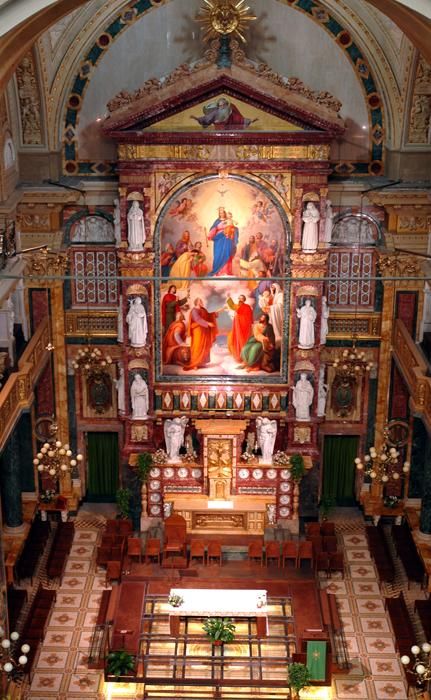
Dedication of the Basilica of Auxilium Christianorum / Our Lady Help of Christians, Turin, Italy, built by St John Bosco (1868) – 27 October: HERE: https://anastpaul.com/2021/10/27/88503/
Thought for the Day – 26 October – Meditations with Antonio Cardinal Bacci (1881-1971)
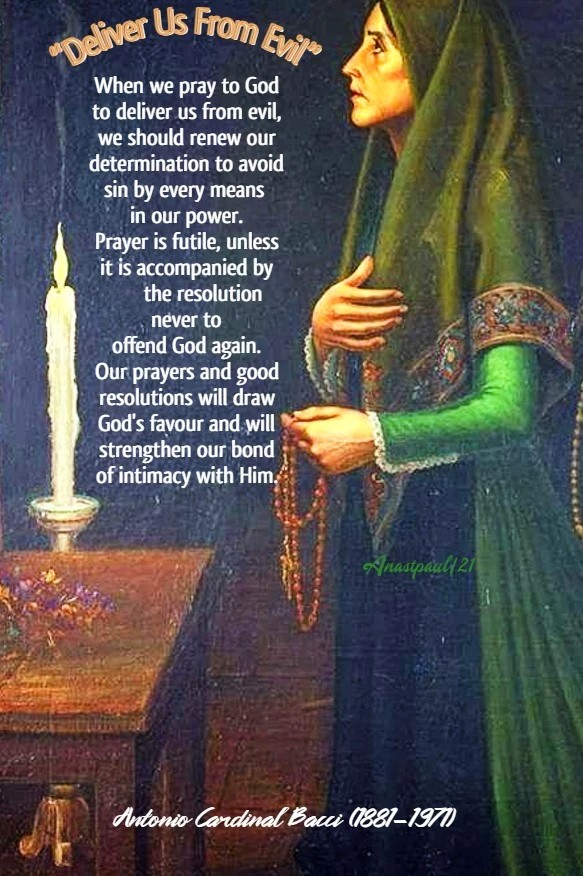
“Month of the Holy Rosary” “Deliver Us From Evil”
“When we ask God to deliver us from evil, we should think chiefly of the real evil, which is spiritual. All other evils are insignificant in comparison with sin, which is an offence committed against God, our only good. Sin robs us of His grace, which is the supernatural life of the soul, deprives us of His friendship and is an act of ingratitude towards our supreme Benefactor.
When we pray to God to deliver us from evil, we should renew our determination to avoid sin by every means in our power. Prayer is futile, unless it is accompanied by the resolution never to offend God again. Our prayers and good resolutions will draw God’s favour and will strengthen our bond of intimacy with Him.”
Quote/s of the Day – 26 October – “The Month of the Most Holy Rosary and of the Angels” – 1 Peter 5:1-4; 5:10-11, Matthew 16:13-19 – Scripture search here: https://www.drbo.org/
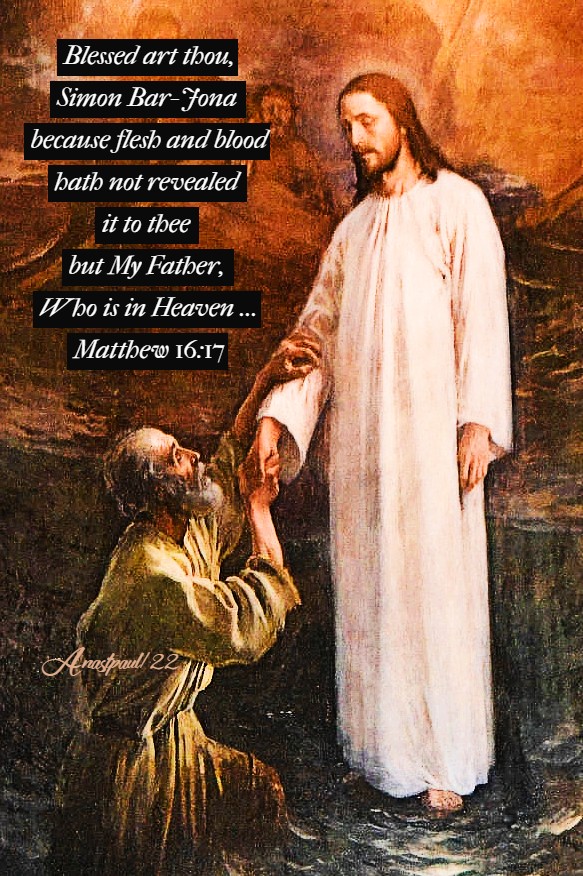
“Blessed art thou, Simon Bar-Jona because flesh and blood hath not revealed it to thee but My Father Who is in Heaven.”
Matthew 16:17
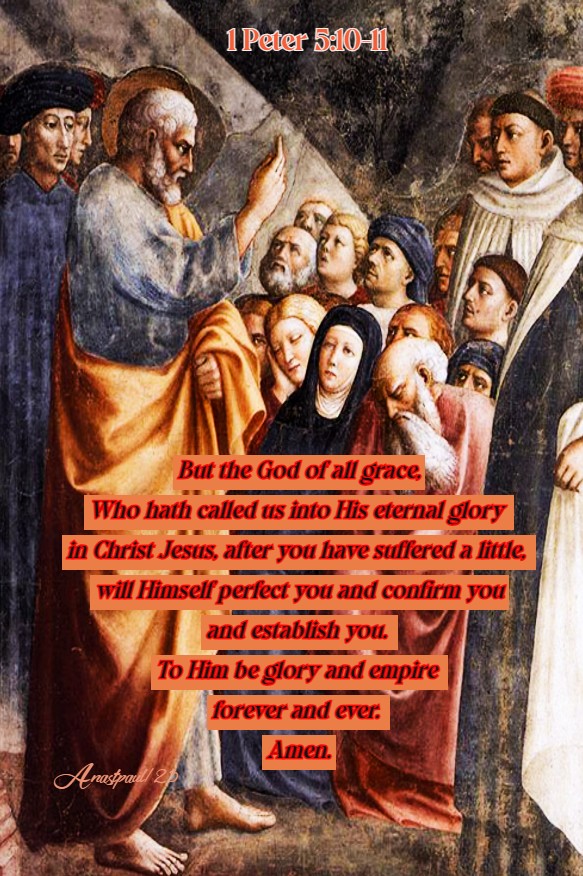
“But the God of all grace, Who hath called us into His eternal glory in Christ Jesus, after you have suffered a little, will Himself perfect you and confirm you and establish you. To Him be glory and empire forever and ever. Amen.”
1 Peter 5:10-11
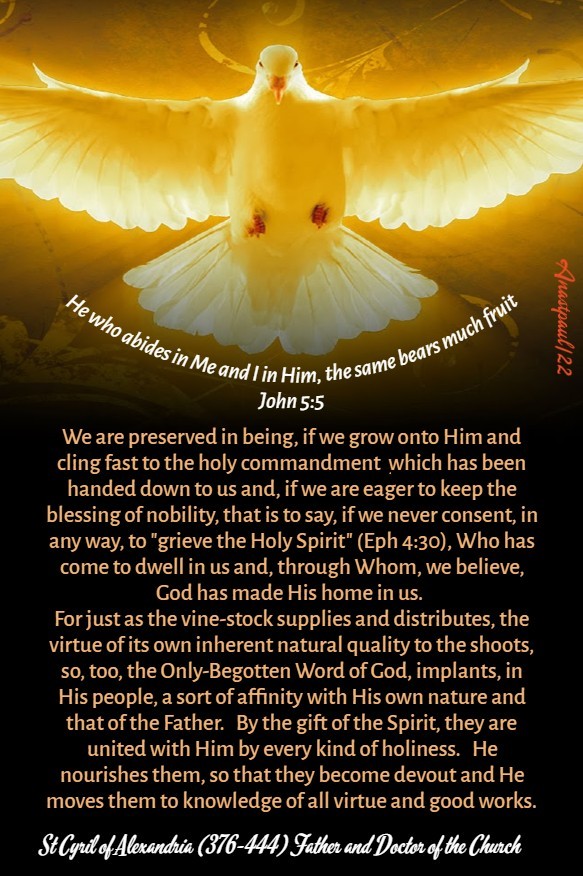
“He who abides in Me and I in Him, the same bears much fruit” John 5:5
“We are preserved in being, if we grow onto Him and cling fast to the holy commandment, which has been handed down to us and, if we are eager to keep the blessing of nobility, that is to say, if we never consent, in any way, to “grieve the Holy Spirit” (Eph 4:30), Who has come to dwell in us and, through Whom, we believe, God has made His home in us. … For just as the vine-stock supplies and distributes, the virtue of its own inherent natural quality to the shoots, so, too, the Only-Begotten Word of God, implants, in His people, a sort of affinity with His own nature and that of the Father. By the gift of the Spirit, they are united with Him by every kind of holiness. He nourishes them, so that they become devout and He moves them to knowledge of all virtue and good works.”
St Cyril of Alexandria (376-444) Father & Doctor of the Church
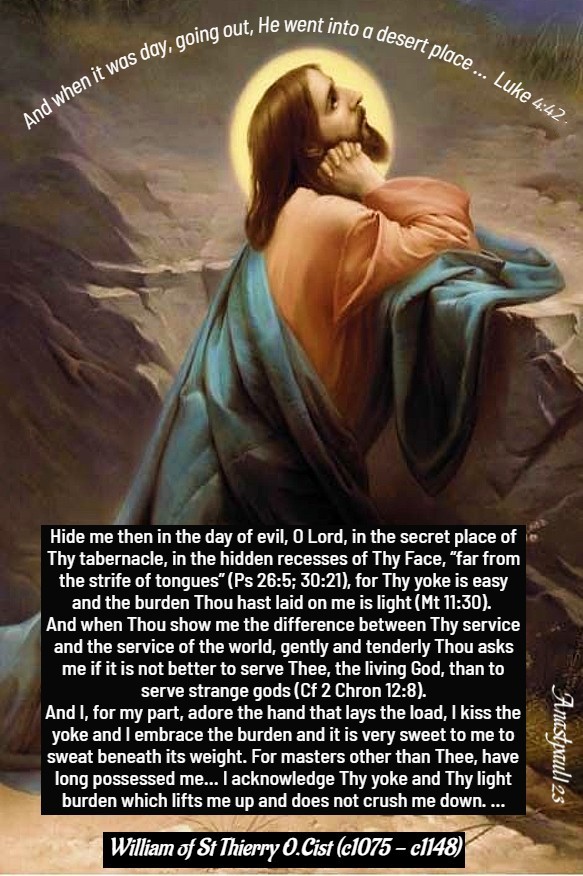
“Hide me then in the day of evil, O Lord, in the secret place of Thy tabernacle, in the hidden recesses of Thy Face, “far from the strife of tongues” (Ps 26:5; 30:21), for Thy yoke is easy and the burden Thou hast laid on me is light (Mt 11:30). And when Thou show me the difference between Thy service and the service of the world, gently and tenderly Thou asks me if it is not better to serve Thee, the living God, than to serve strange gods (Cf 2 Chron 12:8). And I, for my part, adore the hand that lays the load, I kiss the yoke and I embrace the burden and it is very sweet to me to sweat beneath its weight. For masters other than Thee, have long possessed me… I acknowledge Thy yoke and Thy light burden which lifts me up and does not crush me down. …”
William of St Thierry O.Cist (c1075 – c1148)
“Let us always belong to God, unreservedly and without interruption. May He ever live and reign in our hearts.”
(Letter to Madame de Chantal)
“He who most loves, will be most loved.”
St Francis de Sales (1567-1622) Doctor of the Church
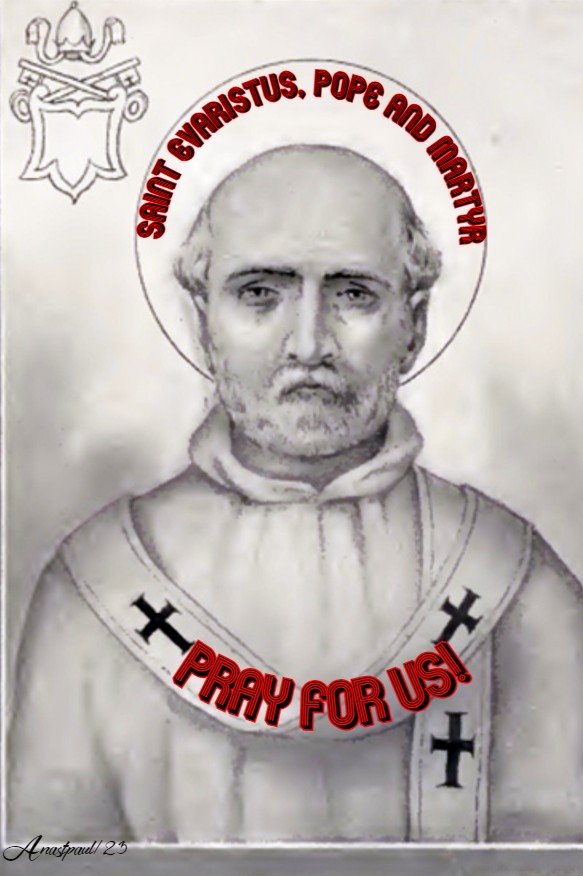
One Minute Reflection – 26 October – “The Month of the Most Holy Rosary and of the Angels” – St Evaristus – (c44–c107) Martyr, Pope Evaristus is the fifth Bishop of Rome, holding office from c99 until his death in c108. – 1 Peter 5:1-4; 5:10-11, Matthew 16:13-19 – Scripture search here: https://www.drbo.org/
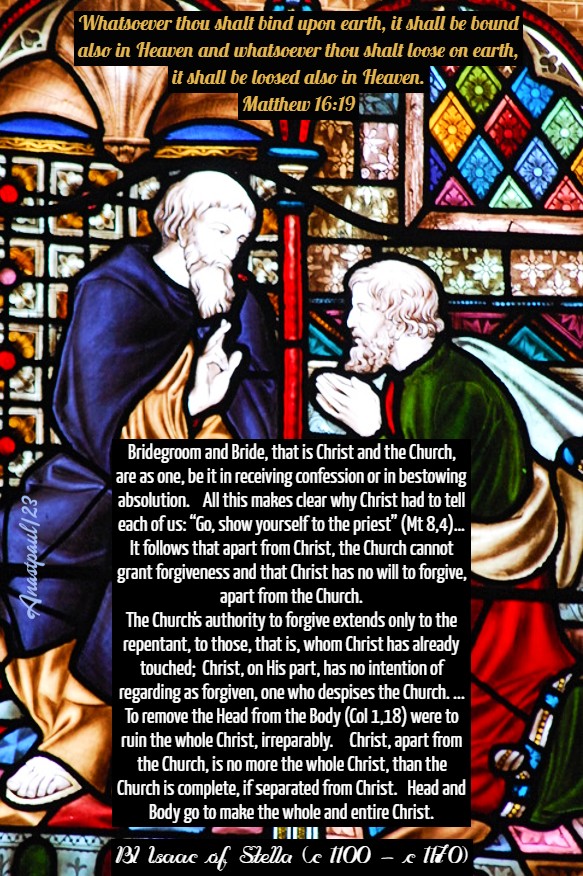
“Whatsoever thou shalt bind upon earth, it shall be bound also in Heaven and whatsoever thou shalt loose on earth, it shall be loosed also in Heaven.” – Matthew 16:19
REFLECTION – “Bridegroom and Bride, that is Christ and the Church, are as one, be it in receiving confession or in bestowing absolution. All this makes clear why Christ had to tell each of us: “Go, show yourself to the priest” (Mt 8,4)… It follows that apart from Christ, the Church cannot grant forgiveness and that Christ has no will to forgive, apart from the Church. The Church’s authority to forgive extends only to the repentant, to those, that is, whom Christ has already touched; Christ, on His part, has no intention of regarding as forgiven, one who despises the Church.
Doubtless, Christ need accept no restraints to His power of Baptising, Consecrating the Eucharist, Ordaining Priests, forgiving sins and the like but, the humble and faithful Bridegroom, prefers to confer such blessings, with the co-operation of His Bride. “What God,” then, “has joined, let no man put asunder” (Mt 19,6). “I say this is a great mystery and refers to Christ and the Church” (Eph 5,32)… To remove the Head from the Body (Col 1,18) were to ruin the whole Christ, irreparably. Christ, apart from the Church, is no more the whole Christ, than the Church is complete, if separated from Christ. Head and Body go to make the whole and entire Christ.” – Bl Isaac of Stella (c 1100 – c 1170) Cistercian Monk, Abbot, Theologian, Philosopher (Sermon 11, §11-814).
PRAYER – Look forgivingly on Thy flock, Eternal Shepherd and keep it in Thy constant protection, by the intercession of blessed Evaristus Thy Martyr and Sovereign Pontiff, whom Thou didst constitute Shepherd of the whole Church. Through Jesus Christ, Thy Son our Lord, Who lives and reigns with Thee, in the unity of the Holy Ghost, God, world without end. Amen (Collect).
Our Morning Offering – 26 October – Catholic Time : On Thursdays we particularly venerate the Most Blessed Sacrament of the Altar. Our Lord instituted the Holy Sacrifice of the Mass on a Thursday, therefore, it is fitting that we remember this greatest of Sacraments on this day. The Eucharist is the greatest gift of God to mankind, as it is nothing less than Jesus Himself. What gift could be greater?
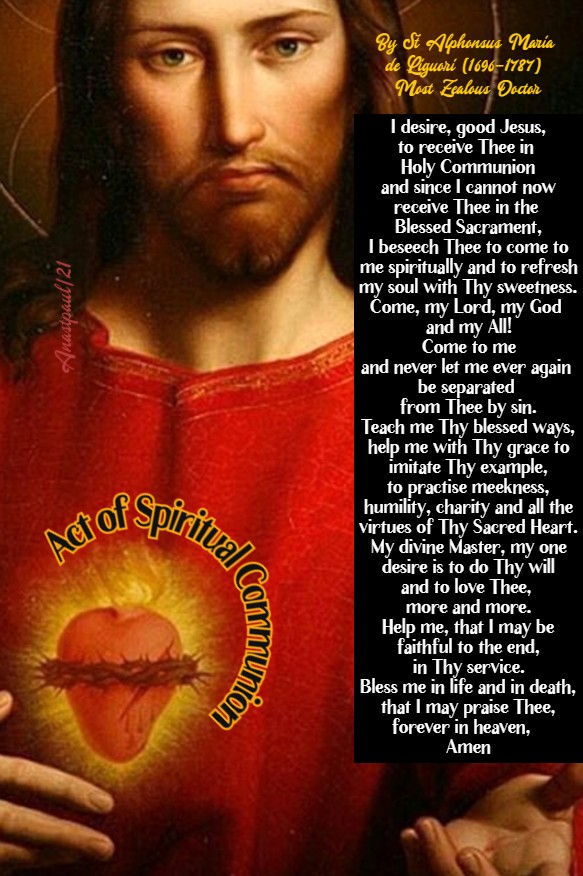
Act of Spiritual Communion By St Alphonsus Maria de Liguori (1696-1787) Most Zealous Doctor
I desire, good Jesus, to receive Thee in Holy Communion and since I cannot now receive Thee in the Blessed Sacrament, I beseech Thee to come to me spiritually and to refresh my soul with Thy sweetness. Come, my Lord, my God and my All! Come to me and never let me ever again be separated from Thee by sin. Teach me Thy blessed ways, help me with Thy grace to imitate Thy example, to practise meekness, humility, charity and all the virtues of Thy Sacred Heart. My divine Master, my one desire is to do Thy will and to love Thee, more and more. Help me, that I may be faithful to the end, in Thy service. Bless me in life and in death, that I may praise Thee, forever in heaven, Amen
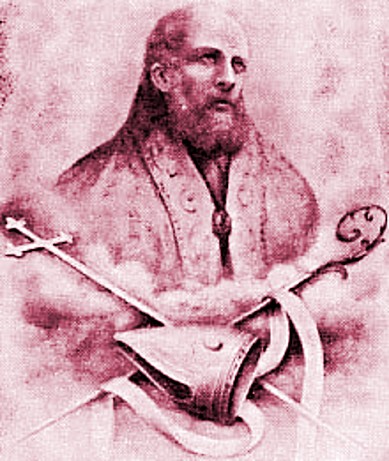
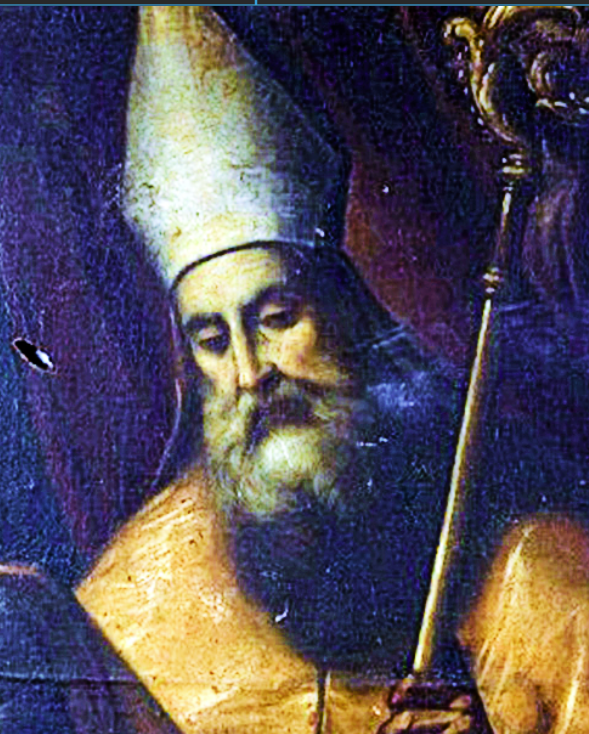
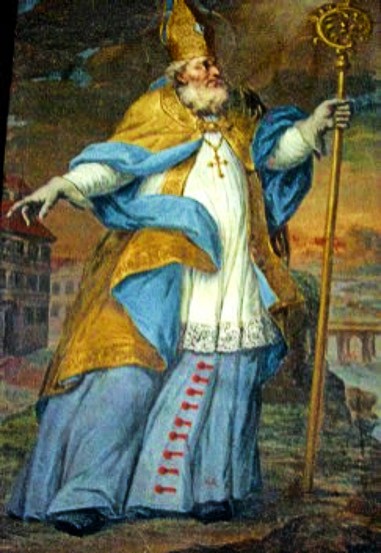
Saint of the Day – 26 October – Saint Fulk of Pavia (1164-1229) Bishop, Confessor, Peacemaker, Protector of the poor and educator of their children, Religious Reformer and Social Reformer, Defender of the Church and its rights. Born 1164 in Piacenza, Italy and died on 16 December 1229 of natural causes in Pavia, Italy aged 65. Co-Patron of Pavia. Fulk’s forefathers originally came from Ireland, hence the family name Scotti or Scotus but by the time of his arrival into the world, his family name had become one of the richest and most influential in the region. Scotia was originally the Latin name for Ireland (also called Hibernia by the Romans). Our Saint is known too as – Fulk of Piacenza, Folco Scotti, Foulques… Additional Memorial 21 May in Pavia and 16 December on some calendars.
The Roman Martyrology reads: “In Pavia, Saint Fulk, Bishop, man of peace, full of zeal and charity”
Nothing is known of Fulk’s birth or childhood, except that his parents were members of a greatly influential and immensely wealthy family, originally the descendants of Irish emigrants. In 1186, aged 22, he entered the Regular Canons of the Parish of St Eufemia, and later (1491) Fulk joined the Renana Congregation of the Most Holy Saviour..
Fulk was so talented that he was sent to Paris to complete his studies in theology. In 1194, at the age of 30, he had to return to Piacenza as he had been appointed Prior of St Eufemia. Bishop Grimerius (1199-1210) depended to a large extent on Fulk’s assistance and, in 1207, he gave him the responsibility of delivering the opening speech at the Synod. The following year, Fulk was appointed Canon at the Cathedral and Archpriest. He was also appointed Lecturer in theology at the Seminary in Piacenza.
When, in 1210, Bishop Grimerius died, Fulk was elected his successor as Bishop of Piacenza. This election was not confirmed by Pope Innocent III (1198-1216) but, nevertheless, he administered the Diocese for six years before being officially Consecrated in 1216, by Pope Honorius III (1216-1227).
In the same year,1216, the electors of Pavia Diocese elected Fulk as the City’s 49th Bishop and he held the office of Bishop of Pavia for thirteen years.
At that time, there was strong enmity between the Cities of Pavia and Piacenza, which was not unusual for neighbouring Cities. Even today, the rivalry between the two Cities lives on in colourful traditions and competitions. But, in the Middle Ages, the rivalry was not colourful folklore but violent and bloody and entailed great sorrow and ruin. Bishop Fulk, who was from Piacenza and was the Bishop of Pavia, became the foremost peacemaker between the two Cities. He first worked for internal peace in the Cities which were also characterised by violent factional battles. He then worked for peace between them.
Bishop Fulk founded a number of social institutions which, among other things, provided food for the poor and free education for their children. He also reformed religious houses, including the Monastery of San Pietro in Ciel d’Oro, and he defended the freedom of the Church against the Civil authorities.
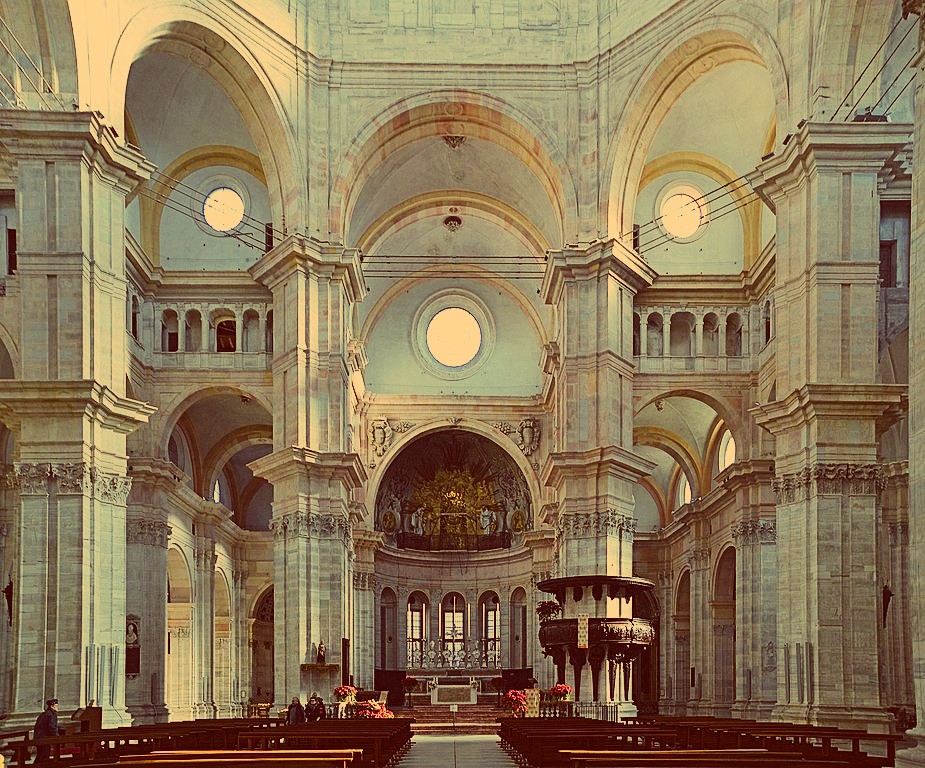
Fulk died on 16 December 1229 and was buried in the Cathedral. He was succeeded by Saint Rodobald II de’ Cipolla. His memorial day is 26 October. In the Cathedral of Pavia he is celebrated on 21 May. He was Canonised by Pope Gregory IX.
Our Saint Fulk goes down in history as an extraordinary peacemaker. Supported by his unshakable faith and the teachings of Jesus, the Bishop often managed to restore peace, so much so that he is loved by both the people of his own birthplace, Piacenza and the people of his beloved See, Pavia.
St Adalgott of Einsiedeln St Alanus of Quimper St Albinus of Buraburg
St Alfred the Great (849-899) King of Wessex, Confessor, Scholar, Writer and Translator, negotiator. He administered justice with insight and fairness, protected the poor, and encouraged art and the crafts. He tried in all that he did, to rule as a model Christian King. For all this, he alone among the rulers of England is called “the Great.” This Great Saint’s Life: https://anastpaul.com/2021/10/26/saint-of-the-day-26-october-saint-alfred-the-great-849-899/
St Alorus of Quimper St Amandus of Strasburg St Amandus of Worms St Aneurin St Aptonius of Angouleme St Arnold of Queralt St Bean of Mortlach St Bernard de Figuerols
St Felicissimus of Carthage St Florius Martyr of Nicomedia and Companions St Fulk of Pavia (1164-1229) Bishop St Gaudiosus of Salerno St Gibitrudis St Gwinoc St Humbert St Lucian Martyr of Nicomedia and Companions St Marcian St Quadragesimus of Policastro St Quodvultdeus St Rogatian of Carthage St Rusticus of Narbonne St Sigibald of Metz
Thought for the Day – 25 October – Meditations with Antonio Cardinal Bacci (1881-1971)
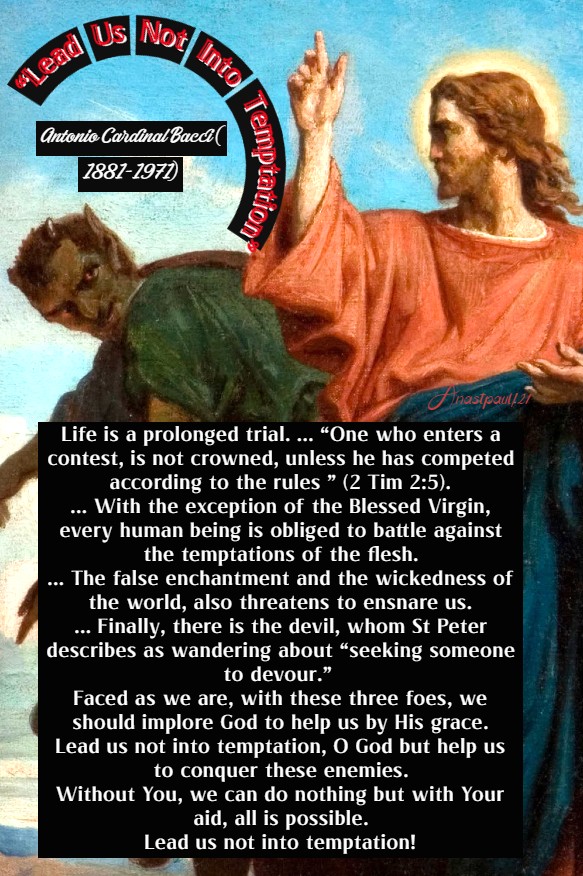
“Month of the Holy Rosary” “Lead Us Not Into Temptation”
“Life is a prolonged trial. St Paul compares it to a stadium in which everyone must fight to win. If anyone lays down his arms, he will be unable to conquer his passions or to achieve the palm of victory. “One who enters a contest, is not crowned, unless he has competed according to the rules ” (2 Tim 2:5).
With the exception of the Blessed Virgin, every human being is obliged to battle against the temptations of the flesh. Sometimes, these can be quite terrifying. St Paul himself confessed that he felt another law in his members, warning against the law of his mind. “Unhappy man that I am!” he exdclaimed in supplication to God to come to his assistance. “Who will deliver me from the body of this death?” (Rom 7:24).
The false enchantment and the wickedness of the world, also threatens to ensnare us. “We know that we are of God and the whole world is in the power of the evil one” (1 Jn 5:19). It is easy to become absorbed in worldly affairs and to forget the all-important spiritual realities.
Finally, there is the devil, whom St Peter describes as wandering about “seeking someone to devour.” Resist him, he urges us, “steadfast in the faith, knowing that the same suffering befalls your brethren all over the world ” (Cf 1 Peter 5:9).
Faced as we are, with these three foes, we should implore God to help us by His grace. Lead us not into temptation, O God but help us to conquer these enemies. Without You, we can do nothing but with Your aid, all is possible. Lead us not into temptation!”
Quote/s of the Day – 25 October – Lord, Make Me an Instrument of Thy Peace.
The Lord’s Prayer Jesus Matthew 6:9-13
Our Father who art in heaven, Hallowed be Thy name. Thy kingdom come. Thy will be done, On earth as it is in heaven. Give us this day our daily bread And forgive us our trespasses As we forgive those who trespass against us And lead us not into temptation but deliver us from evil. Amen
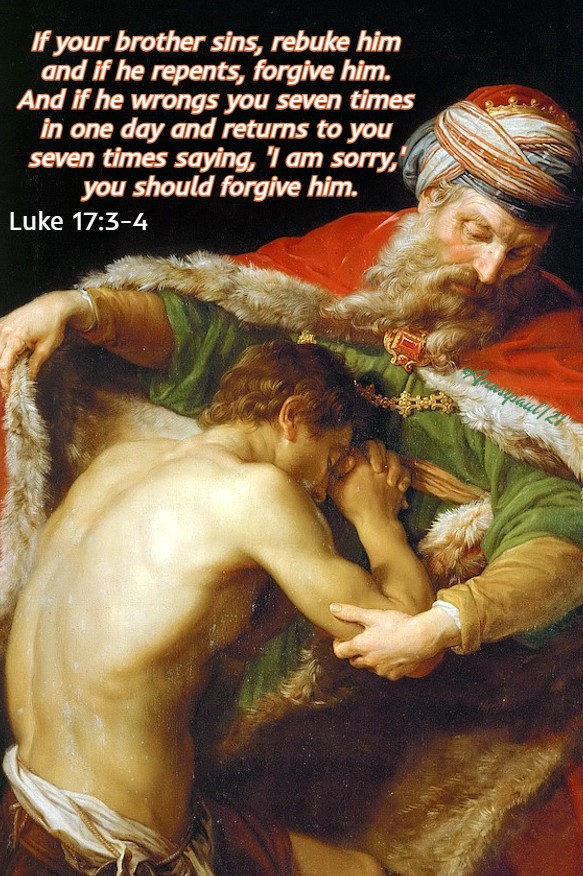
“If your brother sins, rebuke him and if he repents, forgive him. And if he wrongs you seven times in one day and returns to you seven times saying, ‘I am sorry,’ you should forgive him.”
Luke 17:3-4
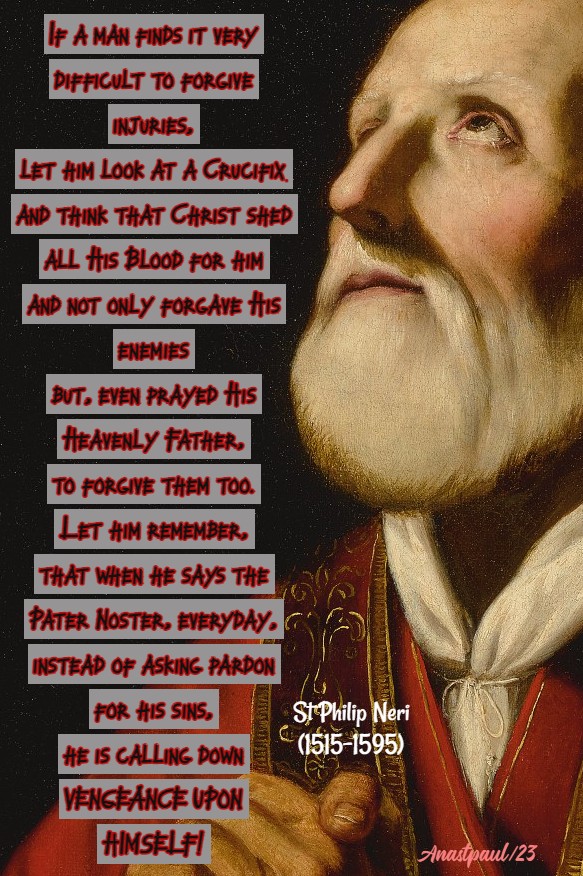
“If a man finds it very difficult to forgive injuries, let him look at a Crucifix and think that Christ shed all His Blood for him and not only forgave His enemies but, even prayed His Heavenly Father, to forgive them too. Let him remember, that when he says the Pater Noster, everyday, instead of asking pardon for his sins, he is calling down VENGEANCE UPON HIMSELF!”
St Philip Neri (1515-1595)
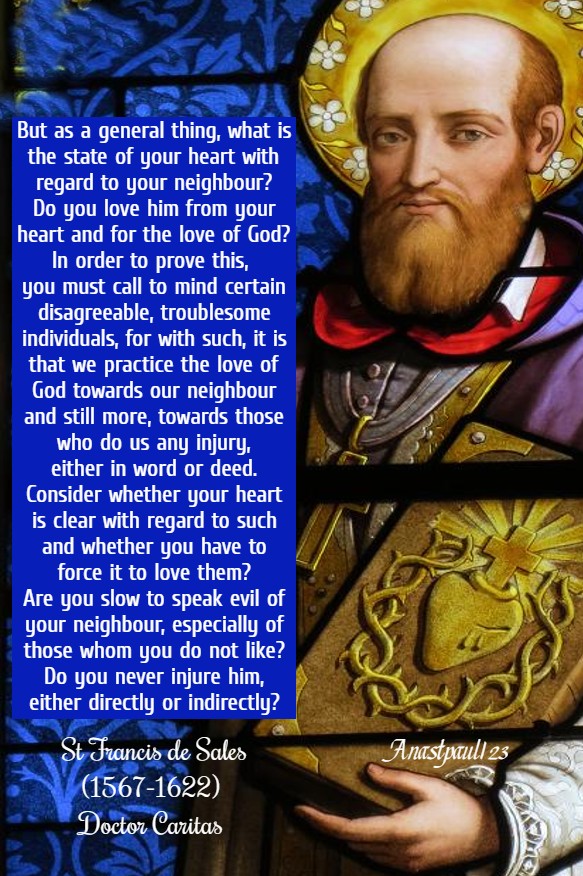
“But as a general thing, what is the state of your heart with regard to your neighbour? Do you love him from your heart and for the love of God? In order to prove this, you must call to mind certain disagreeable, troublesome individuals, for with such, it is that we practice the love of God towards our neighbour and still more, towards those who do us any injury, either in word or deed. Consider whether your heart is clear with regard to such and whether you have to force it to love them? Are you slow to speak evil of your neighbour, especially of those whom you do not like?” Do you never injure him, either directly or indirectly?”
(Introduction to the Devout Life).
St Francis de Sales (1567-1622) Doctor Caritatis
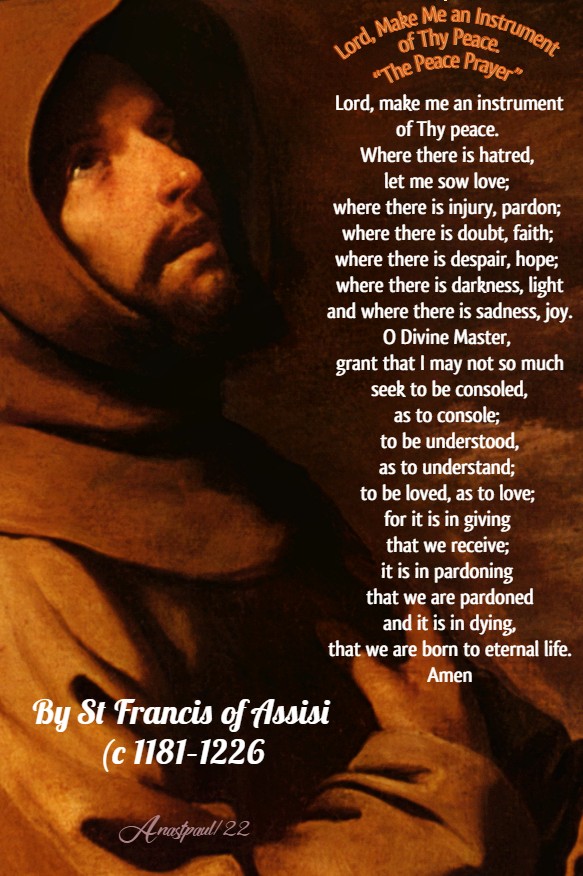
Lord, Make Me an Instrument of Thy Peace. “The Peace Prayer” By St Francis of Assisi (c 1181–1226
Lord, make me an instrument of Thy peace. Where there is hatred, let me sow love; where there is injury, pardon; where there is doubt, faith; where there is despair, hope; where there is darkness, light and where there is sadness, joy. O Divine Master, grant that I may not so much seek to be consoled, as to console; to be understood, as to understand; to be loved, as to love; for it is in giving that we receive; it is in pardoning that we are pardoned and it is in dying, that we are born to eternal life. Amen
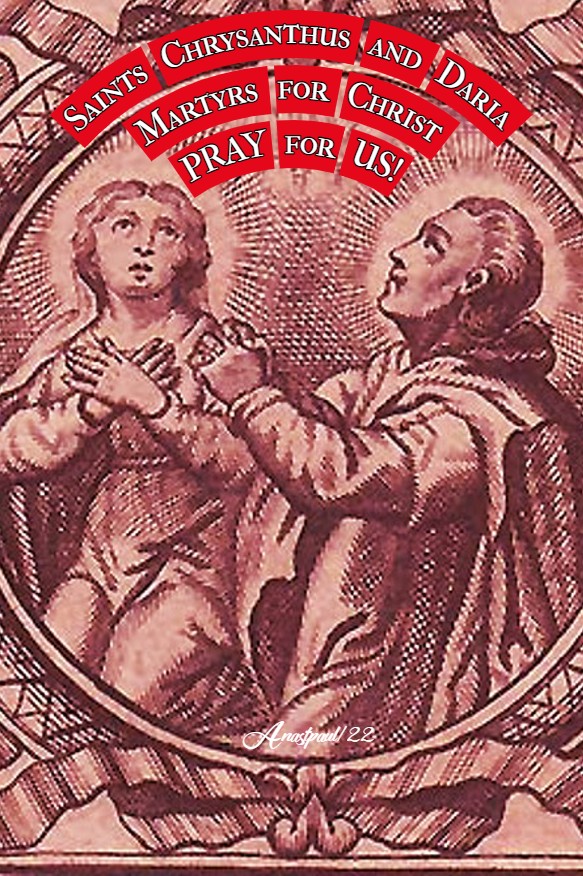
One Minute Reflection – 25 October – “The Month of the Most Holy Rosary and of the Angels” – Saints Chrysanthus and Daria (Died c 282) Martyrs, Married Couple – Wisdom 3:1-8, Luke 11:47-51 – Scripture search here: https://www.drbo.org/
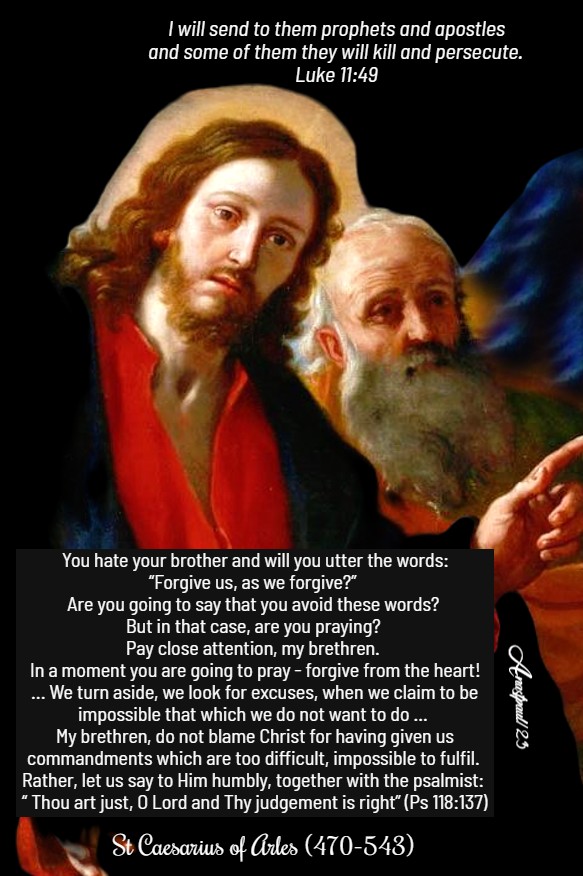
“I will send to them prophets and apostles and some of them they will kill and persecute. ” – Luke 11:49
REFLECTION – “You know what we are going to say in prayer to God before coming to Communion: “Forgive us our trespasses, as we forgive those who trespass against us.” Interiorly prepare yourself to forgive because you are about to meet with these words in prayer. How are you going to say them? Are you perhaps not going to say them? In the end that is very much the question – will you say these words, yes or no? You hate your brother and will you utter the words: “Forgive us,as we forgive?” Are you going to say that you avoid these words? But in that case, are you praying? Pay close attention, my brethren. In a moment you are going to pray – forgive from the heart!
Look at Christ suspended on the Cross, listen to Him praying: “Father, forgive them, for they know not what they do” (Lk 23:34). Doubtless, you will say: He was able to do it but I cannot. I am a man but He is God. You cannot imitate Christ? Why then did the Apostle Peter write: “Christ suffered for you, leaving you an example, so that you should follow in His steps” (1Pt 2:21)? Why does the Apostle Paul write: “Be imitators of God as beloved children” (Eph 5:1)? Why did the Lord Himself say: “Learn from Me, for I am meek and humble of heart” (Mt 11:29)? We turn aside, we look for excuses, when we claim to be impossible that which we do not want to do … My brethren, do not blame Christ for having given us commandments which are too difficult, impossible to fulfil. Rather, let us say to Him humbly, together with the psalmist: “ Thou art just, O Lord and Thy judgement is right” (Ps 118:137).” – St Caesarius of Arles (470-543) Bishop and Monk (Sermon 35).
PRAYER – May the prayer of Your blessed Martyrs, Chrysanthus and Daria, defend us, O Lord, that we may ever enjoy the loving help of those whom we honour by this celebration. ThroughJesus Christ, Thy Son our Lord, Who lives and reigns with Thee, in the unity of the Holy Ghost, God, world without end. Amen (Collect).
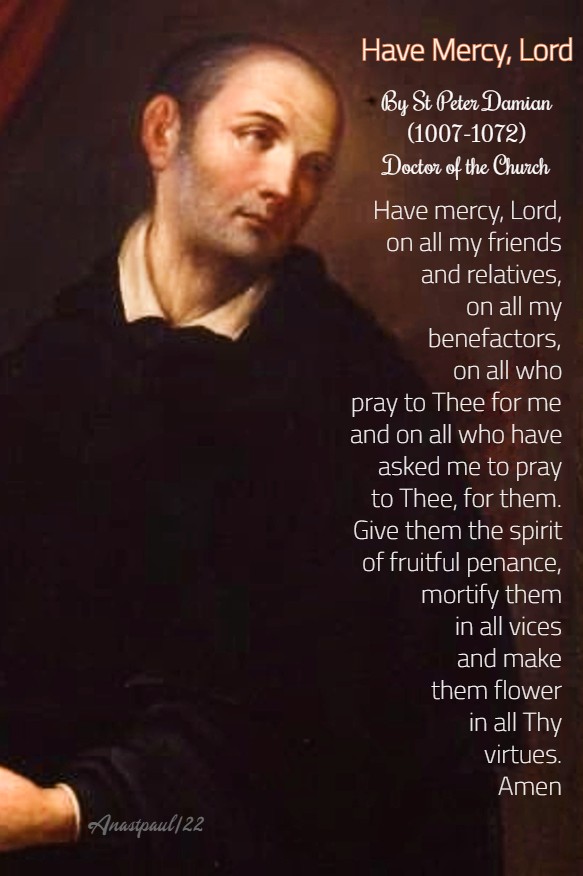
Have Mercy, Lord By St Peter Damian (1007-1072) Father & Doctor of the Church
Have mercy, Lord, on all my friends and relatives, on all my benefactors, on all who pray to Thee for me and on all who have asked me to pray to Thee, for them. Give them the spirit of fruitful penance, mortify them in all vices and make them flower in all Thy virtues. Amen
Saint of the Day – 25 October – Saint Fronto of Périgueux (1st-2nd Centuries) Bishop consecrated by St Peter Apostle, Confessor, Missionary, Miracle-worker. Born at an unknown date in Lycaonia, Asia Minor and died in Périgueux, France of natural causes. Also known as – Fron, Frontón, Frontone, Front. Name means: the clever one (Old High German).
The Roman Martyrology reads today: “At Périgueux in France, St Fronto, who, being made Bishop by the blessed Apostle Peter, with a Priest named George, converted to Christ a large number of the people of that place and renowned for miracles, rested in peace.”
Fronto actually lived but at an unknown time. According to tradition, he first lived as a Hermit and then became the first Bishop of Périgueux .
Together with his assistant, the Priest named George, Fronto is believed to have been sent to Gaul by St Peter and Ordained as the first Bishop of Périgueux . George died on the way to France and Fronto returned to Rome. But St Peter gave him a rod, saying: “When you place this rod of mine, on the body of this assistant, say, Arise in Christ’s Name! and carry out the commission which you have received from the Apostle.” So it happened, together they converted the Citizens of Périgueux.
When Fronto fell asleep in his chair one day after the Epistle, Christ appeared to him and caused him to go with Him to Tarascon, to hold the funeral service for St Martha of Bethany, who died there and to help Him to lay her in the grave. In the meantime, when the singing was over in Périgueux and the Deacon was waiting for the Bishop’s blessing, to read the Gospel and woke him, the Bishop sent him away to fetch the ring and gloves which he had left at Martha’s graveside. And thus the Deacon was a witness to the miracle of his bilocation and dual presence.
Fragments of Fronto’s tomb are exhibited in the Museum in Périgueux . The tomb supposedly consisted of a pyramid-shaped roof and many figures dating to antiquity. The first mention of a veneration of Fronto can be found incidentally in the life story of St Gaugericus the Bishop of Cambrai, from the middle of the 7th Century, who prayed at the grave of the Confessor Fronto. It tells of Fronto as a student of St Peter and in the 9th Century, Fronto was included in the Martyrology of Lyon and that of St Rabanus Maurus . In the 10th and 11th Centuries, his life story was revised several times and elements from the legends of Martialis of Limoges and Martha of Bethany were incorporated.
Authentications of his Relics took place in 1261 and 1463. These were largely destroyed by Protestants in 1575. When Périgueux was liberated in 1581, St Fronto’s Cathedral was badly damaged and Saint-Fronto’s was left untouched and in a state of disrepair for decades.
Listen to the chiming of the bells of St Fronto Cathedral, it’s as if you were there!
In 1852 the Architect Paul Abadie, undertook major restoration work to the Cathedral to save it from ruin. He brought it back to life, stone by stone, a colossal project lasting some fifty years. Abadie managed to retain the original plan and volumes of the Cathedral as well as re-designing certain aspects to harmonise the architecture. He used the same architectural model for Saint-Fronto’s as he later used for the Sacré Coeur BaSILICA in Paris.
St Cyrinus of Rome St Dulcardus St Fronto of Périgueux (1st-2nd Centuries) Bishop consecrated by St Peter Apostle St Fructus of Segovia
St Gaudentius of Brescia (Died 410) Bishop, renowned Preacher, Theologian, Diplomatic Mediator, The Roman Martyrology states today: “In Brescia, Saint Gaudentius, Bishop, who, Ordained by Saint Ambrose, shone among the prelates of his time for doctrine and virtue, instructed his people with words and writings and founded a Basilica which he called the ‘Council of Saints.‘” Biography: https://anastpaul.com/2021/10/25/saint-of-the-day-25-october-st-gaudentius-of-brescia-died-410/
St George of Périgueux (1st-2nd Centuries) Priest, assistant to St Fronto St Goeznoveus of Leon St Guesnoveus Bl Henry of Segusio St Hilary of Javols St Hilary of Mende St Hildemarca of Fecamp St Januarius of Sassari St Lucius of Rome St Lupus of Bayeux St Mark of Rome
Thought for the Day – 24 October – Meditations with Antonio Cardinal Bacci (1881-1971)
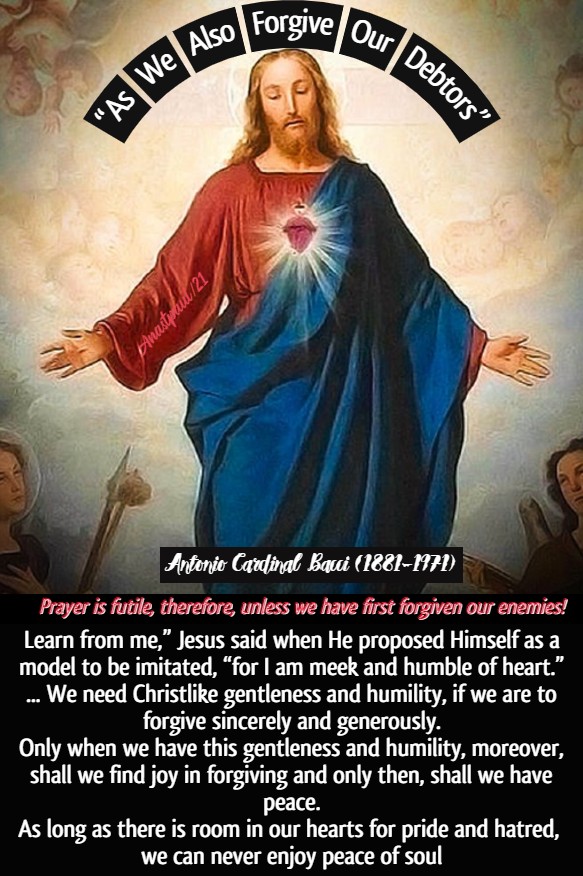
“Month of the Holy Rosary” “As We Also Forgive Our Debtors”
“If thou art offering thy gift at the altar,” Jesus tells us “and thou remember that thy brother has anything against thee, leave thy gift before the altar and go first to be reconciled to thy brother and then come and offer thy gift” (Mt 5:23-24). Prayer is futile, therefore, unless we have first forgiven our enemies!
“Learn from me,” Jesus said when He proposed Himself as a model to be imitated, “for I am meek and humble of heart.” Then He added, “you will find rest for your souls” (Cf Mt 11:29). The foundation of our hatred, anger and resentment, is always our wounded pride. We need Christlike gentleness and humility, if we are to forgive sincerely and generously. Only when we have this gentleness and humility, moreover, shall we find joy in forgiving and only then, shall we have peace. As long as there is room in our hearts for pride and hatred, we can never enjoy peace of soul!”
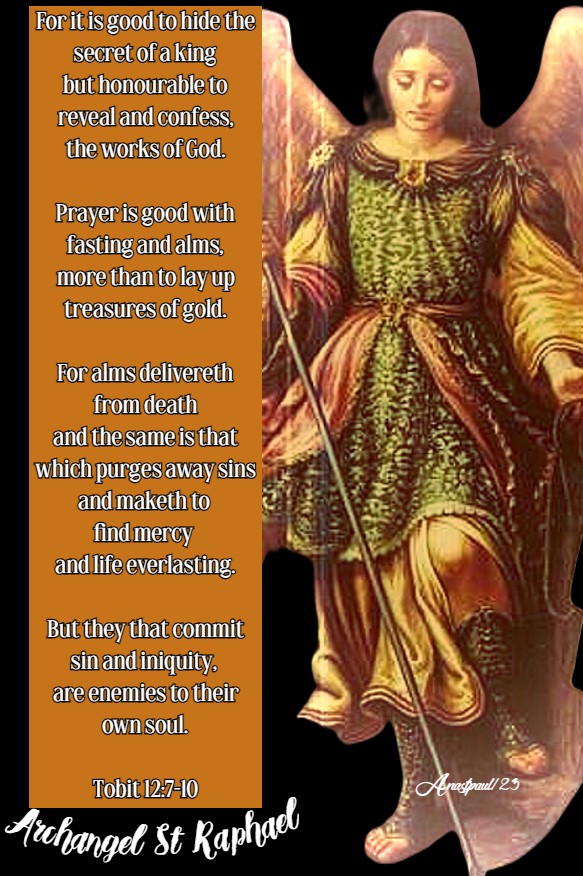
Quote/s of the Day – 24 October – “The Month of the Most Holy Rosary and of the Angels” – Feast of St Raphael the Archangel – Tobit 12:7-15, John 5:1-4 – Scripture search here: https://www.drbo.org/
“For it is good to hide the secret of a king but honourable to reveal and confess, the works of God.
Prayer is good with fasting and alms, more than to lay up treasures of gold.
For alms delivereth from death and the same is that which purges away sins and maketh to find mercy and life everlasting.
But they that commit sin and iniquity, are enemies to their own soul.”
Tobit 12:7-10
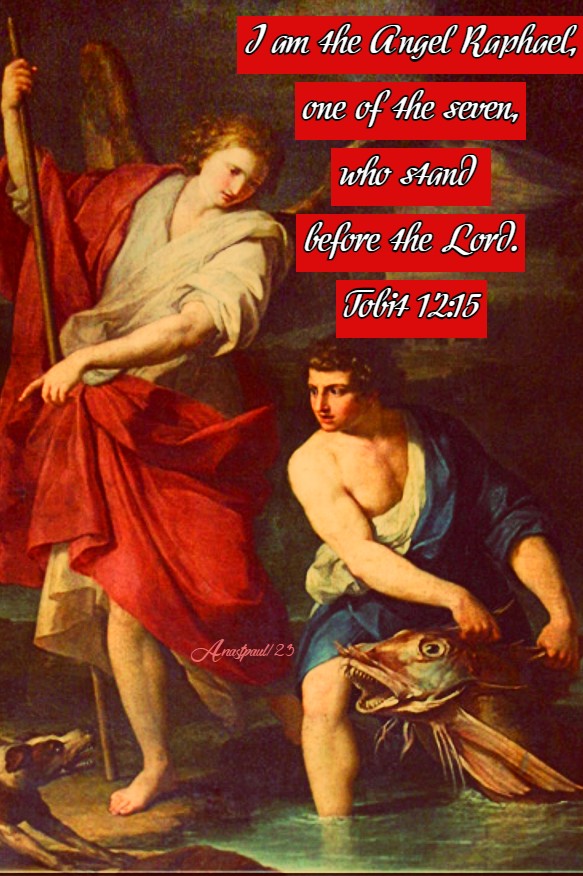
“I am the Angel Raphael, one of the seven, who stand before the Lord.”
One Minute Reflection – 24 October – “The Month of the Most Holy Rosary and of the Angels” – Feast of St Raphael the Archangel – Tobias 12:7-15, John 5:1-4 – Scripture search here: https://www.drbo.org/
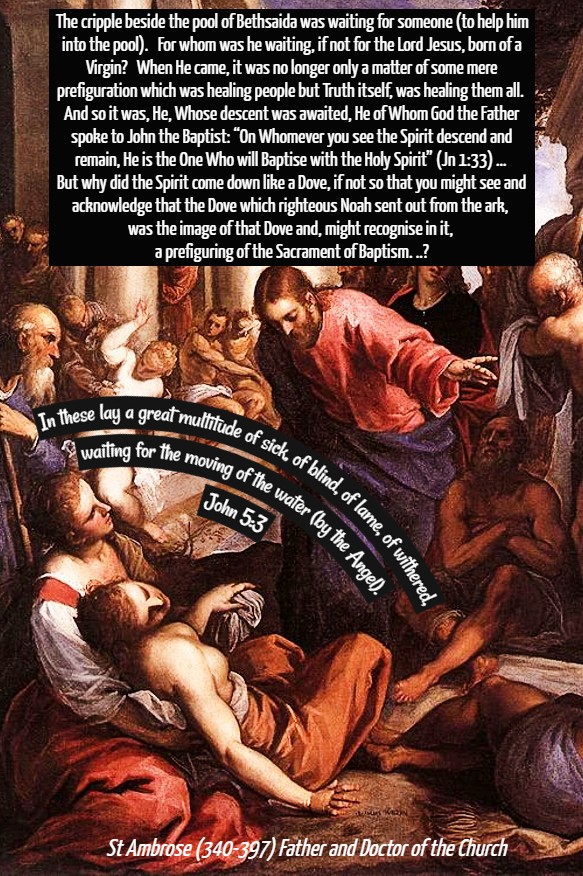
“In these lay a great multitude of sick, of blind, of lame, of withered, waiting for the moving of the water (by the Angel). ” – John 5:3
REFLECTION – “The cripple beside the pool of Bethsaida was waiting for someone (to help him into the pool). For whom was he waiting, if not for the Lord Jesus, born of a Virgin? When He came, it was no longer only a matter of some mere prefiguration which was healing people but Truth itself, was healing them all. And so it was, He, Whose descent was awaited, He of Whom God the Father spoke to John the Baptist: “On Whomever you see the Spirit descend and remain, He is the One Who will Baptise with the Holy Spirit” (Jn 1:33) … But why did the Spirit come down like a Dove, if not so that you might see and acknowledge that the Dove which righteous Noah sent out from the ark, was the image of that Dove and, might recognise in it, a prefiguring of the Sacrament of Baptism. ..?
Can you still waver, when the Father is unquestionably proclaiming to you in the Gospel: “This is My beloved Son, with whom I am well pleased” (Mt 3:17); when the Son, over Whom the Holy Spirit was manifested, in the form of a Dove, is proclaiming it too; when the Holy Spirit, Who descended in the form of a Dove, is also proclaiming it; when David proclaims: “The voice of the Lord is over the waters, the God of glory thunders, the Lord, over vast waters” (Ps 28:3)? Scripture also affirms that Fire came down from Heaven at Gideon’s prayers and again, that Fire was sent to consecrate the sacrifice at the prayer of Elijah. (Jgs 6:21; 1Kgs 18:38).
Do not attend to a Priest’s personal worth but to his office … Believe that our Lord Jesus is present, when invoked at the prayer of the Priest, He Who said: “Where two or three are gathered together, there Am I in the midst of them” (Mt 18:0). How much more, then, does He deign to grant us His presence where the Church is, where the Mysteries are celebrated. And so, you have gone down to the Baptistery. Remember what you have said – that you believe in the Father, you believe in the Son, you believe in the Holy Ghost … With similar words of commitment. you asserted your belief in the Son, as you believe in the Father, your belief in the Holy Spirit as you believe in the Son, with this sole difference – that you profess the need to believe in the Cross of our only Lord Jesus.” – St Ambrose (340-397) Bishop of Milan, Father and Doctor of the Church (On the Mysteries 24).
PRAYER – O God, Who gave blessed Raphael the Archangel as a traveling companion to Your servant Tobias, grant us, Your servants, ever to be protected by his guardianship and by his help.Through the same Jesus Christ, Thy Son our Lord, Who lives and reigns with Thee, in the unity of the Holy Ghost, God, world without end. Amen (Collect).
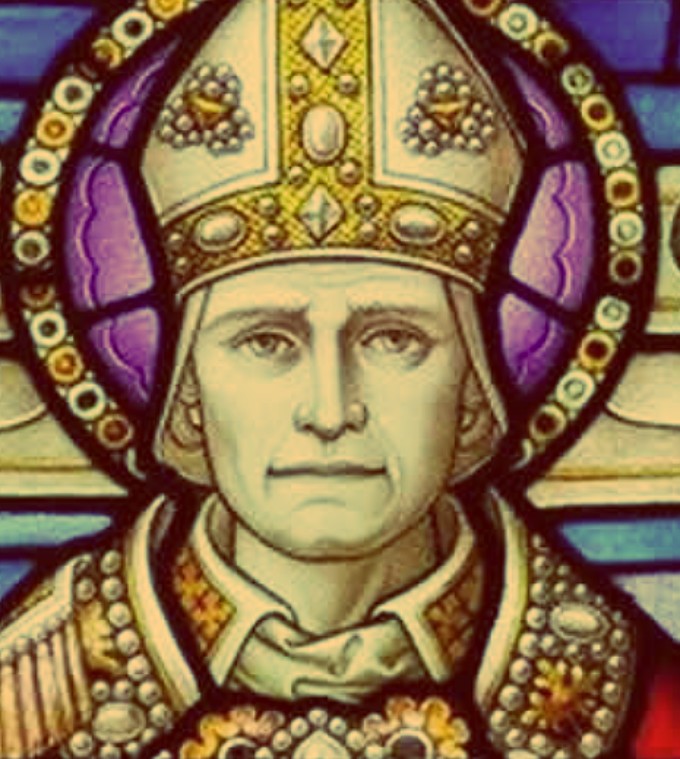
Saint of the Day – 24 October – Saint Maglorius of Wales (Died 575) Bishop of Dol and Solitaire in France, Confessor, Monk, Missionary, Abbot, Miracle-worker, “Apostle to Guernsey and Sark” (Sark, French “Sercq” one of the Channel Islands, a dependency of Guernsey, located in the English Channel, south of England’s coast. Sark lies 11 km east of Guernsey and about 40 km west of the Cherbourg Peninsula of France). Maglorius was born in southern Wales and died in 575 at the Monastery he had founded on the Island of Sark. Patronage – of Sark. Also known as – Maglorious,, Maglorius of Dol, Maglorius of Maelor, Maghorus… Magloire… Maelor… Maglorio…
The Roman Martyrology states: “In Bretagne, the departure from this life of St Maglorious, Bishop, whose body rests in Paris.”
St Maglorius – oil painting by Eugène Goyet (1798–1846), Church Saint-Maglorius-du-Haut-Pas in Paris where his Relics are enshrined.
Saint Maglorius was born inWales at the end of the 5th Century. He was first cousin of Saint Samson (c490–565). They were both placed under the guidance of Abbot Iltut, disciple of Saint Germanus of Auxerre, who took particular care to train them in science and piety. When they were old enough to decide on the choice of a state of life, Samson retired to a Monastery. Maglorius returned to his parents and continued to practice all Christian virtues at home.
Amon, Samson’s father, was attacked by a dangerous illness some time later. He sent for his son and humbled himself before God, from whom he implored mercy. When his health was restored, he renounced his possessions to devote himself solely to the Lord, with his entire family.
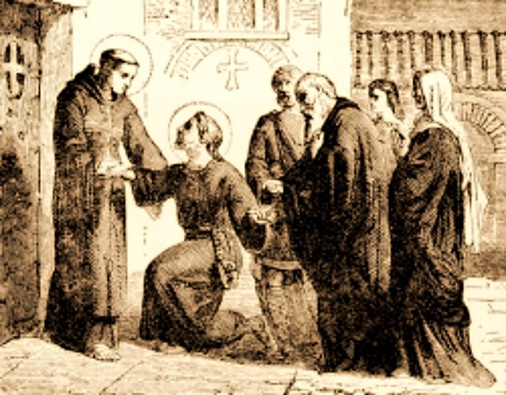
St Maglorius and his family entreat St Samson to receive them into the Monastery
This example had very happy consequences for Maglorius for, he was so touched that he came to Samson with Umbrafel his own father, Afrèle his mother and his two brothers. They all resolved to leave the world and immediately distributed their goods to the poor and to the Churches. Maglorius and his father became particularly attached to Samson, adopting the position of disciples and they obtained permission from him, to take the monastic Habit in the same house. Umbrafel was subsequently sent to Ireland and charged with the government of the Monasteries of that country.
When St Samson was consecrated regional Bishop, he associated himself with Maglorius , who had been elevated to the Diaconate. He took him with him to Armorica, to help him in his Apostolic work and to contribute with his zeal, to the propagation of the Gospel. King Childebert supported the holy missionaries, who were soon able to found Monasteries. Samson made his residence in that of Dol and gave the leadership of that of Kerfunt, or Kerfuntée, to Maglorius, whom he Ordained Priest, so that he could succeed him in the exercise of Episcopal functions.
Maglorius, following the example of his predecessor, preached the Gospel to the Breton,s who lived on the coasts. These peoples were Christians, at least for the most part but the misfortune of wars and the scourges which followed, had weakened the knowledge of Jesus Christ in them and had almost entirely erased it in many. The Saint continued to live with his Monks, as in the past. Under his clothing, he wore a hair shirt. He only ate barley bread and vegetables and a little fish on Sundays and holidays. His zeal and his charity left him almost no moment of rest and he was sometimes without being able to stop to eat for an entire day.
After three years of Episcopate, he formed the plan of going to live in solitude. This project was inspired by the divisions which reigned between the Counts of Brittany. He also believed that God desired of him, this complete separation from the world. After having obtained the consent of the people but without having consulted the neighbouring Bishops. Maglorius, was replaced by Bishop Budoc, whose zeal, enlightenment and virtues were well known by Maglorius. But the Bishops of France disapproved of such conduct and the Second Council of Tours forbade the Bretons from following it in the future.
Maglorius redoubled his austerities and burning with the desire to be united with God in the most intimate way, he avoided, as much as possible, conversing with men. But the reputation of holiness which he enjoyed soon led to the discovery of the place of his retirement. People went there from all sides to find relief from the needs of the soul and the body. If he found himself obliged to accept a few small gifts, it was to distribute them to the poor. Finally, no longer able to bear this influx of people who came to visit him, he resolved to retire into some solitude, where he could be entirely unknown to the world. But Bishop Budoc, whom he consulted, reassured him by making him understand that the good works he was carrying out, should make him sacrifice his particular taste for retirement. He, therefore, remained in the state in which he was and his miracles made his name more famous day-by-day.
The Count of Loiescon, whom he had cured of leprosy, having given him land on the Island of Geurnsey, he built a Church there and founded a Monastery where he gathered more than sixty Monks. During the famine which followed the death of King Chilperic, the monastery provided for countless people who were in need. Although the Monastery’s provisions were exhausted, Maglorius did not reduce the number of his Monks, as was advised. He placed his trust in God and he soon reaped the fruits – a ship loaded with provisions landed on the Island and broughtall the relief needed by all!
It was on Easter night, of the following year that the Maglorius was warned by Heaven, of the proximity of the day of his death. He no longer left the Church, unless he was forced to do so by necessity or by the utility of his neighbour. He often repeated these words of the Psalmist: “I ask only one thing of the Lord and that is, to dwell in His house all the days of my life.”
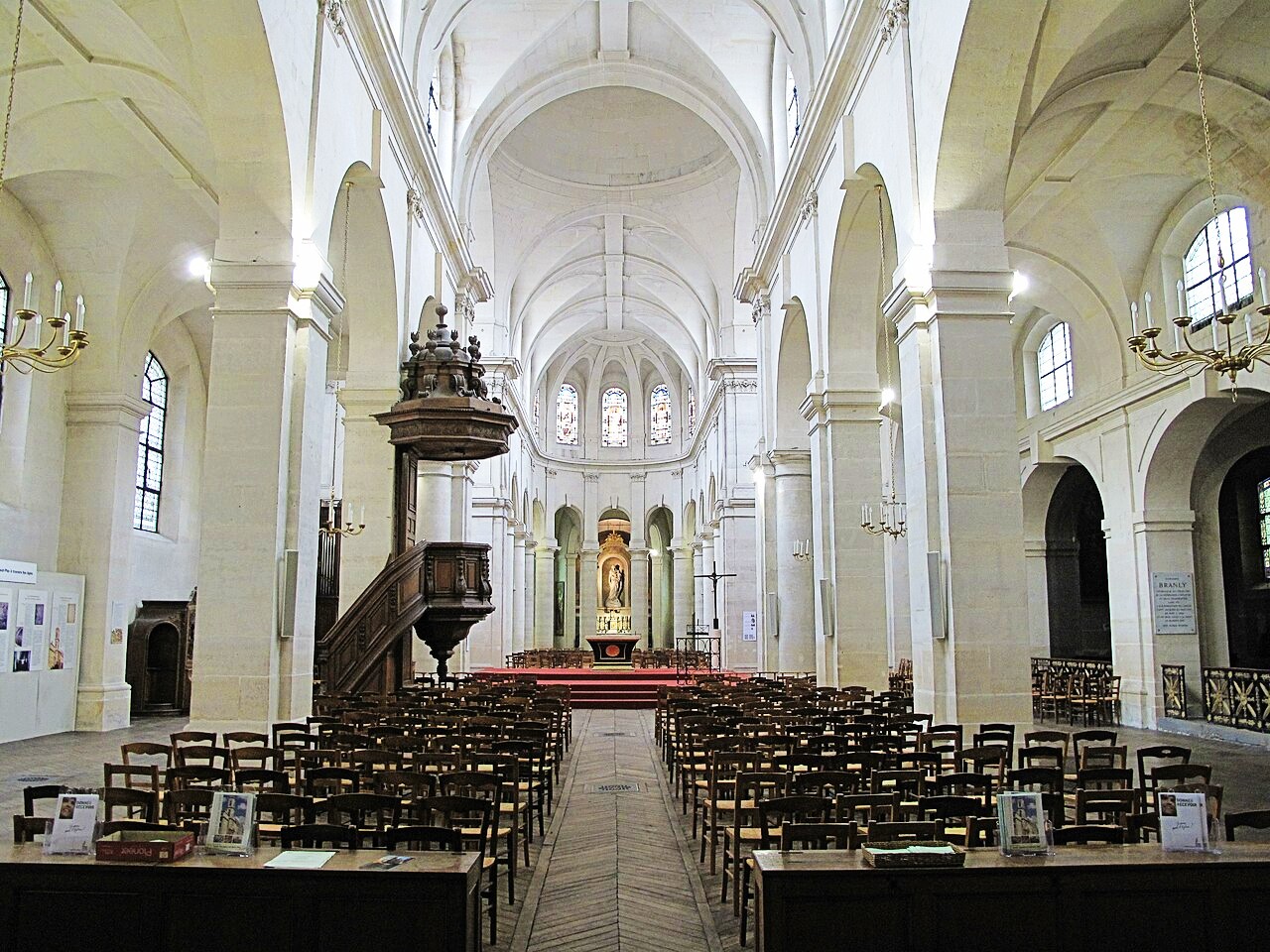
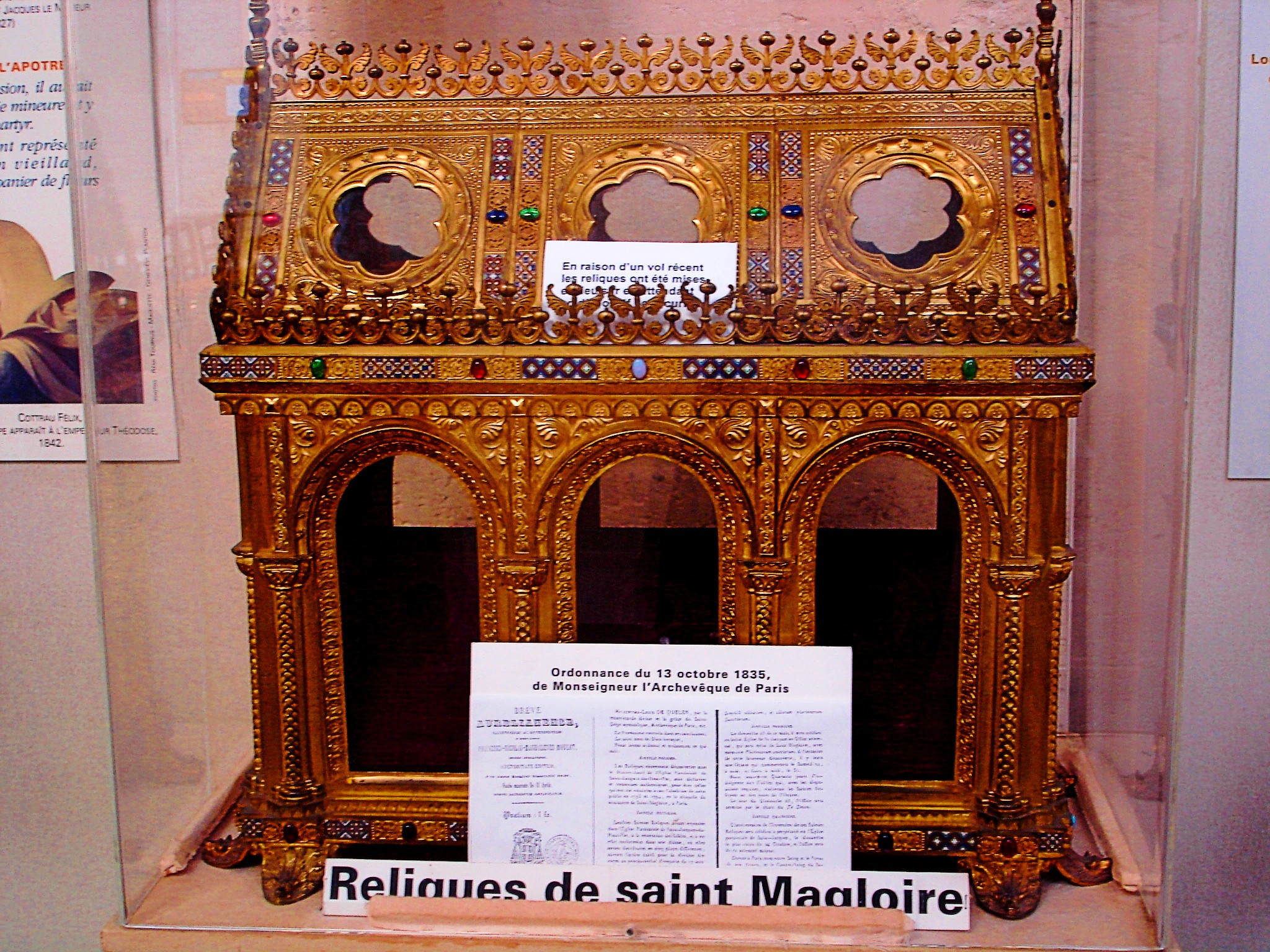
He died six months later, on 24 October 575. He was around eighty years old. During the Norman wars, his Relics and those of several other Saints, were brought to Paris for safety and deposited in the Church of Saint- Barthélemy, then in the Chapel of Saint-Georges, located outside the City walls. They were then transferred to the Church of Saint-Jacques, since called Saint-Maglorius. In the same place, also rested the Relics of Saints Samson and Louthiern, Bishops and of Saints Guinganthon and Escuiphle, Abbots.
The Church of St Maglorius in Paris which contains his Relics and those of St Samson and others
One of the most well-known and detailed Miracles of St Maglorius concerns his rescue of a group of children. The children were playing in an abandoned wreck on the beach below the Monastery in Sark, when a sudden violent storm swept them out to sea. Maglorius swam out to sea when he heard their cries and saved them and the wreched boat, steering it to the safety of the shore, before vanishing.
Other miracles include – the destruction of a dragon on the Island of Jersey; the resurrected a drowned fisherman of Sark and that the putting to flight a fleet of Vikings.
Posthumous miracles of St. Maglorius are also included in the surviving texts. After his death, Sark was attacked again by Vikings, who sacked the Monastery and killed the Monks. When seven of the Vikings attempted to open St Magllorius’ tomb, they were blinded and many of the others turned and began to kill each other!
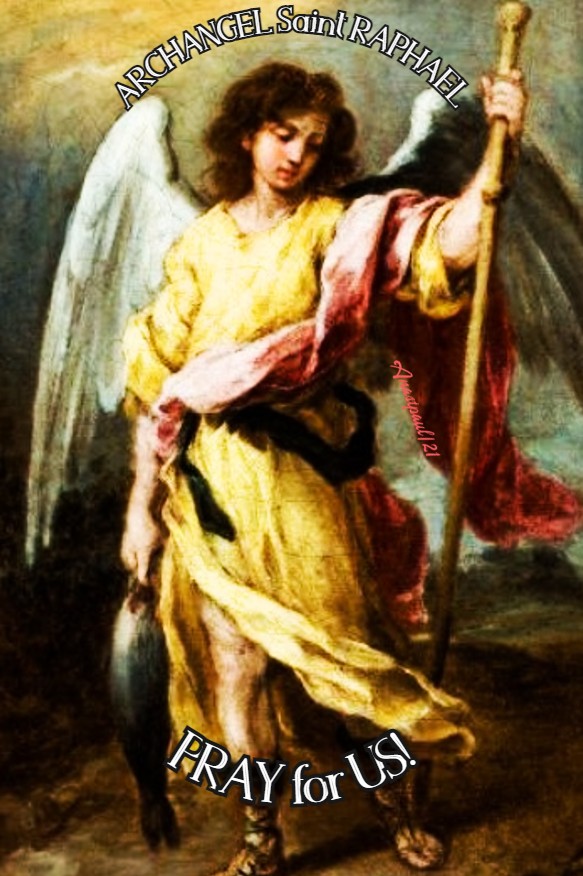
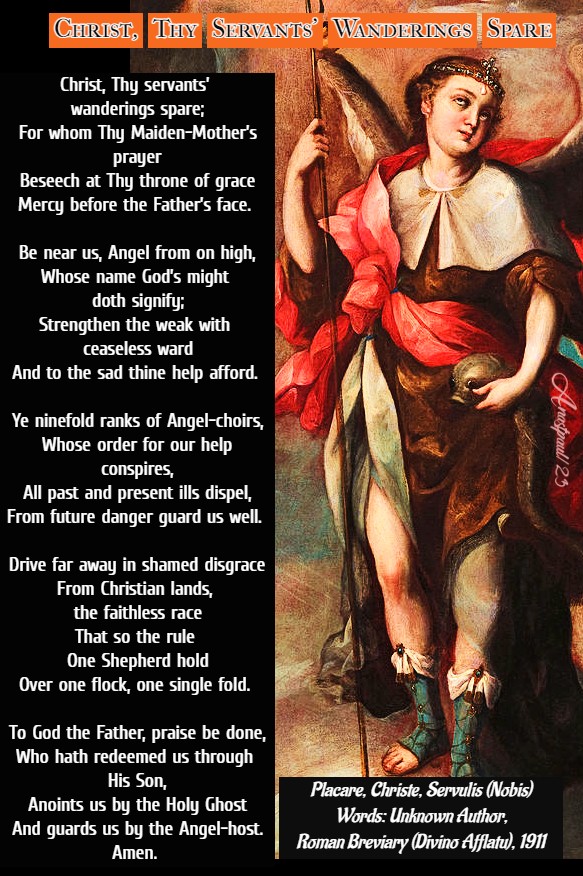
Saint Raphael the Archangel The Feast day of Saint Raphael was included for the first time in the General Roman Calendar in 1921, for celebration on 24 October. With the 1969 revision of the General Roman Calendar, the Feast was transferred to 29 September for celebration together with Archangels Saints Michael and Gabriel. St Raphael: https://anastpaul.com/2021/10/24/saint-of-the-day-24-october-st-raphael-the-archangel/
Bl Amado García Sánchez St Audactus of Thibiuca St Cadfarch St Ciriacus of Hierapolis St Claudian of Hierapolis St Ebregislus of Cologne St Felix of Thibiuca St Fortunatus of Thibiuca St Fromundus of Coutances St Maglorius of Wales (Died 575) Bishop
St Marcius of Monte Cassino St Mark of Campania Hermit
St Senoch St Senócus of Tours St Septimus of Thibiuca
Martyrs of Ephesus – 3 Saints: Three Christians Martyred together. All we know about them are the names Mark, Sotericus and Valentina. They were stoned to death near Ephesus, Asia Minor (in modern Turkey). Their relics are enshrined on the island of Tasos.
Thought for the Day – 23 October – Meditations with Antonio Cardinal Bacci (1881-1971)
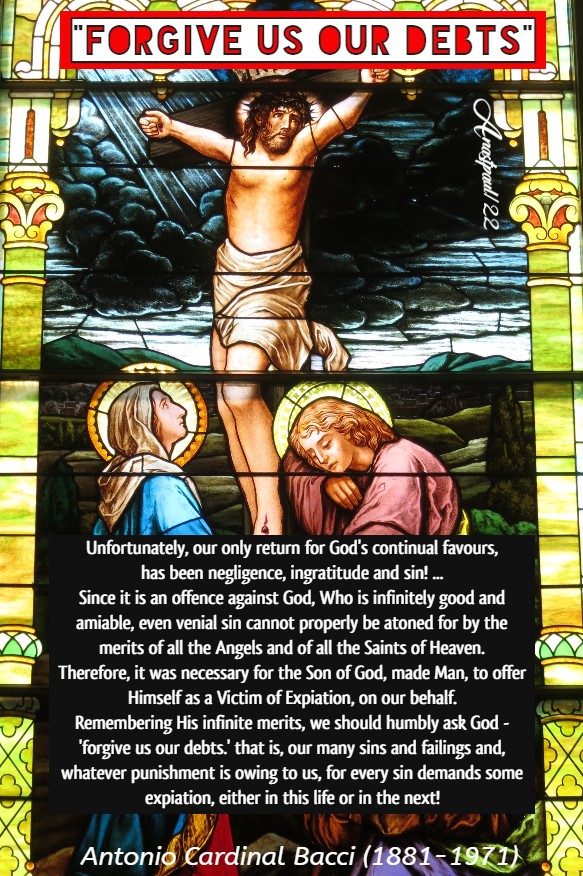
“Month of the Holy Rosary” “Forgive Us Our Debts”
“Finally, we owe God a great deal on account of our sins. Unfortunately, our only return for God’s continual favours, has been negligence, ingratitude and sin! How many failings we have been guilty of throughout our lives? Since it is an offence against God, Who is infinitely good and amiable, even venial sin cannot properly be atoned for by the merits of all the Angels and of all the Saints of Heaven. Therefore, it was necessary for the Son of God, made Man, to offer Himself as a Victim of Expiation, on our behalf.
Remembering His infinite merits, we should humbly ask God – ‘forgive us our debts.‘ that is, our many sins and failings and, whatever punishment is owing to us, for every sin demands some expiation, either in this life or in the next!
Meanwhile, we should accept, with resignation, all the sufferings which God sends us in reparation for our sins and, we should promise never to offend Him again.”
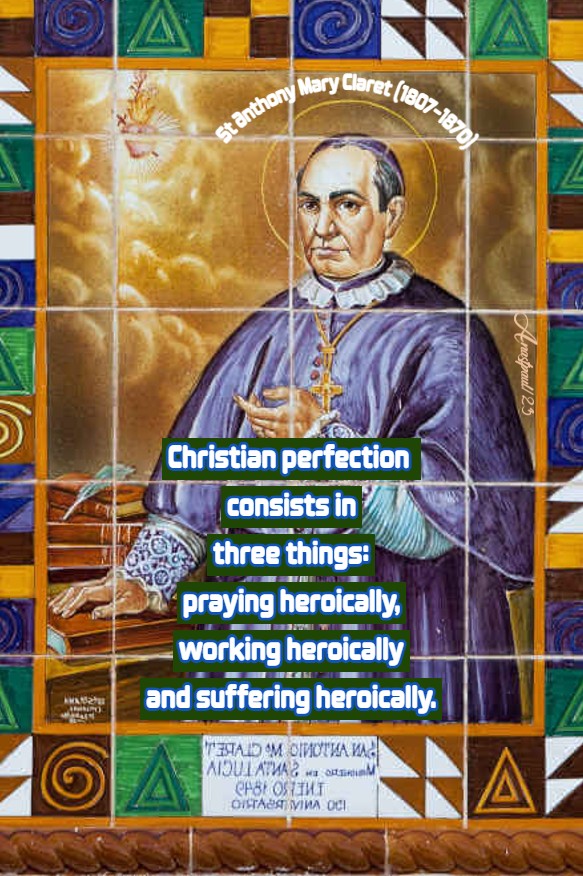
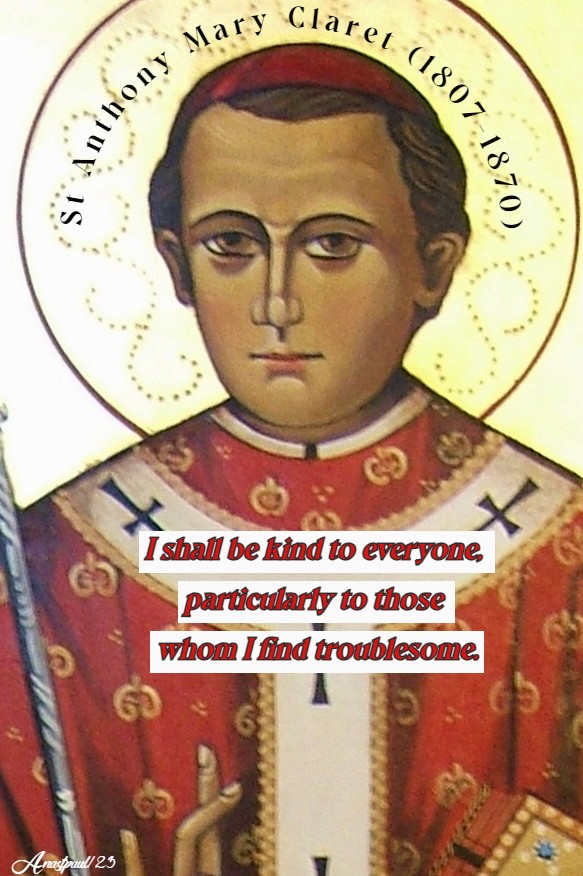
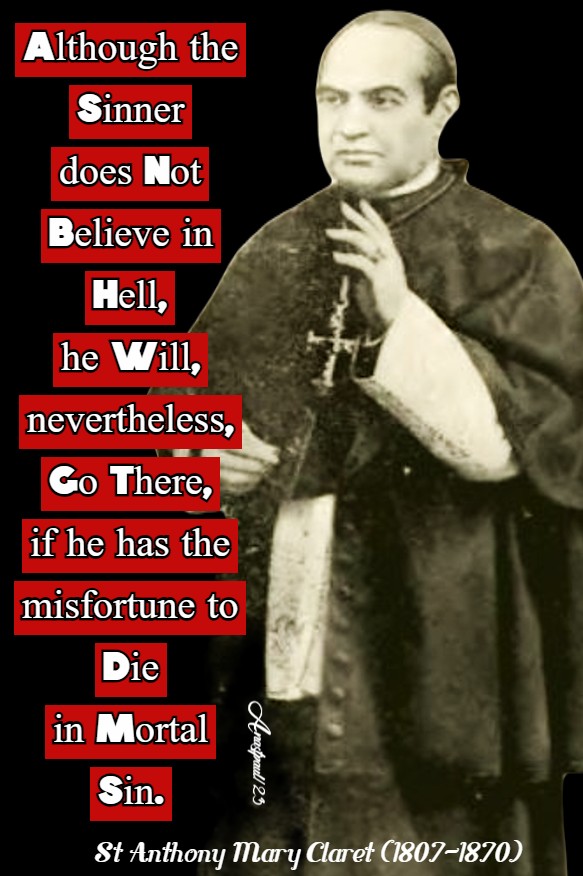
Quote/s of the Day – 23 October – St Anthony Mary Claret CMF (1807-1870) Archbishop and Founder of the Claretians
“Christian perfection consists in three things: praying heroically, working heroically and suffering heroically.”
“I shall be kind to everyone, particularly to those whom I find troublesome.”
“Although the sinner does not believe in Hell, he will, nevertheless, go there, if he has the misfortune to die in mortal sin.”
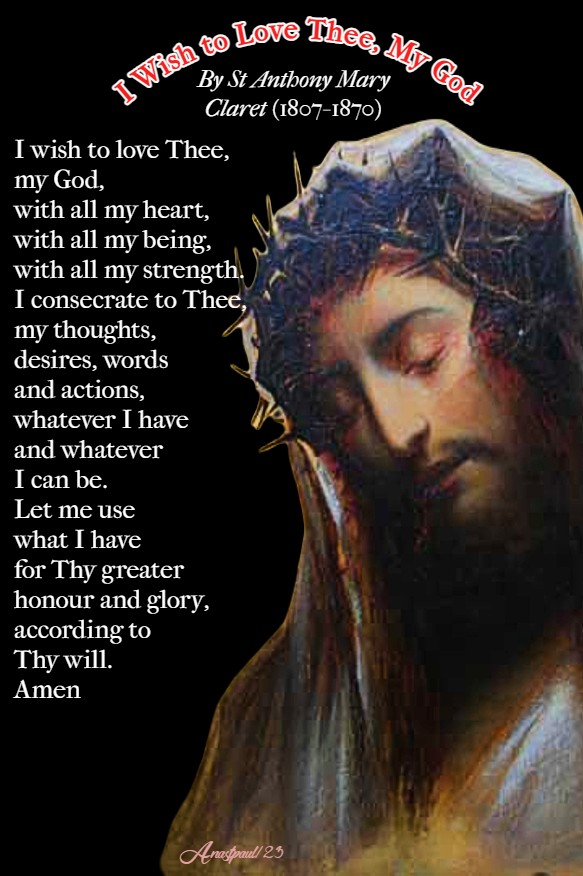
I Wish to Love Thee, My God By St Anthony Mary Claret (1807-1870)
I wish to love Thee, my God, with all my heart, with all my being, with all my strength. I consecrate to Thee, my thoughts, desires, words and actions, whatever I have and whatever I can be. Let me use what I have for Thy greater honour and glory, according to Thy will. Amen
One Minute Reflection – 23 October – “The Month of the Most Holy Rosary and of the Angels” – Ferial Day – Ephesians 6:10-17, Matthew 18:21-35 – Scripture search here: https://www.drbo.org/
“Should you not have had compassion on your fellow servant, as I had compassion on you?” …Matthew 18:33
REFLECTION – “What is human mercy like? It makes you concerned for the hardship of the poor. What is divine mercy like? It forgives sinners… In this world God is cold and hungry in all the poor, as He Himself said (Mt 25:40)… What sort of people are we? When God gives, we want to receive, when He asks, we refuse to give? When a poor man is hungry, Christ is in need, as He said Himself: “I was hungry and you gave me no food” (v. 42). Take care not to despise the hardship of the poor, if you would hope, without fear, to have your sins forgiven… What He receives on earth He returns in heaven.
I put you this question, dearly beloved – what is it you want, what is it you are looking for, when you come to Church? What indeed if not mercy? Show mercy on earth and you will receive mercy in Heaven. A poor man is begging from you and you are begging from God, he asks for a scrap, you ask for eternal life! … And so, when you come to Church, give whatever alms you can to the poor, in accordance with your means.” – St Caesarius of Arles (470-543) (Sermon 25).
PRAYER – O Lord, we beseech Thee, graciously grant Thou faithful, forgiveness and peace that they may be cleansed of all sin and serve Thee with minds free from care. Through Jesus Christ, Thy Son our Lord, Who lives and reigns with Thee, in the unity of the Holy Ghost, God, world without end. Amen (Collect).

















 AnaStpaul
You must be logged in to post a comment.