Our Lenten Journey with the Angels and the Saints – 11 March – Monday of the Fourth Week in Lent – 3 Kings 3:16-28; John 2:13-25 – Scripture search here: https://www.drbo.org/
“Be my rock of refuge, O God, a stronghold to give me safety.” Psalm 30:3
“Destroy this temple and in three days, I will raise it up. ” John 2:19
In Every Part of Your Soul
By St Augustine (354-430) Father and Doctor of Grace
“As they were looking on, so we too gaze on His Wounds as He hangs. We see His Blood as He dies. We see the price offered by the Redeemer, touch the scars of His Resurrection.
He bows His Head, as if to kiss you. His Heart is made bare open, as it were, in love to you. His arms are extended that He may embrace you. His whole body is displayed for your redemption.
Ponder how great these things are. Let all this be rightly weighed in your mind, as He was once fixed to the Cross in every part of His Body for you, so He may now be fixed in every part of your soul!”
One Minute Reflection – 11 March – Monday of the Fourth Week in Lent – 3 Kings 3:16-28; John 2:13-25 – Scripture search here: https://www.drbo.org/
“Destroy this temple and in three days, I will raise it up. ” – John 2:19
REFLECTION – “We are still God’s workmen who are building the temple of God. This temple’s dedication has already taken place in its Head, in that the Lord has Risen from the dead after His victory over death and, having destroyed in Himself what was mortal, He has Ascended to Heaven … But now, we are building this temple through faith, so that its dedication may also be made at the final resurrection. That is why … one of the Psalms has the title: “When the Temple was rebuilt after the captivity” (95:1). Call to mind our own former captivity, when the devil held the whole world in his power, like a flock of the unfaithful. It was due to this captivity that our Redeemer came. He shed His Blood for our ransoming and, by the Blood He poured out, He cancelled the debt which was holding us captive (Col 2:14) … Sold beforehand to sin, we have now been set free by grace.
Following this captivity, the temple is now being built and, to raise it up, the Good News is proclaimed. That is why this Psalm begins as follows: “Sing to the Lord a new song” And, lest you think this temple is being constructed in some insignificant corner, as the heretics who separate themselves from the Church build it, pay attention to what follows: “Sing to the Lord, all you lands” …
“Sing to the Lord a new song; sing to the Lord, all you lands.” Sing and clap your hands! Sing and “bless the Name of the Lord” (v. 2). Proclaim the Day born of the Day of Salvation, the Day born of the Day of Christ. For Who is the Salvation of God if not His Christ? This is the Salvation we pray for in the Psalm: “Show us, Lord, your mercy and give us your saving help.” Just men of old longed for this salvation, those of whom the Lord said to His disciples: “Many desired to see what you see, but did not see it” (Lk 10:24) … “Sing to the lord a new song; sing to the Lord” See the fervour of the builders! “Sing to the Lord and bless His Name.” Proclaim the Good News! What good news is that? Day is born from Day … Light from Light; the Son from the Father, the Saving Power of God! This is how the temple is built after the captivity.” – St Augustine (354-430) Father and Doctor of Grace (Sermon 163:5).
PRAYER – Grant, we beseech Thee, Almighty God, that we who devoutly keep the sacred observances, year by year, may be pleasing to Thee, both in body and soul. Through Jesus Christ, Thy Son our Lord, Who lives and reigns with Thee, in the unity of the Holy Ghost, God, world without end. Amen (Collect).
Our Morning Offering – 11 March – Monday of the Fourth Week in Lent
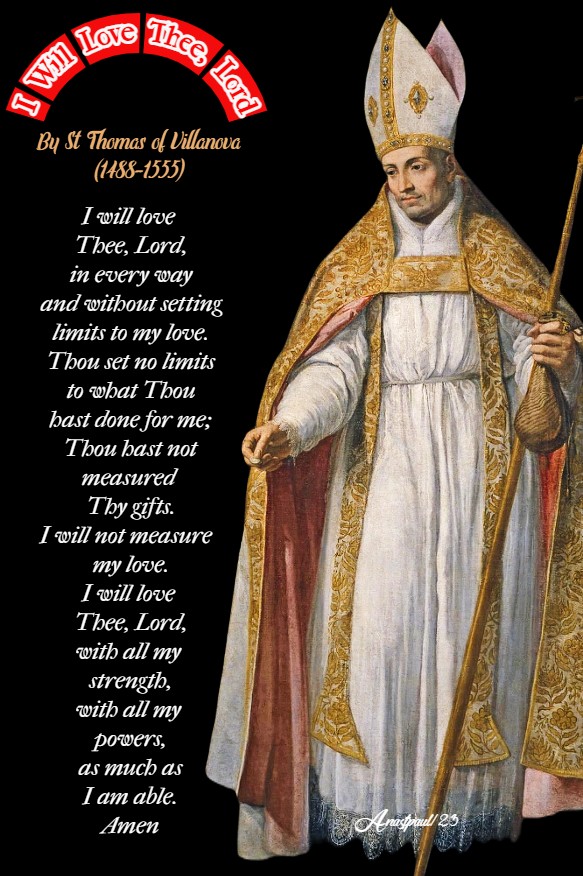
I Will Love Thee, Lord By St Thomas of Villanova (1488-1555)
I will love Thee, Lord, in every way and without setting limits to my love. Thou set no limits to what Thou hast done for me; Thou hast not measured Thy gifts. I will not measure my love. I will love Thee, Lord, with all my strength, with all my powers, as much as I am able. Amen
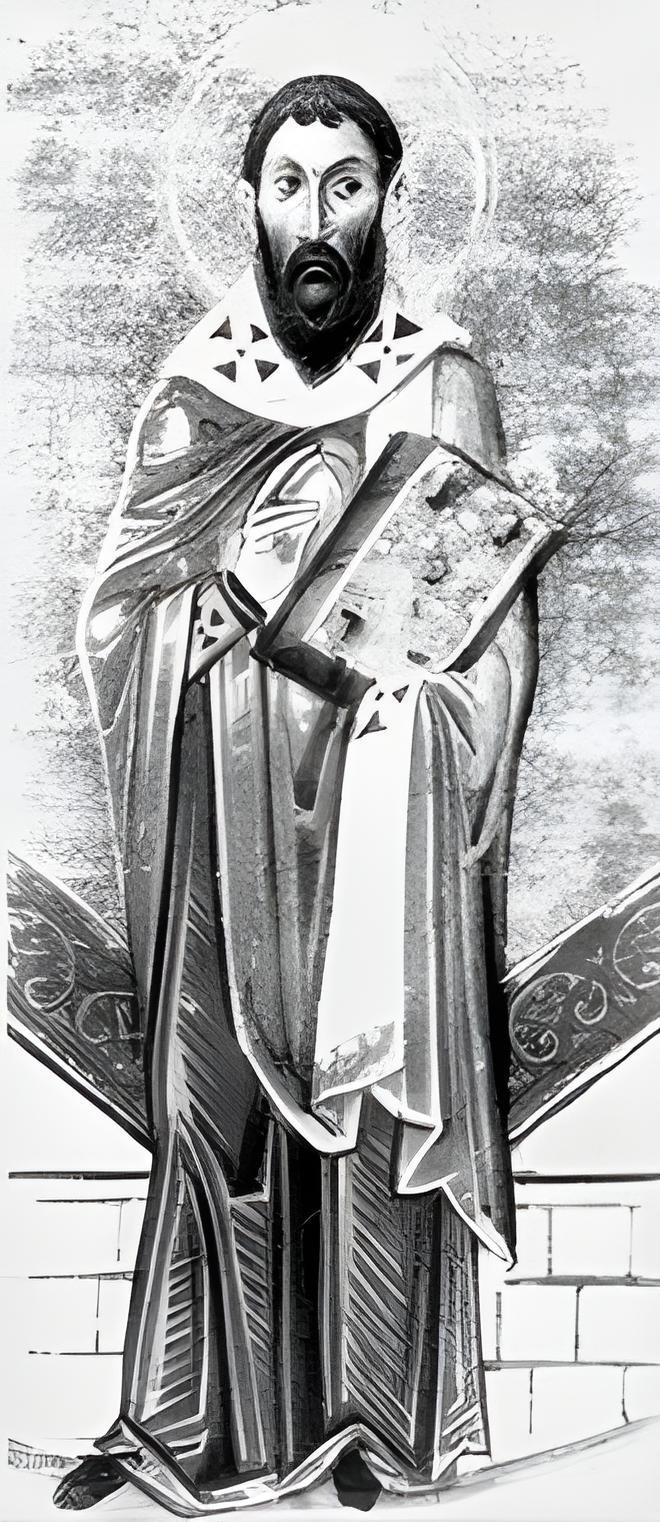
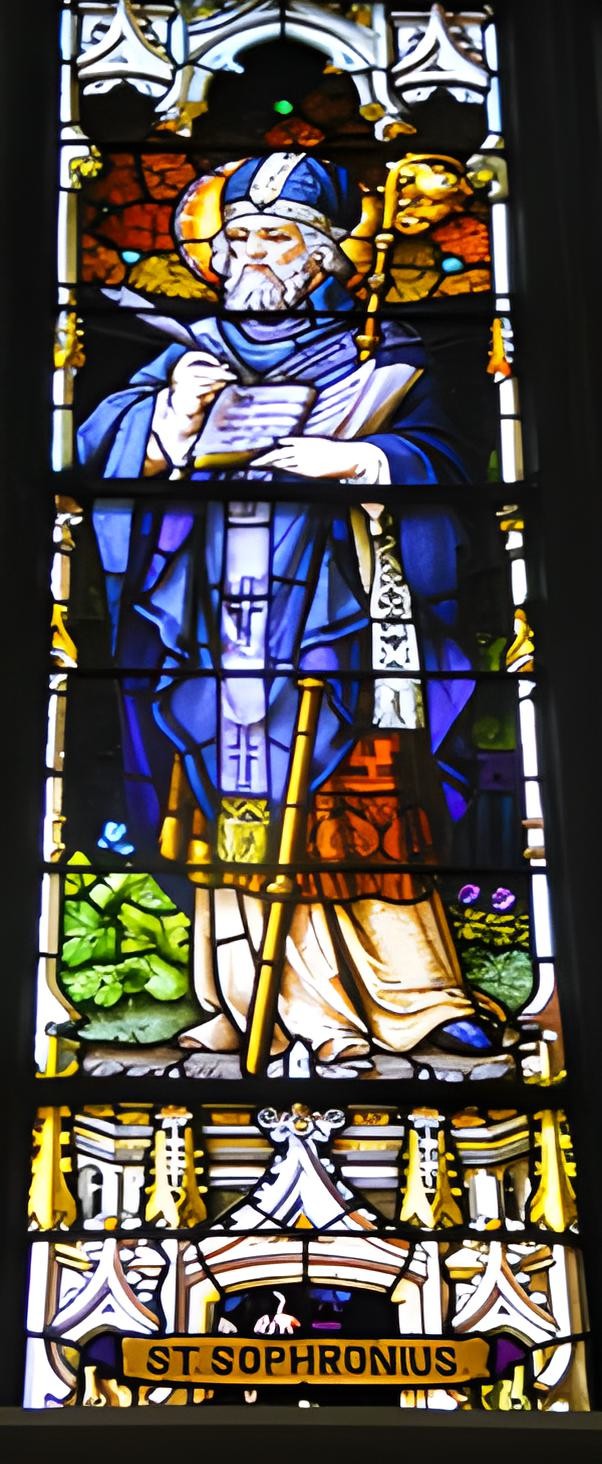
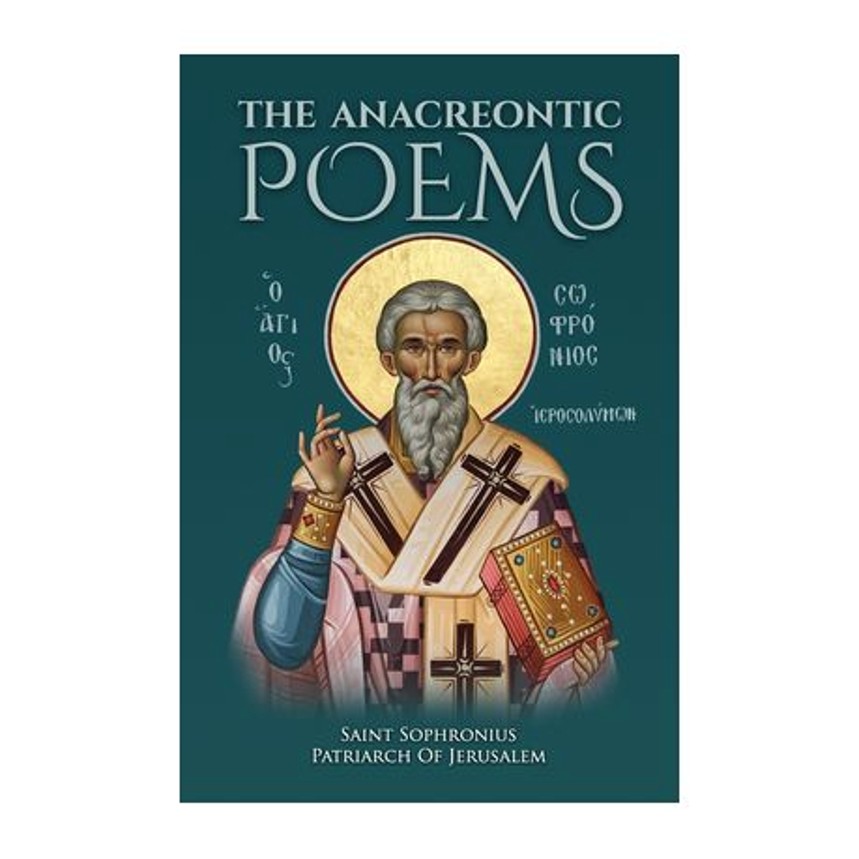
Saint of the Day – 11 March – Saint Sophronius of Jerusalem (c550-c638) Bishop of Jerusalem from 634 until his death, Father of the Church. Before rising to the primacy of the See of Jerusalem, he was a Monk, Theologian and Philosopher, who was the chief protagonist for orthodox teaching in the doctrinal controversy on the essential nature of Jesus. He was a well-travelled and honoured Teacher of Rhetoric, living for several years in Alexandria, Egypt near St John the Almoner. Ecclesiastical and Liturgical Writer, Poet and exercised an extensive correspondence, some of which has survived and some of which we still use within the Liturgy. He is also renowned in history for his peace negotiations with the invading Saracens, thus ensuring a level of protection to the City’s Christians Born in Damascus, Syria in the 6th Century and died in c638; sources disagree on cause and location. Also known as – Sophronius of Damascus, “Sophronius the Sophist” Sofronio…
Sophronius the Sophist, was one of the most rivetting personalities of the time, cultured, open-minded and a passionate defender of orthodoxy, was born in Damascus around 550. He abandoned his hometown as a young man to undertake numerous journeys but always remained proud of his place of origin: “where Paul arrived blind and left healed, where a fleeing persecutor became a preacher; the City which gave refuge to the Apostle and from which he fled in a basket lowered from the window, thus earning the graces of the saints and acquiring great fame […] ”
Sophronius completed his studies mainly in Damascus, where he was educated in Greek and Syriac culture. Eager to become a Monk, he visited the Monastery of San Theodosius, near Bethlehem in Judea and here he met the Monk ascetical Writer John Moschus (c550 – 619), with whom he formed a lasting bond of friendship.
It is difficult to evaluate the influence which each exerted on the other — Sophronius was decidedly more cultured but, he considered his friend his spiritual guide and advisor. Their main bond was perhaps their common Chalcedonian faith but they also began a collaboration in passing on the lives of the Desert Fathers to future generations. The conflicts already present at that time in the Middle Eastern world, caused the two friends to move around a lot, being hosted by different Monasteries. Between 578 and 584, they were in Egypt, where Sophronius was a pupil of the Aristotelian Stephen of Alexandria and both became friends of Theodore, the Philosopher and Zoilus, the latter an erudite Calligrapher. In this period, Sofronio began to lose his sight but he was miraculous cured of his ailment by visiting the Tombs of Saints Cyrus and John near Menuti and, in thanksgiving, he wrote an account of seventy miracles attributed to their intercession.
From 584 onwards it becomes difficult to reconstruct their movements exactly. For a certain time it seems they took different paths — Sophronius became a Monk in the Monastery of Saint Theodosius, while John Moschus wandered between Sinai, Cilicia and Syria. The two friends finally found themselves in the service of the Bishop of Alexandria, Saint John the Almoner, appointed in 610. A few years later the Persians occupied the holy places and headed towards Egypt, so the Bishop with Sophronius and John, left through Cyprus, moving onto other islands and finally arrived in Rome. In 619, in the Eternal City St John the Almoner, handing over his last wishes to Sophronius. Here too, sadly, our Saint lost another great friend and staunch advocate of orthodoxy, John Moschus, who also died in Rome in 619. Sophronius accompanied the body of his friend and spiritual advisor, back to Jerusalem for monastic burial.
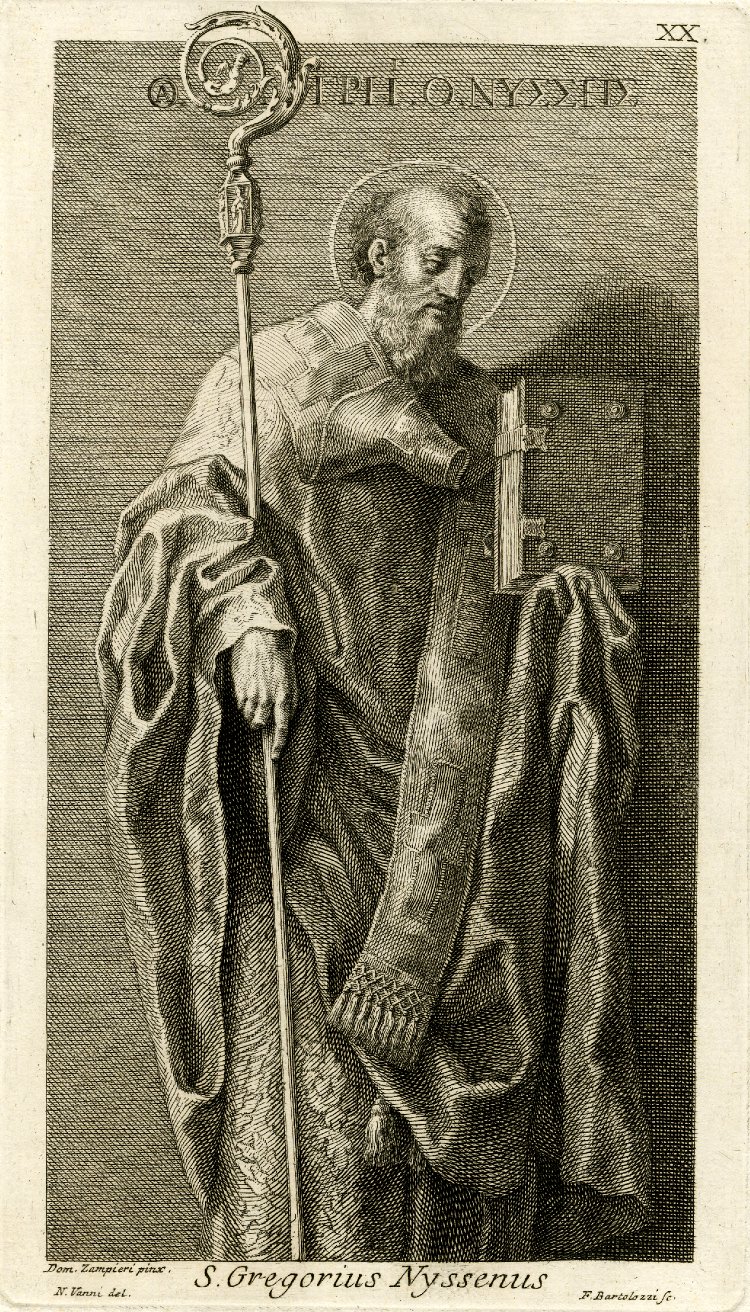
Sophronius made great efforts to counteract the rampant heresies, in particular the Monothelitism which the Emperor Heraclius had imposed on the entire Empire with the approval of the Patriarch, Sergius of Constantinople. From 634 Sophronius was the new Bishop of Jerusalem, a rolewhich allowed him to continue his battle against heresy, with greater authority. As the heresies into which Sergius was falling, were increasingly evident and in fear that Pope Honorius might fall into the trap, he commissioned Bishop Stephen of Dora, to go to Rome in his stead, as he was unable to do so due to an imminent Saracen invasion and made him swear on Calvary, to remain faithful to the One True Faith taught our Saint so deeply by the Chalcedonian Fathers (remember we clebrated one of them recently – St Gregory of Nyssa).
The envoy, Bishop Stephen of Dora, reported Sophronius’ will to the Lateran Council of 649 (the image below shows St Sophronius on the left, St Michael the Archangel in the middler and St? Stephen of Dora on the right): “There he made me promise with a solemn oath: “If you forget or despise the Faith which is now threatened, you will have to give an account to Him Who, although God, was Crucified in this saintly place, when in His Next Coming, He will judge the living and the dead. As you know, I cannot make this journey, due to the invasion of the Saracens […]. Go without delay to the other end of the earth, to the Apostolic See, the Foundation of Orthodox teaching and tell the holy men who are there, not once, not twice but many times, what is happening — tell them the whole truth and nothing more. Do not hesitate, ask them and insistently pray to them, to use their inspired wisdom to pass a final judgement and destroy this new teaching which has been inflicted on us.” Impressed by the solemn appeal which Sophronius had pronounced in that holy and venerable place and, considering the Episcopal power which had been conferred on me, by the grace of God, I immediately left for Rome. I am here before you for the third time, bending before the Apostolic See imploring, as Sophronius and many others did, “come to the aid of the threatened Catholic faith!”.
St Sophronius on the left, St Michael the Archangel in the middler and St? Stephen of Dora on the right
It took a good ten years before Pope Saint Martin I condemned the heresy at the same Council. Sophronius came to terms with the Saracens, to avoid massacres of the people in Jerusalem but, he died a few months later. He left several sermons and writings to posterity, a splendid prayer (which we still use) to bless the water on the Feast of the Baptism of the Lord, as well as Hymns and Canticles of extraordinary beauty! His Antiphons for Holy Week constituted the source of the “Improperia” — lso known as the Reproaches, they are sung in the Liturgy as part of the observance of the Passion, usually on the afternoon of Good Friday.
St Benedict Crispus of Milan (Died 725) Archbishop of Milan from c 685 until his death. A poem written about ten years after his death, De laudibus Mediolani- In Praise of Milan, praises him and remembers his veneration by the entire land and informs us that he was buried in the Basilica of Saint Ambrose. His Life: https://anastpaul.com/2020/03/11/saint-of-the-day-11-march-saint-benedict-crispus-of-milan-died-725/
St Candidus the Martyr St Constantine II St Constantine of Carthage
St Peter the Spaniard St Pionius St Piperion the Martyr St Rosina of Wenglingen St Sophronius of Jerusalem (c550-c638) Bishop of Jerusalem from 634 until his death, Father of the Church. St Thalus the Martyr St Trophimus the Martyr St Vigilius of Auxerre St Vincent of Leon
Thought for the Day – 10 March – The Spiritual Combat (1589) – Dom Lorenzo Scupoli OSM (c1530-1610)
“None shall be crowned who has not fought well.” 2 Tim 2: 5
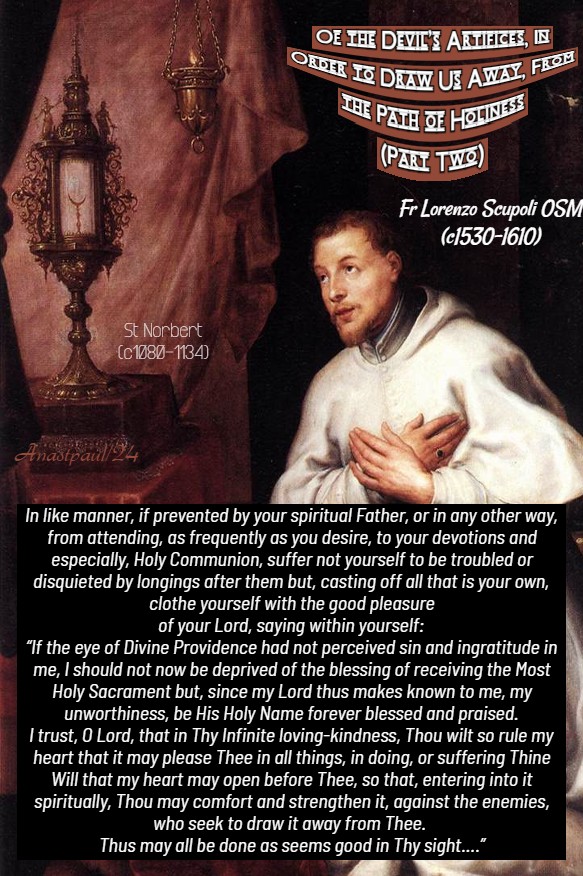
XXXI: … Of the Devil’s Artifices, In Order to Draw Us Away, From the Path of Holiness (Part Two)
“In like manner, if prevented by your spiritual Father, or in any other way, from attending, as frequently as you desire, to your devotions and especially, Holy Communion, suffer not yourself to be troubled or disquieted by longings after them but, casting off all that is your own, clothe yourself with the good pleasure of your Lord, saying within yourself:
“If the eye of Divine Providence had not perceived sin and ingratitude in me, I should not now be deprived of the blessing of receiving the Most Holy Sacrament but, since my Lord thus makes known to me, my unworthiness, be His Holy Name forever blessed and praised. I trust, O Lord, that in Thy Infinite loving-kindness, Thou wilt so rule my heart that it may please Thee in all things, in doing, or suffering Thine Will that my heart may open before Thee, so that, entering into it spiritually, Thou may comfort and strengthen it, against the enemies, who seek to draw it away from Thee. Thus may all be done as seems good in Thy sight. My Creator and Redeemer, may Thy Will be now and ever, my food and sustenance! This one favour only do I beg of Thee, O my Beloved that my soul, freed and purified from everything displeasing to Thee and adorned with all virtues, maybe ever prepared for Thy Coming and, for whatsoever it may please Thee to do with me. Amen.”
If you will observe these rules, know for certain that, when baffled in any good work which you have a desire to perform, be the hindrance from the devil, to disquiet you and turn you aside from the way of virtue, or be it from God, to make trial of your submission to His Will, you will still have an opportunity of pleasing your Lord in the way most acceptable to Him. And herein consists true devotion and the service which God requires of us.
I warn you, also, lest you grow impatient under trials, from whatever source proceeding that, in using the lawful means which God’s servants are wont to use, you use them, not with the desire and hope to obtain relief but because, it is the Will of God that they should be used — for we know not, whether His Divine Majesty will be pleased, by their means, to deliver us.
Otherwise you will fall into further evils — for if the event should not fulfill your purpose and desires, you will easily fall into impatience, or your patience will be defective, not wholly acceptable to God and of little value.”
Quote/s of the Day – 10 March – Laetare Sunday / The Fourth Sunday in Lent
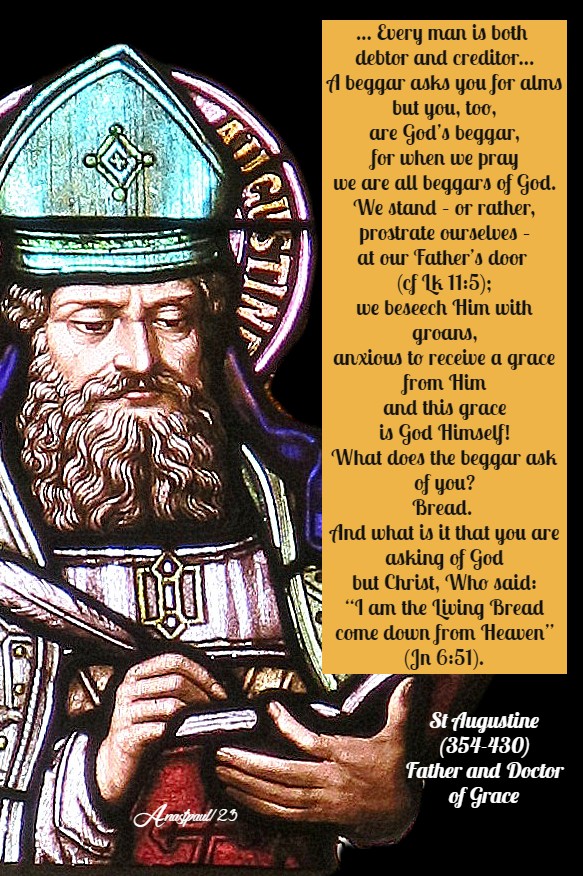
“… Every man is both debtor and creditor… A beggar asks you for alms but you, too, are God’s beggar, for when we pray we are all beggars of God. We stand – or rather, prostrate ourselves – at our Father’s door (cf Lk 11:5); we beseech Him with groans, anxious to receive a grace from Him and this grace is God Himself! What does the beggar ask of you? Bread. And what is it that you are asking of God but Christ, Who said: “I am the Living Bread come down from Heaven” (Jn 6:51).”
St Augustine (354-430) Father and Doctor of Grace
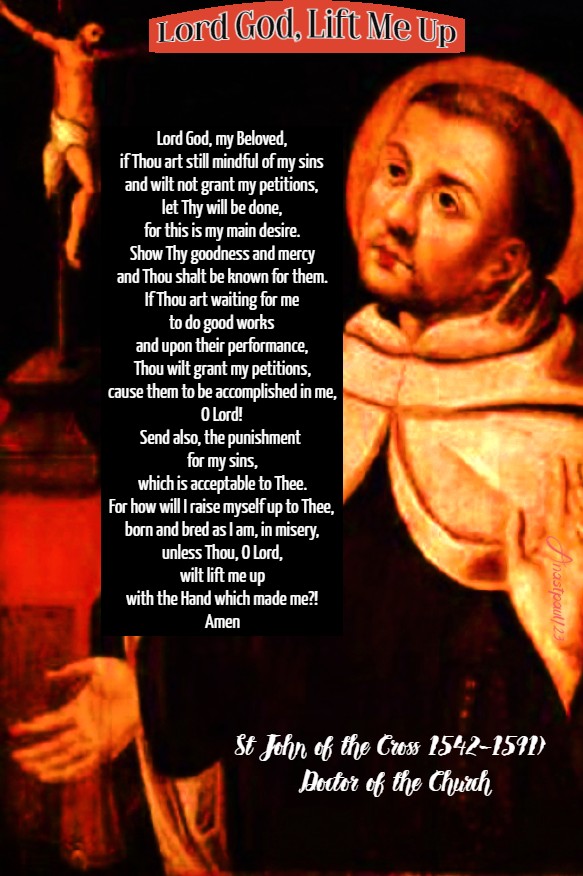
Lord God, Lift Me Up By St John of the Cross (1542-1591)
Lord God, my Beloved, if Thou art still mindful of my sins and wilt not grant my petitions, let Thy will be done, for this is my main desire. Show Thy goodness and mercy and Thou shalt be known for them. If Thou art waiting for me to do good works and upon their performance, Thou wilt grant my petitions, cause them to be accomplished in me, O Lord! Send also, the punishment for my sins, which is acceptable to Thee. For how will I raise myself up to Thee, born and bred as I am, in misery, unless Thou, O Lord, wilt lift me up with the Hand which made me?! Amen
St John of the Cross (1542-1591) Mystical Doctor of the Church
Our Lenten Journey with the Angels and the Saints – 10 March – Laetare Sunday / The Fourth Sunday in Lent – Galatians 4:22-31, John 6:1-15 – Scripture search here: https://www.drbo.org/
“They who trust in the Lord are like Mount Sion which is immovable; which forever stands.” Psalm 124:1-2
“Make the men sit down.” John 6:10
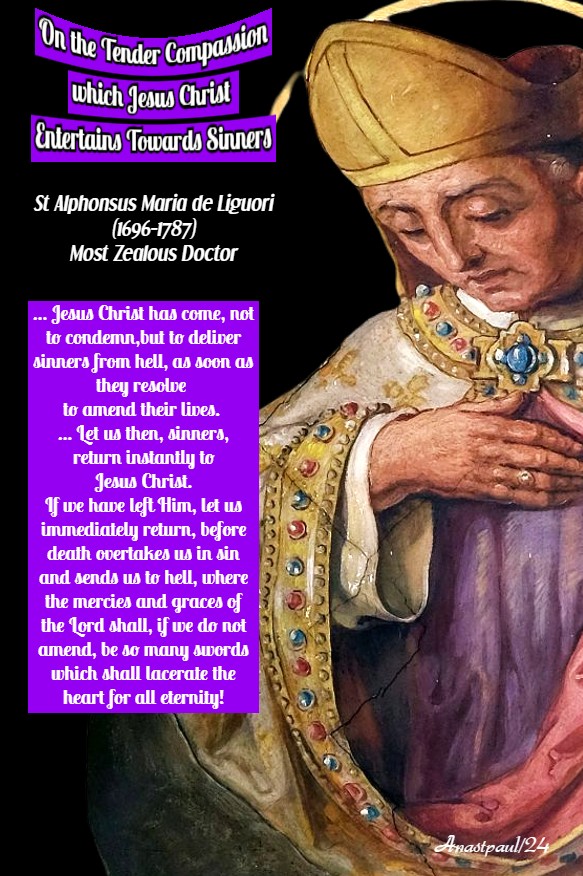
On the Tender Compassion which Jesus Christ Entertains Towards Sinners
St Alphonsus Maria de Liguori (1696-1787) Most Zealous Doctor
“WE read in this day’s Gospel that, having gone up into a mountain with His disciples and seeing a multitude of five thousand persons, who followed Him because they saw the miracles which He wrought on them that were diseased, the Redeemer said to St Philip: “Whence shall we buy bread that these may eat ?” “Lord,” answered St Philip, “two-hundred pennyworth of bread is not sufficient that every one may take a little.” St Andrew then said: There is a boy here that has five barley loaves and two fishes but what are these among so many? But Jesus Christ said: “Make the men sit down.” And he distributed the loaves and fishes among them. “The multitude were satisfied and the fragments of bread which remained, filled twelve baskets.” The Lord wrought this miracle through compassion for the bodily wants of these poor people but, far more tender is His compassion, for the necessities of the souls of the poor that is, of sinners, who are deprived of the Divine Grace.
But, my Lord, since Thou hast resolved to take human flesh, would not a single prayer offered by Thee be sufficient for the redemption of all men? What need, then, was there of leading a life of poverty, humiliation and contempt, for thirty- three years, of suffering a cruel and shameful death on an infamous gibbet and of shedding all Thy Blood by dint of torments? I know well, answers Jesus Christ, that One Drop of My Blood, or a simple prayer, would be sufficient for the salvation of the world but neither,would be sufficient to show the love which I bear to men and, therefore, to be loved by men when they should see me dead on the Cross, for the love of them, I have resolved to submit to so many torments and to so painful a death. This, He says, is the duty of a good Shepherd “I Am the Good Shepherd. The Good Shepherd giveth His Life for His sheep… I lay down My Life for My sheep.” (John 10:11, 15) …
This tenderness of Jesus Christ was experienced by the sinful woman (according to St Gregory, — Mary Magdalene) who cast herself at the feet of Jesus and washed them with her tears. (Luke 7:47 and 50) The Lord, turning to her with sweetness, consoled her by saying: “Thy sins are forgiven … thy faith hath made thee safe; go in peace.” (Luke 7:48 and 50.) Child, thy sins are pardoned; thy confidence in Me has saved thee; go in peace. It was also felt by the man who was sick for thirty- eight years and who was infirm, both in body and soul. The Lord cured his malady and pardoned his sins. … We have also a proof of the tender compassion of the Son of God for sinners, in his conduct towards the woman caught in adultery.
… Jesus Christ has come, not to condemn,but to deliver sinners from hell, as soon as they resolve to amend their lives. And when He sees them obstinately bent on their own perdition, He addresses them with tears in the words of Ezechiel: “Why will you die, O house of Israel?” (18:31). My children, why will you die? Why do you voluntarily rush into hell, when I have come from Heaven to deliver you from it by death?” He adds: you are already dead to the grace of God. But I will not allow your death — return to Me and I will restore to you the life which you have lost.
Let us then, sinners, return instantly to Jesus Christ. If we have left Him, let us immediately return, before death overtakes us in sin and sends us to hell, where the mercies and graces of the Lord shall, if we do not amend, be so many swords which shall lacerate the heart for all eternity!” – (Sermon for the Fourth Sunday in Lent – Intro, 3,8,9,11,12).
One Minute Reflection – 10 March – Laetare Sunday / The Fourth Sunday in Lent – Galatians 4:22-31, John 6:1-15 – Scripture search here: https://www.drbo.org/
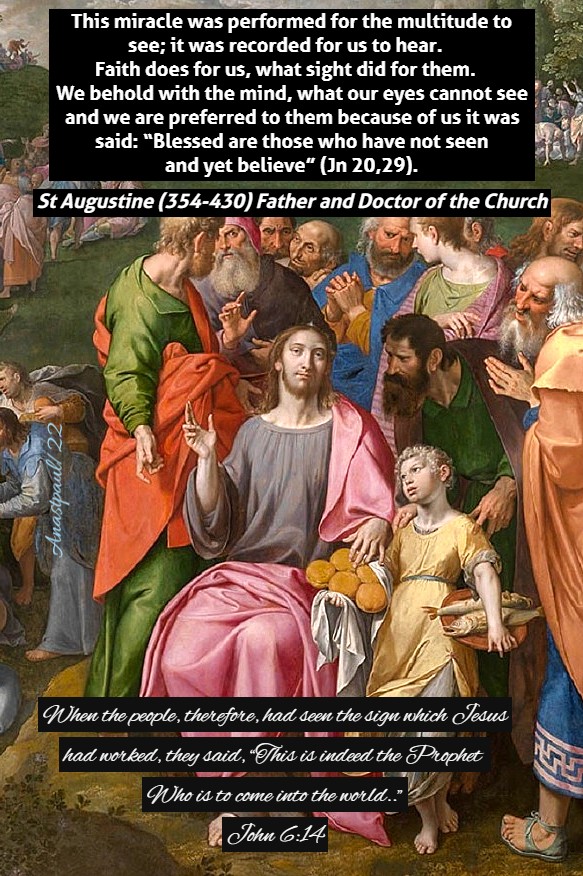
“When the people, therefore, had seen the sign which Jesus had worked, they said, “This is indeed the Prophet Who is to come into the world..” – John 6:14
REFLECTION – “Governing the entire universe, is a greater miracle, than feeding five thousand people with five loaves of bread, yet no-one marvels at it. People marvel at the feeding of the five thousand, not because this miracle is greater but because, it is out of the ordinary. Who is even now providing nourishment for the whole world if not the God Who creates a field of wheat from a few seeds? Christ did what God does. Just as God multiplies a few seeds into a whole field of wheat, so Christ multiplied the five loaves in His Hands. For there was power in the Hands of Christ. Those five loaves were like seeds, not because they were cast on the earth but because, they were multiplied by the One Who made the earth.
This miracle was presented to our senses, in order to stimulate our minds… and so make us marvel at “the God we do not see because of His works which we do see” (Rom 1:20). For then, when we have been raised to the level of faith and purified by faith, we shall long to behold, although not with our eyes, the invisible God Whom we recognise, through what is visible. This miracle was performed for the multitude to see; it was recorded for us to hear. Faith does for us, what sight did for them. We behold with the mind, what our eyes cannot see and we are preferred to them because, of us it was said: “Blessed are those who have not seen and yet believe” (Jn 20:29).” – St Augustine (354-430) Father and Doctor of the Church (Homilies on Saint John’s gospel, 24).
PRAYER – Grant, we beseech Thee, Almighty God, that we who know how courageously Thy holy Martyrs have confessed the faith, may experience their goodness as they intercede for us with Thee. Through Jesus Christ, Thy Son our Lord, Who lives and reigns with Thee, in the unity of the Holy Ghost, God, world without end. Amen (Collect).
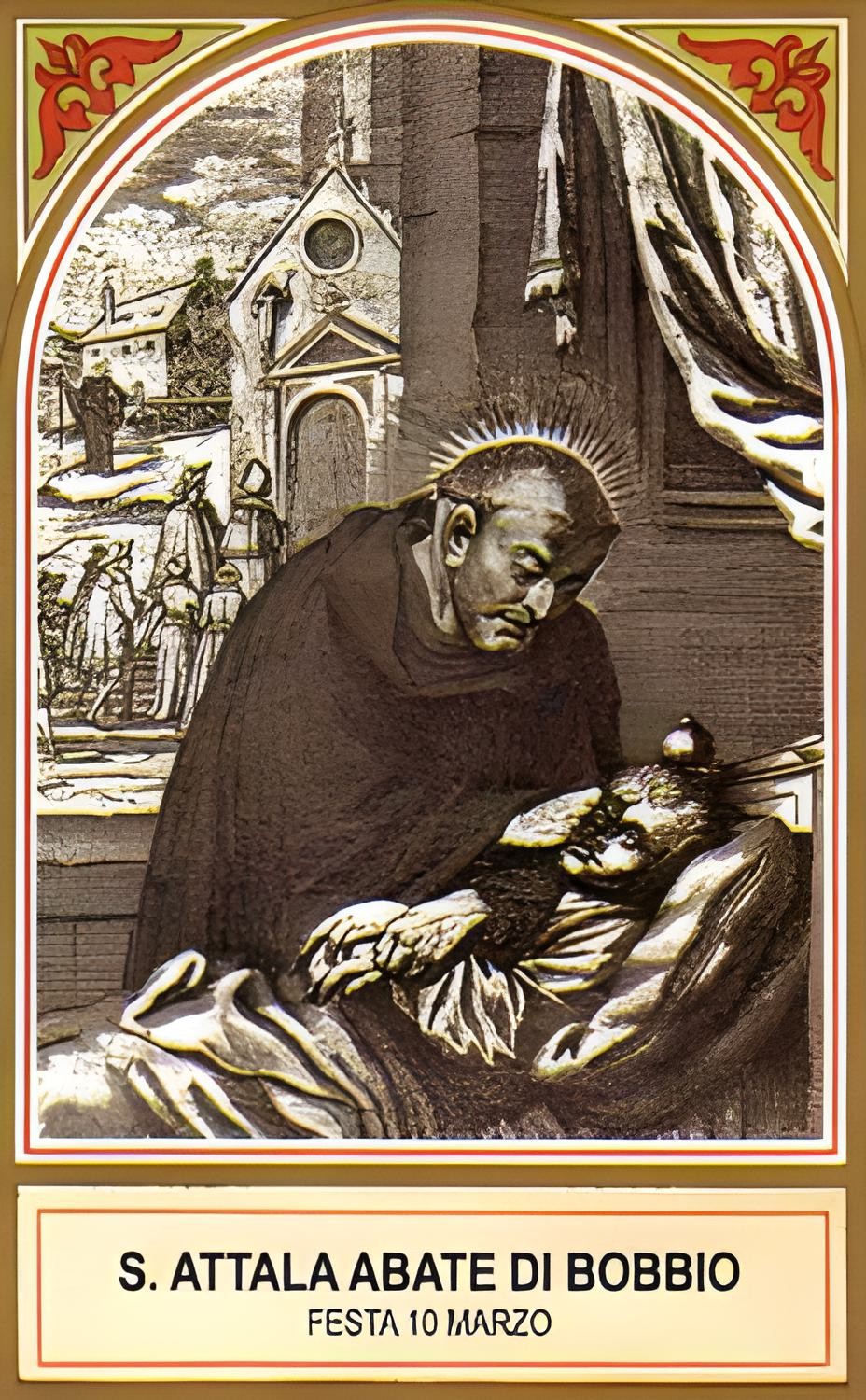
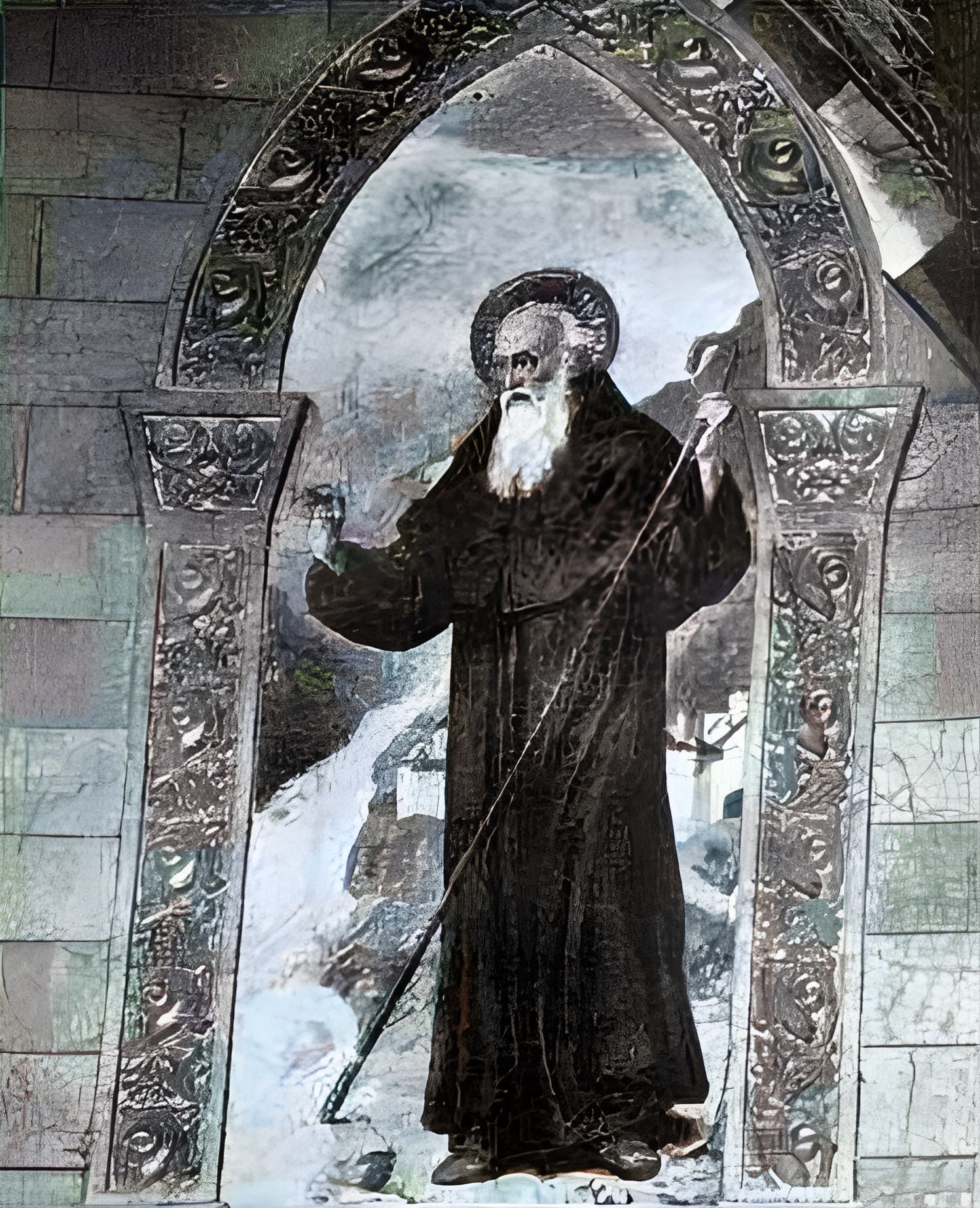
Saint of the Day – 10 March – St Attalas of Bobbio (Died c627) Abbot, Disciple of, Assistant and Successor to St Columban (543-615). A legendary leader of great wisdom and scholarly abilities, a loving father to his Monks and a generous and kindly Apostle to the poor and the ill, Miracle-worker. His Monks included Saint Valery, Saint Blitmund and St Bertulf, all Abbots at various times. Born in Burgundy, France and died in c627 of natural causes in Bobbio, Italy. Patronages – of Bobbio and of Luxeuil-les-Bains, France. Also known as – Attal, Attala, Attale.
The Roman Martyrology reads today: “In the Monastery of Bobbio, the Abbot, St Attalas, renowned for miracles.”
Attalas was originally from Burgundy, where he was born into a noble family. For his suitable education he was entrusted to Aredius, the Bishop of Gap, City of the Dauphiné.
However, desiring a more rigid lifestyle, Attalas fled and took refuge for some time in the Monastery of Lérins. But even this renowned Monastery did not satisfy him and he decided to move to Luxeuil, the Monastery founded by Saint Columban. Here he was finally able to find the austerity he desired and place himself under the guidance of the great Irish Saint.
When Colomban was banished from France for having accused the vices of King Theodoric of Austrasia, he took some companions with him to Lombardy, including Attalas. They settled in Bobbio, on land donated by the Lombard King.
Colomban was now in his seventies, a venerable age and he survived only a year after the foundation of the new Monastery. Much of the credit for the foundation of this Monastery of Bobbio is, in fact, due toour Saint, who succeeded him as Abbot in 615.
When charismatic authority of the holy founder died and his place was taken by Attalas, various objections to the austerity of community life were raised by the Monks but Attalas did not allow himself to be influenced and let those who were dissatisfied leave. However, some of these later returned and he welcomed them with affection and benevolence.
Jonah of Susa, his Hagiographer, remembers him as “a man loved by all, of great fervour and charity for the poor and pilgrims. He knew how to resist the proud but he was humble with the humblest, he did not allow himself to be silenced in conversations with intelligent people but with simple people, he knew how to talk about the secrets of God. Wise when he came across thorny problems, firm when challenged by heretics, he was strong in adversity, disciplined in favourable times, always temperate and discreet. He showed love and respect towards his subordinates and wisdom towards his disciples. In his presence, no-one could be excessively sad or display undisciplined gaiety.”
Like St Colomban, Attalas also found himself having to fight Arianism which was widespread in the surroundings of Milan.
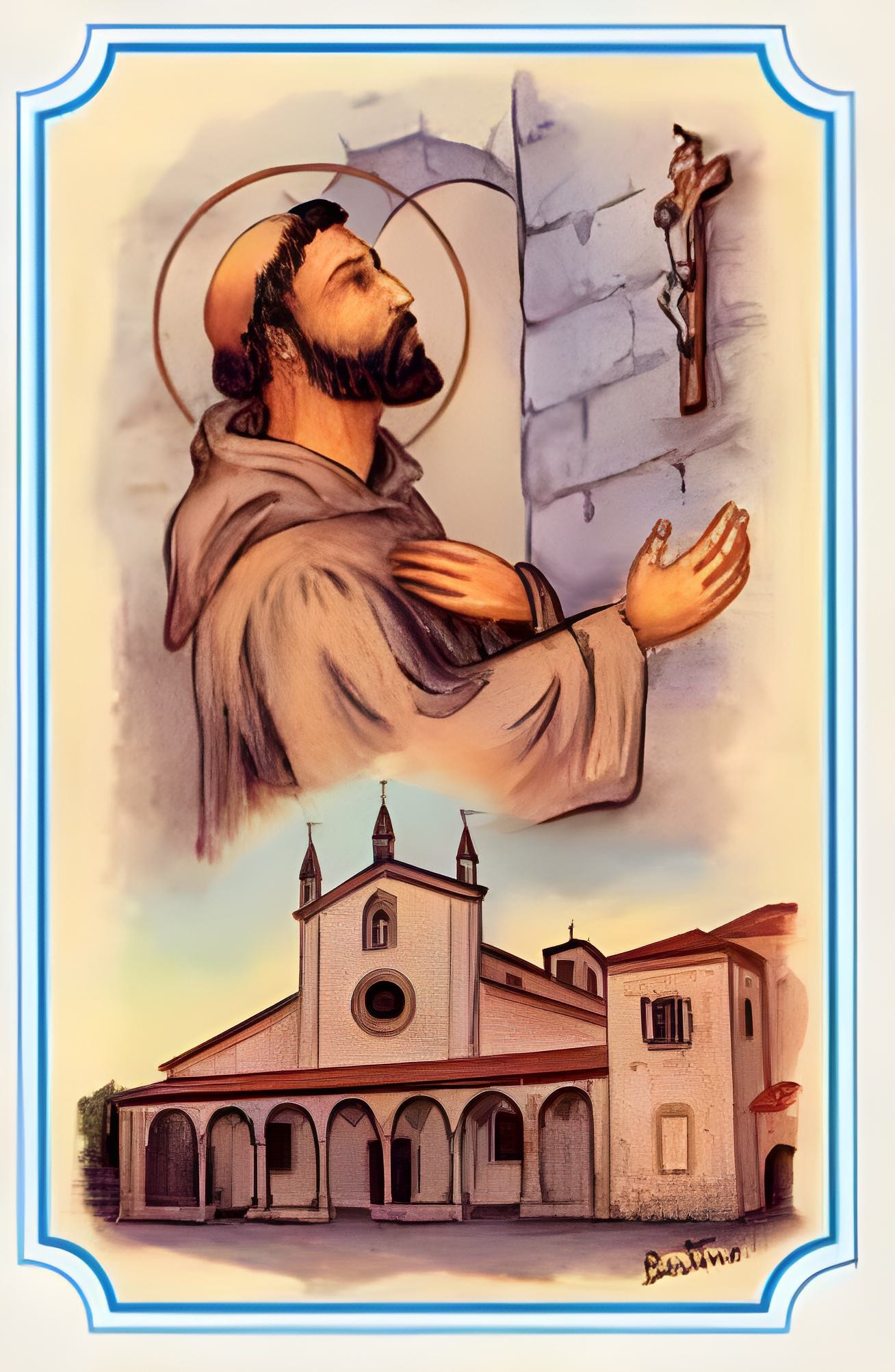
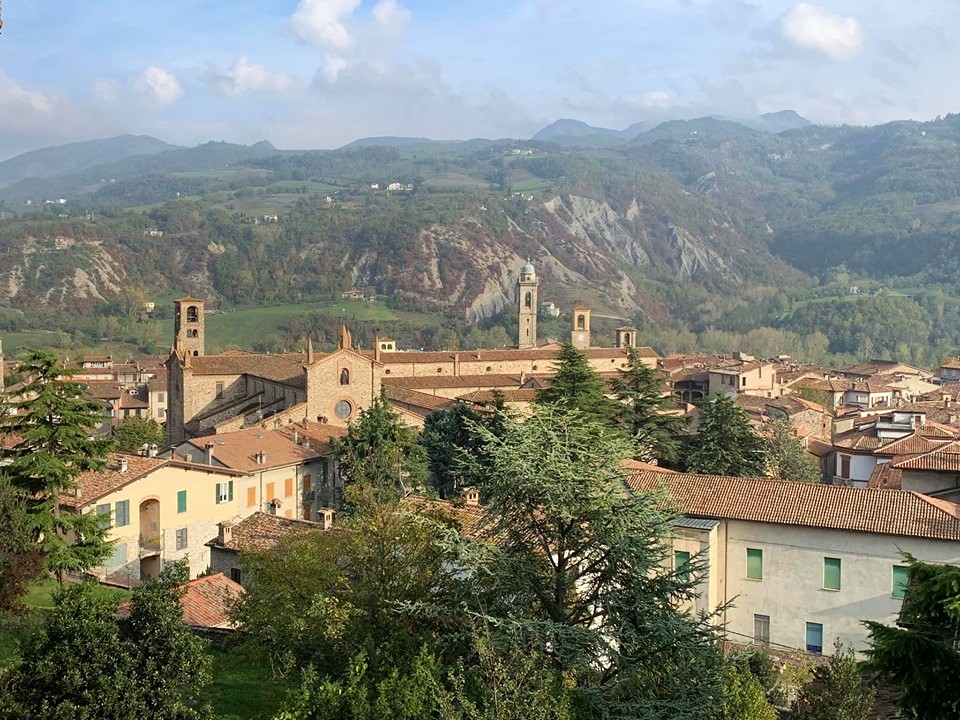
Bobbio Monastery
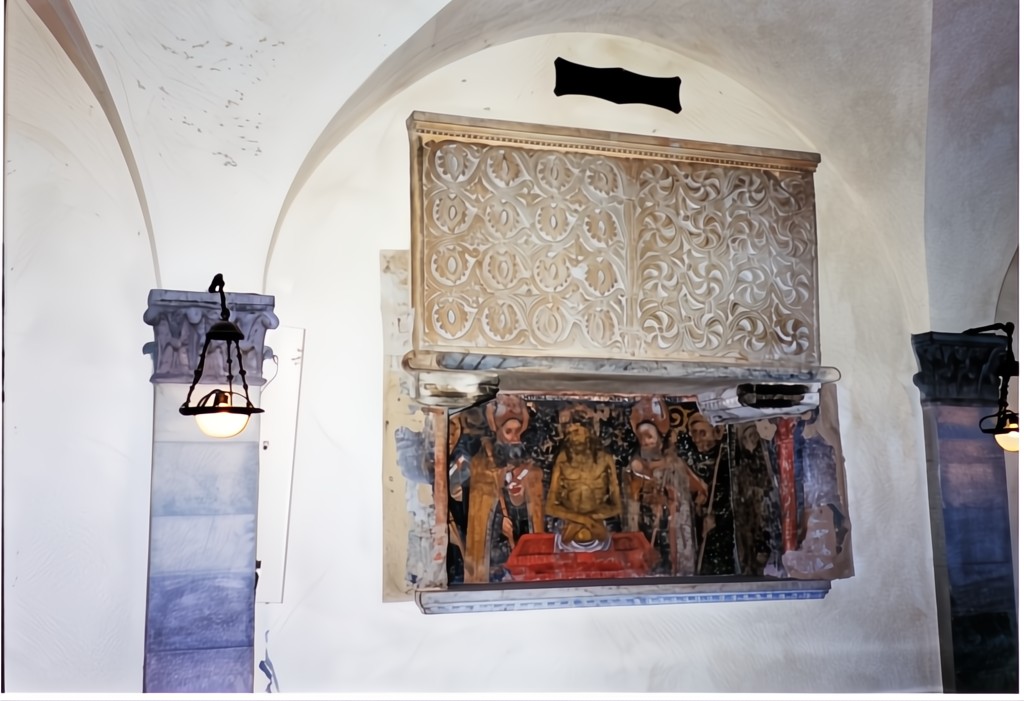
Having become seriously ill, Attalas asked to be laid outside his cell, near which there was a Crucifix which he touched everytime he entered or left his cell and to be left alone there on the ground. As a Monk, who remained nearby testified, the now dying Saint prayed fervently and had a vision of Paradise for several hours. Finally taken back to his cell, he died the following day. It was the year c627. Saint Attalas was buried next to Saint Colomban and a few years later Saint Bertulf, their successor, also joined them in the same tomb and shared the cult with them.
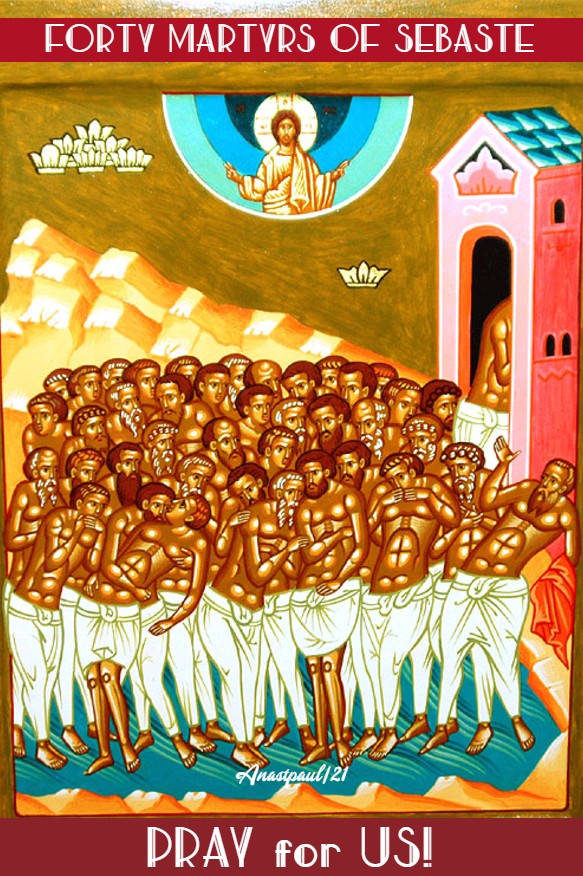
Forty Martyrs of Sebaste, Armenia (Died 320) – Forty Christian soldiers of the Thunderstruck Legion of the Imperial Roman army who were tortured and murdered for their faith during the persecutions of Emperor Licinius. They were exposed naked on a frozen pond to freeze to death at Sebaste, Armenia in 320 and their bodies afterward were burned. THE FULL STORY HERE: https://anastpaul.com/2021/03/10/saints-of-the-day-10-march-the-forty-martyrs-of-sebaste-armenia-died-320/
NOVENA FOR THE INTERCESSION OF SAINT JOSEPH DAY ONE – Link: NOVENA FOR THE INTERCESSION OF SAINT JOSEPH (Remember last year St Joseph’s Feast was moved to 20 March due to Laetare Sunday falling on his Feast Day, 19 March. Hence the Novena began a day later than usual.)
St Alexander of Apema St Anastasia the Patrician St Andrew of Strumi St Attalas of Bobbio (Died c627) Abbot St Blanchard of Nesle-la-Réposte St Caius of Apema St Cordratus of Nicomedië
St Emilian of Lagny St Failbhe the Little St Gustav the Hermit St Himelin Bl John of Vallombrosa St Kessog
St Macarius of Jerusalem (Died c335) Bishop of Jerusalem for over twenty years. Defender of the Faith against Arianism, founder of the True Cross with St Helena, organiser and manager of the building of the Sacred Basilicas, including the Church of the Holy Sepuchre in Jerusalem, paid for by St Constantine the Great, St Helena’s son. Also of great import is the fact that Bishop Macarius was one of the two main authors of the Nicene Creed, that is, of the Creed that we still pronounce in Mass today The Life os St Macarius: https://anastpaul.com/2022/03/10/saint-of-the-day-10-march-saint-macarius-died-c-335/
St Peter of Veroli St Rufinus of Nicomedië St Sannudius of Bagensena St Saturninus of Nicomedië St Sedna of Ossory St Silvester of Ireland
Thought for the Day – 9 March – The Spiritual Combat (1589) – Dom Lorenzo Scupoli OSM (c1530-1610)
“None shall be crowned who has not fought well.” 2 Tim 2: 5
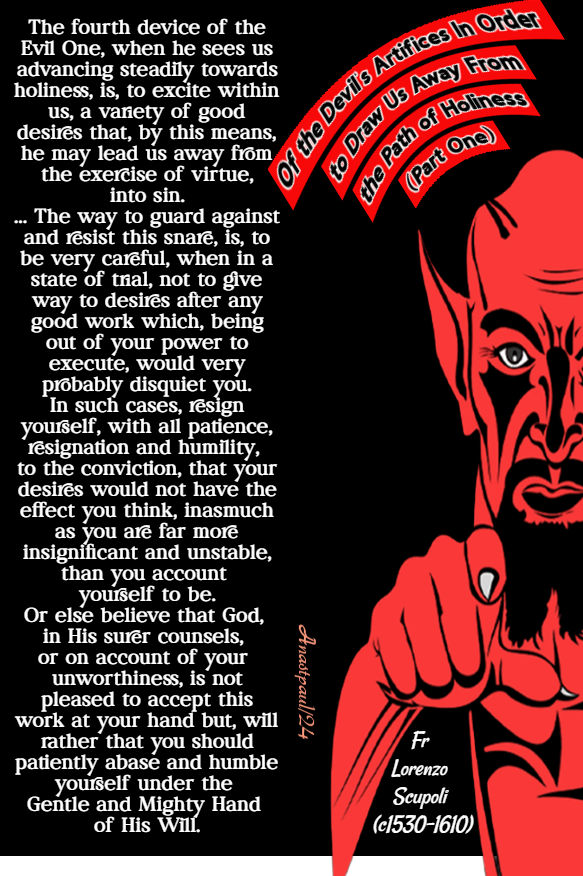
XXXI: … Of the Devil’s Artifices, In Order to Draw Us Away, From the Path of Holiness (Part One)
“The fourth device of the Evil One, when he sees us advancing steadily towards holiness, is, to excite within us, a variety of good desires that, by this means, he may lead us away from the exercise of virtue, into sin.
A sick person is perhaps bearing his illness with a patient will. The cunning adversary knows that by this means, he may attain to a habit of patience and, he immediately sets before him all the good works which, in a different condition, he might be able to perform, and tries to persuade him that if he were but well, he would be able to serve God better and be more useful to himself and others. Having once aroused such wishes within him, he goes on increasing them by degrees, until he makes the subject restless at the impossibility of carrying them into effect and, the deeper and stronger such wishes become, the more does this restlessness increase. Then the enemy leads him on gently and with a stealthy step, to impatience at the sickness, not as sickness but as a hindrance to those good works which he so anxiously desires to perform for some greater good. When he has brought him thus far, with the same art he removes from his mind the end he had in view, to serve God and perform good works and leaves him only, the bare desire to be rid of his sickness. And then, if this does not happen according to his wish, he is so much troubled, as to become actually impatient and so, unconsciously, he falls from the virtue in which he was exercising himself, into the opposite vice.
The way to guard against and resist this snare, is, to be very careful, when in a state of trial, not to give way to desires after any good work which, being out of your power to execute, would very probably disquiet you. In such cases, resign yourself, with all patience, resignation and humility, to the conviction, that your desires would not have the effect you think, inasmuch as you are far more insignificant and unstable, than you account yourself to be.
Or else believe that God, in His surer counsels, or on account of your unworthiness, is not pleased to accept this work at your hand but, will rather that you should patiently abase and humble yourself under the Gentle and Mighty Hand of His Will.”
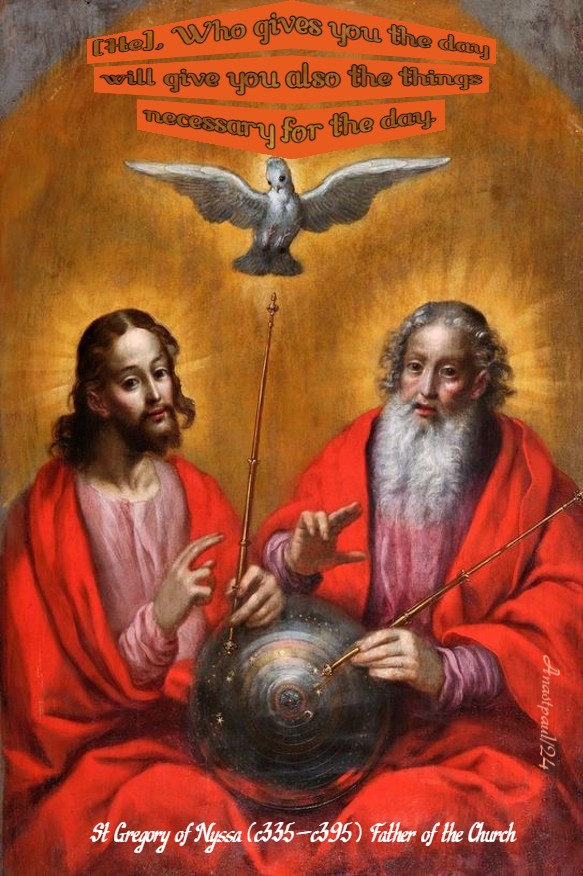
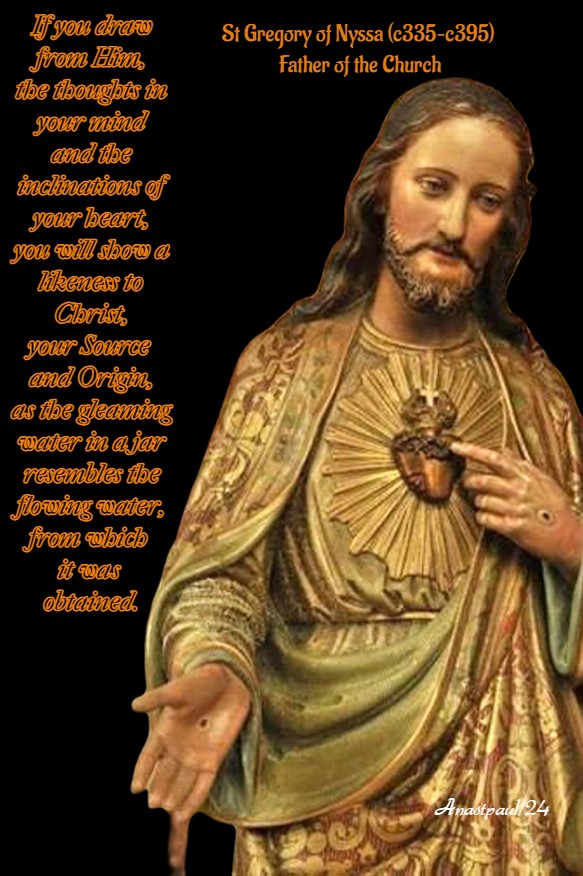
Quote/s of the Day – 9 March – St Gregory of Nyssa (c335–c395) Bishop, Father of the Church
On the Soul and the Resurrection in Two Parts
“[He], Who gives you the day will give you also the things necessary for the day.”
“As no darkness can be seen by anyone surrounded by light, so, no trivialities can capture, the attention of anyone, who has his eyes on Christ.”
“For when one considers the universe, can anyone be so simple-minded, as NOT to believe that the Divine is present in everything, pervading, embracing and penetrating it?”
“It is impossible for one to live without tears, who considers things, exactly as they are!”
“For the purity of Christ and the purity which is manifest in our hearts are identical. Christ’s purity, however, is the Fountainhead; ours has its Source in Him and flows out of Him. Our life is stamped with the beauty of His thought. The inner and the outer man, are harmonised in a kind of music. The mind of Christ is the controlling influence which inspires us to moderation and goodness in our behaviour. As I see it, Christian perfection consists in this – sharing the title which expresses the meaning of Christ’s Name, we bring out this meaning in our minds, our prayers and our way of life.”
“If you draw from Him, the thoughts in your mind and the inclinations of your heart, you will show a likeness to Christ, your Source and Origin, as the gleaming water in a jar resembles the flowing water, from which it was obtained.”
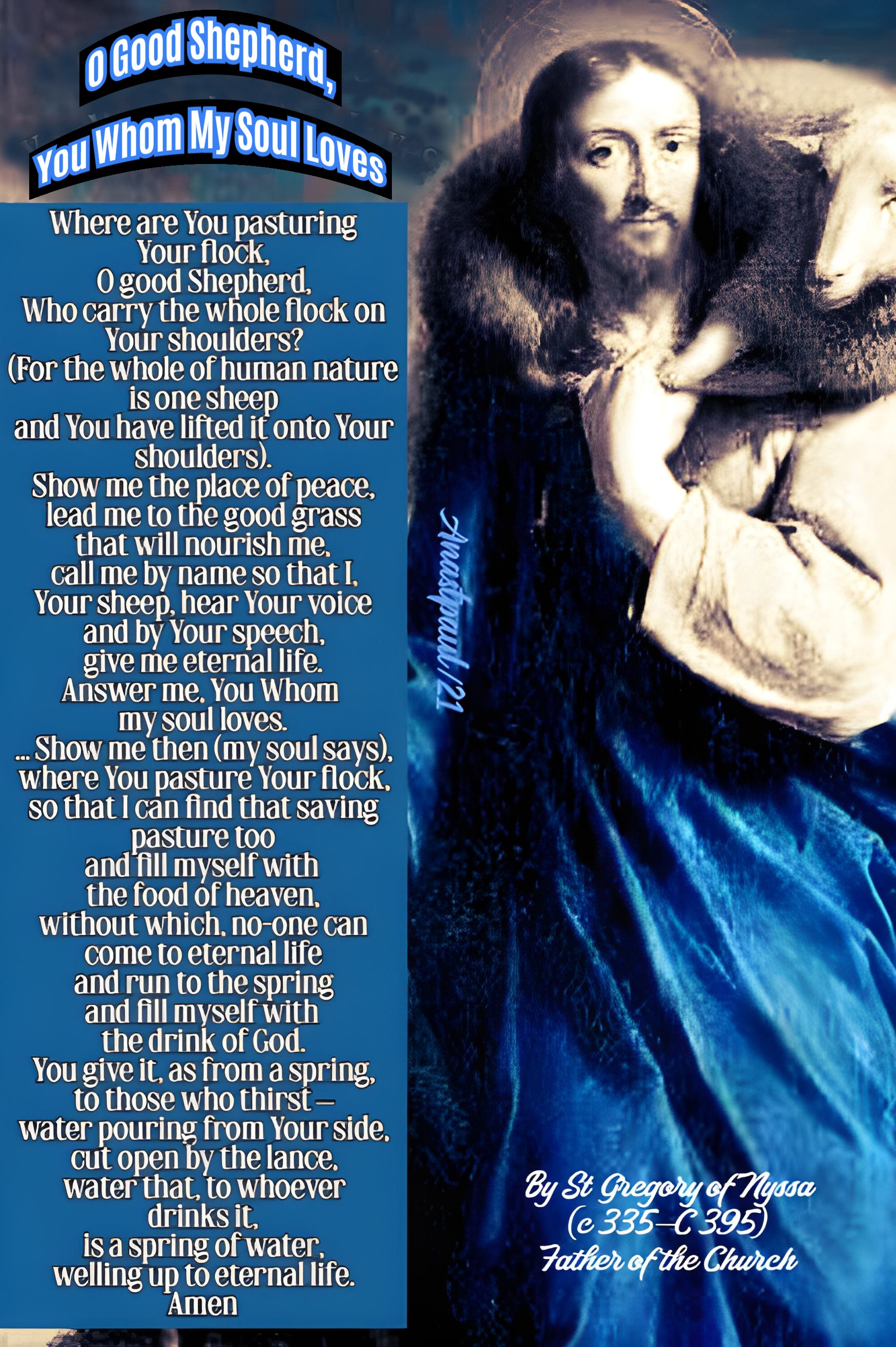
O Good Shepherd, You Whom My Soul Loves By St Gregory of Nyssa (c 335–C 395) Father of the Church
Where are You pasturing Your flock, O good Shepherd, Who carry the whole flock on Your shoulders? (For the whole of human nature is one sheep and You have lifted it onto Your shoulders). Show me the place of peace, lead me to the good grass that will nourish me, call me by name so that I, Your sheep, hear Your voice and by Your speech, give me eternal life. Answer me, You Whom my soul loves. … Show me then (my soul says), where You pasture Your flock, so that I can find that saving pasture too and fill myself with the food of heaven, without which, no-one can come to eternal life and run to the spring and fill myself with the drink of God. You give it, as from a spring, to those who thirst – water pouring from Your side, cut open by the lance, water that, to whoever drinks it, is a spring of water, welling up to eternal life. Amen
This is a tiny excerpt from St Gregory of Nyssa’s commentary on the Song of Songs (Cap 2: PG 44, 802), using the imagery of Psalm 23, appeals to the Lord Jesus Christ for the promised green pastures, restful waters and noonday rest that is the final, eternal destination of those who love God and walk in His ways.
St Gregory of Nyssa (c335–c395) Father of the Church
Our Lenten Journey with the Angels and the Saints – 9 March – Saturday of the Third Week in Lent – Proverbs 31:10-31, Matthew 13:44-52 – Scripture search here: https://www.drbo.org/
“Thou hast loved justice and hated iniquity; therefore God, thy God, hath anointed thee with the oil of gladness, above thy fellows.” Psalm 44:8
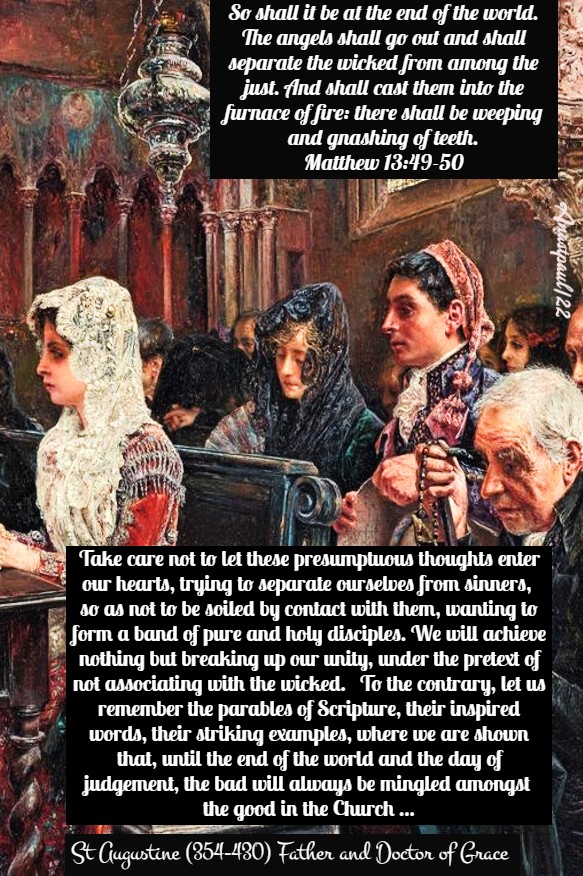
“So shall it be at the end of the world. The Angels shall go out and shall separate the wicked from among the just. And shall cast them into the furnace of fire: there shall be weeping and gnashing of teeth.” Matthew 13:49-50
HEAVEN or HELL?
St Francis de Sales (1567-1622) Doctor Caritas
“CONSIDER THAT THE CHOICE you make in this life will last forever in the next! Consider too, that while both are open to receive you, according to your choice, yet God, Who is prepared to give the one by reason of His Justice, the other by reason of His Mercy, all the while desires, unspeakably that you should select Paradise. offering you countless graces on God’s part, countless assistance to attain to it. Consider that Jesus Christ, enthroned in Heaven, looks down upon you in loving invitation – ‘O beloved one, come unto Me and joy forever in the eternal blessedness of My Love!’ Behold His mother yearning over you with maternal tenderness, ‘Courage, my child, do not despise the Goodness of my Son, or my earnest prayers for thy salvation.‘ …
O Hell, I abhor thee now and forever; I abhor thy griefs and torments, thine endless misery, the unceasing blasphemies and maledictions which thou pourest out upon my God and turning to thee, O blessed Paradise, eternal glory, unfading happiness, I choose thee forever as my abode, thy glorious mansions, thy precious and abiding tabernacles.
O my God, I bless Thy Mercy which gives me the power to choose, O Jesus, Saviour, I accept Thine Eternal Love and praise Thee for the promise Thou hast given me, of a place prepared for me, in that blessed New Jerusalem, where I shall love and bless Thee forever. ” (Excerpt – ‘Introduction to the Devout Life’ 9th Meditation).
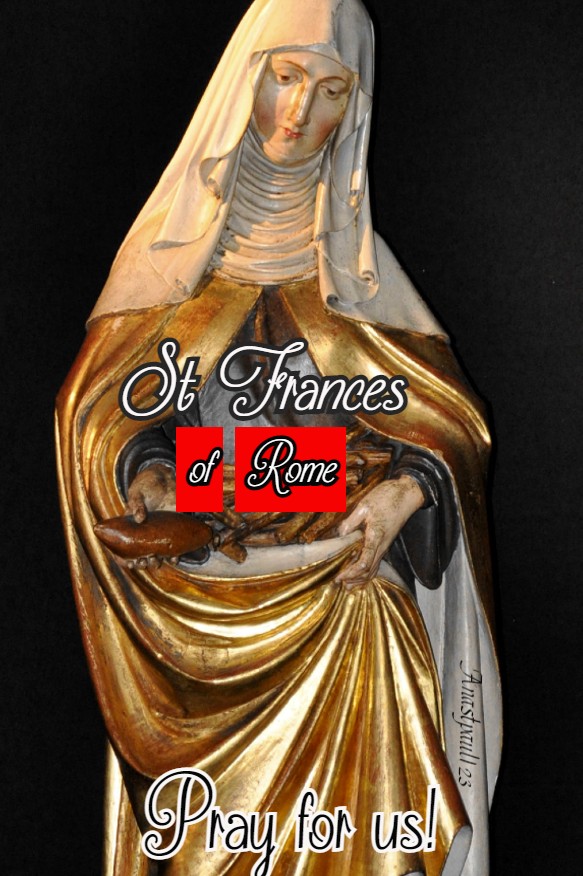
One Minute Reflection – 9 March – Saturday of the Third Week in Lent – St Frances of Rome Obl.S.B. (1384-1440) Widow – Proverbs 31:10-31, Matthew 13:44-52 – Scripture search here: https://www.drbo.org/
“So shall it be at the end of the world. The Angels shall go out and shall separate the wicked from among the just. And shall cast them into the furnace of fire – there shall be weeping and gnashing of teeth.” – Matthew 13:49-50
REFLECTION – “Our Lord was an example of incomparable patience. He bore with a “devil” among His disciples even to His Passion (Jn 6,70). He said: “Let them grow together until the harvest lest you uproot the wheat when you pull out the weeds” (cf. Mt 13,29f.). As a symbol of the Church, He preached that the net would bring back to shore, namely the end of the world, every kind of fish, both good and bad. And He made it known, in various other ways, whether openly or in parables, that there would always be a mixture of good and bad. But, nevertheless, He stresses, that we have to protect the Church’s discipline when He says: “If your brother sins against you, go and tell him his fault between you and him alone. If he listens to you, you have won over your brother” (Mt 18,15)…
Yet today, we see people who think of nothing but stern commandments, who order that troublemakers be reproved, ‘not giving what is holy to the dogs,’ treating, like the publicans, ‘anyone who despises the Church, cutting off the scandalous member from the body‘ (Mt 7,6 ; 18,17 ; 5,30). Their stormy zeal so troubles the Church, that they pull out the weeds before their time and their blindness makes of them enemies, of the unity of Jesus Christ…
Take care not to let these presumptuous thoughts enter our hearts, trying to separate ourselves from sinners, so as not to be soiled by contact with them, wanting to form a band of pure and holy disciples. We will achieve nothing but breaking up our unity, under the pretext of not associating with the wicked. To the contrary, let us remember the parables of Scripture, their inspired words, their striking examples, where we are shown that, until the end of the world and the day of judgement, the bad will always be mingled amongst the good in the Church, without their participation in the Sacraments being harmful to the good, so long as these latter, have not played a part in their sins.” – St Augustine (354-430) Father and Doctor of Grace (On Faith and Works – Excerpt ch 3-5)
PRAYER – O God, Who along with other gifts of Thy grace honoured blessed Frances, Thy handmaid, with the close companionship of an angel, grant, we beseech Thee, that by the help of her intercession we may be made worthy to attain the companionship of Angels in Heaven. Through Jesus Christ, Thy Son our Lord, Who lives and reigns with Thee, in the unity of the Holy Ghost, God, world without end. Amen (Collect).
Our Morning Offering – 9 March – “The Month of St Joseph” – Saturday of the Third Week in Lent
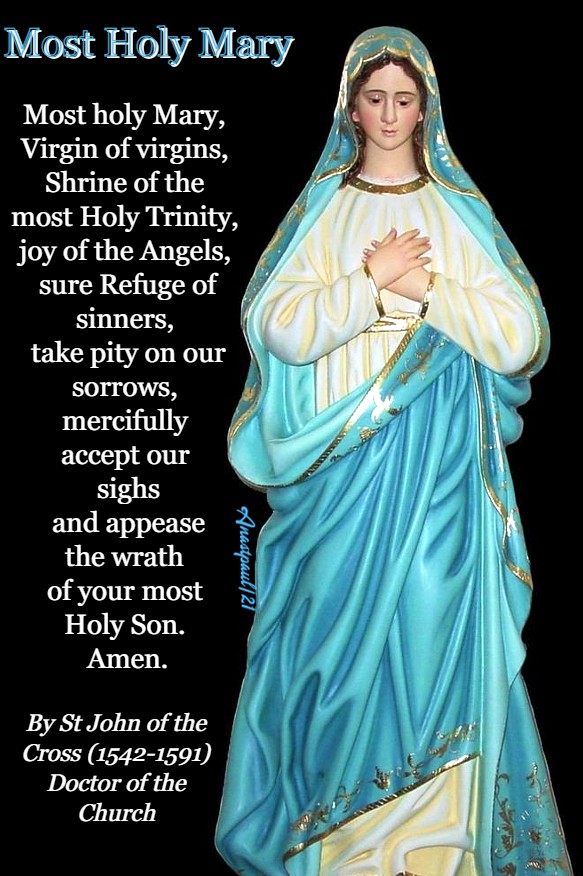
Most Holy Mary By St John of the Cross (1542-1591) Doctor of the Church
Most holy Mary, Virgin of virgins, Shrine of the most Holy Trinity, joy of the Angels, sure Refuge of sinners, take pity on our sorrows, mercifully accept our sighs and appease the wrath of your most holy Son. Amen.
Saint of the Day – 9 March – St Gregory of Nyssa (c335–c395) Bishop, Father of the Church, Brother of St Basil the Great. Another of Gregory’s brothers, called Naucratius, was a Monk. He was the Bishop of Nyssa in Cappadocia from 372 to 376 and from 378 until his death in 395. Born in c335 at Caesarea, Cappadocia and died there in c395 of natural causes. St Gregory was an erudite Theologian, Philosopher. Writer , Defender of orthodoxy against heresy but he possible lacked the administrative ability of his brother, Basil or the contemporary influence of Gregory of Nazianzen but, he was an erudite Theologian who made significant contributions to the Doctrines of the Church, in particular, of the Trinity and the Nicene Creed. St Gregory, together with his elder brother, St Basil the Great (Doctor of the Church) and their great and lifelong friend, St Gregory of Nazianzen (also a Doctor of the Church) are collectively known as the “Cappadocian Fathers.”
The Roman Martyrology reads today: “At Nyssa, the demise of St Gregory, Bishop, brother of the blessed Basil the Great, whose life and erudition have rendered him illustrious. He was expelled from his own City for having defended the Catholic Faith during the reign of the Arian Emperor, Valens.”
Gregory’s eldest sister, St Macrina the Younger, had a great influence on him. A discussion he had with her, as he attended at her deathbed and she looked forward to what lay ahead, was later expanded by Gregory, into a Treatise entitled On the Soul and the Resurrection.
Gregory was born at Caesarea in Cappadocia (south-eastern Turkey), the third son and one of five brothers and five sisters. His father was a Rhetorician and his mother, Emelia an earnest Christian and woman of great personal charm. His elder brother, Basil becamethe Bishop of Caesarea. Gregory had an excellent education as a Rhetorician at Athens. He may have married a lady called Theosebeia, possibly the sister of his friend Gregory of Nazianzen. After some years he became disillusioned with his career as a Professor of Rhetoric.
St Gregory of Nazianzen prevailed on Gregory to devote himself to the service of the Church. He was Ordained in 362. It is not known whether his wife died or accompanied him to Nyssa. He gave himself to studying the Scriptures and the works of the Christian writer Origen.
In 371 Gregory was installed as the Bishop of Nyssa, a small town in Lower Armenia, by his brother Basil. However, a financial scandal, where he appeared perhaps too gentle, caused him to be excluded from his See for two years but he was re-instated in 378. It was only after Basil’s death in 379 that his gifts as a Theologian and Writer developed. He became the mainstay of orthodoxy against the Arians throughout Cappadocia and was one of the champions of orthodoxy at the Council of Constantinople (381). And by the time he died he was a greatly respected figure in the Church. He was also in favour with the Emperor Theodosius, who asked him to preach at the funeral of his daughter Pulcheria. He died in the same year as Theodosius, 395.
Many of Gregory’s writings are extant. In theme, they resemble the writings of the other Cappadocian Fathers – Basil and Gregory Naziazen – asserting the Divinity of Jesus and the Holy Ghost against different forms of Arianism (denying the Divinity of Jesus) and Macedonianism (denying the Divinity of the Holy Ghost) – but probably have a greater clarity and depth. Below is an image of his work ‘On Virginity.’ Among the Greeks he was nick-named ‘The Theologian’ and ‘The Father of the Fathers’.
Thought for the Day – 8 March – The Spiritual Combat (1589) – Dom Lorenzo Scupoli OSM (c1530-1610)
“None shall be crowned who has not fought well.” 2 Tim 2: 5
XXX: … On the Delusions of Some, Who Consider Themselves on the Way to Perfection
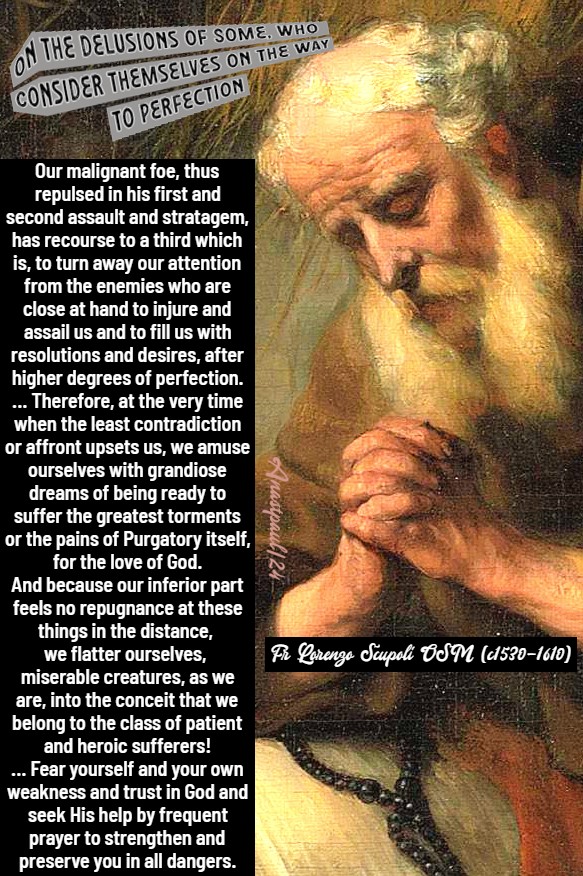
“Our malignant foe, thus repulsed in his first and second assault and stratagem, has recourse to a third which is, to turn away our attention from the enemies who are close at hand to injure and assail us and to fill us with resolutions and desires, after higher degrees of perfection.
Hence, we are continually being wounded; yet, we pay no attention to our wounds and looking upon these resolutions, as already fufillled, we take pride in them in various ways.
Therefore, at the very time when the least contradiction or affront upsets us, we amuse ourselves with grandiose dreams of being ready to suffer the greatest torments or the pains of Purgatory itself, for the love of God. And because our inferior part feels no repugnance at these things in the distance, we flatter ourselves, miserable creatures, as we are, into the conceit that we belong to the class of patient and heroic sufferers! To avoid this snare, resolve to fight manfully against the enemies who are close at hand and actually waging war against you.
You will thus discover whether your resolutions are real or imaginary, weak or strong and so, you will go onto virtue and perfection, by the beaten and Royal Road.
But, against enemies who are not wont to trouble you, I do not advise you to take up arms, unless there appear a probability of their making an attack at some future time. In this case it is lawful to make resolutions beforehand that you may be found strong and prepared.
Do not, however, judge of your resolutions by their effects, even though you should have long and faithfully exercised yourself in virtue but, be very humble with regard to them; fear yourself and your own weakness and trust in God and seek His help by frequent prayer to strengthen and preserve you in all dangers and especially from the very slightest presumption or self-confidence. For in this case, although we may not be able to overcome some slight defects which our Lord sometimes leaves in us, in order to greater, humility and self-knowledge and for the protection of some virtue, we may yet be permitted to form purposes of aspiring to higher degrees of perfection.”
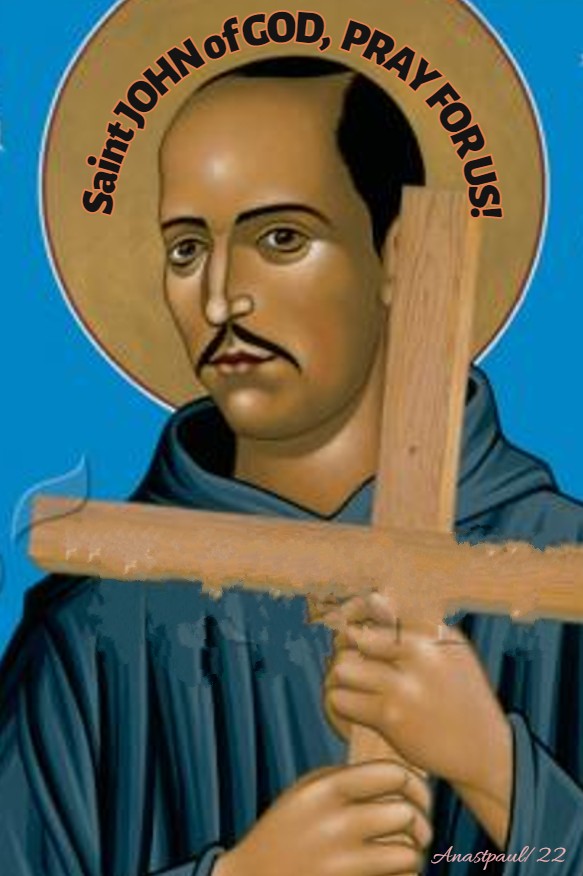
Quote/s of the Day – 8 March – St John of God OH (1495-1550) Confessor, Founder of the Brothers Hospitallers of Saint John of God
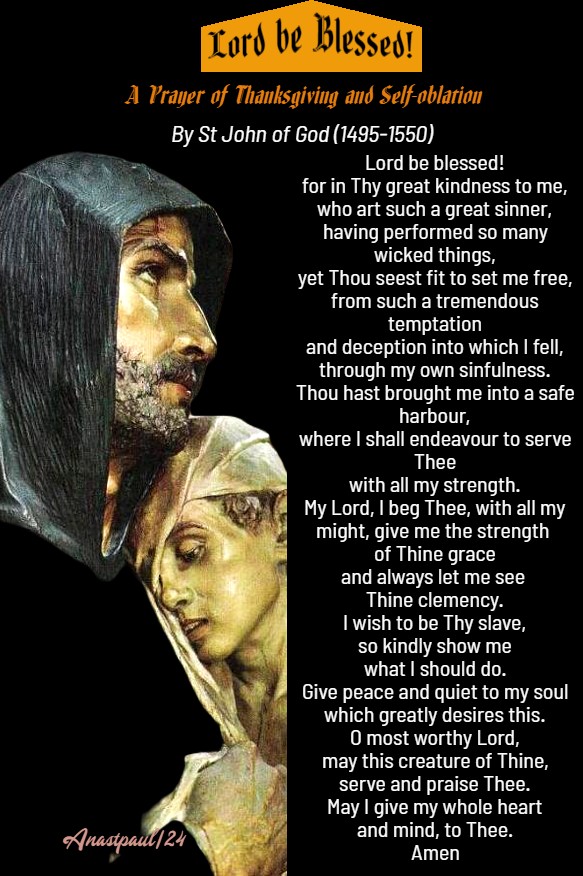
Lord be Blessed! (A Prayer of Thanksgiving and Self-oblation) By St John of God (1495-1550)
Lord be blessed! for in Thy great kindness to me, who art such a great sinner, having performed so many wicked things, yet Thou seest fit to set me free, from such a tremendous temptation and deception into which I fell, through my own sinfulness. Thou hast brought me into a safe harbour, where I shall endeavour to serve Thee with all my strength. My Lord, I beg Thee, with all my might, give me the strength of Thine grace and always let me see Thine clemency. I wish to be Thy slave, so kindly show me what I should do. Give peace and quiet to my soul which greatly desires this. O most worthy Lord, may this creature of Thine, serve and praise Thee. May I give my whole heart and mind, to Thee. Amen
Our Lenten Journey with the Angels and the Saints – 8 March – Friday in the Second Week of Lent – Ecclesiasticus Sirach 31:8-11, Matthew 22:34-46 – Scripture search here: https://www.drbo.org/
“Blessed is the man who fears the Lord, he shall delight exceedingly in His commandments. …” Psalm 111:3
“‘You shall love the Lord your God with your whole heart and with your whole soul and your whole mind.’ This is the greatest and first commandment. And the second is like it, ‘You shall love your neighbour as yourself.’ ” Matthew 22:37-39
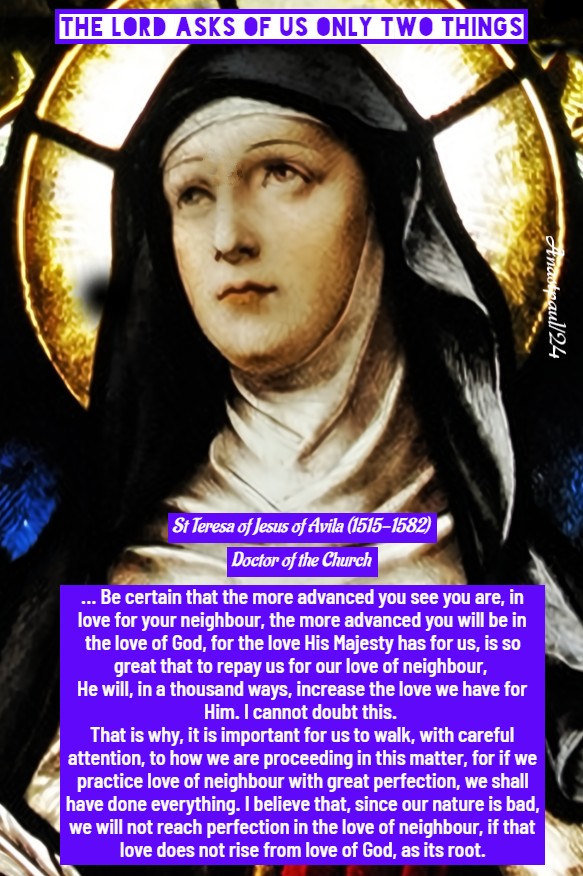
The Lord Asks of Us Only Two Things
St Teresa of Jesus of Avila (1515-1582) Carmelite, Doctor of the Church
“The Lord asks of us only two things – love of His Majesty and love of our neighbour. These are what we must work for. By observing them with perfection, we do His will and so, will be united with Him. But how far, as I have said, we are from doing these two things, as we ought, for so great a God! May it please His Majesty to give us His grace, so that we might merit, if we wish to reach this state that lies within our power.
The most certain sign, in my opinion, as to whether or not we are observing these two laws, is whether we observe well, the love of neighbour. We cannot know whether or not we love God, although there are strong indications for recognising that we do love Him but, we can know, whether we love our neighbour. And be certain that the more advanced you see you are, in love for your neighbour, the more advanced you will be in the love of God, for the love His Majesty has for us, is so great that to repay us for our love of neighbour, He will, in a thousand ways, increase the love we have for Him. I cannot doubt this. That is why, it is important for us to walk, with careful attention, to how we are proceeding in this matter, for if we practice love of neighbour with great perfection, we shall have done everything.I believe that, since our nature is bad, we will not reach perfection in the love of neighbour, if that love does not rise from love of God, as its root.” – (Interior Castle, Fifth Dwelling Places Ch 3).
One Minute Reflection – 8 March – Friday in the Second Week of Lent – The Memorial of St John of God OH (1495-1550) Confessor, Founder of the Brothers Hospitallers of Saint John of God – Ecclesiasticus Sirach 31:8-11, Matthew 22:34-46 – Scripture search here: https://www.drbo.org/
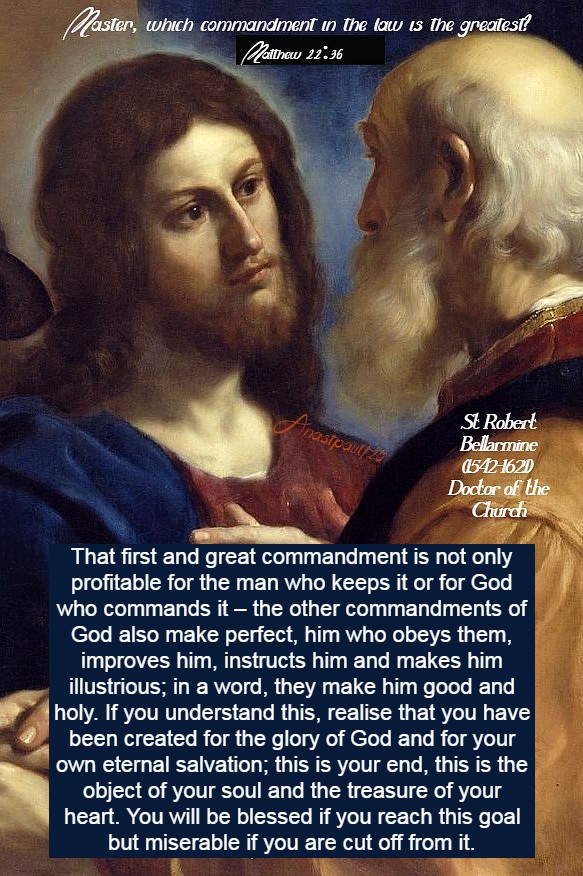
“Master, which commandment in the law is the greatest?” … Matthew 22:36
REFLECTION – “O Lord, what is it that you require of Your servants? “Take my yoke upon you,” you say. And what sort of yoke is this? “My yoke is easy and my burden light.” Now who would not willingly bear a yoke that does not press down but gives strength; a burden that does not weigh heavily but refreshes? As You rightly added: “And you will find rest” (Mt 11:29). And what is this yoke of Yours that does not tire but gives rest? It is the first and greatest of the commandments: “You shall love the Lord your God with all your heart.” What could be easier, better or more agreeable than to love the goodness, beauty and love that is most perfectly Yours, O Lord my God?
Do You not offer a reward to those who keep the commandments, which are “more desirable than a heap of gold and sweeter than honey from the comb?” (Ps 19[18]:11) So in every way, You offer a very ample reward, as James the Apostle says: “The Lord has prepared the crown of life for those who love him” (Jas 1:12) …And Paul quotes these words from Isaiah: “No eye has seen, nor ear heard, nor has the heart of man conceived, what God has prepared for those who love him” (1 Cor 2:9).
That first and great commandment is not only profitable for the man who keeps it or for God Who commands it – the other commandments of God also make perfect him who obeys them, improves him, instructs him and makes him illustrious; in a word, they make him good and holy. If you understand this, realise that you have been created for the glory of God and for your own eternal salvation; this is your end, this is the object of your soul and the treasure of your heart. You will be blessed if you reach this goal but miserable if you are cut off from it.” – St Robert Bellarmine (1542-1621) Doctor of the Church (The Ascent of the Mind to God, 1).
PRAYER – O God, Who caused blessed John, when burning with love for Thee, to walk unharmed through the midst of flames and through him, enriched Thy Church with a new religious family; grant by the help of his merits, our sins may be burned away by the fire of Thy love and eternal remedies may come to us. Through Jesus Christ, Thy Son our Lord, Who lives and reigns with Thee, in the unity of the Holy Ghost, God, world without end. Amen (Collect).
Our Morning Offering – 8 March – Friday of the Third Week in Lent and the Feast of the Five Holy Wounds
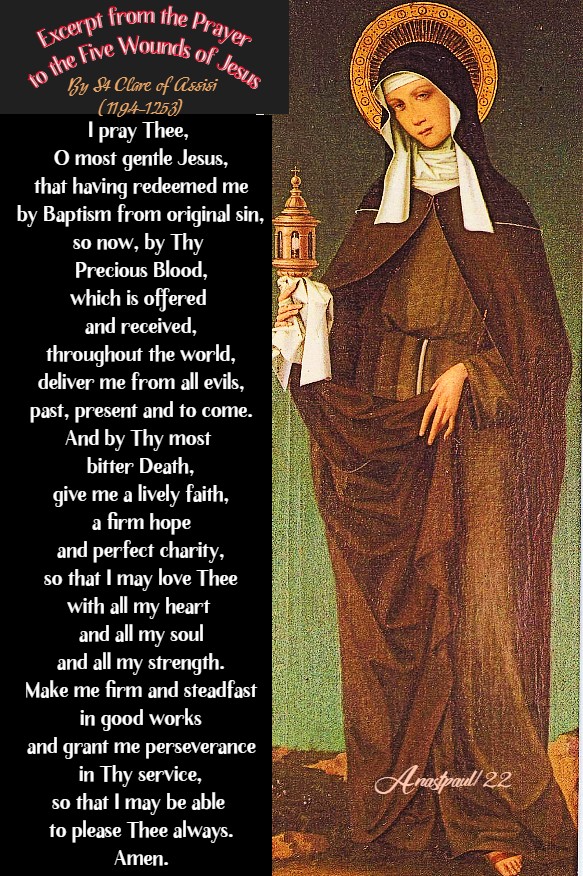
Excerpt from the Prayer to the Five Wounds of Jesus By St Clare of Assisi (1194-1253)
I pray Thee, O most gentle Jesus, that having redeemed me by Baptism from original sin, so now, by Thy Precious Blood, which is offered and received, throughout the world, deliver me from all evils, past, present and to come. And by Thy most bitter Death, give me a lively faith, a firm hope and perfect charity, so that I may love Thee with all my heart and all my soul and all my strength. Make me firm and steadfast in good works and grant me perseverance in Thy service, so that I may be able to please Thee always. Amen.
Saint of the Day – 8 March – Saint Julian of Toledo(642-690) Bishop and Confessor, Monk and Abbot, Scholar and prolific Writer. Born in c642 in Toledo, Spain and died there in 690.
The Roman Martyrology reads: “At Toledo, in Spain, the demise of the blessed Saint Julian, Bishop and Confessor, most celebrated for his sanctity and learning.”
Julian was well educated at the Cathedral school, was a Monk and later Abbot at Agali, a spiritual student of Saint Eugene II his predeccesor as the Archbishop of Toledo.
Julian was the first Bishop to have primacy over the entire Iberian Peninsula and he helped centralise the Iberian Church in Toledo.
He presided over several Councils and Synods and revised the Mozarabic Liturgy.
A voluminous writer, his works include Prognostics, a volume on death (and his most influential work); a history of King Wamba’s war with dux Paul in Septimania (a Sallustian work, and one of the few examples of historical writing from the late Visigothic Kingdom) and, a book on the future life in Heaven (687). A lost work, apparently dedicated to King Erwig, dealt with the issue of Jews owning Christian slaves.
St Apollonius of Antinoë St Arianus of Alexandri St Arnulf of Chartres Abbot St Beoadh of Ardcarne St Duthus of Ross
St Felix of Burgundy (Died 647) Bishop, “The Apostle of East Anglia” Missionary in East Anglia and particularly in the Port Town now known as Felixstowe, in Suffolk, England. Amongst being the Founder of countless Churches. a famouse Monastery of Bury Saint Edmunds, he is also the Founder of what is now the University of Cambridge. This wonderful “Apostle of East Anglia” https://anastpaul.com/2023/03/08/saint-of-the-day-8-march-st-felix-of-burgundy-died-647-bishop-the-apostle-of-east-anglia/
St Humphrey of Prüm St Julian of Toledo (c642-690) Bishop and Confessor St Litifredus of Pavia St Philemon of Antinoë St Pontius of Carthage St Provinus of Como St Quintilis of Nicomedia St Rhian
Martyrs of North Africa – 9 Saints: A Bishop and some of his flock who were Martyred together in North Africa. The only details that have survived are nine of the names – Beata, Cyril, Felicitas, Felix, Herenia, Mamillus, Rogatus, Silvanus, Urban.
Thought for the Day – 7 March – The Spiritual Combat (1589) – Dom Lorenzo Scupoli OSM (c1530-1610)
“None shall be crowned who has not fought well.” 2 Tim 2: 5
XXIX: … Of the Efforts of the Devil to Prevent the Conversion of Those Who Desire It (Part Two)
“Prompt obedience, I say and not mere resolutions; for these are often fallacious and many have been deceived thereby through various causes:
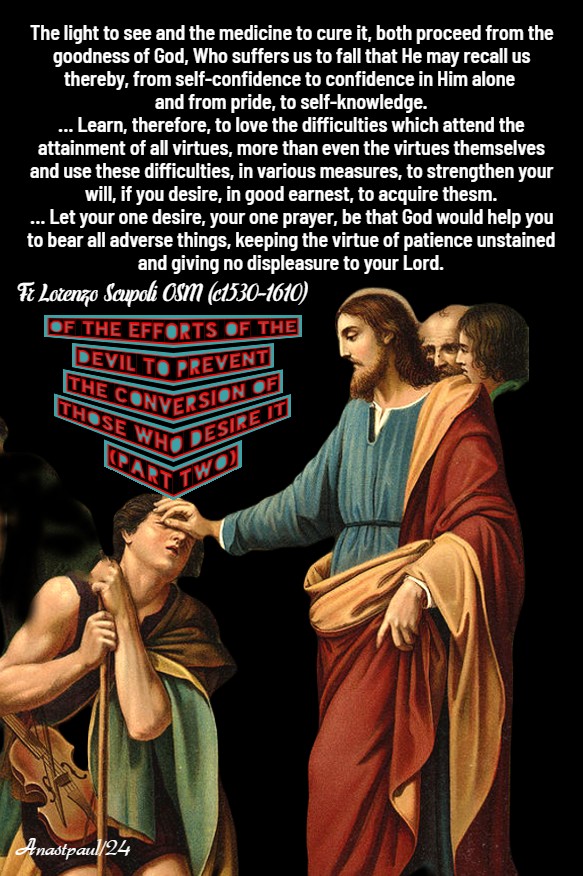
+++ FIRST: Because our resolutions are not founded upon self-distrust and trust in God, but our excessive pride, whence proceeds this blindness and delusion, prevents our perceiving it. The light to see and the medicine to cure it, both proceed from the goodness of God, Who suffers us to fall that He may recall us thereby, from self-confidence to confidence in Him alone and from pride, to self-knowledge. Your resolutions, therefore, to be effective, must be steadfast and to be steadfast, they must be free from all self-confidence and humbly based on confidence in God.
+++ SECOND: When we are making our resolutions, we dwell on the beauty and excellence of virtue which attracts our will, slack and feeble as it is — but, when confronted by the difficulties which attend the attainment of virtue, the weak and untried, will fail and draw back. Learn, therefore, to love the difficulties which attend the attainment of all virtues, more than even the virtues themselves and use these difficulties, in various measures, to strengthen your will, if you desire, in good earnest, to acquire thesm. And know that the more courageously and lovingly you shall embrace these difficulties, the more speedy and complete shall be your victory over self and all your other enemies.
+++ THIRD: In our resolutions, we too often look, rather to our own advantage than to the will of God and the acquisition of the virtues He requires of us. This is frequently the case with resolutions made in times of great spiritual joy or acute sorrow, when we seem unable to find any relief but, in a resolution to give ourselves wholly to God and to the practice of virtue. To avoid this snare, take care in times of spiritual consolation to be very cautious and humble in your resolutions, especially in your vows and promises and in tribulation, let your resolution be to bear your cross patiently, according to the will of God, nay, to exalt it, refusing all earthly and, if so be it, even all heavenly consolation.
Let your one desire, your one prayer, be that God would help you to bear all adverse things, keeping the virtue of patience unstained and giving no displeasure to your Lord.”
Quote/s of the Day – 7 March – St Thomas Aquinas OP (1225-1274) Confessor, Doctor
“We are like children, who stand in need of masters, to enlighten us and direct us and God has provided for this, by appointing His Angels, to be our teachers and guides.”
“To one who has faith, no explanation is necessary. To one without faith, no explanations is possible.”
“Love takes up, where knowledge leaves off.”
“If the highest aim of a Captain were to preserve his ship, he would keep it in Port, forever!”
“If then, you are looking for the way by which you should go, take Christ, for He, Himself, is the Way.”
“Happiness is secured through virtue; it is a good attained by man’s own will.”
Grant Me Grace, O Merciful God Prayer of St Thomas Aquinas (1225-1274) Doctor Angelicus & Doctor Communis which he was accustomed to recite everyday before the image of Christ.
Grant me grace, O merciful God, to desire ardently all that is pleasing to Thee, to examine it prudently, to acknowledge it truthfully and to accomplish it perfectly, for the praise and glory of Thy Name. Amen
Our Lenten Journey with the Angels and the Saints – 7 March – Wisdom 7:7-14; Matthew 5:13-19 – Scripture search here: https://www.drbo.org/
“For she is an infinite treasure to men! which they that use, become the friends of God” Wisdom 7:14
“Neither do men light a candle and put it under a bushel but upon a candlestick …” Matthew 5:15
Exercise Your Soul
St Clement of Alexandria (c150-c215) Father of the Church
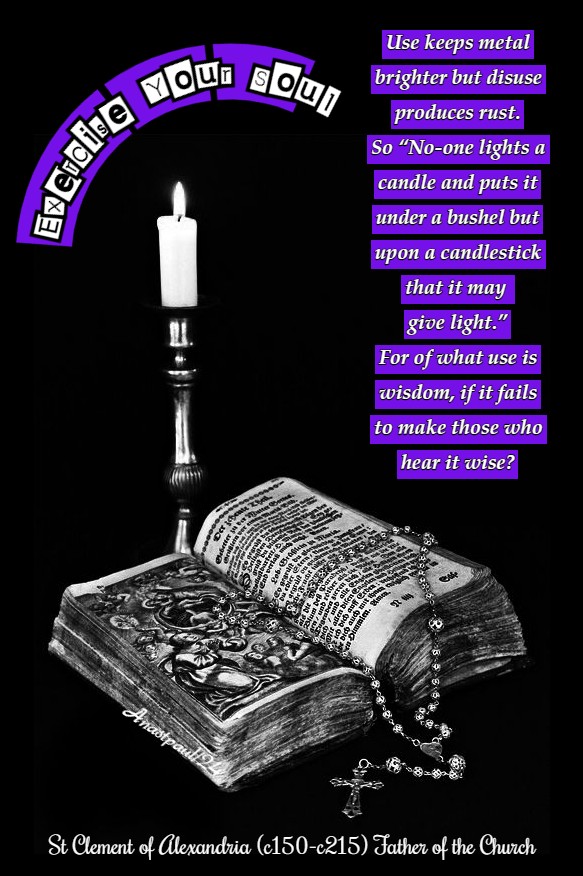
“A well, when pumped regularly, produces purer water. If neglected and no-one uses it, it changes into a source of pollution. Use keeps metal brighter but disuse produces rust.
For, in a word, exercise produces a healthy condition, both in souls and bodies.
So “No-one lights a candle and puts it under a bushel but upon a candlestick that it may give light.”
For of what use is wisdom, if it fails to make those who hear it wise?” (Stromateis 1)
One Minute Reflection – 7 March – “The Month of St Joseph” – – St Thomas Aquinas OP (1225-1274) Confessor, Doctor – Wisdom 7:7-14; Matthew 5:13-19 – Scripture search here: https://www.drbo.org/
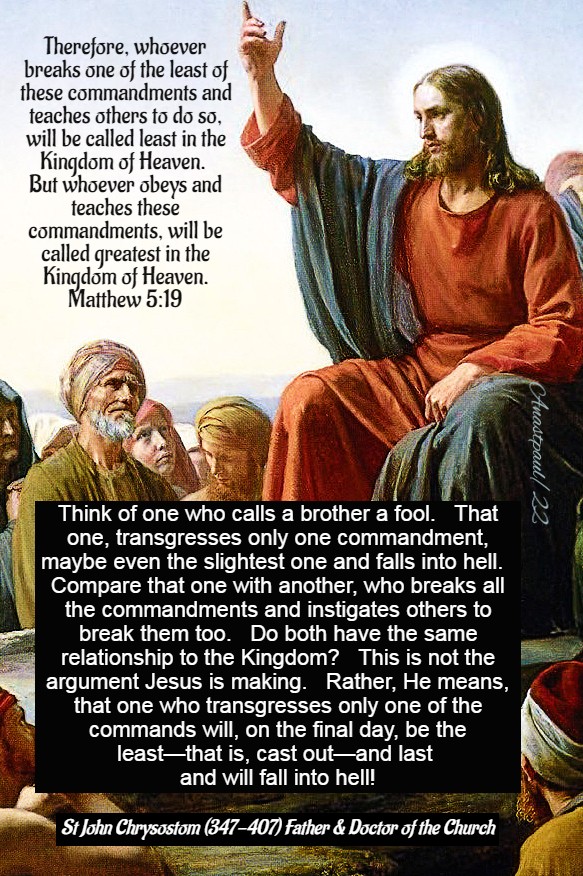
“Therefore, whoever breaks one of the least of these commandments and teaches others to do so, will be called least in the Kingdom of Heaven. But whoever obeys and teaches these commandments, will be called greatest in the Kingdom of Heaven.” – Matthew 5:19
REFLECTION – “For what reason then does He call some of these commandments “least,” although they are so magnificent and lofty? Jesus spoke this way because He was about to introduce His own teaching, as a new law . As He humbles Himself and speaks of Himself with great modesty, so He refers to His own teaching in the same manner. In this way, Jesus teaches us to practice humility in everything. And besides, since some suspected His teaching to be a new departure, He temporarily taught it in a more reserved way.
But when you hear “least in the Kingdom of Heaven,” you are to think of nothing but hell and punishment. For it was His practice to speak, not only of the joy the Kingdom brings but also, of the time of the resurrection and the fearful event of the Second Coming.
Think of one who calls a brother a fool. That one, transgresses only one commandment, maybe even the slightest one and falls into hell. Compare that one with another, who breaks all the commandments and instigates others to break them too. Do both have the same relationship to the Kingdom? This is not the argument Jesus is making. Rather, He means, that one who transgresses only one of the commands will, on the final day, be the least—that is, cast out—and last and will fall into hell!” – St John Chrysostom (347-407) Archbishop of Constantinople, Father and Doctor of the Church (The Gospel of Saint Matthew, Homily 16).
PRAYER – O God, Who enlightened Thy Church with the wondrous learning of blessed Thomas, Thy Confessor and enriched her through his holy life, grant us, we beseech Thee, both to understand what he taught and by following his example, to do what he did. Through tJesus Christ, Thy Son our Lord, Who lives and reigns with Thee, in the unity of the Holy Ghost, God, world without end. Amen (Collect).





























You must be logged in to post a comment.