Our Morning Offering – 17 September – The 16th Sunday after Pentecost
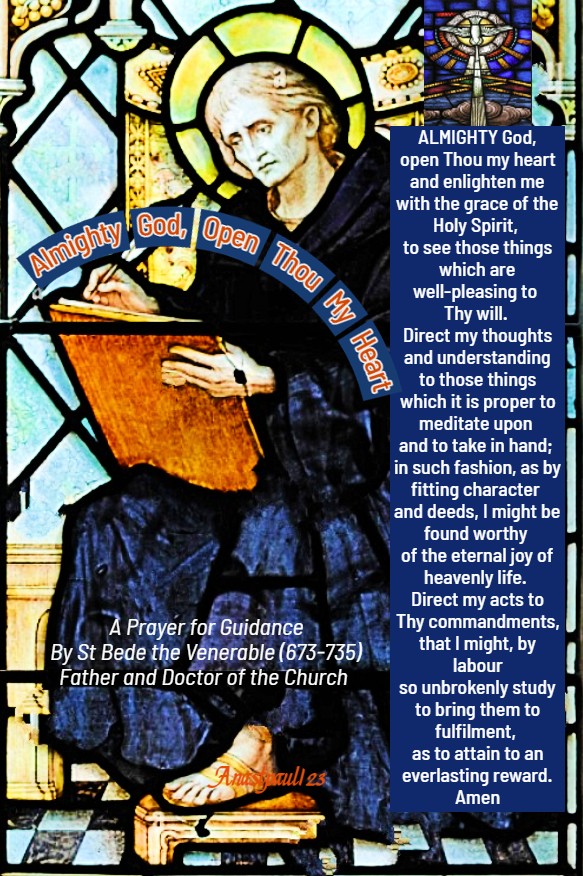
Almighty God, Open Thou My Heart A Prayer for Guidance By St Bede the Venerable (673-735) Father and Doctor of the Church
ALMIGHTY God, open Thou my heart and enlighten me with the grace of the Holy Spirit, to see those things which are well-pleasing to Thy will. Direct my thoughts and understanding to those things which it is proper to meditate upon and to take in hand; in such fashion, as by fitting character and deeds, I might be found worthy of the eternal joy of heavenly life. Direct my acts to Thy commandments, that I might, by labour so unbrokenly, study to bring them to fulfilment, as to attain to an everlasting reward. Amen
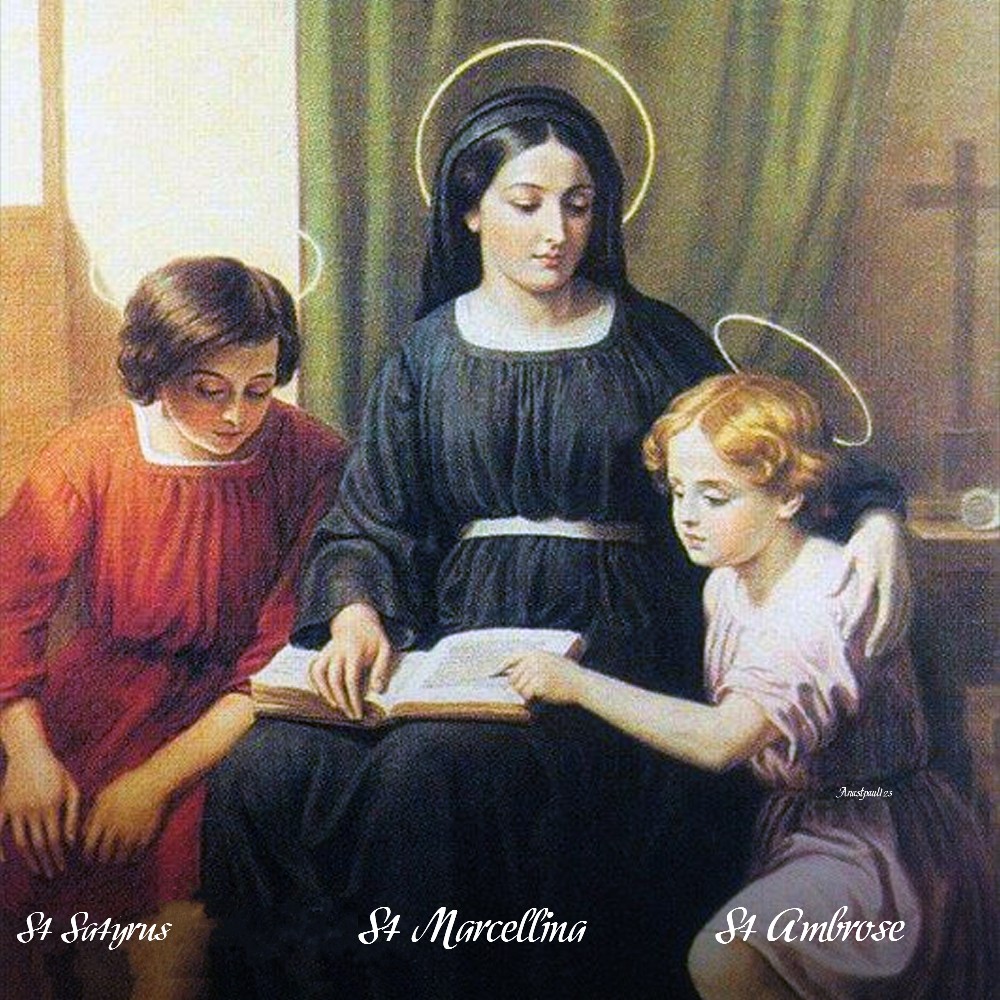
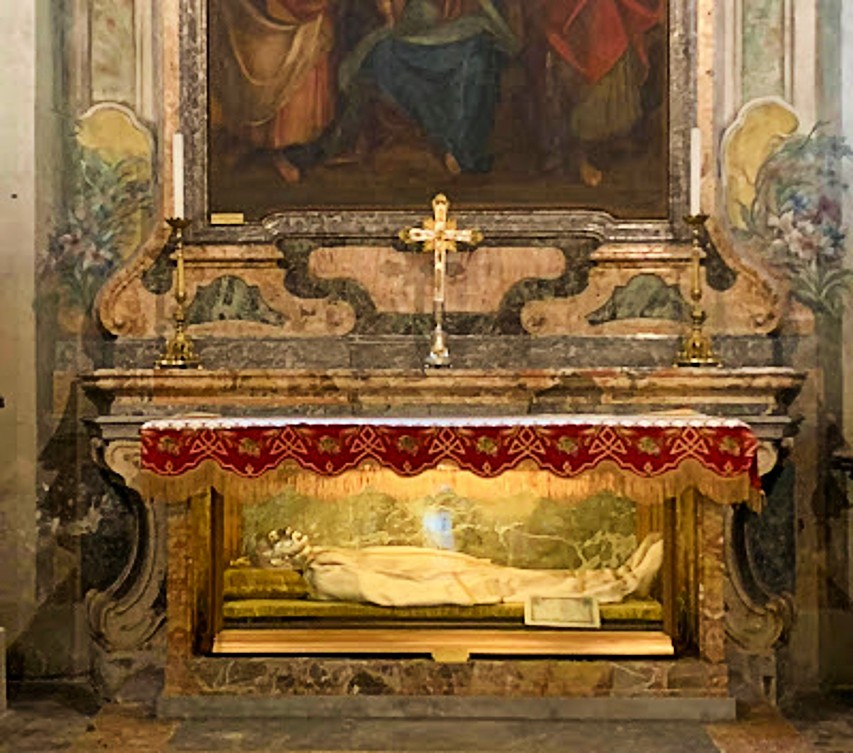
Saint of the Day – 17 September – St Satyrus of Milan (c335-c378) Confessor, Layman. Older brother of St Aurelius Ambrose (340-397) Father and Doctor and St Marcellina (c330-c398) Consecrated Virgin. Born as Uranio Satiro, probably in Trier, Germany and died in 378 in Milan of natural causes. Patronages – of Sacristans of the Archdiocese of Milan.
The Roman Martyrology reads today: “At Milan, the departure from this world of St Satyrus, Confessor, whose distinguished merits are mentioned by his brother, St Ambrose.”
Our only sources for Satyrus’ life are two orations delivered by his brother, one on the day of his death and the other, a week later. We know that he was the second of their parents’ three children, born after their sister, Marcellina; this puts his birth somewhere around 335, before his brother’s in 340, at either Trier, where their father reigned as Governor of a Roman Province, or at Rome. Being of the Senatorial Aristocracy, both brothers followed in the path of their father’s career and served as Governors of Roman Provinces but that assigned to Satyrus is unknown.
In 374, when St Ambrose was appointed as the Bishop of Milan, his brother left public office in order to help him with the administration of the Diocese, as well as to care for their sister and the family patrimony. St Ambrose praises him for his chastity in terms that clearly indicate that he was not married.
More than once, these duties required Satyrus to travel to Africa. Like many men of his class and period, whose public responsibilities were difficult to reconcile with the discipline of a Christian life, he long remained a Catechumen. (St Ambrose himself was a Catechumen at the time of his election as Bishop by popular acclamation. The Ambrosian Rite adds a commemoration of his Baptism to the Mass of St Andrew the Apostle on 30 November and keeps his principal Feast only a week later, on the day of his Episcopal Ordination). Ambrose, however, notes the following episode, in proof of his strong faith.
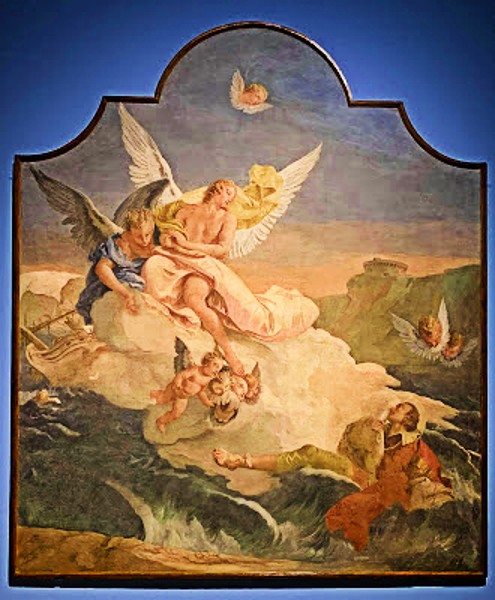
The Shipwreck of St Satyrus, by Giambattista Tiepolo, 1737′ It is kept in the Chapel dedicated to him, where his Relics were formerly kept, also within the Basilica of St Ambrose.
On Satyrus’ return from the last of his African journeys, his ship was wrecked on shoals, just off the coast of either Sicily or Sardinia. Before jumping off the boat, one of his fellow passengers gave him, at his request, a small piece of the Blessed Sacrament, which he then wrapped up in a small cloth and fastened around his neck. St Ambrose attributes his safe deliverance from the sea, to this, noting that Satyrus’ faith in God was so strong that he did not even bother to grab onto one of the planks of the broken vessel. After safely reaching land, he decided to be Baptised. He had, however, evidently already contracted the unknown disease which would take his life shortly thereafter. Having returned to Milan, he died in either 378 or 379 in the arms of his two siblings.
Devotion to St Satyrus is first attested in the 9th Century, when Anspert, Archbishop of Milan, built a small Church dedicated to him, his brother and St Silvester. This was later absorbed into a Church constructed by the Architect Donatello Bramante in 1476-1482 which is still, to this day, known as “St Mary near St Satyrus.” His name first appears in Liturgical books of the Ambrosian Rite in the 10th Century. In view of his role as his brother’s assistant in the administration of the Diocese, he is traditionally honoured in Milan as the Patron Saint of Sacristans.
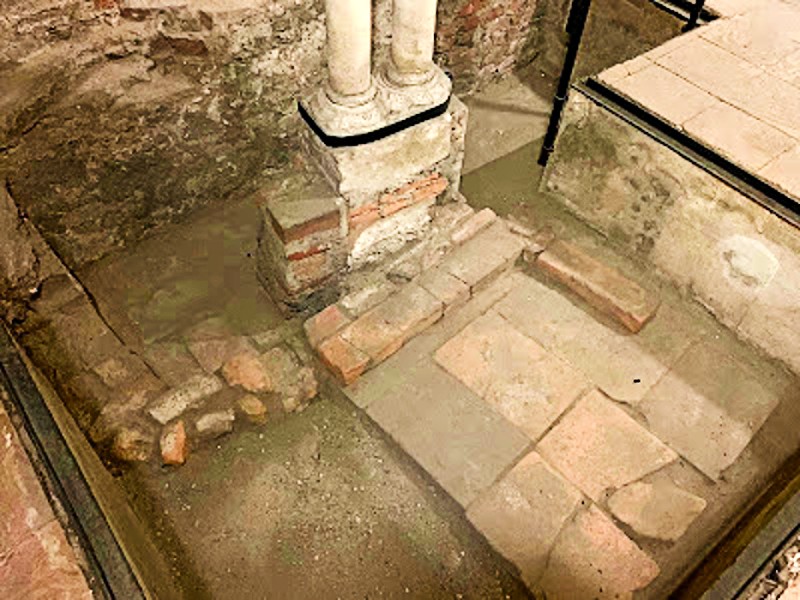
The original location of St Satyrus’ burial within the Chapel of St Victor.
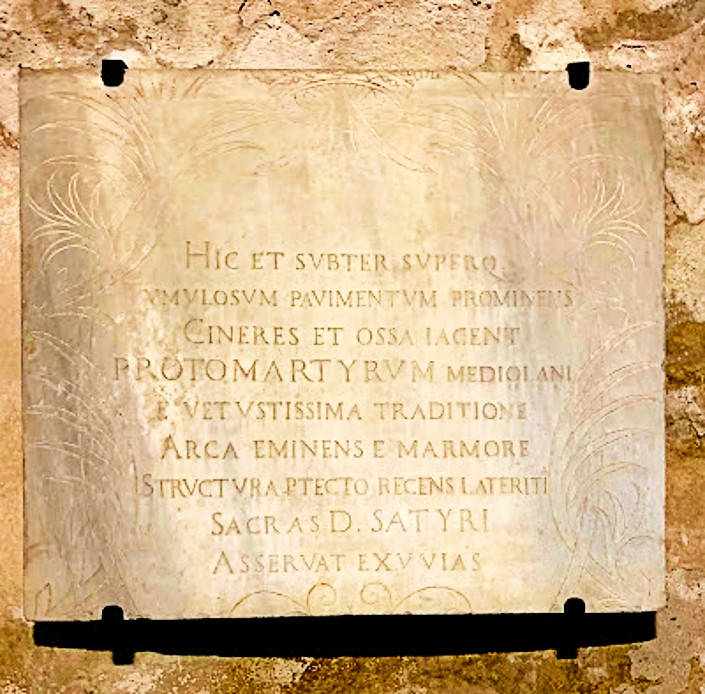
An inscription which notes the site as the place of his burial, alongside several early Martyrs of the Church of Milan.
The story told above about the shipwreck, forms a large part of the Ambrosian Preface for the Mass of St Satyrus:
“Truly it is worthy… eternal God, unceasingly praising Thy glory and proclaiming Thy greatness in Thy Saints. Who didst grant Thy blessed Confessor, Satyrus, such an abundance of virtues that he, having become, in many affairs, the colleague of his brother, the glorious Bishop Ambrose, the foremost Doctor and teacher of the Churches, was, for his diligence, deemed a most faithful and excellent champion of Christ, Thy Son. For while yet in the first service of the Faith, he so distinguished himself that, amid the waves of the sea, when he would have perished miserably by the wreck of his ship, although he was not yet washed by holy Baptism, he still did not lack for trust in Thy help. Therefore, he placed the Sacrament of the Lord’s Body, enclosed in a cloth, around his neck and did not hesitate, to entrust himself, to the frothing sea, supported by such an oar. And Thy, most mighty Right Hand which in the waves lifted up Peter, the Prince of the Apostles, lest he drown, with like power also brought this man safe and unharmed to the shore. This, O Lord, is the working of the fullness of Thy might. Through the same Christ our Lord. Through Whom the Angels praise Thy majesty…” (GREGORY DIPIPPO)
Right side Nave of St Ambrose Basilica. Saint Bartholomew and Saint Satyrus baroque-style Chapel. It preserves the Relics of Satyrus.
St Rodingus St Satyrus of Milan (c335-c378) Confessor, Older brother of St Ambrose (340-397) Father and Doctor and St Marcellina (c330-c398) Consecrated Virgin St Socrates St Stephen St Theodora St Uni of Bremen
Thought for the Day – 16 September – Meditations with Antonio Cardinal Bacci (1881-1971)
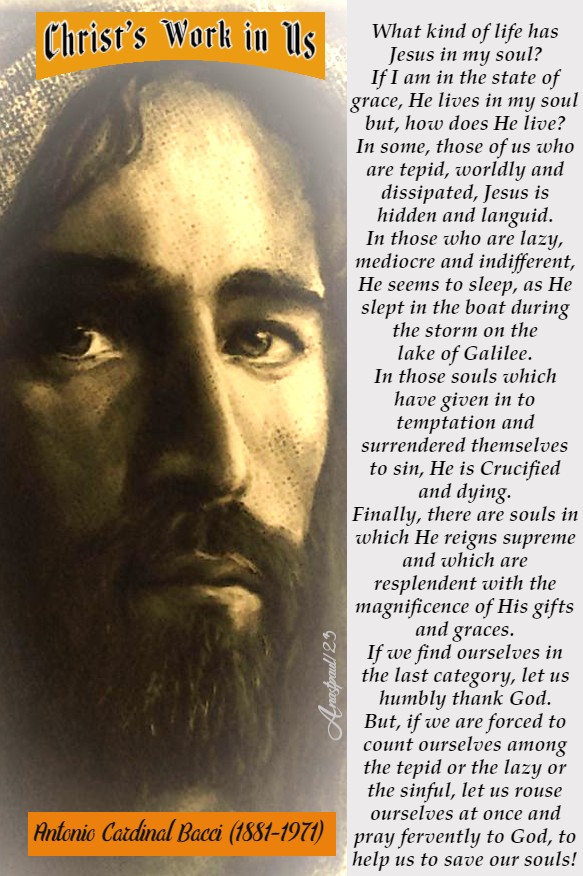
Christ’s Work in Us
“It is not enough that Jesus live in us – He must increase and act in us continually. The Spiritual life is like natural life. It cannot stop, for to halt would mean death! If Jesus is our life, He should live in us with ever-increasing intensity. Life is like a stairway, we are either going up or coming down.
If we continue to climb energetically towards Jesus, we shall be coming nearer to Christian perfection. If, on the other hand, we halt, the supernatural life of Jesus in us, will begin to weaken. Tepedity will replace fervour and sin will succeed tepidity. It is difficult to remain unchanged because, life involves movement. ‘Jesus Christ,” writes St Augustine, “was born a baby but, He did not remain one. He grew to boyhood, to adolescence and then, to maturity.”
It is necessary for us to grow also. More precisely, it is necessary that Jesus grow continuously in us through faith, charity and good works. “Court the good,” admonishes St Paul, “from a good motive always … until Christ is formed in you” (Gal 4:18-19).
It is not enough that Christ be born in us, it is necessary that He increase to the fullness of perfection (Cf Eph 4:13-16). “Jesus increases daily,” writes Origen, “in the soul of the holy and just man, which mirror His grace, His wisdom and His sanctity. In the soul of the unfortunate sinner, however, Christ decreases and dies.”
What kind of life has Jesus in my soul? If I am in the state of grace, He lives in my soul but, how does He live? In some, those of us who are tepid, worldly and dissipated, Jesus is hidden and languid. In those who are lazy, mediocre and indifferent, He seems to sleep, as He slept in the boat during the storm on the lake of Galilee. In those souls which have given in to temptation and surrendered themselves to sin, He is Crucified and dying.
Finally, there are souls in which He reigns supreme and which are resplendent with the magnificence of His gifts and graces. If we find ourselves in the last category, let us humbly thank God. But, if we are forced to count ourselves among the tepid or the lazy or the sinful, let us rouse ourselves at once and pray fervently to God, to help us to save our souls!”
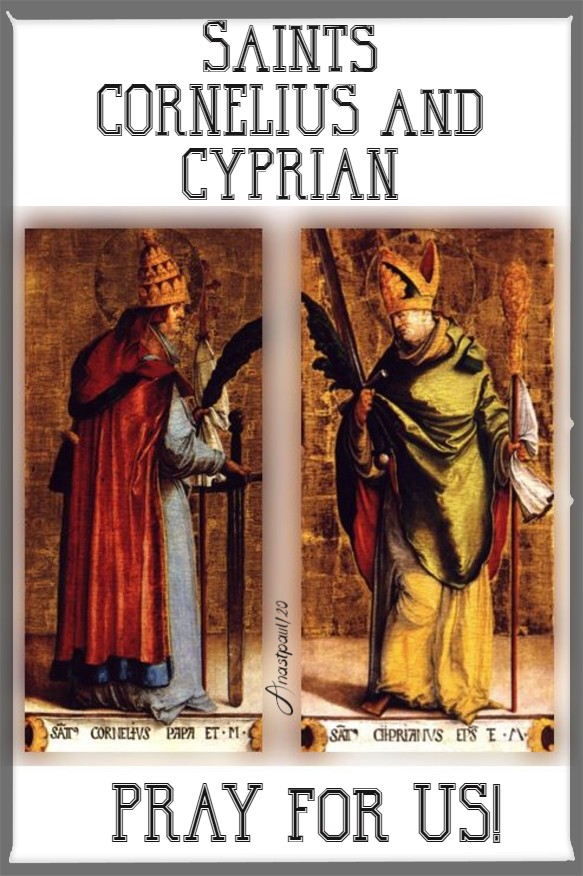
Quote/s of the Day – 16 September – Saints Cornelius and Cyprian – Wisdom 3:1-8, Luke 21:9-19 – Scripture search here: https://www.drbo.org/
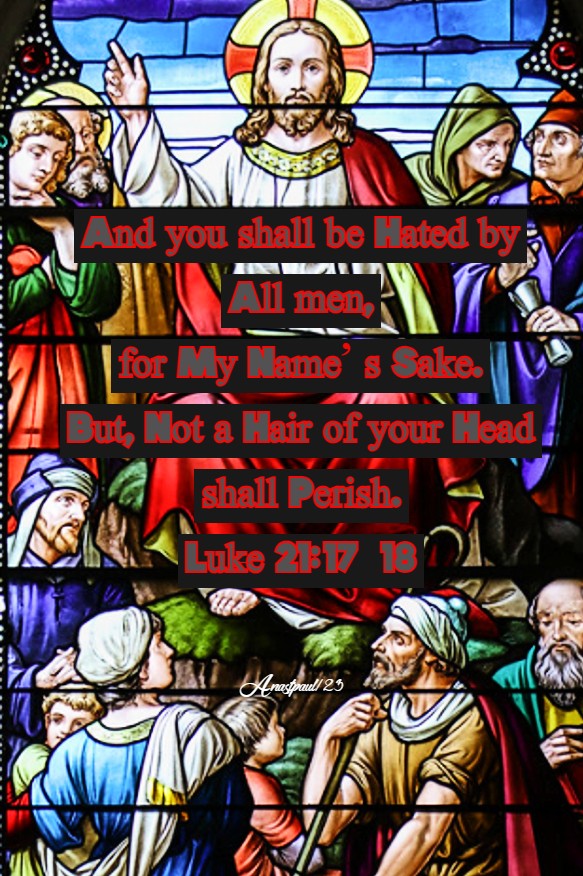
“And you shall be hated by all men, for My Name’s sake. But, not a hair of your head shall perish.”
Luke 21:17-18
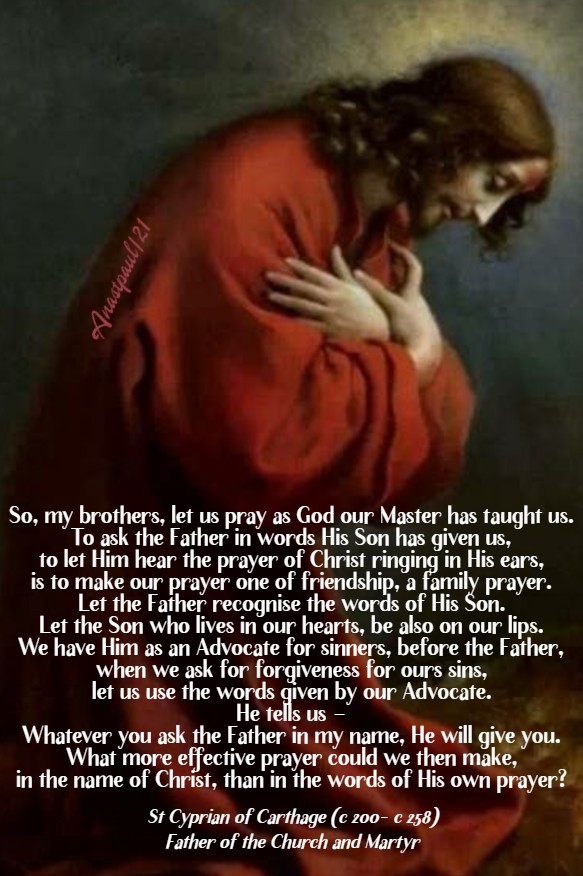
“So, my brothers, let us pray as God our master has taught us. To ask the Father in words His Son has given us, to let Him hear the prayer of Christ ringing in His ears, is to make our prayer one of friendship, a family prayer. Let the Father recognise the words of His Son. Let the Son who lives in our hearts, be also on our lips. We have Him as an Advocate for sinners, before the Father, when we ask for forgiveness for ours sins, let us use the words given by our Advocate. He tells us – Whatever you ask the Father in my name, He will give you. What more effective prayer could we then make, in the name of Christ, than in the words of His own prayer?”
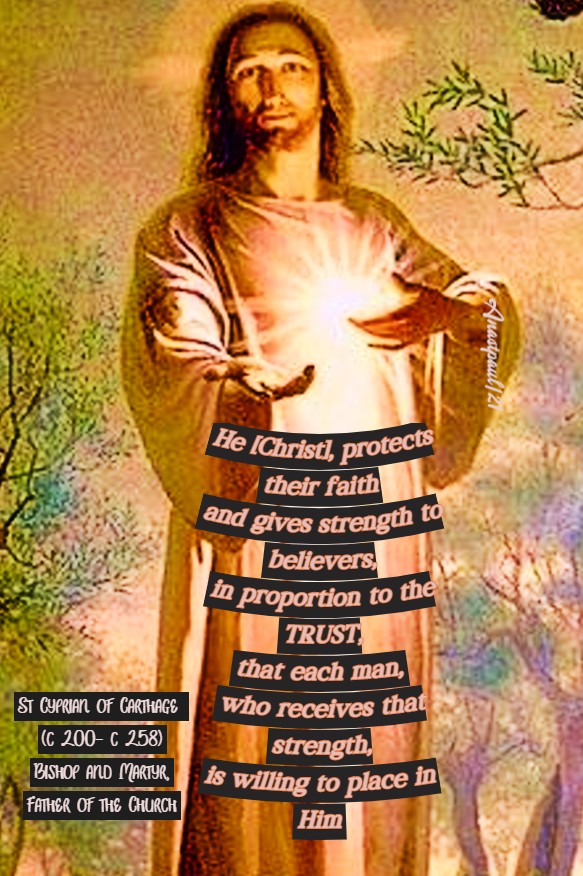
“He [Christ], protects their faith and gives strength to believers, in proportion to the TRUST, that each man, who receives that strength, is willing to place in Him.”
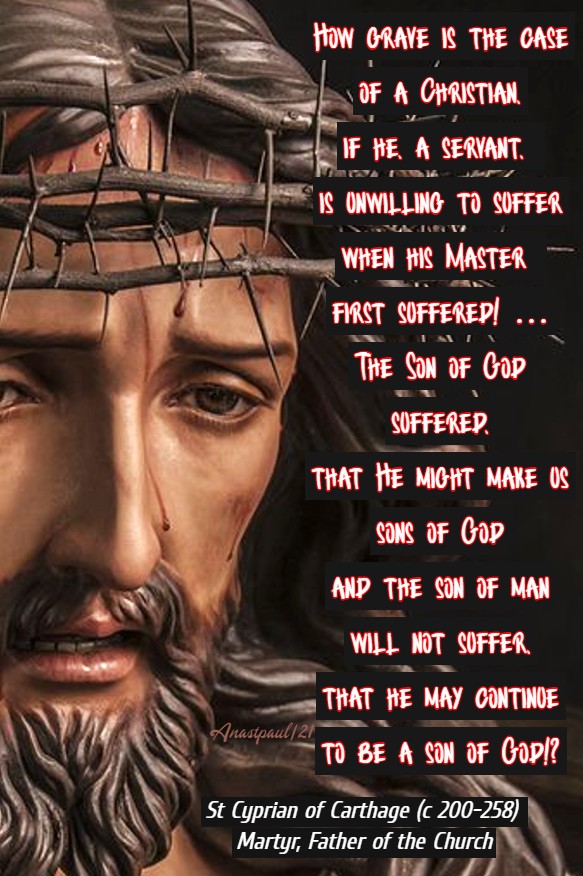
“ How grave is the case of a Christian, if he, a servant, is unwilling to suffer when his Master first suffered! … The Son of God suffered that He might make us sons of God and the son of man will not suffer that he may continue to be a son of God!? … The Maker and Lord of the world also warns us, saying: “If the world hates you, remember that it hated Me before you. If you were of the world, the world would love its own but because you are not of the world but I have chosen you out of the world ” … remember the word that I said to you: “The servant is not greater than his Lord” (Jn 15:18-20).”
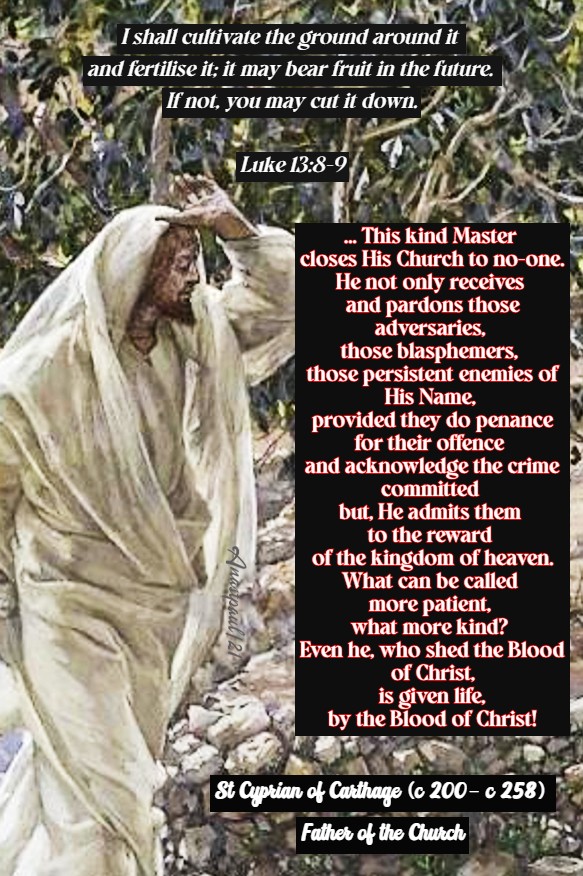
“I shall cultivate the ground around it and fertilise it; it may bear fruit in the future. If not, you may cut it down.” Luke 13:8-9
“… This kind Master closes His Church to no-one. He not only receives and pardons those adversaries, those blasphemers, those persistent enemies of His Name, provided they do penance for their offence and acknowledge the crime committed but, He admits them to the reward of the Kingdom of Heaven. What can be called more patient, what more kind? Even he, who shed the Blood of Christ, is given life, by the Blood of Christ.”
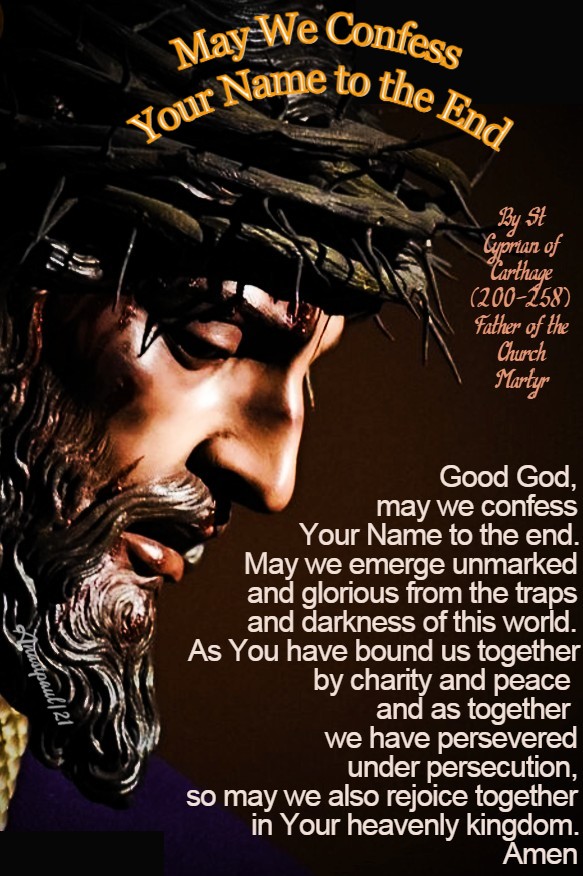
May We Confess Your Name to the End By St Cyprian of Carthage (200-258)
Good God, may we confess Your Name to the end. May we emerge unmarked and glorious from the traps and darkness of this world. As You have bound us together by charity and peace and as together we have persevered under persecution, so may we also rejoice together in Your heavenly kingdom. Amen
St Cyprian of Carthage (c 200-258) Martyr, Bishop of Carthage, Father of the Church
One Minute Reflection – 16 September – “Month of The Seven Sorrows of the Blessed Virgin Mary and The Holy Cross” – Saints Cornelius and Cyprian – Wisdom 3:1-8, Luke 21:9-19 – Scripture search here: https://www.drbo.org/
“Resolve, therefore, in your hearts, not to meditate beforehand, how you are to make your defence. For I Myself, will give you utterance and wisdom …” – Luke 21:14-15
REFLECTION – “O strong love of God! I really think, nothing seems impossible, to one who loves. O happy soul which has obtained this peace, from its God! For it has become mistress over all the trials and perils of the world. If only it can serve its good Spouse and Lord, it fears none of them – and, with good reason… Think of something which occurs to me now and which, is applicable to those who are naturally pusillanimous and have little courage… Although, in actual fact, their soul has been raised up to this state, the weakness of their nature makes them afraid. We must be on the watch, or this natural weakness, will deprive us of a great crown. When you find yourselves as pusillanimous as this, my daughters, have recourse to faith and humility and do not fail to go forward with faith, for nothing is impossible to God (Lk 1:37). He has thus been able to give many holy Saints, the courage to endure all the cruel tortures which they had resolved to suffer for His sake!
It is of this resolution and this free-will that the soul wishes to make Him Master, though He has no need of our efforts. Indeed, His Majesty is pleased that His works should shine forth in those who are weak, since in these, there is more scope for His power and, for the fulfilment of His desire, to grant us favours…
Pay no heed to the arguments adduced by your mind and your own weakness – this weakness will only grow, if you begin to imagine, what will and what will not happen…This is no time to think about your sins, leave them alone, humility is out of place now, it comes at the wrong time… Be assured that the Lord never forsakes those who love Him and risk everything for His sake!” – St Teresa of Jesus of Avila (1515-1582) Carmelite, Doctor of the Church (Conceptions of the Love of God Ch 3:4-6).
PRAYER – May the feast of the blessed Martyrs and Bishops, Cornelius and Cyprian, protect us, O Lord, we beseech Thee and may their holy prayer recommend us to Thee.Through Jesus Christ, Thy Son our Lord, Who lives and reigns with Thee, in the unity of the Holy Ghost, God, world without end. Amen (Collect).
Our Morning Offering – 16 September – “Month of The Seven Sorrows of the Blessed Virgin Mary and The Holy Cross”
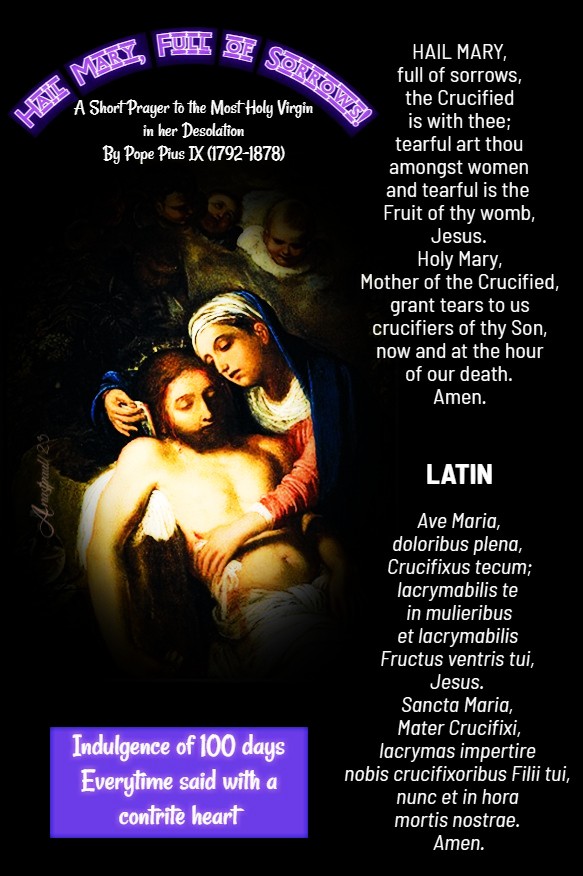
Hail Mary, Full of Sorrows! A Short Prayer to the Most Holy Virgin in her Desolation By Pope Pius IX (1792-1878) Papal Reign 1846-1878 (+102 Raccolta)
His Holiness Pope Pius IX, by a Decree of the Sacred Congregation of Indulgences, of 23 December 1847, deigned to grant:
An Indulgence of 100 days to all the faithful, everytime they say, with contrite heart, the following prayer in honour of the most Holy Virgin in her desolation.
HAIL MARY, full of sorrows! the Crucified is with thee; tearful art thou amongst women and tearful is the Fruit of thy womb, Jesus. Holy Mary, Mother of the Crucified, grant tears to us crucifiers of thy Son, now and at the hour of our death. Amen.
LATIN
Ave Maria, doloribus plena, Crucifixus tecum; lacrymabilis te in mulieribus et lacrymabilis Fructus ventris tui, Jesus. Sancta Maria, Mater Crucifixi, lacrymas impertire nobis crucifixoribus Filii tui, nunc et in hora mortis nostrae. Amen.
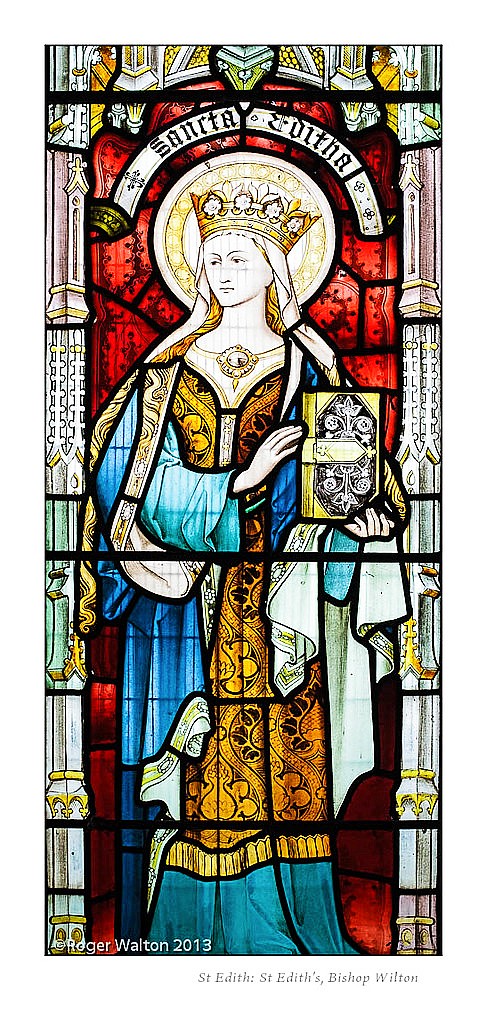
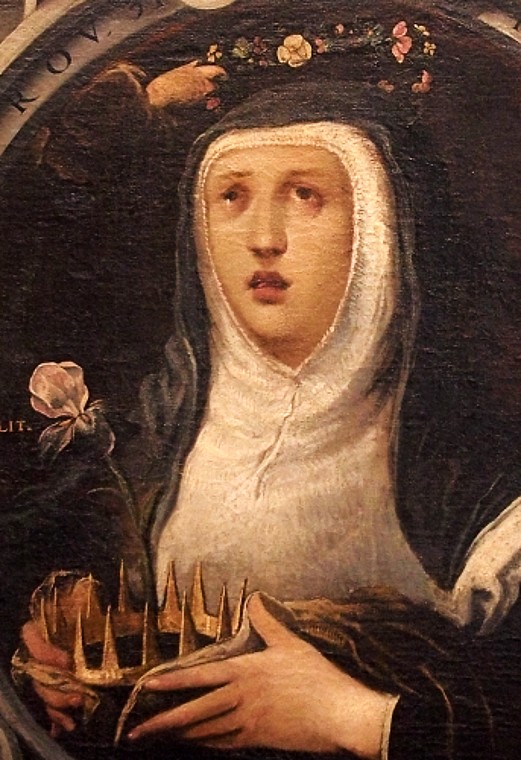
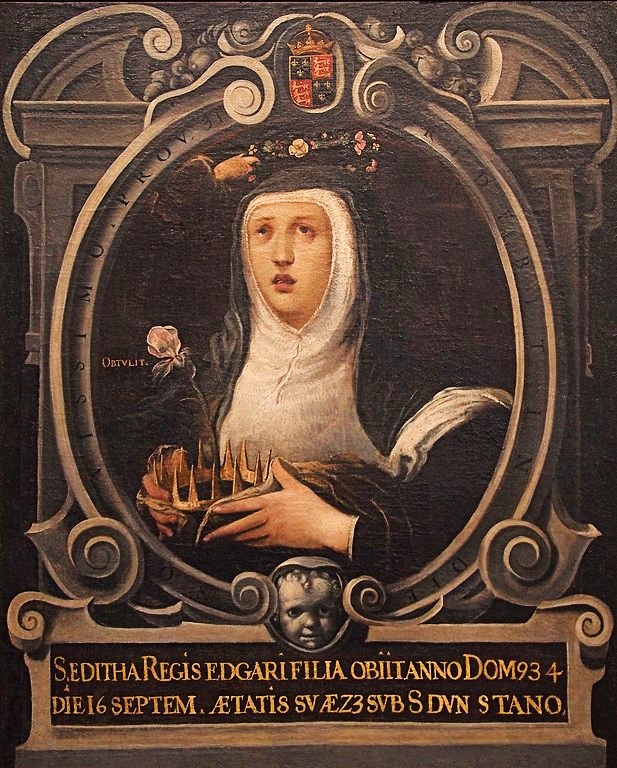
Saint of the Day – 16 September – Saint Edith of Wilton (961-984) Virgin, Nun, Princess, Founder of a Church and a Hospital for the poor. Born in 961 at Kensing, Kent, England and died on 15 September 984 aged just 23 years, a date foretold by Saint Dunstan of Canterbury, of natural causes. Edith also had a gift for communicating with wild animals as so many Saints have had. Edith is one of the most venerated female Saints of England. Her extensive legacy continues to this day – there is a Pilgrimage route, “St Edith’s Way” and annual devotions take place on her Feast day. Also known as – Edith of Barking, Eadgyth…. Eadgith…. Editha…. Ediva…. Patronage – against blindness and eye diseases, of sailors, against storms at sea, Wilton Abbey.
Edith was the only daughter of King Edgar the Peaceful (959-975) and St Wulfthryth, who later became Abbess of Wilton Abbey. Edith is an interesting Saint because she seemed to be able to combine her Royal status and its concerns, with the asceticism of a Benedictine Monastery. There seems to be some doubt about the relationship of her parents. Apparently Edgar took the noblewoman Wulfthryth, from the Convent at Wilton and either kept her as a concubine or else married her. However, the union was dissolved and Wulfthryth returned to her Convent with Edith. Edgar, nonetheless, continued to take an interest in his daughter, arranging her education with two foreign Chaplains, Fr Radbod of Rheims and Fr Benno of Trier.
There is a indecision over whether Edith was actually a Nun or a lay member of the community – whether she took Vows or not. Her main biographer, writing about a hundred years after her death, was a Flemish Benedictine Monk, who came to England and wrote lives of the Saints. He relates that her father, Edgar, came to the Convent and placed before her the finest clothes and jewels, while her mother placed religious objects before her eyes. Edith, opted for the religious life, although she always wore fine clothes – the Bishop of Winchester admonished her for this but she replied: “My father, the mind maybe modest and God-fearing under fine clothes, as under a serge habit. The God I love looks to the heart and not to the dress.” According to legend, she was vindicated when a chest caught fire as a candle was accidentally dropped on it – the clothes remained untouched inside! The chest was preserved in the Convent. She also maintained the custom, suited to a Princess but not expected of a Nun in a cloistered community, of heating her bath water with a special metal casket.
In spite of her fine clothes, she observed strict fasting and abstinence and wore a hair shirt under those clothes – a lesson in not juding a book by its cover, I would think. She had a care for the poor and sick and asked that a hospital be built to care for the poor and destitute patients. It was said of her that at night she would wash the stockings of her fellow sisters.
Her education was one that befitted a Royal lady. She seems to have been a talented needlewoman and designed and embroidered a sumptuous Alb and other Ecclesiastical Vestments. She was versed in literary languages and the arts. She had a fine singing voice, painted, wrote and composed. She had a library and wrote out a book of prayers. She was also very well read. Edith also seemed to have been free to indulge her interest in animals, as she kept a menagerie of native and exotic creatures.
Although she had chosen a Convent life, she seems to have had influence at her father’s Court and that of her half-brothers Edward the Martyr and Ethelred. She was highly regarded by the nobility of England; foreign Kings and Ambassadors sought her favour through letters and gifts and high-ranking Clergy, her intercession. Her father tried to make her Abbess of three Convents but she refused the honour. When Edward the Martyr was murdered, she was offered the throne,but again declined.
St Dunstan, Archbishop of Canterbury, predicted her death and that the thumb on her right hand – which made the Sign of the Cross in an unusual way – would remain incorrupt. Edith died three weeks after his prediction, on 16 September 984. Dunstan presided when her body was removed to the Chapel of St Denys, which our Saint had built and the thumb had not decomposed.
Edith’s cult seemed to have developed slowly. The Abbess, Aelfgifu was cured of an eye disease during a dream vision. There are stories of her intervention, when either her surroundings or Relics were interfered with. King Canute did not believe she was a Saint and demanded that her Tomb be opened so he could decide for himself. The body of Edith rose up and struck him! He got the message and generously endowed the Convent. He claimed also that later, Edith had rescued him from a storm at sea.
She was Canonised thirteen years after her death through the offices of her half-brother King Ethelred II and with the support of St Dunstan and other Ecclesiastics. Her body was removed to the Church of St Denys, which she had founded.
She became a very popular Saint in medieval Britain with the help of Royal patronage. The Convent at Wilton became a place where Royal and noble ladies could receive a good education. The Abbey continued to function until the Reformation when it was dissolved. St Edith, however, has not been forgotten. She is venerated at her birth-place in Kemsing. The Holy Well in the centre of the Village bears her name and, it is said, to have healing properties. Well dressing has been revived recently. There is also a Pilgrimage entitled “St Edith’s Way.”
St Abundantius of Rome St Abundius of Rome St Andrew Kim Taegon St Cunibert of Maroilles St Curcodomus St Dulcissima of Sutri St Edith of Wilton (961-984) Virgin, Nun, Princess St Eugenia of Hohenburg
Blessed Luigi Ludovico Allemandi (c 1390-1450) Bishop and Cardinal, called “The Cardinal of Arles.” Blessed Luigi was a Priest driven by immense love for the Holy Mother of God and for the Church. His involvement in various Councils and Papal dissentions, were the result of his great desire to maintain the purity of the Chair of Peter. He was Beatified in 1527 by Pope Clement VII. His Life; https://anastpaul.com/2020/09/16/saint-of-the-day-blessed-luigi-ludovico-allemandi-c-1390-1450/
St Lucia and St Geminianus of Rome + St Ludmila St Marcian the Senator Bl Martin of Huerta Bl Michael Himonaya
Bl Paul Fimonaya St Priscus of Nocera St Rogellus of Cordoba St Sebastiana St Servus Dei St Stephen of Perugia
Martyrs of the Via Nomentana: Four Saints: Christian men Martyred together, date unknown – Alexander, Felix, Papias and Victor. They were Martyred on the Via Nomentana outside Rome, Italy.
Thought for the Day – 15 September – Meditations with Antonio Cardinal Bacci (1881-1971)
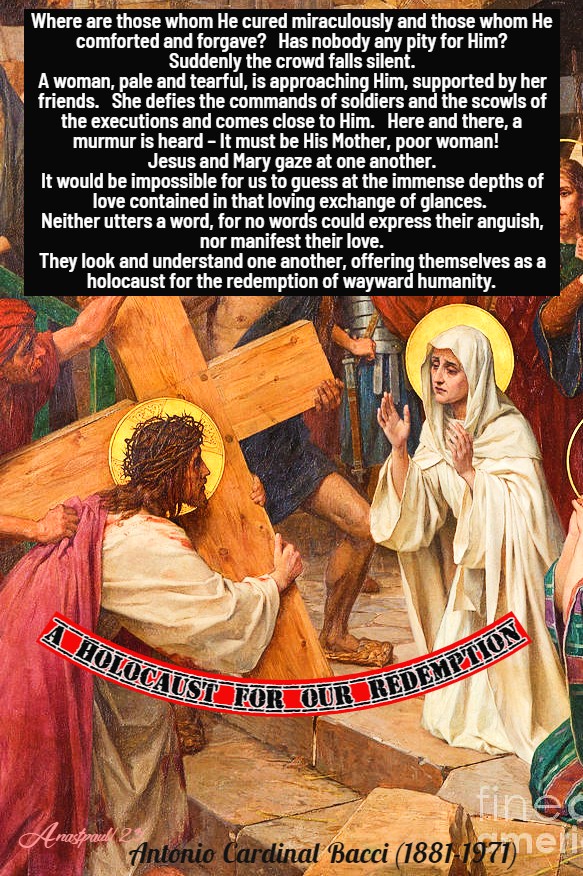
A Holocaust for our Redemption
“Scourged, crowned with thorns and derided, Jesus is finally condemned to death. Burdened with the Cross, He sets out for the place of execution in the midst of a crowd of enemies, blasphemers and idle speculators. Among them , there is only a tiny group which sympathises with Jesus, namely, Mary His Mother, the devout women and the beloved Apostle, St John.
The divine Redeemer goes forward labouriously beneath the heavy weight of the Cross. He has already lost a large quantity of blood in Gethsemane and during the scourging and crowning with thorns. His strength seems to be failing but love sustains Him. Looking feebly around Him, He sees the mocking Jews, the indifferent and disrespectful Roman soldiers and a throng of curious spectators looking for something to amuse them. Is there nobody else? Where are those whom He cured miraculously and those whom He comforted and forgave? Has nobody any pity for Him? Suddenly the crowd falls silent. A woman, pale and tearful, is approaching Him, supported by her friends. She defies the commands of soldiers and the scowls of the executions and comes close to Him.
Here and there, a murmur is heard – It must be His Mother, poor woman! Jesus and Mary gaze at one another. It would be impossible for us to guess at the immense depths of love contained in that loving exchange of glances. Neither utters a word, for no words could express their anguish, nor manifest their love. They look and understand one another, offering themselves as a holocaust for the redemption of wayward humanity.
Nevertheless, in this silent meeting, there was great consolation for the Heart of Jesus, for He had found someone who loved and understood Him, amongst those malicious throngs. Why do we not sympathise with Him too and love Him with all our hearts?”
Quote/s of the Day – 15 September – “Month of The Seven Sorrows of the Blessed Virgin Mary and The Holy Cross” and The Feast of the Seven Sorrows of the Blessed Virgin – Our Lady of Sorrows – Judith 13:22; 13:25, John 19:25-27 – Scripture search here: https://www.drbo.org/
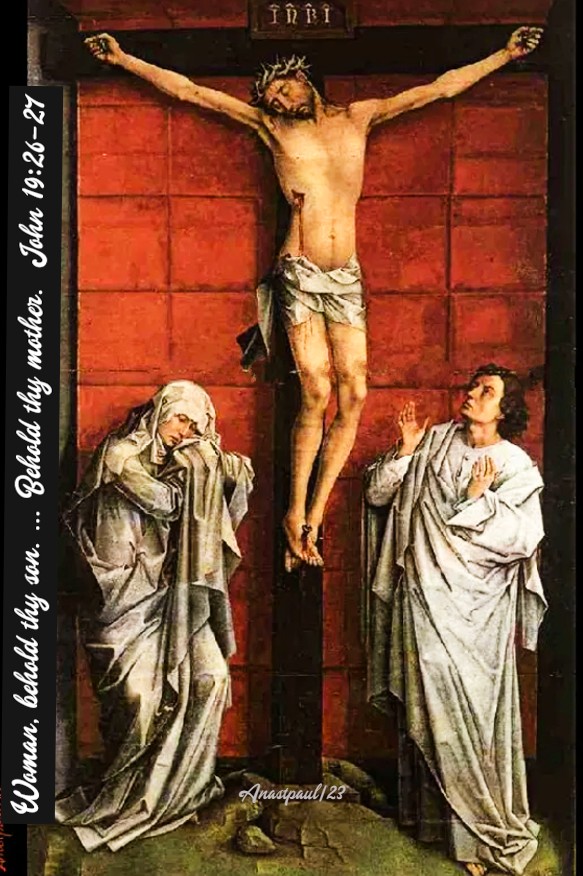
“Woman, behold thy son. … Behold thy mother”
John 19:26-27
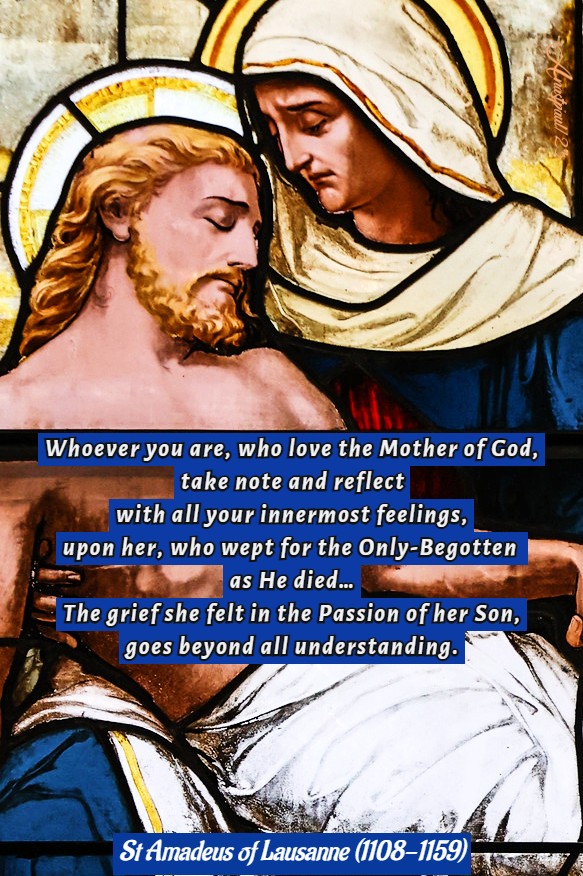
“Whoever you are, who love the Mother of God, take note and reflect with all your innermost feelings, upon her, who wept for the Only-Begotten as He died… The grief she felt in the Passion of her Son, goes beyond all understanding.”
St Amadeus of Lausanne (1108-1159)
“ Now it is that we are to show an invincible courage towards our Saviour, serving Him purely for the love of His will, not only without pleasure but amid this deluge of sorrows, horrors, distresses and assaults, as did his glorious Mother and St John, upon the day of His Passion. Amongst so many blasphemies, sorrows and deadly distresses, they remained constant in love …”
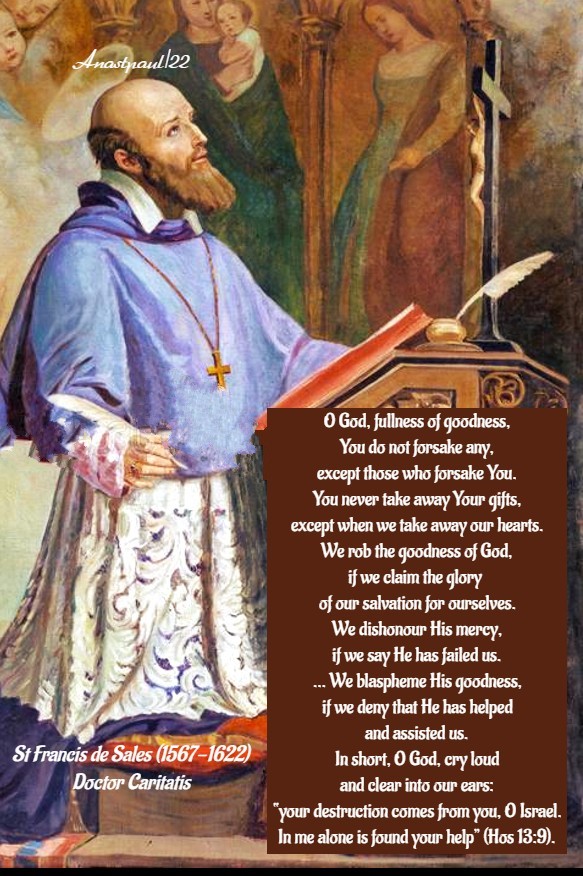
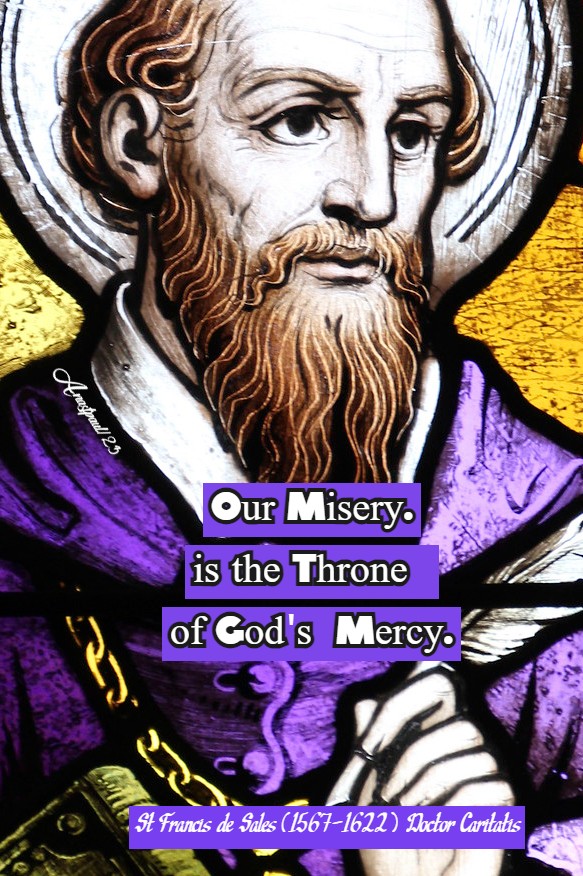
St Francis de Sales (1567-1622) Doctor Caritatis
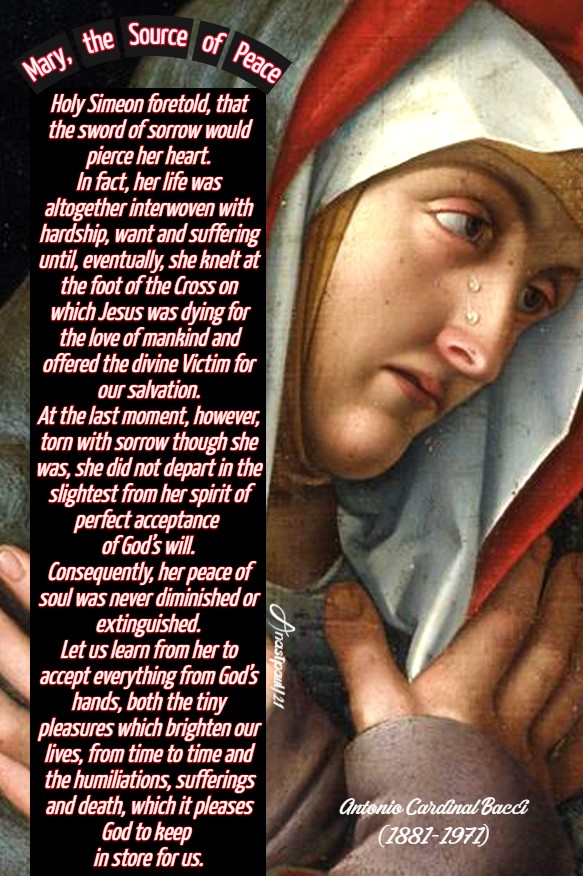
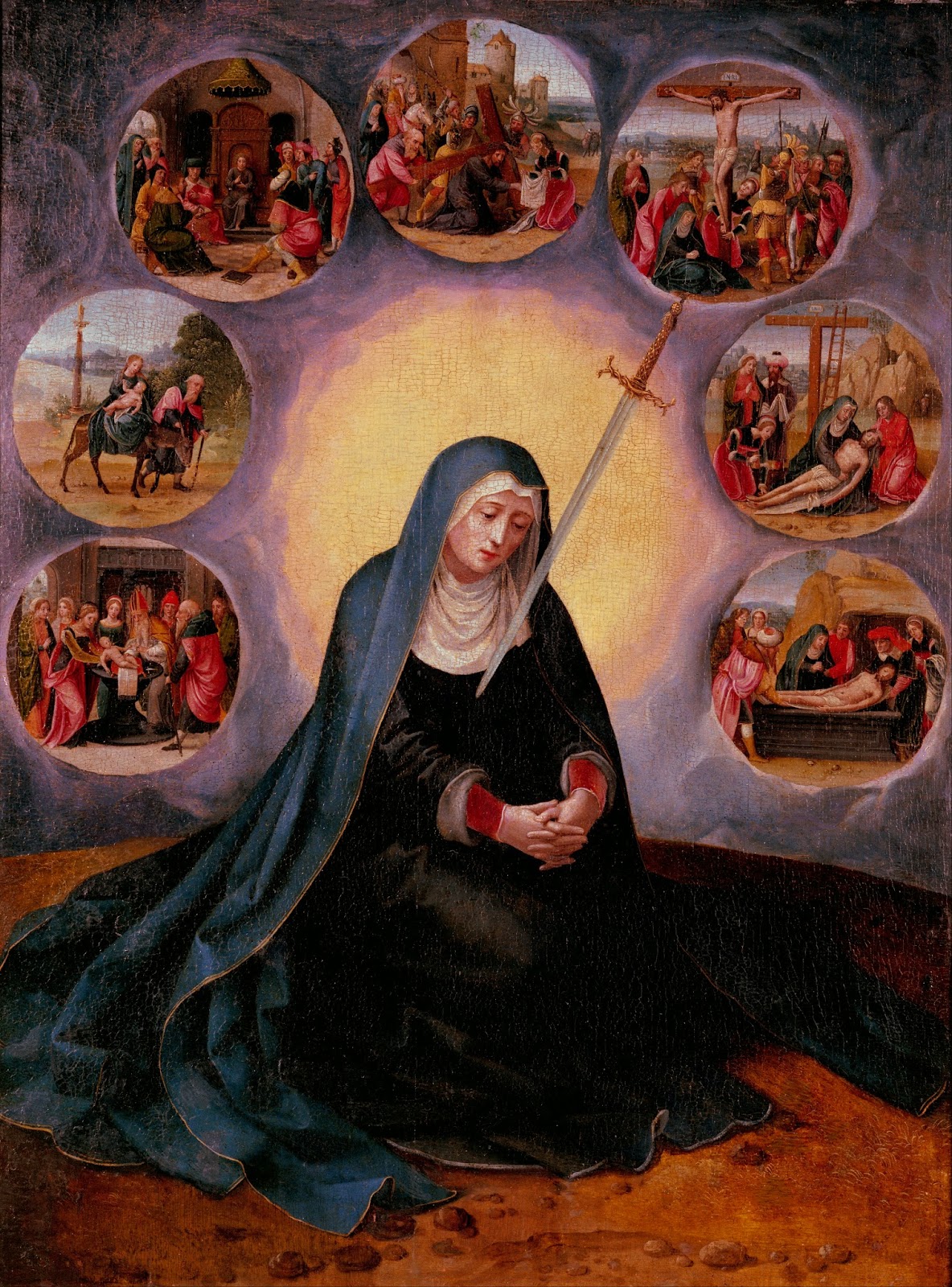
“Holy Simeon foretold, that the sword of sorrow would pierce her heart. In fact, her life was altogether interwoven with hardship, want and suffering until, eventually, she knelt at the foot of the Cross on which Jesus was dying for the love of mankind and offered the divine Victim for our salvation. At the last moment, however, torn with sorrow though she was, she did not depart in the slightest from her spirit of perfect acceptance of God’s will. Consequently, her peace of soul was never diminished or extinguished. Let us learn from her, to accept everything from God’s hands, both the tiny pleasures which brighten our lives, from time to time and the humiliations, sufferings and death, which it pleases God to keep in store for us.”
Antonio Cardinal Bacci (1881-1971)
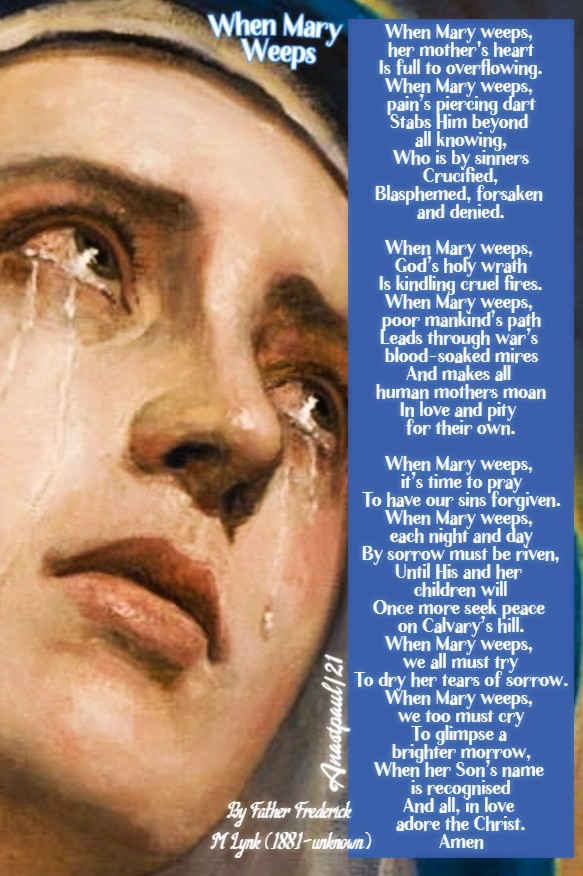
When Mary Weeps By Father Frederick M Lynk (1881-unknown)
When Mary weeps, her mother’s heart Is full to overflowing. When Mary weeps, pain’s piercing dart Stabs Him beyond all knowing, Who is by sinners Crucified, Blasphemed, forsaken and denied.
When Mary weeps, God’s holy wrath Is kindling cruel fires. When Mary weeps, poor mankind’s path Leads through war’s blood-soaked mires And makes all human mothers moan In love and pity for their own.
When Mary weeps, it’s time to pray To have our sins forgiven. When Mary weeps, each night and day By sorrow must be riven, Until His and her children will Once more seek peace on Calvary’s hill. When Mary weeps, we all must try To dry her tears of sorrow. When Mary weeps, we too must cry To glimpse a brighter morrow, When her Son’s name is recognised And all, in love adore the Christ. Amen
One Minute Reflection – 15 September – “Month of The Seven Sorrows of the Blessed Virgin Mary and The Holy Cross” and The Feast of the Seven Sorrows of the Blessed Virgin – Our Lady of Sorrows – Judith 13:22; 13:25, John 19:25-27 – Scripture search here: https://www.drbo.org/
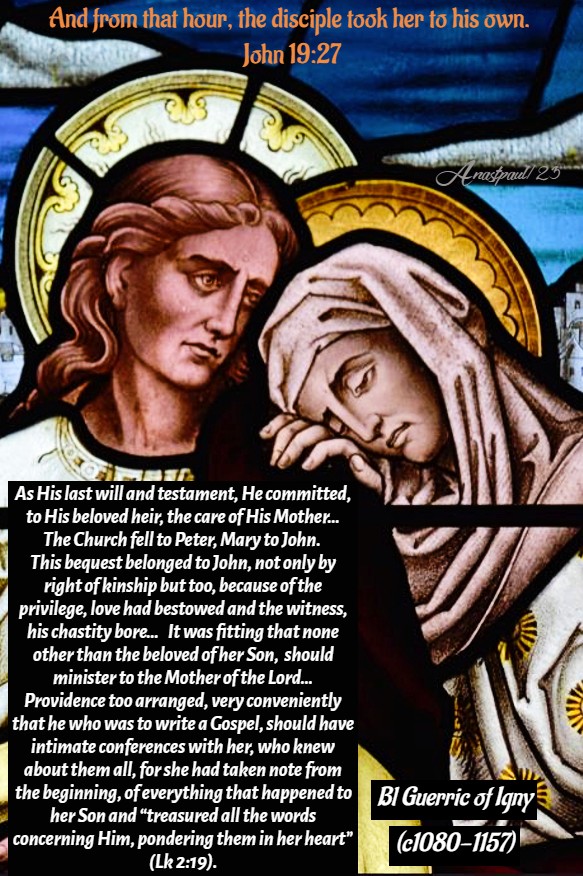
“And from that hour, the disciple took her to his own.” – John 19:27
REFLECTION – “When Jesus was going round towns and villages preaching the Gospel, Mary was His inseparable companion, clinging to His footsteps and hanging upon His words, as He taught, so much so, that neither the storm of persecution, nor dread of punishment, could deter her from following her Son and Master.
“By the Lord’s Cross there stood Mary, His Mother.” Truly a Mother, who did not abandon her Son, even in the face of death! How could she be frightened of death, when “her love was as strong as death,” (Sg 8:6) or rather, stronger than death? Truly she stood by Jesus’ Cross, when, at the same time, the pain of the Cross crucified her mind and, as manifold a sword, pierced her own soul, (Lk 2:35) as she beheld the body of her Son, pierced with wounds. Rightly, therefore, was she recognised as His Mother there and by His care, entrusted to a suitable protector, in which both the mother’s unalloyed love for her Son and the Son’s kindness toward His Mother, were proved to the utmost …
Loving her as He did, Jesus “Loved her to the end” (Jn 13:1), so as not only to bring His life to an end, for her but also, to speak almost His last words for her benefit. As His last will and testament, He committed, to His beloved heir, the care of His Mother… The Church fell to Peter, Mary to John. This bequest belonged to John, not only by right of kinship but too, because of the privilege, love had bestowed and the witness, his chastity bore… It was fitting that none other than the beloved of her Son, should minister to the Mother of the Lord… Providence too arranged, very conveniently that he who was to write a Gospel, should have intimate conferences with her, who knew about them all, for she had taken note from the beginning, of everything that happened to her Son and “treasured all the words concerning Him, pondering them in her heart” (Lk 2:19).” – Blessed Guerric of Igny (c1080-1157) Cistercian Abbot (4th Sermon for the Assumption).
PRAYER – O God, in Whose Passion the sword, according to the prophecy of blessed Simeon, pierced through the soul of Mary, the glorious Virgin and Mother, mercifully grant that we, who reverently commemorate her piercing through and her suffering, may, by the interceding glorious merits of all the Saints faithfully standing by the Cross, obtain the abundant fruit of Thine Passion. Who lives and reigns with God the Father, in the unity of the Holy Ghost, God, world without end. Amen (Collect).
Our Morning Offering – 15 September – “Month of The Seven Sorrows of the Blessed Virgin Mary and The Holy Cross” and The Feast of the Seven Sorrows of the Blessed Virgin – Our Lady of Sorrows
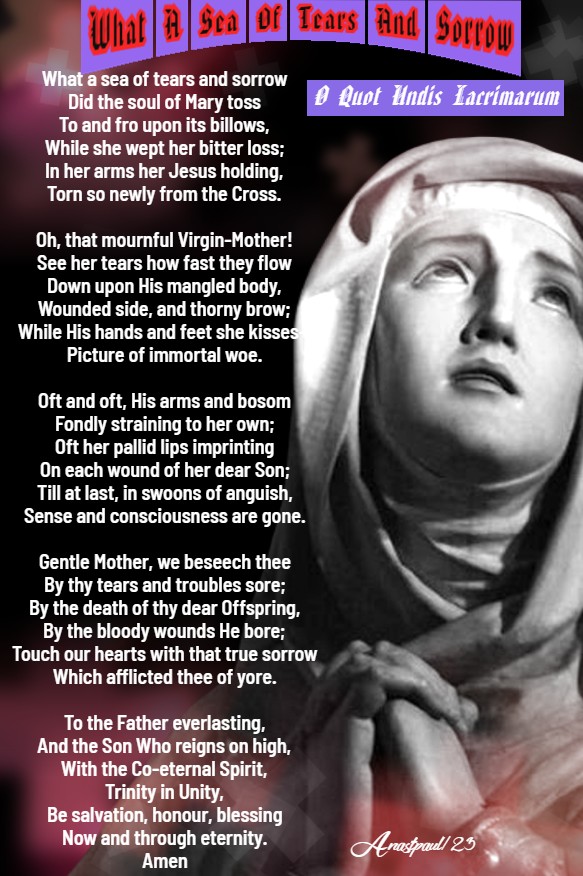
O Quot Undis Lacrimarum What A Sea Of Tears And Sorrow Breviary Hymn for the Feast of the Seven Sorrow Attrib. Bishop Callisto Palumbella OSM (1687-1749) Trans. Fr Edward Caswell COrat (1814–1878)
What a sea of tears and sorrow Did the soul of Mary toss To and fro upon its billows, While she wept her bitter loss; In her arms her Jesus holding, Torn so newly from the Cross.
Oh, that mournful Virgin-Mother! See her tears how fast they flow Down upon His mangled body, Wounded side, and thorny brow; While His hands and feet she kisses— Picture of immortal woe.
Oft and oft, His arms and bosom Fondly straining to her own; Oft her pallid lips imprinting On each wound of her dear Son; Till at last, in swoons of anguish, Sense and consciousness are gone.
Gentle Mother, we beseech thee By thy tears and troubles sore; By the death of thy dear Offspring, By the bloody wounds He bore; Touch our hearts with that true sorrow Which afflicted thee of yore.
To the Father everlasting, And the Son Who reigns on high, With the Co-eternal Spirit, Trinity in Unity, Be salvation, honour, blessing Now and through eternity. Amen
Attrib. to the Servite Bishop Callisto Maria Vincenzo Antonio Palumbella OSM (1687-1749), who also composed the Office for the Feast inserted in the Breviary in 1720. He was the Bishop of Terracina, Priverno e Sezze, Italy. This Translation by Fr Edward Caswell COrat (1814–1878)
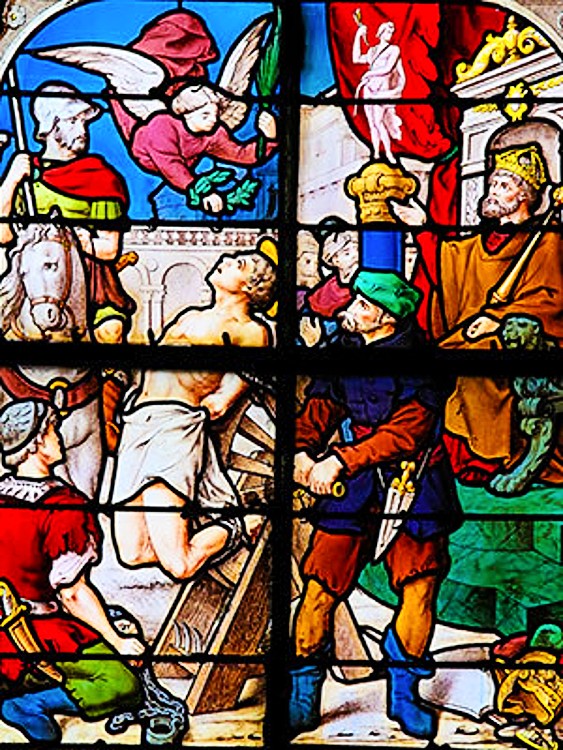
Saint of the Day – 15 September – St Nicomedes (Died c71) Priest and Martyr. Died in Rome by being beaten to death wiuth clubs.
The Roman Martyrology reads today: “In Rome, on the Nomentan Way, the birthday of the blessed Nicomedes, Priest and Martyr. As he said to those who would compel him to sacrifice: “I sacrifice only to the Omnipotent God, who reigns in Heaven.” He was scourged, for a very long time with leaded whips and thus, went to our Lord.”
Stained glass depiction of scene common in the days of the early Christian Martyrs and the time of St Nicomedes. Stained glass window in St Catherine’s Church in Honfleur, France.
Little is known of the early life of this heroic Christian Martyr. What we do know for sure, is derived from the historical texts of Holy Mother Church He is spoken of in the legendary ‘Passio’ of the Saints Nereus and Achilleus composed in the 5th-6th Century, whose Author states that Nicomedes was a Priest.
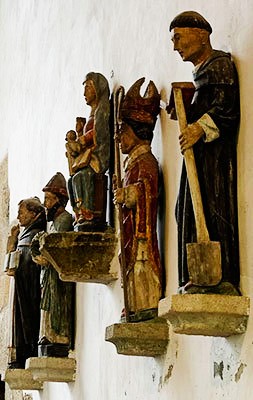
A holy “line up” including: St Dominic, St Nicomèdes, Our Lady and Baby Jesus, St Claude and St Fiacre. These sculptures are found in the interior of the Chapelle de Kermaria-an-Isquit in France.
He was discovered while burying the body of the Martyr Felicola and arrested by a certain Flaccus, Since he refused to sacrifice to the gods, he was subjected to a cruel flagellation, during which he died.
His body was thrown into the Tiber but one of his fellow-clerics ,named Giusto, recovered it and buried it in a small garden along the Via Nomentan.
The Author of the ‘Passio’ does not mention the day of his death but from the context, it can be deduced that he died, at the time of the Emperor Domitian (51-96. Subsequent studies and research have hypothesised 15 September as the day of his death, while another ‘Passio’ of the 7th Century places his death on 1 June under Maximian (240-310).
In any case, the existence and cult of this Martyr Nicomedes are attested by documents worthy of faith, although the biographical information is uncertain. Moreover, he is mentioned in at least eight historical ‘Martyrologies.’ In the ‘Roman’ one, his feast day remained on 15 September.
Already in the 7th Century, it is known that pilgrims venerated the tomb of the Martyr on the Via Nomentan, on which Pope Boniface V (619-625) had a Basilica built which was later restored by Pope Hadrian I (†795).
St Aichardus St Albinus of Lyon St Aprus of Toul St Bond of Sens St Emilas of Cordoba St Eutropa of Auvergne St Hernan St Jeremias of Cordoba St Joseph Abibos St Mamillian of Palermo St Melitina St Mirin of Bangor St Nicetas the Goth
St Nicomedes (Died c71) Priest and Martyr
St Porphyrius the Martyr St Ribert St Ritbert of Varennes Bl Rolando de Medici Bl Tommasuccio of Foligno St Valerian of Châlon-sur-Saône St Valerian of Noviodunum St Vitus of Bergamo
Martyrs of Adrianopolis – 3 Saints: Three Christian men Martyred together in the persecutions of Maximian – Asclepiodotus, Maximus and Theodore. They were martyred in 310 at Adrianopolis (Adrianople), a location in modern Bulgaria.
Martyrs of Noviodunum – 4 Saints: Three Christian men martyred together, date unknown – Gordian, Macrinus, Stratone and Valerian. They were martyred in Noviodunum, Lower Moesia (near modern Isaccea, Romania).
Mercedarian Martyrs of Morocco – 6 Beati: A group of six Mercedarians who were captured by Moors near Valencia, Spain and taken to Morocco. Though enslaved, they refused to stop preaching Christianity. Martyrs. – Dionisio, Francis, Ildefonso, James, John and Sancho. They were crucified in 1437 in Morocco.
Thought for the Day – 14 September – Meditations with Antonio Cardinal Bacci (1881-1971)
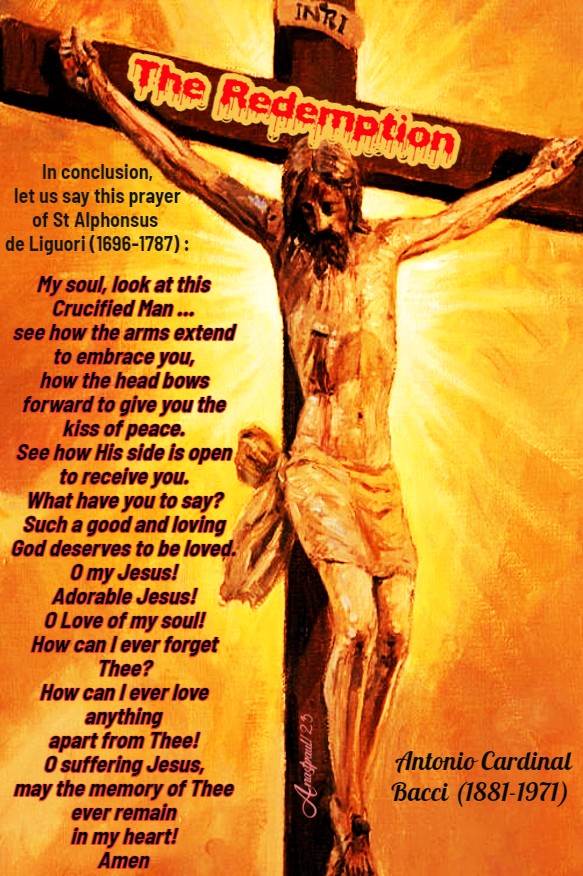
The Redemption
“In conclusion, let us say this prayer of St Alphonsus de Liguori (1696-1787): “My soul, look at this Crucified Man … see how the arms extend to embrace you, how the head bows forward to give you the kiss of peace. See how His side is open to receive you. What have you to say? Such a good and loving God deserves to be loved. O my Jesus! Adorable Jesus! O Love of my soul! How can I ever forget Thee? How can I ever love anything apart from Thee! O suffering Jesus, may the memory of Thee ever remain in my heart!”
Quote/s of the Day – 14 September – “Month of The Seven Sorrows of the Blessed Virgin Mary and The Holy Cross” – Exaltation of the Holy Cross –Philippians 2:5-11, John 12:31-36 – Scripture search here: https://www.drbo.org/
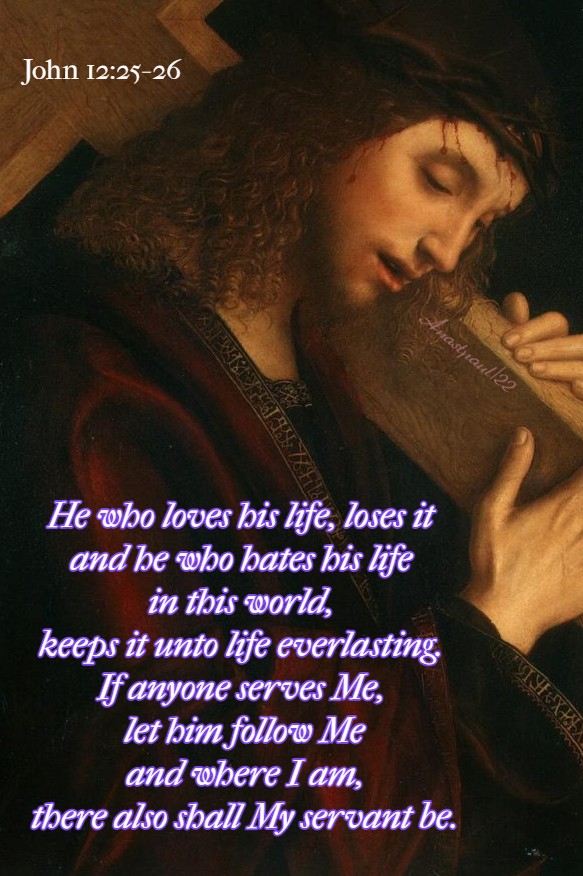
“If anyone serves Me, let him follow Me and where I am, there also shall My servant be.”
John 12:25-26
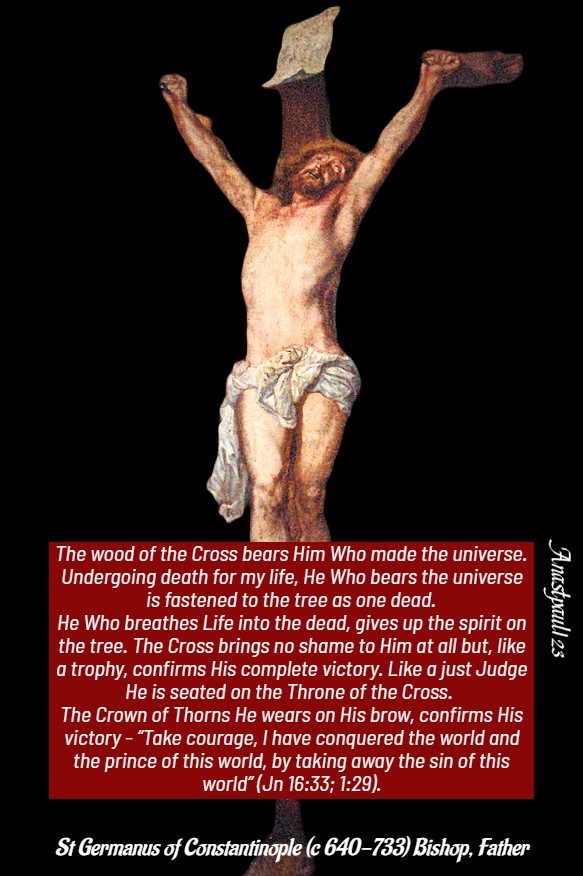
“The wood of the Cross bears Him Who made the universe. Undergoing death for my life, He Who bears the universe is fastened to the tree, as one dead. He Who breathes Life into the dead, gives up the spirit on the tree. The Cross brings no shame to Him at all but, like a trophy, confirms His complete victory. Like a just Judge, He is seated on the Throne of the Cross. The Crown of Thorns. He wears on His brow, confirms His victory “Take courage, I have conquered the world and the prince of this world, by taking away the sin of this world” (Jn 16:33; 1:29).”
St Germanus of Constantinople (c640-733) Bishop, Father of the Church
Hail, Most Precious and Life-Giving Cross of the Lord!
Let God arise and let His enemies be scattered and let those, who hate Him, flee from His Presence. As smoke vanishes, let them vanish and as wax melts by the presence of fire, so let the demons perish by the presence of those who love God and who sign themselves with the Sign of the Cross and say in gladness: Hail, Most Precious and Life-Giving Cross of the Lord, for Thou drives away the demons by the power of our Lord Jesus Christ Crucified on thee, Who went down to hell and trampled on the power of the devil and gave us thee, His venerable Cross, for driving away all enemies. O Most Precious and Life-Giving Cross of the Lord, help me with our holy Lady, the Virgin Mother of God and with all the Saints throughout the ages. Amen.
St John Damascene (675-749) Father and Doctor of the Church
(Part of the Night Prayers by St John Damascene)
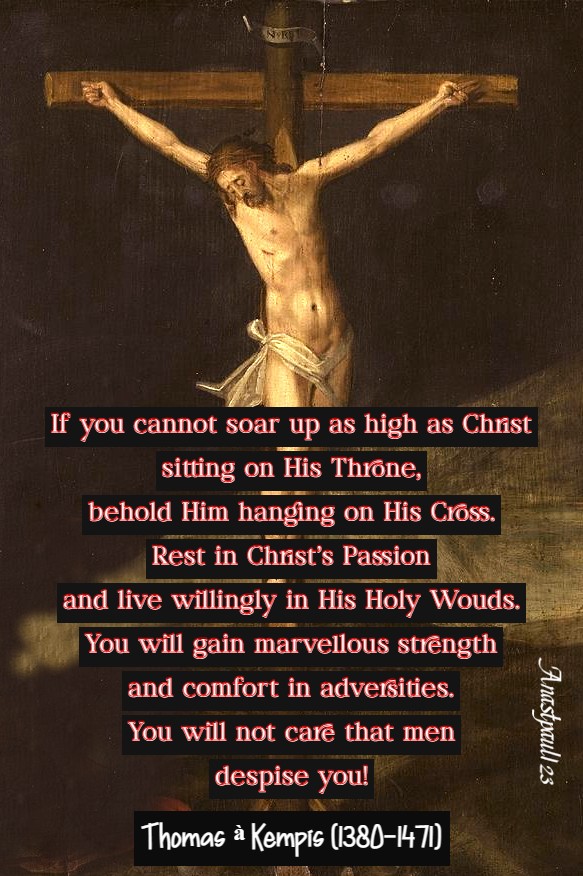
“If you cannot soar up as high as Christ sitting on His Throne, behold Him hanging on His Cross. Rest in Christ’s Passion and live willingly in His Holy Wounds. You will gain marvellous strength and comfort in adversities. You will not care that men despise you!”
Thomas à Kempis CRSA (1380-1471)
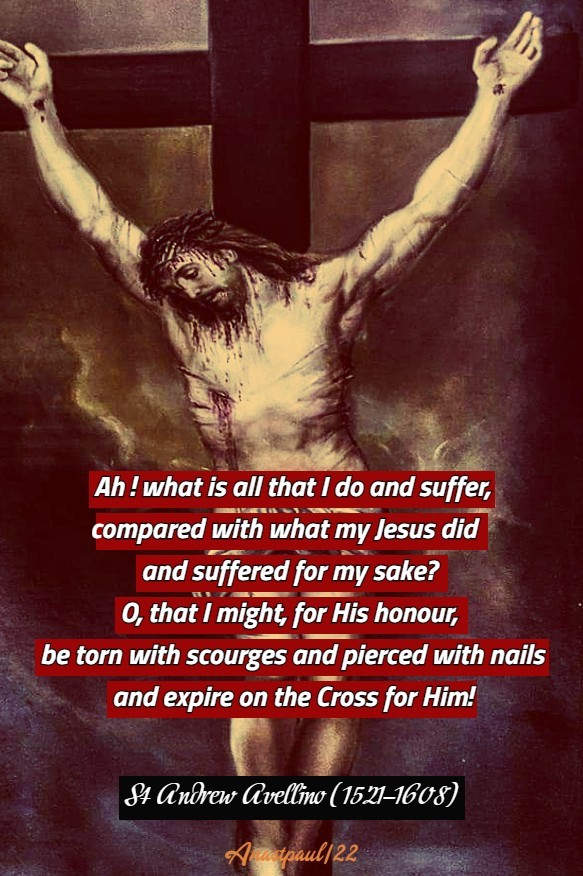
“Ah ! what is all that I do and suffer, compared with what my Jesus did and suffered for my sake? O, that I might, for His honour, be torn with scourges and pierced with nails and expire on the Cross for Him!”
St Andrew Avellino (1521–1608)
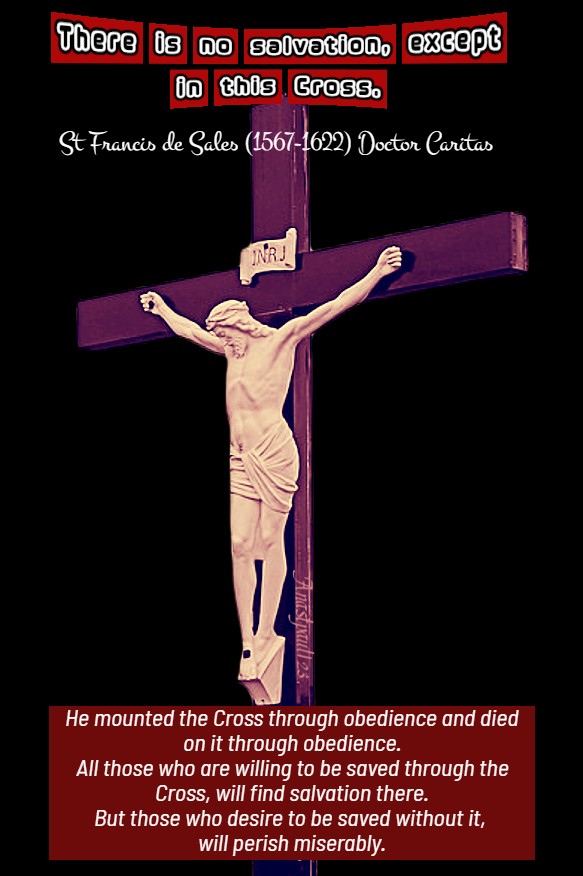
“He mounted the Cross through obedience and died on it through obedience. All those who are willing to be saved through the Cross, will find salvation there. But those, who desire to be saved without it, will perish miserably. There is no salvation, except in this Cross.”
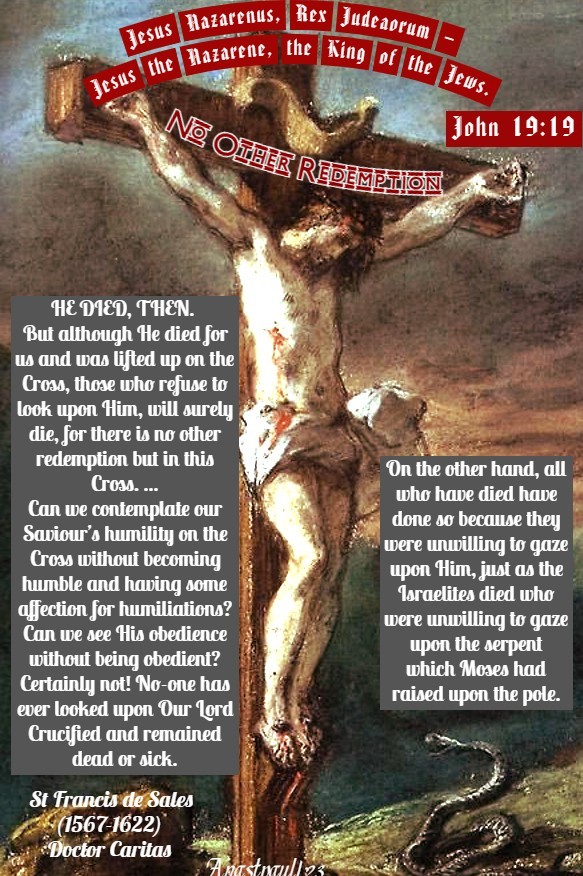
“Jesus Nazarenus, Rex Judeaorum – Jesus the Nazarene, the King of the Jews.” John 19:19
“HE DIED, THEN But although He died for us and was lifted up on the Cross, those who refuse to look upon Him, will surely die, for there is no other redemption but in this Cross.
O God, how spiritually beneficial and profitable is a consideration of Thy Cross and Passion! Can we contemplate our Saviour’s humility on the Cross, without becoming humble and, having some affection for humiliations? Can we see His obedience, without being obedient? Certainly not! No-one has ever looked upon Our Lord Crucified and remained dead or sick. On the other hand, all who have died, have done so because. they were unwilling to gaze upon Him, just as the Israelites died. who were unwilling to gaze upon the serpent which Moses had raised upon the pole.”
One Minute Reflection – 14 September – “Month of The Seven Sorrows of the Blessed Virgin Mary and The Holy Cross” – Exaltation of the Holy Cross –Philippians 2:5-11, John 12:31-36 – Scripture search here: https://www.drbo.org/
“He who loves his life, loses it and he who hates his life in this world, keeps it unto life everlasting. If anyone serves Me, let him follow Me and where I Am ,there also shall My servant be.” – John 12:25-26
REFLECTION – “… We are being towed along by a world which passes away, forgetting the world to come. We are greedy for present things but, do not take into account, the coming judgement. We will not run to meet the Lord as He comes!…
Let us turn back, brethren, let us turn back… By the very fact of His delay, of His still waiting, our Lord proves His desire to see us come back to Him, His desire that we should not perish. In His great goodness, He continues addressing these words to us: “I take no pleasure in the death of the wicked but, would rather, he would change his ways and live ”(Ez 33:11). So let us turn back to Him, brethren, not fearing that time is running short. The time that belongs to time’s Author cannot be shortened. The proof of it lies in the criminal in the Gospel, who, at the moment of dying on the cross, got away with his pardon, grabbed hold of life and, breaking into paradise like a burglar, managed to make his way into the Kingdom (cf. Lk 23,43)!” – St Peter Chrysologus (c 400-450) Bishop of Ravenna, Father and “Doctor of Sermons” of the Church (Excerpt from Sermon 167).
PRAYER – O God, Who gladden us this day by the annual feast of the Exaltation of the Holy Cross, grant, we beseech Thee, that we, who know on earth, the mysteries of Christ, may be found worthy to obtain, in heaven, the rewards of His Redemption. Through the same Jesus Christ, Thy Son our Lord, Who lives and reigns with Thee, in the unity of the Holy Ghost, God, world without end. Amen (Collect).
Our Morning Offering – 14 September – “Month of The Seven Sorrows of the Blessed Virgin Mary and The Holy Cross” and the Feast of the Exaltation of the Holy Cross
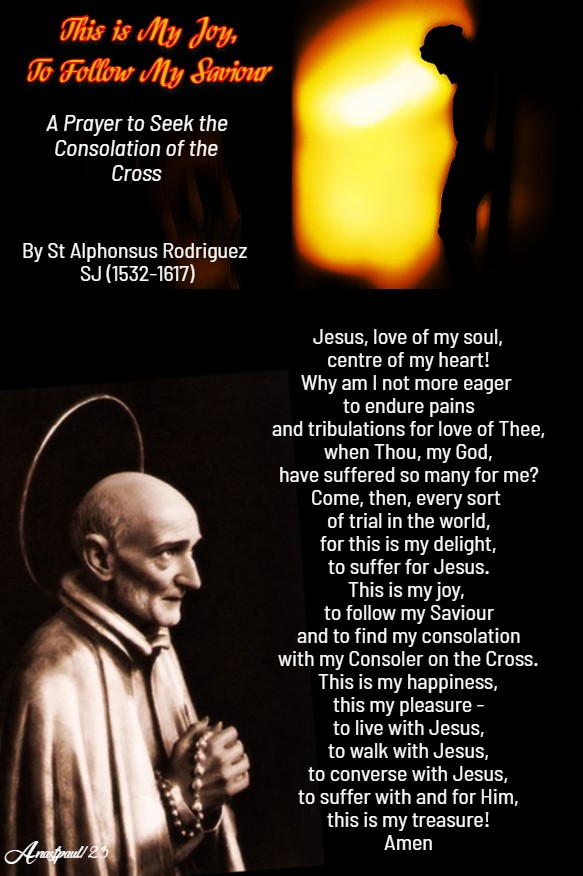
This is My Joy, To Follow My Saviour A Prayer to Seek the Consolation of the Cross By St Alphonsus Rodriguez SJ (1532-1617)
Jesus, love of my soul, centre of my heart! Why am I not more eager to endure pains and tribulations for love of Thee, when Thou, my God, have suffered so many for me? Come, then, every sort of trial in the world, for this is my delight, to suffer for Jesus. This is my joy, to follow my Saviour and to find my consolation with my Consoler on the Cross. This is my happiness, this my pleasure – to live with Jesus, to walk with Jesus, to converse with Jesus, to suffer with and for Him, this is my treasure! Amen
Saint of the Day – 14 September – Saint Cormac of Cashel (c836-908) Bishop, King of Munster, Ireland, a great Scholar and Writer. Born as Cormac MacCquilenan was the son of Cuillenan and descended from King Aengus who Saint Patrick Baptised. Cormac was probably the first Bishop of Cashel and the compiler of the “Psalter of Cashel” an Irish history. Irish writers have celebrated him for his learning, piety, charity and valour. He was killed in a battle against King Flan of Meath.
Coprmac, in his early years received a good education in one of the Irish Monastery schools. He was Ordained Priest and afterwards appointed Bishop of Cashel.
In the year 900 he became, on account of his descent, King of Cashel and thus were combined in his person, the two offices of spiritual and temporal ruler of Leth Moga, as the southern portion of Ireland was called.
In 906, The Ardri (ard-ri, High King) Flann, assisted by the King of Leinster, led his forces into the Southern Province and was met by the Munstermen under Cormac. The Ardri suffered a signal defeat. However in 908, Flann, assisted by Ceorbhall, King of Leinster and Cathal, King of Connaught, returned to the attack, apparently because Cormac, instigated by Flaherty, Abbot of Inniscathay, had claimed tribute from Leinster and had even signified his intention of assuming the position of High King there. The battle was fought, the Munstermen suffered a complete defeat and Cormac was killed in the battle.
An Irish Glossary called “Sanas Chormai,” containing etymologies and explanations of over 1400 unusual Irish words which has come down to us. Although, etymologically, the work is of little value, yet on account of the light it throws upon many ancient Irish customs and institutions, it is of great importance to the historian. The “Glossary of Cormac” is said to be only a part of the “Psalter of Cashel” also attributed to Cormac, but which has been lost. The lost Psalter of Cashel and the “Lebor na Cert—the Book of Rights”—is also linked to Cormac.
Cormac was regarded as a Saint after his death and his Shrine at Castledermot, County Kildare, is the site of miracles and pilgrimages.
St Caerealis Bl Claude Laplace St Cormac of Cashel (c836-908) Bishop, King St Crescentian of Carthage St Crescentius of Rome St Generalis of Carthage St Giulia Crostarosa St Jean Gabriel Taurin du Fresse
St Maternus of Cologne (Died c 325) Bishop, the first Bishop of Cologne and Founder of the Diocese of Tongeren, Germany. In Cologne and in his hometown of Trier, the faithful began to venerate him as a Saint. A popular cult of which the splendid 13th century stained glass windows in the Cathedral Chapel dedicated to his name, also testify. He was buried in the Cathedral of Cologne but the Cathedral of St Peter in Trier boasts a large Reliquary, which became and remains, a pilgrimage site. Biography; https://anastpaul.com/2021/09/14/saint-of-the-day-14-september-saint-maternus-of-cologne-died-c-325/
St Peter of Tarentaise O.Cist (1102-1174) Cistercian Monk, Archbishop of Tarentaise from 1141 until his death, Abbot, Apostle of Charity, Miracle-worker. There are two Saints named Saint Peter of Tarentaise who lived one Century apart. The Saint we honour today, is the younger Peter, born in France in the early part of the 12th Century. The other Saint Peter if Tarentaise, became Pope Innocent V. His Life: https://anastpaul.com/2019/09/14/saint-of-the-day-14-september-saint-peter-of-tarentaise-o-cist-1102-1174/
Bl Pedro Bruch Cotacáns St Rosula of Carthage St Sallustia St Victor of Carthage
Thought for the Day – 13 September – Meditations with Antonio Cardinal Bacci (1881-1971)
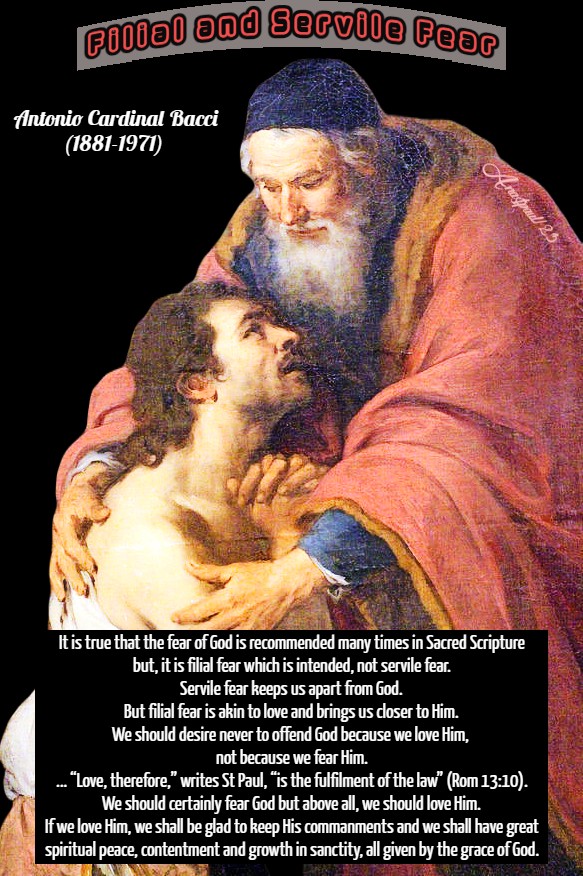
Filial and Servile Fear
“It is true that the fear of God is recommended many times in Sacred Scripture but, it is filial fear which is intended, not servile fear.
Servile fear keeps us apart from God. But filial fear is akin to love and brings us closer to Him. We should desire never to offend God because we love Him, not because we fear Him. When one loves another with all one’s heart, iot is nearly impossible to offend him. In this sense “the fear of Lord is the beginning of knowledge” (Prov 1:7) and, therefore, of sanctity. It is a gift of the Holy Spirit which produces, in us, a complete and loving submission to God, our Father and keeps us far from sin because, it is displeasing to Him.
The filial fear is pleasing to God, for “he fulfils the desire of those who fear Him, He hears their cry and saves them” (Ps 144:19).
“Love, therefore,” writes St Paul, “is the fulfilment of the law” (Rom 13:10). We should certainly fear God but above all, we should love Him. If we love Him, we shall be glad to keep His commanments and we shall have great spiritual peace, contentment and growth in sanctity, all given by the grace of God.”
Quote/s of the Day – 13 September – “Month of The Seven Sorrows of the Blessed Virgin Mary and The Holy Cross” – Ferial Day – Galatians 5:25-26; 6:1-10, Luke 7:11-15 – Scripture search here: https://www.drbo.org/
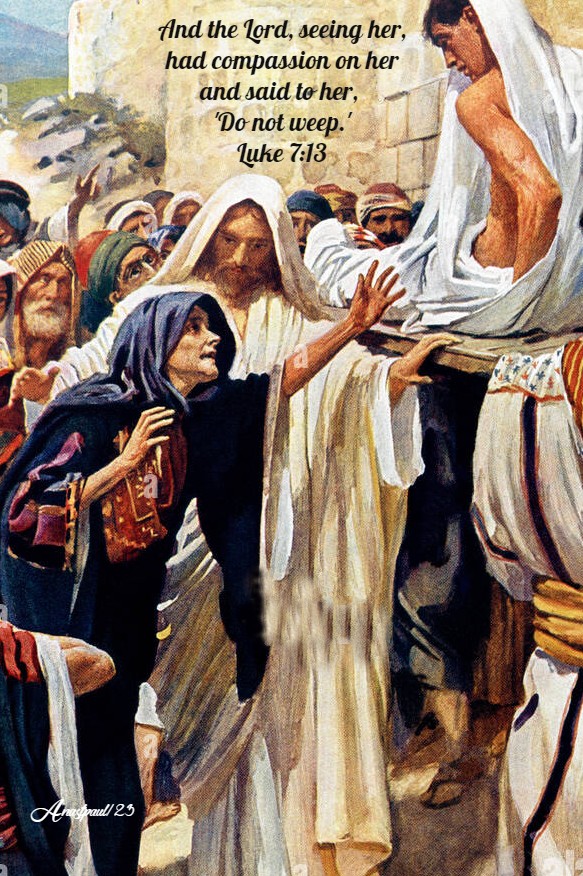
“And the Lord, seeing her, had compassion on her and said to her, ‘Do not weep.’”
Luke 7:13
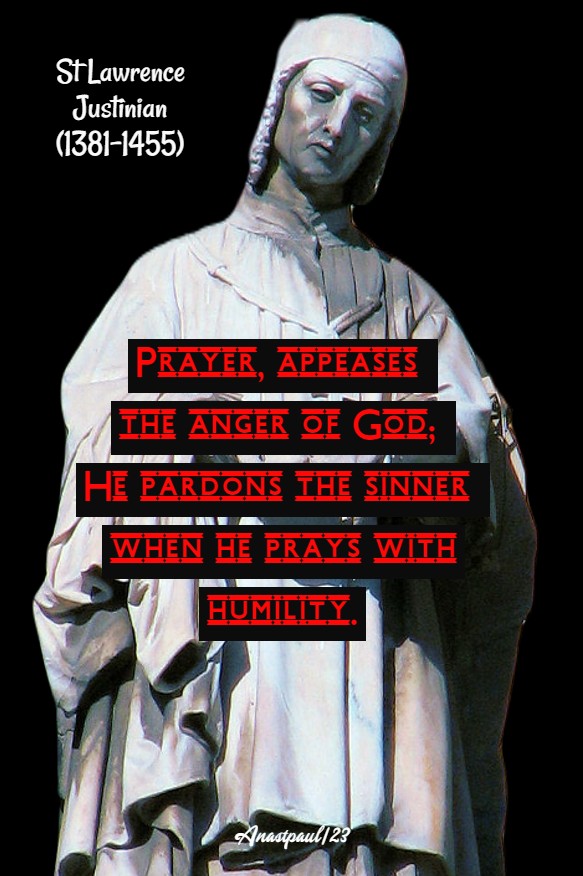
“Prayer, appeases the anger of God; He pardons the sinner when he prays with humility.”
St Lawrence Justinian (1381-1455)
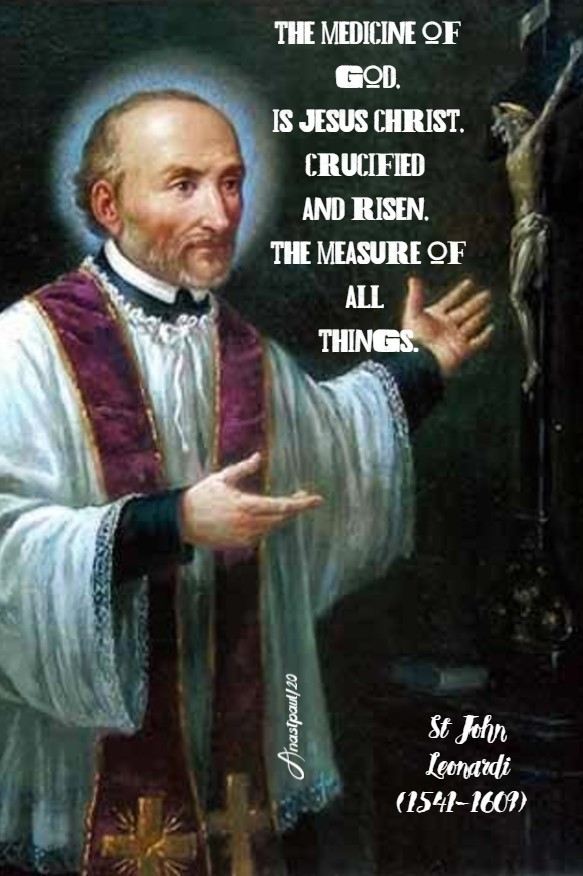
“The medicine of God, is Jesus Christ, Crucified and Risen, the measure of all things.”
St John Leonardi (1541-1609) Confessor, Priest, Founder
“O God, fullness of goodness, You do not forsake any, except those who forsake You. You never take away Your gifts, except when we take away our hearts. We rob the goodness of God, if we claim the glory of our salvation for ourselves. We dishonour His mercy, if we say He has failed us. … We blaspheme His goodness, if we deny that He has helped and assisted us. In short, O God, cry loud and clear into our ears: “your destruction comes from you, O Israel. In me alone is found your help” (Hos 13:9).
One Minute Reflection – 13 September – “Month of The Seven Sorrows of the Blessed Virgin Mary and The Holy Cross” – Ferial Day – Galatians 5:25-26; 6:1-10, luke 7:11-16– Scripture search here: https://www.drbo.org/
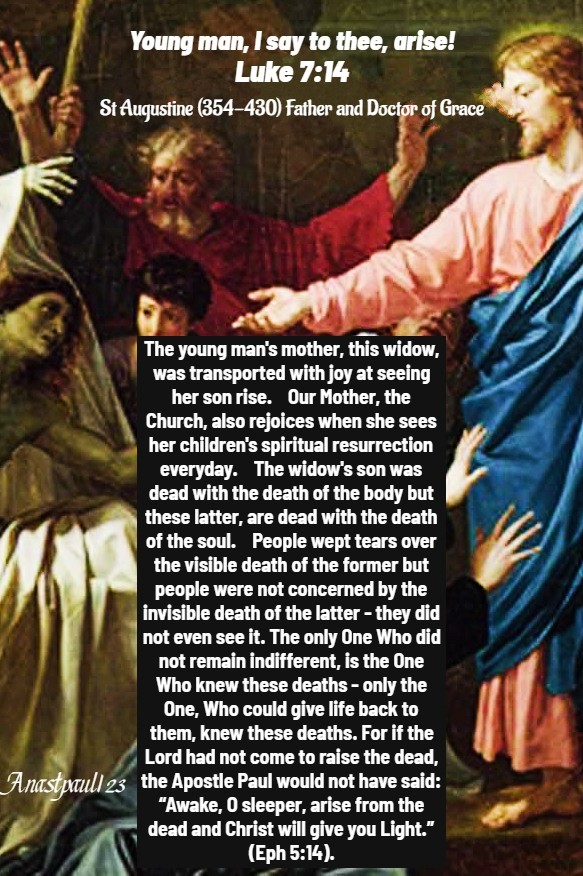
“Young man, I say to thee, arise!” – Luke 7:14
REFLECTION – “Let no-one who is Christian doubt that even now, dead people rise. Certainly, every human being has eyes, by which he can see dead people rising, in the way this widow’s son, whom we just heard about in the Gospel, arose. But not everyone can see people who are spiritually dead rise. For that, it is necessary to have already risen interiorly. It is greater to raise someone, who is to live forever than to raise someone, who will have to die again.
The young man’s mother, this widow, was transported with joy at seeing her son rise. Our Mother, the Church, also rejoices when she sees her children’s spiritual resurrection everyday. The widow’s son was dead with the death of the body but these latter, are dead with the death of the soul. People wept tears over the visible death of the former but people were not concerned by the invisible death of the latter – they did not even see it. The only One Who did not remain indifferent, is the One Who knew these deaths – only the One, Who could give life back to them, knew these deaths. For if the Lord had not come to raise the dead, the Apostle Paul would not have said: “Awake, O sleeper, arise from the dead and Christ will give you Light.” (Eph 5:14).” –St Augustine (354-430) Father and Doctor of Grace (Sermon 98).
PRAYER – Grant, we beseech Thee, O Lord God, unto all Thy servants that they may remain continually in the enjoyment of soundness, both of mind and body and by the glorious intercession of the Blessed Mary, always a Virgin, may be delivered from present sadness and enter into the joy of Thine eternal gladness.Through Jesus Christ, Thy Son our Lord, Who lives and reigns with Thee, in the unity of the Holy Ghost, God, world without end. Amen (Collect).
Our Morning Offering – 13 September – “Month of The Seven Sorrows of the Blessed Virgin Mary and The Holy Cross”
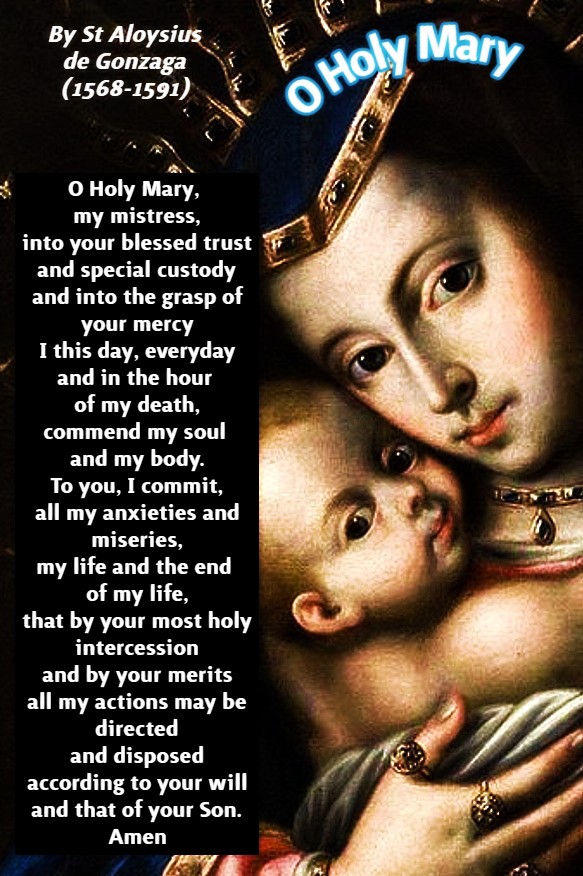
O Holy Mary By St Aloysius de Gonzaga (1568-1591)
O Holy Mary, my mistress, into your blessed trust and special custody and into the grasp of your mercy I this day, everyday and in the hour of my death, commend my soul and my body. To you, I commit, all my anxieties and miseries, my life and the end of my life, that by your most holy intercession and by your merits, all my actions may be directed and disposed according to your will and that of your Son. Amen
Saint of the Day – 13 September – St Emiliano of Valence (Died 374) is considered to be the first Bishop of Valence, in France., although certain historians are uncertain of this. We believe that he governed this See from 347 until his death in 374. Also known as – Emilian, Emilianius, Aemilianus – some believing that reference to Aemilianus is another Saint altogether. Additional Memorial – 12 September in Valence.
According to the Life of Saint Marcellin of Embrun (Died 374), he, Marcellin, was Consecrated Bishop by St Emiliano of Valence and St Eusebius of Vercelli ..
Bishop Emiliano participated in the Council organised in Valence on 12 July 374, although his name is not accompanied by the name of the Episcopal See to which he belonged. However, this is not an unusual occurrence, especially in the light of the tact that the Council was being held in his See.
Bishop Emiliano did sign a Synodal letter at the Council of Sardica in 343/344 as the Bishop of Valence.
An ancient manuscript from Valence Cathedral, possibly dating to the 10th Century speaks of Aemilianus vir sanctissimu (most holy Aemillanus). Since ancient times, the liturgical memory of Saint Emiliano has been celebrated in Valence on 10 September. Bishop Jean de Catelan (1705-1725) moved its commemoration to 12 September, making it obligatory for the entire Diocese.
St Evantius of Autun St Gordian of Pontus Bl Hedwig of Hereford St Julian of Ankyra St Ligorius St Litorius of Tours St Macrobius St Marcellinus of Carthage
Thought for the Day – 12 September – Meditations with Antonio Cardinal Bacci (1881-1971)
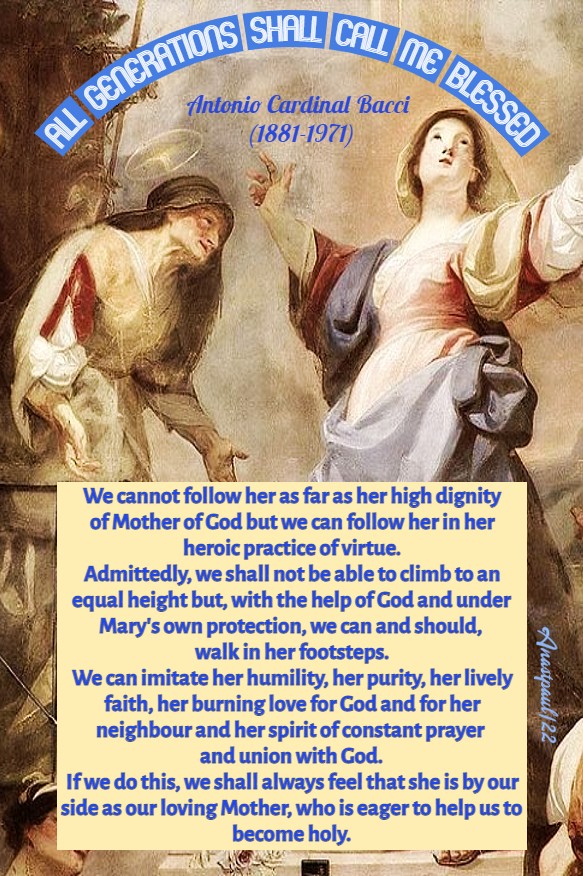
“All Generations Shall Call Me Blessed”
“It is related in the Gospel, that once a certain occasion, a woman in the crowd, was roused by the preaching and miracles of Jesus and cried out: “Blessed is the womb that bore thee and the breasts that nursed thee.” But Jesus replied: “Rather blessed are they who hear the word of God and keep it” (Lk 11:27-28). These words take nothing from the glory of the Mother of God. They were not intended for her but, for us. She was great and holy, not only because she was chosen to be the Mother of the Word Incarnate but also because she perfected herself in virtue by carrying out, in everything, the teaching of her divine Son, Jesus.
We cannot follow her as far as her high dignity of Mother of God but we can follow her in her heroic practice of virtue. Admittedly, we shall not be able to climb to an equal height but, with the help of God and under Mary’s own protection, we can and should, walk in her footsteps.
We can imitate her humility, her purity, her lively faith, her burning love for God and for her neighbour and her spirit of constant prayer and union with God. If we do this, we shall always feel that she is by our side as our loving Mother, who is eager to help us to become holy.”
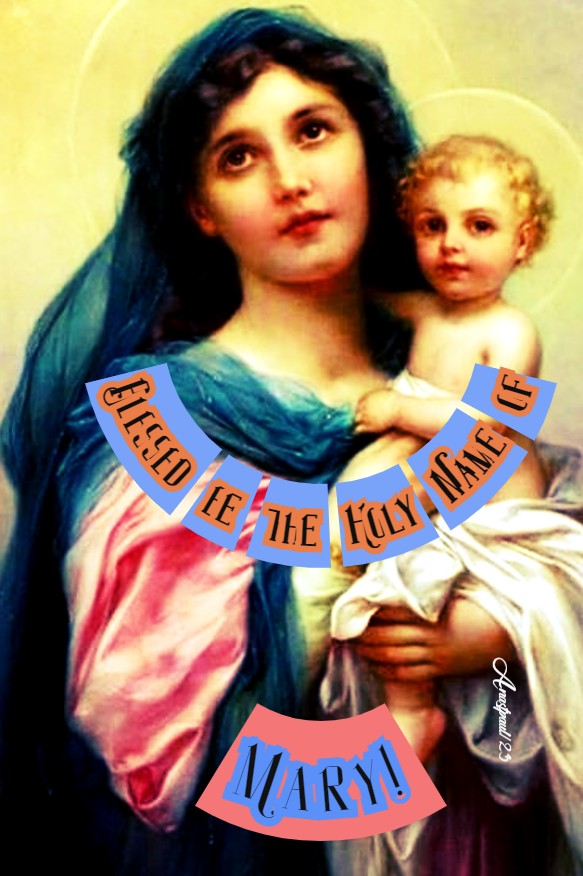
Quote/s of the Day – 12 September – The Feast of the Holy Name of Mary
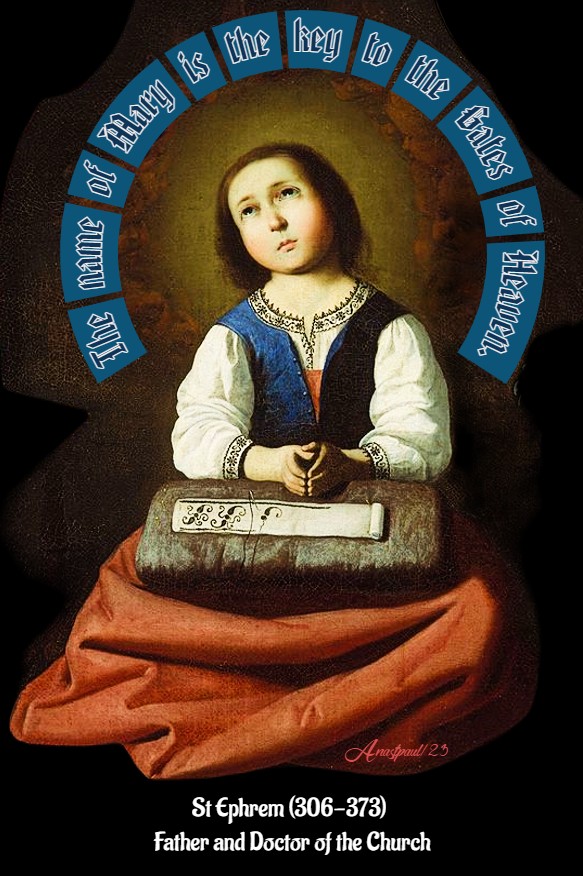
“The name of Mary is the key to the Gates of Heaven.”
St Ephrem (306-373) Father and Doctor of the Church
“O most Holy Virgin Mary! Thy name is so sweet and amiable that it cannot be pronounced, without inflaming those, who do so, with love towards thee and God.”
St Bernard (1090-1153) Mellifluous Doctor of the Church
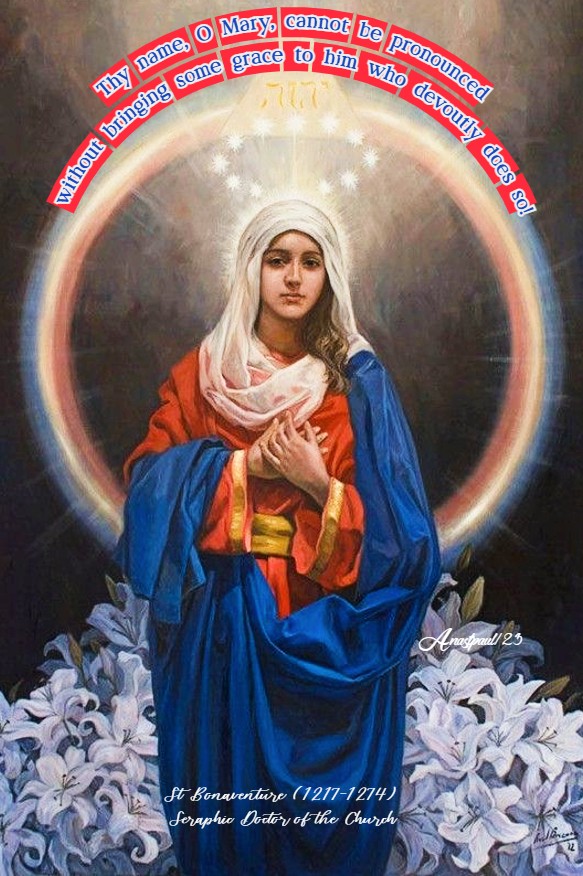
“Thy name, O Mary, cannot be pronounced without bringing some grace to him who devoutly does so!”
St Bonaventure (1217-1274) Seraphic Doctor of the Church
“The devils fear the Queen of Heaven, to such a degree that only on hearing her great name pronounced, they fly from him who does so, as from a burning fire!”
One Minute Reflection – 12 September – “Month of The Seven Sorrows of the Blessed Virgin Mary and The Holy Cross” – Feast of the Most Holy Name of Mary – Ecclesiasticus 24:23-31, Luke 1:26-38 – Scripture search here: https://www.drbo.org/
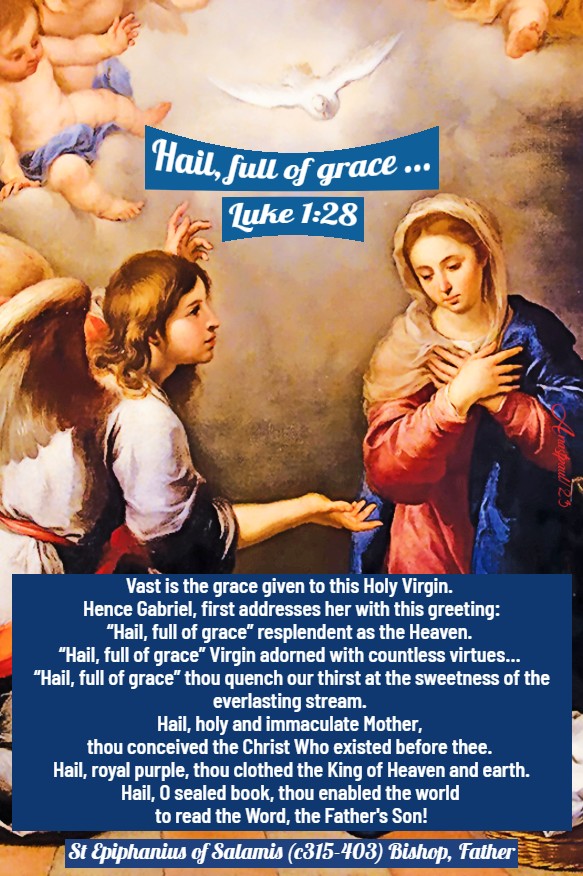
“Hail, full of grace …” – Luke 1:28
REFLECTION – “How can I speak? What praises could I possibly make of the holy and glorious Virgin? She surpasses all other beings except for God Himself. She is by nature more beautiful than the Cherubim and Seraphim and the whole Angelic Host. No language, whether of Heaven or earth, or even of the Angels, is enough to praise her. Blessed Virgin, spotless dove, heavenly bride… temple and throne of the Godhead! Christ, the Sun that shines resplendently in Heaven and on earth, belongs to thee. Thou art the luminous cloud that brought Christ down to earth, He Who is the bright streak of lightening, Who shines across the world.
Rejoice, full of grace, gate of Heaven! It was of thee, the author of the Song of Songs speaks… when he cries aloud: “A garden enclosed is my sister, my bride; an enclosed garden, a fountain sealed” (4:12)… Holy Mother of God, spotless ewe – thou gave birth to Christ, the Lamb, the Word made flesh in thee… How amazing a wonder in the heavens – a woman clothed with the sun (Apoc 12:1), carrying the light in her arms! … How amazing a wonder in the heavens – the Lord of Angels become the Virgin’s Child. Angels judged Eve; now they fill Mary with glory, since it was shewho raised Eve from her fall and brought Adam, expelled from Paradise, into Heaven.
Vast is the grace given to this Holy Virgin. Hence Gabriel, first addresses her with this greeting: “Hail, full of grace” resplendent as the Heaven. “Hail, full of grace” Virgin adorned with countless virtues… “Hail, full of grace” thou quench our thirst at the sweetness of the everlasting stream. Hail, holy and immaculate Mother, thou conceived the Christ Who existed before thee. Hail, royal purple, thou clothed the King of Heaven and earth. Hail, O sealed book, thou enabled the world to read the Word, the Father’s Son!” – St Epiphanius of Salamis (c315-403) Bishop of Salamis, known as the Oracle of Palestine and Father of the Church (Sermon No 5)
PRAYER – Grant, we beseech Thee, Almighty God, through the protection of the most holy Virgin Mary, Thy faithful people, who delight in her name may, by her loving intercession, be delivered from all evils on earth and be found worthy to attain everlasting happiness in Heaven. Through Jesus Christ, Thy Son our Lord, Who lives and reigns with Thee, in the unity of the Holy Ghost, God, world without end. Amen (Collect).






















 AnaStpaul
You must be logged in to post a comment.