Quote/s of the Day – 6 September – Feria Day – Galatians 5:16-24, Matthew 6:24-33 – Scripture search here: https://www.drbo.org/
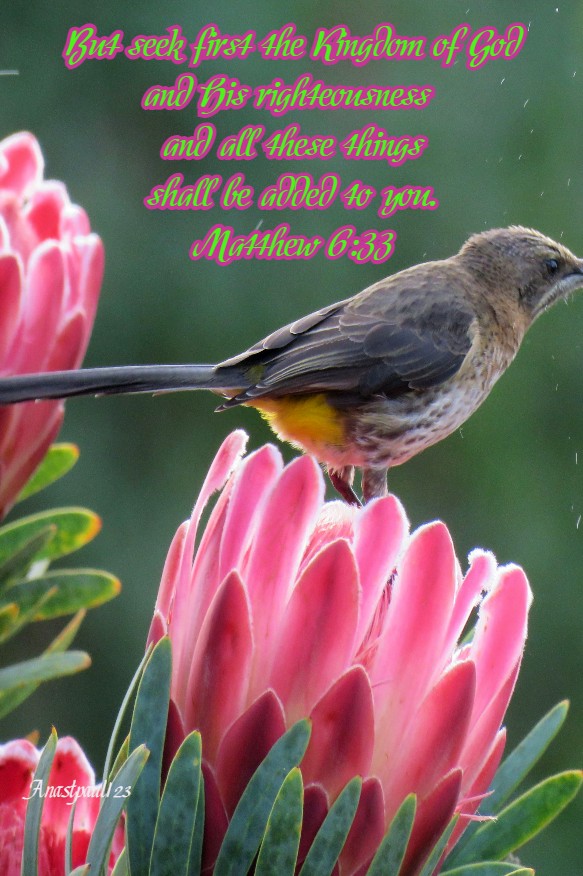
“But seek first the Kingdom of God and His righteousness and all these things shall be added to you.”
Matthew 6:33
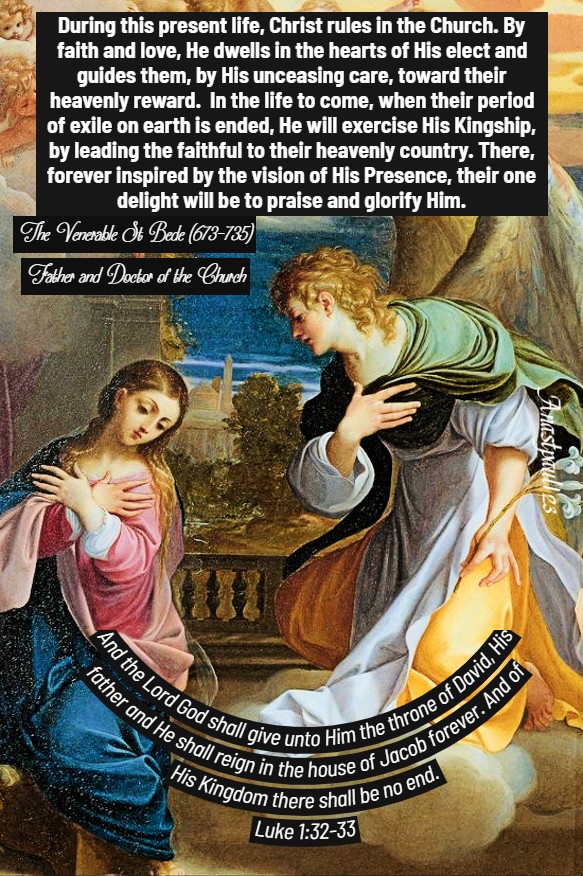
“And the Lord God shall give unto Him the throne of David, His father and He shall reign in the house of Jacob forever. And of His Kingdom there shall be no end.” Luke 1:32-33
“During this present life, Christ rules in the Church. By faith and love, He dwells in the hearts of His elect and guides them, by His unceasing care, toward their heavenly reward. In the life to come, when their period of exile on earth is ended, He will exercise His Kingship, by leading the faithful to their heavenly country. There, forever inspired by the vision of His Presence, their one delight will be to praise and glorify Him.”
The Venerable St Bede (673-735) Father and Doctor of the Church
“The only true riches are those that make us rich in virtue. Therefore, if you want to be rich, beloved, love true riches. If you aspire to the heights of real honour, strive to reach the Kingdom of Heaven. If you value rank and renown, hasten to be enrolled in the heavenly court of the Angels.”
St Pope Gregory III (Died 741)
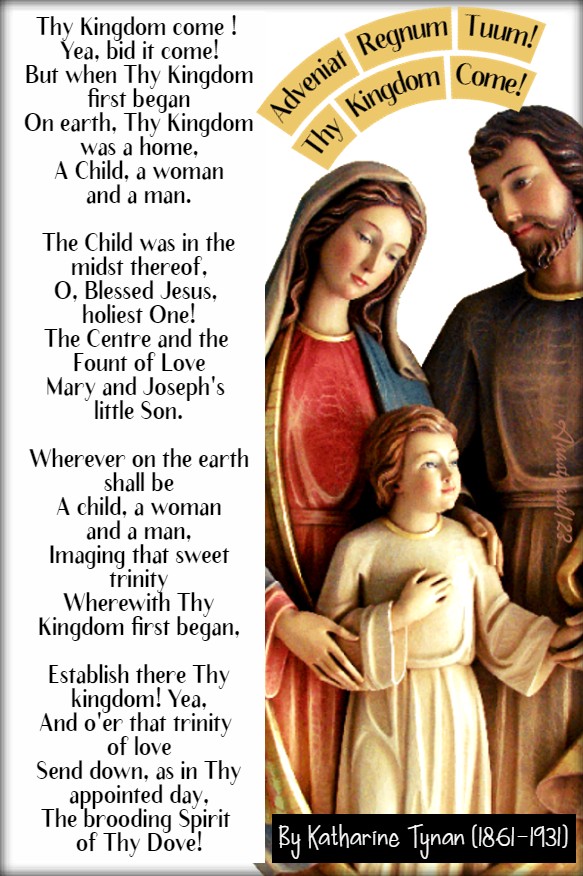
Adveniat Regnum Tuum! Thy Kingdom Come! By Katharine Tynan (1861-1931)
Thy Kingdom come ! Yea, bid it come! But when Thy Kingdom first began On earth, Thy Kingdom was a home, A Child, a woman and a man.
The Child was in the midst thereof, O, Blessed Jesus, holiest One! The Centre and the Fount of Love Mary and Joseph’s little Son.
Wherever on the earth shall be A child, a woman and a man, Imaging that sweet trinity Wherewith Thy Kingdom first began,
Establish there Thy kingdom! Yea, And o’er that trinity of love Send down, as in Thy appointed day, The brooding Spirit of Thy Dove!
Katharine Tynan (1861-1931) was an Irish born Poet and Writer and a friend of the Jesuit Poet, Fr Gerard Manley Hopkins. She contributed to many periodicals and magazines such as the Jesuit published Studies, the Dominican published Irish Rosary, Irish Monthly, Hibernia and Dublin University Review, besides her own private publications. After her marriage, the addition of her husband’s name, “Hinkson” is often appended to her publications.
One Minute Reflection – 6 September – “Month of The Seven Sorrows of the Blessed Virgin Mary and The Holy Cross” – Ferial Day – Galatians 5:16-24, Matthew 6:24-33 – Scripture search here: https://www.drbo.org/
“But seek first the Kingdom of God and His righteousness and all these things shall be added to you.” – Matthew 6:33
REFLECTION – “Seek first the Kingdom of God and its righteousness and all these things shall be added to you”… It is said, then that we should seek the Kingdom of God. “That we should seek” – it’s a simple word but it seems to me, to be saying a great deal. It means… unceasing work for God’s Kingdom, not remaining in an indolent, motionless state but paying attention to one’s interior state, so as to govern it well, not being detached and uncaring at the exterior level… Seek God within yourself, since Saint Augustine confesses that, as long as he sought Him outside himself, he failed to find Him. Seek Him in your soul as in a pleasant dwelling place because, this is the basis on which, His servants of establish themselves, who try to put all the virtues into practice . We have to have an interior life, we have to move towards this – lacking this ,we lack everything… Let us try to make ourselves live interiorly… Let us seek God’s glory, seek the reign of Jesus Christ…
“But, [you will tell me], there is so much to do, so many household jobs, so much business in town, in the fields – work everywhere! Do we have to abandon it all, then, so as to think of nothing but God?” No – but these occupations have to be sanctified by seeking God in them and doing them to find Him in them, rather than, to see them done. What our Lord wants, is for us to seek His glory, His Kingdom, His righteousness, before all else and, for this, to make our foundation the interior life, faith, trust, love, religious exercises…, labours and sufferings, with God our Sovereign Lord in view… Once we are firmly set in the search for God’s glory, we can be assured that the rest will follow.” – St Vincent de Paul (1581-1660) Priest, Founder (Conference given on 21/02/1659).
PRAYER – Grant, we beseech Thee, O Lord God, unto all Thy servants, that they may remain continually in the enjoyment of soundness, both of mind and body and by the glorious intercession of the Blessed Mary, always a Virgin, may be delivered from present sadness and enter into the joy of thine eternal gladness.Through the same Jesus Christ, Thy Son our Lord, Who lives and reigns with Thee, in the unity of the Holy Ghost, God, world without end. Amen (Collect).
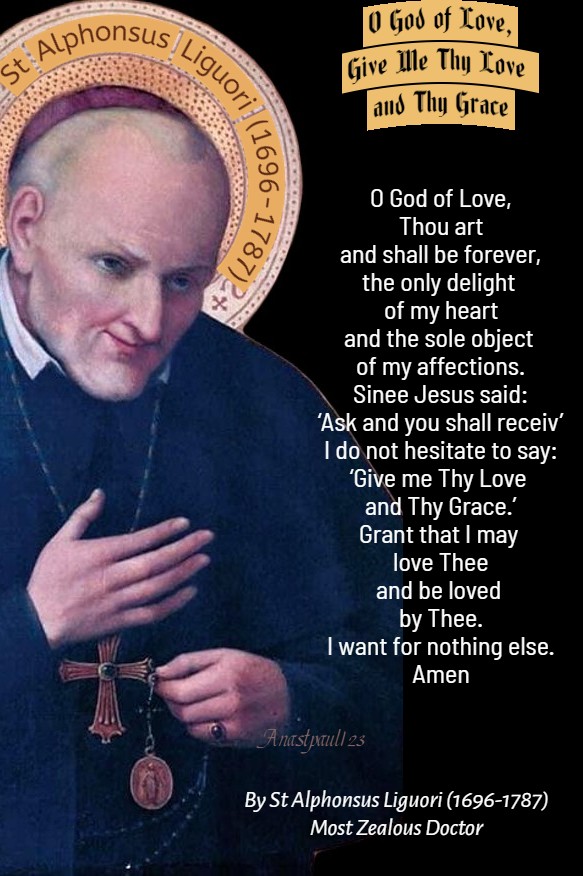
O God of Love, Give Me Thy Love and Thy Grace By St Alphonsus Liguori (1696-1787) Most Zealous Doctor
O God of Love, Thou art and shall be forever, the only delight of my heart and the sole object of my affections. Sinee Jesus said: ‘Ask and you shall receive,’ I do not hesitate to say: ‘Give me Thy Love and Thy Grace.’ Grant that I may love Thee and be loved by Thee. I want for nothing else. Amen
Saint of the Day – 6 September – St Bega (Died c660) Virgin, Irish Princess, Abbess Founder, Miracle-worker. Born in the 7th Century in Ireland as a Princess and died in 681 of natural causes. Also known as – Bee, Bees, Begga, Begh, Begha. Additional Memorial – 31 October in Scotland.
The Roman Martyrology reads: “On the Cumberland coast in England, in a Town which later took its name from her, Saint Bega, consecrated virgin.”
Bega was the daughter of an Irish King. She is described as beautiful, virtuous and learned. Her father had promised her in marriage, to the son of the King of Norway but Bega had no intention of marrying. She wished to consecrated her virginity to Christ.
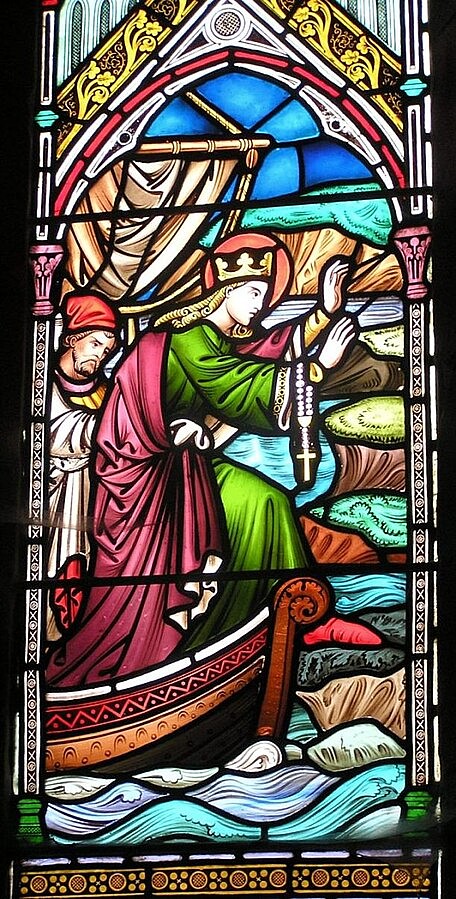
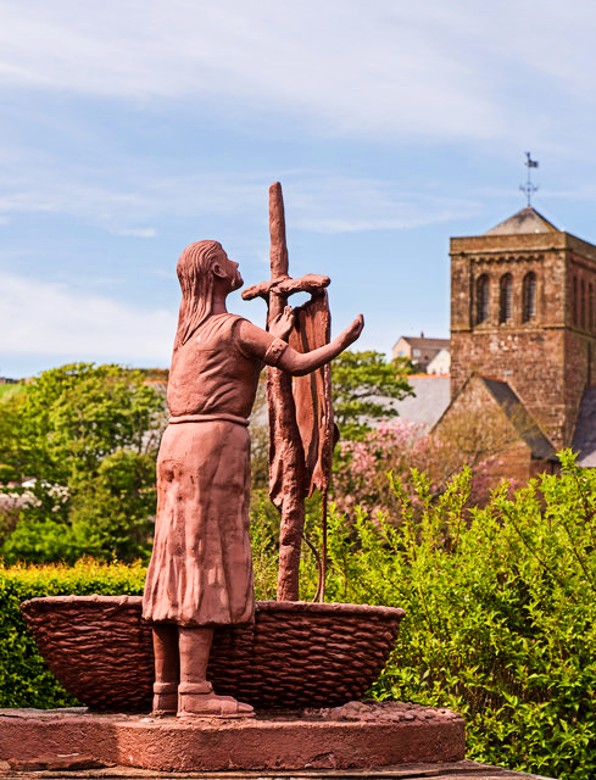
According to her Vita, an Angel presented Bega with an arm ring (bracelet) inscribed with the Cross as a token of her sacred promise. Bega escaped by the grace of God and with miraculous assistance. In onr account, Bega was transported across the Irish Sea by a clod of soil. She arrived safely on the English coast at Cumbria. Settling there, Bega lived in strict seclusion in a hut she built, in amongst a grove of trees near the seashore. She survived on food brought to her by seagulls and gannets.
After some years passed, Viking pirates began to raid the coast. The good Saint ,however, dreaded not death, nor mutilation, nor the loss of temporal goods, of which she was destitute except her bracelet (armilla) but she feared the loss of her virginity, the most precious treasure with which heaven can endow her sex.
By Divine command, Bega hastened her departure from the place but she was induced to leave her bracelet behind her that miracles, in ages to come, might be performed in that neighbourhood, in testimony of her holy life. She travelled inland and on the advice of King Oswald (later St Oswald of Northumbria (c604-642) Martyr and King – https://anastpaul.com/2019/08/05/saint-of-the-day-5-august-saint-oswald-of-northumbria-c-604-642-martyr/), she professed her religious vows and established a Monastery at St Bees in Cumbria under her administration as Abbess.
Bega is often wrongly identified with Saint Eiu (Heiu), who the Venerable St Bede says was the first woman to embrace monastic life in Northumbria, receiving the veil from the hands of Saint Aidan. Following this confusion, she was credited with founding other Monasteries in Yorkshire and there was considerable interference in her veneration as well.
It seems that our Saint died around 660, perhaps in her Monastery in Cumberland which, after her death, took her name and remained the main centre of her cult. It was later seriously damaged by the Danes but at the beginning of the 12th Century was restored as a Priory dependent on the Benedictine Abbey of St Mary of York and endowed by the Earl of Cumberland, William de Meschines.
Bega was considered a Patron Saint by the inhabitants of Cumberland and of the regions near the promontory, who resorted to her to defend them from the bullying of the local Lords and from the incursions of pirates. She was considered, in particular, as the Patroness of the poor and defenceless, with reference to a popular tradition, according to which, she would personally take care of the material needs of the workers, who worked on the construction of her Monastery.
The abovementioned Earl also claimed to possess the miraculous golden arm-ring or bracelet which, Bega received from an Angel before leaving Ireland, as a sign of loyalty to her Celestial Groom. Until the 12th Century, the bracelet was used for the performance of oaths, in the same way as the Sacred Scriptures are used today. It was certain, in fact, that the perjurer would not escape Celestial punishment.
In Scotland, the Church of Kilbees (Bega’s Church), dedicated to her, is also remembered. According to the legends which identify her with Saint Eiu, she, Bega, founded a Monastery in Hartlepool, in the northern region of Yorkshire and here she died as a simple Nun, having renounced the position of Abbess, in favour of Saint Hilda. From the Aberdeen Breviary of 1509, in which the same confusion of characters is found, we learn that, following a Divine intervention, 460 years after her death, Bega’s Relics were found in Hartlepool and solemnly transferred to the restored Monastery of Whitby, where, at the beginning of the 16th Century, were still the object of a lively veneration.
Bega’s festival was commonly celebrated on 6 September. As well as in the northern regions of Great Britain, she is also venerated in Norway, perhaps from this was born the legend, reported by some, according to which the Saint travelled to that Country, successfully working towards the conversion of that people.
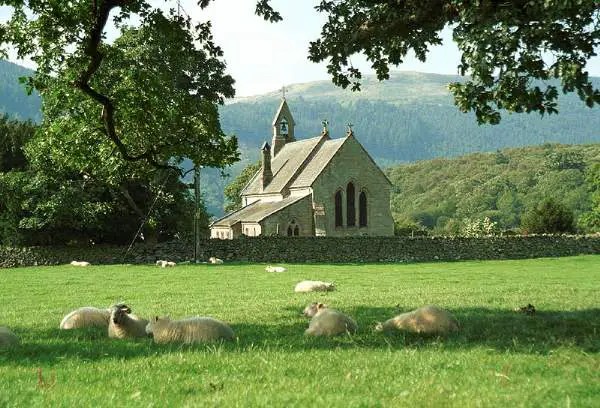
Her Feast day is still celebrated in the Diocese of Lancaster, in Scotland, in Yorkshire and Cumbria. Below is her Church in Bassenthwaite in the Lake District, Cumbria.
St Cagnoald St Consolata of Reggio Emilia St Cottidus of Cappadocia
St Eleutherius the Abbot (Died c 585) Monk and Abbot. A wonderful simplicity and spirit of compunction were the distinguishing virtues of this holy sixth century Abbot. His Lifestory: ttps://anastpaul.com/2020/09/06/saint-of-the-day-saint-eleutherius-the-abbot-at-spoleto-died-c-585/
St Eugene of Cappadocia St Eve of Dreux St Faustus of Alexandria St Faustus of Syracuse St Felix of Champagne
St Mansuetus of Toul St Onesiphorus St Petronius of Verona St Sanctian of Sens St Zacharius the Prophet
Martyrs of Africa – 6 Saints: There were thousands of Christians exiled, tortured and Martyred in the late 5th Century by the Arian King Hunneric. Six of them, all Bishops, are remembered today; however, we really know nothing about them except their names and their deaths for the Christ and the Faith – Donatian, Fusculus, Germanus, Laetus, Mansuetus and Praesidius.
Thought for the Day – 5 September – Meditations with Antonio Cardinal Bacci (1881-1971)
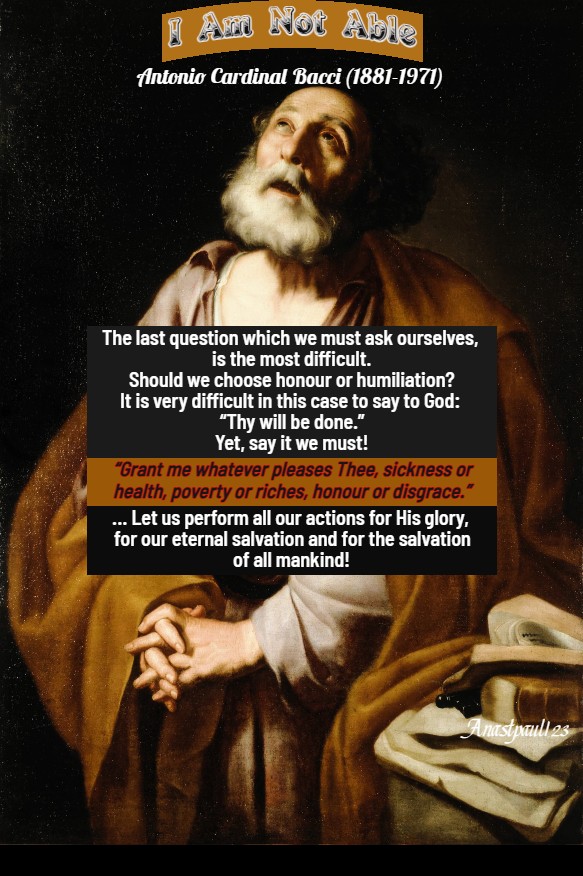
I Am Not Able
“The last question which we must ask ourselves, is the most difficult. Should we choose honour or humiliation? It is very difficult in this case to say to God: “Thy will be done.” Yet, say it we must!
If honour, high position and success redound t0 the glory of God and to our spiritual advantage, then, let us accept them with humble gratitude. But, if Divine Providence ordains that it is better for us to be humiliated and forgotten, we must accept this with cheerful resignation. “Do with me what Thou will, O Lord,” we should pray.
“Grant me whatever pleases Thee, sickness or health, poverty or riches, honour or disgrace.” We must always accept the will of God simply because, we love Him and wish to serve Him more faithfully. Let us perform all our actions for His glory, for our eternal salvation and for the salvation of all mankind!”
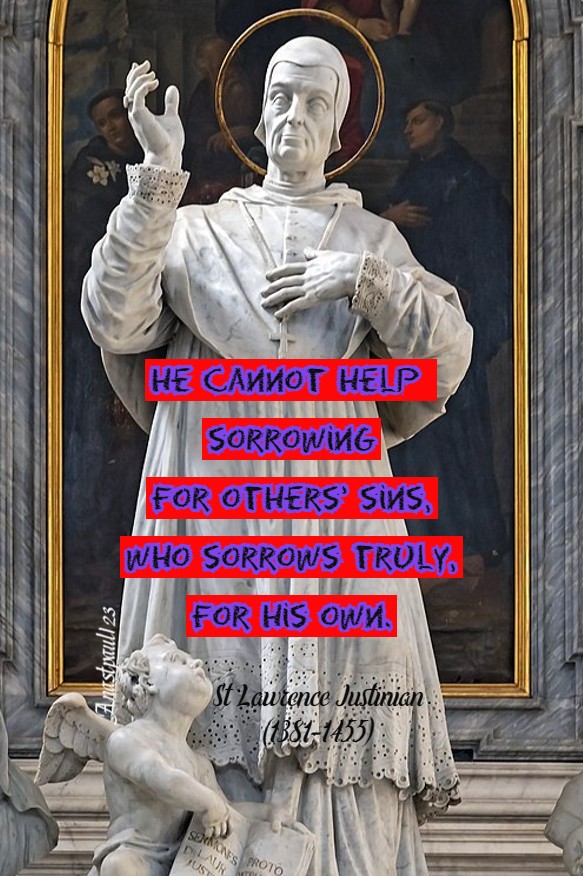
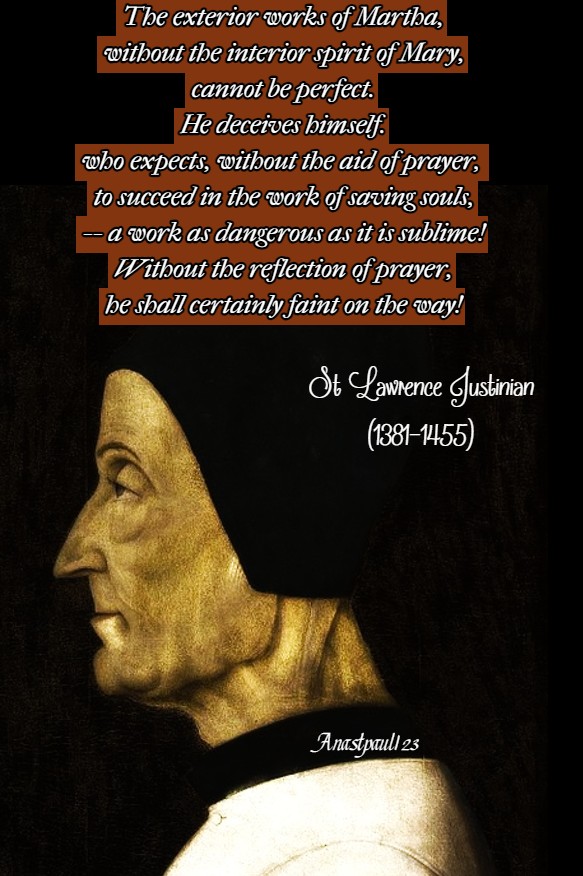
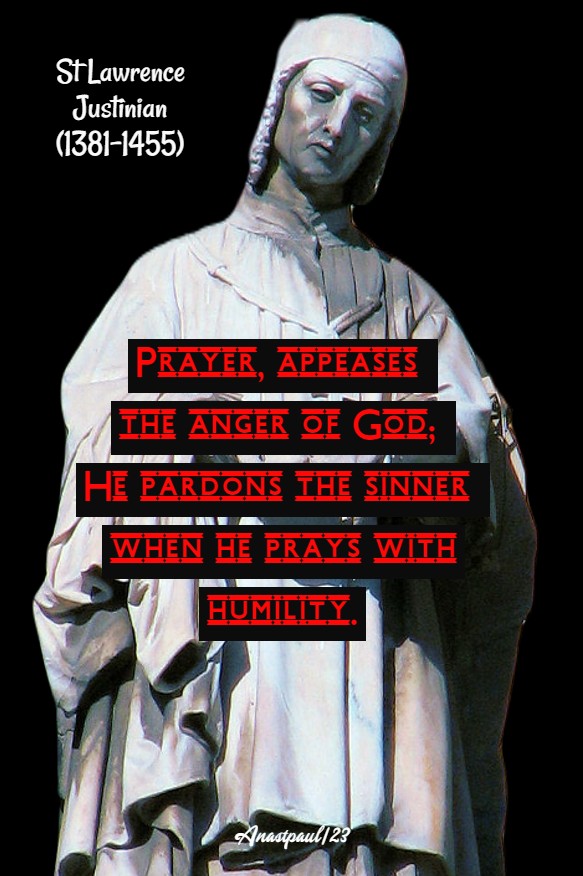
Quote/s of the Day – 5 September – St Lawrence Justinian (1381-1455) Bishop of Venice, Confessor
“He cannot help sorrowing for others’ sins, who sorrows truly, for his own.”
“The exterior works of Martha, without the interior spirit of Mary, cannot be perfect. He deceives himself. who expects, without the aid of prayer, to succeed in the work of saving souls, — a work as dangerous as it is sublime! Without the reflection of prayer, he shall certainly faint on the way!”
“Prayer, appeases the anger of God; He pardons the sinner when he prays with humility.”
One Minute Reflection – 5 September – “Month of The Seven Sorrows of the Blessed Virgin Mary and The Holy Cross” – St Lawrence Justinian (1381-1455) Bishop of Venice, Confessor – Ecclesiasticus 44:16-27; 45:3-20, Matthew 25:14-23 – Scripture search here: https://www.drbo.org/
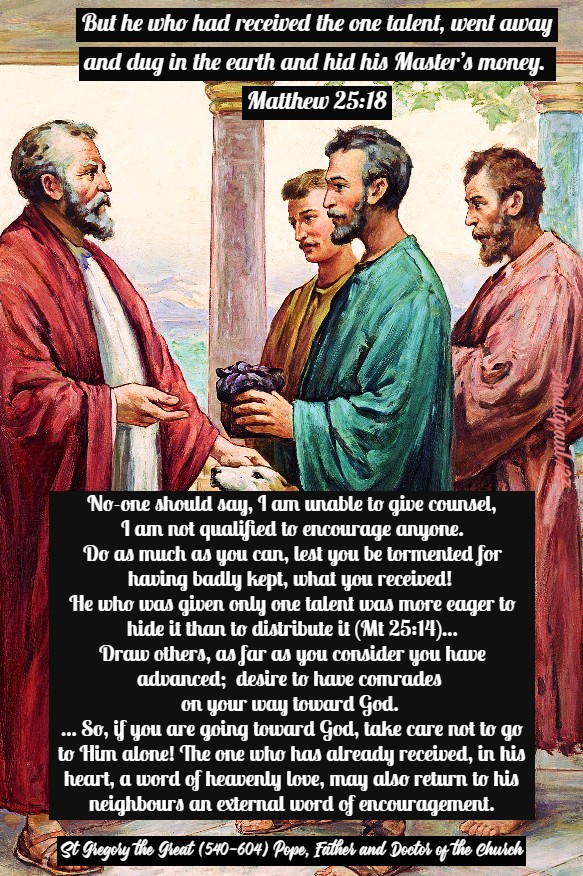
“But he who had received the one talent, went away and dug in the earth and hid his Master’s money. ” – Matthew 25:18
REFLECTION – “You too, if you wish it, can deserve the exalted quality of the name of God’s Angel. Each one of you, insofar, as he can, insofar, as he receives an inspiration from on high, if he recalls his neighbour from his wickedness, takes care to encourage him to do good, proclaims the eternal Kingdom, or eternal punishment, to one astray – each one of you is truly an Angel of Jesus’ holy words. No-one should say, I am unable to give counsel, I am not qualified to encourage anyone. Do as much as you can, lest you be tormented for having badly kept, what you received! He who was given only one talent was more eager to hide it than to distribute it (Mt 25:14)…
Draw others, as far as you consider you have advanced; desire to have comrades on your way toward God. If any of you, my friends, is going to the market, or perhaps to the public baths, he will invite someone whom he sees to have nothing else to do, to come with him. That earthly kind of action is habitual among you. So, if you are going toward God, take care not to go to Him alone! The one who has already received, in his heart, a word of heavenly love, may also return to his neighbours an external word of encouragement.” – St Gregory the Great (540-604) Pope, Father and Doctor of the Church (Sermons on the Gospels No 5).
PRAYER – Grant, we beseech Thee, Almighty God that the venerable feast of Thy blessed Confessor and Bishop, may increase our devotion and promote our salvation. Through Jesus Christ, Thy Son our Lord, Who lives and reigns with Thee, in the unity of the Holy Ghost, God, world without end. Amen (Collect).
Saint of the Day – 5 September – Blessed Gerbrand of Dokkum OPraem (Died 1267) Priest/Canon Regular, the 4th Abbot of the Premonstratensian (Norbertine) Monastery at Dokkum, and a supporter of the Crusades. He encouraged the Frisians to join the Crusade and, in 1268, as a result of his zeal, was awarded, by Pope Clement IV, the Title of ‘Sacrae Militiae Dux‘ (Leader of the Crusade). Gerbrand was a close friend of Saint Louis IX of France (1226-1270). Born in the early 13th Century in a region of modern Netherlands and died on 11 October 1267 at the Premontres Motherhouse in Laon, France of natural cause.
St Norbert
The blessed Gerbrand joined the Premonstratensians, who are also called the Norbertines after their Founder, Saint Norbert of Xanten (c1080-1134) and also the White Canons after the colour of the Order’s Habit. Gerbrand became a Canon in their Monastery in Dokkum in Friesland in today’s Netherlands.
He was elected the 4th Abbot of the Dokkum Monastery. He was a champion of the Crusades and was a friend of Saint Louis IX of France (1226-1270), from whom he received several letters, which remain extant.
In his sermons, he invited the Frisians to participate in the expeditions to assist the Church iu Jerusalem. In 1268, Pope Clement IV, therefore, gave him the title Leader of the Crusade. He made his believers take up the cross and support the Crusade with their alms.
Gerbrand died during his Order’s General Chapter on 11 October 1267 in the Order’s Mother Monastery at Prémontré near Laon in France. A sisterof the Order from Mount Sion had a vision where she saw Gerbrand die and be taken up into Heaven. He is honoured as blessed by the Premonstratensians with a memorial day on 5 September.
St Lawrence Justinian (1381-1455) Bishop of Venice, Confessor, Reformer, Spiritual writer. The Roman Martyrology states of him today: “The Feast of St Lawrence Justinian, first Patriarch of Venice, who, by glorious miracles and virtues, illustrated the Episcopal dignity which he received against his will on this day. His birthday into Heaven is 8 January.” His Zealous Life: https://anastpaul.com/2021/09/05/saint-of-the-day-5-september-saint-lawrence-justinian-1381-1455/
St Charbel Bl Florent Dumontet de Cardaillac St Genebald of Laon Bl Gendtilis Blessed Gerbrand of Dokkum OPraem (Died 1267) Priest Abbot St Guise Hoang Luong Canh Blessed John the Good OSA (c 1168-1249) Bishop Blessed Jordan of Pulsano Abbot
St Obdulia Bl Phêrô Nguyen Van Tu St Romulus of Rome St Victorinus of Amiterme St Victorinus of Como Bl William Browne
Martyrs of Armenia – 1,000 Saints: A group of up to 1,000 Christian soldiers in the 2nd Century Imperial Roman Army of Trajan, stationed in Gaul. Ordered to sacrifice to pagan gods, they refused and were transferred to Armenia. Ordered again to sacrifice to pagan gods, they refused again. Martyrs. We know the names of three of them but nothing else – Eudoxius, Macarius and Zeno.
Martyrs of Capua – 3 Saints: Three Christians who were Martyred together. Long venerated in Capua, Italy. We know their names, but little else – Arcontius, Donatus and Quintius. They were martyred in Capua, Italy.
Martyrs of Nicomedia – 80 Saints: A group of 80 Christians, Lay and Clergy, Martyred together in the persecutions of Valens. We know little more than the names of three of them – Menedemo, Teodoro and Urbano. They were locked on a boat which was then set on fire on the shore of Nicomedia, Bithynia (in modern Turkey) c370.
Martyrs of Porto Romano – 4+ Saints: A group of Christians Martyred together in the persecutions of Marcus Aurelius. We know little more than their names – Aconto, Herculanus, Nonno and Taurino. c180 at Porto Romano, Italy.
Thought for the Day – 4 September – Meditations with Antonio Cardinal Bacci (1881-1971)
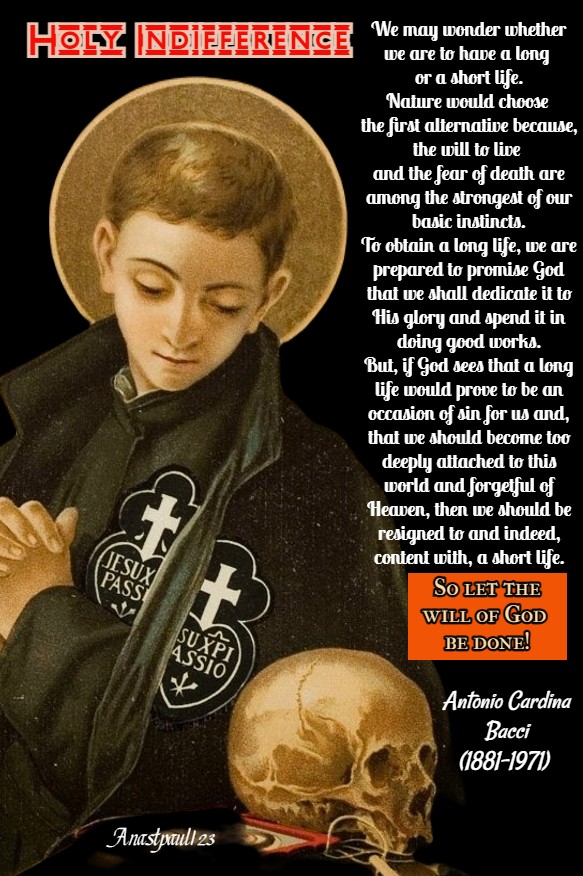
Holy Indifference
“We may wonder whether we are to have a long or a short life. Nature would choose the first alternative because, the will to live and the fear of death are among the strongest of our basic instincts. To obtain a long life, we are prepared to promise God that we shall dedicate it to His glory and spend it in doing good works. But, if God sees that a long life would prove to be an occasion of sin for us and, that we should become too deeply attached to this world and forgetful of Heaven, then we should be resigned to and indeed, content with, a short life.
How many young people like St Maria Goretti, St Gabriel of Our Lady of Sorrows, St Dominic Savio and others, have reached the peak of sanctity while still in the flower of their youth?! If this were the will of God for us, surely we should welcome the advent of an early death?
There is another question which often bothers those who attempt to look into the future. Shall I be rich or poor? It is natural to desire wealth and to want to avoid poverty. Yet, Jesus says: “Blessed are the poor … and woe to the rich!” It is clear then that wealth is likely to be a greater spiritual danger than poverty, for it can cause us to become more attached to worldly possessions. We can save our souls whether we are rich or poor, as long as we make right use of whatever we have/
Quote/s of the Day – 4 September – Feria – Galatians 5:16-24, Matthew 6:24-33 – Scripture search here: https://www.drbo.org/
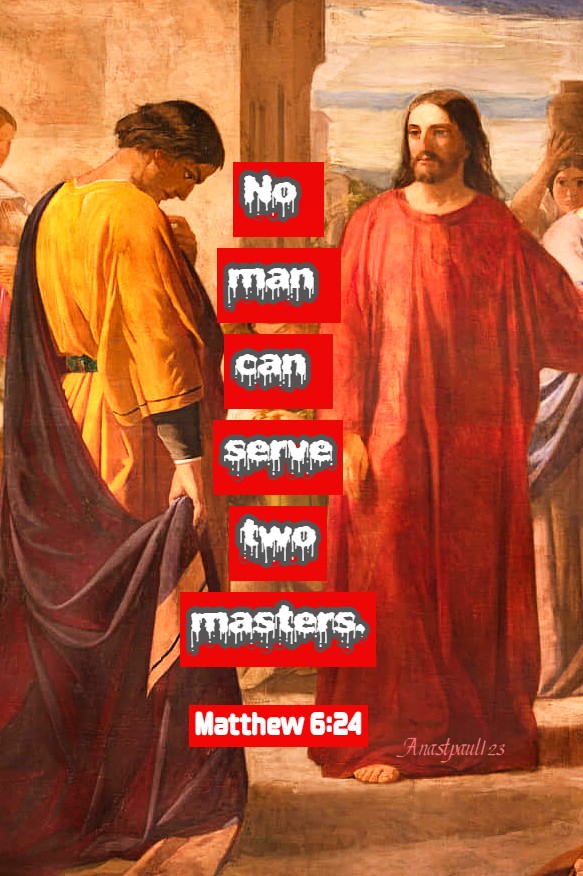
“No man can serve two masters.”
Matthew 6:24
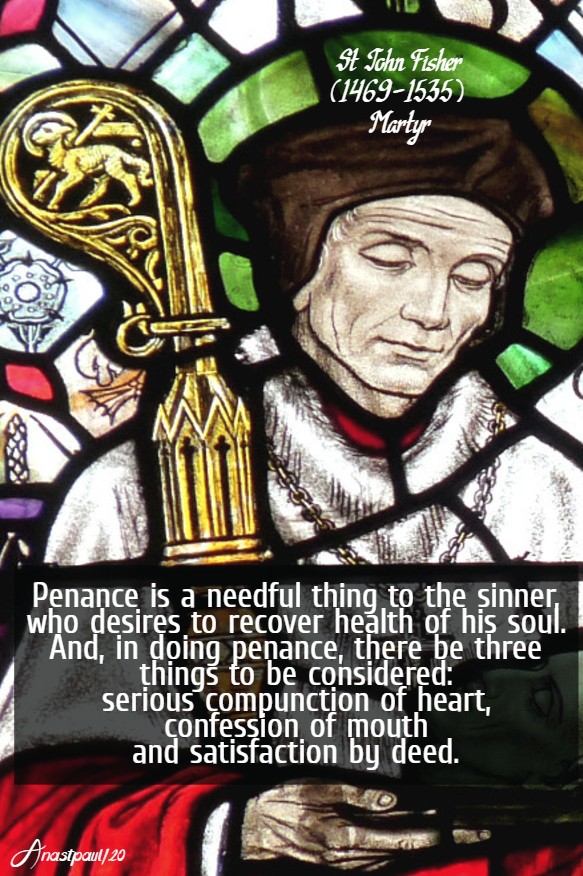
“Penance is a needful thing to the sinner, who desires to recover health of his soul. And, in doing penance, there be three things to be considered: serious compunction of heart, confession of mouth and satisfaction by deed.”
St John Fisher (1469-1535)
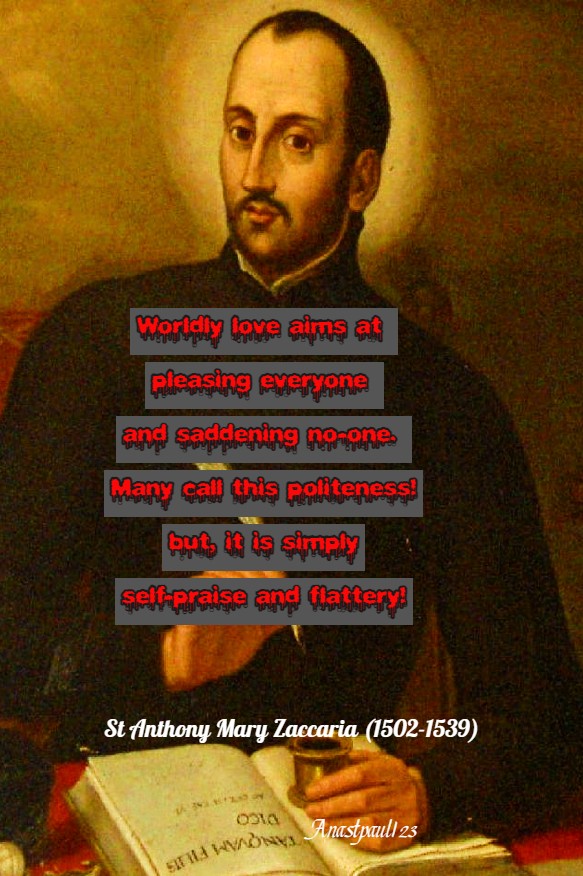
“Worldly love aims at pleasing everyone and saddening no-one. Many call this politeness! but, it is simply self-praise and flattery!”
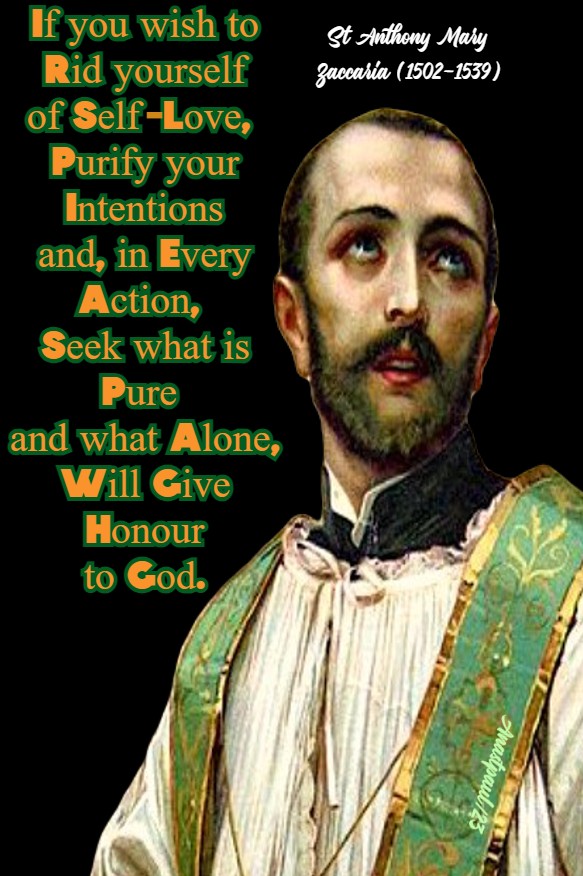
“If you wish to rid yourself of self-love, purify your intentions and, in every action, seek what is pure and what alone, will give honour to God.”
St Anthony Mary Zaccaria (1502-1539)
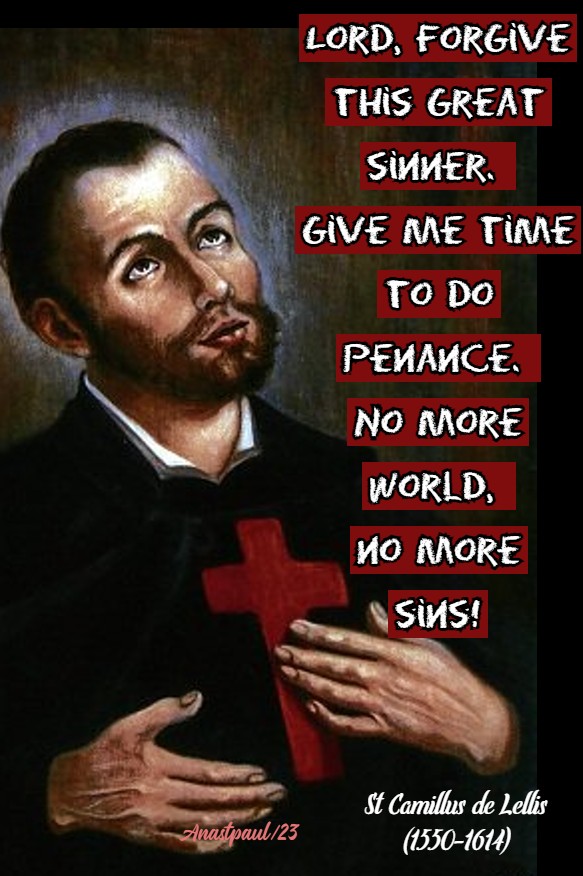
“Lord, forgive this great sinner. Give me time to do penance. No more world, no more sins!”
St Camillus de Lellis MI (1550-1614)
“To advance well, we must apply ourselves to make good way on the road nearest to us and do, the first day’s journey.”
“We fight the monsters of Africa in imagination but, from lack of attention, we allow ourselves, in reality, to be killed by the little serpents which lie in our way!”
(Intro to the Devout Life III:37)
St Francis de Sales (1567-1622) Doctor of Charity of the Church
“Let us be humble like Mary. Let us make God’s glory, rather than our own satisfaction, the object of our actions. Only one thing should count with us and that is, the testimony of a good conscience before God. Everything else is passing and futile.”
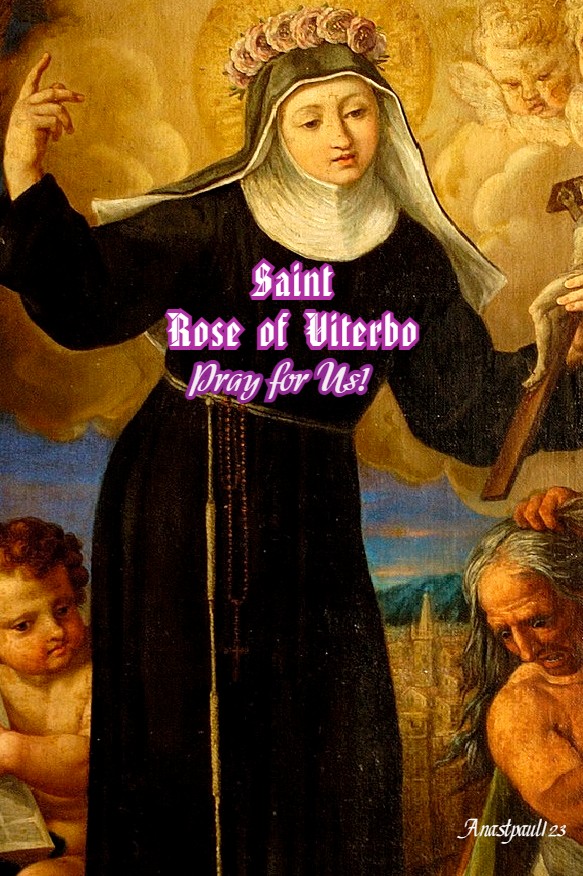
One Minute Reflection – 4 September – “Month of The Seven Sorrows of the Blessed Virgin Mary and The Holy Cross” – St Rose of Viterbo (c1233 – 1251) Virgin – Galatians 5:16-24, Matthew 6:24-33 – Scripture search here: https://www.drbo.org/
“No man can serve two masters.” – Matthew 6:24
REFLECTION – “To want to place one’s hope and trust in passing things, is to want to set one’s foundations in running water! Everything passes, God abides. To be attached to what is transitory is to cut oneself off from what endures. For who, carried away by the angry whirling of a rapid, can stand firm in that roiling flood? So, if you wish to avoid being carried away by the current, then flee from all that flows away. Otherwise, the object of our love, will make us finish by doing exactly what we wanted to avoid! Whoever attaches himself to transitory things, will surely be dragged along, to wherever the things he is clinging to, are drifting.
So, the first thing we must do, is to keep ourselves from loving material goods; the second is, not to put our trust in such of those goods, as are entrusted for our use and not our enjoyment. The soul, who is attached to goods which only pass away, very soon loses its own stability. The current of this present life carries off, whoever it bears and, it is a foolish delusion, for whoever this current carries, to try to stand upright in it!” – St Gregory the Great (540-604) Pope, Father and Doctor of the Church (Morals on Job, 34).
PRAYER – Protect Thy Church by Thine abiding mercy, we beseech Thee, O Lord and since all mortals fall without Thee, may Thy help keep them from danger and guide them to salvation. May the prayers of Thy virgin the blessed Rose, assist us on our journey to Thee. Through Jesus Christ, Thy Son our Lord, Who lives and reigns with Thee, in the unity of the Holy Ghost, God, world without end. Amen (Collect).
Our Morning Offering – 4 September – Monday is the day in which we begin the work week with extra devotion to the Holy Ghost, the Third Person of the Most Blessed Trinity to Whom we pray for enlightenment, for wisdom, for the light of inspiration. We ask the Holy Ghost to work through us over the course of the day and the week. To remind us that we are instruments and help us to seek only the Will of God.
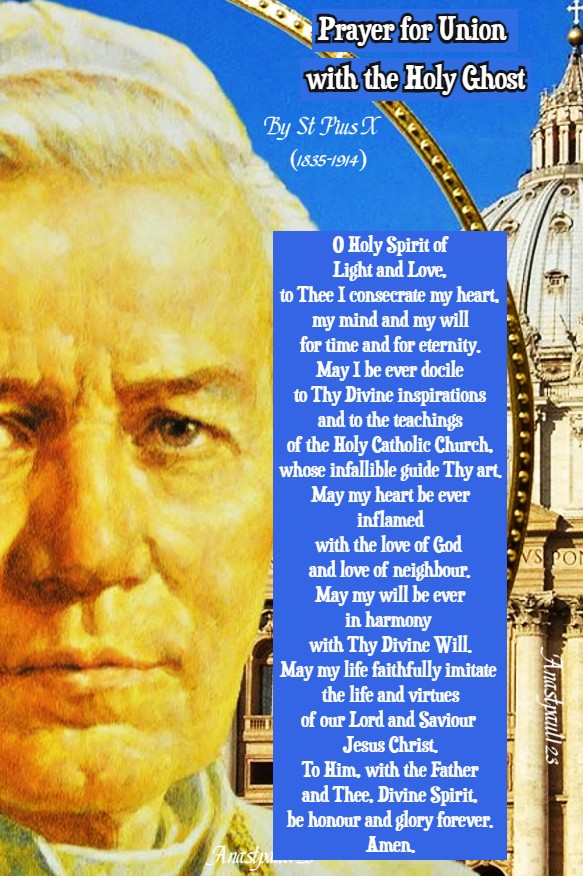
Prayer for Union with the Holy Ghost By St Pius X (1835-1914) Supreme Pontiff from August 1903-August 1914
O Holy Spirit of Light and Love, to Thee I consecrate my heart, my mind and my will for time and for eternity. May I be ever docile to Thy Divine inspirations and to the teachings of the Holy Catholic Church, whose infallible guide Thy art. May my heart be ever inflamed with the love of God and love of neighbour. May my will be ever in harmony with Thy Divine Will. May my life faithfully imitate the life and virtues of our Lord and Saviour Jesus Christ. To Him, with the Father and Thee, Divine Spirit, be honour and glory forever. Amen.
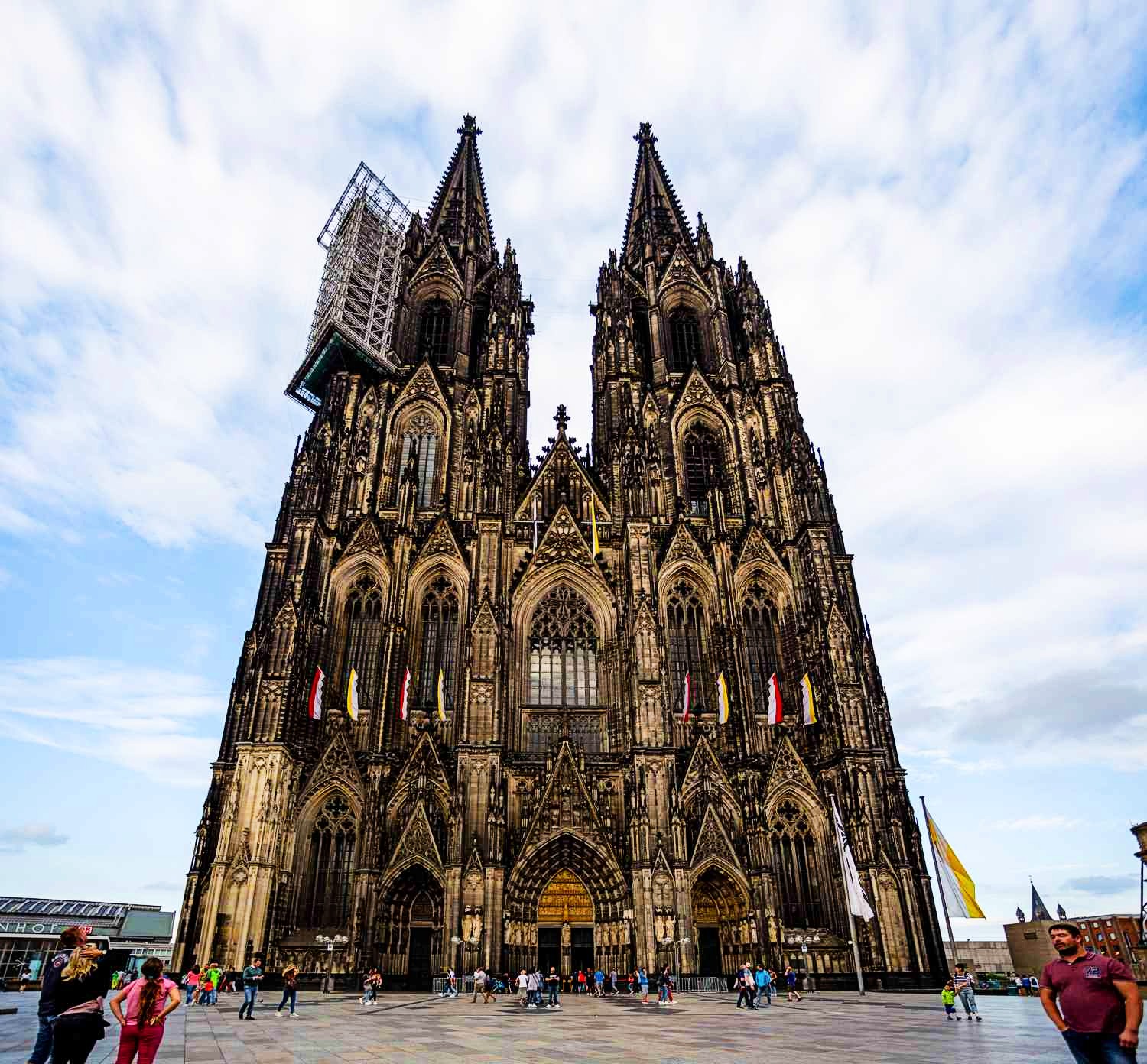
Saint of the Day – 4 September – St Irmgard of Cologne (c1000-c1065 or c1082-1089) Virgin, Reigning Countess of Süchteln, Recluse, Pilgrim, Founder of many Churches and Apostle of the poor. Born in c1000 in Aspel and died in Cologne, Germany of natural causes, where her Relics now reside behind the High Altar of the magnificent Cologne Cathedral. Also known as – Irmgarde, Irmengarda, Irmgard of Süchteln., Irmgard of Aspe. Additional Memorial – 10 November on some calendars in her locale.
The Roman Martyrology reads: “In Cologne in Lotharingia, in today’s Germany, Saint Irmgarde, who, Sovereign Countess of Süchteln, committed all her assets to the construction of Churches.”
Irmgard was the daughter of Count Godizo of Aspel, in the Lower Rhine, a relative of Saint Henry II, the Emperor and his wife Saint Cunegonde. after her parents died, she distributed her wealth among hospitals, Churches, founding and building new Churches, the poor and needy..
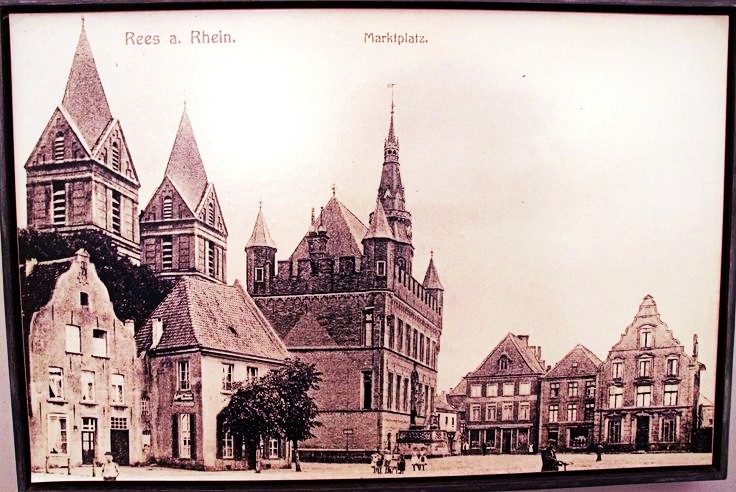
Above her parents’ Tomb, in Rees, Irmgard had a Church built in honour of the Holy Virgin.
Emperor Henry III granted her many lands in Belgium and Holland and, in 1049, Pope Saint Leo IX visited her in Aspel. Shortly afterwards, she left her deceased parent’s house and became a Recluse in Süchteln, where she lived a life in solitude of prayer, fasting and penance.
St Irmgard’s parents home in Rees
After a pilgrimage to Rome, Irmgard lived in Cologne, from where on a second pilgrimage, she brought back to Rome, some earth from the Cemetery of Saint Ursula which she would miraculously turn into blood. Irmgard completed three pilgrimages during her life.
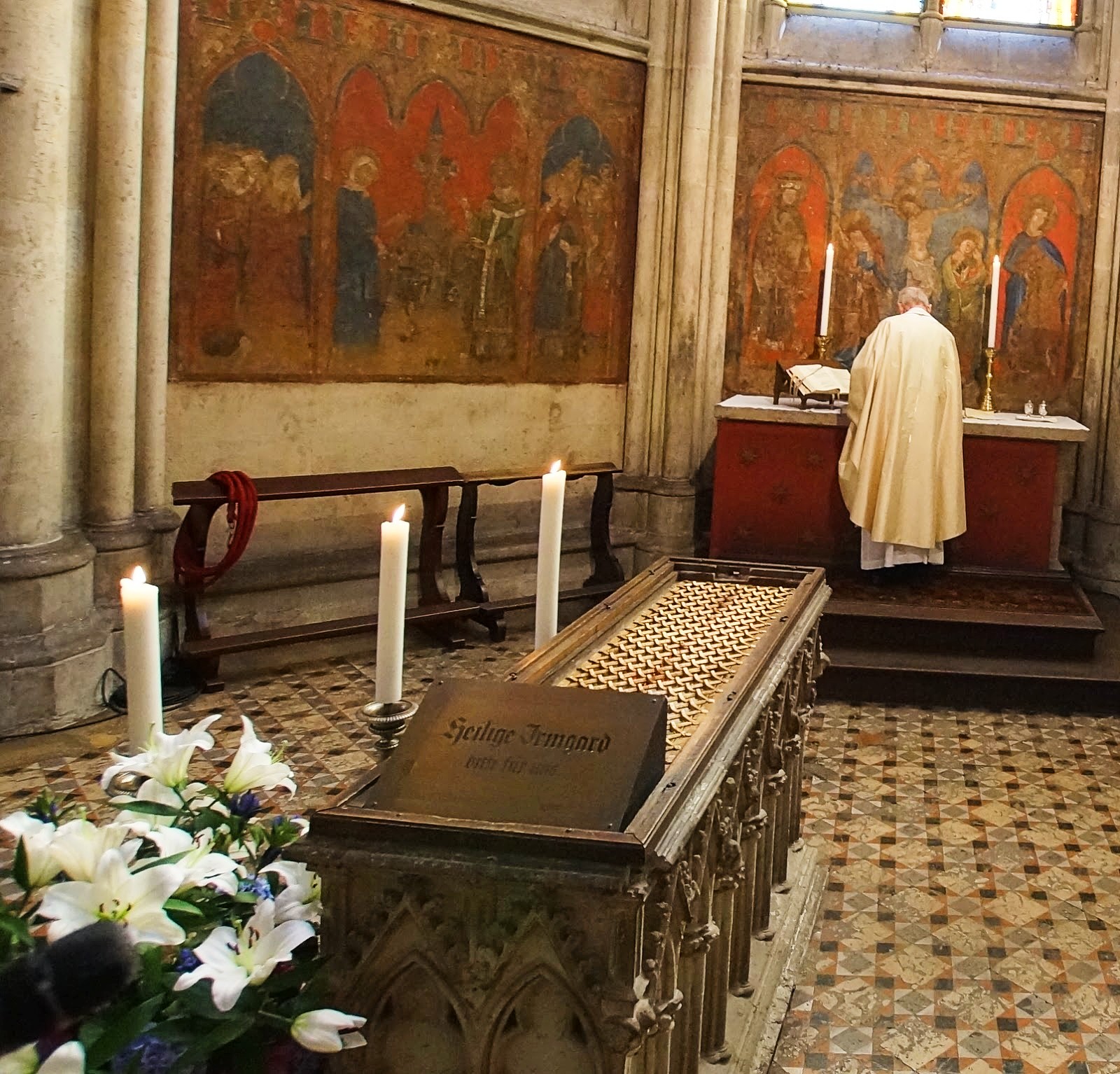
St Irmgard’s Sarcophagus behind the High Altar at Cologne Cathedral
St Irmgard’s Sarcophagus behind High Altar in Cologne Cathedral
Irmgard died around 1089, probably on 4 September in Cologne. Her Tomb is located behind the High Altar in the Cathedral of this City. Already in 1319 she had the title of Saint and her Feast was celebrated on 4 September and 10 November and her cult flourished, particularly in Cologne, Rees, Süchteln and Aspel, where today there are many Pilgrimages and celebrations on her Feast.
Cologne Cathedral
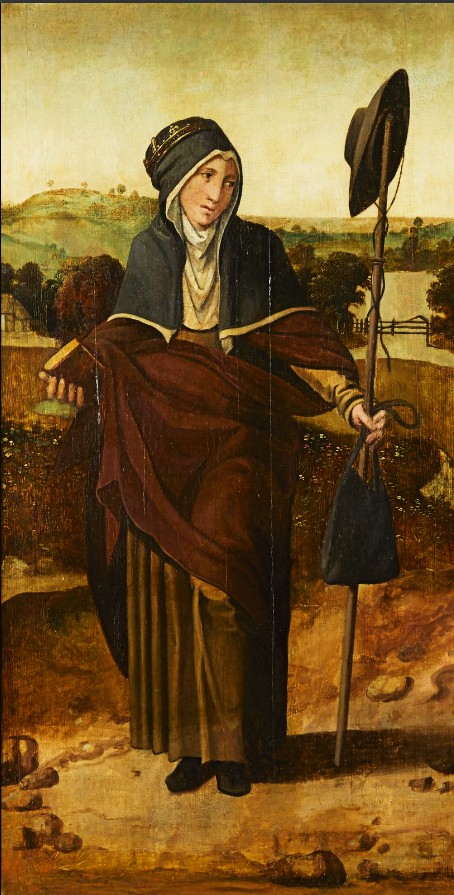
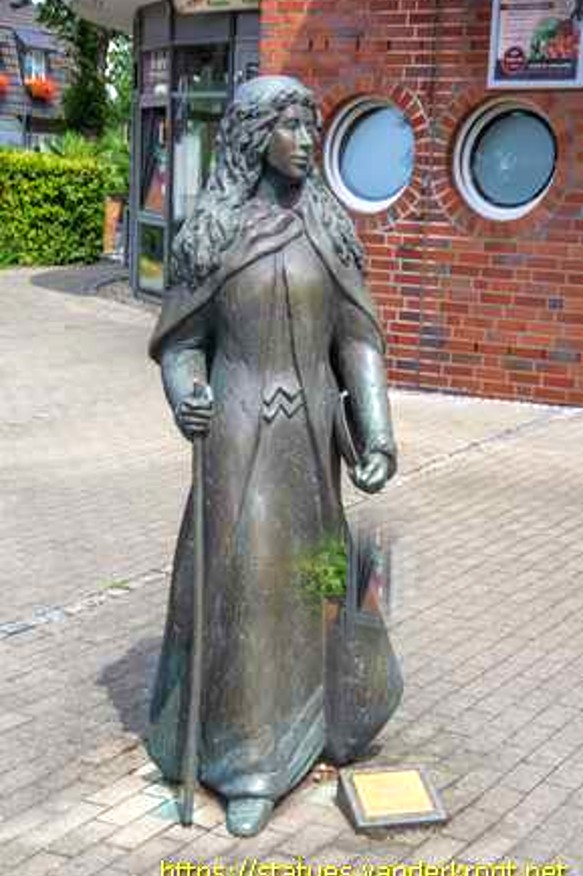
Irmengard is represented as a noble lady with a crown on her head, a model of a Church in one hand, a staff in the other. There are numerous Chruches, Schools, Hospitals, Apostolates and Institutions named after our Saint.
St Rose of Viterbo TOSF (c 1233 – 1251) Virgin, Preacher – Member of the Franciscan Third Order, Recluse, Miracle-Worker. Rose was quickly acclaimed a Saint by the people of Viterbo who brought her incorrupt body to the Poor Clare Monastery which had refused her entry in life. Pope Innocent IV immediately began the process for her Canonisation but, for various reasons, her cause did not proceed 1457 when she was Canonised. Her Story: https://anastpaul.com/2018/09/04/saint-of-the-day-4-september-st-rose-of-viterbo-c-1233-1251/
St Ammianus the Martyr St Caletricus of Chartres St Candida of Naples St Candida the Elder St Castus of Ancyra
St Irmgard of Cologne (c1000-c1065 or c1082-1089) Countess, Recluse, Pilgrim. St Julian the Martyr St Magnus of Ancyra St Marcellus of Chalon-sur-Saône St Marcellus of Treves St Maximus of Ancyra St Monessa St Moses the Prophet St Oceanus the Martyr Bl Peter of Saint James St Rebecca of Alexandria St Rhuddlad
St Rufinus of Ancyra St Salvinus of Verdun St Silvanus of Ancyra St Sulpicius of Bayeux St Thamel St Theodore the Martyr St Ultan of Ardbraccan St Victalicus
Thought for the Day – 3 September – Meditations with Antonio Cardinal Bacci (1881-1971)
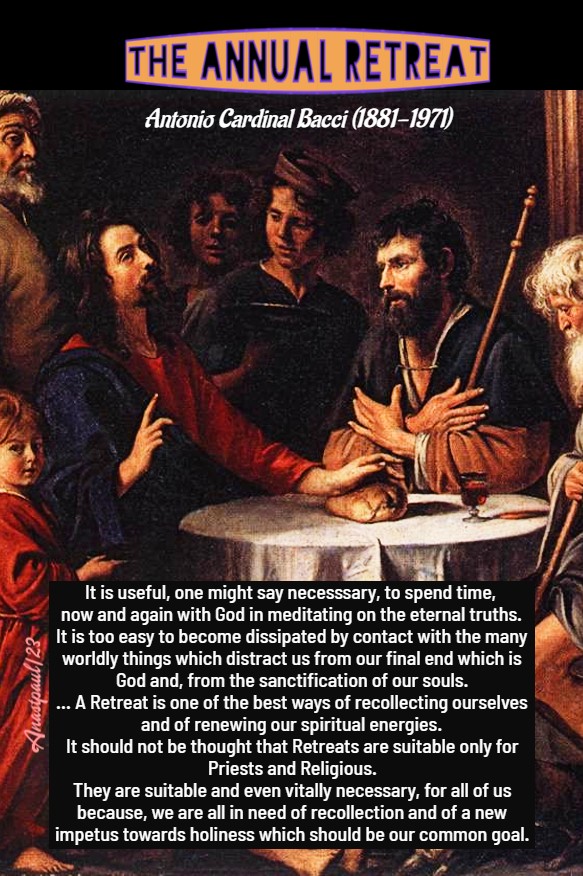
The Annual Retreat
“It is useful, one might say necesssary, to spend time, now and again with God in meditating on the eternal truths. It is too easy to become dissipated by contact with the many worldly things which distract us from our final end which is God and, from the sanctification of our souls. With dissipation comes carelessness, spiritual lethargy and tepidity and, we know that tepidity eventually leads us to commit sin.
A Retreat is one of the best ways of recollecting ourselves and of renewing our spiritual energies. It should not be thought that Retreats are suitable only for Priests and Religious. They are suitable and even vitally necessary for all of us because, we are all in need of recollection and of a new impetus towards holiness which should be our common goal.
An annual Retreat, therefore, should be the aim of all the faithful, even of the laity. Sometimes, we are disgusted and frightened by the desolate spectacle which the world presents us with! Faith has grown weak; religious indifference is invading all sections of society; the forces of evil and of progress have achieved an almost universal and soul-destroying corruption of morals. How has this happened? We get the answer from the Prophet Jeremias, who laments that in the supreme moment of trial, the chosen people abandoned God! “With desolation is all the land made desolate because, there is none who considereth in the heart” (Jer 12:1).
Let us resolve not to neglect this great means of sanctification. If possible, let us make a Retreat every year.”
Quote/s of the Day – 3 September – St Pius X (1835-1914) Pope, Confessor
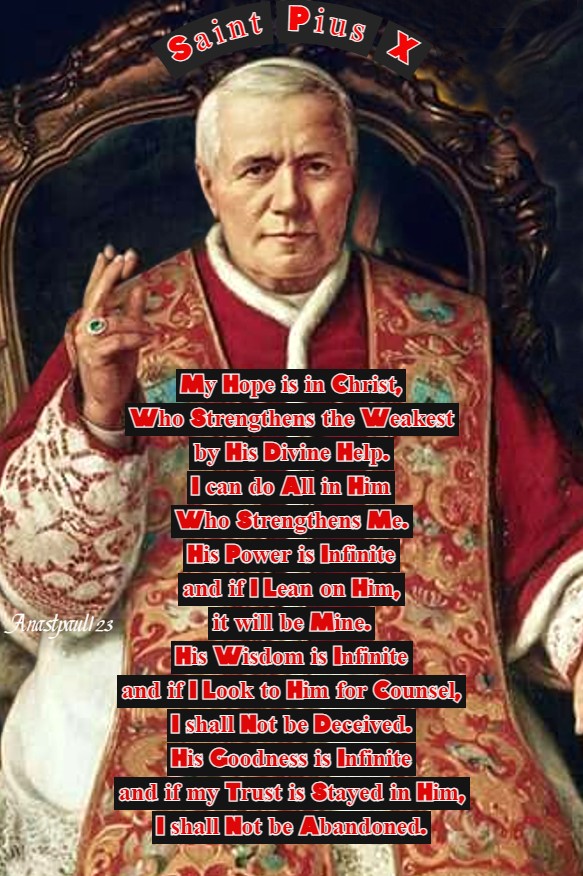
“My hope is in Christ, Who strengthens the weakest by His Divine help. I can do all in Him Who strengthens me. His Power is Infinite and if I lean on Him, it will be mine. His Wisdom is Infinite and if I look to Him for counsel, I shall not be deceived. His Goodness is Infinite and if my trust is stayed in Him, I shall not be abandoned.”
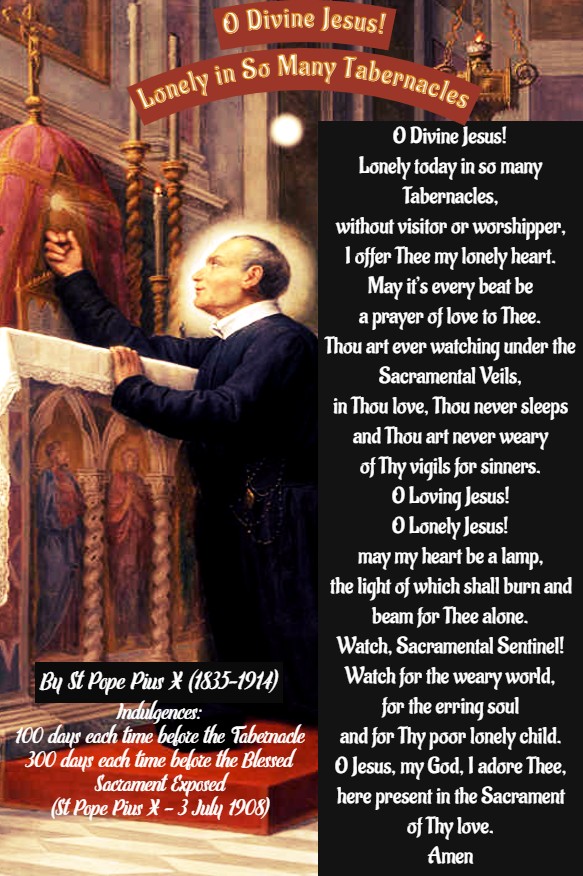
O Divine Jesus! Lonely in So Many Tabernacles By St Pope Pius X (1835-1914) “Pope of the Blessed Sacrament”
O Divine Jesus! Lonely today in so many Tabernacles, without visitor or worshipper, I offer Thee my lonely heart. May it’s every beat be a prayer of love to Thee. Thou are ever watching under the Sacramental Veils, in Thou love, Thou never sleeps and Thou are never weary of Thy vigils for sinners. O Loving Jesus! O Lonely Jesus! may my heart be a lamp, the light of which shall burn and beam for Thee alone. Watch, Sacramental Sentinel! Watch for the weary world, for the erring soul and for Thy poor lonely child.
O Jesus, my God, I adore Thee, here present in the Sacrament of Thy love. Amen
Indulgences: 100 days each time before the Tabernacle 300 days each time before the Blessed Sacrament Exposed (St Pope Pius X – 3 July 1908) Prayers to the Sacred Heart 15th Ed 1936
One Minute Reflection – 3 September – “Month of The Seven Sorrows of the Blessed Virgin Mary and The Holy Cross” – St Pius X (1835-1914) Pope, Confessor – Galatians 5:16-24, Matthew 6:24-33 – Scripture search here: https://www.drbo.org/
“Is not the life a greater thing than the food and the body, than the clothing? ” – Matthew 6:25
REFLECTION – “If spiritual things hold first place in our lives, material needs will cause us no concern, for God, in His goodness, will give them to us in abundance. On the other hand, if we devote ourselves entirely to earthly pursuits and neglect our spiritual life, concern for what this life has to offer will lead us to neglect our souls… I urge you, therefore, let us not overturn the established order. We know that our Master is good, so let us commit everything to Him and not be taken up with the cares of this life… “Your heavenly Father knows that you need all these things even before you ask him” (Mt 6:32).
Jesus wishes us, then, to be free from every anxiety regarding temporal affairs and to have all possible leisure for the things of the Spirit. He says: “Your part is to seek spiritual blessings and I myself, will provide amply for your material needs. Look at the birds in the sky. They neither sow nor reap nor gather crops into barns and yet, your Father feeds them. ” In other words, “If I take such care of irrational birds, as to supply them with all they need without plowing or sowing, I will take much greater care of you, who are endowed with reason, if only you make up your minds to put spiritual things before temporal ones. If I made these creatures for your sake and the whole of creation too and, if I take such care of them, of what great care will I not deem you worthy – you, for whom I created all of this?” – St John Chrysostom (345-407) Bishop of Constantinople, Father and Doctor of the Church (Baptismal catechesis, no 8, 19-25).
PRAYER – O God Who, for the defence of the Catholic faith and the restoration of all things in Christ, filled St Pius, the Supreme Pontiff, with heavenly wisdom and apostolic fearlessness, mercifully grant that, by following his teachings and examples, we may receive Thy eternal rewards. Through Jesus Christ, Thy Son our Lord, Who lives and reigns with Thee, in the unity of the Holy Ghost, God, world without end. Amen (Collect).
Our Morning Offering – 3 September – “Month of The Seven Sorrows of the Blessed Virgin Mary and The Holy Cross” – The 14th Sunday after Pentecost
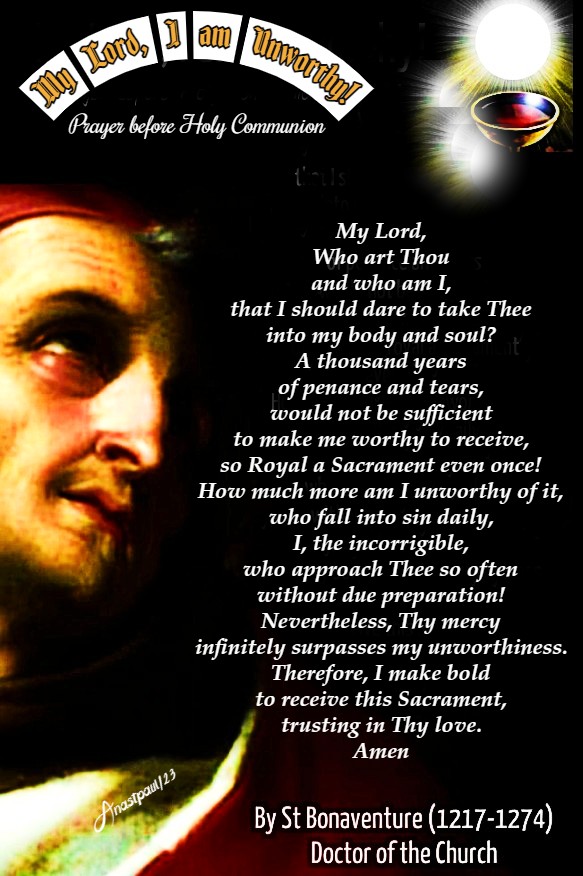
My Lord, I am Unworthy! Prayer before Holy Communion By St Bonaventure (1217-1274) Seraphic Doctor of the Church
My Lord, Who art Thou and who am I, that I should dare to take Thee into my body and soul? A thousand years of penance and tears, would not be sufficient to make me worthy to receive, so Royal a Sacrament even once! How much more am I unworthy of it, who fall into sin daily, I, the incorrigible, who approach Thee so often without due preparation! Nevertheless, Thy mercy infinitely surpasses my unworthiness. Therefore, I make bold to receive this Sacrament, trusting in Thy love. Amen
Saint of the Day – 3 September – Blessed Guala de Ronii of Brescia OP ( 1180-1244) Bishop, Priest and Friar of the Order of Preachers, being one of the earliest disciples of St Dominic, Papal Envoy, Peace-maker. Also known as – Guala of Roniis, Guala Romanoni, Guala of Bergamo, Walter… Wilhelm… Guala was Beatified on 1 October 1868 by Pope Pius IX. Additional Memorials – 2 September (Diocese of Brescia), 20 April as one of the Saints of the Diocese of Brescia and 4 September on some calendars.
Guala de Ronii was born in 1180 in the Bergamo Province and belonged to a famed noble Roman house. His parents oversaw his initial education and his excellent progress caused his parents to entertain great hopes for his future, while neglecting to entertain the thought that perhaps God had a surprise in store for their son and the course of his life.
Guala heard St Dominic preach in 1219 and – like others – was so enchanted by St Dominic’s character that he was one of the first to seek him out for enrollment into his new Order of Preachers. Guala soon received the habit from St Dominic himself and later received Ordination as a Priest. St Dominic soon called the Priest to Bologna in order to appoint him as one of four entrusted with the building of Saint Agnes’ convent for Dominican nuns.
He served as one of the Saint’s first disciples and received the latter’s appointment as the first Prior of the Order in Brescia where Dominic founded a Monastery. Both Theoderic of Apolda, the Hagiographer and Blessed Jordan of Saxony were his Dominican contemporaries.
When Guala learned of St Dominic’s death ,which he received in Brescia, with tremendous grief. Prior to this news, he had fallen asleep with his head against a Church bell tower and saw a Friar ascending a ladder into Heaven where Angels surrounded him – that Friar was Dominic, unbeknownst to him at the time. He was about to depart for Bologna when he learned that Dominic had died at the time of his vision!
The Priorship of Saint Nicholas in Bologna – now titled as Saint Dominic – became vacant and the people there elected him to the position in 1226. But his tenure became difficult with tensions between Bologna and rival Mantua which prompted Pope Honorius III to appoint him as the Papal Envoy to the two Cities, n order that he might secure reconciliation between the warring towns – he managed to negotiate peace terms sto remain in place and to be abided by, for a decade. The new Pope Gregory IX then appointed him as the Papal Legate to Frederick II in order to induce him to keep his often broken promise, to march on a crusade for the relief of the faithful in Jerusalem. On 20 July 1225 he oversaw the successful Treaty of San Germano in Cassino.
Brescia longed for his return and when the Bishop of the Diocese died the people pleaded with intense supplications for the Fr Guala’s appointment to replace the deceased. Guala reluctanly accepted his appointment in 1229 as the Bishop of Brescia from Pope Gregory IX and he received his Episcopal Consecration soon after.
His Episcopate intended as a particular objective to make provision for the temporal care of poor children of the Diocese. But ,the Pontiff also made him an Apostolic Delegate to both Treviso and Paduaas peacemaker, when the two were at odds with each other – despite putting the new Bishop far from his flock – and it was he who conducted successful peace negotiations.
Guala’s contemporaries described him as “a man of great prudence, well acquainted with the world, and of accomplished manners” and said that “he governed the Diocese entrusted to his care with such holiness that, both during his life and after his death, he wrought many wonders through God.”
The years of labour and civil strife wore him down. He resigned his See in 1242 in order to enter complete seclusion and pray without interruption, in preparation for death. Therefore, he retired to the Vallumbrosan Monastery of San Sepolcro d’Astino in Bergamo, his hometown, where he lived as a Hermit – despite his retreat into peaceful solitude – many still flocked to seek his wise counsel. Guala died on 3 September 1244. He was buried in the Benedictine Church,and after many miracles at his tomb, his cause was promoted.
St Aigulphus of Lérins St Ambrose of Sens St Ammon of Heraclea Bl Andrew Dotti St Auxanus St Balin St Basilissa of Nicomedia
St Chariton St Chrodegang of Séez St Frugentius the Martyr Blessed Guala de Ronii of Brescia OP ( 1180-1244) Bishop St Hereswitha Bl Herman of Heidelberg St Macanisius St Mansuetus of Toul St Marinus (Died c 366) St Martiniano of Como St Natalis of Casale
St Regulus of Rheims St Remaclus St Sandila of Cordoba St Vitalian of Capua (Died 699) Bishop
Martyrs of Aquileia – 4 Saints: Four young women, variously sisters and cousins, who were born to the nobility, the daughters of the pagans Valentinianus of Aquileia and Valentius of Aquileia. Each woman converted and made private vows, dedicating themselves to God. They were arrested, tortured and martyred by order of Valentius for becoming a Christian. We know little else but their names – Dorothy, Erasma, Euphemia and Thecla. They were martyred by beheaded in the 1st century in Aquileia, Italy and their bodies were thrown into a nearby river.
Martyrs of Nagasaki – 6 Beati: A group of Priests and Clerics, native and foreign, murdered together in the anti-Christian persecutions in Japan. They were scalded in boiling water and then burned alive on 3 September 1632 in Nishizaka, Nagasaki, Japan and Beatified on 7 May 1867 by Pope Pius IX. They are: Anthony Ishida, Bartolomé Gutiérrez Rodríguez, Francisco Terrero de Ortega Pérez, Gabriel Tarazona Rodríguez, Jerome of the Cross de Torres, Vicente Simões de Carvalho
Thought for the Day – 2 September – Meditations with Antonio Cardinal Bacci (1881-1971)
Intimacy with Jesus
“In his memoirs written while in exile, Napoleon says: “Many have desired and endeavoured to be obeyed, revered and honoured by all; only Jesus Christ has demanded this because He is God.”
“As the Father has loved Me, I also have loved you,” we read in the Gospel of St John. “Abide in My love” (Jn 15:9).
Jesus, therefore, asks each of us, not only to love Him but, to remain intimately united to Him in love. He has a perfect right to demand this because, as God, He is our Creator and as God-Man, He is our Redeemer, Who out of love for us has given Himself entirely.”
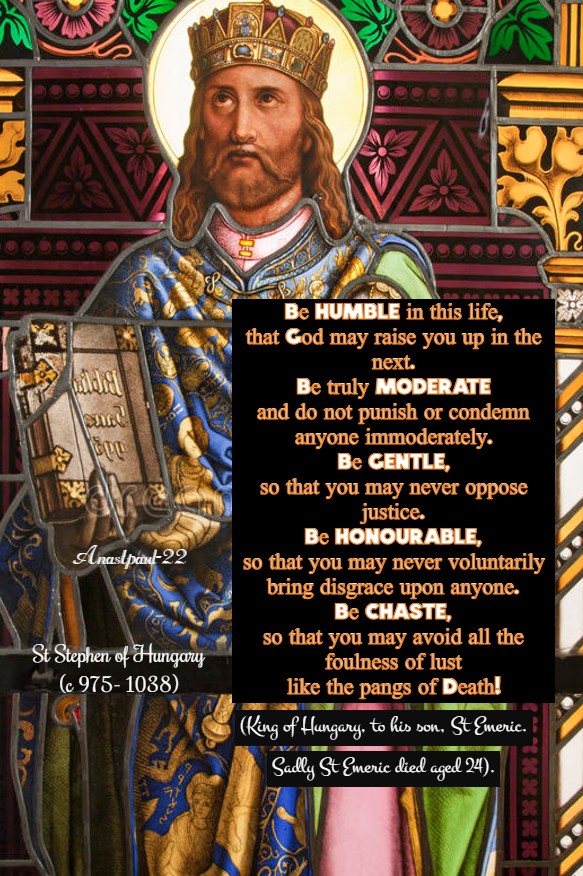
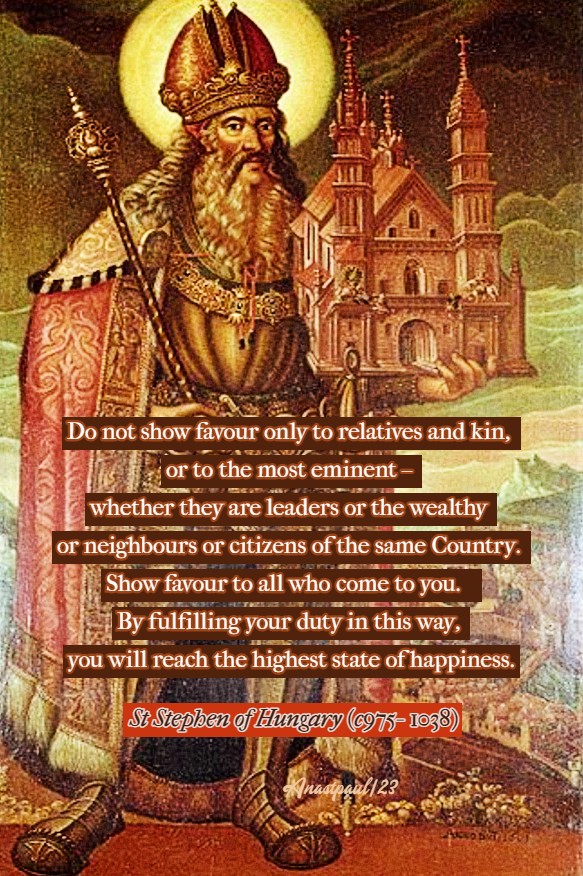
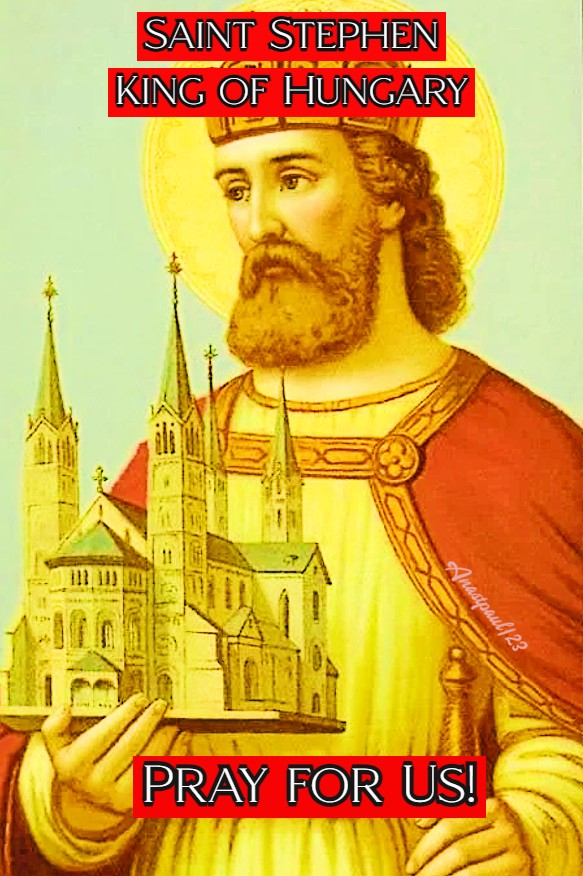
Quote/s of the Day – 2 September – St Stephen, King of Hungary (c975- 1038) Confessor
“Be HUMBLE in this life, that God may raise you up in the next. Be truly MODERATE and do not punish or condemn anyone immoderately. Be GENTLE, so that you may never oppose justice. Be HONOURABLE, so that you may never voluntarily bring disgrace upon anyone. Be CHASTE, so that you may avoid all the foulness of lust like the pangs of death.”
“Do not show favour only to relatives and kin, or to the most eminent – whether they are leaders or the wealthy or neighbours or citizens of the same Country. Show favour to all who come to you. By fulfilling your duty in this way, you will reach the highest state of happiness.”
St Stephen of Hungary (c975- 1038) (King of Hungary, to his son, St Emeric. Sadly St Emeric died aged 24 but had taken a private vow of Celibacy.)
One Minute Reflection – 2 September – “Month of The Seven Sorrows of the Blessed Virgin Mary and The Holy Cross” – St Stephen King of Hungary (c975- 1038) Confessor – Ecclesiasticus 31:8-11, Luke 19:12-26 – Scripture search here: https://www.drbo.org/
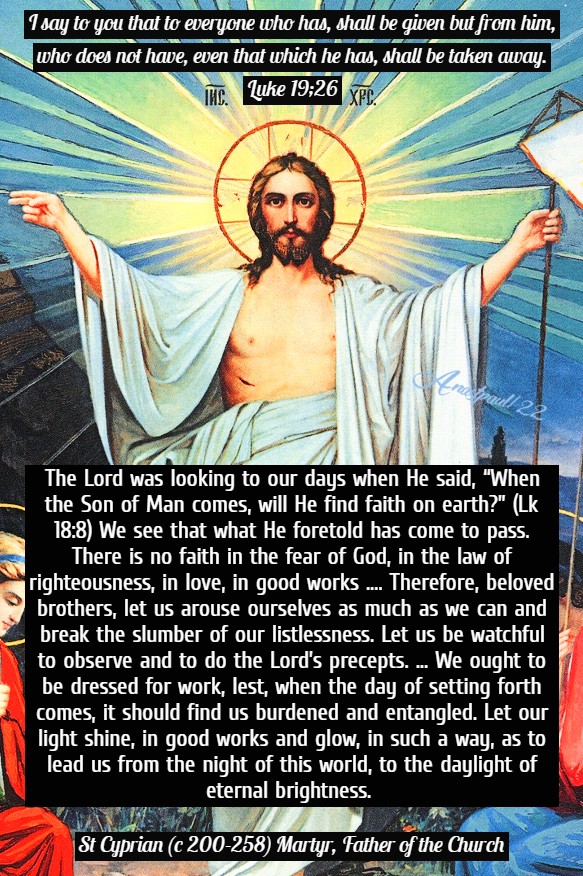
“I say to you that to everyone who has, shall be given but from him, who does not have, even that which he has, shall be taken away.” – Luke 19;26
REFLECTION – “The Lord was looking to our days when He said, “When the Son of Man comes, will He find faith on earth?” (Lk 18:8) We see that what He foretold has come to pass. There is no faith in the fear of God, in the law of righteousness, in love, in good works …. That which our conscience would fear if it believed, it does not fear because it does not believe at all. If it believed, it would also take heed and if it took heed, it would be saved.
Therefore, beloved brothers, let us arouse ourselves as much as we can and break the slumber of our listlessness. Let us be watchful to observe and to do the Lord’s precepts. Let us be like He Himself, has bidden us to be, saying, “Gird your loins and light your lamps and be like servants who await their master’s return from a wedding, ready to open immediately, when He comes and knocks. Blessed are those servants, whom the Master finds vigilant on His arrival“.
We ought to be dressed for work, lest, when the day of setting forth comes, it should find us burdened and entangled. Let our light shine, in good works and glow, in such a way, as to lead us from the night of this world, to the daylight of eternal brightness. Let us always wait with solicitude and caution for the sudden coming of the Lord, so that when he knocks, our faith may be on the watch and receive from the Lord, the reward of our vigilance. If these commands be observed, if these warnings and precepts be kept, we will not be overtaken in slumber, by the deceit of the devil. But we shall reign with Christ in His Kingdom, as servants on the watch.” – St Cyprian of Carthage (c 200-258) Bishop of Carthage and Martyr, Father of the Church (Treatise on the unity of the Church, 26-27).
PRAYER – We beseech Thee, Almighty God, that Thy Church be worthy to have as her glorious defender in Heaven, the blessed Stephen, Thy Confessor, whom she had as her champion while he reigned on earth. Through Jesus Christ, Thy Son our Lord, Who lives and reigns with Thee, in the unity of the Holy Ghost, God, world without end. Amen (Collect).
Our Morning Offering – 2 September – “Month of The Seven Sorrows of the Blessed Virgin Mary and The Holy Cross” and the First Saturday of the Month
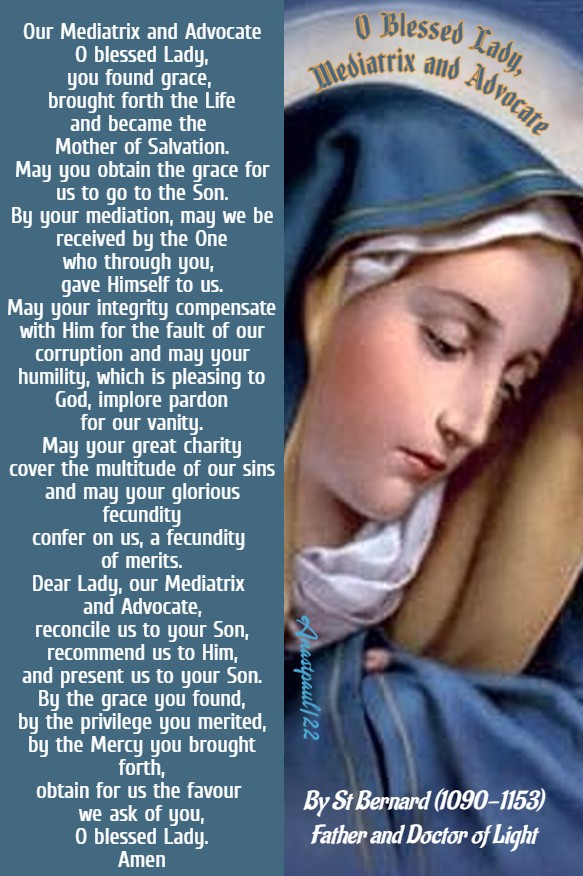
O Blessed Lady, Mediatrix and Advocate By St Bernard (1090-1153) Father and Doctor of Light
Our Mediatrix and Advocate O blessed Lady, you found grace, brought forth the Life, and became the Mother of Salvation. May you obtain the grace for us to go to the Son. By your mediation, may we be received by the One who through you, gave Himself to us. May your integrity compensate with Him for the fault of our corruption and may your humility, which is pleasing to God, implore pardon for our vanity. May your great charity cover the multitude of our sins and may your glorious fecundity confer on us, a fecundity of merits. Dear Lady, our Mediatrix and Advocate, reconcile us to your Son, recommend us to Him and present us to your Son. By the grace you found, by the privilege you merited, by the Mercy you brought forth, obtain for us the favour we ask of you, O blessed Lady. Amen
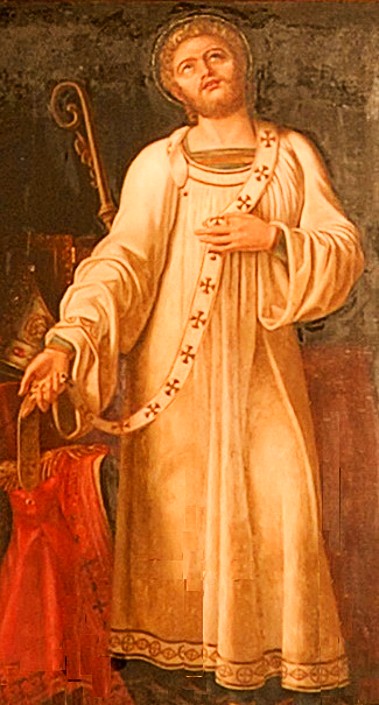
Saint of the Day – 2 September – St Justus of Lyons (Died c390) the 13th Bishop of Lyons, Confessor, Monk, Hermit, a man of learning, of meek, gentle and kind nature. Born in Tournon-sur-Rhône, Gaul (in modern France) and died in 390 in the Egyptian desert of natural causes. Also known as – Just, Justo, Giusto. The Latin name Justus means “one who helps.”
The Roman Martyrology states of him today: “At Lyons in France, St Justus, Bishop and Confessor, who was endowed with extraordinary sanctity and, a prophetic spirit, He resigned his Bishopric and retired into a desert of Egypt with his Lector, Viator, When he had, for some years, led an almost angelic life and the end of his meritorious labours had come, he went to our Lord to receive the crown of justice, on the 14th day of October, His holy body together with the Relics of his blessed Lector Viator, was afterwards taken to Lyons on this day, 2 September, becoming the remembrance of his birthday into Heaven.”
Justus was born in the first half of the 4th Century in Tournon-sur-Rhône and came from an aristocratic family. He followed the religious teaching of Saint Paschasius, the Archbishop of Vienne at the time, and became a Deacon of the Church of Vienne. A contemporary biographer describes him as being a meek and merciful man.
Around 350, Justus was Consecrated as the Bishop of Lyons. As the Bishop of the Capital City of Gaul, he was among the participants of the Council of Valencia in 374, regarding religious discipline of the Clergy and the faithful.
In 381, He assisted at the Council of Aquileia, organised by St Ambrose of Milan. A general Council had been requested by Arian bishops Palladius and Secundianus, supported by the Empress Justina, to review the Church’s position on Arianism. St Ambrose refused to hold a General Council, agreeing only to a Provincial Council but the Emperor Gratian allowed other Bishops to attend. The Bishops of Gaul sent delegates including Justus, who was one of 32 Bishops at the Council which rejected Arianism and condemned Palladius and Secundianus. (They must have regretted have requested the Council!)
At that time, Justus maintained a correspondence with St Ambrose of which there remain only two letters from St Ambrose discussing sections of Scripture. The two letters suggest that Justus was a man respected for his learning.
Some time after the Council of Aquileia, an incident took place where an insane individual in a violent fit, had attacked and killed several people in the streets of the City with a sword. Although eventually restrained, he managed to escape and take refuge in the Church, at that time located on the side of the present Church of St Nizier. Despite threats, the Bishop maintained the right of sanctuary. At length a City Magistrate arrived and persuaded Bishop Justus to hand the accused over to him, giving his word that the matter would be handled according to law. Relying on the Magistrate’s assurances, Justus delivered the man over; but scarcely had the man left the Church when the mob overpowered the guard and seizing the prisoner, put him to death.
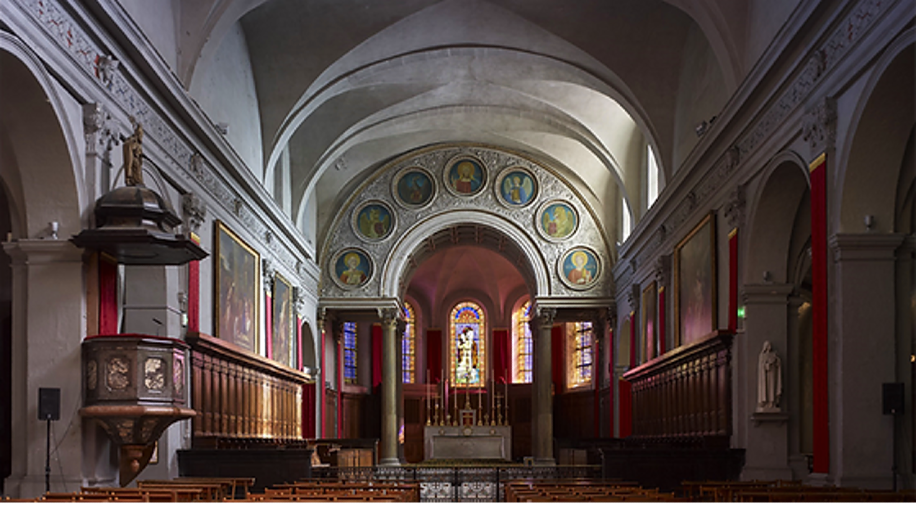
The interior of the Church of St Justus in Lyons
The Bishop came to believe that his failure to adequately protect the murderer had made him unworthy to continue to lead the Christian community and he resolved to devote the remainder of his life to doing penance. Disillusioned, Justus resigned his See and retired to his house at Tournon. His friends could neither convince him that he was not responsible for the unfortunate man’s death, nor to reconsider his decision of being unworthy to be Bishop. One night, he secretly left to take up the ascetical life of a Hermit. He travelled to Arles and then on to Marseilles where he planned to embark for Alexandria. The Cathedral Lector, Viator suspected the Bishop’s intentions and decided to follow his master. He caught up with Justus at Marseilles and together they boarded ship for Egypt.
Once there, they joined the community of Monks in the desert of Scetes, about 40 or 50 miles south of Alexandria, beyond the mountains of Nitria, in the Libyan Desert. At that time the leader or Abbot of this community was St Macarius of Egypt († 390), a disciple of St Anthony († 356). St Macarius had a reputation for great holiness and a fierce asceticism. Most of the Monks lived in cells, either dug in the ground or built of stones and each out of sight of others. They came together only on Sundays to celebrate the liturgy. They supported themselves by manual labour and ate only the poorest of foods. Fasting, prayer, silence and the keeping of night vigils, characterised their lives.
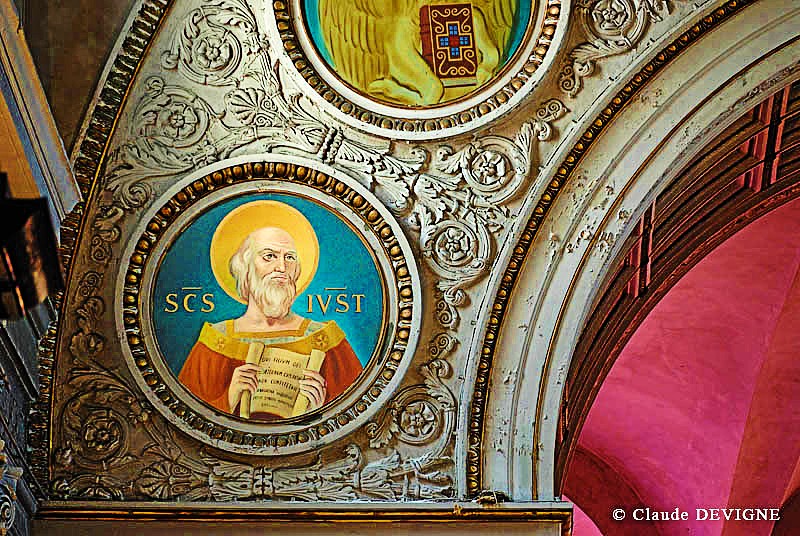
You can vaguely see this above in the interior of the St Justus Church in Lyons
The story is told then of a pilgrim in North Africa who some years later recognised Justus and reported this on his return to Lyons. The City folk being eager to regain their Bishop, sent a delegation led by Antiochus, a Priest of Lyons, to find him and bring him back to his Diocese. Antiochus found but could not convince the Hermit Bishop to return, so Antiochus returned to Gaul and was later himself appointed Bishop of Lyons.
Justus died at a Monastery of Scetes in c390. Upon his death, Antiochus, now himself Bishop of Lyons, made arrangements to repatriate the body of the Bishop and that of his companion Viator, who died shortly after and interred them in the Basilica of the Maccabees which Antiochus renamed the Saint-Just Basilica.
At the end of the 4th Century, a Vita Sancti Justi, Lugdunensis Episcopi, retracing in a hagiographic style the life of Justus, was written by a Priest of Lyons.
The Lyons Church celebrates a Mass for Saint Justus one to four times a year – on the date of his Ordination on 14 July (also Bastille Day); the translation of his Relics to Lyons on 4 August; his death on 2 September and his visit to Egypt on 14 October. The Feast of the translation of his Relics is still celebrated in the Diocese of Lyons, in addition to the regular September Feast.
St Justus Church in Lyons
In Lyons, the Basilica of Saint Justus, now destroyed, was replaced by the Church of Saint-Just. Around the Basilica developed a village of the same name which, in the 19th Century, became a suburb of Lyons.
The Chapel of the School of Tournon, St Justus’ birth Town, also bears his name.
St Prospero of Tarragona St Theodota of Bithynia St Valentine of Strasbourg St William of Roeskilde
Marytrs of Nicomedia – 3 Saints: Three Christians who were Martyred together in the persecutions of Diocletian. No details about them but their names have survived – Concordius, Theodore and Zenone. They were martyrd in Nicomedia, Bithynia (in modern Turkey).
The Holy Martyrs of September (Died 1792) – 191 beati: Also known as – Martyrs of Paris, Martyrs of Carmes. They were massacred by a mobs on 2 September and 3 September 1792 and Beatified on 17 October 1926 by Pope Pius XI. THEIR LIVES AND DEATHS: https://anastpaul.com/2021/09/02/saint-s-of-the-day-2-september-
Martyrs of 2 September – 10 Saints: A group of ten Martyrs; their names are on old Martyrologies but we have lost all record of their lives and deaths. They were Canonised: Antoninus, Diomedes, Eutychian, Hesychius, Julian, Leonides, Menalippus, Pantagapes, Philadelphus, Philip.
Holy Bishops of Rennes: Honours all the Bishops of the Diocese of Rennes, France who have been recognised as Saints and Beati. They include Saint Maximinus of Rennes Saint Modéran of Rennes Saint Rambert of Rennes Saint Riotisme of Rennes Saint Servius of Rennes Saint Synchronius of Rennes
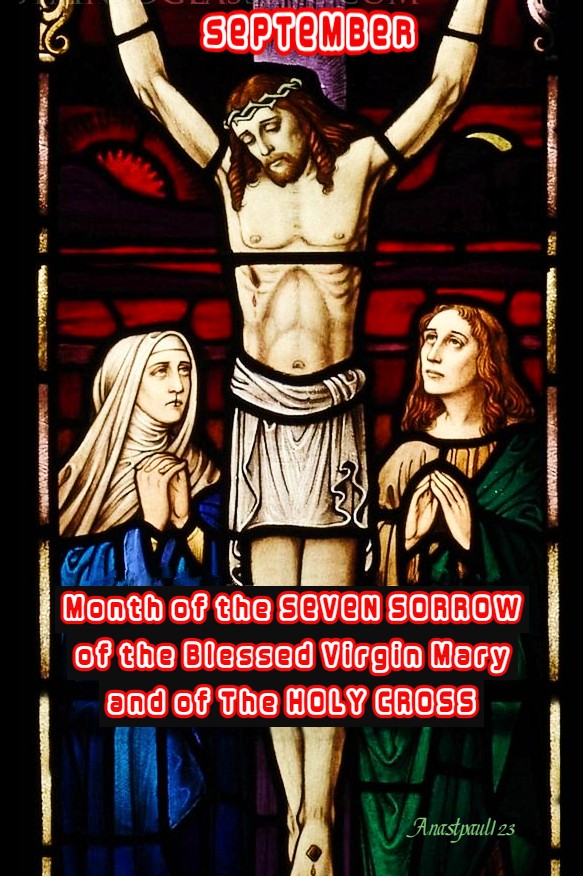
Month of The Seven Sorrows of the Blessed Virgin Mary and The Holy Cross
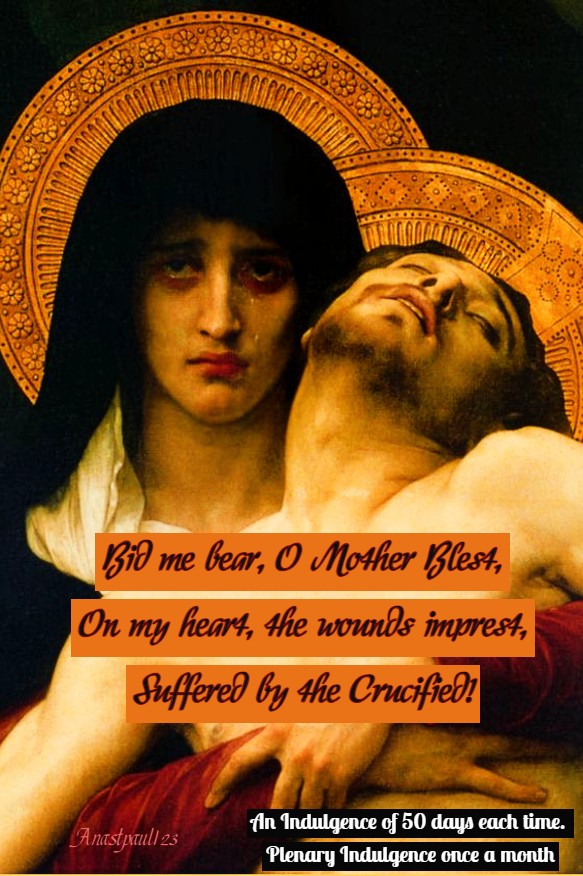
Bid me bear, O Mother Blest, On my heart, the wounds imprest, Suffered by the Crucified!
An Indulgence of 50 days each time. Plenary Indulgence once a month under the usual conditions.
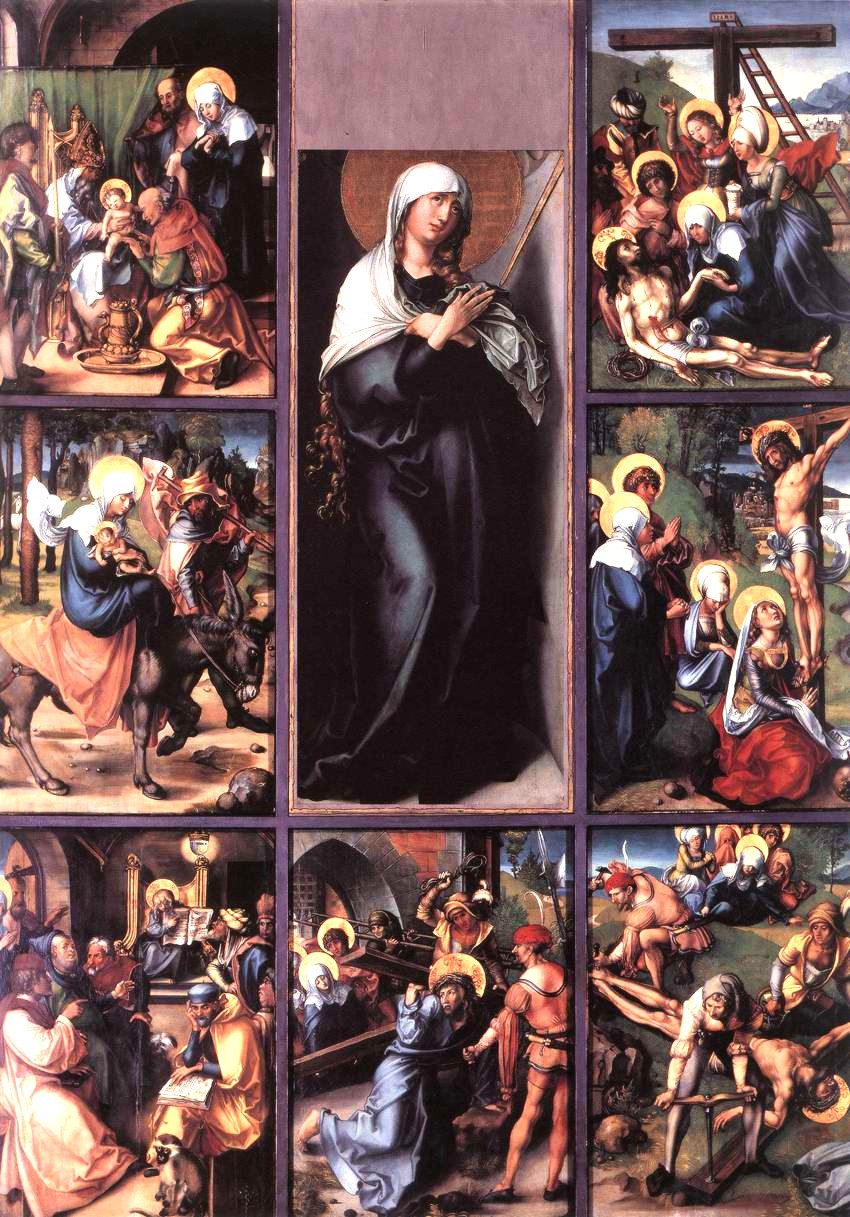
The Seven Sorrows of the Blessed Virgin Mary
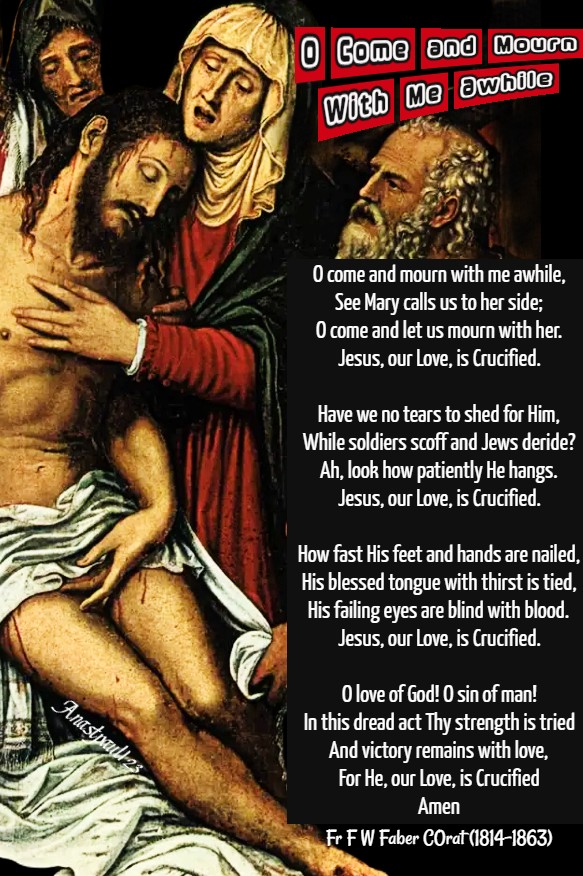
1, The prophecy of Simeon 2. The Flight to Egypt 3. Loss of Child Jesus for 3 days 4. Meeting Jesus carrying His Cross 5. The Crucifixion of Jesus 6. The Pieta – receiving Jesus’ Body The Burial of Jesus
What Can I Say? By St Anselm (1033-1109) Magnificent Doctor Marian Doctor
My most merciful Lady, what can I say about the fountains that flowed from your most pure eyes when you saw your only Son before you, bound, beaten and suffering? What do I know of the flood that drenched your matchless face, when you beheld your Son, your Lord and your God, stretched on the Cross without guilt, when the flesh of your flesh was cruelly butchered by wicked men? How can I judge, what sobs, troubled your most pure breast, when you heard, “Woman, behold your son,” and the disciple, “Behold, your Mother,” when you received as a son the disciple in place of the Master, the servant for the Lord? Amen
From “The Prayers and Meditations of Saint Anselm with the Proslogion,” Benedicta Ward, trans,1973, Penguin classics, Penguin Group (UK).



















 AnaStpaul
You must be logged in to post a comment.