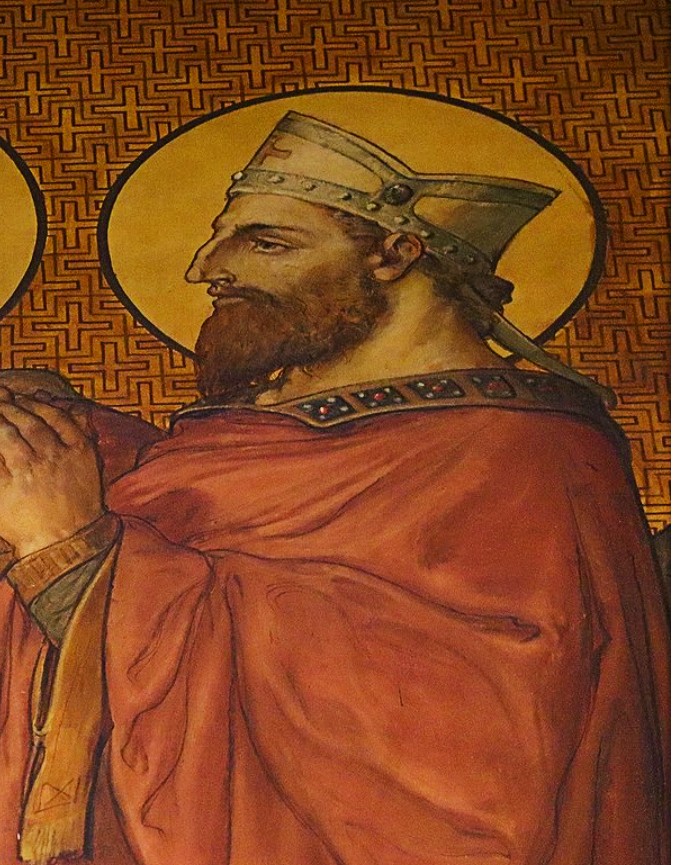
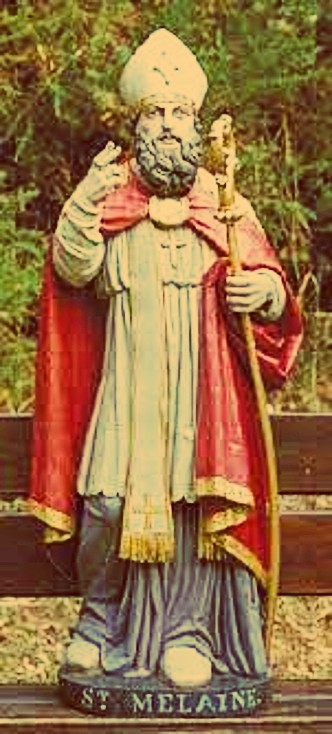
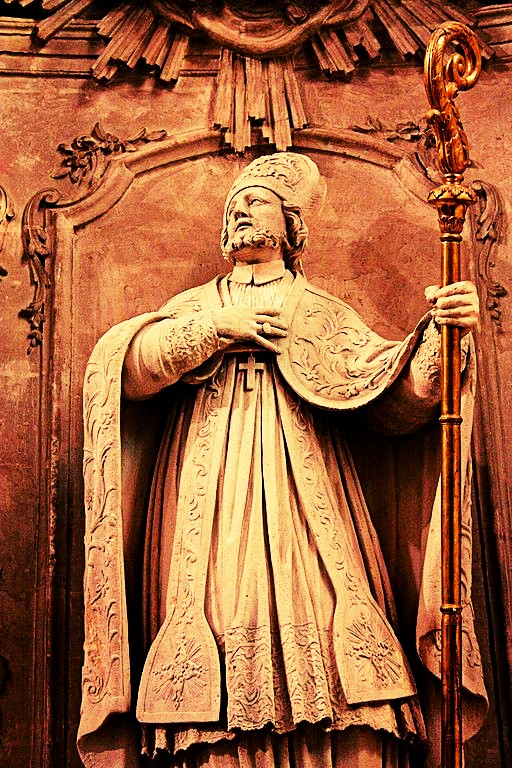
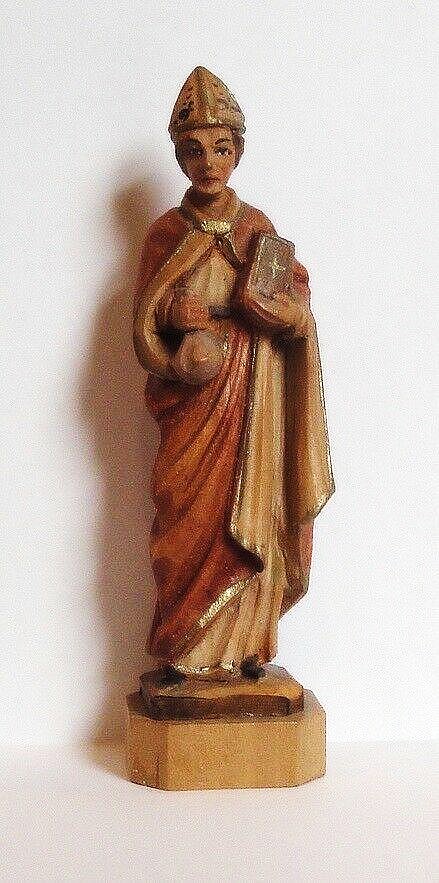
Saint of the Day – 6 November – Saint Melaine of Rennes (Died c535) Bishop of Rennes in Brittany, France, Confessor, previously a Monk and Abbot, Royal Advisor, Miracle-worker. Born in Placet, Brittany and died in c535 of natural causes. Also known as – “Apostle of France” • Melan, Melanie, Melanio, Melanius, Melen, Mellion, Mullion. Additional Memorials – 6 January and 11 October – both dates seeming to be in regard to the translation of his Relics. Patronages – Mullion, Cornwall and Saint Mellyan, Cornwall, England.
The Roman Martyrology reds: “At Rennes, in France, St Melanius, Bishop and Confessor, who displayed innumerable virtues and with his thoughts ever fixed on Heaven, passed from the world in glory.”
Melaine grew up at Plaz in Brain, near Redon in Brittany, northwest modern France. He was a pious child, often being punished for spending too long at his prayers. He became a Monk and then Abbot. He was nominated the successor to Bishop St Amand of Rennes. Traditions state that on the death of Amand, he was compelled, by the local population, to become the next Bishop, accepting the role with great reluctance.
It is also recorded that Melaine performed many miracles and put an end to heathen practices in his Diocese. During his rule, King Clovis I began his reign and Melaine became his trusted advisor. He opposed immigration from Britain and attended the First Council of Orléans in 511.
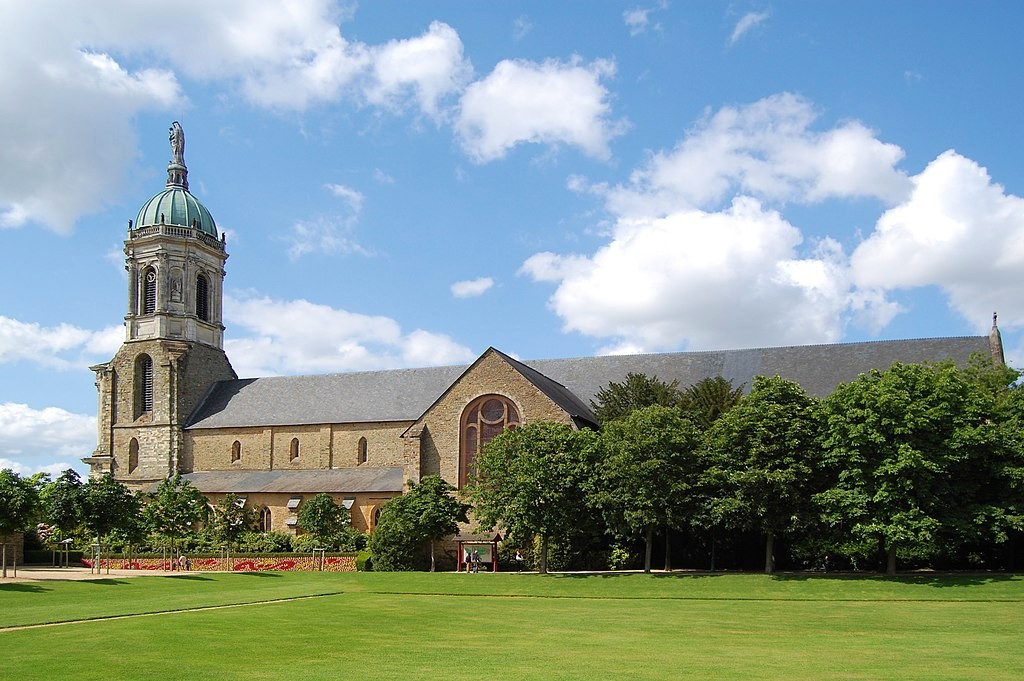
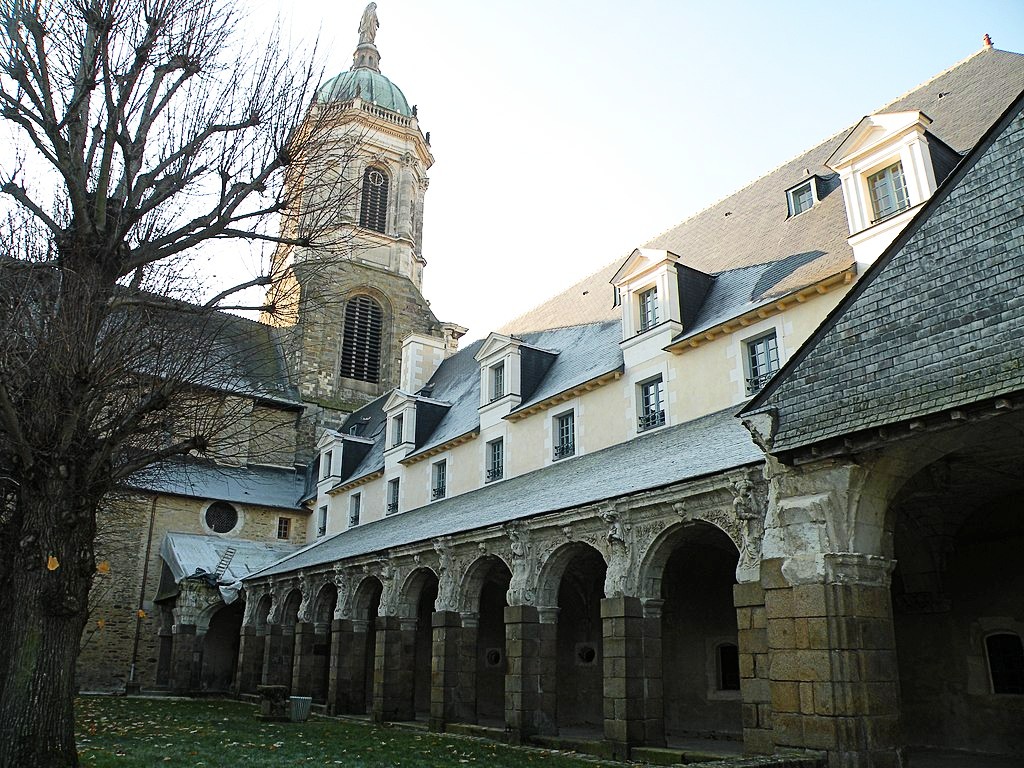
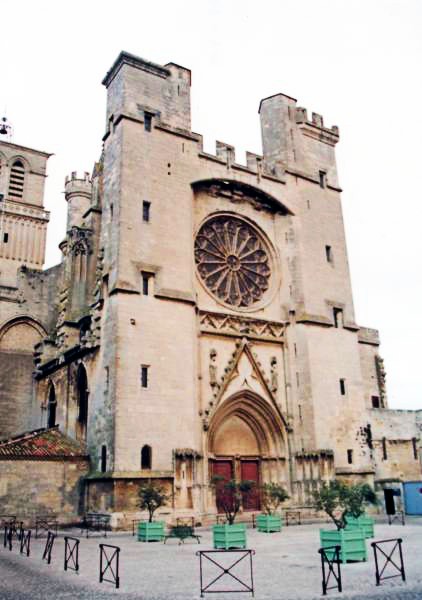
Melaine died at Rennes in c535 and was buried in the Abbey Church of Notre-Dame-en-Saint-Melaine, see below, which was built around his tomb.
In Wales, his Feast is celebrated locally on 10 October rather than 11 October at St Mellons, in modern-day Cardiff, although there is serious doubt over whether Melaine is the same Saint ‘Mellonius’ said to have been born there.
In Cornwall, he is the patron of the villages of St Mellion and Mullion, where there is a tradition of his visit.
The Abbey of St Melaine and the back of the Church
St Demetrian of Cyprus St Edwen of Northumbria St Efflam of Brittany St Emilian of Faenza St Erlafrid of Hirschau St Felix of Fondi St Felix of Genoa St Felix of Thynissa St Illtyd St Israel of Limoges
St Leonard of Reresby Bl Leonianus of Autun St Melaine of Rennes (Died c535) Bishop Confessor St Paul of Constantinople St Pinnock St Protasius of Lausanne St Severus of Barcelona Bl Simon of Aulne St Stephen of Apt St Theobald of Dorat St Valentine of Genoa
Martyrs of Antioch – 10 Saints: Ten Christians murdered together by Arabs after their seizure of Antioch, Syria. No names or other details about them have come down to us. 637 in Antioch, Syria.
Martyrs of Gaza – 9 Saints: A group of Christian soldiers who were captured by Saracens invading the area of Gaza in Palestine. When the men continued to profess their Christianity, they were executed. We know the names of some of the Martyrs – Himerius, John (2 of them), Kallinikos (Callinoco), Paul, Peter, Stephen and Theodore (2 of them). They were beheaded in Gaza, Palestine.
Thought for the Day – 5 November – Meditations with Antonio Cardinal Bacci (1881-1971)
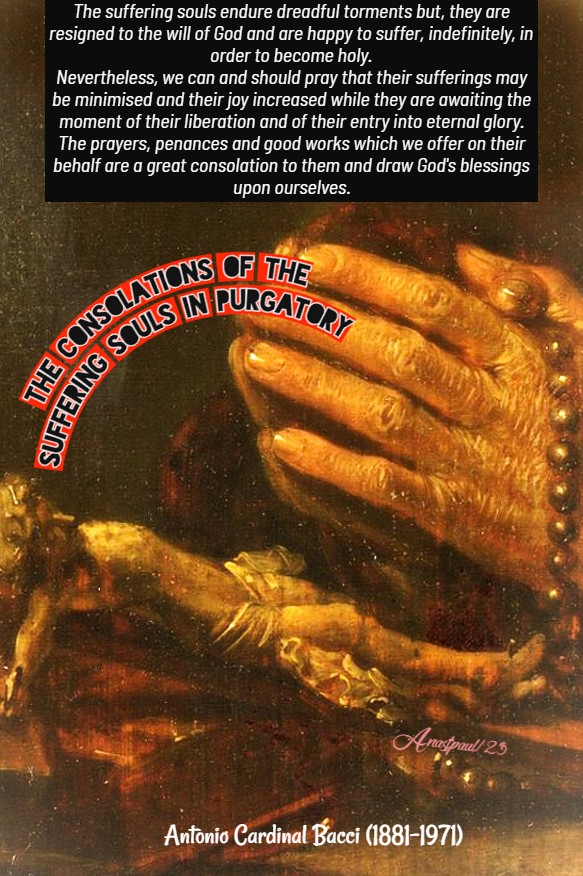
The Consolations of the Suffering Souls in Purgatory
“That is the way it is in Purgatory. The suffering souls endure dreadful torments but, they are resigned to the will of God and are happy to suffer, indefinitely, in order to become holy. Nevertheless, we can and should pray that their sufferings may be minimised and their joy increased while they are awaiting the moment of their liberation and of their entry into eternal glory. The prayers, penances and good works which we offer on their behalf are a great consolation to them and draw God’s blessings upon ourselves.”
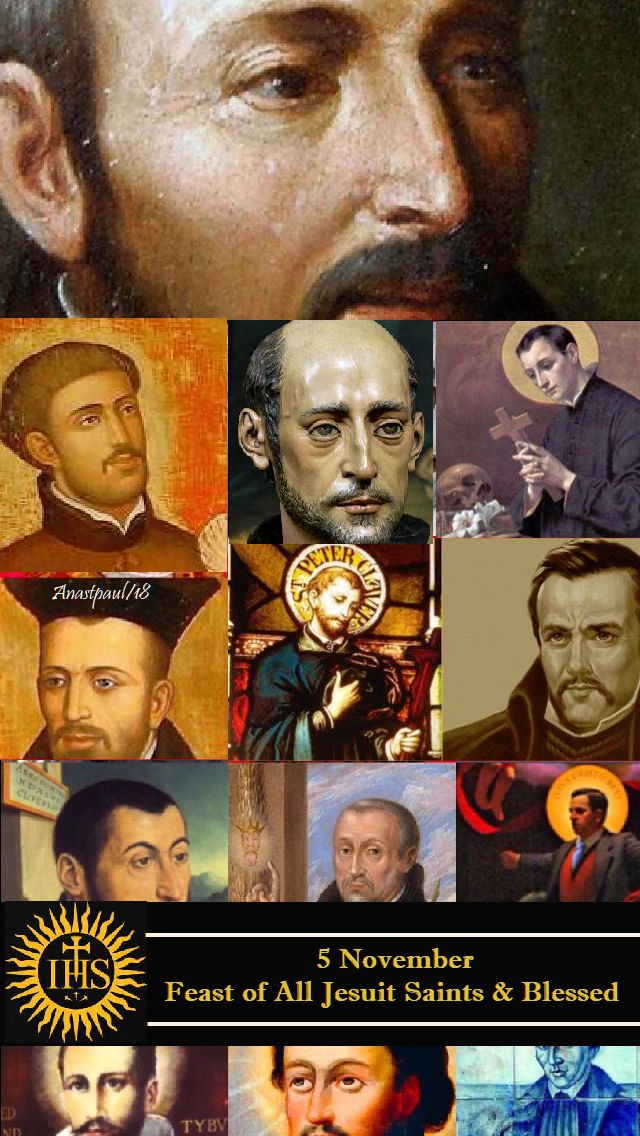
Quote/s of the Day – 5 November – All Saints and Blesseds of the Society of Jesus (SJ)
“True humility consists in persuading and convincing oneself that without God, we are insignificant and despicable and, in accepting to be treated as such!”
St Ignatius Loyola SJ (1491-1556)
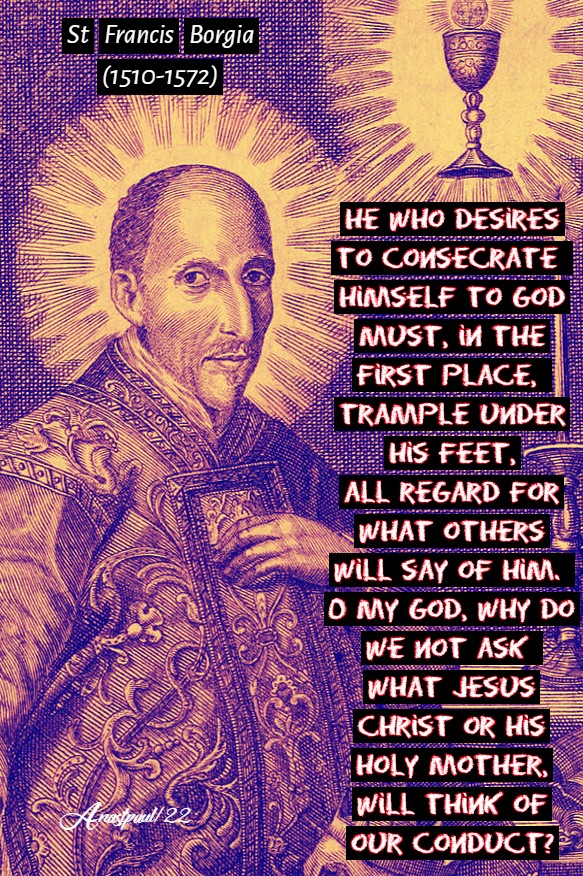
“He who desires to consecrate himself to God must, in the first place, trample under his feet, all regard for what others will say of him. O my God, why do we not ask what Jesus Christ or His holy Mother, will think of our conduct?”
St Francis Borgia SJ (1510-1572)
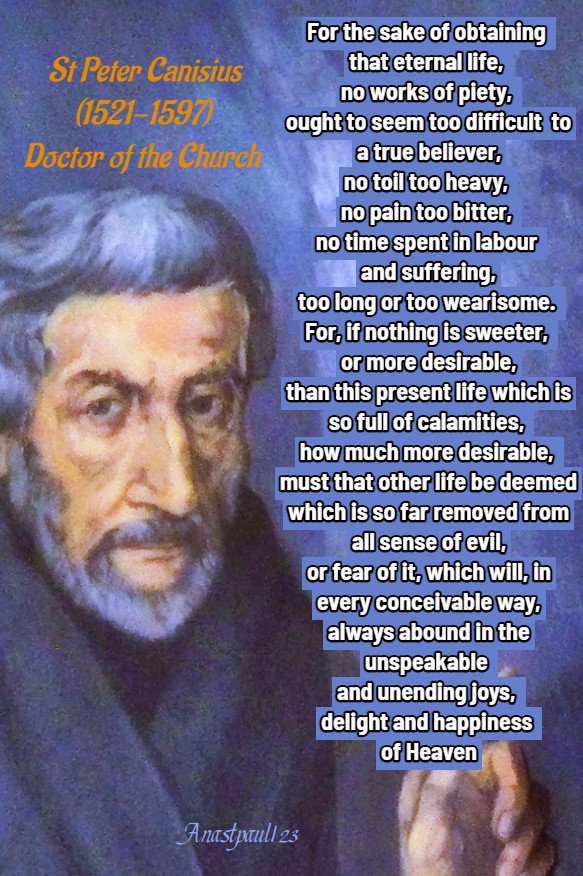
“For the sake of obtaining that eternal life, no works of piety, ought to seem too difficult to a true believer, no toil too heavy, no pain too bitter, no time spent in labour and suffering, too long or too wearisome. For, if nothing is sweeter, or more desirable, than this present life which is so full of calamities, how much more desirable, must that other life be deemed which is so far removed from all sense of evil, or fear of it, which will, in every conceivable way, always abound in the unspeakable and unending joys, delight and happiness of Heaven.”
St Peter Canisius SJ (1521-1597) Confessor, Doctor of the Church
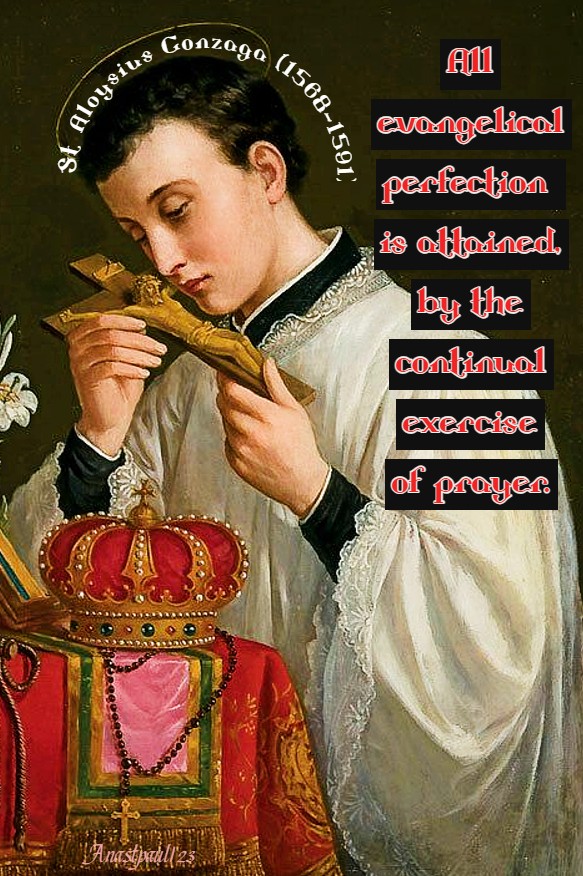
“All evangelical perfection is attained, by the continual exercise of prayer.”
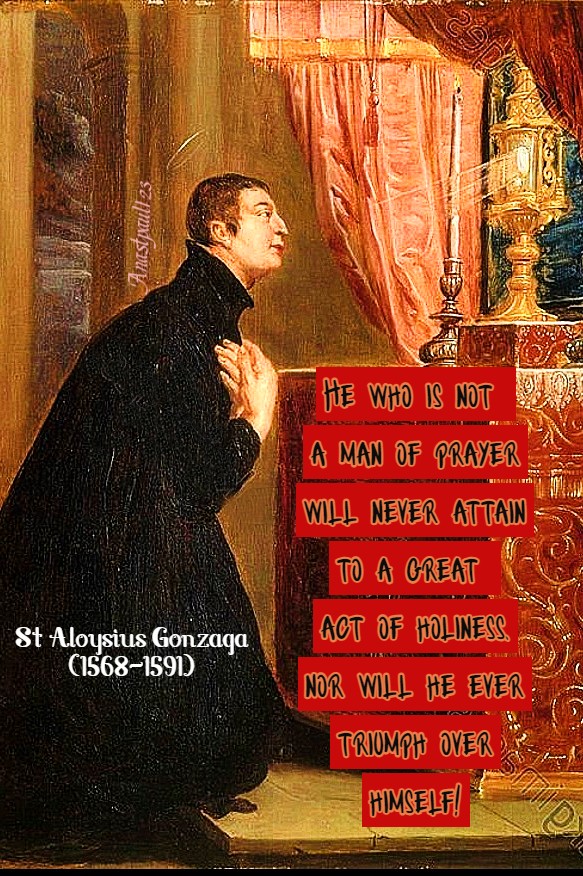
“He who is not a man of prayer will never attain to a great act of holiness, nor will he ever triumph over himself!”
St Aloysius Gonzaga SJ (1568-1591)
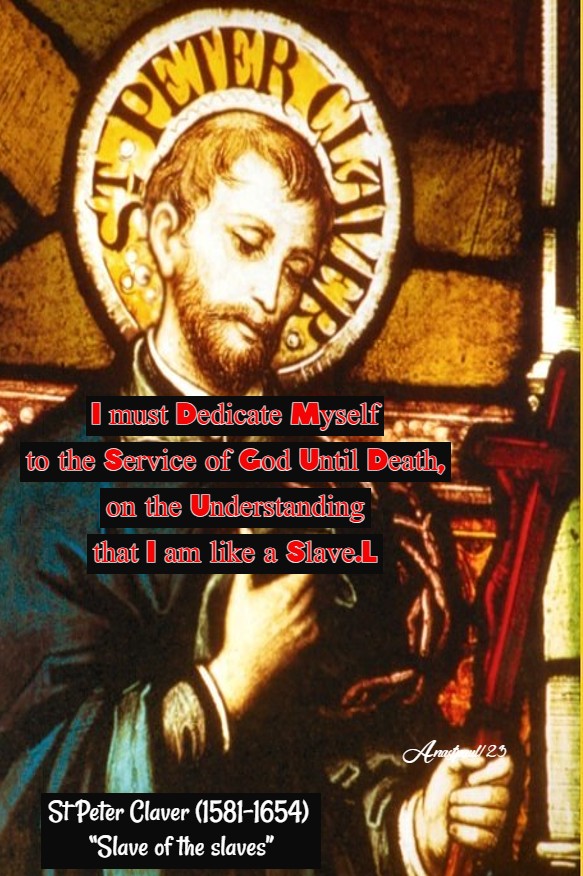
“I must dedicate myself to the service of God until death, on the understanding that I am like a slave.”
St Peter Claver SJ (1581-1654)
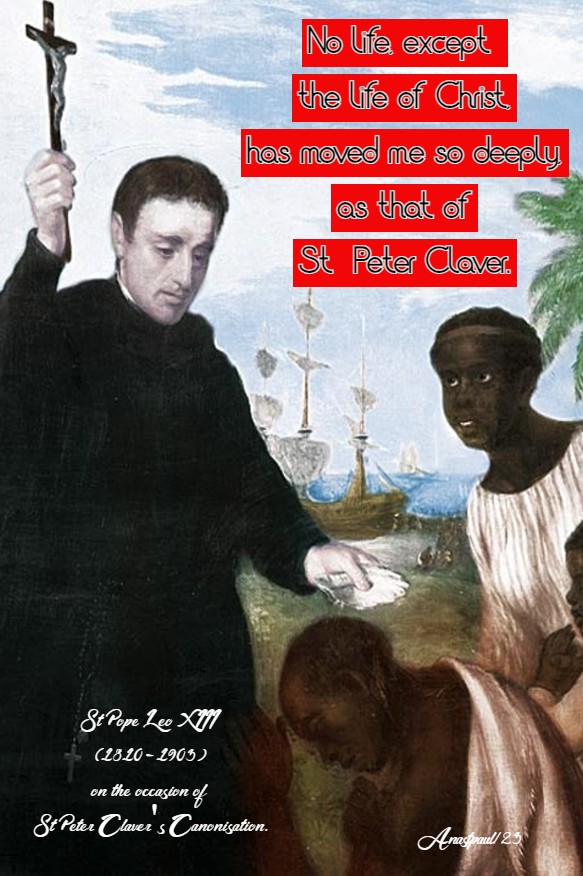
“No life, except the life of Christ, has moved me so deeply, as that of Peter Claver.”
St Pope Leo XIII (1810-1903) on the occasion of St Peter Claver’s Canonisation.
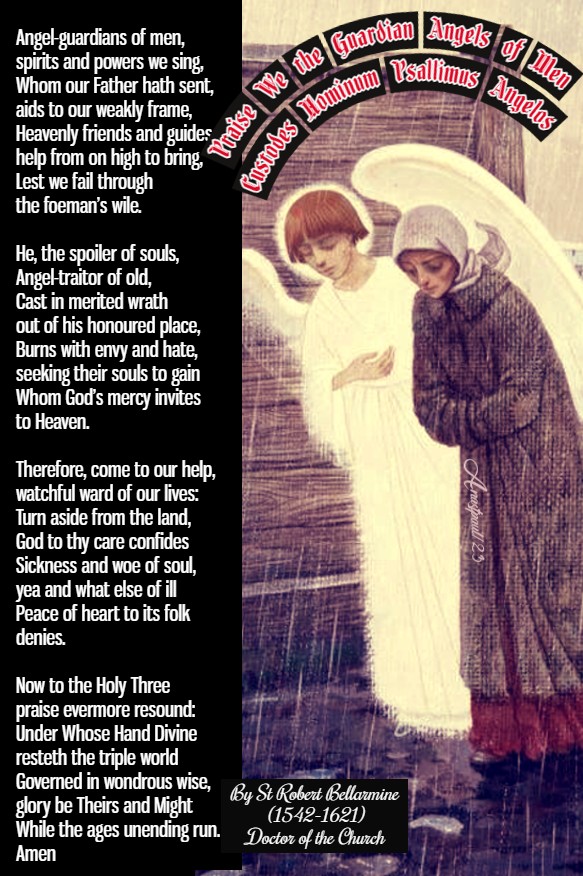
Custodes Hominum Psallimus Angelos Praise We the Guardian Angels of Men By St Robert Bellarmine SJ (1542-1621) Archbishop of Capua, Theologian Doctor of the Church
Angel-guardians of men, spirits and powers we sing, Whom our Father hath sent, aids to our weakly frame, Heavenly friends and guides, help from on high to bring, Lest we fail through the foeman’s wile.
He, the spoiler of souls, Angel-traitor of old, Cast in merited wrath out of his honoured place, Burns with envy and hate, seeking their souls to gain Whom God’s mercy invites to Heaven.
Therefore, come to our help, watchful ward of our lives: Turn aside from the land, God to thy care confides Sickness and woe of soul, yea and what else of ill Peace of heart to its folk denies.
Now to the Holy Three praise evermore resound: Under Whose Hand Divine resteth the triple world Governed in wondrous wise, glory be Theirs and Might While the ages unending run. Amen
This Hymn by St Robert Bellarmine,was added to the Roman Breviary in 1608, by command of Pope Paul V. It is for Vespers in the Office for “the Holy Guardian Angels. Double of the second class, 2 October.
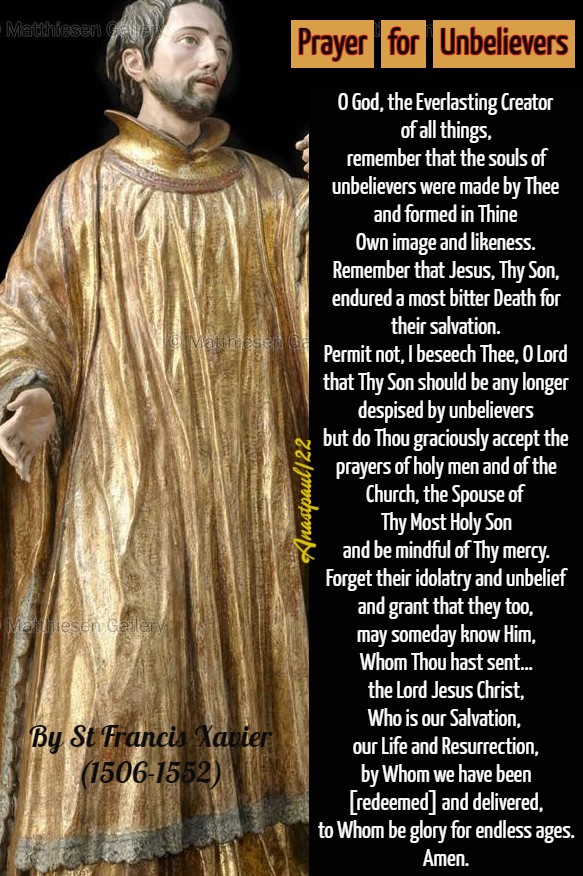
Prayer for Unbelievers By St Francis Xavier (1506-1552)
O God, the Everlasting Creator of all things, remember that the souls of unbelievers were made by Thee and formed in Thine own image and likeness. Remember that Jesus, Thy Son, endured a most bitter Death for their salvation. Permit not, I beseech Thee, O Lord that Thy Son should be any longer despised by unbelievers but do Thou graciously accept the prayers of holy men and of the Church, the Spouse of Thy Most Holy Son and be mindful of Thy mercy. Forget their idolatry and unbelief and grant that they too, may someday know Him, Whom Thou hast sent…the Lord Jesus Christ, Who is our Salvation, our Life and Resurrection, by Whom we have been [redeemed] and delivered, to Whom be glory for endless ages. Amen.
One Minute Reflection – 5 November – “The Month of the Holy Souls in Purgatory” – Within the Octave of All Saints and the Feast of the Holy Relics – Philippians 3:17-21; 4:1-3; Matthew 9:18-26 – Scripture search here: https://www.drbo.org/
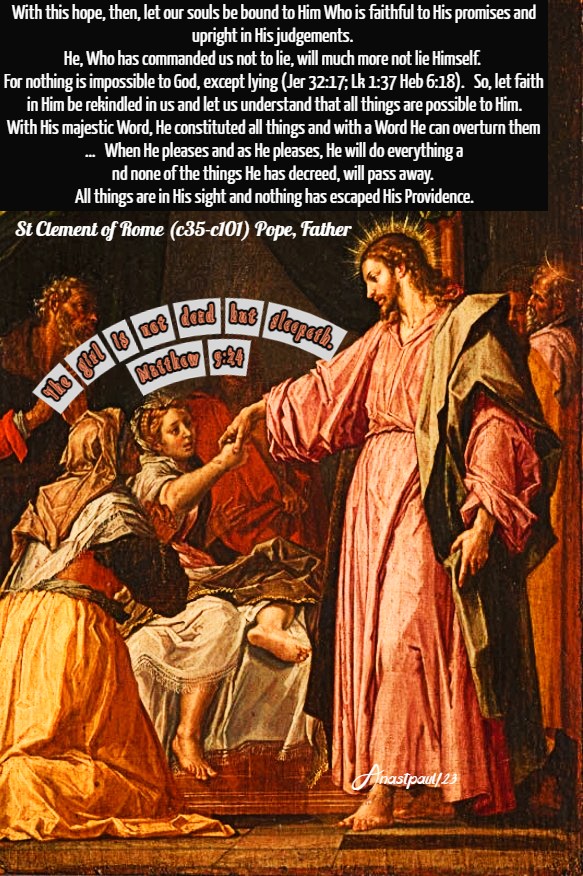
“… The girl is not dead but sleepeth.” – Matthew 9:24
REFLECTION – “Let us consider, dear friends, how the Master is continually proving to us that there is to be a resurrection, of which He made the Lord Jesus Christ the First Fruits, when He raised Him from the dead. Let us observe, dear friends, the resurrection that is regularly taking place. Day and night show us a resurrection – night falls asleep, day arises; day departs, night arrives. Let us take the crops – how and in what way, does the sowing take place? The sower goes out and sows each seed in the ground. They fall into the ground, dry and bare and decay, then from their decay, the greatness of the Master’s Providence raises them up and, from a single grain, many spring up and bear fruit! … Do we, then, regard it as a great and marvellous thing. for the Creator of all things. to bring about the resurrection of those. who have served Him with holiness, in the assurance of a good faith?…
With this hope, then, let our souls be bound to Him Who is faithful to His promises and upright in His judgements. He, Who has commanded us not to lie, will much more not lie Himself. For nothing is impossible to God, except lying (Jer 32:17; Lk 1:37 Heb 6:18). So, let faith in Him be rekindled in us and let us understand that all things are possible to Him.
With His majestic Word, He constituted all things and with a Word, He can overturn them … When He pleases and as He pleases, He will do everything and none of the things He has decreed, will pass away. All things are in His sight and nothing has escaped His Providence.” – St Clement of Rome (c35-c101) Pope from c88 to c101, Father of the Church (Letter to the Corinthians 24-28).
PRAYER – Almighty, eternal God, Who granted us to honour the merits of all Thy Saints in a single solemn festival, bestow on us, we beseech Thee, through their manifold intercession, that abundance of Thy mercy for which we yearn.Through Jesus Christ, Thy Son our Lord, Who lives and reigns with Thee, in the unity of the Holy Ghost, God, world without end. Amen (Collect).
Our Morning Offering – 5 November – “The Month of the Holy Souls in Purgatory” – The 23rd Sunday after Pentecost
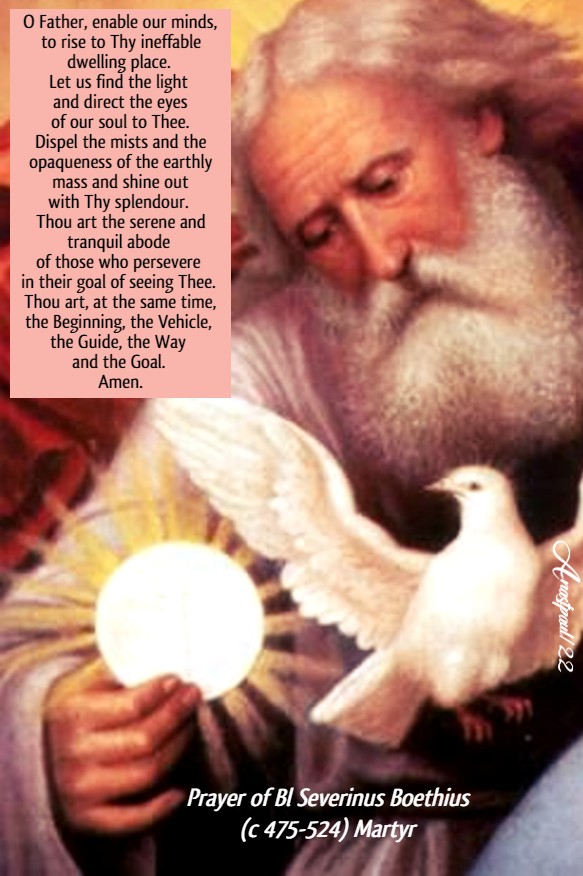
Prayer of Blessed Severinus Boethius (c 475-524) Martyr
O Father, enable our minds, to rise to Thy ineffable dwelling place. Let us find the light and direct the eyes of our soul to Thee. Dispel the mists and the opaqueness of the earthly mass and shine out with Thy splendour. Thou art the serene and tranquil abode of those who persevere in their goal of seeing Thee. Thou art, at the same time, the Beginning, the Vehicle, the Guide, the Way and the Goal. Amen.
Saint of the Day – 5 November – Saint Gerald of Béziers OSA (1070–1123) Bishop of Béziers from 1121 until the day of his death, Canon Regular of St Augustine and the 2nd Prior of the community at Cassan Abbey, Apostle of the poor and sick, Gerald built a Hospital and restored and extended the Abbey, Miracle-worker. Born around 1070 in Puissalicon and died on 5 November 1123 in Béziers in France of natural causes. Patronages – Puissalicon and the town of Saint-Guiraud and of children suffering from eye diseases. Also known as – Gerald of Puissalicon, Guiraud, Geraud, Geraldo.
Gerald was born in Puissalicon in 1070. Several acts and charters bear the signature “Guiraud of Puissalicon.” This proves that he was from the noble family of thePuissalicons. Tradition reports that his mother carried him for only 7 months and then, when he was Baptised, the Baptismal’s water began to boil as if some red-hot iron had been planted within it. This miracle was considered as forerunner of the holiness of the child.
Before 1085, being only around 15 years old, he joined the Canons Regular of St Augustine, where , in around 1094, he was Ordained a Deacon. Seven years later, in 1101, aged 31, Gerald was Ordained to the Priesthood.
Between 4 May 1105 and 6 August 1106, he was elected Prior of the Monastery in Cassan near Roujan , which, as Prior, he restored to its former glory. He built many new buildings, including a Hospital. On 5 October 1115, a new Church outside the Cassan Monastery was Consecrated.
Gerald was known for his piety, sincerity and simplicity, He devoted much of his time to the poor and sick and in 1121 he accepted the Bishopric of the Diocese of Béziers. He held this office for only around 2 years before Gerald died at the age of approximately 53 as a result of illness.
He was buried, as requested, next to Saint. Aphrodisius, first bishop of Béziers. His Relics were transferred on 11 November 1259 to the no longer existing Monastery of the Poor Clares . This building was a place of worship until the French Revolution, during which the Relics of our Saint were destroyed. His miraculous Silver Amethyst Ring was stored in Reujan and was stolen in 1980 by unknown perpetrators. The ring had great supernatural powers, especially for children with eye diseases.
The French Town of Saint-Guiraud is named after him .
The 23rd Sunday after Pentecost Within the Octave of All Saints
Feast of the Holy Relics: https://anastpaul.com/2022/11/05/feast-of-the-holy-relics-5-november-2/ AND: About: https://anastpaul.wordpress.com/2017/11/05/feast-of-the-holy-relics-5-november/ Protestantism pretends to regard the veneration which the Church pays to the Relics of the Saints, as a sin and contends that this pious practice is a remnant of paganism. The Council of Trent, on the contrary, has decided that the bodies of the Martyrs and other Saints, who were living members of Jesus Christ and temples of the Holy Ghost, are to be honoured by the faithful. This decision was based upon the established usage of the earliest days of the Church and upon the teaching of the Fathers and of the Councils. The Council orders, however, that all abuse of this devotion is to be careffully avoided and forbids any Relics to be exposed which have not been approved by the Bishops and, these Prelates are recommended, to instruct the people faithfully, in the teaching of the Church on this subject. While we regret, then, the errors of the impious and of heretics, let us profit by the advantages which we gain, by hearkening to the voice of the Church!
All Saints and Blesseds of the Society of Jesus: The Society of Jesus, commonly known as the Jesuits, was Founded in 1534 by Saint Ignatius Loyola (1491-1556) at Montmartre, Paris, France. A body of clerics regular organised for Apostolic work, following a religious rule and relying on alms for their support. It was the chief instrument of the Catholic Reformation. Pope Paul III approved the new rule in 1540 and Ignatius was elected the first general of the order in 1541. The constitutions, drafted by him and based on his Spiritual Exercises were adopted in 1558. It was the first order which enjoined by its constitutions devotion to the cause of education. The ministry of the Society consists chiefly in preaching. teaching catechism. administering the sacraments. conducting missions in parishes, taking care of parishes. organising pious confraternities, teaching in schools of every grade, writing books, pamphlets, periodical articles, going on foreign missions and special missions when ordered by the current Holy Father, to whom they take a vow of total obedience. Our current Holy Father, Pope Francis is a Jesuit and has jokingly wondered aloud who is boss of whom in his Order. The general resides at Rome, Italy and has a council of assistants. The motto of the Society is Ad Majorem Dei Gloriam (For the greater glory of God). All Jesuit Saints and Blesseds: https://anastpaul.com/2018/11/05/feast-of-all-the-saints-and-blesseds-of-the-society-of-jesus/
St Canonica St Comasia St Dominator of Brescia St Elizabeth St Domninus the Physician St Epistemis St Eusebius of Terracina St Felix of Terracina St Fibitius St Galation St Gerald of Béziers OSA (1070–1123) Bishop Bl Gomidas Keumurjian Bl Gregory Lakota St Guetnoco St Hermenegild St Idda St Juan Antoni Burró Mas St Juan Duarte Martín St Kanten St Kea St Laetus of Orleans St Magnus of Milan St Mamete St Marco of Troia St Spinulus of Moyen-Moûtier St Sylvanus of Syria St Zachary
Martyrs of Caesarea Maritima – 4 Saints: Four young Christian men who were Martyred together is the persecutions of Maximian – Aussenzius, Philotheus, Timothy and Theotimus. They were martyred in the arena at Caesarea Maritima, Palestine.
Thought for the Day – 4 November – Meditations with Antonio Cardinal Bacci (1881-1971)
More About the Sufferings of Purgatory
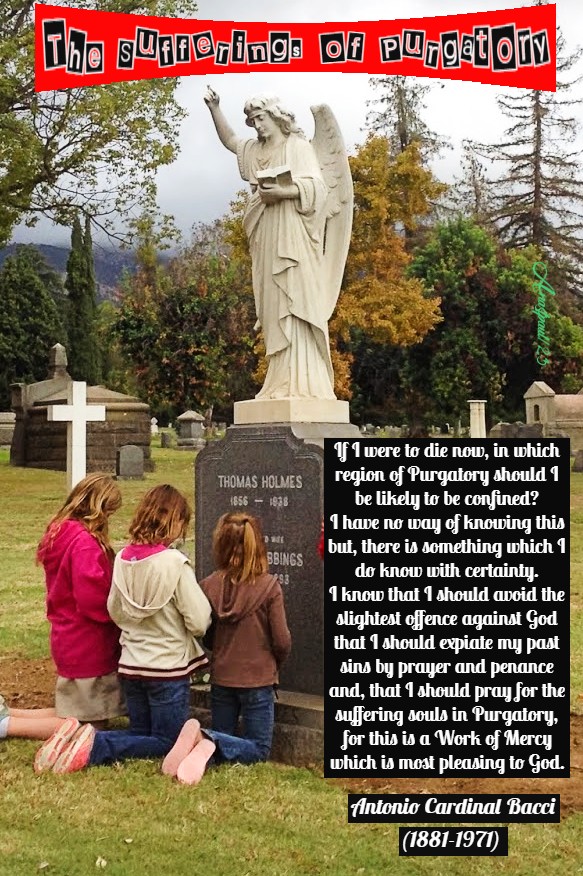
“If I were to die now, in which region of Purgatory should I be likely to be confined? I have no way of knowing this but, there is something which I do know with certainty. I know that I should avoid the slightest offence against God that I should expiate my past sins by prayer and penance and, that I should pray for the suffering souls in Purgatory, for this is a Work of Mercy which is most pleasing to God.”
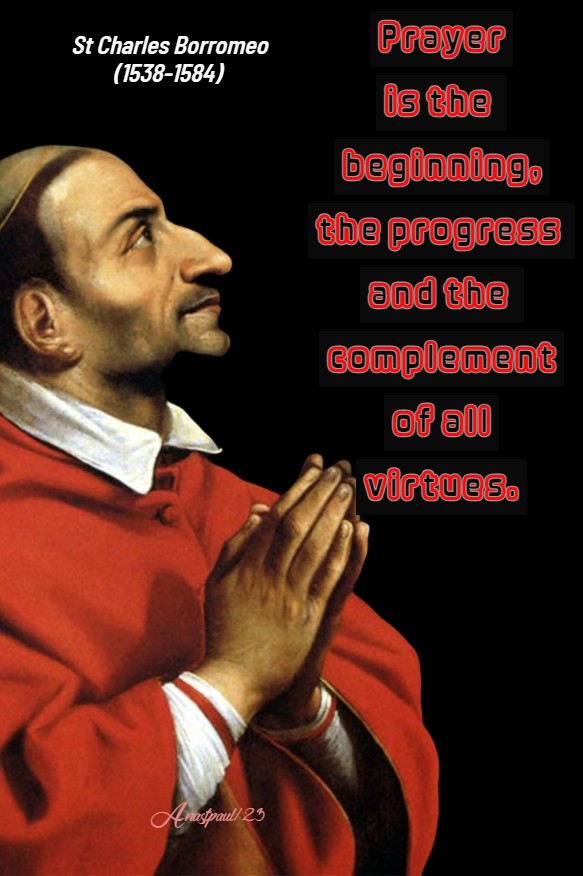
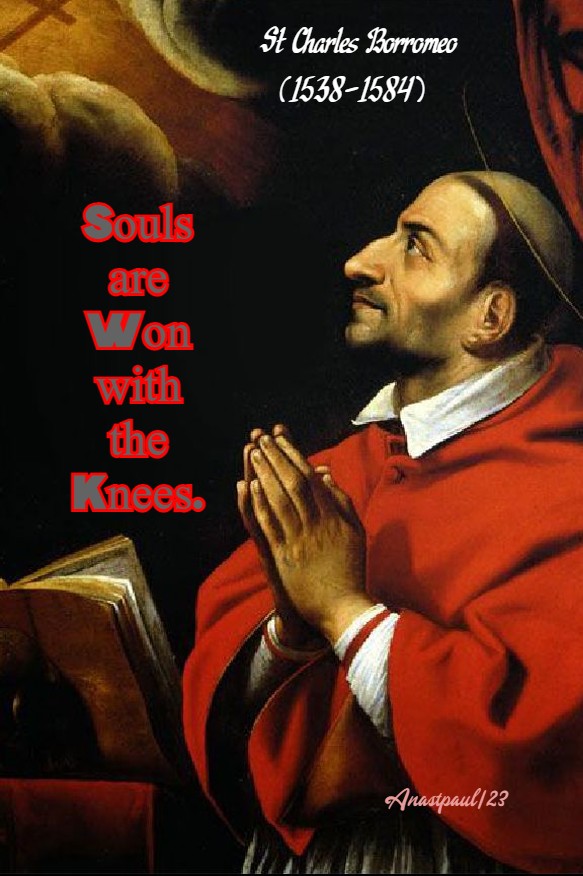
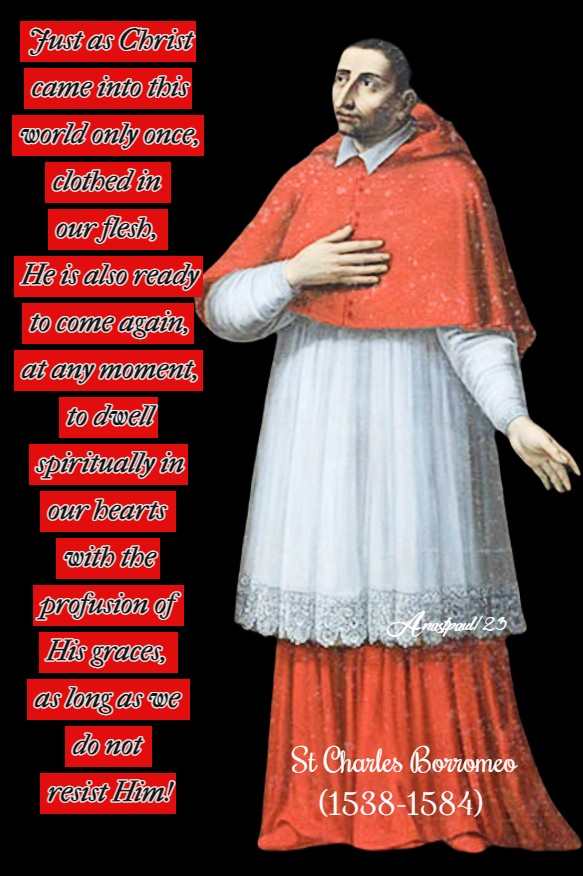
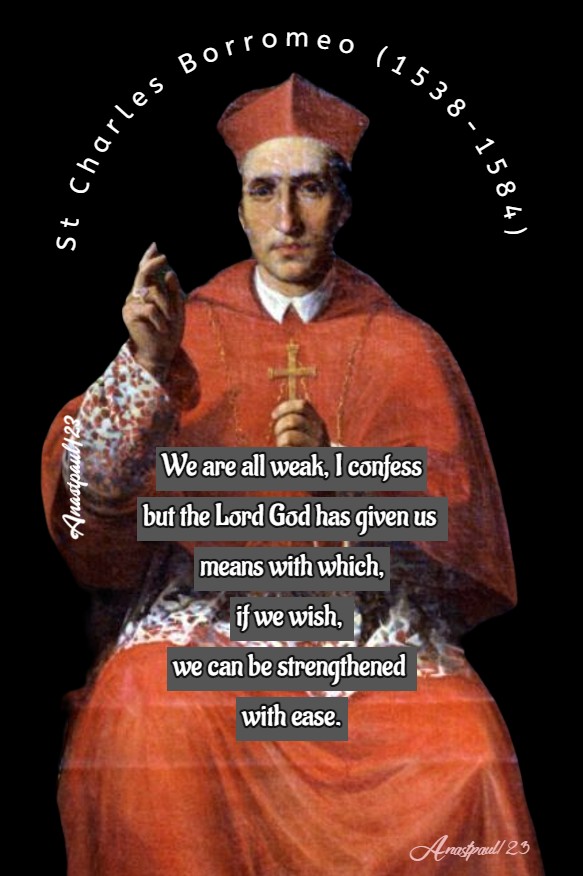
Quote/s of the Day – 4 November – “The Month of the Holy Souls in Purgatory” – Saint Charles Borromeo (1538-1584) He is known as the “Father of the Clergy” – Some of his Patronages – Bishops, Priests, Seminarians • Catechists • Catechumens • Spiritual Director s • Spiritual leaders.
“Prayer is the beginning, the progress and the complement of all virtues.”
“Souls are won with the knees.”
“The Rosary is the most divine of devotions.”
“Just as Christ came into this world only once, clothed in our flesh, He is also ready to come again, at any moment, to dwell spiritually in our hearts with the profusion of His graces, as long as we do not resist Him!”
“We are all weak, I confess but the Lord God has given us means with which, if we wish, we can be strengthened with ease.”
O Holy Mother of God A Prayer for our Priests to the Most Blessed Virgin By St Charles Borromeo (1538-1584)
O Holy Mother of God, pray for the Priests thy Son has chosen to serve His Church. Help them by thy intercession, to be holy, zealous and chaste. Make them models of virtue, in the service of God’s people. Help them to be prayerful in meditations, effective in preaching and enthusiastic in the daily offering of the Holy Sacrifice of the Mass. Help them to administer the Sacraments with joy, O Holy Mother of God. Amen.
One Minute Reflection – 4 November – “The Month of the Holy Souls in Purgatory” – Saint Charles Borromeo (1538-1584) He is known as the “Father of the Clergy” – Some of his Patronages: Bishops, Priests, Seminarians • Catechists • Catechumens • Spiritual Directors • Spiritual leaders. – Sirach 44:16-27; 45:3-20, Matthew 25:14-23 – Scripture search here: https://www.drbo.org/
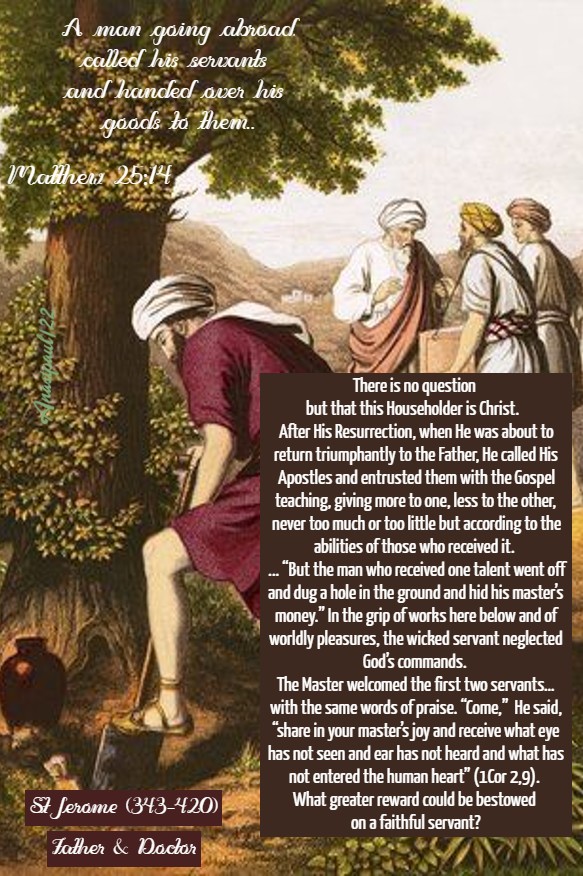
“A man going abroad, called his servants and handed over his goods to them.” – Matthew 25:14
REFLECTION – “There is no question but that this Householder is Christ. After His Resurrection, when He was about to return triumphantly to the Father, He called His Apostles and entrusted them with the Gospel teaching, giving more to one, less to the other, never too much or too little but according to the abilities of those who received it. In the same way, the Apostle Paul said that he had fed with milk those unable to take solid food (1 Cor 3:2)…
Five, two, one talent: let us take these to be the different graces granted to each, whether the five senses for the first; understanding of faith and works for the second; the reasons for distinguishing us from other creatures, for the third. “The one who received five talents went away and traded with them and made another five.” That is to say, besides the physical and material senses he had received, he added knowledge of heavenly things. His knowledge was raised from the creatures to the Creator, from the corporal to the incorporeal, from the visible to the invisible, from the transient to the eternal. “The one who received two made another two.” This one likewise, according to his ability, doubled in the school of the Gospel what he had learned in the school of the Law. Or perhaps we could say, that he understood that knowledge of faith and the works of this present life, lead to future happiness. “But the man who received one talent went off and dug a hole in the ground and hid his master’s money.” In the grip of works here below and of worldly pleasures, the wicked servant neglected God’s commands. However, let us note that, according to another evangelist, he wrapped it in a linen cloth – by this we could understand that he took away the force of his Master’s teaching, by a life of softness and pleasure…
The Master welcomed the first two servants… with the same words of praise. “Come,” He said, “share in your master’s joy and receive what eye has not seen and ear has not heard and what has not entered the human heart” (1 Cor 2:9). What greater reward could be bestowed on a faithful servant?” – St Jerome (343-420) Translator of Sacred Scripture (the Vulgate), Father and One of the Original Four Doctors of the Latin Church .
PRAYER – Safeguard Thy Church, O Lord, under the continual protection of St Charles, Thy Confessor and Bishop, so that just as his concern for his flock made him glorious, so his intercession may make us ever fervent in loving Thee. Through Jesus Christ, Thy Son our Lord, Who lives and reigns with Thee, in the unity of the Holy Ghost, God, world without end. Amen (Collect).
Our Morning Offering – 4 November – “The Month of the Holy Souls in Purgatory”– Saturday of our Most Holy Mother
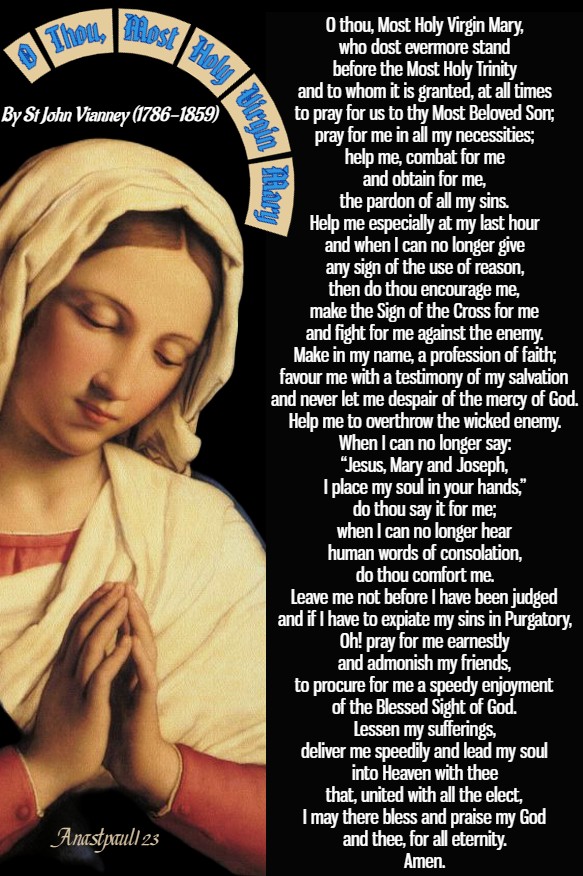
O Thou, Most Holy Virgin Mary (Pray for Me in All My Necessities, at the hour of my death and for my soul in Purgatory) By St John Vianney (1786-1859)
O thou, Most Holy Virgin Mary, who dost evermore stand before the Most Holy Trinity and to whom it is granted, at all times to pray for us to thy Most Beloved Son; pray for me in all my necessities; help me, combat for me and obtain for me, the pardon of all my sins. Help me especially at my last hour and when I can no longer give any sign of the use of reason, then do thou encourage me, make the Sign of the Cross for me and fight for me against the enemy. Make in my name, a profession of faith; favour me with a testimony of my salvation and never let me despair of the mercy of God. Help me to overthrow the wicked enemy. When I can no longer say: “Jesus, Mary and Joseph, I place my soul in your hands,” do thou say it for me; when I can no longer hear human words of consolation, do thou comfort me. Leave me not before I have been judged and if I have to expiate my sins in Purgatory, Oh! pray for me earnestly and admonish my friends, to procure for me a speedy enjoyment of the Blessed Sight of God. Lessen my sufferings, deliver me speedily and lead my soul into Heaven with thee that, united with all the elect, I may there bless and praise my God and thee, for all eternity. Amen.
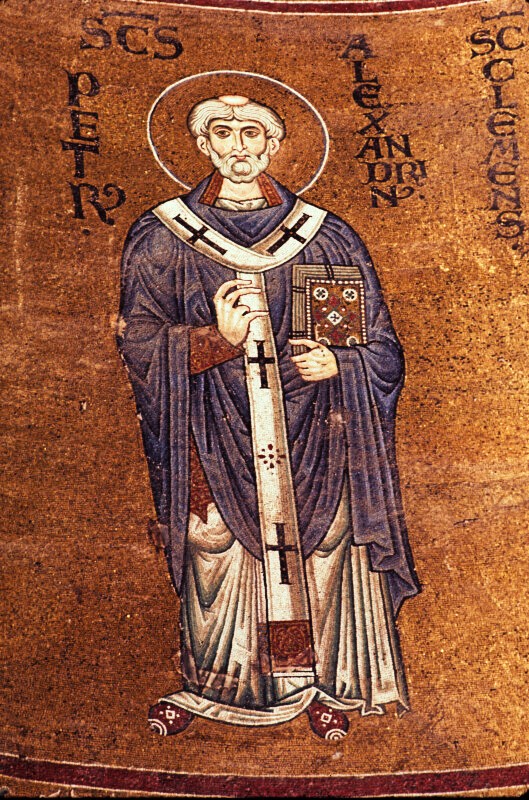
Saint of the Day – 4 November – St Pierius (Died c309) Priest, Confessor, Co-Director with Achilas of the Catechetical School of Alexandria in Egypt,Scholar, renowned Preacher and Exegetical Writer.. He died in Rome in c309 of natural causes which St Jerome assures us of. Also known as – Pierio, “The Younger Origen”
The Roman Martyrology reads today: “The birthday of St Pierius, Priest of Alexandria, who, being deeply versed in the Sacred Scriptures, leading a very pure life and freed from all impediments in order to apply to Christian philosophy, taught the people with great renown and published various treatise, under the Emperors Carus and Diocletian, when St Theonas governed the Church of Alexandria. After the persecutions, he spent the remainder of his life at Rome, where he rested in peace in the Lord.”
Pierius was Ordained a Priest in the late 3rd Century by St Theonas, the Bishop of Alexandria. Thereafter, Pierius served as the Director of the Catechetical School of Alexandria.
He was a gifted preacher and excelled in the fields of Scripture studies and philosophy. Pierius lived austerely and temperately, practising the Evangelical Counsel of poverty.
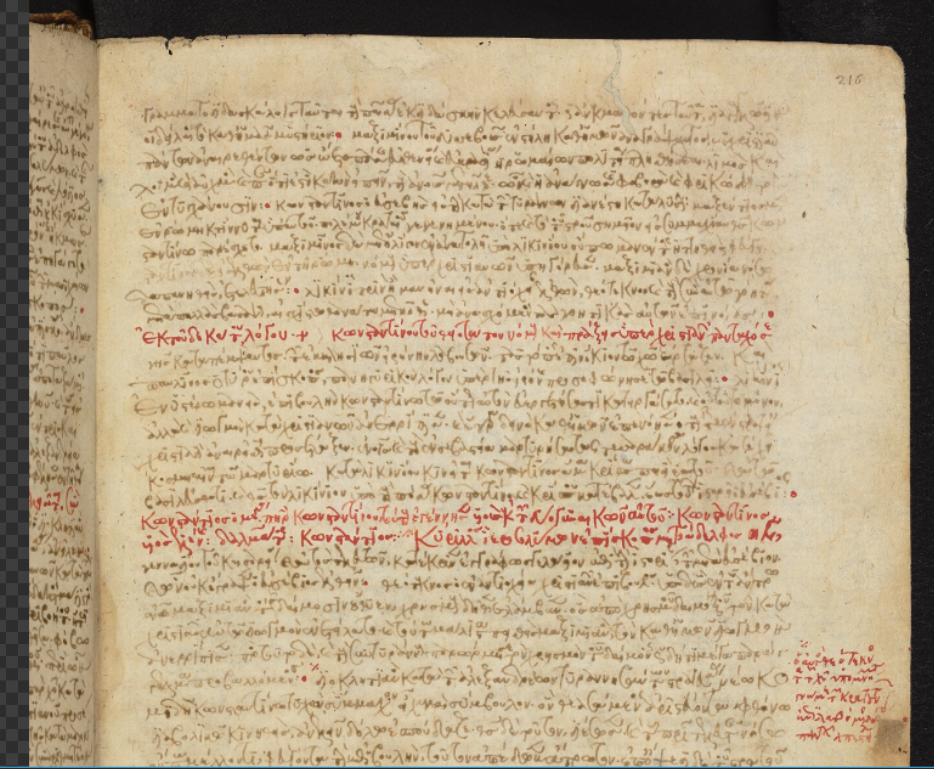
His known published Works are – one on the Gospel of St Luke, an Easter Sermon on Osee (Hosea); a Treatise on the Mother of God; a few other Easter Sermons and an Eulogy on St Pamphilus, who had been one of his disciples. Only fragments of these writings are extant all the rest have been lost to us. Below is an image of this fragment.
St Vitalis (Died c 304) Martyr and St Agricola (Died c 304) Latmen Martyrs. Martyrs, Laymen. They died in c 304 in Bologna, Italy in the persecution of Diocletian. Patronage – Bologna. The Roman Martyrology reads: “In Bologna, Saints Vitalis and Agricola, Martyrs, of whom, according to what Saint Ambrose recounts, the first was first a slave to the other, then a companion in Martyrdom: Vitalis, in fact, suffered such torments that there was no longer any part of his body without wound. Agricola, not at all terrified by the torture of his slave, imitated him in Martyrdom by undergoing crucifixion.” Their Lives and Deaths: https://anastpaul.com/2022/11/04/saints-of-the-day-4-november-st-vitalis-died-c-304-and-st-agricola-died-c-304-martyrs/
St Amandus of Avignon St Amandus of Rodez St Birstan St Clarus the Hermit St Clether
Bl Frances d’Amboise St Gerard de Bazonches St Gregory of Burtscheid Bl Helen Enselmini Bl Henry of Zweifalten St Hermas of Myra St Joannicus of Mount Olympus St John Zedazneli St Modesta of Trier St Nicander of Lycia St Patrobas St Perpète St Philologus St Pierius (Died c309) Priest, Director of the Catechetical School of Alexandria
Thought for the Day – 3 November – Meditations with Antonio Cardinal Bacci (1881-1971)
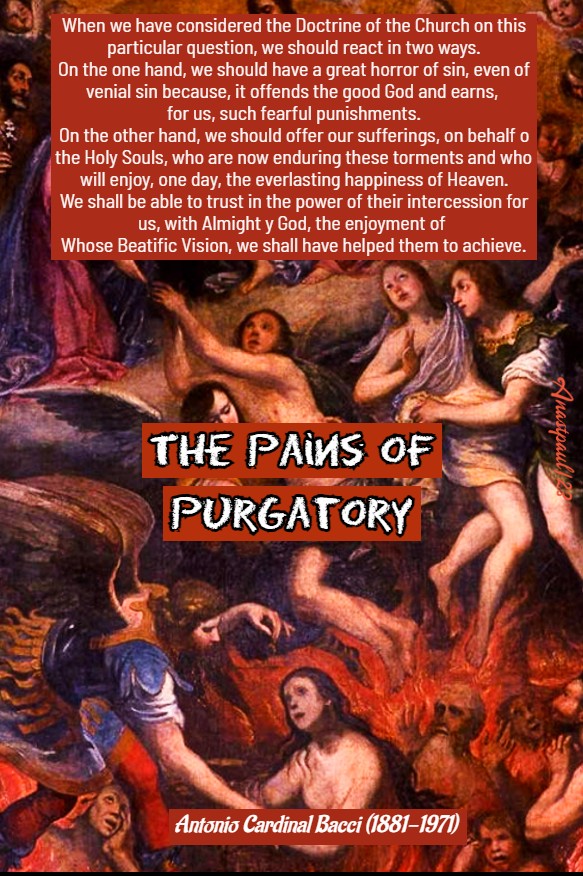
The Pains of Purgatory
“When we have considered the Doctrine of the Church on this particular question, we should react in two ways. On the one hand, we should have a great horror of sin, even of venial sin because, it offends the good God and earns, for us, such fearful punishments. On the other hand, we should offer our sufferings ,on behalf o the Holy Souls, who are now enduring these torments and who will enjoy, one day, the everlasting happiness of Heaven.
We shall be able to trust in the power of their intercession for us, with Almight y God, the enjoyment of Whose Beatific Vision, we shall have helped them to achieve.”
Quote/s of the Day – 3 November – “The Month of the Holy Souls in Purgatory” – Within the Octave of All Saints – Apocalypse 7:2-12, Matthew 5:1-12 – Scripture search here: https://www.drbo.org/
“Blessed are the clean of heart, for they will see God.”
Matthew 5:8
“Let listening to worldly news be BITTER FOOD for you and let the words of Saintly men be as combs filled with honey.”
St Basil the Great (329-379) Father and Doctor of the Church
“Remember, that you will derive strength by reflecting, that the Saints yearn for you to join their ranks; desire to see you fight bravely and, that you behave like true knights in your encounters with the same adversities which they had to conquer. That breath-taking joy is theirs and your eternal reward for having endured a few years of temporal pain. Every drop of earthly bitterness will be changed into an ocean of heavenly sweetness!”
Blessed Henry Suso (1295-1366)
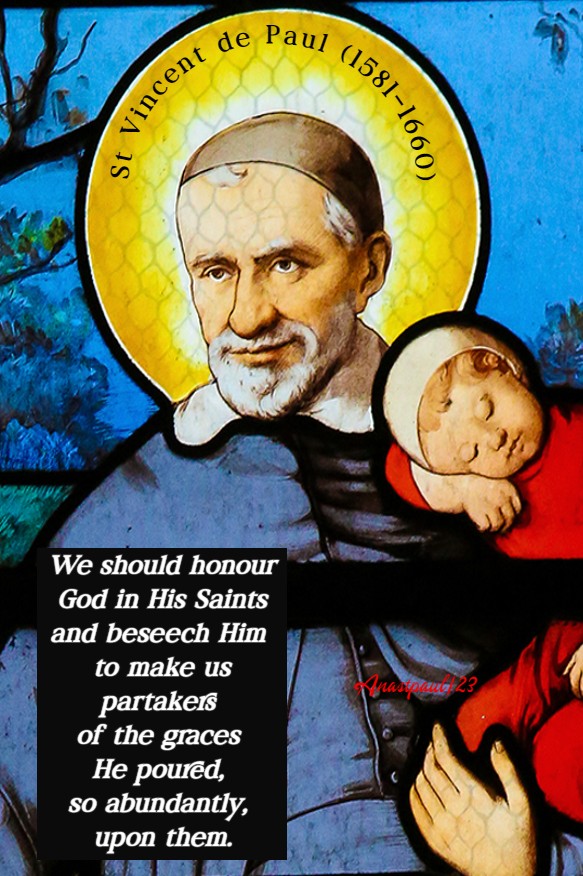
“We should honour God in His Saints and beseech Him to make us partakers of the graces He poured, so abundantly, upon them.”
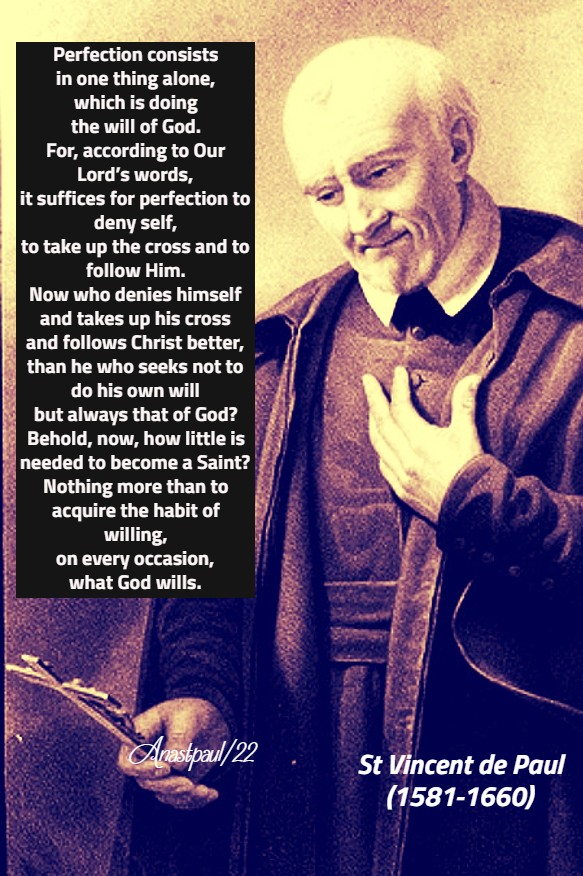
“Perfection consists in one thing alone, which is doing the will of God. For, according to Our Lord’s words, it suffices for perfection to deny self, to take up the cross and to follow Him. Now who denies himself and takes up his cross and follows Christ better, than he who seeks not to do his own will but always that of God? Behold, now, how little is needed to become as Saint? Nothing more than to acquire the habit of willing, on every occasion, what God wills.”
St Vincent de Paul (1581-1660)
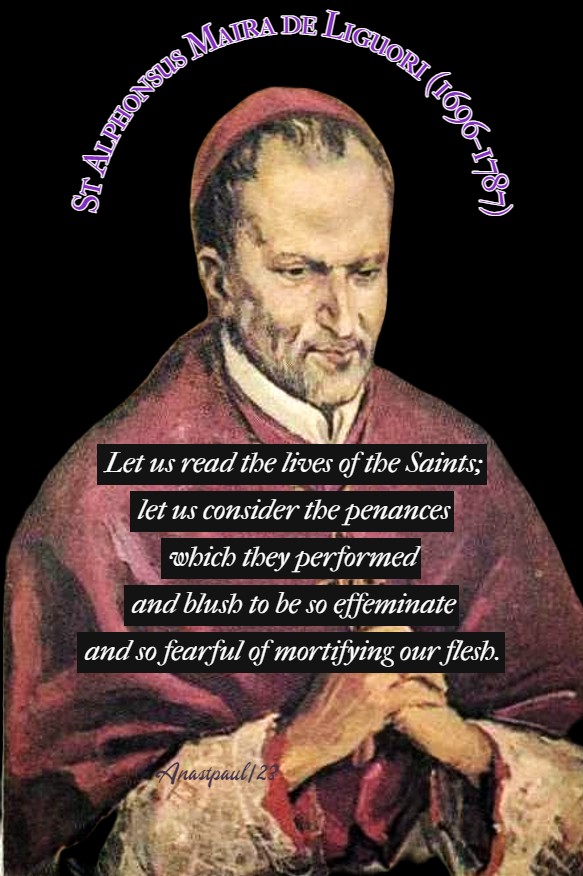
“Let us read the lives of the Saints; let us consider the penances which they performed and blush to be so effeminate and so fearful of mortifying our flesh.”
St Alphonsus Maria de Liguori (1696-1787) Most Zealous Doctor
One Minute Reflection – 3 November – “The Month of the Holy Souls in Purgatory” – Within the Octave of All Saints – Apocalypse 7:2-12, Matthew 5:1-12– Scripture search here: https://www.drbo.org/
“They shall see God.” – Matthew 5:8
REFLECTION – “We want to see God, we seek to see Him, we ardently desire to see Him. Who does not desire this? But note what the Gospel says: “Blest are the pure of heart, they shall see God.” Do what is necessary in order to see Him! To compare it with something from material reality, how can you want to contemplate the rising sun if your eyes are sick? If your eyes are healthy that light will be a pleasure for you; if they are sick, it will be torture for you. You will surely not be allowed to see, with an impure heart, that which one can only see with a pure heart. You will be moved away, put at a distance, you will not see!
How often did the Lord proclaim people to be ‘blest‘? What reasons for eternal happiness did He cite, what good works, what gifts, what merits and what rewards? No other! the beatitude says, “They shall see God.” This is what the others say: “How blest are the poor in spirit, the reign of God is theirs. Blest are the lowly; they shall inherit the land. Blest are the sorrowing; they shall be consoled. Blest are they who hunger and thirst for holiness; they shall have their fill. Blest are they who show mercy; mercy shall be theirs.” So none other asserts, “They shall see God.”
The vision of God is promised ONLY to those with a pure heart. This is not without a reason, since the eyes which allow us to see God are in the heart. Those are the eyes the Apostle Paul was speaking of when he said: “May He enlighten your innermost vision” (Eph 1:18). So, at the present time because of their weakness, those eyes are enlightened by faith; later, because of their strength, they will be enlightened by vision… “Now we see indistinctly, as in a mirror; then we shall see face-to-face.” (1 Cor 13:12).” (1 Cor 13:12).” – St Augustine (354-430) Father and Doctor of the Church (Sermon 53).
PRAYER – Almighty, eternal God, Who granted us to honour the merits of all Thy Saints in a single solemn festival, bestow on us, we beseech Thee, through their manifold intercession, that abundance of Thy mercy for which we yearn. Through Jesus Christ, Thy Son our Lord, Who lives and reigns with Thee, in the unity of the Holy Ghost, God, world without end. Amen (Collect).
Our Morning Offering – 3 November – “The Month of the Holy Souls in Purgatory” – First Friday and a Friday of the Passion
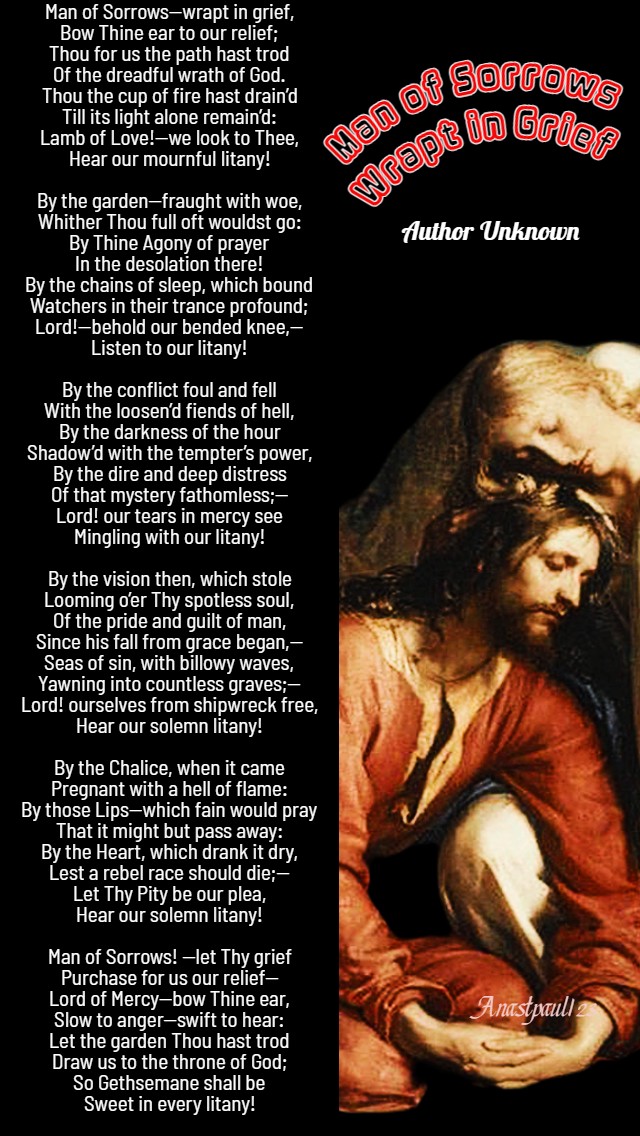
Man of Sorrows—Wrapt in Grief From an old French Hymn Author Unknown
Man of Sorrows—wrapt in grief, Bow Thine ear to our relief; Thou for us the path hast trod Of the dreadful wrath of God. Thou the cup of fire hast drain’d Till its light alone remain’d: Lamb of Love!—we look to Thee, Hear our mournful litany!
By the garden—fraught with woe, Whither Thou full oft wouldst go: By Thine Agony of prayer In the desolation there! By the chains of sleep, which bound Watchers in their trance profound; Lord!—behold our bended knee,— Listen to our litany!
By the conflict foul and fell With the loosen’d fiends of hell, By the darkness of the hour Shadow’d with the tempter’s power, By the dire and deep distress Of that mystery fathomless;— Lord! our tears in mercy see Mingling with our litany!
By the vision then, which stole Looming o’er Thy spotless soul, Of the pride and guilt of man, Since his fall from grace began,— Seas of sin, with billowy waves, Yawning into countless graves;— Lord! ourselves from shipwreck free, Hear our solemn litany!
By the Chalice, when it came Pregnant with a hell of flame: By those Lips—which fain would pray That it might but pass away: By the Heart, which drank it dry, Lest a rebel race should die;— Let Thy Pity be our plea, Hear our solemn litany!
Man of Sorrows! —let Thy grief Purchase for us our relief— Lord of Mercy—bow Thine ear, Slow to anger—swift to hear: Let the garden Thou hast trod Draw us to the throne of God; So Gethsemane shall be Sweet in every litany!
This translation by Matthew Bridges (1800-1894) (The Passion of Jesus 1852) Hymnist, Poet, Writer Converted to Catholicism in 1848, by the influence of John Henry Newman (1801-1890) Tune: “Anima Christi (English)” traditional English melody.
Saint of the Day – 3 November – Saint Rumwold of Buckingham (c650-650) Infant Saint, born with miraculous adult abilities and mystical gifts. Born in c650 at King Sutton, Northants, England and died three days later in the same place. Also known as – Rumwold of Brackley, Rumbald of…. Rumbold of…. Rumwald of….
Tucked away in an almost-forgotten 11th Century manuscript is the extraordinary tale of St Rumwold, an infant saint who lived on this earthly plane for only three days. But in that short time, he not only spoke with the eloquence of a grown and educated man but he declared himself a Christian and gave a sermon to those who had gathered for his birth. The Author of that manscript, was Bishop St Wulfstan of Worcester (c 1008–1095),1070s,
Rumwold was born in the District of King’s Sutton sometime in the 7th Century, the son of the King of Northumberland (also known as Northumbria, in northern England) and his wife, who was a daughter of Penda of Mercia. The hagiography of his short life states that his parents were en-route to visit Penda for the birth of their first child, the infant Rumwold.
Before they could reach their destination, the party was forced to make camp by the roadside in a meadow, as the Princess of Mercia had entered labour. Rumwold was born in the meadow, near to the place that would become known as Sutton and then later as King’s Sutton. Sadly the infant lived only for a short time and died on the third day after his birth. Rumwold was buried in Sutton.
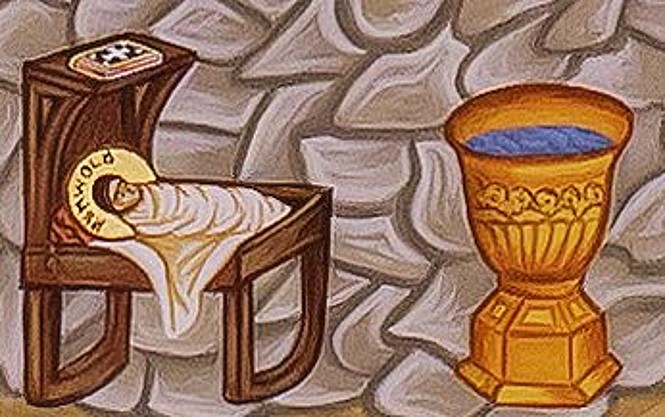
Not an unusual story so far, but it is the events following Rumwold’s birth which begin to move into the realm of miracles. St Wulfstan tells of how Rumwold’s birth was “desired by many and sanctified by God” and that upon being born, the infant proclaimed three times “I am a Christian!” The child then asked the two Priests who attended the royal party, Widerin and Edwold, to Baptise him and grant him the grace of receiving Holy Communion. Seeing as there was no Baptismal Font nearby, he directed the Priests to a nearby bowl-shaped stone. The men were miraculously able to lift it and carry it to the meadow to use for the Baptism. The sBaptismal Font can still be seen in King’s Sutton Church.
St Rumwold’s original stone Baptismal Font
Following the ceremony, Rumwold proceeded to give a lengthy sermon about the need for virtuous living to all those present. He finished by decreeing that after his death, his body should lay for one year at the place which would be called Sutton, for two years at a place to be named Brackley, before coming to his final resting place which would be known as Buckingham. None of these place-names existed at the time of Rumwold’s birth. Rumwold died, as he prophesied, on the third day of his life, the 3rd of November.
Accounts of Rumwold’s miraculous life were widely circulated in the Middle Ages and his Tomb and Shrine in the old Church of Buckingham became an important focus for pilgrims. Many came to take the curative waters of St Rumbold’s Well close to the Town. The earliest Inns of Buckingham were reputedly founded and flourished on the pilgrims’ trade.
Unfortunately Pilgrimages to Buckingham ceased after the Reformation and St Rumwold’s Shrine and Tomb seem to have been demolished when the old Buckingham Church decayed and collapsed in 1776. Regrettably nothing was transferred to the present-day Church. However, there is a recently-erected Memorial in the old Churchyard which reads:
“Near this spot within the old Church of Buckingham, was the Tomb and Shrine of the Infant Saint Rumbold, who lived and died in c650.”
St Rumwold’s Well has been protected and its site still remains.
St Acepsimas St Acheric of Vosges Bl Alphais of Cudot Bl Berardo dei Marsi Bl Berchtold of Engelberg St Caesarius St Cecilio Manrique Arnáiz St Clydog St Cristiolus St Domnus of Vienne St Elerius St Englatius St Florus of Lodeve St Gaudiosus of Tarazona St Germanus St Guenhael St Hermengaudius of Urgell St Hilary of Viterbo
St Sylvia Mother of St Gregory the Great, Pope St Theophilus St Valentine of Viterbo St Valentinian St Vitalis St William of Vosges St Winifred of Wales St Wulganus
Innumerable Martyrs of Saragossa: A large group of Christians martyred in Zaragoza, Spain by Dacian during the persecutions of Diocletian. Dacian ordered all Christians of the city into exile under pain of death; when they were assembled to leave, Dacian ordered imperial soldiers to massacre the lot of them. They were Martyred in 304.
Thought for the Day – 2 November – Meditations with Antonio Cardinal Bacci (1881-1971)
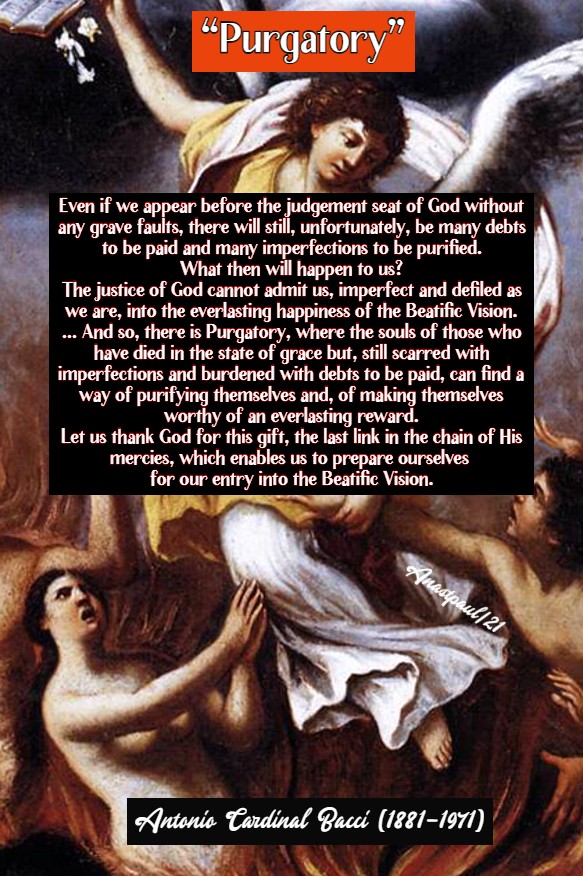
“Purgatory”
“Purgatory is the masterpiece of God’s justice and mercy. St John tells us in the Apocalypse, that nothing defiled can enter into the Heavenly Jerusalem (Apoc 21:27).
There are very few, however, who are privileged to arrive at the supreme moment of death, still wearing their Baptismal robe of innocence. Even the just man falls very often as the Holy Spirit warns us (Prov 24:16). We all possess many failings and have been guilty of many sins, either mortal or venial. It is true, that we can obtain forgiveness by penance and by receiving the Sacraments but, there still remains the temporal punishment due to our sins. Neither the small penances imposed by the confessor, nor our own tiny acts of voluntary mortification, are sufficient to satisfy our debt. We cannot be certain, moreover, that we shall be able, at the hour of our death, to cleanse ourselves of all our sins, by means of one good Confession. Even if we appear before the judgement seat of God without any grave faults, there will still, unfortunately, be many debts to be paid and many imperfections to be purified.
What then will happen to us? The justice of God cannot admit us, imperfect and defiled as we are, into the everlasting happiness of the Beatific Vision. Will He reject us, therefore, even as He rejects those who die in mortal sin and are condemned to eternal punishment? This is unthinkable, for the mercy of God is as infinite as His justice. And so, there is Purgatory, where the souls of those who have died in the state of grace but, still scarred with imperfections and burdened with debts to be paid, can find a way of purifying themselves and, of making themselves worthy of an everlasting reward.
Let us thank God for this gift, the last link in the chain of His mercies, which enables us to prepare ourselves for our entry into the Beatific Vision.”
Quote/s of the Day – 2 November – “The Month of the Holy Souls in Purgatory” – All Souls Day
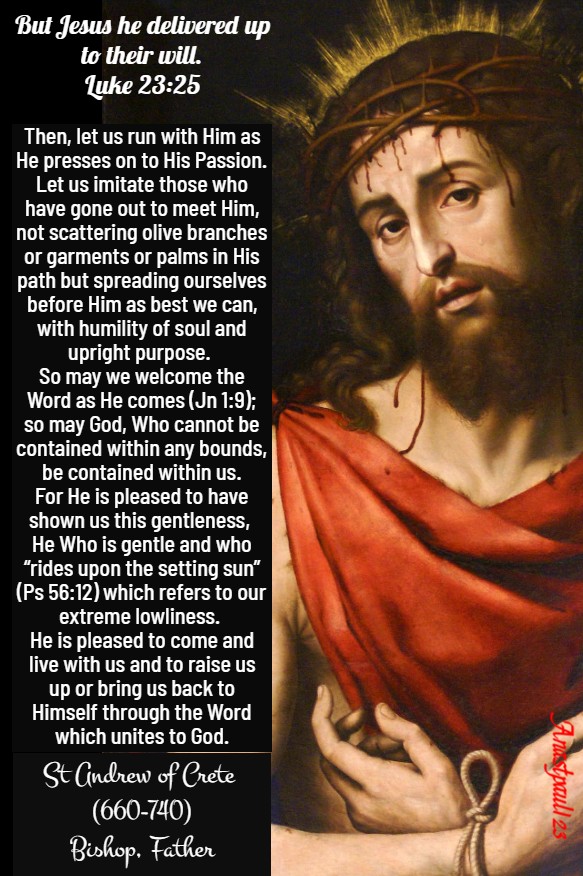
“Then, let us run with Him as He presses on to His Passion. Let us imitate those who have gone out to meet Him, not scattering olive branches or garments or palms in His path but spreading ourselves before Him as best we can, with humility of soul and upright purpose. So may we welcome the Word as He comes (Jn 1:9); so may God, Who cannot be contained within any bounds, be contained within us. For He is pleased to have shown us this gentleness, He, Who is gentle and who “rides upon the setting sun” (Ps 56:12) which refers to our extreme lowliness. He is pleased to come and live with us and to raise us up or bring us back to Himself.”
St Andrew of Crete (660-740) Bishop, Father of the Church
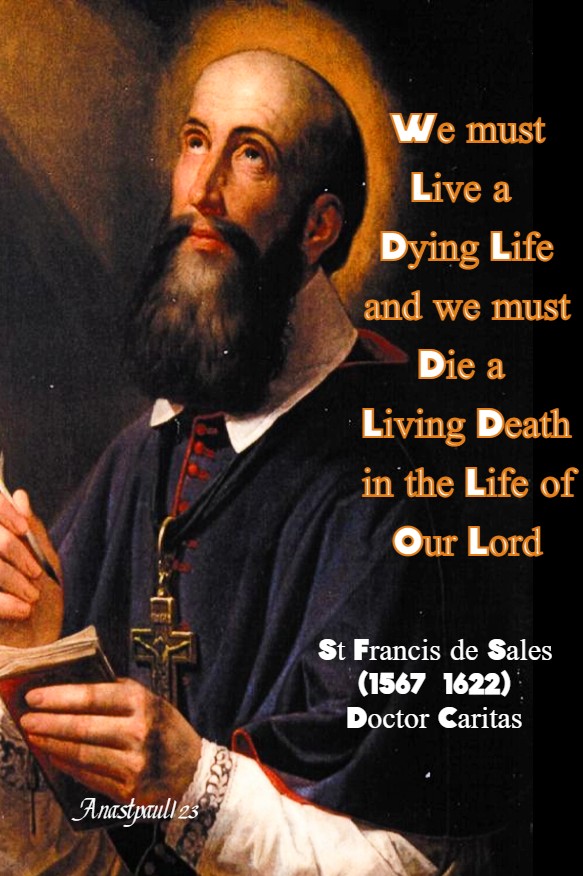
“We must live a dying life and we must die a living death in the life of our Lord.”
(The Spirit of St. François de Sales, XV 6 )
St Francis de Sales (1567-1622) Doctor of the Church
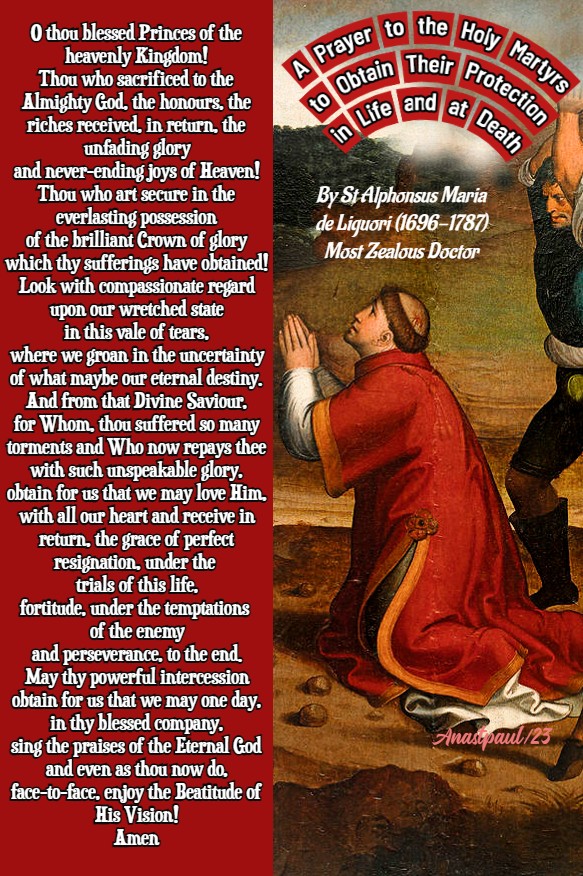
A Prayer to the Holy Martyrs to Obtain Their Protection in Life and at Death By St Alphonsus Maria de Liguori (1696-1787)
O thou blessed Princes of the heavenly Kingdom! Thou who sacrificed to the Almighty God, the honours, the riches received, in return, the unfading glory and never-ending joys of Heaven! Thou who art secure in the everlasting possession of the brilliant Crown of glory which thy sufferings have obtained! Look with compassionate regard upon our wretched state in this vale of tears, where we groan in the uncertainty of what maybe our eternal destiny. And from that Divine Saviour, for Whom, thou suffered so many torments and Who now repays thee with such unspeakable glory, obtain for us that we may love Him, with all our heart and receive in return, the grace of perfect resignation, under the trials of this life, fortitude, under the temptations of the enemy and perseverance, to the end. May thy powerful intercession obtain for us that we may one day, in thy blessed company, sing the praises of the Eternal God and even as thou now do, face-to-face, enjoy the Beatitude of His Vision! Amen
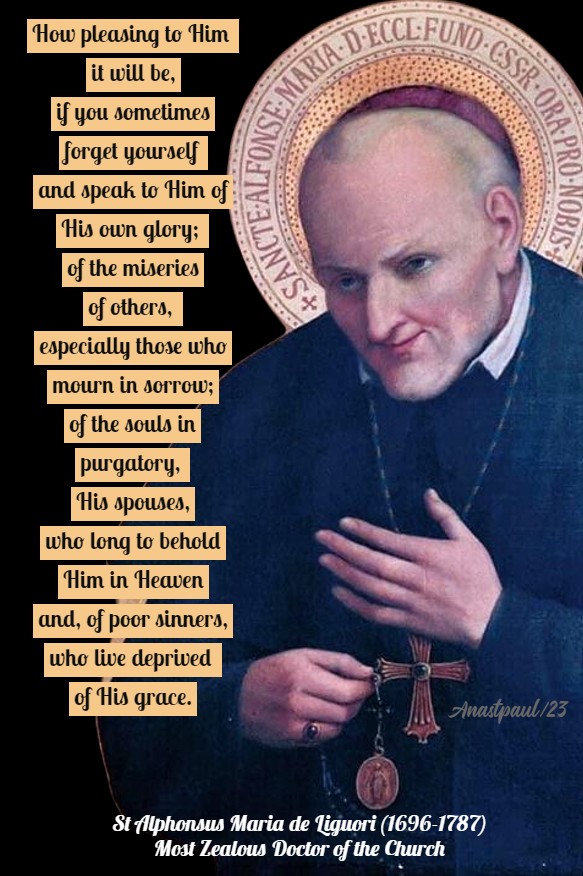
“How pleasing to Him it will be, if you sometimes forget yourself and speak to Him of His own glory; of the miseries of others, especially those who mourn in sorrow; of the souls in purgatory, His spouses, who long to behold Him in Heaven and, of poor sinners, who live deprived of His grace.”
St Alphonsus de Liguori (1696-1787) Most Zealous Doctor
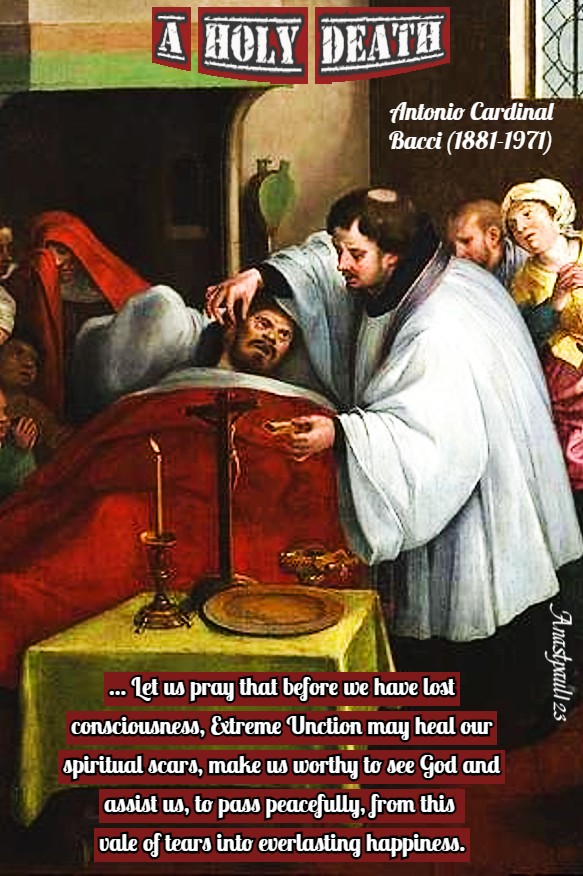
“… Let us pray that before we have lost consciousness, Extreme Unction may heal our spiritual scars, make us worthy to see God and assist us, to pass peacefully, from this vale of tears into everlasting happiness.”
One Minute Reflection – 2 November – “The Month of the Holy Souls in Purgatory” – All Souls Day – 1 Corinthian 15:51-57, John 5:25-29 – Scripture search here: https://www.drbo.org/
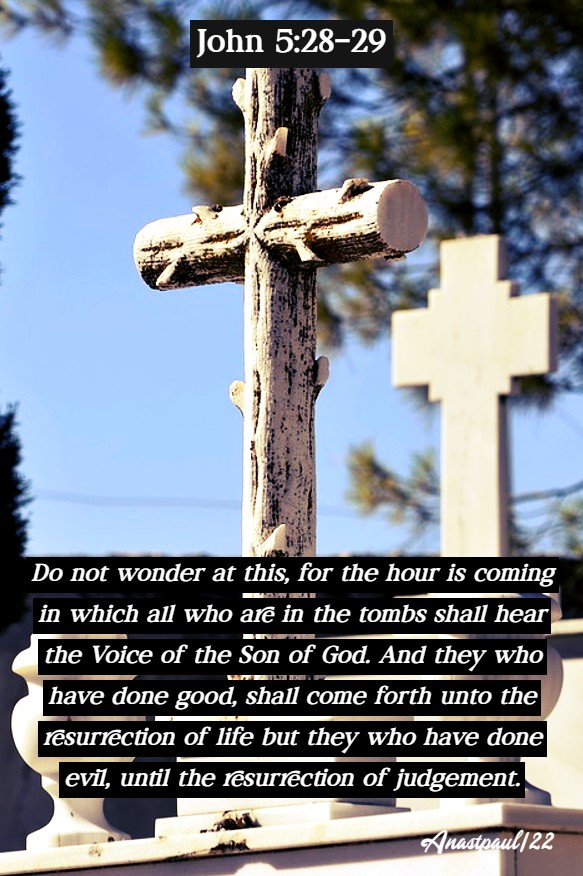
“Do not wonder at this, for the hour is coming in which all who are in the tombs shall hear the Voice of the Son of God. And they who have done good, shall come forth unto the resurrection of Life but they who have done evil, until the resurrection of judgement.” – John 5:28-29
REFLECTION – “Devout, wise and good people are not afraid of death, in view of the great hope they have in what lies before them. Everyday they think of death as of a departure and of the last day, as when the offspring of Adam will be born! The Apostle Paul says: “Death reigned from Adam to Moses, even over those who did not sin, as has happened with all the children of Adam” (Rm 5:14.12) … It has happened, too, in all Moses’ descendants, to the end of the world. However, Moses declared that its rule would be destroyed; death thought to hold everyone captive and rule over them forever. .., but when the Holy One called to Moses, from the heart of the bush, he said to him: “I am the God of Abraham, of Isaac and of Jacob” (Ex 3:6). When it heard these words, death was terrified, it trembled with fear, understanding that … God is Lord over the dead and the living and would come one day when men would escape from its darkness. Now Jesus our Saviour has repeated these words to the Sadducees and said: “He is not God of the dead, for all are alive for Him” (Lk 20:38) …
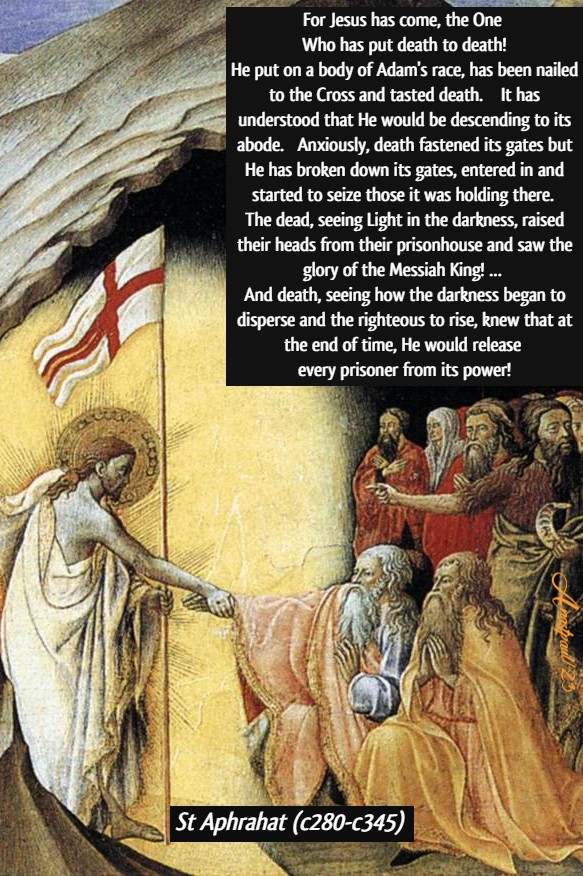
For Jesus has come, the One Who has put death to death! He put on a body of Adam’s race, has been nailed to the Cross and tasted death. It has understood that He would be descending to its abode. Anxiously, death fastened its gates but He has broken down its gates, entered in and started to seize those it was holding there. The dead, seeing Light in the darkness, raised their heads from their prisonhouse and saw the glory of the Messiah King! … And death, seeing how the darkness began to disperse and the righteous to rise, knew that at the end of time, He would release every prisoner from its power!” – St Aphrahat (c280-c345) Bishop near Mosul, Father (Expositions No 22).
PRAYER – O God, Creator and Redeemer of all the faithful, grant to the souls of Thy servants and handmaids, the remission of all their sins, that they may obtain, by our loving prayer,s the forgiveness which they have always desired. Who lives and reigns with God the Father, in the unity of the Holy Spirit, God, world without end. Amen (Collect).
Our Morning Offering – 2 November – “The Month of the Holy Souls in Purgatory”
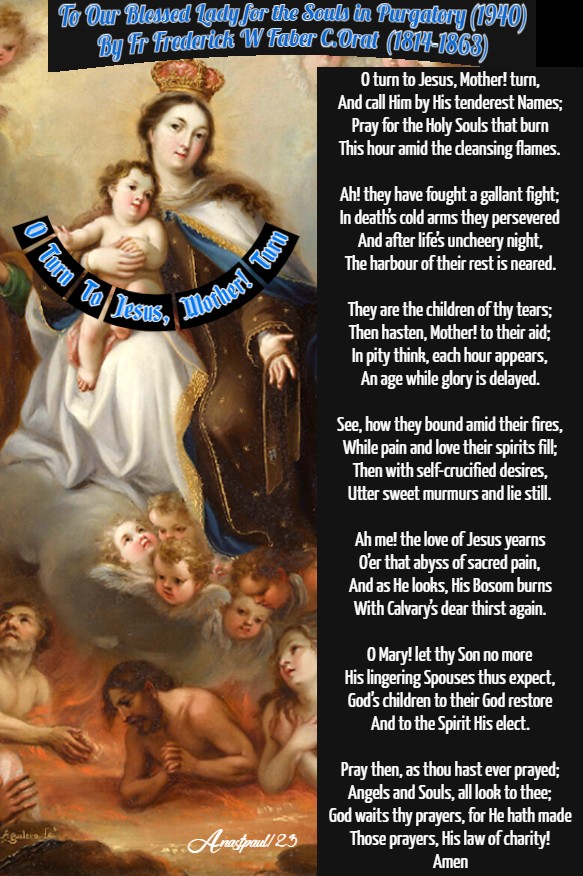
O Turn To Jesus, Mother! Turn To Our Blessed Lady for the Souls in Purgatory (1940) By Fr Frederick W Faber C.Orat (1814-1863)
O turn to Jesus, Mother! turn, And call Him by His tenderest Names; Pray for the Holy Souls that burn This hour amid the cleansing flames.
Ah! they have fought a gallant fight; In death’s cold arms they persevered And after life’s uncheery night, The harbour of their rest is neared.
In pains beyond all earthly pains, Favourites of Jesus! there they lie, Letting the fire wear out their stains And worshipping God’s purity.
Spouses of Christ they are, for He Was wedded to them by His blood And Angels o’er their destiny In wondering adoration brood.
They are the children of thy tears; Then hasten, Mother! to their aid; In pity think, each hour appears, An age while glory is delayed.
See, how they bound amid their fires, While pain and love their spirits fill; Then with self-crucified desires, Utter sweet murmurs and lie still.
Ah me! the love of Jesus yearns O’er that abyss of sacred pain, And as He looks, His Bosom burns With Calvary’s dear thirst again.
O Mary! let thy Son no more His lingering Spouses thus expect, God’s children to their God restore And to the Spirit His elect.
Pray then, as thou hast ever prayed; Angels and Souls, all look to thee; God waits thy prayers, for He hath made Those prayers, His law of charity! Amen
Saint of the Day – 2 November – Blessed John Bodey (1549-1583) Layman, Martyr, Husband and Schoolmaster. Born in 1549 at Wells, Somerset, England and died on 2 November 1583 at Andover, England by being hanged, drawn and quartered for the crime of being a Catholic and refusing to accept Elizabeth I, Queen of England, as the Head of the Church. Blessed John was Beatified on 15 December 1929 together with Blessed John Slade (feast day 30 October), by Pope Pius XI. Additional Memorial – 29 October as one of the Martyrs of Douai, 1 December as one of the Martyrs of Oxford University
John was born in Wells, England, the son of a wealthy merchant and former Mayor. He studied at Winchester and then at Oxford and became an Oxford Fellow of New College, in 1568 at the age of 19. In 1576, John, along with seven others, was deprived of his fellowship for being a Roman Catholic by the Anglican Bishop of Winchester.
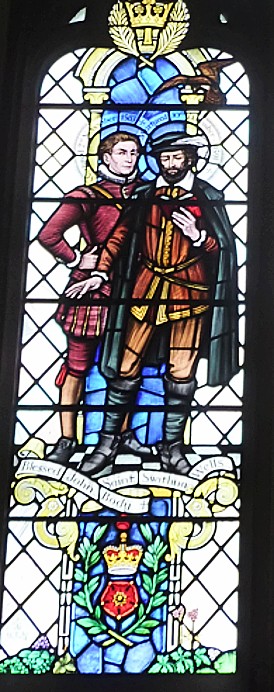
Bl John Bodey left and St Swithun Wells, right at Winchester Catholic Cathedral
In 1577, John travelled to Douay College to study Civil Law but returned to England in February, 1578 when he discovered that his studies could reap no benefits in England as Catholics were forbidden to practice the Legal Profession in any way or under any circumstances.
In 1580, John, by this time married and a schoolmaster, was arrested for continuing to practice the Catholic Faith and rejecting England’s newly-established heretical Church of England or the Anglican Church under the supreme power of the Royal leader.
He was kept in iron shackles in the prison as a “dangerous” prisoner, at Winchester, for three years, which he called his “school of patience.” In 1583 he was tried for treason, both for being a faithful Roman Catholic and for repudiating King Henry VIII’s claim of Royal supremacy of the Church in England, over and above that of the Holy Father in Rome. He was condemned to death in April, 1583, together with John Slade, a fellow layman. There was, apparently, a protest that this Sentence was unjust and illegal, leading to a retriel. But, the two holy men were condemned again—at Andover, Hampshire, in August 1583. Their bravery and perseverance in suffering so impressed their fellow inmates and even the guards that more than one conversion was made – by both Johns, by their virtue and charity!
After the Second Trial – Blessed John Bodey wrote, on behalf of Blessed John Slade and himself:
“We consider that iron for this cause, borne on earth, shall surmount gold and precious stones in Heaven. This is our mark this is our desire. In the mean season we are threatened daily and do look still, when the hurdle shall be brought to the door. I beseech you, for God’s sake that we want not the good prayers of you all for our strength, our joy and our perseverance unto the end. … From our school of patience the 16th September 1583.”
John Bodey was hanged, drawn and quartered at Andover on 2 November 1583. At his Martyrdom, Bodey kissed the halter, saying, “O blessed chain, the sweetest chain and richest that ever came about any man’s neck” and when told he died for treason, exclaimed:
“Indeed, I have been sufficiently censured, for I have been condemned twice; if you may make the hearing of a Blessed Mass – treason, or the saying of an Ave Maria – treason, you may make what you please – treason! … but, I have committed no treason, although, indeed, I suffer the punishment due to treason.”
He then exhorted the people to obey Queen Elizabeth as their worldly ruler: “I acknowledge her as my Lawful Queen in all temporal causes and none other … Ye shall understand, good people all, I suffer death, not for not granting her Majestie to be supreme head of Christ’s Church in England which I may not and will not grant; I pray God long to preserve her Majestie in tranquility over you, even Queen Elizabeth, your Queen and mine; I desire you to obey none other.”
He died saying:
“Jesu, Jesu, esto mihi, Jesu!” “Jesus, Jesus, be for me, Jesus!”
His mother arranged a great feast upon the occasion of her son’s happy death, to which she invited her neighbours, rejoicing at his death as at his marriage, by which his soul was happily and eternally espoused to the Lamb!
Blessed John’s brother Gilbert, was arrested with Alexander Briant on 28 April 1581. He was scourged at Bridewell and afterwards confined in prison. He was released on bail and when not called to appear, escaped to Rheims.
All Souls Day – The Commemoration of All the Faithful Departed: Commemoration of the faithful departed in Purgatory. Abbot Odilo of Cluny instituted it in the Monasteries of his congregation in 998, other religious orders took up the observance and it was adopted by various Diocese and gradually by the whole Church. The Office of the Dead must be recited by the clergy on this day and Pope Benedict XV granted to all Priests, the privilege of saying three Masses of requiem –
St Ambrose of Agaune St Ambrose of Agaune St Amicus of Fonte Avellana St Amicus of Rambone St Baya of Scotland St Domninus of Grenoble St Erc of Slane St Eustochium of Tarsus St George of Vienne
Blessed John Bodey (1549-1583) Layman, Martyr
St Jorandus of Kergrist St Justus of Trieste St Marcian of Chalcis
Martyrs of Isfahan – 5+ Saints: Acindynus, Pegasius and Anempodistus were Persian priests who were imprisoned, tortured, interrogated and Martyred in the persecutions of king Sapor II of Persia; he considered any Christian to be a Roman spy and anti-Persian.
Martyrs of Sebaste – 10 Saints: A group of ten soldiers in the imperial Roman army of Emperor Licinius Licinianus who were executed together for refusing to burn incense as a sacrifice to the emperor. The only details that have survived are five of their names – Agapius, Cartherius, Eudoxius, Styriacus and Tobias. They were burned at the stake in 315 in Sebaste (in modern Turkey).
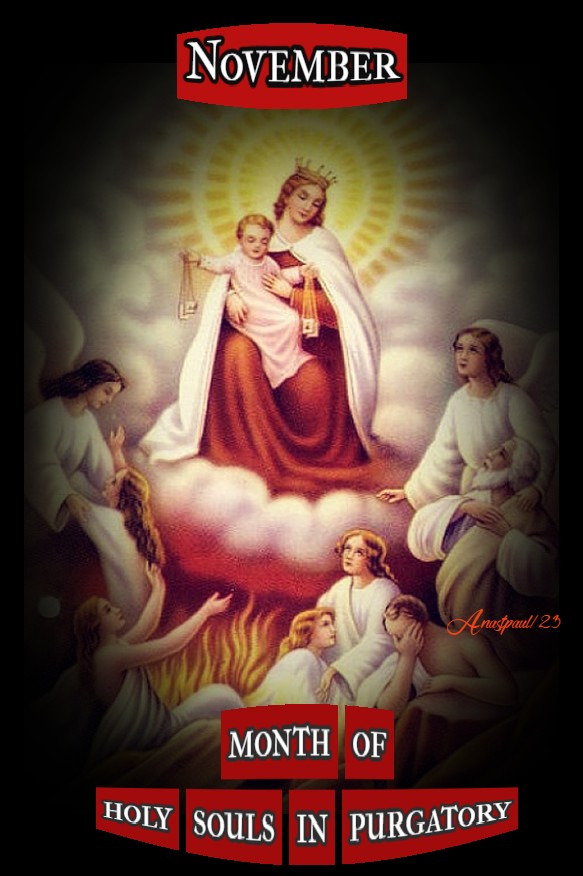
1 November The Month of “The Holy Souls in Purgatory” or of “The Church Suffering” or “The Faithful Departed”
“It is, therefore, a holy and wholesome thought to pray for the dead that they may be loosed from sins.“
2 Machabees 12:46
The faithful who recite prayers or perform other devout exercises in supplication for the faithful departed during the Month of November, may gain: An Indulgence of 3 years once a day, on each day of the Month. A Plenary Indulgence on the usual conditions, if they perform these devotions DAILY for the ENTIRE Month of November. The De Profundis and Requiem aeternam, of themselves, attract a further 100 days Partial Indulgence.
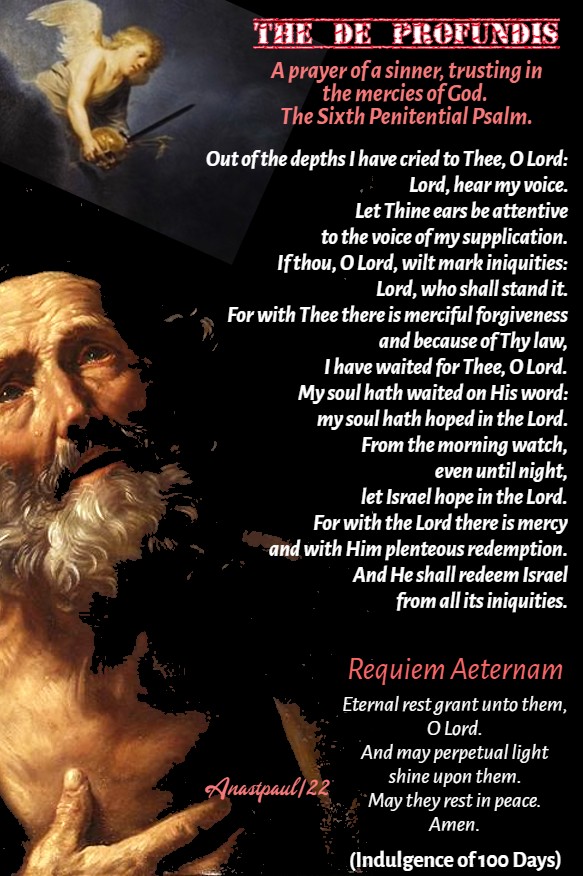
The De Profundis Psalm 129
A prayer of a sinner, trusting in the mercies of God. The Sixth Penitential Psalm.
Out of the depths I have cried to Thee, O Lord: Lord, hear my voice. Let Thine ears be attentive to the voice of my supplication. If thou, O Lord, wilt mark iniquities: Lord, who shall stand it. For with Thee there is merciful forgiveness and because of Thy law, I have waited for Thee, O Lord. My soul hath waited on His word: my soul hath hoped in the Lord. From the morning watch, even until night, let Israel hope in the Lord. For with the Lord there is mercy and with Him plenteous redemption. And He shall redeem Israel from all its iniquities.
(Eternal rest or “Requiem aeternam”) Eternal rest grant unto them, O Lord. And may perpetual light shine upon them. May they rest in peace. Amen.
(Indulgence of 100 Days)
*Psalm 129 in Douay Rheims
Pope Clement XII. was the first who, in order to move the piety of Christians to pray for the souls in Purgatory, granted, by a Brief of 4 August 1736, Coelestes Ecclesiae thesauros – i. The Indulgence of 100 days to all the faithful, everytime that, at the sound of the bell, at the first hour after the evening Ave Maria, they say devoutly, on their knees the psalm De profundis, with a Requiem aAternamat the end of, it. (The evening Ave Maria in Rome varies with the season; it is commonly taken as 6 o’clock.) ii. A Plenary Indulgence to those who perform this pious exercise, for a year, at the hour appointed, once in the year, on any one day, after Confession and Communion. Those who do not know by heart the De Profundis, may gain these Indulgences by saying, in the way already mentioned for the De profundis, one Pater Noster and one Ave Maria, with the Requiem Aeternam. Observe also, that the aforesaid Clement XII. declared, on 12 December 1736, that these Indulgences might be gained by saying the De Profundis etc, as above, although, according to the custom of a particular Church or place, the “signal for the dead,” as it is called, be given by the sound of the bell either before, or after one hour after the evening Ave Maria. Pope Pius VI, by a Rescript of 18 March 1781, granted the above-named Indulgences to all the faithful, who should chance to dwell in any place where no bell for the dead is sounded and who, shall say the De Profundis or Pater Noster, as aforesaid, about the time specified above.
Thought for the Day – 1 November – Meditations with Antonio Cardinal Bacci (1881-1971)
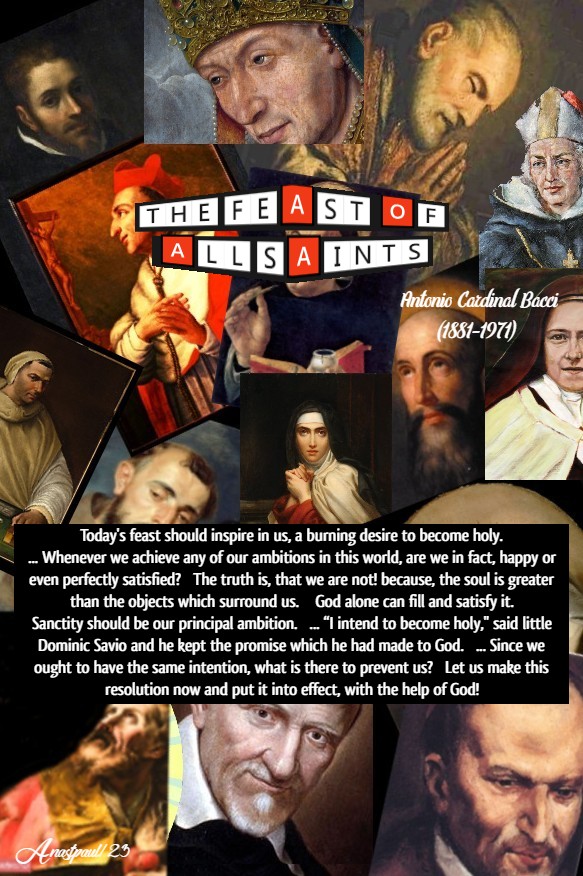
The Feast of All Saints
“Today’s feast should inspire in us, a burning desire to become holy. Men long for many things in this world, things which are often useless and, even sinful. They desire riches, pleasure, honours, success and material comfort. These things may be lawful but, they cannot satisfy the human heart, which is made for God. Whenever we achieve any of our ambitions in this world, are we in fact, happy or even perfectly satisfied? The truth is, that we are not! because, the soul is greater than the objects which surround us. God alone can fill and satisfy it.
Sanctity should be our principal ambition. We should yearn to be more closely united to God, so that His Divinity may be reflected in our thoughts and in our actions. If we enjoy God’s friendship, we shall become more like God and shall be lifted up above petty mundane considerations. Perhaps, we doubt our ability to reach such a high spiritual level? Even so, we should, nevertheless, desire to reach it and, not just in a passing and indifferent manner but, constantly and actively. We should keep our desire alive by repeating it to ourselves and by continually praying for God’s grace to fulfil it. “I intend to become holy,” said little Dominic Savio and he kept the promise which he had made to God. Many people have formed the same resolution, both desert hermits and University professors, both humble workmen and rulers of nations. Since we ought to have the same intention, what is there to prevent us? Let us make this resolution now and put it into effect, with the help of God!”
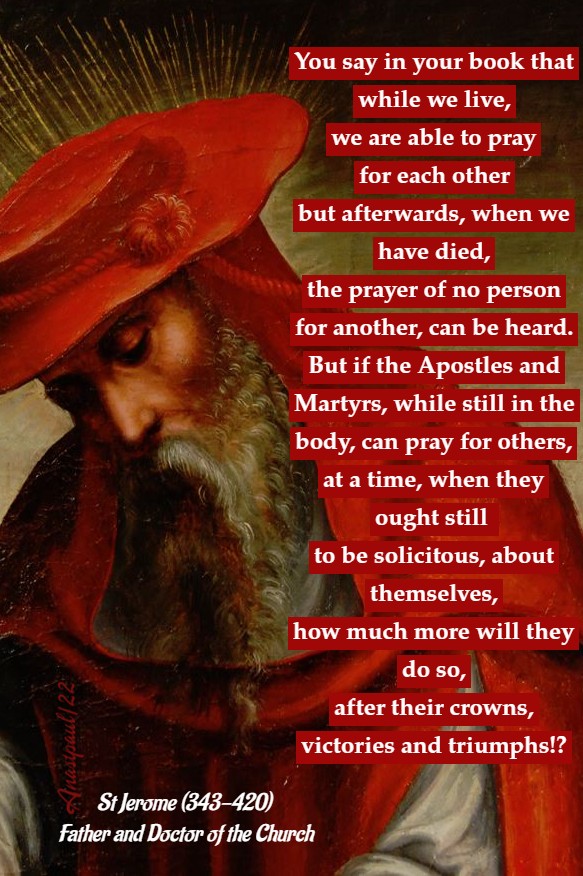
“You say in your book that while we live, we are able to pray for each other but afterwards, when we have died, the prayer of no person for another, can be heard. But if the Apostles and Martyrs, while still in the body, can pray for others, at a time, when they ought still to be solicitous, about themselves, how much more will they do so, after their crowns, victories and triumphs!?”
St Jerome (343-420) Father and Doctor of the Church
“At His Transfiguration Christ showed His disciples, the splendour of His Beauty, to which He will shape and colour, those who are His : ‘He will reform our lowness configured to the Body of His Glory.”
St Thomas Aquinas OP (1225 – 1274) Angelic Doctor of the Church
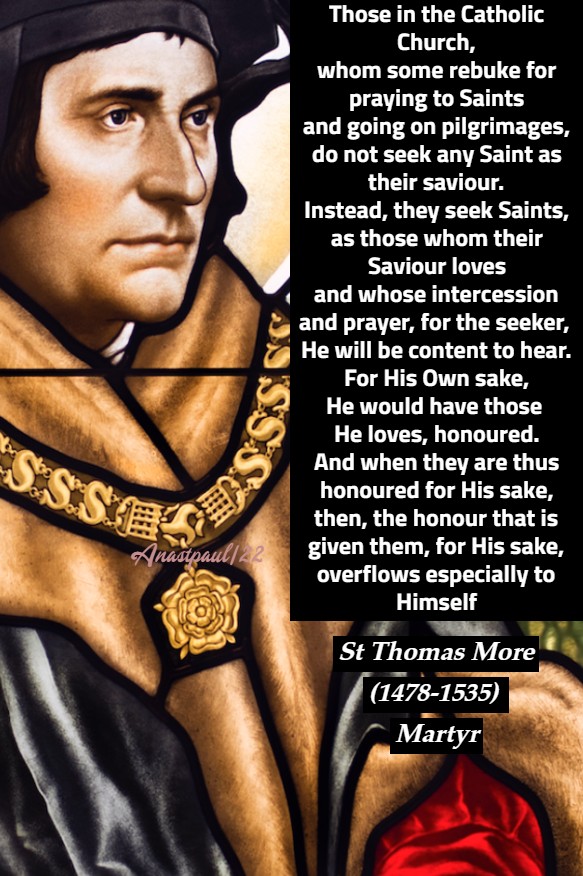
“Those in the Catholic Church, whom some rebuke for praying to Saints and going on pilgrimages, do not seek any Saint as their saviour. Instead, they seek Saints, as those whom their Saviour loves and whose intercession and prayer, for the seeker, He will be content to hear. For His Own sake, He would have those He loves, honoured. And when they are thus honoured for His sake, then, the honour that is given them, for His sake, overflows especially to Himself.”
St Thomas More 1478-1535) Martyr
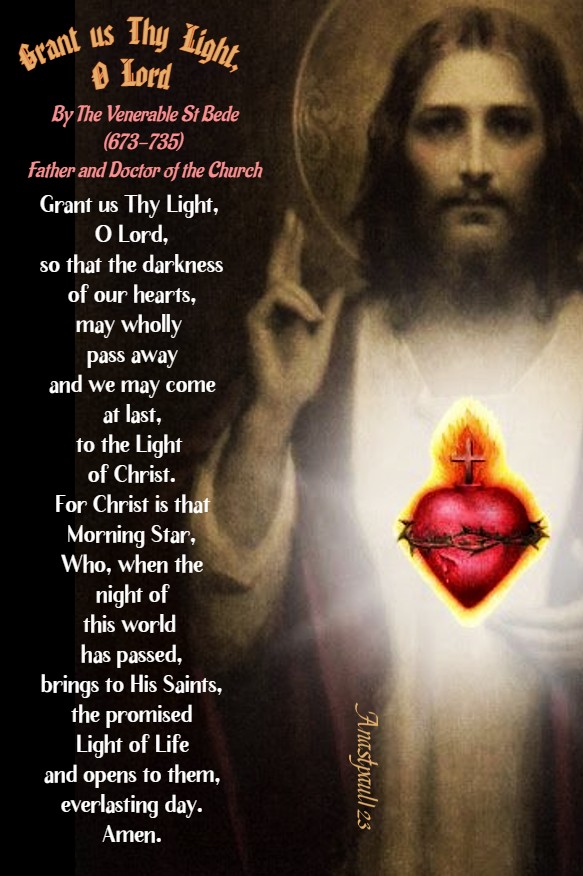
Grant us Your Light, O Lord By The Venerable St Bede (673-735) Father and Doctor of the Church
Grant us Your light, O Lord, so that the darkness of our hearts, may wholly pass away and we may come at last, to the Light of Christ. For Christ is that morning star, who, when the night of this world has passed, brings to His saints, the promised light of life and opens to them, everlasting day. Amen
One Minute Reflection – 1 November – “The Month of the Holy Souls in Purgatory” – All Saints Day – Apocalypse 7:2-12, Matthew 5:1-12 – – Scripture search here: https://www.drbo.org/
“Be glad and rejoice for your reward is very great in Heaven.” – Matthew 5:12
REFLECTION – “Dearly beloved, let us anxiously attend to all that concerns the profession of our common life, “keeping the unity of the spirit in the bond of peace,” by “the grace of our Lord Jesus Christ and the love of God and the imparting of the Holy Spirit ”(Eph 4,3; 2 Cor 13:13). From the love of God comes the unity of the spirit; from the grace of our Lord Jesus Christ comes the bond of peace; from the imparting of the Holy Spirit, comes that communion which is necessary to those who live in common. …
“I believe, 0 Lord, in the Holy Ghost, the holy Catholic Church, the Communion of Saints” (Credo). This is my hope, this is my trust, this is my confidence, this is the whole of my security in the professing of my faith. … If I am allowed, O Lord, to “love Thee and love my neighbour,” (Mt 22:37-39) although my merits are small and few, yet will my hopes reach beyond them. I am confident that the merits of the Saints will help me by the communion of charity, so that the Communion of Saints will make up for my insufficiency and imperfection. … Let charity expand our hope, as far as the Communion of Saints, in the sharing of merits and rewards but the sharing of the latter belongs to the future, for it is the sharing in the glory which shall be revealed in us.
Since, then, there are three communions – the first of nature, which includes the sharing of guilt … the second of grace and the third, of glory. By the communion of grace, that of nature begins to be remade and the sharing of guilt to be excluded but, by the communion of glory, that of nature will be perfectly restored and the communion of anger, will be entirely excluded, when “God will wipe away every tear from the eyes” of the Saints (Is 25:8; Rv 21:4). Then, among all the Saints, there will be “one heart and one soul” and “all things will be in common”when God will be “all in all” (Acts 4:2; 1 Cor 15:28). That we may all arrive at this communion and that we all may be one, “the grace of our Lord Jesus Christ and the love of God, and the imparting of the Holy Spirit be with us all forever. Amen.” – Baldwin of Forde O.Cist ( c 1125–1190) Cistercian Abbot, Bishop, then Archbishop of Canterbury (Treatise on the common life).
PRAYER – Almighty, eternal God, Who granted us to honour the merits of all Thy Saints in a single solemn festival, bestow on us, we beseech Thee, through their manifold intercession, that abundance of Thymercy for which we yearn. Through Jesus Christ, Thy Son our Lord, Who lives and reigns with Thee, in the unity of the Holy Ghost, God, world without end. Amen (Collect).




























You must be logged in to post a comment.