Our Morning Offering – 10 June – “The Month of the Sacred Heart of Jesus” – Saturday Within the Octave of Corpus Christi and Mary’s Saturday
Prayer to the Two Holy Hearts of Jesus and Mary
O Heart of Jesus, pierced for our sins and giving us Your Mother on Calvary! O Heart of Mary, pierced by sorrow and sharing in the sufferings of your Divine Son for our redemption! O Sacred union of these Two Hearts! Praised be the God of Love who united them together! May we unite our hearts and every heart, so that all hearts may live in unity and in imitation of that Sacred unity which exists in these Two Hearts. Triumph, O Sorrowful and Immaculate Heart of Mary! Reign, O Most Sacred Heart of Jesus! – in our hearts, in our homes and families, in the hearts of those who as yet do not know You and in all nations of the world. Establish in the hearts of all mankind the sovereign triumph and reign of Your Two Hearts so that the earth may resound from pole to pole with one cry: Blessed forever be the Most Sacred Heart of Jesus and the Sorrowful and Immaculate Heart of Mary! Obtain for me a greater purity of heart and a fervent love of the spiritual life. May all my actions be done for the greater glory of God in unions with the divine heart of Jesus and the Immaculate Heart of Mary. Hear and answer our prayers and intentions according to Your most merciful will. Amen
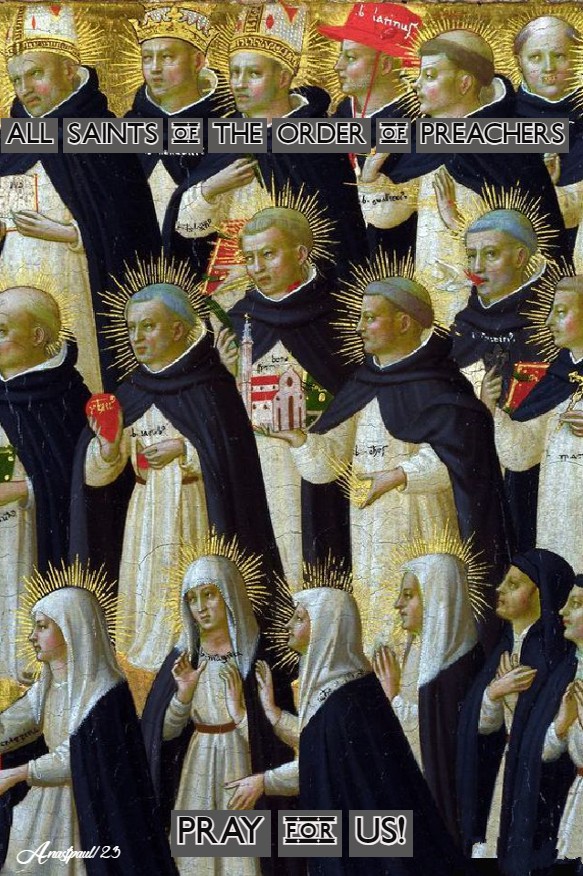
Saint of the Day –10June – Blessed Diana d’Andalo OP (1201-1236) Virgin, Nun of the Order of Preachers Born in 1201 near Bologna, Italy and died on 9 January 1236 in Bologna of natural causes. Beatified on 8 August 1888 by Pope Leo XII. Also known as – Diana degli Andalò.
The Roman Martyrology states: “In Bologna, blessed Diana d’Andalò, Virgin, who, having overcome all the impediments posed by her family, took a vow of cloistered life in the hands of Saint Dominic himself, entering the Monastery of Saint Agnes, which she founded.”
Diana was born into a powerful Roman family in Bologna, Italy in 1201. Nothing is known of her childhood but she was described as “rather spoiled.” She was “of outstanding beauty,” charming, eloquent, well-educated, high spirited, courageous and had good judgement. Dominican scholar Gerald Vann also called her “full of the joy of living, full too of the joy of her own beauty and the power it gave her.”
In 1218, Diana heard the Dominican Scholar and Preacher, Blessed Reginald of Orléans speak in Bologna. His sermons inspired her to give up her worldliness and devote herself to prayer. Following Reginald’s advice, she remained at her family’s home and continued to wear the clothes appropriate to her standing, although she wore an iron chain and hairshirt under them.
In 1219, St Dominic , himself, came to Bologna and to him she vowed her perpetual virginity and she proclaimed her intention to join the Dominican Order as soon as a Convent was established in Bologna.
She persuaded her father to purchase the lands to build a Convent but he refused to allow her to enter it, probably because the family intended that she marry into another prominent family and the Bishop denied permission to build on the site chosen.
In 1222, she ran away to an Augustinian Convent in Ronzano. Her family forcibly removed her and brought her back home;. In the struggle, one of her ribs was broken, an almost fatal injury from which she never fully recovered. St Dominic died shortly afterwards but after she recovered sufficiently in 1223, she again escaped to Ronzano, although her family did not pursue her a second time.
The 3 Sisters make their vows at the new Convent
Shortly after St Dominic’s death, Blessed Jordan of Saxony, St Dominic’ Successor, as leader of the Order, met Diana when he came to Bologna. With his assistance, Diana reconciled with her family, her father agreed to allow her to enter religious life and the Bishop agreed to another site for the Convent. In 1223, the Convent was dedicated to St Agnes in Bologna and Diana entered the Dominican Order there. Four other nuns were also brought from the Convent of St Sixtus in Rome, including the Blessed Cecilia Cesarini, who was made Prioress, and Blessed Amata. The three are always associated together.
Blesseds Cecilia, Diana, Amarta
Diana remained at St Agnes until her death in 1236 and was buried there, along with the remains of Cecilia and Amata. Their Relics were moved several times but always together. Diana’s head was placed in a Reliquary near St Dominic’s Tomb. Diana, along with Cecilia and Amata, were Beatified on 8 Augus 1888, by Pope Leo XIII.
The Reliquary containing Blessed Diana’s skull
Diana is known for a series of letters written to her and to the other Sisters at St Agnes, by Blessed Jordan of Saxony. 37 of the 50 letters that have survived were written directly to her. They are “evidence of the deep friendship shared by Diana and Jordan and demonstrate the possibility of warm affection” between Priests and the cloistered Nuns who pray for them and their work. The letters are also a record of the early history of the Dominican Order. Gerald Vann, Author of the book To Heaven with Diana! a compilation of the correspondence between the two Blesseds, Diana and Jordan, calls the letters “a wonderful treatise on Christian friendship.”
The entrance to St Agnes Convent, built by Bl Diana’s family in Bologna
St Margaret of Scotland (1045-1093) Queen consort of Scotland, Wife and Mother, Apostle of the poor, Reformer. Saint Margaret’s name signifies “pearl” “a fitting name,” says Bishop Turgot, her Confessor and her first Biographer, “for one such as she.” Her soul was like a precious pearl. A life spent amidst the luxury of a Royal Court never dimmed its lustre, or stole it away from Him who had bought it with His Blood. Pope Innocent IV Canonised St Margaret in 1250 in recognition of her personal holiness, fidelity to the Roman Catholic Church, work for Ecclesiastical reform and charity. In 1693 Pope Innocent XII moved her feast day to 10 June but it was changed after Vatican II to 16 November. Wonderful St Margaret: https://anastpaul.com/2018/11/16/saint-of-the-day-16-november-st-margaret-of-scotland-1045-1093-queen/ AND: https://anastpaul.com/2022/06/10/saint-of-the-day-10-june-st-margaret-of-scotland-1045-1093/
Bl Amata of San Sisto St Amantius of Tivoli St Asterius of Petra St Bardo of Mainz
St Caerealis of Tivoli St Censurius of Auxerre (Died 486) Bishop St Crispulus of Rome Blessed Diana d’Andalo OP (1201-1236) Nun of the Order of Preachers Beatified on 8 August 1888 by Pope Leo XII. Bl Elisabeth Hernden Bl Elizabeth Guillen St Evermund of Fontenay St Faustina of Cyzicus Bl Gerlac of Obermarchtal St Getulius of Tivoli
St Landericus of Novalese St Landericus of Paris Bl Mary Magdalene of Carpi St Maurinus of Cologne St Primitivus of Tivoli St Restitutus of Rome Bl Thomas Green St Timothy of Prusa Bl Walter Pierson St Zachary of Nicomedia
Martyrs of North Africa – 17 Saints: A group of seventeen Christians Martyred together in North Africa; the only surviving details are two of their names – Aresius and Rogatius. Both the precise location in North Africa and the date are unknown.
Martyrs of the Aurelian Way – 23 Saints: A group of 23 Martyrs who died together in the persecutions of Aurelian. The only details that survive are three of their names – Basilides, Mandal and Tripos. c.270-275 on the Aurelian Way, Rome, Italy.
Thought for the Day – 9 June – Meditations with Antonio Cardinal Bacci (1881-1971)
The Sacred Heart of Jesus Surmounted by a Flaming Cross
“St Margaret Mary saw the Sacred Heart of Jesus, surmounted by flames in the midst of which, a Cross was raised on high. These flames and this Cross, were the symbol of the infinite love of Jesus. Let us reflect a little. God, immeasurably happy in Himself, wished to communicate a share in His happiness to men, whom He created in a state of earthly happiness. He was offended by men and, when He saw that they were heading for destruction, He sent His Eternal Word to them. The Word took a human nature and became our Brother; He preached the way to Heaven and gave us the means to achieve it. More than this, He offered Himself as a divine victim of expiation for our sins. Having been condemned by those whom He had come to show the way, He died on the Cross and shed all His Blood, for our salvation.
Pagans of all times have called this “the folly of the Cross.” In fact, it is the miracle of the infinite love of God for humanity. Let us remember, however, that, although His love and goodness are infinite, so also is His justice! It is an overwhelming miracle of love on the part of God, that He became man and died for us. It will be our own downfall if we fail to co-operate with this miracle of love!
The same Jesus, Who died on the Cross for us and revealed His Heart, pierced and flaming with love, will one day appear with the same glorious Sign of the Cross, as our Supreme Judge. Then, He will say to the wicked: “Depart from me, accursed ones, into everlasting fire!”
God’s justice is, as infinite as His charity! We must choose either the way of the Cross, the way of love and goodness to which the Sacred Heart of Jesus invites us, or the way of sin, which leads to the gulf of ruin and the final condemnation of the Supreme Judge. This is the tremendous choice we have to make!”
Quote/s of the Day – 9 June – Within the Octave if Corpus Christi – 1 Corinthians 23-29, John 6:56-59 – Scripture search here: https://www.drbo.org/
“The Eucharist is the Sacrament of Love. It signifies Love, It produces love. The Eucharist is the consummation of the whole spiritual life.”
St Thomas Aquinas (1225-1274) Doctor angelicus/Doctor communis
“The Holy Eucharist is the perfectCommunion of Saints, for it is the food common to Angels and sainted souls in Paradise and ourselves – it is the true Bread of which all Christians participate. The forgiveness of sins, the Author of forgiveness being there, is confirmed; the seed of our resurrection sown, life everlasting bestowed. … This very belief in the Most Holy Sacrament, which, in truth, reality and substance, contains the true and natural Body of Our Lord, is actually the abridgment of our Faith, according to that of the Psalmist: “He had made a memory of His wonderful works.”
One Minute Reflection – 9 June – Within the Octave if Corpus Christi – Saints Primus and Felicianus (Died c304) Cinfessors, Brother Lay Martyrs – 1 Corinthians 23-29, John 6:56-59 – Scripture search here: https://www.drbo.org/
This is the Bread that has come down from Heaven; not as your fathers ate the manna and died. He who eats this Bread shall live forever.” – John 6:59
REFLECTION – Christ is “the bread of life” for those who believe in Him: to believe in Christ is to eat the bread of life, to possess Christ within one, is to possess eternal life… “I am the bread of life,” He says; “your fathers ate manna in the wilderness and they are dead” (Jn 6,48f). By this is to be understood ,spiritual death. Why are they dead? Because they believed in what they saw and did not understand what they could not see… Moses ate manna, Aaron ate it and many others, too, who pleased God and are not dead. Why are they not dead? Because they understood, in a spiritual fashion, they were spiritually hungry, they tasted the manna spiritually, so that they might be spiritually satisfied. “This is the bread that came down from heaven: whoever eats it will never die” (v.50). This manna – that is to say, Christ, who Himself spoke like this…, was prefigured by the manna but was able to do more than manna could. For manna could not, of itself, prevent dying spiritually… But the righteous saw Christ in the manna, they believed in His coming and Christ, of whom manna was the symbol, grants to all who believe in Him that they should not spiritually die. Hence He says: “This is the bread come down from heaven; whoever eats it will never see death.” Here on earth, here now, before your eyes, your eyes of flesh: here is to be found the “bread from heaven” (v.51). The “bread of life” we spoke of a moment ago is now called “living bread.” Living bread because it contains, within itself, the life that abides and can deliver from spiritual death and bestow life. First He said: “Whoever eats it will never die” now he speaks clearly, concerning the life He gives: “Whoever eats this bread will live for ever” (v.58). Archbishop Baldwin of Canterbury (c 1125-1190) Cistercian – The Sacrament of the Altar II
PRAYER – Grant O Lord, we pray, that we may ever honour the festival of thy holy Martyrs, Primus and Felicianus and Thy truth of the Church of Saints. Through Jesus Christ, Thy Son our Lord, Who lives and reigns with Thee, in the unity of the Holy Ghost, God, world without end. Amen (Collect).
Sweet Heart of my JESUS, Make me love Thee ever more and more! – 300 Days Indulgence Once a day, Plenary Once a month – Blessed Pope Pius IX – 26 November 1876
Our Morning Offering – 9 June – “The Month of the Sacred Heart of Jesus”
Prayer in Adoration of the Sacred Heart By St Margaret Mary Alacoque (1647-1690) Visionary and Apostle of the Sacred Heart of Jesus
Jesus Christ, my Lord and my God, Whom I believe to be really present in the Blessed Sacrament of the Altar, receive this most profound Act of Adoration to supply for the desire I have, to adore Thee unceasingly and in thanksgiving, for the sentiments of love which Thy Sacred Heart has for me in this Sacrament. I cannot better acknowledge them, than by offering Thee, all the Acts of Adoration, resignation, patience and love which this same Heart has made during its mortal life and which it makes still and which it shall make eternally in Heaven, in order that through it, I may love Thee, praise Thee and adore Thee worthily, as much as it is possible for me. I unite myself to this Divine Offering which Thou dost make to Thy Divine Father and I consecrate to Thee, my whole being, praying Thee, to destroy in me, all sin and not to permit that I should be separated from Thee, in time and eternally. Amen.
Saints of the Day – 9 June – Saints Primus and Felicianus (Died c304) Brother Lay Martyrs, Confessors. Martyred during the Diocletian persecution. The Martyrologium Hieronymianum gives under 9 June the names of Primus and Felician who were buried in the Church of Saint Stephen on Mount Celio, Rome.
The Roman Martyrology reads today: “At Rome, on Mount Caelius, the birthday of the holy Martyrs, Primus and Felician, under the Emperor Diocletian and Maximian. These glorious Martyrs lived long in the service of the Lord and endured sometimes together, sometimes separately, various cruel torments. They were finally beheaded by Promotus, Governor of Nomentum and thus happily ended their combat.”
Saints Primus and Felicianus (Died c304) Martyrs By Fr Francis Xavier Weninger ,SJ (1805-1888)
“Primus and Felicianus, two holy Martyrs, were brothers and natives of Rome. They were renowned on account of their birth and wealth but still more, on account of the blameless life they led and their determination to remain constant in the True Faith, although they knew the suffering which was in store for them, even from their pagan parents, as from other persecutors of the Christian faith. At that period the Emperors Dioclesian and Maximian reigned and the Christians were most cruelly persecuted. Many of them were cast into prison, while others were put to death by the most barbarous torments.
The two zealous brothers visited the imprisoned Christians frequently and sacrificed all their possessions to comfort them, while they cheered and encouraged those that were led to execution, exhorting them to remain faithful to Christ. The idolatrous priests could not endure this, and incited the people against the two holy brothers, as against two sworn enemies of the gods and accused them before the Emperor, demanding their execution.
Both were brought before the Emperor and called upon to renounce their Faith, They, however, said fearlessly, that they would rather die, than obey the Emperor in this point. They were cast into a dungeon and heavily chained. But during the first night an Angel appeared to them, who loosed their fetters and set them free.
They immediately returned to their former kind deeds not willing to save their lives by flight, as many advised them to do. The Emperor, being informed of this, summoned them into his presence and endeavoured, more than before, by promises and menaces to persuade them to abjure their Faith and, at last, sent them to the temple of Hercules to offer incense to this idol. Both brothers refused to obey and the Emperor gave orders that after having been scourged, they should be taken to the Governor of Momentum, a village about 12 miles from Rome and very hostile to the Christians. Before they were led there an Angel again appeared and healed their wounds. No sooner had the two Christian heroes appeared before Promotus, the cruel Governor of the town, than he ordered them to be beaten with clubs until they should change their minds. This was a punishment ordained by law only for slaves and other low people and the tyrant had it executed upon the two noble brothers, in derision of their Faith.
It was a most painful punishment, as the clubs were scourges twisted together of many cords, with leaden balls fastened at the end. With these, the condemned were whipped on the bare back and neck. The two holy brothers had to endure this torment and were more cruelly whipped than the greatest criminals. They, however, manifested no sign of pain but encouraging each other, they united in praising God, humbly begging His assistance:
“Strengthen us, O God!” cried they; “be with us O God! Our only hope, strengthen us that all may recognise Thee as the only true God.”
Our Saints on the Dome of St Stephen’s their resting place
The torture was prolonged until the executioners, tired with whipping, were no longer able to torment the Saints. The Governor wondered at the constancy, or, as he said, the obstinacy of the two brothers and to cause them sooner to obey him, he separated them and had them confined in different prisons.
A few days later, he had Felicianus alone brought before him, to whom he said: “Is it not a contemptible blindness that you should persist in ending your days in agony,” (Felicianus was 80 years old) “when, by obeying the Emperor, you have the opportunity of closing your life, honoured and favoured by him?” The Saint replied: “Is it not a much more contemptible blindness that you, a man of so much mind and importance, should worship a piece of wood as God and thus cast yourself, after the few short days of life, into never-ending pains and torments, while you have the opportunity, by receiving the True Faith, to make yourself eternally happy with the true God?” These fearless words enraged the Governor beyond endurance and he ordered the Saint to be fastened to a pole by an iron nail and there to be left hanging. The Saint, casting his eyes towards Heaven, said: “I have placed my trust in God; I shall not fear the hand of man.”
The M artyrdom of Sts Primus and Felicianus by Veronese
Three days the hero had to remain on the pole, after which he was taken back to prison. Meanwhile. Promotus had Primus brought before him and said to him that at last the eyes of his brother. Felicianus had been opened and that he had sacrificed to Jupiter, for which reason, the Emperor had raised him to the highest dignities and. that Primus might expect the same favours, if he followed his brother’s example. But Primus knew the constancy of his brother, as an Angel had confirmed it to him. Hence, he reproved Promotus with earnest words. Enraged at this, the Governor said: “Either you will immediately sacrifice to Jupiter, or I shall deal with you more cruelly than with all the others.” “I sacrifice to the true God only,” replied Primus “and fear not your cruelties.“
Hardly had these words passed his lips, when the tyrant gave orders to scourge him with hard thongs, until his whole body was one great wound. After this they burned him for a long time with torches. Primus’ countenance was bright and cheerful during this inhuman torture. To prevent this, by command of the tyrant, they poured melted lead into his mouth. How terrible must have been this suffering is easily to be conceived. …
Primus was sentenced to this suffering in order that he might no longer praise the true God. He, however, swallowed the lead without the least sign of pain and then turning to Promotus, said: “ Acknowledge at length, unhappy man, the omnipotence of my God and be converted to Him that you may not go to eternal damnation.” Promotus, furious and unwilling to hear more, ordered the brothers to to be cast to the wild beasts. The order was obeyed but neither the fiercely roaring lion, nor the cruel bear, which they let loose upon them, harmed either of them but crouching at their feet, thus evinced their reverence for the holy men.
Many of the heathens, who witnessed this spectacle, were so deeply touched by the miracle that they cried: “Great is the God of the Christians and He alone is the true God!” Promotus, fearing an insurrection, had both the valiant Confessors decapitated without loss of time and thus they, both, after many heroic battles, obtained the Crown of immortality in Heaven.”
St Comus of Scotland St Cumian of Bobbio St Cyrus Bl Diana d’Andalo OP St Diomedes of Tarsus St Felicianus * and St Primus * (Died c304) Brothers, Lay Martyrs Bl Henry the Shoemaker St Julian of Mesopotamia St Luciano Verdejo Acuña St Maximian of Syracuse St Pelagia of Antioch St Primus * St Richard of Andria Bl Robert Salt Bl Sylvester Ventura St Valerius of Milan St Vincent of Agen
Martyrs of Arbil – 5 Saints: Five Nuns who were Martyred together in the persecutions of Tamsabur for refusing to renounce Christianity for sun-worship – Amai, Mariamne, Martha, Mary and Tecla. They were beheaded on 31 May 347 at Arbil, Assyria (in modern Kurdistan, Iraq).
Thought for the Day – 8 June – Meditations with Antonio Cardinal Bacci (1881-1971)
Adoration of Jesus in the Blessed Sacrament
“In many Diocese and Parishes, there exist Associations of devout people who take it in turns to pray before Jesus in the Blessed Sacrament. There ought to be some such association everywhere because, everyone who has a sincere love for the Holy Eucharist, should feel the need of spending some time in Adoration and in conversation with Jesus in the Blessed Sacrament.
The Saints often spent days and nights in prayer before the Blessed Sacrament. What about you? Even if you are not members of a Eucharistic association, you should put aside some time everyday, for a visit to Jesus in the Tabernacle. There you will find the strength to put your good resolutions into effect. You will find consolation in your troubles and rest for your souls.”
Quote/s of the Day – 8 June – “The Month of the Sacred Heart of Jesus” and the Feast of Corpus Christi – 1 Corinthians 23-29, John 6:56-59 – Scripture search here: https://www.drbo.org/
“I Am the Living Bread Who came down from Heaven. If any man eat of this Bread, he shall live forever and the Bread that I will give, is My Flesh, for the Life of the world.”
John 6:51-52
Source of all we have or know, feed and lead us here below. Grant that with Your saints above, Sitting at the feast of love, We may see You face to face.
Amen Alleluia!
Lord Jesus Christ, in the Most Blessed Sacrament, we Adore and Love You!
( The last Verse of the Lauda Sion, the Eucharistic Hymn/Sequence By St Thomas Aquinas (1225-1274)
“The Saviour has instituted the most glorious Sacrament of the Eucharist, which truly contains His Body and His Blood, so that, whoever eats it will live forever. Therefore, those who receive it frequently, with devotion, strengthen their spiritual life and well-being, to such an extent, that it is almost impossible for them to be poisoned by any kind of evil attachment.”
(Introduction to the Devout Life, Part II, Chapter 20)
St Francis de Sales (1567-1622) Doctor of the Church
Act of Spiritual Communion By St Alphonsus Maria de Liguori (1696-1787) Most Zealous Doctor
I desire, good Jesus, to receive Thee in Holy Communion and since I cannot now receive Thee in the Blessed Sacrament, I beseech Thee to come to me spiritually and to refresh my soul with Thy sweetness. Come, my Lord, my God and my All! Come to me and never let me ever again be separated from Thee by sin. Teach me Thy blessed ways, help me with Thy grace to imitate Thy example, to practise meekness, humility, charity and all the virtues of Thy Sacred Heart. My divine Master, my one desire is to do Thy will and to love Thee, more and more. Help me, that I may be faithful to the end, in Thy service. Bless me in life and in death, that I may praise Thee, forever in heaven, Amen
“It is enough for us to love Him and to be ready to keep His commandments. Such an act of sincere and effective love for Jesus, will cause Him to enter and to remain in our hearts, even after the Sacramental Species has been consumed. This is Spiritual Communion, which consists mainly in the yearning for Jesus. “I have come to cast fire upon the earth and what will I but, that it be kindled” (Lk 12:49).”
One Minute Reflection – 8 June – “The Month of the Sacred Heart of Jesus” – Feast of Corpus Christi – 1 Corinthians 23-29, John 6:56-59 – Scripture search here: https://www.drbo.org/
“He who eats My Flesh and drinks My Blood, abides in Me and I in him. ” – John 6:57
REFLECTION – “The heavenly sacrifice which Christ instituted is indeed the inheritance bequeathed to us through His new covenant. He left it to us on the night He was delivered up to be Crucified, as a token of His Presence. It is viaticum for our journey, food on our life’s path, until we come to it upon leaving this world. That is why our Lord said: “Unless you eat My Flesh and drink My Blood, you do not have life within you.” He wished His deeds of kindness to remain among us and the souls He redeemed, by His Precious Blood, always to be made holy in the image of His own Passion. This is why He commanded His faithful disciples, instituted as the first Priests of His Church, to celebrate these mysteries of eternal life, in perpetuity… Thus all the faithful would have before their eyes, day-by-day, a representation of Christ’s Passion. Taking Him in our hands, receiving Him in our mouths and hearts, we will hold fast to an indelible remembrance of our Redemption.
The bread should be made with the flour of innumerable grains of wheat mixed with water and finished off in the fire. Thus we shall find a close likeness of the Body of Christ in it for, as we know, He forms a single body with the multitude of humankind, brought to completion, by the fire of the Holy Spirit… In the same way, the wine of His Blood, is taken from many grapes – that is to say, the fruit of the vine he planted – is crushed beneath the press of His Cross, poured into the hearts of the faithful and ferments within them, by means of His own power. This is the Passover Sacrifice bringing salvation to all those set free from the bondage of Egypt and Pharaoh which is to say, the devil. Receive it in union with us, with all the eagerness of a pious heart.” – St Gaudentius of Brescia (Died 410) Bishop , Father, renowned Preacher, Theologian, Diplomatic Mediator (An Excerpt from a Paschal Homily no 68:30).
PRAYER – O God, Thou Who in this wondrous Sacrament have left us a memorial of Thy Passion, grant us, we beseech Thee, so to venerate the Sacred Mysteries of Thy Body and Blood that we may ever experience, within us, the effect of Thy Redemption.Through the same Jesus Christ, Thy Son our Lord, Who lives and reigns with Thee, in the unity of the Holy Ghost, God, world without end. Amen (Collect). All praise, honour and glory to the divine HEART of JESUS. – Indulgence 50 Days, Once a day. Raccolta 168 Pope Leo XIII, 14 June 1901.
Our Morning Offering – 8 June – “The Month of the Sacred Heart of Jesus” and the Feast of Corpus Christi
O Heart of Jesus in the Blessed Sacrament By The League of the Sacred Heart 1929 (Ireland)
O Heart of Jesus in the Blessed Sacrament, overflowing with gentleness, tenderness and charity, I bury in the abyss of Thy Mercy, all my iniquities and all my negligence. I offer Thee my labours and my sufferings, my sorrows and my miseries, I recommend to Thee my life and my death. Solace my doubts Sweet Jesus, calm my fears and grant, that day-by-day, I may become more united to Thy Sacred Heart, learning Thy love and Thy holiness. Amen
Saint of the Day – 8 June – St Maximinus of Aix (1st Century) The first Bishop of Aix-en-Provence, in southern France. Maximinu reportedly one of Christ’s seventy-two disciples and a companion of Sts Mary Magdalen, Mary Cleopas, Martha and Lazarus. In one account, Maximinus is called “the man who had been blind from birth.” Patronage – the Diocese of Aix-en-Provenc. Also known as – “the man who had been blind from birth, Maximin, Massimino.
The Roman Martyrology reads: “In Aix-en-Provence in France, Saint Maximinus, who is believed to have been a disciple of Our Lord and to whom the beginnings of Christianity in this City are attributed.”
According to the Christian tradition, the first Church on the site of Aix Cathedral, was founded by Saint Maximinus of Aix, who arrived in Provence from Bethany, a village near Jerusalem, with Mary Magdalene on a boat belonging to Lazarus. Maximinus built a modest Chapel on the site of the present Cathedral and dedicated it to the Holy Saviour.
Aix Cathedral
Mary Magdalene later left him to continue his apostolate alone when she withdrew to the solitude of a cave, which later became a renowned pilgrimage site – Sainte-Baume. On the day she knew she was to die she descended into the plain so that Maximinus could give her Holy Communion and arrange her burial. Her sarcophagus is now at the Basilica of St Mary Magdalene at Saint-Maximin-la-Sainte-Baume, along with that of Saints Sidonius, Marcelle, Suzanne and Maximinus himself, after whom the town was subsequently named.
Church of St Maximinus
Maximinus died on 8 June, now the day of his feast. In the 3rd or 4th century his remains were placed in a sarcophagus.
Saint Sidoine succeeded him as the Bishop of Aix.
Statue of Maximinus of Aix in the Church of Notre-Dame de la Seds in Aix-en-Provence
Corpus Christi The Feast is liturgically celebrated on the Thursday after Trinity Sunday or, “where the Solemnity of The Most Holy Body and Blood of Christ is not a Holy Day of Obligation, it is assigned to the Sunday after the Most Holy Trinity, as its proper day.” (Sanctissimi Corpus et Sanguis Christi.)
Bl Armand of Zierikzee St Bron of Cassel St Calliope St Clodulf of Metz Bl Engelbert of Schäftlarn St Eustadiola of Moyen-Moutier St Fortunato of Fano
St Gildard of Rouen (c 456-c 545 Bishop of Rouen, Confessor * Twin Brother of St Medard below. The Roman Martyrology states of St Medard and his twin brother, St Gildard, today: “At Soissons, in France, the birthday of St Gildard, Bishop of Rouen, whose life and precios death are illustrated by glorios miracles – at Rouen, St Gildard, Bishop, twin brother of St Medard,who was born with his brother on the same day, Consecrated Bishops at the same time and being taken away from this life, also on the same day, they entered Heaven together!” About St Gildard: https://anastpaul.com/2022/06/08/saint-of-the-day-8-june-st-gildard-of-rouen-c-456-c-545/
Bl Giorgio Porta Bl Giselbert of Cappenberg St Heraclius of Sens Bl John Davy O.Cart. (Died 1537) Deacon Martyr Bl essedJohn Rainuzzi Bl Maddallena of the Conception St Maximinus of Aix (1st Century) The first Bishop of Aix-en-Provence, France, in the 1st Century.
St Medard (c 456-545) Bishop and Convessor * Twin Brother of St Gildard above About this iluustrious Saint: https://anastpaul.com/2020/06/08/saint-of-the-day-8-june-saint-medard-c-456-545-bishop/ The Roman Martyrology states of St Medard and his twin brother, St Gildard, today: “At Soissons, in France, the birthday of St Medard, Bishop of Novon, whose life and precios death are illustrated by glorious miracles – at Rouen, St Gildard, Bishop, twin brother of St Medard,who was born with his brother on the same day, Consecrated Bishops at the same time and being taken away from this life, also on the same day, they entered Heaven together!”
St Melania the Elder St Muirchu St Pacificus of Cerano Bl Peter de Amer Bl Robert of Frassinoro St Sallustian St Syra of Troyes St Victorinus of Camerino
Thought for the Day – 7 June – Meditations with Antonio Cardinal Bacci (1881-1971)
The Promises Made to Those Who Practise Devotion to the Sacred Heart
“The promises made by Jesus to those who are truly devoted to His Sacred Heart, are a new proof of His Infinite Love and Mercy. However, if anyone were to cultivate devotion to the Sacred Heart, merely to gain His benefits and to think more of his own spiritual and temporal advantage than of Jesus, he would display a niggardly spirit, quite unworthy of the Lord’s favour.
The worship of the Sacred Heart could degenerate into a kind of utilitarian egoism, undeserving of the name of devotion at all! Pious practices, could become cold and formal and degenerate into sentimentality tinged with superstition. There is nothing to prevent us asking the Sacred Heart for graces and favours which we need. In fact, we should do so, for it is He Who has made these promises to us and is eager to fulfil them because He loves us. But, we should be generous with Jesus in return for His Infinite Generosity towards us. We should love Him because He is so worthy of our love. Our love should be expressed, not only in prayers and outward forms but, in a deep personal transformation, which will make us more like Jesus.
True love transforms and unites two hearts. Let us love Jesus and we shall live with Jesus, through Jesus and in Jesus. His love will effect in us, the miracle which it produces in St Paul. “To me to live is Christ!” (1 Phil 1:21).”
Quote/s of the Day – 7 June – The Memorial of St Anthony Mary Gianelli (1789-1846) Bishop, Founder of the Missionaries of St Alphonsus, the Oblates of St Alphonsus and the Sisters of Our Lady of the Garden.
“In every activity we do, let us imitate Mary. Let us build with our example and exercise charity.”
“In the dangers, in the anguish, in the needs, in the uncertainties, think, seek, invoke Mary!”
“Everything is possible and even easier with God’s help which is never lacking to those who ask Him, with humility and faith.”
“Time is short. While we have it, let us do good.”
One Minute Reflection – 7 June – “The Month of the Sacred Heart of Jesus” – 1 John 4:8-2, Luke 6:36-42 – Scripture search here: https://www.drbo.org/
“The disciple is not above his Master …” – Luke 6:40
REFLECTION – “The blessed disciples were to be the spiritual guides and teachers of the whole world. It had, therefore, to be clearly seen by all that they held fast to the True Faith. It was essential for them to be familiar with the Gospel way of life, skilled in every good work and to give teaching that was precise, salutary and scrupulously faithful to the Truth they themselves had long pondered, enlightened by the Divine Radiance. Otherwise, they would be blind leaders of the blind. Those imprisoned in the darkness of ignorance can never lead others in the same sorry state, to knowledge of the Truth. Should they try, both would fall headlong into the ditch of the passions.
To destroy the ostentatious passion of boastfulness and stop people from trying to win greater honour than their teachers, Christ declared: “The disciple is not above his teacher.” Even if some should advance so far as to equal their teachers in holiness, they ought to remain within the limits set by them and follow their example. Paul also taught this when he said: “Be imitators of me as I am of Christ,” (1Cor 11:1).
So then, if the Master does not judge, why are you judging? He came not to judge the world (Jn 12:47) but to take pity on it. What He is saying, then, is this: “If I do not pass judgment, neither must you, My disciple. You may be even more guilty of the faults of which you accuse another… Why do you look for the speck in your brother’s eye?” – St Cyril of Alexandria (380-444) Bishop, Father and Doctor of the Church (Commentary on the Gospel of Luke, 6).
PRAYER – From all perils of soul and body defend us, O Lord, we beseech Thee and by the intercession of blessed and gloriosus ever Virgin Mary, Mother of God, of blessed Joseph, of Thy blessed Apostles, Peter and Paul and all the Saints, graciously grant us safety and peace that all adversities and errors being overcome, Thy Church may serve Thee in security and freedom. Through Jesus Christ, Thy Son our Lord, Who lives and reigns with Thee, in the unity of the Holy Ghost, God, world without end. Amen (Collect).
Our Morning Offering – 7 June – “The Month of the Sacred Heart of Jesus”
O Heart of Jesus! By St Gertrude the Great (1256-1302)
Sanctity of the Heart of Jesus, consecrate my heart; Providence of the Heart of Jesus, watch over my heart; Unchangeableness of the Heart of Jesus, strengthen my heart; Purity of the Heart of Jesus, purify my heart; Obedience of the Heart of Jesus, subjugate my heart; Amiability of the Heart of Jesus, make Thyself known to my heart; Divine attractions of the Heart of Jesus, captivate my heart; Riches of the Heart of Jesus, do ye suffice for my heart; Floods of grace and blessing which flow from the Heart of Jesus, inundate my heart. O Heart of Jesus! be Thou my joy, my peace, my repose in this world and in the next. O Heart of Jesus! adored in Heaven, Invoked on earth, feared in hell, Reign over all hearts, Reign throughout all ages, Reign forever in celestial glory. Amen
Saint of the Day – 7 June – Apparition de St Joseph (José) / Apparition of St Joseph at Cotignac, France – (1660): 7 June
COTIGNAC, FRANCE, the Cliffside Village of Provence – 1660 VISIONARY: Gaspard Ricard
“To him who thirsts I will give of the fountain of the water of life, freely.” Apocalypse 21:6
On 7 June 1660, a shepherd of 22 years of age named Gaspard Ricard, was herding his sheep to the east side of Mount Bessillon near a picture-perfect village, dating to Roman times which isin the Var region of Provence.
It had been a very hot summer thus far and at around lunchtime, the heat grew stronger and the young shepherd found himself struggling to bear it. He was very tired and thirsty, having already drunk all his water which he had carried with him, he decided to lie down upon the rocky ground for a rest, when suddenly a tall man stood next to him and pointed to a nearby rock, saying:
“I am Joseph, lift the rock and you will drink.”
The startled young man saw that the large rock looked heavy, stating that it would take about eight men to move it. He asked how he would be able to do this alone, as there were no other men around besides himself. St Joseph merely reiterated his instruction to lift the rock. Gaspard obeyed and, finding himself able to move the rock, found fresh water flowing from underneath it. He began to drink excitedly and looking up he found that St.Joseph had disappeared. With haste, he ran into town exclaiming this news to the villagers and within three hours the small spring of water had now become a fountain of overabundant clear and fresh water.
It is interesting to note that St Joseph had nothing else to say besides his simple instruction to lift the rock and drink. But, in the absence of words, he has told us much. Water is the sign of healing and new life in the Church and here we are shown that Joseph pointed to this source of water. He is given to us as an intercessor, leading us to drink of the Fountain of Life in Jesus Christ our Lord and God.
Because of these occurrences, King Louis XIV (1638-1715) decreed that day to be a special day of celebration and, after making his own pilgrimage to this holy Fountain, he consecrated France – and, of course, himself – to St Joseph.
These waters which sprang forth in Cotignac, France, would become a sign of hope for many as the waters were found to have miraculous curative properties – for both the body and the soul. One of the documented miracles which took place at Cotignac was recorded in 1662 by a Priest who had gone there the previous year:
“The waters of St Joseph bring miracles. Since I returned, a man whom we know from Avignon, born lame, went to the spring and came back cured, having left his crutches there. Everyone drinks and carries away the water.” – Father Allard of the Oratory, 1662.
St Gotteschalk St Justus of Condat St Landulf of Yariglia St Lycarion of Egypt
Venerable Matt Talbot (1856 – 1925) (born Matthew Talbot) – Layman, Ascetic, Mystic – known as the “Saint in Overalls” and “the Workers’ Saint” disciple of Eucharistic Adoration and the Blessed Virgin – Patron of Struggling and Recovering Addicts and Alcoholics and many addiction treatment programs, retreats and centres throughout the world bear his name. On 6 November 1931, Edward Joseph Byrne, Archbishop of Dublin, opened a sworn inquiry into the alleged claims of holiness of the former dock worker. He was declared Venerable in 1975. The Matt Talbot Story: https://anastpaul.com/2017/06/07/saint-of-the-day-7-june-venerable-matt-talbot-ofs/
St Meriadoc I of Vannes St Meriadoc II of Vannes St Odo of Massay St Potamiaena of Alexandria the Younger St Quirinus of Cluny
St Robert of Newminster O.Cist. (c 1100–1159) English Priest, Abbot, Apostle of the poor, Miracle-worker. He was one of the Monks who founded Fountains Abbey in North Yorkshire, England, another at Newminster, Northumbria and 3 other Monasteries Robert ruled and directed the Monks at Newminster for 21 years. St Robert’s Life: https://anastpaul.com/2021/06/07/saint-of-the-day-7-june-saint-robert-newminster-o-cist-c-1100-1159/
St Sergius of Cluny St Vulflagius of Abbeville
Martyrs of Africa – 7 Saints: A group of seven Christians who were Martyred together. No details about them have survived except the names – Donata, Evasius, Guirillus, Januaria, Privata, Spisinna, Victurus. The precise location in Africa and date are unknown.
Martyred in Córdoba, Spain: Habentius of Córdoba Jeremiah of Córdoba Peter of Córdoba Sabinian of Córdoba Wallabonsus of Córdoba Wistremundus of Córdoba
Thought for the Day – 6 June – Meditations with Antonio Cardinal Bacci (1881-1971)
The Worship of the Sacred Heart in Relation to the Love of God and of Our Neighbour
“The cult of the Sacred Heart demands, especially, the practice of the two great fundamental precepts of our Catholic Faith, namely, that we should love God above all things and our neighbour as ourselves. The implementation of this teaching will transform our lives.
Do we love God above all things and more than we love ourselves? What is the predominant concept in our minds? Is it the concept of God? What is the first love in our hearts? Is it the love of God? What is our main desire in life? Is it the glory of God? Or is it our own glory or our own pleasure?
We have still, a long way to go in the way of love of God which is the way of perfectiuon. We can only really be said to be ourselves moreover, when we love God above all things and more than ourselves. If a man does not love God above all things, neither does he love himself in the way in which he ought to love himself because, God is our only true to happiness.
Do we love our neighbour as ourselves? How much moral and physical wretchedness do we see around us? But do we try to remedy it by every means in our power, no matter what the sacrifice? Or are we cold and disinterested? Let us remember the words of St John the Apostle of Charity. “In this we have come to know His love that He laid down His life for us and we likewise, ought to lay down our life for the brethren” (1 Jn 3:16). Are we prepared to do this? Are we at least prepared to give away whatever do do not need ourselves, in order to relieve poverty and want?
Anyone who is lacking in an effective love for God and for his neighbours, has no real devotion to the Sacred Heart of Jesus!”
Quote/s of the Day – 6 June – St Norbert (c 1080-1134) Bishop, Confessor, Patron for peace, invoked during childbirth for safe delivery, of infertile married couples.
“A talkative, over-curious and restless person is like an oven which is open and exposed on all sides and which keeps no heat; you will never enjoy the sweetness of a quiet prayer unless you shut your mind to all worldly desires and temporal affairs.”
One Minute Reflection – 6 June – “The Month of the Sacred Heart of Jesus” – St Norbert (c 1080-1134) Bishop, Confessor, Founder of the Premonstratensian or the Norbertine Canons and Sisters, “Defender of the Eucharist” and “Apostle of the Eucharist,”– Sirach 44:16-27; 45:3-20, Matthew 25:14-23 – Scripture search here: https://www.drbo.org/
“Well done, good and faithful servant … Enter thou into the joy of thy Lord.”- Matthew 25:21
REFLECTION – “The Word of the Father, Only-begotten Son of God, Sun of Justice (Mal 3:20), is the great Merchant Who has brought us the price of our redemption. It is atruly precious exchange that we can never value sufficiently when a King, Son of the King most high, has become the Coin, the Gold has paid our dues, the Just Man is given for the sinner. Truly unmerited mercy, perfectly disinterested love, astonishing goodness…, it is a completely disproportionate purchase, in which the Son of God is delivered up for the servant, the Creator is put to death for the one He has created, the Lord is condemned for His slave.
O Christ, these are Your works, You Who descended from Heaven’s brightness into our hellish darkness, to bring light to our gloomy prison. You came down from the Right Hand of the Divine Majesty, into our human misery, to redeem the human race, You Who descended from the Father’s glory to death on the Cross, to triumph over death and its author. You are the only One and there is no other but You Who could have been drawn to redeem us through Your own goodness…
Let all the merchants of Teman (Bar 3:23) withdraw from this place… it is not they but Israel [Your] beloved that [You have] chosen, You Who hide these mysteries from the wise and prudent and have revealed them to those babes and humble servants of Yours (Lk 10:21)… O Lord, I willingly embrace this purchase since it concerns me! I remember all the things You have done, You Who desire that I should keep them alive… Therefore, I shall profit by this talent which you have loaned to me until Your return and will stand before You with great joy. O God, grant that I may then hear these sweet words: “Well done, good servant! Enter the joy of your Lord” (Mt 25:21).” – St Bernard O.Cist. (1091-1153) Cistercian Monk, known as the Last Father and the Mellifluous Doctor of the Church (Selected sermons, no 42: The Five Purchases).
PRAYER – To God, Who made blessed Norbert, Thy Confessor and Bishop, a brilliant preacher of Thy Word and through him, enriched Thy Church with a new religious family, grant, we beseech Thee, that by his prayerful intercession and Thy help, we may be able to do what he has taught us by his words and deeds. Through Jesus Christ, Thy Son our Lord, Who lives and reigns with Thee, in the unity of the Holy Ghost, God, world without end. Amen (Collect).
Our Morning Offering – 6 June – “The Month of the Sacred Heart of Jesus”
Daily Consecration to the Sacred Heart of Jesus Prayers to the Sacred Heart 1936 – 15th Edition, Dublin
O Sacred Heart of Jesus, filled with infinite love, broken by our ingratitude and pierced by our sins, yet loving us still, accept the Consecration we make to Thee, of all that we are and all that we have. Take every faculty of our souls and bodies, only day by day draw us, nearer and nearer to Thy Sacred Heart, and there, as we shall hear the lesson, teach us Thy Holy Way. Amen
Saint of the Day – 6 June – Blessed William Greenwood O.Cart. (Died 1537) Carthusian Lay Friar, Martyr. Born in England and died by being starved to death on 6 June 1537 at Newgate Prison, London, for opposing the policies of Henry VIII. Additional Memorial – 4 May as one of the Carthusian Martyrs. William was Beatified on 20 December 1886 by Pope Leo XIII.
On 18 May 1537 the 20 hermits and 18 lay brothers remaining in the London Charterhouse were required to take the Oath of Supremacy. Of the brothers, Robert Salt, William Greenwood, Thomas Redyng, Thomas Scryven, Walter Pierson, and William Horne refused.
On 29 May, those refusing the oath were all sent to Newgate Prison and treated, as had been their fellow Carthusians in June 1535. They were chained standing and with their hands tied behind them to posts in the prison. Plague and typhus running through the prisoners in the summer weather, killed five of the prisoners, two more coming close to death.
Margaret Clement (1508-1570) (née Giggs), who had been raised by St Thomas More, bribed the gaoler to let her have access to the prisoners and, disgu as his foster-daughterised as a milkmaid, carried in a milk-can full of meat which she fed to them. She also relieved them as best she could of the filth. However, King Henry became suspicious and began to ask whether they were already dead and Thomas Cromwell was angered to hear the prisoners had been left to die. When this filtered back to the gaoler, he became too afraid to let Margaret enter again. For a brief time she was allowed to go on the roof and uncover the tiles, and let down meat in a basket as near as she could to their mouths. This method meant the monks could get little or nothing from the basket and, in any case, the gaoler became too afraid and stopped any contact.
William Greenwood died first, on 6 June with his fellow Carthusians following in quick succession.
There is a memorial plaque at Charterhouse Square. A private commemoration ceremony takes place each year at the Carthusian Martyrs Plaque on 4 May, the date of the Prior, St John Houghton’s execution.
St Norbert (c 1080-1134) Bishop, Confessor, Founder of the Premonstratensian or the Norbertine Canons and Sisters, “Defender of the Eucharist” and “Apostle of the Eucharist,” Exorcist, Reformer, Preacher His amazing life: https://anastpaul.com/2017/06/06/saint-of-the-day-6-june-st-norbert/
St Agobard of Lyon St Alexander of Fiesole St Alexander of Noyon St Amantius of Noyon St Anoub of Skete St Artemius of Rome St Bazalota of Abyssinia
St Candida of Rome St Ceratius of Grenoble St Claudius of Besançon St Cocca St Colmán of Orkney Bl Daniel of Bergamo St Euphemia of Abyssinia St Eustorgius II of Milan Bl Falco of La Cava Bl Gilbert of Neufontaines St Grazia of Germagno St Gudwall Bl Gundisalvus of Azebeyro St Hilarion the Younger
Blessed William Greenwood O.Cart. (Died 1537) Carthusian Lay Friar, Martyr
Marytrs of Tarsus: A group of 20 Martyrs who were Martyred together during the persecutions of Diocletian. They were martyred in Tarsus (in modern Turkey).
Mercedarian Fathers of Avignon: Several Mercedarians from the Santa Maria Convent of Avignon, France who worked with plague victims in that city and died of the disease themselves. They died in Avignon, France of plague and are remembered together today for their great charity and commitment to their people.
Thought for the Day – 5 June – Meditations with Antonio Cardinal Bacci (1881-1971)
The Sacred Heart and the Holy Viaticum
“From a sudden and unprovided death, O Lord, deliver us. Jesus, Mary and Joseph, I give Thee my heart and my soul. Jesus, Mary and Joseph, assist me now and in my last agony. Jesus, Mary and Joseph, may I breathe forth my soul in peace with Thee. Amen.”
Quote/s of the Day – 5 June – The Memorial of St Boniface (672-754) Martyr “The Apostle of Germany,” Confessor, Bishop
“In her voyage across the ocean of this world, the Church is like a great ship being pounded by the waves of life’s different stresses. Our duty is not to abandon ship but to keep her on her course.”
“Let us trust in Him. Who has placed this burden upon us. What we ourselves cannot bear, let us bear, with the help of Christ. For He is All-powerful and He tells us: ‘My yoke is easy and my burden light.’”
“Let us be careful shepherds watching over Christ’s flock. Let us preach the whole of God’s plan, to the powerful and to the humble, to rich and to poor, to men of every rank and age, as far as God gives us the strength, in season and out of season.”
One Minute Reflection – 5 June – “The Month of the Sacred Heart of Jesus” – The Memorial of St Boniface (672-754) Martyr “The Apostle of Germany,” Confessor, Bishop – Ecclesiasticus 44:1-15. Matthew 5,1-12.– Scripture search here: https://www.drbo.org/
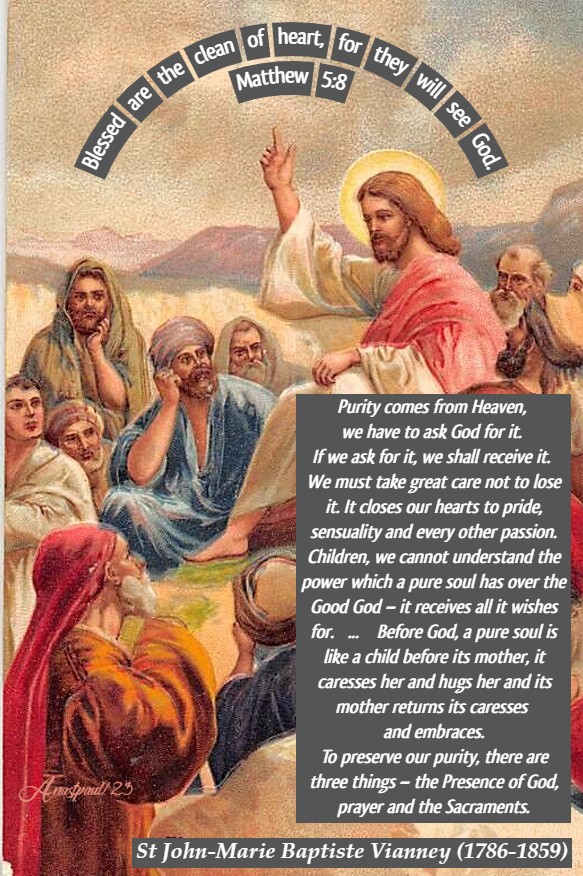
“They shall see God.” – Matthew 5:8
REFLECTION – “We want to see God, we seek to see Him, we ardently desire to see Him. Who does not desire this? But note what the Gospel says: “Blest are the pure of heart, they shall see God.” Do what is necessary in order to see Him! To compare it with something from material reality, how can you want to contemplate the rising sun if your eyes are sick? If your eyes are healthy that light will be a pleasure for you; if they are sick, it will be torture for you. You will surely not be allowed to see with an impure heart what one can only see with a pure heart. You will be moved away, put at a distance, you will not see!
How often did the Lord proclaim people to be ‘blest‘? What reasons for eternal happiness did He cite, what good works, what gifts, what merits and what rewards? No other! the beatitude says, “They shall see God.” This is what the others say: “How blest are the poor in spirit, the reign of God is theirs. Blest are the lowly; they shall inherit the land. Blest are the sorrowing; they shall be consoled. Blest are they who hunger and thirst for holiness; they shall have their fill. Blest are they who show mercy; mercy shall be theirs.” So none other asserts, “They shall see God.”
The vision of God is promised ONLY to people with a pure heart. This is not without a reason, since the eyes that allow us to see God are in the heart. Those are the eyes the Apostle Paul was talking about when he said: “May He enlighten your innermost vision” (Eph 1:18). So, at the present time because of their weakness, those eyes are enlightened by faith; later, because of their strength, they will be enlightened by vision… “Now we see indistinctly, as in a mirror; then we shall see face-to-face.” (1 Cor 13:12).” – St Augustine (354-430) Father and Doctor of the Church (Sermon 53).
PRAYER – O God, Who, through the zeal of blessed Boniface, Thy Martyr and Bishop, graciously called a multitude of people to the knowledge of Thine Name, mercifully grant that we, who keep his feast, may also enjoy his patronage.Through Jesus Christ, Thy Son our Lord, Who lives and reigns with Thee, in the unity of the Holy Ghost, God, world without end. Amen (Collect).
You must be logged in to post a comment.