Quote/s of the Day – 18 April – “The Month of the Resurrection” – Tuesday in the Second Week of Easter – 1 John 5:4-10, John 20. 19-31 – Scripture search here: https://www.drbo.org/
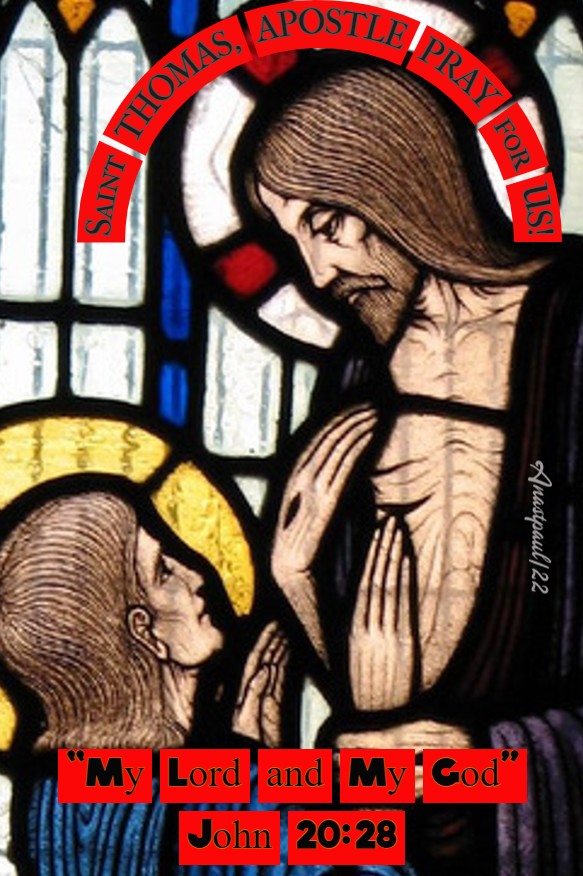
“My Lord and my God.”
John 20:28
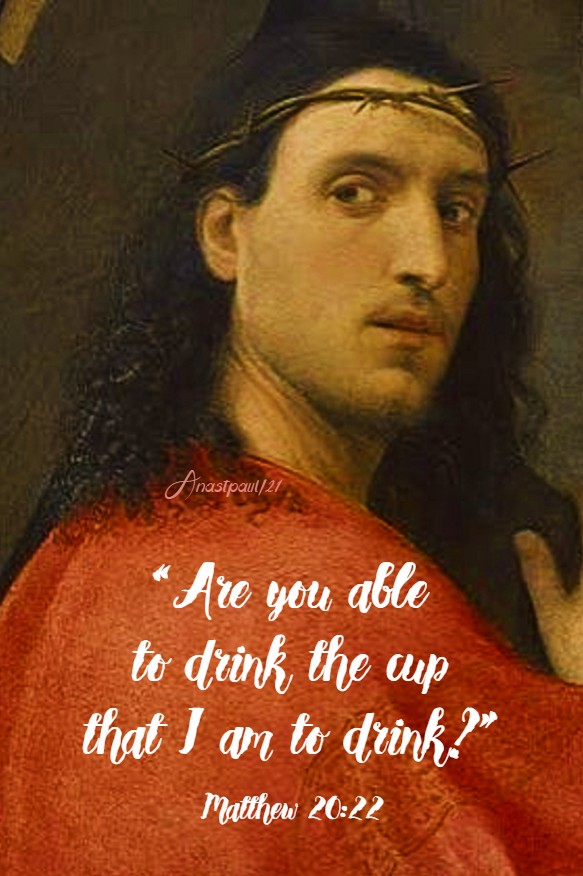
“Are you able to drink the cup that I am to drink?”
Matthew 20:22
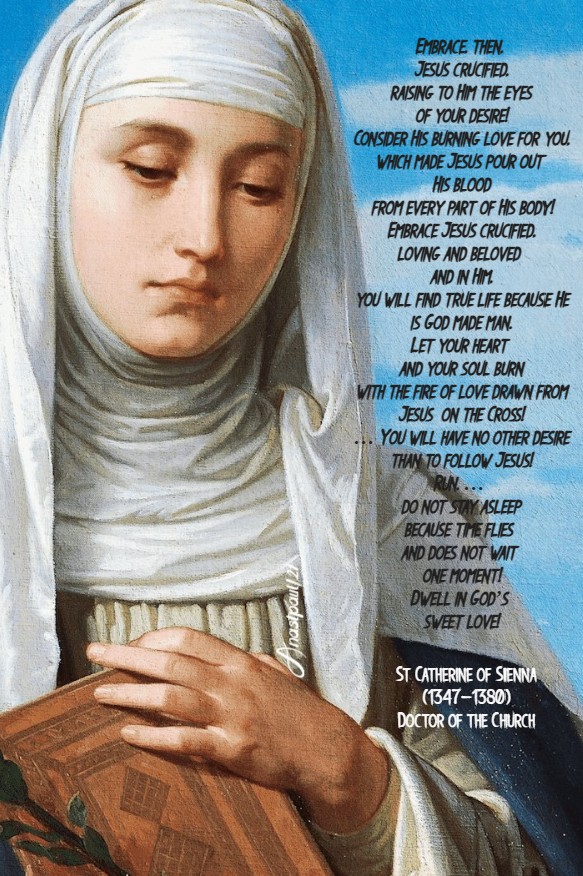
“Embrace, then, Jesus Crucified, raising to Him the eyes of your desire! Consider His burning love for you which made Jesus pour out His Blood from every part of His body! Embrace Jesus Crucified, loving and beloved and in Him, you will find true life because He is God made Man. Let your heart and your soul burn with the fire of love drawn from Jesus on the Cross! … You will have no other desire than to follow Jesus! Run, … do not stay asleep because time flies and does not wait one moment! Dwell in God’s sweet love!”
St Catherine of Sienna (1347-1380) Doctor of the Church
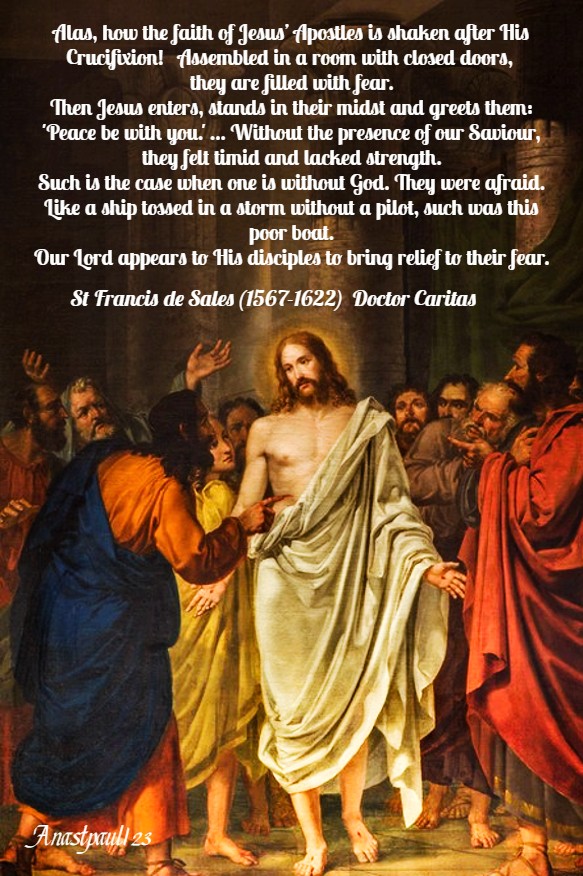
“Alas, how the faith of Jesus’ Apostles is shaken after His Crucifixion! Assembled in a room with closed doors, they are filled with fear. Then Jesus enters, stands in their midst and greets them: ‘Peace be with you.’ … Without the presence of our Saviour, they felt timid and lacked strength. Such is the case when one is without God. They were afraid. Like a ship tossed in a storm without a pilot, such was this poor boat. Our Lord appears to His disciples to bring relief to their fear.”
One Minute Reflection – 18 April – “The Month of the Resurrection” – Tuesday in the Second Week of Easter – 1 John 5:4-10, John 20. 19-31 – Scripture search here: https://www.drbo.org/
“Thomas answered and said to Him: My Lord and my God.” – John 20:28
REFLECTION – “ Why did Thomas seek proof for his faith in this way? … Your love, my brethren, would have preferred it, if lack of faith had left no-one in doubt after the Resurrection. But Thomas bore the uncertainty, not only of his own heart but of all people. And since he was to preach the Resurrection to the gentiles, he sought out, like a good workman, what he would base a Mystery on which demands so much faith. And the Lord showed all the Apostles what Thomas had sought so late. “Jesus came … and showed them His Hands and His Side” (Jn 20:19-20). Indeed, the Person Who entered when the doors were shut, might have been taken for a spirit, by the disciples, if he had not been able to show them that it was none other than He, the Wounds being the mark of His Passion.
Then He came to Thomas and said to him: ”Put your hand in My Side and do not be unbelieving but believe. May the Wounds you are opening make faith flow into the whole world once more, those Wounds which have already poured out the water of Baptism and the Blood of Redemption.” (Jn 19:34). Thomas replied: “My Lord and my God!” Let unbelievers come and hear and, as our Lord said, let them no longer be doubters but believers. Thomas makes known and declares that this is not just a human Body but that, by the Passion of His Body of Flesh, Christ is God and Lord. He Who comes out alive from death and Who rises out of His woundedness is God indeed!” – St Peter Chrysologus (406-450) Bishop of Ravenna, Father and Doctor of the Church (Sermon 84).
PRAYER – Grant, we beseech Thee, Almighty God that we, who have celebrated the Paschal Feast, may, by Thy bounty, retain its fruits in our daily habits and behaviour. Through Jesus Christ, Thy Son our Lord, Who lives and reigns with Thee, in the unity of the Holy Ghost, God, world without end. Amen (Collect).
Our Morning Offering – 18 April – Tuesday in the Second Week of Easter
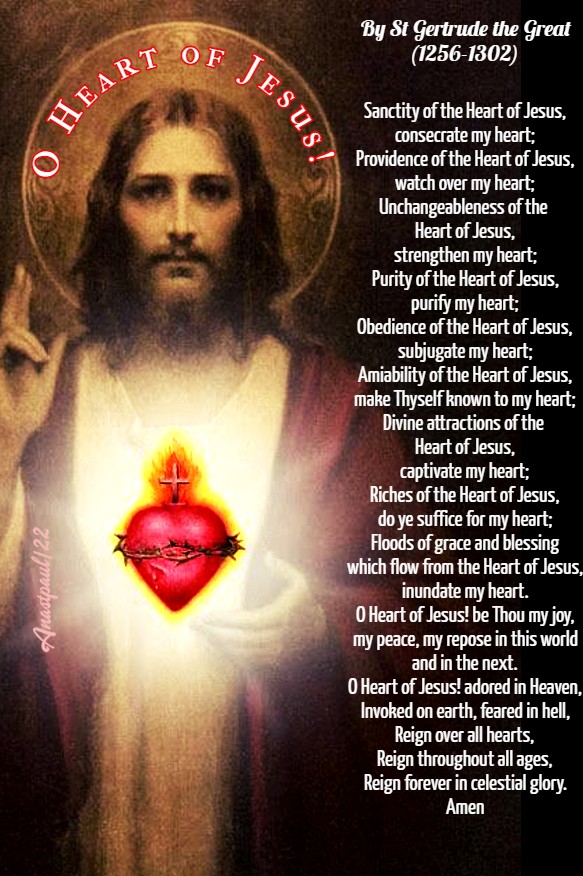
O Heart of Jesus! By St Gertrude the Great (1256-1302)
Sanctity of the Heart of Jesus, consecrate my heart; Providence of the Heart of Jesus, watch over my heart; Unchangeableness of the Heart of Jesus, strengthen my heart; Purity of the Heart of Jesus, purify my heart; Obedience of the Heart of Jesus, subjugate my heart; Amiability of the Heart of Jesus, make Thyself known to my heart; Divine attractions of the Heart of Jesus, captivate my heart; Riches of the Heart of Jesus, do ye suffice for my heart; Floods of grace and blessing which flow from the Heart of Jesus, inundate my heart. O Heart of Jesus! be Thou my joy, my peace, my repose in this world and in the next. O Heart of Jesus! adored in Heaven, Invoked on earth, feared in hell, Reign over all hearts, Reign throughout all ages, Reign forever in celestial glory. Amen
Saint of the Day – 18 April – Blessed Barbara Aurillot / Marie of the Incarnation OCD (1566-1618) Widow, Third Order Lay Discalced Carmelite Sister, Apostle of Charity, Mystic. Barbara is considered the Foundress of the French branch of Carmel. She was known for receiving visions and ecstasies and for supernatural gifts. Born on 1 February 1566 at Paris, France as Barbe Aurillot and died on 18 April 1618 at Pontoise, France of natural causes. Patronages – against impoverishment, against loss of parents, against poverty, parents separated from children, the poor, widows. Also known as – Le belle Acarie (the beautiful Acarie), as she was known in Paris, Barbara Aurillot, Barbara Avrillot, Barbe Acarie, Barbe Aurillot, Barbe Avrillot, Madame Acarie, Marie Acarie Marie or Mary of the Incarnation.
Barbara was the daughter of a French Government Official named Nicholas Aurillot,the Accountant General in the Paris Chamber and Chancellor of Marguerite of Navarre, first wife of Henri IV. Her mother, Marie Lhuillier. was a descendant of Etienne Marcel, the famous prévôt des marchands (Chief municipal Magistrate). She was educated at her Aunt’s Convent at Longchamps, the Minor Sisters of Humility of Our Lady.
Although Barbara was attracted to the religious life, at the age of 16 in 1684, through obedience, she was married to Pierre Acarie, the Viscount of Villemoran, a wealthy young man of high standing, who was a fervent Catholic and Government Treasury Official. She became the Mother of six children, three of whom became Carmelites Nuns and one a Priest.
Her husband, Pierre, supported the Catholic League, of which he was a staunch member, against Henry IV. Pierre was one of the sixteen who organised the resistance in Paris. When Henry became King, he seized the Acarie estates, impoverished the family and exiled Pierre from Paris, separated husband and father from his family. Barbara had to contend with creditors and irate businessmen. Although she had been severely injured due to a fall from her horse and medical treatment which had only made matters worse and left her an invalid for the rest of her life. Barbara still, legally challenged the matter and went to Court to fight and she won. The family was able to reclaim part of the their property and fortune.
Barbara was devoted to the writings of Saint Teresa of Avila. Her good works eventually won her the admiration and support of the same King Henry! who assisted her later when she was the greatest protagonist in bringing the reformed Carmelites of St Teresa to France. At this time, she received a vision of St Teresa who informed her that God wished Barbara to do this work.
At the beginning of the Seventeenth Century Madame Acarie was widely known for her virtue, her supernatural gifts and especially, for her charity towards the poor and the sick in the hospitals. To her residence came all the distinguished and devout people of the day. Among them was St Vincent de Paul and St Francis de Sales, the latter of whom became her Spiritual Counsellor.
Barbara was instrumental in bringing the Discalced Carmelites of Saint Teresa to France, founding five houses between 1604 and 1609. The Carmel spread rapidly and profoundly influenced the French religious and secular society of the day. In 1618, the year of Barbara’s death, Carmel numbered fourteen houses.
She also shared in two foundations of the day, that of the Oratory and of the Ursulines. She urged De Bérulle to refuse the tutorship of Louis XIII and on 11 November 1611, she, with St Vincent de Paul, assisted at the Mass of the installation of the Oratory of France.
Among the many postulants whom Mme Acarie received for the Carmel, there were some who had no vocation and she conceived the idea of getting them to undertake the education of young girls and broached her plan to her holy cousin, Mme. de Sainte-Beuve. To establish the new order they brought Ursulines to Paris and adopted their rule and name.
When Pierre died in 1613, his widow settled her affairs and begged leave to enter the Carmel, asking as a favour to be received as a lay sister in the poorest community. In 1614 she withdrew to the Monastery of Amiens, taking the name of Marie of the Incarnation. Her three daughters had preceded her into the cloister and one of them was Sub-prioress at Amiens. In 1616, by order of her Superiors for health reasons, she went to the Carmelite Convent at Pontoise, where she died at the aged of 52/53. St Francis de Sales considered her death in spiritual poverty as laudable as that of St Francis Xavier’s, who died in utter physical poverty.
Her cause was introduced at Rome in 1627 and she was Beatified on 24 April 1791 by Pope Pius VI – her Feast is widely celebrated in Paris on 18 April. Her mortal remains are in the Chapel of the Carmelites of Pontoise.
It has been said that the vigorous and saintly Madame Acarie, provided the first definite impulse towards that interior growth which made the exquisite and urbane St Francis de Sales, a fit guide for the soul of St Jane Frances de Chantal.
St Agia of Hainault St Anthia of Illyria St Antusa of Constantinople Saint Apollonius the Apologist
St Athanasia of Aegina
Blessed Barbara Aurillot / Marie of the Incarnation O.Carm (1566-1618) Widow, Lay Carmelite Sister St Bitheus St Calocerus of Brescia St Cogitosus St Corebus St Eleuterius of Illyria St Elpidius of Melitene St Eusebius of Fano St Galdinus of Milan St Gebuinus of Lyons St Genocus St Hermogenes of Melitene
Blessed Idesbald of Dunes O.Cist (c1095-1167) Cistercian Priest and Abbot of Ten Duinen Abbey, Our Lady of the Dunes. The Roman Martyrology states: “In Bruges in Flanders, in today’s Belgium, Blessed Idesbaldo, Abbot, who, soon became a widower and exercised for another thirty years, duties in the palace of the Counts, entered the Monastery of Dune at a mature age, which he held holy, as the third Abbot for twelve years.” Biography: https://anastpaul.com/2021/04/18/saint-of-the-day-18-april-blessed-idesbald-of-dunes-o-cist-c-1095-1167/
Thought for the Day – 17 April – Meditations with Antonio Cardinal Bacci (1881-1971)
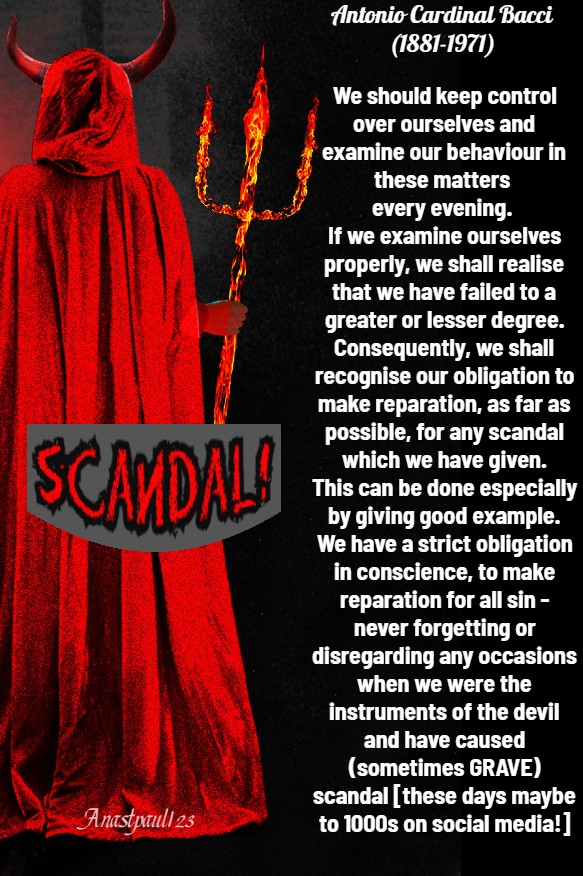
SCANDAL!
“Some people are careful to avoid giving grave scandal but do not give it a thought in matters which they regard as trivial. They have no scruples about imprudent gestures, malicious innuendoes, double-meaning conversations, acts of impatience, lack of understanding or constant grumbling. Such things may seem trivial in themselves but can cause a great deal of harm in certain circumstances and in certain types of company.
We should keep control over ourselves and examine our behaviour in these matters every evening. If we examine ourselves properly, we shall realise that we have failed to a greater or lesser degree. Consequently, we shall recognise our obligation to make reparation, as far as possible, for any scandal which we have given. This can be done especially by giving good example. We have a strict obligation in conscience, to make reparation for all sin – never forgetting or disregarding any occasions when we were the instruments of the devil and have caused (sometimes GRAVE) scandal [these days maybe to 1000s on social media!].”
Quote/s of the Day – 17 April – 1 Peter 5:1-4; 5:10-11, Matthew 16:13-19 – Scripture search here: https://www.drbo.org/
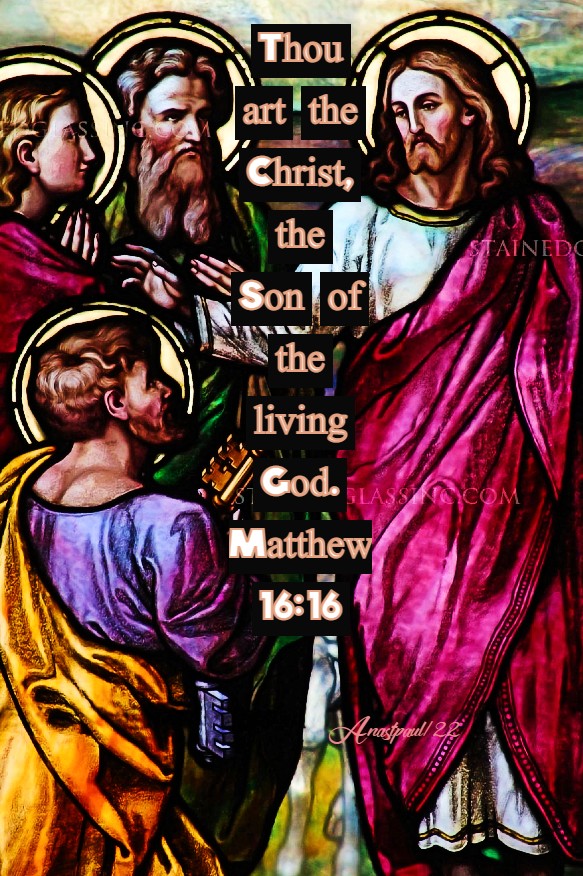
“Simon Peter answered and said: Thou art Christ, the Son of the living God.”
Matthew 16:16
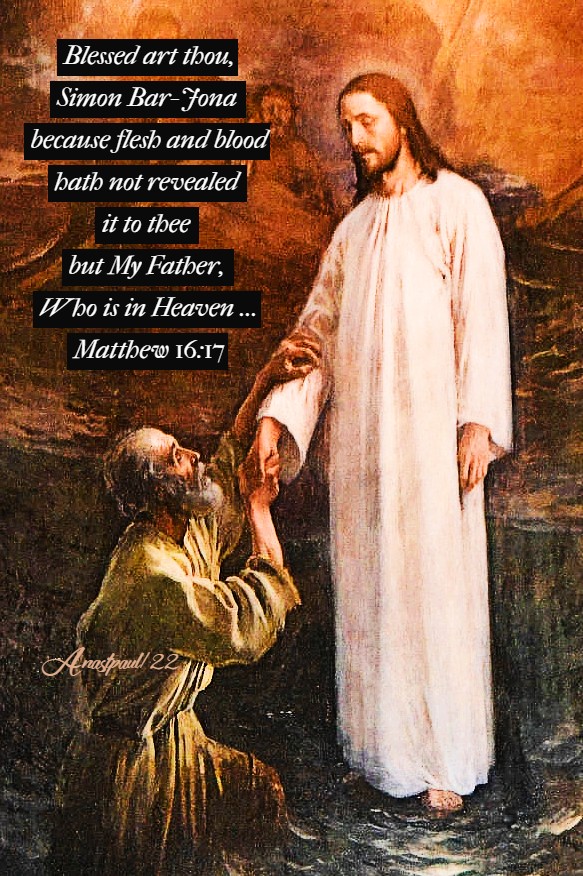
“Blessed art thou, Simon Bar-Jona because flesh and blood hath not revealed it to thee but My Father Who is in Heaven.”
Matthew 16:17
“If I only touch his garment, I will be made well.” Jesus turned and seeing her he said, “Take heart, daughter, your faith has made you well.” And instantly the woman was made well.”
Matthew 9:21-22
“… A tree is known by its fruit. So those who profess to belong to Christ will be known, by what they do. For the work we are about, is not a matter of words, here and now but depends on the power of faith and on being found faithful, to the end!”
St Ignatius of Antioch (c35–c107) Bishop, Martyr, Apostolic Father
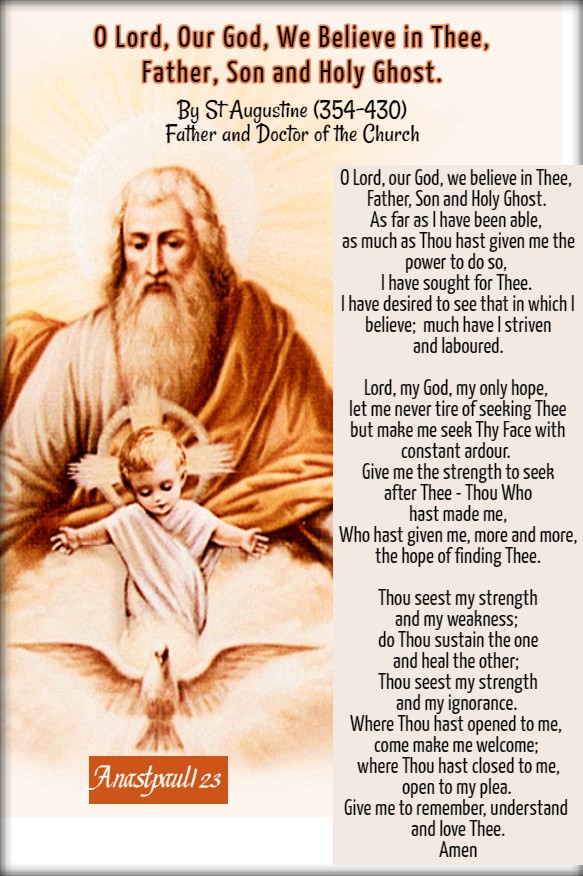
O Lord, Our God, We Believe in Thee, Father, Son and Holy Ghost. By St Augustine (354-430) Father and Doctor of the Church
O Lord, our God, we believe in Thee, Father, Son and Holy Ghost. As far as I have been able, as much as Thou hast given me the power to do so, I have sought for Thee. I have desired to see that in which I believe; much have I striven and laboured.
Lord, my God, my only hope, let me never tire of seeking Thee but make me seek Thy Face with constant ardour. Give me the strength to seek after Thee – Thou Who hast made me, Who hast given me, more and more, the hope of finding Thee.
Thou seest my strength and my weakness; do Thou sustain the one and heal the other; Thou seest my strength and my ignorance. Where Thou hast opened to me, come make me welcome; where Thou hast closed to me, open to my plea. Give me to remember, understand and love Thee. Amen
“May Christ be heard in our language, may Christ be seen in our life, may He be perceived in our hearts”
St Peter Damian (1007-1072) Doctor of the Church
“Faith is like a bright ray of sun light. It enables us to see God in all things, as well as all things in God.”
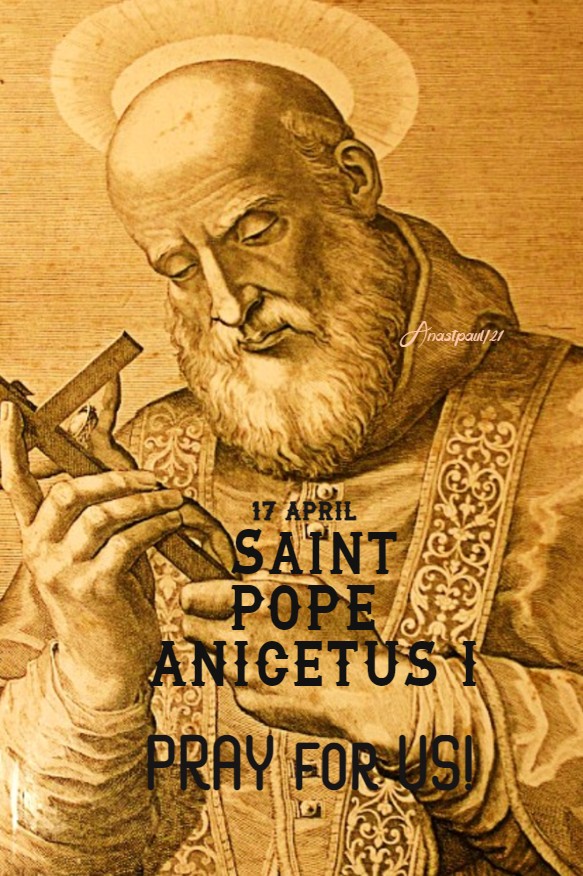
One Minute Reflection – 17 April – St Pope Anicetus (Died 168) 12th Bishop of Rome and Martyr – 1 Peter 5:1-4; 5:10-11, Matthew 16:13-19 – Scripture search here: https://www.drbo.org/
“Blessed art thou, Simon Bar-Jona because flesh and blood hath not revealed it to thee but My Father Who is in Heaven.” – Matthew 16:17
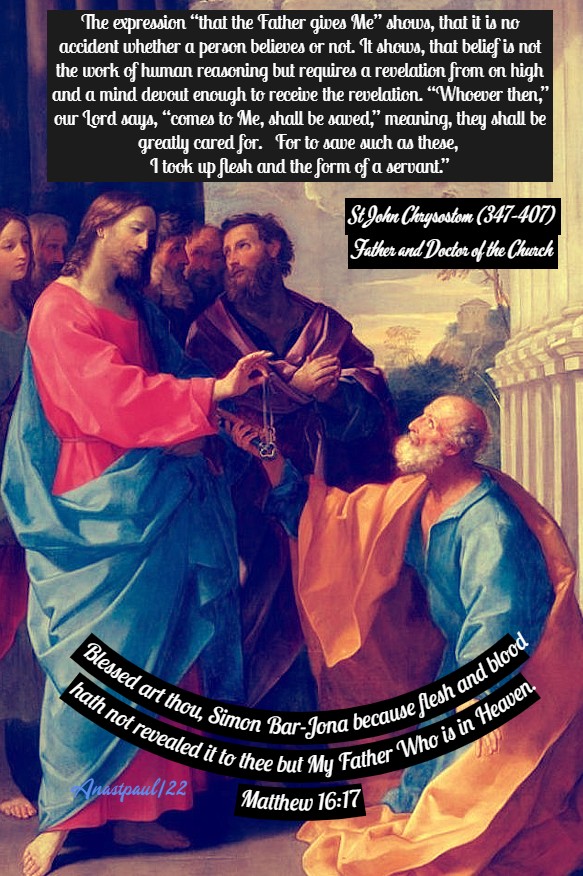
REFLECTION – “Faith in Me, He intimates here, is no ordinary thing or one that comes from human reason but [it] needs a revelation from above. And this He establishes throughout His discourses, showing, that this faith requires a noble sort of soul and one drawn on by God. The expression “that the Father gives Me” shows, that it is no accident whether a person believes or not. It shows, that belief is not the work of human reasoning but requires a revelation from on high and a mind devout enough to receive the revelation. “Whoever then,” our Lord says, “comes to Me, shall be saved,” meaning, they shall be greatly cared for. For to save such as these, I took up flesh and the form of a servant.” – St John Chrysostom (347-407) Archbishop of Constantinople, Father and Doctor of the Church (Homilies on the Gospel of John 45)”
PRAYER – Look forgivingly on Thy flock, Eternal Shepherd and keep it in Thy constant protection, by the intercession of blessed Anicetus, Thy Martyr and Sovereign Pontiff, whom Thou didst constitute Shepherd of the whole Church.Through Jesus Christ, Thy Son our Lord, Who lives and reigns with Thee, in the unity of the Holy Ghost, God, world without end. Amen (Collect).
Our Morning Offering – 17 April – “The Month of the Resurrection” –Monday in the Second Week of Easter
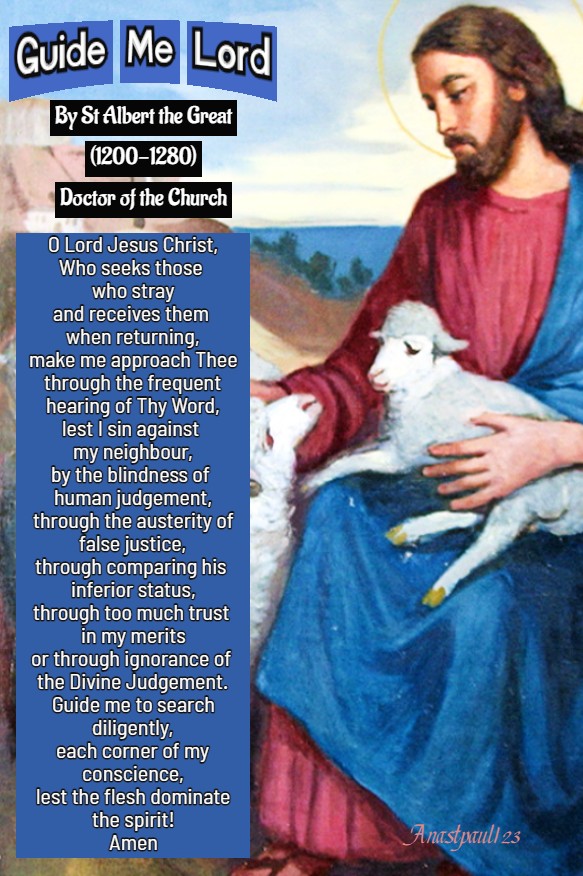
Guide Me Lord By St Albert the Great (1200-1280) Doctor of the Church
O Lord Jesus Christ, Who seeks those who stray and receives them when returning, make me approach Thee through the frequent hearing of Thy Word, lest I sin against my neighbour, by the blindness of human judgement, through the austerity of false justice, through comparing his inferior status, through too much trust in my merits or through ignorance of the Divine Judgement. Guide me to search diligently, each corner of my conscience, lest the flesh dominate the spirit! Amen
Saint of the Day – 17 April – St Landericus (c637-c720) Bishop, Abbot Born in c637 at Hainaut, Belgium and died on 17 Apr c720 (aged 82–83) at in Soignies, France of natural causes. Patron Saint of the House of Habsburg. Also known as – Landericus of Meaux (Metz), Landericus of Soignies, Landry, Landricus, Landrich, Landerico.
That he was a Bishop in the Seventh Century is generally agreed upon but exactly where and when is unclear. Some accounts show him as Bishop of Metz, while others say he was Bishop of Meaux, both in France.
Either way, it is said he resigned his Episcopal responsibilities so as to become a Benedictine DMonk at the Monastery of Hautmont, in France and later at Soignies, in Belgium, both of which were founded by his father.
He succeeded his father as Abbot of Soignies when the elder died around the year 677. Abbot Landericus also died at Soignies somewhere between the years 700 and 730, depending on which account of his life is used and his relics are held at the Collegiale S. Vincent, the Church named for his father.
His feast day is 17 April. Locally, that is in France and Belgium, he is known as St Landry, while most compilations of Saints use the Latin name St Landericus.
In the truly unique and renowned Church known as the Hofkirche in Innsbruck resides a large Statue of our Saint. This is most interesting and leads us to believe that he must have been a much more illustrious figure than we can find information regarding his life. and there is also the fact that he is the Patron Saint of the Royal House of Habsburg. This beautiful Church was built to house the tomb of Emperor Maximilian I who died in 1519. The Church is also known as “Schwarzmanderkirche“ (literally “Black Men Church”) famous for its namesake “Black Men” – 28 over-life-sized Renaissance bronze Statues of important historical figures and Saints which flank the marble Tomb of Emperor Maximilian I. See below.
Bl essed Andrés Hibernón Real OFM (1534-1602) Religious Friar, Apostle of the Holy Eucharist, the Blessed Virgin and the Holy Rosary, Apostle of the poor. He predicted the date of his death four years before the fact, which was 18 April 1602 in Gandia, Valencia, Spain of natural causes immediately after having prayed a rosary. He was Beatified on 22 May 1791 by Pope Pius VI. His body is incorrupt. Biography: https://anastpaul.wordpress.com/2018/04/17/saint-of-the-day-17-april-blessed-andres-hibernon-real-o-f-m-1534-1602/
St Agia of Hainault St Anthia of Illyria St Athanasia of Aegina St Bitheus St Calocerus of Brescia St Cogitosus St Corebus
St Eleuterius of Illyria St Elpidius of Melitene St Eusebius of Fano St Galdinus of Milan St Gebuinus of Lyons St Genocus St Hermogenes of Melitene Bl Idesbald of Dunes Blessed James of Cerqueto Bl James Oldo Bl Joseph Moreau St Landericus (c637-c730) Bishop, Abbot St Laserian of Leighlin Bl Louis Leroy Bl Luca Passi St Pantagathus of Vienne St Perfecto of Córdoba St Pusicio
St Robert de Turlande/Chaise-Dieu OSB (c 1000-1067) Priest, professed religious of the Order of St Benedict, Monk, Abbot, Apostle of Charity, Marian devotee. He was of noble stock, was related to Saint Gerald of Aurillac (c855–c909) and was a descendant of St Caesarius of Arles (470-543). He is best known for the establishment of the Benedictine Convent of La Chaise-Dieu (‘Home of God’) and for his total commitment to the poor. He became a spiritual inspiration for Pope Clement VI (1291–1352) – whose own origin,s in the religious life were based at that Convent – and it was Pope Clement who confirmed the Canonisation of the Benedictine Abbot on 19 September 1351 in Avignon. His Life: https://anastpaul.com/2019/04/17/saint-of-the-day-17-april-st-robert-de-chaise-dieu-osb-c-1000-1067/
Thought for the Day – 16 April – Meditations with Antonio Cardinal Bacci (1881-1971)
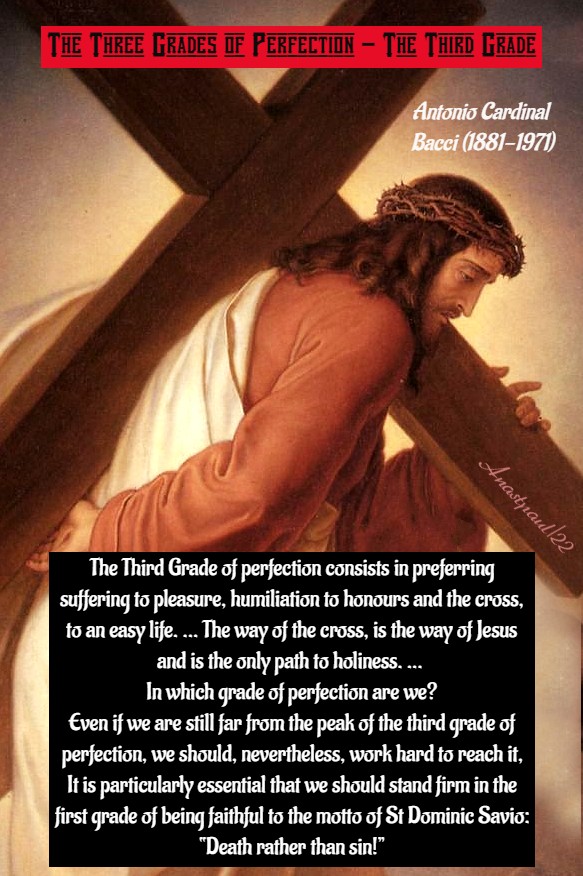
The Three Grades of Perfection – The Third Grade
“The Third Grade of perfection consists in preferring suffering to pleasure, humiliation to honours and the cross, to an easy life. By these means, we imitate Christ better and show our love for Him. The way of the cross, is the way of Jesus and is the only path to holiness. It is easier for those who walk this path to be detached from sin and from the world and to remain close to Jesus. This is the way which the Saints chose.
In which grade of perfection are we? Even if we are still far from the peak of the third grade of perfection, we should, nevertheless, work hard to reach it, It is particularly essential that we should stand firm in the first grade of being faithful to the motto of St Dominic Savio: “Death rather than sin!”
Quote/s of the Day –16 April – “The Month of the Resurrection” – Low Sunday, The Octave Day of Easter – 1 John 5:4-10, John 20. 19-31 – Scripture search here: https://www.drbo.org/
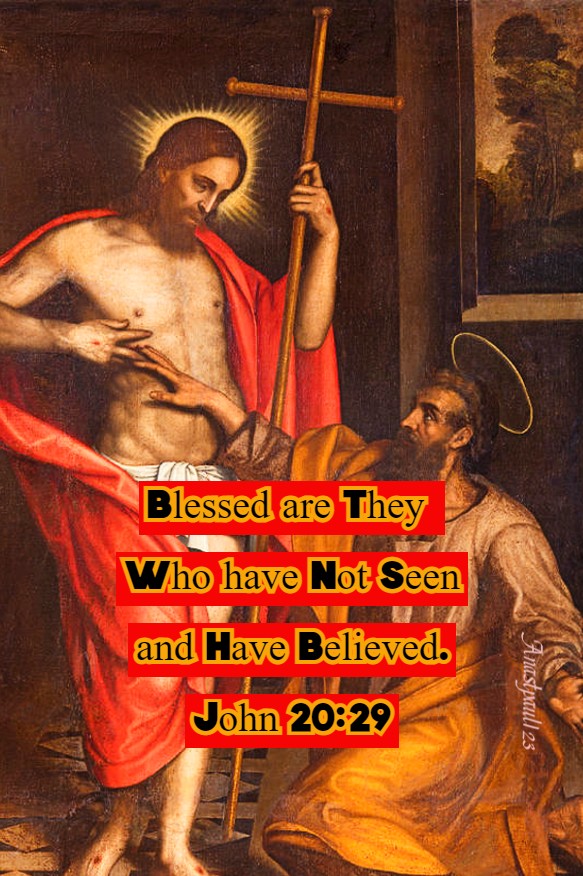
“ Blessed are they who have not seen and have believed.”
John 20:29
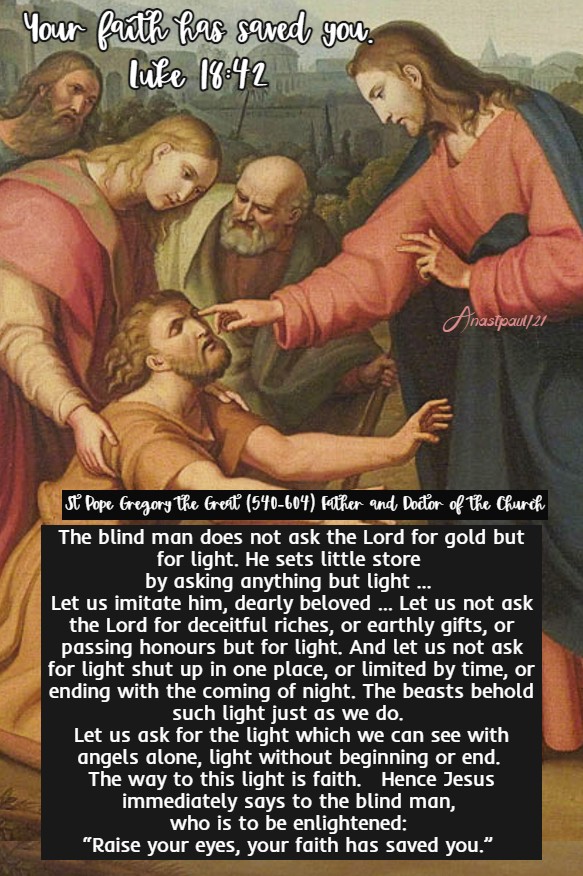
“Your faith has saved you.”
Luke 18:42
“The blind man does not ask the Lord for gold but for Light. He sets little store by asking anything but Light … Let us imitate him, dearly beloved … Let us not ask the Lord for deceitful riches, or earthly gifts, or passing honours but for Light. And let us not ask for light shut up in one place, or limited by time, or ending with the coming of night. The beasts behold such light just as we do. Let us ask for the Light which we can see with Angels alone, Light without beginning or end. The way to this Light is faith. Hence Jesus immediately says to the blind man, who is to be enlightened: “Raise your eyes, your faith has saved you!”
“Stand erect and raise your heads because your redemption is at hand.”
Luke 21:28
“Truth is exhorting His elect by saying: “When the disasters of the world become more frequent… let your hearts exult! While the world, which is not your friend, is coming to an end, the redemption you have sought ,is coming near.!” Those who love God are ordered to rejoice and be merry at the world’s end. They will soon find Him Whom they love, while what they have not loved is passing away. It should be far from the hearts of all the faithful who long to see God, to grieve over the disasters of a world, for they know, these very disasters, are soon to end. It is written that: “Whoever wishes to be a friend of this world, makes himself an enemy of God” (Jas 4,4).”
St Gregory the Great (540-604) Pope, Confessor, Father and Doctor “Father of the Fathers”
One Minute Reflection – 16 April – “The Month of the Resurrection” – Low Sunday, The Octave Day of Easter – 1 John 5:4-10, John 20. 19-31 – Scripture search here: https://www.drbo.org/
“We have seen the Lord.” – John 20:25
REFLECTION – “While hiding in a house, the Apostles see Christ; He entered, all the doors being shut. But Thomas, who was absent at that time… shuts his ears and wants to open his eyes… He bursts out with his incredulity, hoping, in this way, his desire will be answered. “My doubts are not going to disappear until I see Him,” he says. “I shall put my finger in the marks of the nails and embrace this Lord of mine Whom I long for so much. Let Him reproach my lack of faith but let Him satisfy me with sight of Him. For now, I am unbelieving but, when I see Him, I shall believe. I shall believe when I clasp Him in my arms and gaze on Him. I wish to see the holes in those Hands which have healed the hands of Adam’s wrongdoing. I wish to see the Side which cast out death from mankind’s side. I wish, be my own witness, to see the Lord and another’s testimony is not enough for me. Your tales aggravate my impatience. The joyful news you bring does nothing but stir up my turmoil. I shall not be cured of this sickness, unless I touch its medicine with my own hands.”
The Lord appeared again and dispelled both the sadness and the doubt of His disciple. What am I saying? He did not dispel his doubts, he fulfilled his expectation! He entered, all the doors being shut!” – Basil of Seleucia (Died c468) Archbishop (Sermon for the Resurrection).
PRAYER – Grant, we beseech Thee, Almighty God, that we, who have celebrated the Paschal Feast, may, by Thy bounty, retain its fruits in our daily habits and behaviour. Through Jesus Christ, Thy Son our Lord, Who lives and reigns with Thee, in the unity of the Holy Ghost, God, world without end. Amen (Collect).
Our Morning Offering – 16 April – Low Sunday, The Octave Day of Easter – “The Month of the Resurrection”
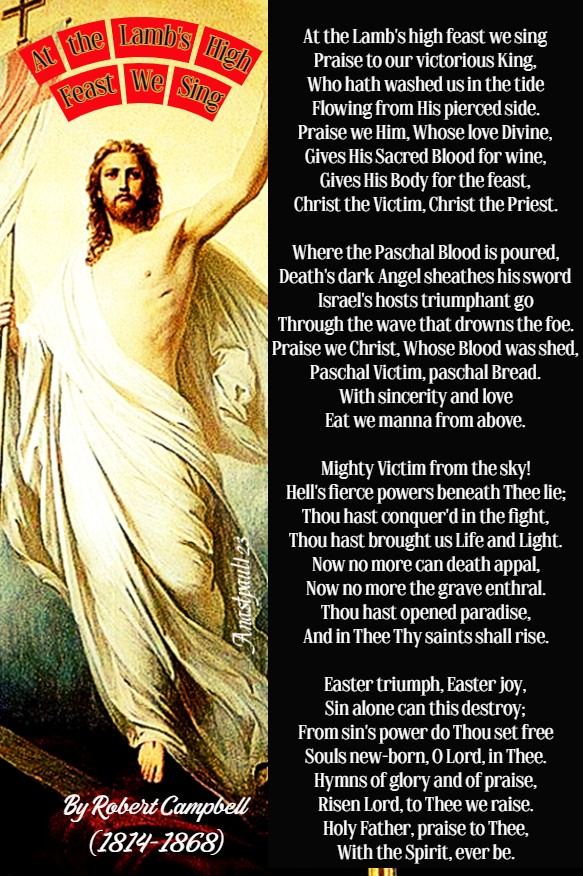
At the Lamb’s High Feast We Sing By Robert Campbell (1814-1868) Scottish Catholic Convert, Hymnist
At the Lamb’s high feast we sing Praise to our victorious King, Who hath washed us in the tide Flowing from His pierced side. Praise we Him, Whose love Divine, Gives His Sacred Blood for wine, Gives His Body for the feast, Christ the Victim, Christ the Priest.
Where the Paschal Blood is poured, Death’s dark Angel sheathes his sword Israel’s hosts triumphant go Through the wave that drowns the foe. Praise we Christ, Whose Blood was shed, Paschal Victim, paschal Bread. With sincerity and love Eat we manna from above.
Mighty Victim from the sky! Hell’s fierce powers beneath Thee lie; Thou hast conquer’d in the fight, Thou hast brought us Life and Light. Now no more can death appal, Now no more the grave enthral. Thou hast opened paradise, And in Thee Thy saints shall rise.
Easter triumph, Easter joy, Sin alone can this destroy; From sin’s power do Thou set free Souls new-born, O Lord, in Thee. Hymns of glory and of praise, Risen Lord, to Thee we raise. Holy Father, praise to Thee, With the Spirit, ever be.
Saint of the Day – 16 April – Blessed Arcangelo Canetoli CRSSB (1460-1513) Priest.and Canon of the Canons Regular of the Congregation of the Most Holy Saviour at Bologna, Mystic gifted with the charism of prophecy and of many visions of the Blessed Virgin, Born in 1460 in Bologna, Italy and died on 16 April 1513 (aged 53) in Gubbio, Italy of natural causes. His body is incorrupt. Arcangelo was Beatified on 2 October 1748 by Pope Benedict XIV.
Blessed Arcangelo Canetoli between St Nicholas and St Leonard painted by GB Piazzetta and Domenico Maggiotto for the Church of San Salvatore, Venice.
Arcangelo Canetoli, born in Bologna in 1460, suffered the bitter vicissitudes of the rivalry between the Canetoli and the Bentivoglio families. When still a young child, he providentially survived the extermination of the entire family. As a young man he entered the Canons Regular of Santa Maria di Reno, known as “Renani.” Due to his extreme humility and love of solitude he refused, for a long time, any Ecclesiastical dignity and only out of obedience, did he accept Priestly Ordination. From 1498 he lived in the convent of Sant’Ambrogio di Gubbio, loved and venerated by the humble and the powerful, including the Acquisti of Arezzo and the Medici of Florence. He consistently refused the appointment as Archbishop of the Medici City proposed to him by Pope Leo X. He died on 16 April 1513 and his incorrupt body is still venerated in his Monastery in Gubbio.
Arcangelo was born to one of the noblest families of Bologna – the Canetoli. The entire family was massacred being held esponsible for the death of member of an opposing family member. Only Arcangelo, still a child, managed to save himself thanks to fortuitous circumstances.
On 29 September 1484 he took the Habit of the Congregation of the Canons Regular of Santa Maria di Reno, called “Renani”, in the Convent of the Santissimo Salvatore in Venice. Here he was entrustd with the task of welcoming pilgrims and in some of them he sometimes happened to recognise the murderers of his family members! However, he always knew how to heroically dominate his desire for revenge.
Extremely humble and a lover of solitude, for a long time he refused, any Ecclesiastical dignity and finally, in 1498, accepted Priestly Ordination only out of a sense of obedience to his Superioirs. Shortly after his Ordination he was sent, by his own request, to the Hermitage of St Ambrose, a mountainside Monastery in Gubbio. Here he would remain for the remainder of his life, although he operated as the Provincial Vicar of his Order for 4 years, still retaining his base at Gubbio.
The St Ambrose Monastery in Gubbio
Arcamgelo predicted that Cardinal Giovanni de’ Medici would be elected as pope sometime soon and when this Cardinal became Pope Leo X in 1513, the Leo’s brother Giuliano de’ Medici summoned Canetoli to Florence in an attempt to persuade him to become the new Archbishop of Florence. But again Arangelo refused and returned to his Convent.
Blessed Arcangelo refusing the Honour of becoming the Archbishop of Florence painted by Giuseppe Reposati.
Arcangelo died in 1513 after a period of illness and high temperatures. He was interred in his Monastery of St Anbrose at Gubbio, where his incorrupt body remains enshrined for the veneration of pilgrims.
Blessed Arcangelo Canetoli (1460-1513) Priest. Beatified on 2 October 1748 by Pope Benedict XIV.
St Benedict Joseph Labre – Known as the Beggar of Perpetual Adoration (1748-1783) Laqy Penitent and Pilgrim – he “abandoned his country, his parents and whatever is flattering in the world, to lead a new sort of life, a life most painful, most penitential, not in a wilderness, nor in a cloister but in the midst of the world, devoutly visiting as a pilgrim the famous places of Christian devotion.” Canonised by Pope Leo XIII on 8 December 1881. Dearest St Benedict Joseph: https://anastpaul.wordpress.com/2017/04/16/saint-of-the-day-16-april-st-benedict-joseph-labre/
St Magnus of Orkney (c 1075-1115) Layman Martyr, Magnus was the Earl .of Orkney in Scotland and related to the Royal House of Norway, which exercised sovereignty over the Orkney Islands at that time. The story of St Magnus’ life and Martyrdom are well attested. His Life and Death: https://anastpaul.com/2022/04/16/saint-of-the-day-16-april-saint-magnus-of-orkney-c-1075-1115/
St Turibius of Astorga St Vaise St William Gnoffi
Martyrs of Corinth – 9 Saints: A group of nine Christians who were tortured and Martyred together in the persecutions of Decius. We know little more than three of their names – Callistus, Charisius and Leonide. They were thrown into the sea at Corinth, Greece c250.
Martyrs of Saragossa: Group of eighteen Martyrs murdered in 304 in Saragossa, Spain in the persecutions of Diocletian and the prefect Dacean. We know little more than the names – Apodemus, Caecilian, Caius, Crementius, Engratia, Eventius, Felix, Fronto, Gaius, Julia, Lambert, Lupercus, Martial, Optatus, Primitivus, Publius, Quintilian, Saturnius (4 men of this name), Succesus and Urban. Their graves re-discovered in 1389 in the crypt under the Church of San Encrazia in Saragossa.
Thought for the Day – 15 April – Meditations with Antonio Cardinal Bacci (1881-1971)
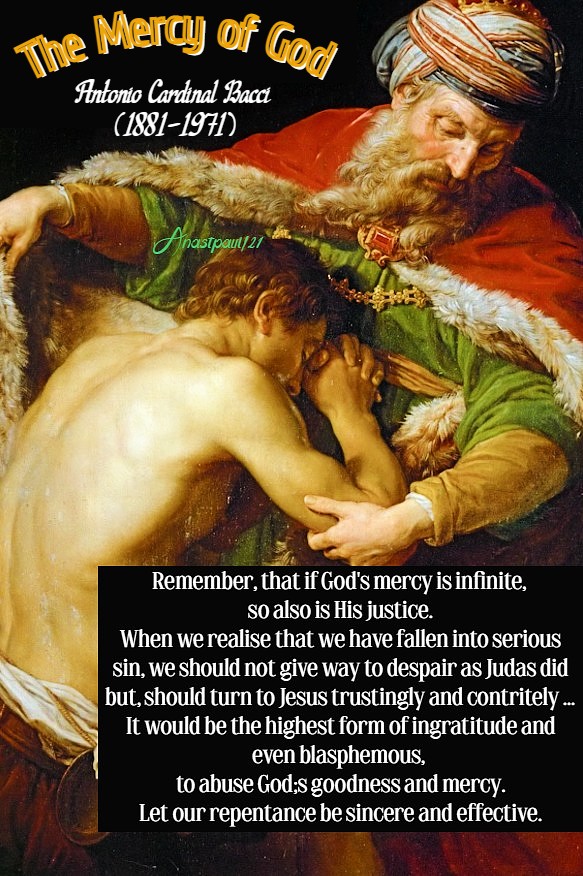
The Mercy of God
“Remember, that if God’s mercy is infinite, so also is His justice.
When we realise that we have fallen into serious sin, we should not give way to despair as Judas did but, should turn to Jesus trustingly and contritely, saying with the Psalmist, “My refuge and my fortess, my stonghold, my deliverer, my shield, in whom I trust” (Ps 143:2). We shall certainly be forgiven.
It would be the highest form of ingratitude and even blasphemous, to abuse God;s goodness and mercy. Let our repentance be sincere and effective. In return for the infinite goodness of God, let us give Him our love, limited indeed but willing and constant.”
Quote/s of the Day – 15 April – “The Month of the Resurrection” – Easter Saturday – 1 Peter 2:1-10, John 20:1-9 – Scripture search here: https://www.drbo.org/
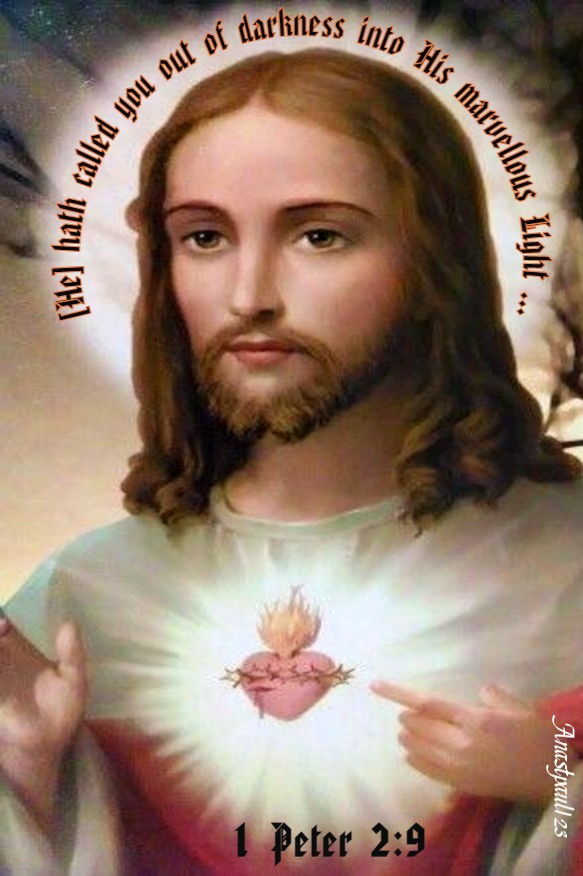
“[He] hath called you out of darkness into His marvellous Light … ”
1 Peter 2:9
“When we stand in the light it is not we who illumine the light and cause it to shine but we are illuminated and made shining by the light… God grants His blessings on those who serve Him because they are serving Him and on those who follow Him because they are following Him but He receives no blessing from them because He is perfect and without need.”
St Irenaeus(c130-c208) Bishop, Martyr, Father of the Church
Grant us Thy Light, O Lord By The Venerable St Bede (673-735) Father and Doctor of the Church
Grant us Thy Light, O Lord, so that the darkness of our hearts, may wholly pass away and we may come at last, to the Light of Christ. For Christ is that Morning Star, Who, when the night of this world has passed, brings to His Saints, the promised Light of Life and opens to them, everlasting day. Amen.
“In the world you will have tribulation. But take heart, I have conquered the world.” John 16:33
“Who will be crowned without having fought? Who will go to rest if he is not tired (cf. 2 Tim 2:5-6)? Who will gather the fruits of life without having planted virtues in his soul? Cultivate them, prepare the earth with the greatest care, take trouble over it, sweat over it, children, God’s workers, imitators of the Angels, competitors with incorporeal beings, lights for those who are in the world (cf. Phil 2:15)!”
One Minute Reflection – 15 April – “The Month of the Resurrection” – Easter Saturday – 1 Peter 2:1-10, John 20:1-9 – Scripture search here: https://www.drbo.org/
“This is the day which the Lord has made: let us be glad and rejoice therein.” – Psalm 117:24.
REFLECTION – “The Sun of Justice (Mal 3:20) which had disappeared for three days, today rises and shines on the whole creation. Christ was in the tomb for three days but He existed before the ages! He comes up like a vine and fills the earth with joy. Let us behold the Rising Sun which will never set, let us anticipate the day and be filled with the joy of this Light!
The gates of Hell have been broken by Christ, the dead awake from sleep. Christ rises, He, the Resurrection of the dead and comes to awaken Adam. Christ, the Resurrection of all who have died, rises and comes to free Eve from malediction. Christ rises, He Who is the Resurrection and He transforms, in all its beauty, what had “no stately bearing to make us look at Him” (Is 53:2). As a sleeper, the Lord awoke and confounded all the deceitfulness of the enemy. He was raised and gave joy to the whole creation; He was raised and the prison-house of Hell was emptied; He was raised and transformed, what is corruptible into incorruptibility (1 Cor 15:53). The Risen Christ clothed Adam with incorruptibility, his original dignity.
Today, through Christ, the Church becomes a new heaven (Apoc 21:1), a more beautiful vault to contemplate, than the visible sun. The sun which we see everyday, cannot compare with this Sun – as a servant filled with respect, it eclipsed before Him, when it saw Him hanging on the Cross (Mt 27:45). It is of this Sun that the prophet said: “For you, who fear My Name, there will arise the Sun of Justice with its healing rays” (Mal 3:20)…Through Him, Christ, the Sun of Justice, the Church becomes a beautiful heaven filled with a multitude of stars which emerge from the Baptismal waters in their new Light. “This is the day which the Lord has made; let us rejoice in it and be glad” (Ps 117:24), filled with the joy that comes from God.” – St Epiphanius of Salamis (?-403) Bishop
PRAYER – Grant, we beseech Thee, O Almighty God that we, who have devoutly kept the Easter solemnities, may at last worthily pass from keeping Feasts, unto Thee here below, to the everlasting jubilation above. Through Jesus Christ, Thy Son our Lord, Who lives and reigns with Thee, in the unity of the Holy Ghost, God, world without end. Amen (Collect).
O Mary, My Hope! By St John Damascene (675-749) Father and Doctor of the Church
I salute you, O Mary! you are the hope of Christians. Receive the prayer of a sinner, who loves you tenderly, honours you in a special manner and places in you the whole hope of his salvation. From you I have my life. You reinstate me in the grace of your Son: you are the sure pledge of my salvation. I beseech of you, therefore, to deliver me from the burden of my sins, dispel the darkness of my mind, banish from my heart the love of the world, repress the temptations of my enemies and so rule my whole life, that by your means and under your guidance, I may obtain everlasting happiness in heaven. Amen
Saint of the Day – 15 April – St Paternus of Avranches (c482-565) Bishop, Abbot, Monk, Hermit, Miracle-worker, Founder of Monasteries, local Missionary to the pagans. Born c482 at Poitiers and died c565 of natural causes. Also known as – Foix, Padarn, Pair, Patier.
Paternus was born at Poitiers, of illustrious Christian parents, about the year 482. His father, Patranus, with the consent of his wife, went to Ireland to end his days as a hermit in holy solitude.
Paternus, fired by his father’s example, embraced monastic life in the Abbey of Marnes, France. After some time, desiring to attain the perfection of Christian virtue by a life of penance in solitude, he retired with a companion Monk of the Abbey, Saint Scubilion. In the forests of the Diocese of Coutances near the sea, they embraced an austere anchorite’s life resembling that of Angels more than of men.
In 512, an Abbot of that region who knew of him recommended Paternus to the Bishop of Coutances, who Ordained him a Deacon and then a Priest. He and Saint Scubilion then evangelised the western coasts and established several Monasteries, of which he was the Abbot general. Many miracles honoured his apostolate among the pagan populations.
In his mature years, he was consecrated bishop of Avranches while his former companion, Saint Scubilion, had become Abbot of a Monastery founded by the two missionaries.
When Saint Paternus fell ill he felt his end was near and he sent to his dear friend to come and assist him in his last illness. But the same fate had befallen Scubilion, who, for his part had sent a messenger to Paternus! The two hermit-missionaries, each of whom had become the spiritual father of many, departed this life on the same day, 15 or 16 April 565, the thirteenth year of the Episcopate of Saint Paternus. They were afterwards buried on the same day in the Church of the Monastery of Scicy, a region they had evangelised together.
Statue of St Paternus at the Church dedicated to him in Avranches
Saint Anastasia of Rome (Died c 68) Martyr, Spiritual Student of St Peter the Apostle AND: St Basilissa of Rome (Died c 68) Martyr, Spiritual Student of St Peter the Apostle. put to death during the reign of Nero. They were among the first converts to Christianity in the 1st century after Christ. The Roman Martyrology states today: “At Rome, the Saints Basilissa and Anastasia. Of noble families, they were disciples of the Apostles and, as they persevered courageously in the profession of their faith, in the time of the Emperor Nero, they had their tongues and feet cut off, were put to the sword and thus obtained the Crown of Martyrdom.” Their Life and Death: https://anastpaul.com/2022/04/15/saint-s-of-the-day-15-april-saints-anastasia-and-st-basilissa-died-c-68-martyrs/
St Crescens of Myra St Eutyches of Rome St Eutychius of Ferentino
Bl Laurentinus Sossius St Maro of Rome St Maximus of Persia St Mundus St Nidger of Augsburg St Olympiades of Persia St Ortario of Landelles St Paternus of Avranches (c482-c565) Bishop
St Sylvester of Réome St Theodore of Thrace St Victorinus of Rome St Waltmann of Cambrai
Mercedarian Martyrs of Africa: A group of Mercedarian Monks sailing to Africa as on a mission to redeem capture Christians. Captured by Moors, they were tortured and executed for their faith. Martyrs. 1393.
Thought for the Day – 14 April – Meditations with Antonio Cardinal Bacci (1881-1971)
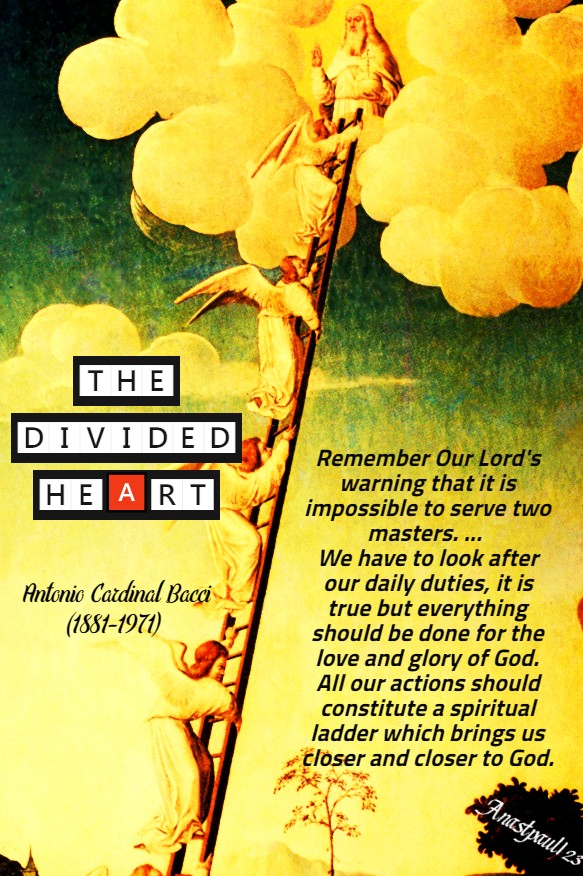
The Divided Heart
“Remember Our Lord’s warning that it is impossible to serve two masters. We cannot serve God and at the same time be preoccupied eith self-love, worldly pleasure and sin. Look at the Saints. Their hearts were never divided but belonged wholly to God. They did everything in their power to keep their hearts pure and burning with love for Him. They suffered because of their slightest imperfections and longed to remain always close to God. We should imitate them. We have to look after our daily duties, it is true but everything should be done for the love and glory of God. All our actions should constitute a spiritual ladder which brings us closer and closer to God.”
Quote/s of the Day –14 April – Easter Friday – 1 Peter 3:18-22, Matthew 28:16-20 – Scripture search here: https://www.drbo.org/
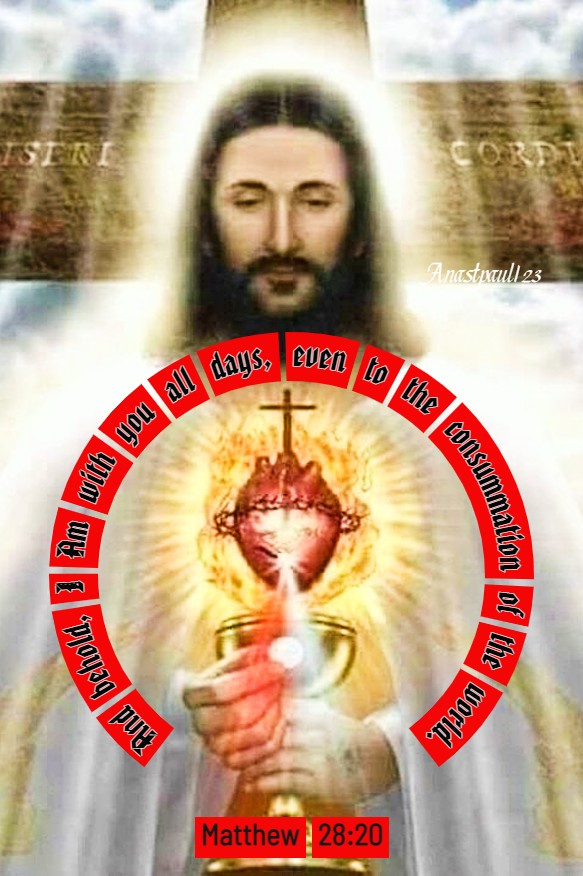
“And behold, I Am with you all days, even to the consummation of the world.”
Matthew 28:20
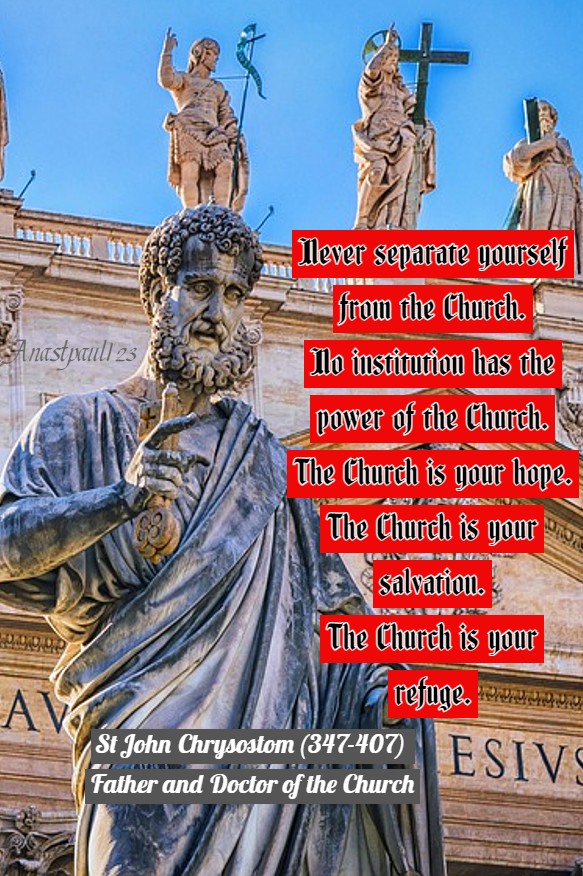
“Never separate yourself from the Church. No institution has the power of the Church. The Church is your hope. The Church is your salvation. The Church is your refuge.”
St John Chrysostom (347-407) Father and Doctor of the Church
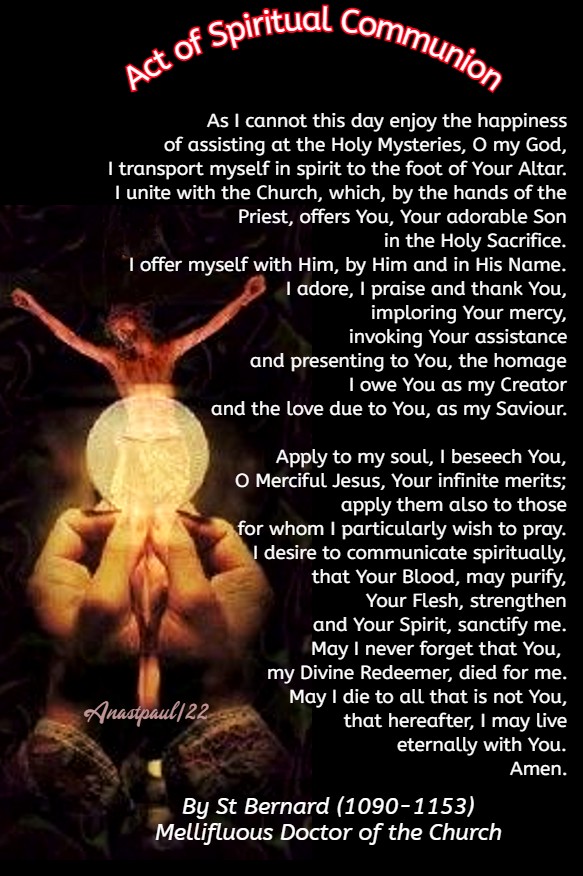
Act of Spiritual Communion By St Bernard O. Cist (1090-1153) Mellifluous Doctor of the Church
As I cannot this day enjoy the happiness of assisting at the Holy Mysteries, O my God, I transport myself in spirit to the foot of Your Altar. I unite with the Church, which, by the hands of the Priest, offers You, Your adorable Son in the Holy Sacrifice. I offer myself with Him, by Him and in His Name. I adore, I praise and thank You, imploring Your mercy, invoking Your assistance and presenting to You, the homage I owe You as my Creator and the love due to You, as my Saviour.
Apply to my soul, I beseech You, O Merciful Jesus, Your infinite merits; apply them also to those for whom I particularly wish to pray. I desire to communicate spiritually, that Your Blood, may purify, Your Flesh, strengthen and Your Spirit, sanctify me. May I never forget that You, my divine Redeemer, died for me. May I die to all that is not You, that hereafter, I may live eternally with You. Amen.
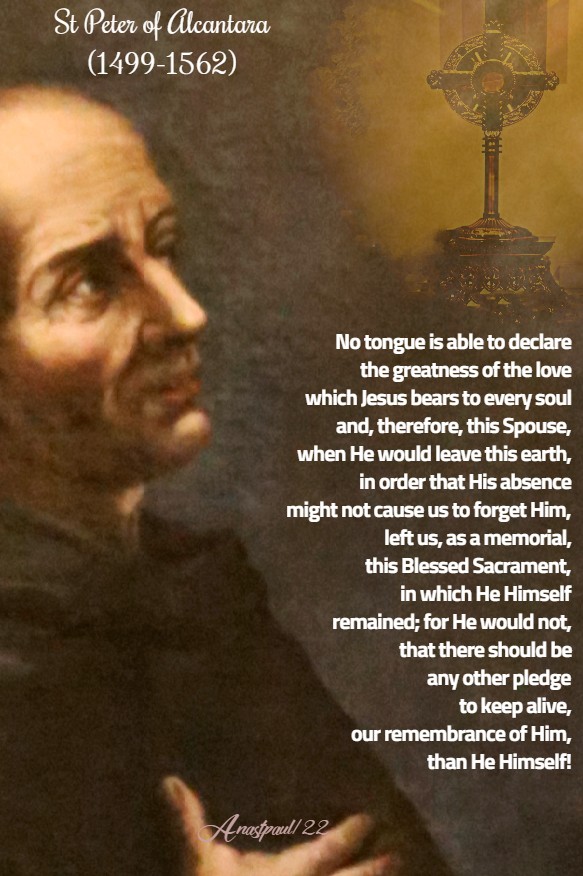
“No tongue is able to declare the greatness of the love which Jesus bears to every soul and, therefore, this Spouse, when He would leave this earth, in order that His absence might not cause us to forget Him, left us, as a memorial, this Blessed Sacrament, in which He Himself remained; for He would not, that there should be any other pledge to keep alive, our remembrance of Him, than He Himself!”
St Peter of Alcantara (1499-1562)
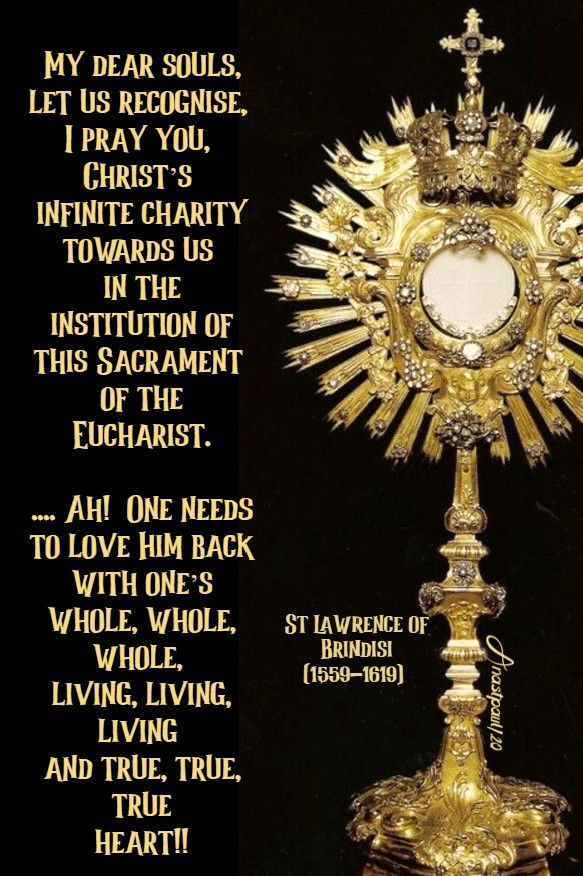
“My dear souls, let us recognise, I pray you, Christ’s infinite charity towards us in the institution of this Sacrament of the Eucharist. In order that our love be a spiritual love, He wills a new heart, a new love, a new spirit for us. It is not with a carnal heart but with a spiritual one, that Christ has loved us with a gratuitous love, a supreme and most ardent love, by way of pure grace and charity. Ah! One needs to love Him back with one’s whole, whole, whole, living, living, living and true, true, true heart!”
One Minute Reflection – 14 April – “The Month of the Resurrection” – Easter Friday – 1 Peter 3:18-22, Matthew 28:16-20 – Scripture search here: https://www.drbo.org/
“And behold, I Am with you all days, even to the consummation of the world.” – Matthew 28:20
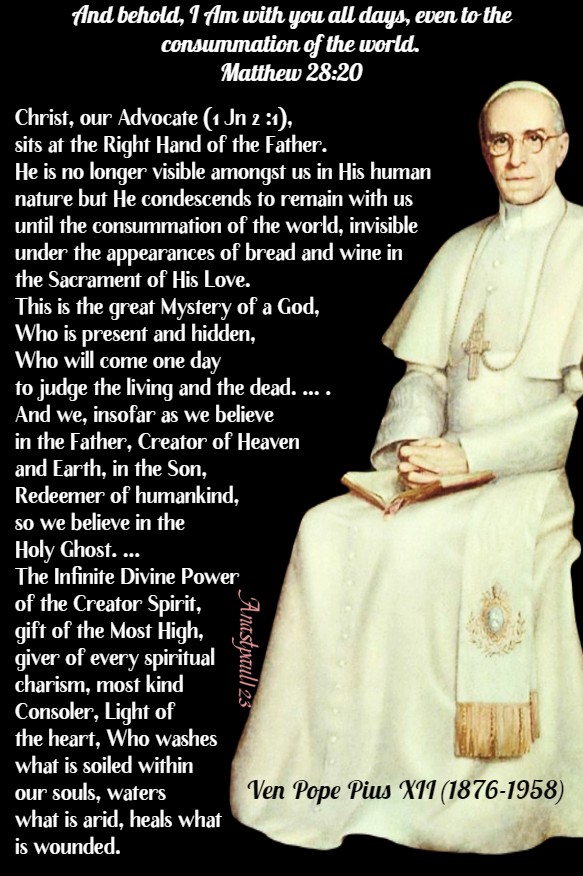
REFLECTION – “Christ, our Advocate (1 Jn 2 :1), sits at the Right Hand of the Father. He is no longer visible amongst us in His human nature but He condescends to remain with us until the consummation of the world, invisible under the appearances of bread and wine in the Sacrament of His Love. This is the great Mystery of a God, Who is present and hidden, Who will come one day to judge the living and the dead.
It is towards this great day of God that the whole of humanity progresses from ages past, present and future. It is towards this day that the Church advances, mistress of faith and morals, for all nations, Baptising in the Name of the Father, Son and Holy Spirit. And we, insofar as we believe in the Father, Creator of Heaven and Earth, in the Son, Redeemer of humankind, so we believe in the Holy Ghost.
This is the Spirit proceeding from the Father and the Son as their Consubstantial Love, promised and sent to the Apostles by Christ, on the day of Pentecost, the virtue from on high, Who fills them. He is the Paraclete and Comforter Who remains with them always, the invisible Spirit, unknown to the world, Who teaches them and reminds them of all that Jesus said to them.
Show Christians the Infinite Divine Power of the Creator Spirit, gift of the Most High, giver of every spiritual charism, most kind Consoler, Light of the heart, Who washes what is soiled within our souls, waters what is arid, heals what is wounded.
From Him, Eternal Love, descends the fire of that charity which Christ wishes to see kindled here below; the charity that makes the Church One, Holy, Catholic that animates her and makes her invincible in the midst of the assaults of the synagogue of Satan – the charity that unites, in the Communion of Saints; the charity that renews our friendship with God and remits sin.” – Venerable Pius XII (1876-1958) – Pope from 1939 to 1958 (Allocution to the Priests of Rome and the preachers during Lent, 17 February 1942).
PRAYER – Almighty and eternal God, in the Easter Sacrament Thou instituted the covenant, whereby Thou forgavest mankind; grant to our souls that what we outwardly profess, we may show forth in our deeds. Through Jesus Christ, Thy Son our Lord, Who lives and reigns with Thee, in the unity of the Holy Ghost, God, world without end. Amen (Collect).
Our Morning Offering – 14 April – “The Month of the Resurrection”
Easter Prayer of Praise By St Gregory the Great (540-604) Pope, Father and Doctor of the Church
It is only right, with all the powers of our heart and mind, to praise Thee Father and Thine Only-Begotten Son, Our Lord Jesus Christ. Dear Father, by Thy wondrous condescension of Loving-Kindness toward us, Thy servants, Thou gave us Thy Son. Dear Jesus Thou paid the debt of Adam for us, to the Eternal Father by Thy Blood poured forth in Loving-Kindness. Thou cleared away the darkness of sin by Thy magnificent and radiant Resurrection. Thou broke the bonds of death and rose from the grave as a Conqueror. Thou reconciled Heaven and earth. Our life had no hope of Eternal Happiness before Thou Redeemed us. Thy Resurrection has washed away our sins, restored our innocence and brought us joy. How inestimable is the tenderness of Thy Love! Amen
Saint of the Day – 14 April – St Abundius the Sacristan (Died c564) Confessor, Sacristan of St Peter’s Basilica in Rome, Layman. Pope St Gregory I the Great wrote of his life, which was filled with many graces. Died in .564 of natural causes. Also known as – Abonde. Patronage – of Sacristans.
The Roman Martyrology reads today: “At Rome, St Abundius, resdident Sacristan of the Church of St Peter.”
Abundius’ holy life was reportedly an inspiration to all who knew him and several miracles were attributed to him, during his life. For one, he is reported as having miraculously cured a gout sufferer by his prayers.
Another wonderful miracle wrought by the intercession of Abundius is told by Saint Gregory the Great in his Dialogues (Book III, Chapter 25). St Gregory reports that there was a young woman who was suffering from palsy and had been praying to Saint Peter to be cured. The Saint appeared to her in a vision and told her to go to Abundius to be cured. The woman did not know Abundius but sought him out at the Basilica and engaged in the following conversation with him:
“The maid … suddenly met with him whom she sought for and asking for him of himself, he told her that he was Abundius. Then quoth she: ‘Our shepherd and Patron, blessed St Peter the Apostle, hath sent me that you should help me of this my disease.’ ‘If you be sent by him,’ quoth Abundius, ‘then rise up’ and taking her by the hand, he forthwith lifted her up upon her feet and from that very hour, all the sinews and parts of her body became so strong that no sign of her former malady remained.”
In the same work, St Gregory also makes note of another saintly Sacristan of Saint Peter’s, Theodore, who lived before Abundius.
St Abundius is remembered at St Peter’s today where his holy Relics are enshrined.
St Bernard of Tiron (1046-1117) Monk, Abbot, Founder of the the Tiron Abbey and the Tironensian Order. St Bernard had a deep devotion to the Passion of Christ, teaching and instruction his disciples in the love of the Holy Cross. The Roman Martyrology reads: “In the Monastery of Tiron near Chartres in France, Saint Bernard, Abbot, who on several occasions gave himself up to a hermit life in the woods and on the Island of Chausey but also dedicated himself to instructing and guiding the disciples, who in great numbers, flocked to him.” St Bernard’s Life: https://anastpaul.com/2022/04/14/saint-of-the-day-14-april-st-bernard-of-tiron-c-1046-1117/
St Domnina of Terni St Fronto of Nitria Bl Hadewych
Thought for the Day – 13 April – Meditations with Antonio Cardinal Bacci (1881-1971)
The Word of God
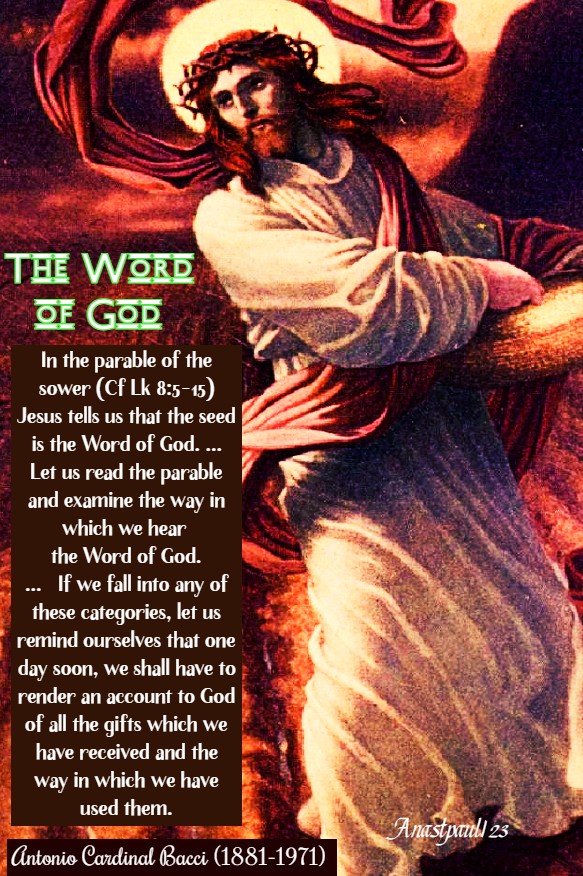
“In the parable of the sower (Cf Lk 8:5-15) Jesus tells us that the seed is the Word of God. Some seed falls by the wayside, that is, upon hardened and dissipated hearts which admit every kind of thought and affection, exdcept the love of God. The good seed cannot take root and the birds of the air come and eat it. Other seed falls upon rocky ground but, as soon as it has sprung up, it withers away for want of moisture. Other seed falls among thorns which choke it and prevent it from growing. Finally, some of the seed falls upon good ground and yuields fruit a hundredfold.
Let us read the parable and examine the way in which we hear the word of God. Are our hearts hard like the surface of the wayside, so that we are deaf and indifferent to the Word of God? Or do we receive it with joy and enthusiasm at first but, lack the constancy to put it into practice, so that the seed dies for want of moisture and we forget everything which we promised? Or are our minds and hearts caught up in a tangle of earthly preoccupations – business, pleasure and other interests – which choke the good seed and prevent it from yielding fruit?
Let us make a thorough examination of our attitude. If we fall into any of these categories, let us remind ourselves that one day soon, we shall have to render an account to God of all the gifts which we have received and the way in which we have used them.”
































 AnaStpaul
You must be logged in to post a comment.