Our Morning Offering – 4 October – St Francis of Assisi OFM (c1181–1226) Confessor, Deacon, Founder, Mystic, Stigmatist.
I Beg Thee, Lord By St Francis of Assisi (c1181–1226)
I beg Thee, Lord, let the fiery, gentle power of Thy love take possession of my soul and snatch it away, from everything under Heaven, that I may die, for love of Thy love, as Thou saw fit, to die for love of mine! Amen
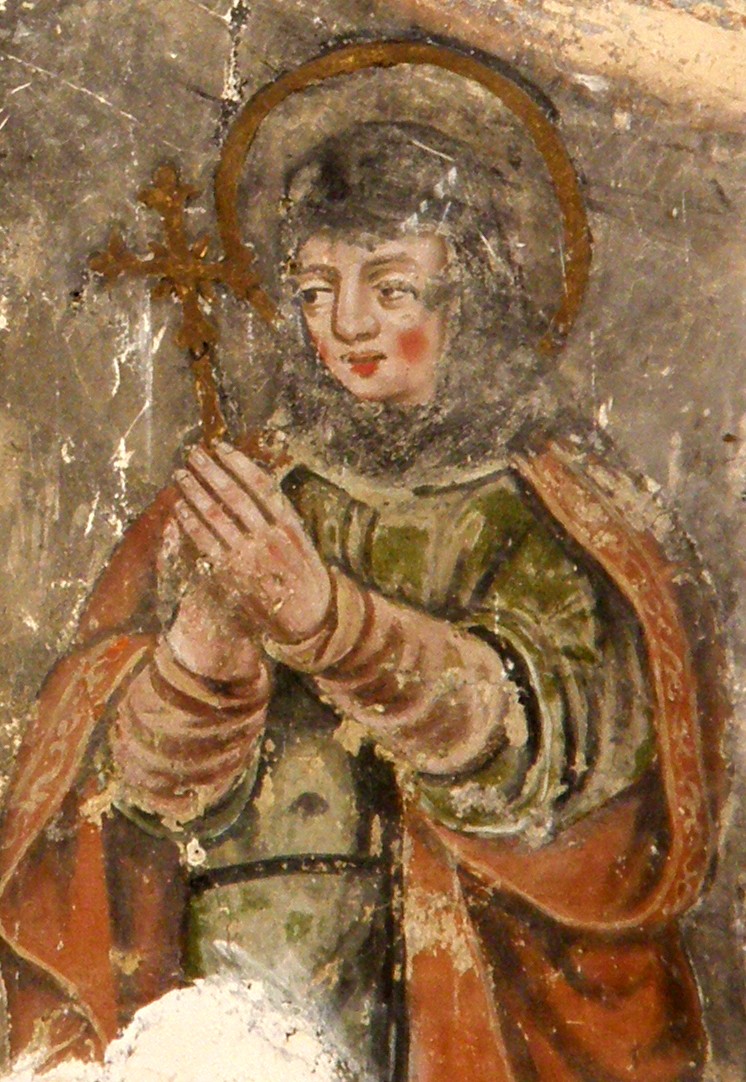
Saint of the Day – 4 October – Saint Aurea of Paris (Died 666) Virgin, Abbess of Saint Martial Convent in Paris during the reigns of King Dagobert I and King Clovis II which Aurea ruled for 33 years, known as a Miracle-worker both before and after her death. Also known as – Aure. On some calendars, particularly in the Proper of Paris, St Aurea is venerated on 5 October owing to the conflict with St Francis’ Feast today.
The Roman Martyrology reads: “In Paris, still in France, Saint Aurea, Abbess, whom Saint Eligius placed at the head of a Monastery which he himself founded in this City under the rule of Saint Columba, in which he had gathered three hundred virgins.”
St Aurea in a 17th Century mural carrying a miniature Crucifix. At the Church in Tohogne, Belgium.
Daughter of Maurino and Quiria. St Aurea appears in works by two writers, St Wudoin and St Jonas of Bobbio (the renowned Abbot and disciple of St Columba and later Author of the Life of St Columba), in their Hagiographies of St Eligius and St Eustace. Both writers state that she was an immigrant to Paris from Syria.
In 633, Aurea was placed, by Saint Eligius (c588-660), at the head of a female Monastery, which he founded in Paris donating his own property for the founding of the first female Monastery in the region.
Aurea was in office from 633 to 666, the year in which she died on 3 (or 4) October, victim of a furious plague which caused the death of one hundred and sixty of her Nuns.
Her remains, were initially placed in the Church of St Paul, where the Nuns were then buried and were then taken to the Oratory of St Marziale. They were again transferred to St Paul’s and finally, in 1421, brought back to St Marziale but in 1792, during the Revolution, they were removed and distroyed, except for a portion of her Relics which were transferred to safety in Normandy. These might be those that are still safely held and venerated at the Church of St Eligius in Paris. In the same Church, there is also a mural of her receiving the veil from the hands of St Eloigius.
Many miracles were recorded through St Aurea’s prayers and intercession. She brought a woman back to life, in order to release a key from her dead hands. Aurea swept red-hot ashes out of an empty oven, causing perfectly baked loaves to appear and, long after her death, St Aurea cured and restored the sight of a blind woman with the touch of her cut-off (and freshly bleeding) arm.
St Aurea of Paris (Died 666) Virgin, Abbess St Berenice St Caius of Corinth St Callisthene of Ephesus St Crispus of Corinth St Damaris of Athens St Diogenes of Milan St Domnina St Hierotheus Bl Julian Majali St Lucius of Alexandria St Peter of Damascus
Martyrs of Alexandria: A group of Christians, men and women, young and old, murdered together for their faith.The only names that have come down to us are the brothers Mark and Marcian.
Oh Immaculate Heart of Mary, Virgin most pure, have compassion on those who are prone to the allurements of impurity. Give us, we beseech thee, strength to overcome our weaknesses and courage in the struggle against sin. We know it is thy ardent wish that we renew our pledge of holy purity. Oh, Immaculate Heart of Mary, we consecrate to thee here and now, without reserve, our eyes, ears, tongues, hearts– our whole beings. We promise that, with thy help, we shall be steady in our purpose to serve thee, with undefiled chastity. Give us the courage to resist all temptations and to avoid all things which may be the occasion of sin. Amen.
Our Lady of Fatima, Virgin most pure, enflame our hearts with the love of Purity and Reparation for sin.
We pray our Daily Rosary now with the same Intention: “Purity of Body and Soul”
Thought for the Day – 3 October – Meditations with Antonio Cardinal Bacci (1881-1971)
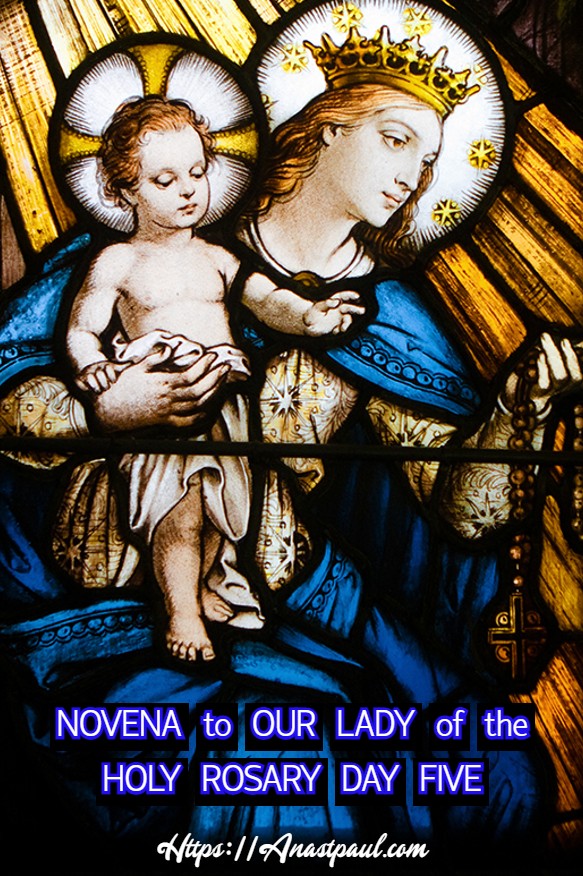
“Month of the Holy Rosary” The First Joyful Mystery The Annunciation
“The Rosary is both a vocal and a mental prayer. When reciting the first five decades, we should meditate on the principal joyful mysteries of our faith, beginning with the Annunciation to the Blessed Virgin. In other words, during the first decade, we should visualise the scene described in the Gospel.
“The Angel Gabriel was sent from God to a town of Galilee called Nazareth, to a virgin betrothed to a man named Joseph, of the house of David and the Virgin’s name was Mary. And, when the Angel had come to her, he said “Hail, full of grace, the Lord is with thee. Blessed art thou among women” (Lk 1:26-28).
Note the manner in which the Angel greets Mary. He proclaims that she is full of grace, pleasing and acceptable to God. He bows before her and says that she is blessed among women. On previous occasions Angels had appeared to Patriarchs, Kings and Prophets but always, as superior beings bearing a command from Almighty God. Why, then, does an Angel bow before this maiden and salute her with such reverence? The reason is twofold. Mary is the purest of creatures, immaculate from the moment of her conception; she is also destined to become the Mother of God, a destiny of quasi-infinite dignity. Let we, poor sinners, bow before her also and beg her to obtain for us from God, the graces of forgiveness and of sanctification. It is in this spirit, of loving humility that we should recite the First Decade of the Holy Rosary.”
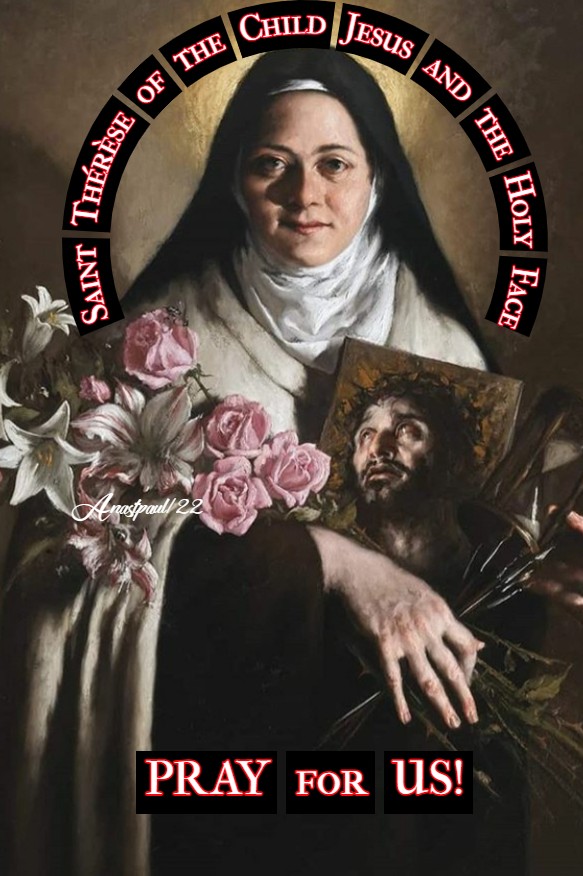
Quote/s of the Day – 3 October – St Thérèse of the Child Jesus (1873–1897)
“A soul, in a state of grace, has nothing to fear from demons – who are cowards.”
“Trust and trust alone, should lead us to love.”
“Love alone, have I ever given to the good God; with love, He will repay me.”
“Then, overcome by joy, I cried: ‘Jesus, my love.’ At last I have found my vocation. My vocation is love. In the heart of the Church, my mother, I will be love and then I will be all things!”
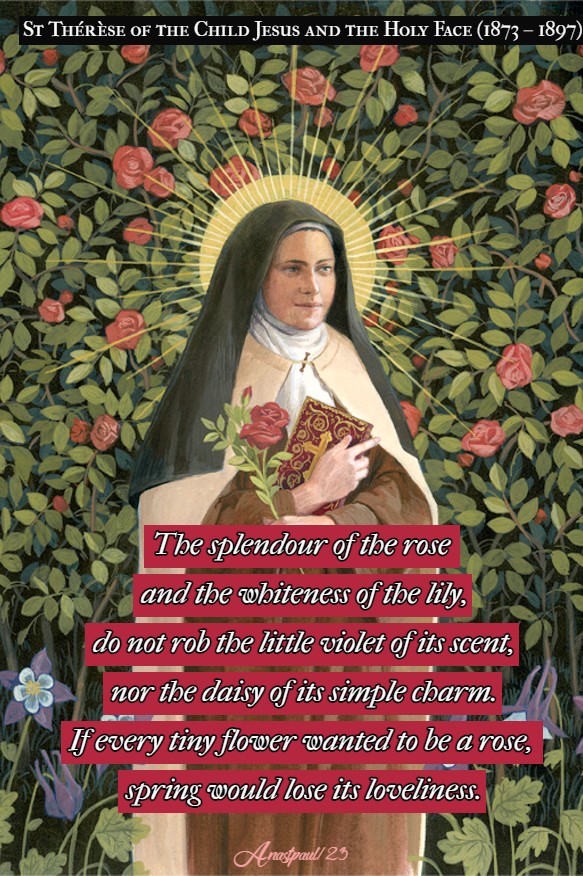
“The splendour of the rose and the whiteness of the lily, do not rob the little violet of its scent, nor the daisy of its simple charm. If every tiny flower wanted to be a rose, spring would lose its loveliness.”
One Minute Reflection – 3 October – “The Month of the Most Holy Rosary and of the Angels” – St Thérèse of the Child Jesus (1873–1897) – Isaias 66:12-14, Matthew 18:1-4 Scripture search here: https://www.drbo.org/
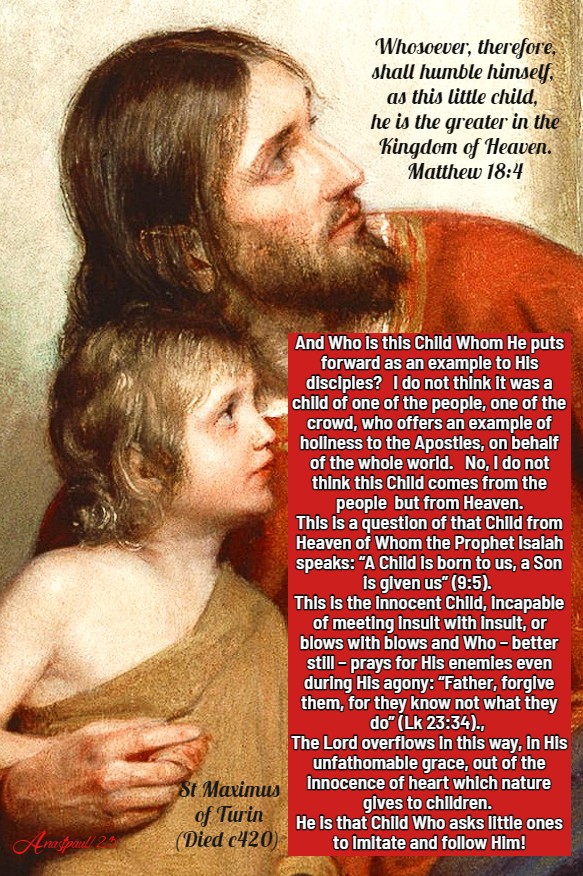
“Whosoever, therefore, shall humble himself, as this little child, he is the greater in the Kingdom of heaven.”- Matthew 18:4
REFLECTION – “The Lord said to His Apostles, who were already adult and mature: “Unless you turn and become like this little child, you shall not enter the Kingdom of Heaven” (Mt 18:3&4)… He urges them to rediscover their childhood… in order that they might be born again to innocence of heart: “No-one can enter the Kingdom of God without being born of water and spirit” (Jn 3:5).
“Unless you turn and become like this little child” – He does not say “these children” but “this child”- He only chooses one, only suggests one. And Who is this Child Whom He puts forward as an example to His disciples? I do not think it was a child of one of the people, one of the crowd, who offers an example of holiness to the Apostles, on behalf of the whole world. No, I do not think this Child comes from the people but from Heaven. This is a question of that Child from Heaven of Whom the Prophet Isaiah speaks: “A Child is born to us, a Son is given us” (9:5). This is the innocent Child, incapable of meeting insult with insult, or blows with blows and Who – better still – prays for His enemies even during His agony: “Father, forgive them, for they know not what they do” (Lk 23:34)., The Lord overflows in this way, in His unfathomable grace, out of the innocence of heart which nature gives to children. He is that Child Who asks little ones to imitate and follow Him!” – St Maximus of Turin (Died c420) Bisho, Father (Homily 58).
PRAYER – O Lord, Who said: Unless you become as little children, you shall not enter into the Kingdom of Heaven, grant us, we beseech Thee, so to follow the footsteps of blessed Thérèse the Virgin, in humility and simplicity of heart that we may obtain everlasting rewards.Through Jesus Christ, Thy Son our Lord, Who lives and reigns with Thee, in the unity of the Holy Ghost, God, world without end. Amen (Collect).
Our Morning Offering – 3 October – St Thérèse of the Child Jesus and the Holy Face (1873 – 1897)
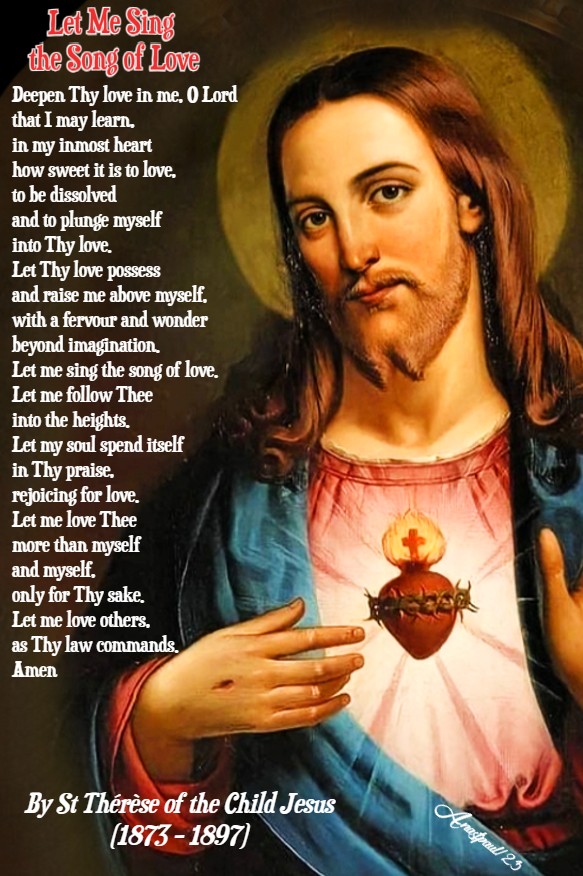
Let Me Sing the Song of Love By St Thérèse of the Child Jesus and the Holy Face (1873 – 1897)
Deepen Thy love in me, O Lord that I may learn, in my inmost heart how sweet it is to love, to be dissolved and to plunge myself into Thy love. Let Thy love possess and raise me above myself, with a fervour and wonder beyond imagination. Let me sing the song of love. Let me follow Thee into the heights. Let my soul spend itself in Thy praise, rejoicing for love. Let me love Thee more than myself and myself, only for Thy sake. Let me love others, as Thy law commands. Amen
Saint of the Day – 3 October – Saint Adalgott of Chur O.Cist. (Died 1160) Bishop, Monk in Citeaux, then disciple of Saint Bernard at Clairvaux,, Abbot at Disentis in Switzerland and then Bishop of Chur, Reformer of monastic life and of the Clergy, Apostle of the sick and founder of a Hospital in his Diocese. Date and place of birth unknown – died on 3 October 1160 at Chur of natural causes. Also known as – Adalgott of Discentis, Adalgotto, Algott, Adelgorio.
The Roman Martyrology reads: “In Chur in Switzerland, blessed Adalgotto, Bishop, who, disciple of Saint Bernard in Clairvaux, was a great lover of monastic discipline.”
St Adalgott in his Cistercian Habit
In 1150, Adalgott was requested to become the Bishop of Chur by the faithful and Clergy of the Diocese. Some believe that this request was engendered because he was probably originally from that area. He was consecrated there in 1151 by the Archbishop of Mainz.
Adalgott gave his private life and his Episcopate an imprint of austerity – he reformed the Clergy, returned the Monasteries under his jurisdiction to a more rigid observance of the Rule, monitored the good morals of the population.
He was in political relations with Pope Stephen III and Emperor Frederick I but never compromised on anything concerning the rights of the Church. He restored Churches and Monasteries, including Cazis, Schännis, Munster, Müstail. Adalgott particularly supported the Premonstratensian Monastery of St Lucius in Chur which was founded in 1140/42 by the Cistercian Pope Eugene III.
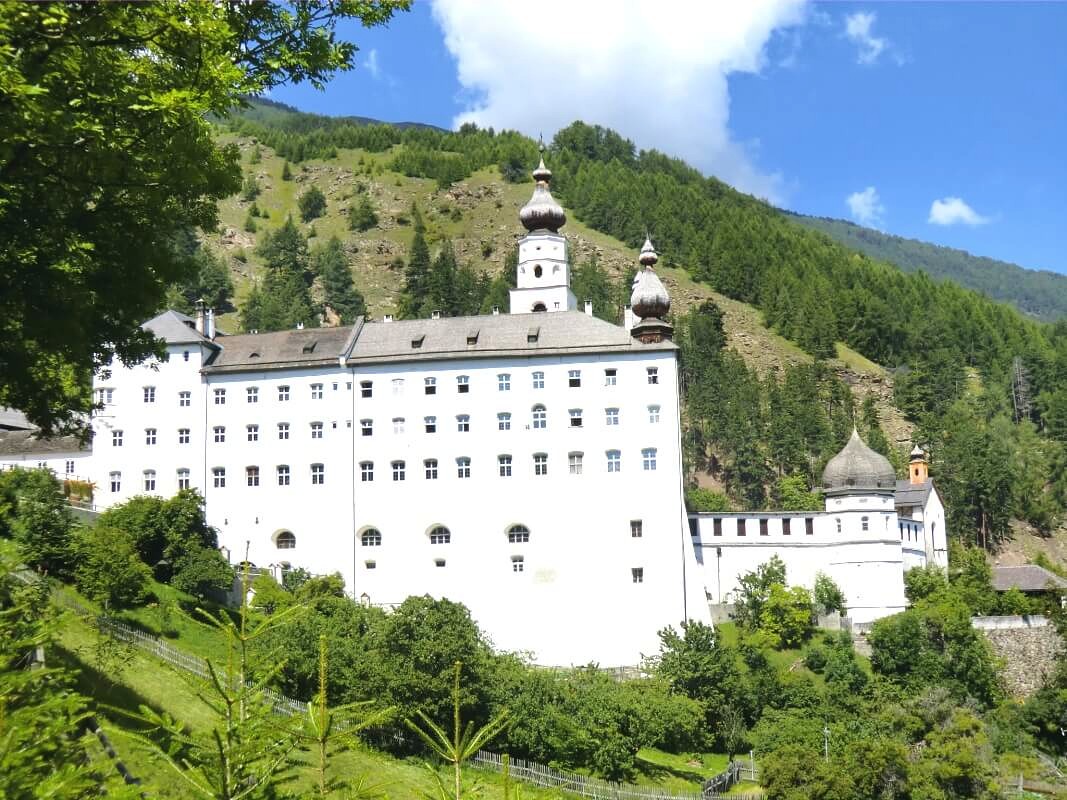
Marienberg Monastery near Mals in South Tyrol
Adalgott was known throughout his life for his concern for and ministry to the sick and his use of position and title to assist them however possible. When Adalgott was named Bishop of Chur, he conducted an apostolate for the suffering of the region and, in the same year, he founded a Hospital at Chur specifically to attend to needs of the poor.
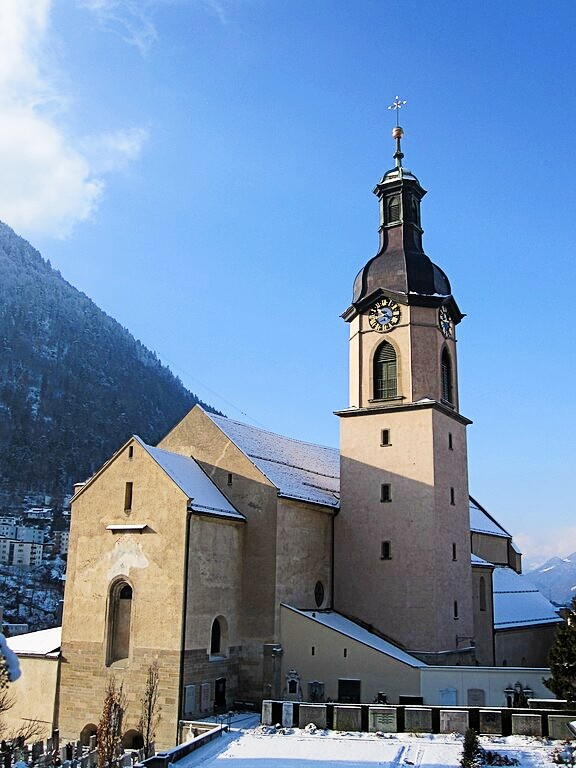
On 11 June 1160 Adalgott Consecrated the Marianberg Crypt, as evidenced by an inscription and it was probably he who promoted the construction of the beautiful Cathedral of Chur which is now dedicated to him.
He died at an advanced age on 3 October 1160. His Relics which soon became an object of veneration and the prayers at his tomb resulted in many miracles. In 1492, Adalgott’s name was included in the Catalogue of Cistercian Saints and Blesseds, compiled by the Abbot of Citeaux, John of Cirey, where some variants of his name are also recorded: Algott, Adelgorio.
On 4 May 1881 the Congregation of Rites approved Adalgott’s cult ab immemorial. The Cistercian Congregations of Mehrerau and San Bernardo in Italy remember him on 3 October.
Statue of St Adalgott in the Monastery Church of Eschenbach in Lucerne
St Adalgott of Chur O.Cist. (Died 1160) Bishop Bl Agostina of the Assumption St Candidus the Martyr St Cyprian of Toulon Bl Damian de Portu St Dionysius the Aeropagite Bl Dominic Spadafora Bl Edmund of Scotland St Ewald the Black St Ewald the Fair St Froilan
Martyrs of Alexandria – 9 Saints: A number of Christian Martyrs remembered together. We know the names Caius, Cheremone, Dionysius, Eusebio, Fausto, Lucio, Maximus, Paul, Peter and that there were at least two more whose names have not come down to us, and that’s about all we know.
Oh Immaculate Heart of Mary, Virgin most powerful, we know that the vision of the terrible fires of hell which thou showed to the three little shepherd children at Fatima, was really meant for us. We beseech thee, Oh Mother Mary, to spare us the fate of a judgement which ordains such a punishment! Grant unto us, a faith so strong that we may ever realise that the evil of sin will be justly repaid with eternal punishment. I believe in the Infinite Justice of the One True God and the Infinite Love of the Father, Son and Holy Ghost. We pray and beseech thee that through thy intercession, we may be given the grace to live so worthy a life on earth, as to enjoy the reward of eternal happiness in the Kingdom of thy Divine Son, Our Lord Jesus Christ. Amen.
Our Lady of Fatima, Virgin most powerful, inflame our hearts with the love of Reparation for the Salvation of Souls.
We pray our Daily Rosary now with the same Intention: Reparation for the Salvation of Souls.
Thought for the Day – 2 October – Meditations with Antonio Cardinal Bacci (1881-1971)
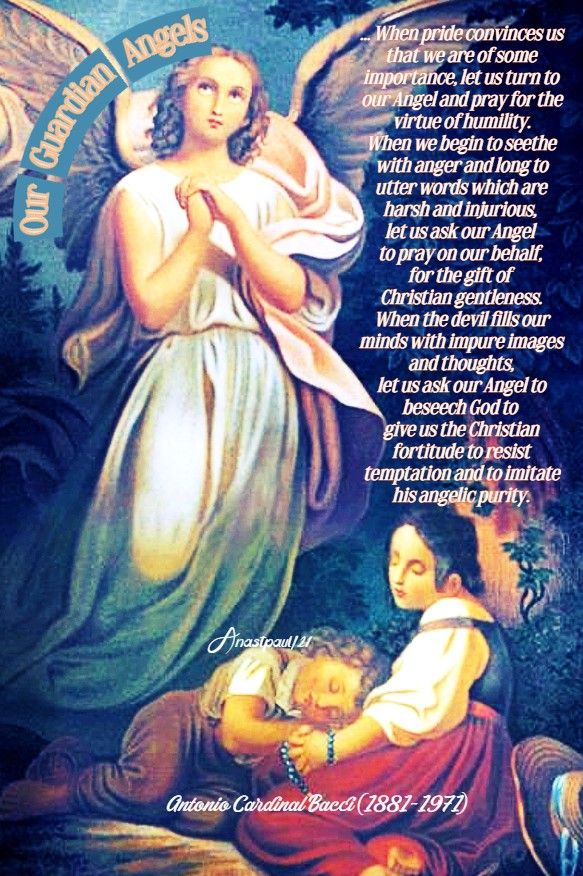
Our Guardian Angels
“The realisation that our Guardian Angel is always close at hand, should be a warning to us. It should prevent us from doing anything displeasing to God. Would we venture to do anything unbecoming in the presence of our Father or Mother, or of anyone for whom we have any regard? Definitely not and still less, should we dare to perform an evil action in the presence of our Angel, to whom we owe such gratitude and in the presence of God, our Creator, Lord and Redeemer, Who could, at any moment, snap the thread which binds us to life and plunge us into eternity.
Furthermore, when pride convinces us that we are of some importance, let us turn to our Angel and pray for the virtue of humility. When we begin to seethe with anger and long to utter words which are harsh and injurious, let us ask our Angel to pray on our behalf, for the gift of Christian gentleness. When the devil fills our minds with impure images and thoughts, let us ask our Angel to beseech God to give us the Christian fortitude to resist temptation and to imitate his angelic purity.
Finally, when tepidity is sapping the vigour of our interior life, let us pray to our Guardian Angel in the hope of obtaining a share in his intimate union with God.
Let us pray the Guardian Angel prayer or at least say: “My Guardian Angel enlighten me. My Guardian Angel help me. My Guardian Angel, protect me.” Amen.”
Quote/s of the Day – 2 October – “The Month of the Most Holy Rosary and of the Angels” and the Feast of the Guardian Angels
“. . . You should know that there is present with you, the Angel whom God has appointed for each man. . . This Angel, who is sleepless and cannot be deceived, is always present with you; he sees all things and is not hindered by darkness. You should know, too, that with him, is God!”
St Anthony Abbot (251-356)
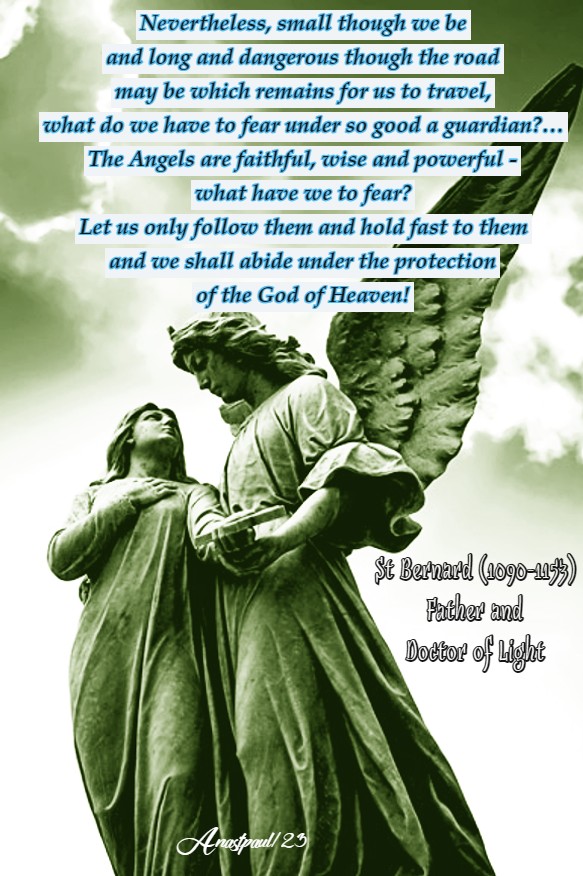
“Nevertheless, small though we be and long and dangerous though the road may be which remains for us to travel, what do we have to fear under so good a guardian?… The Angels are faithful, wise and powerful – what have we to fear? Let us only follow them and hold fast to them and we shall abide under the protection of the God of Heaven!”
St Bernard (1090-1153) Father and Doctor of Light
“Recommend yourself to your Angel Guardian three times a day – in the morning. by the prayer “Angele Dei” in the evening, by the same prayer and during the day, when you visit the Altars in Churches. Remember that you are to be guided by your Angel, like a blind man who cannot see the dangers of the streets and trusts entirely. to the person who leads him.”
One Minute Reflection – 2 October – “The Month of the Most Holy Rosary and of the Angels” – Feast of the Holy Guardian Angels – Exodus 23:20-23; Matthew 18:1-10 – Scripture search here: https://www.drbo.org/
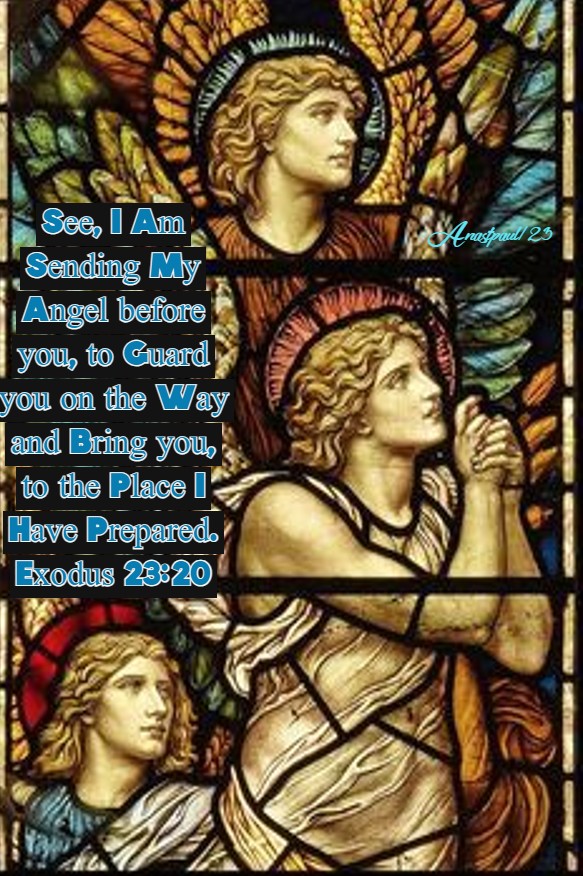
“See, I am sending My Angel before you, to guard you on the way and bring you, to the place I have prepared.” – Exodus 23:20
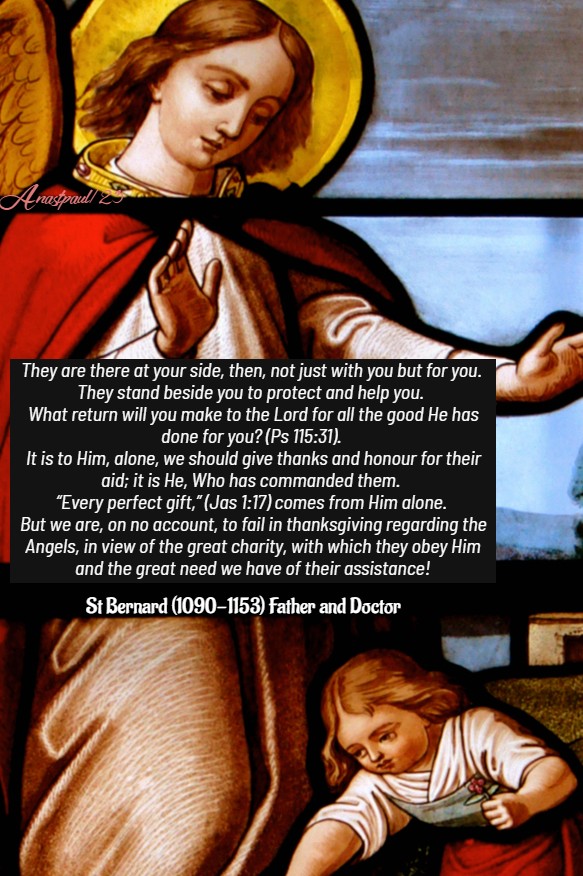
REFLECTION – “To His Angels He has given command about you that they guard you in all your ways” (Ps 90:11). What respect these words should arouse in you, to what fervour they should give birth, what trust they should inspire! Respect on account of their presence, fervour on account of their watchfulness, trust on account of their vigilance… They are there at your side, then, not just with you but for you. They stand beside you to protect and help you. What return will you make to the Lord for all the good He has done for you? (Ps 115:31). It is to Him, alone, we should give thanks and honour for their aid; it is He, Who has commanded them. “Every perfect gift,” (Jas 1:17) comes from Him alone. But we are, on no account, to fail in thanksgiving regarding the Angels, in view of the great charity, with which they obey Him and the great need we have of their assistance!
So let us be full of respect and thanksgiving for such vigilance on their part; let us love them in return and honour them as best we are able, as much as we ought… In God, let us love the Angels, knowing that one day we shall be sharers in the inheritance and that between then and now, the Father allows and arranges that they may be our guides and instructors. For “we are God’s children now” even though it has not yet been clearly revealed, (1 Jn 3:2) since we are still children subject to stewards and tutors and, for the present, we seem no different from servants.
Nevertheless, small though we be and long and dangerous though the road may be which remains for us to travel, what do we have to fear under so good a guardian?… The Angels are faithful, wise and powerful – what have we to fear? Let us only follow them and hold fast to them and we shall abide under the protection of the God of Heaven!” – St Bernard (1090-1153) Cistercian Abbot, called the Last Father and the Doctor of Light of the Church (12th sermon on Psalm 90).
PRAYER – O God, Who in Thy wondrous providence graciously send Thy Angels to watch over us, grant that we, who pray to Thee maybe ever under their protection and may rejoice in their unending companionship. Through Jesus Christ, Thy Son our Lord, Who lives and reigns with Thee, in the unity of the Holy Ghost, God, world without end. Amen (Collect).
Our Morning Offering – 2 October – “The Month of the Most Holy Rosary and of the Angels”
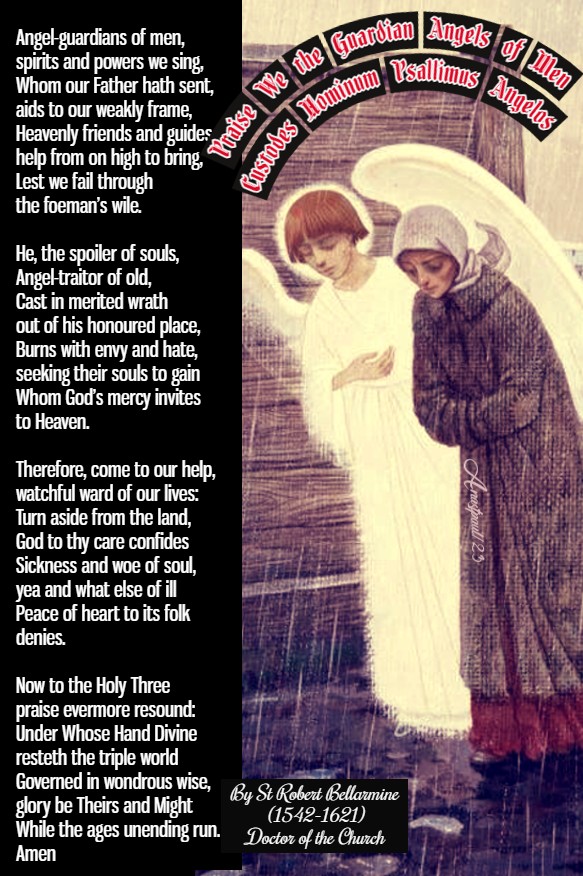
Custodes Hominum Psallimus Angelos Praise We the Guardian Angels of Men By St Robert Bellarmine SJ (1542-1621) Archbishop of Capua, Theologian Doctor of the Church
Angel-guardians of men, spirits and powers we sing, Whom our Father hath sent, aids to our weakly frame, Heavenly friends and guides, help from on high to bring, Lest we fail through the foeman’s wile.
He, the spoiler of souls, Angel-traitor of old, Cast in merited wrath out of his honoured place, Burns with envy and hate, seeking their souls to gain Whom God’s mercy invites to Heaven.
Therefore, come to our help, watchful ward of our lives: Turn aside from the land, God to thy care confides Sickness and woe of soul, yea and what else of ill Peace of heart to its folk denies.
Now to the Holy Three praise evermore resound: Under Whose Hand Divine resteth the triple world Governed in wondrous wise, glory be Theirs and Might While the ages unending run. Amen
This Hymn by St Robert Bellarmine,was added to the Roman Breviary in 1608, by command of Pope Paul V. It is for Vespers in the Office for “the Holy Guardian Angels. Double of the second class, 2 October.”
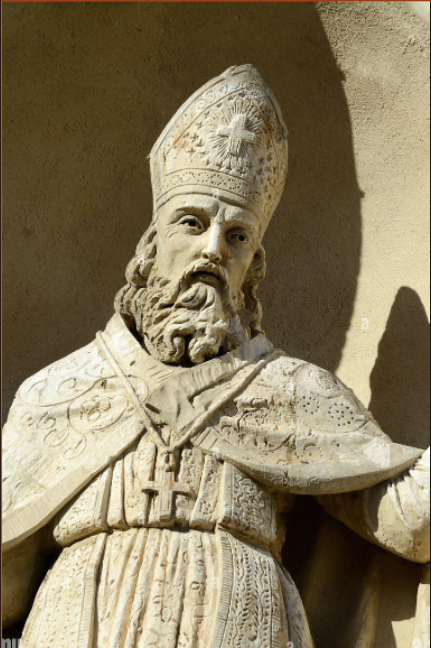
Saint of the Day – 2 October – Saint Ursicinus II (Died 760) Bishop of Chur in Switzerland, Monk, Abbot, Hermit, Restorer of the Monastery of Disentis and Architect and builder of 3 Churches in the Diocese. Unknown date and place of birth but died on 2 October in 769 in Disentis, Switzerland of natural causes. Also known as – Ursicinus di Coira, Ursicinus of Chur, Ursicino… Additional Memorial – 3 October in the Diocese of Chur together with the Blessed Bishop Algarotto II. The Image of the Statue of a Bishop is NOT our Saint but an unknown Bishop.
The Roman Martyrology states: “In the territory of today’s Switzerland, Saint Ursicinus, Bishop of Chur and first Abbot of the Monastery of Disentis which he founded.”
Unknown Bishop
We do not know when and where he was born, although his name has Latin/Italian roots and means “bear” but there is little certain data about him.
We do know that Ursicinus was educated in the Monastery of Saint Lucius of Chur, in Switzerland and, after that period, in 721 he entered the Benedictines of the Monastery of Disentis, whose first monastic nucleus was, according to tradition, erected around the year 700, by St Sigisbert.
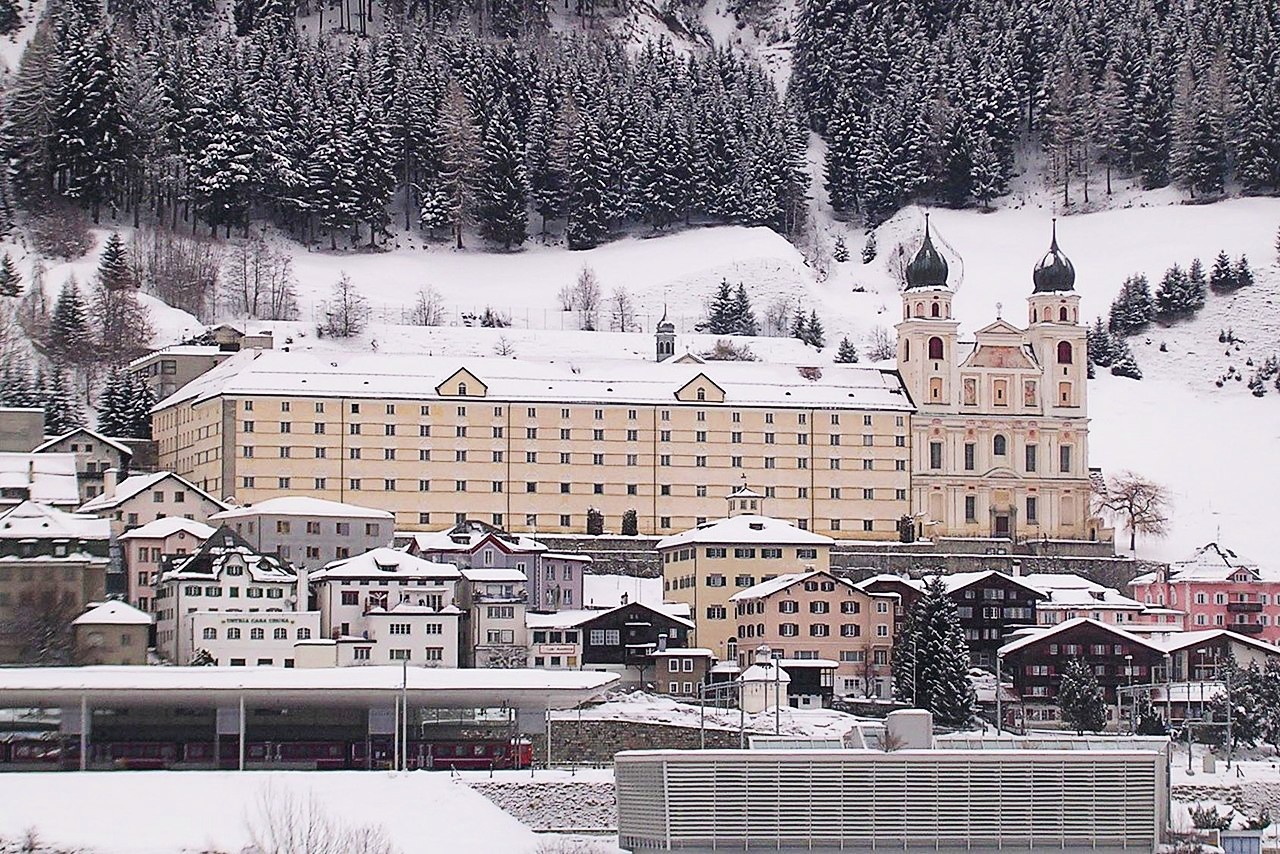
The Disentis Monastery
Ursicinus was elected Abbot of the Abbey of Disentis in 730. Nine years later, around 739, thanks to the help of the Bishops, Victor II and Vigilius, he managed to rebuild the Monastery and became the Architect and builder of the erection of the Churches of St Maria, St Martin and St Peter.
In 754, against his will, Ursicinus was elected Bishop of Chur which he ruled for only four years. He does not appear in the chrontaxes of the Bishops of the Diocese, whose list in that period, shows many gaps
The Cathedral of Chur
In 758, Ursicinus, now elderly, renounced his role and retired as a simple Monk to the Monastery of Disentis, where. according to some, he died on 2 October 760.
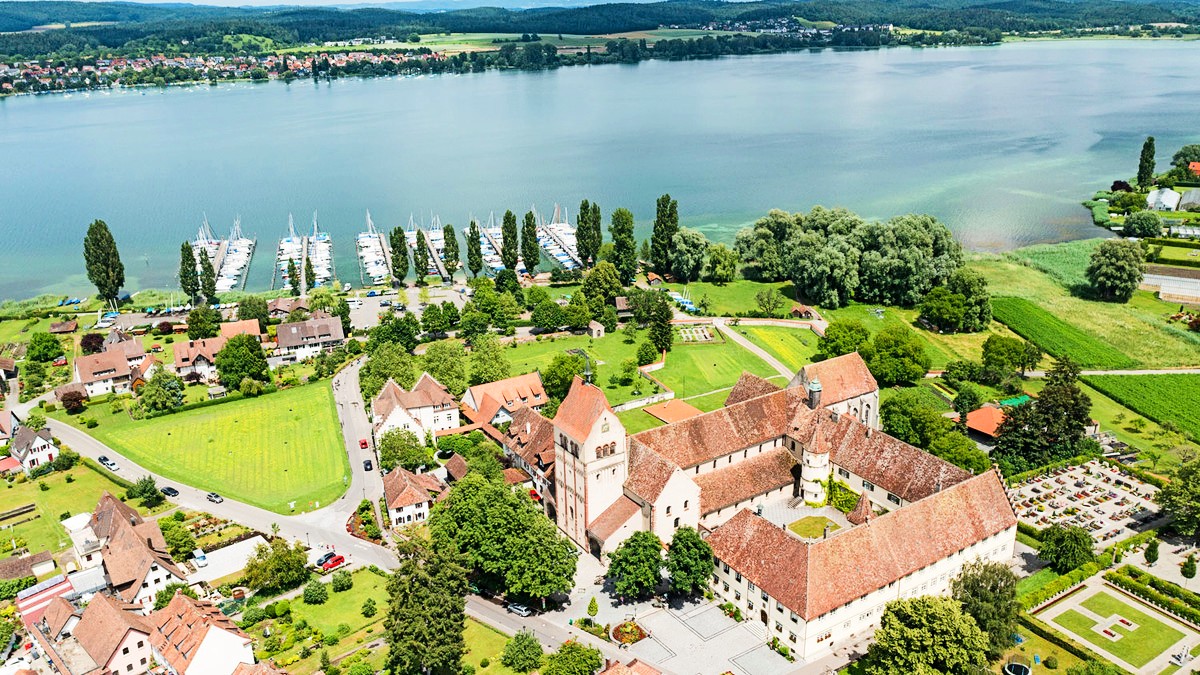
Furthermore, we do not know if and in what period he became a Monk of the important Abbey of Reichenau on Lake Constance, given that his name appears in their “Liber confraternitatum” at the head of all the Monks with the words “Ursicinus Episcopus.”
Reichenau Abbey on Lake Constance
Throughout the region, Ursicinus II enjoyed a great reputation for sanctity. In the Diocese of Chur, he is remembered by being celebrated together with Blessed Adalgotto II on 3 October. Saint Ursicino II Bishop, is remembered and celebrated in the Reichenau Obituary, in the Disentis Proper of 1690 and, in the Roman Martyrology on 2 October.
St Leudomer St Modesto of Sardinia St Saturius of Soria St Theophilus of Bulgaria
St Thomas de Cantilupe of Hereford (c1218-1282) Bishop of Hereford, Confessor, learned Scholar, known for his care of the poor and his protection of them against feudal landlords, Miracle-worker, Chancellor of Oxford University, Lord Chancellor of England. Thomas de Cantilupe was the last Englishman Canonised before the Reformation. An amazing Life and in death, a wondrous Miracle-worker: https://anastpaul.com/2021/10/02/saint-of-the-day-2-october-saint-thomas-de-cantilupe-of-hereford-c-1218-1282/
St Ursicinus II (Died 760) Bishop
Martyred in Nagasaki, Japan: A husband, wife and two sons, who were all martyred together in the persecutions in Japan. They were beheaded on 2 October 1622 in Nagasaki, Japan and Beatified by Pope Pius IX on 7 May 1867. Blessed Andreas Yakichi Blessed Franciscus Yakichi Blessed Lucia Yakichi Blessed Ludovicus Yakichi
Devotion for October, The Month of the Most Holy Rosary
The practice of dedicating the entire Month of October to the Holy Rosary developed toward the end of the 19th Century. Pope Leo XIII (Papacy: 1878-1903) strongly promoted the increase of devotion to the Blessed Mother and her Divine Son, by encouraging the constant use of the Rosary.
Beginning on 1 September 1883, with Supremo Apostolatus Officio, Pope Leo XIII wrote a total of eleven Encyclicals on the Rosary, ending with Diuturni Temporis in 1898. In 1885, Pope Leo XIII ordered the Rosary to be recited everyday during the month of October in every Parish Church and Cathedral, throughout the world. Those of the faithful who could not be present at this recital he exhorted to say it with their families or in private.
An Indulgence of 7 years is granted to all the faithful who devoutly recite the Rosary during the Month of October–granted by Pope Leo XIII, in the same Encyclical, Supremo Apostolatus Officio.
Please remember to offer Rosaries for the Poor Souls in Purgatory.
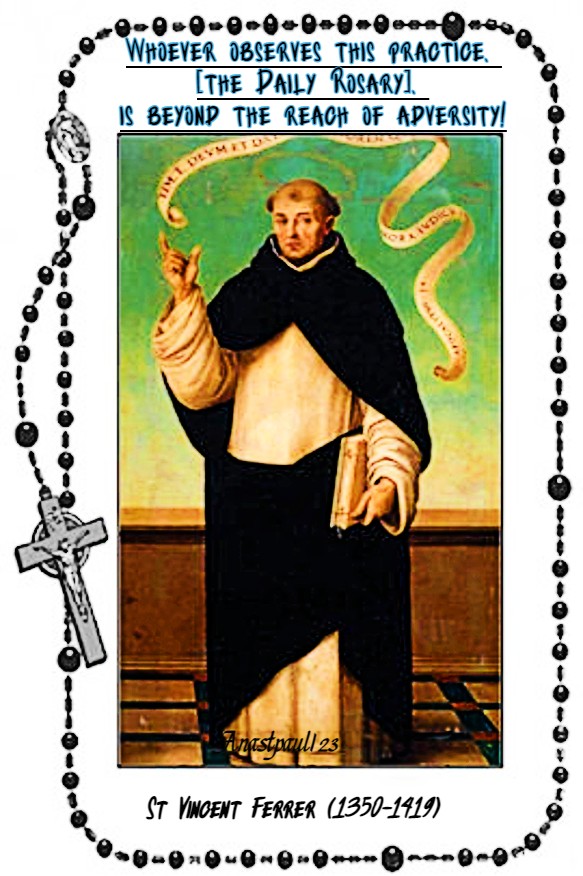
“Whoever observes this practice, [the Daily Rosary], is beyond the reach of adversity!”
St Vincent Ferrer (1350-1419)
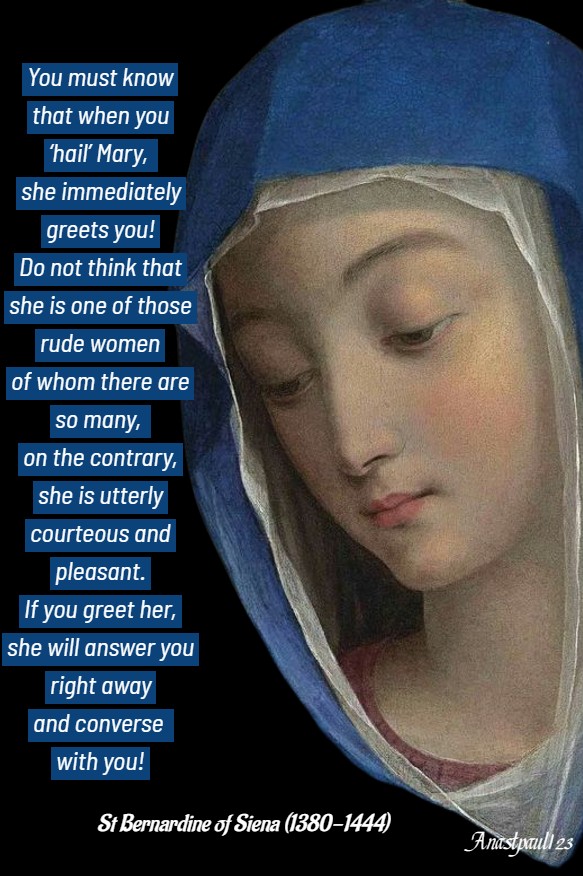
“You must know that when you ‘hail’ Mary, she immediately greets you! Do not think that she is one of those rude women of whom there are so many, on the contrary, she is utterly courteous and pleasant. If you greet her, she will answer you right away and converse with you!”
Oh Immaculate Heart of Mary, Mother most merciful, to thee do we plead the cause of the poor suffering souls in Purgatory, e specially those most abandoned. In obedience to thy request at Fatima, we beg for their relief. Oh Mother most merciful, we ask thee to lessen their toll of expiation. Deign to accept our humble prayers and sacrifice in reparation and payment for the punishment that is due from them. We pray that through the treasures of thy Divine Son, thou own special merits and sorrows and those of the Saints that God may be mindful of our prayers on behalf of the suffering souls in Purgatory and bring them into His Kingdom, to love and serve Him forever. Amen.
Our Lady of Fatima, Mother most merciful, inflame our hearts with the love and repartion for the Souls in Purgatory.
We pray our Daily Rosary now with the same Intention: “Relief for the Souls in Purgatory”
Thought for the Day – 1 October – Meditations with Antonio Cardinal Bacci (1881-1971)
The Month of the Holy Rosary
“We should say the Rosary devoutly everyday. This beautiful prayer is very pleasing to Our Lady and, the Church, is particularly anxious that we should recite it during the month of October. Families which say the Holy Rosary together can hope for a special blessing from God and for the maternal protection of Mary.
If possible, every family should gather together in the evening and recite the Rosary before an image of our Blessed Mother. If the parents set an example, their child will join them. It is consoling to come together after the toil and trouble of the day, in order to confide our cares and hopes to Mary.
Do you say the Rosary everyday? If you have neglected this pious practice, begin today! Do not plead lack of time. There is time for so many other things, so surely, there is time to pray and to entrust ourselves, in a special way, to the protection of our heavenly Mother!? The practice of reciting the Holy Rosary, will win for you, the blessing of God and the patronage of the Blessed Virgin.”
Quote/s of the Day – 1 October– “The Month of the Most Holy Rosary and of the Angels”
The Fifteen Promises is a tradition held by the Order of Preachers, that the Blessed Virgin Mary made Fifteen specific Promises through Saint Dominic (1170-1221) and Blessed Alain de la Roche (1428-1475), to those who faithfully pray the Rosary.
The 15 Promises of The Most Holy Rosary Given by The Blessed Virgin Mary
1.Those who faithfully serve me, by the recitation of the Rosary shall receive signal graces. 2. I promise my special protection and the greatest graces, to all those who shall recite the Rosary. 3. The Rosary shall be a powerful armour against hell. 4. It will destroy vice, decrease sin and defeat heresies. It will cause virtue and good works to flourish. It will obtain for souls the abundant mercy of God. It will withdraw the hearts of men from the love of the world and its vanities and will lift them to the desire of eternal things. Oh, that souls would sanctify themselves by this means. 5. The soul which recommends itself to me by the recitation of the Rosary, shall not perish. 6. Whoever shall recite my Rosary devoutly, applying himself to the consideration of its Sacred Mysteries, shall never be conquered and never overwhelmed by misfortune. God shall not chastise him in His justice, he shall not perish by an unprovided death Sinners shall convert. The just shall grow in grace and become worthy of eternal life. 7. Whoever shall have a true devotion to the Holy Rosary, shall not die without the Sacraments of the Church. 8. Those who are faithful, in reciting the Rosary, shall have, during their life and at their death, the Light of God and the plenitude of His graces. At the moment of death, they shall participate in the merits of the Saints in paradise. 9. I shall deliver from Purgatory, those who have been devoted to the Rosary. 10. The faithful children of the Rosary, shall merit a high degree of glory in Heaven. 11. You shall obtain all you ask of me, by the recitation of the Rosary. 12. All those who propagate the Holy Rosary, shall be aided by me, in their necessities. 13. I have obtained from my Divine Son, that all the advocates of the Rosary, shall have for intercessors, the entire Celestial Court during their life and at the hour of death. 14. All who recite the Rosary are my sons and brothers of my only Son, Jesus Christ. 15. Devotion to my Rosary is a great sign of predestination.
“The Rosary, recited with meditation on the mysteries, brings about the following marvellous results:
It gradually gives us a perfect knowledge of Jesus Christ;
It purifies our souls, washing away sin;
It gives us victory over all our enemies;
It makes it easy for us to practice virtue;
It sets us on fire with love of Our Blessed Lord;
It enriches us with graces and merits;
It supplies us with what is needed to pay, all our debts to God and to our fellow men and finally, it obtains all kinds of graces for us from Almighty God.”
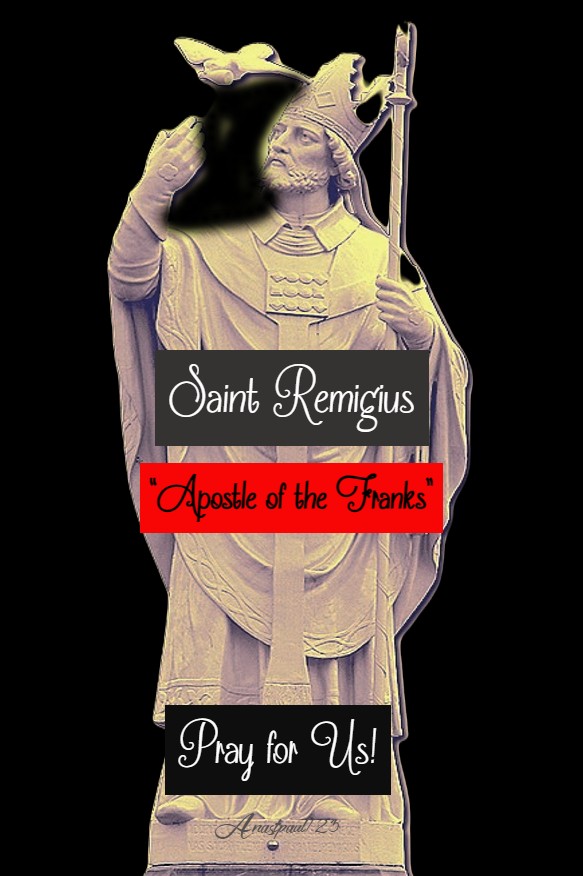
One Minute Reflection – 1 October – “The Month of the Most Holy Rosary and of the Angels” – The 18th Sunday after Pentecost – St Remigius (c438-533) Confessor, “Apostle of the Franks” Bishop –1 Corinthians 1:4-8 , Matthew 9:1-8 – Scripture search here: https://www.drbo.org/
“Which is easier to say: Thy sins are forgiven thee, or to say: Arise, and walk?” – Matthew 9:5
REFLECTION – “And people there brought to him a paralytic.” Saint Matthew merely says that this paralytic was carried to Jesus. Other Evangelists describe, how he was let down through an opening in the roof and placed before the Lord, without expressing any particular request, leaving it to Him to assess the needs …
“When Jesus saw their faith,” the Gospel says, that is to say, the faith of those who had brought the man to Him. Consider how sometimes Christ pays no attention to the faith of the sick person – perhaps because, the latter is incapable of it, being unconscious or possessed with an evil spirit. However, in this case, this paralytic had great trust in Jesus, otherwise, would he have allowed them to let him down in front of Him? Christ responds to this trust with an extraordinary miracle. With the power of God, He forgives this man’s sins. Thus He showed, that He is equal to the Father, a truth He had already shown, when He said to the leper: “I will do it – be made clean” (Mt 8:3) … and when, with a word, He stilled the tempestuous sea (Mt 8:26), or when, as God, He had cast out the demons who recognised in Him their ruler and their judge (Mt 8:32). So here, He shows His adversaries, to their great astonishment, that He is equal to the Father
And once more, the Saviour shows here, how He turns away from anything spectacular or a source of vainglory. On all sides the crowd is pressing Him, yet, He is in no hurry to work a visible miracle by healing the external paralysis of this man …. He begins with an invisible miracle – by healing the man’s soul. This kind of healing, is far more beneficial for him and, outwardly speaking, less glorious for Christ.” – St John Chrysostom (345-407) Priest at Antioch then Bishop of Constantinople, Father and Doctor of the Church – homilies on Saint Matthew’s Gospel, no. 29, 1.
PRAYER – Grant, we beseech Thee, Almighty God that the solemn feast of blessed Remigius, Thy Confessor and Bishop, may both increase our devotion and advance our salvation. Through the same Jesus Christ, Thy Son our Lord, Who lives and reigns with Thee, in the unity of the Holy Ghost, God, world without end. Amen (Collect).
Our Morning Offering – 1 October – “The Month of the Most Holy Rosary and of the Angels”
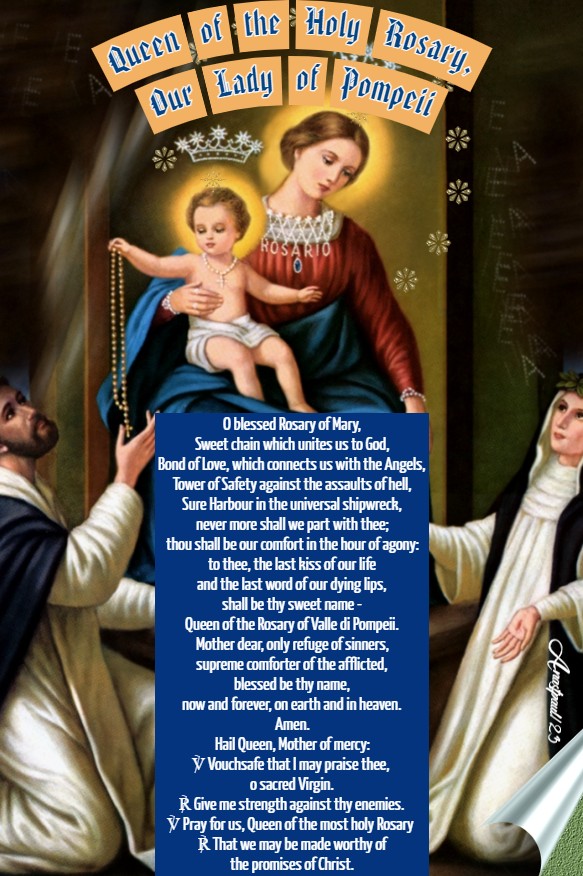
Queen of the Holy Rosary, Our Lady of Pompeii (Portion)
O blessed Rosary of Mary, Sweet chain which unites us to God, Bond of Love, which connects us with the Angels, Tower of Safety against the assaults of hell, Sure Harbour in the universal shipwreck, never more shall we part with thee; thou shall be our comfort in the hour of agony: to thee, the last kiss of our life and the last word of our dying lips, shall be thy sweet name – Queen of the Rosary of Valle di Pompeii. Mother dear, only refuge of sinners, supreme comforter of the afflicted, blessed be thy name, now and forever, on earth and in heaven. Amen.
Hail Queen, Mother of mercy: ℣ Vouchsafe that I may praise thee, o sacred Virgin. ℟ Give me strength against thy enemies. ℣ Pray for us, Queen of the most holy Rosary ℟ That we may be made worthy of the promises of Christ.
This Prayer has been approved by the Congregation of Rites and Pope Leo XIII has granted an Indulgence of Seven Years and Seven Quarantines to those who devoutly recite it on 8 May or on the first Sunday in October. (Rescript of 18 June 1887)
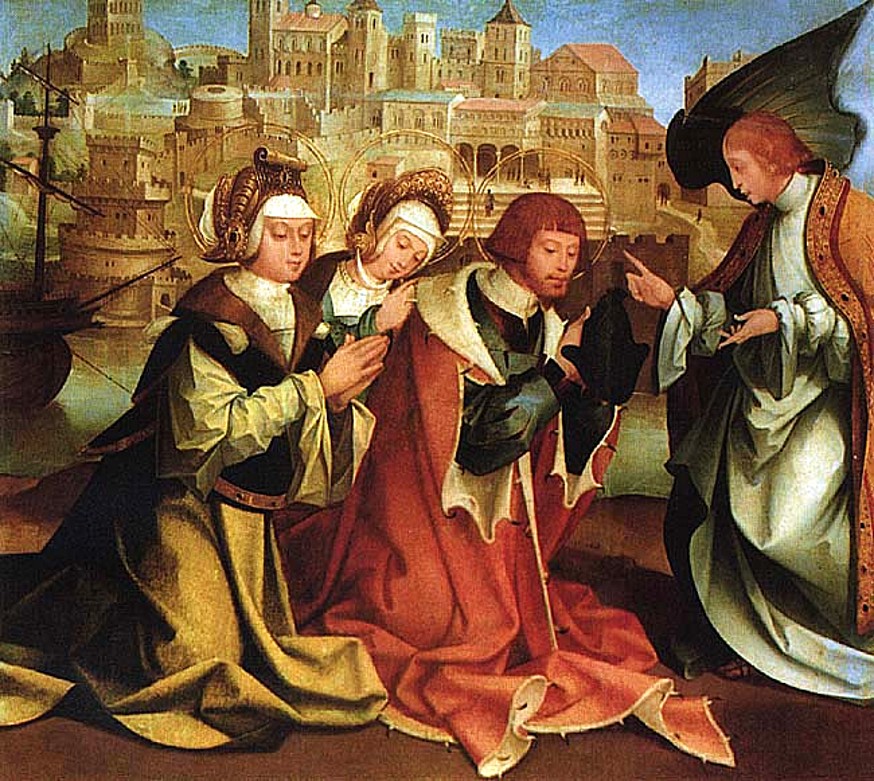
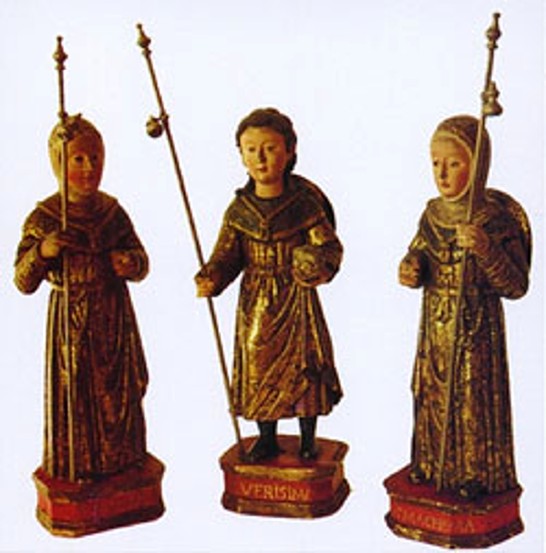
Saints of the Day – 1 October – The Holy Martyrs of Lisbon (Died c303) St Verissimus, St Maxima, St Julia. (Portuguese: Santos Mártires de Lisboa) were three siblings, the brother Verissimus and his two sisters , Maxima and Julia, who were Martyred n the Roman Province of Lusitania (modern-day Lisbon, Portugal) during the persecutions of Emperor Diocletian.
The Roman Martyrology reads: “At Lisbon, in Portugal, the holy Martyrs Verissimus and his tow sisters, Maxima and Julia, who suffered in the persecution of Diocletian.”
The first known historical references to the three Saints is found in the 8th Century Martyrology of Usuard. Thefaithful of Lisbon’s ancient devotion to the Martyrs is also attested in De expugnatione Lyxbonensi, an account of the Siege of Lisbon at the start of the Second Crusade in 1145.
Most accounts of the lives of the Holy Martyrs of Lisbon, maintain that the three siblings were in Rome when an Angel appeared unto them and told them to go to Olisipo, where they “would achieve the Crown of Martyrdom which they so eagerly sought.” They journeyed by boat to the City and soon enough were arrested for being Christians and taken into the presence of Tarquinius, the Roman Governor under Diocletian. Having voiced their will to uphold the Christian Faith even it be necessary to suffer Martyrdom therefore, Tarquinius subjected them to a series of torments after which they were stoned and their throats slit.
The Martyrdom of Verissimus, Maxima and Julia, is the subject of a series of paintings by Garcia Fernandes, painted in c1530, see above.
St Crescens of Tomi St Dodo Bl Dominic of Villanova Bl Edward James St Evagrius of Tomi St Fidharleus Bl Gaspar Fisogiro Bl John Robinson St Julia + The Holy Martyrs of Lisbon St Maxima + The Holy Martyrs of Lisbon St Piaton of Tournai St Priscus of Tomi Bl Ralph Crockett Bl Robert Widmerpool Bl Robert Wilcox
St Romanos the Melodist (c490-c 556) Deacon, Hymnographer, Poet, Writer. He is said to have composed more than 1,000 hymns celebrating various festivals of the ecclesiastical year, the lives of the saints and other sacred subjects, some 60 to 80 of which survive. Wonderful Saint Romanos! https://anastpaul.com/2020/10/01/saint-of-the-day-1-october-st-romanos-the-melodios-c-490-c-556/
St Sazan of Abyssinia St Verissimus + The Holy Martyrs of Lisbon St Virila St Wasnulf
Oh Immaculate Heart of Mary, Mother of Jesus and Our Mother, we pray that the hope and promise made by thee at Fatima, will soon be realised. We know it is thou ardent wish and desire that there be peace in the world and it is only through Reparation to thou Immaculate Heart that such can be accomplished. Thou has told us thy wish in the Message of Fatima – Reparation through the Rosary and the practice of the First Saturdays. We beg of thee, Oh Mary Immaculate that, through thy pleadings, our prayers and example may show the world, the road to the true peace which the world itself cannot give. Bless, we beseech thee, our country and inspire us and our leaders to receive, understand and promote that glorious Message delivered by thee at Fatima.
Our Lady of Fatima, Queen of Peace, inflame our hearts with the love of “The True Peace of Christ.” Amen
We pray our Daily Rosary now with the same Intention: “The True Peace of Christ.”
Thought for the Day – 30 September – Meditations with Antonio Cardinal Bacci (1881-1971)
Christian Modesty
“The virtue of modesty is necessary, in that it regulates all our actions, internal and external and saves us from everything which threatens the purity of our souls. It is also an inspiring example to the people around us. The Saints often converted sinners and incited others to lead better lives, simply because their conduct proclaimed their purity and sanctity.
We should endeavour to do the same, without affectation, however but, in a simple and natural manner. The continual mastery which we exercise over our interior and exterior faculties, should be reflected in our appearance, in our conversation and, in all our actions.”
Quote/s of the Day – 30 September – St Jerome (347-419) Confessor, Father and Doctor of the Church, Priest, Monk, Translator of the Scriptures into Latin (the Vulgate), Theologian, Historian, Hermit, Mystic. “The Sun Who Illuminated the Scriptures” “A Lion in Defence of the Faith”
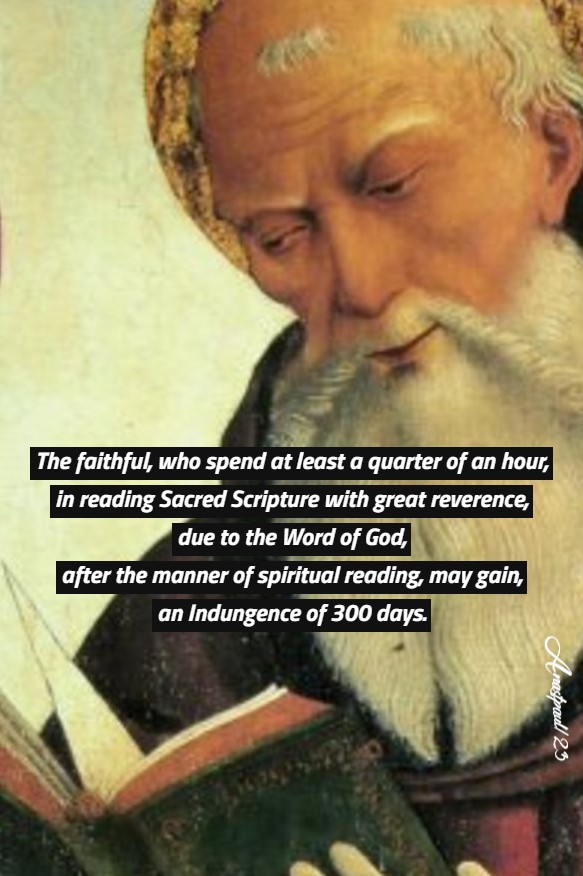
The Reading of Sacred Scripture: “The faithful, who spend at least a quarter of an hour, in reading Sacred Scripture with great reverence, due to the Word of God, after the manner of spiritual reading, may gain, an Indungence of 300 days.”
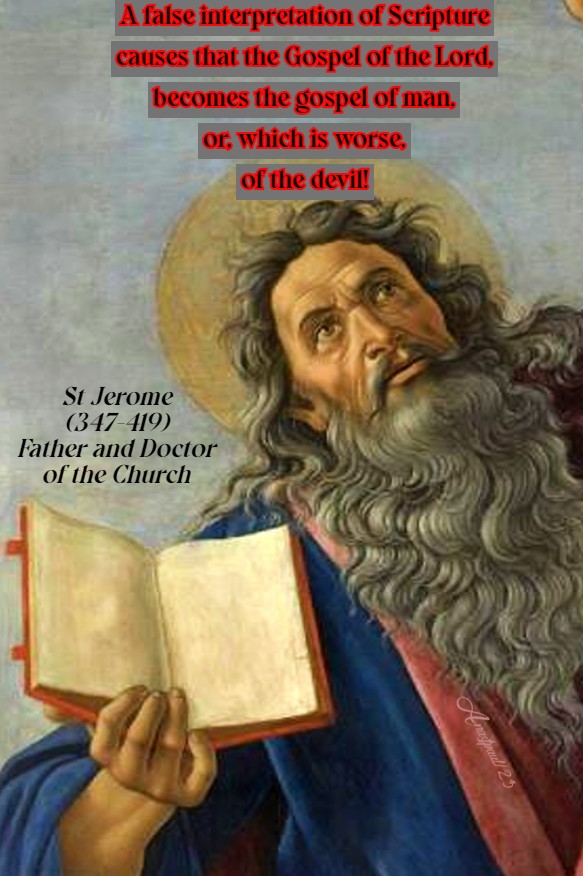
“A false interpretation of Scripture causes that the Gospel of the Lord, becomes the gospel of man, or, which is worse, of the devil!”
“Instead of speaking saintly words, we must act them.”
“It is our part to seek, His to grant what we ask; ours to make a beginning, His to bring it to completion; ours to offer what we can, His to finish what we cannot.”
One Minute Reflection – 30 September – “Month of The Seven Sorrows of the Blessed Virgin Mary and The Holy Cross” – St Jerome (347-419) Confessor, Father and Doctor – 2 Timothy 4:1-8, Matthew 5:13-19 – Scripture search here: https://www.drbo.org/
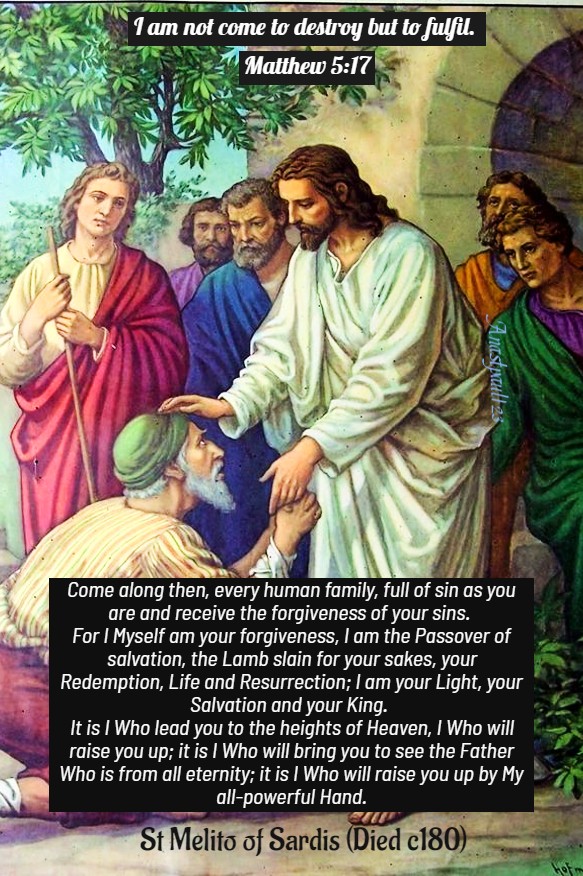
“I am not come to destroy but to fulfil.” – Matthew 5:17
REFLECTION – “The sacrifice of the lamb, the Passover rite and the letter of the Law have reached their term in Jesus Christ, in view of Whom, everything in the ancient Law took place – and, even more so, in the new dispensation. For the Law became the Word; from being old it became new … the commandments have been transformed into grace and the foreshadowing into Truth; the lamb has become the Son, the sheep has become man and man has become God. …
God, although He was the Lord, put on our humanity; He suffered for him, who was suffering, was bound for him, who was captive, was judged for the guilty, was buried for him, who was buried. He was raised from the dead and cried out in a loud voice: “If anyone wishes to oppose Me, let us appear together” (Is 50:8). It is I Who delivered the condemned man; I Who restored life to the dead; I Who raised up those in the grave. “Who disputes My right?” It is I, He says, I Who am the Christ, I Who destroyed death, Who triumphed over the enemy, Who bound the mighty enemy and carried off man to the heights of heaven; it is I, He says, Who am the Christ.
Come along then, every human family, full of sin as you are and receive the forgiveness of your sins. For I Myself am your forgiveness, I am the Passover of salvation, the Lamb slain for your sakes, your Redemption, Life and Resurrection; I am your Light, your Salvation and your King. It is I Who lead you to the heights of Heaven, I Who will raise you up; it is I Who will bring you to see the Father Who is from all eternity; it is I Who will raise you up by My all-powerful Hand.” – St Melito of Sardis (Died c180) Bishop of Sardis in Smyrna and Father of the Church [Paschal Homily (Passim)]
PRAYER – O God, Who graciously gave Thy Church blessed Jerome, Thy Confessor and peerless teacher, to explain the Holy Scriptures, grant, we beseech Thee that, with the help of his merits and by Thy assistance, we may be able to put into practice what he has taught us by his life and works. Through the same Jesus Christ, Thy Son our Lord, Who lives and reigns with Thee, in the unity of the Holy Ghost, God, world without end. Amen (Collect).
Our Morning Offering – 30 September – St Jerome (347-419) Confessor, Father and Doctor, Priest, Monk, Translator of the Scriptures into Latin (the Vulgate), Theologian, Historian, Hermit, Mystic.
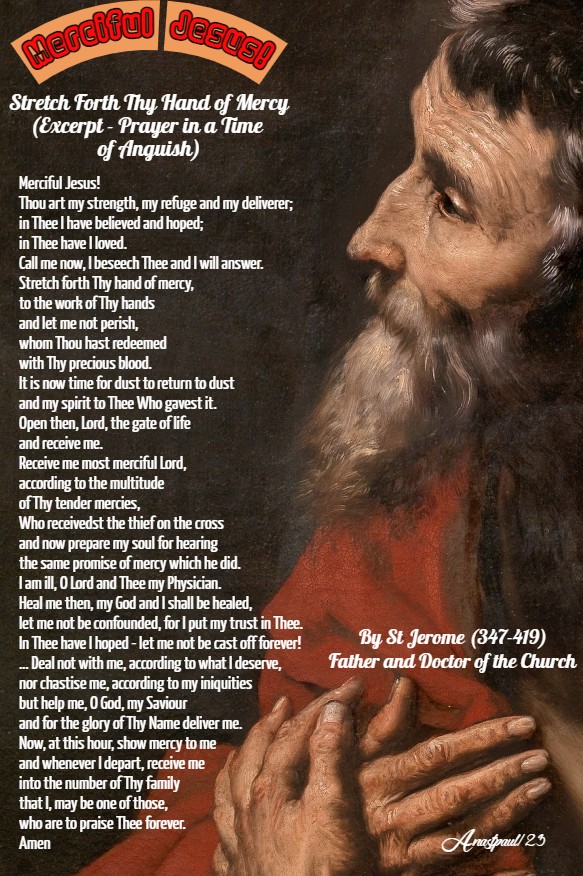
Merciful Jesus! Stretch Forth Thy Hand of Mercy (Excerpt – Prayer in a Time of Anguish) By St Jerome (347-419) Father and Doctor of the Church
Merciful Jesus! Thou art my strength, my refuge and my deliverer; in Thee I have believed and hoped; in Thee have I loved. Call me now, I beseech Thee and I will answer. Stretch forth Thy hand of mercy, to the work of Thy hands and let me not perish, whom Thou hast redeemed with Thy precious blood. It is now time for dust to return to dust and my spirit to Thee Who gavest it. Open then, Lord, the gate of life and receive me. Receive me most merciful Lord, according to the multitude of Thy tender mercies, Who receivedst the thief on the cross and now prepare my soul for hearing the same promise of mercy which he did. I am ill, O Lord and Thee my Physician. Heal me then, my God and I shall be healed, let me not be confounded, for I put my trust in Thee. In Thee have I hoped – let me not be cast off forever! … Deal not with me, according to what I deserve, nor chastise me, according to my iniquities but help me, O God, my Saviour and for the glory of Thy Name deliver me. Now, at this hour, show mercy to me and whenever I depart, receive me into the number of Thy family that I, may be one of those, who are to praise Thee forever. Amen
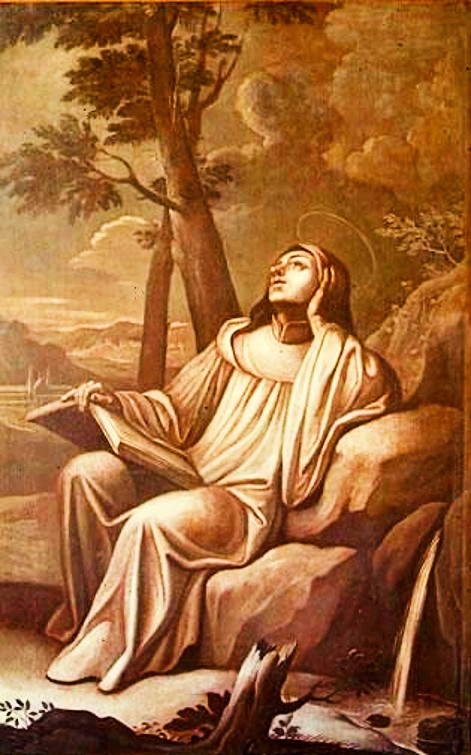
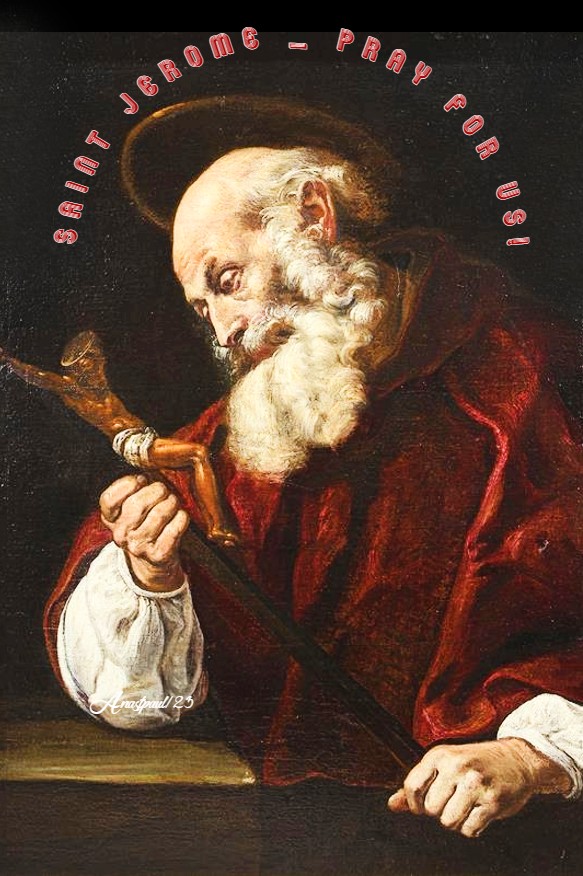
IMAGE – Ribera, Jusepe de, lo Spagnoletto (Spanish) 1644 Oil on Canvas




















You must be logged in to post a comment.