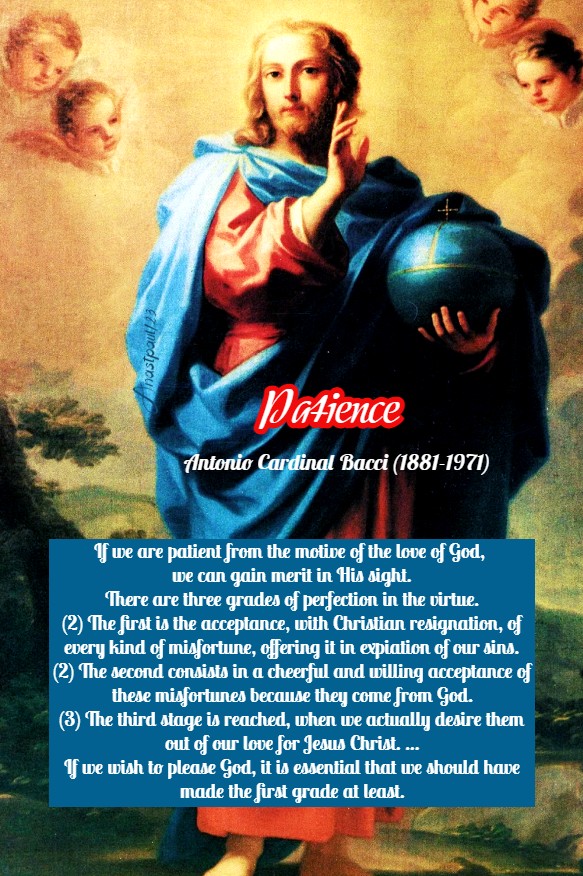
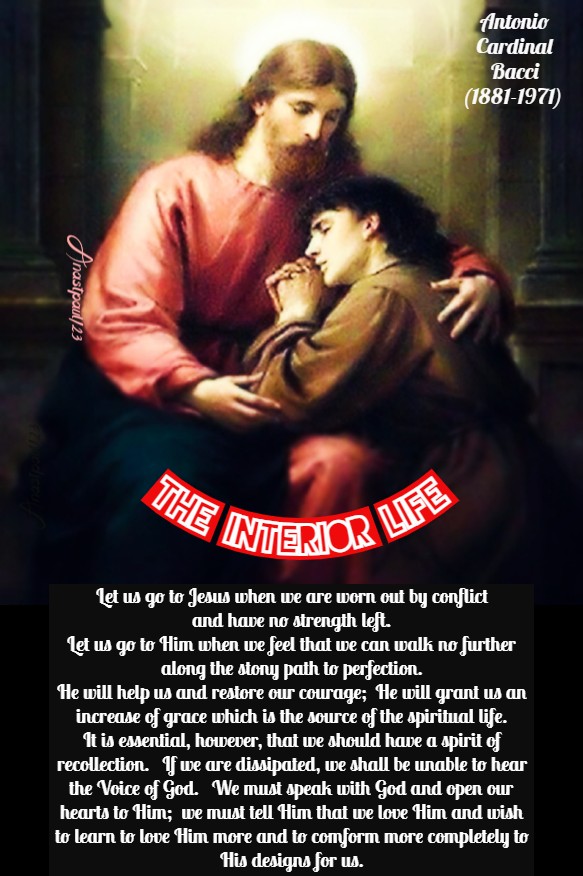
Thought for the Day – 12 March – Meditations with Antonio Cardinal Bacci (1881-1971)
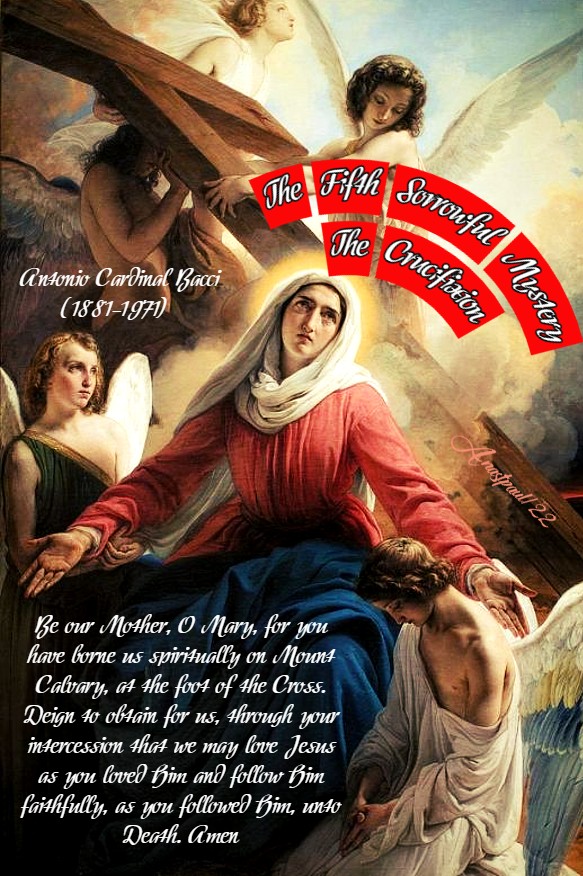
Detachment from the World
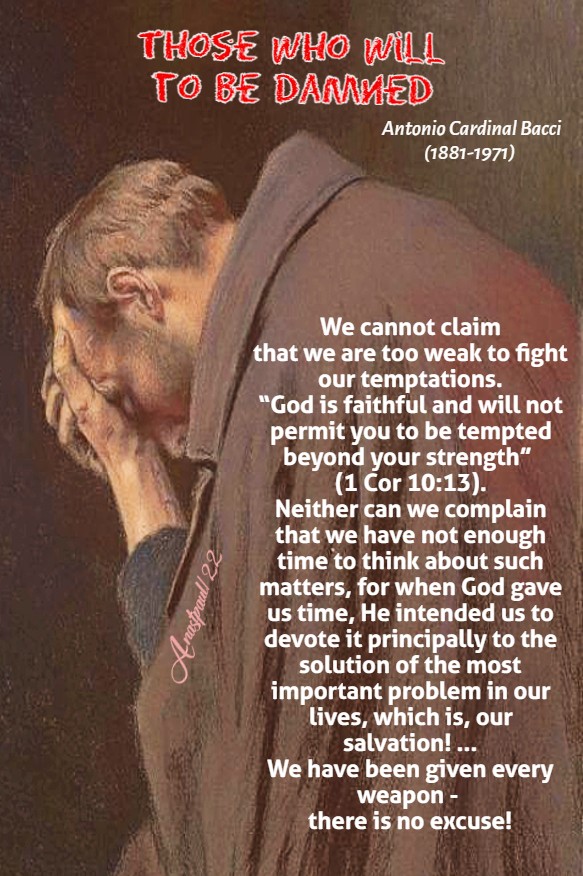
“This is not the same as saying that we should have no interest in worldly affairs. Far from it. It is our duty to think about them and make provision for the future. We cannot and should not look for miracles from God. We must have obligations to ourselves, or to our family, or to our position in life. We are in this world to work, not to surrender to apathy or inactivity. We must engage in worldly activity insofar as our circumstances demand it.

Nevertheless, our hearts should not be engrossed in earthly things, for they belong to God. In the midst of our other preoccupations, we should adore, love and thank God, the Giver of every good, our Creator and our Redeemer.”
Quote/s of the Day – 12 March – The Third Sunday in Lent and the Feast of St Gregory the Great (540-604) Pope, Confessor, Father & Doctor of the Church, “Father of the Fathers”
“Your faith has saved you.”
Luke 18:42
“The blind man does not ask the Lord for gold but for Light. He sets little store by asking anything but Light … Let us imitate him, dearly beloved … Let us not ask the Lord for deceitful riches, or earthly gifts, or passing honours but for Light. And let us not ask for light shut up in one place, or limited by time, or ending with the coming of night. The beasts behold such light just as we do. Let us ask for the Light which we can see with angels alone, Light without beginning or end. The way to this Light is faith. Hence Jesus immediately says to the blind man, who is to be enlightened: “Raise your eyes, your faith has saved you!”
“Have I not a right to do what I choose? Or are you envious because I am generous?”
Matthew 20:15.
“But no-one should boast of his work or of his time, when, after saying this, Truth cries out: “So the last will be first and the first last.” We know what good things we have done and how many they are; we do not know with what exactitude our Judge on high will investigate them. Indeed, we must all rejoice exceedingly, to be even the last, in the Kingdom of God!”
“Stand erect and raise your heads because your redemption is at hand.”
Luke 21:28
“Truth is exhorting His elect by saying: “When the disasters of the world become more frequent… let your hearts exult! While the world, which is not your friend, is coming to an end, the redemption you have sought ,is coming near.!” Those who love God are ordered to rejoice and be merry at the world’s end. They will soon find Him Whom they love, while what they have not loved is passing away. It should be far from the hearts of all the faithful who long to see God, to grieve over the disasters of a world, for they know, these very disasters, are soon to end. It is written that: “Whoever wishes to be a friend of this world, makes himself an enemy of God” (Jas 4,4).”
“Someone who does not rejoice as the end of the world approaches, testifies that he is its friend and this itself convicts him, of being God’s enemy!”
Our Lenten Journey with St Francis de Sales – 12 March – The Third Sunday in Lent – Ephesians 5:1-9, Luke 11,14-28 – Scripture search here: https://www.drbo.org/
“To Thee have I lifted up my eyes, Who dwells in Heaven. Have mercy on us, O Lord, have mercy on us.” Psalm 122:1,3
“Every kingdom divided against itself is laid waste.” Luke 11:17
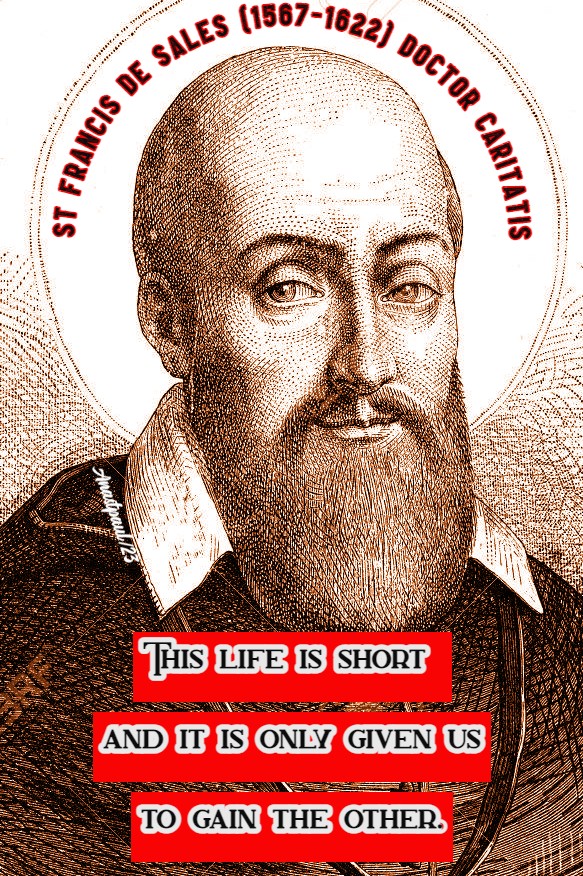
MUTUAL CHARITY St Francis de Sales (1567-1622) Doctor Caritas
“IN TODAY’S GOSPEL[Lk. 11:14-28], Our Lord insists that every kingdom divided against itself, (not united in itself) is brought to desolation. On the other hand, the converse is true, too – all kingdoms united in concord, not permitting any division to enter, will surely be filled with consolation. For if the propositions are opposite, the consequences must be, too. These words are among the most remarkable, noteworthy and important that our Divine Master ever spoke. For this reason the ancient Fathers carefully interpreted them.
They agree that our Saviour had three kinds of concord or union in mind when He spoke, where division in any of them, results in desolation. The first is the concord which should exist between a king and his subjects, making subjects submissive and obedient to his laws. The second is the union which we ought to have within, in our inner kingdom, where reason must be the king to whom are subject, all the faculties of our spirit, all our senses and even our bodies. … (Without this obedience and submission we cannot avoid having desolation and trouble, any more than there could be peace in a kingdom in which the subjects are not obedient to the laws of the king.)
… The third, is that which we ought to have with each other. This union or concord, has been earnestly preached, recommended and taught to us by Our Lord, equally in word and example. … Nothing is so stressed, nothing stated so completely as the observance of this Commandment [the Commandment of love[. He does so with good reason, for the beloved of the Beloved, the great Apostle St John, assures us that anyone who says that he loves God and does not love his neighbour, is a liar [1 Jn.4:20-21]. On the other hand, he who says he loves his neighbour but does not love God also contradicts the truth. That simply cannot be. To love God without loving the neighbour, who is created in His Image and Likeness [Gen. 1:26-27], is impossible.
But what should this union and concord be which we all ought to have? Oh! What should it be indeed! It must be such that if Our Lord Himself had not explained it, no-one would have been so daring as to use the same terms as His. At the Last Supper, after He had given the incomparable pledge of His love for us men, the Most Blessed Sacrament of the Eucharist, He said: “Father, My very dear Father, I beseech Thee that all those whom Thou hast given Me may be one, as Thou and I, Father, are One ” [Jn 17:11-12, 21-22]. To show that He was not speaking only for the Apostles but for all the rest of us, He added: “I do not pray for them alone (that is, those He had just mentioned) but for all those who will believe in Me, through their word” [Jn 17:20]. Who would have dared, I repeat, to make such a comparison, or to ask that we might be united as the Father, the Son and the Holy Spirit are united? – (Sermon for the Third Sunday of Lent, 27 February 1622).
One Minute Reflection – 12 March – The Third Sunday in Lent and the Feast of St Gregory the Great (540-604) – Pope, Confessor, Father & Doctor of the Church, “Father of the Fathers” – Ephesians 5:1-9, Luke 11,14-28 – Scripture search here: https://www.drbo.org/
“Every kingdom divided against itself is laid waste.” – Luke 11:17
REFLECTION –“No-one can have God as his father, if he does not have the Church as his mother… The Lord warned us of this when He said: “Whoever is not with me, is against me and whoever does not gather together with me, scatters.” The person who breaks the peace and concord of Christ, acts against Christ; the person who gathers together, outside of the Church, scatters the Church of Christ.
The Lord said: “The Father and I are one.” (Jn 10:30) It is also written of the Father, the Son and the Holy Spirit: “These three are one.” (1 Jn 5:7) From now on, who can believe, that the unity, which has its origin in this divine harmony, which is linked with this heavenly mystery, can be divided up in the Church… through conflicts of will? Whoever does not observe this unity, neither observes the law of God, nor faith, in the Father and the Son – he keeps neither life, nor salvation.
In the gospel, this sacrament of unity, this bond of concord, in indissoluble cohesion, is shown us through the Lord’s tunic. It could neither be divided nor torn but they drew lots, so as to know who would put on Christ (Jn 19:24)… It is the symbol of unity, that comes from on high.” – St Cyprian of Carthage (c 200- c 258) Bishop and Martyr, Father of the Church (On the unity of the Church).
PRAYER – O God, Who granted the rewards of everlasting happiness to the soul of Thy servant Gregory, mercifully grant that we, who are weighed down with the burden of our sins, may be raised up by his prayers to Thee. Through Jesus Christ, Thy Son our Lord, Who lives and reigns with Thee, in the unity of the Holy Ghost, God, world without end. Amen (Collect).
Our Morning Offering – 12 March – The Third Sunday in Lent and the Memorial of St Pope Gregory the Great (540-604) – Father & Doctor
Lucis Creator Optime O Blest Creator of the Light By St Gregory the Great (540-604) Pope, Father & Doctor “Father of the Fathers”
O blest Creator of the light, Who mak’st the day with radiance bright, And o’er the forming world did’st call The Light from Chaos First of all.
Whose wisdom join’d in meet array The morn and eve and nam’d them day; Night comes with all its darkling fears; Regard Thy people’s pray’rs and tears.
Lest, sunk in sin and whelm’d with strife, They lose the gift of endless life; While thinking but the thoughts of time, They weave new chains of woe and crime.
But grant them grace that they may strain The heav’nly gate and prize to gain; Each harmful lure, aside to cast, And purge away each error past.
O Father, that we ask be done, Through Jesus Christ, Thine only Son; Who, with the Holy Ghost and Thee, Shall live and reign eternally. Amen
This hymn is used for Vespers (II) on Sundays throughout the year in the Extraordinary Form of the Roman Breviary. Trans John M Neale (1818-1866), 1851. Tune: “Lucis Creator Optime” Gregorian Chant, Mode VIII, traditional.
Saint of the Day – 12 March – St Bernard of Carinola (1040-1109) Bishop of Caripola, Counsellor and Chaplain, Confessor to Royalty. Born in 1040 at Capua, Italy and died in 1109 of natural causes at Carinola, Campania, Italy of which City and Diocese he is the Patron Saint. Also known as – Bernard of Capua.
QWe have no information of St Bernard’s early life. We know that he studied at the Benedictine Abbey of Monte Cassino Abbey. He became a Monk and the spiritual student of the Abbot who later became Pope Victor III. One of his fellow students was St Peter Damia, the Doctor of the Church.
This Relief at the Cathedral of Carinola is probably St Bernard
He was Ordained a Priest and then appointed as the Counsellor and Chaplian to Prince Jordan of Capua and the Confessor of Duke Richard II of Capua.
In 1087 he was appointed the Bishop of Forum Claudii by Pope Victor III, his former Master at Monte Casino. Bernard was Consecrated by this Pope on 21 March 1087. In 1100, Bernard transferred the See to the City of Carinola.
The Bishop on the left in this ancient fresco at the Cathedral of Carinola is most likely to be St Bernard/
Bernard died at the age of 69 after having zealously served the Church and his flock for 22 years. His body was nterred in a marble sarcophagus in the Cathedral of Carinola.
St Almut of Wetter St Alphege the Bald St BasilissS of Asia Bl Beatrix of Engelport St Bernard of Carinola (1040-1109) Bishop Bl Claudius the Minor St Egdunus St Fechno
Blessed Jerome of Recanati OSA (Died 1350) Priest, Friar of the Hermits of Saint Augustine, Peacemaker. He was Beatified in 1804 by Pope Pius VII (cultus confirmation). The Roman Martyrology reads : “In Recanati in the Marche, Blessed Girolamo Gherarducci, Priest of the Order of the Hermits of St Agustine, who worked for peace and harmony between peoples.” About Bl Jerome: https://anastpaul.com/2022/03/12/saint-of-the-day-12-march-blessed-jerome-of-recanati-osa-died-1350/
Martyrs of Nicomedia – 8 Beati: Christians who were Martyred in succession in a single incident during the persecutions of Diocletian. First there were the eight imprisoned Christians, Domna, Esmaragdus, Eugene, Hilary, Mardonius, Maximus, Mígdonus and Peter, about whom we know little more than their names. Each day for eight days one of them would be strangled to death in view of the others so that they would spend the night in dread, not knowing if they were next. Peter was the chamberlain or butler in the palace of Diocletian. When he was overheard complaining about this cruelty, he was exposed as a Christian, arrested, tortured and executed by having the flesh torn from his bones, salt and vinegar poured on the wounds and then being roasted to death over a slow fire. Gorgonio was an army officer and member of the staff in the house of emperor Diocletian, Doroteo was a staff clerk. They were each exposed as Christians when they were overhead objecting to the torture and murder of Peter. This led to their own arrest, torture and executions. Died in 303 in Nicomedia, Bithynia (in modern Turkey) Additional Memorial – 28 December as part of the 20,000 Martyrs of Nicomedia. Beatified on 14 January 1891 by Pope Leo XIII (cultus confirmation).
Saint Joseph, you are the faithful protector and intercessor of all who love and venerate you. You know that I have confidence in you and that, after Jesus and Mary, I come to you as an example of holiness, for you are especially close to God. Therefore, I humbly commend myself, with all who are dear to me and all for whom I pray, to your intercession. I beg of you, by your love for Jesus and Mary, not to abandon me during life and to assist me at the hour of my death. Glorious Saint Joseph, Spouse of the Immaculate Virgin, pray for me to have a pure, humble, charitable heart and perfect resignation to the divine Will. Be my guide, my father and my model throughout life, that I may die as you did, in the arms of Jesus and Mary. Loving Saint Joseph, faithful follower of Jesus Christ, I raise my heart to you to implore your powerful intercession in obtaining from the Divine Heart of Jesus, all the graces necessary for my spiritual and temporal welfare, particularly the grace of a happy death, and the special grace I now implore: …………….. (Mention your request) Guardian of the Word Incarnate, I feel confident that your prayers on my behalf will be graciously heard before the throne of God St Joseph Most Just, Pray for us! Amen.
Thought for the Day – 11 March – Meditations with Antonio Cardinal Bacci (1881-1971)
The Growth of Jesus
“Like Jesus, we must advance in goodness before men, as well as before God. Our external behaviour should be the candid mirror of our inner sanctity. The external appearance of courtesy, good manners and holiness, should not be mere ostentation. It should be a vital expression of interior goodness which, naturally, tends to show itself outwardly, so that all “may see your good works and give glory to your Father in Heaven” (Mt 5:16). If it is no more than a display, Jesus will say that “they have received their reward” (Cf Mt 6:1,5). If it is pure hyprocrisy, Jesus will drive away the culprits from Himself because, they are “like whited sepulchres” (Cf Mt 23:27).
Let us make Jesus our constant model, therefore. Let our outward demeanour always reflect our interior goodness and holiness.”
Quote/s of the Day – 11 March – Saturday of the Second Week in Lent
“Do you wish your prayer to fly toward God? Make for it two wings – fasting and almsgiving!”
St Augustine (354-430) Father and Doctor of Grace
“It is a matter of real sorrow when God has given us strength to break stronger fetters, those of vanity and sin that we neglect our own progress and the attainment of such great blessings because we will not detach ourselves from trifles. Not only do we not advance, we fall back. For it is well known, that on the spiritual road, not to go on overcoming self, is to go backwards and not to increase our gain, is to lose!”
St John of the Cross (1542-1591) Doctor of the Church
Our Lenten Journey with St Francis de Sales – 11 March – Saturday of the Second Week in Lent – Genesis 27:6-40, Luke 15:11-32 – Scripture search here: https://www.drbo.org/
“Lord, before I existed Thou beheld me and called me by name …” Jeremias 1:5
“I shall arise and shall go to my Father” Luke 15:18
THE LOVING HEART OF GOD St Francis de Sales (1567-1622) Doctor Caritas
“REMEMBER the Heart of Our Lord saw your heart and loved you surely, from the Tree of the Cross. By this love, He obtained for you all the good things that you will ever have, including your resolutions. Yes, we can say with Jeremias: “Lord, before I existed Thou beheld me and called me by name” (cf. 1:5).
This is indeed so – His Divine Goodness has prepared, in His love and mercy, all the means, general and particular, for our salvation and consequently, our resolutions. Yes, without doubt. A woman with child prepares the cradle, the linen and swaddling clothes and even arranges a nurse for the child whom she hopes to bring forth, although it is not yet in the world. So Our Lord, in His Goodness, is, as it were, pregnant with you, wishing to bring you forth to salvation and make you His child, prepared upon the Tree of the Cross, everything you would need. He got ready your spiritual cradle, linen and swaddling clothes, your nurse and everything suitable for your happiness.
These are all the means, all the attractions and all the graces by which He guides you and wants to lead you to perfection. My God, how deeply this truth should be fixed in our memory. Is it possible that I have been loved and loved so tenderly, by my Saviour? That He thought of me personally in all these little events by which He has drawn me to Himself? How much then should we love, cherish and make good use of all this for our benefit!This is extremely kind. this loving Heart of my God thought of me, loved me and obtained for me a thousand means of salvation. This He did as though there was no other soul in the world He could think of!
The sun shines on one part of the earth, shining on it no less than if it shone nowhere else and, as if it shone upon it alone. In the same way, Our Lord thought of and cared for all His loving children, in such a way, that He thought of each one of us. as though He had not thought of all the rest. He loved me, says St Paul and gave Himself for me, (Galatians 2:20) as if He said: for myself alone, as though He had done nothing for the others. Imprint this in your spirit, in order to cherish and nourish, with care, your firm resolution, so precious to the Heart of the Saviour.”– (Introduction to the Devout Life)
One Minute Reflection – 11 March – Saturday of the Second Week in Lent – Genesis 27:6-40, Luke 15:11-32 – Scripture search here: https://www.drbo.org/
“I shall arise and shall go to my Father” – Luke 15:18
REFLECTION – “As the prodigal son, I will return to my Father’s house and I will be welcomed back home. I shall do the same, as he did – will the Father not grant my prayer too? O forgiving Father, here I am at Thy door and I knock, open to me, let me enter, so that I may not ruin myself, go away and die! Thou made me Thy heir and I neglected my inheritance and squandered my goods – from now on, may I be as a mercenary and as a servant to Thee.
As of the tax collector, have mercy on me and I shall live by Thy grace! O Son of God, forgive my sins as Thou did with the adulteress. Save me from the waves, as Thou did with Peter. Have mercy on my lowness, as Thou did for the good criminal and remember me! O Lord, come search for me, like the lost sheep and Thou will find me; carry me on Thy shoulders, Lord, to the house of Thy Father.
As Thou didst with the blind man, open my eyes that I may see Thy Light! As for the deaf, open my ears, that I may hear Thy Voice! As for the paralytic, heal my disability so that I may praise Thy Name. As for the leper, cleanse me of my sin with Thy hyssop (cf Ps 50,9). As the young girl, the daughter of Jairus, make me live, our Lord. As Peter’s mother-in-law, heal me, for I am sick. As the young boy, the widow’s son, raise me up, that I may stand up again. As Thou did with Lazarus, cry out to me with Thy Own Voice and undo my bandages. For I am dead because of sin, like as for a sickness, raise me up from my ruin that I may praise Thy Name!
I beg Thee, Lord of Heaven and earth, come save me and show me Thy Way, so that I may come towards Thee. Bring me back to Thee, Son of the Good Lord and fill me with Thy Mercy. I will come to Thee and then will I be filled with joy!” – St Jacob of Sarug (c451-521) Bishop, Theologian, Poet, Writer, Father (A poem).
PRAYER – Grant that our fasting may be beneficial to us, we beseech Thee, O Lord, so that by chastising our flesh, we may obtain strength for our souls. Through tJesus Christ, Thy Son our Lord, Who lives and reigns with Thee, in the unity of the Holy Ghost, God, world without end. Amen (Collect).
Our Morning Offering – 11 March – Saturday in the Second Week of Lent and a day for our Mother Mary
Most Holy Virgin, My Consolation By St Germanus of Paris (c 490-576)
Most Holy Virgin! Who are the greatest consolation that I receive from God, you, who art the heavenly dew which assuages all my pains, you, who are the light of my soul when it is enveloped in darkness, you, who are my guide in unknown paths, the support of my weakness, my treasure, in poverty, my remedy, in sickness, my consolation, in trouble, my refuge, in misery, and the hope of my salvation, hear my supplications, have pity on me, as becomes the Mother of so good a God and obtain for me a favourable reception of all my petitions at the throne of mercy. Amen
Saint of the Day – 11 March – St Aurea of San Millán (1043-1070) Spanish Nun and Anchorite, Ascetic, Visionary, Miracle-worker. Born in c1042 at Villavelayo, Spain and died in 1069 at San Millán de la Cogolla, La Rioja, Spanish Navarre of natural causes. Also known as – Oria (from the Latin: golden). Patronage – Villavelayo.
Aurea was born in 1043 in the village of Villavelayo, then part of Zaragoza, a region controlled by the Moors. Her mother was St Amunia who died in 1069 and her memory is also celebrated today.
As a child, Aurea studied the Scriptures and the lives of the early martyrs of the Church, under the guidance of a Monk named Munio, who would later write her Vita. Her favourite Saints to meditate upon and to try to imitate, were Saint Agatha, Saint Eulalia and Saint Cecilia.
When she was aged nine years old, Aurea decided to leave the world and to embrace a life of asceticism. Her mother took her to the Benedictine Monastery of San Millán de la Cogolla, where they appealed to the Prior, St Dominic de Silos (1000-1073) (later founder and namesake of the Abbey of Santo Domingo de Silos) for help in this. After some consideration as to how to proceed, Prior Dominic had a narrow cell built for her in the wall of the Monastery Church, with a small window through which she could see the Altar and another to the outside. He became her spiritual guide and she took the vows of a Benedictine Nun..
Aurea completely applied herself to the contemplative life. By the age of 20, she was living in a cave, where she received a vision of her three favourite Saints and was encouraged to follow her chosen lifestyle with more zeal. St. Eulalia gave her a pigeon, which image became connected to her, instructing her to follow it as an example of how she was to seek God.
Aurea performed many miracles and many people began to seek her advice and prayers. She supported herself by embroidering vestments for the Monastery and hosts for the Mass.
She did not live long after her visions. During the winter of 1070 she contracted a painful disease. At the time of her death, Aurea was twenty-seven years old.
Her body was initially buried in her cave which served as her shrine until 1609, when the bulk of her remains were enshrined at the Monastery, with some being given to the Parish Church of her home town of Villavelayo, where a special Chapel was built to house them and to honour her as the Patron Saint of the Town.
The Monastery of San Millán de la Cogolla
A Confraternity established to honour her, cares for the Shrine and organises an annual pilgrimage to the Shrine at the Monastery.
St Aengus the Culdee St Alberta of Agen St Amunia St Aurea of San Millán (1043-1070) Spanish Nun and Anchorite
St Benedict Crispus of Milan (Died 725) Archbishop of Milan from c 685 until his death. A poem written about ten years after his death, De laudibus Mediolani- In Praise of Milan, praises him and remembers his veneration by the entire land and informs us that he was buried in the Basilica of Saint Ambrose. His Life: https://anastpaul.com/2020/03/11/saint-of-the-day-11-march-saint-benedict-crispus-of-milan-died-725/
St Candidus the Martyr St Constantine II St Constantine of Carthage
St Peter the Spaniard St Pionius St Piperion the Martyr St Rosina of Wenglingen St Sophronius of Jerusalem St Thalus the Martyr St Trophimus the Martyr St Vigilius of Auxerre St Vincent of Leon
Thought for the Day – 10 March – Meditations with Antonio Cardinal Bacci (1881-1971)
The Hidden Life of Jesus
“There are many who complain that their work is degrading or heavy or unsatisfying. This is an indication that they are working for themselves, rather than for God.
We should sanctify our work by prayer. We should meditate on the example of Jesus and remeber that there are many sins for which we must make reparation. If we offer our work to God, it will not only become meritorious but, much easier to bear.
To work purely for profit is avarice, to work for the good opinion and praise of others, is vanity and to work in order to pass the time – is a waste of time! The perfect Christian approach, is to work in order to do our duty, to please God, to atone for our sins and to gain Heaven.”
Quote/s of the Day – 10 March – Friday of the Second Week in Lent – Hebrews 11:33-39, Luke 6:17-23. – Scripture search here: https://www.drbo.org/
“Blessed are the poor in spirit.” Wisely indeed He puts first… what every man seeks… For who does not want to be happy? Why do men universally quarrel and fight, bargain, resort to flattery and inflict injuries on one another? Is it not simply in order to obtain, by fair means or foul… something that promises to make them happy?… So, the Teacher of all men… begins by redirecting those who have lost the way…; He Who is “the Way, the Truth and the Life”… (Jn 14,16; 6,32;4,6) begins with the words: “Happy are the poor in spirit.”
Bl Isaac of Stella O.Cist. (c 1100–c 1170) Cistercian Monk, Abbot, Theologian, Philosopher
“Seek for nothing, desiring to enter for love of Jesus, with detachment, emptiness and poverty in everything in this world. You will never have to do with necessities greater than those to which you made your heart yield itself – for the poor in spirit are most happy and joyful in a state of privation and he who has set his heart on nothing, finds satisfaction everywhere!”
St John of the Cross (1542-1591) Doctor of the Church
Our Lenten Journey with St Francis de Sales – 10 March – Friday of the Second Week in Lent – Hebrews 11:33-39, Luke 6:17-23. – Scripture search here: https://www.drbo.org/
“The just cried and the Lord heard them and delivered them out of all their troubles.” Psalm 33:18
“And He, lifting up His eyes on His disciples, said: Blessed are you poor, for yours is the Kingdom of God.” Luke 6:20
POVERTY AMID RICHES St Francis de Sales (1567-1622) Doctor Caritas
“Blessed are the poor in spirit, for theirs is the Kingdom of God” and if so, woe be to the rich in spirit, for theirs must be the bitterness of hell! By rich in spirit, I mean him, whose riches engross his mind, or whose mind is buried in his riches. He is poor in spirit, whose heart is not filled with the love of riches, whose mind is not set upon them. …
Whatever riches and all other transitory things you may possess, you must keep your heart free from the slightest affection for them. Your heart may be surrounded by riches; however, riches must never master your heart! … And this, my child, is what your heart should be – open only to Heaven, impenetrable to riches and earthly treasures. If you have them, keep your heart from attaching itself to them; let it maintain a higher level and amidst riches be as though you had none, superior to them. Do not let that mind which is the likeness of God, cleave to mere earthly goods; let it always be raised above them, not sunk in them.
… Do not fix your longings on anything which you do not possess; do not let your heart rest in that which you have; do not grieve overmuch , at the losses which may happen to you – and then, you may reasonably believe, that although rich in fact, you are not so in affection but that you are poor in spirit and, therefore, blessed, for the Kingdom of Heaven is yours.” (Introduction to the Devout Life – PART III Containing counsels concerning the practice of virtue).
One Minute Reflection – 10 March – Forty Martyrs of Sebaste, Armenia (Died 320) – Friday of the Second Week in Lent – Hebrews 11:33-39, Luke 6:17-23 – Scripture search here: https://www.drbo.org/
“And He, lifting up His eyes on His disciples, said: Blessed are you …” – Luke 6:20
REFLECTION – “Lord Jesus Christ, to teach us the summit of virtue, You ascended the mountain with Your disciples and taught them the Beatitudes and highest virtues, promising them the rewards applicable to each. Grant that my weakness may hear Your Voice, that I may apply myself, through their practice, to acquire the merit of the virtues, so that by Your Mercy, I may receive the promised reward. As I consider the payment, do not let me refuse the effort of the labour. Make my hope of eternal salvation, sweeten the bitterness of the cure, inflaming my soul with the splendour of Your work. Out of the wretched person I am, create one of the blessed; from the blessedness here below, lead me, by Your Grace, to the blessedness of the homeland.
Come, Lord Jesus Christ, in search of Your servant, seeking Your erring and exhausted sheep. Come, Spouse of the Church, in search of Your lost coin. Come, Father of mercies, welcome the prodigal son returning to You. Come, then, Lord, for You are the only One, able to call back the sheep that has strayed, to find the lost drachma, to reconcile the runaway son. Cone, that there may be salvation on earth and joy in Heaven! Turn me towards You and grant that I may carry out a true and perfect repentance, so that I may become an occasion for joy, among the Angels. Sweetest Jesus, I pray You, by the immensity of Your Love for me, a sinner, grant that I may love You alone, above all things, that I may be consoled by none but You, my sweetest God!” – Ludolph of Saxony (c1300-1378) Monk, Theologian, Writer, Dominican then a Carthusian (Prayers to Jesus Christ).
PRAYER – Grant, we beseech Thee, Almighty God, that we who know how courageously Thy holy Martyrs have confessed the faith, may experience their goodness as they intercede for us with Thee. Through Jesus Christ, Thy Son our Lord, Who lives and reigns with Thee, in the unity of the Holy Ghost, God, world without end. Amen (Collect).
Our Morning Offering – 10 March – Friday of the Second Week of Lent
Hail, Sweet Jesus! Prayer to Christ in His Passion and Death By St Francis de Sales (1567-1622) Doctor of the Church
Hail, sweet Jesus! Praise, honour and glory be to Thee, O Christ, Who, of Thou own accord, embraced death, and recommending Thyself to Thy heavenly Father, bowing down Thy venerable Head, did yield up Thy Spirit. Truly thus giving up Thy life for Thy sheep, Thou hast shown Thyself, to be the Good Shepherd. Thou died, O Only-begotten Son of God. Thou died, O my beloved Saviour, that I might live forever. O how great hope, how great confidence have I reposed in Thy Death and Thy Blood! I glorify and praise Thy Holy Name, acknowledging my infinite obligations to Thee. O good Jesus, by Thy bitter Death and Passion, give me grace and pardon. Give unto the faithful departed, rest and life everlasting. Amen
Saint of the Day – 10 March – St Droctoveus (c530-c580) Abbot , disciple of St Germanus He was the first Abbot of the Benedictine Monastery which became the Church of Saint Germain-des-Pres in Paris. Born in c530 in Auxerre, France and died in c580 of natural causes. Also known as – Droctoveus of Paris, Droctoveus of Autun, Droctonius, Droctovée, Droctovius, Drote, Drottoveo, Drotté.
The Roman Martyrology reads: “At Paris, the decease of the Abbot, St Droctoveus, who was a disciple of the blessed Bishop, Germanus.”
The oldest account of Droctoveus’ life was written by his contemporary, the renowned Bishop and Poet, St Venantius Fortunatus in Chapter XI of his Carmina (Songs), who praised his holiness and virtues. A complete Vita was written of him but was unfortunately lost during the Norman raids. In the 9th Century, Gislemar, a Benedictine Monk of this house, collected from tradition and scattered memoirs the history of our Saint and this information was used by the Bollandists in their Lives of the Saints.
Droctoveus became a Monk and studied under St Germanicus (c 490-576 at St Symphorien Abbey at Autun. There a Rule was followed modelled upon that of the Solitaries of Egypt.
When St Germanus had become the Bishop of Paris and King Childebert had founded the Monastery of St Vincent (since called Saint Germain-des -pres) St Germanus being eminent for his learning and extraordinary spirit of mortification and prayer, was appointed the first Abbot of this house.
He ruled the Monastery until his death at the age of around forty-five “the embodiment (so the chroniclers describe him) of Christian and monastic perfection.”
His body is kept in that Abbey and he is honoured by the Church on the 10th of March.
Friday of the Second Week in Lent – FAST and ABSTINENCE
Forty Martyrs of Sebaste, Armenia (Died 320) – Forty Christian soldiers of the Thunderstruck Legion of the Imperial Roman army who were tortured and murdered for their faith during the persecutions of Emperor Licinius. They were exposed naked on a frozen pond to freeze to death at Sebaste, Armenia in 320 and their bodies afterward were burned. THE FULL STORY HERE: https://anastpaul.com/2021/03/10/saints-of-the-day-10-march-the-forty-martyrs-of-sebaste-armenia-died-320/
The Feast of the Holy Shroud: Since 1831, the Holy Shroud of Turin is celebrated on the Friday after the Second Sunday in Lent. Before 1831 it was rarely found on Diocesan calendars. The office is taken from the Proprium of Turin.
St Alexander of Apema St Anastasia the Patrician St Andrew of Strumi St Attalas of Bobbio St Blanchard of Nesle-la-Réposte St Caius of Apema St Cordratus of Nicomedië St Droctoveus (c530-c580) Abbot St Emilian of Lagny St Failbhe the Little St Gustav the Hermit St Himelin Bl John of Vallombrosa St Kessog
St Macarius of Jerusalem (Died c 335) Bishop of Jerusalem for over twenty years. Defender of the Faith against Arianism, founder of the True Cross with St Helena, organiser and manager of the building of the Sacred Basilicas, including the Church of the Holy Sepuchre in Jerusalem, paid for by St Constantine the Great, St Helena’s son. Also of great import is the fact that Bishop Macarius was one of the two main authors of the Nicene Creed, that is, of the Creed that we still pronounce in Mass today The Life os St Macarius: https://anastpaul.com/2022/03/10/saint-of-the-day-10-march-saint-macarius-died-c-335/
St Peter of Veroli St Rufinus of Nicomedië St Sannudius of Bagensena St Saturninus of Nicomedië St Sedna of Ossory St Silvester of Ireland
Thought for the Day – 9 March – Meditations with Antonio Cardinal Bacci (1881-1971)
The Human Soul
“Remember that every mortal sin means death to the soul, for it robs it of the supernatural life of grace, making it incapable of every good action and deserving of hell. If you committed one mortal sin, God could tire of you, as if you were an unproductive tree and put an end to your life, without giving you time to repent! Then, you would be lost for all eternity. This thought should never leave your mind, particularly in time of temptation. At such a time, turn to God with confidence, tell Him that you love Him and do not wish to offend Him at any price. Face death rather than sin.”
Quote/s of the Day – 9 March – St Frances of Rome (1384-1440) Widow
“It is most laudable, in a married woman, to be devout but, she must never forget that she is a home-keeper. And sometimes, she must leave God at the Altar to find Him in her household affairs.”
St Frances of Rome (1384-1440)
“Be ever more convinced that your Guardian Angel is really present, that he is ever at your side. St Frances of Rome always saw him standing before her, his arms clasped at his breast, his eyes uplifted to Heaven but, at the slightest failing, he would cover his face, as if in shame and at times, turn his back to her!”
Our Lenten Journey with St Francis de Sales – 9 March – Thursday in the Second Week of Lent – Proverbs 31:10-31, Matthew 13:44-52 – Scripture search here: https://www.drbo.org/
“Thou hast loved justice and hated iniquity; therefore God, thy God, hath anointed thee with the oil of gladness, above thy fellows.” Psalm 44:8
“So shall it be at the end of the world. The Angels shall go out and shall separate the wicked from among the just. And shall cast them into the furnace of fire: there shall be weeping and gnashing of teeth.” Matthew 13:49-50
HEAVEN or HELL? St Francis de Sales (1567-1622) Doctor Caritas
“CONSIDER THAT THE CHOICE you make in this life will last forever in the next! Consider too, that while both are open to receive you, according to your choice, yet God, Who is prepared to give the one by reason of His Justice, the other by reason of His Mercy, all the while desires, unspeakably that you should select Paradise. offering you countless graces on God’s part, countless assistance to attain to it. Consider that Jesus Christ, enthroned in Heaven, looks down upon you in loving invitation – ‘O beloved one, come unto Me and joy forever in the eternal blessedness of My Love!’ Behold His mother yearning over you with maternal tenderness, ‘Courage, my child, do not despise the Goodness of my Son, or my earnest prayers for thy salvation.‘ …
O Hell, I abhor thee now and forever; I abhor thy griefs and torments, thine endless misery, the unceasing blasphemies and maledictions which thou pourest out upon my God and turning to thee, O blessed Paradise, eternal glory, unfading happiness, I choose thee forever as my abode, thy glorious mansions, thy precious and abiding tabernacles.
O my God, I bless Thy Mercy which gives me the power to choose, O Jesus, Saviour, I accept Thine Eternal Love and praise Thee for the promise Thou hast given me, of a place prepared for me, in that blessed New Jerusalem, where I shall love and bless Thee forever. ” (Excerpt – ‘Introduction to the Devout Life’ 9th Meditation).
One Minute Reflection – 9 March – Thursday in the Second Week of Lent – The Memorial of St Frances of Rome Obl.S.B. (1384-1440) Widow – Proverbs 31:10-31, Matthew 13:44-52 – Scripture search here: https://www.drbo.org/
“So shall it be at the end of the world. The Angels shall go out and shall separate the wicked from among the just. And shall cast them into the furnace of fire: there shall be weeping and gnashing of teeth.” – Matthew 13:49-50
REFLECTION – “Our Lord was an example of incomparable patience. He bore with a “devil” among His disciples even to His Passion (Jn 6,70). He said: “Let them grow together until the harvest lest you uproot the wheat when you pull out the weeds” (cf. Mt 13,29f.). As a symbol of the Church, He preached that the net would bring back to shore, namely the end of the world, every kind of fish, both good and bad. And He made it known, in various other ways, whether openly or in parables, that there would always be a mixture of good and bad. But, nevertheless, He stresses, that we have to protect the Church’s discipline when He says: “If your brother sins against you, go and tell him his fault between you and him alone. If he listens to you, you have won over your brother” (Mt 18,15)…
Yet today, we see people who think of nothing but stern commandments, who order that troublemakers be reproved, ‘not giving what is holy to the dogs,’ treating, like the publicans, ‘anyone who despises the Church, cutting off the scandalous member from the body‘ (Mt 7,6 ; 18,17 ; 5,30). Their stormy zeal so troubles the Church, that they pull out the weeds before their time and their blindness makes of them enemies, of the unity of Jesus Christ…
Take care not to let these presumptuous thoughts enter our hearts, trying to separate ourselves from sinners, so as not to be soiled by contact with them, wanting to form a band of pure and holy disciples. We will achieve nothing but breaking up our unity, under the pretext of not associating with the wicked. To the contrary, let us remember the parables of Scripture, their inspired words, their striking examples, where we are shown that, until the end of the world and the day of judgement, the bad will always be mingled amongst the good in the Church, without their participation in the Sacraments being harmful to the good, so long as these latter, have not played a part in their sins.” – St Augustine (354-430) Father and Doctor of Grace (On Faith and Works – Excerpt ch 3-5)
PRAYER – O God, Who along with other gifts of Thy grace honoured blessed Frances, Thy handmaid, with the close companionship of an angel, grant, we beseech Thee, that by the help of her intercession we may be made worthy to attain the companionship of Angels in Heaven. Through Jesus Christ, Thy Son our Lord, Who lives and reigns with Thee, in the unity of the Holy Ghost, God, world without end. Amen (Collect).
Our Morning Offering – 9 March – Thursday in the Second Week of Lent
Look Down, O Lord By St Cajetan (1480-1547)
Look down, O Lord, from Thy sanctuary and from the high habitation of Heaven and behold this Sacred Oblation which our great High Priest, Thy Holy Servant, the Lord Jesus, immolates unto Thee, for the sins of His brethren and be propitious to the multitude of our iniquities. Behold, the Voice of the Blood of Jesus, our Brother, cries to Thee from the Cross. Graciously hear, O Lord, be appeased, O Lord, hearken and do. Delay not for Thy own sake, my God because Thy Name is invoked upon this city and upon Thy people and do with us, according to Thy mercy. Amen
Plenary Indulgence on the First Thursday of each month for Communicants visiting the Blessed Sacrament and reciting this prayer. Partial Indulgence of seven years and seven Quarantines, on all other Thursdays. –Pope Pius VII. “Quarantines” signifies a strict Ecclesiastical penance of forty days, performed according to the practice of the early Church. Hence an Indulgence of “Seven Quarantines,” for instance, implies. the remission of as much temporal punishment, as would be blotted out by the corresponding amount of Ecclesiastical Penance i.e. 7 x 40 = 280 days.
Saint of the Day – 9 March – St Frances of Rome Obl.S.B. (1384-1440) Widow, Founder, Wife, Mother, Mystic, Organiser of charitable services and a Benedictine Oblate who founded a religious community of Oblates, who share a common life without religious vows. Patronages – against plague/epidemics, of automobile drivers (given in 1951), aviators, taxi drivers, death of children, the laity, motorcyclists, motorists, people ridiculed for their piety, Roman housewives, widows, women, Rome, Italy.
Saint Frances of Rome, Widow From the Liturgical Year, 1870
Frances, a noble lady of Rome, led a most virtuous life, even in her earliest years. She despised all childish amusements and worldly pleasures, her only delight being solitude and prayer. When eleven years old, she resolved on consecrating her virginity to God and seeking admission into a Monastery. But she humbly yielded to the wishes of her parents and married a young and rich nobleman, by name Lorenzo Ponziani.
As far as it was possible, she observed, in the married state, the austerities of the more perfect life to which she had aspired. She carefully shunned theatrical entertainments, banquets and other such amusements. Her dress was of serge and extremely plain. Whatever time remained after she had fulfilled her domestic duties, was spent in prayer and works of charity. But her zeal was mainly exercised in endeavouring to persuade the ladies of Rome, to shun the world and vanity in dress. It was with a view to this, that she founded, during her husband’s life, the House of Oblates of the Congregation of Monte-Oliveto, under the Rule of St Benedict.
She bore her husband’s banishment, the loss of all her goods and the trouble which befel her whole family, not only with heroic patience but was frequently heard to give thanks, saying with holy Job: “The Lord hath given and the Lord hath taken away; blessed be the Name of the Lord!”
At the death of her husband, she fled to the aforesaid House of Oblates and there, barefooted, with a rope tied around her neck and prostrate on the ground, she humbly and with many tears, begged admission. Her petition being granted, she, though mother of the whole community, gloried in calling herself everyone’s servant and a worthless woman and a vessel of dishonour. She evinced the contempt she had for herself by her conduct, as well as by her expressions. Thus, when returning from a vineyard in the suburbs, she would go through the city, sometimes carrying faggots on her head, sometimes driving an ass laden with them.
She looked after, and bestowed abundant alms upon the poor. She visited the sick in the hospitals and consoled them, not only with corporal food but with spiritual advice. She was untiring in her endeavours to bring her body into subjection, by watchings, fasting, wearing a hair-shirt and an iron girdle and by frequent disciplines. Her food, which she took but once in the day, consisted of herbs and pulse and her only drink was water. But she would somewhat relent in these corporal austerities, as often as she was requested to do so by her Confessor, whom she obeyed with the utmost exactitude.
Her contemplation of the Divine Mysteries and especially of the Passion, was made with such intense fervour and abundance of tears that she seemed as though she would die with grief. Frequently, too, when she was praying and above all, after Holy Communion, she would remain motionless, with her soul fixed on God and rapt in heavenly contemplation.
The enemy of mankind seeing this, endeavoured to frighten her out of so holy a life, by insults and blows but she feared him not, invariably baffled his attempts and, by the assistance of her Angel Guardian, whose visible presence was granted to her, she gained a glorious victory.
God favoured her with the gift of healing the sick, as also with that of prophecy, whereby she foretold future events and could read the secrets of hearts. More than once, when she was intent on prayer, either in the bed of a torrent, or during a storm of rain, she was not touched by the water. On one occasion, when all the bread they had was scarcely enough to provide a meal for three of the Sisters, she besought our Lord and he multiplied the bread so that after fifteen persons had eaten as much as they needed, there was sufficient left to fill a basket.
At another time, when the Sisters were gathering wood outside the City walls, in the month of January, she amply quenched their thirst by offering them bunches of fresh grapes, which she plucked from a vine and which she had miraculously obtained.
Her virtues and miracles procured for her the greatest veneration from all. Our Lord called her to Himself in the fifty-sixth year of her age and she was Canonised in 1384 by Pope Paul the Fifth.
Thought for the Day – 8 March – Meditations with Antonio Cardinal Bacci (1881-1971)
Knowledge and Goodness
“St Paul wrote: “Let no-one rate himself more than he ought but, let him rate himself according to moderation and according as God has apportioned to each one, the measure of faith” (Rom 12:31). “Knowledge puffs up,” he said “but charity edifies” (1 Cor 8:11).
“The humble knowledge of oneself,” The Imitation of Christ tells us, “is a surer way to God, than deep researches after science. Knowledge is not to be blamed… but a good conscience and a virtuous life, are always to be preferred. But because many take more pains to be learned than to lead good lives, therefore, they often go astray” (Bk 2 ch 3).
So let us learn everything which our position in life requires of us and, as much besides as we are able. But above all, let us learn to be good and holy. If we fail in this, the rest is useless and dangerous!”
You must be logged in to post a comment.