Thought for the Day – 4 March – Meditations with Antonio Cardinal Bacci (1881-1971)
The Imitation of the Saints
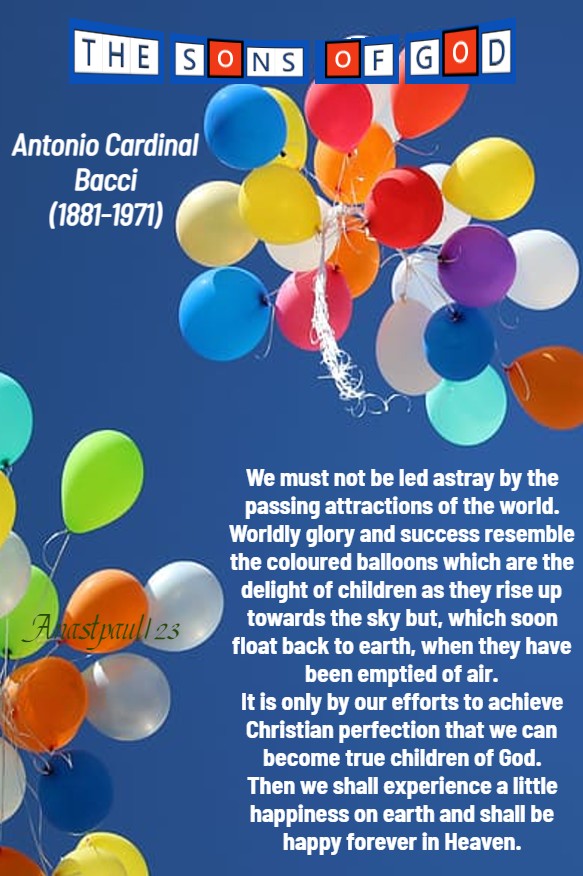
“Sacred Scripture says of Jesus, that He “did and taught” (Acts 1:11). We should reflect on these words. Very often we come across thinkers, who teach but do nothing. Sometimes they even act contrary to their own precepts and then their work is futile and harmful! Many unfortunate young people are the victims of the false ideas and bad example of their teachers. It was not so with Jesus, nor was it so with the Saints, His faithful followers.
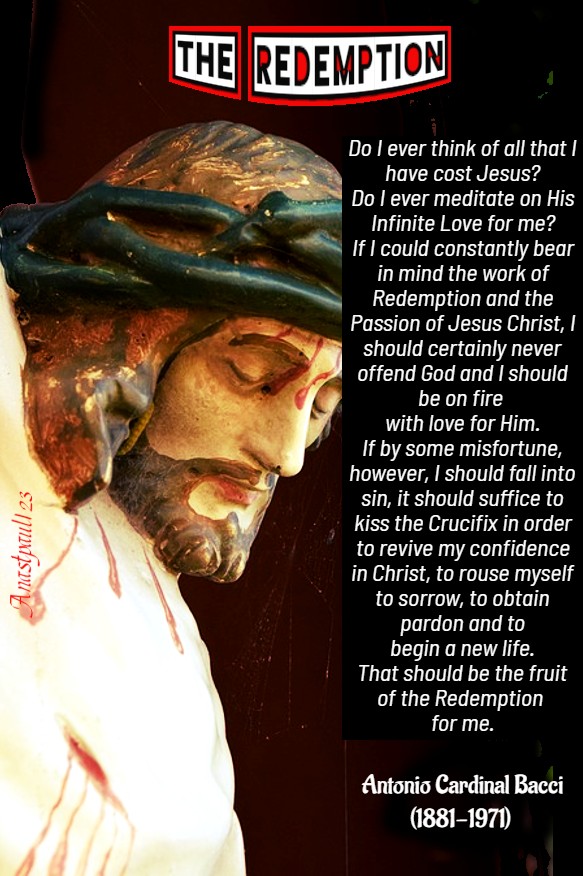
We can learn much from their writings and still more from their example. For this reason we should read about their lives. People read so many books and articles which teach them nothing and many others which arouse their lower instincts and smother their high ideals. A good Christian should read the Lives of the Saints, as well as those books which it is his duty to know. The highest and most useful school of learning for a sincere Christian, is the reading of the Gospel and The Lives of the Saints.”
Quote/s of the Day – 4 March – The Memorial of St Casimir (1458-1484) Confessor, Prince
“I would rather die than not live as a virgin. If I had a thousand lives, I would sacrifice them all to remain a virgin.”
“But above all these things have charity, which is the bond of perfection …”
Colossians 3:14
“By the power of the Holy Ghost, Casimir burned with a sincere and unpretentious love for Almighty God which was almost unbelievable in its strength. So rich was his love and so abundantly did it fill his heart that it flowed out from his inner spirit toward his fellow men. As a result, nothing was more pleasant, nothing more desirable for him, than to share his belongings and even to dedicate and give, his entire self, to Christ’s poor, to strangers, to the sick, to those in captivity and all who suffer. To widows, orphans and the afflicted, he was not only a guardian and patron but a father, son and brother!”
From the Biography of Saint Casimir, written by a contemporary.
St Casimir called the Blessed Virgin his dear mother and he loved her as a child. In her honour he sang frequently a touching Hymn which is in use even at the present day. It begins thus: “Daily, Daily Sing to Mary.” He repeated this many times everyday and asked to have it placed in the grave with him. When his grave was opened after 120 years, both his body and this written Hymn, were untainted by any sign of corruption.
Daily, Daily, Sing to Mary By Bernard of Cluny (12th Century) Trans. Fr Henry Bittleshon C.Orat. (1818-1886)
Daily, daily sing to Mary, Sing, my soul, her praises due. All her glorious actions cherish, With the heart’s devotion true. Lost in wond’ring contemplation, Be her majesty confessed! Call her Mother, call her Virgin, Happy Mother, Virgin blest!
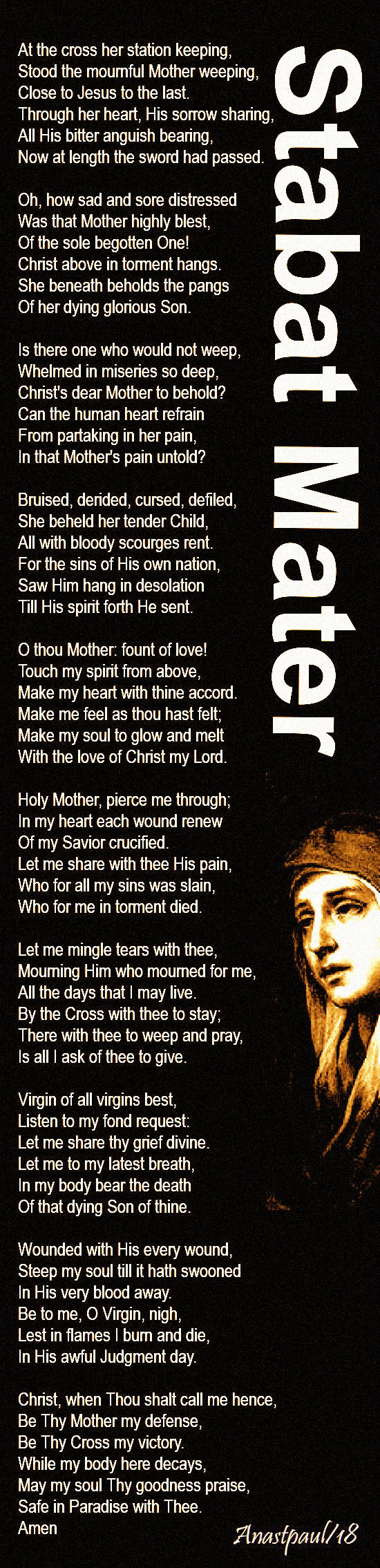
She is mighty to deliver, Call her, trust her lovingly. When the tempest rages round thee, She will calm the troubled sea. Gifts of Heaven she has given, Noble Lady, to our race; She, the Queen, who clothes her subjects, With the Light of God’s own grace.
Sing, my tongue, the Virgin’s honours, Who for us, her Maker bore, For the curse of old inflicted, Peace and blessings to restore. Sing in songs of praise unending, Sing the world’s majestic Queen; Weary not nor faint in telling, All the gifts that earth has seen.
All my senses, heart, affections, Strive to sound her glory forth. Spread abroad the sweet memorials Of the Virgin’s priceless worth. Where the voice of music thrilling, Where the tongues of eloquence, That can utter hymns befitting All her matchless excellence?
All our joys do flow from Mary, All then join her praise to sing. Trembling, sing the Virgin Mother, Mother of our Lord and King. While we sing her awesome glory, Far above our fancy’s reach, Let our hearts be quick to offer Love the heart alone can reach.
Bernard of Morlaix, or of Cluny, for he is equally well known by both titles, was an Englishman by extraction, both his parents being natives of this country. He was, however, born in France very early in the 12th Century, at Morlaix, Bretagne. Little or nothing is known of his life, beyond the fact that he entered the Abbey of Cluny, of which at that time Peter the Venerable, was the Abbot, who filled the post from 1122 to 1156. There, as far as we know, he spent his whole life and there he probably died, although the exact date of his death, as well as of his birth, is unrecorded.
Our Lenten Journey with St Francis de Sales – 4 March – The Memorial of St Casimir (1458-1484) Confessor, Prince – Saturday of Ember Week in Lent – Ecclesiasticus Sirach 31:8-11,Luke 12:35-40 – Scripture search here: https://www.drbo.org/
“The just shall flourish like the palm tree, he shall grow up, like the cedar of Lebanon.” Psalm 91:13
“Stay dressed for action and keep your lamps burning … ” Luke 12:35-36
VIGILANT FAITH AND CHARITY St Francis de Sales (1567-1622) Doctor Caritas
“IT WORKS THE SAME WAY with faith as with charity. We know by the works which charity performs, whether faith is dead or dying. When it produces no good works, we conclude that it is dead and when they are few and sluggish, that, it is dying. But just as there is a dead faith, there must also be a living one which is its opposite. It is excellent. Joined and United with charity and vivified by it, it is strong, firm and Constant. It performs many great and good works which deserve the praise: “Oh, how great is your faith!Let all that you desire be done.” …
It is great because of the good works it performs and also because of the many virtues which accompany it and which it governs. … So charity united to faith is not only followed by all the virtues but, as a queen, she commands them and all obey and fight for her and, according to her will. From this, results the multitude of good works, of a living faith.
There is a vigilant faith which, again, depends on its union with charity. But there is also one which is sluggish, dull and apathetic and, it is the opposite of vigilant faith. It is lax in applying itself to the consideration of the Mysteries of our Religion. It is completely torpid and, for this reason, it does not penetrate revealed Truths at all. It sees them, to be sure and knows them, because its eyes are not altogether closed. It is not asleep but it is drowsy or dozing. It resembles weary people who, although their eyes are open, see almost nothing and although they hear talking, they neither know nor understand what is said. Why? Because they are quite overcome with sleepiness. …
But vigilant faith not only performs good works, like living faith, it also penetrates and understands revealed Truths quickly and with great depth and subtlety of perception. It is active and diligent, in seeking and embracing those things which can increase and strengthen it. It watches and perceives from afar, all its enemies. It is always on the alert to discover the good and to avoid evil. It guards itself against anything which could ruin it. Vigilant, it walks firmly and easily keeps from falling over precipices.
This vigilant faith is accompanied by the Four Cardinal Virtues: Fortitude, Prudence, Justice and Temperance. It uses them as an Armoured Breastplate to put its enemies to flight, or to remain among them firm, invincible and unshaken. So great is its strength that it fears nothing because, not only is it strong but also, it is aware of its strength and by Whom it is supported—Truth itself!” (Sermon for Thursday after the First Sunday of Lent, 17 February 1622).
One Minute Reflection – 4 March – The Memorial of St Casimir (1458-1484) Confessor, Prince – Ecclesiasticus Sirach 31:8-11,Luke 12:35-40 – Scripture search here: https://www.drbo.org/
“Stay dressed for action and keep your lamps burning and be like men who are waiting for their master to come home from the wedding feast, so that they may open the door to him at once when he comes and knocks.” – Luke 12:35-36
REFLECTION – “God, the Word, stirs up the lazy and arouses the sleeper. For indeed, someone who comes knocking at the door is always wanting to come in. But it depends on us, if He does not always enter or always remain… May your door be open to Him Who comes; open your soul, enlarge your spiritual capacities that you may discover the riches of simplicity, the treasures of peace and sweetness of grace. Expand your heart; run to meet the Sun of that Eternal Light that “enlightens everyone” (Jn 1,9). It is certain that this true Light shines for all but, if anyone shuts their windows, then they themselves, shut themselves off from this Eternal Light.
So even Christ remains outside, if you shut the door of your soul. It is true, that He could enter but He does not want to use force, He does not put those who refuse under pressure. Descended from the Virgin, born from her womb, He shines throughout the universe to give light to all. Those who long to receive the light which shines with an everlasting brightness, open up to Him. No night comes to intervene. Indeed, the sun we see each day, gives way to night’s darkness but the Sun of Justice (Mal 3,20) knows no setting, for Wisdom is not overcome by evil.” – St Ambrose (340-397) Bishop of Milan and Father and Doctor of the Church (12th Sermon on Psalm 118).
PRAYER – O God, Who strengthened St Casimir with the virtue of steadfastness amid the luxuries of a Royal Court and the allurements of the world, we beseech Thee that through his intercession, Thy faithful may treat earthly things as naught and ever aspire to those of Heaven. Through Jesus Christ, Thy Son our Lord, Who lives and reigns with Thee, in the unity of the Holy Ghost, God, world without end. Amen (Collect).
Our Morning Offering – 4 March – Saturday of Ember Week in Lent and the First Saturday of the Month
Say Not, Merciful Virgin By St Francis de Sales (1567-1622 Doctor Caritatis
Say not, Merciful Virgin, that you cannot help me, for your Beloved Son holds all power in Heaven and on earth. Say not, that you ought not to assist me, for you are the Mother of all poor children of Adam and my Mother in particular. Since, then, Merciful Virgin, you are my Mother and you are all-powerful, what excuse can you offer if you do not lend your assistance? See, my Mother, see, you are obliged to grant me what I ask and to yield to my entreaties. Amen.
Saint of the Day – 4 March – St Lucius I (Died 254) Pope and Martyr. The 22nd Bishop of Rome from 25 June 253 to his death on 5 March 254. He was banished soon after his consecration but gained permission to return. Patronage – Copenhagen, Denmark.
The Roman Martyrology reads today: “At Rome, on the Appian Way. during the persecution of Valerian, the birthday of St Lucius, Pope and Martyr, who was first exiled for the Faith of Christ but, being permitted by Divine Providence to return to his Church, he suffered Martyrdom by decapitation, after having combated the Novatians. His praises have been published by the blesseed Saint Cyprian, Bishop of Carthage(200-258).”
Lucius was born in Rome. Nothing is known about his family except his father’s name, Porphyrianus. He was elected probably on 25 June 253. His election took place during the persecution which caused the banishment of his predecessor, Cornelius, and he also was banished soon after his consecration but succeeded in gaining permission to return.
Lucius is praised in several letters of Cyprian (see Epist. lxviii. 5) for condemning the Novationists for their refusal to readmit to communion Christians who repented for having lapsed under persecution.
His feast did not appear in the Tridentine Calendar of Pope Pius V. In 1602, it was inserted under the date of 4 March, into the General Roman Calendar. With the insertion in 1621 on the same date of the feast of Saint Casimir,
Lucius I’s Tombstone is still extant in the Catacomb of Callixtus. His Relics were later brought to the Church of Santa Cecilia in Trastevere, along with the Relics of St Cecilia and others. His head is preserved in a reliquary in St. Ansgar’s Cathedral in Copenhagen, Denmark. This Relic was brought to Roskilde around the year 1100, after Lucius had been declared Patron Saint of the Danish region Zeeland.
According to tradition, there had been demons at large at the Isefjord at Roskilde City and, as they declared that they feared nothing but Lucius’ skull, this had to be brought to Denmark, whereupon peace took reign of the fjord again. After the Reformation, the skull was taken to the exhibition rooms of King Frederik III in Copenhagen, where it was on exhibit and then returned to the Cathedral. The skull remained in Roskilde Cathedral but in 1910 it was enshrined at St Ansgar’s Cathedral. It is one of the few Relics to have survived the Reformation in Denmark.
St Lucius I skull inside the Reliquary at St Ansgar’s Cathedral in Copenhagen
St Adrian of May St Adrian of Nicomedia Bl Alexander Blake St Appian of Comacchio St Arcadius of Cyprus St Basinus of Trier Bl Christopher Bales St Felix of Rhuys St Gaius of Nicomedia Bl Humbert III of Savoy St Leonard of Avranches Bl Nicholas Horner St Nestor the Martyr St Owen Bl Paolo of Brescia
Martyrs on the Appian Way – 900 Saints: Group of 900 Martyrs buried in the Catacombs of Saint Callistus on the Appian Way, Rome, Italy.c 260
Martyrs of Nicomedia – 20 Saints: A group of 20 Christians murdered together for their faith. The only details about them to survive are three of their names – Archelaus, Cyrillos and Photius. Nicomedia, Bithynia (in modern Turkey)
Martyrs of the Crimea – 7 Saints: A group of 4th century missionary Bishops who evangelised in the Crimea and southern Russia and were Martyred for their work. We know little else beyond the names – Aetherius, Agathodorus, Basil, Elpidius, Ephrem, Eugene and Gapito.
Thought for the Day – 3 March – Meditations with Antonio Cardinal Bacci (1881-1971)
The Shortness of Time
“Another vision will confront us also in that final hour. Our frightened minds will see again all those hours which we have misused in sin. The devil will try by every means in his power, to repaint them in our troubled imagination. He will do his best to lead us into despair, even as he tempted Judas and many other sinners before us.
We know well that the mercy of God is infinite and that it remains infinite at the hour of death. But, we know too that His justice, is no less infinite. Since God has granted us so much time in which He called us to repentance and to a life of virtue, it could happen that at the point of death, He will put an end to the mercy and to the favours which He has shown us and which we have disregarded. What will become of us then? Remember that only one of the two thieves was converted. The other died unrepentant on his cross, even though he was hanging by the side of Jesus!
Reflect and make provision while there is still time. While we have time.,let us do good (Gal 6:10). We shall be unable to do anything about it afterwards.”
Quote/s of the Day – 3 March – Ember Friday, First Week of Lent – Ezekiel 18:20-28, John 5:1-15 – Scripture search here: https://www.drbo.org/
“Do you wish to be made whole?”
John 5:6
“”
“O Heavenly Father, have compassion for my cry as Thou did for the prodigal son, for I, too, am throwing myself at Thy feet and crying aloud as he cried: “Father, I have sinned!” Do not reject me, Thy unworthy child, O my Saviour but cause Thy Angels to rejoice too, on my behalf, O God of goodness Thou, Who desires that all should be saved.”
St Romanos Melodios (c 490-c 556) Monk, Composer of hymns, Poet
“Each day then, we ought to renew our resolutions and arouse ourselves to fervour, as though it were the first day of our turning back to God. We ought to say: “Help me, O Lord God, in my good resolution and in Your holy service. Grant me now, this very day, to begin perfectly, for thus far I have done nothing.” … Just men depend on the grace of God rather than on their own wisdom in keeping their resolutions. In Him they confide every undertaking …”
Our Lenten Journey with St Francis de Sales – 3 March – Ember Friday of the First Week in Lent – Ezekiel 18:20-28, John 5:1-15 – Scripture search here: https://www.drbo.org/
“Give ear, O Lord, to my prayer and attend to the voice of my petition.” Psalm 85:6
“Do you wish to be made whole?” John 5:6
THE GOAL OF PRAYER St Francis de Sales (1567-1622) Doctor Caritas
“ … IN OUR PRIVATE PRAYERS what reverence ought we to have? In private prayer, we are before God, as in public prayer, although in public prayer we ought to be particularly attentive on account of the edification of our neighbour; exterior reverence is a great aid to the interior. We have many examples which witness to the great exterior reverence which we ought to have when praying, even though it be private prayer. Listen to St. Paul: “I kneel, ” he says, “before the Father of Our Lord Jesus Christ, for you all”(cf Eph 3:14). And do you not see that the Saviour Himself, while praying to His Father, is prostrate on the ground? (cf. Mt 26:39 and Mk 14:35). ” (Sermon for the Palm Sunday, given on 12 April 1615).
“We must now speak of the final cause [that is, the goal] of prayer. We ought to know, in the first place that all things have been created for prayer and that, when God created angels and men, He did so that they might praise Him eternally in Heaven above, even though this is the last thing that we shall do – if that can be called “last” which is eternal.
To understand this better we will say this – when we wish to make something, we always look first to the end [or purpose], rather than to the work itself. For example, if we are to build a Church and we are asked why we are building it, we will respond that it is so that we can retire there and sing the praises of God; nevertheless, this will be the last thing that we shall do. …
Now prayer, according to most of the Fathers, is nothing other than a raising of the mind to heavenly things; others say, it is a petition but the two opinions are not at all opposed, for while raising our mind to God, we can ask Him for what seems necessary.
The principal petition which we ought to make to God is that of union of our wills with His and the final cause [goal] of prayer lies in desiring only God. Accordingly,, all perfection is contained therein, as Brother Giles, the companion of St Francis [of Assisi] said, when a certain person asked him what he could do in order to be perfect very soon. “Give,” he replied, “one to One.” That is to say, you have only one soul and there is only God – give your soul to Him and He will give Himself to you. The final cause [goal] of prayer, then, ought not to be to desire those tendernesses and consolations which our Lord sometimes gives, since union does not consist in that but rather, in conforming to the will of God.” (Sermon for the Third Sunday of Lent, given on 22 March 1615).
One Minute Reflection – 3 March – “The Month of the St Joseph” – Ember Friday, First Week of Lent – Ezekiel 18:20-28, John 5:1-15 – Scripture search here: https://www.drbo.org/
“Now a certain man was there who had been thirty-eight years under his infirmity. When Jesus saw him lying there and knew that he had been in this state a long time, He said to him: Do you wish to be made whole?” – John 5:5-6
REFLECTION – “Christ’s Miracles are symbols of the different events of our eternal salvation, … this pool is the symbol of the precious gift the Lord’s Word gives us. To explain – this water is the Jewish people; the five porticos are the Law which Moses wrote in five books. And so, this pool was surrounded by five porticos, like the people enclosed by the Law. The water which was stirred and troubled, is the Saviour’s Passion in this people’s midst. Whoever went down into this water was healed – but only one person so as to express unity. Those, who were unable to bear anyone speaking to them about the Passion, are the proud – they do not wish to go down and are not healed. “What!” says that arrogant man: “Believe a God to be Incarnate! that a God was Born of a woman that a God has been Crucified, Scourged, covered with Wounds ,that He Died and has been Buried?! No, I would never believe in these Humiliations of a God, they are unworthy of Him.”
Let your heart speak here, rather than your head. The Humiliations of a God seem unworthy to the arrogant and that is why they are very far from a cure. So protect yourself from this pride. If you desire your healing, accept to go down. There would be something to be worried about, if someone said to you that Christ had undergone some sort of change, in becoming Incarnate. But no, … your God remains what He Is, have no fear; He does not perish and He prevents you yourselves from perishing. Yes, He remains what He Is; He Is born of a woman but according to the flesh … it is as Man that He has been Seized, Bound, Scourged, Mocked and finally Crucified and put to Death. Why be afraid? The Word of the Lord remains forever. Anyone who refuses these humiliations of a God, does not wish to be cured of the mortal swelling of his pride.
By His Incarnation, our Lord Jesus Christ has, therefore, restored hope to our flesh. He assumed the fruits of this earth which are only too well known and common – Birth and Death. Birth and death – here indeed are goods that the earth possesses in abundance! But in them were found, neither resurrection nor eternal life. He found here the unfortunate fruits of this unfruitful earth and gave us, in exchange, the possessions of His Heavenly Kingdom!” – St Augustine (354-430) Father and Doctor of Grace (Sermon 124).
PRAYER – From all perils of soul and body defend us, O Lord, we beseech Thee and by the intercession of blessed and gloriosus ever Virgin Mary, Mother of God, of blessed Joseph, of Thy blessed apostles Peter and Paul and all the Saints, graciously grant us safety and peace that all adversities and errors, being overcome, Thy Church may serve Thee in security and freedom. Through Jesus Christ, Thy Son our Lord, Who lives and reigns with Thee, in the unity of the Holy Ghost, God, world without end. Amen (Collect).Through the same Jesus Christ, Thy Son our Lord, Who lives and reigns with Thee, in the unity of the Holy Ghost, God, world without end. Amen (Collect).
Our Morning Offering – 3 March – Ember Friday in the First Week of Lent
Rescue Me, Most Merciful God By Father Martin von Cochem OSFC (c 1630-1712)
Most merciful God, remember at how great a price Thou didst purchase me and how much Thou didst suffer for me. For the sake of that inestimable price, do not permit me to be lost, rescue me, number me amongst the sheep of Thy fold. With them, I will then praise and magnify Thy loving kindness, to all eternity. Amen
Fr Martin von Cochem was a German Capuchin theologian, preacher and prolific ascetic writer. Father Martin’s works embrace a great variety of subjects: a huge volume of apologetics against Protestantism, the life of Christ, lives of the Saints, edifying narratives, the setting forth of certain points in Christian asceticism, forms of prayer, methods to be followed for the worthy reception of the sacraments, etc. The prayer above is from the renowned “The Four Last Things.”
Saint of the Day – 3 March – Blessed Benedetto Sinigardi da Arezzo OFM (c1190-1282) Friar of the Order of Friars Minor, one of the first companions of St Francis and who received the Habit directly from his handi, Provincial of the Marches in Italy and later of the Holy Land, Missionary. Born in c1190 in Arezzo, Italy and died in 1282 in the Franciscan Convent of Poggio del Sole in Arezzo, Italy of natural causes. Although rarely mentioned, Blessed Benedetto is the Author of the Angelus! Additional Memorial – 13 August on some calendars. Also known as – Benedetto Sinigardi du Arezzo, Benedict of Arezzo.
The call of the Lord to Benedetto Sinigardi occurred during a sermon which St Francis of Assisi gave in 1211 in Arezzo. The poor man’s fame attracted huge crowds everywhere and that day Piazza Grande was packed to capacity. Among the listeners there was also the twenty-year-old Benedetto, son of Tommaso Sinigardo de’ Sinigardi and Countess Elisabetta Tarlati di Pietramala. He was, therefore, a member of two of the most important families in the City but Francis’ words penetrated his heart, to such an extent that, moved, he decided to change his life.
He had received a good education and was a good Christian, he attended Sacred worship and devotions, fasting three times a week. His soul wa,s therefore, ready to accept the words of the Seraphic Father and his choice was radical, as he left the comforts and riches to joyfully embrace Sister Poverty. He received the Habit directly from the hands of St Francis himself.
Good-natured, he had excellent qualities which immediately made him loved and esteemed by his brothers and by the people. At the age of only 27, he was appointed Provincial Minister of the Marches, a region that had such importance for the Franciscan Order.
The ardour to pronounce the Gospel made him ask later, to go as a Missionary to distant lands, even among the infidels and at the risk of his life. He went to Greece, to Romania and Turkey and experienced first-hand the realities caused by the schism between the Church of the East and that of the West. The final stage of his mission was the places where the Son of God was Incarnated and lived. He was elected Provincial Minister for the Holy Land and, in the sixteen years of his stay in those lands, he built the first Franciscan Convent in Constantinople, having cordial relations also with the Emperor.
According to tradition, John of Brienne, Emperor of Constantinople, following the example of St Louis of the French and St Elizabeth of Hungary, wanted to receive the Franciscan Habit from Benedetto’s hands.
After this intense apostolic activity, now an old man, he was called back to his native City. In Arezzo, in the Convent of the Friars Minor Benedetto died at a very old age, surrounded by a reputation for holiness. Miracles were immediately attributed to him and he was proclaimed Blessed by the people before the Ecclesiastical authority.
None of his writings have survived but we have two testimonies of his deep piety and devotion to the Passion of Jesus and to he Holy Virgin. In the last years of his life, he commissioned the Crucifix called “Of Beato Benedetto” which today stands on the High Altar of the Basilica of St Francis in the centre of Arezzo, where his body was also transported after the demolition of the Convent in which he died and was laid. Below is a glimpse of the right wall of the Church of San Francesco with a view of five Chapels which alternate between the classical and Gothic styles. The first of these, on the left in the classical style, is the Gozzari Chapel. Here is the Sarcophagus containing the remains of Blessed Benedetto Sinigardi.
It was he who indicated to the painter, the so-called Master of St Francis, all the details with which it had to be created. In the same Basilica, in the main Chapel, there is also the cycle of frescoes of the Legend of the Cross, painted by Piero della Francesca two centuries later.
Furthermore, the beautiful custom of reciting the Marian Antiphon “The Angelus Domini” is attributed to Blessed Benedetto, meditating on the saving Mystery of the Incarnation of the Son of God in Mary’s virginal womb. The Angelus Domini became a pious practice firstly to the entire Franciscan Order, then to the whole Church, as it still is today.
In his visit to the City of Arezzo on 23 May 1993, after having stopped in prayer before the Tomb of Blessed Benedetto, John Paul II said in his speech: “We stop in the middle of the day for a moment of Marian prayer. It is so today in a singular way because we find ourselves in the place where, … the custom of reciting the Angelus Domini was born.”
St Anselm of Nonantola St Arthelais of Benevento Blessed Benedetto Sinigardi da Arezzo OFM (1190-1282) Friar of the Order of Friars Minor, who received the Habit directly from St Francis of Assisi. Although rarely mentioned, Blessed Benedetto is the Author of the Angelus! St Calupan St Camilla St Cele-Christ
St Cunegundes (c 975-1040) Empress of the Holy Roman Empire, Nun, she took a vow of Virginity before her marriage, which, after a miracle was upheld by her husband, the King (also a Saint). Founder of Monasteries and Churches, Nun in one of her Convents, Apostle of Charity. Born in c 975 and died in 1040 of natural causes. Biography: https://anastpaul.com/2022/03/03/saint-of-the-day-3-march-st-cunegundes-c-975-1040/
St Foila Bl Frederick of Hallum St Gervinus Bl Innocent of Berzo Bl Jacobinus de’ Canepaci St Lamalisse St Non
Bl Pierre-René Rogue St Sacer St Teresa Eustochio Verzeri St Titian of Brescia St Winwallus of Landévennec
40 Martyrs in North Africa – A group of Christians Martyred together in North Africa, date unknown. No details have survived, but we know these names – Antonius, Artilaus, Asclipius, Astexius, Basil, Bosimus, Carissimus, Castus, Celedonius, Claudianus, Cyricus, Donata, Emeritus, Emeterius, Euticus, Felix, Fortunatus, Frunumius, Gajola, Georgius, Gorgonius, Hemeterus, Isicus, Janula, Julius, Luciola, Luciolus, Marcia, Marinus, Meterus, Nicephorus, Papias, Photius, Risinnius, Sabianus, Savinianus and Solus
Martyrs of Pontus – 3+ Saints – A large group of Christians Martyred together in the persecutions of Emperor Maximian Galerius and governor Ascleopiodato. We have some details on three of them – Basiliscus, Cleonicus and Eutropius. 308 in Pontus (in modern Turkey) Martyrs of Caesarea; Asterius Marinus
Martyrs of Calahorra: Cheledonius Emeterius
Martyrs of Gondar, Ethiopia: Bl Antonio Francesco Marzorati Bl Johannes Laurentius Weiss Bl Michele Pío Fasol
Thought for the Day – 2 March – Meditations with Antonio Cardinal Bacci (1881-1971)
Prayer as a Necessary Means of Salvation
“We should appreciate how necessary it is to pray with special fervour and perseverance, in times of great temptation and suffering. If we neglect to do so when temptation assails us, we shall be on our own and shall certainly fall. When we encounter suffering and everything seems to be crumbling around us, let us remember that God sees us and pities us. Let us turn to Him. Who alone is able and eager to help us in our misfortunes. When we pray, our tears are precious in His sight. God’s love for us is infinite. If we have recourse to Him, He will certainly answer us in the manner which He knows is best for us. He has promised this, “If he cries out to me, I will hear him, for I am compassionate” (Ex 22:26).”
Quote/s of the Day – 2 March – Thursday of the First Week in Lent – Ezechiel 18:1-9, Matthew 15:21-28 – Scripture search here: https://www.drbo.org/
“Then Jesus answering, said to her: O woman, great is thy faith! be it done to thee as thou desire and her daughter was cured from that hour.”
Matthew 15:28
“I implore you to live with me and, by believing, to run with me; let us long for our Heavenly Country, let us sigh for our Heavenly Home, let us truly feel that here, we are strangers. What shall we then see? Let the gospel tell us: In the beginning was the Word and the Word was with God and the Word was God. You will come to the fountain, with whose dew you have already been sprinkled. Instead of the ray of Light which was sent through slanting and winding ways, into the heart of your darkness, you will see the Light Itself, in all its purity and brightness. It is to see and experience this Light that you are now being cleansed. … It has been good for us to share the common Light, good to have enjoyed ourselves, good to have been glad together. When we part from one another, let us not depart from Him!”
St Augustine (354-430) Father and Doctor of Grace
Prayer of Blessed Severinus Boethius (c 475-524) Martyr
“O Father, enable our minds, to rise to Thy ineffable dwelling place. Let us find the Light and direct the eyes of our soul to Thee. Dispel the mists and the opaqueness of the earthly mass and shine out with Thy splendour. Thou art the serene and tranquil abode of those who persevere in their goal of seeing Thee. Thou art, at the same time, the Beginning, the Vehicle, the Guide, the Way and the Goal. Amen”.
“… How can anyone put on Jesus Christ and imitate His example, if he does not study this Jesus, who must inspire and perfect our faith? He must run the race to which he is challenged, the glorious race in which, he overcomes the enemy of the human family and follows the Way of the Cross. Under the lordly banner of that Cross, he will attain eternal life.”
Our Lenten Journey with St Francis de Sales – 1 March – Thursday of the First Week in Lent – Ezechiel 18:1-9, Matthew 15:21-28 – Scripture search here: https://www.drbo.org/
“Keep me, O Lord, as the apple of Your eye, hide me in the shadow of Your wings.” Psalm 16:8,2
“O woman, great is thy faith! be it done to thee as thou desire …” Matthew 15:28
FAITH St Francis de Sales (1567-1622) Doctor Caritas
“FAITH IS THE BASIS AND FOUNDATION of all the other virtues but particularly of hope and of charity. Now what I say of charity applies also to all the many virtues associated with it. When charity is united and joined to faith, it vivifies it. And so it follows that there is a dead faith and a dying faith.
Dead faith is faith separated from charity, a separation which prevents us from performing works, conformable to the faith we profess. This dead faith is that which many Christians – the worldly – have. Indeed, they believe all the Mysteries of our Holy Religion but since their faith is not accompanied by charity, they perform no good works which conform to their faith. Dying faith is that which is not entirely separated from charity. It performs some good works, although rarely and feebly, for charity cannot really be in the soul which has faith without performing works, either little or great. It must either produce or perish because it cannot exist without doing good works.
Just as the soul cannot remain in the body without producing vital actions, so charity cannot be united to our faith, without performing works conforming to it [Gal 5:6; Jas 2:14-26]. It cannot be otherwise. Therefore, do you want to know if your faith is dead or dying? Examine your works and actions. …
Dead faith resembles a dry tree that has no living substance at all. In springtime when other trees bud forth leaves and flowers, this one brings forth nothing because it does not have sap which those have that are not dead but only dormant. Now, here is another point. However much all other trees may look like this dead tree in winter, nevertheless, in their season they produce leaves, flowers and fruits. This never happens with the tree that is really dead. It may look like the other trees, to be sure but it is dead, for it never brings forth either flowers or fruit. Similarly, dead faith may indeed appear to be living faith but with this important difference – it bears neither the flowers nor the fruit of good works, while living faith always bears them,and in all seasons! (Sermon for Thursday after the First Sunday in Lent, 17 February 1622).
One Minute Reflection – 2 March – “The Month of the St Josephs” –Thursday of the First Week in Lent – Ezechiel 18:1-9, Matthew 15:21-28 – Scripture search here: https://www.drbo.org/
“But she said, Yes, Lord; for even the dogs eat of the crumbs that fall from their masters’ table.” – Matthew 15:27
REFLECTION – “See her humility as well as her faith! For He had called the Jews “children” but she was not satisfied with this. She even called them “masters,” so far was she from grieving at the praises of others. She said, “Yes, Lord, yet even the dogs eat the crumbs that fall from their masters’ table.” Behold the woman’s wisdom! She did not venture so much as to say a word against anyone else. She was not stung to see others praised, nor was she indignant to be reproached. Behold her constancy! When He answered, “It is not fair to take the children’s bread and throw it to the dogs,” she said, “Yes, Lord.” He called them “children” but she called them “masters.” He used the name of a dog but she described the action of the dog. Do you see this woman’s humility?
Then compare her humility with the proud language of the Jews: “We are Abraham’s seed and were never in bondage to any man.” “We are born of God.” But not so this woman. Rather, she calls herself a dog and them masters. So for this reason, she became a child. For what does Christ then say? “O woman, great is your faith.”
So we might surmise that this is the reason He put her off, in order that He might proclaim aloud this saying and that He might crown the woman: “Be it done for you as you desire.” This means “Your faith, indeed, is able to effect even greater things than these. Nevertheless, be it unto you even as you wish.” This Voice was at one with the Voice that said, “Let the heaven be,” and it was. “And her daughter was made whole from that very hour.”
Do you see how this woman, too, contributed not a little to the healing of her daughter? For note that Christ did not say, “Let your little daughter be made whole” but “Great is your faith, be it done for you as you desire.” These words were not uttered at random, nor were they flattering words,but great was the power of her faith and for our learning. He left the certain test and demonstration, however, to the issue of events. Her daughter accordingly was immediately healed.” – St John Chrysostom (347-407) Archbishop of Constantinople, Father and Doctor (The Gospel of Matthew – Homily 52).
PRAYER – From all perils of soul and body defend us, O Lord, we beseech Thee and by the intercession of blessed and gloriosus ever Virgin Mary, Mother of God, of blessed Joseph, of Thy blessed apostles Peter and Paul and all the Saints, graciously grant us safety and peace that all adversities and errors, being overcome, Thy Church may serve Thee in security and freedom. Through Jesus Christ, Thy Son our Lord, Who lives and reigns with Thee, in the unity of the Holy Ghost, God, world without end. Amen (Collect).
Our Morning Offering – 2 March – Thursday of the First Week in Lent
A Lenten Prayer By St Pope Pius V (1504-1572)
Look with favour, Lord, on Your household. Grant that, though our flesh be humbled by abstinence from food, our souls, hungering after You, may be resplendent in Your sight. Amen
St Pius V is the Pope of the Council of Trent, the Counter Reformation, the excommunication of Elizabeth I for Heresy and persecution of English Catholics and of the Battle of Lepanto, amongst many other illustrious and holy achievements.
Saint of the Day – 2 March – Blessed Charles the Good (c1083-1127) Martyr, Duke, Apostle, protector and defender of the poor, selling his and his kingdom’s riches to help those in need, wherever he could, a fair and just Ruler who made laws to accommodate the poor rather than the rich (the eventual cause of his Martyrdom), Knight who assisted in Secomd Crusade. Born in c1083 and died by being beheaded on 2 March 1127 at Bruges, Belgium. Patronages – of Dukes, Counts, the Diocese of Bruges,Crusaders.Also known as – Charles of Flanders. Blessed Charles cultus was officially confirmed by his Beatification in 1883 by Pope Leo XIII.
Charles was the son of St Canut, King of Denmark and of Alice of Flanders, who, in 1086, after the death of his father, carried him, then an infant of 3 years, into Flanders. His cousin, Baldwin the Seventh, Earl of Flanders, dying without issue in 1119, appointed Charles as his heir, on account of his extraordinary valour and merit.
The young Earl was a perfect model of all virtues, especially devotion, charity and humility. Among his friends and courtiers, he loved those best who admonished him of his faults. He frequently exhausted his treasury to the benefit of the poor and often gave the clothes off his back to be sold for their relief. He served them with his own hands and distributed clothes and bread to them wherever he travelled. It was observed that in Ipres he gave away, in one day, no less than seven thousand eight hundred loaves.
Charles took care, for the sake of the poor, to keep the price of corn and provisions always low and he made wholesome laws to protect them from the oppressions of the great. This exasperated Bertulf, who had tyrannically usurped the provostship of St Donatian’s in Bruges, to which dignity was annexed the Chancellorship of Flanders. Between Bertulf and and his wicked relatives, the exercised a great oppressors of their country.
In this horrible conspiracy they were joined by Erembald, Castellan or Chief Magistrate of the territory of Bruges, with his five sons, who were provoked against their Sovereign Charles because he had repressed their unjust violence.
The holy Earl went every morning barefoot and very early, to perform his devotions before the Altar of the Blessed Virgin in St Donatian’s Church. On the morning of 2 March 1127, following his usual practice he left to walk to the Church. Before he left, he was informed of a conspiracy but answered; “We are always surrounded by dangers but we belong to God. If it be His will, can we die in a better cause than that of justice and truth?”
While he was reciting the Penitential Psalms before the Altar, the conspirators rushed in and hacked him to death with broadswords. These enemies were Fromold Borchard, nephew to Bertulf.
The brutal and sacrilegious murder of the popular Duke provoked widespread public outrage, and he was immediately regarded as a Martyr and Saint, although not formally Beatified until 1882.
The Erembalds, who had planned and carried out the murder of Charles, were besieged inside the castle of Bruges by the enraged nobles and commoners of Bruges and Ghent. All the conspirators were defeated, captured and tortured to death. King Louis VI of France, who had supported the uprising against the Erembalds, used his influence to select William Clito as the next Duke of Flanders., Charles having died without issue.
Jan van Beers (1852–1927).- The funeral of Charles I, Count of Flanders, celebrated in Bruges in the Church of St. Christopher on 22 April 1127. This remarkable painting is now situate at the Petit Palais Museum in Paris
Charles was buried in St Christopher’s Church at Bruges, not in that of St Donatian See the remarkable painting above created by Jan van Beers. To view clearly click on the image. In 1600, Charles’s Shrine was placed, by an order of Charles Philip Rodoan, the fourth Bishop of Bruges, in the Chapel of the Blessed Virgin in the St Saviour’s Cathedral in Bruges. Ever since the year 1610, a Solemn High Mass in honour of the Blessed Trinity, is sung on his festival.
Image of Charles on his rRliquary in the Sint-Salvatorskathedraal, Bruges, Belgium
Blessed Charles the Good (c1083-1127) Martyr, Duke St Cynibild of Laestingaeu St Felix of Treves St Fergna the White Bl Girolamo Carmelo di Savoia St Gistilian St Joavan of Brittany St John Maron St Jovinus the Martyr St Lorgius of Caesarea St Lucius of Caesarea
St Quintus the Thaumaturge St Slebhene St Troas St Willeic
Martyrs of Campania – Approximately 400 northern Italian Christians Martyred for their faith by pagan Lombards. Their story was recorded by Pope Saint Gregory the Great, who reports that they people spent their final days supporting each other with prayer. c 579 in Camnpania, Italy.
Martyrs of Porto Romano – 4 Saints – Group of Christians Martyred in the persecution of Diocletian. The only other information that survives are the names of four of them – Heraclius, Januaria, Paul and Secondilla. c305 at Porto Romano at the mouth of the River Tiber, Rome.
Thought for the Day – 1 March – Meditations with Antonio Cardinal Bacci (1881-1971)
The Five Tribunals of Justice
“In regard to the civil authority, however, one thing should be made quite clear. We are only obliged to obey it when it does not infringe on the rights of God or of the Church. If it should run counter to these, we should answer in the words of St Peter and the other Apostles, when thy were called before the Sanhedrin. “We must obey God rather than men” (Acts 5:29).
If we had to suffer anything as a result, in the cause of God and of the Church, we should count that as our good fortune. Like the Apostles, we should be able to rejoice that we have been found worthy to suffer indignity and ill-treatment for the sake of Jesus’ Name (Acts 5:41).”
Quote/s of the Day – 1 March – Ember Wednesday – 3 Kings. 19:3-8, Matthew 12:38-50 – Scripture search here: https://www.drbo.org/
“The men of Nineveh will rise up at the judgement with this generation and condemn it, for they repented …”
Matthew 12:41
“The sign of Jonah”
Matthew 12:39
“It was, too, to lead the Ninevites to firm repentance and to convert them to Him, Who would deliver them from death, amazed as they were by the sign accomplished in Jonah … In the same way, God permitted man to be swallowed by that great monster, the author of disobedience, not so that he should altogether vanish away and die but because God, had prepared beforehand, the salvation fulfilled by His Word by means of the “sign of Jonah.”
St Irenaeus (130-208) Bishop of Lyons, Martyr and Father
“… In the conceitedness of our souls, without taking the least trouble to obey the Lord’s Commandments, we think ourselves worthy to receive the same reward as those who have resisted sin to the death!”
St Basil the Great (329-379) Father and Doctor of the Church
“To do penance is to bewail the evil we have done and to do no evil to bewail.”
“But He still follows behind us and counsels us, that we have despised Him but He still does not cease to call us. We turn our backs on His face, so to speak, when we reject His Words, when we trample His Commandments underfoot but He, Who sees that we reject Him, still calls out to us by His Commandments and waits for us by His patience, stands behind us and calls us back when we have turned away.”
St Pope Gregory the Great (540-604) Father & Doctor of the Church
“What are we doing? If we really love the Sacred Heart of Jesus, we should offer penance and sacrifices in order to make reparation for our sins and the sins of others and, to propitiate this adorable Heart, Which ardently desires to bestow new favours upon us.”
Our Lenten Journey with St Francis de Sales – 1 March – Ember Wednesday
“The troubles of my heart are multiplied, deliver me from my necessities. See my abjection and my labour and forgive me all my sins.” Psalm 24:17-18
“The men of Nineveh will rise up in the judgement with this generation and will condemn it; for they repented at the preaching of Jonah and behold, One greater than Jonah is here.” Matthew 12:41
REPENTANCE St Francis de Sales (1567-1622) Doctor Caritatis
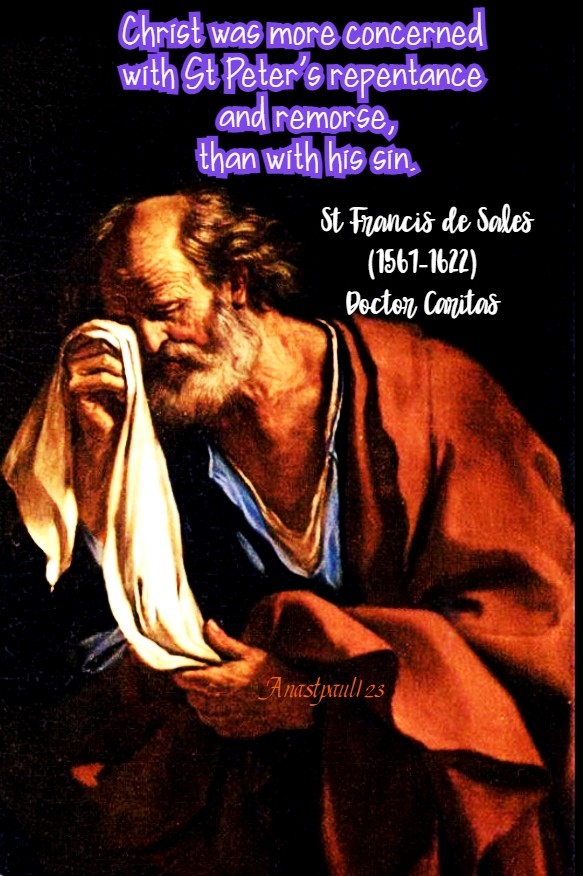
“LET ANYONE WHO IS STANDING BE FEARFUL lest he fall, says the Apostle [1 Cor 10:12]; let no-one glory in finding himself expressly called by God, to a place where there seems nothing to fear. Let no-one presume on his good works and think he has nothing more to fear. St Peter, who had received so many graces, who had promised to accompany Our Lord to prison and even to death itself [Lk 22:33], denied Him, nevertheless, at the whimpering taunt of a chambermaid! Judas sold Him for such a small sum of money!
These falls were both very great but there was this difference. One acknowledged his guilt; the other despaired. Yet, our Saviour had inspired in the heart of both, the same Peccavi [admission of guilt] (“I have sinned”) that same Peccavi that God inspired in David’s heart. [2 Kgs (2 Sm.) 12:13]. Yes, He inspired it in both Apostles but one rejected it and the other accepted it. Hearing the cock crow, St Peter remembered what he had done and the word his good Master had spoken to him. Then, acknowledging his sin, he went out and wept so bitterly [Matt 26:74-75; Lk 22:61-62] that he received what we today call a Plenary Indulgence and full remission of all his sins. O happy St Peter! By such contrition for your sins you received a full pardon for such great disloyalty!
From this time on, St Peter never ceased weeping, principally when he heard the cock crow at night and morning, for he remembered this crowing as the signal for his conversion. It is also reported that he shed so many tears that they hollowed his cheeks into two furrows. With these tears he, who had been a great sinner became a great saint. “O glorious St Peter, how happy you are to have done such great penance for such great disloyalty. By it you were reinstated in grace. You, who deserved eternal death became worthy of eternal life.” Not only that but St Peter received here below, special favours and privileges and was lavished with blessings on earth and in Heaven.
On the other hand, although Judas received the same inspiration for the same Peccavi, he rejected it and despaired. I know that efficacious and sufficient grace differ, as theologians say but I am not here to prove and dispute, whether Judas’ inspiration … was as efficacious as David’s, or only sufficient. It was certainly sufficient. This Peccavi, sent to the heart of Judas, was truly like that formerly sent to David. Why then was Judas not converted?
O miserable man! He saw the gravity of his crime and despaired. Truly, he confessed his sin, for in returning to the chief priests the thirty pieces of silver for which he had sold his good Master, he acknowledged aloud that he had sold innocent blood. [Matt. 27:3-5]. But these priests would give him no absolution. Alas, did not this unhappy man know that Our Lord alone could give it to him, that He was the Saviour and held Redemption in His hands? Had he not seen this truth clearly in those whose sins Jesus had remitted? Certainly, he knew it but he did not wish, nor dare to ask pardon. To make him despair, the devil showed him the enormity and hideousness of his crime and, perhaps, made him fear that if he asked his Master’s pardon, He might impose too great a penance. Perhaps, for fear of such penance, he was unwilling to ask for forgiveness. Thus, despairing, he hanged himself and his body burst wide open, all his entrails spilling out [Acts 1:18] and he was buried in the deepest of Hells.” – Sermon for Good Friday 25 March 1622.
One Minute Reflection – 1 March – Ember Wednesday – 3 Kings. 19:3-8, Matthew 12:38-50 –The Memorial of St David (c 542-c 601) Bishop, Confessor – Scripture search here: https://www.drbo.org/
“The sign of Jonah” – Matthew 12:39
REFLECTION – “You were conducted by the hand to the holy pool of Sacred Baptism, just as Christ was conveyed from the Cross to the sepulchre close at hand [in this Church of the Holy Sepulchre]. Each person was asked if he believed in the Name of the Father and of the Son and of the Holy Spirit. You made the confession that brings salvation and submerged yourselves three times in the water and emerged, by this symbolic gesture, you were secretly re-enacting the burial of Christ, three days in the tomb. For just as our Saviour spent three days and nights in the bosom of the earth, so you, upon first emerging, were representing Christ… You saw nothing when immersed – as if it were night but you emerged – as if to the light of day. In one and the same action, you died and were born, the water of salvation became both tomb and mother for you…
What a strange and astonishing situation! We did not really die, we were not really buried, we did not really hang from a cross and rise again. Our imitation was symbolic but our salvation a reality! Christ truly hung from a Cross, was truly buried and truly rose again. All this He did gratuitously for us, so that we might share His sufferings by imitating them and gain salvation in actuality. What transcendent kindness! Christ endured nails in His innocent Hands and Feet and suffered pain and by letting me participate in the pain, without anguish or sweat, He freely bestows salvation on me! …
We know well that not merely does Baptism cleanse sins and bestow on us the gift of the Holy Spirit – it is also the sign of Christ’s suffering. This is why, as we heard just now, Paul cried out: “Are you unaware that we, who were Baptised into Christ Jesus, were Baptised into His Death? We were indeed buried with Him through Baptism into death”… So, in order that we may realise that Christ endured all His sufferings for us and our salvation IN actuality and not in symbolism and that, we share in His pains, Paul cried out the literal truth: “If we have grown into union with Him through a death like His, we shall also be united with Him in the resurrection,” (Rom 6,3-5). – St Cyril of Jerusalem (313-350) Bishop of Jerusalem, Father and Doctor of the Church (Catechesis no.20/2nd Mystagogy) .
PRAYER – We beseech Thee, O Lord, look graciously upon the fervour of Thy people, who mortify themselves in the flesh through abstinence that they may be refreshed in spirit, by the fruit of these good works and the intercession of Thy blessed Confessor, David. Through Jesus Christ, Thy Son our Lord, Who lives and reigns with Thee, in the unity of the Holy Ghost, God, world without end. Amen (Collect).
Jesus, My Saviour, Help Me! By St Alphonsus Maria de Liguori (1696-1787) Most Zealous Doctor of the Church
Jesus, my Saviour, help me! I am resolved truly to love Thee and to leave all, to please Thee. Help me to free myself from everything which hinders me from belonging wholly to Thee, Who has loved me so much. By thy prayers, O Mother Mary, which are so powerful with God, obtain for me this grace, to belong wholly to God. Amen
Saint of the Day – 1 March – Saint Leolucas of Corleone OBas (c815-c915) Monk of the Basilian Order Abbot, Mystic, Ascetic, Miracle-worker. Born in c815 to 818 at Corleone, Sicily and died in c915 of natural causes, after eighty years of monastic life, in Monteleone Calabro, now Vibo Valentia in Calabria. Patronages – Corleone, Sicily, Vibo Valentia, Italy. Also known as – Leo Lukas, Leo Luke, Leoluca, Leone Luca, Leo Luke of Corleone, Luke of Sicily.
The Roman Martyrology reads: “In the Monastery of Avena between the slopes of Mount Mercurio in Calabria, St Leone Luca, Abbot of Monte Mula, who shone in the hermitic life, as in the cenobitic life, following the rules of the oriental Monks.”
In 2006 Leolucas Relics were found in the Municipality of San Gregorio d’Ippona, about 2 km southeast of the City of Vibo Valentia.
The text of the Life of Leo Luke of Corleone was published in 1657 in the Sicilian Martyrology of Jesuit Ottavio Gaetani (Vitae Sanctorum Siculorum). He was said to have derived it from three manuscripts discovered in Sicily – one from Palermo, another from Mazara and a third from Corleone. Later, the Bollandists published another Life, in Latin, found in the library of Joseph Acosta.
Leolucas was born in Corleone, Sicily in the 9th century on the eve of the Saracen invasion of Sicily. His parents, Leo and Theoktiste Baptised him Leo, in honour of his father. They were a pious and wealthy family who raised him in the nurture and admonition of the Lord. He was orphaned at an early age and devoted himself to managing the family estate and supervising the herds. In the solitude of the fields he realised that he had a call to religious life, so he sold the estate, gave the money to the poor and went to the Monastery of St Philip in Agira, in Sicily.
It is not known how long he stayed at that Monastery but due to the raids of the Saracens, he left and went to Calabria. Before going to Calabria, however, he went on pilgrimage to visit the Tombs of Saints Peter and Paul in Rome.
In Calabria, he went to the Monastery of Mula, at Mount Mula, one of the highest peaks of the Orsomarso mountains. Here he became a Monk, excelling in the virtues and in obedience, remaining there for six years. Once while he was still a Novice, he and some other brothers went into the nearby forest to collect firewood. The young Novice, full of enthusiasm and charity, trusted in his strength and gathered a large pile of firewood but when he was about to shoulder it, it turned out that he had overestimated his strength. He then split the pile in half, taking one half with him and planning to go back after the other. But when he came out of the forest with his load, the other brothers saw, to their great immense surprise that the other half of the fuel was moving itself beside the young Novice!
Once, soon after, he was bitten by a snake while cutting grass in the garden. Immediately the brothers tried to help him because they thought he was in danger. But young Leolucas retired to a corner of the garden in prayer, and a little later he returned, perfectly well. After that miracle, he had the admiration of the other Monks and they considered him a true friend of God.
He and the Abbot, named Christopher, then sort to find a place of solitude where they could grow further in unity with God. They went to the mountainous region in Northern Calabria and here they founded a new Monastery, living there in Asceticism for a further seven years.
Once more they left and moved onto Vena (modern Avena, Calabria) to continue the spiritual struggle. Here they built another Monastery, which by the time of Christopher’s death, had attracted more than one-hundred Monks to the very strict Rule practised by Leolucas, who himself lived in total silence and apart in a solitary cell.
But after the death of Abbot Christopher, Leolucas became the Abbot. He attracted the faithful in the surrounding regions who flocked to our Saint for spirital direction and cures. Many miracles were worked, demons were exorcised and guided the lost towards the path of salvation. He prayed without ceasing and remained out in the cold for up to twenty days at a time, in penance and reparation.
Leolucas lived the last days of his life in meditation, fasting and ecstatic prayer. Finally he called the Monks to come to him and foretold his end. He delegated the responsibility of the position of Abbot to the Monk Theodore and assigned the Priest Euthymios, as Theodore’s auxiliary. Having received Holy Communion, Leolucas fell asleep in peace and was buried in the Church of the Blessed Virgin Mary.
News of Leoluca’s death spread slowly to Corleone and it is only in the 13th Century that there is evidence of a Church dedicated to him in his birthplace. In 1420 there are also references to a Brotherhood of St Leolucas.
Leolucas’ intercession is credited with saving the City of Corleone during an outbreak of the plague of 1575 and he was made the Patron Saint Corleone, his home town. In 1624 he was made the Patron Saint of Vibo Valentia as well.
In1860, an apparition of St Leolucas and St Anthony is credited with preventing Corleone being invaded by the Bourbons.
In Vibo Valentia in Calabria, on his Feast day on 1 March, the local fire brigade pay him homage by placing a crown of flowers at the foot of his Statue which is located high on the façade of the Cathedral of Santa Maria Maggiore & San Leolucas, using a turntable ladder to perform the act.
The cathedral of Santa Maria Maggiore and San Leoluca, in Vibo
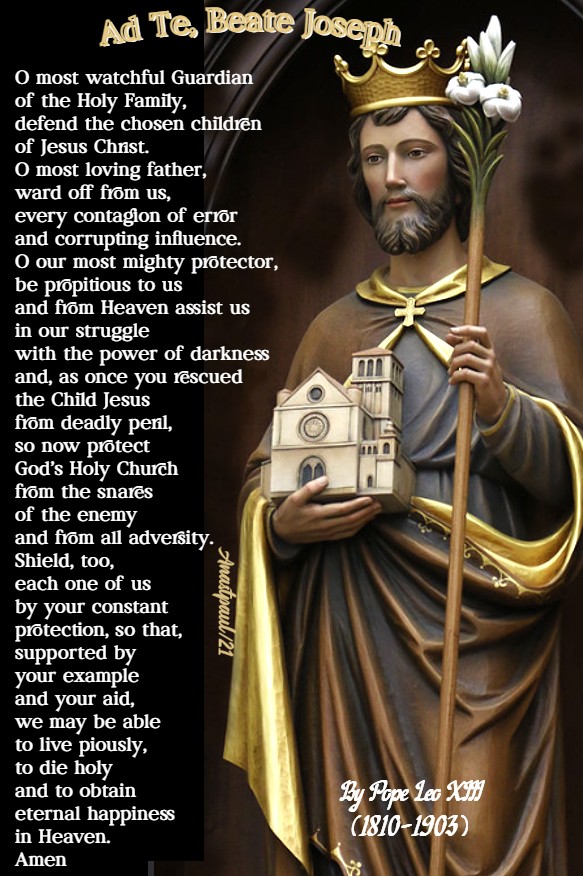
The beloved Foster-Father and Guardian of Jesus and Protector of the Holy Family, is celebrated for this whole month and his Feast Day falls in the middle of it – 19 March – this year moved to the 20th as the 19th is Laetare Sunday, the Fourth Sunday of Lent.
“Quamquam Pluries” On the Devotion to St Joseph Pope Leo XIII
“On 10 March, [11 MARCH THIS YEAR], we begin the Novena to St Joseph, entrusting so many of our woes and cares to his holy and fatherly care and intercession. His Patronages are numerous, as we know, one of them will fit our needs perfectly and if not, then we should all ask him to intercede on our behalf for our families and for a Happy and Holy Death. On the 20th [FEAST normally 19th] we pray the Consecration to St Joseph.”
Patronages in Alphabetical Order:
of Accountants • Bursars • Cabinetmakers • Carpenters • Catholic Church • Cemetery Workers • Children • Civil Engineers • against Communism • Confectioners • Craftsmen • against Doubt and Hesitation • the Dying • Emigrants • Exiles • Expectant Mothers • Families • Fathers • Furniture Makers • Grave diggers • Happy Death • Holy Death • House Hunters • House Sellers • Immigrants • Joiners • Labourers • all the Legal Profession • Married Couples • Oblates of Saint Joseph • Orphans • Pioneers • Social Justice • Teachers • Travellers • the Unborn • Wheelwrights • Workers • Americas • Austria • Belgium • Bohemia • Canada • China • Croatian people • Korea • Mexico • New France • New World • Peru • Philippines • Vatican City • VietNam • Canadian Armed Forces • Papal States • 46 Diocese • 26 Cities,States and Regions.
St David of Wales (c542-c601) Bishop, Prince, Monk, Confessor, Missionary, Founder of Monasteries. Uncle of King Arthur. David studied under Saint Paul Aurelian. Worked with Saint Columbanus, Saint Gildas the Wise and Saint Finnigan. He was officially Canonised in 1120 by Pope Callistus II. Biography: https://anastpaul.com/2017/03/01/saint-of-the-day-1-march-st-david-of-wales/
St Abdalong of Marseilles St Adrian of Numidia St Agapios of Vatopedi St Agnes Cao Guiying
St Albinus of Vercelli St Amandus of Boixe St Antonina of Bithynia Bl Aurelia of Wirberg Bl Bonavita of Lugo St Bono of Cagliari Bl Christopher of Milan Bl Claudius Gabriel Faber St Domnina of Syria St Domnina of Syria St Donatus of Carthage St Eudocia of Heliopolis St Felix III, Pope Bl George Biandrate Bl Giovanna Maria Bonomo Bl Gonzalo de Ubeda St Hermes of Numidia St Jared the Patriarch St Leo of Rouen St Leolucas of Corleone OBas (c815-c915) Abbot of the Basilian Order
St Lupercus St Marnock St Monan Bl Pietro Ernandez Bl Roger Lefort St Rudesind St Seth the Patriarch St Simplicius of Bourges St Siviard St Swithbert St Venerius of Eichstätt
Martyrs of Africa – A group of 13 Christians executed together for their faith in Africa. The only details about them to survive are ten names – Abundantius, Adrastus, Agapius, Charisius, Donatilla, Donatus, Fortunus, Leo, Nicephorus and Polocronius. c290
Martyrs of Antwerp – A group of Christians Martyred together, buried together and whose Relics were transferred and enshrined together. We know nothing else but their names – Benignus, Donatus, Felician, Fidelis, Filemon, Herculanus, Julius, Justus, Maximus, Pelagius, Pius, Primus, Procopius and Silvius. Died in the 2nd Century in Rome. They are buried in the St Callistus Catacombs and their relics were enshirned in the Jesuit Church in Antwerp on 28 February 1600.
Martyrs of the Salarian Way – A group of 260 Christians who, for their faith, were condemned to road work on the Salarian Way in Rome, Italy during the persecutions of Claudius II. When they were no longer needed for work, they were publicly murdered in the amphitheatre. Martyrs. c 269 in Rome.
Martyrs Under Alexander – A large but unspecified number of Christians Martyred in the persecutions of Emperor Alexander Severus and the praefect Ulpian who saw any non-state religion to be a dangerous treason. c 219.
Thought for the Day – 28 February – Meditations with Antonio Cardinal Bacci (1881-1971)
The Examination of Conscience
“Pope St Pius X holds great authority for a Christian. In his Exhortatio ad Clerum, he strongly recommends the Examination of Conscience, especially at the close of the day. This Examination, he says, is necessary for Priests but it is no less necessary for the laity. He recalls the apt words of St Augustine: “Judge your own conscience. Demand an account from it. Dig deep and rend it apart. Discover all the evil thoughts and intentions of the day … and punish yourself for them!” (Expos in Ps 4 n 8). He also quotes the equally relevant works of St Bermard: “Be a searching inquirer into your own integrity of life; examine your conduct everyday. See how much you have advanced, or, how much you have fallen back … Learn to know yourself. … Place all your faults before your eyes. Stand before yourself, as if it were before someone else and you will find reason to weep over yourself!” (Meditat Cap 5 de quotidiano sui ipsius examine).
The Saintly Pontiff concludes his inspiring address as follows: “Experience has proven that anyone who makes a strict examination of his thoughts, words and actions, is more firmly resolved to hate and avoid what is evil and wholeheartedly to love what is good” (Acta Pii X, IV p257).”
You must be logged in to post a comment.