Our Morning Offering – 2 February – The Feast of the Purification of the Blessed Virgin – Candlemas
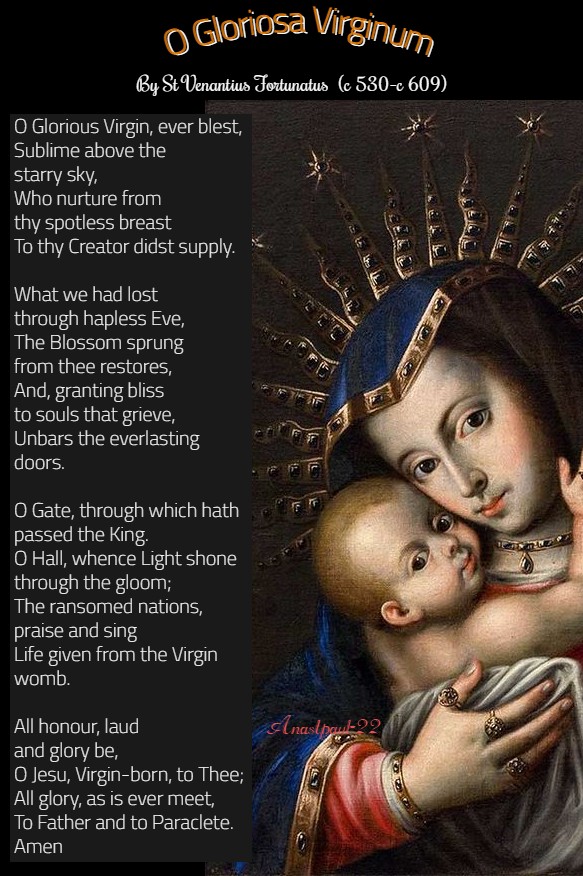
O Gloriosa Virginum By St Venantius Fortunatus (c530 – c609)
O Glorious Virgin, ever blest, Sublime above the starry sky, Who nurture from thy spotless breast To thy Creator didst supply.
What we had lost through hapless Eve, The Blossom sprung from these restores, And, granting bliss to souls that grieve, Unbars the everlasting doors.
O Gate, through which hath passed the King. O Hall, whence Light shone through the gloom; The ransomed nations, praise and sing Life given from the Virgin womb.
All honour, laud and glory be, O Jesu, Virgin-born, to Thee; All glory, as is ever meet, To Father and to Paraclete. Amen
O Gloriosa Domina is the second half of the Hymn: Quem Terra, Pontus, Aethera. It was composed by St Venantius Fortunatus (c530 – c609) the Bishop of Poitiers. In 1632, in accordance with revisions made to the hymns of the Divine Office by Pope Urban VIII (1568-1644), it was altered and changed to O Gloriósa Vírginum. It is sung in the Common of the Blessed Virgin Mary of the Roman Breviary. It is said that St Anthony of Padua (1195-1231) was always singing this Hymn. His mother sang it to him as a baby and even on his death bed, after receiving Extreme Unction, he intoned the Hymn.
Saint of the Day – 2 February – Blessed Stephen Luigi Giuseppe Bellesini OSA (1774-1840) Priest and Friar of the Hermits of St Augustine, teacher, mentor to the youth, Parish Priest, guardian of the poor and sick. Born on 25 November 1774 at Trent, Italy as Aloysius Bellesini and died on 2 February 1840 of Typhus and an infection that developed from a cut on his leg received by an accidental fall while visiting the sick at Genazzano, Italy. Also known as – Aloysius Bellesini, Stefano Bellesini. Additional Memorial – 3 February (Augustinians). Beatified on 27 December 1904 by Pope Pius X.
We celebrate today the memory of Blessed Stephen Bellesini, a man who lived during a difficult period of the Church’s history at the turn of 19th Century Italy. His vocation as an Augustinian Religious was severely tried by strong anticlerical government regulations. Nevertheless, he did not withdraw in shame, nor did he become embittered by external challenges and persecutions. Rather, he redoubled his commitment and persevered in his resolve, giving himself generously in the service of others, most especially the poor, the disadvantaged and the infirm.
Luigi Bellesini was born in Trent, Italy, on 25 November 1774. He entered the Order at the Monastery of San Marco in his native City, taking the name Stephen and making his profession on 31 May 1794. Following studies in Rome and Bologna, aged just 22, he was forced to return to Trent during the government suppression of religious houses and there completed his theological education. He was Ordained to the Priesthood in 1797.
After several years of service, principally as a preacher as well as a teacher in the local schools, the Monastery in Trent, after years of tension and uncertainty, Stephen and his community were expelled from their Monastery for good, forbidden to wear any longer the Habit of their religious profession. They would never return. The Monastery would never re-open.
Stephen was forced to return to his family home. He founded, in his home, a free school for the poor children of the area, who otherwise would not have access to education. He gave food and clothing to the poorest of his students and offered encouragement and friendship to all of them. He dedicated his energies with such remarkable results that his work won the respect of the materialistic local authorities, who appointed him Director and Superintendent of all schools of the district.
However, when the opportunity presented itself, he resigned from these offices and secretly made his way to Rome, in order to resume his religious life. He was appointed Novice Master first in Rome, then in Bologna, Umbria and lastly at Genazzano.
Political leaders in Trent begged Stephen to return to his work in the schools there, offering to increase his salary. But Stephen refused, writing to them: “You would surely not ask me (to return to Trent) if you realised the unbreakable bond between a Friar and his God, Who is the King of Kings. Before His Altar, I have solemnly promised to be faithful to those vows.”
The closing years of his life were spent as Parish Priest at the Shrine of Our Mother of Good Counsel,. There his ministry included a special emphasis on the needs of the poor and of children.
In January 1840, while answering a call to care for a sick Parishioner, during the Typhus epidemic which was raging in the area at the time, he tripped and fell. A cut on his leg became infected and he developed a high fever. He tried to remain active for the next two days but the fever remained. It is believed that he had contracted Cholera and in his weakened state, he could not fight the desease. He died, a Martyr of Charity, on 2 February 1840.
At the entrance to the Chapel of the General Curia in Rome, there is a familiar painting of the Augustinian Blessed, Stephen Bellesini. It is a copy of an original artwork created by G Toeschi in 1905, depicting a usual but crowning moment and possibly one of the last, of Stephen’s life. He stands close to the bedside of an ill man, administering perhaps the last Sacrament or simply offering him some spiritual comfort, while the man’s wife presses her head to the bed, seemingly overcome with grief or exhaustion. Two young children look on anxiously. The artist touchingly captured here an important aspect of the ministry which occupied the latter part of Stephen’s life, as he visited the homes of the townspeople, bringing them the comfort of the Sacraments and oftentimes, material assistance as well, during the Typhus epidemic which struck Genazzano in the Spring of 1839. As we know, less than a year later, Stephen, himself, would fall victim to the pestilence and would succumb – a Martyr of Charity – faithful to the end.
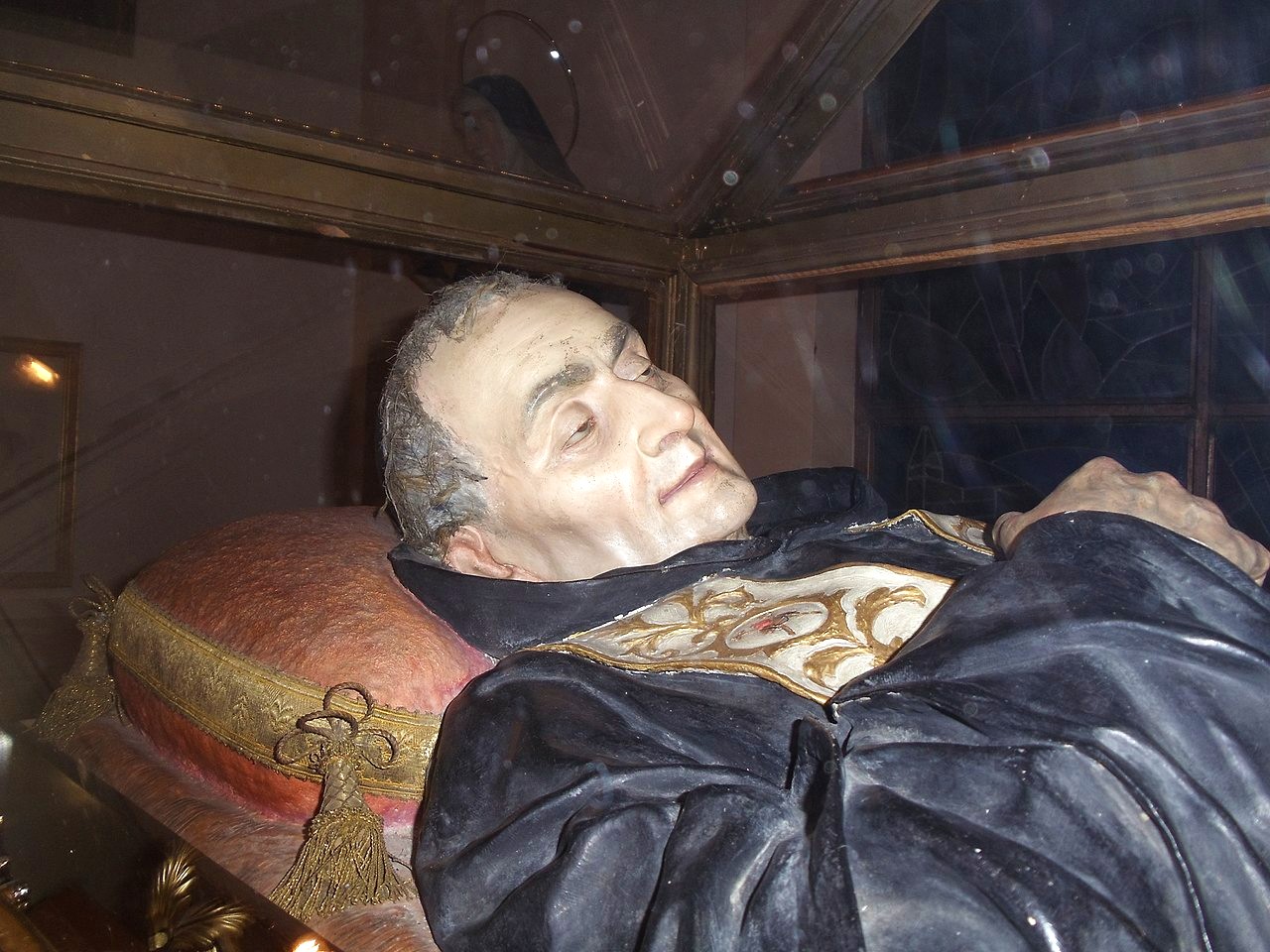
Stephen was Beatified by St Pius X on 27 December 1904. His remains are venerated in a special Chapel dedicated to him at the Shrine of Our Mother of Good Counsel, Genazzano.
“Why is Blessed Stephen, who was Beatified in 1904, not yet a saint?
Certainly his sanctity is not at issue. Champion of youth, advocate for justice, comforter of the sick, guardian of the poor, his message is timely, his life is exemplary and his love for and commitment to religious life speaks loudly to Augustinians of today. The Postulator of Causes will tell us that Stephen needs to obtain a miracle! And so we might be inclined to leave the question at Stephen’s own feet … and wait. But, to borrow an opinion expressed in another context, “how will they call on him if they have not heard of him?” In Stephen Bellesini we Augustinians have a powerful witness to show forth, a Religious and Priest who has a great deal to say to so many categories of people in need today: the sick, the young, Religious and Priests, to those who fight injustice and religious persecution. This is a small attempt to make him better known. Can you help us in this effort?” (Augustinian.org)
Our Lady of the Candles – (formally known as Nuestra Señora de la Purificación y la Candelaria) is a Marian title and image venerated by Filipino Catholics. The image, which is enshrined on the balcony of Jaro Cathedral, is known as the patroness of Jaro District of Iloilo City and the whole of the Western Visayas. The feast day of Our Lady of the Candles is on Candlemas (2 February) and is celebrated in Iloilo City with a Solemn Pontifical Mass presided by the Archbishop of Jaro.
St Adalbald of Ostrevant St Adeloga of Kitzingen St Agathodoros of Tyana St Apronian the Executioner Bl Bernard of Corbara St Bruno of Ebsdorf St Burchard of Wurzburg St Candidus the Martyr St Columbanus of Ghent St Cornelius the Centurion St Felician the Martyr St Feock St Firmus of Rome St Flosculus of Orléans St Fortunatus the Martyr St Hilarus the Martyr St Jeanne de Lestonnac (1556-1640) Widow, Mother, Founder
St Lawrence of Canterbury (Died 2 February 619) The Second Archbishop of Canterbury, the successor of St Augustine of Canterbury from 604 until his death in 619, but he was Consecrated as Archbishop by his predecessor, St Augustine, during Augustine’s lifetime, to ensure continuity in the office, Benedictine Monk, Missionary. He was a member of the Gregorian mission sent from Italy to England to Christianise the Anglo-Saxons. About St Lawrence: https://anastpaul.com/2022/02/02/saint-of-the-day-2-february-saint-lawrence-of-canterbury-died-619/
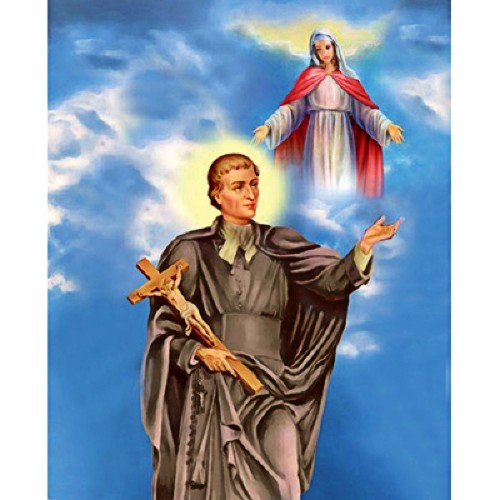
Blessed Luigi Giuseppe Bellesini OSA (1774-1840) Priest and Friar of the Hermits of St Augustine St Marquard of Hildesheim St Mun
St Rogatus the Martyr St Saturninus the Martyr St Sicharia of Orleans St Simon of Cassia Fidati St Theodoric of Ninden St Victoria the Martyr
Martyrs of Ebsdorf: Members of the army of King Louis III of France under the leadership of Duke Saint Bruno of Ebsdorf. The Martyrs died fighting invading pagan Norsemen, and defending the local Christian population. Four bishops, including Saint Marquard of Hildesheim and Saint Theodoric of Ninden, eleven nobles, and countless unnamed foot soldiers died repelling the invaders. They were martyred in the winter of 880 in battle at Luneberg Heath and Ebsdorf, Saxony (modern Germany).
February is traditionally the Month of the Blessed Trinity, with the Holy Family being celebrated together with the Holy Name of Jesus in January.
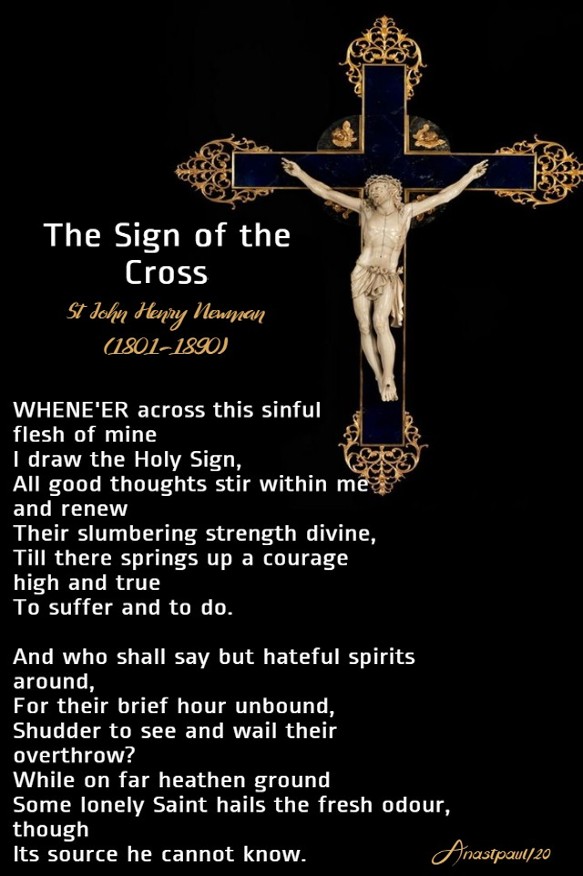
The Sign of the Cross
In the name of the Father and of the Son and of the Holy Ghost.
(50 Days. 100 Days if made with Holy Water Blessed Pope Pius IX, 1865.)
WHENE’ER across this sinful flesh of mine I draw the Holy Sign, All good thoughts stir within me and renew Their slumbering strength divine, Till there springs up a courage high and true To suffer and to do.
And who shall say but hateful spirits around, For their brief hour unbound, Shudder to see and wail their overthrow? While on far heathen ground Some lonely Saint hails the fresh odour, though Its source he cannot know.
John Henry Newman (1801-1890) Oxford – 25 November 1832
Thought for the Day – 1 February – Meditations with Antonio Cardinal Bacci (1881-1971)
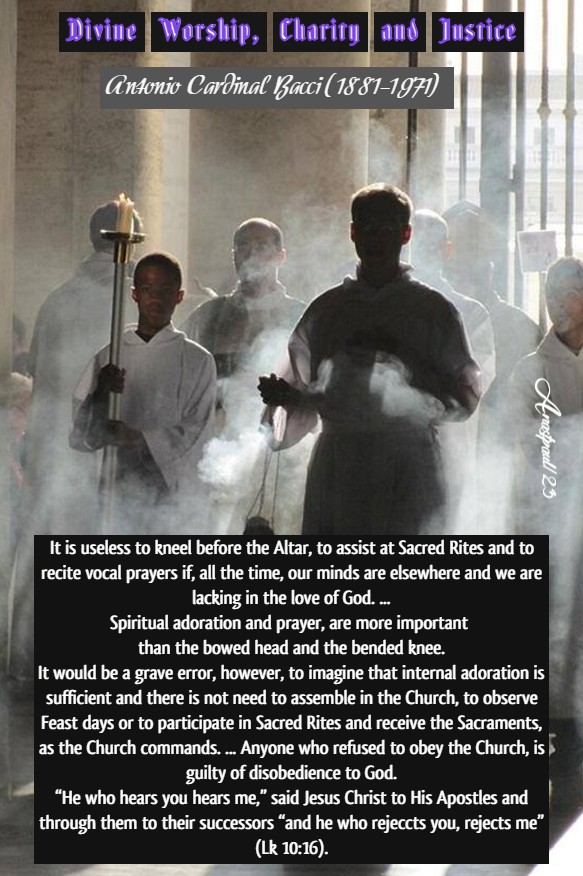
Divine Worship, Charity and Justice
“Divine Worship: We have a strict duty to honour and obey God. “I, the Lord, Am your God,” He tells us in the first commandment of the Decalogue. “You shall not have other gods besides me.” We are obliged, therefore, to worship God both internally and externally, since both soul and body are created by God. Internal worship is especially necessary, for without it, external worship would be an empty formality. It is useless to kneel before the Altar, to assist at Sacred Rites and to recite vocal prayers if, all the time, our minds are elsewhere and we are lacking in the love of God. Spiritual adoration and prayer, are more important than the bowed head and the bended knee.
It would be a grave error, however, to imagine that internal adoration is sufficient and there is not need to assemble in the Church, to observe Feast days or to participate in Sacred Rites and receive the Sacraments, as the Church commands. Everything should be subject to God. The Church was founded by Christ and endowed by Him with the authority to lay down the exact manner in which we should pay homage to Almighty God. She has the right to dictate the feasts and ceremonies in which we are obliged to participate. Anyone who refused to obey the Church, is guilty of disobedience to God. “He who hears you hears me,” said Jesus Christ to His Apostles and through them to their successors “and he who rejeccts you, rejects me” (Lk 10:16).
How do we adore God? Are we among those who pray with their lips and not from the heart? Or do we believe that private devotion is quite sufficient and that there is no need to subject ourselves to all the laws of the Church? Some laws we agree with, some we do not and choose to ignore. In either case, we have gone astray and should be unable to gain God’s favour and cannot be regarded as members of His Church!”
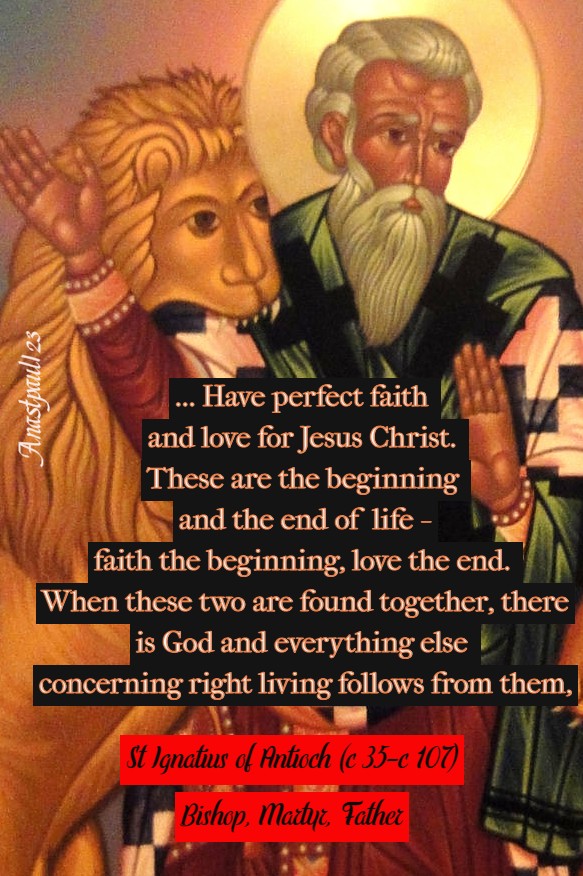
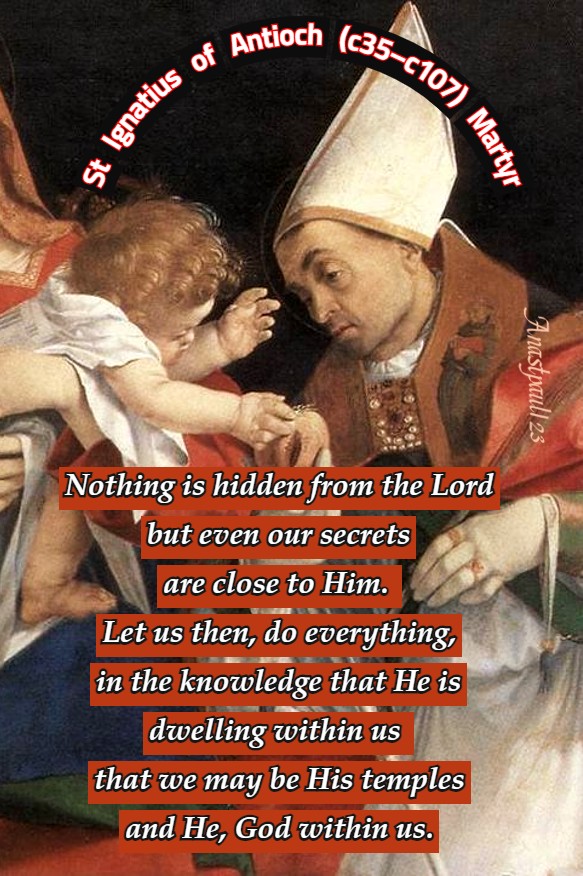
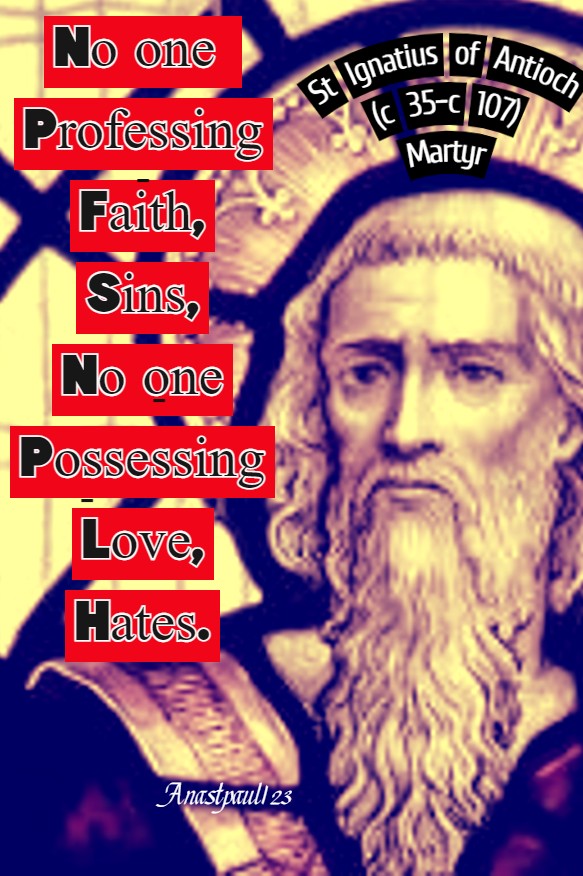
Quote/s of the Day – 1 February – – St Ignatius of Antioch (c35 – c107) Martyr, Bishop of Antioch, Apostolic Father of the Church
“ … Have perfect faith and love for Jesus Christ. These are the beginning and the end of life – faith the beginning, love the end. When these two are found together, there is God and everything else concerning right living follows from them. …”
“Nothing is hidden from the Lord but even our secrets are close to Him. Let us then, do everything, in the knowledge that He is dwelling within us that we may be His temples and He ,God within us.”
“… A tree is known by its fruit. So those who profess to belong to Christ will be known, by what they do. For the work we are about, is not a matter of words, here and now but depends on the power of faith and on being found faithful, to the end!”
One Minute Reflection – 1 February – “The Month of the Blessed Trinitys” – St Ignatius of Antioch (c 35 – 107) Martyr, Bishop of Antioch, Apostolic Father of the Church. – Romans 8:35-39, John 12:24-26 – Scripture search here: https://www.drbo.org/
“If it dies, it produces much fruit” – John 12:24
REFLECTION – “The Kingdom of Heaven is like a mustard seed which a person took and sowed in a field. It is the smallest of all the seeds, yet, when full-grown it is the largest of plants. It becomes a large bush and the ‘birds of the sky come and dwell in its branches.’” (Mt 13:31). This small seed is for us the symbol of Jesus Christ, Who, sowed into the garden where He was buried, rose from it shortly after, through His Resurrection, as a big tree.
One could say that when He died, He was like a small seed – a small seed because of the humiliation of His flesh but a big tree because of the glorification of His Majesty. He was like a small seed when he appeared completely disfigured before our eyes but like a large tree when He rose again like “the most handsome of men” (Ps 44:3).
The branches of this mysterious tree, are the holy preachers of the Gospel, of whom one of the Psalms indicates the reach: “Their report goes forth throughout all the earth, their message, to the ends of the world “ (Ps 19:5; cf Rom 10:18). The birds rest on these branches while the souls of the just, who have been raised up above earth’s attractions, on the wings of holiness, find in the words of these preachers of the Gospel, the consolation they need in the sorrows and difficulties of this life.”– St Gregory the Great (540-604) Pope, Father and Doctor of the Church (Homilies on Matthew, Ch.13).
PRAYER – Be mindful of our weakness, O aAmighty God and since the burden of our deeds is grievous to us, grant that the glorious intercession of blessed Ignatius Thy Martyr and Bishop, may protect us. Through Jesus Christ, Thy Son our Lord, Who lives and reigns with Thee, in the unity of the Holy Ghost, God, world without end. Amen (Collect).
Our Morning Offering – 1 February – “The Month of the Blessed Trinity”
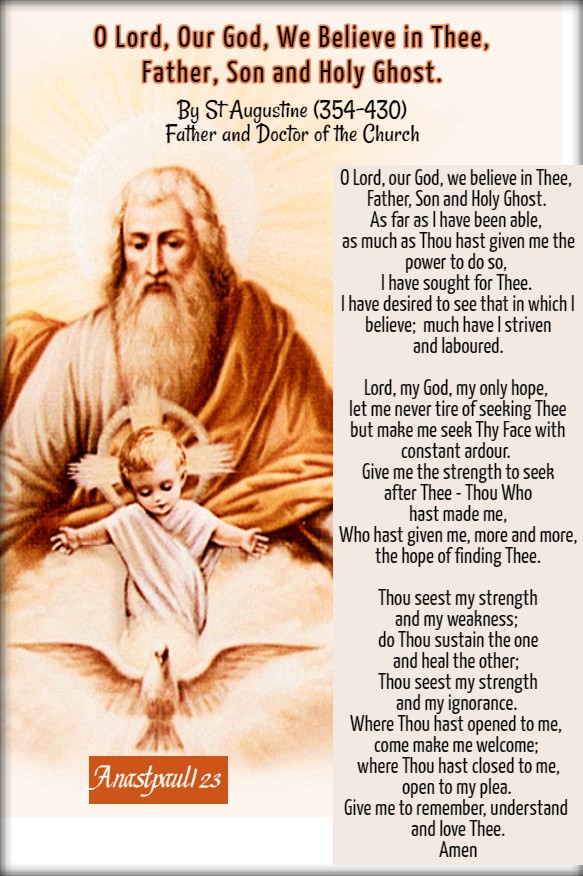
O Lord, Our God, We Believe in Thee, Father, Son and Holy Ghost. By St Augustine (354-430) Father and Doctor of the Church
O Lord, our God, we believe in Thee, Father, Son and Holy Ghost. As far as I have been able, as much as Thou hast given me the power to do so, I have sought for Thee. I have desired to see that in which I believe; much have I striven and laboured.
Lord, my God, my only hope, let me never tire of seeking Thee but make me seek Thy Face with constant ardour. Give me the strength to seek after Thee – Thou Who hast made me, Who hast given me, more and more, the hope of finding Thee.
Thou seest my strength and my weakness; do Thou sustain the one and heal the other; Thou seest my strength and my ignorance. Where Thou hast opened to me, come make me welcome; where Thou hast closed to me, open to my plea. Give me to remember, understand and love Thee. Amen
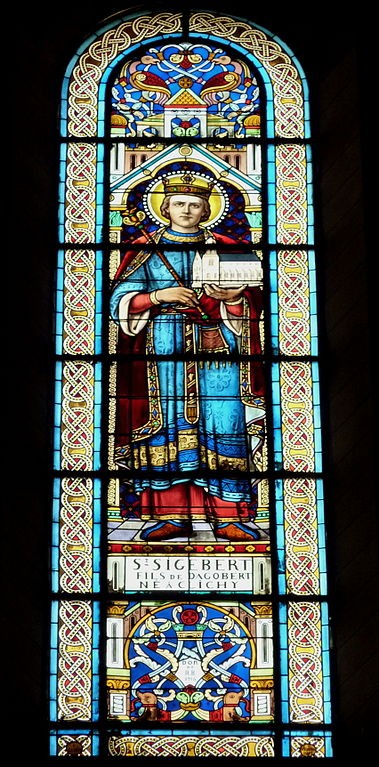
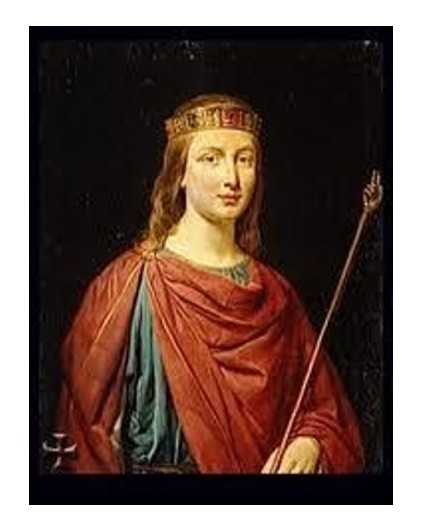
Saint of the Day – 1 February – Saint Sigebert III of Austrasia (c 630-656) King, Married and father of St Dagobert II. Born in c 630 in Metz, Moselle, Lorraine, France and died on 1 February 656 at Metz, France of natural causes, aged 25-26. His body was incorrupt until it was attacked by the marauders during the French Revolution. Patronages – the City and Diocese of Nancy, France. Also known as – Sigebert the Younger, Sigisbert…
Sigebert was the eldest son of King Dagobert I and his concubine Ragnetrude and half-brother of King Clovis. The King recalled and made peace with Saint Amand, who was previously banished for criticising the King’s vices and unholy life and asked him to baptise his new-born son. The ceremony was performed at Orléns and Charibert II, Dagobert’s half-brother who was King of Aquitaine at the time, was the Godfather. Dagobert assigned the education of Sigebert to Pepin of Landen, who was the Mayor of the Palace in Austrasia. Pepin took the baby Sigebert and moved with him to his domains in Aquitane, where they remained for the next three years.
In 633, a revolt of the nobles forced Dagobert to make the three-year old Sigebert King of Austrasia. However, he refused to give the power to Pepin of Landen by making him Mayor of the Palace for the child-king. Instead, he had put Sigebert under the tutelage of Adalgisel as Mayor of the Palace and the Bishop of Cologne, Saint Cunibert, as Regent, while keeping Pepin in Neustria as hostage.
On the death of Dagobert in 639, the two Frankish kingdoms became independent once again under Sigebert III and his little brother, Clovis II. Both kingdoms were under child-kings – Sigebert was around eleven years old and Clovis was five – and were ruled by the respective Regents. It was under Seigbert’s reign that the Mayor of the Palace began to play the most important role in political life and he has been described as the first “roi fainéant”—“do-nothin king”—of the Merovingian dynasty. A most unfair derogatory and insulting title, considering he was a child however, as he grew in age and wisdom, he disregarded worldly affairs as of no value anyway and focused his heart on things above.
In 640 the Duchy of Thuringia rebelled against Austrasia in the only war of Sigebert’s reign.The young King attempted to quell the rebellion but was defeated. The rout left Sigebert weeping in his saddle.
Throughout his youth and adolescencd, Sigebert had grown in personal sanctity and love for God and His Church. He became an extremely holy and devout adult under the tutelage of Pepin and the spiritual direcrion of Saint Cunibert and lived a life of Christian virtue. He used his wealth to establish numerous Monasteries, homes and hospitals especially for the poor and Churches, including the renowned Monastery of Stavelot-Malmedy.
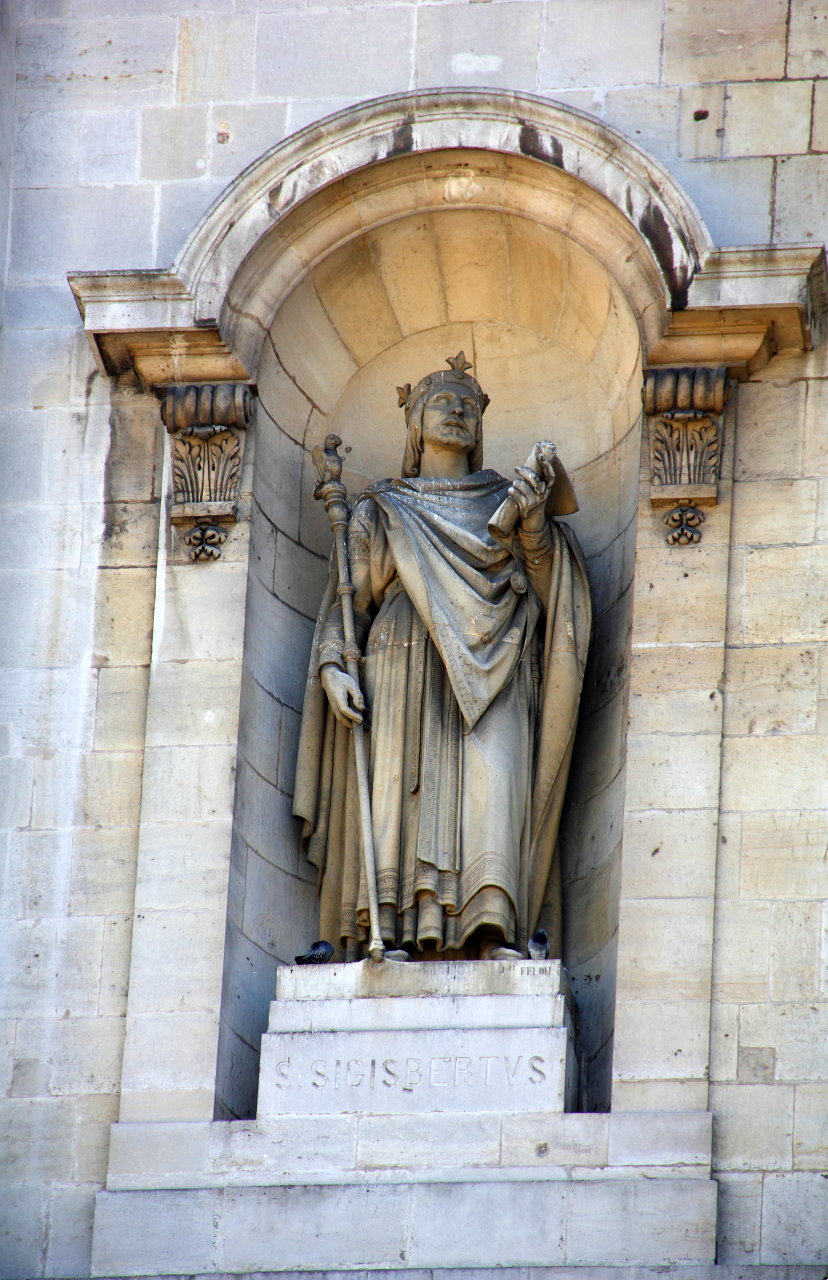
Sigebert III died of natural causes on 1 February 656 at age 25. He was buried in the Abbey of Saint Martin near Metz which he had founded. In 1063 his body, found incorrupt, was taken out of the tomb and moved to the Altar. During the French Revolution the Abbey and tomb were desecrated. What Relics remained were moved to the Nancy Cathedral. The Statue below is situate on the facade of said Cathedral.
Bl Anthony Manzoni St Asclepiades St Autbert of Landevenec St Brigid of Fiesole St Cecilius of Granada St Cinnia of Ulster St Clarus of Seligenstadt St Crewenna St Darlaugdach of Kildare St Henry Morse St Jarlath Bl John of the Grating St Kinnia St Paul of Trois-Châteaux St Raymond of Fitero
St Sabinus St Severus of Avranches St Severus of Ravenna
St Sigebert III of Austrasia (c 630-656) King, Married and father of St Dagobert II. His body was incorrupt until it was attacked by the marauders during the French Revolution.
St Tryphon of Lampsacus St Ursus of Aosta St Veridiana
Thought for the Day – 31 January – Meditations with Antonio Cardinal Bacci (1881-1971)
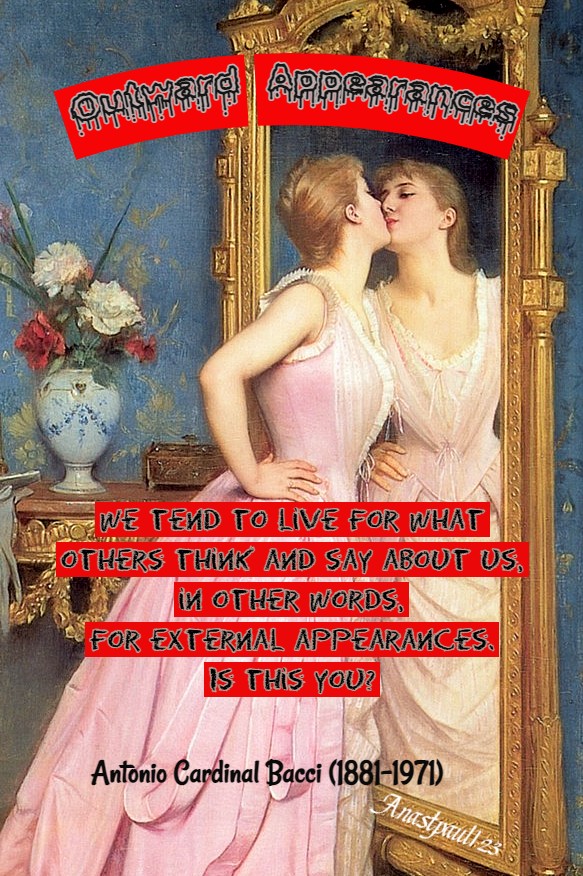
Outward Appearances
“Men of the world look at the outward appearance of things and are often satisfied with that. Many of them desire and long for physical beauty, wealth, high social status and honours. It does not matter to them if beneath this splendid facade, there are concealed, a mean and impoverish spirit, a corrupt and dishonest heart, an egotism indifferent to noble ideals and an astuteness intent on ousting potential rivals. All this is unimportant, as long as they are successful and can keep up appearances,
We tend to live for what others think and say about us, in other words, for external appearances. Is this you?”
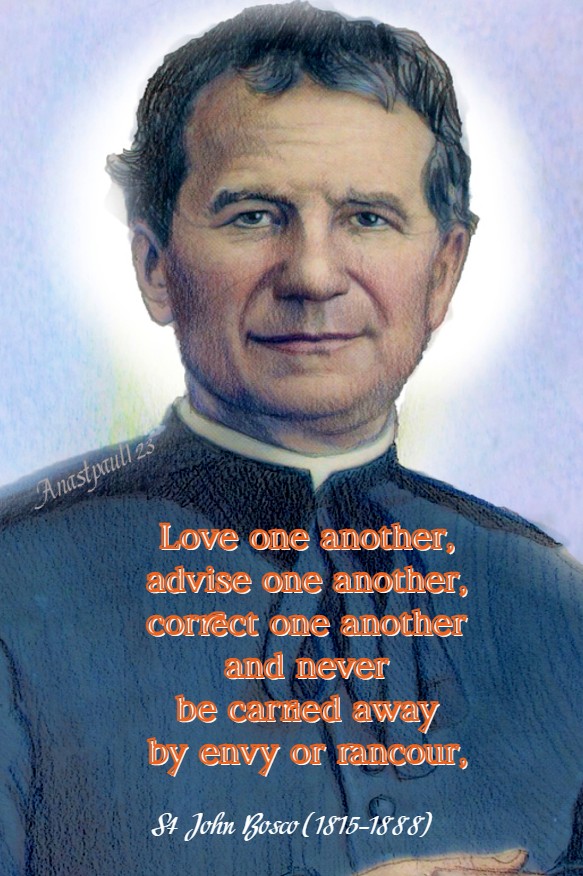
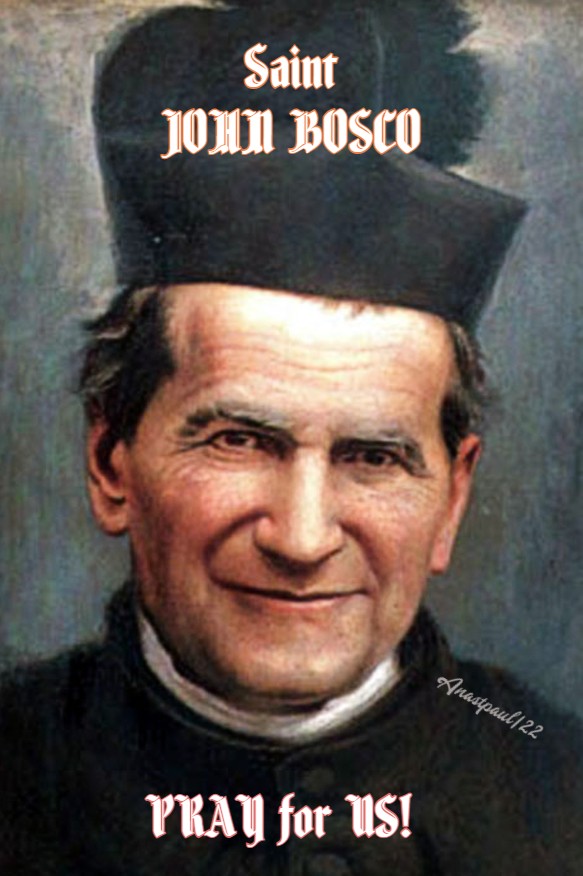
Quote/s of the Day – 31 January – St John Bosco “Don Bosco” SDB (1815-1888) Priest, Confessor, Founder.
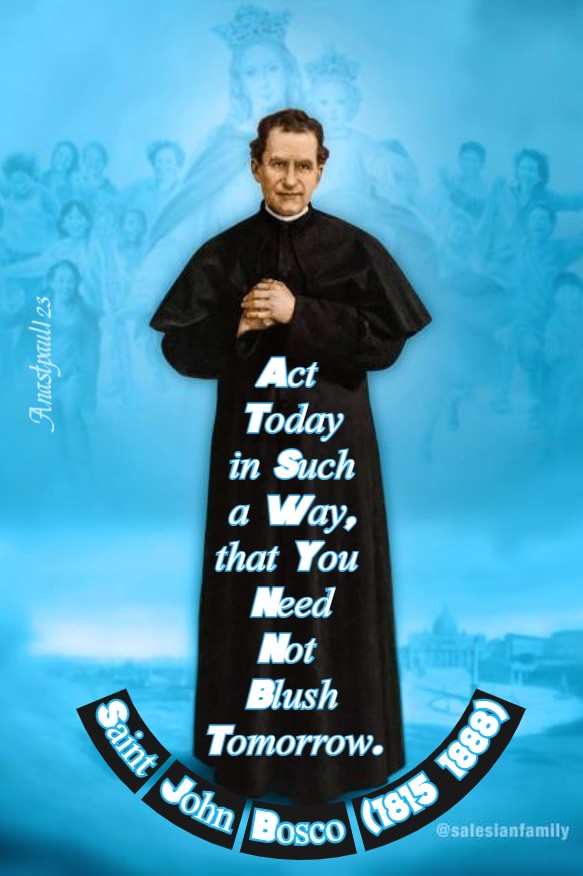
“Act today in such a way, that you need not blush tomorrow.”
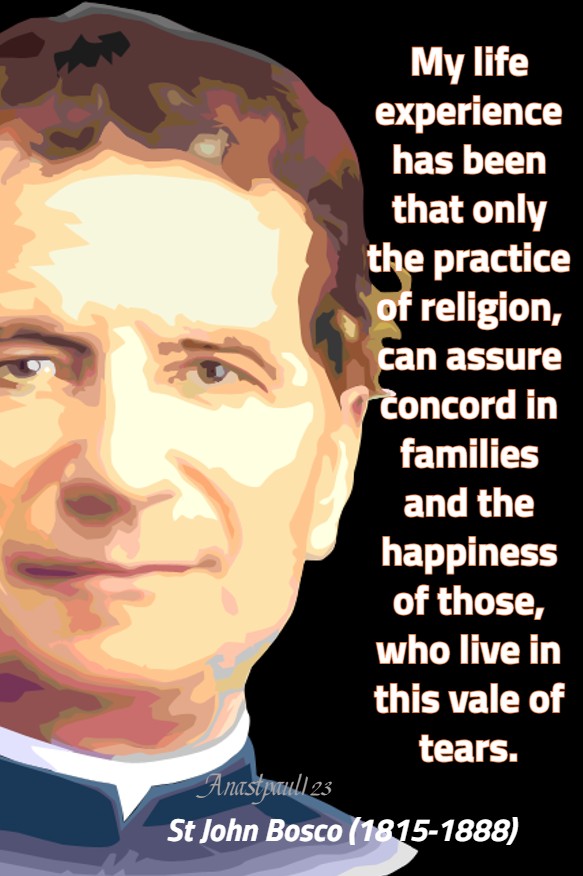
“My life experience has been that only the practice of religion, can assure concord in families and the happiness of those, who live in this vale of tears.”
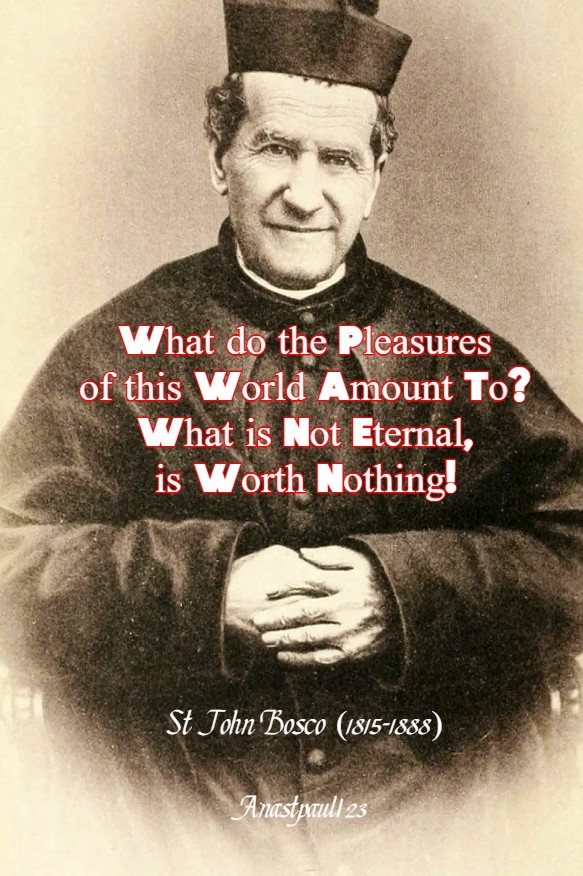
“What do the pleasures of this world amount to? What is not eternal, is worth nothing!”
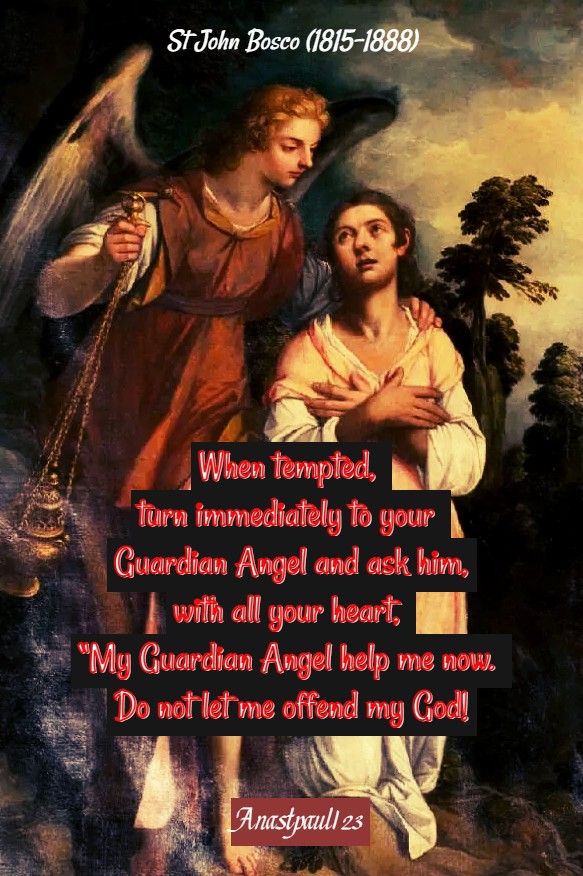
“When tempted, turn immediately to your Guardian Angel and ask him, with all your heart, “My Guardian Angel help me now. Do not let me offend my God!”
“Love one another, advise one another, correct one another and never be carried away by envy or rancour,”
One Minute Reflection – 31 January – St John Bosco “Don Bosco” SDB (1815-1888) Priest, Confessor, Founder. – Philippians 4:4-9 , Matthew 18:1-5 – Scripture search here: https://www.drbo.org/
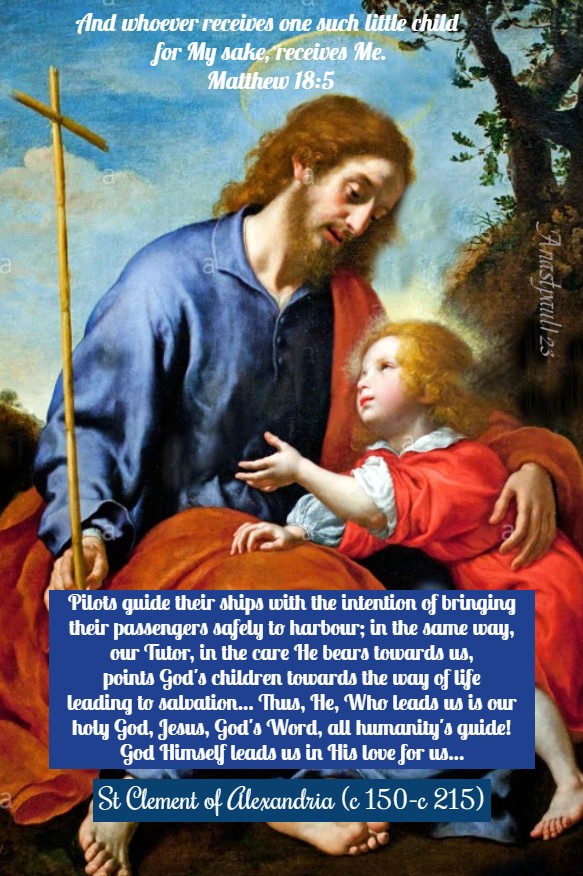
“And whoever receives one such little child for My sake, receives Me.” – Matthew 18:5
REFLECTION – “Scripture calls all of us “children” and, when we begin to follow Christ, we receive the name of “little children” (Mt 18:3; Jn 21:5)… So Who is our Instructor and Tutor, the Tutor we have when we are small? He is called Jesus. He calls Himself “Shepherd” by Name, referring to Himself as “the Good Shepherd” (Jn 10:11). He makes a comparison between shepherds guiding their sheep and Himself, the Tutor who guides small children, the Shepherd full of concern for the lambs which, in their simplicity, He compares with the sheep. “They will all be one flock,” He says, “because there will be One Shepherd” (Jn 10:16). Therefore, our Tutor is, of course, the Word of God because He leads us to salvation. As He clearly declared through the mouth of the prophet Hosea: “I am your Teacher” (5:2 LXX).
As for His instruction, that is, the religious formation by which He teaches us how to serve God, forming us in the knowledge of the truth and leading us straight to Heaven… Pilots guide their ships with the intention of bringing their passengers safely to harbour; in the same way, our Tutor, in the care He bears towards us, points God’s children towards the way of life leading to salvation… Thus, He, Who leads us is our holy God, Jesus, God’s Word, all humanity’s guide! God Himself leads us in His love for us… The Holy Spirit said of Him during the Exodus: “He found him in the wilderness, a wasteland of howling desert. He shielded him and cared for him, guarding him as the apple of His eye. As an eagle incites its nestlings forth by hovering over its brood, so He spreads His wings to receive him and bore him up on His pinions. The Lord alone was his Leader” (Dt 32:10-12).” – St Clement of Alexandria (c 150-c 215) Theologian and Philosopher, Professor who taught at the Catechetical School of Alexandria, Father of the Church (Pedagogue, I, 53-56).
PRAYER – O God, Who in Thy Confessor, blessed John, raised up a father and teacher of youth and willed that through him, with the help of the Virgin Mary, new religious families should bloom in the Church, grant, we beseech Thee, that , inflamed by the same fire of love, we may seek to win souls and to serve Thee alone. Through Jesus Christ, Thy Son our Lord, Who lives and reigns with Thee, in the unity of the Holy Ghost, God, world without end. Amen (Collect).
Our Morning Offering – 31 January – St John Bosco “Don Bosco” SDB (1815-1888) Priest, Confessor, Founder.
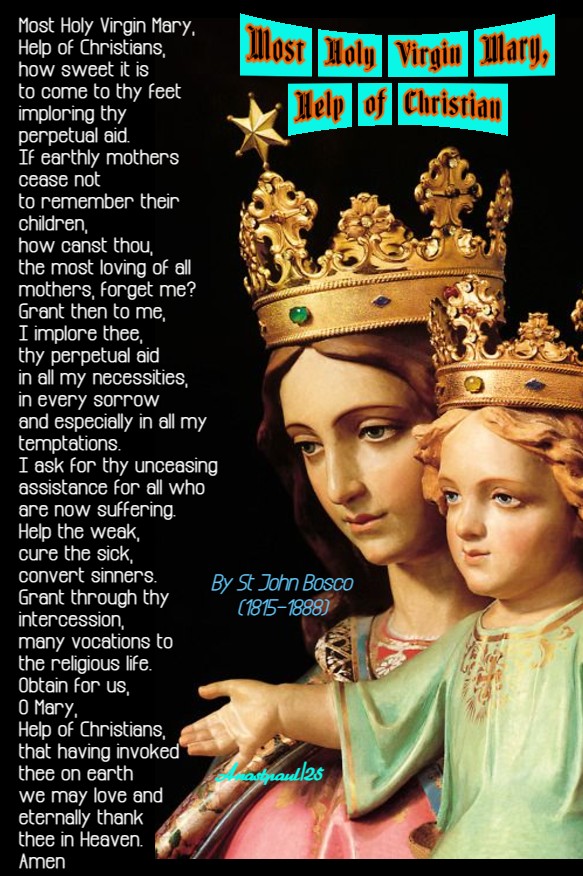
Most Holy Virgin Mary, Help of Christian By St John Bosco (1815-1888)
Most Holy Virgin Mary, Help of Christians, how sweet it is to come to thy feet imploring thy perpetual aid. If earthly mothers cease not to remember their children, how canst thou, the most loving of all mothers, forget me? Grant then to me, I implore thee thy perpetual aid in all my necessities, in every sorrow and especially in all my temptations. I ask for thy unceasing assistance for all who are now suffering. Help the weak, cure the sick, convert sinners. Grant through thy intercession, many vocations to the religious life. Obtain for us, O Mary, Help of Christians, that having invoked thee on earth we may love and eternally thank thee in Heaven. Amen
Saint of the Day – 31 January – Blessed Louise degli Albertoni TOSF (1474-1533) Widow, Mother, Mystic, Ecstatic, Apostle of the sick, the poor, the deprived, Miracle-worker. Born in1474 as Ludovica Albertoni in Rome, Italy and died on 31 January 1533 in Rome of natural causes. Beatified on 28 January 1671 by Pope Clement X. Also known as – Ludovica, Louisa Albertoni, Ludovica Albertoni Cetera.
Louise first saw the light of the world at Rome in the year 1474. Her parents belonged to the distinguished families of this City because of their wealth but still more because of their piety. They bestowed great care upon the training of their daughter and she responded fully to their efforts, so that she developed into a model for all young women. She had resolved to remain unmarried but when her parents urged her to be betrothed to an illustrious young man, she believed she recognised the will of God in their desire and agreed to the marriage.
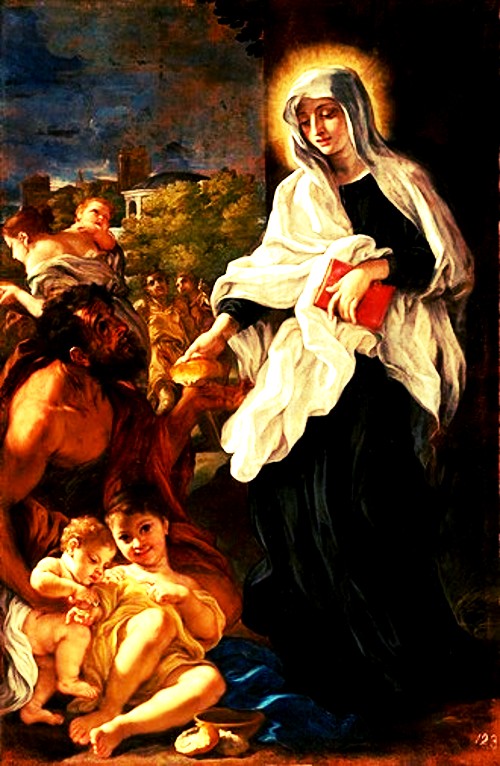
The Blessed Ludovica Albertoni distributing Alms (Giovanni Battista Gaulli c 1670)
But even in the married state, in which she remained attached to her husband with genuine love, she sought above all things to please God. Her attire was very plain, and even away from home, she avoided frivolous pomp and luxury. God blessed their union with three daughters, whom she was careful to rear, above all, in the love and fear of God.
When Blessed Louise Albertoni was but thirty-three years old, she lost her husband to death. After her daughters were provided for, Louise thought of nothing but to dedicate herself to the service of God. Publicly she took the habit of the Third Order, practiced the severest penances and was so irresistibly drawn to the contemplation of the sufferings of Our Lord and they were so constantly before her mind that she continually wept,and it was feared that she would lose her sight.
Louise lived a pious life, working for the poor of the Trastevere neighbourhood, under the guidance of the Franciscan Friars of San Francesco Church, where she would be buried in 1533. She bore a great love for the poor as special members of Christ. She used the abundant income of her fortune entirely for their support. But she strove to conceal her liberality. With this intention she often hid pieces of money in the bread that was given to the poor at her door and then begged Almighty God that He would let it fall to the lot of such as needed it most. Her benevolence knew no bounds. Sometimes she lacked even the necessaries for herself. But then, she rejoiced to be like Christ, who, being rich, became poor out of love for men.
God repaid her with extraordinary graces. He granted her the gift of miracles and frequent ecstasy. He also told her beforehand of the day of her death.
When her end drew nigh, she received the last Sacraments with great devotion. Then gazing upon the Crucifix with the tenderest pity, she kissed it and said: “Into Thy hands, O Lord, I commend my spirit.” Thereupon she breathed forth her soul on the day that had been announced to her, which was 31 January 1533.
Her body rests in the Church of St Francis on the Tiber and her Feast is celebrated in Rome with great solemnity. Pope Clement X Beatified Blessed Louise Albertoni in 1671.
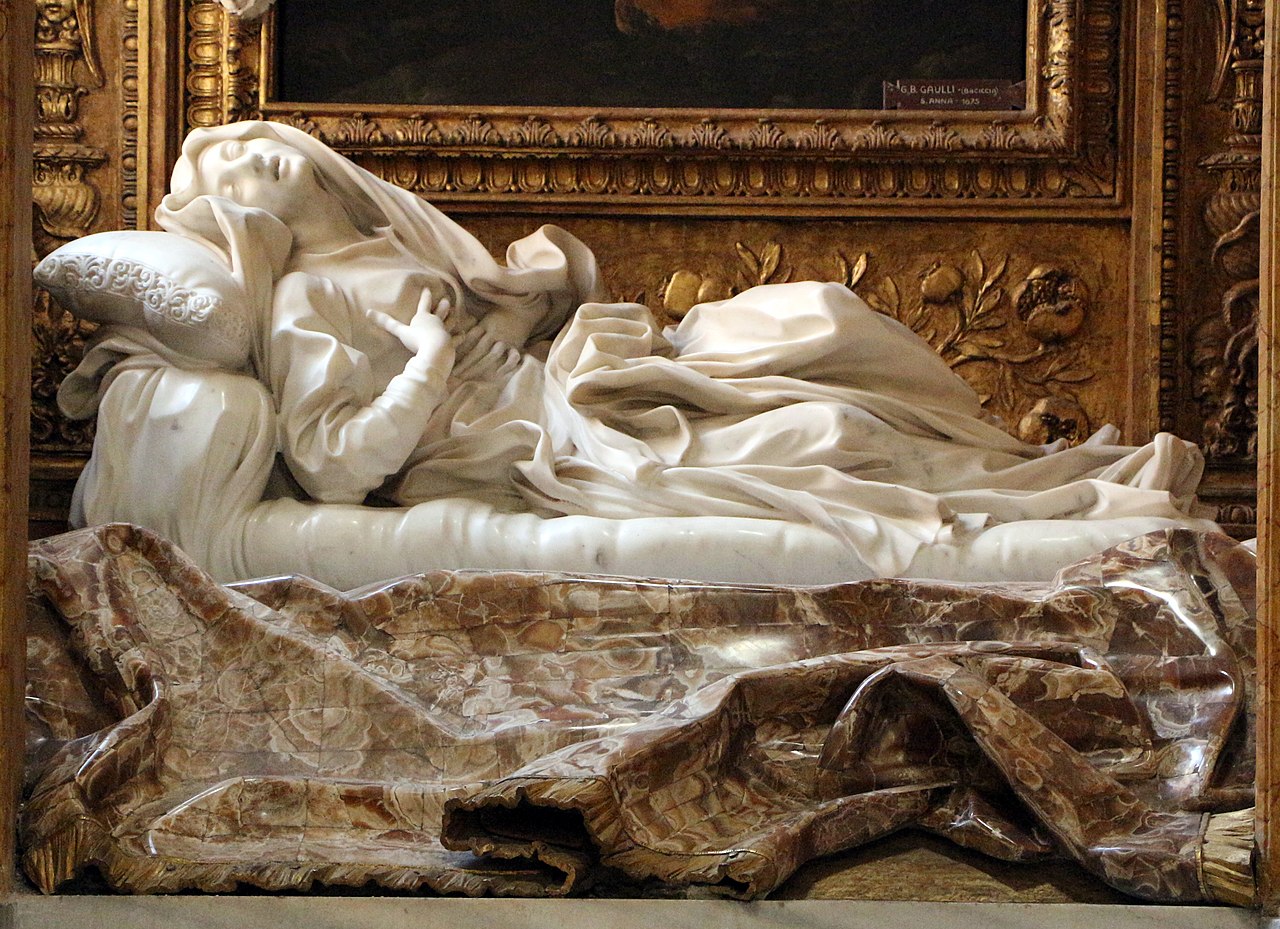
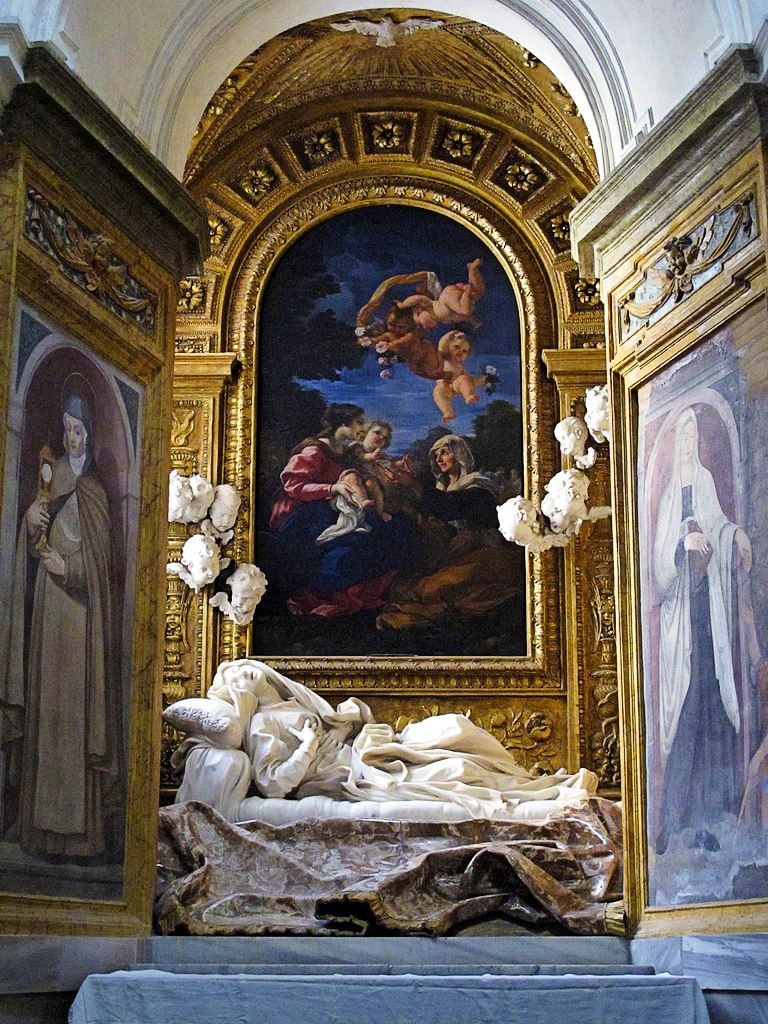
The Bernini figure of Ludovica Albertoni, above,is set above the Altar of the Altieri Chapel on the left side of the Church of San rancesco. Bernini designed an architectural setting that focuses attention on the marble sculpture, framing it within an archway he cut into an existing wall where a painting had previously hung. The main figure is flanked by deep returns set at oblique angles decorated with earlier frescoes of Saint Clare of Assisi and Blessed Ludovica herself providing alms to a beggar. The central figure is lit on both sides by large windows concealed by the returns.
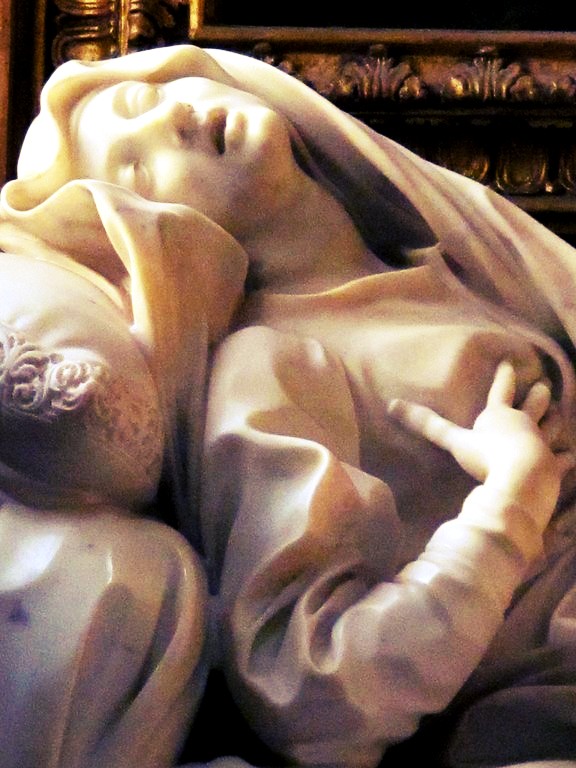
The figure of Ludovica Albertoni is presented on a mattress at the moment of mystical communion with God. The folds of her habit reflect her state of turmoil and her head is thrown back onto an embroidered pillow supported by a headrest. Beneath her figure is a deeply crumpled sculpted cloth above a red-marble Sarcophagus, where Ludovica is interred. The panel behind her is carved with stylized pomegranates, flaming hearts adorn the base of the windows. She is surrounded by putti and waiting to rise to the Light of Heaven.
St Geminian of Modena Bl John Angelus St Julius of Novara Blessed Louise degli Albertoni TOSF (1474-1533) Widow, Mystic, Ecstatic, Apostle of the sick, the poor, the deprived, Miracle-worker. St Madoes St Marcella St Martin Manuel St Nicetas of Novgorod St Tryphaena of Cyzicus St Tysul St Ulphia of Amiens St Waldo of Evreux St Wilgils
Martyrs of Corinth – 14 Saints: A group of Christians tortured and Martyred together in Corinth, Greece in the persecutions of Decius. We know nothing about them except some names – Anectus, Claudius, Codratus, Crescens, Cyprian, Diodorus, Dionysius, Nicephorus, Papias, Paul, Serapion, Theodora, Victor and Victorinus.
Martyrs of Canope: A group of Christians tortured and Martyred together in Corinth, Greece in the persecutions of Decius. We know nothing about them except some names – Anectus, Claudius, Codratus, Crescens, Cyprian, Diodorus, Dionysius, Nicephorus, Papias, Paul, Serapion, Theodora, Victor and Victorinus.
Martyred in Alexandria, Egypt: Cyriacus Metranus Saturninus Tarskius Thyrsus Victor Zoticus
Thought for the Day – 30 January – Meditations with Antonio Cardinal Bacci (1881-1971)
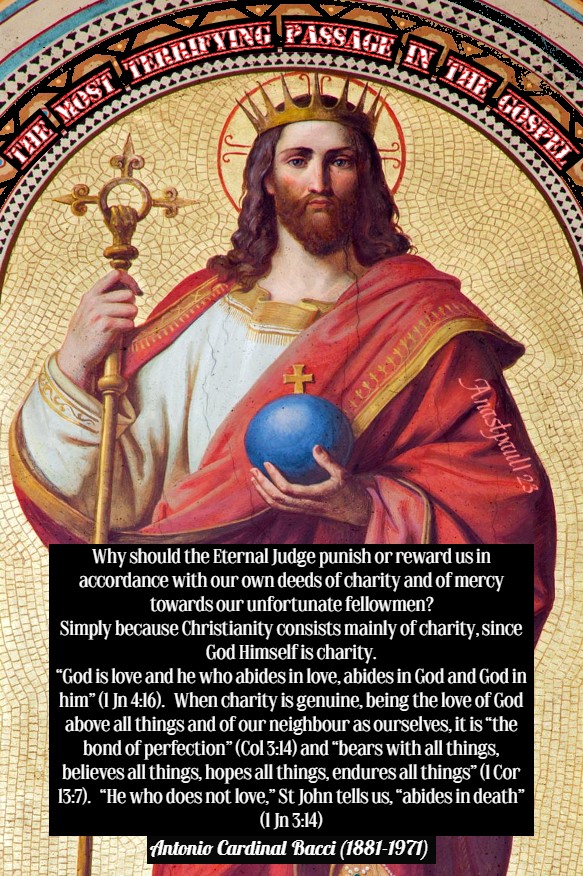
The Most Terrifying Passage in the Gospel
“Why should the Eternal Judge punish or reward us in accordance with our own deeds of charity and of mercy towards our unfortunate fellowmen? Simply because Christianity consists mainly of charity, since God Himself is charity. “God is love and he who abides in love, abides in God and God in him” (1 Jn 4:16). When charity is genuine, being the love of God above all things and of our neighbour as ourselves, it is “the bond of perfection” (Col 3:14) and “bears with all things, believes all things, hopes all things, endures all things” (1 Cor 13:7).
True love, in the Christian sense, presupposes faith, hope and all other virtues, whereas faith without charity is, as St Paul says, as futile as “a tinkling cymbal” (1 Cor 13:1). Even the devils have faith but their faith will not save them. “He who does not love,” St John tells us, “abides in death” (1 Jn 3:14).”
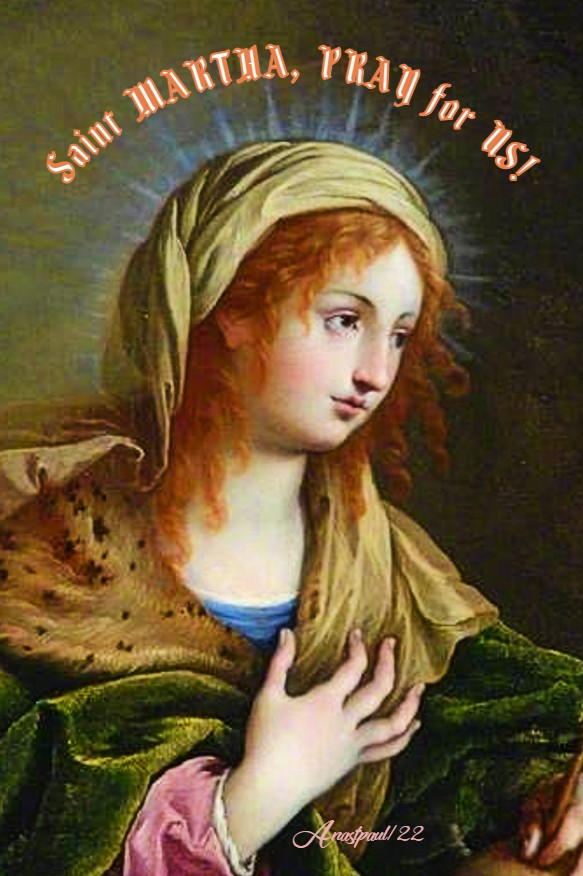
Quote/s of the Day – 30 January – “The Month of the Most Holy Name of Jesus” – St Martha (1st Century) Virgin Martyr – Sirach 51:1-8; 5:12, Matthew 25:1-13. – Scripture search here: https://www.drbo.org/
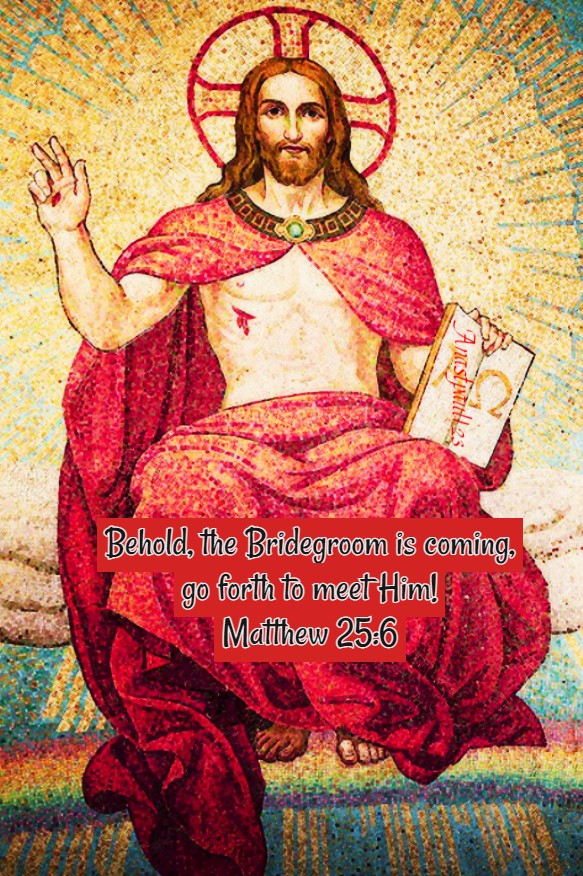
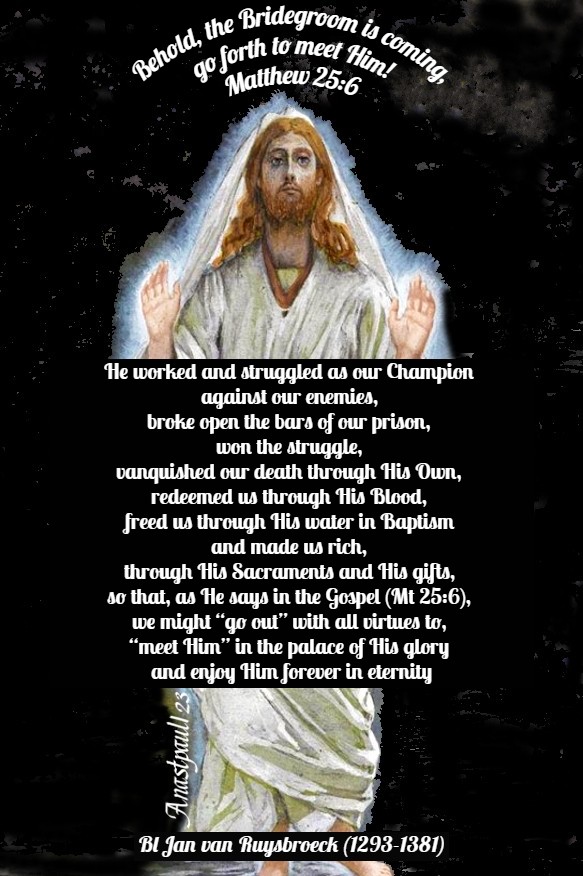
“Behold, the Bridegroom is coming, go forth to meet Him!”
Matthew 25:6
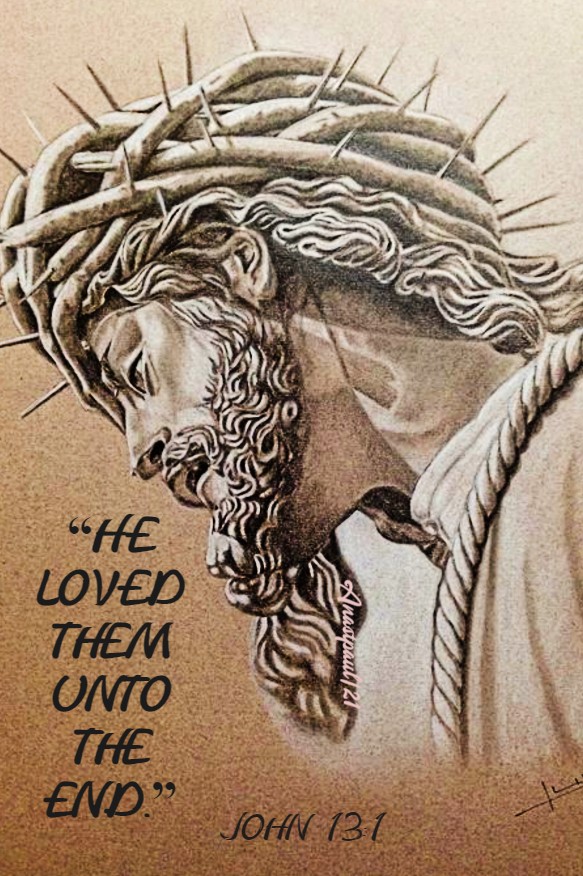
“He loved them unto the end.”
John 13:1
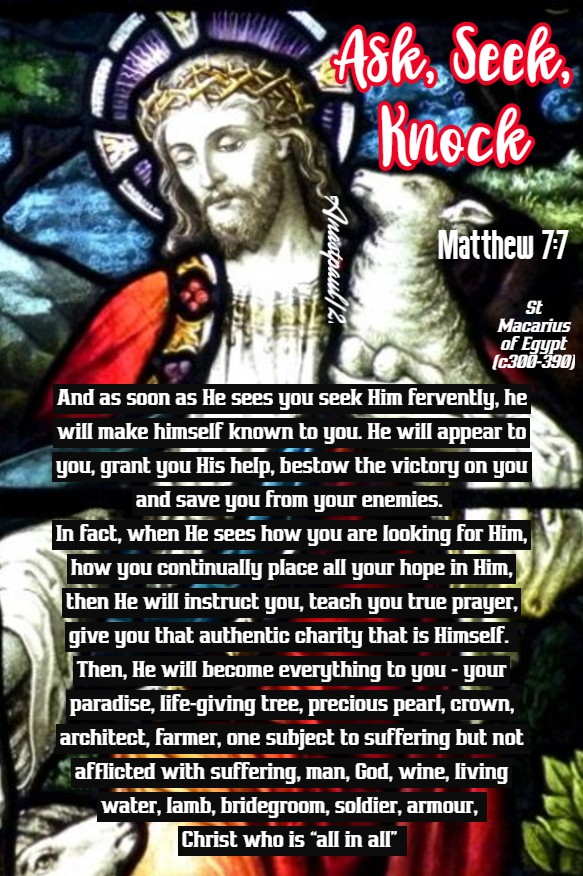
“And as soon as He sees you seek Him fervently, He will make Himself known to you. He will appear to you, grant you His help, bestow the victory on you and save you from your enemies. In fact, when He sees how you are looking for Him, how you continually place all your hope in Him, then He will instruct you, teach you true prayer, give you that authentic charity that is Himself. Then, He will become everything to you: your Paradise, Life-giving Tree, Precious Pearl, Crown, Architect, Farmer, One subject to suffering but not afflicted with suffering, Man, God, Wine, Living Water, Lamb, Bridegroom, Soldier, Armour, Christ Who is “All in All” (1Cor 1B,28).
St Macarius of Egypt (c 300-390)
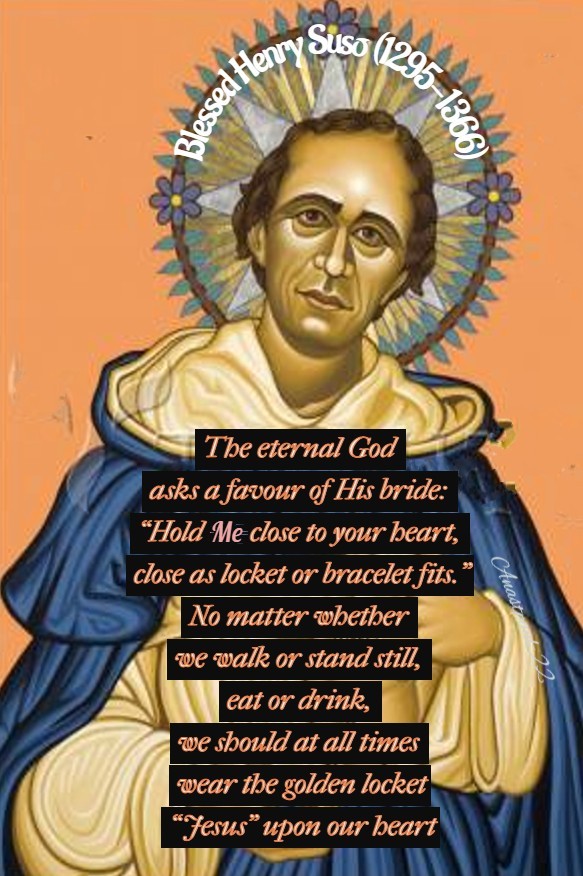
“The eternal God asks a favour of His bride: “Hold me close to your heart, close as locket or bracelet fits.” No matter whether we walk or stand still, eat or drink, we should at all times wear the golden locket “Jesus” upon our heart.”
One Minute Reflection – 30 January – St Martha (1st Century) Virgin Martyr – Sirach 51:1-8; 5:12, Matthew 25:1-13. – Scripture search here: https://www.drbo.org/
“Behold, the Bridegroom is coming, go forth to meet Him!” – Matthew 25:6
REFLECTION – “When it seemed to God that the right time had come and He took pity on His beloved in her suffering, He sent His Only-begotten Son to earth into a magnificent palace and a glorious temple, that is, into the body of the glorious Virgin Mary. There the Son wedded this bride, our nature and united her with His Own Person through the purest blood of the noble Virgin. The priest who witnessed the bride’s marriage was the Holy Ghost. The Angel Gabriel brought the message. The glorious Virgin gave her consent. Thus did Christ, our faithful Bridegroom, unite our nature with Himself. He came to us in a strange land and taught us through a heavenly way of life and with perfect fidelity.
He worked and struggled as our Champion against our enemies, broke open the bars of our prison, won the struggle, vanquished our death through His Own, redeemed us through His Blood, freed us through His water in Baptism and made us rich, through His Sacraments and His gifts, so that, as He says in the Gospel (Mt 25:6), we might “go out” with all virtues to, “meet Him” in the palace of His glory and enjoy Him forever in eternity.” – Bl Jan van Ruysbroeck (1293-1381) Canon Regular (The Spiritual Espousals, Prologue).
PRAYER – O God, Who among the other miracles of Thine power have bestowed the victory of Martyrdom even upon the weaker sex, graciously grant that we, who commemorate the anniversary of the death of blessed Martha, Thy Virgin and Martyr, may come to Thee by the path of her example. ThroughJesus Christ, Thy Son our Lord, Who lives and reigns with Thee, in the unity of the Holy Ghost, God, world without end. Amen (Collect).
Our Morning Offering – 30 January – Memorial of St Martha (1st Century) Virgin Martyr
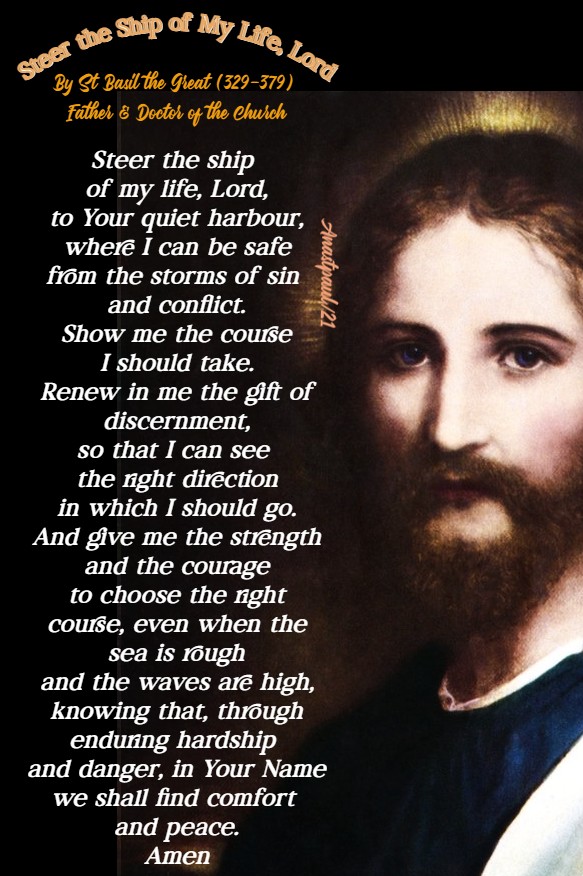
Steer the Ship of My Life, Lord By St Basil the Great (329-379) Father & Doctor of the Church
Steer the ship of my life, Lord, to Your quiet harbour, where I can be safe from the storms of sin and conflict. Show me the course I should take. Renew in me the gift of discernment, so that I can see the right direction in which I should go. And give me the strength and the courage to choose the right course, even when the sea is rough and the waves are high, knowing that through enduring hardship and danger in Your name we shall find comfort and peace. Amen
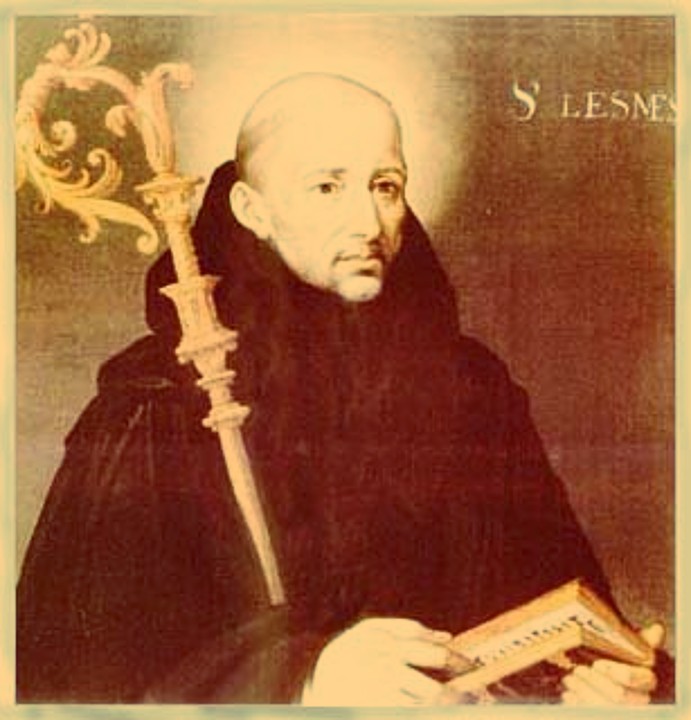
Saint of the Day – 30 January – Saint Adelelmus (Died c 1100) Abbot, Soldier, Miracle-worker. Born in the 11th Century at Laudun, Poitou, France and died in c 1100 at Burgos, Castilla la Vieja, Spain of natural causes. Patronages – Burgos, Spain, butlers, domestic servant, housemaids, manservants, servants. Also known as – Adelunie, Aleaume, Alleaume, Elesmes, Lesmes.
Adelelmus joined the military at a young age. During a pilgrimage to Rome he met St Robert de Turlande (c 1000-1067), Founder of the Abbey of La Chaise-Dieu – “Home of God” and left the military life to become a Monk in the Benedictine Order, under the spiritual direction of Saint Robert.
Soon, Adelelmus was known for miles around because of his miracles. Queen Constance of Burgundy of Castile was so impressed with the reports of Adelelmus’ holiness, she invited him to live in Burgos, Spain. She and King Alfonso VI founded a Monastery in the City in 1079, on the condition that he would be its first Abbot . He added a hospital and a Church to the building soon after. He later used his military training to help King Alfonso against the Moors.
One night, while out on some holy business, Abbot Adelelmus and his aide were caught in a storm. Adelelmus ordered his servany to light a candle in order to complete their journey in the darkness. Not only was he able to light the exposed candle in the rain and wind but it stayed alight throughout their whole wet, windy, stormy travels.
After death, Adelelmus became the Patron Saint of the City of Burgos in Spain. His remains lie in the Iglesia de San Lesmes Abad, dedicated to him.
Adelelmus’ life was written soon after his death by a French Monk named Rodulph, who travelled to Burgos with the sole purpose of writing the Saint Vita. This volume gives a detailed account of the life and miracles of Saint Adelelmus and includes all the liturgical chants for the Mass which celebrate this Saint. As an attestation of the centuries-long veneration of the Patron Saint of Burgos, the Vita Adelelmi represents a unique and indescribably valuable artifact.
Adelelmus’ Feast day is kept on 30 January and celebrated honourably in Burgos but it is no longer observed in the General Roman Calendar.
St Adelelmus (Died c 1100) Abbot St Aldegundis St Alexander of Edessa St Amnichad of Fulda St Armentarius of Antibes St Armentarius of Pavia St Barsen St Barsimaeus of Edessa
Our Prayers to the Saints – 29 January – St Francis de Sales (1567-1622) Bishop, Confessor – Doctor of the Church: Doctor Caritatis (Doctor of Charity) “The Gentle Christ of Geneva” and the “Gentleman Saint.”
O Glorious St Francis Prayer to St Francis de Sales
O Glorious St Francis, model of the interior life and full of zeal for the salvation of souls! Obtain for me the grace to employ all my faculties, not for my own sanctification alone but for that of my neighbour too that continually spreading abroad, the sweet odour of Jesus Christ, by my words and works, I may attain, with thee, the blessedness promised to the merciful: “Blessed are the merciful, for they shall obtain mercy” and that I may one day have a share in the glory which thou dost enjoy in Paradise with the Angels and Saints, where those who edify and instruct to justice, shall shine as stars for all eternity (Dan 12:3). Amen
Thought for the Day – 29 January – Meditations with Antonio Cardinal Bacci (1881-1971)
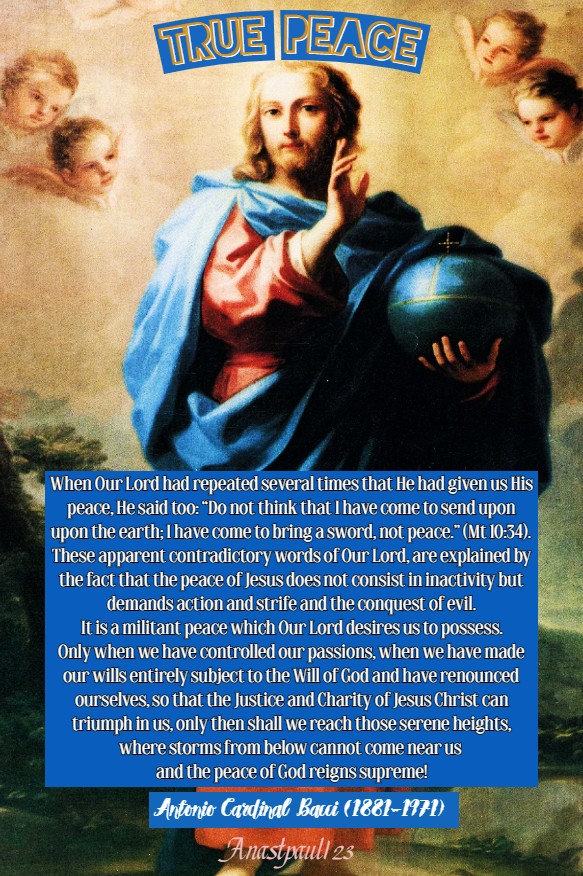
True Peace
“This absolute and loving abandonment to the Will of God in all things, brings complete inner peace but, it does not exclude conflict. Interior peace is the result of the practice of virtue and, therefore, of the struggle against evil. When Our Lord had repeated several times that He had given us His peace, He said too: “Do not think that I have come to send upon upon the earth; I have come to bring a sword, not peace.” (Mt 10:34).
These apparent contradictory words of Our Lord, are explained by the fact that the peace of Jesus does not consist in inactivity but demands action and strife and the conquest of evil. It is a militant peace which Our Lord desires us to possess. Only when we have controlled our passions, when we have made our wills entirely subject to the Will of God and have renounced ourselves, so that the Justice and Charity of Jesus Christ can triumph in us, only then shall we reach those serene heights, where storms from below cannot come near us and the peace of God reigns supreme!
We find examples of this true and perfect peace among the Saints, Martyrs and Apostles. We read of the Apostles that “they departed … rejoicing that they had been counted worthy to suffer disgrace for the Name of Jesus” (Acts 5:41). This is an example of that genuine peace which is the result of victory in the combat against evil and of complete and loving submission to the Will of God.”
Quote/s of the Day – 29 January – St Francis de Sales, Bishop, Confessor and Doctor of the Church
“The measure of love, is to love without measure.”
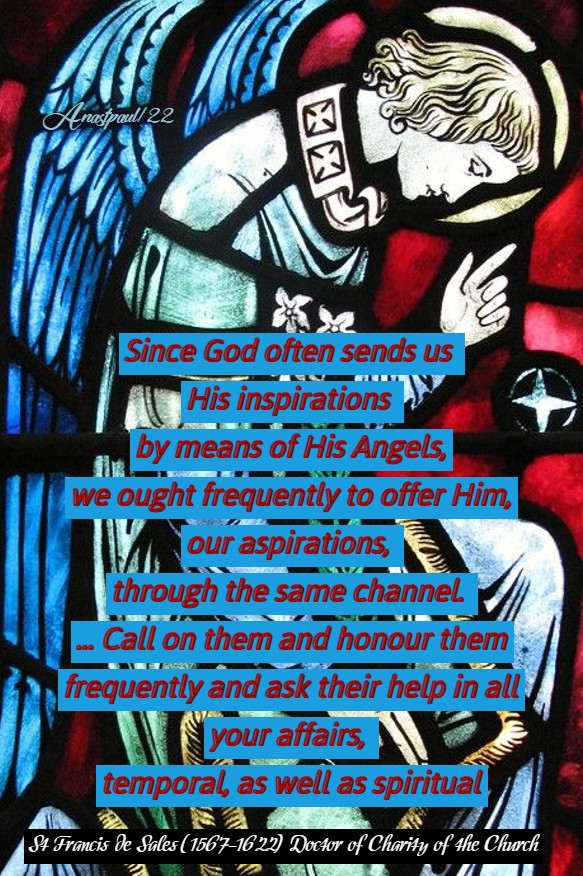
“Since God often sends us His inspirations by means of His Angels, we ought frequently to offer Him, our aspirations, through the same channel. … Call on them and honour them frequently and ask their help in all your affairs, temporal, as well as spiritual.”
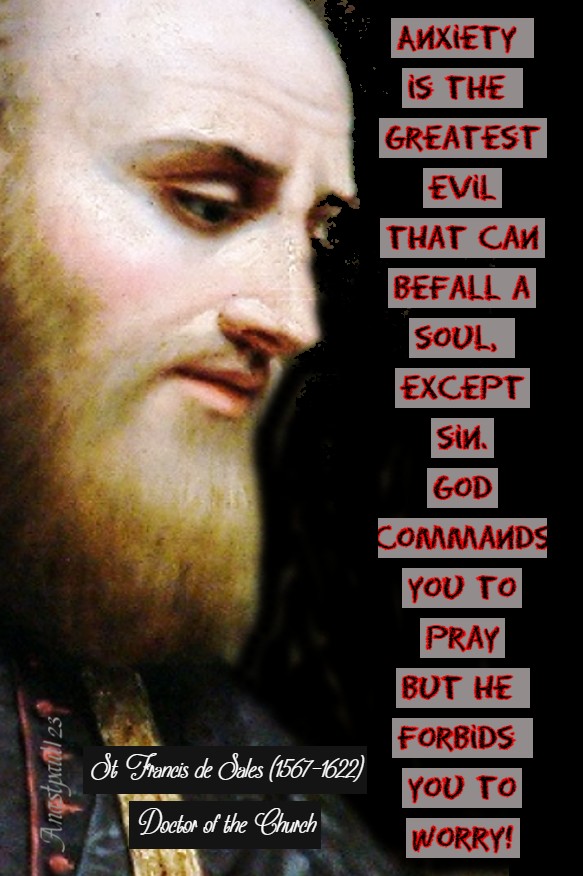
“Anxiety is the greatest evil that can befall a soul, except sin. God commands you to pray but He forbids you to worry.”
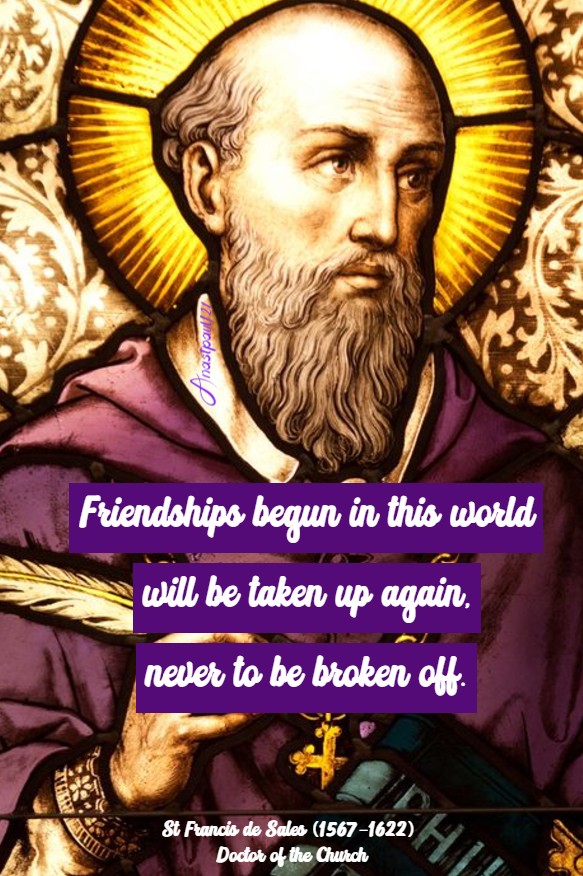
“Friendships begun in this world will be taken up again, never to be broken off. ”
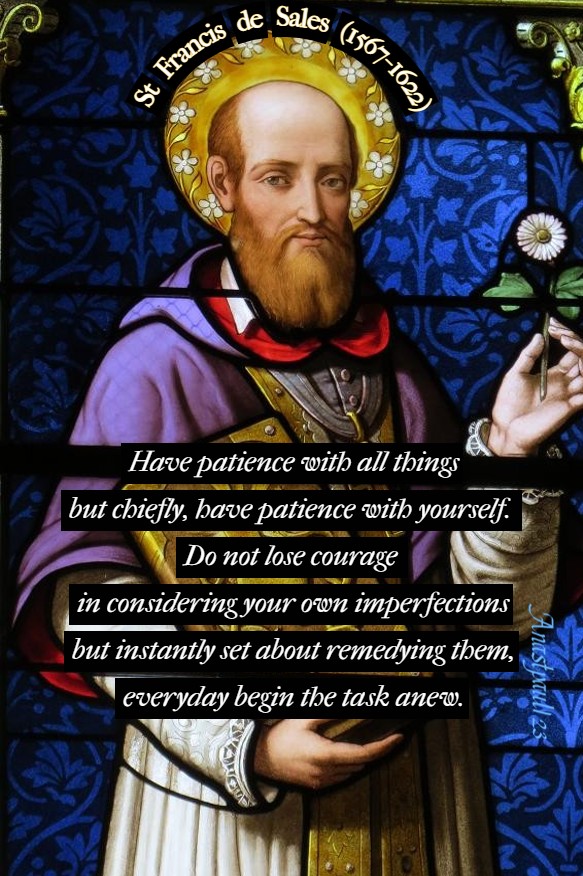
“Have patience with all things but chiefly, have patience with yourself. Do not lose courage in considering your own imperfections but instantly set about remedying them, everyday begin the task anew.”
“Do not look forward to the changes and chances of this life in fear – rather look to them with full hope that, as they arise, God, whose you are, will deliver you out of them. He is your keeper. He has kept you hitherto. Do you but hold fast to His dear hand and He will lead you safely through all things and, when you cannot stand, He will bear you in His arms. Do not look forward to what may happen tomorrow. Our Father will either shield you from suffering, or He will give you strength to bear it.”
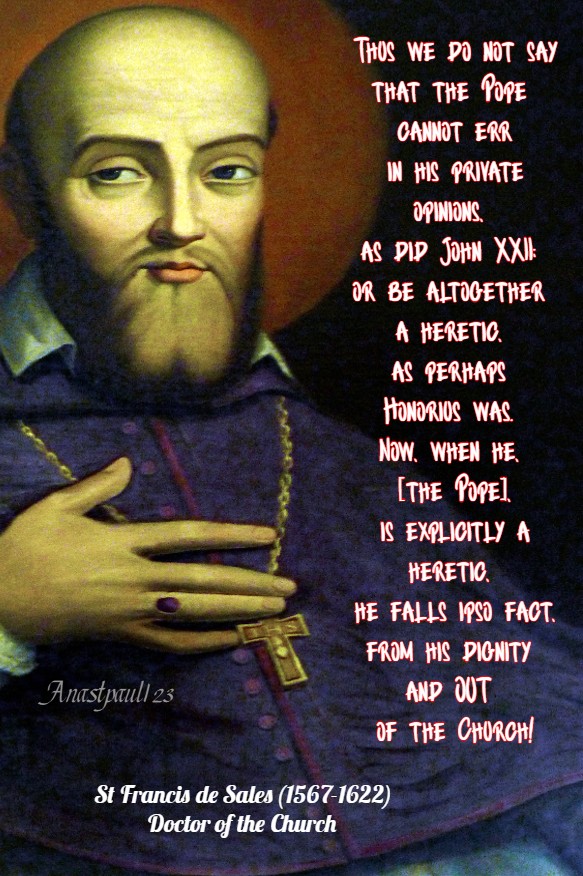
“Thus we do not say that the Pope cannot err in his private opinions, as did John XXII; or be altogether a heretic, as perhaps Honorius was. Now, when he, [the Pope], is explicitly a heretic, he falls ipso facto, from his dignity and OUT of the Church! …”
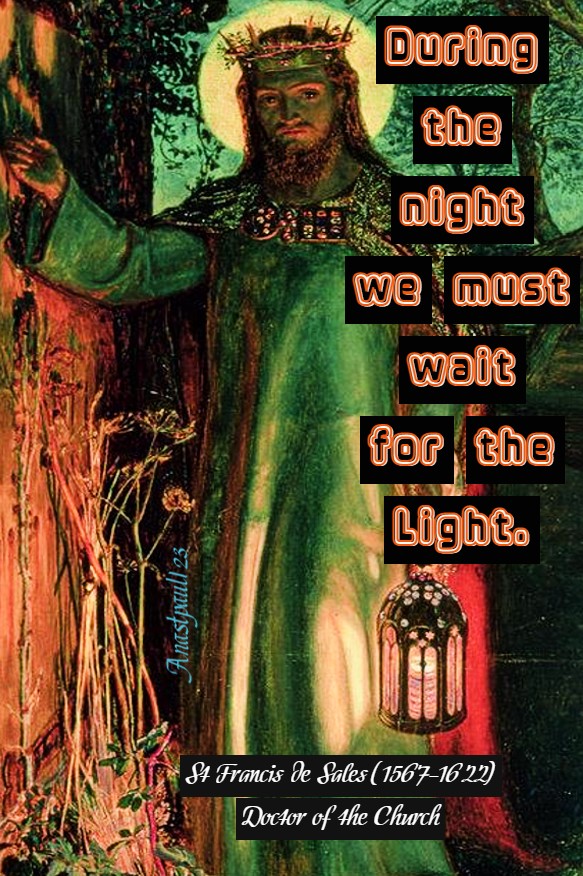
“During the night we must wait for the Light.”
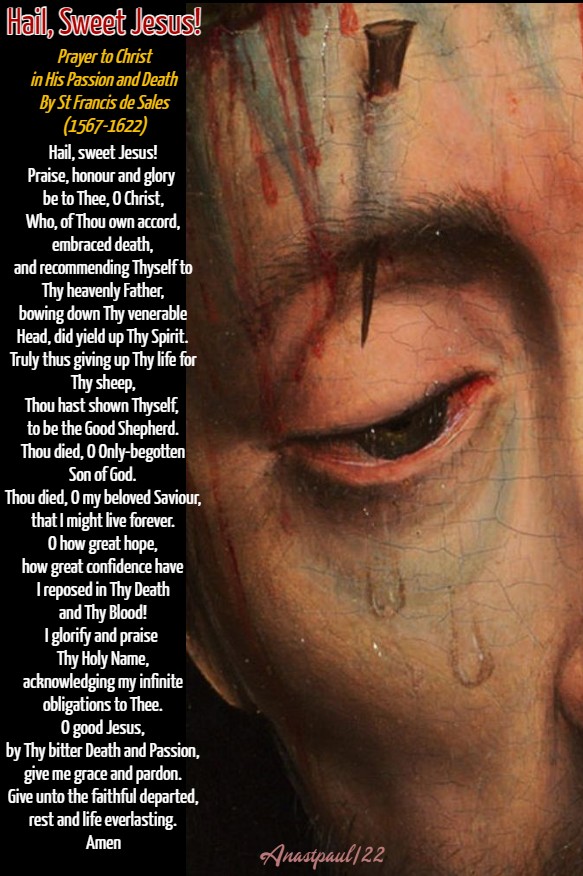
Hail, Sweet Jesus! Prayer to Christ in His Passion and Death By St Francis de Sales (1567-1622) Doctor of the Church
Hail, sweet Jesus! Praise, honour and glory be to Thee, O Christ, Who, of Thou own accord, embraced death, and recommending Thyself to Thy heavenly Father, bowing down Thy venerable Head, did yield up Thy Spirit. Truly thus giving up Thy life for Thy sheep, Thou hast shown Thyself, to be the Good Shepherd. Thou died, O Only-begotten Son of God. Thou died, O my beloved Saviour, that I might live forever. O how great hope, how great confidence have I reposed in Thy Death and Thy Blood! I glorify and praise Thy Holy Name, acknowledging my infinite obligations to Thee. O good Jesus, by Thy bitter Death and Passion, give me grace and pardon. Give unto the faithful departed, rest and life everlasting. Amen.
Most Holy Mary, Virgin Mother of God Act of Consecration By St Francis de Sales (1567-1622) Indulgence of 300 days, for each recitation St Pius X, 17 November 1906
Most Holy Mary, Virgin Mother of God, I ………., most unworthy though I am to be thy servant, yet touched by thy motherly care for me and longing to serve thee, do, in the presence of my Guardian Angel and all the Court of Heaven, choose thee this day to be my Queen, my Advocate and my Mother and I firmly purpose to serve thee evermore myself and, to do what I can, that all may render faithful service to thee. Therefore, most devoted Mother, through the Precious Blood thy Son poured out for me, I beg thee and beseech thee, deign to take me among thy clients and receive me as thy servant forever. Aid me in my every action and beg for me the grace never, by word or deed or thought, to be displeasing in thy sight and that of thy most holy Son. Think of me, my dearest Mother and desert me not at the hour of death. Amen
One Minute Reflection – 29 January – The Memorial of St Francis Salesius, Bishop, Confessor and Doctor of the Church – Romans 13:8-10, Matthew 8:23-27 – Scripture search here: https://www.drbo.org/
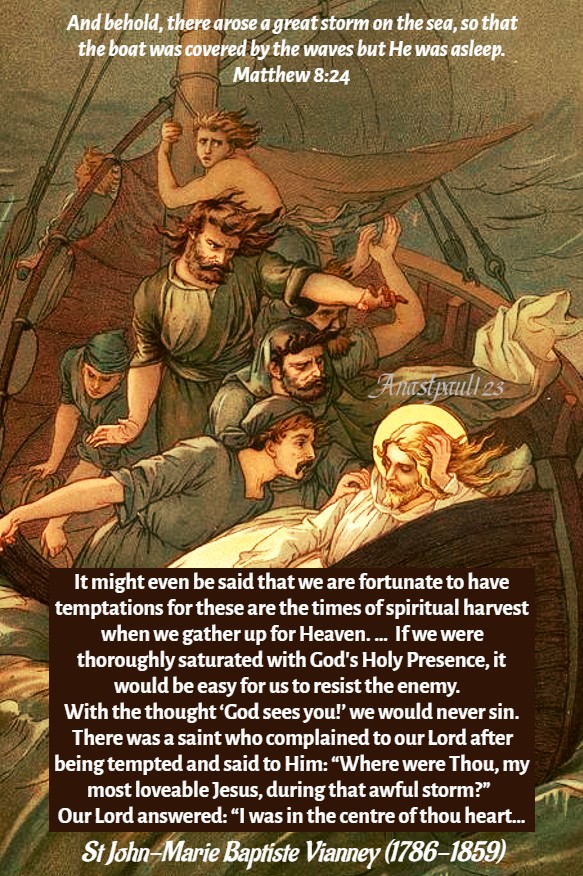
“And behold, there arose a great storm on the sea, so that the boat was covered by the waves but He was asleep.”- Matthew 8:24
REFLECTION – “Just as the good soldier is not afraid of battle, so the good Christian has no fear of temptation. … The greatest temptation is not to have temptation! It might even be said that we are fortunate to have temptations for these are the times of spiritual harvest when we gather up for Heaven. … If we were thoroughly saturated with God’s Holy Presence, it would be easy for us to resist the enemy. With the thought ‘God sees you!’ we would never sin.
There was a saint who complained to our Lord after being tempted and said to Him: “Where were Thou, my most loveable Jesus, during that awful storm?” Our Lord answered: “I was in the centre of thou heart…”– St John-Marie Baptiste Vianney (1786-1859) The Curé of Ars (Selected thoughts of the Curé d’Ars).
PRAYER – O God, Who for the salvation of souls, willed that blessed Francis, Thy Confessor and Bishop, should become all things to all men, mercifully grant that we, inspired by the sweetness of Thy love, guided by his teachings and aided by his merits, may attain the joys of everlasting life. Through Jesus Christ, Thy Son our Lord, Who lives and reigns with Thee, in the unity of the Holy Ghost, God, world without end. Amen (Collect).
Our Morning Offering – 29 January – St Francis de Sales (1567-1622) Bishop, Confessor – Doctor of the Church: Doctor Caritatis (Doctor of Charity) “The Gentle Christ of Geneva” and the “Gentleman Saint” – “The Month of the Most Holy Name of Jesus
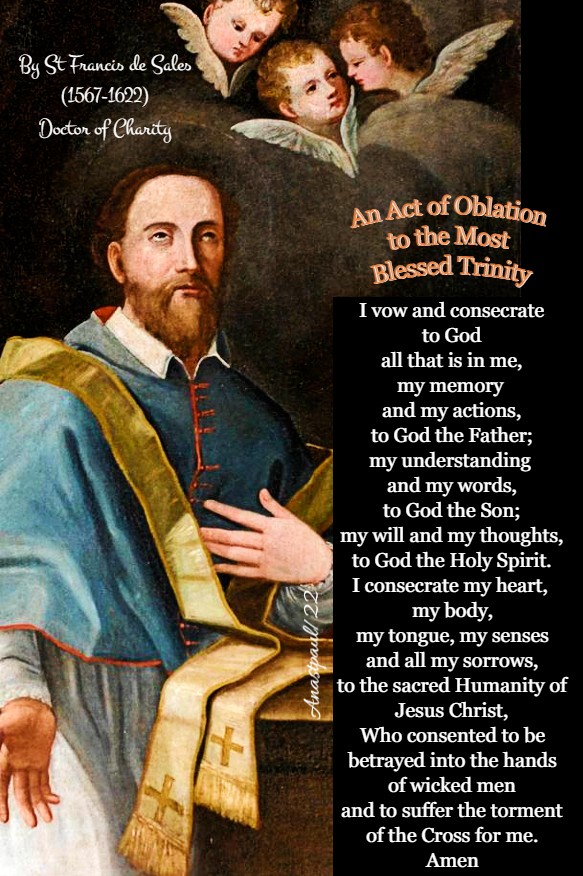
An Act of Oblation to the Most Blessed Trinity By St Francis de Sales (1567-1622) Doctor of Charity
I vow and consecrate to God all that is in me, my memory and my actions, to God the Father; my understanding and my words, to God the Son; my will and my thoughts, to God the Holy Spirit. I consecrate my heart, my body, my tongue, my senses and all my sorrows, to the Sacred Humanity of Jesus Christ, Who consented to be betrayed into the hands of wicked men and to suffer the torment of the Cross for me. Amen
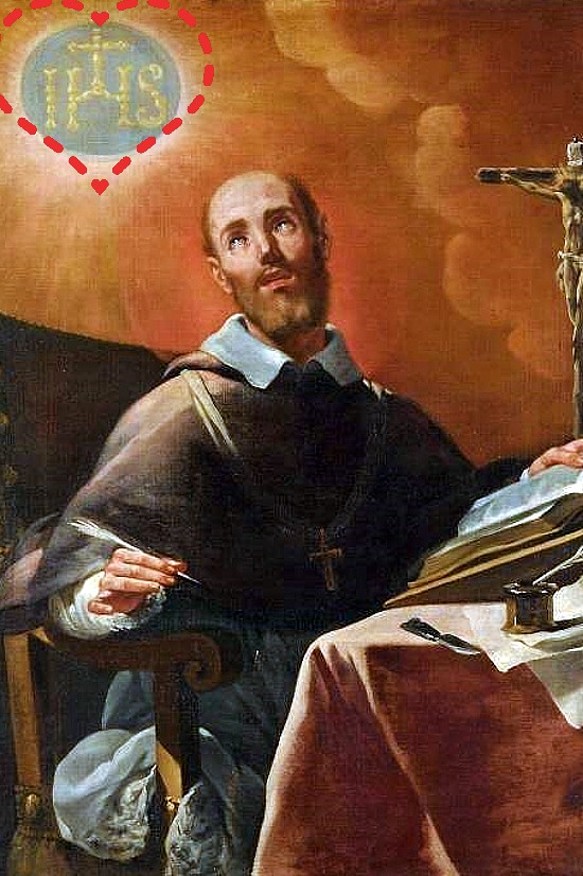
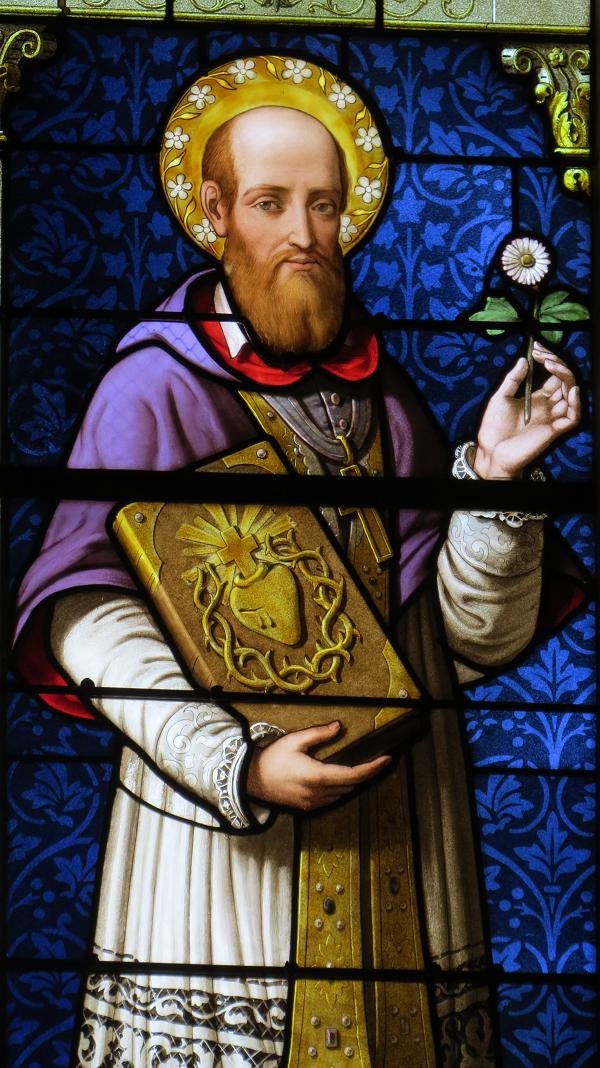
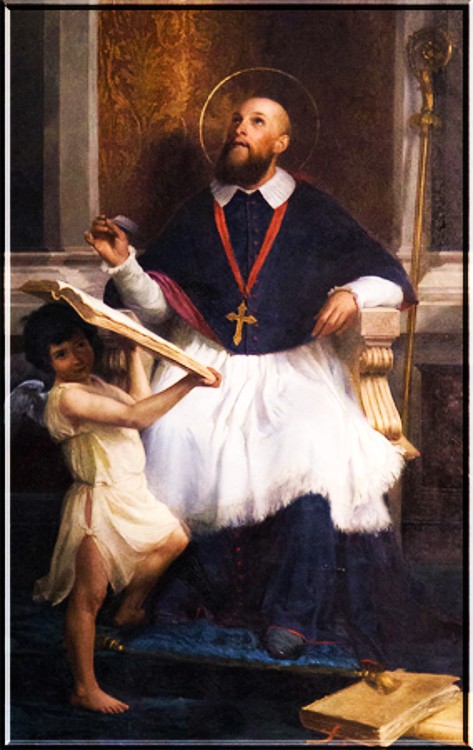
Saint of the Day – 29 January – St Francis de Sales (1567-1622) Bishop, Confessor, Doctor of the Church – Doctor Caritatis (Doctor of Charity) “The Gentle Christ of Geneva” and the “Gentleman Saint.”
From the Office of the Church for the Feast, of St Francis de Sales.
Francis was born of pious and noble parents, in the town of Sales, from which the family took their name. From his earliest years, he gave pledge of his future sanctity by the innocence and gravity of his conduct. Having been instructed in the liberal sciences during his youth, he was sent early to Paris that he might study Philosophy and Theology and, in order that his education might be complete, he was sent to Padua, where he took, with much honour, the degree of Doctor in both Civil and Canon Law. He visited the Sanctuary of Loreto, where he renewed the vow he had already taken in Paris, of perpetual virginity, in which holy resolution he continued till death, in spite of all the temptations of the devil and all the allurements of the flesh.
He refused to accept an honourable position in the Senate of Savoy and entered into the Ecclesiastical state. He was Ordained Priest and was made Provost of the Diocese of Geneva, which charge he so laudably fulfilled that Granier, his Bishop, selected him for the arduous undertaking of labouring, by the preaching of God’s Word, for the conversion of the Calvinists of Chablais and the neighbouring country round about Geneva.
This mission he undertook with much joy. He had to suffer the harshest treatment on the part of the heretics, who frequently sought to take away his life, caluminated him and laid all kinds of plots against him. But, he showed heroic courage in the midst of all these dangers and persecutions and by the Divine assistance, converted, as it is stated, seventy-two thousand heretics to the One True Catholic Faith, among whom were many distinguished by the high position they held in the world and by their learning.
After the death of Granier, who had already made him his Co-adjutor, he was made Bishop of Geneva. Then it was that his sanctity showed itself in every direction, by his zeal for Ecclesiastical discipline, his love of peace, his charity to the poor and every virtue.
From a desire to give more honour to God, he founded a new Order of Nuns, which he called the Visitation, taking for their Rule that of St Augustine, to which he added Constitutions of admirable wisdom and sweetness. He enlightened the children of the Church by the works he wrote, which are full of a heavenly wisdom and pointed out a path, which is at once safe and easy, to christian perfection.
In his fifty-fifth year, whilst returning from France to Annecy, he was taken with his last sickness, immediately after having celebrated Mass, on the Feast of St. John the Evangelist. On the following day, his soul departed this life for Heaven, in the year of our Lord 1622. His body was taken to Annecy and was buried, with great demonstration of honour, in the Church of the Nuns of the above mentioned Order. Immediately after his death, miracles began to be wrought through his intercession, which, being officially authenticated, he was Canonised by Pope Alexander the Seventh and his Feast was appointed to be kept on the twenty ninth day of January.
St Francis de Sales CO, OM, OFM (Cap) (1567-1622) Bishop, Confessor – Doctor of the Church: Doctor caritatis (Doctor of Charity) “The Gentle Christ of Geneva” and the “Gentleman Saint” – Bishop of Geneva, Doctor of Law and Theology, Writer, Theologian, Mystic, Teacher, Preacher, Founder along with St Jane Frances de Chantal, founded the women’s Order of the Visitation of Holy Mary (Visitandines). Feast Day – 29 January (General Roman Calendar of 1960 and local communities. Biography: https://anastpaul.wordpress.com/2018/01/24/saint-of-the-day-24-january-st-francis-de-sales-1567-1622-doctor-of-the-church-doctor-caritatis-doctor-of-charity/
t Abundantia the Martyr St Aphraates St Aquilinus of Milan St Barbea of Edessa St Blath of Kildare Bl Boleslawa Maria Lament St Caesarius of Angoulême Bl Charles of Sayn
Thought for the Day – 28 January – Meditations with Antonio Cardinal Bacci (1881-1971)
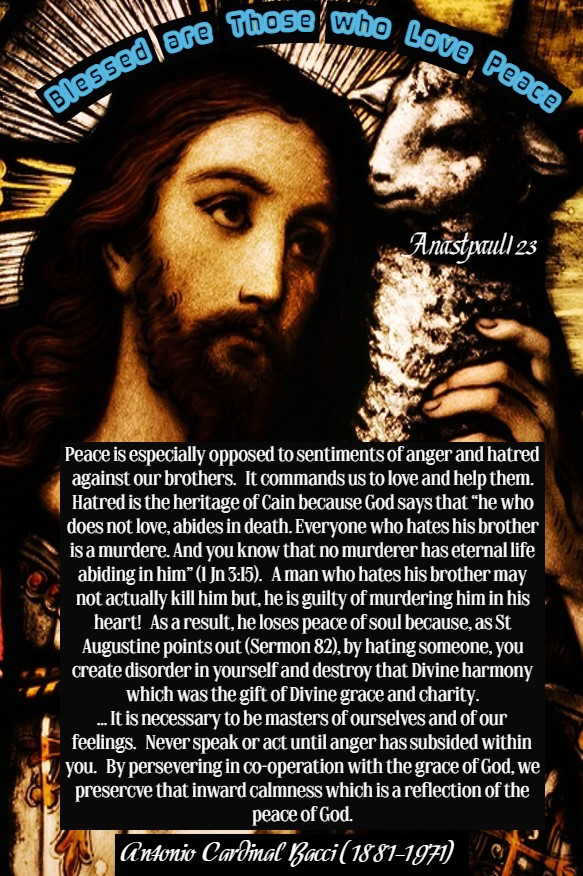
Blessed are Those who Love Peace
“Peace is especially opposed to sentiments of anger and hatred against our brothers. It commands us to love and help them. Hatred is the heritage of Cain because God says that “he who does not love, abides in death. Everyone who hates his brother is a murdere. And you know that no murderer has eternal life abiding in him” (1 Jn 3:15). A man who hates his brother may not actually kill him but, he is guilty of murdering him in his heart! As a result, he loses peace of soul because, as St Augustine points out (Sermon 82), by hating someone, you create disorder in yourself and destroy that Divine harmony which was the gift of Divine grace and charity.
If we wish to preserve interior peace, we must cast out from our hearts, every vestige of hatred for our neighbour and entertain love, understanding and forgiveness, for all. By loving our enemies, we place ourselves above them by an act of true Christian nobility. We imitate Jesus, Who forgave His executioners and prayed for them from the Cross.
A fit of anger is like a moment of madness. It is a great misfortune for anyone to yield to it. He speaks and acts like a man who has lost his reason and allows himself to be carried away by blind passion. When the moment of insanity is over, he will be ashamed of himself and of all that he has said and done.
It is necessary to be masters of ourselves and of our feelings. Never speak or act until anger has subsided within you. By persevering in co-operation with the grace of God, we presercve that inward calmness which is a reflection of the peace of God.”

























 AnaStpaul
You must be logged in to post a comment.