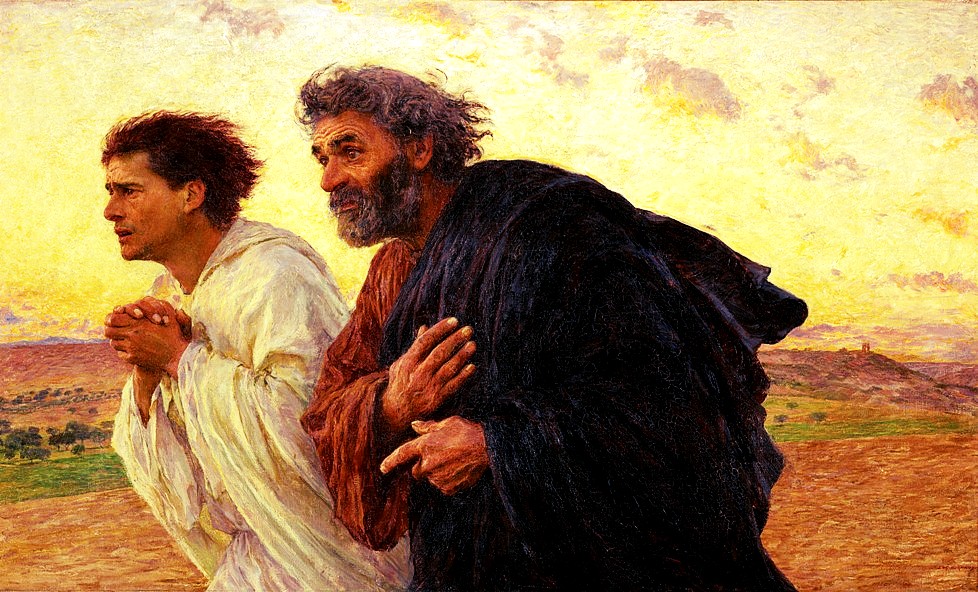
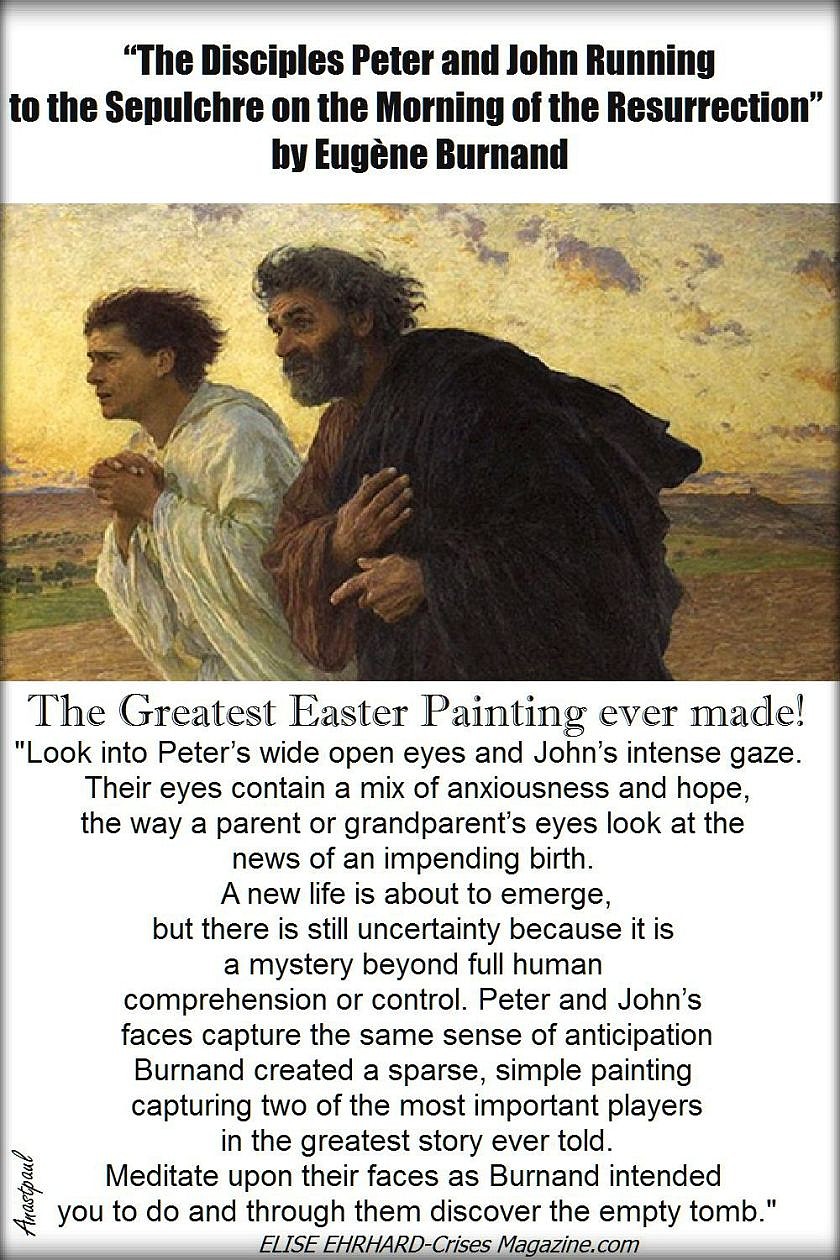
The Greatest Story Ever Told The Greatest Easter Painting Ever Made!
“Look into Peter’s wide open eyes and John’s intense gaze. Their eyes contain a mix of anxiousness and hope, the way a parent or grandparent’s eyes look at the news of an impending birth. A new life is about to emerge but there is still uncertainty because it is a mystery beyond full human comprehension or control. Peter and John’s faces capture the same sense of anticipation. Burnand created a sparse, simple painting capturing two of the most important players in the greatest story ever told. Meditate upon their faces, as Burnand intended you to do and through them, discover the empty tomb.” (Elisabeth Ehrhard-Crises Magazine).
One Minute Reflection – 12 April – “The Month of the Resurrection” – Easter Wednesday – Acts 3:13-15; 3:17-19, John 21:1-14 – Scripture search here: https://www.drbo.org/
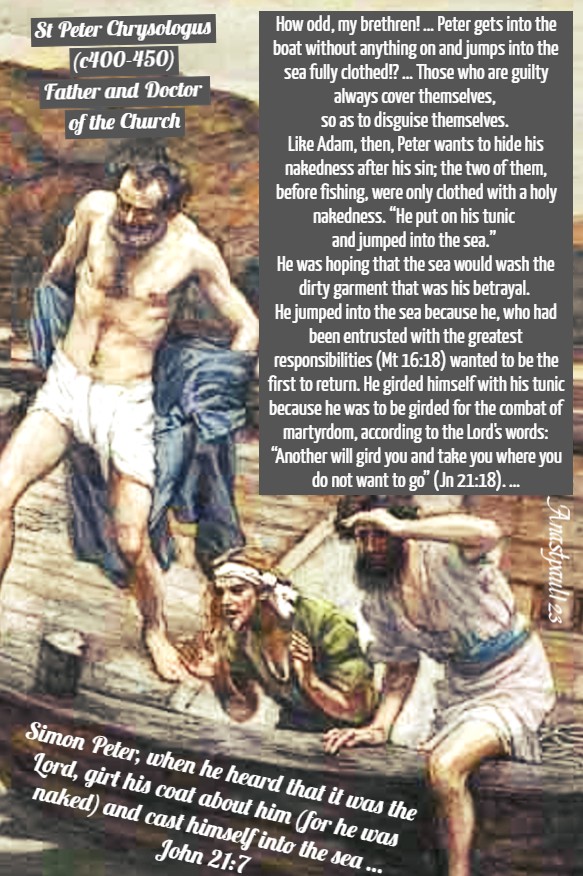
“ Simon Peter, when he heard that it was the Lord, girt his coat about him (for he was naked) and cast himself into the sea.. …” – John 21:7
REFLECTION – “The disciple whom Jesus loved said to Peter: ‘It is the Lord!’” The one who loved was the first to see! love casts a keener sight over everything; whosoever loves, always feels with greater vivacity. … What difficulty made Peter’s spirit so slow and prevented him from recognising Jesus first, as he had already done? Where is that unique witness which caused him to exclaim: “You are the Christ, the Son of the living God?” (Mt 16:16) Where is it? Peter had entered the house of Caiaphas, the high priest, where he had heard the whispering of a servant without difficulty, yet, he delayed to acknowledge his Lord!?
“When he heard that it was the Lord, he put on his tunic, for he had nothing on.” How odd, my brethren! … Peter gets into the boat without anything on and jumps into the sea fully clothed!? … Those who are guilty always cover themselves, so as to disguise themselves. Like Adam, then, Peter wants to hide his nakedness after his sin; the two of them, before fishing, were only clothed with a holy nakedness. “He put on his tunic and jumped into the sea.” He was hoping that the sea would wash the dirty garment that was his betrayal. He jumped into the sea because he, who had been entrusted with the greatest responsibilities (Mt 16:18) wanted to be the first to return. He girded himself with his tunic because he was to be girded for the combat of martyrdom, according to the Lord’s words: “Another will gird you and take you where you do not want to go” (Jn 21:18). …
The others came with the boat, dragging their net full of fish. With a great deal of difficulty, they brought the Church back with them, tossed about in the winds of the world. This is what those men bore in the net of the Gospel to the Light of Heaven and which they pulled out of the deep, so as to lead it to the Lord.” – St Peter Chrysologus (c400-450) Bishop of Ravenna, Father and “Doctor of Homilies” (Sermon 78).
PRAYER – O God, Who dost every year fill us with holy gladness through the rising of the Lord, mercifully grant that these Feast-days which we are now keeping here in time, may be to us, a means whereby, in the end, we may worthily attain unto those pleasures which are at Thy Right Hand, for evermore.Through the same Jesus Christ, Thy Son our Lord, Who lives and reigns with Thee, in the unity of the Holy Ghost, God, world without end. Amen (Collect).
Our Morning Offering – 12 April – Easter Wednesday – “The Month of the Resurrection”
O Most Compassionate Jesus! By Pope Pius IX (1792-1878) Indulgence of 100 days, once a day 6 October 1870
O Most compassionate Jesus! Thou alone art our Salvation, our Life and our Resurrection. We implore Thee, therefore, do not forsake us in our needs and afflictions but by the agony of Thy Most Sacred Heart and by the sorrows of Thy Immaculate Mother, succour Thy servants, whom Thou hast redeemed by Thy Most Precious Blood. Amen
Saint of the Day – 12 April – Saint Pope Julius I (Died 337) Bishop of Rome from 6 February 337 until his death on 12 April 352. He fought against the Arian Heresy and it is traditionally believed that he is the Pope who set 25 December as the date of the Birth of Jesus. Born at Rome, Italy and died on 12 April 352 of natural causes. Also known as – Jules I.
The Roman Martyrology reads: “At Rome, the birthday of Pope St Julius, who combated vigorously for the Catholic Faith against the Arians. After a life of brilliant deeds and great sanctity, he rested in peace.”
Julius was the son of a Roman named Rusticus. He was elected Pope to succeed Pope St Mark on 6 February 337.
Julius was soon involved in the Arian controversy when Eusebius of Nicomedia opposed the return of Athanasius to the See of Alexandria in 338. Eusebius and his followers elected George, whereupon the Arians elected Pistus.
On his second banishment from Alexandria, St Athanasius came to Rome, and was recognised as the rightful Bishop by the Synod presided over by Julius in c340. In a letter to the Eusebian Bishops, Julius declared that Athanasius was the rightful Bishop of Alexandria and reinstated him. The matter was not finally settled until the Council of Sardica (Sofia), summoned by Emperors Constans and Constantius in 342 or 343, declared Julius’ action correct and that any deposed Bishop had the right of appeal to the Pope in Rome.
The Fathers of the Council of Sardica sent Pope Julius I the letter Quod semper credidimus, whose beginning we transcribe:
“The Bishops gathered in the City of Sardica, to our most beloved Brother Julius, Bishop of Rome.
We have always believed and professed that which we have now experienced and heard. What the Blessed Paul, Doctor of Nations, said about himself is true; to wit that since Christ the Lord dwelt in him, there can be no doubt that the Spirit spoke through his breath and resounded in his mouth. …
You also, beloved Brother, although separated from us in body, have been present with us, united in spirit and will. The reason for your absence was both honourable and compelling so that the schismatic wolves might not steal, nor treacherously waylay, any of the flock with their snares, or the heretical dogs, rabid with fury, disturb it with their mad barking, or, indeed that serpent spew forth the venom of his diabolical blasphemies. This certainly seems to be the best and most fitting course – that the Priests of the Lord, from each and every Province report everything to their Head that is, to the See of the Apostle Peter.”
Julius also built several Basilicas and Churches in Rome before his death on 12 April 337.
St Alferius Pappacarbone of La Cava (930–1050) Priest, Founder and Abbot of Arsicia (La Trinità della Cava) which follows the Benedictine Rule, nobleman, Diplomat to Prince Waimar III of Salerno, Cluniac reformer, cave Hermit, Mystic and Ecstatic, Miracle-worker. The Roman Martyrology states: “In the Monastery of Cava de ‘Tirreni in Campania, Saint Alferius, Founder and first Abbot, who, after having been adviser to Guaimario, Duke of Salerno, who became a disciple of Saint Odilone in Cluny, learned in an excellent way, the discipline of monastic life.” Biography: https://anastpaul.com/2021/04/12/saint-of-the-day-12-april-saint-alferius-of-la-cava-930-1050/
Blessed Andrew of Montereale OSA (c1479-1764) Priest and Friar of the Order oif the Hermits of St Augustine, renowned Scholar, Preacher, Teacher, Reformer. Confessor and Spiritual Director to the Royal Court of France, Miracle-worker. His life was devoted to teaching, preaching and leading the Augustinians from several positions of leadership. He was hailed, even during his lifetime, as a pious Miracle worker.
St Artemón of Caesarea St Basil of Parion St Constantine of Gap St Damian of Pavia St Erkemboden of Thérouanne St Florentin of Arles St Pope Julius I (Died 337) Bishop of Rome from 6 February 337 until his death on 12 April 352. St Lorenzo of Belem St Peter of Montepiano
St Sabas the Lector
St Tetricus of Auxerre St Victor of Braga St Vissia of Fermo St Wigbert
Thought for the Day –11 April – Meditations with Antonio Cardinal Bacci (1881-1971)
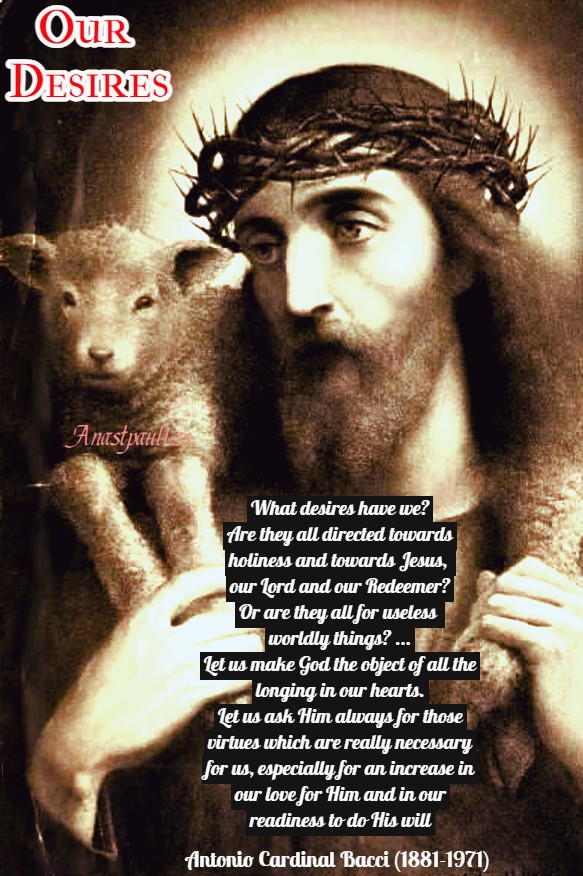
Our Desires
“What desires have we? Are they all directed towards holiness and towards Jesus, our Lord and our Redeemer? Or are they all for useless worldly things? In times of physical or spiritual affliction, do we make sure that our desires are in conformity with and subject to, the will of God?
Let us examine ourselves seriously. If we find that any of our desires are vain or sinful, let us change this state of affairs at once. Let us make God the object of all the longing in our hearts. Let us ask Him always for those virtues which are really necessary for us, especially for an increase in our love for Him and in our readiness to do His will.”
Quote/s of the Day –11 April – The Month of the Resurrection” – Easter Tuesday
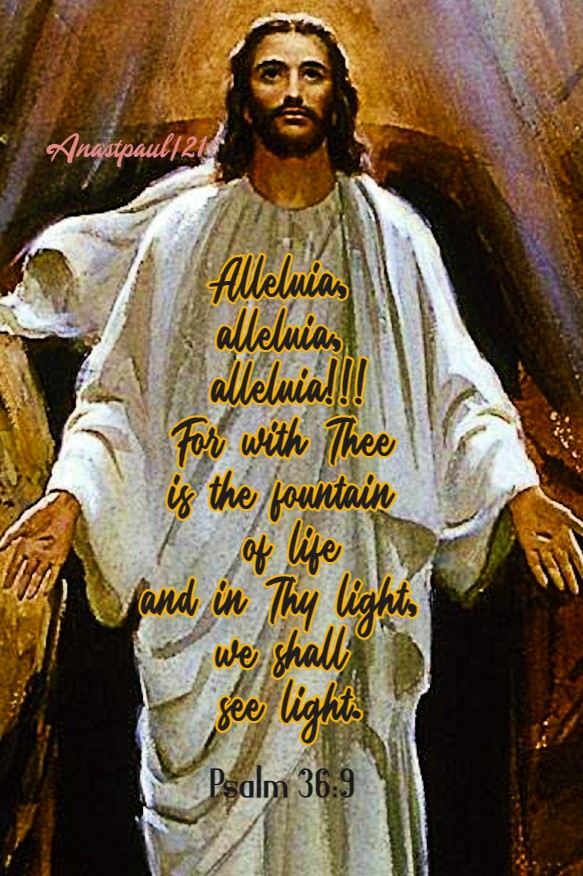
Alleluia, alleluia, alleluia!!! For with thee is the fountain of life and in Thy Light, we shall see light.
Psalm 36:9
“Do we, then, regard it as a great and marvellous thing, for the Creator of all things, to bring about the resurrection of those, who have served Him with holiness, in the assurance of a good faith?… With this hope, then, let our souls be bound to Him Who is faithful, to His promises and upright in His judgements. He, Who has commanded us not to lie will much more not lie Himself. For nothing is impossible to God except lying (Jn 32:17; Lk 1:37; 6:18).” (Letter to the Corinthians, #24-28)
St Pope Clement I (c 35-c 99) Pope from about 90 to 99 Apostolic Father
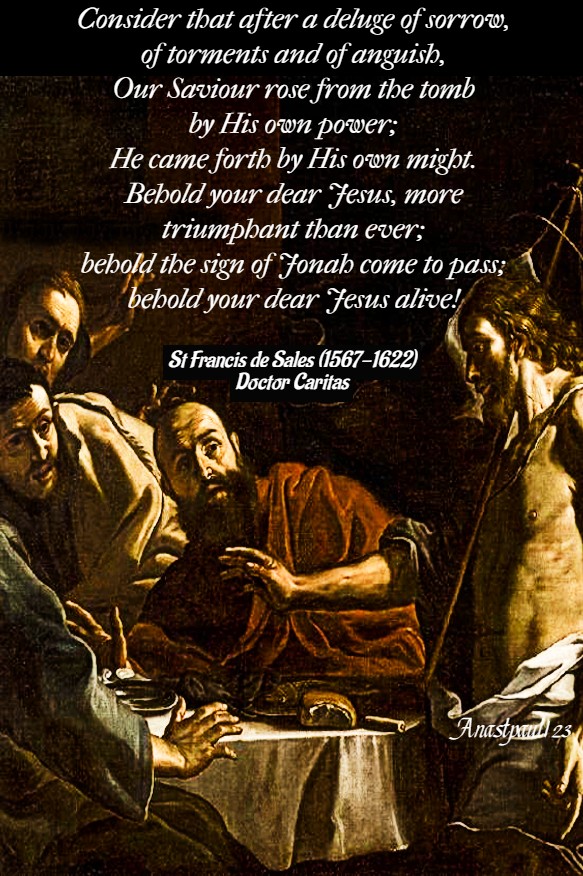
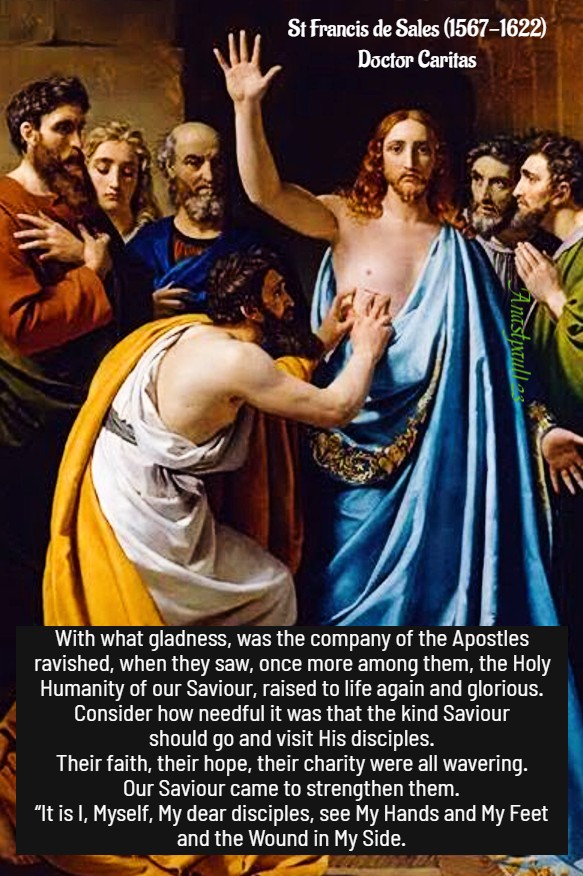
“Consider that after a deluge of sorrow, of torments and of anguish, Our Saviour rose from the tomb by His own power; He came forth by His own might. Behold your dear Jesus, more triumphant than ever; behold the sign of Jonah come to pass; behold your dear Jesus alive!
With what gladness, was the company of the Apostles ravished, when they saw, once more among them, the Holy Humanity of our Saviour, raised to life again and glorious. Consider how needful it was that the kind Saviour should go and visit His disciples. Their faith, their hope, their charity were all wavering. Our Saviour came to strengthen them. “It is I, Myself, My dear disciples, see My Hands and My Feet and the Wound in My Side.” (Meditation and Conferences)
One Minute Reflection – 11 April – “The Month of the Resurrection” – Easter Tuesday – Acts 13:16; 13:26-33; Luke 24:36-47 – Scripture search here: https://www.drbo.org/
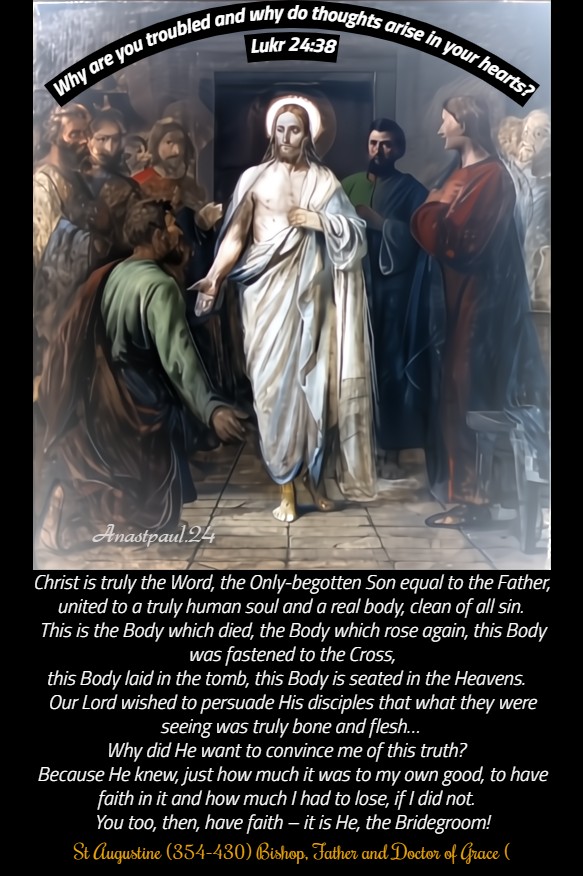
“And He said to them: Why are you troubled and why do thoughts arise in your hearts?” – Luke 24:38
REFLECTION –
“This Gospel passage… shows us in truth, Who the Messiah is and who the Church … that we might understand well which Bride it is that this Divine Bridegroom has chosen and Who the Bridegroom of this holy Bride is … On this page we can read their deed of espousal …
You have learned that Christ is the Word, God’s Utterance, united to a human soul and human body … Here, the disciples thought they were seeing a ghost; they did not believe that the Lord had a real body. But since the Lord understood the danger of such thoughts, He made haste to snatch them out of their hearts … “Why do questions arise in your hearts? Look at My Hands and My Feet; touch Me and see because, a ghost does not have flesh and bone, as you can see I have.” Yet you, with these same questioning thoughts, strongly oppose the rule of faith you have received …
Christ is truly the Word, the Only-begotten Son equal to the Father, united to a truly human soul and a real body, clean of all sin. This is the Body which died, the Body which rose again, this Body was fastened to the Cross, this Body laid in the tomb, this Body is seated in the Heavens. Our Lord wished to persuade His disciples that what they were seeing was truly bone and flesh… Why did He want to convince me of this truth? Because He knew, just how much it was to my own good, to have faith in it and how much I had to lose, if I did not. You too, then, have faith – it is He, the Bridegroom!
Now listen to what was said about the Bride… “The Messiah had to suffer and rise from the dead on the third day and repentance, for the forgiveness of sins, is to be preached in His Name to all the nations, beginning from Jerusalem.” This is the Bride… the Church is spread all over the earth and has taken all peoples to her heart … The Apostles saw Christ and believed in what they did not see, the Church. We, on our part, see the Church; so let us believe in Jesus Christ, Whom we do not see and so, by holding onto what we see, we shall come to Him Whom, as yet, we do not see.” – St Augustine (354-430) Bishop, Father and Doctor of Grace (Sermon 238).
PRAYER – O God, Who art ever multiplying the children of Thy Church, grant unto the same, Thy servants that they may lead the rest of their lives, according to this beginning, wherein Thou hast given them faith to receive the Sacrament of the New Birth. Through Jesus Christ, Thy Son our Lord, Who lives and reigns with Thee, in the unity of the Holy Ghost, God, world without end. Amen (Collect).
Our Morning Offering – 11 April – Easter Monday and “The Month of the Resurrection”
He is Risen, Tell the Story By Father Willard F Janusch (1930-2018)
He is risen, tell the story to the nations of the night; from their sin and from their blindness, let them walk in Easter light. Now begins a new creation, now has come our true salvation. Jesus Christ, the Son of God!
Mary goes to tell the others of the wonders she has seen; John and Peter come a’running what can all this truly mean? O Rabboni, Master holy, to appear to one so lowly! Jesus Christ, the Son of God!
He has cut down death and evil, He has conquered all despair; He has lifted from our shoulders, all the weight of anxious care. Risen Brother, now before you, we will worship and adore You. Jesus Christ, the Son of God!
Now get busy, bring the message, so that all may come to know there is hope for saint and sinner, for our God has loved us so. Ev’ry church bell is a’ringing, ev’ry Christian now is singing. Jesus Christ, the Son of God!
A Parish Priest, Seminary Professor and prolific Musician and Hymnist, Fr Willard wa Ordained in 1956 and died at the age of 88 in 2018.
Saint of the Day – 11 April – Saint Godeberta (c640-c700) Abbess, Miracle-worker. Born in c640 near Amiens, France and died in c700 at Noyon, France of natural causes. Patronages – against plague/epidemics, for drought relief )fpr rain) , of Noyon, France. Also known as – Godeberta of Noyon, Godebertha, Godberta.Godeberta means “fervour.” Additional Memorials – 11 June, the Fifth Sunday after Easter.
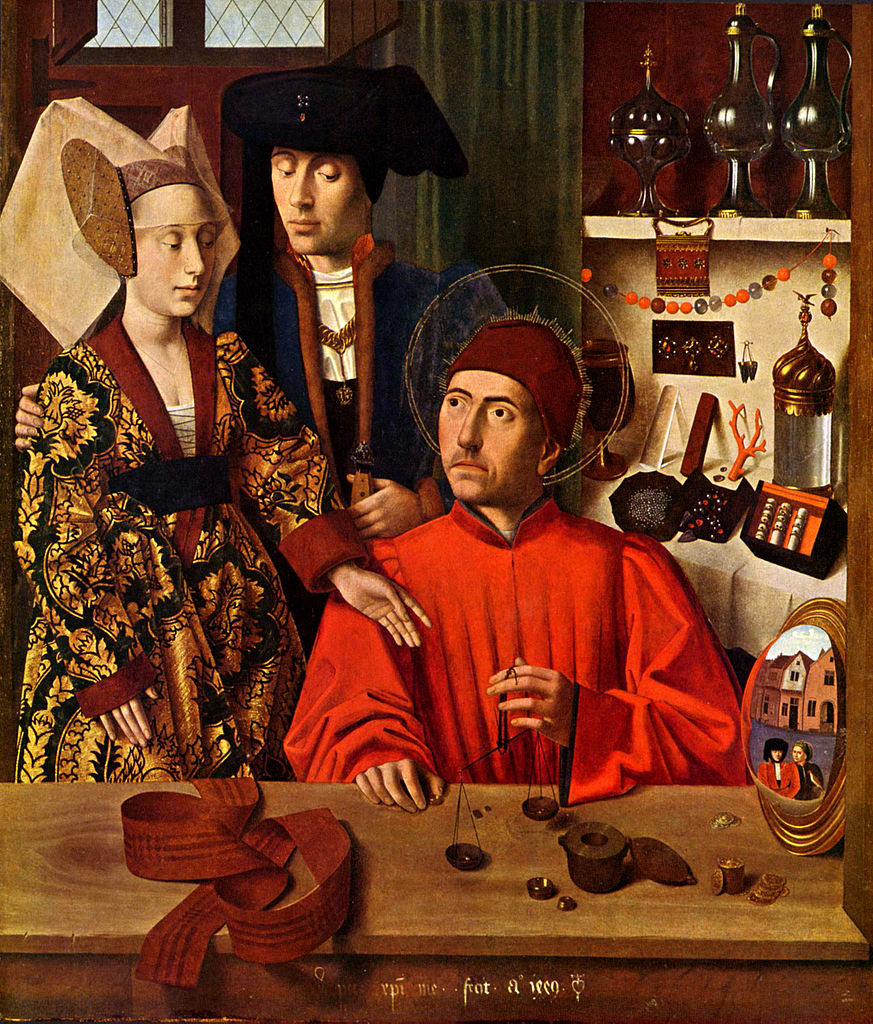
Godeberta was born about the year 640, at Boves, a few leagues from Amiens, in France;. She was very carefully educated, her parents being of noble rank and attched to the Court of King Clovis II. When the question of her marriage was being discussed in the presence of the King, the saintly Bishop of Noyon, St Eligius, as if by inspiration, presented Godeberta with a golden ring and expressed the hope that she might devote her life to the service of God. Godeberta, moved by the Holy Spirit and feeling her heart suddenly filled with Divine love, turned away from the bright prospects before her and refused the advantageous offers which had been made by her noble suitors. She declared her willingness to be the spouse of Christ and asked the holy prelate to allow her to assume the veil.
The Legend of Saint Eligius and Saint Godeberta, by Petrus Christus.
In a short time all opposition to her wishes disappeared and she entered on her new life under the guidance of St Eligius. The King of the Franks was so impressed by her conduct and her zeal that he made her a present of the small palace which he had at Noyon, together with a little Chapel dedicated to St George. Godeberta’s example inspired a number of young women to follow in the same path and she founded in her new home, a Convent, of which she became the Abbess
Here she passed the remainder of her life in prayer and solitude, save when the call of charity or religion, brought her forth among the people, many of whom were still sunk in the vices of paganism. She was remarkable ,in particular, for the constant penances and fasts, to which she subjected herself. She had a wonderful faith in the efficacy of that ancient practice of the early Christians–the Sign of the Cross and, it is recorded, that on one occasion, in 676, during the Episcopacy of St Mommelinus, when the town was threatened with total destruction by fire, she made the Sign of the Cross over the flames,and the conflagration was forthwith extinguished.
The exact year of her death is unknown but it is said to have occurred on 11 June, on which day her feast is marked in the Proprium of Beauvais. In Noyon, however, by virtue of an indult, dated 2 April, 1857, it is kept on the fifth Sunday after Easter, the feast of 11 April appears to stem from the belief that this was the date of the translation of her Relics. The body of the Saint was interred in the Church of St George, which was afterwards called by her name.
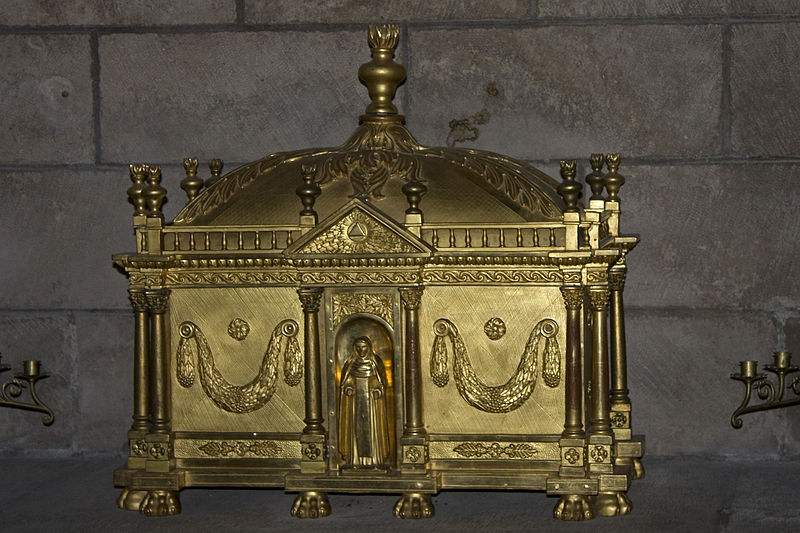
In 1168 Godeberta’s body was solemnly translated from the ruined Church where it had rested for over 450 years, by Bishop Baudoin to the Cathedral of Noyon. Providentially her relics have escaped the ravages of time and fire and the malice of the irreligious. At the period of the Revolution a pious townsman secretly buried them near the Cathedral. When the storm had passed they were recovered from their hiding place and their authenticity, being canonically established, they were replaced in the Church.
A bell is still preserved which tradition avers, to have been the one actually used by Godeberta in her Convent. It is certainly very ancient and there seems no good reason, in particular from an archaeological point of view, for doubting the trustworthiness of the legend. In the treasury of the Cathedral, likewise may be seen a gold ring, said to have been that presented by St Eligius to the Saint. Mention is made in a record of the year 1167 of this Relic having been then in the possession of the Church of Noyon.
Unfortunately the most ancient documents we have giving details of Godeberta’s life do not, in all probability, date beyond the Eleventh Century, as the oldest “Vita” which, in truth, is rather a panegyric for her feast than a biography, is believed to have been composed by Radbodus, who became Bishop of Noyon in 1067. In those days, too, the aim of such writers was the edification rather than the instruction of the faithful, so we find in this life, the usual wonders related in such pious works of that period with but few historic facts. It is certain, however, that St. Godeberta was looked upon as a protector in the time of plagues and catastrophes and we have every reason to hold that this practice was justified by the results that followed her solemn invocation.
In 1866 a violent outbreak of typhoid fever occurred in Noyon, decimating the Town. On 23 May in that year, one of the leading citizens, whose child had just been stricken down, approached the cure of the Church and recalling the favours that had been granted in ages past to the clients of the Saint, earnestly asked that the Shrine containing her Relics should be exposed and a Novena of intercession begun. This was done the following day,and forthwith, the scourge ceased; it was officially certified that not another case of typhoid occurred. In thanksgiving a solemn procession took place under the guidance of the Bishop, Mgr Gignoux, a few weeks later, the Relics of St Godeberta being carried triumphantly through the town. A beautiful statue of the saint, the cathedral of Noyon, which was blessed by the Bishop on 25 February, 1867, perpetuated the memory of this wonderful event.
St Domnio of Salona Bl Elena Guerra St Eustorgius of Nicomedia Bl George Gervase St Godeberta (c640-c700) Abbess
St Guthlac of Crowland (674–715) Monk, Hermit, Ascetic. St Guthlac was from Lincolnshire in England. He is particularly venerated in the Fens of eastern England where many Churches are dedicated to him. His sister is venerated as Saint Pega, an anchoress. His body was incorrupt until its destruction in the 16th century by the dissolution of the Monasteries by Henry VIII. Biography: https://anastpaul.com/2019/04/11/saint-of-the-day-11-april-st-guthlac-674-715/
St Hildebrand of Saint-Gilles St Isaac of Monteluco Bl James of Africa Bl John of Cupramontana Bl Lanunio St Machai St Maedhog of Clonmore Bl Mechthild of Lappion Bl Paul of Africa St Philip of Gortyna St Raynerius Inclusus St Sancha of Portugal St Stephen of Saint-Gilles
Thought for the Day – 10 April – Meditations with Antonio Cardinal Bacci (1881-1971)
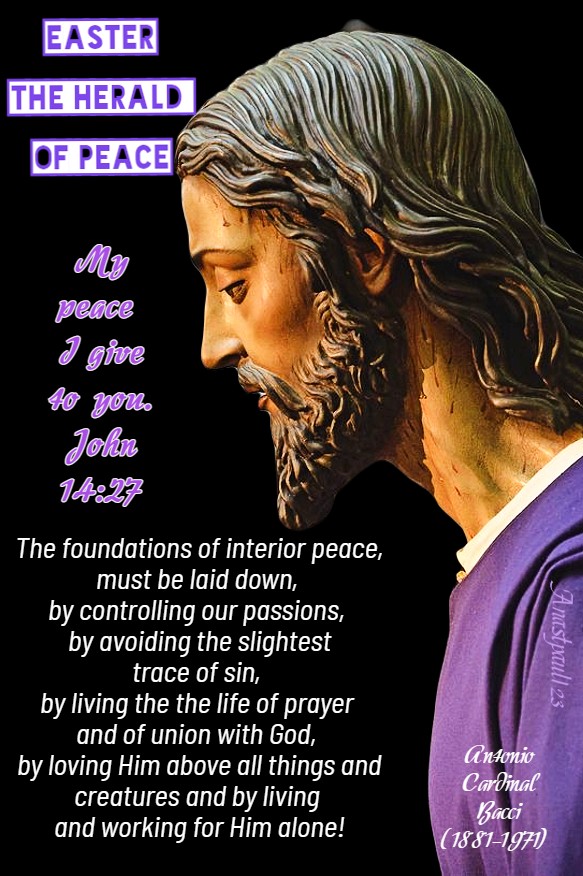
Easter: The Herald of Peace
“At the close of this meditation, let us ask the risen Christ to give us His peace which is the only true peace. “My peace I give to you” (Jn 14:27). Although it comes from Jesus, however, this peace requires an effort on our part too. We must build it up carefully within ourselves with the help of God’s grace. The foundations of interior peace, must be laid down, by controlling our passions, by avoiding the slightest trace of sin, by living the the life of prayer and of union with God, by loving Him above all things and creatures and by living and working for Him alone!”
Quote/s of the Day – 10 April – “The Month of the Resurrection” – Easter Monday – Scripture search here: https://www.drbo.org/
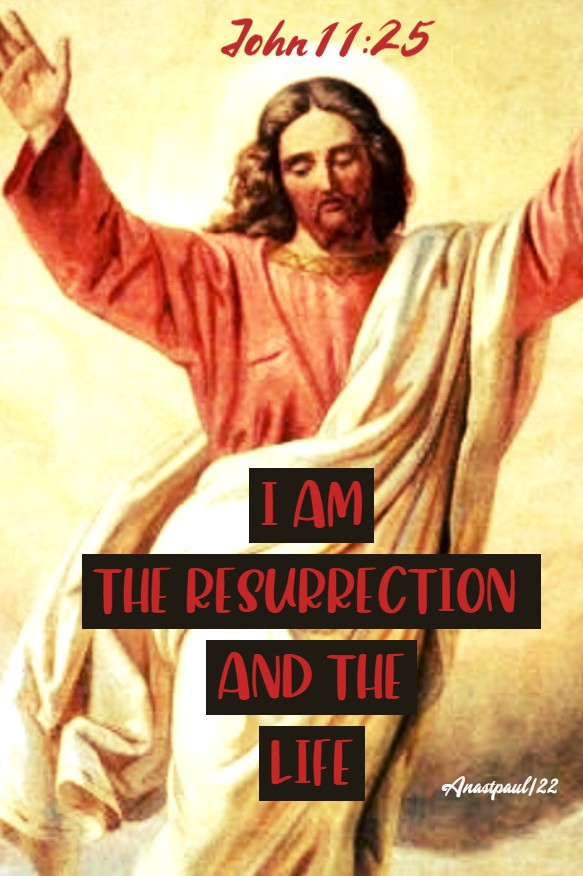
“I Am the Resurrection and the Life”
John 11:25
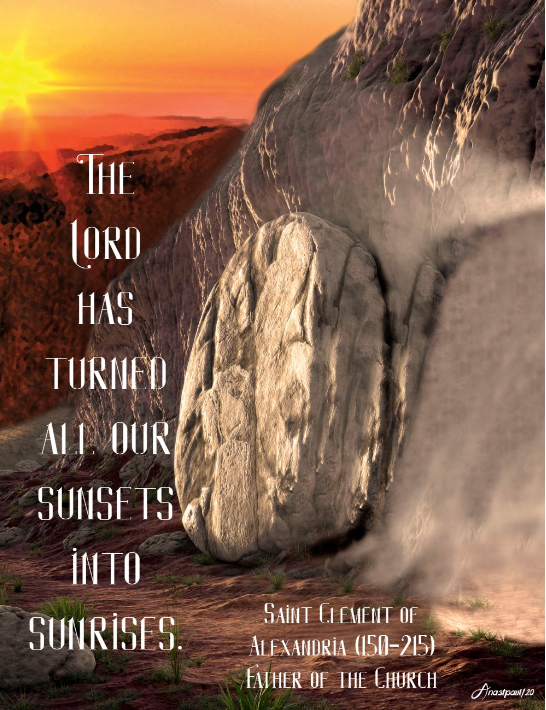
“The Lord has turned all our sunsets into sunrises.”
St Clement of Alexandria (150-215) Father of the Church
“The people who sat in darkness, have seen a great light”
Matthew 4:16
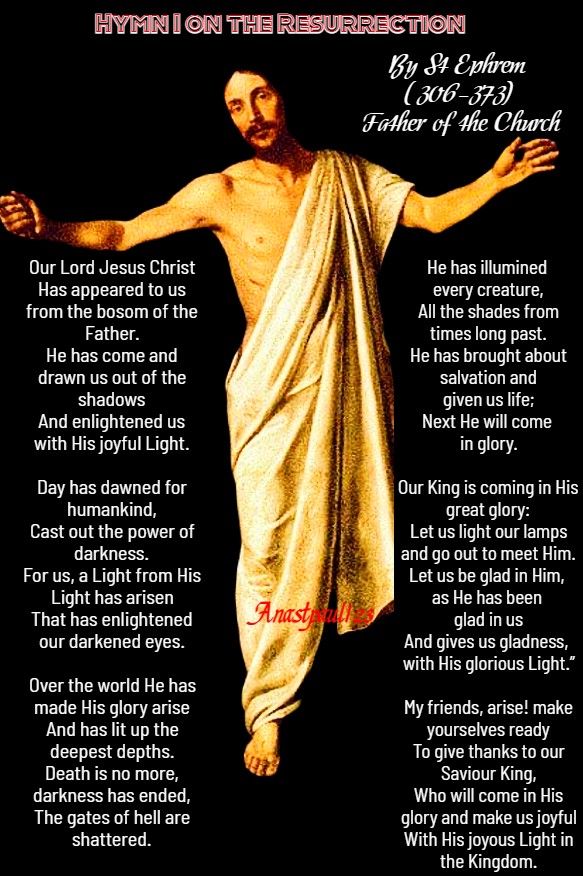
Hymn I on the Resurrection
“Our Lord Jesus Christ Has appeared to us from the bosom of the Father. He has come and drawn us out of the shadows And enlightened us with His joyful Light.
Day has dawned for humankind, Cast out the power of darkness. For us, a Light from His Light has arisen That has enlightened our darkened eyes.
Over the world He has made His glory arise And has lit up the deepest depths. Death is no more, darkness has ended, The gates of hell are shattered.
He has illumined every creature, All the shades from times long past. He has brought about salvation and given us life; Next He will come in glory.
Our King is coming in His great glory: Let us light our lamps and go out to meet Him (Mt 25,6); Let us be glad in Him, as He has been glad in us And gives us gladness, with His glorious Light.
My friends, arise! make yourselves ready To give thanks to our Saviour King, Who will come in His glory and make us joyful With His joyous Light in the Kingdom.”
One Minute Reflection – 10 April – “The Month of the Resurrection” – Easter Monday – Acts 10:37-43, Luke 24:13-35 – Scripture search here: https://www.drbo.org/
“You know the word which hath been published through all Judea; for it began from Galilee …” – Acts 10:37
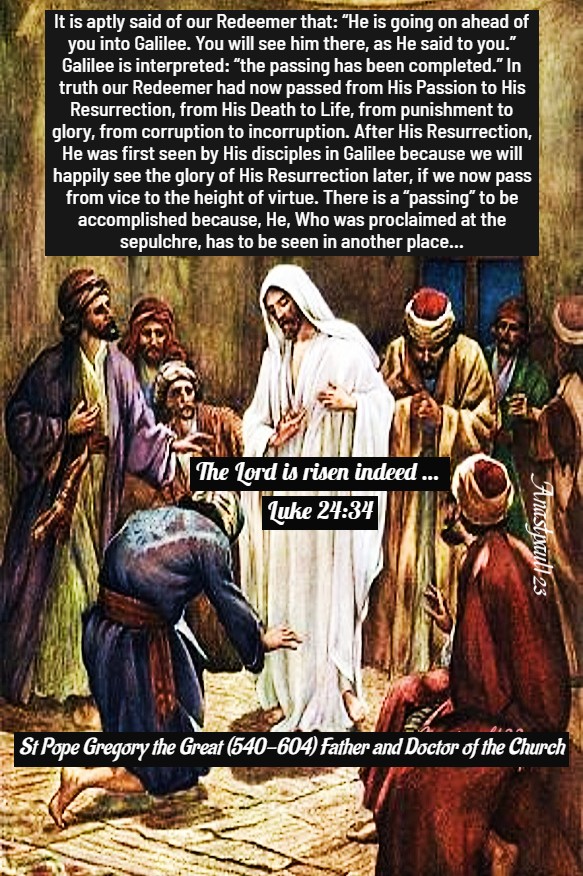
REFLECTION – “It is aptly said of our Redeemer that: “He is going on ahead of you into Galilee. You will see him there, as He said to you.” Galilee is interpreted: “the passing has been completed.” In truth our Redeemer had now passed from His Passion to His Resurrection, from His Death to Life, from punishment to glory, from corruption to incorruption. After His Resurrection, He was first seen by His disciples in Galilee because we will happily see the glory of His Resurrection later, if we now pass from vice to the height of virtue. There is a “passing” to be accomplished because, He, Who was proclaimed at the sepulchre, has to be seen in another place…
There were two lives. One we know about, of the other we are ignorant; One is mortal, the other immortal; One is corruptible, the other incorruptible; One ends in Death, the other in Resurrection. But the Mediator between God and men, the Man Christ Jesus (1Tim 2,5), came. He took upon Himself, the One and revealed to us, the other; the One He bore by Dying and the other He revealed by Rising. If He had promised resurrection of the body to us, who knew this mortal life but did not visibly manifest it, who would have believed His promises?” – St Gregory the Great (540-604) Pope, Father and Doctor of the Church (Homilies on the Gospels 21, 6-7).
PRAYER – O God, Who dost heal the sick world by the solemn gladness of the Passover, continue, we beseech Thee, to pour forth Thine heavenly gifts upon Thy people, until the same shall bring them into perfect liberty and finally, avail them unto life everlasting .Through Jesus Christ, Thy Son our Lord, Who lives and reigns with Thee, in the unity of the Holy Ghost, God, world without end. Amen (Collect).
Our Morning Offering – 10 April – Easter Monday – “The Month of the Resurrection”
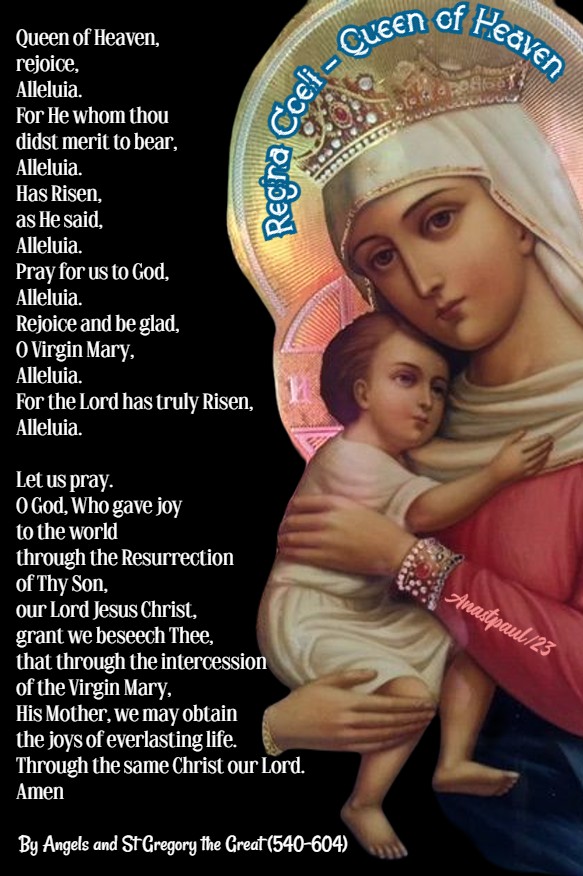
REMINDER: To exchange your Angelus prayer for the Regina Coeli as from Compline on Holy Saturday for the next 50 days of Eastertide, until the None (Afternoon) Prayer on the Saturday following Pentecost, inclusively. St Gregory the Great (540-604) heard Angels chanting the first three lines one Easter morning in Rome, while following barefoot in a great religious procession of the Icon of the Virgin painted by St Luke the Evangelist. He was, thereupon, inspired to add the fourth line.
Regina Coeli Queen of Heaven By Angels and St Gregory the Great (540-604)
Queen of Heaven, rejoice, Alleluia. For He whom thou didst merit to bear, Alleluia. Has Risen, as He said, Alleluia. Pray for us to God, Alleluia. Rejoice and be glad, O Virgin Mary, Alleluia. For the Lord has truly Risen, Alleluia.
Let us pray. O God, Who gave joy to the world through the Resurrection of Thy Son, our Lord Jesus Christ, grant we beseech Thee, that through the intercession of the Virgin Mary, His Mother, we may obtain the joys of everlasting life. Through the same Christ our Lord. Amen
Saint of the Day – 10 April – St Bademus (Died 376) Confessor, Abbot and Martyr, Founder of a Monastery. Bademus died on 10 April 376 by being stabbed countless times and finally beheaded by a wavering and frightened executioner. Also known as – Bademo, Vadim.
Bademus was a rich and noble citizen of Bethlapeta in Persia, who sold his possessions to follow Christ, then gave the greater part of the proceeds to the poor. He reserved just enough to found a Monastery near that City, to which he retired with several others and then governed it with great sanctity. He conducted his religious in the paths of perfection with sweetness, prudence and charity.
To crown his virtue, God permitted him, with seven of his Monks, to be apprehended by the followers of King Sapor in the thirty-sixth year of that King’s persecution. He lay for four months in a dungeon, loaded with chains and during this lingering martyrdom, received everyday, a cruel flagellation. But he triumphed over his torments by the patience and joy with which he suffered them for Christ.
At the same time, a Prince named Nersan, who was a Christian, was cast into prison and his goods confiscated because he refused to adore the sun. At first he seemed resolute but, at the sight of tortures,his constancy failed him and he promised to conform if he could be delivered. The King, to test whether his change was sincere, ordered Bademus to be brought where Nersan was kept in the royal palace and sent word to Nersan that if he would slay the Abbot, he would be restored to his liberty and former dignities. The apostate accepted the condition; a sword was put into his hand and he advanced to plunge it into the breast of the Abbot. But being seized with a sudden terror, he stopped short and remained for some time unable to lift up his arm to strike – he had neither courage to repent, nor heart to accomplish his crime.
Finally, he hardened himself and continued with a trembling hand to aim at the Martyr’s sides. Fear, shame, remorse and respect made his strokes forceless and unsteady and so great was the number of his victim’s wounds that the bystanders were in admiration at his invincible patience. Saint Bademus reproached his executioner, saying, “What will you do on the day when you will have to render an account of your actions and hear the sentence of your condemnation? I offer myself willingly to die for the glory of my Lord Jesus Christ but I would prefer to die by another hand, than yours!” The pagans themselves were horrified at the cruelty of the King, the long Martyrdom and the perfidious acts of the apostate.
Saint Bademus suffered on the 10th of April in the year 376. His body was cast out of the City but secretly carried away and interred by the Christians. A short time afterwards Nersan fell into public disgrace and perished by the sword – other accounts say that he committed suicide. . The disciples of the Saint were released from their chains four years later, at the death of King Sapor.
St Miguel de Sanctis O.SS.T (1591-1625) Priest of the Order of the Most Holy Trinity and of the Captives also known as the Trinitarian Order or the Trinitarians, Mystic, Penitent, Ecstatic, Apostle of prayer, mortification, of the poor and the sick, he had a special devotion to the Blessed Sacrament and would fall into ecstatic prayer during the Consecration at Holy Mass, so much so, that he became known as “El Extático”, “The Ecstatic.” Pope Pius IX Canonised Miguel on 8 June 1862. About St Miguel: https://anastpaul.com/2020/04/10/saint-of-the-day-10-april-st-miguel-de-sanctis-o-ss-t-1591-1625/
St Palladius of Auxerre St Paternus the Scot
Martyrs of Carthage – 50 Saints: A group of 50 Christians who were imprisoned in a pen of snakes and scorpions and then Martyred, all during the persecutions of Decius. Only six of their names have come down to us – Africanus, Alessandro, Massimo, Pompeius, Terence and Teodoro. Beheaded in 250 at Carthage.
Martyrs of Georgia: Approximately 6,000 Christian Monks and lay people Martyred in Georgia in 1616 for their faith by a Muslim army led by Shah Abbas I of Persia.
Martyrs of Ostia: A group of criminals who were brought to the faith by Pope Saint Alexander I while he was in prison with them. Drowned by being taken off shore from Ostia, Italy, in a boat which was then scuttled, c 115.
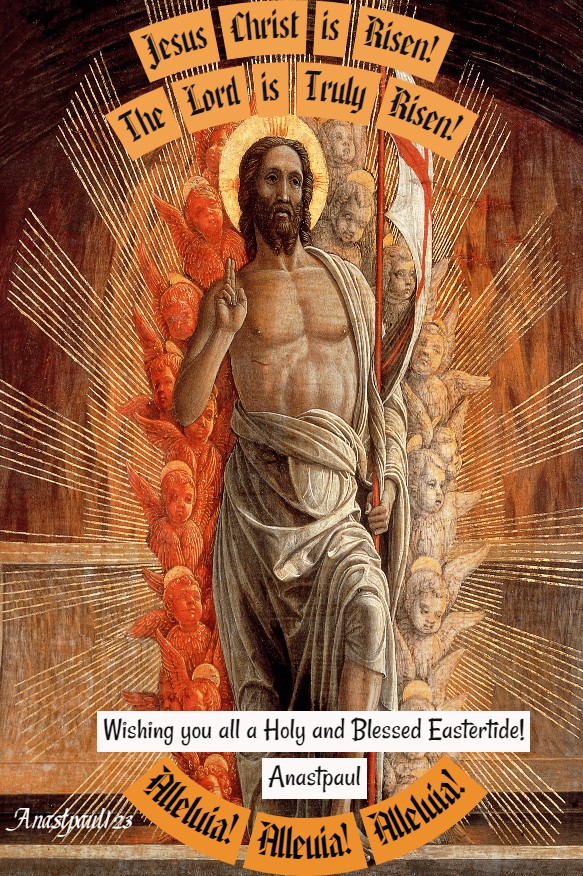
Wishing you all a most Blessed and Holy Easter! Alleluia!
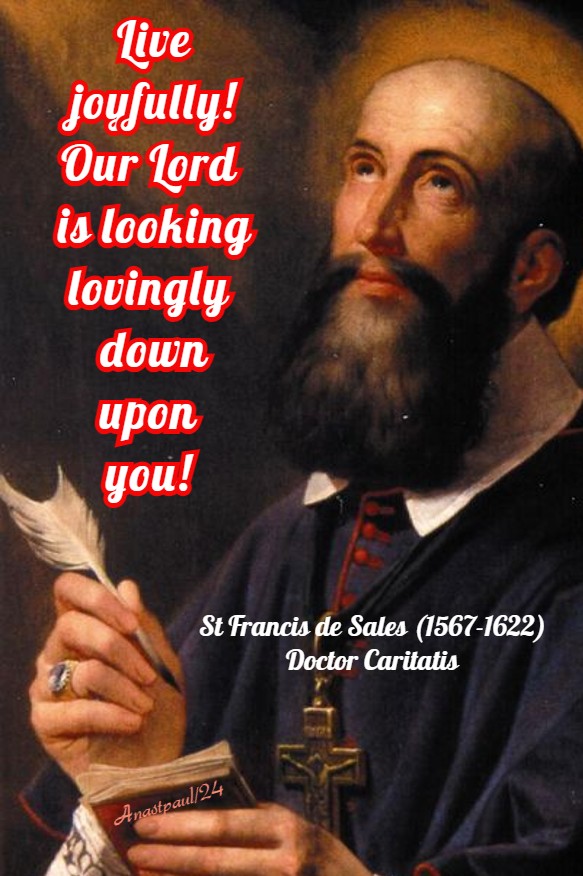
Thank you for accompanying me on our Lenten journey with St Francis de Sales. I hope his words have been inspiring and helpful. Today we rejoice and continue with joy singing in our hearts through the Octave as we celebrate this great Feast! And, St Francis will not be leaving at all, he has hired a permanent abode here that we might visit him as often as we wish.
“Live joyfully! Our Lord is looking lovingly down upon you! ”
St Francis de Sales (1567-1622) Doctor Caritas
My deepest gratitude to the benefactors of “Breathing Catholic.” 💘🤗 Your faithfulness and love are in my heart and my prayers. May the Risen Lord fill your hearts with His infinite love, may He protect your faith and your families.
Thought for the Day – 9 April – Meditations with Antonio Cardinal Bacci (1881-1971)
The Meaning of Easter
“How many Easters have we spent? Have they represented a constant improvement in our lives, or have we been static or even worse, become lukewarm, tepid and uncaring of our good Lord’s love of us and our own salvation? In the Hebrew tongue, Pasch means a passing or transit, specifically, it refers to the passing of the Lord. It will be a tragedy if Jesus passes us by without stopping! to rest with us in order to claim us as His own and to make us holy!
This Easter could be our last. The thought should be a warning for us. God’s goodness is infinite but, there is a limit to His grace and favours. We often impose this limit ourselves by the degree of our co-operation. Our eternal salvation depends largely upon ourselves! God does not grant His Mercy to unrepentant souls – think of that second thief on the cross next to Our Lord!”
Quote/s of the Day –9 April – Easter Sunday and “The Month of the Resurrection”
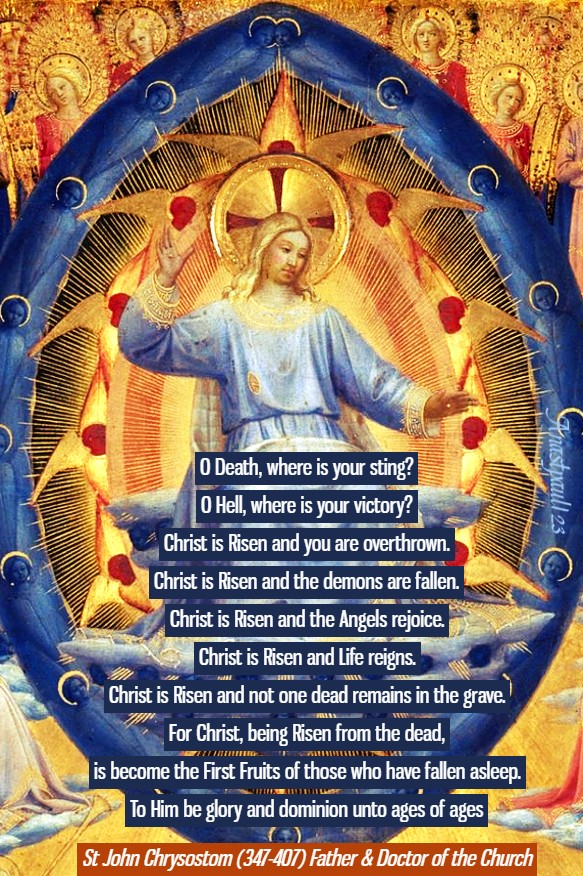
“O Death, where is your sting? O Hell, where is your victory? Christ is Risen and you are overthrown. Christ is Risen and the demons are fallen. Christ is Risen and the Angels rejoice. Christ is Risen and Life reigns. Christ is Risen and not one dead remains in the grave. For Christ, being Risen from the dead, is become the First Fruits of those who have fallen asleep. To Him be glory and dominion unto ages of ages.”
St John Chrysostom (347-407) Father & Doctor of the Church
“For Christ is our Salvation. For He is our Salvation, Who was wounded for us and fastened with nails to the Wood and taken down from the Wood and laid in the sepulchre. But He rose from the sepulchre and although His Wounds were healed, the Scars remained. For this He judged expedient for His Disciples that He should keep His Scars, to heal the wounds of their soul.”
St Augustine (354-430) Father and Doctor of Grace
“All I want to know is Christ and the power flowing from His Resurrection!”
Our Lenten Journey with St Francis de Sales – 9 April – Easter Sunday, Alleluia, He is Truly Risen, Alleluia!
“Such is the case when one is without God … ” St Francis de Sales
EASTER SUNDAY! St Francis de Sales (1567-1622) Doctor Caritas
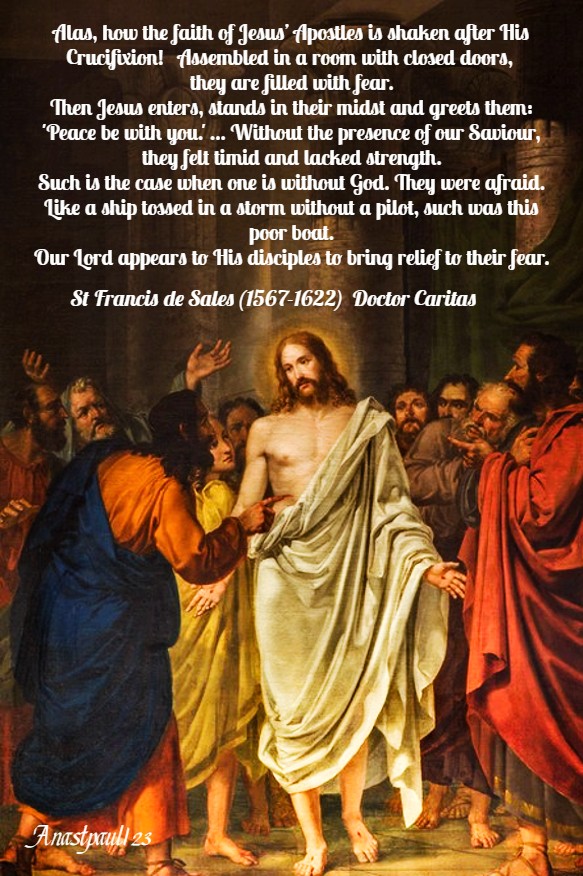
“Alas, how the faith of Jesus’ Apostles is shaken after His Crucifixion! Assembled in a room with closed doors, they are filled with fear. Then Jesus enters, stands in their midst and greets them: ‘Peace be with you.’ Showing them the signs and marks of the reconciliation of humanity with God, He says, ‘See My Hands and My Side.’ Why does He do this? To bolster their vacillating faith. Without the presence of our Saviour, they felt timid and lacked strength. Such is the case when one is without God. They were afraid. Like a ship tossed in a storm without a pilot, such was this poor boat. Our Lord appears to His disciples to bring relief to their fear.” – (Sermon of St Francis de Sales for Lent).
One Minute Reflection – 9 April – Easter Sunday, Alleluia, He is Truly Risen, Alleluia! and “The Month of the Resurrection” – 1 Corinthians 5:7-8, Mark 16:1-7 – Scripture search here: https://www.drbo.org/
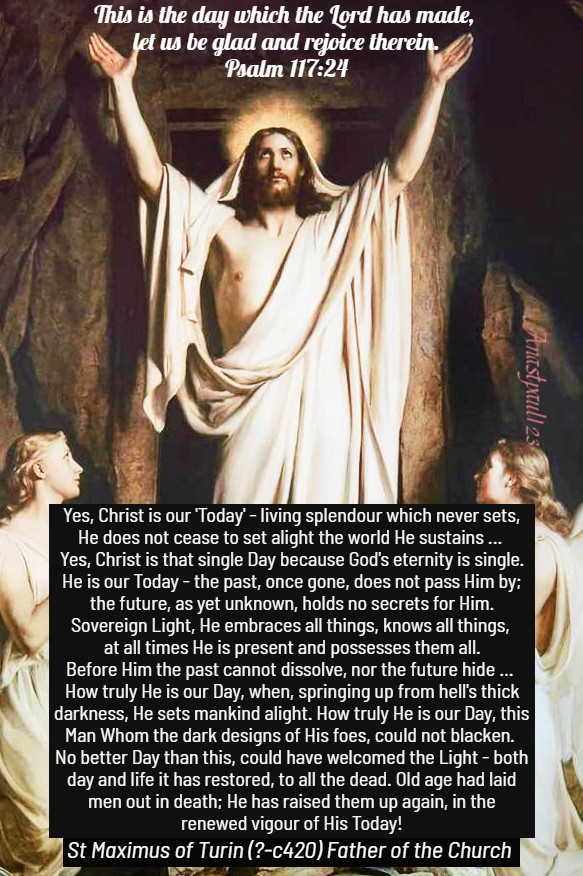
“This is the day which the Lord has made, let us be glad and rejoice therein. ” – Psalm 117:24
REFLECTION – “Today, as yesterday, let our joy break out, my brethren. If night’s darkness has interrupted our rejoicing then the holy day is not complete… for the brightness shed by the joy of the Lord is eternal. Christ shone upon us yesterday and today His Light shines out again. “Jesus Christ is the same, yesterday and today” says the blessed Apostle Paul (Heb 13:8). Yes, Christ has become our Day. He was born today for us, as God His Father declares through the voice of David: “You are My Son; today I have become your Father” (Ps 2:7). What are we to say? That He did not once Father His Son but Himself engendered day and night…
Yes, Christ is our ‘Today’ – living splendour which never sets, He does not cease to set alight the world He sustains (cf. Heb 1,3) and this eternal refulgence seems but a day. “A thousand years in Your Sight are like a single day” exclaims the prophet (Ps 89:4). Yes, Christ is that single Day because God’s eternity is single. He is our Today – the past, once gone, does not pass Him by; the future, as yet unknown, holds no secrets for Him. Sovereign Light, He embraces all things, knows all things, at all times He is present and possesses them all. Before Him the past cannot dissolve, nor the future hide… This day is neither the one when He was born of the Virgin Mary according to the flesh, nor the one when He came forth from the mouth of God, His Father according to His Divinity but, it is the moment, when He was raised from the dead. “He raised up Jesus,” says the Apostle Paul, “as it is written in the second Psalm: ‘You are My Son; this day I have begotten You” (Acts 13,33).
How truly He is our Day, when, springing up from hell’s thick darkness, He sets mankind alight. How truly He is our Day, this Man Whom the dark designs of His foes, could not blacken. No better Day than this, could have welcomed the Light – both day and life it has restored, to all the dead. Old age had laid men out in death; He has raised them up again, in the renewed vigour of His Today!” – St Maximus of Turin (?-c420) Bishop and Father of the Church (Sermon 36).
PRAYER – O God, Who, on this day, through Thine Only-begotten Son, hast conquered death and thrown open to us, the Gate of everlasting life, give effect by thine aid to our desires, which Thou dost anticipate and inspire. Through the same Jesus Christ, Thy Son our Lord, Who lives and reigns with Thee, in the unity of the Holy Ghost, God, world without end. Amen (Collect).
Our Morning Offering – 9 April – Easter Sunday, Alleluia, He is Truly Risen, Alleluia! and “The Month of the Resurrection”
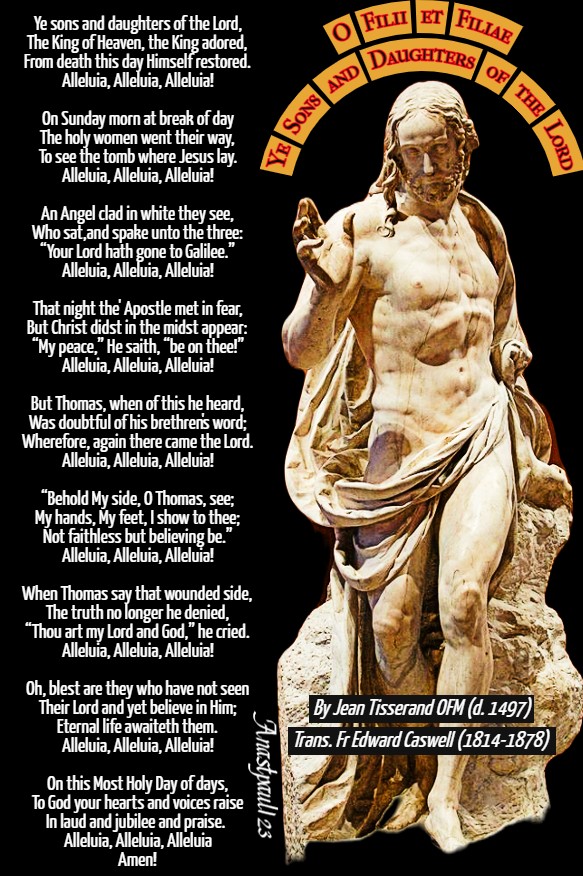
O Filii et Filiae Ye Sons and Daughters of the Lord By Jean Tisserand OFM (Died 1497) (The original Hymn comprises the nine stanzas below). Trans. Fr Edward Caswell C.Orat. (1814-1878)
Ye sons and daughters of the Lord, The King of Heaven, the King adored, From death this day Himself restored. Alleluia, Alleluia, Alleluia!
On Sunday morn at break of day The holy women went their way, To see the tomb where Jesus lay. Alleluia, Alleluia, Alleluia!
An Angel clad in white they see, Who sat,and spake unto the three: “Your Lord hath gone to Galilee.” Alleluia, Alleluia, Alleluia!
That night the’ Apostle met in fear, But Christ didst in the midst appear: “My peace,” He saith, “be on thee!” Alleluia, Alleluia, Alleluia!
But Thomas, when of this he heard, Was doubtful of his brethren’s word; Wherefore, again there came the Lord. Alleluia, Alleluia, Alleluia!
“Behold My side, O Thomas, see; My hands, My feet, I show to thee; Not faithless but believing be.” Alleluia, Alleluia, Alleluia!
When Thomas say that wounded side, The truth no longer he denied, “Thou art my Lord and God,” he cried. Alleluia, Alleluia, Alleluia!
Oh, blest are they who have not seen Their Lord and yet believe in Him; Eternal life awaiteth them. Alleluia, Alleluia, Alleluia!
On this Most Holy Day of days, To God your hearts and voices raise In laud and jubilee and praise. Alleluia, Alleluia, Alleluia Amen!
Saint of the Day – 9 April – Saint Waltrude of Mons (c612-686) Married, Mother, Widow, later a Nun. Born at Cousolre in northern France in c612 as Waldetrude and died on 9 April 686 of natural causes. Patronages – of Hainault, Belgium and of Mons, Belgium. Also known as – Waldetrude, Valdetrudis, Vaudru, Vautrude, Waldeltrude, Waldetrude, Waldetrudis, Waltrudis, Waudru.
The Roman Martyrology reads: “At Mons, in Hainault, blessed Waltrude, renowned for holiness of life and miracles.”
Waltrude was the daughter to the Princess St Bertille, elder sister to St Aldegondes and wife to Madelgaire, Count of Hainault and one of the principal Lords of King Dagobert’s Court. After bearing him two sons and two daughters, she induced him to embrace the monastic state at Haumont, taking the name of Vincent. He is honoured in Flanders among the Saints on the 20 September and called St.Vincent of Soignies.
For two years longer, she remained in the world, devoting herself entirely to exercises of piety, under the direction of the holy Abbot Saint Guislain. Being by that time disengaged from the encumbrances of the world,in 656, she received the Religious Veil at the hands of St.Aubert, Bishop of Cambray and lived in a little cell, adjoining to which was a Chapel in a solitary place called Castriloc, now Mons. Many other ladies resorting to her, she formed a Religious Community, which became a rich royal chapter of canonesses.
The Canonesses’ habit
From her reputation and from this community arose the City of Mons, now the Capital of Hainault. While her sister Aldegondes governed her great Monastery at Maubeuge, Waltrude sanctified herself in her little cell by holy poverty, meekness, patience, continual fasting and prayer. She suffered much from the slanders of men and from severe interior trials and temptations but God, after some years, recompensed her fidelity with a holy peace and great spiritual consolations.
On the 9 April, 686, she went to receive the crown promised by God to those who serve Him. Her Relics are esteemed the most precious treasure of the great Church which bears her name in Mons. She is titular Patroness of Mons and all of the district of Hainault.
By the life of St Waltrude, we should learn to despise the unjust censures of the world. It persecutes, by its calumnies, those by whose lives, its false maxims are condemned. But, it can only hurt a counterfeit virtue, as the fire consumes only the dross but renders true gold brighter and more pure. Solid virtue is not only tried by humiliations but, gains the greatest advantage and improvement, by making a good use of them.
The Shrine of Saint Waltrude is kept in the Saint Waltrude Collegiate Church in Mons. Each year, as part of the Ducasse de Mons Festival, the Shrine, which is within a gilded cart, is drawn by horses through the City streets.
Both her parents – Walbert and Bertille and her sister (Aldegund) were Canonised. Her four children were also declared Saints, (Landericus, Dentelin, Aldetrude, and Madelberte) and so was her husband, Madelgaire.
St Brogan St Casilda of Toledo St Concessus the Martyr St Demetrius the Martyr St Dotto St Eupsychius of Cappadocia St Gaucherius St Hedda the Abbot St Heliodorus of Mesopotamia St Hilary the Martyr
Blessed Ubaldo Adimari OSM (c 1245-1315) Priest and Servite Friar, Soldier, Politician, Penitent, miracle-worker, spiritul student and later assistant of St Philip Benezi (1233-1285) (one of the Seven Holy Founders of the Order of the Servants of Mary – the Servites). He was Beatified on 3 April 1821 by Pope Pius VII. Biography: https://anastpaul.com/2021/04/09/saint-of-the-day-9-april-blessed-ubaldo-adimari-osm-c-1245-1315/
St Waltrude of Mons (c612-686) Married Mother, later a Nun
Martyrs of Croyland – 9 Saints: A group of Benedictine Monks Martyred by pagan Danes – Agamund, Askega, Egdred, Elfgete, Grimkeld, Sabinus, Swethin, Theodore and Ulric. Croyland Abbey, England.
Martyrs of Masyla: Massylitan Martyrs Group of Christians Martyred in Masyla in northwest Africa.
Martyrs of Pannonia: Seven Virgin-Martyrs in Sirmium, Pannonia (modern Sremska Mitrovica, Serbia).
Martyrs of Thorney Abbey – 3+ Saints: A group of Hermits, hermitesses and monks who lived in or around Thorney Abbey who were Martyred together during raids by pagan Danes. We know little more than the names of three – Tancred, Torthred and Tova. 869 by raiders at Thorney Abbey, Cambridgeshire, England.
Thought for the Day – 8 April – Meditations with Antonio Cardinal Bacci (1881-1971)
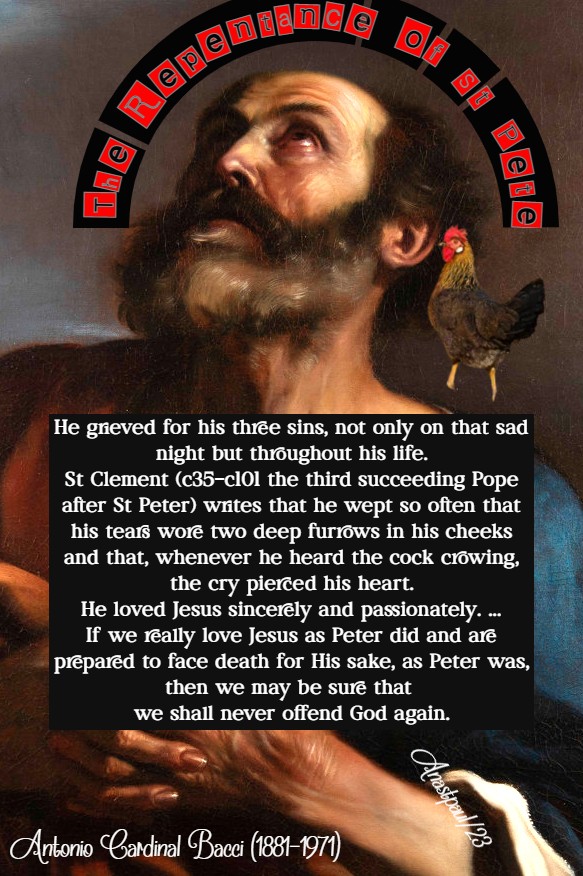
The Repentance of St Peter
“When Peter realised how wretchedly he had fallen, the first thing which he did, was to escape from the occasion of sin. “Peter went out” (Lk 22:62), He grieved for his three sins, not only on that sad night but throughout his life. St Clement (c35-c101 the third succeeding Pope after St Peter) writes that he wept so often that his tears wore two deep furrows in his cheeks and that, whenever he heard the cock crowing, the cry pierced his heart. He loved Jesus sincerely and passionately. When he was asked three times if he loved Him, he replied humbly, “Lord, Thou knowest that I love Thee” (Cf Jn 21:16).
Can we say these same words to Jesus, with equal sincerity and humility? If we really love Jesus as Peter did and are prepared to face death for His sake, as Peter was, then we may be sure that we shall never offend God again.”
“Today a great silence reigns on earth, a great silence and a great stillness. A great stillness because the King is asleep. The earth trembled and is still because God has fallen asleep in the flesh and has raised up all who have slept, since the world began…
I order you, O sleeper, to awake. I did not create you to be a prisoner in hell. Rise from the dead, for I am the Life of the dead.”
Ancient Christian Writer (ACW)
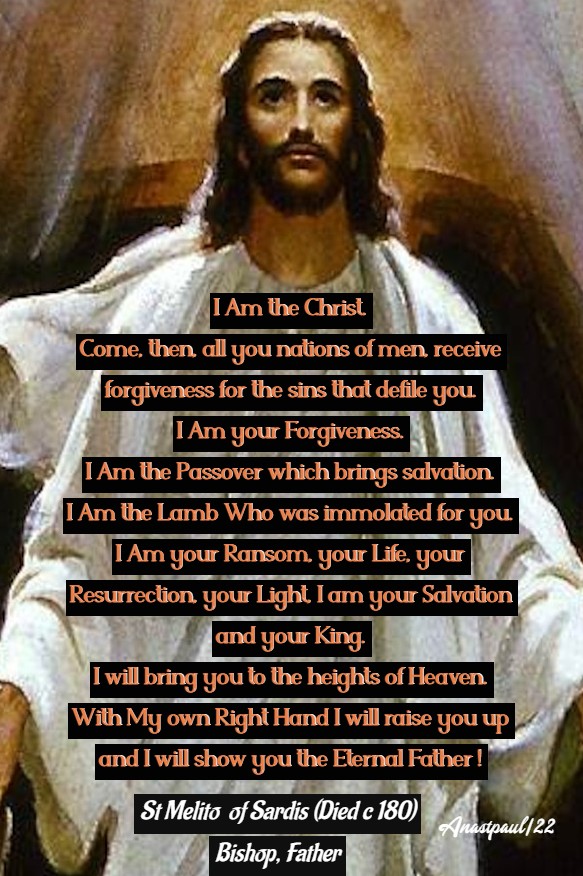
“The Lord, although He was God, became man. He suffered for the sake of those who suffer, He was bound for those in bonds, condemned for the guilty, buried for those who lie in the grave but He rose from the dead and cried aloud: “Who will contend with Me? Let him confront Me.” I have freed the condemned, brought the dead back to life, raised men from their graves. Who has anything to say against Me? I, He said, Am the Christ, I have destroyed death, triumphed over the enemy, trampled hell underfoot, bound the strong one and taken men up to the heights of Heaven. I Am the Christ. Come, then, all you nations of men, receive forgiveness for the sins that defile you. I Am your Forgiveness. I Am the Passover which brings salvation. I Am the Lamb Who was immolated for you. I Am your Ransom, your Life, your Resurrection, your Light, I am your Salvation and your King. I will bring you to the heights of Heaven. With My own Right Hand I will raise you up and I will show you the Eternal Father.”
Our Lenten Journey with St Francis de Sales – 8 April – Holy Saturday – The Lord’s Vigil Mass of Easter
“Into Thy Hands, O My God, I entrust My Spirit. ”
HOLY SATURDAY St Francis de Sales (1567-1622) Doctor Caritas
“INTO THY HANDS,O my God, I entrust my spirit. Dost Thou wish me to be in dryness or in consolation? Into Thy Hands, I entrust my spirit. Dost Thou wish me to be contradicted, to experience repugnances and difficulties, to be loved or not, to obey this one or that one and in whatever it may be, in great things or small? Then into Thy Hands, I entrust my spirit. …All is consummated, O God; in everything I have accomplished Thy Divine Will. What remains now for me except to entrust my spirit into Thy Hands at the end of my life, just as I entrusted it to Thee, at its beginning and during its course.” – (Sermons of St Francis de Sales for Lent).
One Minute Reflection – 8 April – Holy Saturday – The Lord’s Vigil Mass of Easter, Blessing of the Fire, Prophecies, Blessing of the Font, First Mass of Easter – Matthew 28,1-7 – Scripture search here: https://www.drbo.org/
“And the Angel answering, said to the women: Fear not you, for I know that you seek Jesus Who was Crucified, He is not here, for He is risen, as He said.” – Matthew 28:5-6
REFLECTION – “Every vigil celebrated in the Lord’s honour is pleasing to God and acceptable to Him but this particular Vigil more than all the rest. That is why this night, in particular, holds the title “The Lord’s Vigil.” Indeed, what we read is: “All the Israelites must keep a vigil for the Lord” (Ex 12:42). And this night, well merits the title, since the Lord awoke in life that we might not remain asleep in death. For He suffered death’s sleep for our sakes, in the Mystery of His Passion, yet this sleep of the Lord, has become the Vigil of the whole world because, the Death of Christ, has removed from us, the sleep of eternal death. He Himself says it through the prophet: “I lie down in sleep, I wake again and My sleep was sweet to me” (Ps 3:6; Jer 31:26). This sleep of Christ which we have called to mind, from the bitterness of Death to the sweetness of Life, cannot be anything but sweet.
Solomon wrote: “I sleep but my heart is awake” (Sg 5:2). These words seemingly show the Mystery of the Divinity and flesh of the Lord. He slept according to the flesh but His Divinity kept watch, since the Divinity cannot sleep… “He neither slumbers nor sleeps, the guardian of Israel” (Ps 120:4)… He slept according to the flesh but His Divinity visited hell in order to draw out the man whom it had held captive. Our Lord and Saviour desired to enter into every place to have mercy on everyone. He came down from Heaven to the earth to visit the world and again, He descended from earth to hell, to carry light to those held captive there, as spoken by the prophet: “Upon those who dwelt in the land of gloom, a light has shone” (Is 9:1).
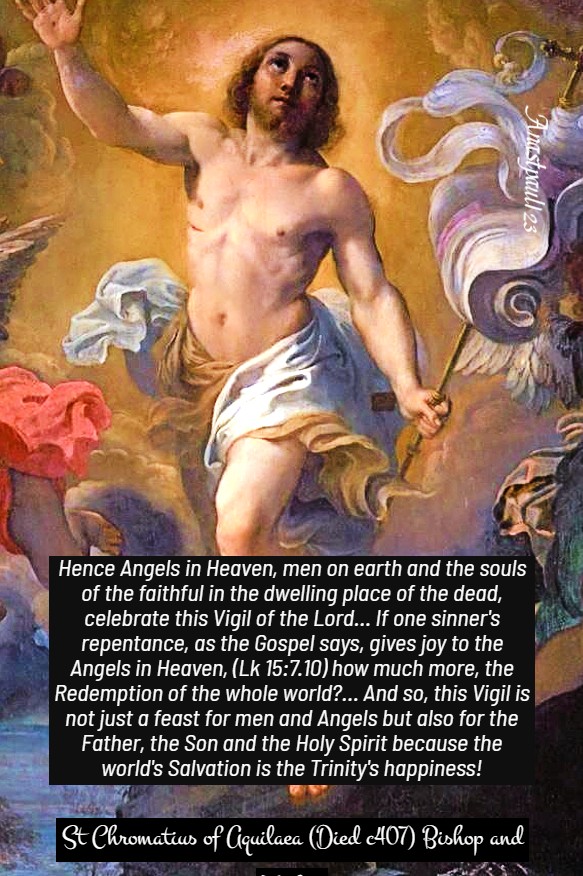
Hence Angels in Heaven, men on earth and the souls of the faithful in the dwelling place of the dead, celebrate this Vigil of the Lord… If one sinner’s repentance, as the Gospel says, gives joy to the Angels in Heaven, (Lk 15:7.10) how much more, the Redemption of the whole world?… And so, this Vigil is not just a feast for men and Angels but also for the Father, the Son and the Holy Spirit because the world’s Salvation is the Trinity’s happiness!” – St Chromatius of Aquilaea (Died c407) Bishop and Father of the Church (1st Sermon for the Paschal Vigil).
PRAYER – O God, Who dost illuminate this most holy night by the glory of the Lord’s Resurrection, preserve in the new children of Thy family, the spirit of adoption which Thou hast given, that renewed in body and mind, they may render to Thee a pure service. Through our Lord Jesus Christ, Thy Son, who lives and reigns with Thee in the unity of the Holy Ghost, God, world without end. Amen (Collect).
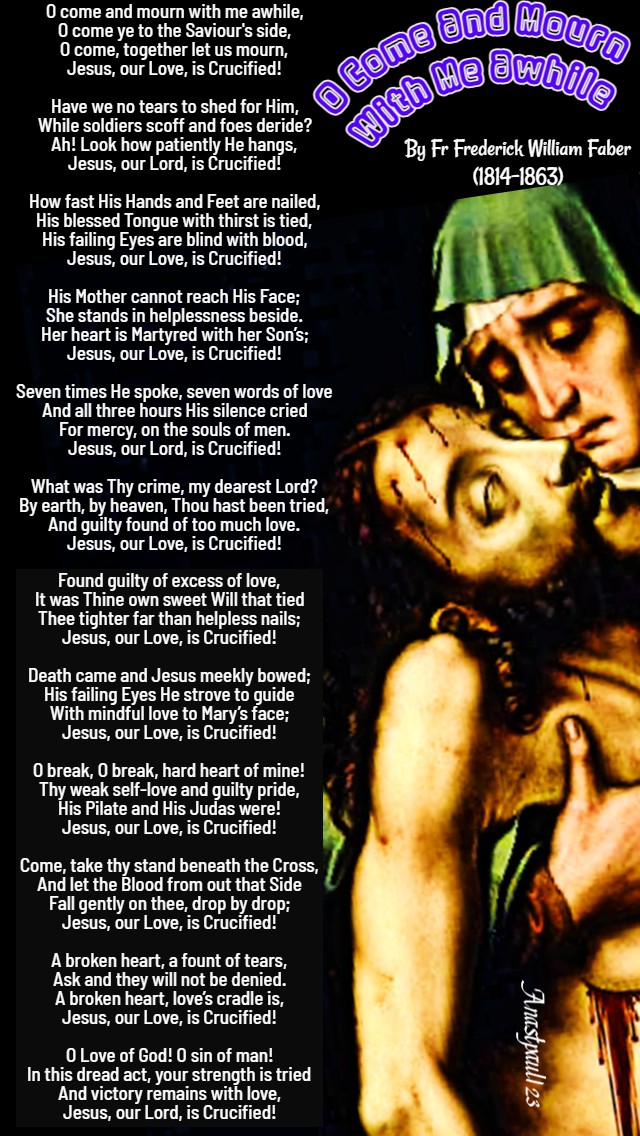
O Come And Mourn With Me Awhile By Fr Frederick William Faber CO (1814-1863) (This is the full, original text from an 1852 edition of Fr Faber’s H ymnal “Jesus and Mary”)
O come and mourn with me awhile, O come ye to the Saviour’s side, O come, together let us mourn, Jesus, our Love, is Crucified!
Have we no tears to shed for Him, While soldiers scoff and foes deride? Ah! Look how patiently He hangs, Jesus, our Lord, is Crucified!
How fast His Hands and Feet are nailed, His blessed Tongue with thirst is tied, His failing Eyes are blind with blood, Jesus, our Love, is Crucified!
His Mother cannot reach His Face; She stands in helplessness beside. Her heart is Martyred with her Son’s; Jesus, our Love, is Crucified!
Seven times He spoke, seven words of love And all three hours His silence cried For mercy, on the souls of men. Jesus, our Lord, is Crucified!
What was Thy crime, my dearest Lord? By earth, by heaven, Thou hast been tried, And guilty found of too much love. Jesus, our Love, is Crucified!
Found guilty of excess of love, It was Thine own sweet Will that tied Thee tighter far than helpless nails; Jesus, our Love, is Crucified!
Death came and Jesus meekly bowed; His failing Eyes He strove to guide With mindful love to Mary’s face; Jesus, our Love, is Crucified!
O break, O break, hard heart of mine! Thy weak self-love and guilty pride, His Pilate and His Judas were! Jesus, our Love, is Crucified!
Come, take thy stand beneath the Cross, And let the Blood from out that Side Fall gently on thee, drop by drop; Jesus, our Love, is Crucified!
A broken heart, a fount of tears, Ask and they will not be denied. A broken heart, love’s cradle is, Jesus, our Love, is Crucified!
O Love of God! O sin of man! In this dread act, your strength is tried And victory remains with love, Jesus, our Lord, is Crucified!






































You must be logged in to post a comment.