Our Morning Offering – 22 September – “The Month of the Seven Sorrows of the Blessed Virgin Mary and the Holy Cross”
My Most Sorrowful Lady By St Anselm (1033-1109) Marian Doctor Magnificent Doctor
My most sorrowful Lady, what can I say about the fountains, that flowed from your most pure eyes, when you saw your only Son before you, bound, beaten and suffering? What do I know of the flood, that drenched your matchless face, when you beheld your Son, your Lord and your God, stretched on the Cross without guilt, when the flesh of your flesh, was cruelly butchered by wicked me? How can I judge what sobs troubled your most pure breast when you heard, “Woman, behold your son,” and the disciple, “Behold, your Mother,” when you received, as a son, the disciple, in place of the Master, the servant, for the Lord? Amen
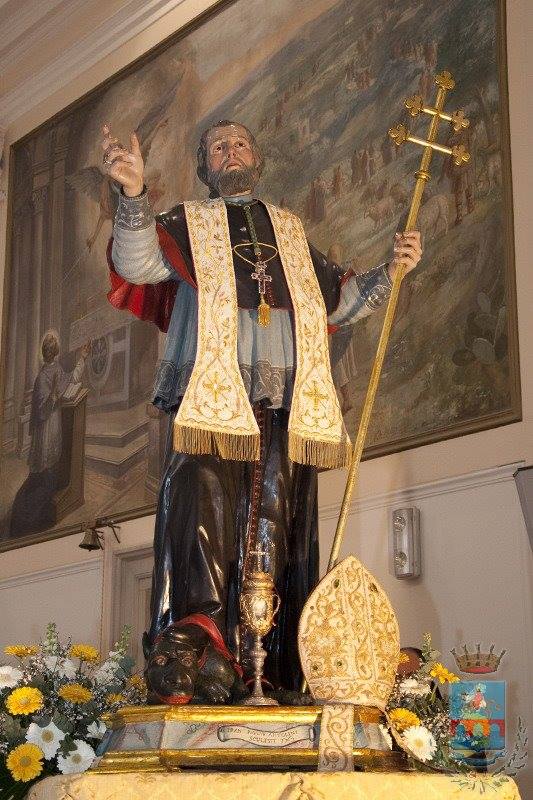
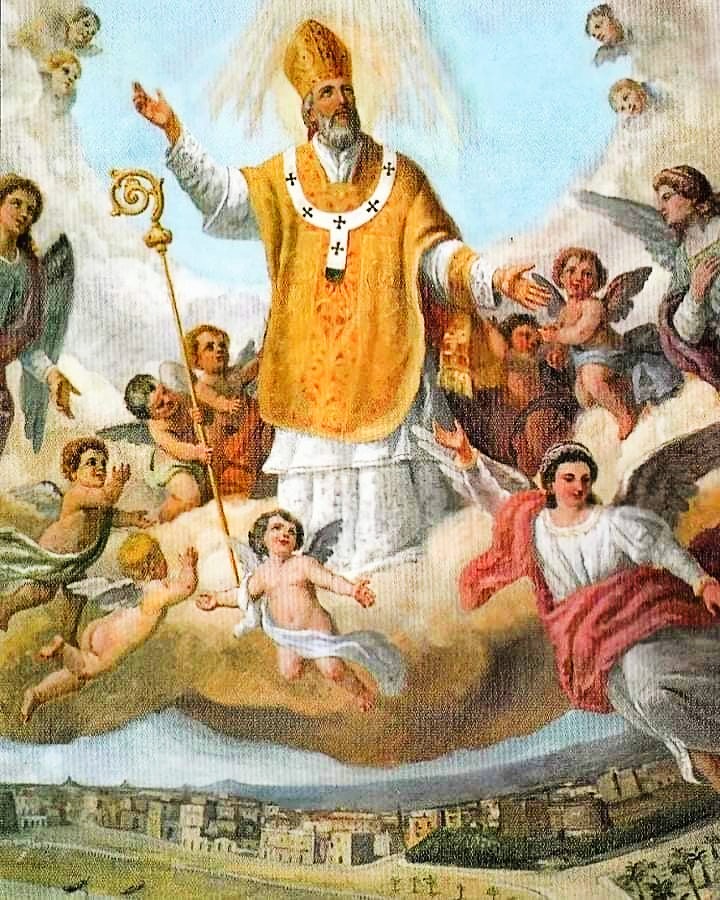
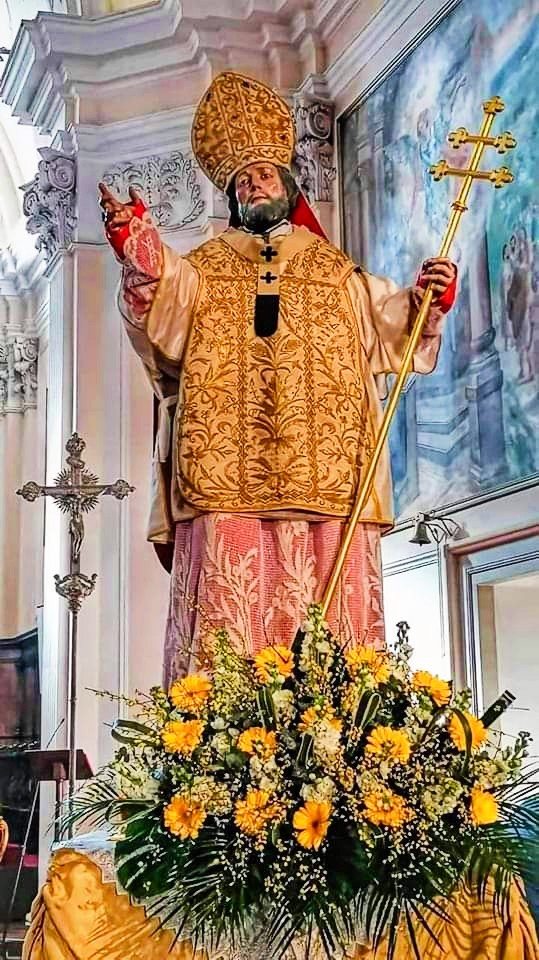
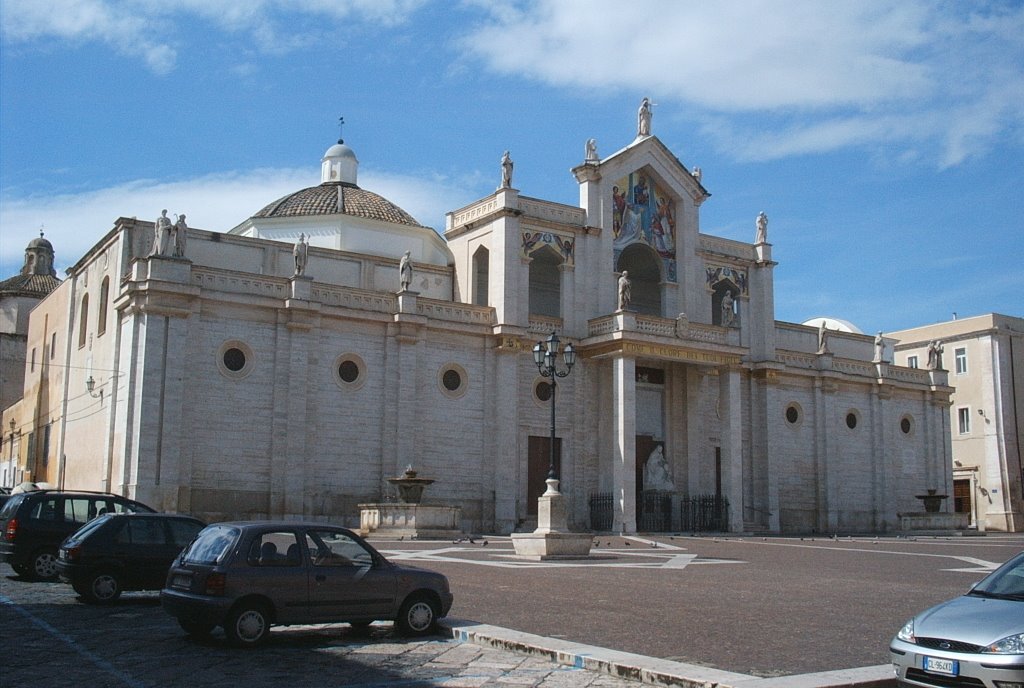
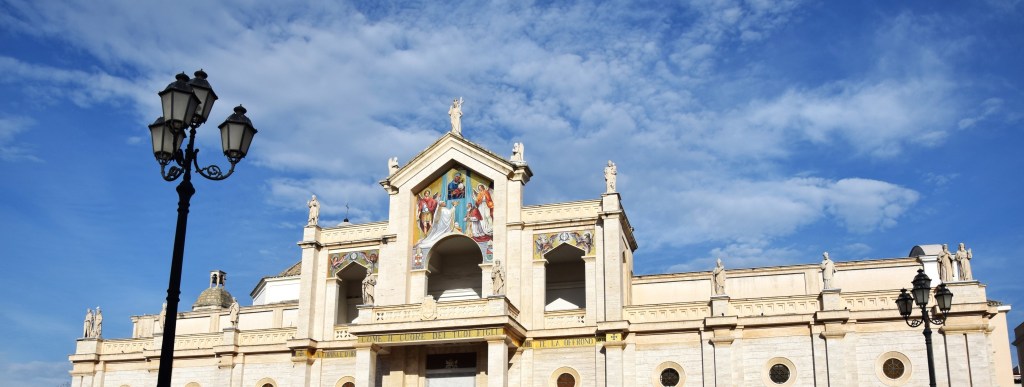
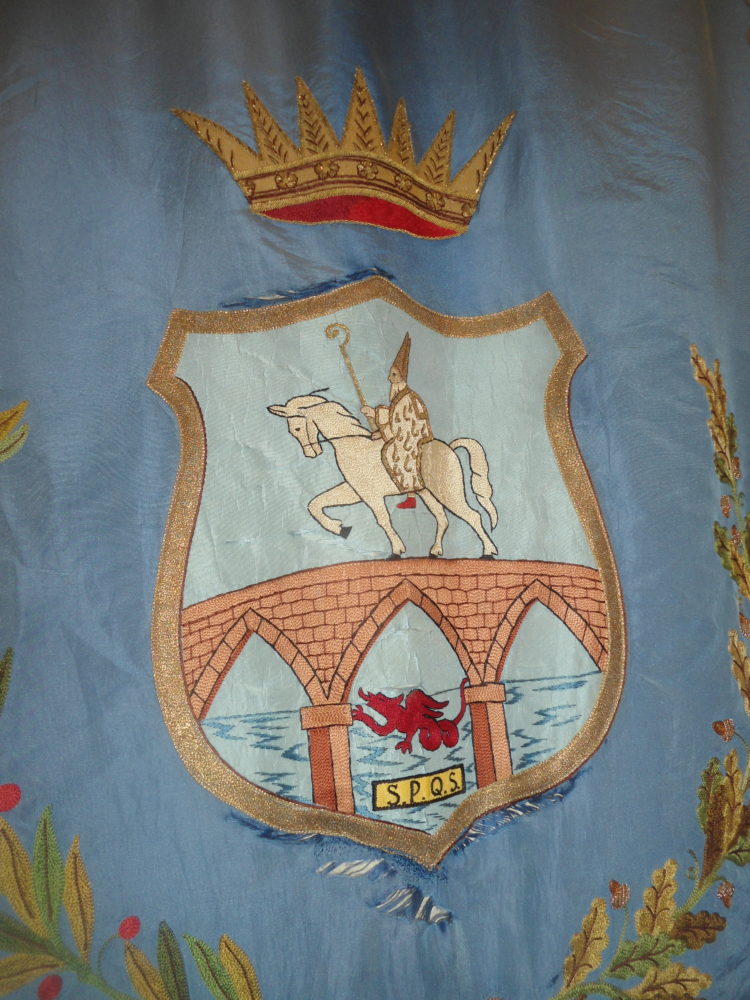
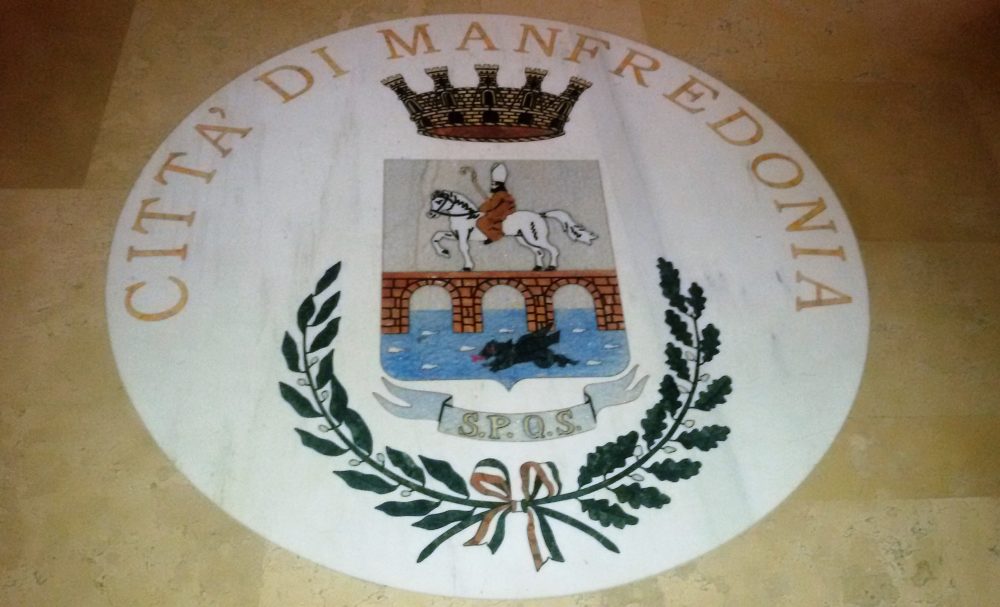
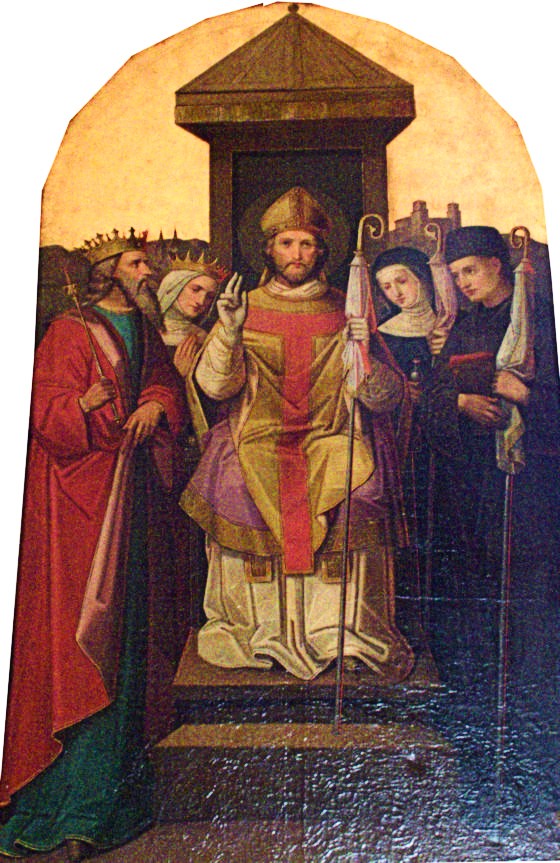
Saint of the Day – 22 September – Saint Septimius of Jesi (Died c 307) the first Bishop of Jesi in Italy, Confessor, Martyr., Miracle-worker Born in Germany and died by being beheaded in Jesi, Italy. Patronages – the City and Diocese of Jesi. Also known as – Settimio.
St Septimius is venerated as the first Bishop of the Diocese of Jesi and is considered the builder of the first Cathedral,which, although dedicated to the Holy Saviour retained the name of Septimius as the name of the founder (as was the custom).
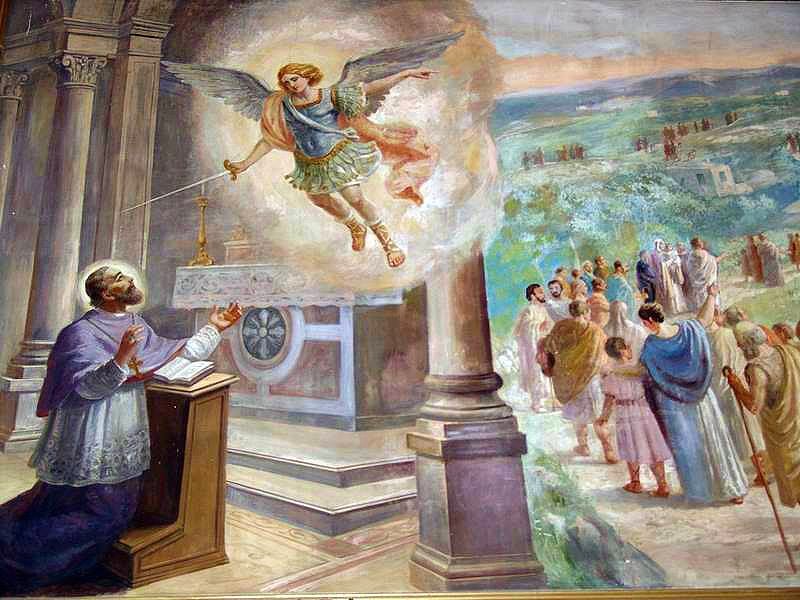
Fresco of St Septimius, by Biagio Bigatti, 1937. Iesi Cathedral.
Very ancient documents from Jesi, bear 461 as the date of the death of the holy Bishop and Martyr, however, this date seems to be in error when contrasted with the other historical events of the time. The office tells us that Septimius, born in Germany, devoted himself to liberal studies and a military life, then, in contrast to the opinion of his relatives, he converted to Christianity and came to Italy with some friends.
He began to preach the faith in Milan but was forced to leave that City, following the spread of Diocletian’s persecution. He travelled to Rome where he worked wonders and converted many to the True Faith. He was so successful in evangelising the pagans and became so renowned for the many miracles worked through his prayers, that Pope Marcellus I (308-309) Consecrates him as the Bishop of Jesi.
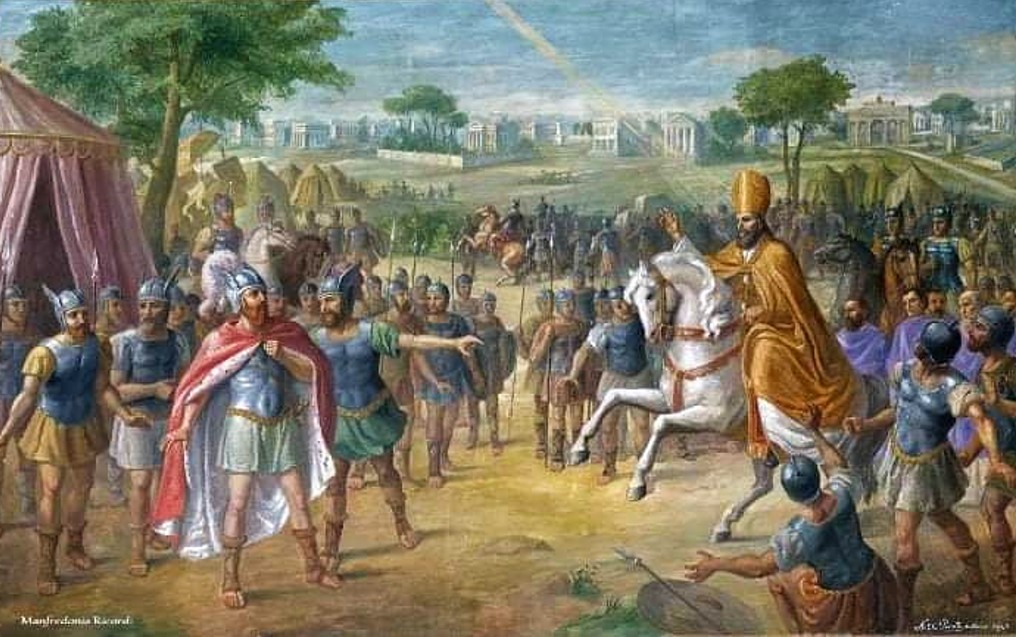
Septimius began immediately his pastoral mission and, at the same time, began the work of building a Cathedral. But in this City he found the Judge Florentius, who forbid him to continue his apostolate and gave him the ultimatum to sacrifice to the gods within five days, according to the imperial edict. Septimius, however, ignored Florentius’ demands and continues to preach the Gospel of Christ and convert pagans and perform miracles, At the end of the five days, Septimius was arrested and beheaded.
Although his place of burial was lost, by 1208 the Cathedral was named for him, His body was finally rediscovered in 1469 and translated to the Cathedral. In 1623 a new Altar was Consecrated to him where his body is now enshrined. His cult, however, had always been venerated because the Cathedral of Jesi was already dedicated to St Septimius.
Until 1623, St Septimius’ celebration was on 5 September and after that year, it was fixed at 22 September. St Septimius is the Patron Saint of the City of Jesi and of the Diocese, which he had established.
St Thomas of Villanueva/Villanova OSA (1488-1555) Archbishop, Confessor, Religious Priest of the Order of St Augustine,Writer, Preacher, Teacher, Apostle of Charity, Mystic, Miracle-Worker often called “the Almsgiver” and “the Father of the Poor“, Reformer. Canonised on 1 November 1658 by Pope Alexander VII. About St Thomas here: https://anastpaul.com/2017/09/22/saint-of-the-day-22-september-st-thomas-of-villanova-o-s-a/
St Irais St Jonas St Lauto of Coutances St Lindru of Partois Bl Otto of Freising St Sadalberga St Sanctinus of Meaux St Septimius of Jesi (Died c 307) Bishop, Confessor, Martyr St Sigfrid of Wearmouth St Silvanus of Levroux St Symphorian
Martyrs of the Theban Legion: + Martyrs (c 287) A Roman imperial legion of 6,600 soldiers, all of whom were Christians; they had been recruited from the area around Thebes in Upper Egypt, were led by Saint Maurice and served under Emperor Maximian Herculeus. Around the year 287, Maximian led the army across the Alps to Agaunum, an area in modern Switzerland, in order to suppress a revolt by the Bagandre in Gaul. In connection with battle, the army offered public sacrifices to the Roman gods; the Theban Legion refused to participate. For refusing orders, the Legion was decimated – one tenth of them were executed. When the remainder refused to sacrifice to the gods, they were decimated again. When the survivors still refused to sacrifice, Maximinian ordered them all killed. Martyrs. Known members of the Legion include: Alexander of Bergamo Candidus the Theban Chiaffredo of Saluzzo Exuperius Fortunato Innocent of Agaunum Maurice Secundus the Theban Ursus the Theban Victor of Agaunum Victor of Xanten Victor the Theban Vitalis of Agaunum Other profiled Saints associated with the Legion include: Antoninus of Piacenza (martyred soldier; associated by later story tellers) Adventor of Turin (not a member; associated by later story tellers) Cassius (may have been a member) Florentius the Martyr (may have been a member) George of San Giorio (not a member; associated by later story tellers) Gereon (not a member, but another soldier who was martyred for refusing to make a sacrifice to Roman gods) Octavius of Turin (not a member; associated by later story tellers) Pons of Pradleves (escaped the massacre to become an evangelists in northern Italy) Secundus of Asti (not a member but linked due to art work) Solutor of Turin (not a member; associated by later story tellers) Tiberio of Pinerolo (may have been a member) Verena (wife of a member of the Legion) They were Martyred c 287 in Agaunum (modern Saint-Maurice-en-Valais, Switzerland. A Basilica was built in Agaunum to enshrine the relics of the Legion. The full story: https://anastpaul.com/2018/09/22/saints-of-the-day-22-september-st-maurice-and-the-martyrs-of-the-theban-legion-martyrs-c
Thought for the Day – 21 September – Meditations with Antonio Cardinal Bacci (1881-1971) – The Feast of St Matthew, Apostle and Evangelist, Martyr
Gospel Reading
“Finally, we should practice what we learn in the Gospel. If this were not the result of our reading, our efforts would be worth very little. When reading, we should apply to our lives the spirit and the precepts of Jesus. This was the practice of the Saints, whose lives were a continual implementation of the Gospel message. So, St Aloysius and others, understood and applied to their own lives, the maxim: “Blessed are pure of heart.” St Francis and his followers, applied another maxim: “Blessed are the poor in spirit.” St Francis de Sales applied to himself, in a special way, the words: “Blessed are the meek.” As a result, he was noted for his gentleness of character, this man, known as “The Gentleman Saint” and “The Gentle Christ of Geneva!”
We should read the Gospel everyday. It should be for us, a school of practical spirituality, esspecially adapted to the needs of our own soul, which will finally lead us to sanctity.”
One Minute Reflection – 21 September – “The Month of the Seven Sorrows of the Blessed Virgin Mary and the Holy Cross” – The Feast of St Matthew, Apostle and Evangelist, Martyr – Ezekiel 1:10-14, Matthew 9:9-13
“It is not the healthy who need a physician but they who are sick. But go and learn what this means: ‘I desire mercy, and not sacrifice.’ For I have come to call sinners, not the just.”- Matthew 9:12-13
REFLECTION – “The Apostles, those who all as one and each in particular, possessed the Good News of God, went to the ends of the earth proclaiming the news of all the blessings God sends us and announcing Heaven’s peace towards men (Lk 2:14). Specifically, Matthew produced a written form of the gospel for the Hebrews in their own language, while Peter and Paul evangelised Rome and founded the Church there. After their deaths, Mark, who was Peter’s disciple and interpreter (1 Pt 5:13), also handed down Peter’s preaching to us in writing. Likewise, Luke, Paul’s companion, set down in a book, the Gospel preached by the latter. And then John, the disciple of the Lord, the one who leaned back on his breast (Jn 13:25), also published the Gospel during his stay at Ephesus.
In his Gospel,Matthew relates the genealogy of Christ as man: “The book of the genealogy of Jesus Christ, the son of David, the son of Abraham: now this is how the birth of Christ came about” (Mt 1:1, 18). Thus, this Gospel, presents Christ in human form, which is why it always represents Christ as being moved by sentiments of humility and remaining a man of gentleness …The Apostle Matthew knows none but One and the same God, Who promised Abraham that He would multiply his descendants like the stars in the sky (Gen 15:5) and, Who, through His Son, Jesus Christ, has called us from the worship of stones to knowledge of Him, (Mt 3:9) in such a way, that “those who were no people have become His people and she who was unloved has become beloved” (cf. Hos 2:25; Rom 9:25).” – St Irenaeus (130-202) Father of the Church, Bishop of Lyons, Theologian, Martyr (Against the heresies, III, 11,8 ; 9,1 – One of the first historical testimonies to the Evangelists).
PRAYER – We thank You, heavenly Father, for the witness of Your Apostle and Evangelist, Matthew, to the Gospel of Your Son, our Saviour and we pray, that, after his example, we may with ready wills and hearts, obey the calling of our Lord, to follow Him; through Jesus Christ our Lord, who lives and reigns with You and the Holy Spirit, one God, now and forever. Amen. (Collect).
Saint of the Day – 21 September – The Feast of St Matthew, Apostle and Evangelist, Martyr. Patronages – accountant, bookkeepers, bankers, customs officers, financial officers, money managers, guards, security forces, security guards, stock brokers, tax collectors, Diocese of Trier, Germany, Archdiocese of Washington, 5 cities.
St Matthew, Apostle and Evangelist By Fr Leonard Goffiné O.Praem (1648-1719) (Excerpt from The Church’s Year)
Matthew, before his conversion called Levi, was a Galilean, a son of Alpheus (Mark 2:14) consequently a brother of St James the Less, another of the Apostles. (Mark 3:18). Matthew was a collector of the toll which the Jews were obliged to pay to the Roman Emperors and was called from his custom-house by our Lord to be an Apostle.
In his Gospel, which he wrote later, he calls himself from humility always by his early designation, Matthew the Publican. He followed Jesus faithfully and after the descent of the Holy Ghost remained, as the historical writers Eusebius and Epiphanus inform us, in Judea and its neighbourhood, until just before the destruction of Jerusalem, when the Apostles dispersed and went into foreign lands to preach the doctrine of Christ. When obliged to separate from the recent converts in Jerusalem, Matthew wrote his Gospel to leave with them in place of his presence among them and was the first to write concerning our Lord’s life upon earth.
The Calling of Matthew – van Hemessen
He led a rigorous life, prayed much, never touched meat and lived on herbs, roots and wild fruits. He was at last stabbed by the Ethiopian King Hirtakus, as the generality of writers inform us, while standing at the Altar and offering the Sacrifice of Mass because the Saint had refused consent to the King’s marriage with the virgin Eugenia, who was dedicated to God. His sacred remains were, in the tenth Century, brought to Salerno, Naples, where they are still highly venerated.
Matthew was the first to write a Gospel. How proper it is, that he, who after many sins, becomes converted, should be the first to announce the Infinite Mercy of the Redeemer, Who came into this world, not to call the just but sinners.
“Christ, the Saviour, looked with His mild eyes at St Matthew in his custom-house and called him. Matthew obeyed, instantly arose and followed Christ, becoming thus, from a publican, an Apostle of the Lord, a great Saint. How comforting an example of Divine Mercy, even towards the greatest sinner! How wholesome a lesson! The same kind, merciful Saviour, Who gazed so mildly upon Matthew and called him, turns His loving eyes on you also, even if you live in mortal sin. He calls you to repentance – He calls you to follow Him. Obey Him as St. Matthew did, without putting it off. Let neither the greatness, nor the number of your sins detain you. Your Saviour is ready to forgive them, to receive you into His favour and to make you a Saint. “If you are a publican or a sinner,” says St Chrysostom, “you may still become an Evangelist. If you are a blasphemer, you may still become an Apostle.” This means that you may obtain pardon and gain salvation, as St Matthew and St Paul did, the former of whom was a publican, a sinner;and the other, according to his own testimony, a blasphemer. St Augustine says the same in the following words: “Perhaps some may think that the sin they have committed, is so great that it cannot obtain pardon from God. Oh! may such thoughts be far from us. Why, O man, regard only the number of thy sins and not the Omnipotence of the Heavenly Physician? As God is merciful because He is gracious and, as He can be merciful because He is Omnipotent, he who believes that God will not or cannot forforgive him, closes the door of the Divine Mercy on himself, by denying that God is gracious or Omnipotent. Hence, let no-one doubt the Mercy of God, even if he has committed a hundred, nay a thousand crimes. But this belief should incite him, to reconcile himself immediately with the Almighty.” – Fr Francis Xavier Weninger SJ (1805-1888)
Prayer to St Matthew as your Patron Saint
Saint Matthew, whom I have chosen as my Special Patron, pray for me, that I, too, may one day glorify the Blessed Trinity in Heaven. Obtain for me your lively faith, that I may consider all persons, things and events, in the light of Almighty God. Pray, that I may be generous in making sacrifices of temporal things, to promote my eternal interests, as you, so wisely did. Set me on fire with a love for Jesus, that I may thirst for His sacraments and burn with zeal, for the spread of His kingdom. By your powerful intercession, help me in the performance of my duties to God, to myself and to all the world. Win for me the virtue of purity and a great confidence in the Blessed Virgin. Protect me this day and everyday of my life. Keep me from mortal sin. Obtain for me the grace of a happy death. Amen
St Alexander of the Via Claudia Bl Diego Hompanera París St Eusebius of Phoenicia St Francisco Pastor Garrido St Gerulph St Herminio García Pampliega St Iphigenia St Isaac of Cyprus Bl Jacinto Martínez Ayuela St Jonah the Prophet Bl José María Azurmendi Mugarza Bl Josep Vila Barri St Landelino of Ettenheim Bl Manuel Torró García
St Maura of Troyes St Meletius of Cyprus Bl Nicolás de Mier Francisco St Pamphilus of Rome Bl Vicente Galbis Gironés Bl Vicente Pelufo Orts
Martyrs of Gaza – 3 Saints: Three brothers, Eusebius, Nestulus and Zeno, who were seized, dragged through the street, beaten and murdered by a pagan mob celebrating the renunciation of Christianity by Julian the Apostate. They were burned to death in 362 on a village garbage heap in Gaza, Palestine.
The PC has been the source of great good in our lives but, as we so well know, of even greater evil. Many of you may recall that during the last week of June, I sustained an injury to my back. After a “not-long-enough” rest, I returned to Breathing Catholic but, sadly, now, the Repetitive Strain of the PC movements, posture and chair, have aggravated the injury to my previously dislocated shoulder blade.
So this Soldier of Christ has been temporarily “boarded.” Please pray with me for patience in the trials and sufferings of this life and for our Divine Physician to touch all those who are in pain and myself and grant us cures in body and soul.
Missing you already sweet and faithful friends. 🧡🙏 Ana
Thought for the Day – 29 August – Meditations with Antonio Cardinal Bacci (1881-1971)
More About Almsgiving
“The description of the Last Judgement in the twenty fifth chapter of St Matthew’s Gospel would shock many people, if they were to read it. The principles, in accordance with which, Christ will pronounce sentence are inescapably clear. Did you feed and clothe the poor for My sake, He will ask because you recognised Me in them? If, you have done so, you will certainly be saved. If, you have neglected to do so, you will be condemned for all eternity. Christ does not ask about anything else because, everything else is subordinate to the precept of charity. Where there is charity, everything else follows. Where charity is lacking, there is nothing else because, Christianity is synonymouse with charity. Charity, says St Paul, “is the bond of perfection” (Col 3:14).
“If I should speak with the tongue of men and of Angels,” St Paul says elsewhere, “but have not charity, I have become as sounding brass or a tinkling cymbal … and if I have all faith so as to move mountains, yet have not charity, I am nothing. And if I distribute all my goods to feed the poor … yet do not have charity, it profits me nothing” (Cf 1 Cor 13:1-3).
So, our eternal salvation depends on our charity. But it must be charity in action, not merely in words. “He who has the goods of this world,” says St John “and sees his brother in need and closes his heart to him, how does the love of God abide in him?” (1 Jn 3:17). Charity must be expressed in almsgiving and good works, for otherwise, it would be a matter of idle talk which would be powerless to save us.
Our almsgiving should not be dictated simply by natural feelings of compassion, however, nor by mere philanthropy. It should be pre-eminently a religious act, springing from supernatural motives. Because we see the person of Christ in the poor man, we should love and help him as we should our Diving Redeemer. This is real Christian charity.
A proud man may also be liberal in giving away money in order to draw attention to himself. But this is not Christian almsgiving which is never the product of self-love but of the love of God.
Let us be more generous in giving, therefore but, let us always give from the supernatural motive of Christian charity.”
Quote/s of the Day – 29 August – The Beheading of Saint John the Baptist
“Amen I say to you, there hath not risen among them that are born of women, a greater than John the Baptist.”
Matthew 11:11
“The Lord called me from birth, from my mother’s womb He pronounced my name.”
Isaias 49:1
“I, for my part, think that the mystery of John is being fulfilled in the world until the present. The spirit and the power of John, must first fill the soul of whoever is destined to believe in Christ Jesus, “to prepare for the Lord a people well-disposed” (Lk 1:17) and to “make ready the way of the Lord, [to] clear Him a straight path” (Lk 3:5) in the roughness of their hearts. Not only at that time were “the winding paths … made straight and the rough ways smooth;” rather, the spirit and the power of John still go before the Lord and Saviour’s coming today. Oh greatness of the Lord’s Mystery and of His plan for the world! ”
Origen Adamantius (c 185-253) Priest, Theologian, Exegist, Writer, Apologist, Father
“Why was John allowed to die?” For what occurred was not a death but a crown, not an end but the beginning of a greater life. Learn to think and live like a Christian. You will not only remain unharmed by these events but will reap the greatest benefits.”
St John Chrysostom (347-407) Father & Doctor of the Church
One Minute Reflection –29 August – The Beheading of Saint John the Baptist – Jeremias 1:17-19, Mark 6:17-29
“He brought in the head on a platter and gave it to the girl. The girl in turn gave it to her mother.” – Mark 6:28
REFLECTION – “In what way, then, was this just man harmed by this demise, this violent death, these chains, this imprisonment? Who are those he did not set back on their feet — provided they had a penitent disposition — because of what he spoke because of what he suffered,because of what he still proclaims in our own day — the same message he preached, while he was living. Therefore, do not say: “Why was John allowed to die?” For what occurred was not a death, but a crown, not an end, but the beginning of a greater life. Learn to think and live like a Christian. You will not only remain unharmed by these events, but will reap the greatest benefits.” St John Chrysostom (347-407) Archbishop of Constantinople, Father and Doctor of the Church (On the Providence of God 22).
PRAYER – May the great festival of St John the Baptist, ThyPrecursor and Martyr, we beseech Thee, O Lord, assure for us the results of Thy saving help. Who lives and reign with God the Father, in the unity of the Holy Spirit, God, world without end. Amen (Collect).
Saint/s of the Day – 29 August – Blessed John of PerugiaOFM (Died 1231) Priest and Blessed Peter of Sassoferrato OFM (Died 1231) Lay Brother, Martyrs, Confessors, Friars of the Friars Minor. Both were beheaded in 1231 in Valencia, Spain. We have no artworks of the two Saints, those below are generic Franciscans.
A Franciscan Friar
The two Friars Minor, Blessed John of Perugia, a Priest, and Peter of Sassoferrato, a lay brother, were sent to Spain with a large number of Friars by St Francis himself. There, they were assigned to the kingdom of Aragon, where they built a small Convent in the little town of Teruel and reaped much fruit, by their holy lives, their prayers and their sermons on penance.
Their longing for the conversion of the infidels and the hope of obtaining the Palm of Martyrdom urged Friars John and Peter to go to the larger city of Valencia, which was governed, at that time, by the Moorish King Azotus. The Friars began to preach in public that Jesus Christ is the true Son of God and that only through Him, can we be saved. Azotus was a bitter enemy of the Christians.
Hearing of the activities of the Friars, he had them seized and cast into prison. He used every possible means to force them to apostatise. But when promises and threats alike, failed to shake their constancy, he condemned them to be beheaded. The Friars thanked the King,, praying fervently to God to enlighten their persecutor and in His mercy, to grant him the grace of conversion to the true Faith. Then, Blessed John of Perugia and Peter of Sassoferrato were beheaded. This occurred in the year 1231.
A few years later, James I, the Catholic King of Aragon, made war on Valencia. His army defeated the army of Azotus, who by this ill fortune and by the grace which the holy Martyrs had won for him from God, recognised Mohammed as a false prophet and Christ as the Saviour of the world. King James rejoiced exceedingly when Azotus asked to be Baptised. After his Baptism, Azotus offered the Friars Minor, his former palace for a Convent.
“When I was still an infidel,” he told them, “I caused your brethren to be executed at Teruel. I sincerely regret this crime and desire to make reparation for it. Accept my palace, in which the blood of many holy Martyrs has been shed and convert it into a convent.”
The palace was remodeled into a Convent and, next to it, a Church was erected in honour of the two Martyrs. On 11 September 1704, Pope Clement XI approved the public veneration which was paid to them and in 1783, Pope Pius VI again honoured them by confirming their cultus.
Blessed John of Perugia`OFM (Died 1231) Martyr, Friar of the Friars Minor AND Blessed Peter of Sassoferrato OFM (Died 1231) Martyr, Friar of the Friars Minor
St Adelphus St Adausia of Rome St Alberic of Bagno de Romagna St Basilia of Sirmium Bl Bronislava St Candida of Rome St Edwold the Hermit St Euthymius of Perugia St Maximian of Vercelli St Medericus St Nicaeus of Antioch St Paul of Antioch St Repositus of Velleianum Bl Richard Herst St Sabina of Troyes St Sator of Velleianum St Sebbe of Essex St Velleicus St Victor of La Chambon St Vitalis of Velleianum
Thought for the Day – 28 August – Meditations with Antonio Cardinal Bacci (1881-1971)
Lord, That I May See!
“The restlessness and intensity of living, make us see things as differently from what they really are. But one day, the veil of the temple will be rent asunder before our frightened eyes and eternal Light will break upon us. Then, we shall be blind no longer but, we shall see everything in the Light of eternity.
Let us place ourselves now, in the state in which we should like to find ourselves at that moment. Let us consider ourselves and everything else, in the Light of eternity. Then our blindness will disappear. Since we shall see everything in God’s way, we shall direct all our thoughts and actions toward Him.alone!”
Quote/s of the Day – 28 August – St Augustine (354-430) Bishop, Confessor, Doctor of Grace and Father–
St Jerome wrote to Augustine in 418: “You are known throughout the world; Catholics honour and esteem you as the one who has established anew the ancient Faith.”
“The sky and the earth and the waters and the things that are in them, the fishes and the birds and the trees are not evil. All these are good; it is evil men who make this evil world.”
“What is reprehensible, is that while leading good lives themselves and abhorring those of wicked men, some, fearing to offend, shut their eyes to evil deeds instead of condemning them and pointing out their malice.”
“People who associate the name of Christian with a dishonest life, injure Christ! … If God’s Name, is blasphemed by bad Christians, it is praised and honoured, on the other hand, by the good: “For in every place, we are the aroma of Christ” (2 Cor,14-15). And it is said in the Song of Songs: “Your name is oil poured out” (1,3).”
“You do not know when your last day may come. You are an ingrate! Why not use the day, today, that God has given you to repent?”
“If you believe what you like in the Gospels and reject what you don’t like, it is not the Gospel you believe but yourself.”
“Now is the time in this life of suffering, when we journey apart from Him. … So let us fast and pray now because, we are in the days of childbirth!”
“Give of your earthly goods and receive eternal ones; give earth and receive heaven!”
Breathe in Me, O Holy Spirit By St Augustine (354-420)
Breathe in me, O Holy Spirit, that my thoughts may all be holy. Act in me, O Holy Spirit, that my work, too, may be holy. Draw my heart, O Holy Spirit, that I love but what is holy. Strengthen me, O Holy Spirit, to defend all that is holy. Guard me, then, O Holy Spirit, that I always may be holy. Amen
Hear us, O Heavenly Father, For the Sake of Your Only Son By St Augustine (354-430)
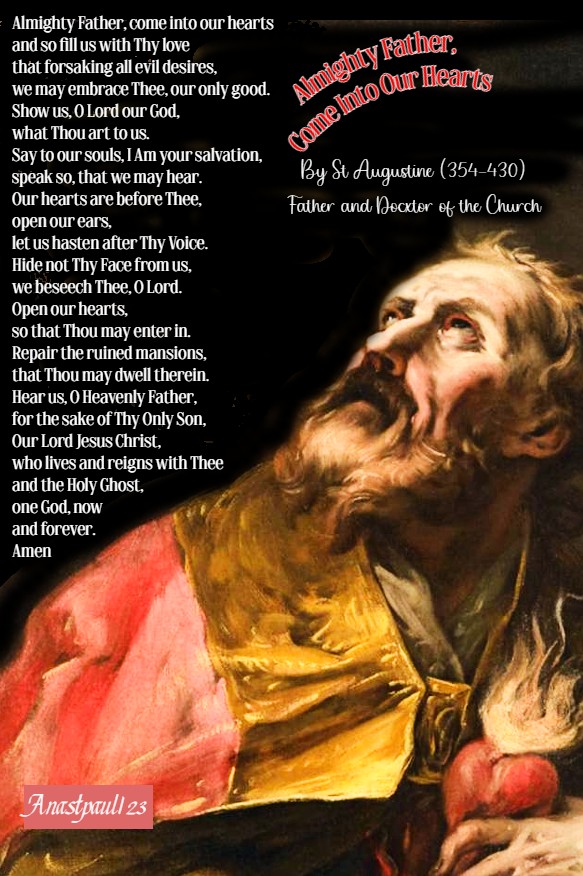
Almighty Father, come into our hearts and so fill us with Your love that forsaking all evil desires, we may embrace You, our only good. Show us, O Lord our God, what You are to us. Say to our souls, I am your salvation, speak so, that we may hear. Our hearts are before You, open our ears, let us hasten after Your Voice. Hide not Your Face from us, we beseech You, O Lord. Open our hearts, so that You may enter in. Repair the ruined mansions, that You may dwell therein. Hear us, O Heavenly Father, for the sake of Your only Son, Our Lord Jesus Christ, who lives and reigns with You and the Holy Spirit, one God, now and forever. Amen
One Minute Reflection – 28 August – St Augustine (354-430) – Bishop, Confessor, Doctor of Grace and Father – 2 Corinthians 3:4-9, Luke 10:23-37
“The next day he took out two silver coins and gave them to the innkeeper with the instruction, ‘Take care of him. If you spend more than what I have given you, I shall repay you on my way back.’” – Luke 10:35
REFLECTION – “Who is my neighbour?” In answer the Word explained, in the form of a story, God’s entire economy of salvation.He told of man’s descent from heaven, the robbers’ ambush, the stripping of the garment of immortality, the wounds of sin, the progress of death over half of man’s nature while his soul remained immortal. Then came the passage of the Law that brought no help—neither the priest nor the Levite tended the wounds of the man who fell among robbers—for “it was impossible for the blood of goats and oxen to remove man’s sin” (Heb 10:4). And then He came, clothed in our human nature as the first-fruits of the mass in which there was a portion of every race, Jewish, Samaritan, Greek — all mankind. With His body (that is, the beast of the story) He proceeded to the place of man’s disaster, healed his wounds and set him upon His own beast. He created for him the inn of His loving providence, in which all those who labour and are burdened can find rest (Mt 11,28) (…)
“Whoever abides in me and I in him” (Jn 6:56) … Whoever finds shelter in Christ’s mercy accepts two denarii from Him, one of which signifies the love of God with one’s whole heart and the other the love of one’s neighbour as oneself, according to the lawyer’s reply (Mk 12:30f). But “not the hearers of the law are just before God but the doers of the law shall be justified” (Rm 2:13). Hence we must not merely accept these two coins … but we must, by our own good deeds, co-operate in the fulfilment of these two commandments. And so, the Lord says to the innkeeper, that whatever he does in caring for the wounded man will be made up to him at the Lord’s second coming according to the measure of his devotion.” … St Gregory of Nyssa (c 335–C 395) Father of the Church, Monk, Bishop – Sermons on the Song of Songs, no14 – [Brother of St Basil the Great (Father & Doctor)]
PRAYER – Give heed to our humble prayers, Almighty God and through the intercession of blessed Augustine, Thy Confessor and Bishop, kindly grant Thy oft-given mercy to those upon whom Thou bestows great hope in Thy forgiveness. Through Jesus Christ, Thy Son our Lord, Who lives and reigns with Thee, in the unity of the Holy Ghost, God, world without end. Amen (Collect).
Our Morning Offering – 28 August – St Augustine (354-430) – Bishop, Confessor, Doctor of Grace and Father
O God, the House of My Soul is Narrow By St Augustine (354-430) Father & Doctor of Grace
O God, the Light of the heart, which sees Thee, The Life of the soul, which loves Thee, The Strength of the mind, which seeks Thee, May I ever continue to be steadfast in Thy love. Be the Joy of my heart, Take all of me to Thyself and abide therein. The house of my soul is, I confess, too narrow for Thee. Enlarge it, that Thou may enter. It is ruinous but do repair it. It has within it what must offend Thine Eyes, I confess and know it, But whose help shall I seek in cleansing it but Thine alone? To Thee, O God, I cry urgently. Cleanse me from secret faults. Keep me from false pride and sensuality, that they may not get dominion over me. Amen
Saint of the Day – 28 August – Saint Moses the Black (330-405) Priest, Monk, Hermit, Penitent, Evangeliser. Born in 330 Ethiopian ancestry and died by being murdered 405 by Berbers at Petra, Skete, Egypt. Patronage – of Africa. Also known as – Moses the Ethiopian, Moses of Scete.
The Roman Martyrology reads: “St Moses, an Ethiopian, who gave up a life of robbery and became a renowned anchorite. He converted many robbers and led them to a Monastery.”
Moses the Black lived during the fourth century in Egypt. He was an Ethiopian and he was black of skin and, therefore, called “Murin” (meaning “like an Ethiopian”). In his youth he was the slave of an important man but after he committed a crime, his master banished him and he joined a band of robbers.
Moses and his band of brigands did many evil deedss. People were afraid at the mere mention of his name. He spent several years leading a sinful life but through the great mercy of God he repented, left his band of robbers and went to one of the desert Monasteries. Here he wept for a long time, begging to be admitted as one of the brethren. The Monks were not convinced of the sincerity of his repentance but the former robber would not be driven away nor silenced. He continued to ask that they accept him.
Moses was completely obedient to the Abbot and the brethren and he poured forth many tears of sorrow for his sinful life. After a certain while, Moses withdrew to a solitary cell, where he spent the time in prayer and the strictest fasting in a very austere lifestyle.
Once, four of the robbers of his former band descended upon his cell. He had lost none of his great physical strength, so he tied them all up. Throwing them over his shoulder, he brought them to the Monastery, where he asked his superiors what to do with them. The superiors ordered that they be set free. The robbers, learning that they had chanced upon their former ringleader and that he had dealt kindly with them, followed his example: they repented and became Monks. Later, when the rest of the band of robbers heard about the repentance of Moses, then they also gave up their thievery and became fervent Monks.
Moses was not quickly freed from the passions. He went often to the Confessor, seeking advice on how to be delivered from the passions of profligacy. Being experienced in the spiritual struggle, the his Confessor taught him never to eat too much food, to remain partly hungry while observing the strictest moderation. But the temptations did not cease to trouble Moses in his dreams.
Then he learnt of the all-night vigil. The Monk stood the whole night at prayer, so he would not fall asleep. From his prolonged struggles Moses fell into despondency and when there arose thoughts about leaving his solitary cell, his Confessor instead, strengthened the resolve of his disciple.
Moses undertook a new penance. Making the rounds by night of the wilderness cells, he carried water from the well to each brother. He did this especially for the superiors, who lived far from the well and who were not easily able to carry their own water. Once, kneeling over the well, Moses felt a powerful blow upon his back and he fell down at the well like one dead, lying there in that position until dawn. Thus did the devils take revenge upon the Monk for his victory over them. In the morning the Monks carried him to his cell and he lay there a whole year crippled.
Accounts about his conversion spread even beyond the bounds of the wilderness. The governor of the land wanted to see the Saint. When he heard of this, Moses decided to hide from any visitors and he departed his own cell. Along the way he met servants of the governor, who asked him how to get to the cell of the Hermit. Moses. The Monk answered them: “Go no farther to see this unworthy Monk.” The servants returned to the Monastery where the governor was waiting and they told him the words of the Monk they had chanced to meet. The brethren, hearing a description of his appearance, told them that they had encountered Moses himself.
After many years of monastic obedience, study and piety, Moses was Ordained Deacon. The Bishop clothed him in vestments and said, “Now Moses is entirely white!” The Saint replied, “Only outwardly, for God knows that I am still dark within.” Through humility, the Saint believed himself unworthy of the office of Deacon. Having put him to the test, the Bishop then Ordained Moses Priest . St Moses laboured for fifteen years in this rank and gathered around himself many disciples.
When the Saint reached age 75, he warned his Monks that soon brigands would descend upon the Monastery and murder all that were there. The Saint blessed his Monks to leave, in order to avoid violent death. His disciples began to beseech him to leave with them but he replied: “For many years already, I have awaited the time when the words which my Master, the Lord Jesus Christ, should be fulfilled: “All who take up the sword, shall perish by the sword” (Mt. 26: 52). After this, seven of the brethren remained with him and one of them hid nearby during the attack of the robbers. The robbers killed Moses and the six Monks who remained with him. Their death occurred in about the year 405.
St Facundinus of Taino St Felix of Venosa St Fortunatus of Salerno St Gaius of Salerno St Gorman of Schleswig St Hermes of Rome (Died 120) Martyr Bl Hugh More Bl James Claxton St Januarius of Venosa St Julian of Auvergne St Moses the Black (330-405) Priest, Monk, Hermit, Penitent. St Pelagius of Istria St Restitutus of Carthage St Rumwold the Prince St Septiminus of Venosa
Thought for the Day – 27 August – Meditations with Antonio Cardinal Bacci (1881-1971)
Evening Prayer
“A page in the story of our lives is closed. For all we know, it may be our last. Sleep is a symbol of death. How can we be certain that this night will not be our last?
A large number of people die during their sleep. For this reason, our night prayers should include an Act of sincere and perfect Contrition for our sins, an Act of Love for God, our supreme benefactor and an Act of complete resignation to His Will.
When we are in bed, we should repeat the words of Jesus on the Cross, “Father, into Thy Hands, I commit my spirit” (Lk 23:46). If this prayer is on our lips and in our heart, we can sleep in peace.”
Quote/s of the Day – 27 August – St Joseph Calasanz/Calasantius (1557-1648) Spanish Confessor
“Like the saplings of plants, the young are easily influenced, as long as someone works to teach their souls. But if they are allowed to grow hard, we know well that the possibility of one day bending them, diminishes a great deal and is sometimes utterly lost.”
“Keep, O Lord, my heart at peace, always close to Thee. Thou Who calms the wild waves of the sea.”
One Minute Reflection – 27 August – “The Month of the Immaculate Heart of Mary” and the celebration of St Joseph Calasantius (1557-1648) Spanish Confessor – Wisdom 10:10-14, Matthew 18:1-5
“Amen, I say to you, unless you turn and become like little children, you will not enter the kingdom of heaven.”… Matthew 18:3
REFLECTION – “We must seek for reasons for individual sayings and actions of the Lord. After the coin was found, after the tribute paid, what do the Apostles’ sudden questions mean? Why precisely “at that time” did the disciples come to Jesus saying, “Who is the greatest in the kingdom of heaven?” Because they had seen that the same tax had been paid for both Peter and the Lord. From the equal price they inferred, that Peter may have been set over all the other Apostles, since Peter had been compared with the Lord in the paying of the tax. So they ask, who is greater in the Kingdom of Heaven. Jesus, seeing their thoughts and understanding the causes of their error, wants to heal their desire for glory, with a struggle for humility.”
He called a child to Him, to ask its age or to show the image of innocence. Or perhaps He actually set a child in their midst — He Himself, Who had not come to be served but to serve — to show them an example of humility.
Whoever humbles himself like this child, he is the greatest in the Kingdom of Heaven. Just as this child, whose example I show you, does not persist in anger, does not long remember injury suffered, is not enamoured inordinately by the sight of a beautiful woman, does not think one thing and say another, so you too, unless you have similar innocence and purity of mind, will not be able to enter the Kingdom of Heaven! Or, it might be taken in another way: “Whosoever, therefore, humiliates himself like this child, is greater in the kingdom of heaven,” so as to imply that anyone, who imitates Me and humiliates himself following My example, so that he abases himself as much as I abased Myself in accepting the form of a servant, will enter the Kingdom of Heaven.” – St Jerome (343-420) Translator of Sacred Scripture into Latin (The Vulgate) One of the original four Doctors of the Latin Church, Father (Commentary on Matthew 3).
PRAYER – O God, Who through St Joseph, Thy Confessor, did graciously will to provide Thy Church with a new method for the training of youth, in the spirit of understanding and holiness grant, we beseech Thee, that, following his example and through his intercession, we may live and teach so as to acquire an everlasting reward. Through Jesus Christ, Thy Son our Lord, Who lives and reigns with Thee, in the unity of the Holy Ghost, God, world without end. Amen (Collect).
Our Morning Offering – 27 August – “The Month of the Immaculate Heart of Mary” and Feast of Our Lady Health of the Sick and Mary’s Day
Virgin Full of Goodness, Mother of Mercy By St Thomas Aquinas (1225-1274) Doctor angelicus Doctor communis
Virgin full of goodness, Mother of mercy, I entrust to you my body and my soul, my thoughts and my actions, my life and my death. My Queen, come to my aid and deliver me from the snares of the devil. Obtain for me the grace of loving my Lord Jesus Christ, your Son, with a true and perfect love, and after Him, O Mary, of loving you with all my heart and above all things. Amen.
Saint of the Day – 27 August – Feast of the Seven Joys of Our Lady. This Feast is also known as “The Franciscan Crown,” The Seven Joys of the Virgin. Today was kept by the Franciscans as the Feast of the Seven Joys of the Virgin Mary. As an expression of the Seraphic Order’s devotional life, it corresponds to the Feast of the Holy Rosary, which began among the Dominicans and the observance on 15 September of the Seven Sorrows of the Virgin,
The devotion to the Seven Joys in and of itself, however,is much older; the story of its origin is told thus in the Manual for Franciscan Tertiaries.
About the year 1420, a young man, deeply devoted to Our Lady, took the habit of St Francis. Before joining the Order, he had, among other practices, been accustomed daily, to make a Chaplet of flowers,and with it, to Crown a Statue of the Blessed Virgin. Having in his novitiate no longer an opportunity of making this Crown for his Most Beloved Queen, he, in his simplicity, thought that she would withdraw her affection from him; this temptation of the devil disturbed his vocation. He resolved to abandon the cloister. The merciful mother appeared to him and gently rebuking him, strengthened him in his vocation by telling him to offer her, instead of the Chaplet of Flowers, a Crown much more pleasing to her, composed of seventy two Ave Marias and a Pater after each decade of Ave Marias. Our Lady instructed him to meditate at each decade upon the seven joys she had experienced, during years of her exile upon the earth.
The novice immediately commenced reciting the new Crown or Chaplet and derived, therefrom, many spiritual and temporal graces.
This pious practice spread quickly through the whole Order, and even throughout the world… St Bernardin of Siena used to say that it was by the Crown of the Seven Joys that he had obtained all the graces which Heaven has heaped upon him.
The Seven Joys listed in the Manual are the Annunciation, the Visitation, the Birth of Christ, the Adoration of the Magi, the Finding of the Christ Child in the Temple, the Resurrection and the Assumption but other version of the list may be found. Two more Aves are added to make the number seventy-two mentioned above and another Pater and Ave for the intentions of the Pope. The recitation concludes with a versicle and response and with the Collect of the Immaculate Conception.
Praying The Franciscan Crown
Using beads for the Franciscan Crown (seven decades), announce the First Mystery and pray the Our Father on the single bead just before the medallion.
Pray one Hail Mary for each of the ten beads. (It seems most fitting to proceed around the beads in a clockwise direction.)
On the single bead between the decades, announce the next Mystery and then pray the Our Father. Continue as in Step 2 for the remaining Mysteries.
After the last Mystery, pray one Hail Mary each on the fourth and third beads from the Cross to complete 72 years of Mary’s Joy.
Pray the Our Father and the Glory Be to the Father (Gloria Patri), for the intention of the Holy Father on the 2nd bead from the Cross.
Pray a Hail Mary on the single bead closest to the Cross.
The recitation concludes with a versicle and response and with the Collect of the Immaculate Conception.
V. In thy Conception, o Virgin, thou wast immaculate. R. Pray for us to the Father, whose Son thou didst bear. Let us pray. O God, Who by the Immaculate Conception of the Virgin, prepared a worthy dwelling place for Thy Son; we beseech Thee, that, as by the foreseen death of Thy sam, Son, Thou preserved her from every stain, so Thou may grant us also, through Her intercession, to come to Thee with pure hearts. Through the same Christ our Lord. R. Amen.
St Carpophorus St David Lewis St Decuman St Ebbo of Sens St Etherius of Lyons St Euthalia of Leontini St Fortunatus of Potenza Bl Gabriel Mary St Gebhard of Constance St Giovanni of Pavia St Honoratus of Potenza St John of Pavia St Licerius of Couserans St Malrubius of Merns St Narnus of Bergamo St Phanurius St Poemen Bl Roger Cadwallador St Rufus of Capua St Sabinian of Potenza St Syagrius of Autun
Martyrs of Tomi – 5 Saints: A group of 17 Christians imprisoned and excuted for their faith during the persecutions of Diocletian. They miraculously were unburned by fire and untouched by wild animals. We know the names and a few details on five of them – John, Mannea, Marcellinus, Peter and Serapion. They were tied to stakes and burned alive; they emerged unharmed – thrown to wild animals in the amphitheatre; the animals ignored them; they were beheaded in 304 in Tomi, Mesia (modern Costanza, Romania).
Martyrs of Nagasaki – 14 Beati: A group of fourteen missionaries and Japanese native Christians, who were Martyred together for their faith. They died on 16 August 1627 in Nagasaki, Japan and were Beatified on 7 May 1867 by Pope Pius IX. • Blessed Antonius of Saint Francis • Blessed Bartolomé Díaz Laurel • Blessed Caius Akashi Jiemon • Blessed Francisca Pinzokere • Blessed Francisco of Saint Mary • Blessed Franciscus Kuhyoe • Blessed Leo Kurobyoe Nakamura • Blessed Lucas Tsuji Kyuemon • Blessed Ludovicus Matsuo Soyemon • Blessed Magdalena Kiyota • Blessed Maria Shobyoe • Blessed Michaël Koga Kizayemon • Blessed Thomas Sato Shin’emon • Blessed Tsuji Shobyoe
Thought for the Day – 26 August – Meditations with Antonio Cardinal Bacci (1881-1971)
Visits to the Blessed Sacrament
“Let us consider the Infinite Goodness of Jesus. He became man for us and spent thirty three years on earth, “doing good and healing all” (Acts 10:38). More than this, He chose to remain with us until the end of time, hidden in the Blessed Sacrament, to be our Friend and Comforter and the Food of our souls. In His Infinite Power and Goodness, is there anything more He could have done for us? All day, He waits there, anxious to heal our ills, to console us in our troubles and, to give us the strength to persevere in our journey towards perfection and towards Heaven.
Let us listen to that loving Voice! Do not be ungrateful for this miracle of Infinite Goodness. Let us go to Jesus, as often as we can, especially in the evening, when our day is nearly over. We shall find Him a True Friend, Who is always ready to listen – better still, He is a Friend Who is able and willing, to help us.”
Quote/s of the Day – 26 August – St Zephyrinus (Died 217) Martyr and Pope – 1 Pet 5:1-4; 5:10-11, Matthew 16:13-19
“Blessed art thou, Simon Bar-Jona because flesh and blood hath not revealed it to thee but My Father Who is in Heaven.”
Matthew 16:17
“Keep me, O Lord, as the apple of Your eye; hide me in the shadow of Your wings.”
Psalm 16:8,2
“… May grace and peace be yours in abundance, through knowledge of God and of Jesus Our Lord…”
2 Peter 1:2
“We recognise a tree by its fruit and we ought to be able to recognise a Christian by his action. The fruit of faith should be evident in our lives, for being a Christian, is more than making sound professions of faith. It should reveal itself in practical and visible ways. Indeed, it is better to keep quiet about our beliefs and live them out, than to talk eloquently about what we believe but fail, to live by it.”
St Ignatius of Antioch (c 35-c 108) Father of the Church
“See that you not be deceived, for many will come in my name, saying, ‘I am he’ and ‘The time has come.’ Do not follow them!”
Luke 21:8
“[Christ speaks:] I became useless to those who knew Me not, because I shall hide Myself, from those who possessed Me not. And I will be with those who love Me. … I arose and am with them and will speak by their mouths. For they have rejected those who persecute them and I threw over them, the yoke of My love. … Then I heard their voice and placed their faith in My Heart. And I placed My Name upon their forehead (Rv 14,1) because they are free and they are Mine!”
Odes of Solomon (Hebrew Christian text from the beginning of the 2nd century) N° 42)
“Do you desire security? Here you have it. The Lord says to you, “I will never abandon you, I will always be with you.” If a good man made you such a promise, you would trust him. God makes it and do you doubt? Do you seek a support, more sure than the Word of God, which is infallible? Surely, He has made the promise, He has written it, He has pledged His Word for it, it is most certain!”
St Augustine (354-430) Bishop of Hippo Father and Doctor of Grace
“Believing is: an act of the intellect assenting to the divine truth, by command of the will, moved by God through grace.”
St Thomas Aquinas (1225-1274) Doctor Angelicus. Doctor Communis
“Each one of us has a thirst for all that is infinite, eternal and perfect. God alone can satisfy this thirst. Just as we are created by God, so we are created for Him. Just as we came from God, so we are gradually travelling back towards Him, for He is the final goal of our earthly journey. We should meditate on this great truth which we were first taught in the Catechism, namely, that we were created to know, love and serve God on this earth and to be happy with Him forever in Heaven. God alone is the eternal beauty which will satisfy our hearts.”
You must be logged in to post a comment.