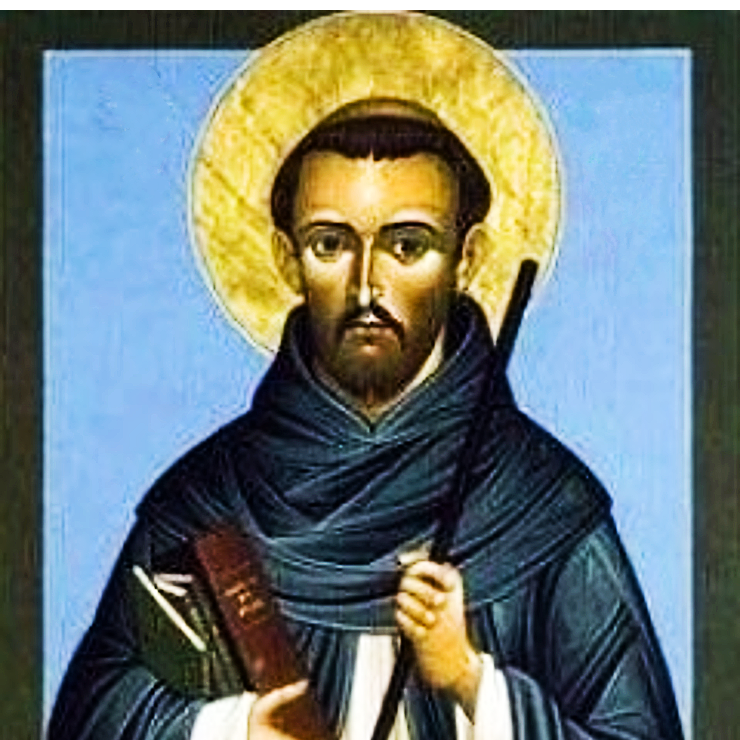
St John Eudes (1601-1680) Confessor, Priest, Missionary, Founder, Preacher, Writer, Mystic, he founded the Congregation of Jesus (The Eudists) and Mary and the Order of Our Lady of Charity and was the Author of the propers for the Mass and Divine Office of the Sacred Hearts of Jesus and Mary. Known as “The Apostle of Two Hearts.” Beatified on 25 April 1909 by Pope Pius X and Canonised on 31 May 1925 by Pope Pius XI. Biography here: https://anastpaul.wordpress.com/2017/08/19/saint-of-the-day-19-august-st-john-eudes-apostle-of-two-hearts/
St Andrew the Tribune St Badulf of Ainay St Bertulf of Luxeuil St Calminius St Credan of Evesham St Donatus of Mount Jura St Elaphius of Châlons St Guenninus Bl Guerricus Bl Hugh Green
Blessed Jordan of Pisa OP (c 1255–1311) Dominican Friar, Theologian, Professor, renowned Preacher, Founder of the Confraternity of the Holy Redeemer at Pisa, Visionary, Marian devotee, promoter and daring innovator of the vernacular Italian language as a ‘church’ language and a tool for evangelisation. On 23 August 1833, Blessed Jordan’s cultus was confirmed by Pope Gregory XVI and in 1838 he was Beatified by Pope Gregory XVI. His Life: https://anastpaul.com/2019/08/19/saint-of-the-day-blessed-jordan-of-pisa-op-c-1255-1311/ St Julius of Rome
St Louis of Toulouse OFM (1274-1297) Prince and Bishop, Neapolitan Prince of the Capetian House of Anjou, Franciscan Friar and Priest, Apostle of Prayer, of Penance and of the poor and the sick. He had received the last sacraments on the Feast of the Assumption of Our Lady and on the 19th of August, 1297, while pronouncing the holy name of Mary, he yielded his soul to God. Because of the many miracles that were wrought at his tomb, he was Canonised as early as 1317, during the lifetime of his mother. Lovely St Louis: https://anastpaul.com/2020/08/19/saint-of-the-day-19-august-saint-louis-of-toulouse-ofm-1274-1297-prince-and-bishop/
St Magnus of Anagni St Magnus of Avignon St Magnus of Cuneo St Marianus of Entreaigues St Marinus of Besalu St Magino of Tarragona St Mochta St Namadia of Marsat St Rufinus of Mantua St Sarah the Matriarch St Sebaldus St Thecla of Caesarea St Timothy of Gaza
Martyrs of Nagasaki – 15 Beati: A group of missionaries and their laymen supporters who were executed for spreading Christianity in Japan. • Antonius Yamada • Bartholomaeus Mohyoe • Iacobus Matsuo Denji • Ioachim Díaz Hirayama • Ioannes Miyazaki Soemon • Ioannes Nagata Matashichi • Ioannes Yago • Laurentius Ikegami Rokusuke • Leo Sukeemon • Ludovic Frarijn • Marcus Takenoshita Shin’emon • Michaël Díaz Hori • Paulus Sankichi • Pedro de Zúñiga • Thomas Koyanagi They were beheaded on 19 August 1622 at Nagasaki, Japan and Beatified on 7 May 1867 by Pope Pius IX.
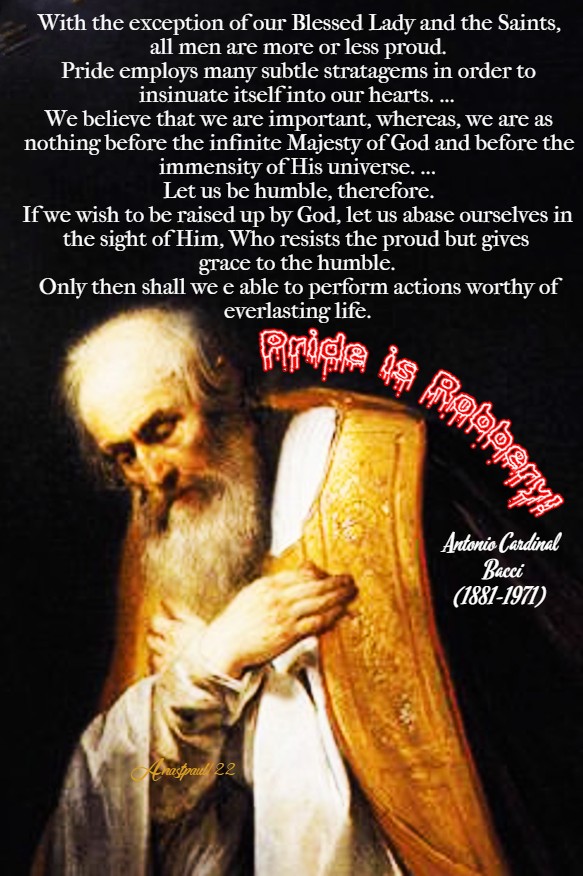
Thought for the Day – 18 August – Meditations with Antonio Cardinal Bacci (1881-1971)
Pride is Robbery!
“With the exception of our Blessed Lady and the Saints, all men are more or less proud. Pride employs many subtle stratagems in order to insinuate itself into our hearts. Very often it does not take the form of an open revolt against God, like tat of Lucifer but expresses itself in a sense of self-complacency which feeds on the praise and adulation of others. We forget that it was God, Who gave us whatever talents we possess. If we have achieved any kind of success or have accomplished anything good in the world, we forget that we have been dependent upon God for our very existence, as well as for our power to act.
We believe that we are important, whereas, we are as nothing before the infinite Majesty of God and before the immensity of His universe.
Let us be humble, therefore. If we wish to be raised up by God, let us abase ourselves in the sight of Him, Who resists the proud but gives grace to the humble. Only then shall we e able to perform actions worthy of everlasting life.”
Quote/s of the Day – 18 August – “The Month of the Immaculate Heart of Mary” – Within the Octave of the Assumption
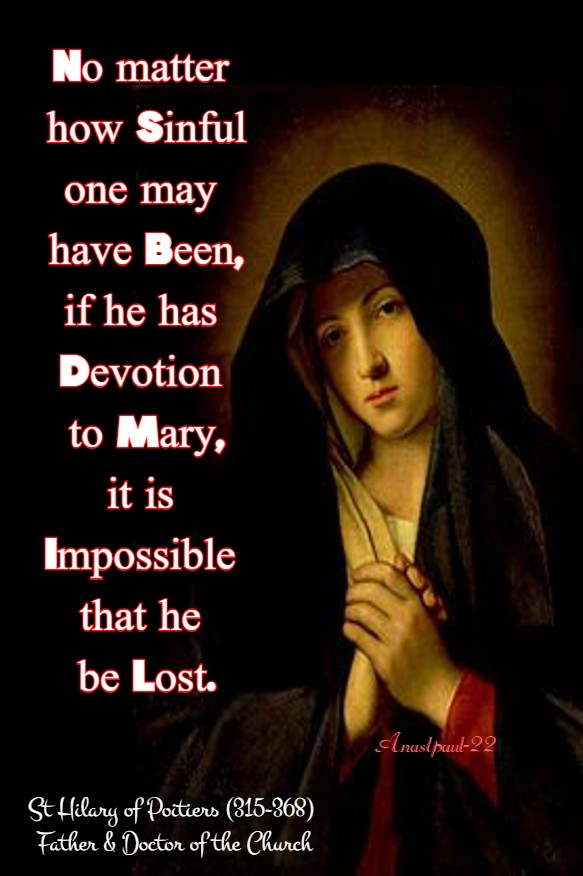
“No matter how sinful one may have been, if he has devotion to Mary, it is impossible that he be lost.”
St Hilary of Poitiers (315-368) Father & Doctor of the Church
“The very fact that God has elected her, proves, that none was ever holier than Mary; if any stain had disfigured her soul, if any other virgin had been purer and holier, God would have selected her and rejected Mary.”
St Jacob of Sarug (c 451-521) Bishop, Theologian, Poet, Writer
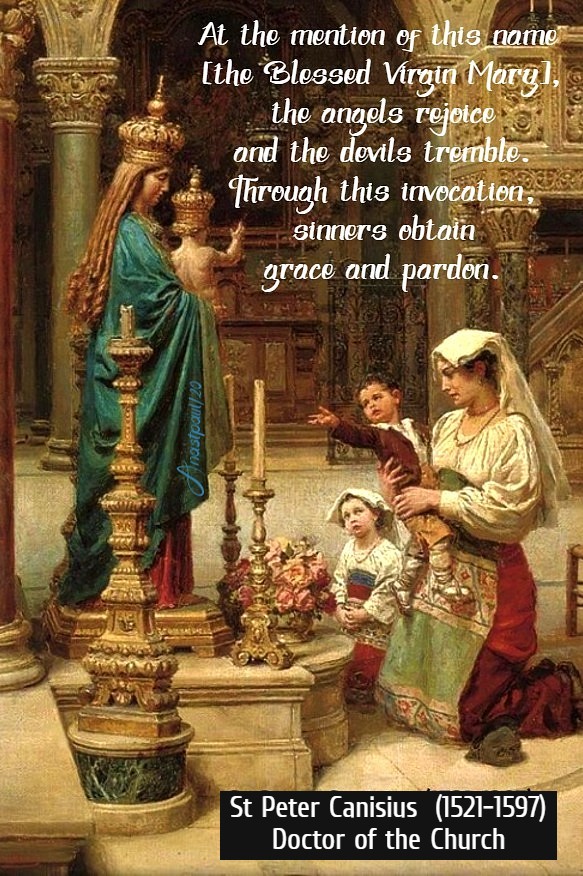
“At the mention of this name [the Blessed Virgin Mary], the Angels rejoice and the devils tremble. Through this invocation, sinners obtain grace and pardon.”
St Peter Canisius SJ (1521-1397) Doctor of the Church
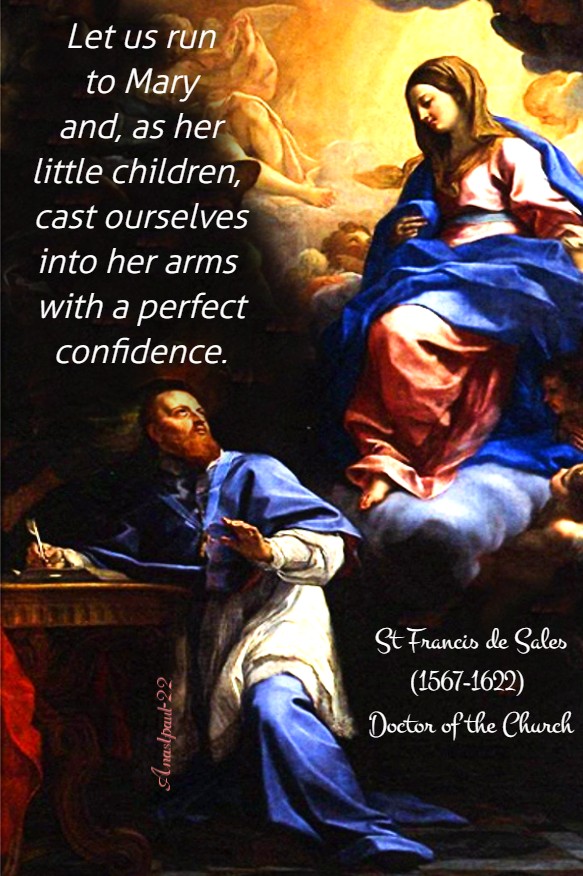
“Let us run to Mary and, as her little children, cast ourselves into her arms with a perfect confidence.”
St Francis de Sales (1567-1622) Doctor of the Church
One Minute Reflection – 18 August – “The Month of the Immaculate Heart of Mary” – Within the Octave of the Assumption – Judith 13:22-25; 13:15; 13:10, Luke 1:41-50
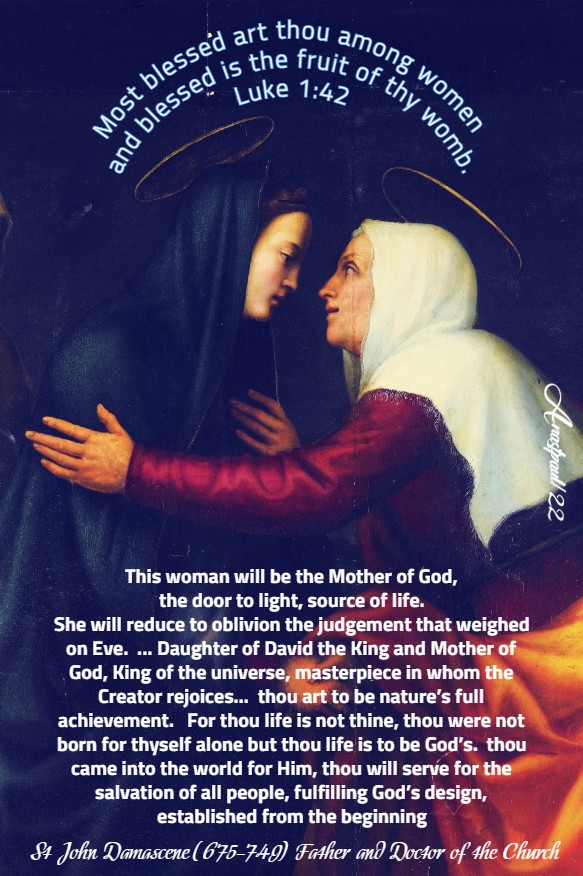
“Most blessed art thou among women and blessed is the fruit of thy womb.” – Luke 1:42
REFLECTION – “This woman will be the Mother of God, the door to light, source of life. She will reduce to oblivion the judgement that weighed on Eve. “The rich among the people seek the face” of this woman, “the kings of the nations shall pay her homage”, they shall “offer gifts”…, yet the glory of the Mother of God is an interior glory: the fruit of her womb.
O woman, so worthy of love, thrice happy, “blessed are thou among women and blessed is the fruit of thy womb.” Daughter of David the king and Mother of God, King of the universe, masterpiece in whom the Creator rejoices… thou art to be nature’s full achievement. For thou life is not thine, thou were not born for thyself alone but thou life is to be God’s. thou came into the world for Him, thou will serve for the salvation of all people, fulfilling God’s design, established from the beginning: the Incarnation of the Word and our own divinisation.Thy whole desire is to feed on the words of God, to be strengthened by their sap, like “a green olive tree in the house of God,” “like a tree planted by running water” thou ary the “tree of life” who “yielded its fruit in due season”…
He who is infinite, limitless, came to dwell in thy womb; God, the child Jesus, was nourished by thy milk. Thou art the ever-virginal doorway of God; thou hands hold thy God; thou lap is a throne raised up above the cherubim… Thou art the wedding chamber of the Spirit, the “city of the living God, gladdened by the runlets of the stream” that is to say, the waves of the Spirit’s gifts. Thou art “all fair, the Beloved” of God.” – St John Damascene (675-749) Monk, Theologian, Father and Doctor of the Church (Sermon on the Nativity of the Virgin 9 ).
PRAYER – O Lord, we beseech Thee, forgive the transgressions of Thy servant, and, forasmuch as by our own deeds we cannot please Thee, may we find safety through the prayers of, the Mother of Thy Son and our Lord.Through the same Jesus Christ, Thy Son our Lord, Who lives and reigns with Thee, in the unity of the Holy Ghost, God, world without end. Amen (Collect).
Our Morning Offering – 18 August – “The Month of the Immaculate Heart of Mary” and the Memorial of St Macarius the Wonder-Worker (Died 850)
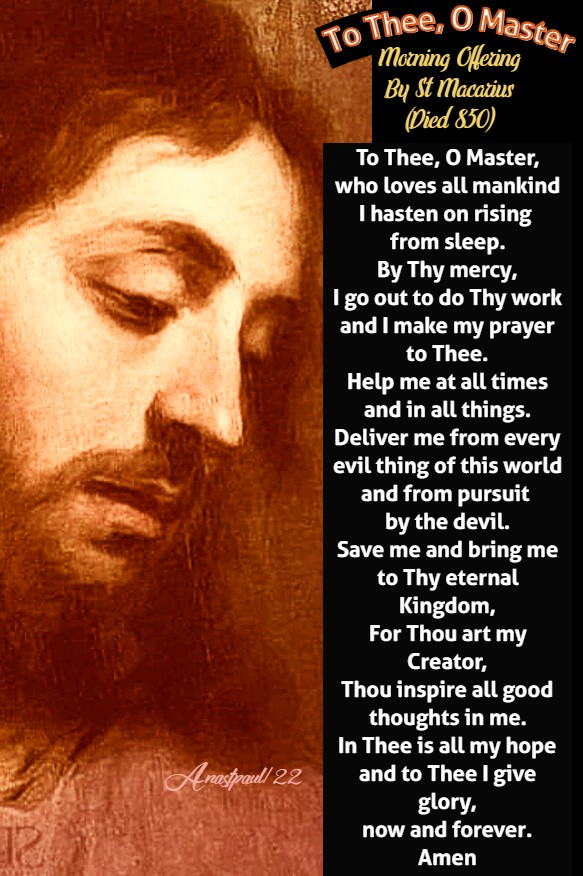
To Thee, O Master Morning Offering By St Macarius the Wonder-Worker (Died 850)
To Thee, O Master, who loves all mankind I hasten on rising from sleep. By Thy mercy, I go out to do Thy work and I make my prayer to Thee. Help me at all times and in all things. Deliver me from every evil thing of this world and from pursuit by the devil. Save me and bring me to Thy eternal Kingdom, For Thou art my Creator, Thou inspire all good thoughts in me. In Thee is all my hope and to Thee I give glory, now and forever. Amen
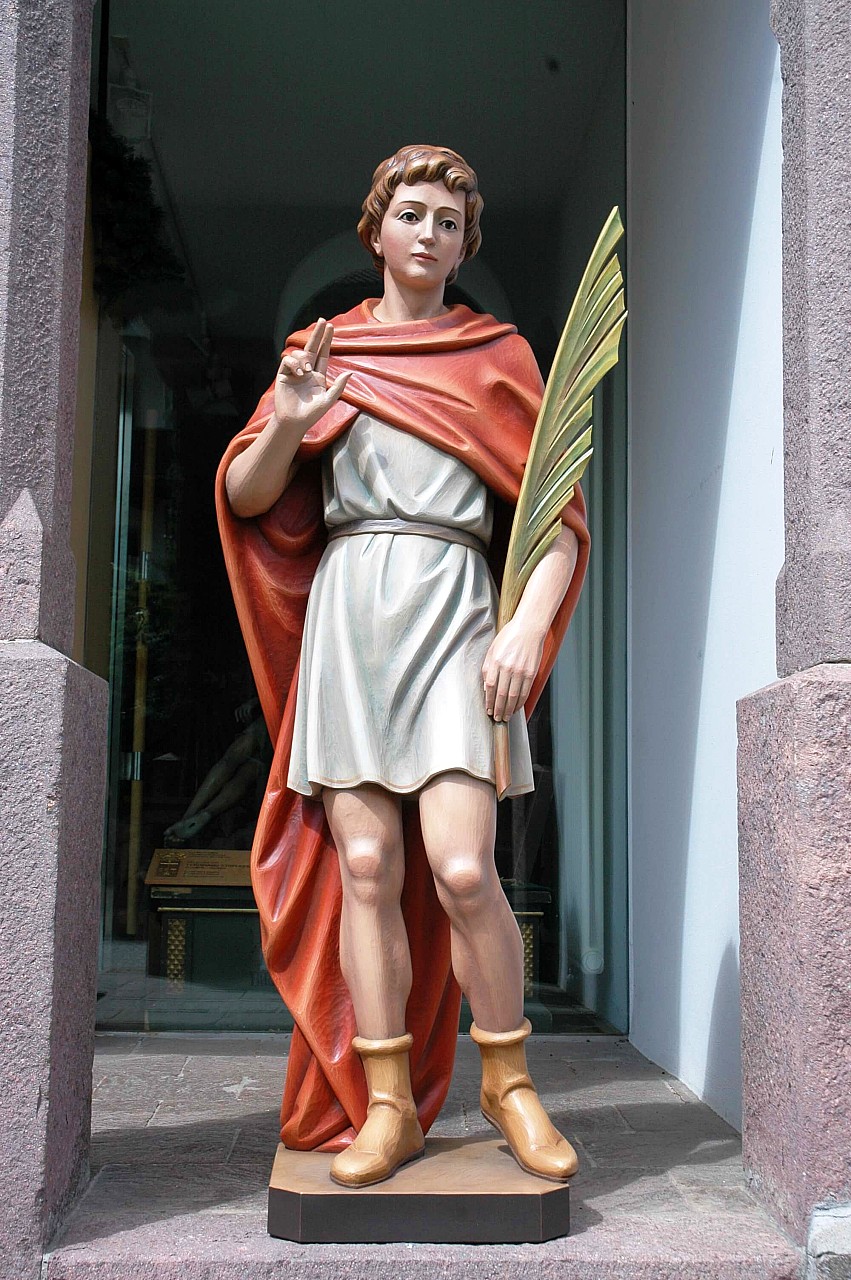
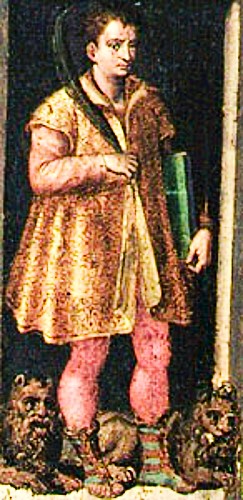
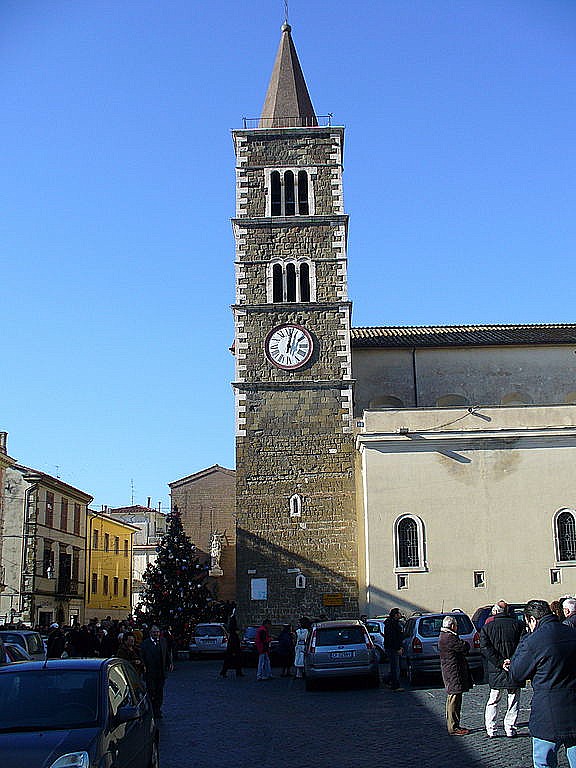
Saint of the Day – 18 August – St Agapitus the Martyr (c 259- c 274) Roman Youth aged 15 Born in c 259 in Palestrina, Italy and died in c 274 by being thrown to wild animals in the arena. When the animals would not touch him, he was beheaded at Palestrina, Italy. Patronages – against colics, Palestrina, Italy. Also known as –
The Roman Martyrology reads: “At Palestina, the birthday of the holy Martyr Agapitus. Although only fifteen years of age, as he was fervent in the love of Christ, he was arrested by order of te Emperor Aurelian and scourged for a long time. Afterwards, under the Prefect Antiochus, he endured more severed torments and, being delivered to the lions by the Emperor’s order without receiving any injury, he was finally struck with the sword and thus, merited his crown.”
Agapitus, was a member of the noble Anicia family of Palestrina, He was condemned to death under the Prefect Antiochus and the Emperor Aurelian, for being a Christian.
Agapitus was but 15 years old, when he was apprehended by the tyrant Aurelian, on account of being a Christian. As he unflinchingly proclaimed his belief in Christ, he was whipped with scourges and then cast into a dungeon, without any food, that he might thus be forced to forsake Christianity.
When Antiochus, the Prefect, found him, at the end of five days, more determined than before, he ordered a live coal to be put upon his head. The brave youth stood immovably under this torture and praising God, said: “A head, which would wear an eternal crown in Heaven, must not hesitate to wear suffering and pain upon earth. Wounds and burns make my head the more worthy to be crowned with eternal glory.”
Antiochus, greatly provoked, ordered them to whip the holy youth till his body became one great wound, after which, they hung him by the feet over a fire, hoping to suffocate him. But they failed for, after a long silence, he addressed the Prefect saying: “Behold, Antiochus, the people will say that all thy ingenuity, all thy wit, ends in smoke.”
Statue of St Agapitus by Marco Antonio Prestinari (c 1605-1607) in Museo del Duomo, Milan
Enraged at this remark, the tyrant had him again cruelly whipped and ordered boiling water to be poured into the open wounds. After this, they knocked all his teeth out and broke his jaws with blows.
The Martyrdom of St Agapitus
But God punished the tyrant for his cruelty; He caused him to fall from his seat and break his neck. Aurelian, hearing of this, ordered the Martyr to be thrown to the wild beasts but, as they refused to touch him, he was finally beheaded. Thus ended the glorious Martyrdom of the holy youth, Agapitus, in around 274.
Agapitus is mentioned in the ancient Martyrologies, including the Martyrologium Hieronymianum of St Jerome, Around the 5th Century, Pope Felix III built a Basilica in his honour on the supposed site of his Martyrdom. His relics were kept in the Basilica and a cemetery grew around it. At some uncertain date, his relics were translated to the present Cathedral of Palestrina, dedicated to him.
Agapitus is honoured in the Tridentine Calendar by a commemoration added to the Mass and canonical hours in the liturgy of the day within the Octave of the Assumption.
St Crispus of Rome St Daig Maccairaill Bl Domenico de Molinar St Eonus of Arles St Ernan St Evan of Ayrshire St Firminus of Metz St Florus of Illyria Bl Francus of Francavilla Bl Gaspar di Salamanca St Hermas of Rome St John of Rome St Juliana of Myra St Juliana of Stobylum St Laurus of Illyria St Leo of Myra Bl Leonard of Cava St Maximus of Illyria Bl Milo of Fontenelle St Polyaenus of Rome St Proculus of Illyria
Blessed Rinaldo of Concorezzo (c 1245 – 1321) Bishop of Vicenza from 1296 until his 1303 appointment as the Archbishop of Ravenna-Cervia holding that until his death, Doctor of Canon Law, Papal envoy, Arbitrator and Peace-maker. Archbishop Rinaldo was also a close friend of Dante Alighieri. His Courageous Life: https://anastpaul.com/2020/08/18/saint-of-the-day-18-august-blessed-rinaldo-of-concorezzo-c-1245-1321/
St Ronan of Iona St Serapion of Rome
Massa Candida: Also known as Martyrs of Utica and the White Company: Three hundred 3rd century Christians at Carthage, who were ordered to burn incense to Jupiter or face death by fire. Martyrs. Saint Augustine of Hippo and the poet Prudentius wrote about them. They were forced to cast themselves into a pit of burning lime c 253 at Carthage, North Africa.
Thought for the Day – 17 August – Meditations with Antonio Cardinal Bacci (1881-1971)
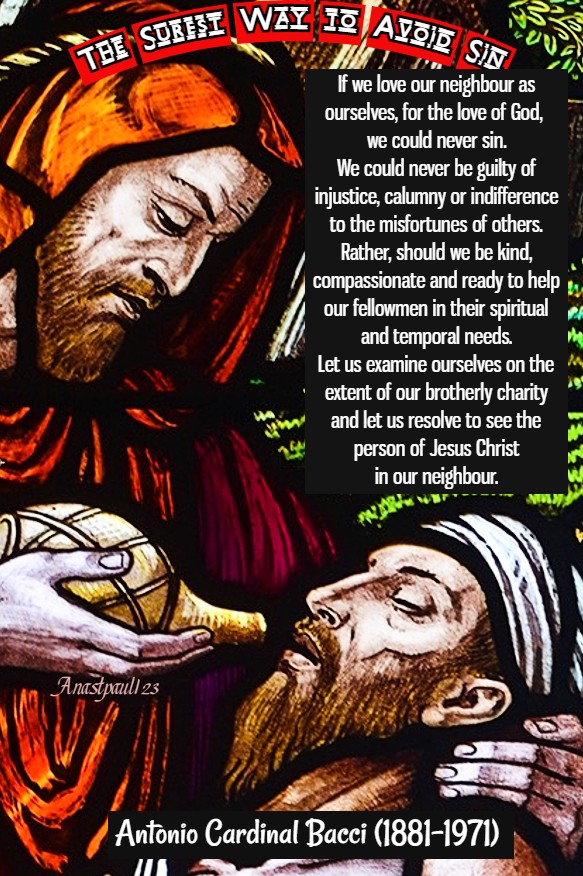
The Surest Way to Avoid Sin
“Another way of making sure that we shall never offend God is to love our neighbour. “Love does no evil to a neighbour” (Rin 13:10) St Paul assures us. We are told that when St John the Apostle was too old to be able to preach long sermons and had to be carried into speak to his flock, he was accustomed to repeat the same brief message: “Little children, love one another.” One day, the faithful, who had grown tired of hearing the same phrase so often, asked him to say something else to them, “But this is God’s command,” St John replied “and if you obey it that will be sufficient,”
If we love our neighbour as ourselves, for the love of God, we could never sin. We could never be guilty of injustice, calumny or indifference to the misfortunes of others. Rather, should we be kind, compassionate and ready to help our fellowmen in their spiritual and temporal needs.
Let us examine ourselves on the extent of our brotherly charity and let us resolve to see the person of Jesus Christ in our neighbour.”
Quote/s of the Day – 17 August – St Hyacinth OP (1185-1257) ) Confessor
For forty years St Hyacinth was devoted solely to the glory of God and the salvation of souls. He has now enjoyed, for more than seven hundred and fifty years, the heavenly joys in recompence for his labours and, he will enjoy them for all eternity. Oh! how richly God rewards the services of His elect!
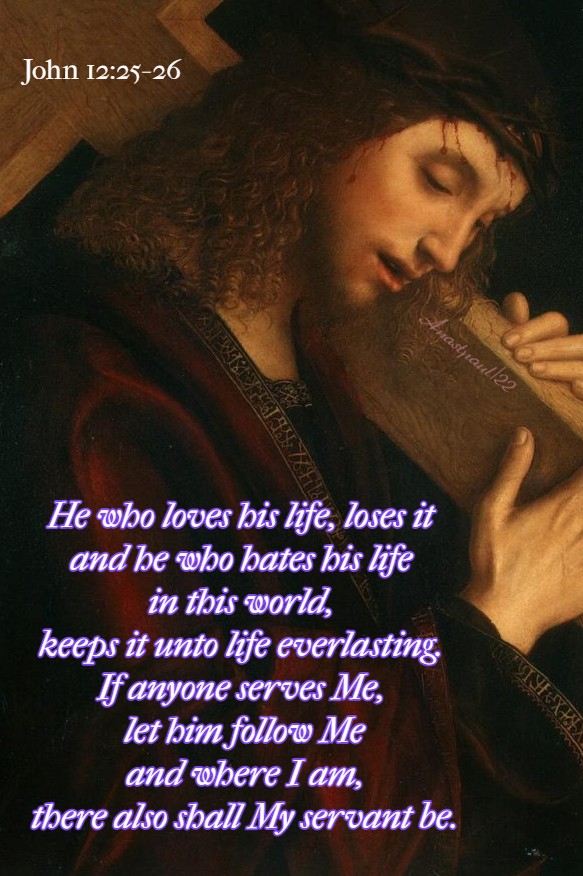
“He who loves his life, loses it and he who hates his life in this world, keeps it unto life everlasting. If anyone serves Me, let him follow Me and where I Am, there also shall My servant be.”
John 12:25-26
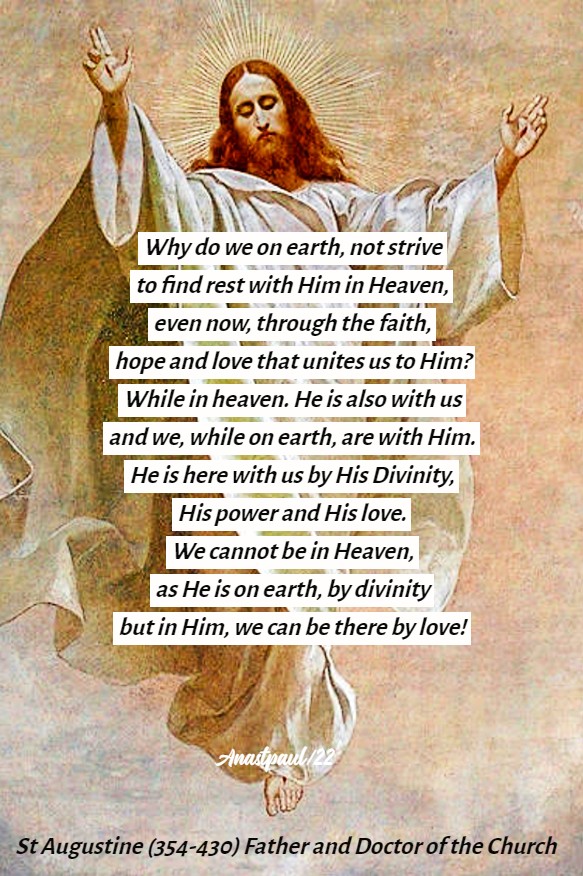
“Why do we on earth, not strive to find rest with Him in Heaven, even now, through the faith, hope and love that unites us to Him? While in Heaven. He is also with us and we, while on earth, are with Him. He is here with us by His Divinity, His power and His love. We cannot be in Heaven, as He is on earth, by divinity but in Him, we can be there by love!”
“That your joy may be full.”
John 16:24
“Such is our Christian life. By desiring Heaven, we exercise the powers of our soul. Now this exercise will be effective, only to the extent that we free ourselves from desires leading to infatuation with this world. Let me return to the example I have already used, of filling an empty container. God means to fill each of you with what is good – so cast out what is bad! If he wishes to fill you with honey and you are full of sour wine, where is the honey to go? The vessel must be emptied of its contents and then, be cleansed. Yes, it must be cleansed, even if you have to work hard and scour it. It must be made fit for the new thing, whatever it may be!”
St Augustine (354-430) Father and Doctor of the Church
“The happiness to which I aspire is greater than anything on earth. Therefore, I regard with extreme joy, whatever pains and sufferings may befall me here.”
One Minute Reflection – 17 August – St Hyacinth OP (1185-1257) ) Confessor – Sirach 31:8-11, Luke 12:35-40
“Let your loins be girt about and your lamps burning and you yourselves ,like men waiting for their master’s return from the wedding; so that when he comes and knocks, they may straightaway open to him. Blessed are those servants whom the master, on his return, shall find watching.” – Luke 12:35-37
REFLECTION –“God, the Word, stirs up the lazy and arouses the sleeper. For indeed, someone who comes knocking at the door is always wanting to come in. But, it depends on us, if He does not always enter or always remain. May your door be open to Him Who comes; open your soul, enlarge your spiritual capacities, that you may discover the riches of simplicity, the treasures of peace and sweetness of grace. Expand your heart, run to meet the Sun of that Eternal Light that “enlightens everyone” (Jn 1,9). It is certain, that this true Light shines for all but, if anyone shuts their windows, then they themselves shut themselves off from this Eternal Light.
So even Christ remains outside, if you shut the door of your soul. It is true that He could enter but He does not want to use force, He does not put those who refuse under pressure. Descended from the Virgin, born from her womb, He shines throughout the universe to give light to all. Those who long to receive the Light, that shines with an everlasting brightness, open up to Him. No night comes to intervene. Indeed, the sun we see each day gives way to night’s darkness but the Sun of justice (Mal 3,20) knows no setting, for Wisdom is not overcome by evil.” – St Ambrose (340-397) Bishop of Milan and Father and Doctor of the Church – (12th Sermon on Psalm 118).
PRAYER – O God, Who gladden us with the annual feast of blessed Hyacinth, Thy Confessor, mercifully grant that, while honouring the anniversary of his death, we may also imitate his deeds. Through Jesus Christ, Thy Son our Lord, Who lives and reigns with Thee, in the unity of the Holy Ghost, God, world without end. Amen (Collect).
Our Morning Offering – 17 August – “The Month of the Immaculate Heart of Mary”
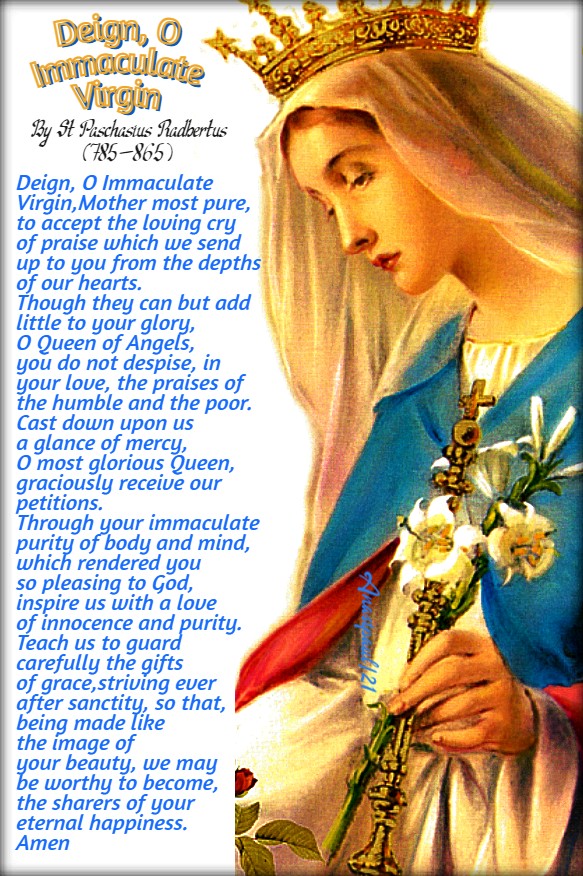
Deign, O Immaculate Virgin By St Paschasius Radbertus (785–865)
Deign, O Immaculate Virgin, Mother most pure, to accept the loving cry of praise which we send up to you from the depths of our hearts. Though they can but add little to your glory, O Queen of Angels, you do not despise, in your love, the praises of the humble and the poor. Cast down upon us a glance of mercy, O most glorious Queen, graciously receive our petitions. Through your immaculate purity of body and mind, which rendered you so pleasing to God, inspire us with a love of innocence and purity. Teach us to guard carefully the gifts of grace, striving ever after sanctity, so that, being made like the image of your beauty, we may be worthy to become, the sharers of your eternal happiness. Amen
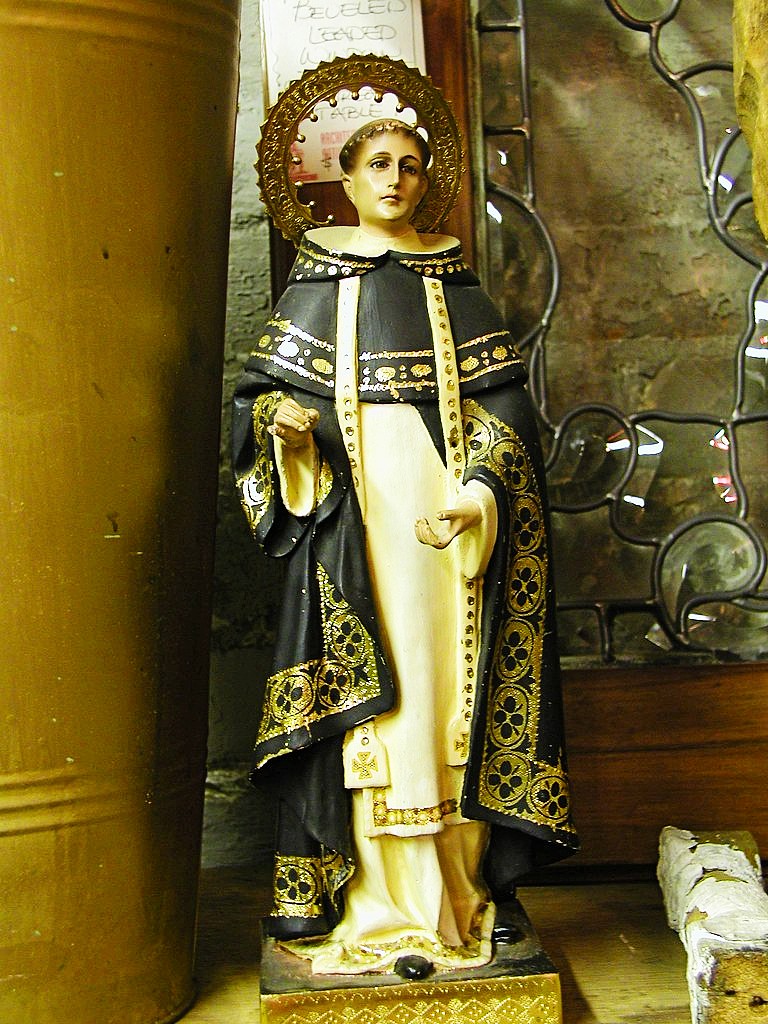
Saint of the Day – 17 August – St Hyacinth OP (1185-1257) ) Confessor, Priest. “Apostle of Poland” and “Apostle of the North” also known as “the Polish St Dominic.
Saint Hyacinth, Confessor By Fr Francis Xavier Weninger SJ (1805-1888)
St Hyacinth, a great ornament of the celebrated Order of Preachers, was born in Poland. He was the son of illustrious parents, who educated him according to the dictates of Christianity. During the years devoted to his studies, he was an example of innocence, piety and industry. His uncle, the Bishop of Cracow, appointed him Canon in his Cathedral, so that he might employ him in the administration of his See. When he left for Rome, on account of troubles at home, he took Hyacinth with him. St Dominic, so celebrated for his apostolic zeal and for the miracles he wrought, was also in Rome at the time. Hyacinth, observing the wonderful zeal and piety of this holy man and of his companions, felt a growing desire to join them. He and three of his fellow-travellers, who had the same inclination, went to St Dominic and begged him to receive them into his newly founded Order. The Saint received them willingly and instructed them how to lead a religious life, to preach in a Christian spirit and to labour successfully for the spiritual welfare of men. After a few months, the holy founder had so thoroughly imbued them with his spirit that he did not hesitate, after they had taken their vows, to send them into their native country, to preach the word of God and promote the salvation of souls.
At Cracow, where Hyacinth had formerly preached, by his edifying life, he now began to preach with words and God gave them such power that he reformed the most hardened sinners, induced others to become more zealous in the service of the Almighty and animated all, to be more solicitous for the salvation of their souls. That all this might have a more solid foundation, he gathered a number of spiritual co-operators about himself and, having instructed them, according to the maxims of St Dominic, he established a Dominican Monastery at Cracow. Hyacinth, who had been chosen Superior by the new members, was an example to all. Besides the prescribed fast-days of his Order, he fasted all Fridays and vigils, on bread and water. The greater part of the night he passed in fervent prayer, before the Blessed Sacrament. He allowed himself only a very short rest on the bare floor and scourged himself severely every night. The whole day was occupied with hearing confessions, preaching, visiting the sick and similar pious exercises.
He had particular devotion to the Blessed Sacrament and to the Blessed Virgin and never undertook anything before offering his work to God and begging the assistance of His Blessed Mother. She appeared to him once, on the eve of the Feast of her Assumption, saying to him: “Be assured, my son, that thou shalt receive everything thou askest from my Son.” The comfort these words afforded the holy man, may be easily imagined. He, however, asked only for what was necessary for the salvation of souls. His own and his companion’s pious labours were all directed to the same end.
When he thought that he had firmly established religious principles and practices among the inhabitants of Cracow and the whole Diocese, he sent his preachers to different places to labour in the same manner. He himself, also left Cracow and it is astonishing, how many Countries he journeyed through, how many Convents he established everywhere for apostolic labourers, how many souls he converted to the true faith or to a more virtuous life. To aid his pious endeavours, God gave him power to work miracles and so great was their number, that he might well be called the Thaumaturgus, or wonder-worker of his age.
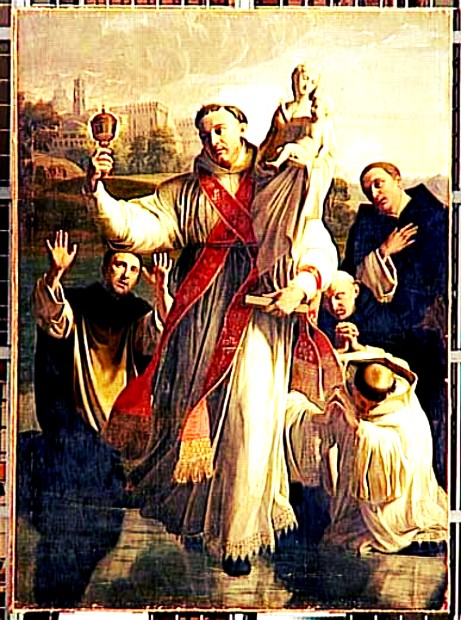
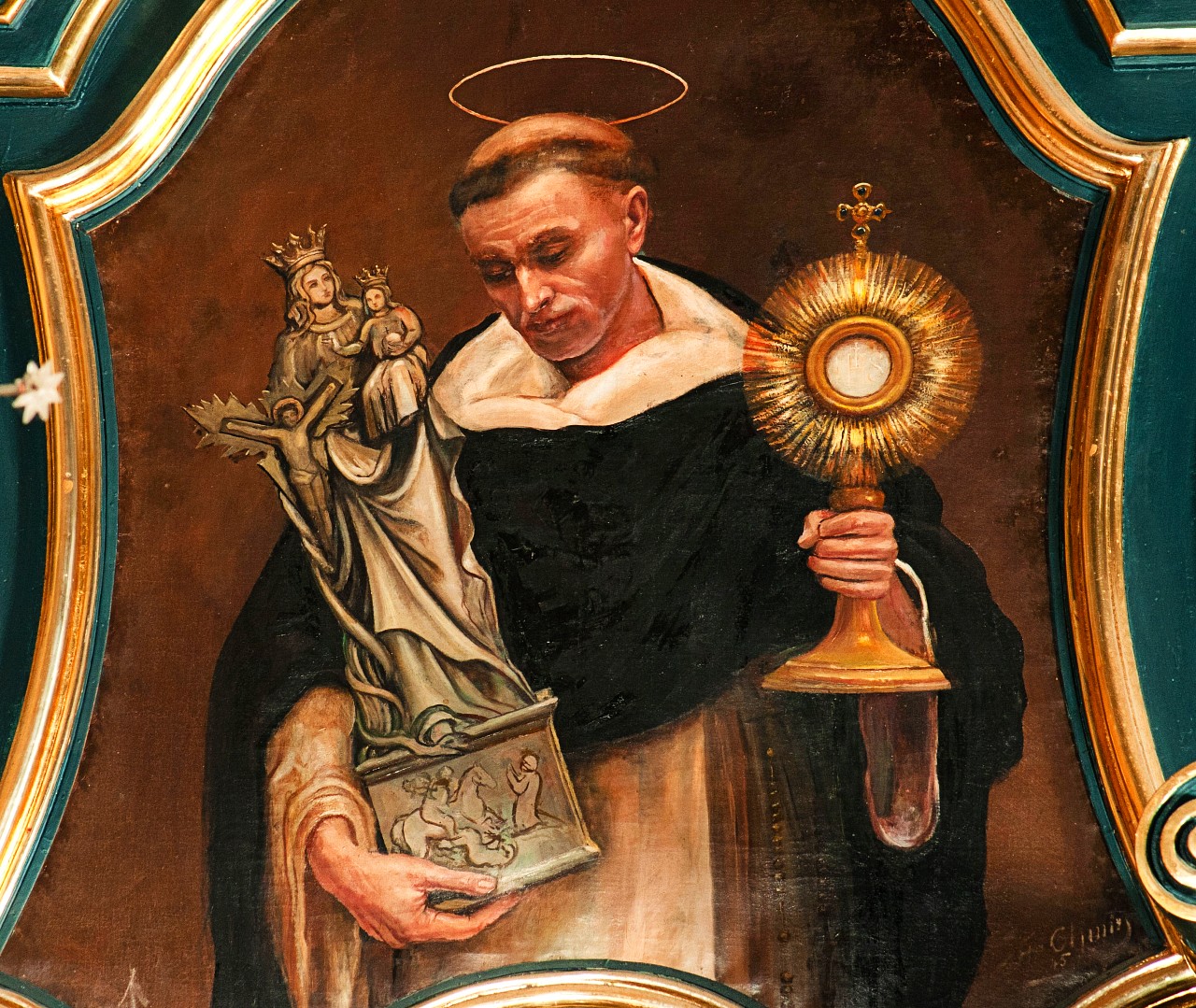
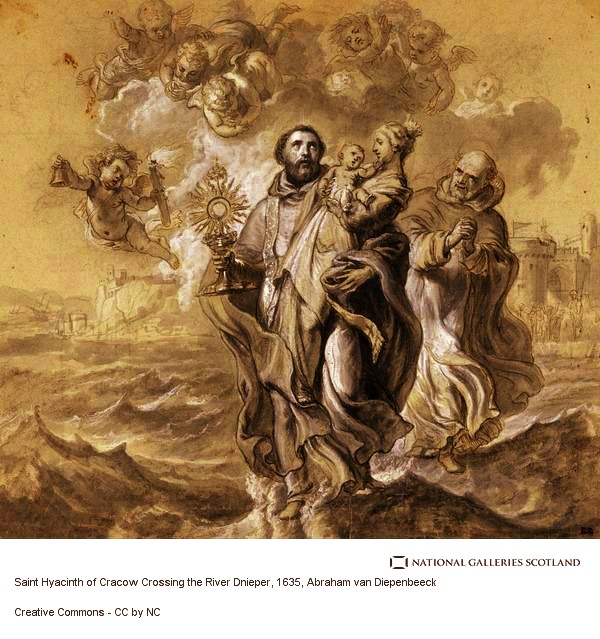
A miraculous event occurred in Russia, when the Tartars stormed Kiow, where the Saint had founded a Church and Convent. He was standing at the Altar when they entered the City, spreading destruction and desolation around them. After finishing the Holy Sacrifice, the Saint, still in his Priestly robes, took the Ciborium containing the Blessed Sacrament and telling his Priests to follow him without fear, he went towards the Church door. When passing a large alabaster statue of the Blessed Virgin, before which he had often said his prayers, he distinctly heard a voice saying: “My son Hyacinth, wilt thou leave me here to be at the mercy of my enemies?” The Saint’s eyes filled with tears. “How can I carry thee? ” said he; “the burden is too heavy.” “Only try,” was the response; “my Son will assist thee to carry me without difficulty.” The holy man with streaming eyes, took the statue and found it so light that he could carry it with one hand. Thus, carrying the Ciborium in one hand and the statue in the other, he and his companions passed through the enemy unassailed, to the gates of the City. Not finding any soldiers there, they passed on and reached Cracow in safety.
Whether Almighty God made His servants invisible to the Tartars on this occasion, or in some other manner prevented them from harming them, is not known but, it is a fact that they left the City unmolested. When they reached the river, over which there was no bridge, nor a boat to convey them across, the Saint, trusting in the power of Him Whom he carried in his right hand and, in the intercession of her whom he held in his left, fearlessly stepped upon the water and crossed it with dry feet.
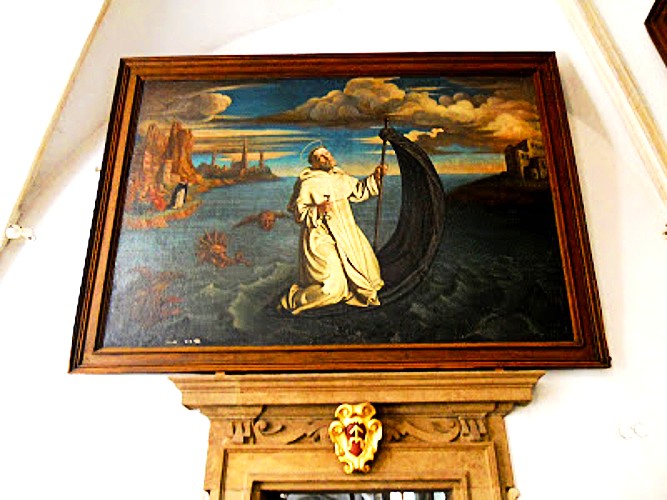
A similar and perhaps, still greater miracle occurred at another time. He was going to Vicegrad to preach but, on reaching the river, found no vessel which he could use to reach the opposite bank. Spreading his cloak on the water, he sat upon it and was floated safely across and brought his companions over in the same manner. By this and many other miracles, God glorified His servant even on earth.
For forty years this holy man had laboured for the salvation of souls, when, in 1257, it was revealed to him that he should assist, in Heaven, at the triumph of the Blessed Virgin, on the Feast of her glorious Assumption. On the Feast of St Mary ad Nives, he was taken ill. On the eve of the Assumption, he gave his last instruction to the Priests of his Order, after which, he prepared for the festival and,, having recited the Office of the day, he fixed his eyes on Heaven and said the psalm, “In thee, O Lord, have I hoped,” to the words, “Into thy hands I commend my spirit,” when he calmly expired, at the age of 74. The innocence and chastity which he possessed at the time of his Baptism, remained unspotted until the end.
After his death, the miracles which the Almighty continued to work through this Saint, were the means of proclaiming to all the world, the sanctity and merits of His blessed servant.
St Amor of Amorbach St Anastasius of Terni St Benedicta of Lorraine St Carloman St Cecilia of Lorraine
St Clare of the Cross of Montefalco (c 1269-1308) Augustinian Nun and Abbess, before becoming a nun, St Clare was a member of the Third Order of St Francis (Secular), Mystic, Penitent, Spiritual adviser. Beatified by Pope Clement XII. On 8 December 1881, the Feast of the Immaculate Conception, Pope Leo XIII Canonised Clare. Her Life: https://anastpaul.com/2019/08/17/saint-of-the-day-17-august-saint-clare-of-the-cross-of-montefalco-c-1269-1308/
St Donatus of Ripacandida St Drithelm St Elias the Younger St Eusebius of Sicily St James the Deacon St Jeroen of Noordwijk St Juliana of Ptolemais St Mamas St Myron of Cyzicus
St Nicolò Politi (1117-1167) Basilian Monk and Hermit. He was known for his miracles even during his childhood and was Venerated as a saint even before his death. St Nicolò was Canonised on 7SJune 1507, at Saint Peter’s Basilica, Rome, by Pope Julius II. About St Nicolò: https://anastpaul.com/2020/08/17/saint-of-the-day-17-august-st-nicolo-politi-1117-1167/
Thought for the Day – August – Meditations with Antonio Cardinal Bacci (1881-1971)
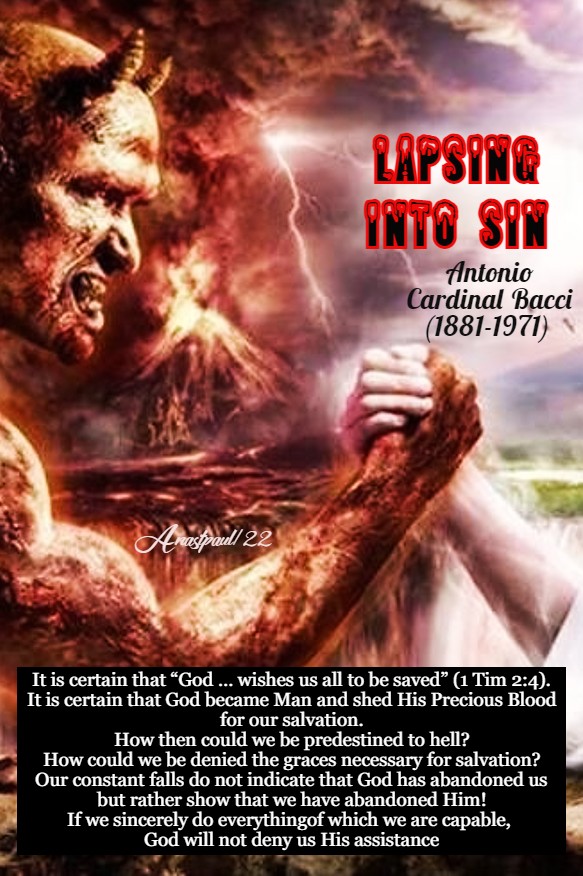
Lapsing into Sin
“When we have spent many years fighting our evil inclinations, praying and forming resolutions, it saddens us when we fall into grave sin once again. A lapse like this can be very discouraging and can make us feel that it is impossible to resist temptation. We may even feel that we are not destined by God to enjoy everlasting happiness! This is a very dangerous temptation which could lead us into ruin. It is part of the tactics of the devil, to tempt us to sin and, when we have fallen, to persuade us that our fall was unavoidable and, that we may as well resign ourselves to sinning because, we are predestined to hell!
Predestination is a gigantic theological problem which has tormented the minds and consciences of many. It is a difficult question but, in practice, it can be answered in a few words. It is certain that “God … wishes us all to be saved” (1 Tim 2:4). It is certain that God became Man and shed His Precious Blood for our salvation. How then could we be predestined to hell? How could we be denied the graces necessary for salvation? Our constant falls do not indicate that God has abandoned us but rather show that we have abandoned Him! If we sincerely do everythingof which we are capable, God will not deny us His assistance.”
Quote/s of the Day – 16 August – “The Month of the Immaculate Heart of Mary”
Mary, Mother of Grace St Athanasius (297-373) Father & Doctor of the Church
It becomes you to be mindful of us, as you stand near Him who granted you all graces, for you are the Mother of God and our Queen. Help us for the sake of the King, the Lord God and Master, Who was born of you. For this reason, you are called full of grace. Remember us, most holy Virgin, and bestow on us gifts from the riches of your graces, Virgin full of graces. Amen
“Go to Mary and sing her praises and you will be enlightened. For it is through her, that the true Light shines on the sea of this life.”
St Ildephonsus (607-670)
“… The design of the Redeemer of our race was to bring about a birth and, as it were, a new creation to replace the one that went before. Therefore, just as in Paradise, He had taken a little clay out of the pure and spotless earth, to fashion the first Adam (Gn 2,7), so, at the moment of bringing about His Own Incarnation, He made use of another earth, so to speak, namely, this Pure and Immaculate Virgin, chosen from among all other beings He had created. It is in her that He, Adam’s Creator, has remade us in our very substance and become a new Adam (1Cor 15,45) that the old might be saved by the new and eternal.”
One Minute Reflection – 16 August – “The Month of the Immaculate Heart of Mary” – St Joachim, Father of the Blessed Virgin Mary – Ecclesiasticus 31:8-11, Matthew1:1-16
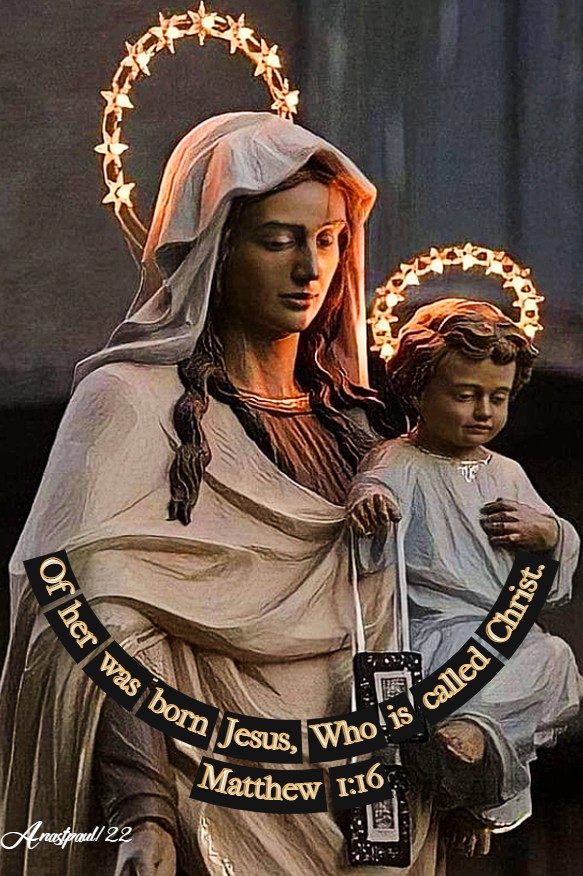
“And Jacob begot Joseph, the husband of Mary and of her was born Jesus, Who is called Christ.” – Matthew 1:16
REFLECTION – “Let all creation celebrate and sing the holy childbirth of a holy woman, for she has brought a lasting treasure into the world. … Through her, the creative Word of God has been united to the whole creation and we celebrate the ending of human barrenness, the ending of the sickness that kept us from possessing all our good. … Nature has given way to grace … As the Virgin Mother of God had to be born of barren Anna, so nature remained without fruit until grace had produced its own. It was to open the womb of its mother, she who would give birth to “The Firstborn of all creation” in whom “all things hold together” (Col 1:15,17).
O blessed couple, Joachim and Anna! All creation owes you thanks; through you it has offered the Creator the best of all His gifts: a Mother worthy of veneration, the only Mother worthy of the One who created her. ”- St John Damascene (675-749) Monk, Theologian, Father and Doctor of the Church – Homily on the Nativity of the Virgin Mary, 1-2 (cf SC 80, p. 48).
PRAYER – O God, Who, willed St Joachim to be the father of Thy Son’s Mother; grant, we beseech Thee that we may ever enjoy the spiritual help of him whose feast we celebrate. Through the same Jesus Christ, Thy Son our Lord, Who lives and reigns with Thee, in the unity of the Holy Ghost, God, world without end. Amen (Collect).
Our Morning Offering – 16 August – “The Month of the Immaculate Heart of Mary”
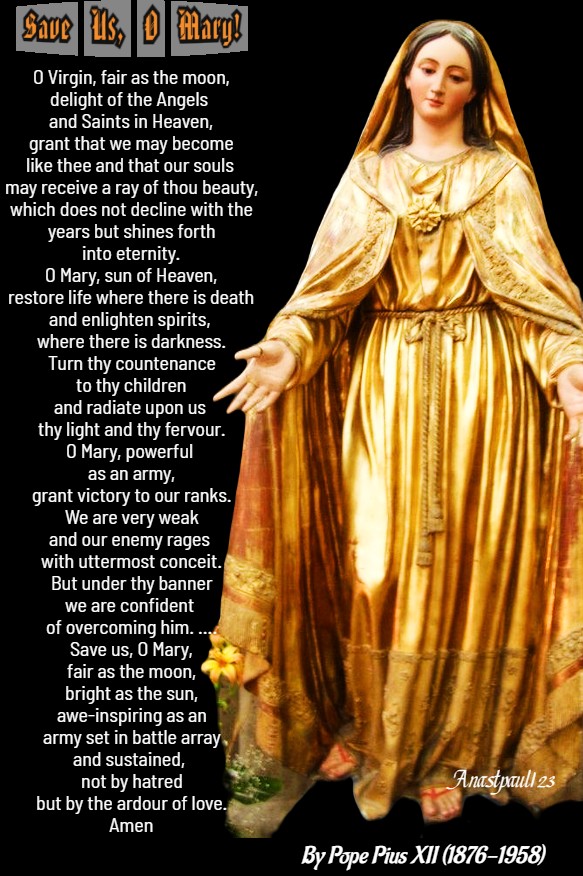
Save Us, O Mary! By Pope Pius XII (1876-1958) (Pontiff 1939-1958)
O Virgin, fair as the moon, delight of the Angels and Saints in Heaven, grant that we may become like thee and that our souls may receive a ray of thou beauty, which does not decline with the years but shines forth into eternity. O Mary, sun of Heaven, restore life where there is death and enlighten spirits, where there is darkness. Turn thy countenance to thy children and radiate upon us thy light and thy fervour. O Mary, powerful as an army, grant victory to our ranks. We are very weak and our enemy rages with uttermost conceit. But under thy banner we are confident of overcoming him. …. Save us, O Mary, fair as the moon, bright as the sun, awe-inspiring as an army set in battle array and sustained, not by hatred but by the ardour of love. Amen
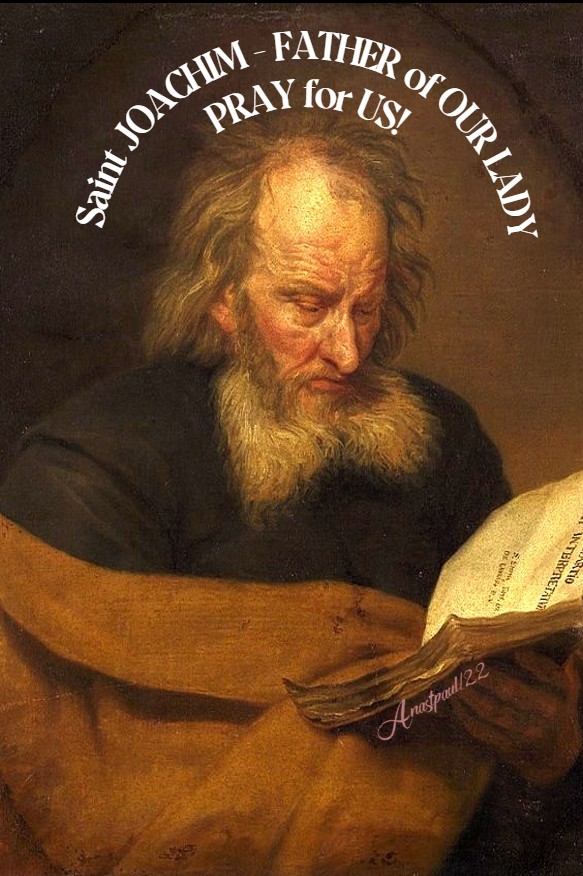
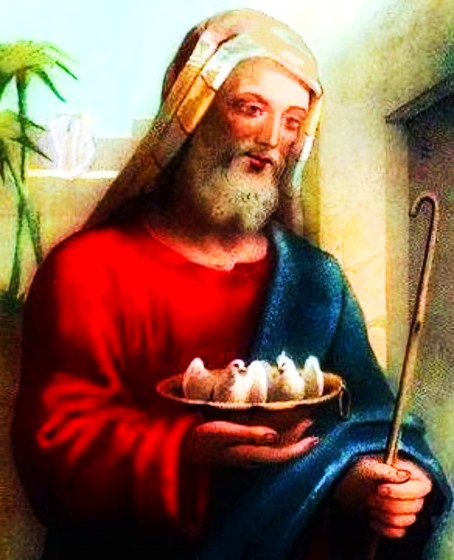
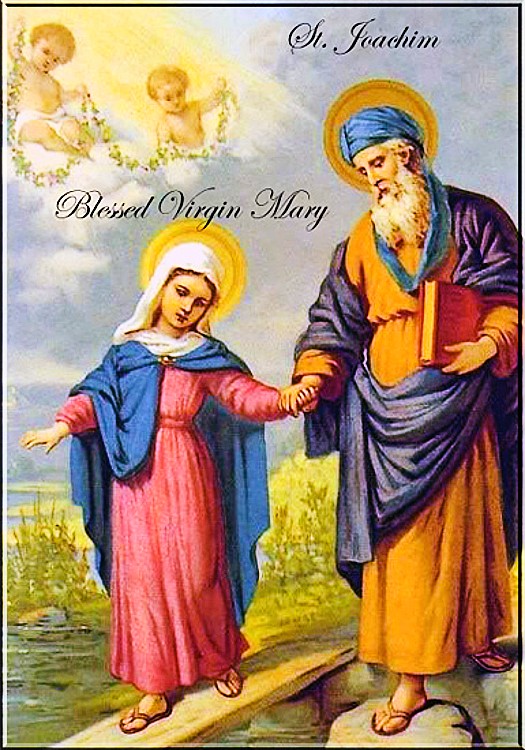
Saint of the Day – 16 August – St Joachim, Father of the Blessed Virgin Mary. St Joachim is regarded as the Father of the Virgin Mary, Mother of God, our Lord Jesus and Saviour. St Joachim was a retired Priest or Holy man of his time. He is the Patron Saint of Fathers, Grandfathers, Grandparents, Married Couples, Cabinet Makers, Puerto Rico, Dolores, Eastern Samar; Fasnia (Tenerife). The name Joachim in Hebrew means, “God Prepares.”
At the temple, Joachim’s sacrifice was rejected, as the couple’s childlessness was interpreted as a sign of Divine displeasure. Joachim consequently withdrew to the desert, where he fasted and did penance and prayed for 40 days. Angels then appeared to both Joachim and Anne to promise them a child.
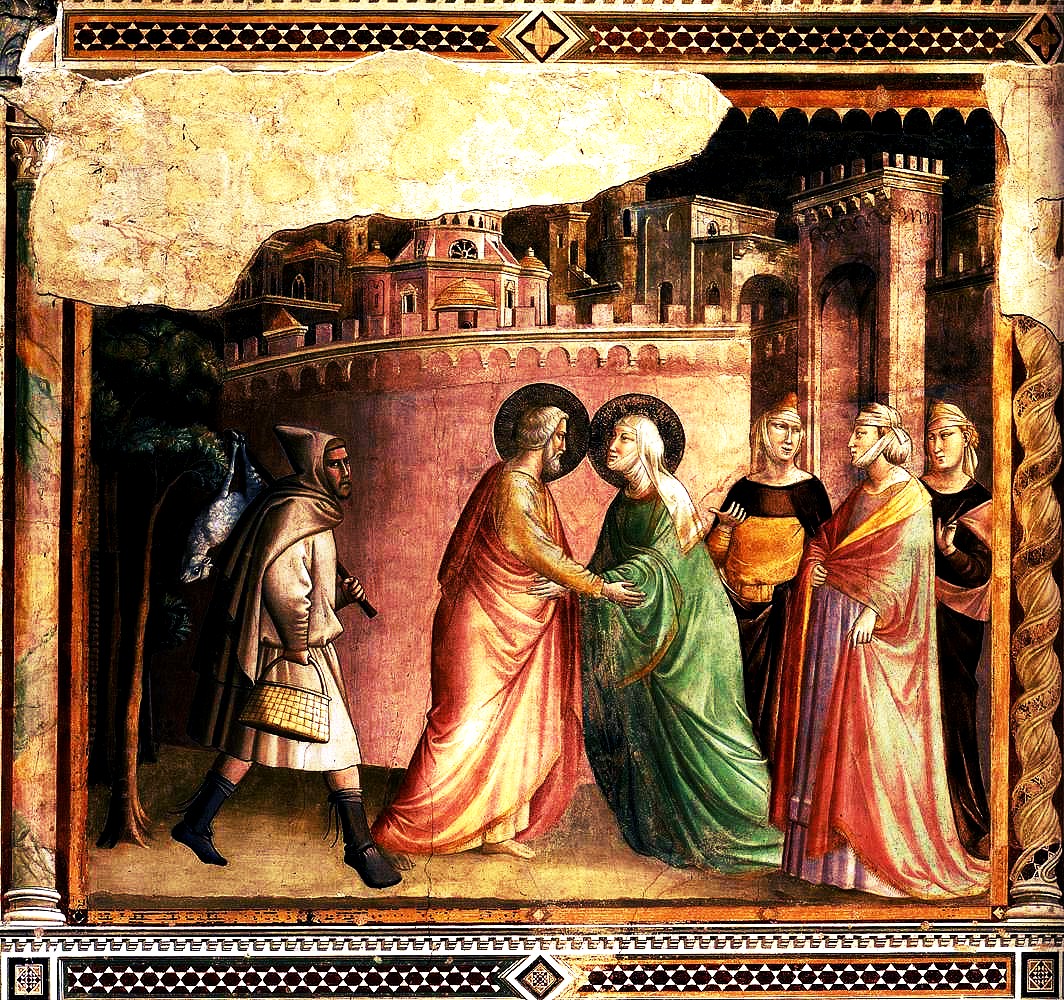
Joachim returned to Jerusalem and embraced Anne at the City gate, located in the Walls of Jerusalem. An ancient belief held that a child born of an elderly mother who had given up hope of having offspring was destined for great things. It is also tradition that Joachim would give Mary to the service of the Temple when the girl was only three years old.
Joachim is neither mentioned in historical or canonical writings but is still widely revered and is the namesake of many Church institutions. The only source of information regarding St Joachim, is the non-biblical Gospel of James, an apocryphal book that was, nonetheless, widely read.
St Joachim meets St Anne at the City Gate
In the 1500 – 1600’s, Joachim’s image appeared on many European coins ,including , in about 1520, the famous Joachim’s Taler, a silver coin in Bohemia. Some of those coins are still seen today, in the hands of collectors.
We know St Joachim as the Father of Our Lady. Although little is actually known about this Saint, one can imagine the love he had for his child, who came late in life to he and St Anne. The tradition tells us he was a Priest or Holy man of God and much can be taken from that. We too, may not always know what God may have in store for us – but one thing is certain, if we stay close to God, serve Him with all our strength, we too can merit life eternal, like St Joachim.
Blessed Angelo Agostini Mazzinghi O.Carm. (1385-1438) was an Italian Priest and a professed member of the Carmelite Order. He was a noted Preacher, Prior and Reformer, Teacher of theology and was known for his pious devotion to the Holy Eucharist, the Blessed Virgin Mary and the Carmelite Rule of Life and to the profession of the Gospel. His Life: https://anastpaul.com/2019/08/16/saint-of-the-day-16-august-blessed-angelo-agostini-mazzinghi-o-carm-1385-1438/
St Arsacius of Nicomedia St Frambaldo Bl Iacobus Bunzo Gengoro Bl Jean-Baptiste Menestrel Bl John of Saint Martha Bl Laurence Loricatus Bl Magdalena Kiyota Bokusai Bl Maria Gengoro Bl Ralph de la Futaye St Serena Bl Simon Kiyota Bokusai Bl Thomas Gengoro St Titus the Deacon
St Ugolina of Vercelli (c 1239-c 1300) Anchorite, Recluse, Penitent, Spiritual advisor. The very strange story that of this Blessed Ugolina who shut herself in a hermitage, representing herself as a man and remained there for forty-seven years! The aim of her subterfuge was to escape the aims of her father, who wished her to marry. In order not to reveal her secret, she called herself Ugo without revealing her identity to anyone. for nearly fifty years Her Life: https://anastpaul.com/2021/08/16/saint-of-the-day-16-august-saint-ugolina-of-vercelli-c-1239-c-1300/
Martyrs of Palestine – 33 Saints: Thirty-three Christians Martyred in Palestine; they are commemorated in old martyrologies but the date and exact location have been lost.
Thought for the Day – 15 August – Meditations with Antonio Cardinal Bacci (1881-1971)
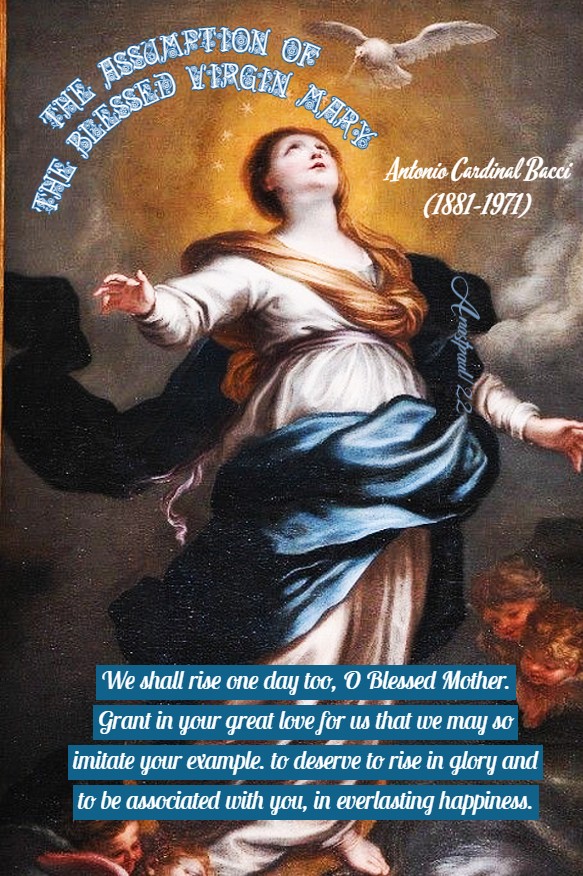
The Assumption of the Blessed Virgin Mary
“Even as Christ, by His Own Power, rose from the grave, so, by reason of His intervention, the soul of Mary was re-united, after a short separation, with her body and she was taken up, body and soul into everlasting glory. It was fitting that this privilege should have been bestowed upon the Mother of God. It would have been unbecoming for the Immaculate flesh , in which the Divine Body of Jesus was formed, to have been allowed to corrupt in the grave. It was fitting too that she, who was to be proclaimed Queen of Angels and of men, should have come immediately to her throne of glory, with her humanity integral and unimpaired. Her resurrection was, moreover, the reward of her virginal purity. From the first moment of her conception, she was preserved free from Original Sin and from every evil inclination and, throughout her life, she advanced, further and further, in the way of perfection.
We shall rise one day too, O Blessed Mother. Grant in your great love for us that we may so imitate your example. to deserve to rise in glory and to be associated with you, in everlasting happiness.”
Quote/s of the Day – 15 August –“The Month of the Immaculate Heart of Mary” – The Assumption
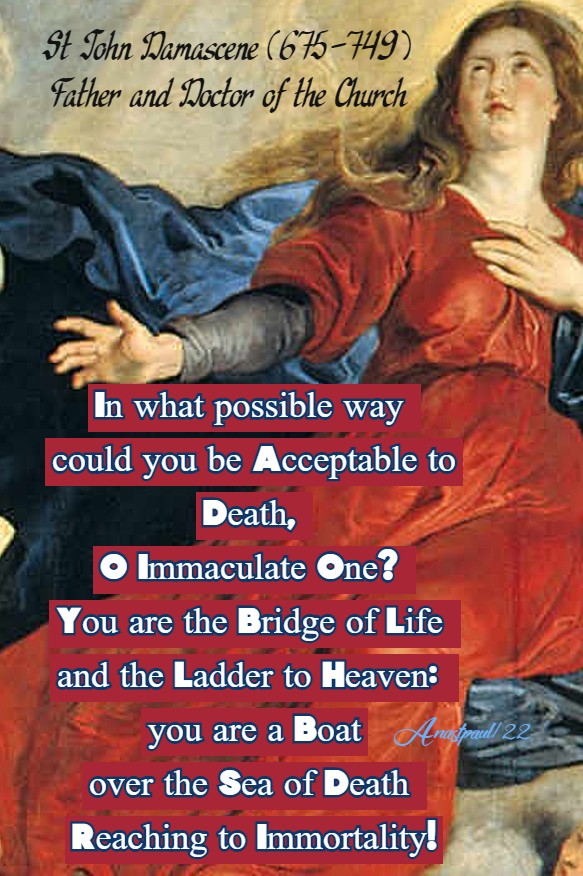
“In what possible way could you be acceptable to death, O Immaculate one? You are the bridge of life and the Ladder to Heaven: you are a boat over the sea of death reaching to immortality!”
St John Damascene (675-749) Father and Doctor of the Church
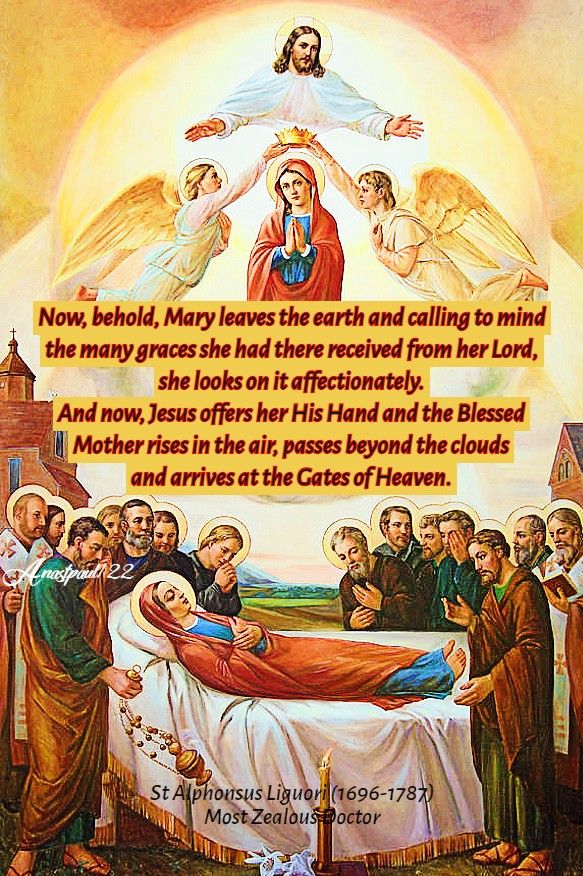
“Now, behold, Mary leaves the earth and calling to mind the many graces she had there received from her Lord, she looks on it affectionately. And now, Jesus offers her His Hand and the Blessed Mother rises in the air, passes beyond the clouds and arrives at the Gates of Heaven.”
St Alphonsus Liguori (1696-1787) Most Zealous Doctor
One Minute Reflection – 15 August – The Assumption of the Blessed Virgin Mary – Judith 13:22-25; 15:10, Luke 1:41-50
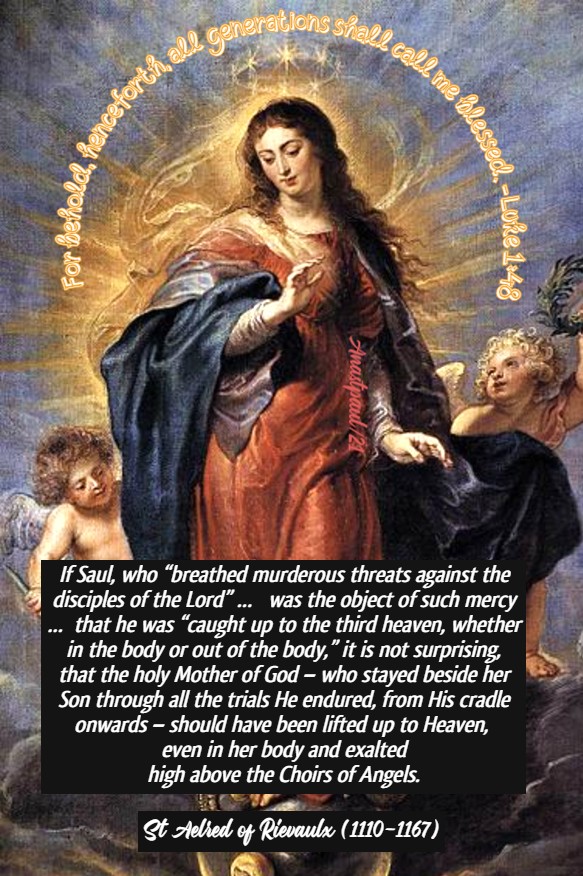
“For behold, henceforth, all generations shall call me blessed.” – Luke 1:48
REFLECTION – “If Saint Mary Magdalene – who had been a sinner and from whom the Lord had cast out seven demons – merited to be glorified by him to the extent that her praise abides forever among the assembly of the saints, who can measure the extent to which “the upright rejoice and dance for joy in the presence of the Lord” with regard to holy Mary, who knew not man? … If the Apostle Peter, – who was not only unable to watch for one hour with Christ but, who even went so far as to deny him, – afterwards won such favour that the keys of the Kingdom of Heaven were entrusted to him, of what praises is holy Mary not worthy, who bore the King of Angels Himself in her womb, He Whom the Heavens cannot contain? If Saul, who “breathed murderous threats against the disciples of the Lord” … was the object of such mercy … that he was “caught up to the third heaven, whether in the body or out of the body,” it is not surprising, that the holy Mother of God – who stayed beside her Son through all the trials He endured, from His cradle onwards – should have been lifted up to Heaven, even in her body and exalted high above the Choirs of Angels.
If there is “joy in heaven before the angels over one sinner who repents”, who can tell what joyful and lovely praises rise up before God, concerning Holy Mary who never sinned? … Indeed, if those who “once were darkness” and have now become “light in the Lord” “will shine like the sun in the kingdom of their Father,” who is able to tell “the eternal weight of glory” of Holy Mary, who came into the world “like dawn arising, beautiful as the moon, resplendent as the sun” and of whom was born “the true light which enlightens everyone coming into the world?” Moreover, since our Lord said: “Whoever serves me must follow me and where I am, there will my servant also be,” where do we think His Mother must be, who served Him with such eagerness and fidelity? If she followed Him and obeyed Him, even to death, no-one can wonder, that now, more than anyone else, she “follows the Lamb wherever he goes.” – St Aelred of Rievaulx (1110-1167) – Cistercian Monk – 2nd sermon for the Assumption
PRAYER – Almighty, everlasting God, Who took up, body and soul, the Immaculate Virgin Mary, Mother of Thy Son, into heavenly glory, grant, we beseech Thee, that, always devoting ourselves to heavenly things, we may be found worthy to share in her glory. Through Jesus Christ, Thy Son our Lord, Who lives and reigns with Thee, in the unity of the Holy Ghost, God, world without end. Amen (Collect).
Our Morning Offering – 15 August – The Assumption of the Blessed Virgin Mary
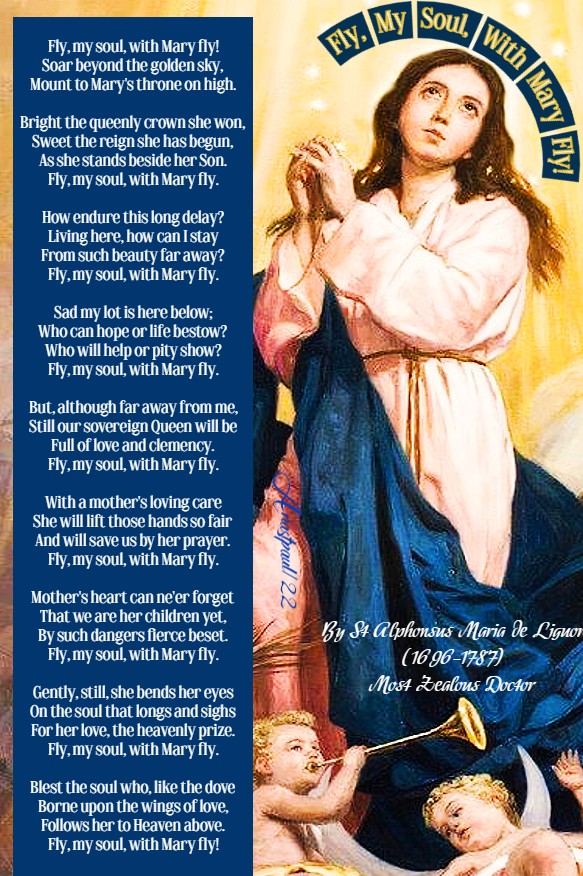
Fly, My Soul, with Mary Fly! By St Alphonsus Maria de Liguori (1696-1787) Most Zealous Doctor (From “The Glories of Mary” Trans. Redemptoris Fathers, 1931)
Fly, my soul, with Mary fly! Soar beyond the golden sky, Mount to Mary’s throne on high.
Bright the queenly crown she won, Sweet the reign she has begun, As she stands beside her Son. Fly, my soul, with Mary fly.
How endure this long delay? Living here, how can I stay From such beauty far away? Fly, my soul, with Mary fly.
Sad my lot is here below; Who can hope or life bestow? Who will help or pity show? Fly, my soul, with Mary fly.
But, although far away from me, Still our sovereign Queen will be Full of love and clemency. Fly, my soul, with Mary fly.
With a mother’s loving care She will lift those hands so fair And will save us by her prayer. Fly, my soul, with Mary fly.
Mother’s heart can ne’er forget That we are her children yet, By such dangers fierce beset. Fly, my soul, with Mary fly.
Gently, still, she bends her eyes On the soul that longs and sighs For her love, the heavenly prize. Fly, my soul, with Mary fly.
Blest the soul who, like the dove Borne upon the wings of love, Follows her to Heaven above. Fly, my soul, with Mary fly!
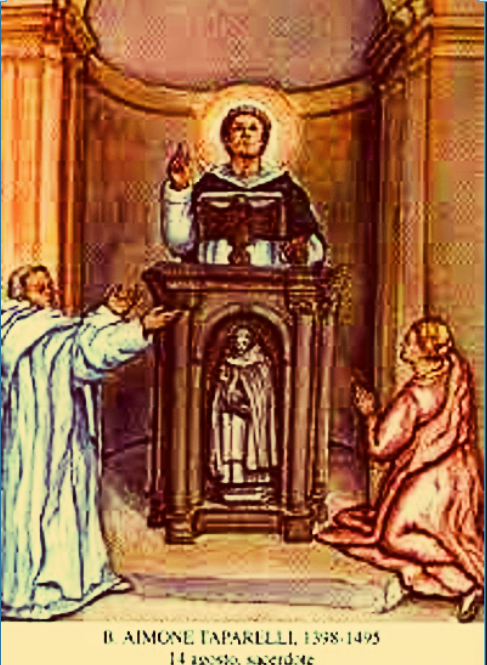
Saint of the Day – 15 August – Blessed Aimo Taparelli OP (c 1395-1495) Priest and Friar of the Order of Preachers, widower and father, Reformer., spiritual writer. He served as an Inquisitor-General for his order in the Lombard and Liguria regions of Italy and became a travelling preacher in northern Italian Cities. Born in c 1395 at Savigliano, Piedmont, Italy and died on 15 August 1495 (aged 100 years) at Savigliano, Piedmont of natural causes. Also known as – Aimone Taparelli, Haymo Taparelli, Elmo. Additional Memorial – 17 August, in Savigliano of which Town Aimo is the Patron. His name means “defends the house with the sword.” Aimo was Beatified on 29 May 1856 by Pope Pius IX.
The Roman Martyrology reads today: “In Savigliano in Piedmont, Blessed Aimone Taparelli, Priest of the Order of Preachers, tireless defender of the truth.”
Aimo was born around 1395 in Savigliano to nobles who were the Counts of Lagnasco. The Tapparelli, one of the oldest families of Savigliano, boasted illustrious Ecclesiastics over the centuries.
Aimo first pursued a career in law and was married and a father. But soon became a widower, mourning both the death of his wife and his children. Aimo felt the call to the religious life instead.
He felt the call to the religious life and to this end he studied at Turin, graduating in Theology and Sacred Scripture. Embracing complete self-denial, he entered the Order of Preachers at Savigliano in 1441 at the San Domenico Convent.
From his earliest years, he engaged in an intense apostolate. He was a worthy son of St Dominic, for the effectiveness of his sermons and for the austerity of his life. When the clear fame of his virtues reached the Savoy Court, Duke Amedeo IX wanted him to be his Chaplain and Confessor. He was then appointed Professor at the University of Turin (lecturer in Theology).
He returned to Savigliano and was appointed as the Inquisitor-General for his Order in the Lombard and Ligurian regions. He was appointed as such to replace the murdered Fr Bartolomeo Cerveri. He carried out this delicate task with care and tireless preservation of the Catholic faith, strengthened by the example of his previous confreres in this role, who had suffered martyrdom in carrying out this mission. In the case of Blessed Antonio Pavoni (1325-1374), he personally organised his honourable burial .
In 1468 he became Superior of his Convent and then Prior of it in 1483. He was confirmed twice as the Inquisitor-General in 1483 and in 1489 and finally, Aimo was appointed as the Provincial Vicar. As he defended the values of Catholicism, his zeal in restoring and confirming discipline within the Order was equal, so much so that he is remembered among the most ardent reformers of the fifteenth century.
However, he also loved solitude and when he could, he retired to a small hermitage in Verzuolo, where there was a Chapel dedicated to St Cristina, 5 kilometers from his Convent.
Aimo composed various religious writings and promoted the cult of the Mother of God, towards whom,he always nourished deep devotion.
In 1495 at almost 100 years old, Aimo predicted his death. A pious legend tells that the Angels warned him that it would take place on the Feast of the glorious Assumption of the Virgin. In bed, reciting the Office, he pressed the Crucifix to his heart and, having received the Sacraments, he expired saying “To serve God is to reign.”
The Friars in choir, read the introit of the solemn Mass. With difficulty they removed the Crucifix from his hands while a crowd had already gathered at the Convent.
Aimo was buried in the choir, in a new tomb, where the faithful, who soon wanted his relics, could go to pray. Some brought wax tablets as ex-votos. Two extraordinary miracles are well remembered – the healing of a woman’s mother from cancer and the conception of a child, in old age, of a couple believed to be sterile. They were from the Genola family and the newborn, who was given the name Aimo, would become an illustrious scholar.
At the beginning of the 19th century his remains were brought to St Domenic Church in Turin. Pope Pius IX, on 29 May 1856, approved the cult, setting its memorial of the Blessed Aimo for 17 August, which date is still honoured in Savigliano.
St Alypius of Thagaste (Died 430) Bishop Bishop of the See of Thagaste (in what is now Algeria) in 394, Confessor, Reformer, Defender of the Faith against heresy, Lawyer, teacher, spiritual advisor. He was a lifelong disciple and friend of Saint Augustine of Hippo and joined him in his conversion (in 386; Confessions 8.12.28) and life in Christianity. He is credited with helping establish Augustine’s Monastery in Africa. Most of what is known about him comes from Augustine’s autobiographical Confessions. Biography: https://anastpaul.com/2021/08/15/saint-of-the-dy-saint-alypius-of-thagaste-died-430/
Blessed Alfred of Hildesheim OSB (Died 874) Bishop, Benedictine Monk, Confessor, Founder of Essen Abbey, Hildesheim Cathedral, many Convents, Schools and Seminaries, Royal Spiritual Adviser to the East Frankish King Louis the German, Diplomatic Peacemaker, he was know for his great devotion to the Blessed Virgin Mary. His Lifestory: https://anastpaul.com/2020/08/15/saint-of-the-day-15-august-blessed-alfred-of-hildesheim-osb-died-874-bishop/
Blessed Aimo Taparelli OP (c 1395-1495) Priest of the Order of Preachers Bl Alberto Berdini of Sarteano St Arduinus of Rimini St Napoleon of Alexandria
St Simplician (c 320-c 401) Archbishop of Milan and Successor of St Ambrose (340-397) Doctor of the Church in the Archdiocese of Milan, Teacher, Catechist, Writer, Mystic. St Ambrose used to call Simplician father, as a sign of spiritual relationship but they were also great friends. Simplician took also an active part in the conversions of both Alypius of Thagaste and Augustine of Hippo. The meeting between Augustine and Simplican occurred in Milan in 386 and it is recorded in Augustine’s Confessions. After his conversion, Augustine also called Simplician father and in 397 he dedicated to Simplician two books on the issue of predestination, known as De Diversis Quaestionibus ad Simplicianum. St Augustine, remembered and referred to him with deep gratitude, calling him the “spiritual father of my soul” and would submit his own writings to him to review and comment. Details of the life of St Simplician here: https://anastpaul.wordpress.com/2017/08/15/saint-of-the-day-15-august-st-simplician-of-milan/
Martyrs of Nicomedia – 3 Saints: Three Christians Martyred together. No details survive but the names – Eutychian, Philip and Straton. They were martyred in Nicomedia, Bithynia (in modern Turkey).
The Ninth Day: Mary in Heaven, the Help of Christians on Earth
Preparatory Prayer by St Alphonsus Maria de Liguori (1696-1787) Most Zealous Doctor of the Church
O Mary, Virgin most Blessed and Mother of Our Lord and Redeemer Jesus Christ, through thy mercy I beseech thee, to come to my aid and to inspire me with such confidence in thy power that I may have recourse to thee, pray to thee and implore thy aid, in all needs of soul and body. Amen
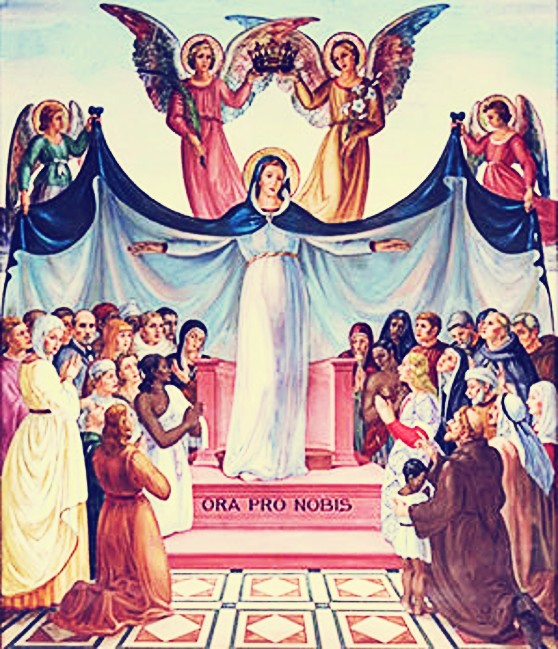
Meditation: Mary’s succour as Mother of mercy is not confined to individuals. She is the protectress and helper of the whole Church. All over the earth, wherever we cast our glance, in the records of the history of times, long past and those of recent occurrence, we find testimony of the graces and benefits, obtained through her intercession. The feasts celebrated by the Church, throughout the year, what are they but evidences of gratitude, offered to the Queen of Heaven for the oftentimes, miraculous delivery from war, pestilence and other great afflictions? Hence she is rightly invoked as the “Help of Christians.”
The processional Statue of St John Bosco’s Our Lady Help of Christians in Turin
Practice: In our days, too, storms and dangers threaten the Church. Let us, therefore, by calling on Mary for help, do our part toward shortening the days of visitation and trial. Let us not confine our petitions, to her, within the narrow limits, of our own personal needs but let us join in the cry for assistance ascending to the Mother of mercy, throughout all Christendom. Let us daily, for Holy Church, send up our petition to Mary’s heavenly throne: “Help of Christians, pray for us!”
Prayer of the Church: We beseech Thee, O Lord, pardon the shortcomings of Thy servants that we who, by our own works, are not able to please Thee, may be saved by the intercession of the Mother of Thy Son, Our Lord Jesus Christ. Amen.
Novena Prayer: Day Nine
Glorious Virgin and Mother of God, Mary, Queen of Heaven! Forget us not! Thou art the help of Christians; lighten our tribulations and help us with motherly intercession at the throne of thy Divine Son. With Holy Church, I join in the petition to thee: “Holy Mary, aid the miserable, assist the desponding, strengthen the weak, pray for thy people, plead for the clergy, intercede for the devout mothers, woman and consecrated woman. Let all who have recourse to thee experience the efficacy of thy succour!” And my holy Mother and Queen, forget not, my special petition …………….
Hail Mary …….
Ejaculation: Sweet heart of Mary be my salvation!
Indulgence. (1) 100 days, every time. (2) A Plenary Indulgence, once a month, on any day, to all who shall have said it everyday for a month, under the usual conditions.
Thought for the Day – 14 August – Meditations with Antonio Cardinal Bacci (1881-1971)
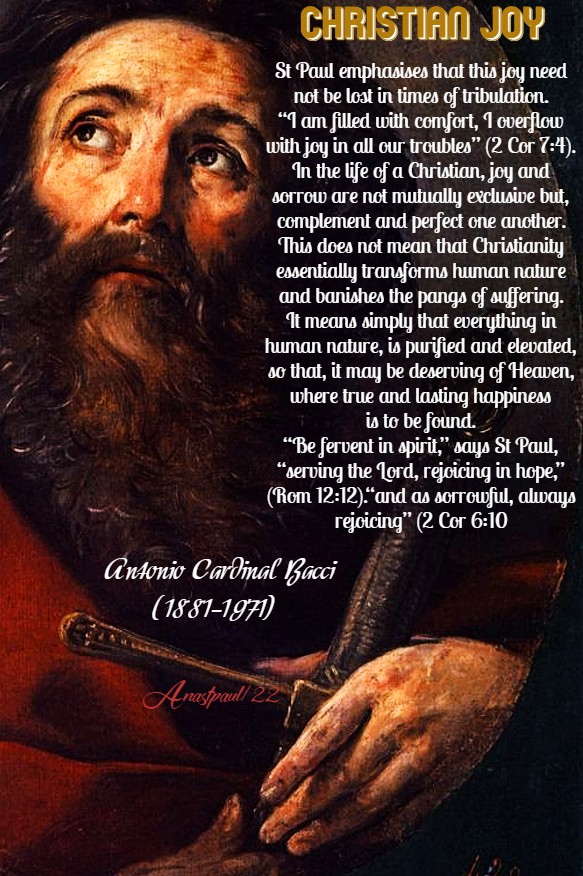
Christian Joy
“In his letters, St Paul frequently exhorts the early Christians to be joyful. “Rejoice in the Lord always, again I say rejoice” (Phil 4:4). “The fruit of the Spirit is charity, joy, peace, patience, kindliness” (Cf Gal 5:22). But we are to remember that “The Kingdom of God does not consist in food and drink but, in justice and peace and joy in the Holy Spirit” (Rom 14:17).
St Paul emphasises that this joy need not be lost in times of tribulation. “I am filled with comfort, I overflow with joy in all our troubles” (2 Cor 7:4). In the life of a Christian, joy andsorrow are not mutually exclusive but, complement and perfect one another.
This does not mean that Christianity essentially transforms human nature and banishes the pangs of suffering. It means simply that everything in human nature, is purified and elevated, so that, it may be deserving of Heaven, where true and lasting happiness is to be found. “Be fervent in spirit,” says St Paul, “serving the Lord, rejoicing in hope,” (Rom 12:12)“and as sorrowful, always rejoicing” (2 Cor 6:10.”
Quote/s of the Day – 14 August – The 10th Sunday after Pentecost – 1 Cor.inthians 12:2-11, Luke 18:9-14
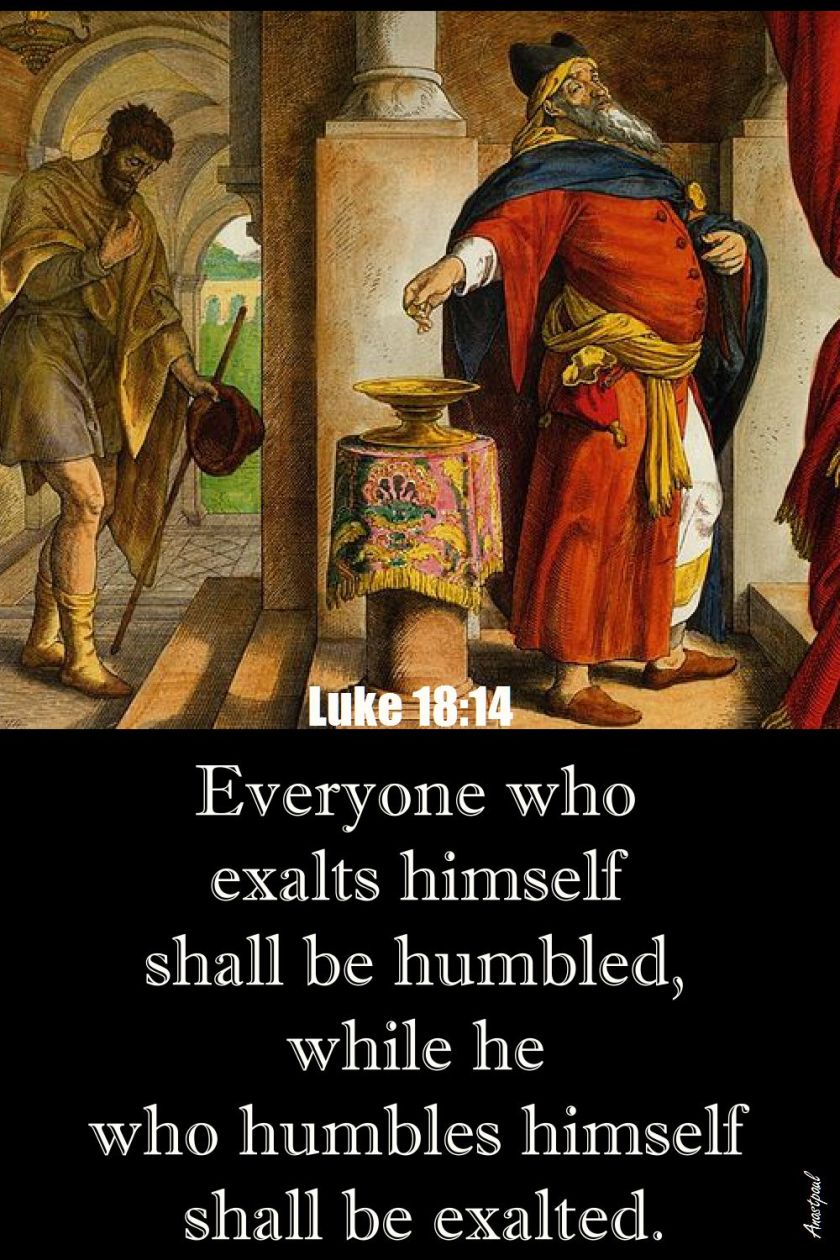
“… For everyone who exalts himself shall be humbled and he who humbles himself shall be exalted.”
Luke 18:14
“Let him who is greatest among you, become as the youngest and he who is the leader, as the servant.”
Luke 22:25
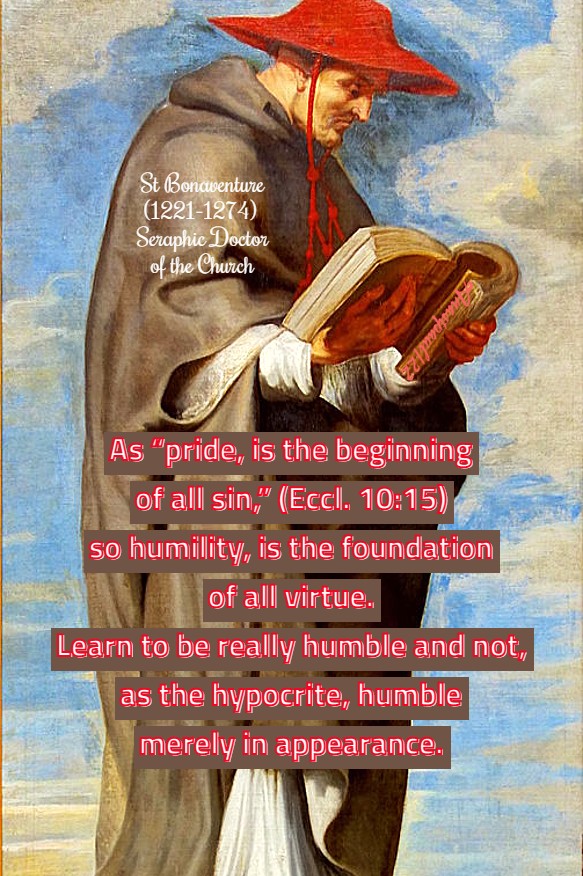
“As “pride, is the beginning of all sin,” (Eccl. 10:15) so humility, is the foundation of all virtue. Learn to be really humble and not, as the hypocrite, humble merely in appearance.”
St Bonaventure (1221-1274) Seraphic Doctor of the Church
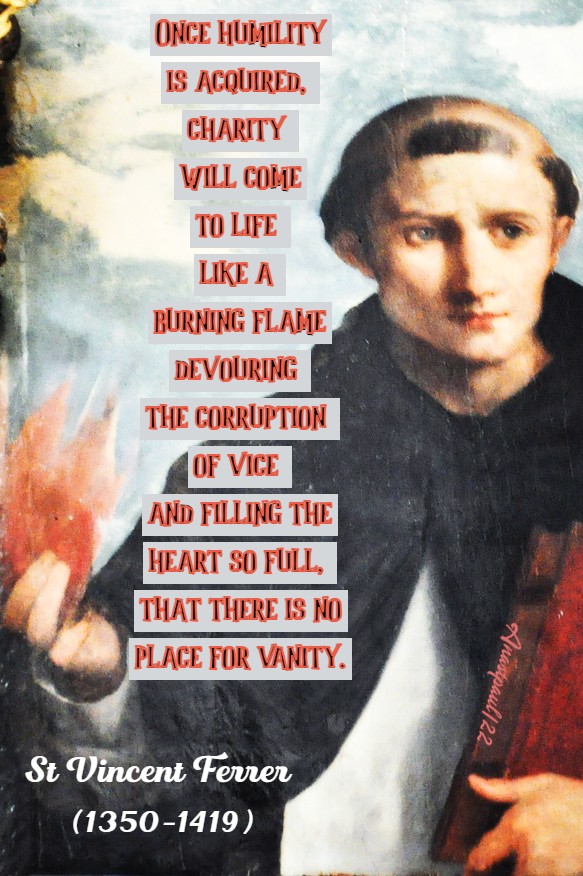
“Once humility is acquired, charity will come to life like a burning flame devouring the corruption of vice and filling the heart so full, that there is no place for vanity.”
St Vincent Ferrer (1350-1419)
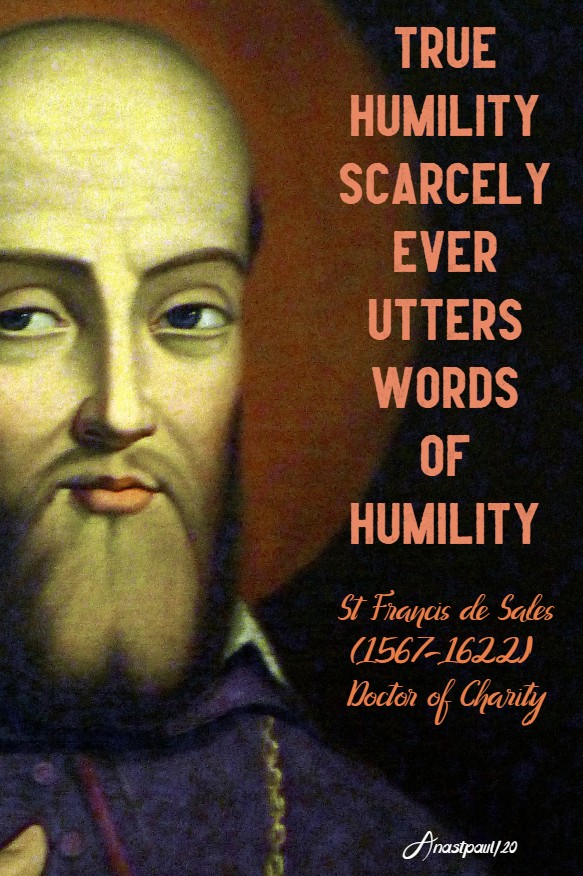
“True humility scarcely ever utters words of humility.”
One Minute Reflection – 14 August – “The Month of the Immaculate Heart of Mary” – The 10th Sunday after Pentecost – 1 Cor.inthians 12:2-11, Luke 18:9-14
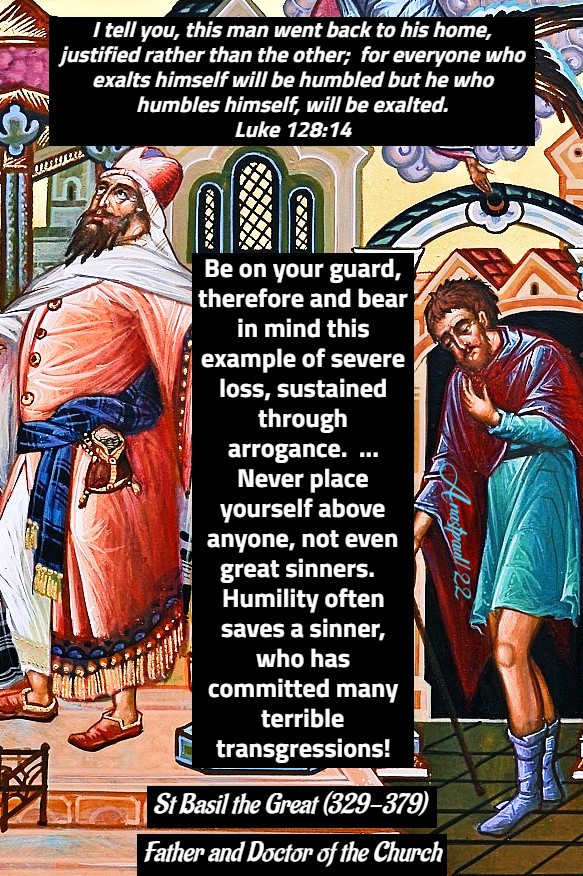
“I tell you, this man went back to his home, justified rather than the other; for everyone who exalts himself will be humbled but he who humbles himself, will be exalted” – Luke 18:14
REFLECTION – “The stern Pharisee, who in his overweening pride, not only boasted of himself but also discredited the tax collector, in the Presence of God, made his justice void by being guilty of pride. Instead of the Pharisee, the tax collector went down justified because he had given glory to God, the Holy One. He did not dare lift his eyes but sought only to plead for mercy. He accused himself by his posture, by striking his breast and by entertaining no other motive, except propitiation.
Be on your guard, therefore and bear in min, this example of severe loss, sustained through arrogance. The one guilty of insolent behaviour suffered the loss of his justice and forfeited his reward, by his bold self-reliance. He was judged inferior to a humble man and a sinner because, in his self-exaltation, he did not await the judgement of God but pronounced it himself.
Never place yourself above anyone, not even great sinners. Humility often saves a sinner, who has committed many terrible transgressions!” – St Basil the Great (329-379) Bishop of Caesarea, Father and Doctor of the Church (On Humility)
PRAYER – O God, Thou manifest Thy power, particularly in forbearance and pity, show us Thy mercy again and again, so that hastening toward Thy promises, we may become partakers of the blessings of Heaven. Through Jesus Christ, Thy Son our Lord, Who lives and reigns with Thee, in the unity of the Holy Ghost, God, world without end. Amen (Collect).
Our Morning Offering – 14 August – The 10th Sunday after Pentecost
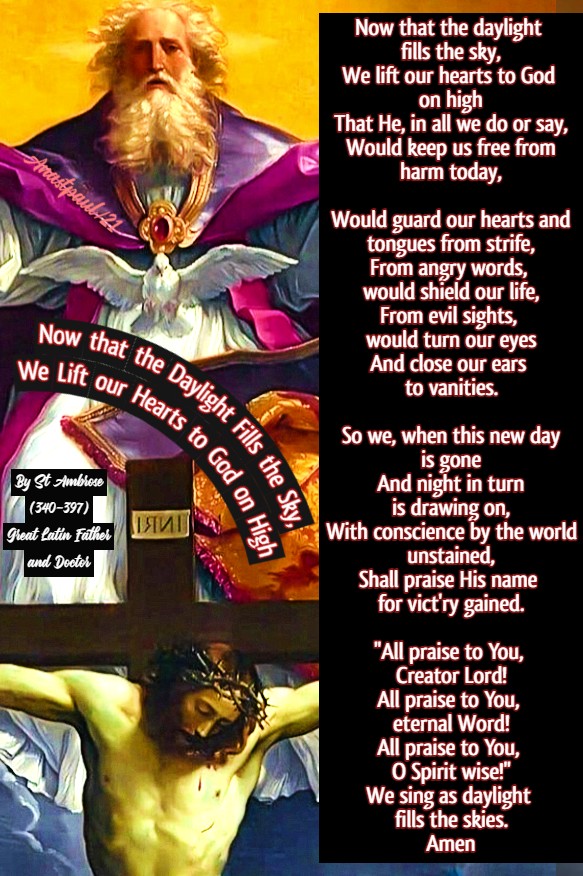
Now that the Daylight Fills the Sky, We Lift our Hearts to God on High By St Ambrose (340-397) Great Latin Father and Doctor of the Church Trans J M Neale (1818-1866)
Now that the daylight fills the sky, We lift our hearts to God on high That He, in all we do or say, Would keep us free from harm today,
Would guard our hearts and tongues from strife, From angry words, would shield our life, From evil sights, would turn our eyes And close our ears to vanities.
So we, when this new day is gone And night in turn is drawing on, With conscience by the world unstained, Shall praise His Name for vict’ry gained.
“All praise to You, Creator Lord! All praise to You, eternal Word! All praise to You, O Spirit wise!” We sing as daylight fills the skies. Amen






















 AnaStpaul
You must be logged in to post a comment.