Thought for the Day – 5 January– Meditations with Antonio Cardinal Bacci (1881-1971)
Venial Sin
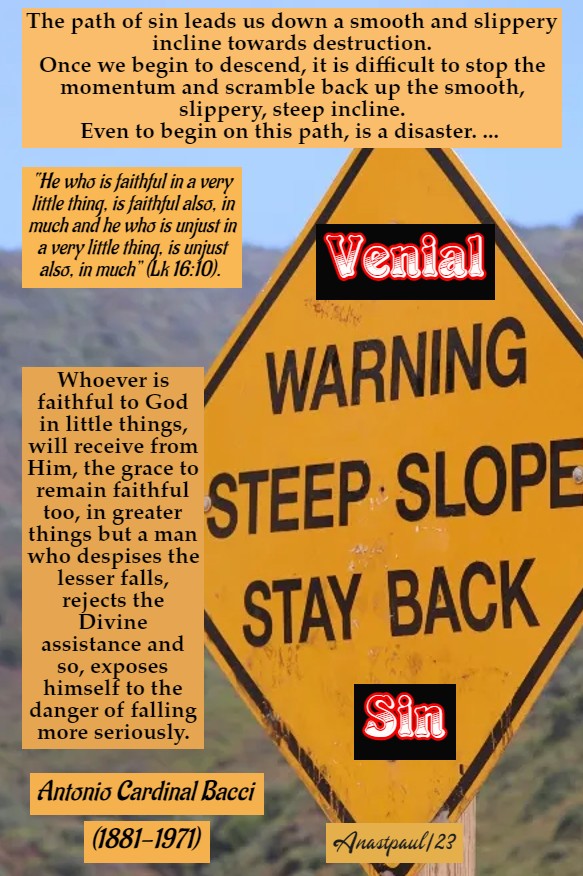
“There is another motive too, which obliges us to carefully avoid even commiting a venial sin. The path of sin leads us down a smooth and slippery incline towards destruction. Once we begin to descend, it is difficult to stop the momentum and scramble back up the smooth, slippery, steep incline. Even to begin on this path, is a disaster.
“He who wastes the little he has, will be stripped bare” (Eccles 19:1).
“He who is faithful in a very little thing, is faithful also, in much and he who is unjust in a very little thing, is unjust also, in much” (Lk 16:10).
Whoever is faithful to God in little things, will receive from Him, the grace to remain faithful too, in greater things but a man who despises the lesser falls, rejects the Divine assistance and so, exposes himself to the danger of falling more seriously.
If we reflect on such dangers, we shall have a real fear of venial sin and shall be always on our guard against it.”
Quote/s of the Day – 5 January – “The Month of the Most Holy Name of Jesus” – Vigil of the Epiphany –
“Wake up then, believer and note what is stated here: “In my Name.” That [Name] is Christ Jesus. Christ signifies King, Jesus signifies Saviour. Therefore, whatever we ask for that would hinder our salvation, we do not ask in our Saviour’s Name and yet, He is our Saviour, not only when He does what we ask but also, when He does not. When He sees us ask anything to the disadvantage of our salvation, He shows Himself our Saviour by not doing it. The physician knows whether what the sick person asks for, is to the advantage or disadvantage of his health. And [the physician] does not allow what would be harmful to him, although the sick person himself, desires it. But the physician looks to his final cure.”
St Augustine (354-430) Father and Doctor of Grace of the Church
“The Lord, although He was God, became man. He suffered for the sake of those who suffer, He was bound for those in bonds, condemned for the guilty, buried for those who lie in the grave but He rose from the dead and cried aloud: “Who will contend with Me? Let him confront Me.” I have freed the condemned, brought the dead back to life, raised men from their graves. Who has anything to say against Me? I, He said, Am the Christ, I have destroyed death, triumphed over the enemy, trampled hell underfoot, bound the strong one and taken men up to the heights of Heaven. I Am the Christ. Come, then, all you nations of men, receive forgiveness for the sins which defile you. I Am your Forgiveness. I Am the Passover which brings salvation. I Am the Lamb Who was immolated for you. I Am your Ransom, your Life, your Resurrection, your Light, I am your Salvation and your King. I will bring you to the heights of Heaven. With My own Right Hand I will raise you up and I will show you the Eternal Father.”
St Melito of Sardis (Died c 180) Bishop, Father
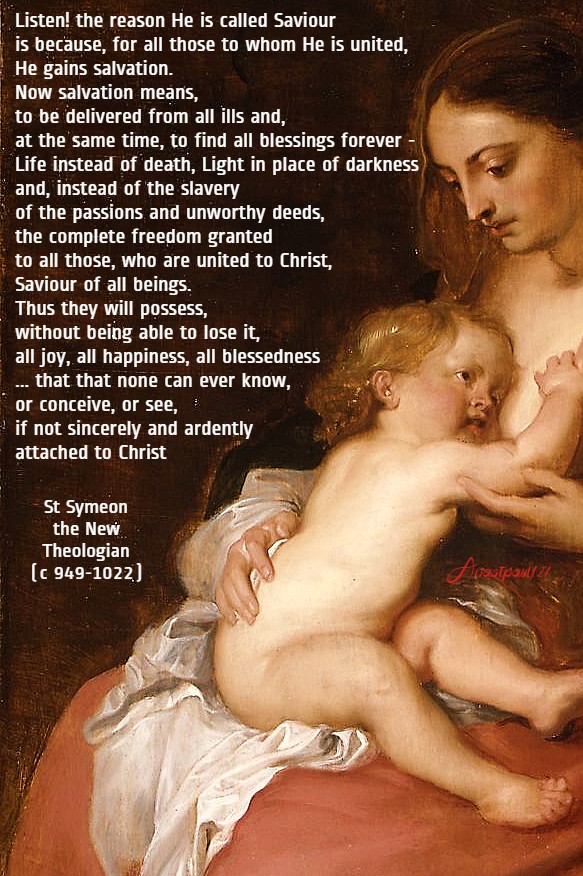
“Listen! the reason He is called Saviour is because, for all those to whom He is united, He gains salvation. Now salvation means, to be delivered from all ills and, at the same time, to find all blessings forever – Life instead of death, Light in place of darkness and, instead of the slavery of the passions and unworthy deeds, the complete freedom granted to all those, who are united to Christ, Saviour of all beings. Thus they will possess, without being able to lose it, all joy, all happiness, all blessedness (…) that that none can ever know, or conceive, or see, if not sincerely and ardently attached to Christ.”
One Minute Reflection – 5 January – “The Month of the Most Holy Name of Jesus” – Vigil of the Epiphany – Galatians 4:1-7, Matthew 2:19-23 – Scripture search here: https://www.drbo.org/
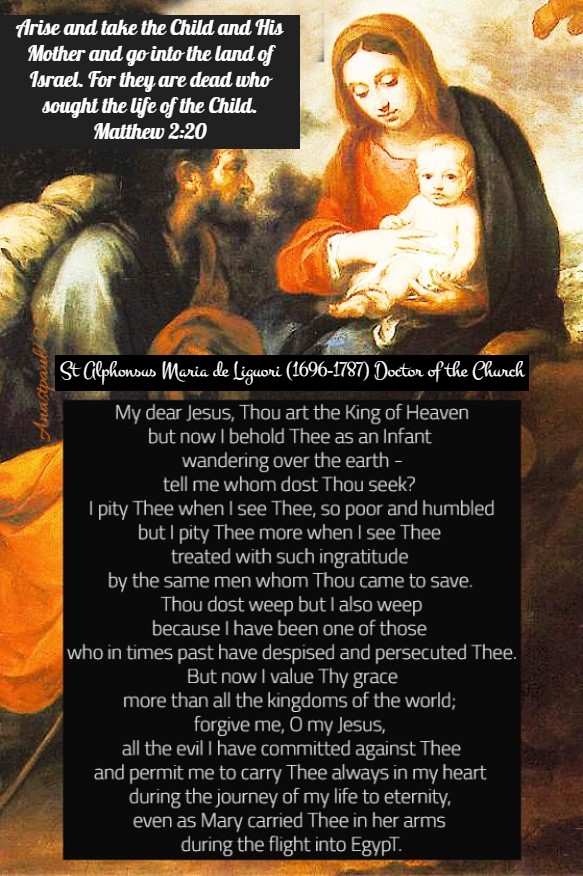
“Arise and take the Child and His Mother and go into the land of Israel. For they are dead who sought the life of the Child.” – Matthew 2:20
REFLECTION – “My dear Jesus, Thou art the King of Heaven but now I behold Thee as an Infant wandering over the earth – tell me whom dost Thou seek? I pity Thee when I see Thee, so poor and humbled but I pity Thee more when I see Thee treated with such ingratitude by the same men whom Thou came to save. Thou dost weep but I also weep because I have been one of those who in times past have despised and persecuted Thee. But now I value Thy grace more than all the kingdoms of the world; forgive me, O my Jesus, all the evil I have committed against Thee and permit me to carry Thee always in my heart during the journey of my life to eternity, even as Mary carried Thee in her arms during the flight into [and return from] Egypt.” – St Alphonsus Maria de Liguori (1696-1787) Doctor of the Church”
PRAYER – O Almighty and everlasting God, do Thou order all our actions in conformity with Thy good pleasure that through the name of Thy well-beloved Son, we may worthily abound in all good works. Through the same Jesus Christ, Thy Son our Lord, Who lives and reigns with Thee, in the unity of the Holy Ghost, God, world without end. Amen (Collect).
Our Morning Offering – 5 January – The Vigil of the Epiphany of Our Lord
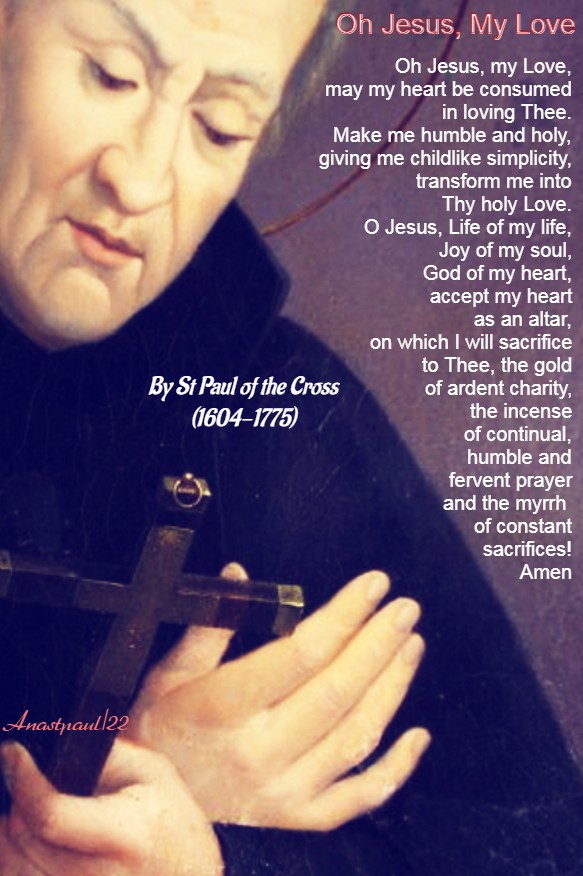
Oh Jesus, My Love By St Paul of the Cross (1604-1775)
Oh Jesus, my Love, may my heart be consumed in loving Thee. Make me humble and holy, giving me childlike simplicity, transform me into Thy holy Love. O Jesus, Life of my life, Joy of my soul, God of my heart, accept my heart as an altar, on which I will sacrifice to Thee, the gold of ardent charity, the incense of continual, humble and fervent prayer and the myrrh of constant sacrifices! Amen
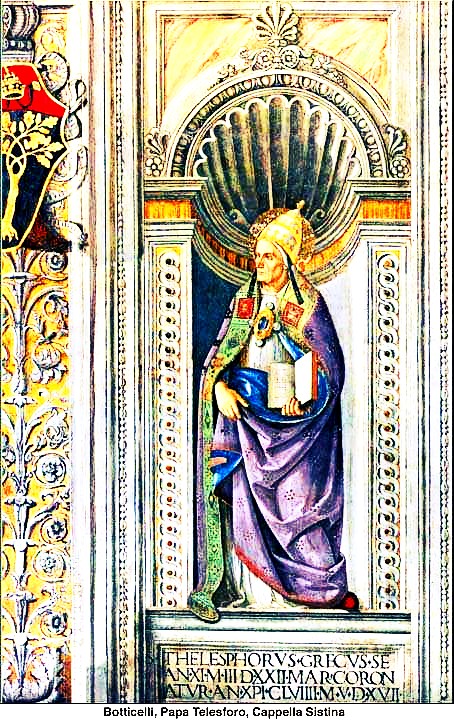
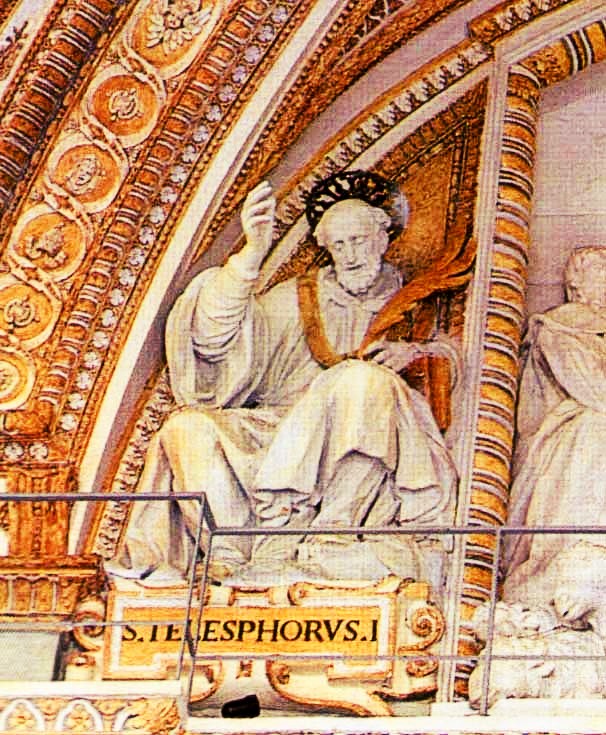
Saint of the Day – 5 January – Saint Telesphorus (Died c 138) Confessor, Pope Martyr. Papal Ascension – 128 to 129 and died by Martyredom in 138 to 139. Also known as – Telesforo.
The Roman Martyrology reads today: “In Rome, in the time of Antoninus Pius, St Telesphorus, Pope, who after many sufferings for the Confession of Christ, underwent a glorious Martyrdom.”
He was of Greek ancestry and born in Terranova da Sibari, Calabria, Italy.
Telesphorus is traditionally considered as the Eighth Bishop of Rome in succession after Saint Peter. The Liber Pontificalis mentions that he had been an Anchorite Monk prior to assuming office.
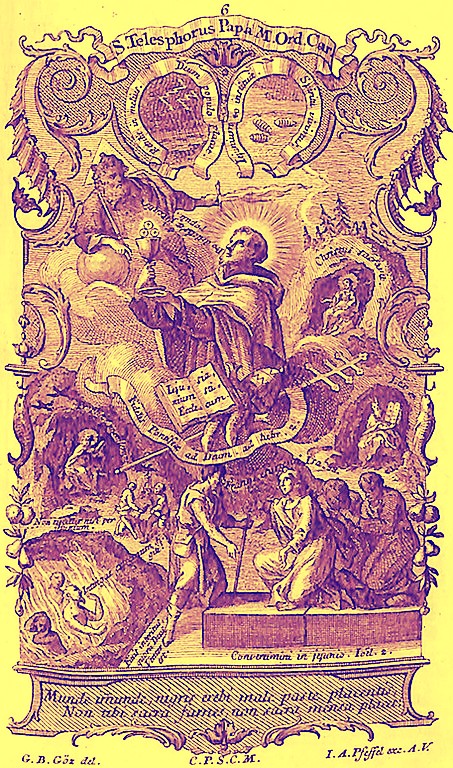
Engraving of St Telesphorus by Johann Andreas Pfeffel (1674-1748)
The tradition of Christmas Midnight Masses, the celebration of Easter on Sundays, the keeping of a seven-week Lent before Easter and the singing of the Gloria, are usually attributed to his Pontificate. A fragment of a letter from St Irenæus to Pope Victor I, during the Easter controversy in the late 2nd Century, also preserved by Eusebius, testifies that Telesphorus was one of the Roman Bishops who always celebrated Easter on Sunday,, rather than on other days of the week, according to the calculation of the Jewish Passover. Unlike Victor, however, Telesphorus remained in communion with those communities who did not follow this custom.
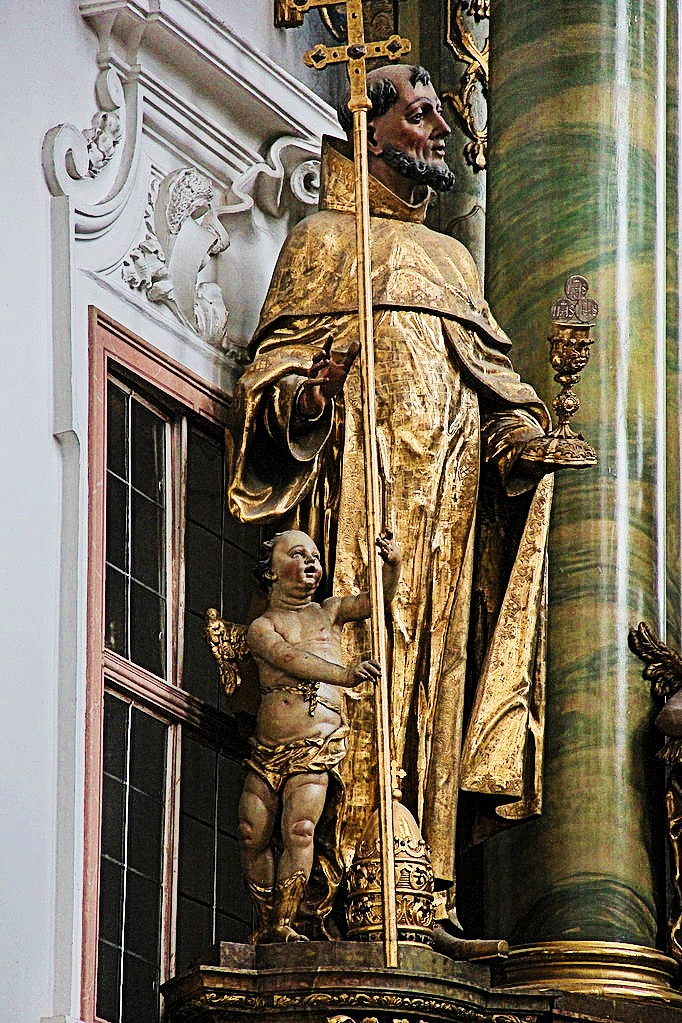
14th Century depiction of St Telesphorus in the Carmelite Monastery of Straubing in Bavaria
According to the testimony of St Irenaeus (Against Heresies III.3.3), he suffered a “glorious Martyrdom.” Although most early Popes are called Martyrs by sources such as the Liber Pontificalis, Telesphorus is the first to whom St Irenaeus, writing in c 180, gives this title, thus making his Martyrdom the earliest attested Martyrdom of a Pope, after Saint Peter.
Eusebius (Church History iv.7; iv.14) places the beginning of his Pontificate in the twelfth year of the reign of Emperor Hadrian (128–129) and gives the date of his death as being in the first year of the reign of Antoninus Pius (138–139).
The Carmelites venerate Telesphorus as a Patron Saint of the Order since some sources depict him as a hermit living on Mount Carmel. The town of Saint-Télesphore, in the southwestern part of Canada’s Quebec Province, is named after him.
Bl Alacrinus of Casamari St Apollinaris Syncletica St Cera of Kilkeary Bl Convoyon of Redon St Deogratias of Carthage (Died 457) Bishop St Dorotheus the Younger
St Kiara St Lomer of Corbion Bl Marcelina Darowska Bl Paula of Tuscany Bl Pietro Bonilli St Simeon Stylites St Syncletica St Talida of Antinoë
Martyrs of Africa – 14 Saints: A group of Christians Martyred together in Africa, date unknown, exact location unknown. We know nothing more than their names – Acutus, Anastasia, Candidus, Coelifloria, Felix, Honorius, Januaria, Jucundus, Lucianus, Marcus, Petrus, Secundus, Severus and Telesphorus.
Martyrs of Sais: A group of Christians Martyred for their faith, but about whom no details have survived. They were Martyred by drowning near Sais, Egypt.
Martyrs of Upper Egypt: There were many Martyrs who suffered in the persecutions of Diocletian in the Thebaid region. Though we know these atrocities occurred, to the point that witnesses claim the torturers and executioners were exhausted by the work, we do not know the names of the saints and we honour them as a group. Many were beheaded and or burned alive in 303 in Upper Egypt.
Thought for the Day – 4 January– Meditations with Antonio Cardinal Bacci (1881-1971)
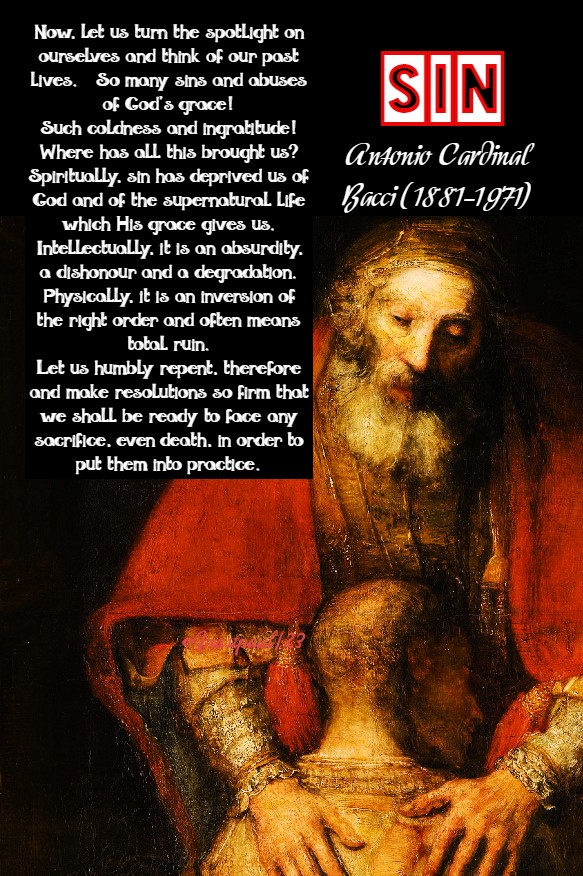
SIN
“Now, let us turn the spotlight on ourselves and think of our past lives. So many sins and abuses of God’s grace! Such coldness and ingratitude! Where has all this brought us? Spiritually, sin has deprived us of God and of the supernatural life which His grace gives us. Intellectually, it is an absurdity, a dishonour and a degradation. Physically, it is an inversion of the right order and often means total ruin.
Let us humbly repent, therefore and make resolutions so firm that we shall be ready to face any sacrifice, even death, in order to put them into practice.”
Quote/s of the Day – 4 January – “The Month of the Most Holy Name of Jesus” – Octave of the Holy Innocents – Apocalypse 14:1-5 , Matthew 2:13-18 –Scripture search here: https://www.drbo.org/
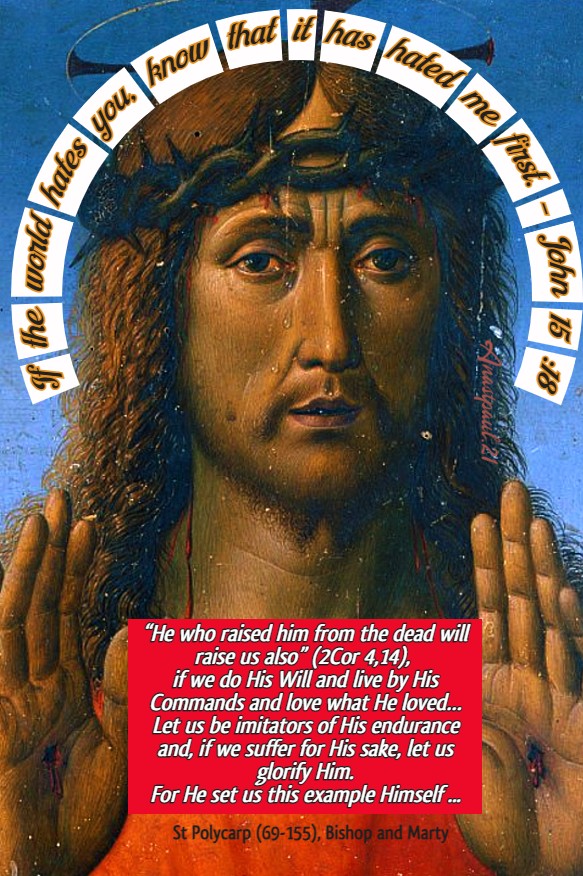
“If the world hates you, know that it has hated Me first.”
John 15:18
“He who raised Him from the dead will raise us also” (2Cor 4,14), if we do His Will and live by His Commands and love what He loved… Let us be imitators of His endurance and, if we suffer for His sake, let us glorify Him. For He set us this example Himself …”
St Polycarp (69-155) Apostolic Father, Bishop and Martyr
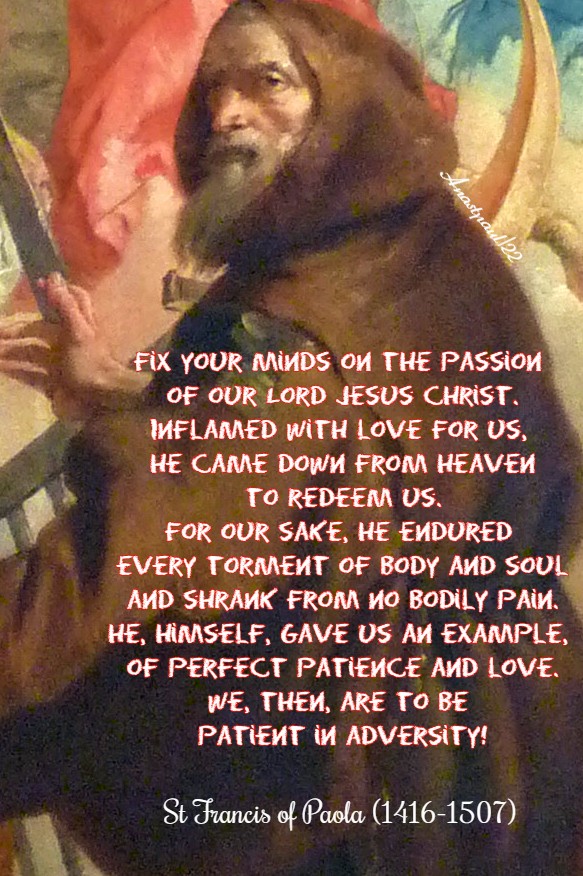
“Fix your minds on the Passion of our Lord Jesus Christ. Inflamed with love for us, He came down from Heaven to redeem us. For our sake, He endured every torment of body and soul and shrank from no bodily pain. He, Himself, gave us an example of perfect patience and love. We, then, are to be patient, in adversity!”
“The recollection of an injury, is . . . a rusty arrow and poison for the soul.”
St Francis of Paola (1416-1507)
“You will be consoled according to the greatness of your sorrow and affliction; the greater the suffering, the greater will be the reward.”
St Maria Magdalena de’ Pazzi (1566-1607)
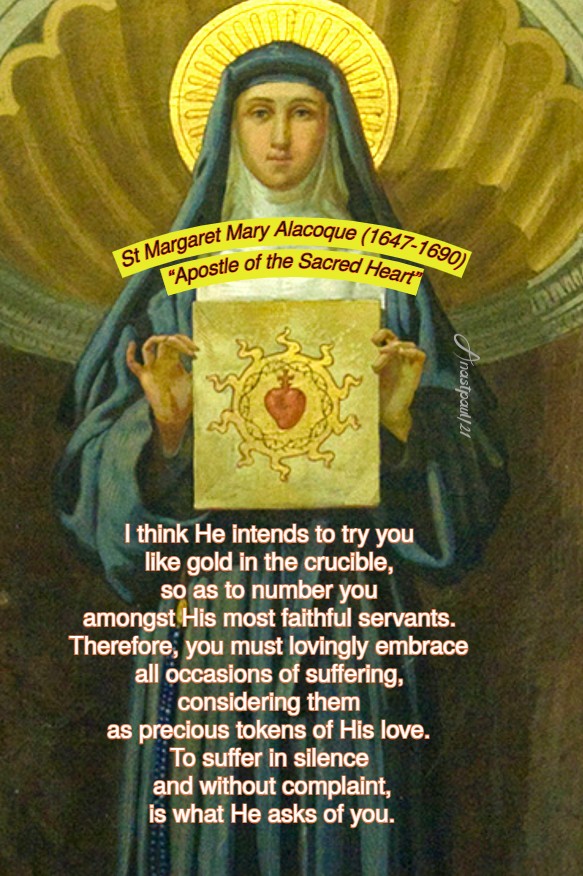
“I think He intends to try you like gold in the crucible, so as to number you amongst His most faithful servants. Therefore, you must lovingly embrace all occasions of suffering, considering them as precious tokens of His love. To suffer in silence and without complaint, is what He asks of you.”
St Margaret Mary Alacoque (1647-1690) “Apostle of the Sacred Heart”
“Our Lord, Who saved the world, through the Cross, will only Work for the good of souls, through the Cross.”
One Minute Reflection – 4 January – “The Month of the Most Holy Name of Jesus” – Octave of the Holy Innocents – Apocalypse 14:1-5 , Matthew 2:13-18 –Scripture search here: https://www.drbo.org/
“For it will come to pass that Herod will seek the Child, to destroy Him.” – Matthew 2:14
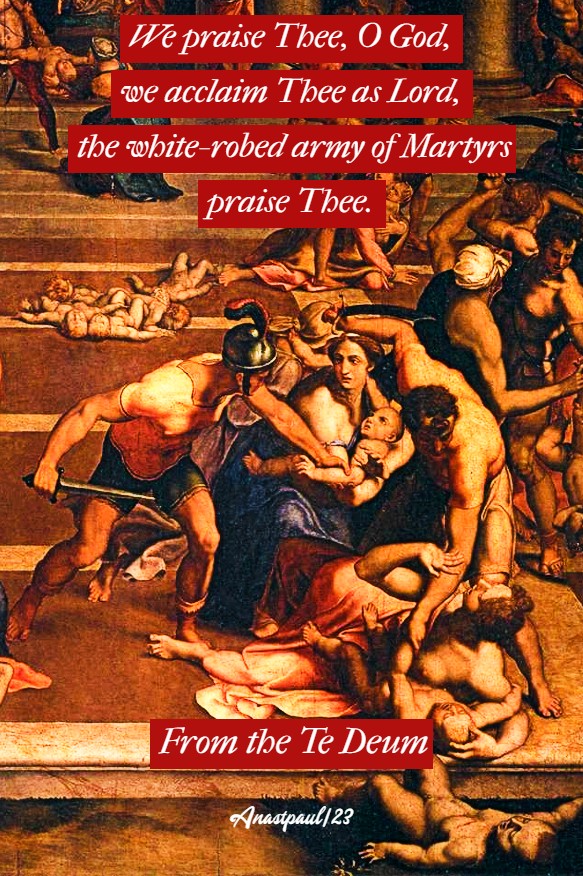
REFLECTION – “The Apostle John said: “Whoever says he abides in Christ, ought to walk even as Christ walked” (1 Jn 2:6). Moreover, the blessed Apostle Paul exhorts and teaches us, saying: “We are God’s children but if children, then heirs of God and joint-heirs with Christ; if so be that we suffer with him that we may also be glorified together” (Rm 8:16f.) … Let us, beloved brethren, imitate righteous Abel, who initiated Martyrdom, he being the first to be slain for righteousness’s sake (Gn 4:8) … let us imitate the three children Ananias, Azarias and Misael, who … overcame the king by the power of faith (Dn 3) … What of the prophets whom the Holy Spirit quickened to a foreknowledge of future events? What of the Apostles whom the Lord chose? Since these righteous men were slain for righteousness’ sake, have they not taught us also to die?
The nativity of Christ at once witnessed the Martyrdom of infants, so that they, who were two years old and under were slain for His Name’s sake. An age, not yet fitted for the battle, appeared fit for the crown. That it might be manifest that they, who are slain for Christ’s sake, are innocent, innocent infancy was put to death for His Name’s sake … How grave is the case of a Christian, if he, a servant, is unwilling to suffer when his Master first suffered! … The Son of God suffered that He might make us sons of God and the son of man will not suffer that he may continue to be a son of God!? … The Maker and Lord of the world also warns us, saying: “If the world hates you, remember that it hated Me before you. If you were of the world, the world would love its own but because you are not of the world but I have chosen you out of the world ”… remember the word that I said to you: “The servant is not greater than his Lord” (Jn 15:18-20).” – St Cyprian of Carthage (c 200-258) Martyr, Bishop of Carthage, Father of the Church – Letter 55
PRAYER – O God, Whose praise the Innocents, Thy Martyrs, this day proclaimed, not by speaking but by dying, put to death in us all the wickedness of sin, so that Thy faith which our tongue professes, may be proclaimed also by our life. Through Jesus Christ, Thy Son our Lord, Who lives and reigns with Thee, in the unity of the Holy Ghost, God, world without end. Amen (Collect).
Our Morning Offering – 4 January – Octave of the Holy Innocents – “The Month of the Most Holy Name of Jesus”
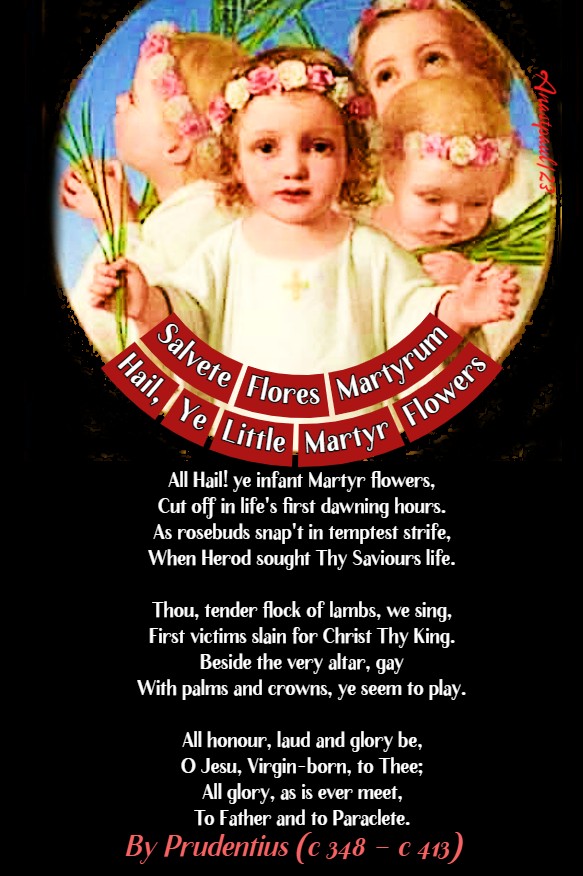
Salvete Flores Martyrum Hail, Ye Little Martyr Flowers By Prudentius (c 348 – c 413) (Aurelius Prudentius Clemens) The Renowned Poet
All Hail! ye infant Martyr flowers, Cut off in life’s first dawning hours. As rosebuds snap’t in temptest strife, When Herod sought Thy Saviours life.
Thou, tender flock of lambs, we sing, First victims slain for Christ Thy King. Beside the very altar, gay With palms and crowns, ye seem to play.
All honour, laud and glory be, O Jesu, Virgin-born, to Thee; All glory, as is ever meet, To Father and to Paraclete.
Salvete Flores Martyrum is the Office Hymn for Lauds on the Feast of the Holy Innocents (28 Dec). Its stanzas are drawn from Prudentius’ Epiphany Hymn, Cathemerinon and were first assembled in the 1568 Breviary of Pope Pius V.
Saint of the Day – 4 January – Saint Gregory of Langres (Died 539) Bishop of Langres and Dijon, Count and Governor, Father of 2 Sons and Widower, before being appointed as the Bishop of Langres, Ascetic, Miracle-worker. Great-grandfather of St Gregory of Tours. He ordered the translation of the Relics of Saint Benignus and built the Church and the Abbey of Saint-Benignus of Dijon. Born around around 446, as the Count of Autun, in Saone-et-Loire, modern France and died in 539 of natural causes. Also known as – Gregory of Autun, Gregory of Dijon. Additional Memorials – 13 May and 6 November (translation of relics).
The Roman Martyrology reads today: “At Langres, Gregory, Bishop, renowned for his miracles, Great-grandfater of St Gregory of Tours, who wrote of him.”
Gregory was a descendant of a rich family of Senators. After the death of his uncle, Attale, he became the Count of Autun. He was the Count and Governor of Autun and Autunois.
History retains the memory of a man firm and severe, yet fair. He was ruthless to cowards and bandits, kind and gentle with those in need and with the good and faithful servants of Christ..
Gregory had two sons of his union with Armentaire, daughter of Armentarius, Senator of Lyons. One of his sons, named Tetricus, became his successor to the Episcopal See of Langres. His second son, also named Gregory, became the grandfather of the famous St Gregory of Tours.
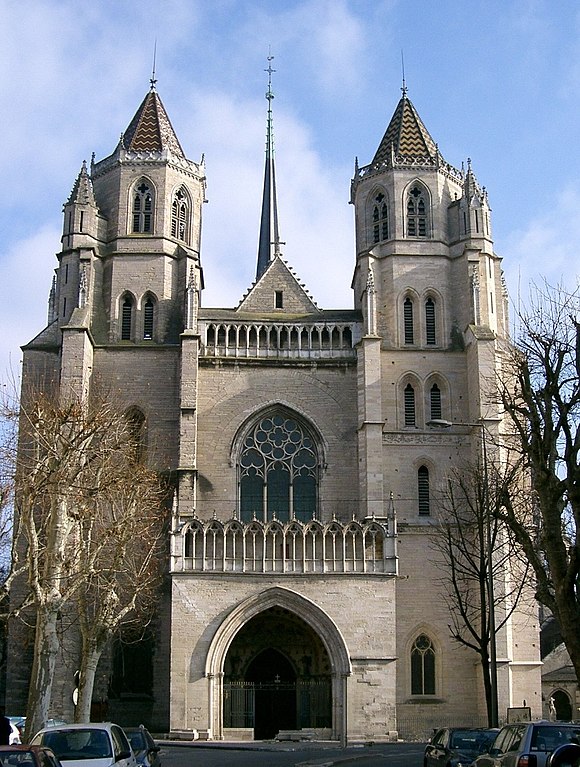
After the death of his wife, Gregory joined the Church. his biographer tells us that he was elected in 506 by the Clergy and the faithful of Langres to the Episcopal See. It is about this date that he founded the Abbey of Saint-Bénigne of Dijon – St Benignus, who was a Martyr who died in the 3rd Century, is the Patron Saint and first herald of Christianity of Dijon (Feast day 1 November). Gregory placed the Relics of St Benignus, the Apostle of Burgundy, in the Basilica he built at the Abbey. The Abbey Church built by Gregory was superseded by a Romanesque Basilica, which collapsed in 1272 and was replaced by the present Dijon Cathedral. He placed the Monastery under he care of Abbot Eustad.
Gregory was an exemplary shepherd, indulging in abstinence with great rigour, eating only bread made with barley, using only wine diluted with water and spending long hours in prayer. He lived “like an anchorite in the middle of the world”, according to St Gregory of Tours, his great-grandson.
He made frequent trips to Dijon, which at that time depended on the Diocese of Langres. He lived near the baptistery of Saint Vincent, near the Saint-Etienne Church. It was a place with many relics, where he came to pray at night. The legend tells us that one of the clerics watching him one night saw the revered saints coming to sing and glorify God with him. Saint Benignus too appeared to Gregory and told him that he was quite grieved that his cult was neglected. Gregory immediately renovated and restored the Shrine of the Martyr.
It was in his day that Abbot Sigo, who would be Canonised under the name of St Seine, came to the Abbey of Reome, under the spiritual direction of St Jean of Reome.
On his way to Langres to celebrate Epiphany, Gregory caught A cold and died on 4 January 539. He had held the Episcopal Seat for thirty-three years. He was buried, according to his wishes, in the Church of Saint-Jean de Dijon, near the baptistery. Legend has it that on the way to his funeral convoy, passing in front of the prison, the prisoners implored the deceased and that he performed a miracle – the gates of the penal establishment opened by themselves.
His son, Tetricus, who succeeded him in the Episcopal See of Langres, made a transfer of his father’s body, in order to raise a Monument worthy of his holiness. This event is commemorated on 6 November. Later, a second translation took place in 1282 – a part of his Relics were deposited in the Cathedral of Langres . Gui of Geneva , Bishop of Langres, deposited them in a silver box which was placed on a column behind the main Altar of Saint-Mammès. The Clergy assembled in Synod, participated in this ceremony.
St Angela of Foligno TOSF (1248-1309) known as the “Mistress of Theologians” – Wife, Mother, Widow, Religious, Mystic, Writer, Third Order Franciscan, Foundress of a religious community, which refused to become an enclosed religious order, so that it might continue her vision of caring for those in need. It is still active today. About St Angela: https://anastpaul.com/2020/01/04/saint-of-the-day-4-january-saint-angela-of-foligno-tosf-1248-1309/
St Celsus of Trier Bl Chiara de Ugarte St Chroman St Dafrosa of Acquapendente
St Ferreolus of Uzès St Gaius of Moesia St Gregory of Langres (Died 539) Bishop St Hermes of Moesia St Libentius of Hamburg Bl Louis de Halles St Mavilus of Adrumetum St Neophytos St Neopista of Rome St Oringa of the Cross Bl Palumbus of Subiaco
Martyrs of Africa – 7 Saints: A group of Christians Martyred together in the persecutions of the Arian Vandal king Hunneric. Saint Bede wrote about them. – Aquilinus, Eugene, Geminus, Marcian, Quintus, Theodotus and Tryphon. In 484 in North Africa.
Martyrs of Rome – 3 Saints: Three Christians Martyred together in the persecutions of Julian the Apostate for refusing to renounce Christianity as ordered. – Benedicta, Priscillianus and Priscus. In 362 in Rome, Italy.
Thought for the Day – 3 January– Meditations with Antonio Cardinal Bacci (1881-1971)
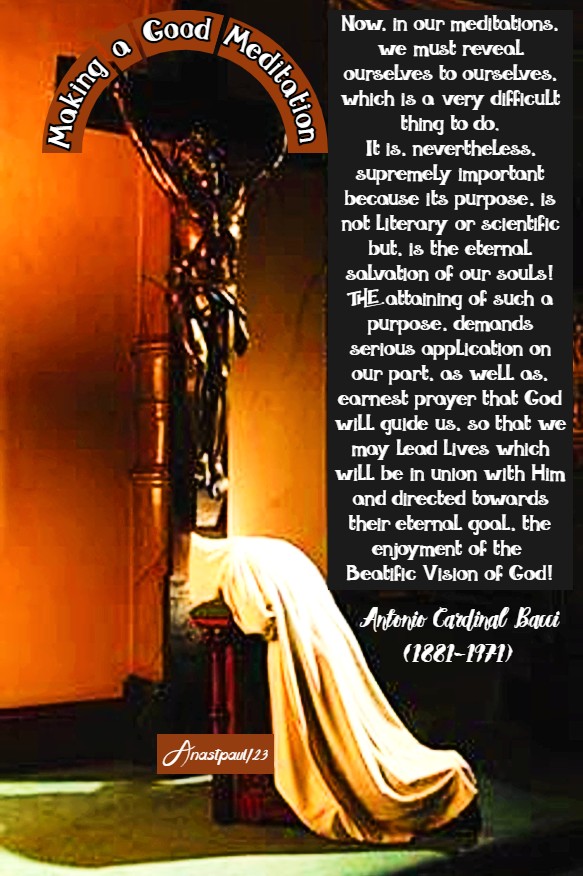
Making a Good Meditation
“Alessandro Manzoni was once asked how he had managed to penetrate so deeply into the human mind. Newman was asked how he had succeeded in discovering the law of universal gravity. Manzoni’s reply was: “By thinking about it.” Newman’s was: “By thinking intensely.”
Now, in our meditations, we must reveal ourselves to ourselves, which is a very difficult thing to do. It is, nevertheless, supremely important because its purpose, is not literary or scientific but, is the eternal salvation of our souls! The attaining of such a purpose, demands serious application on our part, as well as, earnest prayer that God will guide us, so that we may lead lives which will be in union with Him and directed towards their eternal goal, the enjoyment of the Beatific Vision of God!”
“You shall love the Lord your God with all your heart and with all your soul and with all your mind. And the second is like it: You shall love your neighbour as yourself.”
Matthew 22:36,39
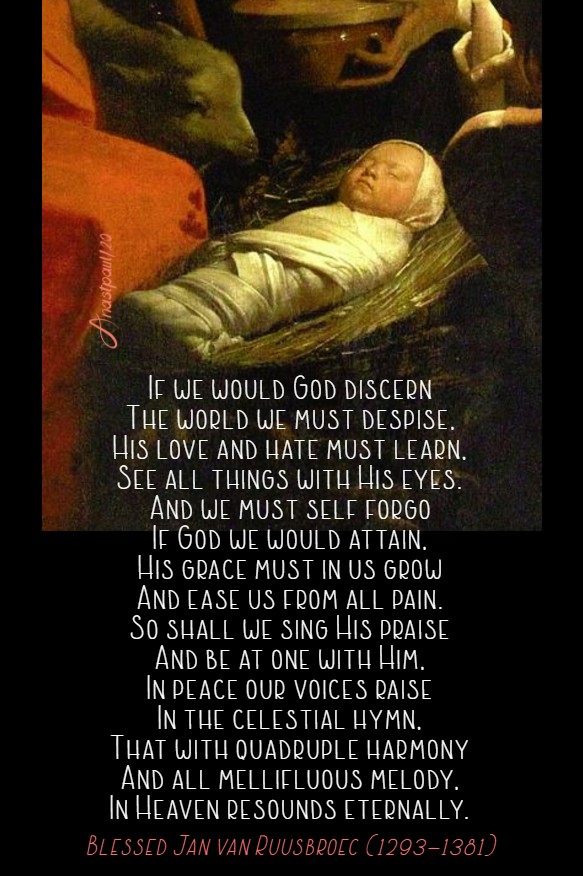
“If we would God discern The world we must despise, His love and hate must learn, See all things with His eyes. And we must self forgo If God we would attain, His grace must in us grow And ease us from all pain. So shall we sing His praise And be at one with Him, In peace our voices raise In the celestial hymn, That with quadruple harmony And all mellifluous melody, In Heaven resounds eternally.”
Bl Jan van Ruusbroec (1293-1381)
“We must make our way towards eternity, never regarding what men think of us, or of our actions, studying only to please God.”
St Francis Borgia (1510-1572)
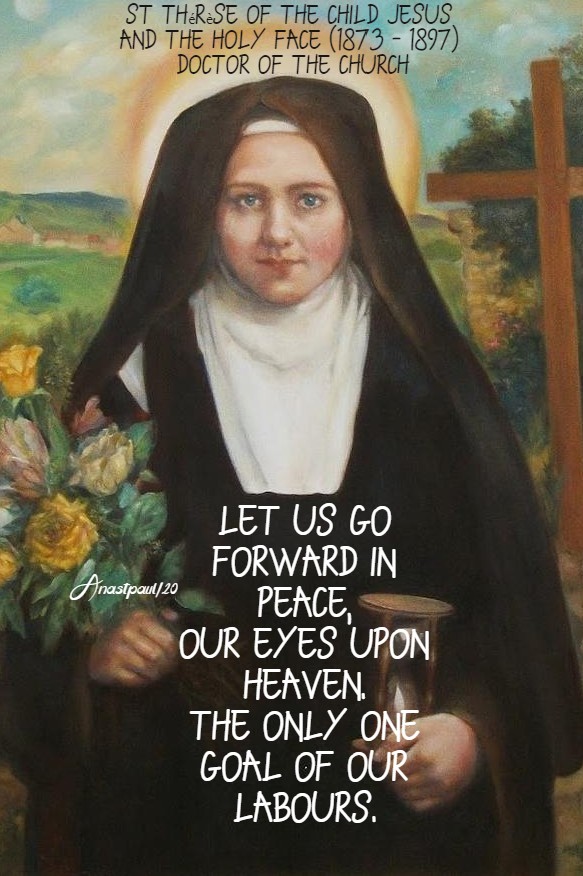
“Let us go forward in peace, our eyes upon Heaven, the only one goal of our labours.”
One Minute Reflection – 3 January – “The Month of the Most Holy Name of Jesus” – Octave Day of St John, Apostle – Ecclesiasticus 15:1-6, John 21:19-24 –Scripture search here: https://www.drbo.org/
“This is that disciple who bears witness concerning these things and who has written these things and we know that his witness is true.” – John 21:24
REFLECTION – “In proportion to the grace that caused Jesus to love him and enabled him to rest on Jesus’ Breast at the Supper (Jn 13:23), John abundantly received [the Spirit’s gifts] of understanding and wisdom (Is 11:2) – understanding with which to comprehend Scripture, wisdom with which to compose his own books with wonderful skill. As a matter of fact, he did not receive this gift right from the time when he rested on our Lord’s Breast, even if he was subsequently able to draw from that Heart “in which are hidden all the treasures of wisdom and knowledge” (Col 2:3). When he says, that when he went into the tomb “he saw and he believed,” he acknowledges that “they did not yet understand the Scripture that Jesus had to rise from the dead” (Jn 20:9). Like all the other Apostles, John received its fullness, when the Holy Spirit came [at Pentecost] and when grace had been given to each of them “according to the measure of Christ’s gift” (Eph 4:7). …
The Lord Jesus loved this disciple more than all the others … and opened the secrets of Heaven to him … to make of him the author of that profound Mystery which man can say nothing about, of himself: the Mystery of the Word, God’s Utterance, the Word made flesh. This is the fruit of that love. Yet even though He loved him, it was not to him that Jesus said: “You are Peter, and on this rock I shall build my Church” (Mt 16:18) … While He loved all His disciples and especially Peter, with a love in mind and soul, our Lord loved John with the love of His Heart …. In the order of Apostleship, Simon Peter received the first place and the “keys of the Kingdom of heaven” (Mt 16:19) but John, won another inheritance, the spirit of understanding, “a wealth of joy and gladness” (Sir 15:6).” – Rupert of Deutz (c 1075- c 1130) Benedictine Monk, Theologian and Writer (The Works of the Holy Spirit, IV, 10 SC 165)
PRAYER – O Lord, graciously shed light upon Thy Church, so that, enlightened by the teachings of blessed John, Thy Apostle and Evangelist, she may gain Thy everlasting rewards.Through Jesus Christ, Thy Son our Lord, Who lives and reigns with Thee, in the unity of the Holy Ghost, God, world without end. Amen (Collect).
Our Morning Offering – 3 January – Octave Day of St John, Apostle
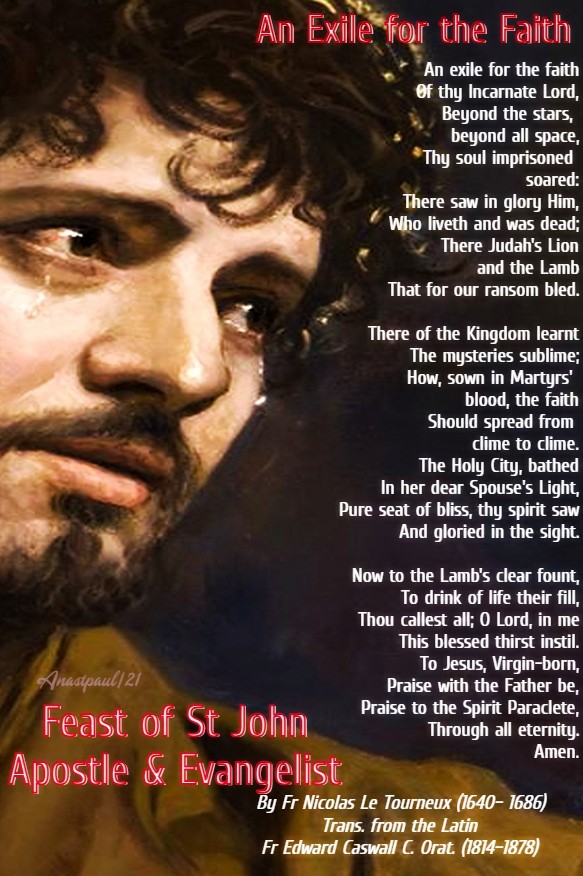
An Exile for the Faith By Father Nicolas Le Tourneux (1640– 1686) Trans. by Fr Edward Caswall C. Orat. (1814–1878)
An exile for the faith Of thy Incarnate Lord, Beyond the stars, beyond all space, Thy soul imprisoned soared, There saw in glory Him, Who liveth and was dead; There Judah’s Lion and the Lamb That for our ransom bled.
There of the Kingdom learnt The mysteries sublime; How, sown in Martyrs’ blood, the faith Should spread from clime to clime. The Holy City, bathed In her dear Spouse’s Light, Pure seat of bliss, thy spirit saw And gloried in the sight.
Now to the Lamb’s clear fount, To drink of life their fill, Thou callest all; O Lord, in me This blessed thirst instil. To Jesus, Virgin-born, Praise with the Father be, Praise to the Spirit Paraclete, Through all eternity. Amen.
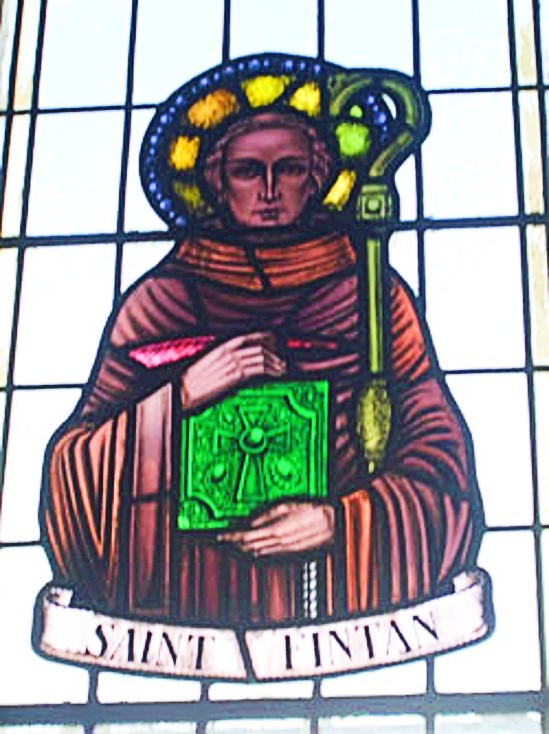
Saint of the Day – 3 January – St Fintan of Doon (Died 6th Century) Abbot, Founder of a Monastery, Miracle-worker. Born in Ireland and died in the 6th Century in Ireland of natural causes. Also known as – Fiontan, Fintanus. Patronage – eye diseases, against blindness, all ailments.
Fintan was a brother to St Finlug, son to Diman who was descended from Mured Manderig, King of Ulster. Alinna, of a noble Limerick family, was his mother.
St Comgall, Abbot of Bangor had founded a school at Bangor in the middle of the 6th Century and it was here that Fintan studied. At this time pirates raided these Monasteries frequently. Fintan, once, asked Finian of Maghbile to lend him a Gospel for his studies but was refused. The next night Fintan and his companions were on guard at the port, fearing an invasion. The pirates, however, firstly raided Magh Bile – the Monastery of St Finian and among the treasures they stole was the Gospel. Later they approached Bangor where Fintan was on guard. When they were about to attack the City, a storm suddenly arose and all the ships were sunk except that which carried the Gospel. The Gospel, along with other artefacts were recovered.
One Spring, a leper came to Fintan and requested some bread, made from newly ripened corn. Fintan instructed the leper to plant a seed in the newly ploughed field. The seed immediately grew and ripened and thus the leper was satisfied.
At this time a pagon king lived in a district called Calathmagh. On hearing of Fintan’s approach, the king instructed his servants to prevent the further progress of Fintan. On reaching a field where the king’s workers were, the Saint and his followers were obstructed from continuing. On requesting permission, they were insulted. Presently a storm arose and the crops were set on fire from which the smoke almost blinded the kings servants. With some Holy Water, Fintan restored their vision and they were deeply grateful to him and many converted.
After these occurrences, Fintan settled at Doon, whose name is derived from the earthen dun and from Blesc who was a vassal to the king at that time. The presence of Fintan’s well and the fact that this is the only place in the area with a name of origin “Dun” verifies that Doon is the place where Fintan settled.
Fintan’s settlement at Doon had been prophesised by St Comgall in the Leabhar Breac which has been translated thus:
“My little foster son shall obtain the fortress, Fintan, by whom the dun will be obtained His city of sacred protection shall be That which is called Doon (Dun Bleisce).”
At Doon, Fintan was welcomed with much hospitality from Columbanus, son to Kynchadhe. A feast, which consisted of a cow and calf and milk had been prepared for Fintan and his seven followers.
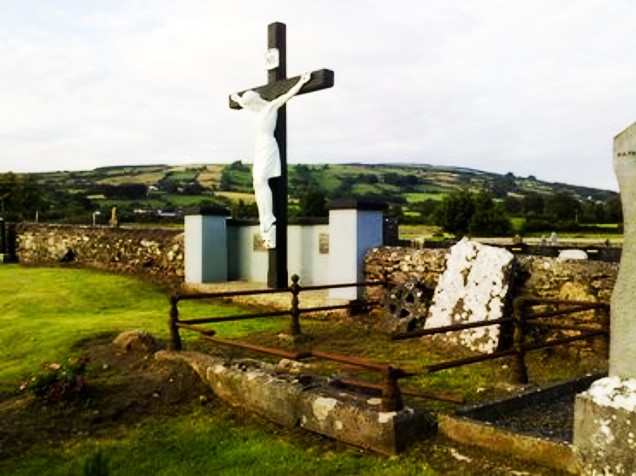
St Fintan’s well is situated in a grove of trees in the east corner of lower Kilmoylan townl. The well’s water is reputed to have great healing powers and previously many pilgrims journeyed there to be cured of diverse ailments but most especially of blindness and eye diseases..
“They have left their cot for the holy well Near the Cross in the valley flowing, its bright blude hide haith a spell Light and joy to the blind bestowing.”
St Fintan is believed to have lived to a very old age. The exact site of St Fintan’s Monastery in Doon is uncertain but we presume it is near the ancient graves of St Fintan’s cemetery in Doon. From St Engus’ comments and other sources, it has been learned that St Fintan’s death fell on the 3rd of January. His Feast-day is celebrated in the Parish. There is no information, however, regarding the year or place of his death.
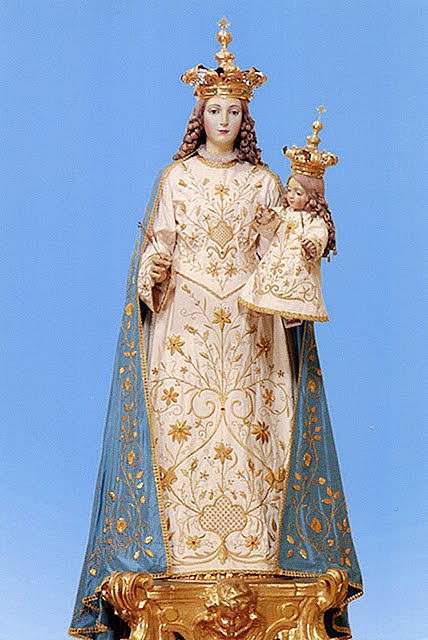
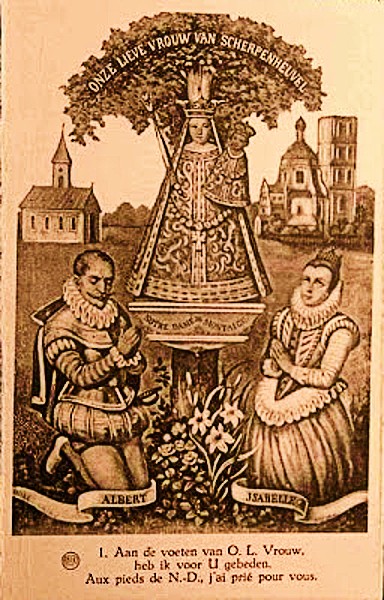
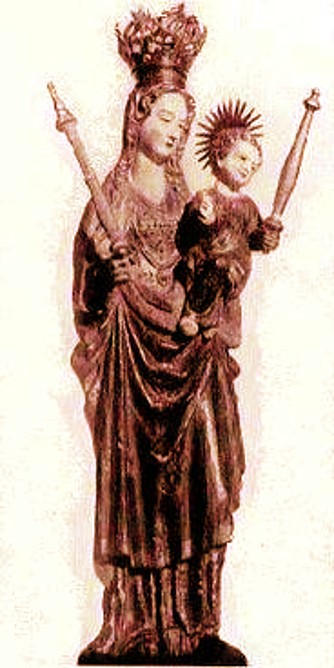
Notre-dame de Montaigu-Zichem / Our Lady of Sichem / Our Lady of Montaigu (474) – 3 January:
The Shrine in Brabant in the Duchy of Louvain, is a replacement of the one below Mount Garizim, Israel. Hadrian restored the temple on Mount Garizim and dedicated it to Jupiter. A small Christian community settled there and on several occasions they suffered greatly at the hands of the pagans. In 474 the Emperor, to avenge an unjust attack on the community, gave Mount Garizim to the Christians, who built on it a Church dedicated to the Blessed Virgin. After the Mohammedan conquest, Christianity practically disappeared from the district. The French made amends by erecting a Shrine to Mary in the Duchy of Louvain. The ancient Statue of Our Lady of Sichem, or as Our Lady of Montaigu-Zichem, which is the title more commonly used today, has been venerated in Belgium from very early times. The Mother of God rewarded the faithful magnanimously for their pious attention. According to legend, a shepherd boy originally found the Statue of Our Lady after it had apparently fallen from a niche cut in an old oak tree. The Statue was mysteriously too heavy for him to lift alone, so he ran to find his master, and have him return to help him replace the statue in its place in the old oak. It is said that in 1306 the Blessed Virgin Mary moved the hearts of the people by causing four drops of blood to flow from the eyes of the Statue. This revived the faith of the people and increased their fervour. A small Chapel was built beneath the tree, which was rebuilt in 1602 and the dedication of Our Lady of Sichem took place in the year 1604 by the Archbishop of Mechlin, Mathias Hovius. From that time forward, there were many miracles as Our Lady seemed to demonstrate her appreciation by granting many favours. The Statue was soon venerated as miraculous, and there have been many pilgrimages to the site during the centuries, continuing even until this day.
St Constant of Gap St Cyrinus of Cyzicus St Daniel Himmerod the Younger Bl Daniel of Padua St Eustadius St Finlugh St Fintan of Doon (Died 6th Century) Abbot St Florentius of Vienne St Florentius of Vienne the Martyr Bl Gerard Cagnoli St Gordius of Cappadocia St Imbenia St Lucian of Lentini St Melorius St Peter of Palestine St Primus of Cyzicus St Salvator of Belluno St Theogenes of Cyzicus St Theonas St Theopemptus of Nicomedia St Wenog Bl William Vives St Zosimus of Cilicia
Martyrs of Africa – 12 Saints: A group of Christians Martyred together in Africa, date unknown, exact location unknown. We know nothing more than their names – Acuta, Candidus, Constantius, Eugenia, Firmus, Hilarinus, Lucida, Martial, Poenica, Possessor, Rogatianus and Statutianus.
Martyrs of Tomi – 7 Saints: A group of Christians Martyred together, date unknown. We know nothing more than their names – Claudon, Diogenius, Eugene, Eugentus, Pinna, Rhodes and Rhodo. They were martyred at Tomi, Exinius Pontus, Moesia (modern Constanta, Romania).
Transport yourself “in spirit” to the Church in Prague where the original Statue of the Infant still stands and let Jesus help you with your intentions!
This wonderful prayer to the Infant Jesus of Prague is known as the Prayer of Father Cyrillus, (c 1637) truly one of the first champions of the loving little Infant!
Prayer of Fr Cyrillus, to the Beloved and Miraculous Infant Jesus of Prague
Jesus, unto Thee I flee, Through Thy Mother praying Thee In my need to succour me. Truly, I believe of Thee God Thou art with strength to shield me; Full of trust, I hope of Thee Thou, Thy grace wilt give to me. All my heart I give to Thee, Therefore, do my sins repent me; From them breaking, I beseech Thee, Jesus, from their bonds to free me. Firm my purpose, is to mend me; Never more will I offend Thee. Wholly unto Thee I give me, Patiently to suffer for Thee, Thee to serve eternally. And my neighbour like to me I will love, for love of Thee. Little Jesus, I beseech Thee, In my need, to succour me, That with Joseph and Mary And the Angels, I may Thee Once enjoy eternally. Amen.
Thought for the Day – 2 January – Meditations with Antonio Cardinal Bacci (1881-1971)
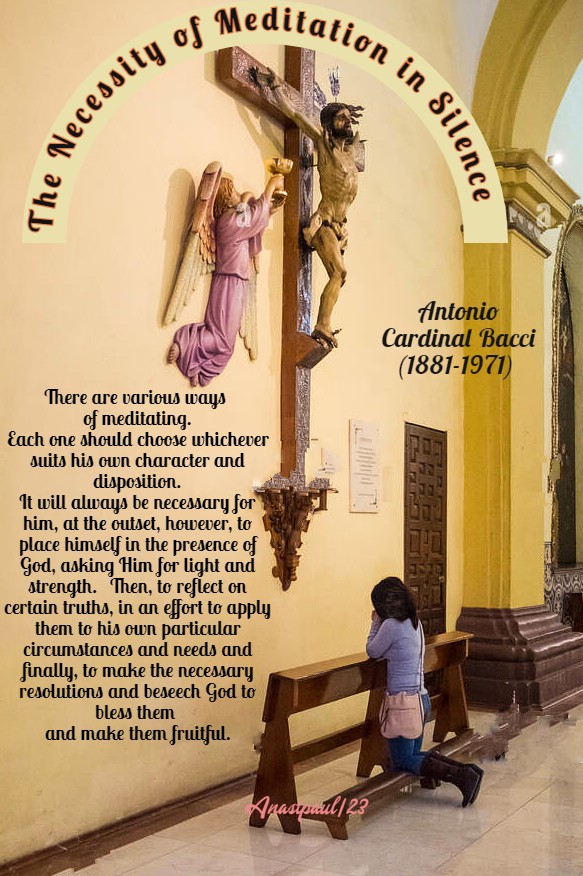
The Necessity of Meditation in Silence
“There are various ways of meditating. Each one should choose whichever suits his own character and disposition. It will always be necessary for him, at the outset, however, to place himself in the presence of God, asking Him for light and strength. Then, to reflect on certain truths, in an effort to apply them to his own particular circumstances and needs and finally, to make the necessary resolutions and beseech God to bless them and make them fruitful.
It is very useful, moreover, to recall to mind frequently, during the rest of the day, the resolutions which have been formed and to accompany these reflections, with short prayers, aspirations and acts of love for God.”
Quote/s of the Day – 2 January – The Feast and the Month of the Most Holy Name of Jesus
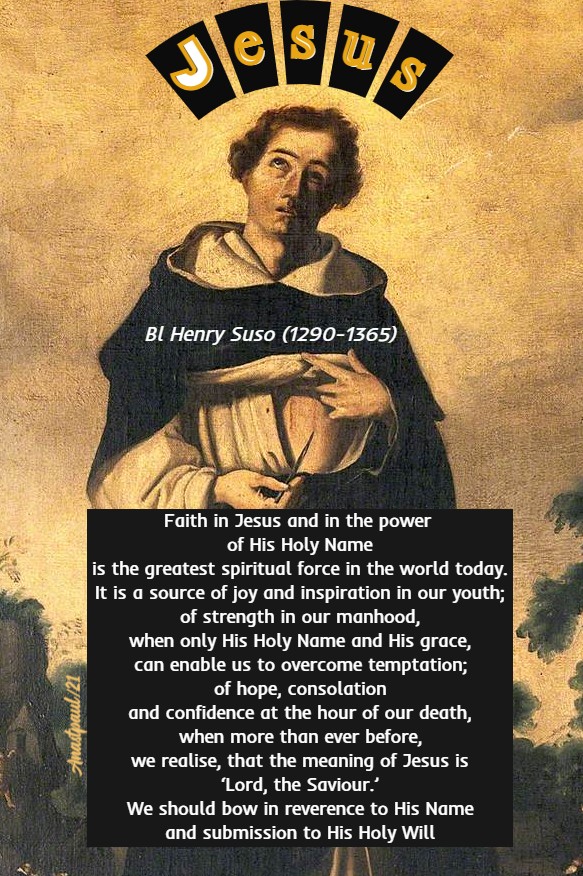
“Faith in Jesus and in the power of His Holy Name is the greatest spiritual force in the world today. It is a source of joy and inspiration in our youth; of strength in our manhood, when only His Holy Name and His grace, can enable us to overcome temptation; of hope, consolation and confidence at the hour of our death, when more than ever before, we realise, that the meaning of Jesus is ‘Lord, the Saviour.’ We should bow in reverence to His Name and submission to His Holy Will.”
Bl Henry Suso OP (1290-1365)
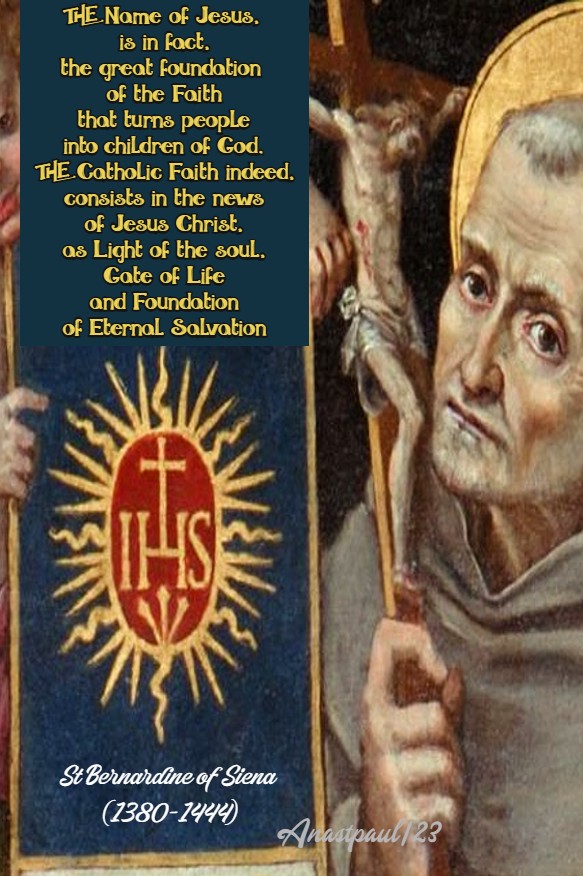
“The Name of Jesus, is in fact, the great foundation of the Faith that turns people into children of God. The Catholic Faith indeed, consists in the news of Jesus Christ, as Light of the soul, Gate of Life and Foundation of Eternal Salvation.”
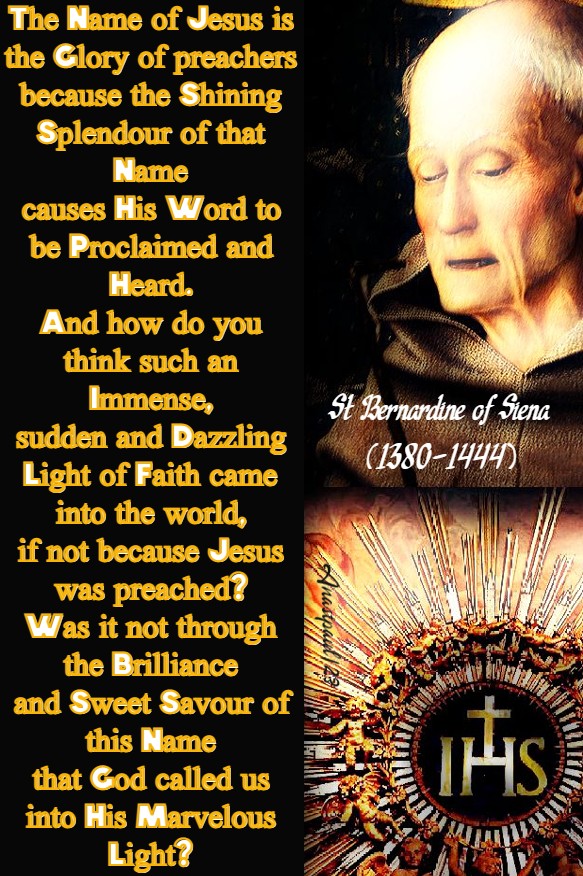
“The Name of Jesus is the glory of preachers because the shining splendour of that Name causes His Word to be proclaimed and heard. And how do you think such an immense, sudden and dazzling Light of Faith came into the world, if not because Jesus was preached? Was it not through the brilliance and sweet savour of this Name that God called us into His marvelous Light?”
One Minute Reflection – 2 January – The Feast and the Month of the Most Holy Name of Jesus – Titus 2:11-15, Luke 2:21 – Scripture search here: https://www.drbo.org/
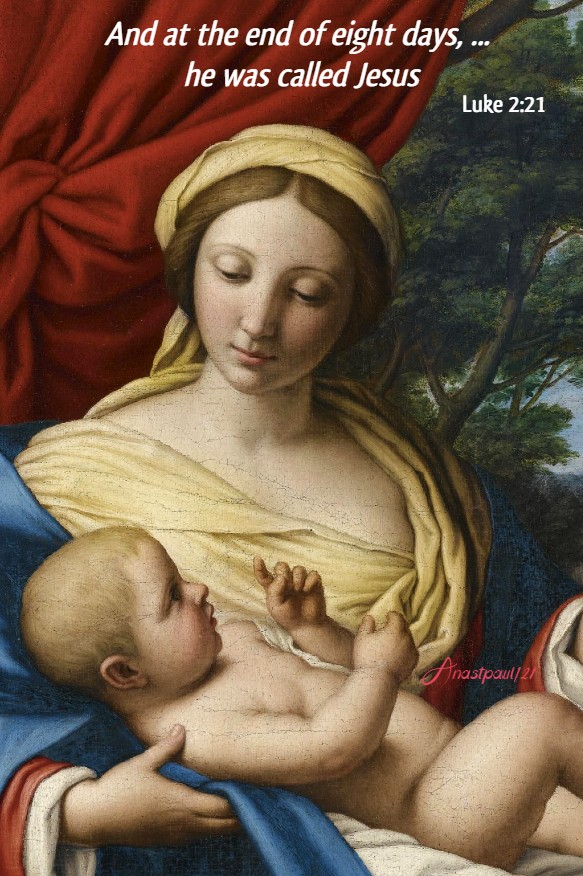
“And at the end of eight days, when He was circumcised, He was called Jesus”…Luke 2:21”
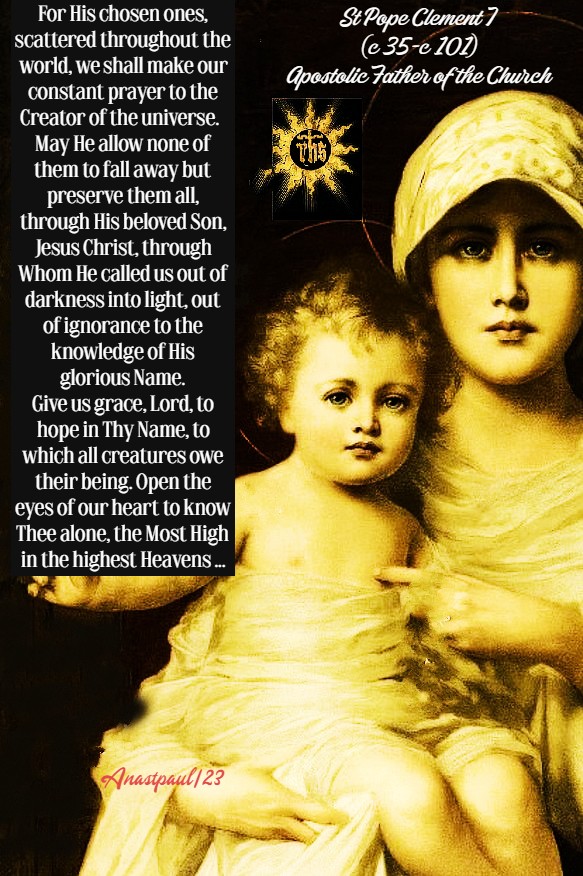
REFLECTION – “For His chosen ones, scattered throughout the world, we shall make our constant prayer to the Creator of the universe. May He allow none of them to fall away but preserve them all, through His beloved Son, Jesus Christ, through Whom He called us out of darkness into light, out of ignorance to the knowledge of His glorious Name.
Give us grace, Lord, to hope in Thy Name, to which all creatures owe their being. Open the eyes of our heart to know Thee alone, the Most High in the highest Heavens, the Holy One, Whose dwelling is in the holy Heaven. Thou abase the arrogance of the proud, frustrate the designs of the godless, exalt the lowly and humble the lofty. Thou give men wealth and take it away; Thou slay them, save them and give them new life. Alone the Benefactor of spirits and God of all flesh, Thy gaze penetrates the depths, Thou observes the doings of men. Helper of those in peril, Saviour of those in despair, Thy created and still, keep watch over all that draws breath. Thou cause the peoples on the earth to multiply and from them all, choose those who love Thee through Jesus Christ, Thy beloved Son. Through Him Thou has instructed us, sanctified us, honoured us.
Lord, we entreat Thee to help us. Come to the aid of the afflicted, pity the lowly, raise up the fallen, show Thy face to the needy, heal the sick, convert the wayward, feed the hungry, deliver the captives, support the weak, encourage the fainthearted. Let all nations know that Thou alone are God; Jesus Christ is Thy Son and we are Thy people and the sheep of Thy pasture. …
Do not hold all the transgressions of Thy servants against them but purify us by Thy truth and so guide our footsteps that, by walking in holiness and justice and simplicity of heart, we may do what is good and pleasing in Thy sight and in the sight of our leaders.
Lord, let the light of Thy Face shine upon us, so that we may enjoy Thy blessings in peace, protected by Thy Strong Hand and freed from all sin, by Thy outstretched Arm and deliver us from those, who hate us unjustly.
Give peace and concord to us and to all mankind, even as Thou gave it to our ancestors, when they devoutly called upon Thee in faith and truth. Lord, Thou alone are able to bestow these and even greater benefits upon us. We praise Thee through Jesus Christ, our High Priest and the champion of our souls. Through Him be glory and majesty to Thee now and throughout all generations, forever and ever. Amen.” – St Clement I (c 35-c 101) Pope from about 88 to 101, Martyr, Apostolic Father of the Church (An excerpt from Letter to the Corinthians).
PRAYER – O God, Thou Who by the fruitful virginity of blessed Mary, have bestowed upon mankind the rewards of eternal salvation, grant, we beseech Thee, that we may enjoy the intercession of her, through whom we have been found worthy to receive among us, the Author of Life, our Lord Jesus Christ Thy Son. Who lives and reigns with Thee, in the unity of the Holy Ghost, God, world without end. Amen (Collect).
Our Morning Offering – 2 January – Feast and Month of the Most Holy Name of Jesus
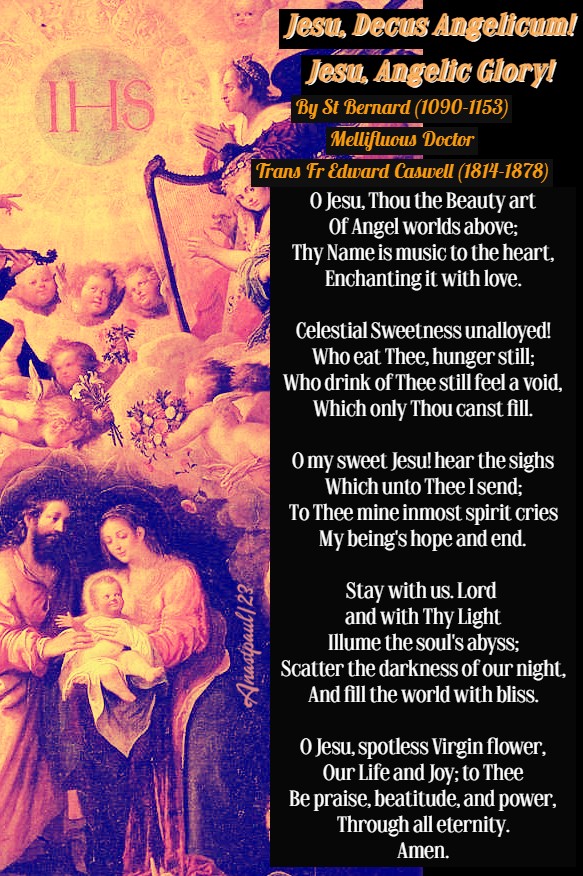
Jesu, Decus Angelicum! Jesu, Angelic Glory! By St Bernard of Clairvaux (1090-1153) Mellifluous Doctor Trans Fr Edward Caswell C.Orat. (1814-1878)
O Jesu, Thou the Beauty art Of Angel worlds above; Thy Name is music to the heart, Enchanting it with love.
Celestial Sweetness unalloyed! Who eat Thee, hunger still; Who drink of Thee still feel a void, Which only Thou canst fill.
O my sweet Jesu! hear the sighs Which unto Thee I send; To Thee mine inmost spirit cries My being’s hope and end.
Stay with us. Lord and with Thy Light Illume the soul’s abyss; Scatter the darkness of our night, And fill the world with bliss.
O Jesu, spotless Virgin flower, Our Life and Joy; to Thee Be praise, beatitude, and power, Through all eternity. Amen.
As noted yesterday, Jesu, Dulcis Memoria is a celebrated 12th century prayer/hymn by St Bernard of Clairvaux (1090-1153), Doctor Mellifluous. The entire hymn has some 42 to 53 stanzas. Parts of this hymn are used for the Feast of the Holy Name of Jesus. So the above are the stanzas used today for the Feast of the Holy Name.
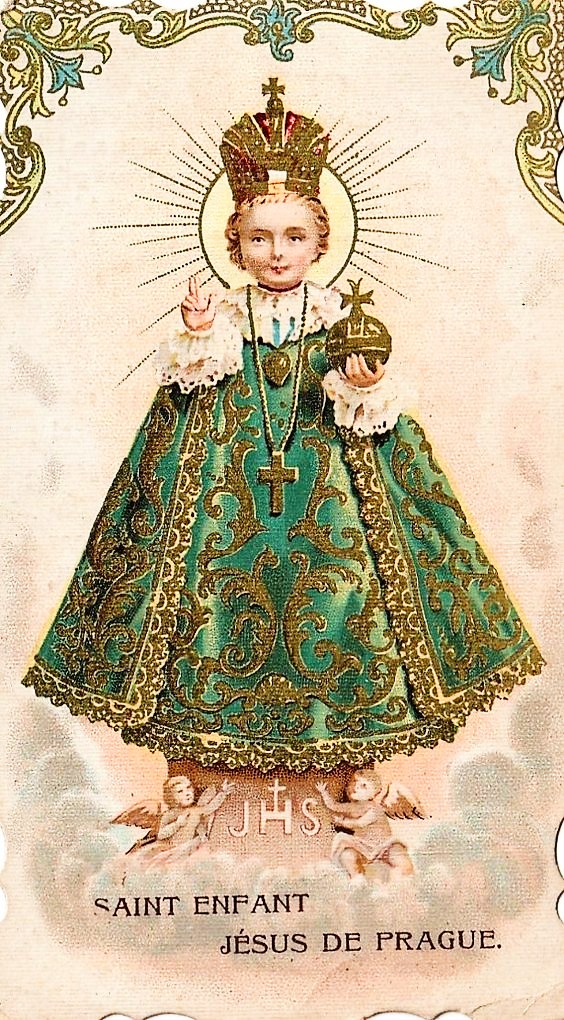
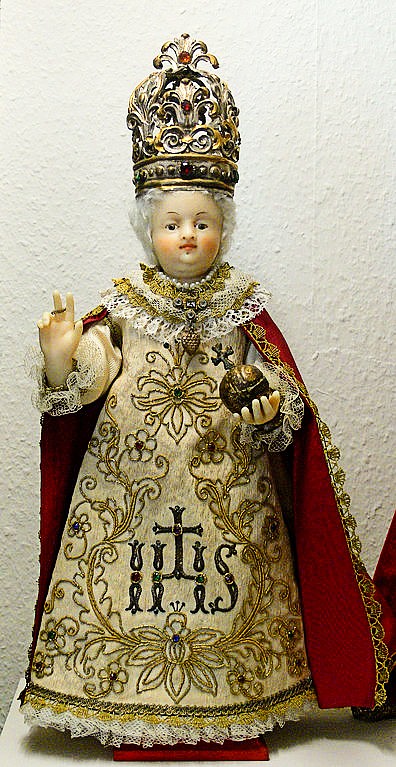
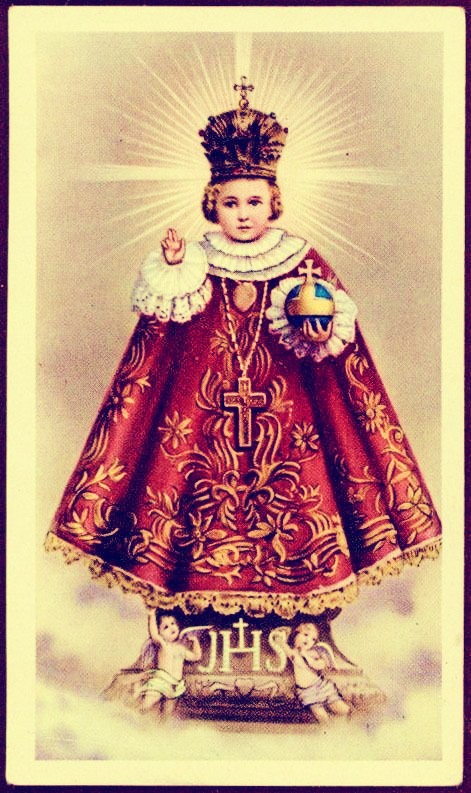
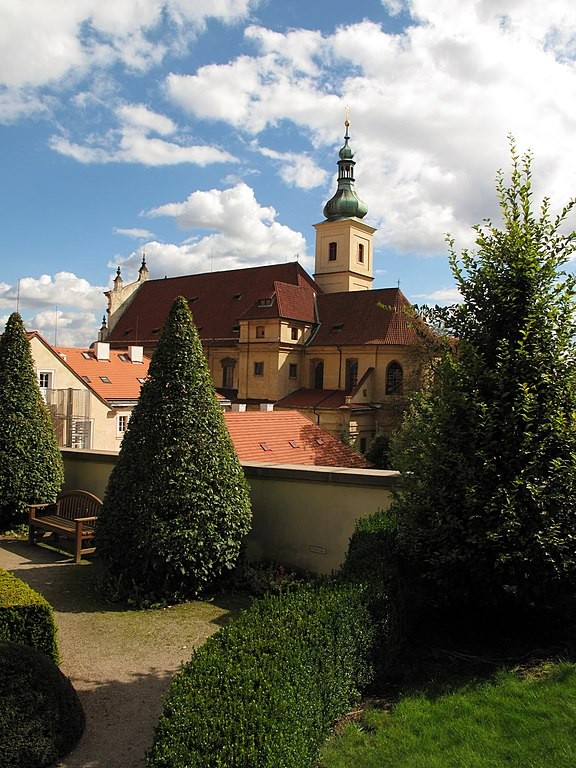
Saint of the Day – 2 January – Feast of the Infant Jesus of Prague – the 16th Century wax-coated wooden Statue of the Child Jesus, holding a globus cruciger (the Orb and Cross) with the right hand being raised in benediction, is of Spanish origin and is just under half a metre in height. It is now located in the Discalced Carmelite Church of Our Lady of Victories in Malá Strana, Prague, Czech Republic, see the Church at the bottom (one where I have been immensely blessed to attend Holy Mass before the Infant each day for a week some years ago). The Statue is venerated on 2 January, on 14 January and on the first Sunday of May.
The Infant above the Altar at Our Lady of Victories in Malá Strana, Prague
In 1556, pious legends claim that the Statue once belonged to St Teresa of Ávila and was donated to the Carmelite Friars by Princess Polyxena of Lobkowicz in 1628 upon her marriage to Czech nobleman.
The image is routinely clothed by the Carmelite Nuns in luxurious fabrics often in the Liturgical Vestment colours relevant to the Seasons and with imperial regalia and a golden crown. In thanksgiving for the numerous graces and cures received, the miraculous Statue at Prague , was solemnly crowned when Pope Leo XII signed and granted its first Pontifical Decree of Canonical Coronation on 24 September 1824. St Pius X granted authorisation via the Decree “Significat Nobis” to erect a namesake Confraternity.
Disturbances in Bohemia due to the Thirty Years’ War brought an end to the special devotions and on 15 November 1631 the army of King Gustavus Adolphus of Sweden took possession of Bohemia’s Capital City. The Carmelite Friary was plundered and the image of the Infant of Prague was thrown into a pile of rubbish behind the Altar. Here it lay forgotten for seven years, its hands broken off, until in 1637, it was found again by Father Cyrillus and placed in the Church’s oratory. One day, while praying before the Statue, Cyrillus heard a voice say, “Have pity on Me and I will have pity on you. Give Me my hands and I will give you peace. The more you honour Me, the more I will bless you.”
A German copy of the Statue, with a white wig instead of the traditional blonde hair, circa. 1870
Copies of the Infant Jesus arrived in Poland in 1680 and it has been popular in Polish homes and Bohemia in general, where the copies are typically placed in glass-enclosed cases. After the start of the Counter-Reformation era of the 17th Century, the Statue spread among Catholics all over the world, with particular devotion developing in South Africa, Australia, Caribbean, Thailand and Sri Lanka.
So many graces have been received by those who invoke the Divine Child before the original Statue that it has been called “The Miraculous Infant Jesus of Prague.” We read the following in an old book printed in Kempt: “All who approach the miraculous Statue and pray there with confidence, receive assistance in danger, consolation in sorrows, aid in poverty, comfort in anxiety, light in spiritual darkness, streams of grace in dryness of soul, health in sickness and hope in despair.”
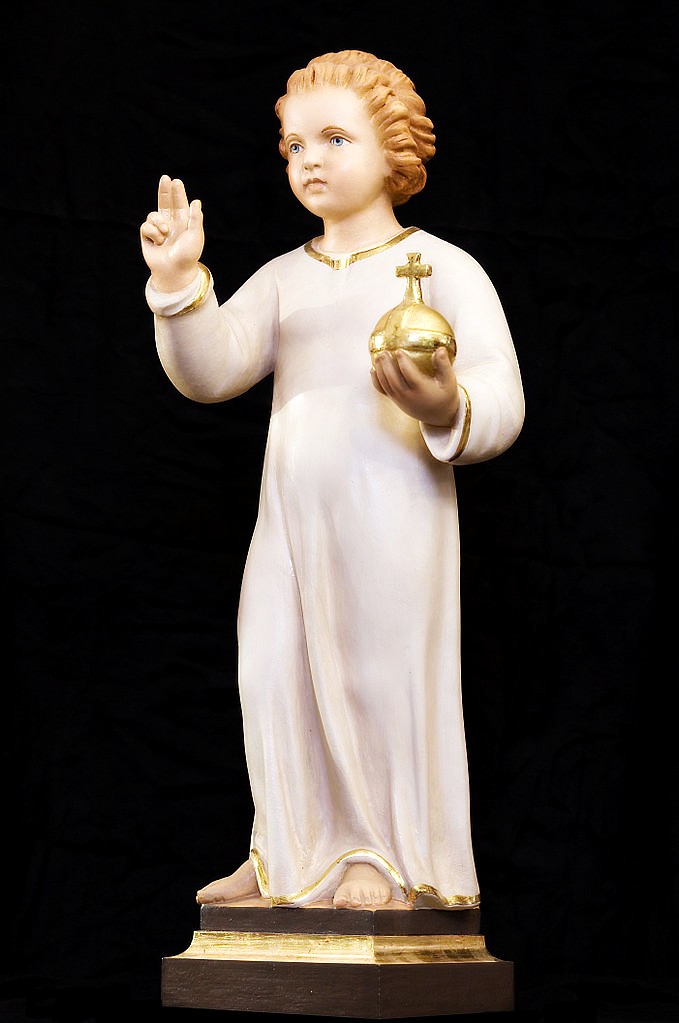
The Infant in it’s bare format
From small beginnings, this devotion has grown to great proportions. The Divine Child attracts an ever increasing number of clients, who appeal to Him in every need.
The Church of Our Lady Victorious, in Malá Strana, Prague, Czech Republic.
Bl Airaldus of Maurienne St Alverius of Agaunum St Asclepius of Limoges St Aspasius of Auch St Baudimius of Auvergne St Blidulf of Bobbio St Dietmar of Prague Bl Guillaume Répin Bl Guillermo de Loarte St Hortulana of Assisi St Isidore of Antioch St Isidore of Nitri St John Camillus the Good St Macarius of Rome
St Mark the Mute St Maximus of Vienne St Munchin of Limerick Bl Odino of Rot St Paracodius of Vienne St Sebastian of Agaunum St Seiriol Bl Stephana de Quinzanis Bl Sylvester of Troina St Telesphorus, Pope St Theodota St Theopistus St Vincentian of Tulle St Viance of Anjou
Many Martyrs Who Suffered in Rome: There were many Martyrs who suffered in the persecutions of Diocletian for refusing to surrender the holy books. Though we know these atrocities occurred, we do not know the names of the Saints and we honour them as a group. c 303 in Rome, Italy.
Martyrs of Antioch – 5 Saints: A group of Christian soldiers Martyred together for their faith. We know the names of five – Albanus, Macarius, Possessor, Starus and Stratonicus. They were born in Greece and were Martyred in Antioch (modern Antakya, Turkey).
Many Martyrs of Britain: The Christians of Britain appear to have escaped unharmed in the earlier persecutions which afflicted the Church but the cruel edicts of Diocletian were enforced in every corner of the Roman Empire and the faithful inhabitants of this land, whether native Britons or Roman colonists, were called upon to furnish their full number of holy Martyrs and Confessors. The names of few are on record but the British historian, Saint Gildas, after relating the Martyrdom of Saint Alban, tells us, that many others were seized, some put to the most unheard-of tortures and others immediately executed, while not a few hid themselves in forests and the caves of the earth, where they endured a prolonged death until God called them to their reward. The same writer attributes it to the subsequent invasion of the English, then a pagan people, that the recollection of the places, sanctified by these Martyrdoms, has been lost and so little honour paid to their memory. It may be added, that, according to one tradition, a thousand of these Christians were overtaken in their flight near Lichfield and cruelly massacred and that the name of Lichfield, or Field of the Dead, is derived from them.
Martyrs of Ethiopia – 3 Saints: A group of Christians Martyred together for their faith. We know the names of three – Auriga, Claudia and Rutile.
Martyrs of Jerusalem – 2 Saints: A group of Christians Martyred together for their faith. We know the names of two – Stephen and Vitalis.
Martyrs of Lichfield: Many Christians suffered at Lichfield (aka Lyke-field, meaning field of dead bodies), England in the persecutions of Diocletian. Though we know these atrocities occurred, we do not know the names of the Saints and we honour them as a group. Their Martyrdom occurred in 304 at Lichfield, England.
Martyrs of Piacenza: A group of Christians who died together for their faith in the persecutions of Diocletian. No details about them have survived. They were Martyred on the site of Church of Madonna di Campagna, Piacenza, Italy.
Martyrs of Puy – 4 Saints: Missionaries, sent by Saint Fronto of Périgueux to the area of Puy, France. Tortured and Martyred by local pagans. We know the names – Frontasius, Severinus, Severian and Silanus. They were beheaded in Puy (modern Puy-en-Velay), France and buried together in the Church of Notre Dame, Puy-en-Velay by Saint Fronto, their bodies laid out to form a cross.
Martyrs of Syrmium – 7 Saints: Group of Christians Martyred together, date unknown. We know the names of seven – Acutus, Artaxus, Eugenda, Maximianus, Timothy, Tobias and Vitus – but very little else. This occurred in the 3rd or 4th century at Syrmium, Pannonia (modern Sremska Mitrovica, Serbia).
Martyrs of Tomi – 3 Saints: Three brothers, all Christian soldiers, in the Imperial Roman army and all three Martyred in the persecutions of Emperor Licinius Licinianus. We know their names – Argeus, Marcellinus and Narcissus – but little else. They were Martyred in 320 at Tomi, Exinius Pontus, Moesia (modern Constanta, Romania).
Let us pray for the strength and courage to withstand the father of lies, and to watch and wait patiently, with our lamps lit, wearing the Armour of God and standing firm in the Faith. “Many are the afflictions of the just but out of them all, will the Lord deliver them.” (Ps 33:20)
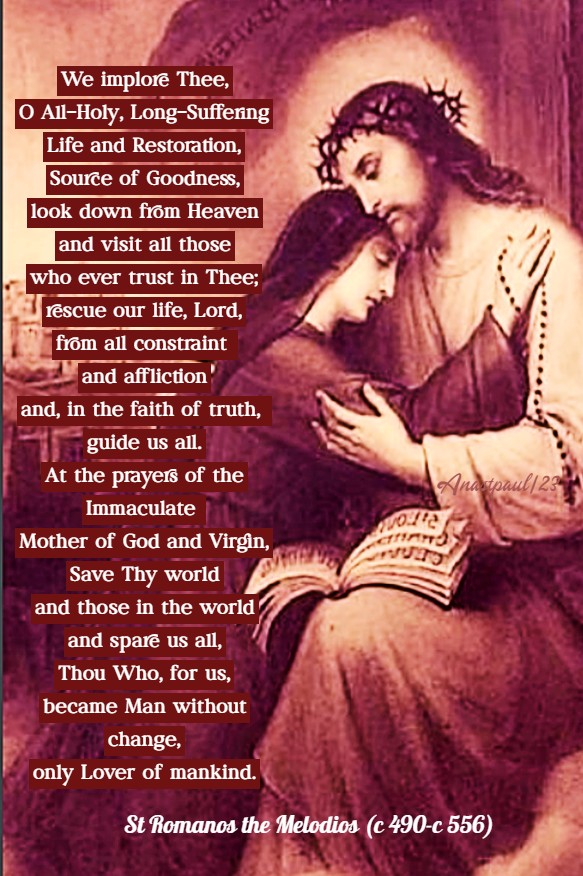
“We implore Thee, O All-Holy, Long-Suffering Life and Restoration, Source of Goodness, look down from Heaven and visit all those who ever trust in Thee; rescue our life, Lord, from all constraint and affliction and, in the faith of truth, guide us all. At the prayers of the Immaculate Mother of God and Virgin, Save Thy world and those in the world and spare us all, Thou Who, for us, became Man without change, only Lover of mankind.”
St Romanos the Melodios (c 490-c 556)
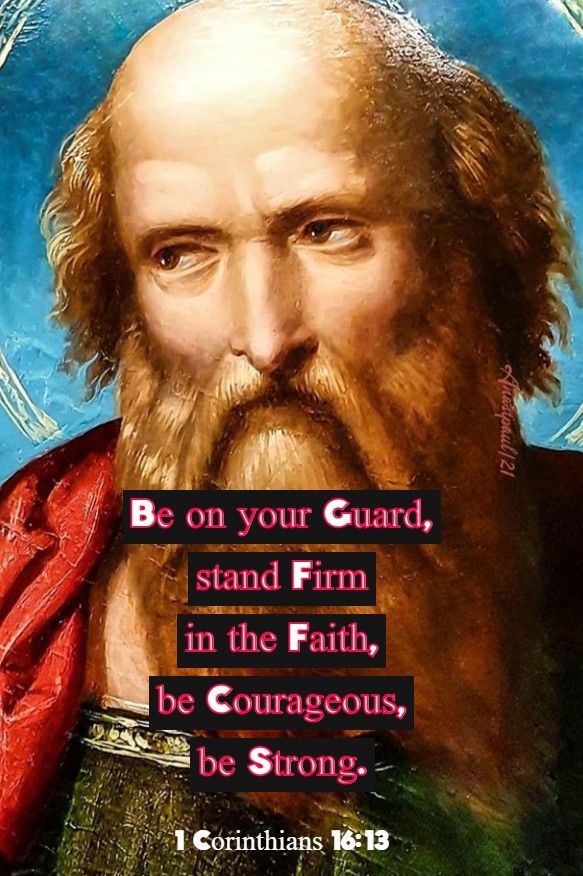
“Be on your guard, stand firm in the faith, be courageous, be strong.”
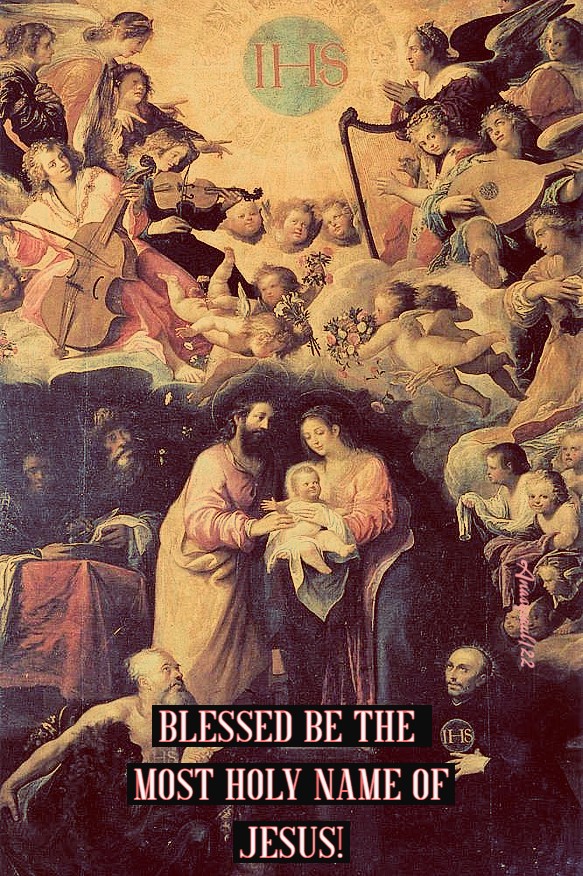
The Name “Jesus” was given to the Holy Child at God’s command (Luke 1:31). The Holy Name is all-powerful because of the Person Who bears it; we honour it because of the command of Christ that we should pray in His Name and because it reminds us of all the blessings we receive through our Holy Redeemer. Hence, St Paul was able to write to the Philippians: “…. at the Name of Jesus, every knee should bend of those in Heaven, on earth and under the earth“ (Phil. 2:10). By means of this devotion we also make amends for improper use of the Holy Name and for the constant blasphemy of this most precious Name.
“Oh Most Sacred Name, Name of peace, Balsam of life, which is the centre of all the sighs, of the most fervent lovers of Jesus. The Sign of those, who truly love Jesus, is to bear Jesus imprinted in the heart and to name often and with devotion, the Most Holy Name of Jesus.”
Thought for the Day – 1 January – Meditations with Antonio Cardinal Bacci (1881-1971)
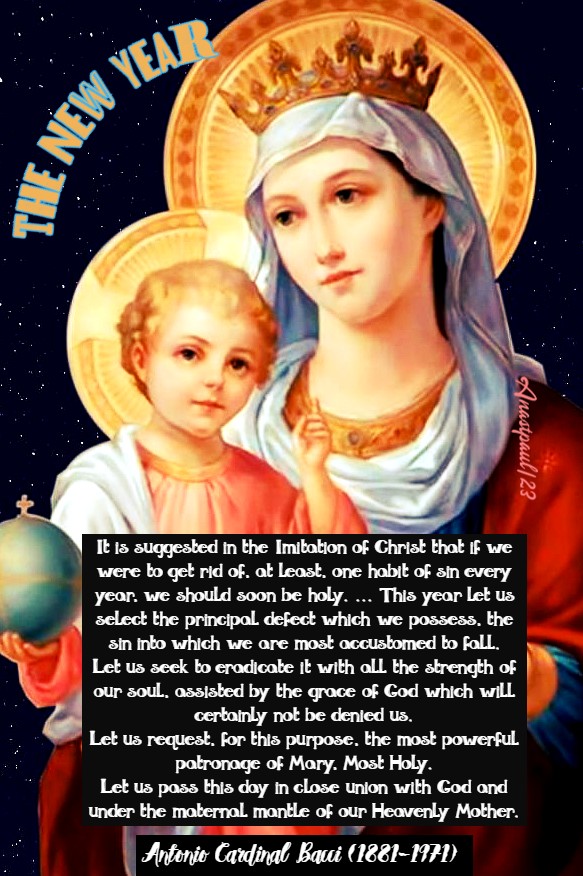
The New Year
“It is suggested in the Imitation of Christ that if we were to get rid of, at least, one habit of sin every year, we should soon be holy. If we have not tried to do this in the past, let us do it in the future. This year let us select the principal defect which we possess, the sin into which we are most accustomed to fall. Let us seek to eradicate it with all the strength of our soul, assisted by the grace of God which will certainly not be denied us. Let us request, for this purpose, the most powerful patronage of Mary, Most Holy. Let us pass this day in close union with God and under the maternal mantle of our Heavenly Mother.
Finally, let us promise earnestly that all the days of the New Year, will follow the same pattern.”
Quote of the Day – 1 January – “The Month of the Most Holy Name of Jesus”
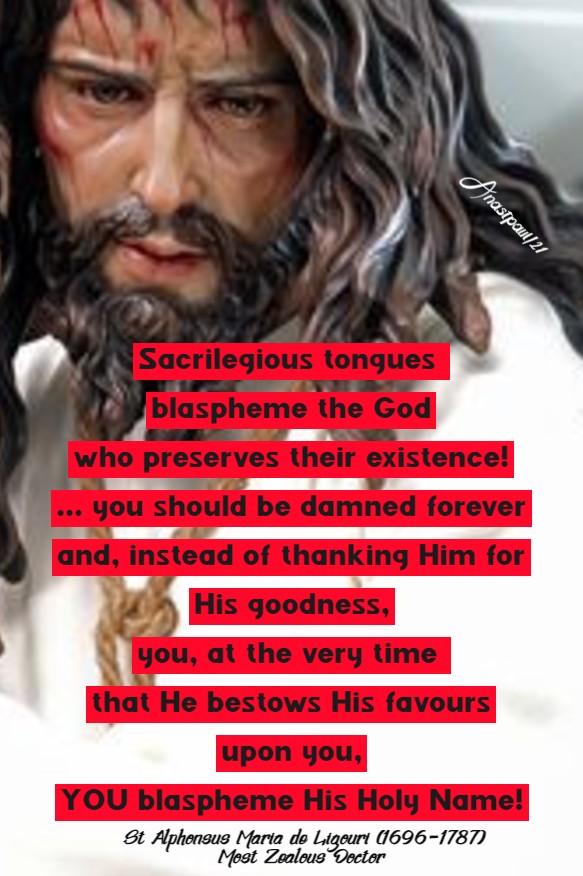
“Sacrilegious tongues blaspheme the God who preserves their existence! … you should be damned forever and, instead of thanking Him for His goodness, you, at the very time that He bestows His favours upon you, YOU blaspheme His Holy Name!”
St Alphonsus Maria de Liguori (1696-1787) Most Zealous Doctor
One Minute Reflection – 1 January – “The Month of the Most Holy Name of Jesus” – Feast of the Circumcision of the Lord – Titus 2:11-15, Luke 2:21 – Scripture search here: https://www.drbo.org/
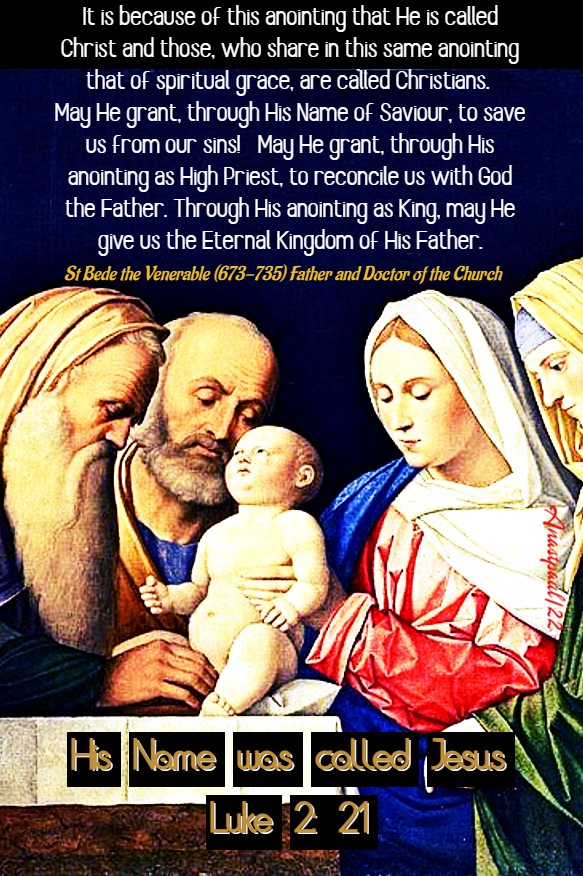
“His Name was called Jesus” – Luke 2:21
REFLECTION – “The Name “Jesus” in Hebrew means “salvation” or “Saviour.” It is a Name that for the prophets, referred to a very specific vocation . From whence came these words, sung with great desire to see Him: “My heart will rejoice in Thy salvation and will be joyful because of His salvation; my soul pines for Thy salvation” (Ps 12:6 ;34:9 ;118:81). “Yet will I rejoice in the Lord and exult in my saving God” (Hab 3:18). And especially: “O God, by Thy Name save me” (Ps 53:3). It is as though one were to say: “O Thou Who are called ‘Saviour,’ by saving me, manifest the glory of Thy Name.” And so the Name of the Son, born of the Virgin Mary, is Jesus, according to the Angel’s explanation: “He shall save His people from their sins”…
As for the word “Christ,” this designates priestly or royal status. Priests and Kings were in fact “chrismated” that is to say, anointed with holy oil. By this means, they became signs of Him Who, appearing in the world as true King and High Priest, received the anointing of “the oil of gladness above Thy fellows” (Ps 44:8). It is because of this anointing that He is called Christ and those, who share in this same anointing that of spiritual grace, are called Christians. May He grant, through His Name of Saviour, to save us from our sins! May He grant, through His anointing as High Priest, to reconcile us with God the Father. Through His anointing as King, may He give us the Eternal Kingdom of His Father.” – St Bede the Venerable (673-735) Father and Doctor of the Church (Homily 5; CCL 122,36).
PRAYER – O God, Thou Who by the fruitful virginity of blessed Mary, have bestowed upon mankind the rewards of eternal salvation, grant, we beseech Thee, that we may enjoy the intercession of her, through whom we have been found worthy to receive among us, the Author of Life, our Lord Jesus Christ Thy Son. Who lives and reigns with Thee, in the unity of the Holy Ghost, God, world without end. Amen (Collect).





























You must be logged in to post a comment.