St Brogan St Casilda of Toledo St Concessus the Martyr St Demetrius the Martyr St Dotto St Eupsychius of Cappadocia St Gaucherius St Hedda the Abbot St Heliodorus of Mesopotamia St Hilary the Martyr St Hugh of Rouen OSB (Died 730) Bishop, Monk Bl James of Padua Blessed John of Vespignano
Martyrs of Croyland – 9 Saints: A group of Benedictine Monks Martyred by pagan Danes – Agamund, Askega, Egdred, Elfgete, Grimkeld, Sabinus, Swethin, Theodore and Ulric. Croyland Abbey, England.
Martyrs of Masyla: Massylitan Martyrs Group of Christians Martyred in Masyla in northwest Africa.
Martyrs of Pannonia: Seven Virgin-Martyrs in Sirmium, Pannonia (modern Sremska Mitrovica, Serbia).
Martyrs of Thorney Abbey – 3+ Saints: A group of Hermits, hermitesses and monks who lived in or around Thorney Abbey who were Martyred together during raids by pagan Danes. We know little more than the names of three – Tancred, Torthred and Tova. 869 by raiders at Thorney Abbey, Cambridgeshire, England.
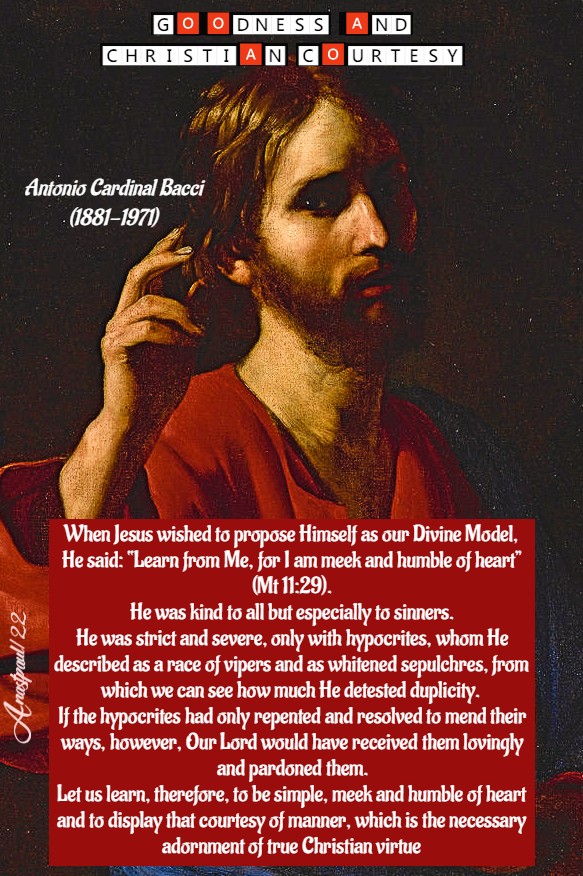
Thought for the Day – 8 April – Meditations with Antonio Cardinal Bacci (1881-1971)
The Betrayal of Judas
“It is quite certain, that Judas did not commit this sacrilegious act of betrayal on the spur of the moment. Evil, like goodness, is arrived at step-by-step. Perhaps it was some motive of self-interest, rather than of pure love, which led Judas to become one of Jesus; Apostles. Covetousness, “the root of all evils,” (Cf 1 Tim 6:10) seems to have been his dominant passion. As the Gospel tells us, he kep the money offerings which those who had been converted, gave to Jesus for His support and for that of His Apostles. Judas did not know how to suppress his dominant passion at times. On one occasion, he complained about Mary Magdalen, when she anointed the feet of Jesus with precious ointment. The passion grew and he became a thief, “He was a thief and holding the purse used to take what was put in it” (Jn 12:6). In spite of the extraordinary grace he had received, he fell into sin. Finally, he was guilty of the betrayal, of the sacrilegious communion at the last supper and of the kiss of hypocrisy in Gethsemane.
The example of Judas is a lesson to us. It is disastrous to begin to yield to our passions and to fall into evil habits. The Holy Spirit warns us that anyone who makes little account of small things, will fall into bigger (Cf Ecclus 19:11). Let us remember, that even a tiny spark can set off a conflagration. Likewise, a single mortal sin can lead us to Hell!”
Friday of Passion Week – 8 April – Our Lenten Journey with the Great Fathers – Jeremiah 17:13-18, John 11:47-54
“O Lord, deal with us not according to our sins, nor requite us according to our crimes.” – Psalm 102:10
“ … It is expedient for us, that one man die for the people, instead of the whole nation perishing.”
John 11:50
“THE DARKENING OF ONE makes many bright… “It is better,” said Caiaphas, “for one man to die for the people, than for the whole nation to be destroyed.” It is better that One be darkened “in the likeness of sinful flesh,” (Rm 8:3) for the sake of all, than for the whole of mankind to be lost by the darkness of sin; that the splendour and image of the substance of God, should be shrouded in the form of a Slave, in order that a slave might live; that the brightness of eternal Light should become dimmed in the flesh, for the purifying of the flesh; that He, Who surpasses all mankind in beauty (Ps 44:2), should be eclipsed by the darkness of the Passion, for the enlightening of mankind; that He should suffer the ignominy of the Cross, grow pale in death, be totally deprived of beauty and comeliness, that He might gain the Church as a beautiful and comely Bride, without spot or wrinkle (Ep 5:27).
BUT UNDER HIS DARK COVERING (Sg 1:5), I recognise the King… I recognise Him and I embrace Him. For, although He presents this dark exterior… within, is the brightness of Divine life, the beauty of His strength, the splendour of grace, the purity of innocence. But covering it all, is the abject hue of infirmity, His Face, as it were, hidden and despised – “one tempted in every respect, as we are, yet without sinning” (Heb 4:15).
I RECOGNISE HERE ,the image of our sin-darkened nature; I recognise the garments that clothed our first parents after their sin (Gen 3:21). My God has clothed Himself in them by assuming the condition of a Slave and becoming, as men are, He was seen in their likeness (Phil 2:7). Under the skin that Jacob wore (Gen 27:16), symbol of sin, I recognise, both the Hand that committed no sin and the Neck which never bowed to evil; no word of treachery was found in His Mouth. I know, Lord, that You are gentle by nature, meek and humble of heart, pleasing in appearance and lovable in Your ways, “anointed with the oil of gladness above Yourcompanions” (Mt 11:29; Ps 44:8). Why then this disfigured likeness to Esau? Whose haggard image this?… Ah! It is mine! He has taken my likeness, taken on my sin… And beneath the rough skin of my sinfulness, I recognise my God and my Saviour.!” – St Bernard (1091-1153) Cistercian Monk, Great Father and Doctor of the Church (28th Homily on the Song of Songs).
Quote/s of the Day – 8 April – Our Lady of the Seven Sorrows – Friday of Passion Week, the Fifth Week in Lent
“Whoever you are, who love the Mother of God, take note and reflect with all your innermost feelings, upon her, who wept for the Only-Begotten as He died… The grief she felt in the Passion of her Son, goes beyond all understanding.”
St Amadeus of Lausanne (1108-1159)
“During the entire course of her life, the Blessed Virgin Mary, Mother of God, never deviated in the slightest from the precepts and examples of her Divine Son. This was true both in the most sweet joys Mary experienced and in the cruel sufferings she underwent, which made the the Queen of Martyrs.”
Venerable Pope Pius XII (1876-1958)
“If you want to assist at Mass, with devotion and with fruit, think of the sorrowful Mother at the feet of her Son on Calvary.”
St Pio of Pietrelcina OFM Cap (1887-1968) Padre Pio
One Minute Reflection – 8 April – Our Lady of the Seven Sorrows – Friday of Passion Week, the Fifth Week in Lent – Jeremiah 17:13-18, John 11:47-54
“ … It is expedient for us, that one man die for the people, instead of the whole nation perishing.” – John 11:50
REFLECTION – “God, the Word of the all-good Father, did not disregard the human race, His own creation, when it was sinking back into corruption but rather, by the offering of His own Body, He destroyed the death men had incurred and by His teaching, He corrected their negligence. So, He restored by His power, all that belongs to man’s estate.
Anyone can find confirmation of this from the Saviour’s own disciples who spoke of Him, for in their writings one reads: The charity of Christ constrains us as we judge that if one died on behalf of all, then all died and He died for all, in order that we may live, no longer for ourselves but for Him Who died for us and rose from the dead, our Lord Jesus Christ. And again: We see Jesus, Who for a little while was made lower than the angels, crowned with glory and honour because He suffered death, that by God’s grace He might taste death for everyone. Then the writer goes onto show why it had to be God, the Word and no other Who became Man: Indeed it was fitting that in bringing many sons to glory, God, for Whom and through Whom all things exist, should make perfect the One Who leads them to salvation. By this He means, that the task of bringing men back from the corruption into which they had fallen, belonged to no other save God the Word, Who had made them in the beginning. Further, Scripture shows, that the Word assumed a Body for the purpose of offering It in sacrifice on behalf of other bodies like His own, for the writer continues: Since the children have blood and flesh in common, He likewise, shared in them Himself ,so that, by His own Death, He might destroy the one who had power over death, that is, the devil and might deliver those, who all their life long, were enslaved by fear of death.
For by the sacrifice of His own Body, He both put an end to the law that stood against us and made a new beginning of life for us, by giving us the hope of resurrection. Hence Paul, the Christbearer, declares: As through a man came death, so through a Man has come the Resurrection of the dead. For as all died in Adam, so also in Christ all shall be made to live.
No longer, then, do we die as men condemned but as men being raised even now, we await the general resurrection of all, which God, Whose work and gift it is, will reveal at the appointed time. – St Athanasius (297-373) Archbishop of Alexandria, Great Father and Doctor of the Church (An excerpt from his “On the Incarnation of the Word” 10).
PRAYER – O God, in Whose Passion the sword, according to the prophecy of blessed Simeon, pierced through the soul of Mary, the glorious Virgin and Mother, mercifully grant that we, who reverently commemorate her piercing through and her suffering, may, by the interceding glorious merits of all the saints faithfully standing by the Cross, obtain the abundant fruit of Your Passion. Who lives and reigns with God the Father, in the unity of the Holy Ghost, God, world without end. Amen (Collect).
Our Morning Offering – 8 April – Friday of Passion Week, the Fifth Week in Lent
The Glory of These Forty Days By St Gregory the Great (540-604) Pope, Great Father & Doctor of the Church
The glory of these forty days we celebrate with songs of praise, for Christ, by Whom all things were made, Himself has fasted and has prayed. Alone and fasting Moses saw the loving God Who gave the law. And to Elijah, fasting, came the steed and chariots of flame. So Daniel trained his mystic sight, delivered from the lion’s might. And John, the Saviour’s friend, became the herald of Messiah’s Name. Then grant, O God, that we may, too, return in fast and prayer to You. Our spirits strengthen with Your Grace, and give us joy to see Your Face. Amen!
Saint of the Day – 8 April – Blessed Julian of Saint Augustine OFM (c 1550-1606) Lay Brother of the Friars Minor, Hermit, Ascetic, Born in c 1550 as Julián Martinet Gutiérrez at Medinaceli, Diocese of Segovia, Castile, Spain and died on 8 April 1606 at Saint Didacus Friary, Alcalá de Henares, Spain of natural causes. Also known as – Julian Martinet, Fray Julián de Alcalá.
Julian’s father was a French nobleman who, in order to escape from the violent pressure exerted on him by the Calvinists, seeking to make him apostatise from the Catholic Faith, fled to Spain, leaving all his wealth behind. There Julian was born and reared amid unpretentious circumstances but in a very Christian manner. The boy was devoted to piety, his greatest pleasure being to serve the Priests at the Altar.
As a young man, Julian accompanied for some time, a Missionary of the Franciscan Order on his apostolic journeys. This Friar arranged for his admission with the Friars Minor as a lay brother in the Convent of Maria of Salzeda. Julian began his convent life with ardent zeal, he practised such extraordinary acts of mortification that he was considered eccentric and God almighty permitted, as a means of trial, that he was dismissed from the Convent This trial Julian bore with admirable fortitude.
Blessed Julian of Saint Augustine withdrew to a neighbouring mountain, where he built a hut in order to live as a Hermit. Once a day he came to the gate of the Convent from which he had been dismissed, to receive food with the other poor. While waiting for the food to be dispensed, he would instruct the others in the Catechism, and when a poor person one day came clad ina dirty and torn garment, he took off his own garment and gave it to that him
On account of such virtues, the dismissed novice was again received into the Convent, where, after successfully enduring the time of probation, he pronounced his vows. In the zeal that always consumed him, he was impressed with the value of obedience. to such a degree, that he sometimes said that he would rather die than not obey. He constantly wore iron girdles and fasted so strenuously that the physicians declared it was a miracle that he could live and work. While on his rounds to gather alms, he edified everyone by his modest and humble demeanour.
Full of zeal for God and the salvation of souls, he brought many a sinner back to the Church by his exhortations and corrected much that was wrong among the people, who greatly esteemed him. In a special way, he denounced frivolous entertainment. He often exhorted the young people to keep away from such dangerous amusements and many followed his warning. The fires that had been built in the open for the night dances, he stamped out with his bare feet.
A true son of St Francis, he loved holy poverty and practised it so rigorously that he did not even wish to have his own cell. The nights he passed in prayer in the Church, or he rested a bit in some corner of the Friary. During his fervent prayers he was often favoured with visions. In spite of this, he always remained so humble, that he considered himself the greatest sinner and accepted all acts of contempt as deserved treatment.
Blessed Julian of Saint Augustine closed his holy life in the Convent of Alcala on the 8th of April, 1606. At once the people began publicly to venerate him and Philip III, King of Spain at that time, urged his Beatification. The proceedings were, however, often interrupted until the jubilee year of 1825, when Pope Leo XII inscribed him solemnly among the Blessed.
Friday of Passion Week, the Fifth Week in Lent +2022
Our Lady of the Seven Sorrows THE FEAST DAY OF THE SEVEN DOLORS IS TRADITIONALLY THE FRIDAY OF PASSION WEEK, WHICH IS THE FRIDAY BEFORE GOOD FRIDAY, OR ON 15 SEPTEMBER.
St Dionysius of Corinth Bl Domingo Iturrate Zubero Bl Gonzalo Mercador St Herodion of Patras Blessed Julian of Saint Augustine (OFM c 1550-1606) Lay Brother
Bl Libania of Busano St Phlegon of Hyrcania St Redemptus of Ferentini
Martyrs of Africa – 3 Saints: A group of African Martyrs whose name appears on ancient lists but about whom nothing is known but their names – Januarius, Macaria and Maxima.
Martyrs of Antioch – 4 Saints: A group of Christians Martyred together for their faith. We know little more than their names – Diogene, Macario, Massimo and Timothy. They died in Antioch, Syria.
Martyrs of Seoul – 5 Saints: A group laymen who were Martyred together in the apostolic vicariate of Korea. • Augustinus Jeong Yak-jong • Franciscus Xaverius Hong Gyo-man • Ioannes Choe Chang-hyeon • Lucas Hong Nak-min • Thomas Choe Pil-gong They died on 8 April 1801 at the Small West Gate, Seoul, South Korea
Thought for the Day – 7 April – Meditations with Antonio Cardinal Bacci (1881-1971)
The Heart of Judas
“How did Judas fall to such a level? Certainly it did not happen in an instant. His dominant passion was probably small in the beginning but when it was not repressed in time, grew daily and finally came to exercise absolute control over his heart. It was avarice, that vilest and most material of passions, which caused him to fall.
Judas had been appointed bursar and administrator of the small offering which the faithful made to the Apostles. He became attached to this money and may have begun to steal small sums which grew bigger with time until greed prompted him to sell Jesus for thirty miserable pieces of silver. He carried out his plan at the very moment when Jesus bestowed on him the highest dignity.
We should meditate on this terrible tragedy, while there is still time for us to save ourselves from sinking to the same level of degradation. This could easily happen if we neglect to resist temptation at once and to pray fervently for divine help, the moment we are tempted.”
Thursday in Passion Week, the Fifth Week of Lent – 7 April – Our Lenten Journey with the Great Fathers – Daniel 3:25, 34-45, Luke 7:36-50
“Happy are they whose way is blameless, who walk in the lawof the Lord.” – Psalm 118:1
“… She began to bathe His feet with her tears and wiped them with the hair of her head and kissed His feet and anointed them with ointment.”
Luke 7:38
“WITH HER HANDS OF GOOD WORKS, she holds the feet of those who preach His Kingdom. She washes them with tears of charity, kisses them with praising lips and pours out the whole ointment of mercy, until He will turn to her. This means that He will come back to her and say to Simon, to the Pharisees, to those who deny, to the nation of the Jews, “I came into your house. You gave me no water for my feet.”
WHEN WILL HE SPEAK these words? He will speak them when He will come in the Majesty of His Father and separate the righteous from the unrighteous, like a Shepherd, Who separates the sheep from the goats. He will say, “I was hungry and you did not give me to eat. I was thirsty, and you gave me no drink. I was a stranger and you did not take me in.” This is equivalent to saying, “But this woman, while she was bathing My Feet, anointing them and kissing them, did to the servants what you did not do for the Master.” She did for the feet what you refused to the Head. She expended upon the lowliest members, what you refused to your Creator. Then He will say to the Church, “Your sins, many as they are, are forgiven you because you have loved much.” – St Peter Chrysologus (c 400-450) Bishop of Ravenna, Father and “Doctor of Homilies” of the Church (Sermon 95)
Quote/s of the Day – 7 April – Thursday in Passion Week, the Fifth Week of Lent
“Many sins are forgiven her because she has loved much.”
Luke 7:42
“The men of Nineveh will rise up at the judgement with this generation and condemn it, for they repented …”
Matthew 12:41
“… In the conceitedness of our souls, without taking the least trouble to obey the Lord’s commandments, we think ourselves worthy to receive the same reward as those who have resisted sin to the death!”
St Basil the Great (329-379) Father and Doctor of the Church
“And when I hear it said, that God is good and He will pardon us and then see, that men cease not from evil-doing, oh, how it grieves me! The infinite goodness with which God communicates with us, sinners as we are, should constantly make us love and serve Him better but we, on the contrary, instead of seeing in His goodness an obligation to please Him, convert it into an excuse for sin, which will, of a certainty, lead in the end, to our deeper condemnation.”
St Catherine of Genoa (1447-1510)
“We … are under an obligation to be the light of the world by the modesty of our behaviour, the fervour of our charity, the innocence of our lives and the example of our virtues. Thus shall we be able to raise the lowered prestige of the Catholic Church and, to build up again, the ruins that others by their vices have caused. Others, by their wickedness, have branded the Catholic Faith with a mark of shame, we must strive, with all our strength, to cleanse it from its ignominy and to restore it to its pristine glory!”
“The path to Heaven is narrow, rough and full of wearisome and trying ascents, nor can it be trodden without great toil and, therefore, wrong is their way, gross their error and assured their ruin, who, after the testimony of so many thousands of Saints, will not learn where to settle their footing!”
St Robert Southwell SJ (1561-1595) Priest and Martyr
One Minute Reflection – 7 April – Thursday in Passion Week, the Fifth Week of Lent Daniel 3:25, 34-45, Luke 7:36-50
“He said to the woman, “Your faith has saved you; go in peace.” – Luke 7:50
REFLECTION – “A sinful woman has proclaimed to us that God’s love has gone forth in search of sinners. For when He called her, Christ was inviting our whole race to His love and, in her person, He was drawing all sinners to His forgiveness. He spoke to her alone but He was drawing all creation to His grace. (…)
Who would not be struck by the mercy of Christ, who accepted an invitation to a Pharisee’s house, in order to save a sinner! For the sake of the woman who hungered for forgiveness, He, Himself felt hunger for the table of Simon the Pharisee and all the while, under the guise of a meal of bread, He had prepared for the sinner, a meal of repentance! …
In order that you may have the same experience, reflect within yourself that your sin is great but that it is blasphemy against God and an injury to yourself, to despair of His forgiveness because your sin seems to you to be too great. He has promised to forgive your sins, however many they are; will you tell Him you cannot believe this and dispute with Him, saying that your sin is too great and He cannot heal your sickness? Stop at that point and cry out with the prophet: “Lord, I have sinned against you” (Ps 51[50]:6). At once He will reply, “As for me, I have overlooked your fault, you shall not die.” Glory to Him from us all, through all ages! Amen, Amen.” ~ An Anonymous Christian Syrian Writer of the 6th century [ACW} (From a collection of homilies on the sinful woman, 1, 4.5.19.26.28 (Eastern Syrian)
PRAYER – Grant, we beseech You, Almighty God, that the dignity of human nature, weakened by excessive self-indulgence, may be restored by the earnest practice of healing self-denial. Through Jesus Christ, Thy Son our Lord, Who livetsand reigns withTthee, in the unity of the Holy Ghost, God, world without end. Amen (Collect).
Our Morning Offering – 7 April – Thursday in Passion Week, the Fifth Week of Lent
O Holy Lord By St Bonaventure (1217-1274) Seraphic Doctor of the Church
O Holy Lord, Father Almighty, everlasting God, for the sake of Your bounty and that of Your Son, Who for me, endured suffering and death; for the sake of the most excellent holiness of His Mother and the merits of all His Saints, grant unto me, a sinner, unworthy of Your blessings, that I may love You only, may ever thirst for Your love, may have continually in my heart the benefits of Your Passion, may acknowledge my own wretchedness and, may desire to be trampled upon and to be despised by all men. Let nothing grieve me, save my guilt. Amen
Saint of the Day – 7 April – Saint Henry Walpole SJ (1558–1595) Priest of the Society of Jesus, Martyr, Confessor, Poet, Lawyer. Born at Docking, Norfolk, in 1558 and died on 7 April 1595, aged 37, at York for refusing to take the Oath of Supremacy, by being hung, drawn and quatered.
Twenty-three-year-old Henry Walpole had attended the debates which St Edmund Campion held with the Anglican hierarchy and was among the bystanders at the execution of Fr Edmund Campion, when drops of the latter’s blood sprinkled his clothes. This moved Henry so deeply, his heart and soul were rent in suffering with St Edmund and he felt convinced that God was calling him to follow in St Edmund’s footsteps.
Henry was born at Docking, near Sandringham, Norfolk, the eldest son of Christopher Walpole, by Margery, heiress of Richard Beckham of Narford. He studied at the Norwich grammar school and later at Peterhouse, Cambridge, before moving to study law at Gray’s Inn, London.
But he was so inspired by Fr Campion’s Martyrdom, that he decided to give up law to become a Priest. At this time, Henry wrote a little book of poetry, honouring St Edmund Campion which was secretly printed and circulated in London. The authorities sought to discover the parties involved. The Printer, Henry’s friend, named Valenger, was fined and suffered the loss of his ears but did not betray Walpole, who was, nonetheless, under suspicion. Walpole fled London for his father’s home in Norfolk and from there, escaped to France.
He entered the English College at Rheims, in France in July, 1582 before going to the English College in Rome and entered the Society of Jesus on 4 February 1584. He completed his studies at Scots College at Pont-a-Mousson, France and was Ordained in Paris on 17 December 1588. He took up his first assignment as Chaplain to the English Catholic refugees serving in the Spanish army in the Low Countries.
Henry was imprisoned for a year in 1589 after he was captured by the Calvinists and then worked at the English Seminary in Valladolid, Spain. In 1593, he travelled to see King Philip II of Spain to obtain permission to found St Omers, now Stonyhurst College in Lancashire, England and thus leave his duties in Spain.
As England’s southern ports were closed because of plague, Fr Walpole, together with his youngest brother, Thomas and an English soldier secured passage on a French vessel going to Scotland and then travelled to Yorkshire where the group separated. While resting at an inn that night, Fr Walpole was unexpectedly arrested on suspicion of being a Priest, being betrayed by a Scottish prisoner who who was paid for denouncing Henry. Fr Walpole’s capture was sorely felt by the Jesuits in England for they had hoped he could continue St Robert Southwell’s work after the latter had been imprisoned.
During his first interrogation Henry only admitted that he was a Jesuit Priest and that he had come to convert the English. He was transferred to York Castle and for three months, he was permitted to leave prison to discuss theology with Protestant visitors before he was transferred to the Salt Tower in the infamous Tower of London into the hands of the notorious Priest-Torturer Richard Topcliffe , who was hoping to extract information from him. regarding hiding Priests and Recusant Catholics.
Fr Walpole remained faithful and did not reveal anything despite being tortured brutally on the rack and was suspended by his wrists for hours over a period of one year to prevent premature death.
In the spring of 1595 he was sent back to York for trial, where he was joined by Blessed Alexander Rawlins, who was also awaiting trial. Both were tried on 3 April on the charge of being Catholic Priests. Henry, as a former lawyer, argued that the law only applied to Priests who had not given themselves up to officials within three days of arrival. He, himself, had been arrested less than a day after landing in England, therefore, he argued that he had not violated the law. The judges demanded that he take the Oath of Supremacy, acknowledging the Queen Elizabeth’s complete authority in religion. He refused to do so and was convicted of high treason. Both he and bL Rawlins were found guilty and condemned and on 7 April 1595 they were hanged, drawn and quartered. bL Rawlins died first; Walpole was allowed to hang until he was dead.
Henry was Beatified on 15 December 1929 by Pope Pius XI and Canonised in 1970, as one of the Forty Martyrs of England and Wales, who are celebrated collectively on 4 May.
While incarcerated in the Salt Tower, Fr Henry Walpole carved his name in the plaster along with those of Saints Peter, Paul, Jerome,
Today, the gruesome Tower of London, is a UNESCO World Heritage Site and a tourist destination. However, its name for most, especially for Catholics, denotes imprisonment, horrific torture and the most crueldeaths. That was not its initial purpose. It was built to show the wealth and power of William the Conquerer. In actuality, few met their deaths within its walls but it did serve as a prison and a very dark torture chamber for many. Among those imprisoned and tortured in the Tower was our Saint today, St Henry Walpole.
The gruesome Tower of London
On the second floor of the Salt Tower’s walls, are many carvings done by these Martyred men. In fact, St Henry carved his name in the wall as seen above. But another carving by one of our Martyrs, is extremely moving. This carving is an outline of a foot with a wound — a Foot of Jesus Christ pierced by iron nails to suspend Him on the Cross for our salvation. This image was common among these Priests. It was a source of courage and consolation as they awaited their own deaths in imitation of their Lord, their Saviour and their God. This image is regarded as a type of relic and those who visit sense its sorrowful holiness and pray before it in veneration.
Drawing on a wall of the Salt Tower, representing the Wound in Christ’s Foot
St Albert of Tournai Bl Alexander Rawlins St Brenach of Carn-Engyle St Calliopus of Pompeiopolis Bl Cristoforo Amerio St Cyriaca of Nicomedia St Donatus of North Africa
St Epiphanius the Martyr St Finian of Kinnitty St George the Younger St Gibardus of Luxeuil St Goran St Guainerth St Hegesippus of Jerusalem St Henry Walpole SJ (1558–1595) Priest Martyr
St Peleusius of Alexandria St Peter Nguyen Van Luu Bl Ralph Ashley St Rufinus the Martyr St Saturninus of Verona Bl Ursuline of Parma
Martyrs of Pentapolis – 4 Saints: A Bishop, Deacon and two Lectors at Pentapolis, Lybia who for their faith were tortured, had their tongues cut out, and were left for dead. They survived and each died years later of natural causes; however, because they were willing to die and because there were attempts to kill them, they are considered martyrs. We know little else except their names – Ammonius, Irenaeus, Serapion and Theodore c 310 at Pentapolis, Lybia.
Martyrs of Sinope – 200 Saints: 200 Christian soldiers Martyred together for their faith. We don’t even have their names. They were martyred in Sinope, Pontus, Asia Minor (in modern Turkey).
Thought for the Day – 6 April – Meditations with Antonio Cardinal Bacci (1881-1971)
OBEDIENCE
“It is easier to practice the virtue of obedience when we remember, that all power omes from God, Then we can see Him in those who have authority over us. This will prevent us obeying orders from secondary motives, such as the desire to please men or to avoid punishment. We shall be able to obey solely for the purpose of doing our duty and pleasing God.
Many think that it is easier to command than to obey. They are mistaken. Anyone in authority has grave responsibility before God and men and can sin seriously, as well!
The man who is obedient to his lawful superiors in the name of God, however, can never go wrong. Reflect on the following exhortation from St Paul, which still holds good in our times:
“Servants, be obedient to them that are your lords according to the flesh, with fear and trembling, in the simplicity of your heart, as to Christ. [6] Not serving to the eye, as it were pleasing men but, as the servants of Christ doing the will of God, from the heart, [7] With a good will serving, as to the Lord and not to men. [8] Knowing that, whatsoever good thing any man shall do, the same shall he receive from the Lord, whether he be bond or free. [9] And you, masters, do the same things to them, forbearing threatenings, knowing that the Lord, both of them and you, is in heaven and there is no respect of persons with him.” [Ephesians 6:5-9]”
Wednesday of Passion Week, the Fifth Week of Lent – 6 April – Our Lenten Journey with the Great Fathers – Leviticus 19:1-2, 11-19, 25, John 10:22-38
“O Lord, deal with us not according to our sins, nor requite us according to our crimes.” – Psalm 102:10
“My sheep hear My Voice; I know them and they follow Me.”
John 10:27
“THE MARK OF CHRIST’S SHEEPis their willingness to hear and obey, just as the sign of those who are not His, is their disobedience. We take the word “Hear” to imply obedience to what has been said. People who hear God are known by Him. No-one is entirely unknown by God but to be known in this way, is to become His Kin. Thus, when Christ says, “I know mine,” He means, “I will receive them and give them permanent Mystical Kinship with Myself.” It might be said, that inasmuch as He has become man, He has made all human beings His Kin, since all are members of the same race; we are all united to Christ in a Mystical relationship because of His Incarnation. Yet, those who do not preserve the likeness of His holiness are alienated from Him… .
“MY SHEEP FOLLOW ME,” says Christ. By a certain God-given grace, believers follow in the footsteps of Christ. No longer subject to the shadows of the Law, they obey the commands of Christ and, guided by His Words rise, through grace, to His own dignity, for they are called children of God. When Christ ascends into Heaven, they also follow Him.” – St Cyril of Alexandria (376-444) Bishop, Father & Doctor of the Church (Commentary on Saint John’s Gospel, 7, 10, 26).
Quote/s of the Day – 6 April – Wednesday of Passion Week, the Fifth Week of Lent Leviticus 19:1-2, 11-19, 25, John 10:22-38
“My sheep hear My Voice; I know them and they follow Me.”
John 10:27
“The mark of Christ’s sheep is their willingness to hear and obey, just as disobedience is the mark of those who are not His. We take the word ‘hear’ to imply obedience to what has been said.”
“My sheep follow me,” says Christ. By a certain God-given grace, believers follow in the footsteps of Christ. No longer subject to the shadows of the Law , they obey the commands of Christ, and guided by His words, rise through grace, to His own dignity, for they are called children of God. When Christ ascends into heaven, they also follow Him.”
St Cyril of Alexandria (376-444)
“Chosen soul, how will you bring this about? What steps will you take to reach the high level to which God is calling you? The means of holiness and salvation, are known to everybody, since they are found in the Gospel, the masters of the spiritual life have explained them, the Saints have practised them… These means are – sincere Humility, unceasing Prayer, complete Self-denial, abandonment to Divine Providence and obedience to the Will of God.”
St Louis Marie Grignion de Montfort (1673-1716)
“Peace in us is the result of two kinds of necessary obedience, the obedience to right reason of the lower faculties and the obedience of right reason to God, our Creator. “This is the peace which God gives on earth to men of goodwill; this is the most perfect wisdom,” St Augustine.”
One Minute Reflection – 6 April – Wednesday of Passion Week, the Fifth Week of Lent – Leviticus 19:1-2, 11-19, 25, John 10:22-38
“And I give them everlasting life and they shall never perish, neither shall anyone snatch them out of My Hand.” – John 10:28
REFLECTION – “For “no-one snatches us away from His Hands,” according to what was said in the Gospel according to John. Yet, it is not written, that just as no-one snatches us away, no-one also falls from His Hands. For one who is self-determined is free. And, I say, no-one will snatch us away from the Hand of God, no-one can take us. But, we are able to fall from His Hands, if we are negligent!” – Origen (c 185-253) Priest, Theologian, Exegist, Writer, Apologist, Father (Homilies on Jeremiah, 18).
PRAYER – In Your mercy, O Lord, may this hallowing fast enlighten the hearts of Your faithful people and since You have given them the desire to serve You, lend a gracious ear to their prayers. Through Jesus Christ, Thy Son our Lord, Who lives and reigns with Thee, in the unity of the Holy Ghost, God, world without end. Amen (Collect).
Our Morning Offering – 6 April – Wednesday of Passion Week, the Fifth Week of Lent
I Will Love and Follow You By Thomas à Kempis CRSA (1380-1471)
Oh my Lord, Let my heart expand in Your love. Let me learn to know how sweet it is, to serve You, how joyful it is, to praise You and to be absorbed in Your love. Oh, I am possessed by love and rise above myself because of the great fervour I feel, through Your infinite goodness. I will sing the canticle of love to You and I will follow You, my Beloved, wherever You go and may my soul never weary of praising You, rejoicing in Your love. I will love You more than myself and myself, only for Your sake. I will love all others in You and for You, as Your law of love commands. Amen
Saints of the Day – 6 April – A Hundred and Twenty Martyrs of Hadiab (Died 345) (or Hadiabena) in Persia. These one hundred and twenty Martyrs suffered at Seleucia, in the year of Christ 345.
MASTER of the Lyversberg Passion Lyversberg Passion (detail)
From their genuine Acts in Syriac:
“In the fifth year of our persecution, say the Acts, Sapor being at Seleucia, caused to be apprehended, in the neighbouring places, one hundred and twenty Christians, of which nine were Virgins, consecrated to God; the others were Priests, Deacons, or of the inferior Clergy.
They lay six months in filthy stinking dungeons, till the end of winter: during all which space Jazdundocta, a very rich virtuous lady of Arbela, the Capital City of Hadiab supported them by her charities, not admitting of a partner in that good work. During this interval, they were often tortured but always courageously answered the president that they would never adore the sun, a mere creature for God and begged He would finish speedily their triumph by death, which would free them from dangers and insults.
Jazdundocta, hearing from the Court one day, that they were to suffer the next morning, flew to the prison, gave to everyone of them, a fine white long robe, as to chosen spouses of the Heavenly Bridegroom; prepared for them a sumptuous supper, served and waited on them herself at table, gave them wholesome exhortations and read the Holy Scriptures to them. They were surprised at her behaviour but could not prevail on her to tell them the reason. The next morning, she returned to the prison and told them she had been informed ,that that was the happy morning in which they were to receive their crown and be joined to the blessed spirits. She earnestly recommended herself to their prayers for the pardon of her sins and that she might meet them at the last day and live eternally with them.
Soon after, the King’s order for their immediate execution was brought to the prison. As they went out of it Jazdundocta met them at the door, fell at their feet, took hold of their hands and kissed them. The guards hastened them on, with great precipitation, to the place of execution;,where the Judge who presided at their tortures ,asked them again if any of them would adore the sun and receive a pardon. They answered ,that their countenance must show him they met death with joy and regarded this world with contempt and being perfectly assured of receiving an immortal crown in the Kingdom of Heaven. He then dictated the sentence of death, whereupon, their heads were struck off.
Jazdundocta, in the dusk of the evening, brought out of the City two undertakers, or embalmers for each body, caused them to wrap the bodies in fine linen,and carry them in coffins, for fear of the Magians, to a place at a considerable distance from the Town, where she buried them in deep graves, with monuments, five and five in a grave. They were of the Province called Hadiab, which contained the greatest part of the ancient Assyria and was in a manner, peopled by Christians.
Helena, Queen of the Hadiabenians, seems to have embraced Christianity in the second Century. Her son Izates and his successors, promoted the Faith, so that Sozomen say, the Country was almost entirely Christian.
These one hundred and twenty Martyrs suffered at Seleucia, in the year of Christ 345, of King Sapor the thirty-sixth, and the sixth of his great persecution, on the 6th day of the moon of April, which was the 21st of that month. They are mentioned in the Roman Martyrology on the 6th.” – From Lives of the Saints by Father Alben Butler.
A Hundred and Twenty Martyrs of Hadiab, or Hadiabena, in Persia
St Agrarius the Martyr St Amand of Grisalba St Berthanc of Kirkwall St Brychan of Brycheiniog Bl Catherine of Pallanza St Diogenes of Philippi St Elstan of Abingdon St Galla of Rome St Gennard St Irenaeus of Sirmium Bl Jan Franciszek Czartoryski St Marcellinus the Martyr
St Phaolô Lê Bao Tinh St Philaret of Calabria Bl Pierina Morosini St Platonides of Ashkelon St Prudentius of Troyes St Pope Sixtus I St Timothy of Philippi St Ulched St Urban of Peñalba St William of Eskilsoe St Winebald
Martyrs of Sirmium : 7 Saints – A group of fourth century Martyrs at Sirmium, Pannonia (modern Sremska Mitrovica, Serbia). We know little more than seven of their names – Florentius, Geminianus, Moderata, Romana, Rufina, Saturus and Secundus.
Martyred in the Spanish Civil War: Bl Enric Gispert Domenech Bl Josep Gomis Martorell
Thought for the Day – 5 April – Meditations with Antonio Cardinal Bacci (1881-1971)
PRIDE “I will not serve.”
“Pride is the sin of Satan. Being a pure spirit, he could not commit sins which have material things as their object, such as sins of impurity or of avarice. The one sin of which a spirit is capable, is pride. Satan had been created by God and had been endowed with the loftiest gifts but, he was obliged to undergo a trial, in order that he could merit the reward reserved for him by God, namely, the everlasting happiness of the Beatific Vision. It is generally held, that God revealed to Satan and to all the legions of Angels, the Eternal Word made man, Jesus Christ and commanded them to adore Him. But when Satan and the other rebellious Angels saw in Jesus Christ, a nature far inferior to their own, they were indignant, because, the Divine Word had not been united to the angelic, instead of the human nature. They refused to bow their haughty heads and flung back at God, the arrogant and blasphemous ultimatum:“I will not serve.”
This, is the essence of pride – the creature attributes to himself, the gifts which he has received from his Creator and believes, that he can do without God. Pride is opposed to truth, which requires us to acknowledge, that we have received everything from God. We should not grow proud, therefore but should gratefully refer all that we are and all that we have, to Our Lord and Creator. We should remember, that one day, we shall have to render to God, a strict account of all these gifts.”
Tuesday in Passion Week – 5 April – Our Lenten Journey with the Great Fathers – Daniel 14:27-42, John 7:1-13
“Fight my fight, O Lord; from the deceitful and impious man rescue me Send forth Your light and Your fidelity; they shall lead me on and bring me to Your holy mountain.” – Psalm 42:1,3
“The world … hates Me because I bear witness concerning it, that its works are evil.”
John 7:7
“ … THE WORLD HATES Christians, so why give your love to it, instead of following Christ, Who loves you and has redeemed you? John is most urgent in his epistle when he tells us, not to love the world by yielding to sensual desires. Never give your love to the world, he warns, or to anything in it. A man cannot love the Father and love the world at the same time. All that the world offers is the lust of the flesh, the lust of the eyes and earthly ambition. The world and its allurements will pass away but the man who has done the will of God shall live forever. Our part, my dear brothers, is to be single-minded, firm in faith and steadfast in courage, ready for God’s will, whatever it may be. Banish the fear of death and think of the eternal life which follows it. That will show people that we really live our faith.
WE OUGHT NEVER TO FORGET, beloved, that we have renounced the world. We are living here now, as aliens and only for a time. When the day of our homecoming puts an end to our exile, frees us from the bonds of the world and restores us to paradise and to the Kingdom, we should welcome it. What man, stationed in a foreign land, would not want to return to his own country, as soon as possible? Well, we look upon paradise as our country and a great crowd of our loved ones awaits us there, a countless throng of parents, brothers and children, longs for us to join them. Assured though they are of their own salvation, they are still concerned about ours. What joy both for them and for us, to see one another and embrace! O the delight of that Heavenly Kingdom where there is no fear of death! O the supreme and endless bliss of everlasting life!
MY DEAR BROTHERS, let all our longing be to join them as soon as we may. May God see our desire, may Christ see this resolve, that springs from faith, for He will give the rewards of His love, more abundantly, to those who have longed for Him more fervently.” – St Cyprian of Carthage (200-258) Bishop of Carthage, Father of the Church and Martyr (An excerpt from On Man’s Mortality).
Quote/s of the Day – 5 April – Tuesday in Passion Week – and the Memorial of St Vincent Ferrer OP (1350-1419)
“Whatever you do, think NOT of yourself but OF God.”
“Once humility is acquired, charity will come to life like a burning flame devouring the corruption of vice and filling the heart so full, that there is no place for vanity.”…
“A vain question deserves nothing but silence. So learn to be silent for a time; you will edify your brethren and silence will teach you, to speak when the hour is come.”
One Minute Reflection – 5 April – Tuesday in Passion Week – Daniel 14:27-42, John 7:1-13 and the Memorial of St Vincent Ferrer OP (1350-1419)
“The Jews sought to kill Him.” – John 7:1
REFLECTION – “I am the true vine,” Jesus says (Jn 15,1)… People dig trenches around this vine; that is to say, cunningly dig traps. When they plot to make someone fall into a snare. it is as if they dug a pit in front of Him. That is why He mourns about it, saying: “They have dug a pit before me” (Ps 56[57],7)…
However, they discovered that these traps caused no harm to the vine. To the contrary, in digging these pits they themselves fell into them (Ps 56[57],7)… Then they kept on digging: not just His Hands and His Feet (Ps 21[22],17) but they pierced His side with a lance (Jn 19,34) and uncovered the interior of that Sacred Heart, which had already been wounded by the spear of love. The Bridegroom says in the song of His love that: “You have wounded my heart, my sister, my spouse” (Sg 4,9 Vg.). O Lord Jesus, Your Heart has been wounded with love by Your spouse, Your friend, Your sister. Why, then, was it necessary for your enemies to wound you again? O you enemies, what are You doing?… Do You not know that this Heart of our Lord Jesus’,already pierced, is already dead, already open and cannot be touched by any other suffering? The Heart of the Bridegroom, our Lord Jesus, has already received the wound of love, the death of love. What other death could touch Him?… The martyrs also laugh when they are threatened, rejoice when they are struck, triumph, when they are killed. Why? Because they have already died through love in their hearts, “dead to sin” (Rm 6,2) and to the world!
Thus Jesus’ Heart has been wounded and put to death for our sake… Physical death triumphed for a moment but only to be conquered forever. It was blotted out when Christ rose from the dead because “death has no power over Him anymore” (Rm 6,9). – St Bonaventure (1221-1274) Doctor of the Church (The Mystical Vine, ch. 3, § 5-10).
PRAYER – O God, Who graciously enlightened Your Church by the virtues and preaching of blessed Vincent, Your Confessor, grant that we, Your servants, may be taught by his example and delivered from all harm by his intercession. Through Jesus Christ, Thy Son our Lord, Who lives and reigns with Thee, in the unity of the Holy Ghost, God, world without end. Amen (Collect).
Our Morning Offering – 5 April – Tuesday in Passion Week
A Lenten Prayer By St Pope Pius V (1504-1572)
Look with favour, Lord, on Your household. Grant that, though our flesh be humbled, by abstinence from food, our souls, hungering after You, may be resplendent in Your sight. Amen
St Pius V is the Pope of the Council of Trent, the Counter Reformation, the excommunication of Elizabeth I for Heresy and persecution of English Catholics and of the Battle of Lepanto, amongst many other illustrious and holy achievements.
Saint of the Day – 5 April – Saint Derferl Gadarn (c 566-660) Welsh Prince, Solodier, Monk, Abbot, Missionary, Local legend holds, that he was a warrior of King Arthur. Born c 566 in Wales died 6 April 660 at Ynys Enlli, Bardsey, Wales of natural causes. Also known as – Cadarn, “Dervel the Mighty,” Gdarn, Terbillius, Turville.
Derferl was born a Prince, the son of King Hywel Mawr; grandson of Hoel I Mawr the Great. brother of Saint Tudwal and the brother of Saint Arthfael.
Derferl is said to have been a noted warrior in medieval Welsh poetry. Tudur Penllyn wrote:
“Derferl in war, he would work his spear wondrously, steel covering is the garment, brave is the appearance.”
Derferl the soldier, whose skill was celebrated the bards of his day, fought in the Battle of Camlan in 537. After the mighty Battle, Derferl is unanimously held in Welsh tradition, to have been visited by grace and received a conversion experience as mighty as his arms of war had been.
He entered the religious life, initially as a wandering Hermit and then he entered the Monastery at Llantwit in Wales. Later he became the Abbot of Ynys Enlli, Bardsey Island, succeeding his cousin St Cadfan. Derferl evangelised the surrounding areas as a Missionary. The Monastery at Llandderfel in Gwynedd, which is named after him is also said to have been founded and established by Derferl.
He died on 6 April 660 at Ynys Enlli, Bardsey, Wales of natural causes. His relics were interred at Llanderfel, Merionethshire, Wales but were destroyed by order of Oliver Cromwell, by order of Henry VIII.
For centuries Derfel was venerated at the Churches of Llanfihangel Llantarnam, which claimed one of his relics and Llandderfel, which featured a wooden Statue. He was an object of pilgrimage at these sites. Derferl was depicted as a warrior in full armour riding a horse rather than as a Monk. The Llandderfel Statue was removed and dismantled by order of Thomas Cromwell during the English Reformation and used to burn a Catholic Priest, and Martyr, Blessed John Forest, at Smithfield in London. This was held to be a fulfilment of a prophecy that the image would burn down a forest. Part of the Statue survives to the present day at Llandderfel.
St Pausilippus Bl Peter Cerdan St Theodore the Martyr
Martyrs of Lesbos: 5 Saints: Five young Christian women Martyred together for their faith. We don’t even know their names. island of Lesbos, Greece.
Martyrs of North-West Africa: Large group of Christians murdered while celebrating Easter Mass during the persecutions of Genseric, the Arian king of the Vandals. They were Martyred in 459 at Arbal (in modern Algeria).
Martyrs of Seleucia: 120 Saints :One-hundred and eleven (111) men and nine (9) women who, because they were Christians, were dragged to Seleucia and Martyred for refusing to worship the sun or fire or other pagan idols during the persecutions of King Shapur II. They were burned alive in 344 in Seleucia, Persia.
Thought for the Day – 4 April – Meditations with Antonio Cardinal Bacci (1881-1971)
Putting Christianity into Practice
“Imagine what the world would be like, if the Gospel of Christ, were practised in it’s entirety, everywhere and by everybody. It would not, of course, become another earthly Paradise, because suffering and death are the legacy of sin and Our Lord, did not remove these when He redeemed us but made them a necessary element, in our purification and spiritual elevation. Nevertheless, the full practice of Christianity would transform the world. A little reflection will convince us of this. Men would love God above all things and their neighbours as themselves. The sincere and ardent love of God, would cause wickedness, brutality and every kind of immorality to disappear. Love of their neighbour, would make men brothers in reality, so that there would be no more wars nor threats of conflict. The enormous wealth which is squandered on weapons of destruction, could then be diverted to good works. There would be no more poverty, because, if men loved one another, those who had more than enough, would give to those in want. There would be no more prisons, because, there would be no more criminals. There would be no need for a police force, because, everyone would do his duty of his own accord. The reign of love, which is the reign of Jesus Christ, would triumph upon earth. Excessive wealth and the selfish love of ease and pleasure, would disappear on one hand, while, on the other, the extreme need of those who can never be sure of a meal, nor of a roof over their heads, would be palliated, until they had been raised to a standard of living, consistent with the laws of God and with the dignity of men. The love of our neighbour as ourselves, would solve every individual and social problem in this life. Men would grow into a vast community of brothers devoid of all barriers of hate, selfishness and greed. This is not a Utopian dream, because it is the clear teaching of the Gospel. Jesus did not preach the impossible. He taught us the standards of the perfect life, which we are all obliged to try and lead.”
You must be logged in to post a comment.