Thought for the Day – 6 October – Meditations with Antonio Cardinal Bacci (1881-1971)
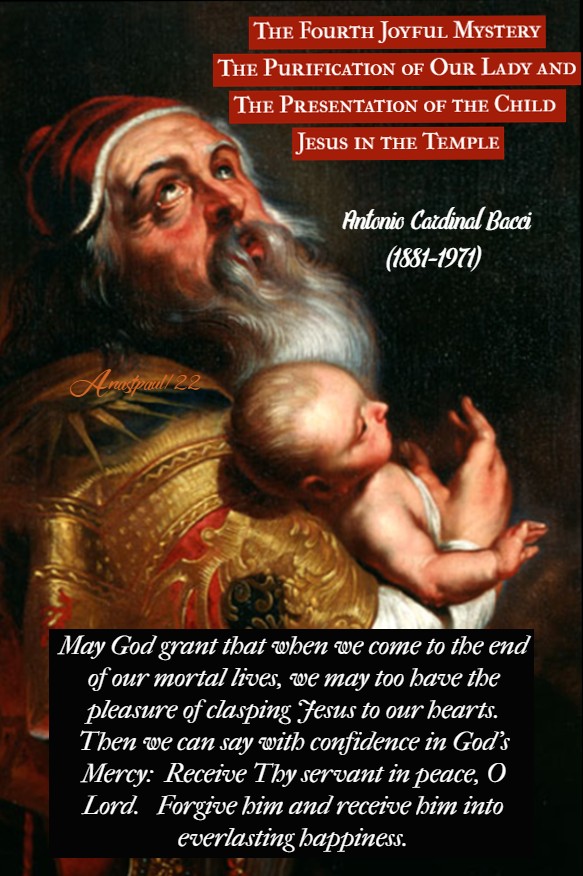
“Month of the Holy Rosary” The Fourth Joyful Mystery The Purification of Our Lady and The Presentation of the Child Jesus in the Temple
“During the ceremony, a devout man, enlightened by God, entered the temple. He asked and obtained, the privilege of holding the Divine Infant in his arms. This was Simeon, a holy old man to whom the Holy Ghost had revealed that before he died, he would see the expected Messiah, the Redeemer of the sinful race. Overjoyed as he held Jesus in his arms, he exclaimed: “Now Thou doet dismiss Thy servant, O Lord, according to Thy word, in peace” (Lk 2:29).
May God grant that when we come to the end of our mortal lives, we may too have the pleasure of clasping Jesus to our hearts. Then we can say with confidence in God’s Mercy: Receive Thy servant in peace, O Lord. Forgive him and receive him into everlasting happiness.”
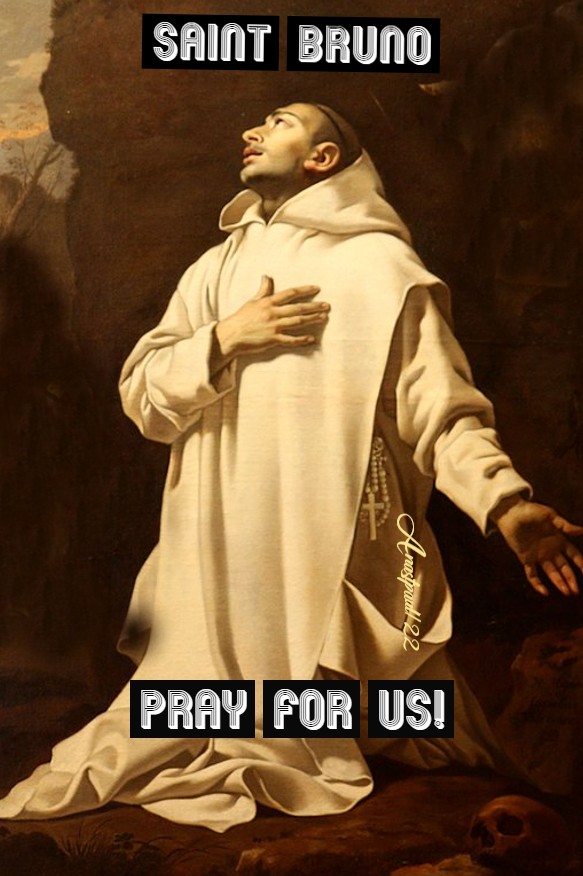
Quote/s of the Day – 6 October – St Bruno O.Cart (c 1030-1101) Priest, Confessor
“No act is charitable, if it is not just.”
“In the solitude and silence of the wilderness… God gives his athletes the reward they desire – a peace that the world does not know and joy in the Holy Spirit.”
One Minute Reflection – 6 October – St Bruno O.Cart (c 1030-1101) Priest, Confessor – Sirach 31:8-11, Luke 12:35-40 – Scripture search: https://www.drbo.org/
“Let your loins be girt about and your lamps burning and you yourselves ,like men waiting for their master’s return from the wedding; so that when he comes and knocks, they may straightaway open to him. Blessed are those servants whom the master, on his return, shall find watching.” – Luke 12:35-37
REFLECTION –“God, the Word, stirs up the lazy and arouses the sleeper. For indeed, someone who comes knocking at the door is always wanting to come in. But, it depends on us, if He does not always enter or always remain. May your door be open to Him Who comes; open your soul, enlarge your spiritual capacities, that you may discover the riches of simplicity, the treasures of peace and sweetness of grace. Expand your heart, run to meet the Sun of that Eternal Light that “enlightens everyone” (Jn 1,9). It is certain, that this true Light shines for all but, if anyone shuts their windows, then they themselves shut themselves off from this Eternal Light.
So even Christ remains outside, if you shut the door of your soul. It is true that He could enter but He does not want to use force, He does not put those who refuse under pressure. Descended from the Virgin, born from her womb, He shines throughout the universe to give light to all. Those who long to receive the Light, that shines with an everlasting brightness, open up to Him. No night comes to intervene. Indeed, the sun we see each day gives way to night’s darkness but the Sun of justice (Mal 3,20) knows no setting, for Wisdom is not overcome by evil.” – St Ambrose (340-397) Bishop of Milan and Father and Doctor of the Church – (12th Sermon on Psalm 118).
PRAYER – May we be aided by the intercession of St Bruno, Thy Confessor, we beseech Thee, O Lord, that we, who have grievously offended Thy Majesty by sin, may, by his merits and prayers, obtain forgiveness for our offenses. Through Jesus Christ, Thy Son our Lord, Who lives and reigns with Thee, in the unity of the Holy Ghost, God, world without end. Amen (Collect).
Our Morning Offering – 6 October – Thursday: The Holy Eucharist
O DIVINE Heart of JESUS Pope Leo XIII Indulgence 100 Days, Once a day Raccolta 167 13 March 1901.
O DIVINE Heart of JESUS, grant, we beseech Thee, eternal rest to the souls in purgatory, the final grace to those who shall die today, true repentance to sinners, the light of the faith to pagans and Thy Blessing to me and mine. To Thee, O most compassionate Heart of JESUS! I commend all these souls and I offer to Thee, on their behalf, all Thy merits, together with the merits of Thy most Holy Mother and of all the Saints, Angels and all the Sacrifices of the Holy Mass, Communions, prayers and good works, which shall be accomplished today, throughout the Christian world. Amen
In Catholic Time, Thursday is the day of The Holy Eucharist – Our Lord instituted the most holy Eucharist on a Thursday, so it is fitting that we remember this greatest of sacraments on this day. The Eucharist is the greatest gift of God to mankind, as it is nothing less than Jesus Himself. What gift could be greater?
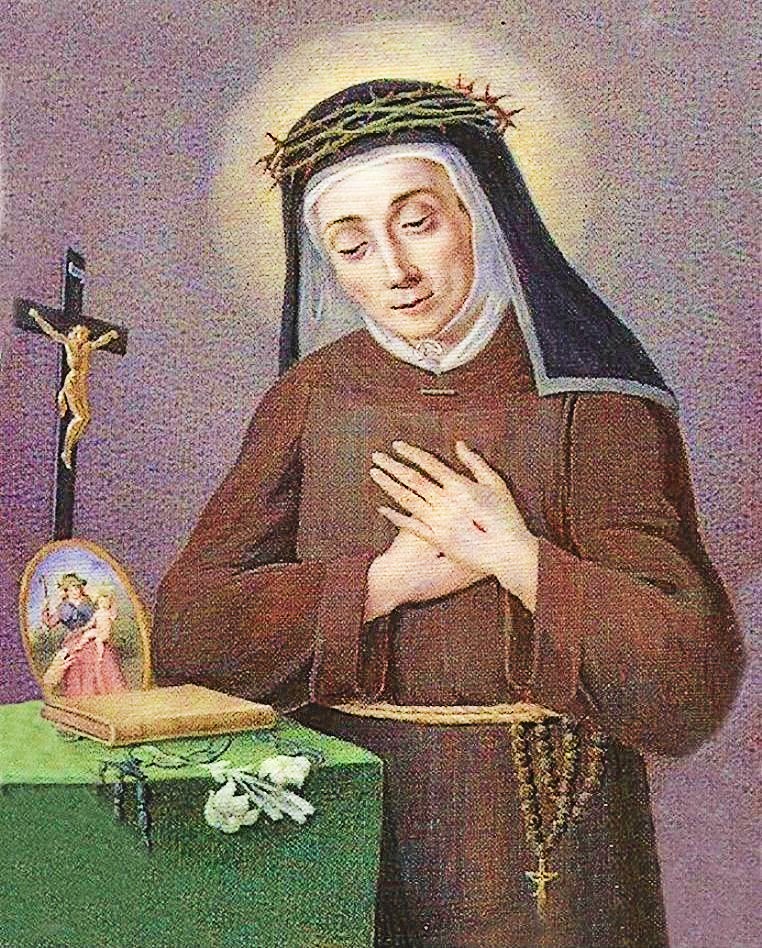
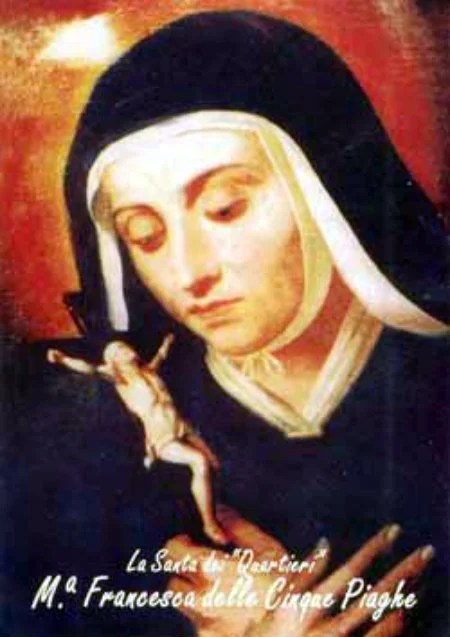
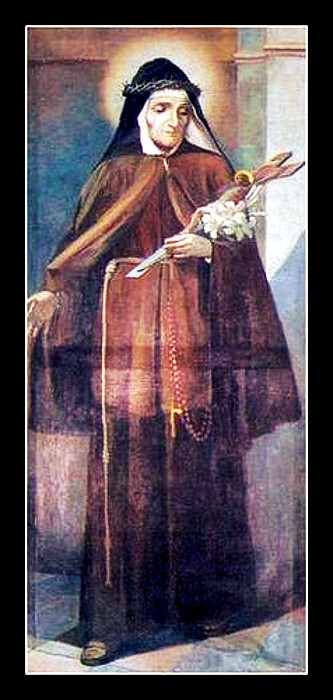
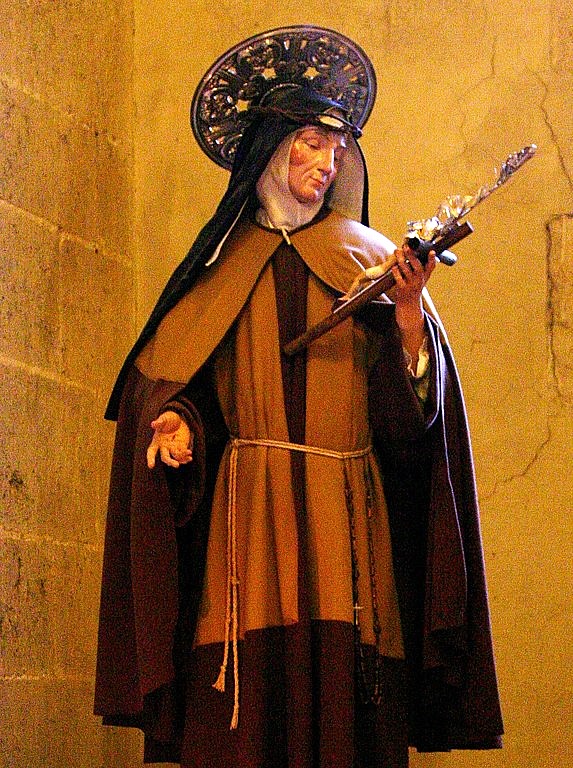
Saint of the Day – 6 October – Saint Mary Frances of the Five Wounds of Jesus TOSF (1715-1791) Virgin, a member of the Third Order of the Friars Minor, Mystic, Ecstatic, Stigmatist, blessed with the gift of prophesy and of miracles. Recluse. Born on 25 March 1715 as Anna Maria Rosa Gallo at Naples, Italy and died on 6 October 1791 at Naples, Italy of natural causes. Also known as St Anna Maria Gallo, Maria Francesca. Mary Frances is the first woman from Naples to have been declared a Saint. Patronages – Pope Pius IX, who Canonised her, declared her to be a patroness of expectant mothers and of women having difficulty conceiving.
Anna Maria Rosa, as Saint Mary Frances was Baptised, was born in Naples in 1715 of a family that belonged to the middle class of society. Her mother, a devout and gentle woman, who had much to contend with from her hot-tempered husband, was quite worried before the birth of this child. But St John Joseph of the Cross, who lived in Naples at that time, calmed her and recommended special care of the child, as it was destined to attain to great holiness.
Anna Maria Rosa was scarcely 4 years old when she began to spend hours in prayer and sometimes arose at night for this purpose. Such was her desire to know the truths of the Catholic Faith that an Angel appeared to her and instructed her regularly. She had not yet attained her 7th year when she desired to receive Holy Communion. Her local Parish Priest marvelled at her knowledge of the Faith, as well as her ardent desire for the Bread of Angels and felt that he could not deny her the privilege. In fact, it was not long before he permitted her to receive daily.
Meanwhile, although physically of a very delicate constitution, the little saint was making herself useful to her parents by assisting them in their work. Her father, a weaver of gold lace, was anxious to have his children help as early as possible. He found that Anna Maria Rosa was not only the most willing but also the most skilled in the work.
She was 16 years old when a rich young man asked her father for her hand. Rejoicing at the favourable prospect, her father at once gave his consent. But when he told Anna Maria Rosa he was amazed to hear her, who had never contradicted him, declare her firm intention of espousing only her heavenly Bridegroom and asking his permission to become a Tertiary. He became so enraged that he seized a rope and whipped the delicate girl unmercifully, until her mother intervened. He then locked her in a room, where she received only bread and water and no-one was permitted to speak to her.
She considered herself fortunate to be able to offer her Divine Bridegroom this early proof of her fidelity – she regarded the trial as a pre-nuptial celebration. The earnest representations of a Priest made her father, who after all was a believing Christian, realise that he had done wrong and he finally consented that his daughter take the Tertiary Habit and serve God as a Consecrated Virgin at home, as was customary in those days. Filled with holy joy, Anna Maria now received the Habit and, with it, the name Maria Francesca and the Surname “of the Five Wounds of Jesus.” This name was prophetic of her subsequent life.
At home Mary Frances had much to endure. Her father never got over the loss of a wealthy son-in-law. When God favoured her with unusual graces — she was sometimes granted ecstasies at prayer and suffered our Lord’s agony with Him — her own brothers and sisters insulted her as an imposter. Even her Confessor felt obliged to deal harshly with her. For a long time she could find consolation nowhere but in the Wounds of Christ. At last her Confessor perceived that it was God Who was doing these things in Mary Frances. Since her mother had died meanwhile, he saw to it that she found a home with a fellow Tertiary. There one day, as she herself lay ill, she learned that her father was near death and she asked Almighty God to let her suffer her father’s death agony and his purgatory. Both requests were granted her.
Although she suffered continuously, Our Lord also gave Mary Frances great graces and consolations. She received the marks of the wounds of Christ and was granted the gift of prophesy and of miracles. She would wear gloves to cover the marks of the nails on her hands, while she did her work. When Pope Pius VI was crowned pope in 1775, she beheld him in a vision wearing a crown of thorns. Pope Pius closed his life 24 years later as a prisoner of the French Revolution at Valence. Mary Frances also prophesied the tragic events of the French Revolution and God heard her prayer, asking that she be taken from this world before they would happen. She died on 6 October 1791, kissing the feet of her Crucifix. God glorified her by many miracles.
Saint Mary Frances was buried in the Church of the Alcantarines, Saint Lucia del Monte, Naples, which she attended during her life, very near the tomb of Saint John Joseph of the Cross. On 6 October 2001, her remains were transferred from the Church of Santa Lucia to the house where she had spent the last half of her life. It is now the Shrine of St. Mary Frances of the Five Wounds. It is still a common practice for expectant mothers to go there to be blessed with her relic. Many votive offerings from mothers who credit her with their successful deliveries are displayed in the Sanctuary.
Devotion to our Saint has long continued in the neighbourhood where she lived in Naples and of which she is the Patron. The residents credit her intercession, with the little damage the sector endured during World War II, when over 100 bombs were dropped on it!
On 12 November 1843, Mary Frances was Beatified by Pope Gregory XVI and on 29 June 1867, she was Canonised by Pope Pius IX.
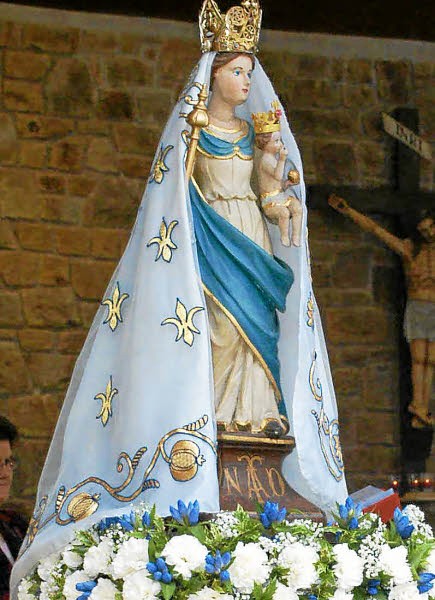
Notre-dame-de-toute-aide de Querrien, France / Our Lady of All Help (1652) – 6 October, for the Feast of the Holy Rosary on 7 October) 15 August (the Assumption) and the Sunday following 8 September (Feast of the Nativity of Our Lady):
According to legend, in 574, the Monk Saint Columban came from Ireland and landed on the coast of Brittany with 12 companions. The Monk Saint Gall, friend and companion of St Colomban, was part of the group. The latter stopped at Querrien and there, he found a clear and limpid spring gushing out of the ground “so that the inhabitants can knead bread there” . St Gall also built a wooden Oratory which he dedicated to Our Lady. He placed there, a wooden Statue, representing the Virgin and Child , a Statue he had sculpted himself. Over time, the Oratory was abandoned, it disintegrates and the Statue fell to the ground and was buried in the mud near the source of the spring..
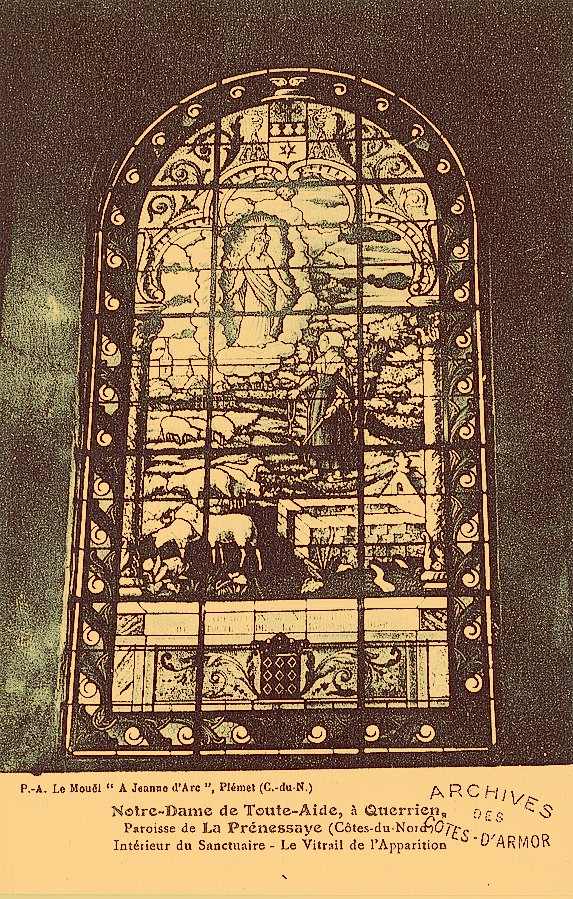
On 15 August 1652, Jeanne Courtel a 12-year-old girl, deaf and dumb from birth. while guarding the family’s sheep saw a “beautiful lady” who spoke to her. Thereupon, Jeanne was immediately able to hear and to speak to the great astonishment of all the inhabitants of the village. A few days later, Jeanne saw the beautiful lady again who asked to have the ground dug up near the source of the spring, where the Statue of the Virgin was buried. The wooden Statuette was found at the place indicated,, confirming for the people, the authenticity of the Apparition. There were a total of fifteen appearances of Our Lady with which Jeanne was favoured, until September of the same year. From that time on, pilgrims arrived and numerous miracles were recorded.
Shortly after this miracle became known, there was a second one just as remarkable. There was a community benefactor whose son was at death’s door with a high fever. Invoking Our Lady before this same Statue the man saw his son instantly cured. After this second wondrous miracle, the Statue was moved into the Chapel and there were many miracles that followed. One miracle was worked in favour of a religious Sister who had been terribly burned and was she was instantly cured. A Priest, falsely accused of a crime, was acquitted after special prayers to the “miracle lady.” The statue had had no name before this but the Parishioners decided now to call her Our Lady of All Help, Quick Help, or Our Lady of Good Remedy. The local Bishop, Denis de La Barde, launched an investigation and went there to verify the child’s declarations. Satisfied with his hearings, he had a chapel erected in 1652 to organise the devotion of the faithful. After having carried out a canonical investigation, the Bishop of Saint-Brieuc issued a positive opinion on the Apparition and decided to have a Chapel built and to organise worship there. The following 29 September, the Bishop returned to bless the first stone of the Chapel during a celebration which brought together 1,500 pilgrims. On 14 August 1950, a great celebration was held in the Sanctuary. This celebration was attended by 20,000 pilgrims, several Bishops, the Abbots of Brittany and 200 Priests from Saint-Brieuc, Rennes and Vannes , for the crowning of the Statue of Notre-Dame de Tout-Aide . It was Archbishop Clément Roque of Rennes who placed the crown designed by Émile Daubé and made by goldsmith René Desury on the head of the Statue. This coronation was carried out with the authorisation and blessing of Pope Pius XII.
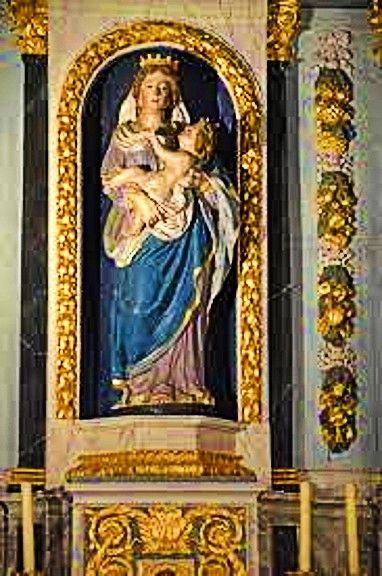
The Processional Statue of Our Lady of All Help
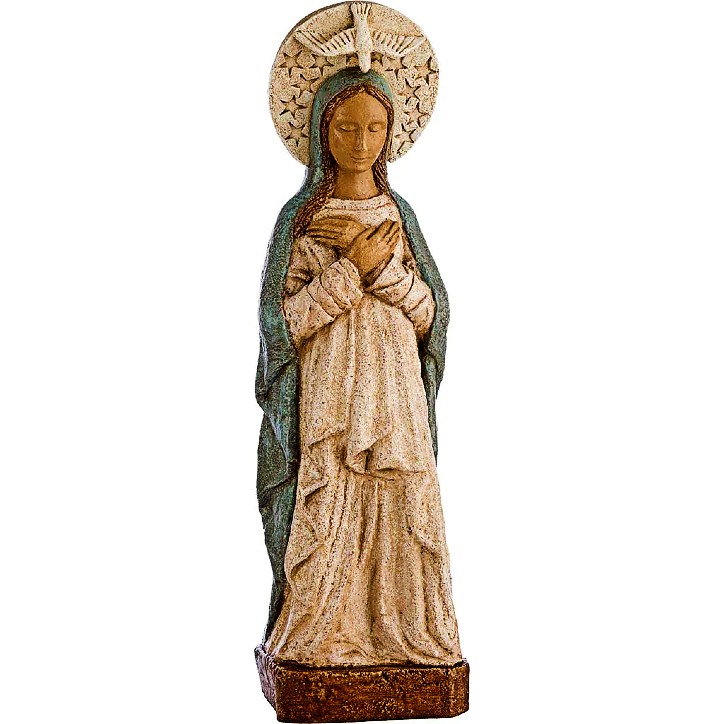
The Statue itself is only about 60 centimetres tall. The Blessed Virgin Mary is crowned, and holds her Infant Son in one arm, and a sceptre in the other. At the time of the French Revolution and during the accompanying Reign of Terror, the Abbey was destroyed. A pious lady took the Statue of Our Lady of All Help and safeguarded it until the trouble was over. After her death the Statue was restored to the community. The Statue of Our Lady of All Help has survived several wars since.
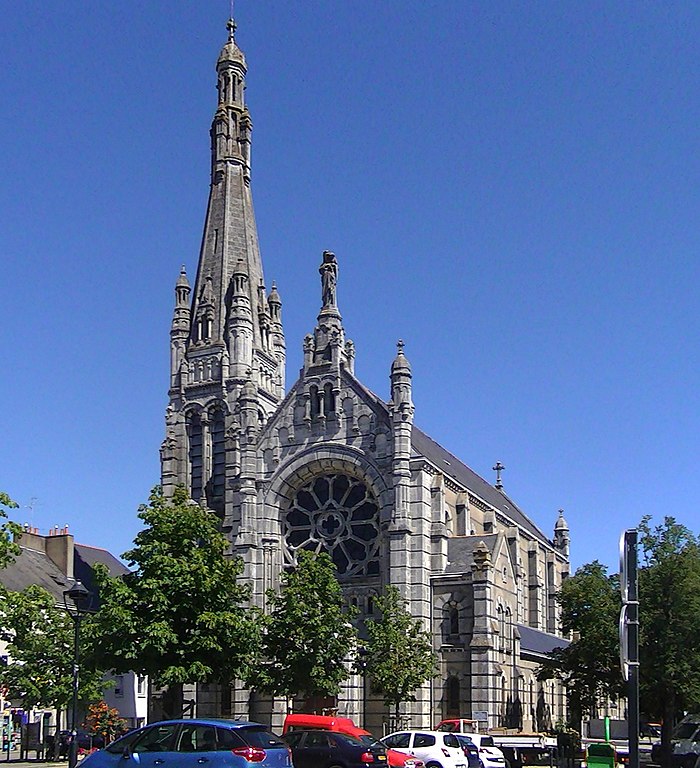
In 1998, a series of renovations began which would continue for several years. Today pilgrimages continue all year with often as many as 10 000 attending the major celebrations. The current Church incorporates the small Chapel (the remains of which, can still be seen on the north side of the building).
There is a short and very lovely prayer which, for centuries, has been associated with this Statue. It is, “Oh, Mother of All Help, say but one word in our behalf to Thy Divine Son, for He cannot refuse thee any favour. Amen.”
Bl Isidore of Saint Joseph St Iwi St John Xenos Bl Juan de Prunera St Magnus of Orderzo Saint Mary Frances of the Five Wounds of Jesus TOSF (1715-1791) Virgin, a member of the Third Order of the Friars Minor, Recluse.
St Pardulf St Renato of Sorrento St Romanus of Auxerre St Sagar of Laodicea
Martyrs of Capua – 4 Saints: A group of Martyrs who were either killed in Capua, Italy, or that’s where their relics were first enshrined. We now know nothing but their names – Aemilius, Castus, Marcellus and Saturninus.
Martyrs of Trier: Commemorates the large number of Martyrs who died in Trier, Germany in the persecutions of Diocletian.
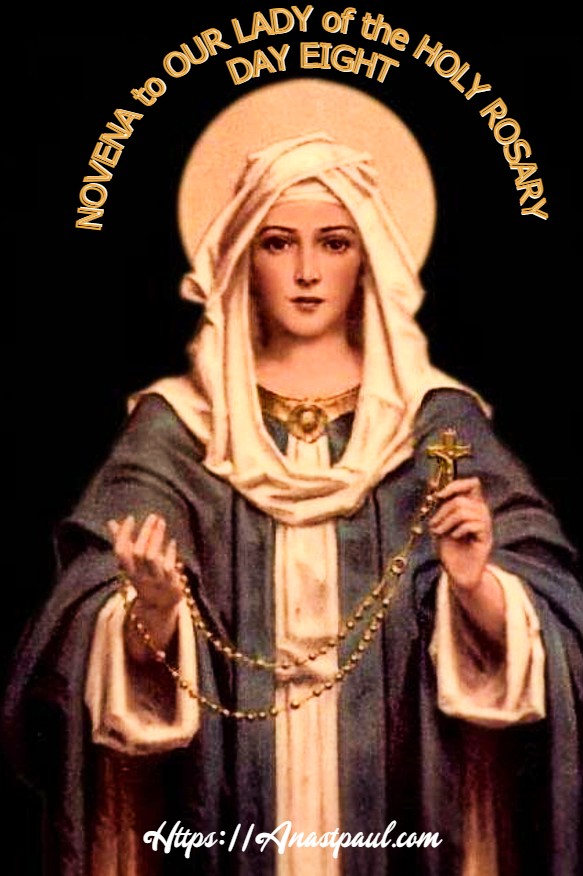
Novena to the Immaculate Heart of Mary, Queen of the Most Holy Rosary
By Father Joseph Cacella, 1947
EIGHTH DAY
Intention: “The Conversion of Sinners”
Oh Immaculate Heart of Mary, Refuge of the human race, thou have given unto us the means of destroying the menace of atheism and godless lives. Thy Promise of conversion for those unfortunate victims of false beliefs, has instilled joy and hope into the nations of the earth. We grieve for those who are victims of such vice. Grant, we beseech thee. Oh Mother, that grace and faith may come to those separated from thy Son by error and discord. We fail, if we heed not thy Message of Fatima. We know thy wishes and,, therefore, we promise to make Reparation to thy Immaculate Heart, through the Most holy Rosary and the Five First Saturdays, that sinners may hear the Word of God and keep it.
Our Lady of Fatima, Refuge of the human race, inflame our hearts with the love of Reparation. Amen
We pray our Daily Rosary now with the same Intention: “The Conversion of Sinners.”
Thought for the Day – 5 October – Meditations with Antonio Cardinal Bacci (1881-1971)
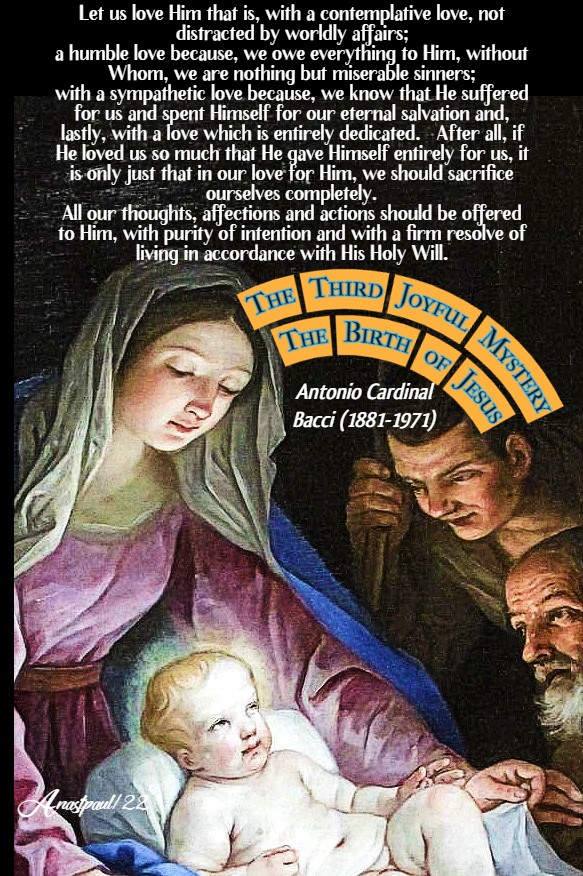
“Month of the Holy Rosary” The Third Joyful Mystery The Birth of Jesus
“Let us too, learn to adore and love Him as His Mother and Foster-father did.
Let us love Him that is, with a contemplative love, not distracted by worldly affairs; a humble love because, we owe everything to Him, without Whom, we are nothing but miserable sinners; with a sympathetic love because, we know that He suffered for us and spent Himself for our eternal salvation and, lastly, with a love which is entirely dedicated. After all, if He loved us so much that He gave Himself entirely for us, it is only just that in our love for Him, we should sacrifice ourselves completely. All our thoughts, affections and actions should be offered to Him, with purity of intention and with a firm resolve of living in accordance with His Holy Will.”
Quote/s of the Day – 5 October – Hebrews 10:32-38, Luke 12:1-8 Scripture search – https://www.drbo.org/
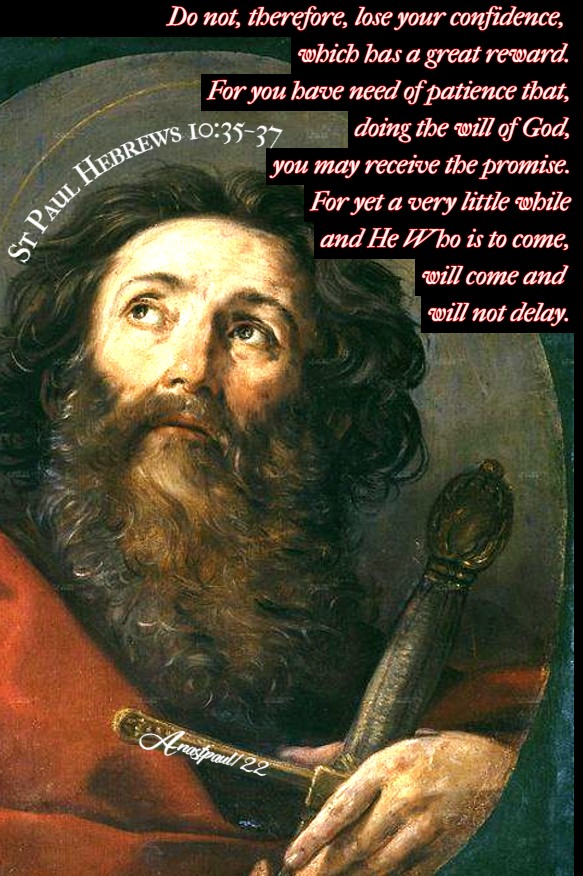
“Do not, therefore, lose your confidence, which has a great reward. For you have need of patience that, doing the will of God, you may receive the promise. For yet a very little while and He Who is to come, will come and will not delay.”
Hebrews 10:35-37
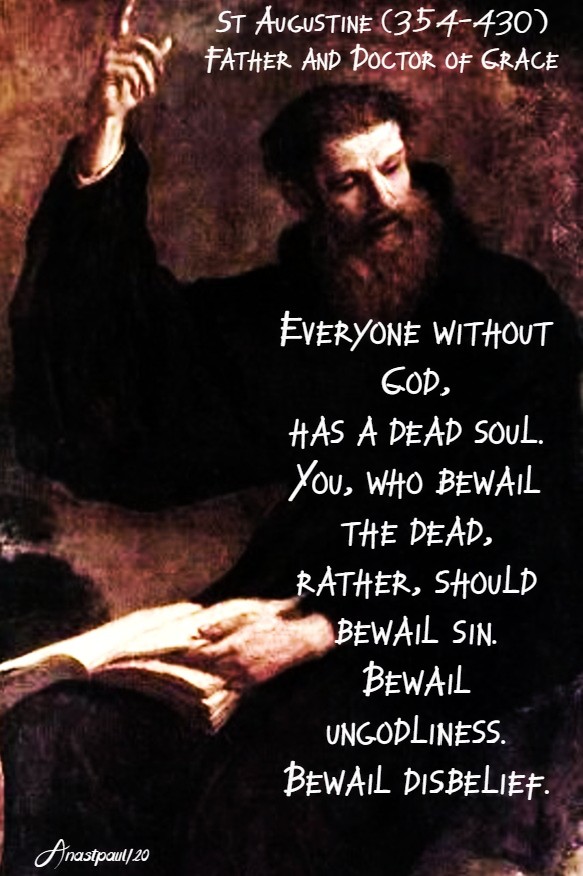
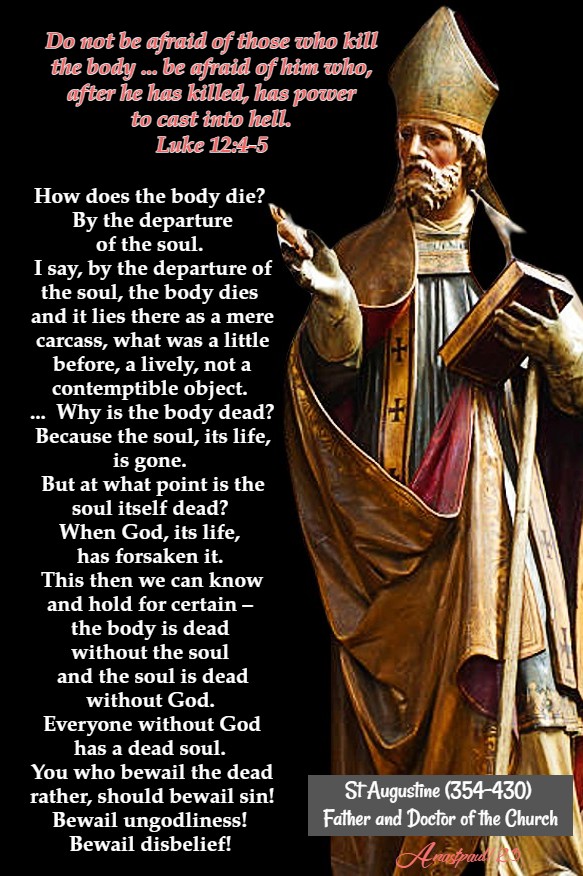
“Everyone without God, has a dead soul. You, who bewail the dead, rather, should bewail sin. Bewail ungodliness. Bewail disbelief.”
St Augustine (354-430) Father and Doctor of Grace
“We have the Providential love of God as our guide. When there is a ship at sea and heads towards the port, nobody doubts that it is led by a pilot and one could doubt that there is a God who guides the universe only because He cannot be seen? By His Providential Love, God arranges and regulates events, regulates everything, with gentleness and wisdom. I advise you to abandon yourself completely into the hands of Divine Providence. “
Blessed Edoardo Giuseppe Rosaz (1877-1903)
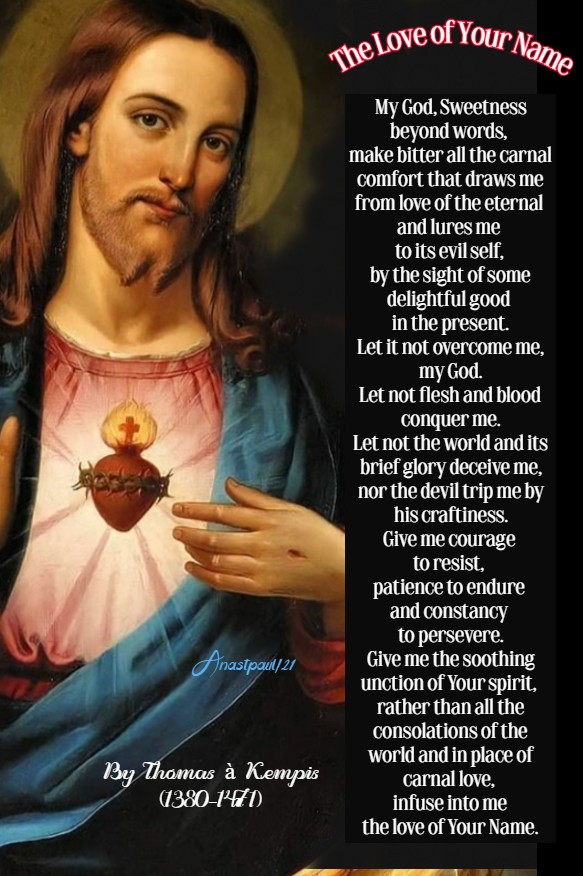
The Love of Your Name
“My God, Sweetness beyond words, make bitter all the carnal comfort that draws me from love of the eternal and lures me to its evil self, by the sight of some delightful good in the present. Let it not overcome me, my God. Let not flesh and blood conquer me. Let not the world and its brief glory deceive me, nor the devil trip me by his craftiness. Give me courage to resist, patience to endure and constancy to persevere. Give me the soothing unction of Your spirit, rather than all the consolations of the world and in place of carnal love, infuse into me the love of Your Name.”
Thomas à Kempis CRSA (1380-1471) The Imitation of Christ (Book 3 Ch 26:1-4)
One Minute Reflection – 5 October – “The Month of the Most Holy Rosary and of the Angels” – Hebrews 10:32-38, Luke 12:1-8 – Scripture search – https://www.drbo.org/
“Do not be afraid of those who kill the body, and after that have nothing more that they can do. … be afraid of him who, after he has killed, has power to cast into hell. ” – Luke 12:4-5
REFLECTION – “The Gospel is life. Impiety and infidelity are the death of the soul. So then, if the soul can die, how then is it yet immortal? Because, there is always a dimension of life in the soul which can never be extinguished. And how does it die? Not in ceasing to be life but by losing its proper life. For the soul is both life to something else and it has it own proper life. Consider the order of the creatures. The soul is the life of the body. God is the life of the soul. As the life that is the soul, is present with the body, that the body may not die, so the life of the soul (God), ought to be with the soul that it may not die.
How does the body die? By the departure of the soul. I say, by the departure of the soul, the body dies and it lies there as a mere carcass, what was a little before, a lively, not a contemptible object. There are in it still, its several members, the eyes and ears. But these are merely the windows of the house – its inhabitant is gone. Those who bewail the dead, cry in vain at the windows of the house. There is no-one there within it to hear. Why is the body dead? Because the soul, its life, is gone. But at what point is the soul itself dead? When God, its life, has forsaken it. This then we can know and hold for certain – the body is dead without the soul and the soul is dead without God. Everyone without God has a dead soul. You who bewail the dead rather, should bewail sin! Bewail ungodliness! Bewail disbelief.! – St Augustine (354-430) Bishop of Hippo, Father and Doctor of the Church (Sermon 65).
PRAYER – Grant, we beseech Thee, O Lord God, unto all Thy servants, that they may remain continually in the enjoyment of soundness, both of mind and body and by the glorious intercession of the Blessed Mary, always a Virgin, maybe delivered from present sadness and enter into the joy of Thine eternal gladness. Through Jesus Christ, Thy Son our Lord, Who lives and reigns with Thee, in the unity of the Holy Ghost, God, world without end. Amen (Collect).
Our Morning Offering – 5 October – – “The Month of the Most Holy Rosary and of the Angels”
Prayer of Abandonment By St Jane Frances de Chantal (1572-1641)
O sovereign goodness of the sovereign Providence of my God! I abandon myself forever to Thy arms. Whether gentle or severe, lead me henceforth whither Thou will. I will not regard the way through which Thou will have me pass but keep my eyes fixed upon Thee, my God, who guides me. My soul finds no rest without the arms and the bosom of this heavenly Providence, my true Mother, my strength and my rampart. Therefore, I resolve with Thy Divine assistance, 0 my Saviour, to follow Thy desires and Thy ordinances, without regarding or examining why Thou does this rather than that but I will blindly follow Thee, according to Thy Divine will, without seeking my own inclinations. Hence I am determined to leave all to Thee, taking no part therein, save by keeping myself in peace in Thy arms, desiring nothing, except as Thou incites me to desire, to will, to wish. I offer Thee this desire, 0 my God, beseeching Thee to bless it. I undertake all it includes, relying on Thy goodness, liberality and mercy, with entire confidence in Thee, distrust of myself, and knowledge of my infinite misery and infirmity. Amen.
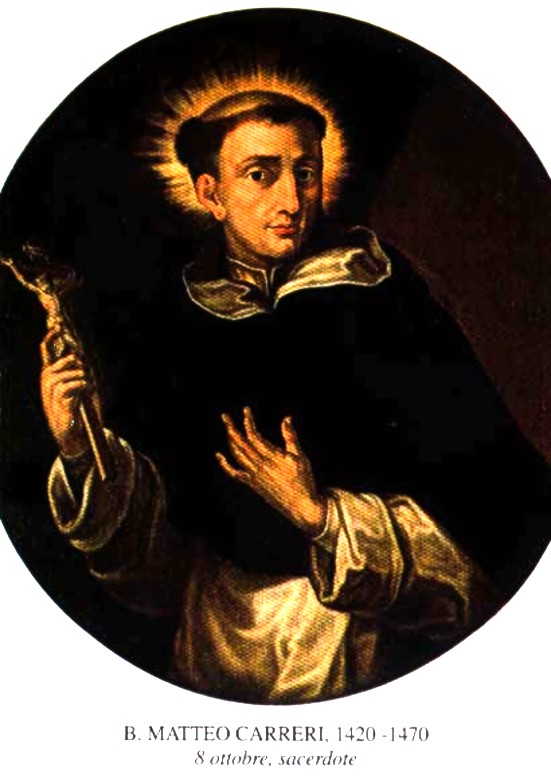
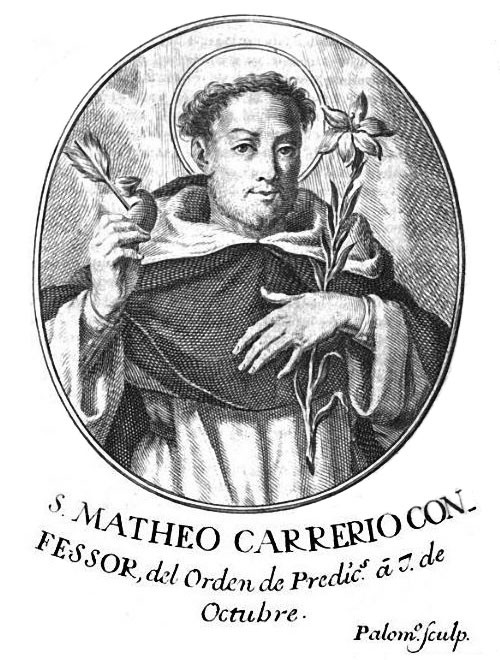
Saint of the Day – 5 October – Blessed Matthew Carreri OP (c 1420-1470) Priest and Friar of the Order of Preachers, Stigmatic, Mystic, Reformer, renowned Preacher. Born Giovanni Francesco Carrieri in the City of Mantua, Italy some time around 1420 and died on 5 October 1470 at Vigevano, Province of Pavia, Italy of natural causes. Patronage – Vigevano, Italy. Also known as – Matthew of Mantua, Matteo Carreri. Additional Memorial – 7 October on some calendars.
Giovanni Francesco grew up a silent and prayerful child, a good student and a great reader. These qualities seemed to recommend him to the Preaching Friars and at an early age, he presented himself at the Convent in his home City and received the Habit. He took the name Matthew when he entered the Dominican Order. His later success as a preacher was inarguably, attributable, to the significant time he spent in spiritual exercises and meditation
Matthews’s career as a preacher began soon after his Ordination, when he was sent to Lombardy to preach against the heretics. He succeeded admirably in his preaching and converted many to a spiritual way of life. Travelling from Convent to Convent, he preached a revival of fervour and a deeper understanding of the spirit of St Dominic, and many of the religious of Lombardy-both Dominicans and members of other Orders,were led by him to renew their devotion and fervour..
At on time, when he was preaching in Vigevano, a troupe of jugglers came into Town and set up their act. They were a particularly scandalous set of people, poking ridicule at the religious and the pope. Matthew sent them word to move on, which they ignored. So he went after them with his walking-stick and this proved more effective. They scattered and ran but soon came back, fortified with the presence of the Duke of Milan, who scolded Matthew for being so narrow-minded and humourless. Matthew patiently pointed out to him, the unhealthy and evil areas in their humour and, in spite of the Duke’s natural aversion to Friars, convinced him that he should keep the jugglers out of Town.
At Lucina, there was a lady of noble birth and great talents, who was wasting her time in frivolities. Never one to avoid an issue, Matthew aimed a powerful sermon in her direction and she came to him afterwards ,in a torrent of tears and begged him to help her. He gave her the Habit of the Third Order and outlined a stiff rule of life, which she afterwards faithfully followed.
He also met and directed Blessed Stephanie Quinzan who proved to be an apt pupil.
Matthew was given the task of reforming the Convents of the Dominican Friars in Soncino and in nearby Towns and he worked for many years in Milan. Going up and down the Peninsula, he varied his approach but never his message – penance and love of God. So many were the conversions effected that a whole group of additional Preachers had to be appointed, to continue to carry on Matthew’s powerful methods and message, as he moved rapidly from place to place. Preaching his way, he went through Tuscany, and took ship at Genoa.
The ship was soon captured by a Turkish corsair. The Mohammed Captain called on the three Dominicans for an explanation of why they were there. Matthew spoke up so fearlessly and eloquently that the Captain released all three of them. Just as they were being hustled off to a rescue boat, the wail of one of the woman passengers stopped them. The lady and her young daughter were resisting the journey and were afraid to be taken to Algiers,and Matthew began pleading for them. The Captain told him he had better let the affair alone and be satisfied that he had saved his own skin. Matthew thereupon, volunteered to go to Algiers, in chains, if the Captain would release the two women. Amazed at his courage, as well as at his defence of those in danger, the Captain released all of them and told them to get off of his ship quickly, before he changed his mind.
Many miracles are credited to Matthew Carreri. One day, a young father who came to hear Matthew preach, had left his little son at home with the nurse. The baby fell into the fire and was badly burned. The distraught father brought the little one to Matthew, who cured him. The baby was well in a few days and grew up to be a Franciscan Friar. Matthew cured another man of hemorrhage and worked many cures on the sick and possessed.
One day, , while meditating on the Passion, Matthew asked our Lord tp allow him to partake of His sufferings. He received the stigmata, in the form of an arrow which pierced his heart. For the remainder of his life, he suffered great pain from his wound.
Matthew Carreri died, in 1470, in a house composed entirely of religious whom he had rescued from a life a laxity. His cult was confirmed twelve years after his death, testifying to the great reputation for sanctity he enjoyed among the people of northern Italy.
Pope Sixtus VI confirmed his cultus in 1483 and he was formally Beatified by Pope Urban VIII on 2 December 1625.
Notre-Dame Arcachon / Our Lady of La Teste-de-Buch, Guienne (1519) – 5 October:
According to the Marian Calendar, Our Lady of Buch is located in the Pine Mountains, in Guienne. The sea cast this image upon the sands, while Saint Thomas, the Cordelier Friar, was praying on behalf of two vessels which he saw in danger of perishing. He respectfully received this image and deposited it in this place, in a small Chapel which he built there.
Guienne, or Guyenne, refers to a loosely defined region of pre-revolutionary, South-Western France. Buch, or La Teste-de-Buch, is a Town in the Gironde region in Aquitaine, located on the south shore of Arcachon Bay. The “Cordeliers,” known also as the Grey Friars for the heavy grey cloth they wore, are Franciscans. Their belt was but a rope with five knots tied at the end, which gave them their name in France. The “Saint Thomas” mentioned is Thomas Illyricus (1484-1528), a Franciscan native of Vrana in the Diocese of Zarian. He was never Canonised. He was a hermit and itinerant preacher and an indefatigable missionary traveller who lived near Arcachon in la Teste-de-Buch. It was he, who built the Chapel of Notre-Dame Arcachon.
“More than his voice, vibrant with emotion,” wrote the Abbe Mauriac, “more than his ascetic appearance, more than his style so direct and so strong, what stirred and attracted thousands of listeners, was his ardent sincerity which overflowed and poured itself out, while his love of God and of souls, accented his words and made him very eloquent.”
It was in the year 1519 that Thomas Illyricus found the famous Statue now known as the Virgin of Advent at the edge of the sea. He built a Shrine of wood that same year for the Statue, and pilgrimages date from 1525 and grew so much in numbers that in 1624, Cardinal Francois de Sourdis authorised the construction of a stone Chapel. This small Chapel was gradually buried by the sands and it was decided to build a new one which was completed in 1723. The Church is known as the Church of L’eglise Notre Dame des Passes, or Notre-Dame Arcachon. Many miracles have been wrought through devotion to Mary at the Shrine and the Church is dedicated to sailors, who face the channels for entry into the Arcachon basin. There is a tall Cross known as the Sailors Cross which stands at the end of the pier of the Chapel. Built at the same time as the construction of the Chapel in 1722, the original was destroyed by a gale in 1855 and was replaced by the one that we see today. It was once customary for sailors to greet the Cross with two blasts from their fog horn, to appeal for divine protection, when they went out on the ocean and faced its dangers. Mary is particularly interested in seafarers and folk living near waters. She who was so familiar with the Sea of Galilee and the profession of the Twelve Pillars of her Divine Son’s Church, she is still is vigilant for their welfare and happiness.
St Alexander of Trier St Anna Schaeffer St Apollinaris of Valence St Attilanus of Zamora St Aymard of Cluny St Boniface of Trier St Charitina of Amasa St Eliano of Cagliari St Firmatus of Auxerre St Flaviana of Auxerre Bl Flora of Beaulieu St Gallo of Aosta St Jerome of Nevers Bl John Hewett St Magdalveus of Verdun St Mamlacha St Marcellinus of Ravenna Blessed Matthew Carreri OP (c 1420-1470) Priest and Friar of the Order of Preachers, Stigmatist, Mystic. St Meinulph St Palmatius of Trier
Blessed Pietro of Imola (c1250-1320) Knight of the Order of St John of Jerusalem and Grand Prior , Lawyer, Jurist, Mediator, Peace-maker. The Roman Martyrology states: “In Florence, blessed Pietro da Imola, who, a Knight of the Order of St John of Jerusalem, took care of the sick with pious charity.” Biography: https://anastpaul.com/2021/10/05/saint-of-the-day-5-october-blessed-pietro-of-imola-c1250-1320/
Blessed Raymond of Capua OP (c 1330-1399) Priest, “The Second Founder” of the Dominican Order of Preachers, Reformer, Spiritual Director, he worked with St Agnes of Montepulciano and St Catherine of Siena, Hagiographer, Teacher. The important Mystic, Reformer, Doctor of the Church, St Catherine of Siena, accepted him as her spiritual director because of his burning passion for the Church and for the revival of religious life, most especially in their own Order. In 1899 Pope Leo XIII Beatified him, on the 500th anniversary of his death. About Blessed Raymond: https://anastpaul.com/2020/10/05/saint-of-the-day-5-october-blessed-raymond-of-capua-op-c-1330-1399/
Bl Robert Sutton Bl Sante of Cori St Thraseas of Eumenia Bl William Hartley
Martyrs of Messina or St Placidus and Companions – 30 Saints: A group of about 30 Benedictine Monks and nuns, some blood relatives, who were sent in the early days of the order to establish Monasteries in the vicinity of Messina, Sicily, Italy and who were martyred. We know the names, and a few details, about seven of them – • Donatus • Eutychius • Faustus • Firmatus • Flavia • Placidus • Victorinus 6th century Messina, Sicily, Italy.
Novena to the Immaculate Heart of Mary, Queen of the Most Holy Rosary
By Father Joseph Cacella, 1947
SEVENTH DAY
Intention: “Forgiveness of Sin”
Oh Immaculate Heart of Mary, Refuge of Sinners, to whom else will we turn in our sorrow for sin, if not to thee. From whom shall we find comfort and consolation, in the shame of our sins, except from thee? Lead us back, dear Mother of Love, to the path of righteousness which leads to the Sacred Heart of thy Divine Son. We have sinned often, oh dear Mother and the remembrances of the errors of our ways troubles us. It shall be no more. We know that thy protecting care, will find peace and hope for us and the remission of our sins. We know too that as with Mary Magdalene of old, thy Son shall welcome us with a loving smile because, you have always pleaded for us. Amen.
Our Lady of Fatima, Refuge of sinners, inflame our hearts with the love of Sorrow, Repentance, Penance and Reparation.
We pray our Daily Rosary now with the same Intention: Sorrow, Repentance, Penance and Reparation.
Thought for the Day – 4 October – Meditations with Antonio Cardinal Bacci (1881-1971)
“Month of the Holy Rosary” The Second Joyful Mystery Mary’s Visit to St Elizabeth
“As soon as Mary entered her cousin’s house, Elizabeth was inspired by the Holy Spirit and felt the infant in her womb, leaping with joy in the presence of Jesus and His Mother. “Blessed art thou amongst women,” she cried out, “and blessed is the fruit of thy wom! And how have I deserved that the Mother of my Lord, should come to me?” (Lk 1:42-43). Then, the Blessed Virgin, in her joy and gratitude, gave utterance to the Magnificat. This expression of her happiness, was interwoven, however, with sentiments of deep humility.
“My soul magnifies the Lord and my spirit rejoices in God, my Saviour. For He has regarded the humility of His handmaid, for behold, henceforth, all generations shall call me blessed. Because He Who is Mighty, has done great things for me and holy is His Name. And His Mercy is from generation to generation on those who fear Him. He has shown might with His Arm, He has scattered the proud in the conceit of their heart. He has put down the mighty from their thrones and has exalted the lowly. He has filled the hungry with good things and the rich He has sent away empty. He has given help to Israel, His servant, mindful of His Mercy – even as He spoke to our fathers – to Abraham and to his posterity forever.” (Lk 1:46-55).
If, at that moment, they could have heard the words of this poor and unknown girl, what would the might Emperor Caesar Augustus, or the petty King, Herod, have said? Yet history is there to demonstrate the astounding truth of these prophetic words. Generations of yesterday and of today, have bowed in reverence before this simple maiden, while one after another rulers, have been tumbling from their thrones!
Let us honour the Blessed Virgin too and learn from her, to love humility and holiness.”
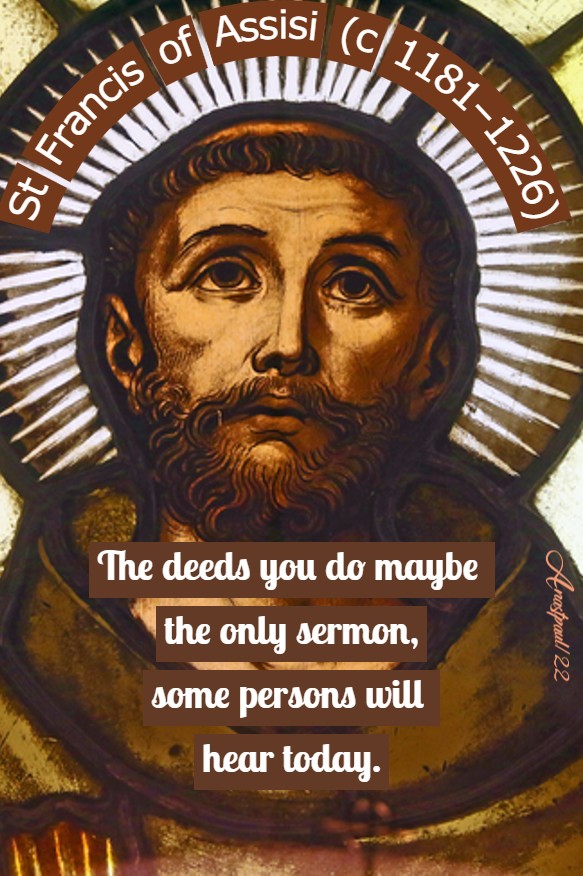
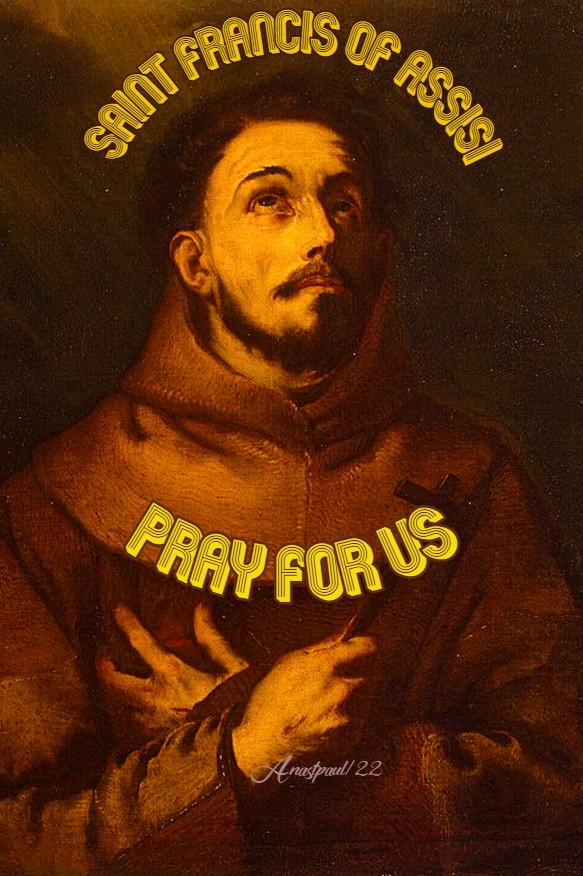
One Minute Reflection – 4 October – St Francis of Assisi OFM (c 1181–1226) Confessor, Founder – Galatians 6:14-18, Matthew 11:25-30 Scripture Search here: https://www.drbo.org/
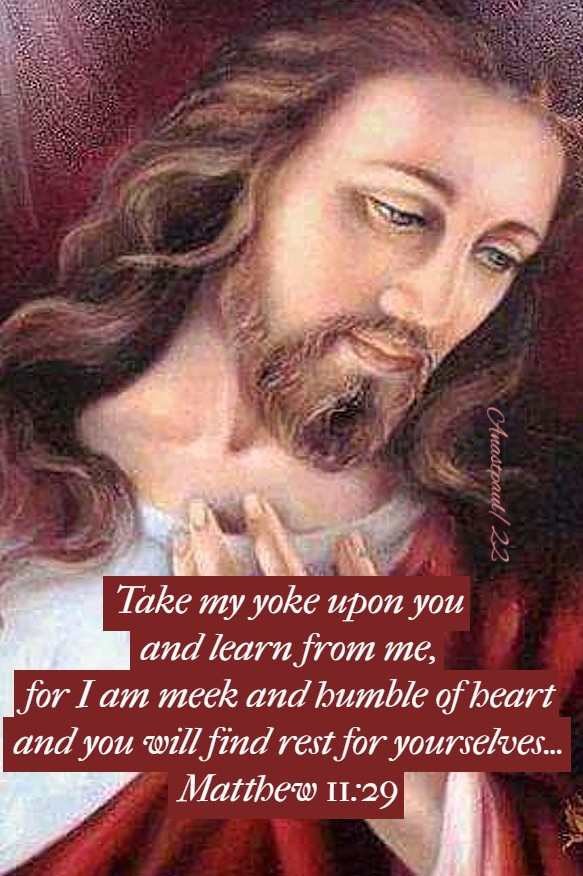
“Take my yoke upon you and learn from me, for I am meek and humble of heart and you will find rest for your souls…” – Matthew 11:29
REFLECTION – “You are to “take my yoke upon you and learn from me.” You are not learning from me how to refashion the fabric of the world, nor to create all things visible and invisible, nor to work miracles and raise the dead. Rather, you are simply learning of me: “that I am meek and lowly in heart.”
If you wish to reach high, then begin at the lowest level. If you are trying to construct some mighty edifice in height, you will begin with the lowest foundation. This is humility. However great the mass of the building you may wish to design or erect, the taller the building is to be, the deeper you will dig the foundation. The building in the course of its erection, rises up high but he who digs its foundation, must first go down very low. So then, you see even a building is low before it is high and the tower is raised, only after humiliation.”… St Augustine(354-430) Father & Doctor (Sermon 69)
PRAYER – O God, Who by the good works of blessed Francis enriched Thy Church by establishing a new religious family, grant us to imitate him by emulation of him, by looking upon the things of earth as nought and ever to rejoice in sharing Thy heavenly gifts. ThroughJesus Christ, Thy Son our Lord, Who lives and reigns with Thee, in the unity of the Holy Ghost, God, world without end. Amen (Collect).
Our Morning Offering – 4 October – St Francis of Assisi OFM (c 1181–1226) Confessor, Founder
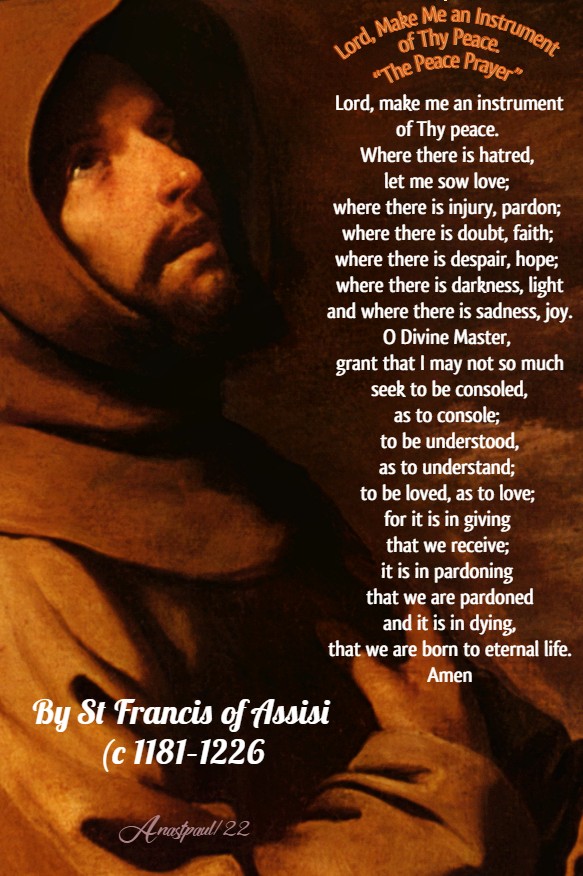
Lord, Make Me an Instrument of Thy Peace. “The Peace Prayer” By St Francis of Assisi (c 1181–1226
Lord, make me an instrument of Thy peace. Where there is hatred, let me sow love; where there is injury, pardon; where there is doubt, faith; where there is despair, hope; where there is darkness, light and where there is sadness, joy. O Divine Master, grant that I may not so much seek to be consoled, as to console; to be understood, as to understand; to be loved, as to love; for it is in giving that we receive; it is in pardoning that we are pardoned and it is in dying, that we are born to eternal life. Amen
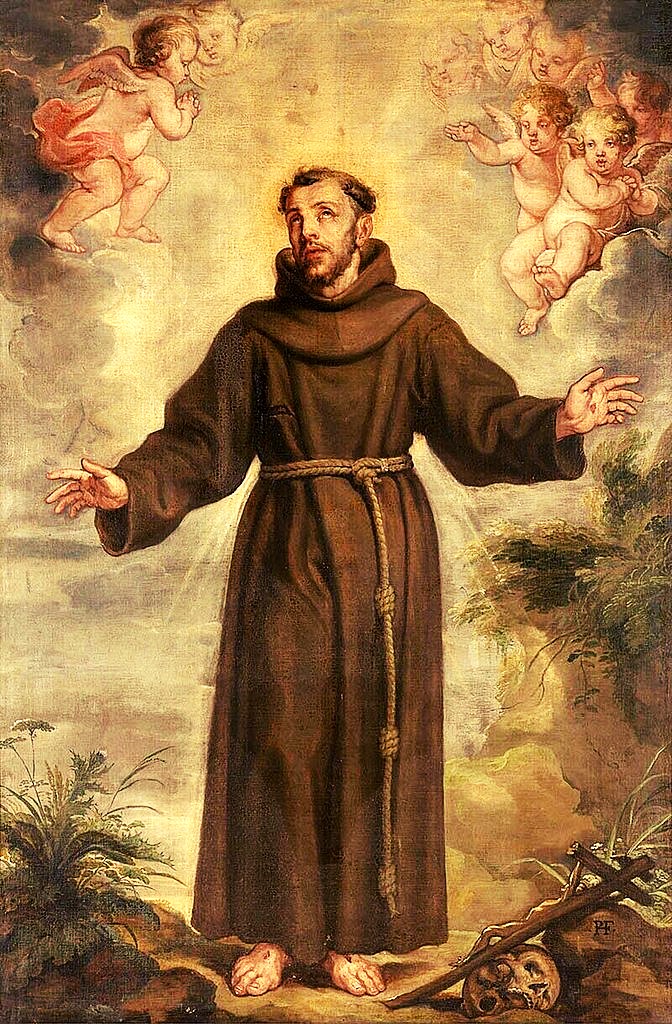
Saint of the Day – 4 October – St Francis of Assisi OFM (c 1181–1226)
An Excerpt from The Little Flowers of St Francis of Assisi Translated from the 14th Century Fioretti (1905)
“In this book are contained certain little Flowers, namely, miracles and devout examples of the glorious poor Little One of Christ, St Francis and of some of his holy companions, to the praise of Jesus Christ. Amen.
In the first place, let us consider how the glorious St Francis, in all the acts of his life, was conformed to the life of that blessed Christ; that, as Christ in the beginning of His preaching elected twelve Apostles that they should despise every worldly thing and follow Him in poverty and in all virtues, so St Francis, for the founding of his Order, elected, in the beginning, twelve companions, who were to be possessors of nothing but an entire poverty.
And, as one of the twelve Apostles of Christ, rejected by God for his infidelity, finally strangled himself, so also, one of the twelve companions of St Francis, who was called Brother John della Capella, apostatised and finally, hanged himself in like manner. And this is to the elect, a great warning and a matter of humility and of fear, to cause them to remember that no-one is certain, to persevere to the end, in the grace of God.
As the blessed Apostles were wholly marvellous for sanctity and humility and full of the Holy Ghost, so the blessed companions of St Francis were men of such great sanctity that, since the time of the Apostles, the world had not seen the like; since one of them, like St Paul, was taken up into the third heaven and this was Brother Giles; another of them, namely Brother Filippo Longo, was touched on the lips by an angel, like the Prophet Isaias, with a coal of fire; another of them and this was Brother Silvester, spoke with God, as one friend with another, after the manner of Moses; another, by the purity of his soul, flew up to the light of the Divine Wisdom, like the eagle, St John the Evangelist and this was the most humble Brother Bernard, who explained, most profoundly, Holy Writ and another was sanctified by God and canonised in Heaven whilst still living on earth and this was Brother Ruffino, who was a gentleman of Assisi. And so were they all privileged with remarkable signs of holiness, as will be declared in the sequel . . .” –page 1 – 2
St Aurea St Berenice St Caius of Corinth St Callisthene of Ephesus St Crispus of Corinth St Damaris of Athens St Diogenes of Milan St Domnina St Hierotheus Bl Julian Majali St Lucius of Alexandria St Peter of Damascus
Martyrs of Alexandria: A group of Christians, men and women, young and old, murdered together for their faith. The only names that have come down to us are the brothers Mark and Marcian.
Novena to the Immaculate Heart of Mary, Queen of the Most Holy Rosary
By Father Joseph Cacella, 1947
SIXTH DAY
Intention: “Purity of Body and Soul”
Oh Immaculate Heart of Mary, Virgin most pure, have compassion on those who are prone to the allurements of impurity. Give us, we beseech thee, strength to overcome our weaknesses and courage in the struggle against sin. We know it is thy ardent wish that we renew our pledge of holy purity. Oh, Immaculate Heart of Mary, we consecrate to thee here and now, without reserve, our eyes, ears, tongues, hearts– our whole beings. We promise that, with thy help, we shall be steady in our purpose to serve thee, with undefiled chastity. Give us the courage to resist all temptations and to avoid all things which may be the occasion of sin. Amen.
Our Lady of Fatima, Virgin most pure, enflame our hearts with the love of Purity and Reparation for sin.
We pray our Daily Rosary now with the same Intention: “Purity of Body and Soul”
Thought for the Day – 3 October – Meditations with Antonio Cardinal Bacci (1881-1971)
“Month of the Holy Rosary” The First Joyful Mystery The Annunciation
“The Angel reassures Mary, “Do not be afraid Mary, for thou hast found grace with God …” (Lk 1:30). “Thou shall conceive in thy womb and shalt bring forth a son … Jesus … the Son of the Most High … the Son of God” (Cf Lk 1:31-36).
The Virgin remains humble and thoughtful. She asks frankly how she can become the Mother of God, when she has resolved to remain a virgin for the rest of her life. The Angel reveals to her the tremendous Mystery by which, the Holy Ghost will descend upon her and the power of the Most High will overshadow her.
Only when Mary understood that this was the will of God and that the privilege of the Divine Motherhood would be compatible with the other privilege of virginal purity, did she utter the momentous words: “Behold, I am the handmaid of the Lord, be it done unto me according to thy word” (Lk 1:38).
Let us bow our proud heads before the Virgin, the humblest and most exalted of creatures, (Dante, Paradiso XXXIII 2-3). Let us learn from her, to love purity above all things and to be prepared to make any sacrifice, rather than lose this beautiful virtue.”
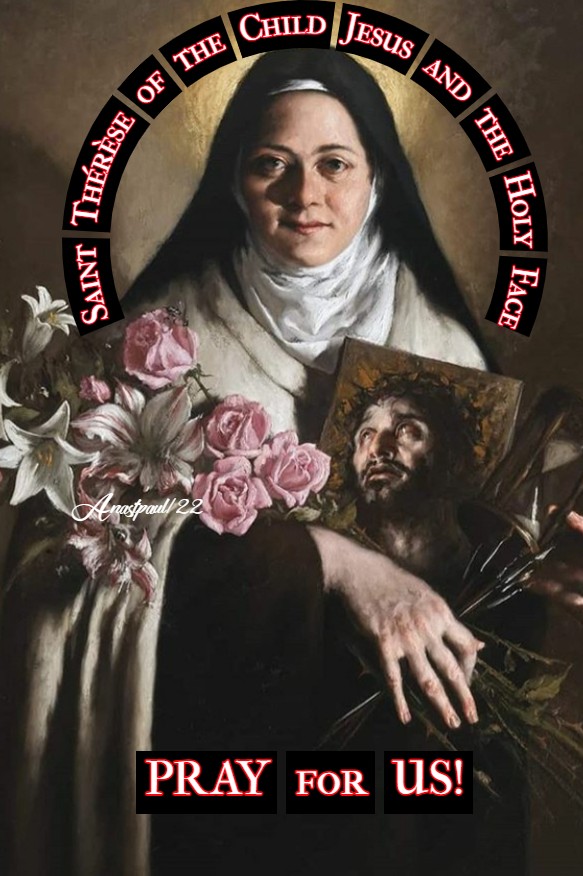
Quote/s of the Day – 3 October – St Thérèse of the Child Jesus and the Holy Face (1873 – 1897)
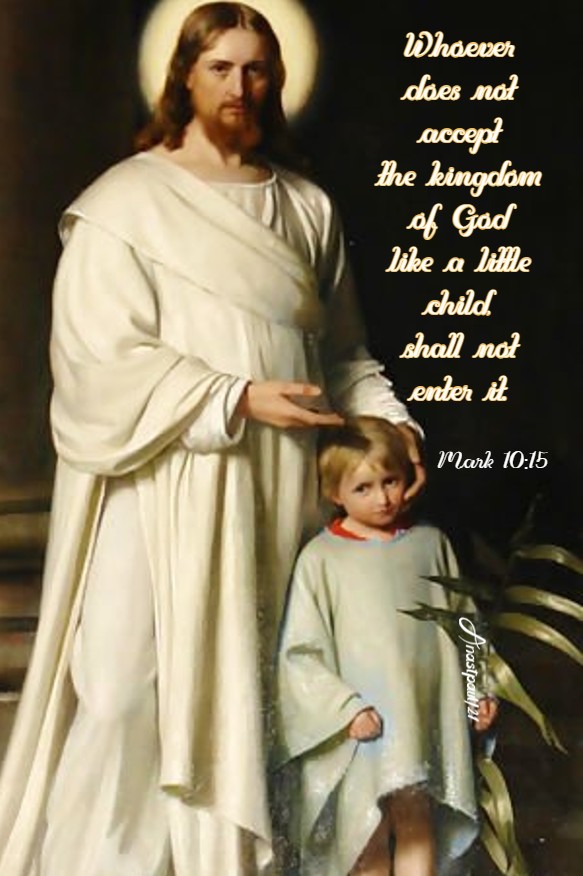
“Whoever does not accept the kingdom of God like a little child, shall not enter it.”
Mark 10:15
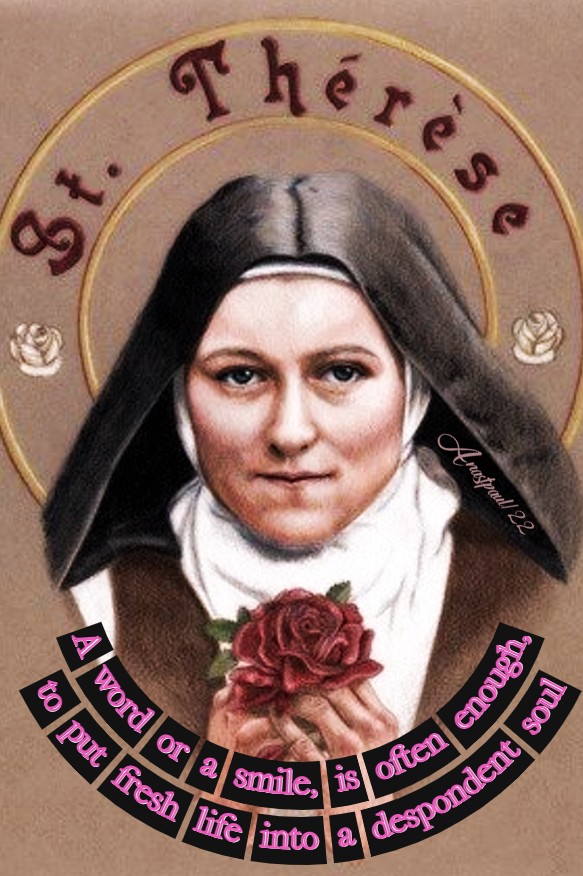
“A word or a smile, is often enough, to put fresh life into a despondent soul.”
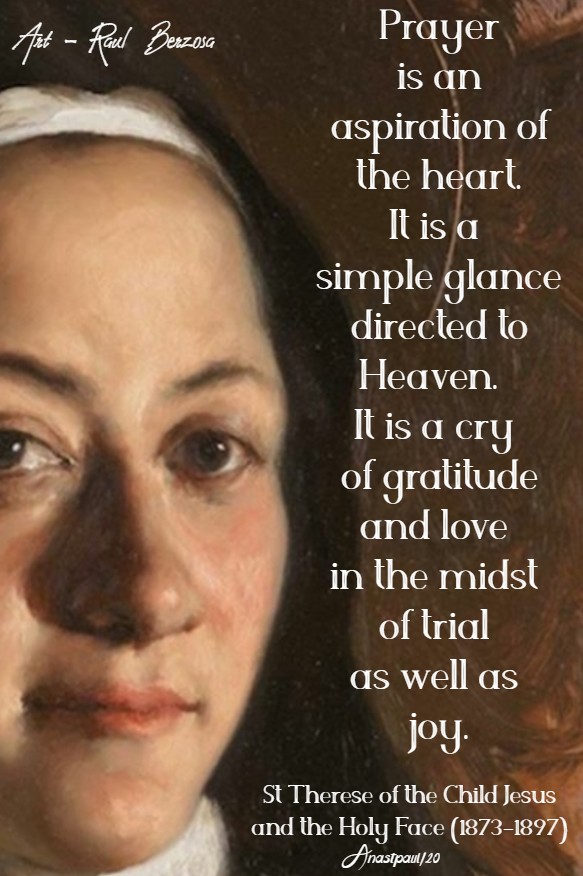
“Prayer is an aspiration of the heart. It is a simple glance directed to Heaven. It is a cry of gratitude and love in the midst of trial as well as joy.”
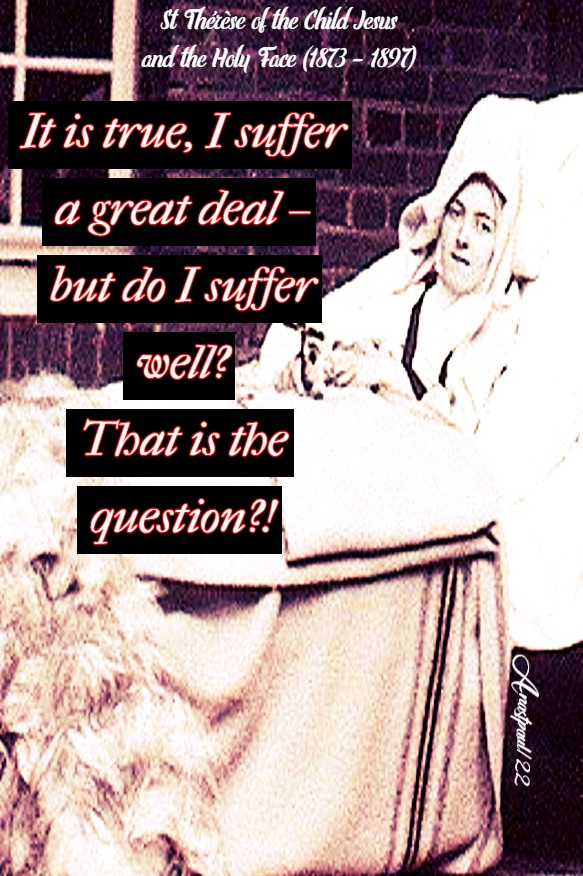
“It is true, I suffer a great deal– but do I suffer well? That is the question?!”
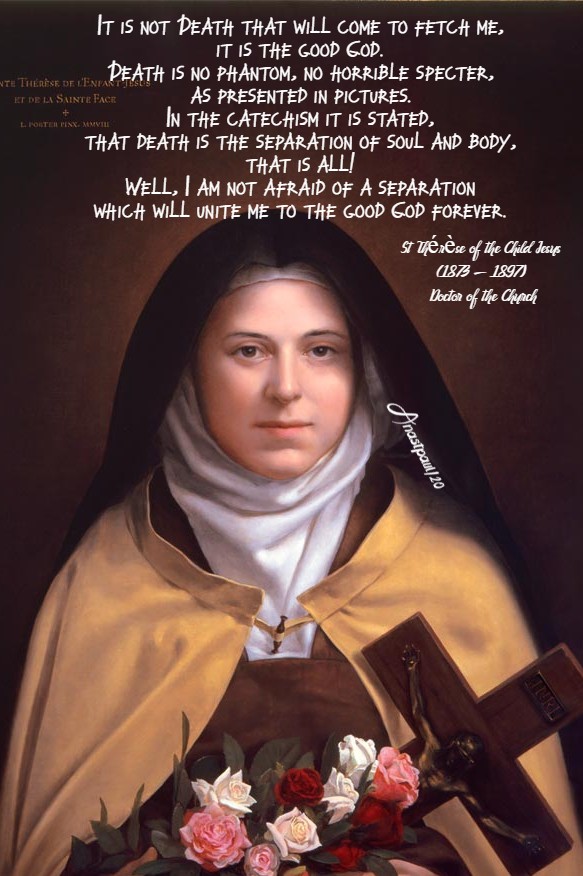
“It is not Death that will come to fetch me, it is the good God. Death is no phantom, no horrible specter, as presented in pictures. In the catechism it is stated, that death is the separation of soul and body, that is all! Well, I am not afraid of a separation which will unite me to the good God forever.”
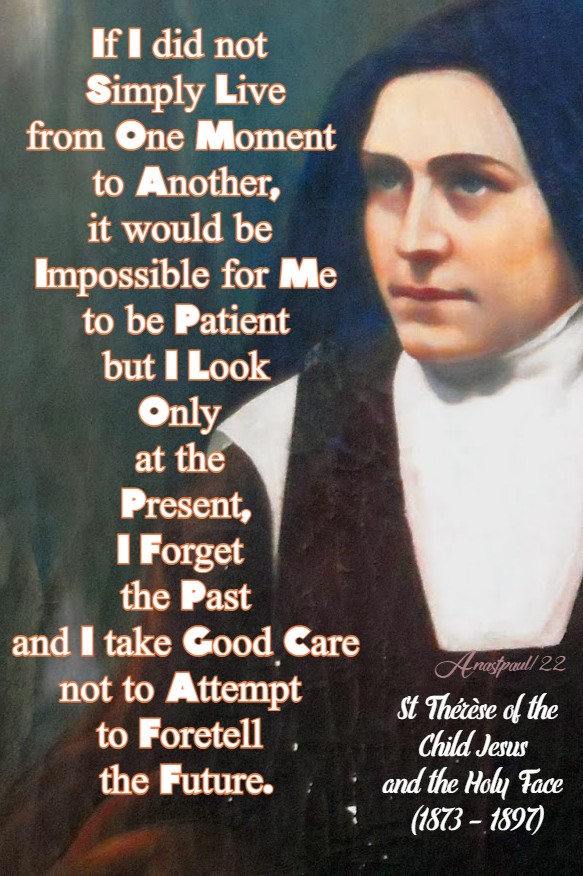
“If I did not simply live from one moment to another, it would be impossible for me to be patient but I only look at the present, I forget the past and I take good care not to attempt to foretell the future.”
St Thérèse of the Child Jesus and the Holy Face (1873 – 1897)
One Minute Reflection – 3 October – St Thérèse of the Child Jesus (1873 – 1897) – Isaias 66:12-14, Matthew 18:1-4 Scripture search here: https://www.drbo.org/
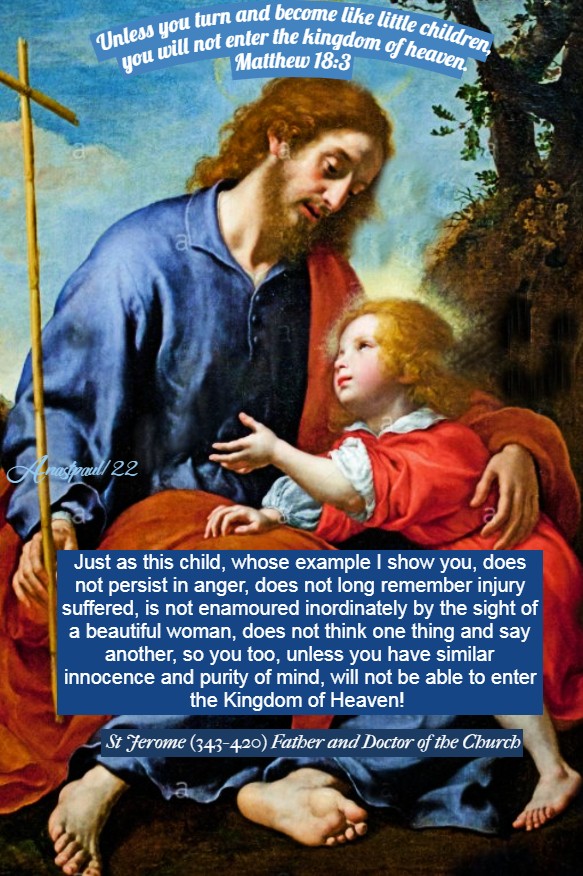
“Amen, I say to you, unless you turn and become like little children, you will not enter the kingdom of heaven.”… Matthew 18:3
REFLECTION – “Whoever humbles himself like this child, he is the greatest in the Kingdom of Heaven. Just as this child, whose example I show you, does not persist in anger, does not long remember injury suffered, is not enamoured inordinately by the sight of a beautiful woman, does not think one thing and say another, so you too, unless you have similar innocence and purity of mind, will not be able to enter the Kingdom of Heaven! Or, it might be taken in another way: “Whosoever, therefore, humiliates himself like this child, is greater in the kingdom of heaven,” so as to imply that anyone, who imitates Me and humiliates himself following My example, so that he abases himself as much as I abased Myself in accepting the form of a servant, will enter the Kingdom of Heaven.” – St Jerome (343-420) Translator of Sacred Scripture into Latin (The Vulgate) One of the original four Doctors of the Latin Church, Father (Commentary on Matthew 3).
PRAYER – O Lord, Who said: Unless you become as little children, you shall not enter into the Kingdom of Heaven, grant us, we beseech Thee, so to follow the footsteps of blessed Thérèse the Virgin, in humility and simplicity of heart that we may obtain everlasting rewards.Through Jesus Christ, Thy Son our Lord, Who lives and reigns with Thee, in the unity of the Holy Ghost, God, world without end. Amen (Collect).
Our Morning Offering – 3 October – Saint Thérèse of the Child Jesus and the Holy Face or The Little Flower (1873 – 1897) Virgin.
Morning Offering By St Thérèse of the Child Jesus (1873 – 1897)
O my God! I offer Thee all my actions of this day for the intentions and for the glory of the Sacred Heart of Jesus. I desire to sanctify every beat of my heart, my every thought, my simplest works, by uniting them to It’s infinite merits and I wish to make reparation for my sins, by casting them into the furnace of It’s Merciful Love. O my God! I ask Thee for myself and for those whom I hold dear, the grace to fulfil perfectly Thy Holy Will, to accept for love of Thee, the joys and sorrows of this passing life, so that we may one day be united together in Heaven for all Eternity. Amen.
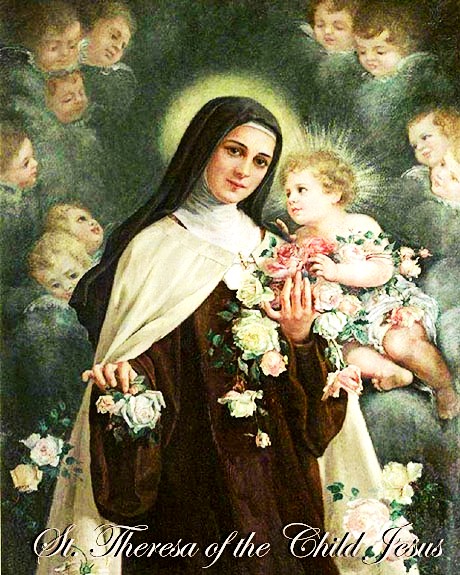
Saint of the Day – 3 October – Sant Thérèse of the Child Jesus and the Holy Face or The Little Flower (1873 – 1897) Virgin.
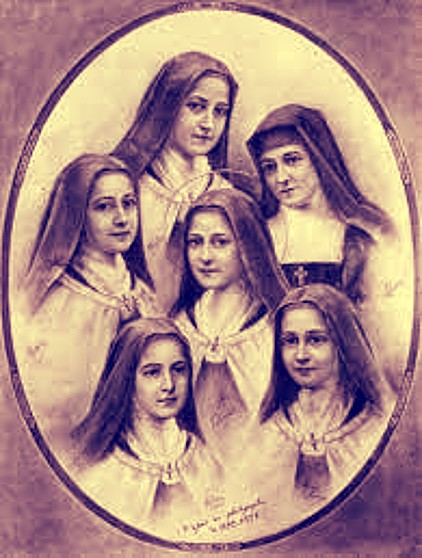
Marie Francoise Thérèse Martin, known as the Little Flower of Jesus, was born 2 January 1873 at Alencon in Normandy, France, of very Christian parents. The Martins, who lost four of their little ones in early infancy or childhood, regarded their children as Gifts from Heaven and offered them to God before their birth. Thérèse was the last flower of this blessed stem, which gave four Sisters to the Carmel of Lisieux, still another to the Visitation of Caen.
The five sisters were left without their mother, a victim of cancer, when Thérèse was only four years old but her two oldest sisters were of an age to take excellent care of the household and continue the Christian character formation, of the younger ones, which their mother had initiated. Their saintly father was soon to see his little flock separated, however, when one after the other they left to enter religious life. He blessed each one and gave them all back to God, with humble gratitude to God for having chosen his daughters.
From childhood,Thérèse had manifested a tender piety which her naturally lively temperament could not alter. Her mother’s death affected her profoundly, however and, at the age of nine, she was visited with a severe trial in the form of an illness the doctors could not diagnose and which seemed incurable. She was instantly restored to her ordnary good health by the Virgin Mary, in answer to her desolate sisters’ prayers – Thérèse saw Her statue become animated, to smile at her with an ineffable tenderness as she lay on her bed of suffering.
Before the age of fifteen, Thérèse already desired to enter the Carmel of Lisieux, where her two eldest sisters were already nuns; a trip to Rome and a petition at the knees of the Holy Father, Leo XIII, gave her the inalterable answer – that her Superiors would regulate the matter. Many prayers finally obtained an affirmative reply to her ardent request and four months after her fifteenth birthday, she entered Carmel with a great joy. She could say then, “I no longer have any desire but to love Jesus even to folly.“
She adopted flowers as the symbol of her love for her Divine Spouse and offered all her little daily sacrifices and works, as rose petals at the feet of Jesus. Divine Providence gave to the world, the autobiography of this true Saint, whose little way of spiritual childhood was described in her own words, in her Story of a Soul. She could not offer God the macerations of the great soldiers of God, only her desires to love Him ,as they had loved Him and to serve Him, in every way possible. She chose “all” in spirit, for her beloved Lord.
Later, she would be named Patroness of missions. Her spirituality does not imply only sweetness and light, however, for this loving child of God, passed by a tunnel of desolate spiritual darkness, yet never ceased to smile at Him, wanting to serve Him, if it were possible, without His even knowing it.
When nine years had passed in the Carmel, the little flower was ready to be plucked for heaven and, in a slow agony of Consumption, Thérèse made her final offering to God. She suffered so severely that she said she would never have believed it possible and could only explain it by her desire to save souls for God. She died in 1897, was Beatified in 1923 and Canonised in 1925.
And now, as she foretold, she is spending her heaven in doing good upon earth. Countless miracles have been attributed to her intercession. Little Flower of Jesus please pray for Holy Mother Church and for all Her faithful children.
St Thérèse of Lisieux/St Thérèse of the Child Jesus and the Holy Face/The Little Flower OCD (1873 – 1897) Virgin, Carmelite Nun. She was Canonised by Pope Pius XI on 17 May 1925. The same Pope proclaimed her Universal Patron of the Missions, alongside Saint Francis Xavier, on 14 December 1927. Up until 1969 her Memorial was celebrated on 3 October. Biography: https://anastpaul.com/2018/10/01/saint-of-the-day-st-therese-of-lisieux-o-c-d-1873-1897-doctor-of-the-church/
St Adalgott of Chur Bl Agostina of the Assumption St Candidus the Martyr St Cyprian of Toulon Bl Damian de Portu St Dionysius the Aeropagite Bl Dominic Spadafora Bl Edmund of Scotland St Ewald the Black St Ewald the Fair St Froilan
Martyrs of Alexandria – 9 Saints: A number of Christian Martyrs remembered together. We know the names Caius, Cheremone, Dionysius, Eusebio, Fausto, Lucio, Maximus, Paul, Peter and that there were at least two more whose names have not come down to us, and that’s about all we know.
Novena to the Immaculate Heart of Mary, Queen of the Most Holy Rosary
By Father Joseph Cacella, 1947
FIFTH DAY
Intention: Reparation for the Salvation of Souls
Oh Immaculate Heart of Mary, Virgin most powerful, we know that the vision of the terrible fires of hell which thou showed to the three little shepherd children at Fatima, was really meant for us. We beseech thee, Oh Mother Mary, to spare us the fate of a judgement which ordains such a punishment! Grant unto us, a faith so strong that we may ever realise that the evil of sin will be justly repaid with eternal punishment. I believe in the Infinite Justice of the One True God and the Infinite Love of the Father, Son and Holy Ghost. We pray and beseech thee that through thy intercession, we may be given the grace to live so worthy a life on earth, as to enjoy the reward of eternal happiness in the Kingdom of thy Divine Son, Our Lord Jesus Christ. Amen.
Our Lady of Fatima, Virgin most powerful, inflame our hearts with the love of Reparation for the Salvation of Souls.
We pray our Daily Rosary now with the same Intention: Reparation for the Salvation of Souls.
Thought for the Day – 2 October – Meditations with Antonio Cardinal Bacci (1881-1971)
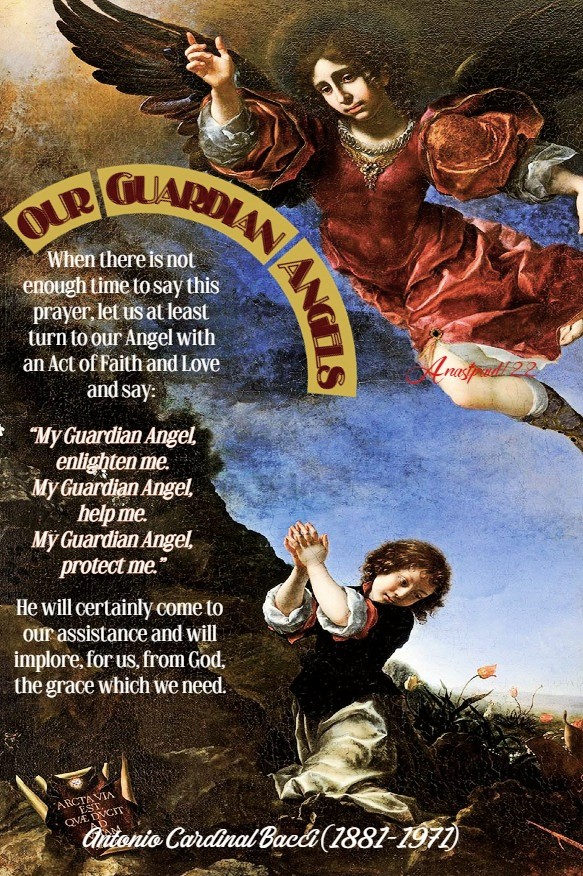
Our Guardian Angels
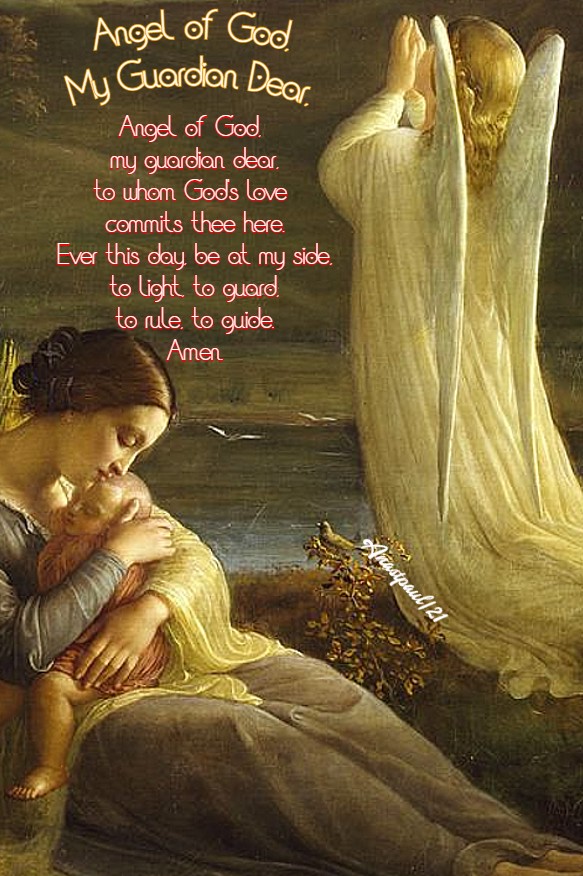
“Let us form the habit of saying this prayer to our Guardian Angel, especially in the crises of life.
Angel of God, my Guardian dear, to whom God’s love commits me here, ever this day (or night) be at my side, to light and guard, to rule and guide. Amen.
When there is not enough time to say this prayer, let us at least turn to our Angel with an Act of Faith and Love and say: “My Guardian Angel, enlighten me. My Guardian Angel, help me. My Guardian Angel, protect me.”
He will certainly come to our assistance and will implore, for us, from God, the grace which we need.”
Quote/s of the Day – 2 October – The Holy Guardian Angel
“See that you despise not one of these little ones, for I say to you that their Angels in Heaven, always see the face of My Father.”
Matthew 18:10
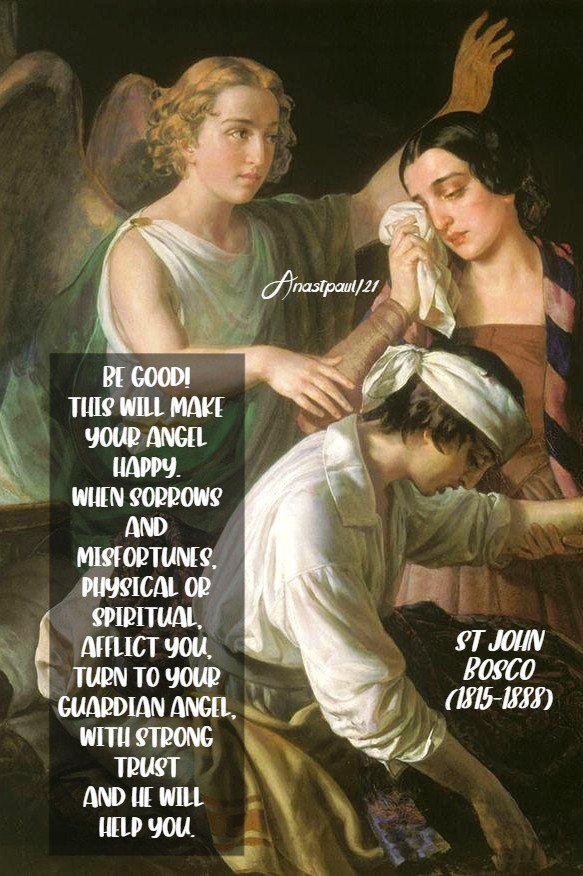
“Be good! This will make your angel happy. When sorrows and misfortunes, physical or spiritual, afflict you, turn to your Guardian Angel, with strong trust and he will help you.”
St John Bosco (1815-1888)
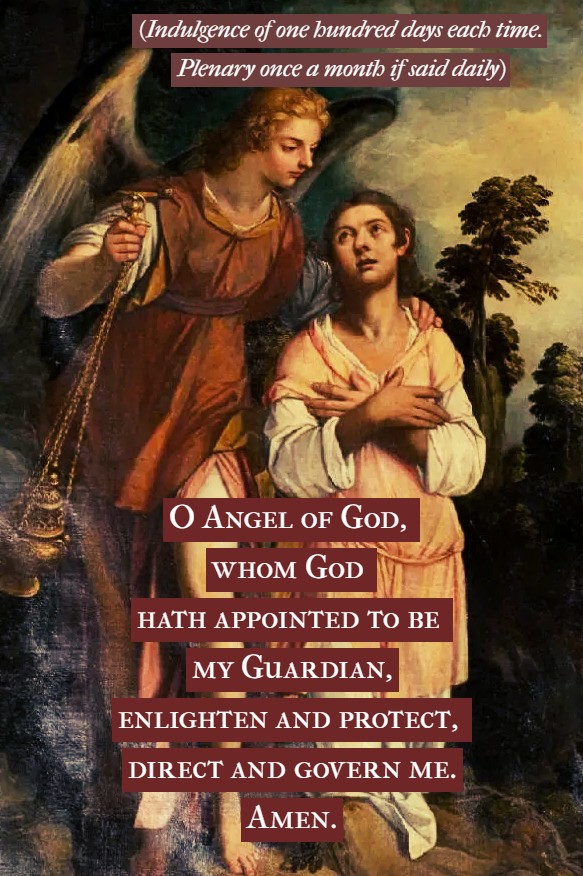
“O Angel of God, whom God hath appointed to be my Guardian, enlighten and protect, direct and govern me. Amen.”
(Indulgence of one hundred days each time. Plenary once a month if said daily)
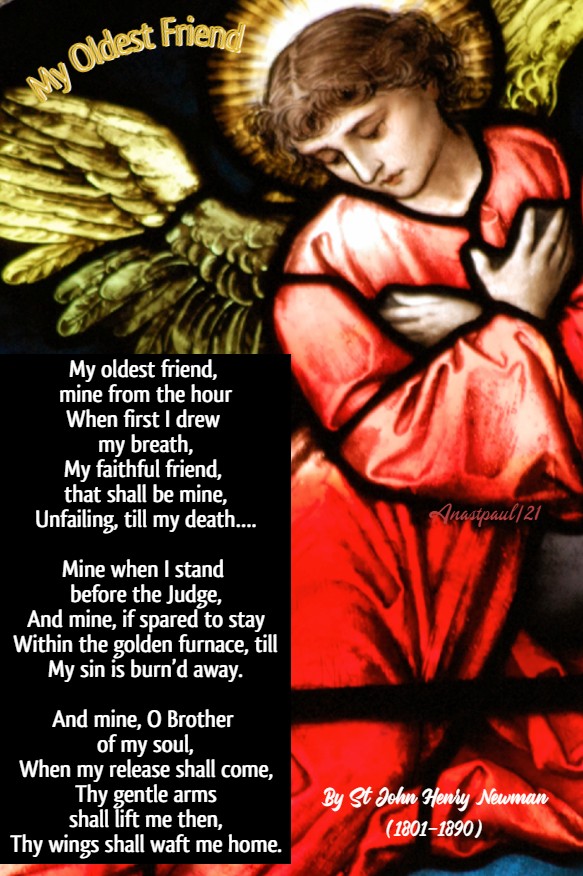
My Oldest Friend By John Henry Newman (1801-1890)
My oldest friend, mine from the hour When first I drew my breath, My faithful friend, that shall be mine, Unfailing, till my death….
Mine when I stand before the Judge, And mine, if spared to stay Within the golden furnace, till My sin is burn’d away.
And mine, O Brother of my soul, When my release shall come, Thy gentle arms shall lift me then, Thy wings shall waft me home.”































You must be logged in to post a comment.