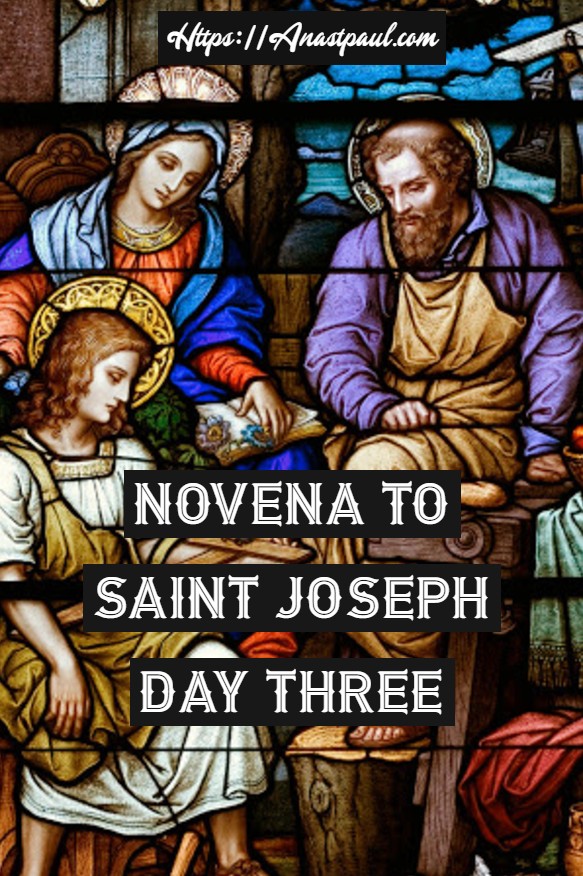
Saint Joseph, you are the faithful protector and intercessor of all who love and venerate you. O most prudent Guardian of the Holy Family, protect our home. Pour forth from heaven. blessings on our family. Remain in our midst. Help us to live in love and harmony, in peace and joy. May the wholesome fear of God, strengthen us, that virtue may adorn our lives and lead us to heaven. To you this day we give the key to our dwelling place. Lock out all things that could do us harm. Lock our home and our loved ones, in the hearts of Jesus and Mary. And for this special grace we now implore you: ……………. (Mention your request) We humbly beg you to look graciously upon the beloved inheritance which Jesus Christ purchased by His blood and to aid us in our necessities with your power and strength. Guardian of the Word Incarnate, we feel confident that your prayers on our behalf, will be graciously heard before the throne of God. St Joseph Most Loving Husband and Guardian, Pray for us! Amen
Glory be to the Father and to the Son and to the Holy Spirit, as it was in the beginning, is now and ever shall be, world without end. Amen.
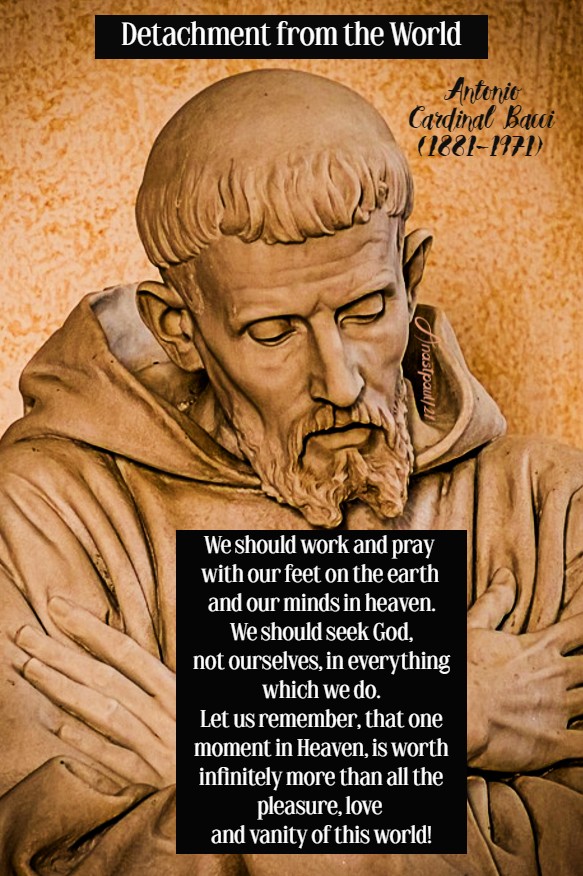
Thought for the Day – 12 March – Meditations with Antonio Cardinal Bacci (1881-1971)
Detachment from the World
“This is not the same as saying that we should have no interest in worldly affairs. Far from it. It is our duty to think about them and make provision for the future. We cannot and should not, look for miracles from God. We may have obligations to ourselves or to our family, or to our position in life. We are in this world to work, not to surrender to apathy or inactivity. We must engage in worldly activity insofar as our circumstances demand it. Nevertheless, our hearts should not be engrossed in earthly things, for they belong to God. In the midst of our other preoccupations, we should adore, love and thank God, the Giver of every good, our Creator and Redeemer. St John Bosco said, that we should work as if we never had to die. But, we should also be as detached from worldly things, as if we had to die in one hour. A man who works like this, can accomplish wonders because, he is not working for himself but, for God. We should work and pray with our feet on the earth and our minds in Heaven. We should seek God, not ourselves, in everything which we do. Let us remember, that one moment in Heaven, is worth infinitely more than all the pleasure, love and vanity of this world!”
Ember Saturday in Lent – 12 March – Our Lenten Journey with the Great Fathers – 1 Thess. 5:14-23, Matthew 17:1-9
“Behold, O God, our Protector and look upon Your servants.” – Psalm 83:10,9
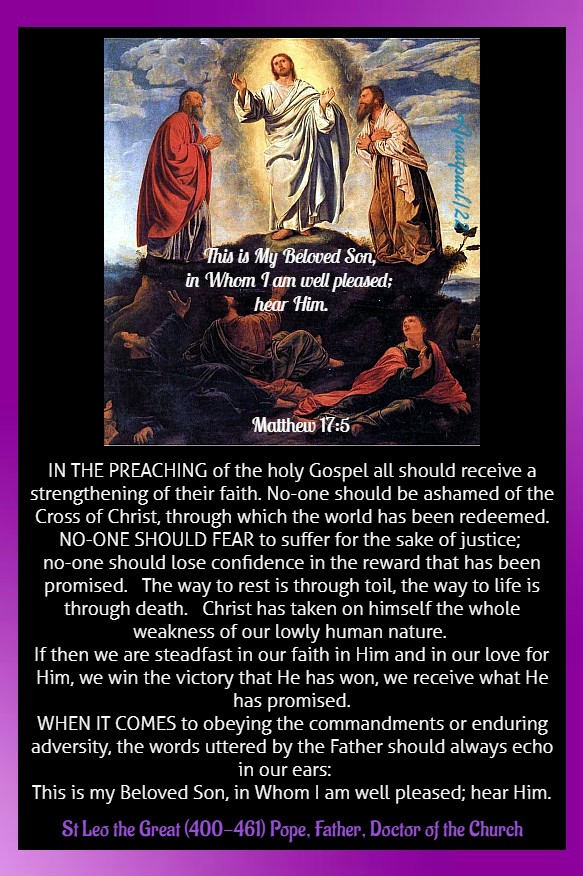
“This is My beloved Son, in Whom I am well pleased; hear Him.”
Matthew 17:5
“THE LORD REVEALS HIS GLORY in the presence of chosen witnesses. His body is like that of the rest of mankind but He makes it shine with such splendour that His face becomes like the sun in glory and His garments, as white as snow.
THE GREAT REASON for this Transfiguration was to remove the scandal of the cCoss from the hearts of His disciples, and to prevent the humiliation of His voluntary suffering, from disturbing the faith, of those who had witnessed the surpassing glory that lay concealed.
WiITH NO LESS FORETHOUGHTHe was also providing a firm foundation for the hope of holy Church. The whole body of Christ was to understand the kind of transformation that it would receive as His gift. The members of that body were to look forward to a share in that glory which first blazed out in Christ their head.
THE LORD had Himself spoken of this, when He foretold the splendour of His coming: Then the just will shine like the sun in the Kingdom of their Father. Saint Paul the Apostle bore witness to this same truth when he said: I consider that the sufferings of the present time are not to be compared with the future glory that is to be revealed in us. In another place he says: You are dead and your life is hidden with Christ in God. When Christ, your life, is revealed, then you also will be revealed with him in glory.
THIS MARVEL of the TRANSFIGURATION contains another lesson for the apostles, to strengthen them and lead them into the fullness of knowledge. Moses and Elijah, the law and the prophets, appeared with the Lord in conversation with Him. This was in order to fulfill exactly, through the presence of these five men, the text which says: Before two or three witnesses every word is ratified. What word could be more firmly established, more securely based, than the word which is proclaimed by the trumpets of both old and new testaments, sounding in harmony, and by the utterances of ancient prophecy and the teaching of the Gospel, in full agreement with each other?
THE WRITINGS of the two testaments support each other. The radiance of the Transfiguration reveals clearly and unmistakably the One Who had been promised by signs foretelling Him under the veils of mystery. As Saint John says: The law was given through Moses, grace and truth came through Jesus Christ. In Him the promise made through the shadows of prophecy stands revealed, along with the full meaning of the precepts of the law. He is the One who teaches the truth of prophecy through His presence and makes obedience to the commandments possible through grace.
IN THE PREACHING of the holy Gospel all should receive a strengthening of their faith. No-one should be ashamed of the Cross of Christ, through which the world has been redeemed.
NO-ONE SHOULD FEAR to suffer for the sake of justice; no-one should lose confidence in the reward that has been promised. The way to rest is through toil, the way to life is through death. Christ has taken on himself the whole weakness of our lowly human nature. If then we are steadfast in our faith in Him and in our love for Him, we win the victory that He has won, we receive what He has promised.
WHEN IT COMES to obeying the commandments or enduring adversity, the words uttered by the Father should always echo in our ears: This is my Beloved Son, in Whom I am well pleased; hear Him.” – St Leo the Great (400-461) Pope, Father, Doctor of the Church (An excerpt from Sermon 51)
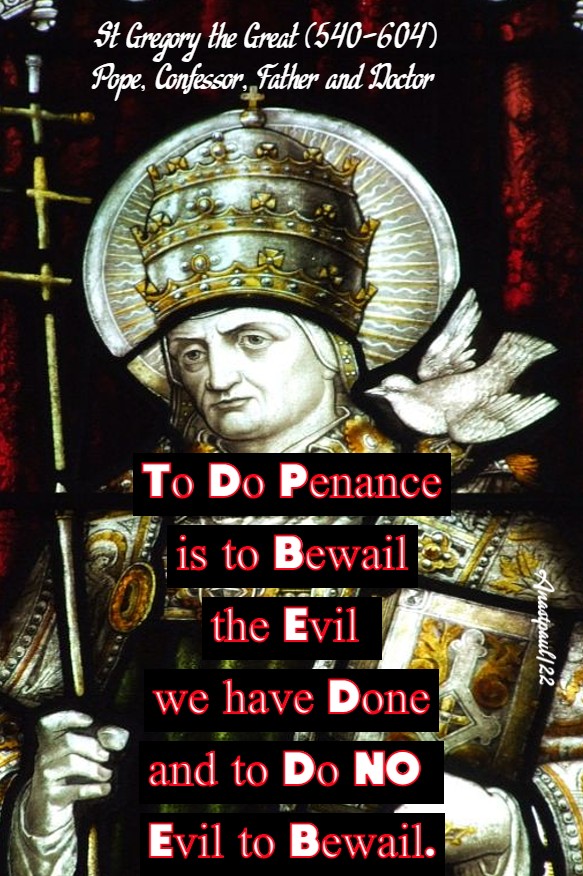
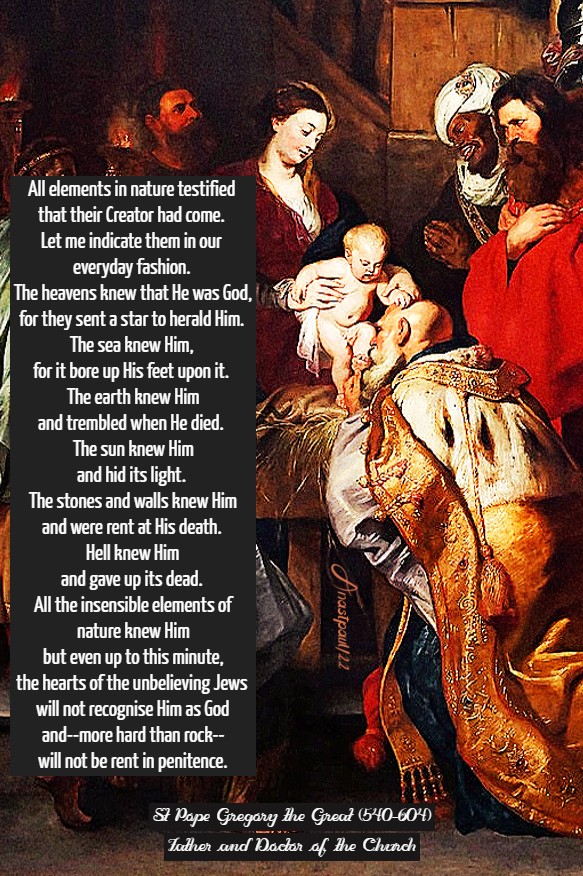
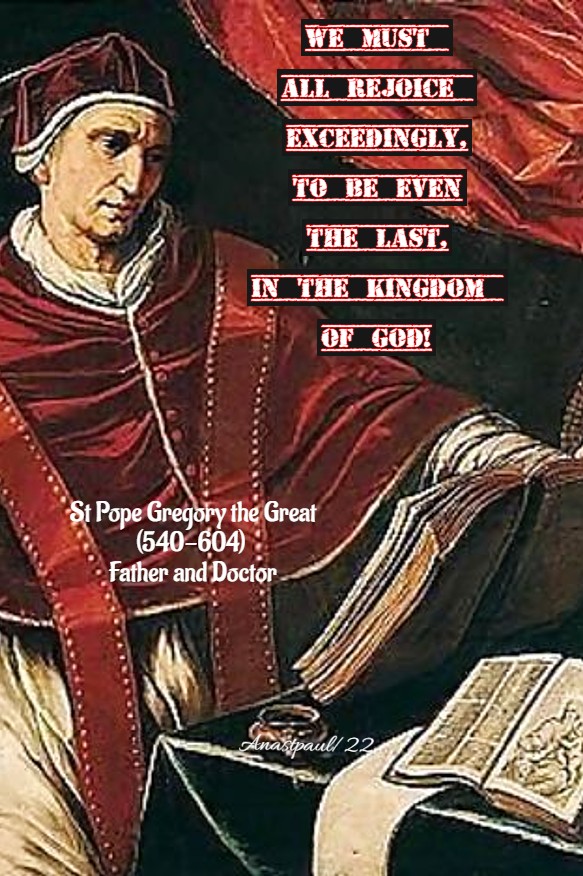
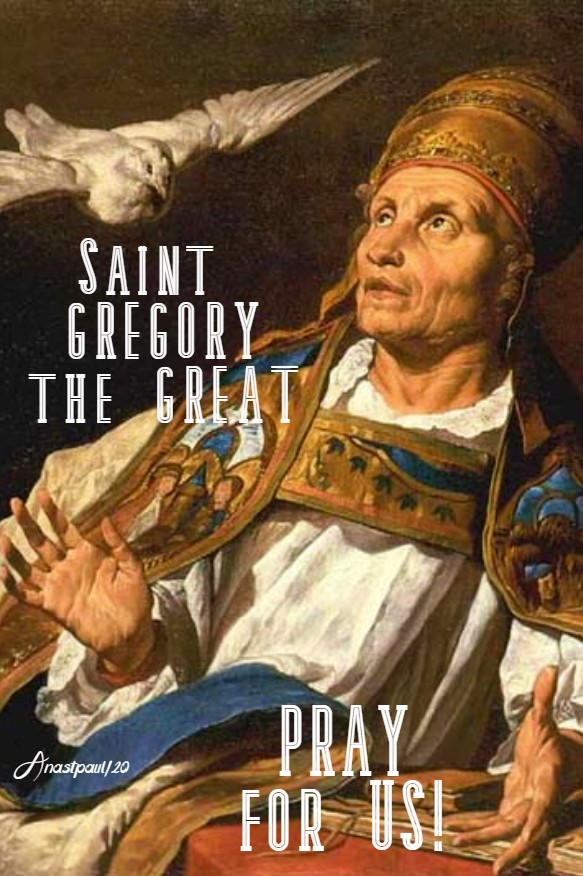
Quote/s of the Day – 12 March – Ember Saturday in Lent – The Memorial of St Pope Gregory the Great (540-604) – Confessor, Father & Doctor
“To do penance is to bewail the evil we have done and to do no evil to bewail.”
“All elements in nature testified that their Creator had come. Let me indicate them in our everyday fashion. The heavens knew that He was God, for they sent a star to herald Him. The sea knew Him, for it bore up His feet upon it. The earth knew Him and trembled when He died. The sun knew Him and hid its light. The stones and walls knew Him and were rent at His death. Hell knew Him and gave up its dead. All the insensible elements of nature knew Him but even up to this minute, the hearts of the unbelieving Jews will not recognise Him as God and–more hard than rock– will not be rent in penitence.”
“… We must all rejoice exceedingly, to be even the last, in the Kingdom of God!”
St Gregory the Great (540-604) Pope, Confessor, Father and Doctor “Father of the Fathers”
One Minute Reflection – 12 March – Ember Saturday in Lent – 1 Thess. 5:14-23, Matthew 17:1-9 and the Memorial of St Pope Gregory the Great (540-604) – Confessor, Father & Doctor
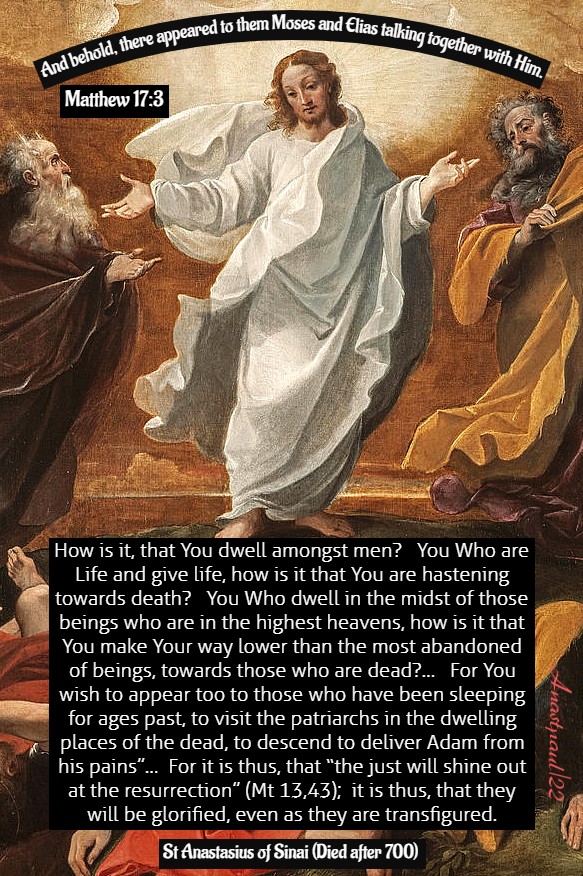
“And behold, there appeared to them Moses and Elias talking together with Him.” – Matthew 17:3
REFLECTION – “Today our Lord truly appeared on the mountain. Today, human nature, which was previously created in the form of God but obscured by the formless figures of idols, has been transfigured into man’s former beauty, created “in the image and likeness of God” (Gn 1,26)… Today man, who had been dressed in garments of skin, plain and dark (Gn 3,21), has put on divine clothing on the mountain, “clothed in light as in a robe” (Ps 103[104],2)…
Moses looked a second time at the fire that did not consume the bush (Ex 3,2) but gives life to all flesh…, and he said : Now I see You : You Who really are and Who exist eternally; You Who are with the Father and have said to me: ‘I am who am’ (v.14)… Now I see You Whom I longed to see before, saying: ‘Let me see your glory’ (Ex 33,18). No longer do I see Your back while hidden in the cleft of the rock (v.23) but I see You, O God, lover of humankind, hidden in human form. No longer do You shelter me with Your right hand (v.22) but You are the Right Hand of the Most High, Who has been revealed to the world. You are the Mediator of both the Old and the New Covenants, O God from of old, New Man…
You Who said to me on Sinai: ‘No-one can see me and live’ (v.20): how is it that You can now be contemplated face-to-face on earth, in the flesh? How is it, that You dwell amongst men? You Who are Life and give life, how is it that You are hastening towards death? You Who dwell in the midst of those beings who are in the highest heavens, how is it that You make Your way lower than the most abandoned of beings, towards those who are dead?…For You wish to appear too to those who have been sleeping for ages past, to visit the patriarchs in the dwelling places of the dead, to descend to deliver Adam from his pains”… For it is thus, that “the just will shine out at the resurrection” (Mt 13,43); it is thus, that they will be glorified, even as they are transfigured.” – St Anastasius of Sinai (Died after 700) Monk (Sermon for the Feast of the Transfiguration).
PRAYER – God our Father, Your rule is a rule of love, Your providence is full of mercy for Your people. Through the intercession of St Gregory, grant the spirit of wisdom and understanding in Your Word through Your Son Jesus Christ. Grant that by the light of His Resurrection we may know our eternal home and strive to attain eternal joy there with You. Through Jesus Christ our Lord, with the Holy Spirit, one God forever, amen.
Our Morning Offering – 12 March – Saturday of Ember Week in Lent and the Memorial of St Pope Gregory the Great (540-604) – Father & Doctor
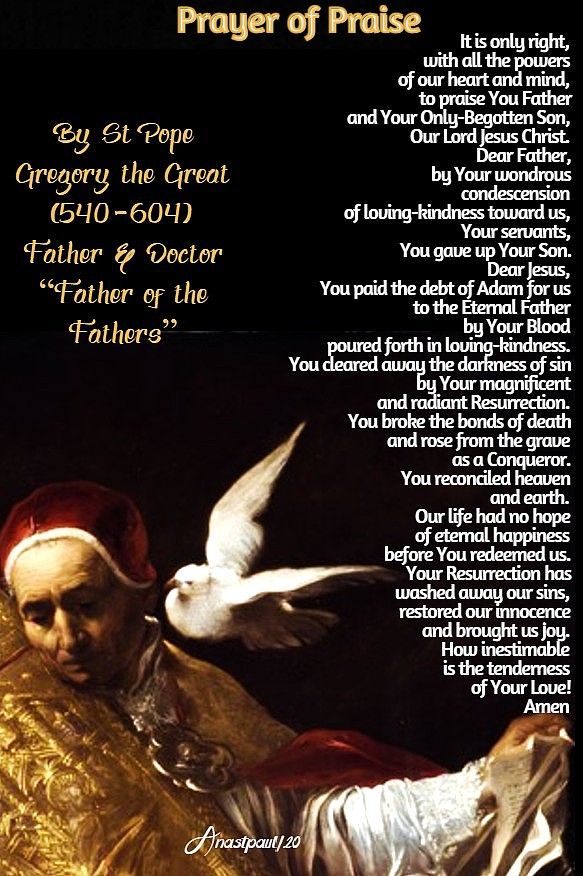
Prayer of Praise By St Gregory the Great (540-604) Father & Doctor “Father of the Fathers”
It is only right, with all the powers of our heart and mind, to praise You Father and Your Only-Begotten Son, Our Lord Jesus Christ. Dear Father, by Your wondrous condescension of loving-kindness toward us, Your servants, You gave up Your Son. Dear Jesus, You paid the debt of Adam for us to the Eternal Father by Your Blood poured forth in loving-kindness. You cleared away the darkness of sin by Your magnificent and radiant Resurrection. You broke the bonds of death and rose from the grave as a Conqueror. You reconciled Heaven and earth. Our life had no hope of eternal happiness before You redeemed us. Your Resurrection has washed away our sins, restored our innocence and brought us joy. How inestimable is the tenderness of Your Love! Amen
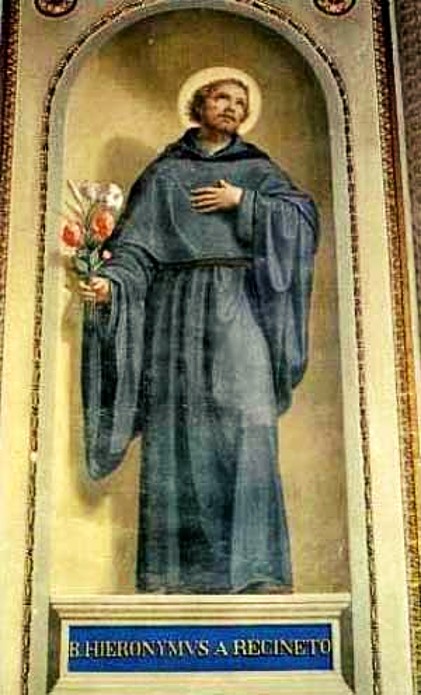
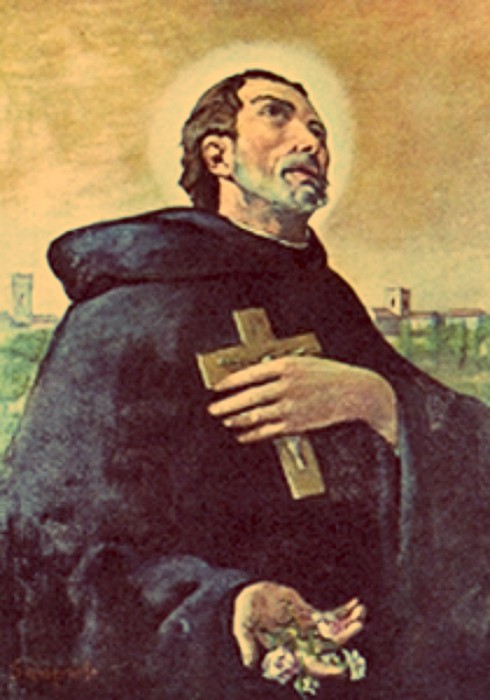
Saint of the Day – 12 March – Blessed Jerome of Recanati OSA (Died 1350) Priest, Friar of the Hermits of Saint Augustine, peacemaker. Died on 12 March 1350 in Recanati, Piceno, Italy of natural causes.
The Roman Martyrology reads : “In Recanati in the Marche, Blessed Girolamo Gherarducci, Priest of the Order of the Hermits of St Agustine, who worked for peace and harmony between peoples.”
Blessed Jerome of Recanati lived in the Augustinian Convent in his hometown, where he died on 12 March 1350. Very little is known about his life. Certainly he lived in a period of flowering of holiness in the Marches, just think of his most famous example: St Nicholas of Tolentino (1254-1305).
In addition to the life of prayer, a peculiar characteristic of his apostolate, was the fact that he was a man who devoted himself to the pacification of souls in times of fratricidal struggles. As part of his ministry, he mediated numerous disputes between families and the City. It is said that he brought peace to the Cities of Ascoli and Fermo, which had been at war with each other for many a long year.
To remember and imitate him, as early as 1369, the Town of Recanati was publicly celebrating the Feast of the blessed Jerome on the Second Sunday of Lent. On this occasion, until recent times, it choose twelve peacemakers from among the populace, six men and six women, whose responsibility it was, to settle disputes among the citizens.
Pope Pius VII confirmed the cult of Jerome in 1804. His mortal remains are venerated in the Church of St Augustine in Recanati.
St Almut of Wetter St Alphege the Bald Bl Angela Salawa St BasilissS of Asia Bl Beatrix of Engelport St Bernard of Carinola Bl Claudius the Minor St Egdunus St Fechno
Blessed Jerome of Recanati OSA (Died 1350) Priest, Friar of the Hermits of Saint Augustine.
St Heiu of Hartlepool St Indrecht of Iona St Pope Innocent I St Joseph Zhang Dapeng
St Luigi Orione FDP (1872-1940) “The Advocate of the Poor and of Orphans” Priest, Preacher, Confessor, Writer, Apostle of Charity, Apostle of Eucharistic Adoration, Marian Devotee and Founder of Sons of Divine Providence Congregation, the Congregation of the Little Missionary Sisters of Charity, Blind Sisters, Adorers of the Blessed Sacrament, Contemplative Sisters of Jesus Crucified. About St Luigi: https://anastpaul.com/2019/03/12/saint-of-the-day-12-march-st-luigi-orione-fdp-1872-1940/
St Maximilian of Thebeste St Mura McFeredach St Paul Aurelian St Peter the Deacon
Martyrs of Nicomedia – 8 Saints: Christians who were Martyred in succession in a single incident during the persecutions of Diocletian. First there were the eight imprisoned Christians, Domna, Esmaragdus, Eugene, Hilary, Mardonius, Maximus, Mígdonus and Peter, about whom we know little more than their names. Each day for eight days one of them would be strangled to death in view of the others so that they would spend the night in dread, not knowing if they were next. Peter was the chamberlain or butler in the palace of Diocletian. When he was overheard complaining about this cruelty, he was exposed as a Christian, arrested, tortured and executed by having the flesh torn from his bones, salt and vinegar poured on the wounds and then being roasted to death over a slow fire. Gorgonio was an army officer and member of the staff in the house of emperor Diocletian, Doroteo was a staff clerk. They were each exposed as Christians when they were overhead objecting to the torture and murder of Peter. This led to their own arrest, torture and executions. Died in 303 in Nicomedia, Bithynia (in modern Turkey) Additional Memorial – 28 December as part of the 20,000 Martyrs of Nicomedia.
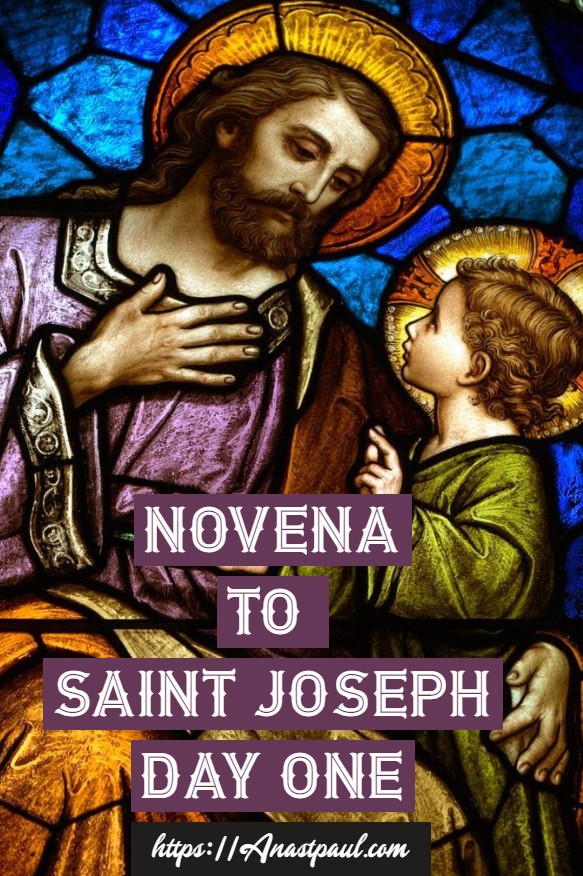
To you, O Blessed Joseph, we come in our trials and having asked the help of your most holy spouse, we confidently ask your patronage too. Through that sacred bond of charity, which united you to the Immaculate Virgin Mother of God and through the fatherly love, with which you embraced the Child Jesus, we humbly beg you to look graciously upon the beloved inheritance which Jesus Christ purchased by His Blood and to aid us in our necessities with your power and strength and the special grace we now implore: ……………. (Mention your request)
O most prudent Guardian of the Holy Family, defend the chosen family of Jesus Christ. Most beloved father, dispel the evil of falsehood and sin. Our most mighty protector, graciously assist us from Heaven in our struggle with the powers of darkness. And just as you once saved the Child Jesus from mortal danger, so now, defend God’s Holy Church from the snares of her enemies and from all adversity. Shield each one of us by your constant protection, so that, supported by your example and your help, we may be able to live a virtuous life, to die a holy death and to obtain eternal happiness in Heaven. St Joseph Most Prudent, Pray for us! Amen
Glory be to the Father and to the Son and to the Holy Spirit, as it was in the beginning, is now and ever shall be, world without end. Amen
Thought for the Day – 11 March – Meditations with Antonio Cardinal Bacci (1881-1971)
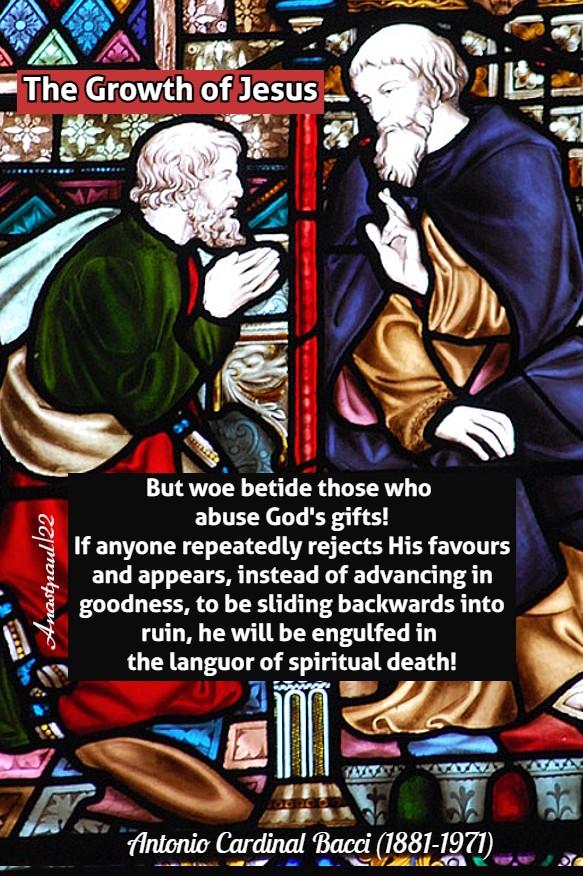
The Growth of Jesus
“It is impossible to stand still in life. This is true, whether we are speaking of the natural or of the supernatural order of life.. Life is motion and activity; there can be no cessation. In the natural order, life begins in the womb and passes through the various stages of infancy, adolescence, maturity and old age.
The supernatural life begins in Baptism, matures in Confirmation and is made entirely holy in the Eucharistic union with Jesus But, if this life begins to fail, the result can be everlasting ruin. It is true that in His infrinite goodness, Jesus has provided the Sacrament of Penance for those who fall and extinguish in themselves, the supernatural life of grace. The Sacrament of Penance, has been instituted for their salvation.
At the hour of death moreover, the Sacrament of Extreme Unction heals the soul of sin and soothes the worn-out body with a refreshing ray of the spiritual life.
But woe betide those who abuse God’s gifts! If anyone repeatedly rejects His favours and appears, instead of advancing in goodness, to be sliding backwards into ruin, he will be engulfed in the languor of spiritual death!”
Friday of the First Week of Lent – 11 March – Our Lenten Journey with the Great Fathers – Ezechiel 18:10-28, John 5:1-15
“Bring me out of distress, O Lord; put an end to my affliction and my suffering and take away all my sins.” – Psalm 24:17-18
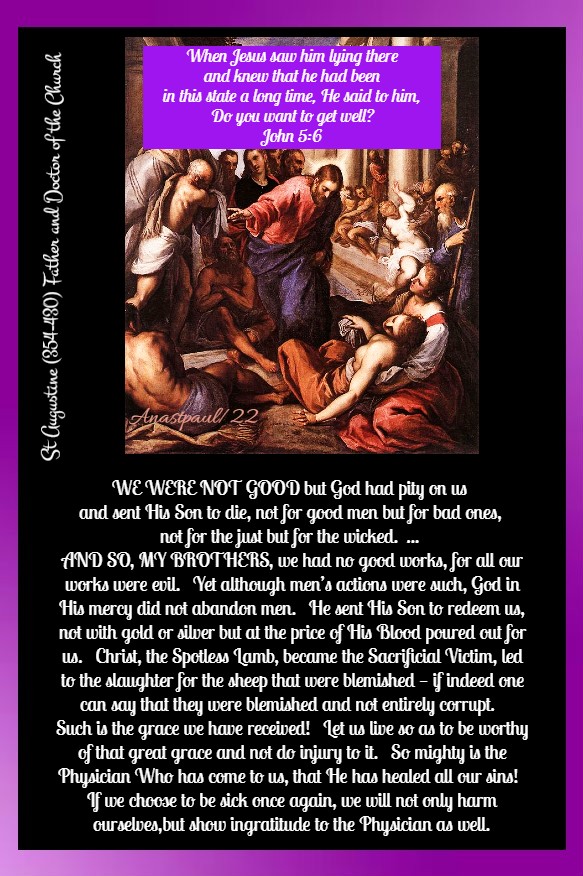
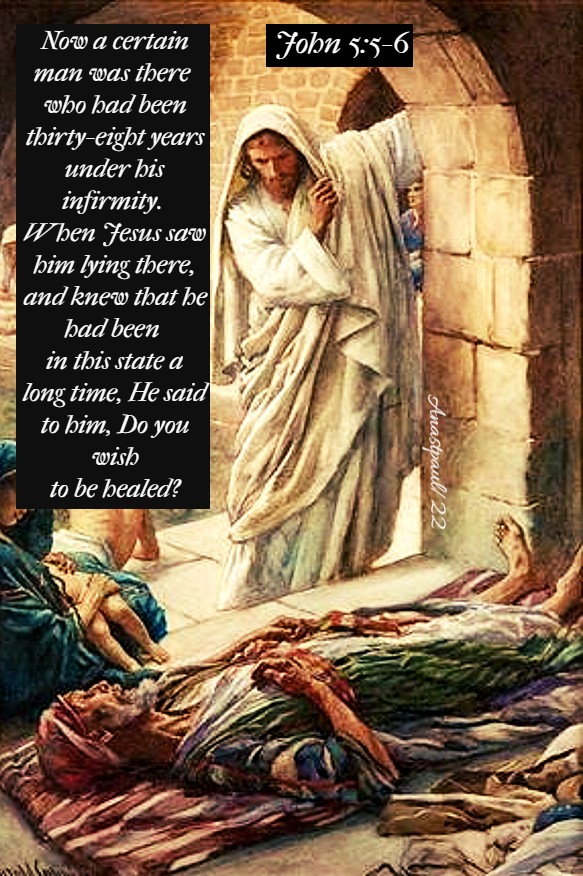
“Now a certain man was there who had been thirty-eight years under his infirmity. When Jesus saw him lying there and knew that he had been in this state a long time, He said to him, Do you want to get well?”
John 5:5-6
“The Lord has had pity on us”
“HAPPY ARE WE if we do the deeds of which we have heard and sung. Our hearing of them means having them planted in us, while our doing them, shows that the seed has borne fruit. By saying this, I wish to caution you, dearly beloved, not to enter the Church fruitlessly, satisfied with mere hearing of such mighty blessings and failing to do good works. For we have been saved by His grace, says the Apostle and not by our works, lest anyone may boast; for it is by His grace that we have been saved. It is not as if a good life of some sort came first and that thereupon, God showed His love and esteem for it from on high, saying: “Let us come to the aid of these men and assist them quickly because they are living a good life.” No, our life was displeasing to Him. He will, therefore, condemn what we have done but He will save, what He Himself has done in us.
WE WERE NOT GOOD but God had pity on us and sent His Son to die, not for good men but for bad ones, not for the just but for the wicked. Yes, Christ died for the ungodly. Notice what is written next: One will hardly die for a righteous man, although perhaps for a good man one will dare even to die. Perhaps someone can be found who will dare to die for a good man but for the unjust man, for the wicked one, the sinner, who would be willing to die except Christ alone, Who is so just, that He justifies even the unjust?
AND SO, MY BROTHERS,we had no good works, for all our works were evil. Yet although men’s actions were such, God in His mercy did not abandon men. He sent His Son to redeem us, not with gold or silver but at the price of His Blood poured out for us. Christ, the Spotless Lamb, became the Sacrificial Victim, led to the slaughter for the sheep that were blemished — if indeed one can say that they were blemished and not entirely corrupt. Such is the grace we have received! Let us live so as to be worthy of that great grace and not do injury to it. So mighty is the Physician Who has come to us, that He has healed all our sins! If we choose to be sick once again, we will not only harm ourselves,but show ingratitude to the Physician as well.
LET US THEN FOLLOW Christ’s paths which He has revealed to us, above all, the path of humility, which He Himself became for us. He showed us that path by His precepts, and He Himself followed it by His suffering on our behalf. In order to die for us —because as God, He could not die — the Word became flesh and dwelt among us. The immortal One took on mortality, that He might die for us and by dying, put to death our death. This is what the Lord did, this the gift He granted to us. The mighty one was brought low, the lowly one was slain and after He was slain, He rose again and was exalted. For He did not intend to leave us dead in hell but to exalt, in Himself, at the Resurrection of the Dead, those whom He had already exalted and made just by the faith and praise they gave Him. Yes, He gave us the path of humility. If we keep to it we shall confess our belief in the Lord and have good reason to sing: We shall praise You, God, we shall praise You and call upon Your Name.” – St Augustine (354-430) Father and Doctor of the Church (An excerpt from a Homily 23).
Quote/s of the Day – 11 March – Ember Friday of the First Week of Lent – Ezechiel 18:10-28, John 5:1-15
“Now a certain man was there who had been thirty-eight years under his infirmity. When Jesus saw him lying there, and knew that he had been in this state a long time, He said to him, Do you want to get well?”
John 5:5-6
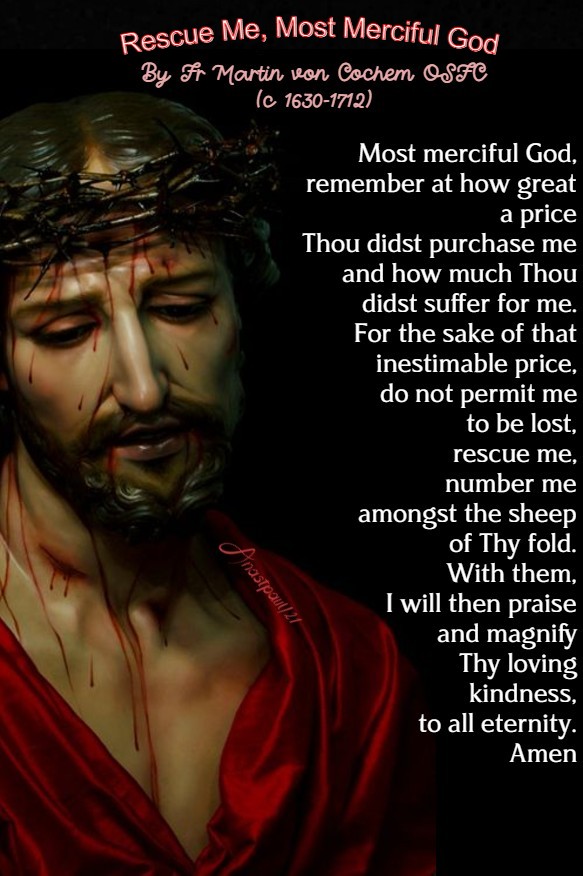
Rescue Me, Most Merciful God By Father Martin von Cochem OSFC (c 1630-1712)
Most merciful God, remember at how great a price Thou didst purchase me and how much Thou didst suffer for me. For the sake of that inestimable price, do not permit me to be lost, rescue me, number me amongst the sheep of Thy fold. With them, I will then praise and magnify Thy loving kindness, to all eternity. Amen
Fr Martin von Cochem was a German Capuchin theologian, preacher and prolific ascetic writer. Father Martin’s works embrace a great variety of subjects: a huge volume of apologetics against Protestantism, the life of Christ, lives of the Saints, edifying narratives, the setting forth of certain points in Christian asceticism, forms of prayer, methods to be followed for the worthy reception of the sacraments, etc. The prayer above is from the renowned “The Four Last Things.”
One Minute Reflection – 11 March – Ember Friday of the First Week of Lent – Ezechiel 18:10-28, John 5:1-15
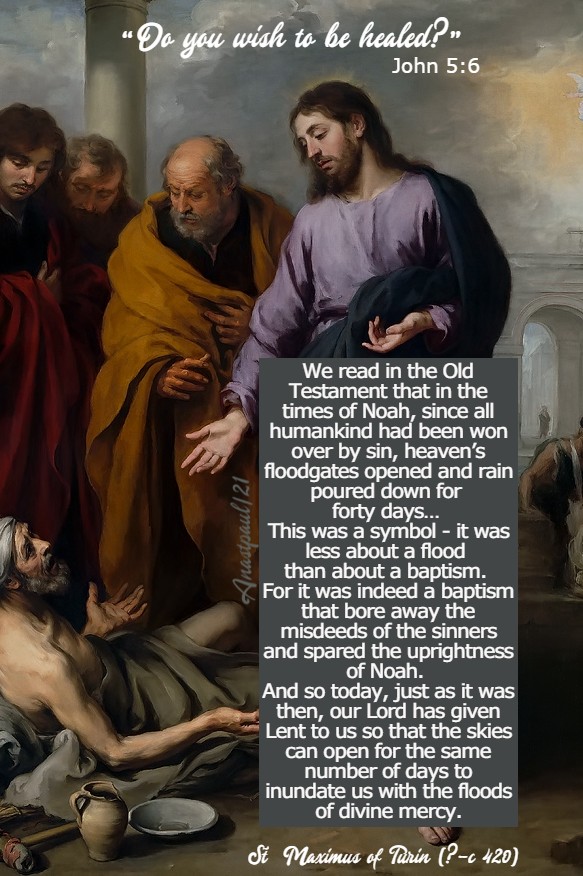
“Jesus said to him, “Do you wish to be healed?”The sick man answered Him, ‘Sir, I have no one to put me into the pool’ … Jesus said to him, “Rise, take up your pallet and walk.” And at once the man was cured.” – John 5:6-8
REFLECTION – “We read in the Old Testament that in the times of Noah, since all humankind had been won over by sin, heaven’s floodgates opened and rain poured down for forty days… This was a symbol – it was less about a flood, than about a baptism. For it was indeed a baptism that bore away the misdeeds of the sinners and spared the uprightness of Noah. And so today, just as it was then, our Lord has given Lent to us so that the skies can open for the same number of days to inundate us with the floods of divine mercy. Once washed in the saving waters of baptism, this Sacrament enlightens us and, just as formerly, its waters bear away the evil of our sins and confirm the uprightness of our virtues.
Today’s situation is just the same as in Noah’s time. Baptism is flood to sinners and consecration for the faithful. In Baptism the Lord rescues justice and destroys injustice. We can see this in the example of one and the same man – before he was cleansed by the spiritual commands, the Apostle Paul, was a persecutor and blasphemer (1Tm 1,13). But once he had been bathed with the heavenly rain of Baptism, the blasphemer died, the persecutor died, Saul died. Then the Apostle, the just man, Paul, came to life… Anyone who lives Lent in a religious manner and observes the Lord’s decrees will see sin die in him and grace come to life… such as these die as sinners and live as righteous persons.” – St Maximus of Turin (?-c 420), Bishop – Sermon for Lent 50
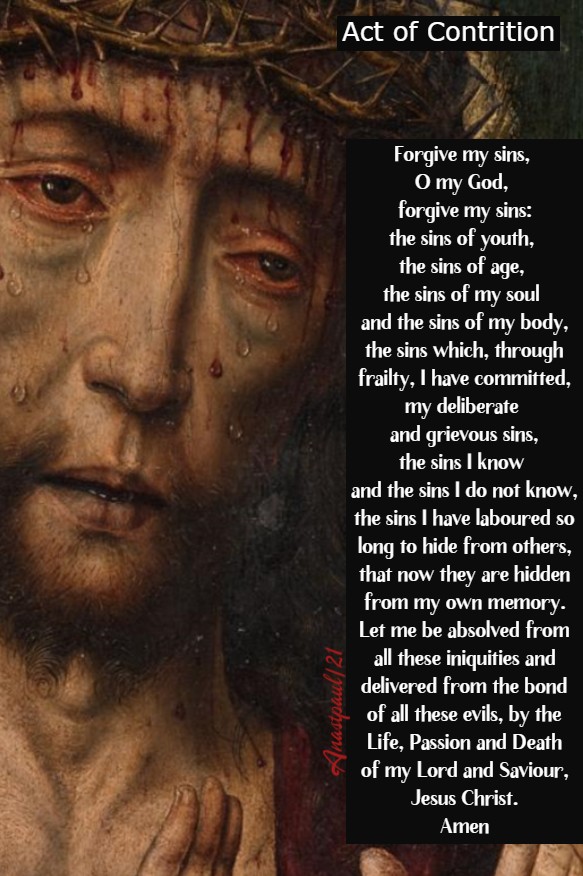
PRAYER – Forgive my sins, O my God, forgive my sins: the sins of youth, the sins of age, the sins of my soul and the sins of my body, the sins which, through frailty, I have committed, my deliberate and grievous sins, the sins I know and the sins I do not know, the sins I have laboured so long to hide from others, that now they are hidden from my own memory. Let me be absolved from all these iniquities and delivered from the bond of all these evils, by the Life, Passion and Death of my Lord and Saviour, Jesus Christ. Amen
Our Morning Offering – 11 March – Ember Friday of the First Week of Lent
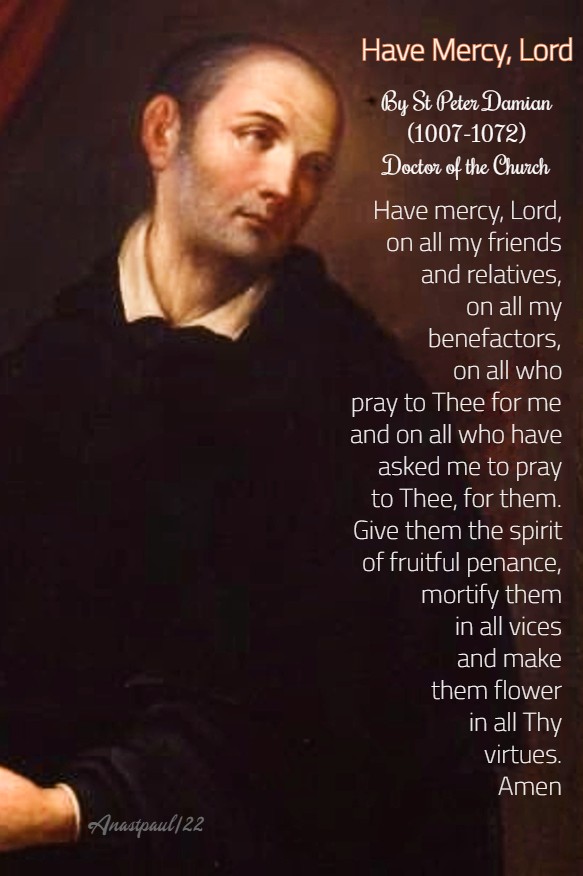
Have Mercy, Lord By St Peter Damian (1007-1072) Doctor of the Church
Have mercy, Lord, on all my friends and relatives, on all my benefactors, on all who pray to Thee for me and on all who have asked me to pray to Thee, for them. Give them the spirit of fruitful penance, mortify them in all vices and make them flower in all Thy virtues. Amen
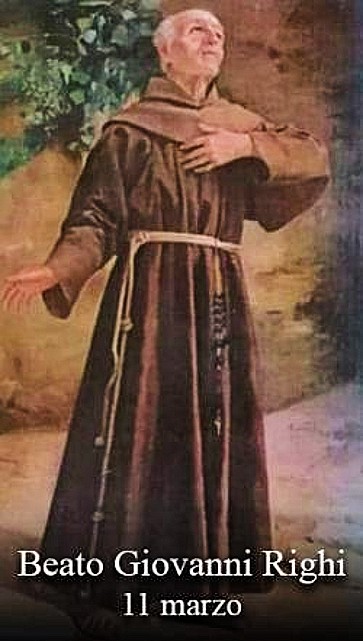
Saint of the Day – 11 March – Blessed John Baptist Righi of Fabriano OFM (1469–1539) Priest, Confessor, Friar of the Friars Minor, Ascetic, Ecstatic, renowned Preacher, Peace-maker, Hermit. Born as Giovanni Battista Righi in 1469 at Fabriano, Ancona, Italy and died on 11 March 1539 of natural causes. Also known as – Giovanni Battista da Fabriano, Giovanni da Fabriano, Giovanni Righi, Joannes de Fabriano, Johannes Baptista Righi, John Baptist of Fabriano. His body is incorrupt.
John was born in Fabriano of the Righi family. From an early age, he was very obedient to the teachings he received in his family. Reading the life of St Francis of Assisi, he decided to become a Franciscan Friar. And so, in the prime of his youth, our Blessed wore the Franciscan habit in the Convent of Forano, near Rieti. After his profession, he devoted several years to the study of philosophy and theology before being Ordained a Priest. For many years he was a very obedient and humble Friar. It is assumed that the young professed went from Forano to the solitary Convent of La Romita, a former Monastery of the Camaldolese.
Giovanni spent practically the rest of his life, about fifty years, up there in Romita, sometimes dedicated to the apostolate and more often, to silence and prayer, penance, reading the works of the Holy Fathers of the Church. In the solitude of La Romita, our blessed found what his heart desired. In the Church, there was a venerable image of Jesus Crucified, which belonged to St John of the Marches – John made it the object of frequent visits, ardent prayers, profound meditations and even,, by permission of the Lord, not rare ecstasies.
Emulating his seraphic Father, he ardently wanted to unite himself to the sufferings of Jesus, to transform himself into the Crucified Love, so little loved by much of the world. He found another object that touched his heart and fueled his filial piety: a terracotta image, which represented the Blessed Virgin contemplating the Child Jesus lying on her lap and which was flanked by the figures of the Apostle St James the Greater and St Francis of Assisi. And so, the solitary devotee spent long hours at the foot of the new and captivating image of the Mother of the Lord, exchanging affections and feelings. In the evening, after the Matins prayer, when his brothers retired to rest, he remained in the choir to continue his prayers which often ended in ecstasy. exchanging affections and feelings. In the evening, after the Matins prayer, when his brothers retired to rest, he remained in the choir to continue his prayers which often ended in ecstasy. exchanging affections and feelings.
In the dense forest that surrounded the solitary Convent, there was and still is, a small cave, like a hermitage inside the hermitage, where John went to devote himself to prayer and penance . For our blessed, Heaven on earth was in his retreat and solitude. But charity and obedience required him, from time to time, to undertake long journeys.
At that time, the different lords and noble families of the region were in conflict. Society and the Church experienced the ups and downs of the progress of a rebirth in all orders. And in high society, as well as among soldiers and ordinary people, demoralisation and the decline of good manners was the norm. John was not an eloquent orator but with his simple and persuasive word he managed to touch hearts and lead them to conversion.
He embarked on long journeys with joy of spirit to pacify the belligerents or to exhort both warring parties to convert and change their lives. When he travelled, always accompanied by another friar as was obligatory, he brought with him nothing but his peaceful poverty and his firm trust in God. his word was always a warm exhortation to the fulfillment of the divine Commandments, to the frequency of the Sacraments, to love one’s neighbour, to free the world from slavery. And he spoke with such zeal and persuasion that many were converted to God, reconciled, confessed, they did penance for their sins. The fame of the simple Friar spread throughout the Marches of Ancona.
Great was the charity of John with all those who met him on his travels or with those who came to him for spiritual guidance and Confession.. But what he practiced with the Friars of his Convent was even greater. He was attentive to their wants and needs and his greatest joy was to serve the sick, giving them every care promptly and gently.
His love for Jesus Crucified, the constant object of his love and contemplation, led him to practice the austerities and penances typical of the ancient anchorites, whose writings he read with pleasure, in particular those of St John Climacus. He continually fasted on bread and water, eating only one meal a day and even less during Lent. As a true son of St Francis, he loved poverty and practiced it, contenting himself with the patched tunic and the Breviary for the liturgical praise of the Lord. His cell, later transformed into an oratory, was small and sober. Indeed, his reputation for holiness soon spread throughout the region and when our Friar travelled, sick people were brought to him even from distant regions, to bless them,and there were numerous votive offerings that were and still are displayed.
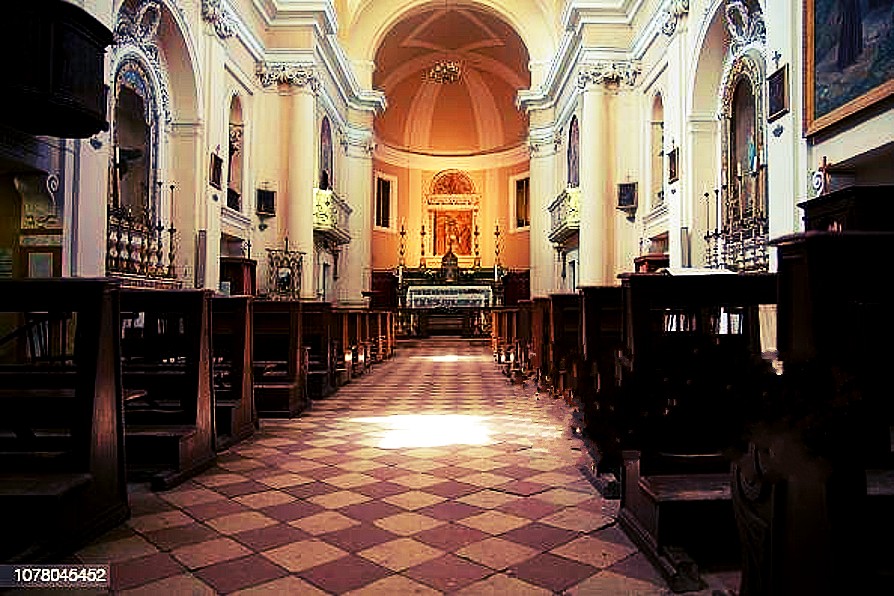
One day he was seized by a great malaise. The Friars came, gave him first aid and looked after him until it seemed to them that the danger had passed, then they withdrew . Soon after, left alone in his small cell, he fell asleep peacefully in the Lord. His body was buried in the cemetery of the Convent but, ten years later, it was unearthed, found incorrupt and placed in an urn under the Altar of the Holy Christ. And there, in the Church of San Giacomo della Romita, he is still preserved and venerated today. His cult was confirmed by Pope Leo XIII on 7 September 1903.
The Church where the Body of Blessed John Righi is enshrined
St Aengus the Culdee St Alberta of Agen St Alexius U Se-Yong St Amunia St Aurea of San Millán
St Benedict Crispus of Milan (Died 725) Archbishop of Milan from c 685 until his death. A poem written about ten years after his death, De laudibus Mediolani- In Praise of Milan, praises him and remembers his veneration by the entire land and informs us that he was buried in the Basilica of Saint Ambrose. His Life: https://anastpaul.com/2020/03/11/saint-of-the-day-11-march-saint-benedict-crispus-of-milan-died-725/
St Candidus the Martyr St Constantine II St Constantine of Carthage St Ðaminh Cam
St Firmian the Abbot St Firmus the Martyr St Gorgonius the Martyr St Heraclius of Carthage Bl John Kearney Blessed John Baptist Righi of Fabriano OFM (1469–1539) Priest, Friar of the Friars Minor St Marcus Chong Ui-Bae St Peter the Spaniard St Pionius St Piperion the Martyr St Rosina of Wenglingen St Sophronius of Jerusalem St Thalus the Martyr Bl Thomas Atkinson St Trophimus the Martyr St Vigilius of Auxerre St Vincent of Leon
Saint Joseph, you are the faithful protector and intercessor of all who love and venerate you. You know that I have confidence in you and that, after Jesus and Mary, I come to you as an example of holiness, for you are especially close to God. Therefore, I humbly commend myself, with all who are dear to me and all for whom I pray, to your intercession. I beg of you, by your love for Jesus and Mary, not to abandon me during life and to assist me at the hour of my death. Glorious Saint Joseph, Spouse of the Immaculate Virgin, pray for me to have a pure, humble, charitable heart and perfect resignation to the divine Will. Be my guide, my father and my model throughout life, that I may die as you did, in the arms of Jesus and Mary. Loving Saint Joseph, faithful follower of Jesus Christ, I raise my heart to you to implore your powerful intercession in obtaining from the Divine Heart of Jesus all the graces necessary for my spiritual and temporal welfare, particularly the grace of a happy death, and the special grace I now implore: …………….. (Mention your request) Guardian of the Word Incarnate, I feel confident that your prayers on my behalf will be graciously heard before the throne of God St Joseph Most Just, Pray for us! Amen.
Glory be to the Father and to the Son and to the Holy Spirit, as it was in the beginning, is now and ever shall be, world without end. Amen.
Thought for the Day – 10 March – Meditations with Antonio Cardinal Bacci (1881-1971)
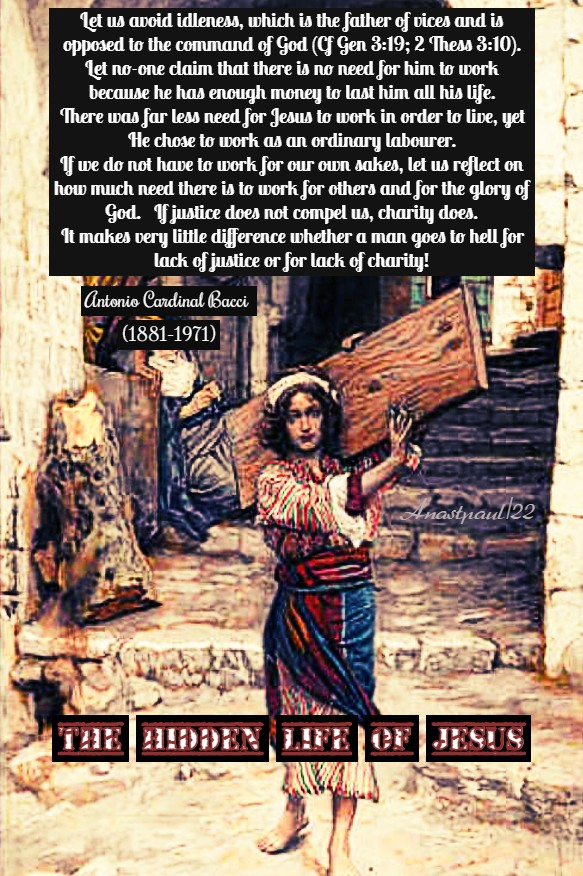
The Hidden Life of Jesus
“Jesus chose to be an ordinary workman. He had power over the Angels of Heaven, over the sun and stars of the firmament, over the waves of the ocean and over all the elements, By a single act of His Divine Will , He could multiply loaves and change water into wine. Yet, He elected to earn His living by the sweat of His brow. In His times, the artisan was held in low esteem and was very often a slave. Manual labour was regarded as sordid and undignified. Christ wished to sanctify manual work by His own toil. He wished to teach men that, in the eyes of God, the hoe is as valuable as the pen. There is no difference between driving a plough and wielding a sceptre, as long as a man is fulfilling his duty for the love of God. The only thing in this regard which is displeasing to God, is laziness and inactivity. Anyone who leads an idle life at the expense of others, is breaking God’s law, which commands everyone to work.
Let us follow the example of Jesus the Worker. Let us avoid idleness, which is the father of vices and is opposed to the command of God (Cf Gen 3:19; 2 Thess 3:10). Let no-one claim that there is no need for him to work because he has enough money to last him all his life. There was far less need for Jesus to work in order to live, yet He chose to work as an ordinary labourer. If we do not have to work for our own sakes, let us reflect on how much need there is to work for others and for the glory of God. If justice does not compel us, charity does. It makes very little difference whether a man goes to hell for lack of justice or for lack of charity!”
Thursday of the First Week of Lent – 10 March – Our Lenten Journey with the Great Fathers – Ezechiel 18:1-9, Matthew 15:21-28
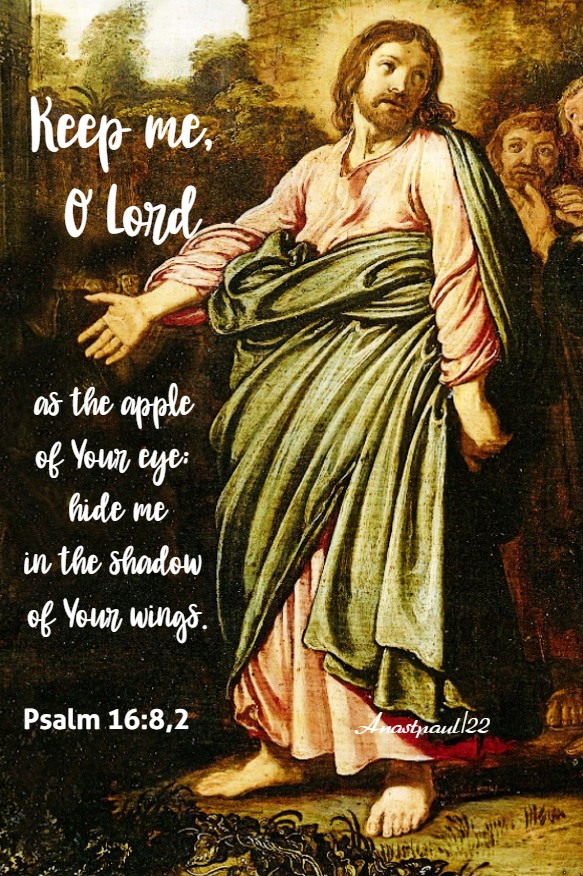
Keep me, O Lord, as the apple of Your eye; hide me in the shadow of Your wings. Psalm 16:8,2
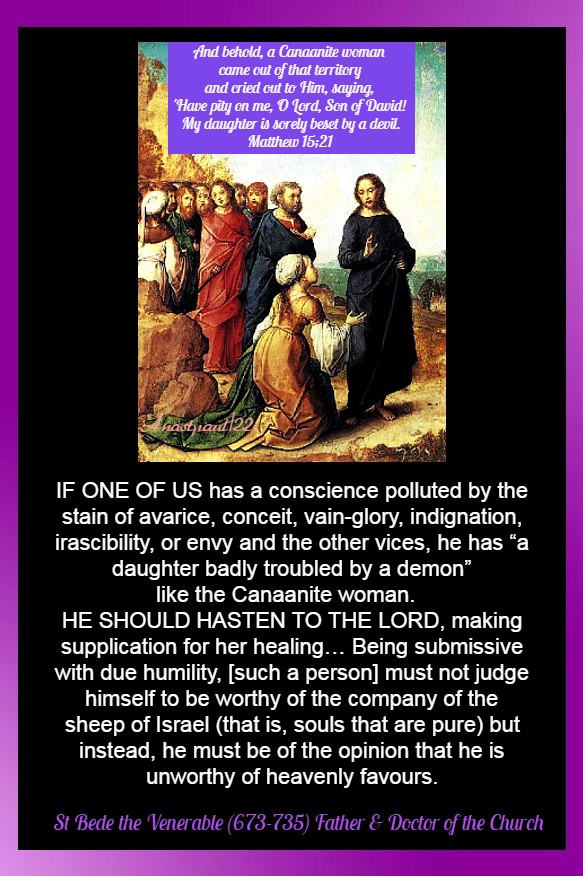
“And behold, a Canaanite woman came out of that territory and cried out to Him, saying, ‘Have pity on me, O Lord, Son of David! My daughter is sorely beset by a devil.’
Matthew 15;21
“O WOMAN, YOUR FAITH IS GREAT. Let it be done to you as you wish” (Mt 15:28). Indeed, she had great enough faith, since she knew neither the ancient miracles, commands and promises of the prophets, nor the more recent ones of the Lord Himself.
IN ADDITION, as often as she was disregarded by the Lord, she persevered in her entreaties and she did not cease knocking by asking Him, although she knew only by popular opinion that He was the Saviour. On account of this, she secured the great object for which she implored…
IF ONE OF US has a conscience polluted by the stain of avarice, conceit, vain-glory, indignation, irascibility, or envy and the other vices, he has “a daughter badly troubled by a demon” like the Canaanite woman.
HE SHOULD HASTEN TO THE LORD, making supplication for her healing… Being submissive with due humility, [such a person] must not judge himself to be worthy of the company of the sheep of Israel (that is, souls that are pure) but instead, he must be of the opinion that he is unworthy of heavenly favours.
NEVERTHELESS, LET HIM NOT IN DESPAIR, rest from the earnestness of his entreaty but with his mind free of doubt, let him trust in the goodness of the supreme Benefactor, for the One who could make a confessor from a robber (Lk 23:39f.), an apostle from a persecutor (Acts 9:1-30, an evangelist from a publican (Mt 9:9-13) and who could make sons for Abraham out of stones, could turn even the most insignificant dog into an Israelite sheep.”…St Bede the Venerable (673-735) – Father & Doctor of the Church
Quote/s of the Day – 10 March –Thursday of the First Week of Lent – Ezechiel 18:1-9, Matthew 15:21-28
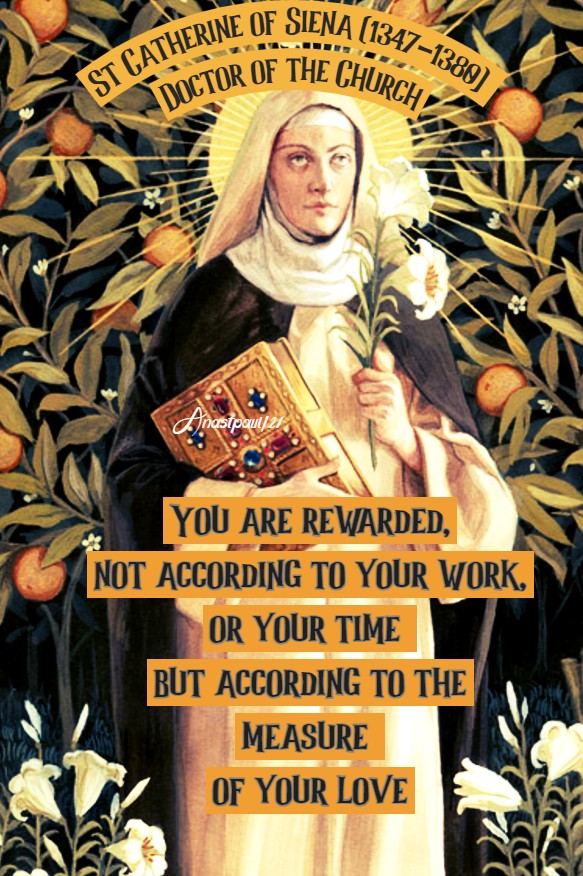
“You are rewarded, not according to your work, or your time but according to the measure of your love.”
St Catherine of Siena (1347-1380) Doctor of the Church
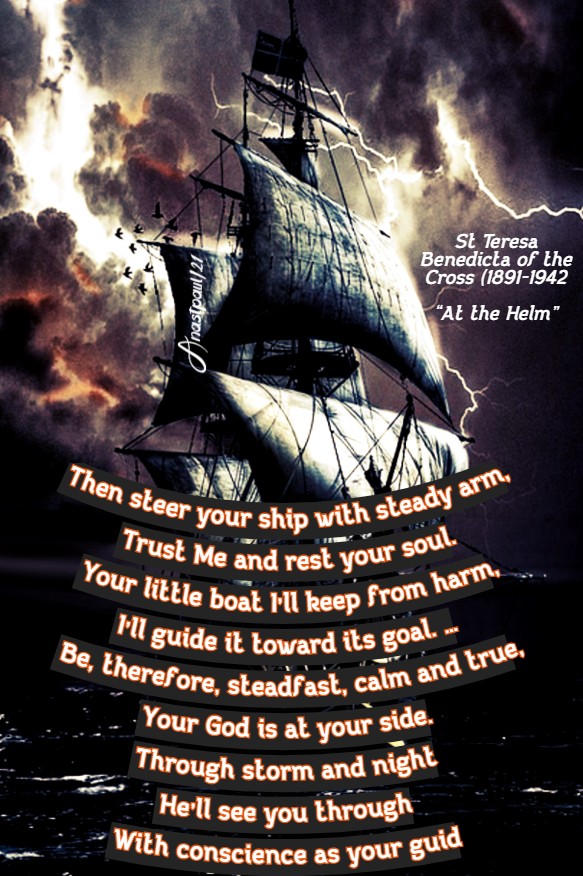
“Then steer your ship with steady arm, Trust Me and rest your soul. Your little boat I’ll keep from harm, I’ll guide it toward its goal. … Be therefore, steadfast, calm and true, Your God is at your side. Through storm and night He’ll see you through With conscience as your guide.”
St Teresa Benedicta of the Cross OCD.(1891-1942 Edith Stein “At the Helm”
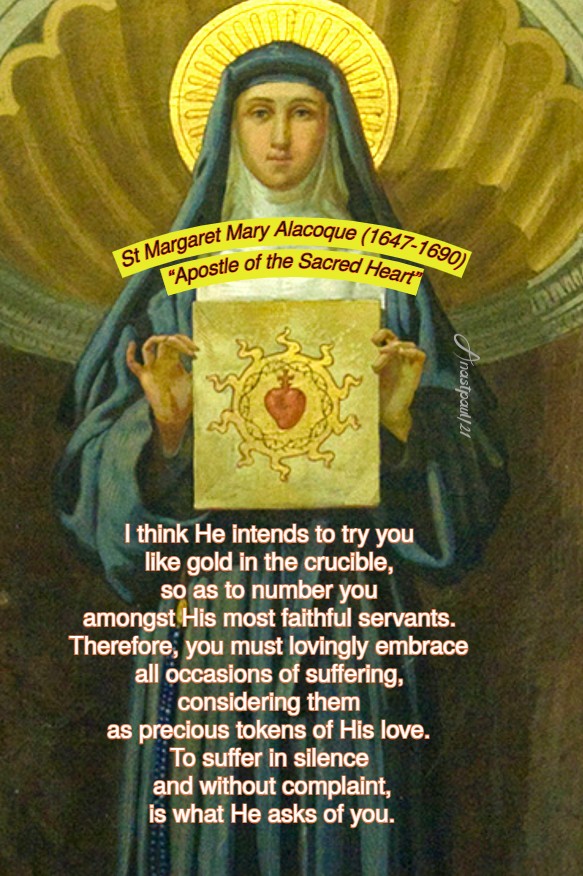
“I think He intends to try you like gold in the crucible, so as to number you amongst His most faithful servants. Therefore, you must lovingly embrace all occasions of suffering, considering them as precious tokens of His love. To suffer in silence and without complaint, is what He asks of you.”
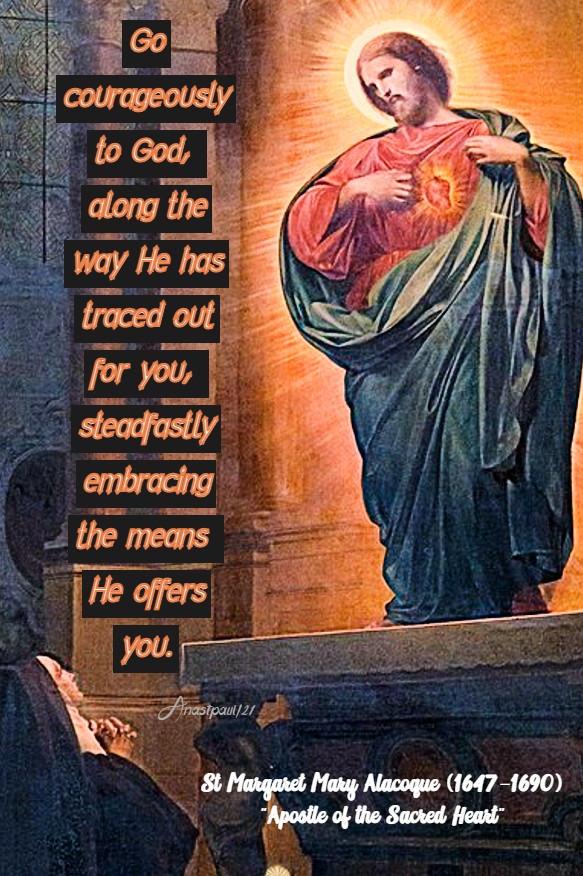
“Go courageously to God, along the way He has traced out for you, steadfastly embracing the means He offers you.”
St Margaret Mary Alacoque (1647-1690)
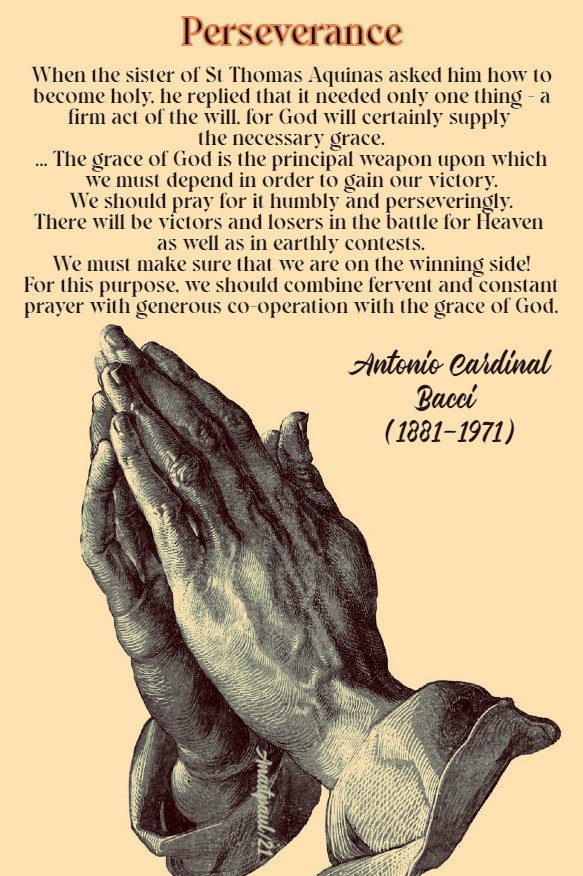
“When the sister of St Thomas Aquinas asked him how to become holy, he replied that it needed only one thing – a firm act of the will, for God will certainly supply the necessary grace. The grace of God is the principal weapon upon which we must depend in order to gain our victory. We should pray for it humbly and perseveringly. There will be victors and losers in the battle for Heaven, as well as in earthly contests. We must make sure, that we are on the winning side! For this purpose, we should combine fervent and constant prayer with generous co-operation with the grace of God.”
One Minute Reflection – 10 March – Thursday of the First Week of Lent – Ezechiel 18:1-9, Matthew 15:21-28
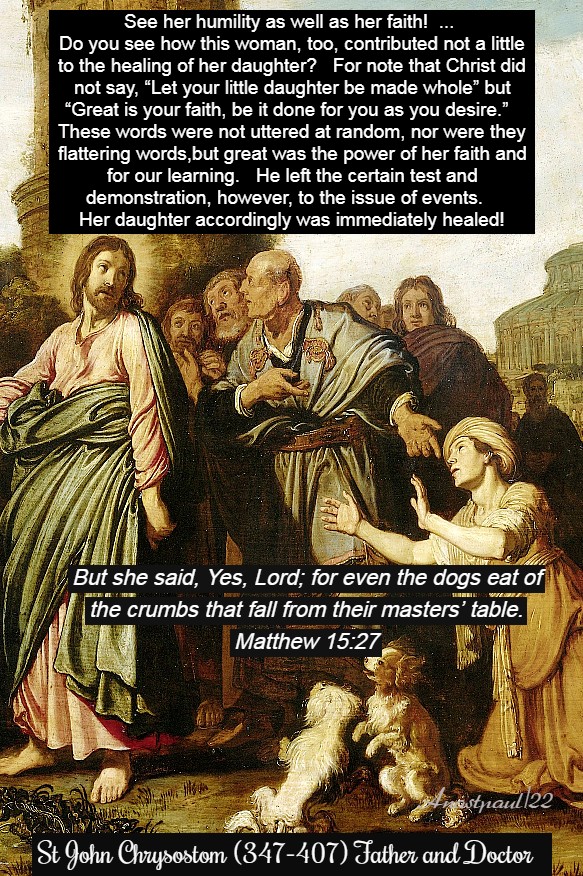
“But she said, Yes, Lord; for even the dogs eat of the crumbs that fall from their masters’ table.” – Matthew 15:27
REFLECTION – “See her humility as well as her faith! For He had called the Jews “children” but she was not satisfied with this. She even called them “masters,” so far was she from grieving at the praises of others. She said, “Yes, Lord, yet even the dogs eat the crumbs that fall from their masters’ table.” Behold the woman’s wisdom! She did not venture so much as to say a word against anyone else. She was not stung to see others praised, nor was she indignant to be reproached. Behold her constancy! When He answered, “It is not fair to take the children’s bread and throw it to the dogs,” she said, “Yes, Lord.” He called them “children” but she called them “masters.” He used the name of a dog but she described the action of the dog. Do you see this woman’s humility?
Then compare her humility with the proud language of the Jews: “We are Abraham’s seed and were never in bondage to any man.” “We are born of God.” But not so this woman. Rather, she calls herself a dog and them masters. So for this reason, she became a child. For what does Christ then say? “O woman, great is your faith.”
So we might surmise that this is the reason He put her off, in order that He might proclaim aloud this saying and that He might crown the woman: “Be it done for you as you desire.” This means “Your faith, indeed, is able to effect even greater things than these. Nevertheless, be it unto you even as you wish.” This Voice was at one with the Voice that said, “Let the heaven be,” and it was. “And her daughter was made whole from that very hour.”
Do you see how this woman, too, contributed not a little to the healing of her daughter? For note that Christ did not say, “Let your little daughter be made whole” but “Great is your faith, be it done for you as you desire.” These words were not uttered at random, nor were they flattering words,but great was the power of her faith and for our learning. He left the certain test and demonstration, however, to the issue of events. Her daughter accordingly was immediately healed.” – St John Chrysostom (347-407) Archbishop of Constantinople, Father and Doctor (The Gospel of Matthew – Homily 52).
PRAYER – We beseech You, O Lord, look graciously upon the fervour of Your people, who mortify themselves in the flesh through abstinence: that they may be refreshed in mind by the fruit of these good works. Through Jesus Christ, Thy Son our Lord, Who lives and reigns with Thee, in the unity of the Holy Ghost, God, world without end. Amen (Collect).
Our Morning Offering – 10 March – Thursday of the First Week of Lent
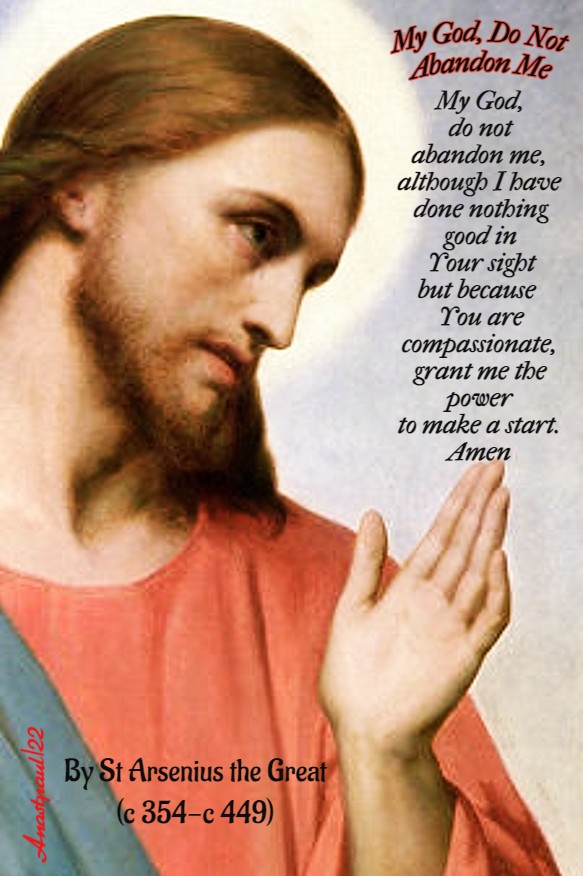
My God, Do Not Abandon Me By St Arsenius the Great (c 354-c 449)
My God, do not abandon me,, although I have done nothing good in Your sight but because You are compassionate, grant me the power to make a start. Amen
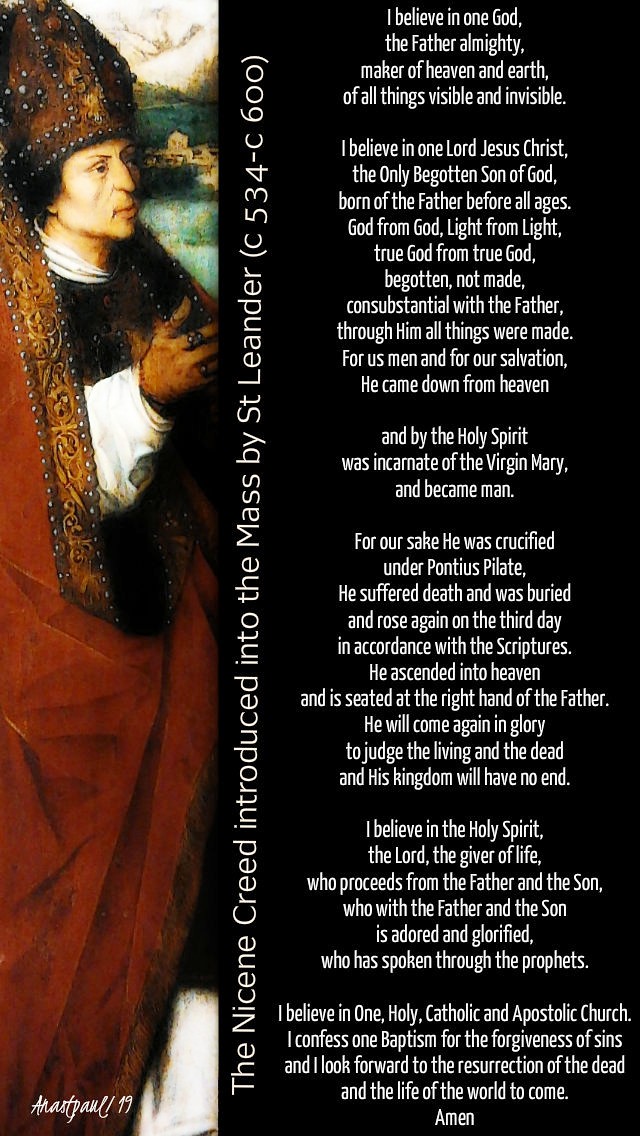
Saint of the Day – 10 March – Saint Macarius (Died c 335) Bishop of Jerusalem from 312 until his death, Defender of the Faith against Arianism, founder of the True Cross with St Helena, organiser and manager of the building of the Sacred Basilicas, including the Church of the Holy Sepuchre in Jerusalem, paid for by St Constantine the Great, St Helena’s son. Also of great import is the fact that Bishop Macarius was one of the two main authors of the Nicene Creed, that is, of the Creed that we still pronounce in Mass today, professing faith “In one God, the Father Almighty” and “In one Lord, Jesus Christ. .. True God from true God.” Died c 335 of natural causes. Also known as – Macario.
The Roman Martyrology states of him today: “The commemoration of St Macarius, Bishop of Jerusalem, on whose exhortation the holy places were brought to light by Constantine the Great and his mother, St Helena and ennobled with, the construction of the Sacred Basilicas.”
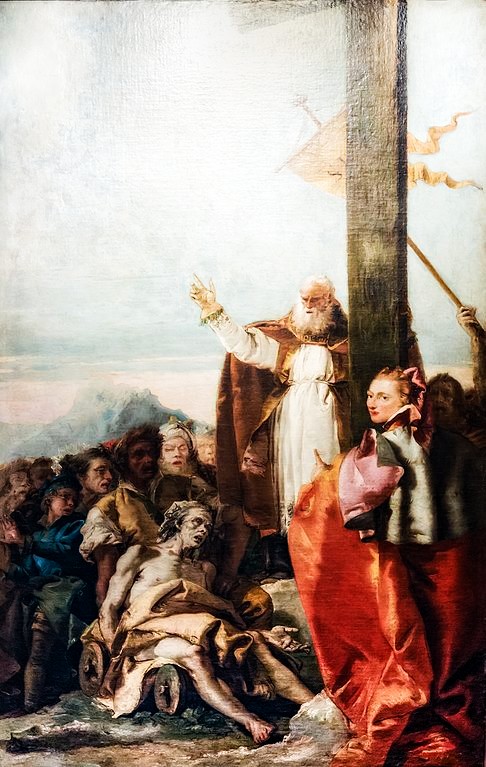
The Finding of the True Cross (Giandomenico Tiepolo), where Bishop Macarius blesses the sick with the True Cross
St Athanasius, in one of his orations against Arianism, refers to Macarius as an example of “the honest and simple style of apostolic men.” The date 312 for Macarius’s accession to the Episcopate is found in St Jerome’s version of Eusebius of Caesarea’s Chronicle. And Macarius is listed as one of the Bishops to whom St Alexander of Alexandria wrote warning against Arias.
Macarius accompanied St Helena Augusta, the mother of St Constantine I, in her search in Jerusalem for relics of the Passion of Jesus, including the Sacred Cross on which Jesus was Crucified.
According to Eusebius, he received a long letter from Constantine with reference to the building of the Basilica of the Holy Sepulchre at Jerusalem: “Such is our Saviour’s grace, that no power of language seems adequate to describe the wondrous circumstance to which I am about to refer. For, that the monument of His most holy Passion, so long ago buried beneath the ground, should have remained unknown for so long a series of years, until its reappearance to His servants now set free through the removal of him who was the common enemy of all, is a fact, which truly surpasses all admiration … And as to the columns and marbles, whatever you shall judge, after actual inspection of the plan, to be especially precious and serviceable, be diligent to send information to us in writing, in order that whatever quantity or sort of materials we shall esteem from your letter to be needful, may be procured from every quarter, as required, for it is fitting that the most marvellous place in the world should be worthily decorated.”
Church of the Holy Sepulchre, Jerysalem
Macarius took part in the Council of Nicaea (325), and two concl;usions as to the part he played there are worth mentioning. The first is that there was a passage of arms between him and his Archbishop, St Eusebius of Caesarea, concerning the rights of their respective Sees. The seventh Canon of the Council — “As custom and ancient tradition show that the Bishop of Ælia [Jerusalem] ought to be honoured, he shall have precedence; without prejudice, however, to the dignity which belongs to the Metropolis” — by its vagueness suggests that it was the result of a drawn battle. The second conclusion, is that Macarius, together with St Eustathius of Antioch, had a good deal to do with the drafting of the Nicene Creed finally adopted by the First Council of Nicæa in 325 and which was introduced into the Mass by St Leander (534-600).
The vigour of his opposition to the Arianists is suggested by the abusive manner in which Arias writes of him in his letter to Eusebius of Nicomedia. Macarius’s name appears first among those of the Bishops of Palestine who subscribed to the Council of Nicæa. Athanasius, in his encyclical letter to the Bishops of Egypt and Libya, places the name of Macarius (who had been long dead at that time) among those Bishops renowned for their orthodoxy. Macarius here at the Council, also appointed Maximus, who afterwards succeeded him, Bishop of Lydia and that the appointment did not take effect because the people of Jerusalem refused to part with Maximus. He also gives another version of the story, to the effect that Macarius himself changed his mind, fearing that, if Maximus was out of the way, an unorthodox Bishop would be appointed to succeed him. The fact that Macarius was then nearing his end would explain the reluctance, whether on his part or that of his flock, to be deprived of Maximus.
After the Council Constantine requested Macarius to search for the sites of the Resurrection and the Passion and the True Cross. It is likely that this is what happened, for excavations were begun very soon after the Council and, completely under the management of Macarius.
The huge mound and stonework with the temple of Venus on the top, which in the time of Hadrian had been piled up over the Holy Sepulchre, were demolished,and “when the original surface of the ground appeared, forthwith, contrary to all expectation, the hallowed monument of our Saviour’s Resurrection was discovered”. On hearing the news Constantine wrote to Macarius giving lavish orders for the erection of a Church on the site. Later on, he wrote another letter “To Macarius and the rest of the Bishops of Palestine” ordering a Church to be built at Mambre, which also had been defiled by a pagan shrine. St Macarius also oversaw and arranged the building of the Churches n the sites of the Nativity and Ascension.
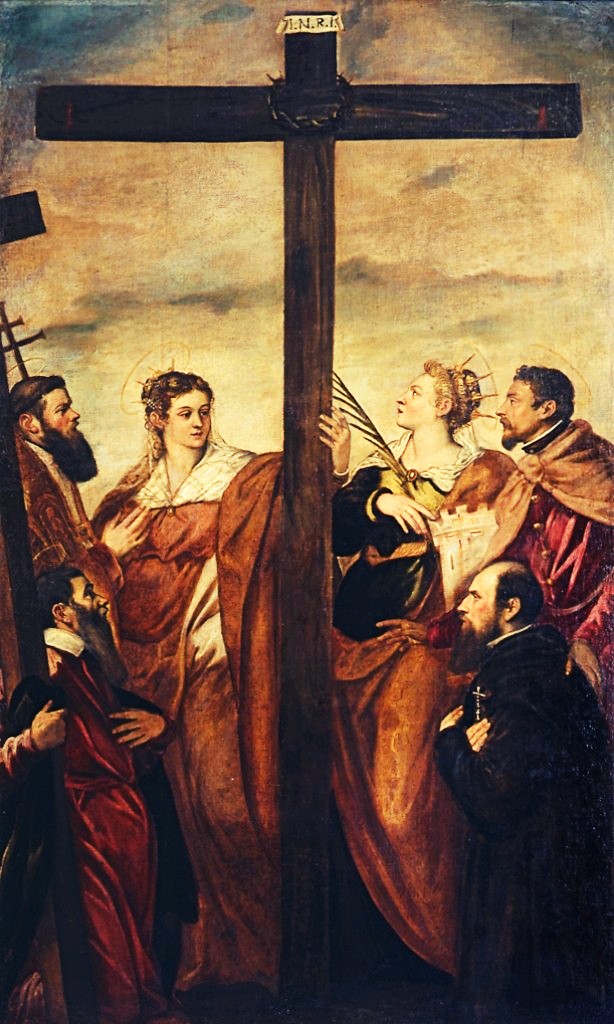
The True Cross with St Helena, right St Barbara, left, St Macarius kneeling, St Andrew far left and another Saint
Forty Martyrs of Sebaste, Armenia (Died 320) – Forty Christian soldiers of the Thunderstruck Legion of the Imperial Roman army who were tortured and murdered for their faith during the persecutions of Emperor Licinius. They were exposed naked on a frozen pond to freeze to death at Sebaste, Armenia in 320 and their bodies afterward were burned. THE FULL STORY HERE: https://anastpaul.com/2021/03/10/saints-of-the-day-10-march-the-forty-martyrs-of-sebaste-armenia-died-320/
St Alexander of Apema St Anastasia the Patrician St Andrew of Strumi St Attalas of Bobbio St Blanchard of Nesle-la-Réposte St Caius of Apema St Cordratus of Nicomedië St Droctoveus of Paris Bl Elias del Socorro Nieves St Emilian of Lagny St Failbhe the Little St Gustav the Hermit St Himelin Bl Jean-Marie Joseph Lataste
Thought for the Day – 9 March – Meditations with Antonio Cardinal Bacci (1881-1971)
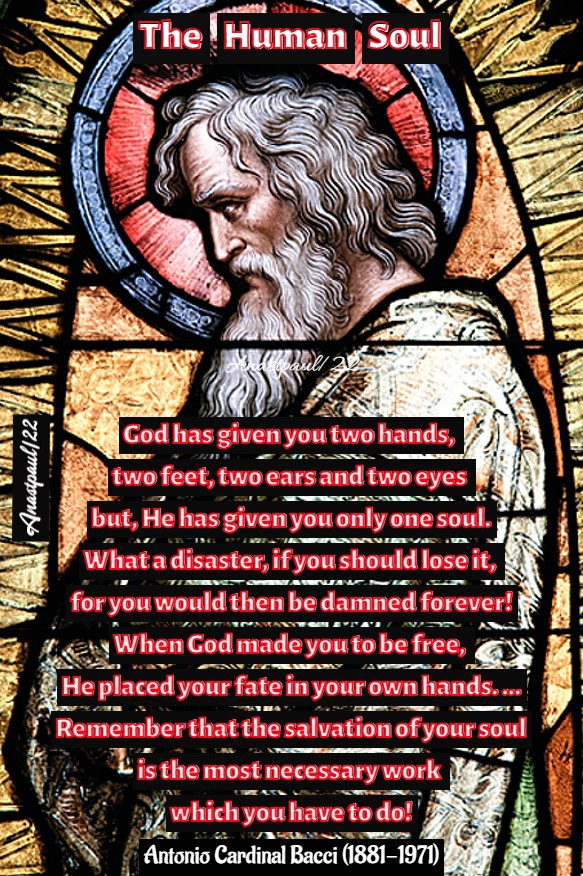
The Human Soul
“Consider that you have only one soul, which belongs entirely to God and has Heaven for its true home. God has given you two hands, two feet, two ears and two eyes but, He has given you only one soul. What a disaster, if you should lose it, for you would then be damned forever! When God made you to be free, He placed your fate in your own hands. “When God, in the beginning, created man, He made him subject to his own free choice” (Ecclus 15:14). Remember that the salvation of your soul is the most necessary work which you have to do! It is more precious to you than gold or silver. “More precious than gold is health and well-being, contentment of spirit, than coral” (Ecclus 30:15). All our attention should be devoted to keeping our soul free from sin and endowing it with every virtue.”
Wednesday of the First Week of Lent – 9 March – Our Lenten Journey with the Great Fathers – 3 Kings 19:3-8, Matthew 12:38-50
“Relieve the troubles of my heart and bring me out of distress, O Lord.” – Psalm 24:17-18
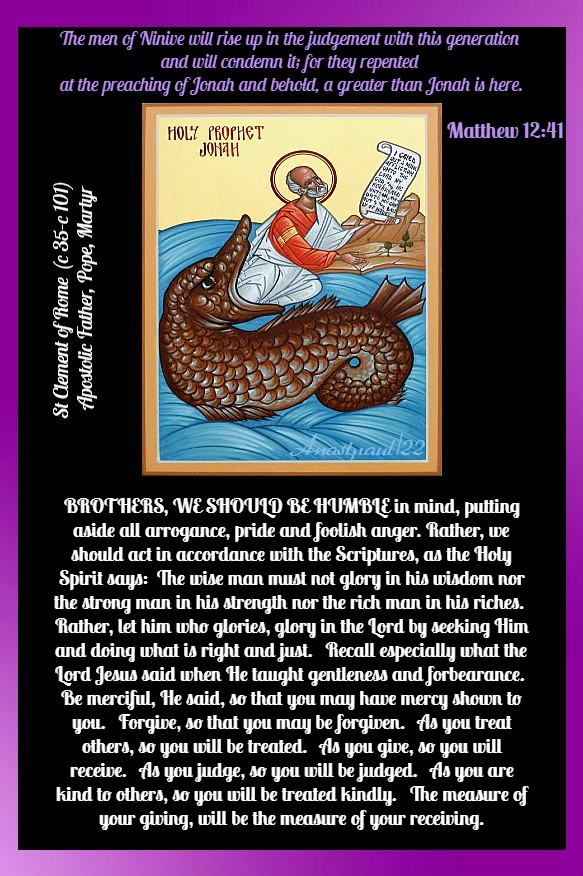
“The men of Ninive will rise up in the judgement with this generation and will condemn it; for they repented at the preaching of Jonah and behold, a greater than Jonah is here.”
Matthew 12:41
“ LET US FIX OUR ATTENTION on the Blood of Christ and recognise how precious it is to God His Father, since it was shed for our salvation and brought the grace of repentance to all the world.
If we review the various ages of history, we will see ,that in every generation the Lord has offered the opportunity of repentance to any who were willing to turn to Him. When Noah preached God’s message of repentance, all who listened to him were saved. Jonah told the Ninevites they were going to be destroyed,but when they repented, their prayers gained God’s forgiveness for their sins and they were saved, even though they were not of God’s people.
UUNDER THE INSPIRATION of the Holy Spirit, the ministers of God’s grace have spoken of repentance; indeed, the Master of the whole universe Himself, spoke of repentance with an oath: As I live, says the Lord, I do not wish the death of the sinner but his repentance. He added this evidence of His goodness: House of Israel, repent of your wickedness. Tell the sons of my people – If their sins should reach from earth to heaven, if they are brighter than scarlet and blacker than sackcloth, you need only turn to Me with your whole heart and say, “Father” and I will listen to you as a holy people.
IN OTHER WORDS. God wanted all His beloved ones to have the opportunity to repent and He confirmed this desire, by His own Almighty Will. That is why we should obey His Sovereign and Glorious Will and prayerfully entreat His mercy and kindness. We should be suppliant before Him and turn to His compassion, rejecting empty works and quarreling and jealousy which only lead to death.
BROTHERS, WE SHOULD BE HUMBLE in mind, putting aside all arrogance, pride and foolish anger. Rather, we should act in accordance with the Scriptures, as the Holy Spirit says: The wise man must not glory in his wisdom nor the strong man in his strength nor the rich man in his riches. Rather, let him who glories, glory in the Lord by seeking Him and doing what is right and just. Recall especially what the Lord Jesus said when He taught gentleness and forbearance. Be merciful, He said, so that you may have mercy shown to you.Forgive, so that you may be forgiven.As you treat others, so you will be treated.As you give, so you will receive. As you judge, so you will be judged.As you are kind to others, so you will be treated kindly. The measure of your giving, will be the measure of your receiving.
LET THESE COMMANDMENTS AND PRECEPTS strengthen us to live in humble obedience to his sacred words. As Scripture asks: Whom shall I look upon with favour, except the humble, peaceful man who trembles at my words?
Sharing then in the heritage of so many vast and glorious achievements, let us hasten toward the goal of peace, set before us from the beginning. Let us keep our eyes firmly fixed on the Father and Creator of the whole universe and hold fast to His splendid and transcendent gifts of peace and all His blessings.” – St Clement of Rome (c 35-c 101) Apostolic Father, Pope, Martyr (An excerpt from his Letter to the Corinthians).
One Minute Reflection – 9 March –Wednesday of the First Week of Lent, Ember Wednesday – 3 Kings 19:3-8, Matthew 12:38-50 and the Memorial of St Dominic Savio (1842-1857)
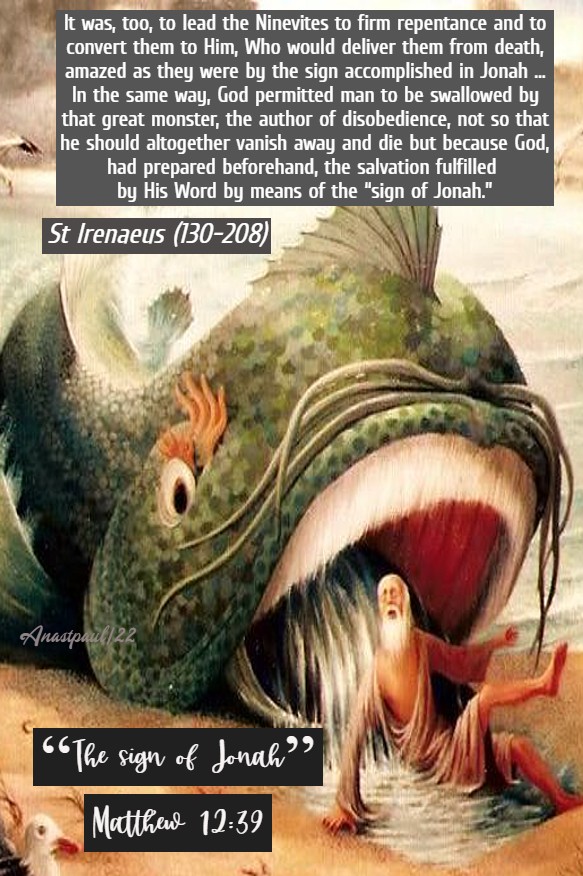
“The sign of Jonah” – Matthew 12:39
REFLECTION – “God showed patience in the face of man’s weakness because He saw beforehand, the victory He would eventually give him, through His Word. For, when “power was made perfect in weakness” (2 Cor 12:9), the Word caused God’s goodness and tremendous power, to be made manifest. Indeed, it was the same with man, as it was with the prophet Jonah. God permitted Jonah to be swallowed by a sea-monster, not to make him altogether vanish away and die but, so that when he had been vomited out by the monster, he would become more subject to God and would give all the more glory to Him who had given him this unexpected deliverance. It was, too, to lead the Ninevites to firm repentance and to convert them to Him, Who would deliver them from death, amazed as they were by the sign accomplished in Jonah … In the same way, God permitted man to be swallowed by that great monster, the author of disobedience, not so that he should altogether vanish away and die but because God, had prepared beforehand, the salvation fulfilled by His Word by means of the “sign of Jonah.” This salvation has been prepared, for those who have the same feelings for God as Jonah did and, who confess Him in the same words: “I am the servant of the Lord and I worship the Lord, the God of heaven, who made the sea and the dry land” (Jon 1:9). God desired that man, by receiving an unanticipated salvation from Him, would rise from the dead and worship God, saying with Jonah: “Out of my distress I called to the Lord; from the midst of the nether world he heard my voice” (Jon 2:2). God desired, too, that man would always remain faithful in giving Him worship and unceasing thanks for the salvation he has received from Him.” – St Irenaeus (130-208) Bishop of Lyons, Martyr, Theologian – Against the heresies III, 20, 1
PRAYER – Infinite Lord, help me to serve You always in accord with Your holy will. Show us how to make You our Lord and our All. St Dominic Savio, you the little giant showed us all the way of holiness within the confines of our lives, always joyfully doing the will of God. Please pray for us all. Through Jesus Christ, Thy Son our Lord, Who lives and reigns with Thee, in the unity of the Holy Ghost, God, world without end. Amen.
Our Morning Offering – 9 March – Wednesdayof the First Week of Lent, Ember Wednesday – FAST & PARTIAL ABSTINENCE
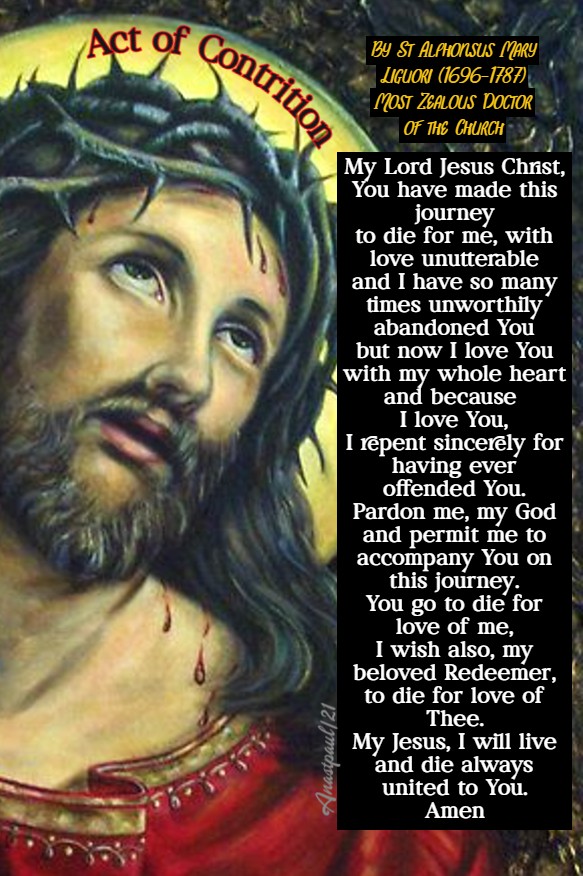
Act of Contrition By St Alphonsus Maria de Liguori (1696-1787) Most Zealous Doctor of the Church
My Lord Jesus Christ, You have made this journey to die for me, with love unutterable and I have so many times unworthily abandoned You but now I love You with my whole heart and because I love You, I repent sincerely for having ever offended You. Pardon me, my God and permit me to accompany You on this journey. You go to die for love of me, I wish also, my beloved Redeemer, to die for love of Thee. My Jesus, I will live and die always united to You.” Amen
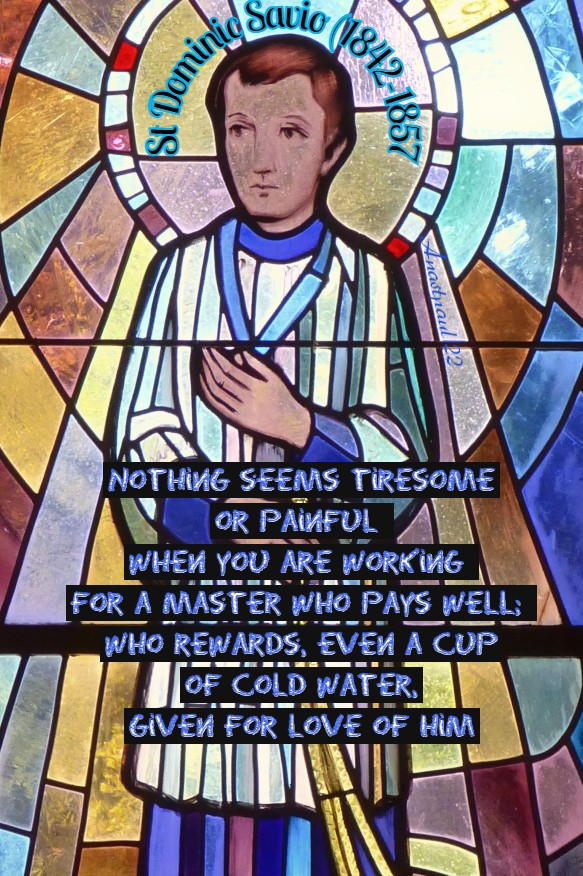
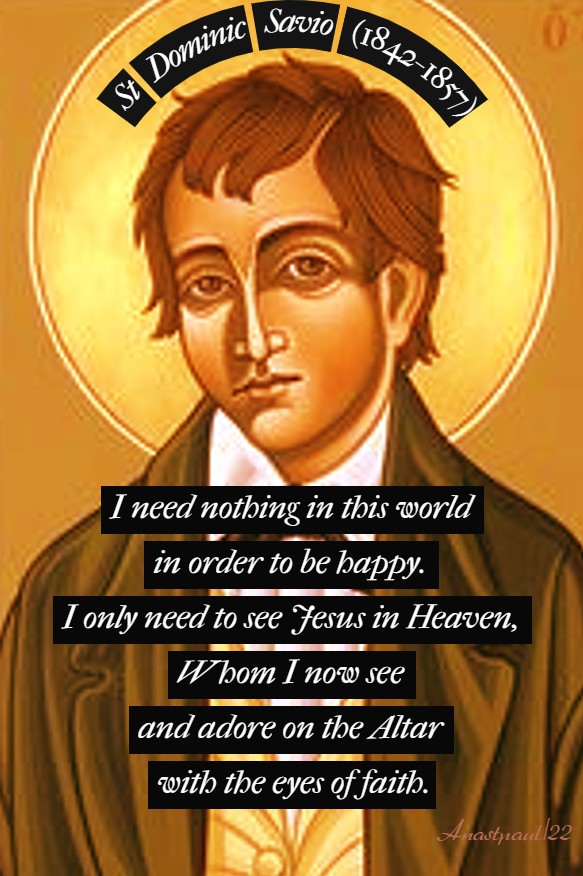
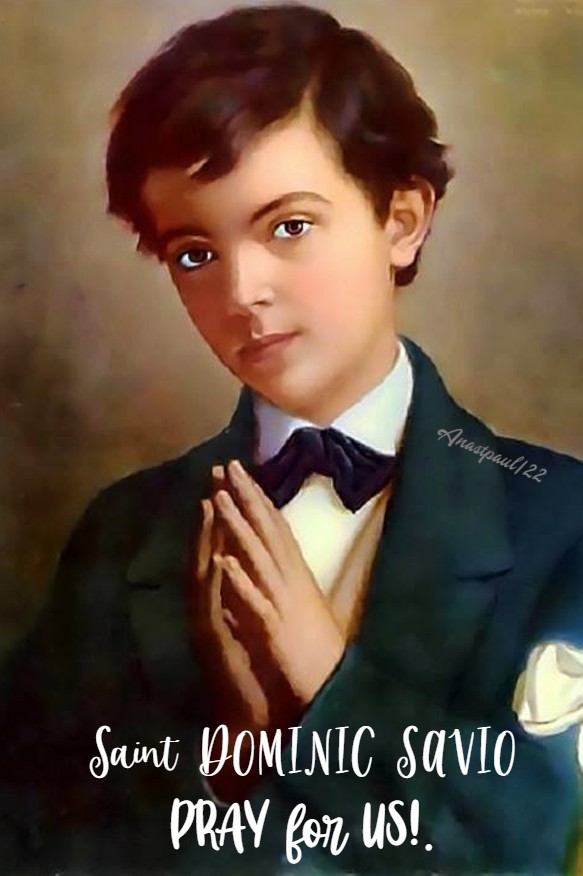
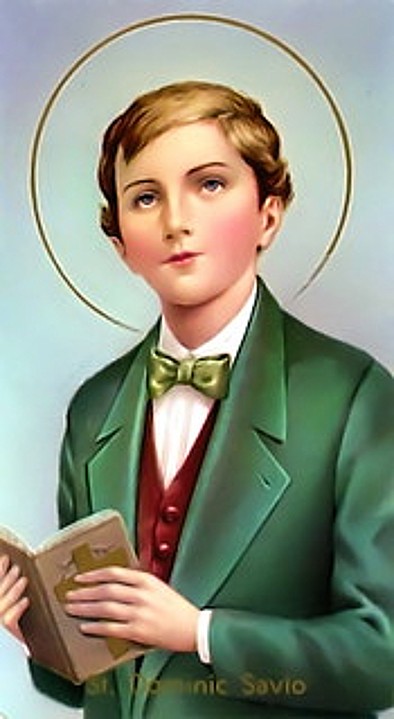
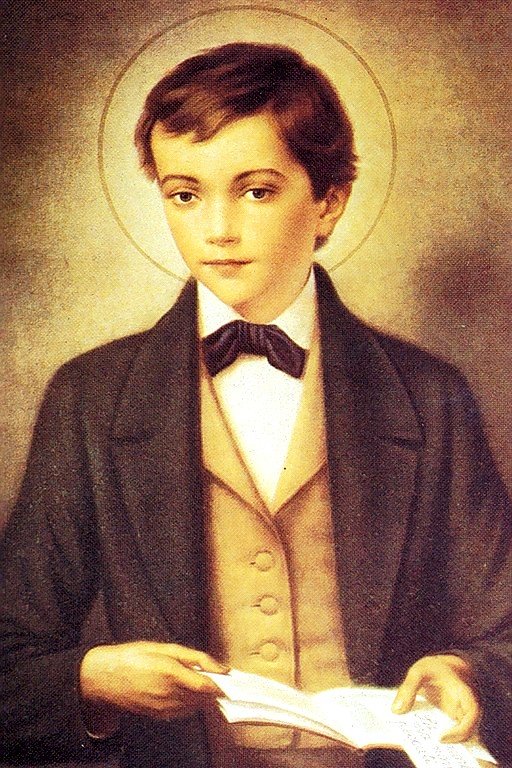
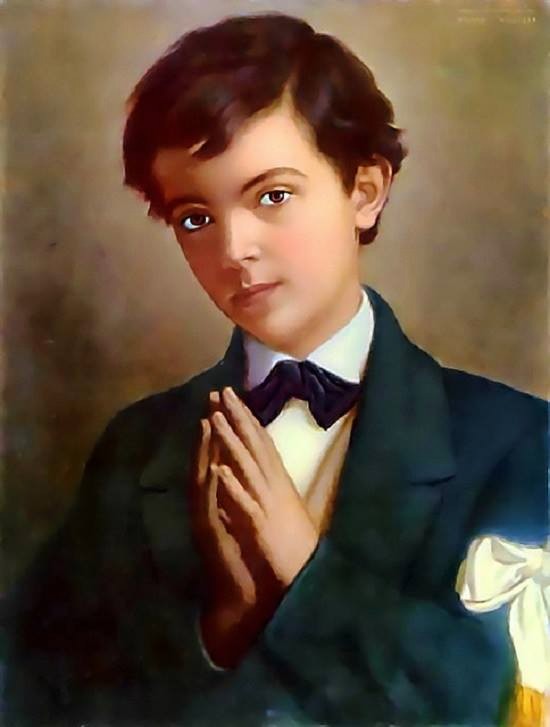
Saint of the Day – 9 March – St Dominic Savio (1842-1857) “The Little Giant”, Student of Saint John Bosco. He was studying to become a priest when he became ill and died at the age of 14. Born on 2 April 1842 at Riva di Chieri, Turin, Italy and died on 9 March 1857 at Mondonio, Italy of natural causes. Patronages – boys, children’s choirs, choir boys (given on 8 June 1956 by Pope Pius XII), choirs, falsely accused people, juvenile delinquents, Pueri Cantors, Colegio Santo Domingo, Bogotá, Colombia (chosen in January 1977), singers.
Dominic was born on 2 April 1842, in San Giovanni di Riva, near Chieri (Turin). On the occasion of his First Communion, at the age of seven, he set out his life’s program: “I will go to Confession frequently and Communion as often as my Confessor allows. I want to make Sundays and feast days holy. My friends will be Jesus and Mary. Death but not sin!”
At the age of twelve, he was accepted by Don Bosco into the Oratory of St Francis de Sales in Turin and Dominic asked his help in order to “become a saint.” Gentle, serene and happy, he put great effort into fulfilling his duties as a student and helping his companions in every way he could, teaching them Catechism, assisting the sick and settling quarrels.
One day he said to a companion who had just arrived in the Oratory: “You should know that here we make holiness consist in being always joyful. We try to avoid sin, which is the great enemy that robs us of the grace of God and peace of heart and, we try to fulfil our duties exactly.” He was very faithful to his program of work, sustained by intense participation in sacramental life, by a filial devotion to Mary and by joyful sacrifice. God enriched him with many special gifts.
On 8 December 1854, when Pope Pius IX proclaimed the Dogma of the Immaculate Conception, Dominic consecrated himself to Mary and began to advance rapidly in holiness. In 1856, he founded the Immaculate Conception Sodality among his friends. This was a group dedicated to apostolic action and peer ministry.
Mamma Margaret, St John Bosco’s Mother, who had come to Turin to help her Priest son, one day said to John “You have many good boys, but no-one surpasses the beauty of heart and soul of Dominic Savio.” And she explained: “I see him always praying, even remaining in Church after the others. Everyday he leaves recreation to visit the Blessed Sacrament; when he is in Church, he is like an angel in Heaven.”
He died in Murialdo on 9 March 1857, possibly of pleurisy. Pope Pius XI defined him as “a little, or rather, a great giant of the Spirit.”
St John Bosco regarded Savio very highly and wrote a Biography of his young student, The Life of Dominic Savio. This volume, along with other accounts of hims life were critical factors in his cause for sainthood. Dominic was Beatified on 5 March 1950 and Canonised on 12 June 1954, both by Pope Pius XII. He is the youngest non-martyr to be Canonised.
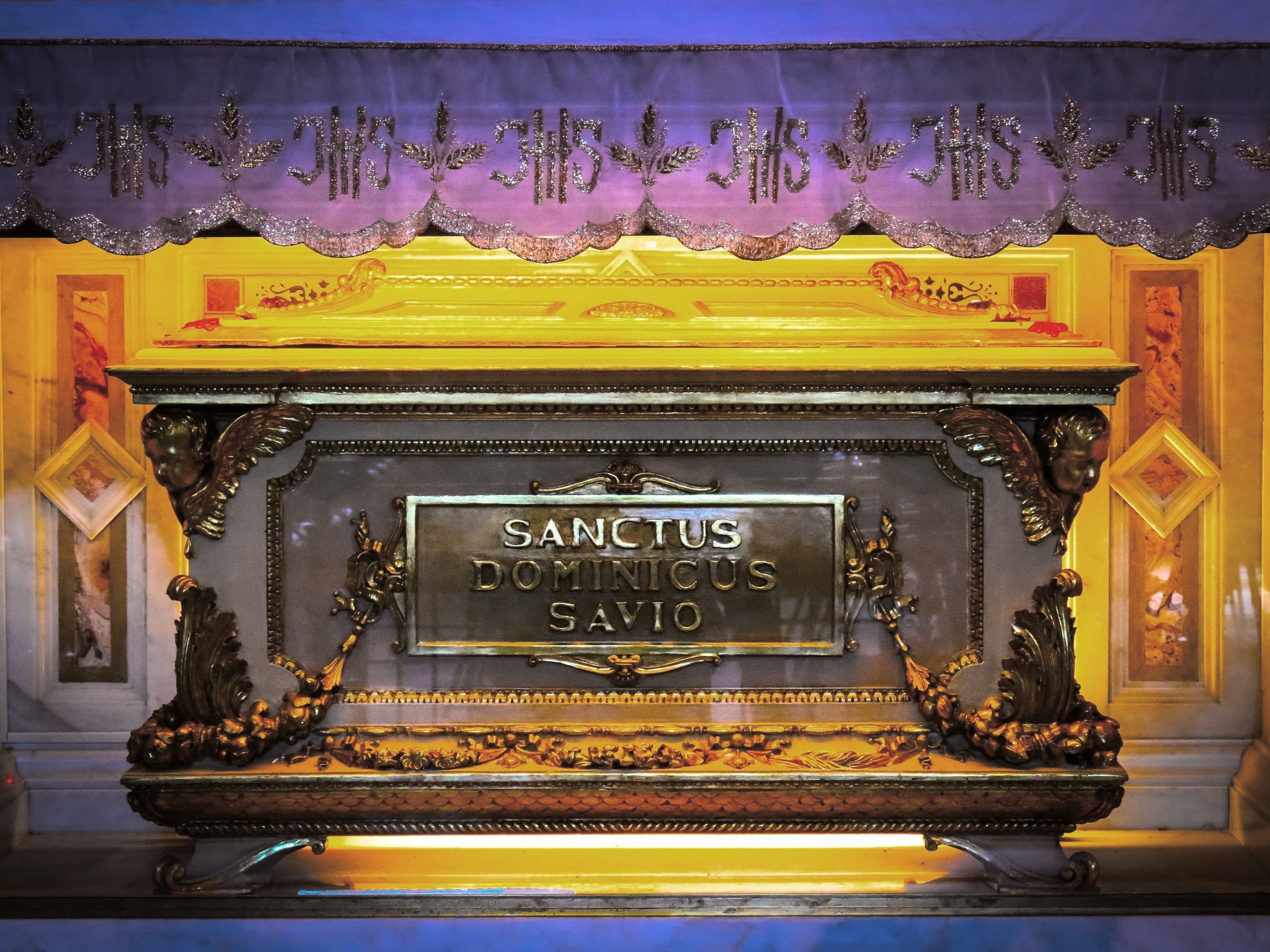
His birthplace is now a retreat house for teenagers and the home where he grew up in Morialdo is now a retreat house for children. The final house in which he lived is the home in Mondonio where the Savio family moved when he was 10 and where he eventually died. Here. you can see his father‘s metal shop and his mother‘s tailoring shop. His tomb is in the Basilica of Mary, Help of Christians in Turin, not far from the tomb of his mentor, teacher and biographer, Saint John Bosco.



















 AnaStpaul
You must be logged in to post a comment.