Madonna delle Grazie / Our Lady of Grace, Costa Folgaria, Italy (1588) – 7 January, 8 September:
Brother Pietro Dal Dosso di Folgaria – a young Hermit Friar of the Order, Saint Jerome of Vicenza – was inspired directly by the Virgin Mary into building a small Church in her honour on the Echen Peak during the second half of the 16th century. Obediently, the Friar began his work and built a small Chapel, occupying what is now the Apse of the Sanctuary of the Madonna delle Grazie. In the 17th Century, the Magnifica Comunità di Folgaria expanded the small building and endowed it with a Bell Tower (1662). The Sanctuary currently hosts the miraculous Madonna, which was declared Holy Patron of Skiers by Papal Decree. The Terracotta statue of the Virgin Mary dates to the second half of the 16th century and is venerated by thousands of believers, who hold an ancient feast – as well as a solemn procession – on the 8th of September every year, when the Statue is carried by ski instructors. All along its age-old history, the Sanctuary of Echen has always been a pilgrimage destination and numerous faithful have put up their own votive offers for graces received in the small Church. The Sanctuary is approximately 2 km away from Folgaria, near the hamlet of Costa and can be easily reached on foot after an easy walk. I am not sure why this Title is listed for today, 7 January but there must be a good reason.
St Aldric of Le Mans Bl Ambrose Fernandez St Anastasius of Sens St Brannock of Braunton St Candida of Greece St Canute Lavard St Cedd St Clerus of Antioch St Crispin I of Pavia St Cronan Beg St Emilian of Saujon St Felix of Heraclea Bl Franciscus Bae Gwan-gyeom St Januarius of Heraclea St Julian of Cagliari St Kentigerna
St Lucian of Antioch Bl Marie-Thérèse Haze Blessed Matthew of Agrigento OFM (1377-1450) “Apostle of the Holy Name of Jesus,” Franciscan Priest and Friar, Bishop, Missdionary Preacher often with St Bernardine of Siena. St Pallada of Greece St Polyeuctus of Melitene St Reinhold of Cologne St Spolicostus of Greece St Theodore of Egypt St Tillo of Solignac St Valentine of Passau St Virginia of Ste-Verge Bl Wittikund of Westphalia
Thought for the Day – 6 January – Meditations with Antonio Cardinal Bacci (1881-1971)
The Epiphany
“Let us consider the faith of the Magi, a faith which was willing, lively and active. They saw in the sky the star which heralded the Infant Jesus and experienced the divine inspiration in their hearts. Immediately they went in search of Him. They were not even deterred by the long and hazardous journey which lay before them.
When they arrived at Jerusalem, they found Herod, who did not know what they were talking about. The star disappeared and the priests replied coldly to the questions they asked. But all the time their trust in the divine call continued to grow. Eventually, they reached a poor barn, where they found, not an earthly King but, a little Child Who was crying on the straw bed of a manger. As a reward for their trouble and perseverance, a voice in their hearts told them that this was Jesus, the King of Kings and Saviour of the world.
Unfortunately, when we hear the divine call, no matter how clear and simple it is, we find a thousand excuses for delaying and perhaps, for not responding to it at all! Let us humbly promise to be more generous in listening for it and more energetic in complying with it, regardless of the cost.”
Quote/s of the Day – 6 January – The Solemnity of the Epiphany of the Lord
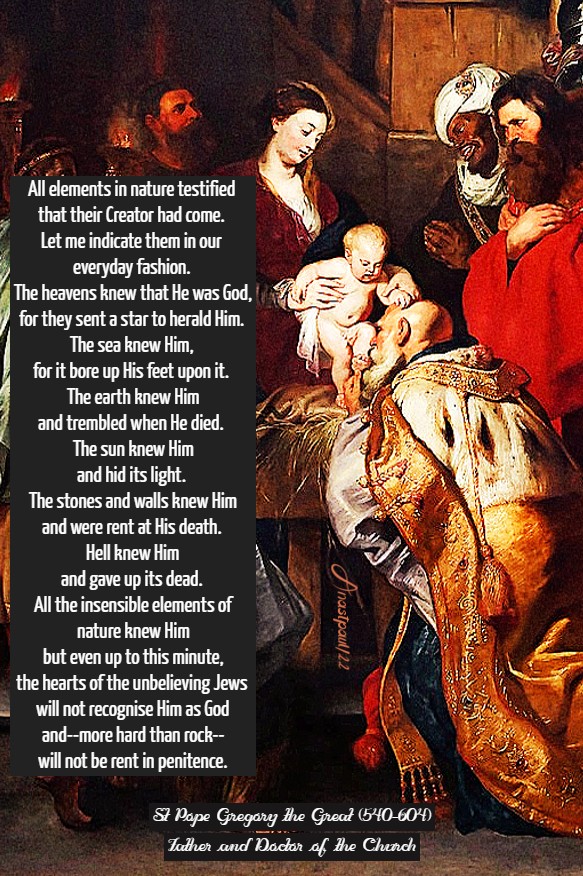
“All elements in nature testified that their Creator had come. Let me indicate them in our everyday fashion. The heavens knew that He was God, for they sent a star to herald Him. The sea knew Him, for it bore up His feet upon it. The earth knew Him and trembled when He died. The sun knew Him and hid its light. The stones and walls knew Him and were rent at His death. Hell knew Him and gave up its dead. All the insensible elements of nature knew Him but even up to this minute, the hearts of the unbelieving Jews will not recognise Him as God and–more hard than rock– will not be rent in penitence.”
St Pope Gregory the Great (540-604) Father and Doctor of the Church
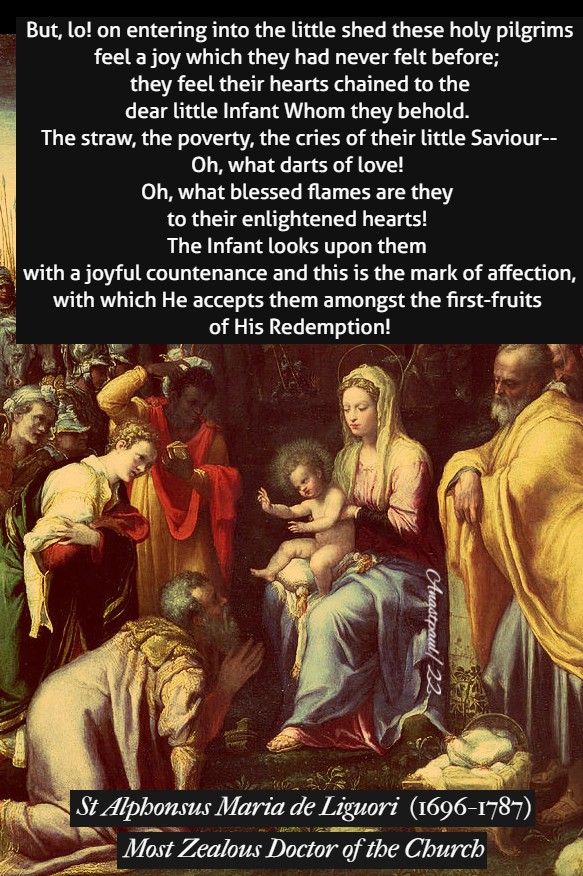
“But, lo! on entering into the little shed these holy pilgrims feel a joy which they had never felt before; they feel their hearts chained to the dear little Infant Whom they behold. The straw, the poverty, the cries of their little Saviour– Oh, what darts of love! Oh, what blessed flames are they to their enlightened hearts! The Infant looks upon them with a joyful countenance and this is the mark of affection, with which He accepts them amongst the first-fruits of His Redemption!”
St Alphonsus Maria de Liguori (1696-1787) Most Zealous Doctor of the Church
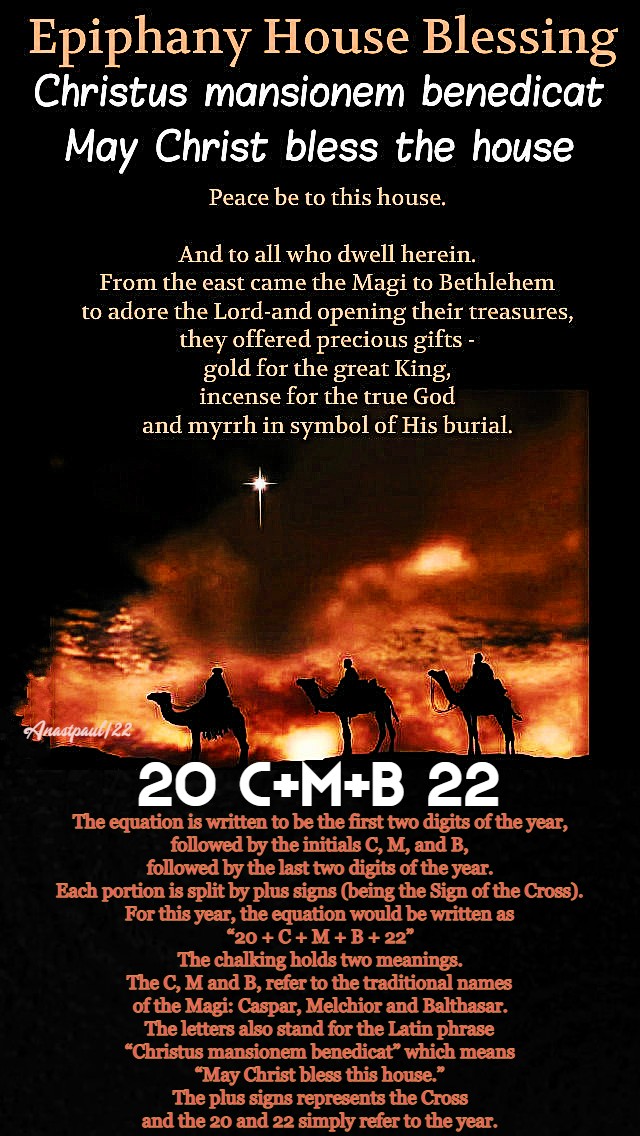
Chalk the Door – Epiphany House Blessing 20 C+M+B 22 “Christus mansionem benedicat” The equation is written to be the first two digits of the year, followed by the initials C, M, and B, followed by the last two digits of the year. Each portion is split by plus signs (being the Sign of the Cross). For this year, the equation would be written as “20 + C + M + B + 22”
The chalking holds two meanings. The C, M and B, refer to the traditional names of the Magi: Caspar, Melchior and Balthasar. The letters also stand for the Latin phrase “Christus mansionem benedicat” which means “May Christ bless this house.” The plus signs represents the Cross and the 20 and 22 simply refer to the year.
One Minute Reflection – 6 January – The Solemnity of the Epiphany of the Lord, Readings: Isaiah 60:1-6, Psalms 72:1-2, 7-8,10-11, 12-13, Ephesians 3:2-3, 5-6, Matthew 2:1-12
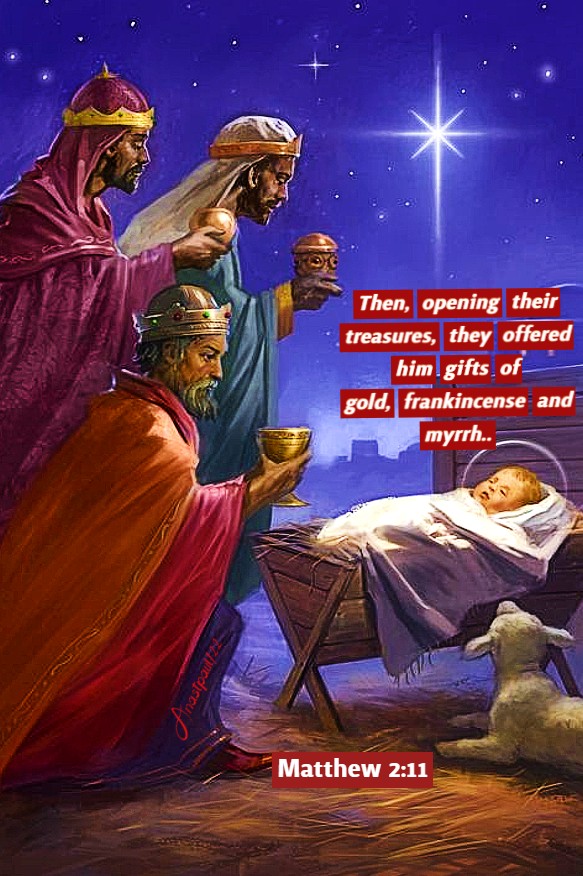
“They fell down and worshipped him. Then, opening their treasures, they offered him gifts of gold, frankincense and myrrh.” – Matthew 2:11
REFLECTION – “Guided by the Star, the wise men from the East, having arrived in Bethlehem, entered the house in which the Blessed Virgin Mother was staying with her Child. They opened their treasures and offered the Lord three gifts – Gold, Frankincense, and Myrrh – thereby acknowledging Him as Lord, true Man,and true King.
Holy Church also offers these same gifts to her Saviour everyday without ceasing. She offers Him Frankincense by acknowledging and believing in Him, the true Lord and Creator of all. She offers Him Myrrh, when she affirms, that He assumed the substance of our flesh, in which He willed to suffer and die for our salvation. And she offers Him, Gold by believing, without a doubt, that He reigns eternally with the Father and the Holy Ghost. …
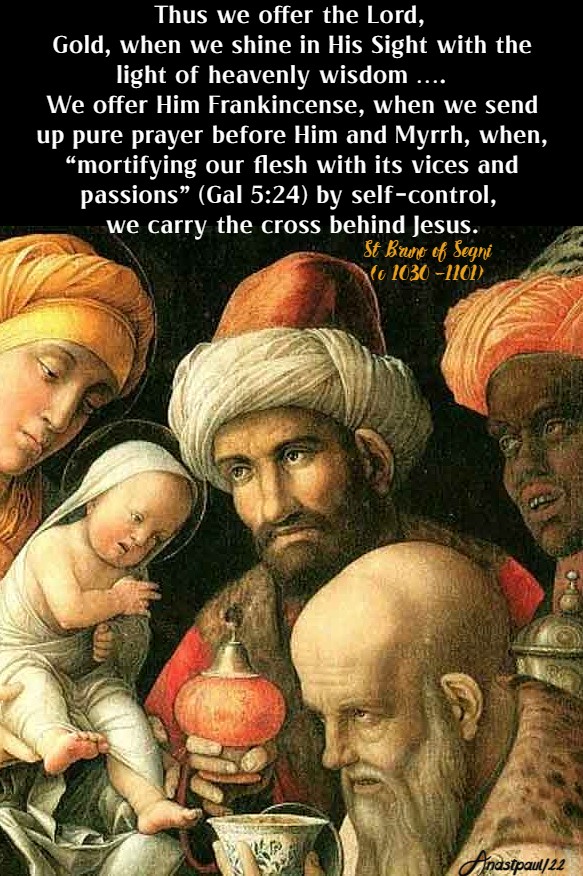
Alternatively, the offering of these gifts may be taken in a mystical sense. Heavenly wisdom is symboliSed by Gold, according to the verse of Solomon, which says: “A priceless treasure lies in the mouth of the sage” (cf. Prv 21:20). … By Frankincense, pure prayer is to be understood, as the psalmist says: “Let my prayer rise like incense in your sight, O Lord” (Ps 141[140]:2). For when our prayer is pure, it yields a purer fragrance to the Lord than the smoke of burning incense and just as such smoke rises upward, so does our prayer ascend to the Lord. Myrrh can be taken as the mortification of our flesh. Thus we offer the Lord, Gold when we shine in His Sight with the light of heavenly wisdom …. We offer Him Frankincense when we send up pure prayer before Him and Myrrh, when, “mortifying our flesh with its vices and passions” (Gal 5:24) by self-control, we carry the cross behind Jesus.” – St Bruno of Segni O.Cart. (c 1030 -1101) Bishop (1st Sermon on the Epiphany ; PL 165, 863).
PRAYER – “Give me, therefore, I pray Thee, this Gold, this Incense and this Myrrh. Give me the Gold of Thy holy Love, give me the spirit of holy prayer, give me the desire and strength to mortify myself in everything that displeases Thee. I am resolved to obey Thee and to love Thee but Thou knowest my weakness, oh, give me the grace to be faithful to Thee!- St Alphonsus Liguori (1696-1787) Doctor of the Church.
Saint of the Day – 6 January – St Felix of Nantes (c 515-584) Bishop of Nantes, Confessor, Evangeliser, Negotiator and peace-maker, Social reformer. Born in c 515 in the Aquitaine region of modern France and died on 6 January 584 of natural causes. Patronages – against famine, against the plague/epidemics. Additional Memorial – 7 July (translation of relics).
The Roman Martyrology states: “In Nantes in Brittany, the memorial of Saint Felix, Bishop, who, in the service of his fellow citizens, gave testimony of his zeal, building the Cathedral Church and evangelising the rural populations relentlessly.”
Born in c 513 to a well-known family of Aquilani and was Ordained a Priest in 540. Felix was married but when, at the age of 37, he was made Bishop of Nantes, on the death of Evemer. his wife became a Nun. He then sold his patrimony donating the proceeds to assist he poor.
He immediately began to evangelise the region and trained young Priests as Missionaries to assist in his programme.
He built and Consecrated a Cathedral within the walls of the City, as planned by his predecessor, Evemer. His social and secular improvements at Nantes were praised in the poems of the Bishop of Poitiers, St Venantius Fortunatus.
He often mediated between the people of Brittany and the Frankish kings. Guerech II, Count of Vannes, plundered the Diocese of Rennes and Vannes and repulsed the troops which King Chilperic sent against him but, at the entreaties of Bishop Felix, withdrew his forces and made peace . By intervening in the political affairs of his time, he saved Maclavius from death, who was being persecuted by his brother Conone, Count of Vannes, who wanted to suppress him.
Felix was in attendance at the Council of Paris in 557 and the Council of Tours in 567.
Towards the end of his life Felix wanted to choose his nephew Burgundius as his successor but St Gregory of Tours, his Archbishop, who was against him (Felix had supported his rival Riculfo) refused to consecrate him, on the grounds that he was too young.
Felix died at the age of seventy, on 6 January 584 after 33 years of zealous service as Bishop of Nantes and was buried in the Cathedral which he had built and Consecrated.
The Solemnity of the Epiphany of the Lord – 6 January: Epiphany celebrates the visit of the three kings or wise men to the Christ Child, signifying the extension of salvation to the Gentiles. The date of Epiphany, one of the oldest Christian Feasts, is 6 January, the 12th day after Christmas. However, in some countries, the celebration of Epiphany is transferred to the Sunday that falls between 2 January and 8 January (inclusive). Greece, Ireland, Italy and Poland continue to observe Epiphany on 6 January as do some Dioceses ithroughout the world. Because Epiphany is one of the most important Christian Feasts, it is a Holy Day of Obligation in most countries.
Nostra Signora di Cana / Our Lady of Cana – 6 January:
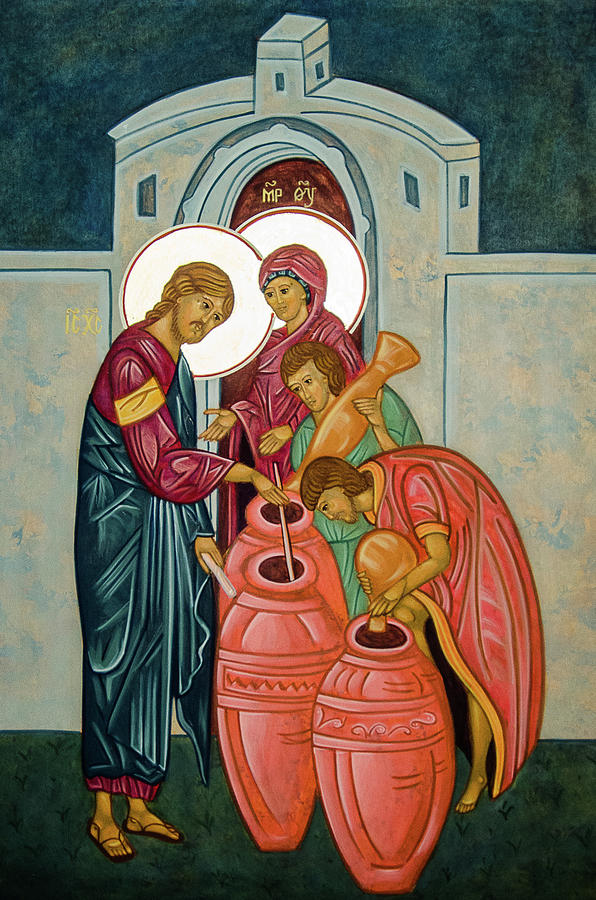
The title recalls the First Miracle of Our Lord through the intercession of His Mother at the Marriage at Cana in Judea, commemorated annually on 6 January. Christ turns water in wine at the request ofHhis Mother (Gospel of John 2:1-10).
Two days of festivities preceded the wedding, which was followed by an evening banquet. It was here that Mary noticed the wine was scarce. She reminded Jesus that He had promised to supply the wine. The Divine Saviour replied “What is that to you or to me, Woman? My hour has not yet come.” Entirely relieved of anxiety for the guests and trusting the Father would reveal the Lord’s power at the right moment, she went to the worried servants and said to them with quiet modesty and confidence: “Do whatever He tells you.” The servants brought in six large, stone jars, which when full were so heavy, two men had to carry one. That they were now empty was evident. Then Jesus said to the waiters: “Fill the jars with water.” After this was done, Jesus went to the jars and blessed them; then He said to the waiters: “Draw out now and take them to the chief steward.” When the chief steward, who did not know where the wine came from, tasted the water after it had become wine, he went to the bridegroom, exclaiming in surprise: “Every man first sets forth the good wine, and when they have drunk freely, then that which is poorer in quality. But you have kept the good wine until now!” When the bridegroom and the bride’s father tasted the miraculous wine, they too were amazed, for the servants insisted they had just filled the jars with nothing but water from the well. Then all the guests drank the new wine and were silent with awe and reverence as they realized they had just witnessed a striking miracle wrought by the Master, Jesus of Nazareth, at the request of His beloved Mother.
Mary Mother of Mercy willingly assists all the poor and afflicted who fear God. From this incident, St. Bonaventure judges of the many graces which we can hope for through Mary, now that she reigns in Heaven; “For,” he says, “if Mary while yet on earth was so compassionate, how much more so is she now, reigning in Heaven!” He gives the reason by adding: “Mary, now that she sees the face of God, knows our necessities far better than when she was on earth and in proportion to the increase of her compassion, her power to aid us has been augmented.” Ah! Why do we not take refuge in all our necessities to this merciful Mother, who, assists the needly?
St Demetrius of Philadelphia St Diman Dubh of Connor St Edeyrn St Eigrad St Erminold of Prüfening St Felix of Nantes (c 515-584) Bishop Bl Frederick of Saint-Vanne Bl Gertrud of Traunkirchen Bl Gertrude van Oosten St Guarinus of Sion St Guy of Auxerre St Honorius St Hywyn of Aberdaron
St Julian of Antinoë St Julius Bl Luc of Roucy Bl Macarius the Scot St Macra of Rheims St Merinus St Nilammon of Geris St Petran of Landévennec St Peter of Canterbury St Pia of Quedlinburg St Pompejanus St Rafaela Porras y Ayllón Bl Raymond de Blanes Bl Rita Amada de Jesus St Schotin St Wiltrudis of Bergen
Martyrs in Africa: Unknown number of Christian men and women who were martyred in the persecutions of Septimus Severus. They were burned to death c 210.
Martyrs of Sirmium – 8 saints: A group of Christians martyred together for their faith. The only surviving details are the names of eight of them – Anastasius VIII, Florianus, Florus, Jucundus, Peter, Ratites, Tatia and Tilis. They were martyred in the 4th century at Syrmium, Pannonia (modern Sremska Mitrovica, Vojvodina, Serbia).
Thought for the Day – 5 January – Meditations with Antonio Cardinal Bacci (1881-1971)
Venial Sin
“Next to mortal sin, the greatest of all evils is venial sin. Sin is always an offence against the God of goodness, When we sin, we place our own will above His and put Him in a position secondary to ourselves. If mortal sin is spiritual suicide because it extinguishes, in us, the divine life of grace, venial sin is an injury, more or less grave, to the soul. The former completely separates us from God; the latter moves us further away from Him. Mortal sin means the death of the soul. Venial sin is a disease of the soul which reduces its supernatural powers and leaves it more open to the ever–increasing attraction of evil.
We cannot speak of small sins, as if sin could be a triviality. Sin is always something great and terrible because, it is an offence against our Creator and Redeemer, Whom we should love, honour and serve with every impulse of our heart and with the whole strength of our will. It is the height of ingratitude because, in order to offend God, we make use of the gifts He has given us – our eyes, ears, speech and all our powers of soul and body.
Let us think seriously about this. We must firmly resolve to be more vigilant so that, with the grace of God, we may avoid ever committing a deliberate venial sin.
The Gospel tells us that we must render an account of every idle word and that nothing tarnished can be admitted into the splendour of Paradise. In the terrible torments of Purgatory, we must pay the full price for all our faults, even the slightest!”
Quote/s of the Day – 5 January – “Month of the Most Holy Name of Jesus” – Christmas Weekday, Readings: 1 John 4:7-10, Psalms 72:1-2, 3-4,7-8, Mark 6:34-44
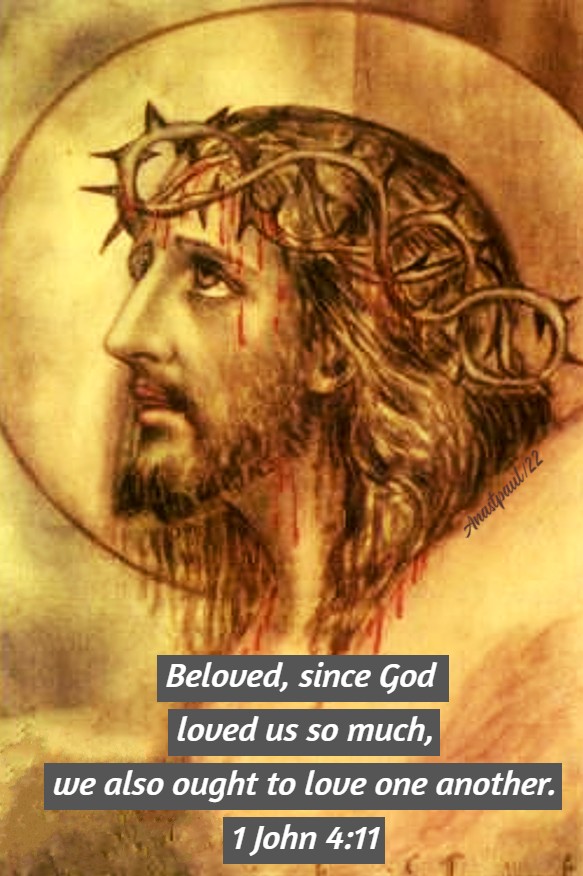
“Beloved, since God loved us so much, we also ought to love one another.”
1 John 4:11
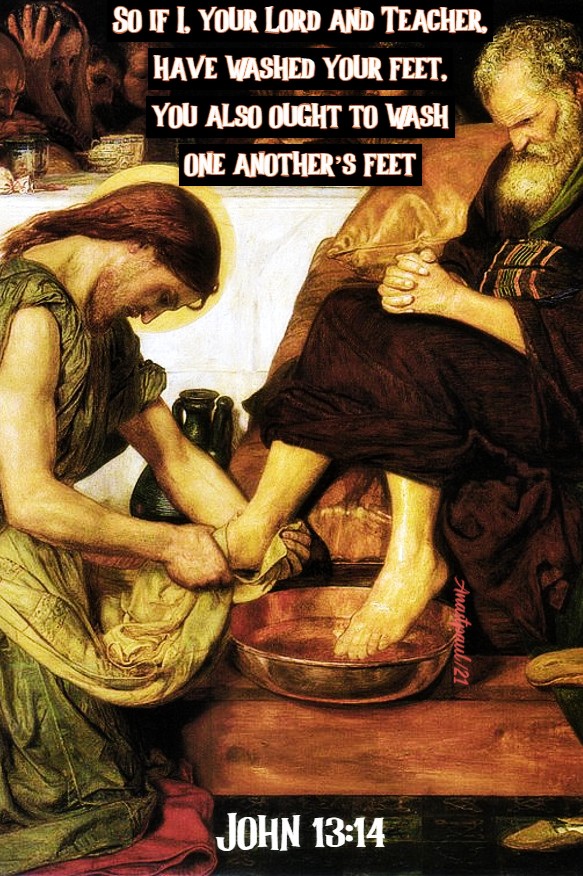
“So if I, your Lord and Teacher, have washed your feet, you also ought to wash one another’s feet.”
John 13:14
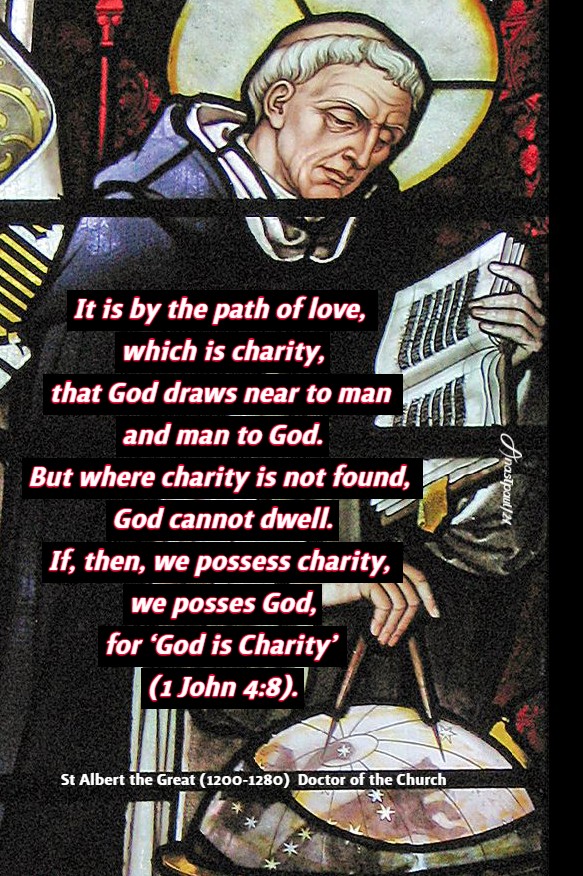
“It is by the path of love, which is charity, that God draws near to man and man to God. But where charity is not found, God cannot dwell. If, then, we possess charity, we posses God, for ‘God is Charity’ (1 John 4:8).”
St Albert the Great OP (1200-1280) Doctor of the Church
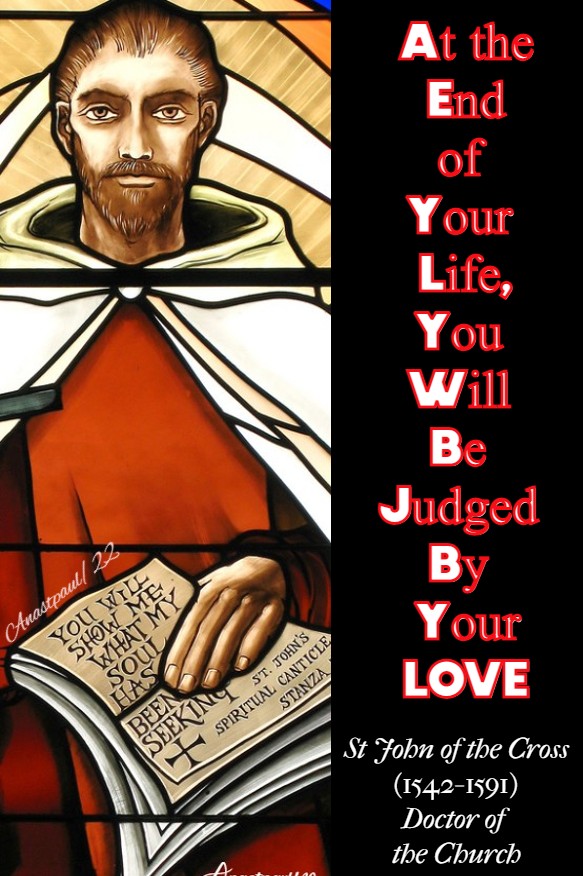
“At the end of your life, you will be judged by your love.”
St John of the Cross (1542-1591) Doctor of the Church
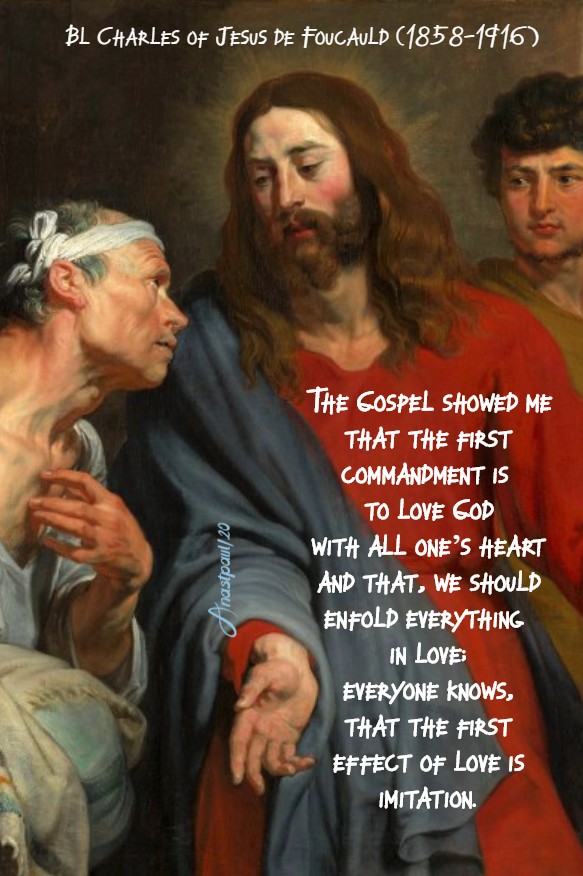
“The Gospel showed me that the first commandment is to love God with all one’s heart and that, we should enfold everything in love; everyone knows, that the first effect of love is imitation.”
Bl Charles of Jesus de Foucauld (1858-1916)
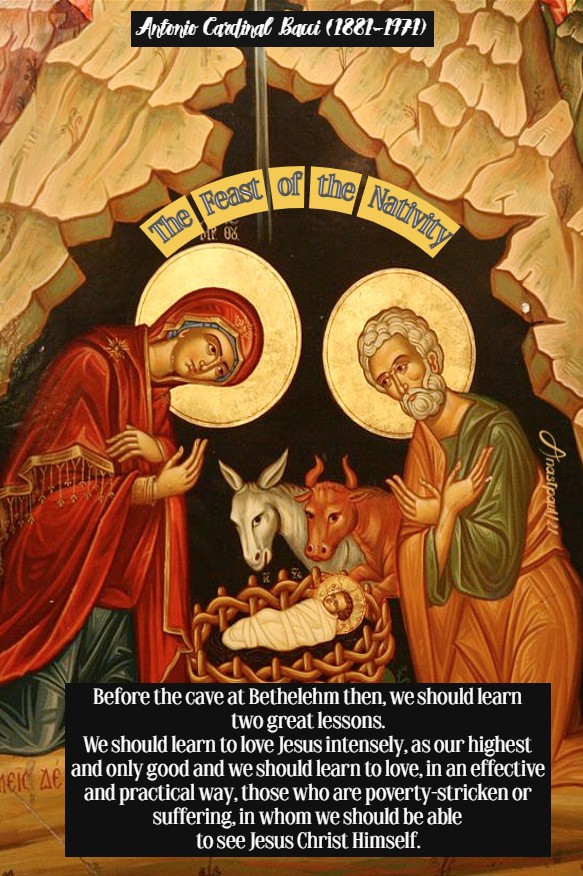
“Before the cave at Bethelehm then, we should learn two great lessons. We should learn to love Jesus intensely, as our highest and only good and we should learn to love, in an effective and practical way, those who are poverty-stricken or suffering, in whom we should be able to see Jesus Christ Himself.”
One Minute Reflection – 5 January – “Month of the Most Holy Name of Jesus” – Christmas Weekday, Readings: 1 John 4:7-10, Psalms 72:1-2, 3-4,7-8, Mark 6:34-44
“But he answered them, “You give them something to eat .. ” – Mark 6:37
REFLECTION – “Let us take note of the disciples’ trusting abandonment to God’s providence in life’s greatest necessities and their disdain for a life of luxury – there were twelve of them and they only had five loaves and two fish. They were not bothered by bodily things but dedicated all their zeal to the things of the soul. Moreover, they did not keep these provisions for themselves, they handed them over to the Saviour at once, when He asked them for them. Let us learn from this example, to share what we have, with those in need, even if we only have a little. When Jesus asks them to bring the five loaves, they don’t say: “What will there be for us later on? Where will we find what is necessary for our own needs?” They obey promptly … Taking the loaves, then, the Lord broke them and entrusted the honour of distributing them to the disciples. He did not just want to honour them by this holy service but desired them to take part in the miracle, so as to be wholly convinced witnesses to it and, not forget what had taken place under their own eyes …. It is through them, that He made the people sit down and, that He distributed the bread, so that each one of them, might bear witness to the miracle accomplished at their hands … Everything in this event – the desert place, the bare ground, the small supply of bread and fish, the distribution of these same things to everyone without distinction, each one of them having the same as their neighbour – all this teaches us humility, frugality and fraternal charity. To love one another equally, to place everything in common amongst those who are serving the same God – this is what our Saviour is teaching us here.” – St John Chrysostom (345-407) Bishop of Constantinople, Father and Doctor of the Church
PRAYER – All-powerful, eternal God, splendour of true light and never-ending day, let our striving for Your kingdom not fall short through selfishness or fear, may the universe be alive with the Spirit and our homes be the pledge of the world redeemed. May our eyes see and our hearts have compassion, to all those who need us. May the intercession of our Holy Mother and all the saints, be a strength and a comfort. Through Jesus, our compassionate and loving Redeemer, with the Holy Spirit, one God with You forever, amen.
Our Morning Offering – 5 January – Christmas Weekday “Month of the Most Holy Name”
Daily Prayer to the Most Holy Name by St Bernardine of Siena (1380-1444) Apostle of the Most Holy Name
Jesus, Name full of glory, grace, love and strength! You are the refuge of those who repent, our banner of warfare in this life, the medicine of souls, the comfort of those who mourn, the delight of those who believe, the light of those who preach the true faith, the wages of those who toil, the healing of the sick. To You, our devotion aspires; by You, our prayers are received; we delight in contemplating You. O Name of Jesus, You are the glory of all the saints for eternity. Amen.
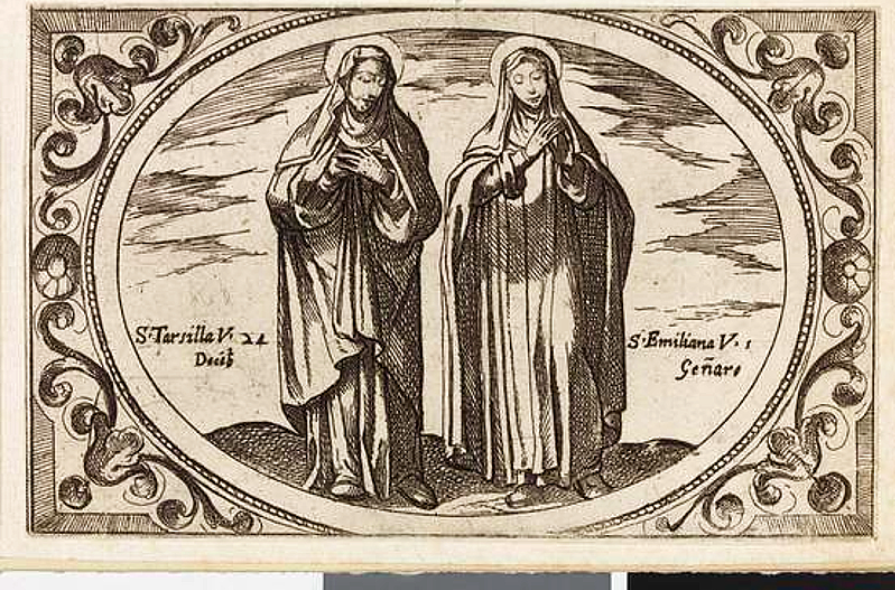
Saint of the Day – 5 January – Saint Emiliana of Rome (6th Century) Virgin, Recluse, Mystic. Patronage – single laywomen. Also known as – Aemiliana, Emilian, Emilienne.
The Roman Martyrology states: “In Rome, commemoration of Saint Emiliana, Virgin, Aunt of Pope Saint Gregory the Great, who, shortly after her sister Tarsilla, also returned to the Lord.”
Emiliana is remembered by her nephew, St Gregory the Great (540-604), for having been able to assist him in his discernment of his vocation. . We have the only biographical information about Emiliana thanks to the Pope who mentions his paternal aunt in a homily.
Emiliana, together with her sisters Tarsilla and Gordiana, retired to a consecrated and ascetic life, probably in the family home. But at a certain point Gordiana chose marriage. Tradition states that St Pope Felix III, their ancestor, appeared to Trasilla and bade her to enter Heaven and on the eve of Christmas Trasilla died, seeing Jesus Christ calling her. The legend also states that Trasilla, a few days later appeared to Emiliana, inviting her to celebrate Epiphany in Heaven.
Emiliana was the Daughter of the noble and wealthy Senator Gordian and Saint Silvia of Rome and the sister of Saint Trasilla and Gordiana.
She was the paternal aunt of Pope Saint Gregory the Great and the niece of Pope Saint Felix III who died in 365.
Emiliana spent so much time kneeling in prayer that her knees and elbows were locked arthritically in the position. She and her sister lived as Recluses in their father‘s house until Thrasilla‘s death.
Emiliana who received a visit from her recently deceased sister inviting her to depart this vale of tears and true to her desire to be with the Lord, Emiliana died a few days later.
Bl Bl Convoyon of Redon St Deogratias of Carthage (Died 457) Bishop St Dorotheus the Younger St Emiliana of Rome (6th Century) Virgin Bl François Peltier St Gaudentius of Gnesen
Bl Jacques Ledoyen Bl Joan Grau Bullich St Kiara St Lomer of Corbion Bl Marcelina Darowska Bl Maria Repetto Bl Paula of Tuscany Nl Pierre Tessier Bl Pietro Bonilli St Simeon Stylites St Syncletica St Talida of Antinoë
Martyrs of Africa – 14 saints: A group of Christians martyred together in Africa, date unknown, exact location unknown. We know nothing more than their names – Acutus, Anastasia, Candidus, Coelifloria, Felix, Honorius, Januaria, Jucundus, Lucianus, Marcus, Petrus, Secundus, Severus and Telesphorus.
Martyrs of Sais: A group of Christians martyred for their faith, but about whom no details have survived. They were martyred by drowning near Sais, Egypt.
Martyrs of Upper Egypt: There were many martyrs who suffered in the persecutions of Diocletian in the Thebaid region. Though we know these atrocities occurred, to the point that witnesses claim the torturers and executioners were exhausted by the work, we do not know the names of the saints and we honour them as a group. Many were beheaded and or burned alive in 303 in Upper Egypt.
Thought for the Day – 4 January – Meditations with Antonio Cardinal Bacci (1881-1971)
Sin
“In order to understand more clearly, the gravity of sin, it is helpful at this stage, to consider three things:
(a) The world with all its evils – sorrows, diseases, wars, plagues and death. All these things do not come directly from the Will of God, Who is the highest good but happen, with His permission.” They are the effect of original sin and of the continuing transgressions of men.
(b) Hell, which is the handiwork of sin, God, infinitely good but also infintely just, has ordained this terrible and everlasting punishment for the rebellious sinner.
(c) The Crucifix. To save us from sin, the God-Man has suffered the cruellest of torments and death but, men go on offending Him with unbelievable ingratitude!
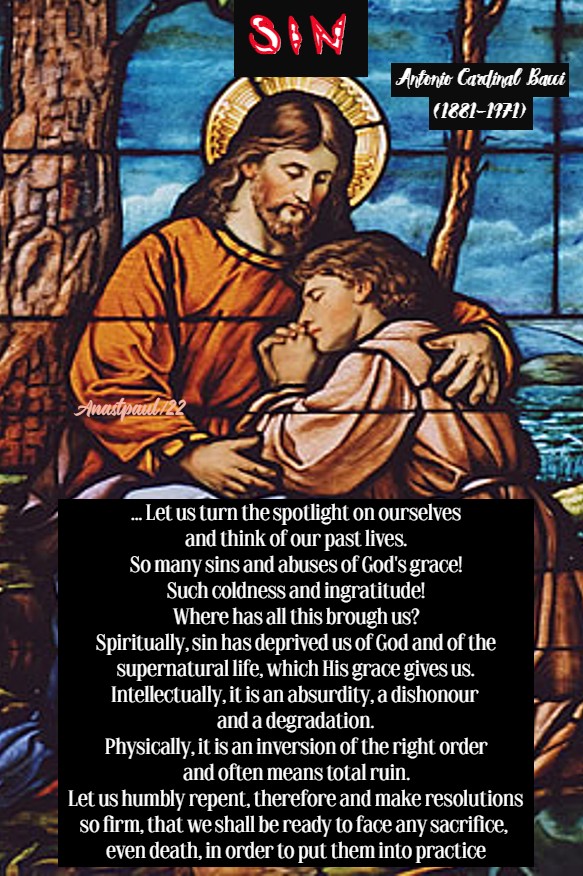
Now, let us turn the spotlight on ourselves and think of our past lives. So many sins and abuses of God’s grace! Such coldness and ingratitude! Where has all this brough us? Spiritually, sin has deprived us of God and of the supernatural life, which His grace gives us. Intellectually, it is an absurdity, a dishonour and a degradation. Physically, it is an inversion of the right order and often means total ruin.
Let us humbly repent, therefore and make resolutions so firm, that we shall be ready to face any sacrifice, even death, in order to put them into practice.”
Quote/s of the Day – 4 January – “Month of the Most Holy Name of Jesus” – Christmas Weekday, Readings: 1 John 3:7-10, Psalm 98:1, 7-9, John 1:35-42
“Jesus turned and saw them following him and said to them, “What are you looking for?”
John 1:38
“… There is one Road and one only, well secured against all possibility of going astray and, this Road is provided by One Who is Himself both God and man. As God, He is the Goal, as man, He is the Way.”
St Augustine (354-430) Bishop of Hippo Father and Doctor of Grace
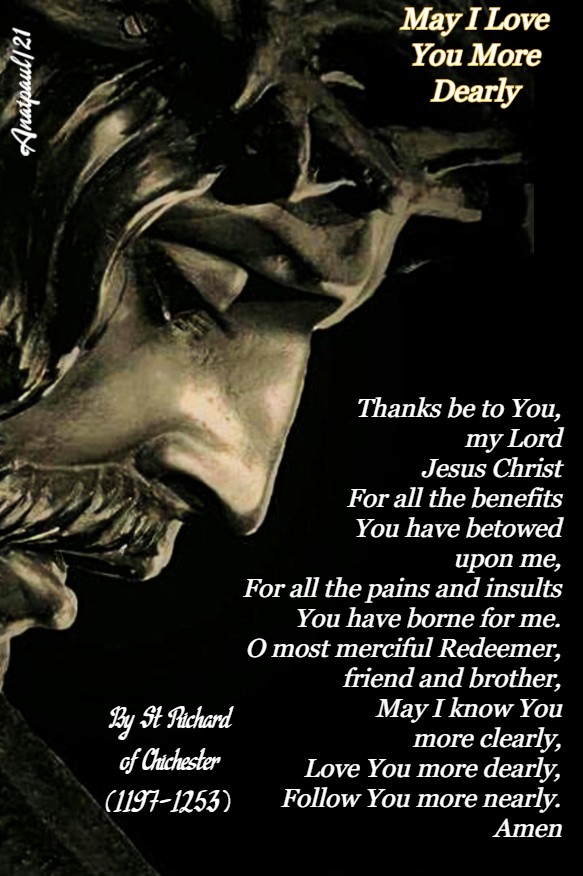
May I Love You More Dearly St Richard of Chichester (1197-1253)
Thanks be to You, my Lord Jesus Christ For all the benefits You have given me, For all the pains and insults You have borne for me. O most merciful Redeemer, Friend and Brother, May I know You more clearly, Love You more dearly, Follow You more nearly. Amen
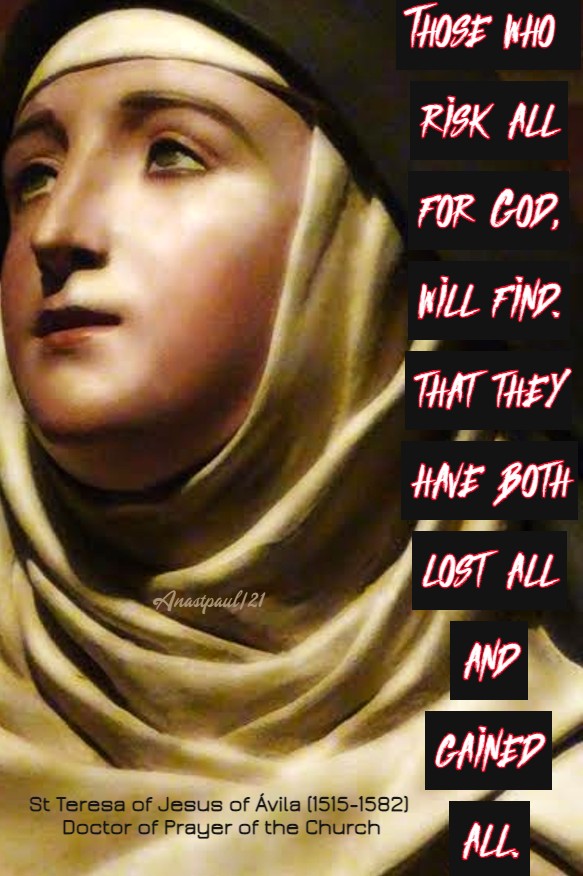
“Those who risk all for God, will find. that they have both lost all and gained all.”
St Teresa of Jesus of Ávila (1515-1582) Doctor of Prayer of the Church
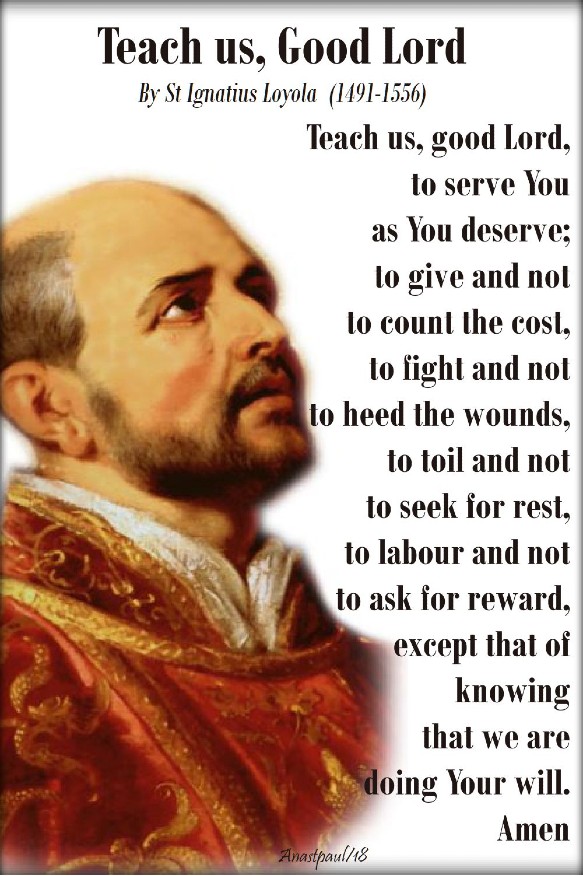
“Teach Us Good Lord” By St Ignatius Loyola (1491-1556)
Teach us, good Lord, to serve You as You deserve; to give and not to count the cost, to fight and not to heed the wounds, to toil and not to seek for rest, to labour and not to ask for reward, except that of knowing that we are doing Your will. Amen
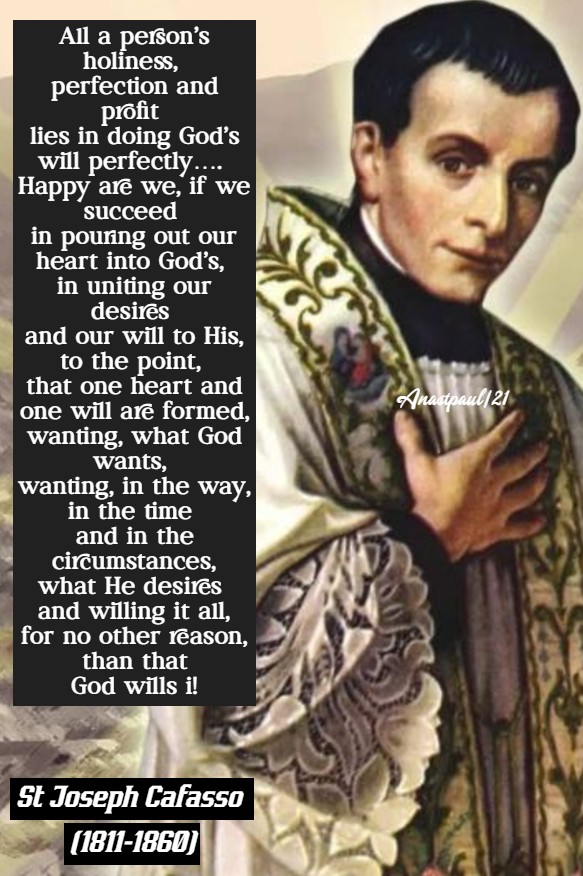
“All a person’s holiness, perfection and profit lies in doing God’s will perfectly…. Happy are we, if we succeed in pouring out our heart into God’s, in uniting our desires and our will to His, to the point, that one heart and one will are formed, wanting, what God wants, wanting, in the way, in the time and in the circumstances, what He desires and willing it all, for no other reason, than that God wills it.”
St Joseph Cafasso (1811-1860)
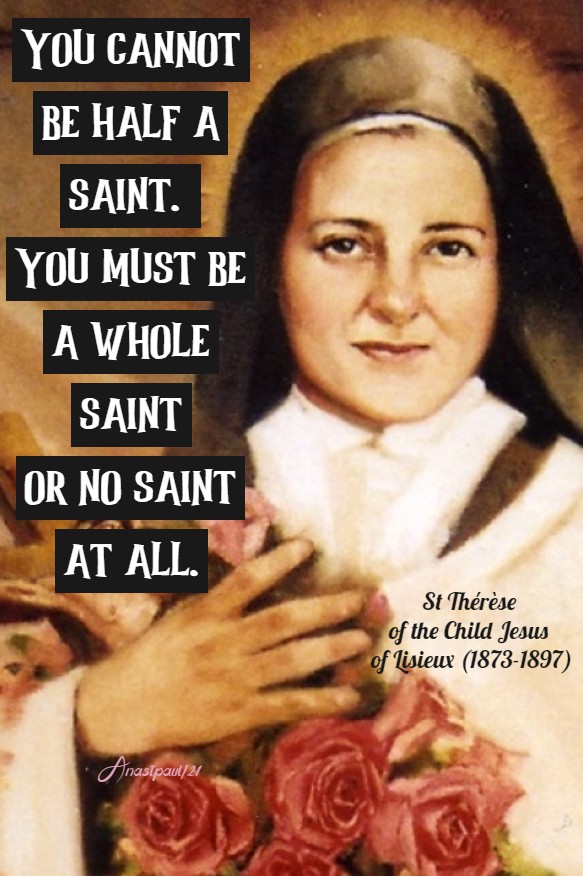
“You cannot be half a saint. You must be a whole saint or no saint at all.”
St Thérèse of the Child Jesus and the Holy Face of Lisieux (1873-1897) Doctor of the Church
One Minute Reflection – 4 January – “Month of the Most Holy Name of Jesus” – Christmas Weekday, Readings: 1 John 3:7-10, Psalm 98:1, 7-9, John 1:35-42
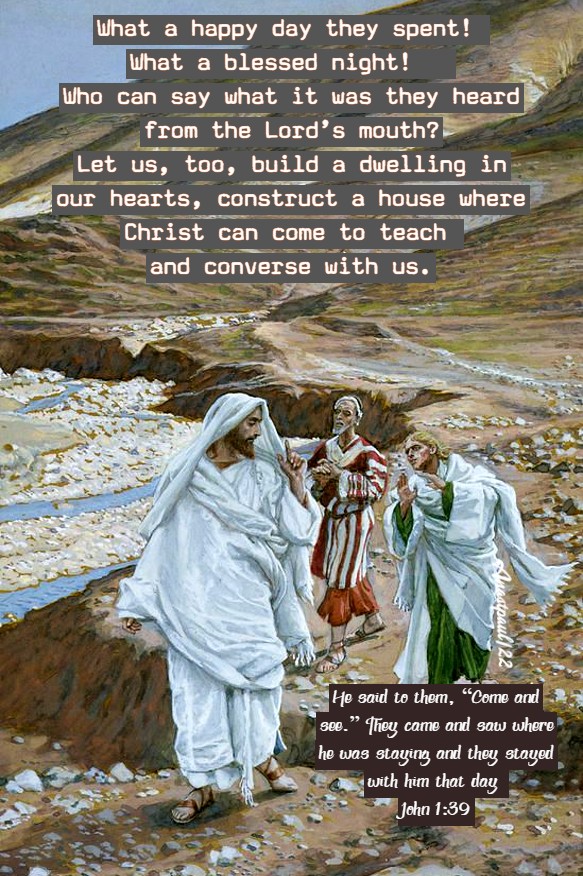
He said to them, “Come and see.” They came and saw where he was staying and they stayed with him that day … John 1:39
REFLECTION – “John was there and two of his disciples with him.” John was such “a friend of the Bridegroom” that he did not seek his own glory, he simply bore witness to the truth (Jn 3:29.26). Did he dream of keeping back his disciples and preventing them from following the Lord? Not in the least. He, himself showed them, the one they were to follow … He declared: “Why cling to me? I am not the Lamb of God. Behold the Lamb of God …… Behold him who takes away the sins of the world.”
At these words the two disciples who were with John, followed Jesus. “Jesus turned and saw that they were following him and said to them: ‘What are you looking for?’ They said to him: ‘Rabbi, where are you staying?” As yet they were not following Him definitively, as we know, they joined themselves to Him, when He called them to leave their boat …, when He said to them: “Come after me and I will make you fishers of men” (Mt 4:19). That was the moment they joined Him definitively, no longer to leave Him. But for now they wanted to see where Jesus was living and put into practice the words of Scripture: “If you see an intelligent man, seek him out at daybreak; let your feet wear away his doorstep! Learn from him the precepts of the Lord” (cf. Sir 6:36f.). So Jesus showed them where He was living, they went and stayed with Him. What a happy day they spent! What a blessed night! Who can say what it was they heard from the Lord’s mouth? Let us, too, build a dwelling in our hearts, construct a house where Christ can come to teach and converse with us.” … St Augustine (354-430) Bishop of Hippo, Father & Doctor of the Church (Sermons on Saint John’s Gospel, no 7).
PRAYER – Heavenly Father, thank You for making me a child of eternity. Help me to live each day in such a way that I may deserve to be a child of Yours forever. Grant that by the prayers of the Blessed Virgin Mary, all Your Angels and Martyrs and Saints, we may strive always to keep our eyes fixed on Your Son, our entry to You, our Shepherd and our Saviour, Who will lead us to You in our eternal home. May we never waiver from Your commandments. Amen.
Our Morning Offering – 4 January – Christmas Weekday “Month of the Most Holy Name”
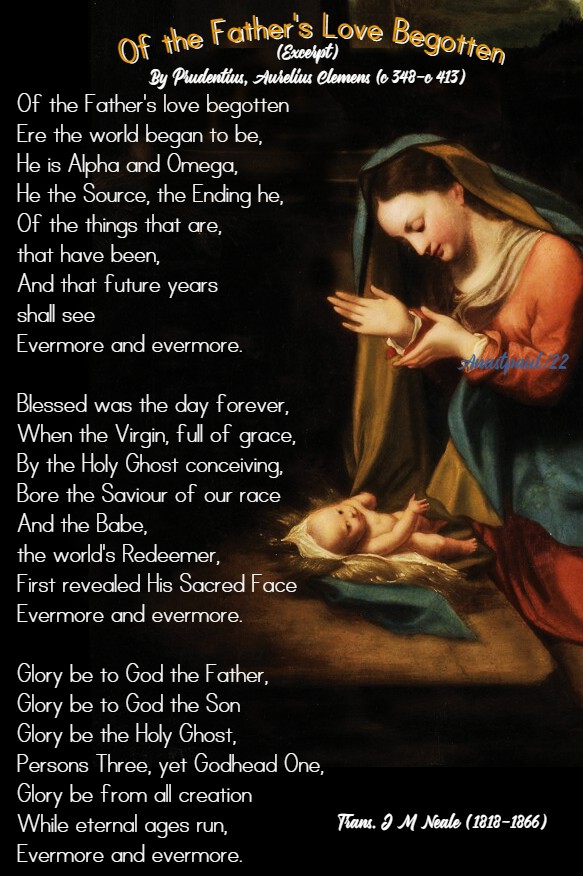
Of the Father’s Love Begotten (Excerpt) By Prudentius, Aurelius Clemens (c 348-c 413) Trans. J M Neale (1818-1866)
Of the Father’s love begotten Ere the world began to be, He is Alpha and Omega, He the Source, the Ending he, Of the things that are, that have been, And that future years shall see Evermore and evermore.
Blessed was the day forever, When the Virgin, full of grace, By the Holy Ghost conceiving, Bore the Saviour of our race And the Babe, the world’s Redeemer, First revealed His Sacred Face Evermore and evermore.
Glory be to God the Father, Glory be to God the Son Glory be the Holy Ghost, Persons Three, yet Godhead One, Glory be from all creation While eternal ages run, Evermore and evermore.
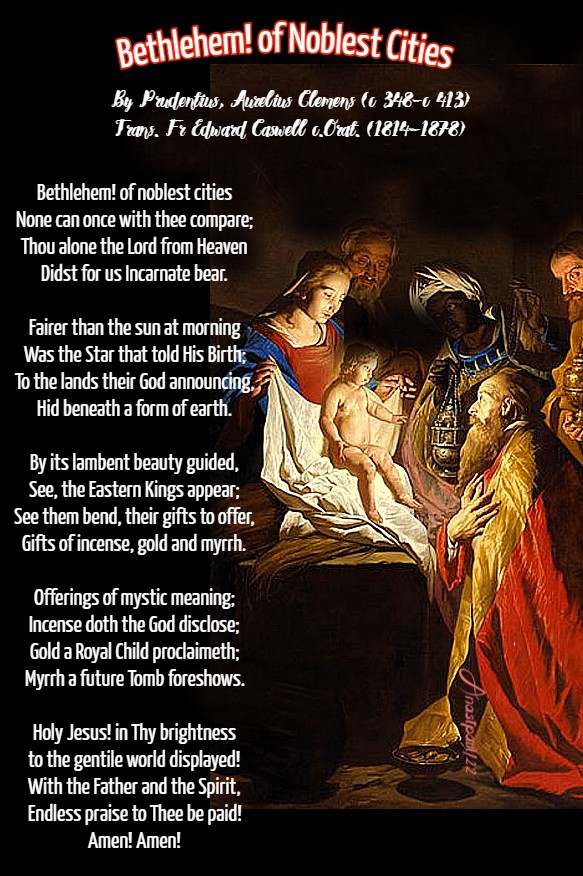
Aurelius Prudentius Clemens was a Roman Christian Poet, born in the Roman Province of Tarraconensis (now Northern Spain) in c 348. He probably died in the Iberian Peninsula some time after 405, possibly around 413. Prudentius practised law with some success and was twice Provincial Governor, perhaps in his native country. Towards the end of his life (possibly around 392) Prudentius retired from public life to become an ascetic, fasting until evening and abstaining entirely from animal food and writing poems, hymns and controversial works in defence of Christianity. Prudentius later collected the Christian poems written during this period and added a preface, which he himself dated 405. The poetry of Prudentius is influenced by early Christian authors, such as Tertullian and St Ambrose, as well as the Sacred Scriptures and the Acts of the Martyrs. His hymn Da, puer, plectrum – “Of the Father’s Love Begotten”) and the hymn for Epiphany O sola magnarum urbium (“Earth Has Many A Noble City”), both from the Cathemerinon, are still frequently in use today, although many others are too but perhaps less frequently..
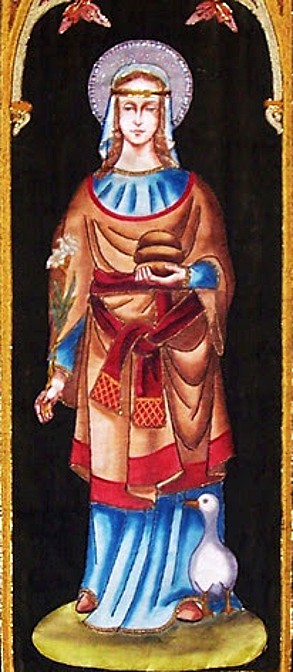
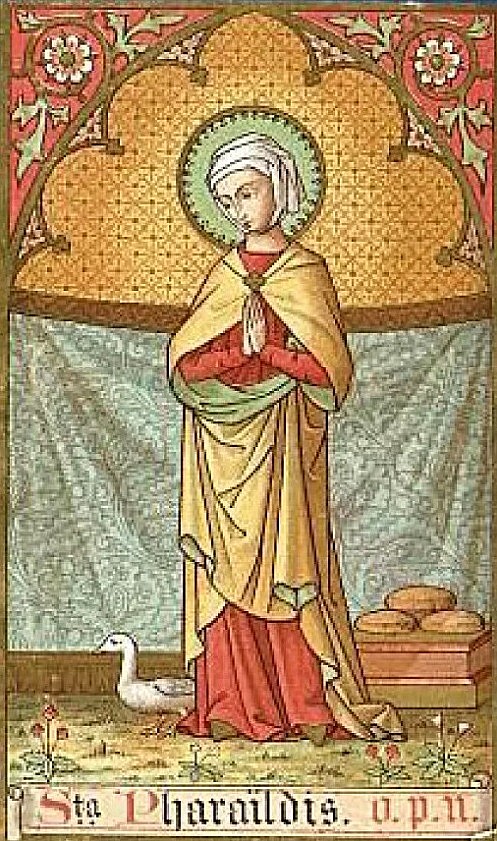
Saint of the Day – 4 January – Saint Pharaildis of Ghent (c 650-c 740) Virgin, although married, she remained a virgin during her marriage, apostle of charity, miracle-worker. Born in c 650 in Ghent, Belgium and died in c 740 of natural causes. Patronages – against childhood diseases, of toothache, difficult marriages, poultry, victims of abuse, widows, Ghent, Belgium, Smetlede, Belgium, Bruay, France. Also known as – Farahilde, Farailde, Pharaild, Pharailde, Pherailde, Vareide, Varelde, Veerhilde, Veerle, Verylde. The name of this Saint, very popular in Flanders, varies according to the various local dialects.
The Roman Martyrology states: ”In Bruay-sur-l’Escaut near Valencienne nell’Artois in Neustria, in modern-day ||Belgium, Saint Pharaildis, widow, who, forced to marry a violent man, is said to have embraced a life of prayer and austerity until old age.”
A native of a noble Belgium family, Pharaildis was the daughter of the Duke of Lotharingia called Witger and St Amalberga of Maubeuge. Her sister was Saint Gudule (c 646-c 700) and they were nieces of Saint Gertrude of Nivelles (c 628- 659).
After making a private vow of virginity, Pharaildis was given in marriage against her will, to a noble and rich suitor who treated her brutally, perhaps because she, who had consecrated her virginity to God, preferred to spend the nights in prayer in the Churches of the City rather than in the nuptial bed.
When Pharaildis was widowed, she was still a virgin and dedicated herself to charity.
Pharaildis is often depicted with a loaf or loaves of bread, in memory of one of her miracles, when she turned the loaves, into stone, that a miserly woman had refused to give to a beggar. She is also invoked by mothers concerned about their children’s health and against toothache.
A legend has it that to water thirsty reapers, Pharaildis made a spring gush out, whose waters were considered therapeutic.
The cult of Pharaildis has been documented as early as the eighth century. About the year 754, Agilfrid, Abbot of Saint Bavo’s Abbey, acquired her relics and brought them to Ghent. , where her feast is celebrated today.
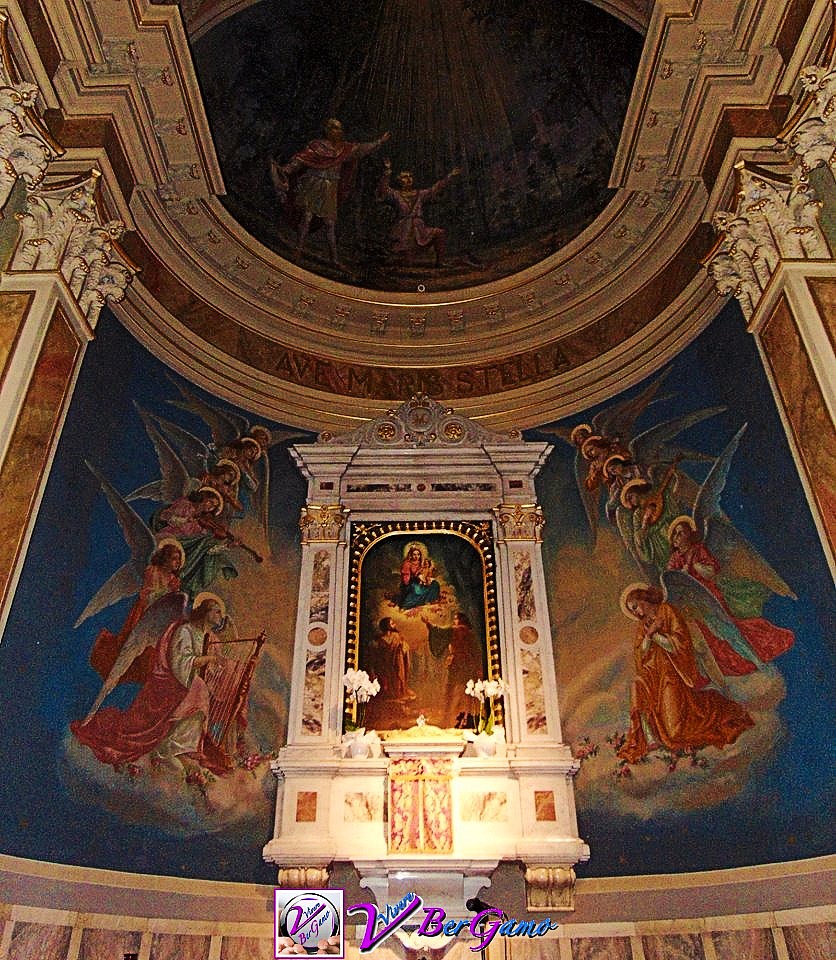
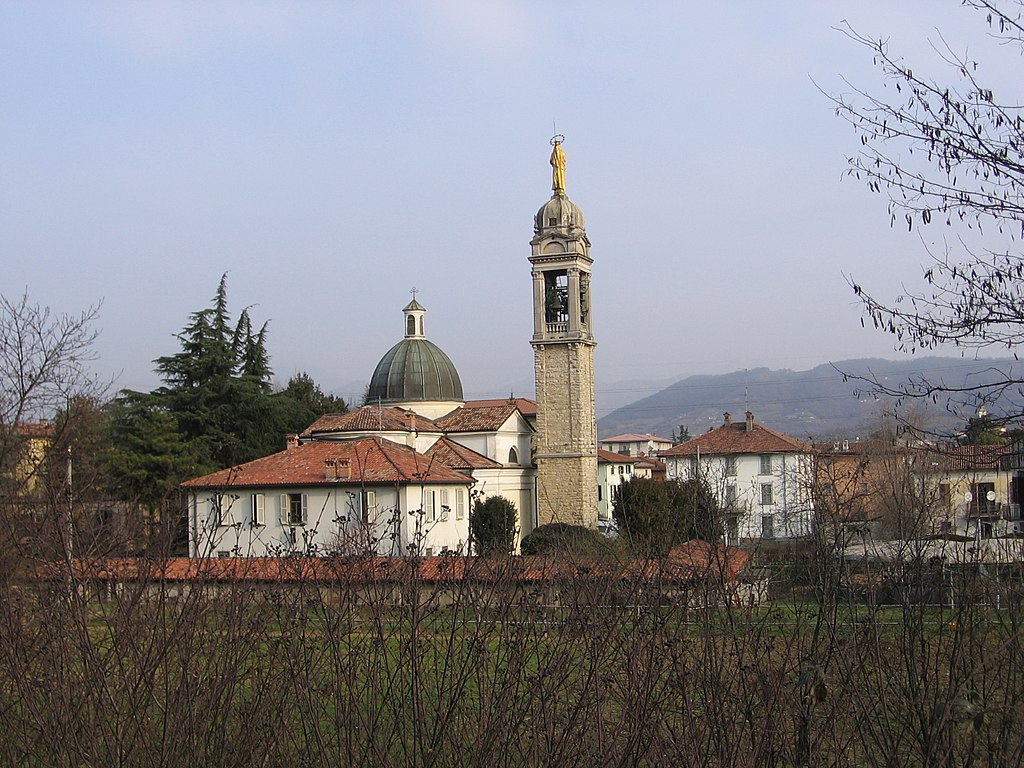
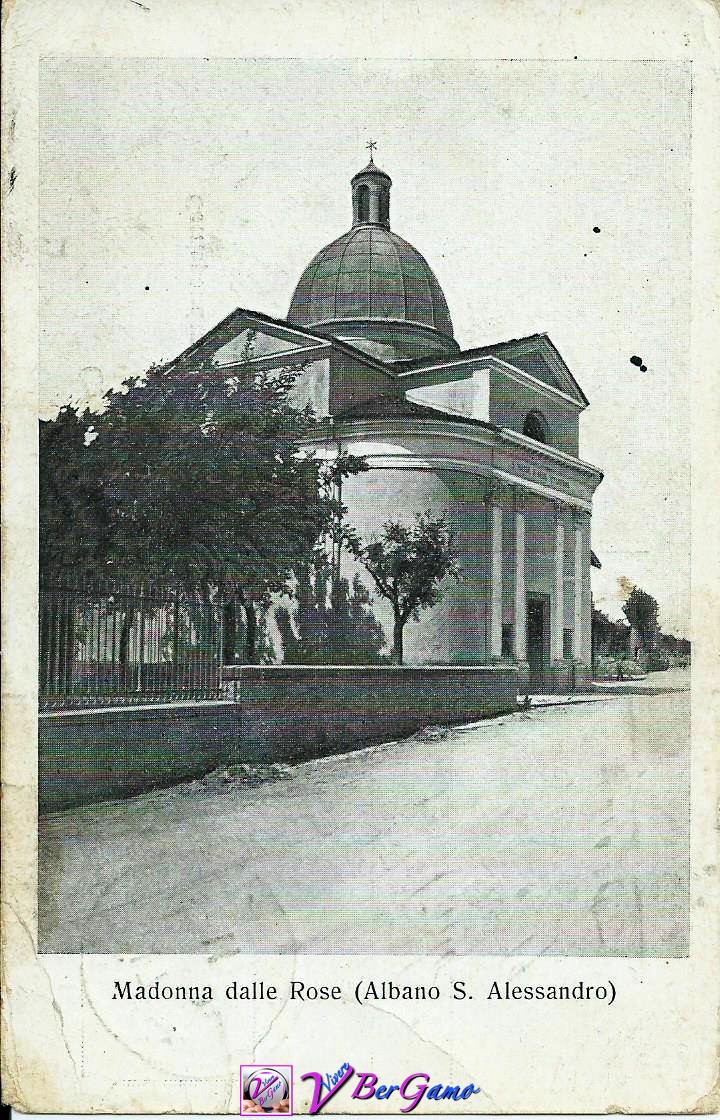
Madonna delle Rose / Our Lady of the Rose s(Albano Sant’Alessandro, Italy) (1417) – 4 January:
A few kilometers from Bergamo, on the way to Trescore Balneario , in a pleasant plain, lies Albano St. Alexander , a Town famous for its Roman origin and for many historical events and bloody battles between the Guelphs and Ghibellines. Today it is famous for the beautiful Shrine of Our Lady of the Roses.
Until 1855, anyone travelling along this road came upon a small, rustic Chapel that appeared to manifest nothing special, neither painted nor written, which makes the unique devotion it attracted even more amazing. The Parish Priest of Albano, zealous and pious , devoted himself to research among the ancient documents the history of this powerful devotion. From this story , printed in Bergamo in 1880 , we are able to establish the origin of the Shrine of Our Lady of the Roses in Albano St. Alexander.
The events of the night between 3 and 4 January 1417, are as follows: – two Roman merchants travelling from Bergamo to Brescia, got lost and found themselves in a thicket near the Village called Albano. Bergamo is only eight miles away but for them, in the dark, between bushes and marshes covered by snow, they felt as if they would never find their way and would die of cold and fear . They turned so fervently to the Madonna with invocations and a vow to build a Chapel, if they would be rescued. Suddenly rays of bright light penetrated the darkness and a strip of luminous light shows them the way. With hearts relieved and grateful, they followed the light to the path and heard “This is the way, walk in it,” until its junction with the main road. Accompanied by a friendly glow they very quickly reached the City of Bergamo .
Desiring to thank the Blessed Virgin , they went to the Basilica of Santa Maria Maggiore but given the hour of the night, it was closed. They found shelter in the nearby ruined tower, ruined by war. There, a great light stopped them and they saw the Immaculate Virgin sitting on a wreath of roses, which surrounded her completely, quite high up from the ground. The Blessed Virgin held the Divine Child close to her breast and the Child Jesus held, in one hand, a small bouquet of white roses, in the act of offering them to His Mother. The eyes of the Blessed Virgin and of the Divine Child, were turned compassionately towards the two merchants, who prostrated themselves at this heavenly vision.
Since that night, the site of the apparition was called “the Hill of Roses.” When day came, the merchants spread the news and attended at the Bishop’s house. After much investigation and many miracles at the Hill of Roses, the Bishop confirmed the miraculous event, judging it as a heavenly sign of mercy and protection for the City of Bergamo beset by many problems, for Italy plagued by discord and enmity, for the Church, torn by division and schism.
St Bernardine of Siena, who at this time was in Bergamo, was appointed as the final arbiter of the Blessing of Our Lady of the Night and of the Hill of Roses. The same Saint also had a vision of the Madonna in the same year, in Siena . The Holy Virgin appeared with great splendour to him, promising to help him in his mission to convert sinners.
All were eager to erect a Church in gratitude for so many graces from the Virgin Mary, The new Pope, Martin V also appointed in 1417, authorised the construction of a new Church. The two blessed visionaries returned to Albano to the site where they had been lost and seen the immense light. ,They bought the land at the place where the path of light guided them to Bergamo and there built the Chapel that would, for 438 years, in future generation,s attract the devotion of countless numbers of the faithful , until 1855. Then a terrible cholera epidemic ravaged the area and by unanimous vote of the population , they erected a new Sanctuary to the Blessed Virgin in thanksgiving and veneration. The epidemic subsided and on 20 September 1855 the construction of the Sanctuary began. The apse and dome of the Church are decorated with frescoes by Luigi Tagliaferri, the walls are adorned with paintings of the Nativity of Mary and the Descent of Jesus from the Cross by Vittorio Manini, the central painting above the High Altar depicting the Apparition to the two merchants and the medallions of the vault, are by Arturo Compagnoni. The Madonna of the Roses was canonically crowned in 1917. The terrible war that plagues the whole world prevented the solemn ceremony, which only occurred on 14 September 1920 celebrated by Don Mario Morra SDB.
St Angela of Foligno TOSF (1248-1309) known as the “Mistress of Theologians” – Wife, Mother, Widow, Religious, Mystic, Writer, Third Order Franciscan, Foundress of a religious community, which refused to become an enclosed religious order, so that it might continue her vision of caring for those in need. It is still active today. About St Angela: https://anastpaul.com/2020/01/04/saint-of-the-day-4-january-saint-angela-of-foligno-tosf-1248-1309/
St Celsus of Trier Bl Chiara de Ugarte St Chroman St Dafrosa of Acquapendente St Ferreolus of Uzès St Gaius of Moesia St Gregory of Langres St Hermes of Moesia St Libentius of Hamburg Bl Louis de Halles
St Mavilus of Adrumetum St Neophytos St Neopista of Rome St St St Oringa of the Cross Bl Palumbus of Subiaco St Pharaildis of Ghent (c 650-c 740) Virgin St Rigobert of Rheims Bl Roger of Ellant St Stephen du Bourg St Theoctistus
Martyrs of Africa – 7 saints: A group of Christians martyred together in the persecutions of the Arian Vandal king Hunneric. Saint Bede wrote about them. – Aquilinus, Eugene, Geminus, Marcian, Quintus, Theodotus and Tryphon. In 484 in North Africa.
Martyrs of Rome – 3 saints: Three Christians martyred together in the persecutions of Julian the Apostate for refusing to renounce Christianity as ordered. – Benedicta, Priscillianus and Priscus. In 362 in Rome, Italy.
Thought for the Day – 3 January – Meditations with Antonio Cardinal Bacci (1881-1971)
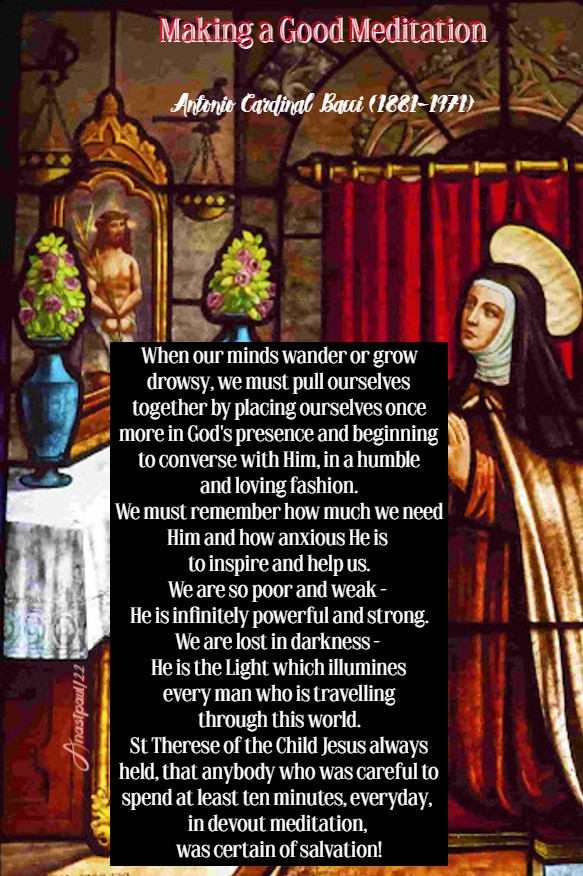
Making a Good Meditation
“Some people claim, that they cannot concentrate for any great length of time on meditation. In their case, it is very helpful to combine mental and vocal prayer. Short aspirations and expressions of love for God and of an ardent desire for holiness, can restore the atmosphere of recollection, making the intellect more attentive, the heart more fervent and the entire spiritual exercise, more profitable.
When our minds wander or grow drowsy, we must pull ourselves together by placing ourselves once more in God’s presence and beginning to converse with Him, in a humble and loving fashion. We must remember how much we need Him and how anxious He is to inspire and help us. We are so poor and weak – He is infinitely powerful and strong. We are lost in darkness – He is the Light which illumines every man who is travelling through this world.
St Therese of the Child Jesus always held, that anybody who was careful to spend at least ten minutes, everyday, in devout meditation, was certain of salvation!”
Quote/s of the Day – 3 January – “Month and Feast of the Most Holy Name of Jesus” – Readings: John 3: 22 – 4: 6; Psalm 2: 7bc-8, 10-11; Matthew 4: 12-17, 23-25
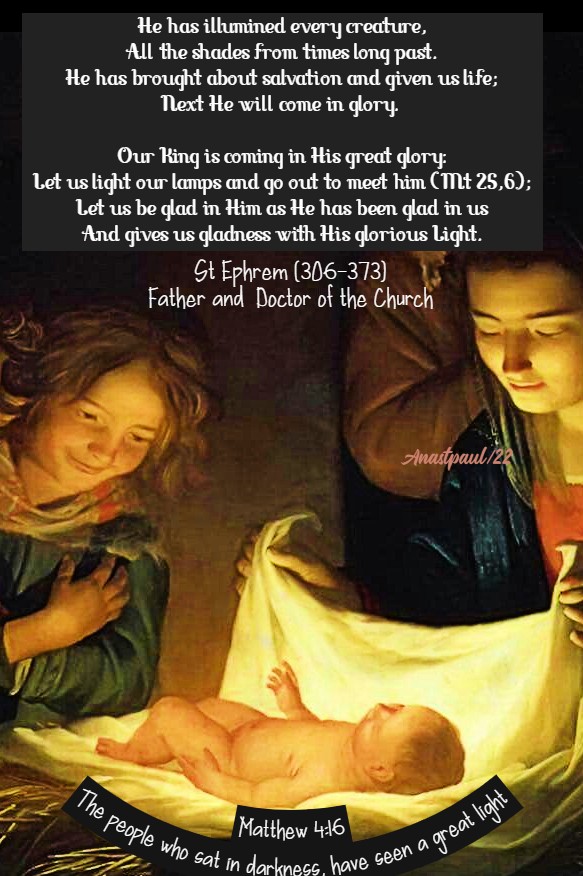
“The people who sat in darkness, have seen a great light“
Matthew 4:16
“Our Lord Jesus Christ Has appeared to us from the bosom of the Father. He has come and drawn us out of the shadows And enlightened us with His joyful Light.
Day has dawned for humankind, Cast out the power of darkness. For us, a Light from His Light has arisen That has enlightened our darkened eyes.
Over the world He has made his glory arise And has lit up the deepest depths. Death is no more, darkness has ended, The gates of hell are shattered.
He has illumined every creature, All the shades from times long past. He has brought about salvation and given us life; Next He will come in glory.
Our King is coming in His great glory: Let us light our lamps and go out to meet him (Mt 25,6); Let us be glad in Him as He has been glad in us And gives us gladness with His glorious Light.
My friends, arise! make yourselves ready To give thanks to our Saviour King, Who will come in His glory and make us joyful With His joyous Light in the Kingdom.
St Ephrem (306-373) Father and Doctor of the Church
One Minute Reflection – 3 January – “Month and Feast of the Most Holy Name of Jesus” – Readings: John 3: 22 – 4: 6; Psalm 2: 7bc-8, 10-11; Matthew 4: 12-17, 23-25
“The people who sat in darkness, have seen a great light and to them who sat in the region of the shadow of death, light is risen.” – Matthew 4:16
REFLECTION – “Because human nature, petrified by the cult of idols and solidified by the ice of paganism, had lost all its motivation towards the good, because of this, the Sun of Justice rises over that rigorous winter and brings in the spring. Just as the rays are rising in the East, the south wind causes this ice to melt by warming the whole mass, so that man, made rigid by the cold, should be penetrated by the Spirit with heat and melt under the rays of the Word and once again, he might become a spring, bubbling up to life eternal. “A breath from him and the waters flow” (Ps. 147:7 LXX). This is what the Baptist openly proclaimed to the Jews, when he told them that the stones would rise up to become children of the Patriarch (cf. Mt 3:9), imitating his virtue.
This is what the Church learns from the Word, when it receives the brightness of truth, through the windows of the prophets and the trellis of the Law. So long as the wall of doctrine and its figurative expression remains, I mean the Law, (cf. Sg 3:9) it shows the shadow of things to come but not the image itself of the realities. But behind the law stands the Truth that follows the figure. First of all it makes the Word shine out for the Church through the prophets, then the Gospel revelation dissipates all shadowy performance in figures. Through it “the dividing wall is broken down” (Eph 2:14) and the air in the house is invaded by celestial light: there is no more need any longer to receive light through the windows, since the true Light itself lightens everything inside, with the rays of the Gospel.
This is why the Word Who raises the broken cries to the Church through the windows: Rise up (from your fall, of course), you who slid in the mud of sin, who were chained by the serpent, who fell to the ground and whom disobedience dragged into falling. Rise up!” – St Gregory of Nyssa (c.335-395) Monk and Bishop, Father of the Church (The Spiritual Spring).
PRAYER – The Love of Your Name
“My God, Sweetness beyond words, make bitter all the carnal comfort that draws me from love of the eternal and lures me to its evil self, by the sight of some delightful good in the present. Let it not overcome me, my God. Let not flesh and blood conquer me. Let not the world and its brief glory deceive me, nor the devil trip me by his craftiness. Give me courage to resist, patience to endure and constancy to persevere. Give me the soothing unction of Your spirit, rather than all the consolations of the world and in place of carnal love, infuse into me the love of Your Name.”
Thomas à Kempis CRSA (1380-1471) The Imitation of Christ (Book 3 Ch 26:1-4)
Our Morning Offering – 3 January – “Month and Feast of the Most Holy Name of Jesus”
The Litany of the Most Holy Name of Jesus received the Church’s approval for private use by Pope Sixtus V in 1585, and public recitation by Pope Leo XIII in 1886. It is one of only six litanies approved for public use. When this litany is prayed publicly, the congregation’s responses to a leader appear in italics below.
The LITANY of The MOST HOLY NAME OF JESUS
Lord, have mercy on us. Christ, have mercy on us. Lord, have mercy on us. Jesus, hear us. Jesus, graciously hear us. God the Father of Heaven, have mercy on us (after each line) God the Son, Redeemer of the world, God the Holy Ghost, Holy Trinity, one God, Jesus, Son of the living God, Jesus, Splendour of the Father, Jesus, Brightness of eternal Light, Jesus, King of Glory, Jesus, Sun of Justice, Jesus, Son of the Virgin Mary, Jesus, most amiable, Jesus, most admirable, Jesus, the mighty God, Jesus, father of the world to come, Jesus, Angel of great counsel, Jesus, most powerful, Jesus, most patient, Jesus, most obedient, Jesus, meek and humble of heart, Jesus, Lover of chastity, Jesus, Lover of us, Jesus, God of peace, Jesus, Author of life, Jesus, Example of virtues, Jesus, zealous Lover of souls, Jesus, our God, Jesus, our Refuge, Jesus, Father of the poor, Jesus, Treasure of the faithful, Jesus, good Shepherd, Jesus, true Light, Jesus, eternal Wisdom, Jesus, infinite Goodness, Jesus, our Way and our Life, Jesus, Joy of Angels, Jesus, King of Patriarchs, Jesus, Master of the Apostles, Jesus, Teacher of the Evangelists, Jesus, Strength of Martyrs, Jesus, Light of Confessors, Jesus, Purity of Virgins, Jesus, crown of all Saints, Be merciful, spare us, O Jesus. Be merciful, graciously hear us, O Jesus. From all evil, deliver us, O Jesus. (after each line) From all sin, From Thy wrath, From the snares of the devil, From the spirit of fornication, From everlasting death, From the neglect of Thine inspirations, By the Mystery of Thy holy Incarnation, By Thy Nativity, By Thine Infancy, By Thy most divine Life, By Thy labors, By Thine agony and Passion, By Thy Cross and dereliction, By Thy sufferings, By Thy Resurrection, By Thine Ascension, By Thine institution of the most Holy Eucharist, By Thy joys, By Thy glory, Lamb of God, Who takest away the sins of the world, Spare us, O Jesus. Lamb of God, Who takest away the sins of the world, Hear us, O Jesus. Lamb of God, Who takest away the sins of the world, Have mercy on us, O Jesus. Jesus, hear us. Jesus, graciously hear us.
Let us pray:
O Lord Jesus Christ, Who hast said: Ask and ye shall receive, seek and ye shall find, knock and it shall be opened unto you; mercifully attend to our supplications and grant us the gift of Thy divine charity, that we may ever love Thee with our whole heart and with all our words and deeds and may never cease from praising Thee. Make us, O Lord, to have a perpetual fear and love of Thy holy Name, for Thou never failest to help and govern those whom Thou dost bring up in Thy steadfast fear and love. Who livest and reignest for ver and ever. Amen.
Saint of the Day – 3 January – Saint Blitmund of Bobbio (Died 660) Monk, Abbot, Founder of Monasteries and Churches, miracle-worker. Born in the late 6th Century in the Dauphiné region of modern France and died in 660 of natural causes. Also known as – Blitmund of St-Valéry, Blitmund of Leuconay, Blitmund of Picardië, Blidmundus, Blimond, Blimont, Blimundus, Blithmundus, Blithumund, Blitmond, Gogus.
Blitmund was born as the son of a noble family. As a young man, Blitmund moved to northern France to live as a Hermit along the River Somme in Leucone. In 611 he built a Chapel and two cells in the area where he had settled. He brought a hanged man back to life, which caused the spread of his reputation as a miracle worker and holy man. This, in turn, led to disciples and spiritual students gathering around him and living in a nearby Monastery.
For unexplained reasons, Blitmund lost the use of his legs, he became semi-paralysed, In c 615, his friend and spiritual teacher, St Valery of Leucone (Died 620) by his fervent intercession miraculously healed Blitmund’s infirmity, Blitmund then became a Monk at St Valery‘s Monastery.
In the same year of the death of St Valery and Blitmund’s succession as the Abbot, in c 620, the Monastery was destroyed by local pagans, whereafter, Blitmund led a group of the displaced Monks to Bobbio, in Italy where they joined the Monks in a Monastery which had been established by St Columban, who had been St Valery’s spiritual teacher. St Blitmund and his fellow Monks, became students of St Attalas of Bobbio (Died c627).
After around seven years in Bobbiop, around 627, Blitmund and a party of his fellow Monks, returned to the area of Leucone, France, where he lived for a year as a Hermit before receiving permission to build another Abbey. He served as its Abbot and made Leucone a site of pilgrimage, piety and learning and a hub for evangelisation which eventually converted the region. The area was later known as Saint-Valéry, and now the village of Saint-Valery-sur-Somme.
Notre-dame de Montaigu-Zichem / Our Lady of Sichem / Our Lady of Montaigu (474) – 3 January:
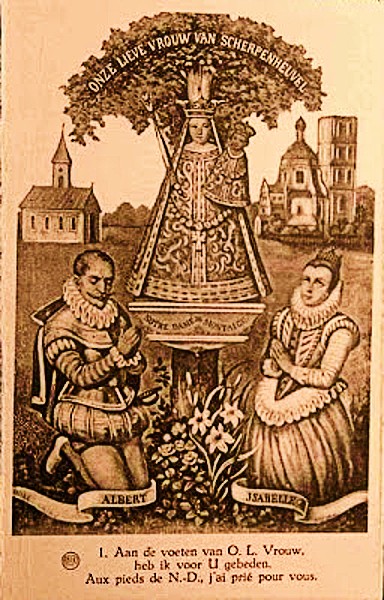
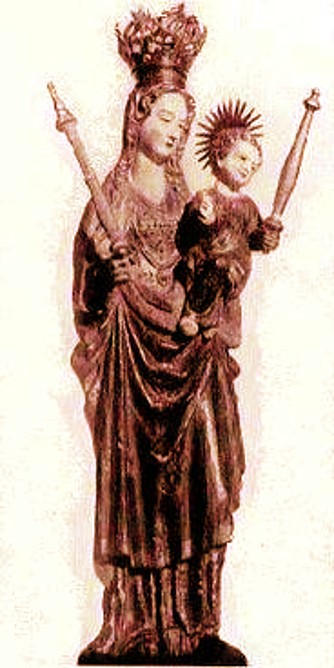
The Shrine in Brabant in the Duchy of Louvain, is a replacement of the one below Mount Garizim, Israel. Hadrian restored the temple on Mount Garizim and dedicated it to Jupiter. A small Christian community settled there and on several occasions they suffered greatly at the hands of the pagans. In 474 the Emperor, to avenge an unjust attack on the community, gave Mount Garizim to the Christians, who built on it a Church dedicated to the Blessed Virgin. After the Mohammedan conquest, Christianity practically disappeared from the district. The French made amends by erecting a Shrine to Mary in the Duchy of Louvain. The ancient Statue of Our Lady of Sichem, or as Our Lady of Montaigu-Zichem,which is the title more commonly used today, has been venerated in Belgium from very early times. The Mother of God rewarded the faithful magnanimously for their pious attention. According to legend, a shepherd boy originally found the Statue of Our Lady after it had apparently fallen from a niche cut in an old oak tree. The Statue was mysteriously too heavy for him to lift alone, so he ran to find his master, and have him return to help him replace the statue in its place in the old oak. It is said that in 1306 the Blessed Virgin Mary moved the hearts of the people by causing four drops of blood to flow from the eyes of the Statue. This revived the faith of the people and increased their fervour. A small Chapel was built beneath the tree, which was rebuilt in 1602 and the dedication of Our Lady of Sichem took place in the year 1604 by the Archbishop of Mechlin, Mathias Hovius. From that time forward, there were many miracles as Our Lady seemed to demonstrate her appreciation by granting many favours. The Statue was soon venerated as miraculous, and there have been many pilgrimages to the site during the centuries, continuing even until this day.
Bl Arnold Wala St Athanasius of Cilicia St Bertilia of Mareuil St Bertille of Thuringia St Blitmund of Bobbio (Died 660) Monk, Abbot St Constant of Gap St Cyrinus of Cyzicus St Daniel Himmerod the Younger Bl Daniel of Padua St Eustadius St Finlugh St Fintan of Doon St Florentius of Vienne St Florentius of Vienne the Martyr
Bl Gerard Cagnoli St Gordius of Cappadocia St Imbenia St Kuriakose Elias Chavara St Lucian of Lentini St Melorius St Peter of Palestine St Primus of Cyzicus St Salvator of Belluno St Theogenes of Cyzicus St Theonas St Theopemptus of Nicomedia St Wenog Bl William Vives St Zosimus of Cilicia
Martyrs of Africa – 12 saints: A group of Christians martyred together in Africa, date unknown, exact location unknown. We know nothing more than their names – Acuta, Candidus, Constantius, Eugenia, Firmus, Hilarinus, Lucida, Martial, Poenica, Possessor, Rogatianus and Statutianus.
Martyrs of Tomi – 7 saints: A group of Christians martyred together, date unknown. We know nothing more than their names – Claudon, Diogenius, Eugene, Eugentus, Pinna, Rhodes and Rhodo. They were martyred at Tomi, Exinius Pontus, Moesia (modern Constanta, Romania).
Thought for the Day – 2 January – Meditations with Antonio Cardinal Bacci (1881-1971)
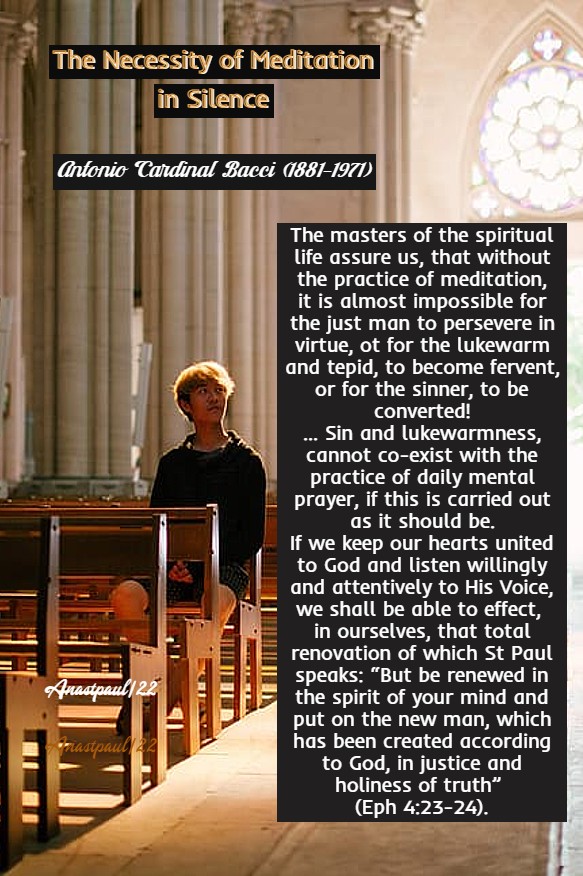
The Necessity of Meditation in Silence
“The masters of the spiritual life assure us, that without the practice of meditation, it is almost impossible for the just man to persevere in virtue, ot for the lukewarm and tepid, to become fervent, or for the sinner, to be converted! God, it is true, can work miracles. At times the grace of God can strike the sinner with the suddenness of a thunderbolt and convert him. But, it is the ordinary rule of the spiritual life, that meditation on the truths of eternity, especially on the Last Things, stirs up the soul and moves it, under the influence of Divine grace, to form good resolutions. Even though, the first fervour early diminishes, the daily repetition of this pious practice, revives and strengthens such good resolutions and causes them to be realised, in activities which are in accordance with Catholic teaching.
Sin and lukewarmness, cannot co-exist with the practice of daily mental prayer, if this is carried out as it should be. If we keep our hearts united to God and listen willingly and attentively to His Voice, we shall be able to effect, in ourselves, that total renovation of which St Paul speaks: “But be renewed in the spirit of your mind and put on the new man, which has been created according to God, in justice and holiness of truth” (Eph 4:23-24).”
Quote/s of the Day – 2 January – “Month of the Most Holy Name of Jesus”
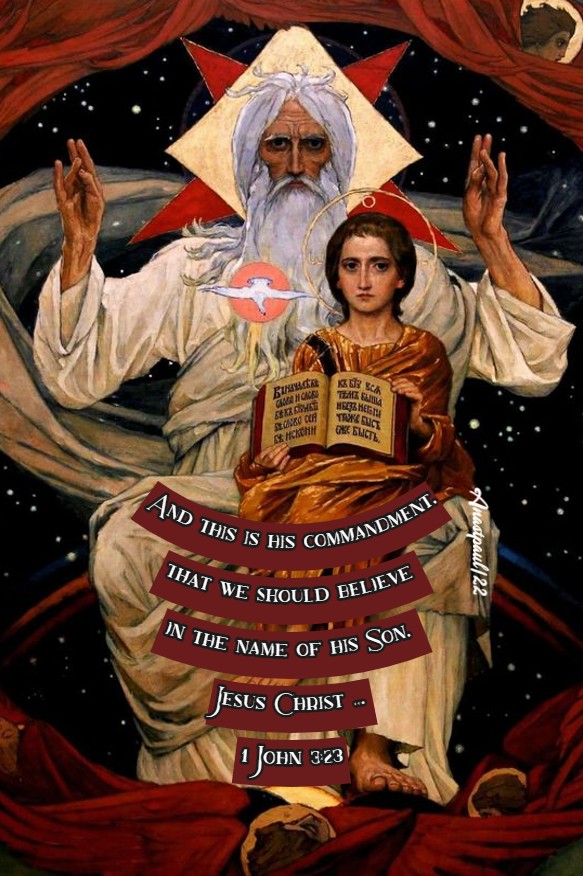
“And this is his commandment, that we should believe in the name of his Son, Jesus Christ … ”
1 John 3:23
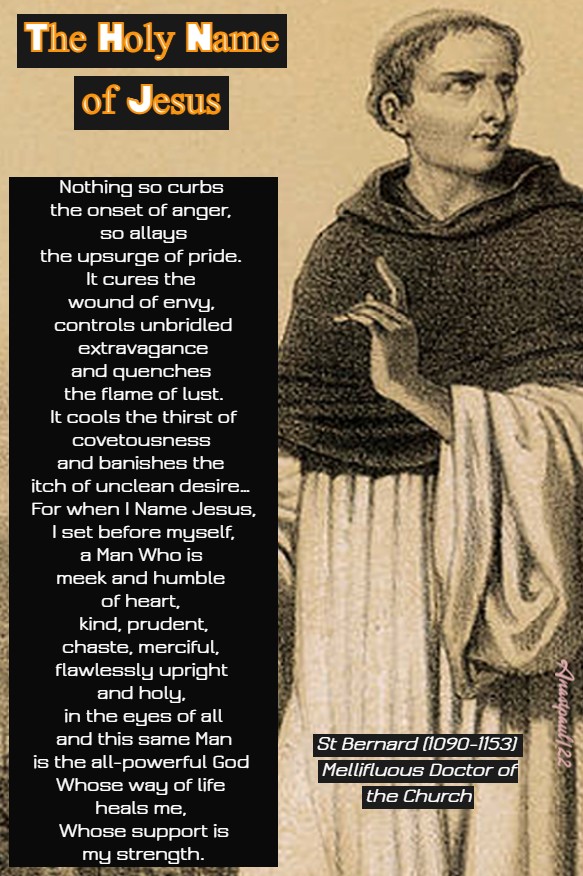
“Nothing so curbs the onset of anger, so allays the upsurge of pride. It cures the wound of envy, controls unbridled extravagance and quenches the flame of lust. It cools the thirst of covetousness and banishes the itch of unclean desire… For when I Name Jesus, I set before myself, a Man Who is meek and humble of heart, kind, prudent, chaste, merciful, flawlessly upright and holy in the eyes of all and this same Man is the all-powerful God Whose way of life heals me, Whose support is my strength.”
St Bernard (1090-1153) Mellifluous Doctor of the Church
(Sermon 15 On the Song of Songs)
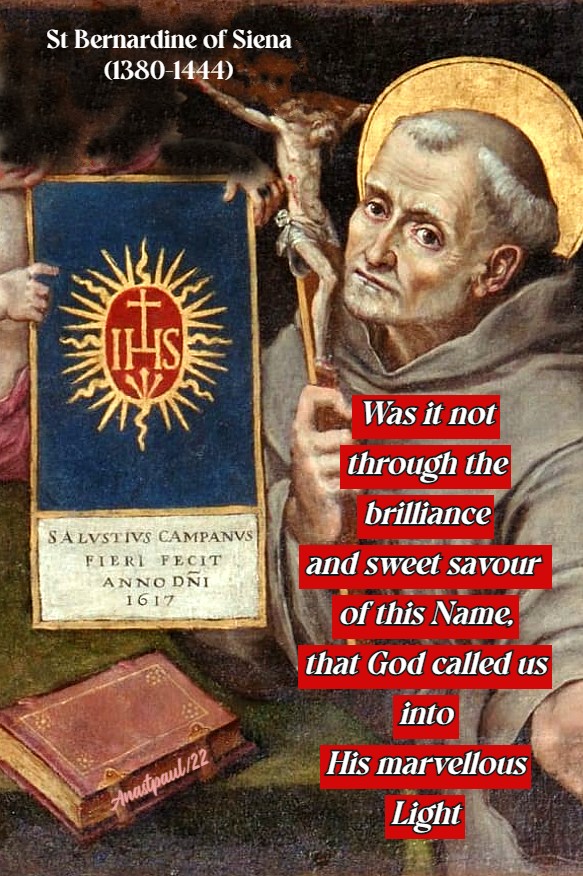
“Was it not through the brilliance and sweet savour of this Name, that God called us into His marvellous Light?”
St Bernardine of Siena (1380-1444)
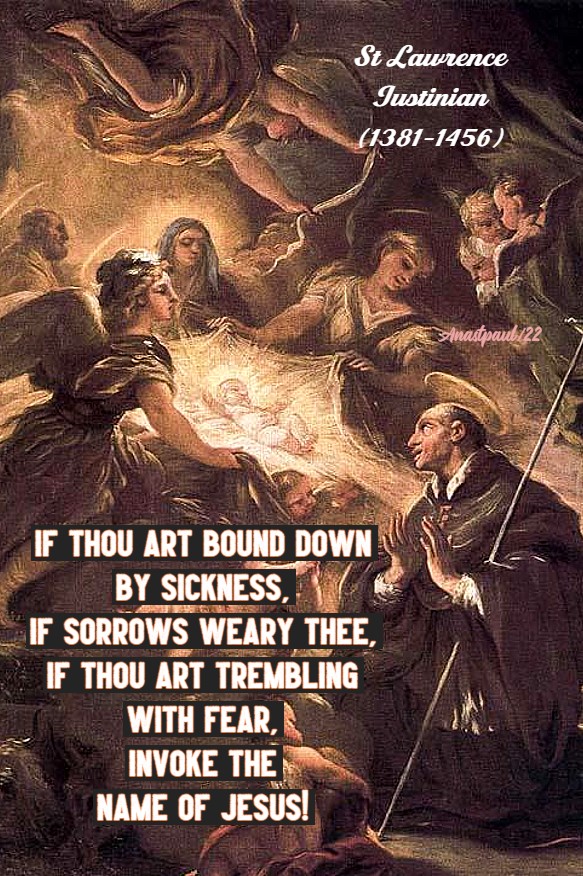
“If thou art bound down by sickness, if sorrows weary thee, if thou art trembling with fear, invoke the name of Jesus.”
One Minute Reflection – 2 January – “Month of the Most Holy Name of Jesus” – and the Feast of the Holy Name celebrated today (Feast 3 January), Readings: Epistle Acts 4:8-12, Psalm 105:47, Isa 63:16, Ps 144:21, Gospel Luke 2:21-24
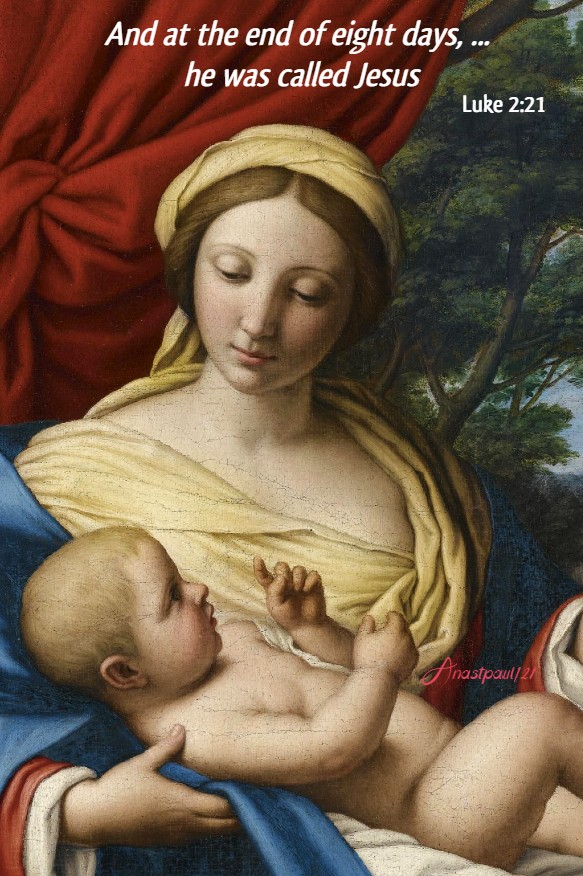
“And at the end of eight days, when he was circumcised, he was called Jesus”…Luke 2:21
REFLECTION – “The Name stands as a complete summary and description of our Lord’s character and office and it is under this aspect that it has been regarded by thousands of Saints, whose hearts have melted at its mere sound. To them Jesus is their God, Jesus is their King, Jesus is their Redeemer, Jesus is their Mediator, Jesus is their Saviour, Jesus is their great Priest, Jesus is their Intercessor, Jesus is the Captain under Whom they fight, Jesus is the Leader Whom they follow, Jesus is their Teacher, Jesus is the Giver of their law, Jesus is the Spouse and Shepherd of their souls, Jesus is their Light, Jesus is their Life, Jesus is the Judge before Whom they rejoice to think, that they must one day stand, Jesus is their final and eternal Reward, for which alone they live.
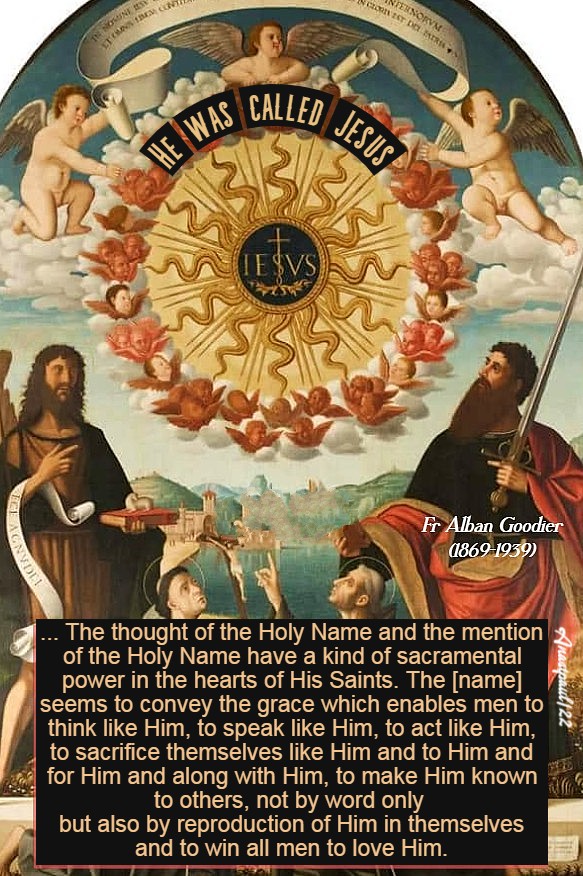
But He is also to them the Mirror of all the most glorious and winning virtues. He is, and His Name tells them that He is, unbounded Charity, infinite Mercy, extremest Kindness, deepest Humility, most devoted Piety, transparent Simplicity, uttermost Poverty, Chastity without a stain. It is the prerogative of love to transform those who love into the likeness of Him Whom they love and as the mere name of one who is loved cannot sound in the ear or be thought of in the mind, without adding to the love which is already there, so the thought of the Holy Name and the mention of the Holy Name have a kind of sacramental power in the hearts of His Saints. The [name] seems to convey the grace which enables men to think like Him, to speak like Him, to act like Him, to sacrifice themselves like Him and to Him and for Him and along with Him, to make Him known to others, not by word only but also by reproduction of Him in themselves and to win all men to love Him.” – Fr Alban Goodier SJ (1869-1939) Archbishop – Excerpted from The Prince of Peace.
PRAYER – O God, who founded the salvation of the human race on the Incarnation of Your Word, give Your people the mercy they implore, so that all may know there is no other Name to be invoked but the Name of Your Only Begotten Son. Who lives and reigns with You in the unity of the Holy Spirit, one God, forever and ever. Amen.
Our Morning Offering – 2 January – “Month of the Most Holy Name of Jesus” and the Feast of the Holy Name celebrated today (Feast 3 January)
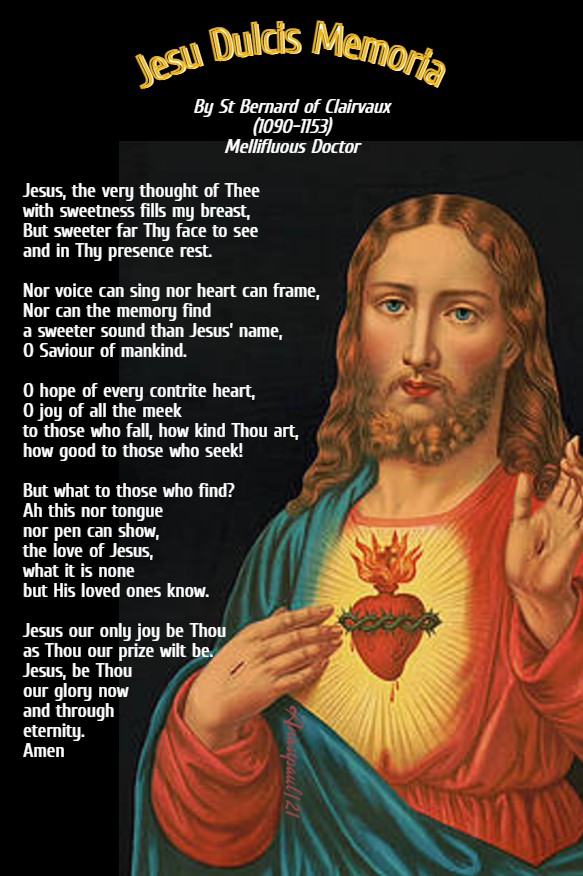
Jesu, Dulcis Memoria Prayer, Poem, Hymn By St Bernard of Clairvaux (1090-1153) Doctor Mellifluous Trans. Fr Edward Caswell C.Orat. (1814-1878)
Jesus, the very thought of Thee With sweetness fills the breast! Yet sweeter far Thy face to see And in Thy presence rest. No voice can sing, no heart can frame, Nor can the memory find, A sweeter sound than Jesus’ Name, The Saviour of mankind. O hope of every contrite heart! 0 joy of all the meek! To those who fall, how kind Thou art! How good to those who seek! But what to those who find? Ah! this Nor tongue nor pen can show The love of Jesus, what it is, None but His loved ones know. Jesus! our only hope be Thou, As Thou our prize shall be; In Thee be all our glory now, And through eternity. Amen
Jesu, Dulcis Memoria is a celebrated 12th century prayer/hymn by St Bernard of Clairvaux (1090-1153), Doctor Mellifluous. The entire hymn has some 42 to 53 stanzas depending upon the translation. Parts of this hymn are used for the Feast of the Holy Name of Jesus on 3 January.
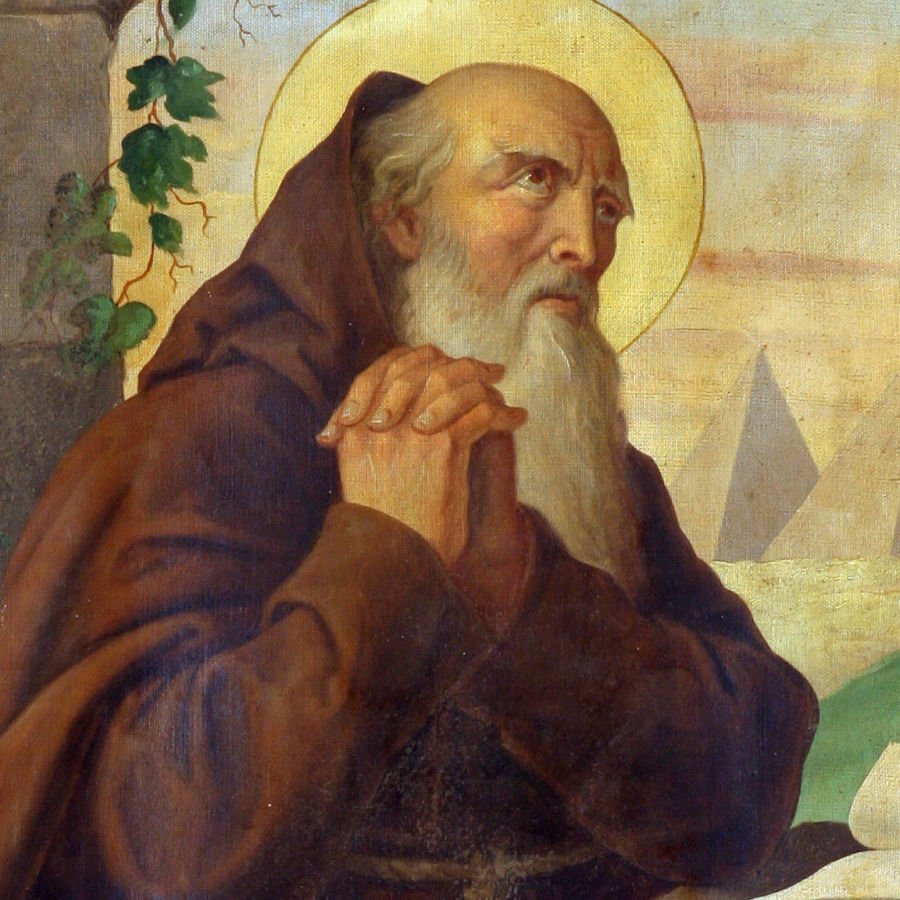
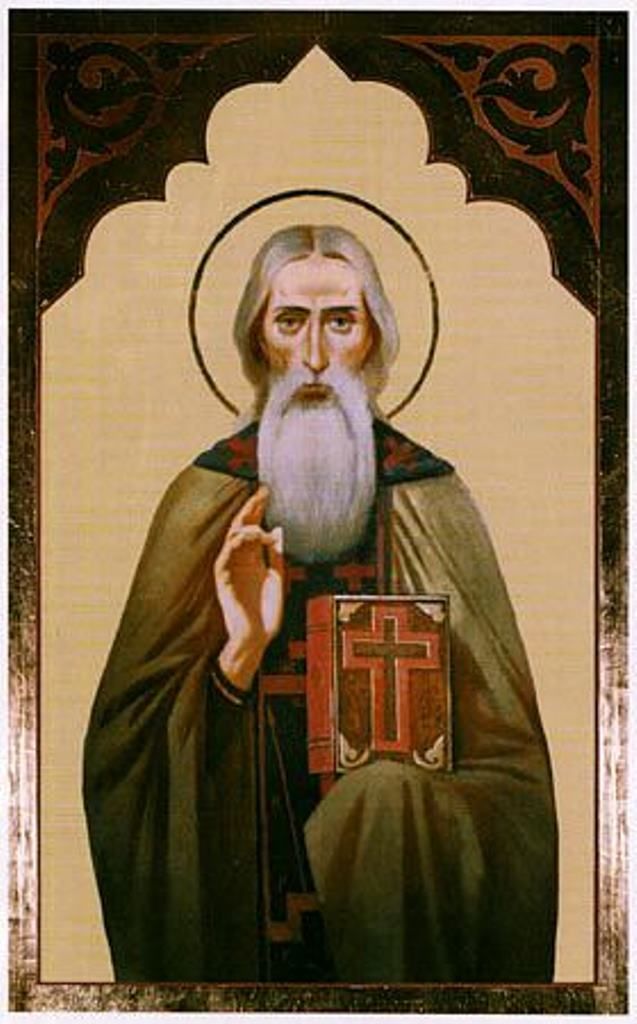
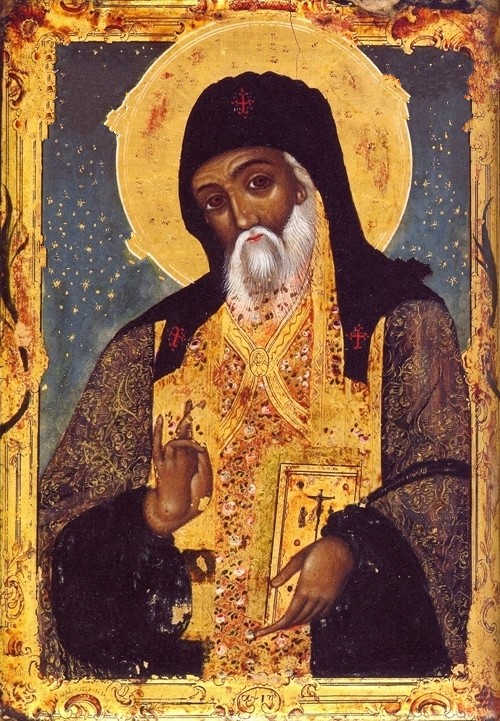
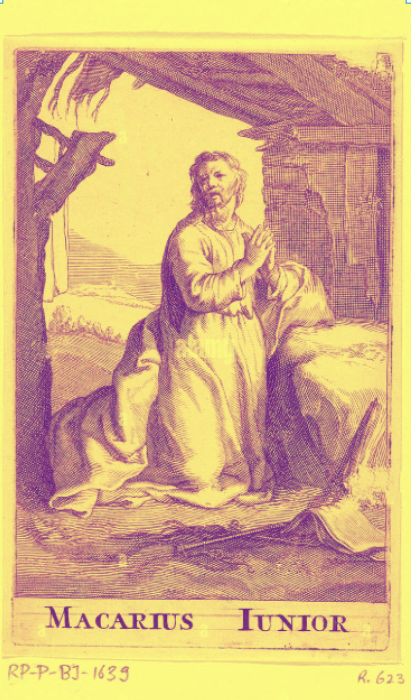
Saint of the Day – 2 January – Saint Macarius the Younger of Alexandria (Died c 401) Priest, Monk, desert Hermit, Abbot, Ascetic, Poet, miracle-worker. Born in the early 4th century at Alexandria, Egypt and died in c 401 in Alexandria, Egypt of natural causes. Also known as – Macarius of Alexandria, Macarius the Alexandrian. Additional Memorials – 1 May on the Coptic Catholic calendar. Patronages – confectioners, cooks, pastry chefs.
Macarius was a Successful merchant in fruits, sweetmeats and pastries in Alexandria, Egypt. In 335, when he converted to Christianity, he gave up his business to become a Monk and Hermit in the Thebaid dara, in Upper Egypt. For a while he lived near to and was a friend of Saint Anthony the Abbot. He was exiled by heretic Arians with Saint Macarius the Elder and other Monks to an island in the Nile because of his orthodoxy but he was later allowed to return. In later life he travelled to Lower Egypt, and was Ordained and lived in a desert cell with other Monks. He wrote a constitution for the Monastery at Nitria named after him and some of its rules were adopted by Saint Jerome for his Monastery.
Amazing accounts were told of his practice of severe austerities, some of which reached the proportion of legend. For seven years he lived on raw vegetables dipped in water with a few crumbs of bread, moistened with drops of oil on feast days. He once spent 20 days and 20 nights without sleep, burnt by the sun in the day, frozen by bitter desert cold at night. “My mind dried up because of lack of sleep and I had a kind of delirium,” he admitted. “So I gave in to nature and returned to my cell.”
In 373, to obtain greater solitude and longing to attain unity with God, Macarius moved to the desert of Nitria in Lower Egypt. The journey was through a harsh land, and when Macarius was at the end of his strength, the devil appeared and asked, “Why not ask God for the food and strength to continue your journey?” Macarius answered, “The Lord is my strength and glory. Do not tempt a servant of God.” The devil then gave him a vision of a camel laden with food. Macarius was about to eat but suspecting a trap he instead prayed very fervently and the camel vanished.
He spent six months nearly naked in the marshes, beset constantly by vicious blood-sucking flies and mosquitoes, in the hope of destroying his last bit of sexual desire. The terrible conditions and attacking insects left him so deformed that when he returned to the Monks, they could recognise him only by his voice.
A young brother once offered Macarius some very fine grapes. The old fruit dealer was about to eat when he decided to send them to a brother who was ill. This brother passed them to one he considered more in need; that one did the same and on and on, until the grapes made the rounds of all the cells and finally returned to Macarius, who we imagine then ate them?
Macarius returned to Skete and began to work on his worst worldly excess – his love of travel. The devil appeared and suggested Macarius go to Rome and chase out the demons there. Torn between travelling for such a good cause but wishing to fight his vice, Macarius filled a large basket with sand, put it on his back and set out. When someone offered to help him, he said, “Leave me alone! I am punishing my tormenter. He wishes to lead me, old and weak as I am, on a distant and vain voyage.” He then returned to his cell, body broken with fatigue but cured of his temptation.
In old age Macarius journeyed to a Monastery where 1,400 Hermits lived under the rigid rule of Saint Pachomius. Macarius was refused admittance. “You are too old to survive the great rigour we impose here,” Pachomius told him. “One should be trained in it from childhood, or else one cannot stand it. Your health would fail and you would curse us for harming you.” Macarius then stood at the Abbey gate for seven days and nights – without sleep, without food, without saying a word. Finally, the Monks relented and he let him in. Macarius stood in a corner of the Monastery in complete silence, for all of Lent, living on a few cabbage leaves each Sunday “more to avoid ostentation, than from any real need.” The Monks became so jealous of this new brother that they took their complaint to Pachomius, who asked God for illumination. When he learned that the old man was Macarius, he went to him and said, “My brother, I thank you for the lesson you have given myself and my sons. It will prevent us boasting about our modest mortifications. You have edified us sufficiently. Return to your own Monastery and pray for us each day.“
St Macarius, Pray for us each day too, we beg you!





























 AnaStpaul
You must be logged in to post a comment.