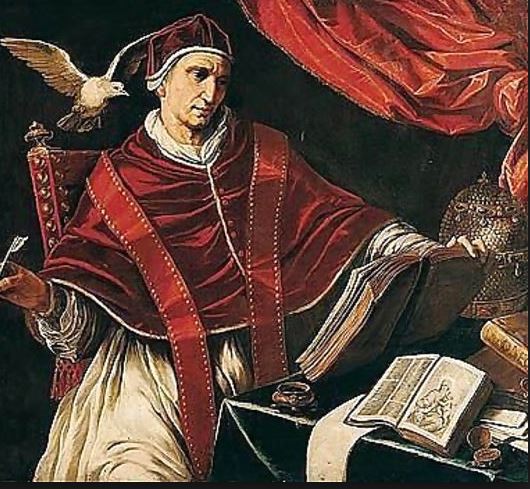
One Minute Reflection – 3 September – “The Month of The Seven Sorrows of the Blessed Virgin Mary and The Holy Cross” – St Pius X (1835-1914) Pope, Confessor – 1 Thessalonians 2:2-8; John 21:15-17 – Scripture search here: https://www.drbo.org/
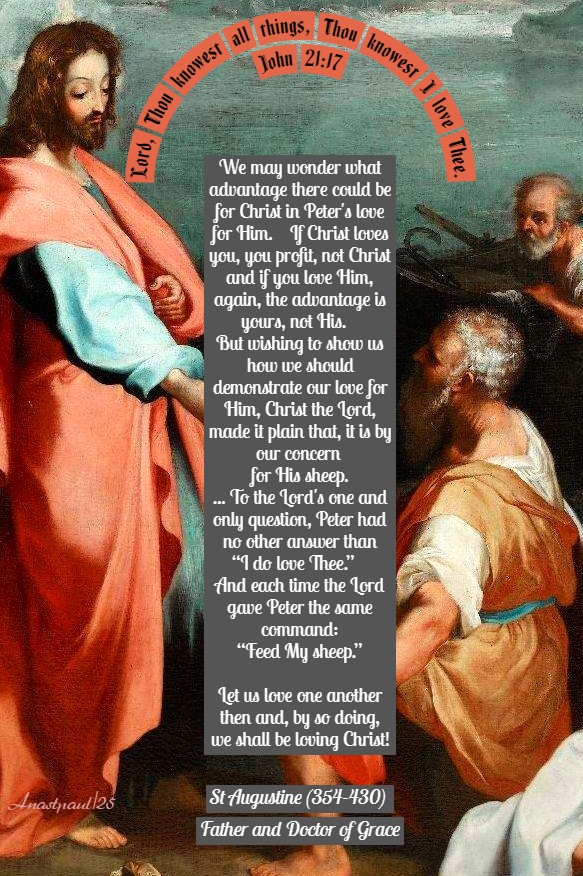
“Lord, Thou knowest all things, Thou knowest I love Thee.” – John 21:17
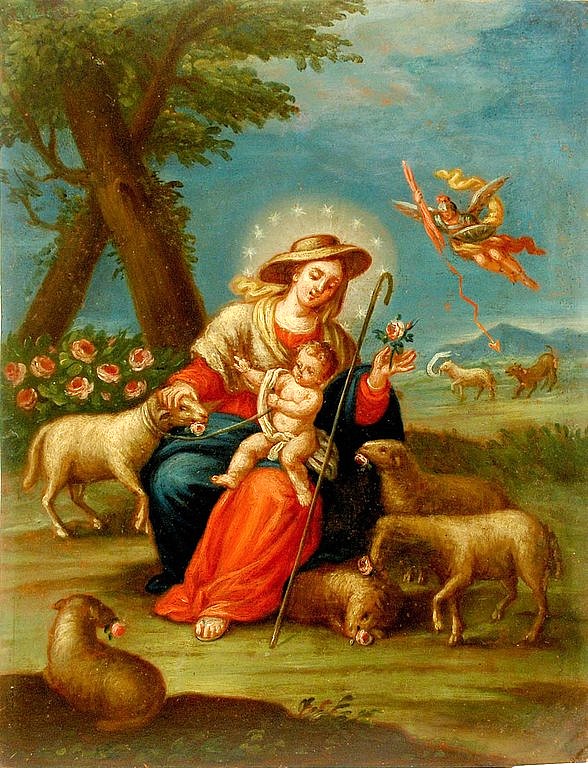
REFLECTION – “The Lord appeared once again to His disciples after His Resurrection and questioning Peter, who from fear had thrice denied Him, extracted from him a threefold declaration of love. Christ had been raised to life in the flesh and Peter to life in the spirit; for when Christ died, as a result of the torments He endured, Peter was also dead, as a result of denying his Master. Christ the Lord was raised from the dead; Christ the Lord raised Peter through Peter’s love for Him. And having obtained from him the assurance of that love, He entrusted His sheep to Peter’s care.
We may wonder what advantage there could be for Christ in Peter’s love for Him. If Christ loves you, you profit, not Christ and if you love Him, again, the advantage is yours, not His. But wishing to show us how we should demonstrate our love for Him, Christ the Lord, made it plain that, it is by our concern for His sheep.
“Simon, son of John, do you love Me?” He asked. “I do love Thee.” “Then feed My sheep.” Once, twice and a third time, the same dialogue was repeated. To the Lord’s one and only question, Peter had no other answer than “I do love Thee.” And each time the Lord gave Peter the same command: “Feed My sheep.” Let us love one another then and, by so doing, we shall be loving Christ!” – St Augustine (354-430) FBishop, ather and Doctor of Grace (Guelferbytanus Sermon 16).
PRAYER – O God Who, for the defence of the Catholic faith and the restoration of all things in Christ, filled St Pius, the Supreme Pontiff, with heavenly wisdom and apostolic fearlessness, mercifully grant that, by following his teachings and examples, we may receive Thy eternal rewards. Through Jesus Christ, Thy Son our Lord, Who lives and reigns with Thee, in the unity of the Holy Ghost, God, world without end. Amen (Collect).
Our Morning Offering – 3 September – “The Month of The Seven Sorrows of the Blessed Virgin Mary and The Holy Cross” – St Pius X (1835-1914) Pope, Confessor and today, Wednesday, being St Joseph’s day. St Joseph continues his fatherly guardianship of Christ’s Body, the Holy Catholic Church. He is a very powerful intercessor for all of us.
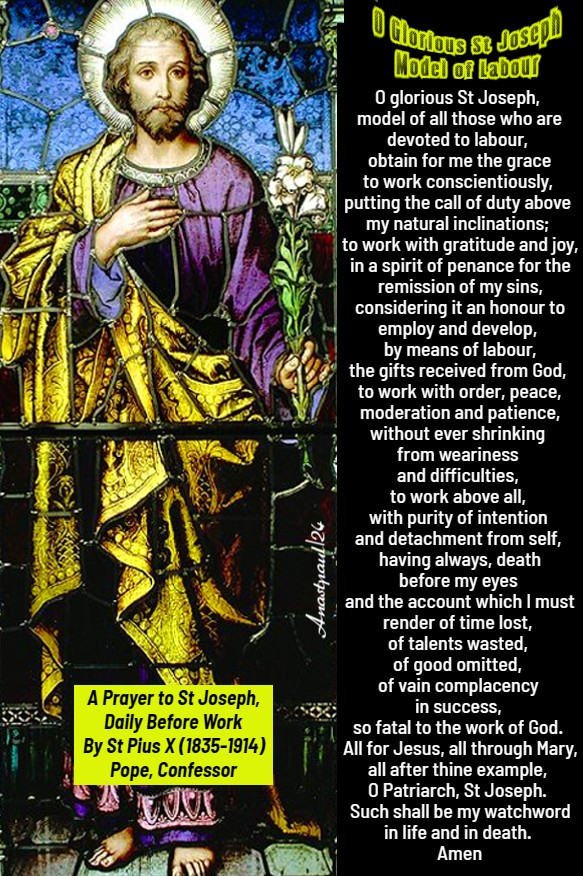
O Glorious St Joseph, Model of Labour A Prayer to St Joseph, Daily Before Work By St Pius X (1835-1914) Pope, Confessor
O glorious St. Joseph, model of all those who are devoted to labour, obtain for me the grace to work conscientiously, putting the call of duty above my natural inclinations; to work with gratitude and joy, in a spirit of penance for the remission of my sins, considering it an honour to employ and develop, by means of labour, the gifts received from God, to work with order, peace, moderation and patience, without ever shrinking from weariness and difficulties, to work above all, with purity of intention and detachment from self, having always, death before my eyes and the account which I must render of time lost, of talents wasted, of good omitted, of vain complacency in success, so fatal to the work of God. All for Jesus, all through Mary, all after thine example, O Patriarch, St Joseph. Such shall be my watchword in life and in death. Amen
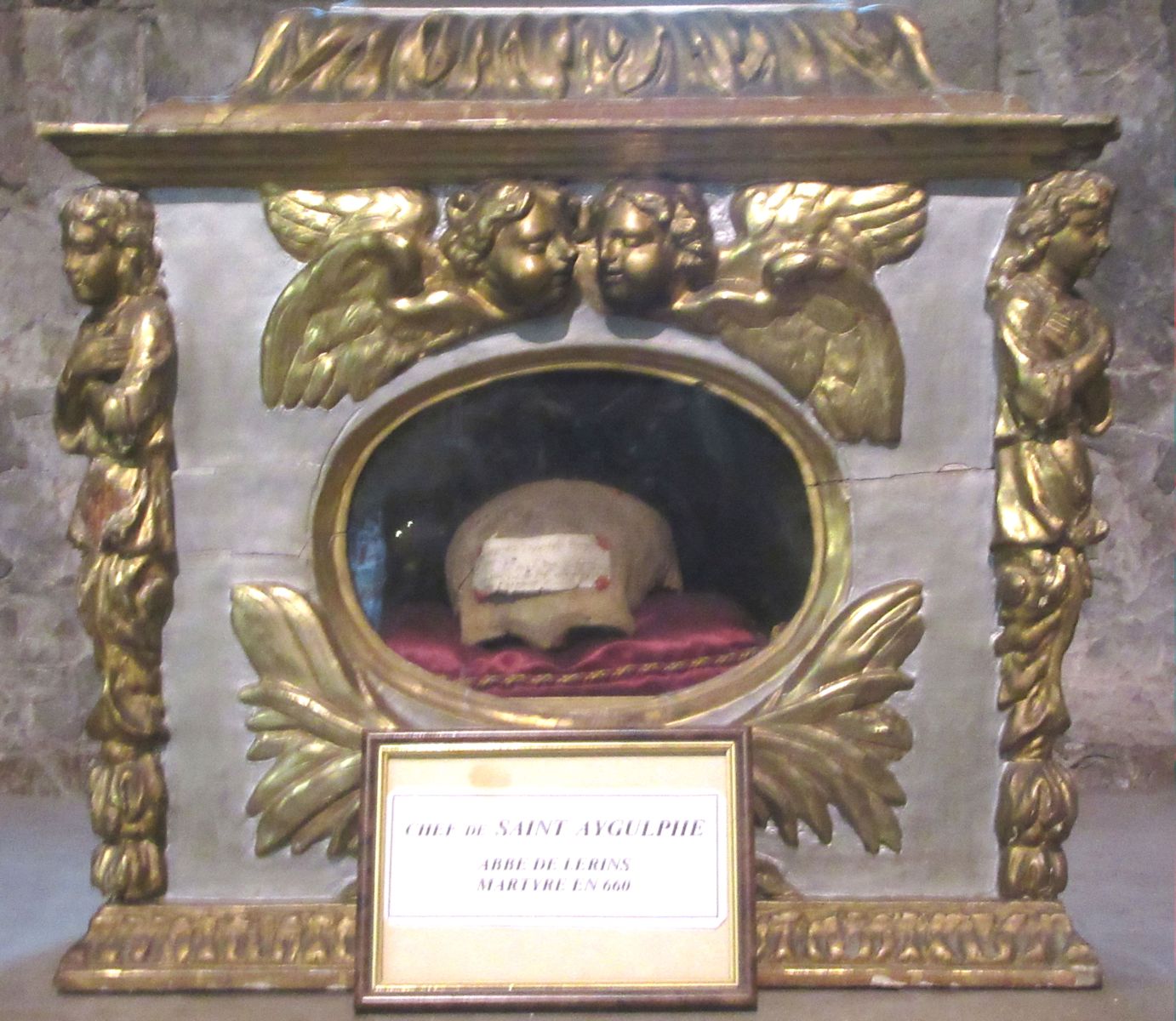
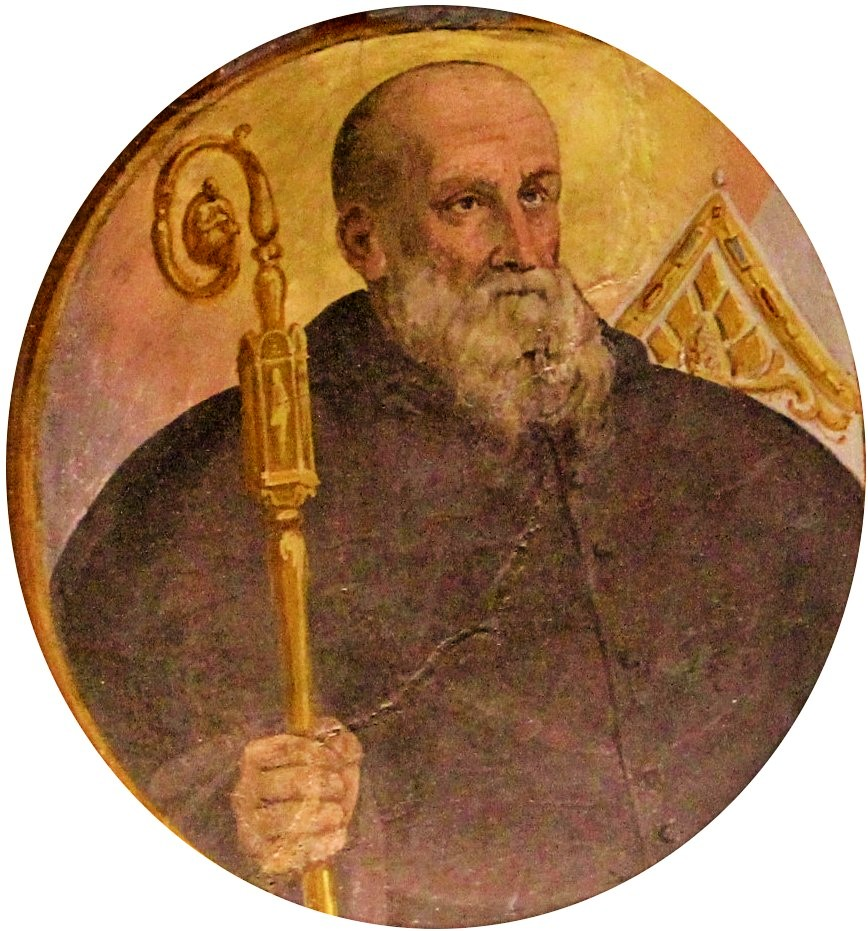
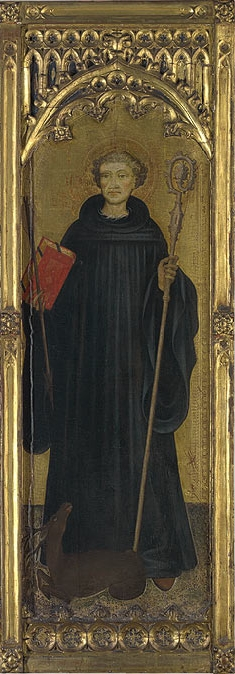
Saint of the Day – 3 September – St Aigulphus OSB (c630-c679) Abbot of Lérins. Born around 630 near Blois in France and died around 676 on the Island of Aigylion / Caprasia, today Capraia in Italy. Patronage – the cure of eyes ailments, against obsessions. Also known as – Aigulphe, Aygulphe, Ayou, Ayoul. Additional Memorial – 17 May (translation of Relics to Lérins).
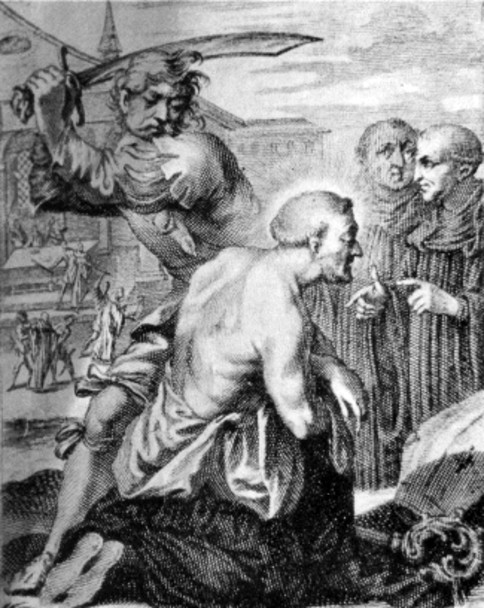
The Roman Martyrology reads today: “The birthday of the holy Martyrs, Aigulphus Abbot of Lérins and the Monks, his companions who, after their tongues were cut off and their eyes plucked out were murdered with the sword.”
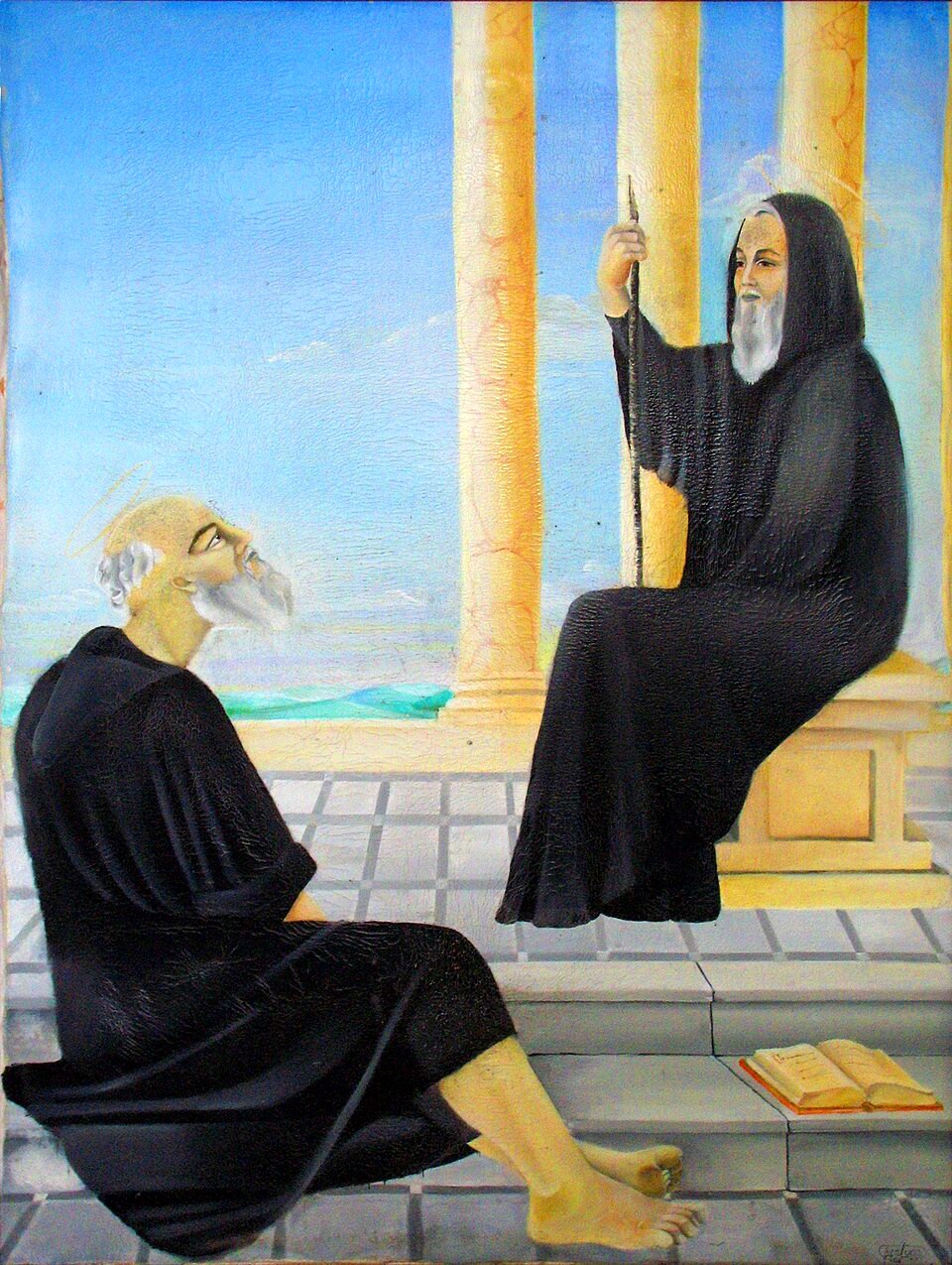
Aigulphus became a Benedictine Monk in the Monastery founded around 651 in Fleury – today’s Saint-Benoît-sur-Loire.
According to tradition, in around 655 he fetcjed the remains of Saints Benedict and Scholastica from the Monastery of Monte Cassino, which had been devastated by the Lombards. Around 661 he was elected as the Abbot of the Monastery on the Lérins Island. There he wanted to introduce the mixed Rule comprising elements of the Order of Columban and the Benedictines.
Aigulphus and 3 companion Monk were attacked by pagans who objected to the growing influence of the Monks. Horrible tortures were inflicted upon Aigulphus. His tongues and eyes were cut and gouged ou t. Then heand his companions were forced into exile on the Island of Caprasia – today’s Island of Capraia – where there was a colony of Hermits which is now named after St Aigulphus. He was finally killed by pirates on this Island. Some sources say that this torture and Martyrdom was actually perpetrated by Monks who disliked Aigulphus’ strict reforms.
It is often said that he had 33 companions but in reality there were probably only three, namely the monks Trucharius and Frongentius (Frugentius) and one whose name is unknown.
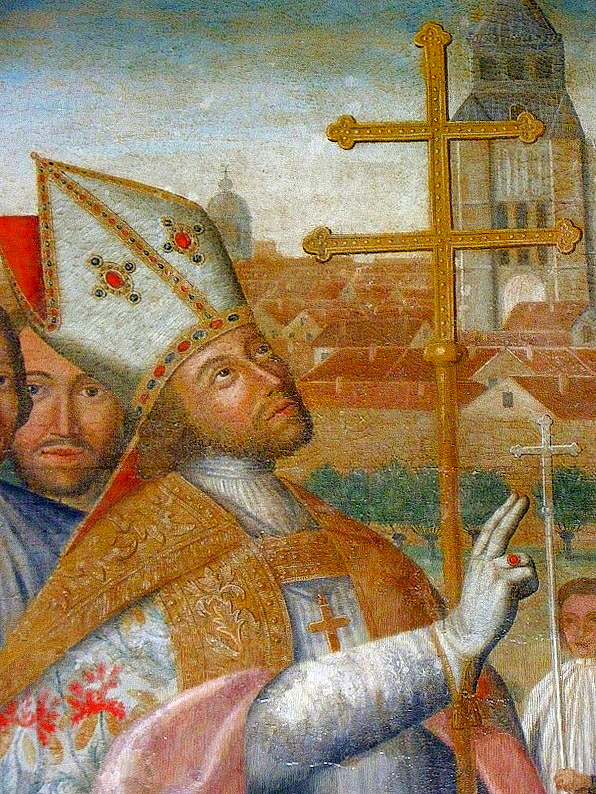
His remains were returned by Abbot Rigomir to the Monastery at Lérins. Relics were also brought to Provins and rediscovered there by Archbishop Seguin in the 10th Century. Part of the head Relic was brought to the Cathedra in Grasse, see below.
St Regulus of Rheims St Remaclus St Sandila of Cordoba St Vitalian of Capua (Died 699) Bishop
Martyrs of Aquileia – 4 Saints: Four young women, variously sisters and cousins, who were born to the nobility, the daughters of the pagans Valentinianus of Aquileia and Valentius of Aquileia. Each woman converted and made private vows, dedicating themselves to God. They were arrested, tortured and martyred by order of Valentius for becoming a Christian. We know little else but their names – Dorothy, Erasma, Euphemia and Thecla. They were martyred by beheaded in the 1st century in Aquileia, Italy and their bodies were thrown into a nearby river.
Martyrs of Nagasaki – 6 Beati: A group of Priests and Clerics, native and foreign, murdered together in the anti-Christian persecutions in Japan. They were scalded in boiling water and then burned alive on 3 September 1632 in Nishizaka, Nagasaki, Japan and Beatified on 7 May 1867 by Pope Pius IX. They are: Anthony Ishida, Bartolomé Gutiérrez Rodríguez, Francisco Terrero de Ortega Pérez, Gabriel Tarazona Rodríguez, Jerome of the Cross de Torres, Vicente Simões de Carvalho
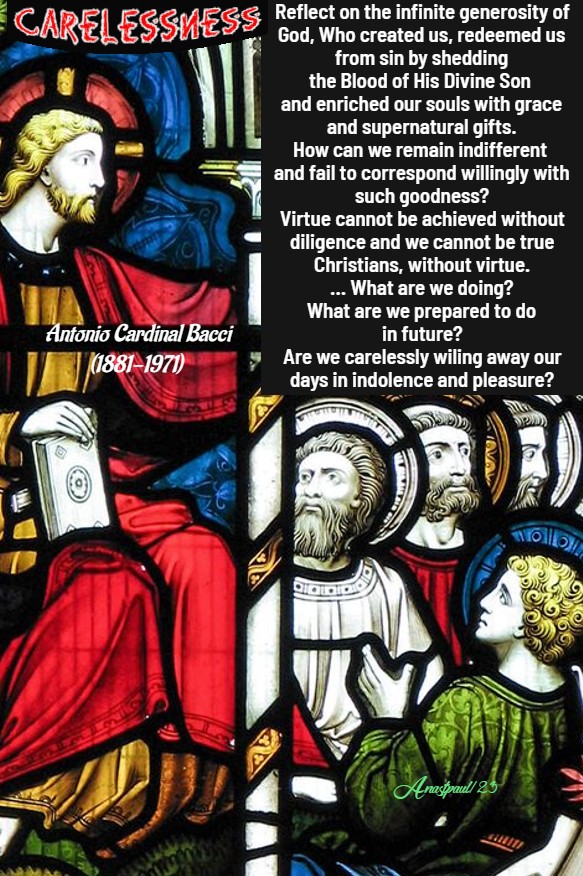
Thought for the Day – 2 September – Meditations with Antonio Cardinal Bacci (1881-1971)
CARELESSNESS
“Reflect on the Infinite generosity of God, Who created us, redeemed us from sin by shedding the Blood of His Divine Son and enriched our souls with grace and supernatural gifts. How can we remain indifferent and fail to correspond willingly with such goodness? Virtue cannot be achieved without diligence and we cannot be true Christians, without virtue. Let us consider the example given us by the Saints. They lived in a continual and prayerful union with God; they never refused any task or any sacrifice, in order to show their love for Jesus and their total dedication to His will; they made every effort to attract others towards holiness and to bring about the triumph of the Kingdom of Christ in the world.
What are we doing? What are we prepared to do in future? Are we carelessly wiling away our days in indolence and pleasure?”
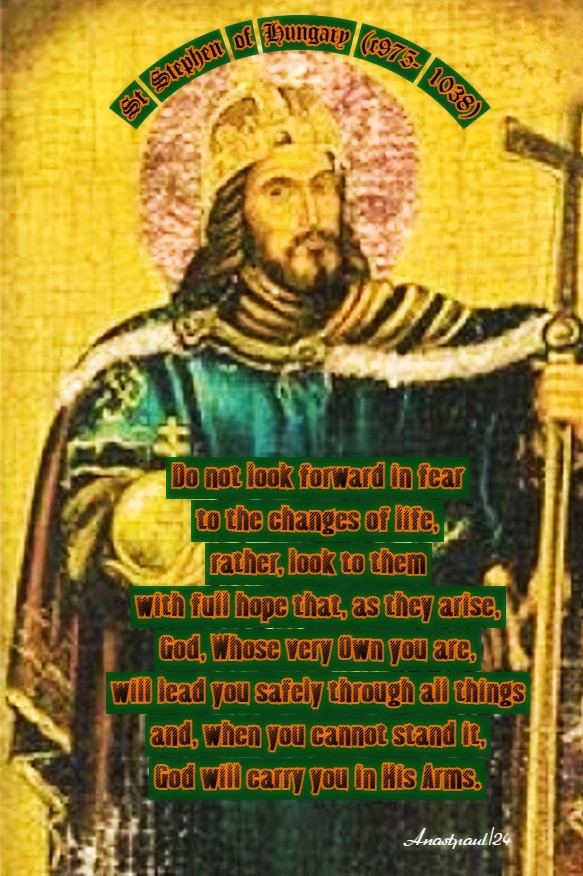
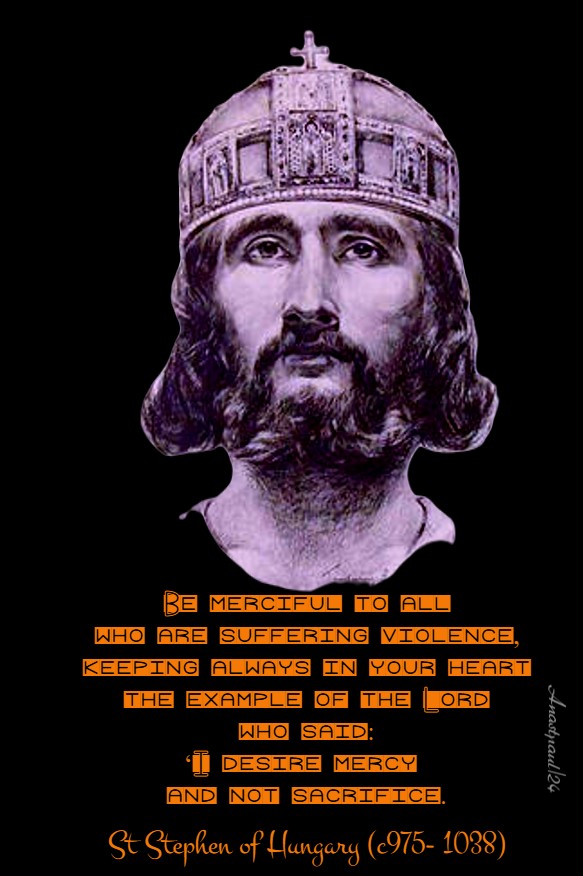
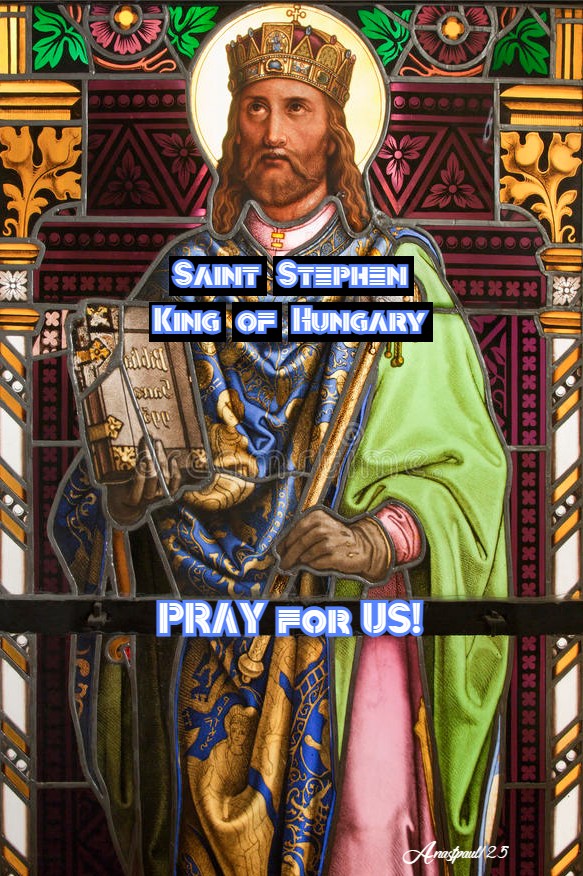
Quote/s of the Day – 2 September – St Stephen, King of Hungary (c975- 1038) Confessor
“Do not look forward in fear to the changes of life, rather, look to them with full hope that, as they arise, God, Whose very Own you are, will lead you safely through all things and, when you cannot stand it, God will carry you in His Arms.”
“Be merciful to all who are suffering violence, keeping always in your heart the example of the Lord who said: ‘I desire mercy and not sacrifice.’”
One Minute Reflection – 2 September – “The Month of The Seven Sorrows of the Blessed Virgin Mary and The Holy Cross ” – St Stephen King of Hungary (c975- 1038) Confessor – Ecclesiasticus Sirach 31:8-11 – Luke 19:12-26 – Scripture search here: https://www.drbo.org/
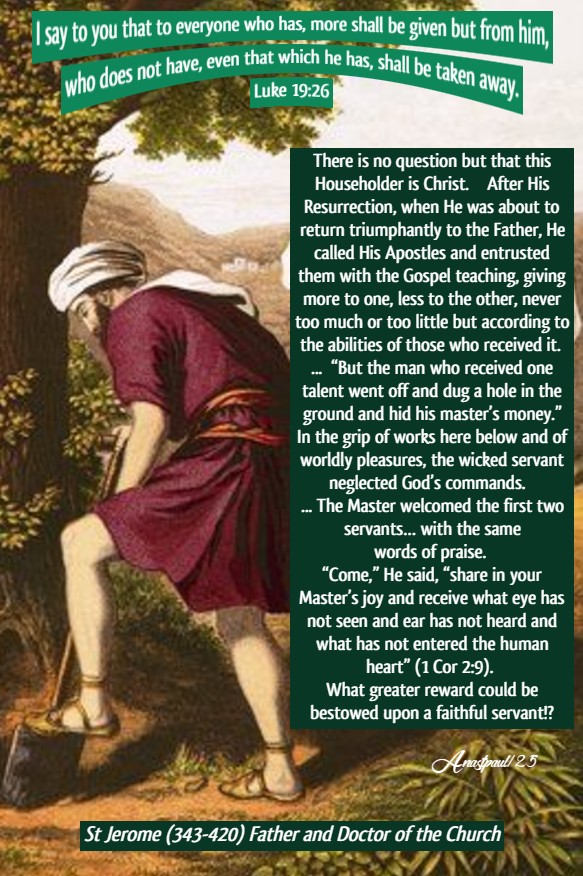
“I say to you that to everyone who has, more shall be given but from him, who does not have, even that which he has, shall be taken away.” – Luke 19;26
REFLECTION – “There is no question but that this Householder is Christ. After His Resurrection, when He was about to return triumphantly to the Father, He called His Apostles and entrusted them with the Gospel teaching, giving more to one, less to the other, never too much or too little but according to the abilities of those who received it. In the same way, the Apostle Paul said that he had fed with milk those unable to take solid food (1 Cor 3:2)…
Five, two, one talent: let us take these to be the different graces granted to each, whether the five senses for the first; understanding of faith and works for the second; the reasons for distinguishing us from other creatures, for the third. “The one who received five talents went away and traded with them and made another five.” That is to say, besides the physical and material senses he had received, he added knowledge of heavenly things. His knowledge was raised from the creatures to the Creator, from the corporal to the incorporeal, from the visible to the invisible, from the transient to the eternal. “The one who received two made another two.” This one likewise, according to his ability, doubled in the school of the Gospel what he had learned in the school of the Law. Or perhaps we could say, that he understood that knowledge of faith and the works of this present life, lead to future happiness. “But the man who received one talent went off and dug a hole in the ground and hid his master’s money.” In the grip of works here below and of worldly pleasures, the wicked servant neglected God’s commands. However, let us note that, according to another evangelist, he wrapped it in a linen cloth – by this we could understand that he took away the force of his Master’s teaching, by a life of softness and pleasure…
The Master welcomed the first two servants… with the same words of praise. “Come,” He said, “share in your Master’s joy and receive what eye has not seen and ear has not heard and what has not entered the human heart” (1 Cor 2:9). What greater reward could be bestowed upon a faithful servant!?” – St Jerome (343-420) Translator of Sacred Scripture (the Vulgate), Father and One of the Original Four Doctors of the Latin Church .
PRAYER – We beseech Thee, Almighty God, that Thy Church be worthy to have as her glorious defender in Heaven, the blessed Stephen, Thy Confessor, whom she had as her champion while he reigned on earth. Through Jesus Christ, Thy Son our Lord, Who lives and reigns with Thee, in the unity of the Holy Ghost, God, world without end. Amen (Collect).
Saint of the Day – 2 September – Saint Elpidius (4th Century) Abbot in Alcona, Italy, Monk, Hermit, Missionary to Italy, Born in Cappadocia in Asia Minor and died in Piceno, Ancona, Italy. Patronages – Sant’Elpdio a Mare, Sant’Elpidio Morico and Porto Sant’Elpidio, Italy. Also known as – Elpidius of Cappadocia, Elpidius the Abbot, Elpidius the Hermit, Elpidio…
The Roman Martyrology reads today: “In the Marche of Ancona, another St Elpidius, an Abbot. A Town hearing his name glories in the posseson of his sacred body.”
South of Ancona, several Towns bear the name of today’s Saint – Sant’Elpidio a Mare, Sant’Elpidio Morico and Porto Sant’Elpidio. In the Piceno area, this name is also frequently used by parents for their male children, yet, little is known about this Saint, so distant in time and memory that he has been confused with various other figures.
Some believe St Elpidius originated in Cappadocia. The writer Palladius recalls him in his Lausiac History as a Hermit who lived for many years in a cave near Jericho and sings the praises of an ascetic who, estranged from the company of men, chose the solitary ascent to the heights of Christian perfection.
At the time of Sant’Elpidius’ life, in the 4th Century, a new form of monasticism was gaining ground, with St Pachomius, the Founder of community life. In the Thebaid, near the Nile, he founded the first Convents of men and women, divided into individual cells, with a communal Church and refectory. At the head of each nucleus (the future Convent) was the Abbot, whose task was to ensure observance of the common Rule, enforcing chastity, work, fasting and the recitation of the Office.
A few years after St Pachomius, the great Church Fater, theologian and mystic, St Basil the Great, also of Cappadocia, issued a more moderate but wiser Rule, destined to become the constitutions, of all Christian monasticism, through the Benedictine Rule.
Elpidius had likely left the Monastery for a period of austere and solitude near Jericho, if we accept this version of the Saint’s life. He later moved to Piceno in Ancona, Italy, by the visitation and instruction of an Angel (see image below) to establish a Monastic community or at least to carry out some form of apostolate among the people. Some scholars, however, believe Elpidius was originally from Piceno and spent his entire life there, adhering to a highly personal ascetic rule, one which earned him the esteem and devotion, of the entire region. This great veneration has not yet diminished for the beloved St Elpidius who has interceded on many occasions for the welfar of the people and Towns under his patronage.
St Elpidius Relics eare nshrined in the Town of Cluana (modern Sant’Elpidio a Mare), Ancona, Italy. The miracles wrought through the veneration of these Relics saved the Town from a Lombarsiege when Elpidius appeared in the sky.
St Elpidius receives a vision in which an Angel informs him that he must evangelise in Ancona
St Prospero of Tarragona St Theodota of Bithynia St Valentine of Strasbourg St William of Roeskilde
Marytrs of Nicomedia – 3 Saints: Three Christians who were Martyred together in the persecutions of Diocletian. No details about them but their names have survived – Concordius, Theodore and Zenone. They were martyrd in Nicomedia, Bithynia (in modern Turkey).
The Holy Martyrs of September (Died 1792) – 191 beati: Also known as – Martyrs of Paris, Martyrs of Carmes. They were massacred by a mobs on 2 September and 3 September 1792 and Beatified on 17 October 1926 by Pope Pius XI. THEIR LIVES AND DEATHS: https://anastpaul.com/2021/09/02/saint-s-of-the-day-2-september-
Martyrs of 2 September – 10 Saints: A group of ten Martyrs; their names are on old Martyrologies but we have lost all record of their lives and deaths. They were Canonised: Antoninus, Diomedes, Eutychian, Hesychius, Julian, Leonides, Menalippus, Pantagapes, Philadelphus, Philip.
Holy Bishops of Rennes: Honours all the Bishops of the Diocese of Rennes, France who have been recognised as Saints and Beati. They include Saint Maximinus of Rennes Saint Modéran of Rennes Saint Rambert of Rennes Saint Riotisme of Rennes Saint Servius of Rennes Saint Synchronius of Rennes
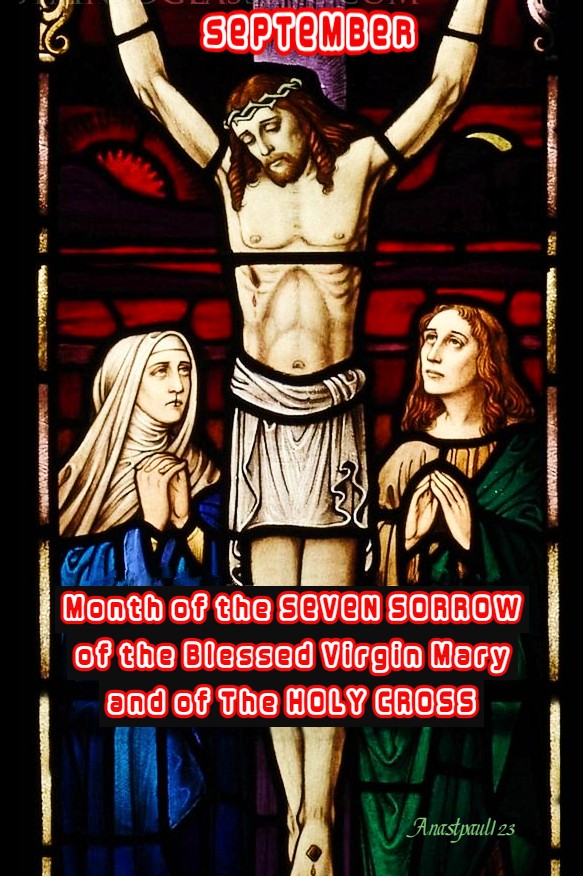
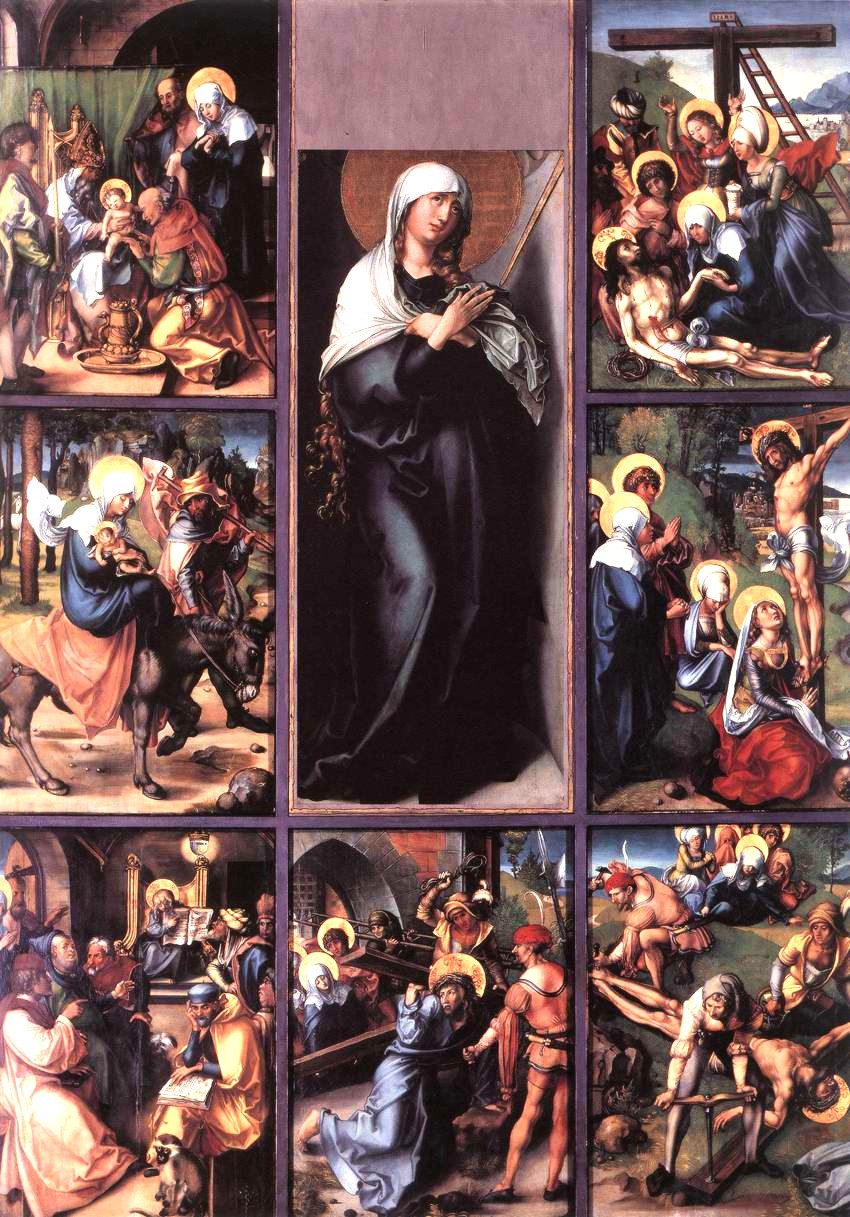
Month of The Seven Sorrows of the Blessed Virgin Mary and The Holy Cross
The Seven Sorrows of the Blessed Virgin Mary
1, The prophecy of Simeon 2. The Flight to Egypt 3. Loss of Child Jesus for 3 days 4. Meeting Jesus carrying His Cross 5. The Crucifixion of Jesus 6. The Pieta – receiving Jesus’ Body The Burial of Jesus
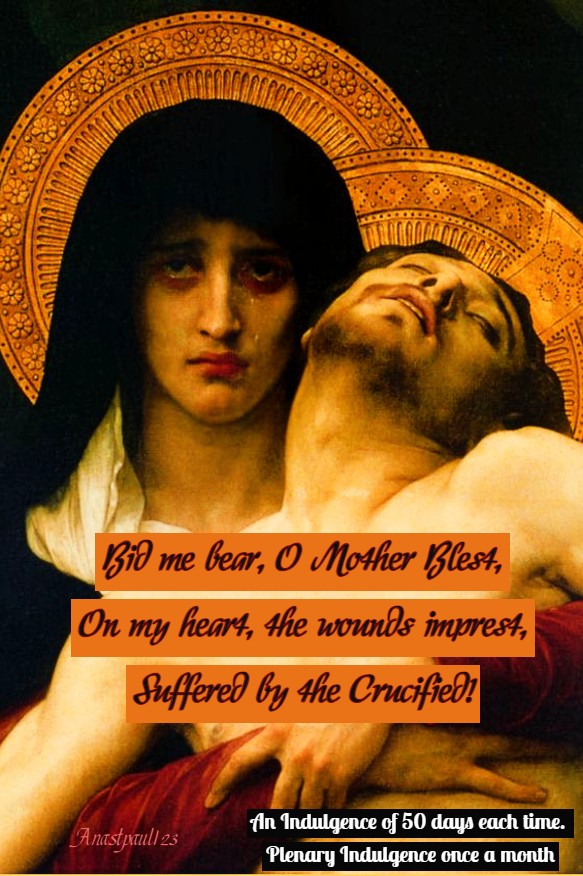
Bid me bear, O Mother Blest, On my heart, the wounds imprest, Suffered by the Crucified!
An Indulgence of 50 days each time. Plenary Indulgence once a month under the usual conditions.
What Can I Say? By St Anselm (1033-1109) Magnificent Doctor Marian Doctor
My most merciful Lady, what can I say about the fountains that flowed from your most pure eyes when you saw your only Son before you, bound, beaten and suffering? What do I know of the flood that drenched your matchless face, when you beheld your Son, your Lord and your God, stretched on the Cross without guilt, when the flesh of your flesh was cruelly butchered by wicked men? How can I judge, what sobs, troubled your most pure breast, when you heard, “Woman, behold your son,” and the disciple, “Behold, your Mother,” when you received as a son the disciple in place of the Master, the servant for the Lord? Amen
From “The Prayers and Meditations of Saint Anselm with the Proslogion,” Benedicta Ward, trans,1973, Penguin classics, Penguin Group (UK).
Thought for the Day –1 September – Meditations with Antonio Cardinal Bacci (1881-1971)
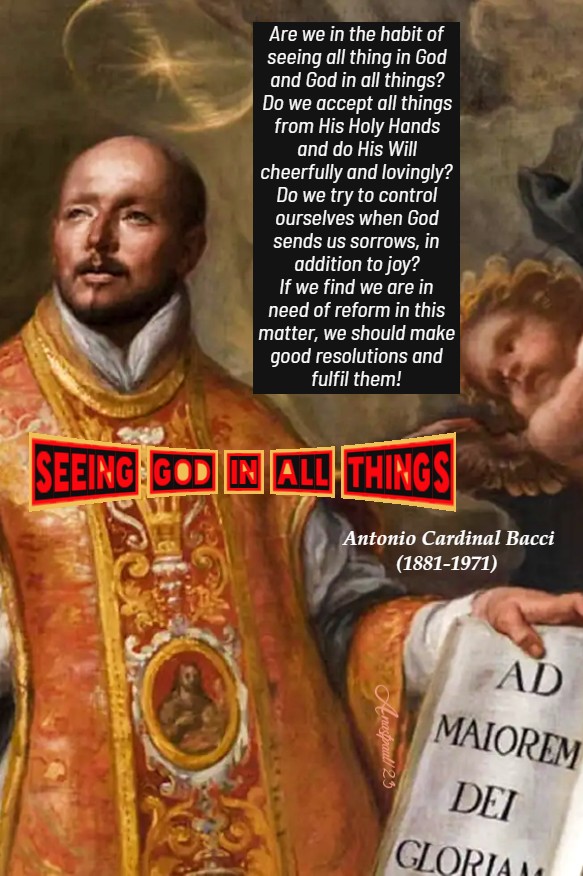
Seeing God in All Things
“Are we in the habit of seeing all thing in God and God in all things? Do we accept all things from His Holy Hands and do His Will cheerfully and lovingly?
Do we try to control ourselves when God sends us sorrows, in addition to joy? If we find we are in need of reform in this matter, we should make good resolutions and fulfil them!”
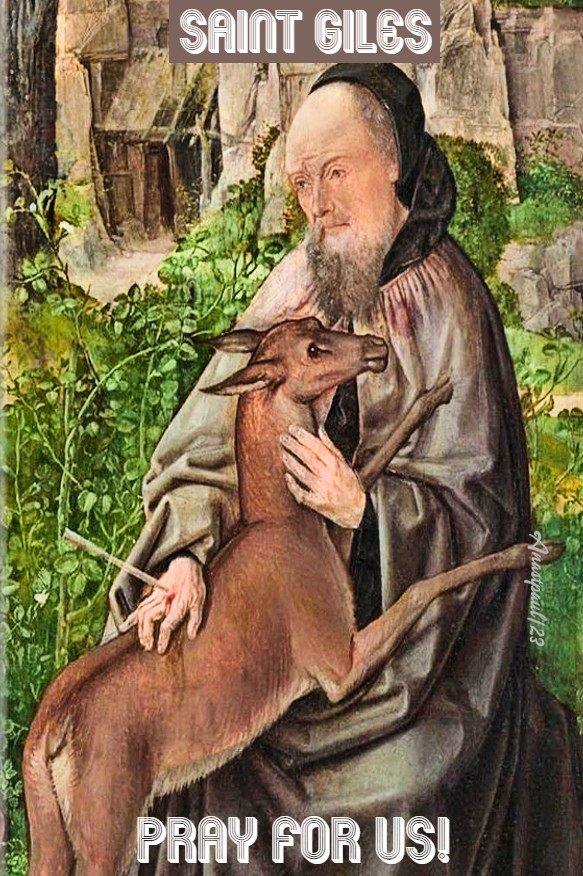
Quote/s of the Day – 1 September – “The Month of The Seven Sorrows of the Blessed Virgin Mary and The Holy Cross” – St Giles (c650 – c710) Abbot – Ecclesiasticus Sir ach 31:8-11 – Luke 12:35-40 – Scripture search here: https://www.drbo.org/
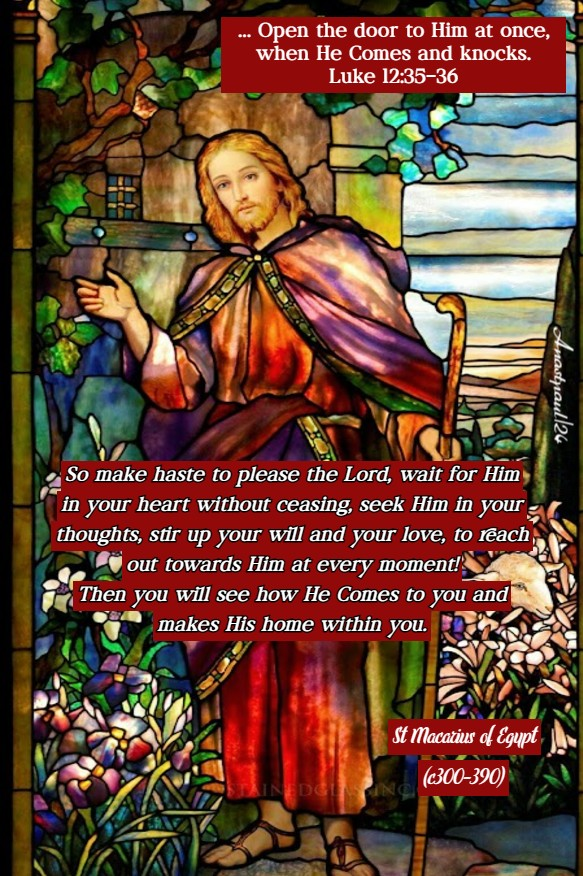
“Stay dressed for action and keep your lamps burning and be like men who are waiting for their master to come home from the wedding feast, so that they may open the door to Him at once, when He Comes and knocks.” Luke 12:35
“So make haste to please the Lord, wait for Him in your heart without ceasing, seek Him in your thoughts, stir up your will and your love, to reach out towards Him at every moment! Then you will see how He Comes to you and makes His home within you.”
St Macarius of Egypt (c300-390)
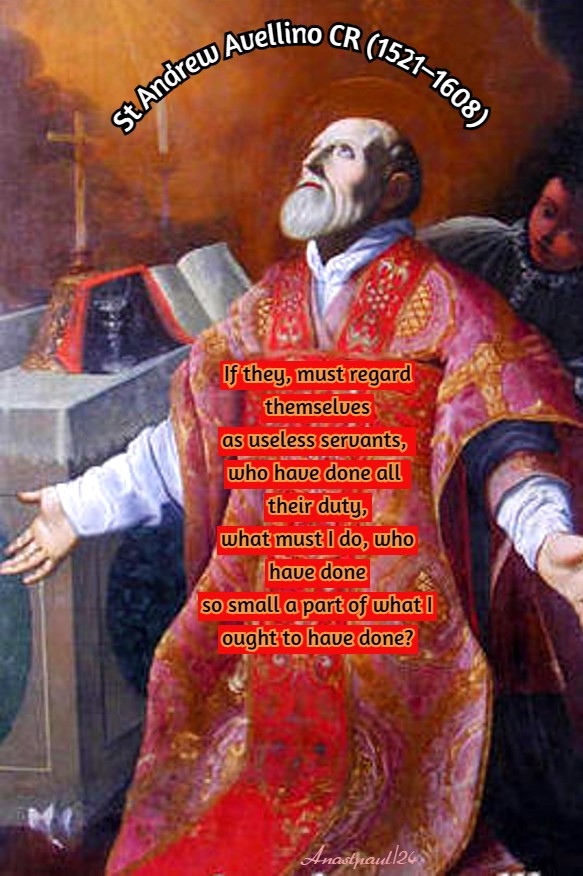
“If they, must regard themselves as useless servants, who have done all their duty, what must I do, who have done so small a part of what I ought to have done?”
One Minute Reflection – 1 September – “The Month of The Seven Sorrows of the Blessed Virgin Mary and The Holy Cross” – St Giles (c650 – c710) Abbot – Ecclesiasticus Sir ach 31:8-11 – Luke 12:35-40 – Scripture search here: https://www.drbo.org/
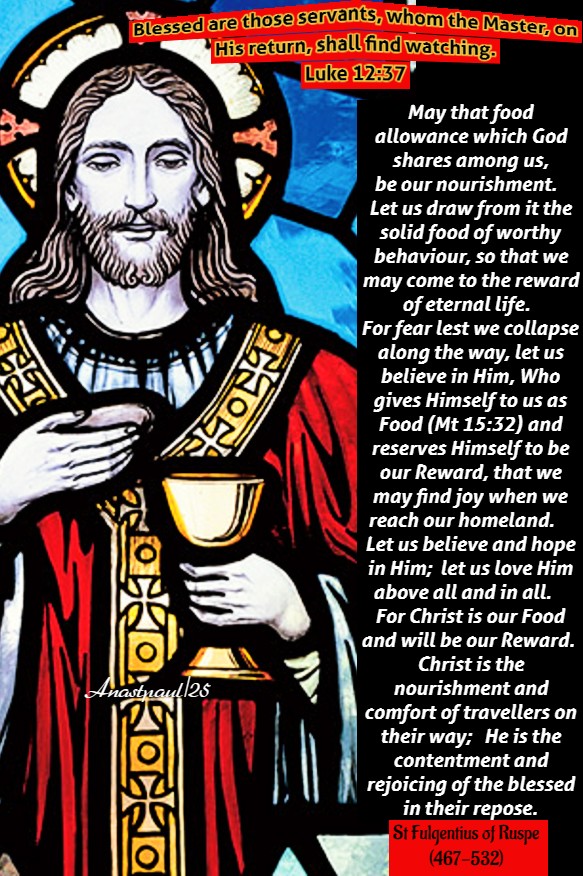
“Blessed are those servants, whom the Master, on His return, shall find watching.” – Luke 12:37
REFLECTION – “In order to clarify the role of the servants,He set at the head of His people, the Lord spoke this word related in the Gospel: “Who, then is the faithful and prudent steward whom the Master will put in charge of His servants to distribute the food allowance at the proper time? Blessed is that servant whom his Master on arrival, finds doing so”… If we should be wondering in what that food allowance consists, Saint Paul gives us the answer; it is “the measure of faith which God has apportioned” (Rom 12:). That which Christ called, an allowance of food, Paul termed, a measure of faith, to teach us that there is no other spiritual food than the Mystery of Christian faith. We give you this allowance of food in the Lord’s Name every time we speak to you according to the rule of the true Faith, illumined by the spiritual gift of grace. As for that allowance, you receive it at the hands of the Lord’s stewards each time you hear the Word of Truth from the mouth of God’s servants.
May that food allowance which God shares among us, be our nourishment. Let us draw from it the solid food of worthy behaviour, so that we may come to the reward of eternal life. For fear lest we collapse along the way, let us believe in Him, Who gives Himself to us as Food (Mt 15:32) and reserves Himself to be our Reward, that we may find joy when we reach our homeland. Let us believe and hope in Him; let us love Him above all and in all. For Christ is our Food and will be our Reward. Christ is the nourishment and comfort of travellers on their way; He is the contentment and rejoicing of the blessed in their repose.” – St Fulgentius of Ruspe (467-532) Bishop Father (Sermon 1, 2-3).
PRAYER – May the pleading of blessed Giles Abbo,t make us acceptable unto Thee O Lord, we pray that what we may not have through any merits of our own, we may gain by means of his patronage. Through Jesus Christ, Thy Son our Lord, Who lives and reigns with Thee, in the unity of the Holy Ghost, God, world without end. Amen (Collect).
Our Morning Offering – 1 September – “The Month of The Seven Sorrows of the Blessed Virgin Mary and The Holy Cross” –
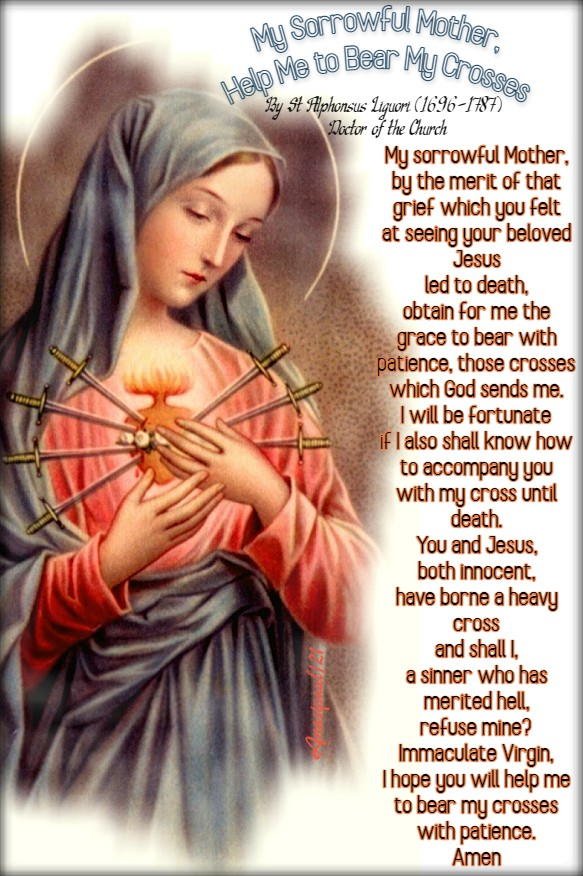
My Sorrowful Mother, Help Me to Bear My Crosses By St Alphonsus Liguori (1696-1787) Most Zealous Doctor of the Church
My sorrowful Mother, by the merit of that grief which you felt at seeing your beloved Jesus led to death, obtain for me the grace to bear with patience, those crosses which God sends me. I will be fortunate if I also shall know how to accompany you with my cross until death. You and Jesus, both innocent, have borne a heavy cross and shall I, a sinner who has merited hell, refuse mine? Immaculate Virgin, I hope you will help me to bear my crosses with patience. Amen
Saint of the Day – 1 September – St Verena (c260-c320) Virgin, Recluse, Ascetic, Apostle of the sick, gifted with the charism of curing illness and by her prayers, healing the sick, Miracle-worker. Born in Egypt in c260 and died in Tenedo, today (Bad) Zurzach, in Switzerland. Also known as – Verena of Zurzach, Verena of Thebes.Patronage – against eye ailments, children, fishermen, for male offspring, housewives, especially those serving in a presbitory, mariners, sailors, millers, nurses, poor people, ship captains, – in Switzerland: Basel, Diocese of Zurich.
The Roman Martyrology reads today: “In Baden, in the Diocese of Constance, St Verena, virgin.”
Verena was born to wealthy parents and Baptised in her hometown by Bishop Chaeremon of Nilopolis. She fell in love with a young Christian who was a member of the Theban Legion of St Maurice who was her cousin. When the Legion was ordered to Gaul by Emperor Maximilian around 300, Verena joined the entourage which travelled with the soldiers as far as Milan . There she lived in the house of the holy man St Maximus and fed and buried fellow Christian. When she heard of the beheading of St Maurice and his followers in Agaunum, she went there to bury them.
Then she travelled on to Solothurn, where Victor – according to some versions of the legend, her fiancé – and Ursus had also been Martyred. She settled there in a hermitage, a cave in the Verena Gorge near Solothurn which was later named after her and lived there as an ascetic.
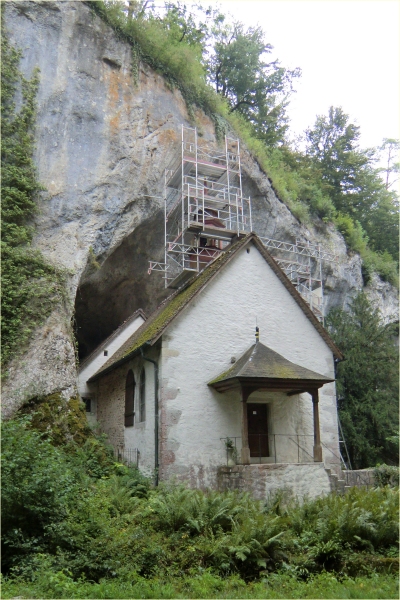
Martins Chapel, behind it the cave in which Verena is said to have lived, at the Hermitage in the St Verena Gorge near Solothurn
Verena often sought out lepers outside the gates of the City of Solothurn to wash them. Because of her healing powers, Verena was considered a Saint by the people; the sick sought her assistance and prayers in her hermitage through her miracles. Soon many young women joined her and formed a community. Verena supported herself and the these young women by selling handicrafts and converted many Alemanni to the Faith in Christ but was eventually imprisoned by the anti-Christian City Commander, Hirtacus. In prison, St Maurice appeared to her , radiant with heavenly light and strengthened her faith. When Hirtacus fell ill and was healed by Verena, he released her but expelled her from the City.
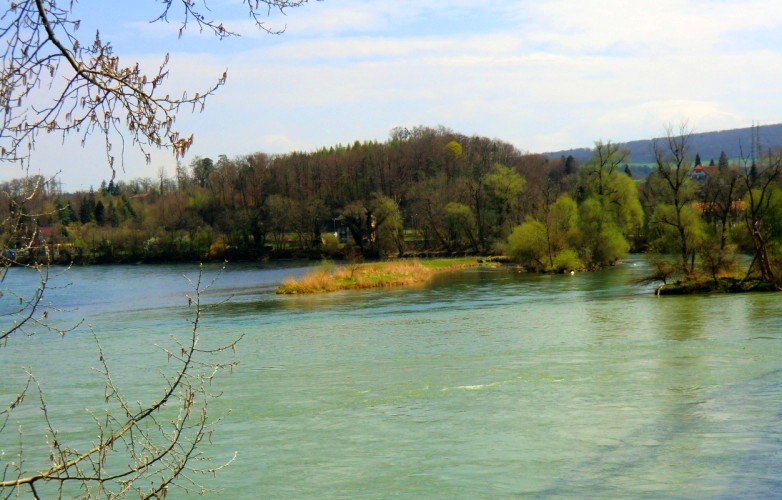
Verena is said to have then floated down the Aare River on a flat stone—or a millstone. In Koblenz, then a small Roman settlement, she made a long stop on an island in the Rhine, freed it of snakes and once again devoted herself to nursing the ill.
Island near Koblenz at the mouth of the Aare (right) into the Rhine (left)
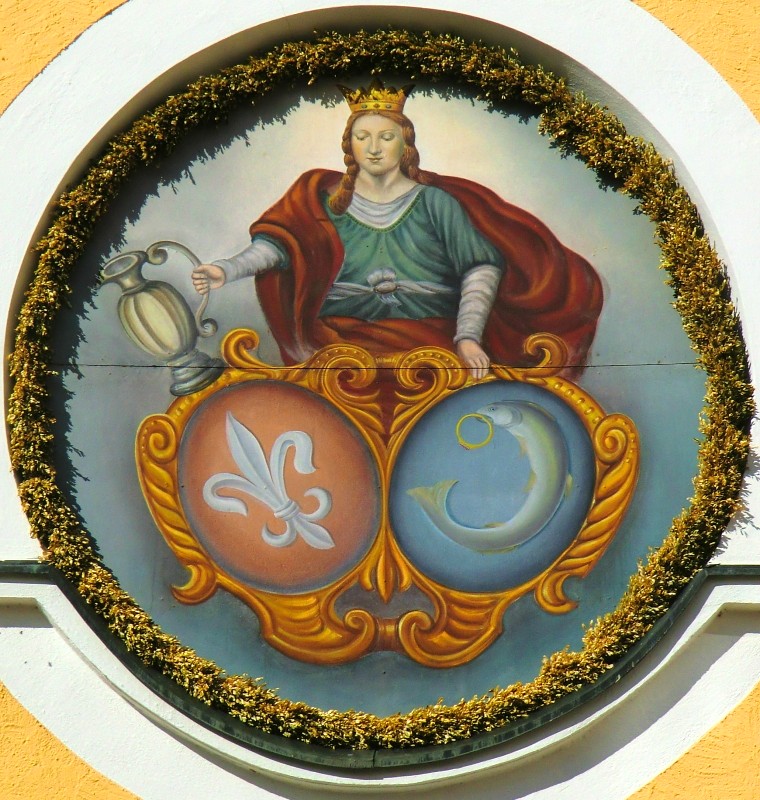
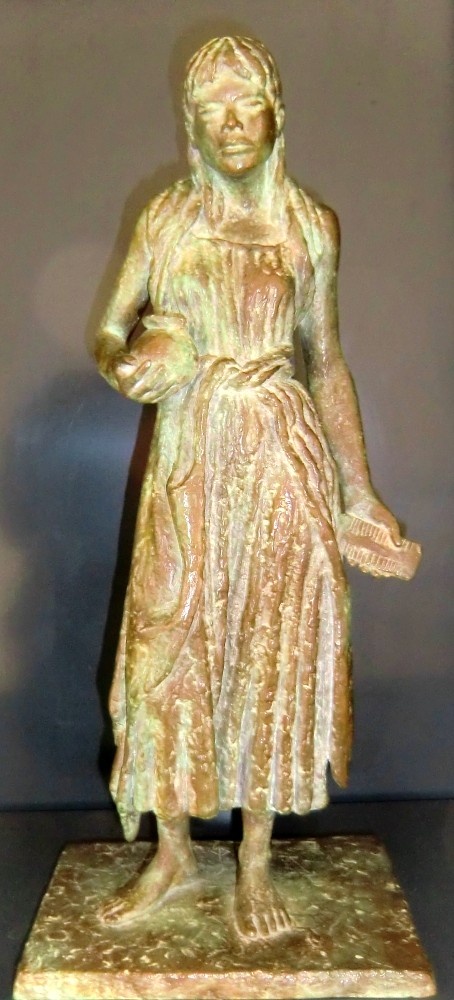
Then she came to the nearby Roman Fort of Tenedo – present-day Zurzach (Bad) – where she became the Priest’s domestic servant. Everyday, carrying a jug and comb, she went outside the City walls to wash the lepers. When she was accused of unlawfully carrying wine and bread to the poor, the wine turned into water. The Priest’s ring, which he refused to wear during Lent, was given to her for safekeeping. A servant, fearing discovery, stole it and threw it into the Rhine. A fisherman brought a large fish as a gift, and Verena cut it up and found the ring.
The Priest then had a cell built for her in Zurzach where, until her death, she washed the heads of the sick with the healing waters of a spring, combed their hair, healed them and anointed them. In her hour of death, Our Lady Mary appeared to Verena with many holy women who guided her to Heaven.
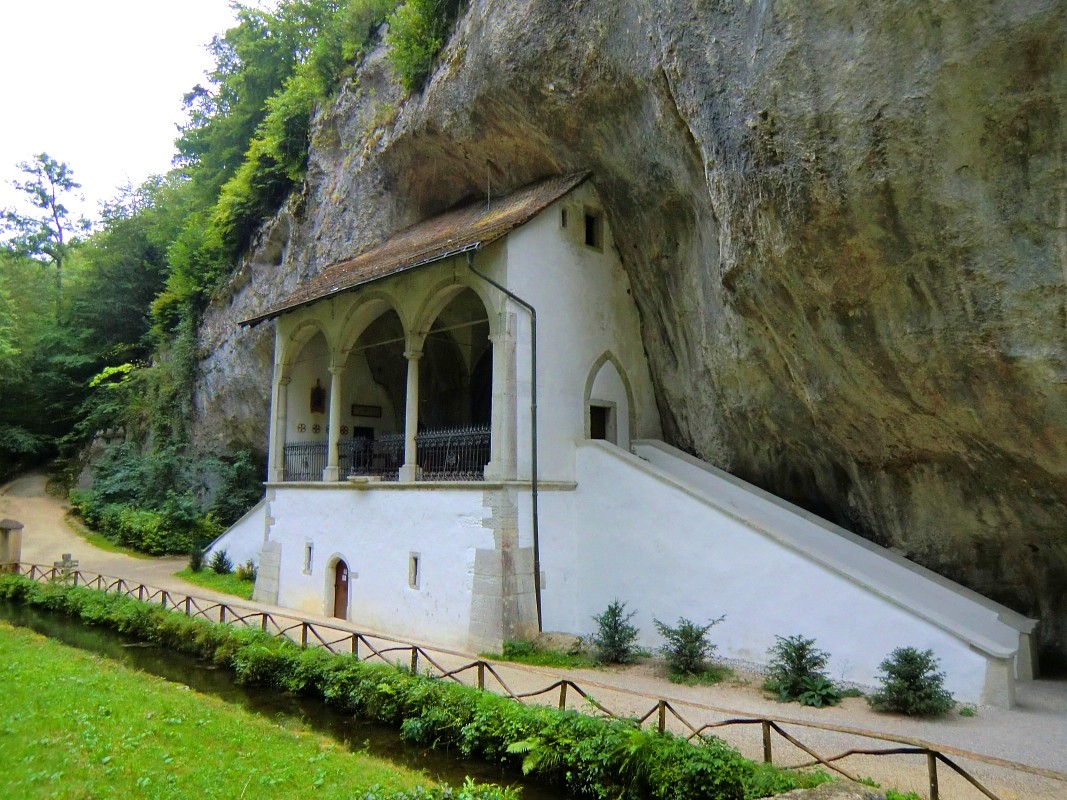
St Verena Chapel at the Hermitage in the St. Verena Gorge near Solothurn
Probably in the 5th Century – proven by archaeological finds – a Church was built over Verena’s grave which lay in a burial ground near an old Roman Fort on the Roman road – on the site of the Cathedral in Bad Zurzach which is now named after St Verena In around 745, a Benedictine Monastery was opened there. This Monastery was converted into a Canonry in the 13th Century and dissolved in 1876.
The first biography was written in 888 in Reichenau Monastery by the Benedictine Abbot Hatto, later Archbishop of Mainz; a further Vita with additions about her work in Koblenz and Zurzach was probably written in the Zurzach Monastery in the 10th Century and a collection of her miracles followed around 1000. Although heavily interspersed with legendary elements, they probably contain a historical core. The gravestone of her Sarcophagus was erected in 1613.
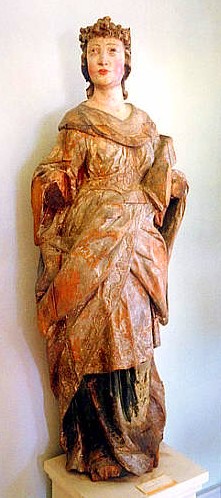
St Verena depicted at the Monastery Church in Rot an der Rot
The St Verena Minster in Bad Zurzach houses the arm Relic a valuable piece of gold from the 14th Century. Relics are also kept in the Minster in Radolfzell . The Church of the Monastery in Rot an der Rot, is dedicated to her. The small Church of St Verena in Rotholz near Lengstein/Longostagno – a district of Ritten near Bolzano – first mentioned in documents in 1256, is also named after her.
Gold figure at the Fountain in the Cathedral in Bad Zurzach
Twelve Holy Brothers: Martyrs of the South – A group of Martyrs who died c303 at various places in southern Italy. In 760 their relics were brought together and enshrined in Benevento, Italy as a group. Saint Arontius of Potenza, Saint Donatus of Sentianum, Saint Felix of Sentianum, Saint Felix of Venosa, Saint Fortunatus of Potenza, Saint Honoratus of Potenza, Saint Januarius of Venosa, Saint Repositus of Velleianum, Saint Sabinian of Potenza, Saint Sator of Velleianum, Saint Septiminus of Venosa, Saint Vitalis of Velleianum. One tradition describes Saint Boniface of Hadrumetum and Saint Thecla of Hadrumetum as their parents.
St Abigail the Matriarch St Aegidius St Agia St Anea St Arcanus St Arealdo of Brescia Bl Colomba of Mount Brancastello
St Constantius (Died c570) Bishop of Aquino, Italy. Gifted with the charism of Prophecy, St Gregory the Great himself says, in particular, that our Saint shone through the gift of prophecy and miracles. Patronage -Co-Patron with St Thomas Aquinas of the City of Aquino and the Diocese of Sora-Cassino-Aquino-Pontecorvo, Italy. The Roman Martyrology reads today: “At Aquino, Saint Constantius, a Bishop renowned for the gift of prophecy and many virtues.” Fervent St Constantius: https://anastpaul.com/2024/09/01/saint-of-the-day-1-september-st-constantius-died-c570-bishop/
DISCLAIMER: Please note: I cannot control the content of the Advertisements on this Site, or of pop-ups which may appear, The revenue from the Advertisements, however, does provide a little assistance in the support of the Site. I do apologise for any inappropriate content.
Thought for the Day – 31 August – Meditations with Antonio Cardinal Bacci (1881-1971)
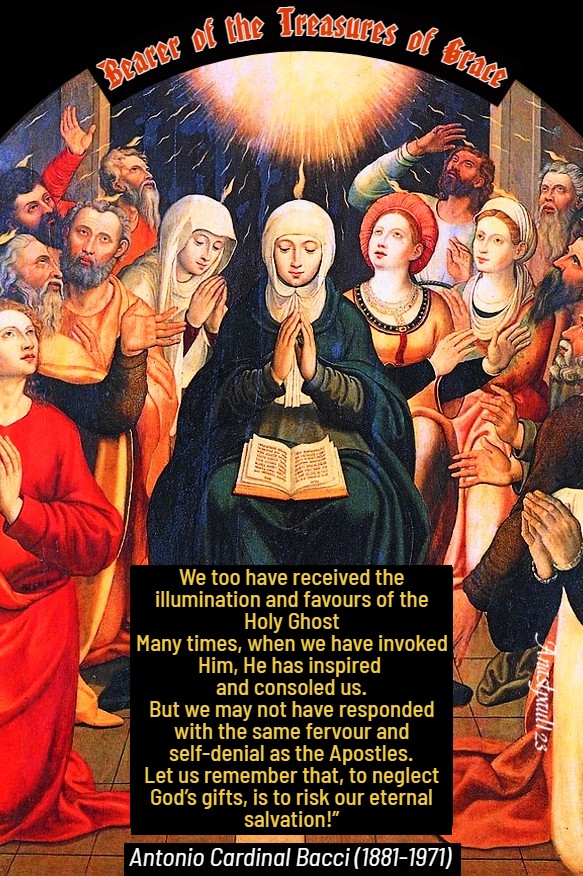
Bearer of the Treasures of Grace
“The Apostles were completely transformed after the Feast of Pentecost. They had been ignorant rustics, timid and vacillating. They had hardly understood at all, the lofty teachings of Christ, for they were hoping still for an earthly kingdom in which they would occupy the highest posts.
When they received the Holy Spirit, however, their minds were flooded with supernatural light and they became heroic in their resolution. Ignorant, though they had been, they became masters of Truth, far superior to the sages of Athens or the philosophers of Rome! They were no longer timid and hesitating but, fearlessly encountered the power of the Sanhedrin, the whips of the soldiery, the dangers of long voyages and, Martyrdom itself.
We too have received the illumination and favours of the Holy Ghost Many times, when we have invoked Him, He has inspired and consoled us. But we may not have responded with the same fervour and self-denial as the Apostles. Let us remember that, to neglect God’s gifts, is to risk our eternal salvation!”
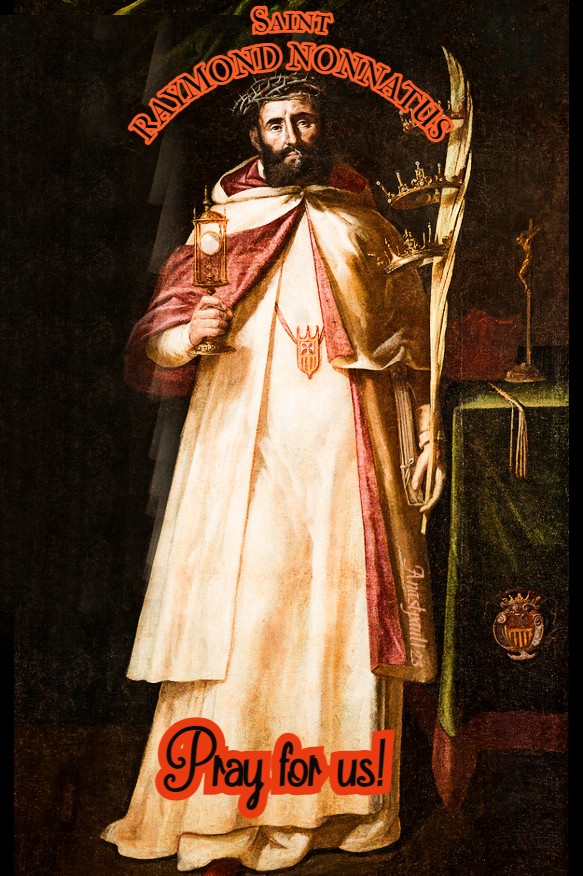
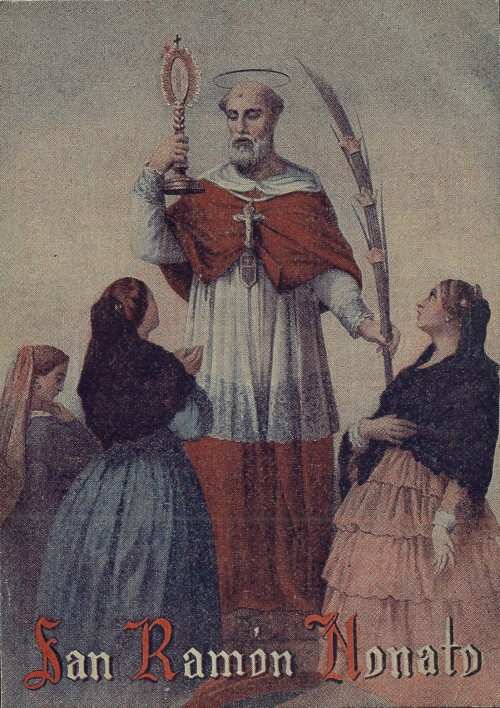
Quote/s of the Day – 31 August – “The Month of the Immaculate Heart of Mary” – Pentecost XII – St Raymond Nonnatus 1204-1240) Priest, Confessor, Cardinal, Friar of the Mercedarian Order – Ecclesiasticus Sir 31:8-1 – Luke 12:35-40 – Scripture search here: https://www.drbo.org/
“Jesus said to His disciples: gird your loins and light your lamps”
Luke 12:35
“ … The Bridegroom came and they, who were ready, went in with Him … ”
Matthew 25:10
“Make ready then the vessel of your soul that you may become a son of God and an heir of God and joint-heir with Christ (Romans 8:17); if, indeed, you are preparing yourself that you may receive; if you are drawing near in faith that you may be made faithful; if of set purpose, you are putting off the old man!”
St Cyril of Jerusalem (315-387) Father and Doctor of the Church
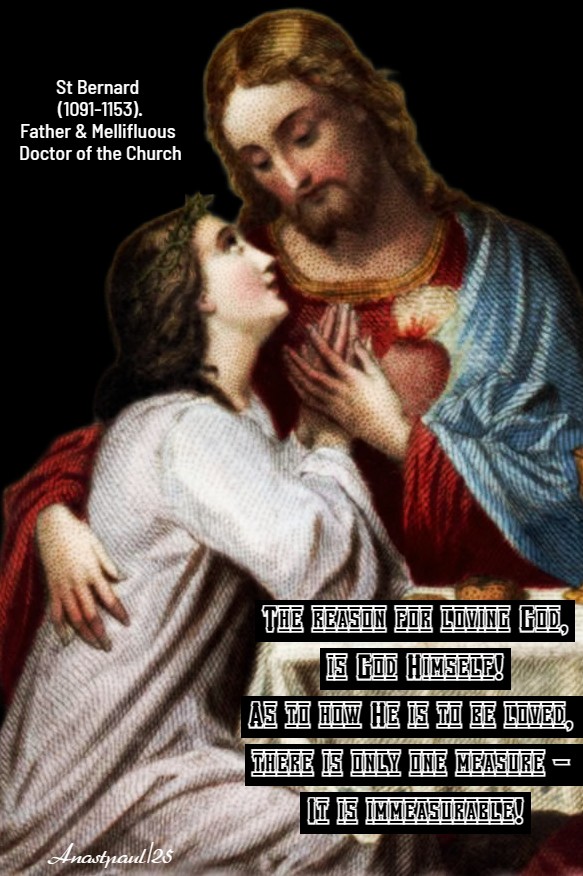
“The reason for loving God, is God Himself! As to how He is to be loved, there is only one measure – It is immeasurable!”
St Bernard (1090-1153) Father & Mellifluous Doctor of the Church
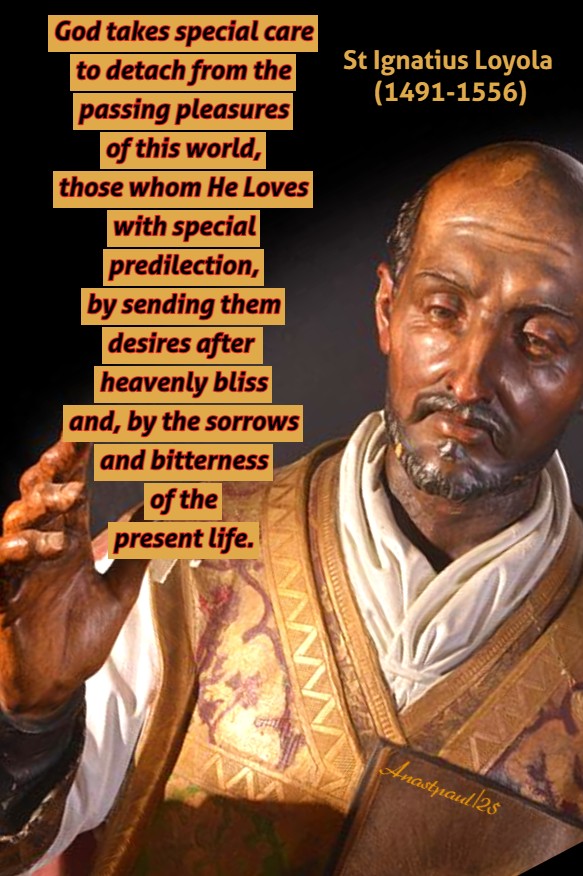
“God takes special care to detach from the passing pleasures of this world, those whom He Loves with special predilection, by sending them desires after heavenly bliss and, by the sorrows and bitterness of the present life.”
One Minute Reflection – 31 August – “The Month of the Immaculate Heart of Mary” – Pentecost XII – St Raymond Nonnatus 1204-1240) Priest, Confessor, Cardinal, Friar of the Mercedarian Order – Ecclesiasticus Sir 31:8-1 – Luke 12:35-40 – Scripture search here: https://www.drbo.org/
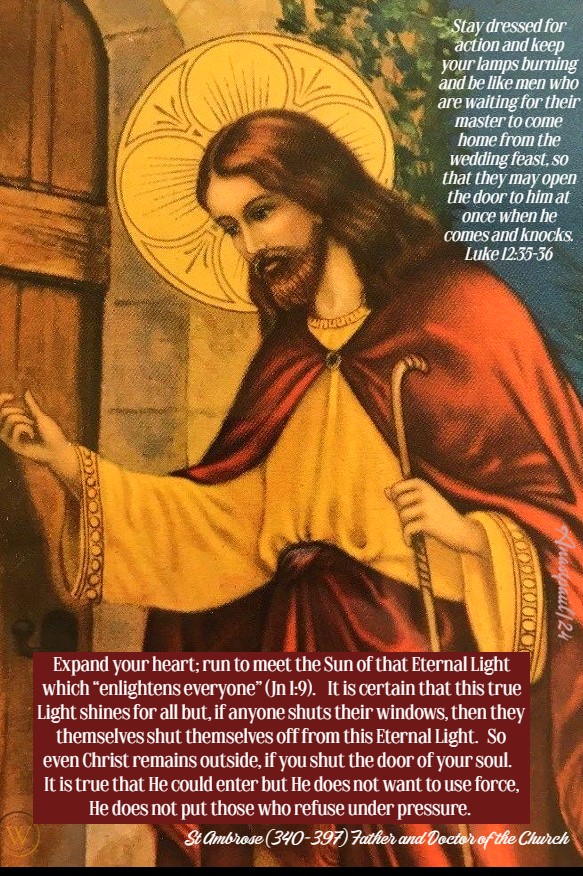
“Stay dressed for action and keep your lamps burning and be like men who are waiting for their master to come home from the wedding feast, so that they may open the door to him at once when he comes and knocks.” – Luke 12:35-36
REFLECTION – “God, the Word, stirs up the lazy and arouses the sleeper. For indeed, someone who comes knocking at the door is always wanting to come in. But it depends on us, if He does not always enter or always remain. … May your door be open to Him who comes; open your soul, enlarge your spiritual capacities, that you may discover the riches of simplicity, the treasures of peace and sweetness of grace. Expand your heart; run to meet the Sun of that Eternal Light which “enlightens everyone” (Jn 1:9). It is certain, that this true Light shines for all but, if anyone shuts their windows, then they themselves, shut themselves off from this Eternal Light.
So even Christ remains outside, if you shut the door of your soul. It is true, He could enter but He does not wish to use force, He does not put those who refuse under pressure. Descended from the Virgin, born from her womb, He shines throughout the universe to give Light to all. Those who long to receive the Light, that shines with an everlasting brightness, open up to Him. No night comes to intervene. Indeed, the sun we see each day, gives way to night’s darkness but the Sun of Justice (Mal 3:20) knows no setting, for Wisdom is not overcome by evil.” – St Ambrose (340-397) Bishop of Milan and Father and Doctor of the Church (12th Sermon on Psalm 118).
PRAYER – O God, Who made blessed Raymund, Thy Confessor, famous for delivering Thy faithful from the captivity of the infidels, grant us, by his intercession that, having been released from the bonds of our sins, we may with free minds, do what is pleasing to Thee. Through Jesus Christ, Thy Son our Lord, Who lives and reigns with Thee, in the unity of the Holy Ghost, God, world without end. Amen (Collect).
Our Morning Offering – 31 August – “The Month of the Immaculate Heart of Mary” on this the last day of August let us pray ab Act of Consecration and Repration to our Mother’s Immacylate Heart
An Act of Consecration and Reparation to the Immaculate Heart of Mary
O Immaculate Heart of Mary, Queen of Heaven and Earth and tender Mother of men, in accordance with thy ardent wish made known at Fatima, I consecrate to thee, myself, my brethren, my country and the whole human race. Reign over us and teach us how to make the Heart of Jesus reign and triumph in us and around us, as It has reigned and triumphed in thee. We wish to atone for the many crimes committed against Jesus and thee. We wish to call down upon our country and the whole world, the peace of God in justice and charity. We promise to imitate thy virtues, by the practice of a Christian life without regard to human respect. We resolve to receive Holy Communion on the first Saturday of every month and to offer thee five decades of the Rosary on this day, together with our sacrifices in the spirit of reparation and penance. Amen.
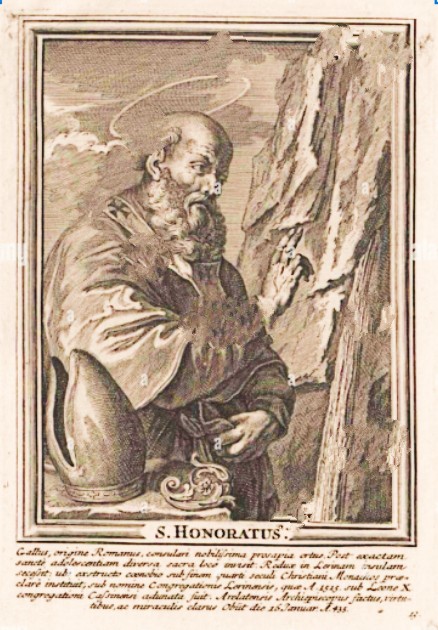
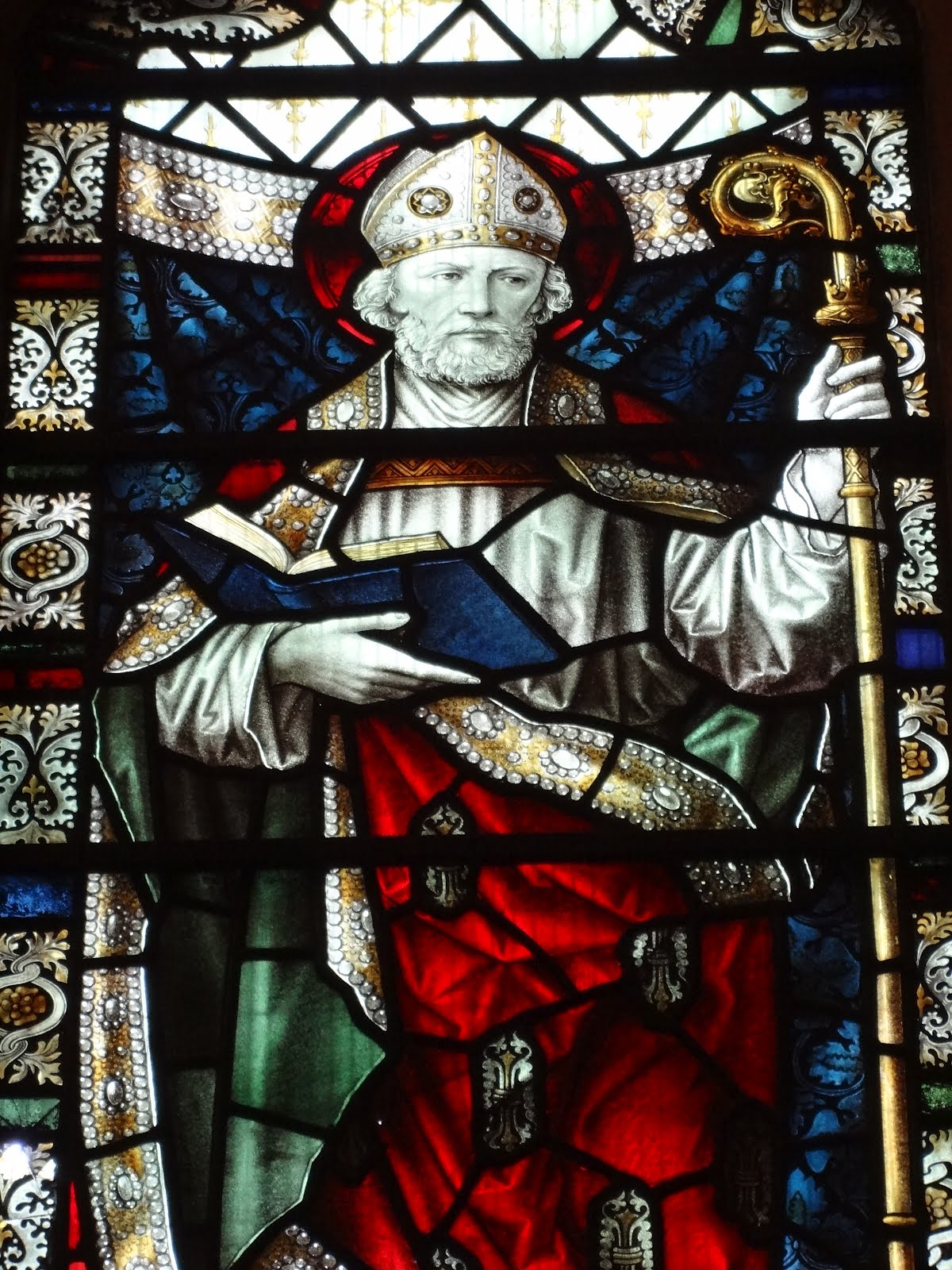
Saint of the Day – 31 August – St Honoratus (5th Century) Bishop of Marseilles and disciple of St Honoratus of Arles, the holy Bishop, Founder and Abbot of Lerins Monastery. Also known as – Onoratus, Onorato.
Honoratus was a Bishop of Marseille who lived in the 5th Century.
In the records of the Diocese, he is listed as number sixth after Greco, mentioned in 475 and before Saint Cannatus, mentioned at the end of the 5th Century.
We know very little information about him. Tradition holds that he was a disciple of Saint Honoratus of Arles, of whom, as modern Hagiographers affirm, he wrote the Vita.
Honoratus was the Bishop pf Marseilles during the Pontificate of Gelasius, with whom he had a lively exchange of correspondence, now lost, during which he had to defend his orthodoxy to the Pontiff.
According to some sources, our Saint Honoratus is described as a renowned orator and preacher of great power.
Thought for the Day – 30 August– Meditations with Antonio Cardinal Bacci (1881-1971)
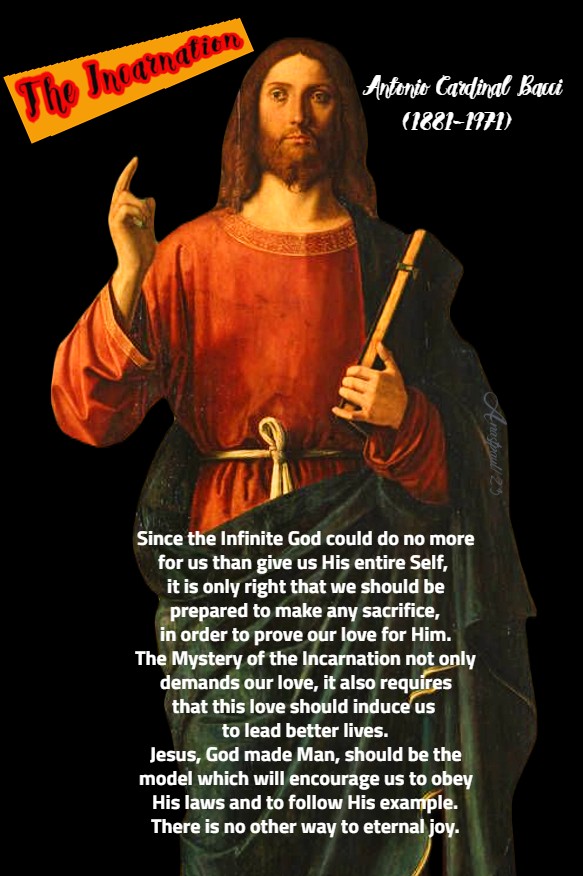
The Incarnation
“The Incarnation, which is the coming of God amongst men, in order that He might be loved more, requires that man, in return, love God and be obedient to His commandments.
Since the Infinite God could do no more for us than give us His entire Self, it is only right that we should be prepared to make any sacrifice, in order to prove our love for Him. The Mystery of the Incarnation not only demands our love, it also requires that this love should induce us to lead better lives. Jesus, God made Man, should be the model which will encourage us to obey His laws and to follow His example. There is no other way to eternal joy.”
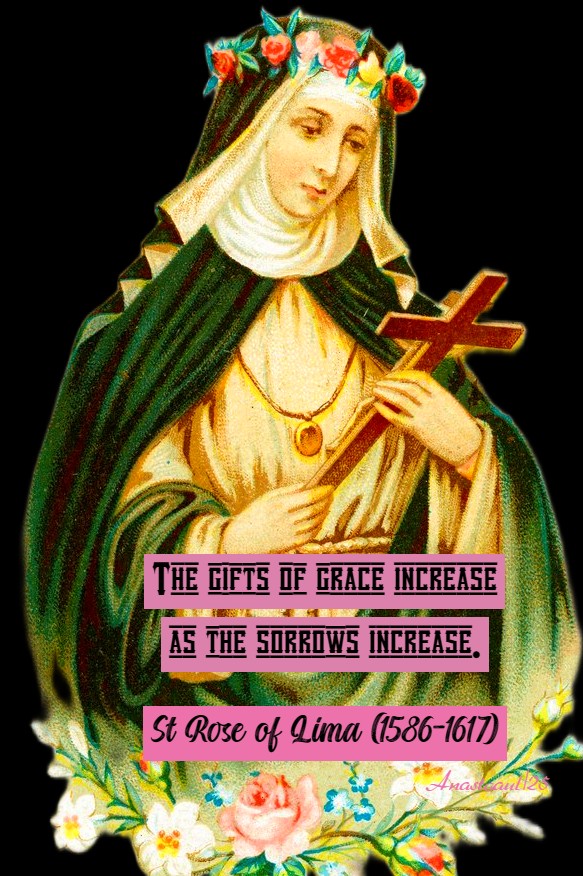
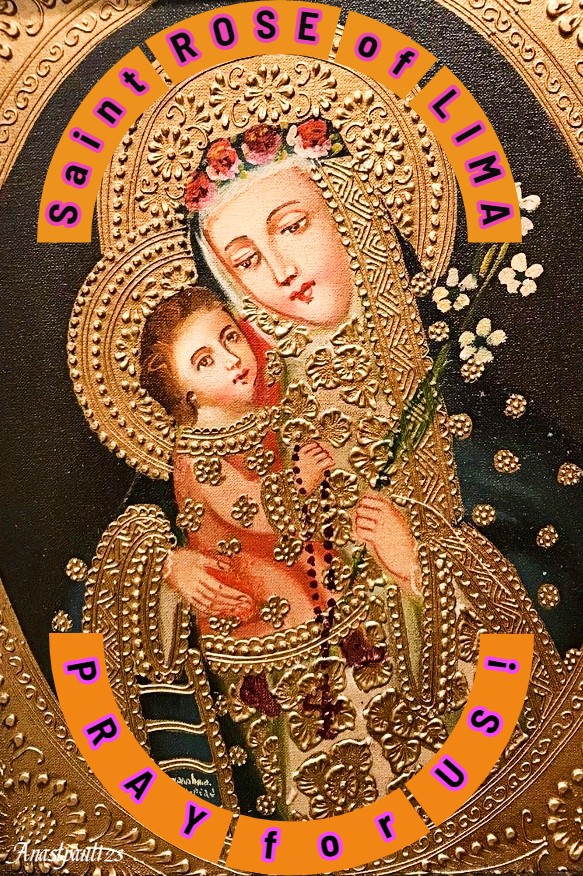
One Minute Reflection – 30 August – “The Month of the Immaculate Heart of Mary” – St Rose of Lima OP (1586-1617) Virgin – 2 Cor inthians10:17-18; 11:1-2 – Matthew 25:1-13 – Scripture search here: https://www.drbo.org/
“Many will come from the east and the west and will recline… at the banquet in the Kingdom of Heaven” – Matthew 8:11
REFLECTION – “I have seen our Lord in the Gospel accomplish many miracles and, reassured by them, have strengthened my fearful words. I have seen the centurion throw himself at the Lord’s feet, nations send their firstfruits to Christ. The Cross has not yet been erected and already, pagans hasten towards their Master. The words “Go, teach all nations” have not yet been heard (Mt 28,19) but the nations are already hastening. Their race precedes their call, they are burning with desire for the Lord. The sound of preaching has not yet been heard but they are hurrying towards the One Who preaches. Peter… has now been instructed and they gather around the One Who is teaching him; the light of Paul has not yet blazed beneath Christ’s standard and nations are coming with incense to adore the King (Mt 2:1).
And now, see how a centurion begs Him and says to him: “Lord, my servant is lying at home paralysed, suffering dreadfully.” Here is a new miracle indeed! The servant, whose limbs are paralysed leads his master to the Lord; the slaves’ sickness gives health to his owner. Seeking his servant’s healing, he finds our Lord and while he is seeking for his slave’s cure, he becomes Christ’s conquest!” – Basil of Seleucia (Died c 468) Archbishop (Homily 19 on the centurion, PG 85, 235f).
PRAYER – Almighty God, Giver of all good things, Who willed that blessed Rose, imbued in early life with the dew of heavenly grace, should bloom among the Indians with the beauty of virginity and patience, grant unto us, Thy servants that, following the fragrance of her sweetness, we may be found worthy to become a sweet savour of Christ. Who livest and reignest with God the Father, in the unity of the Holy Ghost, God, world without end. Amen (Collect).
Our Morning Offering – 30 August – “The Month of the Immaculate Heart of Mary” – St Rose of Lima OP (1586-1617) Virgin
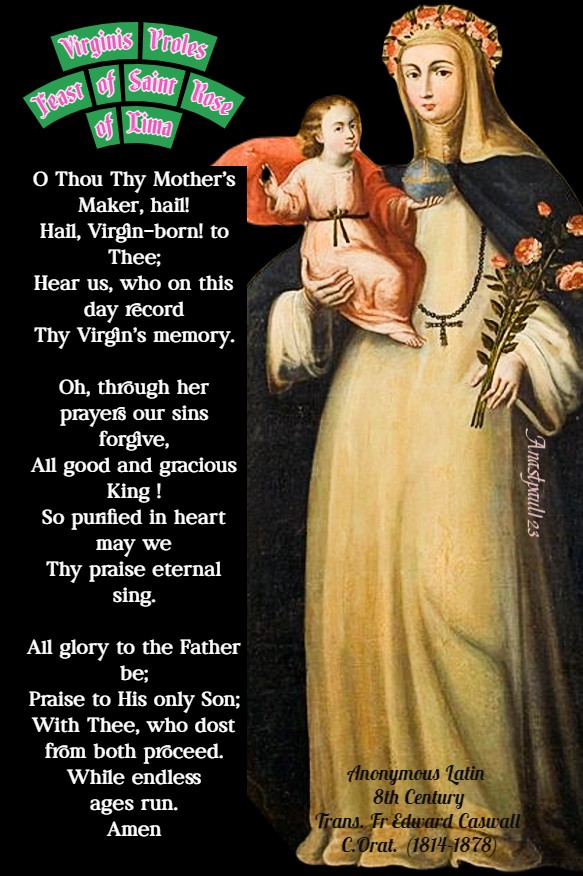
Virginis Proles Anonymous Latin, 8th Century Trans. Fr Edward Caswall C.Orat. (1814-1878)
O Thou Thy Mother’s Maker, hail! Hail, Virgin-born! to Thee; Hear us, who on this day record Thy Virgin’s memory.
Oh, through her prayers our sins forgive, All good and gracious King ! So purified in heart may we Thy praise eternal sing.
All glory to the Father be; Praise to His only Son; With Thee, who dost from both proceed. While endless ages run.
This Hymn is used for Matins in the Common of Virgins in the Extraordinary form of the Roman Breviary. Verses 1, 4 and 5 above, are used for a Virgin who is not a Martyr.
Saint of the Day – 30 August – St Fantinus (c927-1000) Confessor, Abbot of San Mercurius, Ascetic, Hermit, Missionary, Preacher, Spiritual Adviser and Miracle-worker. Born in Calabria in Italy in c927and died in Greece at around year 1000, Also known as – Fantinus of Calabria, Fantinus the Younger, Fantino…
The Roman Martyrology reads today: “At Thessalonica, St Fantinus, Confessor, who suffered much from the Saracens, was driven from his monastery in which he had lived in great abstinence. After having brought many to the ways of salvation, he rested at last at an advanced age.”
Saint Fantinus (on the right). Sanctuary of San Nicodemo, Mammola.
Born in Calabria in a locality described as being the “closest to Sicily” in its customs and appearance. Fantinus’ parents were named Giorgio and Vriena.
Fantinus was introduced as a child, to Saint Elias, a renowned cave-dwelling Hermit. His religious education was entrusted to Elias, leading Fantinus to become a Monk at the age of thirteen and working as a cook and as the doorman in the Monastery
At the age of thirty three, he became a Hermit in the region of Mount Mercurion in the north of Calabria. There, many Monasteries and Hermitages had been established under the Basilian rule. Fantinus lived a life of extreme asceticism, eating only raw vegetables and occupying much of his time copying manuscripts. He also experienced a vision of Heaven and Hell.
Fantinus lived both as a Hermit and as an Abbot. He subsequently convinced his aged parents, as well as his two brothers, Luke and Cosmas, and sister, Caterina, to enter the monastic life.
When he became a Hermit, he left his brother Lucas in charge of the Monastery he had founded. Though a Hermit, he often returned from the wild in order to guide and teach the disciples, who desired his spiritual counsel.
The Monastery he founded named San Mercurius, was destroyed by Muslim raiders during Fantinus’ lifetime. But Fantinus was told by an Angel to preach in Greece. He left Calabria with two disciples, Vitalis and Nicephorus. During the voyage, the ship ran out of drinking water. Fantinus made the Sign of the Cross over a container filled with seawater and miraculously converted it into drinkable water.
Fantinus visited Corinth, Athens and Larissa, where he lived near the sepulcher of Saint Achillius of Larissa. He lived for four months in a Monastery dedicated to Saint Menas near Thessalonica and then lived outside of its walls. In Thessalonica itself, he cured the sick and caused a corrupt Judge to repent of his sins. Fantinus was also honoured for his intercession in preventing a violent invasion of the City. Fantinus died in Greece.
Saint Fantinus died around the year 1000, after embracing and blessing the Monks attending him and was buried with great solemnity in the place of his choosing. The Saint’s Vita concludes with a series of miracles he performed after his death.
St Rose of Lima OP (1586-1617) Virgin and Penitent, Mystic, Visionary, Stigmatist (invisible), Apostle of the Poor. Also known as “St Rose of Saint Mary” – her Religious name. (Her Feast was moved from today to 23 August after Vatican II). Devoted and Ascetic St Rose: https://anastpaul.com/2018/08/23/saint-of-the-day-23-august-st-rose-of-lima-1586-1617/
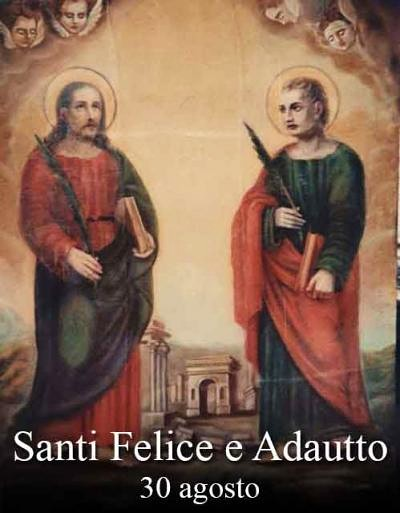
St Adauctus AND St Felix Martyrs of Rome (Died c303) – both dying in c303 by beheading in Rome. The Roman Martyrology reads today: “At Rome on the Ostian Way the Martyrdom of the blessed Priest, Felix, under the Emperor Diocletian and Maximian. After being racked, he was sentenced to death and as they led him to execution, he met a man who spontaneously declared himself a Christian and was, forthwith, beheaded with the holy Felix. The Christians, not knowing his name, called him Adauctus – the Latin word meaning “added to” because he was added to St Felix and shared his Crown.” Their Lives and Deaths: https://anastpaul.com/2023/08/30/saint-s-of-the-day-30-august-saints-felix-priest-and-martyr-and-saint-adauctus-died-c303/
St Agilus St Arsenius the Hermit St Boniface of Hadrumetum St Bononius of Lucedio Bl Bronislava of Poland Bl Edward Shelley Bl Ero di Armenteira Bl Eustáquio van Lieshout St Fantinus (c927-1000) Abbot of San Mercurius
St Pelagius the Hermit St Peter of Trevi Bl Richard Flower Bl Richard Leigh Bl Richard Martin St Rumon of Tavistock St Sylvanus the Hermit St Thecla of Hadrumetum St Theodosius of Oria
Martyrs of Colonia Suffetulana – 60 Saints: A group of 60 Christians Martyred for destroying a statue of Hermes. They were Martyred in Colonia Suffetulana, Africa.
Thought for the Day – 29 August – Meditations with Antonio Cardinal Bacci (1881-1971)
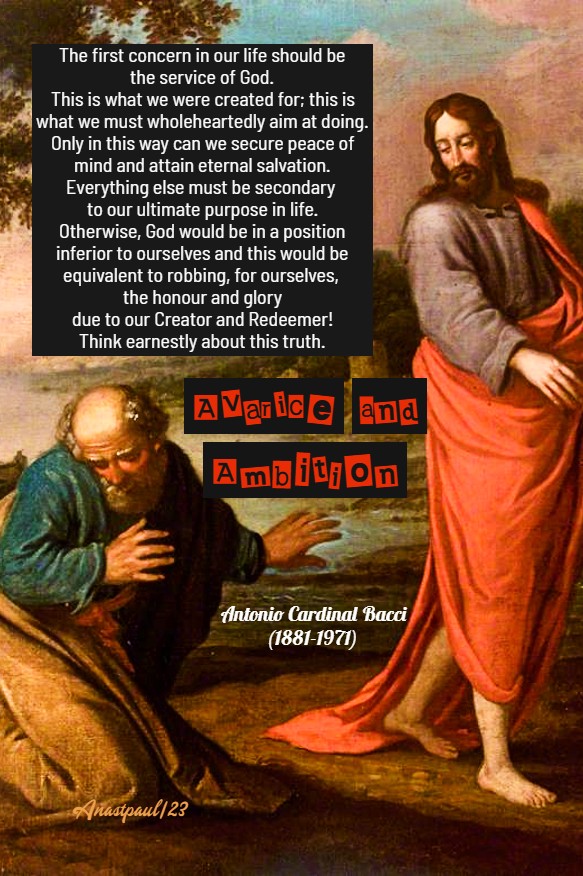
Avarice and Ambition
“What is our attitude in regard to these matters? We are not forbidden, naturally, to look after our own affairs and our work. In fact, it is our duty to do so, to whatever degree is demanded by the circumstances in which we live. Similarly, it is not forbidden to try to better our social position. But, all this must be done, however, with a due sense of proportion and by the proper means.
The first concern in our life should be the service of God. This is what we were created for; this is what we must wholeheartedly aim at doing. Only in this way can we secure peace of mind and attain eternal salvation. Everything else must be secondary to our ultimate purpose in life. Otherwise, God would be in a position inferior to ourselves and this would be equivalent to robbing, for ourselves, the honour and glory due to our Creator and Redeemer! Think earnestly about this truth.”

















 AnaStpaul
You must be logged in to post a comment.