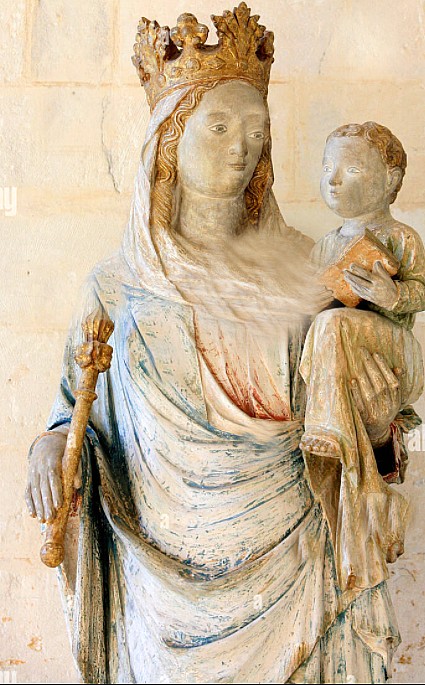
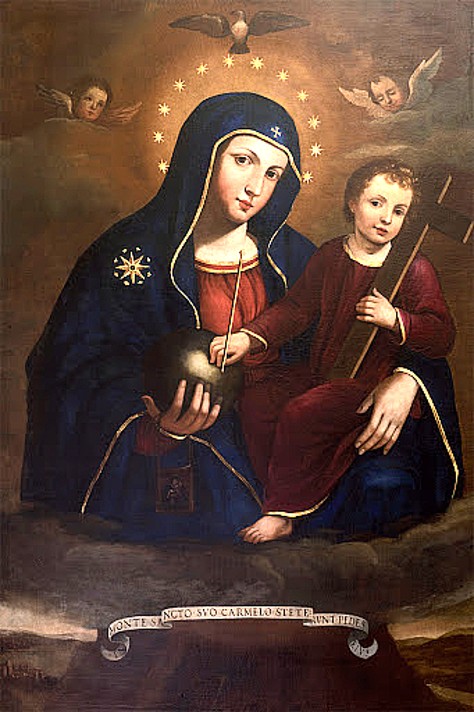
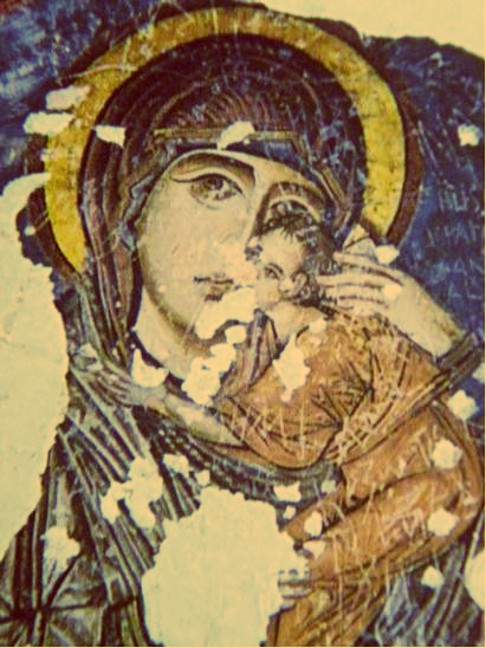
Our Lady of Mount Athos, Great Lavra, Greece , 8th cent. – 5 July:
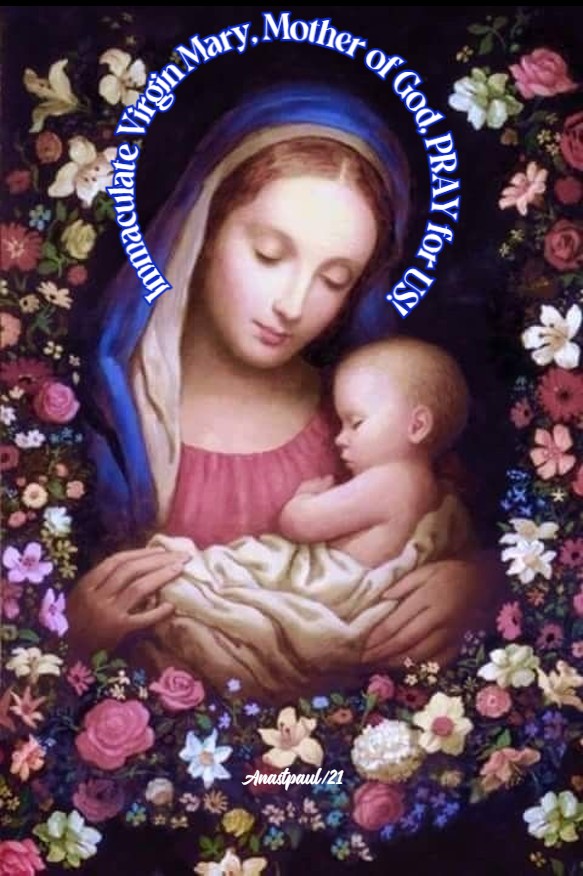
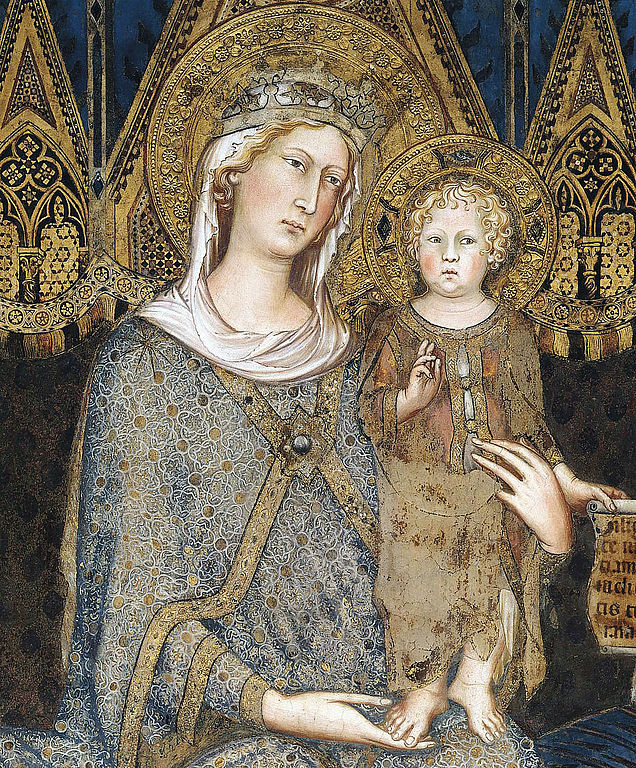
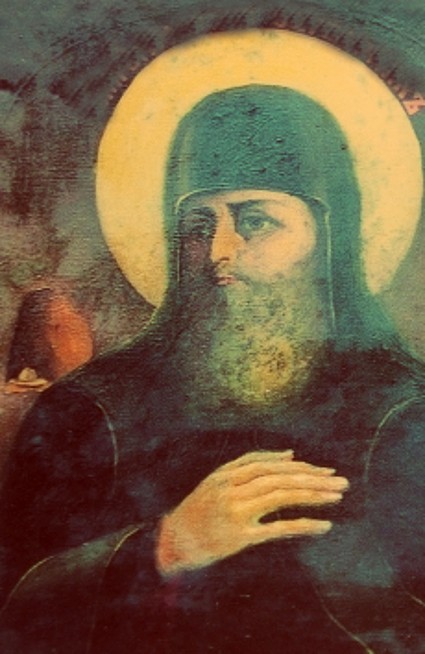
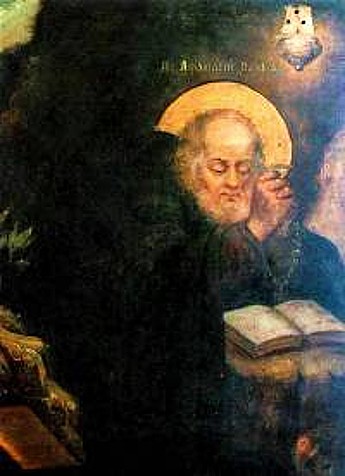
In the 900s, the unfinished Great Monastery on Mount Athos ran out of funds and the starving Monks had to leave. Finally the Monastery Founder, St Athanasius the Athonite, left too in search of help. On the road he met a woman in a long blue veil, who said, “Go back! You will have everything you need if you do not abandon the Monastery!” When Athanasius asked the lady’s name, she answered, “I am the Mother of your Lord.” The Abbot asked for a sign. “Strike the rock with your staff,” she said, and promised to be responsible for the Monastery provisions herself — to be its stewad. As water flowed from the rock, she vanished.
Athanasius returned to find the building completed and stocked with supplies. Soon it was full of Monks again To this day, the Great Lavra regards the Mother of God as its steward, helped by a Monk with the title of assistant steward. In a Shrine on the left of the entrance to the Monastery Church, the Icons depict many saints connected with the Monastery. To Our Lady’s right St. Athanasius holds a model of the building. Down the road, the holy spring still flows.
St Agatho of Sicily St Athanasius the Athonite St Athanasius of Jerusalem St Cast St Cyprille of Libya St Cyrilla of Cyrene St Domèce St Domitius of Phrygia St Edana of West Ireland Bl Edward Cheevers Blessed Elias of Bourdeilles OFM (c 1407-1484) Archbishop of Tours and Cardinal St Erfyl St Fragan Bl George Nichols St Grace of Cornwall St Gwen Bl Humphrey Pritchard
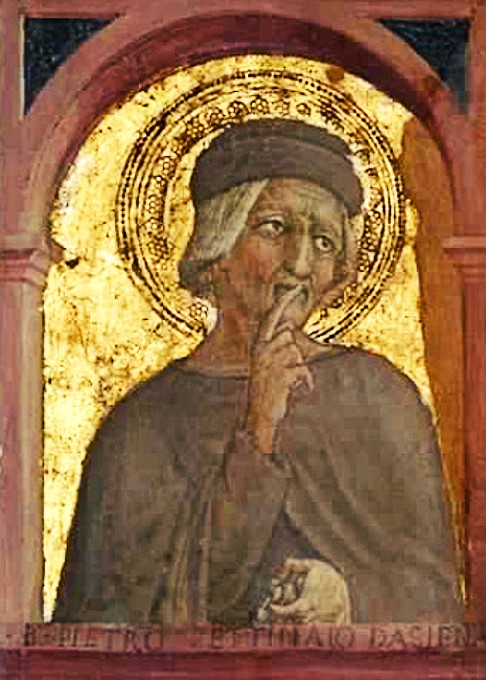
St Marinus of Tomi St Mars of Nantes St Marthe Bl Matthew Lambert St Modwenna St Numerian of Treves Bl Patrick Cavanagh St Philomena of San Severino St Probus of Cornwall Bl Richard Yaxley Bl Robert Meyler St Rosa Chen Aijieh St Sedolpha of Tomi St Stephen of Reggio St Teresia Chen Qingjieh St Theodotus of Tomi Bl Thomas Belson St Thomas of Terreti St Triphina of Brittany St Triphina of Sicily St Zoe of Rome
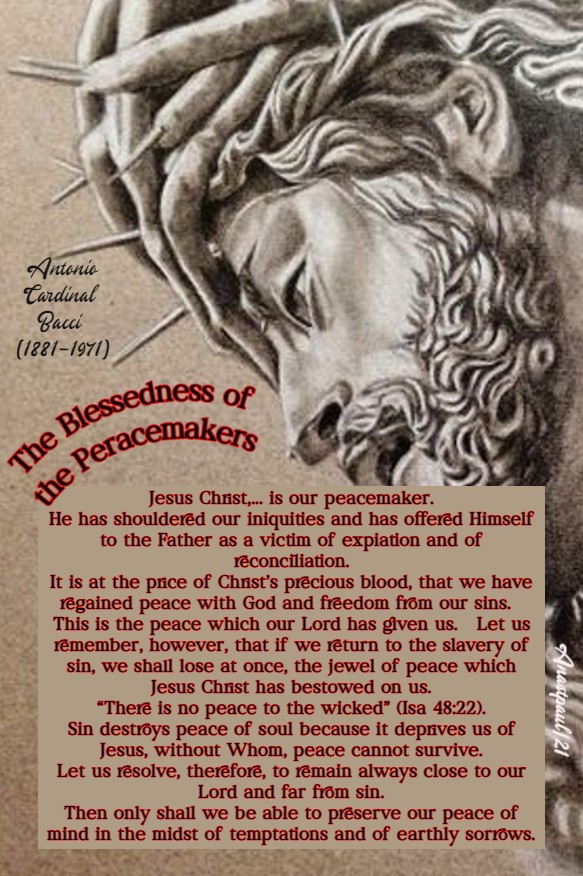
Thought for the Day – 4 July– Meditations with Antonio Cardinal Bacci (1881-1971)
Faith
“A man without the light of faith is like a blind man groping in the dark. The world which surrounds us is an inconceivable absurdity, unless, we have faith in a God who creates and orders. Life is an aimless journey if it is not illuminated by faith in a Creator, Who will reward us. Everything without us and within us, speaks to us of God and directs our steps towards Him, our supreme benefactor, our judge and our eternal reward. The stars of the heavens and the flowers of the fields, tell us of the infinite beauty and goodness of their Creator. In the pages of the Gospel, we find, a clearer and more penetrating light which invites us to adore and love the divine Redeemer and to believe in Him, Who alone, has the words of eternal life and Who alone can satisfy the infinite desires of our hearts.
All this is true. Everything around us and within us leads us to God and invites us to have faith. The virtue of faith, however, is a supernatural gift, which we must humbly and perseveringly beg from God. It is, as St Thomas Aquinas says, the foundation of the entire spiritual life (Summa Theologiae,III,q 73, a 3); without it, the spiritual edifice would collapse. How thankful, therefore, we should be to God for having been called to the faith and for having been born in the Catholic Church. There are so many souls outside Her, who grope in the darkness, longing for the truth. We should pray for them that they may reach the port of salvation and may be able to join with us in praising, loving and serving Our Lord Jesus Christ. We should also be well aware that, as pointed out by St James, faith without good works is dead (Cf Js 2:17-20). Even the devils believe, as St Augustine observes (De Caritate, 10) but, this does not help their salvation. Besides faith, the love of God and love of our neighbour are necessary. The result of this double charity, should be a gradual increase in good works.”
Quote/s of the Day – 4 July – “Month of the Precious Blood”
“Greater love than this no man hath, that a man lay down his life for his friends.”
John 15:13
“Jesus, knowing that his hour was come, … he loved them unto the end.”
John 13:1
“I beg you never to entertain the least dread and to place all your trust in the Blood of Christ Crucified … May all servile fear be banished from your spirits. You will say with Saint Paul … “I can do all things through Christ crucified, since he is within me by desire and love and he strengthens me” (cf. Phil 4:13; Gal 2:20). Love, love, love! By His Blood, the gentle Lamb has made an unassailable rock of your soul.”
St Catherine of Siena (1347-1380) Doctor of the Church
“The actions of good Christians are of such great value, that heaven is given to us for them. However, … it is not because they come from us and are the wool of our hearts. Rather, it is because they are dyed with the Blood of the Son of God. I mean, that the Saviour sanctifies our actions by the merits of His Blood. A branch of the vine, united and joined to the stock, produces fruit, not by it’s own power but empowered by the stock. Now we are united by charity to our Redeemer, as members to the head (Eph 4:15-16). That is why our fruits and good works, drawing their value from Him, merit life everlasting.”
St Francis de Sales (1567-1622) Doctor of Charity
“How long are you going to be deaf to His call? Or are you going to lose your soul, which Jesus Christ bought at the price of His Precious Blood?”
One Minute Reflection – 4 July – “Month of the Precious Blood” – Ezekiel 2: 2-5, Psalms 123: 1-2, 2, 3-4, Second Corinthians 12: 7-10, Mark 6: 1-6
“So he could notperform any mighty deed there, apart from curing a few sick people by laying his hands on them …” – Mark 6:5
REFLECTION – “One meaning of “could not” is simply the limits of some human will. Take, for example, the point ,that Christ “could not” fulfill any signs in Nazareth was due to disbelief on their part. Something essential for healing is required on both sides—faith on the part of the patients, power on that of the healer. So one side without its counterpart “could not,” so to speak, perform them. As this can be seen in medical care, it can also be seen in moral transformation. Similarly involving the limits of the will are the texts: “The world cannot not hate you” and “How can you speak good, being evil?” The metaphor of “impossibility” here must mean free refusal by the will. The same idea applies to those passages which say that what is, impossible for humanity is possible for God. Note also those passages that say that a person “cannot” (in one sense) be born a second time and a needle’s eye “cannot” let a camel through. What would stop these events happening if God willed them directly? Besides all these, there is, as in the case we are presently considering, a “cannot” in the sense of that which is totally inconceivable. We cannot conceive that God can be evil or fail to exist. It is inconceivable that reality cannot exist or two times two is fourteen. So here, it cannot be the case, that the Son would do anything which the Father would not do!” – St Gregory Nazianzen (330-390) Archbishop of Constantinople, Father and Doctor of the Church – Oration 30 (On the Son),10-11.
PRAYER – Lord our God, make us love You above all things and all our fellow-men, with a love that is worthy of You. May we look to Your Divine Son in total trust, faith, love and imitation. Grant too, that by the prayers of the Blessed Virgin Mary, we too may be granted the grace to follow Your only Son, no matter our sufferings, to one day reach You, in our heavenly home. We make our prayer, through Christ our Lord, in the unity of the Holy Spirit, one God, forever amen. Eternal Father, I offer Thee the Precious Blood of Jesus in satisfaction for my sins and for the wants of holy Church. – Indulgence 100 days, Each time, Pope Pius VII, 22 September 1817.
Our Morning Offering – 4 July – “Month of the Precious Blood”
For those unable to attend Holy Mass today and for all of us, everyday!
Act of Spiritual Communion By St Alphonsus Maria de Liguori (1696-1787) Most Zealous Doctor
I desire, good Jesus, to receive Thee in Holy Communion and since I cannot now receive Thee in the Blessed Sacrament, I beseech Thee to come to me spiritually and to refresh my soul with Thy sweetness. Come, my Lord, my God and my All! Come to me and never let me ever again be separated from Thee by sin. Teach me Thy blessed ways, help me with Thy grace to imitate Thy example, to practise meekness, humility, charity and all the virtues of Thy Sacred Heart. My divine Master, my one desire is to do Thy will and to love Thee, more and more. Help me, that I may be faithful to the end, in Thy service. Bless me in life and in death, that I may praise Thee, forever in heaven, Amen
Saint of the Day – 4 July – Blessed John Cornelius SJ (1557– 1594) Martyr, English Priest of the Society of Jesus, Missionary. Born in 1557 as John Conor O’Mahony at Bodmin, Lanherne, Cornwall, England on the estate of Sir John Arundell and died by hanging and being hacked to pieces on 4 July 1594 at Dorchester, Oxfordshire, England. Additional Memorials – 29 October as one of the Martyrs of Douai, 1 December as one of the Martyrs of Oxford University. Also known as – John Mohun and John O’Mahony.
John Corneliu, actually John Conor O’Mahony latinised his middle name. He was born of Irish parents in Bodmin, Cornwall. His father worked for Sir John Arundell who took great interest in young John and it was through him, that John was admitted to Exeter College, Oxford. After his expulsion from Oxford for “popery” i.e. for maintaining Catholic beliefs, John went to the English College in Rheims, France and, a year later, to the English College in Rome. His scholastic achievements were so outstanding, that he delivered the College’s Christmas address before Pope Gregory XIII on the Feast of St Stephen, 26 December 1581. He was Ordained in Rome in 1583 and returned to England the same year.
Fr Cornelius made the home of Sir Arundell in London as his operations centre and was responsible for getting the latter, back to his faith, as well as his own Mother back to the Church. His strong zeal to bring people back to Catholicism and for celebrating Mass, soon made him the prime target for government spies who were out to apprehend him.
All this while Fr Cornelius’ longstanding wish was to become a Jesuit as he came to know them during his student days in Rome and had resolved to enter the Society when time permitted. His years on the English mission only strengthened that desire and he wrote to the Jesuit General in Rome to seek admission. As the custom then was for all English candidates to go to Flanders for their Novitiate, Fr Cornelius’ admission had to be delayed as he couldn’t leave his flock without a Priest. He, nevertheless, kept in contact with Fr Henry Garnet, the Superior of the English Jesuits and placed himself under his direction.
Fr Cornelius was betrayed by William Holmes, a servant of the Arundell’s household whom he had previously reprimanded for annoying one of Lady Arundell’s maids.
When apprehended, the Sheriff said, “I’m glad that I finally have you in my hands.” to which Fr Cornelius replied, “And I, more so, for having been captured.”
Fr Cornelius and three laymen from the Arundell household, were arrested with him and pending trial, he discussed religion with the Trenchard’s household, the arresting Officer and it was reported that he converted Trenchard’s sister-in-law. At the Marshalsea Prison in London, Fr Cornelius was tortured on the rack to reveal the names of Catholic households that had given him hospitality and the names of those who had attended his services but he revealed nothing. Knowing that his time was fast approaching, Fr Cornelius pronounced the vows of the Society before two laymen and a Jesuit and instructed them to make this fact known to Fr Garnet, the Jesuit Superior in England.
Fr Cornelius was sentenced to die for high treason and to be hanged and quartered, because he was a Priest, had celebrated Ma, and had reconciled Protestants to the Catholic Church. His three lay companions were condemned to be hanged for having aided and assisted a Priest and were executed first. The first to ascend the scaffold was John Carey; he kissed the rope, exclaiming “O precious collar,” made a solemn profession of faith and died a valiant death . Before his execution, Patrick Salmon exhorted the spectators to embrace the Catholic faith, for which he and his companions were giving their lives. Then followed Thomas Bosgrave, who delivered a stirring address on the truth of his belief. When it was Fr Cornelius’ turn, he approached the gallows and knelt at the foot of the ladder, prayed, then kissed the ground and the feet of his three dead companions and turning towards the scaffold said, with the words of St Andrew,“O good cross, so long desired.” Once on the ladder, he prayed for his persecutors and the Queen and though forbidden to speak further, he revealed to the bystanders that he was a Jesuit, just before he was pushed from the ladder. His body was subsequently quartered.
All the bodies were retrieved and given proper burial by Lady Arundell. Fr Cornelius and his three companions, the Martyrs of England, were Beatified by Pope Pius XI on 15 December 1929.
Solemnity of Saints Peter and Paul (29 June) +2021
Nuestra Señora del Refugio / Our Lady of Refuge, Matamoros, Tamaulipas, Mexico (1720) – 4 July:
Jesuit Missionary Father Juan José Güica brought a painting of Our Lady, Refuge of Sinners from Italy to Mexico in 1720. In a dream, the Virgin told Padre Güica to ask the Franciscans of Zacatecas to use and promote the image; – they distributed over 150 copies, making this one of the most widespread Marian devotions in Mexico.
In 1793 Franciscan Friars came to the new settlement which would become Matamoros, renaming the area “Nuestra Señora del Refugio de los Esteros Hermosos” (Our Lady of the Refuge of the Lovely Marshes).
The Cathedral of Our Lady of Refuge, built in 1832, displays an 1886 painting of her. Her fiesta, celebrated in many Mexican Towns, commemorates the coronation of the original “Refugium Peccatori” in the Jesuit Church of Frascati, Italy, on 4 July 1717.
Bl Agatha Yun Jeom-Hye St Albert Quadrelli St Andrew of Crete St Anthony Daniel St Aurelian of Lyons St Bertha of Blangy St Carileffo of Anille Bl Catherine Jarrige St Cesidio Giacomantonio Bl Damiano Grassi of Rivoli St Donatus of Libya St Edward Fulthrop St Elias of Jerusalem St Finbar of Wexford St Fiorenzo of Cahors St Flavian of Antioch St Giocondiano Bl Giovanni of Vespignano St Haggai the Prophet Bl Hatto of Ottobeuren Bl Henry Abbot St Henry of Albano St Hosea the Prophet St Innocent of Sirmium Bl John Carey Blessed John Cornelius SJ (1557– 1594) Martyr, English Priest of the Society of Jesus, Missionary. Bl Jozef Kowalski St Jucundian St Laurian of Seville St Lauriano of Vistin Bl Maria Crocifissa Curcio St Namphanion the Archmartyr Bl Natalia of Toulouse St Odo the Good Bl Odolric of Lyon Bl Patrick Salmon Bl Pedro Romero Espejo
Thought for the Day – 3 July – “Month of the Most Precious Blood” – Meditations with Antonio Cardinal Bacci (1881-1971)
The New Life
Only a Christian,” wrote Tertullian, “can be wise, sincere and lofty” (De praescriptione haereticorum, 3).
He had in mind, of course, the true follower of Jesus Christ, who is practising the precepts of Our Lord. “Thou shalt love the Lord thy God, with they whole heart ... Thou shalt love thy neighbour as thyself” (Mt 22:37, MK 12:30, Lk 10:27). “You are to be perfect, even as your heavenly Father is perfect” (Mt 5:48).
A man who loves God above all things, can fairly be called wise. God is the supreme good and as such, should be the final end towards which we direct all our thoughts and actions. If anyone adopts his own ego or some created good as his goal in life, he is not wise because he has upset the proper scale of values. It is not true to say that we should love ourselves before anything else because we are creatures who belong to God and should refer everything to Him. Only if we love God above all things, even above ourselves, can we really be said to love ourselves. How can we love ourselves, if, in the first place, we do not love our highest good, which is God? Since this love must be active, it makes us faithful to God’s commandments and raises us above the rest of creation to a state of immediate dependence on God. A love of all mankind flows as a natural consequence from this union of love with God. If we regard all men as our brothers in Jesus Christ, we shall be perfect Christians in the manner intended by our divine Redeemer when He desires us to be like His heavenly Father. This is the new life which Jesus came to bring into the world and which we should nurture in ourselves (Cf Heb 4:23-24).”
Quote/s of the Day – 3 July – Feast of St Thomas Apostle – Readings: Ephesians 2: 19-22, Psalms 117: 1bc, 2, John 20: 24-29
Jesus said to him, “Have you come to believe because you have seen me? Blessed are those who have not seen and have believed.”
John 20:28-29
“For by your doubting, I am taught to believe, by your forked-tongue, that revealed the Wound on the Divine Body that was pierced, I harvest the fruit for myself, without pain!”
St John Chrysostom (347-407) Father and Doctor
“I believe though I do not comprehend and I hold by faith, what I cannot grasp with the mind.”
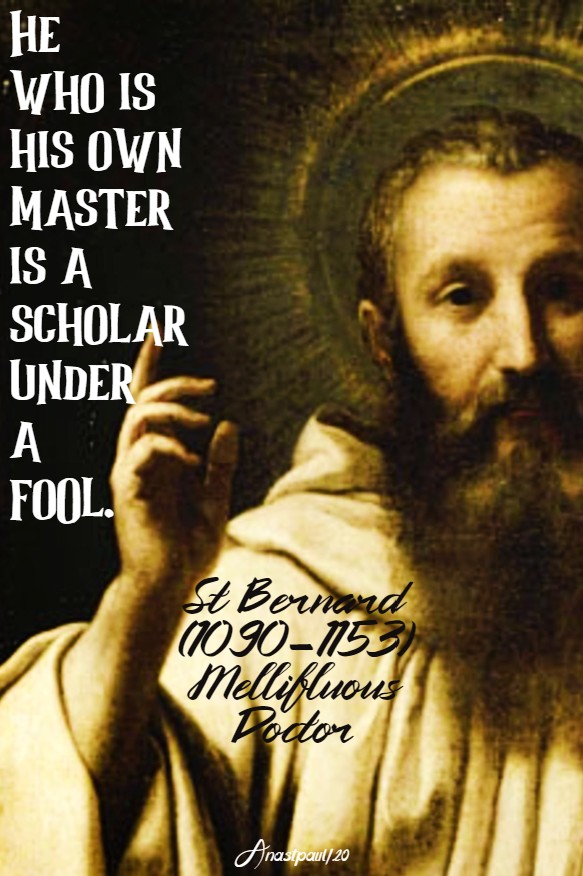
St Bernard (1090-1153) Mellifluous Doctor
“To one who has faith, no explanation is necessary. To one without faith, no explanation is possible.”
“Believing is an act of the intellect assenting to the divine truth, by command of the will, moved by God through grace.”
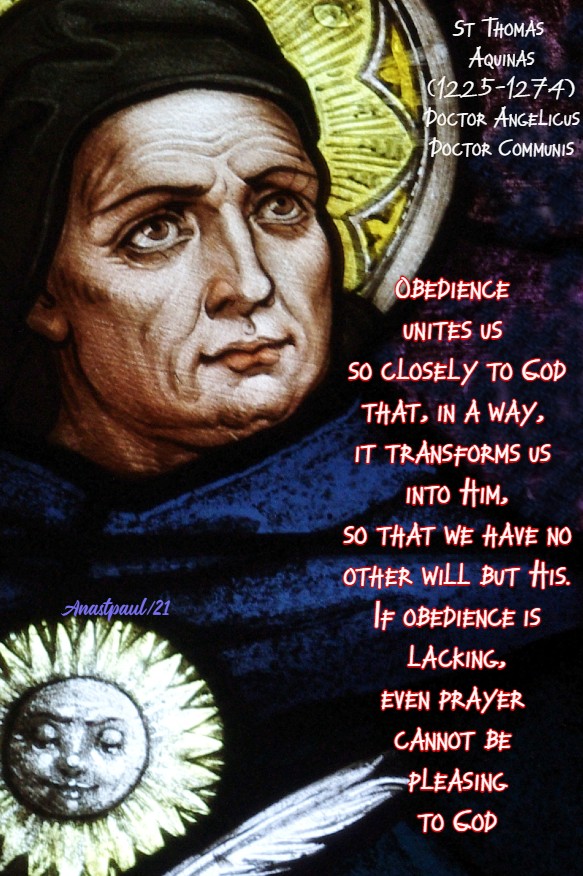
St Thomas Aquinas (1225-1274) Doctor Angelicus/Doctor Communis
One Minute Reflection – 3 July – Feast of St Thomas Apostle – Readings: Ephesians 2: 19-22, Psalms 117: 1bc, 2, John 20: 24-29
“Blessed are those who have not seen and have believed.” – John 20:29
REFLECTION – “There was a wonderful providence behind these words of the Saviour and they can be of very great help to us. They show, once again, how much He cares for our souls, for He is good and| as Scripture says: “He wants everyone to be saved and to come to knowledge of the truth” (1Tm 2,4).
Even so, this saying of His may surprise us. As always, Christ had to be patient with Thomas, when he said he would not believe and, with the other disciples too, when they thought they were seeing a ghost! Because of His desire to convince the whole world, He most willingly showed them the marks of the nails and the wound in His side; – because He wished those, who sought this evidence, as a support for their faith, to have no possible reason for doubt – He even took food, although He had no need for it (Lk 24,41)…
But when anyone accepts what he has not seen, believing on the word of his teacher, the faith, by which he honours the One his teacher proclaims to him, is worthy of great praise. Blessed, therefore, is everyone who believes the message of the holy Apostles who, as Saint Luke says, were eyewitnesses of Christ’s actions and “ministers of the word” (Lk 1,2). If we desire eternal life and long for a dwelling place in heaven, we must listen to them.” – St Cyril of Alexandria (380-444), Bishop, Father and Doctor of the Church – Commentary on Saint John’s gospel, 12, 22
PRAYER – Father, let our celebration on the feast of Saint Thomas the Apostle, be the source of his unfailing help and protection. Fill us with Your life-giving grace through our faith in Your Son, Jesus the Christ, whom Thomas acknowledged to be his Lord and his God. We make our prayer, through our Lord Jesus in union with the Holy Spirit, one God with You, forever and ever, amen.
Our Morning Offering – 3 July – “Month of the Precious Blood” and a Marian Saturday
Most Holy Mary, Virgin Mother of God Act of Consecration By St Francis de Sales (1567-1622) Indulgence of 300 days, for each recitation St Pius X, 17 November 1906
Most Holy Mary, Virgin Mother of God, I ………., most unworthy though I am to be thy servant, yet touched by thy motherly care for me and longing to serve thee, do, in the presence of my Guardian Angel and all the court of heaven, choose thee this day to be my Queen, my Advocate and my Mother and I firmly purpose to serve thee evermore myself and, to do what I can, that all may render faithful service to thee. Therefore, most devoted Mother, through the Precious Blood thy Son poured out for me, I beg thee and beseech thee, deign to take me among thy clients and receive me as thy servant forever. Aid me in my every action and beg for me the grace never, by word or deed or thought, to be displeasing in thy sight and that of thy most holy Son. Think of me, my dearest Mother and desert me not at the hour of death. Amen
Saint of the Day – 3 July – Saint Anatolius of Constantinople (Died c 458) Bishop of Constantinople from 451 until his death on 3 July 458, Confessor. He died in 458 of unknown causes but it is believed he was martyred by heretics.
Anatolius was born at Alexandria. He was Ordained a Deacon by the great St Cyril of Alexandria and was present at the Third Ecumenical Council at Ephesus in the year 431.
He became Bishop of Constantinople through the influence of Pope Dioscorus I of Alexandria with Emperor Theodosius II, after the deposition of Flavian by the Second Council of Ephesus. After his Consecration, Anatolius publicly condemned the teachings not only of Eutyches,but also those of Nestorius, subscribing to the letters of St Cyril against Nestorius and of Pope Leo I against Eutyches.
In conjunction with Pope Leo, he requested that the Emperor Marcian summon a general Council against Dioscorus and the Eutychians but the Imperial letter instructing Anatolius in the preparations for the Council of Chalcedon, only mentions Pope Leo. In this Council, Anatolius presided in conjunction with the Roman legates. By the famous 28th Canon, passed at the conclusion of the Council, Constantinople was made equal in dignity with Rome, “second in eminence and power to the Bishop of Rome.” This displaced the traditional order of authority of the much older Sees of Antioch and Alexandria. Hence arose the controversy between Anatolius and the Roman Pontiff. However, the third Canon of the earlier First Council of Constantinople of 381 stated that “The Bishop of Constantinople, however, shall have the prerogative of honour after the Bishop of Rome because Constantinople is New Rome.” The Eastern position could be characterised as being political in nature, as opposed to a doctrinal view.
Leo complained to Marcian and to Pulcheria that Anatolius had over-stepped his jurisdiction by consecrating Maximinus II as Bishop of Antioch.
Following the Council of Chalcedon, Anatolius received a letter signed by several Egyptian Bishops, asking his assistance against Timothy, who was usurping the Bishopric of Alexandria, as a result Anatolius wrote to the Emperor Leo, against Timothy. The circular of the Emperor requesting the advice of Anatolius on the turbulent state of Alexandria is extant.
When he was in danger of death he was restored to health by St Daniel the Stylite, who came to Constantinople to see him.
The followers of Dioscorus are said to have murdered him in 458.
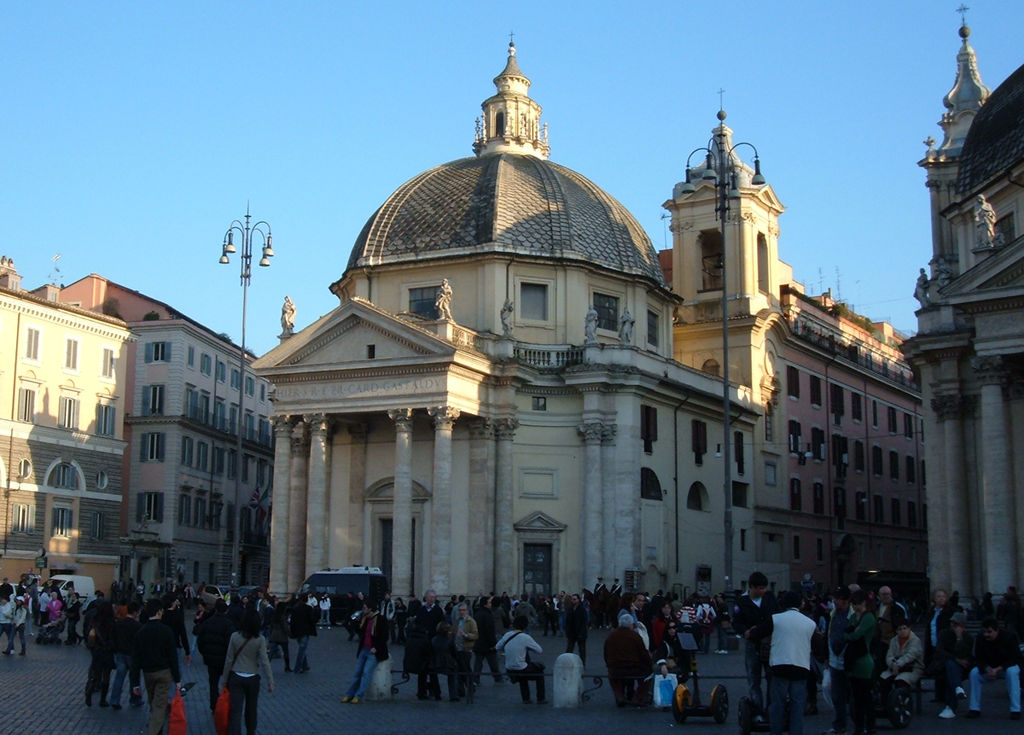
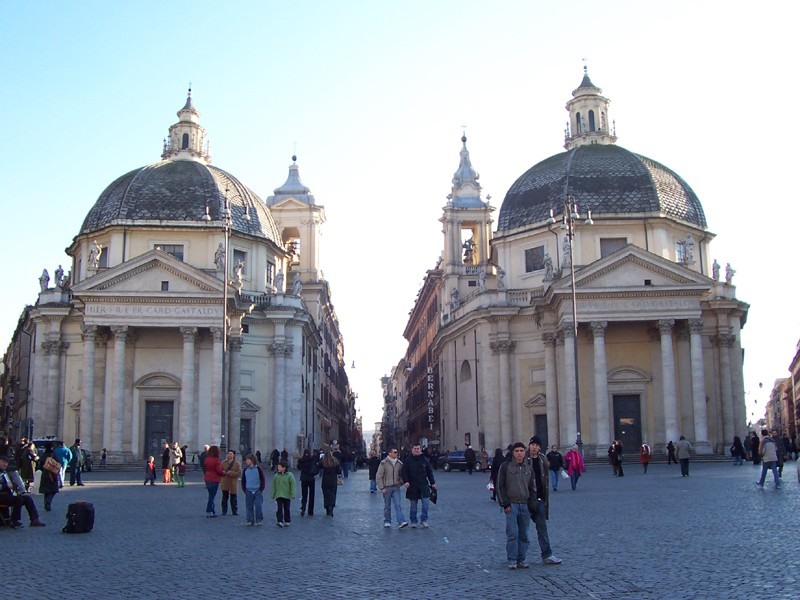
Notre-Dame-de-la-Carole / Our Lady of la Carole, Paris (1418) – 3 July:
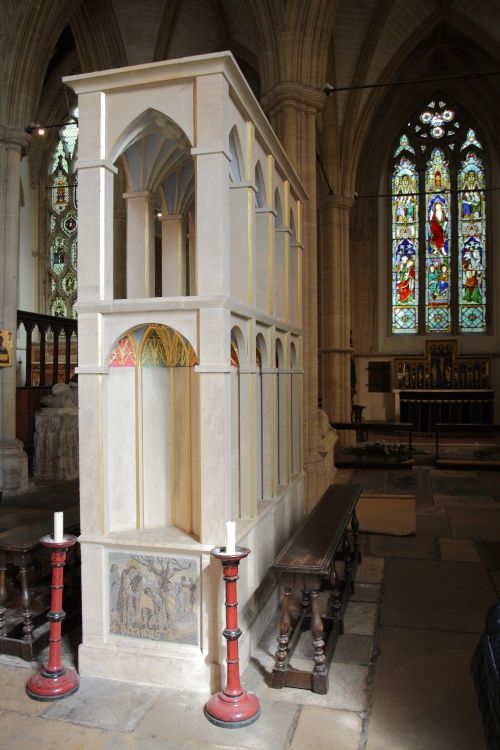
Roadside Shrines can still be seen in places all over Europe, though it is nothing like it used to be in the Middle Ages when these Shrines were extremely prevalent. They were public reminders of God and His Saints and were meant for the good of the general public, who would come upon the Shrine and pause for a moment to pray. They could be simple or somewhat elaborate, ranging from unadorned crosses to free standing towers or even small Chapels. On 3 July in the year 1418, a Swiss soldier committed a sacrilege upon a Statue of the Blessed Virgin known as Our Lady of la Carole, or Our Lady of Carole. It was located at the corner of the Rue aux Ours, which was built in the 13th century and terminated at the hospital of Saint John, which is no longer in existence. The Rue aux Ours is now a short street that begins at Rue Saint-Martin and ends at the Boulevard Sebastopol in Paris, France. The soldier of the Duke of Burgandy’s troops, said to be a Swiss soldier, came upon the Shrine of the Blessed Virgin after having left a tavern where he had gambled away his money. He was probably intoxicated when he drew his sword and repeatedly struck the Statue of the Blessed Virgin with the weapon. The Statue of Our Lady of Carole then began to bleed profusely, as if made of flesh and blood and WAS wounded by the blows. The citizens who had observed the sacrilege were outraged and followed the soldier as he fled from the scene of his crime. The man was eventually caught and apprehended and then brought before the Chancellor where he was sentenced to death for the outrage.
In remembrance of this incident and in expiation for the crime, there was a popular feAST that took place on the Rue aux Ours every year. There were fireworks and a wax figure representing the sacrilegious wretch who had struck the image of the Blessed Virgin was set ablaze. This festival continued until the French Revolution brought an end to the traditional observance.
St Anatolius of Constantinople (Diedc 458) Bishop Bl Andreas Ebersbach Bl Barbara Jeong Sun-mae St Bladus St Byblig St Cillene St Dathus of Ravenna St Eusebius of Laodicea St Firminus St Firmus Bl Gelduin St Giuse Nguyen Ðình Uyen St Gunthiern St Guthagon St Heliodorus of Altinum St Hyacinth of Caesarea St Ioannes Baptista Zhao Mingxi St Irenaeus of Chiusi
St Maelmuire O’Gorman St Mark of Mesia St Mennone the Centurian St Mucian of Mesia St Paul of Mesia St Petrus Zhao Mingzhen St Philiphê Phan Van Minh St Raymond of Toulouse (Died 1118) Layman — Martyrs of Alexandria – 13 saints: Thirteen Christian companions marytred together. No details about them have survived but the names – Apricus, Cyrion (2 of), Eulogius, Hemerion, Julian, Julius, Justus, Menelaus, Orestes, Porfyrios and Tryphon (2 of). They martyred in Alexandria, Egypt, date unknown.
Martyrs of Constantinople – 24 saints: A group of 24 Christians martyred in the persecutions of Arian emperor Valens. We know little more than their names – Acacios, Amedinos, Ammonius, Ammus, Cerealis, Cionia, Cionius, Cyrianus, Demetrius, Eulogius (2), Euphemia, Heliodoros, Heraclios, Horestes, Jocundus, Julian, Martyrios, Menelaeus, Sestratus, Strategos, Thomas, Timotheos and Tryphon. They were martyred in c367 in Constantintinople.
Theodotus and Companions – 6 saints: Six Christians who were imprisoned, tortured and martyred together in the persecutions of Trajan. Saint Hyacinth ministered to them in prison. We know nothing else about them but their names – Asclepiodotus, Diomedes, Eulampius, Golinduchus, Theodota and Theodotus. They were beheaded in c110, location unknown.
Thought for the Day – 2 July – Meditations with Antonio Cardinal Bacci (1881-1971)
The Grace of God
“God has endowed us with wonderful corporal and spiritual gifts, creating us after His own image with powers of intellect and of will. More than this, He has raised us to the supernatural order by communicating to us, His grace, which enables us to live His own life and to share in His divine nature, as His adopted sons.
Grace is the greatest gift which God has given us. It enlightens our minds and moves our will to obey His commands and to perform actions which merit an everlasting reward. It is an entirely supernatural and gratuitous gift. For this reason, we cannot merit it but, we should continually pray for it because, it is absolutely necessary if we are to do good and to merit Heaven. Our first ancestor, Adam, was endowed with this gift by our Creator. Unfortunately, by original sin, he lost it for himself and for his descendants.
We cannot complain to God about this loss, since grace is an entirely supernatural gift which is in no way, due to our human nature. For the same reason, we cannot merit it on our own. But God, being infinitely good, as well as, infinitely just, sent His only-begotten Son to redeem us from sin and to grant us His friendship once more.
We should be very grateful to God for this extraordinary favour and should unite our efforts to the divine action of grace, in the performance of good works, which will enable us to merit everlasting life.”
Quote/s of the Day – 2 July – “Month of the Most Precious Blood” – Readings: Genesis 23: 1-4, 19; 24: 1-8, 62-67, Psalms 106: 1b-2, 3-4a, 4b-5, Matthew 9: 9-13
“It is not the healthy who are in need of the physician but those who are sick”
Matthew 9:12
“… Veiled in a human body, He was able to communicate with humans. He who wanted to assist the guilty hides the fact that He is a Judge. He who did not deny dignity to faithful servants, conceals his Lordship. He who desired the weak to be embraced by a parent’s love, covers His Majesty.”
St Peter Chrysologus (c 400-450) “Doctor of Homilies” Father and Doctor of the Church
” Indeed, the instant you say: “I have sinned against the Lord”, the response is given you: “Your sins are forgiven” (Mt 9:2). … Only do not keep away, or distance yourself, from He who has chosen you to sing and pray but all your life long, remain close to Him, either through pure confidence, or by a holy audacity and courageous confession.”
John of Karpathos (7th Century) Bishop
“My beloved Redeemer, how much did it cost You to raise me from the ruin, which I brought on myself through my sins? What can I do without Your grace? I can do nothing but pray that You will help me but even this prayer comes from the merits of Your suffering and death! O my Jesus, help me!”
St Alphonsus Liguori (1696-1787) Most zealous Doctor
“Even if we are unfaithful servants and are covered with the leprosy of sin, let us go to Him and He will heal us. Even if we have deserved Hell a thousand times, let us shed tears of repentance at His feet as Magdalen did and, He will give us His forgiveness and His peace.”
Antonio Cardinal Bacci (1881-1971)
“Lord Jesus Christ,Son of God, Have Mercy on me, a sinner.”
One Minute Reflection – 2 July – “Month of the Most Precious Blood” – Readings: Genesis 23: 1-4, 19; 24: 1-8, 62-67, Psalms 106: 1b-2, 3-4a, 4b-5, Matthew 9: 9-13
“It is not the healthy who are in need of the physician but those who are sick” – Matthew 9:12
REFLECTION – “And by this I wish to know if you love the Lord God and me, His servant and yours – if you have acted in this manner – that is, there should not be any brother in the world, however much he may have possibly sinned, who, after he has looked into your eyes, would go away without having received your mercy, if he is looking for mercy. And if he were not to seek mercy, you should ask him if he wants mercy. And if he should sin thereafter, a thousand times, before your very eyes, love him more than me, so that you may draw him back to the Lord. Always be merciful to such as these …
If anyone of the brothers, at the instigation of the enemy, should sin mortally, he is bound by obedience to have recourse to his guardian. And all the brothers who might know that he has sinned are not to bring shame upon him or speak ill of him but let them show great mercy toward him and keep most secret, the sin of their brother; “because it is not the healthy who are in need of the physician, but those who are sick” (Mt 9:12) … And let the Custodian mercifully take care of him, as he would like to be taken care of, if he were in a similar position.
And if this brother falls into some venial sin, let him confess this to a brother who is a Priest. And if there is no Priest at hand, let him confess to his brother, until he has contact with a Priest who will absolve him canonically. And the brothers should have no power to enjoin any other penance, except this: “Go and sin no more!” (Jn 8:11). – St Francis of Assisi (1182-1226) Founder of the Friars Minor – Letter to a Minister of the Franciscan Order.
PRAYER – Lord Jesus Christ You showed Your great mercy to Matthew the tax-gatherer, by calling him to become Your Apostle,. Supported by the intercession of the Your Mother and oursby and the prayers and example of Your Saints, may we always answer Your call, obey Your commandments, fulfil Your Will and thus live in close union with You. We make our prayer, in union with God our Father and the Holy Spirit, one God forever and ever.
Our Morning Offering – 2 July – “Month of the Precious Blood”
O God, Be With Us By St Benedict (c 480-547)
O God, from Whom to be turned, is to fall, to Whom to be turned, is to rise and in Whom to stand, is to abide forever, grant us in all our duties, Your help, in all our perplexities, Your guidance, in all our dangers, Your protection, and in all our sorrows, Your peace, through Jesus Christ our Lord. Amen
Saint of the Day – 2 July – Servant of God Bernard of Quintavalle OFM ( Died 1241) “The First fruits of the Minor Orders,”The First Follower of St Francis of Assisi,” his faithful and devout companion who received. from St Francis on his deathbed, custody of the Friars Minor. He died nearly 20 years after St Francis.
Bernard, one of the wealthiest young men of Assisi, became intrigued by reports about one of his peers—Francesco di Bernardone, previously known as something of a dandy and carouser—who had recently aroused wonder, as well as ridicule, by his ostentatious embrace of poverty. His curiosity piqued, Bernard who invited Francis to dine with him and spend the night in his home.
During the course of the night, he was so moved by the sound of his guest’s ardent prayers that he confronted Francis the next day and asked his help in discerning God’s will. Opening the Missal at random, Francis alighted on the text, “If you wish to be perfect, go and sell all you own, and give it to the poor.” A second time he opened the book and found, “Take nothing for your journey.” On a third attempt, he found, “If anyone would follow me, let him deny himself.”“This is the advice that the Lord has given us,” Francis proclaimed. “Go and do as you have heard.” Taking these instructions to heart, Bernard disposed of his property and adopted Francis’s way of life.
This image shows Bernard peeking out from behind the curtains on the right. as St Francis prays.
Becoming one of Francis’s most trusted companions, Bernard accompanied him on many journeys. He established a house in Bologna and undertook a special mission to the Shrine at Santiago de Compostela. When Francis was on his deathbed in 1226, “like the patriarch Jacob, with his devoted sons standing around him, grieving and weeping over the departure of so beloved a father,” he asked, “Where is my firstborn son?” Placing his hand on Bernard, he bestowed a special blessing, and enjoined him to “be the head of all your Brothers.”
Bernard himself died about 20 years later, around 1241 and was buried near his spiritual father in the Basilica of Saint Francis. His last words were, “I find this in my soul – not for a thousand worlds equal to this one, would I want not to have served Our Lord Jesus Christ…. My dearest brothers, I beg you to love one another.”
“Of Bernard, St Francis said that he was worthy of all reverence and that he had founded this Order because he was the first who had left the world, keeping back nothing for himself but giving everything to Christ’s poor.” — From The Little Flowers of St. Francis.
Our Lady of the Walnut Our Lady of Madhu Our Lady of Montallegro Our Lady of the Grove Our Lady of the Leśniów Spring Our Lady of the Visitation Our Lady of the Way of Leon Our Lady of Vaussivieres
Notre Dame de la Visitation / Our Lady of the Visitation, Lescure, Valuéjols, Cantal, Auvergne, France (1717) – Commemorated on the Fourth Sunday of June, 2 July :
At around 19 years old, Shepherd Jean Paillé was devoted to the Virgin Mary, and would daily lead his flock, from his little village in central France ,to a wayside Cross on a bluff, where he would kneel to say the Rosary. On 2 July, 1717, his prayers at the Cross were met by an apparition of the Virgin herself, who asked that a Church be built on that spot, leaving behind a small Statuette of herself at the foot of the Cross. She returned several times with the same request. Finally, Jean answered, “But no one will believe me.”“Keep telling the people of Lescure,” she said “and eventually they will listen.” Both were right. When the shepherd mustered the courage to tell the villagers about his visions, they ridiculed him as a simpleton. So he built a small Shrine in the holy place himself, of dry stone, placing the Statuette inside it.
When bad weather threatened, Jean would go there to pray for help. Seeing those prayers answered, the villagers began to believe in his communication with the Virgin and decided to build her a Church in the village. Jean argued that the Holy Virgin wanted her Church on the promontory but wanting the convenience of building and having it in town, the people built the new Church in Lescure and installed the Statuette there. But, the next day, it had returned to the bluff. Jean was suspected of moving it but the same thing kept happening, even with the shepherd under watch, so finally everyone agreed, that Heaven wanted the Virgin’s Chapel to be on the heights and not in the town. This time Jean Paillé himself organised the work. Building materials poured in, which oxen carried up the hill as easily if they were made of feathers.
In 1724, some 3,000 pilgrims camped in the open air to witness the Consecration of the new Church. The Bishop’s delegate dedicated the Sanctuary to Our Lady of the Visitation, in memory of the first apparition date, 2 July, then the Catholic Feast of the Visitation, commemorating the visit of Mary, pregnant with Jesus, to her cousin Elizabeth, pregnant with John the Baptist. In recent years, the Feast of the Visitation has been moved to 31 May and the Solemnity of Our Lady of Lescure to the last Sunday in June.
She is invoked against illness, of the sick and for cures. Notre-Dame de Lescure, santé des infirmes, priez pour nous. Our Lady of Lescure, health of the sick, pray for us.
Bl Giovanni da Fabriano Becchetti St Jacques Fermin Bl Jarich of Mariengaarde St Jéroche St Lidanus of Sezze St Martinian of Rome St Monegundis St Oudoceus
Martyred Soldiers of Rome – 3 saints: Three soldiers who were converted at the martyrdom of Saint Paul the Apostle. Then they were martyred, as well. We known nothing else about them but their names – Acestes, Longinus and Megistus. Martyred c68 in Rome, Italy
Martyrs in Carthage by Hunneric – 7 saints: A group of seven Christians tortured and murdered in the persecutions of the Arian Vandal king Hunneric for remaining loyal to the teachings of orthodox Christianity. They were some of the many who died for the faith during a period of active Arian heresy. – Boniface, Liberatus, Maximus, Rogatus, Rusticus, Septimus and Servus.
Martyrs of Campania – 10 saints: A group of ten Christians marytred together in the persecutions of Diocletian. The only details about them to have survived are their names – Ariston, Crescention, Eutychian, Felicissimus, Felix, Justus, Marcia, Symphorosa, Urban and Vitalis. Martyred in 284 in Campania, Italy.
Martyrs of Seoul – 8 saints: Additional Memorial – 20 September as part of the Martyrs of Korea. A group of eight Christians who were martyred together as part of the lengthy persecutions in Korea. • Agatha Han Sin-ae • Antonius Yi Hyeon • Bibiana Mun Yeong-in • Columba Gang Wan-suk • Ignatius Choe In-cheol • Iuliana Gim Yeon-i • Matthaeus Gim Hyeon-u • Susanna Gang Gyeong-bok They were martyred on 2 July 1801 at the Small West Gate, Seoul, South Korea. Beatified on 15 August 2014 by Pope Francis.
1 July – Feast of the Most Precious Blood and July Devotion
In his book, The Precious Blood, Father Frederick William Faber, D.D., calls St. Paul the Doctor of the Precious Blood owing to his evident fondness to preach on It in his epistles (Romans 3:25; Ephesians 1:7; Hebrews 9:12).
He recounts that the lives of Saints are replete with devotion to the Precious Blood making special mention of St. John Chrysostom, St. Austin, St. Gertrude and St. Catherine of Sienna whom he considered the Prophetess of the Precious Blood for putting emphasis on It as the solution to the ills of her times.
Father Faber also remarks that the Precious Blood makes us appreciate more, Christ’s redemption of mankind, His sacrifice and Passion.
It also makes us comprehend the beautiful doctrine and the august realities of the Blessed Sacrament as we kneel in front of the Tabernacle in humble adoration.
Over time the Church gave Her blessing to the devotion by approving societies like the Missionaries of the Precious Blood; enriching confraternities like that of St. Nicholas in Carcere, in Rome and that of the London Oratory; attaching indulgences to prayers and scapulars in honour of the Precious Blood; and instituting commemorative feasts of the Precious Blood, Friday after the fourth Sunday in Lent and, since Pius IX, the first Sunday of July.
St Pope Pius X assigned the date of 1 July to this feast.
Salvete Christi vulnera Hail, holy Wounds of Jesus, hail
Hail, holy Wounds of Jesus, hail, Sweet pledges of the saving Rood, Whence flow the streams that never fail, The purple streams of His dear Blood.
Brighter than brightest stars ye show, Than sweetest rose your scent more rare, No Indian gem may match Your glow, No honeys taste with Yours compare.
Portals ye are to that dear home Wherein our wearied souls may hide, Whereto no angry foe can come, The Heart of Jesus crucified.
What countless stripes our Jesus bore, All naked left in Pilates hall! From His torn flesh flow red a shower Did round His sacred person fall!
His beauteous brow, oh, shame and grief, By the sharp thorny crown is riven; Through hands and feet, without relief, The cruel nails are rudely driven.
But when for our poor sakes He died, A willing Priest by love subdued, The soldiers lance transfixed His side, Forth flowed the Water and the Blood.
In full atonement of our guilt, Careless of self, the Saviour trod Een till His Hearts best Blood was spilt The wine-press of the wrath of God.
Come, bathe you in the healing flood, All ye who mourn, by sin opprest; Your only hope is Jesus Blood, His Sacred Heart your only rest.
All praise to Him, the Eternal Son, At Gods right hand enthroned above, Whose Blood our full redemption won, Whose Spirit seals the gift of love.
Thought for the Day – 1 July – Meditations with Antonio Cardinal Bacci (1881-1971)
The Passion of Our Lord
“The Crucifix is a simple meditation manual, open and intelligible to all, even to the most illiterate. Anyone who turns to it, can study the sorrowful gaze of Jesus, His heart pierced with love for men. His head crowned with thorns, His hands and feet transfixed with nails which support His divine body, streaming blood and writhing in anguish. The Crucifix should be dear and sacred to every Catholic. It should stand at the head of his bed, hang around his neck and hold a prominent position in his place of work or study.
Above all, however, the Crucifix should have its place in the heart of every fervent Catholic. At every moment of his life, in time of sadness and of joy, he should remember, that God became man and suffered and died for him. He should remember also, that this implies an obligation on his part, to work, suffer and die, for the love of God alone.
Many people meditate on the Crucifix. They kiss it and claim to love it. But while they love the Crucifix, they have no love for their particular cross, which they try, by every means in their power, to fling far away from them. Now, it is very certain, that anyone who does not love his own cross, does not really love the Crucifix, for Jesus has told us that, “if anyone wishes to come after me, let him deny himself and take up his cross and follow me” (Mt 16:24).”
Quote/s of the Day – 1 July – “Month of the Most Precious Blood” – Readings: Genesis 22: 1b-19 Psalms 115: 1-2, 3-4, 5-6, 8-9,: Matthew 9: 1-8
And Jesus, seeing their faith, said to the man sick of the palsy: “Be of good heart, son, thy sins are forgiven thee.”
Matthew 9:2
“This is the work of God, that you believe in him whom he hath sent.”
John 6:29
“Let us become like Christ, since Christ became like us. He assumed the worse, that He might give us the better; He became poor, that we through His poverty, might be rich.”
St Gregory of Nazianzen (330-390) Father and Doctor of the Church
“Have faith and the One you cannot see, is with you.”
St Augustine (354-430) Father and Doctor of the Church
“Be joyful and keep your faith and your creed.”
St David of Wales (c 542-c 601) Bishop
“Rest is in Him alone. Man knows no peace in the world but he has no disturbance when he is with God.”
St Bernard of Clairvaux (1090-1153) Mellifluous Doctor
One Minute Reflection – 1 July – “Month of the Most Precious Blood” – Readings: Genesis 22: 1b-19 Psalms 115: 1-2, 3-4, 5-6, 8-9,: Matthew 9: 1-8
“Which is easier to say: Thy sins are forgiven thee, or to say: Arise, and walk?” – Matthew 9:5
REFLECTION – “And people there brought to him a paralytic.” Saint Matthew merely says that this paralytic was carried to Jesus. Other evangelists describe how he was let down through an opening in the roof and placed before the Lord without expressing any particular request, leaving it to Him to assess the needs …
“When Jesus saw their faith,” the Gospel says, that is to say, the faith of those who had brought the man to Him. Consider how sometimes Christ pays no attention to the faith of the sick person – perhaps because, the latter is incapable of it, being unconscious or possessed with an evil spirit. However, in this case, this paralytic had great trust in Jesus, otherwise, would he have allowed them to let him down in front of Him? Christ responds to this trust with an extraordinary miracle. With the power of God, He forgives this man’s sins. Thus He showed, that He is equal to the Father, a truth He had already shown, when He said to the leper: “I will do it – be made clean” (Mt 8:3) … and when, with a word, He stilled the tempestuous sea (Mt 8:26), or when, as God, He had cast out the demons who recognised in Him their ruler and their judge (Mt 8:32). So here, He shows His adversaries, to their great astonishment, that He is equal to the Father
And once more, the Saviour shows here, how He turns away from anything spectacular or a source of vainglory. On all sides the crowd is pressing Him, yet, He is in no hurry to work a visible miracle by healing the external paralysis of this man …. He begins with an invisible miracle – by healing the man’s soul. This kind of healing is far more beneficial for him and, outwardly speaking, less glorious for Christ.” – St John Chrysostom (345-407) Priest at Antioch then Bishop of Constantinople, Father and Doctor of the Church – homilies on Saint Matthew’s Gospel, no. 29, 1.
PRAYER – Lord God, be the beginning and the end of all that we are and do and say. Prompt our actions with Your grace, may Your light be our only way, may Your commands be our only need and complete all, with Your all-powerful help. May the prayers of all Your Saints and our most Blessed Mother, grant us the grace of always seeking You in all things! We make our prayer through Christ our Lord in the unity of the Holy Spirit, one God now and forever and ever, amen.
Our Morning Offering – 1 July – “Month of the Most Precious Blood”
Offering of the Precious Blood to Our Father
Eternal Father, I offer Thee the Precious Blood of Jesus Christ, the Merits, Love and Sufferings of His Sacred Heart, the tears and sorrows of our Immaculate Mother, as the price of the favour I wish to obtain, if it be for Thy Glory and my salvation. Amen
Saint of the Day – 1 July – Saint Oliver Plunkett (1629-1681) Martyr, Archbishop and Primate of All Ireland, Confessor, Reformer. Born on 1 November 1629 at Loughenew, County Meath, Ireland and died by being hanged, drawn, and quartered on 1 July 1681 at Tyburn, England. Patronages– Archdiocese of Armagh, Irelanda, around 100 Churches, Apostolates, Schools, Sports facilities, Streets and Estates, even an aeroplane of the national airline.
Oliver Plunkett was born in Loughcrew, County Meath in the midlands of Ireland on 1 November 1625. At that time in Irish history, Catholics were being persecuted for their faith by their overlords, England. Many were evicted from their homes and forbidden to attend Mass. In all of Ireland there was only one active Bishop. Priests were hunted down and persecuted. Many fled to Europe. In 1647 Oliver Plunkett had to go to Rome to study for the priesthood because there were no Colleges or institutions of learning in Ireland.
In 1647 Oliver went to study for the priesthood under Jesuit guidance in the Irish College in Rome. Oliver was Ordained a Priest in Rome in 1654. Due to the religious persecution in his native land, it was not possible for him to return to minister to his people. Oliver remained in Rome and taught as a Professor of Theology at the Propaganda College. Because the persecution of Catholics was at a high point in Ireland, Oliver t could not be Consecrated Archbishop in Ireland but was Consecrated in Ghent by Bishop Eugene D’Allmont on 1 December 1669. He was installed as the then the Archbishop of Armagh and Primate of Ireland.
Archbishop Plunkett returned to Ireland and began a ministry of reform and renewal of clergy and laity for the next eleven years. Archbishop Plunkett soon established himself as a man of peace and, with religious fervour, set about visiting his people, establishing schools, ordaining priests and confirming thousands. During the reforms he made many enemies, not least among the clergy and it was one of the renegade priests whom he had censured who later gave evidence against him at his trial.
1673 brought a renewal of religious persecution and Bishops were banned by a British Government edict. Archbishop Plunkett went into hiding, suffering a great deal from cold and hunger. His many letters showed his determination not to abandon his people but to remain a faithful shepherd.
The persecution eased slightly for a short while and he was once again able to move more openly among his people. In 1679 he was arrested and falsely charged with treason. Oliver was charged with plotting to bring 20 000 French soldiers to Ireland and levying a tax on the poverty-stricken clergy to support 70 000 armed men.
Such an absurd charge had no chance of sticking in Ireland. The government in power could not get him convicted at his trial in Dundalk, Ireland, so they brought him to London where he was again tried. He was unable to defend himself because he was not given time to bring his own witnesses from Ireland. Oliver was tried and with the help of perjured witnesses, was sentenced to death. The Judge, Sir Francis Pemberton, said in passing judgement: “You have done as much as you could to dishonour God in this case; for the bottom of your treason was your setting up your false religion, than which there is not any thing more displeasing to God, or more pernicious to mankind in the world”.. He was found guilty of high treason “for promoting the Roman faith.” The jury returned within fifteen minutes with a guilty verdict and Archbishop Plunkett replied: “Deo Gratias” – Thanks be to God.”
Numerous pleas for mercy were made but Charles II, although himself a reputed crypto-Catholic, thought it too politically dangerous to spare Plunkett. The French Ambassador to England, Paul Barillon, conveyed a plea for mercy from his King, Louis XIV. Charles told him frankly that he knew Plunkett to be innocent but that the time was not right to take so bold a step as to pardon him. Lord Essex, apparently realising too late that his intrigues had led to the condemnation of an innocent man, made a similar plea for mercy. The King, normally the most self-controlled of men, turned on Essex in fury, saying: “his blood be on your head – you could have saved him but would not, I would save him and dare not”.
With deep serenity of soul, Oliver prepared to die, calmly rebutting the charge of treason, refusing to save himself by giving false evidence against his brother Irish Bishops. Oliver Plunkett publicly forgave all those who were responsible for his death.
Oliver was hung, drawn and quartered at Tyburn on 1 July 1681, aged 55, the last Catholic Martyr to die under the English persecutio. His body was initially buried in two tin boxes, next to five Jesuits who had died previously, in the courtyard of St Giles in the Fields Church. The remains were exhumed in 1683 and moved to the Benedictine Monastery at Lamspringe, near Hildesheim in Germany. The head was brought to Rome and from there to Armagh and eventually to Drogheda where since 29 June 1921 it has rested in Saint Peter’s Church. Most of the body was brought to Downside Abbey, England, where the major part is located today, with some parts remaining at Lamspringe. On the occasion of his Canonisation in 1975, his casket was opened and some parts of his body given to the Cathedral at Drogheda in Ireland.
St Oliver Plunkett’s Head
In 1920 he was declared a Martyr for the Faith and was Beatified on 23 May 1920 in Rome by Pope Benedict XV and Canonised on12 October 1975 by Pope Paul VI, Oliver was the first Irish Saint for almost seven hundred years and the first of the Irish Martyrs to be Beatified. For the Canonisation, the customary second miracle was waived. He has since been followed by 17 other Irish Martyrs who were Beatified by Pope John Paul II in 1992.
As a spectacle alone, a rally and Mass for St Oliver Plunkett at London’s Clapham Common was a remarkable triumph. The Common was virtually taken over, for a celebration of the 300th anniversary of Plunkett’s Martyrdom. Cardinal Tomás Ó Fiaich, twenty enrobed bishops and a number of Abbots mounted a stage beneath a scaffolding shelter on 1 July 1981. Ó Fiaich had flown there in a helicopter with Plunkett’s head. The occasion attracted thousands of pilgrims to the park.
In 1997 Plunkett was made a Patron Saint for peace and reconciliation in Ireland, adopted by the Prayer |Apostolate campaigning for peace in Ireland, “St Oliver Plunkett for Peace and Reconciliation.”
The beautiful statue of St Oliver Plunkett commissioned by ArchbishopEamon, which now stands in St Patrick’s Cathedral, Armagh.
Archbishop Eamon Martin unveils the new statue of St Oliver Plunkett in St Patrick’s Cathedral,Armagh Co.Armagh 9 July 2019 CREDIT: LiamMcArdle.com
The Most Precious Blood of Our Lord, Jesus Christ – 1 July: The feast was removed from the General Roman Calendar in 1969, “because the Most Precious Blood of Christ the Redeemer is already venerated in the solemnities of the Passion, of Corpus Christi, of the Sacred Heart of Jesus and in the feast of the Exaltation of the Holy Cross.” However, as this is the Month of the Most Precious Blood, this day, is most worthy of celebrating this Feast Day everyday. There is a wonderful Sermon here: https://altcensored.com/watch?v=Lfju6KSKc5Q
Dedication of the Church of Jumieges, Normandy, France (1067) 1 July:
The Benedictine Abbey of Jumieges in Normandy has an ancient and remarkable history. Founded in the year 654 by Saint Philibert, it was once one of the magnificent Benedictine Monasteries in France and the home of some 700 Monks with over twice that number of lay brothers. Sadly, it is now nothing more than a tourist attraction and the vestiges of the surviving structures, though vacant, scarred and exposed to the elements, are celebrated as a magnificent example of Romanesque art. All that remains standing today are the Church of Notre Dame with its impressive twin towers soaring to a height of 150 feet, the western façade, and sections of which, were once the cloisters and library. The rest is but a pile of rubble, though it is proudly proclaimed the largest medieval ruin in France. Victor Hugo notably Baptised there “the most beautiful ruin in France” but one is left to wonder how it once appeared when the Catholic Faith was still vibrant and alive in France. Located a little west of Rouen along a bend in the Lower Seine, it was vulnerable to the attacks of the Vikings in the ninth and tenth centuries. During one invasion it was set on fire and pillaged of its wealth. It was soon lovingly rebuilt, however, by the Duke of Normandy. The Church of Jumieges was consecrated by Maurice, the Archbishop of Rouen, in the year 1067. William the Conqueror attended the dedication of the Church of Jumieges and the subsequent celebrations. Larger and more beautiful than ever before, the Abbey once again became wealthy and influential. A centre of learning, it was famed for its Scriptorium where Monks worked diligently copying and illustrating manuscripts by hand. The errors of Martin Luther came to France, as they did to all of Christendom, followed by the usual looting of Churches. The destruction was widespread and the Abbey of Jumieges was not spared. When the French Revolution came along, the Monastery was finished, and only the imposing ruins of what had once been a thriving community was left in its wake. In 1793 the whole was sold at auction and mined as a stone quarry. The Chancel, with its marble Altar and the lantern tower were intentionally imploded and the rest was subject to the deprivations of vandals. What remained was rescued in the year 1852 by the Lepel-Cointet family. A lodge was built and the rest landscaped and made into a park before being sold to the State in the year 1946. The Church is not open but one can walk about the ruins and imagine the glory that once was.
St Arnulf of Mainz Bl Assunta Marchetti St Atilano Cruz Alvarado St Calais of Anisole St Carilephus St Castus of Sinuessa St Cewydd St Concordius of Toledo St Cuimmein of Nendrum St Domitian of Lerins Bl Elisabeth de Vans St Eparchius of Perigord St Eutychius of Umbria St Esther the Queen St Gall of Clermont Bl George Beesley St Golvinus of Leon St Gwenyth of Cornwall St Huailu Zhang Bl Jan Nepomucen Chrzan Bl Jean-Baptiste Duverneuil St Julius of Caerleon St Justino Orona Madrigal St Juthware St Leonorious of Brittany St Leontius of Autun Bl Luis Obdulio Navarro St Martin of Vienne Bl Montford Scott
Blessed Ignatius “Nazju” Falzon OFS (1813-1865) Catechist, Confessor, Evangelist, Apostle of seamen, the poor and the marginalised, Apostle of the Passion of Our Lord and of the Blessed Virgi Mary, Doctor of Civil and Canon Law, Writer. He spread devotion to both the Stations of the Cross and the Holy Rosary in all his works His Life: https://anastpaul.com/2020/07/01/saint-of-the-day-1-july-blessed-ignatius-nazju-falzon-ofs-1813-1865/
St Nicasius of Jerusalem
St Oliver Plunkett (1629-1681) Martyr, Archbishop and Primate of All Ireland
Bl Pierre-Yrieix Labrouhe de Laborderie St Secundinus of Sinuessa St Servan of Culross St Theobald of Vicenza St Theodoric of Mont d’Or Bl Thomas Maxfield Bl Tullio Maruzzo St Veep — Martyrs of Rome – 6 saints: Six Christians who were martyred together. No details have survived except their names – Esicius, Antonius, Processus, Marina, Serenus and Victor. They were martyred in Rome, Italy, date unknown.
DAY NINE – NOVENA of DEVOTION to the PRECIOUS BLOOD of JESUS
Opening Prayer for each Day:
Grant me the grace to know You, to love You and to be truly sorry that I have offended You. I ask this grace by Your Precious Blood – By that Precious Blood, which bathed Your Sacred Body and trickled down to the ground in the Garden of Olives. By that Precious Blood, which poured forth from Your Sacred Body during the scourging. By that Precious Blood, which which covered Your Sacred Face when You were crowned with thorns. By that Precious Blood, which burst from Your hands and feet on Calvary. By that Precious Blood, which came forth from Your Sacred Heart after Your death. By that Precious Blood, which we drink in Holy Communion and of which You said: “He who feeds on My Flesh and drinks My Blood has life eternal.” Amen.
Day Nine : Blood of the New and Eternal Covenant, Blood of Eucharist
Final prayer: :
Eternal Father, we offer You the Precious Blood of Jesus, poured out on the Cross and offered daily on the Altar. Father, for Your glory and our salvation, You appointed Jesus Christ eternal High Priest. May the people He gained for You by His Blood, come to share in the power of His Cross and Resurrection. Grant that all Priests be faithful in their ministry to You and to Your people. We ask this, through Christ our Lord. Amen
Our Father … Glory be …
V. Praise and thanksgiving be evermore to Jesus. R. Who with His Blood has saved us. V. Glory to the Blood of Jesus! R. Now and forever. Amen
Thought for the Day – 30 June – “The Last Day of Month of the Sacred Heart” – Meditations with Antonio Cardinal Bacci (1881-1971)
Devotion to the Sacred Heart
“We should have a very high regard for devotion to the Sacred Heart. We should excite in our hearts, acts of love, which will compensate, in some way, for the infinite love which Jesus has for us.
Finally, we should try and make our lives correspond with our love by emulating, as far as possible, the holy and immaculate life of Jesus Christ. It is not a waste of time to constantly think to ourselves, “What would Jesus do in this situation?”
Ejaculation: May the Sacred Heart of Jesus be everywhere, known and loved! Amen”
Quote/s of the Day – 30 June – “The last day of the Month of the Sacred Heart”
“ For where thy treasure is, there is thy heart also.”
Matthew 6:21
“We, Christians, are the true Israel which springs from Christ, for we are carved out of His Heart, as from a Rock!”
St Justin Martyr (100-165) Father of the Church and Martyr
“How good and pleasant it is to dwell in the Heart of Jesus! Who is there who does not love a heart so wounded? Who can refuse a return of love to a Heart so loving? Amen.”
St Bernard (1090-1153) Mellifluous Doctor
“By giving yourself to God, you not only receive Himself in exchange but, eternal life as well!”
St Francis de Sales (1567-1622) Doctor Caritatis
“Where is the heart that loves? On the thing it loves. Therefore, where our love is, there our heart is held captive. It cannot leave it; it cannot be lifted higher, it cannot go either to the right or the left; see, it is fixed. Where the miser’s treasure is, there is his heart and where our heart is, there is our treasure.”
St Vincent de Paul (1581-1660)
“The well-being of souls is only in Christ. Therefore, let the love of Jesus be our perfection and our profession, let us light our hearts from the eternal flames of love that radiate from the Sacred Heart of Jesus.”
One Minute Reflection – 30 June – “Month of the Sacred Heart” – Readings: Genesis 21: 5, 8-20a, Psalms 34: 7-8, 10-11, 12-13, Matthew 8: 28-34 and the Commermoration of St Paul
“And he said to them: Go. But they going out went into the swine and behold, the whole herd ran violently down a steep place, into the sea and they perished in the waters. And behold the whole city went out to meet Jesus and when they saw him, they besought him, that he would depart from their coasts.” – Matthew 8:32,34
REFLECTION – “LORD, what is man that You are mindful of him, or the son of man that You visit him? What has man deserved that You should give him Your grace? What cause have I, Lord, to complain, if You desert me, or what objection can I have, if You do not do what I ask? This I may think and say in all truth: “Lord, I am nothing, of myself I have nothing that is good; I am lacking in all things and I am ever tending toward nothing. And unless I have Your help and am inwardly strengthened by You, I become quite lukewarm and lax.”
But You, Lord, are always the same. You remain forever, always good, just and holy, doing all things rightly, justly and holily, disposing them wisely. I, however, who am more ready to go backward than forward, do not remain always in one state, for I change with the seasons. Yet my condition quickly improves when it pleases You and when You reach forth Your helping hand. For You alone, without human aid, can help me and strengthen me so greatly that my heart shall no more change but be converted and rest solely in You. Hence, if I knew well how to cast aside all earthly consolation, either to attain devotion or because of the necessity which, in the absence of human solace, compels me to seek You alone, then I could deservedly hope for Your grace and rejoice in the gift of new consolation.
Thanks be to You from Whom all things come, whenever it is well with me. In Your sight I am vanity and nothingness, a weak, unstable man. In what, therefore, can I glory and how can I wish to be highly regarded? Is it because I am nothing? This, too, is utterly vain. Indeed, the greatest vanity is the evil plague of empty self-glory because it draws one away from true glory and robs one of heavenly grace. For when a man is pleased with himself he displeases You, when he pants after human praise, he is deprived of true virtue. But it is true glory and holy exultation to glory in You and not in self, to rejoice in Your name rather than in one’s own virtue and not to delight in any creature except for Your sake.
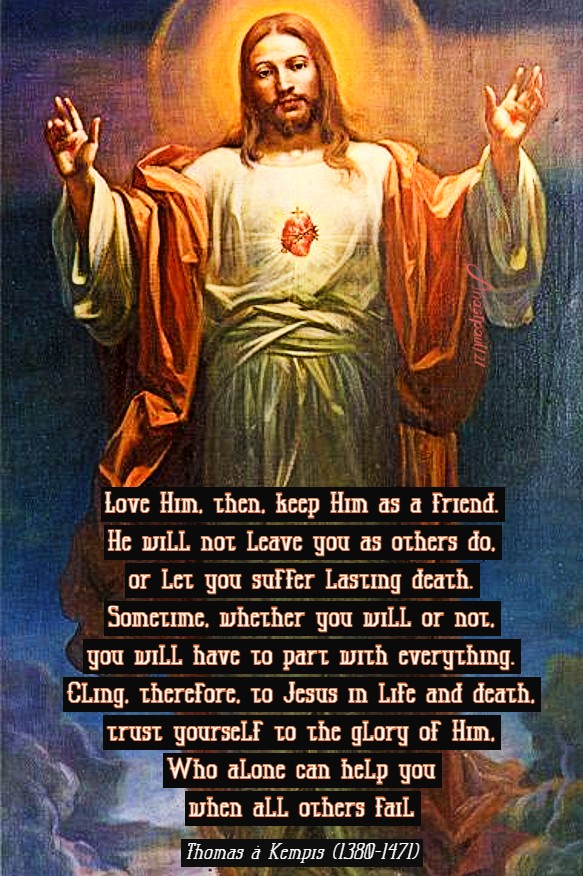
Let Your Name, not mine, be praised. Let Your work, not mine, be magnified. Let Your Holy Name be blessed but let no human praise be given to me. You are my glory. You are the joy of my heart. In You I will glory and rejoice all the day and for myself I will glory in nothing but my infirmities. … ” – Thomas `a Kempis CRSA (1380-1471) – The Imitation of Christ – Book 3 Chapter 40 –Man Has No Good In Himself And Can Glory In Nothing
PRAYER – All-powerful God, to serve You is to reign. Your love gave Your Saint Paul the courage to proclaim the truth of Christ and to preach and live in the light of the Kingdom. Grant that by the prayers of the Blessed Virgin Mary and St Paul, our lives may bear witness to the faith we profess and our love bring others, to the peace and joy of Your gospel. Through our Lord Jesus Christ, Your Son, who lives and reigns with You in the unity of the Holy Spirit, one God, forever and ever. Amen
You must be logged in to post a comment.