Quote/s of the Day – 19 May – “Mary’s Month” – Wednesday of the Seventh Week of Easter, Readings: Acts 20:28-38, Psalm 68:29-30, 33-36, John17:11-1
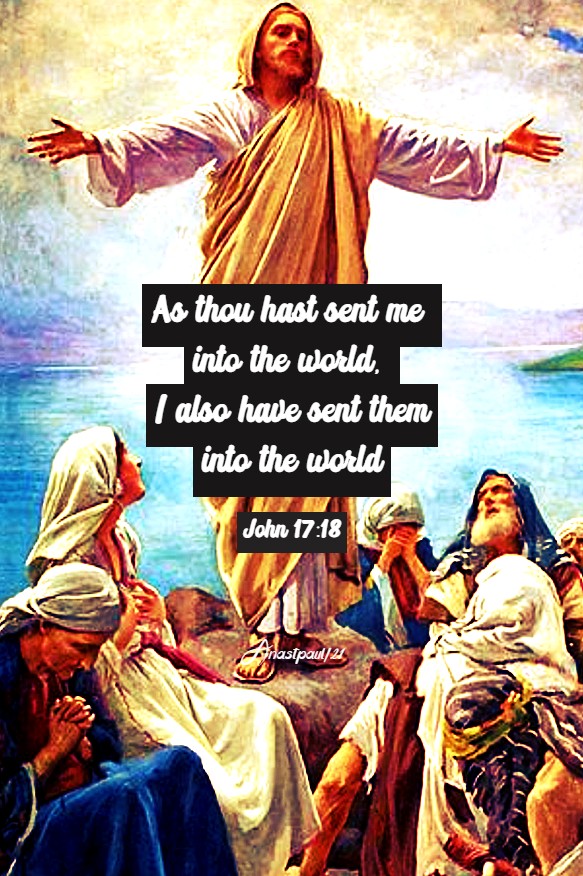
“As thou hast sent me into the world, I also have sent them into the world.”
John 17:18
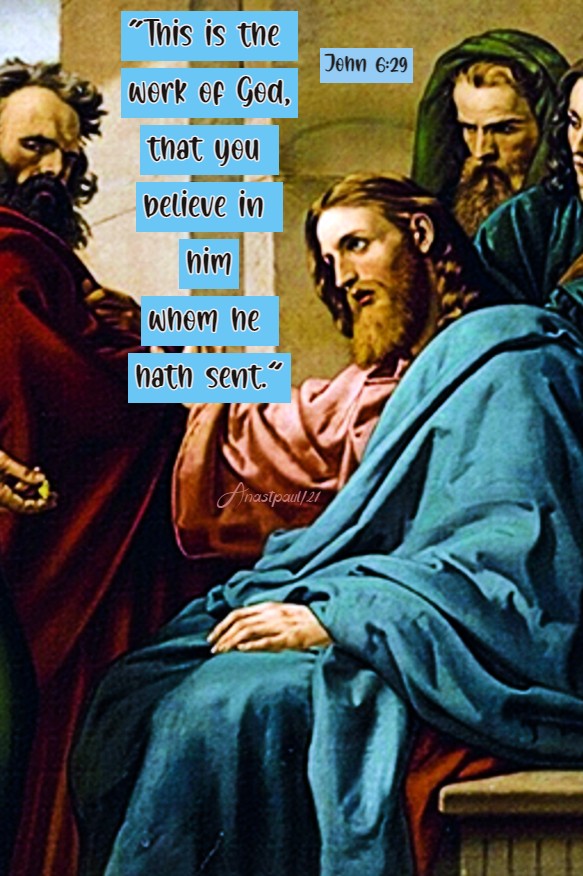
“This is the work of God, that you believe in him whom he hath sent.”
John 6:29
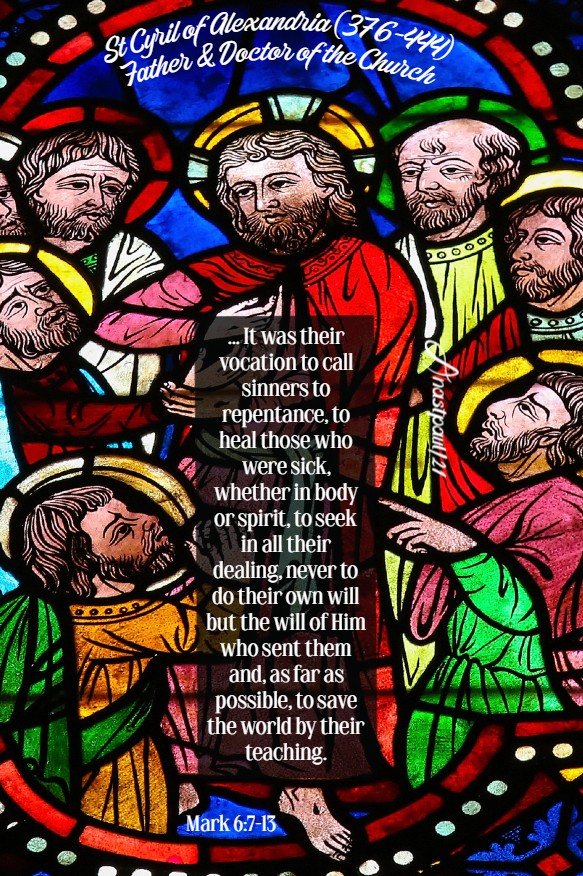
“… It was their vocation to call sinners to repentance, to heal those who were sick, whether in body or spirit, to seek in all their dealing, never to do their own will but the will of Him who sent them and, as far as possible, to save the world by their teaching.”
St Cyril of Alexandria (376-444) Bishop, Father & Doctor of the Church
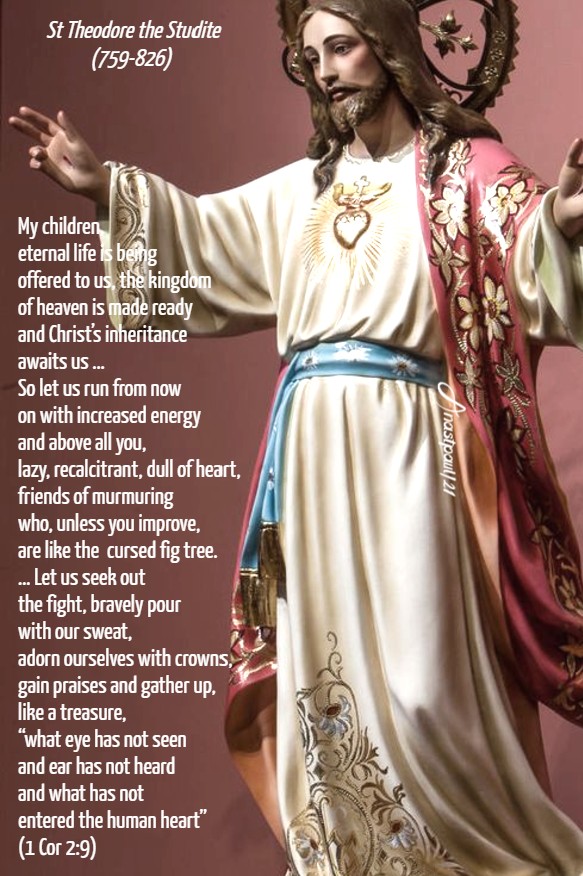
“My children, eternal life is being offered to us, the kingdom of heaven is made ready and Christ’s inheritance awaits us … So let us run from now on with increased energy and above all you, lazy, recalcitrant, dull of heart, friends of murmuring who, unless you improve, are like the cursed fig tree. … Let us seek out the fight, bravely pour with our sweat, adorn ourselves with crowns, gain praises and gather up, like a treasure, “what eye has not seen and ear has not heard and what has not entered the human heart” (1 Cor 2:9).
St Theodore the Studite (759-826)
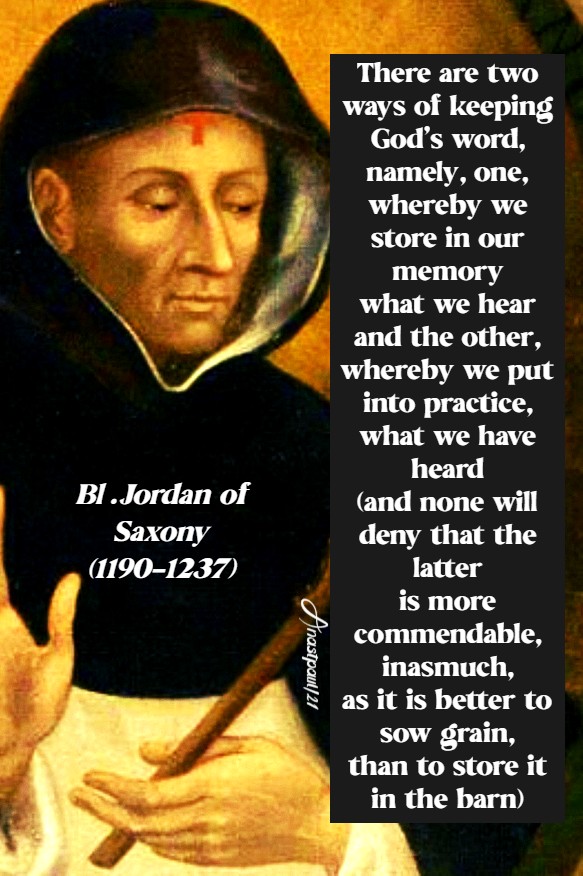
“There are two ways of keeping God’s word, namely, one, whereby we store in our memory what we hear and the other, whereby we put into practice, what we have heard (and none will deny that the latter is more commendable, inasmuch, as it is better to sow grain, than to store it in the barn).”
One Minute Reflection – 19 May – “Mary’s Month” – Wednesday of the Seventh Week of Easter, Readings: Acts 20:28-38, Psalm 68:29-30, 33-36, John17:11-19
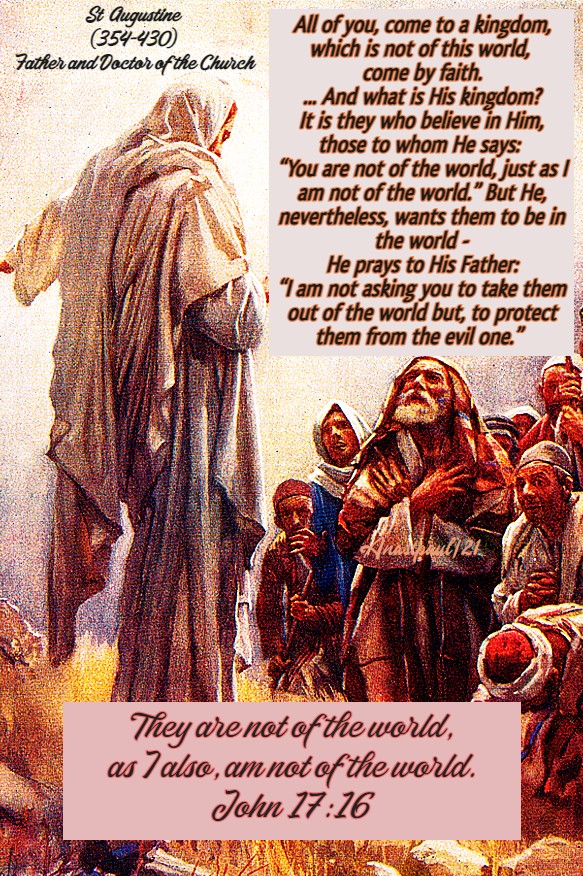
“ They are not of the world, as I also, am not of the world.” – John 17:16
REFLECTION – “Listen everybody, Jews and Gentiles … Listen, all the kingdoms of the earth! I am not preventing you from ruling over this world, “my kingdom is not of this world.” (Jn 18:36) So don’t be afraid with that senseless fear which seized Herod when My birth was announced to him … “No,” the Saviour says, “my kingdom is not of this world.” All of you, come to a kingdom, which is not of this world, come by faith. May you not be made cruel by fear. It is true, that the Son of God, speaking of the Father, says in a prophecy: “Through him, I was established as king on Zion, his holy mountain.” (Ps 2:6) But that Zion and that mountain, are not of this world.
And what is His kingdom? It is they who believe in Him, those to whom He says: “You are not of the world, just as I am not of the world.” But He, nevertheless, wants them to be in the world – He prays to His Father: “I am not asking you to take them out of the world but, to protect them from the evil one.”For He did not say: “My kingdom is not in this world,” but rather: “It is not from this world. If my kingdom were from this world, my followers would be fighting to keep me from being handed over.” (Jn 18:36) – St Augustine (354-430) Bishop, Father and Doctor of Grace of the Church – Homilies on St John, no 115
PRAYER – Give us the grace Holy God to ever serve You and be faithful to You alone. Nothing of this world is worthy of our love and alone in You do we have life and light. May Your divine Son be our Guide and our Hope and may He always be with us as we make our way to our home country, together with His Mother and ours, the Blessed Virgin. We make our prayer through Christ our Lord in the unity of the Holy Spirit, God forever and ever, amen.
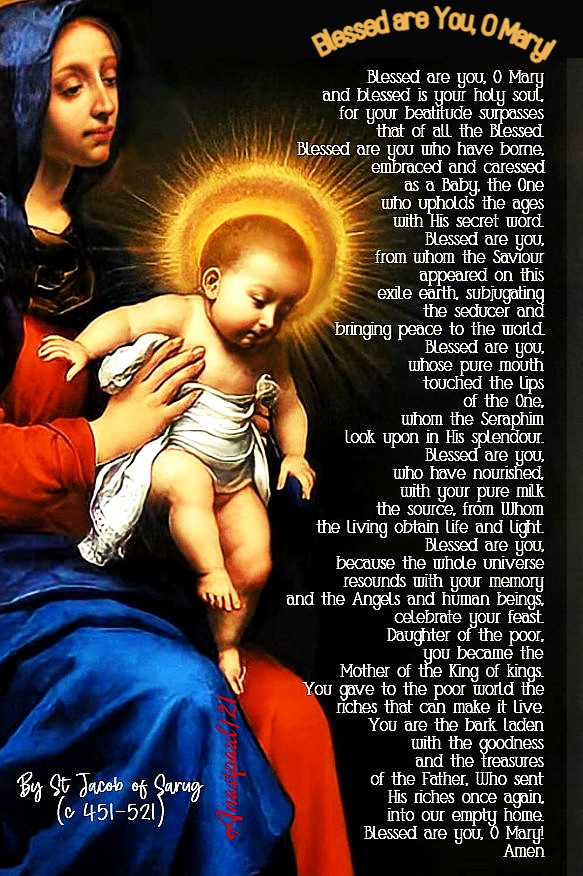
Blessed are You, O Mary! By St Jacob of Sarug (c 451-521) Syrian Bishop and Monk
Blessed are you, O Mary and blessed is your holy soul, for your beatitude surpasses that of all the Blessed. Blessed are you who have borne, embraced and caressed as a Baby, the One who upholds the ages with His secret word. Blessed are you, from whom the Saviour appeared on this exile earth, subjugating the seducer and bringing peace to the world. Blessed are you, whose pure mouth touched the lips of the One, whom the Seraphim look upon in His splendour. Blessed are you, who have nourished, with your pure milk the source, from whom the living obtain life and light. Blessed are you, because the whole universe resounds with your memory and the Angels and human beings, celebrate your feast. Daughter of the poor, you became the Mother of the King of kings. You gave to the poor worldthe riches that can make it live. You are the bark, laden with the goodness and the treasures of the Father, Who sent His riches once again, into our empty home. Blessed are you, O Mary! Amen
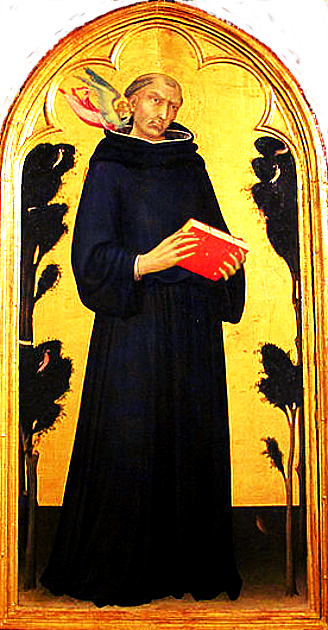
Saint of the Day – 19 May – Blessed Augustine Novello OSA (1240– 1309) Priest and Friar of the Order of St Augustine, miracle-worker, Prior General of the Order, Reformer of the Constitutions, Professor of Canon and Civil Law. Born in 1240 at Taormina, Sicily as Matteo da Termini and died on 19 May 1309 at San Leonardo, Italy of natural causes. Also known as – Augustine of Taormina, Agostino Novello, Augustine Novellus, Matthew of Taormina, Matteo de’ Termini.
Matteo’s parents, of a noble family originally from Catalonia in Spain, educated him most carefully and had him instructed in all the then known sciences. At the University of Bologna, he earned a Doctorate in Civil and Canon Law and became a Professor of law. He worked in the Chancery of the Kingdom of Sicily at the Court of King Manfred of Sicily.
In this capacity, Matteo accompanied the King in the war against Charles I of Anjou, who disputed Manfred’s right to the Crown of Sicily. In the battle at Benevento, in which Manfred was killed and his army routed, Matteo was wounded and thought to be dead and so, was left on the battlefield among the corpse. Regaining consciousness, Matteo was able to somehow reach his home, however, disillusioned with the world and with the evanescence of all earthly glory, he determined, thenceforth, to forsake all worldly honours and dignities.
Following this decision, Matteo asked for admission as a lay brother into the Order of St Augustine and was received in a Convent in Sicily. There he took the name Augustine/Agostino and there, he would live unknown to the world, far from his home and his people, devoted to exercises of piety. He lived there tranquilly until an unforeseen incident brought him once more before the world.
The title to some property belonging to the Convent was claimed by a local Bishop. The Augustinians were represented by a learned lawyer of Siena, Giacomo Pallares, who recognised Augutine as a former colleague. Pallares, lost no time in informing the Ecclesiastical authorities of Augustine’s identity, advising them, to no longer keep such a wealth of learning, in obscurity.
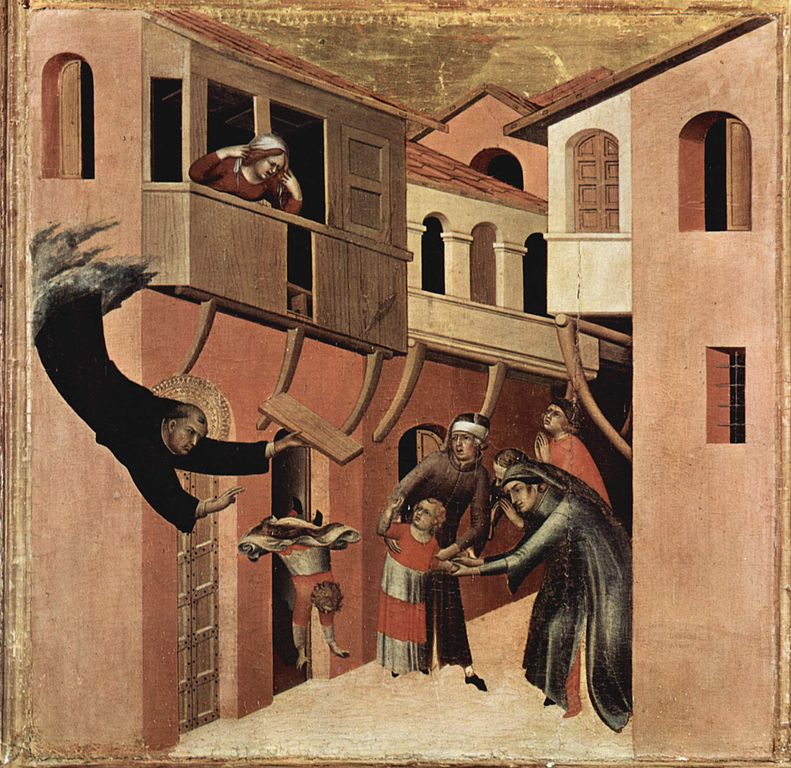
Child falling from a balcony. saved by Bl Augustine
When Blessed Clement of Osimo, General of the Order, heard of this, he compelled Augustine, under obedience, to receive Holy Orders and brought him to Rome, where he reformed the Constitutions of the Order, Pope Nicholas IV appointed him, as his Confessor and Grand Penitentiary, a position which he accepted, again only under obedience.
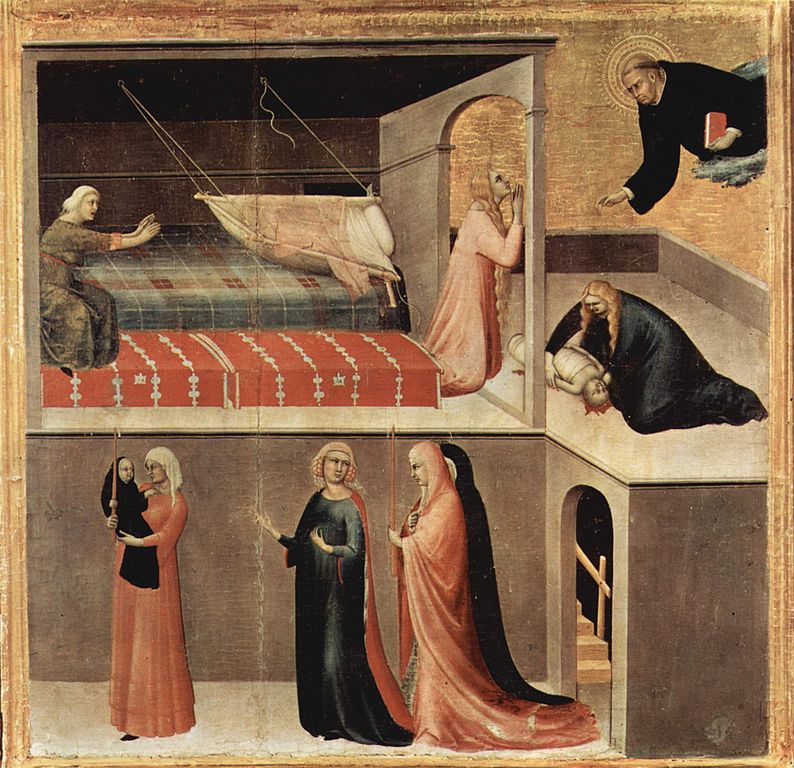
Child falling from its cradle, caught by Bl Augutine
Augustine was elected Prior General in 1298. Despite his attempts to refuse this position he was ordered by the Pope to accept. In 1300 he resigned from office and spent the remaining ten years of his life at the Hermitage of San Leonardo al Lago.
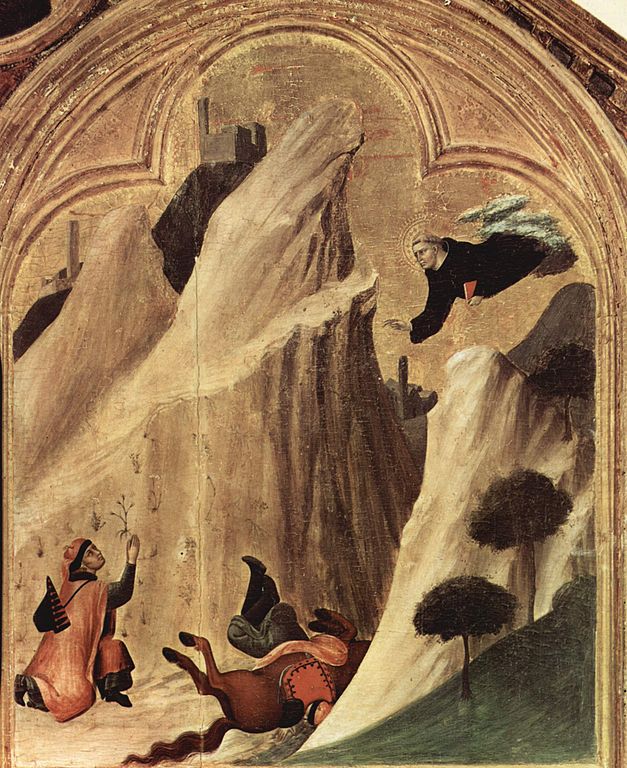
Knight falling into a ravine, saved by Bl Augustine
In his retreat and retrement near Siena, Augustine not only dedicated himself to the practice of the virtues proper to the religious state. He also ministered to the people of the surrounding villages ,as well as in nearby Siena. He was known and respected for his deep humility and love of contemplation. He played an important role in the founding of Siena’s Hospital of Santa Maria della Scala and composed a set of guidelines for the Hospital community.
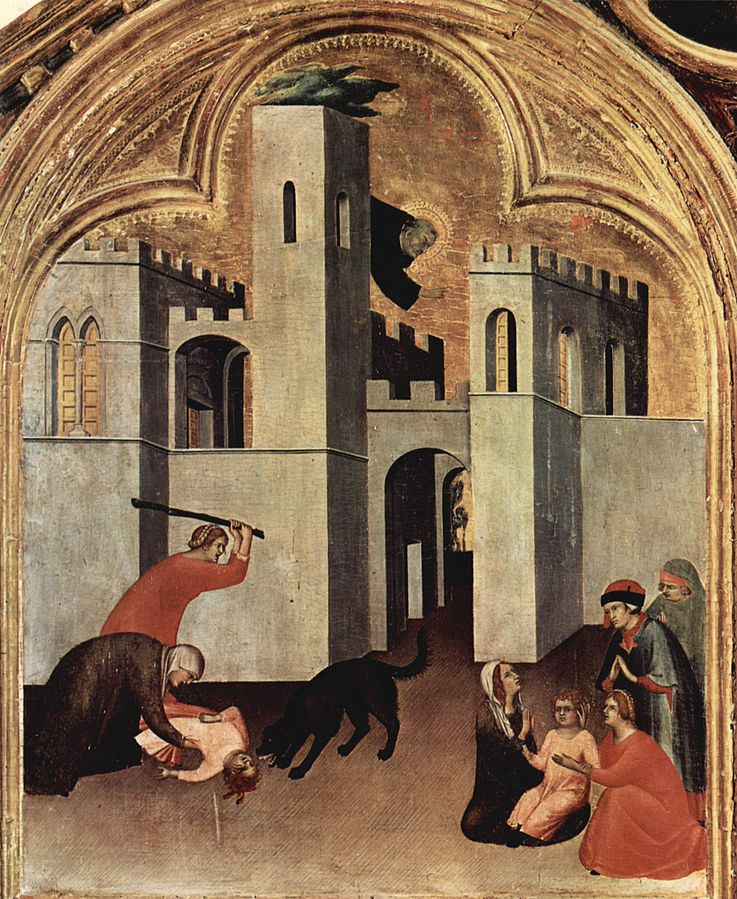
Child attacked by a wolf aved by Bl Augustine
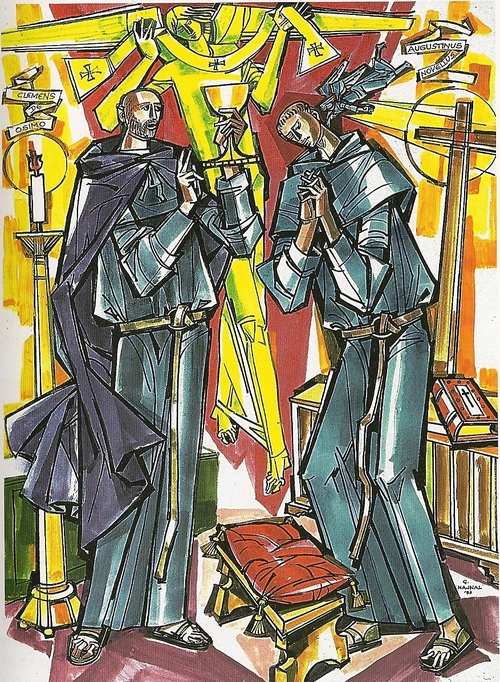
He died on 19 May 1309/10 at San Leonardo. Because his reputation for prayer, charity and miracles was know far and wide, the Bishop of Siena insisted that his body be placed in a casket and kept in the Augustinian Church in Siena, the Church of St Augustine. His casket and related works of art, see below, remained in the Church of Saint Augustine in Siena for many centuries. It was later taken to Sicily, where he had worked for the King before becoming a member of the Order of Saint Augustine. His tomb is now located at Termini Imerese in Sicily. Along with that of Clement of Osimo, the Prior General who had called him out from his anonymity at Rosia.
The Blessed Osimo and Augustine
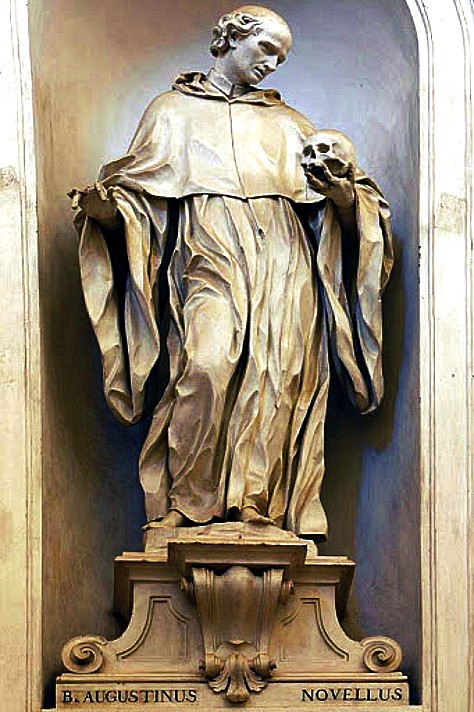
His Statue is found on the façade of the Cathedral.
Many of the miracles wrought through the intercession of Blessed Augsutine were verified and authenticated. by Pope Clement XIII , who solemnly Beatified him in 1761, and Pope Clement XIV authorised his cult on 23 July 1770.
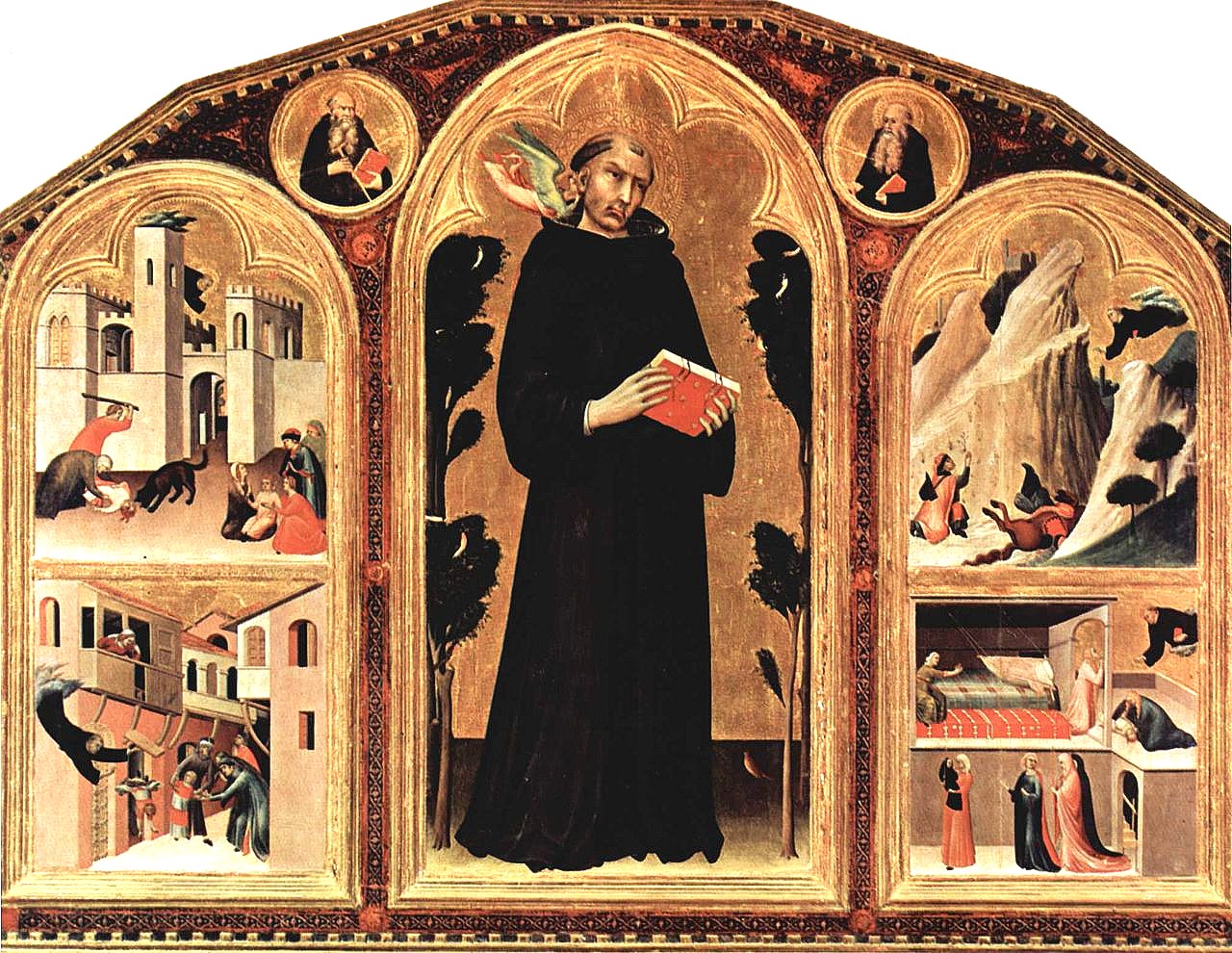
In the Church of Saint Augustine in Siena there was a wooden Sarcophagus in which the Augustine of Tarano was buried and an Altar consecrated to him. A painted Altarpiece was commissioned by the best painter available, Simóne Martini (1280/1285 – 1344). Appropriate to its environment, the Altarpiece is a colourful and simple form of devotional painting. It is presumed that the Altarpiece was in place for the celebrations in honour of the Augustine of Movello held there in 1324. The Altarpiece depicts some of the miracles of Blessed Augustine, see the images above.
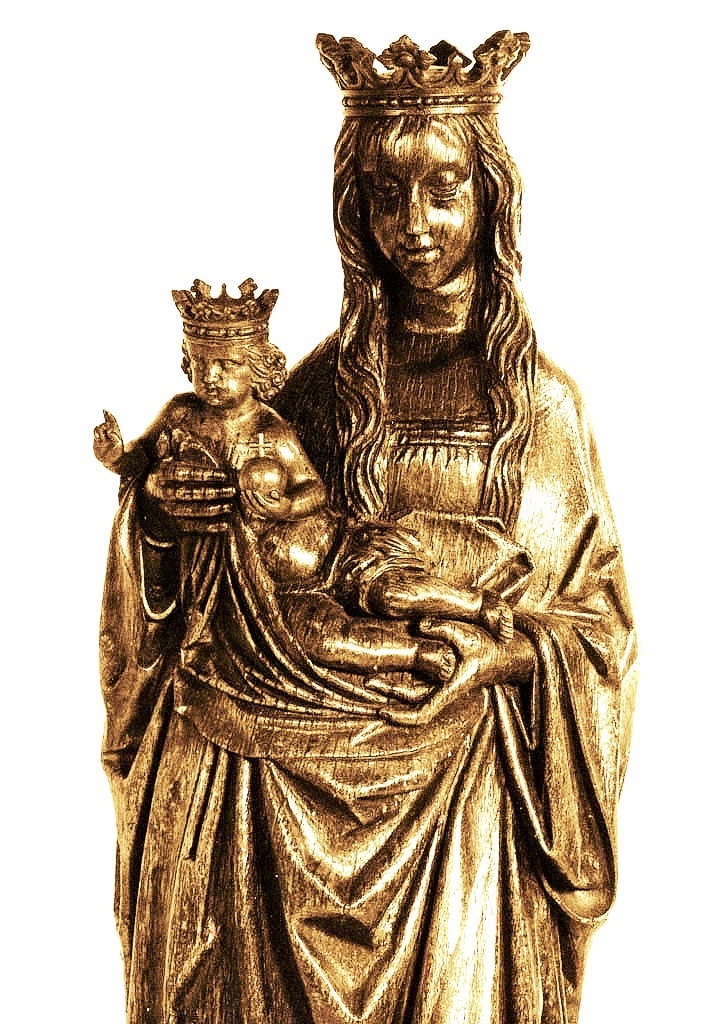
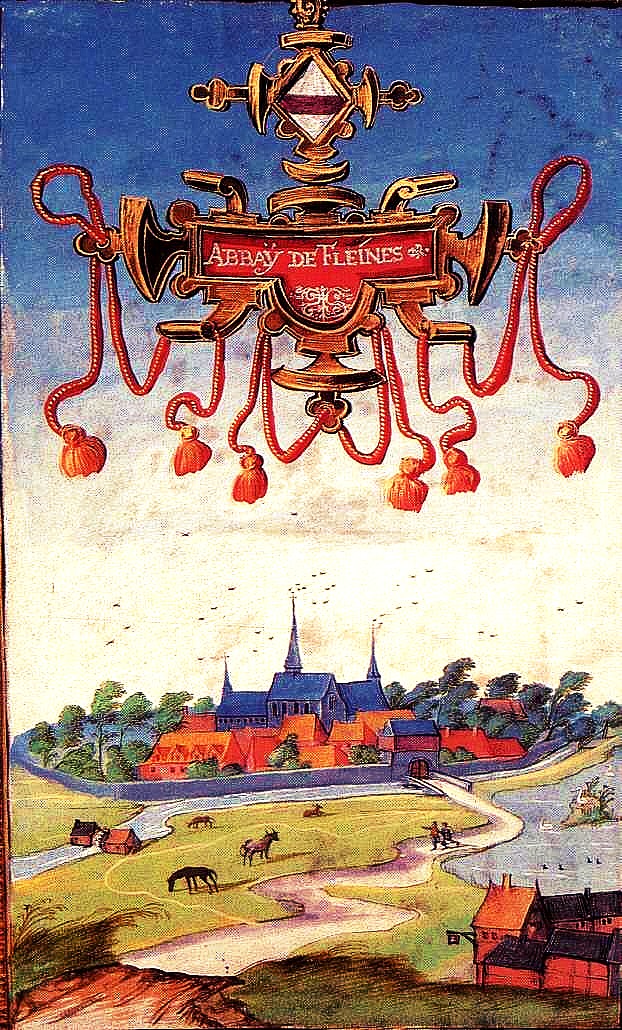
Notre-Dame de Flines / Our Lady of Flines, Douay (1279) – 20 May:
The Abbot Orsini writes: “Dedication of Our Lady of Flines, near Douay, by Peter, Archbishop of Rheims, in the year 1279. This Abbey of Nuns, of the Order of Citeaux, was given to Saint Bernard by Margaret de Dampierre, in the year 1234.”
Margaret de Dampiere, also known as Margaret of Constantinople, was a relative of the Count Guy de Dampier. It appears that Saint Bernard had recently established an Order of Nuns according to the Rule of his Order and in the year 1234, Margaret presented Saint Bernard with the Abbey located near Douay. Five years previous to this, Archbishop Peter of Rheims had dedicated the Shrine to Our Lady of Flines. This Shrine became a place of pilgrimage as a result of the miraculous cure of a child protégé of Margaret’s. The little one, unseen by Margaret’s coachman, had been seriously injured while playing about the stable-yard. The doctors pronounced her hopelessly lame for life. Margaret, however, was confident in Our Lady’s intercession and took the child to the neighbouring Shrine every Saturday and begged the Mother of God to be merciful to the child, as well as to the grieving parents. After the fifteenth visit, the little girl, with a happy cry, jumped from the arms of her mother. “I can walk straight, see?” and proved that Our Lady had indeed cured her in that instant. When Margaret de Dampiere died in 1280, she was buried in the centre of the choir. The renown of the Shrine continued to spread over time and resulted in many pilgrimages to Our Lady of Flines. The Blessed Virgin Mary proved the words of her loyal son Saint Bernard, “Never was it known that anyone who fled to thy protection, implored thy help, or sought thine intercession was left unaided” to be true. The Abbey was destroyed by the partisans of the French Revolution and there is now no trace of the once thriving and beautiful Convent and Shrine.
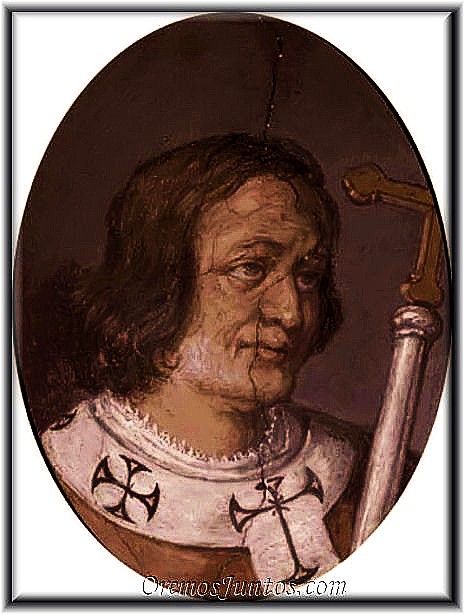
St Alcuin of York Blessed Augustine Novello OSA (1240– 1309) Priest and Friar of the Order of St Augustine. St Calocerus of Rome
Thought for the Day – 18 May – Meditations with Antonio Cardinal Bacci (1881-1971)
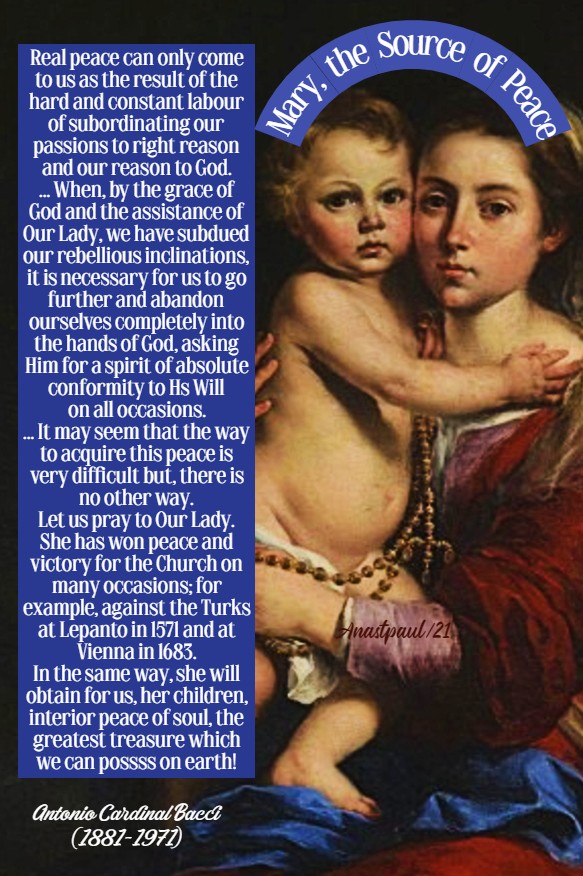
Mary, the Source of Peace
“If we wish to possess this true peace, which only God can give, we must control and regulate the movements of our passions when they rebel against the soul. In other words, as St Augustine says, our lower appetites must obey our reason and this, in its turn, must be subject to its author, God! (De Serm. Domini, 1,2). Real peace can only come to us as the result of the hard and constant labour of subordinating our passions to right reason and our reason to God. “And this is the peace,” Augustine writes, “which God gives on earth, to men of goodwill; this is the most perfect wisdom ” (Ibid).
We have found, from sad experience, that sin and the free play of the passions, cannot give us real peace because “there is no peace for the wicked” (Is 48:22). When, by the grace of God and the assistance of Our Lady, we have subdued our rebellious inclinations, it is necessary for us to go further and abandon ourselves completely into the hands of God, asking Him for a spirit of absolute conformity to Hs Will on all occasions. This is the price which we must pay to enjoy the peace which the world cannot give and which God gives only to those who do His Holy Will in all things (Cf Jn 14:27).
It may seem that the way to acquire this peace is very difficult but, there is no other way. Let us pray to Our Lady. She has won peace and victory for the Church on many occasions; for example, against the Turks at Lepanto in 1571 and at Vienna in 1683. In the same way, she will obtain for us, her children, interior peace of soul, the greatest treasure which we can possss on earth!”
Quote/s of the Day – 16 May – “Mary’s Month” Readings: Acts 20:17-27, Psalm 68:10-11, 20-21, John 17:1-11
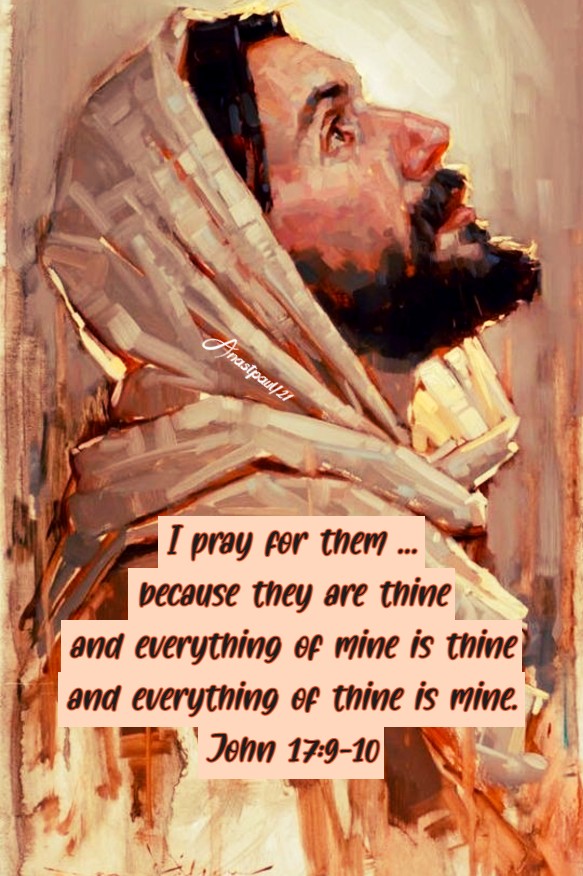
“I pray for them … because they are thine and everything of mine is thine and everything of thine is mine.”
John 17:9-10
“You shall love the Lord your God with all your heart and with all your soul and with all your mind. And the second is like it: You shall love your neighbour as yourself.”
Matthew 22:36,39
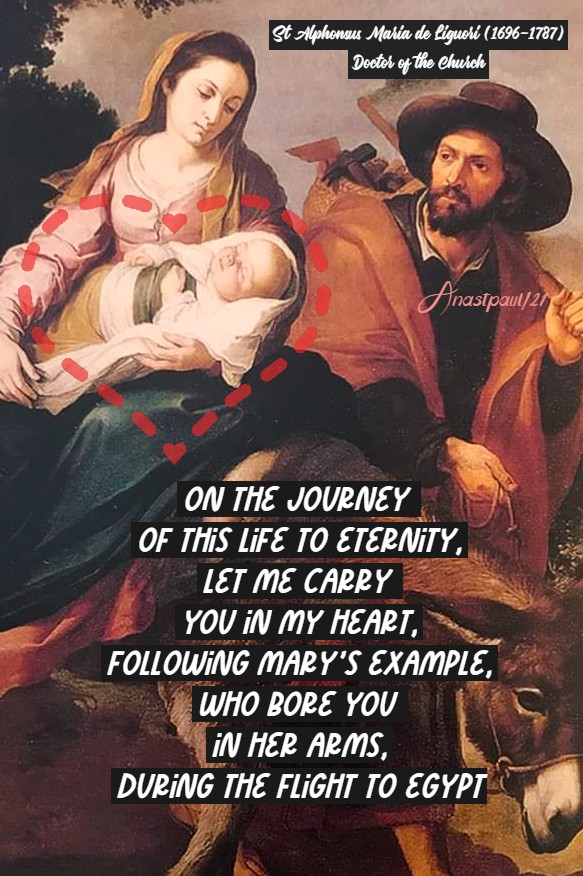
“On the journey of this life to eternity, let me carry You in my heart, following Mary’s example, who bore You in her arms, during the flight to Egypt.”
St Alphonsus Maria de Liguori (1696-1787) Bishop and Doctor of the Church
“When you love, you feel like speaking the whole time with the one you love, or at least, you want to look at Him without ceasing. Prayer is nothing else. It is the familiar meeting with our Beloved. We look at Him, we tell Him we love Him, we rejoice to be at His feet.”
Bl Charles of Jesus de Foucauld (1858-1916)
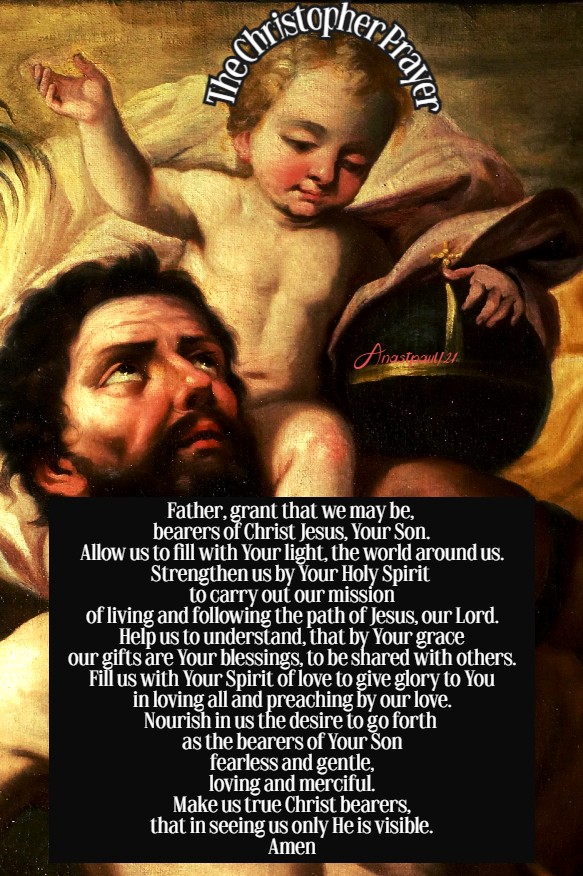
The Christopher Prayer
Father, grant that we may be, bearers of Christ Jesus, Your Son. Allow us to fill with Your light, the world around us. Strengthen us by Your Holy Spirit to carry out our mission of living and following the path of Jesus, our Lord. Help us to understand, that by Your grace our gifts are Your blessings, to be shared with others. Fill us with Your Spirit of love to give glory to You in loving all and preaching by our love. Nourish in us the desire to go forth as the bearers of Your Son fearless and gentle, loving and merciful. Make us true Christ bearers, that in seeing us only He is visible. Amen
One Minute Reflection – 16 May – “Mary’s Month” Readings: Acts 20:17-27, Psalm 68:10-11, 20-21, John 17:1-11
“I am glorified in them.” – John 17:10
REFLECTION –“My Father and I will come to him” – that is to say, to the holy of heart – says the Son of God “and we will make our home with him” (Jn 14:23). It seems to me, that when the psalmist said to God: “You make your dwelling in the holy place, you who art Israel’s praise,” (Ps 22[21]:4) he had no other heaven in mind, than the hearts of the saints. The Apostle expresses it quite clearly: “Christ lives in our hearts through faith,” he tells us (Eph 3:17). Surely it is no wonder that the Lord Jesus gladly makes His home in such a heaven because, unlike the other heavens, He did not bring it into existence by a mere word of command. He descended into the arena to win it; He laid down His life to redeem it. And so, after the battle was won, He solemnly declared: “This is my resting place forever and ever; here I have chosen to dwell” (Ps 132[131]:14). Blessed indeed is the soul to whom the Lord says: “Come, my chosen one, I will set up my throne in you” (Sg 2:10).
“Why, then, are you sorrowful, my soul and why are you troubled within me?” (Ps 42[41]:6). Are you trying to find a place for the Lord within yourself? Who among us can provide a fitting place for the Lord of glory, a place worthy of His majesty! O that I might be counted worthy to worship at His footstool, that I might at least cling to the feet of some saintly soul whom the Lord has chosen to be His dwelling place! However, the Lord has only to anoint my soul with the oil of His mercy, for me in my turn, to be able to say: “I have run the way of your commandments because you have enlarged my heart” (Ps 119[118]:32). Then perhaps, even if I cannot usher Him into a “large and richly furnished room” in my heart where He may refresh Himself with His disciples (cf. Mk 14:15), I shall at least, be able to offer Him, “a place to lay his head” (cf. Mt 8:20).
It is necessary for a soul to grow and be enlarged until it is capable of containing God within itself. But the dimensions of a soul are in proportion to its love, as the Apostle confirms when he urges the Corinthians to “widen their hearts in love” (2 Cor 6 13). Although the soul, being spiritual, cannot be measured physically, grace confers on it what nature does not bestow… Love, then, is the measure of the soul. Souls are large that love much, small that love little; while as for the soul that has no love at all, such a soul is itself nothing. “Without love,” says Saint Paul, “I am nothing” (1 Cor 13:3). – St Bernard (1091-1153) Cistercian Monk and Doctor of the Church – Sermons on the Song of Songs, no. 27, 8-10
PRAYER – Lord God, You opened for us, the way to eternal life, when Christ Your Son was take up to glory and Your Holy Spirit, came to enlighten Your Church. Grant that, as we share in so great a gift, our longing and hope, for our eternal home may grow every stronger and so our service ever more loyal to Your commandments. Listen to the prayers of Holy Mother Mary, the Blessed Virgin Mother of Your Son, whom we beg to pray for Your grace in all things. Through Christ, Our Lord, with the Holy Spirit, one God for all time and for all eternity, amen.
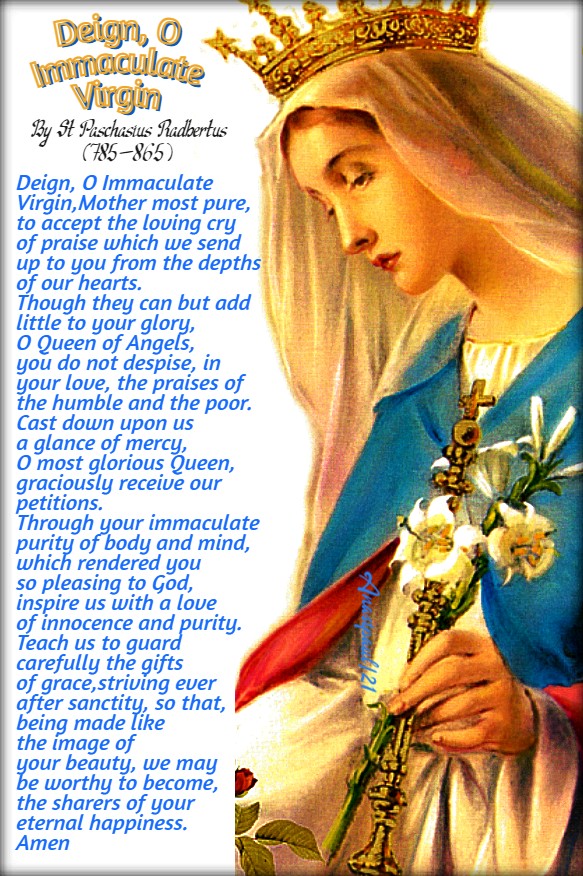
Deign, O Immaculate Virgin By St Paschasius Radbertus (785–865)
Deign, O Immaculate Virgin, Mother most pure, to accept the loving cry of praise which we send up to you from the depths of our hearts. Though they can but add little to your glory, O Queen of Angels, you do not despise, in your love, the praises of the humble and the poor. Cast down upon us a glance of mercy, O most glorious Queen, graciously receive our petitions. Through your immaculate purity of body and mind, which rendered you so pleasing to God, inspire us with a love of innocence and purity. Teach us to guard carefully the gifts of grace, striving ever after sanctity, so that, being made like the image of your beauty, we may be worthy to become, the sharers of your eternal happiness. Amen
Saint of the Day – 18 May – Blessed Burchard of Beinwil (Died c 1192) Priest, miracle-worker. Born in the early 12th century in Langemat, Muri, Switzerland and died on c 1192 in Beinwil, Switzerland of natural causes. Additional Memorials – Monday after Ascension Day (Beinwil, Switzerland), 27 June on some calendars, 20 August (pilgrimage date).
We have little information about Burchrd’s early life. He was educated at the Benedictine Monastery near his home village. He seems to have had some connection to the Kappel Monastery as he is mentioned in their records.
He was Ordained and then became the Parish Priest in Beinwil, Switzerland. He became known as a miracle worker manifested in his zealous and careful attention to the needs of both the physical and the spiritual well-being of his Parishioners, whom he served for decades.
Burchard raised a wild bird from a chick (an owl, crow or jackdaw; records vary) and taught it not only to speak, but to hold conversations with him. When his household fell into evil and dissolute ways while Burchard was away, the bird told the Priest what it had witnessed. The servants killed the bird and threw the carcass into a mine shaft near the vicarage. The dead bird returned to him and managed to explain what had happened and who had done it.
Burchard once travelled to the nearby village to Unterhorben to minister to a dying woman. He was met on the road by a messenger who told him that the woman had died and he need not continue. Father Burchard went on to the house anyway to pray at her deathbed. Miraculously she came back to life just long enough to receive the final Sacraments and blessings.
When Burchard died, he was buried in his Parish Church’s graveyard. In 1619, his tomb was opened and his relics wee moved during the construction of a Chapel on his grave site. Again in 1754, his relics were temporarily moved during the Chapel’s renovation until it was completed and they were returned in 1784. A miraculous spring is found near his tomb.
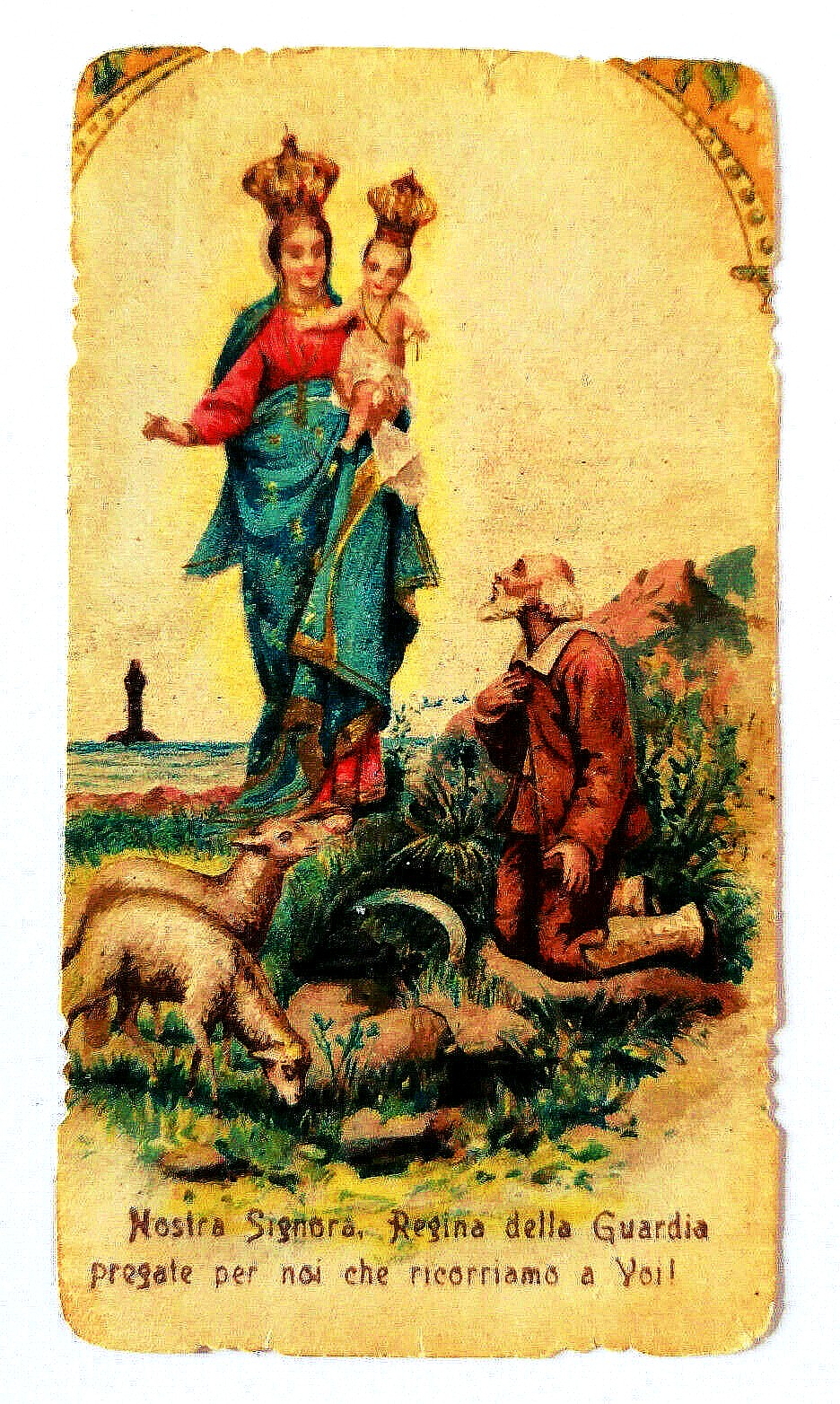
Madonna dell’Alno / Our Lady of the White Poplar, Canzano, Teramo, Abruzzo, Italy (1480): 18 May
The Church, today a Parish Church, represents the centre of the Sanzanese devotion and was built and dedicated to the Madonna of the Alno in the year 1592 by the Congregation of the Most Holy Rosary as reported in the epigraph on the portal architrave : “Societas Rosarii erigendum curavit AD 1592.”
The Virgin Mary appeared on 18 May 1480 on the top of a tree , to the peasant Giovanni Floro, (also referred to as Floro di Giovanni, who was plowing the land in a field located just outside the town. He noticed that his oxen tended to kneel and, looking around, he saw the Madonna on the tree. The Virgin turned to him and asked him to build a Church dedicated to her in the locality of Piano del Castellano in Canzano. [ The farmer immediately returned to the village and reported what had happened to him but, he was not believed and he was mocked and insulted by his fellow villagers.
The next day, the Madonna appeared again and renewed the same request to Floro who, with sadness, told her that the people of Sesi had not believed her words. The Virgin, silent, disappeared but on 20 May, after 6 pm, she manifested herself again and asked Giovanni to return to the village, to explain what was happening to him and, to prove what she said ,by personally driving a horse, notoriously indomitable, owned by the family of Falamesca de Montibus. The Madonna told him to be guided by the animal which would trace and define by its path, the site on which to erect the Church. [The owner of the horse agreed to entrust it to Giovanni who, to the amazement of all present, managed to ride it leading it up to the Piano del Castellano. Here, the animal “without restraint and without guidance, circled a space three times, and finally knelt down and bent its head to the ground.” The bystanders, who until then had observed in silence, expressed their astonishment with a great roar and gave consent and life to the building of the new Church.
Of the original Renaissance construction , only the stone portal remains, showing mirrors and rosettes. The façade and the stucco decorations of the Sanctuary are attributable to the reconstruction work of 1750 , while the brick bell tower dates from 1810 .
The Church holds within it a ‘ holy water font of the XVII Century placed on a pedestal carved with motifs of acanthus leaves, a bust reliquary wood of the eighteenth century depicting holy meek, sister of St Blaise Patron of Canzano, and paintings, dated between the seventeenth and eighteenth centuries . Among these of particular value there is the Altarpiece of the Madonna del Rosario, placed behind the Altar, executed by Pasquale Rico of Montereale , portrayed with the Saints Domenic and Nicolas di Bari attributable to the workshop of Francesco Solimena . There is also the canvas depicting the Adoration of the Shepherds painted by the workshop of Guido Reni .
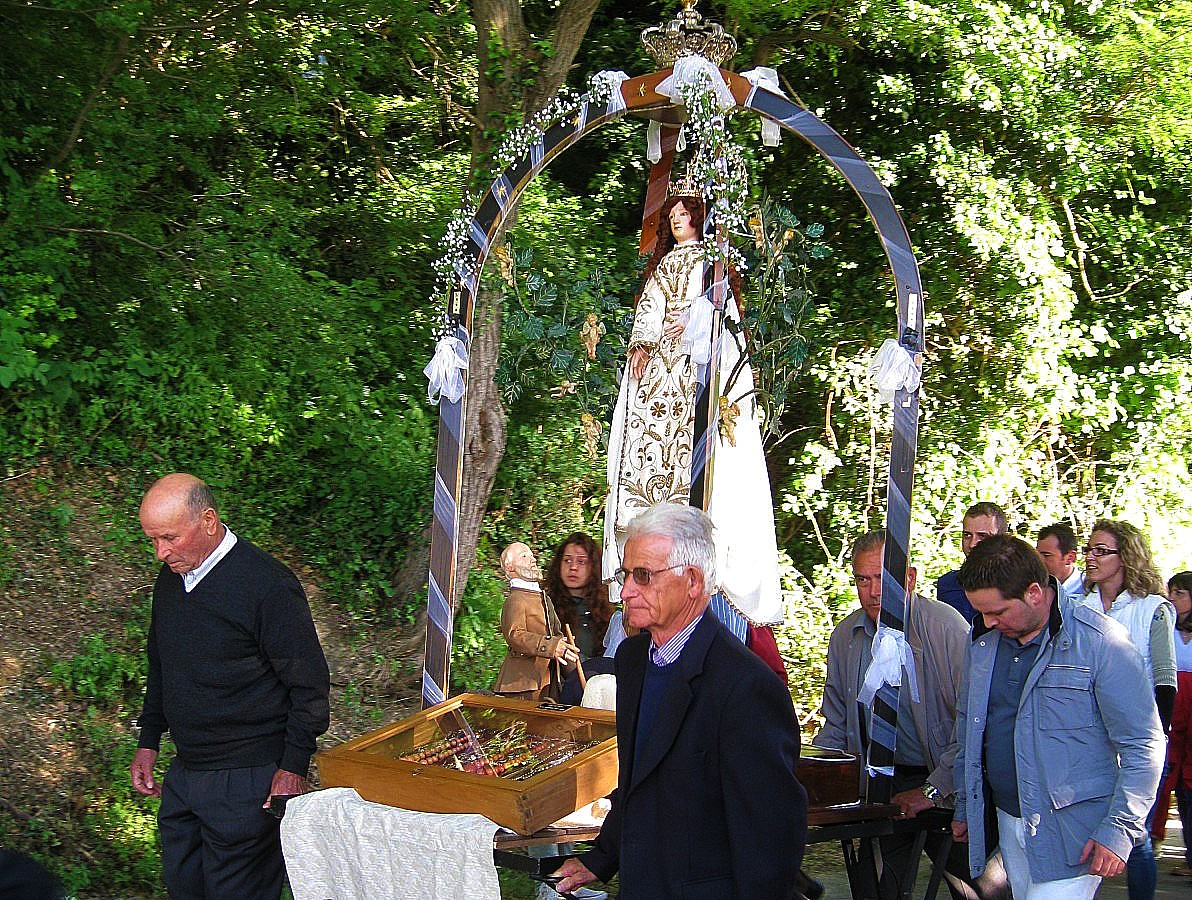
Veneration continues today with many pilgrims visiting all year but on 18 May each year, pilgrims devoutly process carrying the beautiful Statue and praying for all the special needs of the area, the Church and the world.
St Felix of Spoleto St Feredarius of Iona Bl Jan Oprzadek St Merililaun St Ortasio of Alexandria St Potamon of Heraclea St Serapione of Alexandria Bl Stanislaw Kubski
Blessed William of Toulouse OSA (c 1297-1369) Priest of the Order of St Augustine His life: https://anastpaul.com/2019/05/18/saint-of-the-day-blessed-william-of-toulouse-osa-c-1297-1369/ — Martyrs of Ancyra – 8 saints: Seven nuns martyred in the persecutions of Diocletian and the innkeeper who was executed for giving them a Christian burial: Alexandria, Claudia, Euphrasia, Julitta, Matrona, Phaina, Thecusa and Theodatus. c.304 in Ancyra, Galatia (in modern Turkey)
Thought for the Day – 17 May – Meditations with Antonio Cardinal Bacci (1881-1971)
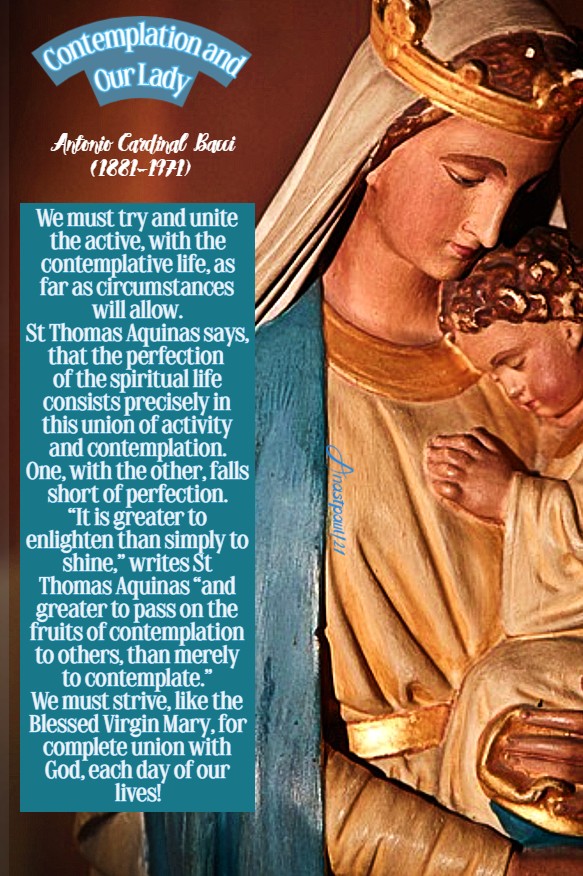
Contemplation and Our Lady
“We must try and unite the active, with the contemplative life, as far as circumstances will allow. St Thomas Aquinas says, that the perfection of the spiritual life consists precisely in this union of activity and contemplation. One, with the other, falls short of perfection. “It is greater to enlighten than simply to shine,” writes St Thomas Aquinas “and greater to pass on the fruits of contemplation to others, than merely to contemplate.” (Summa Theologiae, II-II, q 6, a 3).
Contemplation on its own, can degenerate into useless day dreaming. It is necessary that it should produce a genuine interior transformation, as a result of which, the subject, under the guidance of the Holy Sprit, becomes, in his speech and his conduct, a man of God. Now, the man of God is not satisfied with enjoying spiritual consolations but, is moved by his zeal for the glory of God, to try and extend His Kingdom, by every possible means. It is in this way, that contemplation becomes apostolic action.
We must remember, on the other hand, that neither is action on its own, sufficient. It can become barren when it is not nourished by the interior life of grace, which is the source of prayer and contemplation. It cannot be held, that this last, is the exclusive gift of a few privilege souls. Anyone can have it, as long as he allows himself to be penetrated by the love of God and as long as he succeeds, in securing moments of recollection and silence, at intervals during life. In these moments, he will grow closer to God and will enjoy a foretaste of the happiness of heaven. We must strive, like the Blessed Virgin Mary, for complete union with God, each day of our lives!”
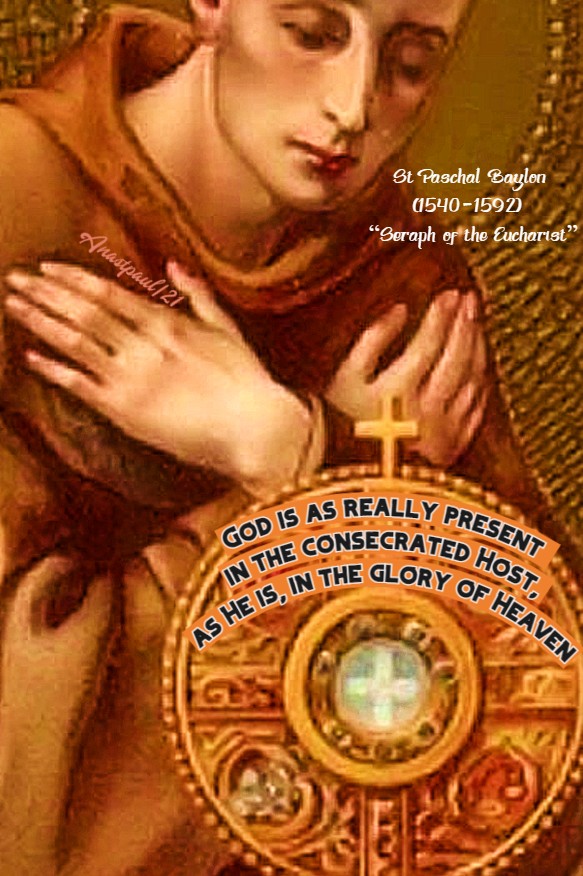
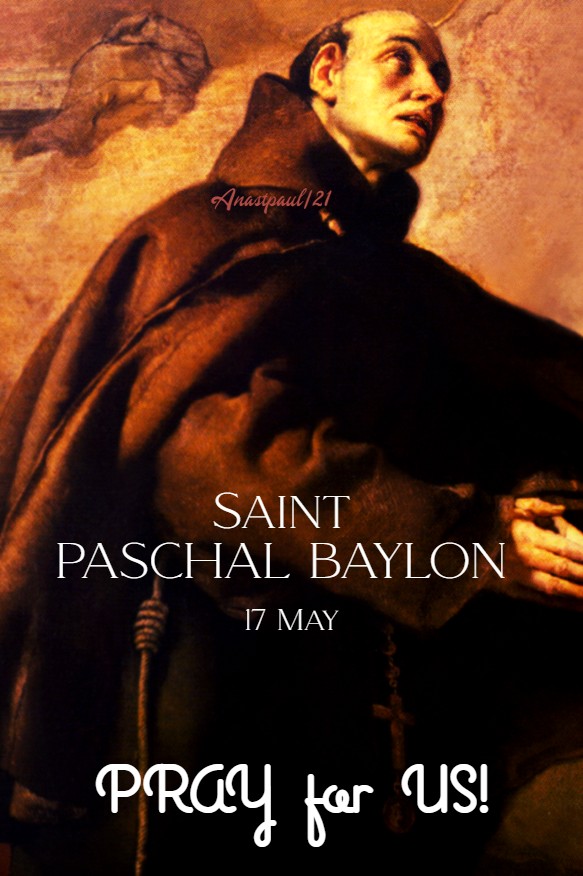
Quote/s of the Day – 17 May – The Memorial of St Paschal Baylon OFM (1540-1592) “Seraph of the Eucharist,” “Saint of the Blessed Sacrament,” “Servant of the Blessed Sacrament.”
“God is as really present in the consecrated Host, as He is, in the glory of Heaven.”
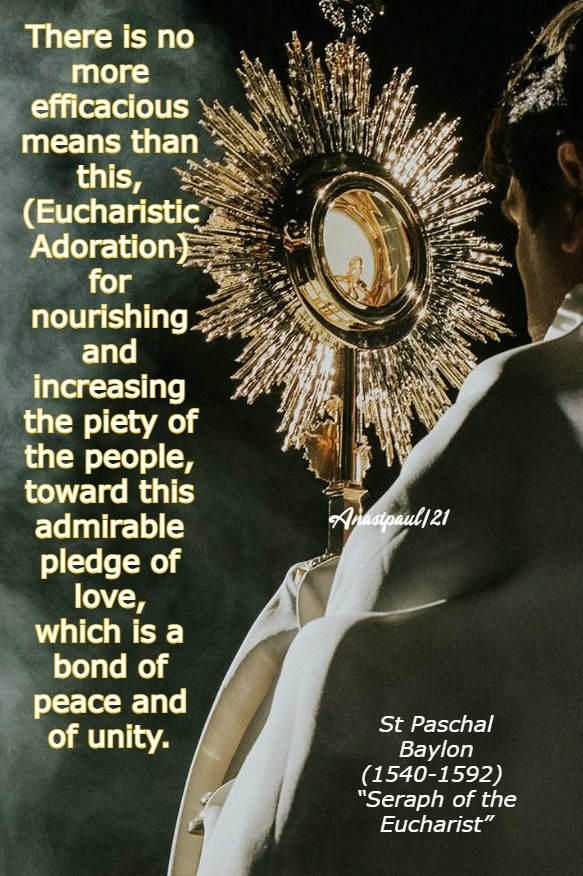
“There is no more efficacious means than this, (Eucharistic Adoration) for nourishing and increasing the piety of the people, toward this admirable pledge of love, which is a bond of peace and of unity.”
One Minute Reflection – 17 May – “Mary’s Month” – Monday of the Seventh week of Easter, Readings: Acts 19:1-8, Psalm 68:2-7, John 16:29-33 and the Memorial of St Paschal Baylon OFM (1540-1592)
“In the world you will have tribulation. But take heart, I have conquered the world.” ... John 16:33
REFLECTION – “Let nothing intervene to hinder the progress of any who travel alongside each other, in this evangelical life but let us walk with agile step though the road be rough and hard, let us show a brave and manly spirit, overcome obstacles, pass along from pathway to pathway, from hill to hill, until we climb onto the mountain of the Lord and make a home for ourselves in the holy place of His impassibility.
Now, companions assist each other on the way; so then, my brothers, as the Apostle says: “Bear one another’s burdens” (Gal 6:2) and make up for whatever is lacking to others (cf. 2 Cor 8:14 ; Phil 2:30). To the negligence that perhaps holds sway today, noble courage will succeed tomorrow, now one is in gloom and then suddenly one rises to the surface and discovers joy again, at one moment our passions rise up but soon God comes to help us, they are broken and calm returns. For you will only be seen like this yesterday and the day before but, dear friend, you will not always remain the same but the grace of God will draw near you, the Lord will fight for you and perhaps, like the great Antony, you will say: “Where were you just now?” and he will answer: “I wanted to see your combat.”
For now, let us persevere, children, dear children, let us be patient for a little, brothers, dear brothers.… Who will be crowned without having fought? Who will go to rest if he is not tired (cf. 2 Tim 2:5-6)? Who will gather the fruits of life without having planted virtues in his soul? Cultivate them, prepare the earth with the greatest care, take trouble over it, sweat over it, children, God’s workers, imitators of the angels, competitors with incorporeal beings, lights for those who are in the world (cf. Phil 2:15)!” … St Theodore the Studite (759-826) Monk – Catechesis 28
PRAYER – Lord God, let the grace of the Holy Spirit come upon us, so that we may hold fast to Your Will with fidelity and love and show it forth by a holy life. May the Mother of our Lord and our Mother and St Paschal Baylon, Servant of the Blessed Sacrament, pray that we may live in the light of our Saviour. Through Jesus Christ our Lord, in the unity of the Holy Spirit, and the glory of God the Father forever and ever, amen.
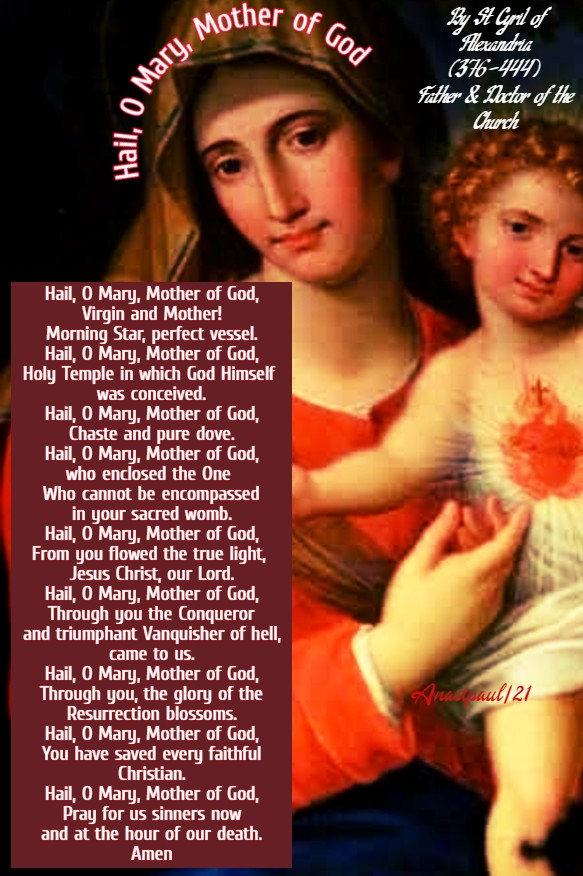
Hail, O Mary, Mother of God By St Cyril of Alexandria (376-444) Father & Doctor of the Church
Hail, O Mary, Mother of God, Virgin and Mother! Morning Star, perfect vessel. Hail, O Mary, Mother of God, Holy Temple in which God Himself was conceived. Hail, O Mary, Mother of God, Chaste and pure dove. Hail, O Mary, Mother of God, who enclosed the One Who cannot be encompassed in your sacred womb. Hail, O Mary, Mother of God, From you flowed the true light, Jesus Christ, our Lord. Hail, O Mary, Mother of God, Through you the Conqueror and triumphant Vanquisher of hell, came to us. Hail, O Mary, Mother of God, Through you, the glory of the Resurrection blossoms. Hail, O Mary, Mother of God, You have saved every faithful Christian. Hail, O Mary, Mother of God, Pray for us sinners now and at the hour of our death. Amen
Saint of the Day – 17 May – Saint Emiliano I of Vercelli (Died 506) Bishop of Vercelli, Italy in the sixth century, Monk and Hermit, Confessor, Defender of the Faith, apostle of the needy, Social Reformer, spiritual director. Born in the 5th century, possibly in the Piedmont region of Italy and died on 11 September in Cercelli, Italy., the date of his entry into life is also celebrated as his feast in some places. Patronages – Cigliano and Villanova Monferrato.
Indeed, he might have preferred to hide in a hermitage and live in solitude and contemplation to better taste the flavour of the Lord but God’s call wanted him to actively serve his neighbour and he knew how to carry it out with commitment and fervour. Among other measures of practical life, he also had an aqueduct built. He asked of himself the maximum efforts in all things and did not spare himself in any way. Of others, he demanded what they could give, in the name of the Lord.
The Roman Martyrology states of him today: “In Vercelli, translation of St Emilian, Bishop.”
Emiliano, the Eleventh Bishop of the great Diocese of Vercelli, was born around the middle of the fifth century. Some sources mistakenly say he was of Spanish origin but he was probably Piedmontese.
He worked in difficult times, as a worthy successor of St Eusebius (who died in 371). After the fall of the Western Roman Empire (476), the barbarian populations occupied the Italian territory. Theodoric, King of the Ostrogoths, defeated Odoacer (493) and the Burgundians, with the capture of Ravenna, they conquered Italy. The occupied populations were continually tested by the ravages of wars. Vercelli, an important Roman municipality, was almost abandoned and depopulated. The most important authority, even from a civil standpoint, was the Bishop. Theodoric tried to establish a peaceful co-existence with the reduction of taxes and the liberation of many slaves. Although he was Arian, he did his utmost to improve relations between the Church of Rome and that of Constantinople. A few decades earlier, in the Council of Chalcedon (451), Christ’s dual nature, human and divine, had been recognised, not without great difficulty. Such were also the teachings of St Eusebio and S.tMassimo of Turin, fully shared by St Emiliano.
Our saint was from the important Eusebian Monastery which, as St Ambrose wrote, gathered around the Bishop, both contemplative religious and aspirants to the Priesthood. According to tradition, Emiliano was a Hermit for forty years near Sostegno, where then a Monastery of regular clerics was built. Even today there is an ancient Sanctuary dedicated to him.
He was elected Bishop between 493 and 497, maintaining a certain aptitude for contemplation. An authentic Shepherd, he was concerned, both with souls (let us think of him, often gathered with his community around the tomb of St Eusebius) and with the living conditions of his faithful.
For this purpose he asked Theodoric, to build a bridge and reduce taxes. Emiliano strongly defended the centrality of Papal power. He went to Rome for a Council called by St Symmachus (early 6th century), whose appointment and the first years of his Pontificate were marked by violent struggles to cancel his election. Pope Symmachus also escaped an attack. Peace returned in 505, thanks also to the intervention of Theodoric, with the adoption of the first rules to avoid external interference in the Papal elections.
Emiliano was an excellent spiritual director. He gave the veil and was confessor of the four sisters Licinia, Leonzia, Ampelia and Flavia who lived in the proto-monastery founded by Eusebia, sister of St Eusebius.
He died on 11 September, around 506 and was buried in the Cathedral. His cult remained alive and Altars were raised in his honour. On 17 May 1181, Bishop Alberto transferred St Emiliano’s relics to the main Altar. Rediscovered in 1565, seven years later it was placed in the Chapel of the Vergine dello Schiaffo, which was then dedicated to him.
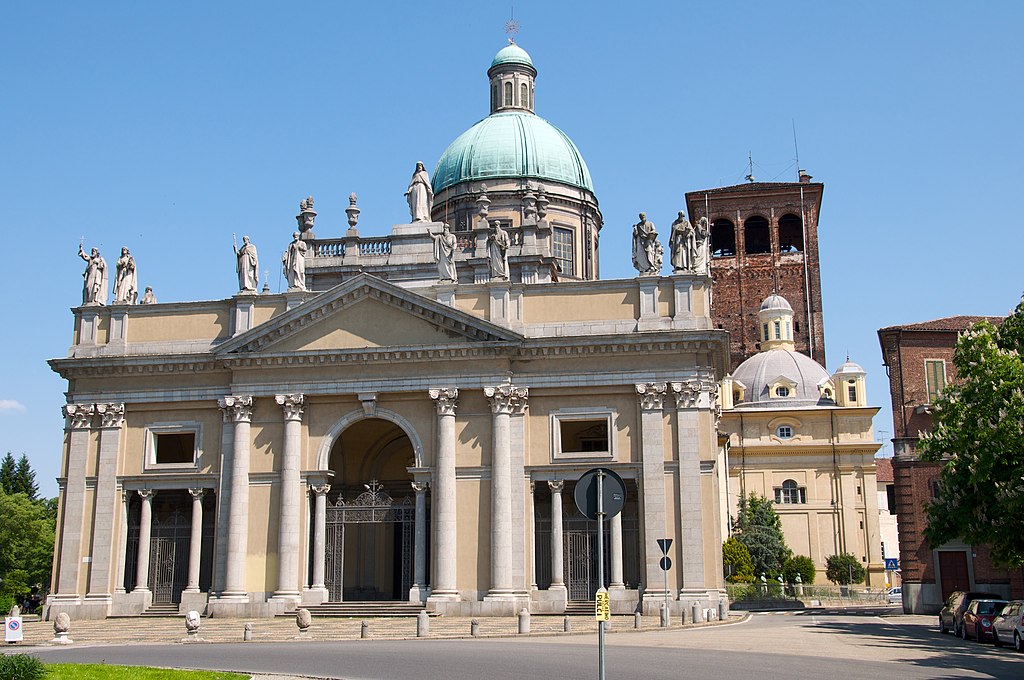
Vercelli Cathedral
Two Parishes, Cigliano and Villanova Monferrato are dedicated to him.. He is not to be confused with Emilian II, a successor to the See of Vercelli, wo centuries later, who was his great devotee.
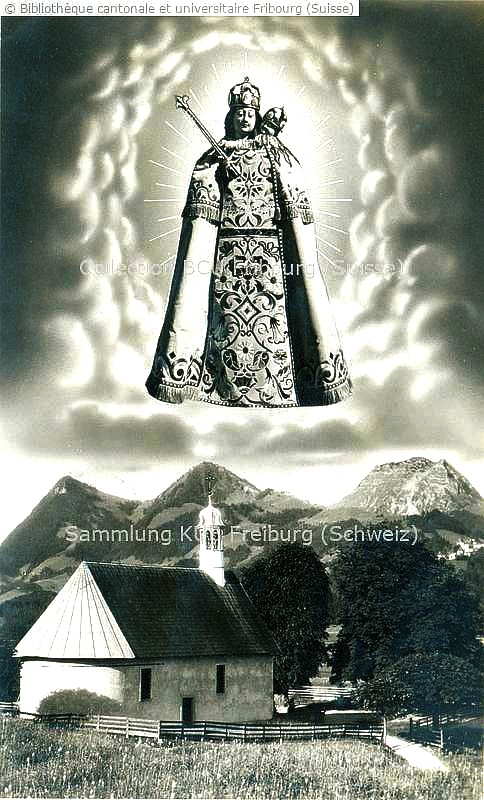
Notre-Dame des Marches, Broc, Gruyère, Fribourg, Switzerland / Our Lady of the Steps (1884)- 17 May:
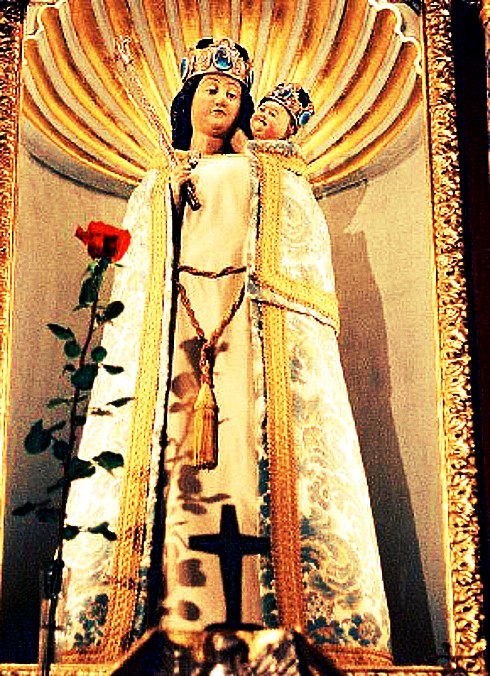
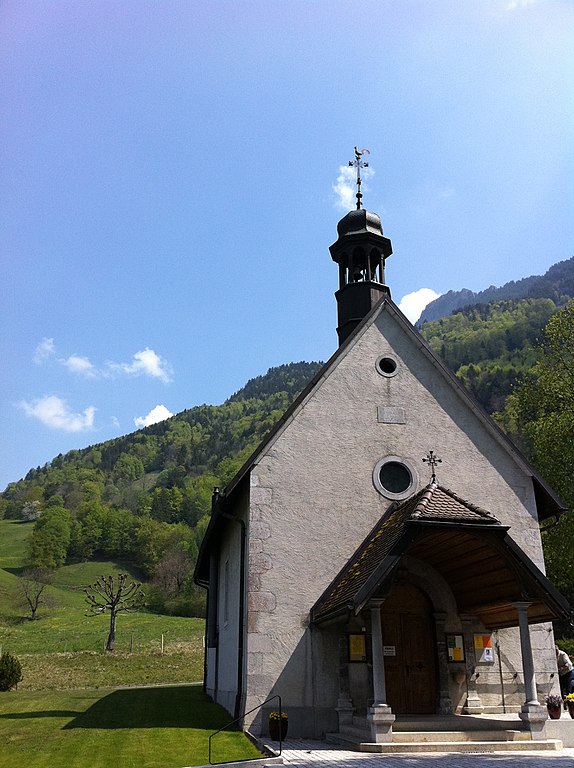
Nestled at the foot of Gruyères Hill, the Chapel overlooks the terraced deposits of the Saane River known as Les Marches, the Steps. The 28″ statue of Our Lady of the Steps, usually vested, is a standing Virgin and Child in the late Gothic style of the 1400s. Documentary evidence of a Chapel here dates to 1572.
The present building goes back to 1705, the work of three brothers, all Priests, from a family of cheese merchants. Dom Nicolas Ruffieux, prothonotary of Broc, decided to build “the most beautiful Chapel in the country.” His brother Jean-Jacques, Priest of neighboring Gruyères, took on the project with a third brother’s help. In 1721, the Commune of Broc added the enclosure and the linden trees that still shade the courtyard. On 17 May 1884, a miracle occurred at Notre-Dame des Marches, the first of several in the 1880s, which turned the rural Chapel into a place of pilgrimage. Stricken with a spinal malady, Léonide Andrey, 22, had been unable to walk for six years. She was carried to Mass at the Chapel and walked home easily. By the 1930s, the Sanctuary was known as the “Little Lourdes of Fribourg.” Two main pilgrimages were established: one in September, initially termed the “anti-alcoholic pilgrimage” and one on a Wednesday in spring, the Pilgrimage of the Sick.
St Heraclius of Noviodunum Bl Ivan Ziatyk St Madron of Cornwall St Maildulf of Malmesbury St Maw
St Paschal Baylon OFM (1540-1592) “Seraph of the Eucharist,” “Saint of the Blessed Sacrament,” “Servant of the Blessed Sacrament.” Franciscan Lay Brother, Mystic…….. A man remarkable for innocence of life and the spirit of penance. Pope Leo XIII declared him the heavenly patron of Eucharistic Congresses and Societies and Apostolates, formed in honour of the Most Blessed Sacrament. About this beautiful Saint: https://anastpaul.wordpress.com/2018/05/17/saint-of-the-day-17-may-st-paschal-baylon-o-f-m-1540-1592-the-seraph-of-the-eucharist/
St Paul of Noviodunum St Peter Lieou St Rasso of Grafrath St Restituta of Carthage St Silaus of Lucca St Solochanus of Chalcedon St Thethmar St Victor Roma — Martyrs of Alexandria – 3 saints: Three Christians martyred together; no details about them have survived except their names: Adrio, Basilla and Victor. 4th century Alexandria, Egypt.
Martyrs of Nyon: A group of Christians martyred together in the persecutions of Diocletian. We know little more than three of their names: Aquilinus, Heradius and Paul. 303 at Noyon, Switzerland.
Thought for the Day – 16 May – Meditations with Antonio Cardinal Bacci (1881-1971)
Prayer and Our Lady
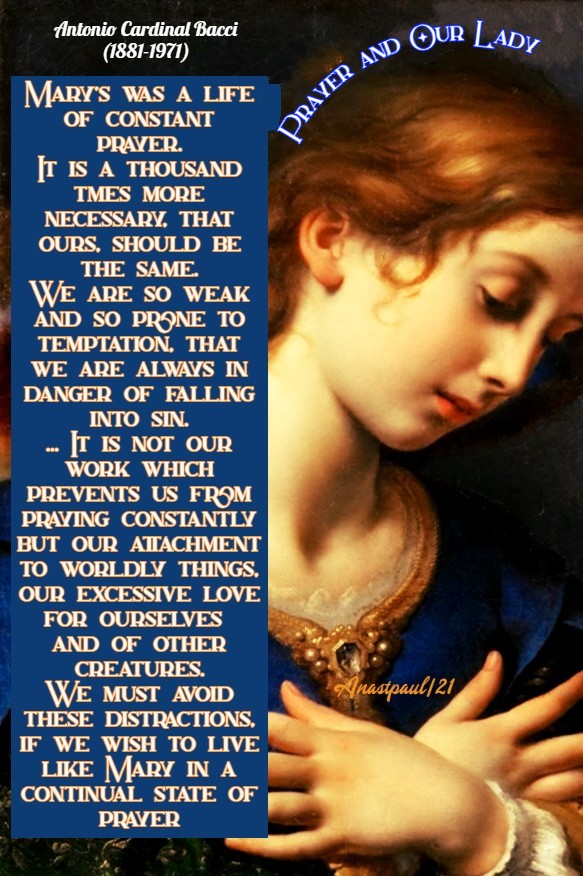
“Mary’s was a life of constant prayer. It is a thousand tmes more necessary, that ours, should be the same. We are so weak and so prone to temptation, that we are always in danger of falling into sin. “Without me, you can do nothing,” (Jn 15:5) Jesus tells us. “I am the vine, you are the branches. If anyone does not abide in me, he shall be cast outside as the branch and wither.” (Ibid). “Ask and it shall be given to you; seek and you shall find; knock and it shall be opened to you ” (Mt 7:7). In short, Jesus asks us to pray. He wants us to pray because He wants to give us His graces.
We cannot object that it is impossible for us to pray all the time because we have to work and fulfil other obligations. The work, which has first claim on us, is the service of God, which is prayer. Secondly, we can pray in tbe course of our daily work and of our different occupations, by offering to God, everything which we do. No matter what we are doing, we can raise our minds to God in an act of love and so remain always, close to Him.
It is not our work which prevents us from praying constantly but our attachment to worldly things, our excessive love for ourselves and of other creatures. We must avoid these distractions, if we wish to live like Mary in a continual state of prayer. ”
Quote/s of the Day – 16 May – “Mary’s Month” – Sunday within the Octave of the Ascension or The Seventh Sunday of Easter, Readings: Acts 1:11, Psalm 47: 2-3, 6-7, 8-9 (6), Second Ephesians 4: 1-1, John 17:1-11
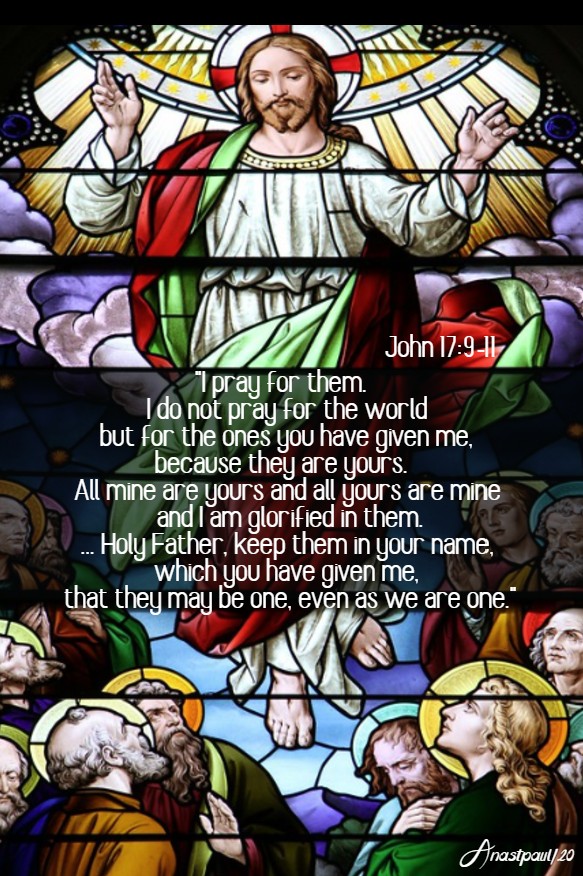
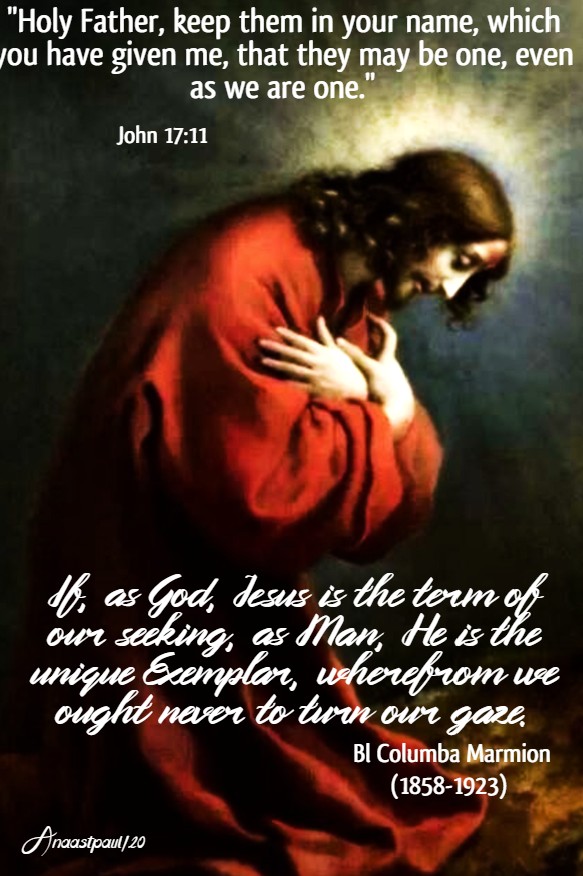
“I pray for them. I do not pray for the world but for the ones you have given me, because they are yours. All mine are yours and all yours are mine and I am glorified in them. … Holy Father, keep them in your name, which you have given me, that they may be one, even as we are one.”
John 17:9-11
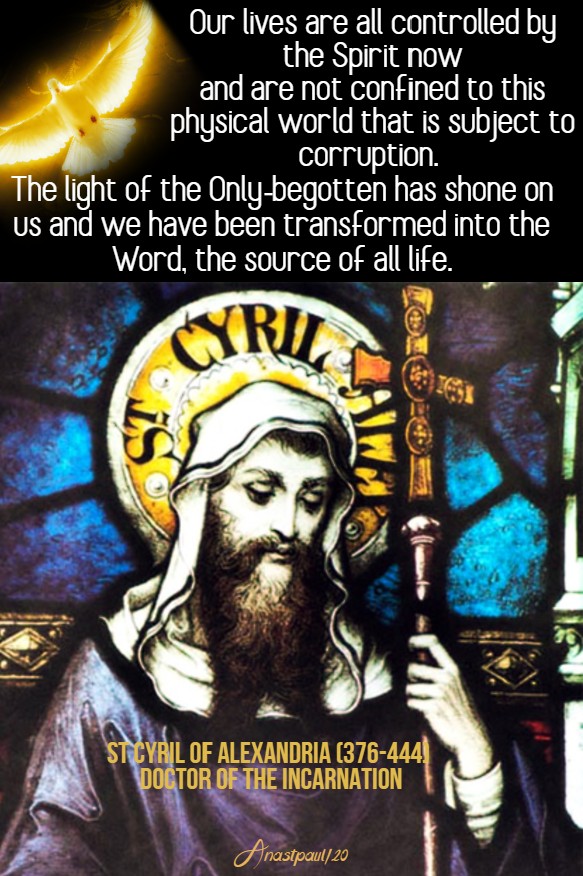
“Our lives are all controlled by the Spirit now and are not confined to this physical world that is subject to corruption. The light of the Only-begotten has shone on us and we have been transformed into the Word, the source of all life.”
St Cyril of Alexandria (376-444) Father and Doctor of the Incarnation
“If, as God, Jesus is the term of our seeking, as Man, He is the unique Exemplar, wherefrom we ought never to turn our gaze.”
One Minute Reflection – 16 May – “Mary’s Month” – Sunday within the Octave of the Ascension or The Seventh Sunday of Easter, Readings: Acts 1:11, Psalm 47: 2-3, 6-7, 8-9 (6), Second Ephesians 4: 1-1, John 17:1-11
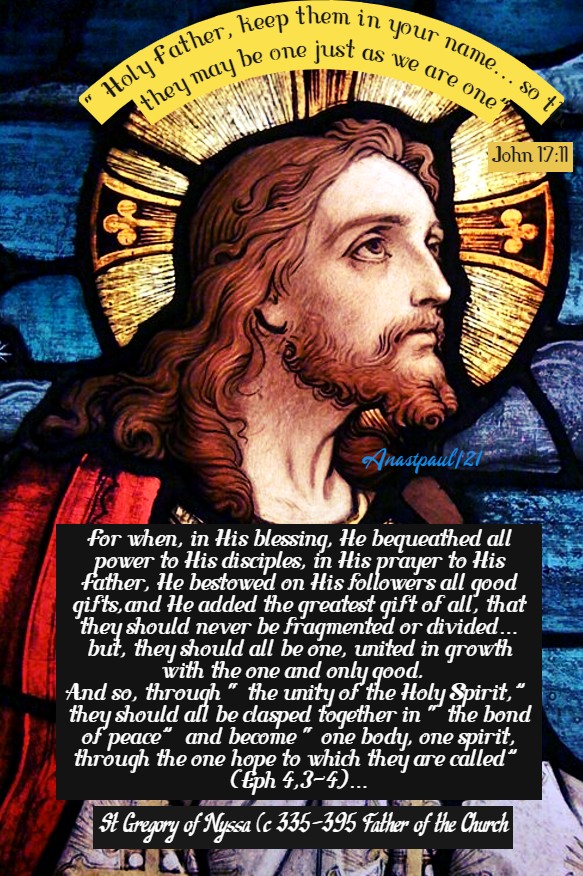
“Holy Father, keep them in your name… so that they may be one just as we are one” – John 17:11
REFLECTION – “The Beloved in the Song of Songs says: “My dove, my perfect one, is only one. She is the only child of her mother…” (6,9). The same point is made even more clearly by the Lord’s own words in the Gospel. For when, in His blessing, He bequeathed all power to His disciples, in His prayer to His Father, He bestowed on His followers all good gifts,and He added the greatest gift of all, that they should never be fragmented or divided… but, they should all be one, united in growth with the one and only good. And so, through “the unity of the Holy Spirit,” they should all be clasped together in “the bond of peace” and become “one body, one spirit, through the one hope to which they are called” (Eph 4,3-4)…
“That they may all be one, even as you, Father, are in me and I in you, that they also may be one.” The bond of this unity is glory and that the Holy Spirit is called “glory” no sensible person will deny, if he considers the Lord’s words: “The glory which you have given me, I have given them” (Jn 17,22). He truly gave such glory to His disciples, for He said to them: “Receive the Holy Spirit” (Jn 20,22). When He clothed Himself in human nature, Christ received this glory, which He had from all ages, “before the world began” (Jn 17,5) and, when His human nature was thus glorified by the Holy Spirit, the glory of the Spirit could be handed on to Christ’s kin, beginning with the disciples. This is the meaning of Christ’s words: “Father, the glory which you have given me I have given to them, that they may be one as we are one.” – St Gregory of Nyssa (c 335-395), Bishop, Brother of St Basil the Great – Sermon on the Song of Songs, no 15
PRAYER – Since it is from You, God our Father, that redemption comes to us, Your adopted children, look with favour on the family You love, grant us to seek You and to to find You in Your Son, Our Lord Jesus Christ.,, May our whole being become a copy of Your Son’s obedience and thus follow Him to You in our eternal heritage. We entreat Our Lady, Queen of Heaven to offer her prayers to You, to strengthen us in our temptations and trials. Through Christ, Our Lord, with the Holy Spirit, God for all eternity, amen.
Our Morning Offering – 15 May – “Mary’s Month” – Wednesday of the Fourth week of Easter, C
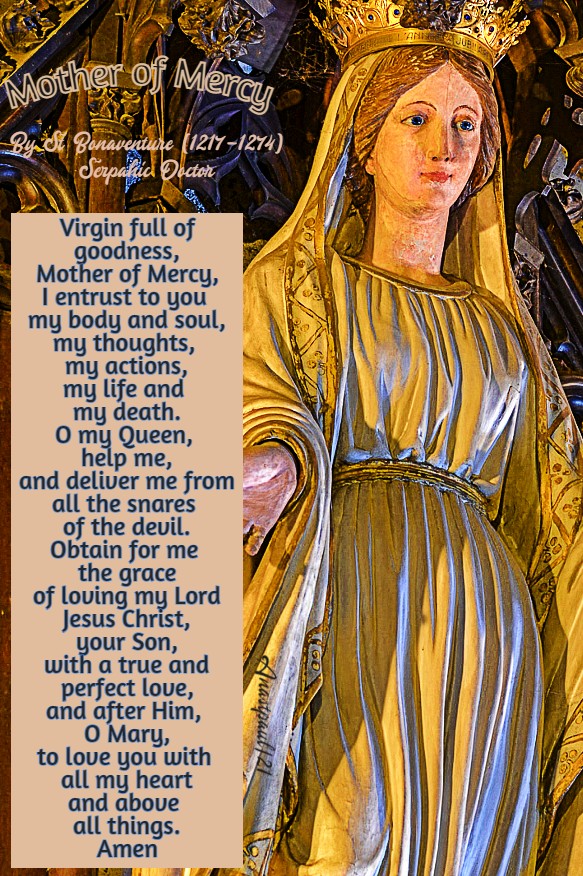
Mother of Mercy By St Bonaventure (1217-1274) Serpahic Doctor
Virgin full of goodness, Mother of Mercy, I entrust to you my body and soul, my thoughts, my actions, my life and my death. O my Queen, help me, and deliver me from all the snares of the devil. Obtain for me the grace of loving my Lord Jesus Christ, your Son, with a true and perfect love, and after him, O Mary, to love you with all my heart and above all things. Amen
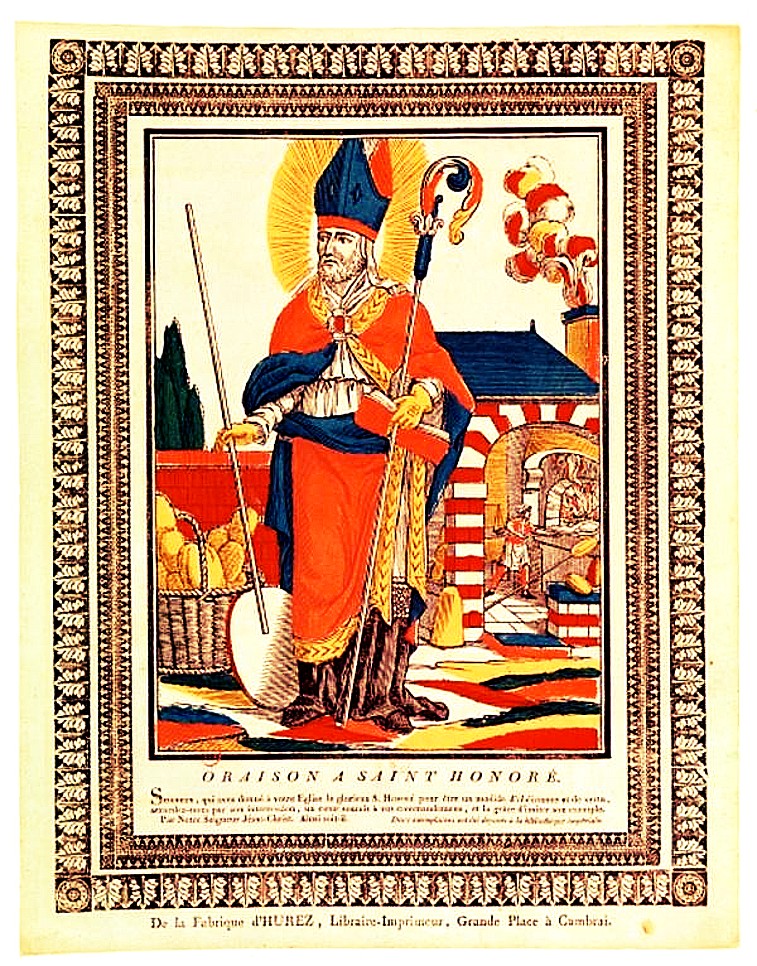
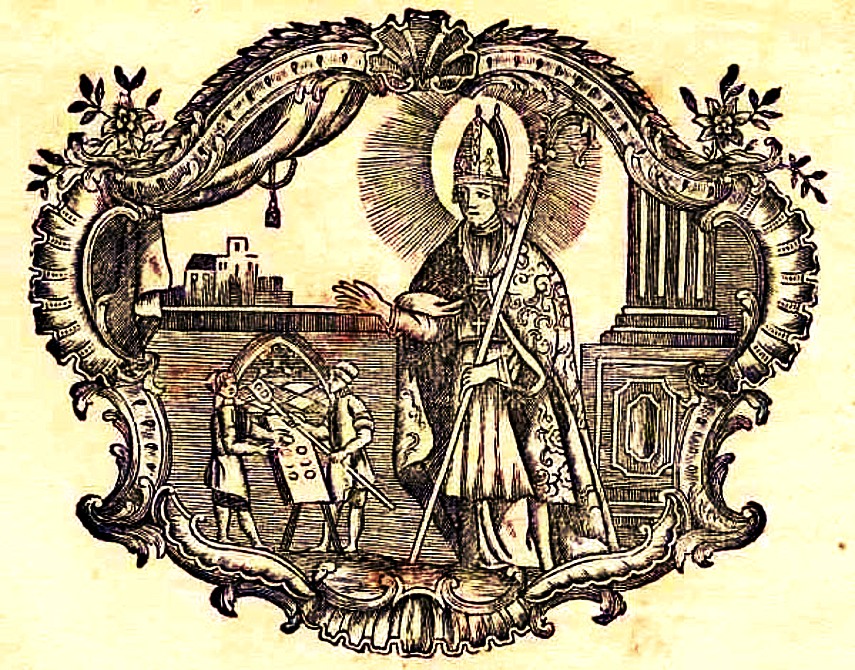
Saint of the Day – 16 May – Saint Honorius of Amiens (Died 653) The Seventh Bishop of Amiens., Miracle-worker. Borin in Port-le-Grand, France and died on 30 September 653 at Porthieu, Amiens of natural causes. Hs Feast Day relates to the date of exumation of his body in 1060. St Honorius served as Bishop of Amiens until his death of natural causes in 653. Also known as – Honoratus, Honoré, Honortus,. Patronages – bakers, confectioners, bakers of altar bread, candle-makers, florists, flour merchants, corn chandlers, oil refiners, and pastry chefs. Honorius is a Latin name (Honoratus) that means “person who is honoured for their merits.“
The Roman Martyrology states of him today: “In Amiens, of Neustria, France, Saint Honoratus, Bishop.“
Honorius was born into a nobile family he was educated by Saint Beatus of Amiens, his predeccesor in the See of Amiens. A pious child, as an adult he became the reluctant Bishop of Amiens. His reluctance was the result of Honorius considering himself unworthy of the position and responsibility. Legend says that a ray of divine light and holy oil appeared upon his head at the time of his selection.
He was not the only one who had difficulty accepting he was selected as Bishop. When th news of his election reached his hometown, his nursemaid, who was baking bread for the family, refused to believe that Honoratus had been elevated to such a position. She remarked that she would believe the news only if the peel she had been using to bake bread put down roots and turned itself into a tree. When the peel was placed into the ground, it was transformed into a mulberry tree that gave flowers and fruit. This miraculous tree was still being shown in the sixteenth century. This miracle is the cause of most of his patroages.
During his episcopate he was honoured with other extraordinary events, such as the discovery of the bodies of Saints Fuscio, Victorico and Genten, Martyrs, which had remained hidden from the faithful. for more than three hundred years. They also say of Saint Honoratus, that his Bishopric was signified by a series of wonders that demonstrated his sanctity, being, especially graced by the Lord.
Many miracles occurred during his lifetime and after his death. Centuries after his death, to help the needs of the people in times of terrible drought, Bishop Guy, son of the Count of Amiens, ordered a general procession, in which the urn with the body of the Saint was carried around the walls of the City. Thus by the prayers raised to St Honorius for his intercession at the throne of God, at last, the rain so desired and needed, fell in abundance. Over the centuries countless miracles are attributed to him, the paralysed walked, the deaf heard, the blind saw and the prisoners regained freedom.
His devotion was widespread in France following reports of numerous miracles when his body was exhumed in 1060.
In 1202, a baker named Renold Theriens donated to the City of Paris some land to build a Chapel in honour of St Honoriust. The Chapel became one of the richest in Paris and gave its name to Rue du Faubourg Saint-Honoré. In 1400, the bakers of Paris established their guild in the Church of Saint Honorius celebrating his feast on 16 May and spreading his cult. This devotion was so great that in 1659, Louis XIV specified that each baker “must observe the Feast of San Honorius, attend the divine service on 16 May and pay a retribution every Sunday to support the community’s expenses.”
He is also the patron of a Carthusian establishment at Abbeville, which was founded in 1306.
He is the namesake of the St Honoré Cake and their are many Villages, Towns, Churches, pastry shops and streets named for St Honorius.
Church of St Honorius in Paris
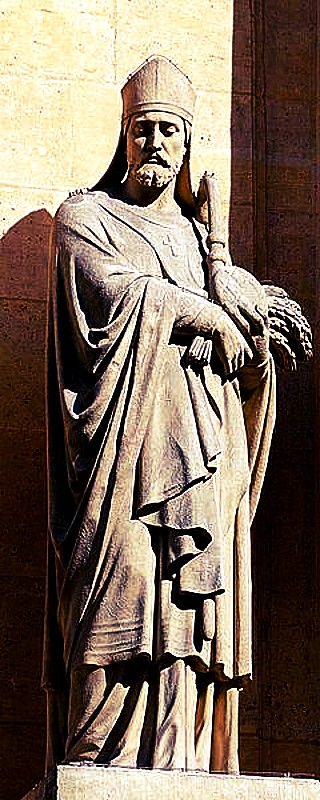
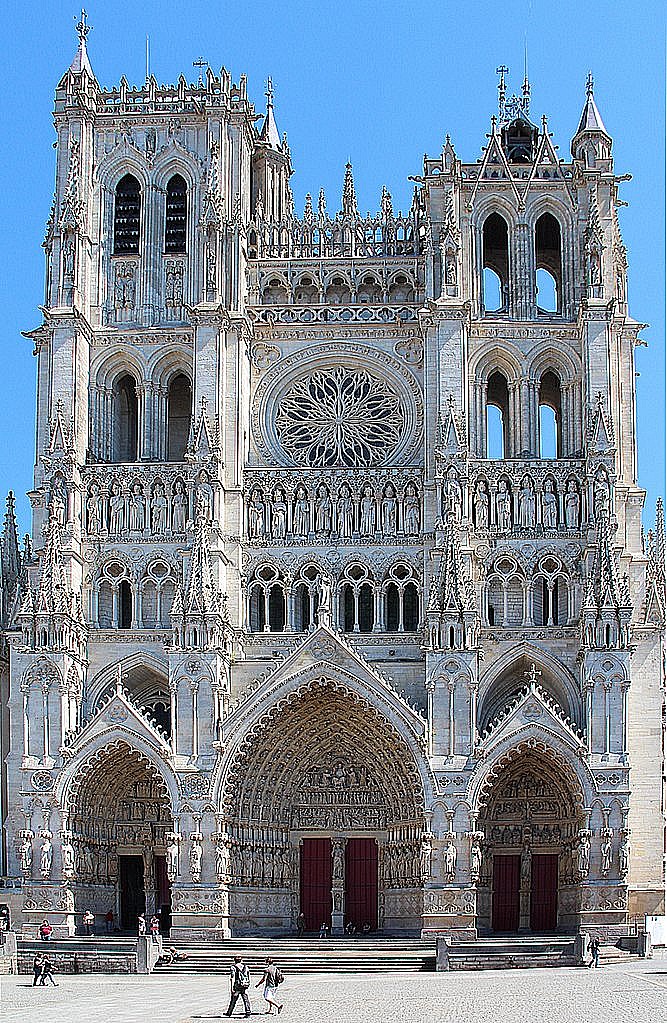
A statue of Honorius stands in the portal of Amiens Cathedral, see below.
Apparition of Our Lady to Saint Catherine of Alexandria (4th Century) – 16 May:
The Abbot Orsini wrote: “Apparition of Our Lady to Saint Catherine of Alexandria, whose body was discovered on the 13th of this month, on Mount Sinai, in consequence of a revelation which the Queen of heaven gave of it.”
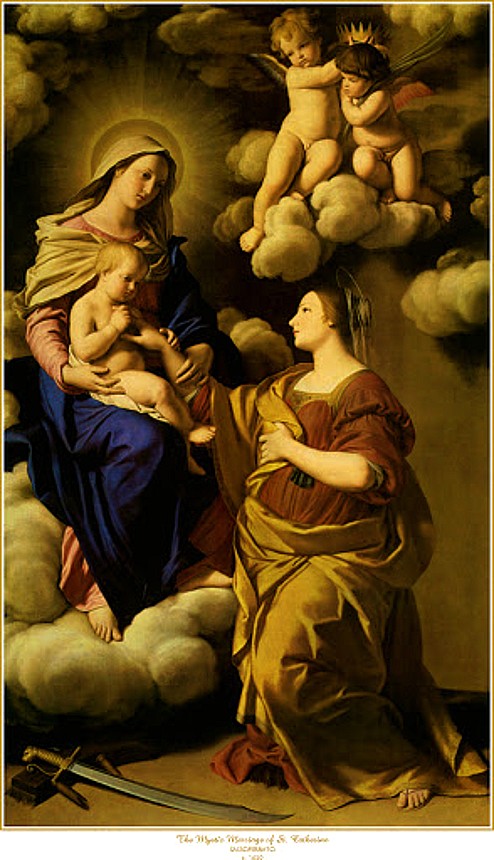
Saint Catherine of Alexandria, also known as Saint Catherine of the Wheel, is a Saint, Virgin, and Martyr. She was the beautiful daughter of King Costus and Queen Sabinella of Alexandria, who at a young age decided to remain a virgin until and unless, she should meet someone who exceeded her in status and political position, as well as beauty, intelligence and wealth. She decided upon Christ, who reigns over us all, for “His beauty is more radiant than the shining of the sun, His wisdom governs all creation and His riches are spread throughout all the world.” While yet a teenager, Saint Catherine received a vision of the Blessed Virgin Mary and Her Divine Son Jesus Christ. In this vision, the Mother of God gave Catherine to her Son in a mystical marriage. Mystical marriage is in some senses, very similar to a marriage ceremony, as Christ presents the chosen soul with a ring that is often invisible to others and often there are Saints and Angels present. There have been well over 70 documented mystical marriages of Saints and ,although the action is mysterious and not well understood, it appears, that Christ gives special attention to these Saints. Saint Teresa explained, that it was the highest state a soul could achieve in this life, and represents a transforming and constant union with the Blessed Trinity.
Saint Catherine was Martyred by the Roman Emperor Maxentius when she refused his proposal of marriage. Again, according to tradition, her body was taken by Angels to Mount Sinai where a Church and Monastery were built in her honour. Saint Catherine’s relics were rediscovered about the year 800. Her hair was still growing and there was a continuous stream of oil coming from her body that was found to have miraculous properties. King Saint Edward was said to have collected some of that oil and taken it back to his kingdom.
Saint Catherine, along with Saint Margaret, were the two Saints who spoke to encourage Saint Joan of Arc in her mission.
St Abdas of Cascar Bl Adam of Adami Bl Adam of San Sabine
St Carantac St Carantoc St Diocletian of Osimo St Felix of Uzalis St Fidolus of Aumont St Fiorenzo of Osimo St Fort of Bordeaux St Francoveus St Gennadius of Uzalis St Germerius of Toulouse St Hilary of Pavia St Honorius of Amiens (Died 653) Bishop Bl Louis of Mercy
St Ubaldus Baldassini St Victorian of Isauria Bl Valdimir Ghika — Martyrs of Saint Sabas: A group of monks, whose names have not come down to us, who were massacred by Moors at the monastery of Saint Sabas in Palestine.
Thought for the Day – 15 May – Meditations with Antonio Cardinal Bacci (1881-1971)
The Power of Mary
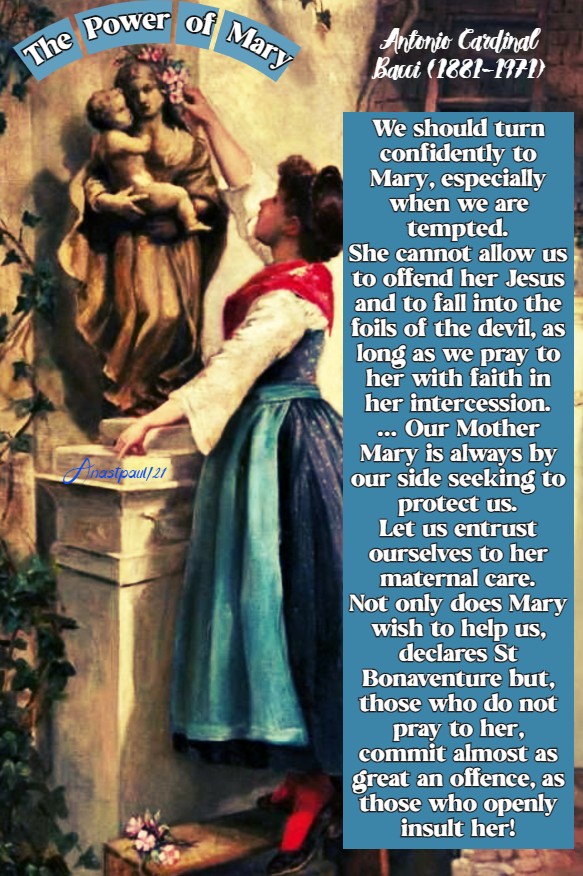
“We should turn confidently to Mary, especially when we are tempted. She cannot allow us to offend her Jesus and to fall into the foils of the devil, as long as we pray to her with faith in her intercession. “The devil, as a roaring lion,” says St Peter, “goes about seeking someone to devour” (1 Peter 5:8). But, our Mother Mary is always by our side seeking to protect us. Let us entrust ourselves to her maternal care. Not only does Mary wish to help us, declares St Bonaventure but, those who do not pray to her, commit almost as great an offence, as those who openly insult her (In Spec Virg)!
Quote/s of the Day – 15 May – “Mary’s Month” – Readings: Acts 18: 23-28, Psalms 47: 2-3, 8-9, 10, John 16: 23-28
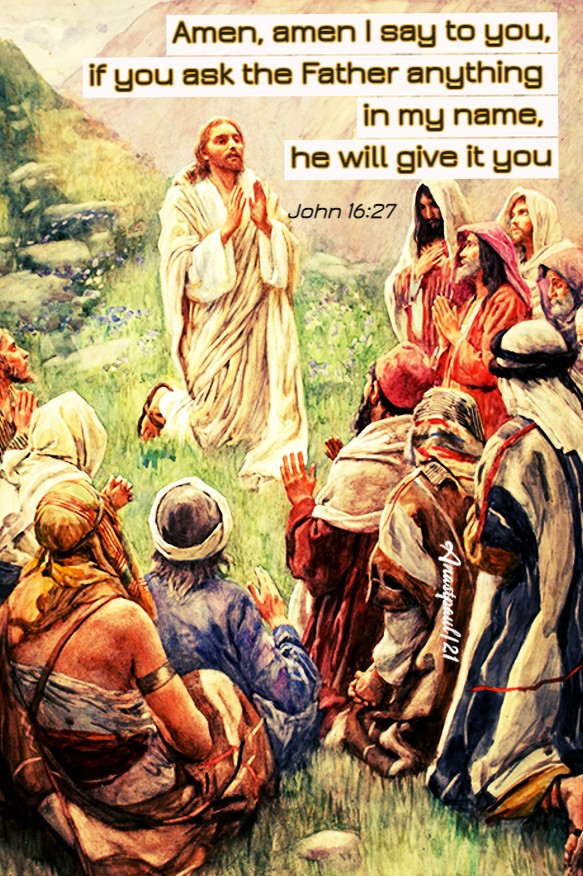
“Amen, amen I say to you, if you ask the Father anything in my name, he will give it you.”
John 16:27
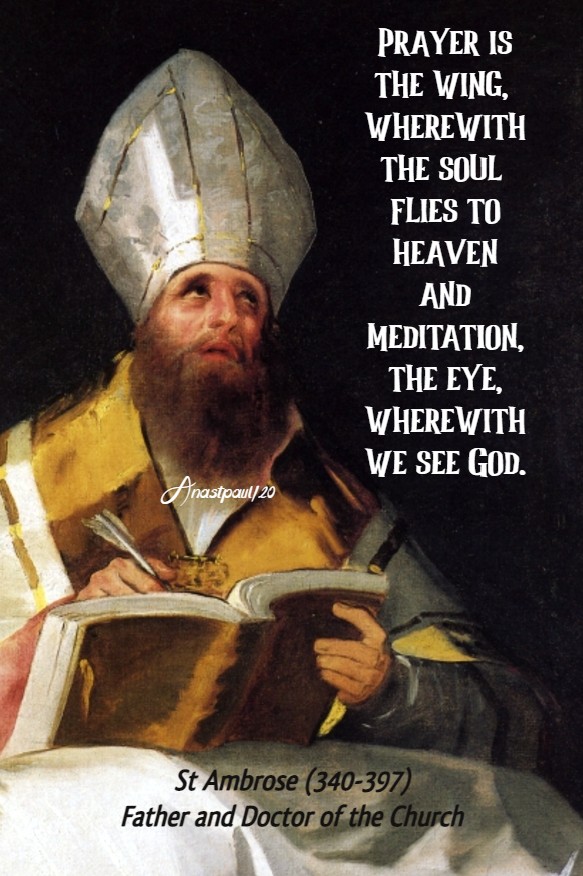
“Prayer is the wing, wherewith the soul flies to heaven and meditation, the eye, wherewith we see God.”
St Ambrose (340-397) Father and Doctor of the Church
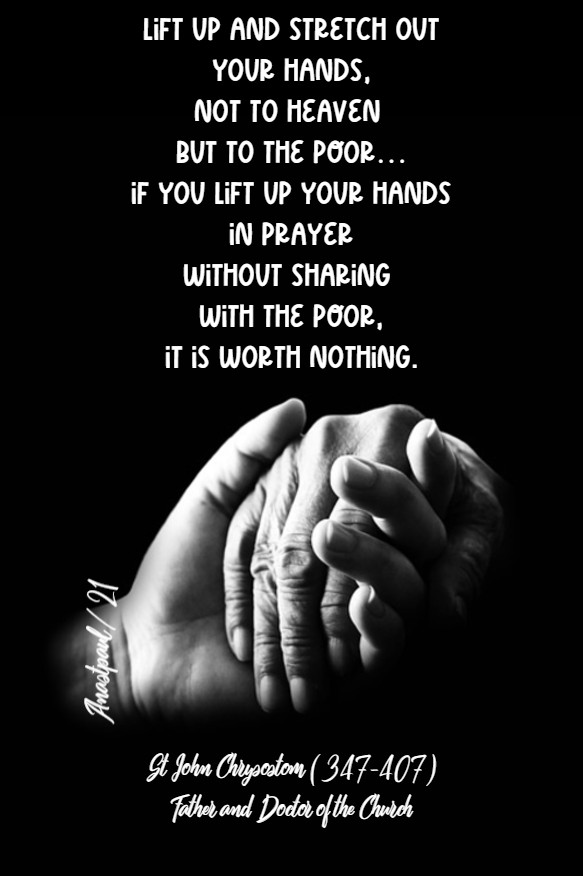
“Lift up and stretch out your hands, not to heaven but to the poor… if you lift up your hands in prayer without sharing with the poor, it is worth nothing.”
St John Chrysostom (347-407) Father and Doctor of the Church
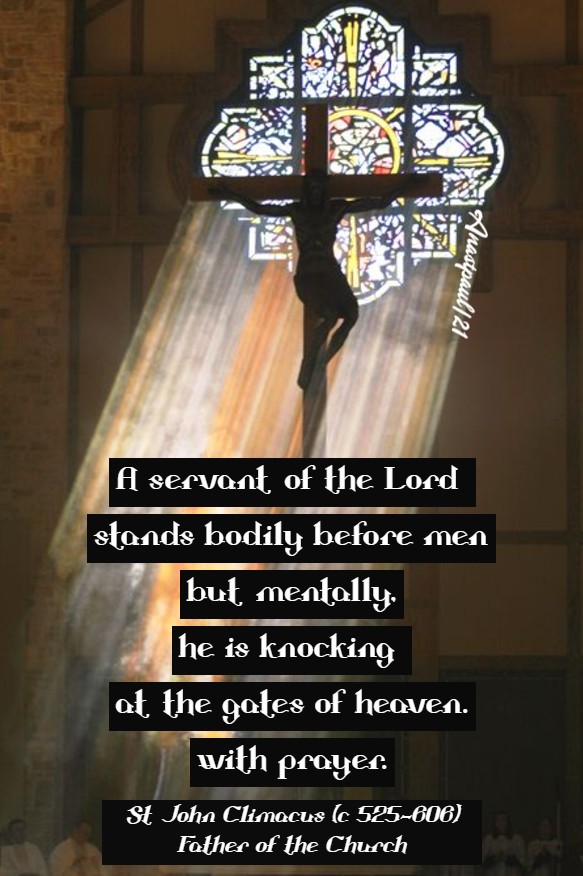
“A servant of the Lord stands bodily before men but mentally, he is knocking at the gates of heaven. with prayer.”
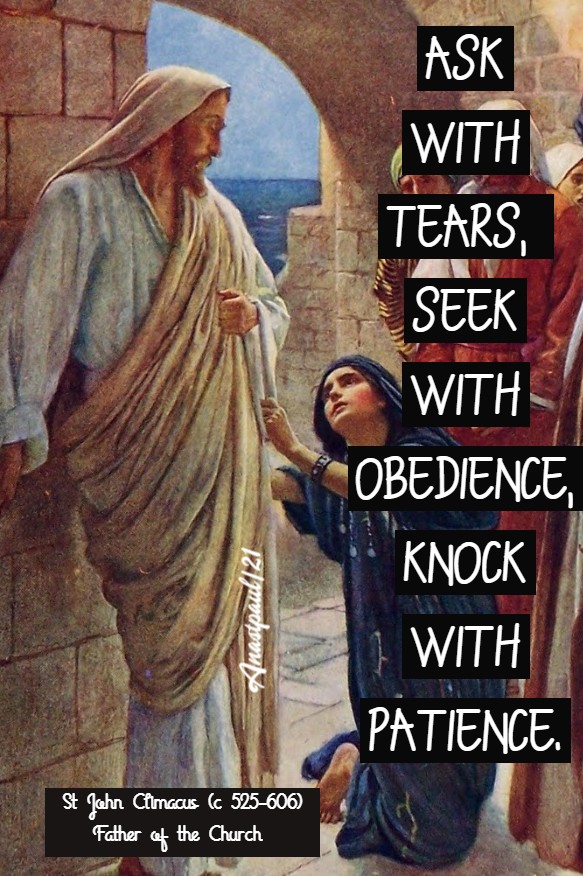
“Ask with tears, seek with obedience, knock with patience.”
St John Climacus (c 525-606) Father of the Church
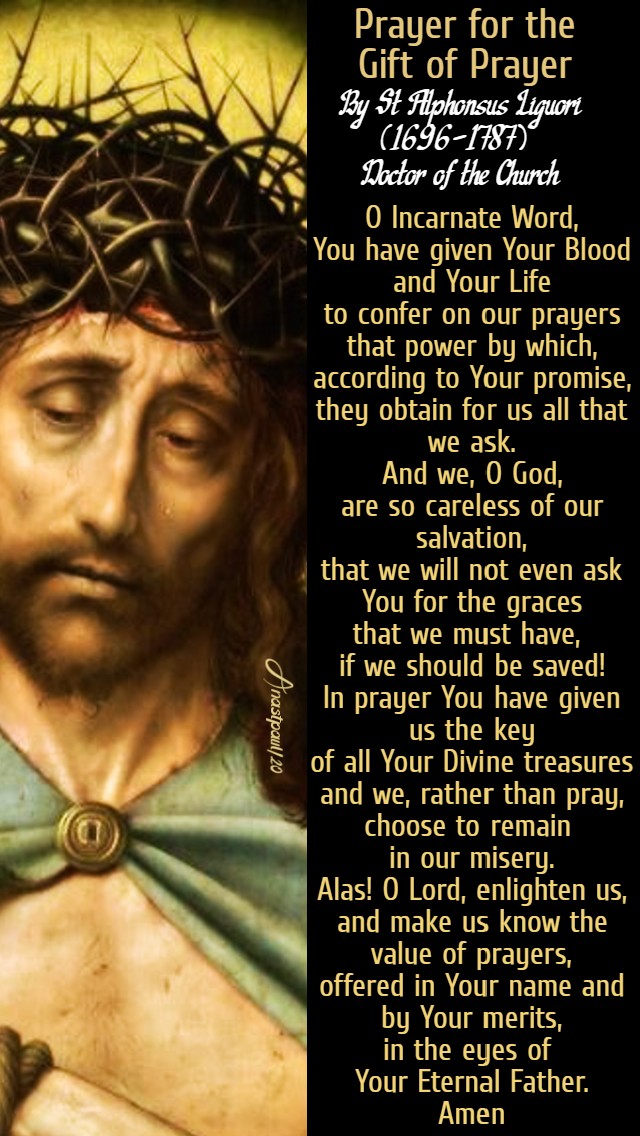
Prayer for the Gift of Prayer By St Alphonsus Liguori (1696-1787) Most Zealous Doctor
O Incarnate Word, You have given Your Blood and Your Life to confer on our prayers that power by which, according to Your promise, they obtain for us all that we ask. And we, O God, are so careless of our salvation, that we will not even ask You for the graces that we must have, if we should be saved! In prayer You have given us the key of all Your Divine treasures; and we, rather than pray, choose to remain in our misery. Alas! O Lord, enlighten us, and make us know the value of prayers, offered in Your name and by Your merits, in the eyes of Your Eternal Father. Amen
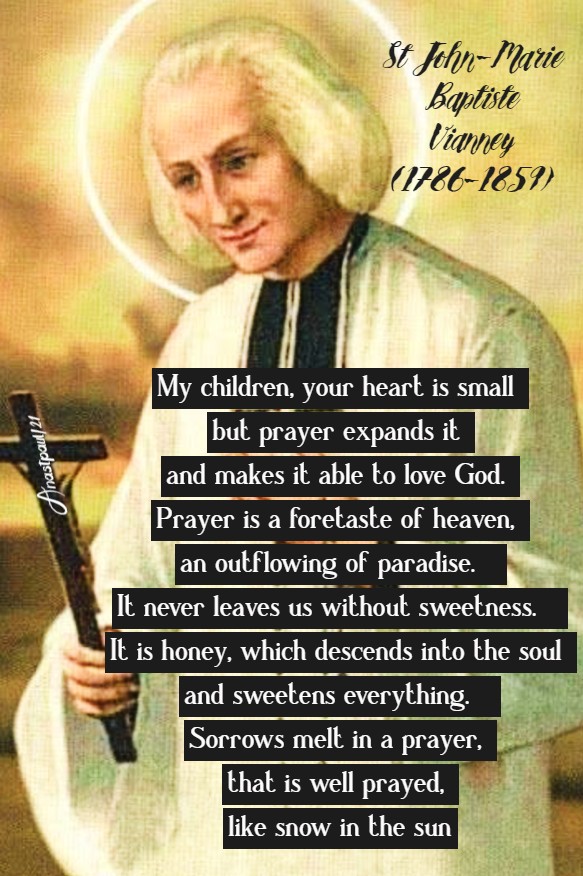
“My children, your heart is small but prayer expands it and makes it able to love God. Prayer is a foretaste of heaven, an outflowing of paradise. It never leaves us without sweetness. It is honey, which descends into the soul and sweetens everything. Sorrows melt in a prayer, that is well prayed, like snow in the sun.”
Our Morning Offering – 15 May – ‘Mary’ Month’ – Saturday within the Octave of th Ascension
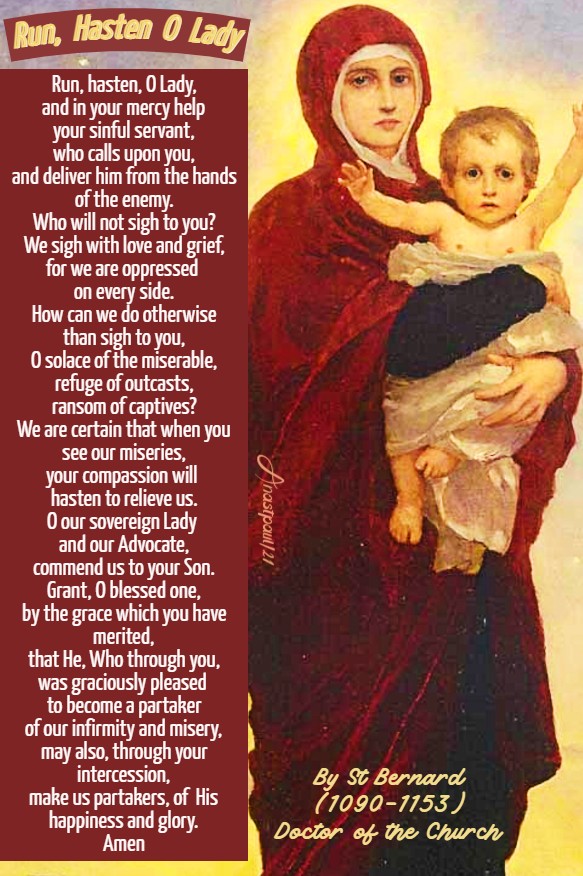
Run, Hasten O Lady By St Bernard (1090-1153) Doctor of the Church
Run, hasten, O Lady, and in your mercy help your sinful servant, who calls upon you, and deliver him from the hands of the enemy. Who will not sigh to you? We sigh with love and grief, for we are oppressed on every side. How can we do otherwise than sigh to you, O solace of the miserable, refuge of outcasts, ransom of captives? We are certain that when you see our miseries, your compassion will hasten to relieve us. O our sovereign Lady and our Advocate, commend us to your Son. Grant, O blessed one, by the grace which you have merited, that He, Who through you, was graciously pleased to become a partaker of our infirmity and misery, may also, through your intercession, make us partakers, of His happiness and glory. Amen
One Minute Reflection – 15 May – “Mary’s Month” – Readings: Acts 18: 23-28, Psalms 47: 2-3, 8-9, 10, John 16: 23-28
“In that day, you will ask in My Name” – John 16:26
REFLECTION – “At the end of our prayers we say: “Through Jesus Christ Thy Son, our Lord” and not “Through the Holy Spirit.” This practice of the Universal Church is not without reason. At its root lies the Mystery according to which, Jesus Christ is the Mediator between God and humanity (1 Tim 2:5), a Priest forever, according to the order of Melchizedek, He who, with His own Blood, entered into the Holy of Holies, not that which was only a copy but, into Heaven itself, where He is at the Right Hand of God and intercedes for us (Heb 6:20; 9:24).
It was in His consideration of Christ’s Priesthood, that the Apostle said: “Through Him let us continually offer God a sacrifice of praise, that is, the fruit of lips which confess His Name” (Heb 13:15). It is through Him that we offer the sacrifice of praise and prayer because it is His death that reconciled us while we were still enemies (Rom 5:10). He willed to offer Himself in sacrifice for our sakes and, since then, it is through Him, that our offerings can be acceptable in God’s sight. This is why Saint Peter warns us in these words: “Like living stones, let yourselves be built into a spiritual house to be a holy priesthood to offer spiritual sacrifices acceptable to God, through Jesus Christ” (1 Pt 2:5). This is the reason why we say to God the Father: “Through Jesus Christ Thy Son, our Lord.” – Saint Fulgentius of Ruspe (467-532) – Bishop in North Africa (Letter 14,36).
PRAYER – Since it is from You, God our Father, that redemption comes to us, Your adopted children, look with favour on the family You love, hear our prayer as we unite our voices in the name of Your Son, our Lord and Redeemer. May our faith, love and joy in Christ bring us all alike to our eternal heritage and may the prayer of His blessed Mother and ours lead us safely home. We make our prayer through Christ our Lord, in the unity of the Holy Spirit, God with You, loving Father, forever, amen.
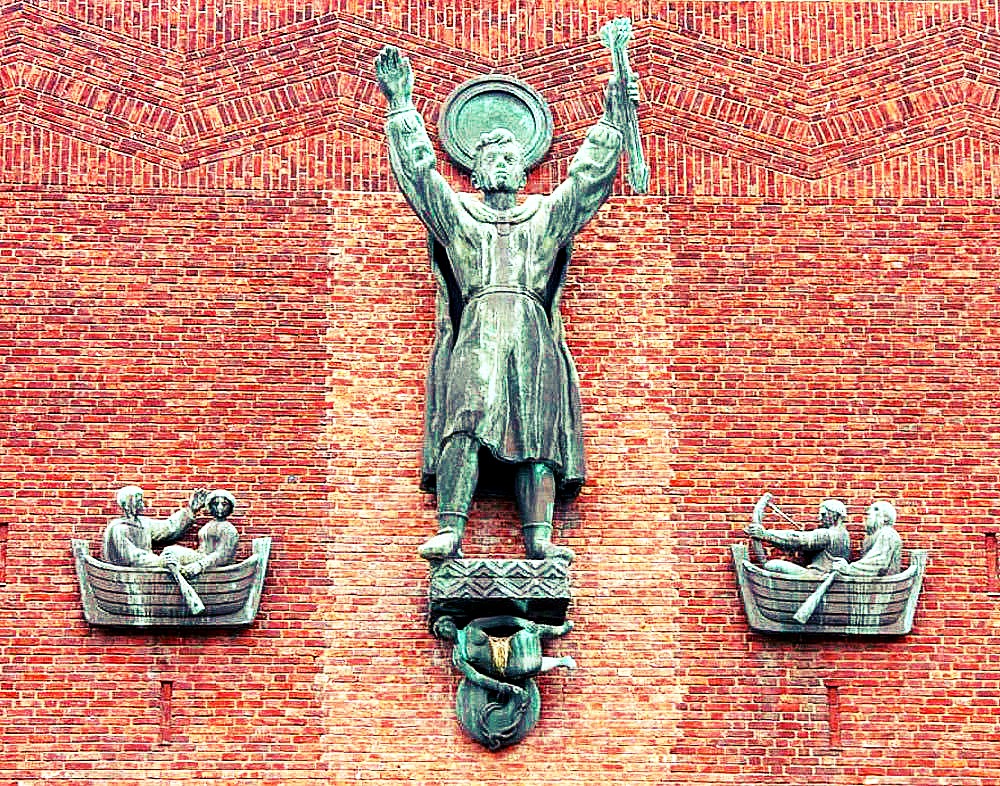
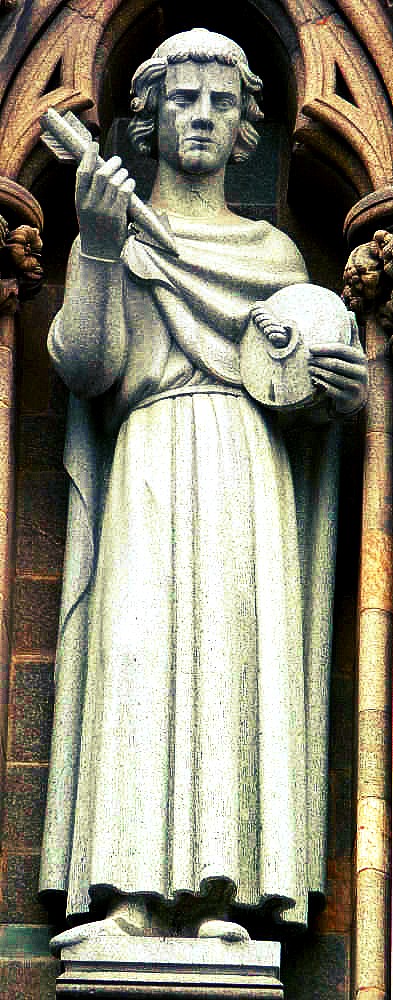
Saint of the Day – 15 May – Saint Hallvard of Oslo (c 1020-1043) Martyr in defence of innocence. Born in c 1020 and died by being shot with an arrow at Drammen, Norway. Patronages – Oslo, Innocence.
Saint Hallvard was born of noble parents. He grew up on his father’s farm, well-liked by everyone. He loved Christianity, was obedient to his parents, loving his neighbour, chaste and in every way honest and just.
Hallvard became a merchant. An introductory story to the legend tells that he was once on Gotland on a trade trip. “Then one of the inhabitants of the land, a rich man named Borvid, came to the strangers and asked who they were. He stood looking at Hallvard for a while and then said, ‘Who is this young man?’ They explained his name and lineage. When he heard this, he said: ‘You have an unusual face and are different to the others. I know for a fact that a great One, will shine upon you.” After this prophecy, he invited the Saint and his companions to a banquet, bought all of Hallvard’s goods and paid more than the Saint asked for.
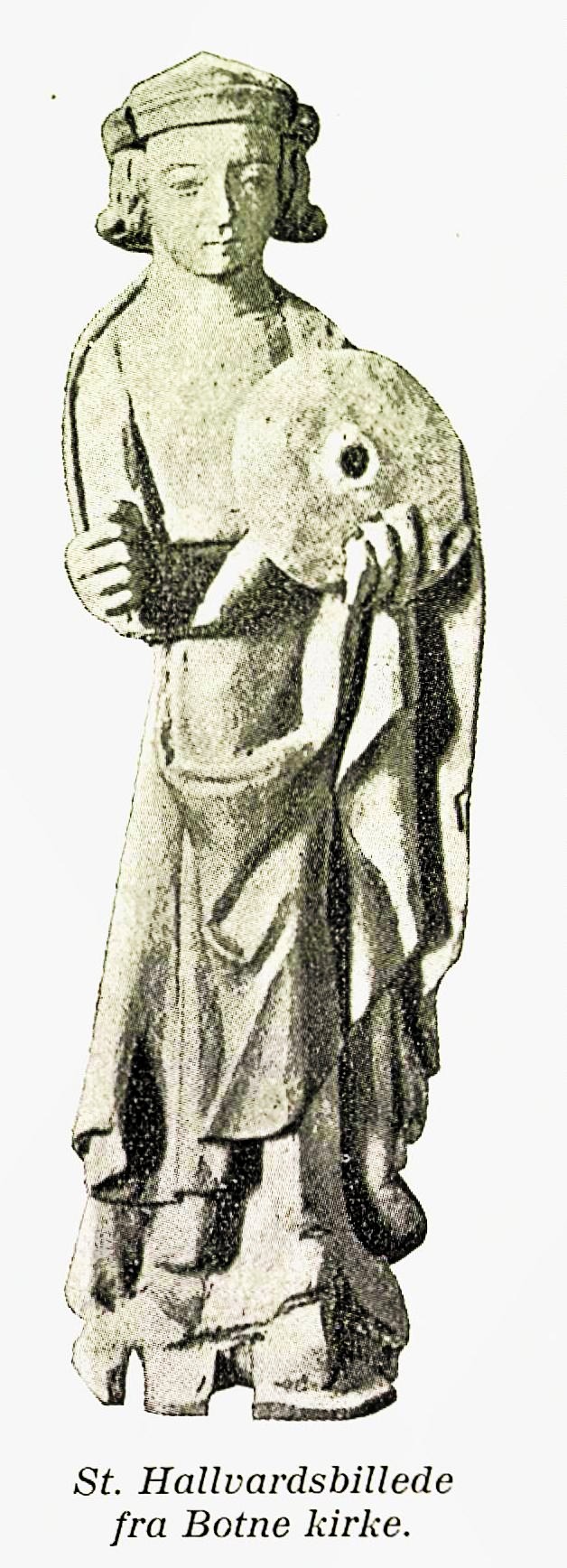
Saint Hallvard is depicted in the Seal of the City of Oslo, holding the millstone and arrows used to kill him, with the woman he defended at his feet
The legend continues: “Shortly afterwards, in the spring, Saint Hallvard left home to trade in the neighbourhood. He came to a lake called Drafn, there he found a small boat and went on board. But suddenly a pregnant woman appeared, she tremblingly asked to join him on board. When asked who she was and where she was going, she gave her name and said that when she wanted to cross the sea and saw a boat that was going to set out, she came running as fast as she could because she feared for her life. He said she could sit in the stern and then he rowed away. But suddenly he saw three men running down to the beach. They jumped on board another boat and came after Hallvard and his passenger.
The saint said to the woman, ‘Do you know them?’ She replied, ‘Yes, I know them.’ He said: ‘I see that they are after you. Tell me what you did! ‘ She replied. ‘It’s true that they are persecuting me but I have not done what they accuse me of. They accuse me of theft. ‘ He said, ‘Can you cleanse yourself of the charge by carrying iron burdens?’ She said, ‘Yes, I can,and I’m willing to do it as long as they spare me.
But the men, who were close to catching them again, said: ‘Why do you, Hallvard, an honourable young man protect such a bad woman? Surrender her so she can die. She deserves it. ‘ Hallvard said to them, ‘What has she done?’ They replied, ‘She broke into our brother’s house and stole his belongings.’ He asked them, ‘And how did she get into the house?’ They said, ‘She pulled the ring that held the lock out of the doorpost.’ He said: ‘No woman can do that, only a very strong man! Has anyone seen her do this? Or have you found stolen goods in her house? And if it is not certain that she has stolen, then why should she die? Wouldn’t it be more appropriate to let her clear herself of the accusation if she can? And if she can not, then she will either be judged according to the law, or I will pay her ransom. For you should not kill a pregnant woman and the child she is carrying. Do not do anything hasty now! ‘
Instead, they screamed, furiously. One of them grabbed his bow and tightened it and the arrow, which was fired with full force, drilled into the Martyr’s chest. After he was murdered, they also killed the woman and buried her on the beach. And to the Saint’s neck they bound a stone and lowered him into the deep. But by the grace of God and by the merits of the Martyr, long after his body was found, with the stone, floating on the sea. “ He was buried in the Saint Hallvard Cathedral, Oslo.
The Hallvard legend formed the basis for a local cult of Hallvard in the Middle Ages. His feast day is widely celebrated especially in Eastern Norway, especially in Viken. His connection to Oslo was strengthened by the fact that his image became part of the City’s Coat pf Arms, see below, as early as the 14th century and he has often been referred to as “Oslo’s Patron Saint.”
Oslo’s Coat of Arms depicting St Halvard and the inocent woman
Oslo Municipality has made Hallvard’s Day 15 May, the City’s official holiday and the municipality’s highest award, the St Hallvard Medal, was named after him in 1950.
St Hallvard Church and Monastery on Enerhaugen was Consecrated as a Franciscan Monastery and Parish Church for the eastern Parish of the Oslo Catholic Diocese.
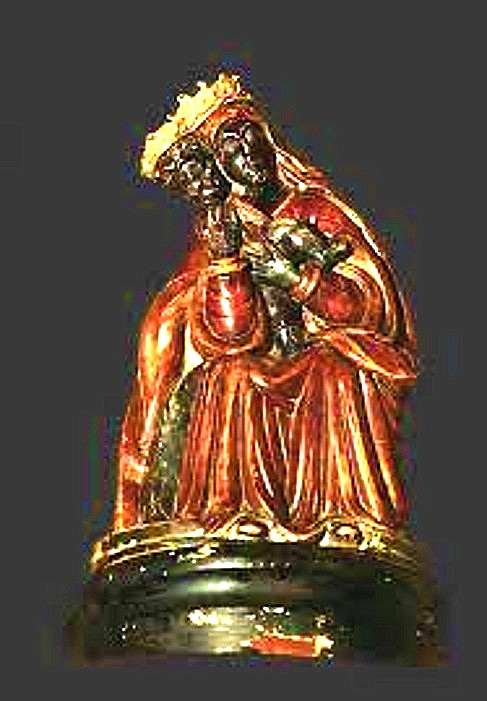
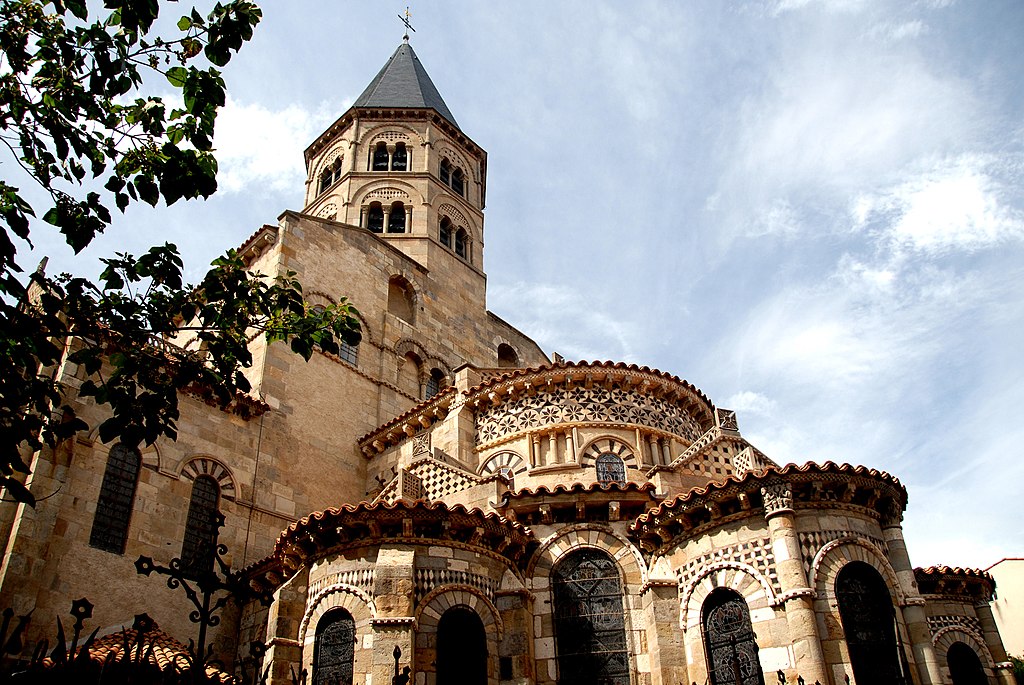
Notre-Dame-du-Port, Clermont-Ferrand, Puy de Dôme, Auvergne / Our Lady of the Port, (1614) – 15 May:
Clermont-Ferrand is located on a plain in the volcanic region of central France. Unlike most hub cities, it is not on a body of water. And yet ,for a thousand years, Clermont’s eastern district has been known as the Port.
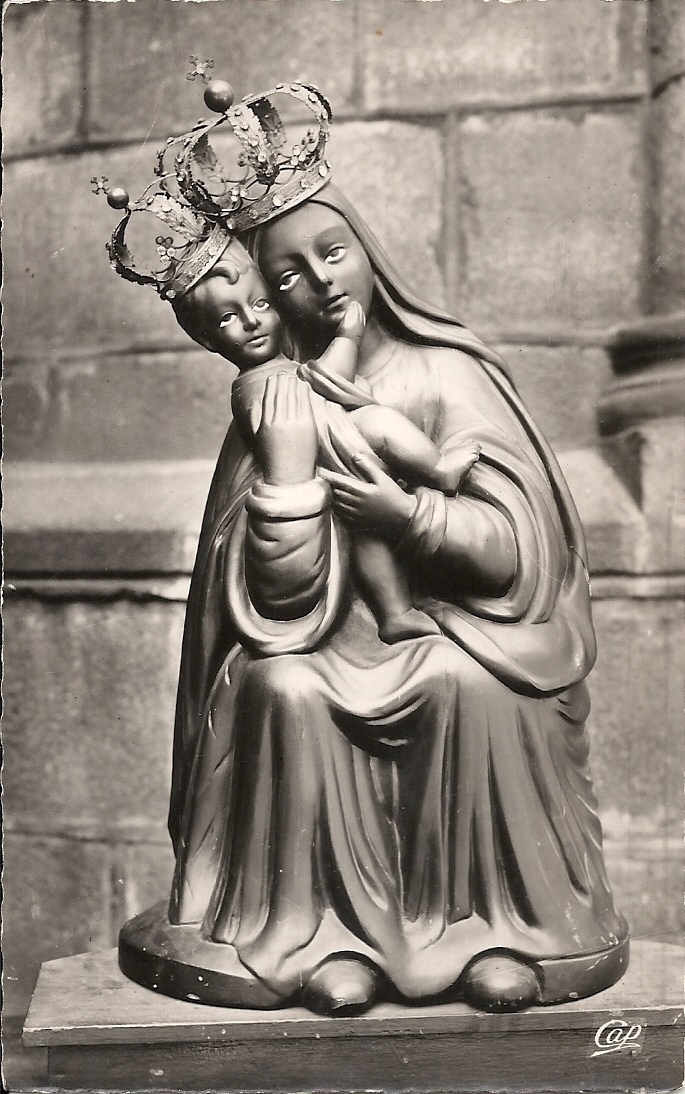
In the crypt of its Romanesque Church of Our Lady of the Port, dating to the early 1100s, is an unusual Black Virgin, a polychromed walnut Statue just under a foot high. This long-revered image is a copy made around 1800 of a Statue from the 1200s, which was held to be a copy of an even earlier image–possibly going back to the Shrine’s foundation by St Avit in the 500s, or possibly a copy of a Byzantine icon brought by returning Crusaders. Mary cradles the child against her cheek, such as the Notre-Dame de Grâce, given in 1450 to Cambrai Cathedral in northern France. n 1614, snow and bitter cold enveloped the area without stopping from Martinmas (11 November) to Easter. By May, there were still no buds and no grass and famine loomed. The leaders and Priests conferred. They asked the Chapter to bring out the image of Our Lady of the Port from the collegiate Church.
The four-hour procession took place on the morning of Ascension Day, May 15, 1614. Some 8,000 people followed the holy image and relics of Saints around the City walls, chanting litanies. The next day, the weather grew milder and in the following days, truly beautiful. To the joy of all, the harvests were excellent that summer and even more abundant the next year.
The new Bishop, Joachim d’Estaing, on 5 May 1616, ordered an inquiry among the town notables, after which he issued an ordinance declaring that the Feast of Notre-Dame du Port would take place on 15 May in the Parish and be observed as a day of rest in the future.
The Statue was crowned in 1875 and on 15 May 1881, Pope Leo XII declared the Church a Minor Basilica. The procession of the first Sunday after 15 May remains joyously well attended.
Bercthun of Beverley Bertha of Bingen St Caecilius of Granada St Caesarea of Otranto St Cassius of Clermont Bl Clemente of Bressanone St Colman Mc O’Laoighse St Ctesiphon of Verga Blessed Diego of Valdieri
St Gerebernus St Hallvard of Oslo (c 1020-1043) Martyr St Hesychius of Gibraltar St Hilary of Galeata St Indaletius of Urci St Isaias St Isidore of Chios Bl Joan Montpeó Masip St Maximus of Clermont St Nicholas the Mystic St Rupert of Bingen St Secundus of Avila St Simplicius of Sardinia St Sophia of Rome St Victorinus of Clermont St Waldalenus of Beze
Thought for the Day – 14 May – Meditations with Antonio Cardinal Bacci (1881-1971)
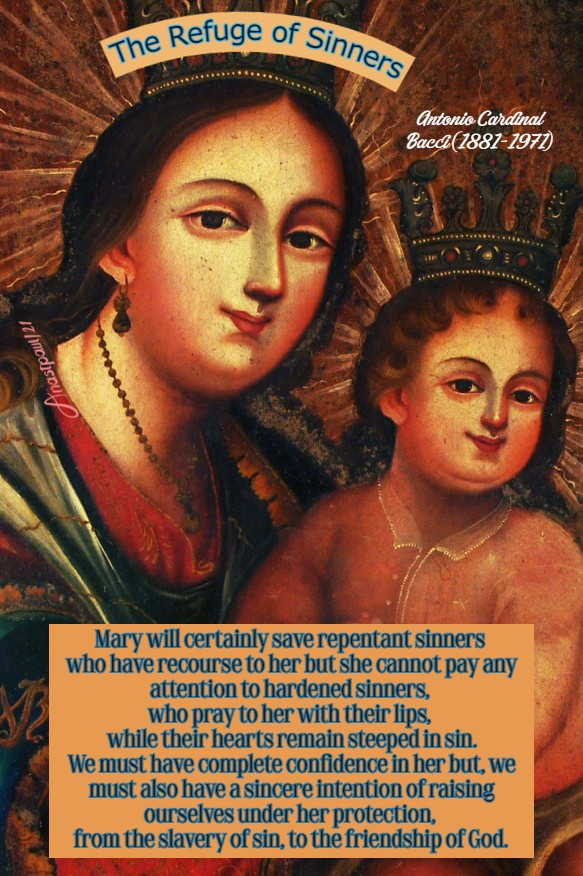
The Refuge of Sinners
“Mary is called, the Star of Sea because, as St Thomas Aquinas says, “even as sailors are guided into port, by means of a star, so Christians are guided towards Heaven, by means of Mary, .” (Opuse, 7). This absolute guarantee of the protection of our heavenly Mother, should increase our trust in her and lead us to turn towards her in every difficulty and temptation. It should not, however, result in an unhealthy attitude of spiritual inactivity, a passive dependence on Mary’s favours, without any co-operation on our part. Such behaviour would be the height of filial ingratitude. Mary will certainly save repentant sinners who have recourse to her but she cannot pay any attention to hardened sinners, who pray to her with their lips, while their hearts remain steeped in sin. We must have complete confidence in her but, we must also have a sincere intention of raising ourselves under her protection, from the slavery of sin, to the friendship of God.
























 AnaStpaul
You must be logged in to post a comment.